EP1627928A1 - Controlled warm-rolling method - Google Patents
Controlled warm-rolling method Download PDFInfo
- Publication number
- EP1627928A1 EP1627928A1 EP04734147A EP04734147A EP1627928A1 EP 1627928 A1 EP1627928 A1 EP 1627928A1 EP 04734147 A EP04734147 A EP 04734147A EP 04734147 A EP04734147 A EP 04734147A EP 1627928 A1 EP1627928 A1 EP 1627928A1
- Authority
- EP
- European Patent Office
- Prior art keywords
- rolling
- temperature
- pass
- warm control
- strain
- Prior art date
- Legal status (The legal status is an assumption and is not a legal conclusion. Google has not performed a legal analysis and makes no representation as to the accuracy of the status listed.)
- Granted
Links
Images



Classifications
-
- C—CHEMISTRY; METALLURGY
- C21—METALLURGY OF IRON
- C21D—MODIFYING THE PHYSICAL STRUCTURE OF FERROUS METALS; GENERAL DEVICES FOR HEAT TREATMENT OF FERROUS OR NON-FERROUS METALS OR ALLOYS; MAKING METAL MALLEABLE, e.g. BY DECARBURISATION OR TEMPERING
- C21D8/00—Modifying the physical properties of ferrous metals or ferrous alloys by deformation combined with, or followed by, heat treatment
- C21D8/02—Modifying the physical properties of ferrous metals or ferrous alloys by deformation combined with, or followed by, heat treatment during manufacturing of plates or strips
- C21D8/0221—Modifying the physical properties of ferrous metals or ferrous alloys by deformation combined with, or followed by, heat treatment during manufacturing of plates or strips characterised by the working steps
- C21D8/0231—Warm rolling
-
- C—CHEMISTRY; METALLURGY
- C21—METALLURGY OF IRON
- C21D—MODIFYING THE PHYSICAL STRUCTURE OF FERROUS METALS; GENERAL DEVICES FOR HEAT TREATMENT OF FERROUS OR NON-FERROUS METALS OR ALLOYS; MAKING METAL MALLEABLE, e.g. BY DECARBURISATION OR TEMPERING
- C21D8/00—Modifying the physical properties of ferrous metals or ferrous alloys by deformation combined with, or followed by, heat treatment
-
- C—CHEMISTRY; METALLURGY
- C21—METALLURGY OF IRON
- C21D—MODIFYING THE PHYSICAL STRUCTURE OF FERROUS METALS; GENERAL DEVICES FOR HEAT TREATMENT OF FERROUS OR NON-FERROUS METALS OR ALLOYS; MAKING METAL MALLEABLE, e.g. BY DECARBURISATION OR TEMPERING
- C21D8/00—Modifying the physical properties of ferrous metals or ferrous alloys by deformation combined with, or followed by, heat treatment
- C21D8/02—Modifying the physical properties of ferrous metals or ferrous alloys by deformation combined with, or followed by, heat treatment during manufacturing of plates or strips
- C21D8/04—Modifying the physical properties of ferrous metals or ferrous alloys by deformation combined with, or followed by, heat treatment during manufacturing of plates or strips to produce plates or strips for drawing, e.g. for deep-drawing
- C21D8/0421—Modifying the physical properties of ferrous metals or ferrous alloys by deformation combined with, or followed by, heat treatment during manufacturing of plates or strips to produce plates or strips for drawing, e.g. for deep-drawing characterised by the working steps
- C21D8/0431—Warm rolling
-
- C—CHEMISTRY; METALLURGY
- C21—METALLURGY OF IRON
- C21D—MODIFYING THE PHYSICAL STRUCTURE OF FERROUS METALS; GENERAL DEVICES FOR HEAT TREATMENT OF FERROUS OR NON-FERROUS METALS OR ALLOYS; MAKING METAL MALLEABLE, e.g. BY DECARBURISATION OR TEMPERING
- C21D8/00—Modifying the physical properties of ferrous metals or ferrous alloys by deformation combined with, or followed by, heat treatment
- C21D8/06—Modifying the physical properties of ferrous metals or ferrous alloys by deformation combined with, or followed by, heat treatment during manufacturing of rods or wires
-
- C—CHEMISTRY; METALLURGY
- C21—METALLURGY OF IRON
- C21D—MODIFYING THE PHYSICAL STRUCTURE OF FERROUS METALS; GENERAL DEVICES FOR HEAT TREATMENT OF FERROUS OR NON-FERROUS METALS OR ALLOYS; MAKING METAL MALLEABLE, e.g. BY DECARBURISATION OR TEMPERING
- C21D9/00—Heat treatment, e.g. annealing, hardening, quenching or tempering, adapted for particular articles; Furnaces therefor
- C21D9/0075—Heat treatment, e.g. annealing, hardening, quenching or tempering, adapted for particular articles; Furnaces therefor for rods of limited length
-
- B—PERFORMING OPERATIONS; TRANSPORTING
- B21—MECHANICAL METAL-WORKING WITHOUT ESSENTIALLY REMOVING MATERIAL; PUNCHING METAL
- B21B—ROLLING OF METAL
- B21B1/00—Metal-rolling methods or mills for making semi-finished products of solid or profiled cross-section; Sequence of operations in milling trains; Layout of rolling-mill plant, e.g. grouping of stands; Succession of passes or of sectional pass alternations
- B21B1/16—Metal-rolling methods or mills for making semi-finished products of solid or profiled cross-section; Sequence of operations in milling trains; Layout of rolling-mill plant, e.g. grouping of stands; Succession of passes or of sectional pass alternations for rolling wire rods, bars, merchant bars, rounds wire or material of like small cross-section
- B21B1/18—Metal-rolling methods or mills for making semi-finished products of solid or profiled cross-section; Sequence of operations in milling trains; Layout of rolling-mill plant, e.g. grouping of stands; Succession of passes or of sectional pass alternations for rolling wire rods, bars, merchant bars, rounds wire or material of like small cross-section in a continuous process
Definitions
- the present invention relates to a warm control rolling method. More specifically, the invention relates to a manufacturing method of ultrafine particle steel material excellent in strength and ductility having ultrafine crystal structure of grain size of 3 ⁇ m or less.
- Ultrafine particle steel can extremely enhance the strength without adding alloy elements, and simultaneously reduces the ductility and brittleness transition temperature extremely, and hence the present inventors have been studying about measures for realizing this ultrafine particle steel industrially, and have already disclosed inventions, warm multipass rolling method (document 1) and multidirectional processing method (document 2).
- Fujioka et al. proposed a manufacturing method of high tension steel characterized in using a billet comprising C: 0.03 to 0.45 weight (wt.) %, Si: 0.01 to 0.50%, Mn: 0.02 to 5.0%, Al: 0.001 to 0.1%, and balance of Fe and inevitable impurities, processing it by one pass or two or more consecutive passes with interval of each pass of within 20 seconds, at temperature of 500 to 700°C, strain speed of 0.1 to 20/sec, and total strain amount of 0.8 to 5.0, and then cooling slowly.
- wt. weight
- Si 0.01 to 0.50%
- Mn 0.02 to 5.0%
- Al 0.001 to 0.1%
- balance of Fe and inevitable impurities processing it by one pass or two or more consecutive passes with interval of each pass of within 20 seconds, at temperature of 500 to 700°C, strain speed of 0.1 to 20/sec, and total strain amount of 0.8 to 5.0, and then cooling slowly.
- the grain size can be controlled without limitation in pass interval or strain speed.
- the actual rolling is continuous multipass process
- the rolling temperature corresponds to the warm processing temperature region (350 to 800°C)
- the deformation resistance of steel is large and the processing heat generation of material is large in this case, and the material temperature may rise several hundred degrees during continuous rolling, there by resulting in Z ⁇ 11, and ultrafine structure of 1 micron may not be formed.
- the present invention is applied in the light of the above background, and presents a new control rolling method in consideration of processing heat generation, as a method capable of applying the new method of controlling the parameter Z according to the proposal of the inventors in continuous rolling process, stably manufacturing ultrafine crystal steel of 3 microns to 1 micron or less without any limitation in pass internal or strain speed.
- the strain used in formula (1) is an industrially simple strain, that is, true strain e.
- plastic strain obtained by finite element method may be used.
- the rolling time t may be the total rolling time including the pass intervals.
- the warm control rolling method being characterized in rolling in rolling temperature range of 400°C to 500°C
- it is a sixth aspect to present the warm control rolling method being characterized in manufacturing steel with Z ⁇ 12 or more and mainly composed of texture with average ferrite grain size of 1 ⁇ m or less
- it is a seventh aspect to present the warm control rolling method being characterized in starting rolling, in consecutive multipass rolling, by waiting until the rolling entry temperature T x+1-in of X+1-th pass becomes T s +20 ⁇ T x+1-in when the rolling temperature T x-out right after X-th pass is higher than the rolling set temperature T s
- it is an eighth aspect to present the warm control rolling method being characterized in measuring the processing heat generation T xH at X-th pass in multipass rolling beforehand, and defining the rolling entry temperature T x-in in the relation of T xs ⁇ T x-in ⁇ T xS - T x-H , s
- It is a ninth aspect of the invention to present the warm control rolling method being characterized in defining the total reduction area at 50% or more in continuous rolling
- it is a tenth aspect to present the warm control rolling method being characterized in defining the plastic strain, or the strain converted into true strain from the reduction of area at 1.5 or more
- it is an eleventh aspect to present the warm control rolling method being characterized in introducing the strain by multidirectional processing
- it is a twelfth aspect to present the warm control rolling method being characterized in controlling the temperature range before and after rolling by setting the rolling speed and the draft of each pass
- it is a thirteenth aspect to present the warm control rolling method being characterized in a step of reheating in the midst of rolling for compensating for temperature drop of material, and a step of cooling in the midst of rolling for suppressing temperature rise of material in the continuous rolling.
- the new method of controlling by the parameter Z relating to the proposals of the inventors can be applied in the continuous rolling process, and a new control rolling method in consideration of processing heat generation can be realized as a method of stably manufacturing superfine crystal steel of 3 microns to 1 micron or less without any limitation in the pass interval or strain speed.
- the invention has many features as discussed above, and its embodiments are specifically described below.
- the rolling is executed in the following condition:
- the parameter Z in formula (1) is known to be an easy index for obtaining ultrafine crystal structure of average grain size, and has been already proposed in the application of Japanese Patent Application No. 2002-54670.
- the inventors have studied and clarified that the average grain size of ultrafine crystals formed by warm processing depends on the processing temperature and strain speed, and that the crystal grain size becomes smaller along with increase of rolling condition parameter Z which is a function of processing temperature and strain speed.
- the rolling condition parameter must be set higher than a certain critical value.
- the critical value is confirmed to be about 11 in the case of bcc structure iron (ferrite, bainite, martensite, pearlite or the like), and about 20 in fcc structure iron (austenite) (Fig. 1).
- the strain used in formula (1) may be an industrially simple strain, that is, true strain e.
- plastic strain obtained by finite element method may be used.
- plastic strain can be calculated according to the flow shown in Table 1.
- the rolling condition is set so that the parameter Z may be 11 or more (bcc structure) or 20 or more (fcc structure) as specified in ⁇ A>.
- the temperature is controlled characteristically as in ⁇ B> in the warm control rolling method of the invention.
- Rolling is executed by controlling as follows: temperature T x-out right after rolling (within 1 second) in each rolling is not higher than 100°C than rolling entry temperature T x-in , and the material temperature right after rolling is not lower than 100°C than the temperature before rolling.
- This temperature control is also essential for the invention. Without such control, actually, if the parameter Z is within the specified range, it is difficult to control within the specified crystal grain size at grain size of 3 ⁇ m or less.
- T x-out is not higher than a temperature that is higher than T x-in by 100°C, and more preferably by 50°C.
- the material temperature right after two passes should not be higher than a temperature that is higher than the material temperature upon start of rolling by 100°C, more preferably by 50°C, and should not be lower than a temperature that is lower than the material temperature upon start of rolling by 100°C.
- the parameter Z should be 12 or more as for ⁇ A>, and the temperature range should be 400 to 500°C as for ⁇ B>.
- rolling in consecutive multipass rolling, if the rolling temperature T x-out right after x-th pass is higher than the rolling set temperature Ts, rolling should be preferably started after waiting until the rolling entry temperature T x+1-in of x+1-th pass becomes T S+20 ⁇ T x+1-in , or by preliminarily measuring the processing heat generation T xH at x-th pass, it may be desired to set rolling entry temperature T xs ⁇ T x-in ⁇ T xs -T xH supposing T xs to be the rolling set temperature.
- the temperature control may have temperature changes as mentioned above, or in continuous rolling, it may be designed to reheat in the midst of rolling to compensate for material temperature drop, or to cool by force in the mist of rolling for suppressing the temperature rise of the material.
- the temperature refers to the material surface temperature.
- the total cumulative reduction strain increases along with increase of strain due to formation of fine crystal particles from the processing particles flattened by warm process, and in order to obtain a structure almost completely composed of superfine crystals, at least strain of 1.5 is needed, or more preferably strain of 2 or more.
- the strain is a plastic strain, or reduction of area converted to true strain, and averages for rolling may include various rolls, and in the case of bar steel, it may be rolled by groove roll.
- mechanism for enhancing the strength by phase transformation is not used, and addition of alloy element is not needed for enhancing the strength
- the steel composition is not limited, and various steel types free from phase transformation such as ferrite single phase steel and austenite single phase steel, and steel materials of wide composition range can be used.
- a more specific example of composition comprises, by wt. %,
- Table 2 shows the composition (balance Fe) of steel materials in the following examples.
- cooling is air cooling.
- Table 2 (mass%) Type of steel C Si Mn P S N s.Al a 0.15 0.3 1.5 0.01 0.001 0.001 0.03 b 0.10 0.3 1.5 0.01 0.001 0.001 0.03 c 0.05 0.3 1.5 0.01 0.001 0.001 0.03
- the blank right column of pass No. refers to so-called “common passing,” that is, the same caliber is passed twice, and hence the reduction of area is indicated at the second pass.
- the parameter Z is calculated in the final pass because it must be calculated after application of a specific strain.
- a steel material of 80 x 80 x 600 mm having the composition shown in Table 2a was heated to 500°C, rolled in caliber at rolling set temperature T1 (499°C), and rolled in 21 passes at reduction of area of 91% (true strain 2.4) until the section was reduced to 24 x 24 mm. Supposing the total rolling time of 600 s, the set value of Z was 15.0. From Fig. 1, the ferrite grain size is estimated to be 0.4 micron.
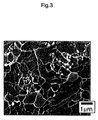
- the C section microscopic image is shown in Fig. 3.
- the composition is ultrafine equiaxial ferrite + cementite texture.
- the average ferrite grain size was 0.6 micron.
- Its mechanical properties are shown in Table 7, and a steel bar of excellent tensile strength of 788 MPa was obtained.
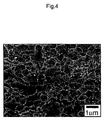
- the obtained texture image is shown in Fig. 4.
- An ultrafine equiaxial ferrite + cementite texture was noted.
- the average ferrite grain size was 0.5 micron.
- Its mechanical properties are shown in Table 7, and a steel bar of excellent tensile strength of 830 MPa was obtained.
- a steel material of 80 x 80 x 600 mm having the composition shown in Table 2b was heated to 900°C, and after once austenizing the texture, the material temperature was lowered to rolling set temperature T1 (550°C) to transform the texture to ferrite + pearlite, and it was rolled in caliber in 20 passes at reduction of area of 91% (true strain 2.4) until the section was reduced to 24 x 24 mm. Supposing the total rolling time of 600 s, the set value of Z was 13.7. From Fig.1, the ferrite grain size is estimated to be 0.6 micron.
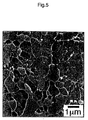
- the obtained texture image is shown in Fig. 5.
- the composition is ultrafine equiaxial ferrite + cementite texture.
- the average ferrite grain size was 0.9 micron.
- Its mechanical properties are shown in Table 7, and a steel bar of excellent tensile strength of 702 MPa was obtained.
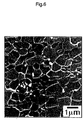
- the obtained texture image is shown in Fig. 6.
- An ultrafine equiaxial ferrite + cementite texture was noted.
- the average ferrite grain size was 1.1 micron.
- Its mechanical properties are shown in Table 7, and a steel bar of excellent tensile strength of 712 MPa was obtained.
- a steel material of 80 x 80 x 600 mm having the composition shown in Table 2c was heated to 600°C, and rolled in caliber at rolling set temperature T1 (600°C), in 21 passes at reduction of area of 95% (true strain 3.0) until the section was reduced to 17 x 17 mm. Supposing the total rolling time of 300 s, the set value of Z was 13.1. From Fig. 1, the ferrite grain size is estimated to be 0.8 micron.
- the temperature (exit temperature) T x-out was measured, and when the exit temperature was lower than 600°C, rolling of next pass was started immediately, but when exceeding 600°C, rolling of next pass (odd-number pass) was started after waiting until the material temperature dropped below 600°C.
- the entry temperature of odd-number pass was not particularly controlled. As a result, the rolling was carried out in a range of entry temperature T x-in of 580 to 619°C (average 590°C) and exit temperature T x-out of 610 to 648°C (average 630°C).
- a steel material of 80 x 80 x 600 mm having the composition shown in Table 2a was heated to 500°C, and rolled in caliber at rolling set temperature T1 (475°C), in 21 passes at reduction of area of 95% (true strain 3.0) until the section was reduced to 17 x 17 mm.
- the temperature (exit temperature) T x-out was measured, and when the exit temperature was lower than 475°C, rolling of next pass was started immediately, but otherwise, rolling of next pass (odd-number pass) was started after waiting until the material temperature dropped below 475°C so as not to exceed 500°C (Table 5).
- the entry temperature of odd-number pass was not particularly controlled.
- the rolling was carried out in a range of entry temperature T x-in of 440 to 485°C (average 465°C) and exit temperature T x-out of 472 to 499°C (average 496°C). Therefore, although processing heat generation occurs in each pass, but does not exceed the set temperature by more than 50°C.
- the obtained texture image is ultrafine equiaxial ferrite + cementite texture.
- the average ferrite grain size was 0.45 micron.
- the tensile strength was 950 MPa.
- a steel material of 80 x 80 x 600 mm having the composition shown in Table 2 was heated to 500°C, and rolled in caliber at rolling set temperature T1 (550°C), in 21 passes at reduction of area of 91 % (true strain 2.4) until the section was reduced to 24 x 24 mm.
- the pass interval was 15 s.
- results of rolling are shown in Table 6.
- the processing heat generation occurring in each pass was accumulated, and the final material temperature was more than 800°C.
- the value of Z was calculated again, and Z was 10.1.
- the average temperature it was 11.9.
- the obtained texture image is shown in Fig. 7. Although it was a ferrite + cementite texture, the average ferrite grain size was 4 microns. The ferrite grain size was larger than expected from the average temperature.
- the new method of controlling the parameter Z by the present invention can be applied to a continuous rolling process, and the invention provides a new control rolling method, in consideration of processing heat generation, as a method of stably manufacturing ultrafine crystal steel of 3 microns to 1 micron or less, without any limitation in pass interval or strain speed.
Landscapes
- Chemical & Material Sciences (AREA)
- Engineering & Computer Science (AREA)
- Physics & Mathematics (AREA)
- Thermal Sciences (AREA)
- Crystallography & Structural Chemistry (AREA)
- Mechanical Engineering (AREA)
- Materials Engineering (AREA)
- Metallurgy (AREA)
- Organic Chemistry (AREA)
- Manufacturing & Machinery (AREA)
- Heat Treatment Of Steel (AREA)
- Metal Rolling (AREA)
Abstract
Description
- The present invention relates to a warm control rolling method. More specifically, the invention relates to a manufacturing method of ultrafine particle steel material excellent in strength and ductility having ultrafine crystal structure of grain size of 3 µm or less.
- Ultrafine particle steel can extremely enhance the strength without adding alloy elements, and simultaneously reduces the ductility and brittleness transition temperature extremely, and hence the present inventors have been studying about measures for realizing this ultrafine particle steel industrially, and have already disclosed inventions, warm multipass rolling method (document 1) and multidirectional processing method (document 2).
- On the other hand, various methods have been proposed so far for manufacturing ultrafine particle steel, but nothing has been known about the method of controlling the grain size quantitatively.
- For example, Fujioka et al. (document 3) proposed a manufacturing method of high tension steel characterized in using a billet comprising C: 0.03 to 0.45 weight (wt.) %, Si: 0.01 to 0.50%, Mn: 0.02 to 5.0%, Al: 0.001 to 0.1%, and balance of Fe and inevitable impurities, processing it by one pass or two or more consecutive passes with interval of each pass of within 20 seconds, at temperature of 500 to 700°C, strain speed of 0.1 to 20/sec, and total strain amount of 0.8 to 5.0, and then cooling slowly.
- They also proposed a manufacturing method of high tension steel of fine crystal particles characterized in using a billet comprising, by wt.%, C: 0.03 to 0.9, Si: 0.01 to 1.0, Mn: 0.01 to 5.0, Al: 0.001 to 0.5, N: 0.001 to 0.1, and also at least one of Nb: 0.003 to 0.5 and Ti: 0.003 to 0.5, and balance of Fe and inevitable impurities, and satisfying the relation of C + (12/14)N ≥ (12+48)Ti (12/487)Nb + 0.03, casting it or heating it and cooling it once into the temperature range of 500°C to room temperature after rolling or without rolling, heating,
rolling in warm process at 700 to 550°C by processing it in one pass or two or more consecutive passes with pass interval of within 10 seconds with draft per pass of 20% or more, at strain speed of 1 to 200 sec, and total strain amount of 0.8 to 5, and then cooling slowly (document 4). - In these two methods, however, nothing is taught about control method of grain size. In these methods, moreover, the pass duration is limited and the strain speed is also limited, and it is considered difficult to apply industrially.
- In this background, the inventors have further promoted studies, and found that it is important to control the cumulative strain in multipass rolling, processing temperature, strain speed, and pass duration comprehensively, not individually, in order to form an ultrafine crystal structure. As a result, it is known that the grain size depends on parameter Z of processing temperature and strain speed expressed in formula (1), and the present inventors have proposed a new control method of grain size by clarifying the relation of Z and grain size through one-pass rolling experiment (prior application 1).

- ε: strain
- t: duration from start till end of rolling (s)
- T: rolling temperature (°C, or average of rolling temperature of each pass in the case of multipass rolling)
- Q: 254,000 if mother phase of texture just before rolling is ferrite, bainite, martensite, or pearlite; 300,000 if mother phase is austenite.
- In this method, to manufacture ultrafine ferrite steel with crystal size of 1 microns or less, it is found that the rolling condition parameter Z in formula (1) should be 11 or more (in the case the texture before rolling is ferrite, bainite, martensite, pearlite or the like, that is, the iron crystal structure is bcc), and that the strain speed can be defined by the value of the total strain ε being divided by the time t from start till end of rolling, and hence ultrafine crystal particles of 1 micron or less can be obtained in the condition of strain e = 3.0 and total rolling time t = 300 s, that is, strain speed = 0.01/s, and this newly proposed method can be applied in a wide range.
- According to this method, the grain size can be controlled without limitation in pass interval or strain speed.
- However, in the subsequent process of researches by the present inventors, new problems have been also unveiled, that is, the actual rolling is continuous multipass process, and when the parameter Z is 11 or more, the rolling temperature corresponds to the warm processing temperature region (350 to 800°C), and the deformation resistance of steel is large and the processing heat generation of material is large in this case, and the material temperature may rise several hundred degrees during continuous rolling, there by resulting in Z < 11, and ultrafine structure of 1 micron may not be formed.
- It has been hence demanded to develop a method capable of controlling the grain size stably even in such continuous multipass rolling.
- Document 1: Japanese Patent Application Laid-Open No. 2000-309850
- Document 2: Japanese Patent Application Laid-Open No. 2001-240912
- Document 3: Japanese Patent Application Laid-Open No. 9-279233
- Document 4: Japanese Patent Application Laid-Open No. 2000-104115
- Prior application 1: Japanese Patent Application No. 2002-54670
- The present invention is applied in the light of the above background, and presents a new control rolling method in consideration of processing heat generation, as a method capable of applying the new method of controlling the parameter Z according to the proposal of the inventors in continuous rolling process, stably manufacturing ultrafine crystal steel of 3 microns to 1 micron or less without any limitation in pass internal or strain speed.
- To solve the problems, it is a first aspect of the invention to present a rolling method of manufacturing steel mainly composed of fine ferrite particle texture with average ferrite grain size of 3 µm or less, which comprises, in the rolling process of one pass or more of rolling in condition where the rolling condition parameter expressed in formula (1)

- ε: strain
- t: duration from start till end of rolling (s)
- T: rolling temperature (°C, or average of rolling temperature of each pass in the case of multipass rolling)
- Q: 254,000 if mother phase of texture just before rolling is ferrite, bainite, martensite, or pearlite; 300,000 if mother phase is austenite..
- Herein, the strain used in formula (1) is an industrially simple strain, that is, true strain e. For example, supposing the initial area of steel bar to be So and the C-section area after rolling to be S, the reduction of area R is expressed as


- The rolling time t may be the total rolling time including the pass intervals.
- It is a second aspect to present the warm control rolling method, being characterized in rolling so that the temperature Tx-out right after rolling in each rolling process is not higher than the temperature that is higher than the rolling entry temperature Tx-in by 50°C.
- It is a third aspect of the invention to present the warm control rolling method, being characterized in rolling two or more passes consecutively in rolling temperature range of 350°C to 800°C, in which the material temperature right after two passes is not higher than the temperature that is higher than the material temperature upon start of rolling by 100°C, and not lower than the temperature that is lower than the material temperature upon start of rolling by 100°C, and it is a fourth aspect to present the warm control rolling method, being characterized in rolling so that the material temperature right after two passes is not higher than the temperature that is higher than the material temperature upon start of rolling by 50°C.
- It is a fifth aspect of the invention to present the warm control rolling method, being characterized in rolling in rolling temperature range of 400°C to 500°C, it is a sixth aspect to present the warm control rolling method, being characterized in manufacturing steel with Z ≥ 12 or more and mainly composed of texture with average ferrite grain size of 1 µm or less, it is a seventh aspect to present the warm control rolling method, being characterized in starting rolling, in consecutive multipass rolling, by waiting until the rolling entry temperature Tx+1-in of X+1-th pass becomes Ts+20 ≥ Tx+1-in when the rolling temperature Tx-out right after X-th pass is higher than the rolling set temperature Ts, and it is an eighth aspect to present the warm control rolling method, being characterized in measuring the processing heat generation TxH at X-th pass in multipass rolling beforehand, and defining the rolling entry temperature Tx-in in the relation of Txs ≥ Tx-in ≥ TxS - Tx-H, supposing TxS to be rolling set temperature.
- It is a ninth aspect of the invention to present the warm control rolling method, being characterized in defining the total reduction area at 50% or more in continuous rolling, it is a tenth aspect to present the warm control rolling method, being characterized in defining the plastic strain, or the strain converted into true strain from the reduction of area at 1.5 or more, it is an eleventh aspect to present the warm control rolling method, being characterized in introducing the strain by multidirectional processing, it is a twelfth aspect to present the warm control rolling method, being characterized in controlling the temperature range before and after rolling by setting the rolling speed and the draft of each pass, and it is a thirteenth aspect to present the warm control rolling method, being characterized in a step of reheating in the midst of rolling for compensating for temperature drop of material, and a step of cooling in the midst of rolling for suppressing temperature rise of material in the continuous rolling.
In the invention of the present application, having such configuration, the new method of controlling by the parameter Z relating to the proposals of the inventors can be applied in the continuous rolling process, and a new control rolling method in consideration of processing heat generation can be realized as a method of stably manufacturing superfine crystal steel of 3 microns to 1 micron or less without any limitation in the pass interval or strain speed. -
- Fig. 1 is a diagram showing the relation of parameter Z and ferrite average grain size relating to formula (1).
- Fig. 2 is front view and dimensional drawing showing caliber shape of groove roll of each pass.
- Fig. 3 is a texture SEM image in
embodiment 1. - Fig. 4 is a texture SEM image in
embodiment 2. - Fig. 5 is a texture SEM image in
embodiment 3. - Fig. 6 is a texture SEM image in
embodiment 4. - Fig. 7 is a texture SEM image in comparative example.
- The invention has many features as discussed above, and its embodiments are specifically described below.
- In the method of the invention, in order to manufacture fine ferrite particle structure with average ferrite grain size of 3 µm or less as main constituent, that is, to manufacture steel having ultrafine texture of average ferrite grain size of 3 µm or less in 60% or more range of surface area of its section, in principle, the rolling is executed in the following condition:
- <A> In a range of rolling condition parameter Z expressed in formula (1) is 11 or more (in the case the texture before rolling is ferrite, bainite, martensite, pearlite or the like, that is, iron crystal structure is bcc) or 20 or more (in the case the texture before rolling is austenite, that is, iron crystal structure is fcc), and
- <B> In the rolling process of one pass or more with rolling temperature range of a temperature region of 350°C to 800°C, the material temperature upon start of rolling of each rolling process does not exceed the maximum temperature of 800°C, and the material temperature during rolling and right after final rolling (within 1 second) is not lower than 350°C, and then temperature Tx-out right after rolling in each rolling process (within 1 second) is not higher than the temperature that is higher than rolling entry temperature Tx-in by 100°C, and the material temperature right after rolling is not lower than a temperature that is lower than the temperature right before rolling by 100°C.
- According to the studies by the inventors, the parameter Z in formula (1) is known to be an easy index for obtaining ultrafine crystal structure of average grain size, and has been already proposed in the application of Japanese Patent Application No. 2002-54670. The inventors have studied and clarified that the average grain size of ultrafine crystals formed by warm processing depends on the processing temperature and strain speed, and that the crystal grain size becomes smaller along with increase of rolling condition parameter Z which is a function of processing temperature and strain speed. To obtain texture of average grain size of 1 µm or less, the rolling condition parameter must be set higher than a certain critical value. As a result of experiment by one-pass large strain compression process using small sample pieces, the critical value is confirmed to be about 11 in the case of bcc structure iron (ferrite, bainite, martensite, pearlite or the like), and about 20 in fcc structure iron (austenite) (Fig. 1).
- Herein, the strain used in formula (1) may be an industrially simple strain, that is, true strain e. For example, supposing the initial area of steel bar to be So and the C-section area after rolling to be S, the reduction of area R is expressed as


- More specifically, the plastic strain can be calculated according to the flow shown in Table 1.

- In the warm control rolling method of the invention, accordingly, the rolling condition is set so that the parameter Z may be 11 or more (bcc structure) or 20 or more (fcc structure) as specified in <A>.
- More important, the temperature is controlled characteristically as in <B> in the warm control rolling method of the invention.
- Microscopic local azimuth differences caused by machining large strains by warm processing become sources of ultrafine crystals, and in the recovery process taking place during processing or after processing, dislocation density in particle declines, and crystal grain boundary is formed at the same time and ultrafine texture is composed. If the temperature is low, recovery is insufficient, and processed texture of high dislocation density is left over. If the temperature is too high, discontinuous recrystals or crystal grains by ordinary particle growth become coarse, and ultrafine particle texture of 3 µm or less is not obtained. In the invention, therefore, the rolling temperature is limited in a range of 350°C to 800°C.
- Rolling is executed by controlling as follows: temperature Tx-out right after rolling (within 1 second) in each rolling is not higher than 100°C than rolling entry temperature Tx-in, and the material temperature right after rolling is not lower than 100°C than the temperature before rolling.
- This temperature control is also essential for the invention. Without such control, actually, if the parameter Z is within the specified range, it is difficult to control within the specified crystal grain size at grain size of 3 µm or less.
- Tx-out is not higher than a temperature that is higher than Tx-in by 100°C, and more preferably by 50°C. In consecutive rolling of two or more passes, preferably, the material temperature right after two passes should not be higher than a temperature that is higher than the material temperature upon start of rolling by 100°C, more preferably by 50°C, and should not be lower than a temperature that is lower than the material temperature upon start of rolling by 100°C.
- To obtain texture of ultrafine particles with average ferrite grain size of 1 µm or less, preferably, the parameter Z should be 12 or more as for <A>, and the temperature range should be 400 to 500°C as for <B>.
- In the invention, as described above, in consecutive multipass rolling, if the rolling temperature Tx-out right after x-th pass is higher than the rolling set temperature Ts, rolling should be preferably started after waiting until the rolling entry temperature Tx+1-in of x+1-th pass becomes TS+20 ≥ Tx+1-in, or by preliminarily measuring the processing heat generation TxH at x-th pass, it may be desired to set rolling entry temperature Txs ≥ Tx-in ≥ Txs-TxH supposing Txs to be the rolling set temperature.
- The temperature control may have temperature changes as mentioned above, or in continuous rolling, it may be designed to reheat in the midst of rolling to compensate for material temperature drop, or to cool by force in the mist of rolling for suppressing the temperature rise of the material.
- In the invention, the temperature refers to the material surface temperature.
- In the invention, the total cumulative reduction strain increases along with increase of strain due to formation of fine crystal particles from the processing particles flattened by warm process, and in order to obtain a structure almost completely composed of superfine crystals, at least strain of 1.5 is needed, or more preferably strain of 2 or more.
- In this case, the strain is a plastic strain, or reduction of area converted to true strain, and averages for rolling may include various rolls, and in the case of bar steel, it may be rolled by groove roll.
- In the invention, mechanism for enhancing the strength by phase transformation is not used, and addition of alloy element is not needed for enhancing the strength, and the steel composition is not limited, and various steel types free from phase transformation such as ferrite single phase steel and austenite single phase steel, and steel materials of wide composition range can be used. A more specific example of composition comprises, by wt. %,
- C: 0.001% or more to 1.2 % or less,
- Si: 0.1% or more to 2% or less,
- Mn: 0.1% or more to 3% or less,
- P: 0.2% or less,
- S: 0.2% or less,
- Al: 1.0% or less,
- N: 0.02 % or less,
- Cr, Mo, Cr, Ni: 30% or less in total,
- Nb, Ti, V: 0.5 % or less in total,
- B: 0.01% or less, and
- Embodiments are shown below and described further. It must be noted, however, that the invention is not limited to these examples alone.
- Table 2 shows the composition (balance Fe) of steel materials in the following examples.
- In these examples, cooling is air cooling.
Table 2 (mass%) Type of steel C Si Mn P S N s.Al a 0.15 0.3 1.5 0.01 0.001 0.001 0.03 b 0.10 0.3 1.5 0.01 0.001 0.001 0.03 c 0.05 0.3 1.5 0.01 0.001 0.001 0.03 - In Tables 3 to 6 below, the blank right column of pass No. refers to so-called "common passing," that is, the same caliber is passed twice, and hence the reduction of area is indicated at the second pass.
- The parameter Z is calculated in the final pass because it must be calculated after application of a specific strain. The symbols are as follows: t = total time, T = exit average temperature, ε = total strain.
- A steel material of 80 x 80 x 600 mm having the composition shown in Table 2a was heated to 500°C, rolled in caliber at rolling set temperature T1 (499°C), and rolled in 21 passes at reduction of area of 91% (true strain 2.4) until the section was reduced to 24 x 24 mm. Supposing the total rolling time of 600 s, the set value of Z was 15.0. From Fig. 1, the ferrite grain size is estimated to be 0.4 micron.
- Caliber shape of each pass is shown in Fig. 2, and the draft and temperature changes before and after are given in Table 3. Right after rolling of even-number pass, the temperature (exit temperature) Tx-out was measured, and when the exit temperature was lower than 500°C, rolling of next pass was started immediately, but when exceeding 500°C, rolling of next pass (odd-number pass) was started after waiting until the material temperature dropped below 499°C. As a result, the rolling was carried out in a range of entry temperature Tx-in of 455 to 499°C (average 495°C) and exit temperature Tx-out of 472 to 543°C (average 520°C). Therefore, although the maximum processing heat generation in rolling of two consecutive passes was 40°C, by setting the rolling waiting time, the rolling setting temperature of 499°C did not exceed 550°C throughout the whole rolling process. In other words, processing heat generation occurred in each pass, but did not exceed the set temperature by more than 50°C. By the total rolling time of 895 s and average exit temperature, the value of Z was calculated again, and Z = 14.2 was obtained. The calculated ferrite grain size was 0.45 micron.
- In the obtained bar steel, the C section microscopic image is shown in Fig. 3. The composition is ultrafine equiaxial ferrite + cementite texture. The average ferrite grain size was 0.6 micron. Its mechanical properties are shown in Table 7, and a steel bar of excellent tensile strength of 788 MPa was obtained.

- In succession to
embodiment 1, further 2 passes were rolled until 17 x 17 mm. Caliber shapes are oval and square. Both are large in deformation, and the processing heat generation was measured by preliminary experiment. As a result, it was found that the material temperature rises by 80°C by consecutive rolling of 2 passes. Accordingly, in passes 22 and 23, the entry temperatures T22-in, T23-in were set at 450°C. Since the temperature of pass 21 was 501°C, by waiting until the material temperature dropped to 450°C, and rolling of pass 22 was started. The exit temperature of pass 23 was 514°C. At pass 23, waiting until 464°C, rolling was started, and the exit temperature was 537°C (Table 2). The total rolling time was 1112 s, 4.1. - The obtained texture image is shown in Fig. 4. An ultrafine equiaxial ferrite + cementite texture was noted. The average ferrite grain size was 0.5 micron. Its mechanical properties are shown in Table 7, and a steel bar of excellent tensile strength of 830 MPa was obtained.
- A steel material of 80 x 80 x 600 mm having the composition shown in Table 2b was heated to 900°C, and after once austenizing the texture, the material temperature was lowered to rolling set temperature T1 (550°C) to transform the texture to ferrite + pearlite, and it was rolled in caliber in 20 passes at reduction of area of 91% (true strain 2.4) until the section was reduced to 24 x 24 mm. Supposing the total rolling time of 600 s, the set value of Z was 13.7. From Fig.1, the ferrite grain size is estimated to be 0.6 micron.
- Caliber shape of each pass, the draft and temperature changes before and after are given in Table 4. Right after rolling of even-number pass, the temperature (exit temperature) Tx-out was measured, and when the exit temperature was lower than 550°C, rolling of next pass was started immediately, but when exceeding 550°C, rolling of next pass (odd-number pass) was started after waiting until the material temperature dropped below 570°C. The entry temperature of odd-number pass was not particularly controlled. As a result, the rolling was carried out in a range of entry temperature Tx-in of 440 to 557°C (average 551°C) and exit temperature Tx-out of 536 to 573°C (average 551°C). Therefore, although the maximum processing heat generation in rolling of two consecutive passes was 23°C, by setting the rolling waiting time, the rolling setting temperature of 550°C did not exceed 600°C throughout the whole rolling process. In other words, processing heat generation occurred in each pass, but did not exceed the set temperature by more than 50°C. By the total rolling time of 582 s and average exit temperature, the value of Z was calculated again, and Z =13.5 was obtained.
- The obtained texture image is shown in Fig. 5. The composition is ultrafine equiaxial ferrite + cementite texture. The average ferrite grain size was 0.9 micron. Its mechanical properties are shown in Table 7, and a steel bar of excellent tensile strength of 702 MPa was obtained.

- In succession to
embodiment 3, further 2 passes were rolled until 17 x 17 mm. Caliber shapes are oval and square. Both are large in deformation, and the processing heat generation was measured by preliminary experiment. As a result, it was found that the material temperature rises by 80°C by consecutive rolling of 2 passes. Accordingly, in passes 21 and 22, the entry temperatures T21-in, T22-in were set at 500°C. Since the temperature of pass 20 was 536°C, by waiting until the material temperature dropped to 500°C, and rolling of pass 21 was started. The exit temperature of pass 21 was 568°C. At pass 22, waiting until 550°C, rolling was started, and the exit temperature was 599°C. The total rolling time was 662 s, the average exit temperature was 565°C, and Z was 13.6. - The obtained texture image is shown in Fig. 6. An ultrafine equiaxial ferrite + cementite texture was noted. The average ferrite grain size was 1.1 micron. Its mechanical properties are shown in Table 7, and a steel bar of excellent tensile strength of 712 MPa was obtained.
- A steel material of 80 x 80 x 600 mm having the composition shown in Table 2c was heated to 600°C, and rolled in caliber at rolling set temperature T1 (600°C), in 21 passes at reduction of area of 95% (true strain 3.0) until the section was reduced to 17 x 17 mm. Supposing the total rolling time of 300 s, the set value of Z was 13.1. From Fig. 1, the ferrite grain size is estimated to be 0.8 micron.
Right after rolling of even-number pass, the temperature (exit temperature) Tx-out was measured, and when the exit temperature was lower than 600°C, rolling of next pass was started immediately, but when exceeding 600°C, rolling of next pass (odd-number pass) was started after waiting until the material temperature dropped below 600°C. The entry temperature of odd-number pass was not particularly controlled. As a result, the rolling was carried out in a range of entry temperature Tx-in of 580 to 619°C (average 590°C) and exit temperature Tx-out of 610 to 648°C (average 630°C). Therefore, although the maximum processing heat generation in rolling of two consecutive passes was 40°C, by setting the rolling waiting time, the rolling setting temperature of 600°C did not exceed 650°C throughout the whole rolling process. In other words, processing heat generation occurred in each pass, but did not exceed the set temperature by more than 50°C. By the total rolling time of 800 s and average exit temperature, the value of Z was calculated again, and Z = 12.2 was obtained. The obtained texture image is ultrafine equiaxial ferrite + cementite texture. The average ferrite grain size was 1.4 micron. Its mechanical properties are shown in Table 7, and a steel bar of excellent tensile strength of 640 MPa was obtained. - A steel material of 80 x 80 x 600 mm having the composition shown in Table 2a was heated to 500°C, and rolled in caliber at rolling set temperature T1 (475°C), in 21 passes at reduction of area of 95% (true strain 3.0) until the section was reduced to 17 x 17 mm. Right after rolling of even-number pass, the temperature (exit temperature) Tx-out was measured, and when the exit temperature was lower than 475°C, rolling of next pass was started immediately, but otherwise, rolling of next pass (odd-number pass) was started after waiting until the material temperature dropped below 475°C so as not to exceed 500°C (Table 5). The entry temperature of odd-number pass was not particularly controlled. As a result, the rolling was carried out in a range of entry temperature Tx-in of 440 to 485°C (average 465°C) and exit temperature Tx-out of 472 to 499°C (average 496°C). Therefore, although processing heat generation occurs in each pass, but does not exceed the set temperature by more than 50°C. By the total rolling time of 1128 s and average exit temperature, the value of Z was calculated again, and Z = 14.7 was obtained. The obtained texture image is ultrafine equiaxial ferrite + cementite texture. The average ferrite grain size was 0.45 micron. The tensile strength was 950 MPa.

- A steel material of 80 x 80 x 600 mm having the composition shown in Table 2 was heated to 500°C, and rolled in caliber at rolling set temperature T1 (550°C), in 21 passes at reduction of area of 91 % (true strain 2.4) until the section was reduced to 24 x 24 mm. The pass interval was 15 s.
- Without any particular temperature control, results of rolling are shown in Table 6. The processing heat generation occurring in each pass was accumulated, and the final material temperature was more than 800°C. At the final exit temperature, the value of Z was calculated again, and Z was 10.1. At the average temperature, it was 11.9. The obtained texture image is shown in Fig. 7. Although it was a ferrite + cementite texture, the average ferrite grain size was 4 microns. The ferrite grain size was larger than expected from the average temperature.

Table 7 Embodiment Ferrite grain size (µm) Yield strength (MPa) Tensile strength (MPa) 1 0.6 775 788 2 0.5 825 830 3 0.9 683 702 4 1.1 705 712 5 1.4 600 640 6 0.45 940 950 Comparative example 1 3.1 480 560 - As described specifically herein, the new method of controlling the parameter Z by the present invention can be applied to a continuous rolling process, and the invention provides a new control rolling method, in consideration of processing heat generation, as a method of stably manufacturing ultrafine crystal steel of 3 microns to 1 micron or less, without any limitation in pass interval or strain speed.
is 11 or more (in the case the texture just before rolling is ferrite, bainite, martensite, or pearlite, that is, Fe crystal structure is bcc) or 20 or more (in the case the texture just before rolling is austenite, that is, Fe crystal structure is fcc), and the rolling temperature range is a temperature zone of 350 °C to 800 °C, rolling under condition that the material temperature upon start of rolling of each rolling process does not exceed the maximun temperature of 800 °C and the material temperature during rolling and right after final rolling (within 1 second) is not 350 °C or lower, and rolling so that, in each rolling process, temperature Tx-out right after rolling (within 1 second) is not higher than temperature that is higher than rolling entry temperature Tx-in by 100 °C and the material temperature right after rolling (within 1 second) is not lower than temperature that is lower than the temperature right before rolling by 100°C.
balance of Fe and inevitable impurities, not containing any alloy element. Alloy elements such as Cr, Mo, Cu, Ni, Nb, Ti, V, B may be added more than the specified range as required, or may not be contained at all.
Claims (13)
- A warm control rolling method, being a rolling method of manufacturing steel mainly composed of fine ferrite particle texture with average ferrite grain size of 3 µm or less, which comprises,
in the rolling process of one pass or more of rolling in condition where the rolling condition parameter expressed in formula (1) ε: straint: duration from start till end of rolling (s)T: rolling temperature (°C, or average of rolling temperature of each pass in the case of multipass rolling)Q: 254,000 if mother phase of texture just before rolling is ferrite, bainite, martensite, or pearlite; 300,000 if mother phase is austenite.
is 11 or more (in the case the texture just before rolling is ferrite, bainite, martensite, or pearlite, that is, Fe crystal structure is bcc) or 20 or more (in the case the texture just before rolling is austenite, that is, Fe crystal structure is fcc), and the rolling temperature range is a temperature zone of 350°C to 800 °C,
rolling under condition that the material temperature upon start of rolling of each rolling process does not exceed the maximun temperature of 800 °C and the material temperature during rolling and right after final rolling (within 1 second) is not 350 °C or lower, and,
rolling so that, in each rolling process, temperature Tx-out right after rolling (within 1 second) is not higher than temperature that is higher than rolling entry temperature Tx-in by 100 °C and the material temperature right after rolling (within 1 second) is not lower than temperature that is lower than the temperature right before rolling by 100°C. - The warm control rolling method of claim 1, being characterized in rolling so that the temperature Tx-out right after rolling in each rolling process is not higher than temperature that is higher than the rolling entry temperature Tx-in.by 50°C.
- The warm control rolling method of claim 1, being characterized in rolling two or more passes consecutively in rolling temperature range of 350°C to 800°C, wherein the material temperature right after two passes is not higher than temperature that is higher than the material temperature upon start of rolling by 100°C, and not lower than temperature that is lower than the material temperature upon start of rolling by 100°C
- The warm control rolling method of claim 3, being characterized in rolling so that the material temperature right after two passes is not higher than temperature that is higher than the material temperature upon start of rolling by 50°C.
- The warm control rolling method of any one of claims 1 to 4, being characterized in rolling in rolling temperature range of 400°C to 500°C.
- The warm control rolling method of any one of claims 1 to 5, where in Z is 12 or more and, being characterized in manufacturing steel with mainly composed of texture with average ferrite grain size of 1 µm or less.
- The warm control rolling method of any one of claims 1 to 6, being characterized in starting rolling, in consecutive multipass rolling, by waiting until the rolling entry temperature Tx+1-in of X+1-th pass becomes Ts+20 ≥ Tx+1-in when the rolling temperature Tx-out right after X-th pass is higher than the rolling set temperature Ts.
- The warm control rolling method of any one of claims 1 to 7, being characterized in measuring the processing heat generation TxH at X-th pass in multipass rolling beforehand, and defining the rolling entry temperature Tx-in in the relation of Txs ≥ Tx-in ≥ Txs - Tx-H, supposing Txs to be rolling set temperature.
- The warm control rolling method of any one of claims 1 to 8, wherein the total reduction area in continuous rolling is 50% or more.
- The warm control rolling method of any one of claims 1 to 9, wherein the plastic strain, or the strain converted into true strain from the reduction of area is 1.5 or more.
- The warm control rolling method of any one of claims 1 to 10, being characterized in introducing the strain by multidirectional processing.
- The warm control rolling method of any one of claims 1 to 11, being characterized in controlling the temperature range before and after rolling by setting the rolling speed and the draft of each pass.
- The warm control rolling method of any one of claims 1 to 12, wherein the continuous rolling further comprises a step of reheating in the midst of rolling for compensating for temperature drop of material, and a step of cooling in the midst of rolling for suppressing temperature rise of material.
Applications Claiming Priority (2)
| Application Number | Priority Date | Filing Date | Title |
|---|---|---|---|
| JP2003180292A JP3944579B2 (en) | 2003-05-20 | 2003-05-20 | Multipass warm controlled rolling process using square and oval perforated rolls. |
| PCT/JP2004/007278 WO2004104236A1 (en) | 2003-05-20 | 2004-05-20 | Controlled warm-rolling method |
Publications (3)
| Publication Number | Publication Date |
|---|---|
| EP1627928A1 true EP1627928A1 (en) | 2006-02-22 |
| EP1627928A4 EP1627928A4 (en) | 2008-10-15 |
| EP1627928B1 EP1627928B1 (en) | 2011-12-14 |
Family
ID=33475460
Family Applications (1)
| Application Number | Title | Priority Date | Filing Date |
|---|---|---|---|
| EP04734147A Expired - Lifetime EP1627928B1 (en) | 2003-05-20 | 2004-05-20 | Controlled warm-rolling method |
Country Status (7)
| Country | Link |
|---|---|
| US (1) | US7727343B2 (en) |
| EP (1) | EP1627928B1 (en) |
| JP (1) | JP3944579B2 (en) |
| KR (1) | KR101107141B1 (en) |
| CN (1) | CN100386449C (en) |
| TW (1) | TWI263546B (en) |
| WO (1) | WO2004104236A1 (en) |
Families Citing this family (5)
| Publication number | Priority date | Publication date | Assignee | Title |
|---|---|---|---|---|
| KR101129175B1 (en) * | 2004-12-24 | 2012-03-26 | 주식회사 포스코 | Finishing wire rolling method for reducing the duplex grain structures in 304H stainless steel wire |
| CN100430182C (en) * | 2005-11-18 | 2008-11-05 | 东北大学 | A kind of preparation method of nano grain low carbon microalloy steel |
| JP5843127B2 (en) * | 2011-02-28 | 2016-01-13 | 国立研究開発法人物質・材料研究機構 | Manufacturing method of high strength nonmagnetic austenitic stainless steel |
| JP5733857B2 (en) * | 2011-02-28 | 2015-06-10 | 国立研究開発法人物質・材料研究機構 | Non-magnetic high-strength molded article and its manufacturing method |
| JP5988065B2 (en) * | 2015-05-14 | 2016-09-07 | 国立研究開発法人物質・材料研究機構 | High strength nonmagnetic austenitic stainless steel |
Family Cites Families (13)
| Publication number | Priority date | Publication date | Assignee | Title |
|---|---|---|---|---|
| JPS5352228A (en) | 1976-10-25 | 1978-05-12 | Nippon Steel Corp | Production of high tensile high toughness steel |
| DE69227548T2 (en) * | 1991-07-17 | 1999-07-29 | Centre De Recherches Metallurgiques - Centrum Voor Research In De Metallurgie - Association Sans But Lucratif - Vereniging Zonder Winstoogmerk, Bruessel/Bruxelles | Process for producing a thin strip from mild steel |
| JP3383148B2 (en) * | 1996-04-10 | 2003-03-04 | 新日本製鐵株式会社 | Manufacturing method of high strength steel with excellent toughness |
| WO1998049362A1 (en) * | 1997-04-30 | 1998-11-05 | Kawasaki Steel Corporation | Steel material having high ductility and high strength and process for production thereof |
| JP4006112B2 (en) * | 1998-09-28 | 2007-11-14 | 新日本製鐵株式会社 | Method for producing fine-grained high-tensile steel |
| CA2297291C (en) * | 1999-02-09 | 2008-08-05 | Kawasaki Steel Corporation | High tensile strength hot-rolled steel sheet and method of producing the same |
| JP3538613B2 (en) * | 1999-02-25 | 2004-06-14 | 独立行政法人物質・材料研究機構 | Steel thick wall material with excellent weldability and its manufacturing method |
| JP3904351B2 (en) | 1999-02-26 | 2007-04-11 | 独立行政法人物質・材料研究機構 | High-strength and high-toughness rod and its manufacturing method |
| JP2000309823A (en) * | 1999-04-23 | 2000-11-07 | Nippon Steel Corp | Method for producing hot-rolled silicon steel sheet with uniform magnetic properties |
| JP3796536B2 (en) * | 2000-02-29 | 2006-07-12 | 独立行政法人物質・材料研究機構 | Large strain uniform introduction processing method |
| JP2002137002A (en) * | 2000-10-30 | 2002-05-14 | Daido Steel Co Ltd | Guideless rolling method in hot rolling |
| JP2002192201A (en) * | 2000-12-26 | 2002-07-10 | National Institute For Materials Science | Metal processing method to introduce large strain by forging / rolling line |
| JP3983065B2 (en) * | 2002-02-28 | 2007-09-26 | 独立行政法人物質・材料研究機構 | Manufacturing method of thick steel plate having ultrafine grain structure and thick steel plate |
-
2003
- 2003-05-20 JP JP2003180292A patent/JP3944579B2/en not_active Expired - Lifetime
-
2004
- 2004-05-20 EP EP04734147A patent/EP1627928B1/en not_active Expired - Lifetime
- 2004-05-20 CN CNB2004800038499A patent/CN100386449C/en not_active Expired - Lifetime
- 2004-05-20 US US10/541,539 patent/US7727343B2/en not_active Expired - Lifetime
- 2004-05-20 TW TW093114214A patent/TWI263546B/en not_active IP Right Cessation
- 2004-05-20 WO PCT/JP2004/007278 patent/WO2004104236A1/en not_active Ceased
- 2004-05-20 KR KR1020057014915A patent/KR101107141B1/en not_active Expired - Lifetime
Also Published As
| Publication number | Publication date |
|---|---|
| CN100386449C (en) | 2008-05-07 |
| JP2004346421A (en) | 2004-12-09 |
| WO2004104236A1 (en) | 2004-12-02 |
| JP3944579B2 (en) | 2007-07-11 |
| US20060054255A1 (en) | 2006-03-16 |
| KR20060020600A (en) | 2006-03-06 |
| EP1627928B1 (en) | 2011-12-14 |
| KR101107141B1 (en) | 2012-02-06 |
| TW200427525A (en) | 2004-12-16 |
| EP1627928A4 (en) | 2008-10-15 |
| TWI263546B (en) | 2006-10-11 |
| CN1748040A (en) | 2006-03-15 |
| US7727343B2 (en) | 2010-06-01 |
Similar Documents
| Publication | Publication Date | Title |
|---|---|---|
| EP3555337B1 (en) | Hot rolled steel plate and production method thereof | |
| EP2366035B1 (en) | Manganese steel strip having an increased phosphorus content and process for producing the same | |
| EP2462252B9 (en) | Non-heat treated rolled steel and drawn wire rod with excellent toughness, and method for manufacturing the same | |
| EP1288316B1 (en) | Method for making high-strength high-toughness martensitic stainless steel seamless pipe | |
| EP3976838B1 (en) | Component from a flat steel product, and method of making a method for such component | |
| EP3719155B1 (en) | High-strength cold-rolled steel sheet and method for manufacturing same | |
| US20090260729A1 (en) | High-carbon hot-rolled steel sheet and method for producing the same | |
| EP3901310B1 (en) | Wire rod of which softening heat treatment can be omitted, and manufacturing method therefor | |
| WO2018036918A1 (en) | Method for producing a high-strength steel strip with improved properties for further processing, and a steel strip of this type | |
| WO2006048034A1 (en) | High-strength steel strip or sheet exhibiting twip properties and method for producing said strip by direct strip casting ' | |
| EP1573075A1 (en) | Method for producing a steel product | |
| EP2053139A1 (en) | Hot-rolled steel sheets excellent both in workability and in strength and toughness after heat treatment and process for production thereof | |
| EP4509631A1 (en) | Non-quenched and tempered steel wire rod with improved machinability and toughness, and method for manufacturing same | |
| DE102016115618A1 (en) | Process for producing a high-strength steel strip with improved properties during further processing and such a steel strip | |
| EP2641989B1 (en) | High-toughness cold-drawn non-heat-treated wire rod, and method for manufacturing same | |
| EP2883974B1 (en) | Wire rod having good strength and ductility and method for producing same | |
| EP3708689B1 (en) | Steel sheet | |
| EP1627928B1 (en) | Controlled warm-rolling method | |
| EP1642988B1 (en) | Warm rolling method | |
| US20070289679A1 (en) | High Strength Cold Rolled Steel Sheet Having Excellent Shape Freezability, and Method for Manufacturing the Same | |
| EP1453984B1 (en) | Method for the production of hot strip or sheet from a micro-alloyed steel | |
| JP2000336455A (en) | High ductility hot rolled steel sheet and method for producing the same | |
| DE69228580T2 (en) | Process for producing thin stainless steel sheets based on Cr-Ni with excellent surface quality and formability | |
| JP3995822B2 (en) | Method for producing high purity ferritic stainless steel sheet with excellent ridging resistance | |
| EP4502221A1 (en) | Non-quenched and tempered steel rod wire for hot forging with improved machinability and toughness and method for manufacturing same |
Legal Events
| Date | Code | Title | Description |
|---|---|---|---|
| PUAI | Public reference made under article 153(3) epc to a published international application that has entered the european phase |
Free format text: ORIGINAL CODE: 0009012 |
|
| 17P | Request for examination filed |
Effective date: 20051020 |
|
| AK | Designated contracting states |
Kind code of ref document: A1 Designated state(s): DE FR GB IT |
|
| DAX | Request for extension of the european patent (deleted) | ||
| RBV | Designated contracting states (corrected) |
Designated state(s): DE FR GB IT |
|
| RIC1 | Information provided on ipc code assigned before grant |
Ipc: B21B 1/18 20060101ALI20080904BHEP Ipc: C21D 8/02 20060101ALI20080904BHEP Ipc: C21D 8/04 20060101ALI20080904BHEP Ipc: C21D 8/00 20060101ALI20080904BHEP Ipc: C21D 8/06 20060101AFI20041210BHEP |
|
| A4 | Supplementary search report drawn up and despatched |
Effective date: 20080915 |
|
| 17Q | First examination report despatched |
Effective date: 20110210 |
|
| REG | Reference to a national code |
Ref country code: DE Ref legal event code: R079 Ref document number: 602004035675 Country of ref document: DE Free format text: PREVIOUS MAIN CLASS: C21D0008060000 Ipc: C21D0009000000 |
|
| GRAP | Despatch of communication of intention to grant a patent |
Free format text: ORIGINAL CODE: EPIDOSNIGR1 |
|
| RIC1 | Information provided on ipc code assigned before grant |
Ipc: C21D 9/00 20060101AFI20110630BHEP |
|
| GRAS | Grant fee paid |
Free format text: ORIGINAL CODE: EPIDOSNIGR3 |
|
| GRAA | (expected) grant |
Free format text: ORIGINAL CODE: 0009210 |
|
| AK | Designated contracting states |
Kind code of ref document: B1 Designated state(s): DE FR GB IT |
|
| REG | Reference to a national code |
Ref country code: GB Ref legal event code: FG4D |
|
| REG | Reference to a national code |
Ref country code: DE Ref legal event code: R096 Ref document number: 602004035675 Country of ref document: DE Effective date: 20120223 |
|
| PLBE | No opposition filed within time limit |
Free format text: ORIGINAL CODE: 0009261 |
|
| STAA | Information on the status of an ep patent application or granted ep patent |
Free format text: STATUS: NO OPPOSITION FILED WITHIN TIME LIMIT |
|
| 26N | No opposition filed |
Effective date: 20120917 |
|
| REG | Reference to a national code |
Ref country code: DE Ref legal event code: R097 Ref document number: 602004035675 Country of ref document: DE Effective date: 20120917 |
|
| REG | Reference to a national code |
Ref country code: FR Ref legal event code: PLFP Year of fee payment: 13 |
|
| REG | Reference to a national code |
Ref country code: FR Ref legal event code: PLFP Year of fee payment: 14 |
|
| REG | Reference to a national code |
Ref country code: FR Ref legal event code: PLFP Year of fee payment: 15 |
|
| PGFP | Annual fee paid to national office [announced via postgrant information from national office to epo] |
Ref country code: IT Payment date: 20230526 Year of fee payment: 20 Ref country code: FR Payment date: 20230525 Year of fee payment: 20 Ref country code: DE Payment date: 20220620 Year of fee payment: 20 |
|
| PGFP | Annual fee paid to national office [announced via postgrant information from national office to epo] |
Ref country code: GB Payment date: 20230523 Year of fee payment: 20 |
|
| REG | Reference to a national code |
Ref country code: DE Ref legal event code: R071 Ref document number: 602004035675 Country of ref document: DE |
|
| REG | Reference to a national code |
Ref country code: GB Ref legal event code: PE20 Expiry date: 20240519 |
|
| PG25 | Lapsed in a contracting state [announced via postgrant information from national office to epo] |
Ref country code: GB Free format text: LAPSE BECAUSE OF EXPIRATION OF PROTECTION Effective date: 20240519 |
|
| PG25 | Lapsed in a contracting state [announced via postgrant information from national office to epo] |
Ref country code: GB Free format text: LAPSE BECAUSE OF EXPIRATION OF PROTECTION Effective date: 20240519 |