EP1626720B1 - 4-(2-phenylsulfanyl-phenyl)-piperidine derivatives as serotonin reuptake inhibitors - Google Patents
4-(2-phenylsulfanyl-phenyl)-piperidine derivatives as serotonin reuptake inhibitors Download PDFInfo
- Publication number
- EP1626720B1 EP1626720B1 EP04725291A EP04725291A EP1626720B1 EP 1626720 B1 EP1626720 B1 EP 1626720B1 EP 04725291 A EP04725291 A EP 04725291A EP 04725291 A EP04725291 A EP 04725291A EP 1626720 B1 EP1626720 B1 EP 1626720B1
- Authority
- EP
- European Patent Office
- Prior art keywords
- alk
- hydrogen
- cycloalk
- compound
- halogen
- Prior art date
- Legal status (The legal status is an assumption and is not a legal conclusion. Google has not performed a legal analysis and makes no representation as to the accuracy of the status listed.)
- Expired - Lifetime
Links
- 0 *c1c(*)c(*)c(C2CCN(*)CC2)c(*)c1* Chemical compound *c1c(*)c(*)c(C2CCN(*)CC2)c(*)c1* 0.000 description 4
Classifications
-
- C—CHEMISTRY; METALLURGY
- C07—ORGANIC CHEMISTRY
- C07D—HETEROCYCLIC COMPOUNDS
- C07D405/00—Heterocyclic compounds containing both one or more hetero rings having oxygen atoms as the only ring hetero atoms, and one or more rings having nitrogen as the only ring hetero atom
- C07D405/02—Heterocyclic compounds containing both one or more hetero rings having oxygen atoms as the only ring hetero atoms, and one or more rings having nitrogen as the only ring hetero atom containing two hetero rings
- C07D405/12—Heterocyclic compounds containing both one or more hetero rings having oxygen atoms as the only ring hetero atoms, and one or more rings having nitrogen as the only ring hetero atom containing two hetero rings linked by a chain containing hetero atoms as chain links
-
- A—HUMAN NECESSITIES
- A61—MEDICAL OR VETERINARY SCIENCE; HYGIENE
- A61P—SPECIFIC THERAPEUTIC ACTIVITY OF CHEMICAL COMPOUNDS OR MEDICINAL PREPARATIONS
- A61P25/00—Drugs for disorders of the nervous system
-
- A—HUMAN NECESSITIES
- A61—MEDICAL OR VETERINARY SCIENCE; HYGIENE
- A61P—SPECIFIC THERAPEUTIC ACTIVITY OF CHEMICAL COMPOUNDS OR MEDICINAL PREPARATIONS
- A61P25/00—Drugs for disorders of the nervous system
- A61P25/22—Anxiolytics
-
- A—HUMAN NECESSITIES
- A61—MEDICAL OR VETERINARY SCIENCE; HYGIENE
- A61P—SPECIFIC THERAPEUTIC ACTIVITY OF CHEMICAL COMPOUNDS OR MEDICINAL PREPARATIONS
- A61P25/00—Drugs for disorders of the nervous system
- A61P25/24—Antidepressants
-
- A—HUMAN NECESSITIES
- A61—MEDICAL OR VETERINARY SCIENCE; HYGIENE
- A61P—SPECIFIC THERAPEUTIC ACTIVITY OF CHEMICAL COMPOUNDS OR MEDICINAL PREPARATIONS
- A61P43/00—Drugs for specific purposes, not provided for in groups A61P1/00-A61P41/00
-
- C—CHEMISTRY; METALLURGY
- C07—ORGANIC CHEMISTRY
- C07D—HETEROCYCLIC COMPOUNDS
- C07D211/00—Heterocyclic compounds containing hydrogenated pyridine rings, not condensed with other rings
- C07D211/04—Heterocyclic compounds containing hydrogenated pyridine rings, not condensed with other rings with only hydrogen or carbon atoms directly attached to the ring nitrogen atom
- C07D211/06—Heterocyclic compounds containing hydrogenated pyridine rings, not condensed with other rings with only hydrogen or carbon atoms directly attached to the ring nitrogen atom having no double bonds between ring members or between ring members and non-ring members
- C07D211/08—Heterocyclic compounds containing hydrogenated pyridine rings, not condensed with other rings with only hydrogen or carbon atoms directly attached to the ring nitrogen atom having no double bonds between ring members or between ring members and non-ring members with hydrocarbon or substituted hydrocarbon radicals directly attached to ring carbon atoms
- C07D211/18—Heterocyclic compounds containing hydrogenated pyridine rings, not condensed with other rings with only hydrogen or carbon atoms directly attached to the ring nitrogen atom having no double bonds between ring members or between ring members and non-ring members with hydrocarbon or substituted hydrocarbon radicals directly attached to ring carbon atoms with substituted hydrocarbon radicals attached to ring carbon atoms
- C07D211/20—Heterocyclic compounds containing hydrogenated pyridine rings, not condensed with other rings with only hydrogen or carbon atoms directly attached to the ring nitrogen atom having no double bonds between ring members or between ring members and non-ring members with hydrocarbon or substituted hydrocarbon radicals directly attached to ring carbon atoms with substituted hydrocarbon radicals attached to ring carbon atoms with hydrocarbon radicals, substituted by singly bound oxygen or sulphur atoms
-
- C—CHEMISTRY; METALLURGY
- C07—ORGANIC CHEMISTRY
- C07D—HETEROCYCLIC COMPOUNDS
- C07D211/00—Heterocyclic compounds containing hydrogenated pyridine rings, not condensed with other rings
- C07D211/04—Heterocyclic compounds containing hydrogenated pyridine rings, not condensed with other rings with only hydrogen or carbon atoms directly attached to the ring nitrogen atom
- C07D211/06—Heterocyclic compounds containing hydrogenated pyridine rings, not condensed with other rings with only hydrogen or carbon atoms directly attached to the ring nitrogen atom having no double bonds between ring members or between ring members and non-ring members
- C07D211/08—Heterocyclic compounds containing hydrogenated pyridine rings, not condensed with other rings with only hydrogen or carbon atoms directly attached to the ring nitrogen atom having no double bonds between ring members or between ring members and non-ring members with hydrocarbon or substituted hydrocarbon radicals directly attached to ring carbon atoms
- C07D211/18—Heterocyclic compounds containing hydrogenated pyridine rings, not condensed with other rings with only hydrogen or carbon atoms directly attached to the ring nitrogen atom having no double bonds between ring members or between ring members and non-ring members with hydrocarbon or substituted hydrocarbon radicals directly attached to ring carbon atoms with substituted hydrocarbon radicals attached to ring carbon atoms
- C07D211/20—Heterocyclic compounds containing hydrogenated pyridine rings, not condensed with other rings with only hydrogen or carbon atoms directly attached to the ring nitrogen atom having no double bonds between ring members or between ring members and non-ring members with hydrocarbon or substituted hydrocarbon radicals directly attached to ring carbon atoms with substituted hydrocarbon radicals attached to ring carbon atoms with hydrocarbon radicals, substituted by singly bound oxygen or sulphur atoms
- C07D211/24—Heterocyclic compounds containing hydrogenated pyridine rings, not condensed with other rings with only hydrogen or carbon atoms directly attached to the ring nitrogen atom having no double bonds between ring members or between ring members and non-ring members with hydrocarbon or substituted hydrocarbon radicals directly attached to ring carbon atoms with substituted hydrocarbon radicals attached to ring carbon atoms with hydrocarbon radicals, substituted by singly bound oxygen or sulphur atoms by sulfur atoms to which a second hetero atom is attached
Definitions
- the present invention relates to novel compounds which are serotonin reuptake inhibitors and as such effective in the treatment of for example depression and anxiety.
- SSRIs Selective serotonin reuptake inhibitors
- Augmentation of antidepressant therapy may be accomplished through the co-administration of mood stabilizers such as lithium carbonate or triiodothyronin or by the use of electroshock.
- the present invention provides compounds which are serotonin reuptake inhibitors for the treatment of affective disorders, such as depression, anxiety disorders including general anxiety disorder, social anxiety disorder, post traumatic stress disorder, obsessive compulsive disorder, panic disorder, panic attacks, specific phobias, social phobia and agoraphobia. Some of the compounds also have a combined effect of serotonin reuptake inhibition and 5-HT 2C receptor modulation, which according to WO01/41701 would imply a faster onset of antidepressant activity.
- the present invention provides compounds of the general formula I wherein R 1 , R 2 , R 3 , R 4 , R 5 , R 6 , R 7 , R 8 , and R 9 are as defined below.
- the invention provides a compound according to the above for use as a medicament.
- the invention provides a pharmaceutical composition
- a pharmaceutical composition comprising a compound according to the above or a pharmaceutically acceptable acid addition salt thereof and at least one pharmaceutically acceptable carrier or diluent.
- the invention provides the use of a compound according to the above or a pharmaceutically acceptable acid addition salt thereof for the preparation of a medicament for the treatment of affective disorders, such as depression, anxiety disorders including general anxiety disorder, social anxiety disorder, post traumatic stress disorder, obsessive compulsive disorder, panic disorder, panic attacks, specific phobias, social phobia and agoraphobia.
- affective disorders such as depression, anxiety disorders including general anxiety disorder, social anxiety disorder, post traumatic stress disorder, obsessive compulsive disorder, panic disorder, panic attacks, specific phobias, social phobia and agoraphobia.
- Halogen means fluoro, chloro, bromo or iodo.
- C 1-6 -alk(en/yn)yl means a C 1-6 -alkyl, C 2-6 -alkenyl or a C 2-6 -alkynyl group.
- C 1-6 alkyl refers to a branched or unbranched alkyl group having from one to six carbon atoms inclusive, including but not limited to methyl, ethyl, 1-propyl, 2-propyl, 1-butyl, 2-butyl, 2-methyl-2-propyl and 2-methyl-1-propyl.
- C 2-6 alkenyl and C 2-6 alkynyl designate such groups having from two to six carbon atoms, including one double bond and one triple bond respectively, including but not limited to ethenyl, propenyl, butenyl, ethynyl, propynyl and butynyl.
- C 1-6 -alk(en/yn)yloxy designate such groups in which the C 1-6 -alk(en/yn)yl are as defined above.
- Halo means halogen.
- NR z R w -C 1-6 -alk(en/yn)yl designate the group
- C 3-8 cycloalkyl designates a monocyclic or bicyclic carbocycle having three to eight C-atoms, including but not limited to cyclopropyl, cyclopentyl, cyclohexyl, etc.
- C 3-8 cycloalkenyl designates a monocyclic or bicyclic carbocycle having three to eight C-atoms and including one double bond.
- C 3-8 -cycloalk(en)yl-C 1-6 -alk(en/yn)yl, C 3-8 -cycloalk(en)yl and C 1-6 -alk(en/yn)yl are as defined above.
- 3-7-membered ring optionally containing one further heteroatom, such as N, O, or S refers to ring systems such as 1-morpholinyl, 1-piperidinyl, 1-azepinyl, 1-piperazinyl, 1-homopiperazinyl, 1-imidazolyl, 1-pyrrolidinyl, 1-azetidinyl, 1-pyrrolyl or pyrazolyl, all of which may be further substituted with a group selected from a C 1-6 -alk(en/yn)yl, hydroxy, hydroxy-C 1-6 -alk(en/yn)yl, C 1-6 -alk(en/yn)yloxy-C 1-6 -alk(en/yn)yl.
- the present invention relates to 4-(2-phenylsulfanyl-phenyl)-piperidine derivatives which are serotonin reuptake inhibitors and as such effective in the treatment of for example depression and anxiety.
- the present invention relates to a compound represented by the general formula I wherein R 1 , R 2 , R 3 , R 4 , R 5 are independently selected from hydrogen, halogen, cyano, C 1-6 -alk(en/yn)yl, C 1-6 -alk(en/yn)yloxy, C 1-6 -alk(en/yn)ylsulfanyl, hydroxy, hydroxy-C 1-6 -alk(en/yn)yl, halo-C 1-6 -alk(en/yn)yl, halo-C 1-6 -alk(en/yn)yloxy, or NR x R y wherein R x and R y are independently selected from hydrogen, C 1-6 -alk(en/yn)yl, cyano-C 1-6 -alk(en/yn)yl, C 3-8 -cycloalk(en)yl, C 3-8 -cycloalk(en)yl
- R 1 is selected from hydrogen, halogen, cyano, C 1-6 -alk(en/yn)yl, C 1-6 -alk(en/yn)yloxy, C 1-6 -alk(en/yn)ylsulfanyl, halo-C 1-6 -alk(en/yn)yl, or NR x R y wherein R x and R y are independently selected from hydrogen, C 1-6 -alk(enlyn)yl, cyano-C 1-6 -alk(en/yn)yl, C 3-8 -cycloalk(en)yl, C 3-8 -cycloalk(en)yl-C 1-6 -alk(en/yn)yl, or NR z R w -C 1-6 -alk(en/yn)yl, wherein R z and R w are independently selected from hydrogen, C 1-6 -alk(en/yn)yl, C 1-6
- R 1 is selected from hydrogen, halogen, cyano, C 1-6 -alk(en/yn)yl, C 1-6 -alk(en/yn)yloxy, C 1-6 -alk(en/yn)ylsulfanyl, halo-C 1-6 -alk(en/yn)yl.
- R 1 is NR x R y wherein R x and R y are independently selected from hydrogen, C 1-6 -alk(en/yn)yl, cyano-C 1-6 -alk(en/yn)yl, C 3-8 -cycloalk(en)yl, C 3-8 -cycloalk(en)yl-C 1-6 -alk(en/yn)yl, such as hydrogen, cyanomethyl, C 1-6 -alk(en/yn)yl.
- R 1 is NR x R y wherein R x is NR z R w -C 1-6 -alk(en/yn)yl, wherein R z and R w are independently selected from hydrogen, C 1-6 -alk(en/yn)yl, C 3-8 -cycloalk(en)yl, or C 3-8 -cycloalk(en)yl-C 1-6 -alk(en/yn)yl, and R y is selected from hydrogen, C 1-6 -alk(en/yn)yl, cyano-C 1-6 -alk(en/yn)yl, C 3-8 -cycloalk(en)yl, or C 3-8 -cycloalk(en)yl-C 1-6 -alk(en/yn)yl.
- R 1 is NR x R y wherein R x and R y together with the nitrogen to which they are attached form a 3-7-membered ring which optionally contains one further heteroatom, such as 1-morpholinyl, 1-piperidinyl, 1-azepinyl, 1-piperazinyl, 1-homopiperazinyl, 1-imidazolyl, 1-pyrrolidinyl, 1-azetidinyl, 1-pyrrolyl or pyrazolyl, optionally substituted with one or more selected from a C 1-6 -alk(en/yn)yl, hydroxy, hydroxy-C 1-6 -alk(en/yn)yl, C 1-6 -alk(en/yn)yloxy-C 1-6 -alk(en/yn)yl, e.g.
- R 1 is selected from hydrogen; halogen; cyano; C 1-6 -alkyl; C 1-6 -alkyloxy; C 1-6 -alkylsulfanyl; halo-C 1-6 -alkyl; NR x R y wherein R x and R y are independently selected from hydrogen, C 1-6 -alkyl, cyanomethyl; NR x R y wherein R y is selected from hydrogen, or C 1-6 -alkyl, and R x is NR z R w -C 1-6 -alk(en/yn)yl wherein R z and R w are independently selected from hydrogen, or C 1-6 -alkyl; 1-morpholinyl, 1-piperidinyl, 1-azepinyl, 1-piperazinyl, 1-homopiperazinyl, 1-imidazolyl, 1-pyrrolidinyl, 1-azetidinyl, 1-pyrrolyl or pyrazolyl, optionally
- R 2 is selected from hydrogen, halogen, cyano, C 1-6 -alk(en/yn)yl, C 1-6 -alk(en/yn)yloxy, C 1-6 -alk(en/yn)ylsulfanyl, halo-C 1-6 -alk(en/yn)yl.
- R 2 is selected from hydrogen, halogen, cyano, C 1-6 -alkyl, C 1-6 -alkyloxy, C 1-6 -alkylsulfanyl, halo-C 1-6 -alkyl.
- R 2 is hydrogen; another embodiment of R 2 is C 1-6 -alkoxy, such as methoxy; a further embodiment of R 2 is halogen, such as fluoro, or chloro; a further embodiment of R 2 is C 1-6 -alkyl, such as methyl.
- R 3 is selected from hydrogen, halogen, cyano, C 1-6 -alk(en/yn)yl, C 1-6 -alk(en/yn)yloxy, C 1-6 -alk(en/yn)ylsulfanyl, halo-C 1-6 -alk(en/yn)yl.
- R 3 is selected from hydrogen, halogen, cyano, C 1-6 -alkyl, C 1-6 -alkyloxy, C 1-6 -alkylsulfanyl, halo-C 1-6 -alkyl.
- R 3 is hydrogen; another embodiment of R 3 is C 1-6 -alkyl, such as methyl; a further embodiment of R 3 is C 1-6 -alkoxy, such as methoxy; a further embodiment of R 3 is halogen, such as bromo, chloro, or fluoro; a further embodiment of R 3 is halo-C 1-6 -alkyl, such as CF 3 ; a further embodiment of R 3 is hydroxy-C 1-6 -alkyl, such as hydroxy-methyl; a further embodiment of R 3 is NR x R y wherein R x is hydrogen and R y is C 1-6 -alkyl, such as methylamino; a further embodiment of R 3 is C 2-6 -alkenyl, such as ethenyl.
- R 4 is selected from hydrogen, halogen, cyano, C 1-6 -alk(en/yn)yl, C 1-6 -alk(en/yn)yloxy, C 1-6 -alk(en/yn)ylsulfanyl, halo-C 1-6 -alk(en/yn)yl.
- R 4 is selected from hydrogen, halogen, cyano, C 1-6 -alkyl, C 1-6 -alkyloxy, C 1-6 -alkylsulfanyl, halo-C 1-6 -alkyl.
- R 4 is hydrogen; another embodiment of R 4 is C 1-6 -alkoxy, such as methoxy; a further embodiment of R 4 is halogen, such as fluoro, or chloro; a further embodiment of R 4 is C 1-6 -alkyl, such as methyl.
- R 5 is selected from hydrogen, halogen, cyano, C 1-6 -alk(en/yn)yl, C 1-6 -alk(en/yn)yloxy, C 1-6 -alk(en/yn)ylsulfanyl, halo-C 1-6 -alk(en/yn)yl, or NR x R y wherein R x and R y are independently selected from hydrogen, C 1-6 -alk(en/yn)yl, cyano-C 1-6 -alk(en/yn)yl, C 3-8 -cycloalk(en)yl, C 3-8 -cycloalk(en)yl-C 1-6 -alk(en/yn)yl, or NR z R w -C 1-6 -alk(en/yn)yl, wherein R z and R w are independently selected from hydrogen, C 1-6 -alk(en/yn)yl, C 1-6
- R 5 is selected from hydrogen, halogen, cyano, C 1-6 -alk(en/yn)yl, C 1-6 -alk(en/yn)yloxy, C 1-6 -alk(en/yn)ylsulfanyl, halo-C 1-6 -alk(en/yn)yl.
- R 5 is NR x R y wherein R x and R y are independently selected from hydrogen, C 1-6 -alk(en/yn)yl, cyano-C 1-6 -alk(en/yn)yl, C 3-8 -cycloalk(en)yl, C 3-8 -cycloalk(en)yl-C 1-6 -alk(en/yn)yl, such as hydrogen, cyanomethyl, C 1-6 -alk(en/yn)yl.
- R 5 is NR x R y wherein R x is NR z R w -C 1-6 -alk(en/yn)yl, wherein R z and R w are independently selected from hydrogen, C 1-6 -alk(en/yn)yl, C 3-8 -cycloalk(en)yl, or C 3-8 -cycloalk(en)yl-C 1-6 -alk(en/yn)yl, and R y is selected from hydrogen, C 1-6 -alk(en/yn)yl, cyano-C 1-6 -alk(en/yn)yl, C 3-8 -cycloalk(en)yl, or C 3-8 -cycloalk(en)yl-C 1-6 -alk(en/yn)yl.
- R 5 is NR x R y wherein R x and R y together with the nitrogen to which they are attached form a 3-7-membered ring which optionally contains one further heteroatom, such as 1-morpholinyl, 1-piperidinyl, 1-azepinyl, 1-piperazinyl, 1-homopiperazinyl, 1-imidazolyl, 1-pyrrolidinyl, 1-azetidinyl, 1-pyrrolyl or pyrazolyl, optionally substituted with one or more selected from a C 1-6 -alk(en/yn)yl, hydroxy, hydroxy-C 1-6 -alk(en/yn)yl, C 1-6 -alk(en/yn)yloxy-C 1-6 -alk(en/yn)yl, e.g.
- R 5 is selected from hydrogen; halogen; cyano; C 1-6 -alkyl; C 1-6 -alkyloxy; C 1-6 -alkylsulfanyl; halo-C 1-6 -alkyl; NR x R y wherein R x and R y are independently selected from hydrogen, C 1-6 -alkyl, cyanomethyl; NR x R y wherein R y is selected from hydrogen, or C 1-6 -alkyl, and R x is NR z R w -C 1-6 -alk(en/yn)yl wherein R z and R w are independently selected from hydrogen, or C 1-6 -alkyl; 1-morpholinyl, 1-piperidinyl, 1-azepinyl, 1-piperazinyl, 1-homopiperazinyl, 1-imidazolyl, 1-pyrrolidinyl, 1-azetidinyl, 1-pyrrolyl or pyrazolyl, optionally
- R 6 is selected from hydrogen, halogen, C 1-6 -alk(en/yn)yl, halo-C 1-6 -alk(en/yn)yl.
- R 6 is selected from hydrogen, halogen, C 1-6 -alkyl, halo-C 1-6 -alkyl.
- an embodiment of R 6 is hydrogen; another embodiment of R 6 is halogen, such as fluoro.
- R 7 is selected from hydrogen, halogen, C 1-6 -alk(en/yn)yl, halo-C 1-6 -alk(en/yn)yl.
- R 7 is selected from hydrogen, halogen, C 1-6 -alkyl, halo-C 1-6 -alkyl.
- an embodiment of R 7 is hydrogen; another embodiment of R 7 is halogen, such as fluoro.
- R 8 is selected from hydrogen, halogen, C 1-6 -alk(en/yn)yl, halo-C 1-6 -alk(en/yn)yl, or NR x R y wherein R x and R y are independently selected from hydrogen, C 1-6 -alk(en/yn)yl, cyano-C 1-6 -alk(en/yn)yl, C 3-8 -cycloalk(en)yl, C 3-8 -cycloalk(en)yl-C 1-6 -alk(en/yn)yl, or NR z R w -C 1-6 -alk(en/yn)yl, wherein R z and R w are independently selected from hydrogen, C 1-6 -alk(en/yn)yl, C 3-8 -cycloalk(en)yl, or C 3-8 -cycloalk(en)yl-C 1-6
- R 8 is selected from hydrogen, halogen, C 1-6 -alk(en/yn)yl, halo-C 1-6 -alk(en/yn)yl.
- R 8 is NR x R y wherein R x and R y are independently selected from hydrogen, C 1-6 -alk(en/yn)yl, cyano-C 1-6 -alk(en/yn)yl, C 3-8 -cycloalk(en)yl, C 3-8 -cycloalk(en)yl-C 1-6 -alk(en/yn)yl, such as hydrogen, cyanomethyl, C 1-6 -alk(en/yn)yl.
- R 8 is NR x R y wherein R x is NR z R w -C 1-6 -alk(en/yn)yl, wherein R z and R w are independently selected from hydrogen, C 1-6 -alk(en/yn)yl, C 3-8 -cycloalk(en)yl, or C 3-8 -cycloalk(en)yl-C 1-6 -alk(en/yn)yl, and R y is selected from hydrogen, C 1-6 -alk(en/yn)yl, cyano-C 1-6 -alk(en/yn)yl, C 3-8 -cycloalk(en)yl, or C 3-8 -cycloalk(en)yl-C 1-6 -alk(en/yn)yl.
- R 8 is NR x R y wherein R x and R y together with the nitrogen to which they are attached form a 3-7-membered ring which optionally contains one further heteroatom, such as 1-morpholinyl, 1-piperidinyl, 1-azepinyl, 1-piperazinyl, 1-homopiperazinyl, 1-imidazolyl, 1-pyrrolidinyl, 1-azetidinyl, 1-pyrrolyl or pyrazolyl, optionally substituted with one or more selected from a C 1-6 -alk(en/yn)yl, hydroxy, hydroxy-C 1-6 -alk(en/yn)yl, C 1-6 -alk(en/yn)yloxy-C 1-6 -alk(en/yn)yl, e.g.
- R 8 is selected from hydrogen; halogen; cyano; C 1-6 -alkyl; C 1-6 -alkyloxy; C 1-6 -alkylsulfanyl; halo-C 1-6 -alkyl; NR x R y wherein R x and R y are independently selected from hydrogen, C 1-6 -alkyl, cyanomethyl; NR x R y wherein R y is selected from hydrogen, or C 1-6 -alkyl, and R x is NR z R w -C 1-6 -alk(en/yn)yl wherein R z and R w are independently selected from hydrogen, or C 1-6 -alkyl; 1-morpholinyl, 1-piperidinyl, 1-azepinyl, 1-piperazinyl, 1-homopiperazinyl, 1-imidazolyl, 1-pyrrolidinyl, 1-azetidinyl, 1-pyrrolyl or pyrazolyl, optionally
- R 8 is hydrogen; another embodiment of R 8 is halogen, such as fluoro, or bromo; a further embodiment of R 8 is C 1-6 -alkyl, such as methyl; another embodiment of R 8 is C 1-6 -alkyloxy, such as methoxy; a further embodiment of R 8 is halo-C 1-6 -alkyl, such as CF 3 .
- R 9 is selected from hydrogen, halogen, C 1-6 -alk(en/yn)yl, halo-C 1-6 -alk(en/yn)yl.
- R 9 is selected from hydrogen, halogen, C 1-6 -alkyl, halo-C 1-6 -alkyl.
- an embodiment of R 9 is hydrogen; another embodiment of R 9 is halogen, such as fluoro.
- the compound of formula I has at least one substituent in the phenyl ring(s), selected from any one of R 1 -R 9 , which is different from hydrogen, such as 1, 2, 3, or 4 substituents in the phenyl ring(s), selected from any one of R 1 -R 9 , which is/are different from hydrogen, and the remaining substituents are hydrogen.
- 1 substituent selected from any one of R 1 -R 9 which is different from hydrogen, is present in either of the two phenyl rings, such as 1 substituent selected from R 1 -R 5 , or the substituent is selected from R 6 -R 9 .
- substituents selected from R 1 -R 9 which are different from hydrogen, are present in either of the two phenyl rings, such as 1 substituent selected from R 1 -R 5 , and the other selected from R 6 -R 9 , or both substituents are selected from R 1 -R 5 .
- 3 substituents selected from R 1 -R 9 which are different from hydrogen, are present in either of the two phenyl rings, such as 2 substituents selected from R 1 -R 5 , and the last substituent is selected from R 6 -R 9 .
- the remaining substituents are hydrogen. To illustrate this further without limiting the invention, some typical embodiments are outlined hereafter.
- one substituent is present which is R 2 as defined above, except hydrogen.
- one substituent is present which is R 3 as defined above, except hydrogen.
- two substituents are present being R 3 and R 8 , wherein R 3 and R 8 are as defined above, except hydrogen.
- two substituents are present being R 3 and R 6 , wherein R 3 and R 6 are as defined above, except hydrogen.
- two substituents are present being R 3 and R 7 , wherein R 3 and R 7 are as defined above, except hydrogen.
- said compound is selected from 4-[2-(4-Chloro-phenylsulfanyl)-5-trifluoromethyl-phenyl]-piperidine 4-[2-(4-Methoxy-phenylsulfanyl)-phenyl]-piperidine 4-[2-(2,4-Dimethyl-phenylsulfanyl)-5-trifluoromethyl-phenyl]-piperidine 4-[2-(4-Chloro-phenylsulfanyl)-4-fluoro-phenyl]-piperidine 4-[2-(4-Methoxy-phenylsulfanyl)-4-fluoro-phenyl]-piperidine 4-[2-(4-Methoxy-phenylsulfanyl)-5-methyl-phenyl]-piperidine 4-[2-(2,4-Dimethyl-phenylsulfanyl)-5-methyl-phenyl]-piperidine 4-[2-(4-Flu
- the present compounds of formula I are serotonin reuptake inhibitors. Some of the tested compounds have also shown good affinity to the 5HT 2C receptor, typically Ki ⁇ 75 nM as measured in the test described in the examples section, and such compounds are considered to be further aspects of the invention. Accordingly, in a further aspect the present invention relates to a compound of formula I or a salt thereof, wherein R 3 is selected from C 1-6 alkoxy (such as methoxy), halogen (such as Cl), or halo-C 1-6 alkyl (such as CF 3 ), and R 1 , R 2 , and R 4 -R 9 are all hydrogen.
- the present invention relates to a compound of formula I or a salt thereof, wherein R 1 is selected from halogen (such as Cl or F), and R 3 is selected from halogen (such as F), and R 2 , and R 4 -R 9 are all hydrogen.
- the present invention relates to a compound of formula I or a salt thereof, wherein R 1 is selected from halogen (such as Cl), and R 7 is selected from halogen (such as F), and R 2 -R 6 and R 8 -R 9 are all hydrogen.
- the present invention relates to a compound of formula I or a salt thereof, wherein R 3 is selected from halogen (such as F), and R 7 is selected from halogen (such as F), and R 1-R 2 , R 4 -R 6 and R 8 -R 9 are all hydrogen.
- the present invention relates to a compound of formula I or a salt thereof, wherein R 1 is selected from halogen (such as F), and R 9 is selected from halogen (such as F), and R 2 -R 8 , are all hydrogen.
- the present invention relates to a compound of formula I or a salt thereof, wherein R 2 is selected from halogen (such as Cl or F), and R 9 is selected from halogen (such as F), and R 1 and R 3 -R 8 , are all hydrogen.
- the present invention relates to a compound of formula I or a salt thereof, wherein R 3 is selected from C 1-6 alkyl (such as methyl), C 1-6 alkoxy (such as methoxy), or halogen (such as Cl or F), and R 9 is selected from halogen (such as F), and R 1 , R 2 , and R 4 -R 8 , are all hydrogen.
- the present invention relates to a compound of formula I or a salt thereof, wherein R 3 is selected from C 1-6 alkoxy (such as methoxy), and R 6 is selected from halogen (such as F), and R 1 , R 2 , R 4 , R 5 , and R 7 -R 9 are all hydrogen.
- the present invention relates to a compound of formula I or a salt thereof, wherein R 3 is selected from C 1-6 alkoxy (such as methoxy), or halogen (such as Cl), and R 7 is selected from halogen (such as F), and R 1 , R 2 , R 4 -R 6 , and R 8 -R 9 are all hydrogen.
- the present invention relates to a compound of formula I or a salt thereof, wherein R 3 is selected from C 1-6 alkyl (such as methyl), C 1-6 alkoxy (such as methoxy), or halogen (such as F or Cl), and R 8 is selected from C 1-6 alkyl (such as methyl), C 1-6 alkoxy (such as methoxy), or halogen (such as F), and R 1 , R 2 , R 4 -R 7 , and R 9 are all hydrogen.
- R 3 is selected from C 1-6 alkyl (such as methyl), C 1-6 alkoxy (such as methoxy), or halogen (such as F or Cl)
- R 8 is selected from C 1-6 alkyl (such as methyl), C 1-6 alkoxy (such as methoxy), or halogen (such as F)
- R 1 , R 2 , R 4 -R 7 , and R 9 are all hydrogen.
- the present invention relates to a compound of formula I or a salt thereof, wherein R 1 is selected from C 1-6 alkyl (such as methyl), R 3 is selected from C 1-6 alkyl (such as methyl), and R 6 is selected from halogen (such as F), and R 2 , R 4 -R 5 , and R 7 -R 9 are all hydrogen.
- the present invention relates to a compound of formula I or a salt thereof, wherein R 1 is selected from C 1-6 alkyl (such as methyl), or halogen (such as F), R 3 is selected from C 1-6 alkoxy (such as methoxy), or halogen (such as F, Br, or Cl), and R 8 is selected from C 1-6 alkyl (such as methyl), or halogen (such as F), and R 2 , R 4 -R 7 , and R 9 are all hydrogen.
- R 1 is selected from C 1-6 alkyl (such as methyl), or halogen (such as F)
- R 3 is selected from C 1-6 alkoxy (such as methoxy), or halogen (such as F, Br, or Cl)
- R 8 is selected from C 1-6 alkyl (such as methyl), or halogen (such as F)
- R 2 , R 4 -R 7 , and R 9 are all hydrogen.
- the present invention relates to a compound of formula I or a salt thereof, wherein R 1 is selected from C 1-6 alkyl (such as methyl), or halogen (such as F or Cl), R 3 is selected from C 1-6 alkyl (such as methyl), C 1-6 alkoxy (such as methoxy), or halogen (such as F, or Cl), and R 9 is selected from halogen (such as F), and R 2 , and R 4 -R 8 , are all hydrogen.
- R 1 is selected from C 1-6 alkyl (such as methyl), or halogen (such as F or Cl)
- R 3 is selected from C 1-6 alkyl (such as methyl), C 1-6 alkoxy (such as methoxy), or halogen (such as F, or Cl)
- R 9 is selected from halogen (such as F)
- R 2 , and R 4 -R 8 are all hydrogen.
- the present invention relates to a compound of formula I or a salt thereof, wherein R 1 is selected from halogen (such as F), R 2 is selected from halogen (such as Cl), and R 9 is selected from halogen (such as F), and R 3 , and R 4 -R 8 , are all hydrogen.
- the present invention relates to a compound of formula I or a salt thereof, wherein R 2 is selected from C 1-6 alkoxy (such as methoxy), or halogen (such as F), R 3 is selected from halogen (such as F), or C 1-6 alkyl (such as methyl), and R 9 is selected from halogen (such as F), and R 1 , and R 4 -R 8 , are all hydrogen.
- R 2 is selected from C 1-6 alkoxy (such as methoxy), or halogen (such as F)
- R 3 is selected from halogen (such as F), or C 1-6 alkyl (such as methyl)
- R 9 is selected from halogen (such as F)
- R 1 , and R 4 -R 8 are all hydrogen.
- Preferred compounds which are serotonin reuptake inhibitors and has shown good affinity to the SHT 2C receptor are selected from:
- the present invention also comprises salts of the present compounds, typically, pharmaceutically acceptable salts.
- Such salts include pharmaceutical acceptable acid addition salts, pharmaceutically acceptable metal salts, ammonium and alkylated ammonium salts.
- Acid addition salts include salts of inorganic acids as well as organic acids.
- suitable inorganic acids include hydrochloric, hydrobromic, hydroiodic, phosphoric, sulfuric, sulfamic, nitric acids and the like.
- suitable organic acids include formic, acetic, trichloroacetic, trifluoroacetic, propionic, benzoic, cinnamic, citric, fumaric, glycolic, itaconic, lactic, methanesulfonic, maleic, malic, malonic, mandelic, oxalic, picric, pyruvic, salicylic, succinic, methane sulfonic, ethanesulfonic, tartaric, ascorbic, pamoic, bismethylene salicylic, ethanedisulfonic, gluconic, citraconic, aspartic, stearic, palmitic, EDTA, glycolic, p-aminobenzoic, glutamic, benzenesulfonic, p-tol
- metal salts examples include lithium, sodium, potassium, magnesium salts and the like.
- ammonium and alkylated ammonium salts include ammonium, methyl-, dimethyl-, trimethyl-, ethyl-, hydroxyethyl-, diethyl-, n -butyl-, sec- butyl-, tert- butyl-, tetramethylammonium salts and the like.
- the compounds of this invention may exist in unsolvated as well as in solvated forms with pharmaceutically acceptable solvents such as water, ethanol and the like.
- the solvated forms are considered equivalent to the unsolvated forms for the purposes of this invention.
- the compounds of the present invention may have one or more asymmetric centres and it is intended that any optical isomers (i.e. enantiomers or diastereomers), as separated, pure or partially purified optical isomers and any mixtures thereof including racemic mixtures are included within the scope of the invention.
- Racemic forms can be resolved into the optical antipodes by known methods, for example, by separation of diastereomeric salts thereof with an optically active acid, and liberating the optically active amine compound by treatment with a base. Another method for resolving racemates into the optical antipodes is based upon chromatography on an optically active matrix. Racemic compounds of the present invention can also be resolved into their optical antipodes, e.g. by fractional crystallization of d- or 1- (tartrates, mandelates or camphorsulphonate) salts. The compounds of the present invention may also be resolved by the formation of diastereomeric derivatives.
- Optically active compounds can also be prepared from optically active starting materials, or by stereo selective synthesis. Furthermore, when a double bond or a fully or partially saturated ring system is present in the molecule geometric isomers may be formed. It is intended that any geometric isomers, as separated, pure or partially purified geometric isomers or mixtures thereof are included within the scope of the invention. Likewise, molecules having a bond with restricted rotation may form geometric isomers. These are also intended to be included within the scope of the present invention.
- the compounds of formula I are serotonin reuptake inhibitors, and accordingly may be applicable for the treatment, including prevention, of affective disorders, such as depression, anxiety disorders including general anxiety disorder and panic disorder and obsessive compulsive disorder.
- the invention relates to a compound of formula I for use as a medicament.
- the present invention also relates to a pharmaceutical composition
- a pharmaceutical composition comprising a compound of formula I and a pharmaceutically acceptable carrier or diluent.
- the composition may comprise any one of the embodiments of formula I described above.
- the compound of formula I is present in an amount of from about 0.001 to about 100 mg/kg body weight per day.
- the present invention also relates to use of a compound of formula I for the preparation of a medicament for the treatment of a disease or disorder, wherein a serotonin reuptake inhibitor is beneficial.
- the medicament may comprise any one of the embodiments of formula I described above.
- the present invention also relates to use of a compound of formula I for the preparation of a medicament for the treatment of affective disorders.
- the present invention also relates to use of a compound of formula I for the preparation of a medicament for the treatment of depression.
- the present invention also relates to use of a compound of formula I for the preparation of a medicament for the treatment of anxiety disorders.
- the present invention also relates to use of a compound of formula I for the preparation of a medicament for the treatment of general anxiety disorder.
- the present invention also relates to use of a compound of formula I for the preparation of a medicament for the treatment of social anxiety disorder.
- the present invention also relates to use of a compound of formula I for the preparation of a medicament for the treatment of post traumatic stress disorder.
- the present invention also relates to use of a compound of formula I for the preparation of a medicament for the treatment of obsessive compulsive disorder.
- the present invention also relates to use of a compound of formula I for the preparation of a medicament for the treatment of panic disorder.
- the present invention also relates to use of a compound of formula I for the preparation of a medicament for the treatment of panic attacks.
- the present invention also relates to use of a compound of formula I for the preparation of a medicament for the treatment of specific phobias.
- the present invention also relates to use of a compound of formula I for the preparation of a medicament for the treatment of social phobia.
- the present invention also relates to use of a compound of formula I for the preparation of a medicament for the treatment of agoraphobia.
- the present invention discloses a method of preparing a compound of formula I, comprising
- the compounds of the invention may be administered alone or in combination with pharmaceutically acceptable carriers or excipients, in either single or multiple doses.
- the pharmaceutical compositions according to the invention may be formulated with pharmaceutically acceptable carriers or diluents as well as any other known adjuvants and excipients in accordance with conventional techniques such as those disclosed in the textbook Remington: The Science and Practice of Pharmacy, 19 Edition, Gennaro, Ed., Mack Publishing Co., Easton, PA, 1995 .
- compositions may be specifically formulated for administration by any suitable route such as the oral, rectal, nasal, pulmonary, topical (including buccal and sublingual), transdermal, intracisternal, intraperitoneal, vaginal and parenteral (including subcutaneous, intramuscular, intrathecal, intravenous and intradermal) route, the oral route being preferred. It will be appreciated that the preferred route will depend on the general condition and age of the subject to be treated, the nature of the condition to be treated and the active ingredient chosen.
- Pharmaceutical compositions for oral administration include solid dosage forms such as capsules, tablets, dragees, pills, lozenges, powders and granules. Where appropriate, they can be prepared with coatings such as enteric coatings or they can be formulated so as to provide controlled release of the active ingredient such as sustained or prolonged release according to methods well known in the art.
- Liquid dosage forms for oral administration include solutions, emulsions, suspensions, syrups and elixirs.
- compositions for parenteral administration include sterile aqueous and nonaqueous injectable solutions, dispersions, suspensions or emulsions as well as sterile powders to be reconstituted in sterile injectable solutions or dispersions prior to use. Depot injectable formulations are also contemplated as being within the scope of the present invention.
- Suitable administration forms include suppositories, sprays, ointments, cremes, gels, inhalants, dermal patches, implants etc.
- a typical oral dosage is in the range of from about 0.001 to about 100 mg/kg body weight per day, preferably from about 0.01 to about 50 mg/kg body weight per day, and more preferred from about 0.05 to about 10 mg/kg body weight per day administered in one or more dosages such as 1 to 3 dosages.
- the exact dosage will depend upon the frequency and mode of administration, the sex, age, weight and general condition of the subject treated, the nature and severity of the condition treated and any concomitant diseases to be treated and other factors evident to those skilled in the art.
- a typical unit dosage form for oral administration one or more times per day such as 1 to 3 times per day may contain from 0.01 to about 1000 mg, preferably from about 0.05 to about 500 mg, and more preferred from about 0.5 mg to about 200 mg.
- parenteral routes such as intravenous, intrathecal, intramuscular and similar administration
- typically doses are in the order of about half the dose employed for oral administration.
- the compounds of this invention are generally utilized as the free substance or as a pharmaceutically acceptable salt thereof.
- One example is an acid addition salt of a compound having the utility of a free base.
- a compound of the formula (I) contains a free base such salts are prepared in a conventional manner by treating a solution or suspension of a free base of the formula (I) with a chemical equivalent of a pharmaceutically acceptable acid. Representative examples are mentioned above.
- solutions of the novel compounds of the formula (I) in sterile aqueous solution may be employed.
- aqueous solutions should be suitably buffered if necessary and the liquid diluent first rendered isotonic with sufficient saline or glucose.
- the aqueous solutions are particularly suitable for intravenous, intramuscular, subcutaneous and intraperitoneal administration.
- the sterile aqueous media employed are all readily available by standard techniques known to those skilled in the art.
- Suitable pharmaceutical carriers include inert solid diluents or fillers, sterile aqueous solution and various organic solvents.
- solid carriers are lactose, terra alba, sucrose, cyclodextrin, talc, gelatine, agar, pectin, acacia, magnesium stearate, stearic acid and lower alkyl ethers of cellulose.
- liquid carriers are syrup, peanut oil, olive oil, phospho lipids, fatty acids, fatty acid amines, polyoxyethylene and water.
- the carrier or diluent may include any sustained release material known in the art, such as glyceryl monostearate or glyceryl distearate, alone or mixed with a wax.
- the pharmaceutical compositions formed by combining the novel compounds of the formula (I) and the pharmaceutical acceptable carriers are then readily administered in a variety of dosage forms suitable for the disclosed routes of administration.
- the formulations may conveniently be presented in unit dosage form by methods known in the art of
- Formulations of the present invention suitable for oral administration may be presented as discrete units such as capsules or tablets, each containing a predetermined amount of the active ingredient, and which may include a suitable excipient.
- the orally available formulations may be in the form of a powder or granules, a solution or suspension in an aqueous or non-aqueous liquid, or an oil-in-water or water-in-oil liquid emulsion.
- the preparation may be a tablet, placed in a hard gelatine capsule in powder or pellet form or it can be in the form of a troche or lozenge.
- the amount of solid carrier will vary widely but will usually be from about 25 mg to about 1 g.
- the preparation may be in the form of a syrup, emulsion, soft gelatine capsule or sterile injectable liquid such as an aqueous or non-aqueous liquid suspension or solution.
- the compounds of the invention are prepared by the following general methods:
- the deprotection according to method a) was performed by standard techniques, known to the persons skilled in the art and detailed in the textbook Protective Groups in Organic Synthesis, Greene and Wuts, Wiley Interscience, (1991), ISBN 0471623016 .
- the cleavage from a polymer support, such as from the Wang resin based carbamate linker, according to method a) was performed according to literature known procedures ( Zaragoza Tetrahedron Lett. 1995, 36, 8677-8678 and Conti et al. Tetrahedron Lett. 1997, 38, 2915-2918 ).
- Compounds of formula II can be prepared by dehydrating a compound of formula VII under conditions that do not lead to cleavage of the N-R' bond followed by hydrogenation of the double bond.
- compounds of formula VII can be dehydrated with subsequent or concomitant cleavage of the N-R' bond to provide compounds of formula VI; subsequent protection of the amino group and hydrogenation of the double bond then provides compounds of formula II.
- the reduction of the double bond may be performed using standard heterogeneous hydrogenation procedures or using homogeneous hydrogenation methods such as e.g. Crabtree's or Wilkinson's catalysts (see e.g Encyclopedia of Reagents for Organic Synthesis, Paquette (Ed.), Wiley (1995), ISBN 0471936235, p.
- Compounds VII, VIII, and IX have R 1 -R 9 and R' as previously described, and G' is a bromine or iodine atom.
- the properly substituted 1-bromo-phenylsulfanylbenzenes or 1-iodo-phenylsulfanylbenzenes were prepared from thiophenols IV and properly substituted aryliodides or aryl bromides according to the general procedures by Schopfer and Schlapbach Tetrahedron 2001, 57, 3069-3073 ; Bates et al. Org. Lett. 2002, 4, 2803-2806 and Kwong et al. Org. Lett. 2002, 4, 581-584 .
- Starting materials of formula VII can also be prepared by palladium or copper catalysed coupling of a thiophenol of formula X with a compound of formula XI according to Schopfer and Schlapbach Tetrahedron 2001, 57, 3069-3073 ; Bates et al. Org. Lett. 2002, 4, 2803-2806 , or Kwong et al. Org. Lett. 2002, 4, 581-584 .
- Compounds X can be prepared by ortholithiation of compounds IV, or by metal-halogen exchange of properly substituted 2-bromo-thiophenol or 2-iodo-thiophenol derivatives, followed by addition of electrophile of formula VIII, as exemplified in the experimental.
- Compounds of formula X and XI have R 1 -R 9 , R', and G as described previously.
- the sulfonyl esters can be derived from the corresponding phenol by reaction with 4-methyl-benzenesulfonyl chloride, trifluoro-methanesulfonic acid anhydride, 1,1,2,2,3,3,4,4,4-nonafluoro-butane-1-sulfonyl fluoride, or related compounds, as described by e.g. Cho et al. J. Org. Chem., 2003, 68, 3017-3025 , Arnould et al. Tetrahedron Lett. 1996, 37, 45-23-4524 , and Anderson et al. J.
- phenol in terms can be prepared from the analogous anisole or suitably protected phenol by standard techniques, known to the persons skilled in the art and detailed in the textbook Protective Groups in Organic Synthesis, Greene and Wuts, Wiley Interscience, (1991), ISBN 0471623016 .
- Starting materials of formula V and XI can be prepared by diazotation of properly substituted aniline derivatives followed by addition of either copper bromide or copper iodide as described in the textbook Advanced Organic Chemistry March, John Wiley & Sons (1992), ISBN 0471601802 , by diazotation of the corresponding aniline derivative followed by addition of potassium iodide as described by Tunney and Stille J. Org. Chem. 1987, 52, 748-753 , or by diazotization under the conditions reported by Doyle et al. J. Org. Chem. 1977, 42, 2426-2431 and Doyle et at. J. Org. Chem. 1980, 45, 2570-2575 .
- compound V in which G is a sulfonyl ester may be derived from the corresponding phenol as described above for compound XI.
- the phenol in terms can be prepared from the analogous anisole or suitably protected phenol by standard techniques, known to the persons skilled in the art and detailed in the textbook Protective Groups in Organic Synthesis, Greene and Wuts, Wiley Interscience, (1991), ISBN 0471623016 .
- Compounds II can also be prepared by removal of the hydroxyl group from compounds VII using standard deoxygenation procedures (e.g. Barton-type reduction).
- standard deoxygenation procedures e.g. Barton-type reduction.
- One example of this uses activation with methyl oxalyl chloride followed by reduction with tri- n -butyltin hydride and 2-[(cyano-dimethyl-methyl)-azo]-2-methyl-propionitrile (AIBN) as described by Hansen et al. Synthesis 1999, 1925-1930 .
- Compounds II can also be prepared by reacting compound XII with thiophenol IV in the presence of a palladium or copper catalyst using the methods described previously for compounds X and XI.
- Compound XII has R 6 -R 9 , R', and G are as defined previously.
- Compound XII may be prepared from compound III via the general diazotization methods outlined for compounds V and IX below, or from compound XX as discussed below.
- Compounds II can also be prepared by reacting compound XIII with an alkyl metal species followed by reaction with disulfide XIV, e.g. via the method reported by Carreno et al. Tetrahedron, 1991, 47, 605-614 .
- the metallated species derived from compounds XIII may be quenched with compounds of formula XV according to the procedure of Marchand et al. Tetrahedron 2000, 56, 7331-7338 .
- Compounds XIV and XV are either commercially available or can be prepared from thiophenols IV, e.g.
- Diazotation of compound III followed by reaction with a thiophenol IV to yield compound I can be performed by addition of the diazonium salt of the corresponding aniline to a solution of sodium salt of a thiophenol in an aqueous suspension of copper under conditions similar to those described for starting material XI below.
- the starting material of formula III are either commercially available or can be prepared by methods analogues to those described in the literature (e.g. Berridge, M. S. et al. J. Med. Chem. 1993, 36, 1284-1290 ).
- Thiophenols IV are either commercially available or can be prepared according to methods described in standard works such as Houben-Weyl, Methoden der organischen Chemie (Methods of Organic Chemistry), Georg-Thieme-Verlag, Stuttgart ; Organic Reactions, John Wiley & Sons, Inc. New York , or from compounds XI using the methods of Arnould et al. Tetrahedron Lett. 1996, 37, 4523-4524 and Rane et al. Tetrahedron Lett. 1994, 35, 3225-3226 followed by deprotection under standard conditions known to the persons skilled in the art and detailed in the textbook Protective Groups in Organic Synthesis, Greene and Wuts, Wiley Interscience, (1991), ISBN 0471623016 .
- Compounds V can be prepared by from compounds XII by N-deprotection using standard techniques, known to the persons skilled in the art and detailed in the textbook Protective Groups in Organic Synthesis, Greene and Wuts, Wiley Interscience, (1991), ISBN 0471623016 .
- Compounds XVII can be derived from compounds XVI by palladium catalysed reaction with 4-(4,4,5,5-tetramethyl-[1,3,2]dioxaborolan-2-yl)-3,6-dihydro-2 H -pyridine-1-carboxylic acid tert- butyl ester (or related boronic acid derivatives) using the method of Eastwood Tetrahedron Lett.
- Compounds of formula II can further be prepared by coupling of compounds of structures XVII when R" is a hydrogen and compound XI in the presence of a suitable palladium or copper catalyst as described by Schopfer and Schlapbach Tetrahedron 2001, 57, 3069-3073 ; Bates et al. Org. Lett. 2002, 4, 2803-2806 or Kwong et al. Org. Lett. 2002, 4, 581-584 .
- Compound XVII has R 6 -R 9 , and R' as defined previously, and R" is a hydrogen or a trialkyl, a dialkylaryl, a alkyldiaryl silyl protection group.
- TBAF tetra- n -butyl ammonium fluoride
- Compounds of formula II can be prepared by coupling of compounds XVIII and XI in the presence of a suitable copper or palladium catalyst as detailed for the analogous coupling of compounds XVII and XI above, followed by reduction of the double bond under the conditions outlined above for compound VI.
- Compounds XVIII have R 6 -R 9 , R', and R" as defined previously.
- Compounds of formula XVIII for which R" is a silyl group can be prepared from compounds of formula XX wherein R 6 -R 9 , R', and G are as defined above under the conditions reported by Arnould et al. Tetrahedron Lett. 1996, 37, 4523-4524 and Rane et al. Tetrahedron Lett.
- Compound XX can be derived from compound XVI by copper or palladium catalysed reaction with 4-(4,4,5,5-tetramethyl-[1,3,2]dioxaborolan-2-yl)-3,6-dihydro-2H-pyridine-1-carboxylic acid tert -butyl ester (or related boronic acid derivatives) as described by Eastwood Tetrahedron Lett. 2000, 41, 3705-3708 or by using the conditions for the Suzuki coupling reported by Zhuravel and Nguyen Tetrahedron Lett. 2001, 42, 7925-7928 as exemplified in the experimental.
- L hydrogen
- L halide-lithium exchange
- electrophile VIII electrophile VIII
- R 6 -R 9 are as defined above while J is a methoxy group or a similarly directing hydroxyl derivative, and L is a hydrogen, bromide, or iodide atom.
- Compound X may be prepared from compounds XXI by directed ortho lithiation or halide-metal exchange according to the methods reported by Palmer et al. J. Med. Chem. 1997, 40, 1982-1989 , Kitagawa et al. Angew. Chem. Int. Ed. 2000, 39, 2481-2483 , or Boymond et al. Angew. Chem. Int. Ed. 1998, 37, 1701-1703 , or according to the procedures reported in the textbook Organometallics in Synthesis. A Manual, Schlosser (Ed), John Wiley & Sons, Ltd (2002), ISBN 0471984167 followed by quenching with eletrophiles of the formula VIII.
- compounds XXI may be transformed into compounds XXII for which R 6 -R 9 are as defined above, and Q is an sulfonyl ester as described for compounds XI.
- compounds XXII can be transformed into compounds XVII under the conditions described for compounds XVII.
- the product of the reaction of the lithiated compound XXI and the electrophile VIII can be activated as a sulfonyl ester after transformation of J into a hydroxyl group by methods known to the persons skilled in the art and detailed in the textbook Protective Groups in Organic Synthesis, Greene and Wuts, Wiley Interscience, (1991), ISBN 0471623016 .
- sulfonyl esters can be transformed into compounds X under the conditions discussed for compounds XVII followed by cleavage of the silyl protective group by methods known to the persons skilled in the art and detailed in the textbook Protective Groups in Organic Synthesis, Greene and Wuts, Wiley Interscience, (1991), ISBN 0471623016 .
- Analytical LC-TOF data were obtained on a 4 channel Micromass LCT instrument equipped with MUX electrospay source and Waters 1525 LC system.
- Analytical LC-MS data were obtained on a PE Sciex API 150EX instrument equipped with IonSpray source and Shimadzu LC-8A/SLC-10A LC system.
- Method Linear gradient elution with 90% A to 100% B in 4 min and with a flow rate of 2 mL/min.
- the crude material was purified by chromatography on silica gel (eluent: An increasing amount of ethyl acetate (0-20%) in heptane) to produce 4-[2-(4-chloro-phenylsulfanyl)-phenyl]-piperidine-1-carboxylic acid tert -butyl ester as a white solid (5.63 g). This material was dissolved in methylene chloride (130 mL).
- Hydrogen gas (3 bar) was bubbled through the solution using a Parr shaker apparatus and (1,5-cyclooctadiene)(pyridine)(tricyclohexylphosphine)(hexafluorophosphine) iridium(I) (Crabtree's catalyst, 0.495 g, 1.40 mmol) was added and the hydrogenation was allowed to continue overnight.
- the catalyst was filtered off and the crude product was purified by chromatography on silica gel (eluent: An increasing amount of ethyl acetate (0-20%) in heptane) to produce 4-[2-(4-chloro-phenylsulfanyl)-phenyl]-piperidine-1-carboxylic acid tert -butyl ester (5.37 g).
- This material was dissolved in methanol (70 mL) and hydrogen chloride in diethyl ether (2M, 67 mL, 133 mmol) was added and the reaction mixture was stirred overnight.
- composition of assay buffer 123 mM NaCl, 4.82 mM KCl, 0.973 mM CaCl 2 , 1.12 mM MgSO 4 , 12.66 mM Na 2 HPO 4 , 2.97 mM NaH 2 PO4, 0.162 mM EDTA, 10 mM glucose and 1 mM ascorbic acid.
- Buffer is oxygenated with 95% 0 2 /5% CO 2 for 10 min at 37 °C and pH is adjusted 7.4. The incubation is started by adding tissue to a final assay volume of 0.2 mL.
- Preferred compounds of the present invention exhibit serotonin reuptake inhibition below 200 nM (IC 50 ) in the assay above. More preferred are the compounds which exhibit inhibition below 100 nM and most preferably below 50 nM.
- Cell lines expressing 10-20 pmol/mg protein human 5-HT 2C-VSV receptors were harvested in ice-cold 50 mM Tris pH 7.7 buffer containing 125 mM NaCl and stored at -80 ° C. On the day of the experiment cells were quickly thawed and homogenized in 50 mM Tris pH 7.7 using an Ultra-Thurax. Aliqouts consisting of 6-30 ⁇ g protein, [ 3 H]Mesulergine (1 nM) and testsubstance were incubated for 30 min at 37 °C. Total binding was determined using assay buffer (50 mM Tris pH 7.7) and non-specific binding was defined in the presence of 100 ⁇ M 5-HT. Bound and free [ 3 H]Mesulergine was separated by vacuum filtration on GF/B filters (pre-soaked in 0.1% PEI for 1 ⁇ 2 hour) and counted in a scintillation counter.
- 5-HT 2C receptor efficacy as determined by fluorometry.
Landscapes
- Chemical & Material Sciences (AREA)
- Organic Chemistry (AREA)
- Health & Medical Sciences (AREA)
- Life Sciences & Earth Sciences (AREA)
- General Health & Medical Sciences (AREA)
- General Chemical & Material Sciences (AREA)
- Medicinal Chemistry (AREA)
- Nuclear Medicine, Radiotherapy & Molecular Imaging (AREA)
- Bioinformatics & Cheminformatics (AREA)
- Pharmacology & Pharmacy (AREA)
- Engineering & Computer Science (AREA)
- Animal Behavior & Ethology (AREA)
- Chemical Kinetics & Catalysis (AREA)
- Public Health (AREA)
- Veterinary Medicine (AREA)
- Biomedical Technology (AREA)
- Neurology (AREA)
- Neurosurgery (AREA)
- Pain & Pain Management (AREA)
- Psychiatry (AREA)
- Pharmaceuticals Containing Other Organic And Inorganic Compounds (AREA)
- Hydrogenated Pyridines (AREA)
Abstract
Description
- The present invention relates to novel compounds which are serotonin reuptake inhibitors and as such effective in the treatment of for example depression and anxiety.
- Selective serotonin reuptake inhibitors (hereinafter referred to as SSRIs) have become first choice therapeutics in the treatment of depression, certain forms of anxiety and social phobias, because they are effective, well tolerated and have a favourable safety profile compared to the classic tricyclic antidepressants.
- However, clinical studies on depression indicate that non-response to SSRIs is substantial, up to 30%. Another, often neglected, factor in antidepressant treatment is compliance, which has a rather profound effect on the patient's motivation to continue pharmacotherapy.
- First of all, there is the delay in therapeutic effect of SSRIs. Sometimes symptoms even worsen during the first weeks of treatment. Secondly, sexual dysfunction is a side effect common to all SSRIs. Without addressing these problems, real progress in the pharmacotherapy of depression and anxiety disorders is not likely to happen.
- In order to cope with non-response, psychiatrists sometimes make use of augmentation strategies. Augmentation of antidepressant therapy may be accomplished through the co-administration of mood stabilizers such as lithium carbonate or triiodothyronin or by the use of electroshock.
- The effect of combined administration of a compound that inhibits serotonin reuptake and a 5-HT1A receptor antagonist has been evaluated in several studies (Innis et al. Eur. J. Pharmacol. 1987, 143, 1095-204 and Gartside Br. J. Pharmacol. 1995, 115, 1064-1070, Blier et al. Trends in Pharmacol. Science 1994, 15, 220). In these studies, it was found that 5-HT1A receptor antagonists would abolish the initial brake on 5-HT neurotransmission induced by the serotonin reuptake inhibitors and thus produce an immediate boost of 5-HT transmission and a rapid onset of therapeutic action.
- Several patent applications have been filed, which cover the use of a combination of a 5-HT1A antagonist and a serotonin reuptake inhibitor for the treatment of depression (see e.g.
EP-A2-687472 EP-A2-714663 - Another approach to increase terminal 5-HT would be through blockade of the 5-HT1B autoreceptor. Microdialysis experiments in rats have indeed shown that increase of hippocampal 5-HT by citalopram is potentiated by GMC 2-29, an experimental 5-HT1B receptor antagonist.
- Several patent applications covering the combination of an SSRI and a 5-HT1B antagonist or partial agonist have also been filed (
WO 97/28141 WO 96/03400 EP-A-701819 WO 99/13877 - It has previously been found that the combination of a serotonin reuptake inhibitor with a compound having 5-HT2C antagonistic or inverse agonistic effect (compounds having a negative efficacy at the 5-HT2C receptor) provides a considerable increase in the level of 5-HT in terminal areas, as measured in microdialysis experiments (
WO 01/41701 - The present invention provides compounds which are serotonin reuptake inhibitors for the treatment of affective disorders, such as depression, anxiety disorders including general anxiety disorder, social anxiety disorder, post traumatic stress disorder, obsessive compulsive disorder, panic disorder, panic attacks, specific phobias, social phobia and agoraphobia. Some of the compounds also have a combined effect of serotonin reuptake inhibition and 5-HT2C receptor modulation, which according to
WO01/41701 - The present invention provides compounds of the general formula I

- The invention provides a compound according to the above for use as a medicament.
- The invention provides a pharmaceutical composition comprising a compound according to the above or a pharmaceutically acceptable acid addition salt thereof and at least one pharmaceutically acceptable carrier or diluent.
- The invention provides the use of a compound according to the above or a pharmaceutically acceptable acid addition salt thereof for the preparation of a medicament for the treatment of affective disorders, such as depression, anxiety disorders including general anxiety disorder, social anxiety disorder, post traumatic stress disorder, obsessive compulsive disorder, panic disorder, panic attacks, specific phobias, social phobia and agoraphobia.
- Halogen means fluoro, chloro, bromo or iodo.
- The expression C1-6-alk(en/yn)yl means a C1-6-alkyl, C2-6-alkenyl or a C2-6-alkynyl group.
- The term C1-6 alkyl refers to a branched or unbranched alkyl group having from one to six carbon atoms inclusive, including but not limited to methyl, ethyl, 1-propyl, 2-propyl, 1-butyl, 2-butyl, 2-methyl-2-propyl and 2-methyl-1-propyl.
- Similarly, C2-6 alkenyl and C2-6 alkynyl, respectively, designate such groups having from two to six carbon atoms, including one double bond and one triple bond respectively, including but not limited to ethenyl, propenyl, butenyl, ethynyl, propynyl and butynyl.
- The terms C1-6-alk(en/yn)yloxy, C1-6 alk(en/yn)ylsulfanyl, hydroxy-C1-6-alk(en/yn)yl, halo-C1-6-alk(en/yn)yl, cyano-C1-6-alk(en/yn)yl, NRzRw-C1-6-alk(en/yn)yl, C1-6-alk(en/yn)yloxy-C1-6-alk(en/yn)yl and halo-C1-6-alk(en/yn)yloxy designate such groups in which the C1-6-alk(en/yn)yl are as defined above. Halo means halogen. NRzRw-C1-6-alk(en/yn)yl designate the group

- The term C3-8 cycloalkyl designates a monocyclic or bicyclic carbocycle having three to eight C-atoms, including but not limited to cyclopropyl, cyclopentyl, cyclohexyl, etc.
- The term C3-8 cycloalkenyl designates a monocyclic or bicyclic carbocycle having three to eight C-atoms and including one double bond.
In the term C3-8-cycloalk(en)yl-C1-6-alk(en/yn)yl, C3-8-cycloalk(en)yl and C1-6-alk(en/yn)yl are as defined above. - The term 3-7-membered ring optionally containing one further heteroatom, such as N, O, or S, as used herein refers to ring systems such as 1-morpholinyl, 1-piperidinyl, 1-azepinyl, 1-piperazinyl, 1-homopiperazinyl, 1-imidazolyl, 1-pyrrolidinyl, 1-azetidinyl, 1-pyrrolyl or pyrazolyl, all of which may be further substituted with a group selected from a C1-6-alk(en/yn)yl, hydroxy, hydroxy-C1-6-alk(en/yn)yl, C1-6-alk(en/yn)yloxy-C1-6-alk(en/yn)yl.
- The present invention relates to 4-(2-phenylsulfanyl-phenyl)-piperidine derivatives which are serotonin reuptake inhibitors and as such effective in the treatment of for example depression and anxiety.
- Accordingly the present invention relates to a compound represented by the general formula I

R1, R2, R3, R4, R5 are independently selected from hydrogen, halogen, cyano, C1-6-alk(en/yn)yl, C1-6-alk(en/yn)yloxy, C1-6-alk(en/yn)ylsulfanyl, hydroxy, hydroxy-C1-6-alk(en/yn)yl, halo-C1-6-alk(en/yn)yl, halo-C1-6-alk(en/yn)yloxy, or NRxRy wherein Rx and Ry are independently selected from hydrogen, C1-6-alk(en/yn)yl, cyano-C1-6-alk(en/yn)yl, C3-8-cycloalk(en)yl, C3-8-cycloalk(en)yl-C1-6-alk(en/yn)yl, or NRzRw-C1-6-alk(en/yn)yl, wherein Rz and Rw are independently selected from hydrogen, C1-6-alk(en/yn)yl, C3-8-cycloalk(en)yl, C3-8-cycloalk(en)yl-C1-6-alk(en/yn)yl; or Rx and Ry together with the nitrogen to which they are attached form a 3-7-membered ring which optionally contains one further heteroatom;
R6, R7, R8, R9 are independently selected from hydrogen, halogen, C1-6-alk(en/yn)yl, C1-6-alk(en/yn)yloxy, C1-6-alk(en/yn)ylsulfanyl, hydroxy, hydroxy-C1-6-alk(en/yn)yl, halo-C1-6-alk(en/yn)yl, halo-C1-6-alk(en/yn)yloxy, or NRxRy wherein Rx and Ry are independently selected from hydrogen, C1-6-alk(en/yn)yl, cyano-C1-6-alk(en/yn)yl, C3-8-cycloalk(en)yl, C3-8-cycloalk(en)yl-C1-6-alk(en/yn)yl, or NRzRw-C1-6-alk(en/yn)yl, wherein Rz and Rw are independently selected from hydrogen, C1-6-alk(en/yn)yl, C3-8-cycloalk(en)yl, C3-8-cycloalk(en)yl-C1-6-alk(en/yn)yl; or Rx and Ry together with the nitrogen to which they are attached form a 3-7-membered ring which optionally contains one further heteroatom;
provided that at least one of R1, R2, R3, R4, R5, R6, R7, R8, and R9 is different from hydrogen; also provided that when R3 is methyl, then at least one of R1, R2, R4, R5, R6, R7, R8, R9 is different from hydrogen; or a salt thereof. - In one embodiment of the compound of formula I, R1 is selected from hydrogen, halogen, cyano, C1-6-alk(en/yn)yl, C1-6-alk(en/yn)yloxy, C1-6-alk(en/yn)ylsulfanyl, halo-C1-6-alk(en/yn)yl, or NRxRy wherein Rx and Ry are independently selected from hydrogen, C1-6-alk(enlyn)yl, cyano-C1-6-alk(en/yn)yl, C3-8-cycloalk(en)yl, C3-8-cycloalk(en)yl-C1-6-alk(en/yn)yl, or NRzRw-C1-6-alk(en/yn)yl, wherein Rz and Rw are independently selected from hydrogen, C1-6-alk(en/yn)yl, C3-8-cycloalk(en)yl, or C3-8-cycloalk(en)yl-C1-6-alk(en/yn)yl, provided that if one of Rx and Ry is NRzRw-C1-6-alk(en/yn)yl then the other is selected from hydrogen, C1-6-alk(en/yn)yl, cyano-C1-6-alk(en/yn)yl, C3-8-cycloalk(en)yl, or C3-8-cycloalk(en)yl-C1-6-alk(en/yn)yl; or Rx and Ry together with the nitrogen to which they are attached form a 3-7-membered ring which optionally contains one further heteroatom. In a further embodiment of the compound of formula I R1 is selected from hydrogen, halogen, cyano, C1-6-alk(en/yn)yl, C1-6-alk(en/yn)yloxy, C1-6-alk(en/yn)ylsulfanyl, halo-C1-6-alk(en/yn)yl. In a further embodiment R1 is NRxRy wherein Rx and Ry are independently selected from hydrogen, C1-6-alk(en/yn)yl, cyano-C1-6-alk(en/yn)yl, C3-8-cycloalk(en)yl, C3-8-cycloalk(en)yl-C1-6-alk(en/yn)yl, such as hydrogen, cyanomethyl, C1-6-alk(en/yn)yl. In a further embodiment R1 is NRxRy wherein Rx is NRzRw-C1-6-alk(en/yn)yl, wherein Rz and Rw are independently selected from hydrogen, C1-6-alk(en/yn)yl, C3-8-cycloalk(en)yl, or C3-8-cycloalk(en)yl-C1-6-alk(en/yn)yl, and Ry is selected from hydrogen, C1-6-alk(en/yn)yl, cyano-C1-6-alk(en/yn)yl, C3-8-cycloalk(en)yl, or C3-8-cycloalk(en)yl-C1-6-alk(en/yn)yl. In a further embodiment R1 is NRxRy wherein Rx and Ry together with the nitrogen to which they are attached form a 3-7-membered ring which optionally contains one further heteroatom, such as 1-morpholinyl, 1-piperidinyl, 1-azepinyl, 1-piperazinyl, 1-homopiperazinyl, 1-imidazolyl, 1-pyrrolidinyl, 1-azetidinyl, 1-pyrrolyl or pyrazolyl, optionally substituted with one or more selected from a C1-6-alk(en/yn)yl, hydroxy, hydroxy-C1-6-alk(en/yn)yl, C1-6-alk(en/yn)yloxy-C1-6-alk(en/yn)yl, e.g. one or two selected from hydroxy, hydroxy-C1-6-alkyl, C1-6-alkyloxy-C1-6-alkyl, C1-6-alkyl, in particular one or two selected from hydroxy, methoxy-methyl, methyl. Typically, R1 is selected from hydrogen; halogen; cyano; C1-6-alkyl; C1-6-alkyloxy; C1-6-alkylsulfanyl; halo-C1-6-alkyl; NRxRy wherein Rx and Ry are independently selected from hydrogen, C1-6-alkyl, cyanomethyl; NRxRy wherein Ry is selected from hydrogen, or C1-6-alkyl, and Rx is NRzRw-C1-6-alk(en/yn)yl wherein Rz and Rw are independently selected from hydrogen, or C1-6-alkyl; 1-morpholinyl, 1-piperidinyl, 1-azepinyl, 1-piperazinyl, 1-homopiperazinyl, 1-imidazolyl, 1-pyrrolidinyl, 1-azetidinyl, 1-pyrrolyl or pyrazolyl, optionally substituted with one or two selected from hydroxy, hydroxy-C1-6-alkyl, C1-6-alkyloxy-C1-6-alkyl, C1-6-alkyl, in particular one or two selected from hydroxy, methoxy-methyl, methyl. To further illustrate without limiting the invention an embodiment of R1 is hydrogen; another embodiment of R1 is C1-6-alkyl, such as methyl; a further embodiment of R1 is halogen, such as fluoro, or chloro.
- In a further embodiment of the compound of formula I, R2 is selected from hydrogen, halogen, cyano, C1-6-alk(en/yn)yl, C1-6-alk(en/yn)yloxy, C1-6-alk(en/yn)ylsulfanyl, halo-C1-6-alk(en/yn)yl. Typically, R2 is selected from hydrogen, halogen, cyano, C1-6-alkyl, C1-6-alkyloxy, C1-6-alkylsulfanyl, halo-C1-6-alkyl. To further illustrate without limiting the invention an embodiment of R2 is hydrogen; another embodiment of R2 is C1-6-alkoxy, such as methoxy; a further embodiment of R2 is halogen, such as fluoro, or chloro; a further embodiment of R2 is C1-6-alkyl, such as methyl.
- In a further embodiment of the compound of formula I, R3 is selected from hydrogen, halogen, cyano, C1-6-alk(en/yn)yl, C1-6-alk(en/yn)yloxy, C1-6-alk(en/yn)ylsulfanyl, halo-C1-6-alk(en/yn)yl. Typically, R3 is selected from hydrogen, halogen, cyano, C1-6-alkyl, C1-6-alkyloxy, C1-6-alkylsulfanyl, halo-C1-6-alkyl. To further illustrate without limiting the invention an embodiment of R3 is hydrogen; another embodiment of R3 is C1-6-alkyl, such as methyl; a further embodiment of R3 is C1-6-alkoxy, such as methoxy; a further embodiment of R3 is halogen, such as bromo, chloro, or fluoro; a further embodiment of R3 is halo-C1-6-alkyl, such as CF3; a further embodiment of R3 is hydroxy-C1-6-alkyl, such as hydroxy-methyl; a further embodiment of R3 is NRxRy wherein Rx is hydrogen and Ry is C1-6-alkyl, such as methylamino; a further embodiment of R3 is C2-6-alkenyl, such as ethenyl.
- In a further embodiment of the compound of formula I, R4 is selected from hydrogen, halogen, cyano, C1-6-alk(en/yn)yl, C1-6-alk(en/yn)yloxy, C1-6-alk(en/yn)ylsulfanyl, halo-C1-6-alk(en/yn)yl. Typically, R4 is selected from hydrogen, halogen, cyano, C1-6-alkyl, C1-6-alkyloxy, C1-6-alkylsulfanyl, halo-C1-6-alkyl. To further illustrate without limiting the invention an embodiment of R4 is hydrogen; another embodiment of R4 is C1-6-alkoxy, such as methoxy; a further embodiment of R4 is halogen, such as fluoro, or chloro; a further embodiment of R4 is C1-6-alkyl, such as methyl.
- In a further embodiment of the compound of formula I, R5 is selected from hydrogen, halogen, cyano, C1-6-alk(en/yn)yl, C1-6-alk(en/yn)yloxy, C1-6-alk(en/yn)ylsulfanyl, halo-C1-6-alk(en/yn)yl, or NRxRy wherein Rx and Ry are independently selected from hydrogen, C1-6-alk(en/yn)yl, cyano-C1-6-alk(en/yn)yl, C3-8-cycloalk(en)yl, C3-8-cycloalk(en)yl-C1-6-alk(en/yn)yl, or NRzRw-C1-6-alk(en/yn)yl, wherein Rz and Rw are independently selected from hydrogen, C1-6-alk(en/yn)yl, C3-8-cycloalk(en)yl, or C3-8-cycloalk(en)yl-C1-6-alk(en/yn)yl, provided that if one of Rx and Ry is NRzRw-C1-6-alk(en/yn)yl then the other is selected from hydrogen, C1-6-alk(en/yn)yl, cyano-C1-6-alk(en/yn)yl, C3-8-cycloalk(en)yl, or C3-8-cycloalk(en)yl-C1-6-alk(en/yn)yl; or Rx and Ry together with the nitrogen to which they are attached form a 3-7-membered ring which optionally contains one further heteroatom. In a further embodiment of the compound of formula I R5 is selected from hydrogen, halogen, cyano, C1-6-alk(en/yn)yl, C1-6-alk(en/yn)yloxy, C1-6-alk(en/yn)ylsulfanyl, halo-C1-6-alk(en/yn)yl. In a further embodiment R5 is NRxRy wherein Rx and Ry are independently selected from hydrogen, C1-6-alk(en/yn)yl, cyano-C1-6-alk(en/yn)yl, C3-8-cycloalk(en)yl, C3-8-cycloalk(en)yl-C1-6-alk(en/yn)yl, such as hydrogen, cyanomethyl, C1-6-alk(en/yn)yl. In a further embodiment R5 is NRxRy wherein Rx is NRzRw-C1-6-alk(en/yn)yl, wherein Rz and Rw are independently selected from hydrogen, C1-6-alk(en/yn)yl, C3-8-cycloalk(en)yl, or C3-8-cycloalk(en)yl-C1-6-alk(en/yn)yl, and Ry is selected from hydrogen, C1-6-alk(en/yn)yl, cyano-C1-6-alk(en/yn)yl, C3-8-cycloalk(en)yl, or C3-8-cycloalk(en)yl-C1-6-alk(en/yn)yl. In a further embodiment R5 is NRxRy wherein Rx and Ry together with the nitrogen to which they are attached form a 3-7-membered ring which optionally contains one further heteroatom, such as 1-morpholinyl, 1-piperidinyl, 1-azepinyl, 1-piperazinyl, 1-homopiperazinyl, 1-imidazolyl, 1-pyrrolidinyl, 1-azetidinyl, 1-pyrrolyl or pyrazolyl, optionally substituted with one or more selected from a C1-6-alk(en/yn)yl, hydroxy, hydroxy-C1-6-alk(en/yn)yl, C1-6-alk(en/yn)yloxy-C1-6-alk(en/yn)yl, e.g. one or two selected from hydroxy, hydroxy-C1-6-alkyl, C1-6-alkyloxy-C1-6-alkyl, C1-6-alkyl, in particular one or two selected from hydroxy, methoxy-methyl, methyl. Typically, R5 is selected from hydrogen; halogen; cyano; C1-6-alkyl; C1-6-alkyloxy; C1-6-alkylsulfanyl; halo-C1-6-alkyl; NRxRy wherein Rx and Ry are independently selected from hydrogen, C1-6-alkyl, cyanomethyl; NRxRy wherein Ry is selected from hydrogen, or C1-6-alkyl, and Rx is NRzRw-C1-6-alk(en/yn)yl wherein Rz and Rw are independently selected from hydrogen, or C1-6-alkyl; 1-morpholinyl, 1-piperidinyl, 1-azepinyl, 1-piperazinyl, 1-homopiperazinyl, 1-imidazolyl, 1-pyrrolidinyl, 1-azetidinyl, 1-pyrrolyl or pyrazolyl, optionally substituted with one or two selected from hydroxy, hydroxy-C1-6-alkyl, C1-6-alkyloxy-C1-6-alkyl, C1-6-alkyl, in particular one or two selected from hydroxy, methoxy-methyl, methyl. To further illustrate without limiting the invention an embodiment of R5 is hydrogen; another embodiment of R5 is C1-6-alkyl, such as methyl; a further embodiment of R5 is halogen, such as chloro, or fluoro.
- In a further embodiment of the compound of formula I, R6 is selected from hydrogen, halogen, C1-6-alk(en/yn)yl, halo-C1-6-alk(en/yn)yl. Typically, R6 is selected from hydrogen, halogen, C1-6-alkyl, halo-C1-6-alkyl. To further illustrate without limiting the invention an embodiment of R6 is hydrogen; another embodiment of R6 is halogen, such as fluoro.
- In a further embodiment of the compound of formula I, R7 is selected from hydrogen, halogen, C1-6-alk(en/yn)yl, halo-C1-6-alk(en/yn)yl. Typically, R7 is selected from hydrogen, halogen, C1-6-alkyl, halo-C1-6-alkyl. To further illustrate without limiting the invention an embodiment of R7 is hydrogen; another embodiment of R7 is halogen, such as fluoro.
- In a further embodiment of the compound of formula I, R8 is selected from hydrogen, halogen, C1-6-alk(en/yn)yl, halo-C1-6-alk(en/yn)yl, or NRxRy wherein Rx and Ry are independently selected from hydrogen, C1-6-alk(en/yn)yl, cyano-C1-6-alk(en/yn)yl, C3-8-cycloalk(en)yl, C3-8-cycloalk(en)yl-C1-6-alk(en/yn)yl, or NRzRw-C1-6-alk(en/yn)yl, wherein Rz and Rw are independently selected from hydrogen, C1-6-alk(en/yn)yl, C3-8-cycloalk(en)yl, or C3-8-cycloalk(en)yl-C1-6-alk(en/yn)yl, provided that if one of Rx and Ry is NRzRw-C1-6-alk(enlyn)yl then the other is selected from hydrogen, C1-6-alk(en/yn)yl, cyano-C1-6-alk(en/yn)yl, C3-8-cycloalk(en)yl, or C3-8-cycloalk(en)yl-C1-6-alk(en/yn)yl; or Rx and Ry together with the nitrogen to which they are attached form a 3-7-membered ring which optionally contains one further heteroatom. In a further embodiment of the compound of formula I, R8 is selected from hydrogen, halogen, C1-6-alk(en/yn)yl, halo-C1-6-alk(en/yn)yl. In a further embodiment, R8 is NRxRy wherein Rx and Ry are independently selected from hydrogen, C1-6-alk(en/yn)yl, cyano-C1-6-alk(en/yn)yl, C3-8-cycloalk(en)yl, C3-8-cycloalk(en)yl-C1-6-alk(en/yn)yl, such as hydrogen, cyanomethyl, C1-6-alk(en/yn)yl. In a further embodiment, R8 is NRxRy wherein Rx is NRzRw-C1-6-alk(en/yn)yl, wherein Rz and Rw are independently selected from hydrogen, C1-6-alk(en/yn)yl, C3-8-cycloalk(en)yl, or C3-8-cycloalk(en)yl-C1-6-alk(en/yn)yl, and Ry is selected from hydrogen, C1-6-alk(en/yn)yl, cyano-C1-6-alk(en/yn)yl, C3-8-cycloalk(en)yl, or C3-8-cycloalk(en)yl-C1-6-alk(en/yn)yl. In a further embodiment, R8 is NRxRy wherein Rx and Ry together with the nitrogen to which they are attached form a 3-7-membered ring which optionally contains one further heteroatom, such as 1-morpholinyl, 1-piperidinyl, 1-azepinyl, 1-piperazinyl, 1-homopiperazinyl, 1-imidazolyl, 1-pyrrolidinyl, 1-azetidinyl, 1-pyrrolyl or pyrazolyl, optionally substituted with one or more selected from a C1-6-alk(en/yn)yl, hydroxy, hydroxy-C1-6-alk(en/yn)yl, C1-6-alk(en/yn)yloxy-C1-6-alk(en/yn)yl, e.g. one or two selected from hydroxy, hydroxy-C1-6-alkyl, C1-6-alkyloxy-C1-6-alkyl, C1-6-alkyl, in particular one or two selected from hydroxy, methoxy-methyl, methyl. Typically, R8 is selected from hydrogen; halogen; cyano; C1-6-alkyl; C1-6-alkyloxy; C1-6-alkylsulfanyl; halo-C1-6-alkyl; NRxRy wherein Rx and Ry are independently selected from hydrogen, C1-6-alkyl, cyanomethyl; NRxRy wherein Ry is selected from hydrogen, or C1-6-alkyl, and Rx is NRzRw-C1-6-alk(en/yn)yl wherein Rz and Rw are independently selected from hydrogen, or C1-6-alkyl; 1-morpholinyl, 1-piperidinyl, 1-azepinyl, 1-piperazinyl, 1-homopiperazinyl, 1-imidazolyl, 1-pyrrolidinyl, 1-azetidinyl, 1-pyrrolyl or pyrazolyl, optionally substituted with one or two selected from hydroxy, hydroxy-C1-6-alkyl, C1-6-alkyloxy-C1-6-alkyl, C1-6-alkyl, in particular one or two selected from hydroxy, methoxy-methyl, methyl. To further illustrate without limiting the invention an embodiment of R8 is hydrogen; another embodiment of R8 is halogen, such as fluoro, or bromo; a further embodiment of R8 is C1-6-alkyl, such as methyl; another embodiment of R8 is C1-6-alkyloxy, such as methoxy; a further embodiment of R8 is halo-C1-6-alkyl, such as CF3.
- In a further embodiment of the compound of formula I, R9 is selected from hydrogen, halogen, C1-6-alk(en/yn)yl, halo-C1-6-alk(en/yn)yl. Typically, R9 is selected from hydrogen, halogen, C1-6-alkyl, halo-C1-6-alkyl. To further illustrate without limiting the invention an embodiment of R9 is hydrogen; another embodiment of R9 is halogen, such as fluoro.
- Typically, the compound of formula I has at least one substituent in the phenyl ring(s), selected from any one of R1-R9, which is different from hydrogen, such as 1, 2, 3, or 4 substituents in the phenyl ring(s), selected from any one of R1-R9, which is/are different from hydrogen, and the remaining substituents are hydrogen. Thus, in a further embodiment 1 substituent selected from any one of R1-R9, which is different from hydrogen, is present in either of the two phenyl rings, such as 1 substituent selected from R1-R5, or the substituent is selected from R6-R9. In a further embodiment, 2 substituents selected from R1-R9, which are different from hydrogen, are present in either of the two phenyl rings, such as 1 substituent selected from R1-R5, and the other selected from R6-R9, or both substituents are selected from R1-R5. In a further embodiment, 3 substituents selected from R1-R9, which are different from hydrogen, are present in either of the two phenyl rings, such as 2 substituents selected from R1-R5, and the last substituent is selected from R6-R9. In each embodiment, as mentioned the remaining substituents are hydrogen. To illustrate this further without limiting the invention, some typical embodiments are outlined hereafter.
- Thus, in a further embodiment of the compound of formula I one substituent is present which is R2 as defined above, except hydrogen. In a further embodiment of the compound of formula I, one substituent is present which is R3 as defined above, except hydrogen. In a further embodiment of the compound of formula I, two substituents are present being R3 and R8, wherein R3 and R8 are as defined above, except hydrogen. In a further embodiment of the compound of formula I, two substituents are present being R3 and R6, wherein R3 and R6 are as defined above, except hydrogen. In a further embodiment of the compound of formula I, two substituents are present being R3 and R7, wherein R3 and R7 are as defined above, except hydrogen. In a further embodiment of the compound of formula I, two substituents are present being R1 and R3, wherein R1 and R3 are as defined above, except hydrogen. In a further embodiment of the compound of formula I, two substituents are present being R2 and R3, wherein R2 and R3 are as defined above, except hydrogen. In a further embodiment of the compound of formula I, three substituents are present being R1, R3 and R8, wherein R1, R3 and R8 are as defined above, except hydrogen. In each embodiment, as mentioned above the remaining substituents are hydrogen.
- In a further embodiment of the compound of formula I, said compound is selected from
4-[2-(4-Chloro-phenylsulfanyl)-5-trifluoromethyl-phenyl]-piperidine
4-[2-(4-Methoxy-phenylsulfanyl)-phenyl]-piperidine
4-[2-(2,4-Dimethyl-phenylsulfanyl)-5-trifluoromethyl-phenyl]-piperidine
4-[2-(4-Chloro-phenylsulfanyl)-4-fluoro-phenyl]-piperidine
4-[2-(4-Methoxy-phenylsulfanyl)-4-fluoro-phenyl]-piperidine
4-[2-(4-Methyl-phenylsulfanyl)-5-methyl-phenyl]-piperidine
4-[2-(2,4-Dimethyl-phenylsulfanyl)-5-methyl-phenyl]-piperidine
4-[2-(4-Fluoro-2-methyl-phenylsulfanyl)-5-methyl-phenyl]-piperidine
4-[2-(4-Methoxy-phenylsulfanyl)-5-methyl-phenyl]-piperidine
4-[2-(4-Chloro-phenylsulfanyl)-phenyl- piperidine
4-[2-(4-Methoxy-phenylsulfanyl)-5-fluoro-phenyl]-piperidine
4-[2-(4-Chloro-phenylsulfanyl)-5-fluoro-phenyl]-piperidine
or a pharmaceutically acceptable salt thereof. Each of these compounds is considered a specific embodiment and may be subject to individual claims. - As mentioned above, the present compounds of formula I are serotonin reuptake inhibitors. Some of the tested compounds have also shown good affinity to the 5HT2C receptor, typically Ki < 75 nM as measured in the test described in the examples section, and such compounds are considered to be further aspects of the invention. Accordingly, in a further aspect the present invention relates to a compound of formula I or a salt thereof, wherein R3 is selected from C1-6 alkoxy (such as methoxy), halogen (such as Cl), or halo-C1-6 alkyl (such as CF3), and R1, R2, and R4-R9 are all hydrogen. In a still further aspect, the present invention relates to a compound of formula I or a salt thereof, wherein R1 is selected from halogen (such as Cl or F), and R3 is selected from halogen (such as F), and R2, and R4-R9 are all hydrogen. In a still further aspect, the present invention relates to a compound of formula I or a salt thereof, wherein R1 is selected from halogen (such as Cl), and R7 is selected from halogen (such as F), and R2-R6 and R8-R9 are all hydrogen. In a still further aspect, the present invention relates to a compound of formula I or a salt thereof, wherein R3 is selected from halogen (such as F), and R7 is selected from halogen (such as F), and R1-R2, R4-R6 and R8-R9 are all hydrogen. In a still further aspect, the present invention relates to a compound of formula I or a salt thereof, wherein R1 is selected from halogen (such as F), and R9 is selected from halogen (such as F), and R2-R8, are all hydrogen. In a still further aspect, the present invention relates to a compound of formula I or a salt thereof, wherein R2 is selected from halogen (such as Cl or F), and R9 is selected from halogen (such as F), and R1 and R3 -R8, are all hydrogen. In a still further aspect, the present invention relates to a compound of formula I or a salt thereof, wherein R3 is selected from C1-6 alkyl (such as methyl), C1-6 alkoxy (such as methoxy), or halogen (such as Cl or F), and R9 is selected from halogen (such as F), and R1, R2, and R4-R8, are all hydrogen. In a still further aspect, the present invention relates to a compound of formula I or a salt thereof, wherein R3 is selected from C1-6 alkoxy (such as methoxy), and R6 is selected from halogen (such as F), and R1, R2, R4, R5, and R7-R9 are all hydrogen. In a still further aspect, the present invention relates to a compound of formula I or a salt thereof, wherein R3 is selected from C1-6 alkoxy (such as methoxy), or halogen (such as Cl), and R7 is selected from halogen (such as F), and R1, R2, R4-R6, and R8-R9 are all hydrogen. In a still further aspect, the present invention relates to a compound of formula I or a salt thereof, wherein R3 is selected from C1-6 alkyl (such as methyl), C1-6 alkoxy (such as methoxy), or halogen (such as F or Cl), and R8 is selected from C1-6 alkyl (such as methyl), C1-6 alkoxy (such as methoxy), or halogen (such as F), and R1, R2, R4-R7, and R9 are all hydrogen. In a still further aspect, the present invention relates to a compound of formula I or a salt thereof, wherein R1 is selected from C1-6 alkyl (such as methyl), R3 is selected from C1-6 alkyl (such as methyl), and R6 is selected from halogen (such as F), and R2, R4-R5, and R7-R9 are all hydrogen. In a still further aspect, the present invention relates to a compound of formula I or a salt thereof, wherein R1 is selected from C1-6 alkyl (such as methyl), or halogen (such as F), R3 is selected from C1-6 alkoxy (such as methoxy), or halogen (such as F, Br, or Cl), and R8 is selected from C1-6 alkyl (such as methyl), or halogen (such as F), and R2, R4-R7, and R9 are all hydrogen. In a still further aspect, the present invention relates to a compound of formula I or a salt thereof, wherein R1 is selected from C1-6 alkyl (such as methyl), or halogen (such as F or Cl), R3 is selected from C1-6 alkyl (such as methyl), C1-6 alkoxy (such as methoxy), or halogen (such as F, or Cl), and R9 is selected from halogen (such as F), and R2, and R4-R8, are all hydrogen. In a still further aspect, the present invention relates to a compound of formula I or a salt thereof, wherein R1 is selected from halogen (such as F), R2 is selected from halogen (such as Cl), and R9 is selected from halogen (such as F), and R3, and R4-R8, are all hydrogen. In a still further aspect, the present invention relates to a compound of formula I or a salt thereof, wherein R2 is selected from C1-6 alkoxy (such as methoxy), or halogen (such as F), R3 is selected from halogen (such as F), or C1-6 alkyl (such as methyl), and R9 is selected from halogen (such as F), and R1, and R4-R8, are all hydrogen. Preferred compounds which are serotonin reuptake inhibitors and has shown good affinity to the SHT2C receptor are selected from:
- 4-[2-(4-Methoxy-phenylsulfanyl)-phenyl]-piperidine
- 4-[2-(4-Chloro-phenylsulfanyl)-4-fluoro-phenyl]-piperidine
- 4-[2-(4-Methoxy-phenylsulfanyl)-4-fluoro-phenyl]-piperidine
- 4-[2-(4-Methyl-phenylsulfanyl)-5-methyl-phenyl]-piperidine
- 4-[2-(4-Fluoro-2-methyl-phenylsulfanyl)-5-methyl-phenyl]-piperidine
- 4-[2-(4-Methoxy-phenylsulfanyl)-5-methyl-phenyl]-piperidine
- 4-[2-(4-Chloro-phenylsulfanyl)-phenyl- piperidine
- 4-[2-(4-Methoxy-phenylsulfanyl)-5-fluoro-phenyl]-piperidine
- The present invention also comprises salts of the present compounds, typically, pharmaceutically acceptable salts. Such salts include pharmaceutical acceptable acid addition salts, pharmaceutically acceptable metal salts, ammonium and alkylated ammonium salts. Acid addition salts include salts of inorganic acids as well as organic acids.
- Representative examples of suitable inorganic acids include hydrochloric, hydrobromic, hydroiodic, phosphoric, sulfuric, sulfamic, nitric acids and the like. Representative examples of suitable organic acids include formic, acetic, trichloroacetic, trifluoroacetic, propionic, benzoic, cinnamic, citric, fumaric, glycolic, itaconic, lactic, methanesulfonic, maleic, malic, malonic, mandelic, oxalic, picric, pyruvic, salicylic, succinic, methane sulfonic, ethanesulfonic, tartaric, ascorbic, pamoic, bismethylene salicylic, ethanedisulfonic, gluconic, citraconic, aspartic, stearic, palmitic, EDTA, glycolic, p-aminobenzoic, glutamic, benzenesulfonic, p-toluenesulfonic acids, theophylline acetic acids, as well as the 8-halotheophyllines, for example 8-bromotheophylline and the like.
- Examples of metal salts include lithium, sodium, potassium, magnesium salts and the like.
- Examples of ammonium and alkylated ammonium salts include ammonium, methyl-, dimethyl-, trimethyl-, ethyl-, hydroxyethyl-, diethyl-, n-butyl-, sec-butyl-, tert-butyl-, tetramethylammonium salts and the like.
- Further, the compounds of this invention may exist in unsolvated as well as in solvated forms with pharmaceutically acceptable solvents such as water, ethanol and the like. In general, the solvated forms are considered equivalent to the unsolvated forms for the purposes of this invention.
- The compounds of the present invention may have one or more asymmetric centres and it is intended that any optical isomers (i.e. enantiomers or diastereomers), as separated, pure or partially purified optical isomers and any mixtures thereof including racemic mixtures are included within the scope of the invention.
- Racemic forms can be resolved into the optical antipodes by known methods, for example, by separation of diastereomeric salts thereof with an optically active acid, and liberating the optically active amine compound by treatment with a base. Another method for resolving racemates into the optical antipodes is based upon chromatography on an optically active matrix. Racemic compounds of the present invention can also be resolved into their optical antipodes, e.g. by fractional crystallization of d- or 1- (tartrates, mandelates or camphorsulphonate) salts. The compounds of the present invention may also be resolved by the formation of diastereomeric derivatives.
- Additional methods for the resolution of optical isomers, known to those skilled in the art, may be used. Such methods include those discussed by Collet and Wilen in the textbook Enantiomers, Racemates, and Resolutions, John Wiley and Sons, New York (1981).
- Optically active compounds can also be prepared from optically active starting materials, or by stereo selective synthesis.
Furthermore, when a double bond or a fully or partially saturated ring system is present in the molecule geometric isomers may be formed. It is intended that any geometric isomers, as separated, pure or partially purified geometric isomers or mixtures thereof are included within the scope of the invention. Likewise, molecules having a bond with restricted rotation may form geometric isomers. These are also intended to be included within the scope of the present invention. - Furthermore, some of the compounds of the present invention may exist in different tautomeric forms and it is intended that any tautomeric forms that the compounds are able to form are included within the scope of the present invention.
- As mentioned above, the compounds of formula I are serotonin reuptake inhibitors, and accordingly may be applicable for the treatment, including prevention, of affective disorders, such as depression, anxiety disorders including general anxiety disorder and panic disorder and obsessive compulsive disorder.
- Accordingly, in a further aspect the invention relates to a compound of formula I for use as a medicament.
- The present invention also relates to a pharmaceutical composition comprising a compound of formula I and a pharmaceutically acceptable carrier or diluent. The composition may comprise any one of the embodiments of formula I described above.
- In an embodiment of the pharmaceutical composition, the compound of formula I is present in an amount of from about 0.001 to about 100 mg/kg body weight per day.
- The present invention also relates to use of a compound of formula I for the preparation of a medicament for the treatment of a disease or disorder, wherein a serotonin reuptake inhibitor is beneficial. The medicament may comprise any one of the embodiments of formula I described above.
- In particular, the present invention also relates to use of a compound of formula I for the preparation of a medicament for the treatment of affective disorders.
- In a further embodiment, the present invention also relates to use of a compound of formula I for the preparation of a medicament for the treatment of depression.
- In a further embodiment, the present invention also relates to use of a compound of formula I for the preparation of a medicament for the treatment of anxiety disorders.
- In a further embodiment, the present invention also relates to use of a compound of formula I for the preparation of a medicament for the treatment of general anxiety disorder.
- In a further embodiment, the present invention also relates to use of a compound of formula I for the preparation of a medicament for the treatment of social anxiety disorder.
- In a further embodiment, the present invention also relates to use of a compound of formula I for the preparation of a medicament for the treatment of post traumatic stress disorder.
- In a further embodiment, the present invention also relates to use of a compound of formula I for the preparation of a medicament for the treatment of obsessive compulsive disorder.
- In a further embodiment, the present invention also relates to use of a compound of formula I for the preparation of a medicament for the treatment of panic disorder.
- In a further embodiment, the present invention also relates to use of a compound of formula I for the preparation of a medicament for the treatment of panic attacks.
- In a further embodiment, the present invention also relates to use of a compound of formula I for the preparation of a medicament for the treatment of specific phobias.
- In a further embodiment, the present invention also relates to use of a compound of formula I for the preparation of a medicament for the treatment of social phobia.
- In a further embodiment, the present invention also relates to use of a compound of formula I for the preparation of a medicament for the treatment of agoraphobia.
- The present invention discloses a method of preparing a compound of formula I, comprising
- a) Deprotection or cleavage from a polymer support of a compound with formula II

- b) Chemical transformation of a compound with formula III to the corresponding diazonium compound and subsequent reaction with a thiophenol of formula IV

- c) Reacting a compound of formula V with a thiophenol of formula IV in the presence of a palladium or copper catalyst

- d) Hydrogenate the double bond in a compound of formula VI

- The compounds of the invention may be administered alone or in combination with pharmaceutically acceptable carriers or excipients, in either single or multiple doses. The pharmaceutical compositions according to the invention may be formulated with pharmaceutically acceptable carriers or diluents as well as any other known adjuvants and excipients in accordance with conventional techniques such as those disclosed in the textbook Remington: The Science and Practice of Pharmacy, 19 Edition, Gennaro, Ed., Mack Publishing Co., Easton, PA, 1995.
- The pharmaceutical compositions may be specifically formulated for administration by any suitable route such as the oral, rectal, nasal, pulmonary, topical (including buccal and sublingual), transdermal, intracisternal, intraperitoneal, vaginal and parenteral (including subcutaneous, intramuscular, intrathecal, intravenous and intradermal) route, the oral route being preferred. It will be appreciated that the preferred route will depend on the general condition and age of the subject to be treated, the nature of the condition to be treated and the active ingredient chosen. Pharmaceutical compositions for oral administration include solid dosage forms such as capsules, tablets, dragees, pills, lozenges, powders and granules. Where appropriate, they can be prepared with coatings such as enteric coatings or they can be formulated so as to provide controlled release of the active ingredient such as sustained or prolonged release according to methods well known in the art.
- Liquid dosage forms for oral administration include solutions, emulsions, suspensions, syrups and elixirs.
- Pharmaceutical compositions for parenteral administration include sterile aqueous and nonaqueous injectable solutions, dispersions, suspensions or emulsions as well as sterile powders to be reconstituted in sterile injectable solutions or dispersions prior to use. Depot injectable formulations are also contemplated as being within the scope of the present invention.
- Other suitable administration forms include suppositories, sprays, ointments, cremes, gels, inhalants, dermal patches, implants etc.
- A typical oral dosage is in the range of from about 0.001 to about 100 mg/kg body weight per day, preferably from about 0.01 to about 50 mg/kg body weight per day, and more preferred from about 0.05 to about 10 mg/kg body weight per day administered in one or more dosages such as 1 to 3 dosages. The exact dosage will depend upon the frequency and mode of administration, the sex, age, weight and general condition of the subject treated, the nature and severity of the condition treated and any concomitant diseases to be treated and other factors evident to those skilled in the art.
- The formulations may conveniently be presented in unit dosage form by methods known to those skilled in the art. A typical unit dosage form for oral administration one or more times per day such as 1 to 3 times per day may contain from 0.01 to about 1000 mg, preferably from about 0.05 to about 500 mg, and more preferred from about 0.5 mg to about 200 mg.
- For parenteral routes such as intravenous, intrathecal, intramuscular and similar administration, typically doses are in the order of about half the dose employed for oral administration.
- The compounds of this invention are generally utilized as the free substance or as a pharmaceutically acceptable salt thereof. One example is an acid addition salt of a compound having the utility of a free base. When a compound of the formula (I) contains a free base such salts are prepared in a conventional manner by treating a solution or suspension of a free base of the formula (I) with a chemical equivalent of a pharmaceutically acceptable acid. Representative examples are mentioned above.
- For parenteral administration, solutions of the novel compounds of the formula (I) in sterile aqueous solution, aqueous propylene glycol, aqueous vitamin E or sesame or peanut oil may be employed. Such aqueous solutions should be suitably buffered if necessary and the liquid diluent first rendered isotonic with sufficient saline or glucose. The aqueous solutions are particularly suitable for intravenous, intramuscular, subcutaneous and intraperitoneal administration. The sterile aqueous media employed are all readily available by standard techniques known to those skilled in the art.
- Suitable pharmaceutical carriers include inert solid diluents or fillers, sterile aqueous solution and various organic solvents. Examples of solid carriers are lactose, terra alba, sucrose, cyclodextrin, talc, gelatine, agar, pectin, acacia, magnesium stearate, stearic acid and lower alkyl ethers of cellulose. Examples of liquid carriers are syrup, peanut oil, olive oil, phospho lipids, fatty acids, fatty acid amines, polyoxyethylene and water. Similarly, the carrier or diluent may include any sustained release material known in the art, such as glyceryl monostearate or glyceryl distearate, alone or mixed with a wax. The pharmaceutical compositions formed by combining the novel compounds of the formula (I) and the pharmaceutical acceptable carriers are then readily administered in a variety of dosage forms suitable for the disclosed routes of administration. The formulations may conveniently be presented in unit dosage form by methods known in the art of pharmacy.
- Formulations of the present invention suitable for oral administration may be presented as discrete units such as capsules or tablets, each containing a predetermined amount of the active ingredient, and which may include a suitable excipient. Furthermore, the orally available formulations may be in the form of a powder or granules, a solution or suspension in an aqueous or non-aqueous liquid, or an oil-in-water or water-in-oil liquid emulsion.
- If a solid carrier is used for oral administration, the preparation may be a tablet, placed in a hard gelatine capsule in powder or pellet form or it can be in the form of a troche or lozenge.
- The amount of solid carrier will vary widely but will usually be from about 25 mg to about 1 g.
- If a liquid carrier is used, the preparation may be in the form of a syrup, emulsion, soft gelatine capsule or sterile injectable liquid such as an aqueous or non-aqueous liquid suspension or solution.
- The compounds of the invention are prepared by the following general methods:
- a) Deprotection or cleavage from a polymer support of a compound with formula II

- b) Chemical transformation of a compound with formula III to the corresponding diazonium compound and subsequent reaction with a thiophenol of formula IV

- c) Reacting a compound of formula V with a thiophenol of formula IV in the presence of a palladium or copper catalyst

- d) Hydrogenate the double bond in a compound of formula VI

- The deprotection according to method a) was performed by standard techniques, known to the persons skilled in the art and detailed in the textbook Protective Groups in Organic Synthesis, Greene and Wuts, Wiley Interscience, (1991), ISBN 0471623016. The cleavage from a polymer support, such as from the Wang resin based carbamate linker, according to method a) was performed according to literature known procedures (Zaragoza Tetrahedron Lett. 1995, 36, 8677-8678 and Conti et al. Tetrahedron Lett. 1997, 38, 2915-2918).

- Compounds of formula II can be prepared by dehydrating a compound of formula VII under conditions that do not lead to cleavage of the N-R' bond followed by hydrogenation of the double bond. Alternatively, compounds of formula VII can be dehydrated with subsequent or concomitant cleavage of the N-R' bond to provide compounds of formula VI; subsequent protection of the amino group and hydrogenation of the double bond then provides compounds of formula II. The reduction of the double bond may be performed using standard heterogeneous hydrogenation procedures or using homogeneous hydrogenation methods such as e.g. Crabtree's or Wilkinson's catalysts (see e.g Encyclopedia of Reagents for Organic Synthesis, Paquette (Ed.), Wiley (1995), ISBN 0471936235, p. 1447 and p 1253, respectively), or vice-versa. The dehydration reaction and optional deprotection of a compound of formula VII to yield compounds II or VI was performed in a similar manner as described in Palmer et al. J. Med. Chem. 1997, 40, 1982-1989.
- The starting material of formula VII wherein R'=H was prepared from a compound of formula VII wherein R' is a carbamate or benzyl-derived protective group by deprotection under standard conditions known to the persons skilled in the art and detailed in the textbook Protective Groups in Organic Synthesis, Greene and Wuts, Wiley Interscience, (1991), ISBN 0471623016. Compounds of formula VII wherein R' = tert-butyl oxo carbonyl (BOC), may be prepared as described in Palmer et al. J. Med. Chem. 1997, 40, 1982-1989. Compounds VII were prepared from the corresponding properly substituted 1-bromo-phenylsulfanylbenzenes or 1-iodo-phenylsulfanylbenzenes of formula IX by metal-halogen exchange followed by addition of an appropriate electrophile of the formula VIII in a similar manner as described in Palmer et al. J. Med. Chem. 1997, 40, 1982-1989 or by following the procedures of Kitagawa et al. Angew. Chem. Int. Ed. 2000, 39, 2481-2483, or of Boymond et al. Angew. Chem. Int. Ed. 1998, 37, 1701-1703. Compounds VII, VIII, and IX have R1-R9 and R' as previously described, and G' is a bromine or iodine atom. The properly substituted 1-bromo-phenylsulfanylbenzenes or 1-iodo-phenylsulfanylbenzenes were prepared from thiophenols IV and properly substituted aryliodides or aryl bromides according to the general procedures by Schopfer and Schlapbach Tetrahedron 2001, 57, 3069-3073; Bates et al. Org. Lett. 2002, 4, 2803-2806 and Kwong et al. Org. Lett. 2002, 4, 581-584.
- Starting materials of formula VII can also be prepared by palladium or copper catalysed coupling of a thiophenol of formula X with a compound of formula XI according to Schopfer and Schlapbach Tetrahedron 2001, 57, 3069-3073; Bates et al. Org. Lett. 2002, 4, 2803-2806, or Kwong et al. Org. Lett. 2002, 4, 581-584. Compounds X can be prepared by ortholithiation of compounds IV, or by metal-halogen exchange of properly substituted 2-bromo-thiophenol or 2-iodo-thiophenol derivatives, followed by addition of electrophile of formula VIII, as exemplified in the experimental. Compounds of formula X and XI have R1-R9, R', and G as described previously. The sulfonyl esters can be derived from the corresponding phenol by reaction with 4-methyl-benzenesulfonyl chloride, trifluoro-methanesulfonic acid anhydride, 1,1,2,2,3,3,4,4,4-nonafluoro-butane-1-sulfonyl fluoride, or related compounds, as described by e.g. Cho et al. J. Org. Chem., 2003, 68, 3017-3025, Arnould et al. Tetrahedron Lett. 1996, 37, 45-23-4524, and Anderson et al. J. Org. Chem. 2003, 68, 9563-9573. The phenol in terms can be prepared from the analogous anisole or suitably protected phenol by standard techniques, known to the persons skilled in the art and detailed in the textbook Protective Groups in Organic Synthesis, Greene and Wuts, Wiley Interscience, (1991), ISBN 0471623016.
- Starting materials of formula V and XI can be prepared by diazotation of properly substituted aniline derivatives followed by addition of either copper bromide or copper iodide as described in the textbook Advanced Organic Chemistry March, John Wiley & Sons (1992), ISBN 0471601802, by diazotation of the corresponding aniline derivative followed by addition of potassium iodide as described by Tunney and Stille J. Org. Chem. 1987, 52, 748-753, or by diazotization under the conditions reported by Doyle et al. J. Org. Chem. 1977, 42, 2426-2431 and Doyle et at. J. Org. Chem. 1980, 45, 2570-2575. Alternatively, compound V in which G is a sulfonyl ester may be derived from the corresponding phenol as described above for compound XI. The phenol in terms can be prepared from the analogous anisole or suitably protected phenol by standard techniques, known to the persons skilled in the art and detailed in the textbook Protective Groups in Organic Synthesis, Greene and Wuts, Wiley Interscience, (1991), ISBN 0471623016.

- Compounds II can also be prepared by removal of the hydroxyl group from compounds VII using standard deoxygenation procedures (e.g. Barton-type reduction). One example of this uses activation with methyl oxalyl chloride followed by reduction with tri-n-butyltin hydride and 2-[(cyano-dimethyl-methyl)-azo]-2-methyl-propionitrile (AIBN) as described by Hansen et al. Synthesis 1999, 1925-1930. Alternatively, one can use trifluoro-acetic acid and triethyl-silane or use sodium borohydride or related reducing reagents as described in the textbook Reductions in Organic Chemistry, Hudlicky, ACS Monograph 188, The American Chemical Society (1996), ISBN 0841233446.

- Compounds II can also be prepared by reacting compound XII with thiophenol IV in the presence of a palladium or copper catalyst using the methods described previously for compounds X and XI. Compound XII has R6-R9, R', and G are as defined previously. Compound XII may be prepared from compound III via the general diazotization methods outlined for compounds V and IX below, or from compound XX as discussed below.

- Compounds II can also be prepared by reacting compound XIII with an alkyl metal species followed by reaction with disulfide XIV, e.g. via the method reported by Carreno et al. Tetrahedron, 1991, 47, 605-614. Alternatively, the metallated species derived from compounds XIII may be quenched with compounds of formula XV according to the procedure of Marchand et al. Tetrahedron 2000, 56, 7331-7338. Compounds XIV and XV are either commercially available or can be prepared from thiophenols IV, e.g. via the methods described in the the textbook Advanced Organic Chemistry March, John Wiley & Sons (1992), ISBN 0471601802, or by the procedures reported by Barnard J. Chem. Soc. 1957, 4673-4675, Miller J. Chem. Soc. 1925, 224-233, or Evans et al. J. Org. Chem. 1990, 55, 2337-2344. Compounds XIII can be prepared using the same techniques as discussed for compounds XII. For compounds XIII and XIV, R1-R9, R', and G' are as defined previously.
- Diazotation of compound III followed by reaction with a thiophenol IV to yield compound I can be performed by addition of the diazonium salt of the corresponding aniline to a solution of sodium salt of a thiophenol in an aqueous suspension of copper under conditions similar to those described for starting material XI below. The starting material of formula III are either commercially available or can be prepared by methods analogues to those described in the literature (e.g. Berridge, M. S. et al. J. Med. Chem. 1993, 36, 1284-1290). Thiophenols IV are either commercially available or can be prepared according to methods described in standard works such as Houben-Weyl, Methoden der organischen Chemie (Methods of Organic Chemistry), Georg-Thieme-Verlag, Stuttgart; Organic Reactions, John Wiley & Sons, Inc. New York, or from compounds XI using the methods of Arnould et al. Tetrahedron Lett. 1996, 37, 4523-4524 and Rane et al. Tetrahedron Lett. 1994, 35, 3225-3226 followed by deprotection under standard conditions known to the persons skilled in the art and detailed in the textbook Protective Groups in Organic Synthesis, Greene and Wuts, Wiley Interscience, (1991), ISBN 0471623016.
- The coupling of a compound of formula V with a thiophenol of formula IV according to method c) was performed in the presence of a palladium or copper catalyst e.g. by using the method described by Schopfer and Schlapbach Tetrahedron 2001, 57, 3069-307, Bates et al. Org. Lett. 2002, 4, 2803-2806, or Kwong et al. Org. Lett. 2002, 4, 581-584.

- Compounds V can be prepared by from compounds XII by N-deprotection using standard techniques, known to the persons skilled in the art and detailed in the textbook Protective Groups in Organic Synthesis, Greene and Wuts, Wiley Interscience, (1991), ISBN 0471623016. Compounds XVII can be derived from compounds XVI by palladium catalysed reaction with 4-(4,4,5,5-tetramethyl-[1,3,2]dioxaborolan-2-yl)-3,6-dihydro-2H-pyridine-1-carboxylic acid tert-butyl ester (or related boronic acid derivatives) using the method of Eastwood Tetrahedron Lett. 2000, 41, 3705-3708 or by using the conditions for the Suzuki coupling reported by Zhuravel and Nguyen Tetrahedron Lett. 2001, 42, 7925-7928 as exemplified in the experimental followed by reduction of the double bond as described previously. Compounds of formula XVI have R6-R9, and G' as described above, while Y is either a chlorine, bromine, or iodine atom or a hydroxyl group, or a methoxy group or

- Compounds of formula II can further be prepared by coupling of compounds of structures XVII when R" is a hydrogen and compound XI in the presence of a suitable palladium or copper catalyst as described by Schopfer and Schlapbach Tetrahedron 2001, 57, 3069-3073; Bates et al. Org. Lett. 2002, 4, 2803-2806 or Kwong et al. Org. Lett. 2002, 4, 581-584. Compound XVII has R6-R9, and R' as defined previously, and R" is a hydrogen or a trialkyl, a dialkylaryl, a alkyldiaryl silyl protection group. Compounds of formula XVII for which R" is a silyl group can be prepared from compounds of formula XII under the conditions reported by Arnould et al. Tetrahedron Lett. 1996, 37, 45-23-4524 and Rane et al. Tetrahedron Lett. 1994, 35, 3225-3226. The coupling of compounds XVII and XI when R" is a silyl group can be effected by the use of copper or palladium catalyst in the presence of a stoichiometric amount of fluoride ions, e.g. in the form of tetra-n-butyl ammonium fluoride (TBAF) under conditions closely related to those reported by Arnould et al. Tetrahedron Lett. 1996, 37, 45-23-4524 and Rane et al. Tetrahedron Lett. 1994, 35, 3225-3226 as detailed in the experimental.

- Compounds of formula II can be prepared by coupling of compounds XVIII and XI in the presence of a suitable copper or palladium catalyst as detailed for the analogous coupling of compounds XVII and XI above, followed by reduction of the double bond under the conditions outlined above for compound VI. Compounds XVIII have R6-R9, R', and R" as defined previously. Compounds of formula XVIII for which R" is a silyl group can be prepared from compounds of formula XX wherein R6-R9, R', and G are as defined above under the conditions reported by Arnould et al. Tetrahedron Lett. 1996, 37, 4523-4524 and Rane et al. Tetrahedron Lett. 1994, 35, 3225-3226. Compound XX can be derived from compound XVI by copper or palladium catalysed reaction with 4-(4,4,5,5-tetramethyl-[1,3,2]dioxaborolan-2-yl)-3,6-dihydro-2H-pyridine-1-carboxylic acid tert-butyl ester (or related boronic acid derivatives) as described by Eastwood Tetrahedron Lett. 2000, 41, 3705-3708 or by using the conditions for the Suzuki coupling reported by Zhuravel and Nguyen Tetrahedron Lett. 2001, 42, 7925-7928 as exemplified in the experimental. Alternatively, compound XX can be derived from compound XXI by directed ortho lithiation (L = hydrogen) or halide-lithium exchange (L = iodide or bromide), trapping with electrophile VIII as described for compound XXII below, followed by an elimination-protection sequence as previously described for compounds VII. For compounds XXI

- R6-R9 are as defined above while J is a methoxy group or a similarly directing hydroxyl derivative, and L is a hydrogen, bromide, or iodide atom.
- Compound X may be prepared from compounds XXI by directed ortho lithiation or halide-metal exchange according to the methods reported by Palmer et al. J. Med. Chem. 1997, 40, 1982-1989, Kitagawa et al. Angew. Chem. Int. Ed. 2000, 39, 2481-2483, or Boymond et al. Angew. Chem. Int. Ed. 1998, 37, 1701-1703, or according to the procedures reported in the textbook Organometallics in Synthesis. A Manual, Schlosser (Ed), John Wiley & Sons, Ltd (2002), ISBN 0471984167 followed by quenching with eletrophiles of the formula VIII. Upon deoxygenation or elimination-reduction as described above for compound VII, compounds XXI may be transformed into compounds XXII for which R6-R9 are as defined above, and Q is an sulfonyl ester as described for compounds XI. Hence, compounds XXII can be transformed into compounds XVII under the conditions described for compounds XVII. The product of the reaction of the lithiated compound XXI and the electrophile VIII can be activated as a sulfonyl ester after transformation of J into a hydroxyl group by methods known to the persons skilled in the art and detailed in the textbook Protective Groups in Organic Synthesis, Greene and Wuts, Wiley Interscience, (1991), ISBN 0471623016. The resulting sulfonyl esters can be transformed into compounds X under the conditions discussed for compounds XVII followed by cleavage of the silyl protective group by methods known to the persons skilled in the art and detailed in the textbook Protective Groups in Organic Synthesis, Greene and Wuts, Wiley Interscience, (1991), ISBN 0471623016.
- The reduction of the double bond according to method d) was generally performed by catalytic hydrogenation at low pressure (< 3 bar) in a Parr shaker apparatus. Starting material of formula VI may be prepared from compounds of formula VII.
- Analytical LC-TOF data were obtained on a 4 channel Micromass LCT instrument equipped with MUX electrospay source and Waters 1525 LC system. Analytical LC-MS data were obtained on a PE Sciex API 150EX instrument equipped with IonSpray source and Shimadzu LC-8A/SLC-10A LC system. Column: 30 X 4.6 mm Waters Symmmetry C18 column with 3.5 µm particle size; Solvent system: A = water/TFA (100:0.05) and B = water/acetonitrile/TFA (5:95:0.03) (TFA = trifluoro-acetic acid); Method: Linear gradient elution with 90% A to 100% B in 4 min and with a flow rate of 2 mL/min. Purity was determined by integration of the UV (254 nm) and ELSD trace. The retention times (RT) are expressed in minutes.
Preparative LC-MS-purification was performed on the same instrument. Column: 50 X 20 mm YMC ODS-A with 5 µm particle size; Method: Linear gradient elution with 80% A to 100% B in 7 min and with a flow rate of 22.7 mL/min. Fraction collection was performed by split-flow MS detection. - 1H NMR spectra were recorded at 500.13 MHz on a Bruker Avance DRX500 instrument or at 250.13 MHz on a Bruker AC 250 instrument. Chloroform (99.8%D) or dimethyl sulfoxide (99.8%D) were used as solvents. Tetramethylsilane (TMS) was used as internal reference standard. Chemical shift values are expressed in ppm-values. The following abbreviations are used for multiplicity of NMR signals: s = singlet, d = doublet, t = triplet, q = quartet, qui = quintet, h = heptet, dd = double doublet, dt = double triplet, dq = double quartet, tt = triplet of triplets, m = multiplet and b = broad singlet.
- Reactions were run under inert atmosphere and dry conditions unless otherwise stated. Reactions carried out under microwave conditions were performed in a SmithSynthesizer from Personal Chemistry operating at 2450 MHz.
- To a stirred solution of tris(dibenzylidene)dipalladium(0) (Pd2dba3, 0.183 g, 0.2 mmol) and bis(2-diphenylphosphinophenyl)ether (DPEphos, 0.215 g, 0.2 mmol) in toluene (80 mL) was added 3-bromo-4-iodobenzotrifluoride (7.02 g, 20 mmol; prepared from 2-bromo-4-trifluoromethyl-phenylamine by diazotization according to the general procedure by Tunney and Stille J. Org. Chem. 1987, 52, 748-753), 4-chlorothiophenol (2.89 g, 20 mmol) and potassium tert-butoxide (2.46 g, 22 mmol) at room temperature (rt). The reaction mixture was stirred for 2.5 h at 100 °C and then cooled to room temperature (rt) and filtered through celite. The solvent was evaporated off and the crude product was purified by flash chromatography on silica gel (eluent: ethyl acetate/heptane 2:8) to produce 4.53 g (81%) of 1-bromo-2-(4-chloro-phenylsulfanyl)-5-(trifluoromethyl)-benzene as an oil.
- The following intermediates for 1b-1i and 2a-2c were prepared analogously:
- 1-Bromo-2-(4-methoxy-phenylsulfanyl)-benzene (intermediate for 1b). Prepared from 4-methoxy-benzenethiol and 1-bromo-2-iodo-benzene.
- 1-Bromo-2-(2,4-dimethyl-phenylsulfanyl)-5-(trifluoromethyl)-benzene (intermediate for 1c). Prepared from 2,4-dimethyl-benzenethiol and 2-bromo-1-iodo-4-trifluoromethyl-benzene.
- 1-Bromo-2-(4-chloro-phenylsulfanyl)-4-fluoro-benzene (intermediate for 1d). Prepared from 4-chloro-benzenethiol and 1-bromo-4-fluoro-2-iodo-benzene.
- 1-Bromo-4-fluoro-2-(4-methoxy-phenylsulfanyl)-benzene (intermediate for le). Prepared from 4-methoxy-benzenethiol and 1-bromo-4-fluoro-2-iodo-benzene.
- 1-Bromo-2-(4-methyl-phenylsulfanyl)-5-methyl-benzene (intermediate for 1f). Prepared from 4-methyl-benzenethiol and 2-bromo-1-iodo-4-methyl-benzene.
- 1-Bromo-2-(2,4-dimethyl-phenylsulfanyl)-5-methyl-benzene (intermediate for 1g) . Prepared from 2,4-dimethyl-benzenethiol and 2-bromo-1-iodo-4-methyl-benzene.
- 1-Bromo-2-(4-fluoro-2-methyl-phenylsulfanyl)-5-methyl-benzene (intermediate for Ih). Prepared from 4-fluoro-1-iodo-2-methyl-benzene and 2-bromo-4-methyl-benzenethiol (prepared from 2-bromo-4-methyl-phenylamine by diazotization according to the procedure reported for the conversion of 3-toluidine to 3-thiocresol by Tarbell and Fukushima J. Am. Chem. Soc. 1946, 68, 1456-1460).
- 1-Bromo-2-(4-methoxy-phenylsulfanyl)-5-methyl-benzene (intermediate for li) . Prepared from 4-methoxy-benzenethiol and 2-bromo-1-iodo-4-methyl-benzene.
- 1-Bromo-2-(4-chloro-phenylsulfanyl)-benzene (intermediate for 2a). Prepared from 4-chloro-benzenethiol and 1-bromo-2-iodo-benzene.
- 2-Bromo-5-fluoro-1-(4-methoxy-phenylsulfanyl)-benzene (intermediate for 2b). Prepared from 4-methoxy-benzenethiol and 2-bromo-4-fluoro-l-iodo-benzene (prepared from 2-bromo-4-fluoro-phenylamine by diazotization according to the general procedure by Tunney and Stille J. Org. Chem. 1987, 52, 748-753)
- 1-Bromo-2-(4-chloro-phenylsulfanyl)-5-fluoro-benzene (intermediate for 2c). Prepared from 4-chloro-benzenethiol and 2-bromo-4-fluoro-1-iodo-benzene.
- A solution of n-butyl lithium (2.5 M in hexane, 6.5 mL, 16.2 mmol) was slowly added to a stirred solution of 1-bromo-2-(4-chlorophenylsulfanyl)-5-(trifluoromethyl)benzene (5.96 g, 16.2 mmol) in dry THF (40 mL) under argon at -78 °C. The solution was stirred for 10 min before 4-oxo-piperidine-l-carboxylic acid tert-butyl ester (3.23 g, 16.2 mmol) was added in one portion. The solution was allowed to warm to rt and then stirred overnight. Saturated aqueous ammonium chloride (80 mL) was added and the solution was extracted with ethyl acetate (80 mL). The organic phase was washed with saturated aqueous sodium chloride (50 mL), dried over magnesium sulfate and the solvent was evaporated off. The crude product was purified by flash chromatography on silica gel (eluent: ethyl acetate/heptane 2:8) to produce the target compound as a white foam, yield: 4.53 g (57°l0).
- The following intermediates for 1b-1i and 2a-2c were prepared analogously from the corresponding previously described intermediates:
- 1-tert-Butoxycarbonyl-4-[2-(4-methoxy-phenylsulfanyl)-phenyl]-piperidine-4-ol (intermediate for 1b).
- 1-tert-Butoxycarbonyl-4-[2-(2,4-dimethyl-phenylsulfanyl)-5-(trifluoromethyl-phenyl]-piperidine-4-ol (intermediate for 1c).
- 1-tert-Butoxycarbonyl-4-[2-(4-chloro-phenylsulfanyl)-4-fluoro-phenyl]-piperidine-4-ol (intermediate for 1d).
- 1-tert-Butoxycarbonyl-4-[2-(4-methoxy-phenylsulfanyl)-4-fluoro-phenyl]-piperidine-4-ol (intermediate for 1e).
- 1-tert-Butoxycarbonyl-4-[2-(4-methyl-phenylsulfanyl)-5-methyl-phenyl]-piperidine-4-ol (intermediate for 1f).
- 1-tert-Butoxycarbonyl-4-[2-(2,4-dimethyl-phenylsulfanyl)-5-methyl-phenyl]-piperidine-4-ol (intermediate for 1g).
- 1-tert-Butoxycarbonyl-4-[2-(4-fluoro-2-methyl-phenylsulfanyl)-5-methyl-phenyl]-piperidine-4-ol (intermediate for 1h).
- 1-tert-Butoxycarbonyl-4-[2-(4-methoxy-phenylsulfanyl)-5-methyl-phenyl]-piperidine-4-ol (intermediate for 1i).
- 1-tert-Butoxycarbonyl-4-[2-(4-chloro-phenylsulfanyl)-phenyl]-piperidine-4-ol (intermediate for 2a).
- 1-tert-Butoxycarbonyl-4-[2-(4-methoxy-phenylsulfanyl)-5-fluoro-phenyl]-piperidine-4-ol (intermediate for 2b).
- 1-tert-Butoxycarbonyl-4-[2-(4-chloro-phenylsulfanyl)-5-fluoro-phenyl]-piperidine-4-ol (intermediate for 2c).
-

- Chloro-oxo-acetic acid methyl ester (1.37 g, 11.2 mmol) was added to a stirred solution of 1-tert-butoxycarbonyl-4-[2-(4-chloro-phenylsulfanyl)-5-trifluoromethylphenyl]-piperidine-4-ol (0.98 g, 2.0 mmol) and dimethyl-pyridin-4-yl-amine (DMAP, 0.44 g, 3.6 mmol) in dry acetonitrile (6.4 mL) at 0 °C under argon. The reaction mixture was allowed to reach room temperature and then stirred overnight. Ethyl acetate (40 mL) was added and the precipitated salts were removed by filtration through celite. The organic phase was washed with saturated aqueous sodium bicarbonate (40 mL), saturated aqueous sodium chloride (40 mL), and dried over magnesium sulfate. The volatiles were evaporated off, and the crude material was dried in vacuo. This material was dissolved in dry toluene (13 mL) under argon. Tri-n-butyl tin hydride (0.81 g, 3.0 mmol) and 2-[(cyano-dimethyl-methyl)-azo]-2-methyl-propionitrile (AIBN, 82 mg, 0.5 mmol) were added. The solution was stirred under argon at 90 °C for 3.5 h. The solvent was evaporated, and the crude material was purified by chromatography on silica gel (eluent: ethyl acetate/ heptane 1:9) to produce 4-[2-(4-chloro-phenylsulfanyl)-5-trifluoromethyl-phenyl]-piperidine-1-carboxylic acid tert-butyl ester as a clear oil (0.77 g, 82%). This oil was dissolved in methanol (8 mL) and hydrogen chloride in diethyl ether (2M, 8 mL) was added at 0°C. The reaction mixture was allowed to warm to room temperature and stirred overnight. The solvent was evaporated off and ethyl acetate (25 mL) was added. The organic phase was extracted with aqueous sodium hydroxide (2M, 8 mL) and washed with saturated aqueous sodium chloride (10 mL), dried over magnesium sulfate, and the solvent was evaporated off. This material (588 mg) was dissolved in ethyl acetate (2.2 mL) and fumaric acid (183 mg, 1.58 mmol) dissolved in hot ethanol (96%, 4.4 mL) was added. The target compound was collected as a white solid. LC/MS (m/z) 372.1 (MH+); RT = 2.54; purity (UV, ELSD): 97%, 100%; yield: 0.187 g (19%).
- The following compunds of the invention 1b-1i were prepared analogously from the corresponding previously described intermediates:
- 1b, 4-[2-(4-Methoxy-phenylsulfanyl)-phenyl]-piperidine oxalic acid salt was collected as a white solid. LC/MS (m/z) 299.9 (MH+); RT = 2.04; purity (UV, ELSD): 95%, 97%; yield: 0.090 g (10%).
- 1c, 4-[2-(2,4-Dimethyl-phenylsulfanyl)-5-trifluoromethyl-phenyl]-piperidine oxalic acid salt was collected as a white solid. LC/MS (m/z) 366.2 (MH+); RT = 2.45; purity (UV, ELSD): 97%, 99%; yield: 0.61 g (45%).
- 1d, 4-[2-(4-Chloro-phenylsulfanyl)-4-fluoro-phenyl]-piperidine oxalic acid salt was collected as a white solid. LC/MS (m/z) 322.1 (MH+); RT = 2.33; purity (UV, ELSD): 83%, 97%; yield: 0.385 g (51%).
- 1e, 4-[2-(4-Methoxy-phenylsulfanyl)-4-fluoro-phenyl]-piperidine hydrochloric acid salt was collected as a white solid. LC/MS (m/z) 318.1 (MH+); RT = 2.12; purity (UV, ELSD): 96%, 99%; yield: 0.308 g (30%).
- 1f, 4-[2-(4-Methyl-phenylsulfanyl)-5-methyl-phenyll-piperidine oxalic acid salt was collected as a white solid. LC/MS (m/z) 298.2 (MH+); RT = 2.29; purity (UV, ELSD): 98%, 99%; yield: 0.233 g (33%).
- 1g, 4-[2-(2,4-Dimethyl-phenylsulfanyl)-5-methyl-phenyl]-piperidine oxalic acid salt was collected as a white solid. LC/MS (m/z) 312.0 (MH+); RT = 2.41; purity (UV, ELSD): 98%, 100%; yield: 0.233 g (33%).
- 1h, 4-[2-(4-Fluoro-2-methyl-phenylsulfanyl)-5-methyl-phenyl]-piperidine oxalic acid salt was isolated as a white solid. LC/MS (m/z) 316.0 (MH+); RT = 2.33; purity (UV, ELSD): 96%, 100%; yield: 0.336 g (34%).
- 1i, 4-[2-(4-Methoxy-phenylsulfanyl)-5-methyl-phenyl]-piperidine oxalic acid salt was collected as a white solid. LC/MS (m/z) 313.8 (MH+); RT = 2.16; purity (UV, ELSD): 96%, 99%; yield: 0.375 g (34%).
-

- Concentrated aqueous hydrochloric acid (150 mL) was added to a stirred solution of 1-tert-butoxycarbonyl-4-[2-( 4-chloro-phenylsulfanyl)-phenyl]-piperidine-4-ol (12.13 g, 28.9 mmol) in acetic acid (450 mL). The solution was refluxed overnight, cooled to room temperature and then stirred on an ice bath. A saturated aqueous solution of sodium hydroxide (250 mL) was slowly added and the unclear solution was extracted with ethyl acetate (3 x 450 mL). The combined organic phases were washed with saturated aqueous sodium chloride (450 mL), dried over magnesium sulfate and the solvents evaporated off. The crude material (8.02 g) was dissolved in THF (195 mL) and di-tert-butyl dicarbonate (Boc2O, 6.96 g, 31.9 mmol) and triethyl amine (5 mL) were added. The mixture was stirred overnight and then quenched by addition of saturated aqueous ammonium chloride (200 mL). The organic phase was dried over magnesium sulfate, and the solvent was evaporated off. The crude material was purified by chromatography on silica gel (eluent: An increasing amount of ethyl acetate (0-20%) in heptane) to produce 4-[2-(4-chloro-phenylsulfanyl)-phenyl]-piperidine-1-carboxylic acid tert-butyl ester as a white solid (5.63 g). This material was dissolved in methylene chloride (130 mL). Hydrogen gas (3 bar) was bubbled through the solution using a Parr shaker apparatus and (1,5-cyclooctadiene)(pyridine)(tricyclohexylphosphine)(hexafluorophosphine) iridium(I) (Crabtree's catalyst, 0.495 g, 1.40 mmol) was added and the hydrogenation was allowed to continue overnight. The catalyst was filtered off and the crude product was purified by chromatography on silica gel (eluent: An increasing amount of ethyl acetate (0-20%) in heptane) to produce 4-[2-(4-chloro-phenylsulfanyl)-phenyl]-piperidine-1-carboxylic acid tert-butyl ester (5.37 g). This material was dissolved in methanol (70 mL) and hydrogen chloride in diethyl ether (2M, 67 mL, 133 mmol) was added and the reaction mixture was stirred overnight. The solvent was evaporated off, and aqueous sodium hydroxide (2M, 200 mL), and ethyl acetate (400 mL) were added. The phases were separated, and the aqueous phase was extracted with ethyl acetate (400 mL). The combined organic phases were washed with saturated aqueous sodium chloride (300 mL), dried over magnesium sulfate, and the solvent was evaporated off. The residue was purified by chromatography on silica gel (eluent: An increasing amount of ethanol (0-25%) in ethyl acetate containing 5% triethyl-amine) to produce 4-[2-(4-chloro-phenylsulfanyl)-phenyl]-piperidine (1.63 g). This material was dissolved in THF at 50°C and a solution of oxalic acid (0.48 g) in THF was slowly added. 4-[2-(4-chloro-phenylsulfanyl)-phenyl]-piperidine oxalic acid salt was collected as a white solid. LC/MS (m/z) 304.0 (MH+); RT = 2.29; purity (UV, ELSD): 96%, 96%; yield: 1.86 g (15%).
- The following compounds of the invention 2b-2c were prepared analogously from the corresponding previously described intermediates:
- 2b, 4-[2-(4-Methoxy-phenylsulfanyl)-5-fluoro-phenyl]-piperidine oxalic acid salt was collected as a white solid. LC/MS (m/z) 318.1 (MH+); RT = 2.16; purity (UV, ELSD): 91%, 98%.
- 2c, 4-[2-(4-Chloro-phenylsulfanyl)-5-fluoro-phenyl]-piperidine oxalic acid salt was collected as a white solid. LC/MS (m/z) 321.9 (MH+); RT = 2.33; purity (UV, ELSD): 94%, 96%; yield: 0.241 g.
- Whole brains from male Wistar rats (125-225 g), excluding cerebellum, are homogenized in 0.32 M sucrose supplemented with 1mM nialamid with a glass/teflon homogenizer. The homogenate is centrifuged at 600 x g for 10 min at 4 °C. The pellet is discarded and the supernatant is centrifuged at 20.000 x g for 55 min. The final pellet is homogenized (20 sec) in this assay buffer (0.5 mg original tissue/well). Test compounds (or buffer) and 10 nM [3H]-5-HT are added to 96 well plates and shaken briefly. Composition of assay buffer: 123 mM NaCl, 4.82 mM KCl, 0.973 mM CaCl2, 1.12 mM MgSO4, 12.66 mM Na2HPO4, 2.97 mM NaH2PO4, 0.162 mM EDTA, 10 mM glucose and 1 mM ascorbic acid. Buffer is oxygenated with 95% 02/5% CO2 for 10 min at 37 °C and pH is adjusted 7.4. The incubation is started by adding tissue to a final assay volume of 0.2 mL. After 15 min incubation with radioligand at 37 °C, samples are filtered directly on Unifilter GF/C glass fiber filters (soaked for 1 hour in 0.1% polyethylenimine) under vacuum and immediately washed with 3 x 0.2 mL assay buffer. Non-specific uptake is determined using citalopram (10 µM final concentration). Citalopram is included as reference in all experiments as dose-response curve.
- Preferred compounds of the present invention exhibit serotonin reuptake inhibition below 200 nM (IC50) in the assay above. More preferred are the compounds which exhibit inhibition below 100 nM and most preferably below 50 nM.
- Cell lines expressing 10-20 pmol/mg protein human 5-HT2C-VSV receptors (Euroscreen) were harvested in ice-cold 50 mM Tris pH 7.7 buffer containing 125 mM NaCl and stored at -80 ° C. On the day of the experiment cells were quickly thawed and homogenized in 50 mM Tris pH 7.7 using an Ultra-Thurax. Aliqouts consisting of 6-30 µg protein, [3H]Mesulergine (1 nM) and testsubstance were incubated for 30 min at 37 °C. Total binding was determined using assay buffer (50 mM Tris pH 7.7) and non-specific binding was defined in the presence of 100 µM 5-HT. Bound and free [3H]Mesulergine was separated by vacuum filtration on GF/B filters (pre-soaked in 0.1% PEI for ½ hour) and counted in a scintillation counter.
- This assay was carried out as described by Porter et al. British Journal of Pharmacology 1999, 128, 13 with the modifications described below. 2 days before the experiment CHO cells expressing 10-20 pmol/mg protein human 5-HT2C-VSV receptors (Euroscreen) were plated at a density sufficient to yield a mono-confluent layer on the day of the experiment. The cells were dye loaded (Ca2+-kit from Molecular Devices, and according to their instructions) at 37 °C in a 5% CO2 incubator at 95% humidity. Lazer intensity was set to a suitable level to obtain basal values of approximately 8000 RFUs. The variation in basal fluorescence was less than 10%. EC50 values were assessed using increasing concentrations of test compound covering 3 decades. IC50 values were assessed challenging the EC85 of 5-HT with concentrations covering 3 decades of test substances. Ki values were calculated using Cheng-Prusoff equation.
Claims (25)
- A compound represented by the general formula I
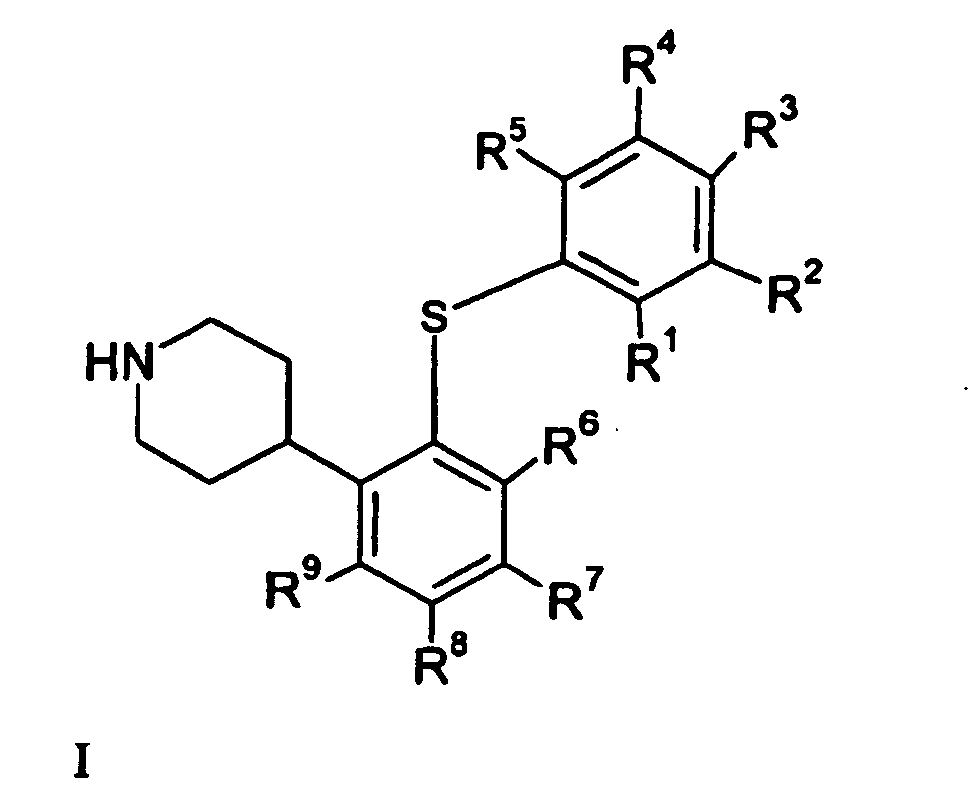
R1, R2, R3, R4, R5 are independently selected from hydrogen, halogen, cyano, C1-6-alk(en/yn)yl, C1-6-alk(en/yn)yloxy, C1-6-alk(en/yn)ylsulfanyl, hydroxy, hydroxy-C1-6-alk(en/yn)yl, halo-C1-6-alk(en/yn)yl, halo-C1-6-alk(en/yn)yloxy, or NRxRy wherein Rx and Ry are independently selected from hydrogen, C1-6-alk(en/yn)yl, cyano-C1-6-alk(en/yn)yl, C3-8-cycloalk(en)yl, C3-8-cycloalk(en)yl-C1-6-alk(en/yn)yl, or NRzRw-C1- 6-alk(en/yn)yl, wherein Rz and Rw are independently selected from hydrogen, C1-6-alk(en/yn)yl, C3-8-cycloalk(en)yl, or C3-8-cycloalk(en)yl-C1-6-alk(en/yn)yl; or Rx and Ry together with the nitrogen to which they are attached form a 3-7-membered ring which optionally contains one further heteroatom;
R6, R7, R8, R9 are independently selected from hydrogen, halogen, C1-6-alk(en/yn)yl, C1-6-alk(en/yn)yloxy, C1-6-alk(en/yn)ylsulfanyl, hydroxy, hydroxy-C1-6-alk(en/yn)yl, halo-C1-6-alk(en/yn)yl, halo-C1-6-alk(en/yn)yloxy, or NRxRy wherein Rx and Ry are independently selected from hydrogen, C1-6-alk(en/yn)yl, cyano-C1-6-alk(en/yn)yl, C3- 8-cycloalk(en)yl, C3-8cycloalk(en)yl-C1-6-alk(en/yn)yl, or NRzRw-C1-6-alk(en/yn)yl, wherein Rz and Rw are independently selected from hydrogen, C1-6-alk(en/yn)yl, C3-8-cycloalk(en)yl, C3-8-cycloalk(en)yl-C1-6-alk(en/yn)yl; or Rx and Ry together with the nitrogen to which they are attached form a 3-7-membered ring which optionally contains one further heteroatom;
provided that at least one of R1, R2, R3, R4, R5, R6, R7, R8, and R9 is different from hydrogen; also provided that when R3 is methyl, then at least one of R1, R2, R4, R5, R6, R7, R8, R9 is different from hydrogen; or a salt thereof. - The compound of claim 1, wherein R1 is selected from hydrogen, halogen, cyano, C1-6-alk(en/yn)yl, C1-6-alk(en/yn)yloxy, C1-6-alk(en/yn)ylsulfanyl, halo-C1-6-alk(en/yn)yl, or NRxRy wherein Rx and Ry are independently selected from hydrogen, C1-6-alk(en/yn)yl, cyano-C1-6-alk(en/yn)yl, C3-8-cycloalk(en)yl, C3-8-cycloalk(en)yl-C1-6-alk(en/yn)yl, or NRzRw-C1-6-alk(en/yn)yl, wherein Rz and Rw are independently selected from hydrogen, C1-6-alk(en/yn)yl, C3-8-cycloalk(en)yl, or C3-8-cycloalk(en)yl-C1-6-alk(en/yn)yl, provided that if one of Rx and Ry is NRzRw-C1-6-alk(en/yn)yl then the other is selected from hydrogen, C1-6-alk(en/yn)yl, cyano-C1-6-alk(en/yn)yl, C3-8-cycloalk(en)yl, or C3-8-cycloalk(en)yl-C1-6-alk(en/yn)yl; or Rx and Ry together with the nitrogen to which they are attached form a 3-7-membered ring which optionally contains one further heteroatom.
- The compound according to claim 2, wherein R1 is selected from hydrogen, C1-6-alkyl, or halogen.
- The compound of any one of claims 1-3, wherein R2 is selected from hydrogen, halogen, cyano, C1-6-alk(en/yn)yl, C1-6-alk(en/yn)yloxy, C1-6-alk(en/yn)ylsulfanyl, halo-C1-6-alk(en/yn)yl.
- The compound according to claim 4, wherein R2 is selected from hydrogen or C1-6-alkoxy.
- The compound of any one of claims 1-5, wherein R3 is selected from hydrogen, halogen, cyano, C1-6-alk(en/yn)yl, C1-6-alk(en/yn)yloxy, C1-6-alk(en/yn)ylsulfanyl, halo-C1-6-alk(en/yn)yl; typically, R3 is selected from hydrogen, C1-6-alkyl, C1-6-alkoxy, halogen, halo-C1-6-alkyl, hydroxy-C1-6-alkyl, NRxRy wherein Rx is hydrogen and Ry is C1-6-alkyl, or C2-6-alkenyl.
- The compound according to claim 6, wherein R3 is selected from hydrogen, halogen, cyano, C1-6-alkyl, C1-6-alkoxy, C1-6-alkylsulfanyl or halo-C1-6-alkyl.
- The compound according to claim 6, wherein R3 is selected from hydrogen, C1-6-alkyl, C1-6-alkoxy or halogen.
- The compound of any one of claims 1-8 wherein R4 is selected from hydrogen, halogen, cyano, C1-6-alk(en/yn)yl, C1-6-alk(en/yn)yloxy, C1-6-alk(en/yn)ylsulfanyl, halo-C1-6-alk(en/yn)yl.
- The compound according to claim 9, wherein R4 is selected from hydrogen or C1- 6-alkoxy.
- The compound of any one of claims 1-10 wherein R5 is selected from hydrogen, halogen, cyano, C1-6-alk(en/yn)yl, C1-6-alk(en/yn)yloxy, C1-6-alk(en/yn)ylsulfanyl, halo-C1-6-alk(en/yn)yl, or NRxRy wherein Rx and Ry are independently selected from hydrogen, C1-6-alk(en/yn)yl, cyano-C1-6-alk(en/yn)yl, C3-8-cycloalk(en)yl, C3-8-cycloalk(en)yl-C1-6-alk(en/yn)yl, or NRzRw-C1-6-alk(en/yn)yl, wherein Rz and Rw are independently selected from hydrogen, C1-6-alk(en/yn)yl, C3-8-cycloalk(en)yl, or C3-8-cycloalk(en)yl-C1-6-alk(en/yn)yl, provided that if one of Rx and Ry is NRzRw-C1-6-alk(en/yn)yl then the other is selected from hydrogen, C1-6-alk(en/yn)yl, cyano-C1-6-alk(en/yn)yl, C3-8-cycloalk(en)yl, or C3-8-cycloalk(en)yl-C1-6-alk(en/yn)yl; or Rx and Ry together with the nitrogen to which they are attached form a 3-7-membered ring which optionally contains one further heteroatom.
- The compound according to claim 11, wherein R5 is selected from hydrogen, C1-6-alkyl, or halogen.
- The compound of any one of claims 1-12 wherein R6 is selected from hydrogen, halogen, C1-6-alk(en/yn)yl, halo-C1-6-alk(en/yn)yl.
- The compound according to claim 13, wherein R6 is selected from hydrogen, or halogen.
- The compound of any one of claims 1-14 wherein R7 is selected from hydrogen, halogen, C1-6-alk(en/yn)yl, halo-C1-6-alk(en/yn)yl.
- The compound according to claim 15, wherein R7 is selected from hydrogen, or halogen
- The compound of any one of claims 1-16 wherein R8 is selected from hydrogen, halogen, C1-6-alk(en/yn)yl, halo-C1-6-alk(en/yn)yl, or NRxRy wherein Rx and Ry are independently selected from hydrogen, C1-6-alk(en/yn)yl, cyano-C1-6-alk(en/yn)yl, C3- 8-cycloalk(en)yl, C3-8-cycloalk(en)yl-C1-6-alk(en/yn)yl, or NRzRw-C1-6-alk(en/yn)yl, wherein Rz and Rw are independently selected from hydrogen, C1-6-alk(en/yn)yl, C3-8-cycloalk(en)yl, or C3-8-cycloalk(en)yl-C1-6-alk(en/yn)yl, provided that if one of Rx and Ry is NRzRw-C1-6-alk(en/yn)yl then the other is selected from hydrogen, C1-6-alk(en/yn)yl, cyano-C1-6-alk(en/yn)yl, C3-8-cycloalk(en)yl, or C3-8-cycloalk(en)yl-C1-6-alk(en/yn)yl; or Rx and Ry together with the nitrogen to which they are attached form a 3-7-membered ring which optionally contains one further heteroatom.
- The compound according to claim 17, wherein R8 is selected from hydrogen, C1-6-alkyl, halo-C1-6-alkyl, or halogen.
- The compound of any one of claims 1-18 wherein R9 is selected from hydrogen, halogen, C1-6-alk(en/yn)ylor halo-C1-6-alk(en/yn)yl.
- The compound according to claim 19, wherein R9 is selected from hydrogen:
- The compound of any one of claims 1-20 wherein the compound of formula I has 1-4 substituents in the phenyl ring(s), selected from any one of R1-R9, which are different from hydrogen, and the remaining substituents are hydrogen.
- The compound of claim 1, said compound being
4-[2-(4-Chloro-phenylsulfanyl)-5-trifluoromethyl-phenyl]-piperidine
4-[2-(4-Methoxy-phenylsulfanyl)-phenyl]-piperidine
4-[2-(2,4-Dimethyl-phenylsulfanyl)-5-trifluoromethyl-phenyl]-piperidine
4-[2-(4-Chloro-phenylsulfanyl)-4-fluoro-phenyl]-piperidine
4-[2-(4-Methoxy-phenylsulfanyl)-4-fluoro-phenyl]-piperidine
4-[2-(4-Methyl-phenylsulfanyl)-5-methyl-phenyl]-piperidine
4-[2-(2,4-Dimethyl-phenylsulfanyl)-5-methyl-phenyl]-piperidine
4-[2-(4-Fluoro-2-methyl-phenylsulfanyl)-5-methyl-phenyl]-piperidine
4-[2-(4-Methoxy-phenylsulfanyl)-5-methyl-phenyl]-piperidine
4-[2-(4-Chloro-phenylsulfanyl)-phenyl- piperidine
4-[2-(4-Methoxy-phenylsulfanyl)-5-fluoro-phenyl]-piperidine
4-[2-(4-Chloro-phenylsulfanyl)-S-fluoro-phenyl]-piperidine
or a pharmaceutically acceptable salt thereof. - A pharmaceutical composition comprising a compound of any one of claims 1-22 or a pharmaceutically acceptable acid addition salt thereof and at least one pharmaceutically acceptable carrier or diluent.
- The use of a compound of any one of claims 1 to 22 or a pharmaceutically acceptable acid addition salt thereof for the preparation of a medicament for the treatment of affective disorders, such as depression, anxiety disorders including general anxiety disorder, social anxiety disorder, post traumatic stress disorder, obsessive compulsive disorder, panic disorder, panic attacks, specific phobias, social phobia and agoraphobia.
- A compound of any one of claims 1-22 for use as a medicament.
Priority Applications (3)
| Application Number | Priority Date | Filing Date | Title |
|---|---|---|---|
| SI200430864T SI1626720T1 (en) | 2003-04-04 | 2004-04-02 | 4-(2-phenylsulfanyl-phenyl)-piperidine derivatives as serotonin reuptake inhibitors |
| PL04725291T PL1626720T3 (en) | 2003-04-04 | 2004-04-02 | 4-(2-phenylsulfanyl-phenyl)-piperidine derivatives as serotonin reuptake inhibitors |
| CY20081101225T CY1108464T1 (en) | 2003-04-04 | 2008-10-30 | Piperidine 4- (2-phenylsulfanyl-phenyl) derivative of piperidine as serotonin re-uptake inhibitors |
Applications Claiming Priority (3)
| Application Number | Priority Date | Filing Date | Title |
|---|---|---|---|
| US46052803P | 2003-04-04 | 2003-04-04 | |
| DKPA200300520 | 2003-04-04 | ||
| PCT/DK2004/000244 WO2004087156A1 (en) | 2003-04-04 | 2004-04-02 | 4-(2-phenylsulfanyl-phenyl)-piperidine derivatives as serotonin reuptake inhibitors |
Publications (2)
| Publication Number | Publication Date |
|---|---|
| EP1626720A1 EP1626720A1 (en) | 2006-02-22 |
| EP1626720B1 true EP1626720B1 (en) | 2008-09-03 |
Family
ID=33132909
Family Applications (1)
| Application Number | Title | Priority Date | Filing Date |
|---|---|---|---|
| EP04725291A Expired - Lifetime EP1626720B1 (en) | 2003-04-04 | 2004-04-02 | 4-(2-phenylsulfanyl-phenyl)-piperidine derivatives as serotonin reuptake inhibitors |
Country Status (19)
| Country | Link |
|---|---|
| US (1) | US7732463B2 (en) |
| EP (1) | EP1626720B1 (en) |
| JP (1) | JP4667366B2 (en) |
| AT (1) | ATE406894T1 (en) |
| AU (1) | AU2004226838B8 (en) |
| CA (1) | CA2521258C (en) |
| CO (1) | CO5700748A2 (en) |
| CY (1) | CY1108464T1 (en) |
| DE (1) | DE602004016316D1 (en) |
| DK (1) | DK1626720T3 (en) |
| ES (1) | ES2309514T3 (en) |
| HR (1) | HRP20080478T3 (en) |
| IL (1) | IL171087A (en) |
| MX (1) | MXPA05009592A (en) |
| NO (1) | NO20055208L (en) |
| PL (1) | PL1626720T3 (en) |
| PT (1) | PT1626720E (en) |
| SI (1) | SI1626720T1 (en) |
| WO (1) | WO2004087156A1 (en) |
Families Citing this family (18)
| Publication number | Priority date | Publication date | Assignee | Title |
|---|---|---|---|---|
| UA81749C2 (en) | 2001-10-04 | 2008-02-11 | Х. Луннбек А/С | Derivated of phenylpiperazine as serotonin reuptake inhibitorS |
| EP1792629A4 (en) | 2004-08-25 | 2010-08-25 | Takeda Pharmaceutical | PREVENTIVE / REMEDY AGENTS FOR INCONTINENCE OF STRESS AND SELECETING METHOD THEREOF |
| EP2727585A1 (en) | 2006-05-16 | 2014-05-07 | Takeda Pharmaceutical Company Limited | In-vivo screening method |
| KR101627901B1 (en) | 2006-06-16 | 2016-06-13 | 하. 룬트벡 아크티에 셀스카브 | 1-[2-(2,4-dimethylphenylsulfanyl)-phenyl]piperazine as a compound with combined serotonin reuptake, 5-ht3 and 5-ht1a activity for the treatment of cognitive impairment |
| TWI432194B (en) * | 2007-03-20 | 2014-04-01 | Lundbeck & Co As H | Novel therapeutic uses of 4-[2-(4-methylphenylsulfanyl)-phenyl]piperidine |
| TWI405588B (en) * | 2007-03-20 | 2013-08-21 | Lundbeck & Co As H | Liquid formulations of salts of 4-[2-(4-methylphenylsulfanyl)-phenyl]piperidine |
| TW200932233A (en) | 2007-11-13 | 2009-08-01 | Lundbeck & Co As H | Therapeutic uses of compounds having combined SERT, 5-HT3 and 5-HT1a activity |
| EP2216023A4 (en) | 2007-11-15 | 2013-03-13 | Takeda Pharmaceutical | CONDENSED PYRIDINE DERIVATIVE AND USE THEREOF |
| TW200938194A (en) * | 2007-12-14 | 2009-09-16 | Lundbeck & Co As H | Therapeutic uses of compounds having affinity to the serotonin transporter, serotonin receptors and noradrenalin transporter |
| TW200932225A (en) * | 2007-12-14 | 2009-08-01 | Lundbeck & Co As H | 4-[2,3-difluoro-6-(2-fluoro-4-methyl-phenylsulfanyl)-phenyl]-piperidine |
| UA98698C2 (en) * | 2008-03-03 | 2012-06-11 | Х. Луннбек А/С | Phenylsulfanylphenyl-piperidines and process for the preparation thereof |
| WO2010121621A1 (en) | 2009-04-24 | 2010-10-28 | H. Lundbeck A/S | Liquid formulations of salts of 1-[2-(2,4-dimethylphenylsulfanyl)phenyl]piperazine |
| JPWO2011071136A1 (en) | 2009-12-11 | 2013-04-22 | アステラス製薬株式会社 | Fibromyalgia treatment |
| US8920840B2 (en) * | 2010-04-30 | 2014-12-30 | Takeda Pharmaceutical Company Limited | Enteric tablet |
| WO2011136376A1 (en) * | 2010-04-30 | 2011-11-03 | 武田薬品工業株式会社 | Enteric tablet |
| JPWO2019131902A1 (en) | 2017-12-27 | 2020-12-10 | 武田薬品工業株式会社 | Remedies for stress urinary incontinence and fecal incontinence |
| WO2019170543A1 (en) | 2018-03-07 | 2019-09-12 | Bayer Aktiengesellschaft | Identification and use of erk5 inhibitors |
| EP4522598A1 (en) | 2022-05-11 | 2025-03-19 | PI Industries Ltd. | Bicyclic compounds and their use as pest control agents |
Family Cites Families (38)
| Publication number | Priority date | Publication date | Assignee | Title |
|---|---|---|---|---|
| US3803143A (en) | 1969-09-08 | 1974-04-09 | Eisai Co Ltd | 6-amino alkylene 6,7-dihydro-5h-dibenzo (b,g),(1,5)thiazocines |
| US4018830A (en) | 1969-09-22 | 1977-04-19 | Merck & Co., Inc. | Phenylthioaralkylamines |
| US4055665A (en) | 1974-11-25 | 1977-10-25 | Merck & Co., Inc. | Treating arrythmia with phenylthioaralkylamines |
| US4066654A (en) | 1975-04-16 | 1978-01-03 | G. D. Searle & Co. | 1-triarylalkyl-4-phenyl-4-piperidine carboxylic acids and derivatives |
| US4056632A (en) | 1975-07-21 | 1977-11-01 | Burroughs Wellcome Co. | 2-Hydroxymethyl-2'-aminomethyl-diphenylsulfides and method of use |
| US4241071A (en) * | 1977-01-27 | 1980-12-23 | American Hoechst Corporation | Antidepressant (α-phenyl-2-tolyl)azacycloalkanes |
| DE2802306A1 (en) * | 1977-01-27 | 1978-08-10 | Hoechst Ag | AZACYCLOALKANE, AZACYCLOALKENE AND THEIR DERIVATIVES |
| US4198417A (en) | 1979-01-10 | 1980-04-15 | American Hoechst Corporation | Phenoxyphenylpiperidines |
| US4198419A (en) * | 1979-01-10 | 1980-04-15 | American Hoechst Corporation | Phenylthiophenylpiperidines |
| DE3640475A1 (en) | 1986-11-27 | 1988-06-09 | Hoechst Sa Lab | MEDICINAL PRODUCTS BASED ON DERIVATIVES OF 3,4-DIPHENYLPIPERIDINE, THE USE OF THE DERIVATIVES AS A MEDICINAL PRODUCT AND NEW 3,4-DIPHENYLPIPERIDINE DERIVATIVES AND METHOD FOR THE PRODUCTION THEREOF |
| EP0396827A1 (en) | 1989-05-09 | 1990-11-14 | SPOFA Spojené Podniky Pro Zdravotnickou Vyrobu | 2-Phenylthiobenzylamine dervivatives and acid addition salts thereof |
| GB8912971D0 (en) * | 1989-06-06 | 1989-07-26 | Wellcome Found | Halogen substituted diphenylsulfides |
| GB9126311D0 (en) | 1991-12-11 | 1992-02-12 | Wellcome Found | Substituted diphenylsulfides |
| US6048876A (en) | 1995-01-23 | 2000-04-11 | Suntory Limited | Medicament for the alleviation or treatment of symptom derived from ischemic disease and compound useful therefor |
| DE907654T1 (en) | 1995-11-06 | 1999-09-16 | Gist-Brocades B.V. | METHOD FOR DE-ESTERIFICATION |
| CZ293595A3 (en) | 1995-11-09 | 1999-12-15 | Farmak A. S. | Derivatives of n,n-dimethyl-2-(arylthio)benzylamine, their salts, processes of their preparation and their use in medicaments |
| US5912256A (en) | 1996-06-20 | 1999-06-15 | Eli Lilly And Company | Compounds having effects on serotonin-related systems |
| ES2188970T3 (en) | 1996-08-27 | 2003-07-01 | Wyeth Corp | 4-AMINOETOXIINDOLES, AS DOPAMINE D2 AGONISTS AND AS 5HT1A RECEIVER LIGANDS. |
| US6297239B1 (en) | 1997-10-08 | 2001-10-02 | Merck & Co., Inc. | Inhibitors of prenyl-protein transferase |
| GB9725953D0 (en) | 1997-12-08 | 1998-02-04 | Pfizer Ltd | Compounds useful in therapy |
| EE200100441A (en) | 1999-02-23 | 2002-12-16 | Pfizer Products Inc. | Monoamine reuptake inhibitors for the treatment of central nervous system disorders |
| MXPA01009915A (en) | 1999-04-02 | 2003-08-20 | Icos Corp | INHIBITORS OF LFA-1 BINDING TO ICAMs AND USES THEREOF. |
| JP2002543173A (en) | 1999-04-30 | 2002-12-17 | ザ トラスティーズ オブ ザ ユニバーシティ オブ ペンシルベニア | SPECT imaging agent for serotonin transporter |
| BR0012984A (en) | 1999-08-04 | 2002-07-16 | Millennium Pharm Inc | Method for treating a condition associated with mc4-r in a mammal, compound binding to mc4-r, and pharmaceutical composition |
| US6410736B1 (en) | 1999-11-29 | 2002-06-25 | Pfizer Inc. | Biaryl ether derivatives useful as monoamine reuptake inhibitors |
| AP2002002481A0 (en) * | 1999-10-13 | 2002-06-30 | Pfizer Prod Inc | Biaryl ether derivatives useful as monoamine reuptake inhibitors. |
| EP1246819A1 (en) | 1999-12-30 | 2002-10-09 | H. Lundbeck A/S | A method for the preparation of substituted benzene derivatives |
| BR0016952A (en) | 1999-12-30 | 2002-10-08 | Lundbeck & Co As H | Substituted phenyl-piperazine-derived compounds, pharmaceutical composition, use and method |
| US6436938B1 (en) | 2001-01-22 | 2002-08-20 | Pfizer Inc. | Combination treatment for depression |
| US20020107244A1 (en) * | 2001-02-02 | 2002-08-08 | Howard Harry R. | Combination treatment for depression |
| WO2002062766A2 (en) | 2001-02-07 | 2002-08-15 | Millennium Pharmaceuticals, Inc. | Melanocortin-4 receptor binding compounds and methods of use thereof |
| PL367305A1 (en) | 2001-06-07 | 2005-02-21 | F.Hoffmann-La Roche Ag | New indole derivatives with 5-ht6 receptor affinity |
| UA81749C2 (en) * | 2001-10-04 | 2008-02-11 | Х. Луннбек А/С | Derivated of phenylpiperazine as serotonin reuptake inhibitorS |
| AU2002351747B2 (en) | 2001-12-21 | 2008-06-05 | H. Lundbeck A/S | Aminoindane derivatives as serotonin and norepinephrine uptake inhibitors |
| TW200505902A (en) | 2003-03-20 | 2005-02-16 | Schering Corp | Cannabinoid receptor ligands |
| HRP20080262T3 (en) | 2003-04-04 | 2009-04-30 | H. Lundbeck A/S | 4- (2-Phenyloxyphenyl) -PIPERIDINE DERIVATIVES OR -1,2,3,6 TETRAHYDROPYRIDINE AS SEROTONIN REHABILITATION INHIBITORS |
| UA81300C2 (en) | 2003-04-04 | 2007-12-25 | Lundbeck & Co As H | Derivates of 4-(2-fenilsulfanilfenil)-1,2,3,6-tetrahydropiridin as retarding agents of serotonin recapture |
| WO2005000309A2 (en) | 2003-06-27 | 2005-01-06 | Ionix Pharmaceuticals Limited | Chemical compounds |
-
2004
- 2004-04-02 CA CA002521258A patent/CA2521258C/en not_active Expired - Fee Related
- 2004-04-02 US US10/551,883 patent/US7732463B2/en not_active Expired - Fee Related
- 2004-04-02 JP JP2006504349A patent/JP4667366B2/en not_active Expired - Fee Related
- 2004-04-02 AT AT04725291T patent/ATE406894T1/en active
- 2004-04-02 EP EP04725291A patent/EP1626720B1/en not_active Expired - Lifetime
- 2004-04-02 DK DK04725291T patent/DK1626720T3/en active
- 2004-04-02 ES ES04725291T patent/ES2309514T3/en not_active Expired - Lifetime
- 2004-04-02 PL PL04725291T patent/PL1626720T3/en unknown
- 2004-04-02 PT PT04725291T patent/PT1626720E/en unknown
- 2004-04-02 AU AU2004226838A patent/AU2004226838B8/en not_active Ceased
- 2004-04-02 HR HR20080478T patent/HRP20080478T3/en unknown
- 2004-04-02 SI SI200430864T patent/SI1626720T1/en unknown
- 2004-04-02 MX MXPA05009592A patent/MXPA05009592A/en active IP Right Grant
- 2004-04-02 WO PCT/DK2004/000244 patent/WO2004087156A1/en not_active Ceased
- 2004-04-02 DE DE602004016316T patent/DE602004016316D1/en not_active Expired - Lifetime
-
2005
- 2005-09-25 IL IL171087A patent/IL171087A/en not_active IP Right Cessation
- 2005-11-03 CO CO05112440A patent/CO5700748A2/en not_active Application Discontinuation
- 2005-11-04 NO NO20055208A patent/NO20055208L/en not_active Application Discontinuation
-
2008
- 2008-10-30 CY CY20081101225T patent/CY1108464T1/en unknown
Also Published As
| Publication number | Publication date |
|---|---|
| JP2006522030A (en) | 2006-09-28 |
| DE602004016316D1 (en) | 2008-10-16 |
| AU2004226838B2 (en) | 2009-02-12 |
| CA2521258A1 (en) | 2004-10-14 |
| JP4667366B2 (en) | 2011-04-13 |
| MXPA05009592A (en) | 2005-10-18 |
| CY1108464T1 (en) | 2014-04-09 |
| CO5700748A2 (en) | 2006-11-30 |
| CA2521258C (en) | 2009-12-01 |
| NO20055208L (en) | 2005-11-04 |
| SI1626720T1 (en) | 2008-12-31 |
| ATE406894T1 (en) | 2008-09-15 |
| AU2004226838B8 (en) | 2009-06-11 |
| DK1626720T3 (en) | 2008-12-01 |
| ES2309514T3 (en) | 2008-12-16 |
| US7732463B2 (en) | 2010-06-08 |
| PT1626720E (en) | 2008-11-10 |
| AU2004226838A1 (en) | 2004-10-14 |
| WO2004087156A1 (en) | 2004-10-14 |
| IL171087A (en) | 2011-01-31 |
| PL1626720T3 (en) | 2009-02-27 |
| US20060100242A1 (en) | 2006-05-11 |
| HRP20080478T3 (en) | 2009-02-28 |
| EP1626720A1 (en) | 2006-02-22 |
Similar Documents
| Publication | Publication Date | Title |
|---|---|---|
| US7732463B2 (en) | 4-(2-phenylsulfanyl-phenyl)-piperidine derivatives as serotonin reuptake inhibitors | |
| EP1077940B1 (en) | 4-phenylpiperidines for the treatment of pruritic dermatoses | |
| JP3421323B2 (en) | Piperidine CCR-3 receptor antagonist | |
| JP2003528046A (en) | Phenoxypropanolamines, their preparation and therapeutic use | |
| EP1613594B1 (en) | 4-(2-phenylsulfanyl-phenyl)-1,2,3,6-tetrahydropyridine derivatives as serotonin reuptake inhibitors | |
| EP1635828B1 (en) | 4-(2-phenyloxyphenyl)-piperidine or -1,2,3,6-tetrahydropyridine derivatives as serotonin reuptake inhibitors | |
| KR20070036061A (en) | 2- (1H-indolylsulfanyl) aryl amine derivative used to treat affect disorders, pain, ADHD and stress incontinence | |
| KR101107536B1 (en) | 4-2-phenylsulfanyl-phenyl-piperidine derivatives as serotonin reuptake inhibitors | |
| WO2020171073A1 (en) | Method for producing benzazepine derivative and intermediate of same | |
| US6114549A (en) | Process of making 3-phenyl-1-methylenedioxyphenyl-indane-2-carboxylic acid derivatives | |
| KR20050119682A (en) | 4-(2-phenyloxyphenyl)-piperidine or -1,2,3,6-tetrahydropyridine derivatives as serotonin reuptake inhibitors | |
| CA2521030C (en) | 4-(2-phenyloxyphenyl)-piperidine or -1,2,3,6-tetrahydropyridine derivatives as serotonin reuptake inhibitors | |
| HK1090051B (en) | 4-(2-phenylsulfanyl-phenyl)-1,2,3,6-tetrahydropyridine derivatives as serotonin reuptake inhibitors | |
| PL190924B1 (en) | Derivatives of indole and 2,3-dihydroindole, method of obtaining them and their application | |
| PL195413B1 (en) | New derivative of 2-amino propanol and its salt |
Legal Events
| Date | Code | Title | Description |
|---|---|---|---|
| PUAI | Public reference made under article 153(3) epc to a published international application that has entered the european phase |
Free format text: ORIGINAL CODE: 0009012 |
|
| 17P | Request for examination filed |
Effective date: 20051104 |
|
| AK | Designated contracting states |
Kind code of ref document: A1 Designated state(s): AT BE BG CH CY CZ DE DK EE ES FI FR GB GR HU IE IT LI LU MC NL PL PT RO SE SI SK TR |
|
| AX | Request for extension of the european patent |
Extension state: AL HR LT LV MK |
|
| 17Q | First examination report despatched |
Effective date: 20060418 |
|
| RIC1 | Information provided on ipc code assigned before grant |
Ipc: A61P 25/00 20060101ALI20080125BHEP Ipc: A61K 31/451 20060101AFI20080125BHEP Ipc: C07D 407/12 20060101ALI20080125BHEP Ipc: C07D 211/20 20060101ALI20080125BHEP |
|
| GRAP | Despatch of communication of intention to grant a patent |
Free format text: ORIGINAL CODE: EPIDOSNIGR1 |
|
| GRAS | Grant fee paid |
Free format text: ORIGINAL CODE: EPIDOSNIGR3 |
|
| GRAA | (expected) grant |
Free format text: ORIGINAL CODE: 0009210 |
|
| AK | Designated contracting states |
Kind code of ref document: B1 Designated state(s): AT BE BG CH CY CZ DE DK EE ES FI FR GB GR HU IE IT LI LU MC NL PL PT RO SE SI SK TR |
|
| AX | Request for extension of the european patent |
Extension state: AL HR LT LV MK |
|
| REG | Reference to a national code |
Ref country code: GB Ref legal event code: FG4D |
|
| REG | Reference to a national code |
Ref country code: CH Ref legal event code: NV Representative=s name: E. BLUM & CO. AG PATENT- UND MARKENANWAELTE VSP Ref country code: CH Ref legal event code: EP |
|
| REG | Reference to a national code |
Ref country code: HR Ref legal event code: TUEP Ref document number: P20080478 Country of ref document: HR |
|
| REG | Reference to a national code |
Ref country code: IE Ref legal event code: FG4D |
|
| REF | Corresponds to: |
Ref document number: 602004016316 Country of ref document: DE Date of ref document: 20081016 Kind code of ref document: P |
|
| REG | Reference to a national code |
Ref country code: PT Ref legal event code: SC4A Free format text: AVAILABILITY OF NATIONAL TRANSLATION Effective date: 20081028 |
|
| REG | Reference to a national code |
Ref country code: RO Ref legal event code: EPE Ref country code: SE Ref legal event code: TRGR |
|
| REG | Reference to a national code |
Ref country code: DK Ref legal event code: T3 |
|
| REG | Reference to a national code |
Ref country code: ES Ref legal event code: FG2A Ref document number: 2309514 Country of ref document: ES Kind code of ref document: T3 |
|
| REG | Reference to a national code |
Ref country code: GR Ref legal event code: EP Ref document number: 20080403041 Country of ref document: GR |
|
| REG | Reference to a national code |
Ref country code: PL Ref legal event code: T3 |
|
| REG | Reference to a national code |
Ref country code: HR Ref legal event code: T1PR Ref document number: P20080478 Country of ref document: HR |
|
| REG | Reference to a national code |
Ref country code: HU Ref legal event code: AG4A Ref document number: E004453 Country of ref document: HU |
|
| PLBE | No opposition filed within time limit |
Free format text: ORIGINAL CODE: 0009261 |
|
| STAA | Information on the status of an ep patent application or granted ep patent |
Free format text: STATUS: NO OPPOSITION FILED WITHIN TIME LIMIT |
|
| 26N | No opposition filed |
Effective date: 20090604 |
|
| PGFP | Annual fee paid to national office [announced via postgrant information from national office to epo] |
Ref country code: CZ Payment date: 20110303 Year of fee payment: 8 Ref country code: SK Payment date: 20110315 Year of fee payment: 8 |
|
| PGFP | Annual fee paid to national office [announced via postgrant information from national office to epo] |
Ref country code: PL Payment date: 20110309 Year of fee payment: 8 |
|
| REG | Reference to a national code |
Ref country code: HR Ref legal event code: ODRP Ref document number: P20080478 Country of ref document: HR Payment date: 20120305 Year of fee payment: 9 |
|
| PGFP | Annual fee paid to national office [announced via postgrant information from national office to epo] |
Ref country code: MC Payment date: 20120327 Year of fee payment: 9 |
|
| PGFP | Annual fee paid to national office [announced via postgrant information from national office to epo] |
Ref country code: BG Payment date: 20120228 Year of fee payment: 9 Ref country code: EE Payment date: 20120316 Year of fee payment: 9 Ref country code: TR Payment date: 20120309 Year of fee payment: 9 |
|
| PGFP | Annual fee paid to national office [announced via postgrant information from national office to epo] |
Ref country code: GR Payment date: 20120320 Year of fee payment: 9 Ref country code: RO Payment date: 20120313 Year of fee payment: 9 |
|
| PGFP | Annual fee paid to national office [announced via postgrant information from national office to epo] |
Ref country code: LU Payment date: 20120426 Year of fee payment: 9 Ref country code: NL Payment date: 20120413 Year of fee payment: 9 Ref country code: CH Payment date: 20120412 Year of fee payment: 9 Ref country code: HU Payment date: 20120314 Year of fee payment: 9 Ref country code: DK Payment date: 20120411 Year of fee payment: 9 Ref country code: IE Payment date: 20120411 Year of fee payment: 9 Ref country code: BE Payment date: 20120412 Year of fee payment: 9 |
|
| PGFP | Annual fee paid to national office [announced via postgrant information from national office to epo] |
Ref country code: FI Payment date: 20120411 Year of fee payment: 9 Ref country code: SE Payment date: 20120411 Year of fee payment: 9 |
|
| PGFP | Annual fee paid to national office [announced via postgrant information from national office to epo] |
Ref country code: CY Payment date: 20120328 Year of fee payment: 9 |
|
| PGFP | Annual fee paid to national office [announced via postgrant information from national office to epo] |
Ref country code: SI Payment date: 20120320 Year of fee payment: 9 |
|
| PGFP | Annual fee paid to national office [announced via postgrant information from national office to epo] |
Ref country code: PT Payment date: 20120402 Year of fee payment: 9 |
|
| PGFP | Annual fee paid to national office [announced via postgrant information from national office to epo] |
Ref country code: AT Payment date: 20120327 Year of fee payment: 9 |
|
| REG | Reference to a national code |
Ref country code: PT Ref legal event code: MM4A Free format text: LAPSE DUE TO NON-PAYMENT OF FEES Effective date: 20131002 |
|
| REG | Reference to a national code |
Ref country code: HR Ref legal event code: PBON Ref document number: P20080478 Country of ref document: HR Effective date: 20130403 |
|
| BERE | Be: lapsed |
Owner name: H. LUNDBECK A/S Effective date: 20130430 |
|
| PG25 | Lapsed in a contracting state [announced via postgrant information from national office to epo] |
Ref country code: CZ Free format text: LAPSE BECAUSE OF NON-PAYMENT OF DUE FEES Effective date: 20130402 |
|
| REG | Reference to a national code |
Ref country code: NL Ref legal event code: V1 Effective date: 20131101 |
|
| REG | Reference to a national code |
Ref country code: LT Ref legal event code: MM9D Effective date: 20130402 |
|
| PG25 | Lapsed in a contracting state [announced via postgrant information from national office to epo] |
Ref country code: MC Free format text: LAPSE BECAUSE OF NON-PAYMENT OF DUE FEES Effective date: 20130430 |
|
| REG | Reference to a national code |
Ref country code: CH Ref legal event code: PL |
|
| REG | Reference to a national code |
Ref country code: SE Ref legal event code: EUG |
|
| REG | Reference to a national code |
Ref country code: DK Ref legal event code: EBP Effective date: 20130430 |
|
| REG | Reference to a national code |
Ref country code: AT Ref legal event code: MM01 Ref document number: 406894 Country of ref document: AT Kind code of ref document: T Effective date: 20130430 |
|
| REG | Reference to a national code |
Ref country code: EE Ref legal event code: MM4A Ref document number: E002637 Country of ref document: EE Effective date: 20130430 |
|
| REG | Reference to a national code |
Ref country code: SI Ref legal event code: KO00 Effective date: 20131120 |
|
| REG | Reference to a national code |
Ref country code: SK Ref legal event code: MM4A Ref document number: E 4614 Country of ref document: SK Effective date: 20130402 |
|
| REG | Reference to a national code |
Ref country code: GR Ref legal event code: ML Ref document number: 20080403041 Country of ref document: GR Effective date: 20131104 |
|
| REG | Reference to a national code |
Ref country code: IE Ref legal event code: MM4A |
|
| PG25 | Lapsed in a contracting state [announced via postgrant information from national office to epo] |
Ref country code: AT Free format text: LAPSE BECAUSE OF NON-PAYMENT OF DUE FEES Effective date: 20130430 Ref country code: CH Free format text: LAPSE BECAUSE OF NON-PAYMENT OF DUE FEES Effective date: 20130430 Ref country code: EE Free format text: LAPSE BECAUSE OF NON-PAYMENT OF DUE FEES Effective date: 20130430 Ref country code: SE Free format text: LAPSE BECAUSE OF NON-PAYMENT OF DUE FEES Effective date: 20130403 Ref country code: PT Free format text: LAPSE BECAUSE OF NON-PAYMENT OF DUE FEES Effective date: 20131002 Ref country code: BE Free format text: LAPSE BECAUSE OF NON-PAYMENT OF DUE FEES Effective date: 20130430 Ref country code: LI Free format text: LAPSE BECAUSE OF NON-PAYMENT OF DUE FEES Effective date: 20130430 Ref country code: SK Free format text: LAPSE BECAUSE OF NON-PAYMENT OF DUE FEES Effective date: 20130402 Ref country code: CY Free format text: LAPSE BECAUSE OF FAILURE TO SUBMIT A TRANSLATION OF THE DESCRIPTION OR TO PAY THE FEE WITHIN THE PRESCRIBED TIME-LIMIT Effective date: 20130710 |
|
| PG25 | Lapsed in a contracting state [announced via postgrant information from national office to epo] |
Ref country code: GR Free format text: LAPSE BECAUSE OF NON-PAYMENT OF DUE FEES Effective date: 20131104 Ref country code: NL Free format text: LAPSE BECAUSE OF NON-PAYMENT OF DUE FEES Effective date: 20131101 Ref country code: SI Free format text: LAPSE BECAUSE OF NON-PAYMENT OF DUE FEES Effective date: 20130403 Ref country code: RO Free format text: LAPSE BECAUSE OF NON-PAYMENT OF DUE FEES Effective date: 20130402 Ref country code: FI Free format text: LAPSE BECAUSE OF NON-PAYMENT OF DUE FEES Effective date: 20130402 Ref country code: HU Free format text: LAPSE BECAUSE OF NON-PAYMENT OF DUE FEES Effective date: 20130403 |
|
| PG25 | Lapsed in a contracting state [announced via postgrant information from national office to epo] |
Ref country code: CY Free format text: LAPSE BECAUSE OF FAILURE TO SUBMIT A TRANSLATION OF THE DESCRIPTION OR TO PAY THE FEE WITHIN THE PRESCRIBED TIME-LIMIT Effective date: 20130402 |
|
| PG25 | Lapsed in a contracting state [announced via postgrant information from national office to epo] |
Ref country code: IE Free format text: LAPSE BECAUSE OF NON-PAYMENT OF DUE FEES Effective date: 20130402 Ref country code: DK Free format text: LAPSE BECAUSE OF NON-PAYMENT OF DUE FEES Effective date: 20130430 |
|
| REG | Reference to a national code |
Ref country code: PL Ref legal event code: LAPE |
|
| PG25 | Lapsed in a contracting state [announced via postgrant information from national office to epo] |
Ref country code: PL Free format text: LAPSE BECAUSE OF NON-PAYMENT OF DUE FEES Effective date: 20130402 |
|
| REG | Reference to a national code |
Ref country code: FR Ref legal event code: PLFP Year of fee payment: 12 |
|
| PG25 | Lapsed in a contracting state [announced via postgrant information from national office to epo] |
Ref country code: BG Free format text: LAPSE BECAUSE OF NON-PAYMENT OF DUE FEES Effective date: 20130430 Ref country code: LU Free format text: LAPSE BECAUSE OF NON-PAYMENT OF DUE FEES Effective date: 20130402 |
|
| PG25 | Lapsed in a contracting state [announced via postgrant information from national office to epo] |
Ref country code: TR Free format text: LAPSE BECAUSE OF NON-PAYMENT OF DUE FEES Effective date: 20130402 |
|
| REG | Reference to a national code |
Ref country code: FR Ref legal event code: PLFP Year of fee payment: 13 |
|
| REG | Reference to a national code |
Ref country code: FR Ref legal event code: PLFP Year of fee payment: 14 |
|
| REG | Reference to a national code |
Ref country code: FR Ref legal event code: PLFP Year of fee payment: 15 |
|
| PGFP | Annual fee paid to national office [announced via postgrant information from national office to epo] |
Ref country code: GB Payment date: 20190327 Year of fee payment: 16 |
|
| PGFP | Annual fee paid to national office [announced via postgrant information from national office to epo] |
Ref country code: FR Payment date: 20190213 Year of fee payment: 16 |
|
| PGFP | Annual fee paid to national office [announced via postgrant information from national office to epo] |
Ref country code: ES Payment date: 20190503 Year of fee payment: 16 Ref country code: IT Payment date: 20190419 Year of fee payment: 16 Ref country code: DE Payment date: 20190319 Year of fee payment: 16 |
|
| REG | Reference to a national code |
Ref country code: DE Ref legal event code: R119 Ref document number: 602004016316 Country of ref document: DE |
|
| PG25 | Lapsed in a contracting state [announced via postgrant information from national office to epo] |
Ref country code: FR Free format text: LAPSE BECAUSE OF NON-PAYMENT OF DUE FEES Effective date: 20200430 Ref country code: DE Free format text: LAPSE BECAUSE OF NON-PAYMENT OF DUE FEES Effective date: 20201103 |
|
| GBPC | Gb: european patent ceased through non-payment of renewal fee |
Effective date: 20200402 |
|
| PG25 | Lapsed in a contracting state [announced via postgrant information from national office to epo] |
Ref country code: GB Free format text: LAPSE BECAUSE OF NON-PAYMENT OF DUE FEES Effective date: 20200402 |
|
| REG | Reference to a national code |
Ref country code: ES Ref legal event code: FD2A Effective date: 20210826 |
|
| PG25 | Lapsed in a contracting state [announced via postgrant information from national office to epo] |
Ref country code: IT Free format text: LAPSE BECAUSE OF NON-PAYMENT OF DUE FEES Effective date: 20200402 |
|
| PG25 | Lapsed in a contracting state [announced via postgrant information from national office to epo] |
Ref country code: ES Free format text: LAPSE BECAUSE OF NON-PAYMENT OF DUE FEES Effective date: 20200403 |