EP1623710A1 - Receptor antagonist - Google Patents
Receptor antagonist Download PDFInfo
- Publication number
- EP1623710A1 EP1623710A1 EP04727766A EP04727766A EP1623710A1 EP 1623710 A1 EP1623710 A1 EP 1623710A1 EP 04727766 A EP04727766 A EP 04727766A EP 04727766 A EP04727766 A EP 04727766A EP 1623710 A1 EP1623710 A1 EP 1623710A1
- Authority
- EP
- European Patent Office
- Prior art keywords
- group
- optionally substituted
- ring
- agent
- compound
- Prior art date
- Legal status (The legal status is an assumption and is not a legal conclusion. Google has not performed a legal analysis and makes no representation as to the accuracy of the status listed.)
- Withdrawn
Links
- 239000002464 receptor antagonist Substances 0.000 title description 6
- 229940044551 receptor antagonist Drugs 0.000 title description 6
- 150000001875 compounds Chemical class 0.000 claims abstract description 238
- 239000003795 chemical substances by application Substances 0.000 claims abstract description 166
- 125000000623 heterocyclic group Chemical group 0.000 claims abstract description 166
- 125000001997 phenyl group Chemical group [H]C1=C([H])C([H])=C(*)C([H])=C1[H] 0.000 claims abstract description 89
- 150000003839 salts Chemical class 0.000 claims abstract description 77
- 101001108239 Homo sapiens Pro-FMRFamide-related neuropeptide VF Proteins 0.000 claims abstract description 45
- 102100021876 Pro-FMRFamide-related neuropeptide VF Human genes 0.000 claims abstract description 45
- 125000003118 aryl group Chemical group 0.000 claims abstract description 27
- 229910052760 oxygen Inorganic materials 0.000 claims abstract description 10
- 125000001183 hydrocarbyl group Chemical group 0.000 claims abstract 24
- -1 substituted Chemical class 0.000 claims description 290
- 125000004169 (C1-C6) alkyl group Chemical group 0.000 claims description 141
- 125000004435 hydrogen atom Chemical group [H]* 0.000 claims description 120
- 239000003814 drug Substances 0.000 claims description 107
- 229940079593 drug Drugs 0.000 claims description 103
- 238000000034 method Methods 0.000 claims description 77
- 125000003277 amino group Chemical group 0.000 claims description 72
- 125000003710 aryl alkyl group Chemical group 0.000 claims description 72
- 125000003178 carboxy group Chemical group [H]OC(*)=O 0.000 claims description 69
- 125000002887 hydroxy group Chemical group [H]O* 0.000 claims description 60
- 125000002252 acyl group Chemical group 0.000 claims description 44
- 125000003917 carbamoyl group Chemical group [H]N([H])C(*)=O 0.000 claims description 44
- 125000004122 cyclic group Chemical group 0.000 claims description 43
- 125000001797 benzyl group Chemical group [H]C1=C([H])C([H])=C(C([H])=C1[H])C([H])([H])* 0.000 claims description 33
- 125000005647 linker group Chemical group 0.000 claims description 28
- 230000006870 function Effects 0.000 claims description 27
- 210000004369 blood Anatomy 0.000 claims description 25
- 239000008280 blood Substances 0.000 claims description 25
- WQZGKKKJIJFFOK-GASJEMHNSA-N Glucose Natural products OC[C@H]1OC(O)[C@H](O)[C@@H](O)[C@@H]1O WQZGKKKJIJFFOK-GASJEMHNSA-N 0.000 claims description 22
- 239000008103 glucose Substances 0.000 claims description 21
- 229940002612 prodrug Drugs 0.000 claims description 20
- 239000000651 prodrug Substances 0.000 claims description 20
- 125000002947 alkylene group Chemical group 0.000 claims description 16
- 208000037265 diseases, disorders, signs and symptoms Diseases 0.000 claims description 16
- 125000000475 sulfinyl group Chemical group [*:2]S([*:1])=O 0.000 claims description 16
- 230000000202 analgesic effect Effects 0.000 claims description 15
- 125000004482 piperidin-4-yl group Chemical group N1CCC(CC1)* 0.000 claims description 15
- 125000005931 tert-butyloxycarbonyl group Chemical group [H]C([H])([H])C(OC(*)=O)(C([H])([H])[H])C([H])([H])[H] 0.000 claims description 15
- 125000002924 primary amino group Chemical group [H]N([H])* 0.000 claims description 14
- 239000002253 acid Substances 0.000 claims description 13
- 102000051325 Glucagon Human genes 0.000 claims description 12
- 108060003199 Glucagon Proteins 0.000 claims description 12
- MASNOZXLGMXCHN-ZLPAWPGGSA-N glucagon Chemical compound C([C@@H](C(=O)N[C@H](C(=O)N[C@@H](CCC(N)=O)C(=O)N[C@@H](CC=1C2=CC=CC=C2NC=1)C(=O)N[C@@H](CC(C)C)C(=O)N[C@@H](CCSC)C(=O)N[C@@H](CC(N)=O)C(=O)N[C@@H]([C@@H](C)O)C(O)=O)C(C)C)NC(=O)[C@H](CC(O)=O)NC(=O)[C@H](CCC(N)=O)NC(=O)[C@H](C)NC(=O)[C@H](CCCNC(N)=N)NC(=O)[C@H](CCCNC(N)=N)NC(=O)[C@H](CO)NC(=O)[C@H](CC(O)=O)NC(=O)[C@H](CC(C)C)NC(=O)[C@H](CC=1C=CC(O)=CC=1)NC(=O)[C@H](CCCCN)NC(=O)[C@H](CO)NC(=O)[C@H](CC=1C=CC(O)=CC=1)NC(=O)[C@H](CC(O)=O)NC(=O)[C@H](CO)NC(=O)[C@@H](NC(=O)[C@H](CC=1C=CC=CC=1)NC(=O)[C@@H](NC(=O)CNC(=O)[C@H](CCC(N)=O)NC(=O)[C@H](CO)NC(=O)[C@@H](N)CC=1NC=NC=1)[C@@H](C)O)[C@@H](C)O)C1=CC=CC=C1 MASNOZXLGMXCHN-ZLPAWPGGSA-N 0.000 claims description 12
- 229960004666 glucagon Drugs 0.000 claims description 12
- 230000028327 secretion Effects 0.000 claims description 12
- 125000002777 acetyl group Chemical group [H]C([H])([H])C(*)=O 0.000 claims description 10
- 125000004209 (C1-C8) alkyl group Chemical group 0.000 claims description 9
- DLFVBJFMPXGRIB-UHFFFAOYSA-N Acetamide Chemical compound CC(N)=O DLFVBJFMPXGRIB-UHFFFAOYSA-N 0.000 claims description 8
- 201000010099 disease Diseases 0.000 claims description 8
- 208000035475 disorder Diseases 0.000 claims description 8
- 238000004519 manufacturing process Methods 0.000 claims description 8
- 206010012601 diabetes mellitus Diseases 0.000 claims description 7
- 206010063928 Amenorrhoea-galactorrhoea syndrome Diseases 0.000 claims description 6
- 206010036018 Pollakiuria Diseases 0.000 claims description 6
- 125000002915 carbonyl group Chemical group [*:2]C([*:1])=O 0.000 claims description 6
- 230000001737 promoting effect Effects 0.000 claims description 6
- 206010006187 Breast cancer Diseases 0.000 claims description 5
- 208000026310 Breast neoplasm Diseases 0.000 claims description 5
- 206010028980 Neoplasm Diseases 0.000 claims description 5
- 108010057464 Prolactin Proteins 0.000 claims description 5
- 208000007536 Thrombosis Diseases 0.000 claims description 5
- 206010046543 Urinary incontinence Diseases 0.000 claims description 5
- 201000005577 familial hyperlipidemia Diseases 0.000 claims description 5
- 208000031424 hyperprolactinemia Diseases 0.000 claims description 5
- 229940097325 prolactin Drugs 0.000 claims description 5
- 125000000547 substituted alkyl group Chemical group 0.000 claims description 5
- 241000124008 Mammalia Species 0.000 claims description 4
- 230000005856 abnormality Effects 0.000 claims description 4
- 229940035676 analgesics Drugs 0.000 claims description 4
- 239000000730 antalgic agent Substances 0.000 claims description 4
- 201000003723 learning disability Diseases 0.000 claims description 4
- 125000002572 propoxy group Chemical group [*]OC([H])([H])C(C([H])([H])[H])([H])[H] 0.000 claims description 4
- 230000021595 spermatogenesis Effects 0.000 claims description 4
- 208000010444 Acidosis Diseases 0.000 claims description 3
- 206010000599 Acromegaly Diseases 0.000 claims description 3
- 201000000736 Amenorrhea Diseases 0.000 claims description 3
- 206010001928 Amenorrhoea Diseases 0.000 claims description 3
- 206010003210 Arteriosclerosis Diseases 0.000 claims description 3
- 208000023275 Autoimmune disease Diseases 0.000 claims description 3
- 206010005082 Bladder stenosis Diseases 0.000 claims description 3
- 208000004054 Chiari-Frommel Syndrome Diseases 0.000 claims description 3
- 208000032131 Diabetic Neuropathies Diseases 0.000 claims description 3
- 206010012689 Diabetic retinopathy Diseases 0.000 claims description 3
- 206010021067 Hypopituitarism Diseases 0.000 claims description 3
- 208000007976 Ketosis Diseases 0.000 claims description 3
- 206010025323 Lymphomas Diseases 0.000 claims description 3
- 208000019255 Menstrual disease Diseases 0.000 claims description 3
- 208000029725 Metabolic bone disease Diseases 0.000 claims description 3
- 206010049088 Osteopenia Diseases 0.000 claims description 3
- 206010036297 Postpartum hypopituitarism Diseases 0.000 claims description 3
- 206010036832 Prolactinoma Diseases 0.000 claims description 3
- 201000009895 Sheehan syndrome Diseases 0.000 claims description 3
- 208000004168 Underactive Urinary Bladder Diseases 0.000 claims description 3
- 208000026723 Urinary tract disease Diseases 0.000 claims description 3
- 230000007950 acidosis Effects 0.000 claims description 3
- 208000026545 acidosis disease Diseases 0.000 claims description 3
- 208000023599 acquired hyperprolactinemia Diseases 0.000 claims description 3
- 125000003545 alkoxy group Chemical group 0.000 claims description 3
- 231100000540 amenorrhea Toxicity 0.000 claims description 3
- 208000011775 arteriosclerosis disease Diseases 0.000 claims description 3
- 206010003246 arthritis Diseases 0.000 claims description 3
- 210000002451 diencephalon Anatomy 0.000 claims description 3
- 201000006549 dyspepsia Diseases 0.000 claims description 3
- 125000004494 ethyl ester group Chemical group 0.000 claims description 3
- 201000001881 impotence Diseases 0.000 claims description 3
- 208000000509 infertility Diseases 0.000 claims description 3
- 230000036512 infertility Effects 0.000 claims description 3
- 231100000535 infertility Toxicity 0.000 claims description 3
- 230000004140 ketosis Effects 0.000 claims description 3
- 230000027939 micturition Effects 0.000 claims description 3
- 230000002969 morbid Effects 0.000 claims description 3
- 208000010916 pituitary tumor Diseases 0.000 claims description 3
- 208000030153 prolactin-producing pituitary gland adenoma Diseases 0.000 claims description 3
- 230000036299 sexual function Effects 0.000 claims description 3
- 208000017520 skin disease Diseases 0.000 claims description 3
- 208000011580 syndromic disease Diseases 0.000 claims description 3
- YHKDPBQCRVJCOR-ZEEKBPLESA-N (3r,5s)-7-chloro-1-(2,2-dimethylpropyl)-3-[2-(4-hydroxypiperidin-1-yl)-2-oxoethyl]-5-[2-methoxy-3-[3-(3-phenylpropylamino)propoxy]phenyl]-5h-4,1-benzoxazepin-2-one Chemical compound C1=CC=C([C@@H]2C3=CC(Cl)=CC=C3N(CC(C)(C)C)C(=O)[C@@H](CC(=O)N3CCC(O)CC3)O2)C(OC)=C1OCCCNCCCC1=CC=CC=C1 YHKDPBQCRVJCOR-ZEEKBPLESA-N 0.000 claims description 2
- DFAOGEYMGCDQTF-QZCRLSDHSA-N (3r,5s)-7-chloro-1-(2,2-dimethylpropyl)-5-[2-methoxy-3-[3-(3-phenylpropylamino)propoxy]phenyl]-3-(2-oxo-2-piperazin-1-ylethyl)-5h-4,1-benzoxazepin-2-one Chemical compound C1=CC=C([C@@H]2C3=CC(Cl)=CC=C3N(CC(C)(C)C)C(=O)[C@@H](CC(=O)N3CCNCC3)O2)C(OC)=C1OCCCNCCCC1=CC=CC=C1 DFAOGEYMGCDQTF-QZCRLSDHSA-N 0.000 claims description 2
- HBYZQFCFGXIARN-VLZNPVHKSA-N 2-[(3r,5s)-7-chloro-1-(2,2-dimethylpropyl)-5-[2-methoxy-3-[3-(3-phenylpropylamino)propoxy]phenyl]-2-oxo-5h-4,1-benzoxazepin-3-yl]-n-propylacetamide Chemical compound COC=1C([C@H]2O[C@@H](C(N(CC(C)(C)C)C3=CC=C(Cl)C=C32)=O)CC(=O)NCCC)=CC=CC=1OCCCNCCCC1=CC=CC=C1 HBYZQFCFGXIARN-VLZNPVHKSA-N 0.000 claims description 2
- WRQAQQDOERVMTL-ZMRHBGJDSA-N 2-[(3r,5s)-7-chloro-1-(2,2-dimethylpropyl)-5-[2-methoxy-3-[3-[[(e)-3-phenylprop-2-enyl]amino]propoxy]phenyl]-2-oxo-5h-4,1-benzoxazepin-3-yl]-n-[(2-fluorophenyl)methyl]acetamide Chemical compound C1=CC=C([C@@H]2C3=CC(Cl)=CC=C3N(CC(C)(C)C)C(=O)[C@@H](CC(=O)NCC=3C(=CC=CC=3)F)O2)C(OC)=C1OCCCNC\C=C\C1=CC=CC=C1 WRQAQQDOERVMTL-ZMRHBGJDSA-N 0.000 claims description 2
- SHDIUJKEJGETPC-XCEDALPCSA-N 2-[(3r,5s)-7-chloro-5-[3-[3-[3-(2-chlorophenyl)propylamino]propoxy]-2-methoxyphenyl]-1-(2,2-dimethylpropyl)-2-oxo-5h-4,1-benzoxazepin-3-yl]-n-[(2-fluorophenyl)methyl]acetamide Chemical compound C1=CC=C([C@@H]2C3=CC(Cl)=CC=C3N(CC(C)(C)C)C(=O)[C@@H](CC(=O)NCC=3C(=CC=CC=3)F)O2)C(OC)=C1OCCCNCCCC1=CC=CC=C1Cl SHDIUJKEJGETPC-XCEDALPCSA-N 0.000 claims description 2
- 208000007342 Diabetic Nephropathies Diseases 0.000 claims description 2
- 208000033679 diabetic kidney disease Diseases 0.000 claims description 2
- JKVJRWRKDXNFOY-UHFFFAOYSA-N ethyl 2-[7-chloro-5-[2-[3-[(2-methylpropan-2-yl)oxycarbonylamino]propoxy]phenyl]-1-(2-methylpropyl)-2-oxo-5h-4,1-benzoxazepin-3-yl]acetate Chemical compound C12=CC(Cl)=CC=C2N(CC(C)C)C(=O)C(CC(=O)OCC)OC1C1=CC=CC=C1OCCCNC(=O)OC(C)(C)C JKVJRWRKDXNFOY-UHFFFAOYSA-N 0.000 claims description 2
- 230000000422 nocturnal effect Effects 0.000 claims description 2
- 210000002700 urine Anatomy 0.000 claims description 2
- 150000001555 benzenes Chemical group 0.000 claims 12
- 102000003946 Prolactin Human genes 0.000 claims 1
- QVGXLLKOCUKJST-UHFFFAOYSA-N atomic oxygen Chemical group [O] QVGXLLKOCUKJST-UHFFFAOYSA-N 0.000 abstract description 3
- 239000001301 oxygen Substances 0.000 abstract description 3
- 239000001257 hydrogen Substances 0.000 abstract 2
- 150000002431 hydrogen Chemical group 0.000 abstract 2
- 229910052739 hydrogen Inorganic materials 0.000 abstract 2
- 125000001424 substituent group Chemical group 0.000 description 241
- 150000002430 hydrocarbons Chemical group 0.000 description 147
- 238000002360 preparation method Methods 0.000 description 103
- 125000005843 halogen group Chemical group 0.000 description 87
- 239000004215 Carbon black (E152) Substances 0.000 description 86
- 229930195733 hydrocarbon Natural products 0.000 description 86
- 235000002639 sodium chloride Nutrition 0.000 description 84
- 239000000243 solution Substances 0.000 description 63
- 125000002496 methyl group Chemical group [H]C([H])([H])* 0.000 description 62
- 125000004191 (C1-C6) alkoxy group Chemical group 0.000 description 58
- LFQSCWFLJHTTHZ-UHFFFAOYSA-N Ethanol Chemical compound CCO LFQSCWFLJHTTHZ-UHFFFAOYSA-N 0.000 description 53
- 125000001495 ethyl group Chemical group [H]C([H])([H])C([H])([H])* 0.000 description 52
- 229910052757 nitrogen Inorganic materials 0.000 description 46
- 125000004433 nitrogen atom Chemical group N* 0.000 description 46
- 125000005915 C6-C14 aryl group Chemical group 0.000 description 45
- 239000002904 solvent Substances 0.000 description 43
- 125000001436 propyl group Chemical group [H]C([*])([H])C([H])([H])C([H])([H])[H] 0.000 description 41
- 229910052717 sulfur Inorganic materials 0.000 description 40
- 125000004434 sulfur atom Chemical group 0.000 description 40
- PXGOKWXKJXAPGV-UHFFFAOYSA-N Fluorine Chemical compound FF PXGOKWXKJXAPGV-UHFFFAOYSA-N 0.000 description 39
- 229910052731 fluorine Inorganic materials 0.000 description 39
- 239000011737 fluorine Substances 0.000 description 39
- 125000005842 heteroatom Chemical group 0.000 description 36
- 125000004430 oxygen atom Chemical group O* 0.000 description 35
- 102000005962 receptors Human genes 0.000 description 34
- 108020003175 receptors Proteins 0.000 description 34
- 125000000999 tert-butyl group Chemical group [H]C([H])([H])C(*)(C([H])([H])[H])C([H])([H])[H] 0.000 description 34
- KRKNYBCHXYNGOX-UHFFFAOYSA-N citric acid Chemical compound OC(=O)CC(O)(C(O)=O)CC(O)=O KRKNYBCHXYNGOX-UHFFFAOYSA-N 0.000 description 33
- RTZKZFJDLAIYFH-UHFFFAOYSA-N Diethyl ether Chemical compound CCOCC RTZKZFJDLAIYFH-UHFFFAOYSA-N 0.000 description 32
- 125000001449 isopropyl group Chemical group [H]C([H])([H])C([H])(*)C([H])([H])[H] 0.000 description 31
- 239000000126 substance Substances 0.000 description 31
- OKKJLVBELUTLKV-UHFFFAOYSA-N Methanol Chemical compound OC OKKJLVBELUTLKV-UHFFFAOYSA-N 0.000 description 30
- 125000000484 butyl group Chemical group [H]C([*])([H])C([H])([H])C([H])([H])C([H])([H])[H] 0.000 description 29
- 125000000959 isobutyl group Chemical group [H]C([H])([H])C([H])(C([H])([H])[H])C([H])([H])* 0.000 description 28
- 238000006243 chemical reaction Methods 0.000 description 27
- 235000019441 ethanol Nutrition 0.000 description 27
- 125000002914 sec-butyl group Chemical group [H]C([H])([H])C([H])([H])C([H])(*)C([H])([H])[H] 0.000 description 27
- 239000000546 pharmaceutical excipient Substances 0.000 description 25
- UHOVQNZJYSORNB-UHFFFAOYSA-N Benzene Chemical group C1=CC=CC=C1 UHOVQNZJYSORNB-UHFFFAOYSA-N 0.000 description 24
- 125000004454 (C1-C6) alkoxycarbonyl group Chemical group 0.000 description 23
- 125000000217 alkyl group Chemical group 0.000 description 21
- 229910052801 chlorine Inorganic materials 0.000 description 21
- ZMXDDKWLCZADIW-UHFFFAOYSA-N N,N-Dimethylformamide Chemical compound CN(C)C=O ZMXDDKWLCZADIW-UHFFFAOYSA-N 0.000 description 20
- 229960001031 glucose Drugs 0.000 description 20
- 230000000694 effects Effects 0.000 description 19
- 229920000642 polymer Polymers 0.000 description 19
- XLYOFNOQVPJJNP-UHFFFAOYSA-N water Substances O XLYOFNOQVPJJNP-UHFFFAOYSA-N 0.000 description 19
- 125000006273 (C1-C3) alkyl group Chemical group 0.000 description 18
- CSCPPACGZOOCGX-UHFFFAOYSA-N Acetone Chemical compound CC(C)=O CSCPPACGZOOCGX-UHFFFAOYSA-N 0.000 description 18
- WEVYAHXRMPXWCK-UHFFFAOYSA-N Acetonitrile Chemical compound CC#N WEVYAHXRMPXWCK-UHFFFAOYSA-N 0.000 description 18
- DNIAPMSPPWPWGF-UHFFFAOYSA-N Propylene glycol Chemical compound CC(O)CO DNIAPMSPPWPWGF-UHFFFAOYSA-N 0.000 description 18
- YXFVVABEGXRONW-UHFFFAOYSA-N Toluene Chemical compound CC1=CC=CC=C1 YXFVVABEGXRONW-UHFFFAOYSA-N 0.000 description 18
- VLKZOEOYAKHREP-UHFFFAOYSA-N n-Hexane Chemical compound CCCCCC VLKZOEOYAKHREP-UHFFFAOYSA-N 0.000 description 18
- 125000004432 carbon atom Chemical group C* 0.000 description 17
- 230000003287 optical effect Effects 0.000 description 17
- PEDCQBHIVMGVHV-UHFFFAOYSA-N Glycerine Chemical compound OCC(O)CO PEDCQBHIVMGVHV-UHFFFAOYSA-N 0.000 description 16
- WYURNTSHIVDZCO-UHFFFAOYSA-N Tetrahydrofuran Chemical compound C1CCOC1 WYURNTSHIVDZCO-UHFFFAOYSA-N 0.000 description 16
- DTQVDTLACAAQTR-UHFFFAOYSA-N Trifluoroacetic acid Chemical compound OC(=O)C(F)(F)F DTQVDTLACAAQTR-UHFFFAOYSA-N 0.000 description 16
- NOESYZHRGYRDHS-UHFFFAOYSA-N insulin Chemical compound N1C(=O)C(NC(=O)C(CCC(N)=O)NC(=O)C(CCC(O)=O)NC(=O)C(C(C)C)NC(=O)C(NC(=O)CN)C(C)CC)CSSCC(C(NC(CO)C(=O)NC(CC(C)C)C(=O)NC(CC=2C=CC(O)=CC=2)C(=O)NC(CCC(N)=O)C(=O)NC(CC(C)C)C(=O)NC(CCC(O)=O)C(=O)NC(CC(N)=O)C(=O)NC(CC=2C=CC(O)=CC=2)C(=O)NC(CSSCC(NC(=O)C(C(C)C)NC(=O)C(CC(C)C)NC(=O)C(CC=2C=CC(O)=CC=2)NC(=O)C(CC(C)C)NC(=O)C(C)NC(=O)C(CCC(O)=O)NC(=O)C(C(C)C)NC(=O)C(CC(C)C)NC(=O)C(CC=2NC=NC=2)NC(=O)C(CO)NC(=O)CNC2=O)C(=O)NCC(=O)NC(CCC(O)=O)C(=O)NC(CCCNC(N)=N)C(=O)NCC(=O)NC(CC=3C=CC=CC=3)C(=O)NC(CC=3C=CC=CC=3)C(=O)NC(CC=3C=CC(O)=CC=3)C(=O)NC(C(C)O)C(=O)N3C(CCC3)C(=O)NC(CCCCN)C(=O)NC(C)C(O)=O)C(=O)NC(CC(N)=O)C(O)=O)=O)NC(=O)C(C(C)CC)NC(=O)C(CO)NC(=O)C(C(C)O)NC(=O)C1CSSCC2NC(=O)C(CC(C)C)NC(=O)C(NC(=O)C(CCC(N)=O)NC(=O)C(CC(N)=O)NC(=O)C(NC(=O)C(N)CC=1C=CC=CC=1)C(C)C)CC1=CN=CN1 NOESYZHRGYRDHS-UHFFFAOYSA-N 0.000 description 15
- 239000000314 lubricant Substances 0.000 description 15
- VEXZGXHMUGYJMC-UHFFFAOYSA-N Hydrochloric acid Chemical compound Cl VEXZGXHMUGYJMC-UHFFFAOYSA-N 0.000 description 14
- 239000003405 delayed action preparation Substances 0.000 description 14
- HQKMJHAJHXVSDF-UHFFFAOYSA-L magnesium stearate Chemical compound [Mg+2].CCCCCCCCCCCCCCCCCC([O-])=O.CCCCCCCCCCCCCCCCCC([O-])=O HQKMJHAJHXVSDF-UHFFFAOYSA-L 0.000 description 14
- 239000002504 physiological saline solution Substances 0.000 description 14
- 125000000882 C2-C6 alkenyl group Chemical group 0.000 description 13
- 239000002202 Polyethylene glycol Substances 0.000 description 13
- 229920002472 Starch Polymers 0.000 description 13
- 125000006615 aromatic heterocyclic group Chemical group 0.000 description 13
- 238000002156 mixing Methods 0.000 description 13
- 229920001223 polyethylene glycol Polymers 0.000 description 13
- 239000003381 stabilizer Substances 0.000 description 13
- 239000008107 starch Substances 0.000 description 13
- 235000019698 starch Nutrition 0.000 description 13
- VZCYOOQTPOCHFL-UHFFFAOYSA-N trans-butenedioic acid Natural products OC(=O)C=CC(O)=O VZCYOOQTPOCHFL-UHFFFAOYSA-N 0.000 description 13
- 125000004105 2-pyridyl group Chemical group N1=C([*])C([H])=C([H])C([H])=C1[H] 0.000 description 12
- WVDDGKGOMKODPV-UHFFFAOYSA-N Benzyl alcohol Chemical compound OCC1=CC=CC=C1 WVDDGKGOMKODPV-UHFFFAOYSA-N 0.000 description 12
- FBPFZTCFMRRESA-KVTDHHQDSA-N D-Mannitol Chemical compound OC[C@@H](O)[C@@H](O)[C@H](O)[C@H](O)CO FBPFZTCFMRRESA-KVTDHHQDSA-N 0.000 description 12
- VZCYOOQTPOCHFL-OWOJBTEDSA-N Fumaric acid Chemical compound OC(=O)\C=C\C(O)=O VZCYOOQTPOCHFL-OWOJBTEDSA-N 0.000 description 12
- NBIIXXVUZAFLBC-UHFFFAOYSA-N Phosphoric acid Chemical compound OP(O)(O)=O NBIIXXVUZAFLBC-UHFFFAOYSA-N 0.000 description 12
- VYPSYNLAJGMNEJ-UHFFFAOYSA-N Silicium dioxide Chemical compound O=[Si]=O VYPSYNLAJGMNEJ-UHFFFAOYSA-N 0.000 description 12
- 239000002585 base Substances 0.000 description 12
- 125000001309 chloro group Chemical group Cl* 0.000 description 12
- 239000000203 mixture Substances 0.000 description 12
- QJGQUHMNIGDVPM-UHFFFAOYSA-N nitrogen group Chemical group [N] QJGQUHMNIGDVPM-UHFFFAOYSA-N 0.000 description 12
- WKBOTKDWSSQWDR-UHFFFAOYSA-N Bromine atom Chemical compound [Br] WKBOTKDWSSQWDR-UHFFFAOYSA-N 0.000 description 11
- YLQBMQCUIZJEEH-UHFFFAOYSA-N Furan Chemical compound C=1C=COC=1 YLQBMQCUIZJEEH-UHFFFAOYSA-N 0.000 description 11
- 239000000654 additive Substances 0.000 description 11
- 235000015165 citric acid Nutrition 0.000 description 11
- 238000000576 coating method Methods 0.000 description 11
- 230000002401 inhibitory effect Effects 0.000 description 11
- 125000002911 monocyclic heterocycle group Chemical group 0.000 description 11
- 125000001971 neopentyl group Chemical group [H]C([*])([H])C(C([H])([H])[H])(C([H])([H])[H])C([H])([H])[H] 0.000 description 11
- 229920000036 polyvinylpyrrolidone Polymers 0.000 description 11
- 239000001267 polyvinylpyrrolidone Substances 0.000 description 11
- 235000013855 polyvinylpyrrolidone Nutrition 0.000 description 11
- 239000003826 tablet Substances 0.000 description 11
- ZCYVEMRRCGMTRW-UHFFFAOYSA-N 7553-56-2 Chemical compound [I] ZCYVEMRRCGMTRW-UHFFFAOYSA-N 0.000 description 10
- CIWBSHSKHKDKBQ-JLAZNSOCSA-N Ascorbic acid Chemical compound OC[C@H](O)[C@H]1OC(=O)C(O)=C1O CIWBSHSKHKDKBQ-JLAZNSOCSA-N 0.000 description 10
- 229920002153 Hydroxypropyl cellulose Polymers 0.000 description 10
- IMNFDUFMRHMDMM-UHFFFAOYSA-N N-Heptane Chemical compound CCCCCCC IMNFDUFMRHMDMM-UHFFFAOYSA-N 0.000 description 10
- KAESVJOAVNADME-UHFFFAOYSA-N Pyrrole Chemical compound C=1C=CNC=1 KAESVJOAVNADME-UHFFFAOYSA-N 0.000 description 10
- FAPWRFPIFSIZLT-UHFFFAOYSA-M Sodium chloride Chemical compound [Na+].[Cl-] FAPWRFPIFSIZLT-UHFFFAOYSA-M 0.000 description 10
- 229930006000 Sucrose Natural products 0.000 description 10
- CZMRCDWAGMRECN-UGDNZRGBSA-N Sucrose Chemical compound O[C@H]1[C@H](O)[C@@H](CO)O[C@@]1(CO)O[C@@H]1[C@H](O)[C@@H](O)[C@H](O)[C@@H](CO)O1 CZMRCDWAGMRECN-UGDNZRGBSA-N 0.000 description 10
- 239000011230 binding agent Substances 0.000 description 10
- 229920002678 cellulose Polymers 0.000 description 10
- 239000002552 dosage form Substances 0.000 description 10
- 235000003599 food sweetener Nutrition 0.000 description 10
- 235000010977 hydroxypropyl cellulose Nutrition 0.000 description 10
- 239000001863 hydroxypropyl cellulose Substances 0.000 description 10
- 229910052740 iodine Inorganic materials 0.000 description 10
- 235000010355 mannitol Nutrition 0.000 description 10
- BQJCRHHNABKAKU-KBQPJGBKSA-N morphine Chemical compound O([C@H]1[C@H](C=C[C@H]23)O)C4=C5[C@@]12CCN(C)[C@@H]3CC5=CC=C4O BQJCRHHNABKAKU-KBQPJGBKSA-N 0.000 description 10
- 238000000746 purification Methods 0.000 description 10
- 239000003765 sweetening agent Substances 0.000 description 10
- QTBSBXVTEAMEQO-UHFFFAOYSA-N Acetic acid Chemical compound CC(O)=O QTBSBXVTEAMEQO-UHFFFAOYSA-N 0.000 description 9
- ZAMOUSCENKQFHK-UHFFFAOYSA-N Chlorine atom Chemical compound [Cl] ZAMOUSCENKQFHK-UHFFFAOYSA-N 0.000 description 9
- YMWUJEATGCHHMB-UHFFFAOYSA-N Dichloromethane Chemical compound ClCCl YMWUJEATGCHHMB-UHFFFAOYSA-N 0.000 description 9
- 229920000084 Gum arabic Polymers 0.000 description 9
- HSHXDCVZWHOWCS-UHFFFAOYSA-N N'-hexadecylthiophene-2-carbohydrazide Chemical compound CCCCCCCCCCCCCCCCNNC(=O)c1cccs1 HSHXDCVZWHOWCS-UHFFFAOYSA-N 0.000 description 9
- FEWJPZIEWOKRBE-UHFFFAOYSA-N Tartaric acid Natural products [H+].[H+].[O-]C(=O)C(O)C(O)C([O-])=O FEWJPZIEWOKRBE-UHFFFAOYSA-N 0.000 description 9
- 239000000205 acacia gum Substances 0.000 description 9
- WQZGKKKJIJFFOK-VFUOTHLCSA-N beta-D-glucose Chemical compound OC[C@H]1O[C@@H](O)[C@H](O)[C@@H](O)[C@@H]1O WQZGKKKJIJFFOK-VFUOTHLCSA-N 0.000 description 9
- GDTBXPJZTBHREO-UHFFFAOYSA-N bromine Substances BrBr GDTBXPJZTBHREO-UHFFFAOYSA-N 0.000 description 9
- 229910052794 bromium Inorganic materials 0.000 description 9
- 239000001768 carboxy methyl cellulose Substances 0.000 description 9
- 235000010980 cellulose Nutrition 0.000 description 9
- 239000001913 cellulose Substances 0.000 description 9
- 239000000460 chlorine Substances 0.000 description 9
- 125000004093 cyano group Chemical group *C#N 0.000 description 9
- 235000011187 glycerol Nutrition 0.000 description 9
- 239000008187 granular material Substances 0.000 description 9
- 235000010979 hydroxypropyl methyl cellulose Nutrition 0.000 description 9
- 229920003088 hydroxypropyl methyl cellulose Polymers 0.000 description 9
- 239000001866 hydroxypropyl methyl cellulose Substances 0.000 description 9
- RAXXELZNTBOGNW-UHFFFAOYSA-N imidazole Natural products C1=CNC=N1 RAXXELZNTBOGNW-UHFFFAOYSA-N 0.000 description 9
- 239000003112 inhibitor Substances 0.000 description 9
- 125000000587 piperidin-1-yl group Chemical group [H]C1([H])N(*)C([H])([H])C([H])([H])C([H])([H])C1([H])[H] 0.000 description 9
- 239000007787 solid Substances 0.000 description 9
- 239000004094 surface-active agent Substances 0.000 description 9
- 125000003396 thiol group Chemical group [H]S* 0.000 description 9
- VTYYLEPIZMXCLO-UHFFFAOYSA-L Calcium carbonate Chemical compound [Ca+2].[O-]C([O-])=O VTYYLEPIZMXCLO-UHFFFAOYSA-L 0.000 description 8
- 229920002134 Carboxymethyl cellulose Polymers 0.000 description 8
- FEWJPZIEWOKRBE-JCYAYHJZSA-N Dextrotartaric acid Chemical compound OC(=O)[C@H](O)[C@@H](O)C(O)=O FEWJPZIEWOKRBE-JCYAYHJZSA-N 0.000 description 8
- KFZMGEQAYNKOFK-UHFFFAOYSA-N Isopropanol Chemical compound CC(C)O KFZMGEQAYNKOFK-UHFFFAOYSA-N 0.000 description 8
- GUBGYTABKSRVRQ-QKKXKWKRSA-N Lactose Natural products OC[C@H]1O[C@@H](O[C@H]2[C@H](O)[C@@H](O)C(O)O[C@@H]2CO)[C@H](O)[C@@H](O)[C@H]1O GUBGYTABKSRVRQ-QKKXKWKRSA-N 0.000 description 8
- 229930195725 Mannitol Natural products 0.000 description 8
- GLUUGHFHXGJENI-UHFFFAOYSA-N Piperazine Chemical compound C1CNCCN1 GLUUGHFHXGJENI-UHFFFAOYSA-N 0.000 description 8
- CDBYLPFSWZWCQE-UHFFFAOYSA-L Sodium Carbonate Chemical compound [Na+].[Na+].[O-]C([O-])=O CDBYLPFSWZWCQE-UHFFFAOYSA-L 0.000 description 8
- 229920002125 Sokalan® Polymers 0.000 description 8
- 235000010489 acacia gum Nutrition 0.000 description 8
- 230000000996 additive effect Effects 0.000 description 8
- 229910052783 alkali metal Inorganic materials 0.000 description 8
- WPYMKLBDIGXBTP-UHFFFAOYSA-N benzoic acid Chemical compound OC(=O)C1=CC=CC=C1 WPYMKLBDIGXBTP-UHFFFAOYSA-N 0.000 description 8
- 235000010948 carboxy methyl cellulose Nutrition 0.000 description 8
- 239000003086 colorant Substances 0.000 description 8
- 235000014113 dietary fatty acids Nutrition 0.000 description 8
- 125000003754 ethoxycarbonyl group Chemical group C(=O)(OCC)* 0.000 description 8
- 229930195729 fatty acid Natural products 0.000 description 8
- 239000000194 fatty acid Substances 0.000 description 8
- 239000011630 iodine Substances 0.000 description 8
- 239000008101 lactose Substances 0.000 description 8
- 239000000594 mannitol Substances 0.000 description 8
- 125000000956 methoxy group Chemical group [H]C([H])([H])O* 0.000 description 8
- 125000001160 methoxycarbonyl group Chemical group [H]C([H])([H])OC(*)=O 0.000 description 8
- 125000001570 methylene group Chemical group [H]C([H])([*:1])[*:2] 0.000 description 8
- 125000000449 nitro group Chemical group [O-][N+](*)=O 0.000 description 8
- 239000002245 particle Substances 0.000 description 8
- 238000002953 preparative HPLC Methods 0.000 description 8
- 239000003223 protective agent Substances 0.000 description 8
- 125000000472 sulfonyl group Chemical group *S(*)(=O)=O 0.000 description 8
- 244000215068 Acacia senegal Species 0.000 description 7
- GUBGYTABKSRVRQ-XLOQQCSPSA-N Alpha-Lactose Chemical compound O[C@@H]1[C@@H](O)[C@@H](O)[C@@H](CO)O[C@H]1O[C@@H]1[C@@H](CO)O[C@H](O)[C@H](O)[C@H]1O GUBGYTABKSRVRQ-XLOQQCSPSA-N 0.000 description 7
- 108010010803 Gelatin Proteins 0.000 description 7
- DHMQDGOQFOQNFH-UHFFFAOYSA-N Glycine Chemical compound NCC(O)=O DHMQDGOQFOQNFH-UHFFFAOYSA-N 0.000 description 7
- 102000004877 Insulin Human genes 0.000 description 7
- 108090001061 Insulin Proteins 0.000 description 7
- LRHPLDYGYMQRHN-UHFFFAOYSA-N N-Butanol Chemical compound CCCCO LRHPLDYGYMQRHN-UHFFFAOYSA-N 0.000 description 7
- 230000002378 acidificating effect Effects 0.000 description 7
- 125000003342 alkenyl group Chemical group 0.000 description 7
- 125000004453 alkoxycarbonyl group Chemical group 0.000 description 7
- 150000001413 amino acids Chemical class 0.000 description 7
- 239000008112 carboxymethyl-cellulose Substances 0.000 description 7
- 238000004587 chromatography analysis Methods 0.000 description 7
- 229920001577 copolymer Polymers 0.000 description 7
- 125000002485 formyl group Chemical group [H]C(*)=O 0.000 description 7
- 229920000159 gelatin Polymers 0.000 description 7
- 235000019322 gelatine Nutrition 0.000 description 7
- 235000011852 gelatine desserts Nutrition 0.000 description 7
- 229940125396 insulin Drugs 0.000 description 7
- 235000019359 magnesium stearate Nutrition 0.000 description 7
- VZCYOOQTPOCHFL-UPHRSURJSA-N maleic acid Chemical compound OC(=O)\C=C/C(O)=O VZCYOOQTPOCHFL-UPHRSURJSA-N 0.000 description 7
- 239000011159 matrix material Substances 0.000 description 7
- 235000010482 polyoxyethylene sorbitan monooleate Nutrition 0.000 description 7
- 229920000053 polysorbate 80 Polymers 0.000 description 7
- 125000006239 protecting group Chemical group 0.000 description 7
- 238000001953 recrystallisation Methods 0.000 description 7
- 239000006190 sub-lingual tablet Substances 0.000 description 7
- 239000000454 talc Substances 0.000 description 7
- 229910052623 talc Inorganic materials 0.000 description 7
- 235000012222 talc Nutrition 0.000 description 7
- 239000011975 tartaric acid Substances 0.000 description 7
- 235000002906 tartaric acid Nutrition 0.000 description 7
- 125000003161 (C1-C6) alkylene group Chemical group 0.000 description 6
- 125000006552 (C3-C8) cycloalkyl group Chemical group 0.000 description 6
- RYHBNJHYFVUHQT-UHFFFAOYSA-N 1,4-Dioxane Chemical compound C1COCCO1 RYHBNJHYFVUHQT-UHFFFAOYSA-N 0.000 description 6
- 125000002941 2-furyl group Chemical group O1C([*])=C([H])C([H])=C1[H] 0.000 description 6
- 125000000175 2-thienyl group Chemical group S1C([*])=C([H])C([H])=C1[H] 0.000 description 6
- 125000003349 3-pyridyl group Chemical group N1=C([H])C([*])=C([H])C([H])=C1[H] 0.000 description 6
- 125000000339 4-pyridyl group Chemical group N1=C([H])C([H])=C([*])C([H])=C1[H] 0.000 description 6
- HEDRZPFGACZZDS-UHFFFAOYSA-N Chloroform Chemical compound ClC(Cl)Cl HEDRZPFGACZZDS-UHFFFAOYSA-N 0.000 description 6
- MUBZPKHOEPUJKR-UHFFFAOYSA-N Oxalic acid Chemical compound OC(=O)C(O)=O MUBZPKHOEPUJKR-UHFFFAOYSA-N 0.000 description 6
- OFOBLEOULBTSOW-UHFFFAOYSA-N Propanedioic acid Natural products OC(=O)CC(O)=O OFOBLEOULBTSOW-UHFFFAOYSA-N 0.000 description 6
- JUJWROOIHBZHMG-UHFFFAOYSA-N Pyridine Chemical compound C1=CC=NC=C1 JUJWROOIHBZHMG-UHFFFAOYSA-N 0.000 description 6
- 241000700159 Rattus Species 0.000 description 6
- HEMHJVSKTPXQMS-UHFFFAOYSA-M Sodium hydroxide Chemical compound [OH-].[Na+] HEMHJVSKTPXQMS-UHFFFAOYSA-M 0.000 description 6
- KDYFGRWQOYBRFD-UHFFFAOYSA-N Succinic acid Natural products OC(=O)CCC(O)=O KDYFGRWQOYBRFD-UHFFFAOYSA-N 0.000 description 6
- 125000005196 alkyl carbonyloxy group Chemical group 0.000 description 6
- 125000005530 alkylenedioxy group Chemical group 0.000 description 6
- 229910000147 aluminium phosphate Inorganic materials 0.000 description 6
- 125000001691 aryl alkyl amino group Chemical group 0.000 description 6
- 125000003236 benzoyl group Chemical group [H]C1=C([H])C([H])=C(C([H])=C1[H])C(*)=O 0.000 description 6
- KDYFGRWQOYBRFD-NUQCWPJISA-N butanedioic acid Chemical compound O[14C](=O)CC[14C](O)=O KDYFGRWQOYBRFD-NUQCWPJISA-N 0.000 description 6
- 239000002775 capsule Substances 0.000 description 6
- 238000002425 crystallisation Methods 0.000 description 6
- 230000008025 crystallization Effects 0.000 description 6
- 238000004090 dissolution Methods 0.000 description 6
- 239000001530 fumaric acid Substances 0.000 description 6
- 235000011087 fumaric acid Nutrition 0.000 description 6
- 239000008273 gelatin Substances 0.000 description 6
- 229940014259 gelatin Drugs 0.000 description 6
- 125000001041 indolyl group Chemical group 0.000 description 6
- 239000010410 layer Substances 0.000 description 6
- 239000011976 maleic acid Substances 0.000 description 6
- 239000003960 organic solvent Substances 0.000 description 6
- 125000000286 phenylethyl group Chemical group [H]C1=C([H])C([H])=C(C([H])=C1[H])C([H])([H])C([H])([H])* 0.000 description 6
- BWHMMNNQKKPAPP-UHFFFAOYSA-L potassium carbonate Chemical compound [K+].[K+].[O-]C([O-])=O BWHMMNNQKKPAPP-UHFFFAOYSA-L 0.000 description 6
- 239000000843 powder Substances 0.000 description 6
- 239000003755 preservative agent Substances 0.000 description 6
- BDERNNFJNOPAEC-UHFFFAOYSA-N propan-1-ol Chemical compound CCCO BDERNNFJNOPAEC-UHFFFAOYSA-N 0.000 description 6
- QQONPFPTGQHPMA-UHFFFAOYSA-N propylene Natural products CC=C QQONPFPTGQHPMA-UHFFFAOYSA-N 0.000 description 6
- 125000004805 propylene group Chemical group [H]C([H])([H])C([H])([*:1])C([H])([H])[*:2] 0.000 description 6
- 230000035484 reaction time Effects 0.000 description 6
- 230000002829 reductive effect Effects 0.000 description 6
- 238000000926 separation method Methods 0.000 description 6
- 238000000638 solvent extraction Methods 0.000 description 6
- 125000006624 (C1-C6) alkoxycarbonylamino group Chemical group 0.000 description 5
- 125000004916 (C1-C6) alkylcarbonyl group Chemical group 0.000 description 5
- 125000006376 (C3-C10) cycloalkyl group Chemical group 0.000 description 5
- 125000001637 1-naphthyl group Chemical group [H]C1=C([H])C([H])=C2C(*)=C([H])C([H])=C([H])C2=C1[H] 0.000 description 5
- 125000001622 2-naphthyl group Chemical group [H]C1=C([H])C([H])=C2C([H])=C(*)C([H])=C([H])C2=C1[H] 0.000 description 5
- 206010002091 Anaesthesia Diseases 0.000 description 5
- FERIUCNNQQJTOY-UHFFFAOYSA-N Butyric acid Chemical compound CCCC(O)=O FERIUCNNQQJTOY-UHFFFAOYSA-N 0.000 description 5
- 229920001353 Dextrin Polymers 0.000 description 5
- 239000004375 Dextrin Substances 0.000 description 5
- IAZDPXIOMUYVGZ-UHFFFAOYSA-N Dimethylsulphoxide Chemical compound CS(C)=O IAZDPXIOMUYVGZ-UHFFFAOYSA-N 0.000 description 5
- UIIMBOGNXHQVGW-DEQYMQKBSA-M Sodium bicarbonate-14C Chemical compound [Na+].O[14C]([O-])=O UIIMBOGNXHQVGW-DEQYMQKBSA-M 0.000 description 5
- 125000003668 acetyloxy group Chemical group [H]C([H])([H])C(=O)O[*] 0.000 description 5
- 125000004397 aminosulfonyl group Chemical group NS(=O)(=O)* 0.000 description 5
- 230000037005 anaesthesia Effects 0.000 description 5
- 230000003110 anti-inflammatory effect Effects 0.000 description 5
- 239000007864 aqueous solution Substances 0.000 description 5
- 125000005098 aryl alkoxy carbonyl group Chemical group 0.000 description 5
- 235000010323 ascorbic acid Nutrition 0.000 description 5
- 239000011668 ascorbic acid Substances 0.000 description 5
- 229960005070 ascorbic acid Drugs 0.000 description 5
- 125000000440 benzylamino group Chemical group [H]N(*)C([H])([H])C1=C([H])C([H])=C([H])C([H])=C1[H] 0.000 description 5
- 125000001584 benzyloxycarbonyl group Chemical group C(=O)(OCC1=CC=CC=C1)* 0.000 description 5
- 239000000872 buffer Substances 0.000 description 5
- 125000001995 cyclobutyl group Chemical group [H]C1([H])C([H])([H])C([H])(*)C1([H])[H] 0.000 description 5
- 125000000113 cyclohexyl group Chemical group [H]C1([H])C([H])([H])C([H])([H])C([H])(*)C([H])([H])C1([H])[H] 0.000 description 5
- 125000001511 cyclopentyl group Chemical group [H]C1([H])C([H])([H])C([H])([H])C([H])(*)C1([H])[H] 0.000 description 5
- 125000001559 cyclopropyl group Chemical group [H]C1([H])C([H])([H])C1([H])* 0.000 description 5
- 235000019425 dextrin Nutrition 0.000 description 5
- 239000000796 flavoring agent Substances 0.000 description 5
- 235000019634 flavors Nutrition 0.000 description 5
- 239000012052 hydrophilic carrier Substances 0.000 description 5
- 238000011835 investigation Methods 0.000 description 5
- 229960005181 morphine Drugs 0.000 description 5
- 150000007524 organic acids Chemical class 0.000 description 5
- 239000003002 pH adjusting agent Substances 0.000 description 5
- 239000000244 polyoxyethylene sorbitan monooleate Substances 0.000 description 5
- 229920001282 polysaccharide Polymers 0.000 description 5
- 239000005017 polysaccharide Substances 0.000 description 5
- 150000004804 polysaccharides Chemical class 0.000 description 5
- 229940068968 polysorbate 80 Drugs 0.000 description 5
- 229920006395 saturated elastomer Polymers 0.000 description 5
- 229910052708 sodium Inorganic materials 0.000 description 5
- 239000011734 sodium Substances 0.000 description 5
- 239000011780 sodium chloride Substances 0.000 description 5
- 235000000346 sugar Nutrition 0.000 description 5
- 239000000725 suspension Substances 0.000 description 5
- 238000002560 therapeutic procedure Methods 0.000 description 5
- 125000004739 (C1-C6) alkylsulfonyl group Chemical group 0.000 description 4
- 125000006700 (C1-C6) alkylthio group Chemical group 0.000 description 4
- 125000006590 (C2-C6) alkenylene group Chemical group 0.000 description 4
- 125000006591 (C2-C6) alkynylene group Chemical group 0.000 description 4
- ZCXLTWVZYXBHJS-UHFFFAOYSA-N 1,2-benzoxazepine Chemical compound O1N=CC=CC2=CC=CC=C12 ZCXLTWVZYXBHJS-UHFFFAOYSA-N 0.000 description 4
- 125000005960 1,4-diazepanyl group Chemical group 0.000 description 4
- IXPNQXFRVYWDDI-UHFFFAOYSA-N 1-methyl-2,4-dioxo-1,3-diazinane-5-carboximidamide Chemical compound CN1CC(C(N)=N)C(=O)NC1=O IXPNQXFRVYWDDI-UHFFFAOYSA-N 0.000 description 4
- NIXOWILDQLNWCW-UHFFFAOYSA-N 2-Propenoic acid Natural products OC(=O)C=C NIXOWILDQLNWCW-UHFFFAOYSA-N 0.000 description 4
- 125000005914 C6-C14 aryloxy group Chemical group 0.000 description 4
- 229920002261 Corn starch Polymers 0.000 description 4
- 229920000858 Cyclodextrin Polymers 0.000 description 4
- FBPFZTCFMRRESA-FSIIMWSLSA-N D-Glucitol Natural products OC[C@H](O)[C@H](O)[C@@H](O)[C@H](O)CO FBPFZTCFMRRESA-FSIIMWSLSA-N 0.000 description 4
- FBPFZTCFMRRESA-JGWLITMVSA-N D-glucitol Chemical compound OC[C@H](O)[C@@H](O)[C@H](O)[C@H](O)CO FBPFZTCFMRRESA-JGWLITMVSA-N 0.000 description 4
- IAZDPXIOMUYVGZ-WFGJKAKNSA-N Dimethyl sulfoxide Chemical compound [2H]C([2H])([2H])S(=O)C([2H])([2H])[2H] IAZDPXIOMUYVGZ-WFGJKAKNSA-N 0.000 description 4
- LYCAIKOWRPUZTN-UHFFFAOYSA-N Ethylene glycol Chemical compound OCCO LYCAIKOWRPUZTN-UHFFFAOYSA-N 0.000 description 4
- UGJMXCAKCUNAIE-UHFFFAOYSA-N Gabapentin Chemical compound OC(=O)CC1(CN)CCCCC1 UGJMXCAKCUNAIE-UHFFFAOYSA-N 0.000 description 4
- AEMRFAOFKBGASW-UHFFFAOYSA-N Glycolic acid Chemical compound OCC(O)=O AEMRFAOFKBGASW-UHFFFAOYSA-N 0.000 description 4
- DGAQECJNVWCQMB-PUAWFVPOSA-M Ilexoside XXIX Chemical compound C[C@@H]1CC[C@@]2(CC[C@@]3(C(=CC[C@H]4[C@]3(CC[C@@H]5[C@@]4(CC[C@@H](C5(C)C)OS(=O)(=O)[O-])C)C)[C@@H]2[C@]1(C)O)C)C(=O)O[C@H]6[C@@H]([C@H]([C@@H]([C@H](O6)CO)O)O)O.[Na+] DGAQECJNVWCQMB-PUAWFVPOSA-M 0.000 description 4
- SIKJAQJRHWYJAI-UHFFFAOYSA-N Indole Chemical compound C1=CC=C2NC=CC2=C1 SIKJAQJRHWYJAI-UHFFFAOYSA-N 0.000 description 4
- WHUUTDBJXJRKMK-VKHMYHEASA-N L-glutamic acid Chemical compound OC(=O)[C@@H](N)CCC(O)=O WHUUTDBJXJRKMK-VKHMYHEASA-N 0.000 description 4
- ROHFNLRQFUQHCH-YFKPBYRVSA-N L-leucine Chemical compound CC(C)C[C@H](N)C(O)=O ROHFNLRQFUQHCH-YFKPBYRVSA-N 0.000 description 4
- AFVFQIVMOAPDHO-UHFFFAOYSA-N Methanesulfonic acid Chemical compound CS(O)(=O)=O AFVFQIVMOAPDHO-UHFFFAOYSA-N 0.000 description 4
- 108010025020 Nerve Growth Factor Proteins 0.000 description 4
- 229920000148 Polycarbophil calcium Polymers 0.000 description 4
- WCUXLLCKKVVCTQ-UHFFFAOYSA-M Potassium chloride Chemical compound [Cl-].[K+] WCUXLLCKKVVCTQ-UHFFFAOYSA-M 0.000 description 4
- 102100024819 Prolactin Human genes 0.000 description 4
- KYQCOXFCLRTKLS-UHFFFAOYSA-N Pyrazine Chemical compound C1=CN=CC=N1 KYQCOXFCLRTKLS-UHFFFAOYSA-N 0.000 description 4
- QAOWNCQODCNURD-UHFFFAOYSA-N Sulfuric acid Chemical compound OS(O)(=O)=O QAOWNCQODCNURD-UHFFFAOYSA-N 0.000 description 4
- YTPLMLYBLZKORZ-UHFFFAOYSA-N Thiophene Chemical compound C=1C=CSC=1 YTPLMLYBLZKORZ-UHFFFAOYSA-N 0.000 description 4
- GWEVSGVZZGPLCZ-UHFFFAOYSA-N Titan oxide Chemical compound O=[Ti]=O GWEVSGVZZGPLCZ-UHFFFAOYSA-N 0.000 description 4
- 230000009471 action Effects 0.000 description 4
- 239000004480 active ingredient Substances 0.000 description 4
- 239000000556 agonist Substances 0.000 description 4
- 235000010443 alginic acid Nutrition 0.000 description 4
- 229920000615 alginic acid Polymers 0.000 description 4
- 125000005236 alkanoylamino group Chemical group 0.000 description 4
- IYABWNGZIDDRAK-UHFFFAOYSA-N allene Chemical group C=C=C IYABWNGZIDDRAK-UHFFFAOYSA-N 0.000 description 4
- 229940024606 amino acid Drugs 0.000 description 4
- 235000001014 amino acid Nutrition 0.000 description 4
- 230000002421 anti-septic effect Effects 0.000 description 4
- 239000003963 antioxidant agent Substances 0.000 description 4
- 235000006708 antioxidants Nutrition 0.000 description 4
- 150000004945 aromatic hydrocarbons Chemical group 0.000 description 4
- 125000005099 aryl alkyl carbonyl group Chemical group 0.000 description 4
- 235000019445 benzyl alcohol Nutrition 0.000 description 4
- SESFRYSPDFLNCH-UHFFFAOYSA-N benzyl benzoate Chemical compound C=1C=CC=CC=1C(=O)OCC1=CC=CC=C1 SESFRYSPDFLNCH-UHFFFAOYSA-N 0.000 description 4
- WHGYBXFWUBPSRW-FOUAGVGXSA-N beta-cyclodextrin Chemical compound OC[C@H]([C@H]([C@@H]([C@H]1O)O)O[C@H]2O[C@@H]([C@@H](O[C@H]3O[C@H](CO)[C@H]([C@@H]([C@H]3O)O)O[C@H]3O[C@H](CO)[C@H]([C@@H]([C@H]3O)O)O[C@H]3O[C@H](CO)[C@H]([C@@H]([C@H]3O)O)O[C@H]3O[C@H](CO)[C@H]([C@@H]([C@H]3O)O)O3)[C@H](O)[C@H]2O)CO)O[C@@H]1O[C@H]1[C@H](O)[C@@H](O)[C@@H]3O[C@@H]1CO WHGYBXFWUBPSRW-FOUAGVGXSA-N 0.000 description 4
- 229910000019 calcium carbonate Inorganic materials 0.000 description 4
- 125000001951 carbamoylamino group Chemical group C(N)(=O)N* 0.000 description 4
- 229910052799 carbon Inorganic materials 0.000 description 4
- 239000011248 coating agent Substances 0.000 description 4
- 239000008120 corn starch Substances 0.000 description 4
- 150000001924 cycloalkanes Chemical class 0.000 description 4
- 125000000753 cycloalkyl group Chemical group 0.000 description 4
- 125000004672 ethylcarbonyl group Chemical group [H]C([H])([H])C([H])([H])C(*)=O 0.000 description 4
- 239000010419 fine particle Substances 0.000 description 4
- 238000005194 fractionation Methods 0.000 description 4
- 125000002541 furyl group Chemical group 0.000 description 4
- 125000004051 hexyl group Chemical group [H]C([H])([H])C([H])([H])C([H])([H])C([H])([H])C([H])([H])C([H])([H])* 0.000 description 4
- 238000001990 intravenous administration Methods 0.000 description 4
- 239000007788 liquid Substances 0.000 description 4
- 229940031703 low substituted hydroxypropyl cellulose Drugs 0.000 description 4
- 229920000609 methyl cellulose Polymers 0.000 description 4
- 235000010981 methylcellulose Nutrition 0.000 description 4
- 239000001923 methylcellulose Substances 0.000 description 4
- 239000011259 mixed solution Substances 0.000 description 4
- 125000001147 pentyl group Chemical group C(CCCC)* 0.000 description 4
- UYWQUFXKFGHYNT-UHFFFAOYSA-N phenylmethyl ester of formic acid Natural products O=COCC1=CC=CC=C1 UYWQUFXKFGHYNT-UHFFFAOYSA-N 0.000 description 4
- XNGIFLGASWRNHJ-UHFFFAOYSA-N phthalic acid Chemical compound OC(=O)C1=CC=CC=C1C(O)=O XNGIFLGASWRNHJ-UHFFFAOYSA-N 0.000 description 4
- 108090000765 processed proteins & peptides Proteins 0.000 description 4
- 125000004076 pyridyl group Chemical group 0.000 description 4
- 125000005493 quinolyl group Chemical group 0.000 description 4
- 229960001860 salicylate Drugs 0.000 description 4
- YGSDEFSMJLZEOE-UHFFFAOYSA-M salicylate Chemical compound OC1=CC=CC=C1C([O-])=O YGSDEFSMJLZEOE-UHFFFAOYSA-M 0.000 description 4
- 235000010413 sodium alginate Nutrition 0.000 description 4
- 239000000661 sodium alginate Substances 0.000 description 4
- 229940005550 sodium alginate Drugs 0.000 description 4
- 229910000029 sodium carbonate Inorganic materials 0.000 description 4
- 235000017550 sodium carbonate Nutrition 0.000 description 4
- 229960002920 sorbitol Drugs 0.000 description 4
- 238000005507 spraying Methods 0.000 description 4
- 229940098466 sublingual tablet Drugs 0.000 description 4
- 239000000829 suppository Substances 0.000 description 4
- 230000008961 swelling Effects 0.000 description 4
- 208000024891 symptom Diseases 0.000 description 4
- JOXIMZWYDAKGHI-UHFFFAOYSA-N toluene-4-sulfonic acid Chemical compound CC1=CC=C(S(O)(=O)=O)C=C1 JOXIMZWYDAKGHI-UHFFFAOYSA-N 0.000 description 4
- 239000012929 tonicity agent Substances 0.000 description 4
- 125000002221 trityl group Chemical group [H]C1=C([H])C([H])=C([H])C([H])=C1C([*])(C1=C(C(=C(C(=C1[H])[H])[H])[H])[H])C1=C([H])C([H])=C([H])C([H])=C1[H] 0.000 description 4
- 229920002554 vinyl polymer Polymers 0.000 description 4
- 125000006717 (C3-C10) cycloalkenyl group Chemical group 0.000 description 3
- 125000001376 1,2,4-triazolyl group Chemical group N1N=C(N=C1)* 0.000 description 3
- 125000004214 1-pyrrolidinyl group Chemical group [H]C1([H])N(*)C([H])([H])C([H])([H])C1([H])[H] 0.000 description 3
- OISVCGZHLKNMSJ-UHFFFAOYSA-N 2,6-dimethylpyridine Chemical compound CC1=CC=CC(C)=N1 OISVCGZHLKNMSJ-UHFFFAOYSA-N 0.000 description 3
- 125000000094 2-phenylethyl group Chemical group [H]C1=C([H])C([H])=C(C([H])=C1[H])C([H])([H])C([H])([H])* 0.000 description 3
- 125000003903 2-propenyl group Chemical group [H]C([*])([H])C([H])=C([H])[H] 0.000 description 3
- BMYNFMYTOJXKLE-UHFFFAOYSA-N 3-azaniumyl-2-hydroxypropanoate Chemical compound NCC(O)C(O)=O BMYNFMYTOJXKLE-UHFFFAOYSA-N 0.000 description 3
- 241000416162 Astragalus gummifer Species 0.000 description 3
- 125000004649 C2-C8 alkynyl group Chemical group 0.000 description 3
- 125000000041 C6-C10 aryl group Chemical group 0.000 description 3
- 125000005974 C6-C14 arylcarbonyl group Chemical group 0.000 description 3
- OYPRJOBELJOOCE-UHFFFAOYSA-N Calcium Chemical compound [Ca] OYPRJOBELJOOCE-UHFFFAOYSA-N 0.000 description 3
- OKTJSMMVPCPJKN-UHFFFAOYSA-N Carbon Chemical compound [C] OKTJSMMVPCPJKN-UHFFFAOYSA-N 0.000 description 3
- VGGSQFUCUMXWEO-UHFFFAOYSA-N Ethene Chemical compound C=C VGGSQFUCUMXWEO-UHFFFAOYSA-N 0.000 description 3
- XEKOWRVHYACXOJ-UHFFFAOYSA-N Ethyl acetate Chemical compound CCOC(C)=O XEKOWRVHYACXOJ-UHFFFAOYSA-N 0.000 description 3
- 239000001856 Ethyl cellulose Substances 0.000 description 3
- ZZSNKZQZMQGXPY-UHFFFAOYSA-N Ethyl cellulose Chemical compound CCOCC1OC(OC)C(OCC)C(OCC)C1OC1C(O)C(O)C(OC)C(CO)O1 ZZSNKZQZMQGXPY-UHFFFAOYSA-N 0.000 description 3
- 239000005977 Ethylene Substances 0.000 description 3
- 239000004471 Glycine Substances 0.000 description 3
- 101000634565 Homo sapiens Neuropeptide FF receptor 1 Proteins 0.000 description 3
- 108010063738 Interleukins Proteins 0.000 description 3
- 102000015696 Interleukins Human genes 0.000 description 3
- XUJNEKJLAYXESH-REOHCLBHSA-N L-Cysteine Chemical compound SC[C@H](N)C(O)=O XUJNEKJLAYXESH-REOHCLBHSA-N 0.000 description 3
- AGPKZVBTJJNPAG-WHFBIAKZSA-N L-isoleucine Chemical compound CC[C@H](C)[C@H](N)C(O)=O AGPKZVBTJJNPAG-WHFBIAKZSA-N 0.000 description 3
- VVQNEPGJFQJSBK-UHFFFAOYSA-N Methyl methacrylate Chemical compound COC(=O)C(C)=C VVQNEPGJFQJSBK-UHFFFAOYSA-N 0.000 description 3
- MBBZMMPHUWSWHV-BDVNFPICSA-N N-methylglucamine Chemical compound CNC[C@H](O)[C@@H](O)[C@H](O)[C@H](O)CO MBBZMMPHUWSWHV-BDVNFPICSA-N 0.000 description 3
- 102000007072 Nerve Growth Factors Human genes 0.000 description 3
- 102100029049 Neuropeptide FF receptor 1 Human genes 0.000 description 3
- 208000001132 Osteoporosis Diseases 0.000 description 3
- PCNDJXKNXGMECE-UHFFFAOYSA-N Phenazine Natural products C1=CC=CC2=NC3=CC=CC=C3N=C21 PCNDJXKNXGMECE-UHFFFAOYSA-N 0.000 description 3
- 229920003171 Poly (ethylene oxide) Polymers 0.000 description 3
- 239000004372 Polyvinyl alcohol Substances 0.000 description 3
- RWRDLPDLKQPQOW-UHFFFAOYSA-N Pyrrolidine Chemical compound C1CCNC1 RWRDLPDLKQPQOW-UHFFFAOYSA-N 0.000 description 3
- KEAYESYHFKHZAL-UHFFFAOYSA-N Sodium Chemical compound [Na] KEAYESYHFKHZAL-UHFFFAOYSA-N 0.000 description 3
- 229940123051 Somatostatin receptor agonist Drugs 0.000 description 3
- 229920001615 Tragacanth Polymers 0.000 description 3
- HEDRZPFGACZZDS-MICDWDOJSA-N Trichloro(2H)methane Chemical compound [2H]C(Cl)(Cl)Cl HEDRZPFGACZZDS-MICDWDOJSA-N 0.000 description 3
- ZMANZCXQSJIPKH-UHFFFAOYSA-N Triethylamine Chemical compound CCN(CC)CC ZMANZCXQSJIPKH-UHFFFAOYSA-N 0.000 description 3
- 229910052784 alkaline earth metal Inorganic materials 0.000 description 3
- 150000001408 amides Chemical group 0.000 description 3
- 125000006620 amino-(C1-C6) alkyl group Chemical group 0.000 description 3
- 125000006598 aminocarbonylamino group Chemical group 0.000 description 3
- 150000003863 ammonium salts Chemical class 0.000 description 3
- 230000008485 antagonism Effects 0.000 description 3
- 239000005557 antagonist Substances 0.000 description 3
- 230000003078 antioxidant effect Effects 0.000 description 3
- 125000002102 aryl alkyloxo group Chemical group 0.000 description 3
- 125000005161 aryl oxy carbonyl group Chemical group 0.000 description 3
- 125000004391 aryl sulfonyl group Chemical group 0.000 description 3
- XSCHRSMBECNVNS-UHFFFAOYSA-N benzopyrazine Natural products N1=CC=NC2=CC=CC=C21 XSCHRSMBECNVNS-UHFFFAOYSA-N 0.000 description 3
- 230000015572 biosynthetic process Effects 0.000 description 3
- 125000006267 biphenyl group Chemical group 0.000 description 3
- 239000011575 calcium Substances 0.000 description 3
- 229910052791 calcium Inorganic materials 0.000 description 3
- 239000001506 calcium phosphate Substances 0.000 description 3
- CJZGTCYPCWQAJB-UHFFFAOYSA-L calcium stearate Chemical compound [Ca+2].CCCCCCCCCCCCCCCCCC([O-])=O.CCCCCCCCCCCCCCCCCC([O-])=O CJZGTCYPCWQAJB-UHFFFAOYSA-L 0.000 description 3
- 235000013539 calcium stearate Nutrition 0.000 description 3
- 239000008116 calcium stearate Substances 0.000 description 3
- 239000004359 castor oil Substances 0.000 description 3
- 235000019438 castor oil Nutrition 0.000 description 3
- 238000004440 column chromatography Methods 0.000 description 3
- 238000007796 conventional method Methods 0.000 description 3
- 125000000392 cycloalkenyl group Chemical group 0.000 description 3
- 230000001419 dependent effect Effects 0.000 description 3
- 239000003995 emulsifying agent Substances 0.000 description 3
- 239000000839 emulsion Substances 0.000 description 3
- 150000002148 esters Chemical group 0.000 description 3
- 235000019325 ethyl cellulose Nutrition 0.000 description 3
- 229920001249 ethyl cellulose Polymers 0.000 description 3
- 235000001727 glucose Nutrition 0.000 description 3
- ZEMPKEQAKRGZGQ-XOQCFJPHSA-N glycerol triricinoleate Natural products CCCCCC[C@@H](O)CC=CCCCCCCCC(=O)OC[C@@H](COC(=O)CCCCCCCC=CC[C@@H](O)CCCCCC)OC(=O)CCCCCCCC=CC[C@H](O)CCCCCC ZEMPKEQAKRGZGQ-XOQCFJPHSA-N 0.000 description 3
- 229960002449 glycine Drugs 0.000 description 3
- 229940088597 hormone Drugs 0.000 description 3
- 239000005556 hormone Substances 0.000 description 3
- 238000006460 hydrolysis reaction Methods 0.000 description 3
- 229920003063 hydroxymethyl cellulose Polymers 0.000 description 3
- 229940031574 hydroxymethyl cellulose Drugs 0.000 description 3
- 230000001900 immune effect Effects 0.000 description 3
- 238000002347 injection Methods 0.000 description 3
- 239000007924 injection Substances 0.000 description 3
- 125000005956 isoquinolyl group Chemical group 0.000 description 3
- 231100000053 low toxicity Toxicity 0.000 description 3
- 239000000463 material Substances 0.000 description 3
- 125000004170 methylsulfonyl group Chemical group [H]C([H])([H])S(*)(=O)=O 0.000 description 3
- 239000003094 microcapsule Substances 0.000 description 3
- 150000007522 mineralic acids Chemical class 0.000 description 3
- 125000002950 monocyclic group Chemical group 0.000 description 3
- JJYKJUXBWFATTE-UHFFFAOYSA-N mosher's acid Chemical compound COC(C(O)=O)(C(F)(F)F)C1=CC=CC=C1 JJYKJUXBWFATTE-UHFFFAOYSA-N 0.000 description 3
- 238000000465 moulding Methods 0.000 description 3
- 125000004123 n-propyl group Chemical group [H]C([H])([H])C([H])([H])C([H])([H])* 0.000 description 3
- 210000000056 organ Anatomy 0.000 description 3
- 238000007254 oxidation reaction Methods 0.000 description 3
- 125000004043 oxo group Chemical group O=* 0.000 description 3
- 239000006187 pill Substances 0.000 description 3
- 125000003386 piperidinyl group Chemical group 0.000 description 3
- 239000004584 polyacrylic acid Substances 0.000 description 3
- 229950005134 polycarbophil Drugs 0.000 description 3
- 229920002451 polyvinyl alcohol Polymers 0.000 description 3
- 235000019422 polyvinyl alcohol Nutrition 0.000 description 3
- 239000011736 potassium bicarbonate Substances 0.000 description 3
- 235000015497 potassium bicarbonate Nutrition 0.000 description 3
- 229910000028 potassium bicarbonate Inorganic materials 0.000 description 3
- 229910000027 potassium carbonate Inorganic materials 0.000 description 3
- 235000011181 potassium carbonates Nutrition 0.000 description 3
- NTTOTNSKUYCDAV-UHFFFAOYSA-N potassium hydride Chemical compound [KH] NTTOTNSKUYCDAV-UHFFFAOYSA-N 0.000 description 3
- 229910000105 potassium hydride Inorganic materials 0.000 description 3
- TYJJADVDDVDEDZ-UHFFFAOYSA-M potassium hydrogencarbonate Chemical compound [K+].OC([O-])=O TYJJADVDDVDEDZ-UHFFFAOYSA-M 0.000 description 3
- 230000002335 preservative effect Effects 0.000 description 3
- 125000001501 propionyl group Chemical group O=C([*])C([H])([H])C([H])([H])[H] 0.000 description 3
- 125000004742 propyloxycarbonyl group Chemical group 0.000 description 3
- UMJSCPRVCHMLSP-UHFFFAOYSA-N pyridine Natural products COC1=CC=CN=C1 UMJSCPRVCHMLSP-UHFFFAOYSA-N 0.000 description 3
- 229940044601 receptor agonist Drugs 0.000 description 3
- 239000000018 receptor agonist Substances 0.000 description 3
- 238000006722 reduction reaction Methods 0.000 description 3
- 239000008159 sesame oil Substances 0.000 description 3
- 235000011803 sesame oil Nutrition 0.000 description 3
- 239000012312 sodium hydride Substances 0.000 description 3
- 229910000104 sodium hydride Inorganic materials 0.000 description 3
- 159000000000 sodium salts Chemical class 0.000 description 3
- 239000000600 sorbitol Substances 0.000 description 3
- 235000010356 sorbitol Nutrition 0.000 description 3
- 230000001954 sterilising effect Effects 0.000 description 3
- 238000004659 sterilization and disinfection Methods 0.000 description 3
- 229960004793 sucrose Drugs 0.000 description 3
- 239000000375 suspending agent Substances 0.000 description 3
- 230000002194 synthesizing effect Effects 0.000 description 3
- 125000006633 tert-butoxycarbonylamino group Chemical group 0.000 description 3
- 125000001412 tetrahydropyranyl group Chemical group 0.000 description 3
- 125000001544 thienyl group Chemical group 0.000 description 3
- 238000004809 thin layer chromatography Methods 0.000 description 3
- 125000003944 tolyl group Chemical group 0.000 description 3
- 150000003722 vitamin derivatives Chemical class 0.000 description 3
- 239000001993 wax Substances 0.000 description 3
- LNAZSHAWQACDHT-XIYTZBAFSA-N (2r,3r,4s,5r,6s)-4,5-dimethoxy-2-(methoxymethyl)-3-[(2s,3r,4s,5r,6r)-3,4,5-trimethoxy-6-(methoxymethyl)oxan-2-yl]oxy-6-[(2r,3r,4s,5r,6r)-4,5,6-trimethoxy-2-(methoxymethyl)oxan-3-yl]oxyoxane Chemical compound CO[C@@H]1[C@@H](OC)[C@H](OC)[C@@H](COC)O[C@H]1O[C@H]1[C@H](OC)[C@@H](OC)[C@H](O[C@H]2[C@@H]([C@@H](OC)[C@H](OC)O[C@@H]2COC)OC)O[C@@H]1COC LNAZSHAWQACDHT-XIYTZBAFSA-N 0.000 description 2
- JFZCLMZUABKABL-GVCDGELBSA-N (2s)-2-[[(2s)-1-[(2s)-2-[[(2s)-4-amino-2-[[(2s)-1-[(2s)-2-amino-3-methylbutanoyl]pyrrolidine-2-carbonyl]amino]-4-oxobutanoyl]amino]-4-methylpentanoyl]pyrrolidine-2-carbonyl]amino]-n-[(2s)-1-[[(2s)-1-amino-1-oxo-3-phenylpropan-2-yl]amino]-5-(diaminomethyli Chemical compound N([C@@H](CC(N)=O)C(=O)N[C@@H](CC(C)C)C(=O)N1[C@@H](CCC1)C(=O)N[C@@H](CCC(N)=O)C(=O)N[C@@H](CCCNC(N)=N)C(=O)N[C@@H](CC=1C=CC=CC=1)C(N)=O)C(=O)[C@@H]1CCCN1C(=O)[C@@H](N)C(C)C JFZCLMZUABKABL-GVCDGELBSA-N 0.000 description 2
- WAAPEIZFCHNLKK-UFBFGSQYSA-N (2s,4s)-6-fluoro-2',5'-dioxospiro[2,3-dihydrochromene-4,4'-imidazolidine]-2-carboxamide Chemical compound C([C@H](OC1=CC=C(F)C=C11)C(=O)N)[C@@]21NC(=O)NC2=O WAAPEIZFCHNLKK-UFBFGSQYSA-N 0.000 description 2
- YYGNTYWPHWGJRM-UHFFFAOYSA-N (6E,10E,14E,18E)-2,6,10,15,19,23-hexamethyltetracosa-2,6,10,14,18,22-hexaene Chemical compound CC(C)=CCCC(C)=CCCC(C)=CCCC=C(C)CCC=C(C)CCC=C(C)C YYGNTYWPHWGJRM-UHFFFAOYSA-N 0.000 description 2
- 125000004178 (C1-C4) alkyl group Chemical group 0.000 description 2
- 125000004844 (C1-C6) alkoxyimino group Chemical group 0.000 description 2
- 125000004738 (C1-C6) alkyl sulfinyl group Chemical group 0.000 description 2
- 125000004845 (C1-C6) alkylsulfonylamino group Chemical group 0.000 description 2
- 125000006656 (C2-C4) alkenyl group Chemical group 0.000 description 2
- SCYULBFZEHDVBN-UHFFFAOYSA-N 1,1-Dichloroethane Chemical compound CC(Cl)Cl SCYULBFZEHDVBN-UHFFFAOYSA-N 0.000 description 2
- UWYZHKAOTLEWKK-UHFFFAOYSA-N 1,2,3,4-tetrahydroisoquinoline Chemical compound C1=CC=C2CNCCC2=C1 UWYZHKAOTLEWKK-UHFFFAOYSA-N 0.000 description 2
- LBUJPTNKIBCYBY-UHFFFAOYSA-N 1,2,3,4-tetrahydroquinoline Chemical compound C1=CC=C2CCCNC2=C1 LBUJPTNKIBCYBY-UHFFFAOYSA-N 0.000 description 2
- IANQTJSKSUMEQM-UHFFFAOYSA-N 1-benzofuran Chemical compound C1=CC=C2OC=CC2=C1 IANQTJSKSUMEQM-UHFFFAOYSA-N 0.000 description 2
- FCEHBMOGCRZNNI-UHFFFAOYSA-N 1-benzothiophene Chemical compound C1=CC=C2SC=CC2=C1 FCEHBMOGCRZNNI-UHFFFAOYSA-N 0.000 description 2
- 229940099409 11 Beta hydroxysteroid dehydrogenase inhibitor Drugs 0.000 description 2
- HYZJCKYKOHLVJF-UHFFFAOYSA-N 1H-benzimidazole Chemical compound C1=CC=C2NC=NC2=C1 HYZJCKYKOHLVJF-UHFFFAOYSA-N 0.000 description 2
- YQTCQNIPQMJNTI-UHFFFAOYSA-N 2,2-dimethylpropan-1-one Chemical group CC(C)(C)[C]=O YQTCQNIPQMJNTI-UHFFFAOYSA-N 0.000 description 2
- SMZOUWXMTYCWNB-UHFFFAOYSA-N 2-(2-methoxy-5-methylphenyl)ethanamine Chemical compound COC1=CC=C(C)C=C1CCN SMZOUWXMTYCWNB-UHFFFAOYSA-N 0.000 description 2
- HZAXFHJVJLSVMW-UHFFFAOYSA-N 2-Aminoethan-1-ol Chemical compound NCCO HZAXFHJVJLSVMW-UHFFFAOYSA-N 0.000 description 2
- FHEYFIGWYQJVDR-ACJLOTCBSA-N 2-[[3-[(2r)-2-[[(2r)-2-(3-chlorophenyl)-2-hydroxyethyl]amino]propyl]-1h-indol-7-yl]oxy]acetic acid Chemical compound C1([C@@H](O)CN[C@@H](CC=2C3=CC=CC(OCC(O)=O)=C3NC=2)C)=CC=CC(Cl)=C1 FHEYFIGWYQJVDR-ACJLOTCBSA-N 0.000 description 2
- VHMICKWLTGFITH-UHFFFAOYSA-N 2H-isoindole Chemical compound C1=CC=CC2=CNC=C21 VHMICKWLTGFITH-UHFFFAOYSA-N 0.000 description 2
- MIDXCONKKJTLDX-UHFFFAOYSA-N 3,5-dimethylcyclopentane-1,2-dione Chemical compound CC1CC(C)C(=O)C1=O MIDXCONKKJTLDX-UHFFFAOYSA-N 0.000 description 2
- FPQQSJJWHUJYPU-UHFFFAOYSA-N 3-(dimethylamino)propyliminomethylidene-ethylazanium;chloride Chemical compound Cl.CCN=C=NCCCN(C)C FPQQSJJWHUJYPU-UHFFFAOYSA-N 0.000 description 2
- 125000004975 3-butenyl group Chemical group C(CC=C)* 0.000 description 2
- WZFZJEPHYDDFCT-UHFFFAOYSA-N 3-chloro-2-methyl-n-[4-[2-(3-oxomorpholin-4-yl)ethyl]-1,3-thiazol-2-yl]benzenesulfonamide Chemical compound CC1=C(Cl)C=CC=C1S(=O)(=O)NC1=NC(CCN2C(COCC2)=O)=CS1 WZFZJEPHYDDFCT-UHFFFAOYSA-N 0.000 description 2
- 125000003682 3-furyl group Chemical group O1C([H])=C([*])C([H])=C1[H] 0.000 description 2
- 125000001541 3-thienyl group Chemical group S1C([H])=C([*])C([H])=C1[H] 0.000 description 2
- QBQLYIISSRXYKL-UHFFFAOYSA-N 4-[[4-[2-(5-methyl-2-phenyl-1,3-oxazol-4-yl)ethoxy]phenyl]methyl]-1,2-oxazolidine-3,5-dione Chemical compound CC=1OC(C=2C=CC=CC=2)=NC=1CCOC(C=C1)=CC=C1CC1C(=O)NOC1=O QBQLYIISSRXYKL-UHFFFAOYSA-N 0.000 description 2
- KDDQRKBRJSGMQE-UHFFFAOYSA-N 4-thiazolyl Chemical compound [C]1=CSC=N1 KDDQRKBRJSGMQE-UHFFFAOYSA-N 0.000 description 2
- IETKPTYAGKZLKY-UHFFFAOYSA-N 5-[[4-[(3-methyl-4-oxoquinazolin-2-yl)methoxy]phenyl]methyl]-1,3-thiazolidine-2,4-dione Chemical compound N=1C2=CC=CC=C2C(=O)N(C)C=1COC(C=C1)=CC=C1CC1SC(=O)NC1=O IETKPTYAGKZLKY-UHFFFAOYSA-N 0.000 description 2
- CWDWFSXUQODZGW-UHFFFAOYSA-N 5-thiazolyl Chemical group [C]1=CN=CS1 CWDWFSXUQODZGW-UHFFFAOYSA-N 0.000 description 2
- FHVDTGUDJYJELY-UHFFFAOYSA-N 6-{[2-carboxy-4,5-dihydroxy-6-(phosphanyloxy)oxan-3-yl]oxy}-4,5-dihydroxy-3-phosphanyloxane-2-carboxylic acid Chemical class O1C(C(O)=O)C(P)C(O)C(O)C1OC1C(C(O)=O)OC(OP)C(O)C1O FHVDTGUDJYJELY-UHFFFAOYSA-N 0.000 description 2
- KDCGOANMDULRCW-UHFFFAOYSA-N 7H-purine Chemical compound N1=CNC2=NC=NC2=C1 KDCGOANMDULRCW-UHFFFAOYSA-N 0.000 description 2
- UJOBWOGCFQCDNV-UHFFFAOYSA-N 9H-carbazole Chemical compound C1=CC=C2C3=CC=CC=C3NC2=C1 UJOBWOGCFQCDNV-UHFFFAOYSA-N 0.000 description 2
- 229920002126 Acrylic acid copolymer Polymers 0.000 description 2
- 229910002012 Aerosil® Inorganic materials 0.000 description 2
- PAYRUJLWNCNPSJ-UHFFFAOYSA-N Aniline Chemical compound NC1=CC=CC=C1 PAYRUJLWNCNPSJ-UHFFFAOYSA-N 0.000 description 2
- 239000005711 Benzoic acid Substances 0.000 description 2
- 241000283690 Bos taurus Species 0.000 description 2
- 206010006895 Cachexia Diseases 0.000 description 2
- GJSURZIOUXUGAL-UHFFFAOYSA-N Clonidine Chemical compound ClC1=CC=CC(Cl)=C1NC1=NCCN1 GJSURZIOUXUGAL-UHFFFAOYSA-N 0.000 description 2
- YVIXXPCJZAUQHJ-YGRLFVJLSA-N Cp-114271 Chemical compound C([C@@H](C)NC[C@H](O)C=1N=C(SC=1)C(F)(F)F)C1=CC=C(OCC(O)=O)C=C1 YVIXXPCJZAUQHJ-YGRLFVJLSA-N 0.000 description 2
- RGSFGYAAUTVSQA-UHFFFAOYSA-N Cyclopentane Chemical compound C1CCCC1 RGSFGYAAUTVSQA-UHFFFAOYSA-N 0.000 description 2
- 108020004414 DNA Proteins 0.000 description 2
- 208000002249 Diabetes Complications Diseases 0.000 description 2
- 206010012655 Diabetic complications Diseases 0.000 description 2
- AOJJSUZBOXZQNB-TZSSRYMLSA-N Doxorubicin Chemical compound O([C@H]1C[C@@](O)(CC=2C(O)=C3C(=O)C=4C=CC=C(C=4C(=O)C3=C(O)C=21)OC)C(=O)CO)[C@H]1C[C@H](N)[C@H](O)[C@H](C)O1 AOJJSUZBOXZQNB-TZSSRYMLSA-N 0.000 description 2
- 229920003134 Eudragit® polymer Polymers 0.000 description 2
- 108010011459 Exenatide Proteins 0.000 description 2
- 239000001116 FEMA 4028 Substances 0.000 description 2
- GHASVSINZRGABV-UHFFFAOYSA-N Fluorouracil Chemical compound FC1=CNC(=O)NC1=O GHASVSINZRGABV-UHFFFAOYSA-N 0.000 description 2
- 229930091371 Fructose Natural products 0.000 description 2
- 239000005715 Fructose Substances 0.000 description 2
- RFSUNEUAIZKAJO-ARQDHWQXSA-N Fructose Chemical compound OC[C@H]1O[C@](O)(CO)[C@@H](O)[C@@H]1O RFSUNEUAIZKAJO-ARQDHWQXSA-N 0.000 description 2
- 108091006027 G proteins Proteins 0.000 description 2
- 102000030782 GTP binding Human genes 0.000 description 2
- 108091000058 GTP-Binding Proteins 0.000 description 2
- 241000202807 Glycyrrhiza Species 0.000 description 2
- 229920002907 Guar gum Polymers 0.000 description 2
- OAKJQQAXSVQMHS-UHFFFAOYSA-N Hydrazine Chemical compound NN OAKJQQAXSVQMHS-UHFFFAOYSA-N 0.000 description 2
- QNAYBMKLOCPYGJ-REOHCLBHSA-N L-alanine Chemical compound C[C@H](N)C(O)=O QNAYBMKLOCPYGJ-REOHCLBHSA-N 0.000 description 2
- CKLJMWTZIZZHCS-REOHCLBHSA-N L-aspartic acid Chemical compound OC(=O)[C@@H](N)CC(O)=O CKLJMWTZIZZHCS-REOHCLBHSA-N 0.000 description 2
- COLNVLDHVKWLRT-QMMMGPOBSA-N L-phenylalanine Chemical compound OC(=O)[C@@H](N)CC1=CC=CC=C1 COLNVLDHVKWLRT-QMMMGPOBSA-N 0.000 description 2
- 102000016267 Leptin Human genes 0.000 description 2
- 108010092277 Leptin Proteins 0.000 description 2
- 108010075639 MAP Kinase Kinase Kinase 5 Proteins 0.000 description 2
- CERQOIWHTDAKMF-UHFFFAOYSA-N Methacrylic acid Chemical compound CC(=C)C(O)=O CERQOIWHTDAKMF-UHFFFAOYSA-N 0.000 description 2
- 229920000168 Microcrystalline cellulose Polymers 0.000 description 2
- 102100033127 Mitogen-activated protein kinase kinase kinase 5 Human genes 0.000 description 2
- YNAVUWVOSKDBBP-UHFFFAOYSA-N Morpholine Chemical compound C1COCCN1 YNAVUWVOSKDBBP-UHFFFAOYSA-N 0.000 description 2
- WHNWPMSKXPGLAX-UHFFFAOYSA-N N-Vinyl-2-pyrrolidone Chemical compound C=CN1CCCC1=O WHNWPMSKXPGLAX-UHFFFAOYSA-N 0.000 description 2
- UFWIBTONFRDIAS-UHFFFAOYSA-N Naphthalene Chemical compound C1=CC=CC2=CC=CC=C21 UFWIBTONFRDIAS-UHFFFAOYSA-N 0.000 description 2
- GRYLNZFGIOXLOG-UHFFFAOYSA-N Nitric acid Chemical compound O[N+]([O-])=O GRYLNZFGIOXLOG-UHFFFAOYSA-N 0.000 description 2
- KDLHZDBZIXYQEI-UHFFFAOYSA-N Palladium Chemical compound [Pd] KDLHZDBZIXYQEI-UHFFFAOYSA-N 0.000 description 2
- KFSLWBXXFJQRDL-UHFFFAOYSA-N Peracetic acid Chemical compound CC(=O)OO KFSLWBXXFJQRDL-UHFFFAOYSA-N 0.000 description 2
- ISWSIDIOOBJBQZ-UHFFFAOYSA-N Phenol Chemical compound OC1=CC=CC=C1 ISWSIDIOOBJBQZ-UHFFFAOYSA-N 0.000 description 2
- 229940122907 Phosphatase inhibitor Drugs 0.000 description 2
- NQRYJNQNLNOLGT-UHFFFAOYSA-N Piperidine Chemical compound C1CCNCC1 NQRYJNQNLNOLGT-UHFFFAOYSA-N 0.000 description 2
- 229920002845 Poly(methacrylic acid) Polymers 0.000 description 2
- 102000003923 Protein Kinase C Human genes 0.000 description 2
- 108090000315 Protein Kinase C Proteins 0.000 description 2
- 239000004373 Pullulan Substances 0.000 description 2
- 229920001218 Pullulan Polymers 0.000 description 2
- WTKZEGDFNFYCGP-UHFFFAOYSA-N Pyrazole Chemical compound C=1C=NNC=1 WTKZEGDFNFYCGP-UHFFFAOYSA-N 0.000 description 2
- CZPWVGJYEJSRLH-UHFFFAOYSA-N Pyrimidine Chemical compound C1=CN=CN=C1 CZPWVGJYEJSRLH-UHFFFAOYSA-N 0.000 description 2
- SMWDFEZZVXVKRB-UHFFFAOYSA-N Quinoline Chemical compound N1=CC=CC2=CC=CC=C21 SMWDFEZZVXVKRB-UHFFFAOYSA-N 0.000 description 2
- YASAKCUCGLMORW-UHFFFAOYSA-N Rosiglitazone Chemical compound C=1C=CC=NC=1N(C)CCOC(C=C1)=CC=C1CC1SC(=O)NC1=O YASAKCUCGLMORW-UHFFFAOYSA-N 0.000 description 2
- 102000000070 Sodium-Glucose Transport Proteins Human genes 0.000 description 2
- 108010080361 Sodium-Glucose Transport Proteins Proteins 0.000 description 2
- BHEOSNUKNHRBNM-UHFFFAOYSA-N Tetramethylsqualene Natural products CC(=C)C(C)CCC(=C)C(C)CCC(C)=CCCC=C(C)CCC(C)C(=C)CCC(C)C(C)=C BHEOSNUKNHRBNM-UHFFFAOYSA-N 0.000 description 2
- FZWLAAWBMGSTSO-UHFFFAOYSA-N Thiazole Chemical compound C1=CSC=N1 FZWLAAWBMGSTSO-UHFFFAOYSA-N 0.000 description 2
- 108090000373 Tissue Plasminogen Activator Proteins 0.000 description 2
- 102000003978 Tissue Plasminogen Activator Human genes 0.000 description 2
- XSQUKJJJFZCRTK-UHFFFAOYSA-N Urea Chemical compound NC(N)=O XSQUKJJJFZCRTK-UHFFFAOYSA-N 0.000 description 2
- KZSNJWFQEVHDMF-UHFFFAOYSA-N Valine Chemical compound CC(C)C(N)C(O)=O KZSNJWFQEVHDMF-UHFFFAOYSA-N 0.000 description 2
- HCHKCACWOHOZIP-UHFFFAOYSA-N Zinc Chemical compound [Zn] HCHKCACWOHOZIP-UHFFFAOYSA-N 0.000 description 2
- DPXJVFZANSGRMM-UHFFFAOYSA-N acetic acid;2,3,4,5,6-pentahydroxyhexanal;sodium Chemical compound [Na].CC(O)=O.OCC(O)C(O)C(O)C(O)C=O DPXJVFZANSGRMM-UHFFFAOYSA-N 0.000 description 2
- DZBUGLKDJFMEHC-UHFFFAOYSA-N acridine Chemical compound C1=CC=CC2=CC3=CC=CC=C3N=C21 DZBUGLKDJFMEHC-UHFFFAOYSA-N 0.000 description 2
- 239000012042 active reagent Substances 0.000 description 2
- MKOMESMZHZNBIZ-UHFFFAOYSA-M alagebrium Chemical compound [Cl-].CC1=C(C)SC=[N+]1CC(=O)C1=CC=CC=C1 MKOMESMZHZNBIZ-UHFFFAOYSA-M 0.000 description 2
- 229960003767 alanine Drugs 0.000 description 2
- 229940072056 alginate Drugs 0.000 description 2
- 125000001931 aliphatic group Chemical group 0.000 description 2
- 125000004450 alkenylene group Chemical group 0.000 description 2
- 125000005115 alkyl carbamoyl group Chemical group 0.000 description 2
- 125000005281 alkyl ureido group Chemical group 0.000 description 2
- 238000005804 alkylation reaction Methods 0.000 description 2
- 125000000304 alkynyl group Chemical group 0.000 description 2
- 125000004419 alkynylene group Chemical group 0.000 description 2
- AGBQKNBQESQNJD-UHFFFAOYSA-N alpha-Lipoic acid Natural products OC(=O)CCCCC1CCSS1 AGBQKNBQESQNJD-UHFFFAOYSA-N 0.000 description 2
- 229920003144 amino alkyl methacrylate copolymer Polymers 0.000 description 2
- 230000003288 anthiarrhythmic effect Effects 0.000 description 2
- 239000003242 anti bacterial agent Substances 0.000 description 2
- 230000001430 anti-depressive effect Effects 0.000 description 2
- 239000000883 anti-obesity agent Substances 0.000 description 2
- 239000000935 antidepressant agent Substances 0.000 description 2
- 229940005513 antidepressants Drugs 0.000 description 2
- 239000002220 antihypertensive agent Substances 0.000 description 2
- 239000002246 antineoplastic agent Substances 0.000 description 2
- 229940125710 antiobesity agent Drugs 0.000 description 2
- 239000002216 antistatic agent Substances 0.000 description 2
- VMWNQDUVQKEIOC-CYBMUJFWSA-N apomorphine Chemical compound C([C@H]1N(C)CC2)C3=CC=C(O)C(O)=C3C3=C1C2=CC=C3 VMWNQDUVQKEIOC-CYBMUJFWSA-N 0.000 description 2
- 229960004046 apomorphine Drugs 0.000 description 2
- 125000004659 aryl alkyl thio group Chemical group 0.000 description 2
- 125000001769 aryl amino group Chemical group 0.000 description 2
- 125000005116 aryl carbamoyl group Chemical group 0.000 description 2
- 125000004658 aryl carbonyl amino group Chemical group 0.000 description 2
- 125000005135 aryl sulfinyl group Chemical group 0.000 description 2
- 125000004657 aryl sulfonyl amino group Chemical group 0.000 description 2
- 125000005110 aryl thio group Chemical group 0.000 description 2
- 229960005261 aspartic acid Drugs 0.000 description 2
- 238000000065 atmospheric pressure chemical ionisation Methods 0.000 description 2
- 239000012752 auxiliary agent Substances 0.000 description 2
- 159000000009 barium salts Chemical class 0.000 description 2
- 235000010233 benzoic acid Nutrition 0.000 description 2
- IOJUPLGTWVMSFF-UHFFFAOYSA-N benzothiazole Chemical compound C1=CC=C2SC=NC2=C1 IOJUPLGTWVMSFF-UHFFFAOYSA-N 0.000 description 2
- 125000000051 benzyloxy group Chemical group [H]C1=C([H])C([H])=C(C([H])=C1[H])C([H])([H])O* 0.000 description 2
- 235000011175 beta-cyclodextrine Nutrition 0.000 description 2
- 229960004853 betadex Drugs 0.000 description 2
- 125000002619 bicyclic group Chemical group 0.000 description 2
- 230000003115 biocidal effect Effects 0.000 description 2
- 125000006251 butylcarbonyl group Chemical group 0.000 description 2
- 125000004063 butyryl group Chemical group O=C([*])C([H])([H])C([H])([H])C([H])([H])[H] 0.000 description 2
- 235000011010 calcium phosphates Nutrition 0.000 description 2
- 159000000007 calcium salts Chemical class 0.000 description 2
- OSGAYBCDTDRGGQ-UHFFFAOYSA-L calcium sulfate Chemical compound [Ca+2].[O-]S([O-])(=O)=O OSGAYBCDTDRGGQ-UHFFFAOYSA-L 0.000 description 2
- 201000011510 cancer Diseases 0.000 description 2
- YKPUWZUDDOIDPM-SOFGYWHQSA-N capsaicin Chemical compound COC1=CC(CNC(=O)CCCC\C=C\C(C)C)=CC=C1O YKPUWZUDDOIDPM-SOFGYWHQSA-N 0.000 description 2
- 235000013736 caramel Nutrition 0.000 description 2
- 229960001631 carbomer Drugs 0.000 description 2
- 125000004181 carboxyalkyl group Chemical group 0.000 description 2
- 238000010531 catalytic reduction reaction Methods 0.000 description 2
- MVPPADPHJFYWMZ-UHFFFAOYSA-N chlorobenzene Chemical compound ClC1=CC=CC=C1 MVPPADPHJFYWMZ-UHFFFAOYSA-N 0.000 description 2
- HVYWMOMLDIMFJA-DPAQBDIFSA-N cholesterol Chemical compound C1C=C2C[C@@H](O)CC[C@]2(C)[C@@H]2[C@@H]1[C@@H]1CC[C@H]([C@H](C)CCCC(C)C)[C@@]1(C)CC2 HVYWMOMLDIMFJA-DPAQBDIFSA-N 0.000 description 2
- 229960002896 clonidine Drugs 0.000 description 2
- 239000008119 colloidal silica Substances 0.000 description 2
- 239000002299 complementary DNA Substances 0.000 description 2
- 229940125898 compound 5 Drugs 0.000 description 2
- 235000012343 cottonseed oil Nutrition 0.000 description 2
- 239000002385 cottonseed oil Substances 0.000 description 2
- 230000008878 coupling Effects 0.000 description 2
- 238000010168 coupling process Methods 0.000 description 2
- 238000005859 coupling reaction Methods 0.000 description 2
- 229960000913 crospovidone Drugs 0.000 description 2
- 125000005169 cycloalkylcarbonylamino group Chemical group 0.000 description 2
- PAFZNILMFXTMIY-UHFFFAOYSA-N cyclohexylamine Chemical compound NC1CCCCC1 PAFZNILMFXTMIY-UHFFFAOYSA-N 0.000 description 2
- XUJNEKJLAYXESH-UHFFFAOYSA-N cysteine Natural products SCC(N)C(O)=O XUJNEKJLAYXESH-UHFFFAOYSA-N 0.000 description 2
- 235000018417 cysteine Nutrition 0.000 description 2
- OPTASPLRGRRNAP-UHFFFAOYSA-N cytosine Chemical compound NC=1C=CNC(=O)N=1 OPTASPLRGRRNAP-UHFFFAOYSA-N 0.000 description 2
- 238000013461 design Methods 0.000 description 2
- FUZBPOHHSBDTJQ-CFOQQKEYSA-L disodium;5-[(2r)-2-[[(2r)-2-(3-chlorophenyl)-2-hydroxyethyl]amino]propyl]-1,3-benzodioxole-2,2-dicarboxylate Chemical compound [Na+].[Na+].C1([C@@H](O)CN[C@@H](CC=2C=C3OC(OC3=CC=2)(C([O-])=O)C([O-])=O)C)=CC=CC(Cl)=C1 FUZBPOHHSBDTJQ-CFOQQKEYSA-L 0.000 description 2
- 239000002270 dispersing agent Substances 0.000 description 2
- 239000002934 diuretic Substances 0.000 description 2
- 230000001882 diuretic effect Effects 0.000 description 2
- PRAKJMSDJKAYCZ-UHFFFAOYSA-N dodecahydrosqualene Natural products CC(C)CCCC(C)CCCC(C)CCCCC(C)CCCC(C)CCCC(C)C PRAKJMSDJKAYCZ-UHFFFAOYSA-N 0.000 description 2
- ADEBPBSSDYVVLD-UHFFFAOYSA-N donepezil Chemical compound O=C1C=2C=C(OC)C(OC)=CC=2CC1CC(CC1)CCN1CC1=CC=CC=C1 ADEBPBSSDYVVLD-UHFFFAOYSA-N 0.000 description 2
- 239000008298 dragée Substances 0.000 description 2
- 238000001035 drying Methods 0.000 description 2
- 206010013990 dysuria Diseases 0.000 description 2
- 206010015037 epilepsy Diseases 0.000 description 2
- HQPMKSGTIOYHJT-UHFFFAOYSA-N ethane-1,2-diol;propane-1,2-diol Chemical compound OCCO.CC(O)CO HQPMKSGTIOYHJT-UHFFFAOYSA-N 0.000 description 2
- 230000001747 exhibiting effect Effects 0.000 description 2
- 238000001125 extrusion Methods 0.000 description 2
- 150000004665 fatty acids Chemical class 0.000 description 2
- 239000007941 film coated tablet Substances 0.000 description 2
- 238000009472 formulation Methods 0.000 description 2
- 230000008014 freezing Effects 0.000 description 2
- 238000007710 freezing Methods 0.000 description 2
- 125000000524 functional group Chemical group 0.000 description 2
- 229960002870 gabapentin Drugs 0.000 description 2
- ASUTZQLVASHGKV-JDFRZJQESA-N galanthamine Chemical compound O1C(=C23)C(OC)=CC=C2CN(C)CC[C@]23[C@@H]1C[C@@H](O)C=C2 ASUTZQLVASHGKV-JDFRZJQESA-N 0.000 description 2
- 210000004211 gastric acid Anatomy 0.000 description 2
- 239000000499 gel Substances 0.000 description 2
- 238000010353 genetic engineering Methods 0.000 description 2
- 229960002989 glutamic acid Drugs 0.000 description 2
- UYTPUPDQBNUYGX-UHFFFAOYSA-N guanine Chemical compound O=C1NC(N)=NC2=C1N=CN2 UYTPUPDQBNUYGX-UHFFFAOYSA-N 0.000 description 2
- 235000010417 guar gum Nutrition 0.000 description 2
- 239000000665 guar gum Substances 0.000 description 2
- 229960002154 guar gum Drugs 0.000 description 2
- 238000010438 heat treatment Methods 0.000 description 2
- 229920000669 heparin Polymers 0.000 description 2
- BXWNKGSJHAJOGX-UHFFFAOYSA-N hexadecan-1-ol Chemical compound CCCCCCCCCCCCCCCCO BXWNKGSJHAJOGX-UHFFFAOYSA-N 0.000 description 2
- 230000007062 hydrolysis Effects 0.000 description 2
- 230000003301 hydrolyzing effect Effects 0.000 description 2
- 125000002768 hydroxyalkyl group Chemical group 0.000 description 2
- 230000001965 increasing effect Effects 0.000 description 2
- PZOUSPYUWWUPPK-UHFFFAOYSA-N indole Natural products CC1=CC=CC2=C1C=CN2 PZOUSPYUWWUPPK-UHFFFAOYSA-N 0.000 description 2
- RKJUIXBNRJVNHR-UHFFFAOYSA-N indolenine Natural products C1=CC=C2CC=NC2=C1 RKJUIXBNRJVNHR-UHFFFAOYSA-N 0.000 description 2
- CGIGDMFJXJATDK-UHFFFAOYSA-N indomethacin Chemical compound CC1=C(CC(O)=O)C2=CC(OC)=CC=C2N1C(=O)C1=CC=C(Cl)C=C1 CGIGDMFJXJATDK-UHFFFAOYSA-N 0.000 description 2
- 229960000905 indomethacin Drugs 0.000 description 2
- 230000002757 inflammatory effect Effects 0.000 description 2
- 229910017053 inorganic salt Inorganic materials 0.000 description 2
- LTINPJMVDKPJJI-UHFFFAOYSA-N iodinated glycerol Chemical compound CC(I)C1OCC(CO)O1 LTINPJMVDKPJJI-UHFFFAOYSA-N 0.000 description 2
- 229960000310 isoleucine Drugs 0.000 description 2
- 125000005928 isopropyloxycarbonyl group Chemical group [H]C([H])([H])C([H])(OC(*)=O)C([H])([H])[H] 0.000 description 2
- AWJUIBRHMBBTKR-UHFFFAOYSA-N isoquinoline Chemical compound C1=NC=CC2=CC=CC=C21 AWJUIBRHMBBTKR-UHFFFAOYSA-N 0.000 description 2
- ZLTPDFXIESTBQG-UHFFFAOYSA-N isothiazole Chemical compound C=1C=NSC=1 ZLTPDFXIESTBQG-UHFFFAOYSA-N 0.000 description 2
- CTAPFRYPJLPFDF-UHFFFAOYSA-N isoxazole Chemical compound C=1C=NOC=1 CTAPFRYPJLPFDF-UHFFFAOYSA-N 0.000 description 2
- 238000004898 kneading Methods 0.000 description 2
- 229940039781 leptin Drugs 0.000 description 2
- NRYBAZVQPHGZNS-ZSOCWYAHSA-N leptin Chemical compound O=C([C@H](CO)NC(=O)[C@H](CC(C)C)NC(=O)[C@H](CC(O)=O)NC(=O)[C@H](CC(C)C)NC(=O)[C@H](CCC(N)=O)NC(=O)[C@H](CC=1C2=CC=CC=C2NC=1)NC(=O)[C@H](CC(C)C)NC(=O)[C@@H](NC(=O)[C@H](CC(O)=O)NC(=O)[C@H](CCC(N)=O)NC(=O)[C@H](CC(C)C)NC(=O)[C@H](CO)NC(=O)CNC(=O)[C@H](CCC(N)=O)NC(=O)[C@@H](N)CC(C)C)CCSC)N1CCC[C@H]1C(=O)NCC(=O)N[C@@H](CS)C(O)=O NRYBAZVQPHGZNS-ZSOCWYAHSA-N 0.000 description 2
- 229960003136 leucine Drugs 0.000 description 2
- 235000019136 lipoic acid Nutrition 0.000 description 2
- 229960003511 macrogol Drugs 0.000 description 2
- 159000000003 magnesium salts Chemical class 0.000 description 2
- IWYDHOAUDWTVEP-UHFFFAOYSA-N mandelic acid Chemical compound OC(=O)C(O)C1=CC=CC=C1 IWYDHOAUDWTVEP-UHFFFAOYSA-N 0.000 description 2
- 238000001819 mass spectrum Methods 0.000 description 2
- 230000010534 mechanism of action Effects 0.000 description 2
- 229960003194 meglumine Drugs 0.000 description 2
- 230000004060 metabolic process Effects 0.000 description 2
- 229910052751 metal Inorganic materials 0.000 description 2
- 239000002184 metal Substances 0.000 description 2
- 229940098779 methanesulfonic acid Drugs 0.000 description 2
- BDAGIHXWWSANSR-UHFFFAOYSA-N methanoic acid Natural products OC=O BDAGIHXWWSANSR-UHFFFAOYSA-N 0.000 description 2
- LXCFILQKKLGQFO-UHFFFAOYSA-N methylparaben Chemical compound COC(=O)C1=CC=C(O)C=C1 LXCFILQKKLGQFO-UHFFFAOYSA-N 0.000 description 2
- 229940016286 microcrystalline cellulose Drugs 0.000 description 2
- 235000019813 microcrystalline cellulose Nutrition 0.000 description 2
- 239000008108 microcrystalline cellulose Substances 0.000 description 2
- 239000012046 mixed solvent Substances 0.000 description 2
- 125000006518 morpholino carbonyl group Chemical group [H]C1([H])OC([H])([H])C([H])([H])N(C(*)=O)C1([H])[H] 0.000 description 2
- 210000000214 mouth Anatomy 0.000 description 2
- 230000003387 muscular Effects 0.000 description 2
- 125000004108 n-butyl group Chemical group [H]C([H])([H])C([H])([H])C([H])([H])C([H])([H])* 0.000 description 2
- 125000001624 naphthyl group Chemical group 0.000 description 2
- OELFLUMRDSZNSF-BRWVUGGUSA-N nateglinide Chemical compound C1C[C@@H](C(C)C)CC[C@@H]1C(=O)N[C@@H](C(O)=O)CC1=CC=CC=C1 OELFLUMRDSZNSF-BRWVUGGUSA-N 0.000 description 2
- 229960000698 nateglinide Drugs 0.000 description 2
- PKWDZWYVIHVNKS-UHFFFAOYSA-N netoglitazone Chemical compound FC1=CC=CC=C1COC1=CC=C(C=C(CC2C(NC(=O)S2)=O)C=C2)C2=C1 PKWDZWYVIHVNKS-UHFFFAOYSA-N 0.000 description 2
- 239000003900 neurotrophic factor Substances 0.000 description 2
- 230000007935 neutral effect Effects 0.000 description 2
- 229910017604 nitric acid Inorganic materials 0.000 description 2
- 239000002736 nonionic surfactant Substances 0.000 description 2
- 239000002664 nootropic agent Substances 0.000 description 2
- GLDOVTGHNKAZLK-UHFFFAOYSA-N octadecan-1-ol Chemical compound CCCCCCCCCCCCCCCCCCO GLDOVTGHNKAZLK-UHFFFAOYSA-N 0.000 description 2
- QIQXTHQIDYTFRH-UHFFFAOYSA-N octadecanoic acid Chemical compound CCCCCCCCCCCCCCCCCC(O)=O QIQXTHQIDYTFRH-UHFFFAOYSA-N 0.000 description 2
- 150000007530 organic bases Chemical class 0.000 description 2
- 235000006408 oxalic acid Nutrition 0.000 description 2
- 239000007800 oxidant agent Substances 0.000 description 2
- PNJWIWWMYCMZRO-UHFFFAOYSA-N pent‐4‐en‐2‐one Natural products CC(=O)CC=C PNJWIWWMYCMZRO-UHFFFAOYSA-N 0.000 description 2
- RDOWQLZANAYVLL-UHFFFAOYSA-N phenanthridine Chemical compound C1=CC=C2C3=CC=CC=C3C=NC2=C1 RDOWQLZANAYVLL-UHFFFAOYSA-N 0.000 description 2
- 125000000951 phenoxy group Chemical group [H]C1=C([H])C([H])=C(O*)C([H])=C1[H] 0.000 description 2
- DHHVAGZRUROJKS-UHFFFAOYSA-N phentermine Chemical compound CC(C)(N)CC1=CC=CC=C1 DHHVAGZRUROJKS-UHFFFAOYSA-N 0.000 description 2
- 239000008363 phosphate buffer Substances 0.000 description 2
- 230000004962 physiological condition Effects 0.000 description 2
- 239000000049 pigment Substances 0.000 description 2
- HYAFETHFCAUJAY-UHFFFAOYSA-N pioglitazone Chemical compound N1=CC(CC)=CC=C1CCOC(C=C1)=CC=C1CC1C(=O)NC(=O)S1 HYAFETHFCAUJAY-UHFFFAOYSA-N 0.000 description 2
- 239000004014 plasticizer Substances 0.000 description 2
- BASFCYQUMIYNBI-UHFFFAOYSA-N platinum Chemical compound [Pt] BASFCYQUMIYNBI-UHFFFAOYSA-N 0.000 description 2
- 229920001993 poloxamer 188 Polymers 0.000 description 2
- 235000013809 polyvinylpolypyrrolidone Nutrition 0.000 description 2
- 229920000523 polyvinylpolypyrrolidone Polymers 0.000 description 2
- XAEFZNCEHLXOMS-UHFFFAOYSA-M potassium benzoate Chemical compound [K+].[O-]C(=O)C1=CC=CC=C1 XAEFZNCEHLXOMS-UHFFFAOYSA-M 0.000 description 2
- 239000001103 potassium chloride Substances 0.000 description 2
- 235000011164 potassium chloride Nutrition 0.000 description 2
- 230000003389 potentiating effect Effects 0.000 description 2
- QELSKZZBTMNZEB-UHFFFAOYSA-N propylparaben Chemical compound CCCOC(=O)C1=CC=C(O)C=C1 QELSKZZBTMNZEB-UHFFFAOYSA-N 0.000 description 2
- 235000019423 pullulan Nutrition 0.000 description 2
- 125000002206 pyridazin-3-yl group Chemical group [H]C1=C([H])C([H])=C(*)N=N1 0.000 description 2
- 125000004940 pyridazin-4-yl group Chemical group N1=NC=C(C=C1)* 0.000 description 2
- PBMFSQRYOILNGV-UHFFFAOYSA-N pyridazine Chemical compound C1=CC=NN=C1 PBMFSQRYOILNGV-UHFFFAOYSA-N 0.000 description 2
- NHZMQXZHNVQTQA-UHFFFAOYSA-N pyridoxamine Chemical compound CC1=NC=C(CO)C(CN)=C1O NHZMQXZHNVQTQA-UHFFFAOYSA-N 0.000 description 2
- 230000009467 reduction Effects 0.000 description 2
- HFHDHCJBZVLPGP-UHFFFAOYSA-N schardinger α-dextrin Chemical compound O1C(C(C2O)O)C(CO)OC2OC(C(C2O)O)C(CO)OC2OC(C(C2O)O)C(CO)OC2OC(C(O)C2O)C(CO)OC2OC(C(C2O)O)C(CO)OC2OC2C(O)C(O)C1OC2CO HFHDHCJBZVLPGP-UHFFFAOYSA-N 0.000 description 2
- 239000000741 silica gel Substances 0.000 description 2
- 229910002027 silica gel Inorganic materials 0.000 description 2
- RMAQACBXLXPBSY-UHFFFAOYSA-N silicic acid Chemical compound O[Si](O)(O)O RMAQACBXLXPBSY-UHFFFAOYSA-N 0.000 description 2
- 235000012239 silicon dioxide Nutrition 0.000 description 2
- 235000019812 sodium carboxymethyl cellulose Nutrition 0.000 description 2
- 229920001027 sodium carboxymethylcellulose Polymers 0.000 description 2
- HRZFUMHJMZEROT-UHFFFAOYSA-L sodium disulfite Chemical compound [Na+].[Na+].[O-]S(=O)S([O-])(=O)=O HRZFUMHJMZEROT-UHFFFAOYSA-L 0.000 description 2
- 235000011121 sodium hydroxide Nutrition 0.000 description 2
- 235000010262 sodium metabisulphite Nutrition 0.000 description 2
- JQWHASGSAFIOCM-UHFFFAOYSA-M sodium periodate Chemical compound [Na+].[O-]I(=O)(=O)=O JQWHASGSAFIOCM-UHFFFAOYSA-M 0.000 description 2
- GEHJYWRUCIMESM-UHFFFAOYSA-L sodium sulfite Chemical compound [Na+].[Na+].[O-]S([O-])=O GEHJYWRUCIMESM-UHFFFAOYSA-L 0.000 description 2
- 239000007901 soft capsule Substances 0.000 description 2
- 239000003549 soybean oil Substances 0.000 description 2
- 235000012424 soybean oil Nutrition 0.000 description 2
- 229940031439 squalene Drugs 0.000 description 2
- TUHBEKDERLKLEC-UHFFFAOYSA-N squalene Natural products CC(=CCCC(=CCCC(=CCCC=C(/C)CCC=C(/C)CC=C(C)C)C)C)C TUHBEKDERLKLEC-UHFFFAOYSA-N 0.000 description 2
- 239000007858 starting material Substances 0.000 description 2
- 125000005156 substituted alkylene group Chemical group 0.000 description 2
- 239000005720 sucrose Substances 0.000 description 2
- 239000007940 sugar coated tablet Substances 0.000 description 2
- 150000008163 sugars Chemical class 0.000 description 2
- 125000000020 sulfo group Chemical group O=S(=O)([*])O[H] 0.000 description 2
- 238000013268 sustained release Methods 0.000 description 2
- 239000012730 sustained-release form Substances 0.000 description 2
- 238000003786 synthesis reaction Methods 0.000 description 2
- 235000020357 syrup Nutrition 0.000 description 2
- 239000006188 syrup Substances 0.000 description 2
- 239000006068 taste-masking agent Substances 0.000 description 2
- RMMXLENWKUUMAY-UHFFFAOYSA-N telmisartan Chemical compound CCCC1=NC2=C(C)C=C(C=3N(C4=CC=CC=C4N=3)C)C=C2N1CC(C=C1)=CC=C1C1=CC=CC=C1C(O)=O RMMXLENWKUUMAY-UHFFFAOYSA-N 0.000 description 2
- CXGTZJYQWSUFET-IBGZPJMESA-N tesaglitazar Chemical compound C1=CC(C[C@H](OCC)C(O)=O)=CC=C1OCCC1=CC=C(OS(C)(=O)=O)C=C1 CXGTZJYQWSUFET-IBGZPJMESA-N 0.000 description 2
- 238000012360 testing method Methods 0.000 description 2
- FPGGTKZVZWFYPV-UHFFFAOYSA-M tetrabutylammonium fluoride Chemical compound [F-].CCCC[N+](CCCC)(CCCC)CCCC FPGGTKZVZWFYPV-UHFFFAOYSA-M 0.000 description 2
- 229960002663 thioctic acid Drugs 0.000 description 2
- 229930192474 thiophene Natural products 0.000 description 2
- 125000000464 thioxo group Chemical group S=* 0.000 description 2
- RWQNBRDOKXIBIV-UHFFFAOYSA-N thymine Chemical compound CC1=CNC(=O)NC1=O RWQNBRDOKXIBIV-UHFFFAOYSA-N 0.000 description 2
- OGIDPMRJRNCKJF-UHFFFAOYSA-N titanium oxide Inorganic materials [Ti]=O OGIDPMRJRNCKJF-UHFFFAOYSA-N 0.000 description 2
- 231100000419 toxicity Toxicity 0.000 description 2
- 230000001988 toxicity Effects 0.000 description 2
- 235000010487 tragacanth Nutrition 0.000 description 2
- 239000000196 tragacanth Substances 0.000 description 2
- 229940116362 tragacanth Drugs 0.000 description 2
- QORWJWZARLRLPR-UHFFFAOYSA-H tricalcium bis(phosphate) Chemical compound [Ca+2].[Ca+2].[Ca+2].[O-]P([O-])([O-])=O.[O-]P([O-])([O-])=O QORWJWZARLRLPR-UHFFFAOYSA-H 0.000 description 2
- GETQZCLCWQTVFV-UHFFFAOYSA-N trimethylamine Chemical compound CN(C)C GETQZCLCWQTVFV-UHFFFAOYSA-N 0.000 description 2
- 125000003774 valeryl group Chemical group O=C([*])C([H])([H])C([H])([H])C([H])([H])C([H])([H])[H] 0.000 description 2
- 239000005526 vasoconstrictor agent Substances 0.000 description 2
- 229940124549 vasodilator Drugs 0.000 description 2
- 239000003071 vasodilator agent Substances 0.000 description 2
- 235000015112 vegetable and seed oil Nutrition 0.000 description 2
- 239000008158 vegetable oil Substances 0.000 description 2
- 125000000391 vinyl group Chemical group [H]C([*])=C([H])[H] 0.000 description 2
- 229940088594 vitamin Drugs 0.000 description 2
- 239000011782 vitamin Substances 0.000 description 2
- 235000013343 vitamin Nutrition 0.000 description 2
- 229930003231 vitamin Natural products 0.000 description 2
- 239000003643 water by type Substances 0.000 description 2
- 238000009736 wetting Methods 0.000 description 2
- 239000000080 wetting agent Substances 0.000 description 2
- 229910052725 zinc Inorganic materials 0.000 description 2
- 239000011701 zinc Substances 0.000 description 2
- AIFRHYZBTHREPW-UHFFFAOYSA-N β-carboline Chemical compound N1=CC=C2C3=CC=CC=C3NC2=C1 AIFRHYZBTHREPW-UHFFFAOYSA-N 0.000 description 2
- HDTRYLNUVZCQOY-UHFFFAOYSA-N α-D-glucopyranosyl-α-D-glucopyranoside Natural products OC1C(O)C(O)C(CO)OC1OC1C(O)C(O)C(O)C(CO)O1 HDTRYLNUVZCQOY-UHFFFAOYSA-N 0.000 description 1
- DBGIVFWFUFKIQN-VIFPVBQESA-N (+)-Fenfluramine Chemical compound CCN[C@@H](C)CC1=CC=CC(C(F)(F)F)=C1 DBGIVFWFUFKIQN-VIFPVBQESA-N 0.000 description 1
- DBGIVFWFUFKIQN-UHFFFAOYSA-N (+-)-Fenfluramine Chemical compound CCNC(C)CC1=CC=CC(C(F)(F)F)=C1 DBGIVFWFUFKIQN-UHFFFAOYSA-N 0.000 description 1
- PROQIPRRNZUXQM-UHFFFAOYSA-N (16alpha,17betaOH)-Estra-1,3,5(10)-triene-3,16,17-triol Natural products OC1=CC=C2C3CCC(C)(C(C(O)C4)O)C4C3CCC2=C1 PROQIPRRNZUXQM-UHFFFAOYSA-N 0.000 description 1
- RQEUFEKYXDPUSK-SSDOTTSWSA-N (1R)-1-phenylethanamine Chemical compound C[C@@H](N)C1=CC=CC=C1 RQEUFEKYXDPUSK-SSDOTTSWSA-N 0.000 description 1
- RQEUFEKYXDPUSK-ZETCQYMHSA-N (1S)-1-phenylethanamine Chemical compound C[C@H](N)C1=CC=CC=C1 RQEUFEKYXDPUSK-ZETCQYMHSA-N 0.000 description 1
- NEQSWPCDHDQINX-MRXNPFEDSA-N (2R)-3-cyclopentyl-2-(4-methylsulfonylphenyl)-N-(2-thiazolyl)propanamide Chemical compound C1=CC(S(=O)(=O)C)=CC=C1[C@H](C(=O)NC=1SC=CN=1)CC1CCCC1 NEQSWPCDHDQINX-MRXNPFEDSA-N 0.000 description 1
- XUFXOAAUWZOOIT-SXARVLRPSA-N (2R,3R,4R,5S,6R)-5-[[(2R,3R,4R,5S,6R)-5-[[(2R,3R,4S,5S,6R)-3,4-dihydroxy-6-methyl-5-[[(1S,4R,5S,6S)-4,5,6-trihydroxy-3-(hydroxymethyl)-1-cyclohex-2-enyl]amino]-2-oxanyl]oxy]-3,4-dihydroxy-6-(hydroxymethyl)-2-oxanyl]oxy]-6-(hydroxymethyl)oxane-2,3,4-triol Chemical compound O([C@H]1O[C@H](CO)[C@H]([C@@H]([C@H]1O)O)O[C@H]1O[C@@H]([C@H]([C@H](O)[C@H]1O)N[C@@H]1[C@@H]([C@@H](O)[C@H](O)C(CO)=C1)O)C)[C@@H]1[C@@H](CO)O[C@@H](O)[C@H](O)[C@H]1O XUFXOAAUWZOOIT-SXARVLRPSA-N 0.000 description 1
- KSDDQEGWVBODMD-OULINLAESA-N (2S)-2-[[(2S,3S)-2-[[(2S)-2-[[(2S)-6-amino-2-[[(2S)-2-[[(2S,3R)-2-[[(2S)-6-amino-2-[[(2S)-4-amino-2-[[(2S)-4-amino-2-[[(2S)-2-[[(2S,3S)-2-[[(2S)-2-[[(2S)-6-amino-2-[[(2S,3R)-2-[[(2S)-2-[[(2S)-2-[[(2S)-6-amino-2-[[(2S)-2-[[(2S)-2-[[(2S)-2-[[(2S)-2-[[(2R)-2-amino-3-sulfanylpropanoyl]amino]-4-carboxybutanoyl]amino]-3-phenylpropanoyl]amino]-4-methylpentanoyl]amino]-3-methylbutanoyl]amino]hexanoyl]amino]-4-carboxybutanoyl]amino]-3-methylbutanoyl]amino]-3-hydroxybutanoyl]amino]hexanoyl]amino]-4-methylpentanoyl]amino]-3-methylpentanoyl]amino]-3-carboxypropanoyl]amino]-4-oxobutanoyl]amino]-4-oxobutanoyl]amino]hexanoyl]amino]-3-hydroxybutanoyl]amino]-4-carboxybutanoyl]amino]hexanoyl]amino]-4-carboxybutanoyl]amino]-3-methylpentanoyl]amino]-4-methylpentanoic acid Chemical compound CC(C)C[C@@H](C(O)=O)NC(=O)[C@H]([C@@H](C)CC)NC(=O)[C@H](CCC(O)=O)NC(=O)[C@H](CCCCN)NC(=O)[C@H](CCC(O)=O)NC(=O)[C@H]([C@@H](C)O)NC(=O)[C@H](CCCCN)NC(=O)[C@H](CC(N)=O)NC(=O)[C@H](CC(N)=O)NC(=O)[C@H](CC(O)=O)NC(=O)[C@H]([C@@H](C)CC)NC(=O)[C@H](CC(C)C)NC(=O)[C@H](CCCCN)NC(=O)[C@H]([C@@H](C)O)NC(=O)[C@H](C(C)C)NC(=O)[C@H](CCC(O)=O)NC(=O)[C@H](CCCCN)NC(=O)[C@H](C(C)C)NC(=O)[C@H](CC(C)C)NC(=O)[C@@H](NC(=O)[C@H](CCC(O)=O)NC(=O)[C@@H](N)CS)CC1=CC=CC=C1 KSDDQEGWVBODMD-OULINLAESA-N 0.000 description 1
- VXEVKSKAINMPFG-QWUNSSNDSA-N (2S)-5-[[(5S)-5-[[(2S)-2-[[(2S)-2-[[(2S)-5-amino-2-[[2-[[(2S)-2-[[(2S)-2-[[(2S)-2-[[(2S)-2-[[(2S)-2-[[(2S)-2-[[(2S)-2-[[(2S)-2-[[(2S,3R)-2-[[(2S)-2-[[(2S,3R)-2-[[2-[[(2S)-2-[[(2S)-2-[[(2S)-2-amino-3-(1H-imidazol-4-yl)propanoyl]amino]propanoyl]amino]-4-carboxybutanoyl]amino]acetyl]amino]-3-hydroxybutanoyl]amino]-3-phenylpropanoyl]amino]-3-hydroxybutanoyl]amino]-3-hydroxypropanoyl]amino]-3-carboxypropanoyl]amino]-3-methylbutanoyl]amino]-3-hydroxypropanoyl]amino]-3-hydroxypropanoyl]amino]-3-(4-hydroxyphenyl)propanoyl]amino]-4-methylpentanoyl]amino]-4-carboxybutanoyl]amino]acetyl]amino]-5-oxopentanoyl]amino]propanoyl]amino]propanoyl]amino]-6-[[(2S)-4-carboxy-1-[[(2S)-1-[[(2S,3S)-1-[[(2S)-1-[[(2S)-1-[[(2S)-1-[[(2S)-1-[[(2S)-1-[[2-[[(2S)-1-(carboxymethylamino)-5-(diaminomethylideneamino)-1-oxopentan-2-yl]amino]-2-oxoethyl]amino]-5-(diaminomethylideneamino)-1-oxopentan-2-yl]amino]-3-methyl-1-oxobutan-2-yl]amino]-4-methyl-1-oxopentan-2-yl]amino]-3-(1H-indol-3-yl)-1-oxopropan-2-yl]amino]-1-oxopropan-2-yl]amino]-3-methyl-1-oxopentan-2-yl]amino]-1-oxo-3-phenylpropan-2-yl]amino]-1-oxobutan-2-yl]amino]-6-oxohexyl]amino]-2-(hexadecanoylamino)-5-hydroxypentanoic acid Chemical compound CCCCCCCCCCCCCCCC(=O)N[C@@H](CCC(NCCCC[C@@H](C(=O)N[C@@H](CCC(=O)O)C(=O)N[C@@H](CC1=CC=CC=C1)C(=O)N[C@@H]([C@@H](C)CC)C(=O)N[C@@H](C)C(=O)N[C@@H](CC2=CNC3=CC=CC=C32)C(=O)N[C@@H](CC(C)C)C(=O)N[C@@H](C(C)C)C(=O)N[C@@H](CCCN=C(N)N)C(=O)NCC(=O)N[C@@H](CCCN=C(N)N)C(=O)NCC(=O)O)NC(=O)[C@H](C)NC(=O)[C@H](C)NC(=O)[C@H](CCC(=O)N)NC(=O)CNC(=O)[C@H](CCC(=O)O)NC(=O)[C@H](CC(C)C)NC(=O)[C@H](CC4=CC=C(C=C4)O)NC(=O)[C@H](CO)NC(=O)[C@H](CO)NC(=O)[C@H](C(C)C)NC(=O)[C@H](CC(=O)O)NC(=O)[C@H](CO)NC(=O)[C@H]([C@@H](C)O)NC(=O)[C@H](CC5=CC=CC=C5)NC(=O)[C@H]([C@@H](C)O)NC(=O)CNC(=O)[C@H](CCC(=O)O)NC(=O)[C@H](C)NC(=O)[C@H](CC6=CNC=N6)N)O)C(=O)O VXEVKSKAINMPFG-QWUNSSNDSA-N 0.000 description 1
- VLPIATFUUWWMKC-SNVBAGLBSA-N (2r)-1-(2,6-dimethylphenoxy)propan-2-amine Chemical compound C[C@@H](N)COC1=C(C)C=CC=C1C VLPIATFUUWWMKC-SNVBAGLBSA-N 0.000 description 1
- JNYAEWCLZODPBN-JGWLITMVSA-N (2r,3r,4s)-2-[(1r)-1,2-dihydroxyethyl]oxolane-3,4-diol Chemical compound OC[C@@H](O)[C@H]1OC[C@H](O)[C@H]1O JNYAEWCLZODPBN-JGWLITMVSA-N 0.000 description 1
- DYIOSHGVFJTOAR-JGWLITMVSA-N (2r,3r,4s,5r)-6-sulfanylhexane-1,2,3,4,5-pentol Chemical compound OC[C@@H](O)[C@@H](O)[C@H](O)[C@@H](O)CS DYIOSHGVFJTOAR-JGWLITMVSA-N 0.000 description 1
- WDQLRUYAYXDIFW-RWKIJVEZSA-N (2r,3r,4s,5r,6r)-4-[(2s,3r,4s,5r,6r)-3,5-dihydroxy-4-[(2r,3r,4s,5s,6r)-3,4,5-trihydroxy-6-(hydroxymethyl)oxan-2-yl]oxy-6-[[(2r,3r,4s,5s,6r)-3,4,5-trihydroxy-6-(hydroxymethyl)oxan-2-yl]oxymethyl]oxan-2-yl]oxy-6-(hydroxymethyl)oxane-2,3,5-triol Chemical compound O[C@@H]1[C@@H](CO)O[C@@H](O)[C@H](O)[C@H]1O[C@H]1[C@H](O)[C@@H](O[C@H]2[C@@H]([C@@H](O)[C@H](O)[C@@H](CO)O2)O)[C@H](O)[C@@H](CO[C@H]2[C@@H]([C@@H](O)[C@H](O)[C@@H](CO)O2)O)O1 WDQLRUYAYXDIFW-RWKIJVEZSA-N 0.000 description 1
- WMUIIGVAWPWQAW-DEOSSOPVSA-N (2s)-2-ethoxy-3-{4-[2-(10h-phenoxazin-10-yl)ethoxy]phenyl}propanoic acid Chemical compound C1=CC(C[C@H](OCC)C(O)=O)=CC=C1OCCN1C2=CC=CC=C2OC2=CC=CC=C21 WMUIIGVAWPWQAW-DEOSSOPVSA-N 0.000 description 1
- KWSPYUOBNIMILB-SANMLTNESA-N (2s)-2-methyl-3-[4-[2-(5-methyl-2-thiophen-2-yl-1,3-oxazol-4-yl)ethoxy]phenyl]-2-phenoxypropanoic acid Chemical compound O([C@@](C)(CC1=CC=C(C=C1)OCCC=1N=C(OC=1C)C=1SC=CC=1)C(O)=O)C1=CC=CC=C1 KWSPYUOBNIMILB-SANMLTNESA-N 0.000 description 1
- ZGGHKIMDNBDHJB-NRFPMOEYSA-M (3R,5S)-fluvastatin sodium Chemical compound [Na+].C12=CC=CC=C2N(C(C)C)C(\C=C\[C@@H](O)C[C@@H](O)CC([O-])=O)=C1C1=CC=C(F)C=C1 ZGGHKIMDNBDHJB-NRFPMOEYSA-M 0.000 description 1
- TUZYXOIXSAXUGO-JFBQIPGGSA-N (3r,5r)-7-[(2s,6s,8s,8ar)-6-hydroxy-2-methyl-8-[(2s)-2-methylbutanoyl]oxy-1,2,6,7,8,8a-hexahydronaphthalen-1-yl]-3,5-dihydroxyheptanoic acid Chemical compound C1=C[C@H](C)C(CC[C@@H](O)C[C@@H](O)CC(O)=O)[C@H]2[C@@H](OC(=O)[C@@H](C)CC)C[C@H](O)C=C21 TUZYXOIXSAXUGO-JFBQIPGGSA-N 0.000 description 1
- MZOFCQQQCNRIBI-VMXHOPILSA-N (3s)-4-[[(2s)-1-[[(2s)-1-[[(1s)-1-carboxy-2-hydroxyethyl]amino]-4-methyl-1-oxopentan-2-yl]amino]-5-(diaminomethylideneamino)-1-oxopentan-2-yl]amino]-3-[[2-[[(2s)-2,6-diaminohexanoyl]amino]acetyl]amino]-4-oxobutanoic acid Chemical compound OC[C@@H](C(O)=O)NC(=O)[C@H](CC(C)C)NC(=O)[C@H](CCCN=C(N)N)NC(=O)[C@H](CC(O)=O)NC(=O)CNC(=O)[C@@H](N)CCCCN MZOFCQQQCNRIBI-VMXHOPILSA-N 0.000 description 1
- VMDKRSNUUUUARH-MQDBWYGVSA-N (3s)-4-[[(2s)-1-[[(2s)-2-[[(2s)-3-(1h-indol-3-yl)-2-[[2-[[(2s)-2-[[2-(4-sulfooxyphenyl)acetyl]amino]hexanoyl]amino]acetyl]amino]propanoyl]amino]hexanoyl]amino]-1-oxo-3-phenylpropan-2-yl]amino]-3-(methylamino)-4-oxobutanoic acid Chemical compound N([C@@H](CCCC)C(=O)NCC(=O)N[C@@H](CC=1C2=CC=CC=C2NC=1)C(=O)N[C@@H](CCCC)C(=O)NC(=O)[C@H](CC=1C=CC=CC=1)NC(=O)[C@H](CC(O)=O)NC)C(=O)CC1=CC=C(OS(O)(=O)=O)C=C1 VMDKRSNUUUUARH-MQDBWYGVSA-N 0.000 description 1
- BMHZAHGTGIZZCT-LJQANCHMSA-N (4r)-2-[(4-bromo-2-fluorophenyl)methyl]-6-fluorospiro[isoquinoline-4,3'-pyrrolidine]-1,2',3,5'-tetrone Chemical compound C1([C@]2(C(NC(=O)C2)=O)C2=O)=CC(F)=CC=C1C(=O)N2CC1=CC=C(Br)C=C1F BMHZAHGTGIZZCT-LJQANCHMSA-N 0.000 description 1
- ULVDFHLHKNJICZ-JVCXMKTPSA-N (4z)-4-[[4-[(5-methyl-2-phenyl-1,3-oxazol-4-yl)methoxy]phenyl]methoxyimino]-4-phenylbutanoic acid Chemical compound CC=1OC(C=2C=CC=CC=2)=NC=1COC(C=C1)=CC=C1CO\N=C(\CCC(O)=O)C1=CC=CC=C1 ULVDFHLHKNJICZ-JVCXMKTPSA-N 0.000 description 1
- 125000006650 (C2-C4) alkynyl group Chemical group 0.000 description 1
- 125000006553 (C3-C8) cycloalkenyl group Chemical group 0.000 description 1
- 125000006705 (C5-C7) cycloalkyl group Chemical group 0.000 description 1
- AGBQKNBQESQNJD-SSDOTTSWSA-N (R)-lipoic acid Chemical compound OC(=O)CCCC[C@@H]1CCSS1 AGBQKNBQESQNJD-SSDOTTSWSA-N 0.000 description 1
- IWYDHOAUDWTVEP-SSDOTTSWSA-N (R)-mandelic acid Chemical compound OC(=O)[C@H](O)C1=CC=CC=C1 IWYDHOAUDWTVEP-SSDOTTSWSA-N 0.000 description 1
- TVYLLZQTGLZFBW-ZBFHGGJFSA-N (R,R)-tramadol Chemical compound COC1=CC=CC([C@]2(O)[C@H](CCCC2)CN(C)C)=C1 TVYLLZQTGLZFBW-ZBFHGGJFSA-N 0.000 description 1
- KWTSXDURSIMDCE-QMMMGPOBSA-N (S)-amphetamine Chemical compound C[C@H](N)CC1=CC=CC=C1 KWTSXDURSIMDCE-QMMMGPOBSA-N 0.000 description 1
- BJEPYKJPYRNKOW-REOHCLBHSA-N (S)-malic acid Chemical compound OC(=O)[C@@H](O)CC(O)=O BJEPYKJPYRNKOW-REOHCLBHSA-N 0.000 description 1
- 125000003088 (fluoren-9-ylmethoxy)carbonyl group Chemical group 0.000 description 1
- AKHXXQAIVSMYIS-UHFFFAOYSA-N 1,1-dioxo-3-pentyl-6-(trifluoromethyl)-3,4-dihydro-2h-1$l^{6},2,4-benzothiadiazine-7-sulfonamide Chemical compound FC(F)(F)C1=C(S(N)(=O)=O)C=C2S(=O)(=O)NC(CCCCC)NC2=C1 AKHXXQAIVSMYIS-UHFFFAOYSA-N 0.000 description 1
- 125000004502 1,2,3-oxadiazolyl group Chemical group 0.000 description 1
- 125000004511 1,2,3-thiadiazolyl group Chemical group 0.000 description 1
- 125000001399 1,2,3-triazolyl group Chemical group N1N=NC(=C1)* 0.000 description 1
- 125000004504 1,2,4-oxadiazolyl group Chemical group 0.000 description 1
- 125000004514 1,2,4-thiadiazolyl group Chemical group 0.000 description 1
- FHGWEHGZBUBQKL-UHFFFAOYSA-N 1,2-benzothiazepine Chemical compound S1N=CC=CC2=CC=CC=C12 FHGWEHGZBUBQKL-UHFFFAOYSA-N 0.000 description 1
- CSNIZNHTOVFARY-UHFFFAOYSA-N 1,2-benzothiazole Chemical compound C1=CC=C2C=NSC2=C1 CSNIZNHTOVFARY-UHFFFAOYSA-N 0.000 description 1
- NWUYHJFMYQTDRP-UHFFFAOYSA-N 1,2-bis(ethenyl)benzene;1-ethenyl-2-ethylbenzene;styrene Chemical compound C=CC1=CC=CC=C1.CCC1=CC=CC=C1C=C.C=CC1=CC=CC=C1C=C NWUYHJFMYQTDRP-UHFFFAOYSA-N 0.000 description 1
- 125000001781 1,3,4-oxadiazolyl group Chemical group 0.000 description 1
- 125000004520 1,3,4-thiadiazolyl group Chemical group 0.000 description 1
- BCMCBBGGLRIHSE-UHFFFAOYSA-N 1,3-benzoxazole Chemical compound C1=CC=C2OC=NC2=C1 BCMCBBGGLRIHSE-UHFFFAOYSA-N 0.000 description 1
- 125000001140 1,4-phenylene group Chemical group [H]C1=C([H])C([*:2])=C([H])C([H])=C1[*:1] 0.000 description 1
- FLBAYUMRQUHISI-UHFFFAOYSA-N 1,8-naphthyridine Chemical compound N1=CC=CC2=CC=CN=C21 FLBAYUMRQUHISI-UHFFFAOYSA-N 0.000 description 1
- WSDSEIUBXJOEIQ-UHFFFAOYSA-N 1-[1-(3-ethoxyphenyl)-4-methylcyclohexyl]-4-phenylpiperazine;methanesulfonic acid Chemical compound CS(O)(=O)=O.CCOC1=CC=CC(C2(CCC(C)CC2)N2CCN(CC2)C=2C=CC=CC=2)=C1 WSDSEIUBXJOEIQ-UHFFFAOYSA-N 0.000 description 1
- 125000004972 1-butynyl group Chemical group [H]C([H])([H])C([H])([H])C#C* 0.000 description 1
- PHRABVHYUHIYGY-UHFFFAOYSA-N 1-methylnaphthalene Chemical group C1=CC=C2C([CH2])=CC=CC2=C1 PHRABVHYUHIYGY-UHFFFAOYSA-N 0.000 description 1
- 125000000530 1-propynyl group Chemical group [H]C([H])([H])C#C* 0.000 description 1
- WJFKNYWRSNBZNX-UHFFFAOYSA-N 10H-phenothiazine Chemical compound C1=CC=C2NC3=CC=CC=C3SC2=C1 WJFKNYWRSNBZNX-UHFFFAOYSA-N 0.000 description 1
- TZMSYXZUNZXBOL-UHFFFAOYSA-N 10H-phenoxazine Chemical compound C1=CC=C2NC3=CC=CC=C3OC2=C1 TZMSYXZUNZXBOL-UHFFFAOYSA-N 0.000 description 1
- 238000005160 1H NMR spectroscopy Methods 0.000 description 1
- BAXOFTOLAUCFNW-UHFFFAOYSA-N 1H-indazole Chemical compound C1=CC=C2C=NNC2=C1 BAXOFTOLAUCFNW-UHFFFAOYSA-N 0.000 description 1
- 125000005955 1H-indazolyl group Chemical group 0.000 description 1
- VEPOHXYIFQMVHW-XOZOLZJESA-N 2,3-dihydroxybutanedioic acid (2S,3S)-3,4-dimethyl-2-phenylmorpholine Chemical compound OC(C(O)C(O)=O)C(O)=O.C[C@H]1[C@@H](OCCN1C)c1ccccc1 VEPOHXYIFQMVHW-XOZOLZJESA-N 0.000 description 1
- 125000003163 2-(2-naphthyl)ethyl group Chemical group [H]C1=C([H])C([H])=C2C([H])=C(C([H])=C([H])C2=C1[H])C([H])([H])C([H])([H])* 0.000 description 1
- CILPHQCEVYJUDN-VWYCJHECSA-N 2-[(1s,2s,5r)-5-methyl-2-propan-2-ylcyclohexyl]oxyacetic acid Chemical compound CC(C)[C@@H]1CC[C@@H](C)C[C@@H]1OCC(O)=O CILPHQCEVYJUDN-VWYCJHECSA-N 0.000 description 1
- CMLUGNQVANVZHY-POURPWNDSA-N 2-[1-[2-[(3r,5s)-1-(3-acetyloxy-2,2-dimethylpropyl)-7-chloro-5-(2,3-dimethoxyphenyl)-2-oxo-5h-4,1-benzoxazepin-3-yl]acetyl]piperidin-4-yl]acetic acid Chemical compound COC1=CC=CC([C@@H]2C3=CC(Cl)=CC=C3N(CC(C)(C)COC(C)=O)C(=O)[C@@H](CC(=O)N3CCC(CC(O)=O)CC3)O2)=C1OC CMLUGNQVANVZHY-POURPWNDSA-N 0.000 description 1
- LUACLLSCZRRTIH-UPHRSURJSA-N 2-[[4-[(z)-4-[4-[(3,5-dioxo-1,2,4-oxadiazolidin-2-yl)methyl]phenoxy]but-2-enoxy]phenyl]methyl]-1,2,4-oxadiazolidine-3,5-dione Chemical compound O1C(=O)NC(=O)N1CC(C=C1)=CC=C1OC\C=C/COC(C=C1)=CC=C1CN1C(=O)NC(=O)O1 LUACLLSCZRRTIH-UPHRSURJSA-N 0.000 description 1
- NSVFSAJIGAJDMR-UHFFFAOYSA-N 2-[benzyl(phenyl)amino]ethyl 5-(5,5-dimethyl-2-oxido-1,3,2-dioxaphosphinan-2-yl)-2,6-dimethyl-4-(3-nitrophenyl)-1,4-dihydropyridine-3-carboxylate Chemical compound CC=1NC(C)=C(C(=O)OCCN(CC=2C=CC=CC=2)C=2C=CC=CC=2)C(C=2C=C(C=CC=2)[N+]([O-])=O)C=1P1(=O)OCC(C)(C)CO1 NSVFSAJIGAJDMR-UHFFFAOYSA-N 0.000 description 1
- PWKSKIMOESPYIA-UHFFFAOYSA-N 2-acetamido-3-sulfanylpropanoic acid Chemical compound CC(=O)NC(CS)C(O)=O PWKSKIMOESPYIA-UHFFFAOYSA-N 0.000 description 1
- BJBCSGQLZQGGIQ-QGZVFWFLSA-N 2-acetamidoethyl (2r)-2-(4-chlorophenyl)-2-[3-(trifluoromethyl)phenoxy]acetate Chemical compound O([C@@H](C(=O)OCCNC(=O)C)C=1C=CC(Cl)=CC=1)C1=CC=CC(C(F)(F)F)=C1 BJBCSGQLZQGGIQ-QGZVFWFLSA-N 0.000 description 1
- 125000004974 2-butenyl group Chemical group C(C=CC)* 0.000 description 1
- 125000000069 2-butynyl group Chemical group [H]C([H])([H])C#CC([H])([H])* 0.000 description 1
- ROJNYKZWTOHRNU-UHFFFAOYSA-N 2-chloro-4,5-difluoro-n-[[2-methoxy-5-(methylcarbamoylamino)phenyl]carbamoyl]benzamide Chemical compound CNC(=O)NC1=CC=C(OC)C(NC(=O)NC(=O)C=2C(=CC(F)=C(F)C=2)Cl)=C1 ROJNYKZWTOHRNU-UHFFFAOYSA-N 0.000 description 1
- JCCBZCMSYUSCFM-UHFFFAOYSA-N 2-chlorobenzenesulfonamide Chemical compound NS(=O)(=O)C1=CC=CC=C1Cl JCCBZCMSYUSCFM-UHFFFAOYSA-N 0.000 description 1
- WMUIIGVAWPWQAW-UHFFFAOYSA-N 2-ethoxy-3-[4-(2-phenoxazin-10-ylethoxy)phenyl]propanoic acid Chemical compound C1=CC(CC(OCC)C(O)=O)=CC=C1OCCN1C2=CC=CC=C2OC2=CC=CC=C21 WMUIIGVAWPWQAW-UHFFFAOYSA-N 0.000 description 1
- ZBOQEBCMZASNFS-UHFFFAOYSA-N 2-ethoxy-3-[[4-[2-(5-oxo-1,2,4-oxadiazolidin-3-yl)phenyl]phenyl]methyl]benzimidazole-4-carboxylic acid Chemical compound CCOC1=NC2=CC=CC(C(O)=O)=C2N1CC(C=C1)=CC=C1C1=CC=CC=C1C1NOC(=O)N1 ZBOQEBCMZASNFS-UHFFFAOYSA-N 0.000 description 1
- SFPNZPQIIAJXGL-UHFFFAOYSA-N 2-ethoxyethyl 2-methylprop-2-enoate Chemical compound CCOCCOC(=O)C(C)=C SFPNZPQIIAJXGL-UHFFFAOYSA-N 0.000 description 1
- XWKFPIODWVPXLX-UHFFFAOYSA-N 2-methyl-5-methylpyridine Natural products CC1=CC=C(C)N=C1 XWKFPIODWVPXLX-UHFFFAOYSA-N 0.000 description 1
- SSONCJTVDRSLNK-UHFFFAOYSA-N 2-methylprop-2-enoic acid;hydrochloride Chemical compound Cl.CC(=C)C(O)=O SSONCJTVDRSLNK-UHFFFAOYSA-N 0.000 description 1
- BSKHPKMHTQYZBB-UHFFFAOYSA-N 2-methylpyridine Chemical compound CC1=CC=CC=N1 BSKHPKMHTQYZBB-UHFFFAOYSA-N 0.000 description 1
- 125000001494 2-propynyl group Chemical group [H]C#CC([H])([H])* 0.000 description 1
- BCSVCWVQNOXFGL-UHFFFAOYSA-N 3,4-dihydro-4-oxo-3-((5-trifluoromethyl-2-benzothiazolyl)methyl)-1-phthalazine acetic acid Chemical compound O=C1C2=CC=CC=C2C(CC(=O)O)=NN1CC1=NC2=CC(C(F)(F)F)=CC=C2S1 BCSVCWVQNOXFGL-UHFFFAOYSA-N 0.000 description 1
- UYGZODVVDUIDDQ-UHFFFAOYSA-N 3-[(2,4-dichlorophenyl)methyl]-2-methyl-n-pentylsulfonylbenzimidazole-5-carboxamide Chemical compound C12=CC(C(=O)NS(=O)(=O)CCCCC)=CC=C2N=C(C)N1CC1=CC=C(Cl)C=C1Cl UYGZODVVDUIDDQ-UHFFFAOYSA-N 0.000 description 1
- 125000006201 3-phenylpropyl group Chemical group [H]C1=C([H])C([H])=C(C([H])=C1[H])C([H])([H])C([H])([H])C([H])([H])* 0.000 description 1
- 239000003477 4 aminobutyric acid receptor stimulating agent Substances 0.000 description 1
- OSWFIVFLDKOXQC-UHFFFAOYSA-N 4-(3-methoxyphenyl)aniline Chemical compound COC1=CC=CC(C=2C=CC(N)=CC=2)=C1 OSWFIVFLDKOXQC-UHFFFAOYSA-N 0.000 description 1
- UZKXVFBKGNVTFE-UHFFFAOYSA-N 4-(4-chlorophenyl)-2-(2-methylimidazol-1-yl)-5-[3-(2-methylphenoxy)propyl]-1,3-oxazole Chemical compound CC1=NC=CN1C(O1)=NC(C=2C=CC(Cl)=CC=2)=C1CCCOC1=CC=CC=C1C UZKXVFBKGNVTFE-UHFFFAOYSA-N 0.000 description 1
- LGSOKZOQANLOEU-UHFFFAOYSA-N 4-[2-(2,4-dioxo-1,3-thiazolidin-5-yl)ethoxy]benzonitrile Chemical compound S1C(=O)NC(=O)C1CCOC1=CC=C(C#N)C=C1 LGSOKZOQANLOEU-UHFFFAOYSA-N 0.000 description 1
- OBKXEAXTFZPCHS-UHFFFAOYSA-N 4-phenylbutyric acid Chemical compound OC(=O)CCCC1=CC=CC=C1 OBKXEAXTFZPCHS-UHFFFAOYSA-N 0.000 description 1
- GDRVFDDBLLKWRI-UHFFFAOYSA-N 4H-quinolizine Chemical compound C1=CC=CN2CC=CC=C21 GDRVFDDBLLKWRI-UHFFFAOYSA-N 0.000 description 1
- NFFXEUUOMTXWCX-UHFFFAOYSA-N 5-[(2,4-dioxo-1,3-thiazolidin-5-yl)methyl]-2-methoxy-n-[[4-(trifluoromethyl)phenyl]methyl]benzamide Chemical compound C1=C(C(=O)NCC=2C=CC(=CC=2)C(F)(F)F)C(OC)=CC=C1CC1SC(=O)NC1=O NFFXEUUOMTXWCX-UHFFFAOYSA-N 0.000 description 1
- FUFZNHHSSMCXCZ-UHFFFAOYSA-N 5-piperidin-4-yl-3-[3-(trifluoromethyl)phenyl]-1,2,4-oxadiazole Chemical compound FC(F)(F)C1=CC=CC(C=2N=C(ON=2)C2CCNCC2)=C1 FUFZNHHSSMCXCZ-UHFFFAOYSA-N 0.000 description 1
- VFFZWMWTUSXDCB-ZDUSSCGKSA-N 6-[2-[[2-[(2s)-2-cyanopyrrolidin-1-yl]-2-oxoethyl]amino]ethylamino]pyridine-3-carbonitrile Chemical compound N1([C@@H](CCC1)C#N)C(=O)CNCCNC1=CC=C(C#N)C=N1 VFFZWMWTUSXDCB-ZDUSSCGKSA-N 0.000 description 1
- LRFVTYWOQMYALW-UHFFFAOYSA-N 9H-xanthine Chemical class O=C1NC(=O)NC2=C1NC=N2 LRFVTYWOQMYALW-UHFFFAOYSA-N 0.000 description 1
- 239000005541 ACE inhibitor Substances 0.000 description 1
- QTBSBXVTEAMEQO-UHFFFAOYSA-M Acetate Chemical compound CC([O-])=O QTBSBXVTEAMEQO-UHFFFAOYSA-M 0.000 description 1
- 229940100578 Acetylcholinesterase inhibitor Drugs 0.000 description 1
- 229930024421 Adenine Natural products 0.000 description 1
- GFFGJBXGBJISGV-UHFFFAOYSA-N Adenine Chemical compound NC1=NC=NC2=C1N=CN2 GFFGJBXGBJISGV-UHFFFAOYSA-N 0.000 description 1
- 102000011690 Adiponectin Human genes 0.000 description 1
- 108010076365 Adiponectin Proteins 0.000 description 1
- 229920001817 Agar Polymers 0.000 description 1
- 206010001488 Aggression Diseases 0.000 description 1
- JBMKAUGHUNFTOL-UHFFFAOYSA-N Aldoclor Chemical class C1=C(Cl)C(S(=O)(=O)N)=CC2=C1NC=NS2(=O)=O JBMKAUGHUNFTOL-UHFFFAOYSA-N 0.000 description 1
- 229940118148 Aldose reductase inhibitor Drugs 0.000 description 1
- 229940077274 Alpha glucosidase inhibitor Drugs 0.000 description 1
- 229940123413 Angiotensin II antagonist Drugs 0.000 description 1
- 101710129690 Angiotensin-converting enzyme inhibitor Proteins 0.000 description 1
- 208000032467 Aplastic anaemia Diseases 0.000 description 1
- 239000004475 Arginine Substances 0.000 description 1
- 108010011485 Aspartame Proteins 0.000 description 1
- BSYNRYMUTXBXSQ-UHFFFAOYSA-N Aspirin Chemical compound CC(=O)OC1=CC=CC=C1C(O)=O BSYNRYMUTXBXSQ-UHFFFAOYSA-N 0.000 description 1
- XUKUURHRXDUEBC-KAYWLYCHSA-N Atorvastatin Chemical compound C=1C=CC=CC=1C1=C(C=2C=CC(F)=CC=2)N(CC[C@@H](O)C[C@@H](O)CC(O)=O)C(C(C)C)=C1C(=O)NC1=CC=CC=C1 XUKUURHRXDUEBC-KAYWLYCHSA-N 0.000 description 1
- XUKUURHRXDUEBC-UHFFFAOYSA-N Atorvastatin Natural products C=1C=CC=CC=1C1=C(C=2C=CC(F)=CC=2)N(CCC(O)CC(O)CC(O)=O)C(C(C)C)=C1C(=O)NC1=CC=CC=C1 XUKUURHRXDUEBC-UHFFFAOYSA-N 0.000 description 1
- 108700001281 BIM 51077 Proteins 0.000 description 1
- 241000894006 Bacteria Species 0.000 description 1
- BWSSMIJUDVUASQ-UHFFFAOYSA-N Benzylhydrochlorothiazide Chemical compound C1=C(Cl)C(S(=O)(=O)N)=CC(S(N2)(=O)=O)=C1NC2CC1=CC=CC=C1 BWSSMIJUDVUASQ-UHFFFAOYSA-N 0.000 description 1
- 229940123208 Biguanide Drugs 0.000 description 1
- XNCOSPRUTUOJCJ-UHFFFAOYSA-N Biguanide Chemical compound NC(N)=NC(N)=N XNCOSPRUTUOJCJ-UHFFFAOYSA-N 0.000 description 1
- LSNNMFCWUKXFEE-UHFFFAOYSA-M Bisulfite Chemical compound OS([O-])=O LSNNMFCWUKXFEE-UHFFFAOYSA-M 0.000 description 1
- BTBUEUYNUDRHOZ-UHFFFAOYSA-N Borate Chemical compound [O-]B([O-])[O-] BTBUEUYNUDRHOZ-UHFFFAOYSA-N 0.000 description 1
- 241000167854 Bourreria succulenta Species 0.000 description 1
- 101710086378 Bradykinin-potentiating and C-type natriuretic peptides Proteins 0.000 description 1
- 102000004219 Brain-derived neurotrophic factor Human genes 0.000 description 1
- 108090000715 Brain-derived neurotrophic factor Proteins 0.000 description 1
- CPELXLSAUQHCOX-UHFFFAOYSA-M Bromide Chemical compound [Br-] CPELXLSAUQHCOX-UHFFFAOYSA-M 0.000 description 1
- FERIUCNNQQJTOY-UHFFFAOYSA-M Butyrate Chemical compound CCCC([O-])=O FERIUCNNQQJTOY-UHFFFAOYSA-M 0.000 description 1
- 239000002083 C09CA01 - Losartan Substances 0.000 description 1
- 239000002080 C09CA02 - Eprosartan Substances 0.000 description 1
- 239000004072 C09CA03 - Valsartan Substances 0.000 description 1
- 239000002947 C09CA04 - Irbesartan Substances 0.000 description 1
- 239000002081 C09CA05 - Tasosartan Substances 0.000 description 1
- 239000005537 C09CA07 - Telmisartan Substances 0.000 description 1
- 125000003601 C2-C6 alkynyl group Chemical group 0.000 description 1
- 108010055448 CJC 1131 Proteins 0.000 description 1
- 229940127291 Calcium channel antagonist Drugs 0.000 description 1
- GHOSNRCGJFBJIB-UHFFFAOYSA-N Candesartan cilexetil Chemical compound C=12N(CC=3C=CC(=CC=3)C=3C(=CC=CC=3)C3=NNN=N3)C(OCC)=NC2=CC=CC=1C(=O)OC(C)OC(=O)OC1CCCCC1 GHOSNRCGJFBJIB-UHFFFAOYSA-N 0.000 description 1
- 229940122820 Cannabinoid receptor antagonist Drugs 0.000 description 1
- 206010048610 Cardiotoxicity Diseases 0.000 description 1
- 229920000623 Cellulose acetate phthalate Polymers 0.000 description 1
- 229920008347 Cellulose acetate propionate Polymers 0.000 description 1
- DQEFEBPAPFSJLV-UHFFFAOYSA-N Cellulose propionate Chemical compound CCC(=O)OCC1OC(OC(=O)CC)C(OC(=O)CC)C(OC(=O)CC)C1OC1C(OC(=O)CC)C(OC(=O)CC)C(OC(=O)CC)C(COC(=O)CC)O1 DQEFEBPAPFSJLV-UHFFFAOYSA-N 0.000 description 1
- 241000282693 Cercopithecidae Species 0.000 description 1
- RKWGIWYCVPQPMF-UHFFFAOYSA-N Chloropropamide Chemical compound CCCNC(=O)NS(=O)(=O)C1=CC=C(Cl)C=C1 RKWGIWYCVPQPMF-UHFFFAOYSA-N 0.000 description 1
- JZUFKLXOESDKRF-UHFFFAOYSA-N Chlorothiazide Chemical compound C1=C(Cl)C(S(=O)(=O)N)=CC2=C1NCNS2(=O)=O JZUFKLXOESDKRF-UHFFFAOYSA-N 0.000 description 1
- 108010009685 Cholinergic Receptors Proteins 0.000 description 1
- 235000005979 Citrus limon Nutrition 0.000 description 1
- 244000131522 Citrus pyriformis Species 0.000 description 1
- 240000000560 Citrus x paradisi Species 0.000 description 1
- BMOVQUBVGICXQN-UHFFFAOYSA-N Clinofibrate Chemical compound C1=CC(OC(C)(CC)C(O)=O)=CC=C1C1(C=2C=CC(OC(C)(CC)C(O)=O)=CC=2)CCCCC1 BMOVQUBVGICXQN-UHFFFAOYSA-N 0.000 description 1
- 102000007644 Colony-Stimulating Factors Human genes 0.000 description 1
- 108010071942 Colony-Stimulating Factors Proteins 0.000 description 1
- 241000699800 Cricetinae Species 0.000 description 1
- PMPVIKIVABFJJI-UHFFFAOYSA-N Cyclobutane Chemical compound C1CCC1 PMPVIKIVABFJJI-UHFFFAOYSA-N 0.000 description 1
- XDTMQSROBMDMFD-UHFFFAOYSA-N Cyclohexane Chemical compound C1CCCCC1 XDTMQSROBMDMFD-UHFFFAOYSA-N 0.000 description 1
- 229940122204 Cyclooxygenase inhibitor Drugs 0.000 description 1
- CMSMOCZEIVJLDB-UHFFFAOYSA-N Cyclophosphamide Chemical compound ClCCN(CCCl)P1(=O)NCCCO1 CMSMOCZEIVJLDB-UHFFFAOYSA-N 0.000 description 1
- LVZWSLJZHVFIQJ-UHFFFAOYSA-N Cyclopropane Chemical compound C1CC1 LVZWSLJZHVFIQJ-UHFFFAOYSA-N 0.000 description 1
- 102000004127 Cytokines Human genes 0.000 description 1
- 108090000695 Cytokines Proteins 0.000 description 1
- CKLJMWTZIZZHCS-UHFFFAOYSA-N D-OH-Asp Natural products OC(=O)C(N)CC(O)=O CKLJMWTZIZZHCS-UHFFFAOYSA-N 0.000 description 1
- QNAYBMKLOCPYGJ-UHFFFAOYSA-N D-alpha-Ala Natural products CC([NH3+])C([O-])=O QNAYBMKLOCPYGJ-UHFFFAOYSA-N 0.000 description 1
- 102000053602 DNA Human genes 0.000 description 1
- 229940123736 Decarboxylase inhibitor Drugs 0.000 description 1
- 101000783577 Dendroaspis angusticeps Thrombostatin Proteins 0.000 description 1
- 101000783578 Dendroaspis jamesoni kaimosae Dendroaspin Proteins 0.000 description 1
- 206010012438 Dermatitis atopic Diseases 0.000 description 1
- HCYAFALTSJYZDH-UHFFFAOYSA-N Desimpramine Chemical compound C1CC2=CC=CC=C2N(CCCNC)C2=CC=CC=C21 HCYAFALTSJYZDH-UHFFFAOYSA-N 0.000 description 1
- 229920002307 Dextran Polymers 0.000 description 1
- 235000019739 Dicalciumphosphate Nutrition 0.000 description 1
- XBPCUCUWBYBCDP-UHFFFAOYSA-N Dicyclohexylamine Chemical compound C1CCCCC1NC1CCCCC1 XBPCUCUWBYBCDP-UHFFFAOYSA-N 0.000 description 1
- 229940124213 Dipeptidyl peptidase 4 (DPP IV) inhibitor Drugs 0.000 description 1
- XIQVNETUBQGFHX-UHFFFAOYSA-N Ditropan Chemical compound C=1C=CC=CC=1C(O)(C(=O)OCC#CCN(CC)CC)C1CCCCC1 XIQVNETUBQGFHX-UHFFFAOYSA-N 0.000 description 1
- 229940098778 Dopamine receptor agonist Drugs 0.000 description 1
- 206010013710 Drug interaction Diseases 0.000 description 1
- 241000196324 Embryophyta Species 0.000 description 1
- 108010061435 Enalapril Proteins 0.000 description 1
- 229940118365 Endothelin receptor antagonist Drugs 0.000 description 1
- 208000008967 Enuresis Diseases 0.000 description 1
- 102000004190 Enzymes Human genes 0.000 description 1
- 108090000790 Enzymes Proteins 0.000 description 1
- 102000003951 Erythropoietin Human genes 0.000 description 1
- 108090000394 Erythropoietin Proteins 0.000 description 1
- 241000588724 Escherichia coli Species 0.000 description 1
- VXLCNTLWWUDBSO-UHFFFAOYSA-N Ethiazide Chemical compound ClC1=C(S(N)(=O)=O)C=C2S(=O)(=O)NC(CC)NC2=C1 VXLCNTLWWUDBSO-UHFFFAOYSA-N 0.000 description 1
- JIGUQPWFLRLWPJ-UHFFFAOYSA-N Ethyl acrylate Chemical compound CCOC(=O)C=C JIGUQPWFLRLWPJ-UHFFFAOYSA-N 0.000 description 1
- 229920003163 Eudragit® NE 30 D Polymers 0.000 description 1
- 229920003159 Eudragit® RS 100 Polymers 0.000 description 1
- HTQBXNHDCUEHJF-XWLPCZSASA-N Exenatide Chemical compound C([C@@H](C(=O)N[C@@H]([C@@H](C)CC)C(=O)N[C@@H](CCC(O)=O)C(=O)N[C@@H](CC=1C2=CC=CC=C2NC=1)C(=O)N[C@@H](CC(C)C)C(=O)N[C@@H](CCCCN)C(=O)N[C@@H](CC(N)=O)C(=O)NCC(=O)NCC(=O)N1[C@@H](CCC1)C(=O)N[C@@H](CO)C(=O)N[C@@H](CO)C(=O)NCC(=O)N[C@@H](C)C(=O)N1[C@@H](CCC1)C(=O)N1[C@@H](CCC1)C(=O)N1[C@@H](CCC1)C(=O)N[C@@H](CO)C(N)=O)NC(=O)[C@H](CC(C)C)NC(=O)[C@H](CCCNC(N)=N)NC(=O)[C@@H](NC(=O)[C@H](C)NC(=O)[C@H](CCC(O)=O)NC(=O)[C@H](CCC(O)=O)NC(=O)[C@H](CCC(O)=O)NC(=O)[C@H](CCSC)NC(=O)[C@H](CCC(N)=O)NC(=O)[C@H](CCCCN)NC(=O)[C@H](CO)NC(=O)[C@H](CC(C)C)NC(=O)[C@H](CC(O)=O)NC(=O)[C@H](CO)NC(=O)[C@@H](NC(=O)[C@H](CC=1C=CC=CC=1)NC(=O)[C@@H](NC(=O)CNC(=O)[C@H](CCC(O)=O)NC(=O)CNC(=O)[C@@H](N)CC=1NC=NC=1)[C@@H](C)O)[C@@H](C)O)C(C)C)C1=CC=CC=C1 HTQBXNHDCUEHJF-XWLPCZSASA-N 0.000 description 1
- 241000282326 Felis catus Species 0.000 description 1
- 206010016654 Fibrosis Diseases 0.000 description 1
- 102100023374 Forkhead box protein M1 Human genes 0.000 description 1
- 229940121909 GABA receptor agonist Drugs 0.000 description 1
- 101710198884 GATA-type zinc finger protein 1 Proteins 0.000 description 1
- 101800001586 Ghrelin Proteins 0.000 description 1
- 102400000442 Ghrelin-28 Human genes 0.000 description 1
- DTHNMHAUYICORS-KTKZVXAJSA-N Glucagon-like peptide 1 Chemical compound C([C@@H](C(=O)N[C@@H]([C@@H](C)CC)C(=O)N[C@@H](C)C(=O)N[C@@H](CC=1C2=CC=CC=C2NC=1)C(=O)N[C@@H](CC(C)C)C(=O)N[C@@H](C(C)C)C(=O)N[C@@H](CCCCN)C(=O)NCC(=O)N[C@@H](CCCNC(N)=N)C(N)=O)NC(=O)[C@H](CCC(O)=O)NC(=O)[C@H](CCCCN)NC(=O)[C@H](C)NC(=O)[C@H](C)NC(=O)[C@H](CCC(N)=O)NC(=O)CNC(=O)[C@H](CCC(O)=O)NC(=O)[C@H](CC(C)C)NC(=O)[C@H](CC=1C=CC(O)=CC=1)NC(=O)[C@H](CO)NC(=O)[C@H](CO)NC(=O)[C@@H](NC(=O)[C@H](CC(O)=O)NC(=O)[C@H](CO)NC(=O)[C@@H](NC(=O)[C@H](CC=1C=CC=CC=1)NC(=O)[C@@H](NC(=O)CNC(=O)[C@H](CCC(O)=O)NC(=O)[C@H](C)NC(=O)[C@@H](N)CC=1N=CNC=1)[C@@H](C)O)[C@@H](C)O)C(C)C)C1=CC=CC=C1 DTHNMHAUYICORS-KTKZVXAJSA-N 0.000 description 1
- 229940089838 Glucagon-like peptide 1 receptor agonist Drugs 0.000 description 1
- FAEKWTJYAYMJKF-QHCPKHFHSA-N GlucoNorm Chemical compound C1=C(C(O)=O)C(OCC)=CC(CC(=O)N[C@@H](CC(C)C)C=2C(=CC=CC=2)N2CCCCC2)=C1 FAEKWTJYAYMJKF-QHCPKHFHSA-N 0.000 description 1
- 102000030595 Glucokinase Human genes 0.000 description 1
- 108010021582 Glucokinase Proteins 0.000 description 1
- 108010086800 Glucose-6-Phosphatase Proteins 0.000 description 1
- 102000003638 Glucose-6-Phosphatase Human genes 0.000 description 1
- WHUUTDBJXJRKMK-UHFFFAOYSA-N Glutamic acid Natural products OC(=O)C(N)CCC(O)=O WHUUTDBJXJRKMK-UHFFFAOYSA-N 0.000 description 1
- 244000068988 Glycine max Species 0.000 description 1
- 235000010469 Glycine max Nutrition 0.000 description 1
- HNSCCNJWTJUGNQ-UHFFFAOYSA-N Glyclopyramide Chemical compound C1=CC(Cl)=CC=C1S(=O)(=O)NC(=O)NN1CCCC1 HNSCCNJWTJUGNQ-UHFFFAOYSA-N 0.000 description 1
- 229940121672 Glycosylation inhibitor Drugs 0.000 description 1
- 102000004269 Granulocyte Colony-Stimulating Factor Human genes 0.000 description 1
- 108010017080 Granulocyte Colony-Stimulating Factor Proteins 0.000 description 1
- 108010051696 Growth Hormone Proteins 0.000 description 1
- 229940121710 HMGCoA reductase inhibitor Drugs 0.000 description 1
- HTTJABKRGRZYRN-UHFFFAOYSA-N Heparin Chemical compound OC1C(NC(=O)C)C(O)OC(COS(O)(=O)=O)C1OC1C(OS(O)(=O)=O)C(O)C(OC2C(C(OS(O)(=O)=O)C(OC3C(C(O)C(O)C(O3)C(O)=O)OS(O)(=O)=O)C(CO)O2)NS(O)(=O)=O)C(C(O)=O)O1 HTTJABKRGRZYRN-UHFFFAOYSA-N 0.000 description 1
- 241000282414 Homo sapiens Species 0.000 description 1
- 101000907578 Homo sapiens Forkhead box protein M1 Proteins 0.000 description 1
- 101000976075 Homo sapiens Insulin Proteins 0.000 description 1
- 101000841267 Homo sapiens Long chain 3-hydroxyacyl-CoA dehydrogenase Proteins 0.000 description 1
- 101100240891 Homo sapiens NPVF gene Proteins 0.000 description 1
- 108091006905 Human Serum Albumin Proteins 0.000 description 1
- 102000008100 Human Serum Albumin Human genes 0.000 description 1
- PMMYEEVYMWASQN-DMTCNVIQSA-N Hydroxyproline Chemical compound O[C@H]1CN[C@H](C(O)=O)C1 PMMYEEVYMWASQN-DMTCNVIQSA-N 0.000 description 1
- 239000003458 I kappa b kinase inhibitor Substances 0.000 description 1
- 206010022489 Insulin Resistance Diseases 0.000 description 1
- 108090000723 Insulin-Like Growth Factor I Proteins 0.000 description 1
- 102000004218 Insulin-Like Growth Factor I Human genes 0.000 description 1
- 102000014150 Interferons Human genes 0.000 description 1
- 108010050904 Interferons Proteins 0.000 description 1
- 108010002352 Interleukin-1 Proteins 0.000 description 1
- 108010065805 Interleukin-12 Proteins 0.000 description 1
- 108010002350 Interleukin-2 Proteins 0.000 description 1
- 108090001005 Interleukin-6 Proteins 0.000 description 1
- SFBODOKJTYAUCM-UHFFFAOYSA-N Ipriflavone Chemical compound C=1C(OC(C)C)=CC=C(C2=O)C=1OC=C2C1=CC=CC=C1 SFBODOKJTYAUCM-UHFFFAOYSA-N 0.000 description 1
- KLDXJTOLSGUMSJ-JGWLITMVSA-N Isosorbide Chemical compound O[C@@H]1CO[C@@H]2[C@@H](O)CO[C@@H]21 KLDXJTOLSGUMSJ-JGWLITMVSA-N 0.000 description 1
- QNAYBMKLOCPYGJ-UWTATZPHSA-N L-Alanine Natural products C[C@@H](N)C(O)=O QNAYBMKLOCPYGJ-UWTATZPHSA-N 0.000 description 1
- CKLJMWTZIZZHCS-UWTATZPHSA-N L-Aspartic acid Natural products OC(=O)[C@H](N)CC(O)=O CKLJMWTZIZZHCS-UWTATZPHSA-N 0.000 description 1
- AHLPHDHHMVZTML-BYPYZUCNSA-N L-Ornithine Chemical compound NCCC[C@H](N)C(O)=O AHLPHDHHMVZTML-BYPYZUCNSA-N 0.000 description 1
- ODKSFYDXXFIFQN-BYPYZUCNSA-P L-argininium(2+) Chemical compound NC(=[NH2+])NCCC[C@H]([NH3+])C(O)=O ODKSFYDXXFIFQN-BYPYZUCNSA-P 0.000 description 1
- 235000000072 L-ascorbyl-6-palmitate Nutrition 0.000 description 1
- 239000011786 L-ascorbyl-6-palmitate Substances 0.000 description 1
- 229930182844 L-isoleucine Natural products 0.000 description 1
- 239000004395 L-leucine Substances 0.000 description 1
- 235000019454 L-leucine Nutrition 0.000 description 1
- KDXKERNSBIXSRK-YFKPBYRVSA-N L-lysine Chemical compound NCCCC[C@H](N)C(O)=O KDXKERNSBIXSRK-YFKPBYRVSA-N 0.000 description 1
- FFEARJCKVFRZRR-BYPYZUCNSA-N L-methionine Chemical compound CSCC[C@H](N)C(O)=O FFEARJCKVFRZRR-BYPYZUCNSA-N 0.000 description 1
- FBOZXECLQNJBKD-ZDUSSCGKSA-N L-methotrexate Chemical compound C=1N=C2N=C(N)N=C(N)C2=NC=1CN(C)C1=CC=C(C(=O)N[C@@H](CCC(O)=O)C(O)=O)C=C1 FBOZXECLQNJBKD-ZDUSSCGKSA-N 0.000 description 1
- KZSNJWFQEVHDMF-BYPYZUCNSA-N L-valine Chemical compound CC(C)[C@H](N)C(O)=O KZSNJWFQEVHDMF-BYPYZUCNSA-N 0.000 description 1
- 229920001491 Lentinan Polymers 0.000 description 1
- ROHFNLRQFUQHCH-UHFFFAOYSA-N Leucine Natural products CC(C)CC(N)C(O)=O ROHFNLRQFUQHCH-UHFFFAOYSA-N 0.000 description 1
- 102100029107 Long chain 3-hydroxyacyl-CoA dehydrogenase Human genes 0.000 description 1
- KDXKERNSBIXSRK-UHFFFAOYSA-N Lysine Natural products NCCCCC(N)C(O)=O KDXKERNSBIXSRK-UHFFFAOYSA-N 0.000 description 1
- 239000004472 Lysine Substances 0.000 description 1
- FYYHWMGAXLPEAU-UHFFFAOYSA-N Magnesium Chemical compound [Mg] FYYHWMGAXLPEAU-UHFFFAOYSA-N 0.000 description 1
- 208000007466 Male Infertility Diseases 0.000 description 1
- ZPXSCAKFGYXMGA-UHFFFAOYSA-N Mazindol Chemical compound N12CCN=C2C2=CC=CC=C2C1(O)C1=CC=C(Cl)C=C1 ZPXSCAKFGYXMGA-UHFFFAOYSA-N 0.000 description 1
- SMNOERSLNYGGOU-UHFFFAOYSA-N Mefruside Chemical compound C=1C=C(Cl)C(S(N)(=O)=O)=CC=1S(=O)(=O)N(C)CC1(C)CCCO1 SMNOERSLNYGGOU-UHFFFAOYSA-N 0.000 description 1
- 102000029828 Melanin-concentrating hormone receptor Human genes 0.000 description 1
- 108010047068 Melanin-concentrating hormone receptor Proteins 0.000 description 1
- 235000006679 Mentha X verticillata Nutrition 0.000 description 1
- 235000002899 Mentha suaveolens Nutrition 0.000 description 1
- 235000001636 Mentha x rotundifolia Nutrition 0.000 description 1
- FEWJPZIEWOKRBE-XIXRPRMCSA-N Mesotartaric acid Chemical compound OC(=O)[C@@H](O)[C@@H](O)C(O)=O FEWJPZIEWOKRBE-XIXRPRMCSA-N 0.000 description 1
- 241001465754 Metazoa Species 0.000 description 1
- CERQOIWHTDAKMF-UHFFFAOYSA-M Methacrylate Chemical compound CC(=C)C([O-])=O CERQOIWHTDAKMF-UHFFFAOYSA-M 0.000 description 1
- CESYKOGBSMNBPD-UHFFFAOYSA-N Methyclothiazide Chemical compound ClC1=C(S(N)(=O)=O)C=C2S(=O)(=O)N(C)C(CCl)NC2=C1 CESYKOGBSMNBPD-UHFFFAOYSA-N 0.000 description 1
- IBAQFPQHRJAVAV-ULAWRXDQSA-N Miglitol Chemical compound OCCN1C[C@H](O)[C@@H](O)[C@H](O)[C@H]1CO IBAQFPQHRJAVAV-ULAWRXDQSA-N 0.000 description 1
- 229930192392 Mitomycin Natural products 0.000 description 1
- PCZOHLXUXFIOCF-UHFFFAOYSA-N Monacolin X Natural products C12C(OC(=O)C(C)CC)CC(C)C=C2C=CC(C)C1CCC1CC(O)CC(=O)O1 PCZOHLXUXFIOCF-UHFFFAOYSA-N 0.000 description 1
- IRLWJILLXJGJTD-UHFFFAOYSA-N Muraglitazar Chemical compound C1=CC(OC)=CC=C1OC(=O)N(CC(O)=O)CC(C=C1)=CC=C1OCCC1=C(C)OC(C=2C=CC=CC=2)=N1 IRLWJILLXJGJTD-UHFFFAOYSA-N 0.000 description 1
- 101100240892 Mus musculus Npvf gene Proteins 0.000 description 1
- 208000021642 Muscular disease Diseases 0.000 description 1
- NWIBSHFKIJFRCO-WUDYKRTCSA-N Mytomycin Chemical compound C1N2C(C(C(C)=C(N)C3=O)=O)=C3[C@@H](COC(N)=O)[C@@]2(OC)[C@@H]2[C@H]1N2 NWIBSHFKIJFRCO-WUDYKRTCSA-N 0.000 description 1
- JTVPZMFULRWINT-UHFFFAOYSA-N N-[2-(diethylamino)ethyl]-2-methoxy-5-methylsulfonylbenzamide Chemical compound CCN(CC)CCNC(=O)C1=CC(S(C)(=O)=O)=CC=C1OC JTVPZMFULRWINT-UHFFFAOYSA-N 0.000 description 1
- 238000005481 NMR spectroscopy Methods 0.000 description 1
- OKJHGOPITGTTIM-DEOSSOPVSA-N Naveglitazar Chemical compound C1=CC(C[C@H](OC)C(O)=O)=CC=C1OCCCOC(C=C1)=CC=C1OC1=CC=CC=C1 OKJHGOPITGTTIM-DEOSSOPVSA-N 0.000 description 1
- 206010058116 Nephrogenic anaemia Diseases 0.000 description 1
- 102000015336 Nerve Growth Factor Human genes 0.000 description 1
- 108090000742 Neurotrophin 3 Proteins 0.000 description 1
- 102100029268 Neurotrophin-3 Human genes 0.000 description 1
- ZBBHBTPTTSWHBA-UHFFFAOYSA-N Nicardipine Chemical compound COC(=O)C1=C(C)NC(C)=C(C(=O)OCCN(C)CC=2C=CC=CC=2)C1C1=CC=CC([N+]([O-])=O)=C1 ZBBHBTPTTSWHBA-UHFFFAOYSA-N 0.000 description 1
- 102000004140 Oncostatin M Human genes 0.000 description 1
- 108090000630 Oncostatin M Proteins 0.000 description 1
- AHLPHDHHMVZTML-UHFFFAOYSA-N Orn-delta-NH2 Natural products NCCCC(N)C(O)=O AHLPHDHHMVZTML-UHFFFAOYSA-N 0.000 description 1
- UTJLXEIPEHZYQJ-UHFFFAOYSA-N Ornithine Natural products OC(=O)C(C)CCCN UTJLXEIPEHZYQJ-UHFFFAOYSA-N 0.000 description 1
- 241000283973 Oryctolagus cuniculus Species 0.000 description 1
- ZCQWOFVYLHDMMC-UHFFFAOYSA-N Oxazole Chemical compound C1=COC=N1 ZCQWOFVYLHDMMC-UHFFFAOYSA-N 0.000 description 1
- 229940123973 Oxygen scavenger Drugs 0.000 description 1
- 229930012538 Paclitaxel Natural products 0.000 description 1
- 208000002193 Pain Diseases 0.000 description 1
- CZYWHNTUXNGDGR-UHFFFAOYSA-L Pamidronate disodium Chemical compound O.O.O.O.O.[Na+].[Na+].NCCC(O)(P(O)([O-])=O)P(O)([O-])=O CZYWHNTUXNGDGR-UHFFFAOYSA-L 0.000 description 1
- 102000019280 Pancreatic lipases Human genes 0.000 description 1
- 108050006759 Pancreatic lipases Proteins 0.000 description 1
- 241001494479 Pecora Species 0.000 description 1
- 241000577979 Peromyscus spicilegus Species 0.000 description 1
- 241000009328 Perro Species 0.000 description 1
- 229940099471 Phosphodiesterase inhibitor Drugs 0.000 description 1
- UJEWTUDSLQGTOA-UHFFFAOYSA-N Piretanide Chemical compound C=1C=CC=CC=1OC=1C(S(=O)(=O)N)=CC(C(O)=O)=CC=1N1CCCC1 UJEWTUDSLQGTOA-UHFFFAOYSA-N 0.000 description 1
- 108010064851 Plant Proteins Proteins 0.000 description 1
- 244000090599 Plantago psyllium Species 0.000 description 1
- 235000010451 Plantago psyllium Nutrition 0.000 description 1
- 229920002675 Polyoxyl Polymers 0.000 description 1
- 229920001214 Polysorbate 60 Polymers 0.000 description 1
- CYLWJCABXYDINA-UHFFFAOYSA-N Polythiazide Polymers ClC1=C(S(N)(=O)=O)C=C2S(=O)(=O)N(C)C(CSCC(F)(F)F)NC2=C1 CYLWJCABXYDINA-UHFFFAOYSA-N 0.000 description 1
- ZLMJMSJWJFRBEC-UHFFFAOYSA-N Potassium Chemical compound [K] ZLMJMSJWJFRBEC-UHFFFAOYSA-N 0.000 description 1
- 102100040918 Pro-glucagon Human genes 0.000 description 1
- HCBIBCJNVBAKAB-UHFFFAOYSA-N Procaine hydrochloride Chemical compound Cl.CCN(CC)CCOC(=O)C1=CC=C(N)C=C1 HCBIBCJNVBAKAB-UHFFFAOYSA-N 0.000 description 1
- 102000002727 Protein Tyrosine Phosphatase Human genes 0.000 description 1
- 208000028017 Psychotic disease Diseases 0.000 description 1
- 101100240893 Rattus norvegicus Npvf gene Proteins 0.000 description 1
- 206010039085 Rhinitis allergic Diseases 0.000 description 1
- XSVMFMHYUFZWBK-NSHDSACASA-N Rivastigmine Chemical compound CCN(C)C(=O)OC1=CC=CC([C@H](C)N(C)C)=C1 XSVMFMHYUFZWBK-NSHDSACASA-N 0.000 description 1
- 240000007651 Rubus glaucus Species 0.000 description 1
- 235000011034 Rubus glaucus Nutrition 0.000 description 1
- 235000009122 Rubus idaeus Nutrition 0.000 description 1
- RYMZZMVNJRMUDD-UHFFFAOYSA-N SJ000286063 Natural products C12C(OC(=O)C(C)(C)CC)CC(C)C=C2C=CC(C)C1CCC1CC(O)CC(=O)O1 RYMZZMVNJRMUDD-UHFFFAOYSA-N 0.000 description 1
- 229910006069 SO3H Inorganic materials 0.000 description 1
- 240000004808 Saccharomyces cerevisiae Species 0.000 description 1
- MTCFGRXMJLQNBG-UHFFFAOYSA-N Serine Natural products OCC(N)C(O)=O MTCFGRXMJLQNBG-UHFFFAOYSA-N 0.000 description 1
- JLRNKCZRCMIVKA-UHFFFAOYSA-N Simfibrate Chemical compound C=1C=C(Cl)C=CC=1OC(C)(C)C(=O)OCCCOC(=O)C(C)(C)OC1=CC=C(Cl)C=C1 JLRNKCZRCMIVKA-UHFFFAOYSA-N 0.000 description 1
- 229920000519 Sizofiran Polymers 0.000 description 1
- DBMJMQXJHONAFJ-UHFFFAOYSA-M Sodium laurylsulphate Chemical compound [Na+].CCCCCCCCCCCCOS([O-])(=O)=O DBMJMQXJHONAFJ-UHFFFAOYSA-M 0.000 description 1
- 102100038803 Somatotropin Human genes 0.000 description 1
- 208000005392 Spasm Diseases 0.000 description 1
- 235000021355 Stearic acid Nutrition 0.000 description 1
- 229940100389 Sulfonylurea Drugs 0.000 description 1
- CYQFCXCEBYINGO-UHFFFAOYSA-N THC Natural products C1=C(C)CCC2C(C)(C)OC3=CC(CCCCC)=CC(O)=C3C21 CYQFCXCEBYINGO-UHFFFAOYSA-N 0.000 description 1
- 244000299461 Theobroma cacao Species 0.000 description 1
- 235000005764 Theobroma cacao ssp. cacao Nutrition 0.000 description 1
- 235000005767 Theobroma cacao ssp. sphaerocarpum Nutrition 0.000 description 1
- AYFVYJQAPQTCCC-UHFFFAOYSA-N Threonine Natural products CC(O)C(N)C(O)=O AYFVYJQAPQTCCC-UHFFFAOYSA-N 0.000 description 1
- 239000004473 Threonine Substances 0.000 description 1
- JLRGJRBPOGGCBT-UHFFFAOYSA-N Tolbutamide Chemical compound CCCCNC(=O)NS(=O)(=O)C1=CC=C(C)C=C1 JLRGJRBPOGGCBT-UHFFFAOYSA-N 0.000 description 1
- HDTRYLNUVZCQOY-WSWWMNSNSA-N Trehalose Natural products O[C@@H]1[C@@H](O)[C@@H](O)[C@@H](CO)O[C@@H]1O[C@@H]1[C@H](O)[C@@H](O)[C@@H](O)[C@@H](CO)O1 HDTRYLNUVZCQOY-WSWWMNSNSA-N 0.000 description 1
- FNYLWPVRPXGIIP-UHFFFAOYSA-N Triamterene Chemical compound NC1=NC2=NC(N)=NC(N)=C2N=C1C1=CC=CC=C1 FNYLWPVRPXGIIP-UHFFFAOYSA-N 0.000 description 1
- GSEJCLTVZPLZKY-UHFFFAOYSA-N Triethanolamine Chemical compound OCCN(CCO)CCO GSEJCLTVZPLZKY-UHFFFAOYSA-N 0.000 description 1
- DOOTYTYQINUNNV-UHFFFAOYSA-N Triethyl citrate Chemical compound CCOC(=O)CC(O)(C(=O)OCC)CC(=O)OCC DOOTYTYQINUNNV-UHFFFAOYSA-N 0.000 description 1
- 235000021307 Triticum Nutrition 0.000 description 1
- 244000098338 Triticum aestivum Species 0.000 description 1
- 108060008682 Tumor Necrosis Factor Proteins 0.000 description 1
- 102000000852 Tumor Necrosis Factor-alpha Human genes 0.000 description 1
- 108090000435 Urokinase-type plasminogen activator Proteins 0.000 description 1
- 102000003990 Urokinase-type plasminogen activator Human genes 0.000 description 1
- 208000012931 Urologic disease Diseases 0.000 description 1
- 235000009499 Vanilla fragrans Nutrition 0.000 description 1
- 244000263375 Vanilla tahitensis Species 0.000 description 1
- 235000012036 Vanilla tahitensis Nutrition 0.000 description 1
- 235000009754 Vitis X bourquina Nutrition 0.000 description 1
- 235000012333 Vitis X labruscana Nutrition 0.000 description 1
- 240000006365 Vitis vinifera Species 0.000 description 1
- 235000014787 Vitis vinifera Nutrition 0.000 description 1
- FZNCGRZWXLXZSZ-CIQUZCHMSA-N Voglibose Chemical compound OCC(CO)N[C@H]1C[C@](O)(CO)[C@@H](O)[C@H](O)[C@H]1O FZNCGRZWXLXZSZ-CIQUZCHMSA-N 0.000 description 1
- 235000010724 Wisteria floribunda Nutrition 0.000 description 1
- YKTSYUJCYHOUJP-UHFFFAOYSA-N [O--].[Al+3].[Al+3].[O-][Si]([O-])([O-])[O-] Chemical compound [O--].[Al+3].[Al+3].[O-][Si]([O-])([O-])[O-] YKTSYUJCYHOUJP-UHFFFAOYSA-N 0.000 description 1
- 238000010521 absorption reaction Methods 0.000 description 1
- 229960002632 acarbose Drugs 0.000 description 1
- XUFXOAAUWZOOIT-UHFFFAOYSA-N acarviostatin I01 Natural products OC1C(O)C(NC2C(C(O)C(O)C(CO)=C2)O)C(C)OC1OC(C(C1O)O)C(CO)OC1OC1C(CO)OC(O)C(O)C1O XUFXOAAUWZOOIT-UHFFFAOYSA-N 0.000 description 1
- 125000000738 acetamido group Chemical group [H]C([H])([H])C(=O)N([H])[*] 0.000 description 1
- BZKPWHYZMXOIDC-UHFFFAOYSA-N acetazolamide Chemical compound CC(=O)NC1=NN=C(S(N)(=O)=O)S1 BZKPWHYZMXOIDC-UHFFFAOYSA-N 0.000 description 1
- 229960000571 acetazolamide Drugs 0.000 description 1
- IYKJEILNJZQJPU-UHFFFAOYSA-N acetic acid;butanedioic acid Chemical compound CC(O)=O.OC(=O)CCC(O)=O IYKJEILNJZQJPU-UHFFFAOYSA-N 0.000 description 1
- 229960001466 acetohexamide Drugs 0.000 description 1
- VGZSUPCWNCWDAN-UHFFFAOYSA-N acetohexamide Chemical compound C1=CC(C(=O)C)=CC=C1S(=O)(=O)NC(=O)NC1CCCCC1 VGZSUPCWNCWDAN-UHFFFAOYSA-N 0.000 description 1
- 102000034337 acetylcholine receptors Human genes 0.000 description 1
- 229960001138 acetylsalicylic acid Drugs 0.000 description 1
- 125000000641 acridinyl group Chemical group C1(=CC=CC2=NC3=CC=CC=C3C=C12)* 0.000 description 1
- 230000003213 activating effect Effects 0.000 description 1
- 230000007059 acute toxicity Effects 0.000 description 1
- 231100000403 acute toxicity Toxicity 0.000 description 1
- 125000004442 acylamino group Chemical group 0.000 description 1
- 125000005073 adamantyl group Chemical group C12(CC3CC(CC(C1)C3)C2)* 0.000 description 1
- 229960000643 adenine Drugs 0.000 description 1
- 239000000853 adhesive Substances 0.000 description 1
- 230000001070 adhesive effect Effects 0.000 description 1
- 210000004100 adrenal gland Anatomy 0.000 description 1
- 229940009456 adriamycin Drugs 0.000 description 1
- 239000008272 agar Substances 0.000 description 1
- 235000010419 agar Nutrition 0.000 description 1
- 230000002776 aggregation Effects 0.000 description 1
- 238000004220 aggregation Methods 0.000 description 1
- 230000016571 aggressive behavior Effects 0.000 description 1
- 208000012761 aggressive behavior Diseases 0.000 description 1
- 230000001270 agonistic effect Effects 0.000 description 1
- 235000004279 alanine Nutrition 0.000 description 1
- 239000003288 aldose reductase inhibitor Substances 0.000 description 1
- 239000002170 aldosterone antagonist Substances 0.000 description 1
- DCSBSVSZJRSITC-UHFFFAOYSA-M alendronate sodium trihydrate Chemical compound O.O.O.[Na+].NCCCC(O)(P(O)(O)=O)P(O)([O-])=O DCSBSVSZJRSITC-UHFFFAOYSA-M 0.000 description 1
- 229960004343 alendronic acid Drugs 0.000 description 1
- OFHCOWSQAMBJIW-AVJTYSNKSA-N alfacalcidol Chemical compound C1(/[C@@H]2CC[C@@H]([C@]2(CCC1)C)[C@H](C)CCCC(C)C)=C\C=C1\C[C@@H](O)C[C@H](O)C1=C OFHCOWSQAMBJIW-AVJTYSNKSA-N 0.000 description 1
- 229960002535 alfacalcidol Drugs 0.000 description 1
- 239000000783 alginic acid Substances 0.000 description 1
- 229960001126 alginic acid Drugs 0.000 description 1
- 239000002168 alkylating agent Substances 0.000 description 1
- 229940100198 alkylating agent Drugs 0.000 description 1
- JAZBEHYOTPTENJ-JLNKQSITSA-N all-cis-5,8,11,14,17-icosapentaenoic acid Chemical compound CC\C=C/C\C=C/C\C=C/C\C=C/C\C=C/CCCC(O)=O JAZBEHYOTPTENJ-JLNKQSITSA-N 0.000 description 1
- 201000010105 allergic rhinitis Diseases 0.000 description 1
- 239000003888 alpha glucosidase inhibitor Substances 0.000 description 1
- HDTRYLNUVZCQOY-LIZSDCNHSA-N alpha,alpha-trehalose Chemical compound O[C@@H]1[C@@H](O)[C@H](O)[C@@H](CO)O[C@@H]1O[C@@H]1[C@H](O)[C@@H](O)[C@H](O)[C@@H](CO)O1 HDTRYLNUVZCQOY-LIZSDCNHSA-N 0.000 description 1
- WQZGKKKJIJFFOK-PHYPRBDBSA-N alpha-D-galactose Chemical compound OC[C@H]1O[C@H](O)[C@H](O)[C@@H](O)[C@H]1O WQZGKKKJIJFFOK-PHYPRBDBSA-N 0.000 description 1
- HSFWRNGVRCDJHI-UHFFFAOYSA-N alpha-acetylene Natural products C#C HSFWRNGVRCDJHI-UHFFFAOYSA-N 0.000 description 1
- BJEPYKJPYRNKOW-UHFFFAOYSA-N alpha-hydroxysuccinic acid Natural products OC(=O)C(O)CC(O)=O BJEPYKJPYRNKOW-UHFFFAOYSA-N 0.000 description 1
- 229960003318 alteplase Drugs 0.000 description 1
- AZDRQVAHHNSJOQ-UHFFFAOYSA-N alumane Chemical class [AlH3] AZDRQVAHHNSJOQ-UHFFFAOYSA-N 0.000 description 1
- 150000001412 amines Chemical class 0.000 description 1
- HAMNKKUPIHEESI-UHFFFAOYSA-N aminoguanidine Chemical compound NNC(N)=N HAMNKKUPIHEESI-UHFFFAOYSA-N 0.000 description 1
- 229960000836 amitriptyline Drugs 0.000 description 1
- KRMDCWKBEZIMAB-UHFFFAOYSA-N amitriptyline Chemical compound C1CC2=CC=CC=C2C(=CCCN(C)C)C2=CC=CC=C21 KRMDCWKBEZIMAB-UHFFFAOYSA-N 0.000 description 1
- HTIQEAQVCYTUBX-UHFFFAOYSA-N amlodipine Chemical compound CCOC(=O)C1=C(COCCN)NC(C)=C(C(=O)OC)C1C1=CC=CC=C1Cl HTIQEAQVCYTUBX-UHFFFAOYSA-N 0.000 description 1
- 229960000528 amlodipine Drugs 0.000 description 1
- 239000003708 ampul Substances 0.000 description 1
- 230000003444 anaesthetic effect Effects 0.000 description 1
- 239000002333 angiotensin II receptor antagonist Substances 0.000 description 1
- 229940044094 angiotensin-converting-enzyme inhibitor Drugs 0.000 description 1
- 150000008064 anhydrides Chemical class 0.000 description 1
- 238000010171 animal model Methods 0.000 description 1
- 235000021120 animal protein Nutrition 0.000 description 1
- 239000003945 anionic surfactant Substances 0.000 description 1
- 230000000954 anitussive effect Effects 0.000 description 1
- 230000003042 antagnostic effect Effects 0.000 description 1
- 125000005428 anthryl group Chemical group [H]C1=C([H])C([H])=C2C([H])=C3C(*)=C([H])C([H])=C([H])C3=C([H])C2=C1[H] 0.000 description 1
- 230000001088 anti-asthma Effects 0.000 description 1
- 230000000844 anti-bacterial effect Effects 0.000 description 1
- 229940005524 anti-dementia drug Drugs 0.000 description 1
- 230000003579 anti-obesity Effects 0.000 description 1
- 230000000884 anti-protozoa Effects 0.000 description 1
- 239000000043 antiallergic agent Substances 0.000 description 1
- 229940125713 antianxiety drug Drugs 0.000 description 1
- 239000000924 antiasthmatic agent Substances 0.000 description 1
- 229940125682 antidementia agent Drugs 0.000 description 1
- 239000003429 antifungal agent Substances 0.000 description 1
- 229940124572 antihypotensive agent Drugs 0.000 description 1
- 239000003972 antineoplastic antibiotic Substances 0.000 description 1
- 229940041181 antineoplastic drug Drugs 0.000 description 1
- 229940127218 antiplatelet drug Drugs 0.000 description 1
- 229940064004 antiseptic throat preparations Drugs 0.000 description 1
- 239000004019 antithrombin Substances 0.000 description 1
- 229940124584 antitussives Drugs 0.000 description 1
- 239000003699 antiulcer agent Substances 0.000 description 1
- 239000002249 anxiolytic agent Substances 0.000 description 1
- 239000002830 appetite depressant Substances 0.000 description 1
- ODKSFYDXXFIFQN-UHFFFAOYSA-N arginine Natural products OC(=O)C(N)CCCNC(N)=N ODKSFYDXXFIFQN-UHFFFAOYSA-N 0.000 description 1
- 239000000605 aspartame Substances 0.000 description 1
- IAOZJIPTCAWIRG-QWRGUYRKSA-N aspartame Chemical compound OC(=O)C[C@H](N)C(=O)N[C@H](C(=O)OC)CC1=CC=CC=C1 IAOZJIPTCAWIRG-QWRGUYRKSA-N 0.000 description 1
- 235000010357 aspartame Nutrition 0.000 description 1
- 229960003438 aspartame Drugs 0.000 description 1
- 235000003704 aspartic acid Nutrition 0.000 description 1
- 239000000305 astragalus gummifer gum Substances 0.000 description 1
- 230000002716 ataractic effect Effects 0.000 description 1
- 125000004429 atom Chemical group 0.000 description 1
- 201000008937 atopic dermatitis Diseases 0.000 description 1
- 229960005370 atorvastatin Drugs 0.000 description 1
- MOTJMGVDPWRKOC-QPVYNBJUSA-N atrasentan Chemical compound C1([C@H]2[C@@H]([C@H](CN2CC(=O)N(CCCC)CCCC)C=2C=C3OCOC3=CC=2)C(O)=O)=CC=C(OC)C=C1 MOTJMGVDPWRKOC-QPVYNBJUSA-N 0.000 description 1
- VSRXQHXAPYXROS-UHFFFAOYSA-N azanide;cyclobutane-1,1-dicarboxylic acid;platinum(2+) Chemical compound [NH2-].[NH2-].[Pt+2].OC(=O)C1(C(O)=O)CCC1 VSRXQHXAPYXROS-UHFFFAOYSA-N 0.000 description 1
- XYOVOXDWRFGKEX-UHFFFAOYSA-N azepine Chemical compound N1C=CC=CC=C1 XYOVOXDWRFGKEX-UHFFFAOYSA-N 0.000 description 1
- HONIICLYMWZJFZ-UHFFFAOYSA-N azetidine Chemical compound C1CNC1 HONIICLYMWZJFZ-UHFFFAOYSA-N 0.000 description 1
- 125000002393 azetidinyl group Chemical group 0.000 description 1
- IIOPLILENRZKRV-UHFFFAOYSA-N azosemide Chemical compound C=1C=CSC=1CNC=1C=C(Cl)C(S(=O)(=O)N)=CC=1C1=NN=N[N]1 IIOPLILENRZKRV-UHFFFAOYSA-N 0.000 description 1
- 229960004988 azosemide Drugs 0.000 description 1
- 229950010663 balaglitazone Drugs 0.000 description 1
- 239000000440 bentonite Substances 0.000 description 1
- 229910000278 bentonite Inorganic materials 0.000 description 1
- 235000012216 bentonite Nutrition 0.000 description 1
- SVPXDRXYRYOSEX-UHFFFAOYSA-N bentoquatam Chemical compound O.O=[Si]=O.O=[Al]O[Al]=O SVPXDRXYRYOSEX-UHFFFAOYSA-N 0.000 description 1
- 229960000686 benzalkonium chloride Drugs 0.000 description 1
- 125000000043 benzamido group Chemical group [H]N([*])C(=O)C1=C([H])C([H])=C([H])C([H])=C1[H] 0.000 description 1
- JUHORIMYRDESRB-UHFFFAOYSA-N benzathine Chemical compound C=1C=CC=CC=1CNCCNCC1=CC=CC=C1 JUHORIMYRDESRB-UHFFFAOYSA-N 0.000 description 1
- SRSXLGNVWSONIS-UHFFFAOYSA-N benzenesulfonic acid Chemical compound OS(=O)(=O)C1=CC=CC=C1 SRSXLGNVWSONIS-UHFFFAOYSA-N 0.000 description 1
- 229940092714 benzenesulfonic acid Drugs 0.000 description 1
- BMWITAUNXBHIPO-OZZZDHQUSA-N benzenesulfonic acid;(2s,4s)-4-fluoro-1-[2-[(1-hydroxy-2-methylpropan-2-yl)amino]acetyl]pyrrolidine-2-carbonitrile Chemical compound OS(=O)(=O)C1=CC=CC=C1.OCC(C)(C)NCC(=O)N1C[C@@H](F)C[C@H]1C#N BMWITAUNXBHIPO-OZZZDHQUSA-N 0.000 description 1
- 125000003785 benzimidazolyl group Chemical group N1=C(NC2=C1C=CC=C2)* 0.000 description 1
- CYKIHIBNSFRKQP-UHFFFAOYSA-N benzo[f][1]benzothiole Chemical compound C1=CC=C2C=C(SC=C3)C3=CC2=C1 CYKIHIBNSFRKQP-UHFFFAOYSA-N 0.000 description 1
- 125000000499 benzofuranyl group Chemical group O1C(=CC2=C1C=CC=C2)* 0.000 description 1
- 229960004365 benzoic acid Drugs 0.000 description 1
- CUBCNYWQJHBXIY-UHFFFAOYSA-N benzoic acid;2-hydroxybenzoic acid Chemical compound OC(=O)C1=CC=CC=C1.OC(=O)C1=CC=CC=C1O CUBCNYWQJHBXIY-UHFFFAOYSA-N 0.000 description 1
- 125000005872 benzooxazolyl group Chemical group 0.000 description 1
- 125000004619 benzopyranyl group Chemical group O1C(C=CC2=C1C=CC=C2)* 0.000 description 1
- 125000001164 benzothiazolyl group Chemical group S1C(=NC2=C1C=CC=C2)* 0.000 description 1
- 229960004217 benzyl alcohol Drugs 0.000 description 1
- 229960002903 benzyl benzoate Drugs 0.000 description 1
- CADWTSSKOVRVJC-UHFFFAOYSA-N benzyl(dimethyl)azanium;chloride Chemical compound [Cl-].C[NH+](C)CC1=CC=CC=C1 CADWTSSKOVRVJC-UHFFFAOYSA-N 0.000 description 1
- 229950007003 benzylhydrochlorothiazide Drugs 0.000 description 1
- 229960002890 beraprost Drugs 0.000 description 1
- YTCZZXIRLARSET-VJRSQJMHSA-M beraprost sodium Chemical compound [Na+].O([C@H]1C[C@@H](O)[C@@H]([C@@H]21)/C=C/[C@@H](O)C(C)CC#CC)C1=C2C=CC=C1CCCC([O-])=O YTCZZXIRLARSET-VJRSQJMHSA-M 0.000 description 1
- OQFSQFPPLPISGP-UHFFFAOYSA-N beta-carboxyaspartic acid Natural products OC(=O)C(N)C(C(O)=O)C(O)=O OQFSQFPPLPISGP-UHFFFAOYSA-N 0.000 description 1
- 229960000516 bezafibrate Drugs 0.000 description 1
- IIBYAHWJQTYFKB-UHFFFAOYSA-N bezafibrate Chemical compound C1=CC(OC(C)(C)C(O)=O)=CC=C1CCNC(=O)C1=CC=C(Cl)C=C1 IIBYAHWJQTYFKB-UHFFFAOYSA-N 0.000 description 1
- 230000027455 binding Effects 0.000 description 1
- 239000003364 biologic glue Substances 0.000 description 1
- 230000036760 body temperature Effects 0.000 description 1
- 210000004556 brain Anatomy 0.000 description 1
- 208000030270 breast disease Diseases 0.000 description 1
- RRKTZKIUPZVBMF-IBTVXLQLSA-N brucine Chemical compound O([C@@H]1[C@H]([C@H]2C3)[C@@H]4N(C(C1)=O)C=1C=C(C(=CC=11)OC)OC)CC=C2CN2[C@@H]3[C@]41CC2 RRKTZKIUPZVBMF-IBTVXLQLSA-N 0.000 description 1
- RRKTZKIUPZVBMF-UHFFFAOYSA-N brucine Natural products C1=2C=C(OC)C(OC)=CC=2N(C(C2)=O)C3C(C4C5)C2OCC=C4CN2C5C31CC2 RRKTZKIUPZVBMF-UHFFFAOYSA-N 0.000 description 1
- 229940046011 buccal tablet Drugs 0.000 description 1
- 239000006189 buccal tablet Substances 0.000 description 1
- 229960004111 buformin Drugs 0.000 description 1
- XSEUMFJMFFMCIU-UHFFFAOYSA-N buformin Chemical compound CCCC\N=C(/N)N=C(N)N XSEUMFJMFFMCIU-UHFFFAOYSA-N 0.000 description 1
- MAEIEVLCKWDQJH-UHFFFAOYSA-N bumetanide Chemical compound CCCCNC1=CC(C(O)=O)=CC(S(N)(=O)=O)=C1OC1=CC=CC=C1 MAEIEVLCKWDQJH-UHFFFAOYSA-N 0.000 description 1
- 229960004064 bumetanide Drugs 0.000 description 1
- 235000014121 butter Nutrition 0.000 description 1
- 125000004744 butyloxycarbonyl group Chemical group 0.000 description 1
- 235000001046 cacaotero Nutrition 0.000 description 1
- BBBFJLBPOGFECG-VJVYQDLKSA-N calcitonin Chemical compound N([C@H](C(=O)N[C@@H](CC(C)C)C(=O)NCC(=O)N[C@@H](CCCCN)C(=O)N[C@@H](CC(C)C)C(=O)N[C@@H](CO)C(=O)N[C@@H](CCC(N)=O)C(=O)N[C@@H](CCC(O)=O)C(=O)N[C@@H](CC(C)C)C(=O)N[C@@H](CC=1NC=NC=1)C(=O)N[C@@H](CCCCN)C(=O)N[C@@H](CC(C)C)C(=O)N[C@@H](CCC(N)=O)C(=O)N[C@@H]([C@@H](C)O)C(=O)N[C@@H](CC=1C=CC(O)=CC=1)C(=O)N1[C@@H](CCC1)C(=O)N[C@@H](CCCNC(N)=N)C(=O)N[C@@H]([C@@H](C)O)C(=O)N[C@@H](CC(N)=O)C(=O)N[C@@H]([C@@H](C)O)C(=O)NCC(=O)N[C@@H](CO)C(=O)NCC(=O)N[C@@H]([C@@H](C)O)C(=O)N1[C@@H](CCC1)C(N)=O)C(C)C)C(=O)[C@@H]1CSSC[C@H](N)C(=O)N[C@@H](CO)C(=O)N[C@@H](CC(N)=O)C(=O)N[C@@H](CC(C)C)C(=O)N[C@@H](CO)C(=O)N[C@@H]([C@@H](C)O)C(=O)N1 BBBFJLBPOGFECG-VJVYQDLKSA-N 0.000 description 1
- 229960003773 calcitonin (salmon synthetic) Drugs 0.000 description 1
- 229960005084 calcitriol Drugs 0.000 description 1
- GMRQFYUYWCNGIN-NKMMMXOESA-N calcitriol Chemical compound C1(/[C@@H]2CC[C@@H]([C@]2(CCC1)C)[C@@H](CCCC(C)(C)O)C)=C\C=C1\C[C@@H](O)C[C@H](O)C1=C GMRQFYUYWCNGIN-NKMMMXOESA-N 0.000 description 1
- 235000020964 calcitriol Nutrition 0.000 description 1
- 239000011612 calcitriol Substances 0.000 description 1
- 239000000480 calcium channel blocker Substances 0.000 description 1
- 229910000389 calcium phosphate Inorganic materials 0.000 description 1
- 229940095498 calcium polycarbophil Drugs 0.000 description 1
- 235000011132 calcium sulphate Nutrition 0.000 description 1
- GDDSFMMICZTVCA-UHFFFAOYSA-L calcium;2-carboxyphenolate;3,7-dimethylpurine-2,6-dione Chemical compound [Ca+2].OC1=CC=CC=C1C([O-])=O.OC1=CC=CC=C1C([O-])=O.CN1C(=O)NC(=O)C2=C1N=CN2C GDDSFMMICZTVCA-UHFFFAOYSA-L 0.000 description 1
- ZQNPDAVSHFGLIQ-UHFFFAOYSA-N calcium;hydrate Chemical compound O.[Ca] ZQNPDAVSHFGLIQ-UHFFFAOYSA-N 0.000 description 1
- 229960004349 candesartan cilexetil Drugs 0.000 description 1
- 239000003536 cannabinoid receptor antagonist Substances 0.000 description 1
- 229960002504 capsaicin Drugs 0.000 description 1
- 235000017663 capsaicin Nutrition 0.000 description 1
- FAKRSMQSSFJEIM-RQJHMYQMSA-N captopril Chemical compound SC[C@@H](C)C(=O)N1CCC[C@H]1C(O)=O FAKRSMQSSFJEIM-RQJHMYQMSA-N 0.000 description 1
- 229960000830 captopril Drugs 0.000 description 1
- 229960000623 carbamazepine Drugs 0.000 description 1
- FFGPTBGBLSHEPO-UHFFFAOYSA-N carbamazepine Chemical compound C1=CC2=CC=CC=C2N(C(=O)N)C2=CC=CC=C21 FFGPTBGBLSHEPO-UHFFFAOYSA-N 0.000 description 1
- 239000004202 carbamide Substances 0.000 description 1
- 235000013877 carbamide Nutrition 0.000 description 1
- 125000000609 carbazolyl group Chemical group C1(=CC=CC=2C3=CC=CC=C3NC12)* 0.000 description 1
- 150000001721 carbon Chemical group 0.000 description 1
- 229960004562 carboplatin Drugs 0.000 description 1
- 150000001732 carboxylic acid derivatives Chemical class 0.000 description 1
- 125000002843 carboxylic acid group Chemical group 0.000 description 1
- 230000003177 cardiotonic effect Effects 0.000 description 1
- 231100000259 cardiotoxicity Toxicity 0.000 description 1
- 230000007681 cardiovascular toxicity Effects 0.000 description 1
- 239000004203 carnauba wax Substances 0.000 description 1
- 235000013869 carnauba wax Nutrition 0.000 description 1
- 229920001525 carrageenan Polymers 0.000 description 1
- 235000010418 carrageenan Nutrition 0.000 description 1
- 239000000969 carrier Substances 0.000 description 1
- 238000005266 casting Methods 0.000 description 1
- 239000003054 catalyst Substances 0.000 description 1
- 229940081734 cellulose acetate phthalate Drugs 0.000 description 1
- 229920003086 cellulose ether Polymers 0.000 description 1
- 229920006218 cellulose propionate Polymers 0.000 description 1
- 229960005110 cerivastatin Drugs 0.000 description 1
- SEERZIQQUAZTOL-ANMDKAQQSA-N cerivastatin Chemical compound COCC1=C(C(C)C)N=C(C(C)C)C(\C=C\[C@@H](O)C[C@@H](O)CC(O)=O)=C1C1=CC=C(F)C=C1 SEERZIQQUAZTOL-ANMDKAQQSA-N 0.000 description 1
- MVCQKIKWYUURMU-UHFFFAOYSA-N cetilistat Chemical compound C1=C(C)C=C2C(=O)OC(OCCCCCCCCCCCCCCCC)=NC2=C1 MVCQKIKWYUURMU-UHFFFAOYSA-N 0.000 description 1
- 229950002397 cetilistat Drugs 0.000 description 1
- 229960000541 cetyl alcohol Drugs 0.000 description 1
- JUFFVKRROAPVBI-PVOYSMBESA-N chembl1210015 Chemical compound C([C@@H](C(=O)N[C@@H]([C@@H](C)CC)C(=O)N[C@@H](CCC(O)=O)C(=O)N[C@@H](CC=1C2=CC=CC=C2NC=1)C(=O)N[C@@H](CC(C)C)C(=O)N[C@@H](CCCCN)C(=O)N[C@@H](CC(=O)N[C@H]1[C@@H]([C@@H](O)[C@H](O[C@H]2[C@@H]([C@@H](O)[C@@H](O)[C@@H](CO[C@]3(O[C@@H](C[C@H](O)[C@H](O)CO)[C@H](NC(C)=O)[C@@H](O)C3)C(O)=O)O2)O)[C@@H](CO)O1)NC(C)=O)C(=O)NCC(=O)NCC(=O)N1[C@@H](CCC1)C(=O)N[C@@H](CO)C(=O)N[C@@H](CO)C(=O)NCC(=O)N[C@@H](C)C(=O)N1[C@@H](CCC1)C(=O)N1[C@@H](CCC1)C(=O)N1[C@@H](CCC1)C(=O)N[C@@H](CO)C(N)=O)NC(=O)[C@H](CC(C)C)NC(=O)[C@H](CCCNC(N)=N)NC(=O)[C@@H](NC(=O)[C@H](C)NC(=O)[C@H](CCC(O)=O)NC(=O)[C@H](CCC(O)=O)NC(=O)[C@H](CCC(O)=O)NC(=O)[C@H](CCSC)NC(=O)[C@H](CCC(N)=O)NC(=O)[C@H](CCCCN)NC(=O)[C@H](CO)NC(=O)[C@H](CC(C)C)NC(=O)[C@H](CC(O)=O)NC(=O)[C@H](CO)NC(=O)[C@@H](NC(=O)[C@H](CC=1C=CC=CC=1)NC(=O)[C@@H](NC(=O)CNC(=O)[C@H](CCC(O)=O)NC(=O)CNC(=O)[C@@H](N)CC=1NC=NC=1)[C@@H](C)O)[C@@H](C)O)C(C)C)C1=CC=CC=C1 JUFFVKRROAPVBI-PVOYSMBESA-N 0.000 description 1
- CEZCCHQBSQPRMU-UHFFFAOYSA-L chembl174821 Chemical compound [Na+].[Na+].COC1=CC(S([O-])(=O)=O)=C(C)C=C1N=NC1=C(O)C=CC2=CC(S([O-])(=O)=O)=CC=C12 CEZCCHQBSQPRMU-UHFFFAOYSA-L 0.000 description 1
- DDPFHDCZUJFNAT-PZPWKVFESA-N chembl2104402 Chemical compound N([C@H](C(=O)N[C@@H](CC(C)C)C(=O)NCC(=O)N[C@@H](CCCCN)C(=O)N[C@@H](CC(C)C)C(=O)N[C@@H](CO)C(=O)N[C@@H](CCC(N)=O)C(=O)N[C@@H](CCC(O)=O)C(=O)N[C@@H](CC(C)C)C(=O)N[C@@H](CC=1N=CNC=1)C(=O)N[C@@H](CCCCN)C(=O)N[C@@H](CC(C)C)C(=O)N[C@@H](CCC(N)=O)C(=O)N[C@@H]([C@@H](C)O)C(=O)N[C@@H](CC=1C=CC(O)=CC=1)C(=O)N1[C@@H](CCC1)C(=O)N[C@@H](CCCNC(N)=N)C(=O)N[C@@H]([C@@H](C)O)C(=O)N[C@@H](CC(O)=O)C(=O)N[C@@H](C(C)C)C(=O)NCC(=O)N[C@@H](C)C(=O)NCC(=O)N[C@@H]([C@@H](C)O)C(=O)N1[C@@H](CCC1)C(N)=O)C(C)C)C(=O)[C@@H]1CCCCCC(=O)N[C@@H](CO)C(=O)N[C@@H](CC(N)=O)C(=O)N[C@@H](CC(C)C)C(=O)N[C@@H](CO)C(=O)N[C@@H]([C@@H](C)O)C(=O)N1 DDPFHDCZUJFNAT-PZPWKVFESA-N 0.000 description 1
- 239000003153 chemical reaction reagent Substances 0.000 description 1
- 239000003638 chemical reducing agent Substances 0.000 description 1
- 235000019693 cherries Nutrition 0.000 description 1
- 229960001761 chlorpropamide Drugs 0.000 description 1
- 229960001523 chlortalidone Drugs 0.000 description 1
- JIVPVXMEBJLZRO-UHFFFAOYSA-N chlorthalidone Chemical compound C1=C(Cl)C(S(=O)(=O)N)=CC(C2(O)C3=CC=CC=C3C(=O)N2)=C1 JIVPVXMEBJLZRO-UHFFFAOYSA-N 0.000 description 1
- 239000003753 cholecystokinin receptor stimulating agent Substances 0.000 description 1
- 235000012000 cholesterol Nutrition 0.000 description 1
- 230000007665 chronic toxicity Effects 0.000 description 1
- 231100000160 chronic toxicity Toxicity 0.000 description 1
- RRGUKTPIGVIEKM-UHFFFAOYSA-N cilostazol Chemical compound C=1C=C2NC(=O)CCC2=CC=1OCCCCC1=NN=NN1C1CCCCC1 RRGUKTPIGVIEKM-UHFFFAOYSA-N 0.000 description 1
- 229960004588 cilostazol Drugs 0.000 description 1
- KMPWYEUPVWOPIM-UHFFFAOYSA-N cinchonidine Natural products C1=CC=C2C(C(C3N4CCC(C(C4)C=C)C3)O)=CC=NC2=C1 KMPWYEUPVWOPIM-UHFFFAOYSA-N 0.000 description 1
- KMPWYEUPVWOPIM-LSOMNZGLSA-N cinchonine Chemical compound C1=CC=C2C([C@@H]([C@H]3N4CC[C@H]([C@H](C4)C=C)C3)O)=CC=NC2=C1 KMPWYEUPVWOPIM-LSOMNZGLSA-N 0.000 description 1
- LOUPRKONTZGTKE-UHFFFAOYSA-N cinchonine Natural products C1C(C(C2)C=C)CCN2C1C(O)C1=CC=NC2=CC=C(OC)C=C21 LOUPRKONTZGTKE-UHFFFAOYSA-N 0.000 description 1
- WCZVZNOTHYJIEI-UHFFFAOYSA-N cinnoline Chemical compound N1=NC=CC2=CC=CC=C21 WCZVZNOTHYJIEI-UHFFFAOYSA-N 0.000 description 1
- 125000000259 cinnolinyl group Chemical group N1=NC(=CC2=CC=CC=C12)* 0.000 description 1
- DQLATGHUWYMOKM-UHFFFAOYSA-L cisplatin Chemical compound N[Pt](N)(Cl)Cl DQLATGHUWYMOKM-UHFFFAOYSA-L 0.000 description 1
- 229960004316 cisplatin Drugs 0.000 description 1
- 229950003072 clinofibrate Drugs 0.000 description 1
- 229960002492 clobenzorex Drugs 0.000 description 1
- LRXXRIXDSAEIOR-ZDUSSCGKSA-N clobenzorex Chemical compound C([C@H](C)NCC=1C(=CC=CC=1)Cl)C1=CC=CC=C1 LRXXRIXDSAEIOR-ZDUSSCGKSA-N 0.000 description 1
- 229960001214 clofibrate Drugs 0.000 description 1
- KNHUKKLJHYUCFP-UHFFFAOYSA-N clofibrate Chemical compound CCOC(=O)C(C)(C)OC1=CC=C(Cl)C=C1 KNHUKKLJHYUCFP-UHFFFAOYSA-N 0.000 description 1
- AGVAZMGAQJOSFJ-WZHZPDAFSA-M cobalt(2+);[(2r,3s,4r,5s)-5-(5,6-dimethylbenzimidazol-1-yl)-4-hydroxy-2-(hydroxymethyl)oxolan-3-yl] [(2r)-1-[3-[(1r,2r,3r,4z,7s,9z,12s,13s,14z,17s,18s,19r)-2,13,18-tris(2-amino-2-oxoethyl)-7,12,17-tris(3-amino-3-oxopropyl)-3,5,8,8,13,15,18,19-octamethyl-2 Chemical compound [Co+2].N#[C-].[N-]([C@@H]1[C@H](CC(N)=O)[C@@]2(C)CCC(=O)NC[C@@H](C)OP(O)(=O)O[C@H]3[C@H]([C@H](O[C@@H]3CO)N3C4=CC(C)=C(C)C=C4N=C3)O)\C2=C(C)/C([C@H](C\2(C)C)CCC(N)=O)=N/C/2=C\C([C@H]([C@@]/2(CC(N)=O)C)CCC(N)=O)=N\C\2=C(C)/C2=N[C@]1(C)[C@@](C)(CC(N)=O)[C@@H]2CCC(N)=O AGVAZMGAQJOSFJ-WZHZPDAFSA-M 0.000 description 1
- 229940125904 compound 1 Drugs 0.000 description 1
- 238000013329 compounding Methods 0.000 description 1
- 238000007906 compression Methods 0.000 description 1
- 230000006835 compression Effects 0.000 description 1
- 238000000748 compression moulding Methods 0.000 description 1
- 239000002285 corn oil Substances 0.000 description 1
- 235000005687 corn oil Nutrition 0.000 description 1
- 238000004132 cross linking Methods 0.000 description 1
- 125000006254 cycloalkyl carbonyl group Chemical group 0.000 description 1
- 125000001047 cyclobutenyl group Chemical group C1(=CCC1)* 0.000 description 1
- 125000001162 cycloheptenyl group Chemical group C1(=CCCCCC1)* 0.000 description 1
- 125000000582 cycloheptyl group Chemical group [H]C1([H])C([H])([H])C([H])([H])C([H])([H])C([H])(*)C([H])([H])C1([H])[H] 0.000 description 1
- 125000000596 cyclohexenyl group Chemical group C1(=CCCCC1)* 0.000 description 1
- NKLCHDQGUHMCGL-UHFFFAOYSA-N cyclohexylidenemethanone Chemical group O=C=C1CCCCC1 NKLCHDQGUHMCGL-UHFFFAOYSA-N 0.000 description 1
- 125000000522 cyclooctenyl group Chemical group C1(=CCCCCCC1)* 0.000 description 1
- 125000000640 cyclooctyl group Chemical group [H]C1([H])C([H])([H])C([H])([H])C([H])([H])C([H])(*)C([H])([H])C([H])([H])C1([H])[H] 0.000 description 1
- 125000002433 cyclopentenyl group Chemical group C1(=CCCC1)* 0.000 description 1
- 229960004397 cyclophosphamide Drugs 0.000 description 1
- 125000000298 cyclopropenyl group Chemical group [H]C1=C([H])C1([H])* 0.000 description 1
- 229940104302 cytosine Drugs 0.000 description 1
- 229940018872 dalteparin sodium Drugs 0.000 description 1
- 239000003954 decarboxylase inhibitor Substances 0.000 description 1
- 230000003247 decreasing effect Effects 0.000 description 1
- 125000002704 decyl group Chemical group [H]C([H])([H])C([H])([H])C([H])([H])C([H])([H])C([H])([H])C([H])([H])C([H])([H])C([H])([H])C([H])([H])C([H])([H])* 0.000 description 1
- CYQFCXCEBYINGO-IAGOWNOFSA-N delta1-THC Chemical compound C1=C(C)CC[C@H]2C(C)(C)OC3=CC(CCCCC)=CC(O)=C3[C@@H]21 CYQFCXCEBYINGO-IAGOWNOFSA-N 0.000 description 1
- 238000010511 deprotection reaction Methods 0.000 description 1
- 229960003914 desipramine Drugs 0.000 description 1
- 230000006866 deterioration Effects 0.000 description 1
- 238000011161 development Methods 0.000 description 1
- 230000018109 developmental process Effects 0.000 description 1
- 229960003957 dexamethasone Drugs 0.000 description 1
- UREBDLICKHMUKA-CXSFZGCWSA-N dexamethasone Chemical compound C1CC2=CC(=O)C=C[C@]2(C)[C@]2(F)[C@@H]1[C@@H]1C[C@@H](C)[C@@](C(=O)CO)(O)[C@@]1(C)C[C@@H]2O UREBDLICKHMUKA-CXSFZGCWSA-N 0.000 description 1
- 229960004597 dexfenfluramine Drugs 0.000 description 1
- 239000008121 dextrose Substances 0.000 description 1
- NEFBYIFKOOEVPA-UHFFFAOYSA-K dicalcium phosphate Chemical compound [Ca+2].[Ca+2].[O-]P([O-])([O-])=O NEFBYIFKOOEVPA-UHFFFAOYSA-K 0.000 description 1
- 229910000390 dicalcium phosphate Inorganic materials 0.000 description 1
- 229940038472 dicalcium phosphate Drugs 0.000 description 1
- 235000013681 dietary sucrose Nutrition 0.000 description 1
- ZBCBWPMODOFKDW-UHFFFAOYSA-N diethanolamine Chemical compound OCCNCCO ZBCBWPMODOFKDW-UHFFFAOYSA-N 0.000 description 1
- HPNMFZURTQLUMO-UHFFFAOYSA-N diethylamine Chemical compound CCNCC HPNMFZURTQLUMO-UHFFFAOYSA-N 0.000 description 1
- 229960004890 diethylpropion Drugs 0.000 description 1
- XXEPPPIWZFICOJ-UHFFFAOYSA-N diethylpropion Chemical compound CCN(CC)C(C)C(=O)C1=CC=CC=C1 XXEPPPIWZFICOJ-UHFFFAOYSA-N 0.000 description 1
- FPAFDBFIGPHWGO-UHFFFAOYSA-N dioxosilane;oxomagnesium;hydrate Chemical compound O.[Mg]=O.[Mg]=O.[Mg]=O.O=[Si]=O.O=[Si]=O.O=[Si]=O.O=[Si]=O FPAFDBFIGPHWGO-UHFFFAOYSA-N 0.000 description 1
- 239000003603 dipeptidyl peptidase IV inhibitor Substances 0.000 description 1
- PCHPORCSPXIHLZ-UHFFFAOYSA-N diphenhydramine hydrochloride Chemical compound [Cl-].C=1C=CC=CC=1C(OCC[NH+](C)C)C1=CC=CC=C1 PCHPORCSPXIHLZ-UHFFFAOYSA-N 0.000 description 1
- RLIRIVMEKVNVQX-UHFFFAOYSA-L disodium;(2-cycloheptyl-1-phosphonatoethyl)-dioxido-oxo-$l^{5}-phosphane;hydron Chemical compound [Na+].[Na+].OP([O-])(=O)C(P(O)([O-])=O)CC1CCCCCC1 RLIRIVMEKVNVQX-UHFFFAOYSA-L 0.000 description 1
- 229960001446 distigmine Drugs 0.000 description 1
- GJHSNEVFXQVOHR-UHFFFAOYSA-L distigmine bromide Chemical compound [Br-].[Br-].C=1C=C[N+](C)=CC=1OC(=O)N(C)CCCCCCN(C)C(=O)OC1=CC=C[N+](C)=C1 GJHSNEVFXQVOHR-UHFFFAOYSA-L 0.000 description 1
- DLNKOYKMWOXYQA-UHFFFAOYSA-N dl-pseudophenylpropanolamine Natural products CC(N)C(O)C1=CC=CC=C1 DLNKOYKMWOXYQA-UHFFFAOYSA-N 0.000 description 1
- 229960003530 donepezil Drugs 0.000 description 1
- 239000003136 dopamine receptor stimulating agent Substances 0.000 description 1
- ZWAOHEXOSAUJHY-ZIYNGMLESA-N doxifluridine Chemical compound O[C@@H]1[C@H](O)[C@@H](C)O[C@H]1N1C(=O)NC(=O)C(F)=C1 ZWAOHEXOSAUJHY-ZIYNGMLESA-N 0.000 description 1
- 229950005454 doxifluridine Drugs 0.000 description 1
- 229960004242 dronabinol Drugs 0.000 description 1
- 239000000975 dye Substances 0.000 description 1
- 229950003102 efonidipine Drugs 0.000 description 1
- 229960005135 eicosapentaenoic acid Drugs 0.000 description 1
- JAZBEHYOTPTENJ-UHFFFAOYSA-N eicosapentaenoic acid Natural products CCC=CCC=CCC=CCC=CCC=CCCCC(O)=O JAZBEHYOTPTENJ-UHFFFAOYSA-N 0.000 description 1
- 235000020673 eicosapentaenoic acid Nutrition 0.000 description 1
- 108700032313 elcatonin Proteins 0.000 description 1
- 229960000756 elcatonin Drugs 0.000 description 1
- 238000010828 elution Methods 0.000 description 1
- 239000012156 elution solvent Substances 0.000 description 1
- 229950000269 emiglitate Drugs 0.000 description 1
- 230000001804 emulsifying effect Effects 0.000 description 1
- GBXSMTUPTTWBMN-XIRDDKMYSA-N enalapril Chemical compound C([C@@H](C(=O)OCC)N[C@@H](C)C(=O)N1[C@@H](CCC1)C(O)=O)CC1=CC=CC=C1 GBXSMTUPTTWBMN-XIRDDKMYSA-N 0.000 description 1
- 229960000873 enalapril Drugs 0.000 description 1
- 239000002308 endothelin receptor antagonist Substances 0.000 description 1
- 239000002158 endotoxin Substances 0.000 description 1
- 229940088598 enzyme Drugs 0.000 description 1
- 239000002532 enzyme inhibitor Substances 0.000 description 1
- 229940125532 enzyme inhibitor Drugs 0.000 description 1
- CHNUOJQWGUIOLD-NFZZJPOKSA-N epalrestat Chemical compound C=1C=CC=CC=1\C=C(/C)\C=C1/SC(=S)N(CC(O)=O)C1=O CHNUOJQWGUIOLD-NFZZJPOKSA-N 0.000 description 1
- 229950010170 epalrestat Drugs 0.000 description 1
- CHNUOJQWGUIOLD-UHFFFAOYSA-N epalrestate Natural products C=1C=CC=CC=1C=C(C)C=C1SC(=S)N(CC(O)=O)C1=O CHNUOJQWGUIOLD-UHFFFAOYSA-N 0.000 description 1
- OROAFUQRIXKEMV-LDADJPATSA-N eprosartan Chemical compound C=1C=C(C(O)=O)C=CC=1CN1C(CCCC)=NC=C1\C=C(C(O)=O)/CC1=CC=CS1 OROAFUQRIXKEMV-LDADJPATSA-N 0.000 description 1
- 229960004563 eprosartan Drugs 0.000 description 1
- 229940105423 erythropoietin Drugs 0.000 description 1
- PROQIPRRNZUXQM-ZXXIGWHRSA-N estriol Chemical compound OC1=CC=C2[C@H]3CC[C@](C)([C@H]([C@H](O)C4)O)[C@@H]4[C@@H]3CCC2=C1 PROQIPRRNZUXQM-ZXXIGWHRSA-N 0.000 description 1
- 229960001348 estriol Drugs 0.000 description 1
- AVOLMBLBETYQHX-UHFFFAOYSA-N etacrynic acid Chemical compound CCC(=C)C(=O)C1=CC=C(OCC(O)=O)C(Cl)=C1Cl AVOLMBLBETYQHX-UHFFFAOYSA-N 0.000 description 1
- 229960003199 etacrynic acid Drugs 0.000 description 1
- 229950007164 ethiazide Drugs 0.000 description 1
- KLFWDLBIZCJKQO-UHFFFAOYSA-N ethyl 2-[7-chloro-1-(2,2-dimethylpropyl)-5-[2-methoxy-4-[3-[(2-methylpropan-2-yl)oxycarbonylamino]propoxy]phenyl]-2-oxo-5h-4,1-benzoxazepin-3-yl]acetate Chemical compound C12=CC(Cl)=CC=C2N(CC(C)(C)C)C(=O)C(CC(=O)OCC)OC1C1=CC=C(OCCCNC(=O)OC(C)(C)C)C=C1OC KLFWDLBIZCJKQO-UHFFFAOYSA-N 0.000 description 1
- NWWORXYTJRPSMC-QKPAOTATSA-N ethyl 4-[2-[(2r,3r,4r,5s)-3,4,5-trihydroxy-2-(hydroxymethyl)piperidin-1-yl]ethoxy]benzoate Chemical compound C1=CC(C(=O)OCC)=CC=C1OCCN1[C@H](CO)[C@@H](O)[C@H](O)[C@@H](O)C1 NWWORXYTJRPSMC-QKPAOTATSA-N 0.000 description 1
- 125000006125 ethylsulfonyl group Chemical group 0.000 description 1
- 125000002534 ethynyl group Chemical group [H]C#C* 0.000 description 1
- VJJPUSNTGOMMGY-MRVIYFEKSA-N etoposide Chemical compound COC1=C(O)C(OC)=CC([C@@H]2C3=CC=4OCOC=4C=C3[C@@H](O[C@H]3[C@@H]([C@@H](O)[C@@H]4O[C@H](C)OC[C@H]4O3)O)[C@@H]3[C@@H]2C(OC3)=O)=C1 VJJPUSNTGOMMGY-MRVIYFEKSA-N 0.000 description 1
- 229960005420 etoposide Drugs 0.000 description 1
- 229960001519 exenatide Drugs 0.000 description 1
- 239000003172 expectorant agent Substances 0.000 description 1
- 230000003419 expectorant effect Effects 0.000 description 1
- 239000000284 extract Substances 0.000 description 1
- ZZCHHVUQYRMYLW-HKBQPEDESA-N farglitazar Chemical compound N([C@@H](CC1=CC=C(C=C1)OCCC=1N=C(OC=1C)C=1C=CC=CC=1)C(O)=O)C1=CC=CC=C1C(=O)C1=CC=CC=C1 ZZCHHVUQYRMYLW-HKBQPEDESA-N 0.000 description 1
- 238000010265 fast atom bombardment Methods 0.000 description 1
- 229960001582 fenfluramine Drugs 0.000 description 1
- 229940125753 fibrate Drugs 0.000 description 1
- 239000003527 fibrinolytic agent Substances 0.000 description 1
- 230000004761 fibrosis Effects 0.000 description 1
- 229950007256 fidarestat Drugs 0.000 description 1
- 238000001914 filtration Methods 0.000 description 1
- XOEVKNFZUQEERE-UHFFFAOYSA-N flavoxate hydrochloride Chemical compound Cl.C1=CC=C2C(=O)C(C)=C(C=3C=CC=CC=3)OC2=C1C(=O)OCCN1CCCCC1 XOEVKNFZUQEERE-UHFFFAOYSA-N 0.000 description 1
- 229960003064 flavoxate hydrochloride Drugs 0.000 description 1
- 125000005519 fluorenylmethyloxycarbonyl group Chemical group 0.000 description 1
- 229960002949 fluorouracil Drugs 0.000 description 1
- 229960003765 fluvastatin Drugs 0.000 description 1
- 235000019253 formic acid Nutrition 0.000 description 1
- 239000012634 fragment Substances 0.000 description 1
- 150000002244 furazanes Chemical class 0.000 description 1
- 125000003838 furazanyl group Chemical group 0.000 description 1
- ZZUFCTLCJUWOSV-UHFFFAOYSA-N furosemide Chemical compound C1=C(Cl)C(S(=O)(=O)N)=CC(C(O)=O)=C1NCC1=CC=CO1 ZZUFCTLCJUWOSV-UHFFFAOYSA-N 0.000 description 1
- 229960003883 furosemide Drugs 0.000 description 1
- AIWAEWBZDJARBJ-PXUUZXDZSA-N fz7co35x2s Chemical compound C([C@@H](C(=O)N[C@@H]([C@@H](C)CC)C(=O)N[C@@H](C)C(=O)N[C@@H](CC=1C2=CC=CC=C2NC=1)C(=O)N[C@@H](CC(C)C)C(=O)N[C@@H](C(C)C)C(=O)N[C@@H](CCCCN)C(=O)NCC(=O)N[C@@H](CCCN=C(N)N)C(=O)N[C@@H](CCCCNC(=O)COCCOCCNC(=O)CCN1C(C=CC1=O)=O)C(N)=O)NC(=O)[C@H](CCC(O)=O)NC(=O)[C@H](CCCCN)NC(=O)[C@H](C)NC(=O)[C@H](C)NC(=O)[C@H](CCC(N)=O)NC(=O)CNC(=O)[C@H](CCC(O)=O)NC(=O)[C@H](CC(C)C)NC(=O)[C@H](CC=1C=CC(O)=CC=1)NC(=O)[C@H](CO)NC(=O)[C@H](CO)NC(=O)[C@@H](NC(=O)[C@H](CC(O)=O)NC(=O)[C@H](CO)NC(=O)[C@@H](NC(=O)[C@H](CC=1C=CC=CC=1)NC(=O)[C@@H](NC(=O)CNC(=O)[C@H](CCC(O)=O)NC(=O)[C@@H](C)NC(=O)[C@@H](N)CC=1N=CNC=1)[C@@H](C)O)[C@@H](C)O)C(C)C)C1=CC=CC=C1 AIWAEWBZDJARBJ-PXUUZXDZSA-N 0.000 description 1
- 229930182830 galactose Natural products 0.000 description 1
- 229960003980 galantamine Drugs 0.000 description 1
- ASUTZQLVASHGKV-UHFFFAOYSA-N galanthamine hydrochloride Natural products O1C(=C23)C(OC)=CC=C2CN(C)CCC23C1CC(O)C=C2 ASUTZQLVASHGKV-UHFFFAOYSA-N 0.000 description 1
- 238000004817 gas chromatography Methods 0.000 description 1
- 230000002068 genetic effect Effects 0.000 description 1
- GNKDKYIHGQKHHM-RJKLHVOGSA-N ghrelin Chemical compound C([C@H](NC(=O)[C@@H](NC(=O)[C@H](CO)NC(=O)CN)COC(=O)CCCCCCC)C(=O)N[C@@H](CC(C)C)C(=O)N[C@@H](CO)C(=O)N1[C@@H](CCC1)C(=O)N[C@@H](CCC(O)=O)C(=O)N[C@@H](CC=1N=CNC=1)C(=O)N[C@@H](CCC(N)=O)C(=O)N[C@@H](CCCNC(N)=N)C(=O)N[C@@H](C(C)C)C(=O)N[C@@H](CCC(N)=O)C(=O)N[C@@H](CCC(N)=O)C(=O)N[C@@H](CCCNC(N)=N)C(=O)N[C@@H](CCCCN)C(=O)N[C@@H](CCC(O)=O)C(=O)N[C@@H](CO)C(=O)N[C@@H](CCCCN)C(=O)N[C@@H](CCCCN)C(=O)N1[C@@H](CCC1)C(=O)N1[C@@H](CCC1)C(=O)N[C@@H](C)C(=O)N[C@@H](CCCCN)C(=O)N[C@@H](CC(C)C)C(=O)N[C@@H](CCC(N)=O)C(=O)N1[C@@H](CCC1)C(=O)N[C@@H](CCCNC(N)=N)C(O)=O)C1=CC=CC=C1 GNKDKYIHGQKHHM-RJKLHVOGSA-N 0.000 description 1
- 229960004580 glibenclamide Drugs 0.000 description 1
- 229960000346 gliclazide Drugs 0.000 description 1
- BOVGTQGAOIONJV-UHFFFAOYSA-N gliclazide Chemical compound C1=CC(C)=CC=C1S(=O)(=O)NC(=O)NN1CC2CCCC2C1 BOVGTQGAOIONJV-UHFFFAOYSA-N 0.000 description 1
- 229960004346 glimepiride Drugs 0.000 description 1
- WIGIZIANZCJQQY-RUCARUNLSA-N glimepiride Chemical compound O=C1C(CC)=C(C)CN1C(=O)NCCC1=CC=C(S(=O)(=O)NC(=O)N[C@@H]2CC[C@@H](C)CC2)C=C1 WIGIZIANZCJQQY-RUCARUNLSA-N 0.000 description 1
- 239000003877 glucagon like peptide 1 receptor agonist Substances 0.000 description 1
- 230000010030 glucose lowering effect Effects 0.000 description 1
- 235000013922 glutamic acid Nutrition 0.000 description 1
- 239000004220 glutamic acid Substances 0.000 description 1
- ZNNLBTZKUZBEKO-UHFFFAOYSA-N glyburide Chemical compound COC1=CC=C(Cl)C=C1C(=O)NCCC1=CC=C(S(=O)(=O)NC(=O)NC2CCCCC2)C=C1 ZNNLBTZKUZBEKO-UHFFFAOYSA-N 0.000 description 1
- MNQZXJOMYWMBOU-UHFFFAOYSA-N glyceraldehyde Chemical compound OCC(O)C=O MNQZXJOMYWMBOU-UHFFFAOYSA-N 0.000 description 1
- 125000005456 glyceride group Chemical group 0.000 description 1
- 229950002888 glyclopyramide Drugs 0.000 description 1
- 150000002334 glycols Chemical class 0.000 description 1
- 125000003630 glycyl group Chemical group [H]N([H])C([H])([H])C(*)=O 0.000 description 1
- 210000002149 gonad Anatomy 0.000 description 1
- 235000021552 granulated sugar Nutrition 0.000 description 1
- 238000005469 granulation Methods 0.000 description 1
- 230000003179 granulation Effects 0.000 description 1
- 239000000122 growth hormone Substances 0.000 description 1
- 201000000079 gynecomastia Diseases 0.000 description 1
- 150000008282 halocarbons Chemical class 0.000 description 1
- 229960002897 heparin Drugs 0.000 description 1
- ZFGMDIBRIDKWMY-PASTXAENSA-N heparin Chemical compound CC(O)=N[C@@H]1[C@@H](O)[C@H](O)[C@@H](COS(O)(=O)=O)O[C@@H]1O[C@@H]1[C@@H](C(O)=O)O[C@@H](O[C@H]2[C@@H]([C@@H](OS(O)(=O)=O)[C@@H](O[C@@H]3[C@@H](OC(O)[C@H](OS(O)(=O)=O)[C@H]3O)C(O)=O)O[C@@H]2O)CS(O)(=O)=O)[C@H](O)[C@H]1O ZFGMDIBRIDKWMY-PASTXAENSA-N 0.000 description 1
- 229940095529 heparin calcium Drugs 0.000 description 1
- 229960001008 heparin sodium Drugs 0.000 description 1
- DMEGYFMYUHOHGS-UHFFFAOYSA-N heptamethylene Natural products C1CCCCCC1 DMEGYFMYUHOHGS-UHFFFAOYSA-N 0.000 description 1
- 125000003187 heptyl group Chemical group [H]C([*])([H])C([H])([H])C([H])([H])C([H])([H])C([H])([H])C([H])([H])C([H])([H])[H] 0.000 description 1
- IPCSVZSSVZVIGE-UHFFFAOYSA-M hexadecanoate Chemical compound CCCCCCCCCCCCCCCC([O-])=O IPCSVZSSVZVIGE-UHFFFAOYSA-M 0.000 description 1
- 125000003104 hexanoyl group Chemical group O=C([*])C([H])([H])C([H])([H])C([H])([H])C([H])([H])C([H])([H])[H] 0.000 description 1
- 238000004128 high performance liquid chromatography Methods 0.000 description 1
- 229960002003 hydrochlorothiazide Drugs 0.000 description 1
- 229960003313 hydroflumethiazide Drugs 0.000 description 1
- DMDGGSIALPNSEE-UHFFFAOYSA-N hydroflumethiazide Chemical compound C1=C(C(F)(F)F)C(S(=O)(=O)N)=CC2=C1NCNS2(=O)=O DMDGGSIALPNSEE-UHFFFAOYSA-N 0.000 description 1
- IXCSERBJSXMMFS-UHFFFAOYSA-N hydrogen chloride Substances Cl.Cl IXCSERBJSXMMFS-UHFFFAOYSA-N 0.000 description 1
- 229910000041 hydrogen chloride Inorganic materials 0.000 description 1
- XMBWDFGMSWQBCA-UHFFFAOYSA-N hydrogen iodide Chemical compound I XMBWDFGMSWQBCA-UHFFFAOYSA-N 0.000 description 1
- WGCNASOHLSPBMP-UHFFFAOYSA-N hydroxyacetaldehyde Natural products OCC=O WGCNASOHLSPBMP-UHFFFAOYSA-N 0.000 description 1
- 229920003132 hydroxypropyl methylcellulose phthalate Polymers 0.000 description 1
- 229940031704 hydroxypropyl methylcellulose phthalate Drugs 0.000 description 1
- 229960001101 ifosfamide Drugs 0.000 description 1
- HOMGKSMUEGBAAB-UHFFFAOYSA-N ifosfamide Chemical compound ClCCNP1(=O)OCCCN1CCCl HOMGKSMUEGBAAB-UHFFFAOYSA-N 0.000 description 1
- 125000005946 imidazo[1,2-a]pyridyl group Chemical group 0.000 description 1
- 125000002883 imidazolyl group Chemical group 0.000 description 1
- 125000001841 imino group Chemical group [H]N=* 0.000 description 1
- BCGWQEUPMDMJNV-UHFFFAOYSA-N imipramine Chemical compound C1CC2=CC=CC=C2N(CCCN(C)C)C2=CC=CC=C21 BCGWQEUPMDMJNV-UHFFFAOYSA-N 0.000 description 1
- 230000036039 immunity Effects 0.000 description 1
- 229950006971 incadronic acid Drugs 0.000 description 1
- 229960004569 indapamide Drugs 0.000 description 1
- NDDAHWYSQHTHNT-UHFFFAOYSA-N indapamide Chemical compound CC1CC2=CC=CC=C2N1NC(=O)C1=CC=C(Cl)C(S(N)(=O)=O)=C1 NDDAHWYSQHTHNT-UHFFFAOYSA-N 0.000 description 1
- KHLVKKOJDHCJMG-QDBORUFSSA-L indigo carmine Chemical compound [Na+].[Na+].N/1C2=CC=C(S([O-])(=O)=O)C=C2C(=O)C\1=C1/NC2=CC=C(S(=O)(=O)[O-])C=C2C1=O KHLVKKOJDHCJMG-QDBORUFSSA-L 0.000 description 1
- 239000004179 indigotine Substances 0.000 description 1
- 235000012738 indigotine Nutrition 0.000 description 1
- HOBCFUWDNJPFHB-UHFFFAOYSA-N indolizine Chemical compound C1=CC=CN2C=CC=C21 HOBCFUWDNJPFHB-UHFFFAOYSA-N 0.000 description 1
- 125000003406 indolizinyl group Chemical group C=1(C=CN2C=CC=CC12)* 0.000 description 1
- 230000001939 inductive effect Effects 0.000 description 1
- 238000002329 infrared spectrum Methods 0.000 description 1
- 238000001802 infusion Methods 0.000 description 1
- 239000004615 ingredient Substances 0.000 description 1
- PBGKTOXHQIOBKM-FHFVDXKLSA-N insulin (human) Chemical compound C([C@@H](C(=O)N[C@@H](CC(C)C)C(=O)N[C@H]1CSSC[C@H]2C(=O)N[C@H](C(=O)N[C@@H](CO)C(=O)N[C@H](C(=O)N[C@H](C(N[C@@H](CO)C(=O)N[C@@H](CC(C)C)C(=O)N[C@@H](CC=3C=CC(O)=CC=3)C(=O)N[C@@H](CCC(N)=O)C(=O)N[C@@H](CC(C)C)C(=O)N[C@@H](CCC(O)=O)C(=O)N[C@@H](CC(N)=O)C(=O)N[C@@H](CC=3C=CC(O)=CC=3)C(=O)N[C@@H](CSSC[C@H](NC(=O)[C@H](C(C)C)NC(=O)[C@H](CC(C)C)NC(=O)[C@H](CC=3C=CC(O)=CC=3)NC(=O)[C@H](CC(C)C)NC(=O)[C@H](C)NC(=O)[C@H](CCC(O)=O)NC(=O)[C@H](C(C)C)NC(=O)[C@H](CC(C)C)NC(=O)[C@H](CC=3NC=NC=3)NC(=O)[C@H](CO)NC(=O)CNC1=O)C(=O)NCC(=O)N[C@@H](CCC(O)=O)C(=O)N[C@@H](CCCNC(N)=N)C(=O)NCC(=O)N[C@@H](CC=1C=CC=CC=1)C(=O)N[C@@H](CC=1C=CC=CC=1)C(=O)N[C@@H](CC=1C=CC(O)=CC=1)C(=O)N[C@@H]([C@@H](C)O)C(=O)N1[C@@H](CCC1)C(=O)N[C@@H](CCCCN)C(=O)N[C@@H]([C@@H](C)O)C(O)=O)C(=O)N[C@@H](CC(N)=O)C(O)=O)=O)CSSC[C@@H](C(N2)=O)NC(=O)[C@H](CCC(N)=O)NC(=O)[C@H](CCC(O)=O)NC(=O)[C@H](C(C)C)NC(=O)[C@@H](NC(=O)CN)[C@@H](C)CC)[C@@H](C)CC)[C@@H](C)O)NC(=O)[C@H](CCC(N)=O)NC(=O)[C@H](CC(N)=O)NC(=O)[C@@H](NC(=O)[C@@H](N)CC=1C=CC=CC=1)C(C)C)C1=CN=CN1 PBGKTOXHQIOBKM-FHFVDXKLSA-N 0.000 description 1
- 230000003914 insulin secretion Effects 0.000 description 1
- 229940079322 interferon Drugs 0.000 description 1
- 229940047122 interleukins Drugs 0.000 description 1
- 238000007918 intramuscular administration Methods 0.000 description 1
- 238000010253 intravenous injection Methods 0.000 description 1
- 239000003456 ion exchange resin Substances 0.000 description 1
- 229920003303 ion-exchange polymer Polymers 0.000 description 1
- 238000000752 ionisation method Methods 0.000 description 1
- 229960005431 ipriflavone Drugs 0.000 description 1
- 229960002198 irbesartan Drugs 0.000 description 1
- YCPOHTHPUREGFM-UHFFFAOYSA-N irbesartan Chemical compound O=C1N(CC=2C=CC(=CC=2)C=2C(=CC=CC=2)C=2[N]N=NN=2)C(CCCC)=NC21CCCC2 YCPOHTHPUREGFM-UHFFFAOYSA-N 0.000 description 1
- UQSXHKLRYXJYBZ-UHFFFAOYSA-N iron oxide Inorganic materials [Fe]=O UQSXHKLRYXJYBZ-UHFFFAOYSA-N 0.000 description 1
- 235000013980 iron oxide Nutrition 0.000 description 1
- VBMVTYDPPZVILR-UHFFFAOYSA-N iron(2+);oxygen(2-) Chemical class [O-2].[Fe+2] VBMVTYDPPZVILR-UHFFFAOYSA-N 0.000 description 1
- 125000001977 isobenzofuranyl group Chemical group C=1(OC=C2C=CC=CC12)* 0.000 description 1
- 125000005929 isobutyloxycarbonyl group Chemical group [H]C([H])([H])C([H])(C([H])([H])[H])C([H])([H])OC(*)=O 0.000 description 1
- 125000000904 isoindolyl group Chemical group C=1(NC=C2C=CC=CC12)* 0.000 description 1
- AGPKZVBTJJNPAG-UHFFFAOYSA-N isoleucine Natural products CCC(C)C(N)C(O)=O AGPKZVBTJJNPAG-UHFFFAOYSA-N 0.000 description 1
- 125000005932 isopentyloxycarbonyl group Chemical group 0.000 description 1
- 125000000555 isopropenyl group Chemical group [H]\C([H])=C(\*)C([H])([H])[H] 0.000 description 1
- 229960002479 isosorbide Drugs 0.000 description 1
- 125000001786 isothiazolyl group Chemical group 0.000 description 1
- 229940062717 keppra Drugs 0.000 description 1
- 208000017169 kidney disease Diseases 0.000 description 1
- VPPJLAIAVCUEMN-GFCCVEGCSA-N lacosamide Chemical compound COC[C@@H](NC(C)=O)C(=O)NCC1=CC=CC=C1 VPPJLAIAVCUEMN-GFCCVEGCSA-N 0.000 description 1
- 229960002623 lacosamide Drugs 0.000 description 1
- 229960001848 lamotrigine Drugs 0.000 description 1
- PYZRQGJRPPTADH-UHFFFAOYSA-N lamotrigine Chemical compound NC1=NC(N)=NN=C1C1=CC=CC(Cl)=C1Cl PYZRQGJRPPTADH-UHFFFAOYSA-N 0.000 description 1
- 210000002429 large intestine Anatomy 0.000 description 1
- 229940115286 lentinan Drugs 0.000 description 1
- 230000003902 lesion Effects 0.000 description 1
- 210000000265 leukocyte Anatomy 0.000 description 1
- HPHUVLMMVZITSG-LURJTMIESA-N levetiracetam Chemical compound CC[C@@H](C(N)=O)N1CCCC1=O HPHUVLMMVZITSG-LURJTMIESA-N 0.000 description 1
- 239000003446 ligand Substances 0.000 description 1
- 230000037356 lipid metabolism Effects 0.000 description 1
- 238000004811 liquid chromatography Methods 0.000 description 1
- 229960004773 losartan Drugs 0.000 description 1
- KJJZZJSZUJXYEA-UHFFFAOYSA-N losartan Chemical compound CCCCC1=NC(Cl)=C(CO)N1CC1=CC=C(C=2C(=CC=CC=2)C=2[N]N=NN=2)C=C1 KJJZZJSZUJXYEA-UHFFFAOYSA-N 0.000 description 1
- 229960004844 lovastatin Drugs 0.000 description 1
- PCZOHLXUXFIOCF-BXMDZJJMSA-N lovastatin Chemical compound C([C@H]1[C@@H](C)C=CC2=C[C@H](C)C[C@@H]([C@H]12)OC(=O)[C@@H](C)CC)C[C@@H]1C[C@@H](O)CC(=O)O1 PCZOHLXUXFIOCF-BXMDZJJMSA-N 0.000 description 1
- QLJODMDSTUBWDW-UHFFFAOYSA-N lovastatin hydroxy acid Natural products C1=CC(C)C(CCC(O)CC(O)CC(O)=O)C2C(OC(=O)C(C)CC)CC(C)C=C21 QLJODMDSTUBWDW-UHFFFAOYSA-N 0.000 description 1
- 229910052749 magnesium Inorganic materials 0.000 description 1
- 239000011777 magnesium Substances 0.000 description 1
- ZLNQQNXFFQJAID-UHFFFAOYSA-L magnesium carbonate Chemical compound [Mg+2].[O-]C([O-])=O ZLNQQNXFFQJAID-UHFFFAOYSA-L 0.000 description 1
- 239000001095 magnesium carbonate Substances 0.000 description 1
- 229910000021 magnesium carbonate Inorganic materials 0.000 description 1
- 239000001630 malic acid Substances 0.000 description 1
- 235000011090 malic acid Nutrition 0.000 description 1
- 210000005075 mammary gland Anatomy 0.000 description 1
- ANEBWFXPVPTEET-UHFFFAOYSA-N manidipine Chemical compound COC(=O)C1=C(C)NC(C)=C(C(=O)OCCN2CCN(CC2)C(C=2C=CC=CC=2)C=2C=CC=CC=2)C1C1=CC=CC([N+]([O-])=O)=C1 ANEBWFXPVPTEET-UHFFFAOYSA-N 0.000 description 1
- 229960003963 manidipine Drugs 0.000 description 1
- 230000000873 masking effect Effects 0.000 description 1
- 229960000299 mazindol Drugs 0.000 description 1
- 238000005259 measurement Methods 0.000 description 1
- 229960004678 mefruside Drugs 0.000 description 1
- 229960004296 megestrol acetate Drugs 0.000 description 1
- RQZAXGRLVPAYTJ-GQFGMJRRSA-N megestrol acetate Chemical compound C1=C(C)C2=CC(=O)CC[C@]2(C)[C@@H]2[C@@H]1[C@@H]1CC[C@@](C(C)=O)(OC(=O)C)[C@@]1(C)CC2 RQZAXGRLVPAYTJ-GQFGMJRRSA-N 0.000 description 1
- 239000000155 melt Substances 0.000 description 1
- QSHDDOUJBYECFT-UHFFFAOYSA-N mercury Chemical compound [Hg] QSHDDOUJBYECFT-UHFFFAOYSA-N 0.000 description 1
- 229910052753 mercury Inorganic materials 0.000 description 1
- AFCCDDWKHLHPDF-UHFFFAOYSA-M metam-sodium Chemical compound [Na+].CNC([S-])=S AFCCDDWKHLHPDF-UHFFFAOYSA-M 0.000 description 1
- 229960003105 metformin Drugs 0.000 description 1
- XZWYZXLIPXDOLR-UHFFFAOYSA-N metformin Chemical compound CN(C)C(=N)NC(N)=N XZWYZXLIPXDOLR-UHFFFAOYSA-N 0.000 description 1
- 229940117841 methacrylic acid copolymer Drugs 0.000 description 1
- 229920003145 methacrylic acid copolymer Polymers 0.000 description 1
- 229930182817 methionine Natural products 0.000 description 1
- 229960000485 methotrexate Drugs 0.000 description 1
- 229960003739 methyclothiazide Drugs 0.000 description 1
- FWMHZWMPUWAUPL-NDEPHWFRSA-N methyl (4s)-3-[3-[4-(3-acetamidophenyl)piperidin-1-yl]propylcarbamoyl]-4-(3,4-difluorophenyl)-6-(methoxymethyl)-2-oxo-1,4-dihydropyrimidine-5-carboxylate Chemical compound N1([C@H](C(=C(NC1=O)COC)C(=O)OC)C=1C=C(F)C(F)=CC=1)C(=O)NCCCN(CC1)CCC1C1=CC=CC(NC(C)=O)=C1 FWMHZWMPUWAUPL-NDEPHWFRSA-N 0.000 description 1
- IVAQJHSXBVHUQT-ZVHZXABRSA-N methyl (e)-3-(3,5-dimethoxyphenyl)-2-[4-[4-[(2,4-dioxo-1,3-thiazolidin-5-yl)methyl]phenoxy]phenyl]prop-2-enoate Chemical compound C=1C=C(OC=2C=CC(CC3C(NC(=O)S3)=O)=CC=2)C=CC=1/C(C(=O)OC)=C\C1=CC(OC)=CC(OC)=C1 IVAQJHSXBVHUQT-ZVHZXABRSA-N 0.000 description 1
- 125000006261 methyl amino sulfonyl group Chemical group [H]N(C([H])([H])[H])S(*)(=O)=O 0.000 description 1
- 239000004292 methyl p-hydroxybenzoate Substances 0.000 description 1
- 235000010270 methyl p-hydroxybenzoate Nutrition 0.000 description 1
- 125000004674 methylcarbonyl group Chemical group CC(=O)* 0.000 description 1
- 229960002216 methylparaben Drugs 0.000 description 1
- 125000006216 methylsulfinyl group Chemical group [H]C([H])([H])S(*)=O 0.000 description 1
- 229960003404 mexiletine Drugs 0.000 description 1
- 244000005700 microbiome Species 0.000 description 1
- 229960001110 miglitol Drugs 0.000 description 1
- 229950002259 minalrestat Drugs 0.000 description 1
- 229960003365 mitiglinide Drugs 0.000 description 1
- WPGGHFDDFPHPOB-BBWFWOEESA-N mitiglinide Chemical compound C([C@@H](CC(=O)N1C[C@@H]2CCCC[C@@H]2C1)C(=O)O)C1=CC=CC=C1 WPGGHFDDFPHPOB-BBWFWOEESA-N 0.000 description 1
- 229960004857 mitomycin Drugs 0.000 description 1
- 230000004048 modification Effects 0.000 description 1
- 238000012986 modification Methods 0.000 description 1
- 229950005805 monteplase Drugs 0.000 description 1
- 108010075698 monteplase Proteins 0.000 description 1
- 125000002757 morpholinyl group Chemical group 0.000 description 1
- BSOQXXWZTUDTEL-ZUYCGGNHSA-N muramyl dipeptide Chemical class OC(=O)CC[C@H](C(N)=O)NC(=O)[C@H](C)NC(=O)[C@@H](C)O[C@H]1[C@H](O)[C@@H](CO)O[C@@H](O)[C@@H]1NC(C)=O BSOQXXWZTUDTEL-ZUYCGGNHSA-N 0.000 description 1
- 125000001421 myristyl group Chemical group [H]C([*])([H])C([H])([H])C([H])([H])C([H])([H])C([H])([H])C([H])([H])C([H])([H])C([H])([H])C([H])([H])C([H])([H])C([H])([H])C([H])([H])C([H])([H])C([H])([H])[H] 0.000 description 1
- HWMFFWCDLWDYGX-UHFFFAOYSA-N n-(4-aminophenyl)furan-2-carboxamide Chemical compound C1=CC(N)=CC=C1NC(=O)C1=CC=CO1 HWMFFWCDLWDYGX-UHFFFAOYSA-N 0.000 description 1
- GOQYKNQRPGWPLP-UHFFFAOYSA-N n-heptadecyl alcohol Natural products CCCCCCCCCCCCCCCCCO GOQYKNQRPGWPLP-UHFFFAOYSA-N 0.000 description 1
- 239000003887 narcotic antagonist Substances 0.000 description 1
- 229950002774 nateplase Drugs 0.000 description 1
- 229920001206 natural gum Polymers 0.000 description 1
- 125000005933 neopentyloxycarbonyl group Chemical group 0.000 description 1
- 210000005036 nerve Anatomy 0.000 description 1
- 229950001628 netoglitazone Drugs 0.000 description 1
- 239000002660 neuropeptide Y receptor antagonist Substances 0.000 description 1
- 230000003472 neutralizing effect Effects 0.000 description 1
- 229960001783 nicardipine Drugs 0.000 description 1
- HYIMSNHJOBLJNT-UHFFFAOYSA-N nifedipine Chemical compound COC(=O)C1=C(C)NC(C)=C(C(=O)OC)C1C1=CC=CC=C1[N+]([O-])=O HYIMSNHJOBLJNT-UHFFFAOYSA-N 0.000 description 1
- 229960001597 nifedipine Drugs 0.000 description 1
- 208000005346 nocturnal enuresis Diseases 0.000 description 1
- 125000001400 nonyl group Chemical group [H]C([*])([H])C([H])([H])C([H])([H])C([H])([H])C([H])([H])C([H])([H])C([H])([H])C([H])([H])C([H])([H])[H] 0.000 description 1
- 238000000655 nuclear magnetic resonance spectrum Methods 0.000 description 1
- OQCDKBAXFALNLD-UHFFFAOYSA-N octadecanoic acid Natural products CCCCCCCC(C)CCCCCCCCC(O)=O OQCDKBAXFALNLD-UHFFFAOYSA-N 0.000 description 1
- 125000002347 octyl group Chemical group [H]C([*])([H])C([H])([H])C([H])([H])C([H])([H])C([H])([H])C([H])([H])C([H])([H])C([H])([H])[H] 0.000 description 1
- 239000003921 oil Substances 0.000 description 1
- 235000019198 oils Nutrition 0.000 description 1
- 239000004006 olive oil Substances 0.000 description 1
- 235000008390 olive oil Nutrition 0.000 description 1
- 229940125395 oral insulin Drugs 0.000 description 1
- 125000001181 organosilyl group Chemical group [SiH3]* 0.000 description 1
- AHLBNYSZXLDEJQ-FWEHEUNISA-N orlistat Chemical compound CCCCCCCCCCC[C@H](OC(=O)[C@H](CC(C)C)NC=O)C[C@@H]1OC(=O)[C@H]1CCCCCC AHLBNYSZXLDEJQ-FWEHEUNISA-N 0.000 description 1
- 229960001243 orlistat Drugs 0.000 description 1
- 229960003104 ornithine Drugs 0.000 description 1
- 125000002971 oxazolyl group Chemical group 0.000 description 1
- CTRLABGOLIVAIY-UHFFFAOYSA-N oxcarbazepine Chemical compound C1C(=O)C2=CC=CC=C2N(C(=O)N)C2=CC=CC=C21 CTRLABGOLIVAIY-UHFFFAOYSA-N 0.000 description 1
- 125000003566 oxetanyl group Chemical group 0.000 description 1
- 230000003647 oxidation Effects 0.000 description 1
- 125000000466 oxiranyl group Chemical group 0.000 description 1
- 229960005434 oxybutynin Drugs 0.000 description 1
- 229960001592 paclitaxel Drugs 0.000 description 1
- 230000036407 pain Effects 0.000 description 1
- 229910052763 palladium Inorganic materials 0.000 description 1
- YJVFFLUZDVXJQI-UHFFFAOYSA-L palladium(ii) acetate Chemical compound [Pd+2].CC([O-])=O.CC([O-])=O YJVFFLUZDVXJQI-UHFFFAOYSA-L 0.000 description 1
- 229960003978 pamidronic acid Drugs 0.000 description 1
- 229950003603 pamiteplase Drugs 0.000 description 1
- 108010085108 pamiteplase Proteins 0.000 description 1
- 210000000496 pancreas Anatomy 0.000 description 1
- 229940116369 pancreatic lipase Drugs 0.000 description 1
- 239000012188 paraffin wax Substances 0.000 description 1
- 238000007911 parenteral administration Methods 0.000 description 1
- 239000001814 pectin Substances 0.000 description 1
- 229920001277 pectin Polymers 0.000 description 1
- 235000010987 pectin Nutrition 0.000 description 1
- 229950001707 penflutizide Drugs 0.000 description 1
- 125000002958 pentadecyl group Chemical group [H]C([*])([H])C([H])([H])C([H])([H])C([H])([H])C([H])([H])C([H])([H])C([H])([H])C([H])([H])C([H])([H])C([H])([H])C([H])([H])C([H])([H])C([H])([H])C([H])([H])C([H])([H])[H] 0.000 description 1
- 125000001148 pentyloxycarbonyl group Chemical group 0.000 description 1
- 239000008194 pharmaceutical composition Substances 0.000 description 1
- 125000005991 phenathrolinyl group Chemical group 0.000 description 1
- 125000001791 phenazinyl group Chemical group C1(=CC=CC2=NC3=CC=CC=C3N=C12)* 0.000 description 1
- 229960003243 phenformin Drugs 0.000 description 1
- ICFJFFQQTFMIBG-UHFFFAOYSA-N phenformin Chemical compound NC(=N)NC(=N)NCCC1=CC=CC=C1 ICFJFFQQTFMIBG-UHFFFAOYSA-N 0.000 description 1
- 229950000688 phenothiazine Drugs 0.000 description 1
- 125000001484 phenothiazinyl group Chemical group C1(=CC=CC=2SC3=CC=CC=C3NC12)* 0.000 description 1
- 125000001644 phenoxazinyl group Chemical group C1(=CC=CC=2OC3=CC=CC=C3NC12)* 0.000 description 1
- 125000006678 phenoxycarbonyl group Chemical group 0.000 description 1
- 229960003562 phentermine Drugs 0.000 description 1
- WVDDGKGOMKODPV-ZQBYOMGUSA-N phenyl(114C)methanol Chemical compound O[14CH2]C1=CC=CC=C1 WVDDGKGOMKODPV-ZQBYOMGUSA-N 0.000 description 1
- 229960005190 phenylalanine Drugs 0.000 description 1
- HKOOXMFOFWEVGF-UHFFFAOYSA-N phenylhydrazine Chemical compound NNC1=CC=CC=C1 HKOOXMFOFWEVGF-UHFFFAOYSA-N 0.000 description 1
- 229940067157 phenylhydrazine Drugs 0.000 description 1
- DLNKOYKMWOXYQA-APPZFPTMSA-N phenylpropanolamine Chemical compound C[C@@H](N)[C@H](O)C1=CC=CC=C1 DLNKOYKMWOXYQA-APPZFPTMSA-N 0.000 description 1
- 229960000395 phenylpropanolamine Drugs 0.000 description 1
- 125000003170 phenylsulfonyl group Chemical group C1(=CC=CC=C1)S(=O)(=O)* 0.000 description 1
- 239000002571 phosphodiesterase inhibitor Substances 0.000 description 1
- LFSXCDWNBUNEEM-UHFFFAOYSA-N phthalazine Chemical compound C1=NN=CC2=CC=CC=C21 LFSXCDWNBUNEEM-UHFFFAOYSA-N 0.000 description 1
- 125000004592 phthalazinyl group Chemical group C1(=NN=CC2=CC=CC=C12)* 0.000 description 1
- 125000000612 phthaloyl group Chemical group C(C=1C(C(=O)*)=CC=CC1)(=O)* 0.000 description 1
- 230000000704 physical effect Effects 0.000 description 1
- 229960003890 pimagedine Drugs 0.000 description 1
- 229960005095 pioglitazone Drugs 0.000 description 1
- 125000004193 piperazinyl group Chemical group 0.000 description 1
- 229960001085 piretanide Drugs 0.000 description 1
- 235000021118 plant-derived protein Nutrition 0.000 description 1
- 239000000106 platelet aggregation inhibitor Substances 0.000 description 1
- 229910052697 platinum Inorganic materials 0.000 description 1
- 229920003229 poly(methyl methacrylate) Polymers 0.000 description 1
- 229940093429 polyethylene glycol 6000 Drugs 0.000 description 1
- 229920000223 polyglycerol Polymers 0.000 description 1
- 229920000193 polymethacrylate Polymers 0.000 description 1
- 239000004926 polymethyl methacrylate Substances 0.000 description 1
- 108010001062 polysaccharide-K Proteins 0.000 description 1
- 229960005483 polythiazide Drugs 0.000 description 1
- 229920000046 polythiazide Polymers 0.000 description 1
- 229920002689 polyvinyl acetate Polymers 0.000 description 1
- 239000011118 polyvinyl acetate Substances 0.000 description 1
- 229920001290 polyvinyl ester Polymers 0.000 description 1
- 229910052700 potassium Inorganic materials 0.000 description 1
- 239000011591 potassium Substances 0.000 description 1
- WSHYKIAQCMIPTB-UHFFFAOYSA-M potassium;2-oxo-3-(3-oxo-1-phenylbutyl)chromen-4-olate Chemical compound [K+].[O-]C=1C2=CC=CC=C2OC(=O)C=1C(CC(=O)C)C1=CC=CC=C1 WSHYKIAQCMIPTB-UHFFFAOYSA-M 0.000 description 1
- OXCMYAYHXIHQOA-UHFFFAOYSA-N potassium;[2-butyl-5-chloro-3-[[4-[2-(1,2,4-triaza-3-azanidacyclopenta-1,4-dien-5-yl)phenyl]phenyl]methyl]imidazol-4-yl]methanol Chemical compound [K+].CCCCC1=NC(Cl)=C(CO)N1CC1=CC=C(C=2C(=CC=CC=2)C2=N[N-]N=N2)C=C1 OXCMYAYHXIHQOA-UHFFFAOYSA-N 0.000 description 1
- 229960003611 pramlintide Drugs 0.000 description 1
- 108010029667 pramlintide Proteins 0.000 description 1
- NRKVKVQDUCJPIZ-MKAGXXMWSA-N pramlintide acetate Chemical compound C([C@@H](C(=O)NCC(=O)N1CCC[C@H]1C(=O)N[C@@H]([C@@H](C)CC)C(=O)N[C@@H](CC(C)C)C(=O)N1[C@@H](CCC1)C(=O)N1[C@@H](CCC1)C(=O)N[C@@H]([C@@H](C)O)C(=O)N[C@@H](CC(N)=O)C(=O)N[C@@H](C(C)C)C(=O)NCC(=O)N[C@@H](CO)C(=O)N[C@@H](CC(N)=O)C(=O)N[C@@H]([C@@H](C)O)C(=O)N[C@@H](CC=1C=CC(O)=CC=1)C(N)=O)NC(=O)[C@H](CC(N)=O)NC(=O)[C@H](CC(N)=O)NC(=O)[C@H](CO)NC(=O)[C@H](CO)NC(=O)[C@H](CC=1NC=NC=1)NC(=O)[C@@H](NC(=O)[C@H](CC(C)C)NC(=O)[C@H](CC=1C=CC=CC=1)NC(=O)[C@H](CC(N)=O)NC(=O)[C@H](C)NC(=O)[C@H](CC(C)C)NC(=O)[C@H](CCCNC(N)=N)NC(=O)[C@H](CCC(N)=O)NC(=O)[C@@H](NC(=O)[C@H](C)NC(=O)[C@H](CS)NC(=O)[C@@H](NC(=O)[C@H](C)NC(=O)[C@@H](NC(=O)[C@H](CC(N)=O)NC(=O)[C@H](CS)NC(=O)[C@@H](N)CCCCN)[C@@H](C)O)[C@@H](C)O)[C@@H](C)O)C(C)C)C1=CC=CC=C1 NRKVKVQDUCJPIZ-MKAGXXMWSA-N 0.000 description 1
- AYXYPKUFHZROOJ-ZETCQYMHSA-N pregabalin Chemical compound CC(C)C[C@H](CN)CC(O)=O AYXYPKUFHZROOJ-ZETCQYMHSA-N 0.000 description 1
- 229960001233 pregabalin Drugs 0.000 description 1
- 229960001309 procaine hydrochloride Drugs 0.000 description 1
- 102000004196 processed proteins & peptides Human genes 0.000 description 1
- 239000000047 product Substances 0.000 description 1
- 150000003145 progesterone derivatives Chemical class 0.000 description 1
- 229960001187 propiverine hydrochloride Drugs 0.000 description 1
- 239000004405 propyl p-hydroxybenzoate Substances 0.000 description 1
- 235000010232 propyl p-hydroxybenzoate Nutrition 0.000 description 1
- 229960003415 propylparaben Drugs 0.000 description 1
- 108010076038 prosaptide Proteins 0.000 description 1
- 239000002599 prostaglandin synthase inhibitor Substances 0.000 description 1
- 108020000494 protein-tyrosine phosphatase Proteins 0.000 description 1
- 235000018102 proteins Nutrition 0.000 description 1
- 102000004169 proteins and genes Human genes 0.000 description 1
- 108090000623 proteins and genes Proteins 0.000 description 1
- 125000001042 pteridinyl group Chemical group N1=C(N=CC2=NC=CN=C12)* 0.000 description 1
- 125000000561 purinyl group Chemical group N1=C(N=C2N=CNC2=C1)* 0.000 description 1
- 125000003373 pyrazinyl group Chemical group 0.000 description 1
- 125000003226 pyrazolyl group Chemical group 0.000 description 1
- 125000002098 pyridazinyl group Chemical group 0.000 description 1
- 235000008151 pyridoxamine Nutrition 0.000 description 1
- 239000011699 pyridoxamine Substances 0.000 description 1
- HNWCOANXZNKMLR-UHFFFAOYSA-N pyridoxamine dihydrochloride Chemical compound Cl.Cl.CC1=NC=C(CO)C(CN)=C1O HNWCOANXZNKMLR-UHFFFAOYSA-N 0.000 description 1
- 125000005554 pyridyloxy group Chemical group 0.000 description 1
- 125000005030 pyridylthio group Chemical group N1=C(C=CC=C1)S* 0.000 description 1
- 125000000714 pyrimidinyl group Chemical group 0.000 description 1
- 125000000719 pyrrolidinyl group Chemical group 0.000 description 1
- 125000000168 pyrrolyl group Chemical group 0.000 description 1
- JWVCLYRUEFBMGU-UHFFFAOYSA-N quinazoline Chemical compound N1=CN=CC2=CC=CC=C21 JWVCLYRUEFBMGU-UHFFFAOYSA-N 0.000 description 1
- 125000002294 quinazolinyl group Chemical group N1=C(N=CC2=CC=CC=C12)* 0.000 description 1
- 125000001567 quinoxalinyl group Chemical group N1=C(C=NC2=CC=CC=C12)* 0.000 description 1
- 229950008257 ragaglitazar Drugs 0.000 description 1
- 238000005932 reductive alkylation reaction Methods 0.000 description 1
- 238000006268 reductive amination reaction Methods 0.000 description 1
- 230000008929 regeneration Effects 0.000 description 1
- 238000011069 regeneration method Methods 0.000 description 1
- 230000001105 regulatory effect Effects 0.000 description 1
- 229960002354 repaglinide Drugs 0.000 description 1
- 238000011160 research Methods 0.000 description 1
- 230000002441 reversible effect Effects 0.000 description 1
- 239000002151 riboflavin Substances 0.000 description 1
- 235000019192 riboflavin Nutrition 0.000 description 1
- 150000003287 riboflavins Chemical class 0.000 description 1
- 125000006413 ring segment Chemical group 0.000 description 1
- CRPGRUONUFDYBG-UHFFFAOYSA-N risarestat Chemical compound C1=C(OCC)C(OCCCCC)=CC=C1C1C(=O)NC(=O)S1 CRPGRUONUFDYBG-UHFFFAOYSA-N 0.000 description 1
- 229960004136 rivastigmine Drugs 0.000 description 1
- XMSXOLDPMGMWTH-UHFFFAOYSA-N rivoglitazone Chemical compound CN1C2=CC(OC)=CC=C2N=C1COC(C=C1)=CC=C1CC1SC(=O)NC1=O XMSXOLDPMGMWTH-UHFFFAOYSA-N 0.000 description 1
- 238000005096 rolling process Methods 0.000 description 1
- 229960004586 rosiglitazone Drugs 0.000 description 1
- 108010068072 salmon calcitonin Proteins 0.000 description 1
- 229950005789 sarpogrelate Drugs 0.000 description 1
- FFYNAVGJSYHHFO-UHFFFAOYSA-N sarpogrelate Chemical compound COC1=CC=CC(CCC=2C(=CC=CC=2)OCC(CN(C)C)OC(=O)CCC(O)=O)=C1 FFYNAVGJSYHHFO-UHFFFAOYSA-N 0.000 description 1
- 238000012216 screening Methods 0.000 description 1
- 125000005930 sec-butyloxycarbonyl group Chemical group [H]C([H])([H])C([H])([H])C([H])(OC(*)=O)C([H])([H])[H] 0.000 description 1
- 125000000467 secondary amino group Chemical group [H]N([*:1])[*:2] 0.000 description 1
- 239000000932 sedative agent Substances 0.000 description 1
- 230000001624 sedative effect Effects 0.000 description 1
- 230000035945 sensitivity Effects 0.000 description 1
- 230000001568 sexual effect Effects 0.000 description 1
- 229960004425 sibutramine Drugs 0.000 description 1
- UNAANXDKBXWMLN-UHFFFAOYSA-N sibutramine Chemical compound C=1C=C(Cl)C=CC=1C1(C(N(C)C)CC(C)C)CCC1 UNAANXDKBXWMLN-UHFFFAOYSA-N 0.000 description 1
- 230000008054 signal transmission Effects 0.000 description 1
- 229960004058 simfibrate Drugs 0.000 description 1
- 235000020374 simple syrup Nutrition 0.000 description 1
- 229960002855 simvastatin Drugs 0.000 description 1
- RYMZZMVNJRMUDD-HGQWONQESA-N simvastatin Chemical compound C([C@H]1[C@@H](C)C=CC2=C[C@H](C)C[C@@H]([C@H]12)OC(=O)C(C)(C)CC)C[C@@H]1C[C@@H](O)CC(=O)O1 RYMZZMVNJRMUDD-HGQWONQESA-N 0.000 description 1
- 229950001403 sizofiran Drugs 0.000 description 1
- 210000000813 small intestine Anatomy 0.000 description 1
- 239000007974 sodium acetate buffer Substances 0.000 description 1
- 239000012279 sodium borohydride Substances 0.000 description 1
- 229910000033 sodium borohydride Inorganic materials 0.000 description 1
- 229910001467 sodium calcium phosphate Inorganic materials 0.000 description 1
- BEOOHQFXGBMRKU-UHFFFAOYSA-N sodium cyanoborohydride Chemical compound [Na+].[B-]C#N BEOOHQFXGBMRKU-UHFFFAOYSA-N 0.000 description 1
- 235000019333 sodium laurylsulphate Nutrition 0.000 description 1
- 239000001488 sodium phosphate Substances 0.000 description 1
- 229910000162 sodium phosphate Inorganic materials 0.000 description 1
- 235000010265 sodium sulphite Nutrition 0.000 description 1
- 239000012321 sodium triacetoxyborohydride Substances 0.000 description 1
- WSRBRQQGWDWSON-UHFFFAOYSA-M sodium;3,7-dimethylpurine-2,6-dione;2-hydroxybenzoate Chemical compound [Na+].OC1=CC=CC=C1C([O-])=O.CN1C(=O)NC(=O)C2=C1N=CN2C WSRBRQQGWDWSON-UHFFFAOYSA-M 0.000 description 1
- 239000008279 sol Substances 0.000 description 1
- 239000008247 solid mixture Substances 0.000 description 1
- 238000007711 solidification Methods 0.000 description 1
- 230000008023 solidification Effects 0.000 description 1
- 229960002256 spironolactone Drugs 0.000 description 1
- LXMSZDCAJNLERA-ZHYRCANASA-N spironolactone Chemical compound C([C@@H]1[C@]2(C)CC[C@@H]3[C@@]4(C)CCC(=O)C=C4C[C@H]([C@@H]13)SC(=O)C)C[C@@]21CCC(=O)O1 LXMSZDCAJNLERA-ZHYRCANASA-N 0.000 description 1
- 230000009154 spontaneous behavior Effects 0.000 description 1
- 230000007480 spreading Effects 0.000 description 1
- 238000003892 spreading Methods 0.000 description 1
- 229940032147 starch Drugs 0.000 description 1
- 239000008117 stearic acid Substances 0.000 description 1
- 230000003637 steroidlike Effects 0.000 description 1
- 210000002784 stomach Anatomy 0.000 description 1
- 238000007920 subcutaneous administration Methods 0.000 description 1
- 150000005846 sugar alcohols Polymers 0.000 description 1
- QAOWNCQODCNURD-UHFFFAOYSA-L sulfate group Chemical group S(=O)(=O)([O-])[O-] QAOWNCQODCNURD-UHFFFAOYSA-L 0.000 description 1
- BUUPQKDIAURBJP-UHFFFAOYSA-N sulfinic acid Chemical compound OS=O BUUPQKDIAURBJP-UHFFFAOYSA-N 0.000 description 1
- YROXIXLRRCOBKF-UHFFFAOYSA-N sulfonylurea Chemical class OC(=N)N=S(=O)=O YROXIXLRRCOBKF-UHFFFAOYSA-N 0.000 description 1
- 230000002195 synergetic effect Effects 0.000 description 1
- 229920001059 synthetic polymer Polymers 0.000 description 1
- 229960001685 tacrine Drugs 0.000 description 1
- YLJREFDVOIBQDA-UHFFFAOYSA-N tacrine Chemical compound C1=CC=C2C(N)=C(CCCC3)C3=NC2=C1 YLJREFDVOIBQDA-UHFFFAOYSA-N 0.000 description 1
- 108010009573 talabostat Proteins 0.000 description 1
- ADXGNEYLLLSOAR-UHFFFAOYSA-N tasosartan Chemical compound C12=NC(C)=NC(C)=C2CCC(=O)N1CC(C=C1)=CC=C1C1=CC=CC=C1C=1N=NNN=1 ADXGNEYLLLSOAR-UHFFFAOYSA-N 0.000 description 1
- 229960000651 tasosartan Drugs 0.000 description 1
- WRGVLTAWMNZWGT-VQSPYGJZSA-N taspoglutide Chemical compound C([C@@H](C(=O)N[C@@H]([C@@H](C)CC)C(=O)N[C@@H](C)C(=O)N[C@@H](CC=1C2=CC=CC=C2NC=1)C(=O)N[C@@H](CC(C)C)C(=O)N[C@@H](C(C)C)C(=O)N[C@@H](CCCCN)C(=O)NC(C)(C)C(=O)N[C@@H](CCCNC(N)=N)C(N)=O)NC(=O)[C@H](CCC(O)=O)NC(=O)[C@H](CCCCN)NC(=O)[C@H](C)NC(=O)[C@H](C)NC(=O)[C@H](CCC(N)=O)NC(=O)CNC(=O)[C@H](CCC(O)=O)NC(=O)[C@H](CC(C)C)NC(=O)[C@H](CC=1C=CC(O)=CC=1)NC(=O)[C@H](CO)NC(=O)[C@H](CO)NC(=O)[C@@H](NC(=O)[C@H](CC(O)=O)NC(=O)[C@H](CO)NC(=O)[C@@H](NC(=O)[C@H](CC=1C=CC=CC=1)NC(=O)[C@@H](NC(=O)CNC(=O)[C@H](CCC(O)=O)NC(=O)C(C)(C)NC(=O)[C@@H](N)CC=1NC=NC=1)[C@@H](C)O)[C@@H](C)O)C(C)C)C1=CC=CC=C1 WRGVLTAWMNZWGT-VQSPYGJZSA-N 0.000 description 1
- 229950007151 taspoglutide Drugs 0.000 description 1
- RCINICONZNJXQF-MZXODVADSA-N taxol Chemical compound O([C@@H]1[C@@]2(C[C@@H](C(C)=C(C2(C)C)[C@H](C([C@]2(C)[C@@H](O)C[C@H]3OC[C@]3([C@H]21)OC(C)=O)=O)OC(=O)C)OC(=O)[C@H](O)[C@@H](NC(=O)C=1C=CC=CC=1)C=1C=CC=CC=1)O)C(=O)C1=CC=CC=C1 RCINICONZNJXQF-MZXODVADSA-N 0.000 description 1
- MKTAGSRKQIGEBH-SSDOTTSWSA-N tebanicline Chemical compound C1=NC(Cl)=CC=C1OC[C@@H]1NCC1 MKTAGSRKQIGEBH-SSDOTTSWSA-N 0.000 description 1
- 229960005187 telmisartan Drugs 0.000 description 1
- 229950004704 tesaglitazar Drugs 0.000 description 1
- 125000003718 tetrahydrofuranyl group Chemical group 0.000 description 1
- CZDYPVPMEAXLPK-UHFFFAOYSA-N tetramethylsilane Chemical compound C[Si](C)(C)C CZDYPVPMEAXLPK-UHFFFAOYSA-N 0.000 description 1
- 125000003831 tetrazolyl group Chemical group 0.000 description 1
- DPJRMOMPQZCRJU-UHFFFAOYSA-M thiamine hydrochloride Chemical compound Cl.[Cl-].CC1=C(CCO)SC=[N+]1CC1=CN=C(C)N=C1N DPJRMOMPQZCRJU-UHFFFAOYSA-M 0.000 description 1
- 125000004627 thianthrenyl group Chemical group C1(=CC=CC=2SC3=CC=CC=C3SC12)* 0.000 description 1
- 239000003451 thiazide diuretic agent Substances 0.000 description 1
- 125000000335 thiazolyl group Chemical group 0.000 description 1
- 239000002562 thickening agent Substances 0.000 description 1
- 125000002053 thietanyl group Chemical group 0.000 description 1
- 125000001166 thiolanyl group Chemical group 0.000 description 1
- BRNULMACUQOKMR-UHFFFAOYSA-N thiomorpholine Chemical compound C1CSCCN1 BRNULMACUQOKMR-UHFFFAOYSA-N 0.000 description 1
- 125000004568 thiomorpholinyl group Chemical group 0.000 description 1
- 229940113082 thymine Drugs 0.000 description 1
- 229960005344 tiapride Drugs 0.000 description 1
- 229960002961 ticlopidine hydrochloride Drugs 0.000 description 1
- MTKNGOHFNXIVOS-UHFFFAOYSA-N ticlopidine hydrochloride Chemical compound [H+].[Cl-].ClC1=CC=CC=C1CN1CC(C=CS2)=C2CC1 MTKNGOHFNXIVOS-UHFFFAOYSA-N 0.000 description 1
- 239000004408 titanium dioxide Substances 0.000 description 1
- 229960002277 tolazamide Drugs 0.000 description 1
- OUDSBRTVNLOZBN-UHFFFAOYSA-N tolazamide Chemical compound C1=CC(C)=CC=C1S(=O)(=O)NC(=O)NN1CCCCCC1 OUDSBRTVNLOZBN-UHFFFAOYSA-N 0.000 description 1
- 229960005371 tolbutamide Drugs 0.000 description 1
- 229960004380 tramadol Drugs 0.000 description 1
- TVYLLZQTGLZFBW-GOEBONIOSA-N tramadol Natural products COC1=CC=CC([C@@]2(O)[C@@H](CCCC2)CN(C)C)=C1 TVYLLZQTGLZFBW-GOEBONIOSA-N 0.000 description 1
- 229940125725 tranquilizer Drugs 0.000 description 1
- 239000003204 tranquilizing agent Substances 0.000 description 1
- 230000002936 tranquilizing effect Effects 0.000 description 1
- FGMPLJWBKKVCDB-UHFFFAOYSA-N trans-L-hydroxy-proline Natural products ON1CCCC1C(O)=O FGMPLJWBKKVCDB-UHFFFAOYSA-N 0.000 description 1
- 230000009466 transformation Effects 0.000 description 1
- 238000000844 transformation Methods 0.000 description 1
- ODLHGICHYURWBS-LKONHMLTSA-N trappsol cyclo Chemical compound CC(O)COC[C@H]([C@H]([C@@H]([C@H]1O)O)O[C@H]2O[C@@H]([C@@H](O[C@H]3O[C@H](COCC(C)O)[C@H]([C@@H]([C@H]3O)O)O[C@H]3O[C@H](COCC(C)O)[C@H]([C@@H]([C@H]3O)O)O[C@H]3O[C@H](COCC(C)O)[C@H]([C@@H]([C@H]3O)O)O[C@H]3O[C@H](COCC(C)O)[C@H]([C@@H]([C@H]3O)O)O3)[C@H](O)[C@H]2O)COCC(O)C)O[C@@H]1O[C@H]1[C@H](O)[C@@H](O)[C@@H]3O[C@@H]1COCC(C)O ODLHGICHYURWBS-LKONHMLTSA-N 0.000 description 1
- 125000004665 trialkylsilyl group Chemical group 0.000 description 1
- 229960001288 triamterene Drugs 0.000 description 1
- 125000004306 triazinyl group Chemical group 0.000 description 1
- 229960004813 trichlormethiazide Drugs 0.000 description 1
- LMJSLTNSBFUCMU-UHFFFAOYSA-N trichlormethiazide Chemical compound C1=C(Cl)C(S(=O)(=O)N)=CC2=C1NC(C(Cl)Cl)NS2(=O)=O LMJSLTNSBFUCMU-UHFFFAOYSA-N 0.000 description 1
- 125000002889 tridecyl group Chemical group [H]C([*])([H])C([H])([H])C([H])([H])C([H])([H])C([H])([H])C([H])([H])C([H])([H])C([H])([H])C([H])([H])C([H])([H])C([H])([H])C([H])([H])C([H])([H])[H] 0.000 description 1
- 239000001069 triethyl citrate Substances 0.000 description 1
- VMYFZRTXGLUXMZ-UHFFFAOYSA-N triethyl citrate Natural products CCOC(=O)C(O)(C(=O)OCC)C(=O)OCC VMYFZRTXGLUXMZ-UHFFFAOYSA-N 0.000 description 1
- 235000013769 triethyl citrate Nutrition 0.000 description 1
- 125000004044 trifluoroacetyl group Chemical group FC(C(=O)*)(F)F 0.000 description 1
- 229940061414 trileptal Drugs 0.000 description 1
- LENZDBCJOHFCAS-UHFFFAOYSA-N tris Chemical compound OCC(N)(CO)CO LENZDBCJOHFCAS-UHFFFAOYSA-N 0.000 description 1
- RYFMWSXOAZQYPI-UHFFFAOYSA-K trisodium phosphate Chemical compound [Na+].[Na+].[Na+].[O-]P([O-])([O-])=O RYFMWSXOAZQYPI-UHFFFAOYSA-K 0.000 description 1
- GXPHKUHSUJUWKP-UHFFFAOYSA-N troglitazone Chemical compound C1CC=2C(C)=C(O)C(C)=C(C)C=2OC1(C)COC(C=C1)=CC=C1CC1SC(=O)NC1=O GXPHKUHSUJUWKP-UHFFFAOYSA-N 0.000 description 1
- 229960001641 troglitazone Drugs 0.000 description 1
- GXPHKUHSUJUWKP-NTKDMRAZSA-N troglitazone Natural products C([C@@]1(OC=2C(C)=C(C(=C(C)C=2CC1)O)C)C)OC(C=C1)=CC=C1C[C@H]1SC(=O)NC1=O GXPHKUHSUJUWKP-NTKDMRAZSA-N 0.000 description 1
- 229960000281 trometamol Drugs 0.000 description 1
- 125000002948 undecyl group Chemical group [H]C([*])([H])C([H])([H])C([H])([H])C([H])([H])C([H])([H])C([H])([H])C([H])([H])C([H])([H])C([H])([H])C([H])([H])C([H])([H])[H] 0.000 description 1
- 208000014001 urinary system disease Diseases 0.000 description 1
- 229960005356 urokinase Drugs 0.000 description 1
- 229960005486 vaccine Drugs 0.000 description 1
- 239000004474 valine Substances 0.000 description 1
- 229960004699 valsartan Drugs 0.000 description 1
- ACWBQPMHZXGDFX-QFIPXVFZSA-N valsartan Chemical compound C1=CC(CN(C(=O)CCCC)[C@@H](C(C)C)C(O)=O)=CC=C1C1=CC=CC=C1C1=NN=NN1 ACWBQPMHZXGDFX-QFIPXVFZSA-N 0.000 description 1
- WQEVDHBJGNOKKO-UHFFFAOYSA-K vanadic acid Chemical compound O[V](O)(O)=O WQEVDHBJGNOKKO-UHFFFAOYSA-K 0.000 description 1
- SYOKIDBDQMKNDQ-XWTIBIIYSA-N vildagliptin Chemical compound C1C(O)(C2)CC(C3)CC1CC32NCC(=O)N1CCC[C@H]1C#N SYOKIDBDQMKNDQ-XWTIBIIYSA-N 0.000 description 1
- OGWKCGZFUXNPDA-XQKSVPLYSA-N vincristine Chemical compound C([N@]1C[C@@H](C[C@]2(C(=O)OC)C=3C(=CC4=C([C@]56[C@H]([C@@]([C@H](OC(C)=O)[C@]7(CC)C=CCN([C@H]67)CC5)(O)C(=O)OC)N4C=O)C=3)OC)C[C@@](C1)(O)CC)CC1=C2NC2=CC=CC=C12 OGWKCGZFUXNPDA-XQKSVPLYSA-N 0.000 description 1
- 229960004528 vincristine Drugs 0.000 description 1
- OGWKCGZFUXNPDA-UHFFFAOYSA-N vincristine Natural products C1C(CC)(O)CC(CC2(C(=O)OC)C=3C(=CC4=C(C56C(C(C(OC(C)=O)C7(CC)C=CCN(C67)CC5)(O)C(=O)OC)N4C=O)C=3)OC)CN1CCC1=C2NC2=CC=CC=C12 OGWKCGZFUXNPDA-UHFFFAOYSA-N 0.000 description 1
- 239000011691 vitamin B1 Substances 0.000 description 1
- 239000011715 vitamin B12 Substances 0.000 description 1
- 229960001729 voglibose Drugs 0.000 description 1
- 229960005080 warfarin Drugs 0.000 description 1
- PJVWKTKQMONHTI-UHFFFAOYSA-N warfarin Chemical compound OC=1C2=CC=CC=C2OC(=O)C=1C(CC(=O)C)C1=CC=CC=C1 PJVWKTKQMONHTI-UHFFFAOYSA-N 0.000 description 1
- 229960000883 warfarin potassium Drugs 0.000 description 1
- 238000010792 warming Methods 0.000 description 1
- SXONDGSPUVNZLO-UHFFFAOYSA-N zenarestat Chemical compound O=C1N(CC(=O)O)C2=CC(Cl)=CC=C2C(=O)N1CC1=CC=C(Br)C=C1F SXONDGSPUVNZLO-UHFFFAOYSA-N 0.000 description 1
- 229950006343 zenarestat Drugs 0.000 description 1
- 229940061639 zonegran Drugs 0.000 description 1
- UBQNRHZMVUUOMG-UHFFFAOYSA-N zonisamide Chemical compound C1=CC=C2C(CS(=O)(=O)N)=NOC2=C1 UBQNRHZMVUUOMG-UHFFFAOYSA-N 0.000 description 1
- 229950005346 zopolrestat Drugs 0.000 description 1
- 125000004933 β-carbolinyl group Chemical group C1(=NC=CC=2C3=CC=CC=C3NC12)* 0.000 description 1
Images


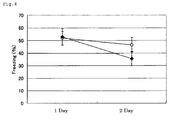


Classifications
-
- C—CHEMISTRY; METALLURGY
- C07—ORGANIC CHEMISTRY
- C07D—HETEROCYCLIC COMPOUNDS
- C07D267/00—Heterocyclic compounds containing rings of more than six members having one nitrogen atom and one oxygen atom as the only ring hetero atoms
- C07D267/02—Seven-membered rings
- C07D267/08—Seven-membered rings having the hetero atoms in positions 1 and 4
-
- A—HUMAN NECESSITIES
- A61—MEDICAL OR VETERINARY SCIENCE; HYGIENE
- A61P—SPECIFIC THERAPEUTIC ACTIVITY OF CHEMICAL COMPOUNDS OR MEDICINAL PREPARATIONS
- A61P1/00—Drugs for disorders of the alimentary tract or the digestive system
- A61P1/14—Prodigestives, e.g. acids, enzymes, appetite stimulants, antidyspeptics, tonics, antiflatulents
-
- A—HUMAN NECESSITIES
- A61—MEDICAL OR VETERINARY SCIENCE; HYGIENE
- A61P—SPECIFIC THERAPEUTIC ACTIVITY OF CHEMICAL COMPOUNDS OR MEDICINAL PREPARATIONS
- A61P13/00—Drugs for disorders of the urinary system
- A61P13/02—Drugs for disorders of the urinary system of urine or of the urinary tract, e.g. urine acidifiers
-
- A—HUMAN NECESSITIES
- A61—MEDICAL OR VETERINARY SCIENCE; HYGIENE
- A61P—SPECIFIC THERAPEUTIC ACTIVITY OF CHEMICAL COMPOUNDS OR MEDICINAL PREPARATIONS
- A61P15/00—Drugs for genital or sexual disorders; Contraceptives
-
- A—HUMAN NECESSITIES
- A61—MEDICAL OR VETERINARY SCIENCE; HYGIENE
- A61P—SPECIFIC THERAPEUTIC ACTIVITY OF CHEMICAL COMPOUNDS OR MEDICINAL PREPARATIONS
- A61P17/00—Drugs for dermatological disorders
-
- A—HUMAN NECESSITIES
- A61—MEDICAL OR VETERINARY SCIENCE; HYGIENE
- A61P—SPECIFIC THERAPEUTIC ACTIVITY OF CHEMICAL COMPOUNDS OR MEDICINAL PREPARATIONS
- A61P19/00—Drugs for skeletal disorders
- A61P19/02—Drugs for skeletal disorders for joint disorders, e.g. arthritis, arthrosis
-
- A—HUMAN NECESSITIES
- A61—MEDICAL OR VETERINARY SCIENCE; HYGIENE
- A61P—SPECIFIC THERAPEUTIC ACTIVITY OF CHEMICAL COMPOUNDS OR MEDICINAL PREPARATIONS
- A61P19/00—Drugs for skeletal disorders
- A61P19/08—Drugs for skeletal disorders for bone diseases, e.g. rachitism, Paget's disease
-
- A—HUMAN NECESSITIES
- A61—MEDICAL OR VETERINARY SCIENCE; HYGIENE
- A61P—SPECIFIC THERAPEUTIC ACTIVITY OF CHEMICAL COMPOUNDS OR MEDICINAL PREPARATIONS
- A61P21/00—Drugs for disorders of the muscular or neuromuscular system
-
- A—HUMAN NECESSITIES
- A61—MEDICAL OR VETERINARY SCIENCE; HYGIENE
- A61P—SPECIFIC THERAPEUTIC ACTIVITY OF CHEMICAL COMPOUNDS OR MEDICINAL PREPARATIONS
- A61P25/00—Drugs for disorders of the nervous system
- A61P25/04—Centrally acting analgesics, e.g. opioids
-
- A—HUMAN NECESSITIES
- A61—MEDICAL OR VETERINARY SCIENCE; HYGIENE
- A61P—SPECIFIC THERAPEUTIC ACTIVITY OF CHEMICAL COMPOUNDS OR MEDICINAL PREPARATIONS
- A61P25/00—Drugs for disorders of the nervous system
- A61P25/08—Antiepileptics; Anticonvulsants
-
- A—HUMAN NECESSITIES
- A61—MEDICAL OR VETERINARY SCIENCE; HYGIENE
- A61P—SPECIFIC THERAPEUTIC ACTIVITY OF CHEMICAL COMPOUNDS OR MEDICINAL PREPARATIONS
- A61P25/00—Drugs for disorders of the nervous system
- A61P25/14—Drugs for disorders of the nervous system for treating abnormal movements, e.g. chorea, dyskinesia
-
- A—HUMAN NECESSITIES
- A61—MEDICAL OR VETERINARY SCIENCE; HYGIENE
- A61P—SPECIFIC THERAPEUTIC ACTIVITY OF CHEMICAL COMPOUNDS OR MEDICINAL PREPARATIONS
- A61P25/00—Drugs for disorders of the nervous system
- A61P25/28—Drugs for disorders of the nervous system for treating neurodegenerative disorders of the central nervous system, e.g. nootropic agents, cognition enhancers, drugs for treating Alzheimer's disease or other forms of dementia
-
- A—HUMAN NECESSITIES
- A61—MEDICAL OR VETERINARY SCIENCE; HYGIENE
- A61P—SPECIFIC THERAPEUTIC ACTIVITY OF CHEMICAL COMPOUNDS OR MEDICINAL PREPARATIONS
- A61P3/00—Drugs for disorders of the metabolism
- A61P3/06—Antihyperlipidemics
-
- A—HUMAN NECESSITIES
- A61—MEDICAL OR VETERINARY SCIENCE; HYGIENE
- A61P—SPECIFIC THERAPEUTIC ACTIVITY OF CHEMICAL COMPOUNDS OR MEDICINAL PREPARATIONS
- A61P3/00—Drugs for disorders of the metabolism
- A61P3/08—Drugs for disorders of the metabolism for glucose homeostasis
- A61P3/10—Drugs for disorders of the metabolism for glucose homeostasis for hyperglycaemia, e.g. antidiabetics
-
- A—HUMAN NECESSITIES
- A61—MEDICAL OR VETERINARY SCIENCE; HYGIENE
- A61P—SPECIFIC THERAPEUTIC ACTIVITY OF CHEMICAL COMPOUNDS OR MEDICINAL PREPARATIONS
- A61P35/00—Antineoplastic agents
-
- A—HUMAN NECESSITIES
- A61—MEDICAL OR VETERINARY SCIENCE; HYGIENE
- A61P—SPECIFIC THERAPEUTIC ACTIVITY OF CHEMICAL COMPOUNDS OR MEDICINAL PREPARATIONS
- A61P37/00—Drugs for immunological or allergic disorders
- A61P37/02—Immunomodulators
- A61P37/06—Immunosuppressants, e.g. drugs for graft rejection
-
- A—HUMAN NECESSITIES
- A61—MEDICAL OR VETERINARY SCIENCE; HYGIENE
- A61P—SPECIFIC THERAPEUTIC ACTIVITY OF CHEMICAL COMPOUNDS OR MEDICINAL PREPARATIONS
- A61P43/00—Drugs for specific purposes, not provided for in groups A61P1/00-A61P41/00
-
- A—HUMAN NECESSITIES
- A61—MEDICAL OR VETERINARY SCIENCE; HYGIENE
- A61P—SPECIFIC THERAPEUTIC ACTIVITY OF CHEMICAL COMPOUNDS OR MEDICINAL PREPARATIONS
- A61P5/00—Drugs for disorders of the endocrine system
- A61P5/24—Drugs for disorders of the endocrine system of the sex hormones
-
- A—HUMAN NECESSITIES
- A61—MEDICAL OR VETERINARY SCIENCE; HYGIENE
- A61P—SPECIFIC THERAPEUTIC ACTIVITY OF CHEMICAL COMPOUNDS OR MEDICINAL PREPARATIONS
- A61P7/00—Drugs for disorders of the blood or the extracellular fluid
-
- A—HUMAN NECESSITIES
- A61—MEDICAL OR VETERINARY SCIENCE; HYGIENE
- A61P—SPECIFIC THERAPEUTIC ACTIVITY OF CHEMICAL COMPOUNDS OR MEDICINAL PREPARATIONS
- A61P7/00—Drugs for disorders of the blood or the extracellular fluid
- A61P7/02—Antithrombotic agents; Anticoagulants; Platelet aggregation inhibitors
-
- A—HUMAN NECESSITIES
- A61—MEDICAL OR VETERINARY SCIENCE; HYGIENE
- A61P—SPECIFIC THERAPEUTIC ACTIVITY OF CHEMICAL COMPOUNDS OR MEDICINAL PREPARATIONS
- A61P9/00—Drugs for disorders of the cardiovascular system
- A61P9/10—Drugs for disorders of the cardiovascular system for treating ischaemic or atherosclerotic diseases, e.g. antianginal drugs, coronary vasodilators, drugs for myocardial infarction, retinopathy, cerebrovascula insufficiency, renal arteriosclerosis
Definitions
- the present invention relates to an agent for modulating the function of an RFRP receptor having a fused 7-membered ring skeleton, a representative of which is benzoxazepine, that is useful as a medicament such as an analgesic.
- RFRP-1 Secretion peptides called RFRP-1, RFRP-2 and RFRP-3, and a G protein conjugated-type receptor protein OT7T022 (hereinafter, abbreviated as RFRP receptor) to which the peptide is bound are known (WO 00/29441).
- RFRP-1, RFRP-2 and RFRP-3 have prolactin secretion modulating activity (WO 01/66134).
- a benzoxazepine derivative has somatostatin receptor agonist activity, and is useful as a diabetic drug (WO 98/47882), has squalene synthesis inhibiting activity (EP567029, WO 97/10224), has ataractic activity (JP 57-35576 A), and has osteoporosis treating effect (WO 93/17129), but it is not known that a benzoxazepine derivative is bound to an RFRP receptor.
- An object of the present invention is to provide a synthetic compound having excellent antagonism for an RFRP receptor.
- a compound having a fused 7-memberd ring skeleton or a salt thereof, a representative of which is benzoxazepine has unexpectedly excellent RFRP receptor antagonism based on its peculiar chemical structure, further has excellent nature in physical properties as a medicament such as stability, and becomes a drug which is safe and useful as an analgesic, resulting in completion of the present invention based on these findings.
- the present invention relates to:
- the ring A represents an optionally substituted aromatic ring.
- aromatic ring represented by the ring A an aromatic hydrocarbon ring or an aromatic heterocyclic ring is used.
- aromatic hydrocarbon ring an aromatic hydrocarbon ring of a carbon number of 6 to 14 such as a benzene ring, and a naphthalene ring is used and, inter alia, a benzene ring is preferably used.
- aromatic heterocyclic ring for example, a 5-to 14-membered (monocyclic, dicyclic or tricyclic), preferably 5- to 10-membered, more preferably 5- to 6-membered aromatic heterocyclic ring containing 1 to 4 of 1 or 2 kinds of heteroatoms selected from a nitrogen atom, a sulfur atom and an oxygen atom in addition to carbon atoms is used.
- an aromatic heterocyclic ring such as thiophene, furan, oxazole, benzo[b]thiophene, benzo[b]furan, benzimidazole, benzoxazole, benzothiazole, benzisothiazole, naphtha[2,3-b]thiophene, pyrrole, imidazole, pyrazole, pyridine, pyrazine, pyrimidine, pyridazine, indole, isoindole, 1H-indazole, purine, 4H-quinolizine, isoquinoline, quinoline, phthalazine, naphthyridine, quinoxaline, quinazoline, cinnoline, carbazole, ⁇ -carboline, phenanthridine, acridine, phenazine, thiazole, iso
- benzene ring etc.
- a monocyclic aromatic heterocyclic ring is preferable and, for example, thiophene, pyrazole, imidazole, pyridine, pyrazine, pyrimidine, pyridazine, pyrrole, furan, thiazole, isothiazole, and isooxazole are used.
- the ring B represents an optionally substituted benzene ring.
- substituents which may be possessed by the ring A include a halogen atom (e.g. fluorine, chlorine, bromine, iodine), a nitro group, a cyano group, an optionally substituted hydrocarbon group, an optionally substituted heterocyclic group, an optionally substituted hydroxy group, an optionally substituted thiol group, a substituted sulfinyl group, a substituted sulfonyl group, an optionally substituted amino group, an acyl group, an optionally substituted carbamoyl group, an optionally esterified carboxyl group, and a C 1-3 alkylenedioxy group (hereinafter, substituent A group).
- a halogen atom e.g. fluorine, chlorine, bromine, iodine
- substituent A group e.g. fluorine, chlorine, bromine, iodine
- Examples of the substituent which may be possessed by the ring B include a halogen atom (e.g. fluorine, chlorine, bromine, iodine), a nitro group, a cyano group, an optionally substituted hydrocarbon group, an optionally substituted heterocyclic group, an optionally substituted hydroxy group, an optionally substituted thiol group, a substituted sulfinyl group, a substituted sulfonyl group, an optionally substituted amino group, an acyl group, an optionally substituted carbamoyl group, an optionally esterified carboxyl group, a C 1-3 alkylenedioxy group, and a group represented by the formula: described hereinafter.
- a halogen atom e.g. fluorine, chlorine, bromine, iodine
- a cyano group e.g. fluorine, chlorine, bromine, iodine
- an optionally substituted hydrocarbon group e.g
- hydrocarbon group of the "optionally substituted hydrocarbon group” as the substituent which may be possessed by the ring A or the ring B include an alkyl group, a cycloalkyl group, an alkenyl group, a cycloalkenyl group, an alkynyl group, an aralkyl group, an aryl group.
- alkyl group a “straight or branched C 1-15 alkyl group” such as methyl, ethyl, propyl, isopropyl, butyl, isobutyl, sec-butyl, tert-butyl, pentyl, neopentyl, hexyl, heptyl, octyl, nonyl, decyl, undecyl, tridecyl, tetradecyl, and pentadecyl, preferably, a C 1-8 alkyl group is used. More preferably, a C 1-6 alkyl group is used. Further preferably, a C 1-4 alkyl group is used.
- cycloalkyl group a "C 3-10 cycloalkyl group” such as cyclopropyl, cyclobutyl, cyclopentyl, cyclohexyl, cycloheptyl, cyclooctyl, and adamantyl is used. More preferably, a C 3-8 cycloalkyl group is used. Further preferably, a C 5-7 cycloalkyl group is used.
- alkenyl group a "C 2-18 alkenyl group” such as vinyl, allyl, isopropenyl, 3-butenyl, 3-octenyl, and 9-octadecenyl is used. More preferably, a C 2-6 alkenyl group is used. Further preferably, a C 2-4 alkenyl group is used.
- cycloalkenyl group a "C 3-10 cycloalkenyl group” such as cyclopropenyl, cyclobutenyl, cyclopentenyl, cyclohexenyl, cycloheptenyl, and cyclooctenyl is used. More preferably, a C 3-8 cycloalkenyl group is used. Further preferably, a C 5-7 cycloalkenyl group is used.
- alkynyl group a "C 2-8 alkynyl group” such as ethynyl, 1-propynyl, propargyl, 1-butynyl, 2-butynyl, 1-pentynyl, 2-pentynyl, and 3-pentynyl is used. More preferably, a C 2-6 alkynyl group is used. Further preferably, a C 2-4 alkynyl group is used.
- a C 7-14 aralkyl group a C 7-14 aralkyl group is used.
- a phenyl-C 1-6 alkyl group such as benzyl, phenethyl, 3-phenylpropyl, and 4-phenylbutyl
- a naphthyl-C 1-6 alkyl group such as (1-naphthyl)methyl, 2-(1-naphthyl)ethyl, and 2-(2-naphthyl)ethyl are used.
- aryl group an aromatic monocyclic, dicyclic or tricyclic C 6-14 aryl group such as phenyl, 1-naphthyl, 2-naphthyl, phenthryl, and anthryl, a biphenyl group, and a tolyl group are used.
- a C 6-10 aryl group such as phenyl and naphthyl is used. More preferably, phenyl is used.
- substituent which may be possessed by the "hydrocarbon group” in the "optionally substituted hydrocarbon group” as the substituent which may be possessed by the ring A or the ring B for example, (i) a nitro group, (ii) a hydroxy group, an oxo group, (iii) a cyano group, (iv) a carbamoyl group, (v) a mono- or di-C 1-6 alkyl-carbamoyl group (e.g.
- the alkenyl group may be substituted with a halogen atom, a hydroxy group, a C 1-6 alkoxy group etc.), a mono- or di-C 6-14 aryl-carbamoyl group (the C 6-14 aryl group may be substituted with a halogen atom, a C 1-6 alkyl optionally substituted with a halogen atom, a C 1-6 alkoxy group etc.), a mono- or di-C 7-16 aralkyl-carbamoyl group (the C 7-16 aralkyl group (e.g.
- benzyl group may be substituted with a halogen atom, a C 1-6 alkyl optionally substituted with a halogen atom, a C 1-6 alkoxy group etc.), a C 1-6 alkoxy-carbonyl-carbamoyl group, a C 1-6 alkylsulfonyl-carbamoyl group, a C 1-6 alkoxy-carbamoyl group, an amino-carbamoyl group, a mono- or di-C 1-6 alkylamino-carbamoyl group, a mono- or di-C 6-14 arylamino-carbamoyl group, (vi) a carboxyl group, (vii) a C 1-6 alkoxy-carbonyl group (e.g.
- a C 1-6 alkoxy group optionally substituted with a hydroxy group
- a C 1-6 alkoxy group optionally substituted with a carboxyl group
- a C 1-6 alkoxy group optionally substituted with a C 1-6 alkoxy-carbonyl group
- a C 1-6 alkoxy-C 1-6 alkoxy group optionally substituted with a C 1-6 alkoxy-C 1-6 alkoxy group
- a C 1-6 alkoxy-C 1-6 alkoxy-C 1-6 alkoxy group (xi) a C 6-14 aryloxy group, a C 6-14 aryloxy-C 1-6 alkyl group, a C 6-14 aryloxy-C 1-6 alkoxy group, a C 1-6 alkylcarbonyl-oxy group, a carbamoyloxy group, a mono- or di-C 1-6 alkyl-carbamoyloxy group
- an optionally halogenated C 6-14 aryl group e.g.
- a phenyl group, 1- or 2-naphthyl an optionally halogenated C 6-14 aryl-C 1-6 alkyl group, an optionally halogenated C 6-14 aryl-C 2-4 alkenyl group, an optionally halogenated C 6-14 aryloxy group (e.g. o-, m- or p-chlorophenoxy, o-, m- or p-bromophenoxy etc.), a 5- to 10-membered heterocyclic-oxy group containing at least one (preferably 1 to 4, further preferably 1 or 2) of 1 to 3 kinds (preferably 1 or 2 kinds) of heteroatoms selected from an oxygen atom, a sulfur atom, and a nitrogen atom (e.g.
- the heterocyclic ring may be substituted with C 1-6 alkyl), a C 3-10 cycloalkyl group, a C 3-10 cycloalkyl-C 1-6 alkoxy group, a C 3-10 cycloalkyl-C 1-6 alkyl group, (xiii) an optionally halogenated C 1-6 alkyl group (e.g. methyl, ethyl, propyl, isopropyl, butyl etc.), an optionally halogenated C 2-6 alkenyl group (e.g. vinyl, allyl, 2-butenyl, 3-butenyl etc.), an optionally halogenated C 1-6 alkylthio group (e.g.
- a C 1-6 alkyl group optionally substituted with a hydroxy group a C 1-6 alkylthio group optionally substituted with a hydroxy group, (xiv) a mercapto group, a thioxo group, (xv) a C 7-16 aralkyloxy group (e.g. benzyloxy) or a C 7-16 aralkylthio group (e.g.
- benzylthio each optionally substituted with a substituent selected from a halogen atom, a carboxyl group and a C 1-6 alkoxy-carbonyl group, (xvi) an optionally halogenated C 6-14 arylthio group, a 5- to 10-membered heterocyclic-thio group containing at least one (preferably 1 to 4, further preferably 1 to 2) of 1 to 3 kinds (preferably 1 to 2 kinds) of heteroatoms selected from an oxygen atom, a sulfur atom and a nitrogen atom (e.g.
- the heterocyclic ring may be substituted with C 1-6 alkyl), a C 6-14 arylthio-C 1-6 alkyl group, a 5- to 10-membered heterocyclic-thio-C 1-6 alkyl group containing at least one (preferably 1 to 4, further preferably 1 to 2) of 1 to 3 kinds (preferably 1 to 2 kinds) of heteroatoms selected from an oxygen atom, a sulfur atom, and a nitrogen atom (e.g. pyridylthio-C 1-6 alkyl; the heterocyclic ring may be substituted with C 1-6 alkyl), (xvii) an optionally halogenated C 1-6 alkylsulfinyl group (e.g.
- methylsulfinyl, ethylsulfinyl etc. a C 6-14 arylsulfinyl group, a C 6-14 arylsulfinyl-C 1-6 alkyl group, (xviii) an optionally halogenated C 1-6 alkylsulfonyl group (e.g.
- a C 6-14 arylsulfonyl group a C 6-14 arylsulfonyl-C 1-6 alkyl group, (xix) an amino group, an aminosulfonyl group, a mono- or di-C 1-6 alkylaminosulfonyl group (e.g.
- a C 1-15 acyl-amino group e.g. a C 1-10 alkanoylamino group (e.g. formylamino, acetylamino, trifluoroacetylamino, propionylamino, pivaloylamino etc.), a C 3-10 alkenoylamino group (e.g.
- acryloylamino, methacryloylamino etc. a C 3-10 cycloalkylcarbonylamino group (e.g. cyclopropylcarbonylamino, cyclopentylcarbonylamino etc.), C 6-14 arylcarbonylamino (e.g. benzoylamino), C 1-6 alkylsulfonylamino (e.g. methanesulfonylamino, trifluoromethanesulfonylamino etc.), C 6-14 arylsulfonylamino (e.g.
- C 1-15 acyl may be substituted with a halogen atom, a hydroxy group, a carboxyl group etc.], C 7-16 aralkyloxycarbonylamino (e.g. benzyloxycarbonylamino), optionally halogenated C 1-6 alkoxycarbonylamino, a carbamoylamino group, a mono- or di-C 1-6 alkylcarbamoylamino group, (xxi) a mono- or di-C 1-6 alkylamino group (e.g.
- the alkyl group may be substituted with a halogen atom, a hydroxy group, a C 1-6 alkoxy group etc.), a mono- or di-C 1-6 alkanoylamino group (e.g. formylamino, acetylamino etc.; the alkanoyl group may be substituted with a halogen atom, a hydroxy group, a C 1-6 alkoxy group etc.), C 6-14 arylamino, C 7-16 aralkylamino (e.g.
- benzylamino a C 1-6 alkyl (C 7-16 aralkyl)amino group (e.g. C 1-6 alkyl (benzyl) amino etc.), a C 1-6 alkanoyl (C 7-16 aralkyl)amino group (e.g. C 1-6 alkanoyl(benzyl)amino etc.), (xxii) a 3- to 8-membered cyclic amino group (e.g.
- 1-pyrrolidinylcarbonylamino, piperidinocarbonylamino, morpholinocarbonylamino, thiomorpholinocarbonylamino, 1-piperazinylcarbonylamino etc. preferably a 5- or 6-membered cyclic amino-carbonyl-amino group), a 3- to 8-membered cyclic amino-sulfonyl group (e.g.
- a benzoyl group each optionally substituted with a substituent selected from a halogen atom, amino, a carboxyl group and a C 1-6 alkoxy-carbonyl group, (xxiv) a C 7-16 aralkyl-carbonyl (e.g.
- a benzylcarbonyl group optionally substituted with a substituent selected from a halogen atom, amino, a carboxyl group and a C 1-6 alkoxy-carbonyl group, (xxv) a 5- to 10-membered heterocyclic group containing at least one (preferably 1 to 4, further preferably 1 to 2) of 1 to 3 kinds (preferably 1 or 2 kinds) of heteroatoms selected from an oxygen atom, a sulfur atom and a nitrogen atom (e.g.
- heterocyclic group may be substituted with a C 1-6 alkyl group), (xxvi) a 5- to 10-membered heterocyclic-carbonyl group containing at least one (preferably 1 to 4, further preferably 1 to 2) of 1 to 3 kinds (preferably 1 or 2 kinds) of heteroatoms selected from an oxygen atom, a sulfur atom and a nitrogen atom (e.g.
- a C 1-6 alkyl-ureido group e.g. methylureido, ethylureido etc.
- a C 1-6 alkyl group optionally substituted with a halogen atom (forgoing, substituent B group) are used.
- the "hydrocarbon group” may have 1 to 5 of these substituents at any possible positions and, when it has 2 or more substituents, they may be the same or different.
- heterocyclic group of the "optionally substituted heterocyclic group” as the substituent which may be possessed by the ring A or the ring B include a 5- to 16-membered monocyclic to tricyclic aromatic heterocyclic group, and a 3- to 8-membered saturated or unsaturated non-aromatic heterocyclic group (aliphatic heterocyclic group), containing at least one (preferably 1 to 4, further preferably 1 to 2) of 1 to 3 kinds (preferably 1 or 2 kinds) of heteroatoms selected from an oxygen atom, a sulfur atom and a nitrogen atom, as an atom constituting a ring system (ring atom).
- aromatic heterocyclic group examples include a 5- or 6-membered aromatic monocyclic heterocyclic group such as furyl, thienyl, pyrrolyl, oxazolyl, isooxazolyl, thiazolyl, isothiazolyl, imidazolyl, pyrazolyl, 1,2,3-oxadiazolyl, 1,2,4-oxadiazolyl, 1,3,4-oxadiazolyl, furazanyl, 1,2,3-thiadiazolyl, 1,2,4-thiadiazolyl, 1,3,4-thiadiazolyl, 1,2,3-triazolyl, 1,2,4-triazolyl, tetrazolyl, pyridyl, pyridazinyl, pyrimidinyl, pyrazinyl, and triazinyl, and a 8- to 16-membered (preferably 8- to 12-membered) aromatic fused heterocyclic group (preferably a heterocyclic ring
- non-aromatic heterocyclic group examples include a 3- to 8-membered (preferably 5- to 6-membered) saturated or unsaturated (preferably saturated) non-aromatic monocyclic heterocyclic group (aliphatic monocyclic heterocyclic group) such as oxiranyl, azetidinyl, oxetanyl, thietanyl, pyrrolidinyl (preferably, 1-pyrrolidinyl), tetrahydrofuryl, thiolanyl, piperidinyl (preferably, 1-piperidinyl or 4-piperidinyl), tetrahydropyranyl, morpholinyl, thiomorpholinyl, and piperazinyl, a heterocyclic group in which 1 to 2 (preferably 1) of the aforementioned non-aromatic monocyclic heterocyclic groups are fused with 1 to 2 (preferably 1) of benzene rings such as 2,3-dihydroindolyl, and 1,3-dihydr
- heterocyclic group in the “optionally substituted heterocyclic group”, a 5- or 6-membered aromatic monocyclic heterocyclic group is preferable.
- substituent which may be possessed by the "heterocyclic group” the same number of the same groups as those for the substituent (substituent B group) which may be possessed by the "hydrocarbon group” in the “optionally substituted hydrocarbon group” as the substituent which may be possessed by the ring A are used.
- Examples of the "optionally substituted amino group", the “optionally substituted hydroxy group” and the “optionally substituted thiol group” as the substituent which may be possessed by the ring A or the ring B include an "amino group”, a “hydroxy group” and a “thiol group”, each optionally having a substituent, such as an optionally substituted hydrocarbon group, an acyl group, an optionally esterified carboxyl group, an optionally substituted carbamoyl group, and an optionally substituted heterocyclic group.
- substituent in the "optionally substituted hydrocarbon group” and the “optionally substituted heterocyclic group” the same number of the same groups as those for the substituent (substituent B group) in the "optionally substituted hydrocarbon group” and the “optionally substituted heterocyclic group” as the substituent which may be possessed by the ring A are used, respectively.
- preferable examples include an "amino group”, a “hydroxy group” and a “thiol group” optionally having a substituent such as a lower alkyl (e.g.
- C 1-6 alkyl such as methyl, ethyl, propyl, isopropyl, butyl, isobutyl, tert-butyl, pentyl, hexyl etc.
- a substituent selected from a halogen atom e.g. fluorine, chlorine, bromine, iodine etc.
- optionally halogenated C 1-6 alkoxy e.g.
- phenyl preferably, phenyl optionally substituted with a substituent selected from an optionally halogenated C 1-6 alkyl group, an optionally halogenated C 1-6 alkoxy group, a carboxyl group and a halogen atom
- a 5- to 10-membered heterocyclic group containing at least one (preferably 1 to 4, further preferably 1 or 2) of 1 to 3 kinds (preferably 1 or 2 kinds) of heteroatoms selected from an oxygen atom, a sulfur atom and a nitrogen atom e.g.
- C 1-6 alkylsulfonyl e.g. methanesulfonyl etc.
- benzenesulfonyl etc. optionally halogenated C 1-6 alkoxycarbonyl (e.g. methoxycarbonyl, ethoxycarbonyl, trifluoromethoxycarbonyl, 2,2,2-trifluoroethoxycarbonyl, trichloromethoxycarbonyl, 2,2,2-trichloroethoxycarbonyl etc.), C 1-6 alkoxycarbonyl optionally substituted with phenyl (e.g.
- an optionally substituted carbamoyl group e.g. a carbamoyl group optionally substituted with 1 to 2 substituents such as a lower (C 1-6 ) alkyl group, a C 6-14 aryl group (e.g. a phenyl group) etc., such as carbamoyl, N-methylcarbamoyl, N,N-dimethylcarbamoyl, phenylcarbamoyl etc.
- a heterocyclic group the same group as the "heterocyclic group” in the "optionally substituted heterocyclic group” as a substituent which may be possessed by a ring A
- N,N-disubstituted amino may be taken together with a nitrogen atom to form a "cyclic amino group" and, as the "cyclic amino group", a 3-to 8-membered (preferably 5- to 8-membered more preferably 5- or 6-membered) cyclic amino group such as 1-azetidinyl, 1-pyrrolidinyl, piperidino, morpholino, thiomorpholino (a sulfur atom may be oxidized), 1-piperazinyl, and 1,4-diazepanyl is used.
- the "cyclic amino group” may have a substituent selected from the substituent B group.
- 1-piperazinyl, and 1,4-diazepanyl optionally having lower alkyl (e.g. C 1-6 alkyl such as methyl, ethyl, propyl, isopropyl, butyl, tert-butyl, pentyl, hexyl etc.), aralkyl (e.g. C 7-16 aralkyl such as benzyl, phenethyl etc.), aryl (e.g. C 6-14 aryl such as phenyl, 1-naphthyl, 2-naphthyl etc.) and the like at a 4-position are used.
- alkyl e.g. C 1-6 alkyl such as methyl, ethyl, propyl, isopropyl, butyl, tert-butyl, pentyl, hexyl etc.
- aralkyl e.g. C 7-16 aralkyl such as benzy
- substituted sulfinyl group and the “substituted sulfonyl group” as the substituent which may be possessed by the ring A or the ring B represent a sulfinyl group or a sulfonyl group substituted with a substituent such as the "optionally substituted hydroxy group", the “optionally substituted amino group”, the “optionally substituted hydrocarbon group” or the “optionally substituted heterocyclic group", respectively.
- hydrocarbon group in the “optionally substituted hydrocarbon group”
- hydrocarbon group in the “optionally substituted hydrocarbon group”
- heterocyclic group in the “optionally substituted heterocyclic group
- substituent which may be possessed by the ring A is used.
- the substituent optionally substituting at the hydroxy group and the amino group which are the substituents of the "substituted sulfinyl group” and the “substituted sulfonyl group the same group as the substituent which may be possessed by the "hydroxy group” in the “optionally substituted hydroxy group” or by the "amino group” in the "optionally substituted amino group” as the substituent which may be possessed by the ring A is used, and preferable examples include a C 1-6 alkyl group, a C 3-8 cycloalkyl group, a C 2-4 alkenyl group, a C 6-10 aryl group, an acyl group, an amino group and a heterocyclic group (the same group as the "heterocyclic group” in the "optionally substituted heterocyclic group” as a substituent which may be possessed by the ring A).
- acyl group as a substituent which may be possessed by the ring A or the ring B, an acyl group obtained by removing a OH group from carboxylic acid such as R A COOH, sulfonic acid such as R A SO 3 H, sulfinic acid such as R A SO 2 H, or phosphoric acid such as R A OPO (OR B ) OH
- R A represents a hydrogen atom, an optionally substituted hydrocarbon group, or an optionally substituted heterocyclic group
- R B represents a hydrogen atom, or an optionally substituted hydrocarbon group
- R A CO, R A SO 2 , R A SO, and R A OPO(OR B ) symbols in the formulas are as defined above
- R A CO examples include formyl, acetyl, propionyl, butyryl, isobutyryl, valeryl, isovaleryl, pivaloyl, hexanoyl, cyclobutanecarbonyl, cyclopentanecarbonyl, cyclohexanecarbonyl, crotonyl, benzoyl, nicotinoyl, isonicotinoyl, and trifluoroacetyl and, inter alia, R A CO in which R A is a lower (C 1-6 ) alkyl group such as acetyl, propionyl, butyryl, valeryl is more preferable.
- Examples of the "optionally substituted carbamoyl group" as the substituent which may be possessed by the ring A or the ring B include N-monosubstituted carbamoyl and N,N-disubstituted carbamoyl in addition to unsubstituted carbamoyl.
- substituents which may be possessed by the "carbamoyl group” in the “optionally substituted carbamoyl group” include the same group as the substituent of the "amino group” of the “optionally substituted amino group” as the substituent which may be possessed by the ring A ("optionally substituted hydrocarbon group”, “acyl group”, “optionally substituted alkoxycarbonyl group”, “optionally substituted carbamoyl group” (preferably a carbamoyl group optionally substituted with 1 to 2 substituents such as a lower (C 1-6 ) alkyl group, and a C 6-14 aryl group (e.g.
- a phenyl group such as carbamoyl, N-methylcarbamoyl, N,N-dimethylcarbamoyl, phenylcarbamoyl etc.), "optionally substituted heterocyclic group” etc.), and a “carbamoyl group” having the "optionally substituted amino group” (i.e. “optionally substituted carbazoyl group”), and a “carbamoyl group” having the "optionally substituted hydroxy group” (i.e. "optionally substituted N-hydroxycarbamoyl group”) may be used.
- N,N-disubstituted carbamoyl may be taken together with a nitrogen atom to form cyclic amino and, as cyclic amino carbonyl in such a case, 3- to 8-membered (preferably 5- to 6-membered) cyclic aminocarbonyl such as 1-azetidinylcarbonyl, 1-pyrrolidinylcarbonyl, piperidinocarbonyl, morpholinocarbonyl, thiomorpholinocarbonyl (a sulfur atom may be oxidized), 1-piperazinylcarbonyl, and 1-piperazinylcarbonyl having lower alkyl (e.g.
- C 1-6 alkyl such as methyl, ethyl, propyl, isopropyl, butyl, tert-butyl, pentyl, hexyl etc.
- aralkyl e.g. C 7-10 aralkyl such as benzyl, phenethyl etc.
- aryl e.g. C 6-10 aryl such as phenyl, 1-naphthyl, 2-naphthyl etc.
- an acyl group e.g. formyl, acetyl, benzoyl, methoxycarbonyl, benzyloxycarbonyl, methylsulfonyl etc.
- Examples of the "optionally esterified carboxyl group" as the substituent which may be possessed by the ring A or the ring B include a group represented by the formula - COOR C (R C represents a hydrogen atom, or an optionally substituted hydrocarbon group, or an optionally substituted heterocyclic group) and, inter alia, free carboxyl, lower alkoxycarbonyl, aryloxycarbonyl, aralkyloxycarbonyl, heterocyclic oxycarbonyl, and heterocyclic methyloxycarbonyl are preferably used.
- the hydrocarbon group in the “optionally substituted hydrocarbon group” and the “heterocyclic group” in the “optionally substituted heterocyclic group” represented by R c the same groups as those for the "hydrocarbon group” in the “optionally substituted hydrocarbon group” and the “heterocyclic group” in the “optionally substituted heterocyclic group” as the substituent which may be possessed by the ring A are used, respectively.
- lower alkoxycarbonyl examples include C 1-6 alkoxycarbonyl such as methoxycarbonyl, ethoxycarbonyl, propoxycarbonyl, isopropoxycarbonyl, butoxycarbonyl, isobutoxycarbonyl, sec-butoxycarbonyl, tert-butoxycarbonyl, pentyloxycarbonyl, isopentyloxycarbonyl, and neopentyloxycarbonyl and, inter alia, C 1-3 alkoxycarbonyl such as methoxycarbonyl, ethoxycarbonyl, and propoxycarbonyl is preferable.
- C 1-3 alkoxycarbonyl such as methoxycarbonyl, ethoxycarbonyl, and propoxycarbonyl is preferable.
- the "lower alkoxycarbonyl” may have a substituent at the "lower alkyl” part of the “lower alkoxy” and, as the substituent, the same number of the same groups as those listed as the substituent which may be possessed by the "hydrocarbon group” in the "optionally substituted hydrocarbon group” as the substituent which may be possessed by the ring A are used.
- aryloxycarbonyl C 7-12 aryloxycarbonyl such as phenoxycarbonyl, 1-naphthoxycarbonyl, and 2-naphthoxycarbonyl is preferable.
- aralkyloxycarbonyl C 7-15 aralkyloxycarbonyl such as benzyloxycarbonyl, and phenethyloxycarbonyl (preferably, C 6-10 aryl-C 1-6 alkoxy-carbonyl etc.) is preferable.
- heterocyclic in the "heterocyclic oxycarbonyl” and the “heterocyclic methyloxycarbonyl” the same groups as those for the "heterocyclic” in the “optionally substituted heterocyclic group” as the substituent which may be possessed by the ring A are used and, for example, pyridyl, quinolyl, indolyl, piperidinyl, and tetrahydropyranyl are preferably used.
- the "aryloxycarbonyl”, the “aralkyloxycarbonyl” and the “heterocyclic oxycarbonyl” may have a substituent, respectively.
- substituent B group the same number of the same groups as groups listed as the substituent (substituent B group) which may be possessed by the "hydrocarbon group” in the “optionally substituted hydrocarbon group” as the substituent which may be possessed by the ring A are used.
- a halogen atom e.g. fluorine, chlorine, bromine, iodine
- a C 6-14 aryl group e.g. phenyl
- a chlorine atom, and a phenyl group are particularly preferably used.
- R 9 a hydrogen atom, a chlorine atom, and a phenyl group are preferable.
- R 10 a hydrogen atom or a C 1-6 alkoxy group (e.g. methoxy) is preferable.
- X represents O, S(O)n (n represents an integer of 0 to 2) or NR 3 (R 3 represents a hydrogen atom, an optionally substituted hydrocarbon group, or an optionally substituted heterocyclic group).
- hydrocarbon group and the “heterocyclic group” may have 1 to 5 (preferably 1 to 3) substituents at any possible positions, respectively. When 2 or more substituents are possessed, they may be the same or different.
- an optionally substituted alkyl group is preferable and, inter alia, a C 1-6 alkyl group such as methyl, ethyl and propyl is preferable.
- O is preferable.
- R 1 and R 2 each represents a hydrogen atom, an optionally substituted hydrocarbon group or an optionally substituted heterocyclic group.
- hydrocarbon group and the “heterocyclic group” may have 1 to 5 (preferably 1 to 3) substituents at any possible position, respectively. When two or more substituents are possessed, they may be the same or different.
- R 1 an optionally substituted C 1-8 alkyl group, and an optionally substituted C 7-16 aralkyl group are preferable.
- a C 1-8 alkyl group for example, a C 1-8 alkyl group (e.g. methyl, ethyl, propyl, isopropyl, butyl, isobutyl, sec-butyl, tert-butyl, neopentyl etc.) optionally substituted with a halogen atom (e.g. fluorine etc.), carboxyl, or C 1-6 alkoxy-carbonyl (e.g.
- tert-butoxycarbonyl is used and, inter alia, a branched C 3-6 alkyl group such as isobutyl, sec-butyl, tert-butyl, and neopentyl is preferable, and neopentyl is particularly preferable.
- C 7-16 aralkyl group for example, a C 7-16 aralkyl optionally substituted with C 1-6 alkoxy (e.g. methoxy), or optionally halogenated C 6-14 aryl (e.g. phenyl) (e.g. phenyl-C 1-6 alkyl) is used, and benzyl, 4-biphenylmethyl, and 2,4-dimethoxy-benzyl are particularly preferable.
- C 1-6 alkoxy e.g. methoxy
- optionally halogenated C 6-14 aryl e.g. phenyl
- benzyl, 4-biphenylmethyl, and 2,4-dimethoxy-benzyl are particularly preferable.
- R 1 a branched C 3-6 alkyl group such as isobutyl, sec-butyl, tert-butyl, and neopentyl is preferable, and neopentyl is particularly preferable.
- R 2 for example, a C 1-6 alkyl group (e.g. methyl) optionally substituted with:
- R 2 a group represented by the formula -CO-J (J represents an optionally substituted hydroxy group or an optionally substituted amino group) is also preferable.
- R 12 represents a hydrogen atom, an optionally substituted hydrocarbon group or an optionally substituted heterocyclic group.
- an optionally substituted C 1-6 alkyl group, an optionally substituted C 6-14 aryl group or an optionally substituted C 7-16 aralkyl group is preferable, inter alia, an optionally substituted benzyl group or an optionally substituted phenyl group is preferable, and an optionally substituted benzyl group is particularly preferable.
- C 1-6 alkyl group represented by R 12
- a C 1-6 alkyl group e. g. methyl, ethyl, propyl, isopropyl, butyl, isobutyl, sec-butyl, tert-butyl etc., particularly a C 1-3 alkyl group such as methyl, ethyl, and propyl
- amino, carboxyl, mono- or di-C 1-6 alkylamino e.g.
- cyclopropyl, cyclobutyl, cyclopentyl, cyclohexyl etc.), or a 5- to 10-membered heterocyclic group containing at least one (preferably 1 to 4, further preferably 1 to 2) of 1 to 3 kinds (preferably 1 or 2 kinds) of heteroatoms selected from an oxygen atom, a sulfur atom and a nitrogen atom e.g. 2-thienyl, 2-thiazolyl, 2-pyridyl, 3-pyridyl, 4-pyridyl, 2-furanyl, 2-tetrahydrofuranyl, 2-tetrahydropyranyl, 4-piperidinyl etc.
- a C 1-6 alkyl group e.g.
- a 5- to 10-membered heterocyclic group e.g. 2-pyridyl, 4-piperidinyl etc.
- heteroatoms selected from an oxygen atom, a sulfur atom and a nitrogen atom is preferably used.
- C 6-14 aryl group represented by R 12
- a C 6-14 aryl group e.g. phenyl etc.
- a halogen atom e.g. fluorine etc.
- C 1-6 alkoxy e.g. methoxy, ethoxy etc.
- a C 7-16 aralkyl group e.g. benzyl, phenylethyl etc.
- a C 1-6 alkyl group e.g. methyl, ethyl, propyl, isopropyl, butyl, isobutyl, sec-butyl, tert-butyl etc.
- C 1-6 alkoxy e.g. methoxy, ethoxy, propoxy etc.
- a benzyl group optionally substituted with a substituent selected from a halogen atom (e.g. fluorine etc.), a C 1-6 alkyl group (e.g. methyl, ethyl, propyl, isopropyl, butyl, isobutyl, sec-butyl, tert-butyl etc.) optionally substituted with a halogen atom (e.g. fluorine etc.), and C 1-6 alkoxy (e.g. methoxy, ethoxy, propoxy etc.) is preferably used.
- a substituent selected from a halogen atom (e.g. fluorine etc.)
- a C 1-6 alkyl group e.g. methyl, ethyl, propyl, isopropyl, butyl, isobutyl, sec-butyl, tert-butyl etc.
- C 1-6 alkoxy e.g. methoxy, e
- R 13 represents a hydrogen atom or a C 1-6 alkyl group and, inter alia, a hydrogen atom, methyl, and ethyl are preferable.
- R 14 represents a hydrogen atom, or an optionally substituted C 1-6 alkyl group, and optionally substituted C 1-6 alkyl group is preferable.
- an unsubstituted C 1-6 alkyl group such as methyl, ethyl, propyl, isopropyl, butyl, isobutyl, sec-butyl, and tert-butyl is preferable, and methyl, and ethyl are particularly preferable.
- R 15 represents a hydrogen atom or an optionally substituted C 7-16 aralkyl group, and an optionally substituted C 7-16 aralkyl group is preferable.
- a C 7-16 aralkyl group e.g. benzyl
- a halogen atom e.g. fluorine etc.
- R 16 represents a hydrogen atom or a C 1-6 alkyl group and, inter alia, a hydrogen atom is preferable.
- a 5- to 8-membered nitrogen-containing ring group optionally having 1 to 3 heteroatoms selected from a nitrogen atom, an oxygen atom and a sulfur atom in addition to one nitrogen atom and carbon atoms is used and, specifically, for example, piperidinyl (e.g. 1-piperidinyl, 4-piperidinyl etc.), piperazino, morpholino, thiomorpholino, and 1,4-diazepanyl are used.
- piperidinyl e.g. 1-piperidinyl, 4-piperidinyl etc.
- piperazino, morpholino, thiomorpholino, and 1,4-diazepanyl are used.
- a 5- to 8-membered cyclic amino group (Q') is preferable and, for example, 1-piperidinyl, piperazino, morpholino, thiomorpholino, and 1,4-diazepanyl are used.
- substituent of the "5- to 8-membered nitrogen-containing ring group” or the “5- to 8-membered cyclic amino group” the same substituents as those for the substituent B group are used, inter alia, C 1-6 alkyl (e.g. methyl), amino, hydroxy, carboxyl, C 1-6 alkoxy-carbonyl (e.g. methoxycarbonyl, ethoxycarbonyl, tert-butoxycarbonyl etc.), C 1-6 alkoxycarbonyl-amino (e.g. tert-butoxycarbonylamino etc.), C 1-6 alkylcarbonyl-oxy (e.g.
- acetoxy etc. and a 5-to 8-membered cyclic amino group (e.g. 1-piperidinyl etc.) are preferable, and C 1-6 alkyl (e.g. methyl), amino, hydroxy, carboxyl, C 1-6 alkylcarbonyl-oxy (e.g. acetoxy), and a 5- to 8-membered cyclic amino group (e.g. 1-piperidinyl etc.) are preferable.
- C 1-6 alkyl e.g. methyl
- amino, hydroxy, carboxyl, C 1-6 alkylcarbonyl-oxy e.g. acetoxy
- a 5- to 8-membered cyclic amino group e.g. 1-piperidinyl etc.
- R 17 represents a hydrogen atom or an optionally substituted C 7-16 aralkyl group
- R 18 represents a hydrogen atom or a C 1-6 alkyl group
- R 17 represents a hydrogen atom or an optionally substituted C 7-16 aralkyl group, and an optionally substituted C 7-16 aralkyl group is preferable.
- a C 7-16 aralkyl group e.g. benzyl
- C 1-6 alkoxy e.g. methoxy, ethoxy, propoxy etc.
- R 18 represents a hydrogen atom or a C 1-6 alkyl group and, inter alia, a hydrogen atom is preferable.
- R 19 represents a hydrogen atom or an optionally substituted C 6-14 aryl group, and an optionally substituted C 6-14 aryl group is preferable.
- a C 6-14 aryl group e.g. phenyl
- a halogen atom e.g. fluorine etc.
- R 20 represents a hydrogen atom or a C 1-6 alkyl group and, inter alia, a hydrogen atom is preferable.
- L represents a linker
- linker an optionally substituted divalent hydrocarbon group (preferably, an alkylene group), (ii) -O-, (iii) -S(O)n 1 - (n 1 represents an integer of 0 to 2), (iv) -NR 7 - (R 7 represents a hydrogen atom, an optionally substituted hydrocarbon group, or an optionally substituted heterocyclic group), or (v) a group of a combination of two or more (e.g. 2 to 5, preferably 2 to 3) of them is used.
- divalent hydrocarbon group for example, a group obtained by removing a hydrogen atom from two carbon atoms of an alkylene group, an alkenylene group, an alkynylene group, or a cyclic hydrocarbon is used.
- alkylene group a C 1-6 alkylene group such as methylene, ethylene, and propylene is used and, inter alia, methylene is preferable.
- alkynylene group a C 2-6 alkynylene group such as -C ⁇ C-, -C ⁇ C-CH 2 -, -CH 2 -C ⁇ C-CH 2 -, -(CH 2 ) 2 -C ⁇ C-CH 2 -, - (CH 2 ) 2 -C ⁇ C-(CH 2 ) 2 -, and - (CH 2 ) 3 -C ⁇ C-CH 2 - is used.
- a group obtained by removing a hydrogen atom from two carbon atoms of a cyclic hydrocarbon a group obtained by removing a hydrogen atom from two carbon atoms of a C 6-14 aryl ring (e.g. benzene, naphthalene etc.), or C 3-8 cycloalkane (e.g. cyclopropane, cyclobutane, cyclopentane, cyclohexane etc.), such as 1,4-phenylene, and 1,4-cyclohexynylene is used.
- a group obtained by removing a hydrogen atom from two carbon atoms of a C 6-14 aryl ring e.g. benzene, naphthalene etc.
- C 3-8 cycloalkane e.g. cyclopropane, cyclobutane, cyclopentane, cyclohexane etc.
- alkylene group of the "optionally substituted alkylene group” a C 1-6 alkylene group such as methylene, ethylene, and propylene is used and, inter alia, methylene, ethylene, and propylene are preferable.
- substituent of the "divalent hydrocarbon group” or the "alkylene group” the same groups as those for the "substituent” (substituent B group) of the "optionally substituted hydrocarbon group” as the substituent which may be possessed by the ring A are used and, inter alia, an oxo group is preferable.
- n 1 , 0 is preferable.
- a linker represented by L a group represented by the formula -G 1 -G 2 -G 3 - (G 1 represents a bond or an optionally substituted divalent hydrocarbon group, G 2 represents -O-, -NR 8 - (R 8 represents a hydrogen atom, an optionally substituted hydrocarbon group or an optionally substituted heterocyclic group) or -S(O)n 2 - (n 2 represents an integer of 0 to 2), and G 3 represents an optionally substituted divalent hydrocarbon group) is preferable.
- the same group as the “optionally substituted divalent hydrocarbon group” exemplified as the linker is used.
- an “optionally substituted alkylene group” is preferable, inter alia, a C 1-6 alkylene group such as methylene, ethylene, and propylene is preferably used, and a C 1-3 alkylene group such as methylene, and ethylene is particularly preferable.
- G 1 a bond or an optionally substituted C 1-3 alkylene group (e.g. methylene) is preferable, inter alia, a bond or a C 1-3 alkylene group (e.g. methylene) is preferable, and a bond is particularly preferable.
- C 1-3 alkylene group e.g. methylene
- a bond or a C 1-3 alkylene group e.g. methylene
- an optionally substituted C 2-6 alkylene group e.g. ethylene, propylene, butylene
- ethylene, and propylene are preferable.
- R 8 a hydrogen atom is preferable.
- n 2 , 0 is preferable.
- G 2 As G 2 , -O-, and -NH- are preferable, and -O- is particularly preferable.
- linker represented by L (i) a linker represented by the formula -(CH 2 )m 1 -W-(CH 2 )m 2 - (m 1 and m 2 each represents an integer of 0 to 6, and W represents a bond, -O-, -S(O)n 1 - (n 1 represents an integer of 0 to 2), -NR 7 -, -CO-, -CO-N(R 7 )- or -N(R 7 )-CO-), and (ii) a linker represented by the formula -W 1 -(CH 2 )m 3 -W 2 -(CH 2 )m 2- (m 3 represents an integer of 1 to 6, W 1 and W 2 each represents a bond, -O-, or -S(O)n 1 - (n 1 represents an integer of 0 to 2), and other symbols are as defined above) are preferable.
- m 1 an integer of 0 to 3 is preferable, 0 or 1 is particularly preferable, and 0 is particularly preferable.
- m 2 an integer of 1 to 6 is preferable, and an integer of 1 to 3 is preferable.
- m 3 an integer of 0 to 3 is preferable.
- m 1 and m 2 when m 1 is 0 or 1, the case where m 2 is an integer of 1 to 6 is preferable and, particularly, when m 1 is 0, the case where m 2 is an integer of 1 to 6 is preferable.
- m 3 is an integer of 1 to 3
- m 2 is an integer of 0 to 3
- m 3 is preferable and, particularly, when m 3 is an integer of 1 to 3, the case where m 2 is 0 is preferable.
- R 7 a hydrogen atom is preferable.
- linker represented by L particularly, "optionally substituted -Y-(CH 2 )m- (Y represents a bond, - O-, -S(O)n 1 - (n 1 represents an integer of 0 to 2) or -NR 7- (R 7 is as defined above), and m represents an integer of 0 to 6)" represented by L 1 is preferably used.
- substituent of -Y-(CH 2 )m- the same group as the "substituent" (substituent B group) which may be possessed by the "hydrocarbon group” of the "optionally substituted hydrocarbon group” as the substituent which may be possessed by the ring A is used, but unsubstituted is preferable.
- R 7 a hydrogen atom is preferable.
- n an integer of 1 to 3 is preferable, and 3 is particularly suitable.
- R 4 and R 5 each represents a hydrogen atom, an optionally substituted hydrocarbon group, an acyl group, an optionally substituted carbamoyl group, an esterified carboxyl group or an optionally substituted heterocyclic group, R 4 and R 5 may be taken together to form a ring, or R 4 or R 5 may be taken together with the linker represented by L or L 1 to form a ring.
- esterified carboxyl group represented by R 4 or R 5
- the same group as the “optionally esterified carboxyl group” as the substituent which may be possessed by the ring A other than a free carboxyl group is used.
- a hydrogen atom, a C 1-6 alkyl group (e.g. methyl), a C 7-16 aralkyl group (e.g. a phenyl-C 1-3 alkyl group), and a C 1-6 alkoxycarbonyl group (e.g. tert-butoxycarbonyl) are preferable, inter alia, a hydrogen atom, and a C 1-6 alkyl group are preferable, and a hydrogen atom is particularly preferable.
- R 5 a hydrogen atom, an optionally substituted C 1-6 alkyl group, an optionally substituted C 2-6 alkenyl group, an optionally substituted C 7-16 aralkyl group, and an esterified carboxyl group are preferable.
- a C 1-6 alkyl group optionally substituted with a substituent selected from the substituent B group is used and, inter alia, a C 1-6 alkyl group (e.g. a C 1-3 alkyl group such as methyl, and ethyl) optionally substituted with a substituent selected from phenoxy, and a 5- to 10-membered heterocyclic group (e.g. furyl, thienyl, pyridyl, and indolyl) containing at least one of 1 to 3 kinds of heteroatoms selected from an oxygen atom, a sulfur atom and a nitrogen atom is preferable.
- a C 1-6 alkyl group e.g. a C 1-3 alkyl group such as methyl, and ethyl
- a 5- to 10-membered heterocyclic group e.g. furyl, thienyl, pyridyl, and indolyl
- C 2-6 alkenyl group for example, a C 2-6 alkenyl group optionally substituted with a substituent selected from the substituent B group is used and, inter alia, a C 2-6 alkenyl group optionally substituted with C 6-14 aryl (e.g. phenyl) is preferable.
- a C 7-16 aralkyl group for example, a C 7-16 aralkyl group (e.g. phenyl-C 1-6 alkyl, naphthyl-C 1-6 alkyl etc.) optionally substituted with a substituent selected from the substituent B group is used and, inter alia, a C 7-16 aralkyl group optionally substituted with a substituent selected from a halogen atom (e.g. chlorine atom etc.) and C 1-6 alkoxy (e.g. methoxy etc.) is preferable.
- a halogen atom e.g. chlorine atom etc.
- C 1-6 alkoxy e.g. methoxy etc.
- esterified carboxyl group a C 1-6 alkoxycarbonyl group such as tert-butoxycarbonyl is preferable.
- R 5 a hydrogen atom, an optionally substituted C 1-6 alkyl group, an optionally substituted C 2-6 alkenyl group, and an optionally substituted C 7-16 aralkyl group are preferable, and a C 7-16 aralkyl group (e.g. a phenyl-C 1-3 alkyl group) optionally substituted with a halogen atom (e.g. chlorine atom), a C 1-6 alkyl group, and a phenyl-C 2-6 alkenyl group are preferable.
- a C 7-16 aralkyl group e.g. a phenyl-C 1-3 alkyl group
- a halogen atom e.g. chlorine atom
- a 5- to 10-membered nitrogen-containing ring optionally containing at least one (preferably 1 to 4, further preferably 1 to 2) of 1 to 3 kinds (preferably 1 or 2 kinds) of heteroatoms selected from an oxygen atom, a sulfur atom and a nitrogen atom in addition to carbon atoms and one nitrogen atom is used.
- pyrrole, imidazole, indole, isoindole, benzimidazole, indolizine, isoindolizine, azetidine, pyrrolidine, piperidine, azepine, morpholine, thiomorpholine, piperazine, 1,2,3,4-tetrahydroquinoline, and 1,2,3,4-tetrahydroisoquinoline are used and, inter alia, a 5- or 6-membered nitrogen-containing ring such as pyrrole, and piperazine is preferable.
- a 5- to 8-membered, preferably 5- or 6-membered cyclic amino group e.g. pyrrole, piperazine
- at least one preferably 1 to 4, further preferably 1 to 2 of 1 to 3 kinds (preferably 1 or 2 kinds) of heteroatoms selected from an oxygen atom, a sulfur atom, and a nitrogen atom in addition to carbon atoms and one nitrogen atom is preferable.
- a 5- to 8-membered non-aromatic nitrogen-containing ring e.g. 4-piperidine, piperazine
- a 5- to 8-membered non-aromatic nitrogen-containing ring optionally containing at least one (preferably 1 to 4, further preferably 1 or 2) of 1 to 3 kinds (preferably 1 or 2 kinds) of heteroatoms selected from an oxygen atom, a sulfur atom, and a nitrogen atom in addition to carbon atoms and one nitrogen atom is preferable.
- substituent which may be possessed by the ring which R 4 and R 5 are taken together to form the same group as the "substituent" (substituent B group) which may be possessed by the "hydrocarbon group” of the "optionally substituted hydrocarbon group” as the substituent which may be possessed by the ring A is used and, inter alia, a C 1-6 alkyl group (e.g. methyl) is preferable.
- substituent which may be possessed by the ring which R 4 or R 5 is taken together with the linker represented by L or L 1 to form, the ring which R 4 and G 3 are taken together to form, or the ring which R 4 and R 8 are taken together to form when G 2 is -NR 8 -
- the same group as the "substituent" (substituent B group) which may be possessed by the "hydrocarbon group” of the "optionally substituted hydrocarbon group” as the substituent which may be possessed by the ring A is used.
- R 5 in this case, a C 1-6 alkyl group (e.g. methyl) is preferable.
- the ring C represents a benzene ring which may be further substituted in addition to with a group represented by the formula:
- the ring D represents an optionally substituted benzene ring.
- the same group as the substituent which may be possessed by the ring A is used, inter alia, a halogen atom, and a C 1-6 alkoxy group (e.g. methoxy) are preferable, and a C 1-6 alkoxy group is particularly preferable.
- substituent which may be possessed by the benzene ring represented by the ring D the same group as the substituent which may be possessed by the ring A is used, inter alia, a halogen atom (e.g. a chlorine atom), a C 1-6 alkoxy group, and a C 6-14 aryl group (e.g. phenyl) are preferable, and a halogen atom (e.g. a chlorine atom), and a C 6-14 aryl group (e.g. phenyl) are particularly preferable.
- a halogen atom e.g. a chlorine atom
- C 6-14 aryl group e.g. phenyl
- R 6 represents an optionally substituted hydrocarbon group, or an optionally substituted heterocyclic group.
- an "optionally substituted C 1-6 alkyl group”, an “optionally substituted C 6-14 aryl group”, and an “optionally substituted C 7-16 aralkyl group” are preferable, inter alia, an "optionally substituted C 1-6 alkyl group”, and an “optionally substituted C 7-16 aralkyl group” are preferable, and an "optionally substituted C 1-6 alkyl group” and an “optionally substituted benzyl group” are particularly preferable.
- C 1-6 alkyl group represented by R 6
- a C 1-6 alkyl group e.g. methyl, ethyl, propyl, isopropyl, butyl, isobutyl, sec-butyl, tert-butyl etc., particularly a C 1-3 alkyl group such as methyl, ethyl, and propyl
- amino, carboxyl, mono or di-C 1-6 alkylamino e.g.
- cyclopropyl, cyclobutyl, cyclopentyl, cyclohexyl etc.), or a 5- to 10-membered heterocyclic group containing at least one (preferably 1 to 4, further preferably 1 to 2) of 1 to 3 kinds (preferably 1 or 2 kinds) of heteroatoms selected from an oxygen atom, a sulfur atom and a nitrogen atom e.g. 2-thienyl, 2-thiazolyl, 2-pyridyl, 3-pyridyl, 4-pyridyl, 2-furanyl, 2-tetraydrofuranyl, 2-tetrahydropyranyl, 4-piperidyl, etc.
- a C 1-6 alkyl group e.g.
- C 6-14 aryl group represented by R 6
- a C 6-14 aryl group e.g. phenyl
- a halogen atom e.g. fluorine etc.
- C 1-6 alkoxy e.g. methoxy, ethoxy etc.
- a C 7-16 aralkyl group e.g. benzyl, phenylethyl etc.
- a C 1-6 alkyl group e.g. methyl, ethyl, propyl, isopropyl, butyl, isobutyl, sec-butyl, tert-butyl etc.
- C 1-6 alkoxy e.g. methoxy, ethoxy, propoxy etc.
- a substituent selected from a halogen atom e.g. fluorine etc.
- a C 1-6 alkyl group e.g. methyl, ethyl, propyl, isopropyl, butyl, isobutyl, sec-butyl, tert-butyl etc.
- C 1-6 alkoxy e.g. methoxy, ethoxy
- an optionally substituted benzyl group or an optionally substituted phenyl group is also preferable.
- the substituent which may be possessed by the benzyl group or the phenyl group the same group as the substituent (substituent A group) which may be possessed by the ring A is used and, inter alia, a halogen atom (e.g. fluorine etc.), a C 1-6 alkyl group (e.g. methyl, ethyl, propyl, isopropyl, butyl, isobutyl, sec-butyl, tert-butyl etc.), and C 1-6 alkoxy (e.g. methoxy, ethoxy, propoxy etc.) is preferably used.
- a halogen atom e.g. fluorine etc.
- a C 1-6 alkyl group e.g. methyl, ethyl, propyl, isopropyl, butyl, isobuty
- X, R 1 and R 2 the same groups as those described above are preferably used.
- an optionally substituted hydrocarbon group is preferable and, inter alia, an optionally substituted C 1-8 alkyl group, and an optionally substituted C 7-16 aralkyl group are preferable.
- a C 1-8 alkyl group for example, a C 1-8 alkyl group (e.g. methyl, ethyl, propyl, isopropyl, butyl, isobutyl, sec-butyl, tert-butyl, neopentyl etc.) optionally substituted with a halogen atom (e.g. fluorine etc.), hydroxyl, C 1-6 alkanoyloyloxy (e.g. acetoxy), carboxyl, or C 1-6 alkoxy-carbonyl (e.g.
- a halogen atom e.g. fluorine etc.
- hydroxyl e.g. fluorine etc.
- C 1-6 alkanoyloyloxy e.g. acetoxy
- carboxyl e.g. acetoxy
- C 1-6 alkoxy-carbonyl e.g.
- tert-butoxycarbonyl is used, inter alia, a branched C 3-6 alkyl group such as isobutyl, sec-butyl, tert-butyl, and neopentyl is preferable, and neopentyl is particularly preferable.
- C 7-16 aralkyl group for example, a C 7-16 aralkyl group optionally substituted with C 1-6 alkoxy (e.g. methoxy), or an optionally halogenated phenyl (e.g. phenyl-C 1-3 alkyl) is used, and 4-biphenylmethyl, and 2,4-dimethoxy-benzyl are preferable.
- C 1-6 alkoxy e.g. methoxy
- an optionally halogenated phenyl e.g. phenyl-C 1-3 alkyl
- 4-biphenylmethyl, and 2,4-dimethoxy-benzyl are preferable.
- R 1 a branched C 3-6 alkyl group such as isobutyl, sec-butyl, tert-butyl, and neopentyl is preferable, and neopentyl is particularly preferable.
- R 2 the same groups as those as described above are preferable.
- G 1 a bond and the aforementioned optionally substituted C 1-3 alkylene group are preferable.
- G 2 -O- is preferable.
- G 1 is a bond and G 2 is -O- is preferable.
- the aforementioned optionally substituted C 2-6 alkylene group is preferable and, inter alia, ethylene and propylene are preferable.
- a hydrogen atom, a C 1-6 alkyl group (e.g. methyl), a C 7-16 aralkyl group (e.g. phenyl-C 1-3 alkyl group etc.), and a C 1-6 alkoxycarbonyl group (e.g. tert-butoxycarbonyl) are preferable, inter alia, a hydrogen atom, and a C 1-6 alkyl group are preferable, and a hydrogen atom is particularly preferable.
- a hydrogen atom, an optionally substituted C 1-6 alkyl group, an optionally substituted C 2-6 alkenyl group, an optionally substituted C 7-16 aralkyl group, and an optionally esterified carboxyl group (except for free carboxyl group) are preferable and, inter alia an optionally substituted C 1-6 alkyl group, a phenyl-C 2-6 alkenyl group, and an optionally substituted C 7-16 aralkyl group are preferable.
- a C 1-6 alkyl group optionally substituted with a substituent selected from the substituent B group and, inter alia, a C 1-6 alkyl group (a C 1-3 alkyl group such as methyl, and ethyl) optionally substituted with a substituent selected from phenoxy, and a 5- to 10-membered heterocyclic group (e.g. furyl, thienyl, pyridyl, indolyl etc.) containing at least one (preferably 1 to 4, more preferably 1 or 2) of 1 to 3 kinds of heteroatoms selected from an oxygen atom, a sulfur atom and a nitrogen atom is preferable.
- a C 1-6 alkyl group optionally substituted with a substituent selected from the substituent B group and, inter alia, a C 1-6 alkyl group (a C 1-3 alkyl group such as methyl, and ethyl) optionally substituted with a substituent selected from phenoxy
- C 2-6 alkenyl group for example, a C 2-6 alkenyl group optionally substituted with a substituent selected from the substituent B group is used and, inter alia, a C 2-6 alkenyl group optionally substituted with C 6-14 aryl (e.g. phenyl) is preferable.
- a C 7-16 aralkyl group optionally substituted with a substituent selected from the substituent B group (e.g. phenyl-C 1-6 alkyl, naphthyl-C 1-6 alkyl etc.) is used and, inter alia, a C 7-16 aralkyl group optionally substituted with a substituent selected from a halogen atom (e.g. chlorine atom) and C 1-6 alkoxy (e.g. methoxy) is preferable.
- a substituent selected from the substituent B group e.g. phenyl-C 1-6 alkyl, naphthyl-C 1-6 alkyl etc.
- a C 7-16 aralkyl group optionally substituted with a substituent selected from a halogen atom (e.g. chlorine atom) and C 1-6 alkoxy (e.g. methoxy) is preferable.
- a halogen atom e.g. chlorine atom
- C 1-6 alkoxy
- R 5 a hydrogen atom an optionally substituted C 1-6 alkyl group, an optionally substituted C 2-6 alkenyl group, and an optionally substituted C 7-16 aralkyl group are preferable, and a C 7-16 aralkyl group (e.g. phenyl-C 1-3 alkyl group) optionally substituted with a halogen atom (e.g. chlorine atom), a C 1-6 alkyl group, and a phenyl-C 2-6 alkenyl group are preferable.
- a C 7-16 aralkyl group e.g. phenyl-C 1-3 alkyl group
- a halogen atom e.g. chlorine atom
- G 3 is an optionally substituted divalent hydrocarbon group other than a carbonyl group (e.g. the aforementioned optionally substituted C 2-6 alkylene group), and R 4 is a hydrogen atom
- R 5 is not a hydrogen atom or a tert-butoxycarbonyl group is preferable.
- an "optionally substituted C 1-6 alkyl group”, an “optionally substituted C 6-14 aryl group”, and an “optionally substituted C 7-16 aralkyl group” are preferable, inter alia, an "optionally substituted C 1-6 alkyl group”, and an “optionally substituted C 7-16 aralkyl group” are preferable, and an "optionally substituted C 1-6 alkyl group", and an “optionally substituted benzyl group” are particularly preferable.
- a C 1-6 alkyl group e.g. methyl, ethyl, propyl, isopropyl, butyl, isobutyl, sec-butyl, tert-butyl, etc., particularly a C 1-3 alkyl group such as methyl, ethyl and propyl
- amino, carboxyl, mono- or di-C 1-6 alkylamino e.g.
- 2-pyridyl, 4-piperidinyl etc. containing at least one (preferably 1 to 4, further preferably 1 to 2) of 1 to 3 kinds (preferably 1 or 2 kinds) selected from an oxygen atom, a sulfur atom and a nitrogen atom is preferably used.
- C 6-14 aryl group represented by R 6
- a C 6-14 aryl group e.g. phenyl
- a halogen atom e.g. fluorine etc.
- C 1-6 alkoxy e.g. methoxy, ethoxy etc.
- a C 7-16 aralkyl group e.g. benzyl, phenylethyl etc.
- a C 1-6 alkyl group e.g. methyl, ethyl, propyl, isopropyl, butyl, isobutyl, sec-butyl, tert-butyl etc.
- C 1-6 alkoxy e.g. methoxy, ethoxy, propoxy etc.
- a substituent selected from a halogen atom e.g. fluorine etc.
- a C 1-6 alkyl group e.g. methyl, ethyl, propyl, isopropyl, butyl, isobutyl, sec-butyl, tert-butyl, etc.
- C 1-6 alkoxy e.g. methoxy, e
- an optionally substituted benzyl group or an optionally substituted phenyl group is also preferable, and a benzyl group or phenyl group optionally substituted with a substituent such as a halogen atom (e.g. fluorine etc.), a C 1-6 alkyl group (e.g. methyl, ethyl, propyl, isopropyl, butyl, isobutyl, sec-butyl, tert-butyl, etc.) optionally substituted with a halogen atom (e.g. fluorine etc.), and C 1-6 alkoxy (e.g. methoxy, ethoxy, propoxy etc.) is particularly preferable.
- a substituent such as a halogen atom (e.g. fluorine etc.), a C 1-6 alkyl group (e.g. methyl, ethyl, propyl, isopropyl, butyl, isobutyl, sec-
- a hydroxy group an optionally substituted lower (C 1-6 )alkoxy group, an amino group optionally substituted with an optionally substituted alkyl group (e.g. C 1-6 alkyl group), and an optionally substituted cyclic amino group are preferable.
- a C 1-6 alkoxy group (e.g. methoxy, ethoxy) optionally substituted with a substituent selected from the substituent B group is used and, inter alia, an unsubstituted C 1-6 alkoxy group is preferable.
- an amino group optionally substituted with a C 1-6 alkyl group optionally substituted with a substituent selected from the substituent B is used, inter alia, an amino group optionally substituted with a C 1-6 alkyl group (e.g. methyl, ethyl, propyl, isopropyl, butyl, isobutyl, sec-butyl, tert-butyl etc., particularly a C 1-3 alkyl group such as methyl, ethyl, and propyl) optionally substituted with amino, carboxyl, mono- or di-C 1-6 alkylamino (e.g.
- cyclopropyl, cyclobutyl, cyclopentyl, cyclohexyl etc.), or a 5- to 10-membered heterocyclic group containing at least one (preferably 1 to 4, further preferably 1 to 2) of 1 to 3 kinds (preferably 1 to 2 kinds) of heteroatoms selected from an oxygen, a sulfur atom and a nitrogen atom e.g. 2-thienyl, 2-thiazolyl, 2-pyridyl, 3-pyridyl, 4-pyridyl, 2-furanyl, 2-tetrahydrofuranyl, 2-tetrahydropyranyl, 4-piperidinyl etc.
- a C 1-6 alkyl group e.g.
- cyclic amino group for example a 5- to 8-membered cyclic amino group (e.g. 1-piperidinyl, piperazino, morpholino, 1,4-diazepanyl etc.) optionally substituted with a substituent selected from the substituent B group and, inter alia, a 5- to 8-membered cyclic amino group optionally substituted with a substituent selected from C 1-6 alkyl (e.g. methyl), amino, C 1-6 alkoxycarbonylamino (e.g. tert-butoxycarbonylamino), hydroxyl, carboxyl, C 1-6 alkoxycarbonyl (e.g.
- 5- to 8-membered cyclic amino group e.g. 1- piperidinyl, 4- piperidinyl, morpholino, 1,4-diazepanyl etc.
- C 1-6 alkyl e.g. methyl
- C 6-14 aryl e.g. phenyl
- hydroxy carboxyl
- amino C 1-6 alkoxycarbonyl (e.g. methoxycarbonyl, ethoxycarbonyl, tert-butoxycarbonyl etc.)
- C 1-6 alkylcarbonyl-oxy e.g. acetoxy
- a 5- to 8-membered cyclic amino group e.g. 1-piperidinyl
- a benzene ring optionally further substituted with a halogen atom or a C 1-6 alkoxy group in addition to with a group represented by the formula; is preferable.
- a benzene ring optionally substituted with a halogen atom e.g. chlorine atom
- a C 1-6 alkoxy group, or a C 6-14 aryl group e.g. phenyl
- a benzene ring optionally substituted with a halogen atom e.g. chlorine atom
- a prodrug of the compound represented by the formula (I) or a salt thereof refers to a compound which is converted into a compound (I) by a reaction with an enzyme or gastric acid under the physiological condition in a living body, that is, a compound which causes oxidation, reduction or hydrolysis enzymatically, and is changed into a compound (I), and a compound which causes hydrolysis with gastric acid, and is changed into a compound (I).
- Examples of a prodrug of a compound (I) include a compound in which an amino group of a compound (I) is acylated, alkylated, or phosphorylated (e.g.
- a compound in which an amino group of a compound (I) is eicosanoylated, alanylated, pentylaminocarbonylated, (5-methyl-2-oxo-1, 3-dioxolan-4-yl) methoxycarbonylated, tetrahydrofuranylated, pyrrolidylmethylated, pivaloyloxymethylated, or tert-butylated), a compound in which a hydroxy group of a compound (I) is acylated, alkylated, phosphorylated, or converted into borate (e.g.
- These compounds can be prepared from the compound (I) by the known per se method.
- a prodrug of the compound (I) may be a compound which is changed into a compound (I) under the physiological condition, described in "Development of Medicament", vol. 7, Molecular Design, p163-198 published by Hirokawashoten in 1990.
- the compound (I) may be labeled with an isotope (e.g. 3 H, 14 C, 35 S, 125 I etc.).
- an isotope e.g. 3 H, 14 C, 35 S, 125 I etc.
- a compound (I) may be an anhydride or a hydrate.
- Examples of the salt of the compound (I) include a metal salt, an ammonium salt a salt with an organic base, a salt with an inorganic acid, a salt with an organic acid, and a salt with basic or acidic amino acid.
- the metal salt include an alkali metal salt such as a sodium salt, and a potassium salt; an alkaline earth metal salt such as a calcium salt, a magnesium salt, and a barium salt; an aluminum salt.
- the salt with an organic base include a base with trimethylamine, triethylamine, pyridine, picoline, 2,6-lutidine, ethanolamine, diethanolamine, triethanolamine, cyclohexylamine, dicyclohexylamine, or N, N'-dibenzylethylenediamine.
- the salt with an inorganic acid include a salt with hydrochloric acid, hydrobromic acid, nitric acid, sulfuric acid, or phosphoric acid.
- the salt with an organic acid include a salt with formic acid, acetic acid, trifluoroacetic acid, phthalic acid, fumaric acid, oxalic acid, tartaric acid, maleic acid, citric acid, succinic acid, malic acid, methanesulfonic acid, benzenesulfonic acid or p-toluenesulfonic acid.
- Preferable examples of the salt with basic amino acid include a salt with arginine, lysine, or ornithine, and preferable examples of the salt with acidic amino acid include a salt with aspartic acid, or glutamic acid.
- a pharmaceutically acceptable salt is preferable.
- examples include an inorganic salt such as an alkali metal salt (e.g. sodium salt, potassium salt etc.) an alkaline earth metal salt (e.g.
- examples include a salt with an inorganic acid such as hydrochloric acid, hydrobromic acid, nitric acid, sulfuric acid, and phosphoric acid, and a salt with an organic acid such as acetic acid, phthalic acid, fumaric acid, oxalic acid, tartaric acid, maleic acid, citric acid, succinic acid, methanesulfonic acid, and p-toluenesulfonic acid.
- an inorganic acid such as hydrochloric acid, hydrobromic acid, nitric acid, sulfuric acid, and phosphoric acid
- organic acid such as acetic acid, phthalic acid, fumaric acid, oxalic acid, tartaric acid, maleic acid, citric acid, succinic acid, methanesulfonic acid, and p-toluenesulfonic acid.
- the present compound contains an optical isomer, a steric isomer, a positional isomer, or a rotational isomer
- these isomers are included in the compounds of the present invention, and each of them can be obtained as an isolated product by a per se known synthesizing or separating method.
- an optical isomer resolved from the compound is also included in the compound of the present invention.
- An optical isomer can be prepared by a per se known method. Specifically, an optical isomer is obtained by performing optical resolution using an optically active synthetic intermediate, or performing optical resolution of a final racemic compound according to a conventional method.
- optical resolution method a per se known method such as a fractionation recrystallizing method, a chiral column method, and a diastereomer method is used.
- a method of forming a salt of a racemic compound with an optically active compound e.g. (+)-mandelic acid, (-)-mandelic acid, (+)-tartaric acid, (-)-tartaric acid, (+)-1-phenethylamine, (-)-1-phenethylamine, cinchonine, (-)-chichonidine, brucine etc.
- an optically active compound e.g. (+)-mandelic acid, (-)-mandelic acid, (+)-tartaric acid, (-)-tartaric acid, (+)-1-phenethylamine, (-)-1-phenethylamine, cinchonine, (-)-chichonidine, brucine etc.
- a method of subjecting a racemic compound or a salt thereof to an optical isomer separating column to separate an optical isomer.
- a chiral column such as ENANTIO-OVM (manufactured by Tosoh Corporation) and CHIRAL series manufactured by Daicel Chemical Industries, Ltd.
- the column is developed with water, various buffers (e.g. phosphate buffer), or an organic solvent (e.g. ethanol, methanol, isopropanol, acetonitrile, trifluoroacetic acid, diethylamine etc.) alone or a mixed solution, thereby, an optical isomer is separated.
- an optical isomer is separated using a chiral column such as CP-Chirasil-DeX CB (manufactured by GL Science).
- a conventional separating procedure e.g. fractionation recrystallization, chromatography etc.
- chemical treatment such as a hydrolysis reaction.
- an optically active organic acid e.g.
- MTPA [ ⁇ -methoxy- ⁇ -(trifluoromethyl)phenylacetic acid], (-)-menthoxyacetic acid etc.) to a condensing reaction
- a diastereomer as an ester form or an amide form is obtained.
- the present compound has a carboxylic acid group
- an optical active amine or an alcohol reagent to a condensing reaction
- a diastereomer as an amide form or an ester form is obtained.
- a separated diastereomer is converted into an optical isomer of an original compound by subjecting to an acid hydrolyzing or basic hydrolyzing reaction.
- the compound (I) or a salt thereof can be prepared by the methods described, for example, in WO98/47882, EP-567029, WO97/10224, and WO93/17129, or methods similar thereto.
- novel compound represented by the general formula (III') or a salt thereof can be prepared by the following methods or a similar method.
- each preparing method when an alkylation reaction, a reduction reaction, an oxidation reaction, a protecting or deprotecting reaction, or a reductive alkylation reaction is performed, these reactions are performed according to per se known methods. Examples of such methods include the methods described, for example, in ORGANIC FUNCTIONAL GROUP PREPARATIONS 2 nd edition, ACADEMIC PRESS, INC. published in 1989; Comprehensive Organic Transformations, VCH Publishers Inc., 1989.
- the compound (III') can be prepared from a compound represented by the general formula (A-1); wherein Ga 2 represents -O-, -NR 8 - (R 8 represents a hydrogen atom, an optically substituted divalent hydrocarbon group or an optionally substituted heterocyclic group) or -S-, and the other symbols are defined as above, which can be prepared by the methods described, for example, in WO98/47882, EP-567029, WO97/10224, and WO93/17129, or methods similar thereof, or a salt thereof.
- A-1 general formula (A-1); wherein Ga 2 represents -O-, -NR 8 - (R 8 represents a hydrogen atom, an optically substituted divalent hydrocarbon group or an optionally substituted heterocyclic group) or -S-, and the other symbols are defined as above, which can be prepared by the methods described, for example, in WO98/47882, EP-567029, WO97/10224, and WO93/17129, or methods similar thereof, or
- V 1 represents a leaving group (e.g. a halogen atom (e.g. a chlorine atom, a bromine atom, an iodine atom) or R 21 SO 2 -O- (R 21 represents an optionally halogenated lower alkyl group or an optionally substituted phenyl group)), and the other symbols are as defined above.
- a halogen atom e.g. a chlorine atom, a bromine atom, an iodine atom
- R 21 SO 2 -O- R 21 represents an optionally halogenated lower alkyl group or an optionally substituted phenyl group
- the reaction from the compound represented by the general formula (A-1) or a salt thereof into the compound represented by the general formula (III'-1) or a salt thereof in the above (Method A) can be performed in a solvent such as an ether solvent (e.g. diethyl ether, tetrahydrofuran, dioxane etc.), a hydrocarbon solvent (e.g. benzene, toluene, hexane, heptane etc.), an alcohol solvent (e.g. methanol, ethanol, propanol etc.), acetone, and dimethylformamide and, if necessary, in the presence of a base (e.g.
- a solvent such as an ether solvent (e.g. diethyl ether, tetrahydrofuran, dioxane etc.), a hydrocarbon solvent (e.g. benzene, toluene, hexane, heptane etc.), an alcohol solvent (e.
- the compound represented by the general formula (A-2) or a salt thereof is used at about 1 to 10 mole equivalents, preferably about 1 to 2 mole equivalent relative to 1 mole of the compound represented by the general formula (A-1) or a salt thereof.
- the reaction temperature is about 0 to 100°C, preferably about 20 to 50°C, and the reaction time is about 1 to 24 hours, preferably about 3 to 10 hours.
- the thus obtained compound (III'-1) can be isolated and purified by known separation and purification means such as concentration, concentration under reduced pressure, solvent extraction, crystallization, recrystallization, reextraction, chromatography, and preparative high performance liquid chromatography (HPLC).
- separation and purification means such as concentration, concentration under reduced pressure, solvent extraction, crystallization, recrystallization, reextraction, chromatography, and preparative high performance liquid chromatography (HPLC).
- q represents an integer of 1 or 2, and the other symbols are as defined above, and the compound represented by the general formula (III'-2) represents a compound in which Ga is -S- in the compound represented by the general formula (III'-1).
- the reaction from the compound represented by the general formula (III'-2) or a salt thereof into the compound represented by the general formula (III'-3) or a salt thereof in the above (Method B) is an oxidation reaction of a sulfur atom, and can be performed in a single solvent such as an ether solvent (e.g. diethyl ether, tetrahydrofuran, dioxane etc.), a hydrocarbon solvent (e.g. benzene, toluene, hexane, heptane etc.) a halogenated hydrocarbon solvent (e.g. dichloromethane, chloroform, dichloroethane, chlorobenzene etc.), and an alcohol solvent (e.g.
- ether solvent e.g. diethyl ether, tetrahydrofuran, dioxane etc.
- a hydrocarbon solvent e.g. benzene, toluene, hexane, heptan
- the reaction temperature is about 0 to 100°C, preferably about 0 to 50°C, and the reaction time is about 1 to 24 hours, preferably about 1 to 10 hours.
- the thus obtained compound (III'-3) can be isolated and purified by the known separation and purification means such as concentration, concentration under reduced pressure, solvent extraction, crystallization, recrystallization, reextraction, chromatography, and preparative HPLC.
- V 2 , V 3 and V 4 each represents a leaving group (e.g. a halogen atom (e.g. a chlorine atom, a bromine atom, a iodine atom) or R 22 SO 2 -O- (R 22 represents an optionally halogenated lower alkyl group or an optionally substituted phenyl group)), R 4a and R 5a each represents a group obtained by removing a methylene group from R 4 or R 5 , P 1 represents a protecting group for an amino group and the other symbols are as defined above.
- a leaving group e.g. a halogen atom (e.g. a chlorine atom, a bromine atom, a iodine atom) or R 22 SO 2 -O- (R 22 represents an optionally halogenated lower alkyl group or an optionally substituted phenyl group)
- R 4a and R 5a each represents a group obtained by removing a methylene group from R 4 or
- the reaction from the compound represented by the general formula (A-1) or a salt thereof into the compound represented by the general formula (III'-4) or a salt thereof in the above (Method C) is an alkylation reaction, and can be performed in a solvent such as an ether solvent (e.g. diethyl ether, tetrahydrofuran, dioxane etc.), a hydrocarbon solvent (e.g. benzene, toluene, hexane, heptane etc.), an alcohol solvent (e.g. methanol, ethanol, propanol etc.), acetone and dimethylformamide and, if necessary, in the presence of a base (e.g.
- a solvent such as an ether solvent (e.g. diethyl ether, tetrahydrofuran, dioxane etc.), a hydrocarbon solvent (e.g. benzene, toluene, hexane, heptane etc.
- the compound represented by the general formula (C-1) or a salt thereof is used at about 1 to 10 mole equivalent, preferably about 1 to 2 mole equivalent relative to 1 to mole of the compound represented by the general formula (A-1) or a salt thereof.
- the reaction temperature is about 0 to 100°C, preferably about 20 to 50°C, and a reaction time is about 1 to 24 hours, preferably about 3 to 10 hours.
- the thus obtained compound (III'-4) can be isolated and purified by a known separation and purification means such as concentration, concentration under reduced pressure, solvent extraction, crystallization, recrystallization, reextraction, chromatography, and preparative HPLC.
- the preparation step from the compound represented by the general formula (III'-4) or a salt thereof into the compound represented by the general formula (III'-5) or salt thereof in the above (Method C) is a deprotection reaction of the amino group, and a per se known method is used in a solvent such as an ether solvent (e.g. diethyl ether, tetrahydrofuran, dioxane etc.), a hydrocarbon solvent (e.g. benzene, toluene, hexane, heptane etc.), an alcohol solvent (e.g. methanol, ethanol, propanol, butanol etc.), a halogenated solvent (e.g.
- a solvent such as an ether solvent (e.g. diethyl ether, tetrahydrofuran, dioxane etc.), a hydrocarbon solvent (e.g. benzene, toluene, hexane, heptane
- reaction temperature is about 0 to 100 °C, preferably about 0 to 50°C, and the reaction time is about 0.1 to 24 hours, preferably about 1 to 10 hours.
- the thus obtained compound (III'-5) can be isolated and purified by a known separation and purification means such as concentration, concentration under reduced pressure, solvent extraction, crystallization, recrystallization, reextraction, chromatography, and preparative HPLC.
- the reaction from the compound represented by the general formula (III'-5) or a salt thereof into the compound represented by the general formula (III'-6) or a salt thereof in the above (Method C) can be performed in a solvent such as an ether solvent (e.g. diethyl ether, tetrahydrofuran, dioxane etc.), a hydrocarbon solvent (e.g. benzene, toluene, hexane, heptane etc.), an alcohol solvent (e.g. methanol, ethanol, propanol etc.), acetone, and dimethylformamide and, if necessary, in the presence of a base (e.g.
- a solvent such as an ether solvent (e.g. diethyl ether, tetrahydrofuran, dioxane etc.), a hydrocarbon solvent (e.g. benzene, toluene, hexane, heptane etc.), an alcohol solvent (e
- the compound represented by the general formula (C-2) or a salt thereof is used at about 1 to 10 mole equivalent, preferably about 1 to 2 mole equivalent relative to 1 mole of the compound represented by the general formula (III'-5) or a salt thereof.
- the reaction temperature is about 0 to 100°C, preferably about 20 to 50°C, and the reaction time is about 1 to 24 hours, preferably about 3 to 10 hours.
- the compound represented by the general formula (III'-6) or a salt thereof can be also prepared from the compound represented by the general formula (III'-5) or a salt thereof and the compound represented by the general formula (C-3) or a salt thereof by applying a catalytic reduction reaction, or a reductive amination reaction using sodium borohydride, sodium triacetoxyborohydride or sodium cyanoborohydride, in a solvent such as an ether solvent (e.g. diethyl ether, tetrahydrofuran, dioxane etc.), a hydrocarbon solvent (e.g. benzene, toluene, hexane, hepane etc.), and an alcohol solvent (e.g.
- a solvent such as an ether solvent (e.g. diethyl ether, tetrahydrofuran, dioxane etc.), a hydrocarbon solvent (e.g. benzene, toluene, hexane, hepane etc
- the reaction is performed in the presence of an acid such as acetic acid and trifluoroacetic acid.
- the compound represented by the general formula (C-3) or a salt thereof is used at about 1 to 10 mole equivalent, preferably about 1 to 2 mole equivalent
- the acid is used at 0 to 5 mole equivalent, preferably 0 to 1.5 mole equivalent
- the reducing agent is used at about 0.3 to 5 mole equivalent, preferably about 0.5 to 1 mole equivalent relative to 1 mole of the compound represented by the general formula (III'-5) or a salt thereof.
- the reaction temperature is about 0 to 100°C, preferably about 10 to 70°C
- the reaction time is about 1 to 24 hours, preferably about 3 to 10 hours.
- the thus obtained compound (III'-6) can be isolated and purified by a known separation and purification means such as concentration, concentration under reduced pressure, solvent extraction, crystallization, recrystallization, reextraction, chromatography, and preparative HPLC.
- the reaction from the compound represented by the general formula (III'-6) or a salt thereof into the compound represented by the general formula (III'-7) or a salt thereof in the above (Method C) can be performed using the compound represented by the general formula (C-4) or the general formula (C-5) or a salt thereof by using the same reaction as that of the preparation step of the compound represented by the general formula (III'-6) from the compound represented by the general formula (III'-5).
- the thus obtained compound (III'-7) can be isolated and purified by a known separation and purification means such as concentration, concentration under reduced pressure, solvent extraction, crystallization, recrystallization, reextraction, chromatography, and preparative HPLC.
- protecting group for an amino group for example, formyl, optionally substituted, C 1-6 alkyl-carbonyl (e.g. acetyl, ethylcarbonyl etc.), phenylcarbonyl, C 1-6 alkyl-oxycarbonyl (e.g. methoxycarbonyl, ethoxycarbonyl, tert-butoxycarbonyl (Boc) etc.), allyloxycarbonyl (Aloc), phenyloxycarbonyl, fluorenylmethyloxycarbonyl (Fmoc), C 7-10 aralkyl-carbonyl (e.g. benzylcarbonyl etc.), C 7-10 aralkyloxycarbonyl (e.g.
- benzyloxycarbonyl (Z) etc.), C 7-10 aralkyl (e.g. benzyl, etc.), trityl, phthaloyl or N, N-dimethylaminomethylene is used.
- substituent for them a phenyl group, a halogen atom (e.g. fluorine, chlorine, bromine, iodide), C 1-6 alkyl-carbonyl (e.g. methylcarbonyl, ethylcarbonyl, butylcarbonyl etc.), and a nitro group are used, and the number of substituents is around 1 to 3.
- C 1-6 alkyl e.g. methyl, ethyl, n-propyl, i-propyl, n-butyl, tert-butyl etc.
- allyl benzyl, phenyl, trityl or trialkylsilyl
- substituent for them a halogen atom (e.g. fluorine, chlorine, bromine, iodine), formyl, C 1-6 alkyl-carbonyl (e.g. acetyl, ethylcarbonyl, butylcarbonyl etc.), and a nitro group are used, and the number of substituents is about 1 to 3.
- C 1-6 alkyl e.g. methyl, ethyl, n-propyl, i-propyl, n-butyl, tert-butyl etc.
- C 7-10 aralkyl e.g. benzyl etc.
- formyl C 1-6 alkyl-carbonyl (e.g. acetyl, ethylcarbonyl etc.), benzoyl, C 7-10 aralkyl-carbonyl (e.g. benzylcarbonyl etc.), tetrahydropyranyl, furanyl or silyl is used.
- a halogen atom e.g. fluorine, chlorine, bromine, iodine
- C 1-6 alkyl e.g. methyl, ethyl, n-propyl etc.
- phenyl e.g. phenyl
- C 7-10 aralkyl e.g. benzyl
- C 1-6 alkoxy e.g. methoxy, ethoxy, n-propoxy etc.
- a nitro group e.g. methoxy, ethoxy, n-propoxy etc.
- a method of removing a protecting group a known per se method or a similar method is used, for example, a method of treating with an acid, a base, reduction, ultraviolet light, hydrazine, phenylhydrazine, sodium N-methyldithiocarbamate, tetrabutylammonium fluoride, or palladium acetate is used.
- the RFRP receptor function modulating agent containing the compound (I) or a salt thereof or a prodrug thereof (hereinafter, abbreviated as compound (I) of the present invention) has low toxicity (e.g. acute toxicity, chronic toxicity, hereditary toxicity, reproduction toxicity, cardiac toxicity, drug interaction, carcinogenecity) and little side effect, it is useful as a safe medicament.
- AN RFRP receptor is a receptor to which a peptide having an RF amide structure can bind, and examples include a G protein conjugated-type receptor protein OT7T022 (e.g. a human RFRP receptor having an amino acid sequence represented by SEQ ID No.: 1, a rat RFRP receptor having an amino acid sequence represented by SEQ ID No.:2) described in WO 00/29441, and a mouse RFRP receptor having an amino acid sequence represented by SEQ ID No.:3.
- G protein conjugated-type receptor protein OT7T022 e.g. a human RFRP receptor having an amino acid sequence represented by SEQ ID No.: 1, a rat RFRP receptor having an amino acid sequence represented by SEQ ID No.:2
- WO 00/29441 WO 00/29441
- mouse RFRP receptor having an amino acid sequence represented by SEQ ID No.:3.
- Function modulating refers to both of activity of inhibiting the function of an RFRP receptor (e.g. RFRP receptor antagonizing activity, RFRP receptor antagonist activity), and activity of promoting the function of an RFRP receptor (e.g. RFRP receptor agonistic activity, RFRP receptor agonist activity).
- activity of inhibiting the function of an RFRP receptor inter alia, RFRP receptor antagonist activity is more preferable.
- RFRP receptor function modulating activity, RFRP receptor agonist activity, and RFRP receptor antagonist activity can be measured using a method of screening a compound by changing binding property between RFRP and OT7T022 described in WO 00/29441.
- the agent for modulating the function of an RFRP receptor of the present invention exhibits excellent RFRP receptor function modulating activity, particularly, RFRP receptor antagonism (RFRP receptor antagonist activity) to a mammal (e.g. mouse, rat, hamster, rabbit, cat, dog, cow, sheep, monkey, human etc.), and is excellent in (oral) absorbing property, and (metabolism) stability, it is useful as an agent for preventing or treating RFRP-associated morbid state or a disease involved in RFRP, an analgesic, an agent for promoting analgesic activity of another analgesic (e.g. morphine), or an agent for avoiding resistance due to another analgesic (e.g. morphine).
- RFRP receptor antagonism RFRP receptor antagonist activity
- the agent for modulating the function of an RFRP receptor of the present invention is useful as a prolactin secretion modulating agent, preferably also as an agent for suppressing the prolactin secretion, and is useful as an agent for preventing or treating, for example, hyperprolactinenia, pituitary gland tumor, diencephalons, emmeniopathy, stress, autoimmune disease, prolactinoma, infertility, impotence, amenorrhea, lactic leakage, acromegaly, Chiari-Frommel syndrome, Argonz-del Castilo syndrome, Forbes-Albright syndrome, breast cancer lymphoma, Sheehan's syndrome, or spermatogenesis abnormality.
- hyperprolactinenia pituitary gland tumor, diencephalons, emmeniopathy, stress, autoimmune disease, prolactinoma, infertility, impotence, amenorrhea, lactic leakage, acromegaly, Chiari-Frommel syndrome, Ar
- the agent for modulating the function of an RFRP receptor of the present invention is useful as an agent for preventing, treating or improving a muscular disease, adrenal gland function disorder, spasm, aggressive behavior, walking abnormality, body temperature elevation, decrease in the number of leukocyte, decrease in the number of platelet, increase in spontaneous behavior amount or decrease in a muscular force.
- the agent for modulating the function of an RFRP receptor of the present invention is useful as an agnet for modulating the male hormone secretion, preferably as an agent for inhibiting the male hormone secretion (an agent for suppressing the male hormone secretion).
- the agent for modulating the function of an RFRP receptor of the present invention is useful as an agent for preventing or treating, for example, male gonad function failure, male infertility accompanied with spermatogenesis function disorder, aplastic anemia, marrow fibrosis, renal anemia, pain alleviation of terminal female sexual organ cancer, breast cancer (e.g. unoperational breast cancer), mastopathy, mammary gland tumor, or gynecomastia.
- the agent for modulating the function of an RFRP receptor of the present invention is useful as an agent for suppressing the pancreatic glucagon secretion, a blood glucose lowering agent, a uropoiesis suppressing agent, or an agent for suppressing the deterioration of memory and learning abilities (an agent for suppressing the memory decrease), and is useful as an agent for preventing or treating diabetes, glucose tolerance disorder, ketosis, acidosis, diabetic neuropathy, nephropathy, diabetic retinopathy, pollakiuria, nocturnal enuresis, hyperlipemia, sexual function disorder, skin disease, arthritis, osteopenia, arteriosclerosis, thrombotic diseases, maldigestion, or memory and learning disabilities.
- the agent for modulating the function of an RFRP receptor of the present invention is useful, for example, as a bladder constriction inhibiting agent, and is useful as an agent for preventing or treating urine incontinence, lower urinary tract disease, urge micturition due to excessively active bladder, pollakiuria, or hypotonic bladder accompanied with excessively active bladder.
- agent for modulating the function of an RFRP receptor of the present invention is useful as an analgesic, or as an agent for preventing or treating memory and learning disabilities.
- the compound (I) of the present invention when the compound (I) of the present invention is applied to each of the aforementioned diseases, it is also possible to use a biological preparation (e.g. antibody, vaccine preparation), or it is also possible to apply as a joint treating method by combining with genetic therapy.
- a biological preparation e.g. antibody, vaccine preparation
- the compound (I) of the present invention can be orally or parenterally administered as it is, or by blending a pharmacologically acceptable carrier.
- Examples of a dosage form of the agent for modulating the function of an RFRP receptor of the present invention when orally administered include tablets (including sugar-coated tablets, film-coated tablets), pills, granules, powders, capsules (including soft capsules, microcapsules), syrups, emulsions, and suspensions, and examples of a dosage form when administered parenterally include injectables, infusions, drops, and suppositories.
- a suitable base e.g.
- a content of the compound (I) of the present invention in the preparation of the present invention varies depending on a form of a preparation, and is usually about 0.01 to 100% by weight, preferably about 2 to 85% by weight, further preferably about 5 to 70% by weight relative to the whole preparation.
- the dosage form can be prepared, if necessary, by conveniently blending an appropriate amount of excipients, binders, disintegrating agents, lubricants, sweeteners, surfactants, suspending agents or emulsifying agents which are conventionally used in the pharmaceutical art when prepared into the dosage form.
- the compound (I) of the present invention when the compound (I) of the present invention is prepared into tablets, they can be prepared so that they contain excipients, binders, disintegrating agents, lubricants or the like and, when prepared into pills or granules, they can be prepared so that they contain excipients, binders, disintegrating agents or the like.
- they when prepared into powders or capsules, they can be prepared so that they contain excipients and, when prepared into syrups, they can be prepared so that they contain sweeteners and, when prepared into emulsions or suspensions, they can be prepared so that they contain suspending agents, surfactants, emulsifying agents or the like.
- excipients examples include lactose, white sugar, glucose, starch, sucrose, microcrystalline cellulose, powdered glycyrrhiza, mannitol, sodium bicarbonate, calcium phosphate, and calcium sulfate.
- binders include 5 to 10 weight% starch paste, 10 to 20 weight% gum arabic solution or gelatin solution, 1 to 5 weight% tragacanth solution, carboxymethylcellulose solution, sodium alginate solution, and glycerin.
- disintegrating agents examples include starch, and calcium carbonate.
- lubricants examples include magnesium stearate, stearic acid, calcium stearate, and purified talc.
- sweeteners examples include glucose, fructose, inverted sugar, sorbitol, xylytol, glycerin, and simple syrup.
- surfactants examples include sodium laurylsulfate Polysorbate 80, sorbitan monofatty acid ester, and polyoxyl stearate 40.
- suspending agents examples include gum arabic, sodium alginate, sodium carboxymethylcellulose, methylcellulose, and bentonite.
- emulsifying agents examples include gum arabic, tragacanth, gelatin, and Polysorbate 80.
- the compound (I) of the present invention when prepared into the aforementioned dosage form, optionally, an appropriate amount of colorants, preservatives, flavors, corrigents, stabilizers, and thickeners which are conventionally used in the purification art can be added.
- the agent for modulating the function of an RFRP receptor of the present invention is safe, and has low toxicity, therefore, it can be safely used.
- a daily dose varies depending on the state and a weight of a patient, a kind of a compound, and an administration route. For example, when orally administered to a patient for the purpose of analgesic effect, a dose per adult (weight about 60 kg a day) is, as expressed as an effective ingredient (present compound (I)), about 1 to 1000 mg, preferably about 3 to 300 mg, further preferably about 10 to 200 mg, and the dose can be administered once, or by dividing into two to three portions.
- an effective ingredient present compound (I)
- the compound (I) of the present invention is parenterally administered, usually, it is administered in a form of liquids (e.g. injectables).
- a unit dose thereof varies depending on an administration subject, a subject organ, symptom, and an administration method.
- injectables it is advantageous to administer, by intravenous injection, usually about 0.01 to about 100 mg, preferably about 0.01 to about 50 mg, more preferably about 0.01 to about 20 mg per weight 1 kg.
- injectables include, in addition to intravenous injectables, subcutaneous injectables, intradermal injectables, intramuscular injectables, and drop injectables, and examples of long acting preparations include iontophoresis transdermal agents.
- Such the injectables are prepared by the known per se method, that is, by dissolving, suspending or emulsifying the compound (I) of the present invention in an aqueous solution or an oily solution.
- aqueous solution for injection include isotonics (e.g. D-sorbitol, D-mannitol, sodium chloride etc.) containing a physiological saline, glucose and other additives, and the aqueous solution may be used together with appropriate dissolution aides such as alcohol (e.g. ethanol), polyalcohol (e.g. propylene glycol, polyethylene glycol), or nonionic surfactant (e.g. Polysorbate 80, HCO-50).
- alcohol e.g. ethanol
- polyalcohol e.g. propylene glycol, polyethylene glycol
- nonionic surfactant e.g. Polysorbate 80, HCO-50.
- oily solution examples include a sesame oil, and a soybean oil, and it may be used together with benzyl benzoate, or benzyl alcohol as a dissolution aide.
- buffers e.g. phosphate buffer, sodium acetate buffer
- soothing agents e.g. benzalkonium chloride, procaine hydrochloride etc.
- stabilizers e.g. human serum albumin, polyethylene glycol etc.
- preservatives e.g. benzyl alcohol, phenol etc.
- Examples of a drug which can be used together with the compound (I) of the present invention include another diabetes treating agent, a diabetic complication treating agent, a hyperlipemia treating agent, a hypotensive agent, an anti-obesity agent, a diuretic, a chemical therapy agent, an immunological therapy agent, an immunological regulating drug, an anti-inflammatory, an anti-thrombus agent, an osteoporosis treating agent, an antibacterial agent, an anti-fungus agent, an anti-protozoan agent, an antibiotic, an antitussive or expectorant, a sedative, an anesthetic, an anti-ulcer drug, a tranquilizer, an anti-psychosis drug, an anti-tumor drug, a muscular relaxant, an anti-epilepsy drug, an antidepressant, an anti-allergy drug, a cardiotonic, an anti-arrhythmia drug, a vasodilator, a
- Examples of the other diabetes treating agent include an insulin preparation (e.g. an animal insulin preparation extracted from cow or pig pancreas; a human insulin preparation synthesized by genetic engineering using Escherichia coli or yeast; zinc insulin, zinc protamineinsulin; a fragment or a derivative of insulin (e.g. INS-1 etc., an oral insulin preparation etc.), an insulin sensitivity potentiating agent (e.g.
- pioglitazone or a salt thereof preferably hydrochloride
- troglitazone, rosiglitazone or a salt thereof preferably maleate
- Reglixane JTT-501
- Netoglitazone MCC-555
- YM-440 GI-262570, KRP-297, FK-614, CS-011, ( ⁇ E)- ⁇ -[[[4-[(5-methyl-2-phenyl-4-oxazolyl)methoxy]phenyl]methoxy]imino]benzenebutanoic acid, a compound described in WO 99/58510 (e.g.
- voglibose, acarbose, miglitol, emiglitate etc. a biguanide agent
- a biguanide agent e.g. phenformin, metformin, buformin etc.
- an insulin secretion promoting agent e.g. tolbutamide, glibenclamide, gliclazid, chlorpropamide, tolazamide, acetohexamide, glyclopyramide, glimepiride etc.), repaglinide, senaglinide, mitiglinide or a calcium salt hydrate thereof, nateglinide etc.]
- a GLP-1 receptor agonist e.g.
- a phosphotyrosine phosphatase inhibitor e.g. vanadic acid etc.
- a glyconeogenesis inhibitor e.g. glycogen phosphorylase inhibitor, glucose-6-phosphatase inhibitor, glucagons inhibitor etc.
- a SGLT sodium-glucose cotransporter
- a 11 ⁇ -hydroxysteroid dehydrogenase inhibitor e.g. BVT-3498 etc.
- adiponectin or an agonist thereof an IKK inhibitor (e.g.
- a leptin resistance improving drug a compound described in WO 01/25228, WO 03/42204, a compound described in WO 98/44921, WO 98/45285, WO 99/22735 etc.
- a glucokinase activating drug e.g. Ro-28-1675
- Examples of the diabetic complication treating agent include an aldose reductase inhibitor (e.g. Torestat, epalrestat, zenarestat, zopolrestat, fidarestat (SNK-860), minalrestat (ARI-509), CT-112 etc.), a neurotrophic factor and a drug for increasing it (e.g. NGF, NT-3, BDNF, a neurotrophin production-secretion promoting agent described in WO 01/14372 (e.g.
- an aldose reductase inhibitor e.g. Torestat, epalrestat, zenarestat, zopolrestat, fidarestat (SNK-860), minalrestat (ARI-509), CT-112 etc.
- a neurotrophic factor and a drug for increasing it e.g. NGF, NT-3, BDNF, a neurotrophin production-secretion promoting agent described in WO 01/14372 (e.g.
- a protein kinase C (PKC) inhibitor e.g. LY-333531 etc.
- PKC protein kinase C
- an AGE inhibitor e.g. ALT-945, pimagedine, piratoxathine, N-phenasylthiazolium bromide (ALT-766), EXO-226, ALT-711, Pyridorin, pyridoxamine etc.
- an active oxygen scavenger e.g. thioctic acid etc.
- a brain vasodilator e.g. tiapride etc.
- BIM23190 a somatostatin receptor agonist
- ASK-1 apoptosis signal regulating kinase-1
- the hyperlipemia treating agent examples include a statin compound which is a cholesterol synthesis inhibiting agent (e.g. pravastatin, simvastatin, lovastatin, atorvastatin, fluvastatin, cerivastatin or a salt thereof (e.g. sodium salt etc.) etc.), a squalene synthesizing enzyme inhibitor (e.g.
- a compound described in WO 97/10224 for example, N-[[(3R,5S)-1-(3-acetoxy-2,2-dimethylpropyl)-7-chloro-5-(2,3-dimethoxyphenyl)-2-oxo-1,2,3,5-tetrahydro-4,1-benzoxazepin-3-yl]acetyl]piperidine-4-acetic acid etc.), a fibrate compound (e.g. bezafibrate, clofibrate, simfibrate, clinofibrate etc.), and an antioxidant (e.g. lipoic acid, producol).
- a fibrate compound e.g. bezafibrate, clofibrate, simfibrate, clinofibrate etc.
- an antioxidant e.g. lipoic acid, producol
- hypotensive agent examples include an angiotensin converting enzyme inhibitor (e.g. captopril, enalapril, derapril etc.), an angiotensin II antagonist (e.g. losartan, candesartan cilexetil, eprosartan, valsartan, telmisartan, irbesartan, tasosartan, 1-[[2'-(2,5-dihydro-5-oxo-4H-1,2,4-oxadiazol-3-yl)biphenyl-4-yl]methyl]-2-ethoxy-1H-benzimidazole-7-carboxylic acid etc.), a calcium antagonist (e.g. manidipine, nifedipine, amlodipine, efonidipine, nicardipine etc.), and clonidine.
- angiotensin converting enzyme inhibitor e.g. captopril, enalapril,
- anti-obesity agent examples include a neutral anti-obesity drug (e.g. dexfenfluramine, fenfluramine, phentermine, sibutramine, amfepramone, dexamphetamine, mazindol, phenylpropanolamine, clobenzorex; MCH receptor antagonist (e.g. SB-568849; SNAP-7941; a compound included in WO 01/82925 and WO 01/87834 etc.); a neuropeptide Y antagonist (e.g. CP-422935 etc.); a cannabinoid receptor antagonist (e.g.
- a neutral anti-obesity drug e.g. dexfenfluramine, fenfluramine, phentermine, sibutramine, amfepramone, dexamphetamine, mazindol, phenylpropanolamine, clobenzorex
- MCH receptor antagonist e.g. SB-
- SR-141716, SR-147778 etc. a ghrelin antagonist
- a 11 ⁇ -hydroxysteroid dehydrogenase inhibitor e.g. BVT-3498 etc.
- a pancreatic lipase inhibitor e.g. orlistat, ATL-962 etc.
- a ⁇ 3 agonist e.g. CL-316243, SR-58611-A, UL-TG-307, AJ-9677, AZ40140 etc.
- a peptidic appetite inhibitor e.g. leptin, CNTF (CORPUS ciliare neurotrophic factor) etc.
- a cholecystokinin agonist e.g. rinchitript, FPL-15849 etc.
- an eating inhibitor e.g. P-57 etc.
- diuretic examples include a xanthine derivative (e.g. sodium salicylate theobromine, calcium salicylate theobromine etc.), a thiazide preparation (e.g. ethiazide, cyclopentiazide, trichlormethiazide, hydrochlorothiazide, hydroflumethiazide, benzylhydrochlorothiazide, penflutizide, polythiazide, methyclothiazide etc.), an anti-aldosterone preparation (e.g. spironolactone, triamteren etc.), a decarboxylase inhibitor (e.g.
- acetazolamide etc. a chlorobenzenesulfonamide preparation (e.g. chlortalidone, mefruside, indapamide etc.), azosemide, isosorbide, ethacrynic acid, piretanide, bumetanide, and furosemide.
- chlorobenzenesulfonamide preparation e.g. chlortalidone, mefruside, indapamide etc.
- azosemide azosemide
- isosorbide ethacrynic acid
- piretanide piretanide
- bumetanide a furosemide
- Examples of the chemical therapy agent include an alkylating agent (e.g. cyclophosphamide, ifosfamide etc.), a metabolism antagonist (e.g. methotrexate, 5-fluorouracil etc.), an anti-cancer antibiotic (e.g. mitomycin, adriamycin etc.), a plant-derived anti-cancer agent (e.g. vincristine, vindesin, taxol etc.), cisplatin, carboplatin, and etoposide.
- an alkylating agent e.g. cyclophosphamide, ifosfamide etc.
- a metabolism antagonist e.g. methotrexate, 5-fluorouracil etc.
- an anti-cancer antibiotic e.g. mitomycin, adriamycin etc.
- a plant-derived anti-cancer agent e.g. vincristine, vindesin, taxol etc.
- cisplatin carbo
- the immunological therapy agent examples include a microorganism or bacterium component (e.g. muramyl dipeptide derivative, Picibanil etc.), a polysaccharide having immunity potentiating activity (e.g. lentinan, sizofiran, Krestin etc.), cytokine obtained by a genetic engineering method (e.g. interferon, interleukin (IL) etc.), and a colony stimulating factor (e.g. granulocyte colony stimulating factor, erythropoietin etc.) and, inter alia, interleukins such as IL-1, IL-2, and IL-12 are preferable.
- a microorganism or bacterium component e.g. muramyl dipeptide derivative, Picibanil etc.
- a polysaccharide having immunity potentiating activity e.g. lentinan, sizofiran, Krestin etc.
- cytokine obtained by a genetic engineering method
- IL inter
- anti-inflammatory examples include non-steroidal anti-inflammatory such as aspirin, acetoaminophen, and indometacin.
- anti-thrombus agent examples include heparin (e.g. heparin sodium, heparin calcium, dalteparin sodium etc.), warfarin (warfarin potassium etc.), an anti-thrombin drug (e.g. aragatroban etc.), a thrombolytic drug (e.g. urokinase, tisokinase,reteplase, nateplase, monteplase, pamiteplase etc.), a platelet aggregation inhibitor (ticlopidine hydrochloride, cilostazol, ethyl eicosapentoate, beraprost sodium, sarpogrelate hydrochloride etc.).
- heparin e.g. heparin sodium, heparin calcium, dalteparin sodium etc.
- warfarin warfarin potassium etc.
- an anti-thrombin drug e.g. aragatroban etc.
- osteoporosis treating agent examples include alfacalcidol, calcitriol, elcatonin, calcitonin salmon, estriol, ipriflavone, pamidronate disodium, alendronate sodium hydrate, and incadronate disodium.
- Examples of the vitamin drug include vitamin B 1 , and vitamin B 12 .
- anti-dementia agent examples include tacrine, donepezil, rivastigmine, and galantamine.
- Examples of the pollakiuria•urine incontinence treating drug include flavoxate hydrochloride, oxybutynin hydrochloride, and propiverine hydrochloride.
- dysuria treating drug examples include an acetylcholine esterase inhibitor (e.g. distigmine).
- drugs which are recognized to have cachexia improving activity in an animal model or a clinical test that is, a cyclooxygenase inhibitor (e.g. indometacin etc.) [Cancer Research, vol. 49, p5935-5939, 1989] a progesterone derivative (e.g. megestrol acetate) [Journal of Clinical Oncology, vol. 12, p213-225, 1994], a glycosteroid (e.g. dexamethasone etc.), a metochropramide drug, tetrahydrocannabinol drug (the references are the same as those described above), a lipid metabolism improving agent (e.g.
- a growth hormone, IGF-1, or TNF- ⁇ which is a factor inducing cachexia, LIF, IL-6, and an antibody to oncostatin M can be used together with the compound (I) of the present invention.
- a glycosylation inhibitor e.g. ALT-711 etc.
- a nerve regeneration stimulator e.g. Y-128, VX853, prosaptide etc.
- an antidepressant e.g. desipramine, amitriptyline, imipramin
- an anti-epilepsy drug e.g. lamotrigine, Trileptal, Keppra, Zonegran, Pregabalin, Harkoseride, carbamazepine
- an anti-arrhythmia drug e.g. mexiletine
- an acetylcholine receptor ligand e.g. ABT-594
- an endothelin receptor antagonist e.g. ABT-627
- a monoamine uptake inhibitor e.g.
- tramadol a morphine analgesic (e.g. morphine), a GABA receptor agonist (e.g. gabapentin, gabapentin MR agent), an ⁇ 2 receptor agonist (e.g. clonidine), a local analgesic (e.g. capsaicin), an anti-anxiety drug (e.g. benzothiazepine), a phosphodiesterase inhibitor (e.g. Sindenafil), and a dopamine receptor agonist (e.g. apomorphine) can be also used together with the compound (I) of the present invention.
- a morphine analgesic e.g. morphine
- GABA receptor agonist e.g. gabapentin, gabapentin MR agent
- an ⁇ 2 receptor agonist e.g. clonidine
- a local analgesic e.g. capsaicin
- an anti-anxiety drug e.g. benzo
- joint use of the compound (I) of the present invention and the joint use drug will be referred to as "joint use agent of the present invention”.
- an administration time of the compound (I) of the present invention and the joint use drug is not limited, but the compound (I) of the present invention and the joint use drug may be administered to an administration subject simultaneously, or at different times.
- a dose of the joint use drug may be according to a dose which is clinically used, and can be appropriately selected depending on an administration subject, an administration route, a disease, and a combination.
- An administration form of the joint use agent of the present invention is not particularly limited, but the form is enough as long as the compound (I) of the present invention and the joint use drug are combined at administration.
- Examples of such the administration form include (1) simultaneous formulation of the compound (I) of the present invention and the joint use drug into a preparation, and administration of the resulting single preparation, (2) simultaneous administration of two kinds of preparations obtained by separately preparing the compound (I) of the present invention and the joint use drug into a preparation through the same administration route, (3) administration of two kinds of preparations obtained by separately formulating the compound (I) of the present invention and the joint use drug into a preparation through the same administration route at different times, (4) simultaneous administration of two kinds of preparations obtained by separately formulating the compound (I) of the present invention and the joint use drug through different administration routes, and (5) administration of two kinds of preparations obtained by separately formulating the compound (I) of the present invention and the joint use drug through different administration routes at different times (e.g. administration in an order of the compound (I) of the present invention; the
- the joint use agent of the present invention has low toxicity and, for example, the compound (I) of the present invention or (and) the joint use drug are mixed with a pharmacologically acceptable carrier according to the known per se method to prepare a pharmaceutical composition such as tablets (including sugar-coated tablets, film-coated tablets), powders, granules, capsules (including soft capsules), liquids, injectables, suppositories and sustained-release preparations, which can be safely administered orally or parenterally (e.g. local, rectal, intravenous administration etc.).
- An injectable can be administered intravenously, intramuscularly, or subcutaneously, or can be administered into organs, or can be directly administered to a lesion.
- Examples of a pharmacologically acceptable carrier which may be used in preparing the joint use agent of the present invention include the same carriers as those for the aforementioned pharmacologically acceptable carrier which may be used in preparing a drug of the present invention.
- additives such as antiseptics, antioxidants, colorants, sweeteners, adsorbing agents, and wetting agents which may be used in preparing a drug of the present invention can be appropriately used at an appropriate amount.
- a ratio of blending the compound (I) of the present invention and the joint use drug in the joint use agent of the present invention can be appropriately selected depending on an administration subject, an administration route, and a disease.
- a content of the compound (I) of the present invention in the joint use agent of the present invention is different depending on a form of a preparation, and is usually about 0.01 to 100% by weight, preferably about 0.1 to 50% by weight, further preferably about 0.5 to 20% by weight relative to a whole preparation.
- a content of the joint use drug in the joint use agent of the present invention is different depending on a form of a preparation and is usually about 0.01 to 90% by weight, preferably about 0.1 to 50% by weight, further preferably about 0.5 to 20% by weight relative to a whole preparation.
- a content of an additive such as a carrier in the joint use agent of the present invention is different depending on a form of a preparation, and is usually about 1 to 99.99% by weight, preferably about 10 to 90% by weight relative to a whole preparation.
- preparations can be usually prepared by the known per se method which is generally used in a preparation step.
- the compound (I) of the present invention or the joint use drug together with dispersants (e.g. Tween 80 (manufactured by Atlas Powder, USA), HCO 60 (manufactured by Nikko Chemicals Co., Ltd.), polyethylene glycol, caboxymethylcellulose, sodium alginate, hydroxypropylmethylcellulose, dextrin etc.), stabilizers (e.g. ascorbic acid, sodium pyrosulfite etc.), surfactants (e.g. Polysorbate 80, macrogol etc.), solubilizers (e.g. glycerin, ethanol etc.), buffers (e.g.
- dispersants e.g. Tween 80 (manufactured by Atlas Powder, USA), HCO 60 (manufactured by Nikko Chemicals Co., Ltd.
- polyethylene glycol caboxymethylcellulose, sodium alginate, hydroxypropylmethylcellulose, dextrin etc.
- stabilizers e.g. ascorbic acid,
- phosphoric acid and an alkali metal salt thereof, citric acid and an alkali metal salt thereof etc. isotonics (e.g. sodium chloride, potassium chloride, mannitol, sorbitol, glucose etc.), pH adjusting agents (e.g. hydrochloric acid, sodium hydroxide etc.), preservatives (e.g. ethyl paraoxybenzoate, benzoic acid, methyl paraben, propyl paraben, benzyl alcohol etc.), dissolving agents (e.g. concentrated glycerin, meglumine etc.), dissolution aides (e.g. propylene glycol, white sugar etc.), and soothing agents (e.g.
- isotonics e.g. sodium chloride, potassium chloride, mannitol, sorbitol, glucose etc.
- pH adjusting agents e.g. hydrochloric acid, sodium hydroxide etc.
- preservatives e.g. ethyl para
- glucose, benzyl alcohol etc. is prepared into an aqueous injectable, or is dissolved, suspended or emulsified in a vegetable oil such as an olive oil, a sesame oil, a cottonseed oil, and a corn oil, or in a dissolution aide such as propylene glycol to prepare an oily injectable, which may be used as an injectable.
- a vegetable oil such as an olive oil, a sesame oil, a cottonseed oil, and a corn oil
- a dissolution aide such as propylene glycol
- an excipient e.g. lactose, white sugar, starch etc.
- a disintegrating agent e.g. starch, calcium carbonate etc.
- a binder e.g. starch, gum arabic, carboxymethylcellulose, polyvinylpyrrolidone, hydroxypropylcellulose etc.
- a lubricant e.g. talc, magnesium stearate, polyethylene glycol 6000
- An oral preparation may be any of a rapid-releasing preparation and a sustained-release preparation.
- an oily or aqueous solid, semisolid or liquid suppository by mixing the compound (I) of the present invention or the joint use drug with an oily base, an aqueous base or an aqueous gel base, an oily or aqueous solid, semisolid or liquid suppository can be obtained.
- the oily base include glyceride of higher fatty acid [e.g. cacao butter, witepsol (manufactured by Dynamite Novel, Germany)], middle fatty acid [e.g. miglyol (manufactured by Dynamite Novel, Germany) etc.], and a vegetable oil (e.g. sesame oil, soybean oil, cottonseed oil etc.).
- the aqueous base include polyethylene glycol, and propylene glycol.
- the aqueous gel base include natural gums, a cellulose derivative, a vinyl polymer, and an acrylic acid polymer.
- sustained-release preparation examples include sustained-release microcapsules.
- the sustained-release microcapsule is prepared by the known per se method such as the method shown in the following [2].
- the compound (I) of the present invention is molded into an oral preparation such as a solid preparation (e.g. powders, granules, tablets, capsules), or is molded into a rectal preparation such as suppositories.
- an oral preparation is particularly preferable.
- the joint use drug can be formulated into the aforementioned dosage form depending on a kind of a drug.
- An injectable in which the compound (I) of the present invention or the joint use drug is dissolved in water is preferable.
- the injectable may contain benzoate or/and salicylate.
- the injectable is obtained by dissolving both of the compound (I) of the present invention or the joint drug and, optionally, benzoate or/and salicylate in water.
- Examples of a salt of benzoic acid and salicylic acid include an alkali metal salt such as sodium, and potassium, an alkaline earth metal salt such as calcium, and magnesium, an ammonium salt, a meglumine salt, and an organic acid salt such as trometamol.
- a concentration of the compound (I) of the present invention or the joint use drug in an injectable is about 0.5 to 50 w/v%, preferably about 3 to 20 w/v%.
- a concentration of benzoate or/and salicylate is about 0.5 to 50 w/v%, preferably about 3 to 20 w/v%.
- an additive which is generally used in injectables such as a stabilizing agent (e.g. ascorbic acid, sodium pyrosulfite etc.), a surfactant (e.g. Polysorbate 80, macrogol etc.), a solubilizer (e.g. glycerin, ethanol etc.), a buffer (e.g. phosphoric acid and an alkali metal salt thereof, citric acid and an alkali metal salt thereof), tonicity agent (e.g. sodium chloride, potassium chloride etc.), a dispersant (e.g. hydroxypropylmethylcellulose, dextrin), a pH adjusting agent (e.g.
- a stabilizing agent e.g. ascorbic acid, sodium pyrosulfite etc.
- a surfactant e.g. Polysorbate 80, macrogol etc.
- a solubilizer e.g. glycerin, ethanol etc.
- a buffer e.g. phosphoric acid and an al
- hydrochloric acid, sodium hydroxide etc.), a preservative (e.g. ethyl paraoxybenzoate, benzoic acid etc.), a dissolving agent (e.g. concentrated glycerin, meglumine etc.), a dissolution aide (e.g. propylene glycol, white sugar etc.), and a soothing agent (e.g. glucose, benzyl alcohol etc.) can be appropriately blended into the present injectable.
- a preservative e.g. ethyl paraoxybenzoate, benzoic acid etc.
- a dissolving agent e.g. concentrated glycerin, meglumine etc.
- a dissolution aide e.g. propylene glycol, white sugar etc.
- a soothing agent e.g. glucose, benzyl alcohol etc.
- injectables are adjusted to a pH of 2 to 12, preferably a pH of 2.5 to 8.0 by adding a pH adjusting agent.
- Injectables are obtained by dissolving both of the compound (I) of the present invention or the joint use drug and, optionally, benzoate or/and salicylate and, if necessary, the aforementioned additive in water. Dissolution of them may be performed in any order, and can be appropriately performed as in the previous process for preparing injectables.
- an aqueous solution for injection is warmed, and can be supplied as an injectable by filtration sterilization or high pressure heating sterilization as in the conventional injectable.
- an aqueous solution for injectable is subjected to high pressure heating sterilization for 5 to 30 minutes, for example, under conditions of 100 to 121°C.
- an injectable may be formulated into a preparation to which antibacterial property of a solution is imparted so that it can be used as a multiple divided administration preparation.
- Sustained-release preparations in which a core containing the compound (I) of the present invention or the joint use drug is optionally covered with a covering agent such as a water-insoluble substance or a wetting polymer are preferable.
- a covering agent such as a water-insoluble substance or a wetting polymer
- water-insoluble substance used in a covering agent examples include cellulose ethers such as ethylcellulose, and butylcellulose, cellulose esters such as cellulose acetate, and cellulose propionate, polyvinyl esters such as polyvinyl acetate, and polyvinyl butyrate, acrylic acid-based polymer such as an acrylic acid/methacrylic acid copolymer, a methyl methacrylate copolymer, an ethoxyethyl methacrylate/cinnamoethyl methacrylate/aminoalkyl methacrylate copolymer, polyacrylic acid, polymethacrylic acid, a methacrylic acid alkylamide copolymer, poly(methyl methacrylate), polymethacrylate, polymethacrylamide, an aminoalkyl methacrylate copolymer, poly(methacrylic acid anhydride), a glycidyl methacrylate copolymer, inter alia, Eudragit (R
- a wettable polymer a polymer having an acidic dissociating group and exhibiting pH dependent swelling is preferable, and a polymer having an acidic dissociating group, which is slightly swollen in an acidic region such as in stomach, and in which swelling becomes great in a neutral region such as in small intestine and large intestine is preferable.
- polymer having an acidic dissociating group and exhibiting pH dependent swelling examples include crosslinking-type polyacrylic acid polymer such as Carbomer 934P, 940, 941, 974P, 980, 1342 etc., polycarbophil, and calcium polycarbophil (all manufactured by BF Goodrich), and Hiviswako 103, 104, 105, and 304 (all manufactured by Wako Pure Chemical Industries, Ltd.).
- a covering agent used in sustained-release preparations may further contain a hydrophilic substance.
- hydrophilic substance examples include polysaccharides optionally having a sulfate group such as pullulan, dextrin, alginic acid alkali metal salt, polysaccharides having a hydroxyalkyl group or a carboxyalkyl group such as hydroxypropylcellulose, hydroxypropylmethylcellulose, and sodium carboxymethylcellulose, methylcellulose, polyvinylpyrrolidone, polyvinyl alcohol, and polyethylene glycol.
- a sulfate group such as pullulan, dextrin, alginic acid alkali metal salt
- polysaccharides having a hydroxyalkyl group or a carboxyalkyl group such as hydroxypropylcellulose, hydroxypropylmethylcellulose, and sodium carboxymethylcellulose, methylcellulose, polyvinylpyrrolidone, polyvinyl alcohol, and polyethylene glycol.
- a content of the water-insoluble substance in a covering agent of sustained-release preparations is about 30 to about 90% (w/w), preferably about 35 to about 80% (w/w), further preferably about 40 to 75% (w/w), and a content of the wettable polymer is about 3 to about 30% (w/w), preferably about 3 to about 15% (w/w).
- a covering agent may further contain a hydrophilic substance and, in that case, a content of the hydrophilic substance in a covering agent is about 50% (w/w) or lower, preferably about 5 to about 40% (w/w), further preferably about 5 to about 35% (w/w).
- the % (w/w) indicates weight% relative to a covering agent composition obtained by removing a solvent (e.g. water, lower alcohol such as methanol, ethanol etc.) from a covering agent solution.
- a solvent e.g. water, lower alcohol such as methanol, ethanol etc.
- a sustained-release preparation is manufactured by preparing a core containing a drug and, then, covering a core with a covering agent solution obtained by heating-dissolving a water-insoluble substance or a wettable polymer, or dissolving or dispersing in a solvent, as exemplified below.
- a form of a core containing a drug to be covered with a covering agent (hereinafter, simply referred to as core in some cases) is not particularly limited, but a core is formed into a particulate shape such as a granule or a fine particle.
- an average particle diameter thereof is preferably about 150 to 2,000 ⁇ m, further preferably about 500 to about 1,400 ⁇ m.
- Preparation of a core can be performed by a conventional manufacturing method.
- a core is prepared by mixing a drug with an appropriate excipient, binder, disintegrating agent, lubricant, and stabilizing agent, and forming a particle by a wet extrusion granulating method or a fluidized layer granulating method.
- a drug content of a core is about 0.5 to about 95% (w/w), preferably about 5.0 to about 80% (w/w), further preferably about 30 to about 70% (w/w).
- sugars such as white sugar, lactose, mannitol, and glucose, starch, crystalline cellulose, calcium phosphate, and corn starch are used.
- crystalline cellulose, and corn starch are preferable.
- binder for example, polyvinyl alcohol, hydroxypropylcellulose, polyethylene glycol, polyvinylpyrrolidone, Pluronic F68, gum arabic, gelatin, and starch are used.
- disintegrating agent for example, calcium carboxymethylcellulose (ECG505), sodium croscarmelose (Ac-Di-Sol), crosslinking-type polyvinylpyrrolidone (crospovidone), and low-substituted hydroxypropylcellulose (L-HPC) are used.
- hydroxypropylcellulose, polyvinylpyrrolidone, and low-substituted hydroxypropylcellulose are preferable.
- talc talc
- magnesium stearate and an inorganic salt thereof are used and, as the lubricating agent, polyethylene glycol is used.
- the stabilizing agent an acid such as citric acid, succinic acid, fumaric acid, and maleic acid is used.
- a core may be prepared by a rolling granulating method, a pan coating method, a fluidized layer coating method or a melt granulating method in which a small amount of a drug or a mixture of this and an excipient or a lubricant is added while a binder dissolved in a suitable solvent such as water, and a lower alcohol (e.g. methanol, ethanol etc.) is sprayed on an inert carrier particle as a center of a core, in addition to the aforementioned manufacturing method.
- a suitable solvent such as water, and a lower alcohol (e.g. methanol, ethanol etc.)
- a carrier prepared with white sugar, lactose, starch, crystalline cellulose, or waxes can be used, and a particle having an average particle diameter of about 100 ⁇ m to about 1,500 ⁇ m is preferable.
- a surface of a core may be covered with a protecting agent.
- the protecting agent for example, the aforementioned hydrophilic substance or water-insoluble substance is used.
- the protecting agent polyethylene glycol, a polysaccharide having a hydroxyalkyl group or a carboxyalkyl group is used. More preferably, hydroxypropylmethylcellulose, and hydroxypropylcellulose are used.
- the protecting agent may contain an acid such as tartaric acid, citric acid, succinic acid, fumaric acid, and maleic acid as a stabilizing agent, or a lubricant such as talc.
- a covering amount thereof is about 1 to about 15% (w/w), preferably about 1 to about 10% (w/w), further preferably about 2 to about 8% (w/w) relative to a core.
- the protecting agent can be covered by a conventional coating method and, specifically, can be covered by spray-coating the protecting agent on a core, for example, by a fluidized layer coating method or a pan coating method.
- Sustained-release preparations are prepared by covering a core obtained in the aforementioned I with a covering solution obtained by heating-dissolving the aforementioned water-insoluble substance and pH dependent wettable polymer, and hydrophilic substance, or dissolving or dispersing them in a solvent.
- Examples of a method of covering a core with a covering solution include a spray coating method.
- a compositional ratio of a water-insoluble substance, a wettable polymer or a hydrophilic substance in a covering agent solution is appropriately selected so that contents of respective components in a cover become the aforementioned contents, respectively.
- a covering amount of a covering agent is about 1 to about 90% (w/w), preferably about 5 to about 50% (w/w), further preferably about 5 to 35% (w/w) relative to a core (not containing a covering amount of a protecting agent).
- a solvent for a covering agent solution water or an organic solvent alone, or a mixed solution of both of them may be used.
- a ratio of mixing water and an organic solvent water/organic solvent: weight ratio
- the organic solvent is not particularly limited as far as it dissolves a water-insoluble substance, but for example, lower alcohol such as methyl alcohol, ethyl alcohol, isopropyl alcohol, and n-butyl alcohol, lower alkanone such as acetone, acetonitrile, chloroform, and methylene chloride are used.
- a lower alcohol is preferable, and ethyl alcohol, and isopropyl alcohol are particularly preferable.
- Water, and a mixed solution of water and an organic solvent are preferably used as a solvent for a covering agent.
- an acid such as tartaric acid, citric acid, succinic acid, fumaric acid, and maleic acid may be added to the covering agent solution.
- Operation when covered by spray coating can be performed by a conventional coating method and, specifically, can be performed by spray coating a covering solution on a core, for example, by a fluidized layer coating method, or a pan coating method.
- a fluidized layer coating method for example, by a fluidized layer coating method, or a pan coating method.
- talc titanium oxide, magnesium stearate, calcium stearate, and light silicic acid anhydride as a lubricant
- glycerin fatty acid ester, hydrogenated castor oil, triethyl citrate, cetyl alcohol, and stearyl alcohol as a plasticizer may be added.
- an antistatic agent such as talc may be mixed therein.
- a rapid-releasing preparation may be liquid (solutions, suspensions, emulsions etc.) or solid (particles, pills, tablets etc.).
- an oral administration agent, and a parenteral administration agent such as injectable are used, and an oral preparation agent is preferable.
- a rapid-releasing preparation may usually contain a carrier, an additive and an excipient (hereinafter, abbreviated as excipient in some cases) which are conventional in the pharmacy field, in addition to a drug which is an active ingredient.
- An excipient agent used is not particularly limited as far as it is an excipient which is conventionally used as a preparation excipient.
- examples of an excipient for an oral solid preparation include lactose, starch, corn starch, crystalline cellulose (Avicel PH101 manufactured by Asahi Chemical Industry Co., Ltd.), powder sugar, granulated sugar, mannitol, light silicic anhydride, magnesium carbonate, calcium carbonate, and L-cysteine, preferably corn starch and mannitol.
- excipients can be used alone, or by combining two or more kinds of them.
- a content of an excipient is, for example, about 4.5 to about 99.4 w/w%, preferably about 20 to about 98.5 w/w%, further preferably about 30 to about 97 w/w% relative to a total amount of a rapid-releasing preparation.
- a content of a drug in a rapid-releasing preparation can be appropriately selected from a range of about 0.5 to about 95%, preferably about 1 to about 60% relative to a total amount of a rapid-releasing preparation.
- a rapid-releasing preparation When a rapid-releasing preparation is an oral solid preparation, it usually contains a disintegrating agent in addition to the aforementioned components.
- a disintegrating agent for example, calcium carboxymethylcellulose (ECG-505 manufactured by Gotokuyakuhin), sodium croscarmelose (e.g. Acsisol manufactured by Asahi Chemical Industry Co., Ltd.), crospovidone (e.g.
- Colidone CL manufactured by BASF low-substituted hydroxypropylcellulose (manufactured by Shin-Etsu Chemical Co., Ltd.), carboxymethylstarch (manufactured by Matsutani Chemical Industry Co., Ltd.), sodium carboxymethylstarch (Extract Protub manufactured by Kimura Sangyo), and partially gelatinized starch (PCS manufactured by Asahi Chemical Industry Co., Ltd.) are used.
- a disintegrating agent which disintegrates a granule by contacting with water to absorb water or be swollen, or making a channel between an active ingredient and an excipient constituting a core, can be used.
- These disintegrating agents can be used alone, or by combining two or more kinds of them.
- An amount of a disintegrating agent to be blended is appropriately selected depending on a kind and a blending amount of a drug to be used, and preparation design of releasability, and is, for example, about 0.05 to about 30 w/w%, preferably about 0.5 to about 15 w/w% relative to a total amount of a rapid-releasing preparation.
- the preparation may further contain, optionally, an additive which is conventional in a solid preparation, in addition to the aforementioned composition.
- an additive for example, a binder (e.g. sucrose, gelatin, gum arabic powder, methyl cellulose, hydroxypropylcellulose, hydroxypropylmethylcellulose, carboxymethylcellulose, polyvinylpyrrolidone, pullulan, dextrin etc.), a lubricant (e.g. polyethylene glycol, magnesium stearate, talc, light silicic anhydride (e.g. Aerosil (Nippon Aerosil)), a surfactant (e.g.
- anionic surfactant such as sodium alkylsulfate, nonionic surfactant such as polyoxyethylene fatty acid ester and polyoxyethylene sorbitan fatty acid ester, polyoxyethylene castor oil derivative etc.
- a colorant e.g. tar-based pigment, caramel, bengal, titanium oxide, riboflavins
- a corrigent e.g. sweetener, flavor etc.
- an organic acid such as tartaric acid, citric acid, succinic acid, and fumaric acid as a stabilizing agent may be added.
- hydroxypropylcellulose polyethylene glycol and polyvinylpyrrolidone are preferably used.
- a rapid-releasing preparation can be prepared by mixing the aforementioned respective components and, if necessary, further kneading the mixture, and molding this, based on the conventional technique for manufacturing a preparation.
- the mixing is performed by a generally used method, for example, by mixing and kneading.
- the rapid-releasing preparation when a rapid-releasing preparation is formed into a particle shape, by the same procedure as the aforementioned process for preparing a core of the sustained-release preparation, the rapid-releasing preparation can be prepared by mixing components using a vertical granulator, a universal kneader (manufactured by Hatatekkosho), or a fluidized layer granulator FD-5S (manufactured by Powlex) and, thereafter, performing granulation by a wet extrusion granulating method or a fluidized layer granulating method.
- the thus obtained rapid-releasing preparation and sustained-release preparation as they are, or after convenient separate formulation into a preparation with a pharmacy excipient by a conventional method may be formulated into preparations which are administered simultaneously, or which are administered at an arbitrary interval by combination, or both may be used as they are, or both may be conveniently formulated into one oral preparation (e.g. granules, fine particles, tablets, capsules etc.) with a pharmacy excipient. Both preparations may be made into granules or fine particles, and they may be filled into the same capsule to obtain an oral preparation.
- Sublingual tablets, buccal preparations, and oral rapid disintegrating preparations may be a solid preparation such as tablets, or may be oral mucosal applying tablets (films).
- the buccal or the oral rapid disintegrating preparation preparations containing the compound (I) of the present invention or the joint use drug, and an excipient are preferable.
- an auxiliary agent such as a lubricant, tonicity agent, a hydrophilic carrier, a water-dispersible polymer, and a stabilizing agent may be contained.
- ⁇ -cyclodextrin or a ⁇ -cyclodextrin derivative e.g. hydroxypropyl- ⁇ -cyclodextrin etc.
- Examples of the excipient include lactose, white sugar, D-mannitol, starch, crystalline cellulose, and light silicic anhydride.
- Examples of the lubricant include magnesium stearate, calcium stearate, talc, and colloidal silica and, particularly, magnesium stearate and colloidal silica are preferable.
- Examples of the isotonic include sodium chloride, glucose, fructose, mannitol, sorbitol, lactose, saccharose, glycerin, and urea and, particularly, mannitol is preferable.
- hydrophilic carrier examples include crystalline cellulose, ethylcellulose, crosslinking polyvinylpyrrolidone, light silicic anhydride, silicic acid, dicalcium phosphate, and a swelling hydrophilic carrier such as calcium carbonate and, particularly, crystalline cellulose (e.g. microcrystalline cellulose etc.) is preferable.
- water-dispersible polymer examples include a gum (e.g. tragacanth gum, acacia gum, guar gum), alginate (e.g. sodium alginate), cellulose derivative (e.g.
- the stabilizing agent examples include cysteine, thiosorbitol, tartaric acid, citric acid, sodium carbonate, ascorbic acid, glycine, and sodium sulfite and, particularly, citric acid and ascorbic acid are preferable.
- a sublingual tablet, a buccal or an oral rapid disintegrating preparation can be prepared by mixing the compound (I) of the present invention or the joint use drug and an excipient by the known per se method. Further, if desired, the aforementioned auxiliary agent such as a lubricant, tonicity agent, a hydrophilic carrier, a water-dispersible polymer, a stabilizing agent, a colorant, a sweetener, and an antiseptic may be mixed therein. After the aforementioned components are mixed simultaneously or at different times, a sublingual tablet, a buccal tablet or an oral rapid disintegrating tablet is obtained by molding by compression under pressure. In order to obtain a suitable hardness, the tablet may be prepared by wetting or wet-swelling the material, if necessary, using a solvent such as water and an alcohol before or after a stage of compression molding and, after molding, drying this.
- a solvent such as water and an alcohol
- the compound (I) of the present invention or the joint use drug and the aforementioned water-dispersible polymer (preferably hydroxypropylcellulose, hydroxypropylmethylcellulose) and excipient are dissolved in a solvent such as water, and the resulting solution is cast to obtain a film.
- a solvent such as water
- an additive such as a plasticizer, a stabilizer, an antioxidant, a preservative, a colorant, a buffer and a sweetener may be added.
- glycols such as polyethylene glycol and propylene glycol may be contained, or in order to enhance adherability of a film to a mucosal lining in an oral cavity, a biological adhesive polymer (e.g. polycarbophil, carbopol) may be contained.
- Casting is performed by pouring a solution on a non-adhesive surface, spreading this to a uniform thickness (preferably around 10 to 1000 micron) with a coating equipment such as a doctor blade, and drying the solution to form a film.
- the thus formed film may be dried at room temperature or under warming, and cut into a desired surface area.
- Examples of a preferable oral rapid disintegrating preparation include a solid rapid diffusing agent composed of a net-like material of the compound (I) of the present invention or the joint use drug, and a water-soluble or water-diffusing carrier which is inert to the compound (I) of the present invention or the joint use drug.
- the net-like material is obtained by sublimating a solvent from a solid composition composed of a solution in which the compound (I) of the present invention or the joint use drug is dissolved in a suitable solvent.
- composition of the oral rapid disintegrating preparation contains a matrix forming agent and a secondary component in addition to the compound (I) of the present invention or the joint use drug.
- the matrix forming agent includes gelatins, dextrins, as well as animal proteins or plant proteins such as soybean, wheat and psyllium seed proteins; gummy substances such as gum arabic, guar gum, agar and xanthane; polysaccharides; alginates; carboxymethylcelluloses; carrageenans; dextrans; pectins; synthetic polymers such as polyvinylpyrrolidone; substances derived from gelatin-gum arabic complex.
- the matrix forming agent includes sugars such as mannitol, dextrose, lactose, galactose and trehalose; cyclic sugars such as cyclodextrin; inorganic salts such as sodium phosphate, sodium chloride and aluminum silicate; amino acids of a carbon number of 2 to 12 such as glycine, L-alanine, L-aspartic acid, L-glutamic acid, L-hydroxyproline, L-isoleucine, L-leucine, and L-phenylalanine.
- sugars such as mannitol, dextrose, lactose, galactose and trehalose
- cyclic sugars such as cyclodextrin
- inorganic salts such as sodium phosphate, sodium chloride and aluminum silicate
- amino acids of a carbon number of 2 to 12 such as glycine, L-alanine, L-aspartic acid, L-glutamic acid, L-hydroxyproline
- One or more kinds of the matrix forming agents can be introduced into a solution or a suspension before solidification thereof.
- Such the matrix forming agent may be present in addition to a surfactant, or may be present without a surfactant.
- the matrix forming agent can assist to maintain the diffused state of the compound (I) of the present invention or the joint use drug as it is in a solution or a suspension, in addition to formation of a matrix.
- a composition may contain a secondary component such as a preservative, an antioxidant, a surfactant, a viscosity increasing agent, a colorant, a pH adjusting agent, a flavor, a sweetener and a taste masking agent.
- a secondary component such as a preservative, an antioxidant, a surfactant, a viscosity increasing agent, a colorant, a pH adjusting agent, a flavor, a sweetener and a taste masking agent.
- a suitable colorant include red, black and yellow iron oxides, as well as FD & C dyes such as FD & C Blue No. 2 and FD & C Red No. 40 of Ellis And Ebelar.
- a suitable flavor include mint, raspberry glycyrrhiza, orange, lemon, grapefruit, caramel, vanilla, cherry and grape flavor, and a combination thereof.
- Examples of a suitable pH adjusting agent include citric acid, tartaric acid, phosphoric acid, hydrochloric acid and maleic acid.
- Examples of a suitable sweetener include aspartame, acesulphame K and taumatin.
- Examples of a suitable taste masking agent include sodium bicarbonate, ion exchange resin, cyclodextrin inclusion compound, adsorbing substance and microcapsulated apomorphine.
- a preparation contains the compound (I) of the present invention or the joint use drug usually at about 0.1 to about 50% by weight, preferably at about 0.1 to about 30% by weight, and a preparation (the aforementioned sublingual tablet, buccal) which can dissolve 90% or more of the compound (I) of the present invention or the joint use drug (in water) for about 1 minute to about 60 minutes, preferably about 1 minute to about 15 minutes, more preferably about 2 minutes to about 5 minutes, and an oral rapid disintegrating preparation which is disintegrated in 1 to 60 seconds, preferably 1 to 30 seconds, further preferably 1 to 10 seconds after administered into an oral cavity, are preferable.
- a content of the excipient relative to a whole preparation is about 10 to about 99% by weight, preferably about 30 to about 90% by weight.
- a content of ⁇ -cyclodextrin or a ⁇ -cyclodextrin derivative relative to a whole preparation is 0 to about 30% by weight.
- a content of a lubricant to a whole preparation is about 0.01 to about 10% by weight, preferably about 1 to about 5% by weight.
- a content of tonicity agent to a whole preparation is about 0.1 to about 90% by weight, preferably about 10 to about 70% by weight.
- a content of a hydrophilic carrier to a whole preparation is about 0.1 to about 50% by weight, preferably about 10 to about 30% by weight.
- a content of a water-dispersible polymer to a whole preparation is about 0.1 to about 30% by weight, preferably about 10 to about 25% by weight.
- a content of a stabilizing agent relative to a whole preparation is about 0.1 to about 10% by weight, preferably about 1 to about 5% by weight.
- the aforementioned preparation may further contain an additive such as a colorant, a sweetener, and an antiseptic, if necessary.
- a dose of the joint use of the present invention is different depending on a kind of the compound (I) of the present invention, an age, a weight, symptom, a dosage form, an administration method, and an administration term and, for example, about 0.01 to about 1000 mg/kg, preferably about 0.01 to about 100 mg/kg, more preferably about 0.1 to about 100 mg/kg, particularly about 0.1 to about 50 mg/kg, inter alia, about 1.5 to about 30 mg/kg per day in terms of the compound of the present invention and the joint use drug is intravenously administered per a diabetic patient (adult, weight about 60 kg) once to a few times a day.
- a dose varies under the various conditions as described above, an amount smaller than the aforementioned dose is sufficient in some cases, and an amount exceeding the aforementioned range must be administered in some cases.
- any amount of the joint use drug may be set in such as range that side effect does not become problematic.
- a one day dose as the joint use drug is different depending on an extent of symptom, an age, a sex, a weight, and a difference in sensitivity of an administration subject, a term, and an interval of administration, nature, compounding, a kind, and a kind of an active ingredient of a drug preparation, and is not particularly limited.
- An amount of a drug is usually about 0.001 to 2000 mg, preferably about 0.01 to 500 mg, further preferably about 0.1 to 100 mg per 1 kg of a weight of a mammal by oral administration, and this is usually administered by dividing into portions administered once to four times a day.
- the compound (I) of the present invention and the joint use drug may be administered at the same time, or after administration of the joint use drug, the compound (I) of the present invention may be administered, or after administration of the compound (I) of the present invention, the joint use drug may be administered.
- the interval is different depending on an active ingredient to be administered, a dosage form, and an administration method, and for example, when the joint use drug is administered first, there is a method of administering the compound (I) of the present invention in 1 minute to 3 days, preferably 10 minutes to 1 day, more preferably 15 minutes to 1 hour after administration of the joint use drug.
- the compound (I) of the present invention is administered first, there is a method of administering the joint use drug in 1 minute to 1 day, preferably 10 minutes to 6 hours, more preferably 15 minutes to 1 hour after administration of the compound (I) of the present invention.
- a preferable administering method for example, about 0.001 to 200 mg/kg of the joint use drug which has been formulated into an oral administration preparation is orally administered and, after about 15 minutes, about 0.005 to 100 mg/kg of the compound (I) of the present invention which has been formulated into an oral administration preparation is orally administered as a single dose.
- NMR spectra were measured with Varian Gemini 200-type, Varian Mercury 300-type or Bruker DPX-300-type spectrometer using tetramethylsilane as an internal or external standard, and a chemical shift is shown in a ⁇ value, and a coupling constant is shown in Hz.
- IR spectra were measured with Shimadzu FTIR-8200-type spectrometer.
- HPLC HPLC was measured under the following conditions, and purity and the like were determined.
- Measurement equipment Micromass Platform II, Waters ZQ, Waters ZMD, or JEOL. Ltd.
- JMS-AX505W Ionization method Atmospheric Pressure Chemical Ionization (APCI), Electron Spray Ionization (ESI), or Fast Atom Bombardment (FAB)
- a numerical indicated in ( ) is a volume mixing ratio of each solvent.
- % in a solution represents a g number in 100 ml of a solution.
- a tetrahydrofuran (120 ml) solution of the compound obtained in Reference Example 3 (11.5 g) was subjected to nitrogen replacement, and a 1.6M hexane solution (72 ml) of n-butyllithium was slowly added dropwise at -50°C with stirring. A temperature of the reaction mixture was raised to room temperature, followed by stirring for 2.5 hours. The reaction mixture was cooled again to -50°C, and a tetrahydrofuran (50 ml) solution of the compound obtained in Reference Example 2 (14.5 g) was added dropwise. A temperature of the reaction mixture was raised to room temperature, followed by stirring for 1 hour.
- the resulting reaction mixture was diluted with water, and extracted with ethyl acetate (1000 ml) two times. The organic layers were combined, washed with an aqueous saturated sodium chloride solution, dried over anhydrous magnesium sulfate, and concentrated under reduced pressure. The residue was purified by silica gel chromatography, and crystallized using diethyl ether and hexane to obtain the title compound (19.3 g) as colorless crystals.
- Example 2 To an ethyl acetate (4 ml) solution of the compound obtained in Example 1 (0.94 g) was added a 4N hydrochloric acid/ethyl acetate solution (4 ml), and the mixture was stirred at room temperature for 1.5 hours. The resulting reaction mixture was concentrated under reduced pressure, and the residue was dissolved in ethanol, ethyl acetate and ether were then added. The resulting precipitate was filtered to obtain the title compound (0.77 g) as a white powder.
- Example 2 From the compound obtained in Example 2 (160 mg) and 2-thiophenecarboxyaldehyde (29 mg) and according to the same manner as that of Example 3, the title compound (70 mg) was obtained as colorless crystals.
- Example 2 From the compound obtained in Example 2 (300 mg) and 2-pyridinecarboxyaldehyde (50 mg) and according to the same manner as that of Example 3, the title compound (90 mg) was obtained as colorless crystals.
- Example 2 From the compound obtained in Example 2 (200 mg) and 2-naphthoaldehyde (48 mg) and according to the same manner as that of Example 3, the title compound (20 mg) was obtained as colorless crystals.
- Example 2 From the compound obtained in Example 2 (200 mg) and 1-naphthoaldehyde (29 mg) and according to the same manner as that of Example 3, the title compound (10 mg) was obtained as colorless crystals.
- Example 2 From the compound obtained in Example 2 (150 mg) and 4-phenylbutanal (34 mg) and according to the same manner as that of Example 3, the title compound (10 mg) was obtained as colorless crystals.
- Example 2 From the compound obtained in Example 2 (150 mg) and 3-(4-chlorophenyl)propanal (39 mg) and according to the same manner as that of Example 3, the title compound (105 mg) was obtained as colorless crystals.
- Example 2 From the compound obtained in Example 2 (200 mg) and 3-(3-chlorophenyl)propanal (52 mg) and according to the same manner as that of Example 3, the title compound (120 mg) was obtained as colorless crystals.
- Example 2 From the compound obtained in Example 2 (150 mg) and 3-(2-chlorophenyl)propanal (39 mg) and according to the same manner as that of Example 3, the title compound (90 mg) was obtained as colorless crystals.
- Example 2 From the compound obtained in Example 2 (150 mg) and according to the same manner as that of Example 16, the title compound (20 mg) was obtained as colorless crystals.
- Example 2 From the compound obtained in Example 2 (150 mg) and the according to the same manner as that of Example 16, the title compound (50 mg) was obtained as colorless crystals.
- Example 2 From the compound obtained in Example 2 (150 mg) and according to the same manner as that of Example 16, the title compound (20 mg) was obtained as colorless crystals.
- Example 2 From the compound obtained in Example 2 (150 mg) and according to the same manner as that of Example 16, the title compound (60 mg) was obtained as colorless crystals.
- Example 2 From the compound obtained in Example 2 (150 mg) and according to the same manner as that of Example 16, the title compound (70 mg) was obtained as colorless crystals.
- Example 24 From the compound obtained in Example 24 (1.15g) and according to the same manner as that of Example 2, the title compound (0.97g) was obtained as a white powder.
- Example 25 From the compound obtained in Example 25 (100 mg) and according to the same manner as that of Example 16, the title compound (35 mg) was obtained as colorless crystals.
- Example 25 From the compound obtained in Example 25 (150 mg) and 3-phenylpropanal (34mg) and according to the same manner as that of Example 3, the title compound (60 mg) was obtained as colorless crystals.
- Example 25 From the compound obtained in Example 25 (300 mg) and 4-phenylbutanal (70 mg) and according to the same manner as that of Example 3, the title compound (135 mg) was obtained as colorless crystals.
- Example 27 From the compound obtained in Example 27 (54mg) and according to the same manner as that of Example 15, the title compound (35 mg) was obtained as colorless crystals.
- Example 3 To a tetrahydrofuran (20 ml) solution of the compound obtained in Example 3 (1.30g) were added triethylamine (0.54g) and di(tert-butyl) dicarbonate (0.78g), and the mixture was stirred at room temperature for 1 hour. This solution was concentrated under reduced pressure, and the residue was purified by silica gel chromatography to obtain the title compound (1.30g) as a colorless oil.
- Example 33 From the compound obtained in Example 33 (9.03g) and according to the same manner as that of Example 2, the title compound (8.07g) was obtained as a white powder.
- Example 37 To an ethanol/tetrahydrofuran (20 ml/20 ml) solution of the compound obtained in Example 37 (1.03 g) was added a 1N aqueous sodium hydroxide solution (6 ml), and the mixture was heated at 60°C for 1 hour. The reaction mixture was cooled, poured into a 10% aqueous citric acid solution, and this was extracted with ethyl acetate. The extract was washed with an aqueous saturated sodium chloride solution, dried over anhydrous magnesium sulfate, and concentrated under reduced pressure to obtain the title compound (0.99g) as a pale yellow oil.
- Example 38 To the compound obtained in Example 38 (85 mg) was added a 4N hydrochloric acid/ethyl acetate solution (2 ml), and the mixture was stirred at room temperature for 4 hours. The reaction mixture was concentrated under reduced pressure, and the resulting residue was crystallized from methylene chloride-diethyl ether to obtain the title compound (60 mg) as colorless crystals.
- Example 38 From the compound obtained in Example 38 (60 mg) and N-methylbenzylamine (12 mg) and according to the same manner as that of Example 41, the title compound (35 mg) was obtained as colorless crystals.
- Example 38 From the compound obtained in Example 38 (77 mg) and aniline (12 mg) and according to the same manner as that of Example 41, the title compound (60 mg) was obtained as colorless crystals.
- Example 38 From the compound obtained in Example 38 (100 mg) and propylamine (10 mg) and according to the same manner as that of Example 41, the title compound (20 mg) was obtained as colorless crystals.
- Example 38 From the compound obtained in Example 38 (80 mg) and diethylamine (10 mg) and according to the same manner as that of Example 41, the title compound (60 mg) was obtained as colorless crystals.
- Example 38 From the compound obtained in Example 38 (90 mg) and 2-methoxybenzylamine (20 mg) and according to the same manner as that of Example 41, the title compound (70 mg) was obtained as colorless crystals.
- Example 38 From the compound obtained in Example 38 (70 mg) and piperidine (10 mg) and according to the same manner as that of Example 41, the title compound (20 mg) was obtained as colorless crystals.
- Example 38 From the compound obtained in Example 38 (100 mg) and piperazine-1-carboxylic acid-tert-butyl ester (31 mg) and according to the same manner as that of Example 41, the title compound (90 mg) was obtained as colorless crystals.
- Example 38 From the compound obtained in Example 38 (80 mg) and N-methylpiperazine (31 mg) and according to the same manner as that of Example 41, the title compound (70 mg) was obtained as colorless crystals.
- Example 38 From the compound obtained in Example 38 (80 mg) and morpholine (11 mg) and according to the same manner as that of Example 41, the title compound (60 mg) was obtained as colorless crystals.
- Example 38 From the compound obtained in Example 38 (100 mg) and 4-(aminomethyl)piperidine-1-carboxylic tert-butyl ester (35 mg) and according to the same manner as that of Example 41, the title compound (90 mg) was obtained as colorless crystals.
- Example 38 From the compound obtained in Example 38 (90 mg) and 4-piperidinopiperidine (25 mg) and according to the same manner as that of Example 41, the title compound (75 mg) was obtained as colorless crystals.
- Example 38 From the compound obtained in Example 38 (100 mg) and N-(2-aminoethyl)carbamic acid tert-butyl ester (27 mg) and according to the same manner as that of Example 41, the title compound (75 mg) was obtained as colorless crystals.
- Example 38 From the compound obtained in Example 38 (100 mg) and N-(3-aminopropyl)carbamic acid tert-butyl ester (29 mg) and according to the same manner as that of Example 41, the title compound (90 mg) was obtained as colorless crystals.
- Example 38 From the compound obtained in Example 38 (100 mg) and piperidin-4-ylcarbamic acid tert-butyl ester (33 mg) and according to the same manner as that of Example 41, the title compound (70 mg) was obtained as colorless crystals.
- Example 38 From the compound obtained in Example 38 (100 mg) and 1-homopiperazinecarboxylic acid tert-butyl ester (33 mg) and according to the same manner as that of Example 41 the title compound (90 mg) was obtained as colorless crystals.
- Example 38 From the compound obtained in Example 38 (100 mg) and 4-aminopiperidine-1-carboxylic acid tert-butyl ester (33 mg) and according to the same manner as that of Example 41, the title compound (70 mg) was obtained as colorless crystals.
- Example 38 From the compound obtained in Example 38 (100 mg) and glycine tert-butyl ester hydrochloride (28 mg) and according to the same manner as that of Example 41, the title compound (80 mg) was obtained as colorless crystals.
- Example 65 From the compound obtained in Example 65 (1.60 g) and according to the same manner as that of Example 2, the title compound (1.47 g) was obtained as colorless crystals.
- Example 66 From the compound obtained in Example 66 (1.00 g) and 3-phenylpropanal (184 mg) and according to the same manner as that of Example 3, the title compound (270 mg) was obtained as colorless crystals.
- Example 68 From the compound obtained in Example 68 (370 mg) and according to the same manner as that of Example 2, the title compound (270 mg) was obtained as a white crystal.
- Example 69 From the compound obtained in Example 69 (190 mg) and 3-phenylpropanal (43 mg) and according to the same manner as that of Example 3, the title compound (100 mg) was obtained as colorless crystals.
- 1 H-NMR (DMSO-d 6 ) ⁇ : 1.85-1.94 (2H, m), 2.02-2.13 (2H, m), 2.57-2.73 (4H, m), 2.86-2.96 (2H, m), 3.00-3.10 (2H, m), 3.43 (3H, s), 3.49 (3H, s), 4.07-4.40 (5H, m), 5.83 (1H, s), 6.43 (1H, s), 7.02-7.37 (12H, m), 7.55-7.63 (2H, m), 8.40 (2H, brs), 8.47 (1H, t, J 5.9 Hz).
- Example 71 To the free form of the compound obtained in Example 71 (40 mg) was added a 4N hydrochloric acid/ethyl acetate solution (5 ml), and the mixture was stirred at room temperature for 15 hours. The resulting reaction mixture was concentrated under reduced pressure, and the residue was crystallized from methylene chloride-diethyl ether to obtain the title compound (30 mg) as pale yellow crystals.
- Example 35 From the free form of the compound obtained in Example 35 (560 mg) and according to the same manner as that of Example 15, the free form of the title compound (470 mg) was obtained as a pale yellow oil and, further, from this oil (50 mg), the title compound (50 mg) was obtained as pale yellow crystals.
- Example 74 From the compound obtained in Example 74 (200 mg) and piperazine-1-carboxylic acid tert-butyl ester (70 mg) and according to the same manner as that of Example 41, the title compound (180 mg) was obtained as colorless crystals.
- Example 34 From the compound obtained in Example 34 (1.00 g) and 3-(2-chlorophenyl)propanal (297 mg) and according to the same manner as that of Example 3, the free form of the title compound (850 mg) was obtained as a colorless oil, and further from this oil (80 mg), the title compound (50 mg) was obtained as colorless crystals.
- Example 76 From the free form of the compound obtained in Example 76 (300 mg) and according to the same manner as that of Example 30, the title compound (340 mg) was obtained as a pale yellow oil.
- Example 77 From the compound obtained in Example 77 (340 mg) and according to the same manner as that of Example 38, the title compound (328 mg) was obtained as a pale yellow oil.
- Example 78 From the compound obtained in Example 78 (156mg) and according to the same manner as that of Example 39, the title compound (110 mg) was obtained as colorless crystals.
- Example 78 From the compound obtained in Example 78 (172 mg) and piperazine-1-carboxylic acid tert-butyl ester (51 mg) and according to the same manner as that of Example 41, the title compound (150 mg) was obtained as colorless crystals.
- Example 76 From the free form of the compound obtained in Example 76 (690 mg) and according to the same manner as that of Example 15, the free form of the title compound (650 mg) was obtained as a colorless oil and, further, from this oil (60 mg), the title compound (40 mg) was obtained as pale yellow crystals.
- Example 82 From the compound obtained in Example 82 (200 mg) and piperazine-1-carboxylic acid tert-butyl ester (63 mg) and according to the same manner as that of Example 41, the tile compound (120 mg) was obtained as brown crystals.
- Example 84 To an ethanol/tetrahydrofuran (2.5 ml/2.5 ml) solution of the compound obtained in Example 84 (60 mg) was added a 1N aqueous sodium hydroxide solution (0.5 ml), and the mixture was heated at 60°C for 1 hour. The reaction mixture was concentrated under reduced pressure, and water was added, this mixture was then extracted with methylene chloride. The extract was washed with an aqueous saturated sodium chloride solution, dried over anhydrous magnesium sulfate, and concentrated under reduced pressure. The residue was purified by silica gel chromatography to obtain a colorless oil.
- the reaction mixture was concentrated under reduced pressure, a 10% aqueous citric acid solution was added, and this was extracted with ethyl acetate.
- the extract was washed successively with water and an aqueous saturated sodium chloride solution, dried over anhydrous magnesium sulfate, and concentrated under reduced pressure to obtain a colorless oil (80 mg).
- a 4N hydrochloric acid/ethyl acetate solution 5 ml
- the reaction mixture was concentrated under reduced pressure, and the resulting residue was crystallized from methylene chloride-diethyl ether to obtain the title compound (70 mg) as colorless crystals.
- Example 87 The compound obtained in Example 87 (0.31 g), ethyl acetate (3 ml) and a 4N hydrochloric acid/ethyl acetate solution (3 ml) were added, and the mixture was stirred at room temperature for 1.5 hours. After the solvent was distilled off, the residue was dissolved in methanol (3 ml), benzaldehyde (44 mg) and sodium cyanotrihydroborate (27 mg) were added, and the mixture was stirred for 24 hours. The residue was partitioned between ethyl acetate and water, and the organic layer was washed with water, dried over anhydrous magnesium sulfate, and concentrated under reduced pressure.
- Example 87 From the compound obtained in Example 87 (0.34 g) and phenylacetoaldehyde 56 mg) and according to the same manner as that of Example 88, the title compound (0.02 g) was obtained as a white powder.
- Example 8 From the compound obtained in Example 8 (0.34 g) and 3-phenylpropanal (99 mg) and according to the same manner as that of Example 88, the title compound (0.09 g) was obtained as a white powder.
- Example 96 From the compound obtained in Example 96 and according to the same manner as those of Examples 38 and 41, the title compound (0.18 g) was obtained as a white powder.
- Capsule (1) Compound obtained in Example 50 40 mg (2) Lactose 70 mg (3) Microcrystalline cellulose 9 mg (4) Magnesium stearate 1 mg one capsule 120 mg (1), (2) and (3), and 1/2 of (4) are kneaded, and this is granulated. To this is added the remaining (4), and a whole is encapsulated into a gelatin capsule. 3. Tablet (1) Compound obtained in Example 3 40 mg (2) Lactose 58 mg (3) Corn starch 18 mg (4) Microcrystalline cellulose 3.5 mg (5) Magnesium stearate 0.5 mg one tablet 120 mg (1), (2), (3), 2/3 of (4), and 1/2 of (5) are kneaded, and this is granulated.
- a peptide (Y-RFRP-3) (sequence: Tyr-Val-Pro-Asn-Leu-Pro-Gln-Arg-Phe-amide) (0.1 mM) in which a Tyr residue had been added to a N-terminus of hRFRP-3-8 (sequence: Val-Pro-Asn-Leu-Pro-Gln-Arg-Phe-amide) having binding inhibiting activity equivalent to that of endogenous human-type RFRP-3 (hRFRP-3-28) for human-type OT7T022-expressing CHO cell and 10 ⁇ l of distilled water were mixed, 20 ⁇ l of a lactoperoxidase solution (Sigma, prepared using 0.1 M HEPES-NaOH, pH 7.0 in 10 ⁇ g/mL), 10 ⁇ l of Idoine-125 (Amersham, IMS-30, 74 MBq), and 20 ⁇ l of 0.005% hydrogen peroxide (Wako Pure Chemical Industries, Ltd.) were mixed, 20
- a reaction buffer 50 mM Tris-HCl, 5 mM EDTA, 0.1% BSA, 0.5 mM PMSF, 20 ⁇ g/ml leupeptin, 0.1 ⁇ g/ml pepstatin A, 4 ⁇ g/ml E-64, 10 mM MgCl 2 , pH 7.5
- non-labeled Y-RFRP-3 was further added to 100 pM.
- a membrane fraction was transferred to a unifilter GF/C (Perkin Elmer) by filtering the reaction mixture using a cell harvester (Perkin Elmer), and this was washed with a cooled 50 mM Tris buffer (pH 7.5) five times.
- the filter was dried, Microsinti (Packard) was added to the filter, and radioactivity was measured with Topcount (Packard).
- a binding inhibiting rate (IC 50 value) of a test compound is shown in [Table 1].
- Test compound IC 50 value Compound of Example 3 ⁇ 1 ⁇ M Compound Example 4 ⁇ 1 ⁇ M Compound Example 14 ⁇ 1 ⁇ M Compound Example 18 ⁇ 1 ⁇ M Compound Example 46 ⁇ 1 ⁇ M Compound Example 50 ⁇ 1 ⁇ M Compound Example 85 ⁇ 1 ⁇ M Compound Example 86 ⁇ 1 ⁇ M
- the compound (I) of the present invention has the excellent RFRP receptor binding activity.
- Antagonist activity of a test compound was measured in an intracellular cAMP production inhibiting test system of a CHO cell expressing human-type OT7T022.
- cAMP production inhibiting test as an assay buffer, a Hanks' balanced salt solution (Gibco) to which 20 mM HEPES pH 7.4, 0.1% bovine serum albumin, and 0.2 mM 3-isobutyl-1-methylxanthine (Sigma) had been added, was used.
- a sample compound was adjusted with an assay buffer so that the final concentration became 10 -5 M, 10 -6 M, 10 -7 M, 10 -8 M, or 10 -10 M.
- human-type RFRP-3-8 (Val-Pro-Asn-Leu-Pro-Gln-Arg-Phe-amide) was diluted with an assay buffer obtained by adding 4 ⁇ M (final concentration 2 ⁇ M) forscoline to 40 nM (final concentration 20 nM).
- a human-type OT7T022-expressing CHO cell was passaged on a 96-well plate at 4 ⁇ 10 4 /well, and cultured at 37°C, 5% CO 2 and 95% air for one day. The plate which had been cultured for one day was washed with an assay buffer (150 ⁇ l) two times and, after 30 minutes, this was cultured for 30 minutes at 37°C and 100% air.
- Test compound IC 50 value Compound of Example 3 ⁇ 1 ⁇ M
- the compound (I) of the present invention has the excellent RFRP receptor antagonism.
- a flask in which a rat-type OT7T022-expressing CHO cell had been cultured was washed with 5 mM EDTA/PBS, cells were peeled with 5 mM EDTA/PBS, and cells were recovered by centrifugation, suspended in 25 mL of a buffer for preparing a membrane fraction (50 mM Tris-HCl, pH 7.5, 5 mM EDTA, 0.5 mM PMSF (manufactured by Wako Pure Chemical Industries, Ltd.), 20 ⁇ g/ ⁇ L leupeptin (manufactured by Peptide Laboratory), 0.1 ⁇ g/mL pepstatin A (manufactured by Peptide Laboratory), 4 ⁇ g/mL E-64 (manufactured by Peptide Laboratory)), and homogenized on an ice using Polytron (12,000 rpm, 15 seconds ⁇ 3 times).
- a buffer for preparing a membrane fraction 50 mM Tris-HCl, pH 7.5
- a membrane fraction of a rat-type OT7T022-expressing CHO cell was diluted to the final concentration of 0.75 ⁇ g/well, and iodine-labeled Y-RFRP-3 was diluted to the final concentration of 100 pM.
- a 10 -2 M or 10 -3 M stock solution was diluted with an assay buffer so that the final concentration became 10 -5 M, 10 -6 M, 10 -7 M, 10 -8 M, 10 -9 M, 10 -10 M or 10 -11 M.
- hRFRP-3-8 having the final concentration of 10 -5 M was prepared.
- a prepared sample solution, a non-specific binding solution, and 50 ⁇ l of an assay buffer for total binding were dispensed, 25 ⁇ l of an iodine-labeled form diluent was added, the mixture was stirred, 25 ⁇ l of a rat-type OT7T022-expressing CHO cell membrane fraction solution was dispensed, and this was stirred, and incubated at room temperature for 1.5 hours.
- Test compound IC 50 value Compound of Example 3 ⁇ 1 ⁇ M Compound of Example 4 ⁇ 1 ⁇ M Compound of Example 14 ⁇ 1 ⁇ M Compound of Example 18 ⁇ 1 ⁇ M Compound of Example 46 ⁇ 1 ⁇ M Compound of Example 50 ⁇ 1 ⁇ M Compound of Example 85 ⁇ 1 ⁇ M Compound of Example 86 ⁇ 1 ⁇ M
- the compound (I) of the present invention has the excellent antagonism also for a rat-type RFRP receptor.
- RFRP-1 human RFRP-1 (37 amino acids) consisting of an amino acid sequence of 56 th (Ser) to 92 nd (Phe) of an amino acid sequence represented by SEQ ID No.: 4.
- this peptide is abbreviated as RFRP-1.
- a mature Wistar male rat (weight 310 to 350 g at operation) was anesthetized with 50 mg/kg of pentobarbital by intraperitoneal administration. The rat was fixed on an anatomic pad in a supine position, and a left jugular vein was exposed.
- a polyethylene tube SP35 (internal diameter 0.5 mm, external diameter 0.9 mm, Natsume Seisakusho) was cut into a length of about 30 cm, and this was filled with a 200 unit/ml heparin-containing physiological saline, inserted into a jugular vein by about 4.5 cm, and fixed therein. Another end of a tube was exposed at a neck part (back side) through a part under a skin on a back side.
- each 300 ⁇ l of blood was collected from a jugular vein.
- the collected blood was centrifuged (13,000 rpm, 5 minutes) using a minor amount high speed cooling centrifuge (MR-150, Tommy Seiko), and the supernatant (plasma) was recovered.
- a blood glucose concentration was measured using Fuji Drichem 3500 (FUJIFILM).
- a blood glucagon concentration was measured using a glucagons kit ("First" (Daiichi Radioisotope Laboratory), and a blood insulin concentration was measured using rat insulin [ 125 I], an assay system (Amersham Biosciences).
- a blood glucagon concentration was measured using a glucagons kit ("First" (Daiichi Radioisotope Laboratory), and a blood insulin concentration was measured using rat insulin [ 125 I], an assay system (Amersham Biosciences).
- Fig. 2 in an RFRP-1 administration group, significant (p ⁇ 0.01) increase in a blood glucagon concentration was recognized two minutes after administration as compared with a physiological saline administration group and, also 5 minutes after administration, significant (p ⁇ 0.01) increase was continued.
- a variation due to administration of RFRP-1 was not recognized in a blood insulin concentration (Fig. 3).
- a mature Wistar male rat (weight 280 to 320 g at operation) was anesthetized with 50 mg/kg of pentobarbital by intraperitoneal administration, and a rat was fixed in a brain localization apparatus.
- a tooth cutting bar was set lower by 3.3 mm from an interoralline.
- a cranial bone was exposed, and a hole was opened in a bone using a dental drill in order to embed a guide cannulae AG-12 (internal diameter 0.4 mm, external diameter 0.5 mm, Eicom) in a ventricle.
- a guide cannulae AG-12 (internal diameter 0.4 mm, external diameter 0.5 mm, Eicom) in a ventricle.
- an anchor screw was embedded in four places at a periphery thereof.
- a stainless guide cannulae AG-12 was inserted so that its tip was positioned at an upper part of a side ventricle.
- a localization coordinate was set to be AP: -0.8 mm, L: 1.5 mm, H: 4.5 mm from a Blegma according to Atlas of Paxinos and Watson (1986).
- a guide cannulae was fixed at a cranial bone with an instant adhesive and a dental cement, and an anchor screw.
- a stainless dummy cannulae AD-12 (external diameter 0.35 mm, Eicon) was inserted into a guide cannulae, and fixed with a capnight (Eicom). After operation, a rat was raised in a separate cage.
- a recovery term was set to be one week after operation, during which sufficient handling was performed.
- a rat In cued fear conditioning, first, as a training session, a rat was placed into a shock chamber, and was acclimated for 2 minutes and, immediately after impartation of sound stimulation for 30 seconds, a cycle giving electric stimulation 2.5 mA for 2 seconds and giving rest for 28 seconds was repeated five times (total 5 minutes). After test, the rat was released in a chamber for 2 minutes, and returned to an original cage. Then, as a test session, 24 hours (1 day) and 48 hours (2 day) after the aforementioned training, the rat was placed into the same chamber as that at training, sound stimulation for 30 seconds was given at the same timing as that of training five times, the rat was placed into a chamber, and behavior for 5 minutes was observed.
- Behavior analysis was used using analysis software Freeze Frame (Actimetric). When behavior of a variation rate of 15 or lower was observed by sound stimulation, it was defined as freezing.
- RFRP-1 3 nmol
- a physiological saline Otsuka Seiyaku
- the number of experimental animals was 12 in each group.
- a route when a test animal is brought to a test chamber was changed every time, and the animal was made to wait in a room other than a room in which a test was performed. As shown in Fig.
- a mature Wistar male rat (weight 300 to 350 g at operation) was anesthetized with 50 mg/kg pentobarbital by intraperitoneal administration. The rat was fixed on an anatomic pad in a supine position, and a left jugular vein was exposed.
- a polyethylene tube SP35 (internal diameter 0.5 mm, external diameter 0.9 mm, Natsume Seisakusho) was cut into a length of about 30 cm, and this was filled with a 200 unit/ml heparin-containing physiological saline, inserted into a jugular vein by about 4.5 cm, and fixed therein. Another end of a tube was exposed on a neck part (back side) through a part under a skin on a back side.
- RFRP-1 Peptide Laboratory
- 30 nmol mL/kg RFRP-1 Peptide Laboratory
- each 300 ⁇ l of blood was collected from a jugular vein.
- the collected blood was centrifuged (13,000 rpm, 5 minutes) using a minor amount high speed cooling centrifuge (MR-150, Tommy Seiko), and the supernatant (plasma) was recovered.
- a blood glucose concentration was measured using Fuji Drichem 3500 (FUJIFILM).
- a blood glucagon concentration was measured using a glucagons kit "First" (Daiichi Radioisotope Laboratory). As shown in Fig.
- the Example 50 compound administration group inhibits increase in a blood glucagon concentration due to RFRP-1 in a dose dependent manner and, in a 5 mg/kg administration group, activity of increasing a blood glucagon concentration due to RFRP-1 was significantly inhibited 2 minutes after administration of RFRP-1 (p ⁇ 0.05) and 5 minutes after administration of RFRP-1 (p ⁇ 0.001).
- the compound of Example 50 significantly inhibits activity of increasing a blood glucagons concentration due to RFRP-1, and lowers a blood glucose concentration, the compound is useful as a pancreatic glucagons secretion inhibiting agent, a blood glucose lowering agent, or a urine production inhibiting agent.
Landscapes
- Health & Medical Sciences (AREA)
- Chemical & Material Sciences (AREA)
- Organic Chemistry (AREA)
- Engineering & Computer Science (AREA)
- Bioinformatics & Cheminformatics (AREA)
- General Health & Medical Sciences (AREA)
- Animal Behavior & Ethology (AREA)
- Chemical Kinetics & Catalysis (AREA)
- General Chemical & Material Sciences (AREA)
- Medicinal Chemistry (AREA)
- Nuclear Medicine, Radiotherapy & Molecular Imaging (AREA)
- Veterinary Medicine (AREA)
- Pharmacology & Pharmacy (AREA)
- Life Sciences & Earth Sciences (AREA)
- Public Health (AREA)
- Diabetes (AREA)
- Neurology (AREA)
- Biomedical Technology (AREA)
- Neurosurgery (AREA)
- Physical Education & Sports Medicine (AREA)
- Hematology (AREA)
- Immunology (AREA)
- Endocrinology (AREA)
- Orthopedic Medicine & Surgery (AREA)
- Urology & Nephrology (AREA)
- Pain & Pain Management (AREA)
- Rheumatology (AREA)
- Obesity (AREA)
- Psychiatry (AREA)
- Reproductive Health (AREA)
- Transplantation (AREA)
- Psychology (AREA)
- Vascular Medicine (AREA)
- Nutrition Science (AREA)
- Emergency Medicine (AREA)
- Heart & Thoracic Surgery (AREA)
- Cardiology (AREA)
- Hospice & Palliative Care (AREA)
- Dermatology (AREA)
- Pharmaceuticals Containing Other Organic And Inorganic Compounds (AREA)
Abstract
An agent for modulating the function of an RFRP receptor, characterized by containing either a compound represented by the formula (I)

[wherein ring A represents an optionally substituted aromatic ring; ring B represents an optionally substituted benzene ring; X represents oxygen, S(O)n (n is an integer of 0 to 2), or NR3 (R3 represents hydrogen, an optionally substituted hydrocarbon group, or an optionally substituted heterocyclic group); and R1 and R2 each represents hydrogen, an optionally substituted hydrocarbon group, or an optionally substituted heterocyclic group] or a salt of the compound.
Description
- The present invention relates to an agent for modulating the function of an RFRP receptor having a fused 7-membered ring skeleton, a representative of which is benzoxazepine, that is useful as a medicament such as an analgesic.
- Secretion peptides called RFRP-1, RFRP-2 and RFRP-3, and a G protein conjugated-type receptor protein OT7T022 (hereinafter, abbreviated as RFRP receptor) to which the peptide is bound are known (WO 00/29441).
- It is known that RFRP-1, RFRP-2 and RFRP-3 have prolactin secretion modulating activity (WO 01/66134).
- It is known that RFRP-1 inhibits analgesic activity of morphine (Journal of Biological Chemistry, vol. 276, No. 40, p36961-36969, 2001).
- It is known that a benzoxazepine derivative has somatostatin receptor agonist activity, and is useful as a diabetic drug (WO 98/47882), has squalene synthesis inhibiting activity (EP567029, WO 97/10224), has ataractic activity (JP 57-35576 A), and has osteoporosis treating effect (WO 93/17129), but it is not known that a benzoxazepine derivative is bound to an RFRP receptor.
- An object of the present invention is to provide a synthetic compound having excellent antagonism for an RFRP receptor.
- In order to solve the aforementioned object, the present inventors intensively continued to study and, as a result, found that a compound having a fused 7-memberd ring skeleton or a salt thereof, a representative of which is benzoxazepine, has unexpectedly excellent RFRP receptor antagonism based on its peculiar chemical structure, further has excellent nature in physical properties as a medicament such as stability, and becomes a drug which is safe and useful as an analgesic, resulting in completion of the present invention based on these findings.
- That is, the present invention relates to:
- (1) an agent for modulating the function of an RFRP receptor, which comprises a compound represented by the formula:

wherein a ring A represents an optionally substituted aromatic ring, a ring B represents an optionally substituted benzene ring, X represents O, S(O)n (n represents an integer of 0 to 2) or NR3 (R3 represents a hydrogen atom, an optionally substituted hydrocarbon group, or an optionally substituted heterocyclic group), and R1 and R2 each represents a hydrogen atom, an optionally substituted hydrocarbon group, or an optionally substituted heterocyclic group, or a salt thereof, or a prodrug thereof, - (2) the agent according to the above (1), which comprises a compound represented by the formula:
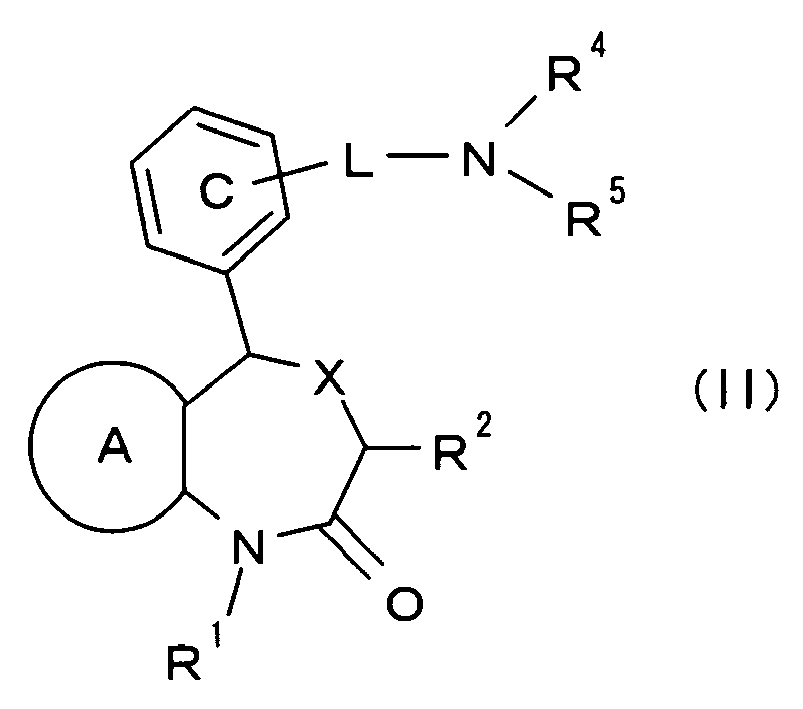
wherein L represents a linker, R4 and R5 each represents a hydrogen atom, an optionally substituted hydrocarbon group, an acyl group, an optionally substituted carbamoyl group, an esterified carboxyl group, or an optionally substituted heterocyclic group, R4 and R5 may be taken together to form a ring, or a R4 or R5 may be taken together with a linker represented by L to form a ring, a ring C represents an optionally further substituted benzene ring, and the other symbols are as defined in the above (1), or a salt thereof, or a prodrug thereof, - (3) the agent according to the above (1), which comprises a compound represented by the formula:

wherein a ring D represents an optionally substituted benzene ring, L represents a linker, R4 and R5 each represents a hydrogen atom, an optionally substituted hydrocarbon group, an acyl group, an optionally substituted carbamoyl group, an esterified carboxyl group, or an optionally substituted heterocyclic group, R4 and R5 may be taken together to form a ring, or R4 or R5 may be taken together with a linker represented by L to form a ring, a ring C represents an optionally further substituted benzene ring, and the other symbols are as defined in the above (1), or a salt thereof, or a prodrug thereof, - (4) the agent according to the above (1), which comprises a compound represented by the formula:

wherein a ring D represents an optionally substituted benzene ring, L1 represents a linker represented by optionally substituted -Y-(CH2)m- (Y represents a bond, -O-, -S(O)n1- (n1 represents an integer of 0 to 2) or -NR7 - (R7 represents a hydrogen atom, an optionally substituted hydrocarbon group, or an optionally substituted heterocyclic group), and m represents an integer of 0 to 6), R4 and R5 each represents a hydrogen atom, an optionally substituted hydrocarbon group, an acyl group, an optionally substituted carbamoyl group, an esterified carboxyl group or an optionally substituted heterocyclic group, R4 and R5 may be taken together to form a ring, or R4 or R5 may be taken together with a linker represented by L1 to form a ring, a ring C represents an optionally further substituted benzene ring, R6 represents an optionally substituted hydrocarbon group, or an optionally substituted heterocyclic group, and the other symbols are as defined in the above (1), or a salt thereof, or a prodrug thereof, - (5) the agent according to the above (1), which is an analgesic, an agent for promoting analgesic activity of another analgesic drug, or an agent for avoiding resistance due to another analgesic drug,
- (6) the agent according to the above (1), which is an agent for modulating the prolactin secretion,
- (7) the agent according to the above (1), which is an agent for preventing or treating hyperprolactinemia, pituitary gland tumor, diencephalons tumor, emmeniopathy, stress, autoimmune disease, prolactinoma, infertility, impotence, amenorrhea, galactic leakage, acromegaly, Chiari-Frommel syndrome, Argonz-del Castilo syndrome, Forbes-Albright syndrome, breast cancer lymphoma, Sheehan's syndrome or spermatogenesis abnormality,
- (8) the agent according to the above (1), which is an agent for suppressing the pancreatic glucagon secretion, an agent for lowering a blood glucose or an agent for suppressing the urine production,
- (9) the agent according to the above (1), which is an agent for preventing or treating diabetes, glucose tolerance disorder, ketosis, acidosis, diabetic neuropathy, diabetic nephropathy, diabetic retinopathy, pollakiuria, nocturnal enarusis, hyperlipemia, sexual function disorder, skin disease, arthritis, osteopenia, arteriosclerosis, thrombotic disease, maldigestion or memory and learning disabilities,
- (10) the agent according to the above (1), which is an agent for suppressing the bladder constriction,
- (11) the agent according to the above (1), which is an agent for preventing or treating urine incontinence, lower uropathy, urge micturition due to excessive active bladder, or hypotonic bladder accompanied with excessive active bladder,
- (12) a compound represented by the formula:

wherein a ring D represents an optionally substituted benzene ring, G1 represents a bond, or an optionally substituted divalent hydrocarbon group, G2 represents -O-, -NR8- (R8 represents a hydrogen atom, an optionally substituted hydrocarbon group, or an optionally substituted heterocyclic group) or -S(O)n2- (n2 represents an integer of 0 to 2), G3 represents an optionally substituted divalent hydrocarbon group, R4and R5 each represents a hydrogen atom, an optionally substituted hydrocarbon group, an acyl group, an optionally substituted carbamoly group, an esterified carboxyl group, or an optionally substituted heterocyclic group, a ring C represents an optionally further substituted benzene ring, R1 and R2 each represents a hydrogen atom, an optionally substituted hydrocarbon group, or an optionally substituted heterocyclic group, R4 may be taken together with G3 or R5to form a ring and, when G2 is -NR8-, R4 and R8 may be taken together to form a ring, provided that 3,5-trans-N-(2-fluorobenzyl)-5-[3-(3-tert-butoxycarbonylaminopropyl)aminomethylphenyl]-7-chloro-1-neopentyl-2-oxo-1,2,3,5-tetrahydro-4,1-benzooxazepine-3-acetamide, 3,5-trans-N-(2-fluorobenzyl)-5-[3-(3-aminopropyl)aminomethylphenyl]-7-chloro-1-neopentyl-2-oxo-1,2,3,5-tetrahydro-4,1-benzooxazepine-3-acetamide, 3,5-trans-N-(2-fluorobenzyl)-5-(3-aminoacetylaminomethylphenyl)-1-benzyl-7-chloro-2-oxo-1,2,3,5-tetrahydro-4,1-benzooxazepine-3-acetamide, 3,5-trans-N-(2-fluorobenzyl)-1-(4-biphenylmethyl)-7-chloro-2-oxo-5-[3-[(piperidin-4-yl)carbonylaminomethyl]phenyl]-1,2,3,5-tetrahydro-4,1-benzooxazepine-3-acetamide, 3,5-trans-N-(2-fluorobenzyl)-5-[2-(3-aminopropyloxy)phenyl]-7-chloro-1-isobutyl-2-oxo-1,2,3,5-tetrahydro-4,1-benzooxazepine-3-acetamide, 3,5-trans-N-(2-fluorobenzyl)-5-[4-(3-aminopropyloxy)-2-methoxyphenyl]-7-chloro-1-neopentyl-2-oxo-1,2,3,5-tetrahydro-4,1-benzooxazepine-3-acetamide, 7-chloro-5-[2-[3-[[(1,1-dimethylethoxy)carbonyl]amino]propoxy]phenyl]-1,2,3,5-tetrahydro-1-(2-methylpropyl)-2-oxo-4,1-benzooxazepin-3-ylacetic acid ethyl ester, and 7-chloro-5-[4-[3-[[(1,1-dimethylethoxy)carbonyl]amino]propoxy]-2-methoxyphenyl]-1-(2,2-dimethylpropyl)]-1,2,3,5-tetrahydro-2-oxo-4,1-benzooxazepin-3-ylacetic acid ethyl ester are excluded], or a salt thereof, - (13) the compound according to the above (12), which is represented by the formula:

wherein J represents an optionally substituted hydroxyl group, or an optionally substituted amino group, and the other symbols are as defined in the above (12), - (14) the compound according to the above (12), which is represented by the formula:

wherein R6 represents an optionally substituted hydrocarbon group, or an optionally substituted heterocyclic group, and the other symbols are as defined in the above (12), - (15) the compound according to the above (12), wherein G1 is a bond, or an optionally substituted C1-3 alkylene group,
- (16) the compound according to the above (12), wherein G3 is an optionally substituted C2-6 alkylene group,
- (17) the compound according to the above (12), wherein G1 is a bond, and G2 is -O-,
- (18) the compound according to the above (12), wherein R1 is an optionally substituted hydrocarbon group,
- (19) the compound according to the above (12), wherein R1 is an optionally substituted C1-8 alkyl group, or an optionally substituted C7-16 aralkyl group,
- (20) the compound according to the above (12), wherein R4 is a hydrogen atom,
- (21) the compound according to the above (12), wherein R5 is an optionally substituted C1-6 alkyl group, or an optionally substituted C7-16 aralkyl group,
- (22) the compound according to the above (13), wherein J is a hydroxyl group, an optionally substituted lower alkoxy group, an amino group optionally substituted with an optionally substituted alkyl group, or an optionally substituted cyclic amino group,
- (23) the compound according to the above (13), wherein J is an optionally substituted 5- to 8- membered cyclic amino group,
- (24) the compound according to the above (14), wherein R6 is an optionally substituted benzyl group, or an optionally substituted phenyl group,
- (25) the compound according to the above (12), wherein G3 is an optionally substituted divalent hydrocarbon group other than a carbonyl group and, when R4 is a hydrogen atom, R5 is not a hydrogen atom or a tert-butyloxycarbonyl group,
- (26) a compound represented by the formula:

wherein a ring D represents an optionally substituted benzene ring, G3 represents an optionally substituted divalent hydrocarbon group, R4 and R5 each represents a hydrogen atom, an optionally substituted hydrocarbon group, an acyl group, an optionally substituted carbamoyl group, an esterified carboxyl group, or an optionally substituted heterocyclic group, a ring C represents an optionally further substituted benzene ring, R1 and R2 each represents an hydrogen atom, an optionally substituted hydrocarbon group, or an optionally substituted heterocyclic group, and R4 may be taken together with G3 or R5 to form a ring, or a salt thereof, - (27) 2-(3,5-trans-7-Chloro-1-(2,2-dimethylpropyl)-5-{2-methoxy-3-[3-(3-phenylpropylamino)propoxy]phenyl}-2-oxo-1,2,3,5-tetrahydro-4,1-benzooxazepin-3-yl)-N-(2-fluorobenzyl)acetamide, 2-{3,5-trans-7-chloro-1-(2,2-dimethylpropyl)-5-[2-methoxy-3-(3-(pentylamino)propoxy)phenyl]-2-oxo-1,2,3,5-tetrahydro-4,1-benzooxazepin-3-yl}-N-(2-fluorobenzyl)acetamide, trans-2-{7-chloro-5-[3-(3-{[3-(2-chlorophenyl)propyl]amino}propoxy)-2-methoxyphenyl]-1-(2,2-dimethylpropyl)-2-oxo-1,2,3,5-tetrahydro-4,1-benzooxazepin-3-yl}-N-(2-fluorobenzyl)acetamide, trans-2-[7-chloro-1-(2,2-dimethylpropyl)-5-[2-methoxy-3-(3-{[(2E)-3-phenyl-2-propenyl]amino}propoxy)phenyl]-2-oxo-1,2,3,5-tetrahydro-4,1-benzooxazepin-3-yl]-N-(2-fluorobenzyl)acetamide, trans-2-[7-chloro-1-(2,2-dimethylpropyl)-5-(2-methoxy-3-{3-[(3-phenylpropyl)amino]propoxy}phenyl)-2-oxo-1,2,3,5-tetrahydro-4,1-benzooxazepin-3-yl]-N-propylacetamide, trans-7-chloro-1-(2,2-dimethylpropyl)-5-(2-methoxy-3-{3-[(3-phenylpropyl)amino]propoxy}phenyl)-3-[2-oxo-2-(1-piperazinyl)ethyl]-1,5-dihydro-4,1-benzooxazepine-2(3H)-one, trans-7-chloro-1-(2,2-dimethylpropyl)-3-[2-(4-hydroxypiperidin-1-yl)-2-oxoethyl]-5-(2-methoxy-3-{3-[(3-phenylpropyl)amino]propoxy}phenyl)-1,5-dihydro-4,1-benzooxazepine-2(3H)-one or 4-{[3,5-trans-7-chloro-1-(2,2-dimethylpropyl)-5-(2-methoxy-3-{3-[(3-phenylpropyl)amino]propoxy}phenyl)-2-oxo-1,2,3,5-tetrahydro-4,1-benzooxazepin-3-yl]acetyl}piperazine-2-carboxylic acid, or a salt thereof,
- (28) a prodrug of the compound according to the above (12) or (26),
- (29) a drug containing the compound according to the above (12) or (26) or a prodrug thereof,
- (30) the drug according to the above (29), which is an agent for preventing or treating RFRP-associated with morbid state or a disease involved in RFRP,
- (31) a method of modulating the function of an RFRP receptor, which comprises administering an effective amount of a compound represented by the formula:
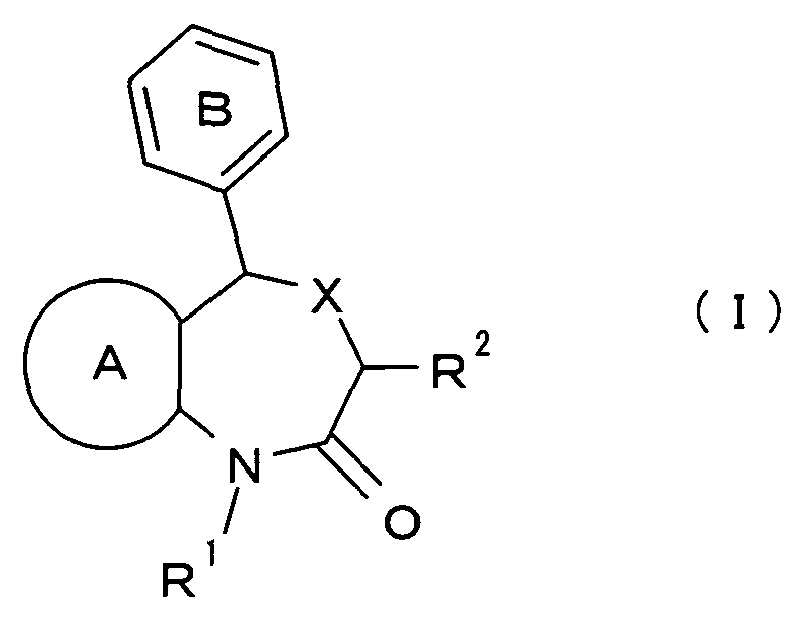
wherein a ring A represents an optionally substituted aromatic ring, a ring B represents an optionally substituted benzene ring, X represents O, S(O)n (n represents an integer of 0 to 2) or NR3 (R3 represents a hydrogen atom, an optionally substituted hydrocarbon group, or an optionally substituted heterocyclic group), and R1 and R 2 each represents a hydrogen atom, an optionally substituted hydrocarbon group, or an optionally substituted heterocyclic ring, or a salt thereof, or a prodrug thereof to a mammal, and - (32) use of a compound represented by the formula:

wherein a ring A represents an optionally substituted aromatic ring, a ring B represents an optionally substituted benzene ring, X represents O, S(O)n (n represents an integer of 0 to 2) or NR3 (R3 represents a hydrogen atom, an optionally substituted hydrocarbon group, or an optionally substituted heterocyclic group), and R1 and R2 each represents a hydrogen atom, an optionally substituted hydrocarbon group, or an optionally substituted heterocyclic group, or a salt thereof, or a prodrug thereof for preparing an agent for modulating the function of an RFRP receptor.
Further, the present invention relates to: - (33) the agent according to the above (1), wherein the ring A is (i) an aromatic hydrocarbon ring of a carbon number of 6 to 14, or (ii) a 5- to 14- membered aromatic heterocyclic containing 1 to 4 of 1 or 2 kinds of heteroatoms selected from a nitrogen atom, a sulfur atom and an oxygen atom in addition to a carbon atom, which may be substituted with a substituent selected from a substituent A group,
the substituent A group is a group consisting of:- (i) a halogen atom,
- (ii) a nitro group,
- (iii) a cyano group
- (iv) a straight or branched C1-15 alkyl group, a C3-10 cycloalkyl group, a C2-18 alkenyl group, a C3-10 cycloalkenyl group, a C2-8 alkynyl group, a C7-16 aralkyl group, a C6-14 aryl group, a biphenyl group, a trityl group or a tolyl group, which may be substituted with a substituent selected from a substituent B group [a nitro group, a hydroxyl group, an oxo group, a cyano group, a carbamoyl group, a mono- or di-C1-6 alkyl-carbamoyl group (the alkyl group may be substituted with a halogen atom, a hydroxyl group, or a C1-6 alkoxy group), a mono- or di-C2-6 alkenyl-carbamoyl group (the alkenyl group may be substituted with a halogen atom, a hydroxyl group, or a C1-6 alkoxy group), a mono- or di-
C 6-14 aryl-carbamoyl group, a mono- or di-C7-16 aralkyl-carbamoyl group, a C1-6 alkoxy-carbonyl-carbamoyl group, a C1-6 alkylsulfonyl-carbamoyl group, a C1-6 alkoxy-carbamoyl group, an amino-carbamoyl group, a mono- or di-C1-6 alkylamino-carbamoyl group, a mono- or di-C6-14 arylamino-carbamoyl group, a carboxyl group, a C1-6 alkoxy -carbonyl group, a sulfo group, a halogen atom, an optionally halogenated C1-6 alkoxy group, a C1-6 alkoxy group optionally substituted with a hydroxyl group, a C1-6 alkoxy group optionally substituted with a carboxyl group, a C1-6 alkoxy group optionally substituted with a C1-6 alkoxy-carbonyl group, a C1-6 alkoxy-C1-6 alkoxy group, a C1-6 alkoxy-C1-6 alkoxy-C1-6 alkoxy group, a C6-14 aryloxy group, a C6-14 aryloxy-C1-6 alkyl group, a C6-14 aryloxy-C1-6 alkoxy group, a C1-6 alkylcarbonyl-oxy group, a carbamoyloxy group, a mono or -di-C1-6 alkyl-carbamoyloxy group, an optionally halogenated C6-14 aryl group (e.g. a phenyl group, 1- or 2-naphthyl), an optionally halogenated C6-14 aryl-C1-6 alkyl group, an optionally halogenated C6-14 aryl-C2-6 alkenyl group, an optionally halogenated C6-14 aryloxy group, a 5-to 10- membered heterocyclic-oxy group containing at least one 1 to 3 kinds of heteroatoms selected from an oxygen atom, a sulfur atom and a nitrogen atom (the heterocyclic group may be substituted with a C1-6 alkyl group), a C3-10 cycloalkyl group, a C3-10 cycloalkyl-C1-6 alkoxy group, a C3-10 cycloalkyl-C1-6 alkyl group, an optionally halogenated C1-6 alkyl group, an optionally halogenated C2-6 alkenyl group, an optionally halogenated C1-6 alkylthio group, a C1-6 alkyl group optionally substituted with a hydroxyl group, a C1-6 alkylthio group optionally substituted with a hydroxy group, a mercapto group, a thioxo group, a C7-16 aralkyloxy group (optionally substituted with a substituent selected from a halogen atom, a carboxyl group and a C1-6 alkoxy-carbonyl group) or a C7-16 aralkylthio group (optionally substituted with a substituent selected from a halogen atom, a carboxyl group and a C1-6 alkoxy-carbonyl group), an optionally halogenated C6-14 arylthio group, a 5- to 10-membered heterocyclic-thio group containing at lease one 1 to 3 kinds of heteroatoms selected from an oxygen atom, a sulfur atom, and a nitrogen atom (the heterocyclic group may be substituted with a C1-6 alkyl group), a C6-14 arylthio-C1-6 alkyl group, a 5- to 10-membered heterocyclic-thio-C1-6 alkyl group containing at least one 1 to 3 kinds of heteroatoms selected from an oxygen atom, a sulfur atom and a nitrogen atom (the heterocyclic group may be substituted with a C1-6 alkyl group), an optionally halogenated C1-6 alkylsulfinyl group, a C6-14 arylsulfinyl group, a C6-14 arylsulfinyl-C1-6 alkyl group, an optionally halogenated C1-6 alkylsulfonyl group, a C6-14 arylsulfonyl group, a C6-14 arylsulfonyl-C1-6 alkyl group, an amino group, an aminosulfonyl group, a mono- or di-C1-6 alkylaminosulfonyl group (the alkyl group may be substituted with a halogen atom, a hydroxy group, or a C1-6 alkoxy group), a C1-10 alkanoyl-amino group (the C1-10 alkanoyl may be substituted with a halogen atom, a hydroxy group, or a carboxyl group), a C3-10 alkenoylamino group (the C3-10 alkenoyl may be substituted with a halogen atom, a hydroxy group, or a carboxyl group), a C3-10 cycloalkylcarbonylamino group (the C3-10 cycloalkylcarbonyl may be substituted with a halogen atom, a hydroxy group, or a carboxyl group), a C6-14 arylcarbonylamino group (the C6-14 arylcarbonyl may be substituted with a halogen atom, a hydroxy group, or a carboxyl group), a C1-6 alkylsulfonylamino group (the C1-6 alkylsulfonyl may be substituted with a halogen atom, a hydroxy group, or a carboxyl group), a C6-14 arylsulfonylamino group (the C6-14 arylsulfonyl may be substituted with a halogen atom, a hydroxyl group, or a carboxyl group), a C7-14 aralkyloxycarbonylamino group, an optionally halogenated C1-6 alkoxycarbonylamino group, a carbamoylamino group, a mono- or di-C1-6 alkylcarbamoylamino group, a mono- or di-C1-6 alkylamino group (the alkyl group may be substituted with a halogen atom, a hydroxy group, or a C1-6 alkoxy group), a mono- or di-C1-6 alkanoylamino group (the alkanoyl group may be substituted with a halogen atom, a hydroxy group, or a C1-6 alkoxy group), a C6-14 arylamino group, a C7-16 aralkylamino group, a C1-6 alkyl (C7-16 aralkyl) amino group, a C1-6 alkanoyl (C7-16 aralkyl) amino group, a 3- to 8-membered cyclic amino group, a 3- to 8-membered cyclic amino-carbonyl group, a 3- to 8-membered cyclic amino carbonyl-oxy group, a 3- to 8-membered cyclic amino-carbonyl-amino group, a 3- to 8-membered cyclic amino-sulfonyl group, a 3- to 8-membered cyclic amino-C1-6 alkyl group, a C1-6 alkanoyl group (optionally substituted with a substituent selected from a halogen atom, amino, a carboxyl group and a C1-6 alkoxy-carbonyl group), a C6-14 aryl-carbonyl group (optionally substituted with a substituent selected from a halogen atom, a carboxyl group and a C1-6 alkoxy-carbonyl group), a C7-16 aralkyl-carbonyl group (optionally substituted with a substituent selected from a halogen atom, amino, a carboxyl group and a C1-6 alkoxy-carbonyl group), a 5- to 10-membered heterocyclic group containing at least one 1 to 3 kinds of heteroatoms selected from an oxygen atom, a sulfur atom and a nitrogen atom (the heterocyclic group may be substituted with a C1-6 alkyl group), a 5- to 10-membered heterocyclic-carbonyl group containing at least one 1 to 3 kinds of heteroatoms selected from an oxygen atom, a sulfur atom and a nitrogen atom (the heterocyclic group may be substituted with a C1-6 alkyl group), a hydroxyimino group, a C1-6 alkoxyimino group, an optionally halogenated straight or branched C1-4 alkylenedioxy group, an ureido group, a C1-6 alkyl-ureido group, and a C1-6 alkyl group optionally substituted with a halogen atom] (hereinafter, optionally substituted hydrocarbon group), - (v) a 5- to 16-membered monocyclic to tricyclic aromatic heterocyclic group containing at least one 1 to 3 kinds of heteroatoms selected from an oxygen atom, a sulfur atom, and a nitrogen atom, or a 3- to 8-membered saturated or unsaturated non-aromatic heterocyclic group, which may be substituted with a substituent selected from the substituent B group (hereinafter, optionally substituted heterocyclic group),
- (vi) a hydroxy group optionally substituted with a substituent selected from the group consisting of:
- (a) the aforementioned optionally substituted hydrocarbon group,
- (b) a group represented by RACO-, RAOCO-, RASO2-, RASO-or RAOPO(ORB)-(RArepresents (aa) a hydrogen atom, (bb) the aforementioned optionally substituted hydrocarbon group or (cc) the aforementioned optionally substituted heterocyclic group, and RBrepresents (aa) a hydrogen atom or (bb) the aforementioned optionally substituted hydrocarbon group) (hereinafter, acyl group),
- (c) a group represented by the formula -COORC (RC represents (aa) a hydrogen atom, (bb) the aforementioned optionally substituted hydrocarbon group or (cc) the aforementioned optionally substituted heterocyclic group) (hereinafter, optionally esterified carboxyl group),
- (d) a carbamoyl group optionally substituted with a substituent selected from the group consisting of:
- (aa) the aforementioned optionally substituted hydrocarbon group,
- (bb) the aforementioned acyl group,
- (cc) the aforementioned optionally esterified carboxyl group,
- (dd) a carbamoyl group optionally substituted with 1 to 2 substituents selected from a C1-6 alkyl group and a C6-14 aryl group, and
- (ee) the aforementioned optionally substituted heterocyclic group (hereinafter, optionally substituted carbamoyl group), and
- (e) the aforementioned optionally substituted heterocyclic group
(hereinafter, optionally substituted hydroxyl group),
- (vii) a thiol group optionally substituted with a substituent selected from the group consisting of:
- (a) the aforementioned optionally substituted hydrocarbon group,
- (b) the aforementioned acyl group,
- (c) the aforementioned optionally esterified carboxyl group,
- (d) the aforementioned optionally substituted carbamoyl group, and
- (e) the aforementioned optionally substituted heterocyclic group
(hereinafter, optionally substituted thiol group),
- (viii) a sulfinyl group substituted with a substituent selected from the group consisting of:
- (a) the aforementioned optionally substituted hydroxy group,
- (b) the following optionally substituted amino group,
- (c) the aforementioned optionally substituted hydrocarbon group, and
- (d) the aforementioned optionally substituted heterocyclic group
(hereinafter, substituted sulfinyl group),
- (ix) a sulfonyl group substituted with a substituent selected from the group consisting of:
- (a) the aforementioned optionally substituted hydroxy group,
- (b) the following optionally substituted amino group,
- (c) the aforementioned optionally substituted hydrocarbon group, and
- (d) the aforementioned optionally substituted heterocyclic group
(hereinafter, substituted sulfonyl group),
- (x) an amino group or a 3- to 8-membered cyclic amino group optionally substituted with a substituent selected from the group consisting of:
- (a) the aforementioned optionally substituted hydrocarbon group,
- (b) the aforementioned acyl group,
- (c) the aforementioned optionally esterified carboxyl group,
- (d) the aforementioned optionally substituted carbamoyl group, and
- (e) the aforementioned optionally substituted heterocyclic group,
(hereinafter, optionally substituted amino group),
- (xi) the aforementioned acyl group,
- (xii) the aforementioned optionally substituted carbamoyl group,
- (xiii) the aforementioned optionally esterified carboxyl group, and
- (xiv) a C1-3 alkylenedioxy group,
the ring B is a benzene ring optionally substituted with a substituent selected from the substituent A group,
X is:- (i) O,
- (ii) S(O)n (n represents an integer of 0 to 2), or
- (iii) NR3
- (R3 represents:
- (a) a hydrogen atom,
- (b) the aforementioned optionally substituted hydrocarbon group, or
- (c) the aforementioned optionally substituted heterocyclic group),
R1 is:- (i) a hydrogen atom,
- (ii) the aforementioned optionally substituted hydrocarbon group, or
- (iii) the aforementioned optionally substituted heterocyclic group,
- (i) a hydrogen atom
- (ii) a straight or branched C1-15 alkyl group, a C3-10 cycloalkyl group, a C2-18 alkenyl group, a C3-10 cycloalkenyl group, a C2-8 alkynyl group, a C7-16 aralkyl group, a C6-14 aryl group, a biphenyl group or a tolyl group, which may be substituted with a substituent selected from the group consisting of:
- (a) a substituent B group,
- (b) a group represented by the formula -CONR12(R13)
(R12 represents:- (aa) a hydrogen atom,
- (bb) the aforementioned optionally substituted hydrocarbon group (e.g. a C1-6 alkyl group optionally substituted with a substituent selected from a substituent B group, a C6-14 aryl group optionally substituted with a substituent selected from a substituent B group, or a C7-16 aralkyl group optionally substituted with a substituent selected from the substituent B group),
- (cc) the aforementioned optionally substituted heterocyclic group,
(R13 represents a hydrogen atom or a C1-6 alkyl group) - (c) a group represented by the formula -COO-R14,
(R14 is:- (aa) a hydrogen atom, or
- (bb) a C1-6 alkyl group optionally substituted with a substituent selected from the substituent B group),
- (d) a group represented by the formula -NR15(R16)
(R15 represents:- (aa) a hydrogen atom,
- (bb) a C7-16 aralkyl group optionally substituted with a substituent selected from the substituent B group, or
- (cc) the aforementioned acyl group,
(R16 represents a hydrogen atom or a C1-6 alkyl group),
- (e) a group represented by the formula -CO-Q (Q represents a 5- to 8-membered nitrogen-containing ring group optionally substituted with a substituent selected from the substituent B group),
- (f) a group represented by the formula -NH-CO-NR19(R20)
(R19 represents:- (aa) a hydrogen atom, or
- (bb) a C6-14 aryl group optionally substituted with a substituent selected from the substituent B group,
(R20 represents:- (aa) a hydrogen atom, or
- (bb) a C1-6 alkyl group optionally substituted with a substituent selected from the substituent B group),
- (g) a group represented by the formula -CO-J
(J represents:- (aa) the aforementioned optionally substituted hydroxy group, or
- (bb) the aforementioned optionally substituted amino group),
- (iii) the aforementioned optionally substituted heterocyclic group,
- (34) the compound according to the above (12), wherein the ring D is a benzene ring optionally substituted with a substituent selected from the substituent A group,
G1 is:- (i) a bond, or
- (ii) (a) a C1-6 alkylene group, (b) a C2-6 alkenylene group, (c) a C2-6 alkynylene group, (d) a group obtained by removing a hydrogen atom from two carbon atoms of a C6-14 aryl ring, or (e) a group obtained by removing a hydrogen atom of two carbon atoms of a C3-8 cycloalkane, which may be substituted with a substituent selected from the substituent B group,
G2 is:- (i) -O-,
- (ii) -NR8-
(R8 represents:- (a) a hydrogen atom,
- (b) the aforementioned optionally substituted hydrocarbon group, or
- (c) the aforementioned optionally substituted heterocyclic group), or
- (iii) -S(O)n2- (n2 represents an integer of 0 to 2),
G3 is (a) a C1-6 alkylene group, (b) a C2-6 alkenylene group, (c) a C2-6 alkynylene group, (d) a group obtained by removing a hydrogen atom from two carbon atoms of a C6-14 aryl ring, or (e) a group obtained by removing a hydrogen atom from two carbon atoms of C3-8 cycloalkane, which may be substituted with a substituent selected from the substituent B group,
R4 and R5 each is:- (i) a hydrogen atom,
- (ii) the aforementioned optionally substituted hydrocarbon group,
- (iii) the aforementioned acyl group,
- (iv) the aforementioned optionally substituted carbamoyl group,
- (v) an esterified carboxyl group (the aforementioned optionally esterified carboxyl group other than a free carboxyl group), or
- (vi) the aforementioned optionally substituted heterocyclic group,
the ring C is a benzene ring optionally further substituted with a substituent selected from the substituent A group,
R1 and R2 each is:- (i) a hydrogen atom,
- (ii) the aforementioned optionally substituted hydrocarbon group, or
- (iii) the aforementioned optionally substituted heterocyclic group,
R4 may be taken together with G3 or R5 to form a 5- to 10-membered nitrogen-containing ring optionally containing 1 to 3 kinds of heteroatoms selected from an oxygen atom, a sulfur atom and a nitrogen atom in addition to carbon atoms and one nitrogen atom, which may be substituted with a substituent selected from the substituent B group,
when G2 is -NR8-, R4 and R8 may be taken together to form a 5- to 10-membered nitrogen-containing ring optionally containing 1 to 3 kinds of heteroatoms selected from an oxygen atom, a sulfur atom and a nitrogen atom in addition to carbon atoms and one nitrogen atom, which may be substituted with a substituent selected from the substituent B group,
- (35) the compound according to the above (13), wherein J is the aforementioned optionally substituted hydroxy group or the aforementioned optionally substituted amino group,
- (36) the compound according to the above (14), wherein R6 is the aforementioned optionally substituted hydrocarbon group or the aforementioned optionally substituted heterocyclic group,
- (37) the compound according to the above (26), wherein a ring D is a benzene ring optionally substituted with a substituent selected from the substituent A group,
G3 is (a) a C1-6 alkylene group, (b) a C2-6 alkenylene group, (c) a C2-6 alkynylene group, (d) a group obtained by removing a hydrogen atom from two carbon atoms of a C6-14 aryl ring, or (e) a group obtained by removing a hydrogen atom from two carbon atoms of C3-8 cycloalkane, which may be substituted with a substituent selected from the substituent B group,
R4 and R5 each is:- (i) a hydrogen atom,
- (ii) the aforementioned optionally substituted hydrocarbon group,
- (iii) the aforementioned acyl group,
- (iv) the aforementioned optionally substituted carbamoyl group,
- (v) an esterified carboxyl group (the aforementioned optionally esterified carboxyl group other than a free carboxyl group), or
- (vi) the aforementioned optionally substituted heterocyclic group,
the ring C is a benzene ring optionally substituted with a substituent selected from the substituent A group,
R1 and R2 each is:- (i) a hydrogen atom,
- (ii) the aforementioned optionally substituted hydrocarbon group, or
- (iii) the aforementioned optionally substituted heterocyclic group,
R4 may be taken together with G3 or R5 to form a 5- to 10-membered nitrogen-containing ring optionally containing at least one of 3 kinds of heteroatoms selected from an oxygen atom, a sulfur atom, and a nitrogen atom in addition to carbon atoms and one nitrogen atom, which may be substituted with a substituent selected from the substituent B group. -
- Fig. 1 shows results of investigation of a variation in a blood glucose concentration upon intravenous administration of RFRP-1 to a rat under no anesthesia. In the figure, (-O-) represents a blood glucose concentration of a physiological saline administration group, (-▲-) represents a blood glucose concentration of an RFRP-1 1 nmol/kg administration group, and (-■-) represents a blood concentration of an RFRP-1 10 nmol/kg administration group. A value indicates mean ±standard deviation (mean ± SE) (n = 4). * indicates that a P value is 0.05 or less as compared with a physiological saline administration group.
- Fig. 2 shows results of investigation of a variation in a blood glucagon concentration upon oral administration of RFRP-1 to a rat under no anesthesia. In the figure, (-o-) represents a blood glucagon concentration of a physiological saline administration group, (-▲-) represents a blood glucagon concentration of an RFRP-1 1 nmol/kg administration group, and (-■-) represents a blood glucagon concentration of an RFRP-1 10 nmol/kg administration group. A value indicates mean ± standard deviation (mean ± SE) (n = 4). ** indicates that a P value is 0.01 or less as compared with a physiological saline administration group.
- Fig. 3 shows results of investigation of a variation in a blood insulin concentration upon intravenous administration of RFRP-1 to a rat under no anesthesia. In the figure, (-o-) represents a blood insulin concentration of a physiological saline administration group, (-▲-) represents a blood insulin concentration of an RFRP-1 1 nmol/kg administration group, and (-■-) represents a blood insulin concentration of an RFRP-1 10 nmol/kg administration group. A value indicates mean ± standard deviation (mean ± SE) (n = 4).
- Fig. 4 indicates a ratio of freezing in a sound clue when RFRP-1 (-□-) and a physiological saline (-○-) are administered in a ventricle. An ordinate axis indicates freezing (%) of one day and two day after administration, respectively, expressed by mean ± standard error.
- Fig. 5 shows results of investigation of a variation in a blood glucose concentration when a compound of Example 50 is intravenously administered to a rat under no anesthesia and, after five minutes, RFRP-1 is intravenously administered. In the figure, (-o-) represents a blood glucose concentration of a physiological saline administration group, (-□-) represents a blood glucose concentration of an Example 50 compound 0.2 mg/kg administration group, (-▲-) represents a blood glucose concentration of an Example 50
compound 1 mg/kg administration group, and (-■-) represents a blood glucose concentration of an Example 50compound 5 mg/kg administration group, as expressed by a variation value from at a time point of administration of RFRP-1. A value indicates mean ± standard deviation (mean ± SE) (n = 4). * indicates that a P value is 0.05 or less as compared with a physiological saline administration group, ** indicates that a P value is 0.01 or less as compared with a physiological saline administration group, and *** indicates that a P value is 0.001 or less as compared with a physiological saline administration group. - Fig. 6 shows results of investigation of a variation in a blood glucagon concentration when a compound of Example 50 is intravenously administered to a rat under no anesthesia and, after five minutes, RFRP-1 is intravenously administered. In the figure, (-o-) represents a blood glucagon concentration of a physiological saline administration group, (-□-) represents a blood glucagon concentration of an Example 50 compound 0.2 mg/kg administration group, (-▲-) represents a blood glucagon concentration of an Example 50 compound (1 mg/kg) administration group, and (-■-) represents a blood glucagon concentration of an Example 50
compound 5 mg/kg administration group, as expressed by a variation value from a time point of administration of RFRP-1. A value indicates mean ± standard deviation (mean ± SE) (n = 4). * indicates that a P value is 0.05 or less as compared with a physiological saline administration group, and *** indicates that a value is 0.001 or less as compared with a physiological saline administration group. - In the aforementioned formulas, the ring A represents an optionally substituted aromatic ring.
- As the aromatic ring represented by the ring A, an aromatic hydrocarbon ring or an aromatic heterocyclic ring is used.
- As the aromatic hydrocarbon ring, an aromatic hydrocarbon ring of a carbon number of 6 to 14 such as a benzene ring, and a naphthalene ring is used and, inter alia, a benzene ring is preferably used.
- As the aromatic heterocyclic ring, for example, a 5-to 14-membered (monocyclic, dicyclic or tricyclic), preferably 5- to 10-membered, more preferably 5- to 6-membered aromatic heterocyclic ring containing 1 to 4 of 1 or 2 kinds of heteroatoms selected from a nitrogen atom, a sulfur atom and an oxygen atom in addition to carbon atoms is used. As the "5- to 14-membered (preferably 5- to 10-membered) aromatic heterocyclic ring", an aromatic heterocyclic ring such as thiophene, furan, oxazole, benzo[b]thiophene, benzo[b]furan, benzimidazole, benzoxazole, benzothiazole, benzisothiazole, naphtha[2,3-b]thiophene, pyrrole, imidazole, pyrazole, pyridine, pyrazine, pyrimidine, pyridazine, indole, isoindole, 1H-indazole, purine, 4H-quinolizine, isoquinoline, quinoline, phthalazine, naphthyridine, quinoxaline, quinazoline, cinnoline, carbazole, β-carboline, phenanthridine, acridine, phenazine, thiazole, isothiazole, phenothiazine, isooxazole, furazane, and phenoxazine, or a ring formed by fusing these rings (preferably monocycle) with one to plural (preferably 1 or 2) aromatic rings (e.g. benzene ring etc.) is used. Inter alia, a monocyclic aromatic heterocyclic ring is preferable and, for example, thiophene, pyrazole, imidazole, pyridine, pyrazine, pyrimidine, pyridazine, pyrrole, furan, thiazole, isothiazole, and isooxazole are used.
- The ring B represents an optionally substituted benzene ring.
- Examples of the substituent which may be possessed by the ring A include a halogen atom (e.g. fluorine, chlorine, bromine, iodine), a nitro group, a cyano group, an optionally substituted hydrocarbon group, an optionally substituted heterocyclic group, an optionally substituted hydroxy group, an optionally substituted thiol group, a substituted sulfinyl group, a substituted sulfonyl group, an optionally substituted amino group, an acyl group, an optionally substituted carbamoyl group, an optionally esterified carboxyl group, and a C1-3 alkylenedioxy group (hereinafter, substituent A group).
- Examples of the substituent which may be possessed by the ring B include a halogen atom (e.g. fluorine, chlorine, bromine, iodine), a nitro group, a cyano group, an optionally substituted hydrocarbon group, an optionally substituted heterocyclic group, an optionally substituted hydroxy group, an optionally substituted thiol group, a substituted sulfinyl group, a substituted sulfonyl group, an optionally substituted amino group, an acyl group, an optionally substituted carbamoyl group, an optionally esterified carboxyl group, a C1-3 alkylenedioxy group, and a group represented by the formula:

- Examples of the "hydrocarbon group" of the "optionally substituted hydrocarbon group" as the substituent which may be possessed by the ring A or the ring B include an alkyl group, a cycloalkyl group, an alkenyl group, a cycloalkenyl group, an alkynyl group, an aralkyl group, an aryl group.
- As the "alkyl group", a "straight or branched C1-15 alkyl group" such as methyl, ethyl, propyl, isopropyl, butyl, isobutyl, sec-butyl, tert-butyl, pentyl, neopentyl, hexyl, heptyl, octyl, nonyl, decyl, undecyl, tridecyl, tetradecyl, and pentadecyl, preferably, a C1-8 alkyl group is used. More preferably, a C1-6 alkyl group is used. Further preferably, a C1-4 alkyl group is used.
- As the "cycloalkyl group", a "C3-10 cycloalkyl group" such as cyclopropyl, cyclobutyl, cyclopentyl, cyclohexyl, cycloheptyl, cyclooctyl, and adamantyl is used. More preferably, a C3-8 cycloalkyl group is used. Further preferably, a C5-7 cycloalkyl group is used.
- As the "alkenyl group", a "C2-18 alkenyl group" such as vinyl, allyl, isopropenyl, 3-butenyl, 3-octenyl, and 9-octadecenyl is used. More preferably, a C2-6 alkenyl group is used. Further preferably, a C2-4 alkenyl group is used.
- As the "cycloalkenyl group", a "C3-10 cycloalkenyl group" such as cyclopropenyl, cyclobutenyl, cyclopentenyl, cyclohexenyl, cycloheptenyl, and cyclooctenyl is used. More preferably, a C3-8 cycloalkenyl group is used. Further preferably, a C5-7 cycloalkenyl group is used.
- As the "alkynyl group", a "C2-8 alkynyl group" such as ethynyl, 1-propynyl, propargyl, 1-butynyl, 2-butynyl, 1-pentynyl, 2-pentynyl, and 3-pentynyl is used. More preferably, a C2-6 alkynyl group is used. Further preferably, a C2-4 alkynyl group is used.
- As the "aralkyl group", a C7-14 aralkyl group is used. Specifically, a phenyl-C1-6 alkyl group such as benzyl, phenethyl, 3-phenylpropyl, and 4-phenylbutyl, and a naphthyl-C1-6 alkyl group such as (1-naphthyl)methyl, 2-(1-naphthyl)ethyl, and 2-(2-naphthyl)ethyl are used.
- As the "aryl group", an aromatic monocyclic, dicyclic or tricyclic C6-14 aryl group such as phenyl, 1-naphthyl, 2-naphthyl, phenthryl, and anthryl, a biphenyl group, and a tolyl group are used. Preferably, a C6-10 aryl group such as phenyl and naphthyl is used. More preferably, phenyl is used.
- As the substituent which may be possessed by the "hydrocarbon group" in the "optionally substituted hydrocarbon group" as the substituent which may be possessed by the ring A or the ring B, for example, (i) a nitro group, (ii) a hydroxy group, an oxo group, (iii) a cyano group, (iv) a carbamoyl group, (v) a mono- or di-C1-6 alkyl-carbamoyl group (e.g. N-methylcarbamoyl, N-ethylcarbamoyl, N,N-dimethylcarbamoyl, N,N-diethylcarbamoyl etc.; the alkyl group may be substituted with a halogen atom, a hydroxy group, or a C1-6 alkoxy group), a mono- or di-C2-4 alkenyl-carbamoyl group (e.g. N-allylcarbamoyl etc.; the alkenyl group may be substituted with a halogen atom, a hydroxy group, a C1-6 alkoxy group etc.), a mono- or di-C6-14 aryl-carbamoyl group (the C6-14 aryl group may be substituted with a halogen atom, a C1-6 alkyl optionally substituted with a halogen atom, a C1-6 alkoxy group etc.), a mono- or di-C7-16 aralkyl-carbamoyl group (the C7-16 aralkyl group (e.g. benzyl group) may be substituted with a halogen atom, a C1-6 alkyl optionally substituted with a halogen atom, a C1-6 alkoxy group etc.), a C1-6 alkoxy-carbonyl-carbamoyl group, a C1-6 alkylsulfonyl-carbamoyl group, a C1-6 alkoxy-carbamoyl group, an amino-carbamoyl group, a mono- or di-C1-6 alkylamino-carbamoyl group, a mono- or di-C6-14 arylamino-carbamoyl group, (vi) a carboxyl group, (vii) a C1-6 alkoxy-carbonyl group (e.g. methoxycarbonyl, ethoxycarbonyl, propoxycarbonyl, isopropoxycarbonyl etc.), (viii) a sulfo group, (ix) a halogen atom (e.g. fluorine, chlorine, bromine, iodine), (x) an optionally halogenated C1-6 alkoxy group (e.g. methoxy, ethoxy, propoxy, isopropoxy etc.), a C1-6 alkoxy group optionally substituted with a hydroxy group, a C1-6 alkoxy group optionally substituted with a carboxyl group, a C1-6 alkoxy group optionally substituted with a C1-6 alkoxy-carbonyl group, a C1-6 alkoxy-C1-6 alkoxy group, a C1-6 alkoxy-C1-6 alkoxy-C1-6 alkoxy group, (xi) a C6-14 aryloxy group, a C6-14 aryloxy-C1-6 alkyl group, a C6-14 aryloxy-C1-6 alkoxy group, a C1-6 alkylcarbonyl-oxy group, a carbamoyloxy group, a mono- or di-C1-6 alkyl-carbamoyloxy group, (xii) an optionally halogenated C6-14 aryl group (e.g. a phenyl group, 1- or 2-naphthyl), an optionally halogenated C6-14 aryl-C1-6 alkyl group, an optionally halogenated C6-14 aryl-C2-4 alkenyl group, an optionally halogenated C6-14 aryloxy group (e.g. o-, m- or p-chlorophenoxy, o-, m- or p-bromophenoxy etc.), a 5- to 10-membered heterocyclic-oxy group containing at least one (preferably 1 to 4, further preferably 1 or 2) of 1 to 3 kinds (preferably 1 or 2 kinds) of heteroatoms selected from an oxygen atom, a sulfur atom, and a nitrogen atom (e.g. pyridyloxy; the heterocyclic ring may be substituted with C1-6 alkyl), a C3-10 cycloalkyl group, a C3-10 cycloalkyl-C1-6 alkoxy group, a C3-10 cycloalkyl-C1-6 alkyl group, (xiii) an optionally halogenated C1-6 alkyl group (e.g. methyl, ethyl, propyl, isopropyl, butyl etc.), an optionally halogenated C2-6 alkenyl group (e.g. vinyl, allyl, 2-butenyl, 3-butenyl etc.), an optionally halogenated C1-6 alkylthio group (e.g. methylthio, ethylthio, n-propylthio, isopropylthio, n-butylthio etc.), a C1-6 alkyl group optionally substituted with a hydroxy group, a C1-6 alkylthio group optionally substituted with a hydroxy group, (xiv) a mercapto group, a thioxo group, (xv) a C7-16 aralkyloxy group (e.g. benzyloxy) or a C7-16 aralkylthio group (e.g. benzylthio), each optionally substituted with a substituent selected from a halogen atom, a carboxyl group and a C1-6 alkoxy-carbonyl group, (xvi) an optionally halogenated C6-14 arylthio group, a 5- to 10-membered heterocyclic-thio group containing at least one (preferably 1 to 4, further preferably 1 to 2) of 1 to 3 kinds (preferably 1 to 2 kinds) of heteroatoms selected from an oxygen atom, a sulfur atom and a nitrogen atom (e.g. pyridylthio; the heterocyclic ring may be substituted with C1-6 alkyl), a C6-14 arylthio-C1-6 alkyl group, a 5- to 10-membered heterocyclic-thio-C1-6 alkyl group containing at least one (preferably 1 to 4, further preferably 1 to 2) of 1 to 3 kinds (preferably 1 to 2 kinds) of heteroatoms selected from an oxygen atom, a sulfur atom, and a nitrogen atom (e.g. pyridylthio-C1-6 alkyl; the heterocyclic ring may be substituted with C1-6 alkyl), (xvii) an optionally halogenated C1-6 alkylsulfinyl group (e.g. methylsulfinyl, ethylsulfinyl etc.), a C6-14 arylsulfinyl group, a C6-14 arylsulfinyl-C1-6 alkyl group, (xviii) an optionally halogenated C1-6 alkylsulfonyl group (e.g. methylsulfonyl, ethylsulfonyl etc.), a C6-14 arylsulfonyl group, a C6-14 arylsulfonyl-C1-6 alkyl group, (xix) an amino group, an aminosulfonyl group, a mono- or di-C1-6 alkylaminosulfonyl group (e.g. methylaminosulfonyl, ethylaminosulfonyl, N,N-dimethylaminosulfonyl, N,N-diethylaminosulfonyl etc.; the alkyl group may be substituted with a halogen atom, a hydroxy group, a C1-6 alkoxy group etc.), (xx) a C1-15 acyl-amino group [e.g. a C1-10 alkanoylamino group (e.g. formylamino, acetylamino, trifluoroacetylamino, propionylamino, pivaloylamino etc.), a C3-10 alkenoylamino group (e.g. acryloylamino, methacryloylamino etc.), a C3-10 cycloalkylcarbonylamino group (e.g. cyclopropylcarbonylamino, cyclopentylcarbonylamino etc.), C6-14 arylcarbonylamino (e.g. benzoylamino), C1-6 alkylsulfonylamino (e.g. methanesulfonylamino, trifluoromethanesulfonylamino etc.), C6-14 arylsulfonylamino (e.g. benzenesulfonylamino, toluenesulfonylamino etc.); C1-15 acyl may be substituted with a halogen atom, a hydroxy group, a carboxyl group etc.], C7-16 aralkyloxycarbonylamino (e.g. benzyloxycarbonylamino), optionally halogenated C1-6 alkoxycarbonylamino, a carbamoylamino group, a mono- or di-C1-6 alkylcarbamoylamino group, (xxi) a mono- or di-C1-6 alkylamino group (e.g. methylamino, ethylamino, dimethylamino, diethylamino etc.; the alkyl group may be substituted with a halogen atom, a hydroxy group, a C1-6 alkoxy group etc.), a mono- or di-C1-6 alkanoylamino group (e.g. formylamino, acetylamino etc.; the alkanoyl group may be substituted with a halogen atom, a hydroxy group, a C1-6 alkoxy group etc.), C6-14 arylamino, C7-16 aralkylamino (e.g. benzylamino), a C1-6 alkyl (C7-16 aralkyl)amino group (e.g. C1-6 alkyl (benzyl) amino etc.), a C1-6 alkanoyl (C7-16 aralkyl)amino group (e.g. C1-6 alkanoyl(benzyl)amino etc.), (xxii) a 3- to 8-membered cyclic amino group (e.g. 1-azetidinyl, 1-pyrrolidinyl, piperidino, morpholino, thiomorpholino, 1-piperazinyl etc., preferably a 5- or 6-membered cyclic amino group), a 3- to 8-membered cyclic amino-carbonyl group (e.g. 1-azetidinylcarbonyl, 1-pyrrolidinylcarbonyl, piperidinocarbonyl, morpholinocarbonyl, thiomorpholinocarbonyl, 1-piperazinylcarbonyl etc., preferably a 5- or 6-membered cyclic amino-carbonyl group), a 3- to 8-membered cyclic amino-carbonyl-oxy group (e.g. 1-pyrrolidinylcarbonyloxy, piperidinocarbonyloxy, morpholinocarbonyloxy, thiomorpholinocarbonyloxy, 1-piperazinylcarbonyloxy etc., preferably a 5- or 6-membered cyclic amino-carbonyl group), a 3- to 8-membered cyclic amino-carbonyl-amino group (e.g. 1-pyrrolidinylcarbonylamino, piperidinocarbonylamino, morpholinocarbonylamino, thiomorpholinocarbonylamino, 1-piperazinylcarbonylamino etc., preferably a 5- or 6-membered cyclic amino-carbonyl-amino group), a 3- to 8-membered cyclic amino-sulfonyl group (e.g. 1-pyrrolidinylsulfonyl, piperidinosulfonyl, morpholinosulfonyl, thiomorpholinosulfonyl, 1-piperazinylsulfonyl etc., preferably a 5- or 6-membered cyclic amino-sulfonyl group), a 3- to 8-membered cyclic amino-C1-6 alkyl group (preferably a 5- or 6-membered cyclic amino-C1-6 alkyl group), (xxiii) a C1-6 alkanoyl group (e.g. formyl, acetyl etc.) or a C6-14 aryl-carbonyl group (e.g. a benzoyl group), each optionally substituted with a substituent selected from a halogen atom, amino, a carboxyl group and a C1-6 alkoxy-carbonyl group, (xxiv) a C7-16 aralkyl-carbonyl (e.g. a benzylcarbonyl group) optionally substituted with a substituent selected from a halogen atom, amino, a carboxyl group and a C1-6 alkoxy-carbonyl group, (xxv) a 5- to 10-membered heterocyclic group containing at least one (preferably 1 to 4, further preferably 1 to 2) of 1 to 3 kinds (preferably 1 or 2 kinds) of heteroatoms selected from an oxygen atom, a sulfur atom and a nitrogen atom (e.g. 2- or 3-thienyl, 2- or 3-furyl, 3-, 4- or 5-pyrazolyl, 2-, 4- or 5-thiazolyl, 3-, 4- or 5-isothiazolyl, 2-, 4- or 5-oxazolyl, 1,2,3- or 1,2,4-triazolyl, 1H- or 2H-tetrazolyl, 2-, 3- or 4-pyridyl, 2-, 4- or 5-pyrimidyl, 3-or 4-pyridazinyl, quinolyl, isoquinolyl, indolyl etc.; the heterocyclic group may be substituted with a C1-6 alkyl group), (xxvi) a 5- to 10-membered heterocyclic-carbonyl group containing at least one (preferably 1 to 4, further preferably 1 to 2) of 1 to 3 kinds (preferably 1 or 2 kinds) of heteroatoms selected from an oxygen atom, a sulfur atom and a nitrogen atom (e.g. 2- or 3-thienylcarbonyl, 2- or 3-furylcarbonyl, 3-, 4- or 5-pyrazolylcarbonyl, 2-, 4- or 5-thiazolylcarbonyl, 3-, 4- or 5-isothiazolylcarbonyl, 2-, 4- or 5-oxazolylcarbonyl, 1,2,3- or 1,2,4-triazolylcarbonyl, 1H- or 2H-tetrazolylcarbonyl, 2-, 3- or 4-pyridylcarbonyl, 2-, 4- or 5-pyrimidylcarbonyl, 3- or 4-pyridazinylcarbonyl, quinolylcarbonyl, isoquinolylcarbonyl, indolylcarbonyl etc., particularly a 5- to 10-membered aromatic heterocyclic-carbonyl group; the heterocyclic group may be substituted with a C1-6 alkyl group), (xxvii) a hydroxyimino group, a C1-6 alkoxyimino group, (xxviii) an optionally halogenated straight or branched C1-6 alkylenedioxy group (e.g. methylenedioxy, ethylenedioxy, propylenedioxy, tetrafluoroethylenedioxy etc.), (xxiv) an ureido group, (xxx) a C1-6 alkyl-ureido group (e.g. methylureido, ethylureido etc.), and (xxxi) a C1-6 alkyl group optionally substituted with a halogen atom (forgoing, substituent B group) are used. The "hydrocarbon group" may have 1 to 5 of these substituents at any possible positions and, when it has 2 or more substituents, they may be the same or different.
- Examples of the "heterocyclic group" of the "optionally substituted heterocyclic group" as the substituent which may be possessed by the ring A or the ring B include a 5- to 16-membered monocyclic to tricyclic aromatic heterocyclic group, and a 3- to 8-membered saturated or unsaturated non-aromatic heterocyclic group (aliphatic heterocyclic group), containing at least one (preferably 1 to 4, further preferably 1 to 2) of 1 to 3 kinds (preferably 1 or 2 kinds) of heteroatoms selected from an oxygen atom, a sulfur atom and a nitrogen atom, as an atom constituting a ring system (ring atom).
- Examples of the "aromatic heterocyclic group" include a 5- or 6-membered aromatic monocyclic heterocyclic group such as furyl, thienyl, pyrrolyl, oxazolyl, isooxazolyl, thiazolyl, isothiazolyl, imidazolyl, pyrazolyl, 1,2,3-oxadiazolyl, 1,2,4-oxadiazolyl, 1,3,4-oxadiazolyl, furazanyl, 1,2,3-thiadiazolyl, 1,2,4-thiadiazolyl, 1,3,4-thiadiazolyl, 1,2,3-triazolyl, 1,2,4-triazolyl, tetrazolyl, pyridyl, pyridazinyl, pyrimidinyl, pyrazinyl, and triazinyl, and a 8- to 16-membered (preferably 8- to 12-membered) aromatic fused heterocyclic group (preferably a heterocyclic ring in which 1 to 2 (preferably 1) of the aforementioned 5- or 6-membered aromatic monocyclic heterocyclic groups are fused with 1 to 2 (preferably 1) of benzene rings are fused, or a heterocyclic ring in which 2 to 3 (preferably 2) of the same or different heterocyclic rings of the aforementioned 5- or 6-membered aromatic monocyclic heterocyclic groups are fused, more preferably a heterocyclic ring in which the aforementioned 5- or 6-membered aromatic monocyclic heterocyclic group is fused with a benzene ring) such as benzofuranyl, isobenzofuranyl, benzo[b]thienyl, indolyl, isoindolyl, 1H-indazolyl, benzimidazolyl, benzooxazolyl, 1,2-benzoisooxazolyl, benzothiazolyl, benzopyranyl, 1,2-benzoisothiazolyl, 1H-benzotriazolyl, quinolyl, isoquinolyl, cinnolinyl, quinazolinyl, quinoxalinyl, phthalazinyl, naphthyridyl, purinyl, pteridinyl, carbazolyl, α-carbolinyl, β-carbolinyl, γ-carbolinyl, acridinyl, phenoxazinyl, phenothiazinyl, phenazinyl, phenoxathiyl, thianthrenyl, phenatrizinyl, phenathrolinyl, indolizinyl, pyrrolo[1,2-b]pyridazinyl, pyrazolo[1,5-a]pyridyl, imidazo[1,2-a]pyridyl, imidazo[1,5-a]pyridyl, imidazo[1,2-b]pyridazinyl, imidazo[1,2-a]pyrimidinyl, 1,2,4-triazolo[4,3-a]pyridyl, 1,2,4-triazolo[4,3-b]pyridazinyl, benzo[1,2,5]thiadiazolyl, and benzo[1,2,5]oxadiazolyl.
- Examples of the "non-aromatic heterocyclic group" include a 3- to 8-membered (preferably 5- to 6-membered) saturated or unsaturated (preferably saturated) non-aromatic monocyclic heterocyclic group (aliphatic monocyclic heterocyclic group) such as oxiranyl, azetidinyl, oxetanyl, thietanyl, pyrrolidinyl (preferably, 1-pyrrolidinyl), tetrahydrofuryl, thiolanyl, piperidinyl (preferably, 1-piperidinyl or 4-piperidinyl), tetrahydropyranyl, morpholinyl, thiomorpholinyl, and piperazinyl, a heterocyclic group in which 1 to 2 (preferably 1) of the aforementioned non-aromatic monocyclic heterocyclic groups are fused with 1 to 2 (preferably 1) of benzene rings such as 2,3-dihydroindolyl, and 1,3-dihydroisoindolyl, a heterocyclic group in which 1 to 2 (preferably 1) of the aforementioned non-aromatic monocyclic heterocyclic groups are fused with 1 to 2 (preferably 1) of the aforementioned 5- to 6-memebred aromatic monocyclic heterocyclic groups, and a non-aromatic heterocyclic group in which a part or all of double bonds of the aforementioned aromatic monocyclic heterocyclic group or aromatic fuse heterocyclic group are saturated such as 1,2,3,4-tetrahydroquinolyl, and 1,2,3,4-tetrahydroisoquinolyl.
- As the "heterocyclic group" in the "optionally substituted heterocyclic group", a 5- or 6-membered aromatic monocyclic heterocyclic group is preferable.
- As the substituent which may be possessed by the "heterocyclic group", the same number of the same groups as those for the substituent (substituent B group) which may be possessed by the "hydrocarbon group" in the "optionally substituted hydrocarbon group" as the substituent which may be possessed by the ring A are used.
- Examples of the "optionally substituted amino group", the "optionally substituted hydroxy group" and the "optionally substituted thiol group" as the substituent which may be possessed by the ring A or the ring B include an "amino group", a "hydroxy group" and a "thiol group", each optionally having a substituent, such as an optionally substituted hydrocarbon group, an acyl group, an optionally esterified carboxyl group, an optionally substituted carbamoyl group, and an optionally substituted heterocyclic group.
- As the "hydrocarbon group" in the "optionally substituted hydrocarbon group" and the "heterocyclic group" in the "optionally substituted heterocyclic group", the same groups as the "hydrocarbon group" in the "optionally substituted hydrocarbon group" and the "heterocyclic group" in the "optionally substituted heterocyclic group" as the substituent which may be possessed by the ring A are used, respectively.
- In addition, as the "acyl group" and the "optionally esterified carboxyl group" as the substituent, the same groups as the "optionally esterified carboxyl group" and the "acryl group" as the substituent which may be possessed by the ring A as described hereinafter are used, respectively.
- As the "optionally substituted carbamoyl group", the same group as the "optionally substituted carbamoyl group" as the substituent which may be possessed by the ring A as described hereinafter is used.
- In addition, as the substituent in the "optionally substituted hydrocarbon group" and the "optionally substituted heterocyclic group", the same number of the same groups as those for the substituent (substituent B group) in the "optionally substituted hydrocarbon group" and the "optionally substituted heterocyclic group" as the substituent which may be possessed by the ring A are used, respectively. Inter alia, preferable examples include an "amino group", a "hydroxy group" and a "thiol group" optionally having a substituent such as a lower alkyl (e.g. C1-6 alkyl such as methyl, ethyl, propyl, isopropyl, butyl, isobutyl, tert-butyl, pentyl, hexyl etc.) optionally substituted with a substituent selected from a halogen atom (e.g. fluorine, chlorine, bromine, iodine etc.), optionally halogenated C1-6 alkoxy (e.g. methoxy, ethoxy, trifluoromethoxy, 2,2,2-trifluoroethoxy, trichloromethoxy, 2,2,2-trichloroethoxy etc.), optionally substituted phenyl (preferably, phenyl optionally substituted with a substituent selected from an optionally halogenated C1-6 alkyl group, an optionally halogenated C1-6 alkoxy group, a carboxyl group and a halogen atom), and a 5- to 10-membered heterocyclic group containing at least one (preferably 1 to 4, further preferably 1 or 2) of 1 to 3 kinds (preferably 1 or 2 kinds) of heteroatoms selected from an oxygen atom, a sulfur atom and a nitrogen atom (e.g. 2- or 3-thienyl, 2-or 3-furyl, 3-, 4- or 5-pyrazolyl, 2-, 4- or 5-thiazolyl, 3-, 4- or 5-isothiazolyl, 2-, 4- or 5-oxazolyl, 1,2,3- or 1,2,4-triazolyl, 1H- or 2H-tetrazolyl, 2-, 3- or 4-pyridyl, 2-, 4- or 5-pyrimidyl, 3- or 4-pyridazinyl, quinolyl, isoquinolyl, indolyl etc.; the heterocyclic may be substituted with a C1-4 alkyl group etc.), acyl (C1-6 alkanoyl (e.g. formyl, acetyl, propionyl, pivaloyl etc.), benzoyl, C1-6 alkylsulfonyl (e.g. methanesulfonyl etc.), benzenesulfonyl etc.), optionally halogenated C1-6 alkoxycarbonyl (e.g. methoxycarbonyl, ethoxycarbonyl, trifluoromethoxycarbonyl, 2,2,2-trifluoroethoxycarbonyl, trichloromethoxycarbonyl, 2,2,2-trichloroethoxycarbonyl etc.), C1-6 alkoxycarbonyl optionally substituted with phenyl (e.g. benzyloxycarbonyl etc.), an optionally substituted carbamoyl group (e.g. a carbamoyl group optionally substituted with 1 to 2 substituents such as a lower (C1-6) alkyl group, a C6-14 aryl group (e.g. a phenyl group) etc., such as carbamoyl, N-methylcarbamoyl, N,N-dimethylcarbamoyl, phenylcarbamoyl etc.), a heterocyclic group (the same group as the "heterocyclic group" in the "optionally substituted heterocyclic group" as a substituent which may be possessed by a ring A) and the like.
- In addition, two substituents in N,N-disubstituted amino may be taken together with a nitrogen atom to form a "cyclic amino group" and, as the "cyclic amino group", a 3-to 8-membered (preferably 5- to 8-membered more preferably 5- or 6-membered) cyclic amino group such as 1-azetidinyl, 1-pyrrolidinyl, piperidino, morpholino, thiomorpholino (a sulfur atom may be oxidized), 1-piperazinyl, and 1,4-diazepanyl is used. The "cyclic amino group" may have a substituent selected from the substituent B group. Specifically, 1-piperazinyl, and 1,4-diazepanyl optionally having lower alkyl (e.g. C1-6 alkyl such as methyl, ethyl, propyl, isopropyl, butyl, tert-butyl, pentyl, hexyl etc.), aralkyl (e.g. C7-16 aralkyl such as benzyl, phenethyl etc.), aryl (e.g. C6-14 aryl such as phenyl, 1-naphthyl, 2-naphthyl etc.) and the like at a 4-position are used.
- The "substituted sulfinyl group" and the "substituted sulfonyl group" as the substituent which may be possessed by the ring A or the ring B represent a sulfinyl group or a sulfonyl group substituted with a substituent such as the "optionally substituted hydroxy group", the "optionally substituted amino group", the "optionally substituted hydrocarbon group" or the "optionally substituted heterocyclic group", respectively.
- As the "hydrocarbon group" in the "optionally substituted hydrocarbon group", the same group as the "hydrocarbon group" in the "optionally substituted hydrocarbon group" as the substituent which may be possessed by the ring A is used. As the "heterocyclic group" in the "optionally substituted heterocyclic group", the same group as the "heterocyclic group" in the "optionally substituted heterocyclic group" as the substituent which may be possessed by the ring A is used. As the substituent optionally substituting at the hydroxy group and the amino group which are the substituents of the "substituted sulfinyl group" and the "substituted sulfonyl group", the same group as the substituent which may be possessed by the "hydroxy group" in the "optionally substituted hydroxy group" or by the "amino group" in the "optionally substituted amino group" as the substituent which may be possessed by the ring A is used, and preferable examples include a C1-6 alkyl group, a C3-8 cycloalkyl group, a C2-4 alkenyl group, a C6-10 aryl group, an acyl group, an amino group and a heterocyclic group (the same group as the "heterocyclic group" in the "optionally substituted heterocyclic group" as a substituent which may be possessed by the ring A).
- In addition, as the substituent in the "optionally substituted hydrocarbon group" and the "optionally substituted heterocyclic group" which are the substituent of the "substituted sulfinyl group" and the "substituted sulfonyl group", the same number of the same groups as those for the substituent (substituent B group) in the "optionally substituted hydrocarbon group" and the "optionally substituted heterocyclic group" as the substituent which may be possessed by the ring A are used.
- As the "acyl group" as a substituent which may be possessed by the ring A or the ring B, an acyl group obtained by removing a OH group from carboxylic acid such as RACOOH, sulfonic acid such as RASO3H, sulfinic acid such as RASO2H, or phosphoric acid such as RAOPO (ORB) OH (RA represents a hydrogen atom, an optionally substituted hydrocarbon group, or an optionally substituted heterocyclic group, and RB represents a hydrogen atom, or an optionally substituted hydrocarbon group) is used and, specifically, RACO, RASO2, RASO, and RAOPO(ORB) (symbols in the formulas are as defined above) are used.
- As the "hydrocarbon group" in the "optionally substituted hydrocarbon group" and the "heterocyclic group" in the "optionally substituted heterocyclic group" represented by RA (and RB), the same groups as the "hydrocarbon group" in the "optionally substituted hydrocarbon group" and the "heterocyclic group" in the "optionally substituted heterocyclic group" as the substituent which may be possessed by the ring A are used, respectively. In addition, as the substituent in the "optionally substituted hydrocarbon group" and the "optionally substituted heterocyclic group", the same number of the same groups as those for the substituent (substituent B group) in the "optionally substituted hydrocarbon group" and the "optionally substituted heterocyclic group" as the substituent which may be possessed by the ring A are used, respectively.
- Examples of RACO include formyl, acetyl, propionyl, butyryl, isobutyryl, valeryl, isovaleryl, pivaloyl, hexanoyl, cyclobutanecarbonyl, cyclopentanecarbonyl, cyclohexanecarbonyl, crotonyl, benzoyl, nicotinoyl, isonicotinoyl, and trifluoroacetyl and, inter alia, RACO in which RA is a lower (C1-6) alkyl group such as acetyl, propionyl, butyryl, valeryl is more preferable.
- Examples of the "optionally substituted carbamoyl group" as the substituent which may be possessed by the ring A or the ring B include N-monosubstituted carbamoyl and N,N-disubstituted carbamoyl in addition to unsubstituted carbamoyl.
- Examples of the substituent which may be possessed by the "carbamoyl group" in the "optionally substituted carbamoyl group" include the same group as the substituent of the "amino group" of the "optionally substituted amino group" as the substituent which may be possessed by the ring A ("optionally substituted hydrocarbon group", "acyl group", "optionally substituted alkoxycarbonyl group", "optionally substituted carbamoyl group" (preferably a carbamoyl group optionally substituted with 1 to 2 substituents such as a lower (C1-6) alkyl group, and a C6-14 aryl group (e.g. a phenyl group), such as carbamoyl, N-methylcarbamoyl, N,N-dimethylcarbamoyl, phenylcarbamoyl etc.), "optionally substituted heterocyclic group" etc.), and a "carbamoyl group" having the "optionally substituted amino group" (i.e. "optionally substituted carbazoyl group"), and a "carbamoyl group" having the "optionally substituted hydroxy group" (i.e. "optionally substituted N-hydroxycarbamoyl group") may be used. Alternatively, two substituents in N,N-disubstituted carbamoyl may be taken together with a nitrogen atom to form cyclic amino and, as cyclic amino carbonyl in such a case, 3- to 8-membered (preferably 5- to 6-membered) cyclic aminocarbonyl such as 1-azetidinylcarbonyl, 1-pyrrolidinylcarbonyl, piperidinocarbonyl, morpholinocarbonyl, thiomorpholinocarbonyl (a sulfur atom may be oxidized), 1-piperazinylcarbonyl, and 1-piperazinylcarbonyl having lower alkyl (e.g. C1-6 alkyl such as methyl, ethyl, propyl, isopropyl, butyl, tert-butyl, pentyl, hexyl etc.), aralkyl (e.g. C7-10 aralkyl such as benzyl, phenethyl etc.), aryl (e.g. C6-10 aryl such as phenyl, 1-naphthyl, 2-naphthyl etc.), or an acyl group (e.g. formyl, acetyl, benzoyl, methoxycarbonyl, benzyloxycarbonyl, methylsulfonyl etc.) at a 4-position is used.
- Examples of the "optionally esterified carboxyl group" as the substituent which may be possessed by the ring A or the ring B include a group represented by the formula - COORC (RC represents a hydrogen atom, or an optionally substituted hydrocarbon group, or an optionally substituted heterocyclic group) and, inter alia, free carboxyl, lower alkoxycarbonyl, aryloxycarbonyl, aralkyloxycarbonyl, heterocyclic oxycarbonyl, and heterocyclic methyloxycarbonyl are preferably used.
- As "the hydrocarbon group" in the "optionally substituted hydrocarbon group" and the "heterocyclic group" in the "optionally substituted heterocyclic group" represented by Rc, the same groups as those for the "hydrocarbon group" in the "optionally substituted hydrocarbon group" and the "heterocyclic group" in the "optionally substituted heterocyclic group" as the substituent which may be possessed by the ring A are used, respectively. In addition, as a substituent which may be possessed by the "hydrocarbon group" or the "heterocyclic group", the same number of the same groups as those for the substituent (substituent B group) which may be possessed by the "hydrocarbon group" in the "optionally substituted hydrocarbon group" and the "heterocyclic group" in the "optionally substituted heterocyclic group" as the substituent which may be possessed by the ring A are used, respectively.
- Examples of the "lower alkoxycarbonyl" include C1-6 alkoxycarbonyl such as methoxycarbonyl, ethoxycarbonyl, propoxycarbonyl, isopropoxycarbonyl, butoxycarbonyl, isobutoxycarbonyl, sec-butoxycarbonyl, tert-butoxycarbonyl, pentyloxycarbonyl, isopentyloxycarbonyl, and neopentyloxycarbonyl and, inter alia, C1-3 alkoxycarbonyl such as methoxycarbonyl, ethoxycarbonyl, and propoxycarbonyl is preferable.
- The "lower alkoxycarbonyl" may have a substituent at the "lower alkyl" part of the "lower alkoxy" and, as the substituent, the same number of the same groups as those listed as the substituent which may be possessed by the "hydrocarbon group" in the "optionally substituted hydrocarbon group" as the substituent which may be possessed by the ring A are used.
- As the "aryloxycarbonyl", C7-12aryloxycarbonyl such as phenoxycarbonyl, 1-naphthoxycarbonyl, and 2-naphthoxycarbonyl is preferable.
- As the "aralkyloxycarbonyl", C7-15 aralkyloxycarbonyl such as benzyloxycarbonyl, and phenethyloxycarbonyl (preferably, C6-10 aryl-C1-6 alkoxy-carbonyl etc.) is preferable.
- As the heterocyclic in the "heterocyclic oxycarbonyl" and the "heterocyclic methyloxycarbonyl", the same groups as those for the "heterocyclic" in the "optionally substituted heterocyclic group" as the substituent which may be possessed by the ring A are used and, for example, pyridyl, quinolyl, indolyl, piperidinyl, and tetrahydropyranyl are preferably used.
- The "aryloxycarbonyl", the "aralkyloxycarbonyl" and the "heterocyclic oxycarbonyl" may have a substituent, respectively. As the substituent thereof, the same number of the same groups as groups listed as the substituent (substituent B group) which may be possessed by the "hydrocarbon group" in the "optionally substituted hydrocarbon group" as the substituent which may be possessed by the ring A are used.
- As the "C1-3 alkylenedioxy group" as the substituent which may be possessed by the ring A or the ring B, methylenedioxy, and ethylenedioxy are used.
- As the substituent which may be possessed by the ring A, a halogen atom (e.g. fluorine, chlorine, bromine, iodine), and a C6-14 aryl group (e.g. phenyl) are preferable, and a chlorine atom, and a phenyl group are particularly preferably used.
- As the substituent which may be possessed by the ring B,
- (i) a group represented by the formula:

- (ii) a halogen atom (e.g. fluorine, chlorine, bromine, iodine)
- (iii) a C1-6 alkyl group (e.g. methyl, ethyl, propyl, isopropyl, butyl, tert-butyl etc., particularly methyl) optionally substituted with a substituent selected from:
- (a) a halogen atom (e.g. fluorine etc.) and
- (b) amino optionally substituted with 1 or 2 substituents selected from:
- (aa) C1-6 alkyl (e.g. methyl, ethyl, tert-butyl) optionally having a substituent selected from C1-6 alkoxy-carbonyl-amino (e.g. tert-butoxycarbonylamino), and 5- or 6-membered cyclic amino,
- (bb) trityl,
- (cc) C7-16 aralkyl (e.g. phenyl-C1-6 alkyl),
- (dd) C1-6 alkyl-carbonyl (e.g. aminoacetyl) optionally having amino, and
- (ee) 5- to 10-membered heterocyclic-carbonyl group (e.g. 4-piperidinyl-carbonyl) containing at least one of 1 to 3 kinds of heteroatoms selected from an oxygen atom, a sulfur atom and a nitrogen atom,
- (iv) a C1-6 alkoxy group optionally substituted with amino (e.g. aminopropoxy),
- (v) a 5- to 10-membered heterocyclic-C1-6 alkyl group (e.g. methyl, ethyl, propyl, isopropyl, butyl etc., particularly methyl) containing at least one (preferably 1 to 4, further preferably 1 or 2) of 1 to 3 kinds (preferably 1 or 2 kinds) of heteroatoms selected from an oxygen, a sulfur atom and a nitrogen atom,
- (vi) a C1-6 alkoxy-carbonyl-C2-6 alkenyl group (e.g. methoxycarbonylvinyl, ethoxycarbonylvinyl, methoxycarbonylallyl, ethoxycarbonylallyl, methoxycarbonylisopropenyl, ethoxycarbonylisopropenyl, methoxycarbonyl-3-butenyl, ethoxycarbonyl-3-butenyl etc.),
- (vii) a hydroxy group,
- (viii) C7-16 aralkyloxy (e.g. benzyloxy), and
- (ix) an amino group;
- In the aforementioned formulas, as the ring A, a benzene ring represented by the formula:

wherein R9 represents a hydrogen atom, a halogen atom or a C6-14 aryl group, is preferably used. As R9, a hydrogen atom, a chlorine atom, and a phenyl group are preferable. - In the aforementioned formulas, as the ring B, a benzene ring represented by the formula:

wherein R10 and R11 each represents (i) a hydrogen atom, (ii) a C1-6 alkyl group optionally substituted with a halogen atom, (iii) a C1-6 alkoxy group, (iv) a 5- to 10-membered heterocyclic group-C1-6 alkyl group containing at least one of 1 to 3 kinds of heteroatoms selected from an oxygen atom, a sulfur atom and a nitrogen atom, or (v) a C1-6 alkoxy-carbonyl-C2-6 alkenyl group) is preferably used. - As R10, a hydrogen atom or a C1-6 alkoxy group (e.g. methoxy) is preferable.
- In the aforementioned formulas, X represents O, S(O)n (n represents an integer of 0 to 2) or NR3 (R3 represents a hydrogen atom, an optionally substituted hydrocarbon group, or an optionally substituted heterocyclic group).
- As the "optionally substituted hydrocarbon group" represented by R3, the same group as the "optionally substituted hydrocarbon group" as the substituent which may be possessed by the ring A is used.
- As the "optionally substituted heterocyclic group" represented by R3, the same group as the "optionally substituted heterocyclic group" as the substituent which may be possessed by the ring A is used.
- The "hydrocarbon group" and the "heterocyclic group" may have 1 to 5 (preferably 1 to 3) substituents at any possible positions, respectively. When 2 or more substituents are possessed, they may be the same or different.
- As R3, an optionally substituted alkyl group is preferable and, inter alia, a C1-6 alkyl group such as methyl, ethyl and propyl is preferable.
- As X, O is preferable.
- In the aforementioned formulas, R1 and R2 each represents a hydrogen atom, an optionally substituted hydrocarbon group or an optionally substituted heterocyclic group.
- As the "optionally substituted hydrocarbon group" represented by R1, the same group as the "optionally substituted hydrocarbon group" as the substituent which may be possessed by the ring A is used.
- As the "hydrocarbon group" of the "optionally substituted hydrocarbon group" represented by R2, the same group as the "hydrocarbon group" of the "optionally substituted hydrocarbon group" as the substituent which may be possessed by the ring A is used.
- As the substituent of the "hydrocarbon group" represented by R2, in addition to the "substituent" (substituent B group) of the "optionally substituted hydrocarbon group" as the substituent which may be possessed by the ring A, (i) a group represented by the formula -CONR12(R13), (ii) a group represented by the formula -COO-R14, (iii) a group represented by the formula -NR15R16), (iv) a group represented by the formula -CO-Q (preferably a group represented by -CO-Q'), and (v) a group represented by the formula -NH-CO-NR19(R20) described hereinafter and, particularly, a group represented by - CONH-R6 as described hereinafter are used. In addition, as the substituent of the "hydrocarbon group" represented by R2, a group represented by the formula -CO-J as described hereinafter is preferable.
- As the "optionally substituted heterocyclic group" represented by R1 or R2, the same group as the "optionally substituted heterocyclic group" as the substituent which may be possessed by the ring A is used.
- The "hydrocarbon group" and the "heterocyclic group" may have 1 to 5 (preferably 1 to 3) substituents at any possible position, respectively. When two or more substituents are possessed, they may be the same or different.
- As R1, an optionally substituted C1-8 alkyl group, and an optionally substituted C7-16 aralkyl group are preferable.
- As the "optionally substituted C1-8 alkyl group", for example, a C1-8 alkyl group (e.g. methyl, ethyl, propyl, isopropyl, butyl, isobutyl, sec-butyl, tert-butyl, neopentyl etc.) optionally substituted with a halogen atom (e.g. fluorine etc.), carboxyl, or C1-6 alkoxy-carbonyl (e.g. tert-butoxycarbonyl) is used and, inter alia, a branched C3-6 alkyl group such as isobutyl, sec-butyl, tert-butyl, and neopentyl is preferable, and neopentyl is particularly preferable.
- As the "optionally substituted C7-16 aralkyl group", for example, a C7-16 aralkyl optionally substituted with C1-6 alkoxy (e.g. methoxy), or optionally halogenated C6-14 aryl (e.g. phenyl) (e.g. phenyl-C1-6 alkyl) is used, and benzyl, 4-biphenylmethyl, and 2,4-dimethoxy-benzyl are particularly preferable.
- As R1, a branched C3-6 alkyl group such as isobutyl, sec-butyl, tert-butyl, and neopentyl is preferable, and neopentyl is particularly preferable.
- As R2, for example, a C1-6 alkyl group (e.g. methyl) optionally substituted with:
- (i) a group represented by the formula -CONR12 (R13) (R12 represents a hydrogen atom, an optionally substituted hydrocarbon group (e.g. an optionally substituted C1-6 alkyl group, an optionally substituted C6-14 aryl group or an optionally substituted C7-16 aralkyl group), or an optionally substituted heterocyclic group, and R13 represents a hydrogen atom or a C1-6 alkyl group),
- (ii) a group represented by the formula -COO-R14 (R14 represents a hydrogen atom, or an optionally substituted C1-6 alkyl group),
- (iii) a group represented by the formula (-NR15(R16)) (R15 represents a hydrogen atom, an optionally substituted C7-16 aralkyl group or an acyl group, and R16 represents a hydrogen atom or a C1-6 alkyl group),
- (iv) a group represented by the formula -CO-Q (Q represents an optionally substituted 5- to 8-membered nitrogen-containing ring group), or
- (v) a group represented by the formula -NH-CO-NR19(R20) (R19 represents a hydrogen atom or an optionally substituted C6-14 aryl group, and R20 represents a hydrogen atom or an optionally substituted C1-6 alkyl group); is preferable, and a C1-6 alkyl group (particularly methyl) optionally substituted with -CONR12(R13) is particularly preferable.
- As R2, a group represented by the formula -CO-J (J represents an optionally substituted hydroxy group or an optionally substituted amino group) is also preferable.
- As the "optionally substituted hydroxy group" and the "optionally substituted amino group" represented by J, the same groups as the "optionally substituted hydroxy group" and the "optionally substituted amino group" which are the substituent of the ring A are used.
- As the "optionally substituted hydroxy group" represented by J, a group represented by the formula -COO-R14 is preferable.
- As the "optionally substituted amino group" represented by the J, (i) a group represented by the formula -CONR12(R13), and (ii) a group represented by -CO-Q' (Q' represents an optionally substituted 5- to 8-membered cyclic amino group) are preferable.
- As the "optionally substituted hydrocarbon group" represented by R12, the same group as the "optionally substituted hydrocarbon group" as the substituent which may be possessed by the ring A is used.
- As the "optionally substituted heterocyclic group" represented by R12, the same group as the "optionally substituted heterocyclic group" as the substituent which may be possessed by the ring A is used.
- As the substituent which may be possessed by the "C1-6 alkyl group", the "C6-14 aryl group" or the "C7-16 aralkyl group" of the "optionally substituted C1-6 alkyl group", the "optionally substituted C6-14 aryl group" or the "optionally substituted C7-16 aralkyl group" represented by any of R12 to R20, the same group as the "substituent" (substituent B group) which may be possessed by the "hydrocarbon group" of the "optionally substituted hydrocarbon group" as the substituent which may be possessed by the ring A is used.
- R12 represents a hydrogen atom, an optionally substituted hydrocarbon group or an optionally substituted heterocyclic group. As R12, an optionally substituted C1-6 alkyl group, an optionally substituted C6-14 aryl group or an optionally substituted C7-16 aralkyl group is preferable, inter alia, an optionally substituted benzyl group or an optionally substituted phenyl group is preferable, and an optionally substituted benzyl group is particularly preferable.
- As the "optionally substituted C1-6 alkyl group" represented by R12, for example, a C1-6 alkyl group (e. g. methyl, ethyl, propyl, isopropyl, butyl, isobutyl, sec-butyl, tert-butyl etc., particularly a C1-3 alkyl group such as methyl, ethyl, and propyl) optionally substituted with amino, carboxyl, mono- or di-C1-6 alkylamino (e.g. methylamino, ethylamino, propylamino, butylamino, dimethylamino, diethylamino etc.), mono- or di-C7-16 aralkylamino (e.g. benzylamino etc.), cyano, a halogen atom (e.g. fluorine etc.), C1-6 alkoxy (e.g. methoxy, ethoxy etc.), C3-8 cycloalkyl (e.g. cyclopropyl, cyclobutyl, cyclopentyl, cyclohexyl etc.), or a 5- to 10-membered heterocyclic group containing at least one (preferably 1 to 4, further preferably 1 to 2) of 1 to 3 kinds (preferably 1 or 2 kinds) of heteroatoms selected from an oxygen atom, a sulfur atom and a nitrogen atom (e.g. 2-thienyl, 2-thiazolyl, 2-pyridyl, 3-pyridyl, 4-pyridyl, 2-furanyl, 2-tetrahydrofuranyl, 2-tetrahydropyranyl, 4-piperidinyl etc.) is used and, inter alia, a C1-6 alkyl group (e.g. methyl, ethyl, propyl, isopropyl, butyl, isobutyl, sec-butyl, tert-butyl etc., particularly a C1-3 alkyl group such as methyl, ethyl, and propyl) optionally substituted with amino, carboxyl, or a 5- to 10-membered heterocyclic group (e.g. 2-pyridyl, 4-piperidinyl etc.) containing at least one (preferably 1 to 4, further preferably 1 or 2) of 1 to 3 kinds (preferably 1 or 2 kinds) of heteroatoms selected from an oxygen atom, a sulfur atom and a nitrogen atom is preferably used.
- As the "optionally substituted C6-14 aryl group" represented by R12, for example, a C6-14 aryl group (e.g. phenyl etc.) optionally substituted with a halogen atom (e.g. fluorine etc.), or C1-6 alkoxy (e.g. methoxy, ethoxy etc.) is used.
- As the "optionally substituted C7-16 aralkyl group" represented by R12, a C7-16 aralkyl group (e.g. benzyl, phenylethyl etc.) optionally substituted with a substituent selected from a halogen atom (e.g. fluorine etc.), a C1-6 alkyl group (e.g. methyl, ethyl, propyl, isopropyl, butyl, isobutyl, sec-butyl, tert-butyl etc.) optionally substituted with a halogen atom (e.g. fluorine etc.), and C1-6 alkoxy (e.g. methoxy, ethoxy, propoxy etc.) is used.
- As the "optionally substituted benzyl group" represented by R12, a benzyl group optionally substituted with a substituent selected from a halogen atom (e.g. fluorine etc.), a C1-6 alkyl group (e.g. methyl, ethyl, propyl, isopropyl, butyl, isobutyl, sec-butyl, tert-butyl etc.) optionally substituted with a halogen atom (e.g. fluorine etc.), and C1-6 alkoxy (e.g. methoxy, ethoxy, propoxy etc.) is preferably used.
- In particular, as R12,
- (i) a C1-6 alkyl group (e.g. methyl, ethyl, propyl, isopropyl, butyl, isobutyl, sec-butyl, tert-butyl etc., particularly a C1-3 alkyl group such as methyl, ethyl, and propyl) optionally substituted with amino, carboxyl, or a 5- to 10-membered heterocyclic group (e.g. 2-pyridyl, 4-piperidinyl etc.) containing at least one (preferably 1 to 4, further preferably 1 or 2) of 1 to 3 kinds (preferably 1 or 2 kinds) of heteroatoms selected from an oxygen atom, a sulfur atom and a nitrogen atom,
- (ii) a C6-14 aryl group (e.g. phenyl etc.), and
- (iii) a C7-16 aralkyl group (e.g. benzyl, phenylethyl etc.) optionally substituted with a substituent selected from a halogen atom (e.g. fluorine etc.), and C1-6 alkoxy (e.g. methoxy, ethoxy, propoxy etc.); are preferable.
- R13 represents a hydrogen atom or a C1-6 alkyl group and, inter alia, a hydrogen atom, methyl, and ethyl are preferable.
- R14 represents a hydrogen atom, or an optionally substituted C1-6 alkyl group, and optionally substituted C1-6 alkyl group is preferable.
- As the "optionally substituted C1-6 alkyl group" represented by R14, an unsubstituted C1-6 alkyl group such as methyl, ethyl, propyl, isopropyl, butyl, isobutyl, sec-butyl, and tert-butyl is preferable, and methyl, and ethyl are particularly preferable.
- R15 represents a hydrogen atom or an optionally substituted C7-16 aralkyl group, and an optionally substituted C7-16 aralkyl group is preferable.
- As the "optionally substituted C7-16 aralkyl group" represented by R15, a C7-16 aralkyl group (e.g. benzyl) optionally substituted with a halogen atom (e.g. fluorine etc.) is used.
- R16 represents a hydrogen atom or a C1-6 alkyl group and, inter alia, a hydrogen atom is preferable.
- As the "5- to 8-membered nitrogen-containing ring group" of the "optionally substituted 5- to 8-membered nitrogen-containing ring group" represented by Q, a 5- to 8-membered nitrogen-containing ring group optionally having 1 to 3 heteroatoms selected from a nitrogen atom, an oxygen atom and a sulfur atom in addition to one nitrogen atom and carbon atoms is used and, specifically, for example, piperidinyl (e.g. 1-piperidinyl, 4-piperidinyl etc.), piperazino, morpholino, thiomorpholino, and 1,4-diazepanyl are used.
- As the "5- to 8-membered nitrogen-containing ring group" represented by Q, a 5- to 8-membered cyclic amino group (Q') is preferable and, for example, 1-piperidinyl, piperazino, morpholino, thiomorpholino, and 1,4-diazepanyl are used.
- As the substituent of the "5- to 8-membered nitrogen-containing ring group" or the "5- to 8-membered cyclic amino group", the same substituents as those for the substituent B group are used, inter alia, C1-6 alkyl (e.g. methyl), amino, hydroxy, carboxyl, C1-6 alkoxy-carbonyl (e.g. methoxycarbonyl, ethoxycarbonyl, tert-butoxycarbonyl etc.), C1-6 alkoxycarbonyl-amino (e.g. tert-butoxycarbonylamino etc.), C1-6 alkylcarbonyl-oxy (e.g. acetoxy etc.), and a 5-to 8-membered cyclic amino group (e.g. 1-piperidinyl etc.) are preferable, and C1-6 alkyl (e.g. methyl), amino, hydroxy, carboxyl, C1-6 alkylcarbonyl-oxy (e.g. acetoxy), and a 5- to 8-membered cyclic amino group (e.g. 1-piperidinyl etc.) are preferable.
- As the "optionally substituted 5- to 8-membered cyclic amino group", for example, a group represented by the formula:

wherein R17 represents a hydrogen atom or an optionally substituted C7-16 aralkyl group, and R18 represents a hydrogen atom or a C1-6 alkyl group, is also preferable. - R17 represents a hydrogen atom or an optionally substituted C7-16 aralkyl group, and an optionally substituted C7-16 aralkyl group is preferable.
- As the "optionally substituted C7-16 aralkyl group" represented by R17, a C7-16 aralkyl group (e.g. benzyl) optionally substituted with C1-6 alkoxy (e.g. methoxy, ethoxy, propoxy etc.) is used.
- R18 represents a hydrogen atom or a C1-6 alkyl group and, inter alia, a hydrogen atom is preferable.
- R19 represents a hydrogen atom or an optionally substituted C6-14 aryl group, and an optionally substituted C6-14 aryl group is preferable.
- As the "optionally substituted C6-14 aryl group" represented by R19, a C6-14 aryl group (e.g. phenyl) optionally substituted with a halogen atom (e.g. fluorine etc.) is used.
- R20 represents a hydrogen atom or a C1-6 alkyl group and, inter alia, a hydrogen atom is preferable.
- As the compound represented by the formula (I), for example,
- (1) a compound represented by the formula:

wherein L represents a linker, R4 and R5 each represents a hydrogen atom, an optionally substituted hydrocarbon group, an acyl group, an optionally substituted carbamoyl group, an esterified carboxyl group, or an optionally substituted heterocyclic group, R4 and R5 may be taken together to form a ring, or R4 or R5 may be taken together with a linker represented by L to form a ring, a ring C represents an optionally further substituted benzene ring, and the other symbols are as defined above, - (2) a compound represented by the formula:

wherein a ring D represents an optionally substituted benzene ring, and the other symbols are as defined above, and - (3) a compound represented by the formula:

- L represents a linker.
- As the "linker", (i) an optionally substituted divalent hydrocarbon group (preferably, an alkylene group), (ii) -O-, (iii) -S(O)n1- (n1 represents an integer of 0 to 2), (iv) -NR7- (R7 represents a hydrogen atom, an optionally substituted hydrocarbon group, or an optionally substituted heterocyclic group), or (v) a group of a combination of two or more (e.g. 2 to 5, preferably 2 to 3) of them is used.
- As the "divalent hydrocarbon group" of the "optionally substituted divalent hydrocarbon group", for example, a group obtained by removing a hydrogen atom from two carbon atoms of an alkylene group, an alkenylene group, an alkynylene group, or a cyclic hydrocarbon is used.
- As the alkylene group, a C1-6 alkylene group such as methylene, ethylene, and propylene is used and, inter alia, methylene is preferable.
- As the alkenylene group, a C2-6 alkenylene group such as -CH = CH-, -CH = CH-CH2-, -CH2-CH = CH-CH2-, -(CH2)2-CH = CH-CH2-, -(CH2)2-CH = CH-(CH2)2-, and -(CH2)3-CH = CH-CH2- is used.
- As the alkynylene group, a C2-6 alkynylene group such as -C≡C-, -C≡C-CH2-, -CH2-C≡C-CH2-, -(CH2)2-C≡C-CH2-, - (CH2)2-C≡C-(CH2)2-, and - (CH2) 3-C≡C-CH2- is used.
- As the group obtained by removing a hydrogen atom from two carbon atoms of a cyclic hydrocarbon, a group obtained by removing a hydrogen atom from two carbon atoms of a C6-14 aryl ring (e.g. benzene, naphthalene etc.), or C3-8 cycloalkane (e.g. cyclopropane, cyclobutane, cyclopentane, cyclohexane etc.), such as 1,4-phenylene, and 1,4-cyclohexynylene is used.
- As the alkylene group of the "optionally substituted alkylene group", a C1-6 alkylene group such as methylene, ethylene, and propylene is used and, inter alia, methylene, ethylene, and propylene are preferable.
- As the substituent of the "divalent hydrocarbon group" or the "alkylene group", the same groups as those for the "substituent" (substituent B group) of the "optionally substituted hydrocarbon group" as the substituent which may be possessed by the ring A are used and, inter alia, an oxo group is preferable.
- As the "optionally substituted hydrocarbon group" represented by R7, the same group as the "optionally substituted hydrocarbon group" as the substituent which may be possessed by the ring A is used.
- As the "optionally substituted heterocyclic group" represented by R7, the same group as the "optionally substituted heterocyclic group" as the substituent which may be possessed by the ring A is used.
- As n1, 0 is preferable.
- As a linker represented by L, a group represented by the formula -G1-G2-G3- (G1 represents a bond or an optionally substituted divalent hydrocarbon group, G2 represents -O-, -NR8- (R8 represents a hydrogen atom, an optionally substituted hydrocarbon group or an optionally substituted heterocyclic group) or -S(O)n2 - (n2 represents an integer of 0 to 2), and G3 represents an optionally substituted divalent hydrocarbon group) is preferable.
- As the "optionally substituted hydrocarbon group" represented by R8, the same group as the "optionally substituted hydrocarbon group" as the substituent which may be possessed by the ring A is used.
- As the "optionally substituted heterocyclic group" represented by R8, the same group as the "optionally substituted heterocyclic group" as the substituent which may be possessed by the ring A is used.
- As the "optionally substituted divalent hydrocarbon group" represented by G1 or G3, the same group as the "optionally substituted divalent hydrocarbon group" exemplified as the linker is used. As the "optionally substituted divalent hydrocarbon group" represented by G1 or G3 an "optionally substituted alkylene group" is preferable, inter alia, a C1-6 alkylene group such as methylene, ethylene, and propylene is preferably used, and a C1-3 alkylene group such as methylene, and ethylene is particularly preferable.
- As G1, a bond or an optionally substituted C1-3 alkylene group (e.g. methylene) is preferable, inter alia, a bond or a C1-3 alkylene group (e.g. methylene) is preferable, and a bond is particularly preferable.
- As G3, an optionally substituted C2-6 alkylene group (e.g. ethylene, propylene, butylene) is preferable and, inter alia, ethylene, and propylene are preferable.
- As R8, a hydrogen atom is preferable.
- As n2, 0 is preferable.
- As G2, -O-, and -NH- are preferable, and -O- is particularly preferable.
- In addition, as the linker represented by L, (i) a linker represented by the formula -(CH2)m1-W-(CH2)m2- (m1 and m2 each represents an integer of 0 to 6, and W represents a bond, -O-, -S(O)n1- (n1 represents an integer of 0 to 2), -NR7-, -CO-, -CO-N(R7)- or -N(R7)-CO-), and (ii) a linker represented by the formula -W1-(CH2)m3-W2-(CH2)m2-(m3 represents an integer of 1 to 6, W1 and W2 each represents a bond, -O-, or -S(O)n1- (n1 represents an integer of 0 to 2), and other symbols are as defined above) are preferable.
- As m1, an integer of 0 to 3 is preferable, 0 or 1 is particularly preferable, and 0 is particularly preferable.
- As m2, an integer of 1 to 6 is preferable, and an integer of 1 to 3 is preferable.
- As m3, an integer of 0 to 3 is preferable.
- As the combination of m1 and m2, when m1 is 0 or 1, the case where m2 is an integer of 1 to 6 is preferable and, particularly, when m1 is 0, the case where m2 is an integer of 1 to 6 is preferable.
- As the combination of m3 and m2, when m3 is an integer of 1 to 3, the case where m2 is an integer of 0 to 3 is preferable and, particularly, when m3 is an integer of 1 to 3, the case where m2 is 0 is preferable.
- As R7, a hydrogen atom is preferable.
- As the linker represented by L, particularly, "optionally substituted -Y-(CH2)m- (Y represents a bond, - O-, -S(O)n1- (n1 represents an integer of 0 to 2) or -NR7-(R7 is as defined above), and m represents an integer of 0 to 6)" represented by L1 is preferably used.
- As the substituent of -Y-(CH2)m-, the same group as the "substituent" (substituent B group) which may be possessed by the "hydrocarbon group" of the "optionally substituted hydrocarbon group" as the substituent which may be possessed by the ring A is used, but unsubstituted is preferable.
- As R7, a hydrogen atom is preferable.
- As m, an integer of 1 to 3 is preferable, and 3 is particularly suitable.
- Among the forgoing, as L, -(CH2)m3-, -O- (CH2) m3-, - (CH2)m4-NH-(CH2)m3-, -(CH2)m4-NHCO-(CH2)m3-, and -O-(CH2)m3-CO- (m3 represents an integer of 1 to 6, preferably an integer of 1 to 3, and m4 represents an integer of 1 to 6, preferably an integer of 1 to 3, and particularly preferably 1) are preferable.
- R4 and R5 each represents a hydrogen atom, an optionally substituted hydrocarbon group, an acyl group, an optionally substituted carbamoyl group, an esterified carboxyl group or an optionally substituted heterocyclic group, R4 and R5 may be taken together to form a ring, or R4 or R5 may be taken together with the linker represented by L or L1 to form a ring.
- As the "optionally substituted hydrocarbon group" represented by R4 or R5, the same group as the "optionally substituted hydrocarbon group" as the substituent which may be possessed by the ring A is used.
- As the "acyl group" represented by R4 or R5, the same group as the "acyl group" as the substituent which may be possessed by the ring A is used.
- As the "optionally substituted carbamoyl group" represented by R4 or R5, the same group as the "optionally substituted carbamoyl group" as the substituent which may be possessed by the ring A is used.
- As the "esterified carboxyl group" represented by R4 or R5, the same group as the "optionally esterified carboxyl group" as the substituent which may be possessed by the ring A other than a free carboxyl group is used.
- As the "optionally substituted heterocyclic group" represented by R4 or R5, the same group as the "optionally substituted heterocyclic group" as the substituent which may be possessed by the ring A is used.
- As R4, a hydrogen atom, a C1-6 alkyl group (e.g. methyl), a C7-16 aralkyl group (e.g. a phenyl-C1-3 alkyl group), and a C1-6 alkoxycarbonyl group (e.g. tert-butoxycarbonyl) are preferable, inter alia, a hydrogen atom, and a C1-6 alkyl group are preferable, and a hydrogen atom is particularly preferable.
- As R5, a hydrogen atom, an optionally substituted C1-6 alkyl group, an optionally substituted C2-6 alkenyl group, an optionally substituted C7-16 aralkyl group, and an esterified carboxyl group are preferable.
- As the "optionally substituted C1-6 alkyl group", for example, a C1-6 alkyl group optionally substituted with a substituent selected from the substituent B group is used and, inter alia, a C1-6 alkyl group (e.g. a C1-3 alkyl group such as methyl, and ethyl) optionally substituted with a substituent selected from phenoxy, and a 5- to 10-membered heterocyclic group (e.g. furyl, thienyl, pyridyl, and indolyl) containing at least one of 1 to 3 kinds of heteroatoms selected from an oxygen atom, a sulfur atom and a nitrogen atom is preferable.
- As the "optionally substituted C2-6 alkenyl group", for example, a C2-6 alkenyl group optionally substituted with a substituent selected from the substituent B group is used and, inter alia, a C2-6 alkenyl group optionally substituted with C6-14 aryl (e.g. phenyl) is preferable.
- As the "optionally substituted C7-16 aralkyl group", for example, a C7-16 aralkyl group (e.g. phenyl-C1-6 alkyl, naphthyl-C1-6 alkyl etc.) optionally substituted with a substituent selected from the substituent B group is used and, inter alia, a C7-16 aralkyl group optionally substituted with a substituent selected from a halogen atom (e.g. chlorine atom etc.) and C1-6 alkoxy (e.g. methoxy etc.) is preferable.
- As the "esterified carboxyl group", a C1-6 alkoxycarbonyl group such as tert-butoxycarbonyl is preferable.
- Inter alia, as R5, a hydrogen atom, an optionally substituted C1-6 alkyl group, an optionally substituted C2-6 alkenyl group, and an optionally substituted C7-16 aralkyl group are preferable, and a C7-16 aralkyl group (e.g. a phenyl-C1-3 alkyl group) optionally substituted with a halogen atom (e.g. chlorine atom), a C1-6 alkyl group, and a phenyl-C2-6 alkenyl group are preferable.
- As the ring which R4 and R5 are taken together to form, the ring which R4 or R5 is taken together with the linker represented by L or L1 to form, the ring which R4 and G3 are taken together to form, and the ring which R4 and R8 are taken together to form when G2 is -NR8-, a 5- to 10-membered nitrogen-containing ring optionally containing at least one (preferably 1 to 4, further preferably 1 to 2) of 1 to 3 kinds (preferably 1 or 2 kinds) of heteroatoms selected from an oxygen atom, a sulfur atom and a nitrogen atom in addition to carbon atoms and one nitrogen atom is used. Specifically, pyrrole, imidazole, indole, isoindole, benzimidazole, indolizine, isoindolizine, azetidine, pyrrolidine, piperidine, azepine, morpholine, thiomorpholine, piperazine, 1,2,3,4-tetrahydroquinoline, and 1,2,3,4-tetrahydroisoquinoline are used and, inter alia, a 5- or 6-membered nitrogen-containing ring such as pyrrole, and piperazine is preferable.
- In particular, as the ring which R9 and R5 are taken together to form, a 5- to 8-membered, preferably 5- or 6-membered cyclic amino group (e.g. pyrrole, piperazine) optionally containing at least one (preferably 1 to 4, further preferably 1 to 2) of 1 to 3 kinds (preferably 1 or 2 kinds) of heteroatoms selected from an oxygen atom, a sulfur atom, and a nitrogen atom in addition to carbon atoms and one nitrogen atom is preferable.
- On the other hand, as the ring which R4 or R5 is taken together with the linker represented by L or L1 to form, the ring which R4 and G3 are taken together to form, and the ring which R4 and R8 are taken together to form when G2 is -NR8-, particularly, a 5- to 8-membered non-aromatic nitrogen-containing ring (e.g. 4-piperidine, piperazine) optionally containing at least one (preferably 1 to 4, further preferably 1 or 2) of 1 to 3 kinds (preferably 1 or 2 kinds) of heteroatoms selected from an oxygen atom, a sulfur atom, and a nitrogen atom in addition to carbon atoms and one nitrogen atom is preferable.
- As the substituent which may be possessed by the ring which R4 and R5 are taken together to form, the same group as the "substituent" (substituent B group) which may be possessed by the "hydrocarbon group" of the "optionally substituted hydrocarbon group" as the substituent which may be possessed by the ring A is used and, inter alia, a C1-6 alkyl group (e.g. methyl) is preferable.
- As the substituent which may be possessed by the ring which R4 or R5 is taken together with the linker represented by L or L1 to form, the ring which R4 and G3 are taken together to form, or the ring which R4 and R8 are taken together to form when G2 is -NR8-, in addition to R5, the same group as the "substituent" (substituent B group) which may be possessed by the "hydrocarbon group" of the "optionally substituted hydrocarbon group" as the substituent which may be possessed by the ring A is used. As R5 in this case, a C1-6 alkyl group (e.g. methyl) is preferable.
- The ring C represents a benzene ring which may be further substituted in addition to with a group represented by the formula:

- The ring D represents an optionally substituted benzene ring.
- As the substituent which may be further possessed by the benzene ring represented by the ring C, the same group as the substituent which may be possessed by the ring A is used, inter alia, a halogen atom, and a C1-6 alkoxy group (e.g. methoxy) are preferable, and a C1-6 alkoxy group is particularly preferable.
- As the substituent which may be possessed by the benzene ring represented by the ring D, the same group as the substituent which may be possessed by the ring A is used, inter alia, a halogen atom (e.g. a chlorine atom), a C1-6 alkoxy group, and a C6-14 aryl group (e.g. phenyl) are preferable, and a halogen atom (e.g. a chlorine atom), and a C6-14 aryl group (e.g. phenyl) are particularly preferable.
- R6 represents an optionally substituted hydrocarbon group, or an optionally substituted heterocyclic group.
- As the "optionally substituted hydrocarbon group" represented by R6, the same group as the "optionally substituted hydrocarbon group" as the substituent which may be possessed by the ring A is used.
- As the "optionally substituted heterocyclic group" represented by R6, the same group as the "optionally substituted heterocyclic group" as the substituent which may be possessed by the ring A is used.
- As R6, for example, an "optionally substituted C1-6 alkyl group", an "optionally substituted C6-14 aryl group", and an "optionally substituted C7-16 aralkyl group" are preferable, inter alia, an "optionally substituted C1-6 alkyl group", and an "optionally substituted C7-16 aralkyl group" are preferable, and an "optionally substituted C1-6 alkyl group" and an "optionally substituted benzyl group" are particularly preferable.
- As the "optionally substituted C1-6 alkyl group" represented by R6, for example, a C1-6 alkyl group (e.g. methyl, ethyl, propyl, isopropyl, butyl, isobutyl, sec-butyl, tert-butyl etc., particularly a C1-3 alkyl group such as methyl, ethyl, and propyl) optionally substituted with amino, carboxyl, mono or di-C1-6 alkylamino (e.g. methylamino, ethylamino, propylamino, butylamino, dimethylamino, diethylamino etc.), mono- or di-C7-16 aralkylamino (e.g. benzylamino etc.), cyano, halogen atom (e.g. fluorine etc.), C1-6 alkoxy (e.g. methoxy, ethoxy etc.), C3-8 cycloalkyl (e.g. cyclopropyl, cyclobutyl, cyclopentyl, cyclohexyl etc.), or a 5- to 10-membered heterocyclic group containing at least one (preferably 1 to 4, further preferably 1 to 2) of 1 to 3 kinds (preferably 1 or 2 kinds) of heteroatoms selected from an oxygen atom, a sulfur atom and a nitrogen atom (e.g. 2-thienyl, 2-thiazolyl, 2-pyridyl, 3-pyridyl, 4-pyridyl, 2-furanyl, 2-tetraydrofuranyl, 2-tetrahydropyranyl, 4-piperidyl, etc.) is used, inter alia, a C1-6 alkyl group (e.g. methyl, ethyl, propyl, isopropyl, butyl, isobutyl, sec-butyl, tert-butyl, etc., particularly a C1-3 alkyl group such as methyl, ethyl, and propyl) optionally substituted with amino, carboxyl or a 5- to 10-membered heterocyclic group containing at least one (preferably 1 to 4, further preferably 1 to 2) of 1 to 3 kinds (preferably 1 to 2 kinds) of heteroatoms selected from an oxygen atom, a sulfur atom and a nitrogen atom is preferably used.
- As the "optionally substituted C6-14 aryl group" represented by R6, for example, a C6-14 aryl group (e.g. phenyl) optionally substituted with a halogen atom (e.g. fluorine etc.) or C1-6 alkoxy (e.g. methoxy, ethoxy etc.) is used.
- As the "optionally substituted C7-16 aralkyl group" represented by R6, a C7-16 aralkyl group (e.g. benzyl, phenylethyl etc.) optionally substituted with a substituent selected from a halogen atom (e.g. fluorine etc.), a C1-6 alkyl group (e.g. methyl, ethyl, propyl, isopropyl, butyl, isobutyl, sec-butyl, tert-butyl etc.) optionally substituted with a halogen atom (e.g. fluorine etc.), and C1-6 alkoxy (e.g. methoxy, ethoxy, propoxy etc.) is used.
- As the "optionally substituted benzyl group" represented by R6, a benzyl group optionally substituted with a substituent selected from a halogen atom (e.g. fluorine etc.), a C1-6 alkyl group (e.g. methyl, ethyl, propyl, isopropyl, butyl, isobutyl, sec-butyl, tert-butyl etc.) optionally substituted with a halogen atom (e.g. fluorine etc.), and C1-6 alkoxy (e.g. methoxy, ethoxy, propoxy etc.) is preferably used.
- In addition, as R6, an optionally substituted benzyl group or an optionally substituted phenyl group is also preferable. As the substituent which may be possessed by the benzyl group or the phenyl group, the same group as the substituent (substituent A group) which may be possessed by the ring A is used and, inter alia, a halogen atom (e.g. fluorine etc.), a C1-6 alkyl group (e.g. methyl, ethyl, propyl, isopropyl, butyl, isobutyl, sec-butyl, tert-butyl etc.), and C1-6 alkoxy (e.g. methoxy, ethoxy, propoxy etc.) is preferably used.
- In particular, as R6,
- (i) a C1-6 alkyl group (e.g. methyl, ethyl, propyl, isopropyl, butyl, isobutyl, sec-butyl, tert-butyl, etc., particularly a C1-3 alkyl group such as methyl, ethyl, and propyl) optionally substituted with amino, carboxyl, or a 5- to 10-membered heterocyclic group containing at least one (preferably 1 to 4, further preferably 1 to 2) of 1 to 3 kinds (preferably 1 to 2 kinds) of heteroatoms selected from an oxygen atom, a sulfur atom and a nitrogen atom (e.g. 2-pyridyl, 4-piperidinyl etc.),
- (ii) a C6-14 aryl group (e.g. phenyl etc.), and
- (iii) a C7-16 aralkyl group (e.g. benzyl, phenylethyl etc.) optionally substituted with a substituent selected from a halogen atom (e.g. fluorine etc.), and C1-6 alkoxy (e.g. methoxy, ethoxy, propoxy etc.) are preferable.
- As a ring A, X, R1 and R2, the same groups as those described above are preferably used.
- Among the compound represented by the formula (I),
- (1) a compound represented by the formula;

wherein respective symbols are as defined above, provided that 3,5-trans-N-(2-fluorobenzyl)-5-[3-(3-tert-butoxycarbonylaminopropyl)aminomethylphenyl]-7-chloro-1-neopentyl-2-oxo-1, 2, 3, 5-tetrahydro-4, 1-benzoxazepine-3-acetamide, 3,5-trans-N-(2-fluorobenzyl)-5-[3-(3-aminopropyl)aminomethylphenyl]-7-chloro-1-neopentyl-2-oxo-1,2,3,5-tetrahydro-4,1-benzoxazepine -3-acetamide, 3,5-trans-N-(2-fluorobenzyl)-5-(3-aminoacetylaminomethylphenyl)-1-benzyl-7-chloro-2-oxo-1,2,3,5-tetrahydro-4,1-benzoxazepine-3-acetamide, 3,5-trans-N-(2-fluorobenzyl)-1-(4-biphenylmethyl)-7-chloro-2-oxo-5-[3-[(piperidin-4-yl)carbonylaminomethyl]phenyl]-1,2,3,5-tetrahydro-4,1-benzoxazepine-3-acetamide, 3,5-trans-N-(2-fluorobenzyl)-5-[2-(3-aminopropyloxy)phenyl]-7-chloro-1-isobutyl-2-oxo-1,2,3,5-tetrahydro-4,1-benzoxazepine-3-acetamide, 3-5-trans-N-(2-fluorobenzyl)-5-[4-(3-aminopropyloxy)-2-methoxyphenyl]-7-chloro-1-neopenpyl-2-oxo-1,2,3,5-tetrahydro-4,1-benzoxazepine-3-acetamide, 7-chloro-5-[2-[3-[[(1,1-dimethylethoxy)carbonyl]amino]propoxy]phenyl]-1,2,3,5-tetrahydro-1-(2-methylpropyl)-2-oxo-4,1-benzoxazepine-3-ylacetic acid ethyl ester, 7-chloro-5-[4-[3-[[(1,1-dimethylethoxy)carbonyl]amino]propoxy]-2-methoxyphenyl]-1-(2,2-dimethylpropyl)-1,2,3,5-tetrahydro-2-oxo-4,1-benzoxazepin-3-ylacetic acid ethyl ester are excluded, - (2) a compound represented by the formula;

wherein respective symbols are as defined above, provided that when R4 is a hydrogen atom, R5 is not a hydrogen atom or a tert-butoxycarbonyl group, - (3) a compound represented by the formula;

wherein respective symbols are as defined above, and - (4) a compound represented by the formula;

- As R1, an optionally substituted hydrocarbon group is preferable and, inter alia, an optionally substituted C1-8 alkyl group, and an optionally substituted C7-16 aralkyl group are preferable.
- As the "optionally substituted C1-8 alkyl group", for example, a C1-8 alkyl group (e.g. methyl, ethyl, propyl, isopropyl, butyl, isobutyl, sec-butyl, tert-butyl, neopentyl etc.) optionally substituted with a halogen atom (e.g. fluorine etc.), hydroxyl, C1-6 alkanoyloyloxy (e.g. acetoxy), carboxyl, or C1-6 alkoxy-carbonyl (e.g. tert-butoxycarbonyl) is used, inter alia, a branched C3-6 alkyl group such as isobutyl, sec-butyl, tert-butyl, and neopentyl is preferable, and neopentyl is particularly preferable.
- As the "optionally substituted C7-16 aralkyl group", for example, a C7-16 aralkyl group optionally substituted with C1-6 alkoxy (e.g. methoxy), or an optionally halogenated phenyl (e.g. phenyl-C1-3 alkyl) is used, and 4-biphenylmethyl, and 2,4-dimethoxy-benzyl are preferable.
- As R1, a branched C3-6 alkyl group such as isobutyl, sec-butyl, tert-butyl, and neopentyl is preferable, and neopentyl is particularly preferable.
- As R2, the same groups as those as described above are preferable.
- As G1, a bond and the aforementioned optionally substituted C1-3 alkylene group are preferable.
- As G2, -O- is preferable. Inter alia, the case where G1 is a bond and G2 is -O- is preferable.
- As G3, the aforementioned optionally substituted C2-6 alkylene group is preferable and, inter alia, ethylene and propylene are preferable.
- As R4, a hydrogen atom, a C1-6 alkyl group (e.g. methyl), a C7-16 aralkyl group (e.g. phenyl-C1-3 alkyl group etc.), and a C1-6 alkoxycarbonyl group (e.g. tert-butoxycarbonyl) are preferable, inter alia, a hydrogen atom, and a C1-6 alkyl group are preferable, and a hydrogen atom is particularly preferable.
- As R5, a hydrogen atom, an optionally substituted C1-6 alkyl group, an optionally substituted C2-6 alkenyl group, an optionally substituted C7-16 aralkyl group, and an optionally esterified carboxyl group (except for free carboxyl group) are preferable and, inter alia an optionally substituted C1-6 alkyl group, a phenyl-C2-6 alkenyl group, and an optionally substituted C7-16 aralkyl group are preferable.
- As the "optionally substituted C1-6 alkyl group", for example, a C1-6 alkyl group optionally substituted with a substituent selected from the substituent B group and, inter alia, a C1-6 alkyl group (a C1-3 alkyl group such as methyl, and ethyl) optionally substituted with a substituent selected from phenoxy, and a 5- to 10-membered heterocyclic group (e.g. furyl, thienyl, pyridyl, indolyl etc.) containing at least one (preferably 1 to 4, more preferably 1 or 2) of 1 to 3 kinds of heteroatoms selected from an oxygen atom, a sulfur atom and a nitrogen atom is preferable.
- As the "optionally substituted C2-6 alkenyl group", for example, a C2-6 alkenyl group optionally substituted with a substituent selected from the substituent B group is used and, inter alia, a C2-6 alkenyl group optionally substituted with C6-14 aryl (e.g. phenyl) is preferable.
- As the "optionally substituted C7-16 aralkyl group", for example, a C7-16 aralkyl group optionally substituted with a substituent selected from the substituent B group (e.g. phenyl-C1-6 alkyl, naphthyl-C1-6 alkyl etc.) is used and, inter alia, a C7-16 aralkyl group optionally substituted with a substituent selected from a halogen atom (e.g. chlorine atom) and C1-6 alkoxy (e.g. methoxy) is preferable.
- As the "optionally esterified carboxyl group (expect for free carboxyl group)", the same group as the "optionally esterified carboxyl group" of the substituent A group (except for free carboxyl group) is used and, inter alia, a C1-6 alkoxylcarbonyl group such as tert-butoxylcarbonyl is preferable.
- Inter alia, as R5, a hydrogen atom an optionally substituted C1-6 alkyl group, an optionally substituted C2-6 alkenyl group, and an optionally substituted C7-16 aralkyl group are preferable, and a C7-16 aralkyl group (e.g. phenyl-C1-3 alkyl group) optionally substituted with a halogen atom (e.g. chlorine atom), a C1-6 alkyl group, and a phenyl-C2-6 alkenyl group are preferable.
- When G3 is an optionally substituted divalent hydrocarbon group other than a carbonyl group (e.g. the aforementioned optionally substituted C2-6 alkylene group), and R4 is a hydrogen atom, the case where R5 is not a hydrogen atom or a tert-butoxycarbonyl group is preferable.
- As R6, for example, an "optionally substituted C1-6 alkyl group", an "optionally substituted C6-14 aryl group", and an "optionally substituted C7-16 aralkyl group" are preferable, inter alia, an "optionally substituted C1-6 alkyl group", and an "optionally substituted C7-16 aralkyl group" are preferable, and an "optionally substituted C1-6 alkyl group", and an "optionally substituted benzyl group" are particularly preferable.
- As the "optionally substituted C1-6 alkyl group" represented by R6, a C1-6 alkyl group (e.g. methyl, ethyl, propyl, isopropyl, butyl, isobutyl, sec-butyl, tert-butyl, etc., particularly a C1-3 alkyl group such as methyl, ethyl and propyl) optionally substituted with amino, carboxyl, mono- or di-C1-6 alkylamino (e.g. methylamino, ethylamino, propylamino, butylamino, dimethylamino, diethylamino, etc.), mono- or di-C7-16 aralkylamino (e.g. benzylamino etc.) cyano, halogen atom (e.g. fluorine etc.), C1-6 alkoxy (e.g. methoxy, ethoxy, etc.), C3-8 cycloalkyl (e.g. cyclopropyl, cyclobutyl, cyclopentyl, cyclohexyl etc.), or a 5- to 10-membered heterocyclic group (e.g. 2-thienyl, 2-thiazolyl, 2-pyridyl, 3-pyridyl, 4-pyridyl, 2-furanyl, 2-tetrahydrofuranyl, 2-tetrahydropyranyl, 4-piperidinyl etc.) containing at least one (preferably 1 to 4, further preferably 1 to 2) of 1 to 3 kinds (preferably 1 to 2 kinds) of heteroatoms selected from an oxygen atom, a sulfur atom and a nitrogen atom is used, inter alia, a C1-6 alkyl group (e.g. methyl, ethyl, propyl, isopropyl, butyl, isobutyl, sec-butyl, tert-butyl etc., particularly a C1-3 alkyl group such as methyl, ethyl, and propyl) optionally substituted with amino, carboxyl, or 5- to 10-membered heterocyclic group (e.g. 2-pyridyl, 4-piperidinyl etc.) containing at least one (preferably 1 to 4, further preferably 1 to 2) of 1 to 3 kinds (preferably 1 or 2 kinds) selected from an oxygen atom, a sulfur atom and a nitrogen atom is preferably used.
- As the "optionally substituted C6-14 aryl group" represented by R6, for example, a C6-14 aryl group (e.g. phenyl) optionally substituted with a halogen atom (e.g. fluorine etc.), or C1-6 alkoxy (e.g. methoxy, ethoxy etc.) is used.
- As the "optionally substituted C7-16 aralkyl group" represented by R6, a C7-16 aralkyl group (e.g. benzyl, phenylethyl etc.) optionally substituted with a substituent selected from a halogen atom (e.g. fluorine etc.), a C1-6 alkyl group (e.g. methyl, ethyl, propyl, isopropyl, butyl, isobutyl, sec-butyl, tert-butyl etc.) optionally substituted with a halogen atom (e.g. fluorine etc.), and C1-6 alkoxy (e.g. methoxy, ethoxy, propoxy etc.) is used.
- As the "optionally substituted benzyl group" represented by R6, a benzyl group optionally substituted with a substituent selected from a halogen atom (e.g. fluorine etc.), a C1-6 alkyl group (e.g. methyl, ethyl, propyl, isopropyl, butyl, isobutyl, sec-butyl, tert-butyl, etc.) optionally substituted with a halogen atom (e.g. fluorine etc.), and C1-6 alkoxy (e.g. methoxy, ethoxy, propoxy etc.) is preferably used.
- In addition, as R6, an optionally substituted benzyl group or an optionally substituted phenyl group is also preferable, and a benzyl group or phenyl group optionally substituted with a substituent such as a halogen atom (e.g. fluorine etc.), a C1-6 alkyl group (e.g. methyl, ethyl, propyl, isopropyl, butyl, isobutyl, sec-butyl, tert-butyl, etc.) optionally substituted with a halogen atom (e.g. fluorine etc.), and C1-6 alkoxy (e.g. methoxy, ethoxy, propoxy etc.) is particularly preferable.
- Particularly, as R6,
- (i) a C1-6 alkyl group (e.g. methyl, ethyl, propyl, isopropyl, butyl, isobutyl, sec-butyl, tert-butyl etc., particularly a C1-3 alkyl group such as methyl, ethyl, and propyl) optionally substituted with amino, carboxyl, or a 5- to 10-membered heterocyclic group (e.g. 2-pyridyl, 4-piperidinyl etc.) containing at least one (preferably 1 to 4, further preferably 1 to 2) of 1 to 3 kinds (preferably 1 to 2 kinds) of heteroatoms selected from an oxygen atom, a sulfur atom and a nitrogen atom,
- (ii) a C6-14 aryl group (e.g. phenyl etc.), and
- (iii) a C7-16 aralkyl group (e.g. benzyl, phenylethyl etc.) optionally substituted with a substituent selected from a halogen atom (e.g. fluorine etc.), and C1-6 alkoxy (e.g. methoxy, ethoxy, propoxy etc.); are preferable.
- As the "optionally substituted hydroxy group" represented by J, the aforementioned group represented by the formula -COO-R14 is preferable.
- As the "optionally substituted amino group" represented by J, (i) a group represented by the aforementioned formula -CONR12(R13), and (ii) a group represented by the aforementioned -CO-Q' (Q' represents an optionally substituted 5- to 8-membered cyclic amino group) are preferable.
- In addition, as J, a hydroxy group, an optionally substituted lower (C1-6)alkoxy group, an amino group optionally substituted with an optionally substituted alkyl group (e.g. C1-6 alkyl group), and an optionally substituted cyclic amino group are preferable.
- As the "optionally substituted lower (C1-6)alkoxy group", a C1-6 alkoxy group (e.g. methoxy, ethoxy) optionally substituted with a substituent selected from the substituent B group is used and, inter alia, an unsubstituted C1-6 alkoxy group is preferable.
- As the "amino group optionally substituted with an optionally substituted alkyl group", an amino group optionally substituted with a C1-6 alkyl group optionally substituted with a substituent selected from the substituent B is used, inter alia, an amino group optionally substituted with a C1-6 alkyl group (e.g. methyl, ethyl, propyl, isopropyl, butyl, isobutyl, sec-butyl, tert-butyl etc., particularly a C1-3 alkyl group such as methyl, ethyl, and propyl) optionally substituted with amino, carboxyl, mono- or di-C1-6 alkylamino (e.g. methylamino, ethylamino, propylamino, butylamino, dimethylamino, diethylamino etc.), mono- or di-C7-16 aralkylamino (e.g. benzylamino etc.), cyano, halogen atom (e.g. fluorine etc.), C1-6 alkoxy (e.g. methoxy, ethoxy etc.), C3-8 cycloalkyl (e.g. cyclopropyl, cyclobutyl, cyclopentyl, cyclohexyl etc.), or a 5- to 10-membered heterocyclic group containing at least one (preferably 1 to 4, further preferably 1 to 2) of 1 to 3 kinds (preferably 1 to 2 kinds) of heteroatoms selected from an oxygen, a sulfur atom and a nitrogen atom (e.g. 2-thienyl, 2-thiazolyl, 2-pyridyl, 3-pyridyl, 4-pyridyl, 2-furanyl, 2-tetrahydrofuranyl, 2-tetrahydropyranyl, 4-piperidinyl etc.) is used and, inter alia, a C1-6 alkyl group (e.g. methyl, ethyl, propyl, isopropyl, butyl, isobutyl, sec-butyl, tert-butyl etc.), particularly a C1-3 alkyl group such as methyl, ethyl, and propyl) optionally substituted with amino, carboxyl, or a 5- to 10-membered heterocyclic group (e.g. 2-pyridyl, 4-piperidinyl etc.) is preferably used.
- As the "optionally substituted cyclic amino group", for example a 5- to 8-membered cyclic amino group (e.g. 1-piperidinyl, piperazino, morpholino, 1,4-diazepanyl etc.) optionally substituted with a substituent selected from the substituent B group and, inter alia, a 5- to 8-membered cyclic amino group optionally substituted with a substituent selected from C1-6 alkyl (e.g. methyl), amino, C1-6 alkoxycarbonylamino (e.g. tert-butoxycarbonylamino), hydroxyl, carboxyl, C1-6 alkoxycarbonyl (e.g. methoxcarbonyl, ethoxycarbonyl, tert-butoxycarbonyl etc.), C1-6 alkylcarbonyl-oxy (e.g. acetoxy) and a 5- to 8-membered cyclic amino group (e.g. 1-piperidinyl) is preferably used.
- In particular, as J, 5- to 8-membered cyclic amino group (e.g. 1- piperidinyl, 4- piperidinyl, morpholino, 1,4-diazepanyl etc.) optionally substituted with C1-6 alkyl (e.g. methyl), C6-14 aryl (e.g. phenyl), hydroxy, carboxyl, amino, C1-6 alkoxycarbonyl (e.g. methoxycarbonyl, ethoxycarbonyl, tert-butoxycarbonyl etc.), C1-6 alkylcarbonyl-oxy (e.g. acetoxy), or a 5- to 8-membered cyclic amino group (e.g. 1-piperidinyl) is preferable.
- As the ring C, a benzene ring optionally further substituted with a halogen atom or a C1-6 alkoxy group in addition to with a group represented by the formula;

- As the ring D, a benzene ring optionally substituted with a halogen atom (e.g. chlorine atom), a C1-6 alkoxy group, or a C6-14 aryl group (e.g. phenyl) is preferable, and a benzene ring optionally substituted with a halogen atom (e.g. chlorine atom) is preferable.
- As the compound represented by the formula (I), specifically, compounds prepared in Reference Examples 7 to 10, 12, 14 to 24, and 27 to 32, Examples 1 to 98 described hereinafter are preferable.
- As the compound represented by the formula (III'), specifically, compounds prepared in Examples 1 to 98 are preferable.
- A prodrug of the compound represented by the formula (I) or a salt thereof [hereinafter, referred to as compound (I) in some cases] refers to a compound which is converted into a compound (I) by a reaction with an enzyme or gastric acid under the physiological condition in a living body, that is, a compound which causes oxidation, reduction or hydrolysis enzymatically, and is changed into a compound (I), and a compound which causes hydrolysis with gastric acid, and is changed into a compound (I). Examples of a prodrug of a compound (I) include a compound in which an amino group of a compound (I) is acylated, alkylated, or phosphorylated (e.g. a compound in which an amino group of a compound (I) is eicosanoylated, alanylated, pentylaminocarbonylated, (5-methyl-2-oxo-1, 3-dioxolan-4-yl) methoxycarbonylated, tetrahydrofuranylated, pyrrolidylmethylated, pivaloyloxymethylated, or tert-butylated), a compound in which a hydroxy group of a compound (I) is acylated, alkylated, phosphorylated, or converted into borate (e.g. a compound in which a hydroxy group of a compound (I) is acetylated, palmitoylated, propanoylated, pivaloylated, succinylated, fumarylated, alanylated, or dimethylaminomethylcarbonylated), and a compound in which a carboxyl group of a compound (I) is esterified, or amidated (e.g. a compound in which a carboxy group of a compound (I) is ethylesterified, phenylesterified, carboxymethylesterified, dimethylaminomethylesterified, pivaloyloxymethylesterified, ethoxycarbonyloxyethylesterified, phthalidylesterified, (5-methyl-2-oxo-1,3-dioxolan-4-yl)methylesterified, cyclohexyloxycarbonylethylesterified, or methylamidated). These compounds can be prepared from the compound (I) by the known per se method.
- Alternatively, a prodrug of the compound (I) may be a compound which is changed into a compound (I) under the physiological condition, described in "Development of Medicament", vol. 7, Molecular Design, p163-198 published by Hirokawashoten in 1990.
- Alternatively, the compound (I) may be labeled with an isotope (e.g. 3H, 14C, 35S, 125I etc.).
- Further, a compound (I) may be an anhydride or a hydrate.
- Examples of the salt of the compound (I) include a metal salt, an ammonium salt a salt with an organic base, a salt with an inorganic acid, a salt with an organic acid, and a salt with basic or acidic amino acid. Preferable examples of the metal salt include an alkali metal salt such as a sodium salt, and a potassium salt; an alkaline earth metal salt such as a calcium salt, a magnesium salt, and a barium salt; an aluminum salt. Preferable example of the salt with an organic base include a base with trimethylamine, triethylamine, pyridine, picoline, 2,6-lutidine, ethanolamine, diethanolamine, triethanolamine, cyclohexylamine, dicyclohexylamine, or N, N'-dibenzylethylenediamine. Preferable examples of the salt with an inorganic acid include a salt with hydrochloric acid, hydrobromic acid, nitric acid, sulfuric acid, or phosphoric acid. Preferable examples of the salt with an organic acid include a salt with formic acid, acetic acid, trifluoroacetic acid, phthalic acid, fumaric acid, oxalic acid, tartaric acid, maleic acid, citric acid, succinic acid, malic acid, methanesulfonic acid, benzenesulfonic acid or p-toluenesulfonic acid. Preferable examples of the salt with basic amino acid include a salt with arginine, lysine, or ornithine, and preferable examples of the salt with acidic amino acid include a salt with aspartic acid, or glutamic acid.
- Among them, a pharmaceutically acceptable salt is preferable. For example, when a compound has an acidic functional group, examples include an inorganic salt such as an alkali metal salt (e.g. sodium salt, potassium salt etc.) an alkaline earth metal salt (e.g. calcium salt, magnesium salt, barium salt etc.), and an ammonium salt and, when the compound has a basic functional group, examples include a salt with an inorganic acid such as hydrochloric acid, hydrobromic acid, nitric acid, sulfuric acid, and phosphoric acid, and a salt with an organic acid such as acetic acid, phthalic acid, fumaric acid, oxalic acid, tartaric acid, maleic acid, citric acid, succinic acid, methanesulfonic acid, and p-toluenesulfonic acid.
- When the present compound contains an optical isomer, a steric isomer, a positional isomer, or a rotational isomer, these isomers are included in the compounds of the present invention, and each of them can be obtained as an isolated product by a per se known synthesizing or separating method. For example, when there are optical isomers in the compound of the present invention, an optical isomer resolved from the compound is also included in the compound of the present invention.
- An optical isomer can be prepared by a per se known method. Specifically, an optical isomer is obtained by performing optical resolution using an optically active synthetic intermediate, or performing optical resolution of a final racemic compound according to a conventional method.
- As an optical resolution method, a per se known method such as a fractionation recrystallizing method, a chiral column method, and a diastereomer method is used.
- A method of forming a salt of a racemic compound with an optically active compound (e.g. (+)-mandelic acid, (-)-mandelic acid, (+)-tartaric acid, (-)-tartaric acid, (+)-1-phenethylamine, (-)-1-phenethylamine, cinchonine, (-)-chichonidine, brucine etc.), separating this by a fractionation recrystallizing method and, optionally, performing a neutralizing step to obtain a free optical isomer.
- A method of subjecting a racemic compound or a salt thereof to an optical isomer separating column (chiral column) to separate an optical isomer. For example, in case of liquid chromatography, a mixture of optical isomers is added to a chiral column such as ENANTIO-OVM (manufactured by Tosoh Corporation) and CHIRAL series manufactured by Daicel Chemical Industries, Ltd., and the column is developed with water, various buffers (e.g. phosphate buffer), or an organic solvent (e.g. ethanol, methanol, isopropanol, acetonitrile, trifluoroacetic acid, diethylamine etc.) alone or a mixed solution, thereby, an optical isomer is separated. In addition, for example, in the case of gas chromatography, an optical isomer is separated using a chiral column such as CP-Chirasil-DeX CB (manufactured by GL Science).
- A method of obtaining an optical isomer by converting a mixture of a racemic modification into a mixture of a diastereomer by a chemical reaction with an optically active reagent, converting this into a single substance via a conventional separating procedure (e.g. fractionation recrystallization, chromatography etc.) and, thereafter, severing an optically active reagent site by chemical treatment such as a hydrolysis reaction. For example, when the present compound has hydroxy or primary or secondary amino in a molecule, by subjecting the compound and an optically active organic acid (e.g. MTPA [α-methoxy-α-(trifluoromethyl)phenylacetic acid], (-)-menthoxyacetic acid etc.) to a condensing reaction, a diastereomer as an ester form or an amide form is obtained. On the other hand, when the present compound has a carboxylic acid group, by subjecting the compound and an optical active amine or an alcohol reagent to a condensing reaction, a diastereomer as an amide form or an ester form is obtained. A separated diastereomer is converted into an optical isomer of an original compound by subjecting to an acid hydrolyzing or basic hydrolyzing reaction.
- The compound (I) or a salt thereof can be prepared by the methods described, for example, in WO98/47882, EP-567029, WO97/10224, and WO93/17129, or methods similar thereto.
- The novel compound represented by the general formula (III') or a salt thereof can be prepared by the following methods or a similar method.
- In the following each preparing method, when an alkylation reaction, a reduction reaction, an oxidation reaction, a protecting or deprotecting reaction, or a reductive alkylation reaction is performed, these reactions are performed according to per se known methods. Examples of such methods include the methods described, for example, in ORGANIC
FUNCTIONAL GROUP PREPARATIONS 2nd edition, ACADEMIC PRESS, INC. published in 1989; Comprehensive Organic Transformations, VCH Publishers Inc., 1989. - For example, the compound (III') can be prepared from a compound represented by the general formula (A-1);

wherein Ga2 represents -O-, -NR8- (R8 represents a hydrogen atom, an optically substituted divalent hydrocarbon group or an optionally substituted heterocyclic group) or -S-, and the other symbols are defined as above, which can be prepared by the methods described, for example, in WO98/47882, EP-567029, WO97/10224, and WO93/17129, or methods similar thereof, or a salt thereof. -

- In the formula, V1 represents a leaving group (e.g. a halogen atom (e.g. a chlorine atom, a bromine atom, an iodine atom) or R21SO2-O- (R21 represents an optionally halogenated lower alkyl group or an optionally substituted phenyl group)), and the other symbols are as defined above.
- The reaction from the compound represented by the general formula (A-1) or a salt thereof into the compound represented by the general formula (III'-1) or a salt thereof in the above (Method A) can be performed in a solvent such as an ether solvent (e.g. diethyl ether, tetrahydrofuran, dioxane etc.), a hydrocarbon solvent (e.g. benzene, toluene, hexane, heptane etc.), an alcohol solvent (e.g. methanol, ethanol, propanol etc.), acetone, and dimethylformamide and, if necessary, in the presence of a base (e.g. sodium bicarbonate, potassium bicarbonate, sodium carbonate, potassium carbonate, sodium hydride, potassium hydride etc.). In this reaction, the compound represented by the general formula (A-2) or a salt thereof is used at about 1 to 10 mole equivalents, preferably about 1 to 2 mole equivalent relative to 1 mole of the compound represented by the general formula (A-1) or a salt thereof. At this time, the reaction temperature is about 0 to 100°C, preferably about 20 to 50°C, and the reaction time is about 1 to 24 hours, preferably about 3 to 10 hours.
- The thus obtained compound (III'-1) can be isolated and purified by known separation and purification means such as concentration, concentration under reduced pressure, solvent extraction, crystallization, recrystallization, reextraction, chromatography, and preparative high performance liquid chromatography (HPLC).
-

- In the formula, q represents an integer of 1 or 2, and the other symbols are as defined above, and the compound represented by the general formula (III'-2) represents a compound in which Ga is -S- in the compound represented by the general formula (III'-1).
- The reaction from the compound represented by the general formula (III'-2) or a salt thereof into the compound represented by the general formula (III'-3) or a salt thereof in the above (Method B) is an oxidation reaction of a sulfur atom, and can be performed in a single solvent such as an ether solvent (e.g. diethyl ether, tetrahydrofuran, dioxane etc.), a hydrocarbon solvent (e.g. benzene, toluene, hexane, heptane etc.) a halogenated hydrocarbon solvent (e.g. dichloromethane, chloroform, dichloroethane, chlorobenzene etc.), and an alcohol solvent (e.g. methanol, ethanol, propanol etc.), acetone, acetonitrile, dimethylformamide, or water or in a mixed solvent thereof, using an oxidizing agent (e.g. peracetic acid, permetachlorobenzoic acid, oxone, sodium metaperiodate). In this reaction, the oxidizing agent is used at about 1 to 10 mole equivalent, preferably about 1 to 2 mole equivalent relative to 1 mole of the compound represented by the general formula (III'-2) or a salt thereof. At this time, the reaction temperature is about 0 to 100°C, preferably about 0 to 50°C, and the reaction time is about 1 to 24 hours, preferably about 1 to 10 hours.
- The thus obtained compound (III'-3) can be isolated and purified by the known separation and purification means such as concentration, concentration under reduced pressure, solvent extraction, crystallization, recrystallization, reextraction, chromatography, and preparative HPLC.
-

- In the formula, V2, V3 and V4 each represents a leaving group (e.g. a halogen atom (e.g. a chlorine atom, a bromine atom, a iodine atom) or R22 SO2-O- (R22 represents an optionally halogenated lower alkyl group or an optionally substituted phenyl group)), R4a and R5a each represents a group obtained by removing a methylene group from R4 or R5, P1 represents a protecting group for an amino group and the other symbols are as defined above.
- The reaction from the compound represented by the general formula (A-1) or a salt thereof into the compound represented by the general formula (III'-4) or a salt thereof in the above (Method C) is an alkylation reaction, and can be performed in a solvent such as an ether solvent (e.g. diethyl ether, tetrahydrofuran, dioxane etc.), a hydrocarbon solvent (e.g. benzene, toluene, hexane, heptane etc.), an alcohol solvent (e.g. methanol, ethanol, propanol etc.), acetone and dimethylformamide and, if necessary, in the presence of a base (e.g. sodium bicarbonate, potassium bicarbonate, sodium carbonate, potassium carbonate, sodium hydride, potassium hydride etc.). In this reaction, the compound represented by the general formula (C-1) or a salt thereof is used at about 1 to 10 mole equivalent, preferably about 1 to 2 mole equivalent relative to 1 to mole of the compound represented by the general formula (A-1) or a salt thereof. At this time, the reaction temperature is about 0 to 100°C, preferably about 20 to 50°C, and a reaction time is about 1 to 24 hours, preferably about 3 to 10 hours.
- The thus obtained compound (III'-4) can be isolated and purified by a known separation and purification means such as concentration, concentration under reduced pressure, solvent extraction, crystallization, recrystallization, reextraction, chromatography, and preparative HPLC.
- The preparation step from the compound represented by the general formula (III'-4) or a salt thereof into the compound represented by the general formula (III'-5) or salt thereof in the above (Method C) is a deprotection reaction of the amino group, and a per se known method is used in a solvent such as an ether solvent (e.g. diethyl ether, tetrahydrofuran, dioxane etc.), a hydrocarbon solvent (e.g. benzene, toluene, hexane, heptane etc.), an alcohol solvent (e.g. methanol, ethanol, propanol, butanol etc.), a halogenated solvent (e.g. dichloromethane, dichloroethane, chloroform etc.), acetone, acetonitrile, ethyl acetate, and dimethylformamide. P1 can be removed by catalytic reduction using palladium, or platinum as a catalyst when P1 is a carbobenzyloxy group, or by dissolving or suspending in an acid (e.g. hydrochloric acid, hydrobromic acid, trifluoroacetic acid, a solution of hydrogen chloride in ether acetate etc.) when P1 is a tert-butoxycarbonyl group. At this time, the reaction temperature is about 0 to 100 °C, preferably about 0 to 50°C, and the reaction time is about 0.1 to 24 hours, preferably about 1 to 10 hours.
- The thus obtained compound (III'-5) can be isolated and purified by a known separation and purification means such as concentration, concentration under reduced pressure, solvent extraction, crystallization, recrystallization, reextraction, chromatography, and preparative HPLC.
- The reaction from the compound represented by the general formula (III'-5) or a salt thereof into the compound represented by the general formula (III'-6) or a salt thereof in the above (Method C) can be performed in a solvent such as an ether solvent (e.g. diethyl ether, tetrahydrofuran, dioxane etc.), a hydrocarbon solvent (e.g. benzene, toluene, hexane, heptane etc.), an alcohol solvent (e.g. methanol, ethanol, propanol etc.), acetone, and dimethylformamide and, if necessary, in the presence of a base (e.g. sodium bicarbonate, potassium bicarbonate, sodium carbonate, potassium carbonate, sodium hydride, potassium hydride etc.). In this reaction, the compound represented by the general formula (C-2) or a salt thereof is used at about 1 to 10 mole equivalent, preferably about 1 to 2 mole equivalent relative to 1 mole of the compound represented by the general formula (III'-5) or a salt thereof. At this time, the reaction temperature is about 0 to 100°C, preferably about 20 to 50°C, and the reaction time is about 1 to 24 hours, preferably about 3 to 10 hours.
- In addition, the compound represented by the general formula (III'-6) or a salt thereof can be also prepared from the compound represented by the general formula (III'-5) or a salt thereof and the compound represented by the general formula (C-3) or a salt thereof by applying a catalytic reduction reaction, or a reductive amination reaction using sodium borohydride, sodium triacetoxyborohydride or sodium cyanoborohydride, in a solvent such as an ether solvent (e.g. diethyl ether, tetrahydrofuran, dioxane etc.), a hydrocarbon solvent (e.g. benzene, toluene, hexane, hepane etc.), and an alcohol solvent (e.g. methanol, ethanol, propanol, butanol etc.). It is preferable that this reaction is performed in the presence of an acid such as acetic acid and trifluoroacetic acid. At this time, the compound represented by the general formula (C-3) or a salt thereof is used at about 1 to 10 mole equivalent, preferably about 1 to 2 mole equivalent, the acid is used at 0 to 5 mole equivalent, preferably 0 to 1.5 mole equivalent, and the reducing agent is used at about 0.3 to 5 mole equivalent, preferably about 0.5 to 1 mole equivalent relative to 1 mole of the compound represented by the general formula (III'-5) or a salt thereof. At this time, the reaction temperature is about 0 to 100°C, preferably about 10 to 70°C, and the reaction time is about 1 to 24 hours, preferably about 3 to 10 hours.
- The thus obtained compound (III'-6) can be isolated and purified by a known separation and purification means such as concentration, concentration under reduced pressure, solvent extraction, crystallization, recrystallization, reextraction, chromatography, and preparative HPLC.
- The reaction from the compound represented by the general formula (III'-6) or a salt thereof into the compound represented by the general formula (III'-7) or a salt thereof in the above (Method C) can be performed using the compound represented by the general formula (C-4) or the general formula (C-5) or a salt thereof by using the same reaction as that of the preparation step of the compound represented by the general formula (III'-6) from the compound represented by the general formula (III'-5). The thus obtained compound (III'-7) can be isolated and purified by a known separation and purification means such as concentration, concentration under reduced pressure, solvent extraction, crystallization, recrystallization, reextraction, chromatography, and preparative HPLC.
- In each reaction in the aforementioned process for preparing the compound (III') or each reaction of synthesizing the starting compound, when the starting compound has an amino group, a carboxyl group, or a hydroxy group as a substituent, a protecting group which is generally used in peptide chemistry may be introduced into these groups and, if necessary, a protecting group is removed after the reaction, thereby, the objective compound can be obtained.
- As the protecting group for an amino group, for example, formyl, optionally substituted, C1-6 alkyl-carbonyl (e.g. acetyl, ethylcarbonyl etc.), phenylcarbonyl, C1-6 alkyl-oxycarbonyl (e.g. methoxycarbonyl, ethoxycarbonyl, tert-butoxycarbonyl (Boc) etc.), allyloxycarbonyl (Aloc), phenyloxycarbonyl, fluorenylmethyloxycarbonyl (Fmoc), C7-10 aralkyl-carbonyl (e.g. benzylcarbonyl etc.), C7-10 aralkyloxycarbonyl (e.g. benzyloxycarbonyl (Z) etc.), C7-10 aralkyl (e.g. benzyl, etc.), trityl, phthaloyl or N, N-dimethylaminomethylene is used. As the substituent for them, a phenyl group, a halogen atom (e.g. fluorine, chlorine, bromine, iodide), C1-6 alkyl-carbonyl (e.g. methylcarbonyl, ethylcarbonyl, butylcarbonyl etc.), and a nitro group are used, and the number of substituents is around 1 to 3.
- As the protecting group for a carboxyl group, for example, optionally substituted, C1-6 alkyl (e.g. methyl, ethyl, n-propyl, i-propyl, n-butyl, tert-butyl etc.), allyl, benzyl, phenyl, trityl or trialkylsilyl is used. As the substituent for them, a halogen atom (e.g. fluorine, chlorine, bromine, iodine), formyl, C1-6 alkyl-carbonyl (e.g. acetyl, ethylcarbonyl, butylcarbonyl etc.), and a nitro group are used, and the number of substituents is about 1 to 3.
- As the protecting group for a hydroxyl group, for example, optionally substituted, C1-6 alkyl (e.g. methyl, ethyl, n-propyl, i-propyl, n-butyl, tert-butyl etc.), C7-10 aralkyl (e.g. benzyl etc.), formyl, C1-6 alkyl-carbonyl (e.g. acetyl, ethylcarbonyl etc.), benzoyl, C7-10 aralkyl-carbonyl (e.g. benzylcarbonyl etc.), tetrahydropyranyl, furanyl or silyl is used. As a substituent for them, a halogen atom (e.g. fluorine, chlorine, bromine, iodine), C1-6 alkyl (e.g. methyl, ethyl, n-propyl etc.), phenyl, C7-10 aralkyl (e.g. benzyl), C1-6 alkoxy (e.g. methoxy, ethoxy, n-propoxy etc.), and a nitro group are used, and the number of substituents is around 1 to 4.
- In addition, as a method of removing a protecting group, a known per se method or a similar method is used, for example, a method of treating with an acid, a base, reduction, ultraviolet light, hydrazine, phenylhydrazine, sodium N-methyldithiocarbamate, tetrabutylammonium fluoride, or palladium acetate is used.
- Since the RFRP receptor function modulating agent containing the compound (I) or a salt thereof or a prodrug thereof (hereinafter, abbreviated as compound (I) of the present invention) has low toxicity (e.g. acute toxicity, chronic toxicity, hereditary toxicity, reproduction toxicity, cardiac toxicity, drug interaction, carcinogenecity) and little side effect, it is useful as a safe medicament.
- AN RFRP receptor is a receptor to which a peptide having an RF amide structure can bind, and examples include a G protein conjugated-type receptor protein OT7T022 (e.g. a human RFRP receptor having an amino acid sequence represented by SEQ ID No.: 1, a rat RFRP receptor having an amino acid sequence represented by SEQ ID No.:2) described in WO 00/29441, and a mouse RFRP receptor having an amino acid sequence represented by SEQ ID No.:3.
- Function modulating refers to both of activity of inhibiting the function of an RFRP receptor (e.g. RFRP receptor antagonizing activity, RFRP receptor antagonist activity), and activity of promoting the function of an RFRP receptor (e.g. RFRP receptor agonistic activity, RFRP receptor agonist activity). In the present invention, activity of inhibiting the function of an RFRP receptor, inter alia, RFRP receptor antagonist activity is more preferable.
- RFRP receptor function modulating activity, RFRP receptor agonist activity, and RFRP receptor antagonist activity can be measured using a method of screening a compound by changing binding property between RFRP and OT7T022 described in WO 00/29441.
- Since the agent for modulating the function of an RFRP receptor of the present invention exhibits excellent RFRP receptor function modulating activity, particularly, RFRP receptor antagonism (RFRP receptor antagonist activity) to a mammal (e.g. mouse, rat, hamster, rabbit, cat, dog, cow, sheep, monkey, human etc.), and is excellent in (oral) absorbing property, and (metabolism) stability, it is useful as an agent for preventing or treating RFRP-associated morbid state or a disease involved in RFRP, an analgesic, an agent for promoting analgesic activity of another analgesic (e.g. morphine), or an agent for avoiding resistance due to another analgesic (e.g. morphine).
- Further, the agent for modulating the function of an RFRP receptor of the present invention is useful as a prolactin secretion modulating agent, preferably also as an agent for suppressing the prolactin secretion, and is useful as an agent for preventing or treating, for example, hyperprolactinenia, pituitary gland tumor, diencephalons, emmeniopathy, stress, autoimmune disease, prolactinoma, infertility, impotence, amenorrhea, lactic leakage, acromegaly, Chiari-Frommel syndrome, Argonz-del Castilo syndrome, Forbes-Albright syndrome, breast cancer lymphoma, Sheehan's syndrome, or spermatogenesis abnormality.
- Further, the agent for modulating the function of an RFRP receptor of the present invention is useful as an agent for preventing, treating or improving a muscular disease, adrenal gland function disorder, spasm, aggressive behavior, walking abnormality, body temperature elevation, decrease in the number of leukocyte, decrease in the number of platelet, increase in spontaneous behavior amount or decrease in a muscular force.
- Further, the agent for modulating the function of an RFRP receptor of the present invention is useful as an agnet for modulating the male hormone secretion, preferably as an agent for inhibiting the male hormone secretion (an agent for suppressing the male hormone secretion). Specifically, the agent for modulating the function of an RFRP receptor of the present invention is useful as an agent for preventing or treating, for example, male gonad function failure, male infertility accompanied with spermatogenesis function disorder, aplastic anemia, marrow fibrosis, renal anemia, pain alleviation of terminal female sexual organ cancer, breast cancer (e.g. unoperational breast cancer), mastopathy, mammary gland tumor, or gynecomastia.
- Further, the agent for modulating the function of an RFRP receptor of the present invention is useful as an agent for suppressing the pancreatic glucagon secretion, a blood glucose lowering agent, a uropoiesis suppressing agent, or an agent for suppressing the deterioration of memory and learning abilities (an agent for suppressing the memory decrease), and is useful as an agent for preventing or treating diabetes, glucose tolerance disorder, ketosis, acidosis, diabetic neuropathy, nephropathy, diabetic retinopathy, pollakiuria, nocturnal enuresis, hyperlipemia, sexual function disorder, skin disease, arthritis, osteopenia, arteriosclerosis, thrombotic diseases, maldigestion, or memory and learning disabilities.
- Further, the agent for modulating the function of an RFRP receptor of the present invention is useful, for example, as a bladder constriction inhibiting agent, and is useful as an agent for preventing or treating urine incontinence, lower urinary tract disease, urge micturition due to excessively active bladder, pollakiuria, or hypotonic bladder accompanied with excessively active bladder.
- In particular, then agent for modulating the function of an RFRP receptor of the present invention is useful as an analgesic, or as an agent for preventing or treating memory and learning disabilities.
- When the compound (I) of the present invention is applied to each of the aforementioned diseases, it is possible to conveniently use a drug or a treating method which is conventionally used in those diseases jointly.
- Further, when the compound (I) of the present invention is applied to each of the aforementioned diseases, it is also possible to use a biological preparation (e.g. antibody, vaccine preparation), or it is also possible to apply as a joint treating method by combining with genetic therapy.
- The compound (I) of the present invention can be orally or parenterally administered as it is, or by blending a pharmacologically acceptable carrier.
- Examples of a dosage form of the agent for modulating the function of an RFRP receptor of the present invention when orally administered, include tablets (including sugar-coated tablets, film-coated tablets), pills, granules, powders, capsules (including soft capsules, microcapsules), syrups, emulsions, and suspensions, and examples of a dosage form when administered parenterally include injectables, infusions, drops, and suppositories. In addition, it is effective to formulate into sustained-release preparations by combining with a suitable base (e.g. a copolymer of butyric acid, a polymer of glycolic acid, a copolymer of butyric acid-glycolic acid, a mixture of a polymer of butyric acid and a polymer of glycolic acid, polyglycerol fatty acid ester etc.).
- A content of the compound (I) of the present invention in the preparation of the present invention varies depending on a form of a preparation, and is usually about 0.01 to 100% by weight, preferably about 2 to 85% by weight, further preferably about 5 to 70% by weight relative to the whole preparation.
- As the method of preparing the compound (I) of the present invention into the aforementioned dosage form, a known preparing method which is generally used in the art can be applied. In addition, when prepared into the aforementioned dosage form, the dosage form can be prepared, if necessary, by conveniently blending an appropriate amount of excipients, binders, disintegrating agents, lubricants, sweeteners, surfactants, suspending agents or emulsifying agents which are conventionally used in the pharmaceutical art when prepared into the dosage form.
- For example, when the compound (I) of the present invention is prepared into tablets, they can be prepared so that they contain excipients, binders, disintegrating agents, lubricants or the like and, when prepared into pills or granules, they can be prepared so that they contain excipients, binders, disintegrating agents or the like. In addition, when prepared into powders or capsules, they can be prepared so that they contain excipients and, when prepared into syrups, they can be prepared so that they contain sweeteners and, when prepared into emulsions or suspensions, they can be prepared so that they contain suspending agents, surfactants, emulsifying agents or the like.
- Examples of excipients include lactose, white sugar, glucose, starch, sucrose, microcrystalline cellulose, powdered glycyrrhiza, mannitol, sodium bicarbonate, calcium phosphate, and calcium sulfate.
- Examples of binders include 5 to 10 weight% starch paste, 10 to 20 weight% gum arabic solution or gelatin solution, 1 to 5 weight% tragacanth solution, carboxymethylcellulose solution, sodium alginate solution, and glycerin.
- Examples of disintegrating agents include starch, and calcium carbonate.
- Examples of lubricants include magnesium stearate, stearic acid, calcium stearate, and purified talc.
- Examples of sweeteners include glucose, fructose, inverted sugar, sorbitol, xylytol, glycerin, and simple syrup.
- Examples of surfactants include sodium laurylsulfate Polysorbate 80, sorbitan monofatty acid ester, and
polyoxyl stearate 40. - Examples of suspending agents include gum arabic, sodium alginate, sodium carboxymethylcellulose, methylcellulose, and bentonite.
- Examples of emulsifying agents include gum arabic, tragacanth, gelatin, and Polysorbate 80.
- Further, when the compound (I) of the present invention is prepared into the aforementioned dosage form, optionally, an appropriate amount of colorants, preservatives, flavors, corrigents, stabilizers, and thickeners which are conventionally used in the purification art can be added.
- The agent for modulating the function of an RFRP receptor of the present invention is safe, and has low toxicity, therefore, it can be safely used. A daily dose varies depending on the state and a weight of a patient, a kind of a compound, and an administration route. For example, when orally administered to a patient for the purpose of analgesic effect, a dose per adult (weight about 60 kg a day) is, as expressed as an effective ingredient (present compound (I)), about 1 to 1000 mg, preferably about 3 to 300 mg, further preferably about 10 to 200 mg, and the dose can be administered once, or by dividing into two to three portions.
- When the compound (I) of the present invention is parenterally administered, usually, it is administered in a form of liquids (e.g. injectables). A unit dose thereof varies depending on an administration subject, a subject organ, symptom, and an administration method. For example, in the form of injectables, it is advantageous to administer, by intravenous injection, usually about 0.01 to about 100 mg, preferably about 0.01 to about 50 mg, more preferably about 0.01 to about 20 mg per
weight 1 kg. Examples of injectables include, in addition to intravenous injectables, subcutaneous injectables, intradermal injectables, intramuscular injectables, and drop injectables, and examples of long acting preparations include iontophoresis transdermal agents. Such the injectables are prepared by the known per se method, that is, by dissolving, suspending or emulsifying the compound (I) of the present invention in an aqueous solution or an oily solution. Examples of the aqueous solution for injection include isotonics (e.g. D-sorbitol, D-mannitol, sodium chloride etc.) containing a physiological saline, glucose and other additives, and the aqueous solution may be used together with appropriate dissolution aides such as alcohol (e.g. ethanol), polyalcohol (e.g. propylene glycol, polyethylene glycol), or nonionic surfactant (e.g. Polysorbate 80, HCO-50). Examples of the oily solution include a sesame oil, and a soybean oil, and it may be used together with benzyl benzoate, or benzyl alcohol as a dissolution aide. In addition, buffers (e.g. phosphate buffer, sodium acetate buffer), soothing agents (e.g. benzalkonium chloride, procaine hydrochloride etc.), stabilizers (e.g. human serum albumin, polyethylene glycol etc.), and preservatives (e.g. benzyl alcohol, phenol etc.) may be blended. Prepared injectables are usually filled into an ampoule. - Examples of a drug which can be used together with the compound (I) of the present invention (hereinafter, abbreviated as joint use drug in some cases) include another diabetes treating agent, a diabetic complication treating agent, a hyperlipemia treating agent, a hypotensive agent, an anti-obesity agent, a diuretic, a chemical therapy agent, an immunological therapy agent, an immunological regulating drug, an anti-inflammatory, an anti-thrombus agent, an osteoporosis treating agent, an antibacterial agent, an anti-fungus agent, an anti-protozoan agent, an antibiotic, an antitussive or expectorant, a sedative, an anesthetic, an anti-ulcer drug, a tranquilizer, an anti-psychosis drug, an anti-tumor drug, a muscular relaxant, an anti-epilepsy drug, an antidepressant, an anti-allergy drug, a cardiotonic, an anti-arrhythmia drug, a vasodilator, a vasoconstrictor, a narcotic antagonist, a vitamin drug, a vitamin derivative, an anti-asthma drug, an anti-dementia drug, pollakiuria or urine incontinence treating drug, a dysuria treating drug, an atopic dermatitis treating drug, an allergic rhinitis treating drug, a vasopressor, an endotoxin antagonist or antibiotic, a signal transmission inhibiting drug, an inflammatory mediator action inhibiting drug, an inflammatory mediator action inhibiting antibody, an anti-inflammatory mediator action inhibiting drug, and an anti-inflammatory mediator action inhibiting antibody. Specific examples are as follows:
- Examples of the other diabetes treating agent include an insulin preparation (e.g. an animal insulin preparation extracted from cow or pig pancreas; a human insulin preparation synthesized by genetic engineering using Escherichia coli or yeast; zinc insulin, zinc protamineinsulin; a fragment or a derivative of insulin (e.g. INS-1 etc., an oral insulin preparation etc.), an insulin sensitivity potentiating agent (e.g. pioglitazone or a salt thereof (preferably hydrochloride), troglitazone, rosiglitazone or a salt thereof (preferably maleate), Reglixane (JTT-501), Netoglitazone (MCC-555), YM-440, GI-262570, KRP-297, FK-614, CS-011, (γE)-γ-[[[4-[(5-methyl-2-phenyl-4-oxazolyl)methoxy]phenyl]methoxy]imino]benzenebutanoic acid, a compound described in WO 99/58510 (e.g. (E)-4-[4-(5-methyl-2-phenyl-4-oxazolylmethoxy)benzyloxyimino]-4-phenylbutyric acid, a compound described in WO 01/38325, Tesaglitazar (AZ-242), Ragaglitazar (NN-622), BMS-298585, ONO-5816, BM-13-1258, LM-4156, MBX-102, LY-519818, MX-6054, LY-510929, Balaglitazone (NN-2344), T-131 or a salt thereof, THR-0921), an α-glucosidase inhibitor (e.g. voglibose, acarbose, miglitol, emiglitate etc.), a biguanide agent (e.g. phenformin, metformin, buformin etc.), an insulin secretion promoting agent [sulfonylurea agent (e.g. tolbutamide, glibenclamide, gliclazid, chlorpropamide, tolazamide, acetohexamide, glyclopyramide, glimepiride etc.), repaglinide, senaglinide, mitiglinide or a calcium salt hydrate thereof, nateglinide etc.], a GLP-1 receptor agonist [e.g. GLP-1, GLP-1MR agent, NN-2211, AC-2993 (exendin-4), BIM-51077, Aib (8,35)hGLP-1(7,37)NH2, CJC-1131 etc.], dipeptidylpeptidase IV inhibitor (e.g. NVP-DPP-278, PT-100, P32/98, P93/01, NVP-DPP-728, LAF237, TS-021 etc.), a β3 agonist (e.g. CL-316243, SR-58611-A, UL-TG-307, AJ-9677, AZ40140 etc.), an aniline agonist (e.g. pramlintide etc.), a phosphotyrosine phosphatase inhibitor (e.g. vanadic acid etc.), a glyconeogenesis inhibitor (e.g. glycogen phosphorylase inhibitor, glucose-6-phosphatase inhibitor, glucagons inhibitor etc.), a SGLT (sodium-glucose cotransporter) inhibitor (e.g. T-1095 etc.), a 11β-hydroxysteroid dehydrogenase inhibitor (e.g. BVT-3498 etc.), adiponectin or an agonist thereof, an IKK inhibitor (e.g. AS-2868 etc.), a leptin resistance improving drug, a somatostatin receptor agonist (a compound described in WO 01/25228, WO 03/42204, a compound described in WO 98/44921, WO 98/45285, WO 99/22735 etc.), and a glucokinase activating drug (e.g. Ro-28-1675).
- Examples of the diabetic complication treating agent include an aldose reductase inhibitor (e.g. Torestat, epalrestat, zenarestat, zopolrestat, fidarestat (SNK-860), minalrestat (ARI-509), CT-112 etc.), a neurotrophic factor and a drug for increasing it (e.g. NGF, NT-3, BDNF, a neurotrophin production-secretion promoting agent described in WO 01/14372 (e.g. 4-(4-chlorophenyl)-2-(2-methyl-1-imidazolyl)-5-[3-(2-methylphenoxy)propyl]oxazole etc.) etc.), a protein kinase C (PKC) inhibitor (e.g. LY-333531 etc.), an AGE inhibitor (e.g. ALT-945, pimagedine, piratoxathine, N-phenasylthiazolium bromide (ALT-766), EXO-226, ALT-711, Pyridorin, pyridoxamine etc.), an active oxygen scavenger (e.g. thioctic acid etc.), a brain vasodilator (e.g. tiapride etc.), a somatostatin receptor agonist (BIM23190), a apoptosis signal regulating kinase-1 (ASK-1) inhibitor.
- Examples of the hyperlipemia treating agent include a statin compound which is a cholesterol synthesis inhibiting agent (e.g. pravastatin, simvastatin, lovastatin, atorvastatin, fluvastatin, cerivastatin or a salt thereof (e.g. sodium salt etc.) etc.), a squalene synthesizing enzyme inhibitor (e.g. a compound described in WO 97/10224, for example, N-[[(3R,5S)-1-(3-acetoxy-2,2-dimethylpropyl)-7-chloro-5-(2,3-dimethoxyphenyl)-2-oxo-1,2,3,5-tetrahydro-4,1-benzoxazepin-3-yl]acetyl]piperidine-4-acetic acid etc.), a fibrate compound (e.g. bezafibrate, clofibrate, simfibrate, clinofibrate etc.), and an antioxidant (e.g. lipoic acid, producol).
- Examples of the hypotensive agent include an angiotensin converting enzyme inhibitor (e.g. captopril, enalapril, derapril etc.), an angiotensin II antagonist (e.g. losartan, candesartan cilexetil, eprosartan, valsartan, telmisartan, irbesartan, tasosartan, 1-[[2'-(2,5-dihydro-5-oxo-4H-1,2,4-oxadiazol-3-yl)biphenyl-4-yl]methyl]-2-ethoxy-1H-benzimidazole-7-carboxylic acid etc.), a calcium antagonist (e.g. manidipine, nifedipine, amlodipine, efonidipine, nicardipine etc.), and clonidine.
- Examples of the anti-obesity agent include a neutral anti-obesity drug (e.g. dexfenfluramine, fenfluramine, phentermine, sibutramine, amfepramone, dexamphetamine, mazindol, phenylpropanolamine, clobenzorex; MCH receptor antagonist (e.g. SB-568849; SNAP-7941; a compound included in WO 01/82925 and WO 01/87834 etc.); a neuropeptide Y antagonist (e.g. CP-422935 etc.); a cannabinoid receptor antagonist (e.g. SR-141716, SR-147778 etc.); a ghrelin antagonist; a 11β-hydroxysteroid dehydrogenase inhibitor (e.g. BVT-3498 etc.) etc.), a pancreatic lipase inhibitor (e.g. orlistat, ATL-962 etc.), a β3 agonist (e.g. CL-316243, SR-58611-A, UL-TG-307, AJ-9677, AZ40140 etc.), a peptidic appetite inhibitor (e.g. leptin, CNTF (CORPUS ciliare neurotrophic factor) etc.), a cholecystokinin agonist (e.g. rinchitript, FPL-15849 etc.), and an eating inhibitor (e.g. P-57 etc.).
- Examples of the diuretic include a xanthine derivative (e.g. sodium salicylate theobromine, calcium salicylate theobromine etc.), a thiazide preparation (e.g. ethiazide, cyclopentiazide, trichlormethiazide, hydrochlorothiazide, hydroflumethiazide, benzylhydrochlorothiazide, penflutizide, polythiazide, methyclothiazide etc.), an anti-aldosterone preparation (e.g. spironolactone, triamteren etc.), a decarboxylase inhibitor (e.g. acetazolamide etc.), a chlorobenzenesulfonamide preparation (e.g. chlortalidone, mefruside, indapamide etc.), azosemide, isosorbide, ethacrynic acid, piretanide, bumetanide, and furosemide.
- Examples of the chemical therapy agent include an alkylating agent (e.g. cyclophosphamide, ifosfamide etc.), a metabolism antagonist (e.g. methotrexate, 5-fluorouracil etc.), an anti-cancer antibiotic (e.g. mitomycin, adriamycin etc.), a plant-derived anti-cancer agent (e.g. vincristine, vindesin, taxol etc.), cisplatin, carboplatin, and etoposide. Inter alia, Furtulon or NeoFurtulon which is a 5-fluorouracil derivative is preferable.
- Examples of the immunological therapy agent include a microorganism or bacterium component (e.g. muramyl dipeptide derivative, Picibanil etc.), a polysaccharide having immunity potentiating activity (e.g. lentinan, sizofiran, Krestin etc.), cytokine obtained by a genetic engineering method (e.g. interferon, interleukin (IL) etc.), and a colony stimulating factor (e.g. granulocyte colony stimulating factor, erythropoietin etc.) and, inter alia, interleukins such as IL-1, IL-2, and IL-12 are preferable.
- Examples of the anti-inflammatory include non-steroidal anti-inflammatory such as aspirin, acetoaminophen, and indometacin.
- Examples of the anti-thrombus agent include heparin (e.g. heparin sodium, heparin calcium, dalteparin sodium etc.), warfarin (warfarin potassium etc.), an anti-thrombin drug (e.g. aragatroban etc.), a thrombolytic drug (e.g. urokinase, tisokinase, alteplase, nateplase, monteplase, pamiteplase etc.), a platelet aggregation inhibitor (ticlopidine hydrochloride, cilostazol, ethyl eicosapentoate, beraprost sodium, sarpogrelate hydrochloride etc.).
- Examples of the osteoporosis treating agent include alfacalcidol, calcitriol, elcatonin, calcitonin salmon, estriol, ipriflavone, pamidronate disodium, alendronate sodium hydrate, and incadronate disodium.
- Examples of the vitamin drug include vitamin B1, and vitamin B12.
- Examples of the anti-dementia agent include tacrine, donepezil, rivastigmine, and galantamine.
- Examples of the pollakiuria•urine incontinence treating drug include flavoxate hydrochloride, oxybutynin hydrochloride, and propiverine hydrochloride.
- Examples of the dysuria treating drug include an acetylcholine esterase inhibitor (e.g. distigmine).
- Further, drugs which are recognized to have cachexia improving activity in an animal model or a clinical test, that is, a cyclooxygenase inhibitor (e.g. indometacin etc.) [Cancer Research, vol. 49, p5935-5939, 1989] a progesterone derivative (e.g. megestrol acetate) [Journal of Clinical Oncology, vol. 12, p213-225, 1994], a glycosteroid (e.g. dexamethasone etc.), a metochropramide drug, tetrahydrocannabinol drug (the references are the same as those described above), a lipid metabolism improving agent (e.g. eicosapentaenoic acid etc.) [British Journal of Cancer, vol. 68, p314-318, 1993], a growth hormone, IGF-1, or TNF-α which is a factor inducing cachexia, LIF, IL-6, and an antibody to oncostatin M can be used together with the compound (I) of the present invention.
- Further, a glycosylation inhibitor (e.g. ALT-711 etc.), a nerve regeneration stimulator (e.g. Y-128, VX853, prosaptide etc.), an antidepressant (e.g. desipramine, amitriptyline, imipramin), an anti-epilepsy drug (e.g. lamotrigine, Trileptal, Keppra, Zonegran, Pregabalin, Harkoseride, carbamazepine), an anti-arrhythmia drug (e.g. mexiletine), an acetylcholine receptor ligand (e.g. ABT-594), an endothelin receptor antagonist (e.g. ABT-627), a monoamine uptake inhibitor (e.g. tramadol), a morphine analgesic (e.g. morphine), a GABA receptor agonist (e.g. gabapentin, gabapentin MR agent), an α2 receptor agonist (e.g. clonidine), a local analgesic (e.g. capsaicin), an anti-anxiety drug (e.g. benzothiazepine), a phosphodiesterase inhibitor (e.g. sindenafil), and a dopamine receptor agonist (e.g. apomorphine) can be also used together with the compound (I) of the present invention.
- By combining the compound (I) of the present invention and the joint use drug, the following excellent effects can be obtained:
- (1) A dose thereof can be decreased as compared with the case where the compound (I) of the present invention or the joint use drug is administered alone.
- (2) A drug to be used with the compound (I) of the present invention jointly can be selected depending on symptom of a patient (slight, severe).
- (3) By selecting the joint use drug having different mechanism of action from that of the compound (I) of the present invention, a treating period can be set long.
- (4) By selecting the joint use drug having different mechanism of action from that of the compound (I) of the present invention, durability of the treating effect can be realized.
- (5) By using the compound (I) of the present invention and the joint use drug jointly, the synergistic effect is obtained
- Hereinafter, joint use of the compound (I) of the present invention and the joint use drug will be referred to as "joint use agent of the present invention".
- Upon use of the joint use agent of the present invention, an administration time of the compound (I) of the present invention and the joint use drug is not limited, but the compound (I) of the present invention and the joint use drug may be administered to an administration subject simultaneously, or at different times. A dose of the joint use drug may be according to a dose which is clinically used, and can be appropriately selected depending on an administration subject, an administration route, a disease, and a combination.
- An administration form of the joint use agent of the present invention is not particularly limited, but the form is enough as long as the compound (I) of the present invention and the joint use drug are combined at administration. Examples of such the administration form include (1) simultaneous formulation of the compound (I) of the present invention and the joint use drug into a preparation, and administration of the resulting single preparation, (2) simultaneous administration of two kinds of preparations obtained by separately preparing the compound (I) of the present invention and the joint use drug into a preparation through the same administration route, (3) administration of two kinds of preparations obtained by separately formulating the compound (I) of the present invention and the joint use drug into a preparation through the same administration route at different times, (4) simultaneous administration of two kinds of preparations obtained by separately formulating the compound (I) of the present invention and the joint use drug through different administration routes, and (5) administration of two kinds of preparations obtained by separately formulating the compound (I) of the present invention and the joint use drug through different administration routes at different times (e.g. administration in an order of the compound (I) of the present invention; the joint use drug, or administration in a reverse order).
- The joint use agent of the present invention has low toxicity and, for example, the compound (I) of the present invention or (and) the joint use drug are mixed with a pharmacologically acceptable carrier according to the known per se method to prepare a pharmaceutical composition such as tablets (including sugar-coated tablets, film-coated tablets), powders, granules, capsules (including soft capsules), liquids, injectables, suppositories and sustained-release preparations, which can be safely administered orally or parenterally (e.g. local, rectal, intravenous administration etc.). An injectable can be administered intravenously, intramuscularly, or subcutaneously, or can be administered into organs, or can be directly administered to a lesion.
- Examples of a pharmacologically acceptable carrier which may be used in preparing the joint use agent of the present invention include the same carriers as those for the aforementioned pharmacologically acceptable carrier which may be used in preparing a drug of the present invention. In addition, if necessary, additives such as antiseptics, antioxidants, colorants, sweeteners, adsorbing agents, and wetting agents which may be used in preparing a drug of the present invention can be appropriately used at an appropriate amount.
- A ratio of blending the compound (I) of the present invention and the joint use drug in the joint use agent of the present invention can be appropriately selected depending on an administration subject, an administration route, and a disease.
- For example, a content of the compound (I) of the present invention in the joint use agent of the present invention is different depending on a form of a preparation, and is usually about 0.01 to 100% by weight, preferably about 0.1 to 50% by weight, further preferably about 0.5 to 20% by weight relative to a whole preparation.
- A content of the joint use drug in the joint use agent of the present invention is different depending on a form of a preparation and is usually about 0.01 to 90% by weight, preferably about 0.1 to 50% by weight, further preferably about 0.5 to 20% by weight relative to a whole preparation.
- A content of an additive such as a carrier in the joint use agent of the present invention is different depending on a form of a preparation, and is usually about 1 to 99.99% by weight, preferably about 10 to 90% by weight relative to a whole preparation.
- In addition, when the compound (I) of the present invention and the joint use drug are separately formulated into a preparation, the same content may be used.
- These preparations can be usually prepared by the known per se method which is generally used in a preparation step.
- For example, the compound (I) of the present invention or the joint use drug together with dispersants (e.g. Tween 80 (manufactured by Atlas Powder, USA), HCO 60 (manufactured by Nikko Chemicals Co., Ltd.), polyethylene glycol, caboxymethylcellulose, sodium alginate, hydroxypropylmethylcellulose, dextrin etc.), stabilizers (e.g. ascorbic acid, sodium pyrosulfite etc.), surfactants (e.g. Polysorbate 80, macrogol etc.), solubilizers (e.g. glycerin, ethanol etc.), buffers (e.g. phosphoric acid and an alkali metal salt thereof, citric acid and an alkali metal salt thereof etc.), isotonics (e.g. sodium chloride, potassium chloride, mannitol, sorbitol, glucose etc.), pH adjusting agents (e.g. hydrochloric acid, sodium hydroxide etc.), preservatives (e.g. ethyl paraoxybenzoate, benzoic acid, methyl paraben, propyl paraben, benzyl alcohol etc.), dissolving agents (e.g. concentrated glycerin, meglumine etc.), dissolution aides (e.g. propylene glycol, white sugar etc.), and soothing agents (e.g. glucose, benzyl alcohol etc.) is prepared into an aqueous injectable, or is dissolved, suspended or emulsified in a vegetable oil such as an olive oil, a sesame oil, a cottonseed oil, and a corn oil, or in a dissolution aide such as propylene glycol to prepare an oily injectable, which may be used as an injectable.
- Alternatively, according to a per se known method, by adding, for example, an excipient (e.g. lactose, white sugar, starch etc.), a disintegrating agent (e.g. starch, calcium carbonate etc.), a binder (e.g. starch, gum arabic, carboxymethylcellulose, polyvinylpyrrolidone, hydroxypropylcellulose etc.) or a lubricant (e.g. talc, magnesium stearate, polyethylene glycol 6000) to the compound (I) of the present invention or the joint use drug to compression-mold them and, if necessary, performing coating by the known per se method for the purpose of taste masking, enteric solubility or durability, or an oral preparation can be obtained. As a coating agent used in coating, for example, hydroxypropylmethylcellulose, ethylcellulose, hydroxymethylcellulose, hydroxypropylcellulose, polyoxyethylene glycol, Tween 80, Pluronic F68, cellulose acetate phthalate, hydroxypropylmethylcellulose phthalate, hydroxymethylcellulose acetate succinate, Eudragit (manufactured by Rohm, Germany, a methacrylic acid•acrylic acid copolymer) and a pigment (e.g. bengal, titanium dioxide etc.) are used. An oral preparation may be any of a rapid-releasing preparation and a sustained-release preparation.
- Further, according to a per se known method, by mixing the compound (I) of the present invention or the joint use drug with an oily base, an aqueous base or an aqueous gel base, an oily or aqueous solid, semisolid or liquid suppository can be obtained. Examples of the oily base include glyceride of higher fatty acid [e.g. cacao butter, witepsol (manufactured by Dynamite Novel, Germany)], middle fatty acid [e.g. miglyol (manufactured by Dynamite Novel, Germany) etc.], and a vegetable oil (e.g. sesame oil, soybean oil, cottonseed oil etc.). Examples of the aqueous base include polyethylene glycol, and propylene glycol. Examples of the aqueous gel base include natural gums, a cellulose derivative, a vinyl polymer, and an acrylic acid polymer.
- Examples of the sustained-release preparation include sustained-release microcapsules. The sustained-release microcapsule is prepared by the known per se method such as the method shown in the following [2].
- It is preferable that the compound (I) of the present invention is molded into an oral preparation such as a solid preparation (e.g. powders, granules, tablets, capsules), or is molded into a rectal preparation such as suppositories. An oral preparation is particularly preferable.
- The joint use drug can be formulated into the aforementioned dosage form depending on a kind of a drug.
- [1] Injectables of the compound (I) of the present invention or the joint use drug and preparation thereof,
- [2] sustained-release preparations or rapid-releasing preparations of the compound (I) of the present invention or the joint use drug, and preparation thereof, and [3] sublingual tablets, buccal or oral rapid disintegrating agents of the compound (I) of the present invention or the joint use drug, and preparation thereof will be specifically shown below.
- An injectable in which the compound (I) of the present invention or the joint use drug is dissolved in water is preferable. The injectable may contain benzoate or/and salicylate.
- The injectable is obtained by dissolving both of the compound (I) of the present invention or the joint drug and, optionally, benzoate or/and salicylate in water.
- Examples of a salt of benzoic acid and salicylic acid include an alkali metal salt such as sodium, and potassium, an alkaline earth metal salt such as calcium, and magnesium, an ammonium salt, a meglumine salt, and an organic acid salt such as trometamol.
- A concentration of the compound (I) of the present invention or the joint use drug in an injectable is about 0.5 to 50 w/v%, preferably about 3 to 20 w/v%. A concentration of benzoate or/and salicylate is about 0.5 to 50 w/v%, preferably about 3 to 20 w/v%.
- In addition, an additive which is generally used in injectables, such as a stabilizing agent (e.g. ascorbic acid, sodium pyrosulfite etc.), a surfactant (e.g. Polysorbate 80, macrogol etc.), a solubilizer (e.g. glycerin, ethanol etc.), a buffer (e.g. phosphoric acid and an alkali metal salt thereof, citric acid and an alkali metal salt thereof), tonicity agent (e.g. sodium chloride, potassium chloride etc.), a dispersant (e.g. hydroxypropylmethylcellulose, dextrin), a pH adjusting agent (e.g. hydrochloric acid, sodium hydroxide etc.), a preservative (e.g. ethyl paraoxybenzoate, benzoic acid etc.), a dissolving agent (e.g. concentrated glycerin, meglumine etc.), a dissolution aide (e.g. propylene glycol, white sugar etc.), and a soothing agent (e.g. glucose, benzyl alcohol etc.) can be appropriately blended into the present injectable. These additives are generally blended at a ratio which is usually used in injectables.
- Suitably, injectables are adjusted to a pH of 2 to 12, preferably a pH of 2.5 to 8.0 by adding a pH adjusting agent.
- Injectables are obtained by dissolving both of the compound (I) of the present invention or the joint use drug and, optionally, benzoate or/and salicylate and, if necessary, the aforementioned additive in water. Dissolution of them may be performed in any order, and can be appropriately performed as in the previous process for preparing injectables.
- Suitably, an aqueous solution for injection is warmed, and can be supplied as an injectable by filtration sterilization or high pressure heating sterilization as in the conventional injectable.
- Suitably, an aqueous solution for injectable is subjected to high pressure heating sterilization for 5 to 30 minutes, for example, under conditions of 100 to 121°C.
- Further, an injectable may be formulated into a preparation to which antibacterial property of a solution is imparted so that it can be used as a multiple divided administration preparation.
- Sustained-release preparations in which a core containing the compound (I) of the present invention or the joint use drug is optionally covered with a covering agent such as a water-insoluble substance or a wetting polymer are preferable. For example, once a day administration-type oral sustained-release preparations are preferable.
- Examples of the water-insoluble substance used in a covering agent include cellulose ethers such as ethylcellulose, and butylcellulose, cellulose esters such as cellulose acetate, and cellulose propionate, polyvinyl esters such as polyvinyl acetate, and polyvinyl butyrate, acrylic acid-based polymer such as an acrylic acid/methacrylic acid copolymer, a methyl methacrylate copolymer, an ethoxyethyl methacrylate/cinnamoethyl methacrylate/aminoalkyl methacrylate copolymer, polyacrylic acid, polymethacrylic acid, a methacrylic acid alkylamide copolymer, poly(methyl methacrylate), polymethacrylate, polymethacrylamide, an aminoalkyl methacrylate copolymer, poly(methacrylic acid anhydride), a glycidyl methacrylate copolymer, inter alia, Eudragit (Rohm·Firma) such as Eudragit RS-100, RL-100, RS-30D, RL-30D, RL-PO, RS-PO (an ethyl acrylate•methyl methacrylate-trimethyl methacrylate chloride•ethyl ammonium copolymer), and Eudragit NE-30D (a methyl methacrylate·ethyl acrylate copolymer), a hydrogenated oil such as hydrogenated castor oil (e.g. Lovely wax (Freund Industry) etc.), waxes such as carnauba wax, fatty acid glycerin ester, and paraffin, and polyglycerin fatty acid ester.
- As a wettable polymer, a polymer having an acidic dissociating group and exhibiting pH dependent swelling is preferable, and a polymer having an acidic dissociating group, which is slightly swollen in an acidic region such as in stomach, and in which swelling becomes great in a neutral region such as in small intestine and large intestine is preferable.
- Examples of such the polymer having an acidic dissociating group and exhibiting pH dependent swelling include crosslinking-type polyacrylic acid polymer such as Carbomer 934P, 940, 941, 974P, 980, 1342 etc., polycarbophil, and calcium polycarbophil (all manufactured by BF Goodrich), and Hiviswako 103, 104, 105, and 304 (all manufactured by Wako Pure Chemical Industries, Ltd.).
- A covering agent used in sustained-release preparations may further contain a hydrophilic substance.
- Examples of the hydrophilic substance include polysaccharides optionally having a sulfate group such as pullulan, dextrin, alginic acid alkali metal salt, polysaccharides having a hydroxyalkyl group or a carboxyalkyl group such as hydroxypropylcellulose, hydroxypropylmethylcellulose, and sodium carboxymethylcellulose, methylcellulose, polyvinylpyrrolidone, polyvinyl alcohol, and polyethylene glycol.
- A content of the water-insoluble substance in a covering agent of sustained-release preparations is about 30 to about 90% (w/w), preferably about 35 to about 80% (w/w), further preferably about 40 to 75% (w/w), and a content of the wettable polymer is about 3 to about 30% (w/w), preferably about 3 to about 15% (w/w). A covering agent may further contain a hydrophilic substance and, in that case, a content of the hydrophilic substance in a covering agent is about 50% (w/w) or lower, preferably about 5 to about 40% (w/w), further preferably about 5 to about 35% (w/w). Herein, the % (w/w) indicates weight% relative to a covering agent composition obtained by removing a solvent (e.g. water, lower alcohol such as methanol, ethanol etc.) from a covering agent solution.
- A sustained-release preparation is manufactured by preparing a core containing a drug and, then, covering a core with a covering agent solution obtained by heating-dissolving a water-insoluble substance or a wettable polymer, or dissolving or dispersing in a solvent, as exemplified below.
- A form of a core containing a drug to be covered with a covering agent (hereinafter, simply referred to as core in some cases) is not particularly limited, but a core is formed into a particulate shape such as a granule or a fine particle.
- When a core is a granule or a fine particle, an average particle diameter thereof is preferably about 150 to 2,000 µm, further preferably about 500 to about 1,400 µm.
- Preparation of a core can be performed by a conventional manufacturing method. For example, a core is prepared by mixing a drug with an appropriate excipient, binder, disintegrating agent, lubricant, and stabilizing agent, and forming a particle by a wet extrusion granulating method or a fluidized layer granulating method.
- A drug content of a core is about 0.5 to about 95% (w/w), preferably about 5.0 to about 80% (w/w), further preferably about 30 to about 70% (w/w).
- As an excipient contained in a core, sugars such as white sugar, lactose, mannitol, and glucose, starch, crystalline cellulose, calcium phosphate, and corn starch are used. Inter alia, crystalline cellulose, and corn starch are preferable.
- As the binder, for example, polyvinyl alcohol, hydroxypropylcellulose, polyethylene glycol, polyvinylpyrrolidone, Pluronic F68, gum arabic, gelatin, and starch are used. As the disintegrating agent, for example, calcium carboxymethylcellulose (ECG505), sodium croscarmelose (Ac-Di-Sol), crosslinking-type polyvinylpyrrolidone (crospovidone), and low-substituted hydroxypropylcellulose (L-HPC) are used. Inter alia, hydroxypropylcellulose, polyvinylpyrrolidone, and low-substituted hydroxypropylcellulose are preferable. As the lubricant, or the aggregation preventing agent, for example, talc, and magnesium stearate and an inorganic salt thereof are used and, as the lubricating agent, polyethylene glycol is used. As the stabilizing agent, an acid such as citric acid, succinic acid, fumaric acid, and maleic acid is used.
- A core may be prepared by a rolling granulating method, a pan coating method, a fluidized layer coating method or a melt granulating method in which a small amount of a drug or a mixture of this and an excipient or a lubricant is added while a binder dissolved in a suitable solvent such as water, and a lower alcohol (e.g. methanol, ethanol etc.) is sprayed on an inert carrier particle as a center of a core, in addition to the aforementioned manufacturing method. As the inert carrier particle, a carrier prepared with white sugar, lactose, starch, crystalline cellulose, or waxes can be used, and a particle having an average particle diameter of about 100 µm to about 1,500 µm is preferable.
- In order to separate a drug contained in a core, and a covering agent, a surface of a core may be covered with a protecting agent. As the protecting agent, for example, the aforementioned hydrophilic substance or water-insoluble substance is used. Preferably, as the protecting agent, polyethylene glycol, a polysaccharide having a hydroxyalkyl group or a carboxyalkyl group is used. More preferably, hydroxypropylmethylcellulose, and hydroxypropylcellulose are used. The protecting agent may contain an acid such as tartaric acid, citric acid, succinic acid, fumaric acid, and maleic acid as a stabilizing agent, or a lubricant such as talc. When the protecting agent is used, a covering amount thereof is about 1 to about 15% (w/w), preferably about 1 to about 10% (w/w), further preferably about 2 to about 8% (w/w) relative to a core.
- The protecting agent can be covered by a conventional coating method and, specifically, can be covered by spray-coating the protecting agent on a core, for example, by a fluidized layer coating method or a pan coating method.
- Sustained-release preparations are prepared by covering a core obtained in the aforementioned I with a covering solution obtained by heating-dissolving the aforementioned water-insoluble substance and pH dependent wettable polymer, and hydrophilic substance, or dissolving or dispersing them in a solvent.
- Examples of a method of covering a core with a covering solution include a spray coating method.
- A compositional ratio of a water-insoluble substance, a wettable polymer or a hydrophilic substance in a covering agent solution is appropriately selected so that contents of respective components in a cover become the aforementioned contents, respectively.
- A covering amount of a covering agent is about 1 to about 90% (w/w), preferably about 5 to about 50% (w/w), further preferably about 5 to 35% (w/w) relative to a core (not containing a covering amount of a protecting agent).
- As a solvent for a covering agent solution, water or an organic solvent alone, or a mixed solution of both of them may be used. Upon use of a mixed solution, a ratio of mixing water and an organic solvent (water/organic solvent: weight ratio) can be changed in a range of 1 to 100%, preferably 1 to about 30%. The organic solvent is not particularly limited as far as it dissolves a water-insoluble substance, but for example, lower alcohol such as methyl alcohol, ethyl alcohol, isopropyl alcohol, and n-butyl alcohol, lower alkanone such as acetone, acetonitrile, chloroform, and methylene chloride are used. Among them, a lower alcohol is preferable, and ethyl alcohol, and isopropyl alcohol are particularly preferable. Water, and a mixed solution of water and an organic solvent are preferably used as a solvent for a covering agent. Thereupon, if necessary, in order to stabilize a covering agent solution, an acid such as tartaric acid, citric acid, succinic acid, fumaric acid, and maleic acid may be added to the covering agent solution.
- Operation when covered by spray coating can be performed by a conventional coating method and, specifically, can be performed by spray coating a covering solution on a core, for example, by a fluidized layer coating method, or a pan coating method. Thereupon, if necessary, talc, titanium oxide, magnesium stearate, calcium stearate, and light silicic acid anhydride as a lubricant, and glycerin fatty acid ester, hydrogenated castor oil, triethyl citrate, cetyl alcohol, and stearyl alcohol as a plasticizer may be added.
- After covering with a covering agent, if necessary, an antistatic agent such as talc may be mixed therein.
- A rapid-releasing preparation may be liquid (solutions, suspensions, emulsions etc.) or solid (particles, pills, tablets etc.). As a rapid-releasing preparation, an oral administration agent, and a parenteral administration agent such as injectable are used, and an oral preparation agent is preferable.
- A rapid-releasing preparation may usually contain a carrier, an additive and an excipient (hereinafter, abbreviated as excipient in some cases) which are conventional in the pharmacy field, in addition to a drug which is an active ingredient. An excipient agent used is not particularly limited as far as it is an excipient which is conventionally used as a preparation excipient. Examples of an excipient for an oral solid preparation include lactose, starch, corn starch, crystalline cellulose (Avicel PH101 manufactured by Asahi Chemical Industry Co., Ltd.), powder sugar, granulated sugar, mannitol, light silicic anhydride, magnesium carbonate, calcium carbonate, and L-cysteine, preferably corn starch and mannitol. These excipients can be used alone, or by combining two or more kinds of them. A content of an excipient is, for example, about 4.5 to about 99.4 w/w%, preferably about 20 to about 98.5 w/w%, further preferably about 30 to about 97 w/w% relative to a total amount of a rapid-releasing preparation.
- A content of a drug in a rapid-releasing preparation can be appropriately selected from a range of about 0.5 to about 95%, preferably about 1 to about 60% relative to a total amount of a rapid-releasing preparation.
- When a rapid-releasing preparation is an oral solid preparation, it usually contains a disintegrating agent in addition to the aforementioned components. As such the disintegrating agent, for example, calcium carboxymethylcellulose (ECG-505 manufactured by Gotokuyakuhin), sodium croscarmelose (e.g. Acsisol manufactured by Asahi Chemical Industry Co., Ltd.), crospovidone (e.g. Colidone CL manufactured by BASF), low-substituted hydroxypropylcellulose (manufactured by Shin-Etsu Chemical Co., Ltd.), carboxymethylstarch (manufactured by Matsutani Chemical Industry Co., Ltd.), sodium carboxymethylstarch (Extract Protub manufactured by Kimura Sangyo), and partially gelatinized starch (PCS manufactured by Asahi Chemical Industry Co., Ltd.) are used. For example, a disintegrating agent which disintegrates a granule by contacting with water to absorb water or be swollen, or making a channel between an active ingredient and an excipient constituting a core, can be used. These disintegrating agents can be used alone, or by combining two or more kinds of them. An amount of a disintegrating agent to be blended is appropriately selected depending on a kind and a blending amount of a drug to be used, and preparation design of releasability, and is, for example, about 0.05 to about 30 w/w%, preferably about 0.5 to about 15 w/w% relative to a total amount of a rapid-releasing preparation.
- When a rapid-releasing preparation is an oral solid preparation, the preparation may further contain, optionally, an additive which is conventional in a solid preparation, in addition to the aforementioned composition. As such the additive, for example, a binder (e.g. sucrose, gelatin, gum arabic powder, methyl cellulose, hydroxypropylcellulose, hydroxypropylmethylcellulose, carboxymethylcellulose, polyvinylpyrrolidone, pullulan, dextrin etc.), a lubricant (e.g. polyethylene glycol, magnesium stearate, talc, light silicic anhydride (e.g. Aerosil (Nippon Aerosil)), a surfactant (e.g. anionic surfactant such as sodium alkylsulfate, nonionic surfactant such as polyoxyethylene fatty acid ester and polyoxyethylene sorbitan fatty acid ester, polyoxyethylene castor oil derivative etc.), a colorant (e.g. tar-based pigment, caramel, bengal, titanium oxide, riboflavins) and, if necessary, a corrigent (e.g. sweetener, flavor etc.), an adsorbing agent, an antiseptic, a wetting agent, and an antistatic agent are used. In addition, an organic acid such as tartaric acid, citric acid, succinic acid, and fumaric acid as a stabilizing agent may be added.
- As the binder, hydroxypropylcellulose, polyethylene glycol and polyvinylpyrrolidone are preferably used.
- A rapid-releasing preparation can be prepared by mixing the aforementioned respective components and, if necessary, further kneading the mixture, and molding this, based on the conventional technique for manufacturing a preparation. The mixing is performed by a generally used method, for example, by mixing and kneading. Specifically, for example, when a rapid-releasing preparation is formed into a particle shape, by the same procedure as the aforementioned process for preparing a core of the sustained-release preparation, the rapid-releasing preparation can be prepared by mixing components using a vertical granulator, a universal kneader (manufactured by Hatatekkosho), or a fluidized layer granulator FD-5S (manufactured by Powlex) and, thereafter, performing granulation by a wet extrusion granulating method or a fluidized layer granulating method.
- The thus obtained rapid-releasing preparation and sustained-release preparation as they are, or after convenient separate formulation into a preparation with a pharmacy excipient by a conventional method, may be formulated into preparations which are administered simultaneously, or which are administered at an arbitrary interval by combination, or both may be used as they are, or both may be conveniently formulated into one oral preparation (e.g. granules, fine particles, tablets, capsules etc.) with a pharmacy excipient. Both preparations may be made into granules or fine particles, and they may be filled into the same capsule to obtain an oral preparation.
- Sublingual tablets, buccal preparations, and oral rapid disintegrating preparations may be a solid preparation such as tablets, or may be oral mucosal applying tablets (films).
- As the sublingual tablet, the buccal or the oral rapid disintegrating preparation, preparations containing the compound (I) of the present invention or the joint use drug, and an excipient are preferable. Alternatively, an auxiliary agent such as a lubricant, tonicity agent, a hydrophilic carrier, a water-dispersible polymer, and a stabilizing agent may be contained. Alternatively, in order to facilitate absorption and enhance bioavailability, β-cyclodextrin or a β-cyclodextrin derivative (e.g. hydroxypropyl-β-cyclodextrin etc.) may be contained. Examples of the excipient include lactose, white sugar, D-mannitol, starch, crystalline cellulose, and light silicic anhydride. Examples of the lubricant include magnesium stearate, calcium stearate, talc, and colloidal silica and, particularly, magnesium stearate and colloidal silica are preferable. Examples of the isotonic include sodium chloride, glucose, fructose, mannitol, sorbitol, lactose, saccharose, glycerin, and urea and, particularly, mannitol is preferable. Examples of the hydrophilic carrier include crystalline cellulose, ethylcellulose, crosslinking polyvinylpyrrolidone, light silicic anhydride, silicic acid, dicalcium phosphate, and a swelling hydrophilic carrier such as calcium carbonate and, particularly, crystalline cellulose (e.g. microcrystalline cellulose etc.) is preferable. Examples of the water-dispersible polymer include a gum (e.g. tragacanth gum, acacia gum, guar gum), alginate (e.g. sodium alginate), cellulose derivative (e.g. methylcellulose, carboxymethylcellulose, hydroxymethylcellulose, hydroxypropylcellulose, hydroxypropylmethylcellulose), gelatin, water-soluble starch, polyacrylic acid (e.g. carbomer), polymethacrylic acid, polyvinyl alcohol, polyethylene glycol, polyvinylpyrrolidone, polycarbophil, ascorbic acid, and palmitate, and hydroxypropylmethylcellulose, polyacrylic acid, alginate, gelatin, carboxymethylcellulose, polyvinylpyrrolidone, and polyethylene glycol are preferable. Particularly, hydroxypropylmethylcelullose is preferable. Examples of the stabilizing agent include cysteine, thiosorbitol, tartaric acid, citric acid, sodium carbonate, ascorbic acid, glycine, and sodium sulfite and, particularly, citric acid and ascorbic acid are preferable.
- A sublingual tablet, a buccal or an oral rapid disintegrating preparation can be prepared by mixing the compound (I) of the present invention or the joint use drug and an excipient by the known per se method. Further, if desired, the aforementioned auxiliary agent such as a lubricant, tonicity agent, a hydrophilic carrier, a water-dispersible polymer, a stabilizing agent, a colorant, a sweetener, and an antiseptic may be mixed therein. After the aforementioned components are mixed simultaneously or at different times, a sublingual tablet, a buccal tablet or an oral rapid disintegrating tablet is obtained by molding by compression under pressure. In order to obtain a suitable hardness, the tablet may be prepared by wetting or wet-swelling the material, if necessary, using a solvent such as water and an alcohol before or after a stage of compression molding and, after molding, drying this.
- When molded into a mucosal applying tablet (film), the compound (I) of the present invention or the joint use drug and the aforementioned water-dispersible polymer (preferably hydroxypropylcellulose, hydroxypropylmethylcellulose) and excipient are dissolved in a solvent such as water, and the resulting solution is cast to obtain a film. Further, an additive such as a plasticizer, a stabilizer, an antioxidant, a preservative, a colorant, a buffer and a sweetener may be added. In order to impart suitable elasticity to a film, glycols such as polyethylene glycol and propylene glycol may be contained, or in order to enhance adherability of a film to a mucosal lining in an oral cavity, a biological adhesive polymer (e.g. polycarbophil, carbopol) may be contained. Casting is performed by pouring a solution on a non-adhesive surface, spreading this to a uniform thickness (preferably around 10 to 1000 micron) with a coating equipment such as a doctor blade, and drying the solution to form a film. The thus formed film may be dried at room temperature or under warming, and cut into a desired surface area.
- Examples of a preferable oral rapid disintegrating preparation include a solid rapid diffusing agent composed of a net-like material of the compound (I) of the present invention or the joint use drug, and a water-soluble or water-diffusing carrier which is inert to the compound (I) of the present invention or the joint use drug. The net-like material is obtained by sublimating a solvent from a solid composition composed of a solution in which the compound (I) of the present invention or the joint use drug is dissolved in a suitable solvent.
- It is preferable that a composition of the oral rapid disintegrating preparation contains a matrix forming agent and a secondary component in addition to the compound (I) of the present invention or the joint use drug.
- The matrix forming agent includes gelatins, dextrins, as well as animal proteins or plant proteins such as soybean, wheat and psyllium seed proteins; gummy substances such as gum arabic, guar gum, agar and xanthane; polysaccharides; alginates; carboxymethylcelluloses; carrageenans; dextrans; pectins; synthetic polymers such as polyvinylpyrrolidone; substances derived from gelatin-gum arabic complex. Further, the matrix forming agent includes sugars such as mannitol, dextrose, lactose, galactose and trehalose; cyclic sugars such as cyclodextrin; inorganic salts such as sodium phosphate, sodium chloride and aluminum silicate; amino acids of a carbon number of 2 to 12 such as glycine, L-alanine, L-aspartic acid, L-glutamic acid, L-hydroxyproline, L-isoleucine, L-leucine, and L-phenylalanine.
- One or more kinds of the matrix forming agents can be introduced into a solution or a suspension before solidification thereof. Such the matrix forming agent may be present in addition to a surfactant, or may be present without a surfactant. The matrix forming agent can assist to maintain the diffused state of the compound (I) of the present invention or the joint use drug as it is in a solution or a suspension, in addition to formation of a matrix.
- A composition may contain a secondary component such as a preservative, an antioxidant, a surfactant, a viscosity increasing agent, a colorant, a pH adjusting agent, a flavor, a sweetener and a taste masking agent. Examples of a suitable colorant include red, black and yellow iron oxides, as well as FD & C dyes such as FD & C Blue No. 2 and FD & C Red No. 40 of Ellis And Ebelar. Examples of a suitable flavor include mint, raspberry glycyrrhiza, orange, lemon, grapefruit, caramel, vanilla, cherry and grape flavor, and a combination thereof. Examples of a suitable pH adjusting agent include citric acid, tartaric acid, phosphoric acid, hydrochloric acid and maleic acid. Examples of a suitable sweetener include aspartame, acesulphame K and taumatin. Examples of a suitable taste masking agent include sodium bicarbonate, ion exchange resin, cyclodextrin inclusion compound, adsorbing substance and microcapsulated apomorphine.
- A preparation contains the compound (I) of the present invention or the joint use drug usually at about 0.1 to about 50% by weight, preferably at about 0.1 to about 30% by weight, and a preparation (the aforementioned sublingual tablet, buccal) which can dissolve 90% or more of the compound (I) of the present invention or the joint use drug (in water) for about 1 minute to about 60 minutes, preferably about 1 minute to about 15 minutes, more preferably about 2 minutes to about 5 minutes, and an oral rapid disintegrating preparation which is disintegrated in 1 to 60 seconds, preferably 1 to 30 seconds, further preferably 1 to 10 seconds after administered into an oral cavity, are preferable.
- A content of the excipient relative to a whole preparation is about 10 to about 99% by weight, preferably about 30 to about 90% by weight. A content of β-cyclodextrin or a β-cyclodextrin derivative relative to a whole preparation is 0 to about 30% by weight. A content of a lubricant to a whole preparation is about 0.01 to about 10% by weight, preferably about 1 to about 5% by weight. A content of tonicity agent to a whole preparation is about 0.1 to about 90% by weight, preferably about 10 to about 70% by weight. A content of a hydrophilic carrier to a whole preparation is about 0.1 to about 50% by weight, preferably about 10 to about 30% by weight. A content of a water-dispersible polymer to a whole preparation is about 0.1 to about 30% by weight, preferably about 10 to about 25% by weight. A content of a stabilizing agent relative to a whole preparation is about 0.1 to about 10% by weight, preferably about 1 to about 5% by weight. The aforementioned preparation may further contain an additive such as a colorant, a sweetener, and an antiseptic, if necessary.
- A dose of the joint use of the present invention is different depending on a kind of the compound (I) of the present invention, an age, a weight, symptom, a dosage form, an administration method, and an administration term and, for example, about 0.01 to about 1000 mg/kg, preferably about 0.01 to about 100 mg/kg, more preferably about 0.1 to about 100 mg/kg, particularly about 0.1 to about 50 mg/kg, inter alia, about 1.5 to about 30 mg/kg per day in terms of the compound of the present invention and the joint use drug is intravenously administered per a diabetic patient (adult, weight about 60 kg) once to a few times a day. Of course, since a dose varies under the various conditions as described above, an amount smaller than the aforementioned dose is sufficient in some cases, and an amount exceeding the aforementioned range must be administered in some cases.
- Any amount of the joint use drug may be set in such as range that side effect does not become problematic. A one day dose as the joint use drug is different depending on an extent of symptom, an age, a sex, a weight, and a difference in sensitivity of an administration subject, a term, and an interval of administration, nature, compounding, a kind, and a kind of an active ingredient of a drug preparation, and is not particularly limited. An amount of a drug is usually about 0.001 to 2000 mg, preferably about 0.01 to 500 mg, further preferably about 0.1 to 100 mg per 1 kg of a weight of a mammal by oral administration, and this is usually administered by dividing into portions administered once to four times a day.
- Upon administration of the joint use agent of the present invention, the compound (I) of the present invention and the joint use drug may be administered at the same time, or after administration of the joint use drug, the compound (I) of the present invention may be administered, or after administration of the compound (I) of the present invention, the joint use drug may be administered. When they are administered at an interval, the interval is different depending on an active ingredient to be administered, a dosage form, and an administration method, and for example, when the joint use drug is administered first, there is a method of administering the compound (I) of the present invention in 1 minute to 3 days, preferably 10 minutes to 1 day, more preferably 15 minutes to 1 hour after administration of the joint use drug. When the compound (I) of the present invention is administered first, there is a method of administering the joint use drug in 1 minute to 1 day, preferably 10 minutes to 6 hours, more preferably 15 minutes to 1 hour after administration of the compound (I) of the present invention.
- As a preferable administering method, for example, about 0.001 to 200 mg/kg of the joint use drug which has been formulated into an oral administration preparation is orally administered and, after about 15 minutes, about 0.005 to 100 mg/kg of the compound (I) of the present invention which has been formulated into an oral administration preparation is orally administered as a single dose.
- The present invention will be explained in detail by way of the following Reference Examples, Examples, Preparation Examples and Test Examples, but these examples are merely actual examples, and do not limit the present invention, and a variation is possible in such a range that it is not apart from the scope of the present invention.
- Elution in column chromatography of Reference Examples, and Examples was performed under observation with TLC (Thin Layer Chromatography). In TLC observation, 60F254 manufactured by Merck, or NH manufactured by Fuji Silicia Chemical was adopted as a TLC plate, a solvent used as an elution solvent in column chromatography was adopted as a developing solvent, and a UV detector was adopted as a detecting method. As the column silica gel, Kiesel Gel 60 (70 to 230 mesh) or Kiesel Gel 60 (230 to 400 mesh) manufactured by Merck was used. NMR spectra were measured with Varian Gemini 200-type, Varian Mercury 300-type or Bruker DPX-300-type spectrometer using tetramethylsilane as an internal or external standard, and a chemical shift is shown in a δ value, and a coupling constant is shown in Hz. IR spectra were measured with Shimadzu FTIR-8200-type spectrometer.
- In a Reference Examples, and Examples, HPLC was measured under the following conditions, and purity and the like were determined.
- Measuring equipment: Shimadzu Corporation LC-10Avp system (when otherwise is indicated) or Ajirent 1100 system
Column: CAPSEL PAK C18UG120 S-3 µm, 2.0×50 mm
Solvent: A solution; 0.1% trifluoroacetic acid containing water,
B solution; 0.1% trifluoroacetic acid containing acetonitrile
Gradient cycle: (A method): 0.00 minute (A solution/B solution = 90/10), 2.00 minutes (A solution/B solution = 5/95), 2.75 minutes (A solution/B solution = 5/95), 2.76 minutes (A solution/B solution = 90/10), 3.45 minutes (A solution/B solution = 90/10), or (B method): 0.00 minute (A solution/B solution = 90/10), 4.00 minutes (A solution/B solution = 5/95), 5.50 minutes (A solution/B solution = 5/95), 5.51 minutes (A solution/B solution = 90/10), 8.00 minutes (A solution/B solution = 90/10)
Injection amount: 10 µl, flow rate: 0.5 ml/min, detecting method:UV 220 nm - In Reference Examples, and Examples, mass spectra (MS) were measured under the following conditions.
- Measurement equipment: Micromass Platform II, Waters ZQ, Waters ZMD, or JEOL. Ltd. JMS-AX505W
Ionization method: Atmospheric Pressure Chemical Ionization (APCI), Electron Spray Ionization (ESI), or Fast Atom Bombardment (FAB) - In purification of compounds in Reference Examples, and Examples, in addition to column chromatography, the following preparative HPLC equipment or intermediate pressure preparative LC equipment was used.
- 1) Preparative HPLC equipment: Gilson High Throughput Purification System
Column: YMC Combiprep ODS-A S-5 µm, 50x20 mm
Solvent: A solution; 0.1% trifluoroacetic acid containing water
B solution; 0.1% trifluoroacetic acid containing acetonitrile
Gradient cycle: 0.00 minute (A solution/B solution = 90/10), 1.20 minutes (A solution/B solution = 90/10), 4.75 minutes (A solution/B solution = 0/100), 7.30 minutes (A solution/B solution = 0/100), 7.40 minutes (A solution/B solution = 90/10), 7.50 minutes (A solution/B solution = 90/10)
Flow rate: 25 ml/min, detecting method:UV 220 nm - 2) Intermediate pressure preparative LC equipment: Moritex parallel purification system (PURIF 8)
column: Yamazen HI-FLASH™ COLUMN (silica gel: 40 µm, 60 Å), 26x100 mm or 20x65 mm
Flow rate: 20 ml/min
Detecting method: UV 254 nm - In a mixed solvent, a numerical indicated in ( ) is a volume mixing ratio of each solvent. And, % in a solution represents a g number in 100 ml of a solution.
- In addition, symbols in Reference Examples, and Examples have the following meanings.
- S: singlet
- d: doublet
- t: triplet
- q: quartet
- quint: quintet
- dd: double doublet
- m: multiplet
- br: broad
- brs: broad singlet
- J: coupling constant
- CDCl3: chloroform-d
- DMSO-d6: dimethyl sulfoxide-d6
- 1H-NMR: proton nuclear magnetic resonance
- WSC: water-soluble carbodiimide
- THF: tetrahydrofuran
- DMF: dimethylformamide
- DMSO: dimethyl sulfoxide
- DNA: deoxyribonucleic acid
- cDNA: complementary deoxyribonucleic acid
- A: adenine
- T: thymine
- G: guanine
- C: cytosine
- Gly: glycine
- Ala: alanine
- Val: valine
- Leu: leucine
- Ile: isoleucine
- Ser: serine
- Thr: threonine
- Cys: cysteine
- Met: methionine
- Glu: glutamic acid
- Asp: aspartic acid
- Lys: lysine
- Arg: arginine
- His: histidine
- Phe: phenylalanine
- Tyr: tyrosine
- Trp: tryptophan
- Pro: proline
- Asn: asparagine
- Gln: glutamine
- SEQ ID Nos. in Sequence Listing in the present specification represent the following sequences.
- [SEQ ID No.: 1]
An amino acid sequence of a human-type RFRP receptor (0T7T022) is shown. - [SEQ ID No.: 2]
An amino acid sequence of a rat-type RFRP receptor is shown. - [SEQ ID No.: 3]
An amino acid sequence of a mouse-type RFRP receptor is shown. - [SEQ ID No.: 4]
An amino acid sequence of human RFRP is shown. - Sodium hydride (5.79 g) was added to a dimethyl sulfoxide (80 ml) solution of 2,3-dihydroxybenzaldehyde (20.0 g), and the mixture was stirred at room temperature for 1 hour. To the reaction mixture was added methyl iodide (9.0 ml), and the mixture was further stirred at room temperature for 20 hours. The resulting reaction mixture was partitioned between ethyl acetate (1000 ml) and water (500 ml). The aqueous layer was further extracted with ethyl acetate (1000 ml), and the organic layers were combined, washed with an aqueous saturated sodium chloride solution, dried over anhydrous magnesium sulfate, and concentrated under reduced pressure. The residue was purified by silica gel chromatography, and crystallized using diisopropyl ether and hexane to obtain the title compound (11.5 g) as a pale brown crystal.
1H-NMR (CDCl3) δ: 3.98 (3H, s), 5.86 (1H, s), 7.12-7.40 (3H, m), 10.27 (1H, s). - To a solution of the compound obtained in Reference Example 1 (11.4 g), potassium carbonate (22.8 g) and potassium iodide (2.49 g) in DMF (130 ml) was added benzyl bromide (9.8 ml), and the mixture was stirred at room temperature for 17 hours. The resulting reaction mixture was concentrated under reduced pressure, and the residue was partitioned between ethyl acetate (1500 ml) and water (1500 ml). The organic layer was washed successively with water and an aqueous saturated sodium chloride solution, dried over anhydrous magnesium sulfate, and concentrated under reduced pressure. The residue was purified by silica gel chromatography, and crystallized using diisopropyl ether and hexane to obtain the title compound (13.7 g) as a pale yellow crystal.
1H-NMR (CDCl3) δ: 4.03 (3H, s), 5.16 (2H, s), 7.09-7.47 (8H, m), 10.45 (1H, d, J = 0.66 Hz). - To an acetonitrile (80 ml) solution of 4-chloroaniline (10.0 g) and triethylamine (16.4 ml) was added dropwise pivaloyl chloride (14.5 ml) under ice-cooling. A temperature of the mixture was raised to room temperature, followed by mixing for 5 hours. The resulting reaction mixture was concentrated under reduced pressure, and the residue was partitioned between ethyl acetate (1500 ml) and water (1500 ml). The organic layer was washed successively with water, an aqueous saturated sodium bicarbonate solution, and an aqueous saturated sodium chloride solution, dried over anhydrous magnesium sulfate, and concentrated under reduced pressure. The residue was crystallized using ethyl ether and hexane to obtain the title compound (15.0 g) as colorless crystals.
1H-NMR (CDCl3) δ: 1.31 (9H, s), 7.26-7.50 (4H, m). - A tetrahydrofuran (120 ml) solution of the compound obtained in Reference Example 3 (11.5 g) was subjected to nitrogen replacement, and a 1.6M hexane solution (72 ml) of n-butyllithium was slowly added dropwise at -50°C with stirring. A temperature of the reaction mixture was raised to room temperature, followed by stirring for 2.5 hours. The reaction mixture was cooled again to -50°C, and a tetrahydrofuran (50 ml) solution of the compound obtained in Reference Example 2 (14.5 g) was added dropwise. A temperature of the reaction mixture was raised to room temperature, followed by stirring for 1 hour. The resulting reaction mixture was diluted with water, and extracted with ethyl acetate (1000 ml) two times. The organic layers were combined, washed with an aqueous saturated sodium chloride solution, dried over anhydrous magnesium sulfate, and concentrated under reduced pressure. The residue was purified by silica gel chromatography, and crystallized using diethyl ether and hexane to obtain the title compound (19.3 g) as colorless crystals.
1H-NMR (CDCl3) δ: 1.12 (9H, s), 3.93 (3H, s), 4.29 (1H, d, J = 4.5 Hz), 5.14 (2H, d, J = 1.4 Hz), 5.99 (1H, d, J = 4.5 Hz), 6.52 (1H, dd, J = 7.1, 1.9 Hz), 6.94-7.02 (3H, m), 7.28-7.47 (6H, m), 8.17 (1H, d, J = 8.7 Hz), 9.20 (1H, bs). - To a tetrahydrofuran (50 ml) solution of the compound obtained in Reference Example 4 (20.0 g) was added 9N sulfuric acid (33.2 ml), and the mixture was heated to reflux for 5 hours. The reaction mixture was cooled with an ice, and a 4N aqueous sodium hydroxide solution (90 ml) was added slowly to basify the solution. The resulting reaction mixture was diluted with water, and extracted with ethyl acetate (1000 ml) two times. The organic layers were combined, washed successively with water and an aqueous saturated sodium chloride solution, dried over anhydrous magnesium sulfate, and concentrated under reduced pressure. The residue was purified by silica gel chromatography to obtain the title compound (11.5 g) as colorless crystals.
1H-NMR (CDCl3) δ: 3.12 (1H, d, J = 5.3 Hz), 3.87 (3H, s), 4.21 (2H, bs), 5.13 (2H, s), 6.03 (1H, d, J = 5.2 Hz), 6.59 (1H, d, J = 8.3 Hz), 6.86-7.10 (5H, m), 7.32-7.47 (5H, m). - To a methanol (80 ml) solution of the compound obtained in Reference Example 5 (9.5 g), pivalaldehyde (2.35 g), and acetic acid (4.1 ml) was added sodium cyanotrihydroborate (2.26 g), and the mixture was stirred at room temperature for 2 hours. The resulting reaction mixture was diluted with a 5% aqueous potassium bicarbonate solution, and concentrated under reduced pressure. The residue was partitioned between ethyl acetate (1000 ml) and water (1000 ml), and the organic layer was washed successively with an aqueous saturated sodium carbonate solution and an aqueous saturated sodium chloride solution, dried over anhydrous magnesium sulfate, and concentrated under reduced pressure. The residue was crystallized using diethyl ether and hexane to obtain the title compound (10.2 g) as colorless crystals.
1H-NMR (CDCl3) δ: 0.93 (9H, s), 2.83 (2H, d, J = 4.5 Hz), 3.21 (1H, d, J = 5.5 Hz), 3.87 (3H, s), 4.77-4.92 (1H, br), 5.13 (2H, s), 5.99(1H, d, J = 5.1 Hz), 6.57 (1H, d, J = 8.7Hz), 6.78-7.16 (5H, m), 7.30-7.49 (5H, m). -
- (1) 3-[{2-[(3-Benzyloxy-2-methoxyphenyl)hydroxymethyl]-4-chlorophenyl}-(2,2-dimethylpropyl)-carbamoyl]acrylic acid ethyl ester
To a dichloromethane (200 ml) suspension of the compound obtained in Reference Example 6 (10.0 g) and sodium bicarbonate (5.35 g) was added dropwise a dichloromethane (30 ml) solution of ethyl (E)-4-chloro-4-oxo-2-butenoate, and the mixture was stirred at room temperature for 3 hours. The resulting reaction mixture was filtered, and the filtrate was concentrated under reduced pressure. The residue was partitioned between ethyl acetate (1000 ml) and water (1000 ml), and the organic layer was washed with an aqueous saturated sodium chloride solution, dried over anhydrous magnesium sulfate, and concentrated under reduced pressured. The residue was purified by silica gel chromatography to obtain the title compound (12.2 g) as a colorless oil. - (2) [3,5-trans-5-(3-Benzyloxy-2-methoxyphenyl)-7-chloro-1-(2,2-dimethylpropyl)-2-oxo-1,2,3,5-tetrahydro-4,1-benzoxazepin-3-yl]acetic acid ethyl ester
An ethanol (140 ml) suspension of the compound obtained in Reference Example 7 (1) (12.1 g) and potassium carbonate (3.54 g) was stirred at room temperature for 19 hours, and the resulting reaction mixture was concentrated under reduced pressure. The residue was partitioned between ethyl acetate (1000 ml) and water (1000 ml), and the organic layer was washed with an aqueous saturated sodium chloride solution, dried over anhydrous magnesium sulfate, and concentrated under reduced pressure. The residue was crystallized with diethyl ether and hexane to obtain the title compound (10.7 g) as colorless crystals.
1H-NMR (CDCl3) δ: 0.94 (9H, s), 1.24 (3H, t, J = 7.1 Hz), 2.77 (1H, dd, J = 16.5, 6.0 Hz), 3.03 (1H, dd, J = 16.4, 7.7 Hz), 3.37 (1H, d, J = 13.9 Hz), 3.66 (3H, s), 4.04-4.22 (2H, m), 4 . 39 (1H, dd, J = 7.6, 6.0 Hz), 4 . 51 (1H, d, J = 13.9 Hz), 5.13 (2H, s), 6.28 (1H, s), 6.63 (1H, d, J = 1.7 Hz), 6.99-7.49 (10H, m). - To an ethanol/tetrahydrofuran (125 ml/150 ml) solution of the compound obtained in Reference Example 7 (10.6 g) was added a 1N aqueous sodium hydroxide solution (45 ml), and the mixture was heated at 60°C for 45 minutes. The reaction mixture was cooled, and 1N hydrochloric acid (80 ml) was added to neutralize the solution, and the resulting mixture was concentrated under reduced pressure. The residue was partitioned between ethyl acetate (1000 ml) and water (1000 ml), and the organic layer was washed with an aqueous saturated sodium chloride solution, dried over anhydrous magnesium sulfate, and concentrated under reduced pressure. The residue was crystallized using diethyl ether and hexane to obtain the title compound (9.4 g) as colorless crystals.
1H-NMR (CDCl3) δ: 0.95 (9H, s), 2.84 (1H, dd, J = 16.4, 5.4 Hz), 3.07 (1H, dd, J = 16.4, 7.5 Hz), 3.38 (1H, d, J = 13.8 Hz), 3.66 (3H, s), 4.34 (1H, dd, J = 7.4, 5.4 Hz), 4.52 (1H, d, J = 13.9 Hz), 5.13 (2H, s), 6.27 (1H, s), 6.65 (1H, d, J = 2.0 Hz), 7.00-7.49 (10H, m). - To a DMF (150 ml) solution of the compound obtained in Reference Example 8 (9.3 g), HOBt (2.80 g), and WSC (3.98 g) was added a DMF (30 ml) solution of 2-fluorobenzylamine (2.60 g), the mixture was stirred at room temperature for 2.5 hours, and the reaction mixture was concentrated under reduced pressure. The residue was partitioned between ethyl acetate (1000 ml) and water (1000 ml), and the organic layer was washed successively with an aqueous saturated sodium bicarbonate solution and an aqueous saturated sodium chloride solution, washed with anhydrous magnesium sulfate, and concentrated under reduced pressure. The residue was crystallized using diethyl ether and hexane to obtain the title compound (10.7 g) as colorless crystals. 1H-NMR (CDCl3) δ: 0.93 (9H, s), 2.69 (1H, dd, J = 14.3, 6.1 Hz), 2.87 (1H, dd, J = 14.3, 6.9 Hz), 3.35 (1H, d, J = 13.8 Hz), 3.65 (3H, s), 4.10-4.52 (4H, m), 5.13 (2H, s), 6.26 (1H, s), 6.30 (1H, brs), 6.62 (1H, d, J = 2.2 Hz), 6.99-7.49 (14H, m).
- To an ethyl acetate (200 ml) suspension of the compound obtained in Reference Example 9 (9.3 g) and 10% palladium carbon (1.0 g) was added 5N hydrochloric acid (10 ml), and the mixture was stirred at room temperature for 1.5 hours under the hydrogen gas atmosphere. The reaction mixture was filtered with Celite, and the filtrate was concentrated under reduced pressure. The residue was partitioned between ethyl acetate (1000 ml) and water (1000 ml), and the organic layer was washed with an aqueous saturated sodium chloride solution, dried over anhydrous magnesium sulfate, and concentrated under reduced pressure. The residue was crystallized using diethyl ether and hexane to obtain the title compound (8.8 g) as a white powder.
1H-NMR (CDCl3) δ: 0.94 (9H, s), 2.69 (1H, dd, J = 14.4, 6.1 Hz), 2.87 (1H, dd, J = 14.4, 6.8 Hz), 3.37 (1H, d, J = 13.9 Hz), 3.58 (3H, s), 4.39-4.52 (4H, m), 5.51 (1H, s), 6.23 (1H, s), 6.29 (1H, brs), 6.62 (1H, d, J = 2.2 Hz), 6.96-7.41 (9H, m). - To a water/tetrahydrofuran (15 ml/15 ml) suspension of 3-bromopropylamine hydrobromide (3.0 g) and sodium carbonate (2.18 g) was added a tetrahydrofuran (10 ml) solution of di(tert-butyl) dicarbonate (3.14 g), and the mixture was stirred at room temperature for 20 hours. The resulting reaction mixture was concentrated under reduced pressure, and the residue was partitioned between ethyl acetate (500 ml) and water (500 ml). The organic layer was washed successively with 1N hydrochloric acid, an aqueous saturated sodium bicarbonate solution, and an aqueous saturated sodium chloride solution, dried over anhydrous magnesium sulfate, and concentrated under reduced pressure to obtain the title compound (3.3 g) as a colorless oil.
1H-NMR (CDCl3) δ: 1.44 (9H, s), 2.05 (2H, quint, J = 6.5 Hz), 3.28 (2H, q, J = 6.5 Hz), 3.44 (2H, t, J = 6.5Hz), 4.66 (1H, brs). - According to the method described in WO 98/47882, the following Compounds A to X were obtained.
- A: The compound described in Example 41 of WO 98/47882 3,5-trans-N-(2-Fluorobenzyl)-5-(3-benzylaminomethylphenyl)-7-chloro-1-neopentyl-2-oxo-1,2,3,5-tetrahydro-4,1-benzoxazepine-3-acetamide hydrochloride
- B: The compound described in Example 42 of WO 98/47882 3,5-trans-N-(2-Fluorobenzyl)-7-chloro-1-neopentyl-2-oxo-5-[3-(piperidin-1-yl)methylphenyl]-1,2,3,5-tetrahydro-4,1-benzoxazepine-3-acetamide hydrochloride
- C: The compound described in Example 43 of WO 98/47882 3,5-trans-N-(2-Fluorobenzyl)-7-chloro-5-(3-methylaminomethylphenyl)-1-neopentyl-2-oxo-1,2,3,5-tetrahydro-4,1-benzoxazepine-3-acetamide hydrochloride
- D: The compound described in Example 44 of WO 98/47882 3,5-trans-N-(2-Fluorobenzyl)-7-chloro-5-(3-dimethylaminomethylphenyl)-1-neopentyl-2-oxo-1,2,3,5-tetrahydro-4,1-benzoxazepine-3-acetamide hydrochloride
- E: The compound described in Example 80 of WO 98/47882 3,5-trans-N-(2-Fluorobenzyl)-5-(3-aminophenyl)-7-chloro-1-neopentyl-2-oxo-1,2,3,5-tetrahydro-4,1-benzoxazepine-3-acetamide hydrochloride
- F: The compound described in Example 83 of WO 98/47882 3,5-trans-N-(2-Fluorobenzyl)-5-[3-(2-aminoethyl)phenyl]-7-chloro-1-neopentyl-2-oxo-1,2,3,5-tetrahydro-4,1-benzoxazepine-3-acetamide hydrochloride
- G: The compound described in Example 85 of WO 98/47882 3,5-trans-N-(2-Fluorobenzyl)-5-[4-(2-aminoethyl)phenyl]-1-(4-biphenylmethyl)-7-chloro-2-oxo-1,2,3,5-tetrahydro-4,1-benzoxazepine-3-acetamide hydrochloride
- H: The compound described in Example 93 of WO 98/47882 3,5-trans-N-(2-Fluorobenzyl)-5-[3-[(1-amino-1-methyl)ethyl]phenyl]-1-(4-biphenylmethyl)-7-chloro-2-oxo-1,2,3,5-tetrahydro-4,1-benzoxazepine-3-acetamide hydrochloride
- I: The compound described in Example 123 of WO 98/47882 3,5-trans-N-(2-Fluorobenzyl)-5-[3-(3-tert-butoxycarbonylaminopropyl)aminomethylphenyl]-7-chloro-1-neopentyl-2-oxo-1,2,3,5-tetrahydro-4,1-benzoxazepine-3-acetamide
- J: The compound described in Example 124 of WO 98/47882 3,5-trans-N-(2-Fluorobenzyl)-5-[3-(3-aminopropyl)aminomethylphenyl]-7-chloro-1-neopentyl-2-oxo-1,2,3,5-tetrahydro-4,1-benzoxazepine-3-acetamide dihydrochloride
- K: The compound described in Example 125 of WO 98/47882 3,5-trans-N-(2-Fluorobenzyl)-5-[3-aminoacetylaminomethylphenyl]-1-benzyl-7-chloro-2-oxo-1,2,3,5-tetrahydro-4,1-benzoxazepine-3-acetamide hydrochloride
- L: The compound described in Example 126 of WO 98/47882 3,5-trans-N-(2-Fluorobenzyl)-1-(4-biphenylmethyl)-7-chloro-2-oxo-5-[3-[(piperidin-4-yl)carbonylaminomethyl]phenyl]-1,2,3,5-tetrahydro-4,1-benzoxazepine-3-acetamide hydrochloride
- M: The compound described in Example 127 of WO 98/47882 3,5-trans-N-(2-Fluorobenzyl)-5-[2-(3-aminopropyloxy)phenyl]-7-chloro-1-isobutyl-2-oxo-1,2,3,5-tetrahydro-4,1-benzoxazepine-3-acetamide hydrochloride
- N: The compound described in Example 128 of WO 98/47882 3,5-trans-N-(2-Fluorobenzyl)-5-[4-(3-aminopropyloxy)-2-methoxyphenyl]-7-chloro-1-neopentyl-2-oxo-1,2,3,5-tetrahydro-4,1-benzoxazepine-3-acetamide hydrochloride
- O: The compound described in Example 133 of WO 98/47882 3,5-trans-N-(2-Fluorobenzyl)-7-chloro-1-(3,3-dimethylbutyl)-2-oxo-5-(3-tritylaminomethylphenyl)-1,2,3,5-tetrahydro-4,1-benzoxazepine-3-acetamide
- P: The compound described in Example 146 of WO 98/47882 3,5-trans-N-(2-Fluorobenzyl)-5-[4-[(1-amino-1-methyl)ethyl]phenyl]-1-(4-biphenylmethyl)-7-chloro-2-oxo-1,2,3,5-tetrahydro-4,1-benzoxazepine-3-acetamide hydrochloride
- Q: The compound described in Example 152 of WO 98/47882 3,5-trans-N-(2-Fluorobenzyl)-5-[2-(2-aminoethyl)phenyl]-1-(4-biphenylmethyl)-7-chloro-2-oxo-1,2,3,5-tetrahydro-4,1-benzoxazepine-3-acetamide
- R: The compound described in Example 214 of WO 98/47882 (3,5-trans)-N-(2-Fluorobenzyl)-5-(3-aminomethylphenyl)-7-chloro-2,3,4,5-tetrahydro-2-oxo-1H-1,4-benzodiazepine-3-acetamide dihydrochloride
- S: The compound described in Example 216 of WO 98/47882 (3,5-trans)-N-(2-Fluorobenzyl)-5-(3-aminomethylphenyl)-1-(4-biphenylmethyl)-7-chloro-2,3,4,5-tetrahydro-2-oxo-1H-1,4-benzodiazepine-3-acetamide dihydrochloride
- T: The compound described in Example 218 of WO 98/47882 (3,5-trans)-N-(2-Fluorobenzyl)-5-(3-aminomethylphenyl)-1-(4-biphenylmethyl)-7-chloro-4-methyl-2,3,4,5-tetrahydro-2-oxo-1H-1,4-benzodiazepine-3-acetamide dihydrochloride
- U: The compound described in Example 220 of WO 98/47882 3,5-trans-N-(2-Fluorobenzyl)-5-(3-aminomethylphenyl)-1-(4-biphenylmethyl)-7-chloro-2-oxo-1,2,3,5-tetrahydro-4,1-benzothiazepine-3-acetamide hydrochloride
- V: The compound described in Example 222 of WO 98/47882 3,5-trans-N-(2-Fluorobenzyl)-5-(3-aminomethylphenyl)-1-(4-biphenylmethyl)-7-chloro-1,2,3,5-tetrahydro-2-oxo-4,1-benzothiazepine-3-acetamide S-oxide hydrochloride
- W: The compound described in Example 224 of WO 98/47882 3,5-trans-N-(2-Fluorobenzyl)-5-(3-aminomethylphenyl)-1-(4-biphenylmethyl)-7-chloro-1,2,3,5-tetrahydro-2-oxo-4,1-benzothiazepine-3-acetamide S-dioxide hydrochloride
- X: The compound described in Example 234 of WO 98/47882 3,5-trans-N-(2-Fluorobenzyl)-5-(5-aminomethyl-2-methoxyphenyl)-1-(4-biphenylmethyl)-7-chloro-2-oxo-1,2,3,5-tetrahydro-4,1-benzoxazepine-3-acetamide hydrochloride
- To a DMF (20 ml) suspension of the compound obtained in Reference Example 10 (0.91 g) and potassium carbonate (0.34 g) was added a DMF (5 ml) solution of the compound obtained in Reference Example 11 (0.47 g), and the mixture was stirred at 90°C for 2 hours. The resulting reaction mixture was concentrated under reduced pressure, and the residue was partitioned between ethyl acetate (1000 ml) and water (1000 ml). The organic layer was washed with an aqueous saturated sodium chloride solution, dried over anhydrous magnesium sulfate, and concentrated under reduced pressure. The residue was purified by silica gel chromatography to obtain the title compound (0.94 g) as a colorless oil.
1H-NMR (CDCl3) δ: 0.94 (9H, s), 1.42 (9H, s), 2.02 (2H, m), 2.69 (1H, dd, J = 14.3, 6.1 Hz), 2.86 (1H, dd, J = 14.3, 6.9 Hz), 3.28-3.41 (2H, m), 3.35 (1H, d, J = 13.7 Hz), 3.62 (3H, s), 4.08 (2H, t, J = 6.0 Hz), 4.35-4.60 (4H, m), 4.85 (1H, br), 6.25 (1H, s), 6.29 (1H, br), 6.60 (1H, d, J = 2.2 Hz), 6.94-7.38 (9H, m). - To an ethyl acetate (4 ml) solution of the compound obtained in Example 1 (0.94 g) was added a 4N hydrochloric acid/ethyl acetate solution (4 ml), and the mixture was stirred at room temperature for 1.5 hours. The resulting reaction mixture was concentrated under reduced pressure, and the residue was dissolved in ethanol, ethyl acetate and ether were then added. The resulting precipitate was filtered to obtain the title compound (0.77 g) as a white powder.
1H-NMR (CD3OD) δ 0.95 (9H, s), 2.18 (2H, m), 2.75 (2H, d, J = 6.7 Hz), 3.17 (2H, m) 3.52-3.64 (1H, m), 3.61 (3H, s), 4.20 (2H, t, J = 5.8 Hz), 4.35-4.50 (4H, m), 6.23 (1H, s), 6.49 (1H, d, J = 2.4 Hz), 7.02-7.63 (9H, m). - To a methanol (5 ml) solution of the compound obtained in Example 2 (300 mg) and 3-phenylpropanealdehyde (66 mg) was added sodium cyanotrihydroborate (35 mg), and the mixture was stirred at room temperature for 3 hours. The resulting reaction mixture was diluted with water, and extracted with ethyl acetate (100 ml). The organic layer was washed with an aqueous saturated sodium chloride solution, dried over anhydrous magnesium sulfate, and concentrated under reduced pressure. The residue was purified by silica gel chromatography to obtain a colorless oil (119 mg). The resulting oil (119 mg) was dissolved in ethyl acetate (2 ml), and to the solution was added a 4N hydrochloric acid/ethyl acetate solution (0.1 ml), followed by stirring at room temperature for 2 hours. The resulting reaction mixture was concentrated under reduced pressure, and the residue was crystallized using ethyl acetate and ether to obtain the title compound (113 mg) as colorless crystals.
1H-NMR (CD3OD) δ: 0.93 (9H, s), 1.98 (2H, m), 2.20 (2H, m), 2.70 (2H, t, J = 7.7 Hz), 2.75 (2H, d, J = 6.7 Hz), 3.02-3.06 (2H, m), 3.23 (2H, m), 3.54 (1H, m), 3.59 (3H, s), 4.20 (2H, t, J = 5.7 Hz), 4.34-4.50 (4H, m), 6.23 (1H, s), 6.49 (1H, d, J = 2.5 Hz), 7.02-7.61 (14H, m). - Using the compound obtained by Example 2 and valeraldehyde and according to the same manner as that of Example 3, the title compound (25 mg) was obtained as colorless crystals.
1H-NMR (CD3OD) δ: 0.92 (3H, t, J = 7.0Hz), 0.95 (9H, s), 1.30-1.41 (4H, m), 1.67 (2H, m), 2.21 (2H, m), 2.75 (2H, d, J = 6.7 Hz), 2.98-3.04 (2H, m), 3.24 (2H, m), 3.55-3.62 (1H, m), 3.61 (3H, s), 4.21 (2H, t, J = 5.7 Hz), 4.38-4.50 (4H, m), 6.23 (1H, s), 6.50 (1H, d, J = 2.4Hz), 7.03-7.65 (9H, m) . - An ethanol (5 ml) solution of the compound obtained in Example 2 (100 mg) and benzaldehyde (17 mg) was stirred at room temperature for 15 hours, and concentrated under reduced pressure. The residue was dissolved in ethanol (5 ml), sodium borohydride (12 mg) was added, and the mixture was stirred at room temperature for 4 hours. The reaction mixture was concentrated under reduced pressure, and the residue was partitioned between ethyl acetate and water. The organic layer was washed with an aqueous saturated sodium chloride solution, dried over anhydrous magnesium sulfate, and concentrated under reduced pressure. The residue was purified by silica gel chromatography to obtain colorless oil. To a methylene chloride (3 ml) solution of this oil was added 1N etheric hydrochloric acid (0.5 ml), and the mixture was stirred at room temperature for 5 hours. The reaction mixture was concentrated under reduced pressure, and the resulting residue was crystallized from methylene chloride-diethyl ether to obtain the title compound (60 mg) as colorless crystals.
1H-NMR (DMSO-d6) δ: 0.88 (9H, s), 2.07-2.20 (2H, m), 2.62-2.66 (2H, m), 3.04-3.16 (2H, m), 3.44 (3H, m), 3.60 (1H, d, J = 13.8 Hz), 4.08-4.39 (8H, m), 6.08 (1H, s), 6.38 (1H, d, J = 2.5 Hz), 7.38-7.59 (6H, m), 7.75 (1H, d, J = 8.8 Hz), 8.47 (1H, d, J = 5.9 Hz), 8.95 (2H, brs). - From the compound obtained in Example 2 (160 mg) and furfural (25 mg) and according to the same manner as that of Example 3, the title compound (20 mg) was obtained as colorless crystals.
1H-NMR (DMSO-d6) δ: 0.88 (9H, s), 2.02-2.13 (2H, m), 2.58-2.68 (2H, m), 3.03-3.13 (2H, m), 3.48 (3H, m), 3.60 (1H, d, J = 14.1 Hz), 4.04-4.17 (2H, m), 4.18-4.40 (6H, m), 6.09 (1H, s), 6.38 (1H, d, J = 2.5 Hz), 6.51 (1H, dd, J = 1.9, 3.3 Hz), 6.60 (1H, d, J = 3.3 Hz), 7.03 (1H, dd, J = 2.5, 8.7 Hz), 7.09-7.21 (4H, m), 7.26-7.37 (2H, m), 7.54 (1H, dd, J = 2.5, 8.7 Hz), 7.72-7.79 (2H, m), 8.46 (1H, d, J = 6.0 Hz), 8.97 (2H, brs). - From the compound obtained in Example 2 (160 mg) and 2-thiophenecarboxyaldehyde (29 mg) and according to the same manner as that of Example 3, the title compound (70 mg) was obtained as colorless crystals.
1H-NMR (DMSO-d6) δ: 0.88 (9H, s), 2.05-2.20 (2H, m), 2.58-2.68 (2H, m), 3.05-3.17 (2H, m), 3.47 (3H, m), 3.60 (1H, d, J = 13.9 Hz), 4.07-4.38 (6H, m), 4.39-4.47 (2H, m), 6.08 (1H, s), 6.38 (1H, d, J = 2.5 Hz), 7.03-7.21 (6H, m), 7.26-7.38 (3H, m), 7.54 (1H, dd, J = 2.5, 8.7 Hz), 7.63 (1H, dd, J = 1.2, 5.1 Hz), 7.75 (1H, d, J = 8.8 Hz), 8.46 (1H, d, J = 5.9 Hz), 8.96 (2H, brs). - From the compound obtained in Example 2 (300 mg) and 2-pyridinecarboxyaldehyde (50 mg) and according to the same manner as that of Example 3, the title compound (90 mg) was obtained as colorless crystals.
1H-NMR(DMSO-d6) δ: 0.88 (9H, s), 2.13-2.33 (2H, m), 2.60-2.70 (2H, m), 3.12-3.26 (2H, m), 3.48 (3H, m), 3.60 (1H, d, J = 14.0 Hz), 4.10-4.40 (8H, m), 6.08 (1H, s), 6.38 (1H, d, J = 2.5 Hz), 7.04 (1H, dd, J = 1.7, 6.6 Hz), 7.09-7.20 (4H, m), 7.27-7.36 (2H, m), 7.39-7.45 (1H, m), 7.47-7.57 (2H, m), 7.75 (1H, d, J = 8.9 Hz), 7.85-7.95 (1H, m), 8.46 (1H, d, J = 5.9 Hz), 8.60-8.62 (1H, m), 9.17 (2H, brs). - From the compound obtained in Example 2 (200 mg) and 2-naphthoaldehyde (48 mg) and according to the same manner as that of Example 3, the title compound (20 mg) was obtained as colorless crystals.
1H-NMR (DMSO-d6) δ: 0.84 (9H, s), 2.10-2.21 (2H, m), 2.56-2.67 (2H, m), 3.05-3.16 (2H, m), 3.23 (3H, m), 3.59 (1H, d, J = 13.9 Hz), 4.08-4.40 (8H, m), 6.02 (1H, s), 6.34 (1H, d, J = 2.5 Hz), 6.98-7.04 (1H, m), 7.08-7.20 (4H, m), 7.25-7.34 (2H, m), 7.50-7.58 (3H, m), 7.61-7.67 (1H, m), 7.73 (1H, d, J = 8.9 Hz), 7.86-8.05 (4H, m), 8.46 (1H, d, J = 5.8 Hz), 9.12 (2H, brs). - From the compound obtained in Example 2 (200 mg) and 1-naphthoaldehyde (29 mg) and according to the same manner as that of Example 3, the title compound (10 mg) was obtained as colorless crystals.
1H-NMR (DMSO-d6) δ: 0.88 (9H, s), 2.10-2.23 (2H, m), 2.61-2.68 (2H, m), 3.18-3.26 (2H, m), 3.41 (3H, m), 3.61 (1H, d, J = 13.8 Hz), 4.09-4.39 (6H, m), 4.63-4.70 (2H, m), 6.08 (1H, s), 6.37 (1H, d, J = 2.5 Hz), 7.04 (1H, dd, J = 2.8, 6.2 Hz), 7.10-7.21 (4H, m), 7.27-7.36 (2H, m), 7.51-7.78 (6H, m), 7.96-8.04 (2H, m), 8.24 (1H, d, J = 8.4 Hz), 8.46 (1H, d, J = 5.8 Hz), 8.95 (2H, brs). - From the compound obtained in Example 2 (150 mg) and 4-phenylbutanal (34 mg) and according to the same manner as that of Example 3, the title compound (10 mg) was obtained as colorless crystals.
1H-NMR (DMSO-d6) δ: 0.87 (9H, s), 1.50-1.70 (6H, m), 2.05-2.20 (2H, m), 2.55-2.68 (4H, m), 3.04-3.20 (2H, m), 3.50 (3H, m), 3.60 (1H, d, J = 14.0 Hz), 4.02-4.39 (6H, m), 6.09 (1H, s), 6.38 (1H, d, J = 2.4 Hz), 7.00-7.36 (11H, m), 7.49-7.58 (1H, m), 7.65-7.78 (2H, m), 8.45 (1H, d, J = 5.8 Hz), 9.25 (2H, brs). - From the compound obtained in Example 2 (150 mg) and 3-(4-chlorophenyl)propanal (39 mg) and according to the same manner as that of Example 3, the title compound (105 mg) was obtained as colorless crystals.
1H-NMR (DMSO-d6) δ: 0.87 (9H, s), 1.82-1.95 (2H, m), 2.04-2.16 (2H, m), 2.60-2.68 (4H, m), 2.87-2.95 (2H, m), 3.02-3.12 (2H, m), 3.51 (3H, m), 3.60 (1H, d, J = 13.9 Hz), 4.09-4.39 (6H, m), 6.09 (1H, s), 6.38 (1H, d, J = 2.5 Hz), 7.04 (1H, dd, J = 2.6, 6.6 Hz), 7.10-7.38 (10H, m), 7.54 (1H, dd, J = 2.5, 8.8 Hz), 7.74 (1H, d, J = 8.8 Hz), 8.46 (1H, t, J = 5.9 Hz), 8.54 (2H, brs). - From the compound obtained in Example 2 (200 mg) and 3-(3-chlorophenyl)propanal (52 mg) and according to the same manner as that of Example 3, the title compound (120 mg) was obtained as colorless crystals.
1H-NMR (DMSO-d6) δ: 0.87 (9H, s), 1.80-1.94 (2H, m), 2.02-2.15 (2H, m), 2.60-2.70 (4H, m), 2.84-2.96 (2H, m), 3.02-3.13 (2H, m), 3.51 (3H, m), 3.60 (1H, d, J = 13.9 Hz), 4.07-4.39 (6H, m), 6.09 (1H, s), 6.38 (1H, d, J = 2.5 Hz), 7.04 (1H, dd, J = 2.5, 6.7 Hz), 7.10-7.21 (5H, m), 7.24-7.37 (5H, m), 7.55 (1H, dd, J = 2.5, 8.8 Hz), 7.74 (1H, d, J = 8.8 Hz), 8.40 (2H, brs), 8.46 (1H, t, J = 5.8 Hz). - From the compound obtained in Example 2 (150 mg) and 3-(2-chlorophenyl)propanal (39 mg) and according to the same manner as that of Example 3, the title compound (90 mg) was obtained as colorless crystals.
1H-NMR (DMSO-d6) δ: 0.87 (9H, s), 1.82-1.95 (2H, m), 2.03-2.14 (2H, m), 2.60-2.68 (2H, m), 2.71-2.80 (2H, m), 2.92-3.00 (2H, m), 3.02-3.12 (2H, m), 3.52 (3H, m), 3.60 (1H, d, J = 14.0 Hz), 4.06-4.39 (6H, m), 6.09 (1H, s), 6.38 (1H, d, J = 2.5 Hz), 7.04 (1H, dd, J = 2.7, 6.5 Hz), 7.10-7.46 (10H, m), 7.54 (1H, dd, J = 2.5, 8.7 Hz), 7.74 (1H, d, J = 8.9 Hz), 8.46 (1H, t, J = 5.8 Hz), 8.50 (2H, brs). - To an acetonitrile/tetrahydrofuran (5 ml/1 ml) solution of the compound obtained in Example 3 (47 mg) and a 37% aqueous formalin solution (0.5 ml) was added sodium cyanotrihydroborate (8 mg), the mixture was stirred at room temperature for 10 minutes, and acetic acid (31 mg) was added, followed by further stirring for 3 hours. The reaction mixture was concentrated under reduced pressure, the residue was partitioned between ethyl acetate (50 ml) and an aqueous saturated sodium bicarbonate solution (50 ml), and the organic layer was washed successively with an aqueous saturated sodium bicarbonate solution and an aqueous saturated sodium chloride solution. This solution was dried over anhydrous magnesium sulfate, and concentrated under reduced pressure. The residue was purified by alumina chromatography to obtain colorless oil (22 mg). To a methylene chloride (3 ml) solution of this oil (22 mg) was added 1N etheric hydrochloric acid (0.5 ml), and the mixture was stirred at room temperature for 5 minutes. The reaction mixture was concentrated under reduced pressure, and the resulting residue was crystallized from methylene chloride-diethyl ether to obtain the title compound (20 mg) as colorless crystals.
1H-NMR (DMSO-d6) δ: 0.87 (9H, s), 1.85-2.00 (2H, m), 2.05-2.20 (2H, m), 2.55-2.70 (4H, m), 2.79 (3H, brs), 3.00-3.22 (2H, m), 3.40-3.65 (6H, m), 4.05-4.40 (6H, m), 6.08 (1H, s), 6.37 (1H, d, J = 2.5 Hz), 7.04 (1H, dd, J = 2.9, 6.3 Hz), 7.10-7.35 (11H, m), 7.54 (1H, dd, J = 2.5, 8.8 Hz), 7.74 (1H, d, J = 8.8 Hz), 8.47 (1H, t, J = 5.8 Hz), 9.48 (1H, brs). - To a methylene chloride (3 ml) solution of the compound obtained in Example 2 (150 mg) and pyridine (55 mg) was added o-nitrobenzenesulfonyl chloride (61 mg) under ice-cooling, and the mixture was stirred at room temperature for 3 hours. The reaction mixture was poured into an aqueous saturated sodium bicarbonate solution, and extracted with ethyl acetate. The extract was washed successively with 1N hydrochloric acid, an aqueous saturated sodium bicarbonate solution and an aqueous saturated sodium chloride solution, dried over anhydrous magnesium sulfate, and concentrated under reduced pressure. The residue was dissolved in dimethylformamide (5 ml), to this solution were added 2-phenoxyethyl bromide (92 mg), potassium iodide (76 mg) and cesium carbonate (225 mg), and the mixture was stirred at 80°C for 20 hours. The reaction mixture was poured into water, and extracted with ethyl acetate. The extract was washed successively with water and an aqueous saturated sodium chloride solution, dried over anhydrous magnesium sulfate, and concentrated under reduced pressure. The residue was purified by silica gel chromatography to obtain a colorless oil (105 mg). To a dimethylformamide (4 ml) solution of this colorless oil (90 mg) were added thiophenol (32 mg) and cesium carbonate (160 mg), and the mixture was stirred at room temperature for 15 hours. The reaction mixture was poured into water, and extracted with ethyl acetate. The extract was washed successively with water and an aqueous saturated sodium chloride solution, dried over anhydrous magnesium sulfate, and concentrated under reduced pressure. The residue was purified by silica gel chromatography to obtain a colorless oil (70 mg). To a methylene chloride (3 ml) solution of this oil (70 mg) was added 1N etheric hydrochloric acid (0.5 ml), and the mixture was stirred at room temperature for 5 minutes. The reaction mixture was concentrated under reduced pressure, and the resolution residue was crystallized from methylene chloride-diethyl ether to obtain the title of the compound (50 mg) as colorless crystals.
1H-NMR (DMSO-d6) δ: 0.87 (9H, s), 2.09-2.21 (2H, m), 2.56-2.72 (2H, m), 3.12-3.25 (2H, m), 3.33-3.41 (2H, m), 3.48 (3H, s), 3.60 (1H, d, J = 14.0 Hz), 4.08-4.40 (8H, m), 6.08 (1H, s), 6.38 (1H, d, J = 2.4 Hz), 6.92-7.08 (4H, m), 7.10-7.20 (4H, m), 7.26-7.37 (4H, m), 7.54 (1H, dd, J = 2.4, 8.8 Hz), 7.74 (1H, d, J = 8.8 Hz), 8.46 (1H, t, J = 5.9 Hz), 8.78 (2H, brs). - From the compound obtained in Example 2 (150 mg) and according to the same manner as that of Example 16, the title compound (20 mg) was obtained as colorless crystals.
1H-NMR (DMSO-d6) δ: 0.88 (9H, s), 2.07-2.19 (2H, m), 2.62-2.66 (2H, m), 2.83-2.96 (2H, m), 3.17-3.27 (4H, m), 3.52 (3H, s), 3.60 (1H, d, J = 13.7 Hz), 4.09-4.39 (6H, m), 6.09 (1H, s), 6.38 (1H, d, J = 2.5 Hz), 7.02-7.10 (1H, m), 7.11-7.38 (11H, m), 7.54 (1H, dd, J = 2.5, 8.8 Hz), 7.75 (1H, d, J = 8.8 Hz), 8.46 (1H, t, J = 5.8 Hz), 8.59 (2H, brs). - From the compound obtained in Example 2 (150 mg) and the according to the same manner as that of Example 16, the title compound (50 mg) was obtained as colorless crystals.
1H-NMR (DMSO-d6) δ: 0.85 (9H, s), 2.06-2.20 (2H, m), 2.61-2.65 (2H, m), 3.05-3.20 (2H, m), 3.42 (3H, s), 3.59 (1H, d, J = 14.0 Hz), 3.70-3.83 (2H, m), 4.05-4.40 (6H, m), 6.06 (1H, s), 6.20-6.32 (1H, m), 6.36 (1H, d, J = 2.5 Hz), 6.81 (1H, d, J = 15.9 Hz), 7.00-7.08 (1H, m), 7.10-7.22 (4H, m), 7.27-7.48 (7H, m), 7.54 (1H, dd, J = 2.5, 8.9 Hz), 7.74 (1H, d, J = 8.9 Hz), 8.46 (1H, t, J = 5.7 Hz), 8.80 (2H, brs). - From the compound obtained in Example 2 (150 mg) and according to the same manner as that of Example 16, the title compound (70 mg) was obtained as colorless crystals.
1H-NMR (DMSO-d6) δ: 0.87 (9H, s), 1.77-1.90 (2H, m), 2.03-2.14 (2H, m), 2.53-2.68 (4H, m), 2.84-2.93 (2H, m), 3.02-3.10 (2H, m), 3.51 (3H, s), 3.60 (1H, d, J = 14.2 Hz), 3.71 (3H, s), 4.08-4.39 (6H, m), 6.09 (1H, s), 6.38 (1H, d, J = 2.5 Hz), 6.83-6.88 (2H, m), 7.04 (1H, dd, J = 2.7, 6.7 Hz), 7.09-7.21 (6H, m), 7.27-7.36 (2H, m), 7.54 (1H, dd, J = 2.5, 8.8 Hz), 7.74 (1H, d, J = 8.8 Hz), 8.46 (1H, t, J = 5.9 Hz), 8.50 (2H, brs). - From the compound obtained in Example 2 (150 mg) and according to the same manner as that of Example 16, the title compound (20 mg) was obtained as colorless crystals.
1H-NMR (DMSO-d6) δ: 0.87 (9H, s), 1.80-1.95 (2H, m), 2.02-2.14 (2H, m), 2.55-2.68 (4H, m), 2.85-2.95 (2H, m), 3.01-3.11 (2H, m), 3.51 (3H, s), 3.60 (1H, d, J = 14.0 Hz), 3.73 (3H, s), 4.06-4.39 (6H, m), 6.09 (1H, s), 6.38 (1H, d, J = 2.4 Hz), 6.74-6.80 (3H, m), 7.04 (1H, dd, J = 2.4, 6.6 Hz), 7.10-7.36 (7H, m), 7.54 (1H, dd, J = 2.4, 8.8 Hz), 7.74 (1H, d, J = 8.8 Hz), 8.41 (2H, brs), 8.46 (1H, t, J = 5.9 Hz). - From the compound obtained in Example 2 (150 mg) and according to the same manner as that of Example 16, the title compound (75 mg) was obtained as colorless crystals.
1H-NMR (DMSO-d6) δ: 0.88 (9H, s), 1.76-1.90 (2H, m), 2.02-2.14 (2H, m), 2.55-2.68 (4H, m), 2.86-2.96 (2H, m), 3.02-3.12 (2H, m), 3.51 (3H, s), 3.60 (1H, d, J = 14.0 Hz), 3.77 (3H, s), 4.06-4.39 (6H, m), 6.09 (1H, s), 6.38 (1H, d, J = 2.5 Hz), 6.87 (1H, t, J = 7.3 Hz), 6.96 (1H, d, J = 7.8 Hz), 7.04 (1H, dd, J = 2.5, 6.7 Hz), 6.99-7.24 (6H, m), 7.26-7.36 (2H, m), 7.54 (1H, dd, J = 2.4, 8.7 Hz), 7.74 (1H, d, J = 8.9 Hz), 8.42 (2H, brs), 8.46 (1H, t, J = 5.8 Hz). - From the compound obtained in Example 2 (150 mg) and according to the same manner as that of Example 16, the title compound (60 mg) was obtained as colorless crystals.
1H-NMR (DMSO-d6) δ: 0.90 (9H, s), 1.82-1.96 (2H, m), 2.05-2.18 (2H, m), 2.55-2.70 (4H, m), 2.86-2.97 (2H, m), 3.03-3.13 (2H, m), 3.54 (3H, s), 3.62 (1H, d, J = 14.0 Hz), 3.73 (3H, s), 3.75 (3H, s), 4.10-4.41 (6H, m), 6.11 (1H, s), 6.41 (1H, d, J = 2.4 Hz), 6.73 (1H, dd, J = 1.7, 8.1 Hz), 6.82 (1H, d, J = 1.7 Hz), 6.88 (1H, d, J = 8.2 Hz), 7.07 (1H, dd, J = 2.6, 6.5 Hz), 7.12-7.23 (4H, m), 7.29-7.39 (2H, m), 7.56 (1H, dd, J = 2.4, 8.7 Hz), 7.77 (1H, d, J = 8.7 Hz), 8.48 (1H, t, J = 5.8 Hz), 8.52 (2H, brs). - From the compound obtained in Example 2 (150 mg) and according to the same manner as that of Example 16, the title compound (70 mg) was obtained as colorless crystals.
1H-NMR (DMSO-d6) δ: 0.87 (9H, s), 2.06-2.19 (2H, m), 2.58-2.68 (2H, m), 3.00-3.28 (6H, m), 3.52 (3H, s), 3.59 (1H, d, J = 13.9 Hz), 4.07-4.40 (6H, m), 6.09 (1H, s), 6.38 (1H, d, J = 2.5 Hz), 6.96-7.39 (11H, m), 7.51-7.59 (2H, m), 7.74 (1H, d, J = 8.8 Hz), 8.46 (1H, t, J = 5.8 Hz), 8.68 (2H, brs), 10.95 (1H, s). - From the compound obtained in Reference Example 10 (1.00g) and 2-bromoethylcarbamic acid tert-butyl ester (0.48g) and according to the same manner as that of Example 1, the title compound (1.21g) was obtained as colorless crystals.
1H-NMR (CDCl3) δ: 0.94 (9H, s), 1.43 (9H, s), 2.69 (1H, dd, J = 6.1, 14.4 Hz), 2.87 (1H, dd, J = 6.8, 14.4 Hz), 3.36 (1H, d, J = 13.8 Hz), 3.48-3.59 (2H, m), 3.62 (3H, s), 4.02-4.10 (2H, m), 4.37-4.58 (4H, m), 4.98 (1H, brs), 6.25 (1H, s), 6.36 (1H, brs), 6.59 (1H, d, J = 2.1 Hz), 6.93-7.17 (5H, m), 7.21-7.37 (4H, m). - From the compound obtained in Example 24 (1.15g) and according to the same manner as that of Example 2, the title compound (0.97g) was obtained as a white powder.
1H-NMR (DMSO-d6) δ: 0.88 (9H, s), 2.62-2.66 (2H, m), 3.20-3.28 (2H, m), 3.51-3.63 (4H, m), 4.18-4.40 (6H, m), 6.09 (1H, s), 6.37 (1H, d, J = 2.5 Hz), 7.06-7.20 (5H, m), 7.28-7.38 (2H, m), 7.54 (1H, dd, J = 2.5, 8.8 Hz), 7.75 (1H, d, J = 8.9 Hz), 8.02 (3H, brs), 8.48 (1H, t, J = 5.6 Hz). - From the compound obtained in Example 25 (100 mg) and according to the same manner as that of Example 16, the title compound (35 mg) was obtained as colorless crystals.
1H-NMR (DMSO-d6) δ: 0.88 (9H, s), 2.62-2.66 (2H, m), 2.90-3.00 (2H, m), 3.40-3.53 (4H, m), 3.53 (3H, s), 3.60 (1H, d, J = 14.3 Hz), 4.17-4.40 (6H, m), 6.09 (1H, s), 6.38 (1H, s), 7.07-7.38 (12H, m), 7.54 (1H, d, J = 8.6 Hz), 7.75 (1H, d, J = 8.6 Hz), 8.47 (1H, t, J = 5.4 Hz) 8.81 (2H, brs). - From the compound obtained in Example 25 (150 mg) and 3-phenylpropanal (34mg) and according to the same manner as that of Example 3, the title compound (60 mg) was obtained as colorless crystals.
1H-NMR (DMSO-d6) δ: 0.87 (9H, s), 1.85-2.00 (2H, m), 2.57-2.68 (4H, m), 2.92-3.06 (2H, m), 3.38-3.62 (6H, m), 4.16-4.40 (6H, m), 6.09 (1H, s), 6.37 (1H, d, J = 2.5 Hz), 7.05-7.38 (12H, m), 7.54 (1H, dd, J = 2.5, 8.8 Hz), 7.75 (1H, d, J = 8.8 Hz), 8.47 (1H, t, J = 5.8 Hz) 8.75 (2H, brs). - From the compound obtained in Example 25 (300 mg) and 4-phenylbutanal (70 mg) and according to the same manner as that of Example 3, the title compound (135 mg) was obtained as colorless crystals.
1H-NMR (DMSO-d6) δ: 0.87 (9H, s), 1.53-1.67 (4H, m), 2.55-2.68 (4H, m), 2.95-3.10 (2H, m), 3.32-3.42 (2H, m), 3.54 (3H, s), 3.60 (1H, d, J = 14.0 Hz), 4.18-4.39 (6H, m), 6.09 (1H, s), 6.37 (1H, d, J = 2.5 Hz), 7.05-7.21 (8H, m), 7.23-7.37 (4H, m), 7.54 (1H, dd, J = 2.5, 8.8 Hz), 7.74 (1H, d, J = 8.8 Hz), 8.47 (1H, t, J = 5.8 Hz), 8.72 (2H, brs). - From the compound obtained in Example 27 (54mg) and according to the same manner as that of Example 15, the title compound (35 mg) was obtained as colorless crystals.
1H-NMR (DMSO-d6) δ: 0.87 (9H, s), 1.96-2.06 (2H, m), 2.55-2.69 (4H, m), 2.87 (3H, d, J = 4.4 Hz), 3.03-3.28 (2H, m), 3.42-3.70 (6H, m), 4.18-4.50 (6H, m), 6.10 (1H, s), 6.39 (1H, s), 7.07-7.38 (12H, m), 7.54 (1H, dd, J = 2.0, 8.8 Hz), 7.75 (1H, d, J = 8.8 Hz), 8.50 (1H, t, J = 5.7 Hz) 9.80 (1H, brs). - To a tetrahydrofuran (20 ml) solution of the compound obtained in Example 3 (1.30g) were added triethylamine (0.54g) and di(tert-butyl) dicarbonate (0.78g), and the mixture was stirred at room temperature for 1 hour. This solution was concentrated under reduced pressure, and the residue was purified by silica gel chromatography to obtain the title compound (1.30g) as a colorless oil.
1H-NMR (CDCl3) δ: 0.94 (9H, s), 1.43 (9H, s), 1.78-1.90 (2H, m), 1.97-2.10 (2H, m), 2.50-2.60 (2H, m), 2.68 (1H, dd, J = 6.1, 14.3 Hz), 2.86 (1H, dd, J = 6.8, 14.3 Hz), 3.13-3.43 (5H, m), 3.59 (3H, s), 3.96-4.07 (2H, m), 4.36-4.57 (4H, m), 6.24 (1H, s), 6.27 (1H, t, J = 5.8 Hz), 6.59 (1H, d, J = 2.1 Hz), 6.99-7.36 (14H, m). - To a methanol (10 ml) solution of the compound obtained in Example 30 (200 mg) were added 10% palladium carbon (100 mg) and ammonium formate (200 mg), and the mixture was stirred for 15 hours under heating and refluxing. The reaction mixture was filtered with Celite, and the filtrate was concentrated under reduced pressure. The residue was partitioned between ethyl acetate and water, and the organic layer was washed with water and an aqueous saturated sodium chloride solution, dried over anhydrous magnesium sulfate, and concentrated under reduced pressure. The residue was purified by silica gel chromatography to obtain a colorless oil (150 mg). To this oil (150 mg) was added a 4N hydrochloric acid/ethyl acetate solution (5 ml), and the mixture was stirred at room temperature for 15 hours. The reaction mixture was concentrated under reduced pressure, and the resulting residue was crystallized from methylene chloride-diethyl ether to obtain the title compound (120 mg) as colorless crystals.
1H-NMR (DMSO-d6) δ: 0.88 (9H, s), 1.88-1.96 (2H, m), 2.03-2.14 (2H, m), 2.60-2.70 (4H, m), 2.88-2.98 (2H, m), 3.02-3.13 (2H, m), 3.47 (3H, s), 3.62 (1H, d, J = 13.8 Hz), 4.10-4.14 (2H, m), 4.19-4.38 (4H, m), 6.14 (1H, s), 6.48 (1H, dd, J = 1.5, 7.7 Hz), 7.03-7.22 (9H, m), 7.26-7.38 (4H, m), 7.42-7.50 (1H, m), 7.66 (1H, d, J = 8.0 Hz), 8.45 (1H, t, J = 5.9 Hz), 8.55 (2H, brs). - To a xylene (10 ml) suspension of the compound obtained in Example 30 (200 mg), phenylboric acid (88mg), tris(dibenzylideneacetone)dipalladium (11 mg) and cesium carbonate (235 mg) was added tri-tert-butylphosphine (10 mg), and the mixed solution was heated to reflux for 15 hours under the nitrogen atmosphere. The reaction mixture was filtered with Celite, and the filtrate was concentrated under reduced pressure. The residue was partitioned between ethyl acetate and an aqueous saturate sodium bicarbonate solution, and the organic layer was washed with water and an aqueous saturated sodium chloride solution, dried over anhydrous magnesium sulfate, and concentrated under reduced pressure. The residue was purified by silica gel chromatography to obtain a colorless oil (140 mg). To this oil (140 mg) was added a 4N hydrochloric acid/ethyl acetate solution (5 ml), and the mixture was stirred at room temperature for 15 hours. The reaction mixture was concentrated under reduced pressure, and the resulting residue was purified by reverse phase liquid chromatography to obtain a colorless oil (80 mg). To a methylene chloride (3 ml) solution of this oil (80 mg) was added 1N etheric hydrochloric acid (0.5 ml), and the mixture was stirred at room temperature for 5 minutes. The reaction mixture was concentrated under reduced pressure, and the resulting residue was crystallized from methylene chloride-diethyl ether to obtain the title compound (61 mg) as colorless crystals.
1H-NMR (DMSO-d6) δ: 0.91 (9H, s), 1.80-1.95 (2H, m), 2.00-2.14 (2H, m), 2.58-2.73 (4H, m), 2.85-2.95 (2H, m), 3.00-3.10 (2H, m), 3.48 (3H, s), 3.67 (1H, d, J = 13.9 Hz), 4.08-4.12 (2H, m), 4.18-4.40 (4H, m), 6.20 (1H, s), 6.71 (1H, s), 7.10-7.45 (17H, m), 7.72-7.80 (2H, m), 8.46 (1H, t, J = 5.7 Hz), 8.52 (2H, brs). - From the compound obtained in Reference Example 7 (10.0g) and according to the same manner as that of Reference Example 10, the title compound (8.46g) was obtained as a colorless oil.
1H-NMR (CDCl3) δ: 0.95 (9H, s), 1.26 (3H, t, J = 7.1 Hz), 2.77 (1H, dd, J = 6.0, 16.5 Hz), 3.03 (1H, dd, J = 7.6, 16.5 Hz), 3.38 (1H, d, J = 13.9 Hz), 3.60 (3H, s), 4.12 (2H, q, J = 7.1 Hz), 4.41 (1H, dd, J = 6.0, 7.6 Hz), 4.52 (1H, d, J = 13.9 Hz), 5.36 (1H, s), 6.24 (1H, s), 6.63 (1H, d, J = 1.8 Hz), 6.95-7.03 (1H, m), 7.15-7.20 (2H, m), 7.30-7.38 (2H, m). - From the compound obtained in Reference Example 12 (8.46g) and the compound obtained in Reference Example 11 (6.35g) and according to the same manner as that of Example 1, the title compound (9.03g) was obtained as pale yellow crystals.
1H-NMR (CDCl3) δ: 0.94 (9H, s), 1.24 (3H, t, J = 7.1 Hz), 1.42 (9H, s), 1.97-2.06 (2H, m), 2.79 (1H, dd, J = 6.0, 16.4 Hz), 3.03 (1H, dd, J = 7.6, 16.4 Hz), 3.30-3.36 (2H, m), 3.37 (1H, d, J = 13.9 Hz), 3.63 (3H, s), 4.04-4.17 (4H, m), 4.39 (1H, dd, J = 6.0, 7.6 Hz), 4.51 (1H, d, J = 13.9 Hz), 4.84 (1H, brs), 6.27 (1H, s), 6.61 (1H, d, J = 1.4 Hz), 6.96 (1H, dd, J = 2.1, 7.7 Hz), 7.12-7.36 (4H, m). - From the compound obtained in Example 33 (9.03g) and according to the same manner as that of Example 2, the title compound (8.07g) was obtained as a white powder.
1H-NMR (DMSO-d6) δ: 0.88 (9H, s), 1.15 (3H, t, J = 7.1 Hz), 1.98-2.10 (2H, m), 2.65-2.86 (2H, m), 2.92-3.03 (2H, m), 3.53 (3H, s), 3.62 (1H, d, J = 13.9 Hz), 3.97-4.17 (4H, m), 4.21-4.32 (2H, m), 6.10 (1H, s), 6.41 (1H, d, J = 2.5 Hz), 7.08-7.15 (2H, m), 7.19-7.27 (1H, m), 7.56 (1H, dd, J = 2.5, 8.7 Hz), 7.70-7.85 (4H, m). - To a dimethylformamide/methanol (50 ml/20 ml) solution of the compound obtained in Example 34 (6.00g), 3-phenylpropanal (1.41g) and acetic acid (1.89g) was added sodium cyanotrihydroborate (0.99g), and the mixture was stirred at room temperature for 15 hours. The resulting reaction mixture was diluted with an aqueous saturated sodium bicarbonate solution, and extracted with ethyl acetate. The extract was washed successively with water and an aqueous saturated sodium chloride solution, dried over anhydrous magnesium sulfate, and concentrated under reduced pressure. The residue was purified by silica gel chromatography to obtain a pale yellow oil (3.55g). To a methylene chloride (3 ml) solution of this oil (80 mg) was added 1N etheric hydrochloric acid (0.5 ml), and the mixture was stirred at room temperature for 5 hours. The reaction mixture was concentrated under reduced pressure, and the resulting residue was crystallized from methylene chloride-diethyl ether to obtain the title compound (50 mg) as colorless crystals.
1H-NMR (DMSO-d6) δ: 0.87 (9H, s), 1.15 (3H, t, J = 7.1 Hz), 1.80-1.94 (2H, m), 2.03-2.16 (2H, m), 2.60-2.89 (4H, m), 2.90-3.00 (2H, m), 3.05-3.15 (2H, m), 3.52 (3H, s), 3.62 (1H, d, J = 13.9 Hz), 4.00-4.19 (4H, m), 4.24 (1H, t, J = 7.0 Hz), 4.29 (1H, d, J = 13.9 Hz), 6.10 (1H, s), 6.41 (1H, d, J = 2.5 Hz), 7.10-7.35 (8H, m), 7.56 (1H, dd, J = 2.5, 8.7 Hz), 7.77 (1H, d, J = 8.7 Hz), 8.55 (2H, brs). - As a by-product of Example 35, the title compound (133 mg) as colorless crystals was obtained.
1H-NMR (DMSO-d6) δ: 0.88 (9H, s), 1.16 (3H, t, J = 7.1 Hz), 1.83-2.02 (4H, m), 2.05-2.21 (2H, m), 2.55-2.90 (6H, m), 3.03-3.30 (6H, m), 3.47 (3H, s), 3.63 (1H, d, J = 14.4 Hz), 4.00-4.35 (6H, m), 6.10 (1H, s), 6.41 (1H, d, J = 2.3 Hz), 7.10-7.32 (13H, m), 7.58 (1H, dd, J = 2.5, 8.7 Hz), 7.78 (1H, d, J = 8.8 Hz), 9.80 (1H, brs). - From the free form of the compound obtained in Example 35 and according to the same manner as that of Example 30, the title compound (3.54 g) was obtained as a colorless oil.
1H-NMR (CDCl3) δ: 0.95 (9H, s), 1.24 (3H, t, J = 7.2 Hz), 1.43 (9H, s), 1.78-1.90 (2H, m), 2.00-2.11 (2H, m), 2.55-2.60 (2H, m), 2.77 (1H, dd, J = 5.9, 16.4 Hz), 3.04 (1H, dd, J = 7.7, 16.4 Hz), 3.15-3.30 (2H, m), 3.32-3.45 (3H, m), 3.61 (3H, s), 4.00-4.05 (2H, m), 4.10-4.20 (2H, m), 4.39 (1H, dd, J = 6.0, 7.6 Hz), 4.52 (1H, d, J = 14.2 Hz), 6.26 (1H, s), 6.61 (1H, s), 6.94 (1H, dd, J = 1.7, 8.7 Hz), 7.10-7.28 (9H, m). - To an ethanol/tetrahydrofuran (20 ml/20 ml) solution of the compound obtained in Example 37 (1.03 g) was added a 1N aqueous sodium hydroxide solution (6 ml), and the mixture was heated at 60°C for 1 hour. The reaction mixture was cooled, poured into a 10% aqueous citric acid solution, and this was extracted with ethyl acetate. The extract was washed with an aqueous saturated sodium chloride solution, dried over anhydrous magnesium sulfate, and concentrated under reduced pressure to obtain the title compound (0.99g) as a pale yellow oil.
1H-NMR (CDCl3) δ: 0.95 (9H, s), 1.43 (9H, s), 1.78-1.90 (2H, m), 2.00-2.12 (2H, m), 2.55-2.60 (2H, m), 2.82 (1H, dd, J = 5.6, 16.5 Hz), 3.08 (1H, dd, J = 7.6, 16.5 Hz), 3.18-3.30 (2H, m), 3.32-3.43 (3H, m), 3.61 (3H, s), 4.00-4.05 (2H, m), 4.34 (1H, dd, J = 5.6, 7.6 Hz), 4.51 (1H, d, J = 13.9 Hz), 6.25 (1H, s), 6.62 (1H, d, J = 1.6 Hz), 6.94 (1H, dd, J = 1.7, 7.8 Hz), 7.12-7.39 (9H, m). - To the compound obtained in Example 38 (85 mg) was added a 4N hydrochloric acid/ethyl acetate solution (2 ml), and the mixture was stirred at room temperature for 4 hours. The reaction mixture was concentrated under reduced pressure, and the resulting residue was crystallized from methylene chloride-diethyl ether to obtain the title compound (60 mg) as colorless crystals.
1H-NMR (DMSO-d6) δ: 0.87 (9H, s), 1.82-1.96 (2H, m), 2.05-2.17 (2H, m), 2.58-2.69 (3H, m), 2.71-2.83 (1H, m), 2.86-2.98 (2H, m), 3.03-3.15 (2H, m), 3.52 (3H, s), 3.62 (1H, d, J = 13.9 Hz), 4.07-4.23 (3H, m), 4.29 (1H, d, J = 13.9 Hz), 6.10 (1H, s), 6.41 (1H, d, J = 2.4 Hz), 7.12-7.34 (8H, m), 7.55 (1H, dd, J = 2.4, 8.8 Hz), 7.77 (1H, d, J = 8.8 Hz), 8.60 (2H, brs), 12.20 (1H, brs). - To a tetrahydrofuran (5 ml) solution of the compound obtained in Example 38 (100 mg) and triethylamine (17 mg) was added isobutyl chloroformate (23 mg) under ice-cooling, the mixture was stirred at room temperature for 30 minutes, a 28% aqueous ammonia solution (160 mg) was added, and this was further stirred at room temperature for 15 hours. The reaction mixture was concentrated under reduced pressured, and the residue was partitioned between ethyl acetate and water. The organic layer was washed successively with water and an aqueous saturated sodium chloride solution, dried over anhydrous magnesium sulfate, and concentrated under reduced pressure. The residue was purified by silica gel chromatography to obtain a colorless oil (40 mg). To this oil (25 mg) was added a 4N hydrochloric acid/ethyl acetate solution (5 ml), and the mixture was stirred at room temperature for 4 hours. The reaction mixture was concentrated under reduced pressure, and the resulting residue was crystallized from methylene chloride-diethyl ether to obtain the title compound (20 mg) as colorless crystals.
1H-NMR (DMSO-d6) δ: 0.87 (9H, s), 1.80-1.94 (2H, m), 2.02-2.15 (2H, m), 2.53-2.70 (4H, m), 2.86-2.96 (2H, m), 3.02-3.11 (2H, m), 3.52 (3H, s), 3.59 (1H, d, J = 13.9 Hz), 4.06-4.19 (2H, m), 4.21-4.35 (2H, m), 6.08 (1H, s), 6.39 (1H, d, J = 2.3 Hz), 6.82 (1H, s), 7.11-7.42 (9H, m), 7.54 (1H, dd, J = 2.3, 8.7 Hz), 7.74 (1H, d, J = 8.7 Hz), 8.43 (2H, brs). - To a dimethylformamide (3 ml) solution of the compound obtained in Example 38 (100 mg), 1-ethyl-3-(3-dimethylaminopropyl)carbodiimide hydrochloride (32 mg), and 1-hydroxybenzotriazole (22 mg) was added benzylamine (18mg), and the mixture was stirred at room temperature for 48 hours. Water was poured into the reaction mixture, followed by extraction with ethyl acetate. The extract was washed successively with water and an aqueous saturated sodium chloride solution, dried over anhydrous magnesium sulfate, and concentrated under reduced pressure. The residue was purified by silica gel chromatography to obtain a colorless oil (100 mg). To this oil (100 mg) was added a 4N hydrochloric acid/ethyl acetate solution (5 ml), and the mixture was stirred at room temperature for 15 hours. The reaction mixture was concentrated under reduced pressure, and the resulting residue was crystallized from methylene chloride-diethyl ether to obtain the title compound (80 mg) as colorless crystals.
1H-NMR (DMSO-d6) δ: 0.88 (9H, s), 1.82-1.96 (2H, m), 2.06-2.18 (2H, m), 2.57-2.70 (4H, m), 2.86-2.98 (2H, m), 3.02-3.15 (2H, m), 3.52 (3H, s), 3.60 (1H, d, J = 13.9 Hz), 4.08-4.22 (3H, m), 4.25-4.38 (3H, m), 6.10 (1H, s), 6.39 (1H, d, J = 2.5 Hz), 7.02-7.35 (13H, m), 7.54 (1H, dd, J = 2.5, 8.8 Hz), 7.75 (1H, d, J = 8.8 Hz), 8.45 (1H, t, J = 6.0 Hz) 8.60 (2H, brs). - From the compound obtained in Example 38 (96mg) and 2-phenylethylamine (19 mg) and the according to the same manner as that of Example 41, the title compound (80 mg) was obtained as colorless crystals.
1H-NMR (DMSO-d6) δ: 0.87 (9H, s), 1.82-1.97 (2H, m), 2.05-2.15 (2H, m), 2.66-2.77 (6H, m), 2.88-2.98 (2H, m), 3.02-3.30 (4H, m), 3.52 (3H, s), 3.59 (1H, d, J = 13.8 Hz), 4.06-4.18 (2H, m), 4.22-4.35 (2H, m), 6.09 (1H, s), 6.40 (1H, d, J = 2.4 Hz), 7.10-7.33 (13H, m), 7.55 (1H, dd, J = 2.4, 8.8 Hz), 7.75 (1H, d, J = 8.8 Hz), 8.05 (1H, t, J = 5.6 Hz) 8.56 (2H, brs). - From the compound obtained in Example 38 (60 mg) and N-methylbenzylamine (12 mg) and according to the same manner as that of Example 41, the title compound (35 mg) was obtained as colorless crystals.
1H-NMR (DMSO-d6) δ: 0.88 (9H, s), 1.83-1.97 (2H, m), 2.03-2.18 (2H, m), 2.60-3.17 (11H, m), 3.51 (1.2H, s), 3.52 (1.8 H, s), 3.63 (1H, d, J = 13.6 Hz), 4.07-4.20 (2H, m), 4.26-4.62 (4H, m), 6.07 (0.4H, s), 6.11 (0.6H, s), 6.42 (1H, d, J = 2.1 Hz), 7.09-7.40 (13H, m), 7.52-7.60 (1H, m), 7.77 (1H, d, J = 8.7 Hz), 8.57 (2H, brs). - From the compound obtained in Example 38 (77 mg) and aniline (12 mg) and according to the same manner as that of Example 41, the title compound (60 mg) was obtained as colorless crystals.
1H-NMR (DMSO-d6) δ: 0.88 (9H, s), 1.80-1.96 (2H, m), 2.02-2.17 (2H, m), 2.62-2.66 (2H, m), 2.77-2.98 (4H, m), 3.02-3.15 (2H, m), 3.52 (3H, s), 3.61 (1H, d, J = 13.9 Hz), 4.05-4.18 (2H, m), 4.26-4.38 (2H, m), 6.13 (1H, s), 6.41 (1H, d, J = 2.5 Hz), 7.00-7.35 (11H, m), 7.48-7.60 (3H, m), 7.77 (1H, d, J = 8.9 Hz), 8.53 (2H, brs), 10.03 (1H, s). - From the compound obtained in Example 38 (92 mg) and 2-aminomethylpyridine (16mg) and according to the same manner as that of Example 41, the title compound (76 mg) was obtained as colorless crystals.
1H-NMR (DMSO-d6) δ: 0.87 (9H, s), 1.82-1.97 (2H, m), 2.03-2.18 (2H, m), 2.60-2.78 (4H, m), 2.85-2.98 (2H, m), 3.02-3.13 (2H, m), 3.48-3.78 (4H, m), 4.08-4.18 (2H, m), 4.25-4.48 (4H, m), 6.10 (1H, s), 6.38 (1H, d, J = 2.5 Hz), 7.06 (1H, dd, J = 2.1, 7.0 Hz), 7.10-7.23 (5H, m), 7.26-7.33 (2H, m), 7.35-7.45 (2H, m), 7.53 (1H, dd, J = 2.5, 8.8 Hz), 7.74 (1H, d, J = 8.8 Hz), 7.85-7.96 (1H, m), 8.52-8.67 (4H, brs). - From the compound obtained in Example 38 (100 mg) and propylamine (10 mg) and according to the same manner as that of Example 41, the title compound (20 mg) was obtained as colorless crystals.
1H-NMR (DMSO-d6) δ: 0.83 (3H, t, J = 7.4 Hz), 0.87 (9H, s), 1.32-1.45 (2H, m), 1.80-1.93 (2H, m), 2.01-2.14 (2H, m), 2.50-2.57 (2H, m), 2.62-2.66 (2H, m), 2.84-3.10 (6H, m), 3.51 (3H, s), 3.59 (1H, d, J = 13.8 Hz), 4.07-4.18 (2H, m), 4.23-4.33 (2H, m), 6.09 (1H, s), 6.38 (1H, d, J = 2.5 Hz), 7.08-7.24 (6H, m), 7.26-7.34 (2H, m), 7.54 (1H, dd, J = 2.5, 8.8 Hz), 7.74 (1H, d, J = 8.8 Hz), 7.90 (1H, t, J = 5.5 Hz), 8.37 (2H, brs). - From the compound obtained in Example 38 (80 mg) and diethylamine (10 mg) and according to the same manner as that of Example 41, the title compound (60 mg) was obtained as colorless crystals.
1H-NMR (DMSO-d6) δ: 0.87 (9H, s), 0.96 (3H, t, J = 7.0 Hz), 1.12 (3H, t, J = 7.1 Hz), 1.82-1.95 (2H, m), 2.04-2.15 (2H, m), 2.60-2.70 (3H, m), 2.87-2.98 (3H, m), 3.02-3.18 (3H, m), 3.20-3.39 (3H, m), 3.40 (3H, s), 3.61 (1H, d, J = 14.0 Hz), 4.08-4.18 (2H, m), 4.23-4.35 (2H, m), 6.09 (1H, s), 6.41 (1H, d, J = 2.5 Hz), 7.12-7.34 (8H, m), 7.54 (1H, dd, J = 2.5, 8.8 Hz), 7.76 (1H, d, J = 8.8 Hz), 8.54 (2H, brs). - From the compound obtained in Example 38 (90 mg) and 2-methoxybenzylamine (20 mg) and according to the same manner as that of Example 41, the title compound (70 mg) was obtained as colorless crystals.
1H-NMR (DMSO-d6) δ: 0.88 (9H, s), 1.80-1.94 (2H, m), 2.01-2.14 (2H, m), 2.55-2.70 (4H, m), 2.85-2.96 (2H, m), 3.00-3.10 (2H, m), 3.52 (3H, s), 3.60 (1H, d, J = 13.9 Hz), 3.78 (3H, s), 4.06-4.36 (6H, m), 6.10 (1H, s), 6.38 (1H, d, J = 2.5 Hz), 6.83-6.90 (1H, m), 6.96 (1H, d, J = 8.0 Hz), 7.04-7.34 (10H, m), 7.53 (1H, dd, J = 2.5, 8.8 Hz), 7.74 (1H, d, J = 8.8 Hz), 8.27 (1H, t, J = 5.8 Hz), 8.35 (2H, brs). - From the compound obtained in Example 38 (70 mg) and piperidine (10 mg) and according to the same manner as that of Example 41, the title compound (20 mg) was obtained as colorless crystals.
1H-NMR (DMSO-d6) δ: 0.87 (9H, s), 1.30-1.62 (6H, m), 1.80-1.95 (2H, m), 2.00-2.15 (2H, m), 2.58-2.70 (3H, m), 2.85-3.16 (5H, m), 3.33-3.47 (4H, m), 3.51 (3H, s), 3.61 (1H, d, J = 13.5 Hz), 4.05-4.17 (2H, m), 4.22-4.33 (2H, m), 6.09 (1H, s), 6.41 (1H, d, J = 2.3 Hz), 7.10-7.33 (8H, m), 7.54 (1H, dd, J = 2.3, 8.7 Hz), 7.76 (1H, d, J = 8.7 Hz), 8.46 (2H, brs). - From the compound obtained in Example 38 (100 mg) and piperazine-1-carboxylic acid-tert-butyl ester (31 mg) and according to the same manner as that of Example 41, the title compound (90 mg) was obtained as colorless crystals.
1H-NMR (DMSO-d6) δ: 0.87 (9H, s), 1.83-1.95 (2H, m), 2.05-2.16 (2H, m), 2.60-2.78 (3H, m), 2.88-3.12 (9H, m), 3.45-3.74 (8H, m), 4.09-4.19 (2H, m), 4.22-4.32 (2H, m), 6.09 (1H, s), 6.42 (1H, d, J = 2.5 Hz), 7.12-7.33 (8H, m), 7.55 (1H, dd, J = 2.5, 8.8 Hz), 7.77 (1H, d, J = 8.8 Hz), 8.70 (4H, brs). - From the compound obtained in Example 38 (80 mg) and N-methylpiperazine (31 mg) and according to the same manner as that of Example 41, the title compound (70 mg) was obtained as colorless crystals.
1H-NMR (DMSO-d6) δ: 0.87 (9H, s), 1.82-1.98 (2H, m), 2.03-2.20 (2H, m), 2.58-3.13 (15H, m), 3.36-3.43 (2H, m), 3.51 (3H, s), 3.62 (1H, d, J = 13.9 Hz), 4.06-4.35 (6H, m), 6.10 (1H, s), 6.42 (1H, d, J = 2.5 Hz), 7.11-7.35 (8H, m), 7.55 (1H, dd, J = 2.5, 8.8 Hz), 7.77 (1H, d, J = 8.8 Hz), 8.74 (2H, brs), 10.59 (1H, brs). - From the compound obtained in Example 38 (80 mg) and morpholine (11 mg) and according to the same manner as that of Example 41, the title compound (60 mg) was obtained as colorless crystals.
1H-NMR (DMSO-d6) δ: 0.89 (9H, s), 1.74-1.80 (2H, m), 1.83-1.96 (2H, m), 2.05-2.17 (2H, m), 2.60-2.80 (3H, m), 2.89-3.12 (5H, m), 3.35-3.70 (10H, m), 4.07-4.20 (2H, m), 4.24-4.35 (2H, m), 6.10 (1H, s), 6.43 (1H, d, J = 2.5 Hz), 7.12-7.35 (8H, m), 7.56 (1H, dd, J = 2.5, 8.7 Hz), 7.78 (1H, d, J = 8.7 Hz), 8.53 (2H, brs). - From the compound obtained in Example 38 (100 mg) and 4-(aminomethyl)piperidine-1-carboxylic tert-butyl ester (35 mg) and according to the same manner as that of Example 41, the title compound (90 mg) was obtained as colorless crystals.
1H-NMR (DMSO-d6) δ: 0.87 (9H, s), 1.18-1.35 (2H, m), 1.56-1.78 (3H, m), 1.86-1.98 (2H, m), 2.06-2.18 (2H, m), 2.55-3.68 (4H, m), 2.72-3.10 (8H, m), 3.16-3.27 (2H, m), 3.52 (3H, s), 3.59 (1H, d, J = 14.0 Hz), 4.08-4.18 (2H, m), 4.22-4.32 (2H, m), 6.09 (1H, s), 6.38 (1H, d, J = 2.5 Hz), 7.05-7.34 (8H, m), 7.54 (1H, dd, J = 2.5, 8.8 Hz), 7.74 (1H, d, J = 8.8 Hz), 8.04 (1H, t, J = 5.9 Hz), 8.78 (4H, brs). - From the compound obtained in Example 38 (90 mg) and 4-piperidinopiperidine (25 mg) and according to the same manner as that of Example 41, the title compound (75 mg) was obtained as colorless crystals.
1H-NMR (DMSO-d6) δ: 0.87 (9H, s), 1.22-2.20 (14H, m), 2.59-3.12 (13H, m), 3.28-3.40 (2H, m), 3.51 (3H, s), 3.62 (1H, d, J = 14.0 Hz), 4.00-4.47 (6H, m), 6.09 (1H, s), 6.41 (1H, d, J = 2.2 Hz), 7.12-7.33 (8H, m), 7.55 (1H, dd, J = 2.5, 8.7 Hz), 7.76 (1H, d, J = 8.8 Hz), 8.77 (2H, brs), 9.98 (1H, brs). - From the compound obtained in Example 38 (100 mg) and N-(2-aminoethyl)carbamic acid tert-butyl ester (27 mg) and according to the same manner as that of Example 41, the title compound (75 mg) was obtained as colorless crystals. 1H-NMR (DMSO-d6) δ: 0.87 (9H, s), 1.84-2.00 (2H, m), 2.05-2.20 (2H, m), 2.55-2.70 (4H, m), 2.75-2.96 (4H, m), 3.00-3.11 (2H, m), 3.18-3.30 (2H, m), 3.52 (3H, s), 3.60 (1H, d, J = 14.0 Hz), 4.07-4.34 (4H, m), 6.09 (1H, s), 6.40 (1H, d, J = 2.1 Hz), 7.06-7.34 (8H, m), 7.54 (1H, dd, J = 2.1, 8.7 Hz), 7.75 (1H, d, J = 8.7 Hz), 8.23 (1H, t, J = 5.5 Hz), 8.27 (5H, brs).
- From the compound obtained in Example 38 (100 mg) and N-(3-aminopropyl)carbamic acid tert-butyl ester (29 mg) and according to the same manner as that of Example 41, the title compound (90 mg) was obtained as colorless crystals.
1H-NMR (DMSO-d6) δ: 0.87 (9H, s), 1.60-1.73 (2H, m), 1.84-1.98 (2H, m), 2.05-2.68 (2H, m), 2.53-2.68 (4H, m), 2.70-2.80 (2H, m), 2.85-2.95 (2H, m), 3.00-3.13 (4H, m), 3.52 (3H, s), 3.59 (1H, d, J = 13.9 Hz), 4.02-4.32 (4H, m), 6.09 (1H, s), 6.40 (1H, d, J = 2.5 Hz), 7.07-7.33 (8H, m), 7.54 (1H, dd, J = 2.5, 8.7 Hz), 7.74 (1H, d, J = 8.8 Hz), 7.84 (3H, brs), 8.13 (1H, t, J = 5.8 Hz), 8.60 (2H, brs). - From the compound obtained in Example 38 (100 mg) and piperidin-4-ylcarbamic acid tert-butyl ester (33 mg) and according to the same manner as that of Example 41, the title compound (70 mg) was obtained as colorless crystals.
1H-NMR (DMSO-d6) δ: 0.87 (9H, s), 1.18-1.51 (2H, m), 1.79-1.97 (4H, m), 2.02-2.17 (2H, m), 2.56-2.74 (4H, m), 2.84-3.25 (7H, m), 3.51 (3H, s), 3.62 (1H, d, J = 12.6 Hz), 3.89-4.01 (1H, m), 4.08-4.33 (5H, m), 6.08 (1H, s), 6.42 (1H, d, J = 2.2 Hz), 7.10-7.35 (8H, m), 7.54 (1H, dd, J = 2.5, 8.8 Hz), 7.76 (1H, d, J = 8.8 Hz), 8.10 (5H, brs). - From the compound obtained in Example 38 (100 mg) and 1-homopiperazinecarboxylic acid tert-butyl ester (33 mg) and according to the same manner as that of Example 41 the title compound (90 mg) was obtained as colorless crystals.
1H-NMR (DMSO-d6) δ: 0.87 (9H, s), 1.80-2.18 (6H, m), 2.58-2.75 (3H, m), 2.86-3.28 (9H, m), 3.40-3.80 (8H, m), 4.08-4.35 (4H, m), 6.10 (1H, s), 6.42 (1H, d, J = 2.5 Hz), 7.12-7.34 (8H, m), 7.55 (1H, dd, J = 2.2, 8.7 Hz), 7.77 (1H, d, J = 8.7 Hz), 8.78 (4H, brs). - From the compound obtained in Example 38 (100 mg) and 4-aminopiperidine-1-carboxylic acid tert-butyl ester (33 mg) and according to the same manner as that of Example 41, the title compound (70 mg) was obtained as colorless crystals.
1H-NMR (DMSO-d6) δ: 0.87 (9H, s), 1.46-1.63 (2H, m), 1.77-1.97 (4H, m), 2.04-2.18 (2H, m), 2.52-2.69 (4H, m), 2.86-3.11 (6H, m), 3.17-3.28 (2H, m), 3.51 (3H, s), 3.59 (1H, d, J = 14.0 Hz), 3.72-3.85 (1H, m), 4.08-4.34 (4H, m), 6.09 (1H, s), 6.38 (1H, d, J = 2.5 Hz), 7.05-7.34 (8H, m), 7.54 (1H, dd, J = 2.5, 8.7 Hz), 7.74 (1H, d, J = 8.8 Hz), 8.12 (1H, d, J = 7.5 Hz), 8.69 (4H, brs). - From the compound obtained in Example 38 (100 mg) and glycine tert-butyl ester hydrochloride (28 mg) and according to the same manner as that of Example 41, the title compound (80 mg) was obtained as colorless crystals.
1H-NMR (DMSO-d6) δ: 0.87 (9H, s), 1.80-1.94 (2H, m), 2.00-2.13 (2H, m), 2.58-2.70 (4H, m), 2.85-2.95 (2H, m), 3.00-3.10 (2H, m), 3.31 (3H, m), 3.59 (1H, J = 17.0 Hz, d), 3.70-3.82 (2H, m), 4.00-4.19 (2H, m), 4.22-4.34 (2H, m), 6.08 (1H, s), 6.39 (1H, d, J = 2.3 Hz), 7.10-7.24 (8H, m), 7.53 (1H, d, J = 8.8 Hz), 7.74 1H, d, J = 8.8 Hz), 8.26 (0.35H, t, J = 5.4 Hz)., 8.39 (0.65H, t, J = 5.9 Hz), 8.50 (2H, brs). - To a dimethylformamide (5 ml) suspension of the compound obtained in Reference Example 10 (150 mg) and potassium carbonate (187 mg) was added 3-(dimethylamino)propyl chloride hydrochloride (51 mg), and the mixture was stirred at 80°C for 15 hours. The reaction mixture was poured into water, and this was extracted with ethyl acetate. The extract was washed successively with water and an aqueous saturated sodium chloride solution, dried over anhydrous magnesium sulfate, and concentrated under reduced pressure. The residue was purified by alumina chromatography to obtain a colorless oil (90 mg). To a methylene chloride (3 ml) solution of this oil (90 mg) was added 1N etheric hydrochloric acid (0.5 ml), and the mixture was stirred at room temperature for 5 minutes. The reaction mixture was concentrated under reduced pressure, and the resulting residue was crystallized from methylene chloride-diethyl ether to obtain the title compound (80 mg) as pale yellow crystals.
1H-NMR (DMSO-d6) δ: 0.88 (9H, s), 2.05-2.20 (2H, m), 2.56-2.65 (2H, m), 2.79 (6H, s), 3.13-3.27 (2H, m), 3.53 (3H, m), 3.60 (1H, d, J = 14.0 Hz), 4.05-4.40 (6H, m), 6.09 (1H, s), 6.37 (1H, d, J = 2.4 Hz), 7.00-7.09 (1H, m), 7.10-7.23 (4H, m), 7.28-7.37 (2H, m), 7.54 (1H, dd, J = 2.4, 8.7 Hz), 7.74 (1H, d, J = 8.8 Hz), 8.47 (1H, t, J = 5.8 Hz), 9.82 (1H, brs) . - From the compound obtained in Reference Example 10 (150 mg) and 1-(2-chloroethyl)pyrrolidine hydrochloride (54 mg) and according to the same manner as that of Example 61, the title compound (103 mg) was obtained as pale yellow crystals.
1H-NMR (DMSO-d6) δ: 0.88 (9H, s), 1.80-2.12 (4H, m), 2.66-2.70 (2H, m), 3.03-3.21 (2H, m), 3.50-3.71 (8H, m), 4.15-4.47 (6H, m), 6.10 (1H, s), 6.38 (1H, d, J = 2.4 Hz), 7.04-7.38 (7H, m), 7.54 (1H, dd, J = 2.4, 8.7 Hz), 7.75 (1H, d, J = 8.8 Hz), 8.47 (1H, t, J = 5.8 Hz), 10.05 (1H, brs). - From the compound obtained in Reference Example 10 (100 mg) and 1-(3-chloropropyl)-4-methylpiperazine dihydrochloride (54 mg)and according to the same manner as that of Example 61, the title compound (90 mg) was obtained as colorless crystals.
1H-NMR (DMSO-d6) δ: 0.88 (9H, s), 2.05-2.25 (2H, m), 2.62-2.66 (2H, m), 2.70-2.90 (2H, m), 3.00-3.80 (15H, m), 4.07-4.39 (6H, m), 6.09 (1H, s), 6.38 (1H, d, J = 2.5 Hz), 7.02-7.08 (1H, m), 7.12-7.20 (4H, m), 7.27-7.37 (2H, m), 7.54 (1H, dd, J = 2.5, 8.8 Hz), 7.74 (1H, d, J = 8.8 Hz), 8.46 (1H, t, J = 5.7 Hz). - From the compound obtained in Reference Example 10 (150 mg) and 2-(dimethylamino)ethyl chloride hydrochloride (54 mg) and according to the same manner as that of Example 61, the title compound (73 mg) was obtained as yellow crystals.
1H-NMR (DMSO-d6) δ: 0.88 (9H, s), 2.56-2.70 (2H, m), 2.86 (6H, s), 3.48-3.65 (6H, m), 4.13-4.47 (6H, m), 6.10 (1H, s), 6.38 (1H, d, J = 2.5 Hz), 7.08-7.26 (5H, m), 7.28-7.37 (2H, m), 7.54 (1H, dd, J = 2.5, 8.7 Hz), 7.75 (1H, d, J = 8.8 Hz), 8.47 (1H, t, J = 5.7 Hz), 9.80 (1H, brs). - From the compound obtained in Reference Example 5 (5.95 g) and 2,4-dimethoxybenzaldehyde (2.81 g) and according to the same manner as that of Reference Example 6, the title compound (6.80 g) was obtained as colorless crystals.
1H-NMR (CDCl3) δ: 3.10 (1H, brs), 3.76 (3H, s), 3.77 (3H, s), 3.80 (3H, s), 4.24 (2H, s), 5.12 (2H, s), 5.26 (1H, brs), 6.02 (1H, s), 6.37 (1H, dd, J = 2.3, 8.3 Hz), 6.43 (1H, d, J = 2.3 Hz), 6.59 (1H, d, J = 8.8 Hz), 6.85 (1H, dd, J = 1.9, 7.4 Hz), 6.93-7.10 (5H, m), 7.29-7.48 (5H, m). - From the compound obtained in Reference Example 13 (6.80 g) and ethyl (E)-4-chloro-4-oxo-2-butenoate (3.30 g) and according to the same manner as that of Reference Example 7, the title compound (7.90 g) was obtained as a colorless oil.
1H-NMR (CDCl3) δ: 1.18-1.30 (3H, m), 2.78 (1H, dd, J = 5.9, 16.5 Hz), 3.09 (1H, dd, J = 7.7, 16.5 Hz), 3.27 (2.7H, s), 3.32 (0.3H, s), 3.65 (2.7H, s), 3.66 (0.3H, s), 3.72 (2.7H, s), 3.75 (0.3H, s), 4.05-4.17 (2H, m), 4.81 (1H, dd, J = 5.9, 7.7 Hz), 4.89 (1H, d, J = 15.0 Hz), 5.08 (0.2H, s), 5.10 (1.8H, s), 5.44 (1H, d, J = 15.0 Hz), 5.97 (1H, s), 6.35-6.45 (2H, m), 6.55 (1H, d, J = 1.9 Hz), 6.92-7.00 (1H, m), 7.04-7.19 (2H, m), 7.22-7.43 (8H, m). - From the compound obtained in Reference Example 14 (7.90 g) and according to the same manner as that of Reference Example 8, the title compound (5.45 g) was obtained as colorless crystals.
1H-NMR (CDCl3) δ: 2.88 (1H, dd, J = 4.9, 16.4 Hz), 3.12 (1H, dd, J = 7.5, 16.4 Hz), 3.27 (3H, s), 3.67 (3H, s), 3.75 (3H, s), 4.42 (1H, dd, J = 4.9, 7.5 Hz), 4.88 (1H, d, J = 15.0 Hz), 5.10 (2H, s), 5.47 (1H, d, J = 15.0 Hz), 5.97 (1H, s), 6.35-6.46 (2H, m), 6.58 (1H, s), 6.95-7.01 (1H, m), 7.08-7.47 (10H, m). - From the compound obtained in Reference Example 15 (5.44 g) and 2-fluorobenzylamine (1.32 g) and according to the same manner as that of Reference Example 9, the title compound (5.60 g) was obtained as colorless crystals.
1H-NMR (CDC13) δ: 2.71 (1H, dd, J = 6.1, 14.3 Hz), 2.91 (1H, dd, J = 6.9, 14.3 Hz), 3.23 (3H, s), 3.65 (3H, s), 3.73 (3H, s), 4.37-4.60 (3H, m), 4.83 (1H, d, J = 14.9 Hz), 5.09 (2H, s), 5.46 (1H, d, J = 14.9 Hz), 5.96 (1H, s), 6.28-6.42 (3H, m), 6.53 (1H, s), 6.93-7.40 (15H, m). - From the compound obtained in Reference Example 16 (2.00 g) and according to the same manner as that of Reference Example 10, the title compound (1.73 g) was obtained as colorless crystals.
1H-NMR (CDCl3) δ: 2.71 (1H, dd, J = 6.2, 14.4 Hz), 2.91 (1H, dd, J = 6.9, 14.4 Hz), 3.00 (3H, s), 3.63 (3H, s), 3.76 (3H, s), 4.38-4.59 (3H, m), 4.80 (1H, d, J = 14.8 Hz), 5.41 (1H, s), 5.51 (1H, d, J = 14.8 Hz), 5.89 (1H, s), 6.30 (1H, t, J = 5.7 Hz), 6.37-6.42 (2H, m), 6.61 (1H, d, J = 14.8 Hz), 6.90-7.38 (10H, m). - From the compound obtained in Reference Example 17 (1.68 g) and the compound obtained in Reference Example 11 (0.95 g) and according to the same manner as that of Example 1, the title compound (1.98 g) was obtained as a colorless oil.
1H-NMR (CDCl3) δ: 1.42 (9H, s), 1.92-2.03 (2H, m), 2.71 (1H, dd, J = 6.1, 14.3 Hz), 2.91 (1H, dd, J = 6.9, 14.3 Hz), 3.20 (3H, s), 3.23-3.36 (2H, m), 3.66 (3H, s), 3.75 (3H, s), 4.00-4.05 (2H, m), 4.36-4.57 (3H, m), 4.74 (1H, brs), 4.84 (1H, d, J = 15.0 Hz), 5.43 (1H, d, J = 15.0 Hz), 5.95 (1H, s), 6.29-6.41 (3H, m), 6.52 (1H, s), 6.86-7.35 (10H, m). - From the compound obtained in Example 65 (1.60 g) and according to the same manner as that of Example 2, the title compound (1.47 g) was obtained as colorless crystals.
1H-NMR (DMSO-d6) δ: 2.00-2.10 (2H, m), 2.60-2.77 (2H, m), 2.90-3.00 (2H, m), 3.10 (3H, s), 3.66 (3H, s), 3.71 (3H, s), 4.03-4.13 (2H, m), 4.19-4.40 (3H, m), 4.78 (1H, d, J = 14.8 Hz), 5.49 (1H, d, J = 14.8 Hz), 5.83 (1H, s), 6.29 (1H, d, J = 2.2 Hz), 6.41 (1H, dd, J = 2.2, 8.3 Hz), 6.52 (1H, d, J = 2.0 Hz), 6.99 (1H, dd, J = 2.0, 6.8 Hz), 7.06-7.23 (5H, m), 7.27-7.36 (2H, m), 7.50 (1H, dd, J = 2.3, 8.7 Hz), 7.65 (1H, d, J = 8.7 Hz), 7.87 (3H, brs), 8.49 (1H, t, J = 5.8 Hz) . - From the compound obtained in Example 66 (1.00 g) and 3-phenylpropanal (184 mg) and according to the same manner as that of Example 3, the title compound (270 mg) was obtained as colorless crystals.
1H-NMR (DMSO-d6) δ: 1.83-1.96 (2H, m), 2.02-2.14 (2H, m), 2.60-2.78 (4H, m), 2.85-2.96 (2H, m), 3.00-3.08 (2H, m), 3.10 (3H, s), 3.66 (3H, s), 3.70 (3H, s), 4.05-4.15 (2H, m), 4.20-4.40 (3H, m), 4.88 (1H, d, J = 14.9 Hz), 5.49 (1H, d, J = 14.9 Hz), 5.83 (1H, s), 6.29 (1H, d, J = 2.3 Hz), 6.40 (1H, dd, J = 2.3, 8.5 Hz), 6.50 (1H, d, J = 2.2 Hz), 7.04 (1H, dd, J = 2.2, 6.9 Hz), 7.05-7.22 (8H, m), 7.23-7.36 (4H, m), 7.49 (1H, dd, J = 2.5, 8.7 Hz), 7.65 (1H, d, J = 8.7 Hz), 8.49 (1H, t, J = 5.8 Hz), 8.62 (2H, brs). - To an acetone (12 ml) solution of the compound obtained in Reference Example 16 (725 mg) was added an aqueous (3 ml) solution of cerium nitrate ammonium (1.64 g) under ice-cooling, and the mixture was stirred at room temperature for 30 minutes. The reaction mixture was concentrated under reduced pressure, diluted with an aqueous saturated sodium bicarbonate solution, and extracted with ethyl acetate. The organic layer was washed with an aqueous saturated sodium chloride solution, dried over anhydrous magnesium sulfate, and concentrated under reduced pressure. The residue was purified by silica gel chromatography to obtain the title compound (410 mg) as a colorless oil.
1H-NMR (CDCl3) δ: 2.70 (1H, dd, J = 6.8, 14.9 Hz), 2.89 (1H, dd, J = 6.0, 14.9 Hz), 3.66 (3H, s), 4.37-4.53 (2H, m), 4.63 (1H, dd, J = 6.0, 6.8 Hz), 5.12 (2H, s), 6.20 (1H, s), 6.30 (1H, t, J = 5.7 Hz), 6.68 (1H, d, J = 2.3 Hz), 6.98-7.48 (14H, m), 8.01 (1H, s). - To a dimethylformamide (15 ml) suspension of the compound obtained in Reference Example 18 (410 mg) and potassium carbonate (493 mg) was added methyl iodide (304 mg), and the mixture was stirred at 60°C for 20 hours. The reaction mixture was poured into water, and this was extracted with ethyl acetate. The extract was washed successively with water and an aqueous saturated sodium chloride solution, dried over anhydrous magnesium sulfate, and concentrated under reduced pressure. The residue was purified by silica gel chromatography to obtain the title compound (420 mg) as a colorless oil.
1H-NMR (CDCl3) δ: 2.70 (1H, dd, J = 6.3, 14.4 Hz), 2.88 (1H, dd, J = 6.7, 14.4 Hz), 3.49 (3H, s), 3.61 (3H, s), 4.39-4.59 (3H, m), 5.12 (2H, s), 6.00 (1H, s), 6.30 (1H, t, J = 5.6 Hz), 6.63 (1H, d, J = 2.4 Hz), 6.98-7.13 (5H, m), 7.16-7.48 (9H, m). - From the compound obtained in Reference Example 19 (420 mg) and according to the same manner as that of Reference Example 10, the title compound (280 mg) was obtained as colorless crystals.
1H-NMR (DMSO-d6) δ: 2.62-2.81 (2H, m), 3.42 (3H, s), 3.46 (3H, s), 4.17-4.38 (3H, m), 5.80 (1H, s), 6.45 (1H, s), 6.86-7.05 (3H, m), 7.10-7.20 (2H, m), 7.26-7.36 (2H, m), 7.57-7.61 (2H, m), 8.49 (1H, t, J = 5.8 Hz), 9.56 (1H, s). - From the compound obtained by the method of Reference Example 20 (280 mg) and the compound obtained in Reference Example 11 (165 mg) and according to the same manner as that of Reference Example 12, the title compound (370 mg) was obtained as a pale brown oil.
1H-NMR (CDCl3) δ: 1.42 (9H, s), 1.92-2.05 (2H, m), 2.70 (1H, dd, J = 6.4, 14.4 Hz), 2.88 (1H, dd, J = 6.7, 14.4 Hz), 3.25-3.40 (2H, m), 3.48 (3H, s), 3.57 (3H, s), 4.04-4.13 (2H, m), 4.40-4.58 (3H, m), 4.90 (1H, brs), 5.99 (1H, s), 6.35 (1H, t, J = 5.8 Hz), 6.62 (1H, d, J = 2.3 Hz), 6.92-7.12 (5H, m), 7.18-7.40 (4H, m). - From the compound obtained in Example 68 (370 mg) and according to the same manner as that of Example 2, the title compound (270 mg) was obtained as a white crystal.
1H-NMR (DMSO-d6) δ: 1.97-2.10 (2H, m), 2.59-2.73 (2H, m), 2.90-3.01 (2H, m), 3.43 (3H, s), 3.50 (3H, s), 4.05-4.37 (5H, m), 5.83 (1H, s), 6.43 (1H, s), 7.04 (1H, dd, J = 2.4, 7.9 Hz), 7.10-7.21 (4H, m), 7.25-7.37 (2H, m), 7.54-7.63 (2H, m), 7.84 (3H, brs), 8.50 (1H, t, J = 5.9 Hz). - From the compound obtained in Example 69 (190 mg) and 3-phenylpropanal (43 mg) and according to the same manner as that of Example 3, the title compound (100 mg) was obtained as colorless crystals.
1H-NMR (DMSO-d6) δ: 1.85-1.94 (2H, m), 2.02-2.13 (2H, m), 2.57-2.73 (4H, m), 2.86-2.96 (2H, m), 3.00-3.10 (2H, m), 3.43 (3H, s), 3.49 (3H, s), 4.07-4.40 (5H, m), 5.83 (1H, s), 6.43 (1H, s), 7.02-7.37 (12H, m), 7.55-7.63 (2H, m), 8.40 (2H, brs), 8.47 (1H, t, J = 5.9 Hz). - To a dimethylformamide (20 ml) suspension of the compound obtained in Reference Example 15 (2.00 g) and potassium carbonate (2.23 g) was added methyl iodide (0.92 g), and the mixture was stirred at room temperature for 20 hours. The reaction mixture was poured into water, and this was extracted with ethyl acetate. The extract was washed successively with water and an aqueous saturated sodium chloride solution, dried over magnesium sulfate, and concentrated under reduced pressure. The residue was purified by silica gel chromatography to obtain the title compound (2.00 g) as a colorless oil.
1H-NMR (CDCl3) δ: 2.80 (1H, dd, J = 5.9, 16.5 Hz), 3.11 (1H, dd, J = 7.8, 16.5 Hz), 3.27 (3H, s), 3.66 (3H, s), 3.68 (3H, s), 3.75 (3H, s), 4.48 (1H, dd, J = 5.9, 7.8 Hz), 4.90 (1H, d, J = 15.0 Hz), 5.10 (2H, s), 5.44 (1H, d, J = 15.0 Hz), 5.97 (1H, s), 6.38-6.44 (2H, m), 6.55 (1H, d, J = 1.8 Hz), 6.98 (1H, dd, J = 1.8, 7.8 Hz), 7.07-7.18 (2H, m), 7.22-7.45 (8H, m). - From the compound obtained in Reference Example 21 (2.00 g) and according to the same manner as that of Reference Example 18, the title compound (1.10 g) was obtained as an yellow oil.
1H-NMR (CDCl3) δ: 2.82 (1H, dd, J = 6.7, 16.3 Hz), 3.06 (1H, dd, J = 6.7, 16.3 Hz), 3.63 (3H, s), 3.70 (3H, s), 4.67 (1H, t, J = 6.7 Hz), 5.14 (2H, s), 6.24 (1H, s), 6.70 (1H, d, J = 2.3 Hz), 7.00-7.17 (4H, m), 7.23-7.47 (6H, m), 9.09 (1H, s) . - From the compound obtained in Reference Example 22 (1.07 g) and bromoacetic acid tert-butyl ester (0.65 g) and according to the same manner as that of Reference Example 19, the title compound (1.32 g) was obtained as a pale yellow oil.
1H-NMR (CDCl3) δ: 1.47 (9H, s), 2.81 (1H, dd, J = 6.2, 16.6 Hz), 3.06 (1H, dd, J = 7.4, 16.6 Hz), 3.67 (3H, s), 3.73 (3H, s), 4.38 (1H, d, J = 17.0 Hz), 4.50 (1H, dd, J = 6.2, 7.4 Hz), 4.69 (1H, d, J = 17.0 Hz), 5.10 (1H, d, J = 11.8 Hz), 5.15 (1H, d, J = 11.8 Hz), 6.55 (1H, s), 6.65 (1H, d, J = 2.5 Hz), 7.01 (1H, dd, J = 2.5, 8.0 Hz), 7.10-7.23 (3H, m), 7.30-7.47 (6H, m). - To an ethyl acetate (45 ml) suspension of the compound obtained in Reference Example 23 (1.30 g) and 10% palladium carbon (180 mg) was added 1N hydrochloric acid (0.9ml), and the mixture was stirred at room temperature for 1 hour under the hydrogen gas atmosphere. The reaction mixture was filtered with Celite, and the filtrate was washed successively with an aqueous saturated sodium bicarbonate solution and an aqueous saturated sodium chloride solution, dried over anhydrous magnesium sulfate, and concentrated under reduced pressure. The residue was purified by silica gel chromatography to obtain the title compound (1.10 g) as a colorless oil.
1H-NMR (CDCl3) δ: 1.47 (9H, s), 2.80 (1H, dd, J = 6.0, 17.6 Hz), 3.07 (1H, dd, J = 7.6, 17.6 Hz), 3.64 (3H, s), 3.67 (3H, s), 4.29 (1H, d, J = 17.1 Hz), 4.51 (1H, dd, J = 6.0, 7.6 Hz), 4.84 (1H, d, J = 17.1 Hz), 5.47 (1H, s), 6.59 (1H, s), 6.69 (1H, d, J = 2.4 Hz), 7.02 (1H, dd, J = 3.3, 6.3 Hz), 7.13-7.20 (3H, m), 7.36 (1H, dd, J = 2.4, 8.5 Hz). - To a methylene chloride (50 ml) solution of 3-phenylpropylamine (5.00 g) and pyridine (3.51 g) was added 2-nitrobenzenesulfonyl chloride (9.01 g) at 0°C, and the mixture was stirred at room temperature for 15 hours. The reaction mixture was concentrated under reduced pressure, and the residue was partitioned between ethyl acetate and water. The organic layer was washed successively with 1N hydrochloride acid, an aqueous saturated sodium bicarbonate solution, and an aqueous saturated sodium chloride solution, dried over anhydrous magnesium sulfate, and concentrated under reduced pressure. The residue was purified by silica gel chromatography to obtain the title compound (9.10 g) as an yellow oil.
1H-NMR (CDCl3) δ: 1.81-1.92 (2H, m), 2.62-2.67 (2H, m), 3.08-3.20 (2H, m), 5.29 (1H, t, J = 5.6 Hz), 7.04-7.30 (5H, m), 7.68-7.78 (2H, m), 7.81-7.95 (1H, m), 8.04-8.13 (1H, m). - To a dimethylformamide (110 ml) solution of the compound obtained in Reference Example 25 (8.81 g) and potassium carbonate (3.84 g) was added 1,3-dibromopropane (27.8 g), and the mixture was stirred at 60°C for 8 hours. The reaction mixture was poured into water, and extracted with ethyl acetate. The extract was washed successively with water and an aqueous saturated sodium chloride solution, dried over anhydrous magnesium sulfate, and concentrated under reduced pressure. The residue was purified by silica gel chromatography to obtain the title compound (7.23 g) as an yellow oil.
1H-NMR (CDCl3) δ: 1.80-1.95 (2H, m), 2.03-2.17 (2H, m), 2.51-2.65 (2H, m), 3.23-3.48 (6H, m), 7.06-7.32 (5H, m), 7.56-7.74 (3H, m), 7.94 (1H, dd, J = 1.5, 7.5 Hz). - To a dimethylformamide (10 ml) suspension of the compound obtained in Reference Example 24 (220 mg) and potassium carbonate (180 mg) was added the compound obtained in Reference Example 26 (288 mg), and the mixture was stirred at 70°C for 15 hours. The reaction mixture was poured into water, and extracted with ethyl acetate. The extract was washed successively with water and an aqueous saturated sodium chloride solution, dried over anhydrous magnesium sulfate, and concentrated under reduced pressure. The residue was purified by silica gel chromatography to obtain an yellow oil (210 mg). To a dimethylformamide (5 ml) solution of this oil (210 mg) were added cesium carbonate (237 mg) and thiophenol (80 mg), and the mixture was stirred at room temperature for 15 hours. The reaction mixture was poured into water, and extracted with ethyl acetate. The extract was washed successively with water and an aqueous saturated sodium chloride solution, dried over anhydrous magnesium sulfate, and concentrated under reduced pressure. The residue was purified by silica gel chromatography to obtain a pale yellow oil (116 mg). To a 2-propanol (4 ml) solution of this oil (71 mg) was added a 2-propanol (3 ml) solution of fumaric acid (12 mg), and the mixture was stirred at room temperature for 5 minutes. The reaction mixture was concentrated under reduced pressure, and the resulting residue was crystallized from 2-propanol-diethyl ether to obtain the title compound (60 mg) as pale yellow crystals.
1H-NMR (DMSO-d6) δ: 1.42 (9H, s), 1.77-1.90 (2H, m), 1.96-2.09 (2H, m), 2.58-2.67 (2H, m), 2.70-3.00 (6H, m), 3.56 (3H, s), 3.57 (3H, s), 4.05-4.15 (2H, m), 4.32 (1H, dd, J = 6.7, 6.9 Hz), 4.56 (1H, d, J = 17.4 Hz), 4.73 (1H, d, J = 17.4 Hz), 6.42-6.49 (4H, m), 7.06-7.30 (8H, m), 7.56-7.61 (2H, m). - To the free form of the compound obtained in Example 71 (40 mg) was added a 4N hydrochloric acid/ethyl acetate solution (5 ml), and the mixture was stirred at room temperature for 15 hours. The resulting reaction mixture was concentrated under reduced pressure, and the residue was crystallized from methylene chloride-diethyl ether to obtain the title compound (30 mg) as pale yellow crystals.
1H-NMR (DMSO-d6) δ: 1.81-1.95 (2H, m), 2.02-2.14 (2H, m), 2.59-2.96 (6H, m), 3.02-3.11 (2H, m), 3.53 (3H, s), 3.58 (3H, s), 4.07-4.16 (2H, m), 4.33 (1H, dd, J = 6.7, 6.9 Hz), 4.57 (1H, d, J = 17.4 Hz), 4.75 (1H, d, J = 17.4 Hz), 6.41 (1H, s), 6.44 (1H, d, J = 2.0 Hz), 7.07-7.34 (8H, m), 7.52-7.63 (2H, m), 8.52 (2H, brs). - From the free form of the compound obtained in Example 35 (560 mg) and according to the same manner as that of Example 15, the free form of the title compound (470 mg) was obtained as a pale yellow oil and, further, from this oil (50 mg), the title compound (50 mg) was obtained as pale yellow crystals.
1H-NMR (DMSO-d6) δ: 0.87 (9H, s), 1.15 (3H, t, J = 7.1 Hz), 1.90-2.05 (2H, m), 2.10-2.24 (2H, m), 2.57-2.88 (7H, m), 2.97-3.26 (4H, m), 3.51 (3H, s), 3.62 (1H, d, J = 14.0 Hz), 3.97-4.18 (4H, m), 4.20-4.34 (2H, m), 6.10 (1H, s), 6.41 (1H, d, J = 2.4 Hz), 7.09-7.32 (8H, m), 7.56 (1H, dd, J = 2.4, 8.7 Hz), 7.77 (1H, d, J = 8.8 Hz), 10.30 (1H, brs). - From the free form of the compound obtained in Example 73 (400 mg) and according to the same manner as that of Reference Example 8, the title compound (385 mg) was obtained as colorless crystals.
1H-NMR (DMSO-d6) δ: 0.87 (9H, s), 1.87-2.03 (2H, m), 2.07-2.23 (2H, m), 2.56-2.85 (7H, m), 2.96-3.27 (4H, m), 3.51 (3H, s), 3.62 (1H, d, J = 14.0 Hz), 4.06-4.25 (3H, m), 4.29 (1H, d, J = 14.0 Hz), 6.09 (1H, s), 6.40 (1H, d, J = 2.4 Hz), 7.10-7.33 (8H, m), 7.55 (1H, dd, J = 2.4, 8.7 Hz), 7.77 (1H, d, J = 8.8 Hz), 9.93 (1H, brs), 12.29 (1H, brs). - From the compound obtained in Example 74 (200 mg) and piperazine-1-carboxylic acid tert-butyl ester (70 mg) and according to the same manner as that of Example 41, the title compound (180 mg) was obtained as colorless crystals. 1H-NMR (DMSO-d6) δ: 0.84 (9H, s), 1.85-2.01 (2H, m), 2.05-2.20 (2H, m), 2.53-2.64 (2H, m), 2.66-2.78 (4H, m), 2.88-3.25 (9H, m), 3.42-3.75 (8H, m), 4.05-4.16 (2H, m), 4.18-4.30 (2H, m), 6.06 (1H, s), 6.38 (1H, d, J = 2.4 Hz), 7.10-7.30 (8H, m), 7.52 (1H, dd, J = 2.5, 8.7 Hz), 7.74 (1H, d, J = 8.8 Hz), 9.05 (2H, brs), 10.18 (1H, brs).
- From the compound obtained in Example 34 (1.00 g) and 3-(2-chlorophenyl)propanal (297 mg) and according to the same manner as that of Example 3, the free form of the title compound (850 mg) was obtained as a colorless oil, and further from this oil (80 mg), the title compound (50 mg) was obtained as colorless crystals.
1H-NMR (DMSO-d6) δ: 0.87 (9H, s), 1.15 (3H, t, J = 7.1 Hz), 1.86-2.02 (2H, m), 2.66-3.13 (8H, m), 3.53 (3H, s), 3.62 (1H, d, J = 13.9 Hz), 3.96-4.34 (6H, m), 6.11 (1H, s), 6.42 (1H, d, J = 2.1 Hz), 7.08-7.46 (7H, m), 7.56 (1H, dd, J = 2.0, 8.6 Hz), 7.77 (1H, d, J = 8.8 Hz), 9.09 (2H, brs). - From the free form of the compound obtained in Example 76 (300 mg) and according to the same manner as that of Example 30, the title compound (340 mg) was obtained as a pale yellow oil.
1H-NMR (CDCl3) δ: 0.94 (9H, s), 1.24 (3H, t, J = 7.1 Hz), 1.43 (9H, s), 1.76-1.90 (2H, m), 2.00-2.13 (2H, m), 2.63-2.72 (2H, m), 2.77 (1H, dd, J = 6.0, 16.5 Hz), 3.03 (1H, dd, J = 7.6, 16.5 Hz), 3.19-3.47 (5H, m), 3.62 (3H, s), 4.00-4.19 (4H, m), 4.38 (1H, dd, J = 6.0, 7.6 Hz), 4.51 (1H, d, J = 13.9 Hz), 6.26 (1H, s), 6.61 (1H, s), 6.95 (1H, dd, J = 1.6, 7.7 Hz), 7.07-7.22 (5H, m), 7.26-7.37 (3H, m). - From the compound obtained in Example 77 (340 mg) and according to the same manner as that of Example 38, the title compound (328 mg) was obtained as a pale yellow oil.
1H-NMR (CDCl3) δ: 0.95 (9H, s), 1.43 (9H, s), 1.76-1.90 (2H, m), 1.98-2.13 (2H, m), 2.63-2.73 (2H, m), 2.86 (1H, dd, J = 5.1, 16.3 Hz), 3.06 (1H, dd, J = 7.3, 16.3 Hz), 3.18-3.46 (5H, m), 3.63 (3H, s), 4.00-4.08 (2H, m), 4.33 (1H, dd, J = 5.1, 7.3 Hz), 4.52 (1H, d, J = 13.9 Hz), 6.26 (1H, s), 6.63 (1H, d, J = 1.9 Hz), 6.95 (1H, d, J = 7.7 Hz), 7.07-7.38 (8H, m). - From the compound obtained in Example 78 (156mg) and according to the same manner as that of Example 39, the title compound (110 mg) was obtained as colorless crystals. 1H-NMR (DMSO-d6) δ: 0.88 (9H, s), 1.82-1.97 (2H, m), 2.03-2.18 (2H, m), 2.57-2.88 (4H, m), 2.91-3.01 (2H, s),3.02-3.13 (2H, m), 3.53 (3H, s), 3.62 (1H, d, J = 14.0 Hz), 3.97-4.35 (4H, m), 6.10 (1H, s), 6.42 (1H, d, J = 2.2 Hz), 7.09-7.47 (7H, m), 7.52-7.60 (1H, m), 7.77 (1H, d, J = 8.8 Hz), 8.60 (2H, brs).
- From the compound obtained in Example 78 (172 mg) and piperazine-1-carboxylic acid tert-butyl ester (51 mg) and according to the same manner as that of Example 41, the title compound (150 mg) was obtained as colorless crystals. 1H-NMR (DMSO-d6) δ: 0.87 (9H, s), 1.83-1.99 (2H, m), 2.06-2.18 (2H, m), 2.69-2.82 (3H, m), 2.90-3.20 (9H, m), 3.47-3.77 (8H, m), 4.08-4.32 (4H, m), 6.10 (1H, s), 6.42 (1H, d, J = 2.4 Hz), 7.10-7.47 (7H, m), 7.55 (1H, dd, J = 2.4, 8.7 Hz), 7.77 (1H, d, J = 8.9 Hz), 8.85 (2H, brs), 9.06 (2H, brs).
- From the free form of the compound obtained in Example 76 (690 mg) and according to the same manner as that of Example 15, the free form of the title compound (650 mg) was obtained as a colorless oil and, further, from this oil (60 mg), the title compound (40 mg) was obtained as pale yellow crystals.
1H-NMR (DMSO-d6) δ: 0.87 (9H, s), 1.15 (3H, t, J = 7.1 Hz), 1.90-2.08 (2H, m), 2.12-2.30 (2H, m), 2.51 (3H, s), 2.65-2.90 (4H, m), 3.00-3.40 (4H, m), 3.52 (3H, s), 3.62 (1H, d, J = 14.0 Hz), 3.97-4.35 (6H, m), 6.10 (1H, s), 6.41 (1H, d, J = 1.4 Hz), 7.06-7.48 (7H, m), 7.50-7.70 (2H, m), 10.65 (1H, brs). - From the free form of the compound obtained in Example 81 (550 mg) and according to the same manner as that of Reference Example 8, the title compound (470 mg) was obtained as colorless crystals.
1H-NMR (DMSO-d6) δ: 0.87 (9H, s), 1.87-2.02 (2H, m), 2.08-2.22 (2H, m), 2.57-2.85 (7H, m), 3.06-3.30 (4H, m), 3.51 (3H, s), 3.62 (1H, d, J = 14.0 Hz), 4.07-4.24 (3H, m), 4.29 (1H, d, J = 14.0 Hz), 6.09 (1H, s), 6.40 (1H, d, J = 2.4 Hz), 7.12-7.45 (7H, m), 7.55 (1H, dd, J = 2.4, 8.7 Hz), 7.77 (1H, d, J = 8.8 Hz), 9.86 (1H, brs), 12.28 (1H, brs). - From the compound obtained in Example 82 (200 mg) and piperazine-1-carboxylic acid tert-butyl ester (63 mg) and according to the same manner as that of Example 41, the tile compound (120 mg) was obtained as brown crystals.
1H-NMR (DMSO-d6) δ: 0.87 (9H, s), 1.89-2.04 (2H, m), 2.11-2.24 (2H, m), 2.67-2.81 (6H, m), 2.93-3.30 (9H, m), 3.50 (3H, s), 3.51-3.77 (5H, m), 4.07-4.17 (2H, m), 4.22-4.32 (2H, m), 6.09 (1H, s), 6.41 (1H, d, J = 2.4 Hz), 7.12-7.45 (7H, m), 7.55 (1H, dd, J = 2.5, 8.7 Hz), 7.77 (1H, d, J = 8.9 Hz), 9.12 (2H, brs), 10.27 (1H, brs). - To a dimethylformamide (6 ml) solution of the compound obtained in Example 38 (200 mg), 1-ethyl-3-(3-dimethylaminopropyl)carbodiimide hydrochloride (32 mg), and 1-hdyroxybenzotriazole (22 mg) was added 4-acetoxypiperidine hydrochloride (60 mg), and the mixture was stirred at 50°C for 15 hours. The reaction mixture was poured into water, and extracted with ethyl acetate. The extract was washed successively with water, and an aqueous saturated sodium chloride solution, dried over anhydrous magnesium sulfate, and concentrated under reduced pressure. The residue was purified by silica gel chromatography to obtain a colorless oil (216 mg). To this oil (100 mg) was added a 4N hydrochloric acid/ethyl acetate solution (5 ml), and the mixture was stirred at room temperature for 6 hours. The reaction mixture was concentrated under reduced pressure, and the resulting residue was crystallized from methylene chloride-diethyl ether to obtain the title compound (80 mg) as colorless crystals.
1H-NMR (DMSO-d6) δ: 0.87 (9H, s), 1.26-1.60 (2H, m), 1.68-1.95 (4H, m), 2.01 (3H, d, J = 5.6 Hz), 2.04-2.16 (2H, m), 2.58-2.77 (3H, m), 2.84-3.22 (7H, m), 3.52 (3H, s), 3.61 (1H, d, J = 13.9 Hz), 3.62-3.88 (2H, m), 4.08-4.20 (2H, m), 4.22-4.32 (2H, m), 4.79-4.91 (1H, m), 6.09 (1H, s), 6.41 (1H, d, J = 2.5 Hz), 7.11-7.33 (8H, m), 7.54 (1H, dd, J = 2.5, 8.7 Hz), 7.76 (1H, d, J = 8.9 Hz), 8.58 (2H, brs). - To an ethanol/tetrahydrofuran (2.5 ml/2.5 ml) solution of the compound obtained in Example 84 (60 mg) was added a 1N aqueous sodium hydroxide solution (0.5 ml), and the mixture was heated at 60°C for 1 hour. The reaction mixture was concentrated under reduced pressure, and water was added, this mixture was then extracted with methylene chloride. The extract was washed with an aqueous saturated sodium chloride solution, dried over anhydrous magnesium sulfate, and concentrated under reduced pressure. The residue was purified by silica gel chromatography to obtain a colorless oil. To a methylene chloride (3 ml) solution of this oil was added 1N etheric hydrochloric acid (0.5 ml), and the mixture was stirred at room temperature for 5 hours. The reaction mixture was concentrated under reduced pressure, and the resulting residue was crystallized from methylene chloride-diethyl ether to obtain the title compound (30 mg) as colorless crystals.
1H-NMR (DMSO-d6) δ: 0.87 (9H, s), 1.06-1.40 (2H, m), 1.58-1.78 (2H, m), 1.80-1.96 (2H, m), 2.01-2.17 (2H, m), 2.58-3.21 (10H, m), 3.51 (3H, s), 3.58-3.90 (4H, m), 4.07-4.18 (2H, m), 4.20-4.31 (2H, m), 4.73 (1H, t, J = 4.2 Hz), 6.08 (1H, s), 6.41 (1H, d, J = 2.4 Hz), 7.10-7.35 (8H, m), 7.54 (1H, dd, J = 2.6, 8.7 Hz), 7.76 (1H, d, J = 8.7 Hz), 8.45 (2H, brs). - To a dimethylformamide (3 ml) solution of the compound obtained in Example 38 (100 mg), 1-ethyl-3-(3-dimethylaminopropyl)carbodiimide hydrochloride (32 mg), 1-hydroxybenzotriazole (22 mg), and triethylamine (56 mg) was added 2-piperazinecarboxylic acid ethyl ester dihydrochloride (38 mg), and the mixture was stirred at room temperature for 15 hours. The reaction mixture was poured into water, and extracted with ethyl acetate. The extract was washed successively with water and an aqueous saturated sodium chloride solution, dried over anhydrous magnesium sulfate, and concentrated under reduced pressure. The residue was purified by silica gel chromatography to obtain a colorless oil (91 mg). To a tetrahydrofuran (3 ml) solution of this oil (91 mg) were added di(tert-butyl) dicarbonate (28 mg) and triethylamine (21 mg), and the mixture was stirred at room temperature for 4 hours. The reaction mixture was concentrated under reduced pressure, and the resulting residue was purified by silica gel chromatography to obtain a colorless oil (92 mg). To a tetrahydrofuran/ethanol (2 ml/2 ml) solution of this oil (92 mg) was added a 1N aqueous sodium hydroxide solution (0.4 ml), and the mixture was heated at 60°C for 1 hour. The reaction mixture was concentrated under reduced pressure, a 10% aqueous citric acid solution was added, and this was extracted with ethyl acetate. The extract was washed successively with water and an aqueous saturated sodium chloride solution, dried over anhydrous magnesium sulfate, and concentrated under reduced pressure to obtain a colorless oil (80 mg). To this oil (80 mg) was added a 4N hydrochloric acid/ethyl acetate solution (5 ml), and this mixture was stirred at room temperature for 15 hours. The reaction mixture was concentrated under reduced pressure, and the resulting residue was crystallized from methylene chloride-diethyl ether to obtain the title compound (70 mg) as colorless crystals.
1H-NMR (DMSO-d6) δ: 0.87 (9H, s), 1.82-1.98 (2H, m), 2.02-2.20 (2H, m), 2.58-2.67 (2H, m), 2.70-4.48 (21H, m), 6.10 (1H, s), 6.42 (1H, s), 7.07-7.33 (8H, m), 7.55 (1H, dd, J = 2.3, 8.8 Hz), 7.77 (1H, d, J = 9.0 Hz), 8.86 (2H, brs), 9.57 (1H, brs). - To a dichloromethane solution (10 ml) of the compound of Reference Example 12I (0.79 g) were added triethylamine (0.24 ml) and trifluoroacetic anhydride (0.24 ml) under ice-cooling, and the mixture was stirred. The reaction mixture was partitioned between chloroform and water, and the organic layer was washed with water, dried over anhydrous magnesium sulfate, and concentrated under reduced pressure. The residue was purified by silica gel chromatography to obtain the title compound (0.69 g) as a colorless oil.
1H-NMR (CDCl3) δ: 0.93 (9H, s), 1.28 (9H, s), 1.72-1.76 (2H, m), 2.66-2.91 (4H, m), 3.19-3.22 (2H, m), 3.35 (1H, d, J = 14 Hz), 3.80 (2H, s), 4.40-4.51 (4H, m), 5.99 (1H, s), 6.55 (1H, s), 6.59 (1H, d, J = 2.2 Hz), 6.98-7.07 (2H, m), 7.20-7.61 (10H, m). - The compound obtained in Example 87 (0.31 g), ethyl acetate (3 ml) and a 4N hydrochloric acid/ethyl acetate solution (3 ml) were added, and the mixture was stirred at room temperature for 1.5 hours. After the solvent was distilled off, the residue was dissolved in methanol (3 ml), benzaldehyde (44 mg) and sodium cyanotrihydroborate (27 mg) were added, and the mixture was stirred for 24 hours. The residue was partitioned between ethyl acetate and water, and the organic layer was washed with water, dried over anhydrous magnesium sulfate, and concentrated under reduced pressure. The residue was purified by silica gel chromatography, and the resulting residue was dissolved in THF (2 ml), methanol (2 ml) and water (1 ml). To this was added lithium hydroxide (80 mg), the mixture was stirred overnight, and this was diluted with ethyl acetate, and washed with an aqueous sodium chloride solution. The organic layer was dried over anhydrous magnesium sulfate, and the solvent was distilled off. To the residue was added a 4N hydrochloric acid/ethyl acetate solution (2 ml), the mixture was stirred at room temperature for 10 minutes, and the solvent was distilled off. The residue was washed with petroleum ether and isopropyl ether to obtain the title compound (0.03 g) as a white powder.
1H-NMR (DMSO-d6) δ: 0.87 (9H, s), 2.60 (6H, s), 2.84 (2H, brs), 3.33 (1H, d, J = 14 Hz), 4.00-4.09 (4H, m), 4.37-4.59 (4H, m), 5.99 (1H, s), 6.47 (1H, d, J = 2.2 Hz), 6.95-7.00 (2H, m), 7.14-7.65 (14H, m), 10.34 (4H, brs). - From the compound obtained in Example 87 (0.34 g) and phenylacetoaldehyde 56 mg) and according to the same manner as that of Example 88, the title compound (0.02 g) was obtained as a white powder.
1H-NMR (DMSO-d6) δ: 0.88 (9H, s), 2.03-2.08 (2H, m), 2.58-2.65 (1H, m), 2.71-2.78 (1H, m), 2.93-3.13 (10H, m), 3.61 (1H, d, J = 14 Hz), 4.18-4.38 (4H, m), 5.89 (1H, s), 6.41 (1H, d, J = 2.4 Hz), 7.10-7.19 (2H, m), 7.25-7.39 (8H, m), 7.47-7.66 (4H, m), 7.77 (2H, d, J = 8.8 Hz), 8.48 (1H, t, J = 5.6 Hz), 9.01 (2H, brs), 9.22 (2H, brs). - From the compound obtained in Example 8 (0.34 g) and 3-phenylpropanal (99 mg) and according to the same manner as that of Example 88, the title compound (0.09 g) was obtained as a white powder.
1H-NMR (CDCl3, free form) δ: 0.90 (9H, s), 1.63 (1H, brs), 1.94-2.11 (4H, m), 2.65-2.92 (6H, m), 3.07-3.11 (1H, m), 3.33 (1H, d, J = 14 Hz), 3.46 (1H, t, J = 7.3 Hz), 4.07 (2H, t, J = 6.0Hz), 4.38-4.60 (4H, m), 5.96 (1H, s), 6.29 (1H, brs), 6.63 (1H, d, J = 2.2 Hz), 6.84-6.92 (3H, m), 6.98-7.08 (2H, m), 7.17-7.33 (10H, m). -
- 1) (2-Oxoethyl)-(3-phenylpropyl)carbamic acid tert-butyl ester
To a methanol solution (50 mg) of 3-phenylpropionaldehyde (6.71 g) were added acetic acid (1 ml), 2-aminoethanol (3.05 g) and sodium cyanotrihydroborate (6.28 g) and the mixture was stirred at room temperature overnight. Water (10 ml) was added, and this was diluted with ethyl acetate, and washed with an aqueous sodium chloride solution. The organic layer was dried over anhydrous magnesium sulfate, the solvent was distilled off, and the residue was purified by silica gel column chromatography. The residue was dissolved in THF (100 ml), triethylamine (1.49 ml) and di(tert-butyl) dicarbonate (2.14 g) were added under ice-cooling, the mixture was stirred for 3 hours, and the solvent was distilled off. The residue was partitioned between ethyl acetate and water, and the organic layer was dried over anhydrous magnesium sulfate. After the solvent was distilled off, the residue was dissolved in dichloromethane (200 ml), sodium acetate (2.29 g) and PCC (5.98 g) were added, and the mixture was stirred at room temperature for 1 hour. Diethyl ether (150 ml) and anhydrous magnesium sulfate (10 g) were added, and the mixture was stirred for 10 minutes, filtered, and washed with ethyl acetate. The filtrate and the washing solution were combined, washed with water, and dried over anhydrous magnesium sulfate. The solvent was distilled off, followed by purification by silica gel column chromatography to obtain the title compound (1.12 g) as a colorless oil. - 2) [2-(3-{7-Chloro-1-(2,2-dimethylpropyl)-3-[(2-fluorobenzylcarbamoyl)methyl]-2-oxo-1,2,3,5-tetrahydro-1,4-benzoxazepin-5-yl}benzylamino)ethyl]-(3-phenylpropyl)carbamic acid tert-butyl ester
- To a methanol solution (5 ml) of the compound described in Example 6 of JP 11-209356 A (0.32 g) were added acetic acid (0.1 ml), (2-oxoethyl)-(3-phenylpropyl)carbamic acid tert-butyl ester obtained in Example 91-1) (0.17 g) and sodium cyanotrihydroborate (39 mg), and the mixture was stirred at room temperature overnight. This was diluted with ethyl acetate, washed with water, and dried over anhydrous magnesium sulfate. After the solvent was distilled off, the residue was purified by column chromatography to obtain the title compound (0.22 g) as a colorless oil.
1H-NMR (CDCl3) δ: 0.92 (9H, s), 1.42 (9H, s), 1.79-1.86 (2H, m), 2.55-2.61 (2H, m), 2.66-2.80 (3H, m), 2.85-2.92 (1H, m), 3.22-3.37 (5H, m), 3.80(2H, s), 4.39-4.51 (4H, m), 5.99 (1H, s), 6.31 (1H, brs), 6.58 (1H, d, J = 2.2 Hz), 7.01-7.14 (2H, m), 7.17-7.36 (14H, m). - To an ethyl acetate (2 ml) solution of the compound obtained in Example 91-2) (0.21 g) was added a 4N hydrochloric acid/ethyl acetate solution (2 ml), and the mixture was stirred at room temperature for 1 hour. The reaction mixture was concentrated under reduced pressure, the residue was dissolved in ethanol, ethyl acetate and ether were then added, and the resulting precipitate was filtered to obtain the title compound (0.12 g) as a white powder.
1H-NMR (CDCl3, free) δ: 0.89 (9H, s), 1.53-1.92 (6H, m), 2.41-2.85 (10H, m), 3.34 (1H, d, J = 14 Hz), 3.46 (1H, d, J = 14 Hz), 3.67 (1H, d, J = 14 Hz), 4.38-4.49 (4H, m), 5.99 (1H, s), 5.59 (1H, d, J = 2.2Hz), 6.85 (1H, brs), 6.98 (2H, t, J = 8.5 Hz), 7.12-7.37 (13H, m). - To a methanol solution (10 ml) of the compound described in Example 41-(7) of JP 11-209356 A (0.50 g) were added acetic acid (0.5 ml), (2-aminoethyl)carbamic acid tert-butyl ester (0.16 g) and sodium cyanotrihydroborate (63 mg), and the mixture was stirred at room temperature overnight. The reaction mixture was diluted with ethyl acetate, washed with water, and dried over anhydrous magnesium sulfate. After the solvent was distilled off, the residue was purified by column chromatography to obtain the title compound (0.42 g) as a colorless oil.
1H-NMR (CDCl3) δ: 0.92 (9H, s), 1.27 (9H, s), 2.62-2.95 (2H, m), 2.91-3.33 (4H, m), 3.34 (1H, d, J = 14 Hz), 3.80 (2H, s), 4.39-4.51 (4H, m), 5.97 (1H, s), 6.53 (1H, s), 6.60 (1H, d, J = 2.2Hz), 6.96-7.07 (2H, m), 7.21-7.61 (10H, m). - To a methanol solution (3 ml) of the compound described in Example 6 of JP 11-209356 A (0.12 g) were added acetic acid (0.1 ml), 6-phenylhexanal (37 mg) and sodium cyanotrihydroborate (17 mg), and the mixture was stirred at room temperature overnight. The reaction mixture was diluted with ethyl acetate, washed with water, and dried over anhydrous magnesium sulfate. After the solvent was distilled off, the residue was purified by column chromatography. To the residue was added a 4N hydrochloric acid/ethyl acetate solution (2 ml), and the mixture was stirred at room temperature for 1 hour. The reaction mixture was concentrated under reduced pressure, the residue was dissolved in ethanol, ethyl acetate and ether were then added, and the resulting precipitate was filtered to obtain the title compound (0.08 g) as a white powder.
1H-NMR (CDCl3) δ: 0.88 (9H, s), 1.11-1.14 (4H, m), 1.50-1. 57 (2H, m), 1.70-1.81 (2H, m), 2.54 (2H, t, J = 7.9 Hz), 2.65-2.90 (4H, m), 3.34 (1H, d, J = 14 Hz), 3.67-3.80 (2H, m), 4.38-4.60 (4H, m), 5.97 (1H, s), 6.45 (1H, s), 6.84 (1H, brs), 6.98-7.05 (2H, m), 7.11-7.37 (10H, m), 7.41-7.49 (2H, m), 7.69 (1H, d, J = 7.7 Hz), 9.86 (2H, brs). - From (2-benzyloxyphenyl)-[5-chloro-2-(2,2-dimethylpropylamino)phenyl]methanol and according to the same manner as that of Reference Example 7, the title compound (1.64 g) was obtained as a white powder.
1H-NMR (CDCl3) δ: 0.76 (9H, s), 1.25 (3H, t, J = 7.1 Hz), 1.54 (1H, s), 2.76-2.81(1H, m), 3.01-3.06(1H, m), 3.30 (1H, d, J = 14 Hz), 4.09-4.17 (2H, m), 4.39-4.48 (2H, m), 4.97 (2H, s), 6.33 (1H, s), 6.68 (1H, d, J = 2.2 Hz), 6.83 (1H, d, J = 8.1 Hz), 7.04-7.09 (3H, m), 7.22-7.39 (5H, m), 7.61 (1H, J = 1,4 Hz, 7.5 Hz). - From the compound obtained in Reference Example 28, and according to the same manner as that of Reference Example 8, the title compound (2.73 g) was obtained as a white powder.
1H-NMR (CDCl3) δ: 0.77 (9H, s), 2.84-2.89 (1H, m), 3.04-3.09 (1H, m), 4.35 (1H, d, J = 7.3 Hz), 4.46 (1H, d, J = 14Hz), 4.97 (2H, s), 6.32 (1H, s), 6.70 (1H, d, J = 2.3 Hz), 6.83 (1H, d, J = 8.2 Hz), 7.05-7.10 (3H, m), 7.23-7.33 (5H, m), 7.37-7.40 (1H, m), 7.62 (1H, d, J = 8.7 Hz), 10.33 (1H, brs). - From the compound obtained in Reference Example 29 and according to the same manner as that of Reference Example 9, the title compound (2.46 g) was obtained as a white powder.
1H-NMR (CDCl3) δ: 0.76 (9H, s), 2.04 (1H, s), 2.68-2.73 (1H, m), 2.85-2.90 (1H, m), 3.29 (1H, d, J = 14 Hz), 4.39-4.46 (3H, m), 4.51-4.56 (1H, m), 4.96 (2H, s), 6.31 (2H, s), 6.66 (1H, d, J = 2.2 Hz), 6.83 (1H, d, J = 8.1 Hz), 7.21-7.38 (8H, m), 7.53 (1H, d, J = 7.5 Hz). - From the compound obtained in Reference Example 30 and according to the same manner as that of Reference Example 10, the title compound 0.30 g was obtained as a white powder.
1H-NMR (CDCl3) δ: 0.91 (9H, s), 2.06 (1H, d, J = 16 Hz), 2.73-2.84 (2H, m), 3.14 (1H, d, J = 14 Hz), 4.44-4.58 (4H, m), 6.03 (1H, t, J = 5.9 Hz), 6.09 (1H, s), 6.83 (1H, d, J = 2.3 Hz), 6.90-7.05 (5H, m), 7.25-7.36 (5H, m). - From the compound obtained in Reference Example 28 and according to the same manner as that of Reference Example 10, the title compound (1.92 g) was obtained as a white powder.
1H-NMR (CDCl3) δ: 0.92 (9H, s), 1.24 (3H, t, J = 7.1 Hz), 1.54 (1H, s), 2.81-2.99 (2H, m), 3.35 (1H, d, J = 14 Hz), 4.11-4.19 (2H, m), 4.45-4.53 (2H, m), 6.11 (1H, s), 6.85 (1H, d, J = 2.2 Hz), 6.88-6.96 (2H, m), 7.03 (1H, d, J = 8.0 Hz), 7.30-7.40 (3H, m), 7.47 (1H, brs). - From the compound obtained in Reference Example 31 and according to the same manners as those of Examples 1 to 3, the title compound (0.11 g) was obtained as a white powder. 1H-NMR (CDCl3, free) δ : 0.92 (9H, s), 1.61 (1H, brs), 1.91-2,10 (4H, m), 2.65-2.90 (6H, m), 3.05- 3.12 (1H, m), 3.32 (1H, d, J = 14 Hz), 3.45 (1H, t, J = 7.3 Hz), 4.07 (2H, t, J = 6.0 Hz), 4.31-4.53(4H, m), 5.92 (1H, s), 6.30 (1H, brs), 6.64 (1H, d, J = 2.2 Hz), 6.94-6.95 (3H, m), 6.99-7.06 (2H, m), 7.11-7.36 (10H, m).
- From the compound obtained in Reference Example 32 and according to the same manner as that of Example 1, the title compound (2.14 g) was obtained as a white powder.
1H-NMR (CDCl3) δ: 0.93 (9H, s), 1.22 (3H, t, J = 7.1 Hz), 1.41 (9H, s), 1.68-1.85 (2H, m), 2.75-3.06 (4H, m), 3.36 (1H, d, J = 14 Hz), 3.94 (2H, d, J = 6.5 Hz), 4.09-4.16 (2H, m), 4.15 (1H, t, J = 6.1 Hz), 4.49 (1H, d, J = 14 Hz), 6.23 (1H, s), 6.63 (1H, s), 6.89 (1H, d, J = 7.9 Hz), 7.06-7.11 (1H, m), 7.30-7.38 (3H, m), 7.60 (1H, d, J = 7.9 Hz). - From the compound obtained in Example 95 and according to the same manners as those of Examples 2 and 3, the title compound (1.68 g) was obtained as a white powder.
1H-NMR (DMSO-d6) δ: 0.86 (9H, s), 1.50 (3H, t, J = 7.1 Hz), 1.81-1.91 (4H, m), 2.60-2.81 (7H, m), 3.33 (1H, s), 3.60 (1H, d, J = 14 Hz), 4.00-4.06 (4H, m), 4.24-4.30 (2H, m), 6.10 (1H, s), 6.42 (1H, d, J = 2.2 Hz), 7.10-7.15 (2H, m), 7.19-7.23 (3H, m), 7.28-7.33 (2H, m), 7.41-7.47 (1H, m), 7.51-7.55 (1H, m), 7.75 (1H, d, J = 8.8 Hz), 8.78 (2H, brs). - From the compound obtained in Example 96 and according to the same manner as those of Examples 38 and 41, the title compound (0.18 g) was obtained as a white powder.
1H-NMR (DMSO-d6): 0.91 (9H, s), 1.59-1.66 (7H, m), 2.07-2.22 (4H, m), 2.67-3.34 (8H, m), 3.64-4.16 (4H, m), 4.41-4.48 (2H, m), 6.13 (1H, s), 6.63 (1H, s), 6.99-7.60 (11H, m), 9.45 (1H, brs), 9.61 (1H, brs), 9.94 (2H, brs). - From 2-(7-chloro-1-(2,2-dimethylpropyl)-5-(3-hydroxyphenyl)-2-oxo-1,2,3,5-tetrahydro-1,4-benzoxazepin-3-yl)-N-(2-fluorobenzyl)acetamide and according to the same manner as those of Examples 1 to 3, the title compound (0.08 g) was obtained as a white powder.
1H-NMR (CDCl3, free) δ: 0.90 (9H, s), 1. 63 (1H, brs), 1.94-2.11 (4H, m), 2.65-2.92 (6H, m), 3.07-3.11 (1H, m), 3.33 (1H, d, J = 14 Hz), 3.46 (1H, t, J = 7.3 Hz), 4.07 (2H, t, J = 6.0 Hz), 4.38-4.60 (4H, m), 5.96 (1H,s), 6.29 (1H, brs), 6.63 (1H, d, J = 2.2 Hz), 6.84-6.92 (3H, m), 6.98-7.08 (2H, m), 7.17-7.33 (10H, m). - An RFRP receptor function modulating agent containing the compound represented by the formula (I) in the present invention or a salt thereof as an active ingredient can be prepared, for example, by the following formulation.
1. Capsule(1) Compound obtained in Example 3 40 mg (2) Lactose 70 mg (3) Microcrystalline cellulose 9 mg (4) Magnesium stearate 1 mg one capsule 120 mg (1), (2) and (3), and 1/2 of (4) are kneaded, and this is granulated. To this is added the remaining (4), and a whole is encapsulated into a gelatin capsule.
2. Capsule(1) Compound obtained in Example 50 40 mg (2) Lactose 70 mg (3) Microcrystalline cellulose 9 mg (4) Magnesium stearate 1 mg one capsule 120 mg (1), (2) and (3), and 1/2 of (4) are kneaded, and this is granulated. To this is added the remaining (4), and a whole is encapsulated into a gelatin capsule.
3. Tablet(1) Compound obtained in Example 3 40 mg (2) Lactose 58 mg (3) Corn starch 18 mg (4) Microcrystalline cellulose 3.5 mg (5) Magnesium stearate 0.5 mg one tablet 120 mg (1), (2), (3), 2/3 of (4), and 1/2 of (5) are kneaded, and this is granulated. The remaining (4) and (5) are added to this granule, and this is pressure-molded into a tablet.
4. Tablet(1) Compound obtained in Example 50 40 mg (2) Lactose 58 mg (3) Corn starch 18 mg (4) Microcrystalline cellulose 3.5 mg (5) Magnesium stearate 0.5 mg one tablet 120 mg (1), (2), (3), 2/3 of (4), and 1/2 of (5) are kneaded, and this is granulated. The remaining (4) and (5) are added to this granule, and this is pressure-molded into a tablet. -
- (1) After 50 mg of the compound obtained in Example 3 is dissolved in 50 ml of Japanese Pharmacopoeia distilled water for injection, Japanese Pharmacopoeia distilled water for injection is added to 100 ml. This solution is filtered under the sterilization condition, then, each 1 ml of this solution is taken, filled into a vial for injection under the sterilization condition, and this is lyophilized, and sealed.
- (2) After 50 mg of the compound obtained in Example 3 is dissolved in 50 ml of Japanese Pharmacopoeia distilled water for injection, Japanese Pharmacopoeia distilled water for injection is added to 100 ml. This solution is filtered under the sterilization condition, then, each 1 ml of this solution is taken, filled into a vial for injection under the sterilization condition, and this is lyophilized, and sealed.
- Twenty µm of a peptide (Y-RFRP-3) (sequence: Tyr-Val-Pro-Asn-Leu-Pro-Gln-Arg-Phe-amide) (0.1 mM) in which a Tyr residue had been added to a N-terminus of hRFRP-3-8 (sequence: Val-Pro-Asn-Leu-Pro-Gln-Arg-Phe-amide) having binding inhibiting activity equivalent to that of endogenous human-type RFRP-3 (hRFRP-3-28) for human-type OT7T022-expressing CHO cell and 10 µl of distilled water were mixed, 20 µl of a lactoperoxidase solution (Sigma, prepared using 0.1 M HEPES-NaOH, pH 7.0 in 10 µg/mL), 10 µl of Idoine-125 (Amersham, IMS-30, 74 MBq), and 20 µl of 0.005% hydrogen peroxide (Wako Pure Chemical Industries, Ltd.) were successively mixed therein, the mixture was allowed to stand at room temperature for 10 minutes, 600 µl of 0.1% TFA-water was added, this was separated by reverse phase HPLC, a peak of the labeled form was collected, an equivalent amount of a buffer for a binding test (50 mM TrisHCl (pH 7.5), 0.1% BSA, 5 mM EDTA, 0.5 mM PMSF, 20 µg/mL leupeptin, 0.1 µg/mL pepstatin A, 4 µ/mL E-64) was added, and this was immediately stored on ice. A part thereof was 1/100 diluted, radioactivity was measured with a γ-counter, and the remaining authentic product was distributed, which was stored at -30°C.
- To a 96-well microplate were added 1 µg of a membrane fraction, a compound and Y-RFRP-3 labeled with 125I, which had been diluted with a reaction buffer (50 mM Tris-HCl, 5 mM EDTA, 0.1% BSA, 0.5 mM PMSF, 20 µg/ml leupeptin, 0.1 µg/ml pepstatin A, 4 µg/ml E-64, 10 mM MgCl2, pH 7.5), to 100pM to react them at room temperature for 1.5 hours. For measuring non-specific binding, non-labeled Y-RFRP-3 was further added to 100 pM. Then, a membrane fraction was transferred to a unifilter GF/C (Perkin Elmer) by filtering the reaction mixture using a cell harvester (Perkin Elmer), and this was washed with a cooled 50 mM Tris buffer (pH 7.5) five times. The filter was dried, Microsinti (Packard) was added to the filter, and radioactivity was measured with Topcount (Packard).
- A binding inhibiting rate (IC50 value) of a test compound is shown in [Table 1].
[Table 1] Test compound IC50 value Compound of Example 3 <1 µM Compound Example 4 <1 µM Compound Example 14 <1 µM Compound Example 18 <1 µM Compound Example 46 <1 µM Compound Example 50 <1 µM Compound Example 85 <1 µM Compound Example 86 <1 µM - From this, it is seen that the compound (I) of the present invention has the excellent RFRP receptor binding activity.
- Antagonist activity of a test compound was measured in an intracellular cAMP production inhibiting test system of a CHO cell expressing human-type OT7T022. In the cAMP production inhibiting test, as an assay buffer, a Hanks' balanced salt solution (Gibco) to which 20 mM HEPES pH 7.4, 0.1% bovine serum albumin, and 0.2 mM 3-isobutyl-1-methylxanthine (Sigma) had been added, was used. A sample compound was adjusted with an assay buffer so that the final concentration became 10-5M, 10-6M, 10-7M, 10-8M, or 10-10M. An agonist: human-type RFRP-3-8 (Val-Pro-Asn-Leu-Pro-Gln-Arg-Phe-amide) was diluted with an assay buffer obtained by adding 4 µM (
final concentration 2 µM) forscoline to 40 nM (final concentration 20 nM). A human-type OT7T022-expressing CHO cell was passaged on a 96-well plate at 4×10⁴/well, and cultured at 37°C, 5% CO2 and 95% air for one day. The plate which had been cultured for one day was washed with an assay buffer (150 µl) two times and, after 30 minutes, this was cultured for 30 minutes at 37°C and 100% air. After washed with an assay buffer (150 µl) two times, 50 µl of a sample compound solution and, then, 50 µl of an agonist + forskolin solution were added, the mixture was stirred well and, after 30 minutes, this was cultured for 30 minutes at 37°C and 100% air. An intracellular cAMP amount was measured according to a protocol of the present kit using cAMP-ScreenTM system (ABI) . - The antagonist activity of the test compound is shown in [Table 2].
[Table 2] Test compound IC50 value Compound of Example 3 <1 µM - From this, it is seen that the compound (I) of the present invention has the excellent RFRP receptor antagonism.
- A flask in which a rat-type OT7T022-expressing CHO cell had been cultured was washed with 5 mM EDTA/PBS, cells were peeled with 5 mM EDTA/PBS, and cells were recovered by centrifugation, suspended in 25 mL of a buffer for preparing a membrane fraction (50 mM Tris-HCl, pH 7.5, 5 mM EDTA, 0.5 mM PMSF (manufactured by Wako Pure Chemical Industries, Ltd.), 20 µg/ µL leupeptin (manufactured by Peptide Laboratory), 0.1 µg/mL pepstatin A (manufactured by Peptide Laboratory), 4 µg/mL E-64 (manufactured by Peptide Laboratory)), and homogenized on an ice using Polytron (12,000 rpm, 15 seconds × 3 times). This was centrifuged in a high speed cooling centrifuge at 4°C and 1,000 g for 10 minutes, and the supernatant was recovered. 25 mL of a buffer for preparing a membrane fraction was added to precipitates, and the supernatant was recovered by the same procedure. These supernatants were combined, subjected to a cell strainer, dispensed into tubes for a supercentrifuge, and centrifuged at 4°C and 100,000 g for 1 hour. The pellet was suspended in a small amount of a buffer for preparing a membrane fraction, this was suspended using a Teflon (registered trade mark) homogenizer, a protein amount was measured using a part, and the remaining was dispensed, and stored at -80°C.
- Using an assay buffer (50 mM Tris-HCl, pH 7.5, 5 mM EDTA, 0.5 mM PMSF, 20 µg/mL leupeptin, 0.1 µg/mL pepstatin A, 4 µg/mL E-64, 0.1% bovine serum albumin, 10 mM MgCl2), a membrane fraction of a rat-type OT7T022-expressing CHO cell was diluted to the final concentration of 0.75 µg/well, and iodine-labeled Y-RFRP-3 was diluted to the final concentration of 100 pM. Regarding a sample compound, a 10-2M or 10-3M stock solution was diluted with an assay buffer so that the final concentration became 10-5M, 10-6M, 10-7M, 10-8M, 10-9M, 10-10M or 10-11M. For non-specific binding, hRFRP-3-8 having the final concentration of 10-5M was prepared. Using a polypropylene 96-well plate, a prepared sample solution, a non-specific binding solution, and 50 µl of an assay buffer for total binding were dispensed, 25 µl of an iodine-labeled form diluent was added, the mixture was stirred, 25 µl of a rat-type OT7T022-expressing CHO cell membrane fraction solution was dispensed, and this was stirred, and incubated at room temperature for 1.5 hours. This was transferred to a unifilter (Perkin Elmer) pre-wetted with a washing buffer (50 mM Tris-HCl, pH 7.5) using a harvester for a 96-well plate (Packard), and this was washed with a washing buffer six times, and sufficiently dried. 50 µl of Microscinti O (Packard) was dispensed, radioactivity was measured with Top Count (Packard), and data were analyzed in a triplicate manner. Binding inhibiting activity (IC50 value) of a test compound for rat-type OT7T022 is shown in [Table 3].
[Table 3] Test compound IC50 value Compound of Example 3 <1 µM Compound of Example 4 <1 µM Compound of Example 14 <1 µM Compound of Example 18 <1 µM Compound of Example 46 <1 µM Compound of Example 50 <1 µM Compound of Example 85 <1 µM Compound of Example 86 <1 µM - From this, it is seen that the compound (I) of the present invention has the excellent antagonism also for a rat-type RFRP receptor.
- As RFRP, human RFRP-1 (37 amino acids) consisting of an amino acid sequence of 56th (Ser) to 92nd (Phe) of an amino acid sequence represented by SEQ ID No.: 4. Hereinafter, this peptide is abbreviated as RFRP-1.
- In order to study influence of peripheral administration of RFRP-1 on a blood glucose concentration, operation for collecting blood under free moving was performed. A mature Wistar male rat (weight 310 to 350 g at operation) was anesthetized with 50 mg/kg of pentobarbital by intraperitoneal administration. The rat was fixed on an anatomic pad in a supine position, and a left jugular vein was exposed. A polyethylene tube SP35 (internal diameter 0.5 mm, external diameter 0.9 mm, Natsume Seisakusho) was cut into a length of about 30 cm, and this was filled with a 200 unit/ml heparin-containing physiological saline, inserted into a jugular vein by about 4.5 cm, and fixed therein. Another end of a tube was exposed at a neck part (back side) through a part under a skin on a back side.
- Overnight after operation, 300 µl of blood was collected using a tuberculin injection syringe having a dose of 1 ml and a 25 gauge injection needle (both Telmo) before administration of RFRP-1. In order to prevent blood coagulation, 3 µl of a 300 KIU/ml aprotinin solution containing 3 mg/ml EDTA had been placed into an injection syringe in advance. An Otsuka physiological saline or RFRP-1 (Peptide Laboratory) (17, 80, 170 nmol) dissolved in 1 mL of a physiological saline was intravenously administered through a tube at 1 mL/Kg. After 0, 5, 15, 30 and 60 minutes from initiation of intravenous administration, each 300 µl of blood was collected from a jugular vein. The collected blood was centrifuged (13,000 rpm, 5 minutes) using a minor amount high speed cooling centrifuge (MR-150, Tommy Seiko), and the supernatant (plasma) was recovered. A blood glucose concentration was measured using Fuji Drichem 3500 (FUJIFILM). As shown in Fig. 1, an RFRP-1 10 nmol/kg administration group showed significant (p<0.05, n = 4) activity of increasing a
blood glucose concentration 5 minutes and 15 minutes after intravenous administration as compared with a physiological saline administration group. - In order to study mechanism of blood glucose concentration increasing activity of RFRP-1, influence of RFRP-1 on a blood concentration of glucagon and insulin which are known as a hormone imparting a variation to a blood glucose concentration was studied. A mature Wistar male rat (weight 310 to 350 g at operation) was operated for collecting blood under free moving. Overnight after operation, 300 µl of a blood was collected using a tuberculin injection syringe having a dose of 1 ml and a 25 gauge injection needle (both Telmo) before administration of RFRP-1. In order to prevent blood coagulation, 3 µl of a 300 KIU/ml aprotinin solution containing 3 mg/ml EDTA had been placed into an injection syringe in advance. An Otsuka physiological saline or RFRP-1 dissolved in a physiological saline (80 nmol/mL) was intravenously administered through a tube at 1 mL/Kg. After 1, 3, 5 and 15 minutes from initiation of intravenous administration, each 300 µl of blood was collected from a jugular vein. The collected blood was centrifuged (13,000 rpm, 5 minutes) using a minor amount high speed cooling centrifuge (MR-150, Tommy Seiko), and the supernatant (plasma) was recovered. A blood glucagon concentration was measured using a glucagons kit ("First" (Daiichi Radioisotope Laboratory), and a blood insulin concentration was measured using rat insulin [125I], an assay system (Amersham Biosciences). As shown in Fig. 2, in an RFRP-1 administration group, significant (p<0.01) increase in a blood glucagon concentration was recognized two minutes after administration as compared with a physiological saline administration group and, also 5 minutes after administration, significant (p<0.01) increase was continued. On the other hand, a variation due to administration of RFRP-1 was not recognized in a blood insulin concentration (Fig. 3). From these results, and from the fact that, in an RFRP-1 administration group, increase in a blood glucose concentration is seen after increase in a blood glucagon concentration, it was thought that activity of increasing a blood glucose concentration due to intravenous administration of RFRP-1 is caused by glucagon secretion of stimulation by RFRP-1.
- Since an RFRP nerve is projected on amygdaloid complex, in order to study involvement of RFRP in amygdaloid complex-dependent memory•learning ability, influence under cued fear conditioning due to ventricle administration of RFRP-1 was studied. A mature Wistar male rat (
weight 280 to 320 g at operation) was anesthetized with 50 mg/kg of pentobarbital by intraperitoneal administration, and a rat was fixed in a brain localization apparatus. A tooth cutting bar was set lower by 3.3 mm from an interoralline. A cranial bone was exposed, and a hole was opened in a bone using a dental drill in order to embed a guide cannulae AG-12 (internal diameter 0.4 mm, external diameter 0.5 mm, Eicom) in a ventricle. In addition, an anchor screw was embedded in four places at a periphery thereof. A stainless guide cannulae AG-12 was inserted so that its tip was positioned at an upper part of a side ventricle. A localization coordinate was set to be AP: -0.8 mm, L: 1.5 mm, H: 4.5 mm from a Blegma according to Atlas of Paxinos and Watson (1986). A guide cannulae was fixed at a cranial bone with an instant adhesive and a dental cement, and an anchor screw. A stainless dummy cannulae AD-12 (external diameter 0.35 mm, Eicon) was inserted into a guide cannulae, and fixed with a capnight (Eicom). After operation, a rat was raised in a separate cage. A recovery term was set to be one week after operation, during which sufficient handling was performed. - In cued fear conditioning, first, as a training session, a rat was placed into a shock chamber, and was acclimated for 2 minutes and, immediately after impartation of sound stimulation for 30 seconds, a cycle giving electric stimulation 2.5 mA for 2 seconds and giving rest for 28 seconds was repeated five times (total 5 minutes). After test, the rat was released in a chamber for 2 minutes, and returned to an original cage. Then, as a test session, 24 hours (1 day) and 48 hours (2 day) after the aforementioned training, the rat was placed into the same chamber as that at training, sound stimulation for 30 seconds was given at the same timing as that of training five times, the rat was placed into a chamber, and behavior for 5 minutes was observed. Behavior analysis was used using analysis software Freeze Frame (Actimetric). When behavior of a variation rate of 15 or lower was observed by sound stimulation, it was defined as freezing. RFRP-1 (3 nmol) and a physiological saline (Otsuka Seiyaku) were administered into a ventricle before and after training, and before a test. The number of experimental animals was 12 in each group. As condition of the present test, a route when a test animal is brought to a test chamber was changed every time, and the animal was made to wait in a room other than a room in which a test was performed. As shown in Fig. 4, in an RFRP-1 administration group, a rate of freezing was remarkably reduced on 2 day as compared with a physiological saline administration group (physiological saline administration group; 46.5%, RFRP administration group; 35.5%). From these results, it was seen that RFRP-1 shows amnesia promoting activity.
- A mature Wistar male rat (
weight 300 to 350 g at operation) was anesthetized with 50 mg/kg pentobarbital by intraperitoneal administration. The rat was fixed on an anatomic pad in a supine position, and a left jugular vein was exposed. A polyethylene tube SP35 (internal diameter 0.5 mm, external diameter 0.9 mm, Natsume Seisakusho) was cut into a length of about 30 cm, and this was filled with a 200 unit/ml heparin-containing physiological saline, inserted into a jugular vein by about 4.5 cm, and fixed therein. Another end of a tube was exposed on a neck part (back side) through a part under a skin on a back side. - Overnight after operation, 300 µl of blood was collected using a tuberculin injection syringe having a dose of 1 ml and a 25 gauge injection needle (both Telmo) before administration of the compound of Example 50. In a blood recovering tube, in order to prevent blood coagulation, 3 µl of a 300KIU/ml aprotinin solution containing 3 mg/ml EDTA was placed in an injection syringe in advance. An Otsuka physiological saline or the compound of Example 50 dissolved in an Otsuka physiological saline was intravenously administered at 0.2, 1 or 5 mg/kg through a tube. Five minutes after administration of the compound of Example 50, 30 nmol mL/kg RFRP-1 (Peptide Laboratory) was intravenously administered and, 0, 2, 5, 15 and 30 minutes after the administration, each 300 µl of blood was collected from a jugular vein. The collected blood was centrifuged (13,000 rpm, 5 minutes) using a minor amount high speed cooling centrifuge (MR-150, Tommy Seiko), and the supernatant (plasma) was recovered. A blood glucose concentration was measured using Fuji Drichem 3500 (FUJIFILM). A blood glucagon concentration was measured using a glucagons kit "First" (Daiichi Radioisotope Laboratory). As shown in Fig. 5, the Example 50 compound administration group inhibits increase in a blood glucose concentration due to RFRP-1 in a dose dependent manner as compared with a control group and, in a 5 mg/kg administration group, activity of increasing a blood glucose concentration due to RFRP-1 was inhibited significantly (p<0.01, n = 4). In addition, as shown in Fig. 6, regarding a blood glucagon concentration, the Example 50 compound administration group inhibits increase in a blood glucagon concentration due to RFRP-1 in a dose dependent manner and, in a 5 mg/kg administration group, activity of increasing a blood glucagon concentration due to RFRP-1 was significantly inhibited 2 minutes after administration of RFRP-1 (p<0.05) and 5 minutes after administration of RFRP-1 (p<0.001).
- From these results, it is seen that since the compound of Example 50 significantly inhibits activity of increasing a blood glucagons concentration due to RFRP-1, and lowers a blood glucose concentration, the compound is useful as a pancreatic glucagons secretion inhibiting agent, a blood glucose lowering agent, or a urine production inhibiting agent.
- Analgesic activity of an RFRP receptor antagonist on provisional pain caused by intrathecal injection (it administration) of substance P (SP) was investigated. In a test, one group (10 animals) of an ICR mouse (♂), 5 week old, was used. A skin of a back of a mouse was excised under ether anesthesia and, after 3 hours or longer recovering time, substance P (SP) was dissolved in a physiological saline, and this was administered by intrathecal injection (between L5-L6) at 10 ng/5 µL/mouse. A physiological saline and the compound of Example 50 were administered by intrathecal injection as a mixed solution with substance P (SP) at a dose of 1, 3 or 10 µg/mouse. From immediately after administration, the number of alternate chewing at a lower abdomen by a mouse was counted for 1 minute, and the time was used as an index for a provisional pain reaction due to substance P (SP). A test was performed using two of an administrator and a measurer, and measurement was performed in the blind state in which a measurer did not know which was administered.
- As shown in Table 4, the compound of Example 50 showed significant (p<0.01) decrease in the chewing time at a dose of 3 and 10 µg/mouse, and showed analgesic activity in which a pain reaction due to substance P (SP) is inhibited in a dose dependent manner.
[Table 4] Administration group Dose (µg/mouse) Chewing time Physiological saline 75.9 ± 4.4 Compound of Example 50 1 71.8 ± 5.1 Compound of Example 50 3 18.6 ± 4.1** Compound of Example 50 10 0.0 ± 0.0** - Since the compound (I) of the present invention or a salt thereof or a prodrug thereof has the excellent RFRP receptor function modulating activity, and exhibits the excellent oral absorbing property, it is used as a safe and effective drug, and is used as an analgesic, an agent for promoting analgesic activity of morphine, an agent for avoiding resistance due to morphine, an agent for modulating prolactin secretion, an agent for inhibiting pancreatic glucagon secretion, a blood glucose lowering agent, a urine production inhibiting agent, or a bladder constriction inhibiting agent.


wherein L1 represents a linker represented by -Y-(CH2)m- (Y represents a bond, -O-, -S(O)n1- (n1 represents an integer of 0 to 2) or -NR7- (R7 represents a hydrogen atom, an optionally substituted hydrocarbon group, or an optionally substituted heterocyclic group), and m represents an integer of 0 to 6), R4 and R5 each represents a hydrogen atom, an optionally substituted hydrocarbon group, an acyl group, an optionally substituted carbamoyl group, an esterified carboxyl group, or an optionally substituted heterocyclic group, R4 and R5 may be taken together to form a ring, or R4 or R5 may be taken together with a linker represented by L1 to form a ring, R6 represents an optionally substituted hydrocarbon group, or an optionally substituted heterocyclic group, and the other symbols are as defined above, are preferably used.
wherein respective symbols are as defined above, provided that when R4 is a hydrogen atom, R5 is not a hydrogen atom or a tert-butoxycarbonyl group, are novel compounds.
Claims (32)
- An agent for modulating the function of an RFRP receptor, which comprises a compound represented by the formula:
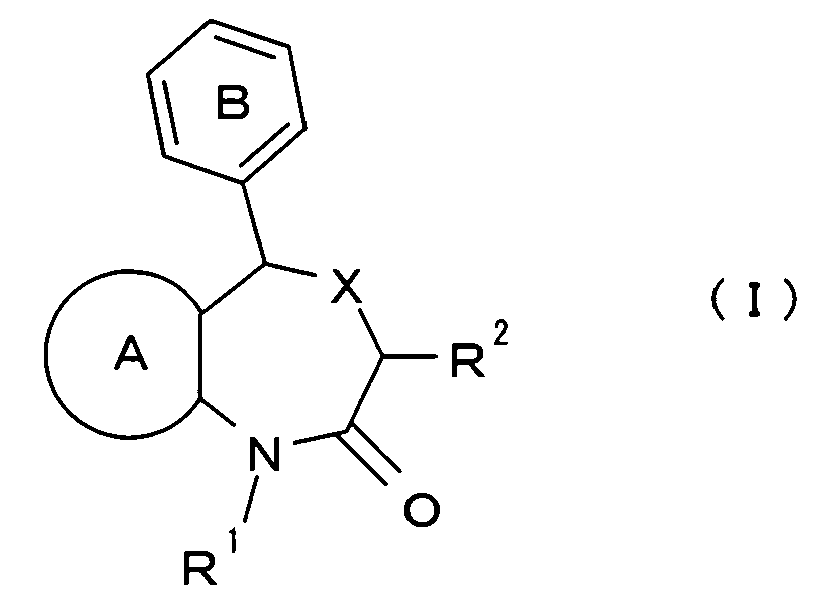
wherein a ring A represents an optionally substituted aromatic ring, a ring B represents an optionally substituted benzene ring, X represents O, S(O)n (n represents an integer of 0 to 2) or NR3 (R3 represents a hydrogen atom, an optionally substituted hydrocarbon group, or an optionally substituted heterocyclic group), and R1 and R2each represents a hydrogen atom, an optionally substituted hydrocarbon group, or an optionally substituted heterocyclic group, or a salt thereof, or a prodrug thereof. - The agent according to claim 1, which comprises a compound represented by the formula:

wherein L represents a linker, R4 and R5 each represents a hydrogen atom, an optionally substituted hydrocarbon group, an acyl group, an optionally substituted carbamoyl group, an esterified carboxyl group, or an optionally substituted hydrerocyclic group, R4 and R5 may be taken together to form a ring, or a R4 or R5 may be taken together with a linker represented by L to form a ring, a ring C represents an optionally further substituted benzene ring, and the other symbols are as defined in claim 1, or a salt thereof, or a prodrug thereof. - The agent according to claim 1, which comprises a compound represented by the formula:

wherein a ring D represents an optionally substituted benzene ring, L represents a linker, R4 and R5 each represents a hydrogen atom, an optionally substituted hydrocarbon group, an acyl group, an optionally substituted carbamoyl group, an esterified carboxyl group, or an optionally substituted heterocyclic group, R4 and R5 may be taken together to form a ring, or R4 or R5 may be taken together with a linker represented by L to form a ring, a ring C represents an optionally further substituted benzene ring, and the other symbols are as defined in claim 1, or a salt thereof, or a prodrug thereof. - The agent according to claim 1, which comprises a compound represented by the formula:
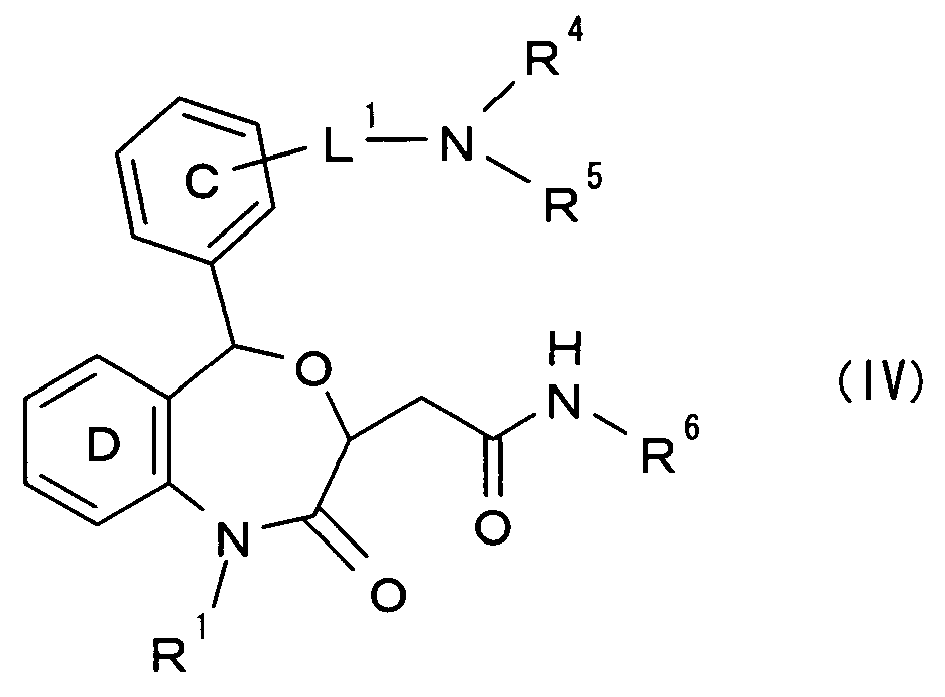
wherein a ring D represents an optionally substituted benzene ring, L1 represents a linker represented by optionally substituted -Y-(CH2)m- (Y represents a bond, -O-, -S(O)n1- (n1 represents an integer of 0 to 2) or -NR7- (R7 represents a hydrogen atom, an optionally substituted hydrocarbon group, or an optionally substituted heterocyclic group), and m represents an integer of 0 to 6), R4 and R5 each represents a hydrogen atom, an optionally substituted hydrocarbon group, an acyl group, an optionally substituted carbamoyl group, an esterified carboxyl group or an optionally substituted heterocyclic group, R4 and R5 may be taken together to form a ring, or R4 or R5 may be taken together with a linker represented by L1 to form a ring, a ring C represents an optionally further substituted benzene ring, R6 represents an optionally substituted hydrocarbon group, or an optionally substituted heterocyclic group, and the other symbols are as defined in claim 1, or a salt thereof, or a prodrug thereof. - The agent according to claim 1, which is an analgesic, an agent for promoting analgesic activity of another analgesic drug, or an agent for avoiding resistance due to another analgesic drug.
- The agent according to claim 1, which is an agent for modulating the prolactin secretion.
- The agent according to claim 1, which is an agent for preventing or treating hyperprolactinemia, pituitary gland tumor, diencephalons tumor, emmeniopathy, stress, autoimmune disease, prolactinoma, infertility, impotence, amenorrhea, galactic leakage, acromegaly, Chiari-Frommel syndrome, Argonz-del Castilo syndrome, Forbes-Albright syndrome, breast cancer lymphoma, Sheehan's syndrome or spermatogenesis abnormality.
- The agent according to claim 1, which is an agent for suppressing the pancreatic glucagon secretion, an agent for lowering a blood glucose or an agent for suppressing the urine production.
- The agent according to claim 1, which is an agent for preventing or treating diabetes, glucose tolerance disorder, ketosis, acidosis, diabetic neuropathy, diabetic nephropathy, diabetic retinopathy, pollakiuria, nocturnal enarusis, hyperlipemia, sexual function disorder, skin disease, arthritis, osteopenia, arteriosclerosis, thrombotic disease, maldigestion or memory and learning disabilities.
- The agent according to claim 1, which is an agent for suppressing the bladder constriction.
- The agent according to claim 1, which is an agent for preventing or treating urine incontinence, lower uropathy, urge micturition due to excessive active bladder, or hypotonic bladder accompanied with excessive active bladder.
- A compound represented by the formula:

wherein a ring D represents an optionally substituted benzene ring, G1 represents a bond, or an optionally substituted divalent hydrocarbon group, G2 represents -O-, -NR8- (R8 represents a hydrogen atom, an optionally substituted hydrocarbon group, or an optionally substituted heterocyclic group) or -S(O)n2- (n2 represents an integer of 0 to 2), G3 represents an optionally substituted divalent hydrocarbon group, R4 and R5 each represents a hydrogen atom, an optionally substituted hydrocarbon group, an acyl group, an optionally substituted carbamoly group, an esterified carboxyl group, or an optionally substituted heterocyclic group, a ring C represents an optionally further substituted benzene ring, R1 and R2 each represents a hydrogen atom, an optionally substituted hydrocarbon group, or an optionally substituted heterocyclic group, R4 may be taken together with G3 or R5 to form a ring and, when G2 is -NR8-, R4 and R8 may be taken together to form a ring, provided that 3,5-trans-N-(2-fluorobenzyl)-5-[3-(3-tert-butoxycarbonylaminopropyl)aminomethylphenyl]-7-chloro-1-neopentyl-2-oxo-1,2,3,5-tetrahydro-4,1-benzooxazepine-3-acetamide, 3,5-trans-N-(2-fluorobenzyl)-5-[3-(3-aminopropyl)aminomethylphenyl]-7-chloro-1-neopentyl-2-oxo-1,2,3,5-tetrahydro-4,1-benzooxazepine-3-acetamide, 3,5-trans-N-(2-fluorobenzyl)-5-(3-aminoacetylaminomethylphenyl)-1-benzyl-7-chloro-2-oxo-1,2,3,5-tetrahydro-4,1-benzooxazepine-3-acetamide, 3,5-trans-N-(2-fluorobenzyl)-1-(4-biphenylmethyl)-7-chloro-2-oxo-5-[3-[(piperidin-4-yl)carbonylaminomethyl]phenyl]-1,2,3,5-tetrahydro-4,1-benzooxazepine-3-acetamide, 3,5-trans-N-(2-fluorobenzyl)-5-[2-(3-aminopropyloxy)phenyl]-7-chloro-1-isobutyl-2-oxo-1,2,3,5-tetrahydro-4,1-benzooxazepine-3-acetamide, 3,5-trans-N-(2-fluorobenzyl)-5-[4-(3-aminopropyloxy)-2-methoxyphenyl]-7-chloro-1-neopentyl-2-oxo-1,2,3,5-tetrahydro-4,1-benzooxazepine-3-acetamide, 7-chloro-5-[2-[3-[[(1,1-dimethylethoxy)carbonyl]amino]propoxy]phenyl]-1,2,3,5-tetrahydro-1-(2-methylpropyl)-2-oxo-4,1-benzooxazepin-3-ylacetic acid ethyl ester, and 7-chloro-5-[4-[3-[[(1,1-dimethylethoxy)carbonyl]amino]propoxy)-2-methoxyphenyl]-1-(2,2-dimethylpropyl)]-1,2,3,5-tetrahydro-2-oxo-4,1-benzooxazepin-3-ylacetic acid ethyl ester are excluded, or a salt thereof. - The compound according to claim 12, which is represented by the formula:

wherein J represents an optionally substituted hydroxy group, or an optionally substituted amino group, and the other symbols are as defined in claim 12. - The compound according to claim 12, which is represented by the formula:

wherein R6 represents an optionally substituted hydrocarbon group, or an optionally substituted heterocyclic group, and the other symbols are ad defined in claim 12. - The compound according to claim 12, wherein G1 is a bond, or an optionally substituted C1-3 alkylene group.
- The compound according to claim 12, wherein G3 is an optionally substituted C2-6 alkylene group.
- The compound according to claim 12, wherein G1 is a bond, and G2 is -O-.
- The compound according to claim 12, wherein R1 is an optionally substituted hydrocarbon group.
- The compound according to claim 12, wherein R1 is an optionally substituted C1-8 alkyl group, or an optionally substituted C7-16 aralkyl group.
- The compound according to claim 12, wherein R4 is a hydrogen atom.
- The compound according to claim 12, wherein R5 is an optionally substituted C1-6 alkyl group, or an optionally substituted C7-16 aralkyl group.
- The compound according to claim 13, wherein J is a hydroxy group, an optionally substituted lower alkoxy group, an amino group optionally substituted with an optionally substituted alkyl group, or an optionally substituted cyclic amino group.
- The compound according to claim 13, wherein J is an optionally substituted 5- to 8- membered cyclic amino group.
- The compound according to claim 14, wherein R6 is an optionally substituted benzyl group, or an optionally substituted phenyl group.
- The compound according to claim 12, wherein G3 is an optionally substituted divalent hydrocarbon group other than a carbonyl group and, when R4is a hydrogen atom, R5 is not a hydrogen atom or a tert-butyloxycarbonyl group.
- A compound represented by the formula:

wherein a ring D represents an optionally substituted benzene ring, G3 represents an optionally substituted divalent hydrocarbon group, R4 and R5 each represents a hydrogen atom, an optionally substituted hydrocarbon group, an acyl group, an optionally substituted carbamoyl group, an esterified carboxyl group, or an optionally substituted heterocyclic group, a ring C represents an optionally further substituted benzene ring, R1 and R2 each represents an hydrogen atom, an optionally substituted hydrocarbon group, or an optionally substituted heterocyclic group, and R4 may be taken together with G3 or R5 to form a ring, or a salt thereof. - 2-(3,5-trans-7-Chloro-1-(2,2-dimethylpropyl)-5-{2-methoxy-3-[3-(3-phenylpropylamino)propoxy]phenyl}-2-oxo-1,2,3,5-tetrahydro-4,1-benzooxazepin-3-yl)-N-(2-fluorobenzyl)acetamide, 2-{3,5-trans-7-chloro-1-(2,2-dimethylpropyl)-5-[2-methoxy-3-(3-(pentylamino)propoxy)phenyl]-2-oxo-1,2,3,5-tetrahydro-4,1-benzooxazepin-3-yl}-N-(2-fluorobenzyl)acetamide, trans-2-{7-chloro-5-[3-(3-{[3-(2-chlorophenyl)propyl]amino}propoxy)-2-methoxyphenyl]-1-(2,2-dimethylpropyl)-2-oxo-1,2,3,5-tetrahydro-4,1-benzooxazepin-3-yl}-N-(2-fluorobenzyl)acetamide, trans-2-[7-chloro-1-(2,2-dimethylpropyl)-5-[2-methoxy-3-(3-{[(2E)-3-phenyl-2-propenyl]amino}propoxy)phenyl]-2-oxo-1,2,3,5-tetrahydro-4,1-benzooxazepin-3-yl]-N-(2-fluorobenzyl)acetamide, trans-2-[7-chloro-1-(2,2-dimethylpropyl)-5-(2-methoxy-3-{3-[(3-phenylpropyl)amino]propoxy}phenyl)-2-oxo-1,2,3,5-tetrahydro-4,1-benzooxazepin-3-yl]-N-propylacetamide, trans-7-chloro-1-(2,2-dimethylpropyl)-5-(2-methoxy-3-{3-[(3-phenylpropyl)amino]propoxy}phenyl)-3-[2-oxo-2-(1-piperazinyl)ethyl]-1,5-dihydro-4,1-benzooxazepine-2(3H)-one, trans-7-chloro-1-(2,2-dimethylpropyl)-3-[2-(4-hydroxypiperidin-1-yl)-2-oxoethyl]-5-(2-methoxy-3-{3-[(3-phenylpropyl)amino]propoxy}phenyl)-1,5-dihydro-4,1-benzooxazepine-2(3H)-one or 4-{[3,5-trans-7-chloro-1-(2,2-dimethylpropyl)-5-(2-methoxy-3-{3-[(3-phenylpropyl)amino]propoxy}phenyl)-2-oxo-1,2,3,5-tetrahydro-4,1-benzooxazepin-3-yl]acetyl}piperazine-2-carboxylic acid, or a salt thereof.
- A prodrug of the compound according to claim 12 or 26.
- A drug comprising the compound according to claim 12 or 26 or a prodrug thereof.
- The drug according to claim 29, which is an agent for preventing or treating RFRP-associated with morbid state or a disease involved in RFRP.
- A method of modulating the function of an RFRP receptor, which comprises administering an effective amount of a compound represented by the formula:

wherein a ring A represents an optionally substituted aromatic ring, a ring B represents an optionally substituted benzene ring, X represents O, S(O)n (n represents an integer of 0 to 2) or NR3 (R3 represents a hydrogen atom, an optionally substituted hydrocarbon group, or an optionally substituted heterocyclic group), and R1 and R2each represents a hydrogen atom, an optionally substituted hydrocarbon group, or an optionally substituted heterocyclic ring, or a salt thereof, or a prodrug thereof to a mammal. - Use of a compound represented by the formula:

wherein a ring A represents an optionally substituted aromatic ring, a ring B represents an optionally substituted benzene ring, X represents O, S(O)n (n represents an integer of 0 to 2) or NR3 (R3 represents a hydrogen atom, an optionally substituted hydrocarbon group, or an optionally substituted heterocyclic group), and R1 and R2 each represents a hydrogen atom, an optionally substituted hydrocarbon group, or an optionally substituted heterocyclic group, or a salt thereof, or a prodrug thereof for preparing an agent for modulating the function of an RFRP receptor.
Applications Claiming Priority (2)
| Application Number | Priority Date | Filing Date | Title |
|---|---|---|---|
| JP2003114313 | 2003-04-18 | ||
| PCT/JP2004/005406 WO2004091628A1 (en) | 2003-04-18 | 2004-04-15 | Receptor antagonist |
Publications (1)
| Publication Number | Publication Date |
|---|---|
| EP1623710A1 true EP1623710A1 (en) | 2006-02-08 |
Family
ID=33296146
Family Applications (1)
| Application Number | Title | Priority Date | Filing Date |
|---|---|---|---|
| EP04727766A Withdrawn EP1623710A1 (en) | 2003-04-18 | 2004-04-15 | Receptor antagonist |
Country Status (3)
| Country | Link |
|---|---|
| US (2) | US20070129348A1 (en) |
| EP (1) | EP1623710A1 (en) |
| WO (1) | WO2004091628A1 (en) |
Families Citing this family (2)
| Publication number | Priority date | Publication date | Assignee | Title |
|---|---|---|---|---|
| CA2685860A1 (en) | 2007-05-10 | 2008-11-20 | Amr Technology, Inc. | Aryl- and heteroaryl-substituted tetrahydrobenzo-1,4-diazepines and use thereof to block reuptake of norepinephrine, dopamine, and serotonin |
| CA3254867A1 (en) * | 2022-03-30 | 2023-10-05 | University Of Florida Research Foundation, Incorported | Compounds for treating psychostimulant misuse |
Family Cites Families (11)
| Publication number | Priority date | Publication date | Assignee | Title |
|---|---|---|---|---|
| CN1072649C (en) * | 1995-09-13 | 2001-10-10 | 武田药品工业株式会社 | Benzoxazepine compounds, their production method and use |
| DE69832376T2 (en) * | 1997-04-21 | 2006-08-03 | Takeda Pharmaceutical Co. Ltd. | 4,1-BENZOXAZEPINE, THEIR ANALOG, AND THEIR USE AS SOMATOSTATIN AGONISTS |
| US7192723B2 (en) * | 1998-11-13 | 2007-03-20 | Takeda Pharmaceutical Company Limited | G protein-coupled receptor protein, its DNA and ligand thereof |
| AU2882801A (en) * | 2000-01-28 | 2001-08-07 | Kaken Pharmaceutical Co., Ltd. | Azepine derivatives |
| JP2002080468A (en) * | 2000-06-23 | 2002-03-19 | Takeda Chem Ind Ltd | Benzooxazepine compound |
| HUP0301301A2 (en) * | 2000-06-23 | 2003-08-28 | Takeda Chemical Industries Ltd. | Benzoxazepinones and their use as squalene synthase inhibitors and pharmaceutical compositions containing them |
| ATE443736T1 (en) * | 2001-06-20 | 2009-10-15 | Asahi Chemical Ind | THERMOPLASTIC RESIN COMPOSITION |
| JP2003081873A (en) * | 2001-06-28 | 2003-03-19 | Takeda Chem Ind Ltd | Prophylactic or therapeutic agent for organ functional disorder and organ insufficiency |
| EP1407782A4 (en) * | 2001-06-28 | 2004-10-20 | Takeda Chemical Industries Ltd | DRUGS FOR THE PREVENTION / TREATMENT OF FUNCTIONAL ORGAN DISORDERS AND ORGAN DYSFUNCTION |
| EP1426440B1 (en) * | 2001-08-24 | 2010-06-16 | Takeda Pharmaceutical Company Limited | Novel rfrp-3 and dna thereof |
| EP1424392B1 (en) * | 2001-09-03 | 2012-10-24 | Takeda Pharmaceutical Company Limited | RF-peptide ligands of G-protein coupled receptor |
-
2004
- 2004-04-15 WO PCT/JP2004/005406 patent/WO2004091628A1/en not_active Ceased
- 2004-04-15 EP EP04727766A patent/EP1623710A1/en not_active Withdrawn
- 2004-04-15 US US10/553,273 patent/US20070129348A1/en not_active Abandoned
-
2009
- 2009-02-24 US US12/391,520 patent/US20090239839A1/en not_active Abandoned
Non-Patent Citations (1)
| Title |
|---|
| See references of WO2004091628A1 * |
Also Published As
| Publication number | Publication date |
|---|---|
| US20090239839A1 (en) | 2009-09-24 |
| US20070129348A1 (en) | 2007-06-07 |
| WO2004091628A1 (en) | 2004-10-28 |
Similar Documents
| Publication | Publication Date | Title |
|---|---|---|
| US7625887B2 (en) | Receptor agonists | |
| US20080132483A1 (en) | Agent for preventing or treating organ functional disorders and organ dysfunction | |
| TW202444405A (en) | Modulators of g-protein coupled receptors | |
| JP2006056881A (en) | Fused ring compound | |
| JP2001515045A (en) | Treatment of congestive heart failure with growth hormone secretagogues | |
| JP2006063064A (en) | Receptor agonist | |
| KR20250157491A (en) | Salts and solid forms of compounds having GLP-1 agonist activity | |
| EP1604983A1 (en) | Receptor antagonist | |
| US7795267B2 (en) | Bicyclic piperazine compound having TGR23 antagonistic activity | |
| US20090239839A1 (en) | Receptor antagonist | |
| WO2001025199A1 (en) | Urea compounds, process for producing the same and use thereof | |
| US20130281435A1 (en) | Therapeutic agent for irritable bowel syndrome | |
| US20090209510A1 (en) | Novel Method of Treating Hyperlipidemia | |
| JP2002540197A (en) | Antibacterial agent | |
| JP2004346059A (en) | Receptor agonist | |
| US20070117840A1 (en) | Receptor antagonist | |
| JP2004331659A (en) | Receptor antagonist | |
| EP1460062A1 (en) | Nitrogenous cyclic ketone derivative, process for producing the same, and use | |
| JP2004300145A (en) | Receptor antagonist | |
| JP2003081873A (en) | Prophylactic or therapeutic agent for organ functional disorder and organ insufficiency | |
| JP2005306839A (en) | Bicyclic piperazine compound and its use | |
| JP2014159375A (en) | Azepane compound | |
| JP2004285038A (en) | Piperidine derivative, its production method and application | |
| JP2004168772A (en) | Receptor modulator | |
| JP2004315500A (en) | Skeletal muscle protective agent |
Legal Events
| Date | Code | Title | Description |
|---|---|---|---|
| PUAI | Public reference made under article 153(3) epc to a published international application that has entered the european phase |
Free format text: ORIGINAL CODE: 0009012 |
|
| 17P | Request for examination filed |
Effective date: 20051012 |
|
| AK | Designated contracting states |
Kind code of ref document: A1 Designated state(s): AT BE BG CH CY CZ DE DK EE ES FI FR GB GR HU IE IT LI LU MC NL PL PT RO SE SI SK TR |
|
| DAX | Request for extension of the european patent (deleted) | ||
| STAA | Information on the status of an ep patent application or granted ep patent |
Free format text: STATUS: THE APPLICATION HAS BEEN WITHDRAWN |
|
| 18W | Application withdrawn |
Effective date: 20080710 |