EP1622393A1 - Color interpolation using data dependent triangulation - Google Patents
Color interpolation using data dependent triangulation Download PDFInfo
- Publication number
- EP1622393A1 EP1622393A1 EP04425587A EP04425587A EP1622393A1 EP 1622393 A1 EP1622393 A1 EP 1622393A1 EP 04425587 A EP04425587 A EP 04425587A EP 04425587 A EP04425587 A EP 04425587A EP 1622393 A1 EP1622393 A1 EP 1622393A1
- Authority
- EP
- European Patent Office
- Prior art keywords
- pixels
- image
- green
- pixel
- value
- Prior art date
- Legal status (The legal status is an assumption and is not a legal conclusion. Google has not performed a legal analysis and makes no representation as to the accuracy of the status listed.)
- Granted
Links
Images






Classifications
-
- G—PHYSICS
- G06—COMPUTING OR CALCULATING; COUNTING
- G06T—IMAGE DATA PROCESSING OR GENERATION, IN GENERAL
- G06T3/00—Geometric image transformations in the plane of the image
- G06T3/40—Scaling of whole images or parts thereof, e.g. expanding or contracting
- G06T3/4015—Image demosaicing, e.g. colour filter arrays [CFA] or Bayer patterns
-
- H—ELECTRICITY
- H04—ELECTRIC COMMUNICATION TECHNIQUE
- H04N—PICTORIAL COMMUNICATION, e.g. TELEVISION
- H04N23/00—Cameras or camera modules comprising electronic image sensors; Control thereof
- H04N23/80—Camera processing pipelines; Components thereof
- H04N23/84—Camera processing pipelines; Components thereof for processing colour signals
- H04N23/843—Demosaicing, e.g. interpolating colour pixel values
-
- H—ELECTRICITY
- H04—ELECTRIC COMMUNICATION TECHNIQUE
- H04N—PICTORIAL COMMUNICATION, e.g. TELEVISION
- H04N25/00—Circuitry of solid-state image sensors [SSIS]; Control thereof
- H04N25/10—Circuitry of solid-state image sensors [SSIS]; Control thereof for transforming different wavelengths into image signals
- H04N25/11—Arrangement of colour filter arrays [CFA]; Filter mosaics
- H04N25/13—Arrangement of colour filter arrays [CFA]; Filter mosaics characterised by the spectral characteristics of the filter elements
- H04N25/134—Arrangement of colour filter arrays [CFA]; Filter mosaics characterised by the spectral characteristics of the filter elements based on three different wavelength filter elements
-
- H—ELECTRICITY
- H04—ELECTRIC COMMUNICATION TECHNIQUE
- H04N—PICTORIAL COMMUNICATION, e.g. TELEVISION
- H04N2209/00—Details of colour television systems
- H04N2209/04—Picture signal generators
- H04N2209/041—Picture signal generators using solid-state devices
- H04N2209/042—Picture signal generators using solid-state devices having a single pick-up sensor
- H04N2209/045—Picture signal generators using solid-state devices having a single pick-up sensor using mosaic colour filter
- H04N2209/046—Colour interpolation to calculate the missing colour values
Definitions
- the present invention relates in general to processing techniques of image data acquired by a color digital sensor and more in particular to a method of interpolating the color information for each image pixel starting from the pixel values produced by the single photosensible elements of the array of the sensors filtered according to a certain spatial scheme or pattern for detecting one of the primary colors or of basic hue.
- Modern digital cameras use an electronic sensor for acquiring the special variations of light intensity.
- CCD Charge Coupled Device
- CMOS Complementary Metal Oxide Semiconductor
- a CCD is constituted by an array of photosensitive diodes that converts photons in electrons (electric charge).
- Each diode, called photoside produces an electric charge proportional to the quantity of light reaching it.
- the single sensors of a digital camera are normally arranged as a bidimensional array of millions of cells (photosides) which convert an infinitesimal portion of the image in electric charge.
- the stored generated charged is then transformed in a pixel of digital image by an analog-to-digital converter.
- a monochromatic sensor is made sensitive to a single color component by a color filter.
- a filter may act on primary colors or on complementary colors.
- the primary color filters are commonly arranged according to a scheme known in the art by the name of Bayer pattern in which half of the pixels are made sensitive to the green color, a fourth of the pixels to the red color and the last fourth to the blue color. As depicted in Figure 1, green and blue pixels alternate along a row while green and red pixels alternate on the successive row and this scheme repeats itself for the whole image.
- the main reason that has led to acquire a number of green pixels double compared to the number of acquired red and blue pixels is the greater sensibility of human sight toward the green chromatic component.
- each pixel of a CCD sensor carries information on a single primary color.
- color interpolation or demosaicing
- RGB values for each pixel of the image to be produced at an output. Therefore, for example for estimating the red component of a pixel for which only the green component has been acquired by the filtered light sensitive cell, it is necessary to take into consideration the adjacent pixels carrying information on the red component.
- triangulation is another well known technique of linear interpolation that has been proposed for performing zooming on a digital image.
- the approach is to partition an image in triangles, the vertexes of which are the known pixels, according to certain criteria.
- the color rendering or reconstruction phase follows during which each pixel value of the image to the produced is calculated through a linear interpolation of the vertexes of the pertinent triangle.
- the criteria for choosing one among all the possible triangulations is to minimize a certain cost function C( T ) of the entire triangulation T.
- the values of the pixels will be interpolated by the unique 3D linear polynomial passing for the three vertexes of the triangles.
- the Voronoi diagram for V is the partition Vor( V ) of the plane into the Voronoi polygons associated to V .
- the Voronoi polygon associated to v i is the locus of points in the plane that are closer to v i than to any other member of V.
- the Delaunay triangulation can be defined as follow:
- Dyn-Levin-Rippa [9] demonstrated that triangulations involving long, narrow triangles give better results in linear interpolation.
- Lawson's algorithm [10] converges to the globally optimal solution if the cost function is based on the Delaunay criterion.
- Schumaker's simulated annealing method [11] gives good results, but is relatively slow.
- the "edge swap with look-ahead” method [8], is relatively faster than other algorithms.
- the Yu-Morse-Sederberg's "edge swap with look-ahead” method consists of the following steps:
- the process is repeated n times, using the results of the previous iteration step.
- Dyn-Levin-Rippa [5] identify four cost functions called NC1 (Nearly C 1 ), as particularly efficient.
- cost ( e ) ⁇ ⁇ P 1 ⁇ * ⁇ ⁇ P 2 ⁇ - ⁇ P 1 * ⁇ P 2
- ⁇ ⁇ P i ⁇ sqrt ( a i 2 + b i 2 )
- Su-Wills algorithm [6] is based on the Delaunay Triangulation.
- triangles are relatively simple.
- R and B channels or patterns
- they are constructed as in the case of a zooming by 2.
- G patterns they are constructed with a rotation by 45 degrees.
- the triangles do not require any appreciable burden for their definition.
- the cost function for the G pattern or channel will be the same, considering a rotation of the triangles by 45 degrees.
- the interpolated points of the triangles are easily calculated as the average of the relative vertexes.
- the interpolation process may be followed by an anti-aliasing processing that effectively removes color artifacts that may be created during the interpolation process.
- this step is based on the use of only two difference arrays, namely green-blue and green-red, respectively, and the consequent calculation of only two median arrays therefrom.
- This invention may be easily implemented with a software computer program.
- FIG. 9 shows the flow scheme of the whole data dependant triangulation color interpolation according to the method of this invention, including also the optional anti-aliasing processing step following the interpolation step.
- Figure 10 illustrates in detail the operations performed in the step Data Dependent Triangulation shown in Figure 9, while Figure 11 illustrates by way of an example an embodiment of the method of the invention.
- the R, G and B pixels in the respective three channels are the vertexes of the triangles to be constructed.
- this function is much simpler to calculate than the Yu-Morse-Sederberg cost function because it requires the calculation of absolute values, additions and multiplications. Using this cost function in the method of color interpolation disclosed in [8], the same quality of images is obtained reducing at the same time the computational cost of the interpolation algorithm.
- the novel method of DDT color interpolation of this invention uses the "edge swap with look-ahead” technique of triangulation.
- the method of the invention contemplates the following operations:
- the method of this invention is applied on all three images in primary colors and blocks of 4x4 pixels are considered.
- this method may be applied also to two images in primary colors and/or considering blocks of 2x2 pixels.
- the central square will have only one, two or three adjacent triangles that form a quadrilateral with a triangle that compose it, will be much more probable than the worst case of Figure 15a.
- the central square will have only two adjacent triangles that form a quadrilateral with a triangle that compose it, while in the algorithm of Yu, Morse and Sederberg all four adjacent triangles must be considered.
- the cost function to be used in steps b) and c) is given by eq. (8).
- the channels R and B are shifted compared to the G channel and then to the original image. For this reason a smart cropping of the borders is necessary to avoid mixing of colors.
- Figure 16 shows how the merging is done: only the central pixels are considered, while the peripheral ones are removed.
- the color artifact removal after the color interpolation is performed through the step of:
- Figure 18 summarizes this innovative aspect of this invention and highlights the difference between the just described algorithm and the Freeman's algorithm.
- the output of the proposed algorithm is 5/6 equal to the output of Freeman's algorithm.
Landscapes
- Engineering & Computer Science (AREA)
- Multimedia (AREA)
- Signal Processing (AREA)
- Physics & Mathematics (AREA)
- Spectroscopy & Molecular Physics (AREA)
- General Physics & Mathematics (AREA)
- Theoretical Computer Science (AREA)
- Image Processing (AREA)
- Color Image Communication Systems (AREA)
- Color Television Image Signal Generators (AREA)
Abstract

Description
- The present invention relates in general to processing techniques of image data acquired by a color digital sensor and more in particular to a method of interpolating the color information for each image pixel starting from the pixel values produced by the single photosensible elements of the array of the sensors filtered according to a certain spatial scheme or pattern for detecting one of the primary colors or of basic hue.
- Modern digital cameras use an electronic sensor for acquiring the special variations of light intensity.
- The two main fabrication technologies of sensors are the so called CCD (Charge Coupled Device) and the CMOS (Complementary Metal Oxide Semiconductor).
- For example, a CCD is constituted by an array of photosensitive diodes that converts photons in electrons (electric charge).
- Each diode, called photoside produces an electric charge proportional to the quantity of light reaching it.
- The single sensors of a digital camera are normally arranged as a bidimensional array of millions of cells (photosides) which convert an infinitesimal portion of the image in electric charge. The stored generated charged is then transformed in a pixel of digital image by an analog-to-digital converter.
- A monochromatic sensor is made sensitive to a single color component by a color filter. A filter may act on primary colors or on complementary colors. The primary color filters are commonly arranged according to a scheme known in the art by the name of Bayer pattern in which half of the pixels are made sensitive to the green color, a fourth of the pixels to the red color and the last fourth to the blue color. As depicted in Figure 1, green and blue pixels alternate along a row while green and red pixels alternate on the successive row and this scheme repeats itself for the whole image.
- The main reason that has led to acquire a number of green pixels double compared to the number of acquired red and blue pixels is the greater sensibility of human sight toward the green chromatic component.
- Therefore, the value of each pixel of a CCD sensor carries information on a single primary color. In order to reconstruct a good quality color image it is therefore necessary to carry out an operation known as color interpolation (or demosaicing) for generating a triplet of values RGB for each pixel of the image to be produced at an output. Therefore, for example for estimating the red component of a pixel for which only the green component has been acquired by the filtered light sensitive cell, it is necessary to take into consideration the adjacent pixels carrying information on the red component.
- The classical bicubic and bilinear color interpolation are really simple and efficient algorithm, but they introduce large errors in the contour zones of the images. To solve this problem several authors have proposed optimization algorithms which are sensitive to the input data. For example Adams introduced an edge oriented method, Kimmel, Adams and Pei-Tam suggested other color correlation methods.
- On another account, triangulation is another well known technique of linear interpolation that has been proposed for performing zooming on a digital image.
- A brief review of triangulation-based linear interpolation approaches is presented herein below.
- Basically, the approach is to partition an image in triangles, the vertexes of which are the known pixels, according to certain criteria. The color rendering or reconstruction phase follows during which each pixel value of the image to the produced is calculated through a linear interpolation of the vertexes of the pertinent triangle.
- Given a set of distinct points V = {(x i , y i )}, what is of interest is a convex hull triangulation of V, that is a set T = {T i }i=1..q of non degenerate triangles that satisfies the following conditions:
- every triangle vertex is an element of V, and every element of V is a triangle vertex;
- every edge of a triangle in T contains exactly two points from V;
- the intersection of any two different triangles in T is either empty, or is a shared edge or a shared vertex;
- the union of all triangles in T is the convex hull of V.
- The criteria for choosing one among all the possible triangulations is to minimize a certain cost function C(T) of the entire triangulation T.
- Dyn-Levin-Rippa [5] suggested, among others, the following overall function cost:

- Once a possible triangulation is chosen, the values of the pixels will be interpolated by the unique 3D linear polynomial passing for the three vertexes of the triangles.
- The 3D liner polynomial will be:

- According to the Delaunay triangulation each triangle is such that the circle passing for his three vertexes does not contains any other vertex of V, where V = {vi} set of distinct vertextes.
- The construction of a Delaunay triangulation is defined through its Voronoi diagram.
- The Voronoi diagram for V is the partition Vor(V) of the plane into the Voronoi polygons associated to V. The Voronoi polygon associated to vi is the locus of points in the plane that are closer to vi than to any other member of V.
- The Delaunay triangulation can be defined as follow:
- partitioning of the set V in two subsets V 1 and V 2 of the same dimension;
- recursively constructing Vor(V 1) and Vor(V 2);
- merging of Vor(V 1) and Vor(V 2) to obtain Vor(V).
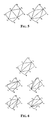
- The following Figures 2 and 3 show the duality of the two problems.
- If the vertexes of V are equally spaced (as it would be in the case of color interpolation), the resulting triangles will be equilateral triangles.
- Dyn-Levin-Rippa [9] demonstrated that triangulations involving long, narrow triangles give better results in linear interpolation.
- Several optimization algorithms for performing what may be defined as Data Dependent Triangulation have been developed. For example, Lawson's algorithm [10] converges to the globally optimal solution if the cost function is based on the Delaunay criterion. Schumaker's simulated annealing method [11], gives good results, but is relatively slow. The "edge swap with look-ahead" method [8], is relatively faster than other algorithms.
- The Yu-Morse-Sederberg's "edge swap with look-ahead" method consists of the following steps:
- a) the phase of triangle construction (step 0) is basically a Delaunay Triangulation, conducted in a very simple way: all the vertexes are joined to form quadrilaterals (for vertexes equally spaced they would be squares) and the diagonal (edge) having the lower cost according to the particular cost function chosen in the quadrilateral will determine the initial triangulation, as depicted in Figure 4. Figure 5 shows a single diagonal swapping inside a considered quadrilateral;
- b) an iterative phase (
step 1 ... n) during which each quadrilateral and its four adjacent triangles are considered, trying all the possible single swapping of the diagonals to minimize the local cost (that is the cost of all the 13 edges involved). The routine ends when all quadrilaterals have been processed. Figure 6 shows, at bottom, all the possible 4 triangulations originated from a starting triangulation (depicted at the top of the figure) by a single edge swap. - The process is repeated n times, using the results of the previous iteration step.
- A number of cost functions for characterize a satisfactory triangulation interpolation have been proposed.
- In particular, Dyn-Levin-Rippa [5] identify four cost functions called NC1 (Nearly C1), as particularly efficient.
- The cost for an edge e = [(x1,y1), (x2,y2)] in common with two triangles T 1 and T 2 , the interpolating planes of which are respectively P 1 (x,y) = a1x + b1y + c1 and P 2 (x,y) = a2x + b2y + c2, may be calculated according to a selected cost function:
- a) ABN (Angle Between Normals) cost function disclosed in Choi, et al. [12]

where α is the angle between the normals to the interpolating planes P 1 and P 2 . - b) JND (Jump in Normal Derivatives) cost function

where (nx, ny) is a unit vector orthogonal to the projection of the edge e. - c) DLP (Deviation from Linear Polynomials) cost function

where
- d) DP (Distance from Planes) cost function

where

- Another cost function has been proposed by Yu-Morse-Sederberg [8]:

where


- A first approach to use pixel level data dependent triangulation [5] even for color interpolation, was proposed by Su-Wills [6], following a previous work [7]. This method of color interpolation matches the edge orientation of the images and correlates the three distinct pixel channels (RGB).
- Su-Wills algorithm [6] is based on the Delaunay Triangulation.
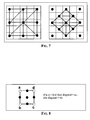
- As depicted in Figure 7, the construction of triangles is relatively simple. For R and B channels (or patterns), they are constructed as in the case of a zooming by 2. Differently, for the G patterns, they are constructed with a rotation by 45 degrees. In practice, due to the utter simplicity of triangulation, the triangles do not require any appreciable burden for their definition.
- To determine which diagonal should be chosen, a simple cost function is used as indicated in Figure 8.
- As usual, the cost function for the G pattern or channel will be the same, considering a rotation of the triangles by 45 degrees.
- The interpolated points of the triangles (the black dots in Figure 8) are easily calculated as the average of the relative vertexes.
- Practically, this known technique does not contemplate any iteration and though relatively simple to implement, does not produce a satisfactory color rendering in the interpolated images.
- On the other hand, the use of more sophisticated triangulation algorithms as recalled above and of a cost function chosen among the above-mentioned four NC1 cost functions and the Yu-Morse-Sederberg [8] cost function for color interpolation would be excessively costly in terms of computation complexity and in some cases excessively slow.
- It is generally perceived from these published works that it is not possible to have good interpolated images with a simple cost function and a fast triangulation algorithm and that it is necessary to employ a sophisticated triangulation algorithm and a relatively complex cost function for obtaining satisfactory performances.
- Contrary to these generally accepted conclusions, the present applicants have found sensibly simpler cost function and faster triangulation algorithms than those disclosed in Yu-Morse-Sederberg [8] that nevertheless produce interpolated images of comparably good quality. Surprisingly, they found that the quality of color interpolated images is not apparently worsened, in respect to images obtained with the method disclosed in [8], if a computationally simpler cost function is used, not requiring the calculation of powers and square roots.
- Moreover, they found an efficient triangulation algorithm that may be executed in far less time than the triangulation algorithm disclosed in [8], while practically ensuring the same performances. The peculiarity of this triangulation algorithm consists in that on average it requires only two iteration steps, while the triangulation algorithm disclosed in [8] is completed only after four iteration steps.
- Optionally, the interpolation process may be followed by an anti-aliasing processing that effectively removes color artifacts that may be created during the interpolation process.
- According to an innovative aspect of this invention in case of a Bayer pattern, this step is based on the use of only two difference arrays, namely green-blue and green-red, respectively, and the consequent calculation of only two median arrays therefrom.
- This invention may be easily implemented with a software computer program.
- The invention is defined in the annexed claims.
- The different aspects and advantages of this invention will be even more evident through a detailed description referring to the attached drawings, wherein:
- Figure 1 shows a Bayer Pattern Array;
- Figure 2 depicts a sample Voronoi diagram;
- Figure 3 illustrates how to obtain a Delaunay triangulation related to the Voronoi diagram;
- Figure 4 illustrates a possible construction phase (step 0) for vertexes equally spaced;
- Figure 5 shows a single diagonal swapping inside the considered quadrilateral;
- Figure 6 shows all the possible 4 triangulation (bottom) originated from a starting triangulation (up) by doing a single edge swap;
- Figure 7 illustrates the triangles "construction" in Su-Wills algorithm: Left: R or B case; Right: G case;
- Figure 8 basically illustrates the Su-Wills algorithm;
- Figure 9 depicts a color interpolation scheme of this invention;
- Figure 10 illustrates the process steps performed in the block Data Dependent Triangulation of Figure 9;
- Figure 11 illustrates with an example the steps of an embodiment of this invention;
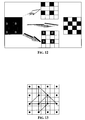
- Figure 12 shows the Bayer Data splitting;
- Figure 13 shows a central square composed of two triangles and its four adjacent triangles obtained according to this invention;
- Figures 14a and 14b illustrate possible edge swappings from the triangulation in Figure 13;
- Figures 15a and 15b illustrate two cases that may occur while performing a DDT;
- Figure 16 illustrates how to merge the three channels of an interpolated image;
- Figure 17 shows the Freeman's algorithm;
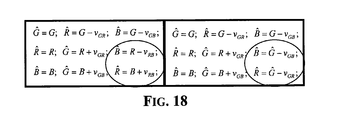
- Figure 18 summarizes the differences between the Freeman's algorithm (left) and the algorithm of this invention (right).
- The color interpolation method of this invention will be described by way of an example why considering the interpolation of a Bayer pattern image data as acquired by a digital color sensor. Naturally, the method is equally applicable to any other different scheme of acquisition using different filters, for example for discriminating among complementary colors instead of primary colors. Figure 9 shows the flow scheme of the whole data dependant triangulation color interpolation according to the method of this invention, including also the optional anti-aliasing processing step following the interpolation step. Figure 10 illustrates in detail the operations performed in the step Data Dependent Triangulation shown in Figure 9, while Figure 11 illustrates by way of an example an embodiment of the method of the invention.
- By referring to the flow scheme of Figure 9, starting from the Bayer Pattern Data, three channels arrays are constructed, as shown in Figure 12.
- The R, G and B pixels in the respective three channels are the vertexes of the triangles to be constructed.
- The cost function that has been found to be outstandingly efficient in terms of quality vs. computational complexity is the following

where

- It may be immediately noticed that this function is much simpler to calculate than the Yu-Morse-Sederberg cost function because it requires the calculation of absolute values, additions and multiplications. Using this cost function in the method of color interpolation disclosed in [8], the same quality of images is obtained reducing at the same time the computational cost of the interpolation algorithm.
- Another method in which this cost function may be conveniently used is disclosed hereinafter.
- According to another aspect of the invention, it has been found a color interpolation method that uses a simple data dependent triangulation.
- Differently from the known method of color interpolation by DDT of Su-Wills [6], the novel method of DDT color interpolation of this invention uses the "edge swap with look-ahead" technique of triangulation.
- The method of the invention contemplates the following operations:
- a) splitting the image in primary colors or complementary colors;
- b) subdividing in blocks of 4x4 pixels or also 2x2 pixels at least an image in primary colors, generating a Delaunay data triangulation using a cost function;
- c) each square at the center of the block and its four adjacent triangles are considered, testing whether the at most two possible single edge swappings from the triangulation shown in Figure 13 of the diagonals, as depicted in Figures 14a and 14b, minimize the cost function, and eventually performing these swappings in order to minimize the local cost.
- According to a preferred embodiment, the method of this invention is applied on all three images in primary colors and blocks of 4x4 pixels are considered. Of course, this method may be applied also to two images in primary colors and/or considering blocks of 2x2 pixels.
- The process ends when all squares have been processed, and this is done at most in two iteration steps. This is evident in Figure 13, but let us consider the critical case of Figure 15a, which is possible even if quite rare.
- There are four triangles adjacent to the central square that form a quadrilateral with a triangle composing the central square. Only in this case, all the four adjacent triangles must be considered but at most two swappings are possible. In fact, for each of such adjacent triangles there is another adjacent triangle that form a quadrilateral with the same triangle of the central square.
- Therefore, if a diagonal of one of such quadrilaterals is swapped, the diagonal of the other quadrilateral involving the same triangle of the central square cannot be swapped anymore. If this were possible, there would be diagonals crossing each other, which is forbidden in any triangulation technique because each unknown pixel value must be calculated in function of only two known pixels values.
- Only in the case of a triangulation as in Figure 15a, that rarely occurs, the method of this invention would not produce substantial advantages of reduced computational complexity in respect to the method disclosed in [8].
- In case of a triangulation as in Figure 15b, which is also rare in practice, there is not possible any edge swapping. Therefore, the method of this invention does not contemplate any iteration and is even faster than the prior art method [8].
- The cases in which the central square will have only one, two or three adjacent triangles that form a quadrilateral with a triangle that compose it, will be much more probable than the worst case of Figure 15a. In average, according to the method of this invention, the central square will have only two adjacent triangles that form a quadrilateral with a triangle that compose it, while in the algorithm of Yu, Morse and Sederberg all four adjacent triangles must be considered.
- According to a preferred embodiment of this method, the cost function to be used in steps b) and c) is given by eq. (8).
- Simulations prove that more than one iteration step does not produce any visual perceptive improvement on the color interpolated image. Therefore, according to a preferred embodiment of this invention, only one iteration step is performed.
- The channels R and B are shifted compared to the G channel and then to the original image. For this reason a smart cropping of the borders is necessary to avoid mixing of colors.
- Figure 16 shows how the merging is done: only the central pixels are considered, while the peripheral ones are removed.
- In this implementation four rows and four columns are removed, so the interpolated image will be smaller than that of the original (input) Bayer Pattern.
- To remove color artifacts, due to the color interpolation step, an anti-aliasing algorithm is necessary. A classical and effective algorithm is the Freeman's algorithm [13], which is summarized in the Figure 17:
- In particular for the RGB channels of a Bayer pattern input image, the Freeman's algorithm uses the following formulas:
- for green (G) pixels in the original Bayer Pattern:

- for red (R) pixels in the original Bayer Pattern:

- for blue (B) pixels in the original Bayer Pattern:

- Freeman's approach works pretty well to remove color artifacts, but it is slow due to the median filter elaboration of the three difference arrays.
- According to an effective novel approach of the applicants, only the two difference arrays (G - B) and (G - R) are used, calculating only the two median arrays νGB and νGR. The difference array (R - B) and the related median array ν RB is not calculated, thus elaboration time is drastically reduced.
- In detail, the color artifact removal after the color interpolation is performed through the step of:
- for each pixel to be filtered, selecting a block of pixels from each component color image with a selection window of pre-established dimensions centered on the pixel to be filtered;
- calculating a first median difference between the values of the selected green pixels and the selected red pixels νGR and a second median difference between the values of the selected green pixels and the selected blue pixels νGB;
- if the pixel to be filtered corresponds to:
- a green pixel in the detected image, keeping its original green component and choosing as value of a new red component thereof R̂ the difference between the green value and the first median difference νGR and as value of a new blue component thereof B̂ the difference between the green value and the second median difference νGB,
- a red pixel in the detected image, keeping its original red component and choosing as value of a new green component thereof Ĝ the sum between the red value and the first median difference νGR and as value of a new blue component thereof B̂ the difference between the new green component Ĝ and the second median difference ν GB,
- a blue pixel in the detected image, keeping its original blue component and choosing as value of a new green component thereof Ĝ the sum between the blue value and the second median difference ν GB and as value of a new red component thereof R̂ the difference between the new green component Ĝ and the first median difference ν GR.
- Figure 18 summarizes this innovative aspect of this invention and highlights the difference between the just described algorithm and the Freeman's algorithm. Considering that the G patterns are double than R or B patterns, the output of the proposed algorithm is 5/6 equal to the output of Freeman's algorithm. In fact, if the repetitive pattern

- Simulations revealed that the quality of the final image in the proposed novel algorithm is practically the same as that obtained with the Freeman's algorithm.
-
- [1] J.E. Adams, Jr. "Interactions between Color Plane Interpolation and Other Image Processing Functions in Electronic Photography" Proc. of SPIE Vol. 2416, pp. 144-151, 1995
- [2] R. Kimmel, "Demosaicing: Image reconstruction from colour CCD samples, "IEEE Trans. Image Processing Vol. 8, pp. 1221-1228, Sept. 1999
- [3] J.E. Adams, Jr. "Design of Practical Colour Filter Array Interpolation Algorithms for Digital Cameras" Proc. Of SPIE Vol. 3028, pp. 117-125, 1997
- [4] S.C. Pei and I.K. Tam, "Effective colour interpolation in CCD colour filter array using signal correlation" Proc. IEEE Int. Conf. Image Processing Vol. 3, 2000, pp. 488-491
- [5] N.Dyn, D.Levin, S.Rippa, "Data Dependent Triangulations for Piecewise Linear Interpolation" IMA Journal of Numerical Analysis, Vol. 10, pp. 137-154, 1990.
- [6] D. Su, P. Willis, "Demosaicing of Colour Images Using Pixel Level Data-Dependent Triangulation", Theory and Practice of Computer Graphics 2003, University of Birmingham (UK), June 2003.
- [7] D. Su, P. Willis, "Image Interpolation by Pixel Level Data-Dependent Triangulation", Computer Graphics Forum, 10/2002.
- [8] X. Yu, B. Morse, T.W. Sederberg, "Image Reconstruction Using Data-Dependent Triangulation", IEEE Transactions on Computer Graphics and Applications, pp. 62-68, May/June 2001.
- [9] N. Dyn, D. Levin, S. Rippa, ""Long, thin triangles can be good for linear interpolation", SIAM Journal of Numerical Analysis, 1992.
- [10] C.L. Lawson, "Software for c1 Surface Interpolations," Mathematical Software III, J.R. Rice, ed., Academic Press, New York, July 1977, pp. 161-194.
- [11] L. Schumaker, "Computing Optimal Triangulations using Simulated Annealing," Computer Aided Geometric Design, vol. 10, nos. 3-4, 1993, pp. 329-345.
- [12] B. Choi et al., "Triangulation of Scattered Data in 3DSpace," Computer Aided Design, vol. 20, no. 5, 1988, pp. 239-248.
- [13] W. T. Freeman "Median filter for reconstructing missing color samples" U.S. Patent N. 4,724,395 (1988).
wherein (R̂,B̂,Ĝ) are the output RGB pixels and ν xy is the median filter (the selection window of which is usually a 3X3 or 5X5 window centered on the pixel to be filtered) applied on the image difference (X - Y).
Claims (9)
- A method of color interpolation of pixels of an image acquired by a color filtered digital sensor by separately interpolating missing image pixels belonging to each one of a plurality of channels in which the acquired pixels are split in terms of primary colors (RGB) or complementary colors of the pixels of the acquired image for generating weighted pixel values relative to each one of said primary or complementary colors for each pixel of the image to be output, comprising the step of:interpolating the missing pixels of at least one of said channels by determining a respective triangulation representation with vertexes coinciding with the pixels of the channel, according to a data dependant triangulation technique (DTT) using a certain cost function to be minimized,characterized in that said cost function is:is the gradient of the interpolating function P i , which depends on the coordinates x, y of the pixel to be interpolated.

where
and
- The method of claim 1, wherein said triangulation representation is obtained by considering blocks of 4x4 or 2x2 acquired pixels of the channel according to a Delaunay data dependent triangulation technique (DDT).
- The method of claim 2, wherein said image is a Bayer image and the method further comprises the steps of:for each square at the center of the considered block of pixels constituted by two of the triangles determined with said data dependent technique (DDT), identifying the four adjacent triangles that share only an edge with the square;considering only two of any adjacent triangle that respectively form a quadrilateral with one and the other triangle that compose said square;for each of said two quadrilaterals, evaluating said cost function for deciding whether to swap its diagonal or not according to an "edge swap with look-ahead" technique.
- A method of color interpolation of pixels of an image acquired by a color filtered digital sensor by separately interpolating missing image pixels belonging to each one of a plurality of channels in which the acquired pixels are split in terms of primary colors (RGB) or complementary colors of the pixels of the acquired image for generating weighted pixel values relative to each one of said primary or complementary colors for each pixel of the image to be output, comprising the step of:interpolating the missing pixels of at least one of said channels by considering blocks of 4x4 or 2x2 acquired pixels and determining a respective triangulation representation with vertexes coinciding with the pixels of the channel according to a Delaunay data dependant triangulation technique (DDT) using a certain cost function to be minimized,
characterized in that it further comprises the steps of:for each square at the center of the considered block of pixels constituted by two of triangles determined with said data dependent technique (DDT), identifying the four adjacent triangles that share only an edge with the square;considering only two of any adjacent triangle that respectively form a quadrilateral with one and the other triangle that compose said square;for each of said two quadrilaterals, evaluating said cost function for deciding whether to swap its diagonal or not according to an "edge swap with look-ahead" technique. - The method according to claim 4, wherein said cost function is:

where
and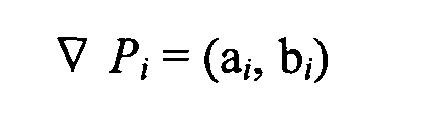
- The method of claim 1 or 4, characterized in that said splitting of the acquired image pixels is done for three basic colors: red, green and blue, and the method includes a step of color artifact removal following said color interpolation, based on the use of only two difference arrays, namely green-blue and green-red, respectively, and calculation of two median arrays therefrom.
- The method of claim 6, wherein said color artifact removal is performed through the following steps:for each pixel to be filtered, selecting a block of pixels from each component color image with a selection window of pre-established dimensions centered on the pixel to be filtered;calculating a first median difference between the values of the selected green pixels and the selected red pixels (νGR) and a second median difference between the values of the selected green pixels and the selected blue pixels (ν GB);
if the pixel to be filtered corresponds to:- a green pixel in the detected image, keeping its original green component and choosing as value of a new red component thereof ( R̂ ) the difference between the green value and said first median difference (ν GR) and as value of a new blue component thereof (B̂) the difference between the green value and said second median difference (ν GB),- a red pixel in the detected image, keeping its original red component and choosing as value of a new green component thereof (Ĝ) the sum between the red value and said first median difference (ν GR) and as value of a new blue component thereof (B̂) the difference between said new green component (Ĝ) and said second median difference (ν GB),- a blue pixel in the detected image, keeping its original blue component and choosing as value of a new green component thereof (Ĝ) the sum between the blue value and said second median difference (ν GB) and as value of a new red component thereof (R̂) the difference between said new green component (Ĝ) and said first median difference (νGR). - A method of color interpolation of pixels of an image acquired by a color filtered digital sensor by separately interpolating missing image pixels belonging to each one of a plurality of channels in which the acquired pixels are split in terms of primary colors (RGB) or complementary colors of the pixels of the acquired image for generating weighted pixel values relative to each one of said primary or complementary colors for each pixel of the image to be output, said splitting of the acquired image pixels being done for three basic colors: red, green and blue, and the method including a step of color artifact removal following said color interpolation comprising the step of:for each pixel to be filtered, selecting a block of pixels from each component color image with a selection window of pre-established dimensions centered on the pixel to be filtered;calculating a first median difference between the values of the selected green pixels and the selected red pixels (ν GR) and a second median difference between the values of the selected green pixels and the selected blue pixels (νGB);
if the pixel to be filtered corresponds to:- a green pixel in the detected image, keeping its original green component and choosing as value of a new red component thereof (R̂) the difference between the green value and said first median difference (ν GR) and as value of a new blue component thereof (B̂) the difference between the green value and said second median difference (ν GB),- a red pixel in the detected image, keeping its original red component and choosing as value of a new green component thereof (Ĝ) the sum between the red value and said first median difference (ν GR) and as value of a new blue component thereof (B̂) the difference between said new green component (Ĝ) and said second median difference (ν GB),- a blue pixel in the detected image, keeping its original blue component and choosing as value of a new green component thereof (Ĝ) the sum between the blue value and said second median difference (νGB) and as value of a new red component thereof (R̂) the difference between said new green component (Ĝ) and said first median difference (νGR). - A software computer program loadable into the internal memory of a computer, comprising a software code for performing the steps of the method of any of the previous claims when said code is executed on said computer.
Priority Applications (3)
| Application Number | Priority Date | Filing Date | Title |
|---|---|---|---|
| EP04425587A EP1622393B1 (en) | 2004-07-30 | 2004-07-30 | Color interpolation using data dependent triangulation |
| DE602004026291T DE602004026291D1 (en) | 2004-07-30 | 2004-07-30 | Color interpolation with data-dependent triangulation |
| US11/190,571 US7305148B2 (en) | 2004-07-30 | 2005-07-27 | Color interpolation using data dependent triangulation |
Applications Claiming Priority (1)
| Application Number | Priority Date | Filing Date | Title |
|---|---|---|---|
| EP04425587A EP1622393B1 (en) | 2004-07-30 | 2004-07-30 | Color interpolation using data dependent triangulation |
Publications (2)
| Publication Number | Publication Date |
|---|---|
| EP1622393A1 true EP1622393A1 (en) | 2006-02-01 |
| EP1622393B1 EP1622393B1 (en) | 2010-03-31 |
Family
ID=34932685
Family Applications (1)
| Application Number | Title | Priority Date | Filing Date |
|---|---|---|---|
| EP04425587A Expired - Lifetime EP1622393B1 (en) | 2004-07-30 | 2004-07-30 | Color interpolation using data dependent triangulation |
Country Status (3)
| Country | Link |
|---|---|
| US (1) | US7305148B2 (en) |
| EP (1) | EP1622393B1 (en) |
| DE (1) | DE602004026291D1 (en) |
Cited By (3)
| Publication number | Priority date | Publication date | Assignee | Title |
|---|---|---|---|---|
| CN106358028A (en) * | 2015-07-13 | 2017-01-25 | 西安电子科技大学 | Image processing method based on subpixel downsampling |
| GB2553899A (en) * | 2016-07-13 | 2018-03-21 | Bosch Gmbh Robert | Method and device for sampling an image sensor |
| US10412333B2 (en) | 2016-07-13 | 2019-09-10 | Robert Bosch Gmbh | Method and device for sampling an image sensor |
Families Citing this family (40)
| Publication number | Priority date | Publication date | Assignee | Title |
|---|---|---|---|---|
| US8471852B1 (en) | 2003-05-30 | 2013-06-25 | Nvidia Corporation | Method and system for tessellation of subdivision surfaces |
| US7602984B2 (en) * | 2005-09-28 | 2009-10-13 | Novell, Inc. | Adaptive method and system for encoding digital images for the internet |
| US8571346B2 (en) | 2005-10-26 | 2013-10-29 | Nvidia Corporation | Methods and devices for defective pixel detection |
| US7885458B1 (en) | 2005-10-27 | 2011-02-08 | Nvidia Corporation | Illuminant estimation using gamut mapping and scene classification |
| US7750956B2 (en) | 2005-11-09 | 2010-07-06 | Nvidia Corporation | Using a graphics processing unit to correct video and audio data |
| US8588542B1 (en) | 2005-12-13 | 2013-11-19 | Nvidia Corporation | Configurable and compact pixel processing apparatus |
| US8737832B1 (en) | 2006-02-10 | 2014-05-27 | Nvidia Corporation | Flicker band automated detection system and method |
| US8019171B2 (en) * | 2006-04-19 | 2011-09-13 | Microsoft Corporation | Vision-based compression |
| US8594441B1 (en) | 2006-09-12 | 2013-11-26 | Nvidia Corporation | Compressing image-based data using luminance |
| US7683914B1 (en) * | 2007-02-12 | 2010-03-23 | Bentley System, Inc. | Triangulation based raster image interpolation |
| US8723969B2 (en) | 2007-03-20 | 2014-05-13 | Nvidia Corporation | Compensating for undesirable camera shakes during video capture |
| US8564687B2 (en) * | 2007-05-07 | 2013-10-22 | Nvidia Corporation | Efficient determination of an illuminant of a scene |
| US8698917B2 (en) * | 2007-06-04 | 2014-04-15 | Nvidia Corporation | Reducing computational complexity in determining an illuminant of a scene |
| US8724895B2 (en) * | 2007-07-23 | 2014-05-13 | Nvidia Corporation | Techniques for reducing color artifacts in digital images |
| US7825965B2 (en) * | 2007-09-07 | 2010-11-02 | Seiko Epson Corporation | Method and apparatus for interpolating missing colors in a color filter array |
| US20090092338A1 (en) * | 2007-10-05 | 2009-04-09 | Jeffrey Matthew Achong | Method And Apparatus For Determining The Direction of Color Dependency Interpolating In Order To Generate Missing Colors In A Color Filter Array |
| US8570634B2 (en) | 2007-10-11 | 2013-10-29 | Nvidia Corporation | Image processing of an incoming light field using a spatial light modulator |
| US20090124854A1 (en) * | 2007-11-09 | 2009-05-14 | Fujifilm Corporation | Image capturing device and image capturing system |
| US8195731B1 (en) * | 2007-12-11 | 2012-06-05 | Nvidia Corporation | System, method, and computer program product for determining at least one root of an n-dimensional function utilizing triangulation |
| US8780128B2 (en) | 2007-12-17 | 2014-07-15 | Nvidia Corporation | Contiguously packed data |
| US9177368B2 (en) | 2007-12-17 | 2015-11-03 | Nvidia Corporation | Image distortion correction |
| US8698908B2 (en) | 2008-02-11 | 2014-04-15 | Nvidia Corporation | Efficient method for reducing noise and blur in a composite still image from a rolling shutter camera |
| US9379156B2 (en) | 2008-04-10 | 2016-06-28 | Nvidia Corporation | Per-channel image intensity correction |
| US8373718B2 (en) | 2008-12-10 | 2013-02-12 | Nvidia Corporation | Method and system for color enhancement with color volume adjustment and variable shift along luminance axis |
| US20100225567A1 (en) * | 2009-03-03 | 2010-09-09 | Time-O-Matic, Inc. | Electronic display |
| US8749662B2 (en) | 2009-04-16 | 2014-06-10 | Nvidia Corporation | System and method for lens shading image correction |
| US8310499B2 (en) * | 2009-09-10 | 2012-11-13 | Seiko Epson Corporation | Balancing luminance disparity in a display by multiple projectors |
| US8698918B2 (en) | 2009-10-27 | 2014-04-15 | Nvidia Corporation | Automatic white balancing for photography |
| US9798698B2 (en) | 2012-08-13 | 2017-10-24 | Nvidia Corporation | System and method for multi-color dilu preconditioner |
| US9508318B2 (en) | 2012-09-13 | 2016-11-29 | Nvidia Corporation | Dynamic color profile management for electronic devices |
| US9307213B2 (en) | 2012-11-05 | 2016-04-05 | Nvidia Corporation | Robust selection and weighting for gray patch automatic white balancing |
| US9870598B2 (en) | 2013-04-26 | 2018-01-16 | Nvidia Corporation | Low complexity adaptive filtering for mobile captures |
| US9756222B2 (en) | 2013-06-26 | 2017-09-05 | Nvidia Corporation | Method and system for performing white balancing operations on captured images |
| US9826208B2 (en) | 2013-06-26 | 2017-11-21 | Nvidia Corporation | Method and system for generating weights for use in white balancing an image |
| KR102669687B1 (en) | 2016-12-05 | 2024-05-28 | 삼성전자주식회사 | Storage device operating differently according to temperature of memory |
| US12039663B2 (en) | 2021-10-28 | 2024-07-16 | Nvidia Corporation | 3D surface structure estimation using neural networks for autonomous systems and applications |
| US12145617B2 (en) | 2021-10-28 | 2024-11-19 | Nvidia Corporation | 3D surface reconstruction with point cloud densification using artificial intelligence for autonomous systems and applications |
| US12190448B2 (en) * | 2021-10-28 | 2025-01-07 | Nvidia Corporation | 3D surface structure estimation using neural networks for autonomous systems and applications |
| US12100230B2 (en) | 2021-10-28 | 2024-09-24 | Nvidia Corporation | Using neural networks for 3D surface structure estimation based on real-world data for autonomous systems and applications |
| US12172667B2 (en) | 2021-10-28 | 2024-12-24 | Nvidia Corporation | 3D surface reconstruction with point cloud densification using deep neural networks for autonomous systems and applications |
Family Cites Families (6)
| Publication number | Priority date | Publication date | Assignee | Title |
|---|---|---|---|---|
| FR2729266A1 (en) * | 1995-01-10 | 1996-07-12 | France Telecom | METHOD FOR INTERPOLATING IMAGES |
| US5704025A (en) * | 1995-06-08 | 1997-12-30 | Hewlett-Packard Company | Computer graphics system having per pixel depth cueing |
| US6016151A (en) * | 1997-09-12 | 2000-01-18 | Neomagic Corp. | 3D triangle rendering by texture hardware and color software using simultaneous triangle-walking and interpolation for parallel operation |
| US6229578B1 (en) * | 1997-12-08 | 2001-05-08 | Intel Corporation | Edge-detection based noise removal algorithm |
| US7215810B2 (en) * | 2003-07-23 | 2007-05-08 | Orametrix, Inc. | Method for creating single 3D surface model from a point cloud |
| US7015930B2 (en) * | 2003-08-01 | 2006-03-21 | Ati Technologies Inc. | Method and apparatus for interpolating pixel parameters based on a plurality of vertex values |
-
2004
- 2004-07-30 EP EP04425587A patent/EP1622393B1/en not_active Expired - Lifetime
- 2004-07-30 DE DE602004026291T patent/DE602004026291D1/en not_active Expired - Lifetime
-
2005
- 2005-07-27 US US11/190,571 patent/US7305148B2/en active Active
Non-Patent Citations (4)
| Title |
|---|
| "SVG Rendering of Real Images Using Data Dependent Triangulation", XP002302393, Retrieved from the Internet <URL:http://www.dmi.unict.it/~battiato/download/SCCG04.pdf> [retrieved on 20040325] * |
| RAMANATH R ET AL: "DEMOSAICKING METHODS FOR BAYER COLOR ARRAYS", JOURNAL OF ELECTRONIC IMAGING, SPIE + IS&T, US, vol. 11, no. 3, July 2002 (2002-07-01), pages 306 - 315, XP001122626, ISSN: 1017-9909 * |
| SU D ET AL: "Demosaicing of color images using pixel level data-dependent triangulation", PROCEEDINGS THEORY AND PRACTICE OF COMPUTER GRAPHICS IEEE COMPUT. SOC LOS ALAMITOS, CA, USA, 5 June 2003 (2003-06-05), pages 16 - 23, XP002302392, ISBN: 0-7695-1942-3 * |
| XIAOHUA YU ET AL: "Image reconstruction using data-dependent triangulation", IEEE COMPUTER GRAPHICS AND APPLICATIONS IEEE USA, vol. 21, no. 3, 30 June 2001 (2001-06-30), pages 62 - 68, XP002302394, ISSN: 0272-1716 * |
Cited By (4)
| Publication number | Priority date | Publication date | Assignee | Title |
|---|---|---|---|---|
| CN106358028A (en) * | 2015-07-13 | 2017-01-25 | 西安电子科技大学 | Image processing method based on subpixel downsampling |
| CN106358028B (en) * | 2015-07-13 | 2018-06-01 | 西安电子科技大学 | Image processing method based on sub-pix down-sampling |
| GB2553899A (en) * | 2016-07-13 | 2018-03-21 | Bosch Gmbh Robert | Method and device for sampling an image sensor |
| US10412333B2 (en) | 2016-07-13 | 2019-09-10 | Robert Bosch Gmbh | Method and device for sampling an image sensor |
Also Published As
| Publication number | Publication date |
|---|---|
| DE602004026291D1 (en) | 2010-05-12 |
| US20060022997A1 (en) | 2006-02-02 |
| EP1622393B1 (en) | 2010-03-31 |
| US7305148B2 (en) | 2007-12-04 |
Similar Documents
| Publication | Publication Date | Title |
|---|---|---|
| EP1622393B1 (en) | Color interpolation using data dependent triangulation | |
| US6639691B2 (en) | Block-matching algorithm for color interpolation | |
| US6269181B1 (en) | Efficient algorithm for color recovery from 8-bit to 24-bit color pixels | |
| EP1371015B1 (en) | Bilateral filtering in a demosaicing process | |
| US6832009B1 (en) | Method and apparatus for improved image interpolation | |
| EP2130176B1 (en) | Edge mapping using panchromatic pixels | |
| US6181376B1 (en) | Method of determining missing color values for pixels in a color filter array | |
| TWI455597B (en) | Noise reduced color image using panchromatic image | |
| US6421084B1 (en) | Method for interpolating a full color image from a single sensor using multiple threshold-based gradients | |
| EP2130175B1 (en) | Edge mapping incorporating panchromatic pixels | |
| TW455781B (en) | A new edge-detection based noise removal algorithm | |
| KR20010020797A (en) | Image demosaicing method utilizing directional smoothing | |
| US7391904B2 (en) | Correlation-based color mosaic interpolation adjustment using luminance gradients | |
| US7612784B2 (en) | Image processor and method, computer program, and recording medium | |
| CN1319375C (en) | Image zooming method based on edge detection | |
| JP2001095001A (en) | Demosaic method of image | |
| JP7741654B2 (en) | Learning device, image processing device, learning processing method, and program | |
| JP2002525722A (en) | Image processing method and system | |
| WO1999052076A1 (en) | System and method of selecting level of detail in texture mapping | |
| US8213710B2 (en) | Apparatus and method for shift invariant differential (SID) image data interpolation in non-fully populated shift invariant matrix | |
| Su et al. | Demosaicing of color images using pixel level data-dependent triangulation | |
| US6642932B2 (en) | Method and system for interpolation in color images | |
| CN101939762A (en) | Method and apparatus for reconstructing color images | |
| Boccuto et al. | A fast algorithm for the demosaicing problem concerning the bayer pattern | |
| US7683914B1 (en) | Triangulation based raster image interpolation |
Legal Events
| Date | Code | Title | Description |
|---|---|---|---|
| PUAI | Public reference made under article 153(3) epc to a published international application that has entered the european phase |
Free format text: ORIGINAL CODE: 0009012 |
|
| AK | Designated contracting states |
Kind code of ref document: A1 Designated state(s): AT BE BG CH CY CZ DE DK EE ES FI FR GB GR HU IE IT LI LU MC NL PL PT RO SE SI SK TR |
|
| AX | Request for extension of the european patent |
Extension state: AL HR LT LV MK |
|
| 17P | Request for examination filed |
Effective date: 20060719 |
|
| AKX | Designation fees paid |
Designated state(s): DE FR GB IT |
|
| 17Q | First examination report despatched |
Effective date: 20070727 |
|
| GRAP | Despatch of communication of intention to grant a patent |
Free format text: ORIGINAL CODE: EPIDOSNIGR1 |
|
| GRAS | Grant fee paid |
Free format text: ORIGINAL CODE: EPIDOSNIGR3 |
|
| GRAA | (expected) grant |
Free format text: ORIGINAL CODE: 0009210 |
|
| AK | Designated contracting states |
Kind code of ref document: B1 Designated state(s): DE FR GB IT |
|
| REG | Reference to a national code |
Ref country code: GB Ref legal event code: FG4D |
|
| RAP2 | Party data changed (patent owner data changed or rights of a patent transferred) |
Owner name: STMICROELECTRONICS SRL |
|
| REF | Corresponds to: |
Ref document number: 602004026291 Country of ref document: DE Date of ref document: 20100512 Kind code of ref document: P |
|
| PGFP | Annual fee paid to national office [announced via postgrant information from national office to epo] |
Ref country code: DE Payment date: 20100706 Year of fee payment: 7 |
|
| PLBE | No opposition filed within time limit |
Free format text: ORIGINAL CODE: 0009261 |
|
| STAA | Information on the status of an ep patent application or granted ep patent |
Free format text: STATUS: NO OPPOSITION FILED WITHIN TIME LIMIT |
|
| 26N | No opposition filed |
Effective date: 20110104 |
|
| GBPC | Gb: european patent ceased through non-payment of renewal fee |
Effective date: 20100730 |
|
| PG25 | Lapsed in a contracting state [announced via postgrant information from national office to epo] |
Ref country code: IT Free format text: LAPSE BECAUSE OF FAILURE TO SUBMIT A TRANSLATION OF THE DESCRIPTION OR TO PAY THE FEE WITHIN THE PRESCRIBED TIME-LIMIT Effective date: 20100331 |
|
| REG | Reference to a national code |
Ref country code: FR Ref legal event code: ST Effective date: 20110331 |
|
| PG25 | Lapsed in a contracting state [announced via postgrant information from national office to epo] |
Ref country code: FR Free format text: LAPSE BECAUSE OF NON-PAYMENT OF DUE FEES Effective date: 20100802 |
|
| PG25 | Lapsed in a contracting state [announced via postgrant information from national office to epo] |
Ref country code: GB Free format text: LAPSE BECAUSE OF NON-PAYMENT OF DUE FEES Effective date: 20100730 |
|
| PG25 | Lapsed in a contracting state [announced via postgrant information from national office to epo] |
Ref country code: DE Free format text: LAPSE BECAUSE OF NON-PAYMENT OF DUE FEES Effective date: 20120201 |
|
| REG | Reference to a national code |
Ref country code: DE Ref legal event code: R119 Ref document number: 602004026291 Country of ref document: DE Effective date: 20120201 |