EP1621571A1 - Compound powder, its preparation method and use - Google Patents
Compound powder, its preparation method and use Download PDFInfo
- Publication number
- EP1621571A1 EP1621571A1 EP04725660A EP04725660A EP1621571A1 EP 1621571 A1 EP1621571 A1 EP 1621571A1 EP 04725660 A EP04725660 A EP 04725660A EP 04725660 A EP04725660 A EP 04725660A EP 1621571 A1 EP1621571 A1 EP 1621571A1
- Authority
- EP
- European Patent Office
- Prior art keywords
- rubber
- latex
- composite powder
- particles
- inorganic particles
- Prior art date
- Legal status (The legal status is an assumption and is not a legal conclusion. Google has not performed a legal analysis and makes no representation as to the accuracy of the status listed.)
- Granted
Links
Images

Classifications
-
- C—CHEMISTRY; METALLURGY
- C08—ORGANIC MACROMOLECULAR COMPOUNDS; THEIR PREPARATION OR CHEMICAL WORKING-UP; COMPOSITIONS BASED THEREON
- C08K—Use of inorganic or non-macromolecular organic substances as compounding ingredients
- C08K3/00—Use of inorganic substances as compounding ingredients
- C08K3/18—Oxygen-containing compounds, e.g. metal carbonyls
- C08K3/24—Acids; Salts thereof
- C08K3/26—Carbonates; Bicarbonates
-
- C—CHEMISTRY; METALLURGY
- C08—ORGANIC MACROMOLECULAR COMPOUNDS; THEIR PREPARATION OR CHEMICAL WORKING-UP; COMPOSITIONS BASED THEREON
- C08J—WORKING-UP; GENERAL PROCESSES OF COMPOUNDING; AFTER-TREATMENT NOT COVERED BY SUBCLASSES C08B, C08C, C08F, C08G or C08H
- C08J3/00—Processes of treating or compounding macromolecular substances
- C08J3/12—Powdering or granulating
- C08J3/122—Pulverisation by spraying
-
- C—CHEMISTRY; METALLURGY
- C08—ORGANIC MACROMOLECULAR COMPOUNDS; THEIR PREPARATION OR CHEMICAL WORKING-UP; COMPOSITIONS BASED THEREON
- C08J—WORKING-UP; GENERAL PROCESSES OF COMPOUNDING; AFTER-TREATMENT NOT COVERED BY SUBCLASSES C08B, C08C, C08F, C08G or C08H
- C08J3/00—Processes of treating or compounding macromolecular substances
- C08J3/20—Compounding polymers with additives, e.g. colouring
-
- C—CHEMISTRY; METALLURGY
- C08—ORGANIC MACROMOLECULAR COMPOUNDS; THEIR PREPARATION OR CHEMICAL WORKING-UP; COMPOSITIONS BASED THEREON
- C08K—Use of inorganic or non-macromolecular organic substances as compounding ingredients
- C08K3/00—Use of inorganic substances as compounding ingredients
- C08K3/01—Use of inorganic substances as compounding ingredients characterized by their specific function
- C08K3/013—Fillers, pigments or reinforcing additives
-
- C—CHEMISTRY; METALLURGY
- C08—ORGANIC MACROMOLECULAR COMPOUNDS; THEIR PREPARATION OR CHEMICAL WORKING-UP; COMPOSITIONS BASED THEREON
- C08K—Use of inorganic or non-macromolecular organic substances as compounding ingredients
- C08K3/00—Use of inorganic substances as compounding ingredients
- C08K3/02—Elements
- C08K3/08—Metals
-
- C—CHEMISTRY; METALLURGY
- C08—ORGANIC MACROMOLECULAR COMPOUNDS; THEIR PREPARATION OR CHEMICAL WORKING-UP; COMPOSITIONS BASED THEREON
- C08K—Use of inorganic or non-macromolecular organic substances as compounding ingredients
- C08K3/00—Use of inorganic substances as compounding ingredients
- C08K3/18—Oxygen-containing compounds, e.g. metal carbonyls
- C08K3/20—Oxides; Hydroxides
- C08K3/22—Oxides; Hydroxides of metals
-
- C—CHEMISTRY; METALLURGY
- C08—ORGANIC MACROMOLECULAR COMPOUNDS; THEIR PREPARATION OR CHEMICAL WORKING-UP; COMPOSITIONS BASED THEREON
- C08K—Use of inorganic or non-macromolecular organic substances as compounding ingredients
- C08K3/00—Use of inorganic substances as compounding ingredients
- C08K3/34—Silicon-containing compounds
- C08K3/346—Clay
-
- C—CHEMISTRY; METALLURGY
- C08—ORGANIC MACROMOLECULAR COMPOUNDS; THEIR PREPARATION OR CHEMICAL WORKING-UP; COMPOSITIONS BASED THEREON
- C08K—Use of inorganic or non-macromolecular organic substances as compounding ingredients
- C08K3/00—Use of inorganic substances as compounding ingredients
- C08K3/34—Silicon-containing compounds
- C08K3/36—Silica
-
- C—CHEMISTRY; METALLURGY
- C08—ORGANIC MACROMOLECULAR COMPOUNDS; THEIR PREPARATION OR CHEMICAL WORKING-UP; COMPOSITIONS BASED THEREON
- C08J—WORKING-UP; GENERAL PROCESSES OF COMPOUNDING; AFTER-TREATMENT NOT COVERED BY SUBCLASSES C08B, C08C, C08F, C08G or C08H
- C08J2309/00—Characterised by the use of homopolymers or copolymers of conjugated diene hydrocarbons
-
- C—CHEMISTRY; METALLURGY
- C08—ORGANIC MACROMOLECULAR COMPOUNDS; THEIR PREPARATION OR CHEMICAL WORKING-UP; COMPOSITIONS BASED THEREON
- C08J—WORKING-UP; GENERAL PROCESSES OF COMPOUNDING; AFTER-TREATMENT NOT COVERED BY SUBCLASSES C08B, C08C, C08F, C08G or C08H
- C08J2321/00—Characterised by the use of unspecified rubbers
-
- Y—GENERAL TAGGING OF NEW TECHNOLOGICAL DEVELOPMENTS; GENERAL TAGGING OF CROSS-SECTIONAL TECHNOLOGIES SPANNING OVER SEVERAL SECTIONS OF THE IPC; TECHNICAL SUBJECTS COVERED BY FORMER USPC CROSS-REFERENCE ART COLLECTIONS [XRACs] AND DIGESTS
- Y10—TECHNICAL SUBJECTS COVERED BY FORMER USPC
- Y10T—TECHNICAL SUBJECTS COVERED BY FORMER US CLASSIFICATION
- Y10T428/00—Stock material or miscellaneous articles
- Y10T428/29—Coated or structually defined flake, particle, cell, strand, strand portion, rod, filament, macroscopic fiber or mass thereof
- Y10T428/2982—Particulate matter [e.g., sphere, flake, etc.]
-
- Y—GENERAL TAGGING OF NEW TECHNOLOGICAL DEVELOPMENTS; GENERAL TAGGING OF CROSS-SECTIONAL TECHNOLOGIES SPANNING OVER SEVERAL SECTIONS OF THE IPC; TECHNICAL SUBJECTS COVERED BY FORMER USPC CROSS-REFERENCE ART COLLECTIONS [XRACs] AND DIGESTS
- Y10—TECHNICAL SUBJECTS COVERED BY FORMER USPC
- Y10T—TECHNICAL SUBJECTS COVERED BY FORMER US CLASSIFICATION
- Y10T428/00—Stock material or miscellaneous articles
- Y10T428/29—Coated or structually defined flake, particle, cell, strand, strand portion, rod, filament, macroscopic fiber or mass thereof
- Y10T428/2982—Particulate matter [e.g., sphere, flake, etc.]
- Y10T428/2991—Coated
- Y10T428/2998—Coated including synthetic resin or polymer
-
- Y—GENERAL TAGGING OF NEW TECHNOLOGICAL DEVELOPMENTS; GENERAL TAGGING OF CROSS-SECTIONAL TECHNOLOGIES SPANNING OVER SEVERAL SECTIONS OF THE IPC; TECHNICAL SUBJECTS COVERED BY FORMER USPC CROSS-REFERENCE ART COLLECTIONS [XRACs] AND DIGESTS
- Y10—TECHNICAL SUBJECTS COVERED BY FORMER USPC
- Y10T—TECHNICAL SUBJECTS COVERED BY FORMER US CLASSIFICATION
- Y10T428/00—Stock material or miscellaneous articles
- Y10T428/31504—Composite [nonstructural laminate]
- Y10T428/31678—Of metal
- Y10T428/31707—Next to natural rubber
Definitions
- the present invention relates to a powder, more particularly, to a composite powder comprising rubber particles and inorganic particles, preparation and use thereof,
- the fully vulcanized powdery rubber thus obtained has a particle size in the range of from 20 to 2000nm and can be used as tougheners for plastics, with excellent toughening effects being achieved.
- a powdery rubber is used for toughening plastics, the strength, modulus and thermal properties inherent in the plastics are frequently reduced.
- inorganic particles have been proposed for modifying plastics.
- Inorganic particles have a very high sulface energy, thus if no special treatment is conducted, they are apt to agglomerate when blending with plastics, which will significantly decrease their modification effects on plastics.
- nano-clay materials are now being used for enhancing the rigidity of polyamides, with polyamide/clay nano-composites being obtained(see, for example, "Polymers-Inorganics Nano-composites", Series of Nano-materials and Application Technologies, the Chemical and Industrial Press, Dec., 2002).
- the clays used for preparing polyamide/clay nano-composites are conventionally sheet clays, which possess a layered structure in a nanometric scale, are natural nano-materials and are very suitable for preparing nano-composites.
- the gaps among the layers of the sheet clays are very small, thus it is Impossible for organic polymers to enter said gaps to exfoliate the sheet clays in a nanometric scale. Therefore, before used for preparing such polymer/clay nano-composites, clays must be subjected to a special treatment, i.e., displacement by various organic substances, thereby obtaining nano-precursor materials containing organic functional groups, which are then compounded with polymers to form nano-composites.
- the process for preparing such nano-precursor materials is also called organo-modification of clays.
- organic functional groups such as organic cations and the like, are introduced to the gaps of the sheet clays, which facilitates the insertion of monomers or polymers(see, for example, "Polymer-Inorganics Nano-composites", pp. 21-22).
- the layers of sheet clays subjected to organo- modification can be dispersed in polymer matrix in a nanometric scale, thereby obtaining polymer/clay nano-composites, which possess high strength, modulus, heat distortion temperature.
- the organo-modification of montmorillonite facilitates the intercalation-compounding and however, renders the preparation of composites complicated.
- the present inventors conducted extensive and intensive researches in the field of toughening plastics, with a view of developing a novel toughener which can be used to toughen plastics and meanwhile, retains the strength, modulus and thermal properties inherent in plastics.
- a composite powder comprising organic elastic particles and inorganic rigid particles can be obtained, and:when blending with plastics, the organic elastic particles contained in such a composite powder prevent the agglomeration of inorganic particles, thus a better toughening effect can be achieved by toughening plastics with such a composite powder, compared to using elastic particles or inorganic particles alone, and meanwhile, the negative effects on rigidity and heat resistance of resins caused by the introduction of elastic particles are reduced. Furthermore, such a composite powder can be advantageously used for the preparation of thermoplastic elastomers.
- an object of the present invention is to provide a composite powder, which can be used for toughening plastics and for preparing thermoplastic elastomers.
- Another object of the present Invention is to provide a process for preparing the composite powder according to the present invention.
- Still another object of the present invention is to provide use of the composite powder according to the present invention for preparing toughened plastics and thermoplastic elastomers.
- the present invention in its one aspect provides a composite powder, comprising powdery rubber particles having a cross-linked structure and inorganic particles distributed between said rubber particles.
- the present invention in its second aspect provides a process for preparing the composite powder according to the present invention, comprising intimately mixing an irradiated or non-irradiated rubber latex with a slurry of inorganic particles in a ratio corresponding to that of rubber particles to inorganic particles In the composite powder according to the present invention, and then drying the resultant mixture.
- the present invention in its third aspect provides plastics toughened by the composite powder according to the present invention.
- the present Invention in its fourth aspect provides thermoplastic elastomers comprising the composite powder according to the present invention.
- the composite powder according to the present invention comprises powdery rubber particles having a cross-linked structure and inorganic particles distributed between said rubber particles, wherein the weight ratio of said rubber particles to said inorganic particles is from 99.5 : 0.5 to 20 : 80, preferably from 99 : 1 to 50 : 50.
- the inorganic particles are those commercially available in the prior art. There are no restrictions on the type of the inorganic particles as long as the size thereof falls within the scope of the present invention. However, the inorganic particles which are unstable when encountering water are excluded.
- the inorganic particles can be of any shape, such as spheres, ellipsoids; sheets, needles or irregular shapes. In the view of three-dimensional point, the individual particles have an average size of from 0.2 to 500nm, preferably from 0.5 to 100nm in at least one dimension.
- the inorganic particles used in the composite powder according to the present invention can be selected from elemental metals or alloys thereof, such as gold, silver, cupper, iron or alloys thereof; metal oxides, such as aluminum oxide(Al 2 O 3 ), magnesium oxide(MgO), titanium dioxide(TiO 2 ), iron sesquioxide(Fe 2 O 3 ), ferroferric oxide(Fe 3 O 4 ), silver oxide(Ag 2 O), zinc oxide(ZnO) and the like; metal or non-metal nitrides, such as aluminum nitride(AIN), silicon nitride(SiN 4 ) and the like; non-metal carbides, such as silicon carbide(SIC) and the like; non-metal oxides, such as silicon dioxide(SiO 2 ) and the like; metal hydroxides, such as aluminum hydroxide(Al(OH) 3 ), magnesium hydroxide(Mg(OH) 2 ) and the like; metal salts, including metal carbonates, silicates, sul
- the powdery rubber particles having a cross-linked structure used in the composite powder according to the present invention are those having a homogeneous structure, that is to say, Individual particles are homogeneous in their composition and no heterogeneous phenomena, such as demixing, phase separation or the like can be observed in the particles by current microscopic technologies.
- the powdery rubber particles have a gel content of 60 percent by weight or more, preferably 75 percent by weight or more, more preferably 80 percent by weight or more.
- the composite powder according, to the present invention can be prepared by the process for preparing fully vulcanized powdery rubbers disclosed in the International Patent Publication WO 01/40356A1 filed by the present applicants on September 18, 2000(its full text is incorporated herein by reference), except that the irradiated latex is admixed with a slurry of inorganic particles prior to drying.
- the composite powder according to the present invention can also be prepared by the process for preparing powdery cross-linked rubbers disclosed in Chinese Patent Application No. 00130386.4 filed by the present applicants on November 3, 2000(CN 1353131A, its full text is incorporated herein by reference), except that cross-linked rubber latexes are admixed with a slurry of inorganic particles prior to drying.
- the composite powder according to the present invention can optionally comprise water-soluble nucleating agents for plastics and if such agents are present, the amount thereof is such that the weight ratio of the rubber particles to the nucleating agent in the composite powder according to the present invention is from 99 : 1 to 5.0 : 50, preferably from 97 : 3 to 70 : 30.
- the nucleating agent can be those conventionally employed in the art, preferably sodium benzoate.
- the composite powder according to the present invention comprises agglomerates composed of powdery rubber particles and inorganic particles; with Inorganic particles being uniformly distributed either inside the agglomerats or both inside the agglomerates and on the surfaces thereof, wherein the rubber particles themselves have a gel content of 60 percent by weight or more, preferably 76 percent by weight or more, more preferably 80 percent by weight or more.
- the composite powder according to the present invention may contain discrete inorganic particles. Especially when the content of the inorganic particles is high inorganic particles are apt to occur outside the agglomerates.
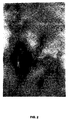
- the agglomerating state possessed by the composite powder according to the present invention can be retained in the composition obtained by melt-blending the composite powder with non-polar plastics(such as polypropylenes or polyethylenes). By subjecting the composition to microtoming and then observing under a transmission electron microscope, a photograph reflecting such an agglomerating state can be obtained (see Figure 1).
- the composite powder according to the present invention can be prepared by intimately mixing an irradiated or non-irradiated rubber latex with a slurry of inorganic particles in a ratio corresponding to that of rubber particles to inorganic particles in the composite powder according to the present invention, and then drying the resultant mixture.
- the composite powder according to the present invention can be prepared by:
- the slurry of inorganic particles is an aqueous suspension of inorganic particles and can be commercially available slurries.
- the commercially avaiable slurries are normally dispersed by means of a conventional dispersing equipment(such as a high-shear dispersing and emulsifying machine, colloidal mill and the like) so as to ensure that the solid particles in the slurries can be homogeneously dispersed in water.
- a conventional dispersing equipment such as a high-shear dispersing and emulsifying machine, colloidal mill and the like
- the slurry of inorganic particles are not commercially available, they can be prepared by dispersing inorganic particles in a suitable amount of water by means of conventional dispersing equipments to form a stable suspension, which is then mixed with a rubber latex.
- the inorganic particles are those commercially available in the art. There are no restrictions on the type of the inorganic particles as long as the size thereof falls within the scope of the present invention. However, the inorganic particles which are unstable when encountering water are excluded.
- the inorganic particles can be of any shape, such as spheres, ellipsoids, sheets, needles or irregular shapes. In the view of three-dimensional point, the individual particles has an average size of from 0.2 to 500nm, preferably from 0.5 to 100nm in at least one dimension.
- the inorganic particles used in the process according to the present Invention can be selected from elemental metals or alloys thereof, such as gold, silver, cupper, iron or alloys thereof: metal oxides, such as aluminum oxide(Al 2 O 3 ), magnesium oxide(MgO), titanium dioxide(TiO 2 ), iron sesquioxide(Fe 2 O 3 ), ferroferric oxide(Fe 3 O 4 ), silver oxide(Ag 2 O), zinc oxide(ZnO) and the like; metal or non-metal nitrides, such as aluminum nitride(AIN), silicon nitride(SiN 4 ) and the like; non-metal carbides, such as silicon carbide(SiC) and the like; non-metal oxides, such as silicon dioxide(SiO 2 ) and the like; metal hydroxides, such as aluminum hydroxide(Al(OH) 3 ), magnesium hydroxide(Mg(OH) 2 ) and the like; metal salts, including metal carbonates, silicates,
- the ratio of the weight of the rubber contained in the rubber latex(i.e., dry weight or solid content of the rubber latex): to the weight of the inorganic particles contained in the slurry of inorganic particles (i.e., dry weight of the slurry of inorganic particles) is from 99.5 : 0.5 to 20 : 80, preferably from 99 : 1 to 50 : 50.
- the mixed latex can be obtained by intimately mixing a slurry of inorganic particles, an aqueous solution of water-soluble nucleating agent for plastics and the irradiated rubber latex(in the process variant b.) or the cross-linked rubber latex(in the process variant a.).
- the ratio of the dry weight of the irradiated rubber latex or the cross-linked rubber latex to the weight of the nucleating agent contained in the aqueous nucleating agent solution is from 99 : 1 to 50 : 50. preferably from 97 : 3 to 70 : 30.
- the composite powder thus obtained can improve the tougheness of plastics and at the same time, promote the crystallization of crystalline plastics, which results in further improvement in the rigidity of plastics.
- the water-soluble nucleating agent for plastics as long as it is water-soluble and promotes the nucleation of plastics.
- Sodium benzoate is preferably used.
- the process for preparing the composite powder according to the present invention it is possible to add the slurry of inorganic particles and optionally, an aqueous solution of water-soluble nucleating agent for plastics to the irradiated rubber latex or the cross-linked rubber latex while stirring so as to intimately mix them.
- concentrations of the rubber latex, the slurry of inorganic particles and the aqueous nucleating agent solution There are no particular restrictions on the concentrations of the rubber latex, the slurry of inorganic particles and the aqueous nucleating agent solution.
- the drying can be carried out by using the drying method for preparing the fully vulcanized powdery rubber disclosed in the international Patent Publication WO 01/40356A1 and the International Patent Publication WO 01/98395(filed on June 15, 2001, claiming the benefit of the Chinese Patent Application No.
- the drying can be carried out by means of a spray dryer, with the inlet temperature and the outlet temperature being controlled to be 100 to 200°C and 20 to 80°C, respectively.
- the rubbers contained the composite powders obtained by using the above process variants a, and b, has a gel content equal to that In the cross-linked synthetic rubber latex in process variant a and that in the irradiated rubber latex in process variant b., respectively.
- cross-linked synthetic rubber latexes are used as the starting materials.
- Cross-linked synthetic rubber latexes can be selected from the group consisting of cross-linked styrene-butadiene latex, cross-linked carboxylated styrene-butadiene latex, cross-linked polybutadiene latex, cross-linked acrylonitrile-butadiene latex, cross-linked carboxylated acrylonitrile-butadiene latex, cross-linked neoprene latex and cross-linked acrylic latex.
- the rubber latexes can be rubber latexes, used for preparing the fully vulcanized powdery rubbers In the International Patent Publications WO 01/40356A1 and WO 01/98395, such as natural rubber latex, styrene-butadiene rubber latex, carboxylated styrene-butadiane rubber latex, acrylonitrile-butadiene rubber latex, carboxylated acrylonitrile-butadiene rubber latex, polybutadiene rubber latex, neoprene rubber latex, silicone rubber, latex, acrylic rubber latex, butadiene-styrene-vinylpyridine rubber latex, isoprene rubber latex, butyl rubber latex, ethylene-proptyene rubber latex, polysulfide rubber latex, acrylate-butadiene rubber late
- the rubber latexes used in the process variant b. for preparing the composite powder according to the present invention can also include the cross-linked synthetic rubber latexes used in the process variant a., that is to say, the cross-linked synthetic rubber latexes can be used to prepare the composite powder according to the present invention without irradiation(as in the process variant a.) or with irradiation(as in the process variant b.), with the gel content of the rubber in the composite powder obtained by the process variant b. being higher than that by the process variant a.
- the solid content(i.e., dry weight) of the rubber latexes used in the above two process variants which Is normally from 20 to 70 percent by weight, preferably from 30 to 60 percent by weight, more preferably from 40 to 50 percent by weight.
- the average particle size of the rubber particles in these rubber latexes is from 20 to 2000 nm, preferably from 30 to 1500 nm, more preferably from 50 to 500 nm.
- the rubber particles contained therein After irradiating the rubber latexes, the rubber particles contained therein acquire a relatively high gel content(60 percent by weight or more), or in the case of the cross-linked synthetic rubber latexes, the particle size of the rubber particles is fixed due to the high gel content, thus after co-spraying the rubber latex and the slurry of inorganic particles, the particle size of individual rubber particles is consistent with that of the rubber particles contained in the rubber latexes as the starting material, i.e., from 20 to 2000 nm, preferably from 30 to 1500 nm, more preferably from 50 to 500 nm, irrespective as of whether the rubber particles are in the form of agglomerates or in free state.
- the conditions for irradiating rubber latexes including cross-linking agents, irradiation doses, sources of high-energy irradiation and the like, are same as those in the process for preparing fully vulcanized powdery rubbers disclosed in the International Patent Publications WO 01/40358A1 and WO 01/98395.
- a cross-linking agent is optionally used.
- the cross-linking agent used can be selected from the group consisting of mono-, di-, tri-, tetra- or multi-functional cross-linking agents, and any combination thereof.
- Examples of monofunctional cross-linking agents include, but not limited to, octyl (meth)acrylate, Iso-octyl (meth)acrylate, glycidyl (meth)acrylate;
- examples of difunctional cross-linking agents include, but not limited to, 1,4-butanediol di(meth)acrylate, 1,6-hexanediol di(meth)acrylate, diethylene glycol di(meth)acrylate, triethylene glycol di(meth)acrylate, neopentyl glycol di(meth)acrylate, divinylbenzene;
- examples of trifunctional cross-linking agents include, but not limited to, trimethylolpropane tri(meth)acrylate, pentaerythritol tri(meth)acrylate;
- examples of tetrafunctional cross-linking agents include, but not limited to pentaerythritol tetra(meth)acrylate, eth
- the amount of the cross-linking agent added varies depending on the type and formulation of the rubber latexes, arid is generally from 0.1 to 10 percent by weight, preferably from 0.5 to 9 percent by weight, more preferably from 0.7 to 7 percent by weight, based on the dry weight of the latexes.
- the high-energy irradiation which can be used is selected from the group consisting of cobalt sources(such as Co-50), UV ray sources and high-energy electron accelerators, prefereby cobalt sources.
- the irradiation dose can be from 0.1 to 30 Mrad, preferably from 0.5 to 20 Mrad.
- the irradiation dose depends on the type and formulation of the rubber latexes. Generally, the irradiation dose Is such that the rubber latexes after vulcanization under irradiation have a gel content of 60 percent by weight or more, preferably 75 percent by weight, more preferably 80 percent by weight or more.
- the composite powder according to the present invention prepared by co-spraying the rubber latexes, the slurry of inorganic particles and the like, comprises agglomerates composed of powdery rubber particles and inorganic particles, with inorganic particles being uniformly distributed either inside the agglomerats or both inside the agglomerates and on the surfaces thereof, wherein the rubber particles themselves have a gel content of 60 percent by weight or more, preferably 75 percent by weight or more, more preferably 80 percent by weight or more.
- the composite powder according to the present invention may contain discrete inorganic particles. Especially when the content of the inorganic particles is high, inorganic particles are apt to occur outside the agglomerates.
- the agglomerating state possessed by the composite powder according to the present invention can be retained in the composition obtained by melt-blending the composite powder with non-polar plastics (such as polypropylenes or polyethylenes). By subjecting the composition to microtoming and then observing under a transmission electron microscope, a photograph reflecting such an agglomerating state can be obtained (see Figure 1).
- non-polar plastics such as polypropylenes or polyethylenes
- the composite powder according to the present invention can be dispersed in plastic matrixes by conventional blending processes, wherein the rubber particles facilitate the uniform dispersion of inorganic particles in the matrix and thus the agglomeration of inorganic particles is substantial avoided.
- non-polar rensin matrixes such as polypropylene or polyethylene
- inorganic particles are uniformly distributed in the agglomerates composed of inorganic particles and rubber particles, which results in a good modification effect.
- the rubber particles contained in the composite powder according to the present invention can be dispersed in the resin matrixes in the form of individual particles after melt-blending, and due to the fact that the inorganic particles contained in the composite powder are uniformly dispersed between the rubber particles, the ideal dispersion of the rubber particles in the resin facilitates the dispersion of inorganic particles.
- montmorillonite in the case of layered inorganic particles like montmorillonite, by preparing a composite powder comprising montmorillonite particles and rubber particles, montmorillonite can be dispersed in polar resin matrixes like nylons in an exfoliated state by the action of rubber particles (as shown in Fig. 3), without the complicated organo-modification.
- the process for preparing the composite powder according to the present Invention is simple, convenient and easy to carry out,
- the composite powder according to the present invention Is used for toughening plastics, a better toughening effect can be achieved, compared to using rubber elastic particles alone, and meanwhile, the negative effects on rigidity and heat resistance of resins caused by the introduction of elastic particles are reduced.
- the composite powder according to the present invention can be advantageously used for the preparation of thermoplastic elastomers,
- the composite powder according to the present invention can be dispersed in plastics very easily, thus can be mixed with various plastics to prepare a number of toughened plastics and thermoplastic elastomers.
- the preparation of toughened plastics or thermoplastic elastomers can be carried out by simply mixing the composite powder according to the present invention and plastics in a certain proportion in conventional blending equipments under conventional processing conditions, if necessary, in the presence of conventional processing aids and compatilizers.
- the weight ratio of the composite powder according to the present invention to plastics is from 0.5 : 99.5 to 50 : 50, preferably from 1 : 99 to 30 : 70.
- the plastics to be toughened can be nylons, polypropylenes, polyethylenes, polyvinyl chloride, polyurethanes, polyesters, polycarbonates, polyoxymethylene, polystyrene, , polyphenylene oxide(PPO), polyphenylene sulfide(PPS), polyimides, polysulfones, epoxy resins, unsaturated polyesters, phenolic resins, amino resins, alkyd resins, diallyl phthalate resins, silicone resins or blends or mixtures thereof.
- the weight ratio of the composite powder according to the present invention to plastics is from 30 : 70 to 75 : 25, preferably from 50 : 50 to 70 : 30.
- the plastics which can be used are nylons, polypropylenes, polyethylenes, polyvinyl chloride, polyurethanes, polyesters, polycarbonates, polyoxymethylene, polystyrene, polyphenylene oxide(PPO), polyphenylene sulfide(PPS), polyimides, polysulfones, epoxy resins, unsaturated polyesters, phenolic resins, amino resins, alkyd resins, diallyl phthalate resins, silicone resins or blends or mixtures thereof.
- the composite powder, propylene homopolymer powder or pellets(melt index: ⁇ 5g/10min) and an antioxidant(Irganox 1010, Ciba-Geigy) are compounded at a weight ratio of the composite powder : polypropylene : 1010 of 100 : 10 : 0.5 in a high speed stirrer for 1 minute.
- the blending and pelleting are carried out in a ZSK-25 twin-screw extruder(Wemer & Pfleiderer Co., Germany), with the temperatures for each section of the extruder being respectively 165°C, 180°C, 195°C, 195°C, 195°C and 195°C (die temperature).
- the extruded strips are subjected to microtoming under -100°C, staining with O 5 O 4 and then observing under a transmission electron microscope.
- a slurry of calcium carbonate (Fine Chemical Factory of Beijing University of Chemical Technology, solid content: 47.3%, average size in one dimension of the particles: 40 to 60nm) is compounded with the irradiated latex at a weight ratio of 50 : 50(on dry basis) while stirring for 1 hour.
- the mixed latex is spray dried by means of a spray dryer, with the inlet temperature and the outlet temperature being 140 to 160°C and 40 to 60°C, respectively.
- a dried carboxylated butadiene-styrene rubber/calcium carbonate composite powder 1 is then collected in a cyclone.
- 500kg of calcium carbonate powders (Fine Chemical Factory of Beijing University of Chemical Technology, average size in one dimension of the particles: 40 to 60nm) are mixed with 1 kg water in a vessel, the resultant mixture is then dispersed by means of a high-shear dispersing and emulsifying machine to obtain a suspension, which is then compounded with the irradiated carboxylated butadiene-styrene rubber latex(prepared as in Example 1) at a weight ratio of 50 : 50(on dry basis) while stirring for 1 hour.
- the mixed latex is spray dried by means of a spray dryer, with the inlet temperature and, the outlet temperature being 140 to 160°C and 40 to 60°C, respectively.
- a dried carboxylated butadiene-styrene rubber/calcium carbonate composite powder 2 is then collected in a cyclone.
- a slurry of calcium carbonate(as in Example 1) is compounded with the irradiated latex at a weight ratio of 90 : 10(on dry basis) while stirring for 1 hour.
- the mixed latex Is spray dried by means of a spray dryer, with the inlet temperature and the outlet temperature being 140 to 160°C and 40 to 60°C, respectively.
- a dried butadiene-styrene rubber/calcium carbonate composite powder 1 is then collected in a cyclone.
- Example 3 The procedure same as in Example 3 is followed, except that the butadiene-styrene rubber latex, without irradiation, is directly compounded with the slurry of calcium carbonate at a weight ratio of 80 : 20(on dry basis) while stirring for 1 hour.
- the mixed latex is spray dried by means of a spray dryer, with the inlet temperature and the outlet temperature being 140 to 160°C and 40 to 60°C, respectively.
- a dried butadiene-styrene rubber/calcium carbonate composite powder 2 is then collected in a cyclone.
- Example 3 The procedure same as in Example 3 is followed, except that the butadiene-styrene rubber latex, without irradiation, is directly compounded with the slurry of calcium carbonate and an aqueous solution of sodium benzoate(available from Wuhan Youjishiye Corporation) at a weight ratio of 80 : 20: 10 (on dry basis) while stirring for 1 hour.
- the mixed latex is spray dried by means of a spray dryer, with the inlet temperature and the outlet temperature being 140 to 160°C and 40 to 60°C, respectively.
- a dried butadiene-styrene rubber/calcium carbonate composite powder containing the nucleating agent is then collected in a cyclone.
- Sodium-based montmorillonite (available from Qinghe Factory, Zhangliakou, Hebel, the particles can be dispersed as flakes of 1 to 20nm thick and 200 to 1000nm long) is mixed with water In a concentration of 5 percent by weight, dispersed by means of a high-shear disperser and then placed for more than one week. After that period, the mixture is dispersed again by means of a high-shear disperser to obtain a stable suspension, with the layers of sheet montmorillointe being sufficiently exfollated.
- the irradiated butadiene-styrene rubber latex(prepared as in Example 3) is compounded with the above slurry of montmorillonite at a weight ratio of 90 : 10(on dry basis) while stirring for 1 hour.
- the mixed latex is spray dried by means of a spray dryer, with the inlet temperature and the outlet temperature being 140 to 160°C and 40 to 60°C, respectively.
- a dried butadiene-etyrene rubber/montmorillonite composite powder 1 is then collected in a cyclone.
- Example 6 The procedure same as in Example 6 is followed, except that the weight ratio of the irradiated butadiene-styrene rubber latex to the sluny of sodium-based montmorillonite is changed to 99 : 1 (on dry basia), with a dried butadiene-styrene rubber/ montmorillonite composite powder 2 being obtained.
- Silicon dioxide powders (avarable from Shenyang Chemical Corporation, average size in one dimension of its particles: 7 to 30 nm) are mixed with water In a concentration of 5 percent by weight and then dispersed by means of a high-shear disperser to obtain a stable suspension.
- 5kg of carboxylated acrylonitrile-butadiene rubber latex having a solid content of 45 percent by welght(available from Lanzhou Petrochemical Company, Brand: XNBRL, average particle size of the rubber particles in latex: 50 nm) is placed in a vessel, 67.5g of iso-octyl acrylate is added dropwise while stirring, and the stirring is continued for 1 hour after the completion of addition.
- the rubber latex is irradiated with Co-60, with the irradiation dose being 2.5Mrad and the irradiation dose rate being 50Gy/min.
- the rubber particles in the irradiated latex have a gel content of 96.1 %.
- the irradiated acrylonitrile-butadiene rubber latex is compounded with the above slurry of silicon dioxide at a weight ratio of 90 : 10(on dry basis) while stirring for 1 hour.
- the mixed latex is spray dried by means of a spray dryer, with the inlet temperature and the outlet temperature being 140 to 160°C and 40 to 60°C, respectively.
- a dried carboxylated acrylonitrile-butadiene rubber/silicon dioxide composite powder is then collected in a cyclone.
- Example 8 The procedure same as in Example 8 is followed, except that the slurry of silicon dioxide is replaced by the slurry of calcium carbonate(as in Example 1), with a dried carboxylated acrylonitrile/calcium carbonate composite powder being obtained.
- Titanium dioxide powders (available from Beijing University of Chemical Technology, average size in one dimension of its particles: 40 to 60 nm) are mixed with water in a concentration of 20 percent by weight and then dispersed by means of a high-shear disperser to obtain a stable suspension.
- the irradiated butadiene-styrene rubber latex (prepared as in Example 3) is compounded with the above slurry of titanium dioxide at a weight ratio of 95 : 5(on dry basis) while stirring for 1 hour.
- the mixed latex is spray dried by means of a spray dryer, with the inlet temperature and the outlet temperature being 140 to 160°C and 40 to 60°C, respectively.
- a dried butadiene-styrene rubber/titanium dioxide composite powder is then collected in a cyclone.
- Magnesium hydroxide powders (avallable from Beijing University of Chemical Technology, average size in one dimension of Its particles: 20 to 40 nm) is mixed with water in a concentration of 20 percent by weight and then dispersed by means of a high-shear disperser to obtain a stable suspension.
- 5kg of acrylonitrile-butadiene rubber latex having a solid content of 45 percent by weight (available from the Latex Reseach Center, Lanzhou Petrochemical Company, Brand: DINGJING-26, average particle size of the rubber particles in latex: 100 nm) is placed in a vessel, 112.5g of trimethylolpropane triacrylate is added dropwise while stirring, and the stirring is continued for 1 hour after the completion of addition.
- the rubber.latex is irradiated with Co-60, with the irradiation dose being 1.0Mrad and the Irradiation dose rate being 50Gy/min.
- the rubber particles in the irradiated latex have a gel content of 90.0%.
- the irradiated acrylonitrile-butadiene rubber latex is compounded with the above slurry of magnesium hydroxide at a weight ratio of 40 : 60 (on dry basis) while stirring for 1 hour.
- the mixed latex Is spray dried by means of a spray dryer, with the inlet temperature and the outlet temperature being 140 to 160°C and 40 to 60°C, respectively.
- a dried acrylonitrile-butadiene rubber/magnesium hydroxide composite powder is then collected in a cyclone.
- the irradiated rubber latex Is compounded with the slurry of montmorillonite(prepared as in Example 6) at a weight ratio of 95 : 5(on dry basis) while stirring for 1 hour.
- the mixed latex is spray dried by means of a spray dryer, with the inlet temperature and the outlet temperature being 140 to 160°C and 40 to 60°C, respectively.
- a dried butadiene-styrene-vinylpyridine rubber/montmorillonite composite powder is then collected in a cyclone.
- Example 1 50g of metallic silver powders (Zhengyuan Nanomaterial Engineering Company, Shangdong, average size: 20 to 80nm) are mixed with 1kg water in a vessel and then dispersed in a high-shear dispersing and emulsifying machine to obtain a suspension.
- the resultant suspension is compounded with the irradiated carboxylated butadiene-styrene rubber latex(prepared as In Example 1) at a weight ratio of 1 : 99(on dry basis) while stirring for 1 hour.
- the mixed latex Is spray dried by means of a spray dryer, with the inlet temperature and the outlet temperature being 140 to 160°C and 40 to 60°C, respectively.
- a dried carboxylated butadiene-styrene rubber/metallic silver composite powder is then collected in a cyclone.
- the butadiene-styrene-vinylpyridine rubber/montmorillointe composite powder prepared as in Example 12 is compounded with Nylon 6(available from UBE, Japan, Brand: 1013B) and antioxidant Irganox 1010(available, from Ciba-Geigy, Switzerland) at a weight ratio of Nylon 6: the composite powder : 1010 of 100 : 15 : 0.3.
- the blending and pelleting are carried out In a ZSK-25 twin-screw extruder(Werner & Pfleiderer:Co., Germany), with the temperatures for each section of the extruder being respectively 220°C, 235°C, 235°C, 235°C, 235°C and 235°C(die temperature).
- the extruded pellets are injection-molded into standard test bars and then subjected to various tests of mechanical properties. The results are listed in Table 1.
- Figure 3 is the micrograph of the sample.
- the nylon pellets as in Example 14 are compounded with a powdery butadiene-styrene-vinylpyridine rubber(obtained by directly spray drying the irradiated butadiene-styrene-vinylpyridine rubber latex as in Example 12, without mixing the slurry of montmorillonite) and antioxidant Irganox 1010 at a weight ratio of nylon : powdery butadiene-styrene-vinylpyridine rubber : 1010 of 100 : 15 : 0.3.
- Standard test bars are obtained by extruding and injection-molding as In Example 14 and then subjected to various tests of mechanical properties. The results are listed in Table 1.
- Example 14 The procedure as in Example 14 is followed, except that no composite powder is used. Standard test bars are obtained by extruding and injection-molding as in Example 14 and then subjected to various tests of mechanical properties. The results are listed in Table 1.
- the butadiene-styrene rubber/calcium carbonate composite powder containing a nucleating agent prepared as in Example 5 is compounded with polypropylene pellets(available from Luoyang Petrochemical Company, Brand: B-200, melt index: 0.35g/10min) and antioxidant Irganox 1010(available from Ciba-Geigy, Switzerland) at a weight ratio of polypropylene : the composite powder of 100 : 10, with the amount of the antioxidant being 0.25 part by weight per 100 parts by weight of the total weight of polypropylene and the composite powder, the resultant mixture is mixed for 1 minute in a high speed stirrer.
- polypropylene pellets available from Luoyang Petrochemical Company, Brand: B-200, melt index: 0.35g/10min
- antioxidant Irganox 1010 available from Ciba-Geigy, Switzerland
- the blending and pelleting are carried out in a ZSK-25 twin-screw extruder(Werner & Pfleiderer Co., Germany), with the temperatures for each section of the extruder being respectively 165°C, 190°C, 195°C, 195°C, 195°C and 195°C(die temperature).
- the extruded pellets are injection-molded into standard test bars and then subjected to various tests of mechanical properties. The results are listed in Table 1.
- Figure 1 is the micrograph of the sample.
- Example 15 The procedure as in Example 15 is followed, except that no composite powder is used and that polypropylene is compounded with the antioxidant at a weight ratio of 100 : 0.25.
- the extruded pellets are injection-molded into standard test bars and then subjected to various tests of mechanical properties. The results are listed in Table 1.
- Example 15 The procedure as In Example 15 Is followed, except that the butadiene-styrene rubber/calcium carbonate composite powder containing a nucleating agent is replaced by a powdery butadiene-styrene rubber containing sodium benzoate(prepared by adding 45g of sodium benzoate to 1 kg of the butadiene-styrene rubber latex as in Example 3 while stirring, continuing the stirring for 1 hour, spray drying the resultant mixed latex by means of a spray dryer, with the inlet temperature and the outlet temperature being 125 to 145°C and 45 to 60°C, respectively, and then collecting the dried butadiene-styrene rubber/sodium benzoate composite powder in a cyclone, the weight ratio of the butadiene-styrene rubber to sodium benzoate in the powder: 100 : 10).
- a powdery butadiene-styrene rubber containing sodium benzoate prepared by adding 45g of sodium benzoate to 1 kg of the butadiene
- Polypropylene(Daging Huake Corporation, propylene homopolymer pellets melt index: 0.4g/10min) is intimately mixed with the butadiene-styrene rubber/calcium carbonate composite powder 2 prepared as in Example 4 at a weight ratio of 50 : 50 in a high speed mixer.
- the blending and pelleting are carried out in a ZSK-25 twin-screw extruder(Werner & Pfleiderer Co., Germany), with the temperatures for each section of the extruder being respectively 170°C, 190°C, 200°C, 210°C, 220°C and 210°C (die temperature).
- the extruded pellets of the fully vulcanized thermoplastic elastomer are injection-molded Into standard test bars and then subjected to various tests of mechanical properties. The results are listed in Table 2.
- Example 16 The procedure as in Example 16 is followed, except that the butadiene-styrene rubber/calcium carbonate composite powder 2 is replaced by a powdery butadiene-styrene rubber(obtained by directly spray drying the irradiated butadiene-styrene rubber latex as in Example 3, without mixing the slurry of calcium carbonate).
- the extruded pellets of the fully vulcanized thermoplastic elastomer are injection-molded into standard test bars and then subjected to various tests of mechanical properties. The results are listed In Table 2. Table 2 Sample Shore hardness(HD) Tensile strength at break(MPa) Permanent compression deformation(22hrs, 23°C), % Comp. Ex. 5 49 16.4 15.8 Ex.16 48 19.6 16.0
- the irradiated carboxylated acrylonitrile-butadiene rubber latex (prepared by irradiating the carboxylated acrylonitrile-butadiene rubber latex as in Example 8 in an irradiation dose of 1Mrad in the presence of 5 percent by weight of trimethylolpropane triacrylate, based on the dry weight of the carboxylated acrylonitrile-butadiene rubber latex, with the gel content of rubber particles In the irradiated latex being 90.0%) is compounded with a suspension of nano-calcium carbonate(prepared by dispersing 100 parts by weight of nano-calcium carbonate cake(available from Beijing Nanuotaike Nanotech Company, Brand: 113-SH, solid content: 50 percent by weight, average size in one dimension of its particles: 40 to 60nm) in 400 parts by weight of water in a high-shear dispersing and emulsifying machine) at a weight ratio of 80 : 20 (on dry weight), while stirring.
- Example 17 The procedure as in Example 17 is followed, except that Premix 1 Is replaced by Premix 2(prepared as follows). Various properties are determined and the results are listed in table 3.
- the irradiated carboxylated acrylonitrile-butadiene rubber latex (prepared by irradiating the carboxylated acrylonitrile-butadiene rubber latex as in Example 8 in an Irradiation dose of 1Mrad in the presence of 5 percent by weight of trimethylolpropane triacrylate, based on the dry weight of the carboxylated acrylonitrile-butadiene rubber latex) is spray dried to obtain the powdery carboxylated acrylonitrile-butadiene rubber having a gel content of 90.0% and an average particle size of 90 nm, with the inlet temperature and outlet temperature being 140 to 160°C and 40 to 60°C, respectively, 20 parts by weight of the powdery carboxylated acrylonitrile-butadiene rubber are mixed with 100 parts by weight of epoxy resin prepolymer(as in Example 17) and the resultant mixture is milled three times by means of a three-roll mill, thereby obtaining Premix 2.
- Example 17 The procedure as in Example 17 is followed, except that the amount of the epoxy resin prepolymer(as in Example 17) is changed into 50.4g, Premix 1 is replaced by 30.24g of Premix 3(prepared as follows). Various properties are determined and the results are listed In table 3.
- Example 17 The procedure as in Example 17 is followed, except that 33.12g of the epoxy resin prepolymer(as in Example 17), 41.5g of Premix 2(as in Comparative Example 7) and 6.02g of Premix 3(as in Comparative Example 8) are mixed.
- Various properties are determined and the results are listed in table 3.
- Table 3 Weight ratio of toughener resin Impact strength (kl/m 2 ) Flexural strength (MPa) Flexural modulus (GPa) Heat distortion temerpature (°C) Tg(°C) Ex. 17 12:100 28.2 97.7 2.73 104.7 111.7 (DSC) Comp. 0:100 11.8 104 3.13 101.3 105.8 (DSC) Ex.
Landscapes
- Chemical & Material Sciences (AREA)
- Health & Medical Sciences (AREA)
- Chemical Kinetics & Catalysis (AREA)
- Medicinal Chemistry (AREA)
- Polymers & Plastics (AREA)
- Organic Chemistry (AREA)
- Dispersion Chemistry (AREA)
- Processes Of Treating Macromolecular Substances (AREA)
- Compositions Of Macromolecular Compounds (AREA)
Abstract
Description
- The present invention relates to a powder, more particularly, to a composite powder comprising rubber particles and inorganic particles, preparation and use thereof,
- The International Patent Publication WO 01/40356A1(filed on September 18, 2000, claiming the benefit of the Chinese Patent Application No. 99125530:5 filed by the present applicants on December 3, 1999) discloses a fully vulcanized powdery rubber, which means discrete, fine rubber powders having a gel content of 60 percent by weight or more and freely flowing after drying without any partitioning agents. Such powdery rubbers, are obtained by irradiating a rubber latex in the absence or presence of a cross-linking agent so as to cross-link them and fix the particle size of the rubber particles, and then subjecting the irradiated latex to precipitation or spray drying. The fully vulcanized powdery rubber thus obtained has a particle size in the range of from 20 to 2000nm and can be used as tougheners for plastics, with excellent toughening effects being achieved. However, when such a powdery rubber is used for toughening plastics, the strength, modulus and thermal properties inherent in the plastics are frequently reduced.
- Since 1980s, inorganic particles have been proposed for modifying plastics. However, Inorganic particles have a very high sulface energy, thus if no special treatment is conducted, they are apt to agglomerate when blending with plastics, which will significantly decrease their modification effects on plastics. For example, nano-clay materials are now being used for enhancing the rigidity of polyamides, with polyamide/clay nano-composites being obtained(see, for example, "Polymers-Inorganics Nano-composites", Series of Nano-materials and Application Technologies, the Chemical and Industrial Press, Dec., 2002). The clays used for preparing polyamide/clay nano-composites are conventionally sheet clays, which possess a layered structure in a nanometric scale, are natural nano-materials and are very suitable for preparing nano-composites. However, the gaps among the layers of the sheet clays are very small, thus it is Impossible for organic polymers to enter said gaps to exfoliate the sheet clays in a nanometric scale. Therefore, before used for preparing such polymer/clay nano-composites, clays must be subjected to a special treatment, i.e., displacement by various organic substances, thereby obtaining nano-precursor materials containing organic functional groups, which are then compounded with polymers to form nano-composites. The process for preparing such nano-precursor materials is also called organo-modification of clays. After such an organo-modification, organic functional groups, such as organic cations and the like, are introduced to the gaps of the sheet clays, which facilitates the insertion of monomers or polymers(see, for example, "Polymer-Inorganics Nano-composites", pp. 21-22). By intercalation-compounding, the layers of sheet clays subjected to organo- modification can be dispersed in polymer matrix in a nanometric scale, thereby obtaining polymer/clay nano-composites, which possess high strength, modulus, heat distortion temperature. The organo-modification of montmorillonite facilitates the intercalation-compounding and however, renders the preparation of composites complicated.
- In view of the above, the present inventors conducted extensive and intensive researches in the field of toughening plastics, with a view of developing a novel toughener which can be used to toughen plastics and meanwhile, retains the strength, modulus and thermal properties inherent in plastics. As a result of many experiments, the present inventors found that by compounding powdery rubbers with inorganic particles, a composite powder comprising organic elastic particles and inorganic rigid particles can be obtained, and:when blending with plastics, the organic elastic particles contained in such a composite powder prevent the agglomeration of inorganic particles, thus a better toughening effect can be achieved by toughening plastics with such a composite powder, compared to using elastic particles or inorganic particles alone, and meanwhile, the negative effects on rigidity and heat resistance of resins caused by the introduction of elastic particles are reduced. Furthermore, such a composite powder can be advantageously used for the preparation of thermoplastic elastomers.
- Therefore, an object of the present invention is to provide a composite powder, which can be used for toughening plastics and for preparing thermoplastic elastomers.
- Another object of the present Invention is to provide a process for preparing the composite powder according to the present invention.
- Still another object of the present invention is to provide use of the composite powder according to the present invention for preparing toughened plastics and thermoplastic elastomers.
- The present invention in its one aspect provides a composite powder, comprising powdery rubber particles having a cross-linked structure and inorganic particles distributed between said rubber particles.
- The present invention in its second aspect provides a process for preparing the composite powder according to the present invention, comprising intimately mixing an irradiated or non-irradiated rubber latex with a slurry of inorganic particles in a ratio corresponding to that of rubber particles to inorganic particles In the composite powder according to the present invention, and then drying the resultant mixture.
- The present invention in its third aspect provides plastics toughened by the composite powder according to the present invention.
- The present Invention in its fourth aspect provides thermoplastic elastomers comprising the composite powder according to the present invention.
- These and other objects, features and advantages of the present invention will be apparent after reading the whole description in conjunction with the drawings.
-
- Figure 1 is a transmission electron micrograph of the sample obtained in Example 15, in which the shadow stands for agglomerates composed of rubber particles and inorganic particles, which are dispersed, in the plastic matrix, with the darker spots in the shadow being inorganic particles dispersed in agglomerated rubber particles.
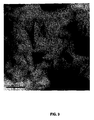
- Figure 2 is a transmission electron micrograph of the sample obtained In Example 17, in which the shadow stands for agglomerates composed of rubber particles and inorganic particles, which are dispersed in the plastic matrix, with the darker spots in the shadow being inorganic particles dispersed in agglomerated rubber particles.
- Figure 3 is a transmission electron micrograph of the sample obtained in Example 14, in which the circular shadow stands for butadiene-styrene-vinylpyridine rubber particles and the strip-shaped shadow stands for sodium-based montmorillonite, with the rubber particles and montmorillonite being uniformly dispersed in the polyamide matrix and at the same time, the sheet montmorillonite being completely exfoliated in the matrix.
- The composite powder according to the present invention comprises powdery rubber particles having a cross-linked structure and inorganic particles distributed between said rubber particles, wherein the weight ratio of said rubber particles to said inorganic particles is from 99.5 : 0.5 to 20 : 80, preferably from 99 : 1 to 50 : 50.
- In the composite powder according to the present invention, the inorganic particles are those commercially available in the prior art. There are no restrictions on the type of the inorganic particles as long as the size thereof falls within the scope of the present invention. However, the inorganic particles which are unstable when encountering water are excluded. The inorganic particles can be of any shape, such as spheres, ellipsoids; sheets, needles or irregular shapes. In the view of three-dimensional point, the individual particles have an average size of from 0.2 to 500nm, preferably from 0.5 to 100nm in at least one dimension.
- The inorganic particles used in the composite powder according to the present invention can be selected from elemental metals or alloys thereof, such as gold, silver, cupper, iron or alloys thereof; metal oxides, such as aluminum oxide(Al2O3), magnesium oxide(MgO), titanium dioxide(TiO2), iron sesquioxide(Fe2O3), ferroferric oxide(Fe3O4), silver oxide(Ag2O), zinc oxide(ZnO) and the like; metal or non-metal nitrides, such as aluminum nitride(AIN), silicon nitride(SiN4) and the like; non-metal carbides, such as silicon carbide(SIC) and the like; non-metal oxides, such as silicon dioxide(SiO2) and the like; metal hydroxides, such as aluminum hydroxide(Al(OH)3), magnesium hydroxide(Mg(OH)2) and the like; metal salts, including metal carbonates, silicates, sulfates and the like, such as calcium carbonate(CaCO3), barium sulfate(BaSO4), calcium sulfate(CaSO4), silver chloride(AgCl) and the like; mineral earths, such as asbestos, talc, kaolin, mica, feldspar, wollastonite, montmorillonite and the like; and the mixtures of two or more of them.
- The powdery rubber particles having a cross-linked structure used in the composite powder according to the present invention are those having a homogeneous structure, that is to say, Individual particles are homogeneous in their composition and no heterogeneous phenomena, such as demixing, phase separation or the like can be observed in the particles by current microscopic technologies. In addition, the powdery rubber particles have a gel content of 60 percent by weight or more, preferably 75 percent by weight or more, more preferably 80 percent by weight or more.
- The composite powder according, to the present invention can be prepared by the process for preparing fully vulcanized powdery rubbers disclosed in the International Patent Publication WO 01/40356A1 filed by the present applicants on September 18, 2000(its full text is incorporated herein by reference), except that the irradiated latex is admixed with a slurry of inorganic particles prior to drying.
- In addition,the composite powder according to the present invention can also be prepared by the process for preparing powdery cross-linked rubbers disclosed in Chinese Patent Application No. 00130386.4 filed by the present applicants on November 3, 2000(CN 1353131A, its full text is incorporated herein by reference), except that cross-linked rubber latexes are admixed with a slurry of inorganic particles prior to drying.
- The composite powder according to the present invention can optionally comprise water-soluble nucleating agents for plastics and if such agents are present, the amount thereof is such that the weight ratio of the rubber particles to the nucleating agent in the composite powder according to the present invention is from 99 : 1 to 5.0 : 50, preferably from 97 : 3 to 70 : 30. The nucleating agent can be those conventionally employed in the art, preferably sodium benzoate.
- The composite powder according to the present invention comprises agglomerates composed of powdery rubber particles and inorganic particles; with Inorganic particles being uniformly distributed either inside the agglomerats or both inside the agglomerates and on the surfaces thereof, wherein the rubber particles themselves have a gel content of 60 percent by weight or more, preferably 76 percent by weight or more, more preferably 80 percent by weight or more. In addition to the agglomerates composed of powdery rubber particles and inorganic particles, the composite powder according to the present invention may contain discrete inorganic particles. Especially when the content of the inorganic particles is high inorganic particles are apt to occur outside the agglomerates.
- The agglomerating state possessed by the composite powder according to the present invention can be retained in the composition obtained by melt-blending the composite powder with non-polar plastics(such as polypropylenes or polyethylenes). By subjecting the composition to microtoming and then observing under a transmission electron microscope, a photograph reflecting such an agglomerating state can be obtained (see Figure 1).
- The composite powder according to the present invention can be prepared by intimately mixing an irradiated or non-irradiated rubber latex with a slurry of inorganic particles in a ratio corresponding to that of rubber particles to inorganic particles in the composite powder according to the present invention, and then drying the resultant mixture.
- More particularly, the composite powder according to the present invention can be prepared by:
- a. intimately mixing a slurry of inorganic particles with a cross-linked synthetic rubber latex to obtain a mixed latex and then drying the mixed latex; or
- b. vulcanizing a rubber latex by high-energy irradiation in the absence or presence of a cross-linking agent, intimately mixing a slurry of inorganic particles with the irradiated rubber latex to obtain a mixed latex and then drying the mixed latex.
- In the process for preparing the composite powder according to the present invention, the slurry of inorganic particles is an aqueous suspension of inorganic particles and can be commercially available slurries. However, prior to mixing with rubber latexes, the commercially avaiable slurries are normally dispersed by means of a conventional dispersing equipment(such as a high-shear dispersing and emulsifying machine, colloidal mill and the like) so as to ensure that the solid particles in the slurries can be homogeneously dispersed in water. If the slurry of inorganic particles are not commercially available, they can be prepared by dispersing inorganic particles in a suitable amount of water by means of conventional dispersing equipments to form a stable suspension, which is then mixed with a rubber latex.
- In the process for preparing the composite powder according to the present invention, the inorganic particles are those commercially available in the art. There are no restrictions on the type of the inorganic particles as long as the size thereof falls within the scope of the present invention. However, the inorganic particles which are unstable when encountering water are excluded. The inorganic particles can be of any shape, such as spheres, ellipsoids, sheets, needles or irregular shapes. In the view of three-dimensional point, the individual particles has an average size of from 0.2 to 500nm, preferably from 0.5 to 100nm in at least one dimension.
- The inorganic particles used in the process according to the present Invention can be selected from elemental metals or alloys thereof, such as gold, silver, cupper, iron or alloys thereof: metal oxides, such as aluminum oxide(Al2O3), magnesium oxide(MgO), titanium dioxide(TiO2), iron sesquioxide(Fe2O3), ferroferric oxide(Fe3O4), silver oxide(Ag2O), zinc oxide(ZnO) and the like; metal or non-metal nitrides, such as aluminum nitride(AIN), silicon nitride(SiN4) and the like; non-metal carbides, such as silicon carbide(SiC) and the like; non-metal oxides, such as silicon dioxide(SiO2) and the like; metal hydroxides, such as aluminum hydroxide(Al(OH)3), magnesium hydroxide(Mg(OH)2) and the like; metal salts, including metal carbonates, silicates, sulfates and the like, such as calcium carbonate(CaCO3), barium sulfate(BaSO4), calcium sulfate(CaSO4), silver chloride(AgCl) and the like; mineral earths, such as asbestos, talc, kaolin, mica, feldspar, wollastonite, montmorillonite and the like; and the mixtures of two or more of them.
- In the process for preparing the composite powder according to the present invention, the ratio of the weight of the rubber contained in the rubber latex(i.e., dry weight or solid content of the rubber latex): to the weight of the inorganic particles contained in the slurry of inorganic particles (i.e., dry weight of the slurry of inorganic particles) is from 99.5 : 0.5 to 20 : 80, preferably from 99 : 1 to 50 : 50.
- In the process variant a or b. for preparing the composite powder according to the present invention, the mixed latex can be obtained by intimately mixing a slurry of inorganic particles, an aqueous solution of water-soluble nucleating agent for plastics and the irradiated rubber latex(in the process variant b.) or the cross-linked rubber latex(in the process variant a.). The ratio of the dry weight of the irradiated rubber latex or the cross-linked rubber latex to the weight of the nucleating agent contained in the aqueous nucleating agent solution is from 99 : 1 to 50 : 50. preferably from 97 : 3 to 70 : 30. The composite powder thus obtained can improve the tougheness of plastics and at the same time, promote the crystallization of crystalline plastics, which results in further improvement in the rigidity of plastics. In the process according to the present invention, there is no restriction on the water-soluble nucleating agent for plastics as long as it is water-soluble and promotes the nucleation of plastics. Sodium benzoate is preferably used.
- In the process for preparing the composite powder according to the present invention, it is possible to add the slurry of inorganic particles and optionally, an aqueous solution of water-soluble nucleating agent for plastics to the irradiated rubber latex or the cross-linked rubber latex while stirring so as to intimately mix them. There are no particular restrictions on the concentrations of the rubber latex, the slurry of inorganic particles and the aqueous nucleating agent solution. The drying can be carried out by using the drying method for preparing the fully vulcanized powdery rubber disclosed in the international Patent Publication WO 01/40356A1 and the International Patent Publication WO 01/98395(filed on June 15, 2001, claiming the benefit of the Chinese Patent Application No. 00109217.0 filed by the present applicants on June 15, 2000), that is to say, the drying can be carried out by means of a spray dryer, with the inlet temperature and the outlet temperature being controlled to be 100 to 200°C and 20 to 80°C, respectively. The rubbers contained the composite powders obtained by using the above process variants a, and b, has a gel content equal to that In the cross-linked synthetic rubber latex in process variant a and that in the irradiated rubber latex in process variant b., respectively.
- After a series of experiments, the present inventors found that some rubber latexes undergo a certain degree of cross-linking between the rubber molecules during their synthesis, which results in rubber latexes having a certain degree of cross-linking. Such rubber latexes are referred to as cross-linked rubber latexes. The Chinese Patent Application No. 00130386.4(CN 1353131A) filed by the present applicants on November 3, 2000 mentioned such a cross-linked synthetic rubber latex, which has a gel content of 80 percent by weight or more, preferably 85 percent by weight or more, Such a rubber latex is per se cross-linked to a higher degree, and thus can be directly spray dried to obtain powdery rubbers, without further irradiation cross-linwing. In the process variant a. for preparing the composite powder according to the present invention, such cross-linked synthetic rubber latexes are used as the starting materials. Cross-linked synthetic rubber latexes can be selected from the group consisting of cross-linked styrene-butadiene latex, cross-linked carboxylated styrene-butadiene latex, cross-linked polybutadiene latex, cross-linked acrylonitrile-butadiene latex, cross-linked carboxylated acrylonitrile-butadiene latex, cross-linked neoprene latex and cross-linked acrylic latex.
- In the process variant b, for preparing the composite powder according to the present Invention, there are no restrictions on the rubber latexes as the starting materials. For example, they can be rubber latexes, used for preparing the fully vulcanized powdery rubbers In the International Patent Publications WO 01/40356A1 and WO 01/98395, such as natural rubber latex, styrene-butadiene rubber latex, carboxylated styrene-butadiane rubber latex, acrylonitrile-butadiene rubber latex, carboxylated acrylonitrile-butadiene rubber latex, polybutadiene rubber latex, neoprene rubber latex, silicone rubber, latex, acrylic rubber latex, butadiene-styrene-vinylpyridine rubber latex, isoprene rubber latex, butyl rubber latex, ethylene-proptyene rubber latex, polysulfide rubber latex, acrylate-butadiene rubber latex, urethane rubber latex, fluorlns rubber latex and the like.
- The rubber latexes used in the process variant b. for preparing the composite powder according to the present invention can also include the cross-linked synthetic rubber latexes used in the process variant a., that is to say, the cross-linked synthetic rubber latexes can be used to prepare the composite powder according to the present invention without irradiation(as in the process variant a.) or with irradiation(as in the process variant b.), with the gel content of the rubber in the composite powder obtained by the process variant b. being higher than that by the process variant a.
- There are no particular restrictions on the solid content(i.e., dry weight) of the rubber latexes used in the above two process variants, which Is normally from 20 to 70 percent by weight, preferably from 30 to 60 percent by weight, more preferably from 40 to 50 percent by weight. The average particle size of the rubber particles in these rubber latexes is from 20 to 2000 nm, preferably from 30 to 1500 nm, more preferably from 50 to 500 nm. After irradiating the rubber latexes, the rubber particles contained therein acquire a relatively high gel content(60 percent by weight or more), or in the case of the cross-linked synthetic rubber latexes, the particle size of the rubber particles is fixed due to the high gel content, thus after co-spraying the rubber latex and the slurry of inorganic particles, the particle size of individual rubber particles is consistent with that of the rubber particles contained in the rubber latexes as the starting material, i.e., from 20 to 2000 nm, preferably from 30 to 1500 nm, more preferably from 50 to 500 nm, irrespective as of whether the rubber particles are in the form of agglomerates or in free state.
- In the process variant b. for preparing the composite powder according to the present invention, the conditions for irradiating rubber latexes, including cross-linking agents, irradiation doses, sources of high-energy irradiation and the like, are same as those in the process for preparing fully vulcanized powdery rubbers disclosed in the International Patent Publications WO 01/40358A1 and WO 01/98395. During the irradiation of rubber latexes, a cross-linking agent is optionally used. The cross-linking agent used can be selected from the group consisting of mono-, di-, tri-, tetra- or multi-functional cross-linking agents, and any combination thereof. Examples of monofunctional cross-linking agents include, but not limited to, octyl (meth)acrylate, Iso-octyl (meth)acrylate, glycidyl (meth)acrylate; examples of difunctional cross-linking agents include, but not limited to, 1,4-butanediol di(meth)acrylate, 1,6-hexanediol di(meth)acrylate, diethylene glycol di(meth)acrylate, triethylene glycol di(meth)acrylate, neopentyl glycol di(meth)acrylate, divinylbenzene; examples of trifunctional cross-linking agents include, but not limited to, trimethylolpropane tri(meth)acrylate, pentaerythritol tri(meth)acrylate; examples of tetrafunctional cross-linking agents include, but not limited to pentaerythritol tetra(meth)acrylate, ethoxylated pentaerythritol tetra(meth)acrylate; examples of multi-functional cross-linking agents Include, but: not limited to dipentaerythritol penta(meth)acrylate. In the context of the present application, the term "(meth)acrylate" means acrylate or methacrylate. These cross-linking agents can be used alone or In any combination, as long as they facilitate the vulcanization under irradiation.
- The amount of the cross-linking agent added varies depending on the type and formulation of the rubber latexes, arid is generally from 0.1 to 10 percent by weight, preferably from 0.5 to 9 percent by weight, more preferably from 0.7 to 7 percent by weight, based on the dry weight of the latexes.
- In the process variant b. for preparing the composite powder according to the present invention, the high-energy irradiation which can be used is selected from the group consisting of cobalt sources(such as Co-50), UV ray sources and high-energy electron accelerators, prefereby cobalt sources. The irradiation dose can be from 0.1 to 30 Mrad, preferably from 0.5 to 20 Mrad. The irradiation dose depends on the type and formulation of the rubber latexes. Generally, the irradiation dose Is such that the rubber latexes after vulcanization under irradiation have a gel content of 60 percent by weight or more, preferably 75 percent by weight, more preferably 80 percent by weight or more.
- The composite powder according to the present invention, prepared by co-spraying the rubber latexes, the slurry of inorganic particles and the like, comprises agglomerates composed of powdery rubber particles and inorganic particles, with inorganic particles being uniformly distributed either inside the agglomerats or both inside the agglomerates and on the surfaces thereof, wherein the rubber particles themselves have a gel content of 60 percent by weight or more, preferably 75 percent by weight or more, more preferably 80 percent by weight or more. In addition to the agglomerates composed of powdery rubber particles and inorganic parties, the composite powder according to the present invention may contain discrete inorganic particles. Especially when the content of the inorganic particles is high, inorganic particles are apt to occur outside the agglomerates.
- The agglomerating state possessed by the composite powder according to the present invention can be retained in the composition obtained by melt-blending the composite powder with non-polar plastics (such as polypropylenes or polyethylenes). By subjecting the composition to microtoming and then observing under a transmission electron microscope, a photograph reflecting such an agglomerating state can be obtained (see Figure 1).
- The composite powder according to the present invention can be dispersed in plastic matrixes by conventional blending processes, wherein the rubber particles facilitate the uniform dispersion of inorganic particles in the matrix and thus the agglomeration of inorganic particles is substantial avoided. In non-polar rensin matrixes(such as polypropylene or polyethylene), inorganic particles are uniformly distributed in the agglomerates composed of inorganic particles and rubber particles, which results in a good modification effect. In the case of resin matrixes which chemically react with the rubber particles in the interface or have a large interaction with the rubber particles in the interface, the rubber particles contained in the composite powder according to the present invention can be dispersed in the resin matrixes in the form of individual particles after melt-blending, and due to the fact that the inorganic particles contained in the composite powder are uniformly dispersed between the rubber particles, the ideal dispersion of the rubber particles in the resin facilitates the dispersion of inorganic particles. For example, in the case of layered inorganic particles like montmorillonite, by preparing a composite powder comprising montmorillonite particles and rubber particles, montmorillonite can be dispersed in polar resin matrixes like nylons in an exfoliated state by the action of rubber particles (as shown in Fig. 3), without the complicated organo-modification.
- The process for preparing the composite powder according to the present Invention is simple, convenient and easy to carry out, When the composite powder according to the present invention Is used for toughening plastics, a better toughening effect can be achieved, compared to using rubber elastic particles alone, and meanwhile, the negative effects on rigidity and heat resistance of resins caused by the introduction of elastic particles are reduced. Furthermore, the composite powder according to the present invention can be advantageously used for the preparation of thermoplastic elastomers,
- The composite powder according to the present invention can be dispersed in plastics very easily, thus can be mixed with various plastics to prepare a number of toughened plastics and thermoplastic elastomers. The preparation of toughened plastics or thermoplastic elastomers can be carried out by simply mixing the composite powder according to the present invention and plastics in a certain proportion in conventional blending equipments under conventional processing conditions, if necessary, in the presence of conventional processing aids and compatilizers.
- In the preparation of toughened plastics, the weight ratio of the composite powder according to the present invention to plastics is from 0.5 : 99.5 to 50 : 50, preferably from 1 : 99 to 30 : 70. The plastics to be toughened can be nylons, polypropylenes, polyethylenes, polyvinyl chloride, polyurethanes, polyesters, polycarbonates, polyoxymethylene, polystyrene, , polyphenylene oxide(PPO), polyphenylene sulfide(PPS), polyimides, polysulfones, epoxy resins, unsaturated polyesters, phenolic resins, amino resins, alkyd resins, diallyl phthalate resins, silicone resins or blends or mixtures thereof.
- In the preparation of thermoplastic elastomers, the weight ratio of the composite powder according to the present invention to plastics is from 30 : 70 to 75 : 25, preferably from 50 : 50 to 70 : 30. The plastics which can be used are nylons, polypropylenes, polyethylenes, polyvinyl chloride, polyurethanes, polyesters, polycarbonates, polyoxymethylene, polystyrene, polyphenylene oxide(PPO), polyphenylene sulfide(PPS), polyimides, polysulfones, epoxy resins, unsaturated polyesters, phenolic resins, amino resins, alkyd resins, diallyl phthalate resins, silicone resins or blends or mixtures thereof.
- The present invention is further described with reference to the following examples, which shall not be construed as limiting the present Invention In any way. The scope of the present invention will be defined in the appended claims.
- The composite powder, propylene homopolymer powder or pellets(melt index: <5g/10min) and an antioxidant(Irganox 1010, Ciba-Geigy) are compounded at a weight ratio of the composite powder : polypropylene : 1010 of 100 : 10 : 0.5 in a high speed stirrer for 1 minute. The blending and pelleting are carried out in a ZSK-25 twin-screw extruder(Wemer & Pfleiderer Co., Germany), with the temperatures for each section of the extruder being respectively 165°C, 180°C, 195°C, 195°C, 195°C and 195°C (die temperature). The extruded strips are subjected to microtoming under -100°C, staining with O5O4 and then observing under a transmission electron microscope.
- 5kg of carboxylated butadiene-styrene rubber latex having a solid content of 50 percent by weight(avallable from Beijing Yanshan Petrochemical Company, Brand: XSBRL-54B1, average particle size of the rubber particles in latex: 150 nm) Is placed in a vessel, 75g of iso-octyl acrylate is added dropwise while stirring, and the stirring is continued for 1 hour after the completion of addition. Thereafter, the rubber latex is Irradiated with Co-60, with the irradiation dose being 2.5Mrad and the irradiation dose rate being 50Gy/min. The rubber particles in the irradiated latex have a gel content of 92.6%. A slurry of calcium carbonate(Fine Chemical Factory of Beijing University of Chemical Technology, solid content: 47.3%, average size in one dimension of the particles: 40 to 60nm) is compounded with the irradiated latex at a weight ratio of 50 : 50(on dry basis) while stirring for 1 hour. The mixed latex is spray dried by means of a spray dryer, with the inlet temperature and the outlet temperature being 140 to 160°C and 40 to 60°C, respectively. A dried carboxylated butadiene-styrene rubber/calcium carbonate composite powder 1 is then collected in a cyclone.
- 500kg of calcium carbonate powders(Fine Chemical Factory of Beijing University of Chemical Technology, average size in one dimension of the particles: 40 to 60nm) are mixed with 1 kg water in a vessel, the resultant mixture is then dispersed by means of a high-shear dispersing and emulsifying machine to obtain a suspension, which is then compounded with the irradiated carboxylated butadiene-styrene rubber latex(prepared as in Example 1) at a weight ratio of 50 : 50(on dry basis) while stirring for 1 hour. The mixed latex is spray dried by means of a spray dryer, with the inlet temperature and, the outlet temperature being 140 to 160°C and 40 to 60°C, respectively. A dried carboxylated butadiene-styrene rubber/calcium carbonate composite powder 2 is then collected in a cyclone.
- 5kg of butadiene-styrene rubber latex having a solid content of 45 percent by weight(available from Lanzhou Petrochemical Company, Brand: DINGBEN-50, gel content: 88.9% average particle size of the rubber particles in latex: 100 nm) is placed in a vessel, 67.5g of iso-octyl acrylate is added dropwise while stirring, and the stirring is continued for 1 hour after the completion of addition. Thereafter, the rubber latex is irradiated with Co-60, with the irradiation dose being 2.5Mrad and the irradiation dose rate being 50Gy/min. The rubber particles in the irradiated latex have a gel content of 90.0%. A slurry of calcium carbonate(as in Example 1) is compounded with the irradiated latex at a weight ratio of 90 : 10(on dry basis) while stirring for 1 hour. The mixed latex Is spray dried by means of a spray dryer, with the inlet temperature and the outlet temperature being 140 to 160°C and 40 to 60°C, respectively. A dried butadiene-styrene rubber/calcium carbonate composite powder 1 is then collected in a cyclone.
- The procedure same as in Example 3 is followed, except that the butadiene-styrene rubber latex, without irradiation, is directly compounded with the slurry of calcium carbonate at a weight ratio of 80 : 20(on dry basis) while stirring for 1 hour. The mixed latex is spray dried by means of a spray dryer, with the inlet temperature and the outlet temperature being 140 to 160°C and 40 to 60°C, respectively. A dried butadiene-styrene rubber/calcium carbonate composite powder 2 is then collected in a cyclone.
- The procedure same as in Example 3 is followed, except that the butadiene-styrene rubber latex, without irradiation, is directly compounded with the slurry of calcium carbonate and an aqueous solution of sodium benzoate(available from Wuhan Youjishiye Corporation) at a weight ratio of 80 : 20: 10 (on dry basis) while stirring for 1 hour. The mixed latex is spray dried by means of a spray dryer, with the inlet temperature and the outlet temperature being 140 to 160°C and 40 to 60°C, respectively. A dried butadiene-styrene rubber/calcium carbonate composite powder containing the nucleating agent is then collected in a cyclone.
- Sodium-based montmorillonite(available from Qinghe Factory, Zhangliakou, Hebel, the particles can be dispersed as flakes of 1 to 20nm thick and 200 to 1000nm long) is mixed with water In a concentration of 5 percent by weight, dispersed by means of a high-shear disperser and then placed for more than one week. After that period, the mixture is dispersed again by means of a high-shear disperser to obtain a stable suspension, with the layers of sheet montmorillointe being sufficiently exfollated. The irradiated butadiene-styrene rubber latex(prepared as in Example 3) is compounded with the above slurry of montmorillonite at a weight ratio of 90 : 10(on dry basis) while stirring for 1 hour. The mixed latex is spray dried by means of a spray dryer, with the inlet temperature and the outlet temperature being 140 to 160°C and 40 to 60°C, respectively. A dried butadiene-etyrene rubber/montmorillonite composite powder 1 is then collected in a cyclone.
- The procedure same as in Example 6 is followed, except that the weight ratio of the irradiated butadiene-styrene rubber latex to the sluny of sodium-based montmorillonite is changed to 99 : 1 (on dry basia), with a dried butadiene-styrene rubber/ montmorillonite composite powder 2 being obtained.
- Silicon dioxide powders(avarable from Shenyang Chemical Corporation, average size in one dimension of its particles: 7 to 30 nm) are mixed with water In a concentration of 5 percent by weight and then dispersed by means of a high-shear disperser to obtain a stable suspension. 5kg of carboxylated acrylonitrile-butadiene rubber latex having a solid content of 45 percent by welght(available from Lanzhou Petrochemical Company, Brand: XNBRL, average particle size of the rubber particles in latex: 50 nm) is placed in a vessel, 67.5g of iso-octyl acrylate is added dropwise while stirring, and the stirring is continued for 1 hour after the completion of addition. Thereafter, the rubber latex is irradiated with Co-60, with the irradiation dose being 2.5Mrad and the irradiation dose rate being 50Gy/min. The rubber particles in the irradiated latex have a gel content of 96.1 %. The irradiated acrylonitrile-butadiene rubber latex is compounded with the above slurry of silicon dioxide at a weight ratio of 90 : 10(on dry basis) while stirring for 1 hour. The mixed latex is spray dried by means of a spray dryer, with the inlet temperature and the outlet temperature being 140 to 160°C and 40 to 60°C, respectively. A dried carboxylated acrylonitrile-butadiene rubber/silicon dioxide composite powder is then collected in a cyclone.
- The procedure same as in Example 8 is followed, except that the slurry of silicon dioxide is replaced by the slurry of calcium carbonate(as in Example 1), with a dried carboxylated acrylonitrile/calcium carbonate composite powder being obtained.
- Titanium dioxide powders(available from Beijing University of Chemical Technology, average size in one dimension of its particles: 40 to 60 nm) are mixed with water in a concentration of 20 percent by weight and then dispersed by means of a high-shear disperser to obtain a stable suspension. The irradiated butadiene-styrene rubber latex(prepared as in Example 3) is compounded with the above slurry of titanium dioxide at a weight ratio of 95 : 5(on dry basis) while stirring for 1 hour. The mixed latex is spray dried by means of a spray dryer, with the inlet temperature and the outlet temperature being 140 to 160°C and 40 to 60°C, respectively. A dried butadiene-styrene rubber/titanium dioxide composite powder is then collected in a cyclone.
- Magnesium hydroxide powders(avallable from Beijing University of Chemical Technology, average size in one dimension of Its particles: 20 to 40 nm) is mixed with water in a concentration of 20 percent by weight and then dispersed by means of a high-shear disperser to obtain a stable suspension. 5kg of acrylonitrile-butadiene rubber latex having a solid content of 45 percent by weight (available from the Latex Reseach Center, Lanzhou Petrochemical Company, Brand: DINGJING-26, average particle size of the rubber particles in latex: 100 nm) is placed in a vessel, 112.5g of trimethylolpropane triacrylate is added dropwise while stirring, and the stirring is continued for 1 hour after the completion of addition. Thereafter, the rubber.latex is irradiated with Co-60, with the irradiation dose being 1.0Mrad and the Irradiation dose rate being 50Gy/min. The rubber particles in the irradiated latex have a gel content of 90.0%. The irradiated acrylonitrile-butadiene rubber latex is compounded with the above slurry of magnesium hydroxide at a weight ratio of 40 : 60 (on dry basis) while stirring for 1 hour. The mixed latex Is spray dried by means of a spray dryer, with the inlet temperature and the outlet temperature being 140 to 160°C and 40 to 60°C, respectively. A dried acrylonitrile-butadiene rubber/magnesium hydroxide composite powder is then collected in a cyclone.
- 5kg of butadiene-styrene-vinylpyridine rubber latex having a solid content of 40 percent by weight(available from Changzhihai Latex Company, Clxi, Zhejiang. Brand: 55555, average particle size of the rubber particles in latex: 100 nm) is placed in a vessel, 100g of trimethylolpropane triacrylate is added dropwise while stirring, and the stirring is continued for 1 hour after the completion of addition. Thereafter, the rubber latex is irradiated with Co-60, with the irradiation dose being 2.5Mrad and the irradiation dose rate being 50Gy/min. The rubber particles In the irradiated latex have a gel content of 87.0%. The irradiated rubber latex Is compounded with the slurry of montmorillonite(prepared as in Example 6) at a weight ratio of 95 : 5(on dry basis) while stirring for 1 hour. The mixed latex is spray dried by means of a spray dryer, with the inlet temperature and the outlet temperature being 140 to 160°C and 40 to 60°C, respectively. A dried butadiene-styrene-vinylpyridine rubber/montmorillonite composite powder is then collected in a cyclone.
- 50g of metallic silver powders (Zhengyuan Nanomaterial Engineering Company, Shangdong, average size: 20 to 80nm) are mixed with 1kg water in a vessel and then dispersed in a high-shear dispersing and emulsifying machine to obtain a suspension. The resultant suspension is compounded with the irradiated carboxylated butadiene-styrene rubber latex(prepared as In Example 1) at a weight ratio of 1 : 99(on dry basis) while stirring for 1 hour. The mixed latex Is spray dried by means of a spray dryer, with the inlet temperature and the outlet temperature being 140 to 160°C and 40 to 60°C, respectively. A dried carboxylated butadiene-styrene rubber/metallic silver composite powder is then collected in a cyclone.
- The butadiene-styrene-vinylpyridine rubber/montmorillointe composite powder prepared as in Example 12 is compounded with Nylon 6(available from UBE, Japan, Brand: 1013B) and antioxidant Irganox 1010(available, from Ciba-Geigy, Switzerland) at a weight ratio of Nylon 6: the composite powder : 1010 of 100 : 15 : 0.3. The blending and pelleting are carried out In a ZSK-25 twin-screw extruder(Werner & Pfleiderer:Co., Germany), with the temperatures for each section of the extruder being respectively 220°C, 235°C, 235°C, 235°C, 235°C and 235°C(die temperature). The extruded pellets are injection-molded into standard test bars and then subjected to various tests of mechanical properties. The results are listed in Table 1. Figure 3 is the micrograph of the sample.
- The nylon pellets as in Example 14 are compounded with a powdery butadiene-styrene-vinylpyridine rubber(obtained by directly spray drying the irradiated butadiene-styrene-vinylpyridine rubber latex as in Example 12, without mixing the slurry of montmorillonite) and antioxidant Irganox 1010 at a weight ratio of nylon : powdery butadiene-styrene-vinylpyridine rubber : 1010 of 100 : 15 : 0.3. Standard test bars are obtained by extruding and injection-molding as In Example 14 and then subjected to various tests of mechanical properties. The results are listed in Table 1.
- The procedure as in Example 14 is followed, except that no composite powder is used. Standard test bars are obtained by extruding and injection-molding as in Example 14 and then subjected to various tests of mechanical properties. The results are listed in Table 1.
- The butadiene-styrene rubber/calcium carbonate composite powder containing a nucleating agent prepared as in Example 5 is compounded with polypropylene pellets(available from Luoyang Petrochemical Company, Brand: B-200, melt index: 0.35g/10min) and antioxidant Irganox 1010(available from Ciba-Geigy, Switzerland) at a weight ratio of polypropylene : the composite powder of 100 : 10, with the amount of the antioxidant being 0.25 part by weight per 100 parts by weight of the total weight of polypropylene and the composite powder, the resultant mixture is mixed for 1 minute in a high speed stirrer. The blending and pelleting are carried out in a ZSK-25 twin-screw extruder(Werner & Pfleiderer Co., Germany), with the temperatures for each section of the extruder being respectively 165°C, 190°C, 195°C, 195°C, 195°C and 195°C(die temperature). The extruded pellets are injection-molded into standard test bars and then subjected to various tests of mechanical properties. The results are listed in Table 1. Figure 1 is the micrograph of the sample.
- The procedure as in Example 15 is followed, except that no composite powder is used and that polypropylene is compounded with the antioxidant at a weight ratio of 100 : 0.25. The extruded pellets are injection-molded into standard test bars and then subjected to various tests of mechanical properties. The results are listed in Table 1.
- The procedure as In Example 15 Is followed, except that the butadiene-styrene rubber/calcium carbonate composite powder containing a nucleating agent is replaced by a powdery butadiene-styrene rubber containing sodium benzoate(prepared by adding 45g of sodium benzoate to 1 kg of the butadiene-styrene rubber latex as in Example 3 while stirring, continuing the stirring for 1 hour, spray drying the resultant mixed latex by means of a spray dryer, with the inlet temperature and the outlet temperature being 125 to 145°C and 45 to 60°C, respectively, and then collecting the dried butadiene-styrene rubber/sodium benzoate composite powder in a cyclone, the weight ratio of the butadiene-styrene rubber to sodium benzoate in the powder: 100 : 10). The extruded pellets are injection-molded into standard test bars and then subjected to various tests of mechanical properties, The results are listed in Table 1.
Table 1 No. Tensile strength (MPa) Elongation at break (%) Izod notched impact strength (J/m)23°C Iod notched impact strength (J/m)-20°C Flexural strength (MPa) Flexural modulus (GPa) Heat distortion temperature (°C) 18MPa Ex. 14 60.8 25 118 90.1 85.7 2.01 69.2 Comp. Ex. 1 56.2 40 107 61.5 79.8 1.83 66.5 Comp. Ex. 2 82.4 16 34.4 29.8 111 2.41 67.4 Ex. 15 34.6 120 221 315 36.0 1.57 116.4 Comp. Ex 3 36.5 145 64.4 262 36.2 1.54 106.8 Comp. Ex.4 33.9 119 186 - 35.9 1.53 116.0 Testing Standard GB 1040 GB 1040 GB 1843 GB 1843 GB 9341 GB 9341 GB 1634 - Polypropylene(Daging Huake Corporation, propylene homopolymer pellets melt index: 0.4g/10min) is intimately mixed with the butadiene-styrene rubber/calcium carbonate composite powder 2 prepared as in Example 4 at a weight ratio of 50 : 50 in a high speed mixer. The blending and pelleting are carried out in a ZSK-25 twin-screw extruder(Werner & Pfleiderer Co., Germany), with the temperatures for each section of the extruder being respectively 170°C, 190°C, 200°C, 210°C, 220°C and 210°C (die temperature). The extruded pellets of the fully vulcanized thermoplastic elastomer are injection-molded Into standard test bars and then subjected to various tests of mechanical properties. The results are listed in Table 2.
- The procedure as in Example 16 is followed, except that the butadiene-styrene rubber/calcium carbonate composite powder 2 is replaced by a powdery butadiene-styrene rubber(obtained by directly spray drying the irradiated butadiene-styrene rubber latex as in Example 3, without mixing the slurry of calcium carbonate).The extruded pellets of the fully vulcanized thermoplastic elastomer are injection-molded into standard test bars and then subjected to various tests of mechanical properties. The results are listed In Table 2.
Table 2 Sample Shore hardness(HD) Tensile strength at break(MPa) Permanent compression deformation(22hrs, 23°C), % Comp. Ex. 5 49 16.4 15.8 Ex.16 48 19.6 16.0 - 28.8g of epoxy resin prepolymer(Wuxi Resin Factory. Brand: E-44), 51.84g of Premix 1 (prepared as follows) and 54g of methyl-tetrahydrophthalic anhydride(Oriental Chemical Factory, Jiaxing, Zhejlang) are weighted into a three-necked flask, heated by a thermostatic water bath at 90°C and then mixed while stirring for 30 minutes. To the resultant mixture is added 0.36g of triethanolamine(analytic pure, available from Beijing Yili Fine Chemicals), and the mixture is evacuated while stirring for 5 minutes and then is cast to a polytetrafluoroethylene mold preheated to 130°C. The mixture is precured at 130°C for 1 hour, cooled for mold release and then is postcured at 110°C for 16 hours, thereby obtaining a cured product, which is then cut to pieces for determination of various properties. The results are listed in table 3. Figure 2 Is the micrograph of the sample.
- 20 parts by weight of the carboxylated acrylonitrile-butadiene rubber/calcium carbonate composite powder(prepared as follows) are mixed with 100 parts by weight of epoxy resin prepolymer(same as above) and the resultant mixture is milled three times by means of a three-roll mill, thereby obtaining Premix 1. Preparation of the carboxylated acrylonitrile-butadiene rubber/calcium carbonate composite powder:
- The irradiated carboxylated acrylonitrile-butadiene rubber latex(prepared by irradiating the carboxylated acrylonitrile-butadiene rubber latex as in Example 8 in an irradiation dose of 1Mrad in the presence of 5 percent by weight of trimethylolpropane triacrylate, based on the dry weight of the carboxylated acrylonitrile-butadiene rubber latex, with the gel content of rubber particles In the irradiated latex being 90.0%) is compounded with a suspension of nano-calcium carbonate(prepared by dispersing 100 parts by weight of nano-calcium carbonate cake(available from Beijing Nanuotaike Nanotech Company, Brand: 113-SH, solid content: 50 percent by weight, average size in one dimension of its particles: 40 to 60nm) in 400 parts by weight of water in a high-shear dispersing and emulsifying machine) at a weight ratio of 80 : 20 (on dry weight), while stirring. The mixed latex is then spray dried to obtain the carboxylated acrylonitrile-butadiene rubber/calcium carbonate composite powder, with the inlet temperature and outlet temperature being 140 to 160°C and 40 to 60°C, respectively.
- 72g of epoxy resin prepolymer (as in Example 17) and 54g of methyl-tetrahydrophthalic anhydride(as in Example 17) are weighted into a three-necked flask, heated by a thermostatic water bath at 90°C and then mixed while stirring for 30 minutes. To the resultant mixture is added 0.36g of triethanolamine(as in Example 17), and the mixture is evacuated while stirring for 5 minutes and then is cast to a polytetrafluoroethylene mold preheated to 130°C, The mixture is precured at 130°C for 1 hour, cooled for mold release and then is postcured at 110°C for 16 hours, thereby obtaining a cured product, which is then cut to pieces for determination of various properties. The results are listed in table 3.
- The procedure as in Example 17 is followed, except that Premix 1 Is replaced by Premix 2(prepared as follows). Various properties are determined and the results are listed in table 3.
- The irradiated carboxylated acrylonitrile-butadiene rubber latex(prepared by irradiating the carboxylated acrylonitrile-butadiene rubber latex as in Example 8 in an Irradiation dose of 1Mrad in the presence of 5 percent by weight of trimethylolpropane triacrylate, based on the dry weight of the carboxylated acrylonitrile-butadiene rubber latex) is spray dried to obtain the powdery carboxylated acrylonitrile-butadiene rubber having a gel content of 90.0% and an average particle size of 90 nm, with the inlet temperature and outlet temperature being 140 to 160°C and 40 to 60°C, respectively, 20 parts by weight of the powdery carboxylated acrylonitrile-butadiene rubber are mixed with 100 parts by weight of epoxy resin prepolymer(as in Example 17) and the resultant mixture is milled three times by means of a three-roll mill, thereby obtaining Premix 2.
- The procedure as in Example 17 is followed, except that the amount of the epoxy resin prepolymer(as in Example 17) is changed into 50.4g, Premix 1 is replaced by 30.24g of Premix 3(prepared as follows). Various properties are determined and the results are listed In table 3.
- 40 parts by weight of nano-calcium carbonate(Fine Chemical Factory of Beijing University of Chemical Technology, average size in one dimension of its particles: 40 to 60 nm) are mixed with 100 parts by weight of epoxy resin prepolymer(as in Example 17) and the resultant mixture is milled three times by means of a three-roll mill, thereby obtaining Premix 3.
- The procedure as in Example 17 is followed, except that 33.12g of the epoxy resin prepolymer(as in Example 17), 41.5g of Premix 2(as in Comparative Example 7) and 6.02g of Premix 3(as in Comparative Example 8) are mixed. Various properties are determined and the results are listed in table 3.
Table 3 Weight ratio of toughener: resin Impact strength (kl/m2) Flexural strength (MPa) Flexural modulus (GPa) Heat distortion temerpature (°C) Tg(°C) Ex. 17 12:100 28.2 97.7 2.73 104.7 111.7 (DSC) Comp. 0:100 11.8 104 3.13 101.3 105.8 (DSC) Ex. 7 12:100 21.4 94.5 2.56 104.9 113.1(DSC) Comp. EX.8 12:100 11.6 87.1 3.32 101.8 107.7 (DSC) Comp. Ex. 9 12:100 20.1 91.9 2.71 102.9 111.2 (DSC)
Claims (22)
- A composite powder, comprising powdery rubber particles having a cross-linked structure and inorganic partides distributed between said rubber particles.
- The composite powder according to claim 1, wherein said inorganic : particles have an average size of 0.2 to 500 nm in at least one dimension and are selected from elemental metals or alloys thereof; metal oxides; metal or non-metal nitrides; non-metal carbides; non-metal oxides; metal hydroxides; metal salts: mineral earths; and the mixtures of two or more of them; and the weight ratio of the powdery rubber particles to the inorganic particles is from 99.5 : 0.5 to 20 : 80.
- The composite powder according to claim 2, wherein the weight ratio of the powdery rubber particles to the inorganic particles is from 99 ; 1 to 50 : 50.
- The composite powder according to claim 2, wherein said inorganic particles have an average size of 0.5 to 100 nm in at least one dimension.
- The composite powder according to claim 1, wherein said inorganic particles are selected from gold, silver, cupper, iron, gold alloys, silver alloys, cupper alloys, iron alloys, aluminum oxide, magnesium oxide, titanium dioxide, iron sesquioxide, ferroferric oxide, silver oxide, zinc oxide, aluminum nitride, silicon nitride, silicon carbide, silicon dioxide, aluminum hydroxide, magnesium hydroxide, calcium carbonate, barium sulfate, calcium sulfate, silver chloride, asbestos, talc, kaolin, mica, feldspar, wollastonite, montmorillonite, and the mixtures of two or more of them.
- The composite powder according to claim 1, wherein said powdery rubber particles have a gel content of 60 percent by weight or more.
- The composite powder according to claim 1, comprising agglomerates composed of powdery rubber particles and inorganic particles, with inorganic particles being uniformly distributed elther inside the agglomerates or both inside the agglomerates and on the surfaces thereof, wherein the rubber particles themselves have a gel content of 60 percent by weight or more.
- The composite powder according to claim 1, wherein said rubber particles have a gel content of 75 percent by weight or more.
- A process for preparing the composite powder according to claim 1, comprising:a. intimately mixing a slurry of inorganic particles with a cross-linked synthetic rubber latex to obtain a mixed latex and then drying the mixed latex; orb. vulcanizing a rubber latex by high-energy irradiation in the absence or presence of a cross-linking agent, intimately mixing a slurry of inorganic particles with the irradiated rubber latex to obtain a mixed latex and then drying the mixed latex.
- The process according to claim 9, wherein the slurry of inorganic particles is an aqueous suspension of inorganic particles.
- The process according to claim 9, wherein said inorganic particles have an average size of 0.2 to 500 nm in at least one dimension and are selected from elemental metals or alloys thereof; metal oxides; metal or non-metal nitrides; non-metal carbides; non-metal oxides; metal hydroxides; metal salts; mineral earths; and the mixtures of two or more of them; and the weight ratio of the powdery rubber particles contained in said rubber latex to the inorganic particles contained in said slurry is from 99.6 ; 0.5 to 20 : 80.
- The process according to claim 11, wherein the weight ratio of the powdery rubber particles contained in said rubber latex to the inorganic particles contained in said slurry is from 99 : 1 to 50 : 50.
- The process according to claim 9, wherein during the preparation of said mixed latex, an aqueous solution of water-soluble nucleating agents for plastics is added in a weight ratio of the rubber particles contained In said latex to the nucleating agent contained in said aqueous solution of 99 ; 1 to 50 : 50.
- The process according to claim 13, wherein said nucleating agent is sodium benzoate.
- The process according to claim 13, wherein the weight ratio of the rubber particles contained in said latex to the nucleating agent contained in said aqueous solution of 97 : 3 to 70: 30.
- The process according to claim 11, wherein said inorganic particles have an average size of 0.5 to 100 nm in at least one dimension.
- The process according to claim 11, wherein said inorganic particles are selected from gold, silver, cupper, iron, gold alloys, silver alloys, cupper alloys, iron alloys, aluminum oxide, magnesium oxide, titanium dioxide, iron sesquioxide, ferroferric oxide, silver oxide, zinc oxide, aluminum nitride, silicon nitride, silicon carbide, silicon dioxide, aluminum hydroxide, magnesium hydroxide, calcium carbonate, barium sulfate, calcium sulfate, silver chloride, asbestos, talc, kaolin, mica, feldspar, wollastonite, montmorillonite, and the mixtures of two or more of them.
- The process according to claim 9, wherein said cross-linked synthetic rubber latexes used in a. have a gel content of 80 percent by weight or more.
- The process according to claim 9, wherein said cross-linked synthetic rubber latexes used in a, are selected from the group consisting of cross-linked styrene-butadiene latex, cross-linked carboxylated styrene-butadiene latex, cross-linked polybutadiene latex, cross-linked acrylonitrile-butadiene latex, cross-linked carboxylated acrylonitrile-butadiene latex, cross-linked neoprene latex and cross-linked acrylic latex.
- The process according to claim 9, wherein said rubber latexes used in b. are selected from the group consisting of natural rubber latex, styrene-butadiene rubber latex, carboxylated styrene-butediene rubber latex, acrylonitrile-butadiene rubber latex, carboxylated acrylonitrile-butadiene rubber latex, polybutadiene rubber latex, neoprene rubber latex, silicone rubber latex, acrylic rubber latex, butadiene-styrene-vinylpyridine rubber latex, isoprene rubber latex, butyl rubber latex, ethylene-proplyene rubber latex, polysulfide rubber latex, acrylate-butadiene rubber latex, urethane rubber latex and fluorine rubber latex.
- A composition useful for preparing toughened plastics or thermoplastic elastomers, comprising plastics and the composite powder according to any of claims 1 to 8.
- Use of the composite powder according to any of claims 1 to 8 in the preparation of toughened plastics or thermoplastic elastomers.
Applications Claiming Priority (2)
| Application Number | Priority Date | Filing Date | Title |
|---|---|---|---|
| CNB031091083A CN1239587C (en) | 2003-04-03 | 2003-04-03 | Composite powder, its preparation method and application |
| PCT/CN2004/000309 WO2004087794A1 (en) | 2003-04-03 | 2004-04-05 | Compound powder, its preparation method and use |
Publications (3)
| Publication Number | Publication Date |
|---|---|
| EP1621571A1 true EP1621571A1 (en) | 2006-02-01 |
| EP1621571A4 EP1621571A4 (en) | 2006-11-08 |
| EP1621571B1 EP1621571B1 (en) | 2016-03-16 |
Family
ID=33102893
Family Applications (1)
| Application Number | Title | Priority Date | Filing Date |
|---|---|---|---|
| EP04725660.7A Expired - Lifetime EP1621571B1 (en) | 2003-04-03 | 2004-04-05 | Compound powder, its preparation method and use |
Country Status (6)
| Country | Link |
|---|---|
| US (2) | US8362128B2 (en) |
| EP (1) | EP1621571B1 (en) |
| JP (1) | JP4989216B2 (en) |
| CN (2) | CN1239587C (en) |
| ES (1) | ES2576577T3 (en) |
| WO (1) | WO2004087794A1 (en) |
Cited By (9)
| Publication number | Priority date | Publication date | Assignee | Title |
|---|---|---|---|---|
| WO2008025530A1 (en) * | 2006-09-01 | 2008-03-06 | Center For Abrasives And Refractories Research & Development C.A.R.R.D. Gmbh | Method for introducing hard materials into a tyre running tread |
| WO2009098305A3 (en) * | 2008-02-08 | 2009-12-23 | Ems-Patent Ag | Hydrolysis-resistant polyamide-elastomer mixtures, molded parts produced therefrom and use thereof |
| WO2010022041A1 (en) * | 2008-08-18 | 2010-02-25 | Dow Global Technologies Inc. | Process for forming and devolatilizing brominated polybutadiene polymer particles |
| EP1985656A3 (en) * | 2007-04-27 | 2010-08-11 | Continental Reifen Deutschland GmbH | Natural rubber mixture with improved rebound elasticity |
| EP1648959B1 (en) * | 2003-07-30 | 2010-11-24 | PolyOne Corporation | Nucleated thermoplastic elastomer compositions and related methods |
| CN102827408A (en) * | 2012-07-05 | 2012-12-19 | 安徽邦尼新材料有限公司 | Polyolefin reinforcing and toughening master batch and production method thereof |
| DE102011054628A1 (en) * | 2011-10-20 | 2013-04-25 | Minervius Gmbh | Process for the preparation of nanocomposites from inorganic nanoparticles and polymers |
| EP2772513A4 (en) * | 2011-10-26 | 2015-09-02 | China Petroleum & Chemical | MODIFIED MASKING RUBBER MIXTURE, RUBBER COMPOSITION PREPARED THEREWITH, AND VULCANIZED RUBBER AND METHOD FOR PREPARING THE SAME |
| EP2772512A4 (en) * | 2011-10-26 | 2015-09-16 | China Petroleum & Chemical | RUBBER COMPOSITION AND PREPARATION METHOD THEREOF AND VULCANIZED RUBBER FORMED THEREFROM |
Families Citing this family (41)
| Publication number | Priority date | Publication date | Assignee | Title |
|---|---|---|---|---|
| CN100417681C (en) * | 2004-10-27 | 2008-09-10 | 中国石油化工股份有限公司 | A kind of high-strength fully vulcanized polyolefin thermoplastic elastomer and preparation method thereof |
| CN100534745C (en) * | 2005-12-01 | 2009-09-02 | 苏州中核华东辐照有限公司 | Device for realizing radiation vulcanization by low-energy electron beam irradiation |
| US7566437B2 (en) * | 2006-03-31 | 2009-07-28 | Umicore Ag & Co. Kg | Process for manufacture of silver-based composite powders for electrical contact materials and composite powders so produced |
| BRPI0621838A2 (en) * | 2006-07-27 | 2011-12-20 | Dow Global Technologies Inc | film composition, thermocontractable film and label |
| KR20150063590A (en) * | 2007-08-02 | 2015-06-09 | 다우 글로벌 테크놀로지스 엘엘씨 | Amphiphilic block copolymers and inorganic nanofillers to enhance performance of thermosetting polymers |
| EP2195160A1 (en) * | 2007-10-02 | 2010-06-16 | Dow Global Technologies Inc. | Multilayer coextruded shrink labels of oriented polystyrene film containing small rubber particles and low rubber particle gel content and block copolymers |
| US8742018B2 (en) * | 2008-01-08 | 2014-06-03 | Dow Global Technologies Llc | High Tg epoxy systems for composite applications |
| KR100891297B1 (en) | 2008-01-15 | 2009-04-06 | 한국신발피혁연구소 | Fast-crosslinking rubber composition capable of plastic injection molding and its manufacturing method |
| JP4518195B2 (en) * | 2008-06-10 | 2010-08-04 | 横浜ゴム株式会社 | Manufacturing method of natural rubber masterbatch |
| US20230045778A9 (en) * | 2008-07-30 | 2023-02-09 | Brilliant Light Power, Inc. | Heterogeneous hydrogen-catalyst solid fuel reaction mixture and reactor |
| CN101724187B (en) * | 2008-10-31 | 2011-08-31 | 中国石油化工股份有限公司 | Rubber composition and preparation method thereof |
| DE102009006936A1 (en) * | 2009-01-30 | 2010-08-05 | Tesa Se | Release agent, in particular for an adhesive tape |
| US8129015B2 (en) * | 2009-05-14 | 2012-03-06 | International Automotive Components North America, Inc. | Modified moldable urethane with tunable haptics |
| CN102050973B (en) * | 2009-10-30 | 2012-11-21 | 中国石油化工股份有限公司 | Tread rubber composite material and preparation method thereof |
| JP5434610B2 (en) * | 2010-01-12 | 2014-03-05 | 富士ゼロックス株式会社 | Toner for electrostatic image development, electrostatic image developer, toner cartridge, process cartridge, image forming method and image forming apparatus |
| CN102268174B (en) * | 2010-06-04 | 2016-08-17 | 中国石油化工股份有限公司 | A kind of high-fire resistance high-toughness epoxy resin compositions and preparation method thereof |
| CN102321281A (en) * | 2011-08-09 | 2012-01-18 | 上海华明高技术(集团)有限公司 | Composition of calcium carbonate and organic elastomer and preparation method thereof |
| CN103035864B (en) * | 2011-09-30 | 2017-06-06 | 天津东皋膜技术有限公司 | With the resistant to elevated temperatures coated separator of elasticity of compression Thermal shutdown |
| EP2794757B1 (en) | 2011-12-20 | 2019-05-15 | Dow Global Technologies LLC | Process for preparing cured epoxy composites |
| US9122968B2 (en) | 2012-04-03 | 2015-09-01 | X-Card Holdings, Llc | Information carrying card comprising a cross-linked polymer composition, and method of making the same |
| US9439334B2 (en) | 2012-04-03 | 2016-09-06 | X-Card Holdings, Llc | Information carrying card comprising crosslinked polymer composition, and method of making the same |
| CN102690468B (en) * | 2012-05-23 | 2013-08-21 | 航天科工武汉磁电有限责任公司 | Thin radio noise suppression material and preparation method thereof |
| US10906287B2 (en) | 2013-03-15 | 2021-02-02 | X-Card Holdings, Llc | Methods of making a core layer for an information carrying card, and resulting products |
| WO2015075566A1 (en) | 2013-11-20 | 2015-05-28 | Blacklight Power, Inc. | Power generation systems and methods regarding same |
| KR102667932B1 (en) | 2014-05-29 | 2024-05-21 | 브릴리언트 라이트 파워, 인크. | Electrical power generation systems and methods regarding same |
| CN104761733A (en) * | 2015-03-29 | 2015-07-08 | 安徽同丰橡塑工业有限公司 | Preparation method of adhesive-type powder chloroprene rubber |
| WO2017077044A1 (en) * | 2015-11-06 | 2017-05-11 | Arlanxeo Deutschland Gmbh | Nanocomposite comprising a layer silicate and a rubber |
| TWI729144B (en) | 2016-05-30 | 2021-06-01 | 美商明亮光源能源公司 | Thermophotovoltaic electrical power generator, network thereof and methods for the forgoing |
| CN108017744B (en) * | 2016-11-03 | 2021-07-30 | 中国石油化工股份有限公司 | A kind of powder carboxylated styrene-butadiene rubber and its preparation method and application |
| CN106633883A (en) * | 2016-12-13 | 2017-05-10 | 安庆市吉美装饰材料有限责任公司 | Warm-keeping board having antistatic function |
| CN107043534A (en) * | 2017-04-07 | 2017-08-15 | 北京隆轩橡塑有限公司 | A kind of polyamide 66 composite material of high-strength toughness reinforcing and preparation method thereof |
| CN107556621A (en) * | 2017-10-13 | 2018-01-09 | 铜陵市永创变压器电子有限公司 | A kind of preparation method of nano aluminium oxide butadiene-styrene rubber capillary polypropylene composite shock-absorbing cushion material |
| EP3762871B1 (en) | 2018-03-07 | 2024-08-07 | X-Card Holdings, LLC | Metal card |
| CN109705569B (en) * | 2018-12-13 | 2021-02-19 | 中广核俊尔新材料有限公司 | Conductive polyphenyl ether/polyamide alloy with low linear expansion coefficient and preparation method thereof |
| MY198073A (en) * | 2019-11-07 | 2023-07-31 | Kossan Sdn Bhd | Polymeric/inorganic composite particle formulation and methods of producing rubber articles using said formulation |
| JP7528554B2 (en) * | 2020-06-16 | 2024-08-06 | 住友ゴム工業株式会社 | Method for producing wet masterbatch, method for producing rubber composition, and method for producing tire |
| CN111849048B (en) * | 2020-07-23 | 2022-04-12 | 陕西师范大学 | A metal powder-rubber particle composite phononic material, preparation method and application |
| CN113024849A (en) * | 2021-03-05 | 2021-06-25 | 江苏麒祥高新材料有限公司 | Powdery modified adhesive and preparation method thereof |
| CN113185915A (en) * | 2021-05-28 | 2021-07-30 | 北京化工大学 | Preparation method of high-temperature-resistant organic silicon resin coating |
| US12220897B2 (en) | 2022-10-20 | 2025-02-11 | X-Card Holdings, Llc | Core layer for information carrying card, resulting information carrying card, and methods of making the same |
| CN120328979B (en) * | 2025-06-19 | 2025-08-19 | 山西四建集团有限公司 | Premixed high-strength fluidized solidified soil and preparation method thereof |
Family Cites Families (24)
| Publication number | Priority date | Publication date | Assignee | Title |
|---|---|---|---|---|
| NL264042A (en) * | 1960-04-26 | |||
| JPS5968333A (en) * | 1982-10-12 | 1984-04-18 | Toray Silicone Co Ltd | Spherical, cured polymer containing linear organopolysiloxane block or composition containing said polymer and production thereof |
| DE3809710A1 (en) * | 1988-03-23 | 1989-10-05 | Huels Chemische Werke Ag | METHOD FOR THE PRODUCTION OF POWDER-SHAPED, GRAZY RUBBER RUBBER-FILLER-MIXTURES BASED ON RUBBER-SOLUTIONS |
| US5017630A (en) * | 1989-08-17 | 1991-05-21 | Zeon Chemicals Usa, Inc. | Free flowing particles of an emulsion polymer having SiO2 incorporated therein |
| US5166227A (en) * | 1989-08-17 | 1992-11-24 | Zeon Chemicals Usa, Inc. | Free flowing particles of an emulsion polymer having SiO2 incorporated therein |
| JP2844886B2 (en) * | 1989-09-05 | 1999-01-13 | 東亞合成株式会社 | Polymer powder |
| JPH06192483A (en) * | 1992-12-24 | 1994-07-12 | Denki Kagaku Kogyo Kk | Powdery acrylic rubber composition and its production |
| US6365663B2 (en) * | 1996-04-01 | 2002-04-02 | Cabot Corporation | Elastomer composite blends and methods-II |
| US6525139B2 (en) * | 1996-12-24 | 2003-02-25 | Bridgestone Sport Co., Ltd. | Golf ball |
| CN1056390C (en) * | 1997-05-24 | 2000-09-13 | 中国石油化工总公司 | Preparation of butadienestyrene rubber with superfine calcium caronate powder filling |
| DE19815453A1 (en) * | 1998-04-07 | 1999-10-21 | Pku Pulverkautschuk Union Gmbh | Powdery, filler-containing rubber powders, process for their production and use |
| DE19924366A1 (en) * | 1999-05-27 | 2000-11-30 | Pku Pulverkautschuk Union Gmbh | Rubber powders containing high amounts of fillers, processes for their production and their use |
| WO2001040356A1 (en) | 1999-12-03 | 2001-06-07 | China Petro-Chemical Corporation | Full vulcanized powdered rubber with controllable particle diameter, preparing method and uses thereof |
| DE60028711T2 (en) * | 1999-12-23 | 2007-05-24 | Rohm And Haas Co. | Additives for plastics, manufacturing and blends |
| DE10016280A1 (en) * | 2000-04-03 | 2001-10-04 | Basf Ag | Impact-resistant thermoplastic molding compositions made of syndiotactic polystyrene, glass fibers and acrylate impact modifier |
| CN1330097A (en) * | 2000-06-15 | 2002-01-09 | 中国石油化工股份有限公司 | Fully sulfurized silicon rubber powder and its preparing process |
| JP5443661B2 (en) * | 2000-08-22 | 2014-03-19 | 中国石油化工股▲分▼有限公司 | Reinforced plastics and their preparation |
| CN1145662C (en) * | 2000-11-03 | 2004-04-14 | 中国石油化工股份有限公司 | Cross-linked powdered rubber and its preparing process and usage |
| ATE325155T1 (en) * | 2001-03-02 | 2006-06-15 | Southern Clay Prod Inc | PRODUCTION OF POLYMER NANOVER COMPOSITE MATERIALS BY DISPERSION DESTABILIZATION |
| KR100789597B1 (en) * | 2001-03-28 | 2007-12-27 | 테크노 폴리머 가부시키가이샤 | Rubber-Reinforced Thermoplastic Resin and Rubber-Reinforced Thermoplastic Resin Composition |
| JP2004530785A (en) * | 2001-06-29 | 2004-10-07 | チバ スペシャルティ ケミカルズ ホールディング インコーポレーテッド | Synergistic combination of sterically hindered nanoscale fillers with amine light stabilizers |
| JP2003111871A (en) * | 2001-10-09 | 2003-04-15 | Sumitomo Rubber Ind Ltd | Golf ball and manufacturing method thereof |
| US7101922B2 (en) * | 2001-12-18 | 2006-09-05 | The Goodyear Tire & Rubber Company | Method for preparing elastomer/silica composite |
| US7041741B2 (en) * | 2004-01-08 | 2006-05-09 | Teknor Apex Company | Toughened polymer compositions |
-
2003
- 2003-04-03 CN CNB031091083A patent/CN1239587C/en not_active Expired - Lifetime
-
2004
- 2004-04-05 WO PCT/CN2004/000309 patent/WO2004087794A1/en not_active Ceased
- 2004-04-05 CN CNB2004800091166A patent/CN100558796C/en not_active Expired - Lifetime
- 2004-04-05 US US10/818,950 patent/US8362128B2/en not_active Expired - Fee Related
- 2004-04-05 ES ES04725660.7T patent/ES2576577T3/en not_active Expired - Lifetime
- 2004-04-05 JP JP2006504208A patent/JP4989216B2/en not_active Expired - Lifetime
- 2004-04-05 EP EP04725660.7A patent/EP1621571B1/en not_active Expired - Lifetime
-
2012
- 2012-12-31 US US13/731,895 patent/US8957135B2/en not_active Expired - Lifetime
Cited By (15)
| Publication number | Priority date | Publication date | Assignee | Title |
|---|---|---|---|---|
| EP1648959B1 (en) * | 2003-07-30 | 2010-11-24 | PolyOne Corporation | Nucleated thermoplastic elastomer compositions and related methods |
| WO2008025530A1 (en) * | 2006-09-01 | 2008-03-06 | Center For Abrasives And Refractories Research & Development C.A.R.R.D. Gmbh | Method for introducing hard materials into a tyre running tread |
| EP1985656A3 (en) * | 2007-04-27 | 2010-08-11 | Continental Reifen Deutschland GmbH | Natural rubber mixture with improved rebound elasticity |
| KR20100126366A (en) * | 2008-02-08 | 2010-12-01 | 라인 케미 라이나우 게엠베하 | Hydrolysis resistant polyamide-elastomer mixtures, molded articles prepared therefrom and uses thereof |
| WO2009098305A3 (en) * | 2008-02-08 | 2009-12-23 | Ems-Patent Ag | Hydrolysis-resistant polyamide-elastomer mixtures, molded parts produced therefrom and use thereof |
| RU2485149C2 (en) * | 2008-02-08 | 2013-06-20 | Рейн Хеми Рейнау Гмбх | Hydrolysis-resistant polyamide-elastomer mixtures, articles moulded therefrom and use thereof |
| WO2010022041A1 (en) * | 2008-08-18 | 2010-02-25 | Dow Global Technologies Inc. | Process for forming and devolatilizing brominated polybutadiene polymer particles |
| US8883253B2 (en) | 2008-08-18 | 2014-11-11 | Dow Global Technologies Llc | Process for forming and devolatilizing brominated polybutadiene polymer particles |
| DE102011054628A1 (en) * | 2011-10-20 | 2013-04-25 | Minervius Gmbh | Process for the preparation of nanocomposites from inorganic nanoparticles and polymers |
| US9290643B2 (en) | 2011-10-26 | 2016-03-22 | China Petroleum & Chemical Corporation | Modified rubber masterbatch, and rubber composition and vulcanized rubber produced therefrom, and the preparation processes for them |
| US9453122B2 (en) | 2011-10-26 | 2016-09-27 | China Petroleum & Chemical Corporation | Rubber composition, preparation method and vulcanized rubber thereof |
| EP2772513A4 (en) * | 2011-10-26 | 2015-09-02 | China Petroleum & Chemical | MODIFIED MASKING RUBBER MIXTURE, RUBBER COMPOSITION PREPARED THEREWITH, AND VULCANIZED RUBBER AND METHOD FOR PREPARING THE SAME |
| EP2772512A4 (en) * | 2011-10-26 | 2015-09-16 | China Petroleum & Chemical | RUBBER COMPOSITION AND PREPARATION METHOD THEREOF AND VULCANIZED RUBBER FORMED THEREFROM |
| CN102827408A (en) * | 2012-07-05 | 2012-12-19 | 安徽邦尼新材料有限公司 | Polyolefin reinforcing and toughening master batch and production method thereof |
| CN102827408B (en) * | 2012-07-05 | 2014-05-28 | 安徽邦尼新材料有限公司 | Polyolefin reinforcing and toughening master batch and production method thereof |
Also Published As
| Publication number | Publication date |
|---|---|
| CN1239587C (en) | 2006-02-01 |
| US20050031870A1 (en) | 2005-02-10 |
| JP4989216B2 (en) | 2012-08-01 |
| US8957135B2 (en) | 2015-02-17 |
| US20130225713A1 (en) | 2013-08-29 |
| EP1621571B1 (en) | 2016-03-16 |
| CN1852939A (en) | 2006-10-25 |
| EP1621571A4 (en) | 2006-11-08 |
| CN1536006A (en) | 2004-10-13 |
| CN100558796C (en) | 2009-11-11 |
| WO2004087794A1 (en) | 2004-10-14 |
| JP2006522175A (en) | 2006-09-28 |
| ES2576577T3 (en) | 2016-07-08 |
| US8362128B2 (en) | 2013-01-29 |
Similar Documents
| Publication | Publication Date | Title |
|---|---|---|
| EP1621571B1 (en) | Compound powder, its preparation method and use | |
| CN101016401B (en) | A kind of injection molding composition based on recycled ABS | |
| EP1499666B1 (en) | Boehmite particles and polymer materials incorporating same | |
| EP2770029B1 (en) | Talc composition and uses thereof | |
| JP5443661B2 (en) | Reinforced plastics and their preparation | |
| CN101724187A (en) | Rubber composition and preparation method thereof | |
| CN107880523B (en) | Polyether ketone/fusible fluoroplastic alloy and preparation method thereof | |
| CN118829678A (en) | Improved dispersion of graphene and graphene oxide via in-situ chemical modification during processing | |
| JP3700964B2 (en) | Aluminosilicate filler | |
| Mat Daud et al. | Epoxy layered silicates with fly ash-based geopolymer: Flexural properties | |
| Li et al. | Epoxy based nanocomposites with fully exfoliated unmodified clay: mechanical and thermal properties | |
| JP2003055030A (en) | Modified layered clay material and epoxy / clay nanocomposite containing it | |
| JP3067122B2 (en) | Enhanced organic polymer composition | |
| CN115572449A (en) | Ultraviolet-resistant and high-toughness PMMA (polymethyl methacrylate) composition as well as preparation method and application thereof | |
| JPH06128412A (en) | Calcium silicate hydrate and method for producing the same | |
| JP4782487B2 (en) | Hybrid filler, rubber composition and resin composition using the same | |
| JP4782488B2 (en) | Hybrid filler, rubber composition and resin composition using the same | |
| Abitha et al. | Processing of nano fillers in nitrile rubber–A novel technique | |
| Wang et al. | Influence of clay concentration on the morphology and properties of clay-epoxy nanocomposites prepared by in-situ polymerization under ultrasonication | |
| JP2577992B2 (en) | Zinc silicate filler | |
| JPH0873651A (en) | Thermoplastic resin composition excellent in heat dissipating property | |
| JPS6230110A (en) | Cold-setting type elastic material composition | |
| JPH07216132A (en) | Light-resistant resin and / or rubber composition | |
| CN118165461A (en) | Antibacterial thermosetting material and preparation method thereof | |
| JP2000313616A (en) | Aluminum borate whisker having modified surface, its production and resin composition using the same |
Legal Events
| Date | Code | Title | Description |
|---|---|---|---|
| PUAI | Public reference made under article 153(3) epc to a published international application that has entered the european phase |
Free format text: ORIGINAL CODE: 0009012 |
|
| 17P | Request for examination filed |
Effective date: 20051103 |
|
| AK | Designated contracting states |
Kind code of ref document: A1 Designated state(s): AT BE BG CH CY CZ DE DK EE ES FI FR GB GR HU IE IT LI LU MC NL PL PT RO SE SI SK TR |
|
| AX | Request for extension of the european patent |
Extension state: AL HR LT LV MK |
|
| A4 | Supplementary search report drawn up and despatched |
Effective date: 20061011 |
|
| 17Q | First examination report despatched |
Effective date: 20070426 |
|
| GRAP | Despatch of communication of intention to grant a patent |
Free format text: ORIGINAL CODE: EPIDOSNIGR1 |
|
| INTG | Intention to grant announced |
Effective date: 20150911 |
|
| GRAS | Grant fee paid |
Free format text: ORIGINAL CODE: EPIDOSNIGR3 |
|
| GRAA | (expected) grant |
Free format text: ORIGINAL CODE: 0009210 |
|
| AK | Designated contracting states |
Kind code of ref document: B1 Designated state(s): AT BE BG CH CY CZ DE DK EE ES FI FR GB GR HU IE IT LI LU MC NL PL PT RO SE SI SK TR |
|
| AX | Request for extension of the european patent |
Extension state: AL HR LT LV MK |
|
| REG | Reference to a national code |
Ref country code: GB Ref legal event code: FG4D |
|
| REG | Reference to a national code |
Ref country code: CH Ref legal event code: EP |
|
| REG | Reference to a national code |
Ref country code: IE Ref legal event code: FG4D |
|
| REG | Reference to a national code |
Ref country code: AT Ref legal event code: REF Ref document number: 781197 Country of ref document: AT Kind code of ref document: T Effective date: 20160415 |
|
| REG | Reference to a national code |
Ref country code: DE Ref legal event code: R096 Ref document number: 602004048813 Country of ref document: DE |
|
| REG | Reference to a national code |
Ref country code: FR Ref legal event code: PLFP Year of fee payment: 13 |
|
| REG | Reference to a national code |
Ref country code: NL Ref legal event code: FP |
|
| REG | Reference to a national code |
Ref country code: ES Ref legal event code: FG2A Ref document number: 2576577 Country of ref document: ES Kind code of ref document: T3 Effective date: 20160708 |
|
| REG | Reference to a national code |
Ref country code: LT Ref legal event code: MG9D |
|
| PG25 | Lapsed in a contracting state [announced via postgrant information from national office to epo] |
Ref country code: GR Free format text: LAPSE BECAUSE OF FAILURE TO SUBMIT A TRANSLATION OF THE DESCRIPTION OR TO PAY THE FEE WITHIN THE PRESCRIBED TIME-LIMIT Effective date: 20160617 Ref country code: FI Free format text: LAPSE BECAUSE OF FAILURE TO SUBMIT A TRANSLATION OF THE DESCRIPTION OR TO PAY THE FEE WITHIN THE PRESCRIBED TIME-LIMIT Effective date: 20160316 |
|
| REG | Reference to a national code |
Ref country code: AT Ref legal event code: MK05 Ref document number: 781197 Country of ref document: AT Kind code of ref document: T Effective date: 20160316 |
|
| PG25 | Lapsed in a contracting state [announced via postgrant information from national office to epo] |
Ref country code: SE Free format text: LAPSE BECAUSE OF FAILURE TO SUBMIT A TRANSLATION OF THE DESCRIPTION OR TO PAY THE FEE WITHIN THE PRESCRIBED TIME-LIMIT Effective date: 20160316 |
|
| PG25 | Lapsed in a contracting state [announced via postgrant information from national office to epo] |
Ref country code: PL Free format text: LAPSE BECAUSE OF FAILURE TO SUBMIT A TRANSLATION OF THE DESCRIPTION OR TO PAY THE FEE WITHIN THE PRESCRIBED TIME-LIMIT Effective date: 20160316 Ref country code: EE Free format text: LAPSE BECAUSE OF FAILURE TO SUBMIT A TRANSLATION OF THE DESCRIPTION OR TO PAY THE FEE WITHIN THE PRESCRIBED TIME-LIMIT Effective date: 20160316 |
|
| PG25 | Lapsed in a contracting state [announced via postgrant information from national office to epo] |
Ref country code: AT Free format text: LAPSE BECAUSE OF FAILURE TO SUBMIT A TRANSLATION OF THE DESCRIPTION OR TO PAY THE FEE WITHIN THE PRESCRIBED TIME-LIMIT Effective date: 20160316 Ref country code: SK Free format text: LAPSE BECAUSE OF FAILURE TO SUBMIT A TRANSLATION OF THE DESCRIPTION OR TO PAY THE FEE WITHIN THE PRESCRIBED TIME-LIMIT Effective date: 20160316 Ref country code: PT Free format text: LAPSE BECAUSE OF FAILURE TO SUBMIT A TRANSLATION OF THE DESCRIPTION OR TO PAY THE FEE WITHIN THE PRESCRIBED TIME-LIMIT Effective date: 20160718 Ref country code: RO Free format text: LAPSE BECAUSE OF FAILURE TO SUBMIT A TRANSLATION OF THE DESCRIPTION OR TO PAY THE FEE WITHIN THE PRESCRIBED TIME-LIMIT Effective date: 20160316 Ref country code: CZ Free format text: LAPSE BECAUSE OF FAILURE TO SUBMIT A TRANSLATION OF THE DESCRIPTION OR TO PAY THE FEE WITHIN THE PRESCRIBED TIME-LIMIT Effective date: 20160316 |
|
| REG | Reference to a national code |
Ref country code: DE Ref legal event code: R097 Ref document number: 602004048813 Country of ref document: DE |
|
| PLBE | No opposition filed within time limit |
Free format text: ORIGINAL CODE: 0009261 |
|
| STAA | Information on the status of an ep patent application or granted ep patent |
Free format text: STATUS: NO OPPOSITION FILED WITHIN TIME LIMIT |
|
| REG | Reference to a national code |
Ref country code: IE Ref legal event code: MM4A |
|
| PG25 | Lapsed in a contracting state [announced via postgrant information from national office to epo] |
Ref country code: DK Free format text: LAPSE BECAUSE OF FAILURE TO SUBMIT A TRANSLATION OF THE DESCRIPTION OR TO PAY THE FEE WITHIN THE PRESCRIBED TIME-LIMIT Effective date: 20160316 |
|
| 26N | No opposition filed |
Effective date: 20161219 |
|
| PG25 | Lapsed in a contracting state [announced via postgrant information from national office to epo] |
Ref country code: BG Free format text: LAPSE BECAUSE OF FAILURE TO SUBMIT A TRANSLATION OF THE DESCRIPTION OR TO PAY THE FEE WITHIN THE PRESCRIBED TIME-LIMIT Effective date: 20160616 |
|
| REG | Reference to a national code |
Ref country code: FR Ref legal event code: PLFP Year of fee payment: 14 |
|
| PG25 | Lapsed in a contracting state [announced via postgrant information from national office to epo] |
Ref country code: IE Free format text: LAPSE BECAUSE OF NON-PAYMENT OF DUE FEES Effective date: 20160405 Ref country code: SI Free format text: LAPSE BECAUSE OF FAILURE TO SUBMIT A TRANSLATION OF THE DESCRIPTION OR TO PAY THE FEE WITHIN THE PRESCRIBED TIME-LIMIT Effective date: 20160316 |
|
| REG | Reference to a national code |
Ref country code: FR Ref legal event code: PLFP Year of fee payment: 15 |
|
| PG25 | Lapsed in a contracting state [announced via postgrant information from national office to epo] |
Ref country code: CY Free format text: LAPSE BECAUSE OF FAILURE TO SUBMIT A TRANSLATION OF THE DESCRIPTION OR TO PAY THE FEE WITHIN THE PRESCRIBED TIME-LIMIT Effective date: 20160316 Ref country code: HU Free format text: LAPSE BECAUSE OF FAILURE TO SUBMIT A TRANSLATION OF THE DESCRIPTION OR TO PAY THE FEE WITHIN THE PRESCRIBED TIME-LIMIT; INVALID AB INITIO Effective date: 20040405 |
|
| PG25 | Lapsed in a contracting state [announced via postgrant information from national office to epo] |
Ref country code: MC Free format text: LAPSE BECAUSE OF FAILURE TO SUBMIT A TRANSLATION OF THE DESCRIPTION OR TO PAY THE FEE WITHIN THE PRESCRIBED TIME-LIMIT Effective date: 20160316 Ref country code: LU Free format text: LAPSE BECAUSE OF NON-PAYMENT OF DUE FEES Effective date: 20160405 Ref country code: TR Free format text: LAPSE BECAUSE OF FAILURE TO SUBMIT A TRANSLATION OF THE DESCRIPTION OR TO PAY THE FEE WITHIN THE PRESCRIBED TIME-LIMIT Effective date: 20160316 |
|
| PGFP | Annual fee paid to national office [announced via postgrant information from national office to epo] |
Ref country code: NL Payment date: 20230428 Year of fee payment: 20 |
|
| PGFP | Annual fee paid to national office [announced via postgrant information from national office to epo] |
Ref country code: IT Payment date: 20230426 Year of fee payment: 20 Ref country code: FR Payment date: 20230426 Year of fee payment: 20 Ref country code: ES Payment date: 20230504 Year of fee payment: 20 Ref country code: DE Payment date: 20230425 Year of fee payment: 20 Ref country code: CH Payment date: 20230516 Year of fee payment: 20 |
|
| PGFP | Annual fee paid to national office [announced via postgrant information from national office to epo] |
Ref country code: BE Payment date: 20230428 Year of fee payment: 20 |
|
| PGFP | Annual fee paid to national office [announced via postgrant information from national office to epo] |
Ref country code: GB Payment date: 20230426 Year of fee payment: 20 |
|
| REG | Reference to a national code |
Ref country code: DE Ref legal event code: R071 Ref document number: 602004048813 Country of ref document: DE |
|
| REG | Reference to a national code |
Ref country code: NL Ref legal event code: MK Effective date: 20240404 |
|
| REG | Reference to a national code |
Ref country code: CH Ref legal event code: PL |
|
| REG | Reference to a national code |
Ref country code: GB Ref legal event code: PE20 Expiry date: 20240404 |
|
| PG25 | Lapsed in a contracting state [announced via postgrant information from national office to epo] |
Ref country code: ES Free format text: LAPSE BECAUSE OF EXPIRATION OF PROTECTION Effective date: 20240406 |
|
| REG | Reference to a national code |
Ref country code: ES Ref legal event code: FD2A Effective date: 20240426 |
|
| PG25 | Lapsed in a contracting state [announced via postgrant information from national office to epo] |
Ref country code: ES Free format text: LAPSE BECAUSE OF EXPIRATION OF PROTECTION Effective date: 20240406 |
|
| REG | Reference to a national code |
Ref country code: BE Ref legal event code: MK Effective date: 20240405 |
|
| PG25 | Lapsed in a contracting state [announced via postgrant information from national office to epo] |
Ref country code: GB Free format text: LAPSE BECAUSE OF EXPIRATION OF PROTECTION Effective date: 20240404 |
|
| PG25 | Lapsed in a contracting state [announced via postgrant information from national office to epo] |
Ref country code: GB Free format text: LAPSE BECAUSE OF EXPIRATION OF PROTECTION Effective date: 20240404 |