EP1621534A2 - Compositions containing oxetane compounds for use in semiconductor packaging - Google Patents
Compositions containing oxetane compounds for use in semiconductor packaging Download PDFInfo
- Publication number
- EP1621534A2 EP1621534A2 EP05016295A EP05016295A EP1621534A2 EP 1621534 A2 EP1621534 A2 EP 1621534A2 EP 05016295 A EP05016295 A EP 05016295A EP 05016295 A EP05016295 A EP 05016295A EP 1621534 A2 EP1621534 A2 EP 1621534A2
- Authority
- EP
- European Patent Office
- Prior art keywords
- oxetane
- compound
- underfill
- curable composition
- reaction
- Prior art date
- Legal status (The legal status is an assumption and is not a legal conclusion. Google has not performed a legal analysis and makes no representation as to the accuracy of the status listed.)
- Granted
Links
- LDHWSNYSYAPQKW-UHFFFAOYSA-N CCC1(COC(c2cc(C(OCC3(CC)COC3)=O)cc(C(OCC3(CC)COC3)=O)c2)=O)COC1 Chemical compound CCC1(COC(c2cc(C(OCC3(CC)COC3)=O)cc(C(OCC3(CC)COC3)=O)c2)=O)COC1 LDHWSNYSYAPQKW-UHFFFAOYSA-N 0.000 description 1
- ZAHBKOLWLFZZFP-UHFFFAOYSA-N CCC1(CO[NH+](CCCCCCCOOCC2(CC)COC2)[O-])COC1 Chemical compound CCC1(CO[NH+](CCCCCCCOOCC2(CC)COC2)[O-])COC1 ZAHBKOLWLFZZFP-UHFFFAOYSA-N 0.000 description 1
Classifications
-
- C—CHEMISTRY; METALLURGY
- C07—ORGANIC CHEMISTRY
- C07D—HETEROCYCLIC COMPOUNDS
- C07D407/00—Heterocyclic compounds containing two or more hetero rings, at least one ring having oxygen atoms as the only ring hetero atoms, not provided for by group C07D405/00
- C07D407/02—Heterocyclic compounds containing two or more hetero rings, at least one ring having oxygen atoms as the only ring hetero atoms, not provided for by group C07D405/00 containing two hetero rings
- C07D407/12—Heterocyclic compounds containing two or more hetero rings, at least one ring having oxygen atoms as the only ring hetero atoms, not provided for by group C07D405/00 containing two hetero rings linked by a chain containing hetero atoms as chain links
-
- H—ELECTRICITY
- H10—SEMICONDUCTOR DEVICES; ELECTRIC SOLID-STATE DEVICES NOT OTHERWISE PROVIDED FOR
- H10W—GENERIC PACKAGES, INTERCONNECTIONS, CONNECTORS OR OTHER CONSTRUCTIONAL DETAILS OF DEVICES COVERED BY CLASS H10
- H10W74/00—Encapsulations, e.g. protective coatings
- H10W74/40—Encapsulations, e.g. protective coatings characterised by their materials
- H10W74/47—Encapsulations, e.g. protective coatings characterised by their materials comprising organic materials, e.g. plastics or resins
-
- C—CHEMISTRY; METALLURGY
- C07—ORGANIC CHEMISTRY
- C07D—HETEROCYCLIC COMPOUNDS
- C07D305/00—Heterocyclic compounds containing four-membered rings having one oxygen atom as the only ring hetero atoms
- C07D305/02—Heterocyclic compounds containing four-membered rings having one oxygen atom as the only ring hetero atoms not condensed with other rings
- C07D305/04—Heterocyclic compounds containing four-membered rings having one oxygen atom as the only ring hetero atoms not condensed with other rings having no double bonds between ring members or between ring members and non-ring members
- C07D305/06—Heterocyclic compounds containing four-membered rings having one oxygen atom as the only ring hetero atoms not condensed with other rings having no double bonds between ring members or between ring members and non-ring members with only hydrogen atoms, hydrocarbon or substituted hydrocarbon radicals, directly attached to the ring atoms
-
- C—CHEMISTRY; METALLURGY
- C08—ORGANIC MACROMOLECULAR COMPOUNDS; THEIR PREPARATION OR CHEMICAL WORKING-UP; COMPOSITIONS BASED THEREON
- C08G—MACROMOLECULAR COMPOUNDS OBTAINED OTHERWISE THAN BY REACTIONS ONLY INVOLVING UNSATURATED CARBON-TO-CARBON BONDS
- C08G73/00—Macromolecular compounds obtained by reactions forming a linkage containing nitrogen with or without oxygen or carbon in the main chain of the macromolecule, not provided for in groups C08G12/00 - C08G71/00
- C08G73/06—Polycondensates having nitrogen-containing heterocyclic rings in the main chain of the macromolecule
-
- H—ELECTRICITY
- H10—SEMICONDUCTOR DEVICES; ELECTRIC SOLID-STATE DEVICES NOT OTHERWISE PROVIDED FOR
- H10W—GENERIC PACKAGES, INTERCONNECTIONS, CONNECTORS OR OTHER CONSTRUCTIONAL DETAILS OF DEVICES COVERED BY CLASS H10
- H10W74/00—Encapsulations, e.g. protective coatings
- H10W74/01—Manufacture or treatment
- H10W74/012—Manufacture or treatment of encapsulations on active surfaces of flip-chip devices, e.g. forming underfills
-
- H—ELECTRICITY
- H10—SEMICONDUCTOR DEVICES; ELECTRIC SOLID-STATE DEVICES NOT OTHERWISE PROVIDED FOR
- H10W—GENERIC PACKAGES, INTERCONNECTIONS, CONNECTORS OR OTHER CONSTRUCTIONAL DETAILS OF DEVICES COVERED BY CLASS H10
- H10W74/00—Encapsulations, e.g. protective coatings
- H10W74/10—Encapsulations, e.g. protective coatings characterised by their shape or disposition
- H10W74/15—Encapsulations, e.g. protective coatings characterised by their shape or disposition on active surfaces of flip-chip devices, e.g. underfills
Definitions
- This invention relates to compositions containing oxetane compounds for use in semiconductor packaging applications, and in particular for use as underfills in assemblies of a semiconductor die attached to a substrate in which the gap between the semiconductor die and substrate is underfilled with a composition containing an oxetane compound.
- solder or polymeric material that is applied to the terminals.
- the terminals are aligned and contacted together and the resulting assembly of semiconductor and substrate heated to reflow the solder or polymeric material and solidify the connection.
- the space between the solder or polymeric connections are filled with a polymeric encapsulant or underfill to reinforce the interconnect and to absorb stress.
- Two prominent uses for underfill technology are in packages known in the industry as flip-chip, in which a semiconductor chip is attached to a lead frame, and ball grid array, in which a package of one or more chips is attached to a printed wire board.
- the underfill process is designed so that the underfill encapsulant should cure at a higher temperature than that at which the solder or polymeric interconnect material reflows.
- the flow temperature can be as high as 217°C.
- the curing temperature of the underfill encapsulant needs to be higher than this temperature.
- Typical underfill compositions include epoxy, epoxy/phenol, epoxy/anhydride, and cyanate ester systems. These do not always cure at temperatures high enough for the underfill operations using polymeric solder without volatilizing off and, therefore, a need exists for performance materials for high temperature underfill.
- Figure 1 is the NMR of Compound I.
- Figure 2 is the NMR of Compound II.
- Figure 3 is the NMR of Compound III.
- Figure 4 is the NMR of Compound IV.
- This invention is a composition that is suitable for use as an adhesive or as an underfill encapsulant in the fabrication of electronic devices.
- the composition comprises an oxetane compound having one or more oxetane rings in which each oxetane ring is one carbon atom removed from an ester, amide, urea, carbamate, carbonate, or carbonyl functionality.
- Oxetanes are known as highly reactive cyclic ethers that can undergo both cationic and anionic ring opening homopolymerization. In general, oxetanes exhibit low viscosity, shrink minimally upon cure, and polymerize readily.
- the compounds of this invention, with an appropriate catalyst, have sufficiently high curing temperatures to be suitable for use as underfill encapsulants when lead free interconnect material is used.
- the preferred starting material for preparing these oxetane resins is 3-ethyl-3-(hydroxymethyl) oxetane (commercially available as OXT101 from Toagosei), having the structure:
- Exemplary resins prepared from 3-ethyl-3-(hydroxymethyl) oxetane and a co-reactive compound include those obtained as follows:
- Compounds I, III, and IV are obtained as white solids with melting points of 71 °C, 79°C and 97°C, respectively.
- Compound II is obtained as a colorless liquid with a viscosity of less than 100 cPs at 25°C.
- Compounds II, III, and IV contain polar ester linkages, and Compound I contains carbamate functionality, those functionalities being useful for improving adhesion.
- Thermogravimetric analysis was used to determine the volatility of the above exemplary oxetane resins by heating a sample of each from room temperature to 350°C at a ramp rate of 10°C/min. The weight loss of each resin was less than 5 wt% at 200°C. This shows that the resins will not volatilize to a detrimental extent before they reach their cure temperature.
- Formulations were prepared from these resins and analyzed separately by Differential Scanning Calorimetry to measure kinetic and thermodynamic properties.
- Compound II was formulated with five weight % of the initiator Rhodorsil 2074 (initiator).
- Compounds I, II, and III were formulated with a cyanate ester (CE) sold as product AROCY L10 (by Lonza Group) at a 1:1 molar ratio, with and without copper boron acetoacetate (CuBAcAc) as a catalyst, and also formulated with cis -1,2,3,6-tetrahydro-phthalic anhydride (THPA) in a 1:1 molar ratio with CuBAcAc as a catalyst.
- CE cyanate ester
- THPA cis -1,2,3,6-tetrahydro-phthalic anhydride
- the L10 cyanate ester has the structure
- underfill compositions suitable for use in this invention will contain, in addition to the oxetane compound, a cyanate ester compound or resin, a curing initiator, and optionally, a filler.
- Suitable cyanate ester compounds or resins are commercially available or synthesized by processes known in the art, and can be either aromatic or aliphatic materials. (See, for example US patents 4,785,075 and 4,839,442.)
- the cyanate ester will be present in an amount up to 90 weight % of the composition excluding fillers.
- underfill compositions suitable for use in this invention will contain, in addition to the oxetane compound, a curable resin having at least one carbon to carbon double bond, an epoxy, or both.
- a curable resin having at least one carbon to carbon double bond include, for example, resins derived from cinnamyl and styrenic starting compounds, fumarates, maleates, acrylates, and maleimides.
- the epoxy or the resin containing the carbon to carbon double bond will be present in an amount up to 90 weight % of the composition excluding fillers.
- Suitable curing agents include cationic initiators, for example, iodonium, oxonium, sulfonium, sulfoxonium, and various other onium salts.
- cationic initiators include Lewis acid catalysts, such as, copper boron acetoacetate and cobalt boron acetoacetate, and alkylation agents, such as, arylsulfonate esters, e.g., methyl-p-toluenesulfonate and methyl trifluoromethanesulfonate.
- a preferred series of photoinitiators are those sold under the trademark Irgacure by Ciba Specialty Chemicals or Rhodorsil 2074 by Rhodia. When present, initiators will be present in an amount up to 10 weight % of the formulation.
- Suitable fillers can be conductive or nonconductive.
- Exemplary conductive fillers are carbon black, graphite, gold, silver, copper, platinum, palladium, nickel, aluminum, silicon carbide, boron nitride, diamond, and alumina.
- Exemplary nonconductive fillers are particles of vermiculite, mica, wollastonite, calcium carbonate, titania, sand, glass, fused silica, fumed silica, barium sulfate, and halogenated ethylene polymers, such as tetrafluoroethylene, trifluoro-ethylene, vinylidene fluoride, vinyl fluoride, vinylidene chloride, and vinyl chloride. Fillers generally will be present in amounts of 20% to 90% by weight of the formulation.
- compositions are useful as underfill material between the die and substrate.
- Typical substrates are fabricated from metal, for example, copper, silver, gold, nickel, alloys (such as, 42Fe/58Ni alloy), silver-coated copper, or palladium-coated copper; from organic material, for example, polyimides, polyamides, or polyesters; from ceramic; and from composites or laminates (such as, printed wire boards)
- underfill operations are known and used in the art, and the materials disclosed within this specification are suitable for use in those operations.
- connections are made between electrical terminals on the die and corresponding electrical terminals on the substrate using metallic or polymeric solder.
- a bump of solder or lead free polymeric solder is placed on the terminals of the substrate, the terminals are aligned and contacted, and the resulting assembly heated to reflow the solder.
- a gap is created between the die and the substrate, which is filled with the underfill encapsulant to reinforce the interconnect.
- the underfill material can be placed along the periphery of the gap between the die and substrate and enter and fill the cap by capillary action.
- the underfill can be applied to the silicon wafer before it is diced into individual dies. Curing of the underfill material may take place after the reflow of the solder or simultaneously with the reflow of the solder, depending on the curing temperature of the underfill material and the process chosen.
- the initial charge was added to a 500-mL 4-neck round bottom flask: 3-ethyl-3-(hydroxymethyl) oxetane (25.76 g, 0.222 mol), triethylamine (22.464 g, 0.222 mol), dimethylaminopyridine (2.712 g, 0.022 mol) and dichloromethane (180 mL).
- the reaction vessel was equipped with an overhead mixer and condenser. Stirring was continued until the mixture became homogeneous. The temperature was kept between 0° and 10°C.
- Azelaoyl chloride (25 g, 0.111 mol) was charged dropwise to the flask over a period of one hour.
- reaction was monitored by FT-IR analysis for the consumption of carbonyl group in acid chloride (peak at 1801 cm -1 ) and the formation of ester group in product (peak at 1736 cm -1 ).
- the reaction was completed after 24 hours.
- the reaction mixture was washed with water (5 x 50 mL).
- the organics were dried over MgSO 4 , filtered, and the solvent was evaporated off at bath temperature of 50°C.
- Product was then dissolved in 50/50 hexane and ethyl acetate mixture (250 mL) and silica gel (8 g) was added.
- the initial charge was added to a 500-mL 4-neck round bottom flask: 3-ethyl-3-(hydroxymethyl) oxetane (40 g, 0.344 mol), triethylamine (34.809 g, 0.344 mol), dimethylaminopyridine (4.203 g, 0.034 mol) and dichloromethane (300 mL).
- the reaction vessel was equipped with an overhead mixer and condenser. Stirring was continued until the mixture became homogeneous. The temperature was kept between 0° and 10°C.
- the initial charge was added to a 500-mL 4-neck round bottom flask: 3-ethyl-3-(hydroxymethyl) oxetane (40 g, 0.344 mol), triethylamine (34.809 g, 0.344 mol), dimethylaminopyridine (4.203 g, 0.034 mol) and dichloromethane (300 mL).
- the reaction vessel was equipped with an overhead mixer and condenser. Stirring was continued until the mixture became homogeneous. The temperature was kept between 0° and 10°C.
- 1,3,5-Benzenetricarbonyl trichloride (30.442 g, 0.115 mol) was dissolved into dichloromethane (100 mL) and the mixture was charged to the flask dropwise over a period of one hour.
- the reaction was monitored by FT-IR analysis for the consumption of carbonyl group in acid chloride (peak at 1801 cm -1 ) and the formation of ester group in product (peak at 1736 cm -1 ).
- the reaction was completed after 24 hours.
- the reaction mixture was washed with water (5 x 50 mL). The organics were dried over MgSO 4 , filtered, and the solvent was evaporated off at bath temperature of 50°C.
Landscapes
- Chemical & Material Sciences (AREA)
- Organic Chemistry (AREA)
- Health & Medical Sciences (AREA)
- Chemical Kinetics & Catalysis (AREA)
- Medicinal Chemistry (AREA)
- Polymers & Plastics (AREA)
- Polyethers (AREA)
- Epoxy Compounds (AREA)
- Compositions Of Macromolecular Compounds (AREA)
- Epoxy Resins (AREA)
- Structures Or Materials For Encapsulating Or Coating Semiconductor Devices Or Solid State Devices (AREA)
Abstract
Description
- This invention relates to compositions containing oxetane compounds for use in semiconductor packaging applications, and in particular for use as underfills in assemblies of a semiconductor die attached to a substrate in which the gap between the semiconductor die and substrate is underfilled with a composition containing an oxetane compound.
- In the manufacture of semiconductors, electrical connections are made between electrical terminals on the semiconductor and corresponding electrical terminals on the substrate for the semiconductor. One method for making these interconnections uses solder or polymeric material that is applied to the terminals. The terminals are aligned and contacted together and the resulting assembly of semiconductor and substrate heated to reflow the solder or polymeric material and solidify the connection. The space between the solder or polymeric connections are filled with a polymeric encapsulant or underfill to reinforce the interconnect and to absorb stress. Two prominent uses for underfill technology are in packages known in the industry as flip-chip, in which a semiconductor chip is attached to a lead frame, and ball grid array, in which a package of one or more chips is attached to a printed wire board.
- In some operations the underfill process is designed so that the underfill encapsulant should cure at a higher temperature than that at which the solder or polymeric interconnect material reflows. In the case where the interconnect is lead free, the flow temperature can be as high as 217°C. Thus, the curing temperature of the underfill encapsulant needs to be higher than this temperature. Typical underfill compositions include epoxy, epoxy/phenol, epoxy/anhydride, and cyanate ester systems. These do not always cure at temperatures high enough for the underfill operations using polymeric solder without volatilizing off and, therefore, a need exists for performance materials for high temperature underfill.
- Figure 1 is the NMR of Compound I. Figure 2 is the NMR of Compound II. Figure 3 is the NMR of Compound III. Figure 4 is the NMR of Compound IV.
- This invention is a composition that is suitable for use as an adhesive or as an underfill encapsulant in the fabrication of electronic devices. The composition comprises an oxetane compound having one or more oxetane rings in which each oxetane ring is one carbon atom removed from an ester, amide, urea, carbamate, carbonate, or carbonyl functionality.
- Oxetanes are known as highly reactive cyclic ethers that can undergo both cationic and anionic ring opening homopolymerization. In general, oxetanes exhibit low viscosity, shrink minimally upon cure, and polymerize readily. The compounds of this invention, with an appropriate catalyst, have sufficiently high curing temperatures to be suitable for use as underfill encapsulants when lead free interconnect material is used.
- The preferred starting material for preparing these oxetane resins is 3-ethyl-3-(hydroxymethyl) oxetane (commercially available as OXT101 from Toagosei), having the structure:

- the reaction of 3-ethyl-3-(hydroxymethyl) oxetane with m-tetramethyl-xylene diisocyanate to give the compound

- the reaction of 3-ethyl-3-(hydroxymethyl) oxetane with azelaoyl chloride to give the compound

- the reaction of 3-ethyl-3-(hydroxymethyl) oxetane with terephthaloyl chloride to give the compound
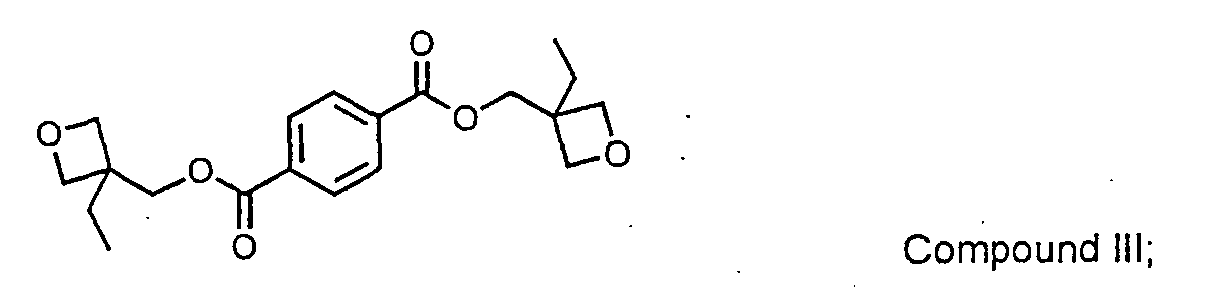
- the reaction of 3-ethyl-3-(hydroxymethyl) oxetane with 1,3,5-benzene-tricarbonyl trichloride to give the compound

- Compounds I, III, and IV are obtained as white solids with melting points of 71 °C, 79°C and 97°C, respectively. Compound II is obtained as a colorless liquid with a viscosity of less than 100 cPs at 25°C. Compounds II, III, and IV contain polar ester linkages, and Compound I contains carbamate functionality, those functionalities being useful for improving adhesion.
- Thermogravimetric analysis (TGA) was used to determine the volatility of the above exemplary oxetane resins by heating a sample of each from room temperature to 350°C at a ramp rate of 10°C/min. The weight loss of each resin was less than 5 wt% at 200°C. This shows that the resins will not volatilize to a detrimental extent before they reach their cure temperature.
- Formulations were prepared from these resins and analyzed separately by Differential Scanning Calorimetry to measure kinetic and thermodynamic properties. Compound II was formulated with five weight % of the initiator Rhodorsil 2074 (initiator). Compounds I, II, and III were formulated with a cyanate ester (CE) sold as product AROCY L10 (by Lonza Group) at a 1:1 molar ratio, with and without copper boron acetoacetate (CuBAcAc) as a catalyst, and also formulated with cis-1,2,3,6-tetrahydro-phthalic anhydride (THPA) in a 1:1 molar ratio with CuBAcAc as a catalyst.
- The L10 cyanate ester has the structure

- The results are disclosed in Table 1 and show that these resins cure at high temperatures. The results also show that with the proper choice of co-curing material and catalyst, the actual curing temperature of a formulation containing these oxetane materials can be adjusted to suit various curing programs.
Table 1. Kinetic and Thermodynamic Properties Formulation (°C) Curing Temp (J/g) Heat of Polymerization Cmpd II + initiator 238 100 Cmpd I + CE 258 215 Cmpd I + CE + CuBAcAc 218 638 Cmpd I + THPA + CuBAcAc 241 202 Cmpd II + CE 207 415 Cmpd II + CE + CuBAcAc 195 455 Cmpd II +THPA + CuBAcAc 264 223 Cmpd III + CE 242 336 Cmpd III + CE + CuBAcAc 247 412 Cmpd III + THPA + CuBAcAc 294 245 - In another embodiment, underfill compositions suitable for use in this invention will contain, in addition to the oxetane compound, a cyanate ester compound or resin, a curing initiator, and optionally, a filler. Suitable cyanate ester compounds or resins are commercially available or synthesized by processes known in the art, and can be either aromatic or aliphatic materials. (See, for example US patents 4,785,075 and 4,839,442.) In these embodiments, the cyanate ester will be present in an amount up to 90 weight % of the composition excluding fillers.
- In another embodiment, underfill compositions suitable for use in this invention will contain, in addition to the oxetane compound, a curable resin having at least one carbon to carbon double bond, an epoxy, or both. Suitable epoxies are commercially available and can be chosen without undue experimentation by the practitioner. Curable resins having a carbon to carbon double bond include, for example, resins derived from cinnamyl and styrenic starting compounds, fumarates, maleates, acrylates, and maleimides. In these embodiments, the epoxy or the resin containing the carbon to carbon double bond will be present in an amount up to 90 weight % of the composition excluding fillers.
- Suitable curing agents include cationic initiators, for example, iodonium, oxonium, sulfonium, sulfoxonium, and various other onium salts. Other suitable cationic initiators include Lewis acid catalysts, such as, copper boron acetoacetate and cobalt boron acetoacetate, and alkylation agents, such as, arylsulfonate esters, e.g., methyl-p-toluenesulfonate and methyl trifluoromethanesulfonate. A preferred series of photoinitiators are those sold under the trademark Irgacure by Ciba Specialty Chemicals or Rhodorsil 2074 by Rhodia. When present, initiators will be present in an amount up to 10 weight % of the formulation.
- Suitable fillers can be conductive or nonconductive. Exemplary conductive fillers are carbon black, graphite, gold, silver, copper, platinum, palladium, nickel, aluminum, silicon carbide, boron nitride, diamond, and alumina. Exemplary nonconductive fillers are particles of vermiculite, mica, wollastonite, calcium carbonate, titania, sand, glass, fused silica, fumed silica, barium sulfate, and halogenated ethylene polymers, such as tetrafluoroethylene, trifluoro-ethylene, vinylidene fluoride, vinyl fluoride, vinylidene chloride, and vinyl chloride. Fillers generally will be present in amounts of 20% to 90% by weight of the formulation.
- These compositions are useful as underfill material between the die and substrate. Typical substrates are fabricated from metal, for example, copper, silver, gold, nickel, alloys (such as, 42Fe/58Ni alloy), silver-coated copper, or palladium-coated copper; from organic material, for example, polyimides, polyamides, or polyesters; from ceramic; and from composites or laminates (such as, printed wire boards)
- Various underfill operations are known and used in the art, and the materials disclosed within this specification are suitable for use in those operations. In a typical underfill operation, connections are made between electrical terminals on the die and corresponding electrical terminals on the substrate using metallic or polymeric solder. A bump of solder or lead free polymeric solder is placed on the terminals of the substrate, the terminals are aligned and contacted, and the resulting assembly heated to reflow the solder. A gap is created between the die and the substrate, which is filled with the underfill encapsulant to reinforce the interconnect.
- There are variations in the processes for the underfill, which variations are known to those skilled in the art. For example, the underfill material can be placed along the periphery of the gap between the die and substrate and enter and fill the cap by capillary action. In another process, the underfill can be applied to the silicon wafer before it is diced into individual dies. Curing of the underfill material may take place after the reflow of the solder or simultaneously with the reflow of the solder, depending on the curing temperature of the underfill material and the process chosen.
- Synthesis of Compound I

- A 500 mL flask was charged with m-tetramethylxylene diisocyanate (24.43 g, 0.1 mol). The reaction vessel was placed under N2 blanket and equipped with an overhead stirrer and condenser. Two drops of dibutyl tin dilaurate were charged to the mixture and the mixture was heated to 60°C. 3-Ethyl-3-(hydroxymethyl) oxetane (23.20 g, 0.2 mol) was placed in the addition funnel. Stirring was continued and the temperature was kept at 60°C by dropwise exothermic addition from the addition funnel over a period of 20 minutes. The reaction was monitored by FT-IR analysis for the consumption of isocyanate (peak at 2258 cm-1). The reaction was completed after four hours. After this interval, the reaction mixture was dissolved into dichloromethane (150 mL). Silica gel (50 g) was added. The organics were filtered and the solvent was removed in vacuo (60°C, 0.3 mm Hg) to afford a white solid with a melting point of 71°C. The NMR for this compound is shown in Figure 1.
- Synthesis of Compound II

- The initial charge was added to a 500-mL 4-neck round bottom flask: 3-ethyl-3-(hydroxymethyl) oxetane (25.76 g, 0.222 mol), triethylamine (22.464 g, 0.222 mol), dimethylaminopyridine (2.712 g, 0.022 mol) and dichloromethane (180 mL). The reaction vessel was equipped with an overhead mixer and condenser. Stirring was continued until the mixture became homogeneous. The temperature was kept between 0° and 10°C. Azelaoyl chloride (25 g, 0.111 mol) was charged dropwise to the flask over a period of one hour. The reaction was monitored by FT-IR analysis for the consumption of carbonyl group in acid chloride (peak at 1801 cm-1) and the formation of ester group in product (peak at 1736 cm-1). The reaction was completed after 24 hours. The reaction mixture was washed with water (5 x 50 mL). The organics were dried over MgSO4, filtered, and the solvent was evaporated off at bath temperature of 50°C. Product was then dissolved in 50/50 hexane and ethyl acetate mixture (250 mL) and silica gel (8 g) was added. Silica gel was filtered out and the solvent was removed in vacuo (60°C, 0.3 mm Hg) to afford a clear yellow liquid (31 g, 0.081 mol, 67%) with a viscosity of less than 100 mPa.s at room temperature. The NMR for this compound is shown in Figure 2.
- Synthesis for Compound III

- The initial charge was added to a 500-mL 4-neck round bottom flask: 3-ethyl-3-(hydroxymethyl) oxetane (40 g, 0.344 mol), triethylamine (34.809 g, 0.344 mol), dimethylaminopyridine (4.203 g, 0.034 mol) and dichloromethane (300 mL). The reaction vessel was equipped with an overhead mixer and condenser. Stirring was continued until the mixture became homogeneous. The temperature was kept between 0° and 10°C. Terephthaloyl chloride (35.0 g, 0.172 mol) was dissolved into dichloromethane (100 mL) and the mixture was charged to the flask by dropwise addition over a period of one hour. The reaction was monitored by FT-IR analysis for the consumption of carbonyl group in acid chloride (peak at 1801 cm-1) and the formation of ester group in product (peak at 1736 cm-1). The reaction was completed after 24 hours. The reaction mixture was washed with water (5 x 50 mL). The organics were dried over MgSO4, filtered, and the solvent was evaporated off at bath temperature of 50°C. Product was mixed with ethyl acetate (300 mL) and the temperature was reduced below -30°C by dry ice. An insoluble white solid (product) precipitated out. Product was filtered and washed with hexane (3 x 30 mL) to afford a white solid with a melting point of 79°C. The NMR for this compound is shown in Figure 3.
- Synthesis of Compound IV
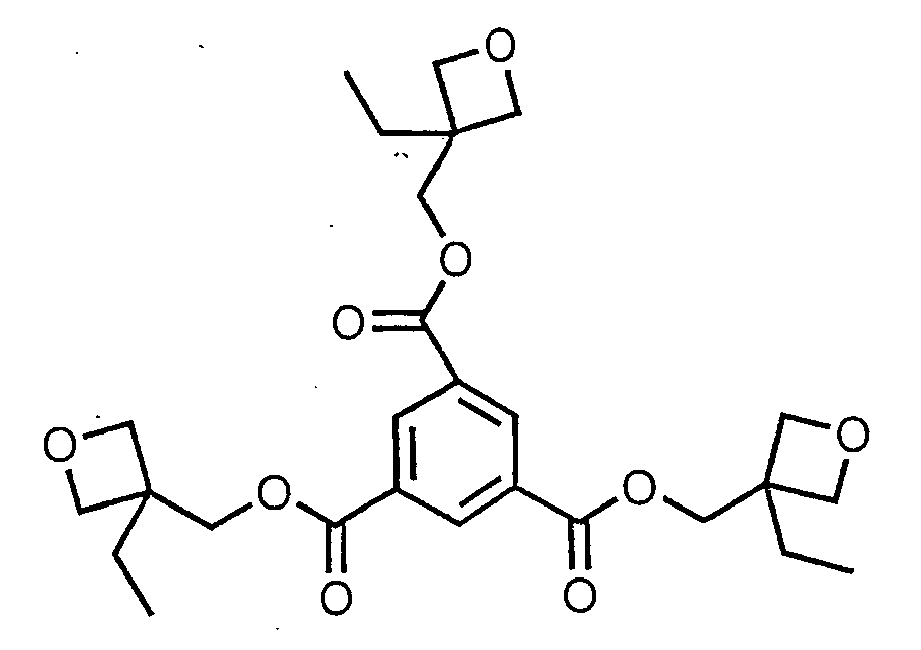
- The initial charge was added to a 500-mL 4-neck round bottom flask: 3-ethyl-3-(hydroxymethyl) oxetane (40 g, 0.344 mol), triethylamine (34.809 g, 0.344 mol), dimethylaminopyridine (4.203 g, 0.034 mol) and dichloromethane (300 mL). The reaction vessel was equipped with an overhead mixer and condenser. Stirring was continued until the mixture became homogeneous. The temperature was kept between 0° and 10°C. 1,3,5-Benzenetricarbonyl trichloride (30.442 g, 0.115 mol) was dissolved into dichloromethane (100 mL) and the mixture was charged to the flask dropwise over a period of one hour. The reaction was monitored by FT-IR analysis for the consumption of carbonyl group in acid chloride (peak at 1801 cm-1) and the formation of ester group in product (peak at 1736 cm-1). The reaction was completed after 24 hours. The reaction mixture was washed with water (5 x 50 mL). The organics were dried over MgSO4, filtered, and the solvent was evaporated off at bath temperature of 50°C. Product was mixed with ethyl acetate (300 mL) and temperature was reduced below -30°C by dry ice. An insoluble white solid (product) precipitated out. Product was filtered and washed with hexane (3 x 30 mL) to afford a white solid with a melting point of 97°C. The NMR for this compound is shown in Figure 4.
Claims (7)
- A curable composition comprising an oxetane compound having one or more oxetane rings in which each oxetane ring is one carbon atom removed from an ester, amide, urea, carbamate, carbonate, or carbonyl functionality.
- The curable composition according to claim 1 further comprising a cyanate ester compound.
- The curable composition according to claim 1 further comprising an epoxy, a resin having a carbon to carbon double bond, or both.
- The curable composition according to claim 1, claim 2, or claim 3, in which the oxetane compound has the structure

- The curable composition according to claim 1, claim 2, or claim 3, in which the oxetane compound has the structure

- The curable composition according to claim 1, claim 2, or claim 3, in which the oxetane compound has the structure

- The curable composition according to claim 1, claim 2, or claim 3, in which the oxetane compound has the structure

Priority Applications (1)
| Application Number | Priority Date | Filing Date | Title |
|---|---|---|---|
| EP08015834A EP2011789A1 (en) | 2004-07-29 | 2005-07-27 | Compositions containing oxetane compounds for use in semiconductor packaging |
Applications Claiming Priority (1)
| Application Number | Priority Date | Filing Date | Title |
|---|---|---|---|
| US10/901,631 US7230055B2 (en) | 2004-07-29 | 2004-07-29 | Compositions containing oxetane compounds for use in semiconductor packaging |
Related Child Applications (2)
| Application Number | Title | Priority Date | Filing Date |
|---|---|---|---|
| EP08015834A Division EP2011789A1 (en) | 2004-07-29 | 2005-07-27 | Compositions containing oxetane compounds for use in semiconductor packaging |
| EP08015834.8 Division-Into | 2008-09-09 |
Publications (3)
| Publication Number | Publication Date |
|---|---|
| EP1621534A2 true EP1621534A2 (en) | 2006-02-01 |
| EP1621534A3 EP1621534A3 (en) | 2007-01-24 |
| EP1621534B1 EP1621534B1 (en) | 2012-12-19 |
Family
ID=35276100
Family Applications (2)
| Application Number | Title | Priority Date | Filing Date |
|---|---|---|---|
| EP05016295A Expired - Lifetime EP1621534B1 (en) | 2004-07-29 | 2005-07-27 | Compositions containing oxetane compounds for use in semiconductor packaging |
| EP08015834A Withdrawn EP2011789A1 (en) | 2004-07-29 | 2005-07-27 | Compositions containing oxetane compounds for use in semiconductor packaging |
Family Applications After (1)
| Application Number | Title | Priority Date | Filing Date |
|---|---|---|---|
| EP08015834A Withdrawn EP2011789A1 (en) | 2004-07-29 | 2005-07-27 | Compositions containing oxetane compounds for use in semiconductor packaging |
Country Status (6)
| Country | Link |
|---|---|
| US (1) | US7230055B2 (en) |
| EP (2) | EP1621534B1 (en) |
| JP (1) | JP2006037107A (en) |
| KR (1) | KR20060048870A (en) |
| CN (1) | CN1743373A (en) |
| TW (1) | TWI377220B (en) |
Cited By (2)
| Publication number | Priority date | Publication date | Assignee | Title |
|---|---|---|---|---|
| WO2008019151A1 (en) * | 2006-08-11 | 2008-02-14 | Momentive Performance Materials Inc. | Oxetane composition, associated method and article |
| WO2008021139A1 (en) * | 2006-08-11 | 2008-02-21 | Momentive Performance Materials Inc. | Oxetane composition, associated method and article |
Families Citing this family (16)
| Publication number | Priority date | Publication date | Assignee | Title |
|---|---|---|---|---|
| WO2010019832A2 (en) | 2008-08-13 | 2010-02-18 | Designer Molecules, Inc. | Amide-extended crosslinking compounds and methods for use thereof |
| US20050267254A1 (en) * | 2004-05-28 | 2005-12-01 | Mizori Farhad G | Functionalized urethanes and methods for use thereof |
| US7875688B2 (en) * | 2004-06-04 | 2011-01-25 | Designer Molecules, Inc. | Free-radical curable polyesters and methods for use thereof |
| US20080039542A1 (en) * | 2006-08-11 | 2008-02-14 | General Electric Company | Composition and associated method |
| US20080039560A1 (en) * | 2006-08-11 | 2008-02-14 | General Electric Company | Syneretic composition, associated method and article |
| US8039663B2 (en) | 2007-04-09 | 2011-10-18 | Designer Molecules, Inc. | Monomers derived from pentacyclopentadecane dimethanol |
| US8431655B2 (en) * | 2007-04-09 | 2013-04-30 | Designer Molecules, Inc. | Curatives for epoxy compositions |
| WO2008124797A1 (en) * | 2007-04-09 | 2008-10-16 | Designer Molecules, Inc. | Curatives for epoxy compositions |
| US7868113B2 (en) | 2007-04-11 | 2011-01-11 | Designer Molecules, Inc. | Low shrinkage polyester thermosetting resins |
| US20100056671A1 (en) * | 2007-04-12 | 2010-03-04 | Designer Molecules, Inc. | Polyfunctional epoxy oligomers |
| US20140264165A1 (en) * | 2013-03-15 | 2014-09-18 | Henkel Corporation | Oxetane-containing compounds and compositions thereof |
| TWI519560B (en) | 2014-11-24 | 2016-02-01 | 財團法人工業技術研究院 | Resin and resin composition containing oxetane group and epoxy group |
| KR102359202B1 (en) | 2014-12-30 | 2022-02-07 | 삼성전자주식회사 | Air cleaner and home appliances including air handling unit |
| CN107621752B (en) | 2016-07-13 | 2019-11-12 | 常州强力先端电子材料有限公司 | One specific admixture type photosensitive resin and preparation method thereof |
| CN107619399B (en) | 2016-07-13 | 2021-04-27 | 常州强力先端电子材料有限公司 | Polyfunctional oxetane compound and preparation method thereof |
| US11681218B2 (en) * | 2018-02-14 | 2023-06-20 | Sumitomo Chemical Company, Limited | Compound, resist composition and method for producing resist pattern |
Citations (5)
| Publication number | Priority date | Publication date | Assignee | Title |
|---|---|---|---|---|
| US3278554A (en) | 1961-10-11 | 1966-10-11 | Ciba Ltd | Esters containing more than one oxetane group |
| US3577438A (en) | 1963-10-31 | 1971-05-04 | Celanese Corp | Method of producing oxetane esters |
| US6753434B1 (en) | 2003-05-06 | 2004-06-22 | National Starch And Chemical Investment Holding Corporation | Oxetane compounds containing cinnamyl functionality |
| WO2004101541A1 (en) | 2003-05-06 | 2004-11-25 | National Starch And Chemical Investment Holding Corporation | Oxetane compounds containing styrenic functionality |
| WO2004101646A1 (en) | 2003-05-06 | 2004-11-25 | National Starch And Chemical Investment Holding Corporation | Adhesive compositions containing hybrid oxetane compounds |
Family Cites Families (23)
| Publication number | Priority date | Publication date | Assignee | Title |
|---|---|---|---|---|
| US4225691A (en) | 1979-07-17 | 1980-09-30 | General Electric Company | Low temperature curable organic resin compositions |
| US4226691A (en) * | 1978-11-24 | 1980-10-07 | National Semiconductor Corporation | Bubble memory process using an aluminum plus water chemical reaction |
| AU597435B2 (en) | 1986-11-24 | 1990-05-31 | Ciba-Geigy Ag | Low viscosity noncrystalline dicyanate esters and blends with prepolymers of dicyanate esters |
| US4785075A (en) | 1987-07-27 | 1988-11-15 | Interez, Inc. | Metal acetylacetonate/alkylphenol curing catalyst for polycyanate esters of polyhydric phenols |
| JPH11246541A (en) * | 1998-03-06 | 1999-09-14 | Ube Ind Ltd | Multifunctional oxetane compounds |
| JPH11269370A (en) * | 1998-03-20 | 1999-10-05 | Ube Ind Ltd | Thermosetting oxetane composition, method for curing the same, and cured product obtained by the method |
| JPH11315181A (en) * | 1998-05-01 | 1999-11-16 | Ube Ind Ltd | Thermosetting oxetane composition, method of curing the same, and cured product obtained by the method |
| JPH11343346A (en) * | 1998-05-29 | 1999-12-14 | Ube Ind Ltd | Thermosetting oxetane composition, method of curing the same, and cured product obtained by the method |
| JP3933322B2 (en) * | 1998-09-01 | 2007-06-20 | 学校法人神奈川大学 | Curable composition |
| US6498200B1 (en) * | 1999-01-12 | 2002-12-24 | Namics Corporation | Cationically polymerizable resin composition |
| US20040155364A1 (en) * | 1999-06-17 | 2004-08-12 | Takahisa Doba | Reworkable thermosetting resin compositions |
| JP2001040205A (en) * | 1999-07-30 | 2001-02-13 | Ube Ind Ltd | Energy ray curable composition |
| KR20010080093A (en) * | 1999-08-12 | 2001-08-22 | 사토 아키오 | Photocurable resin composition for sealing material and method of sealing |
| US6403760B1 (en) | 1999-12-28 | 2002-06-11 | Omnova Solutions Inc. | Monohydric polyfluorooxetane polymer and radiation curable coatings containing a monofunctional polyfluorooxetane polymer |
| TWI278448B (en) * | 2000-01-27 | 2007-04-11 | Univ Kanagawa | Unsaturated monocarboxylic ester compound, process for producing the same, and composition curable with actinic energy ray |
| JP2001329112A (en) | 2000-05-23 | 2001-11-27 | Toray Ind Inc | Silane coupling agent, curable resin solution composition, and functional cured product comprising the same |
| EP1303568B1 (en) | 2000-07-19 | 2007-05-30 | Koninklijke Philips Electronics N.V. | Method of manufacturing a replica as well as a replica obtained by carrying out a uv light-initiated cationic polymerization |
| CN1396947A (en) | 2000-10-04 | 2003-02-12 | 皇家菲利浦电子有限公司 | Polymerizable liquid crystalline dioxetanes, their preparation and use |
| EP1334513A2 (en) | 2000-11-14 | 2003-08-13 | Henkel Loctite Corporation | Wafer applied fluxing and underfill material, and layered electronic assemblies manufactured therewith |
| JP3629235B2 (en) * | 2001-11-27 | 2005-03-16 | ナミックス株式会社 | Liquid sealing resin composition |
| US7034064B2 (en) * | 2003-05-06 | 2006-04-25 | National Starch And Chemical Investment Holding Corporation | Method of attaching a die to a substrate using a hybrid oxetane compound |
| US6982338B2 (en) * | 2003-05-06 | 2006-01-03 | National Starch And Chemical Investment Holding Corporation | Oxetane compounds containing maleimide functionality |
| US20050267254A1 (en) * | 2004-05-28 | 2005-12-01 | Mizori Farhad G | Functionalized urethanes and methods for use thereof |
-
2004
- 2004-07-29 US US10/901,631 patent/US7230055B2/en not_active Expired - Fee Related
-
2005
- 2005-07-27 EP EP05016295A patent/EP1621534B1/en not_active Expired - Lifetime
- 2005-07-27 EP EP08015834A patent/EP2011789A1/en not_active Withdrawn
- 2005-07-28 KR KR1020050068962A patent/KR20060048870A/en not_active Ceased
- 2005-07-28 JP JP2005219085A patent/JP2006037107A/en active Pending
- 2005-07-28 TW TW094125511A patent/TWI377220B/en not_active IP Right Cessation
- 2005-07-29 CN CNA2005101098313A patent/CN1743373A/en active Pending
Patent Citations (5)
| Publication number | Priority date | Publication date | Assignee | Title |
|---|---|---|---|---|
| US3278554A (en) | 1961-10-11 | 1966-10-11 | Ciba Ltd | Esters containing more than one oxetane group |
| US3577438A (en) | 1963-10-31 | 1971-05-04 | Celanese Corp | Method of producing oxetane esters |
| US6753434B1 (en) | 2003-05-06 | 2004-06-22 | National Starch And Chemical Investment Holding Corporation | Oxetane compounds containing cinnamyl functionality |
| WO2004101541A1 (en) | 2003-05-06 | 2004-11-25 | National Starch And Chemical Investment Holding Corporation | Oxetane compounds containing styrenic functionality |
| WO2004101646A1 (en) | 2003-05-06 | 2004-11-25 | National Starch And Chemical Investment Holding Corporation | Adhesive compositions containing hybrid oxetane compounds |
Non-Patent Citations (1)
| Title |
|---|
| "Macromolecules", vol. 32, 9 March 1999, ACS, pages: 1453 - 1462 |
Cited By (2)
| Publication number | Priority date | Publication date | Assignee | Title |
|---|---|---|---|---|
| WO2008019151A1 (en) * | 2006-08-11 | 2008-02-14 | Momentive Performance Materials Inc. | Oxetane composition, associated method and article |
| WO2008021139A1 (en) * | 2006-08-11 | 2008-02-21 | Momentive Performance Materials Inc. | Oxetane composition, associated method and article |
Also Published As
| Publication number | Publication date |
|---|---|
| EP1621534B1 (en) | 2012-12-19 |
| KR20060048870A (en) | 2006-05-18 |
| CN1743373A (en) | 2006-03-08 |
| US7230055B2 (en) | 2007-06-12 |
| US20060025542A1 (en) | 2006-02-02 |
| JP2006037107A (en) | 2006-02-09 |
| TW200621845A (en) | 2006-07-01 |
| EP2011789A1 (en) | 2009-01-07 |
| TWI377220B (en) | 2012-11-21 |
| EP1621534A3 (en) | 2007-01-24 |
Similar Documents
| Publication | Publication Date | Title |
|---|---|---|
| US7230055B2 (en) | Compositions containing oxetane compounds for use in semiconductor packaging | |
| KR100789332B1 (en) | Adhesive for die attach with vinyl ether and carbamate or urea functionality | |
| EP2325876A2 (en) | Epoxy resin formulations for underfill applications | |
| DE60308545T2 (en) | REINFORCED EPOXY / POLYANHYDRIDE COMPOSITION FOR UNFILLING WITHOUT FLOW | |
| US6570029B2 (en) | No-flow reworkable epoxy underfills for flip-chip applications | |
| CN1324909A (en) | Electronic donor compound capable of solidifying | |
| EP2083004A2 (en) | Electron donors, electron acceptors and adhesion promoters containing disulfide | |
| US20020013420A1 (en) | Thermally degradable epoxy underfills for flip-chip applications | |
| WO2003031492A1 (en) | Thermally reworkable epoxy resins and compositions based thereo n | |
| EP1158008B1 (en) | Curable hybrid electron donor compounds containing vinyl ether | |
| EP1621566B1 (en) | Fluxing no-flow underfill composition containing benzoxazines | |
| KR100883375B1 (en) | Epoxy Compounds Containing Styrene or Cinnamil Functional | |
| US7528404B2 (en) | Assembly of a semiconductor die attached to substrate with oxazoline derivative bearing an electron donor or acceptor functionality | |
| HK1089465A (en) | Compositions containing oxetane compounds for use in semiconductor packaging | |
| WO2003029255A1 (en) | Vinyl silane compounds containing epoxy functionality | |
| KR101115567B1 (en) | Epoxy resin composition containing amine dendrimer | |
| KR20040061567A (en) | Liquid epoxy resinous composition | |
| EP1716215B1 (en) | Curable liquid compositions containing bisoxazoline | |
| WO2001088959A2 (en) | No-flow reworkable epoxy underfills for flip-chip applications | |
| WO2008085144A1 (en) | Low shrinkage polyester thermosetting resins | |
| WO2009155291A1 (en) | Curable compositions containing urethane linkages for reworkable adhesives | |
| HK1042316B (en) | Die attach adhesives with vinyl ether and carbamate or urea functionality | |
| HK1094091A (en) | Assembly of a semiconductor die attached to substrate with oxazoline derivative bearing an electron donor or acceptor functionality |
Legal Events
| Date | Code | Title | Description |
|---|---|---|---|
| PUAI | Public reference made under article 153(3) epc to a published international application that has entered the european phase |
Free format text: ORIGINAL CODE: 0009012 |
|
| AK | Designated contracting states |
Kind code of ref document: A2 Designated state(s): AT BE BG CH CY CZ DE DK EE ES FI FR GB GR HU IE IS IT LI LT LU LV MC NL PL PT RO SE SI SK TR |
|
| AX | Request for extension of the european patent |
Extension state: AL BA HR MK YU |
|
| PUAL | Search report despatched |
Free format text: ORIGINAL CODE: 0009013 |
|
| AK | Designated contracting states |
Kind code of ref document: A3 Designated state(s): AT BE BG CH CY CZ DE DK EE ES FI FR GB GR HU IE IS IT LI LT LU LV MC NL PL PT RO SE SI SK TR |
|
| AX | Request for extension of the european patent |
Extension state: AL BA HR MK YU |
|
| 17P | Request for examination filed |
Effective date: 20070711 |
|
| AKX | Designation fees paid |
Designated state(s): AT BE BG CH CY CZ DE DK EE ES FI FR GB GR HU IE IS IT LI LT LU LV MC NL PL PT RO SE SI SK TR |
|
| 17Q | First examination report despatched |
Effective date: 20080310 |
|
| RAP1 | Party data changed (applicant data changed or rights of an application transferred) |
Owner name: HENKEL AG & CO. KGAA |
|
| GRAP | Despatch of communication of intention to grant a patent |
Free format text: ORIGINAL CODE: EPIDOSNIGR1 |
|
| GRAS | Grant fee paid |
Free format text: ORIGINAL CODE: EPIDOSNIGR3 |
|
| GRAA | (expected) grant |
Free format text: ORIGINAL CODE: 0009210 |
|
| AK | Designated contracting states |
Kind code of ref document: B1 Designated state(s): AT BE BG CH CY CZ DE DK EE ES FI FR GB GR HU IE IS IT LI LT LU LV MC NL PL PT RO SE SI SK TR |
|
| REG | Reference to a national code |
Ref country code: GB Ref legal event code: FG4D |
|
| REG | Reference to a national code |
Ref country code: CH Ref legal event code: EP |
|
| REG | Reference to a national code |
Ref country code: AT Ref legal event code: REF Ref document number: 589343 Country of ref document: AT Kind code of ref document: T Effective date: 20130115 |
|
| REG | Reference to a national code |
Ref country code: DE Ref legal event code: R096 Ref document number: 602005037462 Country of ref document: DE Effective date: 20130214 |
|
| PG25 | Lapsed in a contracting state [announced via postgrant information from national office to epo] |
Ref country code: LT Free format text: LAPSE BECAUSE OF FAILURE TO SUBMIT A TRANSLATION OF THE DESCRIPTION OR TO PAY THE FEE WITHIN THE PRESCRIBED TIME-LIMIT Effective date: 20121219 Ref country code: FI Free format text: LAPSE BECAUSE OF FAILURE TO SUBMIT A TRANSLATION OF THE DESCRIPTION OR TO PAY THE FEE WITHIN THE PRESCRIBED TIME-LIMIT Effective date: 20121219 Ref country code: SE Free format text: LAPSE BECAUSE OF FAILURE TO SUBMIT A TRANSLATION OF THE DESCRIPTION OR TO PAY THE FEE WITHIN THE PRESCRIBED TIME-LIMIT Effective date: 20121219 Ref country code: ES Free format text: LAPSE BECAUSE OF FAILURE TO SUBMIT A TRANSLATION OF THE DESCRIPTION OR TO PAY THE FEE WITHIN THE PRESCRIBED TIME-LIMIT Effective date: 20130330 |
|
| REG | Reference to a national code |
Ref country code: NL Ref legal event code: VDEP Effective date: 20121219 Ref country code: AT Ref legal event code: MK05 Ref document number: 589343 Country of ref document: AT Kind code of ref document: T Effective date: 20121219 |
|
| REG | Reference to a national code |
Ref country code: LT Ref legal event code: MG4D |
|
| PG25 | Lapsed in a contracting state [announced via postgrant information from national office to epo] |
Ref country code: SI Free format text: LAPSE BECAUSE OF FAILURE TO SUBMIT A TRANSLATION OF THE DESCRIPTION OR TO PAY THE FEE WITHIN THE PRESCRIBED TIME-LIMIT Effective date: 20121219 Ref country code: GR Free format text: LAPSE BECAUSE OF FAILURE TO SUBMIT A TRANSLATION OF THE DESCRIPTION OR TO PAY THE FEE WITHIN THE PRESCRIBED TIME-LIMIT Effective date: 20130320 Ref country code: LV Free format text: LAPSE BECAUSE OF FAILURE TO SUBMIT A TRANSLATION OF THE DESCRIPTION OR TO PAY THE FEE WITHIN THE PRESCRIBED TIME-LIMIT Effective date: 20121219 |
|
| PG25 | Lapsed in a contracting state [announced via postgrant information from national office to epo] |
Ref country code: CZ Free format text: LAPSE BECAUSE OF FAILURE TO SUBMIT A TRANSLATION OF THE DESCRIPTION OR TO PAY THE FEE WITHIN THE PRESCRIBED TIME-LIMIT Effective date: 20121219 Ref country code: EE Free format text: LAPSE BECAUSE OF FAILURE TO SUBMIT A TRANSLATION OF THE DESCRIPTION OR TO PAY THE FEE WITHIN THE PRESCRIBED TIME-LIMIT Effective date: 20121219 Ref country code: AT Free format text: LAPSE BECAUSE OF FAILURE TO SUBMIT A TRANSLATION OF THE DESCRIPTION OR TO PAY THE FEE WITHIN THE PRESCRIBED TIME-LIMIT Effective date: 20121219 Ref country code: BE Free format text: LAPSE BECAUSE OF FAILURE TO SUBMIT A TRANSLATION OF THE DESCRIPTION OR TO PAY THE FEE WITHIN THE PRESCRIBED TIME-LIMIT Effective date: 20121219 Ref country code: CY Free format text: LAPSE BECAUSE OF FAILURE TO SUBMIT A TRANSLATION OF THE DESCRIPTION OR TO PAY THE FEE WITHIN THE PRESCRIBED TIME-LIMIT Effective date: 20121219 Ref country code: IS Free format text: LAPSE BECAUSE OF FAILURE TO SUBMIT A TRANSLATION OF THE DESCRIPTION OR TO PAY THE FEE WITHIN THE PRESCRIBED TIME-LIMIT Effective date: 20130419 Ref country code: BG Free format text: LAPSE BECAUSE OF FAILURE TO SUBMIT A TRANSLATION OF THE DESCRIPTION OR TO PAY THE FEE WITHIN THE PRESCRIBED TIME-LIMIT Effective date: 20130319 Ref country code: SK Free format text: LAPSE BECAUSE OF FAILURE TO SUBMIT A TRANSLATION OF THE DESCRIPTION OR TO PAY THE FEE WITHIN THE PRESCRIBED TIME-LIMIT Effective date: 20121219 |
|
| PG25 | Lapsed in a contracting state [announced via postgrant information from national office to epo] |
Ref country code: NL Free format text: LAPSE BECAUSE OF FAILURE TO SUBMIT A TRANSLATION OF THE DESCRIPTION OR TO PAY THE FEE WITHIN THE PRESCRIBED TIME-LIMIT Effective date: 20121219 Ref country code: PL Free format text: LAPSE BECAUSE OF FAILURE TO SUBMIT A TRANSLATION OF THE DESCRIPTION OR TO PAY THE FEE WITHIN THE PRESCRIBED TIME-LIMIT Effective date: 20121219 Ref country code: RO Free format text: LAPSE BECAUSE OF FAILURE TO SUBMIT A TRANSLATION OF THE DESCRIPTION OR TO PAY THE FEE WITHIN THE PRESCRIBED TIME-LIMIT Effective date: 20121219 Ref country code: PT Free format text: LAPSE BECAUSE OF FAILURE TO SUBMIT A TRANSLATION OF THE DESCRIPTION OR TO PAY THE FEE WITHIN THE PRESCRIBED TIME-LIMIT Effective date: 20130419 |
|
| PLBE | No opposition filed within time limit |
Free format text: ORIGINAL CODE: 0009261 |
|
| STAA | Information on the status of an ep patent application or granted ep patent |
Free format text: STATUS: NO OPPOSITION FILED WITHIN TIME LIMIT |
|
| PG25 | Lapsed in a contracting state [announced via postgrant information from national office to epo] |
Ref country code: DK Free format text: LAPSE BECAUSE OF FAILURE TO SUBMIT A TRANSLATION OF THE DESCRIPTION OR TO PAY THE FEE WITHIN THE PRESCRIBED TIME-LIMIT Effective date: 20121219 |
|
| 26N | No opposition filed |
Effective date: 20130920 |
|
| REG | Reference to a national code |
Ref country code: DE Ref legal event code: R097 Ref document number: 602005037462 Country of ref document: DE Effective date: 20130920 |
|
| PG25 | Lapsed in a contracting state [announced via postgrant information from national office to epo] |
Ref country code: MC Free format text: LAPSE BECAUSE OF FAILURE TO SUBMIT A TRANSLATION OF THE DESCRIPTION OR TO PAY THE FEE WITHIN THE PRESCRIBED TIME-LIMIT Effective date: 20121219 |
|
| REG | Reference to a national code |
Ref country code: CH Ref legal event code: PL |
|
| REG | Reference to a national code |
Ref country code: IE Ref legal event code: MM4A |
|
| PG25 | Lapsed in a contracting state [announced via postgrant information from national office to epo] |
Ref country code: LI Free format text: LAPSE BECAUSE OF NON-PAYMENT OF DUE FEES Effective date: 20130731 Ref country code: CH Free format text: LAPSE BECAUSE OF NON-PAYMENT OF DUE FEES Effective date: 20130731 |
|
| PG25 | Lapsed in a contracting state [announced via postgrant information from national office to epo] |
Ref country code: IE Free format text: LAPSE BECAUSE OF NON-PAYMENT OF DUE FEES Effective date: 20130727 |
|
| REG | Reference to a national code |
Ref country code: FR Ref legal event code: PLFP Year of fee payment: 11 |
|
| PG25 | Lapsed in a contracting state [announced via postgrant information from national office to epo] |
Ref country code: TR Free format text: LAPSE BECAUSE OF FAILURE TO SUBMIT A TRANSLATION OF THE DESCRIPTION OR TO PAY THE FEE WITHIN THE PRESCRIBED TIME-LIMIT Effective date: 20121219 |
|
| PG25 | Lapsed in a contracting state [announced via postgrant information from national office to epo] |
Ref country code: HU Free format text: LAPSE BECAUSE OF FAILURE TO SUBMIT A TRANSLATION OF THE DESCRIPTION OR TO PAY THE FEE WITHIN THE PRESCRIBED TIME-LIMIT; INVALID AB INITIO Effective date: 20050727 Ref country code: LU Free format text: LAPSE BECAUSE OF NON-PAYMENT OF DUE FEES Effective date: 20130727 |
|
| PGFP | Annual fee paid to national office [announced via postgrant information from national office to epo] |
Ref country code: FR Payment date: 20150626 Year of fee payment: 11 |
|
| PGFP | Annual fee paid to national office [announced via postgrant information from national office to epo] |
Ref country code: GB Payment date: 20150721 Year of fee payment: 11 Ref country code: DE Payment date: 20150721 Year of fee payment: 11 |
|
| PGFP | Annual fee paid to national office [announced via postgrant information from national office to epo] |
Ref country code: IT Payment date: 20150727 Year of fee payment: 11 |
|
| REG | Reference to a national code |
Ref country code: DE Ref legal event code: R119 Ref document number: 602005037462 Country of ref document: DE |
|
| GBPC | Gb: european patent ceased through non-payment of renewal fee |
Effective date: 20160727 |
|
| PG25 | Lapsed in a contracting state [announced via postgrant information from national office to epo] |
Ref country code: FR Free format text: LAPSE BECAUSE OF NON-PAYMENT OF DUE FEES Effective date: 20160801 Ref country code: DE Free format text: LAPSE BECAUSE OF NON-PAYMENT OF DUE FEES Effective date: 20170201 |
|
| REG | Reference to a national code |
Ref country code: FR Ref legal event code: ST Effective date: 20170331 |
|
| PG25 | Lapsed in a contracting state [announced via postgrant information from national office to epo] |
Ref country code: GB Free format text: LAPSE BECAUSE OF NON-PAYMENT OF DUE FEES Effective date: 20160727 |
|
| PG25 | Lapsed in a contracting state [announced via postgrant information from national office to epo] |
Ref country code: IT Free format text: LAPSE BECAUSE OF NON-PAYMENT OF DUE FEES Effective date: 20160727 |