EP1621337A1 - Image recording material and lithographic printing plate precursor - Google Patents
Image recording material and lithographic printing plate precursor Download PDFInfo
- Publication number
- EP1621337A1 EP1621337A1 EP05012745A EP05012745A EP1621337A1 EP 1621337 A1 EP1621337 A1 EP 1621337A1 EP 05012745 A EP05012745 A EP 05012745A EP 05012745 A EP05012745 A EP 05012745A EP 1621337 A1 EP1621337 A1 EP 1621337A1
- Authority
- EP
- European Patent Office
- Prior art keywords
- image recording
- printing plate
- lithographic printing
- recording layer
- plate precursor
- Prior art date
- Legal status (The legal status is an assumption and is not a legal conclusion. Google has not performed a legal analysis and makes no representation as to the accuracy of the status listed.)
- Granted
Links
- 239000000463 material Substances 0.000 title claims abstract description 51
- 238000007639 printing Methods 0.000 title claims description 197
- 239000002243 precursor Substances 0.000 title claims description 136
- 150000001875 compounds Chemical class 0.000 claims abstract description 121
- 238000006116 polymerization reaction Methods 0.000 claims abstract description 62
- 239000003505 polymerization initiator Substances 0.000 claims abstract description 27
- 230000002401 inhibitory effect Effects 0.000 claims abstract description 23
- 239000013626 chemical specie Substances 0.000 claims abstract description 13
- 238000000034 method Methods 0.000 claims description 78
- 239000002250 absorbent Substances 0.000 claims description 13
- 230000002745 absorbent Effects 0.000 claims description 13
- 125000002887 hydroxy group Chemical group [H]O* 0.000 claims description 9
- ISWSIDIOOBJBQZ-UHFFFAOYSA-N phenol group Chemical group C1(=CC=CC=C1)O ISWSIDIOOBJBQZ-UHFFFAOYSA-N 0.000 claims description 9
- 206010034972 Photosensitivity reaction Diseases 0.000 claims description 5
- 230000036211 photosensitivity Effects 0.000 claims description 5
- 239000010410 layer Substances 0.000 description 146
- -1 azide compounds Chemical class 0.000 description 132
- 238000010438 heat treatment Methods 0.000 description 81
- 239000000243 solution Substances 0.000 description 69
- 239000000975 dye Substances 0.000 description 65
- 229920000642 polymer Polymers 0.000 description 55
- 125000004432 carbon atom Chemical group C* 0.000 description 47
- 238000000576 coating method Methods 0.000 description 47
- 239000011248 coating agent Substances 0.000 description 46
- 238000011161 development Methods 0.000 description 41
- 230000018109 developmental process Effects 0.000 description 41
- 239000000049 pigment Substances 0.000 description 41
- 239000011230 binding agent Substances 0.000 description 32
- 239000003112 inhibitor Substances 0.000 description 32
- 229910052782 aluminium Inorganic materials 0.000 description 29
- 239000011241 protective layer Substances 0.000 description 29
- XAGFODPZIPBFFR-UHFFFAOYSA-N aluminium Chemical compound [Al] XAGFODPZIPBFFR-UHFFFAOYSA-N 0.000 description 26
- 238000011282 treatment Methods 0.000 description 26
- 150000002148 esters Chemical class 0.000 description 23
- 239000000126 substance Substances 0.000 description 23
- 239000004094 surface-active agent Substances 0.000 description 22
- XLYOFNOQVPJJNP-UHFFFAOYSA-N water Substances O XLYOFNOQVPJJNP-UHFFFAOYSA-N 0.000 description 22
- ZWEHNKRNPOVVGH-UHFFFAOYSA-N 2-Butanone Chemical compound CCC(C)=O ZWEHNKRNPOVVGH-UHFFFAOYSA-N 0.000 description 21
- 239000003921 oil Substances 0.000 description 20
- 239000007787 solid Substances 0.000 description 20
- 229920001577 copolymer Polymers 0.000 description 18
- 235000014113 dietary fatty acids Nutrition 0.000 description 18
- 239000000194 fatty acid Substances 0.000 description 18
- 229930195729 fatty acid Natural products 0.000 description 18
- 239000010408 film Substances 0.000 description 18
- 238000004519 manufacturing process Methods 0.000 description 18
- 239000003094 microcapsule Substances 0.000 description 18
- 239000002253 acid Substances 0.000 description 17
- VYPSYNLAJGMNEJ-UHFFFAOYSA-N Silicium dioxide Chemical compound O=[Si]=O VYPSYNLAJGMNEJ-UHFFFAOYSA-N 0.000 description 15
- 239000000203 mixture Substances 0.000 description 15
- 150000003254 radicals Chemical class 0.000 description 15
- 150000003839 salts Chemical class 0.000 description 15
- 238000007788 roughening Methods 0.000 description 14
- 230000035945 sensitivity Effects 0.000 description 14
- 230000001235 sensitizing effect Effects 0.000 description 14
- 125000001424 substituent group Chemical group 0.000 description 14
- QGKMIGUHVLGJBR-UHFFFAOYSA-M (4z)-1-(3-methylbutyl)-4-[[1-(3-methylbutyl)quinolin-1-ium-4-yl]methylidene]quinoline;iodide Chemical compound [I-].C12=CC=CC=C2N(CCC(C)C)C=CC1=CC1=CC=[N+](CCC(C)C)C2=CC=CC=C12 QGKMIGUHVLGJBR-UHFFFAOYSA-M 0.000 description 13
- QVGXLLKOCUKJST-UHFFFAOYSA-N atomic oxygen Chemical compound [O] QVGXLLKOCUKJST-UHFFFAOYSA-N 0.000 description 13
- 238000004132 cross linking Methods 0.000 description 13
- 238000012545 processing Methods 0.000 description 13
- 229920003171 Poly (ethylene oxide) Polymers 0.000 description 12
- 125000003118 aryl group Chemical group 0.000 description 12
- 229910052760 oxygen Inorganic materials 0.000 description 12
- VLTRZXGMWDSKGL-UHFFFAOYSA-M perchlorate Chemical compound [O-]Cl(=O)(=O)=O VLTRZXGMWDSKGL-UHFFFAOYSA-M 0.000 description 12
- FBPFZTCFMRRESA-FSIIMWSLSA-N D-Glucitol Natural products OC[C@H](O)[C@H](O)[C@@H](O)[C@H](O)CO FBPFZTCFMRRESA-FSIIMWSLSA-N 0.000 description 11
- RTZKZFJDLAIYFH-UHFFFAOYSA-N Diethyl ether Chemical compound CCOCC RTZKZFJDLAIYFH-UHFFFAOYSA-N 0.000 description 11
- 239000000178 monomer Substances 0.000 description 11
- 239000001301 oxygen Substances 0.000 description 11
- 239000000600 sorbitol Substances 0.000 description 11
- FBPFZTCFMRRESA-JGWLITMVSA-N D-glucitol Chemical compound OC[C@H](O)[C@@H](O)[C@H](O)[C@H](O)CO FBPFZTCFMRRESA-JGWLITMVSA-N 0.000 description 10
- 125000005843 halogen group Chemical group 0.000 description 10
- 230000007246 mechanism Effects 0.000 description 10
- 229920002451 polyvinyl alcohol Polymers 0.000 description 10
- 235000019422 polyvinyl alcohol Nutrition 0.000 description 10
- XEKOWRVHYACXOJ-UHFFFAOYSA-N Ethyl acetate Chemical compound CCOC(C)=O XEKOWRVHYACXOJ-UHFFFAOYSA-N 0.000 description 9
- OKKJLVBELUTLKV-UHFFFAOYSA-N Methanol Chemical compound OC OKKJLVBELUTLKV-UHFFFAOYSA-N 0.000 description 9
- 239000004372 Polyvinyl alcohol Substances 0.000 description 9
- HEMHJVSKTPXQMS-UHFFFAOYSA-M Sodium hydroxide Chemical compound [OH-].[Na+] HEMHJVSKTPXQMS-UHFFFAOYSA-M 0.000 description 9
- 125000000217 alkyl group Chemical group 0.000 description 9
- 150000001408 amides Chemical class 0.000 description 9
- 125000000751 azo group Chemical group [*]N=N[*] 0.000 description 9
- 230000015572 biosynthetic process Effects 0.000 description 9
- 150000004665 fatty acids Chemical class 0.000 description 9
- 239000010419 fine particle Substances 0.000 description 9
- 229920001519 homopolymer Polymers 0.000 description 9
- 238000010186 staining Methods 0.000 description 9
- ARXJGSRGQADJSQ-UHFFFAOYSA-N 1-methoxypropan-2-ol Chemical compound COCC(C)O ARXJGSRGQADJSQ-UHFFFAOYSA-N 0.000 description 8
- LFQSCWFLJHTTHZ-UHFFFAOYSA-N Ethanol Chemical compound CCO LFQSCWFLJHTTHZ-UHFFFAOYSA-N 0.000 description 8
- 230000008859 change Effects 0.000 description 8
- 229910052736 halogen Inorganic materials 0.000 description 8
- 230000000977 initiatory effect Effects 0.000 description 8
- 230000036961 partial effect Effects 0.000 description 8
- 239000002904 solvent Substances 0.000 description 8
- PEDCQBHIVMGVHV-UHFFFAOYSA-N Glycerol Natural products OCC(O)CO PEDCQBHIVMGVHV-UHFFFAOYSA-N 0.000 description 7
- 239000003513 alkali Substances 0.000 description 7
- 150000001412 amines Chemical class 0.000 description 7
- 239000003086 colorant Substances 0.000 description 7
- 230000000694 effects Effects 0.000 description 7
- 150000002430 hydrocarbons Chemical group 0.000 description 7
- ZFSLODLOARCGLH-UHFFFAOYSA-N isocyanuric acid Chemical compound OC1=NC(O)=NC(O)=N1 ZFSLODLOARCGLH-UHFFFAOYSA-N 0.000 description 7
- 229920002134 Carboxymethyl cellulose Polymers 0.000 description 6
- VEXZGXHMUGYJMC-UHFFFAOYSA-N Hydrochloric acid Chemical compound Cl VEXZGXHMUGYJMC-UHFFFAOYSA-N 0.000 description 6
- ZMXDDKWLCZADIW-UHFFFAOYSA-N N,N-Dimethylformamide Chemical compound CN(C)C=O ZMXDDKWLCZADIW-UHFFFAOYSA-N 0.000 description 6
- KKCBUQHMOMHUOY-UHFFFAOYSA-N Na2O Inorganic materials [O-2].[Na+].[Na+] KKCBUQHMOMHUOY-UHFFFAOYSA-N 0.000 description 6
- MUBZPKHOEPUJKR-UHFFFAOYSA-N Oxalic acid Chemical compound OC(=O)C(O)=O MUBZPKHOEPUJKR-UHFFFAOYSA-N 0.000 description 6
- 229910019142 PO4 Inorganic materials 0.000 description 6
- KWYUFKZDYYNOTN-UHFFFAOYSA-M Potassium hydroxide Chemical compound [OH-].[K+] KWYUFKZDYYNOTN-UHFFFAOYSA-M 0.000 description 6
- DNIAPMSPPWPWGF-UHFFFAOYSA-N Propylene glycol Chemical compound CC(O)CO DNIAPMSPPWPWGF-UHFFFAOYSA-N 0.000 description 6
- 239000004115 Sodium Silicate Substances 0.000 description 6
- YXFVVABEGXRONW-UHFFFAOYSA-N Toluene Chemical compound CC1=CC=CC=C1 YXFVVABEGXRONW-UHFFFAOYSA-N 0.000 description 6
- 229910000272 alkali metal oxide Inorganic materials 0.000 description 6
- 229910052910 alkali metal silicate Inorganic materials 0.000 description 6
- 125000003545 alkoxy group Chemical group 0.000 description 6
- 239000007864 aqueous solution Substances 0.000 description 6
- 235000010948 carboxy methyl cellulose Nutrition 0.000 description 6
- 150000001732 carboxylic acid derivatives Chemical class 0.000 description 6
- 230000000052 comparative effect Effects 0.000 description 6
- 239000000470 constituent Substances 0.000 description 6
- 230000003247 decreasing effect Effects 0.000 description 6
- 239000006185 dispersion Substances 0.000 description 6
- 239000003792 electrolyte Substances 0.000 description 6
- 238000005516 engineering process Methods 0.000 description 6
- 125000004435 hydrogen atom Chemical group [H]* 0.000 description 6
- RKJUIXBNRJVNHR-UHFFFAOYSA-N indolenine group Chemical group N1=CCC2=CC=CC=C12 RKJUIXBNRJVNHR-UHFFFAOYSA-N 0.000 description 6
- 239000003999 initiator Substances 0.000 description 6
- 229910052751 metal Chemical class 0.000 description 6
- 239000002184 metal Chemical class 0.000 description 6
- 125000002496 methyl group Chemical group [H]C([H])([H])* 0.000 description 6
- 125000005010 perfluoroalkyl group Chemical group 0.000 description 6
- 239000010452 phosphate Substances 0.000 description 6
- 125000002467 phosphate group Chemical group [H]OP(=O)(O[H])O[*] 0.000 description 6
- 150000004053 quinones Chemical class 0.000 description 6
- NTHWMYGWWRZVTN-UHFFFAOYSA-N sodium silicate Chemical compound [Na+].[Na+].[O-][Si]([O-])=O NTHWMYGWWRZVTN-UHFFFAOYSA-N 0.000 description 6
- 229910052911 sodium silicate Inorganic materials 0.000 description 6
- GRYLNZFGIOXLOG-UHFFFAOYSA-N Nitric acid Chemical compound O[N+]([O-])=O GRYLNZFGIOXLOG-UHFFFAOYSA-N 0.000 description 5
- 235000010724 Wisteria floribunda Nutrition 0.000 description 5
- 125000001931 aliphatic group Chemical group 0.000 description 5
- 125000002915 carbonyl group Chemical group [*:2]C([*:1])=O 0.000 description 5
- 125000003178 carboxy group Chemical group [H]OC(*)=O 0.000 description 5
- 239000003795 chemical substances by application Substances 0.000 description 5
- 230000002708 enhancing effect Effects 0.000 description 5
- 238000011156 evaluation Methods 0.000 description 5
- 229910052731 fluorine Inorganic materials 0.000 description 5
- 239000011737 fluorine Substances 0.000 description 5
- 239000012948 isocyanate Substances 0.000 description 5
- 229910017604 nitric acid Inorganic materials 0.000 description 5
- 239000002245 particle Substances 0.000 description 5
- 239000004014 plasticizer Substances 0.000 description 5
- 229920000036 polyvinylpyrrolidone Polymers 0.000 description 5
- 239000001267 polyvinylpyrrolidone Substances 0.000 description 5
- 235000013855 polyvinylpyrrolidone Nutrition 0.000 description 5
- 238000010526 radical polymerization reaction Methods 0.000 description 5
- 239000004065 semiconductor Substances 0.000 description 5
- 238000003860 storage Methods 0.000 description 5
- 238000004381 surface treatment Methods 0.000 description 5
- XLLIQLLCWZCATF-UHFFFAOYSA-N 2-methoxyethyl acetate Chemical compound COCCOC(C)=O XLLIQLLCWZCATF-UHFFFAOYSA-N 0.000 description 4
- VVBLNCFGVYUYGU-UHFFFAOYSA-N 4,4'-Bis(dimethylamino)benzophenone Chemical compound C1=CC(N(C)C)=CC=C1C(=O)C1=CC=C(N(C)C)C=C1 VVBLNCFGVYUYGU-UHFFFAOYSA-N 0.000 description 4
- 235000011960 Brassica ruvo Nutrition 0.000 description 4
- RWSOTUBLDIXVET-UHFFFAOYSA-N Dihydrogen sulfide Chemical class S RWSOTUBLDIXVET-UHFFFAOYSA-N 0.000 description 4
- IAZDPXIOMUYVGZ-UHFFFAOYSA-N Dimethylsulphoxide Chemical compound CS(C)=O IAZDPXIOMUYVGZ-UHFFFAOYSA-N 0.000 description 4
- YCKRFDGAMUMZLT-UHFFFAOYSA-N Fluorine atom Chemical compound [F] YCKRFDGAMUMZLT-UHFFFAOYSA-N 0.000 description 4
- QIGBRXMKCJKVMJ-UHFFFAOYSA-N Hydroquinone Chemical compound OC1=CC=C(O)C=C1 QIGBRXMKCJKVMJ-UHFFFAOYSA-N 0.000 description 4
- XEEYBQQBJWHFJM-UHFFFAOYSA-N Iron Chemical compound [Fe] XEEYBQQBJWHFJM-UHFFFAOYSA-N 0.000 description 4
- 239000004793 Polystyrene Substances 0.000 description 4
- ZLMJMSJWJFRBEC-UHFFFAOYSA-N Potassium Chemical group [K] ZLMJMSJWJFRBEC-UHFFFAOYSA-N 0.000 description 4
- XUIMIQQOPSSXEZ-UHFFFAOYSA-N Silicon Chemical compound [Si] XUIMIQQOPSSXEZ-UHFFFAOYSA-N 0.000 description 4
- PPBRXRYQALVLMV-UHFFFAOYSA-N Styrene Chemical compound C=CC1=CC=CC=C1 PPBRXRYQALVLMV-UHFFFAOYSA-N 0.000 description 4
- QAOWNCQODCNURD-UHFFFAOYSA-N Sulfuric acid Chemical compound OS(O)(=O)=O QAOWNCQODCNURD-UHFFFAOYSA-N 0.000 description 4
- 239000000654 additive Substances 0.000 description 4
- 125000003342 alkenyl group Chemical group 0.000 description 4
- 150000005215 alkyl ethers Chemical class 0.000 description 4
- 125000000304 alkynyl group Chemical group 0.000 description 4
- 125000003277 amino group Chemical group 0.000 description 4
- 239000002280 amphoteric surfactant Substances 0.000 description 4
- 239000003945 anionic surfactant Substances 0.000 description 4
- 150000001450 anions Chemical class 0.000 description 4
- 239000010407 anodic oxide Substances 0.000 description 4
- 238000002048 anodisation reaction Methods 0.000 description 4
- 239000008346 aqueous phase Substances 0.000 description 4
- 125000004104 aryloxy group Chemical group 0.000 description 4
- 125000004429 atom Chemical group 0.000 description 4
- 239000007795 chemical reaction product Substances 0.000 description 4
- 229910001914 chlorine tetroxide Inorganic materials 0.000 description 4
- JHIVVAPYMSGYDF-UHFFFAOYSA-N cyclohexanone Chemical compound O=C1CCCCC1 JHIVVAPYMSGYDF-UHFFFAOYSA-N 0.000 description 4
- 239000012954 diazonium Substances 0.000 description 4
- 150000001989 diazonium salts Chemical class 0.000 description 4
- 239000012153 distilled water Substances 0.000 description 4
- 239000008151 electrolyte solution Substances 0.000 description 4
- LZCLXQDLBQLTDK-UHFFFAOYSA-N ethyl 2-hydroxypropanoate Chemical compound CCOC(=O)C(C)O LZCLXQDLBQLTDK-UHFFFAOYSA-N 0.000 description 4
- 125000000524 functional group Chemical group 0.000 description 4
- 235000011187 glycerol Nutrition 0.000 description 4
- 150000002367 halogens Chemical class 0.000 description 4
- XMBWDFGMSWQBCA-UHFFFAOYSA-N hydrogen iodide Chemical class I XMBWDFGMSWQBCA-UHFFFAOYSA-N 0.000 description 4
- 230000007062 hydrolysis Effects 0.000 description 4
- 238000006460 hydrolysis reaction Methods 0.000 description 4
- 230000005764 inhibitory process Effects 0.000 description 4
- 150000002513 isocyanates Chemical class 0.000 description 4
- 239000002736 nonionic surfactant Substances 0.000 description 4
- 150000002896 organic halogen compounds Chemical class 0.000 description 4
- 239000012071 phase Substances 0.000 description 4
- 238000005498 polishing Methods 0.000 description 4
- 229920001223 polyethylene glycol Polymers 0.000 description 4
- 239000011591 potassium Chemical group 0.000 description 4
- 229910052700 potassium Inorganic materials 0.000 description 4
- 230000008569 process Effects 0.000 description 4
- 239000000047 product Substances 0.000 description 4
- WVIICGIFSIBFOG-UHFFFAOYSA-N pyrylium Chemical class C1=CC=[O+]C=C1 WVIICGIFSIBFOG-UHFFFAOYSA-N 0.000 description 4
- 230000009257 reactivity Effects 0.000 description 4
- 229920005989 resin Polymers 0.000 description 4
- 239000011347 resin Substances 0.000 description 4
- 229910052710 silicon Inorganic materials 0.000 description 4
- 239000010703 silicon Substances 0.000 description 4
- 239000011734 sodium Substances 0.000 description 4
- 229910052708 sodium Inorganic materials 0.000 description 4
- 238000003786 synthesis reaction Methods 0.000 description 4
- LDHQCZJRKDOVOX-UHFFFAOYSA-N trans-crotonic acid Natural products CC=CC(O)=O LDHQCZJRKDOVOX-UHFFFAOYSA-N 0.000 description 4
- 229920002554 vinyl polymer Polymers 0.000 description 4
- DHKHKXVYLBGOIT-UHFFFAOYSA-N 1,1-Diethoxyethane Chemical compound CCOC(C)OCC DHKHKXVYLBGOIT-UHFFFAOYSA-N 0.000 description 3
- JIHQDMXYYFUGFV-UHFFFAOYSA-N 1,3,5-triazine Chemical class C1=NC=NC=N1 JIHQDMXYYFUGFV-UHFFFAOYSA-N 0.000 description 3
- NIXOWILDQLNWCW-UHFFFAOYSA-N 2-Propenoic acid Natural products OC(=O)C=C NIXOWILDQLNWCW-UHFFFAOYSA-N 0.000 description 3
- 244000215068 Acacia senegal Species 0.000 description 3
- CSCPPACGZOOCGX-UHFFFAOYSA-N Acetone Chemical compound CC(C)=O CSCPPACGZOOCGX-UHFFFAOYSA-N 0.000 description 3
- 239000004593 Epoxy Substances 0.000 description 3
- LYCAIKOWRPUZTN-UHFFFAOYSA-N Ethylene glycol Chemical compound OCCO LYCAIKOWRPUZTN-UHFFFAOYSA-N 0.000 description 3
- 229920000084 Gum arabic Polymers 0.000 description 3
- OAZWDJGLIYNYMU-UHFFFAOYSA-N Leucocrystal Violet Chemical compound C1=CC(N(C)C)=CC=C1C(C=1C=CC(=CC=1)N(C)C)C1=CC=C(N(C)C)C=C1 OAZWDJGLIYNYMU-UHFFFAOYSA-N 0.000 description 3
- WMFOQBRAJBCJND-UHFFFAOYSA-M Lithium hydroxide Chemical compound [Li+].[OH-] WMFOQBRAJBCJND-UHFFFAOYSA-M 0.000 description 3
- 239000004698 Polyethylene Substances 0.000 description 3
- 239000002202 Polyethylene glycol Substances 0.000 description 3
- JUJWROOIHBZHMG-UHFFFAOYSA-N Pyridine Chemical compound C1=CC=NC=C1 JUJWROOIHBZHMG-UHFFFAOYSA-N 0.000 description 3
- QAOWNCQODCNURD-UHFFFAOYSA-L Sulfate Chemical compound [O-]S([O-])(=O)=O QAOWNCQODCNURD-UHFFFAOYSA-L 0.000 description 3
- RTAQQCXQSZGOHL-UHFFFAOYSA-N Titanium Chemical compound [Ti] RTAQQCXQSZGOHL-UHFFFAOYSA-N 0.000 description 3
- ZMANZCXQSJIPKH-UHFFFAOYSA-N Triethylamine Chemical compound CCN(CC)CC ZMANZCXQSJIPKH-UHFFFAOYSA-N 0.000 description 3
- ZJCCRDAZUWHFQH-UHFFFAOYSA-N Trimethylolpropane Chemical compound CCC(CO)(CO)CO ZJCCRDAZUWHFQH-UHFFFAOYSA-N 0.000 description 3
- 235000010489 acacia gum Nutrition 0.000 description 3
- 239000000205 acacia gum Substances 0.000 description 3
- 150000001252 acrylic acid derivatives Chemical class 0.000 description 3
- 230000009471 action Effects 0.000 description 3
- 238000007259 addition reaction Methods 0.000 description 3
- 230000001070 adhesive effect Effects 0.000 description 3
- 125000003282 alkyl amino group Chemical group 0.000 description 3
- QGZKDVFQNNGYKY-UHFFFAOYSA-O ammonium group Chemical group [NH4+] QGZKDVFQNNGYKY-UHFFFAOYSA-O 0.000 description 3
- PYKYMHQGRFAEBM-UHFFFAOYSA-N anthraquinone Natural products CCC(=O)c1c(O)c2C(=O)C3C(C=CC=C3O)C(=O)c2cc1CC(=O)OC PYKYMHQGRFAEBM-UHFFFAOYSA-N 0.000 description 3
- 239000000987 azo dye Substances 0.000 description 3
- IOJUPLGTWVMSFF-UHFFFAOYSA-N benzothiazole Chemical class C1=CC=C2SC=NC2=C1 IOJUPLGTWVMSFF-UHFFFAOYSA-N 0.000 description 3
- 238000007664 blowing Methods 0.000 description 3
- 229910052799 carbon Inorganic materials 0.000 description 3
- 239000006229 carbon black Substances 0.000 description 3
- 150000001733 carboxylic acid esters Chemical class 0.000 description 3
- 239000003093 cationic surfactant Substances 0.000 description 3
- 239000000919 ceramic Substances 0.000 description 3
- 238000006243 chemical reaction Methods 0.000 description 3
- KRKNYBCHXYNGOX-UHFFFAOYSA-N citric acid Chemical compound OC(=O)CC(O)(C(O)=O)CC(O)=O KRKNYBCHXYNGOX-UHFFFAOYSA-N 0.000 description 3
- 239000000084 colloidal system Substances 0.000 description 3
- 125000004093 cyano group Chemical group *C#N 0.000 description 3
- 125000004663 dialkyl amino group Chemical group 0.000 description 3
- MTHSVFCYNBDYFN-UHFFFAOYSA-N diethylene glycol Chemical compound OCCOCCO MTHSVFCYNBDYFN-UHFFFAOYSA-N 0.000 description 3
- UAOMVDZJSHZZME-UHFFFAOYSA-N diisopropylamine Chemical compound CC(C)NC(C)C UAOMVDZJSHZZME-UHFFFAOYSA-N 0.000 description 3
- 238000007598 dipping method Methods 0.000 description 3
- 238000001035 drying Methods 0.000 description 3
- 238000005868 electrolysis reaction Methods 0.000 description 3
- 238000005530 etching Methods 0.000 description 3
- 125000001495 ethyl group Chemical group [H]C([H])([H])C([H])([H])* 0.000 description 3
- 125000005842 heteroatom Chemical group 0.000 description 3
- 229910000040 hydrogen fluoride Inorganic materials 0.000 description 3
- 150000002433 hydrophilic molecules Chemical class 0.000 description 3
- 239000007788 liquid Substances 0.000 description 3
- 229940107698 malachite green Drugs 0.000 description 3
- 229910044991 metal oxide Inorganic materials 0.000 description 3
- 150000004706 metal oxides Chemical class 0.000 description 3
- 125000005397 methacrylic acid ester group Chemical group 0.000 description 3
- VNWKTOKETHGBQD-UHFFFAOYSA-N methane Chemical compound C VNWKTOKETHGBQD-UHFFFAOYSA-N 0.000 description 3
- 238000002156 mixing Methods 0.000 description 3
- PXHVJJICTQNCMI-UHFFFAOYSA-N nickel Substances [Ni] PXHVJJICTQNCMI-UHFFFAOYSA-N 0.000 description 3
- 125000000018 nitroso group Chemical group N(=O)* 0.000 description 3
- 230000035699 permeability Effects 0.000 description 3
- 229920000728 polyester Polymers 0.000 description 3
- 229920006267 polyester film Polymers 0.000 description 3
- 229920000573 polyethylene Polymers 0.000 description 3
- 229920002223 polystyrene Polymers 0.000 description 3
- LLHKCFNBLRBOGN-UHFFFAOYSA-N propylene glycol methyl ether acetate Chemical compound COCC(C)OC(C)=O LLHKCFNBLRBOGN-UHFFFAOYSA-N 0.000 description 3
- 238000005507 spraying Methods 0.000 description 3
- 239000000758 substrate Substances 0.000 description 3
- 125000000472 sulfonyl group Chemical group *S(*)(=O)=O 0.000 description 3
- 229910052717 sulfur Inorganic materials 0.000 description 3
- 125000004001 thioalkyl group Chemical group 0.000 description 3
- 125000005000 thioaryl group Chemical group 0.000 description 3
- YRHRIQCWCFGUEQ-UHFFFAOYSA-N thioxanthen-9-one Chemical class C1=CC=C2C(=O)C3=CC=CC=C3SC2=C1 YRHRIQCWCFGUEQ-UHFFFAOYSA-N 0.000 description 3
- ROVRRJSRRSGUOL-UHFFFAOYSA-N victoria blue bo Chemical compound [Cl-].C12=CC=CC=C2C(NCC)=CC=C1C(C=1C=CC(=CC=1)N(CC)CC)=C1C=CC(=[N+](CC)CC)C=C1 ROVRRJSRRSGUOL-UHFFFAOYSA-N 0.000 description 3
- 125000000391 vinyl group Chemical group [H]C([*])=C([H])[H] 0.000 description 3
- 238000005406 washing Methods 0.000 description 3
- 229920003169 water-soluble polymer Polymers 0.000 description 3
- JYEUMXHLPRZUAT-UHFFFAOYSA-N 1,2,3-triazine Chemical compound C1=CN=NN=C1 JYEUMXHLPRZUAT-UHFFFAOYSA-N 0.000 description 2
- WSLDOOZREJYCGB-UHFFFAOYSA-N 1,2-Dichloroethane Chemical compound ClCCCl WSLDOOZREJYCGB-UHFFFAOYSA-N 0.000 description 2
- AIGNCQCMONAWOL-UHFFFAOYSA-N 1,3-benzoselenazole Chemical class C1=CC=C2[se]C=NC2=C1 AIGNCQCMONAWOL-UHFFFAOYSA-N 0.000 description 2
- RTTZISZSHSCFRH-UHFFFAOYSA-N 1,3-bis(isocyanatomethyl)benzene Chemical compound O=C=NCC1=CC=CC(CN=C=O)=C1 RTTZISZSHSCFRH-UHFFFAOYSA-N 0.000 description 2
- RKMGAJGJIURJSJ-UHFFFAOYSA-N 2,2,6,6-tetramethylpiperidine Chemical compound CC1(C)CCCC(C)(C)N1 RKMGAJGJIURJSJ-UHFFFAOYSA-N 0.000 description 2
- HZAXFHJVJLSVMW-UHFFFAOYSA-N 2-Aminoethan-1-ol Chemical compound NCCO HZAXFHJVJLSVMW-UHFFFAOYSA-N 0.000 description 2
- XNWFRZJHXBZDAG-UHFFFAOYSA-N 2-METHOXYETHANOL Chemical compound COCCO XNWFRZJHXBZDAG-UHFFFAOYSA-N 0.000 description 2
- DVZCOQQFPCMIPO-UHFFFAOYSA-N 2-Methoxyxanthone Chemical compound C1=CC=C2C(=O)C3=CC(OC)=CC=C3OC2=C1 DVZCOQQFPCMIPO-UHFFFAOYSA-N 0.000 description 2
- INQDDHNZXOAFFD-UHFFFAOYSA-N 2-[2-(2-prop-2-enoyloxyethoxy)ethoxy]ethyl prop-2-enoate Chemical compound C=CC(=O)OCCOCCOCCOC(=O)C=C INQDDHNZXOAFFD-UHFFFAOYSA-N 0.000 description 2
- HCLJOFJIQIJXHS-UHFFFAOYSA-N 2-[2-[2-(2-prop-2-enoyloxyethoxy)ethoxy]ethoxy]ethyl prop-2-enoate Chemical compound C=CC(=O)OCCOCCOCCOCCOC(=O)C=C HCLJOFJIQIJXHS-UHFFFAOYSA-N 0.000 description 2
- TXBCBTDQIULDIA-UHFFFAOYSA-N 2-[[3-hydroxy-2,2-bis(hydroxymethyl)propoxy]methyl]-2-(hydroxymethyl)propane-1,3-diol Chemical compound OCC(CO)(CO)COCC(CO)(CO)CO TXBCBTDQIULDIA-UHFFFAOYSA-N 0.000 description 2
- XCZKKZXWDBOGPA-UHFFFAOYSA-N 2-phenylbenzene-1,4-diol Chemical compound OC1=CC=C(O)C(C=2C=CC=CC=2)=C1 XCZKKZXWDBOGPA-UHFFFAOYSA-N 0.000 description 2
- KUDUQBURMYMBIJ-UHFFFAOYSA-N 2-prop-2-enoyloxyethyl prop-2-enoate Chemical compound C=CC(=O)OCCOC(=O)C=C KUDUQBURMYMBIJ-UHFFFAOYSA-N 0.000 description 2
- IZSHZLKNFQAAKX-UHFFFAOYSA-N 5-cyclopenta-2,4-dien-1-ylcyclopenta-1,3-diene Chemical group C1=CC=CC1C1C=CC=C1 IZSHZLKNFQAAKX-UHFFFAOYSA-N 0.000 description 2
- LPEKGGXMPWTOCB-UHFFFAOYSA-N 8beta-(2,3-epoxy-2-methylbutyryloxy)-14-acetoxytithifolin Natural products COC(=O)C(C)O LPEKGGXMPWTOCB-UHFFFAOYSA-N 0.000 description 2
- 229910000838 Al alloy Inorganic materials 0.000 description 2
- ATRRKUHOCOJYRX-UHFFFAOYSA-N Ammonium bicarbonate Chemical group [NH4+].OC([O-])=O ATRRKUHOCOJYRX-UHFFFAOYSA-N 0.000 description 2
- PAYRUJLWNCNPSJ-UHFFFAOYSA-N Aniline Chemical compound NC1=CC=CC=C1 PAYRUJLWNCNPSJ-UHFFFAOYSA-N 0.000 description 2
- LSNNMFCWUKXFEE-UHFFFAOYSA-M Bisulfite Chemical compound OS([O-])=O LSNNMFCWUKXFEE-UHFFFAOYSA-M 0.000 description 2
- IRIAEXORFWYRCZ-UHFFFAOYSA-N Butylbenzyl phthalate Chemical compound CCCCOC(=O)C1=CC=CC=C1C(=O)OCC1=CC=CC=C1 IRIAEXORFWYRCZ-UHFFFAOYSA-N 0.000 description 2
- OKTJSMMVPCPJKN-UHFFFAOYSA-N Carbon Chemical compound [C] OKTJSMMVPCPJKN-UHFFFAOYSA-N 0.000 description 2
- RYGMFSIKBFXOCR-UHFFFAOYSA-N Copper Chemical compound [Cu] RYGMFSIKBFXOCR-UHFFFAOYSA-N 0.000 description 2
- RGHNJXZEOKUKBD-SQOUGZDYSA-N D-gluconic acid Chemical compound OC[C@@H](O)[C@@H](O)[C@H](O)[C@@H](O)C(O)=O RGHNJXZEOKUKBD-SQOUGZDYSA-N 0.000 description 2
- NIQCNGHVCWTJSM-UHFFFAOYSA-N Dimethyl phthalate Chemical compound COC(=O)C1=CC=CC=C1C(=O)OC NIQCNGHVCWTJSM-UHFFFAOYSA-N 0.000 description 2
- ROSDSFDQCJNGOL-UHFFFAOYSA-N Dimethylamine Chemical compound CNC ROSDSFDQCJNGOL-UHFFFAOYSA-N 0.000 description 2
- IMROMDMJAWUWLK-UHFFFAOYSA-N Ethenol Chemical group OC=C IMROMDMJAWUWLK-UHFFFAOYSA-N 0.000 description 2
- JOYRKODLDBILNP-UHFFFAOYSA-N Ethyl urethane Chemical compound CCOC(N)=O JOYRKODLDBILNP-UHFFFAOYSA-N 0.000 description 2
- QUSNBJAOOMFDIB-UHFFFAOYSA-N Ethylamine Chemical compound CCN QUSNBJAOOMFDIB-UHFFFAOYSA-N 0.000 description 2
- KRHYYFGTRYWZRS-UHFFFAOYSA-N Fluorane Chemical compound F KRHYYFGTRYWZRS-UHFFFAOYSA-N 0.000 description 2
- WSFSSNUMVMOOMR-UHFFFAOYSA-N Formaldehyde Chemical compound O=C WSFSSNUMVMOOMR-UHFFFAOYSA-N 0.000 description 2
- 108010010803 Gelatin Proteins 0.000 description 2
- DGAQECJNVWCQMB-PUAWFVPOSA-M Ilexoside XXIX Chemical compound C[C@@H]1CC[C@@]2(CC[C@@]3(C(=CC[C@H]4[C@]3(CC[C@@H]5[C@@]4(CC[C@@H](C5(C)C)OS(=O)(=O)[O-])C)C)[C@@H]2[C@]1(C)O)C)C(=O)O[C@H]6[C@@H]([C@H]([C@@H]([C@H](O6)CO)O)O)O.[Na+] DGAQECJNVWCQMB-PUAWFVPOSA-M 0.000 description 2
- FYYHWMGAXLPEAU-UHFFFAOYSA-N Magnesium Chemical compound [Mg] FYYHWMGAXLPEAU-UHFFFAOYSA-N 0.000 description 2
- CERQOIWHTDAKMF-UHFFFAOYSA-N Methacrylic acid Chemical compound CC(=C)C(O)=O CERQOIWHTDAKMF-UHFFFAOYSA-N 0.000 description 2
- BAVYZALUXZFZLV-UHFFFAOYSA-N Methylamine Chemical compound NC BAVYZALUXZFZLV-UHFFFAOYSA-N 0.000 description 2
- 229920000881 Modified starch Polymers 0.000 description 2
- FXHOOIRPVKKKFG-UHFFFAOYSA-N N,N-Dimethylacetamide Chemical compound CN(C)C(C)=O FXHOOIRPVKKKFG-UHFFFAOYSA-N 0.000 description 2
- 150000001204 N-oxides Chemical class 0.000 description 2
- 229930192627 Naphthoquinone Natural products 0.000 description 2
- NBIIXXVUZAFLBC-UHFFFAOYSA-N Phosphoric acid Chemical group OP(O)(O)=O NBIIXXVUZAFLBC-UHFFFAOYSA-N 0.000 description 2
- 239000004743 Polypropylene Substances 0.000 description 2
- 229920002396 Polyurea Polymers 0.000 description 2
- OFOBLEOULBTSOW-UHFFFAOYSA-N Propanedioic acid Natural products OC(=O)CC(O)=O OFOBLEOULBTSOW-UHFFFAOYSA-N 0.000 description 2
- 239000006087 Silane Coupling Agent Substances 0.000 description 2
- CDBYLPFSWZWCQE-UHFFFAOYSA-L Sodium Carbonate Chemical group [Na+].[Na+].[O-]C([O-])=O CDBYLPFSWZWCQE-UHFFFAOYSA-L 0.000 description 2
- 229920002125 Sokalan® Polymers 0.000 description 2
- WYURNTSHIVDZCO-UHFFFAOYSA-N Tetrahydrofuran Chemical compound C1CCOC1 WYURNTSHIVDZCO-UHFFFAOYSA-N 0.000 description 2
- GWEVSGVZZGPLCZ-UHFFFAOYSA-N Titan oxide Chemical compound O=[Ti]=O GWEVSGVZZGPLCZ-UHFFFAOYSA-N 0.000 description 2
- GSEJCLTVZPLZKY-UHFFFAOYSA-N Triethanolamine Chemical compound OCCN(CCO)CCO GSEJCLTVZPLZKY-UHFFFAOYSA-N 0.000 description 2
- QYKIQEUNHZKYBP-UHFFFAOYSA-N Vinyl ether Chemical compound C=COC=C QYKIQEUNHZKYBP-UHFFFAOYSA-N 0.000 description 2
- HCHKCACWOHOZIP-UHFFFAOYSA-N Zinc Chemical compound [Zn] HCHKCACWOHOZIP-UHFFFAOYSA-N 0.000 description 2
- HVVWZTWDBSEWIH-UHFFFAOYSA-N [2-(hydroxymethyl)-3-prop-2-enoyloxy-2-(prop-2-enoyloxymethyl)propyl] prop-2-enoate Chemical compound C=CC(=O)OCC(CO)(COC(=O)C=C)COC(=O)C=C HVVWZTWDBSEWIH-UHFFFAOYSA-N 0.000 description 2
- 238000010521 absorption reaction Methods 0.000 description 2
- 150000001241 acetals Chemical class 0.000 description 2
- 125000005396 acrylic acid ester group Chemical group 0.000 description 2
- 229910052783 alkali metal Inorganic materials 0.000 description 2
- 150000001340 alkali metals Chemical class 0.000 description 2
- 229910045601 alloy Inorganic materials 0.000 description 2
- 239000000956 alloy Substances 0.000 description 2
- 239000001099 ammonium carbonate Chemical group 0.000 description 2
- 150000004056 anthraquinones Chemical class 0.000 description 2
- 125000002029 aromatic hydrocarbon group Chemical group 0.000 description 2
- ISAOCJYIOMOJEB-UHFFFAOYSA-N benzoin Chemical compound C=1C=CC=CC=1C(O)C(=O)C1=CC=CC=C1 ISAOCJYIOMOJEB-UHFFFAOYSA-N 0.000 description 2
- RWCCWEUUXYIKHB-UHFFFAOYSA-N benzophenone Chemical compound C=1C=CC=CC=1C(=O)C1=CC=CC=C1 RWCCWEUUXYIKHB-UHFFFAOYSA-N 0.000 description 2
- 239000012965 benzophenone Substances 0.000 description 2
- IISBACLAFKSPIT-UHFFFAOYSA-N bisphenol A Chemical compound C=1C=C(O)C=CC=1C(C)(C)C1=CC=C(O)C=C1 IISBACLAFKSPIT-UHFFFAOYSA-N 0.000 description 2
- 230000000903 blocking effect Effects 0.000 description 2
- 229910052796 boron Inorganic materials 0.000 description 2
- GKRVGTLVYRYCFR-UHFFFAOYSA-N butane-1,4-diol;2-methylidenebutanedioic acid Chemical compound OCCCCO.OC(=O)CC(=C)C(O)=O.OC(=O)CC(=C)C(O)=O GKRVGTLVYRYCFR-UHFFFAOYSA-N 0.000 description 2
- 150000001728 carbonyl compounds Chemical class 0.000 description 2
- 150000001735 carboxylic acids Chemical class 0.000 description 2
- 125000002057 carboxymethyl group Chemical group [H]OC(=O)C([H])([H])[*] 0.000 description 2
- YCIMNLLNPGFGHC-UHFFFAOYSA-N catechol Chemical compound OC1=CC=CC=C1O YCIMNLLNPGFGHC-UHFFFAOYSA-N 0.000 description 2
- 229920002678 cellulose Polymers 0.000 description 2
- 235000010980 cellulose Nutrition 0.000 description 2
- 238000010276 construction Methods 0.000 description 2
- 238000001816 cooling Methods 0.000 description 2
- 238000007334 copolymerization reaction Methods 0.000 description 2
- 229910052802 copper Inorganic materials 0.000 description 2
- 239000010949 copper Substances 0.000 description 2
- 239000013078 crystal Substances 0.000 description 2
- ZXJXZNDDNMQXFV-UHFFFAOYSA-M crystal violet Chemical compound [Cl-].C1=CC(N(C)C)=CC=C1[C+](C=1C=CC(=CC=1)N(C)C)C1=CC=C(N(C)C)C=C1 ZXJXZNDDNMQXFV-UHFFFAOYSA-M 0.000 description 2
- HGCIXCUEYOPUTN-UHFFFAOYSA-N cyclohexene Chemical group C1CCC=CC1 HGCIXCUEYOPUTN-UHFFFAOYSA-N 0.000 description 2
- DOIRQSBPFJWKBE-UHFFFAOYSA-N dibutyl phthalate Chemical compound CCCCOC(=O)C1=CC=CC=C1C(=O)OCCCC DOIRQSBPFJWKBE-UHFFFAOYSA-N 0.000 description 2
- ZBCBWPMODOFKDW-UHFFFAOYSA-N diethanolamine Chemical compound OCCNCCO ZBCBWPMODOFKDW-UHFFFAOYSA-N 0.000 description 2
- FLKPEMZONWLCSK-UHFFFAOYSA-N diethyl phthalate Chemical compound CCOC(=O)C1=CC=CC=C1C(=O)OCC FLKPEMZONWLCSK-UHFFFAOYSA-N 0.000 description 2
- MGWAVDBGNNKXQV-UHFFFAOYSA-N diisobutyl phthalate Chemical compound CC(C)COC(=O)C1=CC=CC=C1C(=O)OCC(C)C MGWAVDBGNNKXQV-UHFFFAOYSA-N 0.000 description 2
- ALOUNLDAKADEEB-UHFFFAOYSA-N dimethyl sebacate Chemical compound COC(=O)CCCCCCCCC(=O)OC ALOUNLDAKADEEB-UHFFFAOYSA-N 0.000 description 2
- DMBHHRLKUKUOEG-UHFFFAOYSA-N diphenylamine Chemical compound C=1C=CC=CC=1NC1=CC=CC=C1 DMBHHRLKUKUOEG-UHFFFAOYSA-N 0.000 description 2
- SZXQTJUDPRGNJN-UHFFFAOYSA-N dipropylene glycol Chemical compound OCCCOCCCO SZXQTJUDPRGNJN-UHFFFAOYSA-N 0.000 description 2
- UKMSUNONTOPOIO-UHFFFAOYSA-N docosanoic acid Chemical compound CCCCCCCCCCCCCCCCCCCCCC(O)=O UKMSUNONTOPOIO-UHFFFAOYSA-N 0.000 description 2
- ODQWQRRAPPTVAG-GZTJUZNOSA-N doxepin Chemical compound C1OC2=CC=CC=C2C(=C/CCN(C)C)/C2=CC=CC=C21 ODQWQRRAPPTVAG-GZTJUZNOSA-N 0.000 description 2
- 230000005611 electricity Effects 0.000 description 2
- 239000003822 epoxy resin Substances 0.000 description 2
- 150000002170 ethers Chemical class 0.000 description 2
- 229940116333 ethyl lactate Drugs 0.000 description 2
- JVICFMRAVNKDOE-UHFFFAOYSA-M ethyl violet Chemical compound [Cl-].C1=CC(N(CC)CC)=CC=C1C(C=1C=CC(=CC=1)N(CC)CC)=C1C=CC(=[N+](CC)CC)C=C1 JVICFMRAVNKDOE-UHFFFAOYSA-M 0.000 description 2
- 230000006870 function Effects 0.000 description 2
- 239000008273 gelatin Substances 0.000 description 2
- 229920000159 gelatin Polymers 0.000 description 2
- 235000019322 gelatine Nutrition 0.000 description 2
- 235000011852 gelatine desserts Nutrition 0.000 description 2
- 150000002334 glycols Chemical class 0.000 description 2
- 229920001477 hydrophilic polymer Polymers 0.000 description 2
- XLYOFNOQVPJJNP-UHFFFAOYSA-M hydroxide Chemical compound [OH-] XLYOFNOQVPJJNP-UHFFFAOYSA-M 0.000 description 2
- 230000001965 increasing effect Effects 0.000 description 2
- 230000006698 induction Effects 0.000 description 2
- 229910052742 iron Inorganic materials 0.000 description 2
- 230000001678 irradiating effect Effects 0.000 description 2
- IQPQWNKOIGAROB-UHFFFAOYSA-N isocyanate group Chemical group [N-]=C=O IQPQWNKOIGAROB-UHFFFAOYSA-N 0.000 description 2
- KFZMGEQAYNKOFK-UHFFFAOYSA-N isopropyl alcohol Natural products CC(C)O KFZMGEQAYNKOFK-UHFFFAOYSA-N 0.000 description 2
- 150000002576 ketones Chemical class 0.000 description 2
- JVTAAEKCZFNVCJ-UHFFFAOYSA-N lactic acid Chemical compound CC(O)C(O)=O JVTAAEKCZFNVCJ-UHFFFAOYSA-N 0.000 description 2
- 229910052749 magnesium Inorganic materials 0.000 description 2
- 239000011777 magnesium Substances 0.000 description 2
- FDZZZRQASAIRJF-UHFFFAOYSA-M malachite green Chemical compound [Cl-].C1=CC(N(C)C)=CC=C1C(C=1C=CC=CC=1)=C1C=CC(=[N+](C)C)C=C1 FDZZZRQASAIRJF-UHFFFAOYSA-M 0.000 description 2
- 239000011976 maleic acid Substances 0.000 description 2
- 239000011159 matrix material Substances 0.000 description 2
- 238000005259 measurement Methods 0.000 description 2
- DZVCFNFOPIZQKX-LTHRDKTGSA-M merocyanine Chemical compound [Na+].O=C1N(CCCC)C(=O)N(CCCC)C(=O)C1=C\C=C\C=C/1N(CCCS([O-])(=O)=O)C2=CC=CC=C2O\1 DZVCFNFOPIZQKX-LTHRDKTGSA-M 0.000 description 2
- 125000001434 methanylylidene group Chemical group [H]C#[*] 0.000 description 2
- 229940057867 methyl lactate Drugs 0.000 description 2
- LVHBHZANLOWSRM-UHFFFAOYSA-N methylenebutanedioic acid Natural products OC(=O)CC(=C)C(O)=O LVHBHZANLOWSRM-UHFFFAOYSA-N 0.000 description 2
- 235000019426 modified starch Nutrition 0.000 description 2
- PSZYNBSKGUBXEH-UHFFFAOYSA-M naphthalene-1-sulfonate Chemical compound C1=CC=C2C(S(=O)(=O)[O-])=CC=CC2=C1 PSZYNBSKGUBXEH-UHFFFAOYSA-M 0.000 description 2
- 150000002791 naphthoquinones Chemical class 0.000 description 2
- 125000001624 naphthyl group Chemical group 0.000 description 2
- 238000006386 neutralization reaction Methods 0.000 description 2
- 229910052759 nickel Inorganic materials 0.000 description 2
- 229910052757 nitrogen Inorganic materials 0.000 description 2
- 229920001778 nylon Polymers 0.000 description 2
- 238000007645 offset printing Methods 0.000 description 2
- 239000013307 optical fiber Substances 0.000 description 2
- 150000001451 organic peroxides Chemical class 0.000 description 2
- 229920000620 organic polymer Polymers 0.000 description 2
- 235000006408 oxalic acid Nutrition 0.000 description 2
- 229940059574 pentaerithrityl Drugs 0.000 description 2
- 150000002978 peroxides Chemical class 0.000 description 2
- 150000002989 phenols Chemical class 0.000 description 2
- 125000001997 phenyl group Chemical group [H]C1=C([H])C([H])=C(*)C([H])=C1[H] 0.000 description 2
- 150000003009 phosphonic acids Chemical class 0.000 description 2
- 150000003014 phosphoric acid esters Chemical class 0.000 description 2
- IEQIEDJGQAUEQZ-UHFFFAOYSA-N phthalocyanine Chemical compound N1C(N=C2C3=CC=CC=C3C(N=C3C4=CC=CC=C4C(=N4)N3)=N2)=C(C=CC=C2)C2=C1N=C1C2=CC=CC=C2C4=N1 IEQIEDJGQAUEQZ-UHFFFAOYSA-N 0.000 description 2
- 229920003023 plastic Polymers 0.000 description 2
- 239000004033 plastic Substances 0.000 description 2
- 239000002985 plastic film Substances 0.000 description 2
- 229920006255 plastic film Polymers 0.000 description 2
- 229920000515 polycarbonate Polymers 0.000 description 2
- 239000004417 polycarbonate Substances 0.000 description 2
- 229920000647 polyepoxide Polymers 0.000 description 2
- 229920006324 polyoxymethylene Polymers 0.000 description 2
- 229920001155 polypropylene Polymers 0.000 description 2
- 229920001451 polypropylene glycol Polymers 0.000 description 2
- 229920002635 polyurethane Polymers 0.000 description 2
- 239000004814 polyurethane Substances 0.000 description 2
- BWHMMNNQKKPAPP-UHFFFAOYSA-L potassium carbonate Chemical group [K+].[K+].[O-]C([O-])=O BWHMMNNQKKPAPP-UHFFFAOYSA-L 0.000 description 2
- WQGWDDDVZFFDIG-UHFFFAOYSA-N pyrogallol Chemical compound OC1=CC=CC(O)=C1O WQGWDDDVZFFDIG-UHFFFAOYSA-N 0.000 description 2
- 239000007870 radical polymerization initiator Substances 0.000 description 2
- 239000002994 raw material Substances 0.000 description 2
- GHMLBKRAJCXXBS-UHFFFAOYSA-N resorcinol Chemical compound OC1=CC=CC(O)=C1 GHMLBKRAJCXXBS-UHFFFAOYSA-N 0.000 description 2
- PYWVYCXTNDRMGF-UHFFFAOYSA-N rhodamine B Chemical compound [Cl-].C=12C=CC(=[N+](CC)CC)C=C2OC2=CC(N(CC)CC)=CC=C2C=1C1=CC=CC=C1C(O)=O PYWVYCXTNDRMGF-UHFFFAOYSA-N 0.000 description 2
- 229940043267 rhodamine b Drugs 0.000 description 2
- 239000010731 rolling oil Substances 0.000 description 2
- 238000007789 sealing Methods 0.000 description 2
- 238000005728 strengthening Methods 0.000 description 2
- 150000005846 sugar alcohols Polymers 0.000 description 2
- 125000000542 sulfonic acid group Chemical group 0.000 description 2
- 125000004434 sulfur atom Chemical group 0.000 description 2
- CIHOLLKRGTVIJN-UHFFFAOYSA-N tert‐butyl hydroperoxide Chemical compound CC(C)(C)OO CIHOLLKRGTVIJN-UHFFFAOYSA-N 0.000 description 2
- 238000005979 thermal decomposition reaction Methods 0.000 description 2
- 239000010409 thin film Substances 0.000 description 2
- 150000003573 thiols Chemical class 0.000 description 2
- 229910052719 titanium Inorganic materials 0.000 description 2
- 239000010936 titanium Substances 0.000 description 2
- OGIDPMRJRNCKJF-UHFFFAOYSA-N titanium oxide Inorganic materials [Ti]=O OGIDPMRJRNCKJF-UHFFFAOYSA-N 0.000 description 2
- VZCYOOQTPOCHFL-UHFFFAOYSA-N trans-butenedioic acid Natural products OC(=O)C=CC(O)=O VZCYOOQTPOCHFL-UHFFFAOYSA-N 0.000 description 2
- 229910052723 transition metal Inorganic materials 0.000 description 2
- 125000003866 trichloromethyl group Chemical group ClC(Cl)(Cl)* 0.000 description 2
- GETQZCLCWQTVFV-UHFFFAOYSA-N trimethylamine Chemical compound CN(C)C GETQZCLCWQTVFV-UHFFFAOYSA-N 0.000 description 2
- JNELGWHKGNBSMD-UHFFFAOYSA-N xanthone Chemical compound C1=CC=C2C(=O)C3=CC=CC=C3OC2=C1 JNELGWHKGNBSMD-UHFFFAOYSA-N 0.000 description 2
- 239000008096 xylene Substances 0.000 description 2
- 229910052725 zinc Inorganic materials 0.000 description 2
- 239000011701 zinc Substances 0.000 description 2
- WRXCBRHBHGNNQA-UHFFFAOYSA-N (2,4-dichlorobenzoyl) 2,4-dichlorobenzenecarboperoxoate Chemical compound ClC1=CC(Cl)=CC=C1C(=O)OOC(=O)C1=CC=C(Cl)C=C1Cl WRXCBRHBHGNNQA-UHFFFAOYSA-N 0.000 description 1
- VMHYWKBKHMYRNF-UHFFFAOYSA-N (2-chlorophenyl)-phenylmethanone Chemical compound ClC1=CC=CC=C1C(=O)C1=CC=CC=C1 VMHYWKBKHMYRNF-UHFFFAOYSA-N 0.000 description 1
- CKGKXGQVRVAKEA-UHFFFAOYSA-N (2-methylphenyl)-phenylmethanone Chemical compound CC1=CC=CC=C1C(=O)C1=CC=CC=C1 CKGKXGQVRVAKEA-UHFFFAOYSA-N 0.000 description 1
- HGXJDMCMYLEZMJ-UHFFFAOYSA-N (2-methylpropan-2-yl)oxy 2,2-dimethylpropaneperoxoate Chemical compound CC(C)(C)OOOC(=O)C(C)(C)C HGXJDMCMYLEZMJ-UHFFFAOYSA-N 0.000 description 1
- LIZLYZVAYZQVPG-UHFFFAOYSA-N (3-bromo-2-fluorophenyl)methanol Chemical compound OCC1=CC=CC(Br)=C1F LIZLYZVAYZQVPG-UHFFFAOYSA-N 0.000 description 1
- ZORJPNCZZRLEDF-UHFFFAOYSA-N (3-methoxy-3-methylbutoxy)carbonyloxy (3-methoxy-3-methylbutyl) carbonate Chemical compound COC(C)(C)CCOC(=O)OOC(=O)OCCC(C)(C)OC ZORJPNCZZRLEDF-UHFFFAOYSA-N 0.000 description 1
- URBLVRAVOIVZFJ-UHFFFAOYSA-N (3-methylphenyl)-phenylmethanone Chemical compound CC1=CC=CC(C(=O)C=2C=CC=CC=2)=C1 URBLVRAVOIVZFJ-UHFFFAOYSA-N 0.000 description 1
- KEOLYBMGRQYQTN-UHFFFAOYSA-N (4-bromophenyl)-phenylmethanone Chemical compound C1=CC(Br)=CC=C1C(=O)C1=CC=CC=C1 KEOLYBMGRQYQTN-UHFFFAOYSA-N 0.000 description 1
- WXPWZZHELZEVPO-UHFFFAOYSA-N (4-methylphenyl)-phenylmethanone Chemical compound C1=CC(C)=CC=C1C(=O)C1=CC=CC=C1 WXPWZZHELZEVPO-UHFFFAOYSA-N 0.000 description 1
- OAKFFVBGTSPYEG-UHFFFAOYSA-N (4-prop-2-enoyloxycyclohexyl) prop-2-enoate Chemical compound C=CC(=O)OC1CCC(OC(=O)C=C)CC1 OAKFFVBGTSPYEG-UHFFFAOYSA-N 0.000 description 1
- 229920002818 (Hydroxyethyl)methacrylate Polymers 0.000 description 1
- DNIAPMSPPWPWGF-GSVOUGTGSA-N (R)-(-)-Propylene glycol Chemical compound C[C@@H](O)CO DNIAPMSPPWPWGF-GSVOUGTGSA-N 0.000 description 1
- BJEPYKJPYRNKOW-REOHCLBHSA-N (S)-malic acid Chemical compound OC(=O)[C@@H](O)CC(O)=O BJEPYKJPYRNKOW-REOHCLBHSA-N 0.000 description 1
- FGTUGLXGCCYKPJ-SPIKMXEPSA-N (Z)-but-2-enedioic acid 2-[2-(2-hydroxyethoxy)ethoxy]ethanol Chemical compound OC(=O)\C=C/C(O)=O.OC(=O)\C=C/C(O)=O.OCCOCCOCCO FGTUGLXGCCYKPJ-SPIKMXEPSA-N 0.000 description 1
- SORHAFXJCOXOIC-CCAGOZQPSA-N (z)-4-[2-[(z)-3-carboxyprop-2-enoyl]oxyethoxy]-4-oxobut-2-enoic acid Chemical compound OC(=O)\C=C/C(=O)OCCOC(=O)\C=C/C(O)=O SORHAFXJCOXOIC-CCAGOZQPSA-N 0.000 description 1
- AVQQQNCBBIEMEU-UHFFFAOYSA-N 1,1,3,3-tetramethylurea Chemical compound CN(C)C(=O)N(C)C AVQQQNCBBIEMEU-UHFFFAOYSA-N 0.000 description 1
- NALFRYPTRXKZPN-UHFFFAOYSA-N 1,1-bis(tert-butylperoxy)-3,3,5-trimethylcyclohexane Chemical compound CC1CC(C)(C)CC(OOC(C)(C)C)(OOC(C)(C)C)C1 NALFRYPTRXKZPN-UHFFFAOYSA-N 0.000 description 1
- HSLFISVKRDQEBY-UHFFFAOYSA-N 1,1-bis(tert-butylperoxy)cyclohexane Chemical compound CC(C)(C)OOC1(OOC(C)(C)C)CCCCC1 HSLFISVKRDQEBY-UHFFFAOYSA-N 0.000 description 1
- MYWOJODOMFBVCB-UHFFFAOYSA-N 1,2,6-trimethylphenanthrene Chemical compound CC1=CC=C2C3=CC(C)=CC=C3C=CC2=C1C MYWOJODOMFBVCB-UHFFFAOYSA-N 0.000 description 1
- VDYWHVQKENANGY-UHFFFAOYSA-N 1,3-Butyleneglycol dimethacrylate Chemical compound CC(=C)C(=O)OC(C)CCOC(=O)C(C)=C VDYWHVQKENANGY-UHFFFAOYSA-N 0.000 description 1
- BCMCBBGGLRIHSE-UHFFFAOYSA-N 1,3-benzoxazole Chemical compound C1=CC=C2OC=NC2=C1 BCMCBBGGLRIHSE-UHFFFAOYSA-N 0.000 description 1
- 150000000183 1,3-benzoxazoles Chemical class 0.000 description 1
- LDVVTQMJQSCDMK-UHFFFAOYSA-N 1,3-dihydroxypropan-2-yl formate Chemical compound OCC(CO)OC=O LDVVTQMJQSCDMK-UHFFFAOYSA-N 0.000 description 1
- AZQWKYJCGOJGHM-UHFFFAOYSA-N 1,4-benzoquinone Chemical compound O=C1C=CC(=O)C=C1 AZQWKYJCGOJGHM-UHFFFAOYSA-N 0.000 description 1
- JENANTGGBLOTIB-UHFFFAOYSA-N 1,5-diphenylpentan-3-one Chemical compound C=1C=CC=CC=1CCC(=O)CCC1=CC=CC=C1 JENANTGGBLOTIB-UHFFFAOYSA-N 0.000 description 1
- OGBWMWKMTUSNKE-UHFFFAOYSA-N 1-(2-methylprop-2-enoyloxy)hexyl 2-methylprop-2-enoate Chemical compound CCCCCC(OC(=O)C(C)=C)OC(=O)C(C)=C OGBWMWKMTUSNKE-UHFFFAOYSA-N 0.000 description 1
- CRGSUAQLKYRWDA-UHFFFAOYSA-N 1-[4-(dimethylamino)phenyl]-3-(4-methylphenyl)prop-2-en-1-one Chemical compound C1=CC(N(C)C)=CC=C1C(=O)C=CC1=CC=C(C)C=C1 CRGSUAQLKYRWDA-UHFFFAOYSA-N 0.000 description 1
- HXKKHQJGJAFBHI-UHFFFAOYSA-N 1-aminopropan-2-ol Chemical compound CC(O)CN HXKKHQJGJAFBHI-UHFFFAOYSA-N 0.000 description 1
- OTHANJXFOXIOLL-UHFFFAOYSA-N 1-hydroxy-1-(2-methylphenyl)propan-2-one Chemical compound CC(=O)C(O)C1=CC=CC=C1C OTHANJXFOXIOLL-UHFFFAOYSA-N 0.000 description 1
- 239000012956 1-hydroxycyclohexylphenyl-ketone Substances 0.000 description 1
- IXPNQXFRVYWDDI-UHFFFAOYSA-N 1-methyl-2,4-dioxo-1,3-diazinane-5-carboximidamide Chemical compound CN1CC(C(N)=N)C(=O)NC1=O IXPNQXFRVYWDDI-UHFFFAOYSA-N 0.000 description 1
- VOBUAPTXJKMNCT-UHFFFAOYSA-N 1-prop-2-enoyloxyhexyl prop-2-enoate Chemical compound CCCCCC(OC(=O)C=C)OC(=O)C=C VOBUAPTXJKMNCT-UHFFFAOYSA-N 0.000 description 1
- KGRVJHAUYBGFFP-UHFFFAOYSA-N 2,2'-Methylenebis(4-methyl-6-tert-butylphenol) Chemical compound CC(C)(C)C1=CC(C)=CC(CC=2C(=C(C=C(C)C=2)C(C)(C)C)O)=C1O KGRVJHAUYBGFFP-UHFFFAOYSA-N 0.000 description 1
- RVWUHFFPEOKYLB-UHFFFAOYSA-N 2,2,6,6-tetramethyl-1-oxidopiperidin-1-ium Chemical compound CC1(C)CCCC(C)(C)[NH+]1[O-] RVWUHFFPEOKYLB-UHFFFAOYSA-N 0.000 description 1
- GZBSIABKXVPBFY-UHFFFAOYSA-N 2,2-bis(hydroxymethyl)propane-1,3-diol;prop-2-enoic acid Chemical compound OC(=O)C=C.OC(=O)C=C.OC(=O)C=C.OC(=O)C=C.OCC(CO)(CO)CO GZBSIABKXVPBFY-UHFFFAOYSA-N 0.000 description 1
- HQOVXPHOJANJBR-UHFFFAOYSA-N 2,2-bis(tert-butylperoxy)butane Chemical compound CC(C)(C)OOC(C)(CC)OOC(C)(C)C HQOVXPHOJANJBR-UHFFFAOYSA-N 0.000 description 1
- PIZHFBODNLEQBL-UHFFFAOYSA-N 2,2-diethoxy-1-phenylethanone Chemical compound CCOC(OCC)C(=O)C1=CC=CC=C1 PIZHFBODNLEQBL-UHFFFAOYSA-N 0.000 description 1
- KWVGIHKZDCUPEU-UHFFFAOYSA-N 2,2-dimethoxy-2-phenylacetophenone Chemical compound C=1C=CC=CC=1C(OC)(OC)C(=O)C1=CC=CC=C1 KWVGIHKZDCUPEU-UHFFFAOYSA-N 0.000 description 1
- REJGDSCBQPJPQT-UHFFFAOYSA-N 2,4,6-tri-tert-butylaniline Chemical compound CC(C)(C)C1=CC(C(C)(C)C)=C(N)C(C(C)(C)C)=C1 REJGDSCBQPJPQT-UHFFFAOYSA-N 0.000 description 1
- RICRAVHJCLFPFF-UHFFFAOYSA-N 2,4,6-tris(chloromethyl)-1,3,5-triazine Chemical compound ClCC1=NC(CCl)=NC(CCl)=N1 RICRAVHJCLFPFF-UHFFFAOYSA-N 0.000 description 1
- CCZNFGBAORROPB-UHFFFAOYSA-N 2,4,6-tris(dibromomethyl)-1,3,5-triazine Chemical compound BrC(Br)C1=NC(C(Br)Br)=NC(C(Br)Br)=N1 CCZNFGBAORROPB-UHFFFAOYSA-N 0.000 description 1
- LNRJBPCTMHMOFA-UHFFFAOYSA-N 2,4,6-tris(dichloromethyl)-1,3,5-triazine Chemical compound ClC(Cl)C1=NC(C(Cl)Cl)=NC(C(Cl)Cl)=N1 LNRJBPCTMHMOFA-UHFFFAOYSA-N 0.000 description 1
- URJAUSYMVIZTHC-UHFFFAOYSA-N 2,4,6-tris(tribromomethyl)-1,3,5-triazine Chemical compound BrC(Br)(Br)C1=NC(C(Br)(Br)Br)=NC(C(Br)(Br)Br)=N1 URJAUSYMVIZTHC-UHFFFAOYSA-N 0.000 description 1
- DXUMYHZTYVPBEZ-UHFFFAOYSA-N 2,4,6-tris(trichloromethyl)-1,3,5-triazine Chemical compound ClC(Cl)(Cl)C1=NC(C(Cl)(Cl)Cl)=NC(C(Cl)(Cl)Cl)=N1 DXUMYHZTYVPBEZ-UHFFFAOYSA-N 0.000 description 1
- BRKORVYTKKLNKX-UHFFFAOYSA-N 2,4-di(propan-2-yl)thioxanthen-9-one Chemical compound C1=CC=C2C(=O)C3=CC(C(C)C)=CC(C(C)C)=C3SC2=C1 BRKORVYTKKLNKX-UHFFFAOYSA-N 0.000 description 1
- BTJPUDCSZVCXFQ-UHFFFAOYSA-N 2,4-diethylthioxanthen-9-one Chemical compound C1=CC=C2C(=O)C3=CC(CC)=CC(CC)=C3SC2=C1 BTJPUDCSZVCXFQ-UHFFFAOYSA-N 0.000 description 1
- LCHAFMWSFCONOO-UHFFFAOYSA-N 2,4-dimethylthioxanthen-9-one Chemical compound C1=CC=C2C(=O)C3=CC(C)=CC(C)=C3SC2=C1 LCHAFMWSFCONOO-UHFFFAOYSA-N 0.000 description 1
- DMWVYCCGCQPJEA-UHFFFAOYSA-N 2,5-bis(tert-butylperoxy)-2,5-dimethylhexane Chemical compound CC(C)(C)OOC(C)(C)CCC(C)(C)OOC(C)(C)C DMWVYCCGCQPJEA-UHFFFAOYSA-N 0.000 description 1
- JZODKRWQWUWGCD-UHFFFAOYSA-N 2,5-di-tert-butylbenzene-1,4-diol Chemical compound CC(C)(C)C1=CC(O)=C(C(C)(C)C)C=C1O JZODKRWQWUWGCD-UHFFFAOYSA-N 0.000 description 1
- JGBAASVQPMTVHO-UHFFFAOYSA-N 2,5-dihydroperoxy-2,5-dimethylhexane Chemical compound OOC(C)(C)CCC(C)(C)OO JGBAASVQPMTVHO-UHFFFAOYSA-N 0.000 description 1
- SLUKQUGVTITNSY-UHFFFAOYSA-N 2,6-di-tert-butyl-4-methoxyphenol Chemical compound COC1=CC(C(C)(C)C)=C(O)C(C(C)(C)C)=C1 SLUKQUGVTITNSY-UHFFFAOYSA-N 0.000 description 1
- KJGPMAHVCDFRBN-UHFFFAOYSA-N 2,6-dichloroanthracene-9,10-dione Chemical compound ClC1=CC=C2C(=O)C3=CC(Cl)=CC=C3C(=O)C2=C1 KJGPMAHVCDFRBN-UHFFFAOYSA-N 0.000 description 1
- BQDBORJXHYJUIV-UHFFFAOYSA-N 2-(2-bromophenyl)-2-[2-(2-bromophenyl)-4,5-diphenylimidazol-2-yl]-4,5-diphenylimidazole Chemical compound BrC1=CC=CC=C1C1(C2(N=C(C(=N2)C=2C=CC=CC=2)C=2C=CC=CC=2)C=2C(=CC=CC=2)Br)N=C(C=2C=CC=CC=2)C(C=2C=CC=CC=2)=N1 BQDBORJXHYJUIV-UHFFFAOYSA-N 0.000 description 1
- MYSSRTPFZFYMLM-UHFFFAOYSA-N 2-(2-chlorophenyl)-2-[2-(2-chlorophenyl)-4,5-bis(3-methoxyphenyl)imidazol-2-yl]-4,5-bis(3-methoxyphenyl)imidazole Chemical compound COC1=CC=CC(C=2C(=NC(N=2)(C=2C(=CC=CC=2)Cl)C2(N=C(C(=N2)C=2C=C(OC)C=CC=2)C=2C=C(OC)C=CC=2)C=2C(=CC=CC=2)Cl)C=2C=C(OC)C=CC=2)=C1 MYSSRTPFZFYMLM-UHFFFAOYSA-N 0.000 description 1
- GBOJZXLCJZDBKO-UHFFFAOYSA-N 2-(2-chlorophenyl)-2-[2-(2-chlorophenyl)-4,5-diphenylimidazol-2-yl]-4,5-diphenylimidazole Chemical compound ClC1=CC=CC=C1C1(C2(N=C(C(=N2)C=2C=CC=CC=2)C=2C=CC=CC=2)C=2C(=CC=CC=2)Cl)N=C(C=2C=CC=CC=2)C(C=2C=CC=CC=2)=N1 GBOJZXLCJZDBKO-UHFFFAOYSA-N 0.000 description 1
- SMZOUWXMTYCWNB-UHFFFAOYSA-N 2-(2-methoxy-5-methylphenyl)ethanamine Chemical compound COC1=CC=C(C)C=C1CCN SMZOUWXMTYCWNB-UHFFFAOYSA-N 0.000 description 1
- GYQVIILSLSOFDA-UHFFFAOYSA-N 2-(2-methylphenyl)-2-[2-(2-methylphenyl)-4,5-diphenylimidazol-2-yl]-4,5-diphenylimidazole Chemical compound CC1=CC=CC=C1C1(C2(N=C(C(=N2)C=2C=CC=CC=2)C=2C=CC=CC=2)C=2C(=CC=CC=2)C)N=C(C=2C=CC=CC=2)C(C=2C=CC=CC=2)=N1 GYQVIILSLSOFDA-UHFFFAOYSA-N 0.000 description 1
- FNHQLSVILKHZNI-UHFFFAOYSA-N 2-(2-nitrophenyl)-2-[2-(2-nitrophenyl)-4,5-diphenylimidazol-2-yl]-4,5-diphenylimidazole Chemical compound [O-][N+](=O)C1=CC=CC=C1C1(C2(N=C(C(=N2)C=2C=CC=CC=2)C=2C=CC=CC=2)C=2C(=CC=CC=2)[N+]([O-])=O)N=C(C=2C=CC=CC=2)C(C=2C=CC=CC=2)=N1 FNHQLSVILKHZNI-UHFFFAOYSA-N 0.000 description 1
- DQMOHZLFVGYNAN-UHFFFAOYSA-N 2-(2-phenylethenyl)-4,6-bis(trichloromethyl)-1,3,5-triazine Chemical compound ClC(Cl)(Cl)C1=NC(C(Cl)(Cl)Cl)=NC(C=CC=2C=CC=CC=2)=N1 DQMOHZLFVGYNAN-UHFFFAOYSA-N 0.000 description 1
- XMNIXWIUMCBBBL-UHFFFAOYSA-N 2-(2-phenylpropan-2-ylperoxy)propan-2-ylbenzene Chemical compound C=1C=CC=CC=1C(C)(C)OOC(C)(C)C1=CC=CC=C1 XMNIXWIUMCBBBL-UHFFFAOYSA-N 0.000 description 1
- JAHNSTQSQJOJLO-UHFFFAOYSA-N 2-(3-fluorophenyl)-1h-imidazole Chemical compound FC1=CC=CC(C=2NC=CN=2)=C1 JAHNSTQSQJOJLO-UHFFFAOYSA-N 0.000 description 1
- FVNIIPIYHHEXQA-UHFFFAOYSA-N 2-(4-methoxynaphthalen-1-yl)-4,6-bis(trichloromethyl)-1,3,5-triazine Chemical compound C12=CC=CC=C2C(OC)=CC=C1C1=NC(C(Cl)(Cl)Cl)=NC(C(Cl)(Cl)Cl)=N1 FVNIIPIYHHEXQA-UHFFFAOYSA-N 0.000 description 1
- MPNIGZBDAMWHSX-UHFFFAOYSA-N 2-(4-methylphenyl)-4,6-bis(trichloromethyl)-1,3,5-triazine Chemical compound C1=CC(C)=CC=C1C1=NC(C(Cl)(Cl)Cl)=NC(C(Cl)(Cl)Cl)=N1 MPNIGZBDAMWHSX-UHFFFAOYSA-N 0.000 description 1
- XLQIRWWNVOTDQS-UHFFFAOYSA-N 2-(7-oxabicyclo[4.1.0]hepta-1(6),2,4-trien-4-yl)-4,6-bis(trichloromethyl)-1,3,5-triazine Chemical compound ClC(Cl)(Cl)C1=NC(C(Cl)(Cl)Cl)=NC(C=2C=C3OC3=CC=2)=N1 XLQIRWWNVOTDQS-UHFFFAOYSA-N 0.000 description 1
- LBLYYCQCTBFVLH-UHFFFAOYSA-N 2-Methylbenzenesulfonic acid Chemical compound CC1=CC=CC=C1S(O)(=O)=O LBLYYCQCTBFVLH-UHFFFAOYSA-N 0.000 description 1
- APJRQJNSYFWQJD-GGWOSOGESA-N 2-[(e)-but-2-enoyl]oxyethyl (e)-but-2-enoate Chemical compound C\C=C\C(=O)OCCOC(=O)\C=C\C APJRQJNSYFWQJD-GGWOSOGESA-N 0.000 description 1
- APJRQJNSYFWQJD-GLIMQPGKSA-N 2-[(z)-but-2-enoyl]oxyethyl (z)-but-2-enoate Chemical compound C\C=C/C(=O)OCCOC(=O)\C=C/C APJRQJNSYFWQJD-GLIMQPGKSA-N 0.000 description 1
- LCZVSXRMYJUNFX-UHFFFAOYSA-N 2-[2-(2-hydroxypropoxy)propoxy]propan-1-ol Chemical compound CC(O)COC(C)COC(C)CO LCZVSXRMYJUNFX-UHFFFAOYSA-N 0.000 description 1
- MCNPOZMLKGDJGP-UHFFFAOYSA-N 2-[2-(4-methoxyphenyl)ethenyl]-4,6-bis(trichloromethyl)-1,3,5-triazine Chemical compound C1=CC(OC)=CC=C1C=CC1=NC(C(Cl)(Cl)Cl)=NC(C(Cl)(Cl)Cl)=N1 MCNPOZMLKGDJGP-UHFFFAOYSA-N 0.000 description 1
- HLUNXDCPKMLNMH-UHFFFAOYSA-N 2-[2-(4-propoxyphenyl)ethenyl]-4,6-bis(trichloromethyl)-1,3,5-triazine Chemical compound C1=CC(OCCC)=CC=C1C=CC1=NC(C(Cl)(Cl)Cl)=NC(C(Cl)(Cl)Cl)=N1 HLUNXDCPKMLNMH-UHFFFAOYSA-N 0.000 description 1
- HWSSEYVMGDIFMH-UHFFFAOYSA-N 2-[2-[2-(2-methylprop-2-enoyloxy)ethoxy]ethoxy]ethyl 2-methylprop-2-enoate Chemical compound CC(=C)C(=O)OCCOCCOCCOC(=O)C(C)=C HWSSEYVMGDIFMH-UHFFFAOYSA-N 0.000 description 1
- VIYWVRIBDZTTMH-UHFFFAOYSA-N 2-[4-[2-[4-[2-(2-methylprop-2-enoyloxy)ethoxy]phenyl]propan-2-yl]phenoxy]ethyl 2-methylprop-2-enoate Chemical compound C1=CC(OCCOC(=O)C(=C)C)=CC=C1C(C)(C)C1=CC=C(OCCOC(=O)C(C)=C)C=C1 VIYWVRIBDZTTMH-UHFFFAOYSA-N 0.000 description 1
- MDKVDJZIHRFUBO-UHFFFAOYSA-N 2-amino-3-benzoyl-4-(2-benzoylphenyl)iminocyclohexa-2,5-dien-1-one Chemical compound C1=CC=C(C=C1)C(=O)C2=CC=CC=C2N=C3C=CC(=O)C(=C3C(=O)C4=CC=CC=C4)N MDKVDJZIHRFUBO-UHFFFAOYSA-N 0.000 description 1
- 125000000022 2-aminoethyl group Chemical group [H]C([*])([H])C([H])([H])N([H])[H] 0.000 description 1
- CDAWCLOXVUBKRW-UHFFFAOYSA-N 2-aminophenol Chemical compound NC1=CC=CC=C1O CDAWCLOXVUBKRW-UHFFFAOYSA-N 0.000 description 1
- FGTYTUFKXYPTML-UHFFFAOYSA-N 2-benzoylbenzoic acid Chemical compound OC(=O)C1=CC=CC=C1C(=O)C1=CC=CC=C1 FGTYTUFKXYPTML-UHFFFAOYSA-N 0.000 description 1
- QEMUVGKPNFMGAZ-UHFFFAOYSA-N 2-benzylsulfanyl-4,6-bis(trichloromethyl)-1,3,5-triazine Chemical compound ClC(Cl)(Cl)C1=NC(C(Cl)(Cl)Cl)=NC(SCC=2C=CC=CC=2)=N1 QEMUVGKPNFMGAZ-UHFFFAOYSA-N 0.000 description 1
- PTVAPTQIJMLNKJ-UHFFFAOYSA-N 2-bromo-10h-anthracen-9-one Chemical compound C1=CC=C2C(=O)C3=CC(Br)=CC=C3CC2=C1 PTVAPTQIJMLNKJ-UHFFFAOYSA-N 0.000 description 1
- 125000000143 2-carboxyethyl group Chemical group [H]OC(=O)C([H])([H])C([H])([H])* 0.000 description 1
- RBPGISZOPGTNMV-UHFFFAOYSA-N 2-chlorofluoren-9-one Chemical compound C1=CC=C2C(=O)C3=CC(Cl)=CC=C3C2=C1 RBPGISZOPGTNMV-UHFFFAOYSA-N 0.000 description 1
- ZCDADJXRUCOCJE-UHFFFAOYSA-N 2-chlorothioxanthen-9-one Chemical compound C1=CC=C2C(=O)C3=CC(Cl)=CC=C3SC2=C1 ZCDADJXRUCOCJE-UHFFFAOYSA-N 0.000 description 1
- KRDXTHSSNCTAGY-UHFFFAOYSA-N 2-cyclohexylpyrrolidine Chemical compound C1CCNC1C1CCCCC1 KRDXTHSSNCTAGY-UHFFFAOYSA-N 0.000 description 1
- KMNCBSZOIQAUFX-UHFFFAOYSA-N 2-ethoxy-1,2-diphenylethanone Chemical compound C=1C=CC=CC=1C(OCC)C(=O)C1=CC=CC=C1 KMNCBSZOIQAUFX-UHFFFAOYSA-N 0.000 description 1
- ZNQVEEAIQZEUHB-UHFFFAOYSA-N 2-ethoxyethanol Chemical compound CCOCCO ZNQVEEAIQZEUHB-UHFFFAOYSA-N 0.000 description 1
- VGZZAZYCLRYTNQ-UHFFFAOYSA-N 2-ethoxyethoxycarbonyloxy 2-ethoxyethyl carbonate Chemical compound CCOCCOC(=O)OOC(=O)OCCOCC VGZZAZYCLRYTNQ-UHFFFAOYSA-N 0.000 description 1
- JHTIRPSWNPNDDC-UHFFFAOYSA-N 2-ethyl-10h-anthracen-9-one Chemical compound C1=CC=C2C(=O)C3=CC(CC)=CC=C3CC2=C1 JHTIRPSWNPNDDC-UHFFFAOYSA-N 0.000 description 1
- SJEBAWHUJDUKQK-UHFFFAOYSA-N 2-ethylanthraquinone Chemical compound C1=CC=C2C(=O)C3=CC(CC)=CC=C3C(=O)C2=C1 SJEBAWHUJDUKQK-UHFFFAOYSA-N 0.000 description 1
- YJQMXVDKXSQCDI-UHFFFAOYSA-N 2-ethylthioxanthen-9-one Chemical compound C1=CC=C2C(=O)C3=CC(CC)=CC=C3SC2=C1 YJQMXVDKXSQCDI-UHFFFAOYSA-N 0.000 description 1
- MIRQGKQPLPBZQM-UHFFFAOYSA-N 2-hydroperoxy-2,4,4-trimethylpentane Chemical compound CC(C)(C)CC(C)(C)OO MIRQGKQPLPBZQM-UHFFFAOYSA-N 0.000 description 1
- IEVADDDOVGMCSI-UHFFFAOYSA-N 2-hydroxybutyl 2-methylprop-2-enoate Chemical compound CCC(O)COC(=O)C(C)=C IEVADDDOVGMCSI-UHFFFAOYSA-N 0.000 description 1
- 125000000954 2-hydroxyethyl group Chemical group [H]C([*])([H])C([H])([H])O[H] 0.000 description 1
- OMIGHNLMNHATMP-UHFFFAOYSA-N 2-hydroxyethyl prop-2-enoate Chemical compound OCCOC(=O)C=C OMIGHNLMNHATMP-UHFFFAOYSA-N 0.000 description 1
- BQZJOQXSCSZQPS-UHFFFAOYSA-N 2-methoxy-1,2-diphenylethanone Chemical compound C=1C=CC=CC=1C(OC)C(=O)C1=CC=CC=C1 BQZJOQXSCSZQPS-UHFFFAOYSA-N 0.000 description 1
- XYKPEDAFWPOVCY-UHFFFAOYSA-N 2-methoxy-4,6-bis(tribromomethyl)-1,3,5-triazine Chemical compound COC1=NC(C(Br)(Br)Br)=NC(C(Br)(Br)Br)=N1 XYKPEDAFWPOVCY-UHFFFAOYSA-N 0.000 description 1
- 125000004200 2-methoxyethyl group Chemical group [H]C([H])([H])OC([H])([H])C([H])([H])* 0.000 description 1
- LWRBVKNFOYUCNP-UHFFFAOYSA-N 2-methyl-1-(4-methylsulfanylphenyl)-2-morpholin-4-ylpropan-1-one Chemical compound C1=CC(SC)=CC=C1C(=O)C(C)(C)N1CCOCC1 LWRBVKNFOYUCNP-UHFFFAOYSA-N 0.000 description 1
- GOTIJEQQGSMAIN-UHFFFAOYSA-N 2-methyl-4,6-bis(tribromomethyl)-1,3,5-triazine Chemical compound CC1=NC(C(Br)(Br)Br)=NC(C(Br)(Br)Br)=N1 GOTIJEQQGSMAIN-UHFFFAOYSA-N 0.000 description 1
- LETDRANQSOEVCX-UHFFFAOYSA-N 2-methyl-4,6-bis(trichloromethyl)-1,3,5-triazine Chemical compound CC1=NC(C(Cl)(Cl)Cl)=NC(C(Cl)(Cl)Cl)=N1 LETDRANQSOEVCX-UHFFFAOYSA-N 0.000 description 1
- TURITJIWSQEMDB-UHFFFAOYSA-N 2-methyl-n-[(2-methylprop-2-enoylamino)methyl]prop-2-enamide Chemical compound CC(=C)C(=O)NCNC(=O)C(C)=C TURITJIWSQEMDB-UHFFFAOYSA-N 0.000 description 1
- YBKWKURHPIBUEM-UHFFFAOYSA-N 2-methyl-n-[6-(2-methylprop-2-enoylamino)hexyl]prop-2-enamide Chemical compound CC(=C)C(=O)NCCCCCCNC(=O)C(C)=C YBKWKURHPIBUEM-UHFFFAOYSA-N 0.000 description 1
- KXXOMIPLRDTZCC-UHFFFAOYSA-N 2-methylfluoren-9-one Chemical compound C1=CC=C2C(=O)C3=CC(C)=CC=C3C2=C1 KXXOMIPLRDTZCC-UHFFFAOYSA-N 0.000 description 1
- GDHSRTFITZTMMP-UHFFFAOYSA-N 2-methylidenebutanedioic acid;propane-1,2-diol Chemical compound CC(O)CO.OC(=O)CC(=C)C(O)=O.OC(=O)CC(=C)C(O)=O GDHSRTFITZTMMP-UHFFFAOYSA-N 0.000 description 1
- UWHSVIYYROIHDN-UHFFFAOYSA-N 2-methylxanthen-9-one Chemical compound C1=CC=C2C(=O)C3=CC(C)=CC=C3OC2=C1 UWHSVIYYROIHDN-UHFFFAOYSA-N 0.000 description 1
- PZBLUWVMZMXIKZ-UHFFFAOYSA-N 2-o-(2-ethoxy-2-oxoethyl) 1-o-ethyl benzene-1,2-dicarboxylate Chemical compound CCOC(=O)COC(=O)C1=CC=CC=C1C(=O)OCC PZBLUWVMZMXIKZ-UHFFFAOYSA-N 0.000 description 1
- YJERZJLSXBRUDQ-UHFFFAOYSA-N 2-o-(3,4-dihydroxybutyl) 1-o-methyl benzene-1,2-dicarboxylate Chemical compound COC(=O)C1=CC=CC=C1C(=O)OCCC(O)CO YJERZJLSXBRUDQ-UHFFFAOYSA-N 0.000 description 1
- RCUOAHPSDFRHOR-UHFFFAOYSA-N 2-phenylsulfanyl-4,6-bis(trichloromethyl)-1,3,5-triazine Chemical compound ClC(Cl)(Cl)C1=NC(C(Cl)(Cl)Cl)=NC(SC=2C=CC=CC=2)=N1 RCUOAHPSDFRHOR-UHFFFAOYSA-N 0.000 description 1
- VFZKVQVQOMDJEG-UHFFFAOYSA-N 2-prop-2-enoyloxypropyl prop-2-enoate Chemical compound C=CC(=O)OC(C)COC(=O)C=C VFZKVQVQOMDJEG-UHFFFAOYSA-N 0.000 description 1
- KTALPKYXQZGAEG-UHFFFAOYSA-N 2-propan-2-ylthioxanthen-9-one Chemical compound C1=CC=C2C(=O)C3=CC(C(C)C)=CC=C3SC2=C1 KTALPKYXQZGAEG-UHFFFAOYSA-N 0.000 description 1
- 125000003903 2-propenyl group Chemical group [H]C([*])([H])C([H])=C([H])[H] 0.000 description 1
- DOSGQNSHFPTAOA-UHFFFAOYSA-N 2-propyl-4,6-bis(trichloromethyl)-1,3,5-triazine Chemical compound CCCC1=NC(C(Cl)(Cl)Cl)=NC(C(Cl)(Cl)Cl)=N1 DOSGQNSHFPTAOA-UHFFFAOYSA-N 0.000 description 1
- HXIQYSLFEXIOAV-UHFFFAOYSA-N 2-tert-butyl-4-(5-tert-butyl-4-hydroxy-2-methylphenyl)sulfanyl-5-methylphenol Chemical compound CC1=CC(O)=C(C(C)(C)C)C=C1SC1=CC(C(C)(C)C)=C(O)C=C1C HXIQYSLFEXIOAV-UHFFFAOYSA-N 0.000 description 1
- YTPSFXZMJKMUJE-UHFFFAOYSA-N 2-tert-butylanthracene-9,10-dione Chemical compound C1=CC=C2C(=O)C3=CC(C(C)(C)C)=CC=C3C(=O)C2=C1 YTPSFXZMJKMUJE-UHFFFAOYSA-N 0.000 description 1
- BCHZICNRHXRCHY-UHFFFAOYSA-N 2h-oxazine Chemical compound N1OC=CC=C1 BCHZICNRHXRCHY-UHFFFAOYSA-N 0.000 description 1
- AGIJRRREJXSQJR-UHFFFAOYSA-N 2h-thiazine Chemical compound N1SC=CC=C1 AGIJRRREJXSQJR-UHFFFAOYSA-N 0.000 description 1
- GRIKUIPJBHJPPN-UHFFFAOYSA-N 3',6'-dimethoxyspiro[2-benzofuran-3,9'-xanthene]-1-one Chemical compound O1C(=O)C2=CC=CC=C2C21C1=CC=C(OC)C=C1OC1=CC(OC)=CC=C21 GRIKUIPJBHJPPN-UHFFFAOYSA-N 0.000 description 1
- JZEPXWWZAJGALH-UHFFFAOYSA-N 3,3-bis(1-butyl-2-methylindol-3-yl)-2-benzofuran-1-one Chemical compound C1=CC=C2C(C3(C4=CC=CC=C4C(=O)O3)C3=C(C)N(C4=CC=CC=C43)CCCC)=C(C)N(CCCC)C2=C1 JZEPXWWZAJGALH-UHFFFAOYSA-N 0.000 description 1
- CONFUNYOPVYVDC-UHFFFAOYSA-N 3,3-bis(1-ethyl-2-methylindol-3-yl)-2-benzofuran-1-one Chemical compound C1=CC=C2C(C3(C4=CC=CC=C4C(=O)O3)C3=C(C)N(C4=CC=CC=C43)CC)=C(C)N(CC)C2=C1 CONFUNYOPVYVDC-UHFFFAOYSA-N 0.000 description 1
- FRIBMENBGGCKPD-UHFFFAOYSA-N 3-(2,3-dimethoxyphenyl)prop-2-enal Chemical compound COC1=CC=CC(C=CC=O)=C1OC FRIBMENBGGCKPD-UHFFFAOYSA-N 0.000 description 1
- XYFRHHAYSXIKGH-UHFFFAOYSA-N 3-(5-methoxy-2-methoxycarbonyl-1h-indol-3-yl)prop-2-enoic acid Chemical compound C1=C(OC)C=C2C(C=CC(O)=O)=C(C(=O)OC)NC2=C1 XYFRHHAYSXIKGH-UHFFFAOYSA-N 0.000 description 1
- HOUWRQXIBSGOHF-UHFFFAOYSA-N 3-[4-(diethylamino)phenyl]-3-(1-ethyl-2-methylindol-3-yl)-2-benzofuran-1-one Chemical compound C1=CC(N(CC)CC)=CC=C1C1(C=2C3=CC=CC=C3N(CC)C=2C)C2=CC=CC=C2C(=O)O1 HOUWRQXIBSGOHF-UHFFFAOYSA-N 0.000 description 1
- DQYSALLXMHVJAV-UHFFFAOYSA-M 3-heptyl-2-[(3-heptyl-4-methyl-1,3-thiazol-3-ium-2-yl)methylidene]-4-methyl-1,3-thiazole;iodide Chemical compound [I-].CCCCCCCN1C(C)=CS\C1=C\C1=[N+](CCCCCCC)C(C)=CS1 DQYSALLXMHVJAV-UHFFFAOYSA-M 0.000 description 1
- GNSFRPWPOGYVLO-UHFFFAOYSA-N 3-hydroxypropyl 2-methylprop-2-enoate Chemical compound CC(=C)C(=O)OCCCO GNSFRPWPOGYVLO-UHFFFAOYSA-N 0.000 description 1
- QZPSOSOOLFHYRR-UHFFFAOYSA-N 3-hydroxypropyl prop-2-enoate Chemical compound OCCCOC(=O)C=C QZPSOSOOLFHYRR-UHFFFAOYSA-N 0.000 description 1
- FQMIAEWUVYWVNB-UHFFFAOYSA-N 3-prop-2-enoyloxybutyl prop-2-enoate Chemical compound C=CC(=O)OC(C)CCOC(=O)C=C FQMIAEWUVYWVNB-UHFFFAOYSA-N 0.000 description 1
- JIGUICYYOYEXFS-UHFFFAOYSA-N 3-tert-butylbenzene-1,2-diol Chemical compound CC(C)(C)C1=CC=CC(O)=C1O JIGUICYYOYEXFS-UHFFFAOYSA-N 0.000 description 1
- XOJWAAUYNWGQAU-UHFFFAOYSA-N 4-(2-methylprop-2-enoyloxy)butyl 2-methylprop-2-enoate Chemical compound CC(=C)C(=O)OCCCCOC(=O)C(C)=C XOJWAAUYNWGQAU-UHFFFAOYSA-N 0.000 description 1
- MKTOIPPVFPJEQO-UHFFFAOYSA-N 4-(3-carboxypropanoylperoxy)-4-oxobutanoic acid Chemical compound OC(=O)CCC(=O)OOC(=O)CCC(O)=O MKTOIPPVFPJEQO-UHFFFAOYSA-N 0.000 description 1
- AXDJCCTWPBKUKL-UHFFFAOYSA-N 4-[(4-aminophenyl)-(4-imino-3-methylcyclohexa-2,5-dien-1-ylidene)methyl]aniline;hydron;chloride Chemical compound Cl.C1=CC(=N)C(C)=CC1=C(C=1C=CC(N)=CC=1)C1=CC=C(N)C=C1 AXDJCCTWPBKUKL-UHFFFAOYSA-N 0.000 description 1
- KTZOPXAHXBBDBX-FCXRPNKRSA-N 4-[(e)-but-2-enoyl]oxybutyl (e)-but-2-enoate Chemical compound C\C=C\C(=O)OCCCCOC(=O)\C=C\C KTZOPXAHXBBDBX-FCXRPNKRSA-N 0.000 description 1
- MGUKYHHAGPFJMC-UHFFFAOYSA-N 4-[3-(4-hydroxy-2,5-dimethylphenyl)-1,1-dioxo-2,1$l^{6}-benzoxathiol-3-yl]-2,5-dimethylphenol Chemical compound C1=C(O)C(C)=CC(C2(C3=CC=CC=C3S(=O)(=O)O2)C=2C(=CC(O)=C(C)C=2)C)=C1C MGUKYHHAGPFJMC-UHFFFAOYSA-N 0.000 description 1
- OLQIKGSZDTXODA-UHFFFAOYSA-N 4-[3-(4-hydroxy-2-methylphenyl)-1,1-dioxo-2,1$l^{6}-benzoxathiol-3-yl]-3-methylphenol Chemical compound CC1=CC(O)=CC=C1C1(C=2C(=CC(O)=CC=2)C)C2=CC=CC=C2S(=O)(=O)O1 OLQIKGSZDTXODA-UHFFFAOYSA-N 0.000 description 1
- WCKQPPQRFNHPRJ-UHFFFAOYSA-N 4-[[4-(dimethylamino)phenyl]diazenyl]benzoic acid Chemical compound C1=CC(N(C)C)=CC=C1N=NC1=CC=C(C(O)=O)C=C1 WCKQPPQRFNHPRJ-UHFFFAOYSA-N 0.000 description 1
- DBCAQXHNJOFNGC-UHFFFAOYSA-N 4-bromo-1,1,1-trifluorobutane Chemical compound FC(F)(F)CCCBr DBCAQXHNJOFNGC-UHFFFAOYSA-N 0.000 description 1
- NDWUBGAGUCISDV-UHFFFAOYSA-N 4-hydroxybutyl prop-2-enoate Chemical compound OCCCCOC(=O)C=C NDWUBGAGUCISDV-UHFFFAOYSA-N 0.000 description 1
- IICHURGZQPGTRD-UHFFFAOYSA-N 4-phenyldiazenylnaphthalen-1-amine Chemical compound C12=CC=CC=C2C(N)=CC=C1N=NC1=CC=CC=C1 IICHURGZQPGTRD-UHFFFAOYSA-N 0.000 description 1
- JHWGFJBTMHEZME-UHFFFAOYSA-N 4-prop-2-enoyloxybutyl prop-2-enoate Chemical compound C=CC(=O)OCCCCOC(=O)C=C JHWGFJBTMHEZME-UHFFFAOYSA-N 0.000 description 1
- CDSULTPOCMWJCM-UHFFFAOYSA-N 4h-chromene-2,3-dione Chemical compound C1=CC=C2OC(=O)C(=O)CC2=C1 CDSULTPOCMWJCM-UHFFFAOYSA-N 0.000 description 1
- DUMYZVKQCMCQHJ-UHFFFAOYSA-N 5-chloro-1,3-benzoselenazole Chemical compound ClC1=CC=C2[se]C=NC2=C1 DUMYZVKQCMCQHJ-UHFFFAOYSA-N 0.000 description 1
- YTSFYTDPSSFCLU-UHFFFAOYSA-N 5-chloro-1,3-benzothiazole Chemical compound ClC1=CC=C2SC=NC2=C1 YTSFYTDPSSFCLU-UHFFFAOYSA-N 0.000 description 1
- UBIAVBGIRDRQLD-UHFFFAOYSA-N 5-methyl-1,3-benzoxazole Chemical compound CC1=CC=C2OC=NC2=C1 UBIAVBGIRDRQLD-UHFFFAOYSA-N 0.000 description 1
- NIFNXGHHDAXUGO-UHFFFAOYSA-N 5-phenyl-1,3-benzoxazole Chemical compound C=1C=C2OC=NC2=CC=1C1=CC=CC=C1 NIFNXGHHDAXUGO-UHFFFAOYSA-N 0.000 description 1
- DYLDFHFXBPRKRE-UHFFFAOYSA-N 6-methoxy-1,3-benzoselenazole Chemical compound COC1=CC=C2N=C[se]C2=C1 DYLDFHFXBPRKRE-UHFFFAOYSA-N 0.000 description 1
- HUKPVYBUJRAUAG-UHFFFAOYSA-N 7-benzo[a]phenalenone Chemical compound C1=CC(C(=O)C=2C3=CC=CC=2)=C2C3=CC=CC2=C1 HUKPVYBUJRAUAG-UHFFFAOYSA-N 0.000 description 1
- ZCYVEMRRCGMTRW-UHFFFAOYSA-N 7553-56-2 Chemical compound [I] ZCYVEMRRCGMTRW-UHFFFAOYSA-N 0.000 description 1
- RZVHIXYEVGDQDX-UHFFFAOYSA-N 9,10-anthraquinone Chemical compound C1=CC=C2C(=O)C3=CC=CC=C3C(=O)C2=C1 RZVHIXYEVGDQDX-UHFFFAOYSA-N 0.000 description 1
- 229940076442 9,10-anthraquinone Drugs 0.000 description 1
- GJCOSYZMQJWQCA-UHFFFAOYSA-N 9H-xanthene Chemical compound C1=CC=C2CC3=CC=CC=C3OC2=C1 GJCOSYZMQJWQCA-UHFFFAOYSA-N 0.000 description 1
- HRPVXLWXLXDGHG-UHFFFAOYSA-N Acrylamide Chemical compound NC(=O)C=C HRPVXLWXLXDGHG-UHFFFAOYSA-N 0.000 description 1
- NIXOWILDQLNWCW-UHFFFAOYSA-M Acrylate Chemical compound [O-]C(=O)C=C NIXOWILDQLNWCW-UHFFFAOYSA-M 0.000 description 1
- 229920000178 Acrylic resin Polymers 0.000 description 1
- 239000004925 Acrylic resin Substances 0.000 description 1
- 229910000013 Ammonium bicarbonate Inorganic materials 0.000 description 1
- VHUUQVKOLVNVRT-UHFFFAOYSA-N Ammonium hydroxide Chemical compound [NH4+].[OH-] VHUUQVKOLVNVRT-UHFFFAOYSA-N 0.000 description 1
- NOWKCMXCCJGMRR-UHFFFAOYSA-N Aziridine Chemical compound C1CN1 NOWKCMXCCJGMRR-UHFFFAOYSA-N 0.000 description 1
- 235000021357 Behenic acid Nutrition 0.000 description 1
- 239000005711 Benzoic acid Substances 0.000 description 1
- WPYMKLBDIGXBTP-UHFFFAOYSA-N Benzoic acid Natural products OC(=O)C1=CC=CC=C1 WPYMKLBDIGXBTP-UHFFFAOYSA-N 0.000 description 1
- 239000004342 Benzoyl peroxide Substances 0.000 description 1
- OMPJBNCRMGITSC-UHFFFAOYSA-N Benzoylperoxide Chemical compound C=1C=CC=CC=1C(=O)OOC(=O)C1=CC=CC=C1 OMPJBNCRMGITSC-UHFFFAOYSA-N 0.000 description 1
- ZOXJGFHDIHLPTG-UHFFFAOYSA-N Boron Chemical compound [B] ZOXJGFHDIHLPTG-UHFFFAOYSA-N 0.000 description 1
- NDKYEUQMPZIGFN-UHFFFAOYSA-N Butyl dodecanoate Chemical compound CCCCCCCCCCCC(=O)OCCCC NDKYEUQMPZIGFN-UHFFFAOYSA-N 0.000 description 1
- GOJCZVPJCKEBQV-UHFFFAOYSA-N Butyl phthalyl butylglycolate Chemical compound CCCCOC(=O)COC(=O)C1=CC=CC=C1C(=O)OCCCC GOJCZVPJCKEBQV-UHFFFAOYSA-N 0.000 description 1
- NLZUEZXRPGMBCV-UHFFFAOYSA-N Butylhydroxytoluene Chemical compound CC1=CC(C(C)(C)C)=C(O)C(C(C)(C)C)=C1 NLZUEZXRPGMBCV-UHFFFAOYSA-N 0.000 description 1
- JUQPZRLQQYSMEQ-UHFFFAOYSA-N CI Basic red 9 Chemical compound [Cl-].C1=CC(N)=CC=C1C(C=1C=CC(N)=CC=1)=C1C=CC(=[NH2+])C=C1 JUQPZRLQQYSMEQ-UHFFFAOYSA-N 0.000 description 1
- LAKGQRZUKPZJDH-GLIMQPGKSA-N C\C=C/C(=O)OCC(CO)(CO)COC(=O)\C=C/C Chemical compound C\C=C/C(=O)OCC(CO)(CO)COC(=O)\C=C/C LAKGQRZUKPZJDH-GLIMQPGKSA-N 0.000 description 1
- KXDHJXZQYSOELW-UHFFFAOYSA-N Carbamic acid Chemical class NC(O)=O KXDHJXZQYSOELW-UHFFFAOYSA-N 0.000 description 1
- 229920001747 Cellulose diacetate Polymers 0.000 description 1
- DQEFEBPAPFSJLV-UHFFFAOYSA-N Cellulose propionate Chemical compound CCC(=O)OCC1OC(OC(=O)CC)C(OC(=O)CC)C(OC(=O)CC)C1OC1C(OC(=O)CC)C(OC(=O)CC)C(OC(=O)CC)C(COC(=O)CC)O1 DQEFEBPAPFSJLV-UHFFFAOYSA-N 0.000 description 1
- 229920002284 Cellulose triacetate Polymers 0.000 description 1
- VYZAMTAEIAYCRO-UHFFFAOYSA-N Chromium Chemical compound [Cr] VYZAMTAEIAYCRO-UHFFFAOYSA-N 0.000 description 1
- 229910020366 ClO 4 Inorganic materials 0.000 description 1
- IPAJDLMMTVZVPP-UHFFFAOYSA-N Crystal violet lactone Chemical compound C1=CC(N(C)C)=CC=C1C1(C=2C=CC(=CC=2)N(C)C)C2=CC=C(N(C)C)C=C2C(=O)O1 IPAJDLMMTVZVPP-UHFFFAOYSA-N 0.000 description 1
- RGHNJXZEOKUKBD-UHFFFAOYSA-N D-gluconic acid Natural products OCC(O)C(O)C(O)C(O)C(O)=O RGHNJXZEOKUKBD-UHFFFAOYSA-N 0.000 description 1
- FEWJPZIEWOKRBE-JCYAYHJZSA-N Dextrotartaric acid Chemical compound OC(=O)[C@H](O)[C@@H](O)C(O)=O FEWJPZIEWOKRBE-JCYAYHJZSA-N 0.000 description 1
- 239000004641 Diallyl-phthalate Substances 0.000 description 1
- PYGXAGIECVVIOZ-UHFFFAOYSA-N Dibutyl decanedioate Chemical compound CCCCOC(=O)CCCCCCCCC(=O)OCCCC PYGXAGIECVVIOZ-UHFFFAOYSA-N 0.000 description 1
- VOWAEIGWURALJQ-UHFFFAOYSA-N Dicyclohexyl phthalate Chemical compound C=1C=CC=C(C(=O)OC2CCCCC2)C=1C(=O)OC1CCCCC1 VOWAEIGWURALJQ-UHFFFAOYSA-N 0.000 description 1
- RDOFJDLLWVCMRU-UHFFFAOYSA-N Diisobutyl adipate Chemical compound CC(C)COC(=O)CCCCC(=O)OCC(C)C RDOFJDLLWVCMRU-UHFFFAOYSA-N 0.000 description 1
- ZVFDTKUVRCTHQE-UHFFFAOYSA-N Diisodecyl phthalate Chemical compound CC(C)CCCCCCCOC(=O)C1=CC=CC=C1C(=O)OCCCCCCCC(C)C ZVFDTKUVRCTHQE-UHFFFAOYSA-N 0.000 description 1
- XTHFKEDIFFGKHM-UHFFFAOYSA-N Dimethoxyethane Chemical compound COCCOC XTHFKEDIFFGKHM-UHFFFAOYSA-N 0.000 description 1
- QXNVGIXVLWOKEQ-UHFFFAOYSA-N Disodium Chemical compound [Na][Na] QXNVGIXVLWOKEQ-UHFFFAOYSA-N 0.000 description 1
- ORAWFNKFUWGRJG-UHFFFAOYSA-N Docosanamide Chemical compound CCCCCCCCCCCCCCCCCCCCCC(N)=O ORAWFNKFUWGRJG-UHFFFAOYSA-N 0.000 description 1
- BRLQWZUYTZBJKN-UHFFFAOYSA-N Epichlorohydrin Chemical compound ClCC1CO1 BRLQWZUYTZBJKN-UHFFFAOYSA-N 0.000 description 1
- VGGSQFUCUMXWEO-UHFFFAOYSA-N Ethene Chemical compound C=C VGGSQFUCUMXWEO-UHFFFAOYSA-N 0.000 description 1
- 239000005977 Ethylene Substances 0.000 description 1
- IAYPIBMASNFSPL-UHFFFAOYSA-N Ethylene oxide Chemical group C1CO1 IAYPIBMASNFSPL-UHFFFAOYSA-N 0.000 description 1
- PIICEJLVQHRZGT-UHFFFAOYSA-N Ethylenediamine Chemical compound NCCN PIICEJLVQHRZGT-UHFFFAOYSA-N 0.000 description 1
- 244000043261 Hevea brasiliensis Species 0.000 description 1
- WOBHKFSMXKNTIM-UHFFFAOYSA-N Hydroxyethyl methacrylate Chemical compound CC(=C)C(=O)OCCO WOBHKFSMXKNTIM-UHFFFAOYSA-N 0.000 description 1
- 238000012695 Interfacial polymerization Methods 0.000 description 1
- OWYWGLHRNBIFJP-UHFFFAOYSA-N Ipazine Chemical compound CCN(CC)C1=NC(Cl)=NC(NC(C)C)=N1 OWYWGLHRNBIFJP-UHFFFAOYSA-N 0.000 description 1
- 229920000877 Melamine resin Polymers 0.000 description 1
- WWKGVZASJYXZKN-UHFFFAOYSA-N Methyl violet 2B Chemical compound [Cl-].C1=CC(N(C)C)=CC=C1C(C=1C=CC(N)=CC=1)=C1C=CC(=[N+](C)C)C=C1 WWKGVZASJYXZKN-UHFFFAOYSA-N 0.000 description 1
- CNCOEDDPFOAUMB-UHFFFAOYSA-N N-Methylolacrylamide Chemical compound OCNC(=O)C=C CNCOEDDPFOAUMB-UHFFFAOYSA-N 0.000 description 1
- SECXISVLQFMRJM-UHFFFAOYSA-N N-Methylpyrrolidone Chemical compound CN1CCCC1=O SECXISVLQFMRJM-UHFFFAOYSA-N 0.000 description 1
- 239000000020 Nitrocellulose Substances 0.000 description 1
- 239000004677 Nylon Substances 0.000 description 1
- HJRBEHGGICYUDN-UHFFFAOYSA-N O=S.[B+3] Chemical class O=S.[B+3] HJRBEHGGICYUDN-UHFFFAOYSA-N 0.000 description 1
- YDMUKYUKJKCOEE-SPIKMXEPSA-N OC(=O)\C=C/C(O)=O.OC(=O)\C=C/C(O)=O.OCC(CO)(CO)CO Chemical compound OC(=O)\C=C/C(O)=O.OC(=O)\C=C/C(O)=O.OCC(CO)(CO)CO YDMUKYUKJKCOEE-SPIKMXEPSA-N 0.000 description 1
- BEAWHIRRACSRDJ-UHFFFAOYSA-N OCC(CO)(CO)CO.OC(=O)CC(=C)C(O)=O.OC(=O)CC(=C)C(O)=O Chemical compound OCC(CO)(CO)CO.OC(=O)CC(=C)C(O)=O.OC(=O)CC(=C)C(O)=O BEAWHIRRACSRDJ-UHFFFAOYSA-N 0.000 description 1
- BPQQTUXANYXVAA-UHFFFAOYSA-N Orthosilicate Chemical compound [O-][Si]([O-])([O-])[O-] BPQQTUXANYXVAA-UHFFFAOYSA-N 0.000 description 1
- AMFGWXWBFGVCKG-UHFFFAOYSA-N Panavia opaque Chemical compound C1=CC(OCC(O)COC(=O)C(=C)C)=CC=C1C(C)(C)C1=CC=C(OCC(O)COC(=O)C(C)=C)C=C1 AMFGWXWBFGVCKG-UHFFFAOYSA-N 0.000 description 1
- 229930040373 Paraformaldehyde Natural products 0.000 description 1
- QLZHNIAADXEJJP-UHFFFAOYSA-N Phenylphosphonic acid Chemical compound OP(O)(=O)C1=CC=CC=C1 QLZHNIAADXEJJP-UHFFFAOYSA-N 0.000 description 1
- 229920002845 Poly(methacrylic acid) Polymers 0.000 description 1
- 239000004952 Polyamide Substances 0.000 description 1
- 229920001214 Polysorbate 60 Polymers 0.000 description 1
- 239000004111 Potassium silicate Substances 0.000 description 1
- NRCMAYZCPIVABH-UHFFFAOYSA-N Quinacridone Chemical compound N1C2=CC=CC=C2C(=O)C2=C1C=C1C(=O)C3=CC=CC=C3NC1=C2 NRCMAYZCPIVABH-UHFFFAOYSA-N 0.000 description 1
- 235000010842 Sarcandra glabra Nutrition 0.000 description 1
- 240000004274 Sarcandra glabra Species 0.000 description 1
- UIIMBOGNXHQVGW-DEQYMQKBSA-M Sodium bicarbonate-14C Chemical group [Na+].O[14C]([O-])=O UIIMBOGNXHQVGW-DEQYMQKBSA-M 0.000 description 1
- 244000028419 Styrax benzoin Species 0.000 description 1
- 235000000126 Styrax benzoin Nutrition 0.000 description 1
- 229930006000 Sucrose Natural products 0.000 description 1
- 235000008411 Sumatra benzointree Nutrition 0.000 description 1
- YSMRWXYRXBRSND-UHFFFAOYSA-N TOTP Chemical compound CC1=CC=CC=C1OP(=O)(OC=1C(=CC=CC=1)C)OC1=CC=CC=C1C YSMRWXYRXBRSND-UHFFFAOYSA-N 0.000 description 1
- FEWJPZIEWOKRBE-UHFFFAOYSA-N Tartaric acid Natural products [H+].[H+].[O-]C(=O)C(O)C(O)C([O-])=O FEWJPZIEWOKRBE-UHFFFAOYSA-N 0.000 description 1
- BGNXCDMCOKJUMV-UHFFFAOYSA-N Tert-Butylhydroquinone Chemical compound CC(C)(C)C1=CC(O)=CC=C1O BGNXCDMCOKJUMV-UHFFFAOYSA-N 0.000 description 1
- BOTDANWDWHJENH-UHFFFAOYSA-N Tetraethyl orthosilicate Chemical compound CCO[Si](OCC)(OCC)OCC BOTDANWDWHJENH-UHFFFAOYSA-N 0.000 description 1
- ATJFFYVFTNAWJD-UHFFFAOYSA-N Tin Chemical compound [Sn] ATJFFYVFTNAWJD-UHFFFAOYSA-N 0.000 description 1
- DOOTYTYQINUNNV-UHFFFAOYSA-N Triethyl citrate Chemical compound CCOC(=O)CC(O)(C(=O)OCC)CC(=O)OCC DOOTYTYQINUNNV-UHFFFAOYSA-N 0.000 description 1
- DAKWPKUUDNSNPN-UHFFFAOYSA-N Trimethylolpropane triacrylate Chemical compound C=CC(=O)OCC(CC)(COC(=O)C=C)COC(=O)C=C DAKWPKUUDNSNPN-UHFFFAOYSA-N 0.000 description 1
- OKKRPWIIYQTPQF-UHFFFAOYSA-N Trimethylolpropane trimethacrylate Chemical compound CC(=C)C(=O)OCC(CC)(COC(=O)C(C)=C)COC(=O)C(C)=C OKKRPWIIYQTPQF-UHFFFAOYSA-N 0.000 description 1
- 229920001807 Urea-formaldehyde Polymers 0.000 description 1
- QCWXUUIWCKQGHC-UHFFFAOYSA-N Zirconium Chemical compound [Zr] QCWXUUIWCKQGHC-UHFFFAOYSA-N 0.000 description 1
- NNLVGZFZQQXQNW-ADJNRHBOSA-N [(2r,3r,4s,5r,6s)-4,5-diacetyloxy-3-[(2s,3r,4s,5r,6r)-3,4,5-triacetyloxy-6-(acetyloxymethyl)oxan-2-yl]oxy-6-[(2r,3r,4s,5r,6s)-4,5,6-triacetyloxy-2-(acetyloxymethyl)oxan-3-yl]oxyoxan-2-yl]methyl acetate Chemical compound O([C@@H]1O[C@@H]([C@H]([C@H](OC(C)=O)[C@H]1OC(C)=O)O[C@H]1[C@@H]([C@@H](OC(C)=O)[C@H](OC(C)=O)[C@@H](COC(C)=O)O1)OC(C)=O)COC(=O)C)[C@@H]1[C@@H](COC(C)=O)O[C@@H](OC(C)=O)[C@H](OC(C)=O)[C@H]1OC(C)=O NNLVGZFZQQXQNW-ADJNRHBOSA-N 0.000 description 1
- FJWGYAHXMCUOOM-QHOUIDNNSA-N [(2s,3r,4s,5r,6r)-2-[(2r,3r,4s,5r,6s)-4,5-dinitrooxy-2-(nitrooxymethyl)-6-[(2r,3r,4s,5r,6s)-4,5,6-trinitrooxy-2-(nitrooxymethyl)oxan-3-yl]oxyoxan-3-yl]oxy-3,5-dinitrooxy-6-(nitrooxymethyl)oxan-4-yl] nitrate Chemical compound O([C@@H]1O[C@@H]([C@H]([C@H](O[N+]([O-])=O)[C@H]1O[N+]([O-])=O)O[C@H]1[C@@H]([C@@H](O[N+]([O-])=O)[C@H](O[N+]([O-])=O)[C@@H](CO[N+]([O-])=O)O1)O[N+]([O-])=O)CO[N+](=O)[O-])[C@@H]1[C@@H](CO[N+]([O-])=O)O[C@@H](O[N+]([O-])=O)[C@H](O[N+]([O-])=O)[C@H]1O[N+]([O-])=O FJWGYAHXMCUOOM-QHOUIDNNSA-N 0.000 description 1
- CBMCZKMIOZYAHS-NSCUHMNNSA-N [(e)-prop-1-enyl]boronic acid Chemical compound C\C=C\B(O)O CBMCZKMIOZYAHS-NSCUHMNNSA-N 0.000 description 1
- GQPVFBDWIUVLHG-UHFFFAOYSA-N [2,2-bis(hydroxymethyl)-3-(2-methylprop-2-enoyloxy)propyl] 2-methylprop-2-enoate Chemical compound CC(=C)C(=O)OCC(CO)(CO)COC(=O)C(C)=C GQPVFBDWIUVLHG-UHFFFAOYSA-N 0.000 description 1
- CQHKDHVZYZUZMJ-UHFFFAOYSA-N [2,2-bis(hydroxymethyl)-3-prop-2-enoyloxypropyl] prop-2-enoate Chemical compound C=CC(=O)OCC(CO)(CO)COC(=O)C=C CQHKDHVZYZUZMJ-UHFFFAOYSA-N 0.000 description 1
- ULQMPOIOSDXIGC-UHFFFAOYSA-N [2,2-dimethyl-3-(2-methylprop-2-enoyloxy)propyl] 2-methylprop-2-enoate Chemical compound CC(=C)C(=O)OCC(C)(C)COC(=O)C(C)=C ULQMPOIOSDXIGC-UHFFFAOYSA-N 0.000 description 1
- JUDXBRVLWDGRBC-UHFFFAOYSA-N [2-(hydroxymethyl)-3-(2-methylprop-2-enoyloxy)-2-(2-methylprop-2-enoyloxymethyl)propyl] 2-methylprop-2-enoate Chemical compound CC(=C)C(=O)OCC(CO)(COC(=O)C(C)=C)COC(=O)C(C)=C JUDXBRVLWDGRBC-UHFFFAOYSA-N 0.000 description 1
- LAKGQRZUKPZJDH-GGWOSOGESA-N [2-[[(e)-but-2-enoyl]oxymethyl]-3-hydroxy-2-(hydroxymethyl)propyl] (e)-but-2-enoate Chemical compound C\C=C\C(=O)OCC(CO)(CO)COC(=O)\C=C\C LAKGQRZUKPZJDH-GGWOSOGESA-N 0.000 description 1
- SWHLOXLFJPTYTL-UHFFFAOYSA-N [2-methyl-3-(2-methylprop-2-enoyloxy)-2-(2-methylprop-2-enoyloxymethyl)propyl] 2-methylprop-2-enoate Chemical compound CC(=C)C(=O)OCC(C)(COC(=O)C(C)=C)COC(=O)C(C)=C SWHLOXLFJPTYTL-UHFFFAOYSA-N 0.000 description 1
- HSZUHSXXAOWGQY-UHFFFAOYSA-N [2-methyl-3-prop-2-enoyloxy-2-(prop-2-enoyloxymethyl)propyl] prop-2-enoate Chemical compound C=CC(=O)OCC(C)(COC(=O)C=C)COC(=O)C=C HSZUHSXXAOWGQY-UHFFFAOYSA-N 0.000 description 1
- ZKURGBYDCVNWKH-UHFFFAOYSA-N [3,7-bis(dimethylamino)phenothiazin-10-yl]-phenylmethanone Chemical compound C12=CC=C(N(C)C)C=C2SC2=CC(N(C)C)=CC=C2N1C(=O)C1=CC=CC=C1 ZKURGBYDCVNWKH-UHFFFAOYSA-N 0.000 description 1
- MPIAGWXWVAHQBB-UHFFFAOYSA-N [3-prop-2-enoyloxy-2-[[3-prop-2-enoyloxy-2,2-bis(prop-2-enoyloxymethyl)propoxy]methyl]-2-(prop-2-enoyloxymethyl)propyl] prop-2-enoate Chemical compound C=CC(=O)OCC(COC(=O)C=C)(COC(=O)C=C)COCC(COC(=O)C=C)(COC(=O)C=C)COC(=O)C=C MPIAGWXWVAHQBB-UHFFFAOYSA-N 0.000 description 1
- IDLJKTNBZKSHIY-UHFFFAOYSA-N [4-(diethylamino)phenyl]-phenylmethanone Chemical compound C1=CC(N(CC)CC)=CC=C1C(=O)C1=CC=CC=C1 IDLJKTNBZKSHIY-UHFFFAOYSA-N 0.000 description 1
- BEUGBYXJXMVRFO-UHFFFAOYSA-N [4-(dimethylamino)phenyl]-phenylmethanone Chemical compound C1=CC(N(C)C)=CC=C1C(=O)C1=CC=CC=C1 BEUGBYXJXMVRFO-UHFFFAOYSA-N 0.000 description 1
- XQAXGZLFSSPBMK-UHFFFAOYSA-M [7-(dimethylamino)phenothiazin-3-ylidene]-dimethylazanium;chloride;trihydrate Chemical compound O.O.O.[Cl-].C1=CC(=[N+](C)C)C=C2SC3=CC(N(C)C)=CC=C3N=C21 XQAXGZLFSSPBMK-UHFFFAOYSA-M 0.000 description 1
- IIOBAWYKQQMMEQ-UHFFFAOYSA-N [B+3].I Chemical class [B+3].I IIOBAWYKQQMMEQ-UHFFFAOYSA-N 0.000 description 1
- RJRZPEGSCQEPNL-UHFFFAOYSA-N [B+3].P Chemical class [B+3].P RJRZPEGSCQEPNL-UHFFFAOYSA-N 0.000 description 1
- IRXUPISPXFFGEO-UHFFFAOYSA-N [B+3].S Chemical class [B+3].S IRXUPISPXFFGEO-UHFFFAOYSA-N 0.000 description 1
- 238000002679 ablation Methods 0.000 description 1
- 238000005299 abrasion Methods 0.000 description 1
- 239000011354 acetal resin Substances 0.000 description 1
- 150000008062 acetophenones Chemical class 0.000 description 1
- YRKCREAYFQTBPV-UHFFFAOYSA-N acetylacetone Natural products CC(=O)CC(C)=O YRKCREAYFQTBPV-UHFFFAOYSA-N 0.000 description 1
- 230000002378 acidificating effect Effects 0.000 description 1
- 150000007513 acids Chemical class 0.000 description 1
- 238000012644 addition polymerization Methods 0.000 description 1
- 239000000853 adhesive Substances 0.000 description 1
- 230000002411 adverse Effects 0.000 description 1
- 230000032683 aging Effects 0.000 description 1
- 238000007754 air knife coating Methods 0.000 description 1
- 150000001336 alkenes Chemical class 0.000 description 1
- 150000003973 alkyl amines Chemical class 0.000 description 1
- BJEPYKJPYRNKOW-UHFFFAOYSA-N alpha-hydroxysuccinic acid Natural products OC(=O)C(O)CC(O)=O BJEPYKJPYRNKOW-UHFFFAOYSA-N 0.000 description 1
- 150000004645 aluminates Chemical class 0.000 description 1
- PNEYBMLMFCGWSK-UHFFFAOYSA-N aluminium oxide Inorganic materials [O-2].[O-2].[O-2].[Al+3].[Al+3] PNEYBMLMFCGWSK-UHFFFAOYSA-N 0.000 description 1
- ANBBXQWFNXMHLD-UHFFFAOYSA-N aluminum;sodium;oxygen(2-) Chemical compound [O-2].[O-2].[Na+].[Al+3] ANBBXQWFNXMHLD-UHFFFAOYSA-N 0.000 description 1
- 125000003368 amide group Chemical group 0.000 description 1
- 235000001014 amino acid Nutrition 0.000 description 1
- 150000001413 amino acids Chemical class 0.000 description 1
- 235000012538 ammonium bicarbonate Nutrition 0.000 description 1
- 235000012501 ammonium carbonate Nutrition 0.000 description 1
- 239000000908 ammonium hydroxide Substances 0.000 description 1
- 150000003863 ammonium salts Chemical class 0.000 description 1
- 125000000129 anionic group Chemical group 0.000 description 1
- 239000001000 anthraquinone dye Substances 0.000 description 1
- RJGDLRCDCYRQOQ-UHFFFAOYSA-N anthrone Chemical compound C1=CC=C2C(=O)C3=CC=CC=C3CC2=C1 RJGDLRCDCYRQOQ-UHFFFAOYSA-N 0.000 description 1
- 229910052787 antimony Inorganic materials 0.000 description 1
- WATWJIUSRGPENY-UHFFFAOYSA-N antimony atom Chemical compound [Sb] WATWJIUSRGPENY-UHFFFAOYSA-N 0.000 description 1
- 239000007900 aqueous suspension Substances 0.000 description 1
- VUEDNLCYHKSELL-UHFFFAOYSA-N arsonium Chemical class [AsH4+] VUEDNLCYHKSELL-UHFFFAOYSA-N 0.000 description 1
- 239000012298 atmosphere Substances 0.000 description 1
- JPIYZTWMUGTEHX-UHFFFAOYSA-N auramine O free base Chemical compound C1=CC(N(C)C)=CC=C1C(=N)C1=CC=C(N(C)C)C=C1 JPIYZTWMUGTEHX-UHFFFAOYSA-N 0.000 description 1
- 235000015278 beef Nutrition 0.000 description 1
- 229940116226 behenic acid Drugs 0.000 description 1
- 230000008901 benefit Effects 0.000 description 1
- SRSXLGNVWSONIS-UHFFFAOYSA-N benzenesulfonic acid Chemical compound OS(=O)(=O)C1=CC=CC=C1 SRSXLGNVWSONIS-UHFFFAOYSA-N 0.000 description 1
- 229940092714 benzenesulfonic acid Drugs 0.000 description 1
- AMTXUWGBSGZXCJ-UHFFFAOYSA-N benzo[e][1,3]benzoselenazole Chemical class C1=CC=C2C(N=C[se]3)=C3C=CC2=C1 AMTXUWGBSGZXCJ-UHFFFAOYSA-N 0.000 description 1
- KXNQKOAQSGJCQU-UHFFFAOYSA-N benzo[e][1,3]benzothiazole Chemical class C1=CC=C2C(N=CS3)=C3C=CC2=C1 KXNQKOAQSGJCQU-UHFFFAOYSA-N 0.000 description 1
- WMUIZUWOEIQJEH-UHFFFAOYSA-N benzo[e][1,3]benzoxazole Chemical class C1=CC=C2C(N=CO3)=C3C=CC2=C1 WMUIZUWOEIQJEH-UHFFFAOYSA-N 0.000 description 1
- 235000010233 benzoic acid Nutrition 0.000 description 1
- 229960002130 benzoin Drugs 0.000 description 1
- 150000008366 benzophenones Chemical class 0.000 description 1
- 235000019400 benzoyl peroxide Nutrition 0.000 description 1
- 125000001797 benzyl group Chemical group [H]C1=C([H])C([H])=C(C([H])=C1[H])C([H])([H])* 0.000 description 1
- FAJDWNKDRFAWLS-UHFFFAOYSA-N benzyl-[9-(diethylamino)benzo[a]phenoxazin-5-ylidene]azanium;chloride Chemical compound [Cl-].O1C2=CC(N(CC)CC)=CC=C2N=C(C2=CC=CC=C22)C1=CC2=[NH+]CC1=CC=CC=C1 FAJDWNKDRFAWLS-UHFFFAOYSA-N 0.000 description 1
- 229910052790 beryllium Inorganic materials 0.000 description 1
- ATBAMAFKBVZNFJ-UHFFFAOYSA-N beryllium atom Chemical compound [Be] ATBAMAFKBVZNFJ-UHFFFAOYSA-N 0.000 description 1
- 230000001588 bifunctional effect Effects 0.000 description 1
- HSUIVCLOAAJSRE-UHFFFAOYSA-N bis(2-methoxyethyl) benzene-1,2-dicarboxylate Chemical compound COCCOC(=O)C1=CC=CC=C1C(=O)OCCOC HSUIVCLOAAJSRE-UHFFFAOYSA-N 0.000 description 1
- YGWAFVKXCAQAGJ-UHFFFAOYSA-N bis(2-methylpentan-2-yl) 4-[3,4-bis(2-methylpentan-2-ylperoxycarbonyl)benzoyl]benzene-1,2-dicarboperoxoate Chemical compound C1=C(C(=O)OOC(C)(C)CCC)C(C(=O)OOC(C)(C)CCC)=CC=C1C(=O)C1=CC=C(C(=O)OOC(C)(C)CCC)C(C(=O)OOC(C)(C)CCC)=C1 YGWAFVKXCAQAGJ-UHFFFAOYSA-N 0.000 description 1
- ZFMQKOWCDKKBIF-UHFFFAOYSA-N bis(3,5-difluorophenyl)phosphane Chemical compound FC1=CC(F)=CC(PC=2C=C(F)C=C(F)C=2)=C1 ZFMQKOWCDKKBIF-UHFFFAOYSA-N 0.000 description 1
- QUDWYFHPNIMBFC-UHFFFAOYSA-N bis(prop-2-enyl) benzene-1,2-dicarboxylate Chemical compound C=CCOC(=O)C1=CC=CC=C1C(=O)OCC=C QUDWYFHPNIMBFC-UHFFFAOYSA-N 0.000 description 1
- MQDJYUACMFCOFT-UHFFFAOYSA-N bis[2-(1-hydroxycyclohexyl)phenyl]methanone Chemical compound C=1C=CC=C(C(=O)C=2C(=CC=CC=2)C2(O)CCCCC2)C=1C1(O)CCCCC1 MQDJYUACMFCOFT-UHFFFAOYSA-N 0.000 description 1
- FAMJVEVTWNPFSF-UHFFFAOYSA-N bis[2-(2-hydroxypropan-2-yl)-4-propan-2-ylphenyl]methanone Chemical compound CC(O)(C)C1=CC(C(C)C)=CC=C1C(=O)C1=CC=C(C(C)C)C=C1C(C)(C)O FAMJVEVTWNPFSF-UHFFFAOYSA-N 0.000 description 1
- LZZMTLWFWQRJIS-UHFFFAOYSA-N bis[2-(4-propan-2-ylphenyl)propan-2-yl] 4-[3,4-bis[2-(4-propan-2-ylphenyl)propan-2-ylperoxycarbonyl]benzoyl]benzene-1,2-dicarboperoxoate Chemical compound C1=CC(C(C)C)=CC=C1C(C)(C)OOC(=O)C1=CC=C(C(=O)C=2C=C(C(C(=O)OOC(C)(C)C=3C=CC(=CC=3)C(C)C)=CC=2)C(=O)OOC(C)(C)C=2C=CC(=CC=2)C(C)C)C=C1C(=O)OOC(C)(C)C1=CC=C(C(C)C)C=C1 LZZMTLWFWQRJIS-UHFFFAOYSA-N 0.000 description 1
- 229910052797 bismuth Inorganic materials 0.000 description 1
- JCXGWMGPZLAOME-UHFFFAOYSA-N bismuth atom Chemical compound [Bi] JCXGWMGPZLAOME-UHFFFAOYSA-N 0.000 description 1
- 239000001055 blue pigment Substances 0.000 description 1
- 229910021538 borax Inorganic materials 0.000 description 1
- 150000001642 boronic acid derivatives Chemical class 0.000 description 1
- 239000001058 brown pigment Substances 0.000 description 1
- 244000309464 bull Species 0.000 description 1
- HQABUPZFAYXKJW-UHFFFAOYSA-N butan-1-amine Chemical compound CCCCN HQABUPZFAYXKJW-UHFFFAOYSA-N 0.000 description 1
- OZQCLFIWZYVKKK-UHFFFAOYSA-N butane-1,3-diol 2-methylidenebutanedioic acid Chemical compound CC(O)CCO.OC(=O)CC(=C)C(O)=O.OC(=O)CC(=C)C(O)=O OZQCLFIWZYVKKK-UHFFFAOYSA-N 0.000 description 1
- 235000010410 calcium alginate Nutrition 0.000 description 1
- 239000000648 calcium alginate Substances 0.000 description 1
- 229960002681 calcium alginate Drugs 0.000 description 1
- OKHHGHGGPDJQHR-YMOPUZKJSA-L calcium;(2s,3s,4s,5s,6r)-6-[(2r,3s,4r,5s,6r)-2-carboxy-6-[(2r,3s,4r,5s,6r)-2-carboxylato-4,5,6-trihydroxyoxan-3-yl]oxy-4,5-dihydroxyoxan-3-yl]oxy-3,4,5-trihydroxyoxane-2-carboxylate Chemical compound [Ca+2].O[C@@H]1[C@H](O)[C@H](O)O[C@@H](C([O-])=O)[C@H]1O[C@H]1[C@@H](O)[C@@H](O)[C@H](O[C@H]2[C@H]([C@@H](O)[C@H](O)[C@H](O2)C([O-])=O)O)[C@H](C(O)=O)O1 OKHHGHGGPDJQHR-YMOPUZKJSA-L 0.000 description 1
- 150000001721 carbon Chemical group 0.000 description 1
- 125000005626 carbonium group Chemical group 0.000 description 1
- 239000001768 carboxy methyl cellulose Substances 0.000 description 1
- 150000007942 carboxylates Chemical group 0.000 description 1
- 239000008112 carboxymethyl-cellulose Substances 0.000 description 1
- 239000005018 casein Substances 0.000 description 1
- BECPQYXYKAMYBN-UHFFFAOYSA-N casein, tech. Chemical compound NCCCCC(C(O)=O)N=C(O)C(CC(O)=O)N=C(O)C(CCC(O)=N)N=C(O)C(CC(C)C)N=C(O)C(CCC(O)=O)N=C(O)C(CC(O)=O)N=C(O)C(CCC(O)=O)N=C(O)C(C(C)O)N=C(O)C(CCC(O)=N)N=C(O)C(CCC(O)=N)N=C(O)C(CCC(O)=N)N=C(O)C(CCC(O)=O)N=C(O)C(CCC(O)=O)N=C(O)C(COP(O)(O)=O)N=C(O)C(CCC(O)=N)N=C(O)C(N)CC1=CC=CC=C1 BECPQYXYKAMYBN-UHFFFAOYSA-N 0.000 description 1
- 235000021240 caseins Nutrition 0.000 description 1
- 239000004359 castor oil Substances 0.000 description 1
- 125000002091 cationic group Chemical group 0.000 description 1
- 239000001913 cellulose Substances 0.000 description 1
- 229920002301 cellulose acetate Polymers 0.000 description 1
- 229920006217 cellulose acetate butyrate Polymers 0.000 description 1
- 229920001727 cellulose butyrate Polymers 0.000 description 1
- 229920006218 cellulose propionate Polymers 0.000 description 1
- 239000013522 chelant Substances 0.000 description 1
- VYXSBFYARXAAKO-WTKGSRSZSA-N chembl402140 Chemical compound Cl.C1=2C=C(C)C(NCC)=CC=2OC2=C\C(=N/CC)C(C)=CC2=C1C1=CC=CC=C1C(=O)OCC VYXSBFYARXAAKO-WTKGSRSZSA-N 0.000 description 1
- KRVSOGSZCMJSLX-UHFFFAOYSA-L chromic acid Substances O[Cr](O)(=O)=O KRVSOGSZCMJSLX-UHFFFAOYSA-L 0.000 description 1
- 229910052804 chromium Inorganic materials 0.000 description 1
- 239000011651 chromium Substances 0.000 description 1
- 235000015165 citric acid Nutrition 0.000 description 1
- 238000005354 coacervation Methods 0.000 description 1
- 239000008119 colloidal silica Substances 0.000 description 1
- 238000009833 condensation Methods 0.000 description 1
- 230000005494 condensation Effects 0.000 description 1
- 238000006482 condensation reaction Methods 0.000 description 1
- IQFVPQOLBLOTPF-HKXUKFGYSA-L congo red Chemical compound [Na+].[Na+].C1=CC=CC2=C(N)C(/N=N/C3=CC=C(C=C3)C3=CC=C(C=C3)/N=N/C3=C(C4=CC=CC=C4C(=C3)S([O-])(=O)=O)N)=CC(S([O-])(=O)=O)=C21 IQFVPQOLBLOTPF-HKXUKFGYSA-L 0.000 description 1
- 239000004035 construction material Substances 0.000 description 1
- 239000013256 coordination polymer Substances 0.000 description 1
- OBRMNDMBJQTZHV-UHFFFAOYSA-N cresol red Chemical compound C1=C(O)C(C)=CC(C2(C3=CC=CC=C3S(=O)(=O)O2)C=2C=C(C)C(O)=CC=2)=C1 OBRMNDMBJQTZHV-UHFFFAOYSA-N 0.000 description 1
- LDHQCZJRKDOVOX-NSCUHMNNSA-N crotonic acid Chemical compound C\C=C\C(O)=O LDHQCZJRKDOVOX-NSCUHMNNSA-N 0.000 description 1
- SPTHWAJJMLCAQF-UHFFFAOYSA-M ctk4f8481 Chemical compound [O-]O.CC(C)C1=CC=CC=C1C(C)C SPTHWAJJMLCAQF-UHFFFAOYSA-M 0.000 description 1
- 238000007766 curtain coating Methods 0.000 description 1
- 125000004956 cyclohexylene group Chemical group 0.000 description 1
- PESYEWKSBIWTAK-UHFFFAOYSA-N cyclopenta-1,3-diene;titanium(2+) Chemical class [Ti+2].C=1C=C[CH-]C=1.C=1C=C[CH-]C=1 PESYEWKSBIWTAK-UHFFFAOYSA-N 0.000 description 1
- 230000007547 defect Effects 0.000 description 1
- 238000005238 degreasing Methods 0.000 description 1
- 230000006866 deterioration Effects 0.000 description 1
- 230000001627 detrimental effect Effects 0.000 description 1
- CKJMHSMEPSUICM-UHFFFAOYSA-N di-tert-butyl nitroxide Chemical class CC(C)(C)N([O])C(C)(C)C CKJMHSMEPSUICM-UHFFFAOYSA-N 0.000 description 1
- 125000004386 diacrylate group Chemical group 0.000 description 1
- JBSLOWBPDRZSMB-FPLPWBNLSA-N dibutyl (z)-but-2-enedioate Chemical compound CCCCOC(=O)\C=C/C(=O)OCCCC JBSLOWBPDRZSMB-FPLPWBNLSA-N 0.000 description 1
- HPNMFZURTQLUMO-UHFFFAOYSA-N diethylamine Chemical compound CCNCC HPNMFZURTQLUMO-UHFFFAOYSA-N 0.000 description 1
- SBZXBUIDTXKZTM-UHFFFAOYSA-N diglyme Chemical compound COCCOCCOC SBZXBUIDTXKZTM-UHFFFAOYSA-N 0.000 description 1
- 229940031769 diisobutyl adipate Drugs 0.000 description 1
- LVTYICIALWPMFW-UHFFFAOYSA-N diisopropanolamine Chemical compound CC(O)CNCC(C)O LVTYICIALWPMFW-UHFFFAOYSA-N 0.000 description 1
- 229940043276 diisopropanolamine Drugs 0.000 description 1
- 229940043279 diisopropylamine Drugs 0.000 description 1
- 239000000539 dimer Substances 0.000 description 1
- FBSAITBEAPNWJG-UHFFFAOYSA-N dimethyl phthalate Natural products CC(=O)OC1=CC=CC=C1OC(C)=O FBSAITBEAPNWJG-UHFFFAOYSA-N 0.000 description 1
- 229940014772 dimethyl sebacate Drugs 0.000 description 1
- 229960001760 dimethyl sulfoxide Drugs 0.000 description 1
- 229960001826 dimethylphthalate Drugs 0.000 description 1
- XWVQUJDBOICHGH-UHFFFAOYSA-N dioctyl nonanedioate Chemical compound CCCCCCCCOC(=O)CCCCCCCC(=O)OCCCCCCCC XWVQUJDBOICHGH-UHFFFAOYSA-N 0.000 description 1
- PPSZHCXTGRHULJ-UHFFFAOYSA-N dioxazine Chemical compound O1ON=CC=C1 PPSZHCXTGRHULJ-UHFFFAOYSA-N 0.000 description 1
- 238000003618 dip coating Methods 0.000 description 1
- CZZYITDELCSZES-UHFFFAOYSA-N diphenylmethane Chemical compound C=1C=CC=CC=1CC1=CC=CC=C1 CZZYITDELCSZES-UHFFFAOYSA-N 0.000 description 1
- BJZIJOLEWHWTJO-UHFFFAOYSA-H dipotassium;hexafluorozirconium(2-) Chemical compound [F-].[F-].[F-].[F-].[F-].[F-].[K+].[K+].[Zr+4] BJZIJOLEWHWTJO-UHFFFAOYSA-H 0.000 description 1
- SUXCALIDMIIJCK-UHFFFAOYSA-L disodium;4-amino-3-[[4-[4-[(1-amino-4-sulfonatonaphthalen-2-yl)diazenyl]-3-methylphenyl]-2-methylphenyl]diazenyl]naphthalene-1-sulfonate Chemical compound [Na+].[Na+].C1=CC=CC2=C(N)C(N=NC3=CC=C(C=C3C)C=3C=C(C(=CC=3)N=NC=3C(=C4C=CC=CC4=C(C=3)S([O-])(=O)=O)N)C)=CC(S([O-])(=O)=O)=C21 SUXCALIDMIIJCK-UHFFFAOYSA-L 0.000 description 1
- 238000006073 displacement reaction Methods 0.000 description 1
- 238000010494 dissociation reaction Methods 0.000 description 1
- KGGOIDKBHYYNIC-UHFFFAOYSA-N ditert-butyl 4-[3,4-bis(tert-butylperoxycarbonyl)benzoyl]benzene-1,2-dicarboperoxoate Chemical compound C1=C(C(=O)OOC(C)(C)C)C(C(=O)OOC(C)(C)C)=CC=C1C(=O)C1=CC=C(C(=O)OOC(C)(C)C)C(C(=O)OOC(C)(C)C)=C1 KGGOIDKBHYYNIC-UHFFFAOYSA-N 0.000 description 1
- YCZJVRCZIPDYHH-UHFFFAOYSA-N ditridecyl benzene-1,2-dicarboxylate Chemical compound CCCCCCCCCCCCCOC(=O)C1=CC=CC=C1C(=O)OCCCCCCCCCCCCC YCZJVRCZIPDYHH-UHFFFAOYSA-N 0.000 description 1
- 230000003028 elevating effect Effects 0.000 description 1
- 239000000839 emulsion Substances 0.000 description 1
- 125000003700 epoxy group Chemical group 0.000 description 1
- DAOJMFXILKTYRL-UHFFFAOYSA-N ethane-1,2-diol;2-methylidenebutanedioic acid Chemical compound OCCO.OC(=O)CC(=C)C(O)=O.OC(=O)CC(=C)C(O)=O DAOJMFXILKTYRL-UHFFFAOYSA-N 0.000 description 1
- FYUWIEKAVLOHSE-UHFFFAOYSA-N ethenyl acetate;1-ethenylpyrrolidin-2-one Chemical compound CC(=O)OC=C.C=CN1CCCC1=O FYUWIEKAVLOHSE-UHFFFAOYSA-N 0.000 description 1
- XPKFLEVLLPKCIW-UHFFFAOYSA-N ethyl 4-(diethylamino)benzoate Chemical compound CCOC(=O)C1=CC=C(N(CC)CC)C=C1 XPKFLEVLLPKCIW-UHFFFAOYSA-N 0.000 description 1
- 229940093499 ethyl acetate Drugs 0.000 description 1
- UHESRSKEBRADOO-UHFFFAOYSA-N ethyl carbamate;prop-2-enoic acid Chemical class OC(=O)C=C.CCOC(N)=O UHESRSKEBRADOO-UHFFFAOYSA-N 0.000 description 1
- HNPDNOZNULJJDL-UHFFFAOYSA-N ethyl n-ethenylcarbamate Chemical class CCOC(=O)NC=C HNPDNOZNULJJDL-UHFFFAOYSA-N 0.000 description 1
- STVZJERGLQHEKB-UHFFFAOYSA-N ethylene glycol dimethacrylate Substances CC(=C)C(=O)OCCOC(=O)C(C)=C STVZJERGLQHEKB-UHFFFAOYSA-N 0.000 description 1
- 230000005284 excitation Effects 0.000 description 1
- 239000000835 fiber Substances 0.000 description 1
- YLQWCDOCJODRMT-UHFFFAOYSA-N fluoren-9-one Chemical compound C1=CC=C2C(=O)C3=CC=CC=C3C2=C1 YLQWCDOCJODRMT-UHFFFAOYSA-N 0.000 description 1
- 150000002221 fluorine Chemical class 0.000 description 1
- 238000009472 formulation Methods 0.000 description 1
- AWJWCTOOIBYHON-UHFFFAOYSA-N furo[3,4-b]pyrazine-5,7-dione Chemical compound C1=CN=C2C(=O)OC(=O)C2=N1 AWJWCTOOIBYHON-UHFFFAOYSA-N 0.000 description 1
- 239000000499 gel Substances 0.000 description 1
- 229910052732 germanium Inorganic materials 0.000 description 1
- GNPVGFCGXDBREM-UHFFFAOYSA-N germanium atom Chemical compound [Ge] GNPVGFCGXDBREM-UHFFFAOYSA-N 0.000 description 1
- 239000000174 gluconic acid Substances 0.000 description 1
- 235000012208 gluconic acid Nutrition 0.000 description 1
- 229920000578 graft copolymer Polymers 0.000 description 1
- 230000005484 gravity Effects 0.000 description 1
- 239000001056 green pigment Substances 0.000 description 1
- 235000019382 gum benzoic Nutrition 0.000 description 1
- 125000000623 heterocyclic group Chemical group 0.000 description 1
- 230000003301 hydrolyzing effect Effects 0.000 description 1
- 230000005660 hydrophilic surface Effects 0.000 description 1
- 230000002209 hydrophobic effect Effects 0.000 description 1
- 125000004356 hydroxy functional group Chemical group O* 0.000 description 1
- 150000002462 imidazolines Chemical class 0.000 description 1
- 230000036039 immunity Effects 0.000 description 1
- 230000006872 improvement Effects 0.000 description 1
- 238000011065 in-situ storage Methods 0.000 description 1
- 239000010954 inorganic particle Substances 0.000 description 1
- 239000001023 inorganic pigment Substances 0.000 description 1
- 238000007689 inspection Methods 0.000 description 1
- 238000009413 insulation Methods 0.000 description 1
- 229910052740 iodine Inorganic materials 0.000 description 1
- 239000011630 iodine Substances 0.000 description 1
- LDHQCZJRKDOVOX-IHWYPQMZSA-N isocrotonic acid Chemical compound C\C=C/C(O)=O LDHQCZJRKDOVOX-IHWYPQMZSA-N 0.000 description 1
- PXZQEOJJUGGUIB-UHFFFAOYSA-N isoindolin-1-one Chemical compound C1=CC=C2C(=O)NCC2=C1 PXZQEOJJUGGUIB-UHFFFAOYSA-N 0.000 description 1
- 125000001449 isopropyl group Chemical group [H]C([H])([H])C([H])(*)C([H])([H])[H] 0.000 description 1
- JJWLVOIRVHMVIS-UHFFFAOYSA-N isopropylamine Chemical compound CC(C)N JJWLVOIRVHMVIS-UHFFFAOYSA-N 0.000 description 1
- 239000004310 lactic acid Substances 0.000 description 1
- 235000014655 lactic acid Nutrition 0.000 description 1
- QDLAGTHXVHQKRE-UHFFFAOYSA-N lichenxanthone Natural products COC1=CC(O)=C2C(=O)C3=C(C)C=C(OC)C=C3OC2=C1 QDLAGTHXVHQKRE-UHFFFAOYSA-N 0.000 description 1
- CDOSHBSSFJOMGT-UHFFFAOYSA-N linalool Chemical compound CC(C)=CCCC(C)(O)C=C CDOSHBSSFJOMGT-UHFFFAOYSA-N 0.000 description 1
- SXQCTESRRZBPHJ-UHFFFAOYSA-M lissamine rhodamine Chemical compound [Na+].C=12C=CC(=[N+](CC)CC)C=C2OC2=CC(N(CC)CC)=CC=C2C=1C1=CC=C(S([O-])(=O)=O)C=C1S([O-])(=O)=O SXQCTESRRZBPHJ-UHFFFAOYSA-M 0.000 description 1
- 238000011068 loading method Methods 0.000 description 1
- 229920002521 macromolecule Polymers 0.000 description 1
- ZLNQQNXFFQJAID-UHFFFAOYSA-L magnesium carbonate Chemical compound [Mg+2].[O-]C([O-])=O ZLNQQNXFFQJAID-UHFFFAOYSA-L 0.000 description 1
- 239000001095 magnesium carbonate Substances 0.000 description 1
- 229910000021 magnesium carbonate Inorganic materials 0.000 description 1
- 239000000395 magnesium oxide Substances 0.000 description 1
- CPLXHLVBOLITMK-UHFFFAOYSA-N magnesium oxide Inorganic materials [Mg]=O CPLXHLVBOLITMK-UHFFFAOYSA-N 0.000 description 1
- AXZKOIWUVFPNLO-UHFFFAOYSA-N magnesium;oxygen(2-) Chemical compound [O-2].[Mg+2] AXZKOIWUVFPNLO-UHFFFAOYSA-N 0.000 description 1
- VZCYOOQTPOCHFL-UPHRSURJSA-N maleic acid Chemical compound OC(=O)\C=C/C(O)=O VZCYOOQTPOCHFL-UPHRSURJSA-N 0.000 description 1
- 239000001630 malic acid Substances 0.000 description 1
- 235000011090 malic acid Nutrition 0.000 description 1
- WPBNNNQJVZRUHP-UHFFFAOYSA-L manganese(2+);methyl n-[[2-(methoxycarbonylcarbamothioylamino)phenyl]carbamothioyl]carbamate;n-[2-(sulfidocarbothioylamino)ethyl]carbamodithioate Chemical compound [Mn+2].[S-]C(=S)NCCNC([S-])=S.COC(=O)NC(=S)NC1=CC=CC=C1NC(=S)NC(=O)OC WPBNNNQJVZRUHP-UHFFFAOYSA-L 0.000 description 1
- 239000006224 matting agent Substances 0.000 description 1
- QSHDDOUJBYECFT-UHFFFAOYSA-N mercury Chemical compound [Hg] QSHDDOUJBYECFT-UHFFFAOYSA-N 0.000 description 1
- 229910052753 mercury Inorganic materials 0.000 description 1
- 150000002734 metacrylic acid derivatives Chemical class 0.000 description 1
- 150000002736 metal compounds Chemical class 0.000 description 1
- 229910001507 metal halide Inorganic materials 0.000 description 1
- 150000005309 metal halides Chemical class 0.000 description 1
- NYGZLYXAPMMJTE-UHFFFAOYSA-M metanil yellow Chemical compound [Na+].[O-]S(=O)(=O)C1=CC=CC(N=NC=2C=CC(NC=3C=CC=CC=3)=CC=2)=C1 NYGZLYXAPMMJTE-UHFFFAOYSA-M 0.000 description 1
- 229940051142 metanil yellow Drugs 0.000 description 1
- 125000005641 methacryl group Chemical group 0.000 description 1
- FQPSGWSUVKBHSU-UHFFFAOYSA-N methacrylamide Chemical compound CC(=C)C(N)=O FQPSGWSUVKBHSU-UHFFFAOYSA-N 0.000 description 1
- 239000000113 methacrylic resin Substances 0.000 description 1
- YDKNBNOOCSNPNS-UHFFFAOYSA-N methyl 1,3-benzoxazole-2-carboxylate Chemical compound C1=CC=C2OC(C(=O)OC)=NC2=C1 YDKNBNOOCSNPNS-UHFFFAOYSA-N 0.000 description 1
- DWCZIOOZPIDHAB-UHFFFAOYSA-L methyl green Chemical compound [Cl-].[Cl-].C1=CC(N(C)C)=CC=C1C(C=1C=CC(=CC=1)[N+](C)(C)C)=C1C=CC(=[N+](C)C)C=C1 DWCZIOOZPIDHAB-UHFFFAOYSA-L 0.000 description 1
- STZCRXQWRGQSJD-GEEYTBSJSA-M methyl orange Chemical compound [Na+].C1=CC(N(C)C)=CC=C1\N=N\C1=CC=C(S([O-])(=O)=O)C=C1 STZCRXQWRGQSJD-GEEYTBSJSA-M 0.000 description 1
- 229940012189 methyl orange Drugs 0.000 description 1
- SNVLJLYUUXKWOJ-UHFFFAOYSA-N methylidenecarbene Chemical compound C=[C] SNVLJLYUUXKWOJ-UHFFFAOYSA-N 0.000 description 1
- 229960000907 methylthioninium chloride Drugs 0.000 description 1
- ZIUHHBKFKCYYJD-UHFFFAOYSA-N n,n'-methylenebisacrylamide Chemical compound C=CC(=O)NCNC(=O)C=C ZIUHHBKFKCYYJD-UHFFFAOYSA-N 0.000 description 1
- SHXOKQKTZJXHHR-UHFFFAOYSA-N n,n-diethyl-5-iminobenzo[a]phenoxazin-9-amine;hydrochloride Chemical compound [Cl-].C1=CC=C2C3=NC4=CC=C(N(CC)CC)C=C4OC3=CC(=[NH2+])C2=C1 SHXOKQKTZJXHHR-UHFFFAOYSA-N 0.000 description 1
- YQCFXPARMSSRRK-UHFFFAOYSA-N n-[6-(prop-2-enoylamino)hexyl]prop-2-enamide Chemical compound C=CC(=O)NCCCCCCNC(=O)C=C YQCFXPARMSSRRK-UHFFFAOYSA-N 0.000 description 1
- DAHPIMYBWVSMKQ-UHFFFAOYSA-N n-hydroxy-n-phenylnitrous amide Chemical class O=NN(O)C1=CC=CC=C1 DAHPIMYBWVSMKQ-UHFFFAOYSA-N 0.000 description 1
- NSBIQPJIWUJBBX-UHFFFAOYSA-N n-methoxyaniline Chemical compound CONC1=CC=CC=C1 NSBIQPJIWUJBBX-UHFFFAOYSA-N 0.000 description 1
- 229920003052 natural elastomer Polymers 0.000 description 1
- 229920001194 natural rubber Polymers 0.000 description 1
- 125000000449 nitro group Chemical group [O-][N+](*)=O 0.000 description 1
- 229920001220 nitrocellulos Polymers 0.000 description 1
- 125000004433 nitrogen atom Chemical group N* 0.000 description 1
- 230000000269 nucleophilic effect Effects 0.000 description 1
- 125000002347 octyl group Chemical group [H]C([*])([H])C([H])([H])C([H])([H])C([H])([H])C([H])([H])C([H])([H])C([H])([H])C([H])([H])[H] 0.000 description 1
- JRZJOMJEPLMPRA-UHFFFAOYSA-N olefin Natural products CCCCCCCC=C JRZJOMJEPLMPRA-UHFFFAOYSA-N 0.000 description 1
- 230000003287 optical effect Effects 0.000 description 1
- 239000001053 orange pigment Substances 0.000 description 1
- 150000002894 organic compounds Chemical class 0.000 description 1
- 239000003960 organic solvent Substances 0.000 description 1
- 230000010355 oscillation Effects 0.000 description 1
- WCPAKWJPBJAGKN-UHFFFAOYSA-N oxadiazole Chemical group C1=CON=N1 WCPAKWJPBJAGKN-UHFFFAOYSA-N 0.000 description 1
- 150000004866 oxadiazoles Chemical group 0.000 description 1
- 125000002971 oxazolyl group Chemical group 0.000 description 1
- 125000004430 oxygen atom Chemical group O* 0.000 description 1
- NWVVVBRKAWDGAB-UHFFFAOYSA-N p-methoxyphenol Chemical compound COC1=CC=C(O)C=C1 NWVVVBRKAWDGAB-UHFFFAOYSA-N 0.000 description 1
- FZUGPQWGEGAKET-UHFFFAOYSA-N parbenate Chemical compound CCOC(=O)C1=CC=C(N(C)C)C=C1 FZUGPQWGEGAKET-UHFFFAOYSA-N 0.000 description 1
- WXZMFSXDPGVJKK-UHFFFAOYSA-N pentaerythritol Chemical compound OCC(CO)(CO)CO WXZMFSXDPGVJKK-UHFFFAOYSA-N 0.000 description 1
- 239000003208 petroleum Substances 0.000 description 1
- 235000021317 phosphate Nutrition 0.000 description 1
- 150000004714 phosphonium salts Chemical class 0.000 description 1
- 229910052698 phosphorus Inorganic materials 0.000 description 1
- 239000011574 phosphorus Substances 0.000 description 1
- 208000017983 photosensitivity disease Diseases 0.000 description 1
- 231100000434 photosensitization Toxicity 0.000 description 1
- XNGIFLGASWRNHJ-UHFFFAOYSA-L phthalate(2-) Chemical compound [O-]C(=O)C1=CC=CC=C1C([O-])=O XNGIFLGASWRNHJ-UHFFFAOYSA-L 0.000 description 1
- 150000003021 phthalic acid derivatives Chemical class 0.000 description 1
- 239000001007 phthalocyanine dye Substances 0.000 description 1
- 229920002454 poly(glycidyl methacrylate) polymer Polymers 0.000 description 1
- 229920000162 poly(ureaurethane) Polymers 0.000 description 1
- 229920002037 poly(vinyl butyral) polymer Polymers 0.000 description 1
- 239000004584 polyacrylic acid Substances 0.000 description 1
- 229920002647 polyamide Polymers 0.000 description 1
- 229920006122 polyamide resin Polymers 0.000 description 1
- 229920000768 polyamine Polymers 0.000 description 1
- 229920001225 polyester resin Polymers 0.000 description 1
- 239000004645 polyester resin Substances 0.000 description 1
- 229920000570 polyether Polymers 0.000 description 1
- 229920000139 polyethylene terephthalate Polymers 0.000 description 1
- 239000005020 polyethylene terephthalate Substances 0.000 description 1
- 229920001721 polyimide Polymers 0.000 description 1
- 239000009719 polyimide resin Substances 0.000 description 1
- 229920001228 polyisocyanate Polymers 0.000 description 1
- 239000005056 polyisocyanate Substances 0.000 description 1
- 229920002959 polymer blend Polymers 0.000 description 1
- 238000000710 polymer precipitation Methods 0.000 description 1
- ODGAOXROABLFNM-UHFFFAOYSA-N polynoxylin Chemical compound O=C.NC(N)=O ODGAOXROABLFNM-UHFFFAOYSA-N 0.000 description 1
- 229920005862 polyol Polymers 0.000 description 1
- 229920002503 polyoxyethylene-polyoxypropylene Polymers 0.000 description 1
- 229920005749 polyurethane resin Polymers 0.000 description 1
- 229920002689 polyvinyl acetate Polymers 0.000 description 1
- 239000011736 potassium bicarbonate Substances 0.000 description 1
- 229910000028 potassium bicarbonate Inorganic materials 0.000 description 1
- 235000015497 potassium bicarbonate Nutrition 0.000 description 1
- 229910000027 potassium carbonate Inorganic materials 0.000 description 1
- 235000011181 potassium carbonates Nutrition 0.000 description 1
- TYJJADVDDVDEDZ-UHFFFAOYSA-M potassium hydrogencarbonate Chemical compound [K+].OC([O-])=O TYJJADVDDVDEDZ-UHFFFAOYSA-M 0.000 description 1
- NNHHDJVEYQHLHG-UHFFFAOYSA-N potassium silicate Chemical compound [K+].[K+].[O-][Si]([O-])=O NNHHDJVEYQHLHG-UHFFFAOYSA-N 0.000 description 1
- 229910052913 potassium silicate Inorganic materials 0.000 description 1
- 235000019353 potassium silicate Nutrition 0.000 description 1
- 239000000843 powder Substances 0.000 description 1
- 238000002360 preparation method Methods 0.000 description 1
- 125000002924 primary amino group Chemical group [H]N([H])* 0.000 description 1
- 230000002035 prolonged effect Effects 0.000 description 1
- DOKHEARVIDLSFF-UHFFFAOYSA-N prop-1-en-1-ol Chemical group CC=CO DOKHEARVIDLSFF-UHFFFAOYSA-N 0.000 description 1
- BDERNNFJNOPAEC-UHFFFAOYSA-N propan-1-ol Chemical compound CCCO BDERNNFJNOPAEC-UHFFFAOYSA-N 0.000 description 1
- BWJUFXUULUEGMA-UHFFFAOYSA-N propan-2-yl propan-2-yloxycarbonyloxy carbonate Chemical compound CC(C)OC(=O)OOC(=O)OC(C)C BWJUFXUULUEGMA-UHFFFAOYSA-N 0.000 description 1
- 125000001436 propyl group Chemical group [H]C([*])([H])C([H])([H])C([H])([H])[H] 0.000 description 1
- 239000008262 pumice Substances 0.000 description 1
- JEXVQSWXXUJEMA-UHFFFAOYSA-N pyrazol-3-one Chemical compound O=C1C=CN=N1 JEXVQSWXXUJEMA-UHFFFAOYSA-N 0.000 description 1
- UMJSCPRVCHMLSP-UHFFFAOYSA-N pyridine Natural products COC1=CC=CN=C1 UMJSCPRVCHMLSP-UHFFFAOYSA-N 0.000 description 1
- 229940079877 pyrogallol Drugs 0.000 description 1
- 150000003242 quaternary ammonium salts Chemical class 0.000 description 1
- IZMJMCDDWKSTTK-UHFFFAOYSA-N quinoline yellow Chemical compound C1=CC=CC2=NC(C3C(C4=CC=CC=C4C3=O)=O)=CC=C21 IZMJMCDDWKSTTK-UHFFFAOYSA-N 0.000 description 1
- 239000001008 quinone-imine dye Substances 0.000 description 1
- 230000005855 radiation Effects 0.000 description 1
- 239000001054 red pigment Substances 0.000 description 1
- 238000007670 refining Methods 0.000 description 1
- 230000002441 reversible effect Effects 0.000 description 1
- 239000012487 rinsing solution Substances 0.000 description 1
- RAPZEAPATHNIPO-UHFFFAOYSA-N risperidone Chemical compound FC1=CC=C2C(C3CCN(CC3)CCC=3C(=O)N4CCCCC4=NC=3C)=NOC2=C1 RAPZEAPATHNIPO-UHFFFAOYSA-N 0.000 description 1
- AZJPTIGZZTZIDR-UHFFFAOYSA-L rose bengal Chemical compound [K+].[K+].[O-]C(=O)C1=C(Cl)C(Cl)=C(Cl)C(Cl)=C1C1=C2C=C(I)C(=O)C(I)=C2OC2=C(I)C([O-])=C(I)C=C21 AZJPTIGZZTZIDR-UHFFFAOYSA-L 0.000 description 1
- STRXNPAVPKGJQR-UHFFFAOYSA-N rose bengal A Natural products O1C(=O)C(C(=CC=C2Cl)Cl)=C2C21C1=CC(I)=C(O)C(I)=C1OC1=C(I)C(O)=C(I)C=C21 STRXNPAVPKGJQR-UHFFFAOYSA-N 0.000 description 1
- 239000004576 sand Substances 0.000 description 1
- 238000007127 saponification reaction Methods 0.000 description 1
- SPVXKVOXSXTJOY-UHFFFAOYSA-O selenonium Chemical class [SeH3+] SPVXKVOXSXTJOY-UHFFFAOYSA-O 0.000 description 1
- 238000000926 separation method Methods 0.000 description 1
- 238000007086 side reaction Methods 0.000 description 1
- 239000000377 silicon dioxide Substances 0.000 description 1
- 229910052814 silicon oxide Inorganic materials 0.000 description 1
- 239000000344 soap Substances 0.000 description 1
- 235000010413 sodium alginate Nutrition 0.000 description 1
- 239000000661 sodium alginate Substances 0.000 description 1
- 229940005550 sodium alginate Drugs 0.000 description 1
- 229910001388 sodium aluminate Inorganic materials 0.000 description 1
- 229910000029 sodium carbonate Inorganic materials 0.000 description 1
- 235000017550 sodium carbonate Nutrition 0.000 description 1
- 159000000000 sodium salts Chemical class 0.000 description 1
- 235000010339 sodium tetraborate Nutrition 0.000 description 1
- AUPJTDWZPFFCCP-GMFCBQQYSA-M sodium;2-[methyl-[(z)-octadec-9-enyl]amino]ethanesulfonate Chemical class [Na+].CCCCCCCC\C=C/CCCCCCCCN(C)CCS([O-])(=O)=O AUPJTDWZPFFCCP-GMFCBQQYSA-M 0.000 description 1
- 238000001694 spray drying Methods 0.000 description 1
- 238000003756 stirring Methods 0.000 description 1
- 125000000547 substituted alkyl group Chemical group 0.000 description 1
- 239000005720 sucrose Substances 0.000 description 1
- 125000000446 sulfanediyl group Chemical group *S* 0.000 description 1
- 125000000020 sulfo group Chemical group O=S(=O)([*])O[H] 0.000 description 1
- HXJUTPCZVOIRIF-UHFFFAOYSA-N sulfolane Chemical compound O=S1(=O)CCCC1 HXJUTPCZVOIRIF-UHFFFAOYSA-N 0.000 description 1
- 150000003871 sulfonates Chemical class 0.000 description 1
- 150000003459 sulfonic acid esters Chemical class 0.000 description 1
- 150000003460 sulfonic acids Chemical class 0.000 description 1
- 230000008961 swelling Effects 0.000 description 1
- 229920003051 synthetic elastomer Polymers 0.000 description 1
- 239000005061 synthetic rubber Substances 0.000 description 1
- 239000003760 tallow Substances 0.000 description 1
- 239000011975 tartaric acid Substances 0.000 description 1
- 235000002906 tartaric acid Nutrition 0.000 description 1
- 239000004250 tert-Butylhydroquinone Substances 0.000 description 1
- NMOALOSNPWTWRH-UHFFFAOYSA-N tert-butyl 7,7-dimethyloctaneperoxoate Chemical compound CC(C)(C)CCCCCC(=O)OOC(C)(C)C NMOALOSNPWTWRH-UHFFFAOYSA-N 0.000 description 1
- JZFHXRUVMKEOFG-UHFFFAOYSA-N tert-butyl dodecaneperoxoate Chemical compound CCCCCCCCCCCC(=O)OOC(C)(C)C JZFHXRUVMKEOFG-UHFFFAOYSA-N 0.000 description 1
- BWSZXUOMATYHHI-UHFFFAOYSA-N tert-butyl octaneperoxoate Chemical compound CCCCCCCC(=O)OOC(C)(C)C BWSZXUOMATYHHI-UHFFFAOYSA-N 0.000 description 1
- 235000019281 tert-butylhydroquinone Nutrition 0.000 description 1
- 238000012360 testing method Methods 0.000 description 1
- YMBCJWGVCUEGHA-UHFFFAOYSA-M tetraethylammonium chloride Chemical compound [Cl-].CC[N+](CC)(CC)CC YMBCJWGVCUEGHA-UHFFFAOYSA-M 0.000 description 1
- YLQBMQCUIZJEEH-UHFFFAOYSA-N tetrahydrofuran Natural products C=1C=COC=1 YLQBMQCUIZJEEH-UHFFFAOYSA-N 0.000 description 1
- LFQCEHFDDXELDD-UHFFFAOYSA-N tetramethyl orthosilicate Chemical compound CO[Si](OC)(OC)OC LFQCEHFDDXELDD-UHFFFAOYSA-N 0.000 description 1
- 230000008719 thickening Effects 0.000 description 1
- 125000001544 thienyl group Chemical group 0.000 description 1
- 125000000101 thioether group Chemical group 0.000 description 1
- JOUDBUYBGJYFFP-FOCLMDBBSA-N thioindigo Chemical compound S\1C2=CC=CC=C2C(=O)C/1=C1/C(=O)C2=CC=CC=C2S1 JOUDBUYBGJYFFP-FOCLMDBBSA-N 0.000 description 1
- 125000003396 thiol group Chemical group [H]S* 0.000 description 1
- 150000007944 thiolates Chemical class 0.000 description 1
- PRZSXZWFJHEZBJ-UHFFFAOYSA-N thymol blue Chemical compound C1=C(O)C(C(C)C)=CC(C2(C3=CC=CC=C3S(=O)(=O)O2)C=2C(=CC(O)=C(C(C)C)C=2)C)=C1C PRZSXZWFJHEZBJ-UHFFFAOYSA-N 0.000 description 1
- 229910052718 tin Inorganic materials 0.000 description 1
- 238000004448 titration Methods 0.000 description 1
- 125000005424 tosyloxy group Chemical group S(=O)(=O)(C1=CC=C(C)C=C1)O* 0.000 description 1
- 150000003624 transition metals Chemical class 0.000 description 1
- 125000005270 trialkylamine group Chemical group 0.000 description 1
- WYXIGTJNYDDFFH-UHFFFAOYSA-Q triazanium;borate Chemical compound [NH4+].[NH4+].[NH4+].[O-]B([O-])[O-] WYXIGTJNYDDFFH-UHFFFAOYSA-Q 0.000 description 1
- 239000001069 triethyl citrate Substances 0.000 description 1
- VMYFZRTXGLUXMZ-UHFFFAOYSA-N triethyl citrate Natural products CCOC(=O)C(O)(C(=O)OCC)C(=O)OCC VMYFZRTXGLUXMZ-UHFFFAOYSA-N 0.000 description 1
- 235000013769 triethyl citrate Nutrition 0.000 description 1
- ZIBGPFATKBEMQZ-UHFFFAOYSA-N triethylene glycol Chemical compound OCCOCCOCCO ZIBGPFATKBEMQZ-UHFFFAOYSA-N 0.000 description 1
- 125000004953 trihalomethyl group Chemical group 0.000 description 1
- RKBCYCFRFCNLTO-UHFFFAOYSA-N triisopropylamine Chemical compound CC(C)N(C(C)C)C(C)C RKBCYCFRFCNLTO-UHFFFAOYSA-N 0.000 description 1
- 239000013638 trimer Substances 0.000 description 1
- XZZNDPSIHUTMOC-UHFFFAOYSA-N triphenyl phosphate Chemical compound C=1C=CC=CC=1OP(OC=1C=CC=CC=1)(=O)OC1=CC=CC=C1 XZZNDPSIHUTMOC-UHFFFAOYSA-N 0.000 description 1
- ODHXBMXNKOYIBV-UHFFFAOYSA-N triphenylamine Chemical compound C1=CC=CC=C1N(C=1C=CC=CC=1)C1=CC=CC=C1 ODHXBMXNKOYIBV-UHFFFAOYSA-N 0.000 description 1
- AAAQKTZKLRYKHR-UHFFFAOYSA-N triphenylmethane Chemical compound C1=CC=CC=C1C(C=1C=CC=CC=1)C1=CC=CC=C1 AAAQKTZKLRYKHR-UHFFFAOYSA-N 0.000 description 1
- WUUHFRRPHJEEKV-UHFFFAOYSA-N tripotassium borate Chemical compound [K+].[K+].[K+].[O-]B([O-])[O-] WUUHFRRPHJEEKV-UHFFFAOYSA-N 0.000 description 1
- BSVBQGMMJUBVOD-UHFFFAOYSA-N trisodium borate Chemical compound [Na+].[Na+].[Na+].[O-]B([O-])[O-] BSVBQGMMJUBVOD-UHFFFAOYSA-N 0.000 description 1
- WFKWXMTUELFFGS-UHFFFAOYSA-N tungsten Chemical compound [W] WFKWXMTUELFFGS-UHFFFAOYSA-N 0.000 description 1
- 229910052721 tungsten Inorganic materials 0.000 description 1
- 239000010937 tungsten Substances 0.000 description 1
- ZJHHPAUQMCHPRB-UHFFFAOYSA-N urea urea Chemical compound NC(N)=O.NC(N)=O ZJHHPAUQMCHPRB-UHFFFAOYSA-N 0.000 description 1
- 150000003673 urethanes Chemical class 0.000 description 1
- 229910052720 vanadium Inorganic materials 0.000 description 1
- GPPXJZIENCGNKB-UHFFFAOYSA-N vanadium Chemical compound [V]#[V] GPPXJZIENCGNKB-UHFFFAOYSA-N 0.000 description 1
- ZTWTYVWXUKTLCP-UHFFFAOYSA-N vinylphosphonic acid Chemical compound OP(O)(=O)C=C ZTWTYVWXUKTLCP-UHFFFAOYSA-N 0.000 description 1
- 229910052724 xenon Inorganic materials 0.000 description 1
- FHNFHKCVQCLJFQ-UHFFFAOYSA-N xenon atom Chemical compound [Xe] FHNFHKCVQCLJFQ-UHFFFAOYSA-N 0.000 description 1
- 239000001052 yellow pigment Substances 0.000 description 1
- 229910052726 zirconium Inorganic materials 0.000 description 1
- 229910000859 α-Fe Inorganic materials 0.000 description 1
Images
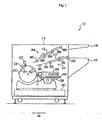
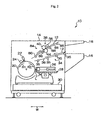


Classifications
-
- G—PHYSICS
- G03—PHOTOGRAPHY; CINEMATOGRAPHY; ANALOGOUS TECHNIQUES USING WAVES OTHER THAN OPTICAL WAVES; ELECTROGRAPHY; HOLOGRAPHY
- G03F—PHOTOMECHANICAL PRODUCTION OF TEXTURED OR PATTERNED SURFACES, e.g. FOR PRINTING, FOR PROCESSING OF SEMICONDUCTOR DEVICES; MATERIALS THEREFOR; ORIGINALS THEREFOR; APPARATUS SPECIALLY ADAPTED THEREFOR
- G03F7/00—Photomechanical, e.g. photolithographic, production of textured or patterned surfaces, e.g. printing surfaces; Materials therefor, e.g. comprising photoresists; Apparatus specially adapted therefor
- G03F7/004—Photosensitive materials
- G03F7/027—Non-macromolecular photopolymerisable compounds having carbon-to-carbon double bonds, e.g. ethylenic compounds
- G03F7/028—Non-macromolecular photopolymerisable compounds having carbon-to-carbon double bonds, e.g. ethylenic compounds with photosensitivity-increasing substances, e.g. photoinitiators
- G03F7/029—Inorganic compounds; Onium compounds; Organic compounds having hetero atoms other than oxygen, nitrogen or sulfur
-
- B—PERFORMING OPERATIONS; TRANSPORTING
- B41—PRINTING; LINING MACHINES; TYPEWRITERS; STAMPS
- B41C—PROCESSES FOR THE MANUFACTURE OR REPRODUCTION OF PRINTING SURFACES
- B41C1/00—Forme preparation
- B41C1/10—Forme preparation for lithographic printing; Master sheets for transferring a lithographic image to the forme
- B41C1/1008—Forme preparation for lithographic printing; Master sheets for transferring a lithographic image to the forme by removal or destruction of lithographic material on the lithographic support, e.g. by laser or spark ablation; by the use of materials rendered soluble or insoluble by heat exposure, e.g. by heat produced from a light to heat transforming system; by on-the-press exposure or on-the-press development, e.g. by the fountain of photolithographic materials
-
- G—PHYSICS
- G03—PHOTOGRAPHY; CINEMATOGRAPHY; ANALOGOUS TECHNIQUES USING WAVES OTHER THAN OPTICAL WAVES; ELECTROGRAPHY; HOLOGRAPHY
- G03F—PHOTOMECHANICAL PRODUCTION OF TEXTURED OR PATTERNED SURFACES, e.g. FOR PRINTING, FOR PROCESSING OF SEMICONDUCTOR DEVICES; MATERIALS THEREFOR; ORIGINALS THEREFOR; APPARATUS SPECIALLY ADAPTED THEREFOR
- G03F7/00—Photomechanical, e.g. photolithographic, production of textured or patterned surfaces, e.g. printing surfaces; Materials therefor, e.g. comprising photoresists; Apparatus specially adapted therefor
- G03F7/002—Photomechanical, e.g. photolithographic, production of textured or patterned surfaces, e.g. printing surfaces; Materials therefor, e.g. comprising photoresists; Apparatus specially adapted therefor using materials containing microcapsules; Preparing or processing such materials, e.g. by pressure; Devices or apparatus specially designed therefor
-
- G—PHYSICS
- G03—PHOTOGRAPHY; CINEMATOGRAPHY; ANALOGOUS TECHNIQUES USING WAVES OTHER THAN OPTICAL WAVES; ELECTROGRAPHY; HOLOGRAPHY
- G03F—PHOTOMECHANICAL PRODUCTION OF TEXTURED OR PATTERNED SURFACES, e.g. FOR PRINTING, FOR PROCESSING OF SEMICONDUCTOR DEVICES; MATERIALS THEREFOR; ORIGINALS THEREFOR; APPARATUS SPECIALLY ADAPTED THEREFOR
- G03F7/00—Photomechanical, e.g. photolithographic, production of textured or patterned surfaces, e.g. printing surfaces; Materials therefor, e.g. comprising photoresists; Apparatus specially adapted therefor
- G03F7/004—Photosensitive materials
- G03F7/027—Non-macromolecular photopolymerisable compounds having carbon-to-carbon double bonds, e.g. ethylenic compounds
-
- G—PHYSICS
- G03—PHOTOGRAPHY; CINEMATOGRAPHY; ANALOGOUS TECHNIQUES USING WAVES OTHER THAN OPTICAL WAVES; ELECTROGRAPHY; HOLOGRAPHY
- G03F—PHOTOMECHANICAL PRODUCTION OF TEXTURED OR PATTERNED SURFACES, e.g. FOR PRINTING, FOR PROCESSING OF SEMICONDUCTOR DEVICES; MATERIALS THEREFOR; ORIGINALS THEREFOR; APPARATUS SPECIALLY ADAPTED THEREFOR
- G03F7/00—Photomechanical, e.g. photolithographic, production of textured or patterned surfaces, e.g. printing surfaces; Materials therefor, e.g. comprising photoresists; Apparatus specially adapted therefor
- G03F7/004—Photosensitive materials
- G03F7/027—Non-macromolecular photopolymerisable compounds having carbon-to-carbon double bonds, e.g. ethylenic compounds
- G03F7/028—Non-macromolecular photopolymerisable compounds having carbon-to-carbon double bonds, e.g. ethylenic compounds with photosensitivity-increasing substances, e.g. photoinitiators
-
- G—PHYSICS
- G03—PHOTOGRAPHY; CINEMATOGRAPHY; ANALOGOUS TECHNIQUES USING WAVES OTHER THAN OPTICAL WAVES; ELECTROGRAPHY; HOLOGRAPHY
- G03F—PHOTOMECHANICAL PRODUCTION OF TEXTURED OR PATTERNED SURFACES, e.g. FOR PRINTING, FOR PROCESSING OF SEMICONDUCTOR DEVICES; MATERIALS THEREFOR; ORIGINALS THEREFOR; APPARATUS SPECIALLY ADAPTED THEREFOR
- G03F7/00—Photomechanical, e.g. photolithographic, production of textured or patterned surfaces, e.g. printing surfaces; Materials therefor, e.g. comprising photoresists; Apparatus specially adapted therefor
- G03F7/004—Photosensitive materials
- G03F7/027—Non-macromolecular photopolymerisable compounds having carbon-to-carbon double bonds, e.g. ethylenic compounds
- G03F7/028—Non-macromolecular photopolymerisable compounds having carbon-to-carbon double bonds, e.g. ethylenic compounds with photosensitivity-increasing substances, e.g. photoinitiators
- G03F7/031—Organic compounds not covered by group G03F7/029
-
- G—PHYSICS
- G03—PHOTOGRAPHY; CINEMATOGRAPHY; ANALOGOUS TECHNIQUES USING WAVES OTHER THAN OPTICAL WAVES; ELECTROGRAPHY; HOLOGRAPHY
- G03F—PHOTOMECHANICAL PRODUCTION OF TEXTURED OR PATTERNED SURFACES, e.g. FOR PRINTING, FOR PROCESSING OF SEMICONDUCTOR DEVICES; MATERIALS THEREFOR; ORIGINALS THEREFOR; APPARATUS SPECIALLY ADAPTED THEREFOR
- G03F7/00—Photomechanical, e.g. photolithographic, production of textured or patterned surfaces, e.g. printing surfaces; Materials therefor, e.g. comprising photoresists; Apparatus specially adapted therefor
- G03F7/004—Photosensitive materials
- G03F7/038—Macromolecular compounds which are rendered insoluble or differentially wettable
- G03F7/0388—Macromolecular compounds which are rendered insoluble or differentially wettable with ethylenic or acetylenic bands in the side chains of the photopolymer
-
- B—PERFORMING OPERATIONS; TRANSPORTING
- B41—PRINTING; LINING MACHINES; TYPEWRITERS; STAMPS
- B41C—PROCESSES FOR THE MANUFACTURE OR REPRODUCTION OF PRINTING SURFACES
- B41C1/00—Forme preparation
- B41C1/10—Forme preparation for lithographic printing; Master sheets for transferring a lithographic image to the forme
- B41C1/1008—Forme preparation for lithographic printing; Master sheets for transferring a lithographic image to the forme by removal or destruction of lithographic material on the lithographic support, e.g. by laser or spark ablation; by the use of materials rendered soluble or insoluble by heat exposure, e.g. by heat produced from a light to heat transforming system; by on-the-press exposure or on-the-press development, e.g. by the fountain of photolithographic materials
- B41C1/1016—Forme preparation for lithographic printing; Master sheets for transferring a lithographic image to the forme by removal or destruction of lithographic material on the lithographic support, e.g. by laser or spark ablation; by the use of materials rendered soluble or insoluble by heat exposure, e.g. by heat produced from a light to heat transforming system; by on-the-press exposure or on-the-press development, e.g. by the fountain of photolithographic materials characterised by structural details, e.g. protective layers, backcoat layers or several imaging layers
-
- B—PERFORMING OPERATIONS; TRANSPORTING
- B41—PRINTING; LINING MACHINES; TYPEWRITERS; STAMPS
- B41C—PROCESSES FOR THE MANUFACTURE OR REPRODUCTION OF PRINTING SURFACES
- B41C2201/00—Location, type or constituents of the non-imaging layers in lithographic printing formes
- B41C2201/02—Cover layers; Protective layers
-
- B—PERFORMING OPERATIONS; TRANSPORTING
- B41—PRINTING; LINING MACHINES; TYPEWRITERS; STAMPS
- B41C—PROCESSES FOR THE MANUFACTURE OR REPRODUCTION OF PRINTING SURFACES
- B41C2201/00—Location, type or constituents of the non-imaging layers in lithographic printing formes
- B41C2201/06—Backcoats; Back layers
-
- B—PERFORMING OPERATIONS; TRANSPORTING
- B41—PRINTING; LINING MACHINES; TYPEWRITERS; STAMPS
- B41C—PROCESSES FOR THE MANUFACTURE OR REPRODUCTION OF PRINTING SURFACES
- B41C2201/00—Location, type or constituents of the non-imaging layers in lithographic printing formes
- B41C2201/10—Location, type or constituents of the non-imaging layers in lithographic printing formes characterised by inorganic compounds, e.g. pigments
-
- B—PERFORMING OPERATIONS; TRANSPORTING
- B41—PRINTING; LINING MACHINES; TYPEWRITERS; STAMPS
- B41C—PROCESSES FOR THE MANUFACTURE OR REPRODUCTION OF PRINTING SURFACES
- B41C2201/00—Location, type or constituents of the non-imaging layers in lithographic printing formes
- B41C2201/12—Location, type or constituents of the non-imaging layers in lithographic printing formes characterised by non-macromolecular organic compounds
-
- B—PERFORMING OPERATIONS; TRANSPORTING
- B41—PRINTING; LINING MACHINES; TYPEWRITERS; STAMPS
- B41C—PROCESSES FOR THE MANUFACTURE OR REPRODUCTION OF PRINTING SURFACES
- B41C2201/00—Location, type or constituents of the non-imaging layers in lithographic printing formes
- B41C2201/14—Location, type or constituents of the non-imaging layers in lithographic printing formes characterised by macromolecular organic compounds, e.g. binder, adhesives
-
- B—PERFORMING OPERATIONS; TRANSPORTING
- B41—PRINTING; LINING MACHINES; TYPEWRITERS; STAMPS
- B41C—PROCESSES FOR THE MANUFACTURE OR REPRODUCTION OF PRINTING SURFACES
- B41C2210/00—Preparation or type or constituents of the imaging layers, in relation to lithographic printing forme preparation
- B41C2210/04—Negative working, i.e. the non-exposed (non-imaged) areas are removed
-
- B—PERFORMING OPERATIONS; TRANSPORTING
- B41—PRINTING; LINING MACHINES; TYPEWRITERS; STAMPS
- B41C—PROCESSES FOR THE MANUFACTURE OR REPRODUCTION OF PRINTING SURFACES
- B41C2210/00—Preparation or type or constituents of the imaging layers, in relation to lithographic printing forme preparation
- B41C2210/08—Developable by water or the fountain solution
-
- B—PERFORMING OPERATIONS; TRANSPORTING
- B41—PRINTING; LINING MACHINES; TYPEWRITERS; STAMPS
- B41C—PROCESSES FOR THE MANUFACTURE OR REPRODUCTION OF PRINTING SURFACES
- B41C2210/00—Preparation or type or constituents of the imaging layers, in relation to lithographic printing forme preparation
- B41C2210/20—Preparation or type or constituents of the imaging layers, in relation to lithographic printing forme preparation characterised by inorganic additives, e.g. pigments, salts
-
- B—PERFORMING OPERATIONS; TRANSPORTING
- B41—PRINTING; LINING MACHINES; TYPEWRITERS; STAMPS
- B41C—PROCESSES FOR THE MANUFACTURE OR REPRODUCTION OF PRINTING SURFACES
- B41C2210/00—Preparation or type or constituents of the imaging layers, in relation to lithographic printing forme preparation
- B41C2210/22—Preparation or type or constituents of the imaging layers, in relation to lithographic printing forme preparation characterised by organic non-macromolecular additives, e.g. dyes, UV-absorbers, plasticisers
-
- B—PERFORMING OPERATIONS; TRANSPORTING
- B41—PRINTING; LINING MACHINES; TYPEWRITERS; STAMPS
- B41C—PROCESSES FOR THE MANUFACTURE OR REPRODUCTION OF PRINTING SURFACES
- B41C2210/00—Preparation or type or constituents of the imaging layers, in relation to lithographic printing forme preparation
- B41C2210/24—Preparation or type or constituents of the imaging layers, in relation to lithographic printing forme preparation characterised by a macromolecular compound or binder obtained by reactions involving carbon-to-carbon unsaturated bonds, e.g. acrylics, vinyl polymers
Definitions
- the present invention relates to an image recording material improved in the white light safety.
- a computer-to-plate technique of producing a printing plate by exposing a lithographic printing plate precursor directly to a laser without intervention of a lith film based on digital data of a computer or the like has been developed, and a lithographic printing plate employing a high-sensitivity laser recording system using this technique has been developed.
- the high-sensitivity printing plate for conventional laser plate-making process using an Ar laser or an FD-YAG laser is, under red light; taken out from a corrugated board package, loaded into a cassette of a plate setter or sometimes manually inserted into a plate setter. In this way, all operations must be performed under dark red light and the workability is seriously bad.
- a normal diazo-type printing plate can be handled under yellow light or UV-cut white light and ensures good workability.
- the enhancement of safelight immunity of a high-sensitivity laser recording lithographic printing plate is greatly demanded on the market in view of workability.
- JP-A-2000-35673 (the term "JP-A” as used herein means an "unexamined published Japanese patent application”) describes a production method of a lithographic printing plate, where a lithographic printing plate comprising at least (A) an aluminum support and (B) a laser sensitive recording layer in this order is exposed by an inner drum-type plate setter using semiconductor laser light in the region from ultraviolet light to visible light (360 to 450 nm). According to this plate-making method, the plate can be handled under yellow light and even when the plate is exposed by an inner drum-type plate setter, fogging is not generated.
- a method called an on-press development has been proposed as one simple and easy plate-making method, where a lithographic printing plate precursor having an image recording layer dissolvable or dispersible with a printing ink and/or a fountain solution is used, and a lithographic printing plate is obtained by supplying a printing ink and/or a fountain solution to an exposed plate loaded on a printing press and thereby removing the unexposed area of the image recording layer.
- JP-A-47-8657 describes a photosensitive composition comprising a polyvinylpyrrolidone, a polymer polycarboxylic acid and an olefinically unsaturated monomer and, if desired, containing a photoinitiator and a polymerization inhibitor, with which a printing plate loadable on a printing press immediately after exposure without applying any processing and usable for printing can be obtained.
- An object of the present invention is to satisfy the above-described requirement. That is, an object of the present invention is to provide an image recording material ensuring excellent white light safety without decreasing the sensitivity at the image exposure.
- the present invention is as follows.
- the unexposed area causes a polymerization reaction to generate fogging. If a polymerization inhibitor is added to the image recording material so as to prevent this polymerization, the white light fogging may be prevented but the sensitivity at the image formation (polymerization reaction) is also decreased.
- the present inventors have found that by incorporating a compound of generating, when heated, a chemical species of inhibiting a polymerization reaction into an image recording material such as lithographic printing plate precursor, and heating the image recording material after image exposure to produce a polymerization inhibitor, white light fogging in the non-image area can be prevented and at the same time, sensitivity in the image area can be ensured.
- the present invention has been accomplished based on this finding.
- the image recording material of the present invention is characterized by comprising (A) a polymerization initiator, (B) a polymerizable compound, and (C) a compound of generating, when heated, a chemical species of inhibiting a polymerization reaction.
- the image recording material which can be suitably used is a lithographic printing plate precursor comprising a support having thereon an image recording layer comprising (A) a polymerization initiator, (B) a polymerizable compound, and (C) a compound of generating, when heated, a chemical species of inhibiting a polymerization reaction.
- a polymerization inhibitor can be generated in the image recording material (image recording layer) by heating the image recording material after image exposure, whereby the white light safety in subsequent handling of the image recording material (lithographic printing plate precursor) can be enhanced without decreasing the sensitivity at the image exposure.
- the image recording layer according to the present invention is preferably an image recording layer removable with a printing ink and/or a fountain solution. With such an image recording layer, an on-press developable lithographic printing plate precursor having excellent white light safety can be obtained.
- the compound (C) of generating, when heated, a chemical species of inhibiting a polymerization reaction for use in the present invention is a compound of decomposing under the action of heat to generate a radical polymerization inhibitor (hereinafter, this compound is sometimes referred to as a "polymerization inhibitor precursor").
- the radical polymerization inhibitor as used herein means a compound of stopping or inhibiting a radical polymerization reaction.
- Preferred examples of the radical polymerization inhibitor include (1) oxygen, (2) phenols and quinones, (3) amines, (4) N-oxides and nitrosos, and (5) triarylmethanes.
- phenols and quinones examples include phenol, p-methoxyphenol, 2,6-di-tert-butyl-4-methoxyphenol, 2,6-di-tert-butyl-4-cresol, hydroquinone, catechol, tert-butyl catechol, pyrogallol, resorcinol, 4,4'-thiobis(3-methyl-6-tert-butylphenol), 2,2'-methylenebis(4-methyl-6-tert-butylphenol), phenylhydroquinone, hydroquinone, tert-butylhydroquinone, 2,5-di-tert-butylhydroquinone and benzoquinone.
- (3) amines include aniline, methoxyaniline, aminophenol, 2,4,6-tri-tert-butylaniline, diphenylamine, triphenylamine, and 2,2,6,6-tetramethylpiperidine and derivatives thereof.
- N-oxides and nitrosos examples include di-tert-butylnitroxide, 2,2,6,6-tetramethylpiperidine-N-oxide and derivatives thereof, and N-nitrosophenylhydroxylamine and metal salts thereof.
- the (5) triarylmethanes are not particularly limited but specific examples thereof include those having structures shown below.
- the polymerization inhibitor precursor of the present invention is a compound of decomposing under heat to produce the above-described thermopolymerization initiator, preferably a compound having a phenolic hydroxyl group protected with a thermally decomposable group.
- polymerization inhibitor precursor for use in the present invention are set forth below, but the present invention is not limited thereto.
- the amount of the polymerization inhibitor precursor added is preferably from 0.01 to 15 mass%, more preferably from 0.1 to 10 mass%, and most preferably from 0.5 to 5 mass%, based on the entire solid content of the image recording layer.
- the thermal decomposition efficiency is elevated and this is preferred.
- Preferred examples of the strong acid include acids with a pKa of 3 or less. Among these, more preferred is a sulfonic acid, and most preferred is a sulfonic acid containing a halogen atom.
- Preferred examples of the acid generator include compounds of generating the above-described acid with a pKa of 3 or less. Among these, more preferred are a diazonium salt, a sulfonium salt, an iodonium salt and a sulfonic acid ester.
- the method for heating the lithographic printing precursor after image exposure is not particularly limited and a known heating method can be used. Examples thereof include a direct heating method of contacting the plate with a heat source such as heat roller, a heating method of blowing hot air, a heating method of irradiating infrared rays generated from an infrared emitter such as halogen heater or ceramic heater, an electromagnetic heating method of irradiating an electron magnetic wave at a predetermined wavelength generated from a magnetron and resonating substances such as water content contained in the image recording layer, and an induction heating method of applying a high-frequency magnetic field to a metal-made lithographic printing plate support from an electromagnetic coil.
- a heat source such as heat roller
- a heating method of blowing hot air a heating method of irradiating infrared rays generated from an infrared emitter such as halogen heater or ceramic heater
- the heating temperature is preferably from 75 to 250°C, more preferably from 90 to 180°C, and the heating time is preferably from 1 to 600 seconds, more preferably from 10 to 180 seconds.
- the image exposure apparatus 10 used in the case of applying heat after exposure preferably comprises a heating device 38 disposed, for example, in a casing 14.
- the heating device 38 locally heats (spot-heating) the lithographic printing plate precursor 12 with hot air and, as shown in Fig. 3, comprises a heating fan unit 140 and a tubular hot air nozzle 144 connected to the heating fan unit 140 through a flexible duct 142.
- the heating fan unit 140 is fixed in the casing 14, and the hot air nozzle 144 is mounted together with an exposure head 26 on a carrier 68.
- the portion on the distal end side of the flexible duct 142 passes together with a bundle of optical fibers through a cable bear.
- the hot air nozzle 144 on the carrier 68 is disposed to come adjacent to the exposure head 26 along the sub-scanning direction.
- the hot air nozzle 144 is supported by extending its basal end side in parallel with the traveling direction of laser light L and at the distal end part, a bend part 45 bent from the basal end side toward the distal end surface to face the exposure region AIR on a lithographic printing plate precursor 12 is formed.
- a rectangular blow port is opened on the distal end surface of this bend part 45.
- a heating part 48 comprising a heater such as halogen heater or ceramic heater for heating air taken in from the outside of the casing 14, and an air supply part 50 for supplying the heated air in a pressurized state into the flexible duct 142 are provided.
- the high-temperature air supplied into the flexible duct 142 is supplied to the hot air nozzle 144 and blown as hot air from the blow port 46 of the hot air nozzle 144 onto a lithographic printing plate precursor 12 loaded on an outer drum 20.
- the bend part 45 of the hot air nozzle 144 faces the exposure region AIR on the lithographic printing plate precursor 12 and therefore, the hot air belched out from the blow port 46 is blown on the region (hereinafter, sometimes referred to as a "heating region A HT ”) overlapping with the exposure region A IR of the lithographic printing plate precursor 12, as a result, the recording layer in the heating region A HT is heated to a predetermined heating temperature.
- the heating region A HT has a center nearly agreeing with the center of the exposure region AIR and the size thereof is sufficiently larger than the exposure region AIR in both the sub-scanning direction and the main scanning direction.
- the heating region A HT above the lithographic printing plate precursor 12 can include the exposure region AIR and when the hot air belched from the blow port 46 is blown on the heating region A HT including the exposure region AIR at the same time with irradiation of laser light L on an arbitrary exposure region AIR of the lithographic printing plate precursor 12, exposure starts in the exposure region AIR by the action of laser light L and the heating region A TH is heated to a predetermined heating temperature during the exposure from the initiation of exposure to the completion of exposure.
- the exposure time from the start of exposure in an arbitrary exposure region AIR by the action of laser light L until the completion of exposure is nearly agreeing with the modulation cycle of laser light L according to the sub-scanning speed and is usually as short as about 0.05 seconds.
- the hot air temperature In order to heat the lithographic printing plate precursor to a desired heating temperature, for example, with hot air in such a short time, the hot air temperature must be made extremely high but this is not practical.
- the length of the heating region A HT along the sub-scanning direction is preferably from 50 to 100 times that of the exposure region AIR, so that the hot air heating of an arbitrary exposure region AIR included in the heating region A HT can continue over from 106 to 107 times the modulation cycle. With this constitution, the heating time for an arbitrary exposure region AIR can be satisfactorily prolonged and therefore, the exposure region AIR can be stably heated to a predetermined heating temperature even when the hot air temperature is not made extremely high.
- a heating control part for controlling the heating device 38 is provided.
- This heating control part controls the temperature and quantity of the hot air supplied from the heating fan unit 140 to the hot air nozzle 144. Also, by mounting a temperature sensor such as infrared radiation thermometer on the carrier 68 and measuring the temperature (surface temperature) of the heating region A HT with use of the temperature sensor, the measurement signal corresponding to the surface temperature in the center part of the heating region A HT can be output to the heating control part.
- the heating control part can feedback control the temperature of the heating region A HT based on the measurement signal, and the temperature in the center part of the heating region A HT can be stably maintained to the heating temperature with good precision.
- a transportation mechanism 84 for transporting the lithographic printing plate precursor 12 released from the outer drum 20 to a discharge tray 18 is provided.
- This transportation mechanism 84 comprises a plurality of transportation rollers 86 disposed along the transportation route for the lithographic printing plate precursor 12, and a plate-like guide member 88.
- the outer drum 20 is rotated in the reverse direction (in the arrow R2 direction in Fig. 1) and at the same time, the rear end part and the leading end part of the lithographic printing plate precursor 12 are sequentially released from the outer drum by a chuck mechanism 22.
- the transportation mechanism 84 starts transporting the lithographic printing plate precursor 12 delivered from the outer drum 20 and reached the entrance part of the discharge route to the discharge tray by rotating the transportation rollers 86 and discharges the lithographic printing plate precursor 12 onto the discharge tray 18.
- the heating device 38 of the image exposure apparatus 10 employs a system of blowing hot air directly to the lithographic printing plate precursor 12 surface and thereby spot-heating the heating region A HT of the lithographic printing plate precursor 12, but the heating device is not limited to those using hot air and, for example, an infrared emitter such as halogen heater or ceramic heater may be mounted on the carrier to irradiate the lithographic printing plate precursor 12 with infrared rays generated from the emitter and thereby spot-heat the heating region A HT , a magnetron may be mounted on the carrier 68 to irradiate the recording layer of the lithographic printing plate precursor 12 with an electromagnetic wave at a predetermined wavelength generated from the magnetron and resonate substances such as water in the recording layer, thereby effecting spot-heating (electromagnetic heating), or an electromagnetic coil may be mounted on the carrier 68 to apply a high-frequency magnetic field from the electromagnetic coil to the metal-made support of the lithographic printing plate precursor 12 and
- the polymerization initiator for use in the present invention is a compound of generating a radical by the effect of either one or both of light and heat energies and thereby initiating or accelerating the polymerization of a compound having a polymerizable unsaturated group.
- a compound of generating a radical by absorbing light at 250 to 420 nm, and a compound of generating a radical in combination with an infrared absorbent are preferred.
- Such a photo-radical generator may be appropriately selected and used from known polymerization initiators, compounds having a bond small in the bond-dissociation energy, and the like.
- Examples of the compound of generating a radical include organohalogen compounds, carbonyl compounds, organic peroxides, azo-based compounds, azide compounds, metallocene compounds, hexaarylbiimidazole compounds, organoboron compounds, disulfone compounds, oxime ester compounds and onium salt compounds.
- organohalogen compound examples include the compounds described in Wakabayashi et al., Bull. Chem. Soc. Japan, 42, 2924 (1969), U.S. Patent 3,905,815, JP-B-46-4605 (the term "JP-B” as used herein means an "examined Japanese patent publication"), JP-A-48-36281, JP-A-53-133428, JP-A-55-32070, JP-A-60-239736, JP-A-61-169835, JP-A-61-169837, JP-A-62-58241, JP-A-62-212401, JP-A-63-70243, JP-A-63-298339, and M.P. Hutt, Journal of Heterocyclic Chemistry, 1, No. 3 (1970).
- oxazole compounds substituted with a trihalomethyl group and s-triazine compounds are preferred.
- s-Triazine derivatives where at least one mono-, di- or tri-halogenated methyl group is bonded to the s-triazine ring, and oxadiazole derivatives where that methyl group is bonded to the oxadiazole ring, are more preferred.
- Examples of the carbonyl compound include benzophenone derivatives such as benzophenone, Michler's ketone, 2-methylbenzophenone, 3-methylbenzophenone, 4-methylbenzophenone, 2-chlorobenzophenone, 4-bromobenzophenone and 2-carboxybenzophenone; acetophenone derivatives such as 2,2-dimethoxy-2-phenylacetophenone, 2,2-diethoxyacetophenone, 1-hydroxycyclohexylphenylketone, ⁇ -hydroxy-2-methylphenylpropanone, 1-hydroxy-1-methylethyl-(p-isopropylphenyl)ketone, 1-hydroxy-1-(p-dodecylphenyl)ketone, 2-methyl-(4'-(methylthio)phenyl)-2-morpholino-1-propanone and 1,1,1-trichloromethyl-(p-butylphenyl)ketone; thioxanthone derivatives such as thioxanthone, 2-
- Examples of the azo-based compound which can be used include azo compounds described in JP-A-8-108621.
- organic peroxide examples include trimethylcyclohexanone peroxide, acetylacetone peroxide, 1,1-bis(tert-butylperoxy)-3,3,5-trimethylcyclohexane, 1,1-bis(tert-butylperoxy)cyclohexane, 2,2-bis(tert-butylperoxy)butane, tert-butyl hydroperoxide, cumene hydroperoxide, diisopropylbenzene hydroperoxide, 2,5-dimethylhexane-2,5-dihydroperoxide, 1,1,3,3-tetramethylbutyl hydroperoxide, tert-butylcumyl peroxide, dicumyl peroxide, 2,5-dimethyl-2,5-di(tert-butylperoxy)hexane, 2,5-oxanoyl peroxide, succinic peroxide, benzoyl peroxide, 2,4-dichlorobenzo
- metallocene compound examples include various titanocene compounds described in JP-A-59-152396, JP-A-61-151197, JP-A-63-41484, JP-A-2-249, JP-A-2-4705 and JP-A-5-83588, such as dicyclopentadienyl-Ti-bis-phenyl, dicyclopentadienyl-Ti-bis-2,6-difluorophen-1-yl, dicyclopentadienyl-Ti-bis-2,4-difluorophen-1-yl, dicyclopentadienyl-Ti-bis-2,4,6-trifluorophen-1-yl, dicyclopentadienyl-Ti-bis-2,3,5,6-tetrafluorophen-1-yl, dicyclopentadienyl-Ti-bis-2,3,4,5,6-pentafluorophen-1-yl, dimethylcyclopentadienyl
- hexaarylbiimidazole compound examples include various compounds described in JP-B-6-29285 and U.S. Patents 3,479,185, 4,311,783 and 4,622,286, such as 2,2'-bis(o-chlorophenyl)-4,4',5,5'-tetraphenylbiimidazole, 2,2'-bis(o-bromophenyl)-4,4',5,5'-tetraphenylbiimidazole, 2,2'-bis(o,p-dichlorophenyl)-4,4',5,5'-tetraphenylbiimidazole, 2,2'-bis(o-chlorophenyl)-4,4',5,5'-tetra(m-methoxyphenyl)biimidazole, 2,2'-bis(o,o'-dichlorophenyl)-4,4',5,5'-tetraphenylbiimidazole, 2,2
- organoboron compound examples include organic borates described in JP-A-62-143044, JP-A-62-150242, JP-A-9-188685, JP-A-9-188686, JP-A-9-188710, JP-A-2000-131837, JP-A-2002-107916, Japanese Patent No. 2764769, JP-A-2002-116539, and Martin Kunz, Rad Tech. '98.
- Examples of the disulfone compound include compounds described in JP-A-61-166544 and JP-A-2003-328465.
- oxime ester compound examples include compounds described in J.C.S. Perkin II, 1653-1660 (1979), J.C.S. Perkin II , 156-162 (1979), Journal of Photopolymer Science and Technology , 202-232 (1995), JP-A-2000-66385 and JP-A-2000-80068. Specific examples thereof include the compounds represented by the following structural formulae.
- onium salt compound examples include onium salts such as diazonium salts described in S.I. Schlesinger, Photogr. Sci. Eng. , 18, 387 (1974) and T.S. Bal et al., Polymer , 21, 423 (1980); ammonium salts described in U.S. Patent 4,069,055 and JP-A-4-365049; phosphonium salts described in U.S. Patents 4,069,055 and 4,069,056; iodonium salts described in European Patent 104,143, U.S.
- onium salts such as diazonium salts described in S.I. Schlesinger, Photogr. Sci. Eng. , 18, 387 (1974) and T.S. Bal et al., Polymer , 21, 423 (1980); ammonium salts described in U.S. Patent 4,069,055 and JP-A-4-365049; phosphonium salts described in U.S. Patents 4,069,055 and 4,
- such an onium salt functions as an ionic radical polymerization initiator but not as an acid generator.
- the onium salt suitably used in the present invention is an onium salt represented by any one of the following formulae (RI-I) to (RI-III):
- Ar 11 represents an aryl group having 20 or less carbon atoms, which may have from 1 to 6 substituent(s), and preferred examples of the substituent include an alkyl group having from 1 to 12 carbon atoms, an alkenyl group having from 1 to 12 carbon atoms, an alkynyl group having from 1 to 12 carbon atoms, an aryl group having from 1 to 12 carbon atoms, an alkoxy group having from 1 to 12 carbon atoms, an aryloxy group having from 1 to 12 carbon atoms, a halogen atom, an alkylamino group having from 1 to 12 carbon atoms, a dialkylamino group having from 1 to 12 carbon atoms, an alkylamide or arylamide group having from 1 to 12 carbon atoms, a carbonyl group, a carboxyl group, a cyano group, a sulfonyl group, a thioalkyl group having from 1 to 12 carbon atoms, and
- Z 11 - represents a monovalent anion and specific examples thereof include halogen ion, perchlorate ion, hexafluorophosphate ion, tetrafluoroborate ion, sulfonate ion, sulfinate ion, thiosulfonate ion and sulfate ion.
- preferred in view of stability are perchlorate ion, hexafluorophosphate ion, tetrafluoroborate ion, sulfonate ion and sulfinate ion.
- Ar 21 and Ar 22 each independently represents an aryl group having 20 or less carbon atoms, which may have from 1 to 6 substituent(s), and preferred examples of the substituent include an alkyl group having from 1 to 12 carbon atoms, an alkenyl group having from 1 to 12 carbon atoms, an alkynyl group having from 1 to 12 carbon atoms, an aryl group having from 1 to 12 carbon atoms, an alkoxy group having from 1 to 12 carbon atoms, an aryloxy group having from 1 to 12 carbon atoms, a halogen atom, an alkylamino group having from 1 to 12 carbon atoms, a dialkylamino group having from 1 to 12 carbon atoms, an alkylamido or arylamido group having from 1 to 12 carbon atoms, a carbonyl group, a carboxyl group, a cyano group, a sulfonyl group, a thioalkyl group having from 1 to 1 to 12 carbon atoms
- Z 21 - represents a monovalent anion and specific examples thereof include halogen ion, perchlorate ion, hexafluorophosphate ion, tetrafluoroborate ion, sulfonate ion, sulfinate ion, thiosulfonate ion and sulfate ion.
- preferred in view of stability and reactivity are perchlorate ion, hexafluorophosphate ion, tetrafluoroborate ion, sulfonate ion, sulfinate ion and carboxylate ion.
- R 31 , R 32 and R 33 each independently represents an aryl, alkyl, alkenyl or alkynyl group having 20 or less carbon atoms, which may have from 1 to 6 substituent(s), and in view of reactivity and stability, preferably an aryl group.
- substituents examples include an alkyl group having from 1 to 12 carbon atoms, an alkenyl group having from 1 to 12 carbon atoms, an alkynyl group having from 1 to 12 carbon atoms, an aryl group having from 1 to 12 carbon atoms, an alkoxy group having from 1 to 12 carbon atoms, an aryloxy group having from 1 to 12 carbon atoms, a halogen atom, an alkylamino group having from 1 to 12 carbon atoms, a dialkylamino group having from 1 to 12 carbon atoms, an alkylamido or arylamido group having from 1 to 12 carbon atoms, a carbonyl group, a carboxyl group, a cyano group, a sulfonyl group, a thioalkyl group having from 1 to 12 carbon atoms, and a thioaryl group having from 1 to 12 carbon atoms.
- Z 31 - represents a monovalent anion and specific examples thereof include halogen ion, perchlorate ion, hexafluorophosphate ion, tetrafluoroborate ion, sulfonate ion, sulfinate ion, thiosulfonate ion and sulfate ion.
- perchlorate ion perchlorate ion, hexafluorophosphate ion, tetrafluoroborate ion, sulfonate ion, sulfinate ion and carboxylate ion
- carboxylate ion described in JP-A-2001-343742
- carboxylate ion described in JP-A-2002-148790.
- the polymerization initiator is not limited to those described above, but particularly in view of reactivity and stability, triazine-based initiators, organohalogen compounds, oxime ester compounds, diazonium salts, iodonium salts and sulfonium salts are more preferred because these generate a large amount of radical by the exposure in a short time.
- the polymerization initiator in the system of such a triazine-based initiator, organohalogen compound, oxime ester compound, diazonium salt, iodonium salt or sulfonium salt is preferably used in combination with a sensitizing dye, because the photopolymerization rate can be increased by the combination use with a sensitizing dye.
- the sensitizing dye include benzoin, benzoin methyl ether, benzoin ethyl ether, 9-fluorenone, 2-chloro-9-fluorenone, 2-methyl-9-fluorenone, 9-anthrone, 2-bromo-9-anthrone, 2-ethyl-9-anthrone, 9,10-anthraquinone, 2-ethyl-9,10-anthraquinone, 2-tert-butyl-9,10-anthraquinone, 2,6-dichloro-9,10-anthraquinone, xanthone, 2-methylxanthone, 2-methoxyxanthone, thioxanthone, benzyl, dibenzylacetone, p-(dimethylamino)phenyl styryl ketone, p-(dimethylamino)phenyl p-methylstyryl ketone, benzophenone, p-(dimethyl
- sensitizing dye for use in the present invention include compounds described in JP-B-51-48516, which are represented by formula (I):
- R 14 represents an alkyl group (e.g., methyl, ethyl, propyl) or a substituted alkyl group (e.g., 2-hydroxyethyl, 2-methoxyethyl, carboxymethyl, 2-carboxyethyl).
- R 15 represents an alkyl group (e.g., methyl, ethyl) or an aryl group (e.g., phenyl, p-hydroxyphenyl, naphthyl, thienyl).
- Z 2 represents a nonmetallic atom group necessary for forming a nitrogen-containing heterocyclic nucleus usually used in cyanine dyes, such as benzothiazoles (e.g., benzothiazole, 5-chlorobenzothiazole, 6-chlorothiazole), naphthothiazoles (e.g., ⁇ -naphthothiazole, ⁇ -naphthothiazole), benzoselenazoles (e.g., benzoselenazole, 5-chlorobenzoselenazole, 6-methoxybenzoselenazole), naphthoselenazoles (e.g., ⁇ -naphthoselenazole, ⁇ -naphthoselenazole), benzoxazoles (e.g., benzoxazole, 5-methylbenzoxazole, 5-phenylbenzoxazole) and naphthoxazoles (e.g., ⁇ -naph
- the compound represented by formula (I) include those having a chemical structure constituted by combining these Z 2 , R 14 and R 15 . Many of such compounds are present as a known substance and therefore, the compound may be appropriately selected and used from those known substances.
- Other preferred examples of the sensitizer for use in the present invention include merocyanine dyes described in JP-B-5-47095 and ketocoumarin-based compounds represented by the following formula (II): wherein R 16 represents an alkyl group such as methyl group and ethyl group.
- merocyanine-based dyes described in JP-A-2000-147763 may also be used as the sensitizing dye. Specific examples thereof include the following compounds.
- the polymerization initiator and sensitizing dye each can be added at a ratio of preferably 0.1 to 50 mass%, more preferably from 0.5 to 30 mass%, still more preferably from 0.8 to 20 mass%, based on all solid contents constituting the image recording layer. Within this range, good sensitivity and good antistaining property of the non-image area at the printing can be obtained.
- One of these polymerization initiators may be used alone, or two or more thereof may be used in combination. Also, the polymerization initiator may be added together with other components in the same layer or may be added to a layer separately provided.
- the image recording layer of the lithographic printing plate precursor when the imagewise exposure is performed by using a light source of emitting infrared rays, the image recording layer of the lithographic printing plate precursor preferably uses the polymerization initiator in combination with an infrared absorbent instead of the sensitizing dye.
- the infrared absorbent in general has a function of converting the absorbed infrared ray into heat and by the effect of heat generated, the polymerization initiator can be thermally decomposed and generate a radical.
- the infrared absorbent for use in the present invention is a dye or pigment having an absorption maximum at a wavelength of 760 to 1,200 nm.
- the dye commercially available dyes and known dyes described in publications, for example, in Senryo Binran (Handbook of Dyes) , compiled by Yuki Gosei Kagaku Kyokai (1970), may be used. Specific examples thereof include dyes such as azo dye, metal complex salt azo dye, pyrazolone azo dye, naphthoquinone dye, anthraquinone dye, phthalocyanine dye, carbonium dye, quinoneimine dye, methine dye, cyanine dye, squarylium dye, pyrylium salt and metal thiolate complex.
- dyes such as azo dye, metal complex salt azo dye, pyrazolone azo dye, naphthoquinone dye, anthraquinone dye, phthalocyanine dye, carbonium dye, quinoneimine dye, methine dye, cyanine dye, squarylium dye, pyrylium salt and metal thiolate complex.
- Preferred examples of the dye include cyanine dyes described in JP-A-58-125246, JP-A-59-84356 and JP-A-60-78787, methine dyes described in JP-A-58-173696, JP-A-58-181690 and JP-A-58-194595, naphthoquinone dyes described in JP-A-58-112793, JP-A-58-224793, JP-A-59-48187, JP-A-59-73996, JP-A-60-52940 and JP-A-60-63744, squarylium dyes described in JP-A-58-112792, and cyanine dyes described in British Patent 434,875.
- near infrared absorbing sensitizers described in U.S. Patent 5,156,938 may be suitably used.
- substituted arylbenzo(thio)pyrylium salts described in U.S. Patent 3,881,924, trimethinethiapyrylium salts described in JP-A-57-142645 (corresponding to U.S.
- Patent 4,327,169 pyrylium-based compounds described in JP-A-58-181051, JP-A-58-220143, JP-A-59-41363, JP-A-59-84248, JP-59-84249, JP-A-59-146063 and JP-A-59-146061, cyanine dyes described in JP-A-59-216146, pentamethinethiapyrylium salts described in U.S. Patent 4,283,475, and pyrylium compounds described in JP-B-5-13514 and JP-B-5-19702 may also be preferably used.
- Other preferred examples of the dye include near infrared absorbing dyes represented by formulae (I) and (II) of U.S. Patent 4,756,993.
- cyanine dye particularly preferred are cyanine dye, squarylium dye, pyrylium salt, nickel thiolate complex and indolenine cyanine dye, more preferred are cyanine dye and indolenine cyanine dye, still more preferred is a cyanine dye, for example, represented by the following formula (III):
- X 1 represents a hydrogen atom, a halogen atom, -NPh 2 , X 2 -L 1 or a group shown below (wherein X 2 represents an oxygen atom, a nitrogen atom or a sulfur atom, L' represents a hydrocarbon group having from 1 to 12 carbon atoms, an aromatic ring having a heteroatom, or a hydrocarbon group having from 1 to 12 carbon atoms and containing a heteroatom (the heteroatom as used herein indicates N, S, O, a halogen atom or Se), X a - has the same definition as Za - described later, and R a represents a substituent selected from a hydrogen atom, an alkyl group, an aryl group, a substituted or unsubstituted amino group and a halogen atom):
- R 1 and R 2 each independently represents a hydrocarbon group having from 1 to 12 carbon atoms.
- R 1 and R 2 each is preferably a hydrocarbon group having 2 to more carbon atoms, and R 1 and R 2 are more preferably combined with each other to form a 5- or 6-membered ring.
- Ar 1 and Ar 2 may be the same or different and each represents an aromatic hydrocarbon group which may have a substituent.
- Preferred examples of the aromatic hydrocarbon group include a benzene ring and a naphthalene ring.
- Preferred examples of the substituent include a hydrocarbon group having 12 or less carbon atoms, a halogen atom and an alkoxy group having 12 or less carbon atoms.
- Y 1 and Y 2 may be the same or different and each represents a sulfur atom or a dialkylmethylene group having 12 or less carbon atoms.
- R 3 and R 4 may be the same or different and each represents a hydrocarbon group having 20 or less carbon atoms, which may have a substituent.
- R 5 , R 6 , R 7 and R 8 may be the same or different and each represents a hydrogen atom or a hydrocarbon group having 12 or less carbon atoms, and in view of availability of the raw material, preferably a hydrogen atom.
- Za - represents a counter anion, but when the cyanine dye represented by formula (III) has an anionic substituent in its structure and neutralization of electric charge is not necessary, Za - is not present.
- Za - is preferably halogen ion, perchlorate ion, tetrafluoroborate ion, hexafluorophosphate ion or sulfonate ion, more preferably perchlorate ion, hexafluorophosphate ion or arylsulfonate ion.
- cyanine dye represented by formula (III) which can be suitably used in the present invention, include those described in paragraphs [0017] to [0019] of JP-A-2001-133969.
- pigments and pigments described in Color Index (C.I.) Binran (C.I. Handbook), Saishin Ganryo Binran (Handbook of Newest Pigments) , compiled by Nippon Ganryo Gijutsu Kyokai (1977), Saishin Ganryo Oyo Gijutsu (Newest Pigment Application Technology) , CMC Shuppan (1986), and Insatsu Ink Gijutsu (Printing Ink Technology) , CMC Shuppan (1984) can be used.
- the kind of pigment includes black pigment, yellow pigment, orange pigment, brown pigment, red pigment, violet pigment, blue pigment, green pigment, fluorescent pigment, metal powder pigment and polymer bond dye.
- Specific examples of the pigment which can be used include insoluble azo pigments, azo lake pigments, condensed azo pigments, chelate azo pigments, phthalocyanine-based pigments, anthraquinone-based pigments, perylene- or perynone-based pigments, thioindigo-based pigments, quinacridone-based pigments, dioxazine-based pigments, isoindolinone-based pigments, quinophthalone-based pigments, dyed lake pigments, azine pigments, nitroso pigments, nitro pigments, natural pigments, fluorescent pigments, inorganic pigments and carbon black.
- carbon black is preferred.
- These pigments may or may not be surface-treated before use.
- the method for surface treatment include a method of coating the surface with resin or wax, a method of attaching a surfactant, and a method of bonding a reactive substance (for example, a silane coupling agent, an epoxy compound or an isocyanate) to the pigment surface.
- a reactive substance for example, a silane coupling agent, an epoxy compound or an isocyanate
- the particle diameter of the pigment is preferably from 0.01 to 10 ⁇ m, more preferably from 0.05 to 1 ⁇ m, still more preferably from 0.1 to 1 ⁇ m. Within this range, good stability of the pigment dispersion in the coating solution for the image recording layer and good uniformity of the image recording layer can be obtained.
- the dispersion method of the pigment a known dispersion technique used in the production of ink or toner may be used.
- the dispersing machine include ultrasonic disperser, sand mill, attritor, pearl mill, super-mill, ball mill, impeller, disperser, KD mill, colloid mill, dynatron, three-roll mill and pressure kneader. These are described in detail in Saishin Ganryo Oyo Gijutsu (Newest Pigment Application Technology) , CMC Shuppan (1986).
- the infrared absorbent is preferably added to the image recording layer in a required minimum amount so as to prevent a side reaction of inhibiting the polymerization.
- the infrared absorbent can be added at a ratio of 0.001 to 50 mass%, preferably from 0.005 to 30 mass%, more preferably from 0.01 to 10 mass%, based on the entire solid content of the image recording layer.
- ratio is in this range, high sensitivity can be obtained without causing adverse effect on the uniformity or film strength of the image recording layer.
- the polymerizable compound which can be used in the present invention is an addition-polymerizable compound having at least one ethylenically unsaturated double bond and is selected from compounds having at least one, preferably two or more, ethylenically unsaturated bond(s).
- Such compounds are widely known in this industrial field and these known compounds can be used in the present invention without any particular limitation. These compounds have a chemical mode such as monomer, prepolymer (that is, dimer, trimer or oligomer) or a mixture or copolymer thereof.
- Examples of the monomer and its copolymer include unsaturated carboxylic acids (e.g., acrylic acid, methacrylic acid, itaconic acid, crotonic acid, isocrotonic acid, maleic acid), and esters and amides thereof.
- unsaturated carboxylic acids e.g., acrylic acid, methacrylic acid, itaconic acid, crotonic acid, isocrotonic acid, maleic acid
- esters and amides thereof are preferred.
- addition reaction products of an unsaturated carboxylic acid ester or amide having a nucleophilic substituent such as hydroxyl group, amino group or mercapto group with a monofunctional or polyfunctional isocyanate or epoxy, and dehydrating condensation reaction products with a monofunctional or polyfunctional carboxylic acid may be suitably used.
- addition reaction products of an unsaturated carboxylic acid ester or amide having an electrophilic substituent such as isocyanate group or epoxy group with a monofunctional or polyfunctional alcohol, amine or thiol, and displacement reaction products of an unsaturated carboxylic acid ester or amide having a desorptive substituent such as halogen group or tosyloxy group with a monofunctional or polyfunctional alcohol, amine or thiol may also be suitably used.
- compounds where the unsaturated carboxylic acid of the above-described compounds is replaced by an unsaturated phosphonic acid, styrene, vinyl ether or the like, may be used.
- ester monomer of an aliphatic polyhydric alcohol compound with an unsaturated carboxylic acid include the followings.
- the acrylic acid ester include ethylene glycol diacrylate, triethylene glycol diacrylate, 1,3-butanediol diacrylate, tetramethylene glycol diacrylate, propylene glycol diacrylate, neopentyl glycol diacrylate, trimethylolpropane triacrylate, trimethylolpropane tri(acryloyloxypropyl) ether, trimethylolethane triacrylate, hexanediol diacrylate, 1,4-cyclohexanediol diacrylate, tetraethylene glycol diacrylate, pentaerythritol diacrylate, pentaerythritol triacrylate, pentaerythritol tetraacrylate, dipentaerythritol diacrylate, dipentaerythritol hex
- methacrylic acid ester examples include tetramethylene glycol dimethacrylate, triethylene glycol dimethacrylate, neopentyl glycol dimethacrylate, trimethylolpropane trimethacrylate, trimethylolethane trimethacrylate, ethylene glycol dimethacrylate, 1,3-butanediol dimethacrylate, hexanediol dimethacrylate, pentaerythritol dimethacrylate, pentaerythritol trimethacrylate, pentaerythritol tetramethacrylate, dipentaerythritol dimethacrylate, dipentaerythritol hexamethacrylate, sorbitol trimethacrylate, sorbitol tetramethacrylate, bis[p-(3-methacryloxy-2-hydroxypropoxy)phenyl]dimethylmethane and bis[p-(
- Examples of the itaconic acid ester include ethylene glycol diitaconate, propylene glycol diitaconate, 1,3-butanediol diitaconate, 1,4-butanediol diitaconate, tetramethylene glycol diitaconate, pentaerythritol diitaconate and sorbitol tetraitaconate.
- Examples of the crotonic acid ester include ethylene glycol dicrotonate, tetramethylene glycol dicrotonate, pentaerythritol dicrotonate and sorbitol tetradicrotonate.
- Examples of the isocrotonic acid ester include ethylene glycol diisocrotonate, pentaerythritol diisocrotonate and sorbitol tetraisocrotonate.
- Examples of the maleic acid ester include ethylene glycol dimaleate, triethylene glycol dimaleate, pentaerythritol dimaleate and sorbitol tetramaleate.
- ester examples include aliphatic alcohol-based esters described in JP-B-51-47334 and JP-A-57-196231, those having an aromatic skeleton described in JP-A-59-5240, JP-A-59-5241 and JP-A-2-226149, and those containing an amino group described in JP-A-1-165613. These ester monomers may also be used as a mixture.
- amide monomer of an aliphatic polyvalent amine compound with an unsaturated carboxylic acid examples include methylenebisacrylamide, methylene-bismethacrylamide, 1,6-hexamethylenebisacrylamide, 1,6-hexamethylenebismethacrylamide, diethylenetriaminetrisacrylamide, xylylenebisacrylamide and xylylenebismethacrylamide.
- amide-type monomer examples include those having a cyclohexylene structure described in JP-B-54-21726.
- urethane acrylates described in JP-A-51-37193, JP-B-2-32293 and JP-B-2-16765, and urethane compounds having an ethylene oxide-type skeleton described in JP-B-58-49860, JP-B-56-17654, JP-B-62-39417 and JP-B-62-39418 are also suitably used.
- addition-polymerizable compounds having an amino or sulfide structure within the molecule described in JP-A-63-277653, JP-A-63-260909 and JP-A-1-105238 are used, a photopolymerizable composition having very excellent photosensitization speed can be obtained.
- polyfunctional acrylates and methacrylates such as polyester acrylates described in JP-A-48-64183, JP-B-49-43191 and JP-B-52-30490 and epoxy acrylates obtained by reacting an epoxy resin with a (meth)acrylic acid.
- specific unsaturated compounds described in JP-B-46-43946, JP-B-1-40337 and JP-B-1-40336, and vinyl phosphonic acid-based compounds described in JP-A-2-25493 may be used.
- structures containing a perfluoroalkyl group described in JP-A-61-22048 are suitably used.
- those described as a photocurable monomer or oligomer in Adhesion, Vol. 20, No. 7, pp. 300-308 (1984) may also be used.
- a structure having a large unsaturated group content per one molecule is preferred and in most cases, a bifunctional or greater functional compound is preferred.
- a trifunctional or greater functional compound is preferred.
- a method of controlling both sensitivity and strength by using a combination of compounds differing in the functional number or in the polymerizable group for example, an acrylic acid ester, a methacrylic acid ester, a styrene-based compound or a vinyl ether-based compound
- the selection and use method of the polymerizable compound are important factors also for the compatibility and dispersibility with other components (e.g., binder polymer, initiator, colorant) in the image recording layer.
- the compatibility may be improved in some cases by using a low purity compound or using two or more compounds in combination.
- a specific structure may be selected for the purpose of improving the adhesion to the substrate, protective layer which is described later, or the like.
- the polymerizable compound is preferably used in an amount of 5 to 80 mass%, more preferably from 25 to 75 mass%, based on all solid contents constituting the image recording layer. Also, these polymerizable compounds may be used individually or in combination of two or more thereof. Other than these, as for the use method of the polymerizable compound, appropriate structure, formulation and amount added can be freely selected by taking account of the degree of polymerization inhibition due to oxygen, resolution, fogging, change in refractive index, surface tackiness and the like. Depending on the case, a layer structure or coating method such as undercoat and overcoat can also be employed.
- the image recording layer of the present invention may further contain additives as needed, such as binder polymer, surfactant, colorant, printing-out agent, thermopolymerization inhibitor, higher fatty acid derivative, plasticizer, inorganic fine particle and low molecule hydrophilic compound. These additives are described below.
- a binder polymer may be used for enhancing the film strength or film property of the image recording layer and for elevating the on-press developability.
- the binder polymer conventionally known binder polymers can be used without limitation, and a linear organic polymer having a film property is preferred.
- examples of such a binder polymer include acrylic resin, polyvinyl acetal resin, polyurethane resin, polyurea resin, polyimide resin, polyamide resin, epoxy resin, methacrylic resin, polystyrene-based resin, novolak-type phenol-based resin, polyester resin, synthetic rubber and natural rubber.
- the binder polymer may have a crosslinking property so as to enhance the film strength in the image part.
- the crosslinking property may be imparted to the binder polymer by introducing a crosslinking functional group such as ethylenically unsaturated bond into the main or side chain of the polymer.
- the crosslinking functional group may be introduced by copolymerization.
- Examples of the polymer having an ethylenically unsaturated bond in the main chain of the molecule include poly-1,4-butadiene and poly-1,4-isoprene.
- polymers having an ethylenically unsaturated bond in the side chain of the molecule include polymers which are a polymer of acrylic or methacrylic acid ester or amide and in which the ester or amide residue (R in -COOR or -CONHR) has an ethylenically unsaturated bond.
- a free radical a polymerization initiating radical or a radical grown in the process of polymerization of a polymerizable compound
- a free radical is added to the crosslinking functional group to cause addition-polymerization between polymers directly or through a polymerization chain of the polymerizable compound, as a result, crosslinking is formed between polymer molecules and thereby curing is effected.
- an atom for example, a hydrogen atom on the carbon atom adjacent to the functional crosslinking group
- the polymer radicals combine with each other to form crosslinking between polymer molecules, thereby effecting curing.
- the content of the crosslinking group (content of radical-polymerizable unsaturated double bond determined by iodine titration) in the binder polymer is preferably from 0.1 to 10.0 mmol, more preferably from 1.0 to 7.0 mmol, most preferably from 2.0 to 5.5 mmol, per g of the binder polymer. Within this range, good sensitivity and good storage stability can be obtained.
- the binder polymer preferably has high solubility or dispersibility for an ink and/or a fountain solution.
- the binder polymer is preferably lipophilic for enhancing the solubility or dispersibility for ink, and the binder polymer is preferably hydrophilic for enhancing the solubility or dispersibility for a fountain solution. Therefore, in the present invention, it is also effective to use a lipophilic binder polymer and a hydrophilic binder polymer in combination.
- hydrophilic binder polymer examples include those having a hydrophilic group such as hydroxy group, carboxyl group, carboxylate group, hydroxyethyl group, polyoxyethyl group, hydroxypropyl group, polyoxypropyl group, amino group, aminoethyl group, aminopropyl group, ammonium group, amide group, carboxymethyl group, sulfonic acid group and phosphoric acid group.
- a hydrophilic group such as hydroxy group, carboxyl group, carboxylate group, hydroxyethyl group, polyoxyethyl group, hydroxypropyl group, polyoxypropyl group, amino group, aminoethyl group, aminopropyl group, ammonium group, amide group, carboxymethyl group, sulfonic acid group and phosphoric acid group.
- Specific examples thereof include gum arabic, casein, gelatin, starch derivatives, carboxymethyl cellulose and sodium salt thereof, cellulose acetate, sodium alginate, vinyl acetate-maleic acid copolymers, styrene-maleic acid copolymers, polyacrylic acids and salts thereof, polymethacrylic acids and salts thereof, homopolymers and copolymers of hydroxyethyl methacrylate, homopolymers and copolymers of hydroxyethyl acrylate, homopolymers and copolymers of hydroxypropyl methacrylate, homopolymers and copolymers of hydroxypropyl acrylate, homopolymers and copolymers of hydroxybutyl methacrylate, homopolymers and copolymers of hydroxybutyl acrylate, polyethylene glycols, hydroxypropylene polymers, polyvinyl alcohols, hydrolyzed polyvinyl acetates having a hydrolysis degree of 60 mol% or more,
- the binder polymer preferably has a mass average molecular weight of 5,000 or more, more preferably from 10,000 to 300,000.
- the number average molecular weight thereof is preferably 1,000 or more, more preferably from 2,000 to 250,000.
- the polydispersity is preferably from 1.1 to 10.
- the binder polymer may be any polymer such as random polymer, block polymer or graft polymer, but is preferably a random polymer.
- the binder polymer can be synthesized by a conventionally know method.
- the solvent used in the synthesis include tetrahydrofuran, ethylene dichloride, cyclohexanone, methyl ethyl ketone, acetone, methanol, ethanol, ethylene glycol monomethyl ether, ethylene glycol monoethyl ether, 2-methoxyethyl acetate, diethylene glycol dimethyl ether, 1-methoxy-2-propanol, 1-methoxy-2-propyl acetate, N,N-dimethylformamide, N,N-dimethylacetamide, toluene, ethyl acetate, methyl lactate, ethyl lactate, dimethylsulfoxide and water. These solvents are used individually or as a mixture of two or more thereof.
- radical polymerization initiator used in the synthesis of the binder polymer known compounds such as azo-type initiator and peroxide initiator can be used.
- the binder polymers may be used individually or as a mixture of two or more thereof.
- the binder polymer content is preferably from 10 to 90 mass%, more preferably from 20 to 80 mass%, still more preferably from 30 to 70 mass%, based on the entire solid content of the image recording layer. Within this range, good strength of image area and good image-forming property can be obtained.
- the polymerizable compound (B) and the binder polymer are preferably used in amounts of giving a mass ratio of 1/9 to 7/3.
- a surfactant is preferably used in the image recording layer so as to accelerate the on-press development at the initiation of printing and enhance the coated surface state.
- the surfactant includes a nonionic surfactant, an anionic surfactant, a cationic surfactant, an amphoteric surfactant, a fluorine-containing surfactant and the like.
- the surfactants may be used individually or in combination of two or more thereof.
- the nonionic surfactant for use in the present invention is not particularly limited and a conventionally known nonionic surfactant can be used.
- examples thereof include polyoxyethylene alkyl ethers, polyoxyethylene alkylphenyl ethers, polyoxyethylene polystyrylphenyl ethers, polyoxyethylene polyoxypropylene alkyl ethers, glycerin fatty acid partial esters, sorbitan fatty acid partial esters, pentaerythritol fatty acid partial esters, propylene glycol monofatty acid esters, sucrose fatty acid partial esters, polyoxyethylene sorbitan fatty acid partial esters, polyoxyethylene sorbitol fatty acid partial esters, polyethylene glycol fatty acid esters, polyglycerin fatty acid partial esters, polyoxyethylenated castor oils, polyoxyethylene glycerin fatty acid partial esters, fatty acid diethanolamides, N,N-bis-2-hydroxyalkylamines, polyoxyethylene al
- the anionic surfactant for use in the present invention is not particularly limited and a conventionally known anionic surfactant can be used.
- examples thereof include fatty acid salts, abietates, hydroxyalkanesulfonates, alkanesulfonates, dialkylsulfosuccinic ester salts, linear alkylbenzenesulfonates, branched alkylbenzenesulfonates, alkylnaphthalenesulfonates, alkylphenoxypolyoxyethylenepropylsulfonates, polyoxyethylenealkylsulfophenyl ether salts, N-methyl-N-oleyltaurine sodium salts, monoamide disodium N-alkylsulfosuccinates, petroleum sulfonates, sulfated beef tallow oils, sulfuric ester salts of fatty acid alkyl ester, alkylsulfuric ester salts, polyoxyethylene alkyl ether sulfuric
- the cationic surfactant for use in the present invention is not particularly limited and a conventionally known cationic surfactant can be used. Examples thereof include alkylamine salts, quaternary ammonium salts, polyoxyethylenealkylamine salts and polyethylene polyamine derivatives.
- amphoteric surfactant for use in the present invention is not particularly limited and a conventionally known amphoteric surfactant can be used.
- examples thereof include carboxybetaines, aminocarboxylic acids, sulfobetaines, aminosulfuric esters and imidazolines.
- polyoxyethylene in the above-described surfactants can be instead read as "polyoxyalkylene” such as polyoxymethylene, polyoxypropylene and polyoxybutylene, and these surfactants can also be used in the present invention.
- the surfactant is more preferably a fluorine-containing surfactant containing a perfluoroalkyl group within the molecule.
- This fluorine-containing surfactant includes an anionic type such as perfluoroalkylcarboxylate, perfluoroalkylsulfonate and perfluoroalkylphosphoric ester; an amphoteric type such as perfluoroalkylbetaine; a cationic type such as perfluoroalkyltrimethylammonium salt; and a nonionic type such as perfluoroalkylamine oxide, perfluoroalkyl ethylene oxide adduct, oligomer containing a perfluoroalkyl group and a hydrophilic group, oligomer containing a perfluoroalkyl group and a lipophilic group, oligomer containing a perfluoroalkyl group, a hydrophilic group and a lipophilic group, and urethane containing a perflu
- the surfactants can be used individually or in combination of two or more thereof.
- the surfactant content is preferably from 0.001 to 10 mass%, more preferably from 0.01 to 7 mass%, based on the entire solid content of the image recording layer.
- various compounds may be further added, if desired, in addition to the above-described additives.
- a dye having large absorption in the visible light region can be used as a colorant of the image.
- Specific examples thereof include Oil Yellow #101, Oil Yellow #103, Oil Pink #312, Oil Green BG, Oil Blue BOS, Oil Blue #603, Oil Black BY, Oil Black BS, Oil Black T-505 (all produced by Orient Chemical Industry Co., Ltd.), Victoria Pure Blue, Crystal Violet (CI42555), Methyl Violet (CI42535), Ethyl Violet, Rhodamine B (CI145170B), Malachite Green (CI42000), Methylene Blue (CI52015), and dyes described in JP-A-62-293247.
- pigments such as phthalocyanine-based pigment, azo-based pigment, carbon black and titanium oxide may be suitably used.
- the colorant is preferably added, because the image area and the non-image area after image formation can be clearly distinguished.
- the amount of the colorant added is preferably from 0.01 to 10 mass% based on the entire solid content of the image recording material.
- a compound of undergoing change in the color by the effect of an acid or a radical can be added so as to produce a print-out image.
- various dyes such as diphenylmethane-based dye, triphenylmethane-based dye, thiazine-based dye, oxazine-based dye, xanthene-based dye, anthraquinone-based dye, iminoquinone-based dye, azo-based dye and azomethine-based dye are effective.
- dyes such as Brilliant Green, Ethyl Violet, Methyl Green, Crystal Violet, Basic Fuchsine, Methyl Violet 2B, Quinaldine Red, Rose Bengale, Metanil Yellow, Thymolsulfophthalein, Xylenol Blue, Methyl Orange, Paramethyl Red, Congo Red, Benzopurpurine 4B, ⁇ -Naphthyl Red, Nile Blue 2B, Nile Blue A, Methyl Violet, Malachite Green, Parafuchsine, Victoria Pure Blue BOH [produced by Hodogaya Chemical Co., Ltd.], Oil Blue #603 [produced by Orient Chemical Industry Co., Ltd.], Oil Pink #312 [produced by Orient Chemical Industry Co., Ltd.], Oil Red 5B [produced by Orient Chemical Industry Co., Ltd.], Oil Scarlet #308 [produced by Orient Chemical Industry Co., Ltd.], Oil Red OG [produced by Orient Chemical Industry Co., Ltd.], Oil Red RR [produced by Orient Chemical Industry
- leuco dyes known as a material for heat-sensitive or pressure-sensitive paper include Crystal Violet Lactone, Malachite Green Lactone, Benzoyl Leuco Methylene Blue, 2-(N-phenyl-N-methylamino)-6-(N-p-tolyl-N-ethyl)aminofluorane, 2-anilino-3-methyl-6-(N-ethyl-p-toluidino)fluorane, 3,6-dimethoxyfluorane, 3-(N,N-diethylamino)-5-methyl-7-(N,N-dibenzylamino)-fluorane, 3-(N-cyclohexyl-N-methylamino)-6-methyl-7-anilinofluorane, 3-(N,N-diethylamino)-6-methyl-7-anilinofluorane, 3-(N,N-diethylamino)-6-methyl-7-xylidino
- the dye of undergoing change in the color by the effect of an acid or a radical is preferably added in an amount of 0.01 to 15 mass% based on the solid content of the image recording layer.
- thermopolymerization inhibitor may be added in addition to the above-described polymerization inhibitor precursor so as to prevent unnecessary thermopolymerization of (C) the radical polymerizable compound during the production or storage of the image recording layer.
- thermopolymerization inhibitor examples include the radical polymerization inhibitors described above for the compound of generating, when heated, a chemical species of inhibiting a polymerization reaction.
- the amount of the thermopolymerization inhibitor added is preferably about 5 mass% or less based on the entire solid content of the image recording layer.
- a higher fatty acid derivative such as behenic acid or behenic acid amide may be added to localize on the surface of the image recording layer during drying after coating so as to prevent polymerization inhibition by oxygen.
- the amount of the higher fatty acid derivative added is preferably from about 0.1 to about 10 mass% based on the entire solid content of the image recording layer.
- the image recording layer of the present invention may contain a plasticizer for enhancing the on-press developability.
- plasticizer examples include phthalic acid esters such as dimethyl phthalate, diethyl phthalate, dibutyl phthalate, diisobutyl phthalate, diocyl phthalate, octyl capryl phthalate, dicyclohexyl phthalate, ditridecyl phthalate, butyl benzyl phthalate, diisodecyl phthalate and diallyl phthalate; glycol esters such as dimethyl glycol phthalate, ethyl phthalylethyl glycolate, methyl phthalylethyl glycolate, butyl phthalylbutyl glycolate and triethylene glycol dicaprylic acid ester; phosphoric acid esters such as tricresyl phosphate and triphenyl phosphate; aliphatic dibasic acid esters such as diisobutyl adipate, dioctyl adipate, dimethyl sebacate, dibutyl
- the plasticizer content is preferably about 30 mass% or less based on the entire solid content of the image recording layer.
- the image recording layer of the present invention may contain an inorganic fine particle so as to elevate the cured film strength in the image area and enhance the on-press developability of the non-image area.
- Suitable examples of the inorganic fine particle include silica, alumina, magnesium oxide, titanium oxide, magnesium carbonate, calcium alginate and a mixture thereof. Such an inorganic fine particle can be used for strengthening the film or roughening the surface to enhance the adhesion at the interface, even if it has no light-to-heat converting property.
- the average particle diameter of the inorganic fine particle is preferably from 5 nm to 10 ⁇ m, more preferably from 0.5 to 3 ⁇ m. Within this range, the inorganic particles are stably dispersed in the image recording layer, so that the image recording layer can maintain sufficiently high film strength and the non-image area formed can have excellent hydrophilicity and exhibit antistaining property at printing.
- Such an inorganic fine particle is easily available on the market as a colloidal silica dispersion or the like.
- the inorganic fine particle content is preferably 20 mass% or less, more preferably 10 mass% or less, based on the entire solid content of the image recording layer.
- the image recording layer of the present invention may contain a hydrophilic low-molecular compound so as to enhance the on-press developability.
- the hydrophilic low-molecular compound include, as a water-soluble organic compound, glycols and ether or ester derivatives thereof, such as ethylene glycol, diethylene glycol, triethylene glycol, propylene glycol, dipropylene glycol and tripropylene glycol; polyhydroxys such as glycerin and pentaerythritol; organic amines and salts thereof, such as triethanolamine, diethanolamine and monoethanolamine; organic sulfonic acids and salts thereof, such as toluenesulfonic acid and benzenesulfonic acid; organic phosphonic acids and salts thereof, such as phenylphosphonic acid; and organic carboxylic acids and salts thereof, such as tartaric acid, oxalic acid, citric acid, malic acid, lactic acid, gluconic acid and amino acids.
- the method for incorporating these image recording layer-constituting components into the image recording layer can take several embodiments.
- One embodiment is a molecular dispersion-type image recording layer formed by dissolving those constituent components in an appropriate solvent and coating the obtained coating solution described, for example, in JP-A-2002-287334.
- Another embodiment is a microcapsule-type image recording layer formed by enclosing all or a part of the constituent components in a microcapsule and incorporating the microcapsule into the image recording layer described, for example, in JP-A-2001-277740 and JP-A-2001-277742.
- the constituent components may be incorporated also outside the microcapsule.
- a preferred embodiment of the microcapsule-type image recording layer is to enclose hydrophobic constituent components in a microcapsule and incorporate hydrophilic constituent components outside the microcapsule.
- the image recording layer is preferably a microcapsule-type image recording layer.
- microencapsulating the constituent components of the image recording layer known methods can be used.
- the method for producing a microcapsule include, but are not limited to, a method utilizing coacervation described in U.S. Patents 2,800,457 and 2,800,458, a method utilizing interfacial polymerization described in U.S. Patent 3,287,154, JP-B-38-19574 and JP-B-42-446, a method utilizing polymer precipitation described in U.S. Patents 3,418,250 and 3,660,304, a method using an isocyanate polyol wall material described in U.S. Patent 3,796,669, a method using an isocyanate wall material described in U.S.
- Patent 3,914,511 a method using a urea-formaldehyde or urea-formaldehyde-resorcinol wall-forming material described in U.S. Patents 4,001,140, 4,087,376 and 4,089,802, a method using a wall material such as melamine-formaldehyde resin and hydroxy cellulose described in U.S. Patent 4,025,445, an in situ method utilizing monomer polymerization described in JP-B-36-9163 and JP-A-51-9079, a spray drying method described in British Patent 930,422 and U.S. Patent 3,111,407, and an electrolytic dispersion cooling method described in British Patents 952,807 and 967,074.
- the microcapsule wall for use in the present invention preferably has a three-dimensionally crosslinked structure and has a property of swelling with a solvent.
- the wall material of microcapsule is preferably polyurea, polyurethane, polyester, polycarbonate, polyamide or a mixture thereof, more preferably polyurea or polyurethane.
- the above-described compound having a crosslinking functional group such as ethylenically unsaturated bond, which can be introduced into the binder polymer may be introduced into the microcapsule wall.
- the average particle diameter of the microcapsule is preferably from 0.01 to 3.0 ⁇ m, more preferably from 0.05 to 2.0 ⁇ m, still more preferably from 0.10 to 1.0 ⁇ m. Within this range, good resolution and good aging stability can be obtained.
- the image recording layer of the present invention is formed by dispersing or dissolving the above-described necessary components in a solvent and coating the prepared coating solution.
- the solvent used here include, but are not limited to, ethylene dichloride, cyclohexanone, methyl ethyl ketone, methanol, ethanol, propanol, ethylene glycol monomethyl ether, 1-methoxy-2-propanol, 2-methoxyethyl acetate, 1-methoxy-2-propyl acetate, dimethoxyethane, methyl lactate, ethyl lactate, N,N-dimethylacetamide, N,N-dimethylformamide, tetramethylurea, N-methylpyrrolidone, dimethylsulfoxide, sulfolane, ⁇ -butyl lactone, toluene and water. These solvents are used individually or in combination.
- the solid content concentration of the coating solution is preferably from 1 to 50 mass%.
- the image recording layer of the present invention may also be formed by dispersing or dissolving the same or different components described above in the same or different solvents to prepare a plurality of coating solutions and repeating the coating and drying multiple times.
- the coated amount (solid content) of the image recording layer obtained on the support after coating and drying varies depending on the use but, in general, is preferably from 0.3 to 3.0 g/m 2 . Within this range, good sensitivity and good film properties of the image recording layer can be obtained.
- various methods may be used and examples thereof include bar coater coating, rotary coating, spray coating, curtain coating, dip coating, air knife coating, blade coating and roll coating.
- the support for use in the lithographic printing plate precursor of the present invention is not particularly limited and may be sufficient if it is a dimensionally stable plate-like material.
- Examples thereof include paper, paper laminated with plastic (e.g., polyethylene, polypropylene, polystyrene), metal plate (e.g., aluminum, zinc, copper), plastic film (e.g., cellulose diacetate, cellulose triacetate, cellulose propionate, cellulose butyrate, cellulose acetate butyrate, cellulose nitrate, polyethylene terephthalate, polyethylene, polystyrene, polypropylene, polycarbonate, polyvinyl acetal), and paper or plastic film laminated or vapor-deposited with the above-described metal.
- polyester film and aluminum plate are preferred, and aluminum plate is more preferred because this is dimensionally stable and relatively inexpensive.
- the aluminum plate is a pure aluminum plate, an alloy plate mainly comprising aluminum and containing trace heteroelements, or an aluminum or aluminum alloy thin film laminated with a plastic.
- the heteroelement contained in the aluminum alloy include silicon, iron, manganese, copper, magnesium, chromium, zinc, bismuth, nickel and titanium.
- the heteroelement content in the alloy is preferably 10 mass% or less.
- a pure aluminum plate is preferred, but perfectly pure aluminum is difficult to produce in view of refining technique and therefore, an aluminum plate containing trace heteroelements may be used.
- the aluminum plate is not particularly limited in its composition, and a conventionally known and commonly employed material can be appropriately used.
- the thickness of the support is preferably from 0.1 to 0.6 mm, more preferably from 0.15 to 0.4 mm, still more preferably from 0.2 to 0.3 mm.
- the aluminum plate is preferably subjected to a surface treatment such as surface roughening and anodization.
- a surface treatment such as surface roughening and anodization.
- it is facilitated to enhance hydrophilicity and ensure adhesion between the image recording layer and the support.
- a degreasing treatment for removing the rolling oil on the surface is performed, if desired, by using a surfactant, an organic solvent, an alkaline aqueous solution or the like.
- the surface-roughening treatment of the aluminum plate surface is performed by various methods and examples thereof include a mechanical surface-roughening treatment, an electrochemical surface-roughening treatment (surface-roughening treatment of electrochemically dissolving the surface) and a chemical surface-roughening treatment (a surface-roughening treatment of chemically and selectively dissolving the surface).
- the mechanical surface-roughening treatment may be performed by using a known method such as ball polishing, brush polishing, blast polishing and buff polishing.
- the method for the electrochemical surface-roughening treatment includes, for example, a method of passing an alternating or direct current in an electrolytic solution containing an acid such as hydrochloric acid or nitric acid. Also, a method using a mixed acid described in JP-A-54-63902 may be used.
- the surface-roughened aluminum plate is, if desired, subjected to an alkali etching treatment using an aqueous solution of potassium hydroxide, sodium hydroxide or the like and after a neutralization treatment, further subjected to an anodization treatment, if desired, so as to enhance the abrasion resistance.
- electrolyte used in the anodization treatment of the aluminum plate various electrolytes of forming a porous oxide film may be used.
- sulfuric acid, hydrochloric acid, oxalic acid, chromic acid or a mixed acid thereof is used.
- concentration of the electrolyte is determined appropriately in accordance with the kind of the electrolyte.
- the anodization treatment conditions vary depending on the electrolyte used and therefore, cannot be indiscriminately specified, but in general, the conditions are preferably such that the concentration of electrolyte is from 1 to 80 mass%, the liquid temperature is from 5 to 70°C, the current density is from 5 to 60 A/dm 2 , the voltage is from 1 to 100 V, and the electrolysis time is from 10 seconds to 5 minutes.
- the amount of the anodic oxide film formed is preferably from 1.0 to 5.0 g/m 2 , more preferably from 1.5 to 4.0 g/m 2 . Within this range, good press life and good scratch resistance in the non-image area of the lithographic printing plate can be obtained.
- the substrate having thereon an anodic oxide film after the above-described surface treatment may be used as-is, but in order to more improve adhesion to the upper layer, hydrophilicity, antiscumming property, heat insulation and the like, treatments described in JP-A-2001-253181 and JP-A-2001-322365 may be appropriately selected and applied, if desired, such as treatment for enlarging micropores of the anodic oxide film, treatment for pore-sealing micopores and surface-hydrophilizing treatment of dipping the substrate in an aqueous solution containing a hydrophilic compound.
- an alkali metal silicate method described in U.S. Patents 2,714,066, 3,181,461, 3,280,734 and 3,902,734 is known.
- the support is dipped in an aqueous solution of sodium silicate or the like, or electrolyzed.
- Other examples include a method of treating the support with potassium fluorozirconate described in JP-B-36-22063, and a method of treating the support with polyvinylphosphonic acid described in U.S. Patents 3,276,868, 4,153,461 and 4,689,272.
- a hydrophilic layer is preferably coated to render the surface hydrophilic.
- the hydrophilic layer include a hydrophilic layer formed by coating a coating solution containing a colloid of an oxide or hydroxide of at least one element selected from beryllium, magnesium, aluminum, silicon, titanium, boron, germanium, tin, zirconium, iron, vanadium, antimony and transition metals described in JP-A-2001-199175, a hydrophilic layer having an organic hydrophilic matrix obtained by crosslinking or pseudo-crosslinking an organic hydrophilic polymer described in JP-A-2002-79772, a hydrophilic layer having an inorganic hydrophilic matrix obtained by sol-gel conversion comprising hydrolysis and condensation of polyalkoxysilane, titanate, zirconate or aluminate, and a hydrophilic layer comprising an inorganic thin
- an antistatic layer is preferably provided on the hydrophilic layer side or opposite side of the support or on both sides.
- an antistatic layer is provided between the support and the hydrophilic layer, this contributes also to the enhancement of adhesion to the hydrophilic layer.
- the antistatic layer which can be used include a polymer layer having dispersed therein metal oxide fine particle or matting agent described in JP-A-2002-79772.
- the support preferably has a center line average roughness of 0.10 to 1.2 ⁇ m. Within this range, good adhesion to the image recording layer, good press life and good antiscumming property can be obtained.
- the color density of the support is preferably from 0.15 to 0.65 in terms of the reflection density value. Within this range, good image-forming property by virtue of antihalation at the image exposure and good suitability for plate inspection after development can be obtained.
- an undercoat layer comprising a compound having a polymerizable group is preferably provided on the support.
- the image recording layer is provided on the undercoat layer.
- the undercoat layer examples include a silane coupling agent having an addition-polymerizable ethylenic double bond reactive group described in JP-A-10-282679, and a phosphorus compound having an ethylenic double bond reactive group described in JP-A-2-304441.
- a compound having a polymerizable group such as methacryl group and allyl group, and a support-adsorbing group such as sulfonic acid group, phosphoric acid group and phosphoric acid ester is preferred.
- a compound obtained by adding a hydrophilicity-imparting group such as ethylene oxide group is also suitably used.
- the coated amount (solid content) of the undercoat layer is preferably from 0.1 to 100 mg/m 2 , more preferably from 1 to 30 mg/m 2 .
- a backcoat may be provided on the back surface of the support, if desired.
- Suitable examples of the backcoat include a coat layer comprising a metal oxide obtained by hydrolyzing and polycondensing an organic polymer compound described in JP-A-5-45885 or an organic or inorganic metal compound described in JP-A-6-35174.
- a coat layer comprising a metal oxide obtained by hydrolyzing and polycondensing an organic polymer compound described in JP-A-5-45885 or an organic or inorganic metal compound described in JP-A-6-35174.
- an alkoxy compound of silicon such as Si(OCH 3 ) 4 , Si(OC 2 H 5 ) 4 , Si(OC 3 H 7 ) 4 and Si(OC 4 H 9 ) 4 , are preferred because the raw material is inexpensive and easily available.
- the image formation is hardly affected by oxygen upon exposure and a protective layer for blocking oxygen is not necessarily required, but for the purpose of preventing generation of scratches or the like on the image recording layer, preventing ablation at the exposure with a high-intensity laser or blocking oxygen to more enhance the image strength, a protective layer may be provided on the image recording layer, if desired.
- the exposure is usually performed in air and the protective layer prevents low molecular compounds such as oxygen and basic substance, which are present in air and inhibit an image-forming reaction occurring upon exposure in the image recording layer, from mixing into the image recording layer and thereby prevents the inhibition of image-forming reaction at the exposure in air.
- the property required of the protective layer is low permeability to low molecular compounds such as oxygen.
- the protective layer preferably has good transparency to light used for exposure, excellent adhesion to the image recording layer, and easy removability during on-press development after exposure.
- Examples of the material used for the protective layer include water-soluble polymer compounds having relatively excellent crystallinity. Specific examples thereof include water-soluble polymers such as polyvinyl alcohol, polyvinylpyrrolidone, acidic celluloses, gelatin, gum arabic and polyacrylic acid.
- polyvinyl alcohol PVA
- a part of the polyvinyl alcohol may be replaced by an ester, an ether or an acetal or may have another copolymerization component as long as it contains an unsubstituted vinyl alcohol unit for giving necessary oxygen-blocking property and water solubility to the protective layer.
- the components (for example, selection of PVA and use of additives), coated amount and the like of the protective layer are appropriately selected by taking account of fogging, adhesion, scratch resistance and the like in addition to the oxygen-blocking property and development removability.
- the oxygen-blocking property is elevated and this is preferred in view of sensitivity.
- the oxygen permeability A at 25°C and 1 atm is preferably 0.2 ⁇ A ⁇ 20 (cc/m 2 ⁇ day).
- glycerin, dipropylene glycol or the like may be added in an amount corresponding to several mass% based on the (co)polymer to impart flexibility.
- an anionic surfactant such as sodium alkylsulfate and sodium alkylsulfonate
- an amphoteric surfactant such as alkylaminocarboxylate and alkylaminodicarboxylate
- a nonionic surfactant such as polyoxyethylene alkylphenyl ether may be added in an amount of several mass% based on the (co)polymer.
- the adhesion to the image area, scratch resistance and the like of the protective layer are also very important in view of handling of the lithographic printing plate precursor. More specifically, when a protective layer which is hydrophilic by containing a water-soluble polymer compound is stacked on the image recording layer which is lipophilic, the protective layer is readily separated due to insufficient adhesive strength and in the separated portion, defects such as curing failure ascribable to polymerization inhibition by oxygen may be caused.
- JP-A-49-70702 and Unexamined British Patent Publication No. 1,303,578 describe a technique of mixing from 20 to 60 mass% of an acrylic emulsion, a water-insoluble vinylpyrrolidone-vinyl acetate copolymer or the like in a hydrophilic polymer mainly comprising polyvinyl alcohol, and stacking the obtained polymer mixture on the image recording layer, thereby providing sufficiently high adhesive property.
- these known techniques all can be used.
- the protective layer may be imparted to the protective layer.
- a colorant for example, water-soluble dye
- the aptitude for safelight can be enhanced without causing decrease of sensitivity.
- the thickness of the protective layer is suitably from 0.1 to 5 ⁇ m, preferably from 0.2 to 2 ⁇ m.
- the lithographic printing plate precursor of the present invention is imagewise exposed by exposure through a transparent original having a line image, a halftone image or the like or by laser scanning exposure based on digital data.
- the light source for exposure include a carbon arc lamp, a high-pressure mercury lamp, a xenon lamp, a metal halide lamp, a fluorescent lamp, a tungsten lamp, a halogen lamp, an ultraviolet laser, a visible light laser and an infrared laser.
- a laser is preferred and examples thereof include a semiconductor laser of emitting light at 250 to 420 nm and a solid or semiconductor laser of emitting infrared ray at 760 to 1,200 nm.
- the exposure is preferably performed by imagewise scanning the laser based on digital data.
- a multi-beam laser device is preferably used.
- the exposure time is preferably 20 ⁇ seconds or less per one picture element.
- the lithographic printing plate precursor of the present invention after imagewise exposure as above is heat-treated, if desired, so as to impart white light safety, and with or without passing through development, used for printing by supplying an oily ink and an aqueous component.
- the developer may be a conventionally known aqueous alkali solution.
- examples thereof include an inorganic alkali agent such as sodium silicate, potassium silicate, sodium tertiary phosphate, potassium tertiary phosphate, ammonium tertiary phosphate, sodium secondary phosphate, potassium secondary phosphate, ammonium secondary phosphate, sodium carbonate, potassium carbonate, ammonium carbonate, sodium bicarbonate, potassium bicarbonate, ammonium bicarbonate, sodium borate, potassium borate, ammonium borate, sodium hydroxide, ammonium hydroxide, potassium hydroxide and lithium hydroxide.
- an inorganic alkali agent such as sodium silicate, potassium silicate, sodium tertiary phosphate, potassium tertiary phosphate, ammonium tertiary phosphate, sodium secondary phosphate, potassium secondary phosphate, ammonium secondary phosphate, sodium carbonate, potassium carbonate, ammonium carbonate, sodium bicarbonate, potassium bicarbon
- an organic alkali agent such as monomethylamine, dimethylamine, trimethylamine, monoethylamine, diethylamine, triethylamine, monoisopropylamine, diisopropylamine, triisopropylamine, n-butylamine, monoethanolamine, diethanolamine, triethanolamine, monoisopropanolamine, diisopropanolamine, ethyleneimine, ethylenediamine and pyridine may also be used.
- the developer of more successfully bringing out the effect of the present invention is an alkali metal silicate-containing aqueous solution at a pH of 12 or more.
- the developability of the aqueous alkali metal silicate solution can be controlled by the ratio (generally denoted by the molar ratio of [SiO 2 ]/[M 2 O]) between silicon oxide SiO 2 as a silicate component and alkali metal oxide M 2 O, and the concentration.
- the pH of the developer is preferably from 9 to 13.5, more preferably from 10 to 13
- the developer temperature is preferably from 15 to 40°C, more preferably from 20 to 35°C
- the development time is preferably from 5 to 60 seconds, more preferably from 7 to 40 seconds.
- the method suitably used therefor is, for example, a method disclosed in JP-A-54-62004 where the developer used is an aqueous sodium silicate solution in which the SiO 2 /Na 2 O molar ratio is from 1.0 to 1.5 (that is, [SiO 2 ]/[Na 2 O] is from 1.0 to 1.5) and the SiO 2 content is from 1 to 4 mass%, and an aqueous sodium silicate solution (replenisher) in which the SiO 2 /Na 2 O molar ratio is from 0.5 to 1.5 (that is, [SiO 2 ]/[Na 2 O] is from 0.5 to 1.5) is added to the developer continuously or intermittently according to the number of lithographic printing plate precursors processed, or a development method described in JP-B-57-7427 where the developer used is an aqueous alkali metal silicate solution in which [SiO 2 ]/[M] is from 0.5 to 0.75 (that is, [SiO 2 ]/[M 2
- the photosensitive lithographic printing plate after such development processing is after-treated with washing water, a rinsing solution containing a surfactant and the like, and a desensitizing solution containing gum arabic, a starch derivative and the like as described, for example, in JP-A-54-8002, JP-A-55-115045 and JP-A-59-58431.
- these treatments can be used in various combinations.
- the lithographic printing plate obtained through such treatments is loaded on an offset printing press and used for printing a large number of sheet.
- a conventionally known plate cleaner for PS plates is used and examples thereof include CL-1, CL-2, CP, CN-4, CN, CG-1, PC-1, SR and IC (produced by Fuji Photo Film Co., Ltd.).
- the plate-making process of the lithographic printing plate precursor for use in the plate-making method of the present invention it is also effective for enhancing the image strength and press life to apply after-heating or exposure to the entire surface of the image after development.
- a very strong condition is employed for the heating after development. This heating is usually performed at 200 to 500°C. If the heating temperature is low, a satisfactory image-strengthening effect cannot be obtained, whereas if it is too high, problems such as deterioration of support or thermal decomposition of image area are caused.
- Specific examples of the method of performing printing without passing through development include a method where the lithographic printing plate precursor is exposed, loaded on a printing press without passing through development and used for printing, and a method where the lithographic printing plate is loaded on a printing press, exposed on the printing press and used as-is for printing.
- the exposed area is cured by polymerization and becomes insoluble.
- this exposed lithographic printing plate precursor is used for printing by supplying an oily ink and an aqueous component without passing through development such as wet development, the uncured image recording layer in the unexposed area is dissolved or dispersed with the oily ink and/or aqueous component and removed and the hydrophilic support surface in that portion is revealed, whereas the polymerized and cured image recording layer in the exposed area remains to form an oily ink-receiving part (image area) having a lipophilic surface.
- the aqueous component adheres to the revealed hydrophilic surface and the oily ink lands on the image recording layer in the exposed region, whereby printing starts.
- either the aqueous component or the oily ink may be first supplied to the plate surface, but the oily ink is preferably first supplied so as to prevent the aqueous component from being contaminated by the image-recording layer in the unexposed area.
- a fountain solution and a printing ink for normal lithographic printing are used as the aqueous component and the oily ink, respectively.
- the lithographic printing plate precursor is on-press developed on an offset printing press and used as-is for printing a large number of sheets.
- a 0.3 mm-thick aluminum plate (construction material: 1050) was degreased with an aqueous 10 mass% sodium aluminate solution at 50°C for 30 seconds to remove the rolling oil on the surface. Thereafter, the aluminum plate surface was grained by using three nylon brushes implanted with bundled bristles having a diameter of 0.3 mm and a water suspension (specific gravity: 1.1 g/cm 3 ) of pumice having a median diameter of 25 ⁇ m, and then thoroughly washed with water.
- This plate was etched by dipping it in an aqueous 25 mass% sodium hydroxide solution at 45°C for 9 seconds and after washing with water, dipped in 20 mass% nitric acid at 60°C for 20 seconds, followed by washing with water. At this time, the etched amount of the grained surface was about 3 g/m 2 .
- the aluminum plate was subjected to a continuous electrochemical surface-roughening treatment by using AC voltage at 60 Hz.
- the electrolytic solution used here was an aqueous 1 mass% nitric acid solution (containing 0.5 mass% of aluminum ion) at a liquid temperature of 50°C.
- This electrochemical surface-roughening treatment was performed by using an AC power source of giving a rectangular AC having a trapezoidal waveform such that the time TP necessary for the current value to reach the peak from zero was 0.8 msec and the duty ratio was 1:1, and disposing a carbon electrode as the counter electrode.
- the auxiliary anode was ferrite.
- the current density was 30 A/dm 2 in terms of the peak value of current, and 5% of the current flowing from the power source was split to the auxiliary anode.
- the quantity of electricity at the nitric acid electrolysis was 175 C/dm 2 when the aluminum plate was serving as the anode. Thereafter, the aluminum plate was water-washed by spraying.
- the aluminum plate was subjected to an electrochemical surface-roughening treatment in the same manner as in the nitric acid electrolysis above by using, as the electrolytic solution, an aqueous 0.5 mass% hydrochloric acid solution (containing 0.5 mass% of aluminum ion) at a liquid temperature of 50°C under the conditions that the quantity of electricity was 50 C/dm 2 when the aluminum plate was serving as the anode, and then water-washed by spraying.
- This plate was treated in 15 mass% sulfuric acid (containing 0.5 mass% of aluminum ion) as the electrolytic solution at a current density of 15 A/dm 2 to provide a DC anodic oxide film of 2.5 g/m 2 , then washed with water and dried.
- the plate was subjected to pore-sealing treatment by exposing it to a saturated-water vapor atmosphere at 100°C for 10 seconds, and then treated in an aqueous 2.5 mass% sodium silicate solution at 30°C for 10 seconds.
- Undercoat Solution (1) was coated to have a dry coated mass of 5 mg/m 2 , thereby preparing Supports (A) to (D) for use in tests.
- Undercoat Solution (1) Undercoat Compound (1) shown below 0.017 g Methanol 9.00 g Water 1.00 g
- the center line average roughness (Ra) on the surface of the obtained support was measured by using a needle having a diameter of 2 ⁇ m and found to be 0.51 ⁇ m.
- Coating Solution (1) for Image Recording Layer having the following composition was coated to have a dry coated mass of 1.5 g/m 2 and dried at 100°C for 1 minute to form an image recording layer. Further thereon, Coating Solution (1) for Protective Layer was coated to have a dry coated mass of 2.5 g/m 2 and dried at 120°C for 1 minute to obtain Lithographic Printing Plate Precursor (1).
- ⁇ Coating Solution (1) for Image Recording Layer Tetramethylolmethane tetraacrylate 20 g Binder Polymer (1) shown below (average molecular weight: 50,000) 30 g Polymerization Initiator (1) shown below 1 g Sensitizing Dye (1) 0.5 g Polymerization inhibitor precursor (Compound I-17) 1 g Dispersion of ⁇ -Phthalocyanine/Binder Polymer (1) 2 g Fluorine-containing surfactant Megafac F177 (produced Dai-Nippon Ink & Chemicals, Inc.) 0.5 g Methyl ethyl ketone 200 g Propylene glycol monomethyl ether acetate 200 g ⁇ Coating Solution (1) for Protective Layer> Polyvinyl alcohol (saponification degree: 95 mol%, polymerization degree: 800) 40 g Polyvinylpyrrolidone (molecular weight: 50,000) 5 g Poly(vinylpyrrolidone/vinyl acetate (1/1)
- Coating Solution (2) for Image Recording Layer having the following composition was bar-coated on the support subjected to undercoating above, and dried in an oven at 70°C for 60 seconds to form an image recording layer having a dry coated mass of 1.0 g/m 2 , and Coating Solution (1) for Protective Layer was coated thereon to have a dry coated mass of 0.5 g/m 2 and dried at 120°C for 1 minute to obtain Lithographic Printing Plate Precursor (2).
- Lithographic Printing Plate Precursor (3) was obtained in the same manner as Lithographic Printing Plate Precursor (2) except for changing Coating Solution (2) for Image Recording Layer to Coating Solution (3) for Image Recording Layer having the following composition.
- oil phase component 10 g of trimethylolpropane and xylene diisocyanate adduct (Takenate D-110N, produced by Mitsui Takeda Chemicals, Inc.), 4.15 g ofisocyanuric acid EO-modified diacrylate (Aronics M-215, produced by Toa Gosei Co., Ltd.) and 0.1 g of Pionin A-41C (produced by Takemoto Yushi Co., Ltd.) were dissolved in 17g of ethyl acetate.
- aqueous phase component 40 g of an aqueous 4 mass% PVA-205 solution was prepared.
- the oil phase component and the aqueous phase component were mixed and emulsified in a homogenizer at 12,000 rpm for 10 minutes.
- the resulting emulsified product was added to 25 g of distilled water and the obtained mixture was stirred at room temperature for 30 minutes and then stirred at 40°C for 3 hours.
- the thus-obtained Microcapsule Solution (1) was diluted with distilled water to a solid content concentration of 20 mass%. The average particle diameter was 0.25 ⁇ m.
- Lithographic Printing Plate Precursor (4) was obtained in the same manner as Lithographic Printing Plate Precursor (2) except for not adding the polymerization inhibitor (Compound I-17) to Coating Solution (2) for Image Recording Layer.
- Lithographic Printing Plate Precursor (5) was obtained in the same manner as Lithographic Printing Plate Precursor (2) except for changing 0.5 g of the polymerization inhibitor (Compound I-17) of Coating Solution (2) for Image Recording Layer to 0.36 g of Polymerization Inhibitor (1) shown below.
- Lithographic Printing Plate Precursor (6) was obtained in the same manner as Lithographic Printing Plate Precursor (2) except for changing Polymerization Initiator (1) of Coating Solution (2) for Image Recording Layer to Polymerization Initiator (2) shown below and changing Sensitizing Dye (1) to Sensitizing Dye (2) shown below.
- Lithographic Printing Plate Precursor (7) was obtained in the same manner as Lithographic Printing Plate Precursor (2) except for changing Polymerization Initiator (1) of Coating Solution (2) for Image Recording Layer to Polymerization Initiator (3) shown below and not adding Sensitizing Dye (1).
- Lithographic Printing Plate Precursor (8) was obtained in the same manner as Lithographic Printing Plate Precursor (2) except for changing Coating Solution (2) for Image Recording Layer to the following Coating solution (4) for Image Recording Layer.
- Coating Solution (4) for Image Recording Layer Infrared Absorbent (1) shown below 0.05 g Polymerization Initiator (4) shown below 0.20 g Polymerization inhibitor precursor (Compound I-17) 0.10 g Binder Polymer (2) 0.50 g Polymerizable monomer, Aronics M-215 (produced by Toa Gosei Co., Ltd.) 1.00 g Naphthalenesulfonate of Victoria Pure Blue 0.02 g Fluorine-Containing Surfactant (1) 0.10 g Methyl ethyl ketone 18.0 g
- Lithographic Printing Plate Precursor (9) was obtained in the same manner as Lithographic Printing Plate Precursor (3) except for changing Coating Solution (3) for Image Recording Layer to the following Coating solution (5) for Image Recording Layer.
- Photosensitive Solution (1) Binder Polymer (3) shown below 0.162 g Polymerization Initiator (4) 0.100 g Infrared Absorbent (2) shown below 0.020 g Polymerization inhibitor precursor (Compound I-17) 0.05 g Polymerizable compound (Aronics M-215, produced by Toa Gosei Co., Ltd.) 0.385 g Fluorine-Containing Surfactant (1) 0.044 g Methyl ethyl ketone 1.091 g 1-Methoxy-2-propanol 8.609 g Microcapsule Solution (2): Microcapsule (2) synthesized as follows 2.640 g Water 2.425 g
- oil phase component 10 g of trimethylolpropane and xylene diisocyanate adduct (Takenate D-110N, produced by Mitsui Takeda Chemicals, Inc.), 3.15 g of pentaerythritol triacrylate (SR444, produced by Nippon Kayaku Co., Ltd.), 0.35 g of Infrared Absorbent (2), 1 g of 3-(N,N-diethylamino)-6-methyl-7-anilinofluorane (ODB, produced by Yamamoto Chemicals, Inc.), and 0.1 g ofPionin A-41C (produced by Takemoto Yushi Co., Ltd.) were dissolved in 17 g of ethyl acetate.
- aqueous phase component 40 g of an aqueous 4 mass% PVA-205 solution was prepared.
- the oil phase component and the aqueous phase component were mixed and emulsified in a homogenizer at 12,000 rpm for 10 minutes.
- the resulting emulsified product was added to 25 g of distilled water and the obtained mixture was stirred at room temperature for 30 minutes and then stirred at 40°C for 3 hours.
- the thus-obtained microcapsule solution was diluted with distilled water to a solid content concentration of 15 mass%. The average particle diameter was 0.2 ⁇ m.
- Lithographic Printing Plate Precursors (10) to (13) were obtained in the same manner as Lithographic Printing Plate Precursor (2) except for changing the polymerization inhibitor precursor Compound I-17 of Coating Solution (2) for Image Recording Layer to polymerization inhibitor precursor Compounds I-5, I-6, I-7 and I-8, respectively.
- Lithographic Printing Plate Precursor (14) was obtained in the same manner as Lithographic Printing Plate Precursor (2) except for not providing a protective layer on the image recording layer.
- Lithographic Printing Plate Precursor (15) was obtained in the same manner as Lithographic Printing Plate Precursor (8) except for not providing a protective layer on the image recording layer.
- the lithographic printing plate precursor was exposed by a semiconductor laser having an oscillation wavelength of 405 nm (Lithographic Printing Plate Precursors (1) to (5) and (10) to (14)) or 375 nm (Lithographic Printing Plate Precursors (6) and (7)) with use of an exposure head comprising an optical system using a DMD spatial modulation device shown in Fig. 4, under the conditions such that the output was 2 mW, the circumferential length of outer drum was 900 mm, the rotation number of drum was 800 rpm, the resolution was 2,400 dpi and the drawing time for one picture element was 0.9 ⁇ sec.
- the lithographic printing plate precursor was exposed by Trendsetter 3244VX (manufactured by Creo) having mounted thereon a water-cooling 40 W infrared (830 nm) semiconductor laser under the conditions such that the output was 9 W, the rotation number of outer drum was 210 rpm and the resolution was 2,400 dpi.
- the lithographic printing plate precursor after image exposure was placed in an oven, heated by blowing hot air and kept at 140°C for 100 seconds.
- the printing plate precursor after image exposure and heat treatment was developed at 30°C for 15 seconds by dipping it in a developer DP-4 (produced by Fuji Photo Film Co., Ltd.) 18-fold diluted with water. Thereafter, the plate surface was treated with a gumming solution GU-7 (produced by Fuji Photo Film Co., Ltd.) 2-fold diluted with water.
- the printing plate precursor after image exposure and heat treatment was loaded on a printing press without passing through a development processing and developed on the press.
- EU-3 etching solution produced by Fuji Photo Film Co., Ltd.
- water/isopropyl alcohol 1/89/10 (by volume)
- a black ink TRANS-G(N) produced by Dai-Nippon Ink & Chemicals, Inc.
- a black ink TRANS-G(N) produced by Dai-Nippon Ink & Chemicals, Inc.
- the unexposed lithographic printing plate precursor was heat-treated by the method described above, placed under a white fluorescent lamp and after setting the conditions to give a light intensity of 400 lux on the surface of the lithographic printing plate precursor, exposed to light.
- the lithographic printing plate precursor exposed to white light was, after development if required, fixed to the cylinder of a printing press SOR-M manufactured by Heidelberg in the same manner as above and used for printing of 100 sheets.
- Lithographic Printing Plate Precursor (1) was subjected to image exposure, heat treatment, development and printing of 1,000 sheets as described above. Then, a good printed matter where the non-image area was free of staining and the image area had a sufficiently high ink density was obtained.
- Lithographic Printing Plate Precursors (2) to (4) and (6) to (15) each was subjected to image exposure and heat treatment and by loading it on a printing press without passing through development as described above, printing of 100 sheets was performed. At this point, removal of the image recording layer in the unexposed area was completed on the printing press and a printed matter with the non-image area being free of ink staining was obtained. Thereafter, 10,000 sheets were further printed, as a result, a good printed matter where the non-image area was free of staining and the image area had a sufficiently high ink density was obtained.
- Lithographic Printing Plate Precursor (2) was image-exposed, loaded on a printing press without passing through heat treatment and development, and used for printing of 100 sheets. At this point, removal of the image recording layer in the unexposed area was completed on the printing press and a printed matter with the non-image area being free of ink staining was obtained. Thereafter, 10,000 sheets were further printed, as a result, a good printed matter where the non-image area was free of staining and the image area had a sufficiently high ink density was obtained.
- Lithographic Printing Plate Precursor (5) was, as described above, image-exposed, heat-treated, loaded on a printing press without passing through development, and used for printing of 100 sheets. At this point, removal of the image recording layer in the unexposed area was completed on the printing press and a printed matter with the non-image are being free of ink staining was obtained. Thereafter, 10,000 sheets were further printed, as a result, the ink density in the image area was decreased after printing of 5,000 sheets despite no staining in the non-image area and a good printed matter was not obtained.
- the evaluation result of white light safety is shown in Table 1.
- Example 1 Lithographic Printing Plate Precursor Polymerization Inhibitor Precursor Protective Layer Heat Treatment Wavelength of Image Exposure Laser [nm] White Light Safety [min]
- Example 1 (1) 1-17 formed done 405 150
- Example 2 (2) 1-17 formed done 405 210
- Example 3 (3) 1-17 formed done 405 240
- Example 4 (6) 1-17 formed done 375 270
- Example 5 (7) 1-17 formed done 375 270
- Example 6 (8) 1-17 formed done 830 300
- Example 7 9
- Example 10 (12) 1-7 formed done 405 210
- Example 12 (14) 1-17 none done 405 300
- Example 13 (15) 1-17 none done 830 300 Comparative Example 1 (4) none formed done 405 10 Comparative Example 2 (2) 1-17 formed none 405 10 Comparative Example 3 (5) none (polymerization inhibitor was added) formed done 405 210
- the polymerization reaction of the image recording layer can be prevented by the heat treatment after image exposure and good white light safety can be obtained without decreasing the sensitivity of the lithographic printing plate at the image exposure.
- an image recording material ensuring excellent white light safety without decreasing the sensitivity at the image exposure can be provided.
Landscapes
- Physics & Mathematics (AREA)
- General Physics & Mathematics (AREA)
- Spectroscopy & Molecular Physics (AREA)
- Chemical & Material Sciences (AREA)
- Inorganic Chemistry (AREA)
- Optics & Photonics (AREA)
- Thermal Sciences (AREA)
- Engineering & Computer Science (AREA)
- Manufacturing & Machinery (AREA)
- Photosensitive Polymer And Photoresist Processing (AREA)
- Materials For Photolithography (AREA)
- Printing Plates And Materials Therefor (AREA)
Abstract
Description
- The present invention relates to an image recording material improved in the white light safety.
- In the field of lithographic printing, a computer-to-plate technique of producing a printing plate by exposing a lithographic printing plate precursor directly to a laser without intervention of a lith film based on digital data of a computer or the like has been developed, and a lithographic printing plate employing a high-sensitivity laser recording system using this technique has been developed.
- However, conventional lithographic printing plates employing a high-sensitivity laser recording system have a problem that when the printing plate precursor is exposed by an inner drum-type plate setter with an Ar (488, 514.5 nm) or FD-YAG (532 nm) laser, which is most commonly used on the market, fogging is readily generated. More specifically, in the case where a negative printing plate precursor is used as the photosensitive material and an image like an entirely solid image is exposed on one surface of the plate, there arise troubles, for example, fogging having a bit of development failure is thinly generated when the opposite side is a non-image area, or a dot is thickened when a halftone image is present on the opposite side (at about 140 to 220° on the assumption that the opposite side is at 180° with respect to the light source). Thus, improvements are demanded.
- Also, the high-sensitivity printing plate for conventional laser plate-making process using an Ar laser or an FD-YAG laser is, under red light; taken out from a corrugated board package, loaded into a cassette of a plate setter or sometimes manually inserted into a plate setter. In this way, all operations must be performed under dark red light and the workability is seriously bad. On the other hand, a normal diazo-type printing plate can be handled under yellow light or UV-cut white light and ensures good workability. The enhancement of safelight immunity of a high-sensitivity laser recording lithographic printing plate is greatly demanded on the market in view of workability.
- To cope with this demand, JP-A-2000-35673 (the term "JP-A" as used herein means an "unexamined published Japanese patent application") describes a production method of a lithographic printing plate, where a lithographic printing plate comprising at least (A) an aluminum support and (B) a laser sensitive recording layer in this order is exposed by an inner drum-type plate setter using semiconductor laser light in the region from ultraviolet light to visible light (360 to 450 nm). According to this plate-making method, the plate can be handled under yellow light and even when the plate is exposed by an inner drum-type plate setter, fogging is not generated.
- On the other hand, in the process of producing a conventional lithographic printing plate precursor, a step of dissolving and removing the unnecessary portion of the image recording layer after exposure, with a developer or the like is necessary. In recent years, as one problem to be solved, it is demanded to dispense with or simplify such an additional wet processing.
- In order to satisfy this requirement, for example, a method called an on-press development has been proposed as one simple and easy plate-making method, where a lithographic printing plate precursor having an image recording layer dissolvable or dispersible with a printing ink and/or a fountain solution is used, and a lithographic printing plate is obtained by supplying a printing ink and/or a fountain solution to an exposed plate loaded on a printing press and thereby removing the unexposed area of the image recording layer.
- For example, JP-A-47-8657 describes a photosensitive composition comprising a polyvinylpyrrolidone, a polymer polycarboxylic acid and an olefinically unsaturated monomer and, if desired, containing a photoinitiator and a polymerization inhibitor, with which a printing plate loadable on a printing press immediately after exposure without applying any processing and usable for printing can be obtained.
- However, when an image recording system utilizing light in the region from ultraviolet light to visible light is applied to such a non-processing printing plate not requiring a development processing with a developer, the image recording layer is not fixed and still has photosensitivity to room light even after exposure and therefore, the plate must be kept in an absolutely light-shielded state after the lithographic printing plate precursor is taken out from the package until the on-press development is completed or must be dealt with in a safelight environment. Otherwise, for example, when the plate after exposure is dealt with under white light, the unnecessary portion of the image recording layer is fogged to allow for film remaining and this causes print staining. Accordingly, the operation of a printing press which does not originally require safelight must be also performed in a safelight environment and this is detrimental to the printing operation such as color adjustment. A non-processing printing plate system operable under white light is being demanded.
- An object of the present invention is to satisfy the above-described requirement. That is, an object of the present invention is to provide an image recording material ensuring excellent white light safety without decreasing the sensitivity at the image exposure.
- The present invention is as follows.
- 1. An image recording material comprising (A) a polymerization initiator, (B) a polymerizable compound, and (C) a compound of generating, when heated, a chemical species of inhibiting a polymerization reaction.
- 2. The image recording material as described in 1 above, which has photosensitivity in the range from 250 to 420 nm.
- 3. The image recording material as described in 1 above, which further comprises an infrared absorbent.
- 4. The image recording material as described in any one of 1 to 3 above, wherein the compound (C) of generating, when heated, a chemical species of inhibiting a polymerization reaction is a compound having a phenolic hydroxyl group protected with a group decomposable under heat.
- 5. A method for inhibiting a polymerization reaction of an image recording material after imagewise exposure, comprising imagewise exposing and then heat-treating the image recording material described in any one of 1 to 4 above.
- 6. The method for inhibiting a polymerization reaction of an image recording material after imagewise exposure as described in 5 above, wherein the light source for imagewise exposure is laser light.
- 7. A lithographic printing plate precursor comprising a support having thereon an image recording layer comprising (A) a polymerization initiator, (B) a polymerizable compound, and (C) a compound of generating, when heated, a chemical species of inhibiting a polymerization reaction.
- 8. The lithographic printing plate precursor as described in 7 above, wherein the image recording layer is an image recording layer removable with a printing ink and/or a fountain solution.
- 9. The lithographic printing plate precursor as described in 7 above, wherein the image recording layer has photosensitivity in the range from 250 to 420 nm.
- 10. The lithographic printing plate precursor as described in 7 above, wherein the image recording layer further comprises an infrared absorbent.
- 11. The lithographic printing plate precursor as described in any one of 7 to 10 above, wherein the compound (C) of generating, when heated, a chemical species of inhibiting a polymerization reaction is a compound having a phenolic hydroxyl group protected with a group decomposable under heat.
- 12. A method for inhibiting a polymerization reaction of an image recording layer after imagewise exposure, comprising imagewise exposing and then heat-treating the lithographic printing plate precursor described in any one of 7 to 11 above.
- 13. The method for inhibiting a polymerization reaction of an image recording layer after imagewise exposure as described in 12 above, wherein the light source for imagewise exposure is laser light.
- When an image recording material utilizing a polymerization reaction is exposed to white light after image exposure, the unexposed area causes a polymerization reaction to generate fogging. If a polymerization inhibitor is added to the image recording material so as to prevent this polymerization, the white light fogging may be prevented but the sensitivity at the image formation (polymerization reaction) is also decreased. The present inventors have found that by incorporating a compound of generating, when heated, a chemical species of inhibiting a polymerization reaction into an image recording material such as lithographic printing plate precursor, and heating the image recording material after image exposure to produce a polymerization inhibitor, white light fogging in the non-image area can be prevented and at the same time, sensitivity in the image area can be ensured. The present invention has been accomplished based on this finding.
-
- Fig. 1 is a side view showing the construction of an image exposure apparatus;
- Fig. 2 is a side view showing the construction of an exposure apparatus employing a system of exposure and then heating (surface heating);
- Fig. 3 is a perspective view showing an exposure head (local heating simultaneously with exposure) in the image exposure apparatus shown in Fig. 1 and a feeding mechanism thereof; and
- Fig. 4 is a perspective view showing an exposure head (local heating after exposure) in the image exposure apparatus shown in Fig. 1 and a feeding mechanism thereof.
- 10 denotes an image exposure apparatus; 12 denotes a lithographic printing plate precursor; 14 denotes a casing; 16 denotes a plate supply table; 18 denotes a discharge tray; 20 denotes an outer drum; 22 denotes a chuck mechanism (holding member); 24 denotes a guide roller; 26 denotes an exposure head (exposure means); 28 denotes a feeding mechanism (exposure means); 30 denotes a light source box; 32 denotes a light source device; 34 denotes a supply and feeding mechanism; 35 denotes a transportation roller; 36 denotes a guide member; 38 denotes a heating device; 40 denotes a heat-resistant film; 42 denotes a film guide; 44 denotes a pressure roller; 45 denotes a bend part; 46 denotes a blow port; 48 denotes a heating part; 50 denotes an air feeding part; 52 denotes an elastic layer; 54 denotes an excitation coil; 56 denotes a temperature sensor; 58 denotes a lens unit; 60 denotes a fiber holder (exposure head); 62 denotes a guide rail; 64 denotes a motor unit; 66 denotes a screw shaft; 68 denotes a carrier (carrier member); 69 denotes a female screw member; 70 denotes an optical fiber; 72 denotes a laser; 74 denotes a heat sink; 76 denotes a connector array; 78 denotes a cable bear; 80 denotes a bear guide; 82 denotes a linking strip; 84 denotes an exporting mechanism; 86 denotes a transportation roller; 88 denotes a guide member; 140 denotes a heating fan unit (heating means); 142 denotes a flexible duct (heating means); 144 denotes a hot air nozzle (heating means); 146 denotes a heating member; 148 denotes a coil unit; 150 denotes a core grid; L denotes Laser light; R1, R2 denote drum rotation directions; S denotes Exposure head feeding direction; AIR denotes an exposure region; and AHT denotes a heating region.
- The image recording material of the present invention is characterized by comprising (A) a polymerization initiator, (B) a polymerizable compound, and (C) a compound of generating, when heated, a chemical species of inhibiting a polymerization reaction.
- The image recording material which can be suitably used is a lithographic printing plate precursor comprising a support having thereon an image recording layer comprising (A) a polymerization initiator, (B) a polymerizable compound, and (C) a compound of generating, when heated, a chemical species of inhibiting a polymerization reaction. With such a constitution, a polymerization inhibitor can be generated in the image recording material (image recording layer) by heating the image recording material after image exposure, whereby the white light safety in subsequent handling of the image recording material (lithographic printing plate precursor) can be enhanced without decreasing the sensitivity at the image exposure.
- The image recording layer according to the present invention is preferably an image recording layer removable with a printing ink and/or a fountain solution. With such an image recording layer, an on-press developable lithographic printing plate precursor having excellent white light safety can be obtained.
- The compound (C) of generating, when heated, a chemical species of inhibiting a polymerization reaction for use in the present invention is a compound of decomposing under the action of heat to generate a radical polymerization inhibitor (hereinafter, this compound is sometimes referred to as a "polymerization inhibitor precursor").
- The radical polymerization inhibitor as used herein means a compound of stopping or inhibiting a radical polymerization reaction. Preferred examples of the radical polymerization inhibitor include (1) oxygen, (2) phenols and quinones, (3) amines, (4) N-oxides and nitrosos, and (5) triarylmethanes.
- Examples of (2) phenols and quinones include phenol, p-methoxyphenol, 2,6-di-tert-butyl-4-methoxyphenol, 2,6-di-tert-butyl-4-cresol, hydroquinone, catechol, tert-butyl catechol, pyrogallol, resorcinol, 4,4'-thiobis(3-methyl-6-tert-butylphenol), 2,2'-methylenebis(4-methyl-6-tert-butylphenol), phenylhydroquinone, hydroquinone, tert-butylhydroquinone, 2,5-di-tert-butylhydroquinone and benzoquinone.
- Examples of (3) amines include aniline, methoxyaniline, aminophenol, 2,4,6-tri-tert-butylaniline, diphenylamine, triphenylamine, and 2,2,6,6-tetramethylpiperidine and derivatives thereof.
- Examples of (4) N-oxides and nitrosos include di-tert-butylnitroxide, 2,2,6,6-tetramethylpiperidine-N-oxide and derivatives thereof, and N-nitrosophenylhydroxylamine and metal salts thereof.
- The (5) triarylmethanes are not particularly limited but specific examples thereof include those having structures shown below.


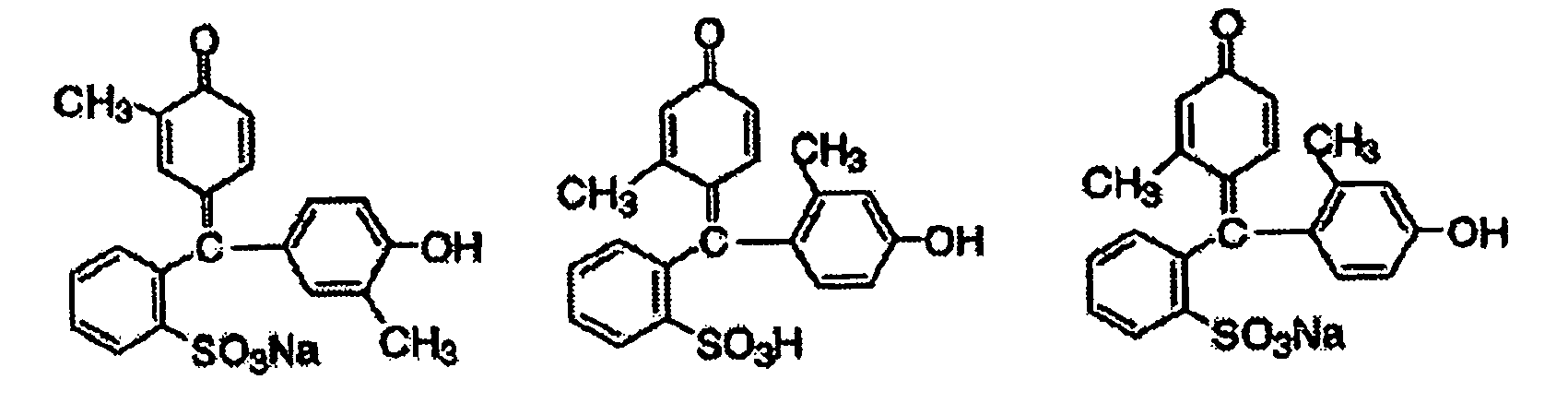


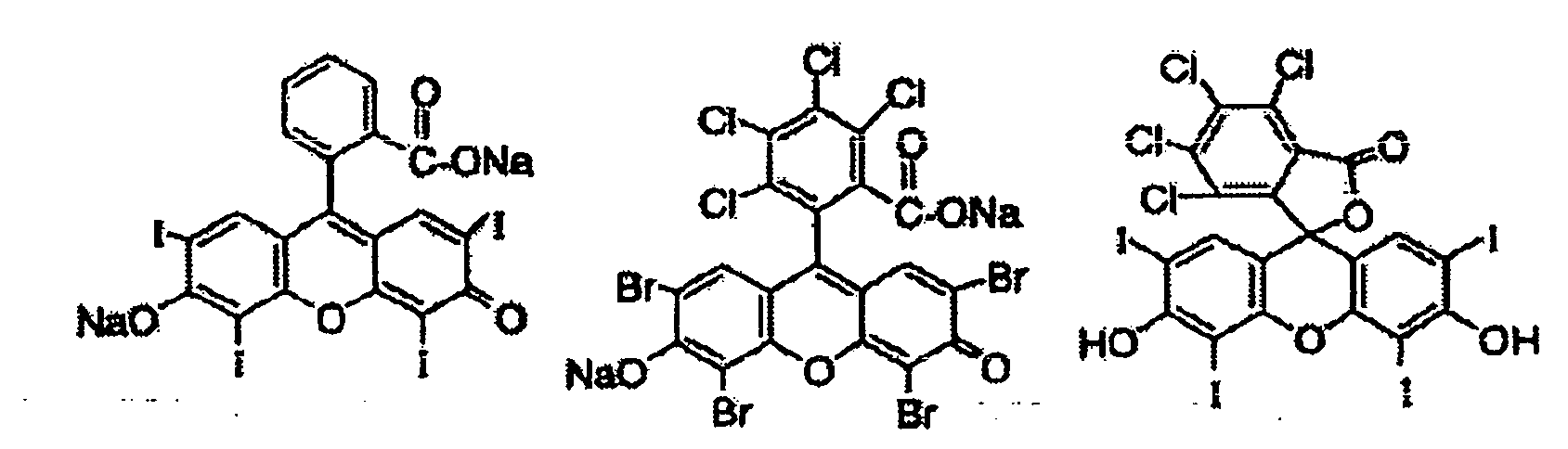


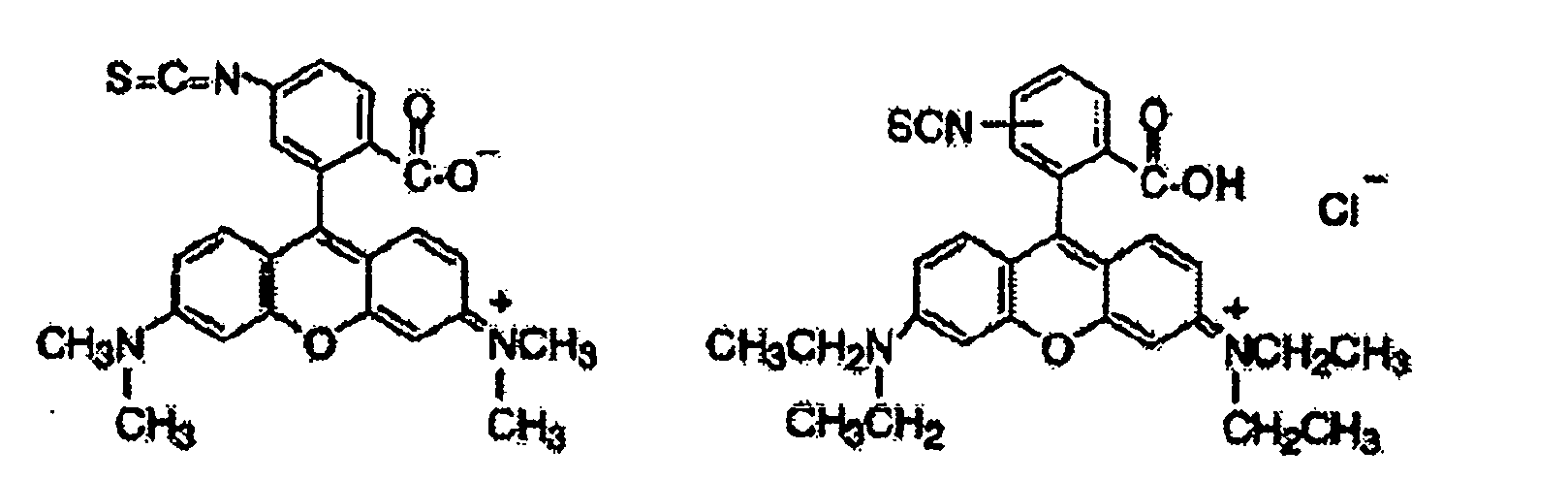


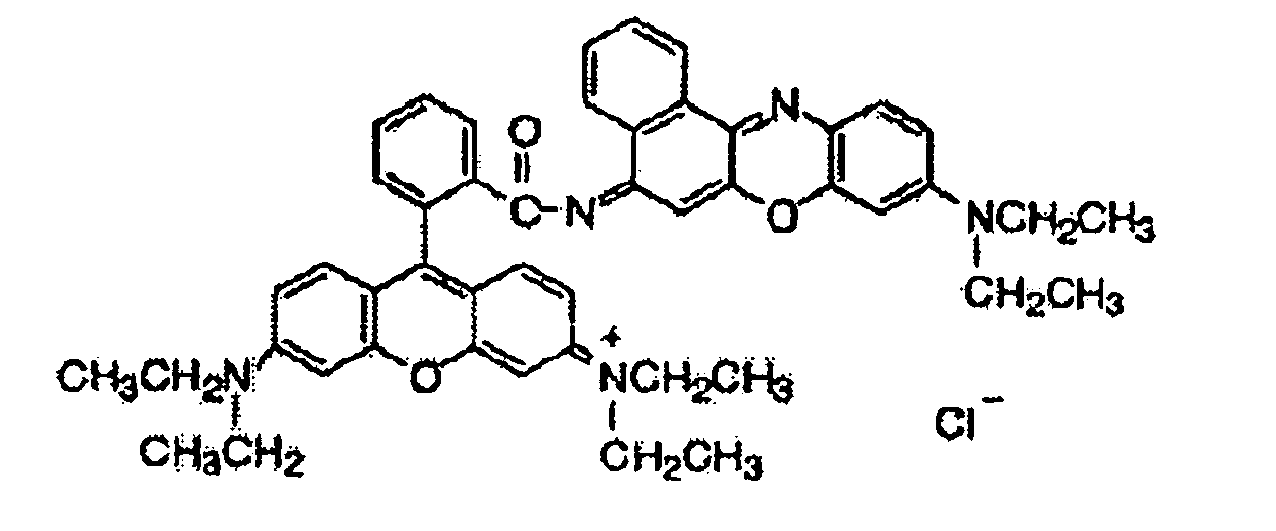
- The polymerization inhibitor precursor of the present invention is a compound of decomposing under heat to produce the above-described thermopolymerization initiator, preferably a compound having a phenolic hydroxyl group protected with a thermally decomposable group.
- Specific examples of the polymerization inhibitor precursor for use in the present invention are set forth below, but the present invention is not limited thereto.


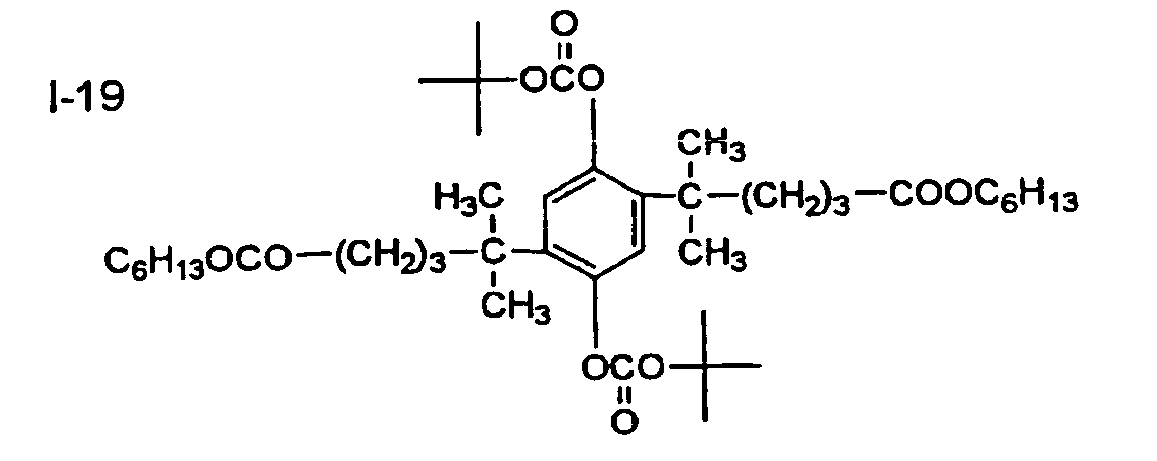

- The amount of the polymerization inhibitor precursor added is preferably from 0.01 to 15 mass%, more preferably from 0.1 to 10 mass%, and most preferably from 0.5 to 5 mass%, based on the entire solid content of the image recording layer.
- When the polymerization inhibitor precursor is used in combination with a strong acid or an acid generator, the thermal decomposition efficiency is elevated and this is preferred. Preferred examples of the strong acid include acids with a pKa of 3 or less. Among these, more preferred is a sulfonic acid, and most preferred is a sulfonic acid containing a halogen atom. Preferred examples of the acid generator include compounds of generating the above-described acid with a pKa of 3 or less. Among these, more preferred are a diazonium salt, a sulfonium salt, an iodonium salt and a sulfonic acid ester.
- The method for heating the lithographic printing precursor after image exposure is not particularly limited and a known heating method can be used. Examples thereof include a direct heating method of contacting the plate with a heat source such as heat roller, a heating method of blowing hot air, a heating method of irradiating infrared rays generated from an infrared emitter such as halogen heater or ceramic heater, an electromagnetic heating method of irradiating an electron magnetic wave at a predetermined wavelength generated from a magnetron and resonating substances such as water content contained in the image recording layer, and an induction heating method of applying a high-frequency magnetic field to a metal-made lithographic printing plate support from an electromagnetic coil.
- The heating temperature is preferably from 75 to 250°C, more preferably from 90 to 180°C, and the heating time is preferably from 1 to 600 seconds, more preferably from 10 to 180 seconds.
- The heating method which can be employed in the present invention is described in detail below by referring to the drawings.
- As shown in Figs. 2, 3 and 4, the
image exposure apparatus 10 used in the case of applying heat after exposure preferably comprises aheating device 38 disposed, for example, in acasing 14. Theheating device 38 locally heats (spot-heating) the lithographicprinting plate precursor 12 with hot air and, as shown in Fig. 3, comprises aheating fan unit 140 and a tubularhot air nozzle 144 connected to theheating fan unit 140 through aflexible duct 142. Theheating fan unit 140 is fixed in thecasing 14, and thehot air nozzle 144 is mounted together with anexposure head 26 on acarrier 68. The portion on the distal end side of theflexible duct 142 passes together with a bundle of optical fibers through a cable bear. - The
hot air nozzle 144 on thecarrier 68 is disposed to come adjacent to theexposure head 26 along the sub-scanning direction. Thehot air nozzle 144 is supported by extending its basal end side in parallel with the traveling direction of laser light L and at the distal end part, abend part 45 bent from the basal end side toward the distal end surface to face the exposure region AIR on a lithographicprinting plate precursor 12 is formed. On the distal end surface of thisbend part 45, a rectangular blow port is opened. - In the
heating fan unit 140, aheating part 48 comprising a heater such as halogen heater or ceramic heater for heating air taken in from the outside of thecasing 14, and anair supply part 50 for supplying the heated air in a pressurized state into theflexible duct 142 are provided. The high-temperature air supplied into theflexible duct 142 is supplied to thehot air nozzle 144 and blown as hot air from theblow port 46 of thehot air nozzle 144 onto a lithographicprinting plate precursor 12 loaded on anouter drum 20. At this time, thebend part 45 of thehot air nozzle 144 faces the exposure region AIR on the lithographicprinting plate precursor 12 and therefore, the hot air belched out from theblow port 46 is blown on the region (hereinafter, sometimes referred to as a "heating region AHT") overlapping with the exposure region AIR of the lithographicprinting plate precursor 12, as a result, the recording layer in the heating region AHT is heated to a predetermined heating temperature. - The heating region AHT has a center nearly agreeing with the center of the exposure region AIR and the size thereof is sufficiently larger than the exposure region AIR in both the sub-scanning direction and the main scanning direction. By such a constitution, the heating region AHT above the lithographic
printing plate precursor 12 can include the exposure region AIR and when the hot air belched from theblow port 46 is blown on the heating region AHT including the exposure region AIR at the same time with irradiation of laser light L on an arbitrary exposure region AIR of the lithographicprinting plate precursor 12, exposure starts in the exposure region AIR by the action of laser light L and the heating region ATH is heated to a predetermined heating temperature during the exposure from the initiation of exposure to the completion of exposure. - The exposure time from the start of exposure in an arbitrary exposure region AIR by the action of laser light L until the completion of exposure is nearly agreeing with the modulation cycle of laser light L according to the sub-scanning speed and is usually as short as about 0.05 seconds. In order to heat the lithographic printing plate precursor to a desired heating temperature, for example, with hot air in such a short time, the hot air temperature must be made extremely high but this is not practical. Accordingly, the length of the heating region AHT along the sub-scanning direction is preferably from 50 to 100 times that of the exposure region AIR, so that the hot air heating of an arbitrary exposure region AIR included in the heating region AHT can continue over from 106 to 107 times the modulation cycle. With this constitution, the heating time for an arbitrary exposure region AIR can be satisfactorily prolonged and therefore, the exposure region AIR can be stably heated to a predetermined heating temperature even when the hot air temperature is not made extremely high.
- In the
image exposure apparatus 10, a heating control part for controlling theheating device 38 is provided. This heating control part controls the temperature and quantity of the hot air supplied from theheating fan unit 140 to thehot air nozzle 144. Also, by mounting a temperature sensor such as infrared radiation thermometer on thecarrier 68 and measuring the temperature (surface temperature) of the heating region AHT with use of the temperature sensor, the measurement signal corresponding to the surface temperature in the center part of the heating region AHT can be output to the heating control part. With this constitution, the heating control part can feedback control the temperature of the heating region AHT based on the measurement signal, and the temperature in the center part of the heating region AHT can be stably maintained to the heating temperature with good precision. - As shown in Fig. 1, in the
casing 14 of theimage exposure 10, atransportation mechanism 84 for transporting the lithographicprinting plate precursor 12 released from theouter drum 20 to adischarge tray 18 is provided. Thistransportation mechanism 84 comprises a plurality oftransportation rollers 86 disposed along the transportation route for the lithographicprinting plate precursor 12, and a plate-like guide member 88. - In the
image exposure apparatus 10, after the completion of exposure (image formation) for the lithographicprinting plate precursor 12 loaded on theouter drum 20, theouter drum 20 is rotated in the reverse direction (in the arrow R2 direction in Fig. 1) and at the same time, the rear end part and the leading end part of the lithographicprinting plate precursor 12 are sequentially released from the outer drum by achuck mechanism 22. In conjunction with this, thetransportation mechanism 84 starts transporting the lithographicprinting plate precursor 12 delivered from theouter drum 20 and reached the entrance part of the discharge route to the discharge tray by rotating thetransportation rollers 86 and discharges the lithographicprinting plate precursor 12 onto thedischarge tray 18. - The
heating device 38 of theimage exposure apparatus 10 according to the present invention employs a system of blowing hot air directly to the lithographicprinting plate precursor 12 surface and thereby spot-heating the heating region AHT of the lithographicprinting plate precursor 12, but the heating device is not limited to those using hot air and, for example, an infrared emitter such as halogen heater or ceramic heater may be mounted on the carrier to irradiate the lithographicprinting plate precursor 12 with infrared rays generated from the emitter and thereby spot-heat the heating region AHT, a magnetron may be mounted on thecarrier 68 to irradiate the recording layer of the lithographicprinting plate precursor 12 with an electromagnetic wave at a predetermined wavelength generated from the magnetron and resonate substances such as water in the recording layer, thereby effecting spot-heating (electromagnetic heating), or an electromagnetic coil may be mounted on thecarrier 68 to apply a high-frequency magnetic field from the electromagnetic coil to the metal-made support of the lithographicprinting plate precursor 12 and thereby spot-heat the support (induction heating). - The polymerization initiator for use in the present invention is a compound of generating a radical by the effect of either one or both of light and heat energies and thereby initiating or accelerating the polymerization of a compound having a polymerizable unsaturated group. In particular, when the polymerization initiator is used alone or used in combination with a sensitizing dye which is described later, a compound of generating a radical by absorbing light at 250 to 420 nm, and a compound of generating a radical in combination with an infrared absorbent are preferred. Such a photo-radical generator may be appropriately selected and used from known polymerization initiators, compounds having a bond small in the bond-dissociation energy, and the like.
- Examples of the compound of generating a radical include organohalogen compounds, carbonyl compounds, organic peroxides, azo-based compounds, azide compounds, metallocene compounds, hexaarylbiimidazole compounds, organoboron compounds, disulfone compounds, oxime ester compounds and onium salt compounds.
- Specific examples of the organohalogen compound include the compounds described in Wakabayashi et al., Bull. Chem. Soc. Japan, 42, 2924 (1969), U.S. Patent 3,905,815, JP-B-46-4605 (the term "JP-B" as used herein means an "examined Japanese patent publication"), JP-A-48-36281, JP-A-53-133428, JP-A-55-32070, JP-A-60-239736, JP-A-61-169835, JP-A-61-169837, JP-A-62-58241, JP-A-62-212401, JP-A-63-70243, JP-A-63-298339, and M.P. Hutt, Journal of Heterocyclic Chemistry, 1, No. 3 (1970). Among these, oxazole compounds substituted with a trihalomethyl group and s-triazine compounds are preferred.
- s-Triazine derivatives where at least one mono-, di- or tri-halogenated methyl group is bonded to the s-triazine ring, and oxadiazole derivatives where that methyl group is bonded to the oxadiazole ring, are more preferred. Specific examples thereof include 2,4,6-tris(monochloromethyl)-s-triazine, 2,4,6-tris(dichloromethyl)-s-triazine, 2,4,6-tris(trichloromethyl)-s-triazine, 2-methyl-4,6-bis(trichloromethyl)-s-triazine, 2-n-propyl-4,6-bis(trichloromethyl)-s-triazine, 2-(α,α,β-trichloroethyl)-4,6-bis(trichloromethyl)-s-triazine, 2-(3,4-epoxyphenyl)-4,6-bis(trichloromethyl)-s-triazine, 2-[1-(p-methoxyphenyl)-2,4-butadienyl]-4,6-bis(trichloromethyl)-s-triazine, 2-styryl-4,6-bis(trichloromethyl)-s-triazine, 2-(p-methoxystyryl)-4,6-bis(trichloromethyl)-s-triazine, 2-(p-i-propyloxystyryl)-4,6-bis(trichloromethyl)-s-triazine, 2-(p-tolyl)-4,6-bis(trichloromethyl)-s-triazine, 2-(4-methoxynaphthyl)-4,6-bis(trichloromethyl)-s-triazine, 2-phenylthio-4,6-bis(trichloromethyl)-s-triazine, 2-benzylthio-4,6-bis(trichloromethyl)-s-triazine, 2,4,6-tris(dibromomethyl)-s-triazine, 2,4,6-tris(tribromomethyl)-s-triazine, 2-methyl-4,6-bis(tribromomethyl)-s-triazine, 2-methoxy-4,6-bis(tribromomethyl)-s-triazine and compounds shown below.









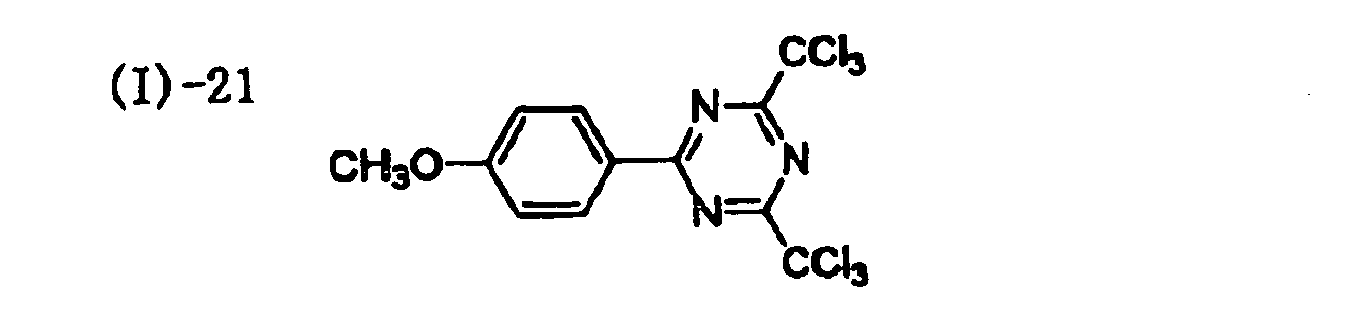


- Examples of the carbonyl compound include benzophenone derivatives such as benzophenone, Michler's ketone, 2-methylbenzophenone, 3-methylbenzophenone, 4-methylbenzophenone, 2-chlorobenzophenone, 4-bromobenzophenone and 2-carboxybenzophenone; acetophenone derivatives such as 2,2-dimethoxy-2-phenylacetophenone, 2,2-diethoxyacetophenone, 1-hydroxycyclohexylphenylketone, α-hydroxy-2-methylphenylpropanone, 1-hydroxy-1-methylethyl-(p-isopropylphenyl)ketone, 1-hydroxy-1-(p-dodecylphenyl)ketone, 2-methyl-(4'-(methylthio)phenyl)-2-morpholino-1-propanone and 1,1,1-trichloromethyl-(p-butylphenyl)ketone; thioxanthone derivatives such as thioxanthone, 2-ethylthioxanthone, 2-isopropylthioxanthone, 2-chlorothioxanthone, 2,4-dimethylthioxanthone, 2,4-diethylthioxanthone and 2,4-diisopropylthioxanthone; and benzoic acid ester derivatives such as ethyl p-dimethylaminobenzoate and ethyl p-diethylaminobenzoate.
- Examples of the azo-based compound which can be used include azo compounds described in JP-A-8-108621.
- Examples of the organic peroxide include trimethylcyclohexanone peroxide, acetylacetone peroxide, 1,1-bis(tert-butylperoxy)-3,3,5-trimethylcyclohexane, 1,1-bis(tert-butylperoxy)cyclohexane, 2,2-bis(tert-butylperoxy)butane, tert-butyl hydroperoxide, cumene hydroperoxide, diisopropylbenzene hydroperoxide, 2,5-dimethylhexane-2,5-dihydroperoxide, 1,1,3,3-tetramethylbutyl hydroperoxide, tert-butylcumyl peroxide, dicumyl peroxide, 2,5-dimethyl-2,5-di(tert-butylperoxy)hexane, 2,5-oxanoyl peroxide, succinic peroxide, benzoyl peroxide, 2,4-dichlorobenzoyl peroxide, diisopropylperoxydicarbonate, di-2-ethylhexylperoxydicarbonate, di-2-ethoxyethylperoxydicarbonate, dimethoxyisopropylperoxycarbonate, di(3-methyl-3-methoxybutyl)peroxydicarbonate, tert-butylperoxyacetate, tert-butylperoxypivalate, tert-butylperoxyneodecanoate, tert-butylperoxyoctanoate, tert-butylperoxylaurate, tert-carbonate, 3,3',4,4'-tetra(tert-butylperoxycarbonyl)benzophenone, 3,3',4,4'-tetra(tert-hexylperoxycarbonyl)benzophenone, 3,3',4,4'-tetra(p-isopropylcumylperoxycarbonyl)benzophenone, carbonyl di(tert-butylperoxydihydrogendiphthalate) and carbonyl di(tert-hexylperoxydihydrogendiphthalate).
- Examples of the metallocene compound include various titanocene compounds described in JP-A-59-152396, JP-A-61-151197, JP-A-63-41484, JP-A-2-249, JP-A-2-4705 and JP-A-5-83588, such as dicyclopentadienyl-Ti-bis-phenyl, dicyclopentadienyl-Ti-bis-2,6-difluorophen-1-yl, dicyclopentadienyl-Ti-bis-2,4-difluorophen-1-yl, dicyclopentadienyl-Ti-bis-2,4,6-trifluorophen-1-yl, dicyclopentadienyl-Ti-bis-2,3,5,6-tetrafluorophen-1-yl, dicyclopentadienyl-Ti-bis-2,3,4,5,6-pentafluorophen-1-yl, dimethylcyclopentadienyl-Ti-bis-2,6-difluorophen-1-yl, dimethylcyclopentadienyl-Ti-bis-2,4,6-trifluorophen-1-yl, dimethylcyclopentadienyl-Ti-bis-2,3,5,6-tetrafluorophen-1-yl and dimethylcyclopentadienyl-Ti-bis-2,3,4,5,6-pentafluorophen-1-yl, and iron-allene complexes described in JP-A-1-304453 and JP-A-1-152109.
- Examples of the hexaarylbiimidazole compound include various compounds described in JP-B-6-29285 and U.S. Patents 3,479,185, 4,311,783 and 4,622,286, such as 2,2'-bis(o-chlorophenyl)-4,4',5,5'-tetraphenylbiimidazole, 2,2'-bis(o-bromophenyl)-4,4',5,5'-tetraphenylbiimidazole, 2,2'-bis(o,p-dichlorophenyl)-4,4',5,5'-tetraphenylbiimidazole, 2,2'-bis(o-chlorophenyl)-4,4',5,5'-tetra(m-methoxyphenyl)biimidazole, 2,2'-bis(o,o'-dichlorophenyl)-4,4',5,5'-tetraphenylbiimidazole, 2,2'-bis(o-nitrophenyl)-4,4',5,5'-tetraphenylbiimidazole, 2,2'-bis(o-methylphenyl)-4,4',5,5'-tetraphenylbiimidazole and 2,2'-bis(o-trifluorophenyl)-4,4',5,5'-tetraphenylbiimidazole.
- Examples of the organoboron compound include organic borates described in JP-A-62-143044, JP-A-62-150242, JP-A-9-188685, JP-A-9-188686, JP-A-9-188710, JP-A-2000-131837, JP-A-2002-107916, Japanese Patent No. 2764769, JP-A-2002-116539, and Martin Kunz, Rad Tech. '98. Proceeding April 19-22, 1998, Chicago; organic boron sulfonium complexes and organic boron oxosulfonium complexes described in JP-A-6-157623, JP-A-6-175564 and JP-A-6-175561; organic boron iodonium complexes described in JP-A-6-175554 and JP-A-6-175553; organic boron phosphonium complexes described in JP-A-9-188710; and organic boron transition metal coordination complexes described in JP-A-6-348011, JP-A-7-128785, JP-A-7-140589, JP-A-7-306527 and JP-A-7-292014.
- Examples of the disulfone compound include compounds described in JP-A-61-166544 and JP-A-2003-328465.
- Examples of the oxime ester compound include compounds described in J.C.S. Perkin II, 1653-1660 (1979), J.C.S. Perkin II, 156-162 (1979), Journal of Photopolymer Science and Technology, 202-232 (1995), JP-A-2000-66385 and JP-A-2000-80068. Specific examples thereof include the compounds represented by the following structural formulae.


- Examples of the onium salt compound include onium salts such as diazonium salts described in S.I. Schlesinger, Photogr. Sci. Eng., 18, 387 (1974) and T.S. Bal et al., Polymer, 21, 423 (1980); ammonium salts described in U.S. Patent 4,069,055 and JP-A-4-365049; phosphonium salts described in U.S. Patents 4,069,055 and 4,069,056; iodonium salts described in European Patent 104,143, U.S. Patents 339,049 and 410,201, JP-A-2-150848 and JP-A-2-296514; sulfonium salts described in European Patents 370,693, 390,214, 233,567, 297,443 and 297,442, U.S. Patents 4,933,377, 161,811, 410,201, 339,049, 4,760,013, 4,734,444 and 2,833,827, and German Patents 2,904,626, 3,604,580 and 3,604,581; selenonium salts described in J.V. Crivello et al., Macromolecules, 10 (6), 1307 (1977) and J.V. Crivello et al., J. Polymer Sci., Polymer Chem. Ed., 17, 1047 (1979); and arsonium salts described in C.S. Wen et al., Teh. Proc. Conf. Rad. Curing ASIA, p. 478 (Tokyo, Oct. 1988).
- In the present invention, such an onium salt functions as an ionic radical polymerization initiator but not as an acid generator.
- The onium salt suitably used in the present invention is an onium salt represented by any one of the following formulae (RI-I) to (RI-III):



- In formula (RI-I), Ar11 represents an aryl group having 20 or less carbon atoms, which may have from 1 to 6 substituent(s), and preferred examples of the substituent include an alkyl group having from 1 to 12 carbon atoms, an alkenyl group having from 1 to 12 carbon atoms, an alkynyl group having from 1 to 12 carbon atoms, an aryl group having from 1 to 12 carbon atoms, an alkoxy group having from 1 to 12 carbon atoms, an aryloxy group having from 1 to 12 carbon atoms, a halogen atom, an alkylamino group having from 1 to 12 carbon atoms, a dialkylamino group having from 1 to 12 carbon atoms, an alkylamide or arylamide group having from 1 to 12 carbon atoms, a carbonyl group, a carboxyl group, a cyano group, a sulfonyl group, a thioalkyl group having from 1 to 12 carbon atoms, and a thioaryl group having from 1 to 12 carbon atoms. Z11 - represents a monovalent anion and specific examples thereof include halogen ion, perchlorate ion, hexafluorophosphate ion, tetrafluoroborate ion, sulfonate ion, sulfinate ion, thiosulfonate ion and sulfate ion. Among these, preferred in view of stability are perchlorate ion, hexafluorophosphate ion, tetrafluoroborate ion, sulfonate ion and sulfinate ion.
- In formula (RI-II), Ar21 and Ar22 each independently represents an aryl group having 20 or less carbon atoms, which may have from 1 to 6 substituent(s), and preferred examples of the substituent include an alkyl group having from 1 to 12 carbon atoms, an alkenyl group having from 1 to 12 carbon atoms, an alkynyl group having from 1 to 12 carbon atoms, an aryl group having from 1 to 12 carbon atoms, an alkoxy group having from 1 to 12 carbon atoms, an aryloxy group having from 1 to 12 carbon atoms, a halogen atom, an alkylamino group having from 1 to 12 carbon atoms, a dialkylamino group having from 1 to 12 carbon atoms, an alkylamido or arylamido group having from 1 to 12 carbon atoms, a carbonyl group, a carboxyl group, a cyano group, a sulfonyl group, a thioalkyl group having from 1 to 12 carbon atoms, and a thioaryl group having from 1 to 12 carbon atoms. Z21 - represents a monovalent anion and specific examples thereof include halogen ion, perchlorate ion, hexafluorophosphate ion, tetrafluoroborate ion, sulfonate ion, sulfinate ion, thiosulfonate ion and sulfate ion. Among these, preferred in view of stability and reactivity are perchlorate ion, hexafluorophosphate ion, tetrafluoroborate ion, sulfonate ion, sulfinate ion and carboxylate ion.
- In formula (RI-III), R31, R32 and R33 each independently represents an aryl, alkyl, alkenyl or alkynyl group having 20 or less carbon atoms, which may have from 1 to 6 substituent(s), and in view of reactivity and stability, preferably an aryl group. Examples of the substituent include an alkyl group having from 1 to 12 carbon atoms, an alkenyl group having from 1 to 12 carbon atoms, an alkynyl group having from 1 to 12 carbon atoms, an aryl group having from 1 to 12 carbon atoms, an alkoxy group having from 1 to 12 carbon atoms, an aryloxy group having from 1 to 12 carbon atoms, a halogen atom, an alkylamino group having from 1 to 12 carbon atoms, a dialkylamino group having from 1 to 12 carbon atoms, an alkylamido or arylamido group having from 1 to 12 carbon atoms, a carbonyl group, a carboxyl group, a cyano group, a sulfonyl group, a thioalkyl group having from 1 to 12 carbon atoms, and a thioaryl group having from 1 to 12 carbon atoms. Z31 - represents a monovalent anion and specific examples thereof include halogen ion, perchlorate ion, hexafluorophosphate ion, tetrafluoroborate ion, sulfonate ion, sulfinate ion, thiosulfonate ion and sulfate ion. Among these, preferred in view of stability and reactivity are perchlorate ion, hexafluorophosphate ion, tetrafluoroborate ion, sulfonate ion, sulfinate ion and carboxylate ion, more preferred is carboxylate ion described in JP-A-2001-343742, still more preferred is carboxylate ion described in JP-A-2002-148790.


ClO 4 - (N-4)

BF4 - (N-6)


PF6 - (N-11)


PF 6 - (I-2)

ClO4 - (I-4)


CF3SO3 - (I-7)


ClO4 - (I-11)

CF 3 COO - (I-13)
CF3SO3 - (I-14)
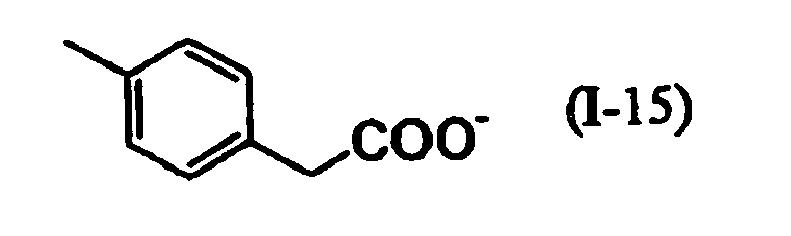


ClO4 - (S-3)


ClO4 - (S-18)


CF3SO3 - (S-21)
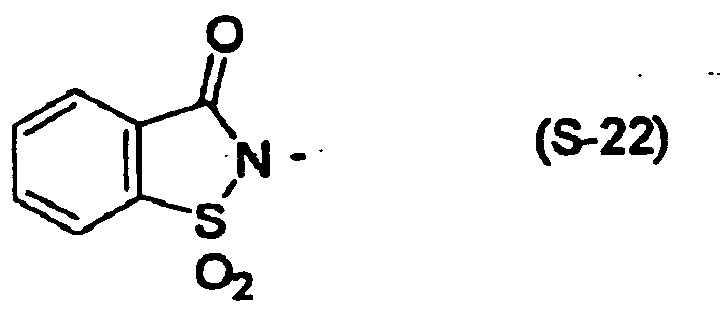


- The polymerization initiator is not limited to those described above, but particularly in view of reactivity and stability, triazine-based initiators, organohalogen compounds, oxime ester compounds, diazonium salts, iodonium salts and sulfonium salts are more preferred because these generate a large amount of radical by the exposure in a short time.
- The polymerization initiator in the system of such a triazine-based initiator, organohalogen compound, oxime ester compound, diazonium salt, iodonium salt or sulfonium salt is preferably used in combination with a sensitizing dye, because the photopolymerization rate can be increased by the combination use with a sensitizing dye.
- Specific examples of the sensitizing dye include benzoin, benzoin methyl ether, benzoin ethyl ether, 9-fluorenone, 2-chloro-9-fluorenone, 2-methyl-9-fluorenone, 9-anthrone, 2-bromo-9-anthrone, 2-ethyl-9-anthrone, 9,10-anthraquinone, 2-ethyl-9,10-anthraquinone, 2-tert-butyl-9,10-anthraquinone, 2,6-dichloro-9,10-anthraquinone, xanthone, 2-methylxanthone, 2-methoxyxanthone, thioxanthone, benzyl, dibenzylacetone, p-(dimethylamino)phenyl styryl ketone, p-(dimethylamino)phenyl p-methylstyryl ketone, benzophenone, p-(dimethylamino)benzophenone (or Michler's ketone), p-(diethylamino)benzophenone and benzanthrone.
- Furthermore, preferred examples of the sensitizing dye for use in the present invention include compounds described in JP-B-51-48516, which are represented by formula (I):

- In formula (I), R14 represents an alkyl group (e.g., methyl, ethyl, propyl) or a substituted alkyl group (e.g., 2-hydroxyethyl, 2-methoxyethyl, carboxymethyl, 2-carboxyethyl). R15 represents an alkyl group (e.g., methyl, ethyl) or an aryl group (e.g., phenyl, p-hydroxyphenyl, naphthyl, thienyl).
- Z2 represents a nonmetallic atom group necessary for forming a nitrogen-containing heterocyclic nucleus usually used in cyanine dyes, such as benzothiazoles (e.g., benzothiazole, 5-chlorobenzothiazole, 6-chlorothiazole), naphthothiazoles (e.g., α-naphthothiazole, β-naphthothiazole), benzoselenazoles (e.g., benzoselenazole, 5-chlorobenzoselenazole, 6-methoxybenzoselenazole), naphthoselenazoles (e.g., α-naphthoselenazole, β-naphthoselenazole), benzoxazoles (e.g., benzoxazole, 5-methylbenzoxazole, 5-phenylbenzoxazole) and naphthoxazoles (e.g., α-naphthoxazole, β-naphthoxazole).
- Specific examples of the compound represented by formula (I) include those having a chemical structure constituted by combining these Z2, R14 and R15. Many of such compounds are present as a known substance and therefore, the compound may be appropriately selected and used from those known substances. Other preferred examples of the sensitizer for use in the present invention include merocyanine dyes described in JP-B-5-47095 and ketocoumarin-based compounds represented by the following formula (II):

wherein R16 represents an alkyl group such as methyl group and ethyl group. - In addition, merocyanine-based dyes described in JP-A-2000-147763 may also be used as the sensitizing dye. Specific examples thereof include the following compounds.
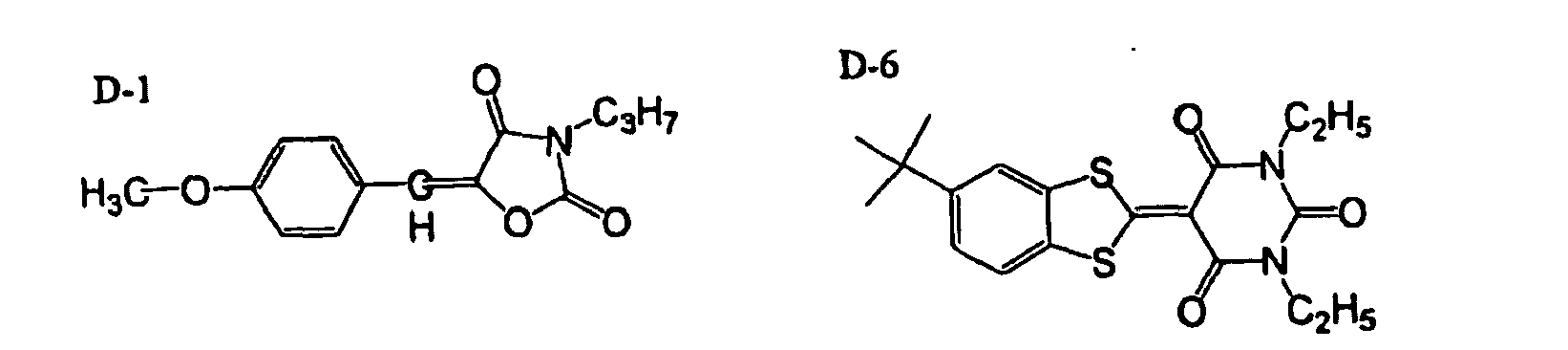




- The polymerization initiator and sensitizing dye each can be added at a ratio of preferably 0.1 to 50 mass%, more preferably from 0.5 to 30 mass%, still more preferably from 0.8 to 20 mass%, based on all solid contents constituting the image recording layer. Within this range, good sensitivity and good antistaining property of the non-image area at the printing can be obtained. One of these polymerization initiators may be used alone, or two or more thereof may be used in combination. Also, the polymerization initiator may be added together with other components in the same layer or may be added to a layer separately provided.
- In the present invention, when the imagewise exposure is performed by using a light source of emitting infrared rays, the image recording layer of the lithographic printing plate precursor preferably uses the polymerization initiator in combination with an infrared absorbent instead of the sensitizing dye. The infrared absorbent in general has a function of converting the absorbed infrared ray into heat and by the effect of heat generated, the polymerization initiator can be thermally decomposed and generate a radical. The infrared absorbent for use in the present invention is a dye or pigment having an absorption maximum at a wavelength of 760 to 1,200 nm.
- As for the dye, commercially available dyes and known dyes described in publications, for example, in Senryo Binran (Handbook of Dyes), compiled by Yuki Gosei Kagaku Kyokai (1970), may be used. Specific examples thereof include dyes such as azo dye, metal complex salt azo dye, pyrazolone azo dye, naphthoquinone dye, anthraquinone dye, phthalocyanine dye, carbonium dye, quinoneimine dye, methine dye, cyanine dye, squarylium dye, pyrylium salt and metal thiolate complex.
- Preferred examples of the dye include cyanine dyes described in JP-A-58-125246, JP-A-59-84356 and JP-A-60-78787, methine dyes described in JP-A-58-173696, JP-A-58-181690 and JP-A-58-194595, naphthoquinone dyes described in JP-A-58-112793, JP-A-58-224793, JP-A-59-48187, JP-A-59-73996, JP-A-60-52940 and JP-A-60-63744, squarylium dyes described in JP-A-58-112792, and cyanine dyes described in British Patent 434,875.
- Also, near infrared absorbing sensitizers described in U.S. Patent 5,156,938 may be suitably used. Furthermore, substituted arylbenzo(thio)pyrylium salts described in U.S. Patent 3,881,924, trimethinethiapyrylium salts described in JP-A-57-142645 (corresponding to U.S. Patent 4,327,169), pyrylium-based compounds described in JP-A-58-181051, JP-A-58-220143, JP-A-59-41363, JP-A-59-84248, JP-59-84249, JP-A-59-146063 and JP-A-59-146061, cyanine dyes described in JP-A-59-216146, pentamethinethiapyrylium salts described in U.S. Patent 4,283,475, and pyrylium compounds described in JP-B-5-13514 and JP-B-5-19702 may also be preferably used. Other preferred examples of the dye include near infrared absorbing dyes represented by formulae (I) and (II) of U.S. Patent 4,756,993.
- Among these dyes, particularly preferred are cyanine dye, squarylium dye, pyrylium salt, nickel thiolate complex and indolenine cyanine dye, more preferred are cyanine dye and indolenine cyanine dye, still more preferred is a cyanine dye, for example, represented by the following formula (III):
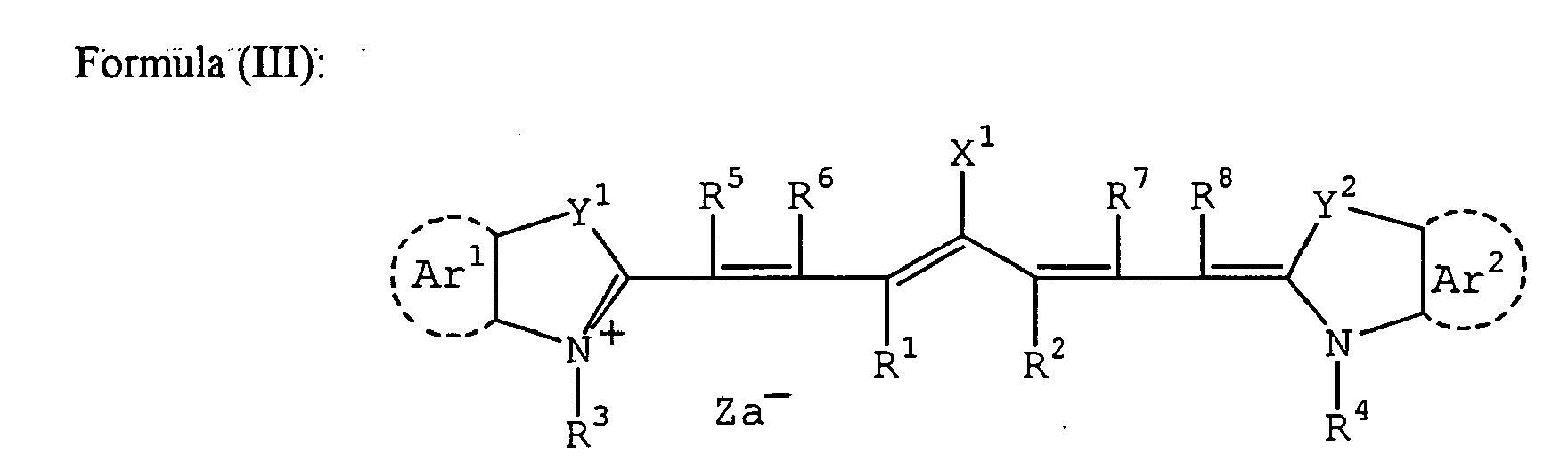
- In formula (III), X1 represents a hydrogen atom, a halogen atom, -NPh2, X2-L1 or a group shown below (wherein X2 represents an oxygen atom, a nitrogen atom or a sulfur atom, L' represents a hydrocarbon group having from 1 to 12 carbon atoms, an aromatic ring having a heteroatom, or a hydrocarbon group having from 1 to 12 carbon atoms and containing a heteroatom (the heteroatom as used herein indicates N, S, O, a halogen atom or Se), Xa - has the same definition as Za- described later, and Ra represents a substituent selected from a hydrogen atom, an alkyl group, an aryl group, a substituted or unsubstituted amino group and a halogen atom):

- R1 and R2 each independently represents a hydrocarbon group having from 1 to 12 carbon atoms. In view of storage stability of the coating solution for the recording layer, R1 and R2 each is preferably a hydrocarbon group having 2 to more carbon atoms, and R1 and R2 are more preferably combined with each other to form a 5- or 6-membered ring.
- Ar1 and Ar2 may be the same or different and each represents an aromatic hydrocarbon group which may have a substituent. Preferred examples of the aromatic hydrocarbon group include a benzene ring and a naphthalene ring. Preferred examples of the substituent include a hydrocarbon group having 12 or less carbon atoms, a halogen atom and an alkoxy group having 12 or less carbon atoms. Y1 and Y2 may be the same or different and each represents a sulfur atom or a dialkylmethylene group having 12 or less carbon atoms. R3 and R4 may be the same or different and each represents a hydrocarbon group having 20 or less carbon atoms, which may have a substituent. Preferred examples of the substituent include an alkoxy group having 12 or less carbon atoms, a carboxyl group and a sulfo group. R5, R6, R7 and R8 may be the same or different and each represents a hydrogen atom or a hydrocarbon group having 12 or less carbon atoms, and in view of availability of the raw material, preferably a hydrogen atom. Za- represents a counter anion, but when the cyanine dye represented by formula (III) has an anionic substituent in its structure and neutralization of electric charge is not necessary, Za- is not present. In view of storage stability of the coating solution for the recording layer, Za- is preferably halogen ion, perchlorate ion, tetrafluoroborate ion, hexafluorophosphate ion or sulfonate ion, more preferably perchlorate ion, hexafluorophosphate ion or arylsulfonate ion.
- Specific examples of the cyanine dye represented by formula (III), which can be suitably used in the present invention, include those described in paragraphs [0017] to [0019] of JP-A-2001-133969.
- Other preferred examples include specific indolenine cyanine dyes described in JP-A-2002-278057.
- As for the pigment used in the present invention, commercially available pigments and pigments described in Color Index (C.I.) Binran (C.I. Handbook), Saishin Ganryo Binran (Handbook of Newest Pigments), compiled by Nippon Ganryo Gijutsu Kyokai (1977), Saishin Ganryo Oyo Gijutsu (Newest Pigment Application Technology), CMC Shuppan (1986), and Insatsu Ink Gijutsu (Printing Ink Technology), CMC Shuppan (1984) can be used.
- The kind of pigment includes black pigment, yellow pigment, orange pigment, brown pigment, red pigment, violet pigment, blue pigment, green pigment, fluorescent pigment, metal powder pigment and polymer bond dye. Specific examples of the pigment which can be used include insoluble azo pigments, azo lake pigments, condensed azo pigments, chelate azo pigments, phthalocyanine-based pigments, anthraquinone-based pigments, perylene- or perynone-based pigments, thioindigo-based pigments, quinacridone-based pigments, dioxazine-based pigments, isoindolinone-based pigments, quinophthalone-based pigments, dyed lake pigments, azine pigments, nitroso pigments, nitro pigments, natural pigments, fluorescent pigments, inorganic pigments and carbon black. Among these pigments, carbon black is preferred.
- These pigments may or may not be surface-treated before use. Examples of the method for surface treatment include a method of coating the surface with resin or wax, a method of attaching a surfactant, and a method of bonding a reactive substance (for example, a silane coupling agent, an epoxy compound or an isocyanate) to the pigment surface. These surface-treatment methods are described in Kinzoku Sekken no Seishitsu to Oyo (Properties and Application of Metal Soap), Saiwai Shobo, Insatsu Ink Gijutsu (Printing Ink Technology), CMC Shuppan (1984), and Saishin Ganryo Oyo Gijutsu (Newest Pigment Application Technology), CMC Shuppan (1986).
- The particle diameter of the pigment is preferably from 0.01 to 10 µm, more preferably from 0.05 to 1 µm, still more preferably from 0.1 to 1 µm. Within this range, good stability of the pigment dispersion in the coating solution for the image recording layer and good uniformity of the image recording layer can be obtained.
- As for the dispersion method of the pigment, a known dispersion technique used in the production of ink or toner may be used. Examples of the dispersing machine include ultrasonic disperser, sand mill, attritor, pearl mill, super-mill, ball mill, impeller, disperser, KD mill, colloid mill, dynatron, three-roll mill and pressure kneader. These are described in detail in Saishin Ganryo Oyo Gijutsu (Newest Pigment Application Technology), CMC Shuppan (1986).
- The infrared absorbent is preferably added to the image recording layer in a required minimum amount so as to prevent a side reaction of inhibiting the polymerization.
- The infrared absorbent can be added at a ratio of 0.001 to 50 mass%, preferably from 0.005 to 30 mass%, more preferably from 0.01 to 10 mass%, based on the entire solid content of the image recording layer. When the ratio is in this range, high sensitivity can be obtained without causing adverse effect on the uniformity or film strength of the image recording layer.
- The polymerizable compound which can be used in the present invention is an addition-polymerizable compound having at least one ethylenically unsaturated double bond and is selected from compounds having at least one, preferably two or more, ethylenically unsaturated bond(s). Such compounds are widely known in this industrial field and these known compounds can be used in the present invention without any particular limitation. These compounds have a chemical mode such as monomer, prepolymer (that is, dimer, trimer or oligomer) or a mixture or copolymer thereof. Examples of the monomer and its copolymer include unsaturated carboxylic acids (e.g., acrylic acid, methacrylic acid, itaconic acid, crotonic acid, isocrotonic acid, maleic acid), and esters and amides thereof. Among these, preferred are esters of an unsaturated carboxylic acid with an aliphatic polyhydric alcohol compound, and amides of an unsaturated carboxylic acid with an aliphatic polyvalent amine compound. Also, addition reaction products of an unsaturated carboxylic acid ester or amide having a nucleophilic substituent such as hydroxyl group, amino group or mercapto group with a monofunctional or polyfunctional isocyanate or epoxy, and dehydrating condensation reaction products with a monofunctional or polyfunctional carboxylic acid may be suitably used. Furthermore, addition reaction products of an unsaturated carboxylic acid ester or amide having an electrophilic substituent such as isocyanate group or epoxy group with a monofunctional or polyfunctional alcohol, amine or thiol, and displacement reaction products of an unsaturated carboxylic acid ester or amide having a desorptive substituent such as halogen group or tosyloxy group with a monofunctional or polyfunctional alcohol, amine or thiol may also be suitably used. Also, compounds where the unsaturated carboxylic acid of the above-described compounds is replaced by an unsaturated phosphonic acid, styrene, vinyl ether or the like, may be used.
- Specific examples of the ester monomer of an aliphatic polyhydric alcohol compound with an unsaturated carboxylic acid include the followings. Examples of the acrylic acid ester include ethylene glycol diacrylate, triethylene glycol diacrylate, 1,3-butanediol diacrylate, tetramethylene glycol diacrylate, propylene glycol diacrylate, neopentyl glycol diacrylate, trimethylolpropane triacrylate, trimethylolpropane tri(acryloyloxypropyl) ether, trimethylolethane triacrylate, hexanediol diacrylate, 1,4-cyclohexanediol diacrylate, tetraethylene glycol diacrylate, pentaerythritol diacrylate, pentaerythritol triacrylate, pentaerythritol tetraacrylate, dipentaerythritol diacrylate, dipentaerythritol hexaacrylate, sorbitol triacrylate, sorbitol tetraacrylate, sorbitol pentaacrylate, sorbitol hexaacrylate, tri(acryloyloxyethyl)isocyanurate, polyester acrylate oligomer and isocyanuric acid EO-modified triacrylate.
- Examples of the methacrylic acid ester include tetramethylene glycol dimethacrylate, triethylene glycol dimethacrylate, neopentyl glycol dimethacrylate, trimethylolpropane trimethacrylate, trimethylolethane trimethacrylate, ethylene glycol dimethacrylate, 1,3-butanediol dimethacrylate, hexanediol dimethacrylate, pentaerythritol dimethacrylate, pentaerythritol trimethacrylate, pentaerythritol tetramethacrylate, dipentaerythritol dimethacrylate, dipentaerythritol hexamethacrylate, sorbitol trimethacrylate, sorbitol tetramethacrylate, bis[p-(3-methacryloxy-2-hydroxypropoxy)phenyl]dimethylmethane and bis[p-(methacryloxyethoxy)-phenyl]dimethylmethane.
- Examples of the itaconic acid ester include ethylene glycol diitaconate, propylene glycol diitaconate, 1,3-butanediol diitaconate, 1,4-butanediol diitaconate, tetramethylene glycol diitaconate, pentaerythritol diitaconate and sorbitol tetraitaconate. Examples of the crotonic acid ester include ethylene glycol dicrotonate, tetramethylene glycol dicrotonate, pentaerythritol dicrotonate and sorbitol tetradicrotonate. Examples of the isocrotonic acid ester include ethylene glycol diisocrotonate, pentaerythritol diisocrotonate and sorbitol tetraisocrotonate. Examples of the maleic acid ester include ethylene glycol dimaleate, triethylene glycol dimaleate, pentaerythritol dimaleate and sorbitol tetramaleate.
- Other examples of the ester include aliphatic alcohol-based esters described in JP-B-51-47334 and JP-A-57-196231, those having an aromatic skeleton described in JP-A-59-5240, JP-A-59-5241 and JP-A-2-226149, and those containing an amino group described in JP-A-1-165613. These ester monomers may also be used as a mixture.
- Specific examples of the amide monomer of an aliphatic polyvalent amine compound with an unsaturated carboxylic acid include methylenebisacrylamide, methylene-bismethacrylamide, 1,6-hexamethylenebisacrylamide, 1,6-hexamethylenebismethacrylamide, diethylenetriaminetrisacrylamide, xylylenebisacrylamide and xylylenebismethacrylamide. Other preferred examples of the amide-type monomer include those having a cyclohexylene structure described in JP-B-54-21726.
- A urethane-based addition-polymerizable compound produced by using an addition reaction of isocyanate with a hydroxyl group is also preferred and specific examples thereof include vinyl urethane compounds having two or more polymerizable vinyl groups within one molecule described in JP-B-48-41708, which are obtained by adding a vinyl monomer having a hydroxyl group represented by the following formula (a) to a polyisocyanate compound having two or more isocyanate groups within one molecule:
CH2=C(R4)COOCH2CH(R5)OH (a)
(wherein R4 and R5 each represents H or CH3). - Also, urethane acrylates described in JP-A-51-37193, JP-B-2-32293 and JP-B-2-16765, and urethane compounds having an ethylene oxide-type skeleton described in JP-B-58-49860, JP-B-56-17654, JP-B-62-39417 and JP-B-62-39418 are also suitably used. Furthermore, when addition-polymerizable compounds having an amino or sulfide structure within the molecule described in JP-A-63-277653, JP-A-63-260909 and JP-A-1-105238 are used, a photopolymerizable composition having very excellent photosensitization speed can be obtained.
- Other examples include polyfunctional acrylates and methacrylates such as polyester acrylates described in JP-A-48-64183, JP-B-49-43191 and JP-B-52-30490 and epoxy acrylates obtained by reacting an epoxy resin with a (meth)acrylic acid. In addition, specific unsaturated compounds described in JP-B-46-43946, JP-B-1-40337 and JP-B-1-40336, and vinyl phosphonic acid-based compounds described in JP-A-2-25493 may be used. In some cases, structures containing a perfluoroalkyl group described in JP-A-61-22048 are suitably used. Furthermore, those described as a photocurable monomer or oligomer in Adhesion, Vol. 20, No. 7, pp. 300-308 (1984) may also be used.
- Details of the use method of these polymerizable compounds, such as structure, sole or combination use and amount added, can be freely selected in accordance with the designed performance of the final lithographic printing plate precursor and, for example, may be selected from the following standpoints.
- In view of sensitivity, a structure having a large unsaturated group content per one molecule is preferred and in most cases, a bifunctional or greater functional compound is preferred. For increasing the strength of image part, namely, cured layer, a trifunctional or greater functional compound is preferred. Also, a method of controlling both sensitivity and strength by using a combination of compounds differing in the functional number or in the polymerizable group (for example, an acrylic acid ester, a methacrylic acid ester, a styrene-based compound or a vinyl ether-based compound) is effective.
- The selection and use method of the polymerizable compound are important factors also for the compatibility and dispersibility with other components (e.g., binder polymer, initiator, colorant) in the image recording layer. For example, the compatibility may be improved in some cases by using a low purity compound or using two or more compounds in combination. Also, a specific structure may be selected for the purpose of improving the adhesion to the substrate, protective layer which is described later, or the like.
- The polymerizable compound is preferably used in an amount of 5 to 80 mass%, more preferably from 25 to 75 mass%, based on all solid contents constituting the image recording layer. Also, these polymerizable compounds may be used individually or in combination of two or more thereof. Other than these, as for the use method of the polymerizable compound, appropriate structure, formulation and amount added can be freely selected by taking account of the degree of polymerization inhibition due to oxygen, resolution, fogging, change in refractive index, surface tackiness and the like. Depending on the case, a layer structure or coating method such as undercoat and overcoat can also be employed.
- The image recording layer of the present invention may further contain additives as needed, such as binder polymer, surfactant, colorant, printing-out agent, thermopolymerization inhibitor, higher fatty acid derivative, plasticizer, inorganic fine particle and low molecule hydrophilic compound. These additives are described below.
- In the present invention, a binder polymer may be used for enhancing the film strength or film property of the image recording layer and for elevating the on-press developability. As for the binder polymer, conventionally known binder polymers can be used without limitation, and a linear organic polymer having a film property is preferred. Examples of such a binder polymer include acrylic resin, polyvinyl acetal resin, polyurethane resin, polyurea resin, polyimide resin, polyamide resin, epoxy resin, methacrylic resin, polystyrene-based resin, novolak-type phenol-based resin, polyester resin, synthetic rubber and natural rubber.
- The binder polymer may have a crosslinking property so as to enhance the film strength in the image part. The crosslinking property may be imparted to the binder polymer by introducing a crosslinking functional group such as ethylenically unsaturated bond into the main or side chain of the polymer. The crosslinking functional group may be introduced by copolymerization.
- Examples of the polymer having an ethylenically unsaturated bond in the main chain of the molecule include poly-1,4-butadiene and poly-1,4-isoprene.
- Examples of the polymer having an ethylenically unsaturated bond in the side chain of the molecule include polymers which are a polymer of acrylic or methacrylic acid ester or amide and in which the ester or amide residue (R in -COOR or -CONHR) has an ethylenically unsaturated bond.
- Examples of the residue (R above) having an ethylenically unsaturated bond include - (CH2)nCR1=CR2R3, -(CH2O)nCH2CR1=CR2R3, -(CH2CH2O)nCH2CR1=CR2R3, -(CH2)nNH-COO-CH2CR1=CR2R3, -(CH2)n-O-CO-CR1=CR2R3 and -(CH2CH2O)2-X (wherein R1 to R3 each represents a hydrogen atom, a halogen atom or an alkyl, aryl, alkoxy or aryloxy group having from 1 to 20 carbon atoms, R1 and R2 or R3 may combine with each other to form a ring, n represents an integer of 1 to 10, and X represents a dicyclopentadienyl residue).
- Specific examples of the ester residue include -CH2CH=CH2 (described in JP-B-7-21633), -CH2CH2O-CH2CH=CH2, -CH2C(CH3)=CH2, -CH2CH=CH-C6H5, - CH2CH2OCOCH=CH-C6H5, -CH2CH2-NHCOO-CH2CH=CH2 and CH2CH2O-X (wherein X represents a dicyclopentadienyl residue).
- Specific examples of the amide residue include -CH2CH=CH2, -CH2CH2-Y (wherein Y represents a cyclohexene residue) and -CH2CH2-OCO-CH=CH2.
- In the binder polymer having a crosslinking property, for example, a free radical (a polymerization initiating radical or a radical grown in the process of polymerization of a polymerizable compound) is added to the crosslinking functional group to cause addition-polymerization between polymers directly or through a polymerization chain of the polymerizable compound, as a result, crosslinking is formed between polymer molecules and thereby curing is effected. Alternatively, an atom (for example, a hydrogen atom on the carbon atom adjacent to the functional crosslinking group) in the polymer is withdrawn by a free radical to produce a polymer radical and the polymer radicals combine with each other to form crosslinking between polymer molecules, thereby effecting curing.
- The content of the crosslinking group (content of radical-polymerizable unsaturated double bond determined by iodine titration) in the binder polymer is preferably from 0.1 to 10.0 mmol, more preferably from 1.0 to 7.0 mmol, most preferably from 2.0 to 5.5 mmol, per g of the binder polymer. Within this range, good sensitivity and good storage stability can be obtained.
- In view of on-press developability of the image recording layer in the unexposed area, the binder polymer preferably has high solubility or dispersibility for an ink and/or a fountain solution.
- The binder polymer is preferably lipophilic for enhancing the solubility or dispersibility for ink, and the binder polymer is preferably hydrophilic for enhancing the solubility or dispersibility for a fountain solution. Therefore, in the present invention, it is also effective to use a lipophilic binder polymer and a hydrophilic binder polymer in combination.
- Preferred examples of the hydrophilic binder polymer include those having a hydrophilic group such as hydroxy group, carboxyl group, carboxylate group, hydroxyethyl group, polyoxyethyl group, hydroxypropyl group, polyoxypropyl group, amino group, aminoethyl group, aminopropyl group, ammonium group, amide group, carboxymethyl group, sulfonic acid group and phosphoric acid group.
- Specific examples thereof include gum arabic, casein, gelatin, starch derivatives, carboxymethyl cellulose and sodium salt thereof, cellulose acetate, sodium alginate, vinyl acetate-maleic acid copolymers, styrene-maleic acid copolymers, polyacrylic acids and salts thereof, polymethacrylic acids and salts thereof, homopolymers and copolymers of hydroxyethyl methacrylate, homopolymers and copolymers of hydroxyethyl acrylate, homopolymers and copolymers of hydroxypropyl methacrylate, homopolymers and copolymers of hydroxypropyl acrylate, homopolymers and copolymers of hydroxybutyl methacrylate, homopolymers and copolymers of hydroxybutyl acrylate, polyethylene glycols, hydroxypropylene polymers, polyvinyl alcohols, hydrolyzed polyvinyl acetates having a hydrolysis degree of 60 mol% or more, preferably 80 mol% or more, polyvinyl formal, polyvinyl butyral, polyvinylpyrrolidone, homopolymers and polymers of acrylamide, homopolymers and copolymers of methacrylamide, homopolymers and copolymers of N-methylolacrylamide, polyvinylpyrrolidone, alcohol-soluble nylons, and polyethers of 2,2-bis-(4-hydroxyphenyl)-propane with epichlorohydrin.
- The binder polymer preferably has a mass average molecular weight of 5,000 or more, more preferably from 10,000 to 300,000. The number average molecular weight thereof is preferably 1,000 or more, more preferably from 2,000 to 250,000. The polydispersity (mass average molecular weight/number average molecular weight) is preferably from 1.1 to 10.
- The binder polymer may be any polymer such as random polymer, block polymer or graft polymer, but is preferably a random polymer.
- The binder polymer can be synthesized by a conventionally know method. Examples of the solvent used in the synthesis include tetrahydrofuran, ethylene dichloride, cyclohexanone, methyl ethyl ketone, acetone, methanol, ethanol, ethylene glycol monomethyl ether, ethylene glycol monoethyl ether, 2-methoxyethyl acetate, diethylene glycol dimethyl ether, 1-methoxy-2-propanol, 1-methoxy-2-propyl acetate, N,N-dimethylformamide, N,N-dimethylacetamide, toluene, ethyl acetate, methyl lactate, ethyl lactate, dimethylsulfoxide and water. These solvents are used individually or as a mixture of two or more thereof.
- As for the radical polymerization initiator used in the synthesis of the binder polymer, known compounds such as azo-type initiator and peroxide initiator can be used.
- The binder polymers may be used individually or as a mixture of two or more thereof.
- The binder polymer content is preferably from 10 to 90 mass%, more preferably from 20 to 80 mass%, still more preferably from 30 to 70 mass%, based on the entire solid content of the image recording layer. Within this range, good strength of image area and good image-forming property can be obtained.
- The polymerizable compound (B) and the binder polymer are preferably used in amounts of giving a mass ratio of 1/9 to 7/3.
- In the present invention, a surfactant is preferably used in the image recording layer so as to accelerate the on-press development at the initiation of printing and enhance the coated surface state. The surfactant includes a nonionic surfactant, an anionic surfactant, a cationic surfactant, an amphoteric surfactant, a fluorine-containing surfactant and the like. The surfactants may be used individually or in combination of two or more thereof.
- The nonionic surfactant for use in the present invention is not particularly limited and a conventionally known nonionic surfactant can be used. Examples thereof include polyoxyethylene alkyl ethers, polyoxyethylene alkylphenyl ethers, polyoxyethylene polystyrylphenyl ethers, polyoxyethylene polyoxypropylene alkyl ethers, glycerin fatty acid partial esters, sorbitan fatty acid partial esters, pentaerythritol fatty acid partial esters, propylene glycol monofatty acid esters, sucrose fatty acid partial esters, polyoxyethylene sorbitan fatty acid partial esters, polyoxyethylene sorbitol fatty acid partial esters, polyethylene glycol fatty acid esters, polyglycerin fatty acid partial esters, polyoxyethylenated castor oils, polyoxyethylene glycerin fatty acid partial esters, fatty acid diethanolamides, N,N-bis-2-hydroxyalkylamines, polyoxyethylene alkylamines, triethanolamine fatty acid esters, trialkylamine oxides, polyethylene glycol, and copolymers of polyethylene glycol and polypropylene glycol.
- The anionic surfactant for use in the present invention is not particularly limited and a conventionally known anionic surfactant can be used. Examples thereof include fatty acid salts, abietates, hydroxyalkanesulfonates, alkanesulfonates, dialkylsulfosuccinic ester salts, linear alkylbenzenesulfonates, branched alkylbenzenesulfonates, alkylnaphthalenesulfonates, alkylphenoxypolyoxyethylenepropylsulfonates, polyoxyethylenealkylsulfophenyl ether salts, N-methyl-N-oleyltaurine sodium salts, monoamide disodium N-alkylsulfosuccinates, petroleum sulfonates, sulfated beef tallow oils, sulfuric ester salts of fatty acid alkyl ester, alkylsulfuric ester salts, polyoxyethylene alkyl ether sulfuric ester salts, fatty acid monoglyceride sulfuric ester salts, polyoxyethylene alkylphenyl ether sulfuric ester salts, polyoxyethylene styrylphenyl ether sulfuric ester salts, alkylphosphoric ester salts, polyoxyethylene alkyl ether phosphoric ester salts, polyoxyethylene alkylphenyl ether phosphoric ester salts, partially saponified products of styrene/maleic anhydride copolymer, partially saponified products of olefin/maleic anhydride copolymer, and naphthalenesulfonate formalin condensates.
- The cationic surfactant for use in the present invention is not particularly limited and a conventionally known cationic surfactant can be used. Examples thereof include alkylamine salts, quaternary ammonium salts, polyoxyethylenealkylamine salts and polyethylene polyamine derivatives.
- The amphoteric surfactant for use in the present invention is not particularly limited and a conventionally known amphoteric surfactant can be used. Examples thereof include carboxybetaines, aminocarboxylic acids, sulfobetaines, aminosulfuric esters and imidazolines.
- The term "polyoxyethylene" in the above-described surfactants can be instead read as "polyoxyalkylene" such as polyoxymethylene, polyoxypropylene and polyoxybutylene, and these surfactants can also be used in the present invention.
- The surfactant is more preferably a fluorine-containing surfactant containing a perfluoroalkyl group within the molecule. This fluorine-containing surfactant includes an anionic type such as perfluoroalkylcarboxylate, perfluoroalkylsulfonate and perfluoroalkylphosphoric ester; an amphoteric type such as perfluoroalkylbetaine; a cationic type such as perfluoroalkyltrimethylammonium salt; and a nonionic type such as perfluoroalkylamine oxide, perfluoroalkyl ethylene oxide adduct, oligomer containing a perfluoroalkyl group and a hydrophilic group, oligomer containing a perfluoroalkyl group and a lipophilic group, oligomer containing a perfluoroalkyl group, a hydrophilic group and a lipophilic group, and urethane containing a perfluoroalkyl group and a lipophilic group. In addition, fluorine-containing surfactants described in JP-A-62-170950, JP-A-62-226143 and JP-A-60-168144 may also be suitably used.
- The surfactants can be used individually or in combination of two or more thereof.
- The surfactant content is preferably from 0.001 to 10 mass%, more preferably from 0.01 to 7 mass%, based on the entire solid content of the image recording layer.
- In the present invention, various compounds may be further added, if desired, in addition to the above-described additives. For example, a dye having large absorption in the visible light region can be used as a colorant of the image. Specific examples thereof include Oil Yellow #101, Oil Yellow #103, Oil Pink #312, Oil Green BG, Oil Blue BOS, Oil Blue #603, Oil Black BY, Oil Black BS, Oil Black T-505 (all produced by Orient Chemical Industry Co., Ltd.), Victoria Pure Blue, Crystal Violet (CI42555), Methyl Violet (CI42535), Ethyl Violet, Rhodamine B (CI145170B), Malachite Green (CI42000), Methylene Blue (CI52015), and dyes described in JP-A-62-293247. Also, pigments such as phthalocyanine-based pigment, azo-based pigment, carbon black and titanium oxide may be suitably used.
- The colorant is preferably added, because the image area and the non-image area after image formation can be clearly distinguished. The amount of the colorant added is preferably from 0.01 to 10 mass% based on the entire solid content of the image recording material.
- In the image recording layer of the present invention, a compound of undergoing change in the color by the effect of an acid or a radical can be added so as to produce a print-out image. As such a compound, various dyes such as diphenylmethane-based dye, triphenylmethane-based dye, thiazine-based dye, oxazine-based dye, xanthene-based dye, anthraquinone-based dye, iminoquinone-based dye, azo-based dye and azomethine-based dye are effective.
- Specific examples thereof include dyes such as Brilliant Green, Ethyl Violet, Methyl Green, Crystal Violet, Basic Fuchsine, Methyl Violet 2B, Quinaldine Red, Rose Bengale, Metanil Yellow, Thymolsulfophthalein, Xylenol Blue, Methyl Orange, Paramethyl Red, Congo Red, Benzopurpurine 4B, α-Naphthyl Red, Nile Blue 2B, Nile Blue A, Methyl Violet, Malachite Green, Parafuchsine, Victoria Pure Blue BOH [produced by Hodogaya Chemical Co., Ltd.], Oil Blue #603 [produced by Orient Chemical Industry Co., Ltd.], Oil Pink #312 [produced by Orient Chemical Industry Co., Ltd.], Oil Red 5B [produced by Orient Chemical Industry Co., Ltd.], Oil Scarlet #308 [produced by Orient Chemical Industry Co., Ltd.], Oil Red OG [produced by Orient Chemical Industry Co., Ltd.], Oil Red RR [produced by Orient Chemical Industry Co., Ltd.], Oil Green #502 [produced by Orient Chemical Industry Co., Ltd.], Spiron Red BEH Special [produced by Hodogaya Chemical Co., Ltd.], m-Cresol Purple, Cresol Red, Rhodamine B, Rhodamine 6G, Sulforhodamine B, Auramine, 4-p-diethylaminophenyliminonaphthoquinone, 2-carboxyanilino-4-p-diethylaminophenyliminonaphthoquinone, 2-carboxystearylamino-4-p-N,N-bis(hydroxyethyl)aminophenyliminonaphthoquinone, 1-phenyl-3-methyl-4-p-diethylaminophenylimino-5-pyrazolone and 1-β-naphthyl-4-p-diethylaminophenylimino-5-pyrazolone, and leuco dyes such as p,p',p"-hexamethyltriaminotriphenyl methane (Leuco Crystal Violet) and Pergascript Blue SRB (produced by Ciba Geigy).
- Other suitable examples include leuco dyes known as a material for heat-sensitive or pressure-sensitive paper. Specific examples thereof include Crystal Violet Lactone, Malachite Green Lactone, Benzoyl Leuco Methylene Blue, 2-(N-phenyl-N-methylamino)-6-(N-p-tolyl-N-ethyl)aminofluorane, 2-anilino-3-methyl-6-(N-ethyl-p-toluidino)fluorane, 3,6-dimethoxyfluorane, 3-(N,N-diethylamino)-5-methyl-7-(N,N-dibenzylamino)-fluorane, 3-(N-cyclohexyl-N-methylamino)-6-methyl-7-anilinofluorane, 3-(N,N-diethylamino)-6-methyl-7-anilinofluorane, 3-(N,N-diethylamino)-6-methyl-7-xylidinofluorane, 3-(N,N-diethylamino)-6-methyl-7-chlorofluorane, 3-(N,N-diethylamino)-6-methoxy-7-aminofluorane, 3-(N,N-diethylamino)-7-(4-chloroanilino)fluorane, 3-(N,N-diethylamino)-7-chlorofluorane, 3-(N,N-diethylamino)-7-benzylaminofluorane, 3-(N,N-diethylamino)-7,8-benzofluorane, 3-(N,N-dibutylamino)-6-methyl-7-anilinofluorane, 3-(N,N-dibutylamino)-6-methyl-7-xylidinofluorane, 3-piperidino-6-methyl-7-anilinofluorane, 3-pyrrolidino-6-methyl-7-anilinofluorane, 3,3-bis(1-ethyl-2-methylindol-3-yl)phthalide, 3,3-bis(1-n-butyl-2-methylindol-3-yl)phthalide, 3,3-bis(p-dimethylaminophenyl)-6-dimethylaminophthalide, 3-(4-diethylamino-2-ethoxyphenyl)-3-(1-ethyl-2-methylindol-3-yl)-4-phthalide and 3-(4-diethylaminophenyl)-3-(1-ethyl-2-methylindol-3-yl)phthalide.
- The dye of undergoing change in the color by the effect of an acid or a radical is preferably added in an amount of 0.01 to 15 mass% based on the solid content of the image recording layer.
- In the image recording layer of the present invention, a small amount of a thermopolymerization inhibitor may be added in addition to the above-described polymerization inhibitor precursor so as to prevent unnecessary thermopolymerization of (C) the radical polymerizable compound during the production or storage of the image recording layer.
- Examples of the thermopolymerization inhibitor include the radical polymerization inhibitors described above for the compound of generating, when heated, a chemical species of inhibiting a polymerization reaction.
- The amount of the thermopolymerization inhibitor added is preferably about 5 mass% or less based on the entire solid content of the image recording layer.
- In the image recording layer of the present invention, a higher fatty acid derivative such as behenic acid or behenic acid amide may be added to localize on the surface of the image recording layer during drying after coating so as to prevent polymerization inhibition by oxygen. The amount of the higher fatty acid derivative added is preferably from about 0.1 to about 10 mass% based on the entire solid content of the image recording layer.
- The image recording layer of the present invention may contain a plasticizer for enhancing the on-press developability.
- Suitable examples of the plasticizer include phthalic acid esters such as dimethyl phthalate, diethyl phthalate, dibutyl phthalate, diisobutyl phthalate, diocyl phthalate, octyl capryl phthalate, dicyclohexyl phthalate, ditridecyl phthalate, butyl benzyl phthalate, diisodecyl phthalate and diallyl phthalate; glycol esters such as dimethyl glycol phthalate, ethyl phthalylethyl glycolate, methyl phthalylethyl glycolate, butyl phthalylbutyl glycolate and triethylene glycol dicaprylic acid ester; phosphoric acid esters such as tricresyl phosphate and triphenyl phosphate; aliphatic dibasic acid esters such as diisobutyl adipate, dioctyl adipate, dimethyl sebacate, dibutyl sebacate, dioctyl azelate and dibutyl maleate; polyglycidyl methacrylate, triethyl citrate, glycerin triacetyl ester and butyl laurate.
- The plasticizer content is preferably about 30 mass% or less based on the entire solid content of the image recording layer.
- The image recording layer of the present invention may contain an inorganic fine particle so as to elevate the cured film strength in the image area and enhance the on-press developability of the non-image area.
- Suitable examples of the inorganic fine particle include silica, alumina, magnesium oxide, titanium oxide, magnesium carbonate, calcium alginate and a mixture thereof. Such an inorganic fine particle can be used for strengthening the film or roughening the surface to enhance the adhesion at the interface, even if it has no light-to-heat converting property.
- The average particle diameter of the inorganic fine particle is preferably from 5 nm to 10 µm, more preferably from 0.5 to 3 µm. Within this range, the inorganic particles are stably dispersed in the image recording layer, so that the image recording layer can maintain sufficiently high film strength and the non-image area formed can have excellent hydrophilicity and exhibit antistaining property at printing.
- Such an inorganic fine particle is easily available on the market as a colloidal silica dispersion or the like.
- The inorganic fine particle content is preferably 20 mass% or less, more preferably 10 mass% or less, based on the entire solid content of the image recording layer.
- The image recording layer of the present invention may contain a hydrophilic low-molecular compound so as to enhance the on-press developability. Examples of the hydrophilic low-molecular compound include, as a water-soluble organic compound, glycols and ether or ester derivatives thereof, such as ethylene glycol, diethylene glycol, triethylene glycol, propylene glycol, dipropylene glycol and tripropylene glycol; polyhydroxys such as glycerin and pentaerythritol; organic amines and salts thereof, such as triethanolamine, diethanolamine and monoethanolamine; organic sulfonic acids and salts thereof, such as toluenesulfonic acid and benzenesulfonic acid; organic phosphonic acids and salts thereof, such as phenylphosphonic acid; and organic carboxylic acids and salts thereof, such as tartaric acid, oxalic acid, citric acid, malic acid, lactic acid, gluconic acid and amino acids.
- In the present invention, the method for incorporating these image recording layer-constituting components into the image recording layer can take several embodiments. One embodiment is a molecular dispersion-type image recording layer formed by dissolving those constituent components in an appropriate solvent and coating the obtained coating solution described, for example, in JP-A-2002-287334. Another embodiment is a microcapsule-type image recording layer formed by enclosing all or a part of the constituent components in a microcapsule and incorporating the microcapsule into the image recording layer described, for example, in JP-A-2001-277740 and JP-A-2001-277742. In the case of the microcapsule-type image recording layer, the constituent components may be incorporated also outside the microcapsule. A preferred embodiment of the microcapsule-type image recording layer is to enclose hydrophobic constituent components in a microcapsule and incorporate hydrophilic constituent components outside the microcapsule. In order to obtain more excellent on-press developability, the image recording layer is preferably a microcapsule-type image recording layer.
- For microencapsulating the constituent components of the image recording layer, known methods can be used. Examples of the method for producing a microcapsule include, but are not limited to, a method utilizing coacervation described in U.S. Patents 2,800,457 and 2,800,458, a method utilizing interfacial polymerization described in U.S. Patent 3,287,154, JP-B-38-19574 and JP-B-42-446, a method utilizing polymer precipitation described in U.S. Patents 3,418,250 and 3,660,304, a method using an isocyanate polyol wall material described in U.S. Patent 3,796,669, a method using an isocyanate wall material described in U.S. Patent 3,914,511, a method using a urea-formaldehyde or urea-formaldehyde-resorcinol wall-forming material described in U.S. Patents 4,001,140, 4,087,376 and 4,089,802, a method using a wall material such as melamine-formaldehyde resin and hydroxy cellulose described in U.S. Patent 4,025,445, an in situ method utilizing monomer polymerization described in JP-B-36-9163 and JP-A-51-9079, a spray drying method described in British Patent 930,422 and U.S. Patent 3,111,407, and an electrolytic dispersion cooling method described in British Patents 952,807 and 967,074.
- The microcapsule wall for use in the present invention preferably has a three-dimensionally crosslinked structure and has a property of swelling with a solvent. From this standpoint, the wall material of microcapsule is preferably polyurea, polyurethane, polyester, polycarbonate, polyamide or a mixture thereof, more preferably polyurea or polyurethane. Also, the above-described compound having a crosslinking functional group such as ethylenically unsaturated bond, which can be introduced into the binder polymer, may be introduced into the microcapsule wall.
- The average particle diameter of the microcapsule is preferably from 0.01 to 3.0 µm, more preferably from 0.05 to 2.0 µm, still more preferably from 0.10 to 1.0 µm. Within this range, good resolution and good aging stability can be obtained.
- The image recording layer of the present invention is formed by dispersing or dissolving the above-described necessary components in a solvent and coating the prepared coating solution. Examples of the solvent used here include, but are not limited to, ethylene dichloride, cyclohexanone, methyl ethyl ketone, methanol, ethanol, propanol, ethylene glycol monomethyl ether, 1-methoxy-2-propanol, 2-methoxyethyl acetate, 1-methoxy-2-propyl acetate, dimethoxyethane, methyl lactate, ethyl lactate, N,N-dimethylacetamide, N,N-dimethylformamide, tetramethylurea, N-methylpyrrolidone, dimethylsulfoxide, sulfolane, γ-butyl lactone, toluene and water. These solvents are used individually or in combination. The solid content concentration of the coating solution is preferably from 1 to 50 mass%.
- The image recording layer of the present invention may also be formed by dispersing or dissolving the same or different components described above in the same or different solvents to prepare a plurality of coating solutions and repeating the coating and drying multiple times.
- The coated amount (solid content) of the image recording layer obtained on the support after coating and drying varies depending on the use but, in general, is preferably from 0.3 to 3.0 g/m2. Within this range, good sensitivity and good film properties of the image recording layer can be obtained.
- For the coating, various methods may be used and examples thereof include bar coater coating, rotary coating, spray coating, curtain coating, dip coating, air knife coating, blade coating and roll coating.
- The support for use in the lithographic printing plate precursor of the present invention is not particularly limited and may be sufficient if it is a dimensionally stable plate-like material. Examples thereof include paper, paper laminated with plastic (e.g., polyethylene, polypropylene, polystyrene), metal plate (e.g., aluminum, zinc, copper), plastic film (e.g., cellulose diacetate, cellulose triacetate, cellulose propionate, cellulose butyrate, cellulose acetate butyrate, cellulose nitrate, polyethylene terephthalate, polyethylene, polystyrene, polypropylene, polycarbonate, polyvinyl acetal), and paper or plastic film laminated or vapor-deposited with the above-described metal. Among these supports, polyester film and aluminum plate are preferred, and aluminum plate is more preferred because this is dimensionally stable and relatively inexpensive.
- The aluminum plate is a pure aluminum plate, an alloy plate mainly comprising aluminum and containing trace heteroelements, or an aluminum or aluminum alloy thin film laminated with a plastic. Examples of the heteroelement contained in the aluminum alloy include silicon, iron, manganese, copper, magnesium, chromium, zinc, bismuth, nickel and titanium. The heteroelement content in the alloy is preferably 10 mass% or less. In the present invention, a pure aluminum plate is preferred, but perfectly pure aluminum is difficult to produce in view of refining technique and therefore, an aluminum plate containing trace heteroelements may be used. The aluminum plate is not particularly limited in its composition, and a conventionally known and commonly employed material can be appropriately used.
- The thickness of the support is preferably from 0.1 to 0.6 mm, more preferably from 0.15 to 0.4 mm, still more preferably from 0.2 to 0.3 mm.
- In advance of using the aluminum plate, the aluminum plate is preferably subjected to a surface treatment such as surface roughening and anodization. By this surface treatment, it is facilitated to enhance hydrophilicity and ensure adhesion between the image recording layer and the support. Before the surface-roughening of aluminum plate, a degreasing treatment for removing the rolling oil on the surface is performed, if desired, by using a surfactant, an organic solvent, an alkaline aqueous solution or the like.
- The surface-roughening treatment of the aluminum plate surface is performed by various methods and examples thereof include a mechanical surface-roughening treatment, an electrochemical surface-roughening treatment (surface-roughening treatment of electrochemically dissolving the surface) and a chemical surface-roughening treatment (a surface-roughening treatment of chemically and selectively dissolving the surface).
- The mechanical surface-roughening treatment may be performed by using a known method such as ball polishing, brush polishing, blast polishing and buff polishing.
- The method for the electrochemical surface-roughening treatment includes, for example, a method of passing an alternating or direct current in an electrolytic solution containing an acid such as hydrochloric acid or nitric acid. Also, a method using a mixed acid described in JP-A-54-63902 may be used.
- The surface-roughened aluminum plate is, if desired, subjected to an alkali etching treatment using an aqueous solution of potassium hydroxide, sodium hydroxide or the like and after a neutralization treatment, further subjected to an anodization treatment, if desired, so as to enhance the abrasion resistance.
- As for the electrolyte used in the anodization treatment of the aluminum plate, various electrolytes of forming a porous oxide film may be used. In general, sulfuric acid, hydrochloric acid, oxalic acid, chromic acid or a mixed acid thereof is used. The concentration of the electrolyte is determined appropriately in accordance with the kind of the electrolyte.
- The anodization treatment conditions vary depending on the electrolyte used and therefore, cannot be indiscriminately specified, but in general, the conditions are preferably such that the concentration of electrolyte is from 1 to 80 mass%, the liquid temperature is from 5 to 70°C, the current density is from 5 to 60 A/dm2, the voltage is from 1 to 100 V, and the electrolysis time is from 10 seconds to 5 minutes. The amount of the anodic oxide film formed is preferably from 1.0 to 5.0 g/m2, more preferably from 1.5 to 4.0 g/m2. Within this range, good press life and good scratch resistance in the non-image area of the lithographic printing plate can be obtained.
- With respect to the support for use in the invention, the substrate having thereon an anodic oxide film after the above-described surface treatment may be used as-is, but in order to more improve adhesion to the upper layer, hydrophilicity, antiscumming property, heat insulation and the like, treatments described in JP-A-2001-253181 and JP-A-2001-322365 may be appropriately selected and applied, if desired, such as treatment for enlarging micropores of the anodic oxide film, treatment for pore-sealing micopores and surface-hydrophilizing treatment of dipping the substrate in an aqueous solution containing a hydrophilic compound.
- As for the hydrophilization treatment, an alkali metal silicate method described in U.S. Patents 2,714,066, 3,181,461, 3,280,734 and 3,902,734 is known. In this method, the support is dipped in an aqueous solution of sodium silicate or the like, or electrolyzed. Other examples include a method of treating the support with potassium fluorozirconate described in JP-B-36-22063, and a method of treating the support with polyvinylphosphonic acid described in U.S. Patents 3,276,868, 4,153,461 and 4,689,272.
- In the case where a support insufficient in the hydrophilicity on the surface, such as polyester film, is used for the support of the present invention, a hydrophilic layer is preferably coated to render the surface hydrophilic. Preferred examples of the hydrophilic layer include a hydrophilic layer formed by coating a coating solution containing a colloid of an oxide or hydroxide of at least one element selected from beryllium, magnesium, aluminum, silicon, titanium, boron, germanium, tin, zirconium, iron, vanadium, antimony and transition metals described in JP-A-2001-199175, a hydrophilic layer having an organic hydrophilic matrix obtained by crosslinking or pseudo-crosslinking an organic hydrophilic polymer described in JP-A-2002-79772, a hydrophilic layer having an inorganic hydrophilic matrix obtained by sol-gel conversion comprising hydrolysis and condensation of polyalkoxysilane, titanate, zirconate or aluminate, and a hydrophilic layer comprising an inorganic thin film having a surface containing a metal oxide. Among these, a hydrophilic layer formed by coating a coating solution containing a colloid of oxide or hydroxide of silicon is more preferred.
- In the case of using a polyester film or the like for the support of the present invention, an antistatic layer is preferably provided on the hydrophilic layer side or opposite side of the support or on both sides. When an antistatic layer is provided between the support and the hydrophilic layer, this contributes also to the enhancement of adhesion to the hydrophilic layer. Examples of the antistatic layer which can be used include a polymer layer having dispersed therein metal oxide fine particle or matting agent described in JP-A-2002-79772.
- The support preferably has a center line average roughness of 0.10 to 1.2 µm. Within this range, good adhesion to the image recording layer, good press life and good antiscumming property can be obtained.
- The color density of the support is preferably from 0.15 to 0.65 in terms of the reflection density value. Within this range, good image-forming property by virtue of antihalation at the image exposure and good suitability for plate inspection after development can be obtained.
- In the lithographic printing plate precursor of the present invention, an undercoat layer comprising a compound having a polymerizable group is preferably provided on the support. When the undercoat layer is used, the image recording layer is provided on the undercoat layer. By virtue of the undercoat layer, in the exposed area, adhesion between the support and the image recording layer is strengthened, whereas in the unexposed area, separation of the image recording layer from the support is facilitated, so that the on-press developability can be enhanced.
- Specific suitable examples of the undercoat layer include a silane coupling agent having an addition-polymerizable ethylenic double bond reactive group described in JP-A-10-282679, and a phosphorus compound having an ethylenic double bond reactive group described in JP-A-2-304441. Also, a compound having a polymerizable group such as methacryl group and allyl group, and a support-adsorbing group such as sulfonic acid group, phosphoric acid group and phosphoric acid ester is preferred. Furthermore, a compound obtained by adding a hydrophilicity-imparting group such as ethylene oxide group to the above-described compound is also suitably used.
- The coated amount (solid content) of the undercoat layer is preferably from 0.1 to 100 mg/m2, more preferably from 1 to 30 mg/m2.
- After the support is surface-treated or the undercoat layer is formed, a backcoat may be provided on the back surface of the support, if desired.
- Suitable examples of the backcoat include a coat layer comprising a metal oxide obtained by hydrolyzing and polycondensing an organic polymer compound described in JP-A-5-45885 or an organic or inorganic metal compound described in JP-A-6-35174. In particular, those using an alkoxy compound of silicon, such as Si(OCH3)4, Si(OC2H5)4, Si(OC3H7)4 and Si(OC4H9)4, are preferred because the raw material is inexpensive and easily available.
- In the lithographic printing plate precursor of the present invention for use in the lithographic printing method of the present invention, the image formation is hardly affected by oxygen upon exposure and a protective layer for blocking oxygen is not necessarily required, but for the purpose of preventing generation of scratches or the like on the image recording layer, preventing ablation at the exposure with a high-intensity laser or blocking oxygen to more enhance the image strength, a protective layer may be provided on the image recording layer, if desired.
- In the present invention, the exposure is usually performed in air and the protective layer prevents low molecular compounds such as oxygen and basic substance, which are present in air and inhibit an image-forming reaction occurring upon exposure in the image recording layer, from mixing into the image recording layer and thereby prevents the inhibition of image-forming reaction at the exposure in air. Accordingly, the property required of the protective layer is low permeability to low molecular compounds such as oxygen. Furthermore, the protective layer preferably has good transparency to light used for exposure, excellent adhesion to the image recording layer, and easy removability during on-press development after exposure. Various studies have been heretofore made on the protective layer having these properties and such protective layers are described in detail, for example, in U.S. patent 3,458,311 and JP-B-55-49729.
- Examples of the material used for the protective layer include water-soluble polymer compounds having relatively excellent crystallinity. Specific examples thereof include water-soluble polymers such as polyvinyl alcohol, polyvinylpyrrolidone, acidic celluloses, gelatin, gum arabic and polyacrylic acid.
- In particular, when polyvinyl alcohol (PVA) is used as the main component, most excellent results are obtained with respect to basic properties such as oxygen-blocking property and development removability. A part of the polyvinyl alcohol may be replaced by an ester, an ether or an acetal or may have another copolymerization component as long as it contains an unsubstituted vinyl alcohol unit for giving necessary oxygen-blocking property and water solubility to the protective layer.
- Examples of the polyvinyl alcohol which can be suitably used include those having a hydrolysis degree of 71 to 100% and a polymerization degree of 300 to 2,400. Specific examples thereof include PVA-105, PVA-110, PVA-117, PVA-117H, PVA-120, PVA-124, PVA-124H, PVA-CS, PVA-CST, PVA-HC, PVA-203, PVA-204, PVA-205, PVA-210, PVA-217, PVA-220, PVA-224, PVA-217EE, PVA-217E, PVA-220E, PVA-224E, PVA-405, PVA-420, PVA-613 and L-8 produced by Kuraray Co., Ltd.
- The components (for example, selection of PVA and use of additives), coated amount and the like of the protective layer are appropriately selected by taking account of fogging, adhesion, scratch resistance and the like in addition to the oxygen-blocking property and development removability. In general, as the PVA has a higher percentage of hydrolysis (namely, as the unsubstituted vinyl alcohol unit content in the protective layer is higher) or as the layer thickness is larger, the oxygen-blocking property is elevated and this is preferred in view of sensitivity. Also, in order to prevent the generation of unnecessary polymerization reaction during production or storage or unnecessary fogging, thickening of image line or the like at the image exposure, excessively high oxygen permeability is not preferred. Accordingly, the oxygen permeability A at 25°C and 1 atm is preferably 0.2≤A≤20 (cc/m2·day).
- As for other components of the protective layer, glycerin, dipropylene glycol or the like may be added in an amount corresponding to several mass% based on the (co)polymer to impart flexibility. Also, an anionic surfactant such as sodium alkylsulfate and sodium alkylsulfonate; an amphoteric surfactant such as alkylaminocarboxylate and alkylaminodicarboxylate; or a nonionic surfactant such as polyoxyethylene alkylphenyl ether may be added in an amount of several mass% based on the (co)polymer.
- The adhesion to the image area, scratch resistance and the like of the protective layer are also very important in view of handling of the lithographic printing plate precursor. More specifically, when a protective layer which is hydrophilic by containing a water-soluble polymer compound is stacked on the image recording layer which is lipophilic, the protective layer is readily separated due to insufficient adhesive strength and in the separated portion, defects such as curing failure ascribable to polymerization inhibition by oxygen may be caused.
- In order to solve this problem, various proposals have been made with an attempt to improve the adhesive property between the image recording layer and the protective layer. For example, JP-A-49-70702 and Unexamined British Patent Publication No. 1,303,578 describe a technique of mixing from 20 to 60 mass% of an acrylic emulsion, a water-insoluble vinylpyrrolidone-vinyl acetate copolymer or the like in a hydrophilic polymer mainly comprising polyvinyl alcohol, and stacking the obtained polymer mixture on the image recording layer, thereby providing sufficiently high adhesive property. In the present invention, these known techniques all can be used.
- Furthermore, other functions may be imparted to the protective layer. For example, when a colorant (for example, water-soluble dye) excellent in the transparency to light used for exposure and capable of efficiently absorbing light at other wavelengths is added, the aptitude for safelight can be enhanced without causing decrease of sensitivity.
- The thickness of the protective layer is suitably from 0.1 to 5 µm, preferably from 0.2 to 2 µm.
- The method for coating the protective layer is described in detail, for example, in U.S. Patent 3,458,311 and JP-B-55-49729.
- In the lithographic printing method using the lithographic printing plate precursor of the present invention, the lithographic printing plate precursor of the present invention is imagewise exposed by exposure through a transparent original having a line image, a halftone image or the like or by laser scanning exposure based on digital data. Examples of the light source for exposure include a carbon arc lamp, a high-pressure mercury lamp, a xenon lamp, a metal halide lamp, a fluorescent lamp, a tungsten lamp, a halogen lamp, an ultraviolet laser, a visible light laser and an infrared laser. In particular, a laser is preferred and examples thereof include a semiconductor laser of emitting light at 250 to 420 nm and a solid or semiconductor laser of emitting infrared ray at 760 to 1,200 nm. In the case of using a laser, the exposure is preferably performed by imagewise scanning the laser based on digital data. Also, in order to shorten the exposure time, a multi-beam laser device is preferably used.
- In the case of using a laser, the exposure time is preferably 20 µ seconds or less per one picture element.
- In the present invention, the lithographic printing plate precursor of the present invention after imagewise exposure as above is heat-treated, if desired, so as to impart white light safety, and with or without passing through development, used for printing by supplying an oily ink and an aqueous component.
- In the case of applying a development processing with a developer, the developer may be a conventionally known aqueous alkali solution. Examples thereof include an inorganic alkali agent such as sodium silicate, potassium silicate, sodium tertiary phosphate, potassium tertiary phosphate, ammonium tertiary phosphate, sodium secondary phosphate, potassium secondary phosphate, ammonium secondary phosphate, sodium carbonate, potassium carbonate, ammonium carbonate, sodium bicarbonate, potassium bicarbonate, ammonium bicarbonate, sodium borate, potassium borate, ammonium borate, sodium hydroxide, ammonium hydroxide, potassium hydroxide and lithium hydroxide. In addition, an organic alkali agent such as monomethylamine, dimethylamine, trimethylamine, monoethylamine, diethylamine, triethylamine, monoisopropylamine, diisopropylamine, triisopropylamine, n-butylamine, monoethanolamine, diethanolamine, triethanolamine, monoisopropanolamine, diisopropanolamine, ethyleneimine, ethylenediamine and pyridine may also be used.
- These alkali agents are used individually or in combination of two or more thereof. Among these aqueous alkali solutions, the developer of more successfully bringing out the effect of the present invention is an alkali metal silicate-containing aqueous solution at a pH of 12 or more. The developability of the aqueous alkali metal silicate solution can be controlled by the ratio (generally denoted by the molar ratio of [SiO2]/[M2O]) between silicon oxide SiO2 as a silicate component and alkali metal oxide M2O, and the concentration. For example, an aqueous sodium silicate solution disclosed in JP-A-54-62004 in which the SiO2/Na2O molar ratio is from 1.0 to 1.5 (that is, [SiO2]/[Na2O] is from 1.0 to 1.5) and the SiO2 content is from 1 to 4 mass%, or an aqueous alkali metal silicate solution described in JP-B-57-7427 in which [SiO2]/[M] is from 0.5 to 0.75 (that is, [SiO2]/[M2O] is from 1.0 to 1.5) and the SiO2 concentration is from 1 to 4 mass% and which contains at least 20 mass% of potassium based on the gram atom of all alkali metals present in the developer, is suitably used. The pH of the developer is preferably from 9 to 13.5, more preferably from 10 to 13, the developer temperature is preferably from 15 to 40°C, more preferably from 20 to 35°C, and the development time is preferably from 5 to 60 seconds, more preferably from 7 to 40 seconds.
- Furthermore, in the case of developing the photosensitive lithographic printing plate by using an automatic developing machine, it is known that when an aqueous solution (replenisher) having an alkali intensity higher than that of developer is added to the developer, a large number of photosensitive lithographic printing plates can be processed without exchanging the developer in the developing tank for a long period of time. Also in the present invention, this replenishing system is preferably used. The method suitably used therefor is, for example, a method disclosed in JP-A-54-62004 where the developer used is an aqueous sodium silicate solution in which the SiO2/Na2O molar ratio is from 1.0 to 1.5 (that is, [SiO2]/[Na2O] is from 1.0 to 1.5) and the SiO2 content is from 1 to 4 mass%, and an aqueous sodium silicate solution (replenisher) in which the SiO2/Na2O molar ratio is from 0.5 to 1.5 (that is, [SiO2]/[Na2O] is from 0.5 to 1.5) is added to the developer continuously or intermittently according to the number of lithographic printing plate precursors processed, or a development method described in JP-B-57-7427 where the developer used is an aqueous alkali metal silicate solution in which [SiO2]/[M] is from 0.5 to 0.75 (that is, [SiO2]/[M2O] is from 1.0 to 1.5) and the SiO2 concentration is from 1 to 4 mass%, the replenisher used is an alkali metal silicate solution in which [SiO2]/[M] is from 0.25 to 0.75 (that is, [SiO2]/[M2O] is from 0.5 to 1.5), and the developer and the replenisher both contain at least 20 mass% of potassium based on the gram atom of all alkali metals present therein.
- The photosensitive lithographic printing plate after such development processing is after-treated with washing water, a rinsing solution containing a surfactant and the like, and a desensitizing solution containing gum arabic, a starch derivative and the like as described, for example, in JP-A-54-8002, JP-A-55-115045 and JP-A-59-58431. For the after-treatment of the photosensitive lithographic printing plate of the present invention, these treatments can be used in various combinations. The lithographic printing plate obtained through such treatments is loaded on an offset printing press and used for printing a large number of sheet. As for the plate cleaner used to remove scumming on the plate at printing, a conventionally known plate cleaner for PS plates is used and examples thereof include CL-1, CL-2, CP, CN-4, CN, CG-1, PC-1, SR and IC (produced by Fuji Photo Film Co., Ltd.).
- In the plate-making process of the lithographic printing plate precursor for use in the plate-making method of the present invention, it is also effective for enhancing the image strength and press life to apply after-heating or exposure to the entire surface of the image after development. For the heating after development, a very strong condition is employed. This heating is usually performed at 200 to 500°C. If the heating temperature is low, a satisfactory image-strengthening effect cannot be obtained, whereas if it is too high, problems such as deterioration of support or thermal decomposition of image area are caused.
- Specific examples of the method of performing printing without passing through development include a method where the lithographic printing plate precursor is exposed, loaded on a printing press without passing through development and used for printing, and a method where the lithographic printing plate is loaded on a printing press, exposed on the printing press and used as-is for printing.
- In the image recording layer of the imagewise exposed lithographic printing plate precursor, the exposed area is cured by polymerization and becomes insoluble. When this exposed lithographic printing plate precursor is used for printing by supplying an oily ink and an aqueous component without passing through development such as wet development, the uncured image recording layer in the unexposed area is dissolved or dispersed with the oily ink and/or aqueous component and removed and the hydrophilic support surface in that portion is revealed, whereas the polymerized and cured image recording layer in the exposed area remains to form an oily ink-receiving part (image area) having a lipophilic surface.
- As a result, the aqueous component adheres to the revealed hydrophilic surface and the oily ink lands on the image recording layer in the exposed region, whereby printing starts. Here, either the aqueous component or the oily ink may be first supplied to the plate surface, but the oily ink is preferably first supplied so as to prevent the aqueous component from being contaminated by the image-recording layer in the unexposed area. A fountain solution and a printing ink for normal lithographic printing are used as the aqueous component and the oily ink, respectively.
- In this way, the lithographic printing plate precursor is on-press developed on an offset printing press and used as-is for printing a large number of sheets.
- The present invention is described in greater detail below by referring to the Examples, but the present invention should not be construed as being limited thereto.
- A 0.3 mm-thick aluminum plate (construction material: 1050) was degreased with an aqueous 10 mass% sodium aluminate solution at 50°C for 30 seconds to remove the rolling oil on the surface. Thereafter, the aluminum plate surface was grained by using three nylon brushes implanted with bundled bristles having a diameter of 0.3 mm and a water suspension (specific gravity: 1.1 g/cm3) of pumice having a median diameter of 25 µm, and then thoroughly washed with water. This plate was etched by dipping it in an aqueous 25 mass% sodium hydroxide solution at 45°C for 9 seconds and after washing with water, dipped in 20 mass% nitric acid at 60°C for 20 seconds, followed by washing with water. At this time, the etched amount of the grained surface was about 3 g/m2.
- Subsequently, the aluminum plate was subjected to a continuous electrochemical surface-roughening treatment by using AC voltage at 60 Hz. The electrolytic solution used here was an aqueous 1 mass% nitric acid solution (containing 0.5 mass% of aluminum ion) at a liquid temperature of 50°C. This electrochemical surface-roughening treatment was performed by using an AC power source of giving a rectangular AC having a trapezoidal waveform such that the time TP necessary for the current value to reach the peak from zero was 0.8 msec and the duty ratio was 1:1, and disposing a carbon electrode as the counter electrode. The auxiliary anode was ferrite. The current density was 30 A/dm2 in terms of the peak value of current, and 5% of the current flowing from the power source was split to the auxiliary anode. The quantity of electricity at the nitric acid electrolysis was 175 C/dm2 when the aluminum plate was serving as the anode. Thereafter, the aluminum plate was water-washed by spraying.
- Thereafter, the aluminum plate was subjected to an electrochemical surface-roughening treatment in the same manner as in the nitric acid electrolysis above by using, as the electrolytic solution, an aqueous 0.5 mass% hydrochloric acid solution (containing 0.5 mass% of aluminum ion) at a liquid temperature of 50°C under the conditions that the quantity of electricity was 50 C/dm2 when the aluminum plate was serving as the anode, and then water-washed by spraying. This plate was treated in 15 mass% sulfuric acid (containing 0.5 mass% of aluminum ion) as the electrolytic solution at a current density of 15 A/dm2 to provide a DC anodic oxide film of 2.5 g/m2, then washed with water and dried.
- Subsequently, the plate was subjected to pore-sealing treatment by exposing it to a saturated-water vapor atmosphere at 100°C for 10 seconds, and then treated in an aqueous 2.5 mass% sodium silicate solution at 30°C for 10 seconds.
- Furthermore, the following Undercoat Solution (1) was coated to have a dry coated mass of 5 mg/m2, thereby preparing Supports (A) to (D) for use in tests.
Undercoat Solution (1): Undercoat Compound (1) shown below 0.017 g Methanol 9.00 g Water 1.00 g 
- The center line average roughness (Ra) on the surface of the obtained support was measured by using a needle having a diameter of 2 µm and found to be 0.51 µm.
- On the support subjected to undercoating above, Coating Solution (1) for Image Recording Layer having the following composition was coated to have a dry coated mass of 1.5 g/m2 and dried at 100°C for 1 minute to form an image recording layer. Further thereon, Coating Solution (1) for Protective Layer was coated to have a dry coated mass of 2.5 g/m2 and dried at 120°C for 1 minute to obtain Lithographic Printing Plate Precursor (1).
<Coating Solution (1) for Image Recording Layer> Tetramethylolmethane tetraacrylate 20 g Binder Polymer (1) shown below (average molecular weight: 50,000) 30 g Polymerization Initiator (1) shown below 1 g Sensitizing Dye (1) 0.5 g Polymerization inhibitor precursor (Compound I-17) 1 g Dispersion of ε-Phthalocyanine/Binder Polymer (1) 2 g Fluorine-containing surfactant Megafac F177 (produced Dai-Nippon Ink & Chemicals, Inc.) 0.5 g Methyl ethyl ketone 200 g Propylene glycol monomethyl ether acetate 200 g 


<Coating Solution (1) for Protective Layer> Polyvinyl alcohol (saponification degree: 95 mol%, polymerization degree: 800) 40 g Polyvinylpyrrolidone (molecular weight: 50,000) 5 g Poly(vinylpyrrolidone/vinyl acetate (1/1)), molecular weight: 70,000 5g Water 950 g - Coating Solution (2) for Image Recording Layer having the following composition was bar-coated on the support subjected to undercoating above, and dried in an oven at 70°C for 60 seconds to form an image recording layer having a dry coated mass of 1.0 g/m2, and Coating Solution (1) for Protective Layer was coated thereon to have a dry coated mass of 0.5 g/m2 and dried at 120°C for 1 minute to obtain Lithographic Printing Plate Precursor (2).
<Coating Solution (2) for Image Recording Layer> Polymerization Initiator (1) 0.2 g Sensitizing Dye (1) 0.1 g Polymerization inhibitor precursor (Compound I-17) 0.5 g Binder Polymer (2) shown below (average molecular weight: 80,000) 6.0 g Polymerizable compound: 12.4 g isocyanuric acid EO-modified triacrylate (Aronics M-315, produced by Toa Gosei Co., Ltd.) Leuco Crystal Violet 0.5 g Tetraethylammonium chloride 0.1 g Fluorine-Containing Surfactant (1) shown below 0.1 g Methyl ethyl ketone 70.0 g 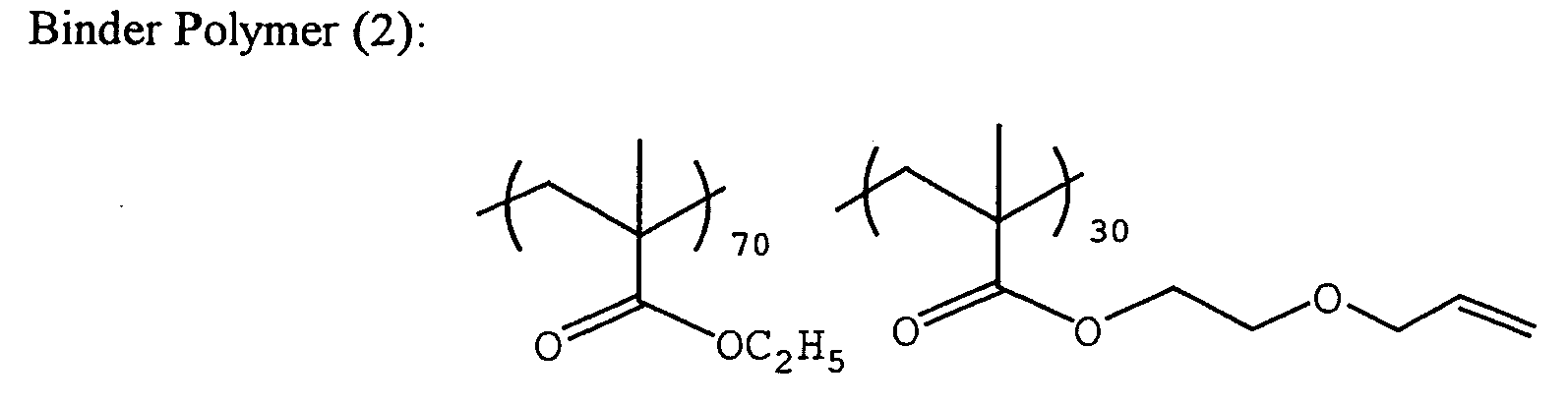

- Lithographic Printing Plate Precursor (3) was obtained in the same manner as Lithographic Printing Plate Precursor (2) except for changing Coating Solution (2) for Image Recording Layer to Coating Solution (3) for Image Recording Layer having the following composition.
<Coating Solution (3) for Image Recording Layer> Polymerization Initiator (1) 0.2 g Sensitizing Dye (1) 0.1 g Polymerization inhibitor precursor (Compound I-17) 0.5 g Binder Polymer (2) (average molecular weight: 80,000) 3.0 g Polymerizable compound: 6.2 g isocyanuric acid EO-modified triacrylate (Aronics M-315, produced by Toa Gosei Co., Ltd.) Leuco Crystal Violet 0.5 g Fluorine-Containing Surfactant (1) 0.1 g Microcapsule (1) shown below (as solid content) 10.0 g Methyl ethyl ketone 35.0 g 1-Methoxy-2-propanol 35.0 g Water 10.0 g - As the oil phase component, 10 g of trimethylolpropane and xylene diisocyanate adduct (Takenate D-110N, produced by Mitsui Takeda Chemicals, Inc.), 4.15 g ofisocyanuric acid EO-modified diacrylate (Aronics M-215, produced by Toa Gosei Co., Ltd.) and 0.1 g of Pionin A-41C (produced by Takemoto Yushi Co., Ltd.) were dissolved in 17g of ethyl acetate. As the aqueous phase component, 40 g of an aqueous 4 mass% PVA-205 solution was prepared. The oil phase component and the aqueous phase component were mixed and emulsified in a homogenizer at 12,000 rpm for 10 minutes. The resulting emulsified product was added to 25 g of distilled water and the obtained mixture was stirred at room temperature for 30 minutes and then stirred at 40°C for 3 hours. The thus-obtained Microcapsule Solution (1) was diluted with distilled water to a solid content concentration of 20 mass%. The average particle diameter was 0.25 µm.
- Lithographic Printing Plate Precursor (4) was obtained in the same manner as Lithographic Printing Plate Precursor (2) except for not adding the polymerization inhibitor (Compound I-17) to Coating Solution (2) for Image Recording Layer.
- Lithographic Printing Plate Precursor (5) was obtained in the same manner as Lithographic Printing Plate Precursor (2) except for changing 0.5 g of the polymerization inhibitor (Compound I-17) of Coating Solution (2) for Image Recording Layer to 0.36 g of Polymerization Inhibitor (1) shown below.
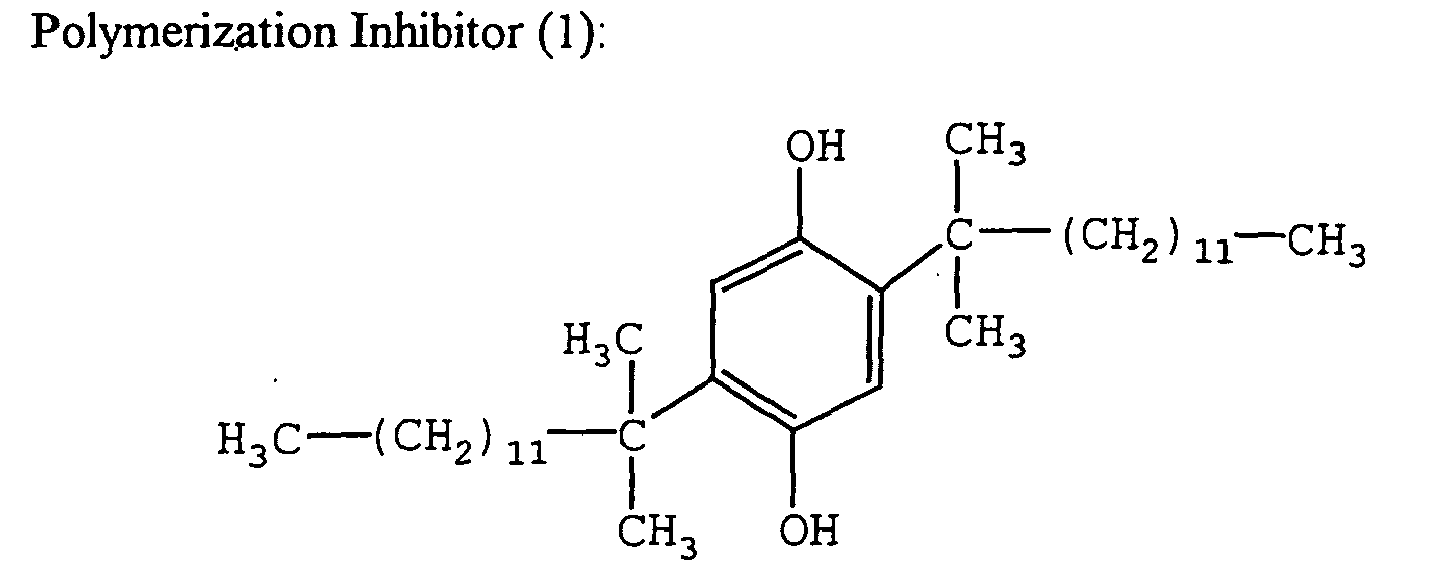
- Lithographic Printing Plate Precursor (6) was obtained in the same manner as Lithographic Printing Plate Precursor (2) except for changing Polymerization Initiator (1) of Coating Solution (2) for Image Recording Layer to Polymerization Initiator (2) shown below and changing Sensitizing Dye (1) to Sensitizing Dye (2) shown below.


- Lithographic Printing Plate Precursor (7) was obtained in the same manner as Lithographic Printing Plate Precursor (2) except for changing Polymerization Initiator (1) of Coating Solution (2) for Image Recording Layer to Polymerization Initiator (3) shown below and not adding Sensitizing Dye (1).

- Lithographic Printing Plate Precursor (8) was obtained in the same manner as Lithographic Printing Plate Precursor (2) except for changing Coating Solution (2) for Image Recording Layer to the following Coating solution (4) for Image Recording Layer.
Coating Solution (4) for Image Recording Layer: Infrared Absorbent (1) shown below 0.05 g Polymerization Initiator (4) shown below 0.20 g Polymerization inhibitor precursor (Compound I-17) 0.10 g Binder Polymer (2) 0.50 g Polymerizable monomer, Aronics M-215 (produced by Toa Gosei Co., Ltd.) 1.00 g Naphthalenesulfonate of Victoria Pure Blue 0.02 g Fluorine-Containing Surfactant (1) 0.10 g Methyl ethyl ketone 18.0 g 

- Lithographic Printing Plate Precursor (9) was obtained in the same manner as Lithographic Printing Plate Precursor (3) except for changing Coating Solution (3) for Image Recording Layer to the following Coating solution (5) for Image Recording Layer.
- Coating Solution (5) for Image Recording Layer was obtained by mixing and stirring the following Photosensitive Solution (1) and Microcapsule Solution (2) immediately before coating.
Photosensitive Solution (1): Binder Polymer (3) shown below 0.162 g Polymerization Initiator (4) 0.100 g Infrared Absorbent (2) shown below 0.020 g Polymerization inhibitor precursor (Compound I-17) 0.05 g Polymerizable compound (Aronics M-215, produced by Toa Gosei Co., Ltd.) 0.385 g Fluorine-Containing Surfactant (1) 0.044 g Methyl ethyl ketone 1.091 g 1-Methoxy-2-propanol 8.609 g Microcapsule Solution (2): Microcapsule (2) synthesized as follows 2.640 g Water 2.425 g 

- As the oil phase component, 10 g of trimethylolpropane and xylene diisocyanate adduct (Takenate D-110N, produced by Mitsui Takeda Chemicals, Inc.), 3.15 g of pentaerythritol triacrylate (SR444, produced by Nippon Kayaku Co., Ltd.), 0.35 g of Infrared Absorbent (2), 1 g of 3-(N,N-diethylamino)-6-methyl-7-anilinofluorane (ODB, produced by Yamamoto Chemicals, Inc.), and 0.1 g ofPionin A-41C (produced by Takemoto Yushi Co., Ltd.) were dissolved in 17 g of ethyl acetate. As the aqueous phase component, 40 g of an aqueous 4 mass% PVA-205 solution was prepared. The oil phase component and the aqueous phase component were mixed and emulsified in a homogenizer at 12,000 rpm for 10 minutes. The resulting emulsified product was added to 25 g of distilled water and the obtained mixture was stirred at room temperature for 30 minutes and then stirred at 40°C for 3 hours. The thus-obtained microcapsule solution was diluted with distilled water to a solid content concentration of 15 mass%. The average particle diameter was 0.2 µm.
- Lithographic Printing Plate Precursors (10) to (13) were obtained in the same manner as Lithographic Printing Plate Precursor (2) except for changing the polymerization inhibitor precursor Compound I-17 of Coating Solution (2) for Image Recording Layer to polymerization inhibitor precursor Compounds I-5, I-6, I-7 and I-8, respectively.
- Lithographic Printing Plate Precursor (14) was obtained in the same manner as Lithographic Printing Plate Precursor (2) except for not providing a protective layer on the image recording layer.
- Lithographic Printing Plate Precursor (15) was obtained in the same manner as Lithographic Printing Plate Precursor (8) except for not providing a protective layer on the image recording layer.
- The lithographic printing plate precursor was exposed by a semiconductor laser having an oscillation wavelength of 405 nm (Lithographic Printing Plate Precursors (1) to (5) and (10) to (14)) or 375 nm (Lithographic Printing Plate Precursors (6) and (7)) with use of an exposure head comprising an optical system using a DMD spatial modulation device shown in Fig. 4, under the conditions such that the output was 2 mW, the circumferential length of outer drum was 900 mm, the rotation number of drum was 800 rpm, the resolution was 2,400 dpi and the drawing time for one picture element was 0.9 µsec.
- The lithographic printing plate precursor was exposed by Trendsetter 3244VX (manufactured by Creo) having mounted thereon a water-cooling 40 W infrared (830 nm) semiconductor laser under the conditions such that the output was 9 W, the rotation number of outer drum was 210 rpm and the resolution was 2,400 dpi.
- The lithographic printing plate precursor after image exposure was placed in an oven, heated by blowing hot air and kept at 140°C for 100 seconds.
- The printing plate precursor after image exposure and heat treatment was developed at 30°C for 15 seconds by dipping it in a developer DP-4 (produced by Fuji Photo Film Co., Ltd.) 18-fold diluted with water. Thereafter, the plate surface was treated with a gumming solution GU-7 (produced by Fuji Photo Film Co., Ltd.) 2-fold diluted with water.
- As described in Printing Method below, the printing plate precursor after image exposure and heat treatment was loaded on a printing press without passing through a development processing and developed on the press.
- Lithographic Printing Plate Precursor (1) was, after image exposure, heat treatment and development of the printing plate precursor, was loaded on a printing press SOR-M manufactured by Heidelberg, and then printing was performed at a printing speed of 6,000 sheets/hour by using a fountain solution (EU-3 (etching solution produced by Fuji Photo Film Co., Ltd.)/water/isopropyl alcohol = 1/89/10 (by volume)) and a black ink TRANS-G(N) (produced by Dai-Nippon Ink & Chemicals, Inc.).
- Lithographic Printing Plate Precursors (2) to (13) each was, without developing the printing plate precursor after image exposure and heat treatment, fixed to the cylinder of a printing press SOR-M manufactured by Heidelberg, a fountain solution and an ink were supplied thereto by using a fountain solution (IF201 (etching solution produced by Fuji Photo Film Co., Ltd.)/water = 4/96 (by volume)) and a black ink TRANS-G(N) (produced by Dai-Nippon Ink & Chemicals, Inc.), and then printing was performed at a printing speed of 6,000 sheets/hour.
- The unexposed lithographic printing plate precursor was heat-treated by the method described above, placed under a white fluorescent lamp and after setting the conditions to give a light intensity of 400 lux on the surface of the lithographic printing plate precursor, exposed to light. The lithographic printing plate precursor exposed to white light was, after development if required, fixed to the cylinder of a printing press SOR-M manufactured by Heidelberg in the same manner as above and used for printing of 100 sheets. The time period exposed under a white fluorescent lamp, with which exposure time ink staining was not caused, was measured up to 300 minutes. As this time period is longer, the white light safety is better.
- Lithographic Printing Plate Precursor (1) was subjected to image exposure, heat treatment, development and printing of 1,000 sheets as described above. Then, a good printed matter where the non-image area was free of staining and the image area had a sufficiently high ink density was obtained.
- The evaluation result of white light safety is shown in Table 1.
- Lithographic Printing Plate Precursors (2) to (4) and (6) to (15) each was subjected to image exposure and heat treatment and by loading it on a printing press without passing through development as described above, printing of 100 sheets was performed. At this point, removal of the image recording layer in the unexposed area was completed on the printing press and a printed matter with the non-image area being free of ink staining was obtained. Thereafter, 10,000 sheets were further printed, as a result, a good printed matter where the non-image area was free of staining and the image area had a sufficiently high ink density was obtained.
- The evaluation results of white light safety are shown in Table 1.
- In the same manner as in Example 2 except for not performing heat treatment, Lithographic Printing Plate Precursor (2) was image-exposed, loaded on a printing press without passing through heat treatment and development, and used for printing of 100 sheets. At this point, removal of the image recording layer in the unexposed area was completed on the printing press and a printed matter with the non-image area being free of ink staining was obtained. Thereafter, 10,000 sheets were further printed, as a result, a good printed matter where the non-image area was free of staining and the image area had a sufficiently high ink density was obtained.
- However, the evaluation result of white light safety was bad as shown in Table 1.
- Lithographic Printing Plate Precursor (5) was, as described above, image-exposed, heat-treated, loaded on a printing press without passing through development, and used for printing of 100 sheets. At this point, removal of the image recording layer in the unexposed area was completed on the printing press and a printed matter with the non-image are being free of ink staining was obtained. Thereafter, 10,000 sheets were further printed, as a result, the ink density in the image area was decreased after printing of 5,000 sheets despite no staining in the non-image area and a good printed matter was not obtained. The evaluation result of white light safety is shown in Table 1.
Table 1 Lithographic Printing Plate Precursor Polymerization Inhibitor Precursor Protective Layer Heat Treatment Wavelength of Image Exposure Laser [nm] White Light Safety [min] Example 1 (1) 1-17 formed done 405 150 Example 2 (2) 1-17 formed done 405 210 Example 3 (3) 1-17 formed done 405 240 Example 4 (6) 1-17 formed done 375 270 Example 5 (7) 1-17 formed done 375 270 Example 6 (8) 1-17 formed done 830 300 Example 7 (9) 1-17 formed done 830 300 Example 8 (10) 1-5 formed done 405 180 Example 9 (11) 1-6 formed done 405 180 Example 10 (12) 1-7 formed done 405 210 Example 11 (13) 1-8 formed done 405 240 Example 12 (14) 1-17 none done 405 300 Example 13 (15) 1-17 none done 830 300 Comparative Example 1 (4) none formed done 405 10 Comparative Example 2 (2) 1-17 formed none 405 10 Comparative Example 3 (5) none (polymerization inhibitor was added) formed done 405 210 - As apparent from the results above, in the image recording material of the present invention, particularly in the lithographic printing plate precursor which is a suitable usage of the image recording material, the polymerization reaction of the image recording layer can be prevented by the heat treatment after image exposure and good white light safety can be obtained without decreasing the sensitivity of the lithographic printing plate at the image exposure.
- According to the present invention, an image recording material ensuring excellent white light safety without decreasing the sensitivity at the image exposure can be provided.
- The entire disclosure of each and every foreign patent application from which the benefit of foreign priority has been claimed in the present application is incorporated herein by reference, as if fully set forth.
Claims (13)
- An image recording material comprising:(A) a polymerization initiator;(B) a polymerizable compound; and(C) a compound of generating, when heated, a chemical species of inhibiting a polymerization reaction.
- The image recording material as claimed in claim 1, which has photosensitivity in a range from 250 to 420 nm.
- The image recording material as claimed in claim 1, which further comprises an infrared absorbent.
- The image recording material as claimed in claim 1,
wherein the compound (C) has a phenolic hydroxyl group protected with a group decomposable under heat. - A method for inhibiting a polymerization reaction of an image recording material after imagewise exposure, comprising:imagewise exposing; andheat-treating the image recording material as claimed in claim 1.
- The method for inhibiting a polymerization reaction of an image recording material after imagewise exposure as claimed in claim 5,
wherein a light source for the imagewise exposing is laser light. - A lithographic printing plate precursor comprising:a support; andan image recording layer comprising: (A) a polymerization initiator; (B) a polymerizable compound; and (C) a compound of generating, when heated, a chemical species of inhibiting a polymerization reaction.
- The lithographic printing plate precursor as claimed in claim 7,
wherein the image recording layer is removable with at least one of a printing ink and a fountain solution. - The lithographic printing plate precursor as claimed in claim 7,
wherein the image recording layer has photosensitivity in a range from 250 to 420 nm. - The lithographic printing plate precursor as claimed in claim 7,
wherein the image recording layer further comprises an infrared absorbent. - The lithographic printing plate precursor as claimed in claim 7,
wherein the compound (C) has a phenolic hydroxyl group protected with a group decomposable under heat. - A method for inhibiting a polymerization reaction of an image recording layer after imagewise exposure, comprising:imagewise exposing; andheat-treating the lithographic printing plate precursor as claimed in claim 7.
- The method for inhibiting a polymerization reaction of an image recording layer after imagewise exposure as claimed in claim 12,
wherein a light source for the imagewise exposing is laser light.
Applications Claiming Priority (1)
| Application Number | Priority Date | Filing Date | Title |
|---|---|---|---|
| JP2004181139A JP4610237B2 (en) | 2004-06-18 | 2004-06-18 | Planographic printing plate precursor |
Publications (2)
| Publication Number | Publication Date |
|---|---|
| EP1621337A1 true EP1621337A1 (en) | 2006-02-01 |
| EP1621337B1 EP1621337B1 (en) | 2017-03-22 |
Family
ID=35134103
Family Applications (1)
| Application Number | Title | Priority Date | Filing Date |
|---|---|---|---|
| EP05012745.5A Expired - Lifetime EP1621337B1 (en) | 2004-06-18 | 2005-06-14 | Image recording material and lithographic printing plate precursor |
Country Status (3)
| Country | Link |
|---|---|
| US (1) | US20050279234A1 (en) |
| EP (1) | EP1621337B1 (en) |
| JP (1) | JP4610237B2 (en) |
Cited By (2)
| Publication number | Priority date | Publication date | Assignee | Title |
|---|---|---|---|---|
| EP1634898A3 (en) * | 2004-09-10 | 2006-08-16 | Fuji Photo Film Co., Ltd. | Polymer having polymerizable group, polymerizable composition, planographic printing plate precursor, and planographic printing method using the same |
| WO2010008514A1 (en) * | 2008-07-15 | 2010-01-21 | Eastman Kodak Company | Negative-working imaging elements and methods of use |
Families Citing this family (4)
| Publication number | Priority date | Publication date | Assignee | Title |
|---|---|---|---|---|
| US8088559B2 (en) * | 2005-11-18 | 2012-01-03 | Agfa Graphics Nv | Method of making a photopolymer printing plate |
| US20080145789A1 (en) * | 2006-10-13 | 2008-06-19 | Elizabeth Knight | Method of making lithographic printing plates |
| US20100129756A1 (en) * | 2007-05-15 | 2010-05-27 | Willi-Kurt Gries | Gum solution for developing and gumming a photopolymer printing plate |
| BR112016010056B1 (en) | 2013-11-07 | 2021-12-28 | Shell Internationale Research Maatschappij B.V. | METHOD OF GENERATING STRONG ACIDS IN DESCENDING HOLE |
Citations (5)
| Publication number | Priority date | Publication date | Assignee | Title |
|---|---|---|---|---|
| US4168982A (en) * | 1976-06-01 | 1979-09-25 | E. I. Du Pont De Nemours And Company | Photopolymerizable compositions containing nitroso dimers to selectively inhibit thermal polymerization |
| EP1132200A2 (en) * | 2000-01-14 | 2001-09-12 | Fuji Photo Film Co., Ltd. | Lithographic printing plate precursor |
| JP2002202594A (en) * | 2000-12-28 | 2002-07-19 | Fuji Photo Film Co Ltd | Photopolymerizable planographic printing plate |
| EP1393899A2 (en) * | 2002-08-29 | 2004-03-03 | Fuji Photo Film Co., Ltd. | On-press developable lithographic printing plate precursor |
| EP1491331A2 (en) * | 2003-06-23 | 2004-12-29 | Fuji Photo Film Co., Ltd. | Process for making flexographic printing plate |
Family Cites Families (7)
| Publication number | Priority date | Publication date | Assignee | Title |
|---|---|---|---|---|
| DE2402179C2 (en) * | 1973-01-18 | 1983-03-31 | E.I. du Pont de Nemours and Co., 19898 Wilmington, Del. | Photopolymerizable compositions containing dimeric nitroso compounds |
| JP2696434B2 (en) * | 1991-01-23 | 1998-01-14 | 富士写真フイルム株式会社 | Image forming method |
| US5932735A (en) * | 1997-06-13 | 1999-08-03 | Ciba Specialty Chemicals Corporation | Derivatives of 1-oxyl-4-hydroxy-2,2,6,6-tetramethylpiperidine as polymerization inhibitors for (meth)acrylate monomers |
| JPH11202483A (en) * | 1998-01-16 | 1999-07-30 | Fuji Photo Film Co Ltd | Lithographic printing plate manufacturing method |
| WO2001032772A1 (en) * | 1999-11-01 | 2001-05-10 | Bridgestone Corporation | Sealing composition and sealing method |
| JP4191887B2 (en) * | 2000-09-27 | 2008-12-03 | 富士フイルム株式会社 | Planographic printing plate precursor |
| EP1219464B1 (en) * | 2000-12-20 | 2008-02-13 | FUJIFILM Corporation | Lithographic printing plate precursor |
-
2004
- 2004-06-18 JP JP2004181139A patent/JP4610237B2/en not_active Expired - Fee Related
-
2005
- 2005-06-08 US US11/147,365 patent/US20050279234A1/en not_active Abandoned
- 2005-06-14 EP EP05012745.5A patent/EP1621337B1/en not_active Expired - Lifetime
Patent Citations (5)
| Publication number | Priority date | Publication date | Assignee | Title |
|---|---|---|---|---|
| US4168982A (en) * | 1976-06-01 | 1979-09-25 | E. I. Du Pont De Nemours And Company | Photopolymerizable compositions containing nitroso dimers to selectively inhibit thermal polymerization |
| EP1132200A2 (en) * | 2000-01-14 | 2001-09-12 | Fuji Photo Film Co., Ltd. | Lithographic printing plate precursor |
| JP2002202594A (en) * | 2000-12-28 | 2002-07-19 | Fuji Photo Film Co Ltd | Photopolymerizable planographic printing plate |
| EP1393899A2 (en) * | 2002-08-29 | 2004-03-03 | Fuji Photo Film Co., Ltd. | On-press developable lithographic printing plate precursor |
| EP1491331A2 (en) * | 2003-06-23 | 2004-12-29 | Fuji Photo Film Co., Ltd. | Process for making flexographic printing plate |
Cited By (5)
| Publication number | Priority date | Publication date | Assignee | Title |
|---|---|---|---|---|
| EP1634898A3 (en) * | 2004-09-10 | 2006-08-16 | Fuji Photo Film Co., Ltd. | Polymer having polymerizable group, polymerizable composition, planographic printing plate precursor, and planographic printing method using the same |
| EP2109000A1 (en) * | 2004-09-10 | 2009-10-14 | FUJIFILM Corporation | Polymer having polymerizable group, polymerizable composition, planographic printing plate precursor, and planographic printing method using the same |
| US7618762B2 (en) | 2004-09-10 | 2009-11-17 | Fujifilm Corporation | Polymer having polymerizable group, polymerizable composition, planographic printing plate precursor, and planographic printing method using the same |
| WO2010008514A1 (en) * | 2008-07-15 | 2010-01-21 | Eastman Kodak Company | Negative-working imaging elements and methods of use |
| US8354216B2 (en) | 2008-07-15 | 2013-01-15 | Eastman Kodak Company | Negative-working imaging elements and methods of use |
Also Published As
| Publication number | Publication date |
|---|---|
| JP4610237B2 (en) | 2011-01-12 |
| EP1621337B1 (en) | 2017-03-22 |
| US20050279234A1 (en) | 2005-12-22 |
| JP2006001182A (en) | 2006-01-05 |
Similar Documents
| Publication | Publication Date | Title |
|---|---|---|
| EP1630618B1 (en) | Method for producing a lithographic printing plate | |
| EP1518672B1 (en) | Lithographic printing plate precursor and lithographic printing method | |
| EP1916568B1 (en) | Use of a developing solution for lithographic printing plates and production method of lithographic printing plate | |
| EP2006738B1 (en) | Lithographic printing plate precursor | |
| EP1685957B1 (en) | Packaged body of lithographic printing plate precursors | |
| US20090114108A1 (en) | Lithographic printing plate precursor and lithographic printing method | |
| EP1577089B1 (en) | Lithographic printing method | |
| EP1621339B1 (en) | Plate-making method of lithographic printing plate | |
| US20090246700A1 (en) | Plate-making method of lithographic printing plate precursor | |
| US20100242766A1 (en) | Lithographic printing plate precursor and lithographic printing method | |
| EP1696268B1 (en) | Lithographic printing plate precursor | |
| US7419758B2 (en) | Lithographic printing plate precursor and lithographic printing method | |
| EP1645912B1 (en) | Lithographic printing method | |
| EP1621337B1 (en) | Image recording material and lithographic printing plate precursor | |
| EP2078984A1 (en) | Lithographic printing plate precursor, method of preparing lithographic printing plate and lithographic printing method | |
| US20090197205A1 (en) | Lithographic printing plate precursor and printing method | |
| EP1669195B1 (en) | Lithographic printing method | |
| EP1614537B1 (en) | Lithographic printing plate precursor and lithographic printing method | |
| EP2101218B1 (en) | Method for preparing a lithographic printing plate | |
| JP2005349801A (en) | Imaging method and lithographic printing method |
Legal Events
| Date | Code | Title | Description |
|---|---|---|---|
| PUAI | Public reference made under article 153(3) epc to a published international application that has entered the european phase |
Free format text: ORIGINAL CODE: 0009012 |
|
| AK | Designated contracting states |
Kind code of ref document: A1 Designated state(s): AT BE BG CH CY CZ DE DK EE ES FI FR GB GR HU IE IS IT LI LT LU MC NL PL PT RO SE SI SK TR |
|
| AX | Request for extension of the european patent |
Extension state: AL BA HR LV MK YU |
|
| 17P | Request for examination filed |
Effective date: 20060426 |
|
| AKX | Designation fees paid |
Designated state(s): AT BE BG CH CY CZ DE DK EE ES FI FR GB GR HU IE IS IT LI LT LU MC NL PL PT RO SE SI SK TR |
|
| RAP1 | Party data changed (applicant data changed or rights of an application transferred) |
Owner name: FUJIFILM CORPORATION |
|
| 17Q | First examination report despatched |
Effective date: 20150120 |
|
| GRAP | Despatch of communication of intention to grant a patent |
Free format text: ORIGINAL CODE: EPIDOSNIGR1 |
|
| INTG | Intention to grant announced |
Effective date: 20161020 |
|
| RIN1 | Information on inventor provided before grant (corrected) |
Inventor name: INNO, TOSHIFUMI Inventor name: KUNITA, KAZUTO |
|
| GRAJ | Information related to disapproval of communication of intention to grant by the applicant or resumption of examination proceedings by the epo deleted |
Free format text: ORIGINAL CODE: EPIDOSDIGR1 |
|
| GRAR | Information related to intention to grant a patent recorded |
Free format text: ORIGINAL CODE: EPIDOSNIGR71 |
|
| GRAS | Grant fee paid |
Free format text: ORIGINAL CODE: EPIDOSNIGR3 |
|
| GRAA | (expected) grant |
Free format text: ORIGINAL CODE: 0009210 |
|
| INTC | Intention to grant announced (deleted) | ||
| INTG | Intention to grant announced |
Effective date: 20170209 |
|
| AK | Designated contracting states |
Kind code of ref document: B1 Designated state(s): AT BE BG CH CY CZ DE DK EE ES FI FR GB GR HU IE IS IT LI LT LU MC NL PL PT RO SE SI SK TR |
|
| REG | Reference to a national code |
Ref country code: GB Ref legal event code: FG4D |
|
| REG | Reference to a national code |
Ref country code: CH Ref legal event code: EP |
|
| REG | Reference to a national code |
Ref country code: AT Ref legal event code: REF Ref document number: 877315 Country of ref document: AT Kind code of ref document: T Effective date: 20170415 |
|
| REG | Reference to a national code |
Ref country code: IE Ref legal event code: FG4D |
|
| REG | Reference to a national code |
Ref country code: DE Ref legal event code: R096 Ref document number: 602005051552 Country of ref document: DE |
|
| REG | Reference to a national code |
Ref country code: NL Ref legal event code: MP Effective date: 20170322 |
|
| PG25 | Lapsed in a contracting state [announced via postgrant information from national office to epo] |
Ref country code: LT Free format text: LAPSE BECAUSE OF FAILURE TO SUBMIT A TRANSLATION OF THE DESCRIPTION OR TO PAY THE FEE WITHIN THE PRESCRIBED TIME-LIMIT Effective date: 20170322 Ref country code: GR Free format text: LAPSE BECAUSE OF FAILURE TO SUBMIT A TRANSLATION OF THE DESCRIPTION OR TO PAY THE FEE WITHIN THE PRESCRIBED TIME-LIMIT Effective date: 20170623 Ref country code: FI Free format text: LAPSE BECAUSE OF FAILURE TO SUBMIT A TRANSLATION OF THE DESCRIPTION OR TO PAY THE FEE WITHIN THE PRESCRIBED TIME-LIMIT Effective date: 20170322 |
|
| REG | Reference to a national code |
Ref country code: LT Ref legal event code: MG4D |
|
| REG | Reference to a national code |
Ref country code: AT Ref legal event code: MK05 Ref document number: 877315 Country of ref document: AT Kind code of ref document: T Effective date: 20170322 |
|
| PG25 | Lapsed in a contracting state [announced via postgrant information from national office to epo] |
Ref country code: SE Free format text: LAPSE BECAUSE OF FAILURE TO SUBMIT A TRANSLATION OF THE DESCRIPTION OR TO PAY THE FEE WITHIN THE PRESCRIBED TIME-LIMIT Effective date: 20170322 Ref country code: BG Free format text: LAPSE BECAUSE OF FAILURE TO SUBMIT A TRANSLATION OF THE DESCRIPTION OR TO PAY THE FEE WITHIN THE PRESCRIBED TIME-LIMIT Effective date: 20170622 |
|
| PG25 | Lapsed in a contracting state [announced via postgrant information from national office to epo] |
Ref country code: NL Free format text: LAPSE BECAUSE OF FAILURE TO SUBMIT A TRANSLATION OF THE DESCRIPTION OR TO PAY THE FEE WITHIN THE PRESCRIBED TIME-LIMIT Effective date: 20170322 |
|
| PG25 | Lapsed in a contracting state [announced via postgrant information from national office to epo] |
Ref country code: AT Free format text: LAPSE BECAUSE OF FAILURE TO SUBMIT A TRANSLATION OF THE DESCRIPTION OR TO PAY THE FEE WITHIN THE PRESCRIBED TIME-LIMIT Effective date: 20170322 Ref country code: ES Free format text: LAPSE BECAUSE OF FAILURE TO SUBMIT A TRANSLATION OF THE DESCRIPTION OR TO PAY THE FEE WITHIN THE PRESCRIBED TIME-LIMIT Effective date: 20170322 Ref country code: IT Free format text: LAPSE BECAUSE OF FAILURE TO SUBMIT A TRANSLATION OF THE DESCRIPTION OR TO PAY THE FEE WITHIN THE PRESCRIBED TIME-LIMIT Effective date: 20170322 Ref country code: SK Free format text: LAPSE BECAUSE OF FAILURE TO SUBMIT A TRANSLATION OF THE DESCRIPTION OR TO PAY THE FEE WITHIN THE PRESCRIBED TIME-LIMIT Effective date: 20170322 Ref country code: EE Free format text: LAPSE BECAUSE OF FAILURE TO SUBMIT A TRANSLATION OF THE DESCRIPTION OR TO PAY THE FEE WITHIN THE PRESCRIBED TIME-LIMIT Effective date: 20170322 Ref country code: RO Free format text: LAPSE BECAUSE OF FAILURE TO SUBMIT A TRANSLATION OF THE DESCRIPTION OR TO PAY THE FEE WITHIN THE PRESCRIBED TIME-LIMIT Effective date: 20170322 Ref country code: CZ Free format text: LAPSE BECAUSE OF FAILURE TO SUBMIT A TRANSLATION OF THE DESCRIPTION OR TO PAY THE FEE WITHIN THE PRESCRIBED TIME-LIMIT Effective date: 20170322 |
|
| PG25 | Lapsed in a contracting state [announced via postgrant information from national office to epo] |
Ref country code: IS Free format text: LAPSE BECAUSE OF FAILURE TO SUBMIT A TRANSLATION OF THE DESCRIPTION OR TO PAY THE FEE WITHIN THE PRESCRIBED TIME-LIMIT Effective date: 20170722 Ref country code: PT Free format text: LAPSE BECAUSE OF FAILURE TO SUBMIT A TRANSLATION OF THE DESCRIPTION OR TO PAY THE FEE WITHIN THE PRESCRIBED TIME-LIMIT Effective date: 20170724 Ref country code: PL Free format text: LAPSE BECAUSE OF FAILURE TO SUBMIT A TRANSLATION OF THE DESCRIPTION OR TO PAY THE FEE WITHIN THE PRESCRIBED TIME-LIMIT Effective date: 20170322 |
|
| REG | Reference to a national code |
Ref country code: DE Ref legal event code: R097 Ref document number: 602005051552 Country of ref document: DE |
|
| PLBE | No opposition filed within time limit |
Free format text: ORIGINAL CODE: 0009261 |
|
| STAA | Information on the status of an ep patent application or granted ep patent |
Free format text: STATUS: NO OPPOSITION FILED WITHIN TIME LIMIT |
|
| PG25 | Lapsed in a contracting state [announced via postgrant information from national office to epo] |
Ref country code: MC Free format text: LAPSE BECAUSE OF FAILURE TO SUBMIT A TRANSLATION OF THE DESCRIPTION OR TO PAY THE FEE WITHIN THE PRESCRIBED TIME-LIMIT Effective date: 20170322 Ref country code: DK Free format text: LAPSE BECAUSE OF FAILURE TO SUBMIT A TRANSLATION OF THE DESCRIPTION OR TO PAY THE FEE WITHIN THE PRESCRIBED TIME-LIMIT Effective date: 20170322 |
|
| REG | Reference to a national code |
Ref country code: CH Ref legal event code: PL |
|
| 26N | No opposition filed |
Effective date: 20180102 |
|
| PG25 | Lapsed in a contracting state [announced via postgrant information from national office to epo] |
Ref country code: SI Free format text: LAPSE BECAUSE OF FAILURE TO SUBMIT A TRANSLATION OF THE DESCRIPTION OR TO PAY THE FEE WITHIN THE PRESCRIBED TIME-LIMIT Effective date: 20170322 |
|
| REG | Reference to a national code |
Ref country code: IE Ref legal event code: MM4A |
|
| REG | Reference to a national code |
Ref country code: FR Ref legal event code: ST Effective date: 20180228 |
|
| PG25 | Lapsed in a contracting state [announced via postgrant information from national office to epo] |
Ref country code: LI Free format text: LAPSE BECAUSE OF NON-PAYMENT OF DUE FEES Effective date: 20170630 Ref country code: LU Free format text: LAPSE BECAUSE OF NON-PAYMENT OF DUE FEES Effective date: 20170614 Ref country code: IE Free format text: LAPSE BECAUSE OF NON-PAYMENT OF DUE FEES Effective date: 20170614 Ref country code: CH Free format text: LAPSE BECAUSE OF NON-PAYMENT OF DUE FEES Effective date: 20170630 |
|
| PG25 | Lapsed in a contracting state [announced via postgrant information from national office to epo] |
Ref country code: FR Free format text: LAPSE BECAUSE OF NON-PAYMENT OF DUE FEES Effective date: 20170630 |
|
| REG | Reference to a national code |
Ref country code: BE Ref legal event code: MM Effective date: 20170630 |
|
| PG25 | Lapsed in a contracting state [announced via postgrant information from national office to epo] |
Ref country code: BE Free format text: LAPSE BECAUSE OF NON-PAYMENT OF DUE FEES Effective date: 20170630 |
|
| PG25 | Lapsed in a contracting state [announced via postgrant information from national office to epo] |
Ref country code: HU Free format text: LAPSE BECAUSE OF FAILURE TO SUBMIT A TRANSLATION OF THE DESCRIPTION OR TO PAY THE FEE WITHIN THE PRESCRIBED TIME-LIMIT; INVALID AB INITIO Effective date: 20050614 |
|
| PGFP | Annual fee paid to national office [announced via postgrant information from national office to epo] |
Ref country code: DE Payment date: 20190604 Year of fee payment: 15 |
|
| PG25 | Lapsed in a contracting state [announced via postgrant information from national office to epo] |
Ref country code: CY Free format text: LAPSE BECAUSE OF NON-PAYMENT OF DUE FEES Effective date: 20170322 |
|
| PGFP | Annual fee paid to national office [announced via postgrant information from national office to epo] |
Ref country code: GB Payment date: 20190612 Year of fee payment: 15 |
|
| PG25 | Lapsed in a contracting state [announced via postgrant information from national office to epo] |
Ref country code: TR Free format text: LAPSE BECAUSE OF FAILURE TO SUBMIT A TRANSLATION OF THE DESCRIPTION OR TO PAY THE FEE WITHIN THE PRESCRIBED TIME-LIMIT Effective date: 20170322 |
|
| REG | Reference to a national code |
Ref country code: DE Ref legal event code: R119 Ref document number: 602005051552 Country of ref document: DE |
|
| GBPC | Gb: european patent ceased through non-payment of renewal fee |
Effective date: 20200614 |
|
| PG25 | Lapsed in a contracting state [announced via postgrant information from national office to epo] |
Ref country code: GB Free format text: LAPSE BECAUSE OF NON-PAYMENT OF DUE FEES Effective date: 20200614 |
|
| PG25 | Lapsed in a contracting state [announced via postgrant information from national office to epo] |
Ref country code: DE Free format text: LAPSE BECAUSE OF NON-PAYMENT OF DUE FEES Effective date: 20210101 |