EP1621227A1 - Circulation promoting laser irradiation device - Google Patents
Circulation promoting laser irradiation device Download PDFInfo
- Publication number
- EP1621227A1 EP1621227A1 EP04729221A EP04729221A EP1621227A1 EP 1621227 A1 EP1621227 A1 EP 1621227A1 EP 04729221 A EP04729221 A EP 04729221A EP 04729221 A EP04729221 A EP 04729221A EP 1621227 A1 EP1621227 A1 EP 1621227A1
- Authority
- EP
- European Patent Office
- Prior art keywords
- laser
- laser beams
- laser irradiation
- section
- beams
- Prior art date
- Legal status (The legal status is an assumption and is not a legal conclusion. Google has not performed a legal analysis and makes no representation as to the accuracy of the status listed.)
- Granted
Links
Images


Classifications
-
- A—HUMAN NECESSITIES
- A61—MEDICAL OR VETERINARY SCIENCE; HYGIENE
- A61N—ELECTROTHERAPY; MAGNETOTHERAPY; RADIATION THERAPY; ULTRASOUND THERAPY
- A61N5/00—Radiation therapy
- A61N5/06—Radiation therapy using light
- A61N5/0613—Apparatus adapted for a specific treatment
- A61N5/0616—Skin treatment other than tanning
-
- A—HUMAN NECESSITIES
- A61—MEDICAL OR VETERINARY SCIENCE; HYGIENE
- A61N—ELECTROTHERAPY; MAGNETOTHERAPY; RADIATION THERAPY; ULTRASOUND THERAPY
- A61N5/00—Radiation therapy
- A61N5/06—Radiation therapy using light
- A61N5/067—Radiation therapy using light using laser light
-
- A—HUMAN NECESSITIES
- A61—MEDICAL OR VETERINARY SCIENCE; HYGIENE
- A61B—DIAGNOSIS; SURGERY; IDENTIFICATION
- A61B18/00—Surgical instruments, devices or methods for transferring non-mechanical forms of energy to or from the body
- A61B18/18—Surgical instruments, devices or methods for transferring non-mechanical forms of energy to or from the body by applying electromagnetic radiation, e.g. microwaves
- A61B18/20—Surgical instruments, devices or methods for transferring non-mechanical forms of energy to or from the body by applying electromagnetic radiation, e.g. microwaves using laser
- A61B2018/208—Surgical instruments, devices or methods for transferring non-mechanical forms of energy to or from the body by applying electromagnetic radiation, e.g. microwaves using laser with multiple treatment beams not sharing a common path, e.g. non-axial or parallel
-
- A—HUMAN NECESSITIES
- A61—MEDICAL OR VETERINARY SCIENCE; HYGIENE
- A61N—ELECTROTHERAPY; MAGNETOTHERAPY; RADIATION THERAPY; ULTRASOUND THERAPY
- A61N5/00—Radiation therapy
- A61N5/06—Radiation therapy using light
- A61N2005/063—Radiation therapy using light comprising light transmitting means, e.g. optical fibres
-
- A—HUMAN NECESSITIES
- A61—MEDICAL OR VETERINARY SCIENCE; HYGIENE
- A61N—ELECTROTHERAPY; MAGNETOTHERAPY; RADIATION THERAPY; ULTRASOUND THERAPY
- A61N5/00—Radiation therapy
- A61N5/06—Radiation therapy using light
- A61N2005/0658—Radiation therapy using light characterised by the wavelength of light used
- A61N2005/0662—Visible light
-
- A—HUMAN NECESSITIES
- A61—MEDICAL OR VETERINARY SCIENCE; HYGIENE
- A61N—ELECTROTHERAPY; MAGNETOTHERAPY; RADIATION THERAPY; ULTRASOUND THERAPY
- A61N5/00—Radiation therapy
- A61N5/06—Radiation therapy using light
- A61N2005/0658—Radiation therapy using light characterised by the wavelength of light used
- A61N2005/0662—Visible light
- A61N2005/0663—Coloured light
Definitions
- the present invention relates to a circulation-accelerating laser irradiation system, particularly to a circulation-accelerating laser irradiation system by which laser beams are concentratedly radiated onto a subcutaneous target part from positions over a skin.
- ray therapeutic apparatuses such as low reaction level laser therapeutic apparatuses and linear polarized near infrared ray therapeutic apparatuses have been utilized as a therapeutic means for a focus present at a subcutaneous deep part in the cases of stiff shoulders, lumbago and the like.
- ray therapeutic apparatuses include a system for irradiating a therapeutic target part with laser beams (Japanese Patent Laid-open No. 2000-187157) and a system for irradiating a therapeutic target part with monochromatic light (Japanese Patent Laid-open No. 2001-212250).
- these ray therapeutic apparatuses are known as a means for alleviating a stiffness or ache by irradiating the target part with light having various wavelengths from positions over the skin.
- the reason for these report lies in that, while the wavelength of the rays used in the conventional ray therapeutic apparatuses is 810-830 nm in the case of laser and 600-1600 nm in the case of linear polarized near infrared rays, it has been found that the circulation-improving (vasodilating or the like) effect constituting one of the analgesic mechanisms is greater on the shorter wavelength side. Particularly, the above three references show that irradiation with ultraviolet rays (300-350 nm) at a very weak output relaxes blood vessels strongly.
- the ray therapeutic apparatuses in clinical use include those with an output in excess of 1000 mW.
- the rays in the UV region of 300-350 nm have a stimulating action harmful to the skin, and are low in tissue depth reaching performance, so that they are considered to be unsuitable for ray therapy in a percutaneous mode.
- the rays in the higher UV region and the visible region do not have any harmful action on the skin, but they are high in absorption by hemoglobin in the blood and are not good in tissue depth reaching performance, so that it is highly possible that these rays cannot show a therapeutic effect on a practical basis.
- the present invention has been made in consideration of the above-mentioned problems. Accordingly, it is an object of the present invention to provide a circulation-accelerating laser irradiation system by which beams with such a high wavelength as to show a vasodilating effect can be efficiently radiated onto an target part constituting a focus part.
- a circulation-accelerating laser irradiation system including: a plurality of laser irradiation section by which laser beams with such a wavelength as to have a vasodilating action is radiated as parallel beams from a plurality of different directions over a skin; and a concentrating section for concentrating the plurality of laser beams radiated from the plurality of laser irradiation section onto a subcutaneous target part.
- the plurality of laser beams radiated from the plurality of laser irradiation section are condensed on the subcutaneous target part, so that even where the laser beam from each individual laser irradiation section is weak in output, therapeutically sufficient energy can be obtained at the target part. Since it suffices for each individual laser beam to have a weak output, the skin tissue irradiated with each individual laser beam can be prevented from being badly influenced by the laser beam, while the therapeutic effect on the target part (i.e., focus part) can be enhanced through the concentration of the laser beams.
- another circulation-accelerating laser irradiation system including: a plurality of laser irradiation section by which laser beams with such a wavelength as to have a vasodilating action are radiated as pulses from positions over a skin; a holding section for positioning and fixing laser beam outgoing ports of the plurality of laser irradiation section in a radial pattern so that the laser beams are concentrated onto a subcutaneous target part; and a control section for such a control that laser irradiations by the plurality of laser irradiation section are conducted at time intervals.
- the laser radiation ports of the laser irradiation section are positioned in a radial pattern, and the plurality of laser irradiation section are so controlled as to perform irradiations with laser beams at time intervals. Therefore, at the target part, the laser beams are simultaneously concentrated, and a high energy can be applied. As a result, a therapeutically sufficient energy can be obtained at the target part, and the therapeutic effect can thus be enhanced through the concentration.
- the laser beams from the outgoing ports are not concentrated, and simultaneous irradiation with the laser beams does not occur, so that application of a high energy does not take place.
- the target part application of a high energy by the laser beams does not occur, and the skin tissues can be prevented from being damaged.
- the present inventors have made a comparative investigation of the vasodilating action obtained by irradiation with light, using a blood vessel enucleated from a rat, a laser beam with a wavelength of 532 nm as a beam in the visible region, and a laser beam with a wavelength of 810 nm on the longer wavelength side.
- Fig. 1 is a schematic diagram showing a blood vessel sample experiment apparatus.
- a rat was used as an animal to be tested, the rat was clubbed to death, followed by phlebotomy, the desending thoracic aorta was enucleated, and a specimen 3 mm long and 1.5 mm in diameter was prepared as a blood vessel sample.
- the blood vessel sample 1 is suspended in a organ bath 3 charged with 50 ml of Krebs-bicarbonate solution 2, and variation in tension is recorded isometrically.
- the organ bath 3 is formed of 1 to 2 mm thick glass sheets, and has a double structure so that water can be circulated along an outer peripheral part thereof.
- the temperature of the Krebs-bicarbonate solution was so controlled that the inside liquid temperature was 33°C when water at a fixed temperature is circulated in the outer peripheral part of the organ bath 3.
- a mixed gas of 95% oxygen and 5% carbon dioxide is passed through the inside liquid.
- the composition of the Krebs-bicarbonate solution is 118 mM of NaCl, 4.8 mM of KCl, 2.5 mM of CaCl 2 , 1.0 mM of MgSO 4 , 1.2 mM of KH 2 PO 4 , 24 mM of NaHCO 3 , and 11 mM of glucose.
- the enucleated blood vessel has no tension; for checking the relaxation, therefore, the blood vessel was preliminarily contracted with noradrenaline (sympathetic nerve mediator).
- the blood vessel was contracted by use of 0.03 ⁇ M noradrenaline, and after the contraction became constant, the laser irradiation experiment was started.
- KTG Green Laser Irradiation System output variable to 20 mW
- the laser irradiation system for a wavelength of 810 nm there was used a dental semiconductor laser apparatus with an output variable to 100 mW, produced by Yunitaku Co., Ltd.
- the laser beam 4 with each individual wavelength was guided by an optical fiber 1.0 mm in diameter, and was radiated directly onto the blood vessel sample 1.
- the irradiation time per run is 1 minute.
- the distance between the blood vessel sample 1 and the tip end of the optical fiber 5 was set to be 1 to 2 mm, to avoid contact therebetween.
- the irradiation intensity of laser from the tip end of the optical fiber 5 was measured immediately before irradiation, by use of Field Master FM (produced by COHERENT, USA).
- the laser beam with a wavelength of 532 nm produced a comparatively strong relaxation (a relaxation reaction of suppressing the noradrenaline contraction by about 40%) at an intensity of 1 mW, whereas the laser beam with a wavelength of 810 nm produced little reaction at an intensity of 4 to 10 mW and only produced a slight relaxation at an intensity of 50 mW.
- the experimental results verified the usefulness of the laser beam with a visible region wavelength of 532 nm.
- a rat was used as an animal subjected to the experiment, the rat was anesthetized with pentobarbital, and a probe of a bloodstream measuring instrument (ADVANCE Laser Flowmeter AFL21R produced by ADVANCE Co., Ltd.) was put into close contact with the inside of an auricle part of the rat.
- ADVANCE Laser Flowmeter AFL21R produced by ADVANCE Co., Ltd.
- the auricle was clamped so that the radiating port of the laser irradiation apparatus is located directly above the probe on the inside.
- the bloodstream in the auricle part was recorded on a pen recorder.
- the laser irradiation with a wavelength of 532 nm at an intensity of 5 mW and the laser irradiation with a wavelength of 810 nm at an intensity of 20 mW produced little influence on the bloodstream, whereas the laser irradiation with a wavelength of 532 nm at an intensity of 20 mW produced an increase in the bloodstream in the auricle dependently on time.
- the irradiation with a laser beam having a wavelength in the visible region has a vasodilating action.
- the vasodilating action leads to an acceleration of the circulation of blood, whereby diseases caused by hindrance of bloodstream in the fascias at the interface between the skin and the muscle or in the muscle at a subcutaneous deep part, such as muscle- or fascias- relating lumbago and stiff shoulders, can be alleviated.
- the beam having a wavelength of 532 nm and a low energy dilates the blood vessel strongly as above-described, a therapeutic effect can be expected when that much energy is made to reach the fascias present at the interface between the skin and the muscle at a subcutaneous deep part.
- the energy with a wavelength of 532 nm is liable to be absorbed by hemoglohin and the like, and is therefore poor in tissue depth reaching performance.
- a high energy is needed for permitting an effective amount of the laser beam with the wavelength to reach a target part at a subcutaneous deep part.
- the use of only one light source may result in that the irradiated part of the skin is damaged by heat.
- beams with little irradiation energy are radiated from a plurality of directions, whereby the optical energy per beam is reduced, the influence of each individual beam on the skin is thereby reduced, and the plurality of irradiation beams are concentrated onto the target part at a subcutaneous deep part, whereby a sufficient optical energy is supplied to the target part.
- Fig. 2 is a schematic diagram showing a circulation-accelerating laser irradiation system according to a first embodiment of the present invention.
- the circulation-accelerating laser irradiation system 1 has a plurality of laser irradiation units by which laser beams with such a wavelength as to have a vasodilating action are radiated as parallel beams from a plurality of different directions over a skin, and a concentrating device for concentrating the plurality of laser beams radiated from the plurality of laser irradiation units onto a subcutaneous target part.
- the laser irradiation unit includes a plurality of optical fibers 10, and a plurality of collimator lenses 11 attached to the tip ends of the optical fibers 10.
- the other ends of the optical fibers 10 are connected to a laser beam generation unit 12.
- the laser beam generation unit 12 can supply laser beams respectively into the plurality of optical fibers 10.
- the laser beam generation unit 12 is further connected to a control unit 13.
- the plurality of optical fibers 10 provided with the collimator lenses 11 at their tip ends are fixed by a holding member 16.
- the holding member 16 functions as a concentrating device, and position the optical fibers 10 so that laser beams 15 radiated from the optical fibers 10 are concentrated onto a target part (focus part) 51. This positioning ensures that the laser beams 15 incoming from the upper side of a skin 50 are concentrated onto the subcutaneous target part 51.
- the holding member 16 has a configuration in which the optical fibers 10 are attached thereto by screws (not shown) or the like so that the concentration position can be changed according to the target part 51.
- the control unit 13 starts controlling the laser beam generation unit 12.
- the laser beam generation unit 12 generates the laser beams 15 according to the control of the control unit 13.
- the laser beams 15 thus generated are transmitted by the optical fibers 10, and are converted into parallel beams by the collimator lenses 11.
- the laser beams 15 converted into the parallel beams are radiated on the living body, and are concentrated onto the target part 51.
- the diseased part is treated by the energy of the laser beams 15 thus concentrated.
- the wavelength of the laser beams 15 generated by the laser beam generation unit 12 is a wavelength in the visible region; specifically, the wavelength is preferably 400 to 650 nm, particularly 400 to 600 nm.
- the laser beams 15 from the individual optical fibers 10 may have an equal wavelength or different wavelengths in the wavelength range.
- the output energy is preferably not less than 5 mW per optical fiber 10. If the output energy is less than 5 mW, even where the laser beams 15 are radiated from the plurality of the optical fibers 10, the energy of each individual laser beam 15 is so weak that each individual laser beam 15 does not reach a part under the skin tissue, so that a therapeutic effect at the subcutaneous deep part cannot be expected. On the other hand, the output energy is desirably not more than 1000 mW. If the output energy per optical fiber 10 is in excess of 1000 mW, there arises the fear of bad influences, such as damage to the skin tissue.
- the number of the optical fibers 10 corresponding to the number of outgoing ports of the laser beams 15 varies depending on the output energy per optical fiber 10, is not particularly limited; the number may be appropriately determined according to the purpose of the therapy or to the effect expected. It should be noted, however, that if the number of the optical fibers 10 is too large, when the laser beams 15 from a plurality of semiconductor data devices are concentrated onto the target part 51, the total energy amount of the beams thus concentrated may produce a bad influence on the living body tissue, and, therefore, it is necessary to carefully set the total energy amount at the concentration part to a value of 50 mW or below.
- the laser beam generation unit 12 is preferably so configured that its output can be regulated as required.
- the laser beams 15 from the plurality of optical fibers 10 are radiated onto a living body, and are concentrated onto a subcutaneous target part 51 of the living body, whereby a sufficient energy for therapy can be obtained at the target part 51, notwithstanding each individual laser beam 15 has a weak output. Since it suffices for each individual laser beam 15 to have a weak output, it is possible to prevent bad influences of the laser beam 15 from being exerted on the skin tissues irradiated with each individual laser beam 15 and, simultaneously, to enhance the therapeutic effect on the target part 51 (i.e., focus part) through the concentration of the laser beams 15.
- the concentration of these laser beams 15 promises an effective therapy of a focus part present at a subcutaneous deep part, such as blood vessels in the fascias or muscle present under the subcutaneous fatty tissue in the cases of muscle- or fascias-related lumbago.
- the plurality of laser beams 15 radiated from many directions and concentrated onto the target part 51, it is possible to suppress the influences of the laser beams 15 on the surroundings of the target part 51, and to specify the part irradiated with the laser beams 15, thereby preventing the laser beams 15 from being concentrated onto other parts.
- the circulation-accelerating laser irradiation system 1 is used with a focus part at a subcutaneous deep part as the target part 51, it can be expected to be effective also for a peripheral circulation insufficiency present at a comparatively surface layer.
- the circulation-accelerating laser irradiation system 1 is effective for treatment of a wide variety of diseases attendant on circulation inefficiency, such as muscle- or fascias-related lumbago, stiff shoulders, stenocardia, bedsore, asteriosclerosis obliterans (ASO), arteritis obliterans (Buerger's disease TAO), and diabetic arterial obliteration, which are present subcutaneously.
- diseases attendant on circulation inefficiency such as muscle- or fascias-related lumbago, stiff shoulders, stenocardia, bedsore, asteriosclerosis obliterans (ASO), arteritis obliterans (Buerger's disease TAO), and diabetic arterial obliteration, which are present subcutaneously.
- circulation-accelerating laser irradiation system 1 is considered to be useful also for accelerating the cure of an operative wound, for which a therapeutic effect can be expected to be produced by improvement of bloodstream.
- Fig. 3 is a schematic diagram showing a circulation-accelerating laser irradiation system according to a second embodiment of the present invention
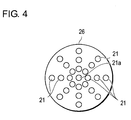
- Fig. 4 is a diagram showing outgoing ports of laser beams.
- the circulation-accelerating laser irradiation system 2 in the second embodiment includes a plurality of laser irradiation units by which laser beams with such a wavelength as to have a vasodilating action are radiated in a pulsed mode from positions over a skin, a holding member for positioning and fixing laser outgoing ports of the plurality of laser irradiation units in a radial pattern so that the laser beams are concentrated onto a subcutaneous target part, and a control unit for such a control that the irradiations by the plurality of laser irradiation units are conducted at time intervals.
- the laser irradiation unit is composed of a laser beam generation unit 22 for generating pulsed laser beams 25, and optical fibers 20 for transmitting the laser beams 25 generated by the laser beam generation unit 22.
- the laser beam generation unit 22 is connected to the plurality of optical fibers 20, and can supply the laser beams respectively into the optical fibers 20.
- the laser beam generation unit 22 is connected further to a control unit 23.
- the plurality of optical fibers 20 are fixed by a holding member 26.
- the holding member 26 positions the plurality of optical fibers 20 so that laser beam outgoing ports 21 of the optical fibers 20 are arranged radially and that the laser beams 25 radiated from the optical fibers 20 in a pulsed mode are concentrated onto the target part (focus part) 51 (see Fig. 4).
- the laser beam 25 outgoing from the outgoing port 21 is not converted into a parallel beam by a collimator lens or the like, so that the laser beam 25 is diffused, as shown in Fig. 3.
- the laser beams 25 are diffused from all the outgoing ports 21 at roughly equal angles, as shown in Fig. 3, so that a portion of each laser beam proceeds toward the target part 51.
- the laser beams 25 are concentrated into a position under the outgoing port 21a disposed at the center of the radial pattern. Therefore, with the target part 51 disposed on the lower side of the outgoing port 21a, the laser beams 25 enters into the skin 50 from above and are concentrated to the subcutaneous target part 51.
- the holding member 26 has a configuration in which the optical fibers 20 are attached thereto by screws (not shown) or the like so that the laser beam concentration position can be conformed to the target part 51 by regulating the protrusion amounts of the optical fibers 20 or the like.
- the control unit 13 When a therapy start signal is inputted by the user or the like, the control unit 13 starts controlling the laser beam generation unit 12.
- the control unit 13 performs such a control that the laser beams 25 are radiated from the outgoing ports 21 disposed in the radial pattern, at slight time intervals in the order from the outer side toward the inner side, as has been described above. Namely, the laser beams 25 are supplied at slight time intervals in the order from the optical fiber 20 corresponding to the outgoing port 21 on the outer side toward the optical fiber 20 corresponding to the outgoing port 21 on the inner side.
- the target part 51 is irradiated with the laser beams simultaneously, and is supplied with a high overall energy; on the other hand, each of other parts is not irradiated with the laser beams simultaneously, so that it is supplied only with low energy.
- therapy can be conducted by the output of the laser beams 25, whereas at other parts, there is no influence of the output of the laser beams 15, and the normal living body would not be damaged.
- the outgoing ports 21 of the optical fibers 20 are arranged in a radial pattern on a plane roughly parallel to the target part 51, and such a control is conducted that the laser beams 25 are radiated in the order from the outer side in the radial pattern, i.e., in the order from the farthest from the target part 51. Therefore, at the target part 51, the laser beams 25 are simultaneously concentrated, so that a high energy can be applied to the target part 51. As a result, at the target part 51, an energy sufficient for therapy can be obtained, and the therapeutic effect can be enhanced through the concentration.
- each of other parts than the target part 51 the laser beams 25 from the outgoing ports 21 would not be concentrated, and simultaneous irradiation with the laser beams 25 would not occur. Therefore, each of the other parts is not supplied with a high energy. As a result, at other parts than the target part 51, a high energy is not applied by the laser beams 25, and the skin tissue can be prevented from being damaged.
- the same kind of effect as in the first embodiment is also obtained.
- the laser beams 25 are not converted into parallel beams by collimator lenses but are let diffuse, and, at other parts than the target part 51, such a control is conducted that the laser beams 25 from the different outgoing ports 21 would not reach simultaneously. Therefore, the energy supplied by the laser beams 25 is low at other parts than the target part 51, so that the influence exerted on the normal skin tissue is more reduced in the second embodiment.
- this mode is not limitative.
- the irradiation with the laser beams 25 may be conducted at time intervals in the order from the inner side of the outgoing ports 21.
- the irradiation with the laser beams 25 may be conducted at random. In this case, also, the normal skin is not supplied with high energy, and can therefore be prevented from being damaged.
- the target part 51 is irradiated with the laser beams 25 not simultaneously but without interruption, so that sufficient energy is supplied only to the diseased part.
- the arrangement of the outgoing ports 21 is not limited to this configuration.
- the outgoing ports 21 may be arranged in a grid pattern or in a concentric circle pattern. Irrespectively of the mode of arrangement, by radiating the laser beams 25 in the order from the outer side toward the inner side of the plurality of outgoing ports 21 thus arranged, the laser beams 25 are concentrated on the target part 51 simultaneously, and high energy can be applied to the target part 51.
- continuous laser beams can also be used inasmuch as their output is on such a level as not to influence the skin surface.
- a high-luminance LED having such a wavelength as to have the above-mentioned vasodilating action or the like can also be used, in place of the laser beam.
- the plurality of laser beams radiated from the plurality of laser irradiation means are concentrated onto a subcutaneous target part, so that a sufficient energy for therapy can be obtained at the target part notwithstanding the laser beam from each individual laser irradiation means has a weak output. Since each individual laser beam may be weak in output, it is possible to prevent the skin tissue irradiated with each individual laser beam from being badly influenced by the laser beam, and, simultaneously, to enhance the therapeutic effect on the target part (i.e., focus part) through the concentration of the laser beams.
- the radiation ports of the laser irradiation means are positioned in a radial pattern, and the plurality of laser irradiation means are so controlled that the irradiation with the laser beams occur at time intervals. Therefore, at the target part, the laser beams are concentrated simultaneously to apply high energy to the target part. As a result, at the target part, a sufficient energy for therapy can be obtained, and the therapeutic effect can be enhanced through the concentration of the laser beams.
- the laser beams from the outgoing ports are not concentrated, and simultaneous irradiation with the laser beams does not occur, so that high energy is not applied.
- application of high energy by the laser beams does not occur, and the skin tissue can be prevented from being damaged.
Landscapes
- Health & Medical Sciences (AREA)
- Engineering & Computer Science (AREA)
- Biomedical Technology (AREA)
- Life Sciences & Earth Sciences (AREA)
- Pathology (AREA)
- Nuclear Medicine, Radiotherapy & Molecular Imaging (AREA)
- Radiology & Medical Imaging (AREA)
- Animal Behavior & Ethology (AREA)
- General Health & Medical Sciences (AREA)
- Public Health (AREA)
- Veterinary Medicine (AREA)
- Biophysics (AREA)
- Optics & Photonics (AREA)
- Physics & Mathematics (AREA)
- Radiation-Therapy Devices (AREA)
- Laser Surgery Devices (AREA)
Abstract
Description
- The present invention relates to a circulation-accelerating laser irradiation system, particularly to a circulation-accelerating laser irradiation system by which laser beams are concentratedly radiated onto a subcutaneous target part from positions over a skin.
- In recent years, in the regions of pain clinics and orthopaedics, ray therapeutic apparatuses such as low reaction level laser therapeutic apparatuses and linear polarized near infrared ray therapeutic apparatuses have been utilized as a therapeutic means for a focus present at a subcutaneous deep part in the cases of stiff shoulders, lumbago and the like. Examples of such ray therapeutic apparatuses include a system for irradiating a therapeutic target part with laser beams (Japanese Patent Laid-open No. 2000-187157) and a system for irradiating a therapeutic target part with monochromatic light (Japanese Patent Laid-open No. 2001-212250).
- Generally, these ray therapeutic apparatuses are known as a means for alleviating a stiffness or ache by irradiating the target part with light having various wavelengths from positions over the skin.
- As an action of the ray therapy using the ray therapeutic apparatus, a nerve conduction blocking effect has been known. On the other hand, diffusion or removal of pain-related substances (bradykinin, histamine, prostaglandin, etc.) and fatigue-related substances (lactic acid, etc.) from a local part through improvement of circulation is regarded as important.
- In addition, a direct relaxing effect on blood vessel smooth muscle has come to be known as a principal mechanism of the circulation improving effect.
- Besides, it has been reported that rays on the short wavelength side are effective for enhancing the effect of light. It is described, for example, in such references as Furchgott et al. (J. Gen. Physiol. 44:449-519, 1961), Furchgott et al. (J. pharmacol. expe. Ther. 259:1140-1146, 1991) and Matsuno et al. (Laser Med. Sci. 15:181-187, 2000).
- The reason for these report lies in that, while the wavelength of the rays used in the conventional ray therapeutic apparatuses is 810-830 nm in the case of laser and 600-1600 nm in the case of linear polarized near infrared rays, it has been found that the circulation-improving (vasodilating or the like) effect constituting one of the analgesic mechanisms is greater on the shorter wavelength side. Particularly, the above three references show that irradiation with ultraviolet rays (300-350 nm) at a very weak output relaxes blood vessels strongly.
- Although the conventional ray therapeutic apparatuses are highly evaluated in view of their little side effects, they are pointed out to have problems such as a yet insufficient desired effect and a longer therapeutic period.
- Furthermore, for a sufficient quantity of rays to reach a focus at a subcutaneous deep part (blood vessels in fascias or muscles under a subcutaneous fatty tissue in the case of muscle- or fascias-related lumbago) from a position or positions over the skin, it is necessary to irradiate with energy at a comparatively high output. If irradiation with energy is conducted at a too high output, the surface layer part of the skin may be damaged. For example, the ray therapeutic apparatuses in clinical use include those with an output in excess of 1000 mW.
- Furthermore, the rays in the UV region of 300-350 nm have a stimulating action harmful to the skin, and are low in tissue depth reaching performance, so that they are considered to be unsuitable for ray therapy in a percutaneous mode. On the other hand, the rays in the higher UV region and the visible region do not have any harmful action on the skin, but they are high in absorption by hemoglobin in the blood and are not good in tissue depth reaching performance, so that it is highly possible that these rays cannot show a therapeutic effect on a practical basis.
- The present invention has been made in consideration of the above-mentioned problems. Accordingly, it is an object of the present invention to provide a circulation-accelerating laser irradiation system by which beams with such a high wavelength as to show a vasodilating effect can be efficiently radiated onto an target part constituting a focus part.
- According to the present invention, there is provided a circulation-accelerating laser irradiation system including: a plurality of laser irradiation section by which laser beams with such a wavelength as to have a vasodilating action is radiated as parallel beams from a plurality of different directions over a skin; and a concentrating section for concentrating the plurality of laser beams radiated from the plurality of laser irradiation section onto a subcutaneous target part.
- According to the circulation-accelerating laser irradiation system of the present invention, the plurality of laser beams radiated from the plurality of laser irradiation section are condensed on the subcutaneous target part, so that even where the laser beam from each individual laser irradiation section is weak in output, therapeutically sufficient energy can be obtained at the target part. Since it suffices for each individual laser beam to have a weak output, the skin tissue irradiated with each individual laser beam can be prevented from being badly influenced by the laser beam, while the therapeutic effect on the target part (i.e., focus part) can be enhanced through the concentration of the laser beams.
- In addition, according to the present invention, there is provided another circulation-accelerating laser irradiation system including: a plurality of laser irradiation section by which laser beams with such a wavelength as to have a vasodilating action are radiated as pulses from positions over a skin; a holding section for positioning and fixing laser beam outgoing ports of the plurality of laser irradiation section in a radial pattern so that the laser beams are concentrated onto a subcutaneous target part; and a control section for such a control that laser irradiations by the plurality of laser irradiation section are conducted at time intervals.
- According to the another circulation-accelerating laser irradiation system, the laser radiation ports of the laser irradiation section are positioned in a radial pattern, and the plurality of laser irradiation section are so controlled as to perform irradiations with laser beams at time intervals. Therefore, at the target part, the laser beams are simultaneously concentrated, and a high energy can be applied. As a result, a therapeutically sufficient energy can be obtained at the target part, and the therapeutic effect can thus be enhanced through the concentration.
- On the other hand, at other parts then the target part, the laser beams from the outgoing ports are not concentrated, and simultaneous irradiation with the laser beams does not occur, so that application of a high energy does not take place. As a result, at the other parts then the target part, application of a high energy by the laser beams does not occur, and the skin tissues can be prevented from being damaged.
-
- Fig. 1 is a schematic diagram showing a blood vessel sample experiment apparatus.
- Fig. 2 is a schematic diagram showing a circulation-accelerating laser irradiation system according to a first embodiment of the present invention.
- Fig. 3 is a schematic diagram showing a circulation-accelerating laser irradiation system according to a second embodiment of the present invention.
- Fig. 4 is a diagram showing laser beam outgoing ports.
- Now, the present invention will be described in detail below.
- Before describing the circulation-accelerating laser irradiation system according to the present invention, first, description will be made of the vasodilating action obtained by irradiation with light having the wavelength which is utilized in the circulation-accelerating laser irradiation system.
- Hitherto, it has been known that light with a wavelength in the UV region has a strong action of dilating blood vessels, but little investigation has been made of light with a wavelength in a visible region (400 to 600 nm).
- In view of this, the present inventors have made a comparative investigation of the vasodilating action obtained by irradiation with light, using a blood vessel enucleated from a rat, a laser beam with a wavelength of 532 nm as a beam in the visible region, and a laser beam with a wavelength of 810 nm on the longer wavelength side.
- As a result, it has been found out that even the laser beam with a wavelength of 532 nm shows a sufficient vasodilating action. The method and results of this exemplary experiment will be shown below.
- Fig. 1 is a schematic diagram showing a blood vessel sample experiment apparatus.
- A rat was used as an animal to be tested, the rat was clubbed to death, followed by phlebotomy, the desending thoracic aorta was enucleated, and a
specimen 3 mm long and 1.5 mm in diameter was prepared as a blood vessel sample. - As shown in Fig. 1, the
blood vessel sample 1 is suspended in aorgan bath 3 charged with 50 ml of Krebs-bicarbonate solution 2, and variation in tension is recorded isometrically. Theorgan bath 3 is formed of 1 to 2 mm thick glass sheets, and has a double structure so that water can be circulated along an outer peripheral part thereof. - The temperature of the Krebs-bicarbonate solution was so controlled that the inside liquid temperature was 33°C when water at a fixed temperature is circulated in the outer peripheral part of the
organ bath 3. A mixed gas of 95% oxygen and 5% carbon dioxide is passed through the inside liquid. - The composition of the Krebs-bicarbonate solution is 118 mM of NaCl, 4.8 mM of KCl, 2.5 mM of CaCl2, 1.0 mM of MgSO4, 1.2 mM of KH2PO4, 24 mM of NaHCO3, and 11 mM of glucose.
- The enucleated blood vessel has no tension; for checking the relaxation, therefore, the blood vessel was preliminarily contracted with noradrenaline (sympathetic nerve mediator).
- Specifically, the blood vessel was contracted by use of 0.03 µM noradrenaline, and after the contraction became constant, the laser irradiation experiment was started.
- As the laser irradiation system for a wavelength of 532 nm, there was used KTG Green Laser Irradiation System (output variable to 20 mW) produced by KTG. Co., Ltd.
- On the other hand, as the laser irradiation system for a wavelength of 810 nm, there was used a dental semiconductor laser apparatus with an output variable to 100 mW, produced by Yunitaku Co., Ltd.
- The
laser beam 4 with each individual wavelength was guided by an optical fiber 1.0 mm in diameter, and was radiated directly onto theblood vessel sample 1. The irradiation time per run is 1 minute. - The distance between the
blood vessel sample 1 and the tip end of theoptical fiber 5 was set to be 1 to 2 mm, to avoid contact therebetween. - The irradiation intensity of laser from the tip end of the
optical fiber 5 was measured immediately before irradiation, by use of Field Master FM (produced by COHERENT, USA). - The degree of relaxation of the
blood vessel sample 1 was indicated in terms of percentage of noradrenaline contraction, and the results were expressed in terms of mean±SD. The experimental results, obtained at 33°C, are shown in Table 1.Table 1 Relaxation reactions (at 33°C) with laser beams different in intensity and wavelength Relaxation reaction (%) 1mW 4mW 10mW 20mW 50mW 100mW 532nm 41.1±6.0 (n=4) 49.4±10.4 (n=4) 810nm 4.0±4.1 (n=3) 10.6±6.7 (n=3) 12.6±8.7 (n=3) 26.3±14.8 (n=3) 5.2 (n=1) - To the
blood vessel sample 1, i.e., the blood vessel (aorta) enucleated from the rat which was provided with a mild tonus by use of noradrenaline, the laser beam with a wavelength of 532 nm produced a comparatively strong relaxation (a relaxation reaction of suppressing the noradrenaline contraction by about 40%) at an intensity of 1 mW, whereas the laser beam with a wavelength of 810 nm produced little reaction at an intensity of 4 to 10 mW and only produced a slight relaxation at an intensity of 50 mW. - In other words, the experimental results verified the usefulness of the laser beam with a visible region wavelength of 532 nm.
- When the same experiment was conducted by changing the temperature of the Krebs-bicarbonate solution from 33°C to 36°C, the vasodilating action was greater at 33°C.
- Next, the results of an experiment in which an animal was wholly used will be shown below. The method and results of the experiment are as follows.
- A rat was used as an animal subjected to the experiment, the rat was anesthetized with pentobarbital, and a probe of a bloodstream measuring instrument (ADVANCE Laser Flowmeter AFL21R produced by ADVANCE Co., Ltd.) was put into close contact with the inside of an auricle part of the rat.
- From the outside of the auricle part, the auricle was clamped so that the radiating port of the laser irradiation apparatus is located directly above the probe on the inside.
- The bloodstream in the auricle part was recorded on a pen recorder.
- The bloodstream immediately upon 1 minute irradiation with laser and that immediately upon 5 minutes irradiation with laser were shown in terms of their increase ratio (mean±SD) based on the bloodstream immediately before the irradiation.
- As for the temperature, a temperature measuring probe in place of the probe of the bloodstream measuring instrument was put into close contact with the inside of the auricle part, then irradiation with laser was conducted in the same manner as above, and the temperature was recorded upon 1 minute irradiation, upon 5 minutes irradiation, and upon 10 minutes irradiation. The results are shown in Table 2.
Table 2 Influences of laser on bloodstream in rat auricle part Wavelength Intensity Increase ratio (%) Upon 1 minute irradiation Upon 5 minute irradiation 532nm 5mW 2.0±2.5 9.8±10.2 20mW 43.6±34.8 95.8+56.6 810nm 20mW 2.8±5.5 6.5±13 (n=4 to 5) - The laser irradiation with a wavelength of 532 nm at an intensity of 5 mW and the laser irradiation with a wavelength of 810 nm at an intensity of 20 mW produced little influence on the bloodstream, whereas the laser irradiation with a wavelength of 532 nm at an intensity of 20 mW produced an increase in the bloodstream in the auricle dependently on time.
- Variations in the temperature during the irradiation were also investigated. The results are shown in Table 3.
Table 3 Variations in temperature of rat auricle part by laser irradiation Wavelengt h Intensit y Temperature (°C) Before irradiation Upon 1 minute irradiation Upon 5 minute irradiation Upon 10 minute irradiation 532nm 20mW 27.4 28.9 29.8 29.8 810nm 20mW 27.2 28.9 29.5 29 - As seen from the results shown in Table 3, no difference in temperature variation was recognized between the wavelength of 532 nm and the wavelength of 810 nm. Based on the results shown in Tables 2 and 3, therefore, the bloodstream increasing action observed attendant on the irradiation with laser is considered to be an influence of the laser beam itself.
- From the above experimental results, it is understood that the irradiation with a laser beam having a wavelength in the visible region has a vasodilating action. The vasodilating action leads to an acceleration of the circulation of blood, whereby diseases caused by hindrance of bloodstream in the fascias at the interface between the skin and the muscle or in the muscle at a subcutaneous deep part, such as muscle- or fascias- relating lumbago and stiff shoulders, can be alleviated.
- Since it has been found that the beam having a wavelength of 532 nm and a low energy (e.g., 1 mW) dilates the blood vessel strongly as above-described, a therapeutic effect can be expected when that much energy is made to reach the fascias present at the interface between the skin and the muscle at a subcutaneous deep part.
- However, the energy with a wavelength of 532 nm is liable to be absorbed by hemoglohin and the like, and is therefore poor in tissue depth reaching performance. For permitting an effective amount of the laser beam with the wavelength to reach a target part at a subcutaneous deep part, a high energy is needed. On the other hand, the use of only one light source may result in that the irradiated part of the skin is damaged by heat.
- In view of these points, in the present invention, beams with little irradiation energy are radiated from a plurality of directions, whereby the optical energy per beam is reduced, the influence of each individual beam on the skin is thereby reduced, and the plurality of irradiation beams are concentrated onto the target part at a subcutaneous deep part, whereby a sufficient optical energy is supplied to the target part.
- Fig. 2 is a schematic diagram showing a circulation-accelerating laser irradiation system according to a first embodiment of the present invention.
- The circulation-accelerating
laser irradiation system 1 according to the first embodiment has a plurality of laser irradiation units by which laser beams with such a wavelength as to have a vasodilating action are radiated as parallel beams from a plurality of different directions over a skin, and a concentrating device for concentrating the plurality of laser beams radiated from the plurality of laser irradiation units onto a subcutaneous target part. - The laser irradiation unit includes a plurality of
optical fibers 10, and a plurality ofcollimator lenses 11 attached to the tip ends of theoptical fibers 10. The other ends of theoptical fibers 10 are connected to a laserbeam generation unit 12. The laserbeam generation unit 12 can supply laser beams respectively into the plurality ofoptical fibers 10. The laserbeam generation unit 12 is further connected to acontrol unit 13. - The plurality of
optical fibers 10 provided with thecollimator lenses 11 at their tip ends are fixed by a holdingmember 16. The holdingmember 16 functions as a concentrating device, and position theoptical fibers 10 so thatlaser beams 15 radiated from theoptical fibers 10 are concentrated onto a target part (focus part) 51. This positioning ensures that thelaser beams 15 incoming from the upper side of askin 50 are concentrated onto thesubcutaneous target part 51. The holdingmember 16 has a configuration in which theoptical fibers 10 are attached thereto by screws (not shown) or the like so that the concentration position can be changed according to thetarget part 51. - Actions of the circulation-accelerating
laser irradiation system 1 will be described. - When a therapy start signal is inputted by the user or the like, the
control unit 13 starts controlling the laserbeam generation unit 12. The laserbeam generation unit 12 generates thelaser beams 15 according to the control of thecontrol unit 13. Thelaser beams 15 thus generated are transmitted by theoptical fibers 10, and are converted into parallel beams by thecollimator lenses 11. Thelaser beams 15 converted into the parallel beams are radiated on the living body, and are concentrated onto thetarget part 51. The diseased part is treated by the energy of thelaser beams 15 thus concentrated. - Here, the wavelength of the
laser beams 15 generated by the laserbeam generation unit 12 is a wavelength in the visible region; specifically, the wavelength is preferably 400 to 650 nm, particularly 400 to 600 nm. Thelaser beams 15 from the individualoptical fibers 10 may have an equal wavelength or different wavelengths in the wavelength range. - In addition, the output energy is preferably not less than 5 mW per
optical fiber 10. If the output energy is less than 5 mW, even where thelaser beams 15 are radiated from the plurality of theoptical fibers 10, the energy of eachindividual laser beam 15 is so weak that eachindividual laser beam 15 does not reach a part under the skin tissue, so that a therapeutic effect at the subcutaneous deep part cannot be expected. On the other hand, the output energy is desirably not more than 1000 mW. If the output energy peroptical fiber 10 is in excess of 1000 mW, there arises the fear of bad influences, such as damage to the skin tissue. - In addition, the number of the
optical fibers 10 corresponding to the number of outgoing ports of thelaser beams 15 varies depending on the output energy peroptical fiber 10, is not particularly limited; the number may be appropriately determined according to the purpose of the therapy or to the effect expected. It should be noted, however, that if the number of theoptical fibers 10 is too large, when thelaser beams 15 from a plurality of semiconductor data devices are concentrated onto thetarget part 51, the total energy amount of the beams thus concentrated may produce a bad influence on the living body tissue, and, therefore, it is necessary to carefully set the total energy amount at the concentration part to a value of 50 mW or below. As to the upper limit of the output energy of thelaser beams 15, sufficient attention must be paid according to the condition of the focus part or to the patient to be treated. Therefore, the above-mentioned values are not values which should necessarily be preferred. These values should naturally be determined while appropriately paying sufficient attention. From this point of view, the laserbeam generation unit 12 is preferably so configured that its output can be regulated as required. - Thus, in the first embodiment, the
laser beams 15 from the plurality ofoptical fibers 10 are radiated onto a living body, and are concentrated onto asubcutaneous target part 51 of the living body, whereby a sufficient energy for therapy can be obtained at thetarget part 51, notwithstanding eachindividual laser beam 15 has a weak output. Since it suffices for eachindividual laser beam 15 to have a weak output, it is possible to prevent bad influences of thelaser beam 15 from being exerted on the skin tissues irradiated with eachindividual laser beam 15 and, simultaneously, to enhance the therapeutic effect on the target part 51 (i.e., focus part) through the concentration of the laser beams 15. - In addition, since the
concentrated laser beams 15 reach the tissue under theskin 50 notwithstanding the output energy of eachlaser beam 15 is weak, the concentration of theselaser beams 15 promises an effective therapy of a focus part present at a subcutaneous deep part, such as blood vessels in the fascias or muscle present under the subcutaneous fatty tissue in the cases of muscle- or fascias-related lumbago. - Besides, with the plurality of
laser beams 15 radiated from many directions and concentrated onto thetarget part 51, it is possible to suppress the influences of thelaser beams 15 on the surroundings of thetarget part 51, and to specify the part irradiated with thelaser beams 15, thereby preventing thelaser beams 15 from being concentrated onto other parts. - Although the circulation-accelerating
laser irradiation system 1 is used with a focus part at a subcutaneous deep part as thetarget part 51, it can be expected to be effective also for a peripheral circulation insufficiency present at a comparatively surface layer. Specifically, the circulation-acceleratinglaser irradiation system 1 is effective for treatment of a wide variety of diseases attendant on circulation inefficiency, such as muscle- or fascias-related lumbago, stiff shoulders, stenocardia, bedsore, asteriosclerosis obliterans (ASO), arteritis obliterans (Buerger's disease TAO), and diabetic arterial obliteration, which are present subcutaneously. - Furthermore, the circulation-accelerating
laser irradiation system 1 is considered to be useful also for accelerating the cure of an operative wound, for which a therapeutic effect can be expected to be produced by improvement of bloodstream. - Fig. 3 is a schematic diagram showing a circulation-accelerating laser irradiation system according to a second embodiment of the present invention, and Fig. 4 is a diagram showing outgoing ports of laser beams.
- The circulation-accelerating
laser irradiation system 2 in the second embodiment includes a plurality of laser irradiation units by which laser beams with such a wavelength as to have a vasodilating action are radiated in a pulsed mode from positions over a skin, a holding member for positioning and fixing laser outgoing ports of the plurality of laser irradiation units in a radial pattern so that the laser beams are concentrated onto a subcutaneous target part, and a control unit for such a control that the irradiations by the plurality of laser irradiation units are conducted at time intervals. - The laser irradiation unit is composed of a laser
beam generation unit 22 for generatingpulsed laser beams 25, andoptical fibers 20 for transmitting thelaser beams 25 generated by the laserbeam generation unit 22. The laserbeam generation unit 22 is connected to the plurality ofoptical fibers 20, and can supply the laser beams respectively into theoptical fibers 20. The laserbeam generation unit 22 is connected further to acontrol unit 23. - The plurality of
optical fibers 20 are fixed by a holdingmember 26. The holdingmember 26 positions the plurality ofoptical fibers 20 so that laser beamoutgoing ports 21 of theoptical fibers 20 are arranged radially and that thelaser beams 25 radiated from theoptical fibers 20 in a pulsed mode are concentrated onto the target part (focus part) 51 (see Fig. 4). Thelaser beam 25 outgoing from theoutgoing port 21 is not converted into a parallel beam by a collimator lens or the like, so that thelaser beam 25 is diffused, as shown in Fig. 3. - However, since the
laser beams 25 are diffused from all theoutgoing ports 21 at roughly equal angles, as shown in Fig. 3, so that a portion of each laser beam proceeds toward thetarget part 51. As a result, thelaser beams 25 are concentrated into a position under theoutgoing port 21a disposed at the center of the radial pattern. Therefore, with thetarget part 51 disposed on the lower side of theoutgoing port 21a, thelaser beams 25 enters into theskin 50 from above and are concentrated to thesubcutaneous target part 51. - Incidentally, the holding
member 26 has a configuration in which theoptical fibers 20 are attached thereto by screws (not shown) or the like so that the laser beam concentration position can be conformed to thetarget part 51 by regulating the protrusion amounts of theoptical fibers 20 or the like. - Now, actions of the circulation-accelerating laser
beam irradiation system 2 will be described. - When a therapy start signal is inputted by the user or the like, the
control unit 13 starts controlling the laserbeam generation unit 12. Thecontrol unit 13 performs such a control that thelaser beams 25 are radiated from theoutgoing ports 21 disposed in the radial pattern, at slight time intervals in the order from the outer side toward the inner side, as has been described above. Namely, thelaser beams 25 are supplied at slight time intervals in the order from theoptical fiber 20 corresponding to theoutgoing port 21 on the outer side toward theoptical fiber 20 corresponding to theoutgoing port 21 on the inner side. - The
laser beams 25 supplied outgo at slight timer intervals, in the order from theoutgoing port 21 on the outer side toward theoutgoing port 21 on the inner side. Since thelaser beams 25 outgoing in the order from theoutgoing port 21 on the outer side are radiated in the order from the farthest from thetarget part 51, so that when thelaser beams 25 are radiated at slight time intervals, thelaser beams 25 reach thetarget part 51 roughly simultaneously. - Therefore, the
target part 51 is irradiated with the laser beams simultaneously, and is supplied with a high overall energy; on the other hand, each of other parts is not irradiated with the laser beams simultaneously, so that it is supplied only with low energy. As a result, at thetarget part 51, therapy can be conducted by the output of thelaser beams 25, whereas at other parts, there is no influence of the output of thelaser beams 15, and the normal living body would not be damaged. - Thus, in the second embodiment, the
outgoing ports 21 of theoptical fibers 20 are arranged in a radial pattern on a plane roughly parallel to thetarget part 51, and such a control is conducted that thelaser beams 25 are radiated in the order from the outer side in the radial pattern, i.e., in the order from the farthest from thetarget part 51. Therefore, at thetarget part 51, thelaser beams 25 are simultaneously concentrated, so that a high energy can be applied to thetarget part 51. As a result, at thetarget part 51, an energy sufficient for therapy can be obtained, and the therapeutic effect can be enhanced through the concentration. - On the other hand, at each of other parts than the
target part 51, thelaser beams 25 from theoutgoing ports 21 would not be concentrated, and simultaneous irradiation with thelaser beams 25 would not occur. Therefore, each of the other parts is not supplied with a high energy. As a result, at other parts than thetarget part 51, a high energy is not applied by thelaser beams 25, and the skin tissue can be prevented from being damaged. - In addition to the above-mentioned effect, the same kind of effect as in the first embodiment is also obtained. Here, in the second embodiment, the
laser beams 25 are not converted into parallel beams by collimator lenses but are let diffuse, and, at other parts than thetarget part 51, such a control is conducted that thelaser beams 25 from the differentoutgoing ports 21 would not reach simultaneously. Therefore, the energy supplied by thelaser beams 25 is low at other parts than thetarget part 51, so that the influence exerted on the normal skin tissue is more reduced in the second embodiment. - Incidentally, while an example of irradiating with the
laser beams 25 at time intervals in the order from the outer side of theoutgoing ports 21 has been described in the second embodiment, this mode is not limitative. For example, the irradiation with thelaser beams 25 may be conducted at time intervals in the order from the inner side of theoutgoing ports 21. Besides, the irradiation with thelaser beams 25 may be conducted at random. In this case, also, the normal skin is not supplied with high energy, and can therefore be prevented from being damaged. In addition, thetarget part 51 is irradiated with thelaser beams 25 not simultaneously but without interruption, so that sufficient energy is supplied only to the diseased part. - In addition, a configuration in which the
outgoing ports 21 of theoptical fibers 20 are arranged in a radial pattern on a plane roughly parallel to thetarget part 51 has been described, the arrangement of theoutgoing ports 21 is not limited to this configuration. Theoutgoing ports 21 may be arranged in a grid pattern or in a concentric circle pattern. Irrespectively of the mode of arrangement, by radiating thelaser beams 25 in the order from the outer side toward the inner side of the plurality ofoutgoing ports 21 thus arranged, thelaser beams 25 are concentrated on thetarget part 51 simultaneously, and high energy can be applied to thetarget part 51. - Besides, while the case where pulsed laser beams are utilized as the laser beams has been described, continuous laser beams can also be used inasmuch as their output is on such a level as not to influence the skin surface.
- Further, a high-luminance LED having such a wavelength as to have the above-mentioned vasodilating action or the like can also be used, in place of the laser beam.
- According to the circulation-accelerating laser irradiation system of the present invention, the plurality of laser beams radiated from the plurality of laser irradiation means are concentrated onto a subcutaneous target part, so that a sufficient energy for therapy can be obtained at the target part notwithstanding the laser beam from each individual laser irradiation means has a weak output. Since each individual laser beam may be weak in output, it is possible to prevent the skin tissue irradiated with each individual laser beam from being badly influenced by the laser beam, and, simultaneously, to enhance the therapeutic effect on the target part (i.e., focus part) through the concentration of the laser beams.
- Besides, according to the another circulation-accelerating laser irradiation system, the radiation ports of the laser irradiation means are positioned in a radial pattern, and the plurality of laser irradiation means are so controlled that the irradiation with the laser beams occur at time intervals. Therefore, at the target part, the laser beams are concentrated simultaneously to apply high energy to the target part. As a result, at the target part, a sufficient energy for therapy can be obtained, and the therapeutic effect can be enhanced through the concentration of the laser beams.
- On the other hand, at other parts than the target part, the laser beams from the outgoing ports are not concentrated, and simultaneous irradiation with the laser beams does not occur, so that high energy is not applied. As a result, at other parts than the target part, application of high energy by the laser beams does not occur, and the skin tissue can be prevented from being damaged.
Claims (10)
- A circulation-accelerating laser irradiation system comprising:a plurality of laser irradiation section by which laser beams with such a wavelength as to have a vasodilating action is radiated as parallel beams from a plurality of different directions over a skin; anda concentrating section for concentrating said plurality of laser beams radiated from said plurality of laser irradiation section onto a subcutaneous target part.
- The circulation-accelerating laser irradiation system as set forth in claim 1, wherein said concentrating section is a holding section for positioning and fixing said plurality of laser irradiation section so that said laser beams from said plurality of laser irradiation means are focused onto said target part.
- The circulation-accelerating laser irradiation system as set forth in claim 1 or 2, wherein said plurality of laser beams are converted into parallel beams by collimator lenses.
- A circulation-accelerating laser irradiation system comprising:a plurality of laser irradiation section by which laser beams with such a wavelength as to have a vasodilating action are radiated as pulses from positions over a skin;a holding section for positioning and fixing laser beam outgoing ports of said plurality of laser irradiation section in a radial pattern so that said laser beams are concentrated onto a subcutaneous target part; anda control section for such a control that laser irradiations by said plurality of laser irradiation section are conducted at time intervals.
- The circulation-accelerating laser irradiation system as set forth in claim 4, wherein said control section performs such a control that irradiations with laser beams from said outgoing ports arranged in a radial pattern are conducted at time intervals in the order from the outer side toward the inner side or from the inner side toward the outer side so that said laser beams reach said target part simultaneously.
- The circulation-accelerating laser irradiation system as set forth in any one of claims 1 to 5, wherein said plurality of laser irradiation section each comprise:a laser beam generating section for generating the laser beam; andan optical fiber for transmitting said laser beam generated by said laser beam generating section.
- The circulation-accelerating laser irradiation system as set forth in any one of claims 1 to 6, wherein said laser beams have a wavelength of 400 to 650 nm.
- The circulation-accelerating laser irradiation system as set forth in any one of claims 1 to 7, wherein the optical energy radiated from one of said laser irradiation section is not less than 5 mW.
- A circulation-accelerating laser irradiation system comprising:a plurality of laser irradiation section by which laser beams with such a wavelength as to have a vasodilating action are radiated from a position over a skin;a holding section for positioning and fixing laser beam outgoing ports of said plurality of laser irradiation section so that said laser beams are concentrated onto a subcutaneous target part; anda control section for such a control that irradiations with said laser beams from said outgoing ports are conducted at time intervals in the order from the outer side toward the inner side or from the inner side toward the outer side.
- A circulation-acceleration light irradiation system comprising:a plurality of light irradiation section by which light with such a wavelength as to have a vasodilating action is radiated from positions over a skin; anda holding section for positioning and fixing light outgoing ports of said plurality of light irradiation section so that said light is concentrated onto a subcutaneous target position.
Applications Claiming Priority (2)
| Application Number | Priority Date | Filing Date | Title |
|---|---|---|---|
| JP2003127903A JP4152248B2 (en) | 2003-05-06 | 2003-05-06 | Laser irradiation device for circulation promotion |
| PCT/JP2004/005851 WO2004105876A1 (en) | 2003-05-06 | 2004-04-23 | Circulation promoting laser irradiation device |
Publications (3)
| Publication Number | Publication Date |
|---|---|
| EP1621227A1 true EP1621227A1 (en) | 2006-02-01 |
| EP1621227A4 EP1621227A4 (en) | 2009-06-03 |
| EP1621227B1 EP1621227B1 (en) | 2012-03-14 |
Family
ID=33487068
Family Applications (1)
| Application Number | Title | Priority Date | Filing Date |
|---|---|---|---|
| EP04729221A Expired - Lifetime EP1621227B1 (en) | 2003-05-06 | 2004-04-23 | Circulation promoting laser irradiation device |
Country Status (5)
| Country | Link |
|---|---|
| US (1) | US20070038274A1 (en) |
| EP (1) | EP1621227B1 (en) |
| JP (1) | JP4152248B2 (en) |
| AT (1) | ATE549062T1 (en) |
| WO (1) | WO2004105876A1 (en) |
Cited By (1)
| Publication number | Priority date | Publication date | Assignee | Title |
|---|---|---|---|---|
| CN102090928B (en) * | 2009-12-14 | 2014-12-17 | 武汉奇致激光技术有限公司 | Dual-wavelength multi-functional laser therapy apparatus |
Families Citing this family (12)
| Publication number | Priority date | Publication date | Assignee | Title |
|---|---|---|---|---|
| TWM276556U (en) * | 2005-03-04 | 2005-10-01 | Biotek Technology Corp | Improvement of optical system structure for treatment and cosmetology |
| US20060252005A1 (en) * | 2005-05-06 | 2006-11-09 | Feinbloom Richard E | Apparatus for providing radiation at multiple wavelengths and method of operating same |
| US20100241038A1 (en) * | 2009-03-20 | 2010-09-23 | Bwt Property, Inc. | Phototherapy Method for Assisting Transvenous Lead Placement |
| JP5118786B2 (en) * | 2011-04-07 | 2013-01-16 | 株式会社アルテック | Laser therapy device handpiece |
| US8926678B2 (en) | 2011-04-07 | 2015-01-06 | Altech Corporation | Handpiece for laser treatment device |
| WO2016168605A1 (en) | 2015-04-16 | 2016-10-20 | Gentuity, Llc | Micro-optic probes for neurology |
| EP4675259A3 (en) | 2015-08-31 | 2026-04-08 | Spryte Medical, Inc. | Imaging system includes imaging probe and delivery devices |
| JP7160935B2 (en) | 2017-11-28 | 2022-10-25 | ジェンテュイティ・リミテッド・ライアビリティ・カンパニー | Imaging system |
| JP2022500174A (en) | 2018-09-17 | 2022-01-04 | ジェンテュイティ・リミテッド・ライアビリティ・カンパニーGentuity, LLC | Imaging system with optical path |
| WO2020223433A1 (en) | 2019-04-30 | 2020-11-05 | Gentuity, Llc | Imaging probe with fluid pressurization element |
| US12239412B2 (en) | 2019-05-21 | 2025-03-04 | Spryte Medical, Inc. | Systems and methods for OCT-guided treatment of a patient |
| ES2928172B2 (en) * | 2021-05-14 | 2023-04-26 | Univ Alcala Henares | LIGHTING DEVICE WITH ORIENTED LED DIODES |
Family Cites Families (12)
| Publication number | Priority date | Publication date | Assignee | Title |
|---|---|---|---|---|
| JPS60114273A (en) * | 1983-11-28 | 1985-06-20 | 稲場 文男 | Light wave wound treating apparatus |
| JPS60148566A (en) * | 1984-01-13 | 1985-08-05 | 株式会社東芝 | Laser treatment apparatus |
| JPS6464674A (en) * | 1987-09-07 | 1989-03-10 | Matsushita Electric Industrial Co Ltd | Semiconductor laser medical treatment apparatus |
| US4930504A (en) * | 1987-11-13 | 1990-06-05 | Diamantopoulos Costas A | Device for biostimulation of tissue and method for treatment of tissue |
| US5755752A (en) * | 1992-04-24 | 1998-05-26 | Segal; Kim Robin | Diode laser irradiation system for biological tissue stimulation |
| US5989245A (en) * | 1994-03-21 | 1999-11-23 | Prescott; Marvin A. | Method and apparatus for therapeutic laser treatment |
| EP1064351A1 (en) * | 1998-03-19 | 2001-01-03 | Amanzi Technologies Limited | Microbiological testing of a liquid sample |
| JPH11276499A (en) * | 1998-03-30 | 1999-10-12 | Terumo Corp | Laser irradiator |
| EP0947221A3 (en) * | 1998-03-31 | 2000-04-26 | Terumo Kabushiki Kaisha | Laser irradiation device |
| US6241752B1 (en) * | 1998-05-08 | 2001-06-05 | Inventis | Method of treating for impotence and apparatus particularly useful in such method |
| JP3188437B2 (en) * | 1999-12-08 | 2001-07-16 | ヤーマン株式会社 | Laser irradiation probe |
| JP4345905B2 (en) * | 1999-12-28 | 2009-10-14 | 利彦 矢山 | Laser beam treatment device |
-
2003
- 2003-05-06 JP JP2003127903A patent/JP4152248B2/en not_active Expired - Fee Related
-
2004
- 2004-04-23 AT AT04729221T patent/ATE549062T1/en active
- 2004-04-23 US US10/555,386 patent/US20070038274A1/en not_active Abandoned
- 2004-04-23 EP EP04729221A patent/EP1621227B1/en not_active Expired - Lifetime
- 2004-04-23 WO PCT/JP2004/005851 patent/WO2004105876A1/en not_active Ceased
Cited By (1)
| Publication number | Priority date | Publication date | Assignee | Title |
|---|---|---|---|---|
| CN102090928B (en) * | 2009-12-14 | 2014-12-17 | 武汉奇致激光技术有限公司 | Dual-wavelength multi-functional laser therapy apparatus |
Also Published As
| Publication number | Publication date |
|---|---|
| WO2004105876A1 (en) | 2004-12-09 |
| EP1621227B1 (en) | 2012-03-14 |
| ATE549062T1 (en) | 2012-03-15 |
| JP2004329475A (en) | 2004-11-25 |
| EP1621227A4 (en) | 2009-06-03 |
| US20070038274A1 (en) | 2007-02-15 |
| JP4152248B2 (en) | 2008-09-17 |
Similar Documents
| Publication | Publication Date | Title |
|---|---|---|
| US6527764B1 (en) | Device and method for laser biomodulation in PDT/surgery | |
| EP1621227B1 (en) | Circulation promoting laser irradiation device | |
| Moskvin | Low-level laser therapy in Russia: history, science and practice | |
| US7311722B2 (en) | Photodynamic stimulation device and methods | |
| US7856985B2 (en) | Method of treatment body tissue using a non-uniform laser beam | |
| EP1991315B1 (en) | An applicator for treating skin | |
| KR100971358B1 (en) | Invasive Dual Wavelength Laser Needle | |
| KR100820164B1 (en) | Laser device for skin disease treatment | |
| US20150025602A1 (en) | Treatment apparatus and use thereof for treating psoriasis | |
| JPH01136668A (en) | Apparatus for stimulation of living tissue and method for treatment of tissue | |
| US20130123648A1 (en) | Medical diagnosis and treatment using multi-core optical fibers | |
| KR880001155B1 (en) | The curing device of athlete's foot | |
| Calderhead et al. | Photobiological basics and clinical indications of phototherapy for skin rejuvenation | |
| Cho et al. | Neurite growth of trigeminal ganglion neurons in vitro with near-infrared light irradiation | |
| US20130310902A1 (en) | Apparatus for Maintaining Treatment of Peripheral Neuropathy | |
| RU92617U1 (en) | DEVICE FOR CARRYING OUT OF INNER-TISSUE LASER HYPERTHERMIA AND PHOTODYNAMIC THERAPY | |
| CN221601075U (en) | Photoelectric cooperative application device and photoelectric cooperative generation device | |
| KR100457964B1 (en) | Apparatus for irradiating laser beam | |
| RU2209097C1 (en) | Device for applying electromagnetic therapy | |
| JP2007209710A (en) | Cosmetic treatment device | |
| RU2184578C1 (en) | Photodynamic method for treating tumors | |
| JP2004329474A (en) | Optical illumination device for easing ache | |
| RU2251990C1 (en) | Method and device for applying laser surgery | |
| KR20150071955A (en) | Color intensive stimulation device of which focal length is adjustable | |
| WO2005077459A1 (en) | Light irradiator |
Legal Events
| Date | Code | Title | Description |
|---|---|---|---|
| PUAI | Public reference made under article 153(3) epc to a published international application that has entered the european phase |
Free format text: ORIGINAL CODE: 0009012 |
|
| 17P | Request for examination filed |
Effective date: 20051103 |
|
| AK | Designated contracting states |
Kind code of ref document: A1 Designated state(s): AT BE BG CH CY CZ DE DK EE ES FI FR GB GR HU IE IT LI LU MC NL PL PT RO SE SI SK TR |
|
| DAX | Request for extension of the european patent (deleted) | ||
| RIN1 | Information on inventor provided before grant (corrected) |
Inventor name: HORIUCHI, KUNIO Inventor name: ISHII, TAKEO |
|
| A4 | Supplementary search report drawn up and despatched |
Effective date: 20090508 |
|
| 17Q | First examination report despatched |
Effective date: 20100121 |
|
| GRAP | Despatch of communication of intention to grant a patent |
Free format text: ORIGINAL CODE: EPIDOSNIGR1 |
|
| RIN1 | Information on inventor provided before grant (corrected) |
Inventor name: HORIUCHI, KUNIO Inventor name: ISHII, TAKEO |
|
| GRAS | Grant fee paid |
Free format text: ORIGINAL CODE: EPIDOSNIGR3 |
|
| GRAA | (expected) grant |
Free format text: ORIGINAL CODE: 0009210 |
|
| AK | Designated contracting states |
Kind code of ref document: B1 Designated state(s): AT BE BG CH CY CZ DE DK EE ES FI FR GB GR HU IE IT LI LU MC NL PL PT RO SE SI SK TR |
|
| REG | Reference to a national code |
Ref country code: GB Ref legal event code: FG4D |
|
| REG | Reference to a national code |
Ref country code: CH Ref legal event code: EP Ref country code: AT Ref legal event code: REF Ref document number: 549062 Country of ref document: AT Kind code of ref document: T Effective date: 20120315 |
|
| REG | Reference to a national code |
Ref country code: IE Ref legal event code: FG4D |
|
| REG | Reference to a national code |
Ref country code: DE Ref legal event code: R096 Ref document number: 602004036894 Country of ref document: DE Effective date: 20120510 |
|
| REG | Reference to a national code |
Ref country code: NL Ref legal event code: VDEP Effective date: 20120314 |
|
| PG25 | Lapsed in a contracting state [announced via postgrant information from national office to epo] |
Ref country code: FI Free format text: LAPSE BECAUSE OF FAILURE TO SUBMIT A TRANSLATION OF THE DESCRIPTION OR TO PAY THE FEE WITHIN THE PRESCRIBED TIME-LIMIT Effective date: 20120314 Ref country code: GR Free format text: LAPSE BECAUSE OF FAILURE TO SUBMIT A TRANSLATION OF THE DESCRIPTION OR TO PAY THE FEE WITHIN THE PRESCRIBED TIME-LIMIT Effective date: 20120615 |
|
| REG | Reference to a national code |
Ref country code: AT Ref legal event code: MK05 Ref document number: 549062 Country of ref document: AT Kind code of ref document: T Effective date: 20120314 |
|
| PG25 | Lapsed in a contracting state [announced via postgrant information from national office to epo] |
Ref country code: CY Free format text: LAPSE BECAUSE OF FAILURE TO SUBMIT A TRANSLATION OF THE DESCRIPTION OR TO PAY THE FEE WITHIN THE PRESCRIBED TIME-LIMIT Effective date: 20120314 |
|
| PG25 | Lapsed in a contracting state [announced via postgrant information from national office to epo] |
Ref country code: PL Free format text: LAPSE BECAUSE OF FAILURE TO SUBMIT A TRANSLATION OF THE DESCRIPTION OR TO PAY THE FEE WITHIN THE PRESCRIBED TIME-LIMIT Effective date: 20120314 Ref country code: EE Free format text: LAPSE BECAUSE OF FAILURE TO SUBMIT A TRANSLATION OF THE DESCRIPTION OR TO PAY THE FEE WITHIN THE PRESCRIBED TIME-LIMIT Effective date: 20120314 Ref country code: RO Free format text: LAPSE BECAUSE OF FAILURE TO SUBMIT A TRANSLATION OF THE DESCRIPTION OR TO PAY THE FEE WITHIN THE PRESCRIBED TIME-LIMIT Effective date: 20120314 Ref country code: SI Free format text: LAPSE BECAUSE OF FAILURE TO SUBMIT A TRANSLATION OF THE DESCRIPTION OR TO PAY THE FEE WITHIN THE PRESCRIBED TIME-LIMIT Effective date: 20120314 Ref country code: CZ Free format text: LAPSE BECAUSE OF FAILURE TO SUBMIT A TRANSLATION OF THE DESCRIPTION OR TO PAY THE FEE WITHIN THE PRESCRIBED TIME-LIMIT Effective date: 20120314 Ref country code: BE Free format text: LAPSE BECAUSE OF FAILURE TO SUBMIT A TRANSLATION OF THE DESCRIPTION OR TO PAY THE FEE WITHIN THE PRESCRIBED TIME-LIMIT Effective date: 20120314 Ref country code: SE Free format text: LAPSE BECAUSE OF FAILURE TO SUBMIT A TRANSLATION OF THE DESCRIPTION OR TO PAY THE FEE WITHIN THE PRESCRIBED TIME-LIMIT Effective date: 20120314 |
|
| PG25 | Lapsed in a contracting state [announced via postgrant information from national office to epo] |
Ref country code: PT Free format text: LAPSE BECAUSE OF FAILURE TO SUBMIT A TRANSLATION OF THE DESCRIPTION OR TO PAY THE FEE WITHIN THE PRESCRIBED TIME-LIMIT Effective date: 20120716 Ref country code: SK Free format text: LAPSE BECAUSE OF FAILURE TO SUBMIT A TRANSLATION OF THE DESCRIPTION OR TO PAY THE FEE WITHIN THE PRESCRIBED TIME-LIMIT Effective date: 20120314 Ref country code: MC Free format text: LAPSE BECAUSE OF NON-PAYMENT OF DUE FEES Effective date: 20120430 |
|
| REG | Reference to a national code |
Ref country code: CH Ref legal event code: PL |
|
| REG | Reference to a national code |
Ref country code: IE Ref legal event code: MM4A |
|
| PLBE | No opposition filed within time limit |
Free format text: ORIGINAL CODE: 0009261 |
|
| STAA | Information on the status of an ep patent application or granted ep patent |
Free format text: STATUS: NO OPPOSITION FILED WITHIN TIME LIMIT |
|
| PG25 | Lapsed in a contracting state [announced via postgrant information from national office to epo] |
Ref country code: NL Free format text: LAPSE BECAUSE OF FAILURE TO SUBMIT A TRANSLATION OF THE DESCRIPTION OR TO PAY THE FEE WITHIN THE PRESCRIBED TIME-LIMIT Effective date: 20120314 Ref country code: IE Free format text: LAPSE BECAUSE OF NON-PAYMENT OF DUE FEES Effective date: 20120423 Ref country code: AT Free format text: LAPSE BECAUSE OF FAILURE TO SUBMIT A TRANSLATION OF THE DESCRIPTION OR TO PAY THE FEE WITHIN THE PRESCRIBED TIME-LIMIT Effective date: 20120314 Ref country code: DK Free format text: LAPSE BECAUSE OF FAILURE TO SUBMIT A TRANSLATION OF THE DESCRIPTION OR TO PAY THE FEE WITHIN THE PRESCRIBED TIME-LIMIT Effective date: 20120314 Ref country code: LI Free format text: LAPSE BECAUSE OF NON-PAYMENT OF DUE FEES Effective date: 20120430 Ref country code: CH Free format text: LAPSE BECAUSE OF NON-PAYMENT OF DUE FEES Effective date: 20120430 |
|
| 26N | No opposition filed |
Effective date: 20121217 |
|
| PG25 | Lapsed in a contracting state [announced via postgrant information from national office to epo] |
Ref country code: IT Free format text: LAPSE BECAUSE OF FAILURE TO SUBMIT A TRANSLATION OF THE DESCRIPTION OR TO PAY THE FEE WITHIN THE PRESCRIBED TIME-LIMIT Effective date: 20120314 |
|
| REG | Reference to a national code |
Ref country code: DE Ref legal event code: R097 Ref document number: 602004036894 Country of ref document: DE Effective date: 20121217 |
|
| PG25 | Lapsed in a contracting state [announced via postgrant information from national office to epo] |
Ref country code: ES Free format text: LAPSE BECAUSE OF FAILURE TO SUBMIT A TRANSLATION OF THE DESCRIPTION OR TO PAY THE FEE WITHIN THE PRESCRIBED TIME-LIMIT Effective date: 20120625 |
|
| PG25 | Lapsed in a contracting state [announced via postgrant information from national office to epo] |
Ref country code: BG Free format text: LAPSE BECAUSE OF FAILURE TO SUBMIT A TRANSLATION OF THE DESCRIPTION OR TO PAY THE FEE WITHIN THE PRESCRIBED TIME-LIMIT Effective date: 20120614 |
|
| PG25 | Lapsed in a contracting state [announced via postgrant information from national office to epo] |
Ref country code: TR Free format text: LAPSE BECAUSE OF FAILURE TO SUBMIT A TRANSLATION OF THE DESCRIPTION OR TO PAY THE FEE WITHIN THE PRESCRIBED TIME-LIMIT Effective date: 20120314 |
|
| PG25 | Lapsed in a contracting state [announced via postgrant information from national office to epo] |
Ref country code: LU Free format text: LAPSE BECAUSE OF NON-PAYMENT OF DUE FEES Effective date: 20120423 |
|
| PG25 | Lapsed in a contracting state [announced via postgrant information from national office to epo] |
Ref country code: HU Free format text: LAPSE BECAUSE OF FAILURE TO SUBMIT A TRANSLATION OF THE DESCRIPTION OR TO PAY THE FEE WITHIN THE PRESCRIBED TIME-LIMIT Effective date: 20040423 |
|
| REG | Reference to a national code |
Ref country code: FR Ref legal event code: PLFP Year of fee payment: 12 |
|
| PGFP | Annual fee paid to national office [announced via postgrant information from national office to epo] |
Ref country code: DE Payment date: 20150414 Year of fee payment: 12 Ref country code: GB Payment date: 20150422 Year of fee payment: 12 |
|
| PGFP | Annual fee paid to national office [announced via postgrant information from national office to epo] |
Ref country code: FR Payment date: 20150408 Year of fee payment: 12 |
|
| REG | Reference to a national code |
Ref country code: DE Ref legal event code: R119 Ref document number: 602004036894 Country of ref document: DE |
|
| GBPC | Gb: european patent ceased through non-payment of renewal fee |
Effective date: 20160423 |
|
| REG | Reference to a national code |
Ref country code: FR Ref legal event code: ST Effective date: 20161230 |
|
| PG25 | Lapsed in a contracting state [announced via postgrant information from national office to epo] |
Ref country code: GB Free format text: LAPSE BECAUSE OF NON-PAYMENT OF DUE FEES Effective date: 20160423 Ref country code: DE Free format text: LAPSE BECAUSE OF NON-PAYMENT OF DUE FEES Effective date: 20161101 Ref country code: FR Free format text: LAPSE BECAUSE OF NON-PAYMENT OF DUE FEES Effective date: 20160502 |