EP1616469A1 - Implement control systems - Google Patents
Implement control systems Download PDFInfo
- Publication number
- EP1616469A1 EP1616469A1 EP05013215A EP05013215A EP1616469A1 EP 1616469 A1 EP1616469 A1 EP 1616469A1 EP 05013215 A EP05013215 A EP 05013215A EP 05013215 A EP05013215 A EP 05013215A EP 1616469 A1 EP1616469 A1 EP 1616469A1
- Authority
- EP
- European Patent Office
- Prior art keywords
- implement
- tractor
- linkage
- lower links
- link
- Prior art date
- Legal status (The legal status is an assumption and is not a legal conclusion. Google has not performed a legal analysis and makes no representation as to the accuracy of the status listed.)
- Withdrawn
Links
- 230000000694 effects Effects 0.000 claims abstract description 13
- 239000012530 fluid Substances 0.000 claims description 2
- 230000005484 gravity Effects 0.000 description 4
- 230000007935 neutral effect Effects 0.000 description 4
- 230000007423 decrease Effects 0.000 description 3
- 230000003068 static effect Effects 0.000 description 2
- 241000408495 Iton Species 0.000 description 1
Images


Classifications
-
- A—HUMAN NECESSITIES
- A01—AGRICULTURE; FORESTRY; ANIMAL HUSBANDRY; HUNTING; TRAPPING; FISHING
- A01B—SOIL WORKING IN AGRICULTURE OR FORESTRY; PARTS, DETAILS, OR ACCESSORIES OF AGRICULTURAL MACHINES OR IMPLEMENTS, IN GENERAL
- A01B63/00—Lifting or adjusting devices or arrangements for agricultural machines or implements
- A01B63/02—Lifting or adjusting devices or arrangements for agricultural machines or implements for implements mounted on tractors
- A01B63/10—Lifting or adjusting devices or arrangements for agricultural machines or implements for implements mounted on tractors operated by hydraulic or pneumatic means
- A01B63/111—Lifting or adjusting devices or arrangements for agricultural machines or implements for implements mounted on tractors operated by hydraulic or pneumatic means regulating working depth of implements
Definitions
- This invention relates to implement control systems for controlling a ground engaging implement mounted and a tractor via a linkage having a pair of lower links and at least one top link.
- the invention is primarily concerned with control systems for front linkages but is also applicable to the control of rear linkages for mounting an implement on the rear of a tractor.
- a system for controlling a ground engaging implement mounted on a tractor via a mounting linkage comprising:-
- Such a system provides for a more stable control of front mounted implements since the instability inherent due to the effect of the weight of the implement on the upper link forces is eliminated.
- the mounting linkage may comprise a pair of lower links and at least one upper link for supporting the implement from the tractor, the sensing means comprising a first linkage for connecting the lower links with a force sensor to transmit to the sensor only the horizontal component of the forces applied to the lower links by the implement and a second linkage connecting the (or each) upper link with the force sensor to transmit to the sensor only the horizontal component of the forces applied to the upper link (or links) by the implement.
- the first linkage may include a first bell crank pivoted about a first generally horizontal and transverse axis relative to the tractor, the first bell crank having a first arm or arms connected with the lower links and a second arm of arms connected with an intermediate link to load the intermediate link with the horizontal component of the forces applied to the lower links and the second linkage includes a second bell crank pivoted about a second generally horizontal and transverse axis relative to the tractor, the second bell crank having a first arm or arms connected with the or each upper link and a second arm or arms connected with the intermediate link to load the intermediate link with the horizontal components of the forces applied to the upper link(s), the intermediate link being connected with the force sensor.
- the force sensor may comprise an electrical force sensing pin, a hydraulic ram or any other suitable sensor.
- the mounting linkage comprises a pair of lower links and at least one upper link for supporting the implement from the tractor
- the sensing means comprising electronic force sensing means to sense only the horizontal component of the forces applied to the upper and lower links by the implement
- the control means receives these signals from the sensing means, compares the signals with the desired operating condition signal set by the tractor operator and generates an electrical output signal which controls the operation of the positioning means accordingly.
- the positioning means preferably comprises hydraulic ram means connected with the mounting linkage so as to apply only a vertical force to the mounting linkage when the system is in use to control the implement and hence avoid any effect on the sensing system signal.
- FIG. 1 this shows an implement control system for use with an implement 10 (shown diagrammatically) mounted on the front of an agricultural tractor.
- the implement is mounted on the tractor via a frame 11 which is bolted to the tractor chassis (not shown).
- An upper link 12 and the pair of lower links 13 connect the implement with the frame 11.
- the lower links are connected via a bracing piece 14 which is in turn connected with a lower bell crank member 15 which is pivoted on frame 11 about a pin 16.
- Bell crank member 15 has two pairs of lower arms 17,18 within which the bracing piece 14 is connected by pins 19 and a pair of upper arms 20 within which a link 21 is connected via a pin 22.
- the upper link 12 is connected with an upper bell crank member 23 which is pivoted on frame 11 via a pin 11a which extends through frame flanges 11b.
- Bell crank 23 has an upper pair of arms 24 which receive between them one end of the upper link 12 via a pin 25 and a lower pair of arms 26 which are connected with the other end of link 21 via a pin 27.
- Lower arms 26 are also connected via pin 27 with links 28 which are attached to a tube 29 within which an electrical draft force sensing pin 30 is mounted.
- Pin 30 mounts the tube 29 to the frame 11 via pillars 31.
- a hydraulic cylinder acts between the frame 11 and each of the lower links 13 to raise/lower the links and hence the implement 10 relative to the frame.
- the line of action of cylinder 32 passes through pivot pin 11a and is arranged to be vertical when the linkage is in its so-called "neutral" position when the system is being used to control implement 10. This ensures that cylinder 32 does not apply any turning movement to either of the bell cranks 15 and 23 and hence any vertical adjustment of the position of the implement of the position of the implement has no effect on the forces sensed by sensing pin 30.
- bell crank arms 17, 18 and 24 are also arranged to be vertical.
- linkage applies a force L with a horizontal component Lx to the implement 10 via lower links 13 and a force T with a horizontal component Tx to the implement via the upper link 12.
- the force R applied to the sensing pin 30 equals the horizontal component of the force applied to the implement by the ground for all values of L1 and L2.
- Unit 33 has various driver input devices, for example, control dials 35,36 for setting levels of draft force or implement position etc and the draft force levels set by the driver are compared with the signals received from pin sensor 30 and a control signal output is sent to solenoid control valve 37 of a hydraulic positioning unit 38 which supplies or exhausts pressurized hydraulic fluid to or from hydraulic cylinders 32 to raise or lower the implement as necessary to achieve the control settings set by the driver.
- driver input devices for example, control dials 35,36 for setting levels of draft force or implement position etc and the draft force levels set by the driver are compared with the signals received from pin sensor 30 and a control signal output is sent to solenoid control valve 37 of a hydraulic positioning unit 38 which supplies or exhausts pressurized hydraulic fluid to or from hydraulic cylinders 32 to raise or lower the implement as necessary to achieve the control settings set by the driver.
- links 28 and pin sensor 30 could be replaced by a hydraulic cylinder which connects pin 27 to frame 11 with the level of pressure in this cylinder being used as the indication of the forces applied to link 21 by the upper link 12 and the lower links 13.
- lower links 13 and upper links 12 could be connected to frame 11 by electronic draft force sensors (e.g. pin sensors similar to sensor 30 described above).
- the three sensors would be designed to measure only the horizontal forces applied to implement 10 by the ground and this signals would be processed by an electronic control unit in which they are compared with the values set by the tractor driver to produce the appropriate control signal for use by hydraulic positioning unit 38.
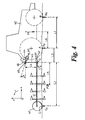
- Figure 4 shows diagrammatically a tractor 40 having a long implement 41 connected to the rear thereof by a pair of lower links 42 and a hydraulic top link 43.
- Implement 41 has a support wheel 47 and top link 43 includes a hydraulic cylinder 44 which can be pressurized by the hydraulic system of the tractor.
- the top link 43 is connected to the implement post 45 via an elongated slot 46 in which a pin 48 on the end of the top link slides.
- the implement control system of the present invention eliminates the effect of the weight of the implement from the draft forces sensed, the pressure in top link 44 can be varied between zero and its maximum (when the implement is raised with the support wheel 47 clear of the ground) without affecting the draft forces sensed.
- the present invention thus also has significant benefits when used on a rear mounted implement.
Landscapes
- Life Sciences & Earth Sciences (AREA)
- Engineering & Computer Science (AREA)
- Mechanical Engineering (AREA)
- Soil Sciences (AREA)
- Environmental Sciences (AREA)
- Lifting Devices For Agricultural Implements (AREA)
- Agricultural Machines (AREA)
Abstract
A system for controlling a ground engaging implement (10) mounted on a tractor (11) via a mounting linkage (12,13), the system has a sensing system (15 to 30) for providing a signal representative of only the horizontal component (Dx) of the forces (D) applied to the implement (10) by the ground thereby eliminating the effect of the weight of the implement from the sensed signal. A positioning means (32) is provided for controlling the height of the mounting linkage (12,13) relative to the tractor and a control means (33) which receives signals from the sensing system and from the tractor operator (35,36) as to the desired operating condition of the implement. The control means (33) compares these signals to provide an output signal to the positioning means (32) to adjust the working position of the implement (10) to meet the desired operating condition of the implement.
Description
- This invention relates to implement control systems for controlling a ground engaging implement mounted and a tractor via a linkage having a pair of lower links and at least one top link. The invention is primarily concerned with control systems for front linkages but is also applicable to the control of rear linkages for mounting an implement on the rear of a tractor.
- Whilst front such linkages are well known, problems arise with the control of implements mounted on such front linkages, since, contrary to implements mounted on the rear of a tractor which are inherently stable in their operation, front mounted implements exhibit instability and the forces applied to the top link can give misleading indications as to the actual forces applied to the implements by the ground.
- It is an object of the present invention to provide an implement control system which is particularly suitable for use with a front linkage and which at least reduces the above problems.
- Thus according to the present invention there is provided a system for controlling a ground engaging implement mounted on a tractor via a mounting linkage, the system comprising:-
- a sensing system for providing a signal representative of only the horizontal component of the forces applied to the implement by the ground thereby eliminating the effect of the weight of the implement from the sensed signal,
- a positioning means for controlling the height of the mounting linkage relative to the tractor,
- a control means which receives signals from the sensing system and from the tractor operator as to the desired operating condition of the implement and which compares these signals to provide an output signal to the positioning means to adjust the working position of the implement to meet the desired operating condition of the implement.
- Such a system provides for a more stable control of front mounted implements since the instability inherent due to the effect of the weight of the implement on the upper link forces is eliminated.
- The mounting linkage may comprise a pair of lower links and at least one upper link for supporting the implement from the tractor, the sensing means comprising a first linkage for connecting the lower links with a force sensor to transmit to the sensor only the horizontal component of the forces applied to the lower links by the implement and a second linkage connecting the (or each) upper link with the force sensor to transmit to the sensor only the horizontal component of the forces applied to the upper link (or links) by the implement.
- The first linkage may include a first bell crank pivoted about a first generally horizontal and transverse axis relative to the tractor, the first bell crank having a first arm or arms connected with the lower links and a second arm of arms connected with an intermediate link to load the intermediate link with the horizontal component of the forces applied to the lower links and the second linkage includes a second bell crank pivoted about a second generally horizontal and transverse axis relative to the tractor, the second bell crank having a first arm or arms connected with the or each upper link and a second arm or arms connected with the intermediate link to load the intermediate link with the horizontal components of the forces applied to the upper link(s), the intermediate link being connected with the force sensor.
- The force sensor may comprise an electrical force sensing pin, a hydraulic ram or any other suitable sensor.
- In a further form of the system the mounting linkage comprises a pair of lower links and at least one upper link for supporting the implement from the tractor, the sensing means comprising electronic force sensing means to sense only the horizontal component of the forces applied to the upper and lower links by the implement, the control means receives these signals from the sensing means, compares the signals with the desired operating condition signal set by the tractor operator and generates an electrical output signal which controls the operation of the positioning means accordingly.
- As will be appreciated, the positioning means preferably comprises hydraulic ram means connected with the mounting linkage so as to apply only a vertical force to the mounting linkage when the system is in use to control the implement and hence avoid any effect on the sensing system signal.
- One embodiment of the present invention will now be described, by way of example only, with reference to the accompanying drawings which:-
- Figure 1 is a perspective view of an implement control system for use with an implement mounted on the front of an agricultural tractor;
- Figure 2 is a diagrammatic view of the system of Figure 1;
- Figure 3 shows the forces applied to the linkage of the system of figures 1 and 2, and
- Figure 4 shows the forces applied to the linkage of the system when mounting a rear implement.
- Referring to Figure 1 this shows an implement control system for use with an implement 10 (shown diagrammatically) mounted on the front of an agricultural tractor. The implement is mounted on the tractor via a
frame 11 which is bolted to the tractor chassis (not shown).Anupper link 12 and the pair oflower links 13 connect the implement with theframe 11. The lower links are connected via abracing piece 14 which is in turn connected with a lowerbell crank member 15 which is pivoted onframe 11 about apin 16. Bellcrank member 15 has two pairs oflower arms bracing piece 14 is connected bypins 19 and a pair ofupper arms 20 within which alink 21 is connected via apin 22. - The
upper link 12 is connected with an upperbell crank member 23 which is pivoted onframe 11 via apin 11a which extends throughframe flanges 11b. Bellcrank 23 has an upper pair ofarms 24 which receive between them one end of theupper link 12 via apin 25 and a lower pair ofarms 26 which are connected with the other end oflink 21 via apin 27.Lower arms 26 are also connected viapin 27 withlinks 28 which are attached to atube 29 within which an electrical draft force sensingpin 30 is mounted. Pin 30 mounts thetube 29 to theframe 11 viapillars 31. - A hydraulic cylinder, not shown in Figure 1 but visible diagrammatically as 32 in Figure 2, acts between the
frame 11 and each of thelower links 13 to raise/lower the links and hence theimplement 10 relative to the frame. The line of action ofcylinder 32 passes throughpivot pin 11a and is arranged to be vertical when the linkage is in its so-called "neutral" position when the system is being used to control implement 10. This ensures thatcylinder 32 does not apply any turning movement to either of thebell cranks pin 30. In the "neutral" positionbell crank arms - The geometry of the bell crank linkage arrangement described above which connects the
lower links 13 and theupper link 12 to theframe 11 is such that in the "neutral" position the effect on thetop link 12 of the weight of theimplement 10 is eliminated from the forces sensed by the sensing pin. This can be shown by an analysis of the forces acting in the linkage as follows. - Referring to Figure 3, when the
lower links 13 are raised to position theimplement 10 clear of the ground so that only the weight of the implement is loading the linkage. - In this condition it can be seen that linkage applies a force L with a horizontal component Lx to the
implement 10 vialower links 13 and a force T with a horizontal component Tx to the implement via theupper link 12. - These forces act in opposite directions and are equal to each other thus Lx = Tx.
- Now, considering the forces acting on
link 21, with the linkage in its so-called "neutral" position (i.e. with thebell crank arm ratio 24/26 = (17,18)/20 it can be seen thatbell crank 15 applies a force equal to Lx to link 21. - Similarly,
bell crank 23 applies a force equal to Tx to link 21. - The only other force acting on
link 21 is the reaction force R applied tolink 21 bylinks 28 which is in effect the force which the sensingpin 30 will measure. - Thus we can say, considering the forces acting on
link 21 that
- Since we know that Tx and Lx are equal and opposite
therefore Tx-Tx+R=0
therefore R=0 - Thus the
senor 30 sees no force inlinks 28 due to the weight of implement 10. - If one now considers the implement in a ground engaging condition in which the ground applies a force D to the implement with a horizontal component Dx it can be seen, taking moments about a point A of the implement, that

- Similarly, taking moments about point B then

- Since R = Lx - Tx from above
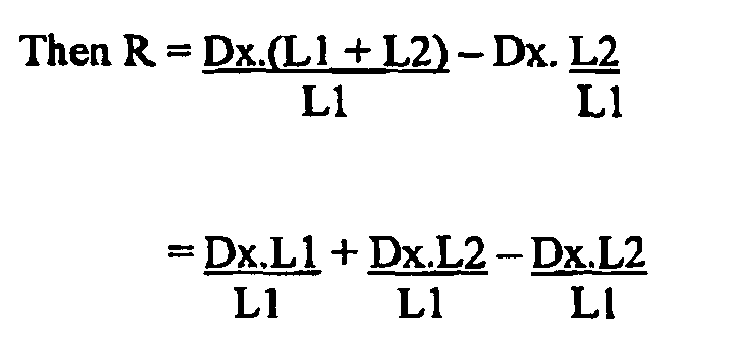
- Thus, the force R applied to the
sensing pin 30 equals the horizontal component of the force applied to the implement by the ground for all values of L1 and L2. - Thus the linkage eliminates the significance of the point at which the ground force is applied by the implement.
- Typically the signal output from
pin sensor 30 is passed to a cab mountedelectronic control unit 33 vialine 34.Unit 33 has various driver input devices, for example,control dials pin sensor 30 and a control signal output is sent tosolenoid control valve 37 of ahydraulic positioning unit 38 which supplies or exhausts pressurized hydraulic fluid to or fromhydraulic cylinders 32 to raise or lower the implement as necessary to achieve the control settings set by the driver. - In a variation of the system described above,
links 28 andpin sensor 30 could be replaced by a hydraulic cylinder which connectspin 27 toframe 11 with the level of pressure in this cylinder being used as the indication of the forces applied tolink 21 by theupper link 12 and thelower links 13. - In a still further variation,
lower links 13 andupper links 12 could be connected toframe 11 by electronic draft force sensors (e.g. pin sensors similar tosensor 30 described above). The three sensors would be designed to measure only the horizontal forces applied to implement 10 by the ground and this signals would be processed by an electronic control unit in which they are compared with the values set by the tractor driver to produce the appropriate control signal for use byhydraulic positioning unit 38. - With the sensing system of the present invention a more constant working depth of the implement can be achieved with resulting more constant power requirement to push the implement and less adjustment of the implement required by the driver. Also, no depth control wheel is required which means that more weight is taken on the front wheels of the tractor thus reducing wheel spin. It also means that the implement is shorter in length which make road travel easier.
- Although the invention has been described above in relation to a front mounted implement it is also useful for use on rear mounted implements since the use of only the horizontal component of the forces acting on the implement as the control signal for the system again promotes greater system stability and enables the use of a hydraulic top link to vary ground reaction of the tractor and implement without affecting the draft force measured.
- For example, Figure 4 shows diagrammatically a
tractor 40 having a long implement 41 connected to the rear thereof by a pair oflower links 42 and a hydraulictop link 43. Implement 41 has asupport wheel 47 andtop link 43 includes ahydraulic cylinder 44 which can be pressurized by the hydraulic system of the tractor. Thetop link 43 is connected to the implementpost 45 via anelongated slot 46 in which apin 48 on the end of the top link slides. - Considering a static analysis of the forces acting on the implement 41.
- Resolving vertically then:-

- Where Cy = the vertical effect of the ground on the
wheel 47 at contact point C - Dy = the vertical component of the force applied by
draft links 42 to the implement 41 at point D - P2 = the weight of the implement 41 acting through its centre of gravity
- Ey = the vertical component of the forces applied to the implement 41 by the
top link 43 at point E. - Resolving horizontally then:-

- Dx = the horizontal component of the force applied by
draft links 42 to the implement 41 at point D. - Ex = the horizontal component of the force applied to the implement 41 by the
top link 43 at point E. - Taking movements about point D then:

- Where L5 = the distance of the centre of gravity of the implement from point D
- L2 = the distance of the point of contact of
wheel 47 from point D. - Also the horizontal component Ex of the force E in
top link 43 is equal to E.cos x where x i the angle of inclination of the top link to the horizontal.
- Now considering the static analysis of the forces acting on the tractor then resolving vertically

- Where Ay = the vertical effect of the ground on the tractor at contact point A
- By = the vertical effect of the ground on the tractor at contact point B
- P1 = the weight of the
tractor 40 acting through its centre of gravity. - Taking movements about point A then:-

- Where L4 = the distance between points D and E
- L6 = the distance of the centre of gravity of the tractor from point A
- L7 = the distance point D and the ground.
- If the top link has no strain since
pin 48 is in the mid region of theslot 46 then:- - The force E in
top link 43 = 0 - Therefore Ex = 0 and Ey = 0
- Thus from equation 2 we can say that Dx = -Ex = 0
- From equation 3:-

- And since Ex = E.cosx from equation 4 then :-

- From equation 1: -

- From equation 5:-

- And since Ey = sinx.E therefore
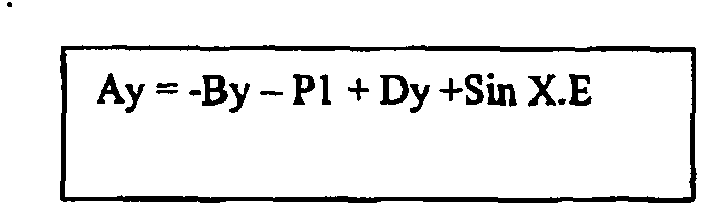
- From equation 6:-


- It can therefore be seen from the above equations for Cy, Ay and By that if the top link is pressurized to increase the force E in the top link then:-
- Cy decreases (since the negative value of the term containing E in the equation for Cy increases).
- Ay increases (since the positive value of the term containing E in the equation for Ay increases), and
- By decreases (since the negative value of the terms containing E in the equation for By increases.
- Thus since Cy and By both decrease as the pressure in the top link is increased and Ay increases the rear wheel ground reaction can be varied by adjusting the pressure in the
top link cylinder 44 to reduce rear wheel slip when ploughing. The objective is to have Ay = 2By when ploughing and when the implement is raised (and Cy = 0) then By should be greater than say ITon to retain a good steering capability. - Since, as demonstrated above, the implement control system of the present invention eliminates the effect of the weight of the implement from the draft forces sensed, the pressure in
top link 44 can be varied between zero and its maximum (when the implement is raised with thesupport wheel 47 clear of the ground) without affecting the draft forces sensed. - The present invention thus also has significant benefits when used on a rear mounted implement.
Claims (11)
- A system for controlling a ground engaging implement (10) mounted on a tractor (11) via a mounting linkage (12,13), the system being characterized by comprising:-- a sensing system (15 to 30) for providing a signal representative of only the horizontal component (Dx) of the forces (D) applied to the implement by the ground thereby eliminating the effect of the weight of the implement from the sensed signal,- a positioning means (32, 38) for controlling the height of the mounting linkage (12,13) relative to the tractor,- a control means (33) which receives signals from the sensing system (16 to 30) and from the tractor operator (35,36) as to the desired operating condition of the implement and which compares these signals to provide an output signal to the positioning means (32) to adjust the working position of the implement (10) to meet the desired operating condition of the implement.
- A system according to claim 1 characterised in that the mounting linkage comprises a pair of lower links (13) and at least one upper link (12) for supporting the implement (10) from the tractor (11), the sensing means comprising a first linkage (15 to 22, 27,28,29) for connecting the lower links (13) with a force sensor (30) to transmit to the sensor only the horizontal component (Dx) of the forces applied to the lower links by the implement (10) and a second linkage (23,24,25,26) connecting the (or each) upper link (12) with the force sensor (30) to transmit to the sensor only the horizontal component of the forces applied to the upper link (or links) by the implement.
- A system according to claim 2 characterised in that the first linkage (15 to 22, 27,28,29) includes a first bell crank (15) pivoted about a first generally horizontal and transverse axis (16) relative to the tractor (11), the first bell crank having a first arm or arms (17,18) connected with the lower links (13) and a second arm of arms (20) connected with an intermediate link (21) to load the intermediate link with the horizontal component of the forces applied to the lower links and the second linkage (23 to 26) includes a second bell crank (23) pivoted about a second generally horizontal and transverse axis (11a) relative to the tractor, the second bell crank having a first arm or arms (24) connected with the or each upper link (12) and a second arm or arms connected (26) with the intermediate link (21) to load the intermediate link with the horizontal components of the forces applied to the upper link(s), the intermediate link being connected (27,28,29) with the force sensor (30).
- A system according to claim 3 characterised in that the force sensor comprises an electrical force sensing pin (30) which receives the load applied to the intermediate link (21) by the upper and lower links (12,13), the sensing pin thus providing an electrical signal representing the horizontal component (Dx) of the load applied to the implement (10) by the ground.
- A system according to claim 3 characterised in that the force sensor comprises a hydraulic cylinder connected with the intermediate link (21), the pressure of hydraulic fluid in the cylinder being used as an indication of he horizontal component (Dx) of the load applied to the implement (10) by the ground.
- A system according to any on of claims 3 to 5 characterised in that the lower links (13) are connected by a bracing piece (14) which is in turn connected with the first bell crank (15).
- A system according to claim 1 characterised in that the mounting linkage comprises a pair of lower links (13) and at least one upper link (12) for supporting the implement (10) from the tractor (11), the sensing means comprising electronic force sensing means to sense only the horizontal component of the forces applied to the upper and lower links by the implement, the control means (33) receives these signals from the sensing means, compares the signals with the desired operating condition signal set by the tractor operator and generates an electrical output signal which controls the operation of the positioning means (32,38) accordingly.
- A system according to any one of claims 1 to 7 characterised in that the positioning means comprises hydraulic ram means (32) connected with the mounting linkage (12,13) so as to apply only a vertical force to the mounting linkage when the system is in use to control the implement (10) and hence avoid any effect on the sensing system signal.
- A system according to any of claims 1 to 8 for mounting an implement on the front of the tractor.
- A system according to any of claims 1 to 8 for mounting an implement on the rear of the tractor.
- A system according to claim 9 or 10 characterised in that a hydraulic upper link (43) is used to enable the weight distribution of the associated tractor to be changed without affecting the operation of the system.
Applications Claiming Priority (1)
| Application Number | Priority Date | Filing Date | Title |
|---|---|---|---|
| GB0414009A GB2415353A (en) | 2004-06-22 | 2004-06-22 | Implement control system |
Publications (1)
| Publication Number | Publication Date |
|---|---|
| EP1616469A1 true EP1616469A1 (en) | 2006-01-18 |
Family
ID=32799989
Family Applications (1)
| Application Number | Title | Priority Date | Filing Date |
|---|---|---|---|
| EP05013215A Withdrawn EP1616469A1 (en) | 2004-06-22 | 2005-06-20 | Implement control systems |
Country Status (3)
| Country | Link |
|---|---|
| US (1) | US20060016609A1 (en) |
| EP (1) | EP1616469A1 (en) |
| GB (1) | GB2415353A (en) |
Families Citing this family (6)
| Publication number | Priority date | Publication date | Assignee | Title |
|---|---|---|---|---|
| US7721813B2 (en) * | 2006-08-29 | 2010-05-25 | Cnh America Llc | Implement/hitch draft control using hitch cylinder pressure as load feedback |
| US7588089B2 (en) * | 2006-10-26 | 2009-09-15 | Cnh America Llc | Implement weight and center of gravity determination based on hitch cylinder pressure |
| US20080267719A1 (en) * | 2007-04-24 | 2008-10-30 | Caterpillar Inc. | Towed compaction determination system utilizing drawbar force |
| GB0723993D0 (en) * | 2007-12-08 | 2008-01-16 | Agco Sa | Implement control system |
| US7798241B2 (en) * | 2008-09-19 | 2010-09-21 | Deere & Company | Mechanical hitch control unit |
| GB201322859D0 (en) * | 2013-12-23 | 2014-02-12 | Agco Int Gmbh | Vehicle control system |
Citations (8)
| Publication number | Priority date | Publication date | Assignee | Title |
|---|---|---|---|---|
| DE478596C (en) * | 1926-05-26 | 1929-07-04 | Harry Ferguson | Tillage equipment towed by a tractor |
| GB628907A (en) * | 1946-06-05 | 1949-09-07 | Ferguson Harry Inc | Improvements in or relating to hitch means for tractor-borne agricultural implements |
| DE1116461B (en) * | 1957-11-26 | 1961-11-02 | Thomas Smirthwaite | Device for adjusting the working depth of agricultural equipment attached to tractors by means of a three-point linkage |
| US4425970A (en) * | 1981-09-21 | 1984-01-17 | Massey-Ferguson Inc. | Tractor draft sensing apparatus |
| US4497375A (en) * | 1981-03-16 | 1985-02-05 | Mannesmann Rexroth Gmbh | Force measuring apparatus mounted on tractor including Hall sensor detecting deformation of flex rod to control tractor power hoist |
| EP0293478A1 (en) * | 1986-10-30 | 1988-12-07 | Iseki & Co., Ltd. | Vertical movement control apparatus for agricultural machines |
| EP0694422A2 (en) * | 1991-06-03 | 1996-01-31 | New Holland U.K. Limited | Wheel speed calibration system for tractor |
| EP0713637A1 (en) * | 1994-11-24 | 1996-05-29 | NEW HOLLAND ITALIA S.p.A. | Draft force sensor apparatus |
Family Cites Families (18)
| Publication number | Priority date | Publication date | Assignee | Title |
|---|---|---|---|---|
| US3128830A (en) * | 1964-04-14 | Draft sensing tractor implement hitch | ||
| US2764923A (en) * | 1950-02-07 | 1956-10-02 | Andre L A Morgen | Arrangements for hydraulically lifting implements carried by a tractor |
| US2747483A (en) * | 1953-08-06 | 1956-05-29 | Arthur H Gross | Level control for tractor-drawn implements |
| US2968353A (en) * | 1956-11-15 | 1961-01-17 | Deere & Co | Tractor-implement hitch and control system |
| US3241620A (en) * | 1960-12-19 | 1966-03-22 | Int Harvester Co | Torsion bar spring draft sensing means for implement hitch mechanism |
| GB1011017A (en) * | 1961-07-07 | 1965-11-24 | Lely Nv C Van Der | Improvements in or relating to lifting mechanisms for tractor-propelled implements |
| US3162247A (en) * | 1961-09-18 | 1964-12-22 | William E Miller | Tractor hitch |
| GB1033374A (en) * | 1962-04-11 | 1966-06-22 | Massey Ferguson Ltd | Improvements in or relating to agricultural machines |
| US3275084A (en) * | 1964-01-31 | 1966-09-27 | Massey Ferguson Inc | Tractor hydraulic control system |
| DE1457700B1 (en) * | 1963-08-20 | 1970-08-20 | Kloeckner Humboldt Deutz Ag | Device for regulating the working depth of agricultural implements attached to tractors with hydraulic power lifts and three-point linkage |
| US3375876A (en) * | 1965-01-07 | 1968-04-02 | Case Co J I | Draft sensing method and apparatus |
| US3595319A (en) * | 1968-08-14 | 1971-07-27 | Cam Gears Luton Ltd | Implement carrying linkage means |
| US3520369A (en) * | 1969-02-27 | 1970-07-14 | Int Harvester Co | Resilient draft sensing device |
| DE2731164C2 (en) * | 1977-07-09 | 1983-12-08 | Robert Bosch Gmbh, 7000 Stuttgart | Device for regulating the lifting mechanism on tractors and combine harvesters |
| DE3004592A1 (en) * | 1980-02-08 | 1981-08-13 | Robert Bosch Gmbh, 7000 Stuttgart | ELECTROHYDRAULIC CONTROL DEVICE FOR OPERATING A HOIST OF AGRICULTURAL WORK VEHICLES |
| US4519623A (en) * | 1983-05-09 | 1985-05-28 | Orthman Manufacturing, Inc. | Tractor front end hitch |
| GB2178290A (en) * | 1985-07-02 | 1987-02-11 | Christopher Edward Meddins | Implement mounting attachment |
| US6749035B2 (en) * | 2002-08-09 | 2004-06-15 | Case Corporation | Pitch alleviation system |
-
2004
- 2004-06-22 GB GB0414009A patent/GB2415353A/en not_active Withdrawn
-
2005
- 2005-06-20 EP EP05013215A patent/EP1616469A1/en not_active Withdrawn
- 2005-06-21 US US11/157,471 patent/US20060016609A1/en not_active Abandoned
Patent Citations (8)
| Publication number | Priority date | Publication date | Assignee | Title |
|---|---|---|---|---|
| DE478596C (en) * | 1926-05-26 | 1929-07-04 | Harry Ferguson | Tillage equipment towed by a tractor |
| GB628907A (en) * | 1946-06-05 | 1949-09-07 | Ferguson Harry Inc | Improvements in or relating to hitch means for tractor-borne agricultural implements |
| DE1116461B (en) * | 1957-11-26 | 1961-11-02 | Thomas Smirthwaite | Device for adjusting the working depth of agricultural equipment attached to tractors by means of a three-point linkage |
| US4497375A (en) * | 1981-03-16 | 1985-02-05 | Mannesmann Rexroth Gmbh | Force measuring apparatus mounted on tractor including Hall sensor detecting deformation of flex rod to control tractor power hoist |
| US4425970A (en) * | 1981-09-21 | 1984-01-17 | Massey-Ferguson Inc. | Tractor draft sensing apparatus |
| EP0293478A1 (en) * | 1986-10-30 | 1988-12-07 | Iseki & Co., Ltd. | Vertical movement control apparatus for agricultural machines |
| EP0694422A2 (en) * | 1991-06-03 | 1996-01-31 | New Holland U.K. Limited | Wheel speed calibration system for tractor |
| EP0713637A1 (en) * | 1994-11-24 | 1996-05-29 | NEW HOLLAND ITALIA S.p.A. | Draft force sensor apparatus |
Also Published As
| Publication number | Publication date |
|---|---|
| GB2415353A (en) | 2005-12-28 |
| US20060016609A1 (en) | 2006-01-26 |
| GB0414009D0 (en) | 2004-07-28 |
Similar Documents
| Publication | Publication Date | Title |
|---|---|---|
| US4173259A (en) | Rear drive assembly with load sensing | |
| US7784354B2 (en) | Moveable working device with supporting extension arms | |
| EP2546627B1 (en) | System and method for determining drawbar force magnitude and direction. | |
| EP2765844B1 (en) | Vehicle control system | |
| EP2734027B1 (en) | Tractor control system | |
| EP2889515B1 (en) | Vehicle control system | |
| US4825956A (en) | Tractor and implement with implement inclination control | |
| EP1812261B1 (en) | A method and a system for determining the load transferred from a semi-trailer to a first axle of a towing vehicle | |
| DE102017215588A1 (en) | Apparatus, system and method for determining axle loads of an agricultural vehicle with a rear linkage | |
| EP0892256A1 (en) | Apparatus for detecting the weight of hinged loads | |
| EP1167639A1 (en) | Device to control the dynamic stability of an industrial vehicle | |
| EP3202244B1 (en) | Draft force detection on a vehicle having a linkage | |
| EP2946647B1 (en) | Method for calibrating a force measuring device | |
| US20090272550A1 (en) | Three point hitch | |
| EP3078517A1 (en) | System for axle load determination for an agricultural tractor | |
| US20060016609A1 (en) | Implement control systems | |
| EP2947431B1 (en) | Method for determining a weight of a payload | |
| FI60076B (en) | ANORDINATION FOR MAINTENANCE AND CONTROL OF DRAGBELASTNING AV TRACTORS | |
| RU2694676C2 (en) | Agricultural working machine and method of controlling load distribution along axes of agricultural working machine | |
| US4271910A (en) | Draft sensing device including load pin with free end | |
| EP0341459A2 (en) | Agricultural tractor having soil-working implements attached thereto | |
| EP0312390B1 (en) | Vehicle | |
| GB2059741A (en) | Drawbar pull measuring link | |
| EP2487131B1 (en) | Counterweight industrial truck with a device for determining load moment | |
| GB2462482A (en) | A drawbar assembly for trailers |
Legal Events
| Date | Code | Title | Description |
|---|---|---|---|
| PUAI | Public reference made under article 153(3) epc to a published international application that has entered the european phase |
Free format text: ORIGINAL CODE: 0009012 |
|
| AK | Designated contracting states |
Kind code of ref document: A1 Designated state(s): AT BE BG CH CY CZ DE DK EE ES FI FR GB GR HU IE IS IT LI LT LU MC NL PL PT RO SE SI SK TR |
|
| AX | Request for extension of the european patent |
Extension state: AL BA HR LV MK YU |
|
| 17P | Request for examination filed |
Effective date: 20060718 |
|
| AKX | Designation fees paid |
Designated state(s): DE FR GB IT |
|
| STAA | Information on the status of an ep patent application or granted ep patent |
Free format text: STATUS: THE APPLICATION HAS BEEN WITHDRAWN |
|
| 18W | Application withdrawn |
Effective date: 20080530 |