EP1615107A2 - Information processing apparatus, memory managing program, and memory managing method - Google Patents
Information processing apparatus, memory managing program, and memory managing method Download PDFInfo
- Publication number
- EP1615107A2 EP1615107A2 EP05013627A EP05013627A EP1615107A2 EP 1615107 A2 EP1615107 A2 EP 1615107A2 EP 05013627 A EP05013627 A EP 05013627A EP 05013627 A EP05013627 A EP 05013627A EP 1615107 A2 EP1615107 A2 EP 1615107A2
- Authority
- EP
- European Patent Office
- Prior art keywords
- memory
- volatile memory
- processing apparatus
- information processing
- names
- Prior art date
- Legal status (The legal status is an assumption and is not a legal conclusion. Google has not performed a legal analysis and makes no representation as to the accuracy of the status listed.)
- Withdrawn
Links
Images



Classifications
-
- G—PHYSICS
- G06—COMPUTING OR CALCULATING; COUNTING
- G06F—ELECTRIC DIGITAL DATA PROCESSING
- G06F12/00—Accessing, addressing or allocating within memory systems or architectures
- G06F12/16—Protection against loss of memory contents
-
- G—PHYSICS
- G06—COMPUTING OR CALCULATING; COUNTING
- G06F—ELECTRIC DIGITAL DATA PROCESSING
- G06F1/00—Details not covered by groups G06F3/00 - G06F13/00 and G06F21/00
- G06F1/26—Power supply means, e.g. regulation thereof
- G06F1/32—Means for saving power
- G06F1/3203—Power management, i.e. event-based initiation of a power-saving mode
-
- G—PHYSICS
- G06—COMPUTING OR CALCULATING; COUNTING
- G06F—ELECTRIC DIGITAL DATA PROCESSING
- G06F1/00—Details not covered by groups G06F3/00 - G06F13/00 and G06F21/00
- G06F1/26—Power supply means, e.g. regulation thereof
- G06F1/32—Means for saving power
- G06F1/3203—Power management, i.e. event-based initiation of a power-saving mode
- G06F1/3234—Power saving characterised by the action undertaken
- G06F1/3246—Power saving characterised by the action undertaken by software initiated power-off
-
- G—PHYSICS
- G06—COMPUTING OR CALCULATING; COUNTING
- G06F—ELECTRIC DIGITAL DATA PROCESSING
- G06F12/00—Accessing, addressing or allocating within memory systems or architectures
- G06F12/02—Addressing or allocation; Relocation
- G06F12/0223—User address space allocation, e.g. contiguous or non contiguous base addressing
- G06F12/023—Free address space management
- G06F12/0238—Memory management in non-volatile memory, e.g. resistive RAM or ferroelectric memory
-
- G—PHYSICS
- G06—COMPUTING OR CALCULATING; COUNTING
- G06F—ELECTRIC DIGITAL DATA PROCESSING
- G06F9/00—Arrangements for program control, e.g. control units
- G06F9/06—Arrangements for program control, e.g. control units using stored programs, i.e. using an internal store of processing equipment to receive or retain programs
- G06F9/44—Arrangements for executing specific programs
- G06F9/4401—Bootstrapping
- G06F9/4418—Suspend and resume; Hibernate and awake
Definitions
- the present invention relates to an information processing apparatus that is capable of autonomously controlling supply of electric power inside the apparatus and a memory managing program and a memory managing method for the information processing apparatus.
- non-volatile memories such as a Ferroelectric Random Access Memory (FeRAM) and a Magneto-resistive Random Access Memory (MRAM) have been developed.
- Such non-volatile memories do not require electric power for maintaining storage of information.
- information which is stored before the supply of electric power is stopped, is held on the memory.
- non-volatile memories Since it is possible to access such non-volatile memories at high speed, it is expected that the non-volatile memories are used as general-purpose memories in computer systems.
- OS operating system software
- JP9-114557A discloses a technique such as suspend or resume.
- the management information of the memory address is stored in a storage such as a hard disk.
- a storage such as a hard disk.
- the conventional processing such as suspend or resume is not processing that assumes use of a non-volatile memory.
- the invention provides an information processing apparatus that autonomously controls supply of electric power inside the apparatus, including: a non-volatile memory that holds stored information in a non-volatile manner (e.g., a non-volatile memory 40 in FIG. 1); and a non-volatile memory managing section (e.g., a CPU 50 constituting a non-volatile memory managing module in FIG. 3) that attaches peculiar memory block names to memory blocks (e.g., memory blocks MB1 to MB3 in FIG. 3) in a storage of the non-volatile memory, generates memory management information (e.g., a memory management table in FIG. 3) for identifying the memory blocks using the memory block names, and stores the memory management information in the non-volatile memory.
- a non-volatile memory that holds stored information in a non-volatile manner
- a non-volatile memory managing section e.g., a CPU 50 constituting a non-volatile memory managing module in FIG. 3
- the information processing apparatus including the non-volatile memory, it is possible to perform memory management for power control appropriately.
- the non-volatile memory managing section searches storage areas in the non-volatile memory on the basis of the memory block names and accesses information stored in the memory blocks corresponding to the memory block names.
- the memory management information of the non-volatile memory is referred to promptly and it is possible to use the information held in the non-volatile memory.
- the non-volatile memory managing section searches storage areas in the non-volatile memory on the basis of the memory block names of the memory blocks and releases the memory blocks.
- the information processing apparatus further includes: a volatile memory (e.g., a volatile memory 30 in FIG. 1) that is capable of reading out data from and writing data at higher speed than the non-volatile memory; and an indirect access section (e.g., the CPU 50 in FIG. 1) that stores information, which is stored in the storage areas of the non-volatile memory, in the volatile memory and accesses the information stored in the volatile memory instead of the non-volatile memory.
- a volatile memory e.g., a volatile memory 30 in FIG. 1
- an indirect access section e.g., the CPU 50 in FIG.
- the non-volatile memory managing section When the non-volatile memory managing section is required to access the memory blocks corresponding to the memory block names, the non-volatile memory managing section accesses information stored in the memory blocks directly on the basis of the memory management information.
- the non-volatile memory managing section attaches names consisting of arbitrary character strings as the memory block names.
- the non-volatile memory managing section attaches names of a size, which corresponds to a data width for treating data in the own apparatus, as the memory block names.
- the non-volatile memory managing section attaches names, which consist of characters of a number obtained by dividing the data width in treating data in the own apparatus by "8", as the memory block names.
- the information processing apparatus includes a predetermined processor (e.g., the CPU 50 in FIG. 1) connected to the non-volatile memory by a data line.
- the non-volatile memory managing section attaches names of a size, which is suited to a data width of the data line, as the memory block names.
- the information processing apparatus includes a predetermined processor that has a register for storing information to be an object of arithmetic operation.
- the non-volatile memory managing section attaches names of a size, which is suited to a size of a data width of the register, as the memory block names.
- the information processing apparatus includes a predetermined processor (e.g., the CPU 50 in FIG. 1) that has an ALU for applying arithmetical or logical operation to information to be an object of arithmetic operation.
- the non-volatile memory managing section attaches names of a size, which is suited to an input data width of the ALU, as the memory block names.
- the invention provides a memory managing program for controlling an information processing apparatus that autonomously controls supply of electric power inside the apparatus.
- the memory managing program causes the information processing apparatus to realize a non-volatile memory management function of attaching peculiar memory block names to memory blocks in storage areas of a non-volatilememory, which holds stored information in a non-volatile manner, provided in the information processing apparatus, generating memory management information for identifying the memory blocks according to the memory block names, and storing the memory management information in the non-volatile memory.
- the invention provides a memory managing method in an information processing apparatus that autonomously controls supply of electric power inside the apparatus.
- the memory managing method includes a non-volatile memory managing step of attaching peculiar memory block names to memory blocks in storage areas of a non-volatile memory, which holds stored information in a non-volatile manner, provided in the information processing apparatus, generating memory management information for identifying the memory blocks according to the memory block names, and storing the memory management information in the non-volatile memory.
- the information processing apparatus including the non-volatile memory, it is possible to perform memory management for power control appropriately and reduce power consumption of the information processing apparatus significantly.
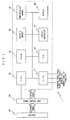
- FIG. 1 is a block diagram showing a functional structure of an information processing apparatus 1 according to the invention.
- the information processing apparatus 1 includes an Input/Output (I/O) unit 10, a Read Only Memory (ROM) 20, a volatile memory 30, a non-volatile memory 40, a Central Processing Unit (CPU) 50, a Graphic Accelerator (GA) 60, a display controller 70, a display 80, a power control unit 90, and a battery 100.
- I/O Input/Output
- ROM Read Only Memory
- volatile memory volatile memory
- non-volatile memory 40 a non-volatile memory 40
- CPU Central Processing Unit
- G Graphic Accelerator
- display controller 70 controls the display 80
- display 80 controls the display 80
- power control unit 90 controls the battery 100.
- the I/O unit 10 is a port through which the information processing apparatus 1 outputs signals to and receives signals from the various devices.
- the information processing apparatus 1 outputs signals to and receives signals from, via the I/O unit 10, input devices such as a keyboard, a touch panel, a mouse, and operation buttons provided in a main body of the information processing apparatus 1, sound input/output devices such as a speaker and a microphone, various interfaces (I/Fs) such as a network interface and a memory card interface, and various peripheral circuits such as a timer.
- input devices such as a keyboard, a touch panel, a mouse, and operation buttons provided in a main body of the information processing apparatus 1
- sound input/output devices such as a speaker and a microphone
- various interfaces (I/Fs) such as a network interface and a memory card interface
- peripheral circuits such as a timer.
- the contents of the electronic book is stored in a memory card and provided.
- the memory card is inserted into a memory card I/F, whereby the contents are inspected via the I/O unit 10.
- the ROM 20 is constituted by a non-volatile memory such as a flash ROM.
- An operating system program (OS), an application program, and a memory block name (described later) are stored in the ROM 20.
- the operating system program stored in the ROM 20 includes a non-volatile memory management module that manages a storage area of the non-volatile memory 40.
- the non-volatile memory management module is an Application Program Interface (API) that performs memory management for the non-volatile memory 40.
- API Application Program Interface
- the non-volatile memory management module includes functions of the API shown in FIG. 2.
- FIG. 2 is a diagram specifically showing the API constituting the non-volatile memory management module.
- NVAllocateNamedMemory is a function for, when the information processing apparatus 1 is required to store data in the non-volatile memory 40 in performing processing, giving peculiar names (memory block names) designated as arguments to areas for storing the data to allocate the areas.
- NGetNamedMemoryAddress is a function for searching the areas with the memory block names designated as the arguments in the non-volatile memory 40.
- NVMemory is a function for releasing the areas with the memory block names designated as the arguments.
- a size of the memory block names it is conceivable to set a size of the memory block names to a size suited to a data width of the CPU 50.
- a size of the memory block names it is possible to set a size of the memory block names to a size suited to a data width of a data line (a data bus) connecting the CPU 50 and the non-volatile memory 40, an input data line of an Arithmetic Logical Unit (ALU) provided inside the CPU 50, a data width of a register of a register file provided inside the CPU 50, and the like.
- ALU Arithmetic Logical Unit
- a size of the memory block names is set to a size suited to the various data widths in the CPU 50. This makes it possible to transfer and compare codes of the memory blocks by performing processing once.
- a size of the memory block names is suited to a data width of a data line connecting the CPU 50 and the non-volatile memory 40. This makes it possible to transmit the memory block names in one clock on the data line connecting the non-volatilememory 40 and the CPU 50.
- a size of the memory block names is suited to an input data width of the ALU provided inside the CPU 50 . This makes it possible to perform processing for comparing a key memory block name and the respective memory block names on the non-volatile memory 40 using the ALU at a time.
- a size of the memory block names is suited to a data width of a register of a register file provided inside the CPU 50. This makes it possible to perform processing for writing the memory block names in and reading out the memory block names from the register file at a time.
- the volatile memory 30 is constituted by a volatile memory such as a Dynamic RandomAccess Memory (DRAM), a Static Random Access Memory (SRAM), or a Synchronous DRAM (SDRAM) .
- DRAM Dynamic RandomAccess Memory
- SRAM Static Random Access Memory
- SDRAM Synchronous DRAM
- the volatile memory 30 is also capable of storing starting addresses of the respective memory blocks stored in the non-volatile memory 40.
- the non-volatile memory 40 is constituted by a non-volatile memory such as a Ferroelectric Random Access Memory (FRAM) or a Magneto-resistive Random Access Memory (MRAM).
- FRAM Ferroelectric Random Access Memory
- MRAM Magneto-resistive Random Access Memory
- non-volatile memory 40 with a non-volatile memory that does not require backup by a power supply.
- a volatile memory such as an SRAM with a dedicated power supply to use the volatile memory as a pseudo-non-volatile memory.
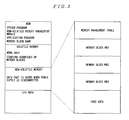
- FIG. 3 is a diagram showing a memory map of a memory space held by the information processing apparatus 1.
- the memory space held by the information processing apparatus 1 includes a ROM area that is a storage area of the ROM 20, a volatile memory area and an I/O area that is storage areas of the volatile memory 30, and a non-volatile memory area that is a storage area of the non-volatile memory 40.
- the non-volatile memory area includes a memory management table area, memory blocks MB1 to MB3, and a free space.
- the memory management table area is an area for storing data in a table form (amemorymanagement table) for associating names of memory blocks (memory block names) and addresses of storage areas corresponding to the memory block names.
- the memory management table is management information on memory addresses in the non-volatile memory 40. Therefore, this memory management table is stored in the non-volatile memory area, whereby, even when the power supply of the information processing apparatus 1 is disconnected, it is possible to use data stored in the respective memory blocks of the non-volatile memory area when the power supply is turned on again.
- the memory management table includes the number of memory blocks, memory block names, and a size of the memory blocks (data for grasping addresses of the memory blocks).
- the number of memory blocks, memory block names, and a size of the memory blocks substantially constitute memory management information.
- the memory blocks MB1 to MB3 are areas allocated by the non-volatile memory management module. Various data, which are required to be saved even when a power supply is disconnected, are stored in the memory blocks MB1 to MB3. Note that, here, a state, in which the three memory blocks MB1 to MB3 are allocated, is illustrated as an example. However, memory blocks of a necessary number and a necessary size are allocated according to processing in the information processing apparatus 1.
- the memory block storing the unnecessary data is released to be a free area by the non-volatile memory management module.
- the free area is an unused area in the non-volatile memory 40.
- the non-volatile memory management module allocates a memory block from this free area.
- the CPU 50 is a unit that controls the entire information processing apparatus 1.
- the CPU 50 reads out and executes an operating system program or an application program stored in the ROM 20 in accordance with various instruction signals that are inputted via the I/O unit 10.
- the CPU 50 executes the operating system program, a function of the non-volatile memory management module is realized. Then, the CPU 50 stores results of various kinds of processing in a predetermined area of the volatile memory 30 or the non-volatile memory 40.
- the CPU 50 when input operation is applied to the information processing apparatus 1, the CPU 50 turns on the power supply to perform processing only when an operation is required. When an operation is unnecessary, the CPU 50 performs power control via the power control unit 90 so as to disconnect the power supply. Therefore, the CPU 50 stores data, which is required to be saved even when the power supply is disconnected, like information required by the OS such as a memory management table and information required by an application such as a page number of an electronic book under inspection in the non-volatile memory 40.
- the GA 60 is a hardware that performs at high speed rendering processing for an image to be displayed on the display 80 in accordance with an instruction of the CPU 50. Specifically, the GA 60 performs processing for expanding a vector figure inputted from the CPU 50 into a raster figure. Then, the GA 60 outputs rendering data for rendering the image subjected to rendering processing on the display 80 to the display controller 70.
- the display controller 70 controls the display 80 directly and causes the display 80 to display the rendering data inputted from the GA 60.
- the display controller 70 drives an X driver and a Y driver of the display 80 with reference to the rendering data inputted from the GA 60 to thereby cause the display 80 to display the raster figure that is a rendering object.
- the display 80 is constituted by, for example, a high pixel density (multi-pixel) display device of an A4 size.
- the display 80 displays pixel data on predetermined pixels according to control of the display controller 70.
- the display 80 is a display device having a memory property (a display device in which a display screen is maintained even if a power supply is disconnected).
- a display device having a memory property a display device in which a display screen is maintained even if a power supply is disconnected.
- the display 80 it is possible to adopt, for example, an electrophoretic display, a cholesteric liquid crystal display, a display using charged toner, a displayusing a twist ball, an electro-deposition display, or the like.
- the power control unit 90 controls supply of electric power from the battery 100 to the respective units of the information processing apparatus 1 in accordance with an instruction of the CPU 50.
- the battery 100 is aprimarybatteryor a secondary battery that supplies electric power to the information processing apparatus 1 via the power control unit 90.
- a power supply is turned on only when an operation of the information processing apparatus is necessary, for example, when input operation is performed. When the necessary operation ends, the power supply is turned off.
- data which is required to be saved even when the power supply is disconnected, such as a page number of contents of an electronic book under inspection and a memorymanagement table, is stored in the non-volatile memory 40.
- the power supply is turned on again, the data stored in the non-volatile memory 40 is made usable.
- FIG. 4 is a flowchart showing a specific example of an operation of the information processing apparatus 1.
- FIG. 5 is a diagram showing transition of a memory map in the non-volatile memory 40 in this case. Note that FIG. 5 (a) is a memory map showing an initial state at the time when the flowchart shown in FIG. 4 is executed. Two memoryblocks "USER” and “ALRM” used by other applications are allocated in the memory map.
- the CPU 50 executes the function "NVAllocateNamedMemory" with a memory block name "PGNO" as an argument and, as shown in FIG. 5(b), allocates memory blocks for four bytes in the storage area of the non-volatile memory 40 (step S1).
- This "PGNO” is a memory block name that inspection software of an electronic book uses exclusively in order to manage a page under inspection.
- the CPU 50 sets a page number "1" (first page) as actual data of the allocated memory blocks (step S2).
- the CPU 50 reads out contents of the first page from the memory card and displays the contents on the display 80 (step S3) .
- the CPU 50 stops the supply of electric power from the battery 100 to the information processing apparatus 1 (step S4).
- the power supply of the information processing apparatus 1 is disconnected while a screen is displayed on the display 80 and the information processing apparatus 1 does not consume electric power.
- step S5 When a button is operated by the user and an instruction for turning a page is inputted, this button operation acts as a trigger for turning on the power supply to resume supply of the electric power to the information processing apparatus 1 (step S5).
- the CPU 50 executes the function "NVGetNamedMemoryAddress" with the memory block name "PGNO" as an argument (step S6). In other words, in step S6, an area of the memory block name "PGNO" is retrieved from the non-volatile memory 40.
- the CPU 5 increments a page number in the area of the retrieved memory block name "PGNO" by "1" to "2" indicating a second page (step S7).
- the CPU 50 reads out contents of the second page from the memory card and displays the contents on the display 80 (step S8).
- the CPU 50 stops the supply of electric power from the battery 100 to the information processing apparatus 1 and the power supply is disconnected again (step S9).
- step S10 When the user operates a button to input an instruction for ending the inspection of the electronic book, this button operation acts as a trigger for turning on the power supply to resume the supply of electric power to the information processing apparatus 1 (step S10).
- the CPU 50 executes the function "NVFreeMemory" with the memory block name "PGNO" as an argument (step S11).
- step S11 as shown in FIG. 5(d), the unnecessary area of the memory block name "PGNO" is deleted from the non-volatile memory 40 to form a free area.
- the CPU 50 performs various kinds of processing following the end of the inspection software for the electronic book (e.g., release of the area used in the volatile memory 30) (step S12), stops the supply of electric power from the battery 100 to the information processing apparatus 1 and the power supply is disconnected again (step S13).
- step S13 the power supply of the information processing apparatus 1 is disconnected and the processing of the specific example of an operation described here ends.
- an operation in the information processing apparatus 1 for example, when the user operates a button, the supply of electric power is resumed promptly and the CPU 50 performs a predetermined processing.
- theCPU50 the non-volatile memory management module
- theCPU50 searches a storage area on the non-volatile memory 40 with a memory block name as a key.
- the information processing apparatus 1 attaches peculiar memory block names to memory blocks allocated in the storage area of the non-volatile memory 40, respectively and uses the memory management table for identifying the memory blocks according to the memory block names to perform memory management for the non-volatile memory 40. Then, when the power supply is turned on again, an application designates a memory block name, whereby the memory block name is retrieved in the non-volatile memory 40 and data of a memory block corresponding to the memory block name is accessed.
- the information processing apparatus including the non-volatile memory, it is possible to perform memory management for power control appropriately. Consequently, it is possible to reduce power consumption in the information processing apparatus significantly.
- the non-volatile memory 40 is accessed directly to read out data from and write data in the non-volatile memory 40.
- a volatile memory is capable of operating faster than a non-volatile memory, it is also possible that data stored in the non-volatile memory 40 is copied to the volatile memory 30 and the data stored in the volatile memory 30 is used. In this way, an OS or an application is capable of performing processing for copying data stored in the non-volatile memory 40 to the volatile memory 30 and using it.
Landscapes
- Engineering & Computer Science (AREA)
- Theoretical Computer Science (AREA)
- Physics & Mathematics (AREA)
- General Engineering & Computer Science (AREA)
- General Physics & Mathematics (AREA)
- Software Systems (AREA)
- Computer Security & Cryptography (AREA)
- Techniques For Improving Reliability Of Storages (AREA)
- Power Sources (AREA)
- Memory System (AREA)
Abstract
Description
- The present invention relates to an information processing apparatus that is capable of autonomously controlling supply of electric power inside the apparatus and a memory managing program and a memory managing method for the information processing apparatus.
- In recent years, in the field of the computer system technology, power control techniques for reducing power consumption at standby time by stopping supply of electric power inside an apparatus when processing is not performed and resuming the supply of electric power instantaneously when processing is required, for example, when input operation is applied to the apparatus have been developed.
- In addition, in recent years, non-volatile memories such as a Ferroelectric Random Access Memory (FeRAM) and a Magneto-resistive Random Access Memory (MRAM) have been developed. Such non-volatile memories do not require electric power for maintaining storage of information. Thus, for example, even when the power control described above is performed and supply of electric power to the memory is stopped, information, which is stored before the supply of electric power is stopped, is held on the memory.
- Since it is possible to access such non-volatile memories at high speed, it is expected that the non-volatile memories are used as general-purpose memories in computer systems.
- Incidentally, in the conventional software techniques, as in the power control techniques described above, it is not assumed in principle that processing is resumed after power supply to a computer is suspended temporarily. In restarting the computer, in general, operating system software (OS) performs start involving initialization of a system (so-called cold start).
- Note that, concerning the power control for the computer systems, for example, JP9-114557A discloses a technique such as suspend or resume.
- However, in the conventional computer systems, when the memory is managed, a method of managing a starting address of an area in use on the memory and, in allocating or releasing the memory, designating the starting address of the area is used.
- Therefore, even when the non-volatile memories such as the FeRAM and the MRAM are used, whensupplyof power is suspended as described above and the supply of power is resumed as required by processing, there is a problem in that management information of a memory address is lost and the information stored on the memory cannot be accessed as the OS performs the cold start.
- When the OS performs the processing such as suspend or resume, the management information of the memory address is stored in a storage such as a hard disk. Thus, it is possible to access the information on the memory even when the power supply of the computer is turned on again.
- However, the conventional processing such as suspend or resume is not processing that assumes use of a non-volatile memory. There is a problem in that it is necessary to save a large quantity of information in the memory or the hard disk in executing the processing and, when the power supply of the computer is turned on again, the information does not surely return to an original state in some cases.
- It is an object of the invention to perform memory management for power control appropriately in an information processing apparatus including a non-volatile memory.
- In order to solve the problems, the invention provides an information processing apparatus that autonomously controls supply of electric power inside the apparatus, including: a non-volatile memory that holds stored information in a non-volatile manner (e.g., a
non-volatile memory 40 in FIG. 1); and a non-volatile memory managing section (e.g., aCPU 50 constituting a non-volatile memory managing module in FIG. 3) that attaches peculiar memory block names to memory blocks (e.g., memory blocks MB1 to MB3 in FIG. 3) in a storage of the non-volatile memory, generates memory management information (e.g., a memory management table in FIG. 3) for identifying the memory blocks using the memory block names, and stores the memory management information in the non-volatile memory. - Consequently, in the information processing apparatus that includes the non-volatile memory and repeats restarting according to power control, it is possible to use data held in the non-volatile memory at the time when a power supply is turned on again.
- In other words, in the information processing apparatus including the non-volatile memory, it is possible to perform memory management for power control appropriately.
- When supply of power to the apparatus is resumed after the supply of power is suspended, the non-volatile memory managing section searches storage areas in the non-volatile memory on the basis of the memory block names and accesses information stored in the memory blocks corresponding to the memory block names.
- Consequently, when the power supply is turned on again, the memory management information of the non-volatile memory is referred to promptly and it is possible to use the information held in the non-volatile memory.
- When the memory blocks become unnecessary, the non-volatile memory managing section searches storage areas in the non-volatile memory on the basis of the memory block names of the memory blocks and releases the memory blocks.
- Consequently, it is also possible to release the memory blocks in the non-volatile memory by designating the memory block names and use the storage areas effectively.
- The information processing apparatus further includes: a volatile memory (e.g., a
volatile memory 30 in FIG. 1) that is capable of reading out data from and writing data at higher speed than the non-volatile memory; and an indirect access section (e.g., theCPU 50 in FIG. 1) that stores information, which is stored in the storage areas of the non-volatile memory, in the volatile memory and accesses the information stored in the volatile memory instead of the non-volatile memory. - Consequently, it is possible to use the information stored in the non-volatile memory via the volatile memory that can perform readout and writing at high speed.
- When the non-volatile memory managing section is required to access the memory blocks corresponding to the memory block names, the non-volatile memory managing section accesses information stored in the memory blocks directly on the basis of the memory management information.
- Consequently, since it is possible to directly read out the information from and write the information in the non-volatile memory, it is possible to use the entire storage areas efficiently without occupying storage areas of other memories.
- The non-volatile memory managing section attaches names consisting of arbitrary character strings as the memory block names.
- Consequently, it is possible to attach names that are easily recognized by a user or an application.
- The non-volatile memory managing section attaches names of a size, which corresponds to a data width for treating data in the own apparatus, as the memory block names.
- Consequently, it is possible to attach memory block names consistent with hardware and realize an increase in speed of processing.
- The non-volatile memory managing section attaches names, which consist of characters of a number obtained by dividing the data width in treating data in the own apparatus by "8", as the memory block names.
- Consequently, it is possible to attach data block names of a size within the data width in treating data in the own apparatus and realize an increase in speed of processing.
- The information processing apparatus includes a predetermined processor (e.g., the
CPU 50 in FIG. 1) connected to the non-volatile memory by a data line. The non-volatile memory managing section attaches names of a size, which is suited to a data width of the data line, as the memory block names. - Consequently, it is possible to transmit the memory block names in one clock between the processor and the non-volatile memory.
- The information processing apparatus includes a predetermined processor that has a register for storing information to be an object of arithmetic operation. The non-volatile memory managing section attaches names of a size, which is suited to a size of a data width of the register, as the memory block names.
- Consequently, it is possible to perform processing for writing the memory block names in the register and reading the memory block names from the register at a time in the processor.
- The information processing apparatus includes a predetermined processor (e.g., the
CPU 50 in FIG. 1) that has an ALU for applying arithmetical or logical operation to information to be an object of arithmetic operation. The non-volatile memory managing section attaches names of a size, which is suited to an input data width of the ALU, as the memory block names. - Consequently, it is possible to perform processing for comparing memory block names at a time in the ALU and perform processing for searching the memory blocks in the non-volatile memory at high speed.
- The invention provides a memory managing program for controlling an information processing apparatus that autonomously controls supply of electric power inside the apparatus. The memory managing program causes the information processing apparatus to realize a non-volatile memory management function of attaching peculiar memory block names to memory blocks in storage areas of a non-volatilememory, which holds stored information in a non-volatile manner, provided in the information processing apparatus, generating memory management information for identifying the memory blocks according to the memory block names, and storing the memory management information in the non-volatile memory.
- The invention provides a memory managing method in an information processing apparatus that autonomously controls supply of electric power inside the apparatus. The memory managing method includes a non-volatile memory managing step of attaching peculiar memory block names to memory blocks in storage areas of a non-volatile memory, which holds stored information in a non-volatile manner, provided in the information processing apparatus, generating memory management information for identifying the memory blocks according to the memory block names, and storing the memory management information in the non-volatile memory.
- In this way, according to the invention, in the information processing apparatus including the non-volatile memory, it is possible to perform memory management for power control appropriately and reduce power consumption of the information processing apparatus significantly.
- In the accompanying drawings:
- FIG. 1 is a block diagram showing a functional structure of an
information processing apparatus 1 according to the invention; - FIG. 2 is a table specifically showing an API constituting a non-volatile memory management module;
- FIG. 3 is a memory map of a memory space included in the
information processing apparatus 1; - FIG. 4 is a flowchart showing a specific example of an operation of the
information processing apparatus 1; and - FIG. 5 is a diagram showing transition of a memory map in the
non-volatile memory 40. - An embodiment of an information processing apparatus according to the invention will be hereinafter explained with reference to the accompanying drawings.
- First, a structure of the information processing apparatus will be explained.
- FIG. 1 is a block diagram showing a functional structure of an
information processing apparatus 1 according to the invention. - Note that, in an example explained here, contents of an electronic book are inspected us ing the
information processing apparatus 1. - In FIG. 1, the
information processing apparatus 1 includes an Input/Output (I/O)unit 10, a Read Only Memory (ROM) 20, avolatile memory 30, anon-volatile memory 40, a Central Processing Unit (CPU) 50, a Graphic Accelerator (GA) 60, adisplay controller 70, adisplay 80, apower control unit 90, and abattery 100. - The I/
O unit 10 is a port through which theinformation processing apparatus 1 outputs signals to and receives signals from the various devices. Theinformation processing apparatus 1 outputs signals to and receives signals from, via the I/O unit 10, input devices such as a keyboard, a touch panel, a mouse, and operation buttons provided in a main body of theinformation processing apparatus 1, sound input/output devices such as a speaker and a microphone, various interfaces (I/Fs) such as a network interface and a memory card interface, and various peripheral circuits such as a timer. - Note that, in this embodiment, the contents of the electronic book is stored in a memory card and provided. The memory card is inserted into a memory card I/F, whereby the contents are inspected via the I/
O unit 10. - The
ROM 20 is constituted by a non-volatile memory such as a flash ROM. An operating system program (OS), an application program, and a memory block name (described later) are stored in theROM 20. - The operating system program stored in the
ROM 20 includes a non-volatile memory management module that manages a storage area of thenon-volatile memory 40. - The non-volatile memory management module is an Application Program Interface (API) that performs memory management for the
non-volatile memory 40. The non-volatile memory management module includes functions of the API shown in FIG. 2. - FIG. 2 is a diagram specifically showing the API constituting the non-volatile memory management module.
- In FIG. 2, "NVAllocateNamedMemory" is a function for, when the
information processing apparatus 1 is required to store data in thenon-volatile memory 40 in performing processing, giving peculiar names (memory block names) designated as arguments to areas for storing the data to allocate the areas. - "NVGetNamedMemoryAddress" is a function for searching the areas with the memory block names designated as the arguments in the
non-volatile memory 40. - "NVFreeNamedMemory" is a function for releasing the areas with the memory block names designated as the arguments.
- Here, it is possible to set the memory block names as arbitrary character strings. In addition, it is possible to give names of a size with which processing for searching memory blocks from a storage of the
non-volatile memory 40 is further increased in speed. - For example, it is conceivable to set a size of the memory block names to a size suited to a data width of the
CPU 50. In this case, it is possible to set a size of the memory block names to a size suited to a data width of a data line (a data bus) connecting theCPU 50 and thenon-volatile memory 40, an input data line of an Arithmetic Logical Unit (ALU) provided inside theCPU 50, a data width of a register of a register file provided inside theCPU 50, and the like. - In this way, a size of the memory block names is set to a size suited to the various data widths in the
CPU 50. This makes it possible to transfer and compare codes of the memory blocks by performing processing once. - A size of the memory block names is suited to a data width of a data line connecting the
CPU 50 and thenon-volatile memory 40. This makes it possible to transmit the memory block names in one clock on the data line connecting the non-volatilememory 40 and theCPU 50. In addition, a size of the memory block names is suited to an input data width of the ALU provided inside theCPU 50 . This makes it possible to perform processing for comparing a key memory block name and the respective memory block names on thenon-volatile memory 40 using the ALU at a time. Moreover, a size of the memory block names is suited to a data width of a register of a register file provided inside theCPU 50. This makes it possible to perform processing for writing the memory block names in and reading out the memory block names from the register file at a time. - Therefore, speed of processing for searching a memory block with the key memory block name from the storage area of the
non-volatile memory 40 is increased. - Referring back to FIG. 1, the
volatile memory 30 is constituted by a volatile memory such as a Dynamic RandomAccess Memory (DRAM), a Static Random Access Memory (SRAM), or a Synchronous DRAM (SDRAM) . When theCPU 50 executes processing, thevolatile memory 30 forms a work area and stores a result of the processing. - The
volatile memory 30 is also capable of storing starting addresses of the respective memory blocks stored in thenon-volatile memory 40. - The
non-volatile memory 40 is constituted by a non-volatile memory such as a Ferroelectric Random Access Memory (FRAM) or a Magneto-resistive Random Access Memory (MRAM). For example, when contents of an electronic book are inspected, data, which is required to be saved even when a power supply of theinformation processing apparatus 1 is disconnected, such as a number of a page under inspection is stored. - Note that, as described above, it is possible to constitute the
non-volatile memory 40 with a non-volatile memory that does not require backup by a power supply. In addition, it is also possible to back up a volatile memory such as an SRAM with a dedicated power supply to use the volatile memory as a pseudo-non-volatile memory. - Here, a memory map of a memory space constituted by the
non-volatile memory 40 will be explained. - FIG. 3 is a diagram showing a memory map of a memory space held by the
information processing apparatus 1. - In FIG. 3, the memory space held by the
information processing apparatus 1 includes a ROM area that is a storage area of theROM 20, a volatile memory area and an I/O area that is storage areas of thevolatile memory 30, and a non-volatile memory area that is a storage area of thenon-volatile memory 40. - Moreover, the non-volatile memory area includes a memory management table area, memory blocks MB1 to MB3, and a free space.
- The memory management table area is an area for storing data in a table form (amemorymanagement table) for associating names of memory blocks (memory block names) and addresses of storage areas corresponding to the memory block names.
- The memory management table is management information on memory addresses in the
non-volatile memory 40. Therefore, this memory management table is stored in the non-volatile memory area, whereby, even when the power supply of theinformation processing apparatus 1 is disconnected, it is possible to use data stored in the respective memory blocks of the non-volatile memory area when the power supply is turned on again. - Note that the memory management table includes the number of memory blocks, memory block names, and a size of the memory blocks (data for grasping addresses of the memory blocks). However, in the explanation of this embodiment, it is assumed that only the number of all memory blocks allocated to the
non-volatile memory 40 is stored in the memory management table area and the other pieces of memory management information are included in the respective memory blocks. In this case, again, the number of memory blocks, memory block names, and a size of the memory blocks (data for specifying addresses of the memory blocks) substantially constitute memory management information. - The memory blocks MB1 to MB3 are areas allocated by the non-volatile memory management module. Various data, which are required to be saved even when a power supply is disconnected, are stored in the memory blocks MB1 to MB3. Note that, here, a state, in which the three memory blocks MB1 to MB3 are allocated, is illustrated as an example. However, memory blocks of a necessary number and a necessary size are allocated according to processing in the
information processing apparatus 1. - When the data stored in any one of the memory blocks MB1 to MB3 is made unnecessary, the memory block storing the unnecessary data is released to be a free area by the non-volatile memory management module.
- The free area is an unused area in the
non-volatile memory 40. The non-volatile memory management module allocates a memory block from this free area. - Referring back to FIG. 1, the
CPU 50 is a unit that controls the entireinformation processing apparatus 1. TheCPU 50 reads out and executes an operating system program or an application program stored in theROM 20 in accordance with various instruction signals that are inputted via the I/O unit 10. When theCPU 50 executes the operating system program, a function of the non-volatile memory management module is realized. Then, theCPU 50 stores results of various kinds of processing in a predetermined area of thevolatile memory 30 or thenon-volatile memory 40. - For example, when input operation is applied to the
information processing apparatus 1, theCPU 50 turns on the power supply to perform processing only when an operation is required. When an operation is unnecessary, theCPU 50 performs power control via thepower control unit 90 so as to disconnect the power supply. Therefore, theCPU 50 stores data, which is required to be saved even when the power supply is disconnected, like information required by the OS such as a memory management table and information required by an application such as a page number of an electronic book under inspection in thenon-volatile memory 40. - The
GA 60 is a hardware that performs at high speed rendering processing for an image to be displayed on thedisplay 80 in accordance with an instruction of theCPU 50. Specifically, theGA 60 performs processing for expanding a vector figure inputted from theCPU 50 into a raster figure. Then, theGA 60 outputs rendering data for rendering the image subjected to rendering processing on thedisplay 80 to thedisplay controller 70. - The
display controller 70 controls thedisplay 80 directly and causes thedisplay 80 to display the rendering data inputted from theGA 60. - Specifically, the
display controller 70 drives an X driver and a Y driver of thedisplay 80 with reference to the rendering data inputted from theGA 60 to thereby cause thedisplay 80 to display the raster figure that is a rendering object. - The
display 80 is constituted by, for example, a high pixel density (multi-pixel) display device of an A4 size. Thedisplay 80 displays pixel data on predetermined pixels according to control of thedisplay controller 70. - In addition, the
display 80 is a display device having a memory property (a display device in which a display screen is maintained even if a power supply is disconnected). Thus, since electric power is unnecessary for maintaining a state of the display screen, it is possible to further reduce power consumption by theinformation processing apparatus 1. - Note that, as the
display 80, it is possible to adopt, for example, an electrophoretic display, a cholesteric liquid crystal display, a display using charged toner, a displayusing a twist ball, an electro-deposition display, or the like. - The
power control unit 90 controls supply of electric power from thebattery 100 to the respective units of theinformation processing apparatus 1 in accordance with an instruction of theCPU 50. - The
battery 100 is aprimarybatteryor a secondary battery that supplies electric power to theinformation processing apparatus 1 via thepower control unit 90. - Next, an operation of the
information processing apparatus 1 will be explained. - In the
information processing apparatus 1 in this embodiment, under the constitution described above, a power supply is turned on only when an operation of the information processing apparatus is necessary, for example, when input operation is performed. When the necessary operation ends, the power supply is turned off. In addition, at this point, data, which is required to be saved even when the power supply is disconnected, such as a page number of contents of an electronic book under inspection and a memorymanagement table, is stored in thenon-volatile memory 40. When the power supply is turned on again, the data stored in thenon-volatile memory 40 is made usable. - Assuming that a user turns on the power supply initially after, for example, replacing a battery and, after turning a page while reading contents of an electronic book, at a point when the user finishes reading a second page, the user ends inspection of the contents, a specific example of an operation of the
information processing apparatus 1 in this case will be explained. - FIG. 4 is a flowchart showing a specific example of an operation of the
information processing apparatus 1. FIG. 5 is a diagram showing transition of a memory map in thenon-volatile memory 40 in this case. Note that FIG. 5 (a) is a memory map showing an initial state at the time when the flowchart shown in FIG. 4 is executed. Two memoryblocks "USER" and "ALRM" used by other applications are allocated in the memory map. - In FIG. 4, after a battery is replaced (or the information processing apparatus is shipped from a factory) , when the user turns on the power supply of the
information processing apparatus 1 initially, theCPU 50 executes the function "NVAllocateNamedMemory" with a memory block name "PGNO" as an argument and, as shown in FIG. 5(b), allocates memory blocks for four bytes in the storage area of the non-volatile memory 40 (step S1). This "PGNO" is a memory block name that inspection software of an electronic book uses exclusively in order to manage a page under inspection. - Subsequently, the
CPU 50 sets a page number "1" (first page) as actual data of the allocated memory blocks (step S2). TheCPU 50 reads out contents of the first page from the memory card and displays the contents on the display 80 (step S3) . - Then, the
CPU 50 stops the supply of electric power from thebattery 100 to the information processing apparatus 1 (step S4). In other words, the power supply of theinformation processing apparatus 1 is disconnected while a screen is displayed on thedisplay 80 and theinformation processing apparatus 1 does not consume electric power. - Thereafter, when a button is operated by the user and an instruction for turning a page is inputted, this button operation acts as a trigger for turning on the power supply to resume supply of the electric power to the information processing apparatus 1 (step S5). The
CPU 50 executes the function "NVGetNamedMemoryAddress" with the memory block name "PGNO" as an argument (step S6). In other words, in step S6, an area of the memory block name "PGNO" is retrieved from thenon-volatile memory 40. - Then, as shown in FIG. 5(c), the
CPU 5 increments a page number in the area of the retrieved memory block name "PGNO" by "1" to "2" indicating a second page (step S7). - Subsequently, the
CPU 50 reads out contents of the second page from the memory card and displays the contents on the display 80 (step S8). - Then, the
CPU 50 stops the supply of electric power from thebattery 100 to theinformation processing apparatus 1 and the power supply is disconnected again (step S9). - Thereafter, when the user operates a button to input an instruction for ending the inspection of the electronic book, this button operation acts as a trigger for turning on the power supply to resume the supply of electric power to the information processing apparatus 1 (step S10). The
CPU 50 executes the function "NVFreeMemory" with the memory block name "PGNO" as an argument (step S11). In other words, in step S11, as shown in FIG. 5(d), the unnecessary area of the memory block name "PGNO" is deleted from thenon-volatile memory 40 to form a free area. - Moreover, the
CPU 50 performs various kinds of processing following the end of the inspection software for the electronic book (e.g., release of the area used in the volatile memory 30) (step S12), stops the supply of electric power from thebattery 100 to theinformation processing apparatus 1 and the power supply is disconnected again (step S13). - Note that, in step S13, the power supply of the
information processing apparatus 1 is disconnected and the processing of the specific example of an operation described here ends. However, when an operation in theinformation processing apparatus 1 is required, for example, when the user operates a button, the supply of electric power is resumed promptly and theCPU 50 performs a predetermined processing. Then, at this point, when the supply of electric power is resumed, theCPU50 (the non-volatile memory management module) searches a storage area on thenon-volatile memory 40 with a memory block name as a key. - As described above, the
information processing apparatus 1 according to this embodiment attaches peculiar memory block names to memory blocks allocated in the storage area of thenon-volatile memory 40, respectively and uses the memory management table for identifying the memory blocks according to the memory block names to perform memory management for thenon-volatile memory 40. Then, when the power supply is turned on again, an application designates a memory block name, whereby the memory block name is retrieved in thenon-volatile memory 40 and data of a memory block corresponding to the memory block name is accessed. - Therefore, in the information processing apparatus that includes the non-volatile memory and repeats restarting according to power control, it is possible to use data held in the non-volatile memory at the time when the power supply is turned on again.
- In the information processing apparatus including the non-volatile memory, it is possible to perform memory management for power control appropriately. Consequently, it is possible to reduce power consumption in the information processing apparatus significantly.
- Note that, in the explanation of this embodiment, it is assumed that only the number of memory blocks is stored in the memory management table and memory block names and a size of the memory blocks are stored in the
non-volatile memory 40 together with actual data of the memory blocks. However, the memory block names and the size of the memory blocks may be included in the memory management table to be managed. - As a method of giving memory block names, as described above, other than suiting a size of the memory block names to a data width of a data bus, an input data width of an ALU, or a data width of a register as described above, it is possible to set the memory block names as an arbitrary character string or an arbitrary numerical value. In general, it is desirable to set a size of the memory blocks to the number of characters obtained by dividing a data width treated in the
information processing apparatus 1 by eight (bits) equivalent to one character of the ASCII code. - In addition, in the explanation of this embodiment, the
non-volatile memory 40 is accessed directly to read out data from and write data in thenon-volatile memory 40. However, in general, since a volatile memory is capable of operating faster than a non-volatile memory, it is also possible that data stored in thenon-volatile memory 40 is copied to thevolatile memory 30 and the data stored in thevolatile memory 30 is used. In this way, an OS or an application is capable of performing processing for copying data stored in thenon-volatile memory 40 to thevolatile memory 30 and using it.
Claims (13)
- An information processing apparatus that autonomously controls supply of electric power inside the apparatus, comprising:a non-volatile memory that holds stored information in a non-volatile manner; anda non-volatile memory managing section that attaches peculiar memory block names to memory blocks in a storage of the non-volatile memory, generates memory management information for identifying the memory blocks using the memory block names, and stores the memory management information in the non-volatile memory.
- The information processing apparatus according to claim 1, wherein, when supply of power to the apparatus is resumed after the supply of power is suspended, the non-volatile memory managing section searches storage areas in the non-volatile memory on the basis of the memory block names and accesses information stored in the memory blocks corresponding to the memory block names.
- The information processing apparatus according to claim 1 or 2, wherein, when the memory blocks become unnecessary, the non-volatile memory managing section searches storage areas in the non-volatile memory on the basis of the memory blocknames of the memory blocks and releases the memory blocks.
- The information processing apparatus according to any one of claims 1 to 3, further comprising:a volatile memory that is capable of reading out data from and writing data at higher speed than the non-volatile memory; andan indirect access section that stores information, which is stored in the storage areas of the non-volatile memory, in the volatile memory and accesses the information stored in the volatile memory instead of the non-volatile memory.
- The information processing apparatus according to any one of claims 1 to 3, wherein, when the non-volatile memory managing section is required to access the memory blocks corresponding to the memory block names, the non-volatile memory managing section accesses information stored in the memory blocks directly on the basis of the memory management information.
- The information processing apparatus according to any one of claims 1 to 5, wherein the non-volatile memory managing section attaches names consisting of arbitrary character strings as the memory block names.
- The information processing apparatus according to any one of claims 1 to 5, wherein the non-volatile memory managing section attaches names of a size, which corresponds to a data width for treating data in the own apparatus, as the memory block names.
- The information processing apparatus according to claim 7, wherein the non-volatile memory managing section attaches names, which consist of characters of a number obtained by dividing the data width in treating data in the own apparatus by "8", as the memory block names.
- The information processing apparatus according to claim 7, comprising a predetermined processor connected to the non-volatile memory by a data line, wherein
the non-volatile memory managing section attaches names of a size, which is suited to a data width of the data line, as the memory block names. - The information processing apparatus according to claim 7, comprising a predetermined processor that has a register for storing information to be an object of operation, wherein
the non-volatile memory managing section attaches names of a size, which is suited to a size of a data width of the register, as the memory block names. - The information processing apparatus according to claim 7, comprising a predetermined processor that has an ALU for applying arithmetical or logical operation to information to be an object of arithmetic operation, wherein
the non-volatile memory managing section attaches names of a size, which is suited to an input data width of the ALU, as the memory block names. - A memory managing program for controlling an information processing apparatus that autonomously controls supply of electric power inside the apparatus, the memory managing program causing the information processing apparatus to realize a non-volatile memory management function of attaching peculiar memory block names to memory blocks in storage areas of a non-volatile memory, which holds stored information in a non-volatile manner, provided in the information processing apparatus, generating memory management information for identifying the memory blocks according to the memory block names, and storing the memory management information in the non-volatile memory.
- A memory managing method in an information processing apparatus that autonomously controls supply of electric power inside the apparatus, the memory managing method comprising a non-volatile memory managing step of attaching peculiar memory block names to memory blocks in storage areas of a non-volatile memory, which holds stored information in a non-volatile manner, provided in the information processing apparatus, generating memory management information for identifying the memory blocks according to the memory block names, and storing the memory management information in the non-volatile memory.
Applications Claiming Priority (1)
| Application Number | Priority Date | Filing Date | Title |
|---|---|---|---|
| JP2004200559A JP4182928B2 (en) | 2004-07-07 | 2004-07-07 | Information processing apparatus, memory management program, and memory management method |
Publications (2)
| Publication Number | Publication Date |
|---|---|
| EP1615107A2 true EP1615107A2 (en) | 2006-01-11 |
| EP1615107A3 EP1615107A3 (en) | 2007-01-03 |
Family
ID=35004173
Family Applications (1)
| Application Number | Title | Priority Date | Filing Date |
|---|---|---|---|
| EP05013627A Withdrawn EP1615107A3 (en) | 2004-07-07 | 2005-06-23 | Information processing apparatus, memory managing program, and memory managing method |
Country Status (6)
| Country | Link |
|---|---|
| US (1) | US7401200B2 (en) |
| EP (1) | EP1615107A3 (en) |
| JP (1) | JP4182928B2 (en) |
| KR (1) | KR100719200B1 (en) |
| CN (1) | CN100370395C (en) |
| TW (1) | TWI277866B (en) |
Families Citing this family (5)
| Publication number | Priority date | Publication date | Assignee | Title |
|---|---|---|---|---|
| JP4341594B2 (en) | 2005-06-30 | 2009-10-07 | セイコーエプソン株式会社 | Program for causing computer to execute information processing apparatus and power control method |
| US7562180B2 (en) * | 2006-03-28 | 2009-07-14 | Nokia Corporation | Method and device for reduced read latency of non-volatile memory |
| CN100536029C (en) * | 2006-07-14 | 2009-09-02 | 威刚科技股份有限公司 | Non-volatile memory device and control method thereof |
| US7788513B2 (en) | 2006-08-29 | 2010-08-31 | Hewlett-Packard Development Company, L.P. | Method of reducing power consumption of a computing system by evacuating selective platform memory components thereof |
| JP4399020B1 (en) * | 2008-08-26 | 2010-01-13 | 株式会社東芝 | Information processing apparatus and memory management method |
Citations (1)
| Publication number | Priority date | Publication date | Assignee | Title |
|---|---|---|---|---|
| US6711595B1 (en) * | 2000-05-09 | 2004-03-23 | Openwave Systems Inc. | Method and apparatus for sharing standard template library objects among processes |
Family Cites Families (14)
| Publication number | Priority date | Publication date | Assignee | Title |
|---|---|---|---|---|
| JPH0437916A (en) | 1990-06-01 | 1992-02-07 | Hitachi Ltd | Information processor |
| EP0749063A3 (en) | 1995-06-07 | 1999-01-13 | International Business Machines Corporation | Method and apparatus for suspend/resume operation in a computer |
| US5860138A (en) * | 1995-10-02 | 1999-01-12 | International Business Machines Corporation | Processor with compiler-allocated, variable length intermediate storage |
| JP3453467B2 (en) | 1995-10-13 | 2003-10-06 | キヤノン株式会社 | Information processing apparatus and power management function calling method of the information processing apparatus |
| GB2310513B (en) * | 1996-02-20 | 2000-02-16 | Ibm | Computer with reduced power consumption |
| JP2988866B2 (en) | 1996-02-29 | 1999-12-13 | 株式会社東芝 | Computer system |
| JP3222821B2 (en) * | 1997-12-25 | 2001-10-29 | 株式会社東芝 | Programmable controller |
| JP4085478B2 (en) | 1998-07-28 | 2008-05-14 | ソニー株式会社 | Storage medium and electronic device system |
| US6209088B1 (en) | 1998-09-21 | 2001-03-27 | Microsoft Corporation | Computer hibernation implemented by a computer operating system |
| KR100566225B1 (en) * | 1998-12-10 | 2006-10-04 | 삼성전자주식회사 | Phonebook memory control device and method for mobile communication terminal |
| EP1037133A1 (en) | 1999-03-15 | 2000-09-20 | International Business Machines Corporation | Method and apparatus for alternation between instances of operating systems in computer systems |
| WO2001037066A1 (en) * | 1999-11-16 | 2001-05-25 | Fujitsu Limited | Information processor and computer-readable medium |
| US7108605B2 (en) * | 2002-09-30 | 2006-09-19 | Igt | EPROM file system in a gaming apparatus |
| US8412879B2 (en) | 2002-10-28 | 2013-04-02 | Sandisk Technologies Inc. | Hybrid implementation for error correction codes within a non-volatile memory system |
-
2004
- 2004-07-07 JP JP2004200559A patent/JP4182928B2/en not_active Expired - Fee Related
-
2005
- 2005-05-19 TW TW094116350A patent/TWI277866B/en active
- 2005-06-10 KR KR1020050049616A patent/KR100719200B1/en not_active Expired - Fee Related
- 2005-06-20 US US11/155,538 patent/US7401200B2/en not_active Expired - Fee Related
- 2005-06-23 EP EP05013627A patent/EP1615107A3/en not_active Withdrawn
- 2005-07-06 CN CNB2005100819606A patent/CN100370395C/en not_active Expired - Fee Related
Patent Citations (1)
| Publication number | Priority date | Publication date | Assignee | Title |
|---|---|---|---|---|
| US6711595B1 (en) * | 2000-05-09 | 2004-03-23 | Openwave Systems Inc. | Method and apparatus for sharing standard template library objects among processes |
Also Published As
| Publication number | Publication date |
|---|---|
| US20060010283A1 (en) | 2006-01-12 |
| JP4182928B2 (en) | 2008-11-19 |
| KR100719200B1 (en) | 2007-05-16 |
| CN100370395C (en) | 2008-02-20 |
| US7401200B2 (en) | 2008-07-15 |
| TW200602868A (en) | 2006-01-16 |
| TWI277866B (en) | 2007-04-01 |
| KR20060048319A (en) | 2006-05-18 |
| JP2006023919A (en) | 2006-01-26 |
| EP1615107A3 (en) | 2007-01-03 |
| CN1719383A (en) | 2006-01-11 |
Similar Documents
| Publication | Publication Date | Title |
|---|---|---|
| KR101562973B1 (en) | Memory device and method of operation of the memory device | |
| TWI436199B (en) | Method and controller for power management | |
| US6393584B1 (en) | Method and system for efficiently saving the operating state of a data processing system | |
| US9032139B2 (en) | Memory allocation for fast platform hibernation and resumption of computing systems | |
| US5590340A (en) | Apparatus and method for suspending and resuming software application on a computer | |
| KR20110006352A (en) | System Fast Boot Device and Method | |
| US6487669B1 (en) | Method and apparatus for a dual mode of displaying data and images | |
| TW201525869A (en) | System and method for dual OS memory switching | |
| US20030145191A1 (en) | Computer system and method of controlling the same | |
| CN107066068A (en) | Memory device and low power consumption memory access method in memory device | |
| JP2012252576A (en) | Information processing device, start method and program | |
| US8996852B2 (en) | Electronic device and booting method thereof | |
| US10890963B2 (en) | System and method for platform sleep state enhancements using non-volatile dual in-line memory modules | |
| EP2538319A1 (en) | Non-volatile data processing apparatus and image forming apparatus | |
| CN119621494A (en) | A display method and computing device | |
| US9170931B2 (en) | Partitioning a memory into a high and a low performance partitions | |
| US9934100B2 (en) | Method of controlling memory swap operation and data processing system using same | |
| CN104298516B (en) | Electronic equipment and hang-up control method | |
| US7401200B2 (en) | Information processing apparatus, memory managing program, and memory managing method | |
| JP5587654B2 (en) | Electronic device and booting method thereof | |
| JP2009258925A (en) | Computer system and memory management method of computer system | |
| WO2017113247A1 (en) | Method for reducing power consumption of memory and computer device | |
| JP3399178B2 (en) | Power control device and method | |
| CN121807510A (en) | Runtime system memory management methods, programmable logic controllers and systems | |
| JP6080490B2 (en) | Information processing apparatus, activation method, and program |
Legal Events
| Date | Code | Title | Description |
|---|---|---|---|
| PUAI | Public reference made under article 153(3) epc to a published international application that has entered the european phase |
Free format text: ORIGINAL CODE: 0009012 |
|
| AK | Designated contracting states |
Kind code of ref document: A2 Designated state(s): AT BE BG CH CY CZ DE DK EE ES FI FR GB GR HU IE IS IT LI LT LU MC NL PL PT RO SE SI SK TR |
|
| AX | Request for extension of the european patent |
Extension state: AL BA HR LV MK YU |
|
| PUAL | Search report despatched |
Free format text: ORIGINAL CODE: 0009013 |
|
| AK | Designated contracting states |
Kind code of ref document: A3 Designated state(s): AT BE BG CH CY CZ DE DK EE ES FI FR GB GR HU IE IS IT LI LT LU MC NL PL PT RO SE SI SK TR |
|
| AX | Request for extension of the european patent |
Extension state: AL BA HR LV MK YU |
|
| RIC1 | Information provided on ipc code assigned before grant |
Ipc: G06F 9/445 20060101ALI20061130BHEP Ipc: G06F 11/14 20060101ALI20061130BHEP Ipc: G06F 1/32 20060101AFI20051012BHEP |
|
| 17P | Request for examination filed |
Effective date: 20070112 |
|
| 17Q | First examination report despatched |
Effective date: 20070227 |
|
| AKX | Designation fees paid |
Designated state(s): FR GB |
|
| REG | Reference to a national code |
Ref country code: DE Ref legal event code: 8566 |
|
| STAA | Information on the status of an ep patent application or granted ep patent |
Free format text: STATUS: THE APPLICATION HAS BEEN WITHDRAWN |
|
| 18W | Application withdrawn |
Effective date: 20160118 |