EP1614591A2 - Inflatable seat restraint system using an inflation integrated inertia reel - Google Patents
Inflatable seat restraint system using an inflation integrated inertia reel Download PDFInfo
- Publication number
- EP1614591A2 EP1614591A2 EP05018934A EP05018934A EP1614591A2 EP 1614591 A2 EP1614591 A2 EP 1614591A2 EP 05018934 A EP05018934 A EP 05018934A EP 05018934 A EP05018934 A EP 05018934A EP 1614591 A2 EP1614591 A2 EP 1614591A2
- Authority
- EP
- European Patent Office
- Prior art keywords
- belt
- inertia reel
- inflatable
- seat
- restraint
- Prior art date
- Legal status (The legal status is an assumption and is not a legal conclusion. Google has not performed a legal analysis and makes no representation as to the accuracy of the status listed.)
- Withdrawn
Links
Images




Classifications
-
- B—PERFORMING OPERATIONS; TRANSPORTING
- B60—VEHICLES IN GENERAL
- B60R—VEHICLES, VEHICLE FITTINGS, OR VEHICLE PARTS, NOT OTHERWISE PROVIDED FOR
- B60R22/00—Safety belts or body harnesses in vehicles
- B60R22/34—Belt retractors, e.g. reels
-
- B—PERFORMING OPERATIONS; TRANSPORTING
- B60—VEHICLES IN GENERAL
- B60R—VEHICLES, VEHICLE FITTINGS, OR VEHICLE PARTS, NOT OTHERWISE PROVIDED FOR
- B60R21/00—Arrangements or fittings on vehicles for protecting or preventing injuries to occupants or pedestrians in case of accidents or other traffic risks
- B60R21/02—Occupant safety arrangements or fittings, e.g. crash pads
- B60R21/16—Inflatable occupant restraints or confinements designed to inflate upon impact or impending impact, e.g. air bags
- B60R21/18—Inflatable occupant restraints or confinements designed to inflate upon impact or impending impact, e.g. air bags the inflatable member formed as a belt or harness or combined with a belt or harness arrangement
-
- B—PERFORMING OPERATIONS; TRANSPORTING
- B60—VEHICLES IN GENERAL
- B60R—VEHICLES, VEHICLE FITTINGS, OR VEHICLE PARTS, NOT OTHERWISE PROVIDED FOR
- B60R22/00—Safety belts or body harnesses in vehicles
- B60R22/02—Semi-passive restraint systems, e.g. systems applied or removed automatically but not both ; Manual restraint systems
- B60R22/023—Three-point seat belt systems comprising two side lower and one side upper anchoring devices
- B60R2022/026—Three-point seat belt systems comprising two side lower and one side upper anchoring devices at least two ends of the belt being retractable after use
-
- B—PERFORMING OPERATIONS; TRANSPORTING
- B60—VEHICLES IN GENERAL
- B60R—VEHICLES, VEHICLE FITTINGS, OR VEHICLE PARTS, NOT OTHERWISE PROVIDED FOR
- B60R22/00—Safety belts or body harnesses in vehicles
- B60R22/18—Anchoring devices
- B60R22/20—Anchoring devices adjustable in position, e.g. in height
- B60R2022/208—Anchoring devices adjustable in position, e.g. in height by automatic or remote control means
-
- B—PERFORMING OPERATIONS; TRANSPORTING
- B60—VEHICLES IN GENERAL
- B60R—VEHICLES, VEHICLE FITTINGS, OR VEHICLE PARTS, NOT OTHERWISE PROVIDED FOR
- B60R22/00—Safety belts or body harnesses in vehicles
- B60R22/34—Belt retractors, e.g. reels
- B60R2022/3427—Seat belt connection on reels
-
- B—PERFORMING OPERATIONS; TRANSPORTING
- B60—VEHICLES IN GENERAL
- B60R—VEHICLES, VEHICLE FITTINGS, OR VEHICLE PARTS, NOT OTHERWISE PROVIDED FOR
- B60R21/00—Arrangements or fittings on vehicles for protecting or preventing injuries to occupants or pedestrians in case of accidents or other traffic risks
- B60R21/02—Occupant safety arrangements or fittings, e.g. crash pads
- B60R21/16—Inflatable occupant restraints or confinements designed to inflate upon impact or impending impact, e.g. air bags
- B60R21/26—Inflatable occupant restraints or confinements designed to inflate upon impact or impending impact, e.g. air bags characterised by the inflation fluid source or means to control inflation fluid flow
-
- B—PERFORMING OPERATIONS; TRANSPORTING
- B60—VEHICLES IN GENERAL
- B60R—VEHICLES, VEHICLE FITTINGS, OR VEHICLE PARTS, NOT OTHERWISE PROVIDED FOR
- B60R22/00—Safety belts or body harnesses in vehicles
- B60R22/18—Anchoring devices
- B60R22/20—Anchoring devices adjustable in position, e.g. in height
-
- B—PERFORMING OPERATIONS; TRANSPORTING
- B60—VEHICLES IN GENERAL
- B60R—VEHICLES, VEHICLE FITTINGS, OR VEHICLE PARTS, NOT OTHERWISE PROVIDED FOR
- B60R22/00—Safety belts or body harnesses in vehicles
- B60R22/18—Anchoring devices
- B60R22/26—Anchoring devices secured to the seat
Definitions
- the present invention relates generally to vehicle occupant restraint systems, and more particularly, to a seat belt restraint system that incorporates an inflatable section into the torso section of the belt.
- Inflatable seat restraint systems have proven to be a dramatic improvement over ordinary three-point sat belts. Unlike ordinary belts, these systems incorporate inflatable restraints that fill with gas immediately upon vehicle impact. The inflatable restraints pretension the system with a force sufficient to counter body loading, to restrict occupant motion during a crash, and to distribute crash loads over larger occupant surface area, thus minimizing injury.
- FIGS. 1a - 1e illustrate a typical prior art inflatable seat restraint system, as disclosed in the commonly assigned U.S. Patent No. 5,839,753 to Yaniv et al., which is incorporated by reference herein.
- the system includes lap belt 102, shoulder or torso belt 103, including an inflatable restraint 101, buckle assembly 105, anchor 106, anchored inertia reels 117 and 118, gas generator 122, and a sensor assembly (not shown).
- lap belt 102 and shoulder belt 103 form one continuous strap which passes through the male portion of buckle assembly 105.
- Lap belt 102 is designed to restrict the forward motion of a seated occupant at the pelvis.
- Lap belt 102 is connected to anchored inertia reel 117, which pivotally mounts lap belt 102 to the floor or seat structure on the door-side of seat 121 (as shown in Figures 1a and 1b).
- the other end of lap belt 102 loops through the male portion of buckle assembly 105, so that the length of lap belt 102 can be adjusted to accommodate a wide range of occupant sizes.
- buckle strap 107 The female portion of buckle assembly 105 is attached to buckle strap 107.
- Buckle strap 107 is pivotally mounted to an attachment point in the vehicle, such as the base of seat 121, or a floor structure on the side of seat 121 that is farthest from the door, by anchor 106.
- the female and male portions of buckle assembly 105 fasten together, thus securing seat belt system 110 around the occupant in a manner similar to that conventional three-point seat belt systems.
- gas generator 122 is typically mounted inside the seat back.
- the gas generator is also sometimes located in the seat base.
- Durable tubing 116 provides a fluid path from gas generator 122 to inflatable restraint 101.
- inflatable restraint 101 is attached to shoulder belt 103 and extends diagonally from the occupant's hip to behind and above the occupant's shoulder.
- the upper end of inflatable restraint 101 loops through a D-ring 108 that is mounted to seat 121 as shown ( Figure 1d) or to the vehicle (e.g., at the roof rail or at the upper B-pillar area (not shown)).
- D-ring 108 acts as an intermediate guide for shoulder belt 103, setting the height at which shoulder belt 103 wraps over the occcupant's shoulder.
- Shoulder belt 103 is then anchored to seat 121 or the vehicle (not shown) by an inertia reel 118.
- shoulder strap 103 is routed inside the vehicle seat to inertia reel 118, which is mounted in the lower portion of the seat back.
- tubing 116 provide fluid communication from the gas generator to inflatable restraint 101 in the torso of the restraint system.
- the crash sensor when a collision occurs, the crash sensor sends a signal to the initiator in gas generator 122, which forces gas through durable tubing 116 and into inflatable restraint 101.
- the internal pressure causes the tube diameter to increase and the tube length to decrease.
- seat belt system 110 is constrained on the outboard side by inertia reel 117 and on the inboard side by anchor 106, and behind the shoulder by inertia reel 118. Inertia reels 117 and 118 lock up during impact, preventing payout of the belt.
- inflatable restraint 101 contracts, it pulls any slack out of seat belt system 110.
- the occupant is thus provided with a pretensioned seat belt, which restricts the forward motion of the occupant and reduces primary injuries.
- conventional inflatable seat belt restraint systems mount inflators in one of two locations: 1) either behind the seat for inflation from behind the occupant and over the shoulder, or 2) at the buckle for inflation from the buckle up to the occcupant's shoulder.
- the inflatable seat restraint system of Figures 1a - 1e is an example of this first configuration, which is referred to herein as the shoulder-fill design.
- the second configuration is referred to herein as the buckle-fill design.
- inflator means any device that fills an inflatable restraint during system deployment, e.g., a gas generator.
- the intermediate guide for the shoulder belt (e.g., D-ring 108 in Figures 1a - 1e) must not be below or too far above the occupant's shoulder. Indeed, most manufacturers and safety experts recommend that the intermediate guide be positioned at or above an occupant's shoulder, with a maximum shoulder belt angle of 30° above horizontal.
- Such shoulder belt height adjustments are simple for conventional three-point seat belt systems, which have no inflatable restraints. However, substantial difficulties arise when incorporating sections of inflatable restraint.
- shoulder-fill designs such as the design illustrated in Figures 1a - 1c, mount the inflator in a fixed position and use a high-pressure hose to connect the inflator to the inflatable restraint.
- the high-pressure hose is flexible to accommodate shoulder belt height adjustments, e.g., when D-ring 108 is raised to wrap the belt over an occupant with a longer torso.
- this shoulder-fill design permits moderate shoulder belt height adjustment, the inflatable restraint must pass through the intermediate guide. Because the inflatable restraint tends to be bulky and stiff, the inflatable restraint and the webbing to which it is attached often kink and bunch around the intermediate guide.
- a typical intermediate guide e.g., a D-ring
- Buckle-fill designs suffer from drawbacks as well.
- a typical buckle-fill design fixes the inflatable restraint at the buckle where the gas is injected.
- An inertia reel mounted behind the seat lets out and retracts the webbing to accommodate the raising and lowering of the intermediate guide for shoulder belt height adjustment. Because this design requires that the inflatable restraint be fixed at the buckle, the length of the inflatable restraint remains unchanged as the intermediate guide is raised. Thus, when the intermediate guide is raised to its highest point, the inflatable restraint may not reach the shoulder of an occupant with a longer torso, therefore compromising occupant protection in this area.
- the design could extend the inflatable restraint up to the intermediate guide for the occupant with a longer torso.
- the inflatable restraint would have to pass through the intermediate guide, thereby raising the same problems discussed above for shoulder-fill designs (i.e., uneven travel and deployment due to kinking, bunching and pinching).
- both designs necessitate a separate inflator housing and the shoulder-belt design requires large amounts of expensive high-pressure hose to connect the inflator to the inflatable tubular structure.
- the designs rely on conventional inertia reels, which are not designed for inflatable seat belt restraint systems and therefore can often be unreliable.
- DE 4 211 672 A1 displays a security belt for vehicle seats consisting of a certain woven textile and providing on at least a part of its length a bag which is inflatable by means of a chemical reaction, but it does not comprise an inertia reel which is attached to the shoulder belt and an inflatable restraint, and anchored above the seat, wherein the inertia reel on the one hand retracts and pays out the inflatable restraint and shoulder belt, and furthermore on the other hand inflates the inflatable restraint upon deployment of the inflatable seat restraint system.
- DE 298 212 72 U1 describes a belt system for restraining a vehicle occupant, comprising a safety belt, a belt buckle, two end fittings, at least one belt retractor, at least one inflatable belt gas bag and at least two belt tensioner, whereby at least one of the belt tensioners is an end fitting tensioner.
- DE 298 212 80 U1 discloses a system for restraining vehicle occupants, comprising a safety belt with two ends, two belt rewinder and furthermore a tubular gas bag, that is assigned to the safety belt, which differs to the content of the submitted application, where only one mean for the retracting and paying out of the shoulder belt is needed.
- DE 200 08 315 U1 describes a vehicle occupant restraint system, comprising a vehicle seat with one part allocated to the seat and one part to the back of the seat, an inflatable safety belt and a gas generator, wherein the safety belt in the upper edge area of the back of the seat comprises at least one wrist point characterized by that the wrist point can be adjusted in height.
- US 3 869 145 A reveals a self applying three point automatically inflatable vehicle safety lap and shoulder belt, which includes an inflatable fibrous lap and where the shoulder belts are joint at one end to a coupling ring and at their other ends to inertia locked spring biased retraction wheels.
- the shoulder belts are joint at one end to a coupling ring and at their other ends to inertia locked spring biased retraction wheels.
- the connected belts it furthermore comprises a solenoid actuated valve system which is connected to a compressed air source to inflate and extend the belts.
- the present invention is an inflatable seat belt restraint system, and a corresponding method for deploying an inflatable seat belt restraint, which use an inflation integrated inertia reel to provide a wide range of shoulder belt adjustment.
- the inflation integrated inertia reel to provide a wide range of shoulder belt adjustment.
- the inflation integrated inertia reel mounts above an occupant's shoulder and secures both the shoulder belt webbing and inflatable restraint of the restraint system.
- An inflator in fluid communication with the inflation integrated inertia reel generates pressurized gas that flows into the inflation integrated inertia reel and then into the inflatable restraint.
- the pressurized gas can also be used to positively lock up the inflation integrated inertia reel.
- the present invention In mounting the inflation integrated inertia reel above the occupant's shoulder, the present invention eliminates the need for an intermediate guide and thereby solves the problems associated with the bunching and kinking of the inflatable restraints. In addition, by combining the inflator housing and inertia reel into a single component, the present invention uses fewer parts that prior art systems. Thus, the present invention provides shoulder belt adjustment with a minimum number of parts and without sacrificing full inflatable restraint protection from an occupant's lap to this shoulder.
- the inflatable seat restraint system includes a shoulder belt, an inflatable restraint, an inflator, an inflation integrated inertia reel, and a shoulder belt anchor that opposes the inflation integrated inertia reel.
- the shoulder belt anchor is preferably a buckle assembly.
- a lap belt and lap belt inertia reel can also be included to provide full occupant protection.
- the buckle assembly and lap belt inertia reel are attached to a lower portion of a seat or to a vehicle structure below the seat, and are located on opposite sides of the seat.
- the inflation integrated inertia reel is attached to an upper portion of the seat or to a vehicle structure proximate to the seat.
- the lap belt attaches to the lap belt inertia reel and the buckle assembly across an occupant's pelvis.
- the shoulder belt attaches to the buckle assembly and the inflation integrated inertia reel, and spans the occupant's torso diagonally from shoulder to pelvis.
- the shoulder belt and lap belt could be one continuous belt.
- the inflation integrated inertia reel provides several functions of the present invention, including shoulder belt adjustment, gas generation, and the spooling, retracting and locking of the shoulder belt webbing and inflatable restraint.
- the inflation integrated inertia reel includes a webbing anchor, a drum, and a port for ducting the inflation gas to the inflatable restraint.
- the inflation integrated inertia reel also includes a locking mechanism that detects a crash event and locks the drum.
- an embodiment of the present invention includes a shoulder belt 202, an inflatable restraint 206, an inflation integrated inertia reel 210, and an inflator, which, in this embodiment, is contained in inflation integrated inertia reel 210.
- This embodiment also includes an anchor for shoulder belt 202 that opposes inflation integrated inertia reel 210, which in this example is a buckle assembly 204.
- Lap belt 200 and lap belt inertia reel 208 are also shown to provide full occupant protection.
- Buckle assembly 204 and lap belt inertia reel 208 are located on opposite sides of seat 212 and are anchored to seat 212 or to a vehicle structure.
- anchored means fixed to another member either directly or through intermediate components.
- lap belt 200 and shoulder belt 202 could be, for example, a single continuous belt that extends from inflation integrated inertia reel 210 through buckle assembly 204 and to lap belt inertia reel 208.
- the single strap could be fixed or slideably attached to buckle assembly 204, for example.
- Inflation integrated inertia reel 210 may be attached to an upper portion of seat 212 or to a vehicle structure above seat 212.
- inflation integrated inertia reel is fixed to headrest 214, which adjusts up and down for differently sized occupants.
- Lap belt 200 attaches to lap belt inertia reel 208 and buckle assembly 204 across an occupant's pelvis.
- FIG 3 shows an enlarged view of the inflation integrated inertia reel 210 depicted in Figure 2.
- Figure 4a shows an axial view of a portion of the inflation integrated inertia reel 210 shown in Figure 3.
- inflation integrated inertia reel 210 includes an inflator 302 and a drum 304.
- a conventional inertia reel locking mechanism 300 is also included, which detects a crash event (e.g., an impact above a predetermined threshold) and locks drum 304.
- Shoulder belt 202 and inflatable restraint 206 are both attached to drum 304.
- inflation integrated inertia reel 210 further includes a webbing anchor 400 and a port 306.
- Webbing anchor 400 attaches shoulder belt 202 to drum 304.
- Port 306 fluidly connects inflatable restraint 206 to drum 304.
- Inflatable restraint 206 and belt 202 spool onto arm 305 of drum 304.
- Port 306 and webbing anchor 400 are positioned on drum 304 so that inflatable restraint 206 lies on top of shoulder belt 202 when drum 304 spools up.
- drum 304 spools up in a clockwise direction, requiring port 306 to be positioned in advance of webbing anchor 400 in a clockwise direction.
- Port 306 provides fluid communication between inflatable restraint 206 and the interior of drum 304.
- a short section of high-pressure hose could be used between port 306 and inflatable restraint 206 to facilitate the connection.
- the inflation gas could be ducted to drum 304 using an axial connection similar to the connection used on a garden hose spool.
- FIGS. 4b and 4c illustrate drum 304 in a fully paid out and fully retracted position, respectively.
- drum 304 rotates up to substantially one revolution such that inflatable restraint 206 spools up a maximum distance without overlapping onto itself.
- inflatable restraint 206 from being overlapped ensures that fluid communication remains open between drum 304 and inflatable restraint 206.
- inflatable restraint 206 can be easily inflated at any adjustment position. For example, if drum 304 is a 3-inch diameter cylinder, then up to 175 mm of payout can be achieved without overlapping the inflatable restraint.
- a larger diameter drum may be used.
- the cross-sectional area of drum 304 is preferably large enough to house inflator 302, to prevent the pinching and bunching of inflatable restraint 206, and to provide enough payout for shoulder belt length and height adjustments.
- the diameter is preferably large enough to allow smooth retraction of inflatable restraint 206, as well as uniform inflation without pinching the inflatable restraint and constricting gas flow.
- drum 304 is also preferably adapted to contain the inflating gas to build pressure that initiates a pressure-actuated locking mechanism of drum 304 (described below).
- the cross-sectional area of drum 304 is large to improve retraction of inflatable restraint 206 and to reduce the possibility of pinching inflatable restraint 206 during deployment such that no gas flows.
- the large cross-sectional area provides room for inflator 302 to be incorporated at the axis of rotation of drum 304.
- the cross-section is circular with a diameter of at least approximately 50 mm.
- Inflator 302 is in fluid communication with drum 304.
- at least a portion of inflator 302 is mounted inside of drum 304.
- inflator 302 is mounted on the inside of drum 304 and rotates freely with inflation integrated inertia reel 210.
- the drum 304 acts as an inflator housing and pressure vessel that contains discharged gas and ducts the gas to inflatable restraint 206. Locating inflator 302 inside drum 304 also significantly reduces inertial loads in comparison to translating inflator systems.
- inflator 302 can be rigidly mounted to the frame of inflation integrated inertia reel 210 on drum 304's axis of rotation such that drum 304 rotates around inflator 302.
- the inflatable seat belt restraint system of the present invention allows the adjustment of lap belt 200 using lap belt inertia reel 208 and the adjustment of shoulder belt 202 using inflation integrated inertia reel 210.
- inflation integrated inertia reel 210 can travel up and down by movement on its mount or by movement of the structure to which it is mounted.
- inflation integrated inertia reel 210 could be mounted to the adjustable headrest of a seat.
- inflatable restraint 206 can be deployed in any reel orientation.
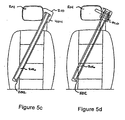
- Figures 5a-5d illustrate the adjustment of shoulder belt 202 by inflation integrated inertia reel 210, as headrest 214 is raised from the position shown in Figures 5a and 5b to the position shown in Figures 5c and 5d.
- Figures 5a and 5c show inflation integrated inertia reel 210 with a decorative cover 404
- Figures 5b and 5d show inflation integrated inertia reel 210 with decorative cover 404 removed.
- Both the webbing of shoulder belt 202 and the inflatable restraint 206 to which it is attached spool onto inflation integrated inertia reel 210.
- drum 304 rotates to pay out additional lengths of shoulder belt 202 and inflatable restraint 206.
- drum 304 rotates to retract the additional lengths of shoulder belt 202 and inflatable restraint 206. Because inflatable restraint 206 spools onto inflation integrated inertia reel 210, the inflatable seat belt restraint system of the present invention can deploy inflatable restraint 206 at any point along the rotation of drum 304, and can lock drum 304 and deploy inflatable restraint 206 for maximum protection of the vehicle occupant.
- inflator 302 discharges gas into the interior of drum 304.
- the gas pressurizes drum 304, forcing gas out of port 306 and into inflatable restraint 206.
- inflation integrated inertia reel 210 fills inflatable restraint 206 from the area of the occupant's shoulder
- inflatable restraint 206 inflates in one direction from the shoulder toward buckle assembly 204, instead of inflating up and over the occupant's shoulder as with some prior art systems.
- This method of inflation eliminates the need for an intermediate guide.
- inflatable restraint 206 inflates smoothly and evenly over drum 304, making the present invention much less susceptible to the kinking and bunching problems of the prior art systems.
- the present invention can inflate inflatable restraint 206 in any adjustment position without having to fix the upper end of the inflatable restraint.
- This flexible design is easily adaptable to any inflatable restraint that uses a remote inflator, such as the INFLATABANDTM, Inflatable Tubular Torso Restraint by Simula, and TAKATATM inflatable restraints.
- the present invention can be used as the shoulder belt inertia reel for virtually any restraint system that uses an inflatable belt system, including restraint systems used in such applications as aviation, automobiles, and military vehicles.
- drum 304 in conjunction with the deployment of inflatable restraint 206, locks to prevent further pay out of shoulder belt 202 and inflatable restraint 206.
- this locking can be provided by a conventional inertia reel locking mechanism, e.g., webbing sensing lock mechanism.
- Such a locking mechanism is analogous to the vehicle-sensing element of existing inertia reels, by which centrifugal motion is used to actuate the lockup of the inertia reel through a series of levers and detents.
- inflation integrated inertia reel 210 uses a pressure-actuated locking mechanism. Because inflation typically occurs well before the occupant loads the inflatable seat restraint system, the inflation gas pressure can trigger a locking mechanism more quickly than a conventional webbing sensing locking mechanism. Thus, the pressure-actuated locking mechanism would lock the system at a time earlier in the deployment sequence, thereby reducing the extent of the occupant movement and increasing occupant protection.
- the pressure-actuated locking mechanism includes at least one pin 600 to engage a frame on which inflation integrated inertial reel 210 is mounted.
- the at least one pin 600 is located on an axial side of drum 304. Pin 600 is in communication with the pressure vessel 602 of drum 304.
- inflation integrated inertia reel 210 has not been deployed and inflator 302 of inflation integrated inertia reel 210 has not been activated, thus leaving pressure vessel 602 unpressurized.
- the pressure-actuated locking mechanism could include two opposed pins 610 and 612 on the axial sides of drum 304, as shown in Figures 6b and 6c.
- Figure 6b shows pins 610 and 612 in a stowed position before pressure vessel 602 is pressurized.
- Figure 6c shows pins 610 and 612 after pressure vessel 602 is pressurized, when pins 610 and 612 are forced axially outward by pressure P in pressure vessel 602.
- the arrows of pressure P represent the force of pressure P pushing outward on the walls of pressure vessel 602 and on pins 610 and 612.
- pins 610 and 612 engage the frame of inflation integrated inertia reel 210 and lock drum 304 in place.
- pins 610 and 612 could engage detents on the inertia reel housing to lock the inertia reel. This arrangement would directly transfer the loads from the inertia reel to the inertia reel housing.
- inflation integrated inertia reel 210 is of a cast construction so that components such as drum 304, port 306, and webbing connection 400 can be cast into the part.
- a conventional inertia reel design could be expanded radially to accommodate an approximately 1-inch diameter opening along its axis.
- Inflation integrated inertia reel 210 would also include means for sealing the gas within drum 304.
- O-ring grooves could be cast into the part between rotating drum 304 and inflator 302.
- inflation integrated inertia reel 210 includes a shroud 402 placed around a portion of inflation integrated inertia reel 210 to limit the inflation of inflatable restraint 206 in the vicinity of inflation integrated inertia reel 210.
- Shroud 402 prevents decorative cover 404 (as shown in Figures 4a, 5a, and 5c) from detaching or becoming damaged during the deployment.
- the present invention provides several significant benefits over prior art systems: 1) it eliminates the need for a separate inflator housing; 2) it reduces the amount of high pressure hose; 3) it eliminates the problems with a sliding or translating inflator for a system that moves the inflator with the movement of the inflatable restraint; 4) it simplifies component connections; 5) it uses internal gas pressure in the drum of the inflation integrated inertia reel to initiate reel lock up; 6) it provides compact, cost-effective designs that do not require an additional housing or lengths of high pressure hose; 7) it provides an inflation integrated inertia reel with a low inertia compared to a translating inflator system, because the device rotates about the center of the inflator and reel axes; and 8) it provides a device that can move up and down with the headrest.
- Figures 7a-d and 8 illustrate an alternate embodiment of the present invention, referred to herein as an inertia reel lever arm 700.
- Inertia reel lever arm 700 provides all of the benefits of the embodiments described above, and, in addition, provides a further aspect of shoulder belt adjustment.
- inertia reel lever 700 preferably includes inflation integrated inertia reel 210, lever arm 702, coil springs 800 and 802, belt 704, and stop 706.
- Figures 7a-d show progressive positions of inertial reel lever arm 700 as it lets out belt 704, according to this alternate embodiment of the present invention.
- Figure 8 shows a cross-section of inertia reel lever arm 700, according to this alternate embodiment.
- inflation integrated inertia reel 210 is housed inside lever arm 702, and is connected to lever arm 702 by coil spring 800.
- Lever arm 702 is, in turn, connected to a seat back 801 by a coil spring 802, which provides less spring force than coil spring 800.
- Both inflation integrated inertia reel 210 and lever arm 702 are axially mounted such that they rotate about the same axis CCC (shown in Figure 8). Because coil spring 800 is stronger than coil spring 802, lever arm 702 and inflation integrated inertia reel 210 rotate together as the shoulder belt 704 is pulled (for example, rotating from the position shown in Figure 7a to the position shown in Figure 7b). Arrow R in Figure 7b shows the counterclockwise direction of rotation.
- Stop 706 prevents lever arm 702 from rotating past a predetermined orientation, as dictated by the geometry of the inflatable seat restraint system (e.g., the required length of payout or the required height of the shoulder belt during deployment).
- lever arm 702 and inflation integrated inertia reel 210 rotate together, lever arm 702 eventually contacts stop 706, at which point lever arm 702 stops rotating (as shown in Figure 7c).
- Inflation integrated inertia reel 210 continues to rotate independently of lever arm 702 as shoulder belt 704 is pulled (as shown in Figure 7d). Once lever arm 702 is stopped, shoulder belt 704 pulls against coil spring 802 only, and not against coil spring 800.
- lever arm 702 rotates to take up and pay out slack to accommodate differences in occupant size.
- inflation integrated inertia reel 210 rotates to pay out and take up slack needed for extended payout, such as when an occupant must move out of a normal seated position to reach for an object.
- this alternate embodiment provides an automatic belt height adjustment, as best shown by the progressive positions depicted in Figures 7a-7d.
- Inertia reel lever arm 700 is shaped so that the distance between axis CCC and the location at which belt 704 comes off of inertia reel lever arm 700 changes as inertia reel lever arm 700 rotates around axis CCC.
- inertia reel lever arm 700 is oblong, or cam shaped, so that belt 704 raises as lever arm 702 rotates around to stop 706.
- the oblong inertia reel lever arm 700 accommodates these relationships by raising the belt height as more belt length is paid out.
- inertia reel lever arm 700 has paid out relatively little belt length and the belt height is at its lowest position ⁇ for the smaller occupant configuration.
- inertia reel lever arm 700 has paid out substantially all of the size-adjusting belt length and the belt height is at its highest position - for the larger occupant configuration.
- coil spring 802 is adapted to provide comfortable tension in shoulder belt 704 for normal use.
- Coil spring 800 is adapted to provide higher tension in belt 704 when belt 704 is fully extended.
- This alternate embodiment of the present invention can incorporate typical locking mechanisms, e.g., conventional inertia reel locking mechanisms, to lock lever arm 702 and inflation integrated inertia reel 210.
- typical locking mechanisms e.g., conventional inertia reel locking mechanisms
- pressure-actuated pins can lock inflation integrated inertial reel 210, as described above.
- drum 304 itself could be shaped to change the height at which belt 704 comes off of drum 304 as drum 304 rotates.
- drum 304 could be oblong such that belt 704 raises as drum 304 rotates counterclockwise. The oblong shape could be provided, for example, by arm 305 of drum 304.
- the specification may have presented the method and/or process of the present invention as a particular sequence of steps. However, to the extent that the method or process does not rely on the particular order of steps set forth herein, the method or process should not be limited to the particular sequence of steps described. As one of ordinary skill in the art would appreciate, other sequences of steps may be possible. Therefore, the particular order of the steps set forth in the specification should not be construed as limitations on the claims. In addition, the claims directed to the method and/or process of the present invention should not be limited to the performance of their steps in the order written, and one skilled in the art can readily appreciate that the sequences may be varied and still remain within the spirit and scope of the present invention.
Landscapes
- Engineering & Computer Science (AREA)
- Mechanical Engineering (AREA)
- Air Bags (AREA)
- Automotive Seat Belt Assembly (AREA)
Abstract
Description
- The present invention relates generally to vehicle occupant restraint systems, and more particularly, to a seat belt restraint system that incorporates an inflatable section into the torso section of the belt.
- Inflatable seat restraint systems have proven to be a dramatic improvement over ordinary three-point sat belts. Unlike ordinary belts, these systems incorporate inflatable restraints that fill with gas immediately upon vehicle impact. The inflatable restraints pretension the system with a force sufficient to counter body loading, to restrict occupant motion during a crash, and to distribute crash loads over larger occupant surface area, thus minimizing injury.
- Figures 1a - 1e illustrate a typical prior art inflatable seat restraint system, as disclosed in the commonly assigned U.S. Patent No. 5,839,753 to Yaniv et al., which is incorporated by reference herein. The system includes
lap belt 102, shoulder ortorso belt 103, including aninflatable restraint 101,buckle assembly 105,anchor 106, anchoredinertia reels gas generator 122, and a sensor assembly (not shown). - As shown in Figure 1c,
lap belt 102 andshoulder belt 103 form one continuous strap which passes through the male portion ofbuckle assembly 105.Lap belt 102 is designed to restrict the forward motion of a seated occupant at the pelvis.Lap belt 102 is connected to anchoredinertia reel 117, which pivotally mountslap belt 102 to the floor or seat structure on the door-side of seat 121 (as shown in Figures 1a and 1b). The other end oflap belt 102 loops through the male portion ofbuckle assembly 105, so that the length oflap belt 102 can be adjusted to accommodate a wide range of occupant sizes. - The female portion of
buckle assembly 105 is attached tobuckle strap 107.Buckle strap 107 is pivotally mounted to an attachment point in the vehicle, such as the base ofseat 121, or a floor structure on the side ofseat 121 that is farthest from the door, byanchor 106. The female and male portions ofbuckle assembly 105 fasten together, thus securingseat belt system 110 around the occupant in a manner similar to that conventional three-point seat belt systems. - As shown in Figure 1d,
gas generator 122 is typically mounted inside the seat back. The gas generator is also sometimes located in the seat base.Durable tubing 116 provides a fluid path fromgas generator 122 toinflatable restraint 101. - As shown in Figure 1c,
inflatable restraint 101 is attached toshoulder belt 103 and extends diagonally from the occupant's hip to behind and above the occupant's shoulder. The upper end ofinflatable restraint 101 loops through a D-ring 108 that is mounted toseat 121 as shown (Figure 1d) or to the vehicle (e.g., at the roof rail or at the upper B-pillar area (not shown)). D-ring 108 acts as an intermediate guide forshoulder belt 103, setting the height at whichshoulder belt 103 wraps over the occcupant's shoulder.Shoulder belt 103 is then anchored toseat 121 or the vehicle (not shown) by aninertia reel 118. - As shown in Figure 1a,
shoulder strap 103 is routed inside the vehicle seat toinertia reel 118, which is mounted in the lower portion of the seat back. Thus, as shown in Figures 1b and 1d,tubing 116 provide fluid communication from the gas generator toinflatable restraint 101 in the torso of the restraint system. - As best shown in Figure 1d, when a collision occurs, the crash sensor sends a signal to the initiator in
gas generator 122, which forces gas throughdurable tubing 116 and intoinflatable restraint 101. As the gas flows intoinflatable restraint 101, the internal pressure causes the tube diameter to increase and the tube length to decrease. At the same time,seat belt system 110 is constrained on the outboard side byinertia reel 117 and on the inboard side byanchor 106, and behind the shoulder byinertia reel 118. Inertia reels 117 and 118 lock up during impact, preventing payout of the belt. Thus, asinflatable restraint 101 contracts, it pulls any slack out ofseat belt system 110. The occupant is thus provided with a pretensioned seat belt, which restricts the forward motion of the occupant and reduces primary injuries. - Typically, conventional inflatable seat belt restraint systems mount inflators in one of two locations: 1) either behind the seat for inflation from behind the occupant and over the shoulder, or 2) at the buckle for inflation from the buckle up to the occcupant's shoulder. The inflatable seat restraint system of Figures 1a - 1e is an example of this first configuration, which is referred to herein as the shoulder-fill design. The second configuration is referred to herein as the buckle-fill design. As used herein, inflator means any device that fills an inflatable restraint during system deployment, e.g., a gas generator.
- For both the shoulder-fill and buckle-fill designs, providing shoulder belt height adjustment to accommodate different torso lengths is a significant concern. To provide maximum occupant protection, the intermediate guide for the shoulder belt (e.g., D-
ring 108 in Figures 1a - 1e) must not be below or too far above the occupant's shoulder. Indeed, most manufacturers and safety experts recommend that the intermediate guide be positioned at or above an occupant's shoulder, with a maximum shoulder belt angle of 30° above horizontal. Such shoulder belt height adjustments are simple for conventional three-point seat belt systems, which have no inflatable restraints. However, substantial difficulties arise when incorporating sections of inflatable restraint. - For example, shoulder-fill designs, such as the design illustrated in Figures 1a - 1c, mount the inflator in a fixed position and use a high-pressure hose to connect the inflator to the inflatable restraint. The high-pressure hose is flexible to accommodate shoulder belt height adjustments, e.g., when D-
ring 108 is raised to wrap the belt over an occupant with a longer torso. Although this shoulder-fill design permits moderate shoulder belt height adjustment, the inflatable restraint must pass through the intermediate guide. Because the inflatable restraint tends to be bulky and stiff, the inflatable restraint and the webbing to which it is attached often kink and bunch around the intermediate guide. In addition, the small diameter of a typical intermediate guide (e.g., a D-ring) pinches the inflatable restraint and webbing. These restrictions cause uneven travel and deployment of the inflatable restraint, resulting in inadequate occupant protection. Although providing stronger clock springs on the inertia reel that feeds the webbing may help force the inflatable restraint over the intermediate guide and reduce kinking and bunching, the stronger pull compromises occupant comfort. - In an attempt to accommodate different height adjustments, designers have proposed various modifications to the shoulder-fill design, each with significant drawbacks. Such modifications have included inflators attached directly to the webbing, inflators mounted on linear slides or guides, and inflators mounted on swing arm devices. In providing a degree of shoulder belt height adjustment, each modification compromises occupant comfort or safety in some way. For example, in the systems that move the inflator in concert with the movement of the inflatable restraint, difficulty in sliding or translating the inflator is a common problem.
- In addition, shoulder-fill systems that attach the inflator directly to the webbing encounter undesirably high inertial loading during webbing retraction and payout, and during crash events. Installing counterweights and springs can offset this high intertial loading, but requires more parts, increased complexity, and higher costs.
- Shoulder-fill systems that mount the inflator on a linear slide can reduce sliding-friction. However, these designs also suffer from the undesirably high inertial loading described above.
- Shoulder-fill systems that mount the inflator to a swing arm also experience undesirably high inertial loading, unless the inflator is connected through a fluid coupler that pivots about the axis of rotation of the swing arm. However, again, installing the fluid coupler increases the cost and complexity of the system.
- All of the modified shoulder-fill designs require some provision for stopping the inertial loads of the inflator in the event of a crash. The webbing feels cumbersome to the occupant due to the inertial loading of the translating inflator. Thus, the conventional shoulder-fill designs fail to provide an optimal solution.
- Buckle-fill designs suffer from drawbacks as well. For example, a typical buckle-fill design fixes the inflatable restraint at the buckle where the gas is injected. An inertia reel mounted behind the seat lets out and retracts the webbing to accommodate the raising and lowering of the intermediate guide for shoulder belt height adjustment. Because this design requires that the inflatable restraint be fixed at the buckle, the length of the inflatable restraint remains unchanged as the intermediate guide is raised. Thus, when the intermediate guide is raised to its highest point, the inflatable restraint may not reach the shoulder of an occupant with a longer torso, therefore compromising occupant protection in this area.
- To provide inflatable restraint protection in this unprotected area, the design could extend the inflatable restraint up to the intermediate guide for the occupant with a longer torso. However, when the intermediate guide is lowered for smaller occupants, the inflatable restraint would have to pass through the intermediate guide, thereby raising the same problems discussed above for shoulder-fill designs (i.e., uneven travel and deployment due to kinking, bunching and pinching).
- In addition to inadequate shoulder belt height adjustment, the shoulder-fill and buckle-fill designs require a large number of components and several complex connections. For example, both designs necessitate a separate inflator housing and the shoulder-belt design requires large amounts of expensive high-pressure hose to connect the inflator to the inflatable tubular structure. In addition, the designs rely on conventional inertia reels, which are not designed for inflatable seat belt restraint systems and therefore can often be unreliable.
- DE 4 211 672 A1 displays a security belt for vehicle seats consisting of a certain woven textile and providing on at least a part of its length a bag which is inflatable by means of a chemical reaction, but it does not comprise an inertia reel which is attached to the shoulder belt and an inflatable restraint, and anchored above the seat, wherein the inertia reel on the one hand retracts and pays out the inflatable restraint and shoulder belt, and furthermore on the other hand inflates the inflatable restraint upon deployment of the inflatable seat restraint system.
- DE 298 212 72 U1 describes a belt system for restraining a vehicle occupant, comprising a safety belt, a belt buckle, two end fittings, at least one belt retractor, at least one inflatable belt gas bag and at least two belt tensioner, whereby at least one of the belt tensioners is an end fitting tensioner.
- DE 298 212 80 U1 discloses a system for restraining vehicle occupants, comprising a safety belt with two ends, two belt rewinder and furthermore a tubular gas bag, that is assigned to the safety belt, which differs to the content of the submitted application, where only one mean for the retracting and paying out of the shoulder belt is needed.
-
DE 200 08 315 U1 describes a vehicle occupant restraint system, comprising a vehicle seat with one part allocated to the seat and one part to the back of the seat, an inflatable safety belt and a gas generator, wherein the safety belt in the upper edge area of the back of the seat comprises at least one wrist point characterized by that the wrist point can be adjusted in height. - US 3 869 145 A reveals a self applying three point automatically inflatable vehicle safety lap and shoulder belt, which includes an inflatable fibrous lap and where the shoulder belts are joint at one end to a coupling ring and at their other ends to inertia locked spring biased retraction wheels. For the inflation of the connected belts it furthermore comprises a solenoid actuated valve system which is connected to a compressed air source to inflate and extend the belts.
- The present invention is an inflatable seat belt restraint system, and a corresponding method for deploying an inflatable seat belt restraint, which use an inflation integrated inertia reel to provide a wide range of shoulder belt adjustment. The inflation integrated inertia reel to provide a wide range of shoulder belt adjustment. The inflation integrated inertia reel mounts above an occupant's shoulder and secures both the shoulder belt webbing and inflatable restraint of the restraint system. An inflator in fluid communication with the inflation integrated inertia reel generates pressurized gas that flows into the inflation integrated inertia reel and then into the inflatable restraint. The pressurized gas can also be used to positively lock up the inflation integrated inertia reel.
- In mounting the inflation integrated inertia reel above the occupant's shoulder, the present invention eliminates the need for an intermediate guide and thereby solves the problems associated with the bunching and kinking of the inflatable restraints. In addition, by combining the inflator housing and inertia reel into a single component, the present invention uses fewer parts that prior art systems. Thus, the present invention provides shoulder belt adjustment with a minimum number of parts and without sacrificing full inflatable restraint protection from an occupant's lap to this shoulder.
- In an embodiment of the present invention, the inflatable seat restraint system includes a shoulder belt, an inflatable restraint, an inflator, an inflation integrated inertia reel, and a shoulder belt anchor that opposes the inflation integrated inertia reel. The shoulder belt anchor is preferably a buckle assembly. A lap belt and lap belt inertia reel can also be included to provide full occupant protection. The buckle assembly and lap belt inertia reel are attached to a lower portion of a seat or to a vehicle structure below the seat, and are located on opposite sides of the seat. The inflation integrated inertia reel is attached to an upper portion of the seat or to a vehicle structure proximate to the seat. The lap belt attaches to the lap belt inertia reel and the buckle assembly across an occupant's pelvis. The shoulder belt attaches to the buckle assembly and the inflation integrated inertia reel, and spans the occupant's torso diagonally from shoulder to pelvis. Optionally, the shoulder belt and lap belt could be one continuous belt.
- The inflation integrated inertia reel provides several functions of the present invention, including shoulder belt adjustment, gas generation, and the spooling, retracting and locking of the shoulder belt webbing and inflatable restraint. According to an embodiment of the present invention, the inflation integrated inertia reel includes a webbing anchor, a drum, and a port for ducting the inflation gas to the inflatable restraint. Optionally, the inflation integrated inertia reel also includes a locking mechanism that detects a crash event and locks the drum.
- These and other objects and advantages of the present invention are described in greater detail in the detailed description of the invention, and the appended drawings. Additional features and advantages of the invention will be set forth in the description that follows, will be apparent from the description, or may be learned by practicing the invention.
-
- Figure 1a is a schematic diagram of a side view of a prior art inflatable seat restraint system in an uninflated configuration.
- Figure 1b is a schematic diagram of the prior art inflatable seat restraint system shown in Figure 1a, in an inflated configuration.
- Figure 1c is a schematic diagram of a front view of the prior art inflatable seat restraint system shown in Figure 1b, in an inflated configuration.
- Figure 1d is a schematic diagram of a cut-away rear view of the prior art inflatable seat restraint system shown in Figure 1a, in an uninflated configuration.
- Figure 1e is a schematic diagram of a cut-away rear view of the prior art inflatable seat restraint system shown in Figure 1b, in an inflated configuration.
- Figure 2 is a schematic diagram of an inflatable seat belt restraint system according to an embodiment of the present invention.
- Figure 3 is a schematic diagram of an enlarged view of the inflation integrated inertia reel shown in Figure 2.
- Figure 4a is a schematic diagram of an axial view of a portion of the inflation integrated inertia reel shown in Figure 3, according to an embodiment of the present invention.
- Figure 4b is a schematic diagram of the inflation integrated inertia reel shown in Figure 4a, with the belt and inflatable restraint fully paid out and with the shroud and decorative cover removed for clarity.
- Figure 4c is a schematic diagram of the inflation integrated inertia reel shown in Figure 4a, with the belt and inflatable restraint fully retracted and with the shroud and decorative cover removed for clarity.
- Figures 5a-5d are schematic diagrams of an embodiment of the inflatable seat restraint system of the present invention, shown in different shoulder belt height adjustment positions, with (Figures 5a and 5c) and without (Figures 5b and 5d) covers for the inflation integrated inertia reel.
- Figure 6a is a schematic diagram of an inflation integrated inertia reel having a pressure-actuated locking mechanism with one pin, according to an embodiment of the present invention.
- Figure 6b is a schematic diagram of an inflation integrated inertia reel having a pressure-actuated locking mechanism with two pins in a stowed position, according to an embodiment of the present invention.
- Figure 6c is a schematic diagram of the inflation integrated inertia reel shown in Figure 6b, with the pins forced out and the inertia reel locked.
- Figure 7a is a schematic diagram of an inertia reel lever arm with its belt fully retracted, according to an alternate embodiment of the present invention.
- Figure 7b is a schematic diagram of the inertia reel lever arm shown in Figure 7a rotating to pay out its belt.
- Figure 7c is a schematic diagram of the inertia reel lever arm shown in Figure 7a, with its lever arm contacting a stop and with its inflation integrated inertia reel yet to rotate independently of the lever arm.
- Figure 7d is a schematic diagram of the inertia reel lever arm shown in Figure 7a, with its lever arm contacting a stop and with its inflation integrated inertia reel rotated independently of the lever arm to pay out an additional belt length.
- Figure 8 shows a cross-section of the inertia reel lever arm shown in Figure 7a.
- The present invention is an inflatable seat restraint system, and a corresponding method for deploying an inflatable seat restraint, which provide shoulder belt adjustment without compromising the performance of the inflatable restraint. Referring to Figure 2, an embodiment of the present invention includes a
shoulder belt 202, aninflatable restraint 206, an inflationintegrated inertia reel 210, and an inflator, which, in this embodiment, is contained in inflation integratedinertia reel 210. This embodiment also includes an anchor forshoulder belt 202 that opposes inflationintegrated inertia reel 210, which in this example is abuckle assembly 204. -
Lap belt 200 and lapbelt inertia reel 208 are also shown to provide full occupant protection.Buckle assembly 204 and lapbelt inertia reel 208 are located on opposite sides ofseat 212 and are anchored to seat 212 or to a vehicle structure. As used herein, anchored means fixed to another member either directly or through intermediate components. Although shown as a separate belt,lap belt 200 andshoulder belt 202 could be, for example, a single continuous belt that extends from inflationintegrated inertia reel 210 throughbuckle assembly 204 and to lapbelt inertia reel 208. The single strap could be fixed or slideably attached to buckleassembly 204, for example. - Inflation integrated
inertia reel 210 may be attached to an upper portion ofseat 212 or to a vehicle structure aboveseat 212. In the embodiment of Figure 2, inflation integrated inertia reel is fixed toheadrest 214, which adjusts up and down for differently sized occupants.Lap belt 200 attaches to lapbelt inertia reel 208 andbuckle assembly 204 across an occupant's pelvis.Shoulder belt 202, withinflatable restraint 206 mounted on top, attaches to buckleassembly 204 and inflation integratedinertia reel 210, and spans the occupant's torso diagonally from shoulder to pelvis. - Figure 3 shows an enlarged view of the inflation integrated
inertia reel 210 depicted in Figure 2. Figure 4a shows an axial view of a portion of the inflation integratedinertia reel 210 shown in Figure 3. As shown in Figure 3, inflation integratedinertia reel 210 includes aninflator 302 and adrum 304. A conventional inertiareel locking mechanism 300 is also included, which detects a crash event (e.g., an impact above a predetermined threshold) and locks drum 304.Shoulder belt 202 andinflatable restraint 206 are both attached to drum 304. As shown in Figure 4a, inflation integratedinertia reel 210 further includes awebbing anchor 400 and aport 306.Webbing anchor 400 attachesshoulder belt 202 to drum 304.Port 306 fluidly connectsinflatable restraint 206 to drum 304.Inflatable restraint 206 andbelt 202 spool ontoarm 305 ofdrum 304. -
Port 306 andwebbing anchor 400 are positioned ondrum 304 so thatinflatable restraint 206 lies on top ofshoulder belt 202 whendrum 304 spools up. For example, in Figure 4a, drum 304 spools up in a clockwise direction, requiringport 306 to be positioned in advance ofwebbing anchor 400 in a clockwise direction.Port 306 provides fluid communication betweeninflatable restraint 206 and the interior ofdrum 304. Optionally, a short section of high-pressure hose could be used betweenport 306 andinflatable restraint 206 to facilitate the connection. Also, optionally, the inflation gas could be ducted to drum 304 using an axial connection similar to the connection used on a garden hose spool. - Figures 4b and 4c illustrate
drum 304 in a fully paid out and fully retracted position, respectively. As shown by these relative positions,drum 304 rotates up to substantially one revolution such thatinflatable restraint 206 spools up a maximum distance without overlapping onto itself. Keepinginflatable restraint 206 from being overlapped ensures that fluid communication remains open betweendrum 304 andinflatable restraint 206. In this manner,inflatable restraint 206 can be easily inflated at any adjustment position. For example, ifdrum 304 is a 3-inch diameter cylinder, then up to 175 mm of payout can be achieved without overlapping the inflatable restraint. Optionally, if more payout is desired, a larger diameter drum may be used. - In an embodiment of the present invention, the cross-sectional area of
drum 304 is preferably large enough to houseinflator 302, to prevent the pinching and bunching ofinflatable restraint 206, and to provide enough payout for shoulder belt length and height adjustments. For example, in the case of a circular cross section (i.e., a cylindrical drum), the diameter is preferably large enough to allow smooth retraction ofinflatable restraint 206, as well as uniform inflation without pinching the inflatable restraint and constricting gas flow. In addition to a preferable size,drum 304 is also preferably adapted to contain the inflating gas to build pressure that initiates a pressure-actuated locking mechanism of drum 304 (described below). - For optimal inflation performance, the cross-sectional area of
drum 304 is large to improve retraction ofinflatable restraint 206 and to reduce the possibility of pinchinginflatable restraint 206 during deployment such that no gas flows. In addition, the large cross-sectional area provides room forinflator 302 to be incorporated at the axis of rotation ofdrum 304. In an embodiment of the present invention, the cross-section is circular with a diameter of at least approximately 50 mm. -
Inflator 302 is in fluid communication withdrum 304. Preferably, at least a portion ofinflator 302 is mounted inside ofdrum 304. More preferably,inflator 302 is mounted on the inside ofdrum 304 and rotates freely with inflationintegrated inertia reel 210. By integrating the inflator intodrum 304, thedrum 304 acts as an inflator housing and pressure vessel that contains discharged gas and ducts the gas toinflatable restraint 206. Locatinginflator 302inside drum 304 also significantly reduces inertial loads in comparison to translating inflator systems. As an alternate embodiment,inflator 302 can be rigidly mounted to the frame of inflation integratedinertia reel 210 ondrum 304's axis of rotation such thatdrum 304 rotates aroundinflator 302. - In normal operation, the inflatable seat belt restraint system of the present invention allows the adjustment of
lap belt 200 using lapbelt inertia reel 208 and the adjustment ofshoulder belt 202 using inflation integratedinertia reel 210. Mounted above the seat, inflation integratedinertia reel 210 can travel up and down by movement on its mount or by movement of the structure to which it is mounted. For example, inflation integratedinertia reel 210 could be mounted to the adjustable headrest of a seat. In addition,inflatable restraint 206 can be deployed in any reel orientation. - Figures 5a-5d illustrate the adjustment of
shoulder belt 202 by inflationintegrated inertia reel 210, asheadrest 214 is raised from the position shown in Figures 5a and 5b to the position shown in Figures 5c and 5d. Figures 5a and 5c show inflation integratedinertia reel 210 with adecorative cover 404, while Figures 5b and 5d show inflation integratedinertia reel 210 withdecorative cover 404 removed. Both the webbing ofshoulder belt 202 and theinflatable restraint 206 to which it is attached spool onto inflation integratedinertia reel 210. As inflation integratedinertia reel 210 is raised to accommodate larger occupants,drum 304 rotates to pay out additional lengths ofshoulder belt 202 andinflatable restraint 206. When inflation integratedinertia reel 210 is then lowered for smaller occupants,drum 304 rotates to retract the additional lengths ofshoulder belt 202 andinflatable restraint 206. Becauseinflatable restraint 206 spools onto inflation integratedinertia reel 210, the inflatable seat belt restraint system of the present invention can deployinflatable restraint 206 at any point along the rotation ofdrum 304, and can lockdrum 304 and deployinflatable restraint 206 for maximum protection of the vehicle occupant. - Referring again to Figures 2, 3, and 4a-4c, upon deployment,
inflator 302 discharges gas into the interior ofdrum 304. The gas pressurizesdrum 304, forcing gas out ofport 306 and intoinflatable restraint 206. Because inflation integratedinertia reel 210 fillsinflatable restraint 206 from the area of the occupant's shoulder,inflatable restraint 206 inflates in one direction from the shoulder towardbuckle assembly 204, instead of inflating up and over the occupant's shoulder as with some prior art systems. This method of inflation eliminates the need for an intermediate guide. As a result,inflatable restraint 206 inflates smoothly and evenly overdrum 304, making the present invention much less susceptible to the kinking and bunching problems of the prior art systems. - By using retractable inflation integrated
inertia reel 210, the present invention can inflateinflatable restraint 206 in any adjustment position without having to fix the upper end of the inflatable restraint. This flexible design is easily adaptable to any inflatable restraint that uses a remote inflator, such as the INFLATABAND™, Inflatable Tubular Torso Restraint by Simula, and TAKATA™ inflatable restraints. The present invention can be used as the shoulder belt inertia reel for virtually any restraint system that uses an inflatable belt system, including restraint systems used in such applications as aviation, automobiles, and military vehicles. - According to an embodiment of the present invention, in conjunction with the deployment of
inflatable restraint 206, drum 304 locks to prevent further pay out ofshoulder belt 202 andinflatable restraint 206. As shown in Figure 3, this locking can be provided by a conventional inertia reel locking mechanism, e.g., webbing sensing lock mechanism. Such a locking mechanism is analogous to the vehicle-sensing element of existing inertia reels, by which centrifugal motion is used to actuate the lockup of the inertia reel through a series of levers and detents. - However, according to another embodiment of the present invention, inflation integrated
inertia reel 210 uses a pressure-actuated locking mechanism. Because inflation typically occurs well before the occupant loads the inflatable seat restraint system, the inflation gas pressure can trigger a locking mechanism more quickly than a conventional webbing sensing locking mechanism. Thus, the pressure-actuated locking mechanism would lock the system at a time earlier in the deployment sequence, thereby reducing the extent of the occupant movement and increasing occupant protection. - According to this embodiment of the present invention, an example of which is shown in Figure 6a, the pressure-actuated locking mechanism includes at least one pin 600 to engage a frame on which inflation integrated
inertial reel 210 is mounted. Preferably, the at least one pin 600 is located on an axial side ofdrum 304. Pin 600 is in communication with thepressure vessel 602 ofdrum 304. In Figure 6a, inflation integratedinertia reel 210 has not been deployed andinflator 302 of inflation integratedinertia reel 210 has not been activated, thus leavingpressure vessel 602 unpressurized. When inflation integratedinertia reel 210 is deployed andpressure vessel 602 is pressurized, pin 600 is forced axially out ofdrum 304 to engage a hole in the frame of inflation integratedinertia reel 210. This pressure-actuated lock would function in any attitude or orientation. - Instead of a single pin, the pressure-actuated locking mechanism could include two
opposed pins drum 304, as shown in Figures 6b and 6c. Figure 6b showspins pressure vessel 602 is pressurized. Figure 6c showspins pressure vessel 602 is pressurized, when pins 610 and 612 are forced axially outward by pressure P inpressure vessel 602. The arrows of pressure P represent the force of pressure P pushing outward on the walls ofpressure vessel 602 and onpins inertia reel 210 and lockdrum 304 in place. - Alternatively, pins 610 and 612 could engage detents on the inertia reel housing to lock the inertia reel. This arrangement would directly transfer the loads from the inertia reel to the inertia reel housing.
- In an embodiment of the present invention, inflation integrated
inertia reel 210 is of a cast construction so that components such asdrum 304,port 306, andwebbing connection 400 can be cast into the part. As an example of an acceptable design, a conventional inertia reel design could be expanded radially to accommodate an approximately 1-inch diameter opening along its axis. Inflation integratedinertia reel 210 would also include means for sealing the gas withindrum 304. For example, O-ring grooves could be cast into the part betweenrotating drum 304 andinflator 302. - In an alternative embodiment of the present invention, as shown in Figure 4a, inflation integrated
inertia reel 210 includes ashroud 402 placed around a portion of inflation integratedinertia reel 210 to limit the inflation ofinflatable restraint 206 in the vicinity of inflation integratedinertia reel 210.Shroud 402 prevents decorative cover 404 (as shown in Figures 4a, 5a, and 5c) from detaching or becoming damaged during the deployment. - Thus, the present invention provides several significant benefits over prior art systems: 1) it eliminates the need for a separate inflator housing; 2) it reduces the amount of high pressure hose; 3) it eliminates the problems with a sliding or translating inflator for a system that moves the inflator with the movement of the inflatable restraint; 4) it simplifies component connections; 5) it uses internal gas pressure in the drum of the inflation integrated inertia reel to initiate reel lock up; 6) it provides compact, cost-effective designs that do not require an additional housing or lengths of high pressure hose; 7) it provides an inflation integrated inertia reel with a low inertia compared to a translating inflator system, because the device rotates about the center of the inflator and reel axes; and 8) it provides a device that can move up and down with the headrest.
- Figures 7a-d and 8 illustrate an alternate embodiment of the present invention, referred to herein as an inertia
reel lever arm 700. Inertiareel lever arm 700 provides all of the benefits of the embodiments described above, and, in addition, provides a further aspect of shoulder belt adjustment. As shown in Figures 7a-d and 8,inertia reel lever 700 preferably includes inflationintegrated inertia reel 210,lever arm 702, coil springs 800 and 802,belt 704, and stop 706. Figures 7a-d show progressive positions of inertialreel lever arm 700 as it lets outbelt 704, according to this alternate embodiment of the present invention. Figure 8 shows a cross-section of inertiareel lever arm 700, according to this alternate embodiment. - In this embodiment, inflation integrated
inertia reel 210 is housed insidelever arm 702, and is connected to leverarm 702 bycoil spring 800.Lever arm 702 is, in turn, connected to a seat back 801 by a coil spring 802, which provides less spring force thancoil spring 800. Both inflation integratedinertia reel 210 andlever arm 702 are axially mounted such that they rotate about the same axis CCC (shown in Figure 8). Becausecoil spring 800 is stronger than coil spring 802,lever arm 702 and inflation integratedinertia reel 210 rotate together as theshoulder belt 704 is pulled (for example, rotating from the position shown in Figure 7a to the position shown in Figure 7b). Arrow R in Figure 7b shows the counterclockwise direction of rotation. - Stop 706 prevents
lever arm 702 from rotating past a predetermined orientation, as dictated by the geometry of the inflatable seat restraint system (e.g., the required length of payout or the required height of the shoulder belt during deployment). Thus, aslever arm 702 and inflation integratedinertia reel 210 rotate together,lever arm 702 eventually contacts stop 706, at whichpoint lever arm 702 stops rotating (as shown in Figure 7c). Inflation integratedinertia reel 210 continues to rotate independently oflever arm 702 asshoulder belt 704 is pulled (as shown in Figure 7d). Oncelever arm 702 is stopped,shoulder belt 704 pulls against coil spring 802 only, and not againstcoil spring 800. - After
lever arm 702 is stopped, the continued rotation of inflation integratedinertia reel 210 provides an occupant with additional payout ofshoulder belt 704, which accommodates situations such as when the occupant needs to reach for an object beyond a normal operating position. Once the occupant returns to the normal operating position, the additional payout ofshoulder belt 704 spools back onto inflation integratedinertia reel 210 first because of the high coil spring force ofcoil spring 800. Asshoulder belt 704 continues to retract,lever arm 702 eventually rotates away fromstop 706. - This lever arm configuration affords two levels of belt adjustment. First,
lever arm 702 rotates to take up and pay out slack to accommodate differences in occupant size. Second, oncelever arm 702 rotates againststop 706, inflation integratedinertia reel 210 rotates to pay out and take up slack needed for extended payout, such as when an occupant must move out of a normal seated position to reach for an object. Thus, this alternate embodiment of the present invention provides an additional aspect of belt adjustment in addition to the benefits described above for the other embodiments. - In addition, this alternate embodiment provides an automatic belt height adjustment, as best shown by the progressive positions depicted in Figures 7a-7d. Inertia
reel lever arm 700 is shaped so that the distance between axis CCC and the location at whichbelt 704 comes off of inertiareel lever arm 700 changes as inertiareel lever arm 700 rotates around axis CCC. Preferably, inertiareel lever arm 700 is oblong, or cam shaped, so thatbelt 704 raises aslever arm 702 rotates around to stop 706. Generally, smaller occupants require a shorter belt length and a lower belt height, while larger occupants require a longer belt length and a higher belt height. The oblong inertiareel lever arm 700 accommodates these relationships by raising the belt height as more belt length is paid out. - Thus, for example, in Figure 7a, inertia
reel lever arm 700 has paid out relatively little belt length and the belt height is at its lowest position ― for the smaller occupant configuration. In contrast, in Figure 7c, inertiareel lever arm 700 has paid out substantially all of the size-adjusting belt length and the belt height is at its highest position - for the larger occupant configuration. - In this alternate embodiment of the present invention, coil spring 802 is adapted to provide comfortable tension in
shoulder belt 704 for normal use.Coil spring 800 is adapted to provide higher tension inbelt 704 whenbelt 704 is fully extended. These spring forces and the shape of inertiareel lever arm 700 ensure thatshoulder belt 704 is located properly on the occupant, onlever arm 702, and on inflation integratedinertia reel 210. - This alternate embodiment of the present invention can incorporate typical locking mechanisms, e.g., conventional inertia reel locking mechanisms, to lock
lever arm 702 and inflation integratedinertia reel 210. However, pressure-actuated pins can lock inflation integratedinertial reel 210, as described above. - The above alternate preferred embodiment describes the separately rotating
lever arm 702 and inflation integratedinertia reel 210 as providing both belt length and belt height adjustment. However, belt height adjustment could be provided in a similar manner using only drum 304 (referring to Figure 4a, for example), withoutlever arm 702. For example, excludinglever arm 702, drum 304 itself could be shaped to change the height at whichbelt 704 comes off ofdrum 304 asdrum 304 rotates. Specifically, as described above forlever arm 702,drum 304 could be oblong such thatbelt 704 raises asdrum 304 rotates counterclockwise. The oblong shape could be provided, for example, byarm 305 ofdrum 304. - Although described herein with respect to a single type of inertia reel, one of ordinary skill in the art would appreciate that the present invention is applicable to other types of inertia reels, as well as load limiters, adjusters, and other devices that are used to adjust restraints. Accordingly, the scope of the invention should be determined not by the examples of embodiments illustrated herein, but by the appended claims and their equivalents.
- The foregoing disclosure of embodiments of the present invention has been presented for purposes of illustration and description. It is not intended to be exhaustive or to limit the invention to the precise forms disclosed. Many variations and modifications of the embodiments described herein will be obvious to one of ordinary skill in the art in light of the above disclosure. The scope of the invention is to be defined only by the claims, and by their equivalents.
- Further, in describing representative embodiments of the present invention, the specification may have presented the method and/or process of the present invention as a particular sequence of steps. However, to the extent that the method or process does not rely on the particular order of steps set forth herein, the method or process should not be limited to the particular sequence of steps described. As one of ordinary skill in the art would appreciate, other sequences of steps may be possible. Therefore, the particular order of the steps set forth in the specification should not be construed as limitations on the claims. In addition, the claims directed to the method and/or process of the present invention should not be limited to the performance of their steps in the order written, and one skilled in the art can readily appreciate that the sequences may be varied and still remain within the spirit and scope of the present invention.
Claims (5)
- An inflatable seat restraint system comprising:a) an anchor anchored to a vehicle on a first side of a seat;b) a shoulder belt attached to the anchor;c) an inflatable restraint attached to the shoulder belt; andd) an inertia reel attached to the shoulder belt and the inflatable restraint, and anchored above the seat,
wherein the inertia reel retracts and pays out the inflatable restraint and shoulder belt, and inflates the inflatable restraint upon deployment of the inflatable seat restraint system. - The system of claim 1, wherein the anchor is a buckle assembly.
- The system of claim 1, wherein the inertia reel is anchored to a headrest above the seat,
wherein the inertia reel pays out the shoulder belt and the inflatable restraint as the headrest rises, and
wherein the inertia reel retracts the shoulder belt and the inflatable restraint as the headrest lowers. - The system of claim 2, further comprising:e) a lap belt inertia reel anchored to the vehicle on a second side of the seat; andf) a lap belt attached to the lap belt inertia reel and the buckle assembly.
- The system of claim 2, further comprising:e) a lap belt inertia reel anchored to the vehicle on a second side of the seat; andf) a lap belt attached to the lap belt inertia reel and the shoulder belt, wherein the lap belt and the shoulder belt are a single belt attached to the inertia reel and the lap belt inertia reel, and slideably attached to the buckle assembly.
Applications Claiming Priority (3)
| Application Number | Priority Date | Filing Date | Title |
|---|---|---|---|
| US23768400P | 2000-10-05 | 2000-10-05 | |
| US09/962,071 US6547273B2 (en) | 2000-10-05 | 2001-09-26 | Inflatable seat restraint system using an inflation integrated inertia reel |
| EP01979447A EP1363813B1 (en) | 2000-10-05 | 2001-10-04 | Inertia reel having a pressure vessel for an inflatable restraint |
Related Parent Applications (1)
| Application Number | Title | Priority Date | Filing Date |
|---|---|---|---|
| EP01979447A Division EP1363813B1 (en) | 2000-10-05 | 2001-10-04 | Inertia reel having a pressure vessel for an inflatable restraint |
Publications (2)
| Publication Number | Publication Date |
|---|---|
| EP1614591A2 true EP1614591A2 (en) | 2006-01-11 |
| EP1614591A3 EP1614591A3 (en) | 2006-01-18 |
Family
ID=35464445
Family Applications (1)
| Application Number | Title | Priority Date | Filing Date |
|---|---|---|---|
| EP05018934A Withdrawn EP1614591A3 (en) | 2000-10-05 | 2001-10-04 | Inflatable seat restraint system using an inflation integrated inertia reel |
Country Status (1)
| Country | Link |
|---|---|
| EP (1) | EP1614591A3 (en) |
Cited By (1)
| Publication number | Priority date | Publication date | Assignee | Title |
|---|---|---|---|---|
| US10604259B2 (en) | 2016-01-20 | 2020-03-31 | Amsafe, Inc. | Occupant restraint systems having extending restraints, and associated systems and methods |
Family Cites Families (5)
| Publication number | Priority date | Publication date | Assignee | Title |
|---|---|---|---|---|
| JPS5610071B2 (en) * | 1972-08-23 | 1981-03-05 | ||
| DE4211672C2 (en) * | 1992-04-07 | 1995-03-23 | Keiper Recaro Gmbh Co | Seat belts for vehicle seats, in particular motor vehicle seats |
| DE29821280U1 (en) * | 1998-11-27 | 1999-03-25 | TRW Occupant Restraint Systems GmbH & Co. KG, 73553 Alfdorf | Vehicle occupant restraint system with a belt gas bag |
| DE29821272U1 (en) * | 1998-11-27 | 1999-03-25 | TRW Occupant Restraint Systems GmbH & Co. KG, 73553 Alfdorf | Belt system for restraining a vehicle occupant |
| DE20008315U1 (en) * | 2000-05-09 | 2000-09-21 | TRW Occupant Restraint Systems GmbH & Co. KG, 73553 Alfdorf | Vehicle occupant restraint system |
-
2001
- 2001-10-04 EP EP05018934A patent/EP1614591A3/en not_active Withdrawn
Cited By (1)
| Publication number | Priority date | Publication date | Assignee | Title |
|---|---|---|---|---|
| US10604259B2 (en) | 2016-01-20 | 2020-03-31 | Amsafe, Inc. | Occupant restraint systems having extending restraints, and associated systems and methods |
Also Published As
| Publication number | Publication date |
|---|---|
| EP1614591A3 (en) | 2006-01-18 |
Similar Documents
| Publication | Publication Date | Title |
|---|---|---|
| EP1363813B1 (en) | Inertia reel having a pressure vessel for an inflatable restraint | |
| US9346430B2 (en) | Inflatable seatbelt | |
| US5839753A (en) | Inflatable tubular torso restraint system | |
| US7905514B2 (en) | Motor vehicle safety restraint system | |
| US6126194A (en) | Inflatable tubular torso restraint system | |
| EP1997693B1 (en) | Air bag module with vent controlled by tether | |
| US7862081B2 (en) | Motor vehicle safety restraint system | |
| EP1944200A1 (en) | Occupant restraint apparatus | |
| US20200254953A1 (en) | Modular restraint seat for vehicle with one or more integrated safety features | |
| US11904792B2 (en) | Seat-centric airbag system with active pelvis restraint | |
| US20060170200A1 (en) | Self-adjusting seatbelt fastener | |
| US7322603B2 (en) | Seat belt system including an airbag | |
| EP1457392A1 (en) | Seatbelt Airbag | |
| US20060289220A1 (en) | Occupant protection system, automobile, and occupant protection method | |
| US7237799B2 (en) | Seat belt system | |
| US7237800B2 (en) | Occupant protection system | |
| WO1997006983A1 (en) | Inflatable tubular restraint system | |
| EP1117567A1 (en) | Inflatable tubular seat restraint system | |
| CA2259317C (en) | Inflatable tubular torso restraint system | |
| EP1614591A2 (en) | Inflatable seat restraint system using an inflation integrated inertia reel | |
| CN112721857A (en) | Pretensioner for passenger restraint system | |
| JP7254757B2 (en) | passenger restraint system | |
| JP7771856B2 (en) | Occupant protection devices |
Legal Events
| Date | Code | Title | Description |
|---|---|---|---|
| PUAI | Public reference made under article 153(3) epc to a published international application that has entered the european phase |
Free format text: ORIGINAL CODE: 0009012 |
|
| PUAL | Search report despatched |
Free format text: ORIGINAL CODE: 0009013 |
|
| 17P | Request for examination filed |
Effective date: 20050831 |
|
| AC | Divisional application: reference to earlier application |
Ref document number: 1363813 Country of ref document: EP Kind code of ref document: P |
|
| AK | Designated contracting states |
Kind code of ref document: A2 Designated state(s): AT BE CH CY DE DK ES FI FR GB GR IE IT LI LU MC NL PT SE TR |
|
| AK | Designated contracting states |
Kind code of ref document: A3 Designated state(s): AT BE CH CY DE DK ES FI FR GB GR IE IT LI LU MC NL PT SE TR |
|
| GRAP | Despatch of communication of intention to grant a patent |
Free format text: ORIGINAL CODE: EPIDOSNIGR1 |
|
| AKX | Designation fees paid |
Designated state(s): AT BE CH CY DE DK ES FI FR GB GR IE IT LI LU MC NL PT SE TR |
|
| STAA | Information on the status of an ep patent application or granted ep patent |
Free format text: STATUS: THE APPLICATION IS DEEMED TO BE WITHDRAWN |
|
| 18D | Application deemed to be withdrawn |
Effective date: 20070131 |