EP1612767A2 - Sound effect applying apparatus and sound effect applying program - Google Patents
Sound effect applying apparatus and sound effect applying program Download PDFInfo
- Publication number
- EP1612767A2 EP1612767A2 EP05105685A EP05105685A EP1612767A2 EP 1612767 A2 EP1612767 A2 EP 1612767A2 EP 05105685 A EP05105685 A EP 05105685A EP 05105685 A EP05105685 A EP 05105685A EP 1612767 A2 EP1612767 A2 EP 1612767A2
- Authority
- EP
- European Patent Office
- Prior art keywords
- subharmonics
- input signal
- sound effect
- gain
- spectrum
- Prior art date
- Legal status (The legal status is an assumption and is not a legal conclusion. Google has not performed a legal analysis and makes no representation as to the accuracy of the status listed.)
- Granted
Links
- 230000000694 effects Effects 0.000 title claims abstract description 70
- 238000001228 spectrum Methods 0.000 claims abstract description 91
- 238000000034 method Methods 0.000 claims description 14
- 239000000203 mixture Substances 0.000 claims description 2
- 239000011295 pitch Substances 0.000 description 22
- 238000001514 detection method Methods 0.000 description 8
- 238000010586 diagram Methods 0.000 description 7
- 230000007423 decrease Effects 0.000 description 3
- 239000000470 constituent Substances 0.000 description 2
- 238000006243 chemical reaction Methods 0.000 description 1
- 230000003247 decreasing effect Effects 0.000 description 1
- 229920006395 saturated elastomer Polymers 0.000 description 1
- 210000001260 vocal cord Anatomy 0.000 description 1
Images



Classifications
-
- G—PHYSICS
- G10—MUSICAL INSTRUMENTS; ACOUSTICS
- G10H—ELECTROPHONIC MUSICAL INSTRUMENTS; INSTRUMENTS IN WHICH THE TONES ARE GENERATED BY ELECTROMECHANICAL MEANS OR ELECTRONIC GENERATORS, OR IN WHICH THE TONES ARE SYNTHESISED FROM A DATA STORE
- G10H1/00—Details of electrophonic musical instruments
- G10H1/02—Means for controlling the tone frequencies, e.g. attack or decay; Means for producing special musical effects, e.g. vibratos or glissandos
- G10H1/06—Circuits for establishing the harmonic content of tones, or other arrangements for changing the tone colour
- G10H1/08—Circuits for establishing the harmonic content of tones, or other arrangements for changing the tone colour by combining tones
- G10H1/10—Circuits for establishing the harmonic content of tones, or other arrangements for changing the tone colour by combining tones for obtaining chorus, celeste or ensemble effects
-
- G—PHYSICS
- G10—MUSICAL INSTRUMENTS; ACOUSTICS
- G10H—ELECTROPHONIC MUSICAL INSTRUMENTS; INSTRUMENTS IN WHICH THE TONES ARE GENERATED BY ELECTROMECHANICAL MEANS OR ELECTRONIC GENERATORS, OR IN WHICH THE TONES ARE SYNTHESISED FROM A DATA STORE
- G10H1/00—Details of electrophonic musical instruments
- G10H1/0091—Means for obtaining special acoustic effects
-
- G—PHYSICS
- G10—MUSICAL INSTRUMENTS; ACOUSTICS
- G10L—SPEECH ANALYSIS TECHNIQUES OR SPEECH SYNTHESIS; SPEECH RECOGNITION; SPEECH OR VOICE PROCESSING TECHNIQUES; SPEECH OR AUDIO CODING OR DECODING
- G10L21/00—Speech or voice signal processing techniques to produce another audible or non-audible signal, e.g. visual or tactile, in order to modify its quality or its intelligibility
- G10L21/003—Changing voice quality, e.g. pitch or formants
-
- G—PHYSICS
- G10—MUSICAL INSTRUMENTS; ACOUSTICS
- G10H—ELECTROPHONIC MUSICAL INSTRUMENTS; INSTRUMENTS IN WHICH THE TONES ARE GENERATED BY ELECTROMECHANICAL MEANS OR ELECTRONIC GENERATORS, OR IN WHICH THE TONES ARE SYNTHESISED FROM A DATA STORE
- G10H2210/00—Aspects or methods of musical processing having intrinsic musical character, i.e. involving musical theory or musical parameters or relying on musical knowledge, as applied in electrophonic musical tools or instruments
- G10H2210/155—Musical effects
-
- G—PHYSICS
- G10—MUSICAL INSTRUMENTS; ACOUSTICS
- G10H—ELECTROPHONIC MUSICAL INSTRUMENTS; INSTRUMENTS IN WHICH THE TONES ARE GENERATED BY ELECTROMECHANICAL MEANS OR ELECTRONIC GENERATORS, OR IN WHICH THE TONES ARE SYNTHESISED FROM A DATA STORE
- G10H2250/00—Aspects of algorithms or signal processing methods without intrinsic musical character, yet specifically adapted for or used in electrophonic musical processing
- G10H2250/131—Mathematical functions for musical analysis, processing, synthesis or composition
- G10H2250/215—Transforms, i.e. mathematical transforms into domains appropriate for musical signal processing, coding or compression
- G10H2250/235—Fourier transform; Discrete Fourier Transform [DFT]; Fast Fourier Transform [FFT]
Definitions
- the present invention relates to a sound effect applying apparatus and a sound effect applying program for providing input voices with effects.
- the distortion technology distorts input sounds by clipping input waveforms. Further, there is proposed a sound effect applying apparatus in Japanese Non-examined Patent Publication No. 2003-288095. Based on input control parameters, the sound effect applying apparatus controls individual magnitudes of harmonic components and nonharmonic components in a sound to be synthesized so as to control the breathiness magnitude.
- the sound effect applying apparatus comprises: an input part that frequency-analyzes an input signal of sound or voice for detecting a plurality of local peaks of harmonics contained in the input signal; a subharmonics provision part that adds a spectrum component of subharmonics between the detected local peaks so as to provide the input signal with a sound effect; and an output part that converts the input signal of a frequency domain containing the added spectrum component into an output signal of a time domain for generating the sound or voice provided with the sound effect.
- the subharmonics provision part adds between the local peaks a variable spectrum component having a gain which varies irregularly.
- the subharmonics provision part adds the variable spectrum component in the form of a mixture of a plurality of spectrum components which have the same frequency but which have phase differences irregularly varying with one another.
- the subharmonics provision part further changes the gain of the variable spectrum component in accordance with a gain of the input signal.
- the subharmonics provision part increases the gain of the variable spectrum component as the gain of the input signal increases, and holds the gain of the variable spectrum component when the gain of the input signal exceeds a given level.
- the subharmonics provision part adjusts parameters of the variable spectrum component to be added in accordance with a pitch of the input signal, the parameters specifying at least one of a type, a frequency and a gain of the variable spectrum component.
- the subharmonics provision part adds a plurality of spectrum components having different frequencies between one local peak and another local peak next to said one local peak.
- the subharmonics provision part changes the gain of the spectrum components in accordance with a gain of the input signal.
- the subharmonics provision part increases the gain of the spectrum components as the gain of the input signal increases, and holds the gain of the spectrum components when the gain of the input signal exceeds a given level.
- the subharmonics provision part adjusts parameters of the spectrum components to be added in accordance with a pitch of the input signal, the parameters specifying at least one of types, frequencies, gains and numbers of the spectrum components.
- the sound effect applying program is executable by a computer to perform a method comprising the steps of: frequency-analyzing an input signal of sound or voice for detecting a plurality of local peaks of harmonics contained in the input signal; adding a spectrum component of subharmonics between the detected local peaks so as to provide the input signal with a sound effect; and converting the input signal of a frequency domain containing the added spectrum component into an output signal of a time domain for generating the sound or voice provided with the sound effect.
- the sound effect applying apparatus and the sound effect applying program according to the present invention can provide input voices with a more realistic distortion effect by adding subharmonics to the frequency spectrum of the input signal. Since there is provided a spectrum component having irregularly varying gains between input voice's local peaks, the input voice can be converted into an output voice of the voice quality having creak (squeaking) distortion. Since there is provided a plurality of spectrum components having different frequencies between input voice's local peaks, the input voice can be converted into an output voice of the voice quality having growl (howling) distortion.
- the effect intensity can be adjusted by specifying parameters such as types, frequencies, and gains of a spectrum component to be provided, or the number of spectrum components.
- the more naturalistic voice quality conversion can be provided by controlling parameters such as types, frequencies, and gains for a spectrum component to be provided, or the number of spectrum components in accordance with an input signal's gain or pitch.
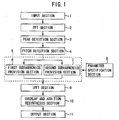
- FIG. 1 is a function block diagram showing the configuration of an embodiment of the sound effect applying apparatus according to the present invention.
- FIG. 2 is a diagram exemplifying a spectrum for analyzing a creak voice.
- FIG. 3 is a diagram showing a process performed by a first subharmonics provision section.
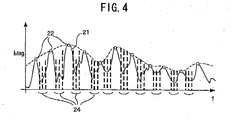
- FIG. 4 is a diagram exemplifying a spectrum for analyzing a growl voice.
- FIG. 5 is a function block diagram showing the configuration of another embodiment of the sound effect applying apparatus according to the present invention.
- FIG. 6 is a diagram showing a process performed by a parameter adjustment section of the sound effect applying apparatus.
- FIG. 1 is a function block showing the configuration of a sound effect applying apparatus according to an embodiment of the present invention.
- reference numeral 1 denotes an input section that receives an input voice signal
- 2 denotes a Fourier transform section that spectrum-analyzes the input voice on a frame basis to obtain a frequency spectrum
- 3 denotes a peak detection section that detects a local peak in the frequency spectrum output from the Fourier transform section
- 4 denotes a pitch detection section that calculates a pitch according to a series of frequencies for the local peaks.
- the input section 1, Fourier transform section 2, peak detection section 3 and pitch detection section 4 collectively constitute an input part that frequency-analyzes an input signal of sound or voice for detecting a plurality of local peaks of harmonics contained in the input signal.
- Reference numeral 5 denotes subharmonics provision means that performs processes in a frequency domain to provide input voices with distortion effects.
- the sound effect applying apparatus according to the embodiment of the present invention is described to have two types of subharmonics provision sections depending on the types of effects to be provided, i.e., a first subharmonics provision section 6 and a second subharmonics provision section 7.
- the subharmonics provision means 5 can provide input voices with processes performed in either or both the first subharmonics provision section 6 and the second subharmonics provision section 7.
- the first subharmonics provision section 6 provides input voice with a creak (squeaking) distortion effect.
- the first subharmonics provision section 6 supplies spectrum components having irregularly varying gains between local peak frequencies of the input voice's frequency spectrum.
- the first subharmonics provision section 6 supplies spectrum components having irregularly varying gains by supplying a plurality of spectrum components having irregularly varying phase differences at the same frequency.
- the second subharmonics provision section 7 provides input voice with a growl (howl) distortion effect.
- the second subharmonics provision section 7 supplies a plurality of spectrum components at different frequencies between local peak frequencies.
- a parameter specification section 8 supplies parameters that control spectrum components provided by the first subharmonics provision section 6 and the second subrlarmonics provision section 7.
- the parameter specification section 8 supplies the first subharmonics provision section 6 and the second subharmonics provision section 7 with parameters concerning a spectrum component to be added such as its type, its frequency position (deviation from the center frequency between harmonics frequencies), its gain, and the number of spectrum components to be provided. Controlling the parameters makes it possible to adjust the intensity of effects provided by the first and second subharmonics provision sections 6 and 7.
- the first subharmonics provision section 6, second subharmonics provision section 7 and parameter specification section 8 collectively constitute a subharmonics provision part that adds a spectrum component of subharmonics between the detected local peaks so as to provide the input signal with a sound effect.
- Reference numeral 9 denotes an inverse Fourier transform section that transforms a frequency spectrum into a time domain.
- the frequency spectrum of the input signal is provided with a spectrum component between local peaks by the first subharmonics provision section 6 or the second subharmonics provision section 7.
- Reference numeral 10 denotes an overlap and addition resynthesis section that synthesizes respective frame-based signals transformed into time-domain signals by the inverse Fourier transform section 9.
- Reference numeral 10 denotes an output section that outputs a voice signal supplied from the overlap and addition resynthesis section 10.
- the parameter specification section 8, inverse Fourier transform section 9, overlap and addition resynthesis section 10 and output section 11 collectively constitute an output part that converts the input signal of a frequency domain containing the added spectrum component into an output signal of a time domain for generating the sound or voice provided with the sound effect.
- the above-mentioned constituent elements can be implemented not only as individual processing sections, but also by computer's program processes.
- FIG. 2 shows an example of the spectrum for analyzing a creak (squeaking) voice.
- a clear voice provides the spectrum indicated by a solid line 21 in FIG. 2. That is, local peak frequencies (white circles 22 in FIG. 2) approximately correspond to harmonic frequencies. There are no other local peaks having large gains.
- the creak voice quality causes peaks (indicated by broken lines) other than the peaks corresponding to the harmonic frequencies near frequency positions (between harmonic frequencies) indicated by reference numeral 23 in FIG. 2. It can be understood that their gains irregularly increase and decrease with the progress of time.
- the first subharmonics provision section 6 reproduces the above-mentioned phenomenon by means of a signal process in the frequency domain.
- FIG. 3 shows an input spectrum, where f 0 denotes a pitch frequency.
- FIGS. 3(b) and 3(c) show spectrum components inserted at frequency positions 1.5f 0 , 2.5f 0 , and so on between harmonic frequencies.
- sine-wave spectrum components are provided.
- the spectrum components may be inserted at 1.4 f 0 , 2.6 f 0 , and so on between the input peak frequencies.
- 3(b) is obtained by adding a phase to the peak phase for the input spectrum immediately preceding the frequency for phase ⁇ so as to shift the frequencies (e.g., shifting f 0 to 1.5f 0 ).
- a phase in FIG. 3(c) results from adding a phase randomly modified from T 0 to the phase for the spectrum component at the same frequency position in FIG. 3(b).
- ⁇ indicates an irregularly varying value at a specified interval.
- the spectrum components in (b) and (c) are found at the same frequency positions. However, the phases in (c) are modified irregularly. Consequently, adding the spectrum components in (b) and (c) together irregularly varies the gains at frequency positions 1.5f 0 , 2.5f 0 , and so on. Further, adding the input spectrums in (a) can yield a spectrum containing subharmonics with irregularly varying gains.
- the method of generating subharmonics may be based on not only controlling phases as mentioned above, but also directly controlling gains. In this manner, it is possible to provide input voices with the effect of creak (squeaking) voice quality. Further, the intensity of this effect can be adjusted by changing gains for the sine-wave spectrum components in (b) and (c).
- Spectrum components to be provided are not limited to sine-wave ones. They may be shaped like a triangular wave or may be extracted from a specified frequency range of previously recorded actual voice waveforms. More diversified effects become available because a user can select spectrum components to be provided according to his or her preference. Further, it may be preferable to specify types of spectrum components to be provided according to frequencies. In addition, the intensity of effects can be adjusted by specifying how much frequency positions for the spectrum components to be provided should be deviated from the center of harmonic frequencies (deviation amount specification). Alternatively, it may be preferable to randomly vary the deviation amount.
- FIG. 4 shows a spectrum example of analyzing a growl (howl) voice. Like the case in FIG. 2, a clear voice allows local peak frequencies (white circles 22 in FIG. 4) to approximately correspond to harmonic frequencies. The resulting spectrum (a solid line 21 in FIG. 4) is shaped to have no other local peaks having large gains. However, it can be understood that the growl voice quality causes a plurality of peaks (indicated by broken lines in FIG. 4) near a frequency position (between harmonic frequencies) denoted by reference numeral 24 in FIG. 4. The second subharmonics provision section 7 simulates this phenomenon to provide a distortion effect causing the growl voice quality.
- This embodiment adds sine wave components for the number of n (an integer greater than or equal to 2) frequencies as subharmonics corresponding to the ith local peak in the input spectrum.
- n an integer greater than or equal to 2
- the following equation is used to find frequency fki for the kth sine wave component to be added.
- fki ( i + 1 ) ⁇ pitch syn + ( k + 1 ) ⁇ ( 1 / ( n + p ) ⁇ pitch
- pitch syn represents a synthesized pitch
- "pitch" represents the input pitch.
- This equation can add new n sine wave components at equal frequency intervals between harmonic frequencies. Instead of evenly arranging frequencies as formulated in the above-mentioned equation, it may be preferable to add n sine wave components at random frequency intervals.
- the second subharmonics provision section 7 adds a plurality of spectrum components between the peak frequencies in the input spectrum to convert an input voice into the growl (howl) voice quality.
- a user can control the number of subharmonics (n) to be added according to his or her preference to adjust the effect to be provided.
- the effect intensity can be adjusted by adjusting gains for sine-wave spectrum components to be added.
- the effect intensity can be further fine-tuned by individually changing gains for respective sine-wave spectrum components.
- the effect intensity can be controlled by controlling the phases of sine-wave spectrum components to be added.
- Spectrum components to be provided are not limited to sine-wave ones. They may be shaped like a triangular wave or may be extracted from previously recorded actual voice waveforms. More diversified effects become available because a user can select spectrum components to be provided according to his or her preference.
- FIG. 5 is a function block diagram showing the configuration of another embodiment of the sound effect applying apparatus according to the present invention.
- the mutually corresponding constituent elements in FIGS. 5 and 1 are designated by the same reference numerals and a detailed description is omitted for simplicity.
- This embodiment can be also implemented by computer's program processes.
- This embodiment newly provides a parameter adjustment section 12 between the parameter specification section 8 and the two subharmonics provision sections, i.e., the first subharmonics provision section 6 and the second subharmonics provision section 7.
- the pitch detection section 4 in FIG. 1 is changed to a pitch and gain detection section 4'.
- the parameter adjustment section 12 is supplied with a pitch and a gain detected by the pitch and gain detection section 4'.
- the parameter adjustment section 12 controls parameters supplied from the parameter specification section 8 in accordance with characteristics such as input voice's pitches and gains and supplies these parameters to the first subharmonics provision section 6 or the second subharmonics provision section 7. This makes it possible to use parameters corresponding to characteristics such as input voice's pitches and gains and provide natural effects.
- FIG. 6 exemplifies parameter control provided by the parameter adjustment section 12.
- This example concerns provision of a growling effect and shows a case of varying gains of subharmonics to be added in accordance with the curve as shown in FIG. 6 corresponding to an input voice gain.
- the gain of subharmonics to be added increases as the input voice gain increases.
- the parameter adjustment section 12 has a coefficient table corresponding to the curve in FIG. 6.
- the parameter adjustment section 12 reads a coefficient corresponding to the gain of the input voice from the pitch and gain detection section 4'.
- the parameter adjustment section 12 multiplies the coefficient by a parameter specifying the gain of the subharmonics supplied from the parameter specification section 8 and supplies a result to the second subharmonics provision section 7. In this manner, the growl effect decreases when the sound volume is small, making it possible to simulate the naturalness.
- the effect intensity can be adjusted by controlling (A) a gain for subharmonic at the beginning of applying the effect in FIG. 6, (B) a gain for the maximum subharmonic, and (C) a gain for an input voice reaching the gain for the maximum subharmonic.
- A a gain for subharmonic at the beginning of applying the effect in FIG. 6,
- B a gain for the maximum subharmonic
- C a gain for an input voice reaching the gain for the maximum subharmonic.
- the first subharmonics provision section 6 can similarly simulate the naturalness by controlling parameters. While the above-mentioned embodiment adjusts subharmonics gains, it may be preferable to adjust the other parameters such as the number of subharmonics, for example. While there has been described the example of controlling parameters in accordance with input voice gains, it may be preferable to adjust parameters in accordance with input voice pitches.
- the present invention can be applied to not only voice signals, but also musical instrument sounds and the like.
Landscapes
- Engineering & Computer Science (AREA)
- Physics & Mathematics (AREA)
- Acoustics & Sound (AREA)
- Multimedia (AREA)
- Quality & Reliability (AREA)
- Signal Processing (AREA)
- Computational Linguistics (AREA)
- Health & Medical Sciences (AREA)
- Audiology, Speech & Language Pathology (AREA)
- Human Computer Interaction (AREA)
- Tone Control, Compression And Expansion, Limiting Amplitude (AREA)
- Electrophonic Musical Instruments (AREA)
- Soundproofing, Sound Blocking, And Sound Damping (AREA)
Abstract
Description
- The present invention relates to a sound effect applying apparatus and a sound effect applying program for providing input voices with effects.
- As a method for applying distortive feeling to instrumental sounds and human voices, there has been known' the distortion technology distorts input sounds by clipping input waveforms.
Further, there is proposed a sound effect applying apparatus in Japanese Non-examined Patent Publication No. 2003-288095. Based on input control parameters, the sound effect applying apparatus controls individual magnitudes of harmonic components and nonharmonic components in a sound to be synthesized so as to control the breathiness magnitude. - While there is known the method of applying the distortion to input sounds as mentioned above, it is desired to apply realistic distortion more meaningful to sounds.
- It is therefore an object of the present invention to provide a sound effect applying apparatus and a sound effect applying program capable of applying a realistic distortion effect to input voices.
- To achieve the above-mentioned object, the sound effect applying apparatus according to the present invention comprises: an input part that frequency-analyzes an input signal of sound or voice for detecting a plurality of local peaks of harmonics contained in the input signal; a subharmonics provision part that adds a spectrum component of subharmonics between the detected local peaks so as to provide the input signal with a sound effect; and an output part that converts the input signal of a frequency domain containing the added spectrum component into an output signal of a time domain for generating the sound or voice provided with the sound effect.
In one form, the subharmonics provision part adds between the local peaks a variable spectrum component having a gain which varies irregularly. For example, the subharmonics provision part adds the variable spectrum component in the form of a mixture of a plurality of spectrum components which have the same frequency but which have phase differences irregularly varying with one another.
Preferably, the subharmonics provision part further changes the gain of the variable spectrum component in accordance with a gain of the input signal. For example, the subharmonics provision part increases the gain of the variable spectrum component as the gain of the input signal increases, and holds the gain of the variable spectrum component when the gain of the input signal exceeds a given level.
Preferably, the subharmonics provision part adjusts parameters of the variable spectrum component to be added in accordance with a pitch of the input signal, the parameters specifying at least one of a type, a frequency and a gain of the variable spectrum component.
In another form, the subharmonics provision part adds a plurality of spectrum components having different frequencies between one local peak and another local peak next to said one local peak.
Preferably, the subharmonics provision part changes the gain of the spectrum components in accordance with a gain of the input signal. For example, the subharmonics provision part increases the gain of the spectrum components as the gain of the input signal increases, and holds the gain of the spectrum components when the gain of the input signal exceeds a given level.
Preferably, the subharmonics provision part adjusts parameters of the spectrum components to be added in accordance with a pitch of the input signal, the parameters specifying at least one of types, frequencies, gains and
numbers of the spectrum components.
The sound effect applying program according to the present invention is executable by a computer to perform a method comprising the steps of: frequency-analyzing an input signal of sound or voice for detecting a plurality of local peaks of harmonics contained in the input signal; adding a spectrum component of subharmonics between the detected local peaks so as to provide the input signal with a sound effect; and converting the input signal of a frequency domain containing the added spectrum component into an output signal of a time domain for generating the sound or voice provided with the sound effect. - The sound effect applying apparatus and the sound effect applying program according to the present invention can provide input voices with a more realistic distortion effect by adding subharmonics to the frequency spectrum of the input signal.
Since there is provided a spectrum component having irregularly varying gains between input voice's local peaks, the input voice can be converted into an output voice of the voice quality having creak (squeaking) distortion. Since there is provided a plurality of spectrum components having different frequencies between input voice's local peaks, the input voice can be converted into an output voice of the voice quality having growl (howling) distortion.
The effect intensity can be adjusted by specifying parameters such as types, frequencies, and gains of a spectrum component to be provided, or the number of spectrum components.
The more naturalistic voice quality conversion can be provided by controlling parameters such as types, frequencies, and gains for a spectrum component to be provided, or the number of spectrum components in accordance with an input signal's gain or pitch. - FIG. 1 is a function block diagram showing the configuration of an embodiment of the sound effect applying apparatus according to the present invention.
FIG. 2 is a diagram exemplifying a spectrum for analyzing a creak voice.
FIG. 3 is a diagram showing a process performed by a first subharmonics provision section.
FIG. 4 is a diagram exemplifying a spectrum for analyzing a growl voice.
FIG. 5 is a function block diagram showing the configuration of another embodiment of the sound effect applying apparatus according to the present invention.
FIG. 6 is a diagram showing a process performed by a parameter adjustment section of the sound effect applying apparatus. - FIG. 1 is a function block showing the configuration of a sound effect applying apparatus according to an embodiment of the present invention.
In FIG. 1,reference numeral 1 denotes an input section that receives an input voice signal; 2 denotes a Fourier transform section that spectrum-analyzes the input voice on a frame basis to obtain a frequency spectrum; 3 denotes a peak detection section that detects a local peak in the frequency spectrum output from the Fourier transform section; and 4 denotes a pitch detection section that calculates a pitch according to a series of frequencies for the local peaks. Theinput section 1, Fouriertransform section 2,peak detection section 3 andpitch detection section 4 collectively constitute an input part that frequency-analyzes an input signal of sound or voice for detecting a plurality of local peaks of harmonics contained in the input signal.
Reference numeral 5 denotes subharmonics provision means that performs processes in a frequency domain to provide input voices with distortion effects. The sound effect applying apparatus according to the embodiment of the present invention is described to have two types of subharmonics provision sections depending on the types of effects to be provided, i.e., a firstsubharmonics provision section 6 and a secondsubharmonics provision section 7. The subharmonics provision means 5 can provide input voices with processes performed in either or both the firstsubharmonics provision section 6 and the secondsubharmonics provision section 7. - The first
subharmonics provision section 6 provides input voice with a creak (squeaking) distortion effect. The firstsubharmonics provision section 6 supplies spectrum components having irregularly varying gains between local peak frequencies of the input voice's frequency spectrum. The firstsubharmonics provision section 6 supplies spectrum components having irregularly varying gains by supplying a plurality of spectrum components having irregularly varying phase differences at the same frequency.
The secondsubharmonics provision section 7 provides input voice with a growl (howl) distortion effect. The secondsubharmonics provision section 7 supplies a plurality of spectrum components at different frequencies between local peak frequencies.
Aparameter specification section 8 supplies parameters that control spectrum components provided by the firstsubharmonics provision section 6 and the secondsubrlarmonics provision section 7. Theparameter specification section 8 supplies the firstsubharmonics provision section 6 and the secondsubharmonics provision section 7 with parameters concerning a spectrum component to be added such as its type, its frequency position (deviation from the center frequency between harmonics frequencies), its gain, and the number of spectrum components to be provided. Controlling the parameters makes it possible to adjust the intensity of effects provided by the first and secondsubharmonics provision sections subharmonics provision section 6, secondsubharmonics provision section 7 andparameter specification section 8 collectively constitute a subharmonics provision part that adds a spectrum component of subharmonics between the detected local peaks so as to provide the input signal with a sound effect. -
Reference numeral 9 denotes an inverse Fourier transform section that transforms a frequency spectrum into a time domain. In this case, the frequency spectrum of the input signal is provided with a spectrum component between local peaks by the firstsubharmonics provision section 6 or the secondsubharmonics provision section 7.Reference numeral 10 denotes an overlap and addition resynthesis section that synthesizes respective frame-based signals transformed into time-domain signals by the inverse Fouriertransform section 9.Reference numeral 10 denotes an output section that outputs a voice signal supplied from the overlap andaddition resynthesis section 10. Theparameter specification section 8, inverse Fouriertransform section 9, overlap andaddition resynthesis section 10 and output section 11 collectively constitute an output part that converts the input signal of a frequency domain containing the added spectrum component into an output signal of a time domain for generating the sound or voice provided with the sound effect.
The above-mentioned constituent elements can be implemented not only as individual processing sections, but also by computer's program processes. - The following describes a subharmonics provision process performed by the first
subharmonics provision section 6.
FIG. 2 shows an example of the spectrum for analyzing a creak (squeaking) voice.
A clear voice provides the spectrum indicated by asolid line 21 in FIG. 2. That is, local peak frequencies (white circles 22 in FIG. 2) approximately correspond to harmonic frequencies. There are no other local peaks having large gains.
However, the creak voice quality causes peaks (indicated by broken lines) other than the peaks corresponding to the harmonic frequencies near frequency positions (between harmonic frequencies) indicated byreference numeral 23 in FIG. 2. It can be understood that their gains irregularly increase and decrease with the progress of time. In other words, it is possible to state that a new harmonic (sub-harmonic) rises at a frequency position between the harmonic frequency positions and that its gain varies irregularly. This phenomenon occurs because a creaky voice causes a variable vocal-fold vibration frequency and this frequency irregularly varies near given frequency T0. - The first
subharmonics provision section 6 reproduces the above-mentioned phenomenon by means of a signal process in the frequency domain. Referring now to FIG. 3, the following describes the process performed in the firstsubharmonics provision section 6.
FIG. 3(a) shows an input spectrum, where f0 denotes a pitch frequency. FIGS. 3(b) and 3(c) show spectrum components inserted at frequency positions 1.5f0, 2.5f0, and so on between harmonic frequencies. In this example, sine-wave spectrum components are provided. The spectrum components may be inserted at 1.4 f0, 2.6 f0, and so on between the input peak frequencies. Each phase φ in FIG. 3(b) is obtained by adding a phase to the peak phase for the input spectrum immediately preceding the frequency for phase φ so as to shift the frequencies (e.g., shifting f0 to 1.5f0). A phase in FIG. 3(c) results from adding a phase randomly modified from T0 to the phase for the spectrum component at the same frequency position in FIG. 3(b). In FIG. 3(c), Ω indicates an irregularly varying value at a specified interval. - The spectrum components in (b) and (c) are found at the same frequency positions. However, the phases in (c) are modified irregularly. Consequently, adding the spectrum components in (b) and (c) together irregularly varies the gains at frequency positions 1.5f0, 2.5f0, and so on. Further, adding the input spectrums in (a) can yield a spectrum containing subharmonics with irregularly varying gains. The method of generating subharmonics may be based on not only controlling phases as mentioned above, but also directly controlling gains.
In this manner, it is possible to provide input voices with the effect of creak (squeaking) voice quality.
Further, the intensity of this effect can be adjusted by changing gains for the sine-wave spectrum components in (b) and (c).
While there has been described the,method of adding two sine-wave spectrum components in (b) and (c), it may be preferable to add three or more sine-wave spectrum components.
Spectrum components to be provided are not limited to sine-wave ones. They may be shaped like a triangular wave or may be extracted from a specified frequency range of previously recorded actual voice waveforms. More diversified effects become available because a user can select spectrum components to be provided according to his or her preference. Further, it may be preferable to specify types of spectrum components to be provided according to frequencies.
In addition, the intensity of effects can be adjusted by specifying how much frequency positions for the spectrum components to be provided should be deviated from the center of harmonic frequencies (deviation amount specification). Alternatively, it may be preferable to randomly vary the deviation amount. - The following describes a subharmonics provision process performed by the second
subharmonics provision section 7.
FIG. 4 shows a spectrum example of analyzing a growl (howl) voice.
Like the case in FIG. 2, a clear voice allows local peak frequencies (white circles 22 in FIG. 4) to approximately correspond to harmonic frequencies. The resulting spectrum (asolid line 21 in FIG. 4) is shaped to have no other local peaks having large gains.
However, it can be understood that the growl voice quality causes a plurality of peaks (indicated by broken lines in FIG. 4) near a frequency position (between harmonic frequencies) denoted byreference numeral 24 in FIG. 4.
The secondsubharmonics provision section 7 simulates this phenomenon to provide a distortion effect causing the growl voice quality.
This embodiment adds sine wave components for the number of n (an integer greater than or equal to 2) frequencies as subharmonics corresponding to the ith local peak in the input spectrum.
Assuming that k is 0, 1, 2, ..., or n-1, the following equation is used to find frequency fki for the kth sine wave component to be added.
This equation can add new n sine wave components at equal frequency intervals between harmonic frequencies.
Instead of evenly arranging frequencies as formulated in the above-mentioned equation, it may be preferable to add n sine wave components at random frequency intervals. - In this manner, the second
subharmonics provision section 7 adds a plurality of spectrum components between the peak frequencies in the input spectrum to convert an input voice into the growl (howl) voice quality.
A user can control the number of subharmonics (n) to be added according to his or her preference to adjust the effect to be provided.
The effect intensity can be adjusted by adjusting gains for sine-wave spectrum components to be added. The effect intensity can be further fine-tuned by individually changing gains for respective sine-wave spectrum components.
Furthermore, the effect intensity can be controlled by controlling the phases of sine-wave spectrum components to be added.
Spectrum components to be provided are not limited to sine-wave ones. They may be shaped like a triangular wave or may be extracted from previously recorded actual voice waveforms. More diversified effects become available because a user can select spectrum components to be provided according to his or her preference. - The above-mentioned embodiment has no consideration for the magnitude (gain) of input voice. However, it may be more effective to vary the effect intensity in accordance with the input voice magnitude. For example, increasing the sound volume generally increases the feeling of growl (howl). On the contrary, decreasing the sound volume generally decreases the feeling of growl (howl).
The following describes another embodiment of the sound effect applying apparatus according to the present invention so as to represent such natural feeling by controlling the above-mentioned parameters in accordance with input voice characteristics such as gains and pitches.
FIG. 5 is a function block diagram showing the configuration of another embodiment of the sound effect applying apparatus according to the present invention. The mutually corresponding constituent elements in FIGS. 5 and 1 are designated by the same reference numerals and a detailed description is omitted for simplicity. This embodiment can be also implemented by computer's program processes. - The following differences will be clearly understood in comparison between FIGS. 1 and 5. This embodiment newly provides a
parameter adjustment section 12 between theparameter specification section 8 and the two subharmonics provision sections, i.e., the firstsubharmonics provision section 6 and the secondsubharmonics provision section 7. Thepitch detection section 4 in FIG. 1 is changed to a pitch and gain detection section 4'. Theparameter adjustment section 12 is supplied with a pitch and a gain detected by the pitch and gain detection section 4'.
Theparameter adjustment section 12 controls parameters supplied from theparameter specification section 8 in accordance with characteristics such as input voice's pitches and gains and supplies these parameters to the firstsubharmonics provision section 6 or the secondsubharmonics provision section 7.
This makes it possible to use parameters corresponding to characteristics such as input voice's pitches and gains and provide natural effects. - FIG. 6 exemplifies parameter control provided by the
parameter adjustment section 12.
This example concerns provision of a growling effect and shows a case of varying gains of subharmonics to be added in accordance with the curve as shown in FIG. 6 corresponding to an input voice gain. As shown in FIG. 6, the gain of subharmonics to be added increases as the input voice gain increases. When the input voice gain exceeds a specified value, the subharmonics gain is saturated. That is, theparameter adjustment section 12 has a coefficient table corresponding to the curve in FIG. 6. Theparameter adjustment section 12 reads a coefficient corresponding to the gain of the input voice from the pitch and gain detection section 4'. Theparameter adjustment section 12 multiplies the coefficient by a parameter specifying the gain of the subharmonics supplied from theparameter specification section 8 and supplies a result to the secondsubharmonics provision section 7.
In this manner, the growl effect decreases when the sound volume is small, making it possible to simulate the naturalness. - The effect intensity can be adjusted by controlling (A) a gain for subharmonic at the beginning of applying the effect in FIG. 6, (B) a gain for the maximum subharmonic, and (C) a gain for an input voice reaching the gain for the maximum subharmonic.
There has been described the example of applying the growling effect by means of the secondsubharmonics provision section 7. When providing the effect, the firstsubharmonics provision section 6 can similarly simulate the naturalness by controlling parameters.
While the above-mentioned embodiment adjusts subharmonics gains, it may be preferable to adjust the other parameters such as the number of subharmonics, for example.
While there has been described the example of controlling parameters in accordance with input voice gains, it may be preferable to adjust parameters in accordance with input voice pitches.
The present invention can be applied to not only voice signals, but also musical instrument sounds and the like.
Claims (11)
- A sound effect applying apparatus comprising:an input part that frequency-analyzes an input signal of sound or voice for detecting a plurality of local peaks of harmonics contained in the input signal;a subharmonics provision part that adds a spectrum component of subharmonics between the detected local peaks so as to provide the input signal with a sound effect; andan output part that converts the input signal of a frequency domain containing the added spectrum component into an output signal of a time domain for generating the sound or voice provided with the sound effect.
- The sound effect applying apparatus according to claim 1, wherein the subharmonics provision part adds between the local peaks a variable spectrum component having a gain which varies irregularly.
- The sound effect applying apparatus according to claim 2, wherein the subharmonics provision part adds the variable spectrum component in'the form of a mixture of a plurality of spectrum components which have the same frequency but which have phase differences irregularly varying with one another.
- The sound effect applying apparatus according to claim 2, wherein the subharmonics provision part further changes the gain of the variable spectrum component in accordance with a gain of the input signal.
- The sound effect applying apparatus according to claim 4, wherein the subharmonics provision part increases the gain of the variable spectrum component as the gain of.the input signal increases, and holds the gain of the variable spectrum component t when the gain of the input signal exceeds a given level.
- The sound effect applying apparatus according to claim 2, wherein the subharmonics provision part adjusts parameters of the variable spectrum component to be added in accordance with a pitch of the input signal, the parameters specifying at least one of a type, a frequency and a gain of the variable spectrum component.
- The sound effect applying apparatus according to claim 1, wherein the subharmonics provision part adds a plurality of spectrum components having different frequencies between one local peak and another local peak next to said one local peak.
- The sound effect applying apparatus according to claim 7, wherein the subharmonics provision part changes the gain of the spectrum components in accordance with a gain of the input signal.
- The sound effect applying apparatus according to claim 8, wherein the subharmonics provision part increases the gain of the spectrum components as the gain of the input signal increases, and holds the gain of the spectrum components when the gain of the input signal exceeds a given level.
- The sound effect applying apparatus according to claim 7, wherein the subharmonics provision part adjusts parameters of the spectrum components to be added in accordance with a pitch of the input signal, the parameters specifying at least one of types, frequencies, gains, and numbers of the spectrum components.
- A sound effect applying program which is executable by a computer to perform a method comprising the steps of:frequency-analyzing an input signal of sound or voice for detecting a plurality of local peaks of harmonics contained in the input signal;adding a spectrum component of subharmonics between the detected local peaks so as to provide the input signal with a sound effect; andconverting the input signal of a frequency domain containing the added spectrum component into an output signal of a time domain for generating the sound or voice provided with the sound effect.
Applications Claiming Priority (1)
| Application Number | Priority Date | Filing Date | Title |
|---|---|---|---|
| JP2004186012A JP4649888B2 (en) | 2004-06-24 | 2004-06-24 | Voice effect imparting device and voice effect imparting program |
Publications (3)
| Publication Number | Publication Date |
|---|---|
| EP1612767A2 true EP1612767A2 (en) | 2006-01-04 |
| EP1612767A3 EP1612767A3 (en) | 2006-11-08 |
| EP1612767B1 EP1612767B1 (en) | 2015-03-04 |
Family
ID=35079280
Family Applications (1)
| Application Number | Title | Priority Date | Filing Date |
|---|---|---|---|
| EP05105685.1A Ceased EP1612767B1 (en) | 2004-06-24 | 2005-06-24 | Sound effect applying apparatus and sound effect applying program |
Country Status (3)
| Country | Link |
|---|---|
| US (1) | US8433073B2 (en) |
| EP (1) | EP1612767B1 (en) |
| JP (1) | JP4649888B2 (en) |
Families Citing this family (9)
| Publication number | Priority date | Publication date | Assignee | Title |
|---|---|---|---|---|
| KR100770839B1 (en) * | 2006-04-04 | 2007-10-26 | 삼성전자주식회사 | Method and apparatus for estimating harmonic information, spectral envelope information, and voiced speech ratio of speech signals |
| KR100762596B1 (en) * | 2006-04-05 | 2007-10-01 | 삼성전자주식회사 | Voice signal preprocessing system and voice signal feature information extraction method |
| JP2010191042A (en) * | 2009-02-17 | 2010-09-02 | Yamaha Corp | Voice processor and program |
| KR20150032390A (en) * | 2013-09-16 | 2015-03-26 | 삼성전자주식회사 | Speech signal process apparatus and method for enhancing speech intelligibility |
| JP5928489B2 (en) * | 2014-01-08 | 2016-06-01 | ヤマハ株式会社 | Voice processing apparatus and program |
| CN109830243B (en) * | 2019-01-30 | 2021-01-12 | 腾讯科技(深圳)有限公司 | Sound effect processing method, device and computer equipment |
| CN112447166B (en) * | 2019-08-16 | 2024-09-10 | 阿里巴巴集团控股有限公司 | A processing method and device for target spectrum matrix |
| CN113870885B (en) * | 2021-12-02 | 2022-02-22 | 北京百瑞互联技术有限公司 | Bluetooth audio squeal detection and suppression method, device, medium, and apparatus |
| JP2025004384A (en) * | 2023-06-26 | 2025-01-15 | ヤマハ株式会社 | Acoustic processing method, acoustic processing system, and program |
Citations (1)
| Publication number | Priority date | Publication date | Assignee | Title |
|---|---|---|---|---|
| JP2003288095A (en) | 2002-03-28 | 2003-10-10 | Yamaha Corp | Sound synthesizer, sound synthetic method, program for sound synthesis and computer readable recording medium having the same program recorded thereon |
Family Cites Families (41)
| Publication number | Priority date | Publication date | Assignee | Title |
|---|---|---|---|---|
| JPS4848123A (en) * | 1971-10-21 | 1973-07-07 | ||
| US3913442A (en) * | 1974-05-16 | 1975-10-21 | Nippon Musical Instruments Mfg | Voicing for a computor organ |
| US4991218A (en) * | 1988-01-07 | 1991-02-05 | Yield Securities, Inc. | Digital signal processor for providing timbral change in arbitrary audio and dynamically controlled stored digital audio signals |
| JP2627770B2 (en) * | 1988-05-26 | 1997-07-09 | 株式会社河合楽器製作所 | Electronic musical instrument |
| JPH03101798A (en) * | 1989-09-14 | 1991-04-26 | Yamaha Corp | Musical sound signal generating device |
| JP2765306B2 (en) * | 1991-10-29 | 1998-06-11 | ヤマハ株式会社 | Sound source device |
| JP3168654B2 (en) * | 1991-12-27 | 2001-05-21 | カシオ計算機株式会社 | Music generator |
| JP2707911B2 (en) * | 1992-03-03 | 1998-02-04 | ヤマハ株式会社 | Music synthesizer |
| US5526431A (en) * | 1992-06-25 | 1996-06-11 | Kabushiki Kaisha Kawai Gakki Seisakusho | Sound effect-creating device for creating ensemble effect |
| US5536902A (en) * | 1993-04-14 | 1996-07-16 | Yamaha Corporation | Method of and apparatus for analyzing and synthesizing a sound by extracting and controlling a sound parameter |
| JPH08221067A (en) * | 1995-02-15 | 1996-08-30 | Roland Corp | Effect addition device |
| JPH08328587A (en) | 1995-05-31 | 1996-12-13 | Sony Corp | Sound effect device |
| US6591240B1 (en) * | 1995-09-26 | 2003-07-08 | Nippon Telegraph And Telephone Corporation | Speech signal modification and concatenation method by gradually changing speech parameters |
| JP3265962B2 (en) * | 1995-12-28 | 2002-03-18 | 日本ビクター株式会社 | Pitch converter |
| US5781636A (en) * | 1996-04-22 | 1998-07-14 | United Microelectronics Corporation | Method and apparatus for generating sounds with tremolo and vibrato sound effects |
| JPH1074098A (en) * | 1996-09-02 | 1998-03-17 | Yamaha Corp | Voice converter |
| US5763807A (en) * | 1996-09-12 | 1998-06-09 | Clynes; Manfred | Electronic music system producing vibrato and tremolo effects |
| US5930373A (en) * | 1997-04-04 | 1999-07-27 | K.S. Waves Ltd. | Method and system for enhancing quality of sound signal |
| US6336092B1 (en) * | 1997-04-28 | 2002-01-01 | Ivl Technologies Ltd | Targeted vocal transformation |
| WO1999025150A1 (en) * | 1997-11-07 | 1999-05-20 | Koninklijke Philips Electronics N.V. | Audio system comprising audio signal processing circuit |
| JP3715422B2 (en) * | 1997-12-12 | 2005-11-09 | 株式会社河合楽器製作所 | Tone generator and electronic musical instrument using the same |
| JP3949828B2 (en) * | 1998-10-15 | 2007-07-25 | ヤマハ株式会社 | Voice conversion device and voice conversion method |
| TW430778B (en) * | 1998-06-15 | 2001-04-21 | Yamaha Corp | Voice converter with extraction and modification of attribute data |
| US6504935B1 (en) * | 1998-08-19 | 2003-01-07 | Douglas L. Jackson | Method and apparatus for the modeling and synthesis of harmonic distortion |
| EP1044583B2 (en) * | 1998-09-08 | 2007-09-05 | Koninklijke Philips Electronics N.V. | Means for bass enhancement in an audio system |
| AU5009399A (en) * | 1998-09-24 | 2000-05-04 | Sony Corporation | Impulse response collecting method, sound effect adding apparatus, and recording medium |
| US7003120B1 (en) * | 1998-10-29 | 2006-02-21 | Paul Reed Smith Guitars, Inc. | Method of modifying harmonic content of a complex waveform |
| US6316710B1 (en) * | 1999-09-27 | 2001-11-13 | Eric Lindemann | Musical synthesizer capable of expressive phrasing |
| JP4757971B2 (en) * | 1999-10-21 | 2011-08-24 | ヤマハ株式会社 | Harmony sound adding device |
| US6704711B2 (en) * | 2000-01-28 | 2004-03-09 | Telefonaktiebolaget Lm Ericsson (Publ) | System and method for modifying speech signals |
| US7136493B2 (en) * | 2000-06-28 | 2006-11-14 | Peavey Electronics Corporation | Sub-harmonic generator and stereo expansion processor |
| WO2003018722A2 (en) * | 2001-08-28 | 2003-03-06 | Koninklijke Philips Electronics N.V. | Circuit and method for processing an audio signal |
| JP3709817B2 (en) * | 2001-09-03 | 2005-10-26 | ヤマハ株式会社 | Speech synthesis apparatus, method, and program |
| CN1552057A (en) * | 2001-09-06 | 2004-12-01 | 皇家飞利浦电子股份有限公司 | Method and circuit for generating subharmonics of periodic signals |
| JP3815347B2 (en) * | 2002-02-27 | 2006-08-30 | ヤマハ株式会社 | Singing synthesis method and apparatus, and recording medium |
| JP4153220B2 (en) * | 2002-02-28 | 2008-09-24 | ヤマハ株式会社 | SINGLE SYNTHESIS DEVICE, SINGE SYNTHESIS METHOD, AND SINGE SYNTHESIS PROGRAM |
| US7027980B2 (en) * | 2002-03-28 | 2006-04-11 | Motorola, Inc. | Method for modeling speech harmonic magnitudes |
| JP3941611B2 (en) * | 2002-07-08 | 2007-07-04 | ヤマハ株式会社 | SINGLE SYNTHESIS DEVICE, SINGE SYNTHESIS METHOD, AND SINGE SYNTHESIS PROGRAM |
| US7248702B2 (en) * | 2003-01-06 | 2007-07-24 | Thomas Nelson Packard | Sound enhancement system |
| US20050004691A1 (en) * | 2003-07-03 | 2005-01-06 | Edwards Christoper A. | Versatile system for processing digital audio signals |
| JP4734961B2 (en) * | 2005-02-28 | 2011-07-27 | カシオ計算機株式会社 | SOUND EFFECT APPARATUS AND PROGRAM |
-
2004
- 2004-06-24 JP JP2004186012A patent/JP4649888B2/en not_active Expired - Fee Related
-
2005
- 2005-06-22 US US11/159,032 patent/US8433073B2/en not_active Expired - Fee Related
- 2005-06-24 EP EP05105685.1A patent/EP1612767B1/en not_active Ceased
Patent Citations (1)
| Publication number | Priority date | Publication date | Assignee | Title |
|---|---|---|---|---|
| JP2003288095A (en) | 2002-03-28 | 2003-10-10 | Yamaha Corp | Sound synthesizer, sound synthetic method, program for sound synthesis and computer readable recording medium having the same program recorded thereon |
Non-Patent Citations (1)
| Title |
|---|
| AMATRIAIN X. ET AL.: "Spectral Modeling for Higher-level Sound Transformations", PROCEEDINGS OF MOSART WORKSHOP ON CURRENT RESEARCH DIRECTIONS IN COMPUTER MUSIC, 2001 |
Also Published As
| Publication number | Publication date |
|---|---|
| US20050288921A1 (en) | 2005-12-29 |
| EP1612767B1 (en) | 2015-03-04 |
| EP1612767A3 (en) | 2006-11-08 |
| US8433073B2 (en) | 2013-04-30 |
| JP2006010906A (en) | 2006-01-12 |
| JP4649888B2 (en) | 2011-03-16 |
Similar Documents
| Publication | Publication Date | Title |
|---|---|---|
| JP5057535B1 (en) | Mixing apparatus, mixing signal processing apparatus, mixing program, and mixing method | |
| US8155343B2 (en) | Engine sound processing system | |
| EP1612767B1 (en) | Sound effect applying apparatus and sound effect applying program | |
| JP4076887B2 (en) | Vocoder device | |
| EP1612770A1 (en) | Voice processing apparatus and program | |
| JP3797283B2 (en) | Performance sound control method and apparatus | |
| JPH05181485A (en) | Electronic musical instrument | |
| JP6337698B2 (en) | Sound processor | |
| CN117116245B (en) | Method, device, equipment and storage medium for generating harmonic wave of sound signal | |
| US8927847B2 (en) | Glitch-free frequency modulation synthesis of sounds | |
| Gentilucci et al. | Composing vocal distortion: A tool for real-time generation of roughness | |
| JP2768195B2 (en) | Music synthesizer | |
| Fernández-Cid et al. | Enhanced quality and variety for chorus/flange units | |
| JPH06301383A (en) | Digital acoustic waveform generating apparatus, digital acoustic waveform generating method, digital acoustic waveform uniformizing method in musical tone waveform generating apparatus, and musical tone waveform generating apparatus | |
| JP6409417B2 (en) | Sound processor | |
| JP3130305B2 (en) | Speech synthesizer | |
| JP3903975B2 (en) | Musical sound processing apparatus, musical sound processing method, and musical sound processing program | |
| JP3669040B2 (en) | Waveform processing device | |
| JP2689765B2 (en) | Noise imparting device | |
| JP2008512699A (en) | Apparatus and method for adding reverberation to an input signal | |
| JP2789981B2 (en) | Music synthesizer | |
| JP2004271750A (en) | Sound synthesizer and program | |
| JP2757717B2 (en) | Effect giving device | |
| JP6260768B2 (en) | Effect imparting device, effect imparting method, and program | |
| JP5928489B2 (en) | Voice processing apparatus and program |
Legal Events
| Date | Code | Title | Description |
|---|---|---|---|
| PUAI | Public reference made under article 153(3) epc to a published international application that has entered the european phase |
Free format text: ORIGINAL CODE: 0009012 |
|
| 17P | Request for examination filed |
Effective date: 20050624 |
|
| AK | Designated contracting states |
Kind code of ref document: A2 Designated state(s): AT BE BG CH CY CZ DE DK EE ES FI FR GB GR HU IE IS IT LI LT LU MC NL PL PT RO SE SI SK TR |
|
| AX | Request for extension of the european patent |
Extension state: AL BA HR LV MK YU |
|
| PUAL | Search report despatched |
Free format text: ORIGINAL CODE: 0009013 |
|
| RIC1 | Information provided on ipc code assigned before grant |
Ipc: G10H 1/10 20060101ALI20060928BHEP Ipc: G10H 1/00 20060101AFI20051026BHEP |
|
| AK | Designated contracting states |
Kind code of ref document: A3 Designated state(s): AT BE BG CH CY CZ DE DK EE ES FI FR GB GR HU IE IS IT LI LT LU MC NL PL PT RO SE SI SK TR |
|
| AX | Request for extension of the european patent |
Extension state: AL BA HR LV MK YU |
|
| RAP1 | Party data changed (applicant data changed or rights of an application transferred) |
Owner name: YAMAHA CORPORATION |
|
| AKX | Designation fees paid |
Designated state(s): DE GB |
|
| 17Q | First examination report despatched |
Effective date: 20071015 |
|
| REG | Reference to a national code |
Ref country code: DE Ref legal event code: R079 Ref document number: 602005045947 Country of ref document: DE Free format text: PREVIOUS MAIN CLASS: G10H0001000000 Ipc: G10L0021003000 |
|
| GRAP | Despatch of communication of intention to grant a patent |
Free format text: ORIGINAL CODE: EPIDOSNIGR1 |
|
| RIC1 | Information provided on ipc code assigned before grant |
Ipc: G10L 21/003 20130101AFI20141001BHEP |
|
| INTG | Intention to grant announced |
Effective date: 20141015 |
|
| GRAS | Grant fee paid |
Free format text: ORIGINAL CODE: EPIDOSNIGR3 |
|
| GRAA | (expected) grant |
Free format text: ORIGINAL CODE: 0009210 |
|
| AK | Designated contracting states |
Kind code of ref document: B1 Designated state(s): DE GB |
|
| REG | Reference to a national code |
Ref country code: GB Ref legal event code: FG4D |
|
| REG | Reference to a national code |
Ref country code: DE Ref legal event code: R096 Ref document number: 602005045947 Country of ref document: DE Effective date: 20150416 |
|
| REG | Reference to a national code |
Ref country code: DE Ref legal event code: R097 Ref document number: 602005045947 Country of ref document: DE |
|
| PLBE | No opposition filed within time limit |
Free format text: ORIGINAL CODE: 0009261 |
|
| STAA | Information on the status of an ep patent application or granted ep patent |
Free format text: STATUS: NO OPPOSITION FILED WITHIN TIME LIMIT |
|
| 26N | No opposition filed |
Effective date: 20151207 |
|
| PGFP | Annual fee paid to national office [announced via postgrant information from national office to epo] |
Ref country code: GB Payment date: 20160622 Year of fee payment: 12 Ref country code: DE Payment date: 20160622 Year of fee payment: 12 |
|
| REG | Reference to a national code |
Ref country code: DE Ref legal event code: R119 Ref document number: 602005045947 Country of ref document: DE |
|
| GBPC | Gb: european patent ceased through non-payment of renewal fee |
Effective date: 20170624 |
|
| PG25 | Lapsed in a contracting state [announced via postgrant information from national office to epo] |
Ref country code: GB Free format text: LAPSE BECAUSE OF NON-PAYMENT OF DUE FEES Effective date: 20170624 Ref country code: DE Free format text: LAPSE BECAUSE OF NON-PAYMENT OF DUE FEES Effective date: 20180103 |