EP1612215A1 - Pyroglutamic acid derivatives and related compounds which inhibit leukocyte adhesion mediated by VLA-4 - Google Patents
Pyroglutamic acid derivatives and related compounds which inhibit leukocyte adhesion mediated by VLA-4 Download PDFInfo
- Publication number
- EP1612215A1 EP1612215A1 EP05019666A EP05019666A EP1612215A1 EP 1612215 A1 EP1612215 A1 EP 1612215A1 EP 05019666 A EP05019666 A EP 05019666A EP 05019666 A EP05019666 A EP 05019666A EP 1612215 A1 EP1612215 A1 EP 1612215A1
- Authority
- EP
- European Patent Office
- Prior art keywords
- benzyl
- substituted
- nhc
- och
- pyroglutamyl
- Prior art date
- Legal status (The legal status is an assumption and is not a legal conclusion. Google has not performed a legal analysis and makes no representation as to the accuracy of the status listed.)
- Withdrawn
Links
- 150000001875 compounds Chemical class 0.000 title claims abstract description 210
- 108010008212 Integrin alpha4beta1 Proteins 0.000 title claims abstract description 51
- 230000001404 mediated effect Effects 0.000 title claims abstract description 23
- 230000023404 leukocyte cell-cell adhesion Effects 0.000 title abstract description 10
- ODHCTXKNWHHXJC-VKHMYHEASA-N 5-oxo-L-proline Chemical class OC(=O)[C@@H]1CCC(=O)N1 ODHCTXKNWHHXJC-VKHMYHEASA-N 0.000 title abstract description 5
- 201000006417 multiple sclerosis Diseases 0.000 claims abstract description 44
- 206010028980 Neoplasm Diseases 0.000 claims abstract description 11
- 208000006673 asthma Diseases 0.000 claims abstract description 9
- 208000022559 Inflammatory bowel disease Diseases 0.000 claims abstract description 8
- 206010039073 rheumatoid arthritis Diseases 0.000 claims abstract description 8
- 201000001320 Atherosclerosis Diseases 0.000 claims abstract description 7
- 208000031225 myocardial ischemia Diseases 0.000 claims abstract description 7
- 238000002054 transplantation Methods 0.000 claims abstract description 7
- 208000030507 AIDS Diseases 0.000 claims abstract description 6
- 208000024827 Alzheimer disease Diseases 0.000 claims abstract description 6
- 206010012289 Dementia Diseases 0.000 claims abstract description 6
- 206010027476 Metastases Diseases 0.000 claims abstract description 6
- 206010012601 diabetes mellitus Diseases 0.000 claims abstract description 6
- 230000009401 metastasis Effects 0.000 claims abstract description 5
- 125000001797 benzyl group Chemical group [H]C1=C([H])C([H])=C(C([H])=C1[H])C([H])([H])* 0.000 claims description 647
- -1 4-(phenylcarbonylamino)benzyl Chemical group 0.000 claims description 233
- 125000000623 heterocyclic group Chemical group 0.000 claims description 201
- 125000001072 heteroaryl group Chemical group 0.000 claims description 182
- 238000000034 method Methods 0.000 claims description 152
- 125000000217 alkyl group Chemical group 0.000 claims description 107
- 239000001257 hydrogen Substances 0.000 claims description 97
- 229910052739 hydrogen Inorganic materials 0.000 claims description 97
- 125000002496 methyl group Chemical group [H]C([H])([H])* 0.000 claims description 88
- 125000003118 aryl group Chemical group 0.000 claims description 73
- IJGRMHOSHXDMSA-UHFFFAOYSA-N nitrogen Substances N#N IJGRMHOSHXDMSA-UHFFFAOYSA-N 0.000 claims description 70
- 229960005190 phenylalanine Drugs 0.000 claims description 68
- 125000003107 substituted aryl group Chemical group 0.000 claims description 66
- 125000004435 hydrogen atom Chemical group [H]* 0.000 claims description 63
- 125000000547 substituted alkyl group Chemical group 0.000 claims description 63
- COLNVLDHVKWLRT-QMMMGPOBSA-N L-phenylalanine Chemical compound OC(=O)[C@@H](N)CC1=CC=CC=C1 COLNVLDHVKWLRT-QMMMGPOBSA-N 0.000 claims description 61
- 125000000753 cycloalkyl group Chemical group 0.000 claims description 59
- COLNVLDHVKWLRT-UHFFFAOYSA-N phenylalanine Natural products OC(=O)C(N)CC1=CC=CC=C1 COLNVLDHVKWLRT-UHFFFAOYSA-N 0.000 claims description 59
- 125000004432 carbon atom Chemical group C* 0.000 claims description 52
- 229910052757 nitrogen Inorganic materials 0.000 claims description 51
- 125000004474 heteroalkylene group Chemical group 0.000 claims description 49
- 125000005346 substituted cycloalkyl group Chemical group 0.000 claims description 46
- 125000002947 alkylene group Chemical group 0.000 claims description 42
- 125000002924 primary amino group Chemical group [H]N([H])* 0.000 claims description 41
- 125000004104 aryloxy group Chemical group 0.000 claims description 40
- 125000002887 hydroxy group Chemical class [H]O* 0.000 claims description 37
- 125000005553 heteroaryloxy group Chemical group 0.000 claims description 34
- 125000005844 heterocyclyloxy group Chemical group 0.000 claims description 34
- QOISWWBTZMFUEL-NSHDSACASA-N tert-butyl (2s)-2-amino-3-phenylpropanoate Chemical compound CC(C)(C)OC(=O)[C@@H](N)CC1=CC=CC=C1 QOISWWBTZMFUEL-NSHDSACASA-N 0.000 claims description 33
- QVGXLLKOCUKJST-UHFFFAOYSA-N atomic oxygen Chemical group [O] QVGXLLKOCUKJST-UHFFFAOYSA-N 0.000 claims description 30
- 125000005708 carbonyloxy group Chemical group [*:2]OC([*:1])=O 0.000 claims description 30
- 229910052760 oxygen Inorganic materials 0.000 claims description 30
- 239000001301 oxygen Chemical group 0.000 claims description 30
- 125000000392 cycloalkenyl group Chemical group 0.000 claims description 29
- NINIDFKCEFEMDL-UHFFFAOYSA-N Sulfur Chemical group [S] NINIDFKCEFEMDL-UHFFFAOYSA-N 0.000 claims description 28
- 229910052717 sulfur Chemical group 0.000 claims description 28
- 239000011593 sulfur Chemical group 0.000 claims description 28
- 125000000999 tert-butyl group Chemical group [H]C([H])([H])C(*)(C([H])([H])[H])C([H])([H])[H] 0.000 claims description 28
- 239000008194 pharmaceutical composition Substances 0.000 claims description 27
- 125000005325 aryloxy aryl group Chemical group 0.000 claims description 26
- VSDUZFOSJDMAFZ-VIFPVBQESA-N methyl L-phenylalaninate Chemical compound COC(=O)[C@@H](N)CC1=CC=CC=C1 VSDUZFOSJDMAFZ-VIFPVBQESA-N 0.000 claims description 25
- 125000003545 alkoxy group Chemical group 0.000 claims description 24
- 210000000265 leukocyte Anatomy 0.000 claims description 22
- 125000005415 substituted alkoxy group Chemical group 0.000 claims description 21
- 125000004429 atom Chemical group 0.000 claims description 20
- 125000005842 heteroatom Chemical group 0.000 claims description 20
- QJGQUHMNIGDVPM-UHFFFAOYSA-N nitrogen group Chemical group [N] QJGQUHMNIGDVPM-UHFFFAOYSA-N 0.000 claims description 20
- 125000001584 benzyloxycarbonyl group Chemical group C(=O)(OCC1=CC=CC=C1)* 0.000 claims description 19
- 150000002148 esters Chemical class 0.000 claims description 19
- 230000027455 binding Effects 0.000 claims description 18
- 125000000484 butyl group Chemical group [H]C([*])([H])C([H])([H])C([H])([H])C([H])([H])[H] 0.000 claims description 18
- 125000004442 acylamino group Chemical group 0.000 claims description 17
- 125000000000 cycloalkoxy group Chemical group 0.000 claims description 17
- 150000003839 salts Chemical class 0.000 claims description 17
- 125000005338 substituted cycloalkoxy group Chemical group 0.000 claims description 17
- 125000003143 4-hydroxybenzyl group Chemical group [H]C([*])([H])C1=C([H])C([H])=C(O[H])C([H])=C1[H] 0.000 claims description 16
- 125000004181 carboxyalkyl group Chemical group 0.000 claims description 16
- 125000004093 cyano group Chemical group *C#N 0.000 claims description 16
- 125000001449 isopropyl group Chemical group [H]C([H])([H])C([H])(*)C([H])([H])[H] 0.000 claims description 15
- 125000001997 phenyl group Chemical group [H]C1=C([H])C([H])=C(*)C([H])=C1[H] 0.000 claims description 14
- CJGXMNONHNZEQQ-JTQLQIEISA-N ethyl (2s)-2-amino-3-phenylpropanoate Chemical compound CCOC(=O)[C@@H](N)CC1=CC=CC=C1 CJGXMNONHNZEQQ-JTQLQIEISA-N 0.000 claims description 13
- 125000003178 carboxy group Chemical group [H]OC(*)=O 0.000 claims description 12
- 125000000449 nitro group Chemical group [O-][N+](*)=O 0.000 claims description 11
- YCWRFIYBUQBHJI-UHFFFAOYSA-N 2-(4-aminophenyl)acetonitrile Chemical group NC1=CC=C(CC#N)C=C1 YCWRFIYBUQBHJI-UHFFFAOYSA-N 0.000 claims description 10
- 125000001495 ethyl group Chemical group [H]C([H])([H])C([H])([H])* 0.000 claims description 10
- 230000001154 acute effect Effects 0.000 claims description 9
- 125000001309 chloro group Chemical group Cl* 0.000 claims description 8
- UYWQUFXKFGHYNT-UHFFFAOYSA-N phenylmethyl ester of formic acid Natural products O=COCC1=CC=CC=C1 UYWQUFXKFGHYNT-UHFFFAOYSA-N 0.000 claims description 8
- 150000003457 sulfones Chemical class 0.000 claims description 8
- 239000012472 biological sample Substances 0.000 claims description 7
- 125000005843 halogen group Chemical group 0.000 claims description 7
- 125000006503 p-nitrobenzyl group Chemical group [H]C1=C([H])C(=C([H])C([H])=C1[N+]([O-])=O)C([H])([H])* 0.000 claims description 7
- 229960004441 tyrosine Drugs 0.000 claims description 7
- 125000006512 3,4-dichlorobenzyl group Chemical group [H]C1=C(Cl)C(Cl)=C([H])C(=C1[H])C([H])([H])* 0.000 claims description 6
- 125000006283 4-chlorobenzyl group Chemical group [H]C1=C([H])C(=C([H])C([H])=C1Cl)C([H])([H])* 0.000 claims description 6
- 125000004217 4-methoxybenzyl group Chemical group [H]C1=C([H])C(=C([H])C([H])=C1OC([H])([H])[H])C([H])([H])* 0.000 claims description 6
- 125000006181 4-methyl benzyl group Chemical group [H]C1=C([H])C(=C([H])C([H])=C1C([H])([H])[H])C([H])([H])* 0.000 claims description 6
- 125000000051 benzyloxy group Chemical group [H]C1=C([H])C([H])=C(C([H])=C1[H])C([H])([H])O* 0.000 claims description 6
- HNDVDQJCIGZPNO-UHFFFAOYSA-N histidine Natural products OC(=O)C(N)CC1=CN=CN1 HNDVDQJCIGZPNO-UHFFFAOYSA-N 0.000 claims description 6
- 150000004702 methyl esters Chemical class 0.000 claims description 6
- 125000006505 p-cyanobenzyl group Chemical group [H]C1=C([H])C(=C([H])C([H])=C1C#N)C([H])([H])* 0.000 claims description 6
- 206010012438 Dermatitis atopic Diseases 0.000 claims description 5
- BXRMEWOQUXOLDH-LURJTMIESA-N L-Histidine methyl ester Chemical compound COC(=O)[C@@H](N)CC1=CN=CN1 BXRMEWOQUXOLDH-LURJTMIESA-N 0.000 claims description 5
- 208000004852 Lung Injury Diseases 0.000 claims description 5
- 201000009906 Meningitis Diseases 0.000 claims description 5
- 201000004681 Psoriasis Diseases 0.000 claims description 5
- 206010038910 Retinitis Diseases 0.000 claims description 5
- 206010069363 Traumatic lung injury Diseases 0.000 claims description 5
- 201000008937 atopic dermatitis Diseases 0.000 claims description 5
- 239000003937 drug carrier Substances 0.000 claims description 5
- 230000004968 inflammatory condition Effects 0.000 claims description 5
- 231100000515 lung injury Toxicity 0.000 claims description 5
- 125000004108 n-butyl group Chemical group [H]C([H])([H])C([H])([H])C([H])([H])C([H])([H])* 0.000 claims description 5
- 201000008383 nephritis Diseases 0.000 claims description 5
- UFHFLCQGNIYNRP-UHFFFAOYSA-N Hydrogen Chemical compound [H][H] UFHFLCQGNIYNRP-UHFFFAOYSA-N 0.000 claims description 4
- 208000006011 Stroke Diseases 0.000 claims description 4
- 206010014599 encephalitis Diseases 0.000 claims description 4
- 125000001153 fluoro group Chemical group F* 0.000 claims description 4
- JPWDURLJLRNJAT-NSHDSACASA-N propan-2-yl (2s)-2-amino-3-phenylpropanoate Chemical compound CC(C)OC(=O)[C@@H](N)CC1=CC=CC=C1 JPWDURLJLRNJAT-NSHDSACASA-N 0.000 claims description 4
- 125000001637 1-naphthyl group Chemical group [H]C1=C([H])C([H])=C2C(*)=C([H])C([H])=C([H])C2=C1[H] 0.000 claims description 3
- 125000000954 2-hydroxyethyl group Chemical group [H]C([*])([H])C([H])([H])O[H] 0.000 claims description 3
- 125000001622 2-naphthyl group Chemical group [H]C1=C([H])C([H])=C2C([H])=C(*)C([H])=C([H])C2=C1[H] 0.000 claims description 3
- 125000003852 3-chlorobenzyl group Chemical group [H]C1=C([H])C(=C([H])C(Cl)=C1[H])C([H])([H])* 0.000 claims description 3
- 125000006291 3-hydroxybenzyl group Chemical group [H]OC1=C([H])C([H])=C([H])C(=C1[H])C([H])([H])* 0.000 claims description 3
- 125000006497 3-methoxybenzyl group Chemical group [H]C1=C([H])C(=C([H])C(OC([H])([H])[H])=C1[H])C([H])([H])* 0.000 claims description 3
- 125000003349 3-pyridyl group Chemical group N1=C([H])C([*])=C([H])C([H])=C1[H] 0.000 claims description 3
- JCQQHLANBJBUIG-UHFFFAOYSA-N 4-azatricyclo[4.2.1.03,7]nonan-5-one Chemical group C1C2C3NC(=O)C2CC1C3 JCQQHLANBJBUIG-UHFFFAOYSA-N 0.000 claims description 3
- 125000004176 4-fluorobenzyl group Chemical group [H]C1=C([H])C(=C([H])C([H])=C1F)C([H])([H])* 0.000 claims description 3
- 125000006483 4-iodobenzyl group Chemical group [H]C1=C([H])C(=C([H])C([H])=C1I)C([H])([H])* 0.000 claims description 3
- 125000001318 4-trifluoromethylbenzyl group Chemical group [H]C1=C([H])C(=C([H])C([H])=C1C([H])([H])*)C(F)(F)F 0.000 claims description 3
- 125000001301 ethoxy group Chemical group [H]C([H])([H])C([H])([H])O* 0.000 claims description 3
- 125000002883 imidazolyl group Chemical group 0.000 claims description 3
- 125000000959 isobutyl group Chemical group [H]C([H])([H])C([H])(C([H])([H])[H])C([H])([H])* 0.000 claims description 3
- 125000000956 methoxy group Chemical group [H]C([H])([H])O* 0.000 claims description 3
- 125000000391 vinyl group Chemical group [H]C([*])=C([H])[H] 0.000 claims description 3
- 125000004494 ethyl ester group Chemical group 0.000 claims description 2
- 125000004123 n-propyl group Chemical group [H]C([H])([H])C([H])([H])C([H])([H])* 0.000 claims description 2
- 125000002914 sec-butyl group Chemical group [H]C([H])([H])C([H])([H])C([H])(*)C([H])([H])[H] 0.000 claims description 2
- 150000002431 hydrogen Chemical group 0.000 claims 30
- 125000000816 ethylene group Chemical group [H]C([H])([*:1])C([H])([H])[*:2] 0.000 claims 8
- 238000011282 treatment Methods 0.000 abstract description 13
- 230000002757 inflammatory effect Effects 0.000 abstract description 10
- 208000027866 inflammatory disease Diseases 0.000 abstract description 7
- 208000014644 Brain disease Diseases 0.000 abstract description 4
- YMWUJEATGCHHMB-UHFFFAOYSA-N Dichloromethane Chemical compound ClCCl YMWUJEATGCHHMB-UHFFFAOYSA-N 0.000 description 111
- 238000006243 chemical reaction Methods 0.000 description 93
- 239000000203 mixture Substances 0.000 description 77
- 239000000243 solution Substances 0.000 description 75
- XLYOFNOQVPJJNP-UHFFFAOYSA-N water Substances O XLYOFNOQVPJJNP-UHFFFAOYSA-N 0.000 description 70
- ZMANZCXQSJIPKH-UHFFFAOYSA-N Triethylamine Chemical compound CCN(CC)CC ZMANZCXQSJIPKH-UHFFFAOYSA-N 0.000 description 69
- OKKJLVBELUTLKV-UHFFFAOYSA-N Methanol Chemical compound OC OKKJLVBELUTLKV-UHFFFAOYSA-N 0.000 description 67
- 239000007787 solid Substances 0.000 description 66
- XEKOWRVHYACXOJ-UHFFFAOYSA-N Ethyl acetate Chemical compound CCOC(C)=O XEKOWRVHYACXOJ-UHFFFAOYSA-N 0.000 description 64
- 230000015572 biosynthetic process Effects 0.000 description 60
- 238000003786 synthesis reaction Methods 0.000 description 58
- CSNNHWWHGAXBCP-UHFFFAOYSA-L Magnesium sulfate Chemical compound [Mg+2].[O-][S+2]([O-])([O-])[O-] CSNNHWWHGAXBCP-UHFFFAOYSA-L 0.000 description 42
- 238000005160 1H NMR spectroscopy Methods 0.000 description 39
- UIIMBOGNXHQVGW-UHFFFAOYSA-M Sodium bicarbonate Chemical compound [Na+].OC([O-])=O UIIMBOGNXHQVGW-UHFFFAOYSA-M 0.000 description 36
- 210000004027 cell Anatomy 0.000 description 36
- 125000001424 substituent group Chemical group 0.000 description 34
- 239000000047 product Substances 0.000 description 33
- ZMXDDKWLCZADIW-UHFFFAOYSA-N N,N-Dimethylformamide Chemical compound CN(C)C=O ZMXDDKWLCZADIW-UHFFFAOYSA-N 0.000 description 32
- HEMHJVSKTPXQMS-UHFFFAOYSA-M Sodium hydroxide Chemical compound [OH-].[Na+] HEMHJVSKTPXQMS-UHFFFAOYSA-M 0.000 description 29
- WYURNTSHIVDZCO-UHFFFAOYSA-N Tetrahydrofuran Chemical compound C1CCOC1 WYURNTSHIVDZCO-UHFFFAOYSA-N 0.000 description 28
- HEDRZPFGACZZDS-MICDWDOJSA-N Trichloro(2H)methane Chemical compound [2H]C(Cl)(Cl)Cl HEDRZPFGACZZDS-MICDWDOJSA-N 0.000 description 26
- LFQSCWFLJHTTHZ-UHFFFAOYSA-N Ethanol Chemical compound CCO LFQSCWFLJHTTHZ-UHFFFAOYSA-N 0.000 description 25
- 239000004480 active ingredient Substances 0.000 description 25
- 125000000304 alkynyl group Chemical group 0.000 description 25
- 235000019439 ethyl acetate Nutrition 0.000 description 25
- 239000000543 intermediate Substances 0.000 description 25
- 125000004426 substituted alkynyl group Chemical group 0.000 description 25
- 125000003342 alkenyl group Chemical group 0.000 description 24
- KRKNYBCHXYNGOX-UHFFFAOYSA-N citric acid Chemical compound OC(=O)CC(O)(C(O)=O)CC(O)=O KRKNYBCHXYNGOX-UHFFFAOYSA-N 0.000 description 24
- WMFOQBRAJBCJND-UHFFFAOYSA-M lithium hydroxide Inorganic materials [Li+].[OH-] WMFOQBRAJBCJND-UHFFFAOYSA-M 0.000 description 24
- WEVYAHXRMPXWCK-UHFFFAOYSA-N Acetonitrile Chemical compound CC#N WEVYAHXRMPXWCK-UHFFFAOYSA-N 0.000 description 22
- 238000005859 coupling reaction Methods 0.000 description 22
- 238000009472 formulation Methods 0.000 description 22
- 238000002360 preparation method Methods 0.000 description 22
- 239000002904 solvent Substances 0.000 description 22
- 125000004001 thioalkyl group Chemical class 0.000 description 22
- 125000005000 thioaryl group Chemical group 0.000 description 22
- 239000003701 inert diluent Substances 0.000 description 21
- 229910052943 magnesium sulfate Inorganic materials 0.000 description 21
- 239000011541 reaction mixture Substances 0.000 description 21
- 239000007858 starting material Substances 0.000 description 21
- 125000005017 substituted alkenyl group Chemical group 0.000 description 21
- VEXZGXHMUGYJMC-UHFFFAOYSA-N Hydrochloric acid Chemical compound Cl VEXZGXHMUGYJMC-UHFFFAOYSA-N 0.000 description 20
- 238000005481 NMR spectroscopy Methods 0.000 description 20
- 238000003556 assay Methods 0.000 description 20
- 208000037265 diseases, disorders, signs and symptoms Diseases 0.000 description 20
- SJRJJKPEHAURKC-UHFFFAOYSA-N N-Methylmorpholine Chemical compound CN1CCOCC1 SJRJJKPEHAURKC-UHFFFAOYSA-N 0.000 description 19
- FAPWRFPIFSIZLT-UHFFFAOYSA-M Sodium chloride Chemical compound [Na+].[Cl-] FAPWRFPIFSIZLT-UHFFFAOYSA-M 0.000 description 19
- 201000010099 disease Diseases 0.000 description 19
- 108010044426 integrins Proteins 0.000 description 19
- 102000006495 integrins Human genes 0.000 description 19
- 238000003756 stirring Methods 0.000 description 19
- RTZKZFJDLAIYFH-UHFFFAOYSA-N Diethyl ether Chemical compound CCOCC RTZKZFJDLAIYFH-UHFFFAOYSA-N 0.000 description 17
- 108010000134 Vascular Cell Adhesion Molecule-1 Proteins 0.000 description 17
- 102100023543 Vascular cell adhesion protein 1 Human genes 0.000 description 17
- 239000003153 chemical reaction reagent Substances 0.000 description 17
- VLKZOEOYAKHREP-UHFFFAOYSA-N n-Hexane Chemical class CCCCCC VLKZOEOYAKHREP-UHFFFAOYSA-N 0.000 description 17
- 125000003277 amino group Chemical group 0.000 description 16
- 239000004615 ingredient Substances 0.000 description 16
- HQKMJHAJHXVSDF-UHFFFAOYSA-L magnesium stearate Chemical compound [Mg+2].CCCCCCCCCCCCCCCCCC([O-])=O.CCCCCCCCCCCCCCCCCC([O-])=O HQKMJHAJHXVSDF-UHFFFAOYSA-L 0.000 description 16
- 239000002253 acid Substances 0.000 description 15
- 230000000903 blocking effect Effects 0.000 description 15
- 238000001727 in vivo Methods 0.000 description 15
- KDLHZDBZIXYQEI-UHFFFAOYSA-N Palladium Chemical compound [Pd] KDLHZDBZIXYQEI-UHFFFAOYSA-N 0.000 description 14
- 150000001412 amines Chemical class 0.000 description 14
- RROBIDXNTUAHFW-UHFFFAOYSA-N benzotriazol-1-yloxy-tris(dimethylamino)phosphanium Chemical compound C1=CC=C2N(O[P+](N(C)C)(N(C)C)N(C)C)N=NC2=C1 RROBIDXNTUAHFW-UHFFFAOYSA-N 0.000 description 14
- HPALAKNZSZLMCH-UHFFFAOYSA-M sodium;chloride;hydrate Chemical compound O.[Na+].[Cl-] HPALAKNZSZLMCH-UHFFFAOYSA-M 0.000 description 14
- 125000002485 formyl group Chemical group [H]C(*)=O 0.000 description 13
- 150000003573 thiols Chemical class 0.000 description 13
- 239000003814 drug Substances 0.000 description 12
- 229910000030 sodium bicarbonate Inorganic materials 0.000 description 12
- 239000011780 sodium chloride Substances 0.000 description 12
- 238000001644 13C nuclear magnetic resonance spectroscopy Methods 0.000 description 11
- HEDRZPFGACZZDS-UHFFFAOYSA-N Chloroform Chemical compound ClC(Cl)Cl HEDRZPFGACZZDS-UHFFFAOYSA-N 0.000 description 11
- 125000002252 acyl group Chemical group 0.000 description 11
- 125000004423 acyloxy group Chemical group 0.000 description 11
- 125000000266 alpha-aminoacyl group Chemical group 0.000 description 11
- 230000008878 coupling Effects 0.000 description 11
- 238000010168 coupling process Methods 0.000 description 11
- 239000012074 organic phase Substances 0.000 description 11
- 239000003826 tablet Substances 0.000 description 11
- 210000001519 tissue Anatomy 0.000 description 11
- GDPHNAZHHDEGFH-UHFFFAOYSA-N 1-[carbamimidoyl-(diaminomethylideneamino)sulfamoyl]-1-(diaminomethylideneamino)guanidine Chemical class N(C(=N)N)N(C(=N)N)S(=O)(=O)N(C(=N)N)NC(=N)N GDPHNAZHHDEGFH-UHFFFAOYSA-N 0.000 description 10
- 229920002472 Starch Polymers 0.000 description 10
- 125000001769 aryl amino group Chemical class 0.000 description 10
- 239000002585 base Substances 0.000 description 10
- 125000005241 heteroarylamino group Chemical class 0.000 description 10
- 239000000463 material Substances 0.000 description 10
- 235000019698 starch Nutrition 0.000 description 10
- JUJWROOIHBZHMG-UHFFFAOYSA-N Pyridine Chemical compound C1=CC=NC=C1 JUJWROOIHBZHMG-UHFFFAOYSA-N 0.000 description 9
- 150000003862 amino acid derivatives Chemical class 0.000 description 9
- 239000012267 brine Substances 0.000 description 9
- 230000006378 damage Effects 0.000 description 9
- 239000003921 oil Substances 0.000 description 9
- 235000019198 oils Nutrition 0.000 description 9
- 235000017557 sodium bicarbonate Nutrition 0.000 description 9
- 239000008107 starch Substances 0.000 description 9
- MOHLVDJRXGVGOM-JTQLQIEISA-N (2s)-1-benzyl-5-oxopyrrolidine-2-carboxylic acid Chemical compound OC(=O)[C@@H]1CCC(=O)N1CC1=CC=CC=C1 MOHLVDJRXGVGOM-JTQLQIEISA-N 0.000 description 8
- LMDZBCPBFSXMTL-UHFFFAOYSA-N 1-ethyl-3-(3-dimethylaminopropyl)carbodiimide Chemical compound CCN=C=NCCCN(C)C LMDZBCPBFSXMTL-UHFFFAOYSA-N 0.000 description 8
- GQHTUMJGOHRCHB-UHFFFAOYSA-N 2,3,4,6,7,8,9,10-octahydropyrimido[1,2-a]azepine Chemical compound C1CCCCN2CCCN=C21 GQHTUMJGOHRCHB-UHFFFAOYSA-N 0.000 description 8
- VHYFNPMBLIVWCW-UHFFFAOYSA-N 4-Dimethylaminopyridine Chemical compound CN(C)C1=CC=NC=C1 VHYFNPMBLIVWCW-UHFFFAOYSA-N 0.000 description 8
- CPELXLSAUQHCOX-UHFFFAOYSA-N Hydrogen bromide Chemical compound Br CPELXLSAUQHCOX-UHFFFAOYSA-N 0.000 description 8
- 239000008346 aqueous phase Substances 0.000 description 8
- 150000001732 carboxylic acid derivatives Chemical class 0.000 description 8
- 239000003054 catalyst Substances 0.000 description 8
- 229910052736 halogen Inorganic materials 0.000 description 8
- 150000002367 halogens Chemical class 0.000 description 8
- 235000019359 magnesium stearate Nutrition 0.000 description 8
- 239000000546 pharmaceutical excipient Substances 0.000 description 8
- 239000002244 precipitate Substances 0.000 description 8
- 239000012453 solvate Substances 0.000 description 8
- 239000000725 suspension Substances 0.000 description 8
- JOXIMZWYDAKGHI-UHFFFAOYSA-M toluene-4-sulfonate Chemical compound CC1=CC=C(S([O-])(=O)=O)C=C1 JOXIMZWYDAKGHI-UHFFFAOYSA-M 0.000 description 8
- PVOAHINGSUIXLS-UHFFFAOYSA-N 1-Methylpiperazine Chemical compound CN1CCNCC1 PVOAHINGSUIXLS-UHFFFAOYSA-N 0.000 description 7
- YYROPELSRYBVMQ-UHFFFAOYSA-N 4-toluenesulfonyl chloride Chemical compound CC1=CC=C(S(Cl)(=O)=O)C=C1 YYROPELSRYBVMQ-UHFFFAOYSA-N 0.000 description 7
- 208000032116 Autoimmune Experimental Encephalomyelitis Diseases 0.000 description 7
- 206010009900 Colitis ulcerative Diseases 0.000 description 7
- 208000011231 Crohn disease Diseases 0.000 description 7
- 206010061218 Inflammation Diseases 0.000 description 7
- JGFZNNIVVJXRND-UHFFFAOYSA-N N,N-Diisopropylethylamine (DIPEA) Chemical compound CCN(C(C)C)C(C)C JGFZNNIVVJXRND-UHFFFAOYSA-N 0.000 description 7
- 201000006704 Ulcerative Colitis Diseases 0.000 description 7
- 229940024606 amino acid Drugs 0.000 description 7
- 229940079593 drug Drugs 0.000 description 7
- 210000002889 endothelial cell Anatomy 0.000 description 7
- 208000012997 experimental autoimmune encephalomyelitis Diseases 0.000 description 7
- 238000000605 extraction Methods 0.000 description 7
- 238000001914 filtration Methods 0.000 description 7
- 150000002440 hydroxy compounds Chemical class 0.000 description 7
- 230000004054 inflammatory process Effects 0.000 description 7
- 208000014674 injury Diseases 0.000 description 7
- CTSLXHKWHWQRSH-UHFFFAOYSA-N oxalyl chloride Chemical compound ClC(=O)C(Cl)=O CTSLXHKWHWQRSH-UHFFFAOYSA-N 0.000 description 7
- 125000000467 secondary amino group Chemical group [H]N([*:1])[*:2] 0.000 description 7
- YLQBMQCUIZJEEH-UHFFFAOYSA-N tetrahydrofuran Natural products C=1C=COC=1 YLQBMQCUIZJEEH-UHFFFAOYSA-N 0.000 description 7
- QTBSBXVTEAMEQO-UHFFFAOYSA-N Acetic acid Chemical compound CC(O)=O QTBSBXVTEAMEQO-UHFFFAOYSA-N 0.000 description 6
- RWRDLPDLKQPQOW-UHFFFAOYSA-N Pyrrolidine Chemical compound C1CCNC1 RWRDLPDLKQPQOW-UHFFFAOYSA-N 0.000 description 6
- CDBYLPFSWZWCQE-UHFFFAOYSA-L Sodium Carbonate Chemical compound [Na+].[Na+].[O-]C([O-])=O CDBYLPFSWZWCQE-UHFFFAOYSA-L 0.000 description 6
- YXFVVABEGXRONW-UHFFFAOYSA-N Toluene Chemical compound CC1=CC=CC=C1 YXFVVABEGXRONW-UHFFFAOYSA-N 0.000 description 6
- 239000000443 aerosol Substances 0.000 description 6
- 150000001299 aldehydes Chemical class 0.000 description 6
- 235000001014 amino acid Nutrition 0.000 description 6
- 239000000427 antigen Substances 0.000 description 6
- 102000036639 antigens Human genes 0.000 description 6
- 108091007433 antigens Proteins 0.000 description 6
- 239000002775 capsule Substances 0.000 description 6
- 238000007796 conventional method Methods 0.000 description 6
- 230000006735 deficit Effects 0.000 description 6
- 230000000694 effects Effects 0.000 description 6
- 239000010410 layer Substances 0.000 description 6
- 125000004433 nitrogen atom Chemical group N* 0.000 description 6
- NXLNNXIXOYSCMB-UHFFFAOYSA-N (4-nitrophenyl) carbonochloridate Chemical compound [O-][N+](=O)C1=CC=C(OC(Cl)=O)C=C1 NXLNNXIXOYSCMB-UHFFFAOYSA-N 0.000 description 5
- NLXLAEXVIDQMFP-UHFFFAOYSA-N Ammonia chloride Chemical compound [NH4+].[Cl-] NLXLAEXVIDQMFP-UHFFFAOYSA-N 0.000 description 5
- YIIMEMSDCNDGTB-UHFFFAOYSA-N Dimethylcarbamoyl chloride Chemical compound CN(C)C(Cl)=O YIIMEMSDCNDGTB-UHFFFAOYSA-N 0.000 description 5
- IAZDPXIOMUYVGZ-UHFFFAOYSA-N Dimethylsulphoxide Chemical compound CS(C)=O IAZDPXIOMUYVGZ-UHFFFAOYSA-N 0.000 description 5
- 241001465754 Metazoa Species 0.000 description 5
- DTQVDTLACAAQTR-UHFFFAOYSA-N Trifluoroacetic acid Chemical compound OC(=O)C(F)(F)F DTQVDTLACAAQTR-UHFFFAOYSA-N 0.000 description 5
- 238000005917 acylation reaction Methods 0.000 description 5
- 239000002168 alkylating agent Substances 0.000 description 5
- 229940100198 alkylating agent Drugs 0.000 description 5
- 230000008499 blood brain barrier function Effects 0.000 description 5
- 210000001218 blood-brain barrier Anatomy 0.000 description 5
- 230000037396 body weight Effects 0.000 description 5
- 201000011510 cancer Diseases 0.000 description 5
- 150000004657 carbamic acid derivatives Chemical class 0.000 description 5
- 239000013078 crystal Substances 0.000 description 5
- 239000002552 dosage form Substances 0.000 description 5
- 238000010931 ester hydrolysis Methods 0.000 description 5
- 125000000524 functional group Chemical group 0.000 description 5
- 239000007903 gelatin capsule Substances 0.000 description 5
- 230000007062 hydrolysis Effects 0.000 description 5
- 238000006460 hydrolysis reaction Methods 0.000 description 5
- 230000028709 inflammatory response Effects 0.000 description 5
- 239000012948 isocyanate Substances 0.000 description 5
- 150000002513 isocyanates Chemical class 0.000 description 5
- NONOKGVFTBWRLD-UHFFFAOYSA-N isocyanatosulfanylimino(oxo)methane Chemical compound O=C=NSN=C=O NONOKGVFTBWRLD-UHFFFAOYSA-N 0.000 description 5
- BDAGIHXWWSANSR-UHFFFAOYSA-N methanoic acid Natural products OC=O BDAGIHXWWSANSR-UHFFFAOYSA-N 0.000 description 5
- 210000000056 organ Anatomy 0.000 description 5
- 239000000843 powder Substances 0.000 description 5
- UMJSCPRVCHMLSP-UHFFFAOYSA-N pyridine Natural products COC1=CC=CN=C1 UMJSCPRVCHMLSP-UHFFFAOYSA-N 0.000 description 5
- 208000024891 symptom Diseases 0.000 description 5
- DYHSDKLCOJIUFX-UHFFFAOYSA-N tert-butoxycarbonyl anhydride Chemical compound CC(C)(C)OC(=O)OC(=O)OC(C)(C)C DYHSDKLCOJIUFX-UHFFFAOYSA-N 0.000 description 5
- ASOKPJOREAFHNY-UHFFFAOYSA-N 1-Hydroxybenzotriazole Chemical compound C1=CC=C2N(O)N=NC2=C1 ASOKPJOREAFHNY-UHFFFAOYSA-N 0.000 description 4
- 206010001052 Acute respiratory distress syndrome Diseases 0.000 description 4
- KXDHJXZQYSOELW-UHFFFAOYSA-M Carbamate Chemical compound NC([O-])=O KXDHJXZQYSOELW-UHFFFAOYSA-M 0.000 description 4
- QOSSAOTZNIDXMA-UHFFFAOYSA-N Dicylcohexylcarbodiimide Chemical compound C1CCCCC1N=C=NC1CCCCC1 QOSSAOTZNIDXMA-UHFFFAOYSA-N 0.000 description 4
- 108090000790 Enzymes Proteins 0.000 description 4
- 102000004190 Enzymes Human genes 0.000 description 4
- MHAJPDPJQMAIIY-UHFFFAOYSA-N Hydrogen peroxide Chemical compound OO MHAJPDPJQMAIIY-UHFFFAOYSA-N 0.000 description 4
- WHUUTDBJXJRKMK-VKHMYHEASA-N L-glutamic acid Chemical compound OC(=O)[C@@H](N)CCC(O)=O WHUUTDBJXJRKMK-VKHMYHEASA-N 0.000 description 4
- 229920000168 Microcrystalline cellulose Polymers 0.000 description 4
- GLUUGHFHXGJENI-UHFFFAOYSA-N Piperazine Chemical compound C1CNCCN1 GLUUGHFHXGJENI-UHFFFAOYSA-N 0.000 description 4
- NQRYJNQNLNOLGT-UHFFFAOYSA-N Piperidine Chemical compound C1CCNCC1 NQRYJNQNLNOLGT-UHFFFAOYSA-N 0.000 description 4
- 208000013616 Respiratory Distress Syndrome Diseases 0.000 description 4
- VYPSYNLAJGMNEJ-UHFFFAOYSA-N Silicium dioxide Chemical compound O=[Si]=O VYPSYNLAJGMNEJ-UHFFFAOYSA-N 0.000 description 4
- PXIPVTKHYLBLMZ-UHFFFAOYSA-N Sodium azide Chemical compound [Na+].[N-]=[N+]=[N-] PXIPVTKHYLBLMZ-UHFFFAOYSA-N 0.000 description 4
- DKGAVHZHDRPRBM-UHFFFAOYSA-N Tert-Butanol Chemical compound CC(C)(C)O DKGAVHZHDRPRBM-UHFFFAOYSA-N 0.000 description 4
- 206010067584 Type 1 diabetes mellitus Diseases 0.000 description 4
- 208000027418 Wounds and injury Diseases 0.000 description 4
- 208000011341 adult acute respiratory distress syndrome Diseases 0.000 description 4
- 201000000028 adult respiratory distress syndrome Diseases 0.000 description 4
- 239000003513 alkali Substances 0.000 description 4
- 229910052784 alkaline earth metal Inorganic materials 0.000 description 4
- 150000001408 amides Chemical class 0.000 description 4
- 150000001413 amino acids Chemical class 0.000 description 4
- 239000007864 aqueous solution Substances 0.000 description 4
- HUMNYLRZRPPJDN-UHFFFAOYSA-N benzaldehyde Chemical compound O=CC1=CC=CC=C1 HUMNYLRZRPPJDN-UHFFFAOYSA-N 0.000 description 4
- AGEZXYOZHKGVCM-UHFFFAOYSA-N benzyl bromide Chemical compound BrCC1=CC=CC=C1 AGEZXYOZHKGVCM-UHFFFAOYSA-N 0.000 description 4
- 125000003739 carbamimidoyl group Chemical group C(N)(=N)* 0.000 description 4
- 150000001718 carbodiimides Chemical class 0.000 description 4
- 235000010980 cellulose Nutrition 0.000 description 4
- 229920002678 cellulose Polymers 0.000 description 4
- 239000001913 cellulose Substances 0.000 description 4
- 150000001923 cyclic compounds Chemical class 0.000 description 4
- 238000002330 electrospray ionisation mass spectrometry Methods 0.000 description 4
- 239000000839 emulsion Substances 0.000 description 4
- 150000004820 halides Chemical class 0.000 description 4
- 238000005984 hydrogenation reaction Methods 0.000 description 4
- 238000000338 in vitro Methods 0.000 description 4
- 230000003993 interaction Effects 0.000 description 4
- 239000003446 ligand Substances 0.000 description 4
- HMGITDQFKDSYBW-QRPNPIFTSA-M lithium;(2s)-2-amino-3-phenylpropanoate Chemical compound [Li+].[O-]C(=O)[C@@H](N)CC1=CC=CC=C1 HMGITDQFKDSYBW-QRPNPIFTSA-M 0.000 description 4
- 230000005291 magnetic effect Effects 0.000 description 4
- MWZPENIJLUWBSY-VIFPVBQESA-N methyl L-tyrosinate Chemical compound COC(=O)[C@@H](N)CC1=CC=C(O)C=C1 MWZPENIJLUWBSY-VIFPVBQESA-N 0.000 description 4
- 235000019813 microcrystalline cellulose Nutrition 0.000 description 4
- 239000008108 microcrystalline cellulose Substances 0.000 description 4
- 229940016286 microcrystalline cellulose Drugs 0.000 description 4
- 230000001590 oxidative effect Effects 0.000 description 4
- 239000002245 particle Substances 0.000 description 4
- 239000006187 pill Substances 0.000 description 4
- BWHMMNNQKKPAPP-UHFFFAOYSA-L potassium carbonate Chemical compound [K+].[K+].[O-]C([O-])=O BWHMMNNQKKPAPP-UHFFFAOYSA-L 0.000 description 4
- 238000001556 precipitation Methods 0.000 description 4
- 125000006239 protecting group Chemical group 0.000 description 4
- 125000004076 pyridyl group Chemical group 0.000 description 4
- 238000005932 reductive alkylation reaction Methods 0.000 description 4
- 238000010992 reflux Methods 0.000 description 4
- 230000004044 response Effects 0.000 description 4
- 239000000523 sample Substances 0.000 description 4
- 210000002966 serum Anatomy 0.000 description 4
- 239000011734 sodium Substances 0.000 description 4
- 239000011550 stock solution Substances 0.000 description 4
- 150000003462 sulfoxides Chemical class 0.000 description 4
- 150000003512 tertiary amines Chemical class 0.000 description 4
- FYSNRJHAOHDILO-UHFFFAOYSA-N thionyl chloride Chemical compound ClS(Cl)=O FYSNRJHAOHDILO-UHFFFAOYSA-N 0.000 description 4
- NHQDETIJWKXCTC-UHFFFAOYSA-N 3-chloroperbenzoic acid Chemical compound OOC(=O)C1=CC=CC(Cl)=C1 NHQDETIJWKXCTC-UHFFFAOYSA-N 0.000 description 3
- 229960000549 4-dimethylaminophenol Drugs 0.000 description 3
- WFDIJRYMOXRFFG-UHFFFAOYSA-N Acetic anhydride Chemical compound CC(=O)OC(C)=O WFDIJRYMOXRFFG-UHFFFAOYSA-N 0.000 description 3
- CSCPPACGZOOCGX-UHFFFAOYSA-N Acetone Chemical compound CC(C)=O CSCPPACGZOOCGX-UHFFFAOYSA-N 0.000 description 3
- 208000037260 Atherosclerotic Plaque Diseases 0.000 description 3
- 102000000844 Cell Surface Receptors Human genes 0.000 description 3
- 108010001857 Cell Surface Receptors Proteins 0.000 description 3
- XTHFKEDIFFGKHM-UHFFFAOYSA-N Dimethoxyethane Chemical compound COCCOC XTHFKEDIFFGKHM-UHFFFAOYSA-N 0.000 description 3
- 102000016359 Fibronectins Human genes 0.000 description 3
- 108010067306 Fibronectins Proteins 0.000 description 3
- DGAQECJNVWCQMB-PUAWFVPOSA-M Ilexoside XXIX Chemical compound C[C@@H]1CC[C@@]2(CC[C@@]3(C(=CC[C@H]4[C@]3(CC[C@@H]5[C@@]4(CC[C@@H](C5(C)C)OS(=O)(=O)[O-])C)C)[C@@H]2[C@]1(C)O)C)C(=O)O[C@H]6[C@@H]([C@H]([C@@H]([C@H](O6)CO)O)O)O.[Na+] DGAQECJNVWCQMB-PUAWFVPOSA-M 0.000 description 3
- SIKJAQJRHWYJAI-UHFFFAOYSA-N Indole Chemical compound C1=CC=C2NC=CC2=C1 SIKJAQJRHWYJAI-UHFFFAOYSA-N 0.000 description 3
- GUBGYTABKSRVRQ-QKKXKWKRSA-N Lactose Natural products OC[C@H]1O[C@@H](O[C@H]2[C@H](O)[C@@H](O)C(O)O[C@@H]2CO)[C@H](O)[C@@H](O)[C@H]1O GUBGYTABKSRVRQ-QKKXKWKRSA-N 0.000 description 3
- NQTADLQHYWFPDB-UHFFFAOYSA-N N-Hydroxysuccinimide Chemical compound ON1C(=O)CCC1=O NQTADLQHYWFPDB-UHFFFAOYSA-N 0.000 description 3
- 206010033799 Paralysis Diseases 0.000 description 3
- KWYUFKZDYYNOTN-UHFFFAOYSA-M Potassium hydroxide Chemical compound [OH-].[K+] KWYUFKZDYYNOTN-UHFFFAOYSA-M 0.000 description 3
- 208000002200 Respiratory Hypersensitivity Diseases 0.000 description 3
- 229930006000 Sucrose Natural products 0.000 description 3
- CZMRCDWAGMRECN-UGDNZRGBSA-N Sucrose Chemical compound O[C@H]1[C@H](O)[C@@H](CO)O[C@@]1(CO)O[C@@H]1[C@H](O)[C@@H](O)[C@H](O)[C@@H](CO)O1 CZMRCDWAGMRECN-UGDNZRGBSA-N 0.000 description 3
- UCKMPCXJQFINFW-UHFFFAOYSA-N Sulphide Chemical compound [S-2] UCKMPCXJQFINFW-UHFFFAOYSA-N 0.000 description 3
- 210000001744 T-lymphocyte Anatomy 0.000 description 3
- XSQUKJJJFZCRTK-UHFFFAOYSA-N Urea Chemical compound NC(N)=O XSQUKJJJFZCRTK-UHFFFAOYSA-N 0.000 description 3
- ODHCTXKNWHHXJC-UHFFFAOYSA-N acide pyroglutamique Natural products OC(=O)C1CCC(=O)N1 ODHCTXKNWHHXJC-UHFFFAOYSA-N 0.000 description 3
- 150000007513 acids Chemical class 0.000 description 3
- 150000001266 acyl halides Chemical class 0.000 description 3
- 230000010085 airway hyperresponsiveness Effects 0.000 description 3
- XSCHRSMBECNVNS-UHFFFAOYSA-N benzopyrazine Natural products N1=CC=NC2=CC=CC=C21 XSCHRSMBECNVNS-UHFFFAOYSA-N 0.000 description 3
- 230000004071 biological effect Effects 0.000 description 3
- 210000004556 brain Anatomy 0.000 description 3
- 235000013877 carbamide Nutrition 0.000 description 3
- 150000001244 carboxylic acid anhydrides Chemical class 0.000 description 3
- 230000002490 cerebral effect Effects 0.000 description 3
- 238000004587 chromatography analysis Methods 0.000 description 3
- 239000012043 crude product Substances 0.000 description 3
- 125000004122 cyclic group Chemical group 0.000 description 3
- 230000003111 delayed effect Effects 0.000 description 3
- 239000003085 diluting agent Substances 0.000 description 3
- 231100000673 dose–response relationship Toxicity 0.000 description 3
- 238000001035 drying Methods 0.000 description 3
- 239000003480 eluent Substances 0.000 description 3
- 210000003038 endothelium Anatomy 0.000 description 3
- 238000001704 evaporation Methods 0.000 description 3
- 230000008020 evaporation Effects 0.000 description 3
- 238000004992 fast atom bombardment mass spectroscopy Methods 0.000 description 3
- 238000003818 flash chromatography Methods 0.000 description 3
- 239000000796 flavoring agent Substances 0.000 description 3
- 102000037865 fusion proteins Human genes 0.000 description 3
- 108020001507 fusion proteins Proteins 0.000 description 3
- 229910000042 hydrogen bromide Inorganic materials 0.000 description 3
- NPZTUJOABDZTLV-UHFFFAOYSA-N hydroxybenzotriazole Substances O=C1C=CC=C2NNN=C12 NPZTUJOABDZTLV-UHFFFAOYSA-N 0.000 description 3
- RAXXELZNTBOGNW-UHFFFAOYSA-N imidazole Natural products C1=CNC=N1 RAXXELZNTBOGNW-UHFFFAOYSA-N 0.000 description 3
- 230000028993 immune response Effects 0.000 description 3
- 238000000099 in vitro assay Methods 0.000 description 3
- 238000001990 intravenous administration Methods 0.000 description 3
- 150000002576 ketones Chemical class 0.000 description 3
- 239000008101 lactose Substances 0.000 description 3
- 239000007788 liquid Substances 0.000 description 3
- 210000004185 liver Anatomy 0.000 description 3
- 239000011159 matrix material Substances 0.000 description 3
- 125000001570 methylene group Chemical group [H]C([H])([*:1])[*:2] 0.000 description 3
- 239000006199 nebulizer Substances 0.000 description 3
- 238000006386 neutralization reaction Methods 0.000 description 3
- 239000012044 organic layer Substances 0.000 description 3
- 229910052763 palladium Inorganic materials 0.000 description 3
- 239000002953 phosphate buffered saline Substances 0.000 description 3
- 229920000036 polyvinylpyrrolidone Polymers 0.000 description 3
- 239000001267 polyvinylpyrrolidone Substances 0.000 description 3
- 235000013855 polyvinylpyrrolidone Nutrition 0.000 description 3
- NLKNQRATVPKPDG-UHFFFAOYSA-M potassium iodide Chemical compound [K+].[I-] NLKNQRATVPKPDG-UHFFFAOYSA-M 0.000 description 3
- 229910052708 sodium Inorganic materials 0.000 description 3
- 229910000029 sodium carbonate Inorganic materials 0.000 description 3
- BEOOHQFXGBMRKU-UHFFFAOYSA-N sodium cyanoborohydride Chemical compound [Na+].[B-]C#N BEOOHQFXGBMRKU-UHFFFAOYSA-N 0.000 description 3
- QDRKDTQENPPHOJ-UHFFFAOYSA-N sodium ethoxide Chemical compound [Na+].CC[O-] QDRKDTQENPPHOJ-UHFFFAOYSA-N 0.000 description 3
- 238000006467 substitution reaction Methods 0.000 description 3
- 239000005720 sucrose Substances 0.000 description 3
- 229940124530 sulfonamide Drugs 0.000 description 3
- 150000003456 sulfonamides Chemical class 0.000 description 3
- 150000003461 sulfonyl halides Chemical class 0.000 description 3
- 125000004434 sulfur atom Chemical group 0.000 description 3
- 239000000829 suppository Substances 0.000 description 3
- 239000006188 syrup Substances 0.000 description 3
- 235000020357 syrup Nutrition 0.000 description 3
- 239000000454 talc Substances 0.000 description 3
- 229910052623 talc Inorganic materials 0.000 description 3
- 235000012222 talc Nutrition 0.000 description 3
- DIGHFXIWRPMGSA-NSHDSACASA-N tert-butyl (2s)-2-amino-3-(4-hydroxyphenyl)propanoate Chemical compound CC(C)(C)OC(=O)[C@@H](N)CC1=CC=C(O)C=C1 DIGHFXIWRPMGSA-NSHDSACASA-N 0.000 description 3
- FQFILJKFZCVHNH-UHFFFAOYSA-N tert-butyl n-[3-[(5-bromo-2-chloropyrimidin-4-yl)amino]propyl]carbamate Chemical compound CC(C)(C)OC(=O)NCCCNC1=NC(Cl)=NC=C1Br FQFILJKFZCVHNH-UHFFFAOYSA-N 0.000 description 3
- 230000001225 therapeutic effect Effects 0.000 description 3
- 238000004809 thin layer chromatography Methods 0.000 description 3
- BRNULMACUQOKMR-UHFFFAOYSA-N thiomorpholine Chemical compound C1CSCCN1 BRNULMACUQOKMR-UHFFFAOYSA-N 0.000 description 3
- RMVRSNDYEFQCLF-UHFFFAOYSA-N thiophenol Chemical compound SC1=CC=CC=C1 RMVRSNDYEFQCLF-UHFFFAOYSA-N 0.000 description 3
- 230000008733 trauma Effects 0.000 description 3
- DFZVZEMNPGABKO-ZETCQYMHSA-N (2s)-2-amino-3-pyridin-3-ylpropanoic acid Chemical compound OC(=O)[C@@H](N)CC1=CC=CN=C1 DFZVZEMNPGABKO-ZETCQYMHSA-N 0.000 description 2
- FQFVANSXYKWQOT-ZETCQYMHSA-N (2s)-2-azaniumyl-3-pyridin-4-ylpropanoate Chemical compound OC(=O)[C@@H](N)CC1=CC=NC=C1 FQFVANSXYKWQOT-ZETCQYMHSA-N 0.000 description 2
- UWYZHKAOTLEWKK-UHFFFAOYSA-N 1,2,3,4-tetrahydroisoquinoline Chemical compound C1=CC=C2CNCCC2=C1 UWYZHKAOTLEWKK-UHFFFAOYSA-N 0.000 description 2
- FCEHBMOGCRZNNI-UHFFFAOYSA-N 1-benzothiophene Chemical compound C1=CC=C2SC=CC2=C1 FCEHBMOGCRZNNI-UHFFFAOYSA-N 0.000 description 2
- ASSKVPFEZFQQNQ-UHFFFAOYSA-N 2-benzoxazolinone Chemical compound C1=CC=C2OC(O)=NC2=C1 ASSKVPFEZFQQNQ-UHFFFAOYSA-N 0.000 description 2
- YEDUAINPPJYDJZ-UHFFFAOYSA-N 2-hydroxybenzothiazole Chemical compound C1=CC=C2SC(O)=NC2=C1 YEDUAINPPJYDJZ-UHFFFAOYSA-N 0.000 description 2
- PBJDFNRYWNIDJL-UHFFFAOYSA-N 286456-64-2 Chemical compound C1C2C(=O)NC3(C(=O)O)C2CC1C3 PBJDFNRYWNIDJL-UHFFFAOYSA-N 0.000 description 2
- OSWFIVFLDKOXQC-UHFFFAOYSA-N 4-(3-methoxyphenyl)aniline Chemical compound COC1=CC=CC(C=2C=CC(N)=CC=2)=C1 OSWFIVFLDKOXQC-UHFFFAOYSA-N 0.000 description 2
- WSUTXQJIZFPAFV-UHFFFAOYSA-N 4-benzyl-5-oxo-4-azatricyclo[4.2.1.0 (3 .7)]nonane-3-carboxylic acid methyl ester Chemical compound C1C2C3(C(=O)OC)CC1CC2C(=O)N3CC1=CC=CC=C1 WSUTXQJIZFPAFV-UHFFFAOYSA-N 0.000 description 2
- BWPBKKBPLQECKN-UHFFFAOYSA-N 4-benzyl-5-oxo-4-azatricyclo[4.2.1.0 (3.7)]nonane-3-carboxylic acid Chemical compound C1C2C3(C(=O)O)CC1CC2C(=O)N3CC1=CC=CC=C1 BWPBKKBPLQECKN-UHFFFAOYSA-N 0.000 description 2
- FJKZIUILZBECJY-UHFFFAOYSA-N 4-benzyl-5-oxothiomorpholine-3-carboxylic acid Chemical compound OC(=O)C1CSCC(=O)N1CC1=CC=CC=C1 FJKZIUILZBECJY-UHFFFAOYSA-N 0.000 description 2
- GKKNDXPSNKLCGX-UHFFFAOYSA-N 5-oxo-4-azatricyclo[4.2.1.0 (3,7)]nonane-3-carboxylic acid methyl ester Chemical compound C1C2C(=O)NC3(C(=O)OC)C2CC1C3 GKKNDXPSNKLCGX-UHFFFAOYSA-N 0.000 description 2
- ZCITVSIKDJSWSS-UHFFFAOYSA-N 5-oxothiomorpholine-3-carboxylic acid Chemical class OC(=O)C1CSCC(=O)N1 ZCITVSIKDJSWSS-UHFFFAOYSA-N 0.000 description 2
- KDCGOANMDULRCW-UHFFFAOYSA-N 7H-purine Chemical compound N1=CNC2=NC=NC2=C1 KDCGOANMDULRCW-UHFFFAOYSA-N 0.000 description 2
- UJOBWOGCFQCDNV-UHFFFAOYSA-N 9H-carbazole Chemical compound C1=CC=C2C3=CC=CC=C3NC2=C1 UJOBWOGCFQCDNV-UHFFFAOYSA-N 0.000 description 2
- QGZKDVFQNNGYKY-UHFFFAOYSA-N Ammonia Chemical compound N QGZKDVFQNNGYKY-UHFFFAOYSA-N 0.000 description 2
- 241000244188 Ascaris suum Species 0.000 description 2
- LSNNMFCWUKXFEE-UHFFFAOYSA-M Bisulfite Chemical compound OS([O-])=O LSNNMFCWUKXFEE-UHFFFAOYSA-M 0.000 description 2
- 108091003079 Bovine Serum Albumin Proteins 0.000 description 2
- CPELXLSAUQHCOX-UHFFFAOYSA-M Bromide Chemical compound [Br-] CPELXLSAUQHCOX-UHFFFAOYSA-M 0.000 description 2
- 241000283707 Capra Species 0.000 description 2
- 241000700198 Cavia Species 0.000 description 2
- 108010016626 Dipeptides Proteins 0.000 description 2
- KCXVZYZYPLLWCC-UHFFFAOYSA-N EDTA Chemical compound OC(=O)CN(CC(O)=O)CCN(CC(O)=O)CC(O)=O KCXVZYZYPLLWCC-UHFFFAOYSA-N 0.000 description 2
- NTYJJOPFIAHURM-UHFFFAOYSA-N Histamine Chemical compound NCCC1=CN=CN1 NTYJJOPFIAHURM-UHFFFAOYSA-N 0.000 description 2
- AVXURJPOCDRRFD-UHFFFAOYSA-N Hydroxylamine Chemical class ON AVXURJPOCDRRFD-UHFFFAOYSA-N 0.000 description 2
- TWRXJAOTZQYOKJ-UHFFFAOYSA-L Magnesium chloride Chemical compound [Mg+2].[Cl-].[Cl-] TWRXJAOTZQYOKJ-UHFFFAOYSA-L 0.000 description 2
- AFVFQIVMOAPDHO-UHFFFAOYSA-N Methanesulfonic acid Chemical compound CS(O)(=O)=O AFVFQIVMOAPDHO-UHFFFAOYSA-N 0.000 description 2
- YNAVUWVOSKDBBP-UHFFFAOYSA-N Morpholine Chemical compound C1COCCN1 YNAVUWVOSKDBBP-UHFFFAOYSA-N 0.000 description 2
- QPCDCPDFJACHGM-UHFFFAOYSA-N N,N-bis{2-[bis(carboxymethyl)amino]ethyl}glycine Chemical compound OC(=O)CN(CC(O)=O)CCN(CC(=O)O)CCN(CC(O)=O)CC(O)=O QPCDCPDFJACHGM-UHFFFAOYSA-N 0.000 description 2
- 239000007832 Na2SO4 Substances 0.000 description 2
- 241001494479 Pecora Species 0.000 description 2
- PCNDJXKNXGMECE-UHFFFAOYSA-N Phenazine Natural products C1=CC=CC2=NC3=CC=CC=C3N=C21 PCNDJXKNXGMECE-UHFFFAOYSA-N 0.000 description 2
- KYQCOXFCLRTKLS-UHFFFAOYSA-N Pyrazine Chemical compound C1=CN=CC=N1 KYQCOXFCLRTKLS-UHFFFAOYSA-N 0.000 description 2
- KAESVJOAVNADME-UHFFFAOYSA-N Pyrrole Chemical compound C=1C=CNC=1 KAESVJOAVNADME-UHFFFAOYSA-N 0.000 description 2
- SMWDFEZZVXVKRB-UHFFFAOYSA-N Quinoline Chemical compound N1=CC=CC2=CC=CC=C21 SMWDFEZZVXVKRB-UHFFFAOYSA-N 0.000 description 2
- 241000700159 Rattus Species 0.000 description 2
- 102100030852 Run domain Beclin-1-interacting and cysteine-rich domain-containing protein Human genes 0.000 description 2
- PMZURENOXWZQFD-UHFFFAOYSA-L Sodium Sulfate Chemical compound [Na+].[Na+].[O-]S([O-])(=O)=O PMZURENOXWZQFD-UHFFFAOYSA-L 0.000 description 2
- YTPLMLYBLZKORZ-UHFFFAOYSA-N Thiophene Chemical compound C=1C=CSC=1 YTPLMLYBLZKORZ-UHFFFAOYSA-N 0.000 description 2
- DPXJVFZANSGRMM-UHFFFAOYSA-N acetic acid;2,3,4,5,6-pentahydroxyhexanal;sodium Chemical compound [Na].CC(O)=O.OCC(O)C(O)C(O)C(O)C=O DPXJVFZANSGRMM-UHFFFAOYSA-N 0.000 description 2
- 230000002378 acidificating effect Effects 0.000 description 2
- DZBUGLKDJFMEHC-UHFFFAOYSA-N acridine Chemical compound C1=CC=CC2=CC3=CC=CC=C3N=C21 DZBUGLKDJFMEHC-UHFFFAOYSA-N 0.000 description 2
- 230000004913 activation Effects 0.000 description 2
- 230000010062 adhesion mechanism Effects 0.000 description 2
- 239000002671 adjuvant Substances 0.000 description 2
- 150000008044 alkali metal hydroxides Chemical class 0.000 description 2
- 125000005262 alkoxyamine group Chemical group 0.000 description 2
- 125000004453 alkoxycarbonyl group Chemical group 0.000 description 2
- 150000001348 alkyl chlorides Chemical class 0.000 description 2
- 230000000172 allergic effect Effects 0.000 description 2
- 230000000735 allogeneic effect Effects 0.000 description 2
- 238000004458 analytical method Methods 0.000 description 2
- 238000010171 animal model Methods 0.000 description 2
- 150000001503 aryl iodides Chemical class 0.000 description 2
- 239000012911 assay medium Substances 0.000 description 2
- 208000010668 atopic eczema Diseases 0.000 description 2
- 230000001363 autoimmune Effects 0.000 description 2
- 210000003651 basophil Anatomy 0.000 description 2
- WPYMKLBDIGXBTP-UHFFFAOYSA-N benzoic acid Chemical compound OC(=O)C1=CC=CC=C1 WPYMKLBDIGXBTP-UHFFFAOYSA-N 0.000 description 2
- PASDCCFISLVPSO-UHFFFAOYSA-N benzoyl chloride Chemical compound ClC(=O)C1=CC=CC=C1 PASDCCFISLVPSO-UHFFFAOYSA-N 0.000 description 2
- 238000001574 biopsy Methods 0.000 description 2
- 125000001246 bromo group Chemical group Br* 0.000 description 2
- 125000002837 carbocyclic group Chemical group 0.000 description 2
- 239000001768 carboxy methyl cellulose Substances 0.000 description 2
- 150000001735 carboxylic acids Chemical class 0.000 description 2
- 230000001413 cellular effect Effects 0.000 description 2
- 239000003638 chemical reducing agent Substances 0.000 description 2
- 239000003795 chemical substances by application Substances 0.000 description 2
- HRYZWHHZPQKTII-UHFFFAOYSA-N chloroethane Chemical compound CCCl HRYZWHHZPQKTII-UHFFFAOYSA-N 0.000 description 2
- 208000023819 chronic asthma Diseases 0.000 description 2
- 230000001684 chronic effect Effects 0.000 description 2
- 239000012230 colorless oil Substances 0.000 description 2
- 238000004440 column chromatography Methods 0.000 description 2
- 238000012875 competitive assay Methods 0.000 description 2
- 230000001419 dependent effect Effects 0.000 description 2
- 238000003745 diagnosis Methods 0.000 description 2
- 238000002059 diagnostic imaging Methods 0.000 description 2
- 150000001987 diarylethers Chemical class 0.000 description 2
- ISOLMABRZPQKOV-UHFFFAOYSA-N diethyl 2-acetamidopropanedioate Chemical compound CCOC(=O)C(NC(C)=O)C(=O)OCC ISOLMABRZPQKOV-UHFFFAOYSA-N 0.000 description 2
- 238000010790 dilution Methods 0.000 description 2
- 239000012895 dilution Substances 0.000 description 2
- QMMFVYPAHWMCMS-UHFFFAOYSA-N dimethyl monosulfide Natural products CSC QMMFVYPAHWMCMS-UHFFFAOYSA-N 0.000 description 2
- LOKCTEFSRHRXRJ-UHFFFAOYSA-I dipotassium trisodium dihydrogen phosphate hydrogen phosphate dichloride Chemical compound P(=O)(O)(O)[O-].[K+].P(=O)(O)([O-])[O-].[Na+].[Na+].[Cl-].[K+].[Cl-].[Na+] LOKCTEFSRHRXRJ-UHFFFAOYSA-I 0.000 description 2
- 238000012377 drug delivery Methods 0.000 description 2
- 239000008387 emulsifying waxe Substances 0.000 description 2
- 239000012055 enteric layer Substances 0.000 description 2
- 210000003979 eosinophil Anatomy 0.000 description 2
- 125000004185 ester group Chemical group 0.000 description 2
- 150000002170 ethers Chemical class 0.000 description 2
- XZKAKRTUAZYHIS-LBPRGKRZSA-N ethyl (2s)-1-benzyl-5-oxopyrrolidine-2-carboxylate Chemical compound CCOC(=O)[C@@H]1CCC(=O)N1CC1=CC=CC=C1 XZKAKRTUAZYHIS-LBPRGKRZSA-N 0.000 description 2
- CJGXMNONHNZEQQ-UHFFFAOYSA-N ethyl 2-amino-3-phenylpropanoate Chemical compound CCOC(=O)C(N)CC1=CC=CC=C1 CJGXMNONHNZEQQ-UHFFFAOYSA-N 0.000 description 2
- 229960003750 ethyl chloride Drugs 0.000 description 2
- 239000012091 fetal bovine serum Substances 0.000 description 2
- 235000019634 flavors Nutrition 0.000 description 2
- 238000001943 fluorescence-activated cell sorting Methods 0.000 description 2
- 235000019253 formic acid Nutrition 0.000 description 2
- 125000002541 furyl group Chemical group 0.000 description 2
- 210000001035 gastrointestinal tract Anatomy 0.000 description 2
- 229960002989 glutamic acid Drugs 0.000 description 2
- 239000008187 granular material Substances 0.000 description 2
- 238000011597 hartley guinea pig Methods 0.000 description 2
- 210000002216 heart Anatomy 0.000 description 2
- 238000010438 heat treatment Methods 0.000 description 2
- BXWNKGSJHAJOGX-UHFFFAOYSA-N hexadecan-1-ol Chemical compound CCCCCCCCCCCCCCCCO BXWNKGSJHAJOGX-UHFFFAOYSA-N 0.000 description 2
- XMBWDFGMSWQBCA-UHFFFAOYSA-N hydrogen iodide Chemical compound I XMBWDFGMSWQBCA-UHFFFAOYSA-N 0.000 description 2
- 210000000987 immune system Anatomy 0.000 description 2
- 238000011534 incubation Methods 0.000 description 2
- 238000001802 infusion Methods 0.000 description 2
- 239000003112 inhibitor Substances 0.000 description 2
- 238000002347 injection Methods 0.000 description 2
- 239000007924 injection Substances 0.000 description 2
- 230000003434 inspiratory effect Effects 0.000 description 2
- AWJUIBRHMBBTKR-UHFFFAOYSA-N isoquinoline Chemical compound C1=NC=CC2=CC=CC=C21 AWJUIBRHMBBTKR-UHFFFAOYSA-N 0.000 description 2
- 238000002372 labelling Methods 0.000 description 2
- 230000003902 lesion Effects 0.000 description 2
- 150000002632 lipids Chemical class 0.000 description 2
- 239000002502 liposome Substances 0.000 description 2
- 229940057995 liquid paraffin Drugs 0.000 description 2
- 210000004698 lymphocyte Anatomy 0.000 description 2
- 210000002540 macrophage Anatomy 0.000 description 2
- 238000002595 magnetic resonance imaging Methods 0.000 description 2
- 239000002609 medium Substances 0.000 description 2
- 229910052987 metal hydride Inorganic materials 0.000 description 2
- 150000004681 metal hydrides Chemical class 0.000 description 2
- 210000001616 monocyte Anatomy 0.000 description 2
- OFCCYDUUBNUJIB-UHFFFAOYSA-N n,n-diethylcarbamoyl chloride Chemical compound CCN(CC)C(Cl)=O OFCCYDUUBNUJIB-UHFFFAOYSA-N 0.000 description 2
- PSHKMPUSSFXUIA-UHFFFAOYSA-N n,n-dimethylpyridin-2-amine Chemical compound CN(C)C1=CC=CC=N1 PSHKMPUSSFXUIA-UHFFFAOYSA-N 0.000 description 2
- SNMVRZFUUCLYTO-UHFFFAOYSA-N n-propyl chloride Chemical compound CCCCl SNMVRZFUUCLYTO-UHFFFAOYSA-N 0.000 description 2
- 125000001624 naphthyl group Chemical group 0.000 description 2
- MUMZUERVLWJKNR-UHFFFAOYSA-N oxoplatinum Chemical compound [Pt]=O MUMZUERVLWJKNR-UHFFFAOYSA-N 0.000 description 2
- 230000020477 pH reduction Effects 0.000 description 2
- QNGNSVIICDLXHT-UHFFFAOYSA-N para-ethylbenzaldehyde Natural products CCC1=CC=C(C=O)C=C1 QNGNSVIICDLXHT-UHFFFAOYSA-N 0.000 description 2
- 239000012188 paraffin wax Substances 0.000 description 2
- 230000005298 paramagnetic effect Effects 0.000 description 2
- 239000008177 pharmaceutical agent Substances 0.000 description 2
- 229940124531 pharmaceutical excipient Drugs 0.000 description 2
- RDOWQLZANAYVLL-UHFFFAOYSA-N phenanthridine Chemical compound C1=CC=C2C3=CC=CC=C3C=NC2=C1 RDOWQLZANAYVLL-UHFFFAOYSA-N 0.000 description 2
- 230000036470 plasma concentration Effects 0.000 description 2
- BASFCYQUMIYNBI-UHFFFAOYSA-N platinum Chemical compound [Pt] BASFCYQUMIYNBI-UHFFFAOYSA-N 0.000 description 2
- 229910003446 platinum oxide Inorganic materials 0.000 description 2
- 229910000027 potassium carbonate Inorganic materials 0.000 description 2
- LPNYRYFBWFDTMA-UHFFFAOYSA-N potassium tert-butoxide Chemical compound [K+].CC(C)(C)[O-] LPNYRYFBWFDTMA-UHFFFAOYSA-N 0.000 description 2
- 230000008569 process Effects 0.000 description 2
- 239000000651 prodrug Substances 0.000 description 2
- 229940002612 prodrug Drugs 0.000 description 2
- 235000018102 proteins Nutrition 0.000 description 2
- 102000004169 proteins and genes Human genes 0.000 description 2
- 108090000623 proteins and genes Proteins 0.000 description 2
- GZRKXKUVVPSREJ-UHFFFAOYSA-N pyridinylpiperazine Chemical compound C1CNCCN1C1=CC=CC=N1 GZRKXKUVVPSREJ-UHFFFAOYSA-N 0.000 description 2
- 239000000376 reactant Substances 0.000 description 2
- 102000005962 receptors Human genes 0.000 description 2
- 108020003175 receptors Proteins 0.000 description 2
- 230000009467 reduction Effects 0.000 description 2
- 238000006722 reduction reaction Methods 0.000 description 2
- 230000002829 reductive effect Effects 0.000 description 2
- 230000004043 responsiveness Effects 0.000 description 2
- 238000007363 ring formation reaction Methods 0.000 description 2
- 229920006395 saturated elastomer Polymers 0.000 description 2
- 230000037390 scarring Effects 0.000 description 2
- 150000003335 secondary amines Chemical class 0.000 description 2
- 238000013207 serial dilution Methods 0.000 description 2
- 239000000741 silica gel Substances 0.000 description 2
- 229910002027 silica gel Inorganic materials 0.000 description 2
- 210000003491 skin Anatomy 0.000 description 2
- WXMKPNITSTVMEF-UHFFFAOYSA-M sodium benzoate Chemical compound [Na+].[O-]C(=O)C1=CC=CC=C1 WXMKPNITSTVMEF-UHFFFAOYSA-M 0.000 description 2
- 239000004299 sodium benzoate Substances 0.000 description 2
- 235000010234 sodium benzoate Nutrition 0.000 description 2
- 235000019812 sodium carboxymethyl cellulose Nutrition 0.000 description 2
- 229920001027 sodium carboxymethylcellulose Polymers 0.000 description 2
- FVAUCKIRQBBSSJ-UHFFFAOYSA-M sodium iodide Inorganic materials [Na+].[I-] FVAUCKIRQBBSSJ-UHFFFAOYSA-M 0.000 description 2
- JQWHASGSAFIOCM-UHFFFAOYSA-M sodium periodate Chemical compound [Na+].[O-]I(=O)(=O)=O JQWHASGSAFIOCM-UHFFFAOYSA-M 0.000 description 2
- 229910052938 sodium sulfate Inorganic materials 0.000 description 2
- 239000008247 solid mixture Substances 0.000 description 2
- UCSJYZPVAKXKNQ-HZYVHMACSA-N streptomycin Chemical compound CN[C@H]1[C@H](O)[C@@H](O)[C@H](CO)O[C@H]1O[C@@H]1[C@](C=O)(O)[C@H](C)O[C@H]1O[C@@H]1[C@@H](NC(N)=N)[C@H](O)[C@@H](NC(N)=N)[C@H](O)[C@H]1O UCSJYZPVAKXKNQ-HZYVHMACSA-N 0.000 description 2
- 239000000758 substrate Substances 0.000 description 2
- 238000001356 surgical procedure Methods 0.000 description 2
- 238000012360 testing method Methods 0.000 description 2
- VZGDMQKNWNREIO-UHFFFAOYSA-N tetrachloromethane Chemical compound ClC(Cl)(Cl)Cl VZGDMQKNWNREIO-UHFFFAOYSA-N 0.000 description 2
- 125000002813 thiocarbonyl group Chemical group *C(*)=S 0.000 description 2
- UMGDCJDMYOKAJW-UHFFFAOYSA-N thiourea Chemical compound NC(N)=S UMGDCJDMYOKAJW-UHFFFAOYSA-N 0.000 description 2
- 125000000464 thioxo group Chemical group S=* 0.000 description 2
- 230000000451 tissue damage Effects 0.000 description 2
- 231100000827 tissue damage Toxicity 0.000 description 2
- WJKHJLXJJJATHN-UHFFFAOYSA-N triflic anhydride Chemical compound FC(F)(F)S(=O)(=O)OS(=O)(=O)C(F)(F)F WJKHJLXJJJATHN-UHFFFAOYSA-N 0.000 description 2
- RIOQSEWOXXDEQQ-UHFFFAOYSA-N triphenylphosphine Chemical compound C1=CC=CC=C1P(C=1C=CC=CC=1)C1=CC=CC=C1 RIOQSEWOXXDEQQ-UHFFFAOYSA-N 0.000 description 2
- 150000003667 tyrosine derivatives Chemical class 0.000 description 2
- 150000003672 ureas Chemical class 0.000 description 2
- 238000005406 washing Methods 0.000 description 2
- 238000005303 weighing Methods 0.000 description 2
- 238000010626 work up procedure Methods 0.000 description 2
- 239000000230 xanthan gum Substances 0.000 description 2
- 235000010493 xanthan gum Nutrition 0.000 description 2
- 229920001285 xanthan gum Polymers 0.000 description 2
- 229940082509 xanthan gum Drugs 0.000 description 2
- WMSUFWLPZLCIHP-UHFFFAOYSA-N (2,5-dioxopyrrolidin-1-yl) 9h-fluoren-9-ylmethyl carbonate Chemical compound C12=CC=CC=C2C2=CC=CC=C2C1COC(=O)ON1C(=O)CCC1=O WMSUFWLPZLCIHP-UHFFFAOYSA-N 0.000 description 1
- CGPHGPCHVUSFFA-NSHDSACASA-N (2s)-1-(4-methylphenyl)sulfonylpyrrolidine-2-carboxylic acid Chemical compound C1=CC(C)=CC=C1S(=O)(=O)N1[C@H](C(O)=O)CCC1 CGPHGPCHVUSFFA-NSHDSACASA-N 0.000 description 1
- ANSLKGPHBYYQIM-JAMMHHFISA-N (2s)-2,6-diamino-7-[(2-methylpropan-2-yl)oxy]-7-oxoheptanoic acid Chemical compound CC(C)(C)OC(=O)C(N)CCC[C@H](N)C(O)=O ANSLKGPHBYYQIM-JAMMHHFISA-N 0.000 description 1
- ZYJPUMXJBDHSIF-NSHDSACASA-N (2s)-2-[(2-methylpropan-2-yl)oxycarbonylamino]-3-phenylpropanoic acid Chemical compound CC(C)(C)OC(=O)N[C@H](C(O)=O)CC1=CC=CC=C1 ZYJPUMXJBDHSIF-NSHDSACASA-N 0.000 description 1
- OWSNAXGBYMMIQQ-GDVGLLTNSA-N (2s)-2-amino-4-tert-butylpentanedioic acid Chemical compound CC(C)(C)C(C(O)=O)C[C@H](N)C(O)=O OWSNAXGBYMMIQQ-GDVGLLTNSA-N 0.000 description 1
- GTVVZTAFGPQSPC-QMMMGPOBSA-N (2s)-2-azaniumyl-3-(4-nitrophenyl)propanoate Chemical class OC(=O)[C@@H](N)CC1=CC=C([N+]([O-])=O)C=C1 GTVVZTAFGPQSPC-QMMMGPOBSA-N 0.000 description 1
- SHINASQYHDCLEU-BKLSDQPFSA-N (2s)-4-aminopyrrolidine-2-carboxylic acid Chemical group NC1CN[C@H](C(O)=O)C1 SHINASQYHDCLEU-BKLSDQPFSA-N 0.000 description 1
- ZIWHMENIDGOELV-BKLSDQPFSA-N (2s)-4-fluoropyrrolidine-2-carboxylic acid Chemical class OC(=O)[C@@H]1CC(F)CN1 ZIWHMENIDGOELV-BKLSDQPFSA-N 0.000 description 1
- OYNANFOWNSGDJL-BKLSDQPFSA-N (2s)-4-sulfanylpyrrolidine-2-carboxylic acid Chemical group OC(=O)[C@@H]1CC(S)CN1 OYNANFOWNSGDJL-BKLSDQPFSA-N 0.000 description 1
- 125000003088 (fluoren-9-ylmethoxy)carbonyl group Chemical group 0.000 description 1
- FUFUQQWIXMPZFU-VIFPVBQESA-N (s)-methyl 2-amino-3-(4-nitrophenyl)propanoate Chemical compound COC(=O)[C@@H](N)CC1=CC=C([N+]([O-])=O)C=C1 FUFUQQWIXMPZFU-VIFPVBQESA-N 0.000 description 1
- KEQXNNJHMWSZHK-UHFFFAOYSA-L 1,3,2,4$l^{2}-dioxathiaplumbetane 2,2-dioxide Chemical compound [Pb+2].[O-]S([O-])(=O)=O KEQXNNJHMWSZHK-UHFFFAOYSA-L 0.000 description 1
- OGYGFUAIIOPWQD-UHFFFAOYSA-N 1,3-thiazolidine Chemical compound C1CSCN1 OGYGFUAIIOPWQD-UHFFFAOYSA-N 0.000 description 1
- RYHBNJHYFVUHQT-UHFFFAOYSA-N 1,4-Dioxane Chemical compound C1COCCO1 RYHBNJHYFVUHQT-UHFFFAOYSA-N 0.000 description 1
- HTSGKJQDMSTCGS-UHFFFAOYSA-N 1,4-bis(4-chlorophenyl)-2-(4-methylphenyl)sulfonylbutane-1,4-dione Chemical compound C1=CC(C)=CC=C1S(=O)(=O)C(C(=O)C=1C=CC(Cl)=CC=1)CC(=O)C1=CC=C(Cl)C=C1 HTSGKJQDMSTCGS-UHFFFAOYSA-N 0.000 description 1
- NDQKGEFMUGSRNS-UHFFFAOYSA-N 1-(3-chlorophenyl)-4-(3-chloropropyl)piperazine Chemical compound C1CN(CCCCl)CCN1C1=CC=CC(Cl)=C1 NDQKGEFMUGSRNS-UHFFFAOYSA-N 0.000 description 1
- LZIYAIRGDHSVED-UHFFFAOYSA-N 1-(bromomethyl)-3-chlorobenzene Chemical compound ClC1=CC=CC(CBr)=C1 LZIYAIRGDHSVED-UHFFFAOYSA-N 0.000 description 1
- KQNBRMUBPRGXSL-UHFFFAOYSA-N 1-(bromomethyl)-4-chlorobenzene Chemical compound ClC1=CC=C(CBr)C=C1 KQNBRMUBPRGXSL-UHFFFAOYSA-N 0.000 description 1
- NVNPLEPBDPJYRZ-UHFFFAOYSA-N 1-(bromomethyl)-4-fluorobenzene Chemical compound FC1=CC=C(CBr)C=C1 NVNPLEPBDPJYRZ-UHFFFAOYSA-N 0.000 description 1
- GIGRWGTZFONRKA-UHFFFAOYSA-N 1-(bromomethyl)-4-methoxybenzene Chemical compound COC1=CC=C(CBr)C=C1 GIGRWGTZFONRKA-UHFFFAOYSA-N 0.000 description 1
- WZRKSPFYXUXINF-UHFFFAOYSA-N 1-(bromomethyl)-4-methylbenzene Chemical compound CC1=CC=C(CBr)C=C1 WZRKSPFYXUXINF-UHFFFAOYSA-N 0.000 description 1
- NXILIHONWRXHFA-UHFFFAOYSA-N 1-[(2-methylpropan-2-yl)oxycarbonyl]piperidine-3-carboxylic acid Chemical compound CC(C)(C)OC(=O)N1CCCC(C(O)=O)C1 NXILIHONWRXHFA-UHFFFAOYSA-N 0.000 description 1
- JWOHBPPVVDQMKB-UHFFFAOYSA-N 1-[(2-methylpropan-2-yl)oxycarbonyl]piperidine-4-carboxylic acid Chemical compound CC(C)(C)OC(=O)N1CCC(C(O)=O)CC1 JWOHBPPVVDQMKB-UHFFFAOYSA-N 0.000 description 1
- CRRUGYDDEMGVDY-UHFFFAOYSA-N 1-bromoethylbenzene Chemical compound CC(Br)C1=CC=CC=C1 CRRUGYDDEMGVDY-UHFFFAOYSA-N 0.000 description 1
- PJUPKRYGDFTMTM-UHFFFAOYSA-N 1-hydroxybenzotriazole;hydrate Chemical group O.C1=CC=C2N(O)N=NC2=C1 PJUPKRYGDFTMTM-UHFFFAOYSA-N 0.000 description 1
- NPOVTGVGOBJZPY-UHFFFAOYSA-N 1-isocyanato-3-methoxybenzene Chemical compound COC1=CC=CC(N=C=O)=C1 NPOVTGVGOBJZPY-UHFFFAOYSA-N 0.000 description 1
- OQURWGJAWSLGQG-UHFFFAOYSA-N 1-isocyanatopropane Chemical compound CCCN=C=O OQURWGJAWSLGQG-UHFFFAOYSA-N 0.000 description 1
- HCKNAJXCHMACDN-UHFFFAOYSA-N 1-methylpiperidine-4-carboxylic acid Chemical compound CN1CCC(C(O)=O)CC1 HCKNAJXCHMACDN-UHFFFAOYSA-N 0.000 description 1
- PKDPUENCROCRCH-UHFFFAOYSA-N 1-piperazin-1-ylethanone Chemical compound CC(=O)N1CCNCC1 PKDPUENCROCRCH-UHFFFAOYSA-N 0.000 description 1
- WJFKNYWRSNBZNX-UHFFFAOYSA-N 10H-phenothiazine Chemical compound C1=CC=C2NC3=CC=CC=C3SC2=C1 WJFKNYWRSNBZNX-UHFFFAOYSA-N 0.000 description 1
- TZMSYXZUNZXBOL-UHFFFAOYSA-N 10H-phenoxazine Chemical compound C1=CC=C2NC3=CC=CC=C3OC2=C1 TZMSYXZUNZXBOL-UHFFFAOYSA-N 0.000 description 1
- BAXOFTOLAUCFNW-UHFFFAOYSA-N 1H-indazole Chemical compound C1=CC=C2C=NNC2=C1 BAXOFTOLAUCFNW-UHFFFAOYSA-N 0.000 description 1
- JVSFQJZRHXAUGT-UHFFFAOYSA-N 2,2-dimethylpropanoyl chloride Chemical compound CC(C)(C)C(Cl)=O JVSFQJZRHXAUGT-UHFFFAOYSA-N 0.000 description 1
- VEPOHXYIFQMVHW-XOZOLZJESA-N 2,3-dihydroxybutanedioic acid (2S,3S)-3,4-dimethyl-2-phenylmorpholine Chemical compound OC(C(O)C(O)=O)C(O)=O.C[C@H]1[C@@H](OCCN1C)c1ccccc1 VEPOHXYIFQMVHW-XOZOLZJESA-N 0.000 description 1
- FALRKNHUBBKYCC-UHFFFAOYSA-N 2-(chloromethyl)pyridine-3-carbonitrile Chemical compound ClCC1=NC=CC=C1C#N FALRKNHUBBKYCC-UHFFFAOYSA-N 0.000 description 1
- MXIUWSYTQJLIKE-UHFFFAOYSA-N 2-(trifluoromethyl)benzoyl chloride Chemical compound FC(F)(F)C1=CC=CC=C1C(Cl)=O MXIUWSYTQJLIKE-UHFFFAOYSA-N 0.000 description 1
- ZWEHNKRNPOVVGH-UHFFFAOYSA-N 2-Butanone Chemical compound CCC(C)=O ZWEHNKRNPOVVGH-UHFFFAOYSA-N 0.000 description 1
- HVAUUPRFYPCOCA-AREMUKBSSA-N 2-O-acetyl-1-O-hexadecyl-sn-glycero-3-phosphocholine Chemical compound CCCCCCCCCCCCCCCCOC[C@@H](OC(C)=O)COP([O-])(=O)OCC[N+](C)(C)C HVAUUPRFYPCOCA-AREMUKBSSA-N 0.000 description 1
- VRPJIFMKZZEXLR-UHFFFAOYSA-N 2-[(2-methylpropan-2-yl)oxycarbonylamino]acetic acid Chemical compound CC(C)(C)OC(=O)NCC(O)=O VRPJIFMKZZEXLR-UHFFFAOYSA-N 0.000 description 1
- KAJBMCZQVSQJDE-UHFFFAOYSA-N 2-[(2-methylpropan-2-yl)oxycarbonylamino]butanedioic acid Chemical compound CC(C)(C)OC(=O)NC(C(O)=O)CC(O)=O KAJBMCZQVSQJDE-UHFFFAOYSA-N 0.000 description 1
- PDRJLZDUOULRHE-ZETCQYMHSA-N 2-aza-L-phenylalanine Natural products OC(=O)[C@@H](N)CC1=CC=CC=N1 PDRJLZDUOULRHE-ZETCQYMHSA-N 0.000 description 1
- NZCKTGCKFJDGFD-UHFFFAOYSA-N 2-bromobenzoyl chloride Chemical compound ClC(=O)C1=CC=CC=C1Br NZCKTGCKFJDGFD-UHFFFAOYSA-N 0.000 description 1
- UORPZQUQDLLNGR-UHFFFAOYSA-N 2-chloro-n-(6-chlorohexyl)ethanimine Chemical compound ClCCCCCCN=CCCl UORPZQUQDLLNGR-UHFFFAOYSA-N 0.000 description 1
- AUVALWUPUHHNQV-UHFFFAOYSA-N 2-hydroxy-3-propylbenzoic acid Chemical class CCCC1=CC=CC(C(O)=O)=C1O AUVALWUPUHHNQV-UHFFFAOYSA-N 0.000 description 1
- ONOMACKDWBXLGB-UHFFFAOYSA-N 2-isocyanatosulfanylethylbenzene Chemical compound O=C=NSCCC1=CC=CC=C1 ONOMACKDWBXLGB-UHFFFAOYSA-N 0.000 description 1
- GPZXFICWCMCQPF-UHFFFAOYSA-N 2-methylbenzoyl chloride Chemical compound CC1=CC=CC=C1C(Cl)=O GPZXFICWCMCQPF-UHFFFAOYSA-N 0.000 description 1
- DGMOBVGABMBZSB-UHFFFAOYSA-N 2-methylpropanoyl chloride Chemical compound CC(C)C(Cl)=O DGMOBVGABMBZSB-UHFFFAOYSA-N 0.000 description 1
- VLRSADZEDXVUPG-UHFFFAOYSA-N 2-naphthalen-1-ylpyridine Chemical compound N1=CC=CC=C1C1=CC=CC2=CC=CC=C12 VLRSADZEDXVUPG-UHFFFAOYSA-N 0.000 description 1
- VMZCDNSFRSVYKQ-UHFFFAOYSA-N 2-phenylacetyl chloride Chemical compound ClC(=O)CC1=CC=CC=C1 VMZCDNSFRSVYKQ-UHFFFAOYSA-N 0.000 description 1
- HACRKYQRZABURO-UHFFFAOYSA-N 2-phenylethyl isocyanate Chemical compound O=C=NCCC1=CC=CC=C1 HACRKYQRZABURO-UHFFFAOYSA-N 0.000 description 1
- VHMICKWLTGFITH-UHFFFAOYSA-N 2H-isoindole Chemical compound C1=CC=CC2=CNC=C21 VHMICKWLTGFITH-UHFFFAOYSA-N 0.000 description 1
- RLRBUTKHQWSJAN-UHFFFAOYSA-N 3-(2-amino-3-methoxy-3-oxopropyl)benzoic acid Chemical compound COC(=O)C(N)CC1=CC=CC(C(O)=O)=C1 RLRBUTKHQWSJAN-UHFFFAOYSA-N 0.000 description 1
- PYSGFFTXMUWEOT-UHFFFAOYSA-N 3-(dimethylamino)propan-1-ol Chemical compound CN(C)CCCO PYSGFFTXMUWEOT-UHFFFAOYSA-N 0.000 description 1
- FPQQSJJWHUJYPU-UHFFFAOYSA-N 3-(dimethylamino)propyliminomethylidene-ethylazanium;chloride Chemical compound Cl.CCN=C=NCCCN(C)C FPQQSJJWHUJYPU-UHFFFAOYSA-N 0.000 description 1
- QSPWUNSFUXUUDG-AKGZTFGVSA-N 3-[(2r)-2-amino-2-carboxyethyl]sulfanyl-2-methylpropanoic acid Chemical compound OC(=O)C(C)CSC[C@H](N)C(O)=O QSPWUNSFUXUUDG-AKGZTFGVSA-N 0.000 description 1
- BMYNFMYTOJXKLE-UHFFFAOYSA-N 3-azaniumyl-2-hydroxypropanoate Chemical group NCC(O)C(O)=O BMYNFMYTOJXKLE-UHFFFAOYSA-N 0.000 description 1
- XCFVFYCWPSBTLX-UHFFFAOYSA-N 3-isocyanatosulfanylpropylbenzene Chemical compound O=C=NSCCCC1=CC=CC=C1 XCFVFYCWPSBTLX-UHFFFAOYSA-N 0.000 description 1
- CYLQTKJROAUTJA-UHFFFAOYSA-N 3-isocyanatosulfanylpyridine Chemical compound O=C=NSC1=CC=CN=C1 CYLQTKJROAUTJA-UHFFFAOYSA-N 0.000 description 1
- CBKDCOKSXCTDAA-UHFFFAOYSA-N 4,5,6,7-tetrahydro-1-benzothiophene Chemical compound C1CCCC2=C1C=CS2 CBKDCOKSXCTDAA-UHFFFAOYSA-N 0.000 description 1
- KVNFJKALZGBYGT-UHFFFAOYSA-N 4-(2-amino-3-methoxy-3-oxopropyl)benzoic acid Chemical compound COC(=O)C(N)CC1=CC=C(C(O)=O)C=C1 KVNFJKALZGBYGT-UHFFFAOYSA-N 0.000 description 1
- ZAPMTSHEXFEPSD-UHFFFAOYSA-N 4-(2-chloroethyl)morpholine Chemical compound ClCCN1CCOCC1 ZAPMTSHEXFEPSD-UHFFFAOYSA-N 0.000 description 1
- XLWSBDFQAJXCQX-UHFFFAOYSA-N 4-(bromomethyl)-1,2-dichlorobenzene Chemical compound ClC1=CC=C(CBr)C=C1Cl XLWSBDFQAJXCQX-UHFFFAOYSA-N 0.000 description 1
- UMLFTCYAQPPZER-UHFFFAOYSA-N 4-(bromomethyl)benzonitrile Chemical compound BrCC1=CC=C(C#N)C=C1 UMLFTCYAQPPZER-UHFFFAOYSA-N 0.000 description 1
- QCQCHGYLTSGIGX-GHXANHINSA-N 4-[[(3ar,5ar,5br,7ar,9s,11ar,11br,13as)-5a,5b,8,8,11a-pentamethyl-3a-[(5-methylpyridine-3-carbonyl)amino]-2-oxo-1-propan-2-yl-4,5,6,7,7a,9,10,11,11b,12,13,13a-dodecahydro-3h-cyclopenta[a]chrysen-9-yl]oxy]-2,2-dimethyl-4-oxobutanoic acid Chemical compound N([C@@]12CC[C@@]3(C)[C@]4(C)CC[C@H]5C(C)(C)[C@@H](OC(=O)CC(C)(C)C(O)=O)CC[C@]5(C)[C@H]4CC[C@@H]3C1=C(C(C2)=O)C(C)C)C(=O)C1=CN=CC(C)=C1 QCQCHGYLTSGIGX-GHXANHINSA-N 0.000 description 1
- CMUHFUGDYMFHEI-QMMMGPOBSA-N 4-amino-L-phenylalanine Chemical compound OC(=O)[C@@H](N)CC1=CC=C(N)C=C1 CMUHFUGDYMFHEI-QMMMGPOBSA-N 0.000 description 1
- AVPYQKSLYISFPO-UHFFFAOYSA-N 4-chlorobenzaldehyde Chemical compound ClC1=CC=C(C=O)C=C1 AVPYQKSLYISFPO-UHFFFAOYSA-N 0.000 description 1
- TVSXDZNUTPLDKY-UHFFFAOYSA-N 4-isocyanatobenzonitrile Chemical compound O=C=NC1=CC=C(C#N)C=C1 TVSXDZNUTPLDKY-UHFFFAOYSA-N 0.000 description 1
- VOLRSQPSJGXRNJ-UHFFFAOYSA-N 4-nitrobenzyl bromide Chemical compound [O-][N+](=O)C1=CC=C(CBr)C=C1 VOLRSQPSJGXRNJ-UHFFFAOYSA-N 0.000 description 1
- BTJIUGUIPKRLHP-UHFFFAOYSA-N 4-nitrophenol Chemical compound OC1=CC=C([N+]([O-])=O)C=C1 BTJIUGUIPKRLHP-UHFFFAOYSA-N 0.000 description 1
- GDRVFDDBLLKWRI-UHFFFAOYSA-N 4H-quinolizine Chemical compound C1=CC=CN2CC=CC=C21 GDRVFDDBLLKWRI-UHFFFAOYSA-N 0.000 description 1
- ODHCTXKNWHHXJC-GSVOUGTGSA-N 5-oxo-D-proline Chemical class OC(=O)[C@H]1CCC(=O)N1 ODHCTXKNWHHXJC-GSVOUGTGSA-N 0.000 description 1
- JDBBSFGAXADKEE-UHFFFAOYSA-N 5-oxomorpholine-3-carboxylic acid Chemical class OC(=O)C1COCC(=O)N1 JDBBSFGAXADKEE-UHFFFAOYSA-N 0.000 description 1
- WDYVUKGVKRZQNM-UHFFFAOYSA-N 6-phosphonohexylphosphonic acid Chemical compound OP(O)(=O)CCCCCCP(O)(O)=O WDYVUKGVKRZQNM-UHFFFAOYSA-N 0.000 description 1
- HBAQYPYDRFILMT-UHFFFAOYSA-N 8-[3-(1-cyclopropylpyrazol-4-yl)-1H-pyrazolo[4,3-d]pyrimidin-5-yl]-3-methyl-3,8-diazabicyclo[3.2.1]octan-2-one Chemical class C1(CC1)N1N=CC(=C1)C1=NNC2=C1N=C(N=C2)N1C2C(N(CC1CC2)C)=O HBAQYPYDRFILMT-UHFFFAOYSA-N 0.000 description 1
- BULODOHSYVQOJP-UHFFFAOYSA-N 9h-fluoren-9-ylmethyl 2,5-dioxopyrrolidine-1-carboxylate Chemical group C12=CC=CC=C2C2=CC=CC=C2C1COC(=O)N1C(=O)CCC1=O BULODOHSYVQOJP-UHFFFAOYSA-N 0.000 description 1
- 244000215068 Acacia senegal Species 0.000 description 1
- 235000006491 Acacia senegal Nutrition 0.000 description 1
- QTBSBXVTEAMEQO-UHFFFAOYSA-M Acetate Chemical compound CC([O-])=O QTBSBXVTEAMEQO-UHFFFAOYSA-M 0.000 description 1
- GUBGYTABKSRVRQ-XLOQQCSPSA-N Alpha-Lactose Chemical compound O[C@@H]1[C@@H](O)[C@@H](O)[C@@H](CO)O[C@H]1O[C@@H]1[C@@H](CO)O[C@H](O)[C@H](O)[C@H]1O GUBGYTABKSRVRQ-XLOQQCSPSA-N 0.000 description 1
- QGZKDVFQNNGYKY-UHFFFAOYSA-O Ammonium Chemical compound [NH4+] QGZKDVFQNNGYKY-UHFFFAOYSA-O 0.000 description 1
- 241001156002 Anthonomus pomorum Species 0.000 description 1
- 200000000007 Arterial disease Diseases 0.000 description 1
- 206010003210 Arteriosclerosis Diseases 0.000 description 1
- 241000416162 Astragalus gummifer Species 0.000 description 1
- 208000023275 Autoimmune disease Diseases 0.000 description 1
- 239000005711 Benzoic acid Substances 0.000 description 1
- OYPRJOBELJOOCE-UHFFFAOYSA-N Calcium Chemical compound [Ca] OYPRJOBELJOOCE-UHFFFAOYSA-N 0.000 description 1
- UXVMQQNJUSDDNG-UHFFFAOYSA-L Calcium chloride Chemical compound [Cl-].[Cl-].[Ca+2] UXVMQQNJUSDDNG-UHFFFAOYSA-L 0.000 description 1
- CKDWPUIZGOQOOM-UHFFFAOYSA-N Carbamyl chloride Chemical compound NC(Cl)=O CKDWPUIZGOQOOM-UHFFFAOYSA-N 0.000 description 1
- 239000004215 Carbon black (E152) Substances 0.000 description 1
- BVKZGUZCCUSVTD-UHFFFAOYSA-L Carbonate Chemical compound [O-]C([O-])=O BVKZGUZCCUSVTD-UHFFFAOYSA-L 0.000 description 1
- PTHCMJGKKRQCBF-UHFFFAOYSA-N Cellulose, microcrystalline Chemical compound OC1C(O)C(OC)OC(CO)C1OC1C(O)C(O)C(OC)C(CO)O1 PTHCMJGKKRQCBF-UHFFFAOYSA-N 0.000 description 1
- 102000008186 Collagen Human genes 0.000 description 1
- 108010035532 Collagen Proteins 0.000 description 1
- 206010009944 Colon cancer Diseases 0.000 description 1
- 229910021589 Copper(I) bromide Inorganic materials 0.000 description 1
- 241000557626 Corvus corax Species 0.000 description 1
- 108090000695 Cytokines Proteins 0.000 description 1
- 102000004127 Cytokines Human genes 0.000 description 1
- FBPFZTCFMRRESA-FSIIMWSLSA-N D-Glucitol Natural products OC[C@H](O)[C@H](O)[C@@H](O)[C@H](O)CO FBPFZTCFMRRESA-FSIIMWSLSA-N 0.000 description 1
- FBPFZTCFMRRESA-KVTDHHQDSA-N D-Mannitol Chemical compound OC[C@@H](O)[C@@H](O)[C@H](O)[C@H](O)CO FBPFZTCFMRRESA-KVTDHHQDSA-N 0.000 description 1
- 150000008574 D-amino acids Chemical class 0.000 description 1
- FBPFZTCFMRRESA-JGWLITMVSA-N D-glucitol Chemical compound OC[C@H](O)[C@@H](O)[C@H](O)[C@H](O)CO FBPFZTCFMRRESA-JGWLITMVSA-N 0.000 description 1
- 238000004435 EPR spectroscopy Methods 0.000 description 1
- 206010014612 Encephalitis viral Diseases 0.000 description 1
- VGGSQFUCUMXWEO-UHFFFAOYSA-N Ethene Chemical compound C=C VGGSQFUCUMXWEO-UHFFFAOYSA-N 0.000 description 1
- 239000005977 Ethylene Substances 0.000 description 1
- 206010016654 Fibrosis Diseases 0.000 description 1
- 108010010803 Gelatin Proteins 0.000 description 1
- WQZGKKKJIJFFOK-GASJEMHNSA-N Glucose Natural products OC[C@H]1OC(O)[C@H](O)[C@@H](O)[C@@H]1O WQZGKKKJIJFFOK-GASJEMHNSA-N 0.000 description 1
- VVOPSEUXHSUTJS-LURJTMIESA-N Glutamine t-butyl ester Chemical compound CC(C)(C)OC(=O)[C@@H](N)CCC(N)=O VVOPSEUXHSUTJS-LURJTMIESA-N 0.000 description 1
- 229920000084 Gum arabic Polymers 0.000 description 1
- 229910004373 HOAc Inorganic materials 0.000 description 1
- 101000994375 Homo sapiens Integrin alpha-4 Proteins 0.000 description 1
- 101000935043 Homo sapiens Integrin beta-1 Proteins 0.000 description 1
- PMMYEEVYMWASQN-DMTCNVIQSA-N Hydroxyproline Chemical class O[C@H]1CN[C@H](C(O)=O)C1 PMMYEEVYMWASQN-DMTCNVIQSA-N 0.000 description 1
- 206010020751 Hypersensitivity Diseases 0.000 description 1
- 206010020880 Hypertrophy Diseases 0.000 description 1
- WRYCSMQKUKOKBP-UHFFFAOYSA-N Imidazolidine Chemical compound C1CNCN1 WRYCSMQKUKOKBP-UHFFFAOYSA-N 0.000 description 1
- 102100032818 Integrin alpha-4 Human genes 0.000 description 1
- 108010041012 Integrin alpha4 Proteins 0.000 description 1
- 102100025304 Integrin beta-1 Human genes 0.000 description 1
- 108010022222 Integrin beta1 Proteins 0.000 description 1
- 102000012355 Integrin beta1 Human genes 0.000 description 1
- PIWKPBJCKXDKJR-UHFFFAOYSA-N Isoflurane Chemical compound FC(F)OC(Cl)C(F)(F)F PIWKPBJCKXDKJR-UHFFFAOYSA-N 0.000 description 1
- ONIBWKKTOPOVIA-BYPYZUCNSA-N L-Proline Chemical compound OC(=O)[C@@H]1CCCN1 ONIBWKKTOPOVIA-BYPYZUCNSA-N 0.000 description 1
- ZDXPYRJPNDTMRX-VKHMYHEASA-N L-glutamine Chemical compound OC(=O)[C@@H](N)CCC(N)=O ZDXPYRJPNDTMRX-VKHMYHEASA-N 0.000 description 1
- OBSIQMZKFXFYLV-QMMMGPOBSA-N L-phenylalanine amide Chemical compound NC(=O)[C@@H](N)CC1=CC=CC=C1 OBSIQMZKFXFYLV-QMMMGPOBSA-N 0.000 description 1
- 229930182821 L-proline Natural products 0.000 description 1
- FEWJPZIEWOKRBE-JCYAYHJZSA-L L-tartrate(2-) Chemical compound [O-]C(=O)[C@H](O)[C@@H](O)C([O-])=O FEWJPZIEWOKRBE-JCYAYHJZSA-L 0.000 description 1
- OUYCCCASQSFEME-QMMMGPOBSA-N L-tyrosine Chemical compound OC(=O)[C@@H](N)CC1=CC=C(O)C=C1 OUYCCCASQSFEME-QMMMGPOBSA-N 0.000 description 1
- 102000007547 Laminin Human genes 0.000 description 1
- 108010085895 Laminin Proteins 0.000 description 1
- NNJVILVZKWQKPM-UHFFFAOYSA-N Lidocaine Chemical compound CCN(CC)CC(=O)NC1=C(C)C=CC=C1C NNJVILVZKWQKPM-UHFFFAOYSA-N 0.000 description 1
- WHXSMMKQMYFTQS-UHFFFAOYSA-N Lithium Chemical compound [Li] WHXSMMKQMYFTQS-UHFFFAOYSA-N 0.000 description 1
- 206010025323 Lymphomas Diseases 0.000 description 1
- 239000004472 Lysine Substances 0.000 description 1
- KDXKERNSBIXSRK-UHFFFAOYSA-N Lysine Natural products NCCCCC(N)C(O)=O KDXKERNSBIXSRK-UHFFFAOYSA-N 0.000 description 1
- FYYHWMGAXLPEAU-UHFFFAOYSA-N Magnesium Chemical compound [Mg] FYYHWMGAXLPEAU-UHFFFAOYSA-N 0.000 description 1
- 241000124008 Mammalia Species 0.000 description 1
- 229910021380 Manganese Chloride Inorganic materials 0.000 description 1
- GLFNIEUTAYBVOC-UHFFFAOYSA-L Manganese chloride Chemical compound Cl[Mn]Cl GLFNIEUTAYBVOC-UHFFFAOYSA-L 0.000 description 1
- 229930195725 Mannitol Natural products 0.000 description 1
- 206010027260 Meningitis viral Diseases 0.000 description 1
- 239000012359 Methanesulfonyl chloride Substances 0.000 description 1
- GMPKIPWJBDOURN-UHFFFAOYSA-N Methoxyamine Chemical compound CON GMPKIPWJBDOURN-UHFFFAOYSA-N 0.000 description 1
- 238000006751 Mitsunobu reaction Methods 0.000 description 1
- 241001529936 Murinae Species 0.000 description 1
- 241000699670 Mus sp. Species 0.000 description 1
- 241000187479 Mycobacterium tuberculosis Species 0.000 description 1
- 102000006386 Myelin Proteins Human genes 0.000 description 1
- 108010083674 Myelin Proteins Proteins 0.000 description 1
- 235000009421 Myristica fragrans Nutrition 0.000 description 1
- SCIFESDRCALIIM-UHFFFAOYSA-N N-Me-Phenylalanine Natural products CNC(C(O)=O)CC1=CC=CC=C1 SCIFESDRCALIIM-UHFFFAOYSA-N 0.000 description 1
- SCIFESDRCALIIM-VIFPVBQESA-N N-methyl-L-phenylalanine Chemical compound C[NH2+][C@H](C([O-])=O)CC1=CC=CC=C1 SCIFESDRCALIIM-VIFPVBQESA-N 0.000 description 1
- 238000010934 O-alkylation reaction Methods 0.000 description 1
- MUBZPKHOEPUJKR-UHFFFAOYSA-N Oxalic acid Chemical compound OC(=O)C(O)=O MUBZPKHOEPUJKR-UHFFFAOYSA-N 0.000 description 1
- 235000019483 Peanut oil Nutrition 0.000 description 1
- 229930182555 Penicillin Natural products 0.000 description 1
- JGSARLDLIJGVTE-MBNYWOFBSA-N Penicillin G Chemical compound N([C@H]1[C@H]2SC([C@@H](N2C1=O)C(O)=O)(C)C)C(=O)CC1=CC=CC=C1 JGSARLDLIJGVTE-MBNYWOFBSA-N 0.000 description 1
- 102000035195 Peptidases Human genes 0.000 description 1
- 108091005804 Peptidases Proteins 0.000 description 1
- YGYAWVDWMABLBF-UHFFFAOYSA-N Phosgene Chemical compound ClC(Cl)=O YGYAWVDWMABLBF-UHFFFAOYSA-N 0.000 description 1
- 108010004729 Phycoerythrin Proteins 0.000 description 1
- 108010003541 Platelet Activating Factor Proteins 0.000 description 1
- ZLMJMSJWJFRBEC-UHFFFAOYSA-N Potassium Chemical compound [K] ZLMJMSJWJFRBEC-UHFFFAOYSA-N 0.000 description 1
- 241000288906 Primates Species 0.000 description 1
- 229910019020 PtO2 Inorganic materials 0.000 description 1
- WTKZEGDFNFYCGP-UHFFFAOYSA-N Pyrazole Chemical compound C=1C=NNC=1 WTKZEGDFNFYCGP-UHFFFAOYSA-N 0.000 description 1
- CZPWVGJYEJSRLH-UHFFFAOYSA-N Pyrimidine Chemical compound C1=CN=CN=C1 CZPWVGJYEJSRLH-UHFFFAOYSA-N 0.000 description 1
- 239000012980 RPMI-1640 medium Substances 0.000 description 1
- 102000007056 Recombinant Fusion Proteins Human genes 0.000 description 1
- 108010008281 Recombinant Fusion Proteins Proteins 0.000 description 1
- 208000025747 Rheumatic disease Diseases 0.000 description 1
- 229910006124 SOCl2 Inorganic materials 0.000 description 1
- 229920001800 Shellac Polymers 0.000 description 1
- KEAYESYHFKHZAL-UHFFFAOYSA-N Sodium Chemical compound [Na] KEAYESYHFKHZAL-UHFFFAOYSA-N 0.000 description 1
- UIIMBOGNXHQVGW-DEQYMQKBSA-M Sodium bicarbonate-14C Chemical class [Na+].O[14C]([O-])=O UIIMBOGNXHQVGW-DEQYMQKBSA-M 0.000 description 1
- 235000021355 Stearic acid Nutrition 0.000 description 1
- QAOWNCQODCNURD-UHFFFAOYSA-L Sulfate Chemical compound [O-]S([O-])(=O)=O QAOWNCQODCNURD-UHFFFAOYSA-L 0.000 description 1
- GKLVYJBZJHMRIY-OUBTZVSYSA-N Technetium-99 Chemical compound [99Tc] GKLVYJBZJHMRIY-OUBTZVSYSA-N 0.000 description 1
- FZWLAAWBMGSTSO-UHFFFAOYSA-N Thiazole Chemical compound C1=CSC=N1 FZWLAAWBMGSTSO-UHFFFAOYSA-N 0.000 description 1
- 229910021626 Tin(II) chloride Inorganic materials 0.000 description 1
- 229920001615 Tragacanth Polymers 0.000 description 1
- 206010052779 Transplant rejections Diseases 0.000 description 1
- 206010053648 Vascular occlusion Diseases 0.000 description 1
- DGEZNRSVGBDHLK-UHFFFAOYSA-N [1,10]phenanthroline Chemical compound C1=CN=C2C3=NC=CC=C3C=CC2=C1 DGEZNRSVGBDHLK-UHFFFAOYSA-N 0.000 description 1
- PMWJQPMSEVSRQX-UHFFFAOYSA-M [I-].COC(=O)C1=CC=CC=C1[Zn+] Chemical compound [I-].COC(=O)C1=CC=CC=C1[Zn+] PMWJQPMSEVSRQX-UHFFFAOYSA-M 0.000 description 1
- 235000010489 acacia gum Nutrition 0.000 description 1
- 229940081735 acetylcellulose Drugs 0.000 description 1
- 230000009471 action Effects 0.000 description 1
- 239000011149 active material Substances 0.000 description 1
- 208000038016 acute inflammation Diseases 0.000 description 1
- 230000006022 acute inflammation Effects 0.000 description 1
- 230000010933 acylation Effects 0.000 description 1
- YKIOKAURTKXMSB-UHFFFAOYSA-N adams's catalyst Chemical compound O=[Pt]=O YKIOKAURTKXMSB-UHFFFAOYSA-N 0.000 description 1
- 230000001464 adherent effect Effects 0.000 description 1
- 102000019997 adhesion receptor Human genes 0.000 description 1
- 108010013985 adhesion receptor Proteins 0.000 description 1
- 239000000853 adhesive Substances 0.000 description 1
- 230000001070 adhesive effect Effects 0.000 description 1
- 230000008369 airway response Effects 0.000 description 1
- 235000010443 alginic acid Nutrition 0.000 description 1
- 229920000615 alginic acid Polymers 0.000 description 1
- 229910052783 alkali metal Inorganic materials 0.000 description 1
- 150000001342 alkaline earth metals Chemical class 0.000 description 1
- 230000002152 alkylating effect Effects 0.000 description 1
- 238000005804 alkylation reaction Methods 0.000 description 1
- 230000000961 alloantigen Effects 0.000 description 1
- PNEYBMLMFCGWSK-UHFFFAOYSA-N aluminium oxide Inorganic materials [O-2].[O-2].[O-2].[Al+3].[Al+3] PNEYBMLMFCGWSK-UHFFFAOYSA-N 0.000 description 1
- 210000001132 alveolar macrophage Anatomy 0.000 description 1
- 125000006598 aminocarbonylamino group Chemical group 0.000 description 1
- 235000019270 ammonium chloride Nutrition 0.000 description 1
- 210000003484 anatomy Anatomy 0.000 description 1
- 238000002399 angioplasty Methods 0.000 description 1
- 210000003423 ankle Anatomy 0.000 description 1
- 125000005428 anthryl group Chemical group [H]C1=C([H])C([H])=C2C([H])=C3C(*)=C([H])C([H])=C([H])C3=C([H])C2=C1[H] 0.000 description 1
- 230000003110 anti-inflammatory effect Effects 0.000 description 1
- 210000000436 anus Anatomy 0.000 description 1
- 210000000709 aorta Anatomy 0.000 description 1
- 206010002906 aortic stenosis Diseases 0.000 description 1
- 239000008365 aqueous carrier Substances 0.000 description 1
- 239000003125 aqueous solvent Substances 0.000 description 1
- 239000007900 aqueous suspension Substances 0.000 description 1
- 230000008321 arterial blood flow Effects 0.000 description 1
- 210000001367 artery Anatomy 0.000 description 1
- 206010003246 arthritis Diseases 0.000 description 1
- 238000002820 assay format Methods 0.000 description 1
- 238000000376 autoradiography Methods 0.000 description 1
- HONIICLYMWZJFZ-UHFFFAOYSA-N azetidine Chemical compound C1CNC1 HONIICLYMWZJFZ-UHFFFAOYSA-N 0.000 description 1
- 125000000852 azido group Chemical group *N=[N+]=[N-] 0.000 description 1
- 210000003719 b-lymphocyte Anatomy 0.000 description 1
- 230000008901 benefit Effects 0.000 description 1
- 235000010233 benzoic acid Nutrition 0.000 description 1
- 125000004196 benzothienyl group Chemical group S1C(=CC2=C1C=CC=C2)* 0.000 description 1
- FPRSPUHXEPWUBZ-HNNXBMFYSA-N benzyl (2s)-2-amino-3-phenylpropanoate Chemical compound C([C@H](N)C(=O)OCC=1C=CC=CC=1)C1=CC=CC=C1 FPRSPUHXEPWUBZ-HNNXBMFYSA-N 0.000 description 1
- 150000005524 benzylchlorides Chemical class 0.000 description 1
- WTOFYLAWDLQMBZ-LURJTMIESA-N beta(2-thienyl)alanine Chemical compound OC(=O)[C@@H](N)CC1=CC=CS1 WTOFYLAWDLQMBZ-LURJTMIESA-N 0.000 description 1
- WQZGKKKJIJFFOK-VFUOTHLCSA-N beta-D-glucose Chemical compound OC[C@H]1O[C@@H](O)[C@H](O)[C@@H](O)[C@@H]1O WQZGKKKJIJFFOK-VFUOTHLCSA-N 0.000 description 1
- 239000003181 biological factor Substances 0.000 description 1
- 210000004204 blood vessel Anatomy 0.000 description 1
- 210000001185 bone marrow Anatomy 0.000 description 1
- 238000010322 bone marrow transplantation Methods 0.000 description 1
- 210000005013 brain tissue Anatomy 0.000 description 1
- 239000011575 calcium Substances 0.000 description 1
- 229910052791 calcium Inorganic materials 0.000 description 1
- 239000001110 calcium chloride Substances 0.000 description 1
- 229910001628 calcium chloride Inorganic materials 0.000 description 1
- 239000001506 calcium phosphate Substances 0.000 description 1
- 229910000389 calcium phosphate Inorganic materials 0.000 description 1
- 235000011010 calcium phosphates Nutrition 0.000 description 1
- 239000000378 calcium silicate Substances 0.000 description 1
- 229910052918 calcium silicate Inorganic materials 0.000 description 1
- 229960003340 calcium silicate Drugs 0.000 description 1
- 235000012241 calcium silicate Nutrition 0.000 description 1
- OYACROKNLOSFPA-UHFFFAOYSA-N calcium;dioxido(oxo)silane Chemical compound [Ca+2].[O-][Si]([O-])=O OYACROKNLOSFPA-UHFFFAOYSA-N 0.000 description 1
- AIXAANGOTKPUOY-UHFFFAOYSA-N carbachol Chemical compound [Cl-].C[N+](C)(C)CCOC(N)=O AIXAANGOTKPUOY-UHFFFAOYSA-N 0.000 description 1
- 229960004484 carbachol Drugs 0.000 description 1
- 239000004202 carbamide Substances 0.000 description 1
- 229910052799 carbon Inorganic materials 0.000 description 1
- OSQPUMRCKZAIOZ-UHFFFAOYSA-N carbon dioxide;ethanol Chemical compound CCO.O=C=O OSQPUMRCKZAIOZ-UHFFFAOYSA-N 0.000 description 1
- VTVVPPOHYJJIJR-UHFFFAOYSA-N carbon dioxide;hydrate Chemical compound O.O=C=O VTVVPPOHYJJIJR-UHFFFAOYSA-N 0.000 description 1
- 239000000969 carrier Substances 0.000 description 1
- 230000003197 catalytic effect Effects 0.000 description 1
- 210000004970 cd4 cell Anatomy 0.000 description 1
- 230000004663 cell proliferation Effects 0.000 description 1
- 229920002301 cellulose acetate Polymers 0.000 description 1
- 210000003169 central nervous system Anatomy 0.000 description 1
- 208000015114 central nervous system disease Diseases 0.000 description 1
- 206010008118 cerebral infarction Diseases 0.000 description 1
- 210000004289 cerebral ventricle Anatomy 0.000 description 1
- 229960000541 cetyl alcohol Drugs 0.000 description 1
- 230000008859 change Effects 0.000 description 1
- 239000002738 chelating agent Substances 0.000 description 1
- AXKJOWVRUHGNBD-UHFFFAOYSA-N chembl1276289 Chemical compound OC1=CC=CC=C1C1=NN=C(C=2C=CC=CC=2)O1 AXKJOWVRUHGNBD-UHFFFAOYSA-N 0.000 description 1
- 239000005081 chemiluminescent agent Substances 0.000 description 1
- 239000005482 chemotactic factor Substances 0.000 description 1
- 238000010568 chiral column chromatography Methods 0.000 description 1
- KQDDQXNVESLJNO-UHFFFAOYSA-N chloromethanesulfonyl chloride Chemical compound ClCS(Cl)(=O)=O KQDDQXNVESLJNO-UHFFFAOYSA-N 0.000 description 1
- 208000037976 chronic inflammation Diseases 0.000 description 1
- 230000006020 chronic inflammation Effects 0.000 description 1
- WCZVZNOTHYJIEI-UHFFFAOYSA-N cinnoline Chemical compound N1=NC=CC2=CC=CC=C21 WCZVZNOTHYJIEI-UHFFFAOYSA-N 0.000 description 1
- 230000004087 circulation Effects 0.000 description 1
- 238000000576 coating method Methods 0.000 description 1
- 239000003240 coconut oil Substances 0.000 description 1
- 235000019864 coconut oil Nutrition 0.000 description 1
- 229920001436 collagen Polymers 0.000 description 1
- 229940075614 colloidal silicon dioxide Drugs 0.000 description 1
- 239000000084 colloidal system Substances 0.000 description 1
- 210000001072 colon Anatomy 0.000 description 1
- 230000000112 colonic effect Effects 0.000 description 1
- 230000000295 complement effect Effects 0.000 description 1
- 239000002299 complementary DNA Substances 0.000 description 1
- 230000021615 conjugation Effects 0.000 description 1
- 238000010276 construction Methods 0.000 description 1
- NKNDPYCGAZPOFS-UHFFFAOYSA-M copper(i) bromide Chemical compound Br[Cu] NKNDPYCGAZPOFS-UHFFFAOYSA-M 0.000 description 1
- 235000012343 cottonseed oil Nutrition 0.000 description 1
- 239000002385 cottonseed oil Substances 0.000 description 1
- 230000009260 cross reactivity Effects 0.000 description 1
- 230000001186 cumulative effect Effects 0.000 description 1
- 125000006165 cyclic alkyl group Chemical group 0.000 description 1
- 125000001995 cyclobutyl group Chemical group [H]C1([H])C([H])([H])C([H])(*)C1([H])[H] 0.000 description 1
- 125000000640 cyclooctyl group Chemical group [H]C1([H])C([H])([H])C([H])([H])C([H])([H])C([H])(*)C([H])([H])C([H])([H])C1([H])[H] 0.000 description 1
- 125000001511 cyclopentyl group Chemical group [H]C1([H])C([H])([H])C([H])([H])C([H])(*)C1([H])[H] 0.000 description 1
- 125000001559 cyclopropyl group Chemical group [H]C1([H])C([H])([H])C1([H])* 0.000 description 1
- 230000001934 delay Effects 0.000 description 1
- 238000001514 detection method Methods 0.000 description 1
- 239000008121 dextrose Substances 0.000 description 1
- ZFTFAPZRGNKQPU-UHFFFAOYSA-N dicarbonic acid Chemical class OC(=O)OC(O)=O ZFTFAPZRGNKQPU-UHFFFAOYSA-N 0.000 description 1
- WBKFWQBXFREOFH-UHFFFAOYSA-N dichloromethane;ethyl acetate Chemical compound ClCCl.CCOC(C)=O WBKFWQBXFREOFH-UHFFFAOYSA-N 0.000 description 1
- FAMRKDQNMBBFBR-BQYQJAHWSA-N diethyl azodicarboxylate Substances CCOC(=O)\N=N\C(=O)OCC FAMRKDQNMBBFBR-BQYQJAHWSA-N 0.000 description 1
- 208000037765 diseases and disorders Diseases 0.000 description 1
- 208000035475 disorder Diseases 0.000 description 1
- 238000006073 displacement reaction Methods 0.000 description 1
- 238000004090 dissolution Methods 0.000 description 1
- 229940112141 dry powder inhaler Drugs 0.000 description 1
- 210000001198 duodenum Anatomy 0.000 description 1
- 239000008157 edible vegetable oil Substances 0.000 description 1
- 210000001513 elbow Anatomy 0.000 description 1
- 239000003995 emulsifying agent Substances 0.000 description 1
- 230000001804 emulsifying effect Effects 0.000 description 1
- 201000002491 encephalomyelitis Diseases 0.000 description 1
- 230000003511 endothelial effect Effects 0.000 description 1
- 239000002702 enteric coating Substances 0.000 description 1
- 239000002532 enzyme inhibitor Substances 0.000 description 1
- 230000002327 eosinophilic effect Effects 0.000 description 1
- 210000003238 esophagus Anatomy 0.000 description 1
- LJQKCYFTNDAAPC-UHFFFAOYSA-N ethanol;ethyl acetate Chemical compound CCO.CCOC(C)=O LJQKCYFTNDAAPC-UHFFFAOYSA-N 0.000 description 1
- IDGUHHHQCWSQLU-UHFFFAOYSA-N ethanol;hydrate Chemical compound O.CCO IDGUHHHQCWSQLU-UHFFFAOYSA-N 0.000 description 1
- SRCZQMGIVIYBBJ-UHFFFAOYSA-N ethoxyethane;ethyl acetate Chemical compound CCOCC.CCOC(C)=O SRCZQMGIVIYBBJ-UHFFFAOYSA-N 0.000 description 1
- BNIKYBDDYIQCEB-JTQLQIEISA-N ethyl (2s)-2-amino-3-(4-nitrophenyl)propanoate Chemical compound CCOC(=O)[C@@H](N)CC1=CC=C([N+]([O-])=O)C=C1 BNIKYBDDYIQCEB-JTQLQIEISA-N 0.000 description 1
- QYJOOVQLTTVTJY-YFKPBYRVSA-N ethyl (2s)-5-oxopyrrolidine-2-carboxylate Chemical compound CCOC(=O)[C@@H]1CCC(=O)N1 QYJOOVQLTTVTJY-YFKPBYRVSA-N 0.000 description 1
- NLFBCYMMUAKCPC-KQQUZDAGSA-N ethyl (e)-3-[3-amino-2-cyano-1-[(e)-3-ethoxy-3-oxoprop-1-enyl]sulfanyl-3-oxoprop-1-enyl]sulfanylprop-2-enoate Chemical class CCOC(=O)\C=C\SC(=C(C#N)C(N)=O)S\C=C\C(=O)OCC NLFBCYMMUAKCPC-KQQUZDAGSA-N 0.000 description 1
- SBBWEQLNKVHYCX-UHFFFAOYSA-N ethyl 2-amino-3-(4-hydroxyphenyl)propanoate Chemical compound CCOC(=O)C(N)CC1=CC=C(O)C=C1 SBBWEQLNKVHYCX-UHFFFAOYSA-N 0.000 description 1
- BKTKLDMYHTUESO-UHFFFAOYSA-N ethyl 2-bromo-2-phenylacetate Chemical compound CCOC(=O)C(Br)C1=CC=CC=C1 BKTKLDMYHTUESO-UHFFFAOYSA-N 0.000 description 1
- WUDNUHPRLBTKOJ-UHFFFAOYSA-N ethyl isocyanate Chemical compound CCN=C=O WUDNUHPRLBTKOJ-UHFFFAOYSA-N 0.000 description 1
- FAMRKDQNMBBFBR-UHFFFAOYSA-N ethyl n-ethoxycarbonyliminocarbamate Chemical compound CCOC(=O)N=NC(=O)OCC FAMRKDQNMBBFBR-UHFFFAOYSA-N 0.000 description 1
- 238000011156 evaluation Methods 0.000 description 1
- 210000002950 fibroblast Anatomy 0.000 description 1
- 230000004761 fibrosis Effects 0.000 description 1
- 239000000706 filtrate Substances 0.000 description 1
- 239000012054 flavored emulsion Substances 0.000 description 1
- 235000020375 flavoured syrup Nutrition 0.000 description 1
- GNBHRKFJIUUOQI-UHFFFAOYSA-N fluorescein Chemical compound O1C(=O)C2=CC=CC=C2C21C1=CC=C(O)C=C1OC1=CC(O)=CC=C21 GNBHRKFJIUUOQI-UHFFFAOYSA-N 0.000 description 1
- MHMNJMPURVTYEJ-UHFFFAOYSA-N fluorescein-5-isothiocyanate Chemical compound O1C(=O)C2=CC(N=C=S)=CC=C2C21C1=CC=C(O)C=C1OC1=CC(O)=CC=C21 MHMNJMPURVTYEJ-UHFFFAOYSA-N 0.000 description 1
- 150000002222 fluorine compounds Chemical class 0.000 description 1
- 235000013355 food flavoring agent Nutrition 0.000 description 1
- 235000003599 food sweetener Nutrition 0.000 description 1
- 210000002683 foot Anatomy 0.000 description 1
- 238000004108 freeze drying Methods 0.000 description 1
- 239000007789 gas Substances 0.000 description 1
- 239000008273 gelatin Substances 0.000 description 1
- 229920000159 gelatin Polymers 0.000 description 1
- 229940014259 gelatin Drugs 0.000 description 1
- 235000019322 gelatine Nutrition 0.000 description 1
- 235000011852 gelatine desserts Nutrition 0.000 description 1
- 238000007429 general method Methods 0.000 description 1
- 230000001434 glomerular Effects 0.000 description 1
- ZDXPYRJPNDTMRX-UHFFFAOYSA-N glutamine Natural products OC(=O)C(N)CCC(N)=O ZDXPYRJPNDTMRX-UHFFFAOYSA-N 0.000 description 1
- 229960002743 glutamine Drugs 0.000 description 1
- 125000002795 guanidino group Chemical group C(N)(=N)N* 0.000 description 1
- 210000004247 hand Anatomy 0.000 description 1
- IXCSERBJSXMMFS-UHFFFAOYSA-N hcl hcl Chemical compound Cl.Cl IXCSERBJSXMMFS-UHFFFAOYSA-N 0.000 description 1
- 230000036541 health Effects 0.000 description 1
- 210000005003 heart tissue Anatomy 0.000 description 1
- 208000010726 hind limb paralysis Diseases 0.000 description 1
- 229960001340 histamine Drugs 0.000 description 1
- 210000003630 histaminocyte Anatomy 0.000 description 1
- 239000008240 homogeneous mixture Substances 0.000 description 1
- 239000012456 homogeneous solution Substances 0.000 description 1
- 229930195733 hydrocarbon Natural products 0.000 description 1
- 238000007327 hydrogenolysis reaction Methods 0.000 description 1
- 230000003301 hydrolyzing effect Effects 0.000 description 1
- 239000000819 hypertonic solution Substances 0.000 description 1
- 229940021223 hypertonic solution Drugs 0.000 description 1
- 210000003405 ileum Anatomy 0.000 description 1
- 238000003384 imaging method Methods 0.000 description 1
- YAMHXTCMCPHKLN-UHFFFAOYSA-N imidazolidin-2-one Chemical group O=C1NCCN1 YAMHXTCMCPHKLN-UHFFFAOYSA-N 0.000 description 1
- MTNDZQHUAFNZQY-UHFFFAOYSA-N imidazoline Chemical compound C1CN=CN1 MTNDZQHUAFNZQY-UHFFFAOYSA-N 0.000 description 1
- 230000006058 immune tolerance Effects 0.000 description 1
- 238000003018 immunoassay Methods 0.000 description 1
- 230000001771 impaired effect Effects 0.000 description 1
- 230000001976 improved effect Effects 0.000 description 1
- 230000006872 improvement Effects 0.000 description 1
- 238000010874 in vitro model Methods 0.000 description 1
- 238000011065 in-situ storage Methods 0.000 description 1
- APFVFJFRJDLVQX-AHCXROLUSA-N indium-111 Chemical compound [111In] APFVFJFRJDLVQX-AHCXROLUSA-N 0.000 description 1
- 229940055742 indium-111 Drugs 0.000 description 1
- PZOUSPYUWWUPPK-UHFFFAOYSA-N indole Natural products CC1=CC=CC2=C1C=CN2 PZOUSPYUWWUPPK-UHFFFAOYSA-N 0.000 description 1
- RKJUIXBNRJVNHR-UHFFFAOYSA-N indolenine Natural products C1=CC=C2CC=NC2=C1 RKJUIXBNRJVNHR-UHFFFAOYSA-N 0.000 description 1
- LPAGFVYQRIESJQ-UHFFFAOYSA-N indoline Chemical compound C1=CC=C2NCCC2=C1 LPAGFVYQRIESJQ-UHFFFAOYSA-N 0.000 description 1
- HOBCFUWDNJPFHB-UHFFFAOYSA-N indolizine Chemical compound C1=CC=CN2C=CC=C21 HOBCFUWDNJPFHB-UHFFFAOYSA-N 0.000 description 1
- 125000003406 indolizinyl group Chemical group C=1(C=CN2C=CC=CC12)* 0.000 description 1
- 125000001041 indolyl group Chemical group 0.000 description 1
- 230000001939 inductive effect Effects 0.000 description 1
- 239000011261 inert gas Substances 0.000 description 1
- 239000012442 inert solvent Substances 0.000 description 1
- 208000015181 infectious disease Diseases 0.000 description 1
- 230000002401 inhibitory effect Effects 0.000 description 1
- 230000000977 initiatory effect Effects 0.000 description 1
- 230000005732 intercellular adhesion Effects 0.000 description 1
- 230000002452 interceptive effect Effects 0.000 description 1
- 238000001361 intraarterial administration Methods 0.000 description 1
- 238000007918 intramuscular administration Methods 0.000 description 1
- 125000002346 iodo group Chemical group I* 0.000 description 1
- 150000002500 ions Chemical class 0.000 description 1
- HBEFVZMJESQFJR-UHFFFAOYSA-N isocyanatosulfanylbenzene Chemical compound O=C=NSC1=CC=CC=C1 HBEFVZMJESQFJR-UHFFFAOYSA-N 0.000 description 1
- QRRARMLFKAGUNA-UHFFFAOYSA-N isocyanatosulfanylethane Chemical compound CCSN=C=O QRRARMLFKAGUNA-UHFFFAOYSA-N 0.000 description 1
- OPLZTPRSJUNYJI-UHFFFAOYSA-N isocyanatosulfanylmethylbenzene Chemical compound O=C=NSCC1=CC=CC=C1 OPLZTPRSJUNYJI-UHFFFAOYSA-N 0.000 description 1
- 229960002725 isoflurane Drugs 0.000 description 1
- ZLTPDFXIESTBQG-UHFFFAOYSA-N isothiazole Chemical compound C=1C=NSC=1 ZLTPDFXIESTBQG-UHFFFAOYSA-N 0.000 description 1
- CTAPFRYPJLPFDF-UHFFFAOYSA-N isoxazole Chemical compound C=1C=NOC=1 CTAPFRYPJLPFDF-UHFFFAOYSA-N 0.000 description 1
- 210000003734 kidney Anatomy 0.000 description 1
- 208000017169 kidney disease Diseases 0.000 description 1
- 210000003127 knee Anatomy 0.000 description 1
- DWKPPFQULDPWHX-VKHMYHEASA-N l-alanyl ester Chemical compound COC(=O)[C@H](C)N DWKPPFQULDPWHX-VKHMYHEASA-N 0.000 description 1
- CFHGBZLNZZVTAY-UHFFFAOYSA-N lawesson's reagent Chemical compound C1=CC(OC)=CC=C1P1(=S)SP(=S)(C=2C=CC(OC)=CC=2)S1 CFHGBZLNZZVTAY-UHFFFAOYSA-N 0.000 description 1
- 238000011694 lewis rat Methods 0.000 description 1
- 229960004194 lidocaine Drugs 0.000 description 1
- 230000000670 limiting effect Effects 0.000 description 1
- 239000011344 liquid material Substances 0.000 description 1
- YNESATAKKCNGOF-UHFFFAOYSA-N lithium bis(trimethylsilyl)amide Chemical compound [Li+].C[Si](C)(C)[N-][Si](C)(C)C YNESATAKKCNGOF-UHFFFAOYSA-N 0.000 description 1
- 229910003002 lithium salt Inorganic materials 0.000 description 1
- 210000003141 lower extremity Anatomy 0.000 description 1
- 239000007937 lozenge Substances 0.000 description 1
- 239000000314 lubricant Substances 0.000 description 1
- 210000004072 lung Anatomy 0.000 description 1
- 239000001115 mace Substances 0.000 description 1
- 229920002521 macromolecule Polymers 0.000 description 1
- 239000011777 magnesium Substances 0.000 description 1
- 229910052749 magnesium Inorganic materials 0.000 description 1
- 229910001629 magnesium chloride Inorganic materials 0.000 description 1
- 235000019341 magnesium sulphate Nutrition 0.000 description 1
- VZCYOOQTPOCHFL-UPHRSURJSA-N maleic acid Chemical compound OC(=O)\C=C/C(O)=O VZCYOOQTPOCHFL-UPHRSURJSA-N 0.000 description 1
- 150000002690 malonic acid derivatives Chemical class 0.000 description 1
- 239000011565 manganese chloride Substances 0.000 description 1
- 239000000594 mannitol Substances 0.000 description 1
- 235000010355 mannitol Nutrition 0.000 description 1
- 230000007246 mechanism Effects 0.000 description 1
- 238000002844 melting Methods 0.000 description 1
- 230000008018 melting Effects 0.000 description 1
- 150000001455 metallic ions Chemical class 0.000 description 1
- VNWKTOKETHGBQD-UHFFFAOYSA-N methane Natural products C VNWKTOKETHGBQD-UHFFFAOYSA-N 0.000 description 1
- QARBMVPHQWIHKH-UHFFFAOYSA-N methanesulfonyl chloride Chemical compound CS(Cl)(=O)=O QARBMVPHQWIHKH-UHFFFAOYSA-N 0.000 description 1
- WKVCQHNOONCNGC-LBPRGKRZSA-N methyl (2s)-2-(tert-butylamino)-3-(4-hydroxyphenyl)propanoate Chemical compound COC(=O)[C@@H](NC(C)(C)C)CC1=CC=C(O)C=C1 WKVCQHNOONCNGC-LBPRGKRZSA-N 0.000 description 1
- NVFBZYNRLBVZAG-QMMMGPOBSA-N methyl (2s)-2-amino-3-(1,3-benzodioxol-5-yl)propanoate Chemical compound COC(=O)[C@@H](N)CC1=CC=C2OCOC2=C1 NVFBZYNRLBVZAG-QMMMGPOBSA-N 0.000 description 1
- KCUNTYMNJVXYKZ-JTQLQIEISA-N methyl (2s)-2-amino-3-(1h-indol-3-yl)propanoate Chemical compound C1=CC=C2C(C[C@H](N)C(=O)OC)=CNC2=C1 KCUNTYMNJVXYKZ-JTQLQIEISA-N 0.000 description 1
- CJPILXKBUORNIC-VIFPVBQESA-N methyl (2s)-2-amino-3-(2,3-dihydro-1,4-benzodioxin-6-yl)propanoate Chemical compound O1CCOC2=CC(C[C@H](N)C(=O)OC)=CC=C21 CJPILXKBUORNIC-VIFPVBQESA-N 0.000 description 1
- FBHPVOLRIXZZMD-VIFPVBQESA-N methyl (2s)-2-amino-3-(4-chlorophenyl)propanoate Chemical compound COC(=O)[C@@H](N)CC1=CC=C(Cl)C=C1 FBHPVOLRIXZZMD-VIFPVBQESA-N 0.000 description 1
- TWUDQOSVGDGRHW-QMMMGPOBSA-N methyl (2s)-2-amino-3-(4-hydroxy-3,5-diiodophenyl)propanoate Chemical compound COC(=O)[C@@H](N)CC1=CC(I)=C(O)C(I)=C1 TWUDQOSVGDGRHW-QMMMGPOBSA-N 0.000 description 1
- MBOJFMMTOKMYMT-QMMMGPOBSA-N methyl (2s)-2-amino-3-(4-hydroxy-3-iodophenyl)propanoate Chemical compound COC(=O)[C@@H](N)CC1=CC=C(O)C(I)=C1 MBOJFMMTOKMYMT-QMMMGPOBSA-N 0.000 description 1
- FFJCJOBIONHKJL-VIFPVBQESA-N methyl (2s)-2-amino-3-(4-iodophenyl)propanoate Chemical compound COC(=O)[C@@H](N)CC1=CC=C(I)C=C1 FFJCJOBIONHKJL-VIFPVBQESA-N 0.000 description 1
- JRDWVZHGDUIEJR-AWEZNQCLSA-N methyl (2s)-2-amino-3-[4-[3-(dimethylamino)propoxy]phenyl]propanoate Chemical compound COC(=O)[C@@H](N)CC1=CC=C(OCCCN(C)C)C=C1 JRDWVZHGDUIEJR-AWEZNQCLSA-N 0.000 description 1
- ANSUDRATXSJBLY-VKHMYHEASA-N methyl (2s)-2-amino-3-hydroxypropanoate Chemical compound COC(=O)[C@@H](N)CO ANSUDRATXSJBLY-VKHMYHEASA-N 0.000 description 1
- CEMZBWPSKYISTN-YFKPBYRVSA-N methyl (2s)-2-amino-3-methylbutanoate Chemical compound COC(=O)[C@@H](N)C(C)C CEMZBWPSKYISTN-YFKPBYRVSA-N 0.000 description 1
- SWVMLNPDTIFDDY-FVGYRXGTSA-N methyl (2s)-2-amino-3-phenylpropanoate;hydrochloride Chemical compound Cl.COC(=O)[C@@H](N)CC1=CC=CC=C1 SWVMLNPDTIFDDY-FVGYRXGTSA-N 0.000 description 1
- UIHPNZDZCOEZEN-YFKPBYRVSA-N methyl (2s)-2-amino-4-methylsulfanylbutanoate Chemical compound COC(=O)[C@@H](N)CCSC UIHPNZDZCOEZEN-YFKPBYRVSA-N 0.000 description 1
- YXMMTUJDQTVJEN-WDSKDSINSA-N methyl (2s,3s)-2-amino-3-methylpentanoate Chemical compound CC[C@H](C)[C@H](N)C(=O)OC YXMMTUJDQTVJEN-WDSKDSINSA-N 0.000 description 1
- YDWPOGYTJVQQIL-UHFFFAOYSA-N methyl 2-(4-aminophenoxy)acetate Chemical compound COC(=O)COC1=CC=C(N)C=C1 YDWPOGYTJVQQIL-UHFFFAOYSA-N 0.000 description 1
- WAUXFATTYFOAHS-UHFFFAOYSA-N methyl 2-amino-3-(1,3-thiazol-2-yl)propanoate Chemical compound COC(=O)C(N)CC1=NC=CS1 WAUXFATTYFOAHS-UHFFFAOYSA-N 0.000 description 1
- QZRKHEWOZOUBLM-UHFFFAOYSA-N methyl 2-amino-3-(1h-1,2,4-triazol-5-yl)propanoate Chemical compound COC(=O)C(N)CC1=NC=NN1 QZRKHEWOZOUBLM-UHFFFAOYSA-N 0.000 description 1
- YEPNFOMBMXWUOG-UHFFFAOYSA-N methyl 2-amino-4-phenylbutanoate Chemical compound COC(=O)C(N)CCC1=CC=CC=C1 YEPNFOMBMXWUOG-UHFFFAOYSA-N 0.000 description 1
- QVDXUKJJGUSGLS-LURJTMIESA-N methyl L-leucinate Chemical compound COC(=O)[C@@H](N)CC(C)C QVDXUKJJGUSGLS-LURJTMIESA-N 0.000 description 1
- 229920000609 methyl cellulose Polymers 0.000 description 1
- 239000001923 methylcellulose Substances 0.000 description 1
- 235000010981 methylcellulose Nutrition 0.000 description 1
- MZVYSWVJXQYPOT-UHFFFAOYSA-N methylsulfanylimino(oxo)methane Chemical compound CSN=C=O MZVYSWVJXQYPOT-UHFFFAOYSA-N 0.000 description 1
- 230000005012 migration Effects 0.000 description 1
- 238000013508 migration Methods 0.000 description 1
- 238000003801 milling Methods 0.000 description 1
- 239000002480 mineral oil Substances 0.000 description 1
- 235000010446 mineral oil Nutrition 0.000 description 1
- 150000007522 mineralic acids Chemical class 0.000 description 1
- 238000002156 mixing Methods 0.000 description 1
- 238000012544 monitoring process Methods 0.000 description 1
- VSEAAEQOQBMPQF-UHFFFAOYSA-N morpholin-3-one Chemical compound O=C1COCCN1 VSEAAEQOQBMPQF-UHFFFAOYSA-N 0.000 description 1
- 210000004877 mucosa Anatomy 0.000 description 1
- 210000005012 myelin Anatomy 0.000 description 1
- 230000002107 myocardial effect Effects 0.000 description 1
- 208000010125 myocardial infarction Diseases 0.000 description 1
- GSLWSSUWNCJILM-UHFFFAOYSA-N n,n-dibenzyl-2-chloroethanamine Chemical compound C=1C=CC=CC=1CN(CCCl)CC1=CC=CC=C1 GSLWSSUWNCJILM-UHFFFAOYSA-N 0.000 description 1
- IXXAKLGALUWMKN-UHFFFAOYSA-N n,n-diethyl-3-isocyanatosulfanylpropan-1-amine Chemical compound CCN(CC)CCCSN=C=O IXXAKLGALUWMKN-UHFFFAOYSA-N 0.000 description 1
- DMEKUKDWAIXWSL-UHFFFAOYSA-N n,n-dimethyl-7-nitro-9h-fluoren-2-amine Chemical compound [O-][N+](=O)C1=CC=C2C3=CC=C(N(C)C)C=C3CC2=C1 DMEKUKDWAIXWSL-UHFFFAOYSA-N 0.000 description 1
- JFCHSQDLLFJHOA-UHFFFAOYSA-N n,n-dimethylsulfamoyl chloride Chemical compound CN(C)S(Cl)(=O)=O JFCHSQDLLFJHOA-UHFFFAOYSA-N 0.000 description 1
- DBDNQNARCHWMSP-UHFFFAOYSA-N n-(2-chloroethyl)-n-ethylaniline Chemical compound ClCCN(CC)C1=CC=CC=C1 DBDNQNARCHWMSP-UHFFFAOYSA-N 0.000 description 1
- DBVADBHSJCWFKI-UHFFFAOYSA-N n-(2-chloroethyl)-n-propan-2-ylpropan-2-amine Chemical compound CC(C)N(C(C)C)CCCl DBVADBHSJCWFKI-UHFFFAOYSA-N 0.000 description 1
- XOVAMNMHLZQZJL-UHFFFAOYSA-N n-benzyl-3-chloro-n-methylpropan-1-amine Chemical compound ClCCCN(C)CC1=CC=CC=C1 XOVAMNMHLZQZJL-UHFFFAOYSA-N 0.000 description 1
- 125000003136 n-heptyl group Chemical group [H]C([H])([H])C([H])([H])C([H])([H])C([H])([H])C([H])([H])C([H])([H])C([H])([H])* 0.000 description 1
- NQVPSGXLCXZSTB-UHFFFAOYSA-N n-tert-butyl-2-chloroacetamide Chemical compound CC(C)(C)NC(=O)CCl NQVPSGXLCXZSTB-UHFFFAOYSA-N 0.000 description 1
- 230000007830 nerve conduction Effects 0.000 description 1
- 210000004126 nerve fiber Anatomy 0.000 description 1
- 230000000926 neurological effect Effects 0.000 description 1
- 210000000440 neutrophil Anatomy 0.000 description 1
- 230000003448 neutrophilic effect Effects 0.000 description 1
- 150000002828 nitro derivatives Chemical class 0.000 description 1
- 230000000269 nucleophilic effect Effects 0.000 description 1
- XYEOALKITRFCJJ-UHFFFAOYSA-N o-benzylhydroxylamine Chemical compound NOCC1=CC=CC=C1 XYEOALKITRFCJJ-UHFFFAOYSA-N 0.000 description 1
- QIQXTHQIDYTFRH-UHFFFAOYSA-N octadecanoic acid Chemical compound CCCCCCCCCCCCCCCCCC(O)=O QIQXTHQIDYTFRH-UHFFFAOYSA-N 0.000 description 1
- OQCDKBAXFALNLD-UHFFFAOYSA-N octadecanoic acid Natural products CCCCCCCC(C)CCCCCCCCC(O)=O OQCDKBAXFALNLD-UHFFFAOYSA-N 0.000 description 1
- 125000002347 octyl group Chemical group [H]C([*])([H])C([H])([H])C([H])([H])C([H])([H])C([H])([H])C([H])([H])C([H])([H])C([H])([H])[H] 0.000 description 1
- 239000012053 oil suspension Substances 0.000 description 1
- 239000002674 ointment Substances 0.000 description 1
- 230000003287 optical effect Effects 0.000 description 1
- 238000005457 optimization Methods 0.000 description 1
- 210000004789 organ system Anatomy 0.000 description 1
- 150000007524 organic acids Chemical class 0.000 description 1
- 239000003960 organic solvent Substances 0.000 description 1
- 238000007254 oxidation reaction Methods 0.000 description 1
- LVSJDHGRKAEGLX-UHFFFAOYSA-N oxolane;2,2,2-trifluoroacetic acid Chemical compound C1CCOC1.OC(=O)C(F)(F)F LVSJDHGRKAEGLX-UHFFFAOYSA-N 0.000 description 1
- NFHFRUOZVGFOOS-UHFFFAOYSA-N palladium;triphenylphosphane Chemical compound [Pd].C1=CC=CC=C1P(C=1C=CC=CC=1)C1=CC=CC=C1.C1=CC=CC=C1P(C=1C=CC=CC=1)C1=CC=CC=C1.C1=CC=CC=C1P(C=1C=CC=CC=1)C1=CC=CC=C1.C1=CC=CC=C1P(C=1C=CC=CC=1)C1=CC=CC=C1 NFHFRUOZVGFOOS-UHFFFAOYSA-N 0.000 description 1
- 210000000496 pancreas Anatomy 0.000 description 1
- 230000001314 paroxysmal effect Effects 0.000 description 1
- 239000000312 peanut oil Substances 0.000 description 1
- 229940049954 penicillin Drugs 0.000 description 1
- HGBOYTHUEUWSSQ-UHFFFAOYSA-N pentanal Chemical compound CCCCC=O HGBOYTHUEUWSSQ-UHFFFAOYSA-N 0.000 description 1
- 210000005259 peripheral blood Anatomy 0.000 description 1
- 239000011886 peripheral blood Substances 0.000 description 1
- 230000002572 peristaltic effect Effects 0.000 description 1
- 230000000144 pharmacologic effect Effects 0.000 description 1
- 239000012071 phase Substances 0.000 description 1
- 229950000688 phenothiazine Drugs 0.000 description 1
- UHZYTMXLRWXGPK-UHFFFAOYSA-N phosphorus pentachloride Chemical compound ClP(Cl)(Cl)(Cl)Cl UHZYTMXLRWXGPK-UHFFFAOYSA-N 0.000 description 1
- IPNPIHIZVLFAFP-UHFFFAOYSA-N phosphorus tribromide Chemical compound BrP(Br)Br IPNPIHIZVLFAFP-UHFFFAOYSA-N 0.000 description 1
- FAIAAWCVCHQXDN-UHFFFAOYSA-N phosphorus trichloride Chemical compound ClP(Cl)Cl FAIAAWCVCHQXDN-UHFFFAOYSA-N 0.000 description 1
- LFSXCDWNBUNEEM-UHFFFAOYSA-N phthalazine Chemical compound C1=NN=CC2=CC=CC=C21 LFSXCDWNBUNEEM-UHFFFAOYSA-N 0.000 description 1
- XKJCHHZQLQNZHY-UHFFFAOYSA-N phthalimide Chemical compound C1=CC=C2C(=O)NC(=O)C2=C1 XKJCHHZQLQNZHY-UHFFFAOYSA-N 0.000 description 1
- 125000003386 piperidinyl group Chemical group 0.000 description 1
- 229920003023 plastic Polymers 0.000 description 1
- 239000004033 plastic Substances 0.000 description 1
- 229910052697 platinum Inorganic materials 0.000 description 1
- 229920000642 polymer Polymers 0.000 description 1
- 239000013641 positive control Substances 0.000 description 1
- 229910052700 potassium Inorganic materials 0.000 description 1
- 239000011591 potassium Substances 0.000 description 1
- 239000012286 potassium permanganate Substances 0.000 description 1
- 230000003389 potentiating effect Effects 0.000 description 1
- 239000002243 precursor Substances 0.000 description 1
- 238000012746 preparative thin layer chromatography Methods 0.000 description 1
- 239000003755 preservative agent Substances 0.000 description 1
- 108090000765 processed proteins & peptides Proteins 0.000 description 1
- 230000000750 progressive effect Effects 0.000 description 1
- 229960002429 proline Drugs 0.000 description 1
- 230000002035 prolonged effect Effects 0.000 description 1
- 238000011321 prophylaxis Methods 0.000 description 1
- QQONPFPTGQHPMA-UHFFFAOYSA-N propylene Natural products CC=C QQONPFPTGQHPMA-UHFFFAOYSA-N 0.000 description 1
- 125000004805 propylene group Chemical group [H]C([H])([H])C([H])([*:1])C([H])([H])[*:2] 0.000 description 1
- 150000003180 prostaglandins Chemical class 0.000 description 1
- 235000019833 protease Nutrition 0.000 description 1
- 230000001681 protective effect Effects 0.000 description 1
- 238000003521 protein stability assay Methods 0.000 description 1
- CPNGPNLZQNNVQM-UHFFFAOYSA-N pteridine Chemical compound N1=CN=CC2=NC=CN=C21 CPNGPNLZQNNVQM-UHFFFAOYSA-N 0.000 description 1
- 230000000541 pulsatile effect Effects 0.000 description 1
- 239000008213 purified water Substances 0.000 description 1
- PBMFSQRYOILNGV-UHFFFAOYSA-N pyridazine Chemical compound C1=CC=NN=C1 PBMFSQRYOILNGV-UHFFFAOYSA-N 0.000 description 1
- PSAYJRPASWETSH-UHFFFAOYSA-N pyridine-2-carbonyl chloride Chemical compound ClC(=O)C1=CC=CC=N1 PSAYJRPASWETSH-UHFFFAOYSA-N 0.000 description 1
- ATBIAJXSKNPHEI-UHFFFAOYSA-N pyridine-3-carbonyl chloride Chemical compound ClC(=O)C1=CC=CN=C1 ATBIAJXSKNPHEI-UHFFFAOYSA-N 0.000 description 1
- RVQZKNOMKUSGCI-UHFFFAOYSA-N pyridine-4-carbonyl chloride Chemical compound ClC(=O)C1=CC=NC=C1 RVQZKNOMKUSGCI-UHFFFAOYSA-N 0.000 description 1
- HNJBEVLQSNELDL-UHFFFAOYSA-N pyrrolidin-2-one Chemical compound O=C1CCCN1 HNJBEVLQSNELDL-UHFFFAOYSA-N 0.000 description 1
- 125000000168 pyrrolyl group Chemical group 0.000 description 1
- 238000010791 quenching Methods 0.000 description 1
- JWVCLYRUEFBMGU-UHFFFAOYSA-N quinazoline Chemical compound N1=CN=CC2=CC=CC=C21 JWVCLYRUEFBMGU-UHFFFAOYSA-N 0.000 description 1
- 238000001953 recrystallisation Methods 0.000 description 1
- 230000000241 respiratory effect Effects 0.000 description 1
- 230000029058 respiratory gaseous exchange Effects 0.000 description 1
- 238000012552 review Methods 0.000 description 1
- 230000000552 rheumatic effect Effects 0.000 description 1
- 238000003118 sandwich ELISA Methods 0.000 description 1
- 239000012056 semi-solid material Substances 0.000 description 1
- 230000035945 sensitivity Effects 0.000 description 1
- 239000008159 sesame oil Substances 0.000 description 1
- 235000011803 sesame oil Nutrition 0.000 description 1
- 239000004208 shellac Substances 0.000 description 1
- ZLGIYFNHBLSMPS-ATJNOEHPSA-N shellac Chemical compound OCCCCCC(O)C(O)CCCCCCCC(O)=O.C1C23[C@H](C(O)=O)CCC2[C@](C)(CO)[C@@H]1C(C(O)=O)=C[C@@H]3O ZLGIYFNHBLSMPS-ATJNOEHPSA-N 0.000 description 1
- 229940113147 shellac Drugs 0.000 description 1
- 235000013874 shellac Nutrition 0.000 description 1
- 239000002002 slurry Substances 0.000 description 1
- 210000000329 smooth muscle myocyte Anatomy 0.000 description 1
- 239000012312 sodium hydride Substances 0.000 description 1
- 229910000104 sodium hydride Inorganic materials 0.000 description 1
- 235000009518 sodium iodide Nutrition 0.000 description 1
- XBMGRDWEYMVTOS-UHFFFAOYSA-M sodium;2-iodobenzoate Chemical compound [Na+].[O-]C(=O)C1=CC=CC=C1I XBMGRDWEYMVTOS-UHFFFAOYSA-M 0.000 description 1
- 239000011343 solid material Substances 0.000 description 1
- 239000000600 sorbitol Substances 0.000 description 1
- 235000010356 sorbitol Nutrition 0.000 description 1
- 241000894007 species Species 0.000 description 1
- 230000009870 specific binding Effects 0.000 description 1
- 210000000278 spinal cord Anatomy 0.000 description 1
- 239000003381 stabilizer Substances 0.000 description 1
- 230000000087 stabilizing effect Effects 0.000 description 1
- 238000010561 standard procedure Methods 0.000 description 1
- 239000008117 stearic acid Substances 0.000 description 1
- 230000000707 stereoselective effect Effects 0.000 description 1
- 239000012058 sterile packaged powder Substances 0.000 description 1
- 230000001954 sterilising effect Effects 0.000 description 1
- 238000004659 sterilization and disinfection Methods 0.000 description 1
- 239000012258 stirred mixture Substances 0.000 description 1
- 210000002784 stomach Anatomy 0.000 description 1
- 229960005322 streptomycin Drugs 0.000 description 1
- 238000007920 subcutaneous administration Methods 0.000 description 1
- 239000000126 substance Substances 0.000 description 1
- 125000005156 substituted alkylene group Chemical group 0.000 description 1
- 229940014800 succinic anhydride Drugs 0.000 description 1
- NVBFHJWHLNUMCV-UHFFFAOYSA-N sulfamide Chemical class NS(N)(=O)=O NVBFHJWHLNUMCV-UHFFFAOYSA-N 0.000 description 1
- QAHVHSLSRLSVGS-UHFFFAOYSA-N sulfamoyl chloride Chemical class NS(Cl)(=O)=O QAHVHSLSRLSVGS-UHFFFAOYSA-N 0.000 description 1
- BDHFUVZGWQCTTF-UHFFFAOYSA-M sulfonate Chemical compound [O-]S(=O)=O BDHFUVZGWQCTTF-UHFFFAOYSA-M 0.000 description 1
- 150000003871 sulfonates Chemical class 0.000 description 1
- 239000000375 suspending agent Substances 0.000 description 1
- 230000002459 sustained effect Effects 0.000 description 1
- 239000003765 sweetening agent Substances 0.000 description 1
- 210000001258 synovial membrane Anatomy 0.000 description 1
- 210000002437 synoviocyte Anatomy 0.000 description 1
- 230000009885 systemic effect Effects 0.000 description 1
- 239000007916 tablet composition Substances 0.000 description 1
- 229940095064 tartrate Drugs 0.000 description 1
- 210000004876 tela submucosa Anatomy 0.000 description 1
- VLLGKVRQXXHELH-YFKPBYRVSA-N tert-butyl (2s)-2,4-diamino-4-oxobutanoate Chemical compound CC(C)(C)OC(=O)[C@@H](N)CC(N)=O VLLGKVRQXXHELH-YFKPBYRVSA-N 0.000 description 1
- BNWCETAHAJSBFG-UHFFFAOYSA-N tert-butyl 2-bromoacetate Chemical compound CC(C)(C)OC(=O)CBr BNWCETAHAJSBFG-UHFFFAOYSA-N 0.000 description 1
- 125000001302 tertiary amino group Chemical group 0.000 description 1
- 125000005207 tetraalkylammonium group Chemical group 0.000 description 1
- 125000003718 tetrahydrofuranyl group Chemical group 0.000 description 1
- 229940124597 therapeutic agent Drugs 0.000 description 1
- 238000002560 therapeutic procedure Methods 0.000 description 1
- 238000011285 therapeutic regimen Methods 0.000 description 1
- 150000003568 thioethers Chemical class 0.000 description 1
- HBDDRESWUAFAHY-UHFFFAOYSA-N thiomorpholin-3-one Chemical compound O=C1CSCCN1 HBDDRESWUAFAHY-UHFFFAOYSA-N 0.000 description 1
- 229930192474 thiophene Natural products 0.000 description 1
- ZWZVWGITAAIFPS-UHFFFAOYSA-N thiophosgene Chemical compound ClC(Cl)=S ZWZVWGITAAIFPS-UHFFFAOYSA-N 0.000 description 1
- 150000003585 thioureas Chemical class 0.000 description 1
- AXZWODMDQAVCJE-UHFFFAOYSA-L tin(II) chloride (anhydrous) Chemical compound [Cl-].[Cl-].[Sn+2] AXZWODMDQAVCJE-UHFFFAOYSA-L 0.000 description 1
- JOXIMZWYDAKGHI-UHFFFAOYSA-N toluene-4-sulfonic acid Chemical compound CC1=CC=C(S(O)(=O)=O)C=C1 JOXIMZWYDAKGHI-UHFFFAOYSA-N 0.000 description 1
- 238000002691 topical anesthesia Methods 0.000 description 1
- 239000012049 topical pharmaceutical composition Substances 0.000 description 1
- 125000005490 tosylate group Chemical group 0.000 description 1
- 231100000331 toxic Toxicity 0.000 description 1
- 230000002588 toxic effect Effects 0.000 description 1
- 235000010487 tragacanth Nutrition 0.000 description 1
- 239000000196 tragacanth Substances 0.000 description 1
- 229940116362 tragacanth Drugs 0.000 description 1
- VZCYOOQTPOCHFL-UHFFFAOYSA-N trans-butenedioic acid Natural products OC(=O)C=CC(O)=O VZCYOOQTPOCHFL-UHFFFAOYSA-N 0.000 description 1
- 230000037317 transdermal delivery Effects 0.000 description 1
- 125000005270 trialkylamine group Chemical group 0.000 description 1
- QORWJWZARLRLPR-UHFFFAOYSA-H tricalcium bis(phosphate) Chemical compound [Ca+2].[Ca+2].[Ca+2].[O-]P([O-])([O-])=O.[O-]P([O-])([O-])=O QORWJWZARLRLPR-UHFFFAOYSA-H 0.000 description 1
- UFXIRMVZNARBDL-UHFFFAOYSA-N trifluoro(morpholin-4-yl)-$l^{4}-sulfane Chemical compound FS(F)(F)N1CCOCC1 UFXIRMVZNARBDL-UHFFFAOYSA-N 0.000 description 1
- 210000004881 tumor cell Anatomy 0.000 description 1
- OUYCCCASQSFEME-UHFFFAOYSA-N tyrosine Natural products OC(=O)C(N)CC1=CC=C(O)C=C1 OUYCCCASQSFEME-UHFFFAOYSA-N 0.000 description 1
- 210000003606 umbilical vein Anatomy 0.000 description 1
- 238000009827 uniform distribution Methods 0.000 description 1
- 210000003556 vascular endothelial cell Anatomy 0.000 description 1
- 208000021331 vascular occlusion disease Diseases 0.000 description 1
- 239000003981 vehicle Substances 0.000 description 1
- 201000002498 viral encephalitis Diseases 0.000 description 1
- 201000010044 viral meningitis Diseases 0.000 description 1
- 238000010792 warming Methods 0.000 description 1
- 239000000080 wetting agent Substances 0.000 description 1
- 210000000707 wrist Anatomy 0.000 description 1
- 239000008096 xylene Substances 0.000 description 1
- 150000003738 xylenes Chemical class 0.000 description 1
- GSQBIOQCECCMOQ-UHFFFAOYSA-N β-alanine ethyl ester Chemical compound CCOC(=O)CCN GSQBIOQCECCMOQ-UHFFFAOYSA-N 0.000 description 1
Classifications
-
- C—CHEMISTRY; METALLURGY
- C07—ORGANIC CHEMISTRY
- C07K—PEPTIDES
- C07K5/00—Peptides containing up to four amino acids in a fully defined sequence; Derivatives thereof
- C07K5/04—Peptides containing up to four amino acids in a fully defined sequence; Derivatives thereof containing only normal peptide links
- C07K5/06—Dipeptides
- C07K5/06139—Dipeptides with the first amino acid being heterocyclic
- C07K5/06173—Dipeptides with the first amino acid being heterocyclic and Glp-amino acid; Derivatives thereof
-
- A—HUMAN NECESSITIES
- A61—MEDICAL OR VETERINARY SCIENCE; HYGIENE
- A61P—SPECIFIC THERAPEUTIC ACTIVITY OF CHEMICAL COMPOUNDS OR MEDICINAL PREPARATIONS
- A61P1/00—Drugs for disorders of the alimentary tract or the digestive system
- A61P1/04—Drugs for disorders of the alimentary tract or the digestive system for ulcers, gastritis or reflux esophagitis, e.g. antacids, inhibitors of acid secretion, mucosal protectants
-
- A—HUMAN NECESSITIES
- A61—MEDICAL OR VETERINARY SCIENCE; HYGIENE
- A61P—SPECIFIC THERAPEUTIC ACTIVITY OF CHEMICAL COMPOUNDS OR MEDICINAL PREPARATIONS
- A61P11/00—Drugs for disorders of the respiratory system
- A61P11/06—Antiasthmatics
-
- A—HUMAN NECESSITIES
- A61—MEDICAL OR VETERINARY SCIENCE; HYGIENE
- A61P—SPECIFIC THERAPEUTIC ACTIVITY OF CHEMICAL COMPOUNDS OR MEDICINAL PREPARATIONS
- A61P13/00—Drugs for disorders of the urinary system
- A61P13/12—Drugs for disorders of the urinary system of the kidneys
-
- A—HUMAN NECESSITIES
- A61—MEDICAL OR VETERINARY SCIENCE; HYGIENE
- A61P—SPECIFIC THERAPEUTIC ACTIVITY OF CHEMICAL COMPOUNDS OR MEDICINAL PREPARATIONS
- A61P17/00—Drugs for dermatological disorders
-
- A—HUMAN NECESSITIES
- A61—MEDICAL OR VETERINARY SCIENCE; HYGIENE
- A61P—SPECIFIC THERAPEUTIC ACTIVITY OF CHEMICAL COMPOUNDS OR MEDICINAL PREPARATIONS
- A61P17/00—Drugs for dermatological disorders
- A61P17/06—Antipsoriatics
-
- A—HUMAN NECESSITIES
- A61—MEDICAL OR VETERINARY SCIENCE; HYGIENE
- A61P—SPECIFIC THERAPEUTIC ACTIVITY OF CHEMICAL COMPOUNDS OR MEDICINAL PREPARATIONS
- A61P25/00—Drugs for disorders of the nervous system
- A61P25/28—Drugs for disorders of the nervous system for treating neurodegenerative disorders of the central nervous system, e.g. nootropic agents, cognition enhancers, drugs for treating Alzheimer's disease or other forms of dementia
-
- A—HUMAN NECESSITIES
- A61—MEDICAL OR VETERINARY SCIENCE; HYGIENE
- A61P—SPECIFIC THERAPEUTIC ACTIVITY OF CHEMICAL COMPOUNDS OR MEDICINAL PREPARATIONS
- A61P27/00—Drugs for disorders of the senses
-
- A—HUMAN NECESSITIES
- A61—MEDICAL OR VETERINARY SCIENCE; HYGIENE
- A61P—SPECIFIC THERAPEUTIC ACTIVITY OF CHEMICAL COMPOUNDS OR MEDICINAL PREPARATIONS
- A61P29/00—Non-central analgesic, antipyretic or antiinflammatory agents, e.g. antirheumatic agents; Non-steroidal antiinflammatory drugs [NSAID]
-
- A—HUMAN NECESSITIES
- A61—MEDICAL OR VETERINARY SCIENCE; HYGIENE
- A61P—SPECIFIC THERAPEUTIC ACTIVITY OF CHEMICAL COMPOUNDS OR MEDICINAL PREPARATIONS
- A61P3/00—Drugs for disorders of the metabolism
- A61P3/08—Drugs for disorders of the metabolism for glucose homeostasis
- A61P3/10—Drugs for disorders of the metabolism for glucose homeostasis for hyperglycaemia, e.g. antidiabetics
-
- A—HUMAN NECESSITIES
- A61—MEDICAL OR VETERINARY SCIENCE; HYGIENE
- A61P—SPECIFIC THERAPEUTIC ACTIVITY OF CHEMICAL COMPOUNDS OR MEDICINAL PREPARATIONS
- A61P35/00—Antineoplastic agents
- A61P35/04—Antineoplastic agents specific for metastasis
-
- A—HUMAN NECESSITIES
- A61—MEDICAL OR VETERINARY SCIENCE; HYGIENE
- A61P—SPECIFIC THERAPEUTIC ACTIVITY OF CHEMICAL COMPOUNDS OR MEDICINAL PREPARATIONS
- A61P9/00—Drugs for disorders of the cardiovascular system
- A61P9/10—Drugs for disorders of the cardiovascular system for treating ischaemic or atherosclerotic diseases, e.g. antianginal drugs, coronary vasodilators, drugs for myocardial infarction, retinopathy, cerebrovascula insufficiency, renal arteriosclerosis
-
- C—CHEMISTRY; METALLURGY
- C07—ORGANIC CHEMISTRY
- C07K—PEPTIDES
- C07K5/00—Peptides containing up to four amino acids in a fully defined sequence; Derivatives thereof
- C07K5/04—Peptides containing up to four amino acids in a fully defined sequence; Derivatives thereof containing only normal peptide links
- C07K5/06—Dipeptides
- C07K5/06139—Dipeptides with the first amino acid being heterocyclic
-
- C—CHEMISTRY; METALLURGY
- C07—ORGANIC CHEMISTRY
- C07K—PEPTIDES
- C07K5/00—Peptides containing up to four amino acids in a fully defined sequence; Derivatives thereof
- C07K5/04—Peptides containing up to four amino acids in a fully defined sequence; Derivatives thereof containing only normal peptide links
- C07K5/06—Dipeptides
- C07K5/06139—Dipeptides with the first amino acid being heterocyclic
- C07K5/06165—Dipeptides with the first amino acid being heterocyclic and Pro-amino acid; Derivatives thereof
-
- C—CHEMISTRY; METALLURGY
- C07—ORGANIC CHEMISTRY
- C07K—PEPTIDES
- C07K5/00—Peptides containing up to four amino acids in a fully defined sequence; Derivatives thereof
- C07K5/04—Peptides containing up to four amino acids in a fully defined sequence; Derivatives thereof containing only normal peptide links
- C07K5/06—Dipeptides
- C07K5/06191—Dipeptides containing heteroatoms different from O, S, or N
Definitions
- This invention relates to compounds which inhibit leukocyte adhesion and, in particular, leukocyte adhesion mediated by VLA-4.
- VLA-4 (also referred to as ⁇ 4 ⁇ 1 integrin and CD49d/CD29), first identified by Hemler and Takada 1 is a member of the ⁇ 1 integrin family of cell surface receptors, each of which comprises two subunits, an ⁇ chain and a ⁇ chain.
- VLA-4 contains an ⁇ 4 chain and a ⁇ 1 chain.
- VLA-4 for example, binds to fibronectin.
- VLA-4 also binds non-matrix molecules that are expressed by endothelial and other cells. These non-matrix molecules include VCAM-1, which is expressed on cytokine-activated human umbilical vein endothelial cells in culture. Distinct epitopes of VLA-4 are responsible for the fibronectin and VCAM-1 binding activities and each activity has been shown to be inhibited independently. 2
- Intercellular adhesion mediated by VLA-4 and other cell surface receptors is associated with a number of inflammatory responses.
- activated vascular endothelial cells express molecules that are adhesive for leukocytes.
- the mechanics of leukocyte adhesion to endothelial cells involves, in part, the recognition and binding of cell surface receptors on leukocytes to the corresponding cell surface molecules on endothelial cells. Once bound, the leukocytes migrate across the blood vessel wall to enter the injured site and release chemical mediators to combat infection.
- adhesion receptors of the immune system see, for example, Springer 3 and Osborn 4 .
- Inflammatory brain disorders such as experimental autoimmune encephalomyelitis (EAE), multiple sclerosis (MS) and meningitis, are examples of central nervous system disorders in which the endothelium/leukocyte adhesion mechanism results in destruction to otherwise healthy brain tissue.
- EAE experimental autoimmune encephalomyelitis
- MS multiple sclerosis
- M multiple sclerosis
- meningitis are examples of central nervous system disorders in which the endothelium/leukocyte adhesion mechanism results in destruction to otherwise healthy brain tissue.
- BBB blood brain barrier
- the leukocytes release toxic mediators that cause extensive tissue damage resulting in impaired nerve conduction and paralysis.
- tissue damage also occurs via an adhesion mechanism resulting in migration or activation of leukocytes.
- tissue damage also occurs via an adhesion mechanism resulting in migration or activation of leukocytes.
- the initial insult following myocardial ischemia to heart tissue can be further complicated by leukocyte entry to the injured tissue causing still further insult (Vedder et al. 5 ).
- inflammatory conditions mediated by an adhesion mechanism include, by way of example, asthma 6-8 , Alzheimer's disease, atherosclerosis 9-10 , AIDS dementia 11 , diabetes 12-14 (including acute juvenile onset diabetes), inflammatory bowel disease 15 (including ulcerative colitis and Crohn's disease), multiple sclerosis 16-17 , rheumatoid arthritis 18-21 , tissue transplantation 22 , tumor metastasis 23-28 , meningitis, encephalitis, stroke, and other cerebral traumas, nephritis, retinitis, atopic dermatitis, psoriasis, myocardial ischemia and acute leukocyte-mediated lung injury such as that which occurs in adult respiratory distress syndrome.
- This invention provides compounds which bind to VLA-4.
- Such compounds can be used, for example, to assay for the presence of VLA-4 in a sample and in pharmaceutical compositions to inhibit cellular adhesion mediated by VLA-4, for example, binding of VCAM-1 to VLA-4.
- the compounds of this invention have a binding affinity to VLA-4 as expressed by an IC 50 of about 15 ⁇ M or less (as measured using the procedures described in Example A below) which compounds are defined by formula I below: wherein
- the compounds of this invention can also be provided as prodrugs which convert (e.g., hydrolyze, metabolize, etc.) in vivo to a compound of formula I above.
- the carboxylic acid in the compound of formula I is modified into a group which, in vivo , will convert to the carboxylic acid (including salts thereof).
- prodrugs are represented by compounds of formula IA: wherein
- R 1 is a group having the formula: wherein
- Z is CH.
- one of R 6 and R 7 is hydrogen and the other is selected from the group consisting of hydrogen, methyl, methoxy, amino, chloro, fluoro, cyano or nitro; or both R 6 and R 7 are chloro.
- R 1 is selected from the group consisting of benzyl, 4-aminobenzyl, 3-chlorobenzyl, 4-chlorobenzyl, 3,4-dichlorobenzyl, 4-cyanobenzyl, 4-fluorobenzyl, 4-methylbenzyl, 4-methoxybenzyl, 4-nitrobenzyl, benzyloxycarbonyl, (pyrdin-3-yl)methyl and the like.
- R 2 is selected from the group consisting of alkylene having 2 or 3 carbon atoms in the alkylene chain, substituted alkylene having 2 or 3 carbon atoms in the alkylene chain, heteroalkylene containing 1 or 2 carbon atoms and 1 heteroatom selected from nitrogen, oxygen and sulfur and having 2 or 3 atoms in the heteroalkylene chain, and substituted heteroalkylene containing, in the heteroalkylene chain, 1 or 2 carbon atoms and 1 heteroatom selected from nitrogen, oxygen and sulfur and having 2 or 3 atoms in the heteroalkylene chain.
- R 2 is selected from the group consisting of -CH 2 CH 2 -, -CH 2 -S-CH 2 -, -CH 2 -O-CH 2 - and -NHCH 2 -. Accordingly, R 2 when joined with the other atoms of the nitrogen-containing ring structure preferably forms a 2-pyrrolidinone, 3-oxothiomorpholine, 3-oxomorpholine or 2-imidazolidinone ring. In another preferred embodiment, R 3 is joined to R 2 to form a 5-oxo-4-azatricyclo[4.2.1.0 (3,7)]nonane ring.
- R 3 is hydrogen or it is joined with R 2 to form a 5-oxo-4-azatricyclo[4.2.1.0 (3,7)]nonane ring. More preferably, R 3 is hydrogen.
- R 4 is preferably selected from all possible isomers arising by substitution with the following groups:
- R 4 is preferably selected from all possible isomers arising by substitution with the following groups:
- R 5 is preferably 2,4-dioxotetrahydrofuran-3-yl (3,4-enol), methoxy, ethoxy, iso -propoxy, n -butoxy, t -butoxy, cyclopentoxy, neo -pentoxy, 2- ⁇ - iso -propyl-4- ⁇ -methylcyclohexoxy, 2- ⁇ -isopropyl-4- ⁇ -methylcyclohexoxy, -NH 2 , benzyloxy, -NHCH 2 COOH, -NHCH 2 CH 2 COOH, -NH-adamantyl, -NHCH 2 CH 2 COOCH 2 CH 3 , -NHSO 2 - p -CH 3 - ⁇ , -NHOR 8 where R 8 is hydrogen, methyl, iso -propyl or benzyl, O-(N-succinimidyl), -O-cholest-5-en-3- ⁇ -yl,
- W is preferably oxygen
- This invention also provides methods for binding VLA-4 in a biological sample which method comprises contacting the biological sample with a compound of formula I or IA above under conditions wherein said compound binds to VLA-4.
- Certain of the compounds of formula I and IA above are also useful in reducing VLA-4 mediated inflammation in vivo.
- compositions comprising a pharmaceutically acceptable carrier and a therapeutically effective amount of one or more of the compounds of formula I or IA above.
- a pharmaceutically acceptable carrier and a therapeutically effective amount of one or more of the compounds of formula I or IA above.
- racemic mixtures can be used.
- the pharmaceutical compositions may be used to treat VLA-4 mediated disease conditions.
- disease conditions include, by way of example, asthma, Alzheimer's disease, atherosclerosis, AIDS dementia, diabetes (including acute juvenile onset diabetes), inflammatory bowel disease (including ulcerative colitis and Crohn's disease), multiple sclerosis, rheumatoid arthritis, tissue transplantation, tumor metastasis, meningitis, encephalitis, stroke, and other cerebral traumas, nephritis, retinitis, atopic dermatitis, psoriasis, myocardial ischemia and acute leukocyte-mediated lung injury such as that which occurs in adult respiratory distress syndrome.
- this invention also provides methods for the treatment of an inflammatory disease in a patient mediated by VLA-4 which methods comprise administering to the patient the pharmaceutical compositions described above.
- Preferred compounds of formula I and IA above include those set forth in Tables IA, IB, IC and ID below:
- this invention relates to compounds which inhibit leukocyte adhesion and, in particular, leukocyte adhesion mediated by VLA-4.
- VLA-4 leukocyte adhesion mediated by VLA-4.
- alkyl refers to alkyl groups preferably having from 1 to 10 carbon atoms and more preferably 1 to 6 carbon atoms. This term is exemplified by groups such as methyl, t-butyl, n-heptyl, octyl and the like.
- Substituted alkyl refers to an alkyl group, preferably of from 1 to 10 carbon atoms, having from 1 to 5 substituents selected from the group consisting of alkoxy, substituted alkoxy, acyl, acylamino, thiocarbonylamino, acyloxy, amino, amidino, alkyl amidino, thioamidino, aminoacyl, aminocarbonylamino, aminothiocarbonylamino, aminocarbonyloxy, aryl, substituted aryl, aryloxy, substituted aryloxy, aryloxylaryl, substituted aryloxyaryl, cyano, halogen, hydroxyl, nitro, carboxyl, carboxylalkyl, carboxyl-substituted alkyl, carboxyl-cycloalkyl, carboxyl-substituted cycloalkyl, carboxylaryl, carboxyl-substituted aryl, carboxylheteroaryl
- Alkylene refers to a divalent hydrocarbon radical of the formula -(CH 2 ) n - where n is an integer ranging from 1 to 10.
- alkylene includes methylene (-CH 2 -), ethylene (-CH 2 CH 2 -), propylene (-CH 2 CH 2 CH 2 -) and the like.
- Substituted alkylene refers to an alkylene group, preferably of from 1 to 10 carbon atoms, having from 1 to 5 substituents selected from the group consisting of alkoxy, substituted alkoxy, acyl, acylamino, thiocarbonylamino, acyloxy, amino, amidino, alkyl amidino, thioamidino, aminoacyl, aminocarbonylamino, aminothiocarbonylamino, aminocarbonyloxy, aryl, substituted aryl, aryloxy, substituted aryloxy, aryloxylaryl, substituted aryloxyaryl, cyano, halogen, hydroxyl, nitro, carboxyl, carboxylalkyl, carboxyl-substituted alkyl, carboxyl-cycloalkyl, carboxyl-substituted cycloalkyl, carboxylaryl, carboxyl-substituted aryl, carboxylheteroaryl
- two or more substituents on the substituted alkylene group may also be joined together to form a fused and/or bridged cycloalkyl, substituted cycloalkyl, heterocyclic or substituted heterocyclic group, or a fused aryl or heteroaryl group.
- Alkoxy refers to the group “alkyl-O-" which includes, by way of example, methoxy, ethoxy, n -propoxy, iso -propoxy, n -butoxy, tert -butoxy, sec -butoxy, n -pentoxy, n -hexoxy, 1,2-dimethylbutoxy, and the like.
- Substituted alkoxy refers to the group “substituted alkyl-O-”.
- Alkoxycarbonyl refers to the group “alkyl-O-C(O)-”.
- Substituted alkoxycarbonyl refers to the group “substituted alkyl-O-C(O)-”.
- Acyl refers to the groups H-C(O)-, alkyl-C(O)-, substituted alkyl-C(O)-, alkenyl-C(O)-, substituted alkenyl-C(O)-, alkynyl-C(O)-, substituted alkynyl-C(O)-, cycloalkyl-C(O)-, substituted cycloalkyl-C(O)-, aryl-C(O)-, substituted aryl-C(O)-, heteroaryl-C(O)-, substituted heteroaryl-C(O), heterocyclic-C(O)-, and substituted heterocyclic-C(O)- wherein alkyl, substituted alkyl, alkenyl, substituted alkenyl, alkynyl, substituted alkynyl, cycloalkyl, substituted cycloalkyl, aryl, substituted aryl, heteroaryl, substituted heteroaryl,
- Acylamino refers to the group -C(O)NRR where each R is independently selected from the group consisting of hydrogen, alkyl, substituted alkyl, alkenyl, substituted alkenyl, alkynyl, substituted alkynyl, aryl, substituted aryl, cycloalkyl, substituted cycloalkyl, heteroaryl, substituted heteroaryl, heterocyclic, substituted heterocyclic and where each R is joined to form together with the nitrogen atom a heterocyclic or substituted heterocyclic ring wherein alkyl, substituted alkyl, alkenyl, substituted alkenyl, alkynyl, substituted alkynyl, cycloalkyl, substituted cycloalkyl, aryl, substituted aryl, heteroaryl, substituted heteroaryl, heterocyclic and substituted heterocyclic are as defined herein.
- Thiocarbonylamino refers to the group -C(S)NRR where each R is independently selected from the group consisting of hydrogen, alkyl, substituted alkyl, alkenyl, substituted alkenyl, alkynyl, substituted alkynyl, aryl, substituted aryl, cycloalkyl, substituted cycloalkyl, heteroaryl, substituted heteroaryl, heterocyclic, substituted heterocyclic and where each R is joined to form, together with the nitrogen atom a heterocyclic or substituted heterocyclic ring wherein alkyl, substituted alkyl, alkenyl, substituted alkenyl, alkynyl, substituted alkynyl, cycloalkyl, substituted cycloalkyl, aryl, substituted aryl, heteroaryl, substituted heteroaryl, heterocyclic and substituted heterocyclic are as defined herein.
- Acyloxy refers to the groups alkyl-C(O)O-, substituted alkyl-C(O)O-, alkenyl-C(O)O-, substituted alkenyl-C(O)O-, alkynyl-C(O)O-, substituted alkynyl-C(O)O-, aryl-C(O)O-, substituted aryl-C(O)O-, cycloalkyl-C(O)O-, substituted cycloalkyl-C(O)O-, heteroaryl-C(O)O-, substituted heteroaryl-C(O)O-, heterocyclic-C(O)O-, and substituted heterocyclic-C(O)O-, wherein alkyl, substituted alkyl, alkenyl, substituted alkenyl, alkynyl, substituted alkynyl, cycloalkyl, substituted cycloalkyl, aryl, substituted ary
- Alkenyl refers to alkenyl group preferably having from 2 to 10 carbon atoms and more preferably 2 to 6 carbon atoms and having at least 1 and preferably from 1-2 sites of alkenyl unsaturation.
- Substituted alkenyl refers to alkenyl groups having from 1 to 5 substituents selected from the group consisting of alkoxy, substituted alkoxy, acyl, acylamino, thiocarbonylamino, acyloxy, amino, amidino, alkylamidino, thioamidino, aminoacyl, aminocarbonylamino, aminothiocarbonylamino, aminocarbonyloxy, aryl, substituted aryl, aryloxy, substituted aryloxy, aryloxyaryl, substituted aryloxyaryl, halogen, hydroxyl, cyano, nitro, carboxyl, carboxylalkyl, carboxyl-substituted alkyl, carboxyl-cycloalkyl, carboxyl-substituted cycloalkyl, carboxylaryl, carboxyl-substituted aryl, carboxylheteroaryl, carboxyl-substituted heteroary
- Alkynyl refers to alkynyl group preferably having from 2 to 10 carbon atoms and more preferably 3 to 6 carbon atoms and having at least 1 and preferably from 1-2 sites of alkynyl unsaturation.
- Substituted alkynyl refers to alkynyl groups having from 1 to 5 substituents selected from the group consisting of alkoxy, substituted alkoxy, acyl, acylamino, thiocarbonylamino, acyloxy, amino, amidino, alkylamidino, thioamidino, aminoacyl, aminocarbonylamino, aminothiocarbonylamino, aminocarbonyloxy, aryl, substituted aryl, aryloxy, substituted aryloxy, aryloxyaryl, substituted aryloxyaryl, halogen, hydroxyl, cyano, nitro, carboxyl, carboxylalkyl, carboxyl-substituted alkyl, carboxyl-cycloalkyl, carboxyl-substituted cycloalkyl, carboxylaryl, carboxyl-substituted aryl, carboxylheteroaryl, carboxyl-substituted
- Aminoacyl refers to the groups -NRC(O)alkyl, -NRC(O)substituted alkyl, -NRC(O)cycloalkyl, -NRC(O)substituted cycloalkyl, -NRC(O)alkenyl, -NRC(O)substituted alkenyl, -NRC(O)alkynyl, -NRC(O)substituted alkynyl, -NRC(O)aryl, -NRC(O)substituted aryl, -NRC(O)heteroaryl, -NRC(O)substituted heteroaryl, -NRC(O)heterocyclic, and -NRC(O)substituted heterocyclic where R is hydrogen or alkyl and wherein alkyl, substituted alkyl, alkenyl, substituted alkenyl, alkynyl, substituted
- Aminocarbonyloxy refers to the groups -NRC(O)O-alkyl, -NRC(O)O-substituted alkyl, -NRC(O)O-alkenyl, -NRC(O)O-substituted alkenyl, -NRC(O)O-alkynyl, -NRC(O)O-substituted alkynyl, -NRC(O)O-cycloalkyl, -NRC(O)O-substituted cycloalkyl, -NRC(O)O-aryl, -NRC(O)O-substituted aryl, -NRC(O)O-heteroaryl, -NRC(O)O-substituted heteroaryl, -NRC(O)O-heterocyclic, and -NRC(O)O-substituted heterocyclic where R is hydrogen or alkyl and where
- Oxycarbonylamino refers to the groups -OC(O)NH 2 , -OC(O)NRR, -OC(O)NR-alkyl, -OC(O)NR-substituted alkyl, -OC(O)NR-alkenyl, -OC(O)NR-substituted alkenyl, -OC(O)NR-alkynyl, -OC(O)NR-substituted alkynyl, -OC(O)NR-cycloalkyl, -OC(O)NR-substituted cycloalkyl, -OC(O)NR-aryl, -OC(O)NR-substituted aryl, -OC(O)NR-heteroaryl, -OC(O)NR-substituted heteroaryl,- OC(O)NR-heterocyclic, and -OC(O)NR-substituted heterocyclic where R is hydrogen
- Oxythiocarbonylamino refers to the groups -OC(S)NH 2 , -OC(S)NRR, -OC(S)NR-alkyl, -OC(S)NR-substituted alkyl, -OC(S)NR-alkenyl, -OC(S)NR-substituted alkenyl, -OC(S)NR-alkynyl, -OC(S)NR-substituted alkynyl, -OC(S)NR-cycloalkyl, -OC(S)NR-substituted cycloalkyl, -OC(S)NR-aryl, -OC(S)NR-substituted aryl, -OC(S)NR-heteroaryl, -OC(S)NR-substituted heteroaryl, -OC(S)NR-heterocyclic, and -OC(S)NR-substituted heterocyclic where R
- Aminocarbonylamino refers to the groups -NRC(O)NRR, -NRC(O)NR-alkyl, -NRC(O)NR-substituted alkyl, -NRC(O)NR-alkenyl, -NRC(O)NR-substituted alkenyl, -NRC(O)NR-alkynyl, -NRC(O)NR-substituted alkynyl, -NRC(O)NR-aryl, -NRC(O)NR-substituted aryl, -NRC(O)NR-cycloalkyl, -NRC(O)NR-substituted cycloalkyl, -NRC(O)NR-heteroaryl, and -NRC(O)NR-substituted heteroaryl, -NRC(O)NR-heterocyclic, and -NRC(O)NR-substituted heteroary
- Aminothiocarbonylamino refers to the groups -NRC(S)NRR, -NRC(S)NR-alkyl, -NRC(S)NR-substituted alkyl, -NRC(S)NR-alkenyl, -NRC(S)NR-substituted alkenyl, -NRC(S)NR-alkynyl, -NRC(S)NR-substituted alkynyl, -NRC(S)NR-aryl, -NRC(S)NR-substituted aryl, -NRC(S)NR-cycloalkyl, -NRC(S)NR-substituted cycloalkyl, -NRC(S)NR-heteroaryl, and -NRC(S)NR-substituted heteroaryl, -NRC(S)NR-heterocyclic, and -NRC(S)NR-substituted
- Aryl or “Ar” refers to an unsaturated aromatic carbocyclic group of from 6 to 14 carbon atoms having a single ring (e.g., phenyl) or multiple condensed rings (e.g., naphthyl or anthryl) which condensed rings may or may not be aromatic (e.g., 2-benzoxazolinone, 2H-1,4-benzoxazin-3(4H)-one-7yl, and the like).
- Preferred aryls include phenyl and naphthyl.
- Substituted aryl refers to aryl groups which are substituted with from 1 to 3 substituents selected from the group consisting of hydroxy, acyl, acylamino, thiocarbonylamino, acyloxy, alkyl, substituted alkyl, alkoxy, substituted alkoxy, alkenyl, substituted alkenyl, alkynyl, substituted alkynyl, amidino, alkylamidino, thioamidino, amino, aminoacyl, aminocarbonyloxy, aminocarbonylamino, aminothiocarbonylamino, aryl, substituted aryl, aryloxy, substituted aryloxy, cycloalkoxy, substituted cycloalkoxy, heteroaryloxy, substituted heteroaryloxy, heterocyclyloxy, substituted heterocyclyloxy, carboxyl, carboxylalkyl, carboxyl-substituted alkyl, carboxyl-cycloalkyl, carboxyl
- Aryloxy refers to the group aryl-O- which includes, by way of example, phenoxy, naphthoxy, and the like.
- Substituted aryloxy refers to substituted aryl-O- groups.
- Aryloxyaryl refers to the group -aryl-O-aryl.
- Substituted aryloxyaryl refers to aryloxyaryl groups substituted with from 1 to 3 substituents on either or both aryl rings selected from the group consisting of hydroxy, acyl, acylamino, thiocarbonylamino, acyloxy, alkyl, substituted alkyl, alkoxy, substituted alkoxy, alkenyl, substituted alkenyl, alkynyl, substituted alkynyl, amidino, alkylamidino, thioamidino, amino, aminoacyl, aminocarbonyloxy, aminocarbonylamino, aminothiocarbonylamino, aryl, substituted aryl, aryloxy, substituted aryloxy, cycloalkoxy, substituted cycloalkoxy, heteroaryloxy, substituted heteroaryloxy, heterocyclyloxy, substituted heterocyclyloxy, carboxyl, carboxylalkyl, carboxyl-substituted alkyl,
- Cycloalkyl refers to cyclic alkyl groups of from 3 to 8 carbon atoms having a single cyclic ring including, by way of example, cyclopropyl, cyclobutyl, cyclopentyl, cyclooctyl and the like. Excluded from this definition are multi-ring or fused-ring alkyl groups such as adamantanyl, and the like.
- Cycloalkenyl refers to cyclic alkenyl groups of from 3 to 8 carbon atoms having single or multiple unsaturation but which are not aromatic.
- Cycloalkoxy refers to -O-cycloalkyl groups.
- Substituted cycloalkoxy refers to -O-substituted cycloalkyl groups.
- Halo or halogen refers to fluoro, chloro, bromo and iodo and preferably is either chloro or bromo.
- Heteroalkylene refers to an alkylene group in which from 1 to 5, preferable from 1 to 3, of the carbon atoms in the alkylene chain have been replaced with a hetereoatom selected from nitrogen, oxygen or sulfur.
- heteroalkylene includes -CH 2 -O-CH 2 -, -CH 2 -S-CH 2 -, -NHCH 2 - and the like.
- Substituted heteroalkylene refers to a heteroalkylene group having from 1 to 5 substituents selected from the group consisting of alkoxy, substituted alkoxy, acyl, acylamino, thiocarbonylamino, acyloxy, amino, amidino, alkyl amidino, thioamidino, aminoacyl, aminocarbonylamino, aminothiocarbonylamino, aminocarbonyloxy, aryl, substituted aryl, aryloxy, substituted aryloxy, aryloxylaryl, substituted aryloxyaryl, cyano, halogen, hydroxyl, nitro, carboxyl, carboxylalkyl, carboxyl-substituted alkyl, carboxyl-cycloalkyl, carboxyl-substituted cycloalkyl, carboxylaryl, carboxyl-substituted aryl, carboxylheteroaryl, carboxyl-substituted
- Heteroaryl refers to an aromatic carbocyclic group of from 2 to 10 carbon atoms and 1 to 4 heteroatoms selected from oxygen, nitrogen and sulfur within the ring.
- Such heteroaryl groups can have a single ring (e.g., pyridyl or furyl) or multiple condensed rings (e.g., indolizinyl or benzothienyl).
- Preferred heteroaryls include pyridyl, pyrrolyl, indolyl and furyl.
- Substituted heteroaryl refers to heteroaryl groups which are substituted with from 1 to 3 substituents selected from the group consisting of hydroxy, acyl, acylamino, thiocarbonylamino, acyloxy, alkyl, substituted alkyl, alkoxy, substituted alkoxy, alkenyl, substituted alkenyl, alkynyl, substituted alkynyl, amidino, alkylamidino, thioamidino, amino, aminoacyl, aminocarbonyloxy, aminocarbonylamino, aminothiocarbonylamino, aryl, substituted aryl, aryloxy, substituted aryloxy, cycloalkoxy, substituted cycloalkoxy, heteroaryloxy, substituted heteroaryloxy, heterocyclyloxy, substituted heterocyclyloxy, substituted heterocyclyloxy, carboxyl, carboxylalkyl, carboxyl-substituted alkyl, carboxyl-cycl
- Heteroaryloxy refers to the group -O-heteroaryl and "substituted heteroaryloxy” refers to the group -O-substituted heteroaryl.
- Heterocycle or “heterocyclic” refers to a saturated or unsaturated group having a single ring or multiple condensed rings, from 1 to 10 carbon atoms and from 1 to 4 hetero atoms selected from nitrogen, sulfur or oxygen within the ring wherein, in fused ring systems, one or more of the rings can be aryl or heteroaryl.
- heterocycles and heteroaryls include, but are not limited to, azetidine, pyrrole, imidazole, pyrazole, pyridine, pyrazine, pyrimidine, pyridazine, indolizine, isoindole, indole, dihydroindole, indazole, purine, quinolizine, isoquinoline, quinoline, phthalazine, naphthylpyridine, quinoxaline, quinazoline, cinnoline, pteridine, carbazole, carboline, phenanthridine, acridine, phenanthroline, isothiazole, phenazine, isoxazole, phenoxazine, phenothiazine, imidazolidine, imidazoline, piperidine, piperazine, indoline, phthalimide, 1,2,3,4-tetrahydroisoquinoline, 4,5,6,
- Heterocyclyloxy refers to the group -O-heterocyclic and "substituted heterocyclyloxy” refers to the group -O-substituted heterocyclic.
- L-Pyroglutamic acid refers to (S)-(-)-2-pyrrolidone-5-carboxylic acid.
- Thiol refers to the group -SH.
- Thioalkyl refers to the groups -S-alkyl
- Substituted thioalkyl refers to the group -S-substituted alkyl.
- Thiocycloalkyl refers to the groups -S-cycloalkyl.
- Substituted thiocycloalkyl refers to the group -S-substituted cycloalkyl.
- Thioaryl refers to the group -S-aryl and "substituted thioaryl” refers to the group -S-substituted aryl.
- Thioheteroaryl refers to the group -S-heteroaryl and "substituted thioheteroaryl” refers to the group -S-substituted heteroaryl.
- Thioheterocyclic refers to the group -S-heterocyclic and "substituted thioheterocyclic” refers to the group -S-substituted heterocyclic.
- “Pharmaceutically acceptable salt” refers to pharmaceutically acceptable salts of a compound of Formula I which salts are derived from a variety of organic and inorganic counter ions well known in the art and include, by way of example only, sodium, potassium, calcium, magnesium, ammonium, tetraalkylammonium, and the like; and when the molecule contains a basic functionality, salts of organic or inorganic acids, such as hydrochloride, hydrobromide, tartrate, mesylate, acetate, maleate, oxalate and the like.
- the compounds of this invention can be prepared from readily available starting materials using the following general methods and procedures. It will be appreciated that where typical or preferred process conditions (i.e., reaction temperatures, times, mole ratios of reactants, solvents, pressures, etc.) are given, other process conditions can also be used unless otherwise stated. Optimum reaction conditions may vary with the particular reactants or solvent used, but such conditions can be determined by one skilled in the art by routine optimization procedures.
- protecting groups may be necessary to prevent certain functional groups from undergoing undesired reactions.
- Suitable protecting groups for various functional groups as well as suitable conditions for protecting and deprotecting particular functional groups are well known in the art. For example, numerous protecting groups are described in T. W. Greene and G. M. Wuts, Protecting Groups in Organic Synthesis , Second Edition, Wiley, New York, 1991, and references cited therein.
- the compounds of this invention will typically contain one or more chiral centers. Accordingly, if desired, such compounds can be prepared or isolated as pure stereoisomers, i.e., as individual enantiomers or diastereomers, or as stereoisomer-enriched mixtures. All such stereoisomers (and enriched mixtures) are included within the scope of this invention, unless otherwise indicated. Pure stereoisomers (or enriched mixtures) may be prepared using, for example, optically active starting materials or stereoselective reagents well-known in the art. Alternatively, racemic mixtures of such compounds can be separated using, for example, chiral column chromatography, chiral resolving agents and the like.
- the compounds of formula I and IA are prepared by first alkylating a cyclic compound of formula II: wherein R' is alkyl, such as methyl, ethyl and the like, and R 2 and R 3 are as defined herein, with a suitable alkylating agent to provide an N -alkylated compound of formula III: wherein R' and R 1 -R 3 are as defined herein.
- This reaction is typically conducted by contacting the cyclic compound of formula II with at least one equivalent of a strong base, such as potassium tert-butoxide, in the presence of at least one equivalent of the alkylating agent.
- a strong base such as potassium tert-butoxide
- the reaction is conducted in an inert diluent, such as THF and the like, at a temperature ranging from about 0°C to about 40°C for about 1 to about 24 hours.
- the resulting N -alkylated compound III is recovered by conventional methods including neutralization, extraction, precipitation, chromatography, filtration, and the like.
- the cyclic compounds of formula II employed in the above reaction are either known compounds or compounds that can be prepared from known compounds by conventional synthetic procedures.
- suitable compounds for use in this reaction include, but are not limited to, L-pyroglutamic acid esters, D-pyroglutamic acid esters, D,L-pyroglutamic acid esters, 3-oxomorpholine-5-carboxylic acid esters, 3-oxothiomorpholine-5-carboxylic acid esters, 5-oxo-4-azatricyclo[4.2.1.0 (3,7]nonane-3-carboxylic acid esters and the like.
- alkylating agent may be employed in this reaction.
- Preferred alkylating agents included benzyl halides, such as benzyl bromide and benzyl chlorides.
- Particularly preferred alkylating agents include benzyl bromide, 3-chlorobenzyl bromide, 4-chlorobenzyl bromide, 3,4-dichlorobenzyl bromide, 4-methylbenzyl bromide, 4-methoxybenzyl bromide, 4-fluorobenzyl bromide, 4-cyanobenzyl bromide, 4-nitrobenzyl bromide and the like.
- intermediate IV can be prepared by reductive alkylation of an amino dicarboxylic acid derivative of formula IVa: where R 2 and R 3 are as defined herein, with an aldehyde of the formula: R 1 -CHO, where R 1 is as defined herein, using conventional reductive alkylation conditions and reagents, followed by cyclization of the resulting N -alkylated intermediate.
- the reductive alkylation reaction is typically conducted by contacting the amino compound IVa with at least one equivalent, preferably about 1.1 to about 1.5 equivalents, of an aldehyde and at least one equivalent based on the amino compound of a metal hydride reducing agent, such as sodium cyanoborohydride, in an inert diluent, such as methanol, tetrahydrofuran, mixtures thereof and the like, at a temperature ranging from about 0°C to about 50°C for about 1 to about 72 hours.
- a metal hydride reducing agent such as sodium cyanoborohydride
- an inert diluent such as methanol, tetrahydrofuran, mixtures thereof and the like
- This coupling reaction is typically conducted using well-known coupling reagents such as carbodiimides, BOP reagent (benzotriazol-1-yloxytris(dimethylamino)phosphonium hexafluorophosphonate) and the like.
- Suitable carbodiimides include, by way of example, dicyclohexylcarbodiimide (DCC), 1-(3-dimethylaminopropyl)-3-ethylcarbodiimide (EDC) and the like.
- DCC dicyclohexylcarbodiimide
- EDC 1-(3-dimethylaminopropyl)-3-ethylcarbodiimide
- polymer supported forms of carbodiimide coupling reagents may also be used including, for example, those described in Tetrahedron Letters , 34(48), 7685 (1993).
- well-known coupling promoters such as N-hydroxysuccinimide, 1-hydroxybenzotriazo
- This coupling reaction is typically conducted by contacting intermediate IV with about 1 to about 2 equivalents of the coupling reagent and at least one equivalent, preferably about 1 to about 1.2 equivalents, of amino acid derivative V in an inert diluent, such as dichloromethane, chloroform, acetonitrile, tetrahydrofuran, N,N -dimethylformamide and the like.
- an inert diluent such as dichloromethane, chloroform, acetonitrile, tetrahydrofuran, N,N -dimethylformamide and the like.
- this reaction is conducted at a temperature ranging from about 0°C to about 37 ° C for about 12 to about 24 hours.
- the compound of formula IA is recovered by conventional methods including neutralization, extraction, precipitation, chromatography, filtration, and the like.
- the intermediate IV can be converted into an acid halide and the acid halide coupled with amino acid derivative V to provide compounds of formula IA.
- the acid halide of IV can be prepared by contacting IV with an inorganic acid halide, such as thionyl chloride, phosphorous trichloride, phosphorous tribromide or phosphorous pentachloride, or preferably, with oxalyl chloride under conventional conditions.
- this reaction is conducted using about 1 to 5 molar equivalents of the inorganic acid halide or oxalyl chloride, either neat or in an inert solvent, such as dichloromethane or carbon tetrachloride, at temperature in the range of about 0°C to about 80°C for about 1 to about 48 hours.
- a catalyst such as N , N- dimethylformamide, may also be used in this reaction.
- the acid halide of intermediate IV is then contacted with at least one equivalent, preferably about 1.1 to about 1.5 equivalents, of amino acid derivative V in an inert diluent, such as dichloromethane, at a temperature ranging from about -70°C to about 40°C for about 1 to about 24 hours.
- this reaction is conducted in the presence of a suitable base to scavenge the acid generated during the reaction.
- suitable bases include, by way of example, tertiary amines, such as triethylamine, diisopropylethylamine, N -methylmorpholine and the like.
- reaction can be conducted under Schotten-Baumann-type conditions using aqueous alkali, such as sodium hydroxide and the like.
- aqueous alkali such as sodium hydroxide and the like.
- the compound of formula IA is recovered by conventional methods including neutralization, extraction, precipitation, chromatography, filtration, and the like.
- amino acid derivatives of formula V employed in the above reactions are either known compounds or compounds that can be prepared from known compounds by conventional synthetic procedures.
- amino acid derivatives of formula V can be prepared by C-alkylating commercially available diethyl 2-acetamidomalonate (Aldrich, Milwaukee, Wisconsin, USA) with an alkyl or substituted alkyl halide. This reaction is typically conducted by treating the diethyl 2-acetamidomalonate with at least one equivalent of sodium ethoxide and at least one equivalent of an alkyl or substituted alkyl halide in refluxing ethanol for about 6 to about 12 hours.
- the resulting C-alkylated malonate is then deacetylated, hydrolyzed and decarboxylated by heating in aqueous hydrochloric acid at reflux for about 6 to about 12 hours to provide the amino acid, typically as the hydrochloride salt.
- amino acid derivatives of formula V suitable for use in the above reactions include, but are not limited to, L-alanine methyl ester, L-isoleucine methyl ester, L-leucine methyl ester, L-valine methyl ester, ⁇ - tert -butyl-L-aspartic acid methyl ester, L-asparagine tert -butyl ester, ⁇ -Boc-L-lysine methyl ester, ⁇ -Cbz-L-lysine methyl ester, ⁇ - tert -butyl-L-glutamic acid methyl ester, L-glutamine tert -butyl ester, L-( N -methyl)histidine methyl ester, L-( N -benzyl)histidine methyl ester, L-methionine methyl ester, L-( O -benzyl)serine methyl ester, L-tryptophan methyl ester, L-
- the compounds of formula I are typically prepared as an ester, i.e., where R 5 is an alkoxy or substituted alkoxy group and the like.
- the ester group can be hydrolysed using conventional conditions and reagents to provide the corresponding carboxylic acid.
- this reaction is conducted by treating the ester with at least one equivalent of an alkali metal hydroxide, such as lithium, sodium or potassium hydroxide, in an inert diluent, such as methanol or mixtures of methanol and water, at a temperature ranging about 0°C to about 24°C for about 1 to about 12 hours.
- benzyl esters may be removed by hydrogenolysis using a palladium catalyst, such as palladium on carbon, or tert -butyl esters can be hydrolyzed by exposure to strong acids, such as formic acid or trifluoroacetic acid.
- the resulting carboxylic acids may be coupled, if desired, to amines such as ⁇ -alanine ethyl ester, hydroxyamines such as hydroxylamine and N -hydroxysuccinimide, alkoxyamines and substituted alkoxyamines such as O -methylhydroxylamine and O -benzylhydroxylamine, and the like, using conventional coupling reagents and conditions as described above.
- a nitro group present on a substituent of a compound of formula I or an intermediate thereof may be readily reduced by hydrogenation in the presence of a palladium catalyst, such as palladium on carbon, to provide the corresponding amino group.
- a palladium catalyst such as palladium on carbon
- This reaction is typically conducted at a temperature of from about 20°C to about 50°C for about 6 to about 24 hours in an inert diluent, such as methanol.
- Compounds having a nitro group on the R 4 substituent can be prepared, for example, by using a 4-nitrophenylalanine derivative and the like in the above-described coupling reactions.
- a pyridyl group can be hydrogenated in the presence of a platinum catalyst, such as platinum oxide, in an acidic diluent to provide the corresponding piperidinyl analogue.
- a platinum catalyst such as platinum oxide
- this reaction is conducted by treating the pyridine compound with hydrogen at a pressure ranging from about 20 psi to about 60 psi, preferably about 40 psi, in the presence of the catalyst at a temperature of about 20°C to about 50°C for about 2 to about 24 hours in an acidic diluent, such as a mixture of methanol and aqueous hydrochloric acid.
- R 4 substituent of a compound of formula I or an intermediate thereof contains a primary or secondary amino group
- such amino groups can be further derivatized either before or after the above coupling reactions to provide, by way of example, amides, sulfonamides, ureas, thioureas, carbamates, secondary or tertiary amines and the like.
- Compounds having a primary amino group on the R 4 substituent may be prepared, for example, by reduction of the corresponding nitro compound as described above.
- such compounds can be prepared by using an amino acid derivative of formula VI derived from lysine, 4-aminophenylalanine and the like in the above-described coupling reactions.
- a compound of formula I or an intermediate thereof having a substituent containing a primary or secondary amino group such as where R 4 is a (4-aminophenyl)methyl group
- R 4 is a (4-aminophenyl)methyl group
- This acylation reaction is typically conducted by treating the amino compound with at least one equivalent, preferably about 1.1 to about 1.2 equivalents, of a carboxylic acid in the presence of a coupling reagent such as a carbodiimide, BOP reagent (benzotriazol-1-yloxytris(dimethylamino)phosphonium hexafluorophosphonate) and the like, in an inert diluent, such as dichloromethane, chloroform, acetonitrile, tetrahydrofuran, N , N -dimethylformamide and the like, at a temperature ranging from about 0°C to about 37 °C for about 4 to about 24 hours.
- a coupling reagent such as a carbodiimide, BOP reagent (benzotriazol-1-yloxytris(dimethylamino)phosphonium hexafluorophosphonate) and the like
- a promoter such as N -hydroxysuccinimide, 1-hydroxybenzotriazole and the like, is used to facilitate the acylation reaction.
- carboxylic acids suitable for use in this reaction include, but are not limited to, N - tert -butyloxycarbonylglycine, N - tert -butyloxycarbonyl-L-phenylalanine, N - tert -butyloxycarbonyl-L-aspartic acid benzyl ester, benzoic acid, N - tert -butyloxycarbonylisonipecotic acid, N -methylisonipecotic acid, N - tert -butyloxycarbonylnipecotic acid, N - tert -butyloxycarbonyl-L-tetrahydroisoquinoline-3-carboxylic acid, N -(toluene-4-sulfonyl)-L-proline
- a compound of formula I or an intermediate thereof containing a primary or secondary amino group can be N -acylated using an acyl halide or a carboxylic acid anhydride to form the corresponding amide.
- This reaction is typically conducted by contacting the amino compound with at least one equivalent, preferably about 1.1 to about 1.2 equivalents, of the acyl halide or carboxylic acid anhydride in an inert diluent, such as dichloromethane, at a temperature ranging from about of about -70°C to about 40°C for about 1 to about 24 hours.
- an acylation catalyst such as 4-( N , N -dimethylamino)pyridine may be used to promote the acylation reaction.
- the acylation reaction is preferably conducted in the presence of a suitable base to scavenge the acid generated during the reaction.
- suitable bases include, by way of example, tertiary amines, such as triethylamine, diisopropylethylamine, N -methylmorpholine and the like.
- the reaction can be conducted under Schotten-Baumann-type conditions using aqueous alkali, such as sodium hydroxide and the like.
- acyl halides and carboxylic acid anhydrides suitable for use in this reaction include, but are not limited to, 2-methylpropionyl chloride, trimethylacetyl chloride, phenylacetyl chloride, benzoyl chloride, 2-bromobenzoyl chloride, 2-methylbenzoyl chloride, 2-trifluoromethylbenzoyl chloride, isonicotinoyl chloride, nicotinoyl chloride, picolinoyl chloride, acetic anhydride, succinic anhydride, and the like.
- Carbamyl chlorides such as N , N -dimethylcarbamyl chloride, N , N -diethylcarbamyl chloride and the like, can also be used in this reaction to provide ureas.
- dicarbonates such as di- tert -butyl dicarbonate, may be employed to provide carbamates.
- a compound of formula I or an intermediate thereof containing a primary or secondary amino group may be N -sulfonated to form a sulfonamide using a sulfonyl halide or a sulfonic acid anhydride.
- Sulfonyl halides and sulfonic acid anhydrides suitable for use in this reaction include, but are not limited to, methanesulfonyl chloride, chloromethanesulfonyl chloride, p -toluenesulfonyl chloride, trifluoromethanesulfonic anhydride, and the like.
- sulfamoyl chlorides such as dimethylsulfamoyl chloride, can be used to provide sulfamides (e.g., >N-SO 2 -N ⁇ ).
- a primary and secondary amino group present on a substituent of a compound of formula I or an intermediate thereof can be reacted with an isocyanate or a thioisocyanate to give a urea or thiourea, respectively.
- This reaction is typically conducted by contacting the amino compound with at least one equivalent, preferably about 1.1 to about 1.2 equivalents, of the isocyanate or thioisocyanate in an inert diluent, such as toluene and the like, at a temperature ranging from about 24°C to about 37°C for about 12 to about 24 hours.
- the isocyanates and thioisocyanates used in this reaction are commercially available or can be prepared from commercially available compounds using well-known synthetic procedures.
- isocyanates and thioisocyanates are readily prepared by reacting the appropriate amine with phosgene or thiophosgene.
- isocyanates and thioisocyanates suitable for use in this reaction include, but are not limited to, ethyl isocyanate, n -propyl isocyanate, 4-cyanophenyl isocyanate, 3-methoxyphenyl isocyanate, 2-phenylethyl isocyanate, methyl thioisocyanate, ethyl thioisocyanate, 2-phenylethyl thioisocyanate, 3-phenylpropyl thioisocyanate, 3-( N , N -diethylamino)propyl thioisocyanate, phenyl thioisocyanate, benzyl thioisocyanate, 3-pyridyl thioisocyanate, fluorescein isothiocyanate (isome
- a compound of formula I or an intermediate thereof contains a primary or secondary amino group
- the amino group can be reductively alkylated using aldehydes or ketones to form a secondary or tertiary amino group.
- This reaction is typically conducted by contacting the amino compound with at least one equivalent, preferably about 1.1 to about 1.5 equivalents, of an aldehyde or ketone and at least one equivalent based on the amino compound of a metal hydride reducing agent, such as sodium cyanoborohydride, in an inert diluent, such as methanol, tetrahydrofuran, mixtures thereof and the like, at a temperature ranging from about 0°C to about 50°C for about 1 to about 72 hours.
- Aldehydes and ketones suitable for use in this reaction include, by way of example, benzaldehyde, 4-chlorobenzaldehyde, valeraldehyde and the like.
- a compound of formula I or an intermediate thereof has a substituent containing a hydroxyl group
- the hydroxyl group can be further modified or derivatized either before or after the above coupling reactions to provide, by way of example, ethers, carbamates and the like.
- Compounds having a hydroxyl group on the R 4 substituent can be prepared using an amino acid derivative of formula V derived from tyrosine and the like in the above-described reactions.
- a compound of formula I or an intermediate thereof having a substituent containing a hydroxyl group can be readily O -alkylated to form ethers.
- This O -alkylation reaction is typically conducted by contacting the hydroxy compound with a suitable alkali or alkaline earth metal base, such as potassium carbonate, in an inert diluent, such as acetone, 2-butanone and the like, to form the alkali or alkaline earth metal salt of the hydroxyl group.
- This salt is generally not isolated, but is reacted in situ with at least one equivalent of an alkyl or substituted alkyl halide or sulfonate, such as an alkyl chloride, bromide, iodide, mesylate or tosylate, to afford the ether.
- an alkyl or substituted alkyl halide or sulfonate such as an alkyl chloride, bromide, iodide, mesylate or tosylate
- this reaction is conducted at a temperature ranging from about 60°C to about 150°C for about 24 to about 72 hours.
- a catalytic amount of sodium or potassium iodide is added to the reaction mixture when an alkyl chloride or bromide is employed in the reaction.
- alkyl or substituted alkyl halides and sulfonates suitable for use in this reaction include, but are not limited to, tert -butyl bromoacetate, N - tert -butyl chloroacetamide, 1-bromoethylbenzene, ethyl ⁇ -bromophenylacetate, 2-( N -ethyl- N -phenylamino)ethyl chloride, 2-( N , N -ethylamino)ethyl chloride, 2-( N , N -diisopropylamino)ethyl chloride, 2-( N , N -dibenzylamino)ethyl chloride, 3-( N , N -ethylamino)propyl chloride, 3-( N -benzyl- N -methylamino)propyl chloride, N -(2-chloroethyl)morpholine, 2-(hexy
- a hydroxyl group present on a substituent of a compound of formula I or an intermediate thereof can be O -alkylating using the Mitsunobu reaction.
- an alcohol such as 3-( N , N -dimethylamino)-1-propanol and the like, is reacted with about 1.0 to about 1.3 equivalents of triphenylphosphine and about 1.0 to about 1.3 equivalents of diethyl azodicarboxylate in an inert diluent, such as tetrahydrofuran, at a temperature ranging from about -10°C to about 5°C for about 0.25 to about 1 hour.
- an inert diluent such as tetrahydrofuran
- a compound of formula I or an intermediate thereof containing an aryl hydroxy group can be reacted with an aryl iodide to provide a diaryl ether.
- this reaction is conducted by forming the alkali metal salt of the hydroxyl group using a suitable base, such as sodium hydride, in an inert diluent such as xylenes at a temperature of about -25°C to about 10°C.
- the salt is then treated with about 1.1 to about 1.5 equivalents of cuprous bromide dimethyl sulfide complex at a temperature ranging from about 10°C to about 30°C for about 0.5 to about 2.0 hours, followed by about 1.1 to about 1.5 equivalents of an aryl iodide, such as sodium 2-iodobenzoate and the like.
- the reaction is then heated to about 70°C to about 150°C for about 2 to about 24 hours to provide the diaryl ether.
- a hydroxy-containing compound can also be readily derivatized to form a carbamate.
- a hydroxy compound of formula I or an intermediate thereof is contacted with about 1.0 to about 1.2 equivalents of 4-nitrophenyl chloroformate in an inert diluent, such as dichloromethane, at a temperature ranging from about -25°C to about 0°C for about 0.5 to about 2.0 hours.
- Treatment of the resulting carbonate with an excess, preferably about 2 to about 5 equivalents, of a trialkylamine, such as triethylamine, for about 0.5 to 2 hours, followed by about 1.0 to about 1.5 equivalents of a primary or secondary amine provides the carbamate.
- amines suitable for using in this reaction include, but are not limited to, piperazine, 1-methylpiperazine, 1-acetylpiperazine, morpholine, thiomorpholine, pyrrolidine, piperidine and the like.
- a hydroxy-containing compound is contacted with about 1.0 to about 1.5 equivalents of a carbamyl chloride in an inert diluent, such as dichloromethane, at a temperature ranging from about 25°C to about 70°C for about 2 to about 72 hours.
- this reaction is conducted in the presence of a suitable base to scavenge the acid generated during the reaction.
- suitable bases include, by way of example, tertiary amines, such as triethylamine, diisopropylethylamine, N -methylmorpholine and the like.
- At least one equivalent (based on the hydroxy compound) of 4-( N , N -dimethylamino)pyridine is preferably added to the reaction mixture to facilitate the reaction.
- carbamyl chlorides suitable for use in this reaction include, by way of example, dimethylcarbamyl chloride, diethylcarbamyl chloride and the like.
- hydroxyl groups can be readily converted into a leaving group and displaced to form, for example, amines, sulfides and fluorides.
- derivatives of 4-hydroxy-L-proline can be converted into the corresponding 4-amino, 4-thio or 4-fluoro-L-proline derivatives via nucleophilic displacement of the derivatized hydroxyl group.
- the stereochemistry at the carbon atom attached to the derivatized hydroxyl group is typically inverted.
- These reactions are typically conducted by first converting the hydroxyl group into a leaving group, such as a tosylate, by treatment of the hydroxy compound with at least one equivalent of a sulfonyl halide, such as p -toluenesulfonyl chloride and the like, in pyridine. This reaction is generally conducted at a temperature of from about 0°C to about 70°C for about 1 to about 48 hours.
- a leaving group such as a tosylate
- a sulfonyl halide such as p -toluenesulfonyl chloride and the like
- the resulting tosylate can then be readily displaced with sodium azide, for example, by contacting the tosylate with at least one equivalent of sodium azide in an inert diluent, such as a mixture of N , N -dimethylformamide and water, at a temperature ranging from about 0°C to about 37°C for about 1 to about 12 hours to provide the corresponding azido compound.
- an inert diluent such as a mixture of N , N -dimethylformamide and water
- the azido group can then be reduced by, for example, hydrogenation using a palladium on carbon catalyst to provide the amino (-NH 2 ) compound.
- a tosylate group can be readily displaced by a thiol to form a sulfide.
- This reaction is typically conducted by contacting the tosylate with at least one equivalent of a thiol, such as thiophenol, in the presence of a suitable base, such as 1,8-diazabicyclo[5.4.0]undec-7-ene (DBU), in an inert diluent, such as N,N -dimethylformamide, at a temperature of from about 0°C to about 37°C for about 1 to about 12 hours to provide the sulfide.
- a suitable base such as 1,8-diazabicyclo[5.4.0]undec-7-ene (DBU)
- DBU 1,8-diazabicyclo[5.4.0]undec-7-ene
- a compound of formula I or an intermediate thereof having a substituent containing an iodoaryl group for example, when R 4 is a (4-iodophenyl)methyl group, can be readily converted either before or after the above coupling reactions into a biaryl compound.
- this reaction is conducted by treating the iodoaryl compound with about 1.1 to about 2 equivalents of an arylzinc iodide, such as 2-(methoxycarbonyl)phenylzinc iodide, in the presence of a palladium catalyst, such as palladium tetra(triphenylphosphine), in an inert diluent, such as tetrahydrofuran, at a temperature ranging from about 24°C to about 30°C until reaction completion.
- a palladium catalyst such as palladium tetra(triphenylphosphine
- an inert diluent such as tetrahydrofuran
- the compounds of formula I or intermediates thereof may contain substituents having one or more sulfur atoms.
- Such sulfur atoms will be present, for example, when the cyclic compound of formula II employed in the above reactions is derived from 3-oxothiomorpholine-5-carboxylic acid and the like.
- sulfur atoms can be oxidized either before or after the above coupling reactions to provide a sulfoxide or sulfone compound using conventional reagents and reaction conditions.
- Suitable reagents for oxidizing a sulfide compound to a sulfoxide include, by way of example, hydrogen peroxide, 3-chloroperoxybenzoic acid (MCPBA), sodium periodate and the like.
- the oxidation reaction is typically conducted by contacting the sulfide compound with about 0.95 to about 1.1 equivalents of the oxidizing reagent in an inert diluent, such as dichloromethane, at a temperature ranging from about - 50°C to about 75°C for about 1 to about 24 hours.
- an oxidizing reagent such as hydrogen peroxide, MCPBA, potassium permanganate and the like.
- the sulfone can be prepared directly by contacting the sulfide with at least two equivalents, and preferably an excess, of the oxidizing reagent. Such reactions are described further in March, "Advanced Organic Chemistry ", 4th Ed., pp. 1201-1202, Wiley Publisher, 1992.
- the compounds of formula I where W is sulfur can prepared by using an thiocarbonyl derivative in place of compound II in the above described synthetic procedures.
- Such thiocarbonyl derivatives can be prepared using, for example, Lawesson's reagent under conventional reaction conditions.
- the compounds of formula I and IA are usually administered in the form of pharmaceutical compositions. These compounds can be administered by a variety of routes including oral, rectal, transdermal, subcutaneous, intravenous, intramuscular, and intranasal. These compounds are effective as both injectable and oral compositions. Such compositions are prepared in a manner well known in the pharmaceutical art and comprise at least one active compound.
- compositions which contain, as the active ingredient, one or more of the compounds of formula I and IA above associated with pharmaceutically acceptable carriers.
- the active ingredient is usually mixed with an excipient, diluted by an excipient or enclosed within such a carrier which can be in the form of a capsule, sachet, paper or other container.
- the excipient serves as a diluent, it can be a solid, semisolid, or liquid material, which acts as a vehicle, carrier or medium for the active ingredient.
- compositions can be in the form of tablets, pills, powders, lozenges, sachets, cachets, elixirs, suspensions, emulsions, solutions, syrups, aerosols (as a solid or in a liquid medium), ointments containing, for example, up to 10% by weight of the active compound, soft and hard gelatin capsules, suppositories, sterile injectable solutions, and sterile packaged powders.
- the active compound In preparing a formulation, it may be necessary to mill the active compound to provide the appropriate particle size prior to combining with the other ingredients. If the active compound is substantially insoluble, it ordinarily is milled to a particle size of less than 200 mesh. If the active compound is substantially water soluble, the particle size is normally adjusted by milling to provide a substantially uniform distribution in the formulation, e.g. about 40 mesh.
- excipients include lactose, dextrose, sucrose, sorbitol, mannitol, starches, gum acacia, calcium phosphate, alginates, tragacanth, gelatin, calcium silicate, microcrystalline cellulose, polyvinylpyrrolidone, cellulose, water, syrup, and methyl cellulose.
- the formulations can additionally include: lubricating agents such as talc, magnesium stearate, and mineral oil; wetting agents; emulsifying and suspending agents; preserving agents such as methyl- and propylhydroxybenzoates; sweetening agents; and flavoring agents.
- the compositions of the invention can be formulated so as to provide quick, sustained or delayed release of the active ingredient after administration to the patient by employing procedures known in the art.
- compositions are preferably formulated in a unit dosage form, each dosage containing from about 5 to about 100 mg, more usually about 10 to about 30 mg, of the active ingredient.
- unit dosage forms refers to physically discrete units suitable as unitary dosages for human subjects and other mammals, each unit containing a predetermined quantity of active material calculated to produce the desired therapeutic effect, in association with a suitable pharmaceutical excipient.
- the active compound is effective over a wide dosage range and is generally administered in a pharmaceutically effective amount. It, will be understood, however, that the amount of the compound actually administered will be determined by a physician, in the light of the relevant circumstances, including the condition to be treated, the chosen route of administration, the actual compound administered, the age, weight, and response of the individual patient, the severity of the patient's symptoms, and the like.
- the principal active ingredient is mixed with a pharmaceutical excipient to form a solid preformulation composition containing a homogeneous mixture of a compound of the present invention.
- a solid preformulation composition containing a homogeneous mixture of a compound of the present invention.
- the active ingredient is dispersed evenly throughout the composition so that the composition may be readily subdivided into equally effective unit dosage forms such as tablets, pills and capsules.
- This solid preformulation is then subdivided into unit dosage forms of the type described above containing from, for example, 0.1 to about 500 mg of the active ingredient of the present invention.
- the tablets or pills of the present invention may be coated or otherwise compounded to provide a dosage form affording the advantage of prolonged action.
- the tablet or pill can comprise an inner dosage and an outer dosage component, the latter being in the form of an envelope over the former.
- the two components can be separated by an enteric layer which serves to resist disintegration in the stomach and permit the inner component to pass intact into the duodenum or to be delayed in release.
- enteric layers or coatings such materials including a number of polymeric acids and mixtures of polymeric acids with such materials as shellac, cetyl alcohol, and cellulose acetate.
- liquid forms in which the novel compositions of the present invention may be incorporated for administration orally or by injection include aqueous solutions suitably flavored syrups, aqueous or oil suspensions, and flavored emulsions with edible oils such as cottonseed oil, sesame oil, coconut oil, or peanut oil, as well as elixirs and similar pharmaceutical vehicles.
- compositions for inhalation or insufflation include solutions and suspensions in pharmaceutically acceptable, aqueous or organic solvents, or mixtures thereof, and powders.
- the liquid or solid compositions may contain suitable pharmaceutically acceptable excipients as described supra .
- the compositions are administered by the oral or nasal respiratory route for local or systemic effect.
- Compositions in preferably pharmaceutically acceptable solvents may be nebulized by use of inert gases. Nebulized solutions may be breathed directly from the nebulizing device or the nebulizing device may be attached to a face masks tent, or intermittent positive pressure breathing machine.
- Solution, suspension, or powder compositions may be administered, preferably orally or nasally, from devices which deliver the formulation in an appropriate manner.
- Hard gelatin capsules containing the following ingredients are prepared: Ingredient Quantity (mg/capsule) Active Ingredient 30.0 Starch 305.0 Magnesium stearate 5.0
- the above ingredients are mixed and filled into hard gelatin capsules in 340 mg quantities.
- a tablet formula is prepared using the ingredients below: Ingredient Quantity (mg/tablet) Active Ingredient 25.0 Cellulose, microcrystalline 200.0 Colloidal silicon dioxide 10.0 Stearic acid 5.0
- the components are blended and compressed to form tablets, each weighing 240 mg.
- a dry powder inhaler formulation is prepared containing the following components: Ingredient Weight % Active Ingredient 5 Lactose 95
- the active mixture is mixed with the lactose and the mixture is added to a dry powder inhaling appliance.
- Tablets each containing 30 mg of active ingredient, are prepared as follows: Ingredient Quantity (mg/tablet) Active Ingredient 30.0 mg Starch 45.0 mg Microcrystalline cellulose 35.0 mg Polyvinylpyrrolidone (as 10 % solution in water) 4.0 mg Sodium carboxymethyl starch 4.5 mg Magnesium stearate 0.5 mg Talc 1.0 mg Total 120mg
- the active ingredient, starch and cellulose are passed through a No. 20 mesh U.S. sieve and mixed thoroughly.
- the solution of polyvinylpyrrolidone is mixed with the resultant powders, which are then passed through a 16 mesh U.S. sieve.
- the granules so produced are dried at 50° to 60°C and passed through a 16 mesh U.S. sieve.
- the sodium carboxymethyl starch, magnesium stearate, and talc previously passed through a No. 30 mesh U.S. sieve, are then added to the granules which, after mixing, are compressed on a tablet machine to yield tablets each weighing 150 mg.
- Capsules each containing 40 mg of medicament are made as follows: Ingredient Quantity (mg/capsule) Active Ingredient 40.0 mg Starch 109.0 mg Magnesium stearate 1.0 mg Total 150.0 mg
- the active ingredient, cellulose, starch, an magnesium stearate are blended, passed through a No. 20 mesh U.S. sieve, and filled into hard gelatin capsules in 150 mg quantities.
- Suppositories each containing 25 mg of active ingredient are made as follows: Ingredient Amount Active Ingredient 25 mg Saturated fatty acid glycerides to 2,000 mg
- the active ingredient is passed through a No. 60 mesh U.S. sieve and suspended in the saturated fatty acid glycerides previously melted using the minimum heat necessary. The mixture is then poured into a suppository mold of nominal 2.0 g capacity and allowed to cool.
- Suspensions each containing 50 mg of medicament per 5.0 ml dose are made as follows: Ingredient Amount Active Ingredient 50.0 mg Xanthan gum 4.0 mg Sodium carboxymethyl cellulose (11 %) Microcrystalline cellulose (89%) 50.0 mg Sucrose 1.75 g Sodium benzoate 10.0 mg Flavor and Color q.v. Purified water to 5.0 ml
- the medicament, sucrose and xanthan gum are blended, passed through a No. 10 mesh U.S. sieve, and then mixed with a previously made solution of the microcrystalline cellulose and sodium carboxymethyl cellulose in water.
- the sodium benzoate, flavor, and color are diluted with some of the water and added with stirring. Sufficient water is then added to produce the required volume.
- the active ingredient, cellulose, starch, and magnesium stearate are blended, passed through a No. 20 mesh U.S. sieve, and filled into hard gelatin capsules in 560 mg quantities.
- An intravenous formulation may be prepared as follows: Ingredient Quantity Active Ingredient 250.0 mg Isotonic saline 1000 ml
- a topical formulation may be prepared as follows: Ingredient Quantity Active Ingredient 1-10 g Emulsifying Wax 30 g Liquid Paraffin 20 g White Soft Paraffin to 100 g
- the white soft paraffin is heated until molten.
- the liquid paraffin and emulsifying wax are incorporated and stirred until dissolved.
- the active ingredient is added and stirring is continued until dispersed.
- the mixture is then cooled until solid.
- transdermal delivery devices Such transdermal patches may be used to provide continuous or discontinuous infusion of the compounds of the present invention in controlled amounts.
- the construction and use of transdermal patches for the delivery of pharmaceutical agents is well known in the art. See, e.g. , U.S. Patent 5,023,252, issued June 11, 1991, herein incorporated by reference.
- patches may be constructed for continuous, pulsatile, or on demand delivery of pharmaceutical agents.
- Direct or indirect placement techniques may be used when it is desirable or necessary to introduce the pharmaceutical composition to the brain.
- Direct techniques usually involve placement of a drug delivery catheter into the host's ventricular system to bypass the blood-brain barrier.
- a drug delivery catheter into the host's ventricular system to bypass the blood-brain barrier.
- One such implantable delivery system used for the transport of biological factors to specific anatomical regions of the body is described in U.S. Patent 5,011,472 which is herein incorporated by reference.
- Indirect techniques usually involve formulating the compositions to provide for drug latentiation by the conversion of hydrophilic drugs into lipid-soluble drugs.
- Latentiation is generally achieved through blocking of the hydroxy, carbonyl, sulfate, and primary amine groups present on the drug to render the drug more lipid soluble and amenable to transportation across the blood-brain barrier.
- the delivery of hydrophilic drugs may be enhanced by intra-arterial infusion of hypertonic solutions which can transiently open the blood-brain barrier.
- the compounds of this invention can be employed to bind VLA-4 ( ⁇ 4 ⁇ 1 integrin) in biological samples and, accordingly have utility in, for example, assaying such samples for VLA-4.
- the compounds can be bound to a solid support and the VLA-4 sample added thereto.
- the amount of VLA-4 in the sample can be determined by conventional methods such as use of a sandwich ELISA assay.
- labeled VLA-4 can be used in a competitive assay to measure for the presence of VLA-4 in the sample.
- Other suitable assays are well known in the art.
- certain of the compounds of this invention inhibit, in vivo , adhesion of leukocytes to endothelial cells mediated by VLA-4 and, accordingly, can be used in the treatment of diseases mediated by VLA-4.
- diseases include inflammatory diseases in mammalian patients such as asthma, Alzheimer's disease, atherosclerosis, AIDS dementia, diabetes (including acute juvenile onset diabetes), inflammatory bowel disease (including ulcerative colitis and Crohn's disease), multiple sclerosis, rheumatoid arthritis, tissue transplantation, tumor metastasis, meningitis, encephalitis, stroke, and other cerebral traumas, nephritis, retinitis, atopic dermatitis, psoriasis, myocardial ischemia and acute leukocyte-mediated lung injury such as that which occurs in adult respiratory distress syndrome.
- the biological activity of the compounds identified above may be assayed in a variety of systems.
- a compound can be immobilized on a solid surface and adhesion of cells expressing VLA-4 can be measured. Using such formats, large numbers of compounds can be screened.
- Cells suitable for this assay include any leukocytes known to express VLA-4 such as T cells, B cells, monocytes, eosinophils, and basophils.
- a number of leukocyte cell lines can also be used, examples include Jurkat and U937.
- test compounds can also be tested for the ability to competitively inhibit binding between VLA-4 and VCAM-1, or between VLA-4 and a labeled compound known to bind VLA-4 such as a compound of this invention or antibodies to VLA-4.
- the VCAM-1 can be immobilized on a solid surface.
- VCAM-1 may also be expressed as a recombinant fusion protein having an Ig tail (e.g., IgG) so that binding to VLA-4 may be detected in an immunoassay.
- VCAM-1 expressing cells such as activated endothelial cells or VCAM-1 transfected fibroblasts can be used.
- the assays described in International Patent Application Publication No. WO 91/05038 are particularly preferred. This application is incorporated herein by reference in its entirety.
- the labelling systems can be in a variety of forms.
- the label may be coupled directly or indirectly to the desired component of the assay according to methods well known in the art.
- a wide variety of labels may be used.
- the component may be labelled by any one of several methods. The most common method of detection is the use of autoradiography with 3 H, 125 I, 35 S, 14 C, or 32 P labelled compounds or the like.
- Non-radioactive labels include ligands which bind to labelled antibodies, fluorophores, chemiluminescent agents, enzymes and antibodies which can serve as specific binding pair members for a labelled ligand.
- the choice of label depends on sensitivity required, ease of conjugation with the compound, stability requirements, and available instrumentation.
- EAE experimental autoimmune encephalomyelitis
- Compounds having the desired biological activity may be modified as necessary to provide desired properties such as improved pharmacological properties (e.g., in vivo stability, bio-availability), or the ability to be detected in diagnostic applications.
- desired properties such as improved pharmacological properties (e.g., in vivo stability, bio-availability), or the ability to be detected in diagnostic applications.
- inclusion of one or more D-amino acids in the sulfonamides of this invention typically increases in vivo stability. Stability can be assayed in a variety of ways such as by measuring the half-life of the proteins during incubation with peptidases or human plasma or serum. A number of such protein stability assays have been described (see, e.g., Verhoef et al., Eur. J. Drug Metab. Pharmacokinet., 1990, 15(2) :83-93).
- the compounds of the subject invention may be modified in a variety of ways for a variety of end purposes while still retaining biological activity.
- various reactive sites may be introduced at the terminus for linking to particles, solid substrates, macromolecules, or the like.
- Labeled compounds can be used in a variety of in vivo or in vitro applications.
- a wide variety of labels may be employed, such as radionuclides (e.g., gamma-emitting radioisotopes such as technetium-99 or indium-111), fluorescers (e.g., fluorescein), enzymes, enzyme substrates, enzyme cofactors, enzyme inhibitors, chemiluminescent compounds, bioluminescent compounds, and the like.
- radionuclides e.g., gamma-emitting radioisotopes such as technetium-99 or indium-111
- fluorescers e.g., fluorescein
- enzymes enzyme substrates
- enzyme cofactors enzyme inhibitors
- chemiluminescent compounds chemiluminescent compounds
- bioluminescent compounds bioluminescent compounds
- In vitro uses include diagnostic applications such as monitoring inflammatory responses by detecting the presence of leukocytes expressing VLA-4.
- the compounds of this invention can also be used for isolating or labeling such cells.
- the compounds of the invention can be used to assay for potential inhibitors of VLA-4/VCAM-1 interactions.
- radioisotopes are typically used in accordance with well known techniques.
- the radioisotopes may be bound to the peptide either directly or indirectly using intermediate functional groups.
- chelating agents such as diethylenetriaminepentacetic acid (DTPA) and ethylenediaminetetraacetic acid (EDTA) and similar molecules have been used to bind proteins to metallic ion radioisotopes.
- the complexes can also be labeled with a paramagnetic isotope for purposes of in vivo diagnosis, as in magnetic resonance imaging (MRI) or electron spin resonance (ESR), both of which are well known.
- MRI magnetic resonance imaging
- ESR electron spin resonance
- any conventional method for visualizing diagnostic imaging can be used.
- gamma- and positron-emitting radioisotopes are used for camera imaging and paramagnetic isotopes are used for MRI.
- the compounds can be used to monitor the course of amelioration of an inflammatory response in an individual. By measuring the increase or decrease in lymphocytes expressing VLA-4 it is possible to determine whether a particular therapeutic regimen aimed at ameliorating the disease is effective.
- the pharmaceutical compositions of the present invention can be used to block or inhibit cellular adhesion associated with a number of diseases and disorders.
- a number of inflammatory disorders are associated with integrins or leukocytes.
- Treatable disorders include, e.g., transplantation rejection (e.g., allograft rejection), Alzheimer's disease, atherosclerosis, AIDS dementia, diabetes (including acute juvenile onset diabetes), retinitis, cancer metastases, rheumatoid arthritis, acute leukocyte-mediated lung injury (e.g., adult respiratory distress syndrome), asthma, nephritis, and acute and chronic inflammation, including atopic dermatitis, psoriasis, myocardial ischemia, and inflammatory bowel disease (including Crohn's disease and ulcerative colitis).
- the pharmaceutical compositions are used to treat inflammatory brain disorders, such as multiple sclerosis (MS), viral meningitis and encephalitis.
- Inflammatory bowel disease is a collective term for two similar diseases referred to as Crohn's disease and ulcerative colitis.
- Crohn's disease is an idiopathic, chronic ulceroconstrictive inflammatory disease characterized by sharply delimited and typically transmural involvement of all layers of the bowel wall by a granulomatous inflammatory reaction. Any segment of the gastrointestinal tract, from the mouth to the anus, may be involved, although the disease most commonly affects the terminal ileum and/or colon.
- Ulcerative colitis is an inflammatory response limited largely to the colonic mucosa and submucosa. Lymphocytes and macrophages are numerous in lesions of inflammatory bowel disease and may contribute to inflammatory injury.
- Asthma is a disease characterized by increased responsiveness of the tracheobronchial tree to various stimuli potentiating paroxysmal constriction of the bronchial airways.
- the stimuli cause release of various mediators of inflammation from IgE-coated mast cells including histamine, eosinophilic and neutrophilic chemotactic factors, leukotrines, prostaglandin and platelet activating factor. Release of these factors recruits basophils, eosinophils and neutrophils, which cause inflammatory injury.
- Atherosclerosis is a disease of arteries (e.g., coronary, carotid, aorta and iliac).
- the basic lesion, the atheroma consists of a raised focal plaque within the intima, having a core of lipid and a covering fibrous cap.
- Atheromas compromise arterial blood flow and weaken affected arteries.
- Myocardial and cerebral infarcts are a major consequence of this disease. Macrophages and leukocytes are recruited to atheromas and contribute to inflammatory injury.
- Rheumatoid arthritis is a chronic, relapsing inflammatory disease that primarily causes impairment and destruction of joints. Rheumatoid arthritis usually first affects the small joints of the hands and feet but then may involve the wrists, elbows, ankles and knees. The arthritis results from interaction of synovial cells with leukocytes that infiltrate from the circulation into the synovial lining of the joints. See e.g ., Paul, Immunology (3d ed., Raven Press, 1993).
- Another indication for the compounds of this invention is in treatment of organ or graft rejection mediated by VLA-4.
- organs such as skin, kidney, liver, heart, lung, pancreas and bone marrow.
- the principal outstanding problem is the lack of satisfactory agents for inducing immunotolerance in the recipient to the transplanted allograft or organ.
- the host immune system is likely to mount an immune response to foreign antigens in the transplant (host-versus-graft disease) leading to destruction of the transplanted tissue.
- CD8 + cells, CD4 cells and monocytes are all involved in the rejection of transplant tissues.
- Compounds of this invention which bind to alpha-4 integrin are useful, inter alia , to block alloantigen-induced immune responses in the donee thereby preventing such cells from participating in the destruction of the transplanted tissue or organ. See, e . g ., Paul et al., Transplant International 9, 420-425 (1996); Georczynski et al., Immunology 87, 573-580 (1996); Georcyznski et al., Transplant. Immunol. 3, 55-61 (1995); Yang et al., Transplantation 60, 71-76 (1995); Anderson et al., APMIS 102, 23-27 (1994).
- GVHD graft versus host disease
- the disease presents an especially severe problem when immune tissue is being transplanted, such as in bone marrow transplantation; but less severe GVHD has also been reported in other cases as well, including heart and liver transplants.
- the therapeutic agents of the present invention are used, inter alia , to block activation of the donor T-cells thereby interfering with their ability to lyse target cells in the host.
- a further use of the compounds of this invention is inhibiting tumor metastasis.
- Several tumor cells have been reported to express VLA-4 and compounds which bind VLA-4 block adhesion of such cells to endothelial cells. Steinback et al., Urol. Res . 23, 175-83 (1995); Orosz et al., Int. J. Cancer 60, 867-71 (1995); Freedman et al., Leuk. Lymphoma 13, 47-52 (1994); Okahara et al., Cancer Res. 54, 3233-6 (1994).
- a further use of the compounds of this invention is in treating multiple sclerosis.
- Multiple sclerosis is a progressive neurological autoimmune disease that affects an estimated 250,000 to 350,000 people in the United States. Multiple sclerosis is thought to be the result of a specific autoimmune reaction in which certain leukocytes attack and initiate the destruction of myelin, the insulating sheath covering nerve fibers.
- murine monoclonal antibodies directed against VLA-4 have been shown to block the adhesion of leukocytes to the endothelium, and thus prevent inflammation of the central nervous system and subsequent paralysis in the animals 16 .
- compositions of the invention are suitable for use in a variety of drug delivery systems. Suitable formulations for use in the present invention are found in Remington's Pharmaceutical Sciences, Mace Publishing Company, Philadelphia, PA, 17th ed. (1985).
- the compounds may be encapsulated, introduced into the lumen of liposomes, prepared as a colloid, or other conventional techniques may be employed which provide an extended serum half-life of the compounds.
- a variety of methods are available for preparing liposomes, as described in, e.g., Szoka, et al., U.S. Patent Nos. 4,235,871, 4,501,728 and 4,837,028 each of which is incorporated herein by reference.
- compositions are administered to a patient already suffering from a disease in an amount sufficient to cure or at least partially arrest the symptoms of the disease and its complications.
- An amount adequate to accomplish this is defined as "therapeutically effective dose.
- Amounts effective for this use will depend on the disease condition being treated as well as by the judgment of the attending clinician depending upon factors such as the severity of the inflammation, the age, weight and general condition of the patient, and the like.
- compositions administered to a patient are in the form of pharmaceutical compositions described above. These compositions may be sterilized by conventional sterilization techniques, or may be sterile filtered. The resulting aqueous solutions may be packaged for use as is, or lyophilized, the lyophilized preparation being combined with a sterile aqueous carrier prior to administration.
- the pH of the compound preparations typically will be between 3 and 11, more preferably from 5 to 9 and most preferably from 7 to 8. It will be understood that use of certain of the foregoing excipients, carriers, or stabilizers will result in the formation of pharmaceutical salts.
- the therapeutic dosage of the compounds of the present invention will vary according to, for example, the particular use for which the treatment is made, the manner of administration of the compound, the health and condition of the patient, and the judgment of the prescribing physician.
- the dose will typically be in the range of about 20 ⁇ g to about 500 ⁇ g per kilogram body weight, preferably about 100 ⁇ g to about 300 ⁇ g per kilogram body weight.
- Suitable dosage ranges for intranasal administration are generally about 0.1 pg to 1 mg per kilogram body weight.
- Effective doses can be extrapolated from dose-response curves derived from in vitro or animal model test systems.
- Amino acid methyl esters can be prepared using the method of Brenner and Huber Helv. Chim. Acta 1953, 36, 1109.
- the desired dipeptide ester was prepared by the reaction of a carboxylic acid (1 equivalent) with the appropriate amino acid ester or amino acid ester hydrochloride (1 equivalent), benzotriazol-1-yloxy-tris(dimethylamino)phosphonium hexafluorophosphate [BOP] (2.0 equivalent), triethylamine (1.1 equivalent), and DMF. The reaction mixture was stirred at room temperature overnight. The crude product is purified flash chromatography to afford the dipeptide ester.
- the tert -butyl ester was dissolved in CH 2 Cl 2 and treated with TFA. The reaction was complete in 1-3 hr at which time the reaction mixture was concentrated and the residue dissolved in H 2 O and lyophilized to yield the desired acid.
- the tert -butyl ester was dissolved in CH 2 Cl 2 (5 mL) and treated with TFA (5 mL). The reaction was complete in 1-3 hours at which time the reaction mixture was concentrated and the residue dissolved in H 2 O and concentrated. The residue was redissolved in H 2 O and lyophilized to yield the desired product.
- the work-up of the reaction solution was as follows: 50 mL EtOAc and 50 mL hexanes was added to the reaction mixture, and the resulting mixture was washed with 0.5 M citric acid (3 x 50 mL), water (2 x 50 mL),10% K 2 CO 3 (2 x 50 mL), and sat. NaCl (1 x 50 mL); dried with MgSO 4 , filtered and evaporated to afford the desired compound.
- N -Methyl piperazine (9.35 mL, 8.45 g, 84.34 mmol, 1.0 eq) was added over three minutes with stirring and stirring was continued overnight while warming to room temperature.
- the reaction mixture was diluted with 700 mL hexanes and the resulting mixture was washed repeatedly with 10% K 2 CO 3 , until no yellow color (from 4-nitrophenol) is observed in the aqueous layer.
- the mixture was then washed with sat. NaCl, dried over anhydrous MgSO 4 , filtered and evaporated.
- the residue was dissolved in 500 mL of ethanol and evaporated to remove triethylamine.
- the residue was again dissolved in 500 mL of ethanol and evaporated to remove triethylamine.
- Step B The product from Step B was then coupled with L-phenylalanine ethyl ester using the procedure described in Method B (with substitution of N -methylmorpholine for triethylamine) to afford N -Benzyl-L-pyroglutamyl-L-phenylalanine ethyl ester.
- the title compound was prepared by hydrolysis of the product from Step C using the procedure described in Method F.
- N -Benzyloxycarbonyl-L-pyroglutamyl-L-phenylalanine tert -butyl ester was prepared from the appropriate starting materials using the procedure described in Method B. The title compound was then prepared using the procedure described in Method D.
- N -(3,4-Dichlorobenzyl)-L-pyroglutamyl-L-4-aminophenylalanine methyl ester was prepared from the appropriate starting materials using the procedures described in Methods B and C.
- Step B Preparation of N -(3,4-Dichlorobenzyl)-L-pyroglutamyl-L-4-(phenylcarbonylamino)phenylalanine Methyl Ester
- Step C Preparation of N -(3,4-Dichlorobenzyl)-L-pyroglutamyl-L-4-(phenylcarbonylamino)phenylalanine Methyl Ester
- the title compound was prepared by hydrolyzing the product from Step B using the procedure described in Method F.
- N -(3-Chlorobenzyl)-L-pyroglutamyl-L-(N'-benzyl)histidine methyl ester was prepared from the appropriate starting materials using the procedure described in Method B. The title compound was then prepared by hydrolysis of the methyl ester using the procedure described in Method E.
- N -Benzyl-L-pyroglutamyl-L-3-chloro-4-hydroxyphenylalanine methyl ester was prepared from the appropriate starting materials using the procedure described in Method B. The title compound was then prepared from the methyl ester using the procedure described in Method L to afford a white solid.
- N -(4-Fluorobenzyl)-L-pyroglutamyl-L-4-[(thiomorpholin-4'-yl)carbonyloxy)phenylalanine tert -butyl ester was prepared from the appropriate starting materials using the procedure described in Method M (thiomorpholine was substituted for N -methylpiperazine). The title compound was then prepared from the tert -butyl ester using the procedure described in Method N to afford a white solid, mp 266-268°C (dec.)
- Step B Preparation of N -(Pyridin-3-ylmethyl)-L-pyroglutamyl-L-tyrosine tert -Butyl Ester
- the title compound was prepared by reacting the acid obtained from the hydrolysis of the product of Step A (using Method D) and L-tyrosine tert -butyl ester following the procedures described in Method B.
- the title compound was prepared from 4-benzyl-5-oxo-4-azatricyclo[4.2.1.0 (3,7)]nonane-3-carboxylic acid (0.60 mmol) and L-tyosine tert -butyl ester using the procedures described in Example 1 to afford 300 mg (93 %) of a white solid.
- N -(Benzyl)-L-pyroglutamyl-L-4-(pyridin-4-ylcarbonylamino)-phenylalanine methyl ester 0.15 methylene chloride solvate (0.400 g, 0.799 mmol) was taken up in methanol (15 mL) and the solvent stripped off using a rotovap. This procedure was repeated twice more to remove any traces of acetonitrile. The solid was dissolved in methanol (15 mL) and charged to a 25 mL round bottom flask equipped with a magnetic stir bar, air condenser and nitrogen inlet.
- N -(benzyl)-L-pyroglutamyl-L-tyrosine acid tert -butyl ester (0.50 g, 1.14 mmol) was combined with p-nitrophenyl chloroformate (0.218 g, 1.08 mmol) in CH 2 Cl 2 (10 mL) and the reaction mixture was cooled to 0°C under N 2 .
- Triethylamine (0.4 mL, 2.85 mmol), previously dissolved in 2 mL CH 2 Cl 2 , was added dropwise to the mixture and stirred 30 min at 0°C.
- the mixture is then brought to ambient temperature and stirred 30 min followed by a recooling to 0°C and addition of 1-methyl-piperazine (0.12 mL, 1.08 mmol).
- the reaction mixture was then allowed to warm to room temparature and stired 66 h.
- the reaction was quenched by dilution with Et 2 O and washed sequentially with 10% K 2 CO 3 solution (5X) and 1N HCl.
- the acid layer was removed and the pH adjusted to 8 using saturated sodium bicarbonate solution.
- An in vitro assay was used to assess binding of candidate compounds to ⁇ 4 ⁇ 1 integrin.
- Compounds which bind in this assay can be used to assess VCAM-1 levels in biological samples by conventional assays (e.g., competitive assays). This assay is sensitive to IC 50 values as low as about 1nM.
- ⁇ 4 ⁇ 1 integrin The activity of ⁇ 4 ⁇ 1 integrin was measured by the interaction of soluble VCAM-1 with Jurkat cells (e.g., American Type Culture Collection Nos. TIB 152, TIB 153, and CRL 8163), a human T-cell line which expresses high levels of ⁇ 4 ⁇ 1 integrin. VCAM-1 interacts with the cell surface in an ⁇ 4 ⁇ 1 integrin-dependent fashion (Yednock, et al. J. Biol. Chem., 1995, 270 :28740).
- VCAM-1 fusion protein containing the seven extracellular domains of VCAM-1 on the N-terminus and the human IgG 1 heavy chain constant region on the C-terminus.
- the VCAM-1 fusion protein was made and purified by the manner described by Yednock, supra .
- Jurkat cells were grown in RPMI 1640 supplemented with 10 % fetal bovine serum, penicillin, streptomycin and glutamine as described by Yednock, supra .
- Jurkat cells were incubated with 1.5 mM MnCl 2 and 5 ⁇ g/mL 15/7 antibody for 30 minutes on ice.
- Mn +2 activates the receptor to enhance ligand binding
- 15/7 is a monoclonal antibody that recognizes an activated/ligand occupied conformation of ⁇ 4 ⁇ 1 integrin and locks the molecule into this conformation thereby stabilizing the VCAM-1/ ⁇ 4 ⁇ 1 integrin interaction.
- Yednock, et al., supra Antibodies similar to the 15/7 antibody have been prepared by other investigators (Luque, et al, 1996, J. Biol. Chem. 271 :11067) and may be used in this assay.
- each of the compounds in Examples 1-36 had an IC 50 of 15 ⁇ M or less.
- EAE Experimental Autoimmune Encephalomyelitis
- Log-growth Jurkat cells are washed and resuspended in normal animal plasma containing 20 ⁇ g/ml of the 15/7 antibody (described in the above example).
- the Jurkat cells are diluted two-fold into either normal plasma samples containing known candidate compound amounts in various concentrations ranging from 66 ⁇ M to 0.01 ⁇ M, using a standard 12 point serial dilution for a standard curve, or into plasma samples obtained from the peripheral blood of candidate compound-treated animals.
- PBS phosphate-buffered saline
- the cells are then exposed to phycoerythrin-conjugated goat F(ab') 2 anti-mouse IgG Fc (Immunotech, Westbrook, ME), which has been adsorbed for any non-specific cross-reactivity by co-incubation with 5% serum from the animal species being studied, at 1:200 and incubated in the dark at 4°C for 30 minutes.
- phycoerythrin-conjugated goat F(ab') 2 anti-mouse IgG Fc immunotech, Westbrook, ME
- FACS fluorescence activated cell sorter
- the data is then graphed as fluorescence versus dose, e.g., in a normal dose-response fashion.
- dose levels that result in the upper plateau of the curve represent the levels needed to obtain efficacy in an in vivo model.
- This assay may also be used to determine the plasma levels needed to saturate the binding sites of other integrins, such as the ⁇ 9 ⁇ 1 integrin, which is the integrin most closely related ⁇ 4 ⁇ 1 (Palmer et al, 1993, J. Cell Bio., 123:1289).
- Such binding is predictive of in vivo utility for inflammatory conditions mediated by ⁇ 9 ⁇ 1 integrin, including by way of example, airway hyper-responsiveness and occlusion that occurs with chronic asthma, smooth muscle cell proliferation in atherosclerosis, vascular occlusion following angioplasty, fibrosis and glomerular scarring as a result of renal disease, aortic stenosis, hypertrophy of synovial membranes in rheumatoid arthritis, and inflammation and scarring that occur with the progression of ulcerative colitis and Crohn's disease.
- the above-described assay may be performed with a human colon carcinoma cell line, SW 480 (ATTC #CCL228) transfected with cDNA encoding ⁇ 9 integrin (Yokosaki et al., 1994, J. Biol. Chem., 269:26691), in place of the Jurkat cells, to measure the binding of the ⁇ 9 ⁇ 1 integrin.
- SW 480 cells which express other ⁇ and ⁇ 1 subunits may be used.
- another aspect of this invention is directed to a method for treating a disease in a mammalian patient, which disease is mediated by ⁇ 9 ⁇ 1 , and which method comprises administering to said patient a therapeutically effective amount of a compound of this invention.
- Such compounds are preferably administered in a pharmaceutical composition described herein above. Effective daily dosing will depend upon the age, weight, condition of the patient which factors can be readily ascertained by the attending clinician. However, in a preferred embodiment, the compounds are administered from about 20 to 500 ⁇ g/kg per day.
- EAE Experimental Autoimmune (or Allergic) Encephalomyelitis
- Brains and spinal cords of adult Hartley guinea pigs were homogenized in an equal volume of phosphate-buffered saline.
- An equal volume of Freund's complete adjuvant (100 mg mycobacterium tuberculosis plus 10 ml Freund's incomplete adjuvant) was added to the homogenate.
- the mixture was emulsified by circulating it repeatedly through a 20 ml syringe with a peristaltic pump for about 20 minutes.
- mice Female Lewis rats (2-3 months old, 170-220 g) or Hartley guinea pigs (20 day old, 180-200 g) were anesthetized with isoflurane and three injections of the emulsion, 0.1 ml each, were made in each flank. Motor impairment onset is seen in approximately 9 days.
- Candidate compound treatment began on Day 8, just before onset of symptoms.
- Compounds were administered subcutaneously ("SC"), orally ("PO”) or intraperitoneally ("IP”). Doses were given in a range of 10 mg/kg to 200 mg/kg, bid, for five days, with typical dosing of 10 to 100 mg/kg SC, 10 to 50 mg/kg PO, and 10 to 100 mg/kg IP.
- Antibody GG5/3 against ⁇ 4 ⁇ 1 integrin (Keszthelyi et al., Neurology, 1996, 47:1053-1059), which delays the onset of symptoms, was used as a positive control and was injected subcutaneously at 3 mg/kg on Day 8 and 11.
- a candidate compound was considered active if it delayed the onset of symptoms, e.g., produced clinical scores no greater than 2 or slowed body weight loss as compared to the control.
- Inflammatory conditions mediated by ⁇ 4 ⁇ 1 integrin include, for example, airway hyper-responsiveness and occlusion that occurs with chronic asthma.
- the following describes an asthma model which can be used to study the in vivo effects of the compounds of this invention for use in treating asthma.
- compounds of this invention are formulated into an aerosol and administered to sheep which are hypersensitive to Ascaris suum antigen.
- Compounds which decrease the early antigen-induced bronchial response and/or block the late-phase airway response e.g., have a protective effect against antigen-induced late responses and airway hyper-responsiveness ("AHR"), are considered to be active in this model.
- Allergic sheep which are shown to develop both early and late bronchial responses to inhaled Ascaris suum antigen are used to study the airway effects of the candidate compounds. Following topical anesthesia of the nasal passages with 2% lidocaine, a balloon catheter is advanced through one nostril into the lower esophagus. The animals are then intubated with a cuffed endotracheal tube through the other nostril with a flexible fiberoptic bronchoscope as a guide.
- Pleural pressure is estimated according to Abraham (1994). Aerosols (see formulation below) are generated using a disposable medical nebulizer that provides an aerosol with a mass median aerodynamic diameter of 3.2 ⁇ m as determined with an Andersen cascade impactor.
- the nebulizer is connected to a dosimeter system consisting of a solenoid valve and a source of compressed air (20 psi).
- the output of the nebulizer is directed into a plastic T-piece, one end of which is connected to the inspiratory port of a piston respirator.
- the solenoid valve is activated for 1 second at the beginning of the inspiratory cycle of the respirator. Aerosols are delivered at V T of 500 ml and a rate of 20 breaths/minute. A 0.5 % sodium bicarbonate solution only is used as a control.
- Bronchial biopsies can be taken prior to and following the initiation of treatment and 24 hours after antigen challenge. Bronchial biopsies can be preformed according to Abraham (1994).
- a solution of the candidate compound in 0.5% sodium bicarbonate/saline (w/v) at a concentration of 30.0-100.0 mg/mL is prepared using the following procedure:
- compounds of this invention were active or are expected to be active in this model when employed at the concentrations indicated.
Landscapes
- Health & Medical Sciences (AREA)
- Chemical & Material Sciences (AREA)
- Organic Chemistry (AREA)
- General Health & Medical Sciences (AREA)
- Life Sciences & Earth Sciences (AREA)
- Medicinal Chemistry (AREA)
- Chemical Kinetics & Catalysis (AREA)
- Nuclear Medicine, Radiotherapy & Molecular Imaging (AREA)
- Pharmacology & Pharmacy (AREA)
- General Chemical & Material Sciences (AREA)
- Animal Behavior & Ethology (AREA)
- Engineering & Computer Science (AREA)
- Public Health (AREA)
- Veterinary Medicine (AREA)
- Bioinformatics & Cheminformatics (AREA)
- Biochemistry (AREA)
- Proteomics, Peptides & Aminoacids (AREA)
- Molecular Biology (AREA)
- Genetics & Genomics (AREA)
- Biophysics (AREA)
- Diabetes (AREA)
- Neurology (AREA)
- Dermatology (AREA)
- Urology & Nephrology (AREA)
- Pulmonology (AREA)
- Biomedical Technology (AREA)
- Neurosurgery (AREA)
- Cardiology (AREA)
- Obesity (AREA)
- Psychiatry (AREA)
- Pain & Pain Management (AREA)
- Rheumatology (AREA)
- Heart & Thoracic Surgery (AREA)
- Oncology (AREA)
- Endocrinology (AREA)
- Vascular Medicine (AREA)
- Hospice & Palliative Care (AREA)
- Hematology (AREA)
- Emergency Medicine (AREA)
- Pharmaceuticals Containing Other Organic And Inorganic Compounds (AREA)
Abstract
Description
- This invention relates to compounds which inhibit leukocyte adhesion and, in particular, leukocyte adhesion mediated by VLA-4.
- The following publications, patents and patent applications are cited in this application as superscript numbers:
- 1 Hemler and Takada, European Patent Application Publication No. 330,506, published August 30, 1989
- 2 Elices, et al., Cell, 60:577-584 (1990)
- 3 Springer, Nature, 346:425-434 (1990)
- 4 Osborn, Cell, 62:3-6 (1990)
- 5 Vedder, et al., Surgery, 106:509 (1989)
- 6 Pretolani, et al., J. Exp. Med. , 180:795 (1994)
- 7 Abraham, et al., J. Clin. Invest. , 93:776 (1994)
- 8 Mulligan, et al., J. Immunology, 150:2407 (1993)
- 9 Cybulsky, et al., Science, 251:788 (1991)
- 10 Li, et al., Arterioscler. Thromb., 13:197 (1993)
- 11 Sasseville, et al., Am. J. Path., 144:27 (1994)
- 12 Yang, et al., Proc. Nat. Acad. Science (USA), 90:10494 (1993)
- 13 Burkly, et al., Diabetes, 43:529 (1994)
- 14 Baron, et al., J. Clin. Invest., 93:1700 (1994)
- 15 Hamann, et al., J. Immunology, 152:3238 (1994)
- 16 Yednock, et al., Nature, 356:63 (1992)
- 17 Baron, et al., J. Exp. Med., 177:57 (1993)
- 18 van Dinther-Janssen, et al., J. Immunology, 147:4207 (1991)
- 19 van Dinther-Janssen, et al., Annals. Rheumatic Dis., 52:672 (1993)
- 20 Elices, et al., J. Clin. Invest. , 93:405 (1994)
- 21 Postigo, et al., J. Clin. Invest., 89:1445 (1991)
- 22 Paul, et al., Transpl. Proceed. , 25:813 (1993)
- 23 Okarhara, et al., Can. Res., 54:3233 (1994)
- 24 Paavonen, et al., Int. J. Can., 58:298 (1994)
- 25 Schadendorf, et al., J. Path., 170:429 (1993)
- 26 Bao, et al., Diff., 52:239 (1993)
- 27 Lauri, et al., British J. Cancer, 68:862 (1993)
- 28 Kawaguchi, et al., Japanese J. Cancer Res., 83:1304 (1992)
- 29 Kogan, et al., U.S. Patent No. 5,510,332, issued April 23, 1996
- 30 International Patent Appl. Publication No. WO 96/01644
- All of the above publications, patents and patent applications are herein incorporated by reference in their entirety to the same extent as if each individual publication, patent or patent application was specifically and individually indicated to be incorporated by reference in its entirety.
- VLA-4 (also referred to as α4β1 integrin and CD49d/CD29), first identified by Hemler and Takada1 is a member of the β1 integrin family of cell surface receptors, each of which comprises two subunits, an α chain and a β chain. VLA-4 contains an α4 chain and a β1 chain. There are at least nine β1 integrins, all sharing the same β1 chain and each having a distinct α chain. These nine receptors all bind a different complement of the various cell matrix molecules, such as fibronectin, laminin, and collagen. VLA-4, for example, binds to fibronectin. VLA-4 also binds non-matrix molecules that are expressed by endothelial and other cells. These non-matrix molecules include VCAM-1, which is expressed on cytokine-activated human umbilical vein endothelial cells in culture. Distinct epitopes of VLA-4 are responsible for the fibronectin and VCAM-1 binding activities and each activity has been shown to be inhibited independently.2
- Intercellular adhesion mediated by VLA-4 and other cell surface receptors is associated with a number of inflammatory responses. At the site of an injury or other inflammatory stimulus, activated vascular endothelial cells express molecules that are adhesive for leukocytes. The mechanics of leukocyte adhesion to endothelial cells involves, in part, the recognition and binding of cell surface receptors on leukocytes to the corresponding cell surface molecules on endothelial cells. Once bound, the leukocytes migrate across the blood vessel wall to enter the injured site and release chemical mediators to combat infection. For reviews of adhesion receptors of the immune system, see, for example, Springer3 and Osborn4.
- Inflammatory brain disorders, such as experimental autoimmune encephalomyelitis (EAE), multiple sclerosis (MS) and meningitis, are examples of central nervous system disorders in which the endothelium/leukocyte adhesion mechanism results in destruction to otherwise healthy brain tissue. Large numbers of leukocytes migrate across the blood brain barrier (BBB) in subjects with these inflammatory diseases. The leukocytes release toxic mediators that cause extensive tissue damage resulting in impaired nerve conduction and paralysis.
- In other organ systems, tissue damage also occurs via an adhesion mechanism resulting in migration or activation of leukocytes. For example, it has been shown that the initial insult following myocardial ischemia to heart tissue can be further complicated by leukocyte entry to the injured tissue causing still further insult (Vedder et al.5). Other inflammatory conditions mediated by an adhesion mechanism include, by way of example, asthma6-8, Alzheimer's disease, atherosclerosis9-10, AIDS dementia11, diabetes12-14 (including acute juvenile onset diabetes), inflammatory bowel disease15 (including ulcerative colitis and Crohn's disease), multiple sclerosis16-17, rheumatoid arthritis18-21, tissue transplantation22, tumor metastasis23-28, meningitis, encephalitis, stroke, and other cerebral traumas, nephritis, retinitis, atopic dermatitis, psoriasis, myocardial ischemia and acute leukocyte-mediated lung injury such as that which occurs in adult respiratory distress syndrome.
- In view of the above, assays for determining the VLA-4 level in a biological sample containing VLA-4 would be useful, for example, to diagnosis VLA-4 mediated conditions. Additionally, despite these advances in the understanding of leukocyte adhesion, the art has only recently addressed the use of inhibitors of adhesion in the treatment of inflammatory brain diseases and other inflammatory conditions29,30. The present invention addresses these and other needs.
- This invention provides compounds which bind to VLA-4. Such compounds can be used, for example, to assay for the presence of VLA-4 in a sample and in pharmaceutical compositions to inhibit cellular adhesion mediated by VLA-4, for example, binding of VCAM-1 to VLA-4. The compounds of this invention have a binding affinity to VLA-4 as expressed by an IC50 of about 15 µM or less (as measured using the procedures described in Example A below) which compounds are defined by formula I below:

wherein - R1 is selected from the group consisting of alkyl, substituted alkyl, aryl, substituted aryl, cycloalkyl, substituted cycloalkyl, heterocyclic, substituted heterocylic, heteroaryl, substituted heteroaryl and -C(O)OR1;
- R2 is selected from the group consisting of alkylene having from 2 to 4 carbon atoms in the alkylene chain, substituted alkylene having from 2 to 4 carbon atoms in the alkylene chain, heteroalkylene containing from 1 to 3 carbon atoms and from 1 to 2 heteroatoms selected from nitrogen, oxygen and sulfur and having from 2 to 4 atoms in the heteroalkylene chain, and substituted heteroalkylene containing, in the heteroalkylene chain, from 1 to 3 carbon atoms and from 1 to 2 heteroatoms selected from nitrogen, oxygen and sulfur and having from 2 to 4 atoms in the heteroalkylene chain;
- R3 is selected from the group consisting of hydrogen, alkyl, substituted alkyl, cycloalkyl, substituted cycloalkyl, cycloalkenyl, substituted cycloalkenyl, aryl, substituted aryl, heteroaryl, substituted heteroaryl, heterocyclic, substituted heterocyclic; or R3 can be joined to R2 to form a fused cycloalkyl, substititued cycloalkyl, cycloalkenyl, substituted cycloalkenyl, heterocyclic or substituted heterocyclic ring;
- R4 is selected from the group consisting of isopropyl, -CH2-X and =CH-X, where X is selected from the group consisting of hydrogen, alkyl, substituted alkyl, cycloalkyl, substituted cycloalkyl, alkoxy, substituted alkoxy, aryl, substituted aryl, aryloxy, substituted aryloxy, aryloxyaryl, substituted aryloxyaryl, heteroaryl, substituted heteroaryl, heterocyclic, substituted heterocyclic, acylamino, carboxyl, carboxylalkyl, carboxyl-substituted alkyl, carboxyl-cycloalkyl, carboxyl-substituted cycloalkyl, carboxylaryl, carboxyl-substituted aryl, carboxylheteroaryl, carboxyl-substituted heteroaryl, carboxyheterocyclic, carboxy-substituted heterocyclic, and hydroxyl with the proviso that when R4 is =CH-X then (H) is removed from the formula and X is not hydroxyl;
- W is oxygen or sulfur;
- and pharmaceutically acceptable salts thereof.
- In another embodiment, the compounds of this invention can also be provided as prodrugs which convert (e.g., hydrolyze, metabolize, etc.) in vivo to a compound of formula I above. In a preferred example of such an embodiment, the carboxylic acid in the compound of formula I is modified into a group which, in vivo, will convert to the carboxylic acid (including salts thereof). In a particularly preferred embodiment, such prodrugs are represented by compounds of formula IA:

wherein - R1 is selected from the group consisting of alkyl, substituted alkyl, aryl, substituted aryl, cycloalkyl, substituted cycloalkyl, heterocyclic, substituted heterocylic, heteroaryl, substituted heteroaryl and -C(O)OR1;
- R2 is selected from the group consisting of alkylene having from 2 to 4 carbon atoms in the alkylene chain, substituted alkylene having from 2 to 4 carbon atoms in the alkylene chain, heteroalkylene containing from 1 to 3 carbon atoms and from 1 to 2 heteroatoms selected from nitrogen, oxygen and sulfur and having from 2 to 4 atoms in the heteroalkylene chain, and substituted heteroalkylene containing, in the heteroalkylene chain, from 1 to 3 carbon atoms and from 1 to 2 heteroatoms selected from nitrogen, oxygen and sulfur and having from 2 to 4 atoms in the heteroalkylene chain;
- R3 is selected from the group consisting of hydrogen, alkyl, substituted alkyl, cycloalkyl, substituted cycloalkyl, cycloalkenyl, substituted cycloalkenyl, aryl, substituted aryl, heteroaryl, substituted heteroaryl, heterocyclic, substituted heterocyclic; or R3 can be joined to R2 to form a fused cycloalkyl, substititued cycloalkyl, cycloalkenyl, substituted cycloalkenyl, heterocyclic or substituted heterocyclic ring;
- R4 is selected from the group consisting of isopropyl, -CH2-X and =CH-X, where X is selected from the group consisting of hydrogen, alkyl, substituted alkyl, cycloalkyl, substituted cycloalkyl, alkoxy, substituted alkoxy, aryl, substituted aryl, aryloxy, substituted aryloxy, aryloxyaryl, substituted aryloxyaryl, heteroaryl, substituted heteroaryl, heterocyclic, substituted heterocyclic, acylamino, carboxyl, carboxylalkyl, carboxyl-substituted alkyl, carboxyl-cycloalkyl, carboxyl-substituted cycloalkyl, carboxylaryl, carboxyl-substituted aryl, carboxylheteroaryl, carboxyl-substituted heteroaryl, carboxyheterocyclic, carboxy-substituted heterocyclic, and hydroxyl with the proviso that when R4 is =CH-X then (H) is removed from the formula and X is not hydroxyl;
- R5 is selected from the group consisting of amino, alkoxy, substituted alkoxy, cycloalkoxy, substituted cycloalkoxy, aryloxy, substituted aryloxy, heteroaryloxy, substituted heteroaryloxy, heterocyclyloxy, substituted heterocyclyloxy, -NHOY where Y is hydrogen, alkyl, substituted alkyl, aryl, or substituted aryl, and -NH(CH2)pCOOY' where Y' is hydrogen, alkyl, substituted alkyl, aryl, or substituted aryl, and p is an integer of from 1 to 8;
- W is oxygen or sulfur;
- and pharmaceutically acceptable salts thereof;
- with the provisos that:
- (a) when R1 is benzyl, R2 is -CH2CH2-, R3 is hydrogen, R4 is benzyl, then R5 is not ethyl;
- (b) when R1 is 3,4-dichlorobenzyl, R2 is -CH2CH2-, R3 is hydrogen, R4 is 4-(phenylcarbonylamino)benzyl, then R5 is not methyl;
- (c) when R1 is benzyl, R2 is -CH2CH2-, R3 is hydrogen, R4 is 4-hydroxybenzyl, then R5 is not isopropyl or tert-butyl;
- (d) when R1 is 4-flurobenzyl, R2 is -CH2CH2-, R3 is hydrogen, R5 is tert-butyl, then R4 is not 4-hydroxybenzyl or 4-(4-nitrophenoxycarbonyloxy)benzyl;
- (e) when R1 is 4-cyanobenzyl, R2 is -CH2CH2-, R3 is hydrogen, R4 is 4-hydroxybenzyl, then R5 is not tert-butyl; and
- (f) when R1 is benzyloxycarbonyl, R2 is -NHCH2-, R3 is hydrogen, R5 is tert-butyl, then R4 is not 4-hydroxybenzyl or 4-(N,N--dimethylcarbamyloxy)benzyl.
- In a preferred embodiment, R1 is a group having the formula:

wherein - R6 and R7 are independently selected from the group consisting of hydrogen, alkyl, alkoxy, amino, cyano, halo and nitro; and
- Z is CH or N.
- Preferably, Z is CH.
- Preferably, one of R6 and R7 is hydrogen and the other is selected from the group consisting of hydrogen, methyl, methoxy, amino, chloro, fluoro, cyano or nitro; or both R6 and R7 are chloro.
- In a particularly preferred embodiment, R1 is selected from the group consisting of benzyl, 4-aminobenzyl, 3-chlorobenzyl, 4-chlorobenzyl, 3,4-dichlorobenzyl, 4-cyanobenzyl, 4-fluorobenzyl, 4-methylbenzyl, 4-methoxybenzyl, 4-nitrobenzyl, benzyloxycarbonyl, (pyrdin-3-yl)methyl and the like.
- Preferably, R2 is selected from the group consisting of alkylene having 2 or 3 carbon atoms in the alkylene chain, substituted alkylene having 2 or 3 carbon atoms in the alkylene chain, heteroalkylene containing 1 or 2 carbon atoms and 1 heteroatom selected from nitrogen, oxygen and sulfur and having 2 or 3 atoms in the heteroalkylene chain, and substituted heteroalkylene containing, in the heteroalkylene chain, 1 or 2 carbon atoms and 1 heteroatom selected from nitrogen, oxygen and sulfur and having 2 or 3 atoms in the heteroalkylene chain.
- In a particularly preferred embodiment, R2 is selected from the group consisting of -CH2CH2-, -CH2-S-CH2-, -CH2-O-CH2- and -NHCH2-. Accordingly, R2 when joined with the other atoms of the nitrogen-containing ring structure preferably forms a 2-pyrrolidinone, 3-oxothiomorpholine, 3-oxomorpholine or 2-imidazolidinone ring. In another preferred embodiment, R3 is joined to R2 to form a 5-oxo-4-azatricyclo[4.2.1.0 (3,7)]nonane ring.
- Preferably, in the compounds of formula I and IA above, R3 is hydrogen or it is joined with R2 to form a 5-oxo-4-azatricyclo[4.2.1.0 (3,7)]nonane ring. More preferably, R3 is hydrogen.
- R4 is preferably selected from all possible isomers arising by substitution with the following groups:
- 4-methylbenzyl,
- 4-hydroxybenzyl,
- 4-methoxybenzyl,
- 4-t-butoxybenzyl,
- 4-benzyloxybenzyl,
- 4-[φ-CH(CH3)O-]benzyl,
- 4-[φ-CH(COOH)O-]benzyl,
- 4-[BocNHCH2C(O)NH-]benzyl,
- 4-chlorobenzyl,
- 4-[NH2CH2C(O)NH-]benzyl,
- 4-carboxybenzyl,
- 4-[CbzNHCH2CH2NH-]benzyl,
- 3-hydroxy-4-(φ-OC(O)NH-)benzyl,
- 4-[HOOCCH2CH2C(O)NH-]benzyl,
- benzyl,
- 4-[2'-carboxylphenoxy-]benzyl,
- 4-[φ-C(O)NH-]benzyl,
- 3-carboxybenzyl,
- 4-iodobenzyl,
- 4-hydroxy-3,5-diiodobenzyl,
- 4-hydroxy-3-iodobenzyl,
- 4-[2'-carboxyphenyl-]benzyl,
- φ-CH2CH2-,
- 4-nitrobenzyl,
- 2-carboxybenzyl,
- 4-[dibenzylamino]-benzyl,
- 4-[(1'-cyclopropylpiperidin-4'-yl)C(O)NH-]benzyl,
- 4-[-NHC(O)CH2NHBoc]benzyl,
- 4-carboxybenzyl,
- 4-hydroxy-3-nitrobenzyl,
- 4-[-NHC(O)CH(CH3)NHBoc]benzyl,
- 4-[-NHC(O)CH(CH2φ)NHBoc]benzyl,
- isobutyl,
- methyl,
- 4-[CH3C(O)NH-]benzyl,
- -CH2-(3-indolyl),
- n-butyl,
- t-butyl-OC(O)CH2-,
- t-butyl-OC(O)CH2CH2-,
- H2NC(O)CH2-,
- H2NC(O)CH2CH2-,
- BocNH-(CH2)4-,
- t-butyl-OC(O)-(CH2)2-,
- HOOCCH2-,
- HOOC(CH2)2-,
- H2N(CH2)4-,
- isopropyl,
- (1-naphthyl)-CH2-,
- (2-naphthyl)-CH2-,
- (2-thiophenyl)-CH2-,
- (φ-CH2-OC(O)NH-(CH2)4-,
- cyclohexyl-CH2-,
- benzyloxy-CH2-,
- HOCH2-,
- 5-(3-N-benzyl)imidazolyl-CH2-,
- 2-pyridyl-CH2-,
- 3-pyridyl-CH2-,
- 4-pyridyl-CH2-,
- 5-(3-N-methyl)imidazolyl-CH2-,
- N-benzylpiperid-4-yl-CH2-,
- N-Boc-piperidin-4-yl-CH2-,
- N-(phenyl-carbonyl)piperidin-4-yl-CH2-,
- H3CSCH2CH2-,
- 1-N-benzylimidazol-4-yl-CH2-,
- iso-propyl-C(O)NH-(CH2)4-,
- iso-butyl-C(O)NH-(CH2)4-,
- phenyl-C(O)NH-(CH2)4-,
- benzyl-C(O)NH-(CH2)4-,
- allyl-C(O)NH-(CH2)4-,
- 4-(3-N-methylimidazolyl)-CH2-,
- 4-imidazolyl,
- 4-[(CH3)2NCH2CH2CH2-O-]benzyl,
- 4-[(benzyl)2N-]-benzyl,
- 4-aminobenzyl,
- allyloxy-C(O)NH(CH2)4-,
- allyloxy-C(O)NH(CH2)3-,
- allyloxy-C(O)NH(CH2)2-,
- NH2C(O)CH2-,
- φ-CH= ,
- 2-pyridyl-C(O)NH-(CH2)4-,
- 4-methylpyrid-3-yl-C(O)NH-(CH2)4-,
- 3-methylthien-2-yl-C(O)NH-(CH2)4-,
- 2-pyrrolyl-C(O)NH-(CH2)4-,
- 2-furanyl-C(O)NH-(CH2)4-,
- 4-methylphenyl-SO2-N(CH3)CH2C(O)NH(CH2)4-,
- 4-[cyclopentylacetylenyl]-benzyl,
- 4-[-NHC(O)-(N-Boc)-pyrrolidin-2-yl)]-benzyl-,
- 1-N-methylimidazol-4-yl-CH2-,
- 1-N-methylimidazol-5-yl-CH2-,
- imidazol-5-yl-CH2-,
- 6-methylpyrid-3-yl-C(O)NH-(CH2)4-,
- 4-[2'-carboxymethylphenyl]-benzyl,
- 4-[-NHC(O)NHCH2CH2CH2-φ]-benzyl,
- 4-[-NHC(O)NHCH2CH2-φ]-benzyl,
- -CH2C(O)NH(CH2)4φ,
- 4-[φ(CH2)4O-]-benzyl,
- 4-[-C≡C-φ-4'φ]-benzyl,
- 4-[-C≡C-CH2-O-S(O)2-4'-CH3-φ]-benzyl,
- 4-[-C≡C-CH2NHC(O)NH2]-benzyl,
- 4-[-C≡C-CH2-O-4'-COOCH2CH3-φ]-benzyl,
- 4-[-C≡C-CH(NH2)-cyclohexyl]-benzyl,
- -(CH2)4NHC(O)CH2-3-indolyl,
- -(CH2)4NHC(O)CH2CH2-3-indolyl,
- -(CH2)4NHC(O)-3-(5-methoxyindolyl),
- -(CH2)4NHC(O)-3-(1-methylindolyl),
- -(CH2)4NHC(O)-4-(-SO2(CH3)-φ),
- -(CH2)4NHC(O)-4-(C(O)CH3)-phenyl,
- -(CH2)4NHC(O)-4-fluorophenyl,
- -(CH2)4NHC(O)CH2O-4-fluorophenyl,
- 4-[-C≡C-(2-pyridyl)]benzyl,
- 4-[-C≡C-CH2-O-phenyl]benzyl,
- 4-[-C≡C-CH2OCH3]benzyl,
- 4-[-C≡C-(3-hydroxyphenyl)]benzyl,
- 4-[-C≡C-CH2-O-4'-(-C(O)OC2H5)phenyl]benzyl,
- 4-[-C≡C-CH2CH(C(O)OCH3)2]benzyl,
- 4-[-C≡C-CH2NH-(4,5-dihydro-4-oxo-5-phenyl-oxazol-2-yl),
- 3-aminobenzyl,
- 4-[-C≡C-CH2CH(NHC(O)CH3)C(O)OH]-benzyl,
- -CH2C(O)NHCH(CH3)φ,
- -CH2C(O)NHCH2-(4-dimethylamino)-φ,
- -CH2C(O)NHCH2-4-nitrophenyl,
- -CH2CH2C(O)N(CH3)CH2-φ,
- -CH2CH2C(O)NHCH2CH2-(N-methyl)-2-pyrrolyl,
- -CH2CH2C(O)NHCH2CH2CH2CH3,
- -CH2CH2C(O)NHCH2CH2-3-indolyl,
- -CH2C(O)N(CH3)CH2phenyl,
- -CH2C(O)NH(CH2)2-(N-methyl)-2-pyrrolyl,
- -CH2C(O)NHCH2CH2CH2CH3,
- -CH2C(O)NHCH2CH2-3-indolyl,
- -(CH2)2C(O)NHCH(CH3)φ,
- -(CH2)2C(O)NHCH2-4-dimethylaminophenyl,
- -(CH2)2C(O)NHCH2-4-nitrophenyl,
- -CH2C(O)NH-4-[-NHC(O)CH3-phenyl],
- -CH2C(O)NH-4-pyridyl,
- -CH2C(O)NH-4-[dimethylaminophenyl],
- -CH2C(O)NH-3-methoxyphenyl,
- -CH2CH2C(O)NH-4-chlorophenyl,
- -CH2CH2C(O)NH-2-pyridyl,
- -CH2CH2C(O)NH-4-methoxyphenyl,
- -CH2CH2C(O)NH-3-pyridyl,
- 4-[(CH3)2NCH2CH2O-]benzyl,
- -(CH2)3NHC(NH)NH-SO2-4-methylphenyl,
- 4-[(CH3)2NCH2CH2O-]benzyl,
- -(CH2)4NHC(O)NHCH2CH3,
- -(CH2)4NHC(O)NH-phenyl,
- -(CH2)4NHC(O)NH-4-methoxyphenyl,
- 4-[4'-pyridyl-C(O)NH-]benzyl,
- 4-[3'-pyridyl-C(O)NH-]benzyl,
- 4-[-NHC(O)NH-3'-methylphenyl]benzyl,
- 4-[-NHC(O)CH2NHC(O)NH-3'-methylphenyl]benzyl,
- 4-[-NHC(O)-(2',3'-dihydroindol-2-yl)]benzyl,
- 4-[-NHC(O)-(2',3'-dihydro-N-Boc-indol-2-yl)]benzyl,
- p-[-OCH2CH2-1'-(4'-pyrimidinyl)-piperazinyl]benzyl,
- 4-[-OCH2CH2-(1'-piperidinyl)benzyl,
- 4-[-OCH2CH2-(1'-pyrrolidinyl)]benzyl,
- 4-[-OCH2CH2CH2-(1'-piperidinyl)]benzyl-,
- -CH2-3-(1,2,4-triazolyl),
- 4-[-OCH2CH2CH2-4-(3'-chlorophenyl)-piperazin-1-yl]benzyl,
- 4-[-OCH2CH2N(φ)CH2CH3]benzyl,
- 4-[-OCH2-3'-(N-Boc)-piperidinyl]benzyl,
- 4-[di-n-pentylamino]benzyl,
- 4-[n-pentylamino]benzyl,
- 4-[di-iso-propylamino-CH2CH2O-]benzyl,
- 4-[-OCH2CH2-(N-morpholinyl)]benzyl,
- 4-[-O-(3'-(N-Boc)-piperidinyl]benzyl,
- 4-[-OCH2CH(NHBoc)CH2cyclohexyl]benzyl,
- p-[OCH2CH2-(N-piperidinyl]benzyl,
- 4-[-OCH2CH2CH2-(4-m-chlorophenyl)-piperazin-1-yl]benzyl,
- 4-[-OCH2CH2-(N-homopiperidinyl)benzyl,
- 4-[-NHC(O)-3'-(N-Boc)-piperidinyl]benzyl,
- 4-[-OCH2CH2N(benzyl)2]benzyl,
- -CH2-2-thiazolyl,
- 3-hydroxybenzyl,
- 4-[-OCH2CH2CH2N(CH3)2]benzyl,
- 4-[-NHC(S)NHCH2CH2-(N-morpholino)]benzyl,
- 4-[-OCH2CH2N(C2H5)2]benzyl,
- 4-[-OCH2CH2CH2N(C2H5)2]benzyl,
- 4-[CH3(CH2)4NH-]benzyl,
- 4-[N-n-butyl,N-n-pentylamino-]benzyl,
- 4-[-NHC(O)-4'-piperidinyl]benzyl,
- 4-[-NHC(O)CH(NHBoc)(CH2)4NHCbz]benzyl,
- 4-[-NHC(O)-(1',2',3',4'-tetrahydro-N-Boc-isoquinolin-1'-yl]benzyl,
- p-[-OCH2CH2CH2-1'-(4'-methyl)-piperazinyl]benzyl,
- -(CH2)4NH-Boc,
- 3-[-OCH2CH2CH2N(CH3)2]benzyl,
- 4-[-OCH2CH2CH2N(CH3)2]benzyl,
- 3-[-OCH2CH2-(1'-pyrrolidinyl)]benzyl,
- 4-[-OCH2CH2CH2N(CH3)benzyl]benzyl,
- 4-[-NHC(S)NHCH2CH2CH2-(N-morpholino)]benzyl,
- 4-[-OCH2CH2-(N-morpholino)]benzyl,
- 4-[-NHCH2-(4'-chlorophenyl)]benzyl,
- 4-[-NHC(O)NH-(4'-cyanophenyl)]benzyl,
- 4-[-OCH2COOH]benzyl,
- 4-[-OCH2COO-t-butyl]benzyl,
- 4-[-NHC(O)-5'-fluoroindol-2-yl]benzyl,
- 4-[-NHC(S)NH(CH2)2-1-piperidinyl]benzyl,
- 4-[-N(SO2CH3)(CH2)3-N(CH3)2]benzyl,
- 4-[-NHC(O)CH2CH(C(O)OCH2φ)-NHCbz]benzyl,
- 4-[-NHS(O)2CF3]benzyl,
- 3-[-O-(N-methylpiperidin-4'-yl]benzyl,
- 4-[-C(=NH)NH2]benzyl,
- 4-[-NHSO2-CH2Cl]benzyl,
- 4-[-NHC(O)-(1',2',3',4'-tetrahydroisoquinolin-2'-yl]benzyl,
- 4-[-NHC(S)NH(CH2)3-N-morpholino]benzyl,
- 4-[-NHC(O)CH(CH2CH2CH2CH2NH2)NHBoc]benzyl,
- 4-[-C(O)NH2]benzyl,
- 4-[-NHC(O)NH-3'-methoxyphenyl]benzyl,
- 4-[-OCH2CH2-indol-3'-yl]benzyl,
- 4-[-OCH2C(O)NH-benzyl]benzyl,
- 4-[-OCH2C(O)O-benzyl]benzyl,
- 4-[-OCH2C(O)OH]benzyl,
- 4-[-OCH2-2'-(4',5'-dihydro)imidazolyl]benzyl,
- -CH2C(O)NHCH2-(4-dimethylamino)phenyl,
- -CH2C(O)NHCH2-(4-dimethylamino)phenyl,
- 4-[-NHC(O)-L-2'-pyrrolidinyl-N-SO2-4'-methylphenyl]benzyl,
- 4-[-NHC(O)NHCH2CH2CH3]benzyl,
- 4-aminobenzyl]benzyl,
- 4-[-OCH2CH2-1-(4-hydroxy-4-(3-methoxypyrrol-2-yl)-piperazinyl]benzyl,
- 4-[-O-(N-methylpiperidin-4'-yl)]benzyl,
- 3-methoxybenzyl,
- 4-[-NHC(O)-piperidin-3'-yl]benzyl,
- 4-[-NHC(O)-pyridin-2'-yl]benzyl,
- 4-[-NHCH2-(4'-chlorophenyl)]benzyl,
- 4-[-NHC(O)-(N-(4'-CH3-φ-SO2)-L-pyrrolidin-2'-yl)]benzyl,
- 4-[-NHC(O)NHCH2CH2-φ]benzyl,
- 4-[-OCH2C(O)NH2]benzyl,
- 4-[-OCH2C(O)NH-t-butyl]benzyl,
- 4-[-OCH2CH2-1-(4-hydroxy-4-phenyl)-piperidinyl]benzyl,
- 4-[-NHSO2-CH=CH2]benzyl,
- 4-[-NHSO2-CH2CH2Cl]benzyl,
- -CH2C(O)NHCH2CH2N(CH3)2,
- 4-[(1'-Cbz-piperidin-4'-yl)C(O)NH-]benzyl,
- 4-[(1'-Boc-piperidin-4'-yl)C(O)NH-]benzyl,
- 4-[(2'-bromophenyl)C(O)NH-]benzyl,
- 4-[-NHC(O)-pyridin-4'-yl]benzyl,
- 4-[(4'-(CH3)2NC(O)O-)phenyl)-C(O)NH-]benzyl,
- 4-[-NHC(O)-1'-methylpiperidin-4'-yl-]benzyl,
- 4-(dimethylamino)benzyl,
- 4-[-NHC(O)-(1'-N-Boc)-piperidin-2'-yl]benzyl,
- 3-[-NHC(O)-pyridin-4'-yl]benzyl,
- 4-[(tert-butyl-O(O)CCH2-O-benzyl)-NH-]benzyl,
- [BocNHCH2C(O)NH-]butyl,
- 4-benzylbenzyl,
- 2-hydroxyethyl,
- 4-[(Et)2NCH2CH2CH2NHC(S)NH-]benzyl,
- 4-[(1'-Boc-4'-hydroxypyrrolidin-2'-yl)C(O)NH-]benzyl,
- 4-[φCH2CH2CH2NHC(S)NH-]benzyl,
- 4-[(perhydroindolin-2'-yl)C(O)NH-]benzyl,
- 2-[4-hydroxy-4-(3-methoxythien-2-yl)piperidin-1-yl]ethyl,
- 4-[(1'-Boc-perhydroindolin-2'-yl)-C(O)NH-]benzyl,
- 4-[N-3-methylbutyl-N-trifluoromethanesulfonyl)amino]benzyl,
- 4-[N-vinylsulfonyl)amino]benzyl,
- 4-[2-(2-azabicyclo[3.2.2]octan-2-yl)ethyl-O-]benzyl,
- 4-[4'-hydroxypyrrolidin-2'-yl)C(O)NH-]benzyl,
- 4-(φNHC(S)NH)benzyl,
- 4-(EtNHC(S)NH)benzyl,
- 4-(φCH2NHC(S)NH)benzyl,
- 3-[(1'-Boc-piperidin-2'-yl)C(O)NH-]benzyl,
- 3-[piperidin-2'-yl-C(O)NH-]benzyl,
- 4-[(3'-Boc-thiazolidin-4'-yl)C(O)NH-]benzyl,
- 4-(pyridin-3'-yl-NHC(S)NH)benzyl,
- 4-(CH3-NHC(S)NH)benzyl,
- 4-(H2NCH2CH2CH2C(O)NH)benzyl,
- 4-(BocHNCH2CH2CH2C(O)NH)benzyl,
- 4-(pyridin-4'-yl-CH2NH)benzyl,
- 4-[(N,N-di(4-N,N-dimethylamino)benzyl)amino]benzyl,
- 4-[(1-Cbz-piperidin-4-yl)C(O)NH-]butyl,
- 4-[φCH2OCH2(BocHN)CHC(O)NH]benzyl,
- 4-[(piperidin-4'-yl)C(O)NH-]benzyl,
- 4-[(pyrrolidin-2'-yl)C(O)NH-]benzyl,
- 4-(pyridin-3'-yl-C(O)NH)butyl,
- 4-(pyridin-4'-yl-C(O)NH)butyl,
- 4-(pyridin-3'-yl-C(O)NH)benzyl,
- 4-[CH3NHCH2CH2CH2C(O)NH-]benzyl,
- 4-[CH3N(Boc)CH2CH2CH2C(O)NH-]benzyl,
- 4-(aminomethyl)benzyl,
- 4-[φCH2OCH2(H2N)CHC(O)NH]benzyl,
- 4-[(1',4'-di(Boc)piperazin-2'-yl)-C(O)NH-]benzyl,
- 4-[(piperazin-2'-yl)-C(O)NH-]benzyl,
- 4-[(N-toluenesulfonylpyrrolidin-2'-yl)C(O)NH-]butyl,
- 4-[-NHC(O)-4'-piperidinyl]butyl,
- 4-[-NHC(O)-1'-N-Boc-piperidin-2'-yl]benzyl,
- 4-[-NHC(O)-piperidin-2'-yl]benzyl,
- 4-[(1'-N-Boc-2',3'-dihydroindolin-2'-yl)-C(O)NH]benzyl,
- 4-(pyridin-3'-yl-CH2NH)benzyl,
- 4-[(piperidin-1'-yl)C(O)CH2-O-]benzyl,
- 4-[(CH3)2CH)2NC(O)CH2-O-]benzyl,
- 4-[HO(O)C(Cbz-NH)CHCH2CH2-C(O)NH-]benzyl,
- 4-[φCH2O(O)C(Cbz-NH)CHCH2CH2-C(O)NH-]benzyl,
- 4-[-NHC(O)-2'-methoxyphenyl]benzyl,
- 4-[(pyrazin-2'-yl)C(O)NH-]benzyl,
- 4-[HO(O)C(NH2)CHCH2CH2-C(O)NH-]benzyl,
- 4-(2'-formyl-1',2',3',4'-tetrahydroisoquinolin-3'-yl-CH2NH-)benzyl,
- N-Cbz-NHCH2-,
- 4-[(4'-methylpiperazin-1'-yl)C(O)O-]benzyl,
- 4-[CH3(N-Boc)NCH2C(O)NH-]benzyl,
- 4-[-NHC(O)-(1',2',3',4'-tetrahydro-N-Boc-isoquinolin-3'-yl]-benzyl,
- 4-[CH3NHCH2C(O)NH-]benzyl,
- (CH3)2NC(O)CH2-,
- 4-(N-methylacetamido)benzyl,
- 4-(1',2',3',4'-tetrahydroisoquinolin-3'-yl-CH2NH-)benzyl,
- 4-[(CH3)2NHCH2C(O)NH-]benzyl,
- (1-toluenesulfonylimidizol-4-yl)methyl,
- 4-[(1'-Boc-piperidin-4'-yl)C(O)NH-]benzyl,
- 4-trifluoromethylbenzyl,
- 4-[(2'-bromophenyl)C(O)NH-]benzyl,
- 4-[(CH3)2NC(O)NH-]benzyl,
- 4-[CH3OC(O)NH-]benzyl,
- 4-[(CH3)2NC(O)O-]benzyl,
- 4-[(CH3)2NC(O)N(CH3)-]benzyl,
- 4-[CH3OC(O)N(CH3)-]benzyl,
- 4-(N-methyltrifluoroacetamido)benzyl,
- 4-[(1'-methoxycarbonylpiperidin-4'-yl)C(O)NH-]benzyl,
- 4-[(4'-phenylpiperidin-4'-yl)C(O)NH-]benzyl,
- 4-[(4'-phenyl-1'-Boc-piperidin-4'-yl)-C(O)NH-]benzyl,
- 4-[(piperidin-4'-yl)C(O)O-]benzyl, 4-[(1'-methylpiperidin-4'-yl)-O-]benzyl,
- 4-[(1'-methylpiperidin-4'-yl)C(O)O-]benzyl,
- 4-[(4'-methylpiperazin-1'-yl)C(O)NH-]benzyl,
- 3-[(CH3)2NC(O)O-]benzyl,
- 4-[(4'-phenyl-1'-Boc-piperidin-4'-yl)-C(O)O-]benzyl,
- 4-(N-toluenesulfonylamino)benzyl,
- 4-[(CH3)3CC(O)NH-]benzyl,
- 4-[(morpholin-4'-yl)C(O)NH-]benzyl,
- 4-[(CH3CH2)2NC(O)NH-]benzyl,
- 4-[-C(O)NH-(4'-piperidinyl)]benzyl,
- 4-[(2'-trifluoromethylphenyl)C(O)NH-]benzyl,
- 4-[(2'-methylphenyl)C(O)NH-]benzyl,
- 4-[(CH3)2NS(O)2O-]benzyl,
- 4-[(pyrrolidin-2'-yl)C(O)NH-]benzyl,
- 4-[-NHC(O)-piperidin-1'-yl]benzyl,
- 4-[(thiomorpholin-4'-yl)C(O)NH-]benzyl,
- 4-[(thiomorpholin-4'-yl sulfone)-C(O)NH-]benzyl,
- 4-[(morpholin-4'-yl)C(O)O-]benzyl,
- 3-nitro-4-(CH3OC(O)CH2O-)benzyl,
- (2-benzoxazolinon-6-yl)methyl-,
- (2H-1,4-benzoxazin-3(4H)-one-7-yl)methyl-,
- 4-[(CH3)2NS(O)2NH-]benzyl,
- 4-[(CH3)2NS(O)2N(CH3)-]benzyl,
- 4-[(thiomorpholin-4'-yl)C(O)O-]benzyl,
- 4-[(thiomorpholin-4'-yl sulfone)-C(O)O-]benzyl,
- 4-[(piperidin-1'-yl)C(O)O-]benzyl,
- 4-[(pyrrolidin-1'-yl)C(O)O-]benzyl,
- 4-[(4'-methylpiperazin-1'-yl)C(O)O-]benzyl,
- 4-[(2'-methylpyrrolidin-1'-yl)-,
- (pyridin-4-yl)methyl-,
- 4-[(piperazin-4'-yl)-C(O)O-]benzyl,
- 4-[(1'-Boc-piperazin-4'-yl)-C(O)O-]benzyl,
- 4-[(4'-acetylpiperazin-1'-yl)C(O)O-]benzyl,
- p-[(4'-methanesulfonylpiperazin-1'-yl)-benzyl,
- 3-nitro-4-[(morpholin-4'-yl)-C(O)O-]benzyl,
- 4-{[(CH3)2NC(S)]2N-}benzyl,
- N-Boc-2-aminoethyl-,
- 4-[(1,1-dioxothiomorpholin-4-yl)-C(O)O-]benzyl,
- 4-[(CH3)2NS(O)2-]benzyl,
- 4-(imidazolid-2'-one-1'-yl)benzyl,
- 4-[(piperidin-1'-yl)C(O)O-]benzyl,
- 1-N-benzyl-imidazol-4-yl-CH2-,
- 3,4-dioxyethylenebenzyl,
- 3,4-dioxymethylenebenzyl,
- 4-[-N(SO2)(CH3)CH2CH2CH2N(CH3)2]benzyl,
- 4-(3'-formylimidazolid-2'-one-1'-yl)benzyl,
- 4-[NHC(O)CH(CH2CH2CH2CH2NH2)NHBoc]benzyl,
- [2'-[4"-hydroxy-4"-(3'''-methoxythien-2'''-yl)piperidin-2"-yl]ethoxy]benzyl, and
- p-[(CH3)2NCH2CH2N(CH3)C(O)O-]benzyl.
- In a preferred embodiment, R4 is preferably selected from all possible isomers arising by substitution with the following groups:
- benzyl,
- 4-aminobenzyl,
- 4-hydroxybenzyl,
- 4-nitrobenzyl,
- 3-chloro-4-hydroxybenzyl,
- 4-(phenylC(O)NH-)benzyl,
- 4-(pyridin-4-ylC(O)NH-)benzyl,
- 4-[(CH3)2NC(O)O-]benzyl,
- 4-[(1'-Cbz-piperidin-4'-yl)C(O)NH-]benzyl,
- 4-[(piperidin-4'-yl)C(O)NH-]benzyl,
- 4-[-O-(N-methylpiperidin-4'-yl)]benzyl,
- 4-[(4'-methylpiperazin-1'-yl)C(O)O-]benzyl,
- 4-[(4'-(pyridin-2-yl)piperazin-1'-yl)C(O)O-]benzyl,
- 4-[(thiomorpholin-4'-yl)C(O)O-]benzyl,
- 3-chloro-4-[(CH3)2NC(O)O-]benzyl, and
- 5-(3-N-benzyl)imidazolyl-CH2-.
- In the compounds of formula IA, R5 is preferably 2,4-dioxotetrahydrofuran-3-yl (3,4-enol), methoxy, ethoxy, iso-propoxy, n-butoxy, t-butoxy, cyclopentoxy, neo-pentoxy, 2-α-iso-propyl-4-β-methylcyclohexoxy, 2-β-isopropyl-4-β-methylcyclohexoxy, -NH2, benzyloxy, -NHCH2COOH, -NHCH2CH2COOH, -NH-adamantyl, -NHCH2CH2COOCH2CH3, -NHSO2-p-CH3-φ, -NHOR8 where R8 is hydrogen, methyl, iso-propyl or benzyl, O-(N-succinimidyl), -O-cholest-5-en-3-β-yl, -OCH2-OC(O)C(CH3)3, -O(CH2)zNHC(O)R9 where z is 1 or 2 and R9 is selected from the group consisting of pyrid-3-yl, N-methylpyridyl, and N-methyl-1,4-dihydro-pyrid-3-yl, -NR"C(O)-R' where R' is aryl, heteroaryl or heterocyclic and R" is hydrogen or -CH2C(O)OCH2CH3.
- In the compounds of formula I and IA above, W is preferably oxygen.
- Preferred compounds within the scope of formula I and IA above include by way of example:
- N-(benzyl)-L-pyroglutamyl-L-phenylalanine
- N-(benzyloxycarbonyl)-L-pyroglutamyl-L-phenylalanine
- N-(benzyl)-L-pyroglutamyl-L-4-(phenylcarbonylamino)phenylalanine
- N-(3,4-dichlorobenzyl)-L-pyroglutamyl-L-4-(phenylcarbonylamino)phenylalanine
- N-(3-chlorobenzyl)-L-pyroglutamyl-L-4-(phenylcarbonylamino)phenylalanine
- N-(3-chlorobenzyl)-L-pyroglutamyl-L-4-(phenylcarbonylamino)phenylalanine methyl ester
- N-(4-chlorobenzyl)-L-pyroglutamyl-L-4-(phenylcarbonylamino)phenylalanine
- N-(4-chlorobenzyl)-L-pyroglutamyl-L-4-(phenylcarbonylamino)phenylalanine methyl ester
- N-(4-methylbenzyl)-L-pyroglutamyl-L-4-(phenylcarbonylamino)phenylalanine
- N-(4-methylbenzyl)-L-pyroglutamyl-L-4-(phenylcarbonylamino)phenylalanine methyl ester
- N-(4-methoxybenzyl)-L-pyroglutamyl-L-4-(phenylcarbonylamino)phenylalanine
- N-(4-methoxybenzyl)-L-pyroglutamyl-L-4-(phenylcarbonylamino)phenylalanine methyl ester
- N-(3-chlorobenzyl)-L-pyroglutamyl-L-(N'-benzyl)histidine
- N-(4-methylbenzyl)-L-pyroglutamyl-L-(N'-benzyl)histidine methyl ester
- N-(4-methylbenzyl)-L-pyroglutamyl-L-(N'-benzyl)histidine
- N-(benzyl)-D-pyroglutamyl-L-phenylalanine
- N-(4-benzyl-3-oxothiomorpholin-5-carbonyl)-L-phenylalanine
- N-(4-benzyl-3-oxothiomorpholin-5-carbonyl)-L-phenylalanine ethyl ester
- N-(4-benzyl-3-oxomorpholin-5-carbonyl)-L-phenylalanine
- N-(4-benzyl-3-oxothiomorpholin-5-carbonyl)-L-4-nitrophenylalanine methyl ester
- N-(benzyl)-L-pyroglutamyl-L-4-(pyridin-4-ylcarbonylamino)phenylalanine methyl ester
- N-(benzyl)-L-pyroglutamyl-L-4-(1'-benzyloxycarbonylpiperidin-4'-ylcarbonylamino)phenylalanine methyl ester
- N-(benzyl)-L-pyroglutamyl-L-4-(pyridin-4-ylcarbonylamino)phenylalanine
- N-(benzyl)-L-pyroglutamyl-L-4-(1'-benzyloxycarbonylpiperidin-4'-ylcarbonylamino)phenylalanine
- N-(benzyl)-L-pyroglutamyl-L-tyrosine ethyl ester
- N-(benzyl)-L-pyroglutamyl-L-4-(piperidin-4'-ylcarbonylamino)phenylalanine
- N-(benzyl)-L-pyroglutamyl-L-4-nitrophenylalanine ethyl ester
- N-(benzyl)-L-pyroglutamyl-L-tyrosine
- N-(benzyl)-L-pyroglutamyl-L-4-(1'-methylpiperidin-4'-yloxy)phenylalanine ethyl ester
- N-(benzyl)-L-pyroglutamyl-L-4-nitrophenylalanine
- N-(benzyl)-L-pyroglutamyl-L-4-[(4'-methylpiperazin-1'-yl)carbonyloxy]phenylalanine ethyl ester
- N-(benzyl)-L-pyroglutamyl-L-4-(1'-methylpiperidin-4'-yloxy)phenylalanine
- N-(benzyl)-L-pyroglutamyl-L-4-[(4'-methylpiperazin-1'-yl)carbonyloxy]phenylalanine
- N-(benzyl)-L-pyroglutamyl-L-4-(N,N-dimethylcarbamyloxy)phenylalanine ethyl ester
- N-(benzyl)-L-pyroglutamyl-L-4-aminophenylalanine ethyl ester
- N-(benzyl)-L-pyroglutamyl-L-4-(N,N-dimethylcarbamyloxy)phenylalanine
- N-(benzyl)-L-pyroglutamyl-L-4-(N,N-dimethylcarbamyloxy)phenylalanine tert-butyl ester
- N-(benzyl)-L-pyroglutamyl-L-4-[(4'-methylpiperazin-1'-yl)carbonyloxy]phenylalanine tert-butyl ester
- N-(benzyl)-L-pyroglutamyl-L-4-[(thiomorpholin-4'-yl)carbonyloxy]phenylalanine tert-butyl ester
- N-(4-fluorobenzyl)-L-pyroglutamyl-L-4-[(thiomorpholin-4'-yl)carbonyloxy]phenylalanine tert-butyl ester
- N-(benzyl)-L-pyroglutamyl-L-4-(N,N-dimethylcarbamyloxy)phenylalanine isopropyl ester
- N-(4-fluorobenzyl)-L-pyroglutamyl-L-4-(N,N-dimethylcarbamyloxy)phenylalanine tert-butyl ester
- N-(benzyl)-L-pyroglutamyl-L-3-chloro-4-hydroxyphenylalanine
- N-(4-cyanobenzyl)-L-pyroglutamyl-L-4-(N,N-dimethylcarbamyloxy)phenylalanine tert-butyl ester
- N-(benzyl)-L-pyroglutamyl-L-3-chloro-4-(N,N dimethylcarbamyloxy)phenylalanine methyl ester
- N-(4-fluorobenzyl)-L-pyroglutamyl-L-4-[(thiomorpholin-4'-yl)carbonyloxy]phenylalanine
- N-(4-cyanobenzyl)-L-pyroglutamyl-L-4-(N,N-dimethylcarbamyloxy)phenylalanine
- N-(1-benzyloxycarbonyl-2-imidazolidone-5-carbonyl)-L-4-(N,N-dimethylcarbamyloxy)phenylalanine
- N-(4-nitrobenzyl)-L-pyroglutamyl-L-4-(N,N-dimethylcarbamyloxy)phenylalanine tert-butyl ester
- N-(benzyl)-L-pyroglutamyl-L-3-chloro-4-(N,N-dimethylcarbamyloxy)phenylalanine
- N-(4-fluorobenzyl)-L-pyroglutamyl-L-4-[(4'-(pyridin-2-yl)piperazin-1'-yl)carbonyloxy]phenylalanine
- N-(4-fluorobenzyl)-L-pyroglutamyl-L-4-[(4'-(pyridin-2-yl)piperazin-1'-yl)carbonyloxy]phenylalanine tert-butyl ester
- N-(4-aminobenzyl)-L-pyroglutamyl-L-4-(N,N-dimethylcarbamyloxy)phenylalanine tert-butyl ester
- N-(pyridin-3-ylmethyl)-L-pyroglutamyl-L-tyrosine tert-butyl ester
- N-(pyridin-3-ylmethyl)-L-pyroglutamyl-L-4-(N,N-dimethylcarbamyloxy)phenylalanine
- N-(pyridin-3-ylmethyl)-L-pyroglutamyl-L-4-(N,N-dimethylcarbamyloxy)phenylalanine tert-butyl ester
- N-(pyridin-3-ylmethyl)-L-pyroglutamyl-L-4-[(4'-(pyridin-2-yl)piperazin-1'-yl)carbonyloxy]phenylalanine tert-butyl ester
- N-(pyridin-3-ylmethyl)-L-pyroglutamyl-L-4-[(4'-(pyridin-2-yl)piperazin-1'-yl)carbonyloxy]phenylalanine
- N-(4-benzyl-5-oxo-4-azatricyclo[4.2.1.0(3,7)]nonane-3-carbonyl)-L-tyrosine tert-butyl ester
- N-(4-benzyl-5-oxo-4-azatricyclo[4.2.1.0 (3,7)]nonane-3-carbonyl)-L-4-(N,N-dimethylcarbamyloxy)phenylalanine tert-butyl ester
- N-(4-benzyl-5-oxo-4-azatricyclo[4.2.1.0 (3,7)]nonane-3-carbonyl)-L-4-(N,N-dimethylcarbamyloxy)phenylalanine
- N-(4-fluorobenzyl)-L-pyroglutamyl-L-4-(N,N-dimethylcarbamyloxy)phenylalanine
- This invention also provides methods for binding VLA-4 in a biological sample which method comprises contacting the biological sample with a compound of formula I or IA above under conditions wherein said compound binds to VLA-4.
- Certain of the compounds of formula I and IA above are also useful in reducing VLA-4 mediated inflammation in vivo.
- This invention also provides pharmaceutical compositions comprising a pharmaceutically acceptable carrier and a therapeutically effective amount of one or more of the compounds of formula I or IA above. Alternatively, racemic mixtures can be used.
- The pharmaceutical compositions may be used to treat VLA-4 mediated disease conditions. Such disease conditions include, by way of example, asthma, Alzheimer's disease, atherosclerosis, AIDS dementia, diabetes (including acute juvenile onset diabetes), inflammatory bowel disease (including ulcerative colitis and Crohn's disease), multiple sclerosis, rheumatoid arthritis, tissue transplantation, tumor metastasis, meningitis, encephalitis, stroke, and other cerebral traumas, nephritis, retinitis, atopic dermatitis, psoriasis, myocardial ischemia and acute leukocyte-mediated lung injury such as that which occurs in adult respiratory distress syndrome.
- Accordingly, this invention also provides methods for the treatment of an inflammatory disease in a patient mediated by VLA-4 which methods comprise administering to the patient the pharmaceutical compositions described above.
- Preferred compounds of formula I and IA above include those set forth in Tables IA, IB, IC and ID below:


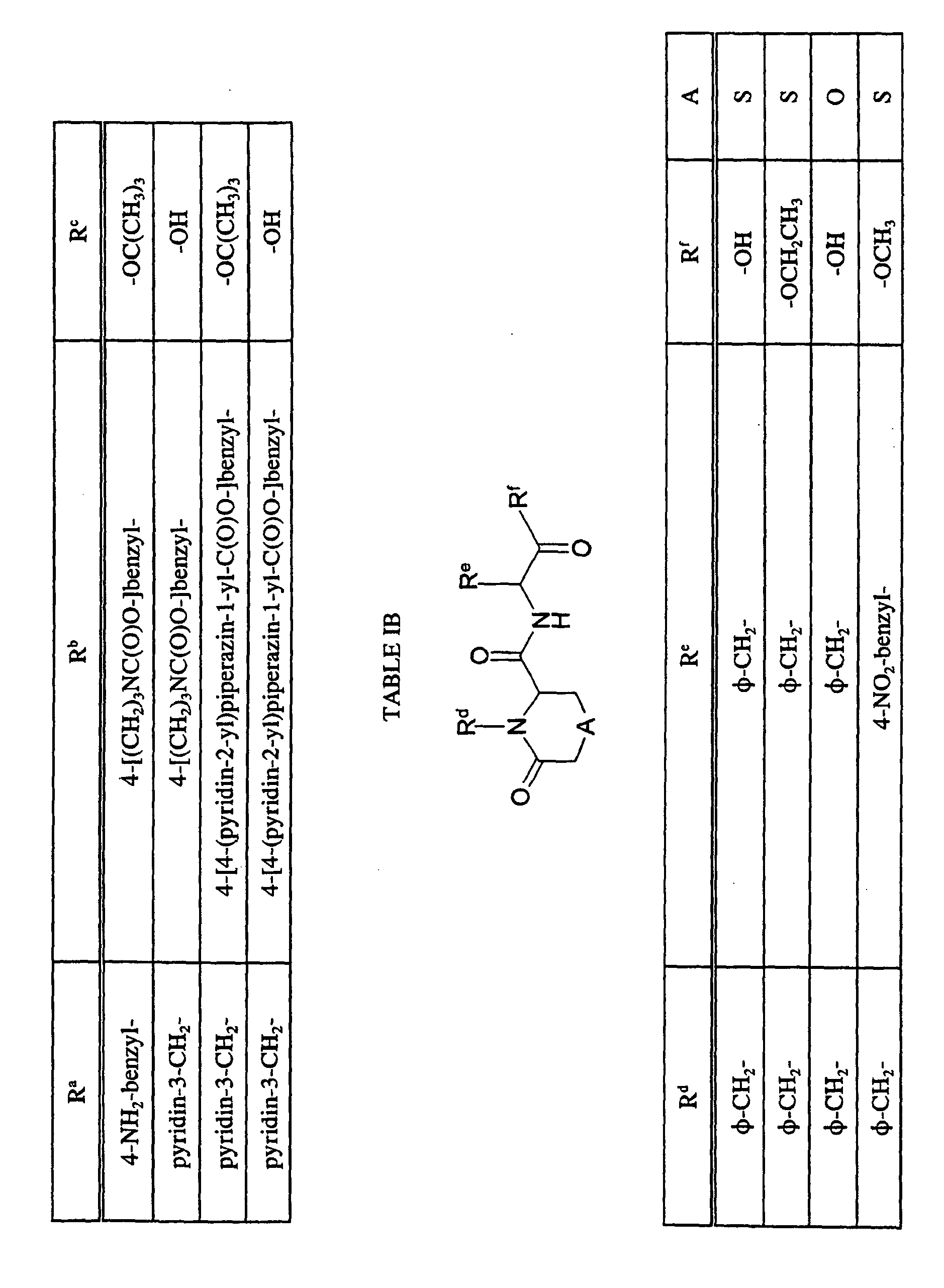

- As above, this invention relates to compounds which inhibit leukocyte adhesion and, in particular, leukocyte adhesion mediated by VLA-4. However, prior to describing this invention in further detail, the following terms will first be defined.
- As used herein, "alkyl" refers to alkyl groups preferably having from 1 to 10 carbon atoms and more preferably 1 to 6 carbon atoms. This term is exemplified by groups such as methyl, t-butyl, n-heptyl, octyl and the like.
- "Substituted alkyl" refers to an alkyl group, preferably of from 1 to 10 carbon atoms, having from 1 to 5 substituents selected from the group consisting of alkoxy, substituted alkoxy, acyl, acylamino, thiocarbonylamino, acyloxy, amino, amidino, alkyl amidino, thioamidino, aminoacyl, aminocarbonylamino, aminothiocarbonylamino, aminocarbonyloxy, aryl, substituted aryl, aryloxy, substituted aryloxy, aryloxylaryl, substituted aryloxyaryl, cyano, halogen, hydroxyl, nitro, carboxyl, carboxylalkyl, carboxyl-substituted alkyl, carboxyl-cycloalkyl, carboxyl-substituted cycloalkyl, carboxylaryl, carboxyl-substituted aryl, carboxylheteroaryl, carboxyl-substituted heteroaryl, carboxylheterocyclic, carboxyl-substituted heterocyclic, cycloalkyl, substituted cycloalkyl, guanidino, guanidinosulfone, thiol, thioalkyl, substituted thioalkyl, thioaryl, substituted thioaryl, thiocycloalkyl, substituted thiocycloalkyl, thioheteroaryl, substituted thioheteroaryl, thioheterocyclic, substituted thioheterocyclic, heteroaryl, substituted aryl, substituted heteroaryl, heterocyclic, substituted heterocyclic, cycloalkoxy, substituted cycloalkoxy, heteroaryloxy, substituted heteroaryloxy, heterocyclyloxy, substituted heterocyclyloxy, oxycarbonylamino, oxythiocarbonylamino, -OS(O)2-alkyl, -OS(O)2-substituted alkyl, -OS(O)2-aryl, -OS(O)2-substituted aryl, -OS(O)2-heteroaryl, -OS(O)2-substituted heteroaryl, -OS(O)2-heterocyclic, -OS(O)2-substituted heterocyclic, -OSO2-NRR where R is hydrogen or alkyl, -NRS(O)2-alkyl, -NRS(O)2-substituted alkyl, -NRS(O)2-aryl, -NRS(O)2-substituted aryl, -NRS(O)2-heteroaryl, -NRS(O)2-substituted heteroaryl, -NRS(O)2-heterocyclic, -NRS(O)2-substituted heterocyclic, -NRS(O)2-NR-alkyl, -NRS(O)2-NR-substituted alkyl, -NRS(O)2-NR-aryl, -NRS(O)2-NR-substituted aryl, -NRS(O)2-NR-heteroaryl, -NRS(O)2-NR-substituted heteroaryl, -NRS(O)2-NR-heterocyclic, -NRS(O)2-NR-substituted heterocyclic where R is hydrogen or alkyl, mono- and di-alkylamino, mono- and di-(substituted alkyl)amino, mono- and di-arylamino, mono- and di-substituted arylamino, mono- and di-heteroarylamino, mono- and di-substituted heteroarylamino, mono- and di-heterocyclic amino, mono- and di-substituted heterocyclic amino, unsymmetric di-substituted amines having different substituents selected from alkyl, substituted alkyl, aryl, substituted aryl, heteroaryl, substituted heteroaryl, heterocyclic and substituted heterocyclic and substituted alkyl groups having amino groups blocked by conventional blocking groups such as Boc, Cbz, formyl, and the like or alkyl/substituted alkyl groups substituted with -SO2-alkyl, -SO2-substituted alkyl, -SO2-alkenyl, -SO2-substituted alkenyl, -SO2-cycloalkyl, -SO2-substituted cycloalkyl, -SO2-aryl, -SO2-substituted aryl, -SO2-heteroaryl, -SO2-substituted heteroaryl, -SO2-heterocyclic, -SO2-substituted heterocyclic and -SO2NRR where R is hydrogen or alkyl.
- "Alkylene" refers to a divalent hydrocarbon radical of the formula -(CH2)n- where n is an integer ranging from 1 to 10. By way of illustration, the term alkylene includes methylene (-CH2-), ethylene (-CH2CH2-), propylene (-CH2CH2CH2-) and the like.
- "Substituted alkylene" refers to an alkylene group, preferably of from 1 to 10 carbon atoms, having from 1 to 5 substituents selected from the group consisting of alkoxy, substituted alkoxy, acyl, acylamino, thiocarbonylamino, acyloxy, amino, amidino, alkyl amidino, thioamidino, aminoacyl, aminocarbonylamino, aminothiocarbonylamino, aminocarbonyloxy, aryl, substituted aryl, aryloxy, substituted aryloxy, aryloxylaryl, substituted aryloxyaryl, cyano, halogen, hydroxyl, nitro, carboxyl, carboxylalkyl, carboxyl-substituted alkyl, carboxyl-cycloalkyl, carboxyl-substituted cycloalkyl, carboxylaryl, carboxyl-substituted aryl, carboxylheteroaryl, carboxyl-substituted heteroaryl, carboxylheterocyclic, carboxyl-substituted heterocyclic, cycloalkyl, substituted cycloalkyl, guanidino, guanidinosulfone, thiol, thioalkyl, substituted thioalkyl, thioaryl, substituted thioaryl, thiocycloalkyl, substituted thiocycloalkyl, thioheteroaryl, substituted thioheteroaryl, thioheterocyclic, substituted thioheterocyclic, heteroaryl, substituted aryl, substituted heteroaryl, heterocyclic, substituted heterocyclic, cycloalkoxy, substituted cycloalkoxy, heteroaryloxy, substituted heteroaryloxy, heterocyclyloxy, substituted heterocyclyloxy, oxycarbonylamino, oxythiocarbonylamino, -OS(O)2-alkyl, -OS(O)2-substituted alkyl, -OS(O)2-aryl, -OS(O)2-substituted aryl, -OS(O)2-heteroaryl, -OS(O)2-substituted heteroaryl, -OS(O)2-heterocyclic, -OS(O)2-substituted heterocyclic, -OSO2-NRR where R is hydrogen or alkyl, -NRS(O)2-alkyl, -NRS(O)2-substituted alkyl, -NRS(O)2-aryl, -NRS(O)2-substituted aryl, -NRS(O)2-heteroaryl, -NRS(O)2-substituted heteroaryl, -NRS(O)2-heterocyclic, -NRS(O)2-substituted heterocyclic, -NRS(O)2-NR-alkyl, -NRS(O)2-NR-substituted alkyl, -NRS(O)2-NR-aryl, -NRS(O)2-NR-substituted aryl, -NRS(O)2-NR-heteroaryl, -NRS(O)2-NR-substituted heteroaryl, -NRS(O)2-NR-heterocyclic, -NRS(O)2-NR-substituted heterocyclic where R is hydrogen or alkyl, mono- and di-alkylamino, mono- and di-(substituted alkyl)amino, mono- and di-arylamino, mono- and di-substituted arylamino, mono- and di-heteroarylamino, mono- and di-substituted heteroarylamino, mono- and di-heterocyclic amino, mono- and di-substituted heterocyclic amino, unsymmetric di-substituted amines having different substituents selected from alkyl, substituted alkyl, aryl, substituted aryl, heteroaryl, substituted heteroaryl, heterocyclic and substituted heterocyclic and substituted alkyl groups having amino groups blocked by conventional blocking groups such as Boc, Cbz, formyl, and the like or alkyl/substituted alkyl groups substituted with -SO2-alkyl, -SO2-substituted alkyl, -SO2-alkenyl, -SO2-substituted alkenyl, -SO2-cycloalkyl, -SO2-substituted cycloalkyl, -SO2-aryl, -SO2-substituted aryl, -SO2-heteroaryl, -SO2-substituted heteroaryl, -SO2-heterocyclic, -SO2-substituted heterocyclic and -SO2NRR where R is hydrogen or alkyl. Additionally, two or more substituents on the substituted alkylene group may also be joined together to form a fused and/or bridged cycloalkyl, substituted cycloalkyl, heterocyclic or substituted heterocyclic group, or a fused aryl or heteroaryl group.
- "Alkoxy" refers to the group "alkyl-O-" which includes, by way of example, methoxy, ethoxy, n-propoxy, iso-propoxy, n-butoxy, tert-butoxy, sec-butoxy, n-pentoxy, n-hexoxy, 1,2-dimethylbutoxy, and the like.
- "Substituted alkoxy" refers to the group "substituted alkyl-O-".
- "Alkoxycarbonyl" refers to the group "alkyl-O-C(O)-".
- "Substituted alkoxycarbonyl" refers to the group "substituted alkyl-O-C(O)-".
- "Acyl" refers to the groups H-C(O)-, alkyl-C(O)-, substituted alkyl-C(O)-, alkenyl-C(O)-, substituted alkenyl-C(O)-, alkynyl-C(O)-, substituted alkynyl-C(O)-, cycloalkyl-C(O)-, substituted cycloalkyl-C(O)-, aryl-C(O)-, substituted aryl-C(O)-, heteroaryl-C(O)-, substituted heteroaryl-C(O), heterocyclic-C(O)-, and substituted heterocyclic-C(O)- wherein alkyl, substituted alkyl, alkenyl, substituted alkenyl, alkynyl, substituted alkynyl, cycloalkyl, substituted cycloalkyl, aryl, substituted aryl, heteroaryl, substituted heteroaryl, heterocyclic and substituted heterocyclic are as defined herein.
- "Acylamino" refers to the group -C(O)NRR where each R is independently selected from the group consisting of hydrogen, alkyl, substituted alkyl, alkenyl, substituted alkenyl, alkynyl, substituted alkynyl, aryl, substituted aryl, cycloalkyl, substituted cycloalkyl, heteroaryl, substituted heteroaryl, heterocyclic, substituted heterocyclic and where each R is joined to form together with the nitrogen atom a heterocyclic or substituted heterocyclic ring wherein alkyl, substituted alkyl, alkenyl, substituted alkenyl, alkynyl, substituted alkynyl, cycloalkyl, substituted cycloalkyl, aryl, substituted aryl, heteroaryl, substituted heteroaryl, heterocyclic and substituted heterocyclic are as defined herein.
- "Thiocarbonylamino" refers to the group -C(S)NRR where each R is independently selected from the group consisting of hydrogen, alkyl, substituted alkyl, alkenyl, substituted alkenyl, alkynyl, substituted alkynyl, aryl, substituted aryl, cycloalkyl, substituted cycloalkyl, heteroaryl, substituted heteroaryl, heterocyclic, substituted heterocyclic and where each R is joined to form, together with the nitrogen atom a heterocyclic or substituted heterocyclic ring wherein alkyl, substituted alkyl, alkenyl, substituted alkenyl, alkynyl, substituted alkynyl, cycloalkyl, substituted cycloalkyl, aryl, substituted aryl, heteroaryl, substituted heteroaryl, heterocyclic and substituted heterocyclic are as defined herein.
- "Acyloxy" refers to the groups alkyl-C(O)O-, substituted alkyl-C(O)O-, alkenyl-C(O)O-, substituted alkenyl-C(O)O-, alkynyl-C(O)O-, substituted alkynyl-C(O)O-, aryl-C(O)O-, substituted aryl-C(O)O-, cycloalkyl-C(O)O-, substituted cycloalkyl-C(O)O-, heteroaryl-C(O)O-, substituted heteroaryl-C(O)O-, heterocyclic-C(O)O-, and substituted heterocyclic-C(O)O-, wherein alkyl, substituted alkyl, alkenyl, substituted alkenyl, alkynyl, substituted alkynyl, cycloalkyl, substituted cycloalkyl, aryl, substituted aryl, heteroaryl, substituted heteroaryl, heterocyclic and substituted heterocyclic are as defined herein.
- "Alkenyl" refers to alkenyl group preferably having from 2 to 10 carbon atoms and more preferably 2 to 6 carbon atoms and having at least 1 and preferably from 1-2 sites of alkenyl unsaturation.
- "Substituted alkenyl" refers to alkenyl groups having from 1 to 5 substituents selected from the group consisting of alkoxy, substituted alkoxy, acyl, acylamino, thiocarbonylamino, acyloxy, amino, amidino, alkylamidino, thioamidino, aminoacyl, aminocarbonylamino, aminothiocarbonylamino, aminocarbonyloxy, aryl, substituted aryl, aryloxy, substituted aryloxy, aryloxyaryl, substituted aryloxyaryl, halogen, hydroxyl, cyano, nitro, carboxyl, carboxylalkyl, carboxyl-substituted alkyl, carboxyl-cycloalkyl, carboxyl-substituted cycloalkyl, carboxylaryl, carboxyl-substituted aryl, carboxylheteroaryl, carboxyl-substituted heteroaryl, carboxylheterocyclic, carboxyl-substituted heterocyclic, cycloalkyl, substituted cycloalkyl, guanidino, guanidinosulfone, thiol, thioalkyl, substituted thioalkyl, thioaryl, substituted thioaryl, thiocycloalkyl, substituted thiocycloalkyl, thioheteroaryl, substituted thioheteroaryl, thioheterocyclic, substituted thioheterocyclic, heteroaryl, substituted heteroaryl, heterocyclic, substituted heterocyclic, cycloalkoxy, substituted cycloalkoxy, heteroaryloxy, substituted heteroaryloxy, heterocyclyloxy, substituted heterocyclyloxy, oxycarbonylamino, oxythiocarbonylamino, -OS(O)2-alkyl, -OS(O)2-substituted alkyl, -OS(O)2-aryl, -OS(O)2-substituted aryl, -OS(O)2-heteroaryl, -OS(O)2-substituted heteroaryl, -OS(O)2-heterocyclic, -OS(O)2-substituted heterocyclic, -OSO2-NRR where R is hydrogen or alkyl, -NRS(O)2-alkyl, -NRS(O)2-substituted alkyl, -NRS(O)2-aryl, -NRS(O)2-substituted aryl, -NRS(O)2-heteroaryl, -NRS(O)2-substituted heteroaryl, -NRS(O)2-heterocyclic, -NRS(O)2-substituted heterocyclic, -NRS(O)2-NR-alkyl, -NRS(O)2-NR-substituted alkyl, -NRS(O)2-NR-aryl, -NRS(O)2-NR-substituted aryl, -NRS(O)2-NR-heteroaryl, -NRS(O)2-NR-substituted heteroaryl, -NRS(O)2-NR-heterocyclic, -NRS(O)2-NR-substituted heterocyclic where R is hydrogen or alkyl, mono- and di-alkylamino, mono- and di-(substituted alkyl)amino, mono- and di-arylamino, mono- and di-substituted arylamino, mono- and di-heteroarylamino, mono- and di-substituted heteroarylamino, mono- and di-heterocyclic amino, mono- and di-substituted heterocyclic amino, unsymmetric di-substituted amines having different substituents selected from alkyl, substituted alkyl, aryl, substituted aryl; heteroaryl, substituted heteroaryl, heterocyclic and substituted heterocyclic and substituted alkenyl groups having amino groups blocked by conventional blocking groups such as Boc, Cbz, formyl, and the like or alkenyl/substituted alkenyl groups substituted with -SO2-alkyl, -SO2-substituted alkyl, -SO2-alkenyl, -SO2-substituted alkenyl, -SO2-cycloalkyl, -SO2-substituted cycloalkyl, -SO2-aryl, -SO2-substituted aryl, -SO2-heteroaryl, -SO2-substituted heteroaryl, -SO2-heterocyclic, -SO2-substituted heterocyclic and -SO2NRR where R is hydrogen or alkyl.
- "Alkynyl" refers to alkynyl group preferably having from 2 to 10 carbon atoms and more preferably 3 to 6 carbon atoms and having at least 1 and preferably from 1-2 sites of alkynyl unsaturation.
- "Substituted alkynyl" refers to alkynyl groups having from 1 to 5 substituents selected from the group consisting of alkoxy, substituted alkoxy, acyl, acylamino, thiocarbonylamino, acyloxy, amino, amidino, alkylamidino, thioamidino, aminoacyl, aminocarbonylamino, aminothiocarbonylamino, aminocarbonyloxy, aryl, substituted aryl, aryloxy, substituted aryloxy, aryloxyaryl, substituted aryloxyaryl, halogen, hydroxyl, cyano, nitro, carboxyl, carboxylalkyl, carboxyl-substituted alkyl, carboxyl-cycloalkyl, carboxyl-substituted cycloalkyl, carboxylaryl, carboxyl-substituted aryl, carboxylheteroaryl, carboxyl-substituted heteroaryl, carboxylheterocyclic, carboxyl-substituted heterocyclic, cycloalkyl, substituted cycloalkyl, guanidino, guanidinosulfone, thiol, thioalkyl, substituted thioalkyl, thioaryl, substituted thioaryl, thiocycloalkyl, substituted thiocycloalkyl, thioheteroaryl, substituted thioheteroaryl, thioheterocyclic, substituted thioheterocyclic, heteroaryl, substituted heteroaryl, heterocyclic, substituted heterocyclic, cycloalkoxy, substituted cycloalkoxy, heteroaryloxy, substituted heteroaryloxy, heterocyclyloxy, substituted heterocyclyloxy, oxycarbonylamino, oxythiocarbonylamino, -OS(O)2-alkyl, -OS(O)2-substituted alkyl, -OS(O)2-aryl, -OS(O)2-substituted aryl, -OS(O)2-heteroaryl, -OS(O)2-substituted heteroaryl, -OS(O)2-heterocyclic, -OS(O)2-substituted heterocyclic, -OSO2-NRR where R is hydrogen or alkyl, -NRS(O)2-alkyl, -NRS(O)2-substituted alkyl, -NRS(O)2-aryl, -NRS(O)2-substituted aryl, -NRS(O)2-heteroaryl, -NRS(O)2-substituted heteroaryl, -NRS(O)2-heterocyclic, -NRS(O)2-substituted heterocyclic, -NRS(O)2-NR-alkyl, -NRS(O)2-NR-substituted alkyl, -NRS(O)2-NR-aryl, -NRS(O)2-NR-substituted aryl, -NRS(O)2-NR-heteroaryl, -NRS(O)2-NR-substituted heteroaryl, -NRS(O)2-NR-heterocyclic, -NRS(O)2-NR-substituted heterocyclic where R is hydrogen or alkyl, mono- and di-alkylamino, mono- and di-(substituted alkyl)amino, mono- and di-arylamino, mono- and di-substituted arylamino, mono- and di-heteroarylamino, mono- and di-substituted heteroarylamino, mono- and di-heterocyclic amino, mono- and di-substituted heterocyclic amino, unsymmetric di-substituted amines having different substituents selected from alkyl, substituted alkyl, aryl, substituted aryl, heteroaryl, substituted heteroaryl, heterocyclic and substituted heterocyclic and substituted alkynyl groups having amino groups blocked by conventional blocking groups such as Boc, Cbz, formyl, and the like or alkynyl/substituted alkynyl groups substituted with -SO2-alkyl, -SO2-substituted alkyl, -SO2-alkenyl, -SO2-substituted alkenyl, -SO2-cycloalkyl, -SO2-substituted cycloalkyl, -SO2-aryl, -SO2-substituted aryl, -SO2-heteroaryl, -SO2-substituted heteroaryl, -SO2-heterocyclic, -SO2-substituted heterocyclic and -SO2NRR where R is hydrogen or alkyl.
- "Amidino" refers to the group H2NC(=NH)- and the term "alkylamidino" refers to compounds having 1 to 3 alkyl groups (e.g., alkyl-HNC(=NH)- and the like).
- "Thioamidino" refers to the group RSC(=NH)- where R is hydrogen or alkyl.
- "Aminoacyl" refers to the groups -NRC(O)alkyl, -NRC(O)substituted alkyl, -NRC(O)cycloalkyl, -NRC(O)substituted cycloalkyl, -NRC(O)alkenyl, -NRC(O)substituted alkenyl, -NRC(O)alkynyl, -NRC(O)substituted alkynyl, -NRC(O)aryl, -NRC(O)substituted aryl, -NRC(O)heteroaryl, -NRC(O)substituted heteroaryl, -NRC(O)heterocyclic, and -NRC(O)substituted heterocyclic where R is hydrogen or alkyl and wherein alkyl, substituted alkyl, alkenyl, substituted alkenyl, alkynyl, substituted alkynyl, cycloalkyl, substituted cycloalkyl, aryl, substituted aryl, heteroaryl, substituted heteroaryl, heterocyclic and substituted heterocyclic are as defined herein.
- "Aminocarbonyloxy" refers to the groups -NRC(O)O-alkyl, -NRC(O)O-substituted alkyl, -NRC(O)O-alkenyl, -NRC(O)O-substituted alkenyl, -NRC(O)O-alkynyl, -NRC(O)O-substituted alkynyl, -NRC(O)O-cycloalkyl, -NRC(O)O-substituted cycloalkyl, -NRC(O)O-aryl, -NRC(O)O-substituted aryl, -NRC(O)O-heteroaryl, -NRC(O)O-substituted heteroaryl, -NRC(O)O-heterocyclic, and -NRC(O)O-substituted heterocyclic where R is hydrogen or alkyl and wherein alkyl, substituted alkyl, alkenyl, substituted alkenyl, alkynyl, substituted alkynyl, cycloalkyl, substituted cycloalkyl, aryl, substituted aryl, heteroaryl, substituted heteroaryl, heterocyclic and substituted heterocyclic are as defined herein.
- "Oxycarbonylamino" refers to the groups -OC(O)NH2, -OC(O)NRR, -OC(O)NR-alkyl, -OC(O)NR-substituted alkyl, -OC(O)NR-alkenyl, -OC(O)NR-substituted alkenyl, -OC(O)NR-alkynyl, -OC(O)NR-substituted alkynyl, -OC(O)NR-cycloalkyl, -OC(O)NR-substituted cycloalkyl, -OC(O)NR-aryl, -OC(O)NR-substituted aryl, -OC(O)NR-heteroaryl, -OC(O)NR-substituted heteroaryl,- OC(O)NR-heterocyclic, and -OC(O)NR-substituted heterocyclic where R is hydrogen, alkyl or where each R is joined to form, together with the nitrogen atom, a heterocyclic or substituted heterocyclic ring, and wherein alkyl, substituted alkyl, alkenyl, substituted alkenyl, alkynyl, substituted alkynyl, cycloalkyl, substituted cycloalkyl, aryl, substituted aryl, heteroaryl, substituted heteroaryl, heterocyclic and substituted heterocyclic are as defined herein.
- "Oxythiocarbonylamino" refers to the groups -OC(S)NH2, -OC(S)NRR, -OC(S)NR-alkyl, -OC(S)NR-substituted alkyl, -OC(S)NR-alkenyl, -OC(S)NR-substituted alkenyl, -OC(S)NR-alkynyl, -OC(S)NR-substituted alkynyl, -OC(S)NR-cycloalkyl, -OC(S)NR-substituted cycloalkyl, -OC(S)NR-aryl, -OC(S)NR-substituted aryl, -OC(S)NR-heteroaryl, -OC(S)NR-substituted heteroaryl, -OC(S)NR-heterocyclic, and -OC(S)NR-substituted heterocyclic where R is hydrogen, alkyl or where each R is joined to form together with the nitrogen atom, a heterocyclic or substituted heterocyclic ring, and wherein alkyl, substituted alkyl, alkenyl, substituted alkenyl, alkynyl, substituted alkynyl, cycloalkyl, substituted cycloalkyl, aryl, substituted aryl, heteroaryl, substituted heteroaryl, heterocyclic and substituted heterocyclic are as defined herein.
- "Aminocarbonylamino" refers to the groups -NRC(O)NRR, -NRC(O)NR-alkyl, -NRC(O)NR-substituted alkyl, -NRC(O)NR-alkenyl, -NRC(O)NR-substituted alkenyl, -NRC(O)NR-alkynyl, -NRC(O)NR-substituted alkynyl, -NRC(O)NR-aryl, -NRC(O)NR-substituted aryl, -NRC(O)NR-cycloalkyl, -NRC(O)NR-substituted cycloalkyl, -NRC(O)NR-heteroaryl, and -NRC(O)NR-substituted heteroaryl, -NRC(O)NR-heterocyclic, and -NRC(O)NR-substituted heterocyclic where each R is independently hydrogen, alkyl or where each R is joined to form together with the nitrogen atom a heterocyclic or substituted heterocyclic ring as well as where one of the amino groups is blocked by conventional blocking groups such as Boc, Cbz, formyl, and the like and wherein alkyl, substituted alkyl, alkenyl, substituted alkenyl, alkynyl, substituted alkynyl, cycloalkyl, substituted cycloalkyl, aryl, substituted aryl, heteroaryl, substituted heteroaryl, heterocyclic and substituted heterocyclic are as defined herein.
- "Aminothiocarbonylamino" refers to the groups -NRC(S)NRR, -NRC(S)NR-alkyl, -NRC(S)NR-substituted alkyl, -NRC(S)NR-alkenyl, -NRC(S)NR-substituted alkenyl, -NRC(S)NR-alkynyl, -NRC(S)NR-substituted alkynyl, -NRC(S)NR-aryl, -NRC(S)NR-substituted aryl, -NRC(S)NR-cycloalkyl, -NRC(S)NR-substituted cycloalkyl, -NRC(S)NR-heteroaryl, and -NRC(S)NR-substituted heteroaryl, -NRC(S)NR-heterocyclic, and -NRC(S)NR-substituted heterocyclic where each R is independently hydrogen, alkyl or where each R is joined to form together with the nitrogen atom a heterocyclic or substituted heterocyclic ring as well as where one of the amino groups is blocked by conventional blocking groups such as Boc, Cbz, formyl, and the like, and wherein alkyl, substituted alkyl, alkenyl, substituted alkenyl, alkynyl, substituted alkynyl, cycloalkyl, substituted cycloalkyl, aryl, substituted aryl, heteroaryl, substituted heteroaryl, heterocyclic and substituted heterocyclic are as defined herein.
- "Aryl" or "Ar" refers to an unsaturated aromatic carbocyclic group of from 6 to 14 carbon atoms having a single ring (e.g., phenyl) or multiple condensed rings (e.g., naphthyl or anthryl) which condensed rings may or may not be aromatic (e.g., 2-benzoxazolinone, 2H-1,4-benzoxazin-3(4H)-one-7yl, and the like). Preferred aryls include phenyl and naphthyl.
- Substituted aryl refers to aryl groups which are substituted with from 1 to 3 substituents selected from the group consisting of hydroxy, acyl, acylamino, thiocarbonylamino, acyloxy, alkyl, substituted alkyl, alkoxy, substituted alkoxy, alkenyl, substituted alkenyl, alkynyl, substituted alkynyl, amidino, alkylamidino, thioamidino, amino, aminoacyl, aminocarbonyloxy, aminocarbonylamino, aminothiocarbonylamino, aryl, substituted aryl, aryloxy, substituted aryloxy, cycloalkoxy, substituted cycloalkoxy, heteroaryloxy, substituted heteroaryloxy, heterocyclyloxy, substituted heterocyclyloxy, carboxyl, carboxylalkyl, carboxyl-substituted alkyl, carboxyl-cycloalkyl, carboxyl-substituted cycloalkyl, carboxylaryl, carboxyl-substituted aryl, carboxylheteroaryl, carboxyl-substituted heteroaryl, carboxylheterocyclic, carboxyl-substituted heterocyclic, carboxylamido, cyano, thiol, thioalkyl, substituted thioalkyl, thioaryl, substituted thioaryl, thioheteroaryl, substituted thioheteroaryl, thiocycloalkyl, substituted thiocycloalkyl, thioheterocyclic, substituted thioheterocyclic, cycloalkyl, substituted cycloalkyl, guanidino, guanidinosulfone, halo, nitro, heteroaryl, substituted heteroaryl, heterocyclic, substituted heterocyclic, cycloalkoxy, substituted cycloalkoxy, heteroaryloxy, substituted heteroaryloxy, heterocyclyloxy, substituted heterocyclyloxy, oxycarbonylamino, oxythiocarbonylamino, -S(O)2-alkyl, -S(O)2-substituted alkyl, -S(O)2-cycloalkyl, -S(O)2-substituted cycloalkyl, -S(O)2-alkenyl, -S(O)2-substituted alkenyl, -S(O)2-aryl, -S(O)2-substituted aryl, -S(O)2-heteroaryl, -S(O)2-substituted heteroaryl, -S(O)2-heterocyclic, -S(O)2-substituted heterocyclic, -OS(O)2-alkyl, -OS(O)2-substituted alkyl, -OS(O)2-aryl, -OS(O)2-substituted aryl, -OS(O)2-heteroaryl, -OS(O)2-substituted heteroaryl, -OS(O)2-heterocyclic, -OS(O)2-substituted heterocyclic, -OSO2-NRR where R is hydrogen or alkyl, -NRS(O)2-alkyl, -NRS(O)2-substituted alkyl, -NRS(O)2-aryl, -NRS(O)2-substituted aryl, -NRS(O)2-heteroaryl, -NRS(O)2-substituted heteroaryl, -NRS(O)2-heterocyclic, -NRS(O)2-substituted heterocyclic, -NRS(O)2-NR-alkyl, -NRS(O)2-NR-substituted alkyl, -NRS(O)2-NR-aryl, -NRS(O)2-NR-substituted aryl, -NRS(O)2-NR-heteroaryl, -NRS(O)2-NR-substituted heteroaryl, -NRS(O)2-NR-heterocyclic, -NRS(O)2-NR-substituted heterocyclic where R is hydrogen or alkyl, mono- and di-alkylamino, mono- and di-(substituted alkyl)amino, mono- and di-arylamino, mono- and di-substituted arylamino, mono- and di-heteroarylamino, mono- and di-substituted heteroarylamino, mono- and di-heterocyclic amino, mono- and di-substituted heterocyclic amino, unsymmetric di-substituted amines having different substituents selected from alkyl, substituted alkyl, aryl, substituted aryl, heteroaryl, substituted heteroaryl, heterocyclic and substituted heterocyclic and amino groups on the substituted aryl blocked by conventional blocking groups such as Boc, Cbz, formyl, and the like or substituted with -SO2NRR where R is hydrogen or alkyl.
- "Aryloxy" refers to the group aryl-O- which includes, by way of example, phenoxy, naphthoxy, and the like.
- "Substituted aryloxy" refers to substituted aryl-O- groups.
- "Aryloxyaryl" refers to the group -aryl-O-aryl.
- "Substituted aryloxyaryl" refers to aryloxyaryl groups substituted with from 1 to 3 substituents on either or both aryl rings selected from the group consisting of hydroxy, acyl, acylamino, thiocarbonylamino, acyloxy, alkyl, substituted alkyl, alkoxy, substituted alkoxy, alkenyl, substituted alkenyl, alkynyl, substituted alkynyl, amidino, alkylamidino, thioamidino, amino, aminoacyl, aminocarbonyloxy, aminocarbonylamino, aminothiocarbonylamino, aryl, substituted aryl, aryloxy, substituted aryloxy, cycloalkoxy, substituted cycloalkoxy, heteroaryloxy, substituted heteroaryloxy, heterocyclyloxy, substituted heterocyclyloxy, carboxyl, carboxylalkyl, carboxyl-substituted alkyl, carboxyl-cycloalkyl, carboxyl-substituted cycloalkyl, carboxylaryl, carboxyl-substituted aryl, carboxylheteroaryl, carboxyl-substituted heteroaryl, carboxylheterocyclic, carboxyl-substituted heterocyclic, carboxylamido, cyano, thiol, thioalkyl, substituted thioalkyl, thioaryl, substituted thioaryl, thioheteroaryl, substituted thioheteroaryl, thiocycloalkyl, substituted thiocycloalkyl, thioheterocyclic, substituted thioheterocyclic, cycloalkyl, substituted cycloalkyl, guanidino, guanidinosulfone, halo, nitro, heteroaryl, substituted heteroaryl, heterocyclic, substituted heterocyclic, cycloalkoxy, substituted cycloalkoxy, heteroaryloxy, substituted heteroaryloxy, heterocyclyloxy, substituted heterocyclyloxy, oxycarbonylamino, oxythiocarbonylamino, -S(O)2-alkyl, -S(O)2-substituted alkyl, -S(O)2-cycloalkyl, -S(O)2-substituted cycloalkyl, -S(O)2-alkenyl, -S(O)2-substituted alkenyl, -S(O)2-aryl, -S(O)2-substituted aryl, -S(O)2-heteroaryl, -S(O)2-substituted heteroaryl, -S(O)2-heterocyclic, -S(O)2-substituted heterocyclic, -OS(O)2-alkyl, -OS(O)2-substituted alkyl, -OS(O)2-aryl, -OS(O)2-substituted aryl, -OS(O)2-heteroaryl, -OS(O)2-substituted heteroaryl, -OS(O)2-heterocyclic, -OS(O)2-substituted heterocyclic, -OSO2-NRR where R is hydrogen or alkyl, -NRS(O)2-alkyl, -NRS(O)2-substituted alkyl, -NRS(O)2-aryl, -NRS(O)2-substituted aryl, -NRS(O)2-heteroaryl, -NRS(O)2-substituted heteroaryl, -NRS(O)2-heterocyclic, -NRS(O)2-substituted heterocyclic, -NRS(O)2-NR-alkyl, -NRS(O)2-NR-substituted alkyl, -NRS(O)2-NR-aryl, -NRS(O)2-NR-substituted aryl, -NRS(O)2-NR-heteroaryl, -NRS(O)2-NR-substituted heteroaryl, -NRS(O)2-NR-heterocyclic, -NRS(O)2-NR-substituted heterocyclic where R is hydrogen or alkyl, mono- and di-alkylamino, mono- and di-(substituted alkyl)amino, mono- and di-arylamino, mono- and di-substituted arylamino, mono- and di-heteroarylamino, mono- and di-substituted heteroarylamino, mono- and di-heterocyclic amino, mono- and di-substituted heterocyclic amino, unsymmetric di-substituted amines having different substituents selected from alkyl, substituted alkyl, aryl, substituted aryl, heteroaryl, substituted heteroaryl, heterocyclic and substituted heterocyclic and amino groups on the substituted aryl blocked by conventional blocking groups such as Boc, Cbz, formyl, and the like or substituted with -SO2NRR where R is hydrogen or alkyl.
- "4-Benzyl-5-oxo-4-azatricyclo[4.2.1.0 (3,7)]nonane-3-carboxylic acid" refers to a compound of the formula:

- "Cycloalkyl" refers to cyclic alkyl groups of from 3 to 8 carbon atoms having a single cyclic ring including, by way of example, cyclopropyl, cyclobutyl, cyclopentyl, cyclooctyl and the like. Excluded from this definition are multi-ring or fused-ring alkyl groups such as adamantanyl, and the like.
- "Cycloalkenyl" refers to cyclic alkenyl groups of from 3 to 8 carbon atoms having single or multiple unsaturation but which are not aromatic.
- "Substituted cycloalkyl" and "substituted cycloalkenyl" refer to a cycloalkyl and cycloalkenyl groups, preferably of from 3 to 8 carbon atoms, having from 1 to 5 substituents selected from the group consisting of oxo (=O), thioxo (=S), alkoxy, substituted alkoxy, acyl, acylamino, thiocarbonylamino, acyloxy, amino, amidino, alkylamidino, thioamidino, aminoacyl, aminocarbonylamino, aminothiocarbonylamino, aminocarbonyloxy, aryl, substituted aryl, aryloxy, substituted aryloxy, aryloxyaryl, substituted aryloxyaryl, halogen, hydroxyl, cyano, nitro, carboxyl, carboxylalkyl, carboxyl-substituted alkyl, carboxyl-cycloalkyl, carboxyl-substituted cycloalkyl, carboxylaryl, carboxyl-substituted aryl, carboxylheteroaryl, carboxyl-substituted heteroaryl, carboxylheterocyclic, carboxyl-substituted heterocyclic, cycloalkyl, substituted cycloalkyl, guanidino, guanidinosulfone, thiol, thioalkyl, substituted thioalkyl, thioaryl, substituted thioaryl, thiocycloalkyl, substituted thiocycloalkyl, thioheteroaryl, substituted thioheteroaryl, thioheterocyclic, substituted thioheterocyclic, heteroaryl, substituted heteroaryl, heterocyclic, substituted heterocyclic, cycloalkoxy, substituted cycloalkoxy, heteroaryloxy, substituted heteroaryloxy, heterocyclyloxy, substituted heterocyclyloxy, oxycarbonylamino, oxythiocarbonylamino, -OS(O)2-alkyl, -OS(O)2-substituted alkyl, -OS(O)2-aryl, -OS(O)2-substituted aryl, -OS(O)2-heteroaryl, -OS(O)2-substituted heteroaryl, -OS(O)2-heterocyclic, -OS(O)2-substituted heterocyclic, -OSO2-NRR where R is hydrogen or alkyl, -NRS(O)2-alkyl, -NRS(O)2-substituted alkyl, -NRS(O)2-aryl, -NRS(O)2-substituted aryl, -NRS(O)2-heteroaryl, -NRS(O)2-substituted heteroaryl, -NRS(O)2-heterocyclic, -NRS(O)2-substituted heterocyclic, -NRS(O)2-NR-alkyl, -NRS(O)2-NR-substituted alkyl, -NRS(O)2-NR-aryl, -NRS(O)2-NR-substituted aryl, -NRS(O)2-NR-heteroaryl, -NRS(O)2-NR-substituted heteroaryl, -NRS(O)2-NR-heterocyclic, -NRS(O)2-NR-substituted heterocyclic where R is hydrogen or alkyl, mono- and di-alkylamino, mono- and di-(substituted alkyl)amino, mono- and di-arylamino, mono- and di-substituted arylamino, mono- and di-heteroarylamino, mono- and di-substituted heteroarylamino, mono- and di-heterocyclic amino, mono- and di-substituted heterocyclic amino, unsymmetric di-substituted amines having different substituents selected from alkyl, substituted alkyl, aryl, substituted aryl, heteroaryl, substituted heteroaryl, heterocyclic and substituted heterocyclic and substituted alkynyl groups having amino groups blocked by conventional blocking groups such as Boc, Cbz, formyl, and the like or alkynyl/substituted alkynyl groups substituted with -SO2-alkyl, -SO2-substituted alkyl, -SO2-alkenyl, -SO2-substituted alkenyl, -SO2-cycloalkyl, -SO2-substituted cycloalkyl, -SO2-aryl, -SO2-substituted aryl, -SO2-heteroaryl, -SO2-substituted heteroaryl, -SO2-heterocyclic, -SO2-substituted heterocyclic and -SO2NRR where R is hydrogen or alkyl.
- "Cycloalkoxy" refers to -O-cycloalkyl groups.
- "Substituted cycloalkoxy" refers to -O-substituted cycloalkyl groups.
- "Guanidino" refers to the groups -NRC(=NR)NRR, -NRC(=NR)NR-alkyl, -NRC(=NR)NR-substituted alkyl, -NRC(=NR)NR-alkenyl, -NRC(=NR)NR-substituted alkenyl, -NRC(=NR)NR-alkynyl, -NRC(=NR)NR-substituted alkynyl, -NRC(=NR)NR-aryl, -NRC(=NR)NR-substituted aryl, -NRC(=NR)NR-cycloalkyl, -NRC(=NR)NR-heteroaryl, -NRC(=NR)NR-substituted heteroaryl, -NRC(=NR)NR-heterocyclic, and -NRC(=NR)NR-substituted heterocyclic where each R is independently hydrogen and alkyl as well as where one of the amino groups is blocked by conventional blocking groups such as Boc, Cbz, formyl, and the like and wherein alkyl, substituted alkyl, alkenyl, substituted alkenyl, alkynyl, substituted alkynyl, cycloalkyl, substituted cycloalkyl, aryl, substituted aryl, heteroaryl, substituted heteroaryl, heterocyclic and substituted heterocyclic are as defined herein.
- "Guanidinosulfone" refers to the groups -NRC(=NR)NRSO2-alkyl, -NRC(=NR)NRSO2-substituted alkyl, -NRC(=NR)NRSO2-alkenyl, -NRC(=NR)NRSO2-substituted alkenyl, -NRC(=NR)NRSO2-alkynyl, -NRC(=NR)NRSO2-substituted alkynyl, -NRC(=NR)NRSO2-aryl, -NRC(=NR)NRSO2-substituted aryl, -NRC(=NR)NRSO2-cycloalkyl, -NRC(=NR)NRSO2-substituted cycloalkyl, -NRC(=NR)NRSO2-heteroaryl, and -NRC(=NR)NRSO2-substituted heteroaryl, -NRC(=NR)NRSO2-heterocyclic, and -NRC(=NR)NRSO2-substituted heterocyclic where each R is independently hydrogen and alkyl and wherein alkyl, substituted alkyl, alkenyl, substituted alkenyl, alkynyl, substituted alkynyl, cycloalkyl, substituted cycloalkyl, aryl, substituted aryl, heteroaryl, substituted heteroaryl, heterocyclic and substituted heterocyclic are as defined herein.
- "Halo" or "halogen" refers to fluoro, chloro, bromo and iodo and preferably is either chloro or bromo.
- "Heteroalkylene" refers to an alkylene group in which from 1 to 5, preferable from 1 to 3, of the carbon atoms in the alkylene chain have been replaced with a hetereoatom selected from nitrogen, oxygen or sulfur. By way of illustration, the term heteroalkylene includes -CH2-O-CH2-, -CH2-S-CH2-, -NHCH2- and the like.
- "Substituted heteroalkylene" refers to a heteroalkylene group having from 1 to 5 substituents selected from the group consisting of alkoxy, substituted alkoxy, acyl, acylamino, thiocarbonylamino, acyloxy, amino, amidino, alkyl amidino, thioamidino, aminoacyl, aminocarbonylamino, aminothiocarbonylamino, aminocarbonyloxy, aryl, substituted aryl, aryloxy, substituted aryloxy, aryloxylaryl, substituted aryloxyaryl, cyano, halogen, hydroxyl, nitro, carboxyl, carboxylalkyl, carboxyl-substituted alkyl, carboxyl-cycloalkyl, carboxyl-substituted cycloalkyl, carboxylaryl, carboxyl-substituted aryl, carboxylheteroaryl, carboxyl-substituted heteroaryl, carboxylheterocyclic, carboxyl-substituted heterocyclic, cycloalkyl, substituted cycloalkyl, guanidino, guanidinosulfone, thiol, thioalkyl, substituted thioalkyl, thioaryl, substituted thioaryl, thiocycloalkyl, substituted thiocycloalkyl, thioheteroaryl, substituted thioheteroaryl, thioheterocyclic, substituted thioheterocyclic, heteroaryl, substituted aryl, substituted heteroaryl, heterocyclic, substituted heterocyclic, cycloalkoxy, substituted cycloalkoxy, heteroaryloxy, substituted heteroaryloxy, heterocyclyloxy, substituted heterocyclyloxy, oxycarbonylamino, oxythiocarbonylamino, -OS(O)2-alkyl, -OS(O)2-substituted alkyl, -OS(O)2-aryl, -OS(O)2-substituted aryl, -OS(O)2-heteroaryl, -OS(O)2-substituted heteroaryl, -OS(O)2-heterocyclic, -OS(O)2-substituted heterocyclic, -OSO2-NRR where R is hydrogen or alkyl, -NRS(O)2-alkyl, -NRS(O)2-substituted alkyl, -NRS(O)2-aryl, -NRS(O)2-substituted aryl, -NRS(O)2-heteroaryl, - NRS(O)2-substituted heteroaryl, -NRS(O)2-heterocyclic, -NRS(O)2-substituted heterocyclic, -NRS(O)2-NR-alkyl, -NRS(O)2-NR-substituted alkyl, -NRS(O)2-NR-aryl, -NRS(O)2-NR-substituted aryl, -NRS(O)2-NR-heteroaryl, -NRS(O)2-NR-substituted heteroaryl, -NRS(O)2-NR-heterocyclic, -NRS(O)2-NR-substituted heterocyclic where R is hydrogen or alkyl, mono- and di-alkylamino, mono- and di-(substituted alkyl)amino, mono- and di-arylamino, mono- and di-substituted arylamino, mono- and di-heteroarylamino, mono- and di-substituted heteroarylamino, mono- and di-heterocyclic amino, mono- and di-substituted heterocyclic amino, unsymmetric di-substituted amines having different substituents selected from alkyl, substituted alkyl, aryl, substituted aryl, heteroaryl, substituted heteroaryl, heterocyclic and substituted heterocyclic and substituted alkyl groups having amino groups blocked by conventional blocking groups such as Boc, Cbz, formyl, and the like or alkyl/substituted alkyl groups substituted with -SO2-alkyl, -SO2-substituted alkyl, -SO2-alkenyl, -SO2-substituted alkenyl, -SO2-cycloalkyl, -SO2-substituted cycloalkyl, -SO2-aryl, -SO2-substituted aryl, -SO2-heteroaryl, -SO2-substituted heteroaryl, -SO2-heterocyclic, -SO2-substituted heterocyclic and -SO2NRR where R is hydrogen or alkyl.
- "Heteroaryl" refers to an aromatic carbocyclic group of from 2 to 10 carbon atoms and 1 to 4 heteroatoms selected from oxygen, nitrogen and sulfur within the ring. Such heteroaryl groups can have a single ring (e.g., pyridyl or furyl) or multiple condensed rings (e.g., indolizinyl or benzothienyl). Preferred heteroaryls include pyridyl, pyrrolyl, indolyl and furyl.
- "Substituted heteroaryl" refers to heteroaryl groups which are substituted with from 1 to 3 substituents selected from the group consisting of hydroxy, acyl, acylamino, thiocarbonylamino, acyloxy, alkyl, substituted alkyl, alkoxy, substituted alkoxy, alkenyl, substituted alkenyl, alkynyl, substituted alkynyl, amidino, alkylamidino, thioamidino, amino, aminoacyl, aminocarbonyloxy, aminocarbonylamino, aminothiocarbonylamino, aryl, substituted aryl, aryloxy, substituted aryloxy, cycloalkoxy, substituted cycloalkoxy, heteroaryloxy, substituted heteroaryloxy, heterocyclyloxy, substituted heterocyclyloxy, carboxyl, carboxylalkyl, carboxyl-substituted alkyl, carboxyl-cycloalkyl, carboxyl-substituted cycloalkyl, carboxylaryl, carboxyl-substituted aryl, carboxylheteroaryl, carboxyl-substituted heteroaryl, carboxylheterocyclic, carboxyl-substituted heterocyclic, carboxylamido, cyano, thiol, thioalkyl, substituted thioalkyl, thioaryl, substituted thioaryl, thioheteroaryl, substituted thioheteroaryl, thiocycloalkyl, substituted thiocycloalkyl, thioheterocyclic, substituted thioheterocyclic, cycloalkyl, substituted cycloalkyl, guanidino, guanidinosulfone, halo, nitro, heteroaryl, substituted heteroaryl, heterocyclic, substituted heterocyclic, cycloalkoxy, substituted cycloalkoxy, heteroaryloxy, substituted heteroaryloxy, heterocyclyloxy, substituted heterocyclyloxy, oxycarbonylamino, oxythiocarbonylamino, -S(O)2-alkyl, -S(O)2-substituted alkyl, -S(O)2-cycloalkyl, -S(O)2-substituted cycloalkyl, -S(O)2-alkenyl, -S(O)2-substituted alkenyl, -S(O)2-aryl, -S(O)2-substituted aryl, -S(O)2-heteroaryl, -S(O)2-substituted heteroaryl, -S(O)2-heterocyclic, -S(O)2-substituted heterocyclic, -OS(O)2-alkyl, -OS(O)2-substituted alkyl, -OS(O)2-aryl, -OS(O)2-substituted aryl, -OS(O)2-heteroaryl, -OS(O)2-substituted heteroaryl, -OS(O)2-heterocyclic, -OS(O)2-substituted heterocyclic, -OSO2-NRR where R is hydrogen or alkyl, -NRS(O)2-alkyl, -NRS(O)2-substituted alkyl, -NRS(O)2-aryl, -NRS(O)2-substituted aryl, -NRS(O)2-heteroaryl, -NRS(O)2-substituted heteroaryl, -NRS(O)2-heterocyclic, -NRS(O)2-substituted heterocyclic, -NRS(O)2-NR-alkyl, -NRS(O)2-NR-substituted alkyl, -NRS(O)2-NR-aryl, -NRS(O)2-NR-substituted aryl, -NRS(O)2-NR-heteroaryl, -NRS(O)2-NR-substituted heteroaryl, -NRS(O)2-NR-heterocyclic, -NRS(O)2-NR-substituted heterocyclic where R is hydrogen or alkyl, mono- and di-alkylamino, mono- and di-(substituted alkyl)amino, mono- and di-arylamino, mono- and di-substituted arylamino, mono- and di-heteroarylamino, mono- and di-substituted heteroarylamino, mono- and di-heterocyclic amino, mono- and di-substituted heterocyclic amino, unsymmetric di-substituted amines having different substituents selected from alkyl, substituted alkyl, aryl, substituted aryl, heteroaryl, substituted heteroaryl, heterocyclic and substituted heterocyclic and amino groups on the substituted aryl blocked by conventional blocking groups such as Boc, Cbz, formyl, and the like or substituted with -SO2NRR where R is hydrogen or alkyl.
- "Heteroaryloxy" refers to the group -O-heteroaryl and "substituted heteroaryloxy" refers to the group -O-substituted heteroaryl.
- "Heterocycle" or "heterocyclic" refers to a saturated or unsaturated group having a single ring or multiple condensed rings, from 1 to 10 carbon atoms and from 1 to 4 hetero atoms selected from nitrogen, sulfur or oxygen within the ring wherein, in fused ring systems, one or more of the rings can be aryl or heteroaryl.
- "Substituted heterocyclic" refers to heterocycle groups which are substituted with from 1 to 3 substituents selected from the group consisting of oxo (=O), thioxo (=S), alkoxy, substituted alkoxy, acyl, acylamino, thiocarbonylamino, acyloxy, amino, amidino, alkylamidino, thioamidino, aminoacyl, aminocarbonylamino, aminothiocarbonylamino, aminocarbonyloxy, aryl, substituted aryl, aryloxy, substituted aryloxy, aryloxyaryl, substituted aryloxyaryl, halogen, hydroxyl, cyano, nitro, carboxyl, carboxylalkyl, carboxyl-substituted alkyl, carboxyl-cycloalkyl, carboxyl-substituted cycloalkyl, carboxylaryl, carboxyl-substituted aryl, carboxylheteroaryl, carboxyl-substituted heteroaryl, carboxylheterocyclic, carboxyl-substituted heterocyclic, cycloalkyl, substituted cycloalkyl, guanidino, guanidinosulfone, thiol, thioalkyl, substituted thioalkyl, thioaryl, substituted thioaryl, thiocycloalkyl, substituted thiocycloalkyl, thioheteroaryl, substituted thioheteroaryl, thioheterocyclic, substituted thioheterocyclic, heteroaryl, substituted heteroaryl, heterocyclic, substituted heterocyclic, cycloalkoxy, substituted cycloalkoxy, heteroaryloxy, substituted heteroaryloxy, heterocyclyloxy, substituted heterocyclyloxy, oxycarbonylamino, oxythiocarbonylamino, -OS(O)2-alkyl, -OS(O)2-substituted alkyl, -OS(O)2-aryl, -OS(O)2-substituted aryl, -OS(O)2-heteroaryl, -OS(O)2-substituted heteroaryl, -OS(O)2-heterocyclic, -OS(O)2-substituted heterocyclic, -OSO2-NRR where R is hydrogen or alkyl, -NRS(O)2-alkyl, -NRS(O)2-substituted alkyl, -NRS(O)2-aryl, -NRS(O)2-substituted aryl, -NRS(O)2-heteroaryl, -NRS(O)2-substituted heteroaryl, -NRS(O)2-heterocyclic, -NRS(O)2-substituted heterocyclic, -NRS(O)2-NR-alkyl, -NRS(O)2-NR-substituted alkyl, -NRS(O)2-NR-aryl, -NRS(O)2-NR-substituted aryl, -NRS(O)2-NR-heteroaryl, -NRS(O)2-NR-substituted heteroaryl, -NRS(O)2-NR-heterocyclic, -NRS(O)2-NR-substituted heterocyclic where R is hydrogen or alkyl, mono- and di-alkylamino, mono- and di-(substituted alkyl)amino, mono- and di-arylamino, mono- and di-substituted arylamino, mono- and di-heteroarylamino, mono- and di-substituted heteroarylamino, mono- and di-heterocyclic amino, mono- and di-substituted heterocyclic amino, unsymmetric di-substituted amines having different substituents selected from alkyl, substituted alkyl, aryl, substituted aryl, heteroaryl, substituted heteroaryl, heterocyclic and substituted heterocyclic and substituted alkynyl groups having amino groups blocked by conventional blocking groups such as Boc, Cbz, formyl, and the like or alkynyl/substituted alkynyl groups substituted with -SO2-alkyl, -SO2-substituted alkyl, -SO2-alkenyl, -SO2-substituted alkenyl, -SO2-cycloakl, -SO2-substituted cycloalkyl, -SO2-aryl, -SO2-substituted aryl, -SO2-heteroaryl, -SO2-substituted heteroaryl, -SO2-heterocyclic, -SO2-substituted heterocyclic and -SO2NRR where R is hydrogen or alkyl.
- Examples of heterocycles and heteroaryls include, but are not limited to, azetidine, pyrrole, imidazole, pyrazole, pyridine, pyrazine, pyrimidine, pyridazine, indolizine, isoindole, indole, dihydroindole, indazole, purine, quinolizine, isoquinoline, quinoline, phthalazine, naphthylpyridine, quinoxaline, quinazoline, cinnoline, pteridine, carbazole, carboline, phenanthridine, acridine, phenanthroline, isothiazole, phenazine, isoxazole, phenoxazine, phenothiazine, imidazolidine, imidazoline, piperidine, piperazine, indoline, phthalimide, 1,2,3,4-tetrahydroisoquinoline, 4,5,6,7-tetrahydrobenzo[b]thiophene, thiazole, thiazolidine, thiophene, benzo[b]thiophene, morpholino, thiomorpholino, piperidinyl, pyrrolidine, tetrahydrofuranyl, and the like.
- "Heterocyclyloxy" refers to the group -O-heterocyclic and "substituted heterocyclyloxy" refers to the group -O-substituted heterocyclic.
- "L-Pyroglutamic acid" refers to (S)-(-)-2-pyrrolidone-5-carboxylic acid.
- "Thiol" refers to the group -SH.
- "Thioalkyl" refers to the groups -S-alkyl
- "Substituted thioalkyl" refers to the group -S-substituted alkyl.
- "Thiocycloalkyl" refers to the groups -S-cycloalkyl.
- "Substituted thiocycloalkyl" refers to the group -S-substituted cycloalkyl.
- "Thioaryl" refers to the group -S-aryl and "substituted thioaryl" refers to the group -S-substituted aryl.
- "Thioheteroaryl" refers to the group -S-heteroaryl and "substituted thioheteroaryl" refers to the group -S-substituted heteroaryl.
- "Thioheterocyclic" refers to the group -S-heterocyclic and "substituted thioheterocyclic" refers to the group -S-substituted heterocyclic.
- "Pharmaceutically acceptable salt" refers to pharmaceutically acceptable salts of a compound of Formula I which salts are derived from a variety of organic and inorganic counter ions well known in the art and include, by way of example only, sodium, potassium, calcium, magnesium, ammonium, tetraalkylammonium, and the like; and when the molecule contains a basic functionality, salts of organic or inorganic acids, such as hydrochloride, hydrobromide, tartrate, mesylate, acetate, maleate, oxalate and the like.
- The compounds of this invention can be prepared from readily available starting materials using the following general methods and procedures. It will be appreciated that where typical or preferred process conditions (i.e., reaction temperatures, times, mole ratios of reactants, solvents, pressures, etc.) are given, other process conditions can also be used unless otherwise stated. Optimum reaction conditions may vary with the particular reactants or solvent used, but such conditions can be determined by one skilled in the art by routine optimization procedures.
- Additionally, as will be apparent to those skilled in the art, conventional protecting groups may be necessary to prevent certain functional groups from undergoing undesired reactions. Suitable protecting groups for various functional groups as well as suitable conditions for protecting and deprotecting particular functional groups are well known in the art. For example, numerous protecting groups are described in T. W. Greene and G. M. Wuts, Protecting Groups in Organic Synthesis, Second Edition, Wiley, New York, 1991, and references cited therein.
- Furthermore, the compounds of this invention will typically contain one or more chiral centers. Accordingly, if desired, such compounds can be prepared or isolated as pure stereoisomers, i.e., as individual enantiomers or diastereomers, or as stereoisomer-enriched mixtures. All such stereoisomers (and enriched mixtures) are included within the scope of this invention, unless otherwise indicated. Pure stereoisomers (or enriched mixtures) may be prepared using, for example, optically active starting materials or stereoselective reagents well-known in the art. Alternatively, racemic mixtures of such compounds can be separated using, for example, chiral column chromatography, chiral resolving agents and the like.
- In a preferred method of synthesis, the compounds of formula I and IA are prepared by first alkylating a cyclic compound of formula II:

wherein R' is alkyl, such as methyl, ethyl and the like, and R2 and R3 are as defined herein, with a suitable alkylating agent to provide an N-alkylated compound of formula III: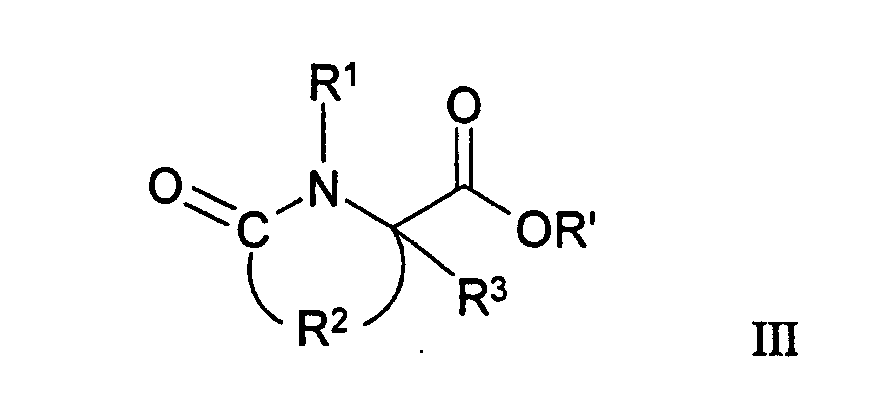
wherein R' and R1-R3 are as defined herein. - This reaction is typically conducted by contacting the cyclic compound of formula II with at least one equivalent of a strong base, such as potassium tert-butoxide, in the presence of at least one equivalent of the alkylating agent. Generally, the reaction is conducted in an inert diluent, such as THF and the like, at a temperature ranging from about 0°C to about 40°C for about 1 to about 24 hours. Upon completion of the reaction, the resulting N-alkylated compound III is recovered by conventional methods including neutralization, extraction, precipitation, chromatography, filtration, and the like.
- The cyclic compounds of formula II employed in the above reaction are either known compounds or compounds that can be prepared from known compounds by conventional synthetic procedures. Examples of suitable compounds for use in this reaction include, but are not limited to, L-pyroglutamic acid esters, D-pyroglutamic acid esters, D,L-pyroglutamic acid esters, 3-oxomorpholine-5-carboxylic acid esters, 3-oxothiomorpholine-5-carboxylic acid esters, 5-oxo-4-azatricyclo[4.2.1.0 (3,7]nonane-3-carboxylic acid esters and the like.
- Any suitable alkylating agent may be employed in this reaction. Preferred alkylating agents included benzyl halides, such as benzyl bromide and benzyl chlorides. Particularly preferred alkylating agents include benzyl bromide, 3-chlorobenzyl bromide, 4-chlorobenzyl bromide, 3,4-dichlorobenzyl bromide, 4-methylbenzyl bromide, 4-methoxybenzyl bromide, 4-fluorobenzyl bromide, 4-cyanobenzyl bromide, 4-nitrobenzyl bromide and the like.
- After completion of the alkylation reaction, subsequent hydrolysis of the ester group using conventional reagents and conditions, i.e., treatment with an alkali metal hydroxide in an inert diluent such as methanol/water, then affords the corresponding carboxylic acid of formula IV:

wherein R1-R3 are as defined herein. - Alternatively, intermediate IV can be prepared by reductive alkylation of an amino dicarboxylic acid derivative of formula IVa:

where R2 and R3 are as defined herein, with an aldehyde of the formula: R1-CHO, where R1 is as defined herein, using conventional reductive alkylation conditions and reagents, followed by cyclization of the resulting N-alkylated intermediate. The reductive alkylation reaction is typically conducted by contacting the amino compound IVa with at least one equivalent, preferably about 1.1 to about 1.5 equivalents, of an aldehyde and at least one equivalent based on the amino compound of a metal hydride reducing agent, such as sodium cyanoborohydride, in an inert diluent, such as methanol, tetrahydrofuran, mixtures thereof and the like, at a temperature ranging from about 0°C to about 50°C for about 1 to about 72 hours. The resulting N-alkylated intermediate is then cyclized by acidification and heating to afford intermediate IV. This reaction typically affords products of high optical purity when an optically active amino dicarboxylic acid, such as L-glutamic acid, is employed. - The compounds of formula I are then prepared by coupling the intermediate of formula IV with an amino acid derivative of formula V:

wherein R4 and R5 are as defined herein. - This coupling reaction is typically conducted using well-known coupling reagents such as carbodiimides, BOP reagent (benzotriazol-1-yloxytris(dimethylamino)phosphonium hexafluorophosphonate) and the like. Suitable carbodiimides include, by way of example, dicyclohexylcarbodiimide (DCC), 1-(3-dimethylaminopropyl)-3-ethylcarbodiimide (EDC) and the like. If desired, polymer supported forms of carbodiimide coupling reagents may also be used including, for example, those described in Tetrahedron Letters, 34(48), 7685 (1993). Additionally, well-known coupling promoters, such as N-hydroxysuccinimide, 1-hydroxybenzotriazole and the like, may be used to facilitate the coupling reaction.
- This coupling reaction is typically conducted by contacting intermediate IV with about 1 to about 2 equivalents of the coupling reagent and at least one equivalent, preferably about 1 to about 1.2 equivalents, of amino acid derivative V in an inert diluent, such as dichloromethane, chloroform, acetonitrile, tetrahydrofuran, N,N-dimethylformamide and the like. Generally, this reaction is conducted at a temperature ranging from about 0°C to about 37 ° C for about 12 to about 24 hours. Upon completion of the reaction, the compound of formula IA is recovered by conventional methods including neutralization, extraction, precipitation, chromatography, filtration, and the like.
- Alternatively, the intermediate IV can be converted into an acid halide and the acid halide coupled with amino acid derivative V to provide compounds of formula IA. The acid halide of IV can be prepared by contacting IV with an inorganic acid halide, such as thionyl chloride, phosphorous trichloride, phosphorous tribromide or phosphorous pentachloride, or preferably, with oxalyl chloride under conventional conditions. Generally, this reaction is conducted using about 1 to 5 molar equivalents of the inorganic acid halide or oxalyl chloride, either neat or in an inert solvent, such as dichloromethane or carbon tetrachloride, at temperature in the range of about 0°C to about 80°C for about 1 to about 48 hours. A catalyst, such as N,N-dimethylformamide, may also be used in this reaction.
- The acid halide of intermediate IV is then contacted with at least one equivalent, preferably about 1.1 to about 1.5 equivalents, of amino acid derivative V in an inert diluent, such as dichloromethane, at a temperature ranging from about -70°C to about 40°C for about 1 to about 24 hours. Preferably, this reaction is conducted in the presence of a suitable base to scavenge the acid generated during the reaction. Suitable bases include, by way of example, tertiary amines, such as triethylamine, diisopropylethylamine, N-methylmorpholine and the like. Alternatively, the reaction can be conducted under Schotten-Baumann-type conditions using aqueous alkali, such as sodium hydroxide and the like. Upon completion of the reaction, the compound of formula IA is recovered by conventional methods including neutralization, extraction, precipitation, chromatography, filtration, and the like.
- The amino acid derivatives of formula V employed in the above reactions are either known compounds or compounds that can be prepared from known compounds by conventional synthetic procedures. For example, amino acid derivatives of formula V can be prepared by C-alkylating commercially available diethyl 2-acetamidomalonate (Aldrich, Milwaukee, Wisconsin, USA) with an alkyl or substituted alkyl halide. This reaction is typically conducted by treating the diethyl 2-acetamidomalonate with at least one equivalent of sodium ethoxide and at least one equivalent of an alkyl or substituted alkyl halide in refluxing ethanol for about 6 to about 12 hours. The resulting C-alkylated malonate is then deacetylated, hydrolyzed and decarboxylated by heating in aqueous hydrochloric acid at reflux for about 6 to about 12 hours to provide the amino acid, typically as the hydrochloride salt.
- Examples of amino acid derivatives of formula V suitable for use in the above reactions include, but are not limited to, L-alanine methyl ester, L-isoleucine methyl ester, L-leucine methyl ester, L-valine methyl ester, β-tert-butyl-L-aspartic acid methyl ester, L-asparagine tert-butyl ester, ε-Boc-L-lysine methyl ester, ε-Cbz-L-lysine methyl ester, γ-tert-butyl-L-glutamic acid methyl ester, L-glutamine tert-butyl ester, L-(N-methyl)histidine methyl ester, L-(N-benzyl)histidine methyl ester, L-methionine methyl ester, L-(O-benzyl)serine methyl ester, L-tryptophan methyl ester, L-phenylalanine methyl ester, L-phenylalanine isopropyl ester, L-phenylalanine benzyl ester, L-phenylalaninamide, N-methyl-L-phenylalanine benzyl ester, 3-carboxy-D,L-phenylalanine methyl ester, 4-carboxy-D,L-phenylalanine methyl ester, L-4-chlorophenylalanine methyl ester, L-4-(3-dimethylaminopropyloxy)phenylalanine methyl ester, L-4-iodophenylalanine methyl ester, L-3,4-methylenedioxyphenylalanine methyl ester, L-3,4-ethylenedioxyphenylalanine methyl ester, L-4-nitrophenylalanine methyl ester, L-tyrosine methyl ester, D,L-homophenylalanine methyl ester, L-(O-methyl)tyrosine methyl ester, L-(O-tert-butyl)tyrosine methyl ester, L-(O-benzyl)tyrosine methyl ester, L-3,5-diiodotyrosine methyl ester, L-3-iodotyrosine methyl ester, β-(1-naphthyl)-L-alanine methyl ester, β-(2-naphthyl)-L-alanine methyl ester, β-(2-thienyl)-L-alanine methyl ester, β-cyclohexyl-L-alanine methyl ester, β-(2-pyridyl)-L-alanine methyl ester, β-(3-pyridyl)-L-alanine methyl ester, β-(4-pyridyl)-L-alanine methyl ester, β-(2-thiazolyl)-D,L-alanine methyl ester, β-(1,2,4-triazol-3-yl)-D,L-alanine methyl ester, and the like. If desired, of course, other esters or amides of the above-described compounds may also be employed.
- For ease of synthesis, the compounds of formula I are typically prepared as an ester, i.e., where R5 is an alkoxy or substituted alkoxy group and the like. If desired, the ester group can be hydrolysed using conventional conditions and reagents to provide the corresponding carboxylic acid. Typically, this reaction is conducted by treating the ester with at least one equivalent of an alkali metal hydroxide, such as lithium, sodium or potassium hydroxide, in an inert diluent, such as methanol or mixtures of methanol and water, at a temperature ranging about 0°C to about 24°C for about 1 to about 12 hours. Alternatively, benzyl esters may be removed by hydrogenolysis using a palladium catalyst, such as palladium on carbon, or tert-butyl esters can be hydrolyzed by exposure to strong acids, such as formic acid or trifluoroacetic acid. The resulting carboxylic acids may be coupled, if desired, to amines such as β-alanine ethyl ester, hydroxyamines such as hydroxylamine and N-hydroxysuccinimide, alkoxyamines and substituted alkoxyamines such as O-methylhydroxylamine and O-benzylhydroxylamine, and the like, using conventional coupling reagents and conditions as described above.
- As will be apparent to those skilled in the art, other functional groups present on any of the substituents of the compounds of formula I can be readily modified or derivatized either before or after the above-described coupling reactions using well-known synthetic procedures. For example, a nitro group present on a substituent of a compound of formula I or an intermediate thereof may be readily reduced by hydrogenation in the presence of a palladium catalyst, such as palladium on carbon, to provide the corresponding amino group. This reaction is typically conducted at a temperature of from about 20°C to about 50°C for about 6 to about 24 hours in an inert diluent, such as methanol. Compounds having a nitro group on the R4 substituent can be prepared, for example, by using a 4-nitrophenylalanine derivative and the like in the above-described coupling reactions.
- Similarly, a pyridyl group can be hydrogenated in the presence of a platinum catalyst, such as platinum oxide, in an acidic diluent to provide the corresponding piperidinyl analogue. Generally, this reaction is conducted by treating the pyridine compound with hydrogen at a pressure ranging from about 20 psi to about 60 psi, preferably about 40 psi, in the presence of the catalyst at a temperature of about 20°C to about 50°C for about 2 to about 24 hours in an acidic diluent, such as a mixture of methanol and aqueous hydrochloric acid. Compounds having a pyridyl group can be readily prepared by using, for example, β-(2-pyridyl)-, β-(3-pyridyl)- or β-(4-pyridyl)-L-alanine derivatives in the above-described coupling reactions.
- Additionally, when the R4 substituent of a compound of formula I or an intermediate thereof contains a primary or secondary amino group, such amino groups can be further derivatized either before or after the above coupling reactions to provide, by way of example, amides, sulfonamides, ureas, thioureas, carbamates, secondary or tertiary amines and the like. Compounds having a primary amino group on the R4 substituent may be prepared, for example, by reduction of the corresponding nitro compound as described above. Alternatively, such compounds can be prepared by using an amino acid derivative of formula VI derived from lysine, 4-aminophenylalanine and the like in the above-described coupling reactions.
- By way of illustration, a compound of formula I or an intermediate thereof having a substituent containing a primary or secondary amino group, such as where R4 is a (4-aminophenyl)methyl group, can be readily N-acylated using conventional acylating reagents and conditions to provide the corresponding amide. This acylation reaction is typically conducted by treating the amino compound with at least one equivalent, preferably about 1.1 to about 1.2 equivalents, of a carboxylic acid in the presence of a coupling reagent such as a carbodiimide, BOP reagent (benzotriazol-1-yloxytris(dimethylamino)phosphonium hexafluorophosphonate) and the like, in an inert diluent, such as dichloromethane, chloroform, acetonitrile, tetrahydrofuran, N,N-dimethylformamide and the like, at a temperature ranging from about 0°C to about 37 °C for about 4 to about 24 hours. Preferably, a promoter, such as N-hydroxysuccinimide, 1-hydroxybenzotriazole and the like, is used to facilitate the acylation reaction. Examples of carboxylic acids suitable for use in this reaction include, but are not limited to, N-tert-butyloxycarbonylglycine, N-tert-butyloxycarbonyl-L-phenylalanine, N-tert-butyloxycarbonyl-L-aspartic acid benzyl ester, benzoic acid, N-tert-butyloxycarbonylisonipecotic acid, N-methylisonipecotic acid, N-tert-butyloxycarbonylnipecotic acid, N-tert-butyloxycarbonyl-L-tetrahydroisoquinoline-3-carboxylic acid, N-(toluene-4-sulfonyl)-L-proline and the like.
- Alternatively, a compound of formula I or an intermediate thereof containing a primary or secondary amino group can be N-acylated using an acyl halide or a carboxylic acid anhydride to form the corresponding amide. This reaction is typically conducted by contacting the amino compound with at least one equivalent, preferably about 1.1 to about 1.2 equivalents, of the acyl halide or carboxylic acid anhydride in an inert diluent, such as dichloromethane, at a temperature ranging from about of about -70°C to about 40°C for about 1 to about 24 hours. If desired, an acylation catalyst such as 4-(N,N-dimethylamino)pyridine may be used to promote the acylation reaction. The acylation reaction is preferably conducted in the presence of a suitable base to scavenge the acid generated during the reaction. Suitable bases include, by way of example, tertiary amines, such as triethylamine, diisopropylethylamine, N-methylmorpholine and the like. Alternatively, the reaction can be conducted under Schotten-Baumann-type conditions using aqueous alkali, such as sodium hydroxide and the like.
- Examples of acyl halides and carboxylic acid anhydrides suitable for use in this reaction include, but are not limited to, 2-methylpropionyl chloride, trimethylacetyl chloride, phenylacetyl chloride, benzoyl chloride, 2-bromobenzoyl chloride, 2-methylbenzoyl chloride, 2-trifluoromethylbenzoyl chloride, isonicotinoyl chloride, nicotinoyl chloride, picolinoyl chloride, acetic anhydride, succinic anhydride, and the like. Carbamyl chlorides, such as N,N-dimethylcarbamyl chloride, N,N-diethylcarbamyl chloride and the like, can also be used in this reaction to provide ureas. Similarly, dicarbonates, such as di-tert-butyl dicarbonate, may be employed to provide carbamates.
- In a similar manner, a compound of formula I or an intermediate thereof containing a primary or secondary amino group may be N-sulfonated to form a sulfonamide using a sulfonyl halide or a sulfonic acid anhydride. Sulfonyl halides and sulfonic acid anhydrides suitable for use in this reaction include, but are not limited to, methanesulfonyl chloride, chloromethanesulfonyl chloride, p-toluenesulfonyl chloride, trifluoromethanesulfonic anhydride, and the like. Similarly, sulfamoyl chlorides, such as dimethylsulfamoyl chloride, can be used to provide sulfamides (e.g., >N-SO2-N<).
- Additionally, a primary and secondary amino group present on a substituent of a compound of formula I or an intermediate thereof can be reacted with an isocyanate or a thioisocyanate to give a urea or thiourea, respectively. This reaction is typically conducted by contacting the amino compound with at least one equivalent, preferably about 1.1 to about 1.2 equivalents, of the isocyanate or thioisocyanate in an inert diluent, such as toluene and the like, at a temperature ranging from about 24°C to about 37°C for about 12 to about 24 hours. The isocyanates and thioisocyanates used in this reaction are commercially available or can be prepared from commercially available compounds using well-known synthetic procedures. For example, isocyanates and thioisocyanates are readily prepared by reacting the appropriate amine with phosgene or thiophosgene. Examples of isocyanates and thioisocyanates suitable for use in this reaction include, but are not limited to, ethyl isocyanate, n-propyl isocyanate, 4-cyanophenyl isocyanate, 3-methoxyphenyl isocyanate, 2-phenylethyl isocyanate, methyl thioisocyanate, ethyl thioisocyanate, 2-phenylethyl thioisocyanate, 3-phenylpropyl thioisocyanate, 3-(N,N-diethylamino)propyl thioisocyanate, phenyl thioisocyanate, benzyl thioisocyanate, 3-pyridyl thioisocyanate, fluorescein isothiocyanate (isomer I) and the like.
- Furthermore, when a compound of formula I or an intermediate thereof contains a primary or secondary amino group, the amino group can be reductively alkylated using aldehydes or ketones to form a secondary or tertiary amino group. This reaction is typically conducted by contacting the amino compound with at least one equivalent, preferably about 1.1 to about 1.5 equivalents, of an aldehyde or ketone and at least one equivalent based on the amino compound of a metal hydride reducing agent, such as sodium cyanoborohydride, in an inert diluent, such as methanol, tetrahydrofuran, mixtures thereof and the like, at a temperature ranging from about 0°C to about 50°C for about 1 to about 72 hours. Aldehydes and ketones suitable for use in this reaction include, by way of example, benzaldehyde, 4-chlorobenzaldehyde, valeraldehyde and the like.
- In a similar manner, when a compound of formula I or an intermediate thereof has a substituent containing a hydroxyl group, the hydroxyl group can be further modified or derivatized either before or after the above coupling reactions to provide, by way of example, ethers, carbamates and the like. Compounds having a hydroxyl group on the R4 substituent, for example, can be prepared using an amino acid derivative of formula V derived from tyrosine and the like in the above-described reactions.
- By way of example, a compound of formula I or an intermediate thereof having a substituent containing a hydroxyl group, such as where R4 is a (4-hydroxyphenyl)methyl group, can be readily O-alkylated to form ethers. This O-alkylation reaction is typically conducted by contacting the hydroxy compound with a suitable alkali or alkaline earth metal base, such as potassium carbonate, in an inert diluent, such as acetone, 2-butanone and the like, to form the alkali or alkaline earth metal salt of the hydroxyl group. This salt is generally not isolated, but is reacted in situ with at least one equivalent of an alkyl or substituted alkyl halide or sulfonate, such as an alkyl chloride, bromide, iodide, mesylate or tosylate, to afford the ether. Generally, this reaction is conducted at a temperature ranging from about 60°C to about 150°C for about 24 to about 72 hours. Preferably, a catalytic amount of sodium or potassium iodide is added to the reaction mixture when an alkyl chloride or bromide is employed in the reaction.
- Examples of alkyl or substituted alkyl halides and sulfonates suitable for use in this reaction include, but are not limited to, tert-butyl bromoacetate, N-tert-butyl chloroacetamide, 1-bromoethylbenzene, ethyl α-bromophenylacetate, 2-(N-ethyl-N-phenylamino)ethyl chloride, 2-(N,N-ethylamino)ethyl chloride, 2-(N,N-diisopropylamino)ethyl chloride, 2-(N,N-dibenzylamino)ethyl chloride, 3-(N,N-ethylamino)propyl chloride, 3-(N-benzyl-N-methylamino)propyl chloride, N-(2-chloroethyl)morpholine, 2-(hexamethyleneimino)ethyl chloride, 3-(N-methylpiperazine)propyl chloride, 1-(3-chlorophenyl)-4-(3-chloropropyl)piperazine, 2-(4-hydroxy-4-phenylpiperidine)ethyl chloride, N-tert-butyloxycarbonyl-3-piperidinemethyl tosylate, and the like.
- Alternatively, a hydroxyl group present on a substituent of a compound of formula I or an intermediate thereof can be O-alkylating using the Mitsunobu reaction. In this reaction, an alcohol, such as 3-(N,N-dimethylamino)-1-propanol and the like, is reacted with about 1.0 to about 1.3 equivalents of triphenylphosphine and about 1.0 to about 1.3 equivalents of diethyl azodicarboxylate in an inert diluent, such as tetrahydrofuran, at a temperature ranging from about -10°C to about 5°C for about 0.25 to about 1 hour. About 1.0 to about 1.3 equivalents of a hydroxy compound, such as N-tert-butyltyrosine methyl ester, is then added and the reaction mixture is stirred at a temperature of about 0°C to about 30°C for about 2 to about 48 hours to provide the O-alkylated product.
- In a similar manner, a compound of formula I or an intermediate thereof containing an aryl hydroxy group can be reacted with an aryl iodide to provide a diaryl ether. Generally, this reaction is conducted by forming the alkali metal salt of the hydroxyl group using a suitable base, such as sodium hydride, in an inert diluent such as xylenes at a temperature of about -25°C to about 10°C. The salt is then treated with about 1.1 to about 1.5 equivalents of cuprous bromide dimethyl sulfide complex at a temperature ranging from about 10°C to about 30°C for about 0.5 to about 2.0 hours, followed by about 1.1 to about 1.5 equivalents of an aryl iodide, such as sodium 2-iodobenzoate and the like. The reaction is then heated to about 70°C to about 150°C for about 2 to about 24 hours to provide the diaryl ether.
- Additionally, a hydroxy-containing compound can also be readily derivatized to form a carbamate. In one method for preparing such carbamates, a hydroxy compound of formula I or an intermediate thereof is contacted with about 1.0 to about 1.2 equivalents of 4-nitrophenyl chloroformate in an inert diluent, such as dichloromethane, at a temperature ranging from about -25°C to about 0°C for about 0.5 to about 2.0 hours. Treatment of the resulting carbonate with an excess, preferably about 2 to about 5 equivalents, of a trialkylamine, such as triethylamine, for about 0.5 to 2 hours, followed by about 1.0 to about 1.5 equivalents of a primary or secondary amine provides the carbamate. Examples of amines suitable for using in this reaction include, but are not limited to, piperazine, 1-methylpiperazine, 1-acetylpiperazine, morpholine, thiomorpholine, pyrrolidine, piperidine and the like.
- Alternatively, in another method for preparing carbamates, a hydroxy-containing compound is contacted with about 1.0 to about 1.5 equivalents of a carbamyl chloride in an inert diluent, such as dichloromethane, at a temperature ranging from about 25°C to about 70°C for about 2 to about 72 hours. Typically, this reaction is conducted in the presence of a suitable base to scavenge the acid generated during the reaction. Suitable bases include, by way of example, tertiary amines, such as triethylamine, diisopropylethylamine, N-methylmorpholine and the like. Additionally, at least one equivalent (based on the hydroxy compound) of 4-(N,N-dimethylamino)pyridine is preferably added to the reaction mixture to facilitate the reaction. Examples of carbamyl chlorides suitable for use in this reaction include, by way of example, dimethylcarbamyl chloride, diethylcarbamyl chloride and the like.
- Likewise, when a compound of formula I or an intermediate thereof contains a primary or secondary hydroxyl group, such hydroxyl groups can be readily converted into a leaving group and displaced to form, for example, amines, sulfides and fluorides. For example, derivatives of 4-hydroxy-L-proline can be converted into the corresponding 4-amino, 4-thio or 4-fluoro-L-proline derivatives via nucleophilic displacement of the derivatized hydroxyl group. Generally, when a chiral compound is employed in these reactions, the stereochemistry at the carbon atom attached to the derivatized hydroxyl group is typically inverted.
- These reactions are typically conducted by first converting the hydroxyl group into a leaving group, such as a tosylate, by treatment of the hydroxy compound with at least one equivalent of a sulfonyl halide, such as p-toluenesulfonyl chloride and the like, in pyridine. This reaction is generally conducted at a temperature of from about 0°C to about 70°C for about 1 to about 48 hours. The resulting tosylate can then be readily displaced with sodium azide, for example, by contacting the tosylate with at least one equivalent of sodium azide in an inert diluent, such as a mixture of N,N-dimethylformamide and water, at a temperature ranging from about 0°C to about 37°C for about 1 to about 12 hours to provide the corresponding azido compound. The azido group can then be reduced by, for example, hydrogenation using a palladium on carbon catalyst to provide the amino (-NH2) compound.
- Similarly, a tosylate group can be readily displaced by a thiol to form a sulfide. This reaction is typically conducted by contacting the tosylate with at least one equivalent of a thiol, such as thiophenol, in the presence of a suitable base, such as 1,8-diazabicyclo[5.4.0]undec-7-ene (DBU), in an inert diluent, such as N,N-dimethylformamide, at a temperature of from about 0°C to about 37°C for about 1 to about 12 hours to provide the sulfide. Additionally, treatment of a tosylate with morpholinosulfur trifluoride in an inert diluent, such as dichloromethane, at a temperature ranging from about 0°C to about 37°C for about 12 to about 24 hours affords the corresponding fluoro compound.
- Furthermore, a compound of formula I or an intermediate thereof having a substituent containing an iodoaryl group, for example, when R4 is a (4-iodophenyl)methyl group, can be readily converted either before or after the above coupling reactions into a biaryl compound. Typically, this reaction is conducted by treating the iodoaryl compound with about 1.1 to about 2 equivalents of an arylzinc iodide, such as 2-(methoxycarbonyl)phenylzinc iodide, in the presence of a palladium catalyst, such as palladium tetra(triphenylphosphine), in an inert diluent, such as tetrahydrofuran, at a temperature ranging from about 24°C to about 30°C until reaction completion. This reaction is further described, for example, in Rieke, J. Org. Chem. 1991, 56, 1445.
- In some cases, the compounds of formula I or intermediates thereof may contain substituents having one or more sulfur atoms. Such sulfur atoms will be present, for example, when the cyclic compound of formula II employed in the above reactions is derived from 3-oxothiomorpholine-5-carboxylic acid and the like. When present, such sulfur atoms can be oxidized either before or after the above coupling reactions to provide a sulfoxide or sulfone compound using conventional reagents and reaction conditions. Suitable reagents for oxidizing a sulfide compound to a sulfoxide include, by way of example, hydrogen peroxide, 3-chloroperoxybenzoic acid (MCPBA), sodium periodate and the like. The oxidation reaction is typically conducted by contacting the sulfide compound with about 0.95 to about 1.1 equivalents of the oxidizing reagent in an inert diluent, such as dichloromethane, at a temperature ranging from about - 50°C to about 75°C for about 1 to about 24 hours. The resulting sulfoxide can then be further oxidized to the corresponding sulfone by contacting the sulfoxide with at least one additional equivalent of an oxidizing reagent, such as hydrogen peroxide, MCPBA, potassium permanganate and the like. Alternatively, the sulfone can be prepared directly by contacting the sulfide with at least two equivalents, and preferably an excess, of the oxidizing reagent. Such reactions are described further in March, "Advanced Organic Chemistry", 4th Ed., pp. 1201-1202, Wiley Publisher, 1992.
- Lastly, the compounds of formula I where W is sulfur can prepared by using an thiocarbonyl derivative in place of compound II in the above described synthetic procedures. Such thiocarbonyl derivatives can be prepared using, for example, Lawesson's reagent under conventional reaction conditions.
- Other procedures and reaction conditions for preparing the compounds of this invention are described in the examples set forth below.
- When employed as pharmaceuticals, the compounds of formula I and IA are usually administered in the form of pharmaceutical compositions. These compounds can be administered by a variety of routes including oral, rectal, transdermal, subcutaneous, intravenous, intramuscular, and intranasal. These compounds are effective as both injectable and oral compositions. Such compositions are prepared in a manner well known in the pharmaceutical art and comprise at least one active compound.
- This invention also includes pharmaceutical compositions which contain, as the active ingredient, one or more of the compounds of formula I and IA above associated with pharmaceutically acceptable carriers. In making the compositions of this invention, the active ingredient is usually mixed with an excipient, diluted by an excipient or enclosed within such a carrier which can be in the form of a capsule, sachet, paper or other container. When the excipient serves as a diluent, it can be a solid, semisolid, or liquid material, which acts as a vehicle, carrier or medium for the active ingredient. Thus, the compositions can be in the form of tablets, pills, powders, lozenges, sachets, cachets, elixirs, suspensions, emulsions, solutions, syrups, aerosols (as a solid or in a liquid medium), ointments containing, for example, up to 10% by weight of the active compound, soft and hard gelatin capsules, suppositories, sterile injectable solutions, and sterile packaged powders.
- In preparing a formulation, it may be necessary to mill the active compound to provide the appropriate particle size prior to combining with the other ingredients. If the active compound is substantially insoluble, it ordinarily is milled to a particle size of less than 200 mesh. If the active compound is substantially water soluble, the particle size is normally adjusted by milling to provide a substantially uniform distribution in the formulation, e.g. about 40 mesh.
- Some examples of suitable excipients include lactose, dextrose, sucrose, sorbitol, mannitol, starches, gum acacia, calcium phosphate, alginates, tragacanth, gelatin, calcium silicate, microcrystalline cellulose, polyvinylpyrrolidone, cellulose, water, syrup, and methyl cellulose. The formulations can additionally include: lubricating agents such as talc, magnesium stearate, and mineral oil; wetting agents; emulsifying and suspending agents; preserving agents such as methyl- and propylhydroxybenzoates; sweetening agents; and flavoring agents. The compositions of the invention can be formulated so as to provide quick, sustained or delayed release of the active ingredient after administration to the patient by employing procedures known in the art.
- The compositions are preferably formulated in a unit dosage form, each dosage containing from about 5 to about 100 mg, more usually about 10 to about 30 mg, of the active ingredient. The term "unit dosage forms" refers to physically discrete units suitable as unitary dosages for human subjects and other mammals, each unit containing a predetermined quantity of active material calculated to produce the desired therapeutic effect, in association with a suitable pharmaceutical excipient.
- The active compound is effective over a wide dosage range and is generally administered in a pharmaceutically effective amount. It, will be understood, however, that the amount of the compound actually administered will be determined by a physician, in the light of the relevant circumstances, including the condition to be treated, the chosen route of administration, the actual compound administered, the age, weight, and response of the individual patient, the severity of the patient's symptoms, and the like.
- For preparing solid compositions such as tablets, the principal active ingredient is mixed with a pharmaceutical excipient to form a solid preformulation composition containing a homogeneous mixture of a compound of the present invention. When referring to these preformulation compositions as homogeneous, it is meant that the active ingredient is dispersed evenly throughout the composition so that the composition may be readily subdivided into equally effective unit dosage forms such as tablets, pills and capsules. This solid preformulation is then subdivided into unit dosage forms of the type described above containing from, for example, 0.1 to about 500 mg of the active ingredient of the present invention.
- The tablets or pills of the present invention may be coated or otherwise compounded to provide a dosage form affording the advantage of prolonged action. For example, the tablet or pill can comprise an inner dosage and an outer dosage component, the latter being in the form of an envelope over the former. The two components can be separated by an enteric layer which serves to resist disintegration in the stomach and permit the inner component to pass intact into the duodenum or to be delayed in release. A variety of materials can be used for such enteric layers or coatings, such materials including a number of polymeric acids and mixtures of polymeric acids with such materials as shellac, cetyl alcohol, and cellulose acetate.
- The liquid forms in which the novel compositions of the present invention may be incorporated for administration orally or by injection include aqueous solutions suitably flavored syrups, aqueous or oil suspensions, and flavored emulsions with edible oils such as cottonseed oil, sesame oil, coconut oil, or peanut oil, as well as elixirs and similar pharmaceutical vehicles.
- Compositions for inhalation or insufflation include solutions and suspensions in pharmaceutically acceptable, aqueous or organic solvents, or mixtures thereof, and powders. The liquid or solid compositions may contain suitable pharmaceutically acceptable excipients as described supra. Preferably the compositions are administered by the oral or nasal respiratory route for local or systemic effect. Compositions in preferably pharmaceutically acceptable solvents may be nebulized by use of inert gases. Nebulized solutions may be breathed directly from the nebulizing device or the nebulizing device may be attached to a face masks tent, or intermittent positive pressure breathing machine. Solution, suspension, or powder compositions may be administered, preferably orally or nasally, from devices which deliver the formulation in an appropriate manner.
- The following formulation examples illustrate the pharmaceutical compositions of the present invention.
- Hard gelatin capsules containing the following ingredients are prepared:
Ingredient Quantity (mg/capsule) Active Ingredient 30.0 Starch 305.0 Magnesium stearate 5.0 - The above ingredients are mixed and filled into hard gelatin capsules in 340 mg quantities.
- A tablet formula is prepared using the ingredients below:
Ingredient Quantity (mg/tablet) Active Ingredient 25.0 Cellulose, microcrystalline 200.0 Colloidal silicon dioxide 10.0 Stearic acid 5.0 - The components are blended and compressed to form tablets, each weighing 240 mg.
- A dry powder inhaler formulation is prepared containing the following components:
Ingredient Weight % Active Ingredient 5 Lactose 95 - The active mixture is mixed with the lactose and the mixture is added to a dry powder inhaling appliance.
- Tablets, each containing 30 mg of active ingredient, are prepared as follows:
Ingredient Quantity (mg/tablet) Active Ingredient 30.0 mg Starch 45.0 mg Microcrystalline cellulose 35.0 mg Polyvinylpyrrolidone (as 10 % solution in water) 4.0 mg Sodium carboxymethyl starch 4.5 mg Magnesium stearate 0.5 mg Talc 1.0 mg Total 120mg - The active ingredient, starch and cellulose are passed through a No. 20 mesh U.S. sieve and mixed thoroughly. The solution of polyvinylpyrrolidone is mixed with the resultant powders, which are then passed through a 16 mesh U.S. sieve. The granules so produced are dried at 50° to 60°C and passed through a 16 mesh U.S. sieve. The sodium carboxymethyl starch, magnesium stearate, and talc, previously passed through a No. 30 mesh U.S. sieve, are then added to the granules which, after mixing, are compressed on a tablet machine to yield tablets each weighing 150 mg.
- Capsules, each containing 40 mg of medicament are made as follows:
Ingredient Quantity (mg/capsule) Active Ingredient 40.0 mg Starch 109.0 mg Magnesium stearate 1.0 mg Total 150.0 mg - The active ingredient, cellulose, starch, an magnesium stearate are blended, passed through a No. 20 mesh U.S. sieve, and filled into hard gelatin capsules in 150 mg quantities.
- Suppositories, each containing 25 mg of active ingredient are made as follows:
Ingredient Amount Active Ingredient 25 mg Saturated fatty acid glycerides to 2,000 mg - The active ingredient is passed through a No. 60 mesh U.S. sieve and suspended in the saturated fatty acid glycerides previously melted using the minimum heat necessary. The mixture is then poured into a suppository mold of nominal 2.0 g capacity and allowed to cool.
- Suspensions, each containing 50 mg of medicament per 5.0 ml dose are made as follows:
Ingredient Amount Active Ingredient 50.0 mg Xanthan gum 4.0 mg Sodium carboxymethyl cellulose (11 %) Microcrystalline cellulose (89%) 50.0 mg Sucrose 1.75 g Sodium benzoate 10.0 mg Flavor and Color q.v. Purified water to 5.0 ml - The medicament, sucrose and xanthan gum are blended, passed through a No. 10 mesh U.S. sieve, and then mixed with a previously made solution of the microcrystalline cellulose and sodium carboxymethyl cellulose in water. The sodium benzoate, flavor, and color are diluted with some of the water and added with stirring. Sufficient water is then added to produce the required volume.
-
Ingredient Quantity (mg/capsule) Active Ingredient 15.0 mg Starch 407.0 mg Magnesium stearate 3.0 mg Total 425.0 mg - The active ingredient, cellulose, starch, and magnesium stearate are blended, passed through a No. 20 mesh U.S. sieve, and filled into hard gelatin capsules in 560 mg quantities.
- An intravenous formulation may be prepared as follows:
Ingredient Quantity Active Ingredient 250.0 mg Isotonic saline 1000 ml - A topical formulation may be prepared as follows:
Ingredient Quantity Active Ingredient 1-10 g Emulsifying Wax 30 g Liquid Paraffin 20 g White Soft Paraffin to 100 g - The white soft paraffin is heated until molten. The liquid paraffin and emulsifying wax are incorporated and stirred until dissolved. The active ingredient is added and stirring is continued until dispersed. The mixture is then cooled until solid.
- Another preferred formulation employed in the methods of the present invention employs transdermal delivery devices ("patches"). Such transdermal patches may be used to provide continuous or discontinuous infusion of the compounds of the present invention in controlled amounts. The construction and use of transdermal patches for the delivery of pharmaceutical agents is well known in the art. See, e.g., U.S. Patent 5,023,252, issued June 11, 1991, herein incorporated by reference. Such patches may be constructed for continuous, pulsatile, or on demand delivery of pharmaceutical agents.
- Direct or indirect placement techniques may be used when it is desirable or necessary to introduce the pharmaceutical composition to the brain. Direct techniques usually involve placement of a drug delivery catheter into the host's ventricular system to bypass the blood-brain barrier. One such implantable delivery system used for the transport of biological factors to specific anatomical regions of the body is described in U.S. Patent 5,011,472 which is herein incorporated by reference.
- Indirect techniques, which are generally preferred, usually involve formulating the compositions to provide for drug latentiation by the conversion of hydrophilic drugs into lipid-soluble drugs. Latentiation is generally achieved through blocking of the hydroxy, carbonyl, sulfate, and primary amine groups present on the drug to render the drug more lipid soluble and amenable to transportation across the blood-brain barrier. Alternatively, the delivery of hydrophilic drugs may be enhanced by intra-arterial infusion of hypertonic solutions which can transiently open the blood-brain barrier.
- The compounds of this invention can be employed to bind VLA-4 (α4β1 integrin) in biological samples and, accordingly have utility in, for example, assaying such samples for VLA-4. In such assays, the compounds can be bound to a solid support and the VLA-4 sample added thereto. The amount of VLA-4 in the sample can be determined by conventional methods such as use of a sandwich ELISA assay. Alternatively, labeled VLA-4 can be used in a competitive assay to measure for the presence of VLA-4 in the sample. Other suitable assays are well known in the art.
- In addition, certain of the compounds of this invention inhibit, in vivo, adhesion of leukocytes to endothelial cells mediated by VLA-4 and, accordingly, can be used in the treatment of diseases mediated by VLA-4. Such diseases include inflammatory diseases in mammalian patients such as asthma, Alzheimer's disease, atherosclerosis, AIDS dementia, diabetes (including acute juvenile onset diabetes), inflammatory bowel disease (including ulcerative colitis and Crohn's disease), multiple sclerosis, rheumatoid arthritis, tissue transplantation, tumor metastasis, meningitis, encephalitis, stroke, and other cerebral traumas, nephritis, retinitis, atopic dermatitis, psoriasis, myocardial ischemia and acute leukocyte-mediated lung injury such as that which occurs in adult respiratory distress syndrome.
- The biological activity of the compounds identified above may be assayed in a variety of systems. For example, a compound can be immobilized on a solid surface and adhesion of cells expressing VLA-4 can be measured. Using such formats, large numbers of compounds can be screened. Cells suitable for this assay include any leukocytes known to express VLA-4 such as T cells, B cells, monocytes, eosinophils, and basophils. A number of leukocyte cell lines can also be used, examples include Jurkat and U937.
- The test compounds can also be tested for the ability to competitively inhibit binding between VLA-4 and VCAM-1, or between VLA-4 and a labeled compound known to bind VLA-4 such as a compound of this invention or antibodies to VLA-4. In these assays, the VCAM-1 can be immobilized on a solid surface. VCAM-1 may also be expressed as a recombinant fusion protein having an Ig tail (e.g., IgG) so that binding to VLA-4 may be detected in an immunoassay. Alternatively, VCAM-1 expressing cells, such as activated endothelial cells or VCAM-1 transfected fibroblasts can be used. For assays to measure the ability to block adhesion to brain endothelial cells, the assays described in International Patent Application Publication No. WO 91/05038 are particularly preferred. This application is incorporated herein by reference in its entirety.
- Many assay formats employ labelled assay components. The labelling systems can be in a variety of forms. The label may be coupled directly or indirectly to the desired component of the assay according to methods well known in the art. A wide variety of labels may be used. The component may be labelled by any one of several methods. The most common method of detection is the use of autoradiography with 3H, 125I, 35S, 14C, or 32P labelled compounds or the like. Non-radioactive labels include ligands which bind to labelled antibodies, fluorophores, chemiluminescent agents, enzymes and antibodies which can serve as specific binding pair members for a labelled ligand. The choice of label depends on sensitivity required, ease of conjugation with the compound, stability requirements, and available instrumentation.
- Appropriate in vivo models for demonstrating efficacy in treating inflammatory responses include EAE (experimental autoimmune encephalomyelitis) in mice, rats, guinea pigs or primates, as well as other inflammatory models dependent upon α4 integrins.
- Compounds having the desired biological activity may be modified as necessary to provide desired properties such as improved pharmacological properties (e.g., in vivo stability, bio-availability), or the ability to be detected in diagnostic applications. For instance, inclusion of one or more D-amino acids in the sulfonamides of this invention typically increases in vivo stability. Stability can be assayed in a variety of ways such as by measuring the half-life of the proteins during incubation with peptidases or human plasma or serum. A number of such protein stability assays have been described (see, e.g., Verhoef et al., Eur. J. Drug Metab. Pharmacokinet., 1990, 15(2):83-93).
- For diagnostic purposes, a wide variety of labels may be linked to the compounds, which may provide, directly or indirectly, a detectable signal. Thus, the compounds of the subject invention may be modified in a variety of ways for a variety of end purposes while still retaining biological activity. In addition, various reactive sites may be introduced at the terminus for linking to particles, solid substrates, macromolecules, or the like.
- Labeled compounds can be used in a variety of in vivo or in vitro applications. A wide variety of labels may be employed, such as radionuclides (e.g., gamma-emitting radioisotopes such as technetium-99 or indium-111), fluorescers (e.g., fluorescein), enzymes, enzyme substrates, enzyme cofactors, enzyme inhibitors, chemiluminescent compounds, bioluminescent compounds, and the like. Those of ordinary skill in the art will know of other suitable labels for binding to the complexes, or will be able to ascertain such using routine experimentation. The binding of these labels is achieved using standard techniques common to those of ordinary skill in the art.
- In vitro uses include diagnostic applications such as monitoring inflammatory responses by detecting the presence of leukocytes expressing VLA-4. The compounds of this invention can also be used for isolating or labeling such cells. In addition, as mentioned above, the compounds of the invention can be used to assay for potential inhibitors of VLA-4/VCAM-1 interactions.
- For in vivo diagnostic imaging to identify, e.g., sites of inflammation, radioisotopes are typically used in accordance with well known techniques. The radioisotopes may be bound to the peptide either directly or indirectly using intermediate functional groups. For instance, chelating agents such as diethylenetriaminepentacetic acid (DTPA) and ethylenediaminetetraacetic acid (EDTA) and similar molecules have been used to bind proteins to metallic ion radioisotopes.
- The complexes can also be labeled with a paramagnetic isotope for purposes of in vivo diagnosis, as in magnetic resonance imaging (MRI) or electron spin resonance (ESR), both of which are well known. In general, any conventional method for visualizing diagnostic imaging can be used. Usually gamma- and positron-emitting radioisotopes are used for camera imaging and paramagnetic isotopes are used for MRI. Thus, the compounds can be used to monitor the course of amelioration of an inflammatory response in an individual. By measuring the increase or decrease in lymphocytes expressing VLA-4 it is possible to determine whether a particular therapeutic regimen aimed at ameliorating the disease is effective.
- The pharmaceutical compositions of the present invention can be used to block or inhibit cellular adhesion associated with a number of diseases and disorders. For instance, a number of inflammatory disorders are associated with integrins or leukocytes. Treatable disorders include, e.g., transplantation rejection (e.g., allograft rejection), Alzheimer's disease, atherosclerosis, AIDS dementia, diabetes (including acute juvenile onset diabetes), retinitis, cancer metastases, rheumatoid arthritis, acute leukocyte-mediated lung injury (e.g., adult respiratory distress syndrome), asthma, nephritis, and acute and chronic inflammation, including atopic dermatitis, psoriasis, myocardial ischemia, and inflammatory bowel disease (including Crohn's disease and ulcerative colitis). In preferred embodiments the pharmaceutical compositions are used to treat inflammatory brain disorders, such as multiple sclerosis (MS), viral meningitis and encephalitis.
- Inflammatory bowel disease is a collective term for two similar diseases referred to as Crohn's disease and ulcerative colitis. Crohn's disease is an idiopathic, chronic ulceroconstrictive inflammatory disease characterized by sharply delimited and typically transmural involvement of all layers of the bowel wall by a granulomatous inflammatory reaction. Any segment of the gastrointestinal tract, from the mouth to the anus, may be involved, although the disease most commonly affects the terminal ileum and/or colon. Ulcerative colitis is an inflammatory response limited largely to the colonic mucosa and submucosa. Lymphocytes and macrophages are numerous in lesions of inflammatory bowel disease and may contribute to inflammatory injury.
- Asthma is a disease characterized by increased responsiveness of the tracheobronchial tree to various stimuli potentiating paroxysmal constriction of the bronchial airways. The stimuli cause release of various mediators of inflammation from IgE-coated mast cells including histamine, eosinophilic and neutrophilic chemotactic factors, leukotrines, prostaglandin and platelet activating factor. Release of these factors recruits basophils, eosinophils and neutrophils, which cause inflammatory injury.
- Atherosclerosis is a disease of arteries (e.g., coronary, carotid, aorta and iliac). The basic lesion, the atheroma, consists of a raised focal plaque within the intima, having a core of lipid and a covering fibrous cap. Atheromas compromise arterial blood flow and weaken affected arteries. Myocardial and cerebral infarcts are a major consequence of this disease. Macrophages and leukocytes are recruited to atheromas and contribute to inflammatory injury.
- Rheumatoid arthritis is a chronic, relapsing inflammatory disease that primarily causes impairment and destruction of joints. Rheumatoid arthritis usually first affects the small joints of the hands and feet but then may involve the wrists, elbows, ankles and knees. The arthritis results from interaction of synovial cells with leukocytes that infiltrate from the circulation into the synovial lining of the joints. See e.g., Paul, Immunology (3d ed., Raven Press, 1993).
- Another indication for the compounds of this invention is in treatment of organ or graft rejection mediated by VLA-4. Over recent years there has been a considerable improvement in the efficiency of surgical techniques for transplanting tissues and organs such as skin, kidney, liver, heart, lung, pancreas and bone marrow. Perhaps the principal outstanding problem is the lack of satisfactory agents for inducing immunotolerance in the recipient to the transplanted allograft or organ. When allogeneic cells or organs are transplanted into a host (i.e., the donor and donee are different individuals from the same species), the host immune system is likely to mount an immune response to foreign antigens in the transplant (host-versus-graft disease) leading to destruction of the transplanted tissue. CD8+ cells, CD4 cells and monocytes are all involved in the rejection of transplant tissues. Compounds of this invention which bind to alpha-4 integrin are useful, inter alia, to block alloantigen-induced immune responses in the donee thereby preventing such cells from participating in the destruction of the transplanted tissue or organ. See, e.g., Paul et al., Transplant International 9, 420-425 (1996); Georczynski et al., Immunology 87, 573-580 (1996); Georcyznski et al., Transplant. Immunol. 3, 55-61 (1995); Yang et al., Transplantation 60, 71-76 (1995); Anderson et al., APMIS 102, 23-27 (1994).
- A related use for compounds of this invention which bind to VLA-4 is in modulating the immune response involved in "graft versus host" disease (GVHD). See e.g., Schlegel et al., J. Immunol. 155, 3856-3865 (1995). GVHD is a potentially fatal disease that occurs when immunologically competent cells are transferred to an allogeneic recipient. In this situation, the donor's immunocompetent cells may attack tissues in the recipient. Tissues of the skin, gut epithelia and liver are frequent targets and may be destroyed during the course of GVHD. The disease presents an especially severe problem when immune tissue is being transplanted, such as in bone marrow transplantation; but less severe GVHD has also been reported in other cases as well, including heart and liver transplants. The therapeutic agents of the present invention are used, inter alia, to block activation of the donor T-cells thereby interfering with their ability to lyse target cells in the host.
- A further use of the compounds of this invention is inhibiting tumor metastasis. Several tumor cells have been reported to express VLA-4 and compounds which bind VLA-4 block adhesion of such cells to endothelial cells. Steinback et al., Urol. Res. 23, 175-83 (1995); Orosz et al., Int. J. Cancer 60, 867-71 (1995); Freedman et al., Leuk. Lymphoma 13, 47-52 (1994); Okahara et al., Cancer Res. 54, 3233-6 (1994).
- A further use of the compounds of this invention is in treating multiple sclerosis. Multiple sclerosis is a progressive neurological autoimmune disease that affects an estimated 250,000 to 350,000 people in the United States. Multiple sclerosis is thought to be the result of a specific autoimmune reaction in which certain leukocytes attack and initiate the destruction of myelin, the insulating sheath covering nerve fibers. In an animal model for multiple sclerosis, murine monoclonal antibodies directed against VLA-4 have been shown to block the adhesion of leukocytes to the endothelium, and thus prevent inflammation of the central nervous system and subsequent paralysis in the animals16.
- Pharmaceutical compositions of the invention are suitable for use in a variety of drug delivery systems. Suitable formulations for use in the present invention are found in Remington's Pharmaceutical Sciences, Mace Publishing Company, Philadelphia, PA, 17th ed. (1985).
- In order to enhance serum half-life, the compounds may be encapsulated, introduced into the lumen of liposomes, prepared as a colloid, or other conventional techniques may be employed which provide an extended serum half-life of the compounds. A variety of methods are available for preparing liposomes, as described in, e.g., Szoka, et al., U.S. Patent Nos. 4,235,871, 4,501,728 and 4,837,028 each of which is incorporated herein by reference.
- The amount administered to the patient will vary depending upon what is being administered, the purpose of the administration, such as prophylaxis or therapy, the state of the patient, the manner of administration, and the like. In therapeutic applications, compositions are administered to a patient already suffering from a disease in an amount sufficient to cure or at least partially arrest the symptoms of the disease and its complications. An amount adequate to accomplish this is defined as "therapeutically effective dose. " Amounts effective for this use will depend on the disease condition being treated as well as by the judgment of the attending clinician depending upon factors such as the severity of the inflammation, the age, weight and general condition of the patient, and the like.
- The compositions administered to a patient are in the form of pharmaceutical compositions described above. These compositions may be sterilized by conventional sterilization techniques, or may be sterile filtered. The resulting aqueous solutions may be packaged for use as is, or lyophilized, the lyophilized preparation being combined with a sterile aqueous carrier prior to administration. The pH of the compound preparations typically will be between 3 and 11, more preferably from 5 to 9 and most preferably from 7 to 8. It will be understood that use of certain of the foregoing excipients, carriers, or stabilizers will result in the formation of pharmaceutical salts.
- The therapeutic dosage of the compounds of the present invention will vary according to, for example, the particular use for which the treatment is made, the manner of administration of the compound, the health and condition of the patient, and the judgment of the prescribing physician. For example, for intravenous administration, the dose will typically be in the range of about 20 µg to about 500 µg per kilogram body weight, preferably about 100 µg to about 300 µg per kilogram body weight. Suitable dosage ranges for intranasal administration are generally about 0.1 pg to 1 mg per kilogram body weight. Effective doses can be extrapolated from dose-response curves derived from in vitro or animal model test systems.
- The following synthetic and biological examples are offered to illustrate this invention and are not to be construed in any way as limiting the scope of this invention. Unless otherwise stated, all temperatures are in degrees Celsius.
- In the examples below, the following abbreviations have the following meanings. If an abbreviation is not defined, it has its generally accepted meaning.
- aq or aq. =
- aqueous
- AcOH =
- acetic acid
- bd =
- broad doublet
- bm =
- broad multiplet
- bs =
- broad singlet
- Bn =
- benzyl
- Boc =
- N-tert-butoxylcarbonyl
- Boc2O =
- di-tert-butyl dicarbonate
- BOP =
- benzotriazol-1-yloxy-tris(dimethylamino)phosphonium hexafluorophosphate
- Cbz =
- carbobenzyloxy
- CHCl3 =
- chloroform
- CH2Cl2 =
- dichloromethane
- (COCl)2 =
- oxalyl chloride
- d =
- doublet
- dd =
- doublet of doublets
- dt =
- doublet of triplets
- DBU =
- 1,8-diazabicyclo[5.4.0]undec-7-ene
- DCC =
- 1,3-dicyclohexylcarbodiimide
- DMAP =
- 4-N,N-dimethylaminopyridine
- DME =
- ethylene glycol dimethyl ether
- DMF =
- N,N-dimethylformamide
- DMSO =
- dimethylsulfoxide
- EDC =
- 1-(3-dimethylaminopropyl)-3-ethylcarbodiimide hydrochloride
- Et3N =
- triethylamine
- Et2O =
- diethyl ether
- EtOAc =
- ethyl acetate
- EtOH =
- ethanol
- eq or eq. =
- equivalent
- Fmoc =
- N-(9-fluorenylmethoxycarbonyl)
- FmocONSu =
- N-(9-fluorenylmethoxycarbonyl)-succinimide
- g =
- grams
- h =
- hour
- H2O =
- water
- HBr =
- hydrobromic acid
- HCl =
- hydrochloric acid
- HOBT =
- 1-hydroxybenzotriazole hydrate
- hr =
- hour
- K2CO3 =
- potassium carbonate
- L =
- liter
- m =
- multiplet
- MeOH =
- methanol
- mg =
- milligram
- MgSO4 =
- magnesium sulfate
- mL =
- milliliter
- mm =
- millimeter
- mM =
- millimolar
- mmol =
- millimol
- mp =
- melting point
- N =
- normal
- NaCl =
- sodium chloride
- Na2CO3 =
- sodium carbonate
- NaHCO3 =
- sodium bicarbonate
- NaOEt =
- sodium ethoxide
- NaOH =
- sodium hydroxide
- NH4Cl =
- ammonium chloride
- NMM =
- N-methylmorpholine
- Phe =
- L-phenylalanine
- Pro =
- L-proline
- psi =
- pounds per square inch
- PtO2 =
- platinum oxide
- q =
- quartet
- quint. =
- quintet
- rt =
- room temperature
- s =
- singlet
- sat =
- saturated
- t =
- triplet
- t-BuOH =
- tert-butanol
- TFA =
- trifluoroacetic acid
- THF =
- tetrahydrofuran
- TLC or tlc =
- thin layer chromatography
- Ts =
- tosyl
- TsCl =
- tosyl chloride
- TsOH =
- tosylate
- µL =
- microliter
- The following Methods may be used to prepare the compounds of this invention.
- Amino acid methyl esters can be prepared using the method of Brenner and Huber Helv. Chim. Acta 1953, 36, 1109.
- The desired dipeptide ester was prepared by the reaction of a carboxylic acid (1 equivalent) with the appropriate amino acid ester or amino acid ester hydrochloride (1 equivalent), benzotriazol-1-yloxy-tris(dimethylamino)phosphonium hexafluorophosphate [BOP] (2.0 equivalent), triethylamine (1.1 equivalent), and DMF. The reaction mixture was stirred at room temperature overnight. The crude product is purified flash chromatography to afford the dipeptide ester.
- Hydrogenation was performed using 10% palladium on carbon (10% by weight) in methanol at 30 psi overnight. The mixture was filtered through a pad of Celite and the filtrate concentrated to yield the desired compound.
- To a chilled (0°C) THF/H2O solution (2:1, 5 - 10 mL) of the appropriate ester was added LiOH (or NaOH) (0.95 equivalents). The temperature was maintained at 0°C and the reaction was complete in 1-3 hours. The reaction mixture was extracted with ethyl acetate and the aqueous phase was lyophilized resulting in the desired carboxylate salt.
- To a chilled (0°C) THF/H2O solution (2:1, 5 - 10 mL) of the appropriate ester was added LiOH (1.1 equivalents). The temperature was maintained at 0°C and the reaction was complete in 1-3 hours. The reaction mixture was concentrated and the residue was taken up into H2O and the pH adjusted to 2-3 with aqueous HCl. The product was extracted with ethyl acetate and the combined organic phase was washed with brine, dried over MgSO4, filtered and concentrated to yield the desired acid.
- The appropriate ester was dissolved in dioxane/H2O (1:1) and 0.9 equivalents of 0.5 N NaOH was added. The reaction was stirred for 3-16 hours and then concentrated. The resulting residue was dissolved in H2O and extracted with ethyl acetate. The aqueous phase was lyophilized to yield the desired carboxylate sodium salt.
- Anhydrous hydrochloride (HCl) gas was bubbled through a methanolic solution of the appropriate Boc-amino acid ester at 0°C for 15 minutes and the reaction mixture was stirred for three hours. The solution was concentrated to a syrup and dissolved in Et2O and reconcentrated. This procedure was repeated and the resulting solid was placed under high vacuum overnight.
- The tert-butyl ester was dissolved in CH2Cl2 and treated with TFA. The reaction was complete in 1-3 hr at which time the reaction mixture was concentrated and the residue dissolved in H2O and lyophilized to yield the desired acid.
- To a CH2Cl2 solution (5-20 mL) of a carboxylic acid (1 equivalent), the appropriate amino acid ester hydrochloride (1 equivalent), N-methylmorpholine (1.1-2.2 equivalents) and 1-hydroxybenzotriazole (2 equivalents) were mixed, placed in an ice bath and 1-(3-dimethylaminopropyl)-3-ethyl carbodiimide (1.1 equivalents) added. The reaction was allowed to rise to room temperature and stirred overnight. The reaction mixture was poured into H2O and the organic phase was washed with sat. NaHCO3, brine, dried (MgSO4 or Na2SO4), filtered and concentrated. The crude product was purified by column chromatography.
- To a DMF solution (5-20 mL) of a carboxylic acid (1 equivalent), the appropriated amino acid ester hydrochloride (1 equivalent), Et3N (1.1 equivalents) and 1-hydroxybenzotriazole (2 equivalents) were mixed, placed in an ice bath and 1-(3-dimethylaminopropyl)-3-ethyl carbodiimide (1.1 equivalents) added. The reaction was allowed to rise to room temperature and stirred overnight. The reaction mixture was partitioned between EtOAc and H2O and the organic phase washed with 0.2 N citric acid, H2O, sat. NaHCO3, brine, dried (MgSO4 or Na2SO4), filtered and concentrated. The crude product was purified by column chromatography or preparative TLC.
- The tert-butyl ester was dissolved in CH2Cl2 (5 mL) and treated with TFA (5 mL). The reaction was complete in 1-3 hours at which time the reaction mixture was concentrated and the residue dissolved in H2O and concentrated. The residue was redissolved in H2O and lyophilized to yield the desired product.
- Into a reaction vial were combined 15.2 mmol, 1.0 eq. of the starting hydroxy compound (typically a tyrosine derivative) and 1.86 g (15.2 mmol, 1.0 eq) DMAP. Methylene chloride (50 mL), triethylamine (2.12 mL, 1.54 g, 15.2 mmol, 1.0 eq), and dimethylcarbamyl chloride (1.68 mL, 1.96 g, 18.2 mmol, 1.2 eq) were then added. The vial was capped tightly, and the reaction solution swirled to obtain a homogeneous solution. The reaction solution was then heated to 40°C. After 48 h, TLC of the resulting colorless solution indicated complete conversion. The work-up of the reaction solution was as follows: 50 mL EtOAc and 50 mL hexanes was added to the reaction mixture, and the resulting mixture was washed with 0.5 M citric acid (3 x 50 mL), water (2 x 50 mL),10% K2CO3 (2 x 50 mL), and sat. NaCl (1 x 50 mL); dried with MgSO4, filtered and evaporated to afford the desired compound.
- Into a reaction vial were combined 84.34 mmol (1.0 eq) of the starting hydroxy compound (typically a tyrosine derivative) and 17.0 g (84.34 mmol, 1.0 eq) 4-nitrophenyl chloroformate. Methylene chloride (700 mL) was added and the vial was capped with a septum. A nitrogen line was attached and the vial was immersed in a 4:1 water/ethanol dry ice slurry with stirring to cool to -15°C. Triethylamine (29.38 mL, 21.33 g, 210.81 mmol, 2.5 eq) was added over five minutes with stirring and the stirring was continued at -10 to -15 °C for 1 h. N-Methyl piperazine (9.35 mL, 8.45 g, 84.34 mmol, 1.0 eq) was added over three minutes with stirring and stirring was continued overnight while warming to room temperature. The reaction mixture was diluted with 700 mL hexanes and the resulting mixture was washed repeatedly with 10% K2CO3, until no yellow color (from 4-nitrophenol) is observed in the aqueous layer. The mixture was then washed with sat. NaCl, dried over anhydrous MgSO4, filtered and evaporated. The residue was dissolved in 500 mL of ethanol and evaporated to remove triethylamine. The residue was again dissolved in 500 mL of ethanol and evaporated to remove triethylamine. The residue was then dissolved in 400 mL of ethanol and 600 mL of water was added with stirring to precipitate a solid or oil. If an oil if formed, the oil is stirred vigorously to induce it to solidify. The solid is then isolated by filtration. Dissolution, precipitation, and filtration are repeated once and the resulting solid is rinsed with water to remove traces of yellow color. The solid is then subjected to high vacuum until the mass remains constant thereby affording the desired carbamyloxy compound.
- A solution of the tert-butyl ester (typically 0.95 mmol) in 25 mL of formic acid was stirred at 25°C for 24 hr. The solvent was removed and the residue was washed with diethyl ether (3x) to afford the desired product as a white solid.
- Ethyl (S)-(+)-2-pyrrolidone-5-carboxylate (1 g, 6.36 mmol) and benzyl bromide (0.76 mL, 6.36 mmol) were placed in dry THF (30 mL). The reaction mixture was stirred and cooled to 0°C. A 1M solultion of tert-BuOK was added dropwise (6.36 mL, 6.36 mmol) and the reaction was stirred for an additional 0.5 h at 0°C and allowed to come to room temperate where it was stirred for 24 hours under N2. The reaction was then dissolved into a 1:1 mixture of H2O/EtOAc. The organic layer was washed with 1M HCl, H2O and brine, and then dried over MgSO4 to afford N-benzyl-L-pyroglutamic acid ethyl ester an oil.
- The ester from Step A was then hydrolyzed using the procedure described in Method F to afford N-benzyl-L-pyroglutamic acid.
- The product from Step B was then coupled with L-phenylalanine ethyl ester using the procedure described in Method B (with substitution of N-methylmorpholine for triethylamine) to afford N-Benzyl-L-pyroglutamyl-L-phenylalanine ethyl ester.
- NMR data was as follows:
- 1H NMR (CDCl3): δ 7.29 (m, 6H), 7.10 (m, 4H), 6.28 (brd, 1H), 5.13 (d, 1H), 4.90 (m, 1H), 4.19 (q, 2H), 3.77 (m, 2H), 3.29 - 2.98 (m, 2H), 2.37 (m, 2H), 2.16 (m, 1H), 1.82 (m, 1H), 1.28 (t, 3H).
- 13C NMR (CDCl3): δ 176.18 171.84, 171.49, 136.32, 136.19, 129.67, 129.37, 129.31, 129.25, 129.01, 128.41, 127.87, 62.38, 60.58, 53.24, 45.89, 38.24, 30.12, 23.84, 14.74.
- The title compound was prepared by hydrolysis of the product from Step C using the procedure described in Method F.
- NMR data was as follows:
- 1H NMR (CDCl3): δ 7.28 (m, 6H), 7.11 (m, 4H), 6.67 (brd, 1H), 5.07 (d, 1H), 4.97 (m, 1H), 3.83 (m, 1H), 3.71 (d, 1H), 3.30 (m, 1H), 3.00 (m, 1H), 2.38 (m, 2H), 2.16 (m, 1H), 1.73 (m, 1H).
- N-Benzyloxycarbonyl-L-pyroglutamyl-L-phenylalanine tert-butyl ester was prepared from the appropriate starting materials using the procedure described in Method B. The title compound was then prepared using the procedure described in Method D.
- NMR data was as follows:
- 1H NMR (CDCl3): δ 7.40 - 6.92 (m, 1H), 5.19 (s, 2H), 4.93 (m, 1H), 4.55 (m, 1H), 3.25 - 2.89 (m, 2H), 2.42 (m, 2H), 2.16 (m, 1H), 1.94 (m, 1H).
- 13C NMR (CDCl3): δ 175.1 174.6 171.0, 151.8, 136.4, 135.3, 129.9, 129.2, 129.1, 129.1, 128.8, 127.7, 69.2, 60.6, 53.4, 38.0, 31.8, 22.9.
- The title compound was prepared from the appropriate starting materials using the procedures described in Examples 1 and 4.
- NMR data was as follows:
- 1H NMR (DMSO-d 6): δ 10.24 (s, 1H), 8.53 (d, 1H), 7.93 (d, 2H), 7.74 (d, 2H), 7.64 - 7.49 (m, 3H), 7.35 - 7.16 (m, 5H), 7.05 (d, 2H), 4.78 (d, 1H), 4.54 (m, 1H), 3.88 (m, 1H), 3.20 - 2.78 (m, 2H), 2.22 (m, 2H), 2.12 (m, 1H), 1.73 (m, 1H).
- 13C NMR (DMSO-d 6): δ 175.0, 172.9, 171.3, 165.8, 137.7, 136.5, 135.0, 132.7, 131.5, 129.2, 128.5, 128.4, 127.8, 127.6, 127.3, 58.8, 53.2, 44.2, 36.0, 29.3, 22.3.
- N-(3,4-Dichlorobenzyl)-L-pyroglutamyl-L-4-aminophenylalanine methyl ester was prepared from the appropriate starting materials using the procedures described in Methods B and C.
- The ester from Step A (230 mg, 0.495 mmol) was then placed in pyridine and benzoyl chloride (63.2 mL, 0.545 mmol) was added dropwise and the reaction was stirred for 2 hours. The resulting mixture was evaporated to dryness and taken up in EtOAc. The organic layer was washed with H2O, 1M HCl, brine, and dried over MgSO4 to give N-(3,4-dichlorobenzyl)-L-pyroglutamyl-L-4-(phenylcarbonylamino)-phenylalanine methyl ester as a white solid.
- The title compound was prepared by hydrolyzing the product from Step B using the procedure described in Method F.
- NMR data was as follows:
- 1H NMR (DMSO-d 6): δ 10.22 (s, 1H), 8.56 (brd, 1H), 7.93 (d, 2H), 7.68 (d, 2H), 7.56 (m, 4H), 7.31 (s, 1H), 7.20 (d, 2H), 7.00 (d, 1H), 4.60 (d, 1H), 4.53 (m, 1H), 3.96 (m, 1H), 3.42 (d, 1H), 3.16 - 2.79 (m, 2H), 2.32 (m, 2H), 2.19 (m, 1H), 1.79 (m, 1H).
- 13C NMR (DMSO-d 6): δ 175.4, 173.0, 171.1, 166.0, 138.1, 138.0, 135.4, 133.1, 132.0, 131.5, 130.9, 130.1, 129.8, 129.1, 128.4, 128.3, 127.6, 120.4, 59.4, 53.4, 43.7, 36.5, 29.6, 22.1.
- The title compound was prepared from the appropriate starting materials using the procedure described in Example 4.
- NMR data was as follows:
- 1H NMR (DMSO-d 6): δ 10.23 (s, 1H), 8.67 (d, 1H), 7.92 (d, 2H), 7.70 (d, 2H), 7.52 (m, 3H), 7.31 (m, 2H), 7.19 (m, 3H), 6.98 (m, 2H), 4.68 (d, 1H), 4.58 (m, 1H), 3.93 (m, 1H), 3.65 (s, 3H), 3.41 (d, 1H), 3.11 - 2.82 (m, 2H), 2.30 (m, 2H), 2.15 (m, 1H), 1.77 (m, 1H).
- The title compound was prepared from the product of Example 5 using the procedure described in Method F.
- NMR data was as follows:
- 1H NMR (DMSO-d 6): δ 10.23 (s, 1H), 8.67 (d, 1H), 7.92 (d, 2H), 7.70 (d, 2H), 7.52 (m, 3H), 7.31 (m, 2H), 7.19 (m, 3H), 6.98 (m, 2H), 4.68 (d, 1H), 4.58 (m, 1H), 3.93 (m, 1H), 3.41 (d, 1H), 3.11 - 2.82 (m, 2H), 2.30 (m, 2H), 2.15 (m, 1H), 1.77 (m, 1H).
- The title compound was prepared from the product of Example 8 using the procedure described in Method F.
- NMR data was as follows:
- 1H NMR (DMSO-d 6): δ 10.25 (s, 1H), 8.51 (d, 1H), 7.93 (d, 2H), 7.72 (d, 2H), 7.54 (m, 3H), 7.33 (d, 2H), 7.20 (d, 2H), 7.01 (d, 2H), 4.67 (d, 1H), 4.52 (m, 1H), 3.85 (m, 1H), 3.15 - 2.77 (m, 2H), 2.30 (m, 2H), 2.11 (m, 1H), 1.76 (m, 1H).
- The title compound was prepared from the appropriate starting materials using the procedure described in Example 4.
- NMR data was as follows:
- 1H NMR (DMSO-d 6): δ 10.25 (s, 1H), 8.51 (d, 1H), 7.93 (d, 2H), 7.72 (d, 2H), 7.54 (m, 3H), 7.33 (d, 2H), 7.20 (d, 2H), 7.01 (d, 2H), 4.67 (d, 1H), 4.52 (m, 1H), 3.85 (m, 1H), 3.65 (s, 3H), 3.15 - 2.77 (m, 2H), 2.30 (m, 2H), 2.11 (m, 1H), 1.76 (m, 1H).
- The title compound was prepared from the appropriate starting materials using the procedure described in Example 4.
- NMR data was as follows:
- 1H NMR (DMSO-d 6): δ 10.25 (s, 1H), 8.59 (d, 1H), 7.94 (d, 2H), 7.74 (d, 2H), 7.55 (m, 3H), 7.20 (d, 2H), 7.09 (d, 2H), 6.89 (d, 2H), 4.73 (d, 1H), 4.60 (m, 1H), 3.82 (m, 1H), 3.66 (s, 3H), 3.32 (d, 1H), 3.13 - 2.81 (m, 2H), 2.30 (m, 2H), 2.24 (s, 3H), 2.10 (m, 1H), 1.73 (m, 1H).
- The title compound was prepared from the product of Example 9 using the procedure described in Method F.
- NMR data was as follows:
- 1H NMR (DMSO-d 6): δ 10.25 (s, 1H), 8.59 (d, 1H), 7.94 (d, 2H), 7.74 (d, 2H), 7.55 (m, 3H), 7.20 (d, 2H), 7.09 (d, 2H), 6.89 (d, 2H), 4.73 (d, 1H), 4.60 (m, 1H), 3.82 (m, 1H), 3.32 (d, 1H), 3.13 - 2.81 (m, 2H), 2.30 (m, 2H), 2.24 (s, 3H), 2.10 (m, 1H), 1.73 (m, 1H).
- The title compound was prepared from the appropriate starting materials using the procedures described in Example 4.
- NMR data was as follows:
- 1H NMR (DMSO-d 6): δ 10.25 (s, 1H), 8.59 (d, 1H), 7.94 (d, 2H), 7.74 (d, 2H), 7.55 (m, 3H), 7.42 (d, 2H), 6.92 (d, 2H), 6.83 (d, 2H), 4.73 (d, 1H), 4.60 (m, 1H), 3.83 (m, 1H), 3.70 (s, 3H), 3.65 (s, 3H), 3.32 (d, 1H), 3.16 - 2.81 (m, 2H), 2.30 (m, 2H), 2.10 (m, 1H), 1.73 (m, 1H).
- 13C NMR (DMSO-d 6): δ 174.8, 172.2, 171.6, 165.9, 158.9, 138.2, 136.4, 132.7, 131.9, 129.6, 129.6, 128.8, 128.6, 128.0, 120.4, 114.3, 58.8, 55.4, 53.5, 52.5, 44.0, 36.2, 29.6, 22.8.
- The title compound was prepared from the product of Example 11 using the procedure described in Method F.
- NMR data was as follows:
- 1H NMR (DMSO-d 6): δ 10.25 (s, 1H), 8.59 (d, 1H), 7.94 (d, 2H), 7.74 (d, 2H), 7.55 (m, 3H), 7.42 (d, 2H), 6.92 (d, 2H), 6.83 (d, 2H), 4.73 (d, 1H), 4.60 (m, 1H), 3.83 (m, 1H), 3.70 (s, 3H), 3.32 (d, 1H), 3.16 - 2.81 (m, 2H), 2.30 (m, 2H), 2.10 (m, 1H), 1.73 (m, 1H).
- N-(3-Chlorobenzyl)-L-pyroglutamyl-L-(N'-benzyl)histidine methyl ester was prepared from the appropriate starting materials using the procedure described in Method B. The title compound was then prepared by hydrolysis of the methyl ester using the procedure described in Method E.
- NMR data was as follows:
- 1H NMR (DMSO-d 6): δ 8.08 (brd, 1H), 7.59 (s, 1H), 7.38 - 7.12 (m, 8H), 7.05 (s, 1H), 6.84 (s, 1H), 5.08 (m, 2H), 4.68 (d, 1H), 4.27 (m, 1H), 3.97 (m, 1H), 3.59 (d, 1H), 3.05 - 2.70 (m, 2H), 2.26 (m, 2h), 2.08 (m, 1H), 1.79 (m, 1H).
- 13C NMR (DMSO-d 6): δ 175.3, 173.9, 170.5, 139.9, 139.3, 138.1, 136.9, 133.5, 130.7, 129.0, 128.0, 127.8, 127.6, 127.0, 116.7, 59.8, 54.0, 49.8, 44.1, 31.1, 29.6, 22.8.
- The title compound was prepared from the appropriate starting materials using the procedures described in Examples 1 and 13 .
- NMR data was as follows:
- 1H NMR (CDCl3): δ 8.18 (d, 1H), 7.42 (s, 1H), 7.33 (m, 3H), 7.16 - 7.06 (m, 6H), 6.67 (s, 1H), 5.14 (d, 1H), 5.04 (s, 2H), 4.79 (m, 1H), 3.88 (m, 1H), 3.82 (d, 1H), 3.64 (s, 3H), 3.15 - 2.94 (m, 2H), 2.70 - 2.57 (m, 1H), 2.39 (m, 1H), 2.27 - 2.00 (m, 2H).
- 13C NMR (CDCl3): δ 176.2, 172.1, 172.1, 138.3, 138.0, 137.9, 136.4, 133.5, 130.0, 129.6, 129.2, 120.0, 127.8, 117.5, 60.8, 53.9, 53.9, 51.5, 45.5, 30.9, 29.5, 23.9, 21.7.
- The title compound was prepared from the product of Example 14 using the procedures described in Method E.
- NMR data was as follows:
- 1H NMR (D2O): δ 7.70 (s, 1H), 7.35 - 7.20 (m, 5H), 7.08 (d, 2H), 6.98 (s, 1H), 6.74 (d, 2H), 5.05 (s, 2H), 4.49 - 4.42 (m, 2H), 3.94 (m, 1H), 3.31 (d, 1H), 3.14 - 2.73 (m, 2H), 2.24 (s, 3H), 2.56 - 2.11 (m, 3H), 1.91 (m, 1H).
- The title compound was prepared from the appropriate starting materials using the procedures described in Examples 1 and 2.
- NMR data was as follows:
- 1H NMR (DMSO-d 6): δ 8.52 (d, 1H), 7.4 - 7.1 (m, 10H), 6.97 (d, 1H), 4.83 (dd, 2H), 4.73 (dd), 4.50 (m, 1H), 3.84 (m, 1H), 3.50 (dd, 2H), 3.40 (dd), 3.13 (2H), 2.85 (2H), 2.19 (m, 2H), 2.03 (m, 1H), 1.48 (m, 1H).
- 13C NMR (DMSO-d 6): δ 175.0, 173.2, 171.3, 138.0, 136.9, 129.5, 129.4, 128.9, 128.9, 128.6, 128.4, 128.2, 127.7, 126.8, 57.1, 53.5, 44.5, 35.8, 29.5, 22.9.
- The title compound was prepared from the product of Example 18 using the procedure described in Method F.
- NMR data was as follows:
- 1H NMR (CDCl3): δ 7.38 -6.98 (m, 10H), 5.48 (d, 1H), 4.97 (m, 1H), 4.20 (t, 1H), 4.09 (t), 3.67 (d, 1H), 3.50 - 2.78 (m, 6H).
- 13C NMR (CDCl3): δ 175.5, 169.7, 168.0, 136.2, 135.8, 129.9, 129.5, 129.3, 129.0, 128.7, 128.0, 62.5, 53.9, 51.1, 38.0, 31.3, 29.4.
- S-(Methylcarboxyethyl)cysteine (Biochemistry, 1989, 28(2), 465) (1.633 g, 7.88 mmol) was placed in MeOH (50 mL) and benzaldehyde (0.8 mL, 7.88 mmol) was added. The mixture was stirred for 10 minutes and then sodium cyanoborohydride (0.594 g, 946 mmol) was added. The reaction was stirred overnight under N2 and then filtered to afford 853 mg of a white solid. This white solid was then heated in water overnight to afford N-benzyl-3-oxothiomorpholin-5-carboxylic acid as a white solid.
- The title compound was prepared from the product of Step A and L-phenylalanine ethyl ester using the procedures described in Method B.
- NMR data was as follows:
- 1H NMR (CDCl3): δ 7.38 - 7.15 (m, 10H), 6.57 (d, 1H), 5.54 (d, 1H), 4.17 (m, 1H), 4.89 (q, 1H), 4.20 (q, 2H), 3.09 (d, 1H) 3.46 (d, 1H), 3.25 - 2.80 (m, 5H), 1.29 (t, 3H).
- 13C NMR (CDCl3): δ 171.6, 169.4, 168.6, 136.3, 136.1, 129.8, 129.7, 129.5, 129.3, 129.0, 128.6, 127.0, 62.4, 62.4, 53.8, 50.7, 38.1, 31.3, 29.4, 14.8.
- The title compound was prepared from the appropriate starting materials using the procedures described in Example 18.
- NMR data was as follows:
- 1H NMR (CDCl3): δ 8.16 (d, 2H), 7.42 - 7.17 (m, 7H), 6.84 (d, 1H), 5.63 (d, 1H), 4.99 (m, 1H), 4.18 (m, 1H), 3.78 - 3.70 (m, 4H), 3.56 (d, 1H), 3.38 - 3.15 (m, 3H), 3.05 - 2.87 (m, 2H).
- 13C NMR (CDCl3): δ 171.5, 169.7, 166.5, 147.8, 144.1, 136.1, 130.8, 129.5, 128.9, 128.8, 124.4, 62.5, 53.7, 53.5, 50.9, 38.1, 31.5, 29.6.
- The title compound was prepared from the appropriate starting materials using the procedure described in Method L to afford white crystals, mp 167-169°C.
- Physical data was as follows:
- Anal. Calc'd for C27H33N3O6: C, 65.44; H, 6.71; N, 8.48.
- Found: C, 65.06; H, 6.73; N, 8.42.
- MS (+EI): 495 (M +)+.
- N-Benzyl-L-pyroglutamyl-L-3-chloro-4-hydroxyphenylalanine methyl ester was prepared from the appropriate starting materials using the procedure described in Method B. The title compound was then prepared from the methyl ester using the procedure described in Method L to afford a white solid.
- Physical data was as follows:
- Anal. Calc'd for C25H28ClN3O6 • 0.1 CH2Cl2: C, 59.06; H, 5.57; N, 8.33. Found: C, 59.08; H, 5.37; N, 8.24.
- MS (+ESI): 502 (M +1)+.
- The title compound was prepared from the appropriate starting materials using the sequential application of the procedure described in Methods B, L and N to afford a white solid, mp 227-230°C.
- Physical data was as follows:
- Anal. Calc'd for C24H26FN3O6: C, 61.14; H, 5.56; N, 8.91. Found: C, 60.80; H, 5.48; N, 8.81.
- MS (+ESI): 472 (M + 1)+.
- N-(4-Fluorobenzyl)-L-pyroglutamyl-L-4-[(thiomorpholin-4'-yl)carbonyloxy)phenylalanine tert-butyl ester was prepared from the appropriate starting materials using the procedure described in Method M (thiomorpholine was substituted for N-methylpiperazine). The title compound was then prepared from the tert-butyl ester using the procedure described in Method N to afford a white solid, mp 266-268°C (dec.)
- Physical data was as follows:
- Anal. Calc'd for C26H28FN3O6S: C, 58.97; H, 5.33; N, 7.93.
- Found: C, 57.98; H, 5.09; N, 7.62.
- MS (-ESI): 528 (M - 1)-.
- The title compound was prepared from the appropriate starting materials using the sequential application of the procedures described in Methods B, L and N to afford a white solid, mp 232-236°C (dec).
- Physical data was as follows:
- Anal. Calc'd for C25H26N4O6 • 0.5 H2O • 0.08 C4H10O: C, 61.63; H, 5.68; N, 11.35. Found: C, 62.01; H, 5.51; N, 11.00.
- MS (+APCI): 479 (M + 1)+.
- The title compound was prepared from the appropriate starting materials using the sequential application of the procedures described in Methods B and L to afford white crystals, mp 159-161 °C.
- Physical data was as follows:
- Anal. Calc'd for C28H34N4O8: C, 60.64; H, 6.18; N, 10.10. Found: C, 60.41; H, 6.34; N, 9.73.
- MS (+ESI): 555 (M + 1)+.
- The title compound was prepared from the product of Example 21 using the procedure described in Method D to afford a white solid.
- Physical data was as follows:
- Anal. Calc'd for C24H25ClN3O6Li •2.5 H2O: C, 53.49; H, 5.61; N, 7.80. Found: C, 53.18; H, 5.02; N, 7.59.
- MS (+ESI): 488 (M +1)+.
- The title compound was prepared from the product of Example 28 using the procedure described in Method N.
- Physical data was as follows:
- Anal. Calc'd for C31H32FN5O6 • .2.5 HCO2H: C, 60.47; H, 5.39; N, 11.02. Found: C, 57.31; H, 5.69; N, 9.53.
- MS (-ESI): 588 (M - 1)-.
- The title compound was prepared from the appropriate starting materials using the procedures of Method M (1-(pyridin-2-yl)piperazine was substituted for N-methylpiperazine) to afford white crystals, mp 198-199°C.
- Physical data was as follows:
- Anal. Calc'd for C35H40FN5O6: C, 65.10; H, 6.24; N, 10.85. Found: C, 65.04; H, 6.17; N, 10.77.
- MS (+ESI): 646 (M + 1)+.
- N-(Pyridin-3-ylmethyl)-L-pyroglutamic acid methyl ester was prepared by reductive alkylation of L-glutamic acid with the appropriate aldehyde followed by acid catalyzed cyclization employing the procedures described in J. Amer. Chem. Soc. 106, 4539 (1984). The following work-up procedures were employed: after the aqueous solution (pH=3) was heated overnight, the solution was cooled to 25°C and the pH was adjusted to 7 using 2N NaOH. The aqueous phase was lyophilized to a gummy solid which was treated with methanolic HCl overnight. After filtration, the solvent was evaporated to afford the crude methyl ester which was taken up in CH2Cl2 and washed with saturated sodium bicarbonate, followed by saturated brine, and then dried over MgSO4 and evaporated to an oil. This oil was then flash chromatographed on alumina (activity grade 3) using ethyl acetate/hexane 1:1 as the eluent to afford N-(pyridin-3-ylmethyl)-L-pyroglutamic acid methyl ester as a colorless oil.
- The title compound was prepared by reacting the acid obtained from the hydrolysis of the product of Step A (using Method D) and L-tyrosine tert-butyl ester following the procedures described in Method B.
- Physical data was as follows:
- Anal. Calc'd for C24H29N3O5 • 0.22 C3H7NO • 0.7 H2O: C, 63.26; H, 6.87; N, 9.63. Found: C, 63.16; H, 6.60; N, 9.44.
- MS (+ESI): 440 (M+1)+.
- The title compound was prepared from the product of Example 31 using the procedure described in Method N to afford a white solid.
- Physical data was as follows:
- Anal. Calc'd for C23H26N4O6 • 0.12 C4H8O2 • 0.25 H2O: C, 60.05; H, 5.89; N, 11.93. Found: C, 59.94; H, 5.77; N, 11.91.
- MS (+ESI): 455 (M+1)+.
- The title compound was prepared from the product of Example 29 using the procedure described in Method M to afford a crystalline solid, mp 157-158°C.
- Physical data was as follows:
- Anal. Calc'd for C27H34N4O6: C, 63.51; H, 6.71; N, 10.97. Found: C, 63.35; H, 6.75; N, 10.88.
- MS (+ESI): 511 (M+1)+.
- The title compound was prepared from the appropriate starting materials using the procedures of Method M (1-(pyridin-2-yl)piperazine was substituted for N-methylpiperazine) to afford a white solid.
- Physical data was as follows:
- Anal. Calc'd for C34H40N6O6: C, 64.95; H, 6.41; N, 13.37. Found: C, 64.94; H, 6.40; N, 13.18.
- MS (+ESI): 629 (M+1)+.
- The title compound was prepared from the product of Example 32 using the procedure described in Method N to afford a white solid.
- Physical data was as follows:
- Anal. Calc'd for C30H32N6O6: C, 62.93; H, 5.63; N, 14.68. Found: C, 62.20; H, 5.49; N, 14.22.
- MS (-ESI): 571 (M-1)-.
- A solution of endo-6-carboxybicyclo[2.2.1]heptane-2-one (6.72 g, 43.6 mmol (J. Org. Chem. 41:1233 (1976)), KCN (3.41 g, 52.4 mmol) and (NH4)2CO3 (16.77 g, 174.6 mmol) in 206 mL 1:1 H2O-ethanol was heated 24 h at 55°C. The condenser was then removed and the reaction mixture was refluxed for 1.5 h. After the reaction was acidified with conc. HCl and cooled to 5°C, a precipitate was obtained which after washing with H2O and dried to afford 1.74 g (18%) of a white solid, mp 286°C. This intermediate (1.74g, 7.76 mmol) was converted to the title compound by refluxing in 30 mL of 2.5 N NaOH for 24 h. Acidification to pH=0 gave the desired product as a white solid, mp 298-300°C.
- Physical data was as follows:
- Anal. Calc'd for C9H11NO3: C, 59.66; H, 6.12; N, 7.73. Found: C, 59.39; H, 6.24; N, 7.67.
- To a suspension of 5-oxo-4-azatricyclo[4.2.1.0 (3,7)]nonane-3-carboxylic acid (183 mg, 1.0 mmol) in 10 mL MeOH under nitrogen at -78°C was added SOCl2 (75 µL, 1.0 mmol). After 169 h, the solvent was evaporated to afford 195 mg of a white solid which was taken up in 10 mL CHCl3, washed sequentially with 10 mL saturated NaHCO3 and 10 mL saturated NaCl, dried over MgSO4 and evaporated to give 160 mg (81%) of a white solid, mp 142-144°C.
- Physical data was as follows:
- MS (FI-POS): 196 (M +1)+.
- To a suspension of 5-oxo-4-azatricyclo[4.2.1.0 (3,7)]nonane-3-carboxylic acid methyl ester (68 8 mg, 3.52 mmol) in 10 mL of THF under nitrogen at 25°C was added LiHMDS (3.87 mL of 1N THF solution, 3.87 mmol). After 15 min, benzyl bromide (0.42 mL, 3.53 mmol) was added. After 169 h, the reaction was quenched by addition of 10 mL of saturated NH4Cl solution. The reaction mixture was partitioned between 30 mL CH2Cl2 and 10 mL H2O. The organic phase was separated, washed with 50 mL saturated NaCl, dried over MgSO4 and evaporated to give 770 mg of an oil. Flash chromatography of 740 mg of this material, eluting with 95:5 CH2Cl2-EtOAc, afforded 510 mg (51%) of the title compound as a colorless oil (0.14 CH2Cl2 solvate).
- Physical data was as follows:
- MS (+ESI): 286 (M +1)+.
- To a solution of 4-benzyl-5-oxo-4-azatricyclo[4.2.1.0 (3,7)]nonane-3-carboxylic acid methyl ester • 0.14 methylene chloride solvate (399 mg, 1.34 mmol) in 13 mL MeOH under nitrogen at 25°C was added 1.5 mL of 1N LiOH. After 117 h, most of the solvent was removed and the residue was taken up in 10 mL 1N NaOH, washed with 2 x 10 mL Et2O, acidified by addition of 10 mL 2 N HCl, extracted 2x with 10 mL Et2O, dried over MgSO4 and evaporated to give 225 mg (71 %) of a white solid, mp 191-194°C.
- Physical data was as follows:
- Anal. Calc'd for C16H17NO3: C, 70.83; H, 6.32; N, 5.16. Found: C, 70.56; H, 6.39; N, 5.01.
- The title compound was prepared from 4-benzyl-5-oxo-4-azatricyclo[4.2.1.0 (3,7)]nonane-3-carboxylic acid (0.60 mmol) and L-tyosine tert-butyl ester using the procedures described in Example 1 to afford 300 mg (93 %) of a white solid.
- Physical data was as follows:
- Anal. Calc'd for C29H34N2O5 • 0.5 C4H8O2: C, 69.64; H, 7.16; N, 5.24. Found: C, 69.41; H, 7.02; N, 5.34.
- MS (+ESI): 491 (M +1)+.
- The title compound was prepared from the product of Example 34 using the procedure described in Method L to afford a white solid.
- Physical data was as follows:
- Anal. Calc'd for C32H39N3O6: C, 68.43; H, 7.00; N, 7.48. Found: C, 67.98; H, 7.00; N, 7.27.
- MS (+ESI): 562 (M +1)+.
- The title compound was prepared from the product of Example 35 using the procedure described in Method N to afford a white solid.
- Physical data was as follows:
- Anal. Calc'd for C28H31N3O6 •0.5 C4H10O: C, 66.40; H, 6.69; N, 7.74. Found: C, 65.72; H, 6.42; N, 7.95.
- MS (+ESI): 506 (M +1)+.
- To a solution of N-benzyl-L-pyroglutamic acid (J.Am. Chem. Soc. 106:4539 (1984), 1.00 g, 4.56 mmol), L-tyrosine ethyl ester hydrochloride (1.23 g, 5.01 mmol) and BOP (2.22 g, 5.01 mmol) in DMF (32 mL) under nitrogen was added triethylamine (1.14 g, 11.26 mmol) dropwise and the resulting solution was stirred at ambient temperature for 22.5 h. The reaction was quenched by addition of 150 mL of saturated sodium bicarbonate and 150 mL of EtOAc. The organic layer was separated and washed sequentially with 150 mL H2O, 150 mL 10% citric acid and 150 mL saturated brine, dried over MgSO4 and evaporated to 1.6 g (82%) of a white solid, mp 192-194°C.
- Physical data was as follows:
- 1H NMR (DMSO-d 6, 400 MHz) δ 9.23 (s, 1H); 8.52 (d, 1H, J = 7.9 Hz); 7.32-7.23 (m, 3H); 7.03-6.97 (m, 4H); 6.69-6.65 (m, 2H); 4.75 (d, 1H, J = 15.2 Hz); 4.49-4.43 (m, 1H); 4.11-4.01 (m, 2H); 3.88-3.85 (m, 1H); 3.37 (d, 1H, J=15.2 Hz); 2.99-2.94 (m, 1H); 2.78-2.72 (m, 1H); 2.33-2.08 (m, 3H); 1.98 (s, 0.2H); 1.76-1.70 (m, 1H); 1.14 (t, 3H, J=7.25 Hz).
- IR (KBr, cm-1) 3400; 3250; 3060; 1725; 1680; 1670; 1550; 1510; 1440; 1265; 1220.
- MS (-FAB) 409.1 (M - H); 381.0; 302.0; 275.0; 257.0; 217.0; 183.0; 91.0.
- Anal. Calc'd for C23H26N2O5 • 0.2M EtOAc: C, 66.78; H, 6.50; N, 6.54.
Found: C, 66.48; H, 6.35; N, 6.66. - To a solution of N-(benzyl)-L-pyroglutamyl-L-tyrosine ethyl ester 0.2 ethyl acetate solvate (0.139 g, 0.325 mmol) in MeOH (3.25 mL) under nitrogen was added 1 N aqueous LiOH (0.72 mL, 0.72 mmol). After 3 days, the solvent was evaporated and the residue was partitioned between 10 mL H2O and 10 mL CH2Cl2. The aqueous layer was washed with 10 mL CH2Cl2 and acidified to pH=1 by addition of 7 mL 1 N HCl. The precipitate was filtered, washed with 20 mL 1:1 CHCl3/EtOAc and dried to afford 0.0835 g of a white solid (67%).
- Physical data was as follows:
- 1H NMR (DMSO-d 6, 400 MHz) δ 12.76 (brd s,1H); 9.22 (s, 1H); 8.40 (d, 1H, J=8.35 Hz); 7.32-7.23 (m, 3H); 7.02-6.97 (m, 4H); 6.68-6.65 (m, 2H); 4.74 (d, 1H, J=14.94 Hz); 4.47-4.41 (m, 1H); 3.87-3.84 (m, 1H); 3.40-3.24 (m, 1H); 3.03-2.98 (m, 1H); 2.75-2.69 (m, 1H); 2.35-2.04 (m, 3H); 1.76-1.69 (m, 1H).
- IR (KBr, cm-1) 3280; 1745; 1670; 1660; 1550; 1515; 1255; 1200; 820; 700.
- MS (+FAB) 383.1 (M + H); 367.1; 327.0; 311.0; 295.0; 279.0; 237.0; 197.0; 174.1; 136.0; 105.0.
- Anal. Calc'd for C21H22N2O5 • 0.2M H2O: C, 65.35; H, 5.85; N, 7.26. Found: C, 65.14; H, 5.66; N, 7.13.
- To a suspension of N-(benzyl-L-pyroglutamyl)-L-tyrosine ethyl ester 0.2 ethyl acetate solvate (0.894 g, 2.09 mmol) and 4-nitrophenyl chloroformate (0.435 g, 2.09 mmol) in 13 mL of 1:1 CH3CN/CH2Cl2 under nitrogen at 0°C was added DMAP (0.032 g, 0.26 mmol) followed by TEA (0.529 g, 5.22 mmol). After 30 min at 0°C the reaction mixture was warmed up to 25°C and kept at this temperature for 30 min. The reaction was then cooled back down to 0°C and 1-methylpiperazine (0.206 g, 1.06 mmol) was added. The ice bath was then removed and the reaction mixture was stirred at 25 °C for 3 h 15 min. The reaction mixture was then diluted with 50 mL Et2O and washed with 4x25 mL 10% sodium carbonate, diluted with CH2Cl2, dried over K2CO3 and evaporated to 1.0 g (88%) of crude solid which was recrystallized from toluene/hexane to afford white crystals, mp 145-148°C.
- Physical data was as follows:
- 1H NMR (DMSO-d 6, 400 MHz) δ 8.59 (d, 1H, J = 8.1 Hz); 7.31-7.19 (m, 5H); 7.04-7.00 (m, 4H); 4.76 (d, 1H, J = 15.2 Hz); 4.56-4.51 (m, 1H); 4.11-4.05 (m, 2H); 3.87-3.84 (m, 1H);); 3.54-3.35 (m, 5H); 3.10-3.05 (m, 1H); 2.90-2.84 (m, 1H); 2.32-2.09 (m, 10H); 1.74-1.69 (m, 1H); 1.24-1.23 (m, 0.4H); 1.15 (t, 3H, J=7.0 Hz); 0.85 (m, 0.3H).
- IR (KBr, cm-1) 3300; 1740; 1720; 1680; 1650; 1550; 1410; 1240; 1210; 1200; 1160; 700.
- MS (EI) 536 (M +); 491; 234; 174; 127; 91; 83; 70; 58; 44.
- Anal. Calc'd for C29H36N4O6 • 0.1M C6H14: C, 65.22; H, 6.90; N, 10.28. Found: C, 65.06; H, 6.66; N, 9.88.
- To a solution of N-(benzyl)-L-pyroglutamyl-L-4-[(4'-methylpiperazin-1'-yl)carbonyloxy]phenylalanine ethyl ester 0.1 hexane solvate (0.200 g, 0.367 mmol) in MeOH (3.67 mL) under nitrogen was added 1 N aqueous LiOH (0.35 mL, 0.35 mmol). After 28 h the solvent was removed, 25 mL H2O was added, the aqueous solution was washed twice with 25 mL of CH2Cl2 , filtered and lyophilized to afford 0.16 g (77%) of a white solid.
- Physical data was as follows:
- 1H NMR (DMSO-d 6, 400 MHz) δ 7.60 (d, 2H, J=7.3 Hz); 7.30-7.21 (m, 3H); 7.13-7.10 (m, 2H); 7.05-7.03 (m, 2H); 6.92-6.88 (m, 2H); 4.75 (d, 1H, J=15.2 Hz); 4.04-4.01 (m, 1H); 3.89-3.86 (m, 1H); 3.54-3.33 (m, 1H); 3.13-3.09 (m, 1H); 2.92-2.87 (m, 1H); 2.33-2.05 (m, 10H); 1.79-1.75 (m, 1H).
- IR (KBr, cm-1) 3400; 1720; 1680;1610;1420; 1240; 1200; 1160; 1000; 710.
- MS (+FAB) 515.0 (M + Li); 471.0; 220.9; 174.0; 91.0.
- Anal. Calc'd for C27H31N4O6Li • 3.0M H2O: C, 57.04; H, 6.56; N, 9.85. Found: C, 57.27; H, 5.70; N, 9.59.
- A solution of N-benzyl-L-pyroglutamic acid (J.Am.Chem.Soc. 106:4539 (1984), 1.00 g, 4.562 mmol), 4-[(4-pyridinylcarbonyl)amino]-L-phenylalanine methyl ester (1.532 g, 4.562 mmol) and BOP (2.018 g, 4.562 mmol) in acetonitrile (30.0 mL) was charged to a 100 mL round bottom flask equipped with a stir bar and nitrogen inlet. Triethylamine (1.272 mL, 9.123 mmol) was added dropwise and the resulting solution was stirred at 25 °C for 16 h. The solvent was stripped off and the material taken up in methylene chloride (75 mL) and washed with saturated sodium bicarbonate solution (50 mL x 3), dried (K2CO3) and the solvent removed to give a biege solid (2.000 g). This material was chromatographed on silica gel (9:1 CH2Cl2:CH3OH) yielding a white solid which was recrystallized from acetonitrile to provide 1.744 g (76%) of white needles, mp = 204-208°C.
- Physical data was as follows:
- 1H NMR (DMSO-d 6, 400 MHz) δ10.47 (s, 1H); 8.77 (d, 2H, J = 6.2 Hz); 8.60 (d, 1H, J = 7.9 Hz); 7.83 (d, 2H, J = 6.2 Hz); 7.71 (d, 2H, J = 8.6 Hz); 7.31-7.19 (m, 5H); 7.02 (d, 2H, J = 5.1 Hz); 4.76 (d, 1H, J = 14.9 Hz); 4.61-4.55 (m, 1H); 3.87-3.84 (m, 1H); 3.65 (s, 3H); 3.36 (d, 1H, J = 14.4 Hz); 3.11-3.06 (m, 1H); 2.89-2.83 (m, 1H); 2.34-2.21 (m, 2H); 2.17-2.09 (m, 1H); 1.76-1.70 (m, 1H).
- IR (KBr, cm-1) 3400; 3325; 3100; 3030; 2960; 1660; 1625; 1540; 1490; 1425; 1325; 1225; 700.
- MS (+FAB) 501.1 (M + H); 485.1; 475.1; 465.1; 451.0; 394.1; 279.0; 174.0; 91.0.
- Anal. Calc'd for C28H28N4O5 • 0.15 CH2Cl2: C, 65.87; H, 5.56; N, 10.92. Found: C, 65.87; H, 5.70; N, 11.36.
- N-(Benzyl)-L-pyroglutamyl-L-4-(pyridin-4-ylcarbonylamino)-phenylalanine methyl ester 0.15 methylene chloride solvate (0.400 g, 0.799 mmol) was taken up in methanol (15 mL) and the solvent stripped off using a rotovap. This procedure was repeated twice more to remove any traces of acetonitrile. The solid was dissolved in methanol (15 mL) and charged to a 25 mL round bottom flask equipped with a magnetic stir bar, air condenser and nitrogen inlet. The mixture was warmed until the ester dissolved (oil bath temperature = 40°C) and 1N LiOH (759 µL, 0.759 mmol) was added, via syringe, and the solution stirred for 16 h under nitrogen. The reaction solution was transferred to a 50 mL round bottom flask and the solvent stripped off yielding a white solid (0.731 g). This solid was taken up in water (50 mL) and washed with methylene chloride (25 mL). An emulsion formed and was allowed to separate. The organic phase was separated and the aqueous phase was filtered, pumped on for 3 h and lyophilized to give 0.353g (94%) of a fluffy white solid, mp = 347°C (decompose).
- Physical data was as follows:
- 1H NMR (DMSO-d 6, 400 MHz) δ 10.48 (s, 1H); 8.76-8.74 (m, 2H); 7.85-7.83 (m, 2H); 7.60 (t, 2H, J = 8.6 Hz); 7.53 (d, 1H, J = 6.8 Hz); 7.30-7.20 (m, 3H); 7.15-7.09 (m, 2H); 7.04 (d, 2H, J = 7.6 Hz); 4.77 (d, 1H, J = 15.4 Hz); 4.01-3.98 (m, 1H); 3.90-3.86 (m, 1H); 3.43 (d, 1H, J = 15.2 Hz); 3.13-3.08 (m, 1H); 2.94-2.89 (m, 1H); 2.29-2.19 (m, 2H); 2.11-2.05 (m, 1H); 1.80-1.77 (m, 1H).
- IR (KBr, cm-1) 3325; 3030; 2960; 1660; 1600; 1530; 1425; 1325; 830; 700.
- MS (+FAB) 487.0 (M + H); 471.0; 450.9; 429.0; 417.0; 400.9; 385.0; 279.0; 236.9; 91.0.
- Anal. Calc'd for C27H26N4O5 • 3.00 H2O C, 58.34; H, 5.72; N, 10.25. Found: C, 58.45; H, 5.44; N, 9.95.
- A solution of N-benzyl-L-pyroglutamic acid (J.Am. Chem. Soc. 106:4539 (1984), 1.00 g, 4.562 mmol), (S)-4-nitro-phenylalanine ethyl ester (1.262 g, 4.562 mmol) and HOBT (1.233 g, 9.123 mmol) in methylene chloride (40.0 mL) was charged to a 100 mL round bottom flask equipped with a stir bar and nitrogen inlet. Hunig's base (3.25 mL, 18.246 mmol) was added dropwise. The solution remained heterogeneous so acetonitrile (10 mL) was added followed by the addition of EDC (1.749g, 9.123 mmol) and the resulting milk white mixture was stirred at 25 °C for 16 h. The solvent was stripped off and the solid taken up in ethyl acetate (100 mL) and washed with saturated ammonium chloride solution (100 mL x 2), saturated sodium bicarbonate solution (50 mL x 2), brine (50 mL x 2), dried (MgSO4) and the solvent removed to yield 1.166 g (58%) of a yellow solid. This material was recrystallized from ethyl acetate giving a white solid, mp = 186-187°C.
- Physical data was as follows:
- 1H NMR (DMSO-d 6, 400 MHz) δ 8.63 (d, 1H, J = 8.1 Hz); 8.15 (d, 2H, J = 9.1 Hz); 7.51 (d, 2H, J = 8.8 Hz); 7.29-7.23 (m, 3H); 6.99-6.95 (m, 2H); 4.76 (d, 1H, J = 15.2 Hz); 4.69-4.64 (m, 1H); 4.11 (q, 2H, J = 5.5 Hz); 3.82-3.79 (m, 2H); 3.37 (d, 1H, J = 15.2 Hz); 3.28-3.23 (m, 1H); 3.06-3.00 (m, 1H); 2.33-2.21 (m, 2H); 2.17-2.09 (m, 1H); 1.73-1.65 (m, 1H); 1.16 (t, 3H, J = 7.1 Hz).
- IR (KBr, cm-1) 3300; 3100; 2990; 2900; 1730; 1690; 1600; 1515; 1450; 1350; 1275; 1250; 1175; 1100; 1025; 840; 750; 700.
- MS (+FAB) 439.0 (M + H); 422.0; 394.0; 366.0; 176.0; 175.0; 174.0; 165.0; 146.0; 118.0; 106.0; 92.0; 91.0; 90.0; 84.0; 65.0.
- Anal. Calc'd for C24H26N2O6 • 0.09 CH2Cl2 C, 62.03; H, 5.80; N, 9.59. Found: C, 62.03; H, 5.68; N, 9.40.
- N-(Benzyl)-L-pyroglutamyl-L-4-nitrophenylalanine ethyl ester 0.09 methylene chloride solvate (0.100 g, 0.228 mmol) was dissolved in refluxing ethanol (10 mL) and charged to a 25 mL round bottom flask equipped with a magnetic stir bar, air condenser and nitrogen inlet. 1N LiOH (216 µL, 0.216 mmol) was added, via syringe, and the solution stirred at 70°C for 16 h under nitrogen. The reaction solution went from clear to brown upon the LiOH addition and some precipitate was noted. This solution was transferred to a 125 mL separatory funnel with an additional 50 mL of water and washed with methylene chloride (50 mL). An emulsion formed and was allowed to separate. The organic phase was removed and the aqueous phase was filtered, pumped on for 3 h and lyophilized to give 0.048 g, (53%) of a fluffy white solid, mp = 285-287°C (decompose).
- Physical data was as follows:
- 1H NMR (DMSO-d 6, 400 MHz) δ 8.07-8.02 (m, 2H); 7.64-7.61 (m, 1H); 7.39-7.36 (m, 2H); 7.31-7.21 (m, 3H); 7.13 (d, 1H, J = 7.5 Hz); 7.00 (d, 1H, J = 7.6 Hz); 4.75 (d, 1H, J = 15.4 Hz); 4.06-4.01 (m, 1H); 3.94-3.89 (m, 1H); 3.45 (d, 1H, J = 15.4 Hz); 3.07-2.99 (m, 1H); 2.29-2.14 (m, 2H); 2.12-2.00 (m, 1H); 1.79-1.73 (m, 1H); 1.57-1.54 (m, 1H).
- IR (KBr, cm-1) 3400; 3100; 2900; 1675; 1600; 1515; 1450; 1425; 1350; 1250; 1100; 840; 690.
- MS (-FAB) 410.1 (M - H); 394.0; 337.1; 275.1; 217.1; 183.0; 153.0; 109.0; 91.0.
- Anal. Calc'd for C21H21N3O6 •1.25 H2O C, 57.34; H, 5.16; N, 9.55. Found: C, 57.44; H, 5.05; N, 9.48.
- A solution of N-(benzyl)-L-pyroglutamyl-L-4-nitrophenylalanine ethyl ester 0.09 methylene chloride solvate (0.900 g, 2.048 mmol) and SnCl2 •H2O in ethanol (30 mL) was charged to a 100 mL round bottom flask equipped with a magnetic stir bar and nitrogen inlet. This solution was stirred at ambient temperature, under nitrogen, for 16 h. The reaction solution was transferred to a 125 mL separatory funnel with 50 mL of ethyl acetate. The organic phase was washed with saturated sodium bicarbonate (50 mL), dried (K2CO3), and the solvent removed to yield 0.702g of a white solid. This material was chromatographed on silica gel (ethyl acetate) giving 0.362g (39%) of a white solid, mp = 147-149°C.
- Physical data was as follows:
- 1H NMR (DMSO-d 6, 400 MHz) δ 8.49 (d, 1H, J = 8.1 Hz); 7.34-7.24 (m, 3H); 7.04 (d, 2H, J = 7.7 Hz); 6.84 (d, 2H, J = 8.3 Hz); 6.48 (d, 2H, J = 9.3 Hz); 4.94 (s, 2H); 4.76 (d, 1H, J = 14.9 Hz); 4.44-4.38 (m, 1H); 4.11-4.01 (m, 2H); 3.89-3.86 (m, 1H); 3.40 (d, 1H, J = 15.2 Hz); 2.91-2.86 (m, 1H); 2.72-2.66 (m, 1H); 2.34-2.20 (m, 2H); 2.16-2.08 (m, 1H); 1.77-1.71 (m, 1H); 1.16 (t, 3H, J = 7.1 Hz).
- IR (KBr, cm-1) 3400; 3300; 3040; 3030; 2990; 2950; 1740; 1675; 1550; 1525; 1425; 1225; 1200; 1125; 830; 700.
- MS (+FAB) 409.0 (M + H); 336.0; 254.0; 253.0; 191.0; 174.0; 146.0; 107.0; 106.0; 91.0; 90.0; 77.0; 65.0; 55.0; 46.0; 45.0; 44.0.
- Anal. Calc'd for C23H27N3O4: C, 67.47; H, 6.65; N, 10.26. Found: C, 67.08; H, 6.69; N, 10.20.
- A solution of N-benzyl-L-pyroglutamic acid (J.Am. Chem. Soc. 106:4539 (1984), 10.00 g, 45.62 mmol), L-tyrosine tert-butyl ester (11.91 g, 50.17 mmol) and BOP (22.19 g, 50.17 mmol) in DMF (250.0 mL) was charged to a 500 mL round bottom flask equipped with a stir bar and nitrogen inlet. Triethylamine (7.00 mL, 50.17 mmol) was added dropwise and the resulting solution was stirred at 25°C for 16 h. The solution was transferred to a 1.0 L separatory funnel with ethyl acetate (300 mL) and washed with saturated sodium bicarbonate solution (300 mL x 2), brine (300 mL x 2), dried (MgSO4) and the solvent removed to give 18.63g (93%) of N-(benzyl)-L-pyroglutamyl-L-tyrosine tert-butyl ester as a white solid.
- A solution of N-(benzyl)-L-pyroglutamyl-L-tyrosine tert-butyl ester (1.00 g, 2.280 mmol) and 4-nitrophenyl chloroformate (0.442 g, 2.092 mmol) were dissolved in methylene chloride (5 mL) and charged to a 25 mL round bottom flask equipped with a magnetic stir bar and nitrogen inlet. The solution was cooled in an ice bath and triethylamine (729 µL, 5.230 mmol) was added, via syringe, and the resulting yellow solution was stirred for 30 min in an ice bath, then 30 min at ambient temperature. The solution was recooled in an ice bath and thiomorpholine (210 µL, 2.092 mmol) was added. The solution was allowed to warm to room temperature and stirred for 16 h under nitrogen. The solution was transferred to a 250 mL separatory funnel with 100 mL of diethyl ether and this organic phase was washed with 10% K2CO3 (50 mL x 12), dried (K2CO3) and the solvent removed to give a white solid (0.992 g). This material was recrystallized from ethanol to yield 0.411 g (35%) of white crystals, mp = 169-171 °C.
- Physcial data was as follows:
- 1H NMR (DMSO-d 6, 400 MHz) δ 8.53 (d, 1H, J = 8.1 Hz); 7.33-7.21 (m, 5H); 7.07-7.03 (m, 4H); 4.78 (d, 1H, J = 15.2 Hz); 4.49-4.36 (m, 1H); 3.89-3.86 (m, 1H); 3.82 (s, 2H); 3.68 (s, 2H); 3.43 (d, 1H, J = 17.0 Hz); 3.08-3.03 (m, 1H); 2.89-2.83 (m, 1H); 2.67 (s, 4H); 2.32-2.26 (m, 2H); 2.17-2.11 (m, 1H); 1.77-1.73 (m, 1H); 1.38 (s, 9H).
- IR (KBr, cm-1) 3400; 3300; 3100; 2980; 2910; 1725; 1675; 1660; 1560; 1510; 1460; 1420; 1375; 1300; 1225; 1200; 1100; 960; 800; 760; 700; 650; 550.
- MS (+FAB) 635.5 (M + NH4); 618.4; 562.2; 506.4; 407.8; 344.5; 255.9.
- To a solution of N-benzyl-L-pyroglutamic acid (0.50 g, 2.275 mmol), L-4-(1'-benzyloxycarbonylpiperidin-4'-ylcarbonylamino)phenylalanine methyl ester hydrochloride (1.08 g, 2.275 mmol) and BOP (1.10 g, 2.48 mmol) in acetonitrile (60 mL) under nitrogen was added triethylamine (0.7 mL, 5.005 mmol) dropwise. The mixture was stirred 48 h at room temperature. The reaction was then worked-up by evaporation of the solvent, addition of ethyl acetate, sequential washing with 1N HCl solution, water, saturated sodium bicarbonate solution, saturated brine and drying with MgSO4 . Evaporation of the solvent gave a crude solid which was purified by flash chromatography using EtOAc/MeOH (99:1) as eluent, to afford the desired product as a solid (0.332 g, mp 223-225 °C, 23% yield).
- Physical data was as follows:
- 1H NMR (DMSO-d 6, 400MHz) δ 9.88 (s, 1H); 8.56 (d, 1H, J = 8.1 Hz); 7.52 (d, 2H, J = 8.5 Hz); 7.4-7.2 (m, 8H); 7.11 (d, 2H, J = 8.3 Hz); 6.99 (d, 2H, J = 8.1 Hz); 5.07 (s, 2H); 4.73 (d, 1H, J = 14.7 Hz); 4.54 (m, 1H); 4.02 (m, 2H); 3.84 (m, 1H); 3.63 (s, 3H); 3.27 (m, 2H); 3.02 (m, 1H); 2.90-2.79 (brd m, 3H); 2.30-2.23 (brd m, 2H); 2.10 (m, 1H); 1.80-1.70 (brd m, 3H); 1.55-1.45 (brd m, 2H).
- IR (KBr, cm-1) 3400; 3275; 2910; 1690; 1550; 1435; 1325; 1225; 1120; 1100; 1010; 940; 700.
- MS (+FAB) 663.1 ([M+Na]+); 597.1; 507.1; 174.0; 91.0.
- Anal. Calc'd for C36H40N4O7 • 0.15C4H8 O2: C, 66.12; H, 6.35; N, 8.56. Found: C, 66.03; H, 5.01; N, 8.56.
- To a suspension of N-(benzyl)-L-pyroglutamyl-L-4-(1'-benzyloxycarbonyl-piperidin-4'-ylcarbonylamino)phenylalanine methyl ester (0.30 g, 0.468 mmol) in a aqueous methanol solution (MeOH/H2O, 12 mL/1 mL) under nitrogen was added solid LiOH (0.039 g, 0.929 mmol). After stirring for 24 h, the solvent was concentrated to about 3mL and acidified using 10% citric acid solution. A white precipitate was filtered off, washed with water and dried in vacuo to yield the product as a off white solid (0.22 g, mp 193-196°C, yield 75%).
- Physical data was as follows:
- 1H NMR (DMSO-d 6, 400MHz) δ 9.87 (s, 1H); 8.42 (d, 1H, J = 8.3 Hz); 7.52 (d, 2H, J = 8.5 Hz); 7.4-7.2 (m, 8H); 7.11 (d, 2H, J = 8.5 Hz); 6.97 (d, 2H, J = 7.9 Hz); 5.07 (s, 2H); 4.73 (d, 1H, J = 15.1 Hz); 4.49 (m, 1H); 4.02 (brd d, 2H, J = 12.7 Hz); 3.84 (m, 1H); 3.26 (s, 1H); 3.07 (m, 1H); 2.98-2.7 (brd m, 3H); 2.32-2.20 (brd m, 2H); 2.10 (m, 1H); 1.80-1.70 (brd m, 3H); 1.55-1.45 (brd m, 2H).
- IR (KBr, cm-1) 3420; 3300; 3050; 2950; 1660; 1550; 1440; 1325; 1225; 1175; 1110; 1060; 950; 820; 760; 700; 510.
- MS (-FAB) 625.4 ([M-H] -); 491.3; 367.2; 275.1; 183.1; 91.0.
- Anal. Calc'd for C35H38N4O7 • 1.5 H2O: C, 64.30; H, 6.32; N, 8.57.
Found: C, 64.33; H, 6.09; N, 8.44. - Hydrogen bromide in HOAc (33 wt. %, 2 mL) was added to a flask containing N-(benzyl)-L-pyroglutamyl-L-4-(1'-benzyloxycarbonylpiperidin-4'-ylcarbonylamino)phenylalanine (0.10 g, 0.16 mmol) and stirred for 50 min. Et2O was added until a precipitate fell out of solution and the mixture was then stirred for 10 min. The precipitate was filtered off and washed with fresh Et2O. The Et2O layers were discarded. The precipitate was then washed with water until all of the material on the filter paper dissolved. This aqueous phase was then lyophilized to generate the product as a solid (0.082 g, mp 191-194°C, 81% yield).
- Physical data was as follows:
- 1H NMR (DMSO-d 6, 400MHz) δ 9.98 (s, 1H); 8.48 (m, 2H); 8.25 (brd s, 1H); 7.52 (d, 2H, J = 8.3 Hz); 7.27-7.20 (m, 3H); 7.13 (d, 2H, J = 8.5 Hz); 6.97 (d, 2H, J = 8.1 Hz); 4.70 (d, 1H, J = 14.9 Hz); 4.49 (m, 1H); 3.83 (m, 1H); 3.05 (m, 1H); 2.86-2.94 (m, 2H); 2.89-2.73 (m, 1H); 2.67-2.57 (m, 1H); 2.32-2.19 (brd m, 2H); 2.14-2.06 (brd m, 1H); 1.98-1.90 (m, 2H); 1.83-1.68 (brd m, 2H).
- MS (+FAB) 493.2 ([M+H]+); 482.0; 460.1; 307.1; 220.2; 176.0; 154.1.
- Anal. Calc'd for C27H32N4O5 • HBr • 3.3 H2O: C, 51.23; H, 6.30; N, 8.85. Found: C, 51.19; H, 5.79; N, 8.80
- To a solution of N-(benzyl)-pyroglutamic acid (0.29 g, 1.32 mmol), L-4-(1'-methylpiperidin-4'-yloxy)phenylalanine ethyl ester dihydrochloride salt (0.50 g, 1.32 mmol) and BOP (0.64 g, 1.45 mmol) in DMF (15 mL) under nitrogen was added triethylamine (0.65 mL, 4.62 mmol) and the mixture stirred at room temperature for 7 days. The reaction was quenched by addition of excess saturated sodium bicarbonate solution and EtOAc. The organic phase was separated and concentrated to an oil that was flash chromatographed using CH2Cl2/MeOH (95:5) as eluent to afford the product as a solid (0.15 g, 22% yield).
- Physical data was as follows:
- 1H NMR (DMSO-d 6, 400MHz) δ 8.57 (d, 1H, J = 7.9 Hz); 7.26 (m, 3H); 7.11 (d, 2H, J = 8.5 Hz); 7.01 (m, 2H); 6.86 (d, 2H, J = 8.5 Hz); 4.72 (d, 1H, J = 15.1 Hz); 4.52 (m, 1H); 4.33 (brd s, 1H); 4.0-4.1 (brd m,3H); 3.85 (m, 1H); 3.02 (m, 1H); 2.70-2.83 (brd m, 3H); 2.40-2.20 (brd m, 7H); 2.12 (m, 1H); 1.93-1.85 (brd s, 2H); 1.75-1.50 (brd m, 4H); 1.21-1.12 (m, 3H).
- MS (EI) 507 ([M+H]+); 421; 174; 133; 107; 98; 70.
- Anal. Calc'd for C29H37N3O5: C, 68.62; H, 7.35; N, 8.28. Found: C, 60.53; H, 6.91; N, 8.20.
- To a solution of N-(benzyl)-L-pyroglutamyl-L-4-(1'-methylpiperidin-4'-yloxy)phenylalanine ethyl ester (0.10 g, 0.197 mmol) in MeOH (3 mL) under nitrogen was added 1N LiOH solution (0.187 mL, 0.187 mmol). After stirring overnight, the solvent was evaporated and 10% citric acid solution was added. A precipitate was filtered off, washed with water and dried in vacuo to produce the product as a solid (0.08 g, m p 232-235°C, 83 % yield).
- Physical data was as follows:
- 1H NMR (DMSO-d 6, 400 MHz) δ 7.60 (d, 1H, J = 7.2 Hz); 7.25 (m, 3H); 7.01 (m, 4H); 6.70 (d, 2H, J = 11.4 Hz); 4.71 (d, 1H, J = 15.1 Hz); 4.18 (m, 1H); 4.02 (m, 1H); 3.87 (m,1H); 3.05 (m, 1H); 2.85 (m, 1H); 2.57-2.54 (brd m, 2H); 2.28-2.18 (m, 2H); 2.13 (s, 3H); 2.11-2.05 (brd m, 3H); 1.87-1.72 (brd m, 3H); 1.58-1.49 (m, 2H).
- MS (+ESI) 480.1 ([M+H]+); 352.0; 274.0; 240.9; 179.9.
- To a solution of N-(benzyl)-L-pyroglutamyl-L-tyrosine ethyl ester (0.50 g, 1.22 mmol), dimethylaminopyridine (0.146 g, 1.20 mmol), triethylamine (0.25 mL, 1.83 mmol) and pyridine (1.5 mL) in CH2Cl2 (10 mL) was added dimethylcarbamyl chloride (0.15 mL, 1.70 mmol) dropwise. After stirring for 60 h, the reaction was quenched by addition of 10 % citric acid solution (40 mL) followed by extraction using ethyl acetate/hexane (65:35) (100 mL). The organic phase was separated and washed sequentially with water, saturated sodium bicarbonate solution, water, saturated brine, dried with MgSO4 and evaporated in vacuo to afford the product as a solid (0.57 g, mp 150-152°C, 99% yield).
- Physical data was as follows:
- 1H NMR (DMSO-d 6, 400 MHz) δ 8.59 (d, 1H, J = 8.1 Hz); 7.25 (m, 3H); 7.18 (d, 2H, J = 8.5 Hz); 7.02 (m, 4H); 4.75 (d, 1H, J = 15.3 Hz); 4.53 (m, 1H); 4.10 (m, 2H); 3.85 (m, 1H); 3.40 (d, 1H, J = 15.1 Hz); 3.09 (m, 1H); 3.01 (s, 3H); 2.88 (m, 4H); 2.33-2.24 (m, 2H); 2.18-2.08 (m, 1H); 1.76-1.67 (m, 1H); 1.14 (t, 3H, J = 7.0 Hz).
- IR (KBr, cm-1) 3425; 2900; 1725; 1690; 1660; 1525; 1425; 1380; 1210; 1175; 1010; 845; 800; 750; 650; 520.
- MS (EI) 481 ([M+H]+); 436; 308; 263; 174; 91; 72.
- Anal. Calc'd for C26H31N3O6: C, 64.85; H, 6.49; N, 8.73. Found: C, 65.00; H, 6.55; N, 8.70.
- To a stirred mixture of N-(benzyl)-L-pyroglutamyl-L-4-(N,N-dimethylcarbamyloxy)phenylalanine ethyl ester (0.3 g, 0.62 mmol) in THF (4 mL) was added 1N LiOH solution (0.59 mL, 0.59 mmol) and the mixture was stirred for 72 h. The reaction was quenched by dilution with water (15 - 20 mL) and the aqueous phase was extracted with CH2Cl2 three times. Lyophilization of the aqueous layer produced the product as a solid (0.27 g, 94% yield).
- Physical data was as follows:
- 1H NMR (DMSO-d 6, 400 MHz) δ 7.54 (d, 1H, J = 6.8 Hz); 7.30-7.20 (brd m, 3H); 7.10 (d, 2H, J = 8.5 Hz); 7.04 (m, 2H); 6.88 (m, 2H); 4.75 (d, 1H, J = 15.1 Hz); 3.99 (q, 1H, J = 6.3 Hz); 3.86 (m,1H); 3.41 (d, 1H, J = 15.3 Hz); 3.11 (m, 1H); 3.00 (s, 3H); 2.88 (m, 4H); 2.30-2.19 (brd m, 2H); 2.12-2.05 (m, 1H); 1.79-1.72 (m, 1H).
- IR (KBr, cm-1) 3400; 2950; 1660; 1600; 1400; 1220; 1175; 700; 510.
- MS (+FAB) 454.0 ([M+H]+); 460.0 ([M+Li]+); 410.0; 326.9; 279.0; 220.9; 173.9; 130.6; 80.3.
- Anal. Calc'd for C24H27N3O6Li • 3 H2O: C, 56.14; H, 6.28; N, 8.18. Found: C, 56.07; H, 5.88; N, 7.95.
- BOP coupling of N-(benzyl)-L-pyroglutamic acid (1.96 g, 8.9 mmol) and L-tyrosine tert-butyl ester (2.32 g, 9.78 mmol) with triethylamine in DMF according to the method of Example 46 followed by a saturated sodium bicarbonate quench, addition of EtOAc and extraction with 10% citric acid solution, water, brine, drying (MgSO4), filtration and concentration produced the precursor N-(benzyl)-L-pyroglutamyl-L-tyrosine acid tert-butyl ester (3.59 g, mp 167-169°C, 92% yield) as a crystalline solid.
- Physical data was as follows:
- Anal. Calc'd for C25H30N2O5 : C, 68.48; H, 6.90; N, 6.39. Found: C, 68.20; H, 6.78; N, 6.75.
- To a combined mixture of N-(benzyl)-L-pyroglutamyl-L-tyrosine acid tert-butyl ester (0.5 g, 1.14 mmol), N,N-dimethylaminopyridine (0.14 g, 1.14 mmol) and triethylamine (0.24 mL, 1.71 mmol) in CH2Cl2 (8 mL) was added dimethylcarbamyl chloride (0.15 mL, 1.59 mmol) dropwise. After stirring for 66 h, the reaction was quenched by addition of 10% citric acid solution (30 mL) followed by extraction using ethyl acetate/hexane (65:35) mixture (100 mL). The organic phase was separated, washed sequentially with water, saturated sodium bicarbonate solution, water, saturated brine, dried with MgSO4 and evaporated in vacuo to afford the product as a solid (0.52 g, mp 184-185°C, 90% yield).
- Physical data was as follows:
- 1H NMR (DMSO-d 6, 400 MHz) δ 8.52 (d, 1H, J = 8.1 Hz); 7.32 - 7.20 (m, 5H); 7.05-7.01 (m, 4H); 4.76 (d, 1H, J = 15.1 Hz); 4.46 (m, 1H); 3.88 (m, 1H); 3.40 (d, 1H, J = 15.1 Hz); 3.05 - 3.0 (m, 4H); 2.90(s, 3H); 2.85 (m, 1H); 2.34-2.26 (m,2H); 2.18-2.11 (m, 1H); 1.78-1.71 (m, 1H); 1.37 (s, 9H).
- IR (KBr, cm-1) 3410; 3275; 2950; 1725; 1660; 1550; 1430; 1375; 1210; 1150; 750; 690; 520.
- MS (EI) 509 ([M+H]+); 453; 408; 233; 174; 91; 72.
- Anal. Calc'd for C28H35N3O6: C, 66.00; H, 6.92; N, 8.25. Found: C, 65.88; H, 6.91; N, 8.24.
- N-(benzyl)-L-pyroglutamyl-L-tyrosine acid tert-butyl ester (0.50 g, 1.14 mmol) was combined with p-nitrophenyl chloroformate (0.218 g, 1.08 mmol) in CH2Cl2 (10 mL) and the reaction mixture was cooled to 0°C under N2. Triethylamine (0.4 mL, 2.85 mmol), previously dissolved in 2 mL CH2Cl2, was added dropwise to the mixture and stirred 30 min at 0°C. The mixture is then brought to ambient temperature and stirred 30 min followed by a recooling to 0°C and addition of 1-methyl-piperazine (0.12 mL, 1.08 mmol). The reaction mixture was then allowed to warm to room temparature and stired 66 h. The reaction was quenched by dilution with Et2O and washed sequentially with 10% K2CO3 solution (5X) and 1N HCl. The acid layer was removed and the pH adjusted to 8 using saturated sodium bicarbonate solution. Extraction of the aqueous phase with EtOAc and followed by brine wash, drying over MgSO4, evaporation and recrystallization (CH2Cl2/hexane) produced the product as a solid (0.372 g, mp 113-116°C, 58% yield).
- Physical data was as follows:
- 1H NMR (DMSO-d 6, 400 MHz) δ 8.52 (d, 1H, J = 8.1 Hz); 7.30 - 7.20 (m, 5H); 7.03 (m, 4H); 4.76 (d, 1H, J = 15.1 Hz); 4.46 (m, 1H); 3.88 (m, 1H); 3.58 (brd s, 2H); 3.41 (m, 3H); 2.38-2.32 (brd s, 4H); 2.22 ( s, 3H); 1.78-1.70 (m, 1H); 1.37 (s, 9H).
- IR (KBr, cm-1) 3410; 3275; 2925; 1725; 1690; 1660; 1550; 1475; 1350; 1290; 1220; 1150; 1050; 1000; 850; 740; 510.
- MS (+ESI) 565.5 ([M+H]+); 509.2; 475.5; 344.1; 279.1; 221.0.
- Anal. Calc'd for C31H40N4O6 • 0.1 CH2Cl2: C, 64.96; H, 7.06; N, 9.77. Found: C, 64.93; H, 7.10; N, 9.62.
- Other compounds prepared by the methods described herein include those set forth in Table I above which are not specifically exemplified herein.
- An in vitro assay was used to assess binding of candidate compounds to α4β1 integrin. Compounds which bind in this assay can be used to assess VCAM-1 levels in biological samples by conventional assays (e.g., competitive assays). This assay is sensitive to IC50 values as low as about 1nM.
- The activity of α4β1 integrin was measured by the interaction of soluble VCAM-1 with Jurkat cells (e.g., American Type Culture Collection Nos. TIB 152, TIB 153, and CRL 8163), a human T-cell line which expresses high levels of α4β1 integrin. VCAM-1 interacts with the cell surface in an α4β1 integrin-dependent fashion (Yednock, et al. J. Biol. Chem., 1995, 270:28740).
- Recombinant soluble VCAM-1 was expressed as a chimeric fusion protein containing the seven extracellular domains of VCAM-1 on the N-terminus and the human IgG1 heavy chain constant region on the C-terminus. The VCAM-1 fusion protein was made and purified by the manner described by Yednock, supra.
- Jurkat cells were grown in RPMI 1640 supplemented with 10 % fetal bovine serum, penicillin, streptomycin and glutamine as described by Yednock, supra.
- Jurkat cells were incubated with 1.5 mM MnCl2 and 5 µg/mL 15/7 antibody for 30 minutes on ice. Mn+2 activates the receptor to enhance ligand binding, and 15/7 is a monoclonal antibody that recognizes an activated/ligand occupied conformation of α4β1 integrin and locks the molecule into this conformation thereby stabilizing the VCAM-1/α4β1 integrin interaction. Yednock, et al., supra. Antibodies similar to the 15/7 antibody have been prepared by other investigators (Luque, et al, 1996, J. Biol. Chem. 271:11067) and may be used in this assay.
- Cells were then incubated for 30 minutes at room temperature with candidate compounds, in various concentrations ranging from 66 µM to 0.01 µM using a standard 5-point serial dilution. 15 µL soluble recombinant VCAM-1 fusion protein was then added to Jurkat cells and incubated for 30 minutes on ice. (Yednock et al., supra.).
- Cells were then washed two times and resuspended in PE-conjugated goat F(ab')2 anti-mouse IgG Fc (Immunotech, Westbrook, ME) at 1:200 and incubated on ice, in the dark, for 30 minutes. Cells were washed twice and analyzed with a standard fluorescence activated cell sorter ("FACS") analysis as described in Yednock, et al., supra.
- Compounds having an IC50 of less than about 15µM possess binding affinity to α4β1.
- When tested in this assay, each of the compounds in Examples 1-36 had an IC50 of 15 µM or less.
- The following describes an in vitro assay to determine the plasma levels needed for a compound to be active in the Experimental Autoimmune Encephalomyelitis ("EAE") model, described in the next example, or in other in vivo models.
- Log-growth Jurkat cells are washed and resuspended in normal animal plasma containing 20 µg/ml of the 15/7 antibody (described in the above example).
- The Jurkat cells are diluted two-fold into either normal plasma samples containing known candidate compound amounts in various concentrations ranging from 66 µM to 0.01 µM, using a standard 12 point serial dilution for a standard curve, or into plasma samples obtained from the peripheral blood of candidate compound-treated animals.
- Cells are then incubated for 30 minutes at room temperature, washed twice with phosphate-buffered saline ("PBS") containing 2% fetal bovine serum and 1mM each of calcium chloride and magnesium chloride (assay medium) to remove unbound 15/7 antibody.
- The cells are then exposed to phycoerythrin-conjugated goat F(ab')2 anti-mouse IgG Fc (Immunotech, Westbrook, ME), which has been adsorbed for any non-specific cross-reactivity by co-incubation with 5% serum from the animal species being studied, at 1:200 and incubated in the dark at 4°C for 30 minutes.
- Cells are washed twice with assay medium and resuspended in the same. They are then analyzed with a standard fluorescence activated cell sorter ("FACS") analysis as described in Yednock et al. J. Biol. Chem., 1995, 270:28740.
- The data is then graphed as fluorescence versus dose, e.g., in a normal dose-response fashion. The dose levels that result in the upper plateau of the curve represent the levels needed to obtain efficacy in an in vivo model.
- This assay may also be used to determine the plasma levels needed to saturate the binding sites of other integrins, such as the α9β1 integrin, which is the integrin most closely related α4β1 (Palmer et al, 1993, J. Cell Bio., 123:1289). Such binding is predictive of in vivo utility for inflammatory conditions mediated by α9β1 integrin, including by way of example, airway hyper-responsiveness and occlusion that occurs with chronic asthma, smooth muscle cell proliferation in atherosclerosis, vascular occlusion following angioplasty, fibrosis and glomerular scarring as a result of renal disease, aortic stenosis, hypertrophy of synovial membranes in rheumatoid arthritis, and inflammation and scarring that occur with the progression of ulcerative colitis and Crohn's disease.
- Accordingly, the above-described assay may be performed with a human colon carcinoma cell line, SW 480 (ATTC #CCL228) transfected with cDNA encoding α9 integrin (Yokosaki et al., 1994, J. Biol. Chem., 269:26691), in place of the Jurkat cells, to measure the binding of the α9β1 integrin. As a control, SW 480 cells which express other α and β1 subunits may be used.
- Accordingly, another aspect of this invention is directed to a method for treating a disease in a mammalian patient, which disease is mediated by α9β1, and which method comprises administering to said patient a therapeutically effective amount of a compound of this invention. Such compounds are preferably administered in a pharmaceutical composition described herein above. Effective daily dosing will depend upon the age, weight, condition of the patient which factors can be readily ascertained by the attending clinician. However, in a preferred embodiment, the compounds are administered from about 20 to 500 µg/kg per day.
- The standard multiple sclerosis model, Experimental Autoimmune (or Allergic) Encephalomyelitis ("EAE"), was used to determine the effect of candidate compounds to reduce motor impairment in rats or guinea pigs. Reduction in motor impairment is based on blocking adhesion between leukocytes and the endothelium and correlates with anti-inflammatory activity in the candidate compound. This model has been previously described by Keszthelyi et al., Neurology, 1996, 47:1053-1059, and measures the delay of onset of disease.
- Brains and spinal cords of adult Hartley guinea pigs were homogenized in an equal volume of phosphate-buffered saline. An equal volume of Freund's complete adjuvant (100 mg mycobacterium tuberculosis plus 10 ml Freund's incomplete adjuvant) was added to the homogenate. The mixture was emulsified by circulating it repeatedly through a 20 ml syringe with a peristaltic pump for about 20 minutes.
- Female Lewis rats (2-3 months old, 170-220 g) or Hartley guinea pigs (20 day old, 180-200 g) were anesthetized with isoflurane and three injections of the emulsion, 0.1 ml each, were made in each flank. Motor impairment onset is seen in approximately 9 days.
- Candidate compound treatment began on Day 8, just before onset of symptoms. Compounds were administered subcutaneously ("SC"), orally ("PO") or intraperitoneally ("IP"). Doses were given in a range of 10 mg/kg to 200 mg/kg, bid, for five days, with typical dosing of 10 to 100 mg/kg SC, 10 to 50 mg/kg PO, and 10 to 100 mg/kg IP.
- Antibody GG5/3 against α4β1 integrin (Keszthelyi et al., Neurology, 1996, 47:1053-1059), which delays the onset of symptoms, was used as a positive control and was injected subcutaneously at 3 mg/kg on Day 8 and 11.
- Body weight and motor impairment were measured daily. Motor impairment was rated with the following clinical score:
0 no change 1 tail weakness or paralysis 2 hindlimb weakness 3 hindlimb paralysis 4 moribund or dead - A candidate compound was considered active if it delayed the onset of symptoms, e.g., produced clinical scores no greater than 2 or slowed body weight loss as compared to the control.
- Inflammatory conditions mediated by α4β1 integrin include, for example, airway hyper-responsiveness and occlusion that occurs with chronic asthma. The following describes an asthma model which can be used to study the in vivo effects of the compounds of this invention for use in treating asthma.
- Following the procedures described by Abraham et al, J. Clin. Invest, 93:776-787 (1994) and Abraham et al, Am J. Respir Crit Care Med, 156:696-703 (1997), both of which are incorporated by reference in their entirety, compounds of this invention are formulated into an aerosol and administered to sheep which are hypersensitive to Ascaris suum antigen. Compounds which decrease the early antigen-induced bronchial response and/or block the late-phase airway response, e.g., have a protective effect against antigen-induced late responses and airway hyper-responsiveness ("AHR"), are considered to be active in this model.
- Allergic sheep which are shown to develop both early and late bronchial responses to inhaled Ascaris suum antigen are used to study the airway effects of the candidate compounds. Following topical anesthesia of the nasal passages with 2% lidocaine, a balloon catheter is advanced through one nostril into the lower esophagus. The animals are then intubated with a cuffed endotracheal tube through the other nostril with a flexible fiberoptic bronchoscope as a guide.
- Pleural pressure is estimated according to Abraham (1994). Aerosols (see formulation below) are generated using a disposable medical nebulizer that provides an aerosol with a mass median aerodynamic diameter of 3.2 µm as determined with an Andersen cascade impactor. The nebulizer is connected to a dosimeter system consisting of a solenoid valve and a source of compressed air (20 psi). The output of the nebulizer is directed into a plastic T-piece, one end of which is connected to the inspiratory port of a piston respirator. The solenoid valve is activated for 1 second at the beginning of the inspiratory cycle of the respirator. Aerosols are delivered at VT of 500 ml and a rate of 20 breaths/minute. A 0.5 % sodium bicarbonate solution only is used as a control.
- To assess bronchial responsiveness, cumulative concentration-response curves to carbachol can be generated according to Abraham (1994). Bronchial biopsies can be taken prior to and following the initiation of treatment and 24 hours after antigen challenge. Bronchial biopsies can be preformed according to Abraham (1994).
- An in vitro adhesion study of alveolar macrophages can also be performed according to Abraham (1994), and a percentage of adherent cells is calculated.
- A solution of the candidate compound in 0.5% sodium bicarbonate/saline (w/v) at a concentration of 30.0-100.0 mg/mL is prepared using the following procedure:
-
Ingredient Gram / 100.0 mL Final Concentration Sodium Bicarbonate 0.5 g 0.5% Saline q.s. ad 100.0 mL q.s. ad 100% -
- 1. Add 0.5g sodium bicarbonate into a 100 mL volumetric flask.
- 2. Add approximately 90.0 mL saline and sonicate until dissolved.
- 3. Q.S. to 100.0 mL with saline and mix thoroughly.
-
Ingredient Gram / 10.0 mL Final Concentration Candidate Compound 0.300 g 30.0-100.0 mg/mL 0.5% Sodium Bicarbonate / Saline Stock Solution q.s. ad 10.0 mL q.s ad 100% -
- 1. Add 0.300 g of the candidate compound into a 10.0 mL volumetric flask.
- 2. Add approximately 9.7 mL of 0.5% sodium bicarbonate /saline stock solution.
- 3. Sonicate until the candidate compound is completely dissolved.
- 4. Q. S. to 10.0 mL with 0.5% sodium bicarbonate / saline stock solution and mix thoroughly.
- Using a conventional oral formulation, compounds of this invention were active or are expected to be active in this model when employed at the concentrations indicated.
Claims (30)
- A compound of formula I:

whereinR1 is selected from the group consisting of alkyl, substituted alkyl, aryl, substituted aryl, cycloalkyl, substituted cycloalkyl, heterocyclic, substituted heterocylic, heteroaryl, substituted heteroaryl and -C(O)OR1;R2 is selected from the group consisting of alkylene having from 2 to 4 carbon atoms in the alkylene chain, substituted alkylene having from 2 to 4 carbon atoms in the alkylene chain, heteroalkylene containing from 1 to 3 carbon atoms and from 1 to 2 heteroatoms selected from nitrogen, oxygen and sulfur and having from 2 to 4 atoms in the heteroalkylene chain, and substituted heteroalkylene containing, in the heteroalkylene chain, from 1 to 3 carbon atoms and from 1 to 2 heteroatoms selected from nitrogen, oxygen and sulfur and having from 2 to 4 atoms in the heteroalkylene chain;R3 is selected from the group consisting of hydrogen, alkyl, substituted alkyl, cycloalkyl, substituted cycloalkyl, cycloalkenyl, substituted cycloalkenyl, aryl, substituted aryl, heteroaryl, substituted heteroaryl, heterocyclic, substituted heterocyclic; or R3 can be joined to R2 to form a fused cycloalkyl, substititued cycloalkyl, cycloalkenyl, substituted cycloalkenyl, heterocyclic or substituted heterocyclic ring;R4 is selected from the group consisting of isopropyl, -CH2-X and =CH-X, where X is selected from the group consisting of hydrogen, alkyl, substituted alkyl, cycloalkyl, substituted cycloalkyl, alkoxy, substituted alkoxy, aryl, substituted aryl, aryloxy, substituted aryloxy, aryloxyaryl, substituted aryloxyaryl, heteroaryl, substituted heteroaryl, heterocyclic, substituted heterocyclic, acylamino, carboxyl, carboxylalkyl, carboxyl-substituted alkyl, carboxyl-cycloalkyl, carboxyl-substituted cycloalkyl, carboxylaryl, carboxyl-substituted aryl, carboxylheteroaryl, carboxyl-substituted heteroaryl, carboxyheterocyclic, carboxy-substituted heterocyclic, and hydroxyl with the proviso that when R4 is =CH-X then (H) is removed from the formula and X is not hydroxyl;W is oxygen or sulfur;and pharmaceutically acceptable salts thereof. - A compound of formula IA:
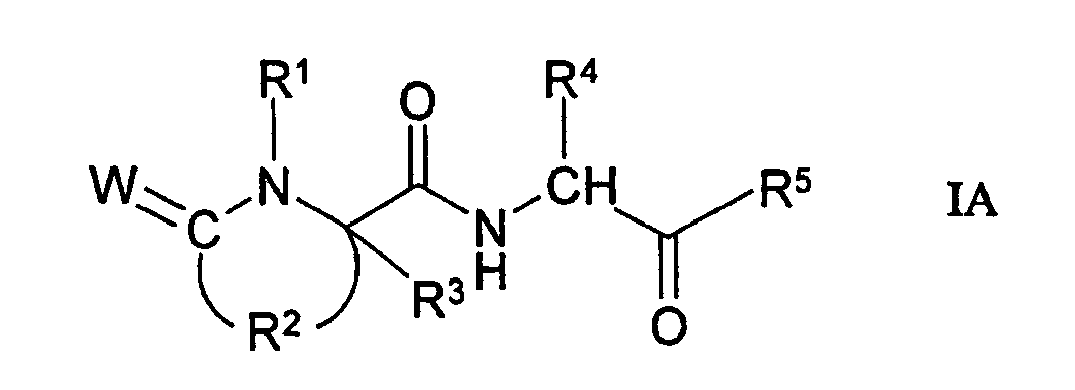
whereinR1 is selected from the group consisting of alkyl, substituted alkyl, aryl, substituted aryl, cycloalkyl, substituted cycloalkyl, heterocyclic, substituted heterocylic, heteroaryl, substituted heteroaryl and -C(O)OR1;R2 is selected from the group consisting of alkylene having from 2 to 4 carbon atoms in the alkylene chain, substituted alkylene having from 2 to 4 carbon atoms in the alkylene chain, heteroalkylene containing from 1 to 3 carbon atoms and from 1 to 2 heteroatoms selected from nitrogen, oxygen and sulfur and having from 2 to 4 atoms in the heteroalkylene chain, and substituted heteroalkylene containing, in the heteroalkylene chain, from 1 to 3 carbon atoms and from 1 to 2 heteroatoms selected from nitrogen, oxygen and sulfur and having from 2 to 4 atoms in the heteroalkylene chain;R3 is selected from the group consisting of hydrogen, alkyl, substituted alkyl, cycloalkyl, substituted cycloalkyl, cycloalkenyl, substituted cycloalkenyl, aryl, substituted aryl, heteroaryl, substituted heteroaryl, heterocyclic, substituted heterocyclic; or R3 can be joined to R2 to form a fused cycloalkyl, substititued cycloalkyl, cycloalkenyl, substituted cycloalkenyl, heterocyclic or substituted heterocyclic ring;R4 is selected from the group consisting of isopropyl, -CH2-X and =CH-X, where X is selected from the group consisting of hydrogen, alkyl, substituted alkyl, cycloalkyl, substituted cycloalkyl, alkoxy, substituted alkoxy, aryl, substituted aryl, aryloxy, substituted aryloxy, aryloxyaryl, substituted aryloxyaryl, heteroaryl, substituted heteroaryl, heterocyclic, substituted heterocyclic, acylamino, carboxyl, carboxylalkyl, carboxyl-substituted alkyl, carboxyl-cycloalkyl, carboxyl-substituted cycloalkyl, carboxylaryl, carboxyl-substituted aryl, carboxylheteroaryl, carboxyl-substituted heteroaryl, carboxyheterocyclic, carboxy-substituted heterocyclic, and hydroxyl with the proviso that when R4 is =CH-X then (H) is removed from the formula and X is not hydroxyl;R5 is selected from the group consisting of amino, alkoxy, substituted alkoxy, cycloalkoxy, substituted cycloalkoxy, aryloxy, substituted aryloxy, heteroaryloxy, substituted heteroaryloxy, heterocyclyloxy, substituted heterocyclyloxy, -NHOY where Y is hydrogen, alkyl, substituted alkyl, aryl, or substituted aryl, and -NH(CH2)pCOOY' where Y' is hydrogen, alkyl, substituted alkyl, aryl, or substituted aryl, and p is an integer of from 1 to 8;W is oxygen or sulfur;and pharmaceutically acceptable salts thereof;with the provisos that:(a) when R1 is benzyl, R2 is -CH2CH2-, R3 is hydrogen, R4 is benzyl, then R5 is not ethyl;(b) when R1 is 3,4-dichlorobenzyl, R2 is -CH2CH2-, R3 is hydrogen, R4 is 4-(phenylcarbonylamino)benzyl, then R5 is not methyl;(c) when R1 is benzyl, R2 is -CH2CH2-, R3 is hydrogen, R4 is 4-hydroxybenzyl, then R5 is not isopropyl or tert-butyl;(d) when R1 is 4-flurobenzyl, R2 is -CH2CH2-, R3 is hydrogen, R5 is tert-butyl, then R4 is not 4-hydroxybenzyl or 4-(4-nitrophenoxycarbonyloxy)benzyl;(e) when R1 is 4-cyanobenzyl, R2 is -CH2CH2-, R3 is hydrogen, R4 is 4-hydroxybenzyl, then R5 is not tert-butyl; and(f) when R1 is benzyloxycarbonyl, R2 is -NHCH2-, R3 is hydrogen, R5 is tert-butyl, then R4 is not 4-hydroxybenzyl or 4-(N,N-dimethylcarbamyloxy)benzyl. - The compound according to Claim 1 or 2 wherein R1 is a group having the formula:

whereinR6 and R7 are independently selected from the group consisting of hydrogen, alkyl, alkoxy, amino, cyano, halo and nitro; andZ is CH or N. - The compound according to Claim 3 wherein Z is CH.
- The compound according to Claim 4 wherein one of R6 and R7 is hydrogen and the other is selected from the group consisting of hydrogen, methyl, methoxy, amino, chloro, fluoro, cyano or nitro; or both R6 and R7 are chloro.
- The compound according to Claim 1 or 2 wherein R1 is selected from the group consisting of benzyl, 4-aminobenzyl, 3-chlorobenzyl, 4-chlorobenzyl, 3,4-dichlorobenzyl, 4-cyanobenzyl, 4-fluorobenzyl, 4-methylbenzyl, 4-methoxybenzyl, 4-nitrobenzyl, benzyloxycarbonyl and (pyrdin-3-yl)methyl.
- The compound according to Claim 1 or 2 wherein R2 is selected from the group consisting of alkylene having 2 or 3 carbon atoms in the alkylene chain, substituted alkylene having 2 or 3 carbon atoms in the alkylene chain, heteroalkylene containing 1 or 2 carbon atoms and 1 heteroatom selected from nitrogen, oxygen and sulfur and having 2 or 3 atoms in the heteroalkylene chain, and substituted heteroalkylene containing, in the heteroalkylene chain, 1 or 2 carbon atoms and 1 heteroatom selected from nitrogen, oxygen and sulfur and having 2 or 3 atoms in the heteroalkylene chain.
- The compound according to Claim 7 wherein R2 is selected from the group consisting of -CH2CH2-, -CH2-S-CH2-, -CH2-O-CH2- and -NHCH2-.
- The compound according to Claim 1 or 2 wherein R3 is hydrogen.
- The compound according to Claim 1 or 2 wherein R3 is joined to R2 to form a fused and/or bridged cycloalkyl, substituted cycloalkyl, cycloalkenyl, substititued cycloalkenyl, heterocyclic or substituted heterocyclic ring.
- The compound according to Claim 10 wherein R2 and R3, together with the other atoms of the nitrogen-containing ring form a 5-oxo-4-azatricyclo[4.2.1.0 (3,7)]nonane ring.
- The compound according to Claim 1 or 2 wherein R4 is selected from the group consisting of:4-methylbenzyl,4-hydroxybenzyl,4-methoxybenzyl,4-t-butoxybenzyl,4-benzyloxybenzyl,4-[φ-CH(CH3)O-]benzyl,4-[φ-CH(COOH)O-]benzyl,4-[BocNHCH2C(O)NH-]benzyl,4-chlorobenzyl,4-[NH2CH2C(O)NH-]benzyl,4-carboxybenzyl,4-[CbzNHCH2CH2NH-]benzyl,3-hydroxy-4-(φ-OC(O)NH-)benzyl,4-[HOOCCH2CH2C(O)NH-]benzyl,benzyl,4-[2'-carboxylphenoxy-]benzyl,4-[φ-C(O)NH-]benzyl,3-carboxybenzyl,4-iodobenzyl,4-hydroxy-3,5-diiodobenzyl,4-hydroxy-3-iodobenzyl,4-[2'-carboxyphenyl-]benzyl,φ-CH2CH2-,4-nitrobenzyl,2-carboxybenzyl,4-[dibenzylamino]-benzyl,4-[(1'-cyclopropylpiperidin-4'-yl)C(O)NH-]benzyl,4-[-NHC(O)CH2NHBoc]benzyl,4-carboxybenzyl,4-hydroxy-3-nitrobenzyl,4-[-NHC(O)CH(CH3)NHBoc]benzyl,4-[-NHC(O)CH(CH2φ)NHBoc]benzyl,isobutyl,methyl,4-[CH3C(O)NH-]benzyl,-CH2-(3-indolyl),n-butyl,t-butyl-OC(O)CH2-,t-butyl-OC(O)CH2CH2-,H2NC(O)CH2-,H2NC(O)CH2CH2-,BocNH-(CH2)4-,t-butyl-OC(O)-(CH2)2-,HOOCCH2-,HOOC(CH2)2-,H2N(CH2)4-,isopropyl,(1-naphthyl)-CH2-,(2-naphthyl)-CH2-,(2-thiophenyl)-CH2-,(φ-CH2-OC(O)NH-(CH2)4-,cyclohexyl-CH2-,benzyloxy-CH2-,HOCH2-,5-(3-N-benzyl)imidazolyl-CH2-,2-pyridyl-CH2-,3-pyridyl-CH2-,4-pyridyl-CH2-,5-(3-N-methyl)imidazolyl-CH2-,N-benzylpiperid-4-yl-CH2-,N-Boc-piperidin-4-yl-CH2-,N-(phenyl-carbonyl)piperidin-4-yl-CH2-,H3CSCH2CH2-,1-N-benzylimidazol-4-yl-CH2-,iso-propyl-C(O)NH-(CH2)4-,iso-butyl-C(O)NH-(CH2)4-,phenyl-C(O)NH-(CH2)4-,benzyl-C(O)NH-(CH2)4-,allyl-C(O)NH-(CH2)4-,4-(3-N-methylimidazolyl)-CH2-,4-imidazolyl,4-[(CH3)2NCH2CH2CH2-O-]benzyl,4-[(benzyl)2N-]-benzyl,4-aminobenzyl,allyloxy-C(O)NH(CH2)4-,allyloxy-C(O)NH(CH2)3-,allyloxy-C(O)NH(CH2)2-,NH2C(O)CH2-,φ-CH=,2-pyridyl-C(O)NH-(CH2)4-,4-methylpyrid-3-yl-C(O)NH-(CH2)4-,3-methylthien-2-yl-C(O)NH-(CH2)4-,2-pyrrolyl-C(O)NH-(CH2)4-,2-furanyl-C(O)NH-(CH2)4-,4-methylphenyl-SO2-N(CH3)CH2C(O)NH(CH2)4-,4-[cyclopentylacetylenyl]-benzyl,4-[-NHC(O)-(N-Boc)-pyrrolidin-2-yl)]-benzyl-,1-N-methylimidazol-4-yl-CH2-,1-N-methylimidazol-5-yl-CH2-,imidazol-5-yl-CH2-,6-methylpyrid-3-yl-C(O)NH-(CH2)4-,4-[2'-carboxymethylphenyl]-benzyl,4-[-NHC(O)NHCH2CH2CH2-φ]-benzyl,4-[-NHC(O)NHCH2CH2-φ]-benzyl,-CH2C(O)NH(CH2)4φ,4-[φ(CH2)4O-]-benzyl,4-[-C≡C-φ-4'φ]-benzyl,4-[-C≡C-CH2-O-S(O)2-4'-CH3-φ]-benzyl,4-[-C≡C-CH2NHC(O)NH2]-benzyl,4-[-C≡C-CH2-O-4'-COOCH2CH3-φ]-benzyl,4-[-C≡C-CH(NH2)-cyclohexyl]-benzyl,-(CH2)4NHC(O)CH2-3-indolyl,-(CH2)4NHC(O)CH2CH2-3-indolyl,-(CH2)4NHC(O)-3-(5-methoxyindolyl),-(CH2)4NHC(O)-3-(1-methylindolyl),-(CH2)4NHC(O)-4-(-SO2(CH3)-φ),-(CH2)4NHC(O)-4-(C(O)CH3)-phenyl,-(CH2)4NHC(O)-4-fluorophenyl,-(CH2)4NHC(O)CH2O-4-fluorophenyl,4-[-C≡C-(2-pyridyl)]benzyl,4-[-C≡C-CH2-O-phenyl]benzyl,4-[-C≡C-CH2OCH3]benzyl,4-[-C≡C-(3-hydroxyphenyl)]benzyl,4-[-C≡C-CH2-O-4'-(-C(O)OC2H5)phenyl]benzyl,4-[-C≡C-CH2CH(C(O)OCH3)2]benzyl,4-[-C≡C-CH2NH-(4,5-dihydro-4-oxo-5-phenyl-oxazol-2-yl),3-aminobenzyl,4-[-C≡C-CH2CH(NHC(O)CH3)C(O)OH]-benzyl,-CH2C(O)NHCH(CH3)φ,-CH2C(O)NHCH2-(4-dimethylamino)-φ,-CH2C(O)NHCH2-4-nitrophenyl,-CH2CH2C(O)N(CH3)CH2-φ,-CH2CH2C(O)NHCH2CH2-(N-methyl)-2-pyrrolyl,-CH2CH2C(O)NHCH2CH2CH2CH3,-CH2CH2C(O)NHCH2CH2-3-indolyl,-CH2C(O)N(CH3)CH2phenyl,-CH2C(O)NH(CH2)2-(N-methyl)-2-pyrrolyl,-CH2C(O)NHCH2CH2CH2CH3,-CH2C(O)NHCH2CH2-3-indolyl,-(CH2)2C(O)NHCH(CH3)φ,-(CH2)2C(O)NHCH2-4-dimethylaminophenyl,-(CH2)2C(O)NHCH2-4-nitrophenyl,-CH2C(O)NH-4-[-NHC(O)CH3-phenyl],-CH2C(O)NH-4-pyridyl,-CH2C(O)NH-4-[dimethylaminophenyl],-CH2C(O)NH-3-methoxyphenyl,-CH2CH2C(O)NH-4-chlorophenyl,-CH2CH2C(O)NH-2-pyridyl,-CH2CH2C(O)NH-4-methoxyphenyl,-CH2CH2C(O)NH-3-pyridyl,4-[(CH3)2NCH2CH2O-]benzyl,-(CH2)3NHC(NH)NH-SO2-4-methylphenyl,4-[(CH3)2NCH2CH2O-]benzyl,-(CH2)4NHC(O)NHCH2CH3,-(CH2)4NHC(O)NH-phenyl,-(CH2)4NHC(O)NH-4-methoxyphenyl,4-[4'-pyridyl-C(O)NH-]benzyl,4-[3'-pyridyl-C(O)NH-]benzyl,4-[-NHC(O)NH-3'-methylphenyl]benzyl,4-[-NHC(O)CH2NHC(O)NH-3'-methylphenyl]benzyl,4-[-NHC(O)-(2',3'-dihydroindol-2-yl)]benzyl,4-[-NHC(O)-(2',3'-dihydro-N-Boc-indol-2-yl)]benzyl,p-[-OCH2CH2-1'-(4'-pyrimidinyl)-piperazinyl]benzyl,4-[-OCH2CH2-(1'-piperidinyl)benzyl,4-[-OCH2CH2-(1'-pyrrolidinyl)]benzyl,4-[-OCH2CH2CH2-(1'-piperidinyl)]benzyl-,-CH2-3-(1,2,4-triazolyl),4-[-OCH2CH2CH2-4-(3'-chlorophenyl)-piperazin-1-yl]benzyl,4-[-OCH2CH2N(φ)CH2CH3]benzyl,4-[-OCH2-3'-(N-Boc)-piperidinyl]benzyl,4-[di-n-pentylamino]benzyl,4-[n-pentylamino]benzyl,4-[di-iso-propylamino-CH2CH2O-]benzyl,4-[-OCH2CH2-(N-morpholinyl)]benzyl,4-[-O-(3'-(N-Boc)-piperidinyl]benzyl,4-[-OCH2CH(NHBoc)CH2cyclohexyl]benzyl,p-[OCH2CH2-(N-piperidinyl]benzyl,4-[-OCH2CH2CH2-(4-m-chlorophenyl)-piperazin-1-yl]benzyl,4-[-OCH2CH2-(N-homopiperidinyl)benzyl,4-[-NHC(O)-3'-(N-Boc)-piperidinyl]benzyl,4-[-OCH2CH2N(benzyl)2]benzyl,-CH2-2-thiazolyl,3-hydroxybenzyl,4-[-OCH2CH2CH2N(CH3)2]benzyl,4-[-NHC(S)NHCH2CH2-(N-morpholino)]benzyl,4-[-OCH2CH2N(C2H5)2]benzyl,4-[-OCH2CH2CH2N(C2H5)2]benzyl,4-[CH3(CH2)4NH-]benzyl,4-[N-n-butyl,N-n-pentylamino-]benzyl,4-[-NHC(O)-4'-piperidinyl]benzyl,4-[-NHC(O)CH(NHBoc)(CH2)4NHCbz]benzyl,4-[-NHC(O)-(1',2',3',4'-tetrahydro-N-Boc-isoquinolin-1'-yl]benzyl,p-[-OCH2CH2CH2-1'-(4'-methyl)-piperazinyl]benzyl,-(CH2)4NH-Boc,3-[-OCH2CH2CH2N(CH3)2]benzyl,4-[-OCH2CH2CH2N(CH3)2]benzyl,3-[-OCH2CH2-(1'-pyrrolidinyl)]benzyl,4-[-OCH2CH2CH2N(CH3)benzyl]benzyl,4-[-NHC(S)NHCH2CH2CH2-(N-morpholino)]benzyl,4-[-OCH2CH2-(N-morpholino)]benzyl,4-[-NHCH2-(4'-chlorophenyl)]benzyl,4-[-NHC(O)NH-(4'-cyanophenyl)]benzyl,4-[-OCH2COOH]benzyl,4-[-OCH2COO-t-butyl]benzyl,4-[-NHC(O)-5'-fluoroindol-2-yl]benzyl,4-[-NHC(S)NH(CH2)2-1-piperidinyl]benzyl,4-[-N(SO2CH3)(CH2)3-N(CH3)2]benzyl,4-[-NHC(O)CH2CH(C(O)OCH2φ)-NHCbz]benzyl,4-[-NHS(O)2CF3]benzyl,3-[-O-(N-methylpiperidin-4'-yl]benzyl,4-[-C(=NH)NH2]benzyl,4-[-NHSO2-CH2Cl]benzyl,4-[-NHC(O)-(1',2',3',4'-tetrahydroisoquinolin-2'-yl]benzyl,4-[-NHC(S)NH(CH2)3-N-morpholino]benzyl,4-[-NHC(O)CH(CH2CH2CH2CH2NH2)NHBoc]benzyl,4-[-C(O)NH2]benzyl,4-[-NHC(O)NH-3'-methoxyphenyl]benzyl,4-[-OCH2CH2-indol-3'-yl]benzyl,4-[-OCH2C(O)NH-benzyl]benzyl,4-[-OCH2C(O)O-benzyl]benzyl,4-[-OCH2C(O)OH]benzyl,4-[-OCH2-2'-(4',5'-dihydro)imidazolyl]benzyl,-CH2C(O)NHCH2-(4-dimethylamino)phenyl,-CH2C(O)NHCH2-(4-dimethylamino)phenyl,4-[-NHC(O)-L-2'-pyrrolidinyl-N-SO2-4'-methylphenyl]benzyl,4-[-NHC(O)NHCH2CH2CH3]benzyl,4-aminobenzyl]benzyl,4-[-OCH2CH2-1-(4-hydroxy-4-(3-methoxypyrrol-2-yl)-piperazinyl]benzyl,4-[-O-(N-methylpiperidin-4'-yl)]benzyl,3-methoxybenzyl,4-[-NHC(O)-piperidin-3'-yl]benzyl,4-[-NHC(O)-pyridin-2'-yl]benzyl,4-[-NHCH2-(4'-chlorophenyl)]benzyl,4-[-NHC(O)-(N-(4'-CH3-φ-SO2)-L-pyrrolidin-2'-yl)]benzyl,4-[-NHC(O)NHCH2CH2-φ]benzyl,4-[-OCH2C(O)NH2]benzyl,4-[-OCH2C(O)NH-t-butyl]benzyl,4-[-OCH2CH2-1-(4-hydroxy-4-phenyl)-piperidinyl]benzyl,4-[-NHSO2-CH=CH2]benzyl,4-[-NHSO2-CH2CH2Cl]benzyl,-CH2C(O)NHCH2CH2N(CH3)2,4-[(1'-Cbz-piperidin-4'-yl)C(O)NH-]benzyl,4-[(1'-Boc-piperidin-4'-yl)C(O)NH-]benzyl,4-[(2'-bromophenyl)C(O)NH-]benzyl,4-[-NHC(O)-pyridin-4'-yl]benzyl,4-[(4'-(CH3)2NC(O)O-)phenyl)-C(O)NH-]benzyl,4-[-NHC(O)-1'-methylpiperidin-4'-yl-]benzyl,4-(dimethylamino)benzyl,4-[-NHC(O)-(1'-N-Boc)-piperidin-2'-yl]benzyl,3-[-NHC(O)-pyridin-4'-yl]benzyl,4-[(tert-butyl-O(O)CCH2-O-benzyl)-NH-]benzyl,[BocNHCH2C(O)NH-]butyl,4-benzylbenzyl,2-hydroxyethyl,4-[(Et)2NCH2CH2CH2NHC(S)NH-]benzyl,4-[(1'-Boc-4'-hydroxypyrrolidin-2'-yl)C(O)NH-]benzyl,4-[φCH2CH2CH2NHC(S)NH-]benzyl,4-[(perhydroindolin-2'-yl)C(O)NH-]benzyl,2-[4-hydroxy-4-(3-methoxythien-2-yl)piperidin-1-yl]ethyl,4-[(1'-Boc-perhydroindolin-2'-yl)-C(O)NH-]benzyl,4-[N-3-methylbutyl-N-trifluoromethanesulfonyl)amino]benzyl,4-[N-vinylsulfonyl)anlino]benzyl,4-[2-(2-azabicyclo[3.2.2]octan-2-yl)ethyl-O-]benzyl,4-[4'-hydroxypyrrolidin-2'-yl)C(O)NH-]benzyl,4-(φNHC(S)NH)benzyl,4-(EtNHC(S)NH)benzyl,4-(φCH2NHC(S)NH)benzyl,3-[(1'-Boc-piperidin-2'-yl)C(O)NH-]benzyl,3-[piperidin-2'-yl-C(O)NH-]benzyl,4-[(3'-Boc-thiazolidin-4'-yl)C(O)NH-]benzyl,4-(pyridin-3'-yl-NHC(S)NH)benzyl,4-(CH3-NHC(S)NH)benzyl,4-(H2NCH2CH2CH2C(O)NH)benzyl,4-(BocHNCH2CH2CH2C(O)NH)benzyl,4-(pyridin-4'-yl-CH2NH)benzyl,4-[(N,N-di(4-N,N-dimethylamino)benzyl)amino]benzyl,4-[(1-Cbz-piperidin-4-yl)C(O)NH-]butyl,4-[φCH2OCH2(BocHN)CHC(O)NH]benzyl,4-[(piperidin-4'-yl)C(O)NH-]benzyl,4-[(pyrrolidin-2'-yl)C(O)NH-]benzyl,4-(pyridin-3'-yl-C(O)NH)butyl,4-(pyridin-4'-yl-C(O)NH)butyl,4-(pyridin-3'-yl-C(O)NH)benzyl,4-[CH3NHCH2CH2CH2C(O)NH-]benzyl,4-[CH3N(Boc)CH2CH2CH2C(O)NH-]benzyl,4-(aminomethyl)benzyl,4-[φCH2OCH2(H2N)CHC(O)NH]benzyl,4-[(1',4'-di(Boc)piperazin-2'-yl)-C(O)NH-]benzyl,4-[(piperazin-2'-yl)-C(O)NH-]benzyl,4-[(N-toluenesulfonylpyrrolidin-2'-yl)C(O)NH-]butyl,4-[-NHC(O)-4'-piperidinyl]butyl,4-[-NHC(O)-1'-N-Boc-piperidin-2'-yl]benzyl,4-[-NHC(O)-piperidin-2'-yl]benzyl,4-[(1'-N-Boc-2',3'-dihydroindolin-2'-yl)-C(O)NH]benzyl,4-(pyridin-3'-yl-CH2NH)benzyl,4-[(piperidin-1'-yl)C(O)CH2-O-]benzyl,4-[(CH3)2CH)2NC(O)CH2-O-]benzyl,4-[HO(O)C(Cbz-NH)CHCH2CH2-C(O)NH-]benzyl,4-[φCH2O(O)C(Cbz-NH)CHCH2CH2-C(O)NH-]benzyl,4-[-NHC(O)-2'-methoxyphenyl]benzyl,4-[(pyrazin-2'-yl)C(O)NH-]benzyl,4-[HO(O)C(NH2)CHCH2CH2-C(O)NH-]benzyl,4-(2'-formyl-1',2',3',4'-tetrahydroisoquinolin-3'-yl-CH2NH-)benzyl,N-Cbz-NHCH2-,4-[(4'-methylpiperazin-1'-yl)C(O)O-]benzyl,4-[CH3(N-Boc)NCH2C(O)NH-]benzyl,4-[-NHC(O)-(1',2',3',4'-tetrahydro-N-Boc-isoquinolin-3'-yl]-benzyl,4-[CH3NHCH2C(O)NH-]benzyl,(CH3)2NC(O)CH2-,4-(N-methylacetamido)benzyl,4-(1',2',3',4'-tetrahydroisoquinolin-3'-yl-CH2NH-)benzyl,4-[(CH3)2NHCH2C(O)NH-]benzyl,(1-toluenesulfonylimidizol-4-yl)methyl,4-[(1'-Boc-piperidin-4'-yl)C(O)NH-]benzyl,4-trifluoromethylbenzyl,4-[(2'-bromophenyl)C(O)NH-]benzyl,4-[(CH3)2NC(O)NH-]benzyl,4-[CH3OC(O)NH-]benzyl,4-[(CH3)2NC(O)O-]benzyl,4-[(CH3)2NC(O)N(CH3)-]benzyl,4-[CH3OC(O)N(CH3)-]benzyl,4-(N-methyltrifluoroacetamido)benzyl,4-[(1'-methoxycarbonylpiperidin-4'-yl)C(O)NH-]benzyl,4-[(4'-phenylpiperidin-4'-yl)C(O)NH-]benzyl,4-[(4'-phenyl-1'-Boc-piperidin-4'-yl)-C(O)NH-]benzyl,4-[(piperidin-4'-yl)C(O)O-]benzyl, 4-[(1'-methylpiperidin-4'-yl)-O-]benzyl,4-[(1'-methylpiperidin-4'-yl)C(O)O-]benzyl,4-[(4'-methylpiperazin-1'-yl)C(O)NH-]benzyl,3-[(CH3)2NC(O)O-]benzyl,4-[(4'-phenyl-1'-Boc-piperidin-4'-yl)-C(O)O-]benzyl,4-(N-toluenesulfonylamino)benzyl,4-[(CH3)3CC(O)NH-]benzyl,4-[(morpholin-4'-yl)C(O)NH-]benzyl,4-[(CH3CH2)2NC(O)NH-]benzyl,4-[-C(O)NH-(4'-piperidinyl)]benzyl,4-[(2'-trifluoromethylphenyl)C(O)NH-]benzyl,4-[(2'-methylphenyl)C(O)NH-]benzyl,4-[(CH3)2NS(O)2O-]benzyl,4-[(pyrrolidin-2'-yl)C(O)NH-]benzyl,4-[-NHC(O)-piperidin-1'-yl]benzyl,4-[(thiomorpholin-4'-yl)C(O)NH-]benzyl,4-[(thiomorpholin-4'-yl sulfone)-C(O)NH-]benzyl,4-[(morpholin-4'-yl)C(O)O-]benzyl,3-nitro-4-(CH3OC(O)CH2O-)benzyl,(2-benzoxazolinon-6-yl)methyl-,(2H-1,4-benzoxazin-3(4H)-one-7-yl)methyl-,4-[(CH3)2NS(O)2NH-]benzyl,4-[(CH3)2NS(O)2N(CH3)-]benzyl,4-[(thiomorpholin-4'-yl)C(O)O-]benzyl,4-[(thiomorpholin-4'-yl sulfone)-C(O)O-]benzyl,4-[(piperidin-1'-yl)C(O)O-]benzyl,4-[(pyrrolidin-1'-yl)C(O)O-]benzyl,4-[(4'-methylpiperazin-1'-yl)C(O)O-]benzyl,4-[(2'-methylpyrrolidin-1'-yl)-,(pyridin-4-yl)methyl-,4-[(piperazin-4'-yl)-C(O)O-]benzyl,4-[(1'-Boc-piperazin-4'-yl)-C(O)O-]benzyl,4-[(4'-acetylpiperazin-1'-yl)C(O)O-]benzyl,p-[(4'-methanesulfonylpiperazin-1'-yl)-benzyl,3-nitro-4-[(morpholin-4'-yl)-C(O)O-]benzyl,4-{[(CH3)2NC(S)]2N-}benzyl,N-Boc-2-aminoethyl-,4-[(1,1-dioxothiomorpholin-4-yl)-C(O)O-]benzyl,4-[(CH3)2NS(O)2-]benzyl,4-(imidazolid-2'-one-1'-yl)benzyl,4-[(piperidin-1'-yl)C(O)O-]benzyl,1-N-benzyl-imidazol-4-yl-CH2-,3,4-dioxyethylenebenzyl,3,4-dioxymethylenebenzyl,4-[-N(SO2)(CH3)CH2CH2CH2N(CH3)2]benzyl,4-(3'-formylimidazolid-2'-one-1'-yl)benzyl,4-[NHC(O)CH(CH2CH2CH2CH2NH2)NHBoc]benzyl,[2'-[4"-hydroxy-4"-(3'''-methoxythien-2'''-yl)piperidin-2"-yl]ethoxy]benzyl, andp-[(CH3)2NCH2CH2N(CH3)C(O)O-]benzyl.
- The compound according to Claim 2 wherein R5 is selected from the group consisting of 2,4-dioxo-tetrahydrofuran-3-yl (3,4-enol), methoxy, ethoxy, iso-propoxy, n-butoxy, t-butoxy, cyclopentoxy, neo-pentoxy, 2-α-iso-propyl-4-β-methylcyclohexoxy, 2-β-isopropyl-4-β-methylcyclohexoxy, -NH2, benzyloxy, -NHCH2COOH, -NHCH2CH2COOH, -NH-adamantyl, -NHCH2CH2COOCH2CH3, -NHSO2-p-CH3-φ, -NHOR8 where R8 is hydrogen, methyl, iso-propyl or benzyl, O-(N-succinimidyl), -O-cholest-5-en-3-β-yl, -OCH2-OC(O)C(CH3)3, -O(CH2)zNHC(O)R9 where z is 1 or 2 and R9 is selected from the group consisting of pyrid-3-yl, N-methylpyridyl, and N-methyl-1,4-dihydro-pyrid-3-yl, -NR"C(O)-R' where R' is aryl, heteroaryl or heterocyclic and R" is hydrogen or -CH2C(O)OCH2CH3.
- The compound according to Claim 1 or 2 wherein W is oxygen.
- A compound selected from the group consisting of:N-(benzyl)-L-pyroglutamyl-L-phenylalanineN-(benzyloxycarbonyl)-L-pyroglutamyl-L-phenylalanineN-(benzyl)-L-pyroglutamyl-L-4-(phenylcarbonylamino)phenylalanineN-(3,4-dichlorobenzyl)-L-pyroglutamyl-L-4-(phenylcarbonylamino)phenylalanineN-(3-chlorobenzyl)-L-pyroglutamyl-L-4-(phenylcarbonylamino)phenylalanineN-(3-chlorobenzyl)-L-pyroglutamyl-L-4-(phenylcarbonylamino)phenylalanine methyl esterN-(4-chlorobenzyl)-L-pyroglutamyl-L-4-(phenylcarbonylamino)phenylalanineN-(4-chlorobenzyl)-L-pyroglutamyl-L-4-(phenylcarbonylamino)phenylalanine methyl esterN-(4-methylbenzyl)-L-pyroglutamyl-L-4-(phenylcarbonylamino)phenylalanineN-(4-methylbenzyl)-L-pyroglutamyl-L-4-(phenylcarbonylamino)phenylalanine methyl esterN-(4-methoxybenzyl)-L-pyroglutamyl-L-4-(phenylcarbonylamino)phenylalanineN-(4-methoxybenzyl)-L-pyroglutamyl-L-4-(phenylcarbonylamino)phenylalanine methyl esterN-(3-chlorobenzyl)-L-pyroglutamyl-L-(N'-benzyl)histidineN-(4-methylbenzyl)-L-pyroglutamyl-L-(N'-benzyl)histidine methyl esterN-(4-methylbenzyl)-L-pyroglutamyl-L-(N'-benzyl)histidineN-(benzyl)-D-pyroglutamyl-L-phenylalanineN-(4-benzyl-3-oxothiomorpholin-5-carbonyl)-L-phenylalanineN-(4-benzyl-3-oxothiomorpholin-5-carbonyl)-L-phenylalanine ethyl esterN-(4-benzyl-3-oxomorpholin-5-carbonyl)-L-phenylalanineN-(4-benzyl-3-oxothiomorpholin-5-carbonyl)-L-4-nitrophenylalanine methyl esterN-(benzyl)-L-pyroglutamyl-L-4-(pyridin-4-ylcarbonylamino)phenylalanine methyl esterN-(benzyl)-L-pyroglutamyl-L-4-(1'-benzyloxycarbonylpiperidin-4'-ylcarbonylamino)phenylalanine methyl esterN-(benzyl)-L-pyroglutamyl-L-4-(pyridin-4-ylcarbonylamino)phenylalanineN-(benzyl)-L-pyroglutamyl-L-4-(1'-benzyloxycarbonylpiperidin-4'-ylcarbonylamino)phenylalanineN-(benzyl)-L-pyroglutamyl-L-tyrosine ethyl esterN-(benzyl)-L-pyroglutamyl-L-4-(piperidin-4'-ylcarbonylamino)phenylalanineN-(benzyl)-L-pyroglutamyl-L-4-nitrophenylalanine ethyl esterN-(benzyl)-L-pyroglutamyl-L-tyrosineN-(benzyl)-L-pyroglutamyl-L-4-(1'-methylpiperidin-4'-yloxy)phenylalanine ethyl esterN-(benzyl)-L-pyroglutamyl-L-4-nitrophenylalanineN-(benzyl)-L-pyroglutamyl-L-4-[(4'-methylpiperazin-1'-yl)carbonyloxy]phenylalanine ethyl esterN-(benzyl)-L-pyroglutamyl-L-4-(1'-methylpiperidin-4'-yloxy)phenylalanineN-(benzyl)-L-pyroglutamyl-L-4-[(4'-methylpiperazin-1'-yl)carbonyloxy]phenylalanineN-(benzyl)-L-pyroglutamyl-L-4-(N,N-dimethylcarbamyloxy)phenylalanine ethyl esterN-(benzyl)-L-pyroglutamyl-L-4-aminophenylalanine ethyl esterN-(benzyl)-L-pyroglutamyl-L-4-(N,N-dimethylcarbamyloxy)phenylalanineN-(benzyl)-L-pyroglutamyl-L-4-(N,N-dimethylcarbamyloxy)phenylalanine tert-butyl esterN-(benzyl)-L-pyroglutamyl-L-4-[(4'-methylpiperazin-1'-yl)carbonyloxy]phenylalanine tert-butyl esterN-(benzyl)-L-pyroglutamyl-L-4-[(thiomorpholin-4'-yl)carbonyloxy]phenylalanine tert-butyl esterN-(4-fluorobenzyl)-L-pyroglutamyl-L-4-[(thiomorpholin-4'-yl)carbonyloxy]phenylalanine tert-butyl esterN-(benzyl)-L-pyroglutamyl-L-4-(N,N-dimethylcarbamyloxy)phenylalanine isopropyl esterN-(4-fluorobenzyl)-L-pyroglutamyl-L-4-(N,N-dimethylcarbamyloxy)phenylalanine tert-butyl esterN-(benzyl)-L-pyroglutamyl-L-3-chloro-4-hydroxyphenylalanineN-(4-cyanobenzyl)-L-pyroglutamyl-L-4-(N,N-dimethylcarbamyloxy)phenylalanine tert-butyl esterN-(benzyl)-L-pyroglutamyl-L-3-chloro-4-(N,N-dimethylcarbamyloxy)phenylalanine methyl esterN-(4-fluorobenzyl)-L-pyroglutamyl-L-4-[(thiomorpholin-4'-yl)carbonyloxy]phenylalanineN-(4-cyanobenzyl)-L-pyroglutamyl-L-4-(N,N-dimethylcarbamyloxy)phenylalanineN-(1-benzyloxycarbonyl-2-imidazolidone-5-carbonyl)-L-4-(N,N-dimethylcarbamyloxy)phenylalanineN-(4-nitrobenzyl)-L-pyroglutamyl-L-4-(N,N-dimethylcarbamyloxy)phenylalanine tert-butyl esterN-(benzyl)-L-pyroglutamyl-L-3-chloro-4-(N,N-dimethylcarbamyloxy)phenylalanineN-(4-fluorobenzyl)-L-pyroglutamyl-L-4-[(4'-(pyridin-2-yl)piperazin-1'-yl)carbonyloxy]phenylalanineN-(4-fluorobenzyl)-L-pyroglutamyl-L-4-[(4'-(pyridin-2-yl)piperazin-1'-yl)carbonyloxy]phenylalanine tert-butyl esterN-(4-aminobenzyl)-L-pyroglutamyl-L-4-(N,N-dimethylcarbamyloxy)phenylalanine tert-butyl esterN-(pyridin-3-ylmethyl)-L-pyroglutamyl-L-tyrosine tert-butyl esterN-(pyridin-3-ylmethyl)-L-pyroglutamyl-L-4-(N,N-dimethylcarbamyloxy)phenylalanineN-(pyridin-3-ylmethyl)-L-pyroglutamyl-L-4-(N,N-dimethylcarbamyloxy)phenylalanine tert-butyl esterN-(pyridin-3-ylmethyl)-L-pyroglutamyl-L-4-[(4'-(pyridin-2-yl)piperazin-1'-yl)carbonyloxy]phenylalanine tert-butyl esterN-(pyridin-3-ylmethyl)-L-pyroglutamyl-L-4-[(4'-(pyridin-2-yl)piperazin-1'-yl)carbonyloxy]phenylalanineN-(4-benzyl-5-oxo-4-azatricyclo[4.2.1.0 (3,7)]nonane-3-carbonyl)-L-tyrosine tert-butyl esterN-(4-benzyl-5-oxo-4-azatricyclo[4.2.1.0 (3,7)]nonane-3-carbonyl)-L-4-(N,N-dimethylcarbamyloxy)phenylalanine tert-butyl esterN-(4-benzyl-5-oxo-4-azatricyclo[4.2.1.0 (3,7)]nonane-3-carbonyl)-L-4-(N,N-dimethylcarbamyloxy)phenylalanineN-(4-fluorobenzyl)-L-pyroglutamyl-L-4-(N,N-dimethylcarbamyloxy)phenylalanine
and pharmaceutically acceptable salts thereof, as well as any of the ester compounds recited above wherein one ester is replaced with another ester selected from the group consisting of methyl ester, ethyl ester, n-propyl ester, isopropyl ester, n-butyl ester, isobutyl ester, sec-butyl ester and tert-butyl ester. - A pharmaceutical composition comprising a pharmaceutically acceptable carrier and a therapeutically effective amount of a compound of formula I:
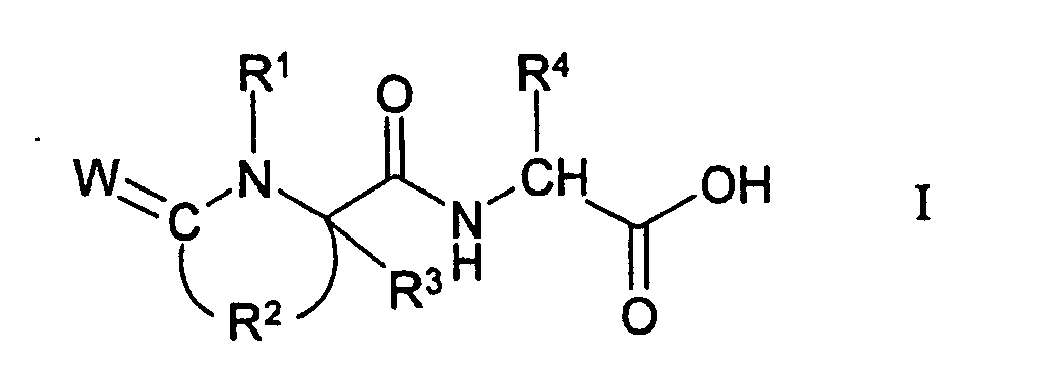
whereinR1 is selected from the group consisting of alkyl, substituted alkyl, aryl, substituted aryl, cycloalkyl, substituted cycloalkyl, heterocyclic, substituted heterocylic, heteroaryl, substituted heteroaryl and -C(O)OR1;R2 is selected from the group consisting of alkylene having from 2 to 4 carbon atoms in the alkylene chain, substituted alkylene having from 2 to 4 carbon atoms in the alkylene chain, heteroalkylene containing from 1 to 3 carbon atoms and from 1 to 2 heteroatoms selected from nitrogen, oxygen and sulfur and having from 2 to 4 atoms in the heteroalkylene chain, and substituted heteroalkylene containing, in the heteroalkylene chain, from 1 to 3 carbon atoms and from 1 to 2 heteroatoms selected from nitrogen, oxygen and sulfur and having from 2 to 4 atoms in the heteroalkylene chain;R3 is selected from the group consisting of hydrogen, alkyl, substituted alkyl, cycloalkyl, substituted cycloalkyl, cycloalkenyl, substituted cycloalkenyl, aryl, substituted aryl, heteroaryl, substituted heteroaryl, heterocyclic, substituted heterocyclic; or R3 can be joined to R2 to form a fused cycloalkyl, substititued cycloalkyl, cycloalkenyl, substituted cycloalkenyl, heterocyclic or substituted heterocyclic ring;R4 is selected from the group consisting of isopropyl, -CH2-X and =CH-X, where X is selected from the group consisting of hydrogen, alkyl, substituted alkyl, cycloalkyl, substituted cycloalkyl, alkoxy, substituted alkoxy, aryl, substituted aryl, aryloxy, substituted aryloxy, aryloxyaryl, substituted aryloxyaryl, heteroaryl, substituted heteroaryl, heterocyclic, substituted heterocyclic, acylamino, carboxyl, carboxylalkyl, carboxyl-substituted alkyl, carboxyl-cycloalkyl, carboxyl-substituted cycloalkyl, carboxylaryl, carboxyl-substituted aryl, carboxylheteroaryl, carboxyl-substituted heteroaryl, carboxyheterocyclic, carboxy-substituted heterocyclic, and hydroxyl with the proviso that when R4 is =CH-X then (H) is removed from the formula and X is not hydroxyl;W is oxygen or sulfur;and pharmaceutically acceptable salts thereof. - A pharmaceutical composition comprising a pharmaceutically acceptable carrier and a therapeutically effective amount of a compound of formula IA:

whereinR1 is selected from the group consisting of alkyl, substituted alkyl, aryl, substituted aryl, cycloalkyl, substituted cycloalkyl, heterocyclic, substituted heterocylic, heteroaryl, substituted heteroaryl and -C(O)OR1;R2 is selected from the group consisting of alkylene having from 2 to 4 carbon atoms in the alkylene chain, substituted alkylene having from 2 to 4 carbon atoms in the alkylene chain, heteroalkylene containing from 1 to 3 carbon atoms and from 1 to 2 heteroatoms selected from nitrogen, oxygen and sulfur and having from 2 to 4 atoms in the heteroalkylene chain, and substituted heteroalkylene containing, in the heteroalkylene chain, from 1 to 3 carbon atoms and from 1 to 2 heteroatoms selected from nitrogen, oxygen and sulfur and having from 2 to 4 atoms in the heteroalkylene chain;R3 is selected from the group consisting of hydrogen, alkyl, substituted alkyl, cycloalkyl, substituted cycloalkyl, cycloalkenyl, substituted cycloalkenyl, aryl, substituted aryl, heteroaryl, substituted heteroaryl, heterocyclic, substituted heterocyclic; or R3 can be joined to R2 to form a fused cycloalkyl, substititued cycloalkyl, cycloalkenyl, substituted cycloalkenyl, heterocyclic or substituted heterocyclic ring;R4 is selected from the group consisting of isopropyl, -CH2-X and =CH-X, where X is selected from the group consisting of hydrogen, alkyl, substituted alkyl, cycloalkyl, substituted cycloalkyl, alkoxy, substituted alkoxy, aryl, substituted aryl, aryloxy, substituted aryloxy, aryloxyaryl, substituted aryloxyaryl, heteroaryl, substituted heteroaryl, heterocyclic, substituted heterocyclic, acylamino, carboxyl, carboxylalkyl, carboxyl-substituted alkyl, carboxyl-cycloalkyl, carboxyl-substituted cycloalkyl, carboxylaryl, carboxyl-substituted aryl, carboxylheteroaryl, carboxyl-substituted heteroaryl, carboxyheterocyclic, carboxy-substituted heterocyclic, and hydroxyl with the proviso that when R4 is =CH-X then (H) is removed from the formula and X is not hydroxyl;R5 is selected from the group consisting of amino, alkoxy, substituted alkoxy, cycloalkoxy, substituted cycloalkoxy, aryloxy, substituted aryloxy, heteroaryloxy, substituted heteroaryloxy, heterocyclyloxy, substituted heterocyclyloxy, -NHOY where Y is hydrogen, alkyl, substituted alkyl, aryl, or substituted aryl, and -NH(CH2)pCOOY' where Y' is hydrogen, alkyl, substituted alkyl, aryl, or substituted aryl, and p is an integer of from 1 to 8;W is oxygen or sulfur;and pharmaceutically acceptable salts thereof;with the provisos that:(a) when R1 is benzyl, R2 is -CH2CH2-, R3 is hydrogen, R4 is benzyl, then R5 is not ethyl;(b) when R1 is 3,4-dichlorobenzyl, R2 is -CH2CH2-, R3 is hydrogen, R4 is 4-(phenylcarbonylamino)benzyl, then R5 is not methyl;(c) when R1 is benzyl, R2 is -CH2CH2-, R3 is hydrogen, R4 is 4-hydroxybenzyl, then R5 is not isopropyl or tert-butyl;(d) when R1 is 4-flurobenzyl, R2 is -CH2CH2-, R3 is hydrogen, R5 is tert-butyl, then R4 is not 4-hydroxybenzyl or 4-(4-nitrophenoxycarbonyloxy)benzyl;(e) when R1 is 4-cyanobenzyl, R2 is -CH2CH2-, R3 is hydrogen, R4 is 4-hydroxybenzyl, then R5 is not tert-butyl; and(f) when R1 is benzyloxycarbonyl, R2 is -NHCH2-, R3 is hydrogen, R5 is tert-butyl, then R4 is not 4-hydroxybenzyl or 4-(N,N-dimethylcarbamyloxy)benzyl. - The pharmaceutical composition according to Claim 16 or 17 wherein R1 is a group having the formula:

whereinR6 and R7 are independently selected from the group consisting of hydrogen, alkyl, alkoxy, amino, cyano, halo and nitro; andZ is CH or N. - The pharmaceutical composition according to Claim 18 wherein Z is CH.
- The pharmaceutical composition according to Claim 19 wherein one of R6 and R7 is hydrogen and the other is selected from the group consisting of hydrogen, methyl, methoxy, amino, chloro, fluoro, cyano or nitro; or both R6 and R7 are chloro.
- The pharmaceutical composition according to Claim 16 or 17 wherein R1 is selected from the group consisting of benzyl, 4-aminobenzyl, 3-chlorobenzyl, 4-chlorobenzyl, 3,4-dichlorobenzyl, 4-cyanobenzyl, 4-fluorobenzyl, 4-methylbenzyl, 4-methoxybenzyl, 4-nitrobenzyl, benzyloxycarbonyl and (pyrdin-3-yl)methyl.
- The pharmaceutical composition according to Claim 16 or 17 wherein R2 is selected from the group consisting of alkylene having 2 or 3 carbon atoms in the alkylene chain, substituted alkylene having 2 or 3 carbon atoms in the alkylene chain, heteroalkylene containing 1 or 2 carbon atoms and 1 heteroatom selected from nitrogen, oxygen and sulfur and having 2 or 3 atoms in the heteroalkylene chain, and substituted heteroalkylene containing, in the heteroalkylene chain, 1 or 2 carbon atoms and 1 heteroatom selected from nitrogen, oxygen and sulfur and having 2 or 3 atoms in the heteroalkylene chain.
- The pharmaceutical composition according to Claim 22 wherein R2 is selected from the group consisting of -CH2CH2-, -CH2-S-CH2-, -CH2-O-CH2- and -NHCH2-.
- The pharmaceutical composition according to Claim 16 or 17 wherein R3 is hydrogen.
- The pharmaceutical composition according to Claim 16 or 17 wherein R4 is selected from the group consisting of:4-methylbenzyl,4-hydroxybenzyl,4-methoxybenzyl,4-t-butoxybenzyl,4-benzyloxybenzyl,4-[φ-CH(CH3)O-]benzyl,4-[φ-CH(COOH)O-]benzyl,4-[BocNHCH2C(O)NH-]benzyl,4-chlorobenzyl,4-[NH2CH2C(O)NH-]benzyl,4-carboxybenzyl,4-[CbzNHCH2CH2NH-]benzyl,3-hydroxy-4-(φ-OC(O)NH-)benzyl,4-[HOOCCH2CH2C(O)NH-]benzyl,benzyl,4-[2'-carboxylphenoxy-]benzyl,4-[φ-C(O)NH-]benzyl,3-carboxybenzyl,4-iodobenzyl,4-hydroxy-3,5-diiodobenzyl,4-hydroxy-3-iodobenzyl,4-[2'-carboxyphenyl-]benzyl,φ-CH2CH2-,4-nitrobenzyl,2-carboxybenzyl,4-[dibenzylamino]-benzyl,4-[(1'-cyclopropylpiperidin-4'-yl)C(O)NH-]benzyl,4-[-NHC(O)CH2NHBoc]benzyl,4-carboxybenzyl,4-hydroxy-3-nitrobenzyl,4-[-NHC(O)CH(CH3)NHBoc]benzyl,4-[-NHC(O)CH(CH2φ)NHBoc]benzyl,isobutyl,methyl,4-[CH3C(O)NH-]benzyl,-CH2-(3-indolyl),n-butyl,t-butyl-OC(O)CH2-,t-butyl-OC(O)CH2CH2-,H2NC(O)CH2-,H2NC(O)CH2CH2-,BocNH-(CH2)4-,t-butyl-OC(O)-(CH2)2-,HOOCCH2-,HOOC(CH2)2-,H2N(CH2)4-,isopropyl,(1-naphthyl)-CH2-,(2-naphthyl)-CH2-,(2-thiophenyl)-CH2-,(φ-CH2-OC(O)NH-(CH2)4-,cyclohexyl-CH2-,benzyloxy-CH2-,HOCH2-,5-(3-N-benzyl)imidazolyl-CH2-,2-pyridyl-CH2-,3-pyridyl-CH2-,4-pyridyl-CH2-,5-(3-N-methyl)imidazolyl-CH2-,N-benzylpiperid-4-yl-CH2-,N-Boc-piperidin-4-yl-CH2-,N-(phenyl-carbonyl)piperidin-4-yl-CH2-,H3CSCH2CH2-,1-N-benzylimidazol-4-yl-CH2-,iso-propyl-C(O)NH-(CH2)4-,iso-butyl-C(O)NH-(CH2)4-,phenyl-C(O)NH-(CH2)4-,benzyl-C(O)NH-(CH2)4-,allyl-C(O)NH-(CH2)4-,4-(3-N-methylimidazolyl)-CH2-,4-imidazolyl,4-[(CH3)2NCH2CH2CH2-O-]benzyl,4-[(benzyl)2N-]-benzyl,4-aminobenzyl,allyloxy-C(O)NH(CH2)4-,allyloxy-C(O)NH(CH2)3-,allyloxy-C(O)NH(CH2)2-,NH2C(O)CH2-,φ-CH=,2-pyridyl-C(O)NH-(CH2)4-,4-methylpyrid-3-yl-C(O)NH-(CH2)4-,3-methylthien-2-yl-C(O)NH-(CH2)4-,2-pyrrolyl-C(O)NH-(CH2)4-,2-furanyl-C(O)NH-(CH2)4-,4-methylphenyl-SO2-N(CH3)CH2C(O)NH(CH2)4-,4-[cyclopentylacetylenyl]-benzyl,4-[-NHC(O)-(N-Boc)-pyrrolidin-2-yl)]-benzyl-,1-N-methylimidazol-4-yl-CH2-,1-N-methylimidazol-5-yl-CH2-,imidazol-5-yl-CH2-,6-methylpyrid-3-yl-C(O)NH-(CH2)4-,4-[2'-carboxymethylphenyl]-benzyl,4-[-NHC(O)NHCH2CH2CH2-φ]-benzyl,4-[-NHC(O)NHCH2CH2-φ]-benzyl,-CH2C(O)NH(CH2)4φ,4-[φ(CH2)4O-]-benzyl,4-[-C≡C-φ-4'φ]-benzyl,4-[-C≡C-CH2-O-S(O)2-4'-CH3-φ]-benzyl,4-[-C≡C-CH2NHC(O)NH2]-benzyl,4-[-C≡C-CH2-O-4'-COOCH2CH3-φ]-benzyl,4-[-C≡C-CH(NH2)-cyclohexyl]-benzyl,-(CH2)4NHC(O)CH2-3-indolyl,-(CH2)4NHC(O)CH2CH2-3-indolyl,-(CH2)4NHC(O)-3-(5-methoxyindolyl),-(CH2)4NHC(O)-3-(1-methylindolyl),-(CH2)4NHC(O)-4-(-SO2(CH3)-φ),-(CH2)4NHC(O)-4-(C(O)CH3)-phenyl,-(CH2)4NHC(O)-4-fluorophenyl,-(CH2)4NHC(O)CH2O-4-fluorophenyl,4-[-C≡C-(2-pyridyl)]benzyl,4-[-C≡C-CH2-O-phenyl]benzyl,4-[-C≡C-CH2OCH3]benzyl,4-[-C≡C-(3-hydroxyphenyl)]benzyl,4-[-C≡C-CH2-O-4'-(-C(O)OC2H5)phenyl]benzyl,4-[-C≡C-CH2CH(C(O)OCH3)2]benzyl,4-[-C≡C-CH2NH-(4,5-dihydro-4-oxo-5-phenyl-oxazol-2-yl),3-aminobenzyl,4-[-C≡C-CH2CH(NHC(O)CH3)C(O)OH]-benzyl,-CH2C(O)NHCH(CH3)φ,-CH2C(O)NHCH2-(4-dimethylamino)-φ,-CH2C(O)NHCH2-4-nitrophenyl,-CH2CH2C(O)N(CH3)CH2-φ,-CH2CH2C(O)NHCH2CH2-(N-methyl)-2-pyrrolyl,-CH2CH2C(O)NHCH2CH2CH2CH3,-CH2CH2C(O)NHCH2CH2-3-indolyl,-CH2C(O)N(CH3)CH2phenyl,-CH2C(O)NH(CH2)2-(N-methyl)-2-pyrrolyl,-CH2C(O)NHCH2CH2CH2CH3,-CH2C(O)NHCH2CH2-3-indolyl,-(CH2)2C(O)NHCH(CH3)φ,-(CH2)2C(O)NHCH2-4-dimethylaminophenyl,-(CH2)2C(O)NHCH2-4-nitrophenyl,-CH2C(O)NH-4-[-NHC(O)CH3-phenyl],-CH2C(O)NH-4-pyridyl,-CH2C(O)NH-4-[dimethylaminophenyl],-CH2C(O)NH-3-methoxyphenyl,-CH2CH2C(O)NH-4-chlorophenyl,-CH2CH2C(O)NH-2-pyridyl,-CH2CH2C(O)NH-4-methoxyphenyl,-CH2CH2C(O)NH-3-pyridyl,4-[(CH3)2NCH2CH2O-]benzyl,-(CH2)3NHC(NH)NH-SO2-4-methylphenyl,4-[(CH3)2NCH2CH2O-]benzyl,-(CH2)4NHC(O)NHCH2CH3,-(CH2)4NHC(O)NH-phenyl,-(CH2)4NHC(O)NH-4-methoxyphenyl,4-[4'-pyridyl-C(O)NH-]benzyl,4-[3'-pyridyl-C(O)NH-]benzyl,4-[-NHC(O)NH-3'-methylphenyl]benzyl,4-[-NHC(O)CH2NHC(O)NH-3'-methylphenyl]benzyl,4-[-NHC(O)-(2',3'-dihydroindol-2-yl)]benzyl,4-[-NHC(O)-(2',3'-dihydro-N-Boc-indol-2-yl)]benzyl,p-[-OCH2CH2-1'-(4'-pyrimidinyl)-piperazinyl]benzyl,4-[-OCH2CH2-(1'-piperidinyl)benzyl,4-[-OCH2CH2-(1'-pyrrolidinyl)]benzyl,4-[-OCH2CH2CH2-(1'-piperidinyl)]benzyl-,-CH2-3-(1,2,4-triazolyl),4-[-OCH2CH2CH2-4-(3'-chlorophenyl)-piperazin-1-yl]benzyl,4-[-OCH2CH2N(φ)CH2CH3]benzyl,4-[-OCH2-3'-(N-Boc)-piperidinyl]benzyl,4-[di-n-pentylamino]benzyl,4-[n-pentylamino]benzyl,4-[di-iso-propylamino-CH2CH2O-]benzyl,4-[-OCH2CH2-(N-morpholinyl)]benzyl,4-[-O-(3'-(N-Boc)-piperidinyl]benzyl,4-[-OCH2CH(NHBoc)CH2cyclohexyl]benzyl,p-[OCH2CH2-(N-piperidinyl]benzyl,4-[-OCH2CH2CH2-(4-m-chlorophenyl)-piperazin-1-yl]benzyl,4-[-OCH2CH2-(N-homopiperidinyl)benzyl,4-[-NHC(O)-3'-(N-Boc)-piperidinyl]benzyl,4-[-OCH2CH2N(benzyl)2]benzyl,-CH2-2-thiazolyl,3-hydroxybenzyl,4-[-OCH2CH2CH2N(CH3)2]benzyl,4-[-NHC(S)NHCH2CH2-(N-morpholino)]benzyl,4-[-OCH2CH2N(C2H5)2]benzyl,4-[-OCH2CH2CH2N(C2H5)2]benzyl,4-[CH3(CH2)4NH-]benzyl,4-[N-n-butyl,N-n-pentylamino-]benzyl,4-[-NHC(O)-4'-piperidinyl]benzyl,4-[-NHC(O)CH(NHBoc)(CH2)4NHCbz]benzyl,4-[-NHC(O)-(1',2',3',4'-tetrahydro-N-Boc-isoquinolin-1'-yl]benzyl,p-[-OCH2CH2CH2-1'-(4'-methyl)-piperazinyl]benzyl,-(CH2)4NH-Boc,3-[-OCH2CH2CH2N(CH3)2]benzyl,4-[-OCH2CH2CH2N(CH3)2]benzyl,3-[-OCH2CH2-(1'-pyrrolidinyl)]benzyl,4-[-OCH2CH2CH2N(CH3)benzyl]benzyl,4-[-NHC(S)NHCH2CH2CH2-(N-morpholino)]benzyl,4-[-OCH2CH2-(N-morpholino)]benzyl,4-[-NHCH2-(4'-chlorophenyl)]benzyl,4-[-NHC(O)NH-(4'-cyanophenyl)]benzyl,4-[-OCH2COOH]benzyl,4-[-OCH2COO-t-butyl]benzyl,4-[-NHC(O)-5'-fluoroindol-2-yl]benzyl,4-[-NHC(S)NH(CH2)2-1-piperidinyl]benzyl,4-[-N(SO2CH3)(CH2)3-N(CH3)2]benzyl,4-[-NHC(O)CH2CH(C(O)OCH2φ)-NHCbz]benzyl,4-[-NHS(O)2CF3]benzyl,3-[-O-(N-methylpiperidin-4'-yl]benzyl,4-[-C(=NH)NH2]benzyl,4-[-NHSO2-CH2Cl]benzyl,4-[-NHC(O)-(1',2',3',4'-tetrahydroisoquinolin-2'-yl]benzyl,4-[-NHC(S)NH(CH2)3-N-morpholino]benzyl,4-[-NHC(O)CH(CH2CH2CH2CH2NH2)NHBoc]benzyl,4-[-C(O)NH2]benzyl,4-[-NHC(O)NH-3'-methoxyphenyl]benzyl,4-[-OCH2CH2-indol-3'-yl]benzyl,4-[-OCH2C(O)NH-benzyl]benzyl,4-[-OCH2C(O)O-benzyl]benzyl,4-[-OCH2C(O)OH]benzyl,4-[-OCH2-2'-(4',5'-dihydro)imidazolyl]benzyl,-CH2C(O)NHCH2-(4-dimethylamino)phenyl,-CH2C(O)NHCH2-(4-dimethylamino)phenyl,4-[-NHC(O)-L-2'-pyrrolidinyl-N-SO2-4'-methylphenyl]benzyl,4-[-NHC(O)NHCH2CH2CH3]benzyl,4-aminobenzyl]benzyl,4-[-OCH2CH2-1-(4-hydroxy-4-(3-methoxypyrrol-2-yl)-piperazinyl]benzyl,4-[-O-(N-methylpiperidin-4'-yl)]benzyl,3-methoxybenzyl,4-[-NHC(O)-piperidin-3'-yl]benzyl,4-[-NHC(O)-pyridin-2'-yl]benzyl,4-[-NHCH2-(4'-chlorophenyl)]benzyl,4-[-NHC(O)-(N-(4'-CH3-φ-SO2)-L-pyrrolidin-2'-yl)]benzyl,4-[-NHC(O)NHCH2CH2-φ]benzyl,4-[-OCH2C(O)NH2]benzyl,4-[-OCH2C(O)NH-t-butyl]benzyl,4-[-OCH2CH2-1-(4-hydroxy-4-phenyl)-piperidinyl]benzyl,4-[-NHSO2-CH=CH2]benzyl,4-[-NHSO2-CH2CH2Cl]benzyl,-CH2C(O)NHCH2CH2N(CH3)2,4-[(1'-Cbz-piperidin-4'-yl)C(O)NH-]benzyl,4-[(1'-Boc-piperidin-4'-yl)C(O)NH-]benzyl,4-[(2'-bromophenyl)C(O)NH-]benzyl,4-[-NHC(O)-pyridin-4'-yl]benzyl,4-[(4'-(CH3)2NC(O)O-)phenyl)-C(O)NH-]benzyl,4-[-NHC(O)-1'-methylpiperidin-4'-yl-]benzyl,4-(dimethylamino)benzyl,4-[-NHC(O)-(1'-N-Boc)-piperidin-2'-yl]benzyl,3-[-NHC(O)-pyridin-4'-yl]benzyl,4-[(tert-butyl-O(O)CCH2-O-benzyl)-NH-]benzyl,[BocNHCH2C(O)NH-]butyl,4-benzylbenzyl,2-hydroxyethyl,4-[(Et)2NCH2CH2CH2NHC(S)NH-]benzyl,4-[(1'-Boc-4'-hydroxypyrrolidin-2'-yl)C(O)NH-]benzyl,4-[φCH2CH2CH2NHC(S)NH-]benzyl,4-[(perhydroindolin-2'-yl)C(O)NH-]benzyl,2-[4-hydroxy-4-(3-methoxythien-2-yl)piperidin-1-yl]ethyl,4-[(1'-Boc-perhydroindolin-2'-yl)-C(O)NH-]benzyl,4-[N-3-methylbutyl-N-trifluoromethanesulfonyl)amino]benzyl,4-[N-vinylsulfonyl)amino]benzyl,4-[2-(2-azabicyclo[3.2.2]octan-2-yl)ethyl-O-]benzyl,4-[4'-hydroxypyrrolidin-2'-yl)C(O)NH-]benzyl,4-(φNHC(S)NH)benzyl,4-(EtNHC(S)NH)benzyl,4-(φCH2NHC(S)NH)benzyl,3-[(1'-Boc-piperidin-2'-yl)C(O)NH-]benzyl,3-[piperidin-2'-yl-C(O)NH-]benzyl,4-[(3'-Boc-thiazolidin-4'-yl)C(O)NH-]benzyl,4-(pyridin-3'-yl-NHC(S)NH)benzyl,4-(CH3-NHC(S)NH)benzyl,4-(H2NCH2CH2CH2C(O)NH)benzyl,4-(BocHNCH2CH2CH2C(O)NH)benzyl,4-(pyridin-4'-yl-CH2NH)benzyl,4-[(N,N-di(4-N,N-dimethylamino)benzyl)amino]benzyl,4-[(1-Cbz-piperidin-4-yl)C(O)NH-]butyl,4-[φCH2OCH2(BocHN)CHC(O)NH]benzyl,4-[(piperidin-4'-yl)C(O)NH-]benzyl,4-[(pyrrolidin-2'-yl)C(O)NH-]benzyl,4-(pyridin-3'-yl-C(O)NH)butyl,4-(pyridin-4'-yl-C(O)NH)butyl,4-(pyridin-3'-yl-C(O)NH)benzyl,4-[CH3NHCH2CH2CH2C(O)NH-]benzyl,4-[CH3N(Boc)CH2CH2CH2C(O)NH-]benzyl,4-(aminomethyl)benzyl,4-[φCH2OCH2(H2N)CHC(O)NH]benzyl,4-[(1',4'-di(Boc)piperazin-2'-yl)-C(O)NH-]benzyl,4-[(piperazin-2'-yl)-C(O)NH-]benzyl,4-[(N-toluenesulfonylpyrrolidin-2'-yl)C(O)NH-]butyl,4-[-NHC(O)-4'-piperidinyl]butyl,4-[-NHC(O)-1'-N-Boc-piperidin-2'-yl]benzyl,4-[-NHC(O)-piperidin-2'-yl]benzyl,4-[(1'-N-Boc-2',3'-dihydroindolin-2'-yl)-C(O)NH]benzyl,4-(pyridin-3'-yl-CH2NH)benzyl,4-[(piperidin-1'-yl)C(O)CH2-O-]benzyl,4-[(CH3)2CH)2NC(O)CH2-O-]benzyl,4-[HO(O)C(Cbz-NH)CHCH2CH2-C(O)NH-]benzyl,4-[φCH2O(O)C(Cbz-NH)CHCH2CH2-C(O)NH-]benzyl,4-[-NHC(O)-2'-methoxyphenyl]benzyl,4-[(pyrazin-2'-yl)C(O)NH-]benzyl,4-[HO(O)C(NH2)CHCH2CH2-C(O)NH-]benzyl,4-(2'-formyl-1',2',3',4'-tetrahydroisoquinolin-3'-yl-CH2NH-)benzyl,N-Cbz-NHCH2-,4-[(4'-methylpiperazin-1'-yl)C(O)O-]benzyl,4-[CH3(N-Boc)NCH2C(O)NH-]benzyl,4-[-NHC(O)-(1',2',3',4'-tetrahydro-N-Boc-isoquinolin-3'-yl]-benzyl,4-[CH3NHCH2C(O)NH-]benzyl,(CH3)2NC(O)CH2-,4-(N-methylacetamido)benzyl,4-(1',2',3',4'-tetrahydroisoquinolin-3'-yl-CH2NH-)benzyl,4-[(CH3)2NHCH2C(O)NH-]benzyl,(1-toluenesulfonylimidizol-4-yl)methyl,4-[(1'-Boc-piperidin-4'-yl)C(O)NH-]benzyl,4-trifluoromethylbenzyl,4-[(2'-bromophenyl)C(O)NH-]benzyl,4-[(CH3)2NC(O)NH-]benzyl,4-[CH3OC(O)NH-]benzyl,4-[(CH3)2NC(O)O-]benzyl,4-[(CH3)2NC(O)N(CH3)-]benzyl,4-(CH3OC(O)N(CH3)-]benzyl,4-(N-methyltrifluoroacetamido)benzyl,4-[(1'-methoxycarbonylpiperidin-4'-yl)C(O)NH-]benzyl,4-[(4'-phenylpiperidin-4'-yl)C(O)NH-]benzyl,4-[(4'-phenyl-1'-Boc-piperidin-4'-yl)-C(O)NH-]benzyl,4-[(piperidin-4'-yl)C(O)O-]benzyl, 4-[(1'-methylpiperidin-4'-yl)-O-]benzyl,4-[(1'-methylpiperidin-4'-yl)C(O)O-]benzyl,4-[(4'-methylpiperazin-1'-yl)C(O)NH-]benzyl,3-[(CH3)2NC(O)O-]benzyl,4-[(4'-phenyl-1'-Boc-piperidin-4'-yl)-C(O)O-]benzyl,4-(N-toluenesulfonylamino)benzyl,4-[(CH3)3CC(O)NH-]benzyl,4-[(morpholin-4'-yl)C(O)NH-]benzyl,4-[(CH3CH2)2NC(O)NH-]benzyl,4-[-C(O)NH-(4'-piperidinyl)]benzyl,4-[(2'-trifluoromethylphenyl)C(O)NH-]benzyl,4-[(2'-methylphenyl)C(O)NH-]benzyl,4-[(CH3)2NS(O)2O-]benzyl,4-[(pyrrolidin-2'-yl)C(O)NH-]benzyl,4-[-NHC(O)-piperidin-1'-yl]benzyl,4-[(thiomorpholin-4'-yl)C(O)NH-]benzyl,4-[(thiomorpholin-4'-yl sulfone)-C(O)NH-]benzyl,4-[(morpholin-4'-yl)C(O)O-]benzyl,3-nitro-4-(CH3OC(O)CH2O-)benzyl,(2-benzoxazolinon-6-yl)methyl-,(2H-1,4-benzoxazin-3(4H)-one-7-yl)methyl-,4-[(CH3)2NS(O)2NH-]benzyl,4-[(CH3)2NS(O)2N(CH3)-]benzyl,4-[(thiomorpholin-4'-yl)C(O)O-]benzyl,4-[(thiomorpholin-4'-yl sulfone)-C(O)O-]benzyl,4-[(piperidin-1'-yl)C(O)O-]benzyl,4-[(pyrrolidin-1'-yl)C(O)O-]benzyl,4-[(4'-methylpiperazin-1'-yl)C(O)O-]benzyl,4-[(2'-methylpyrrolidin-1'-yl)-,(pyridin-4-yl)methyl-,4-[(piperazin-4'-yl)-C(O)O-]benzyl,4-[(1'-Boc-piperazin-4'-yl)-C(O)O-]benzyl,4-[(4'-acetylpiperazin-1'-yl)C(O)O-]benzyl,p-[(4'-methanesulfonylpiperazin-1'-yl)-benzyl,3-nitro-4-[(morpholin-4'-yl)-C(O)O-]benzyl,4-{[(CH3)2NC(S)]2N-}benzyl,N-Boc-2-aminoethyl-,4-[(1, 1-dioxothiomorpholin-4-yl)-C(O)O-]benzyl,4-[(CH3)2NS(O)2-]benzyl,4-(imidazolid-2'-one-1'-yl)benzyl,4-[(piperidin-1'-yl)C(O)O-]benzyl,1-N-benzyl-imidazol-4-yl-CH2-,3,4-dioxyethylenebenzyl,3,4-dioxymethylenebenzyl,4-[-N(SO2)(CH3)CH2CH2CH2N(CH3)2]benzyl,4-(3'-formylimidazolid-2'-one-1'-yl)benzyl,4-[NHC(O)CH(CH2CH2CH2CH2NH2)NHBoc]benzyl,[2'-[4"-hydroxy-4"-(3'''-methoxythien-2'''-yl)piperidin-2"-yl]ethoxy]benzyl, andp-[(CH3)2NCH2CH2N(CH3)C(O)O-]benzyl.
- The pharmaceutical composition according to Claim 17 wherein R5 is selected from the group consisting of 2,4-dioxotetrahydrofuran-3-yl (3,4-enol), methoxy, ethoxy, iso-propoxy, n-butoxy, t-butoxy, cyclopentoxy, neo-pentoxy, 2-α-iso-propyl-4-β-methylcyclohexoxy, 2-β-isopropyl-4-β-methylcyclohexoxy, -NH2, benzyloxy, -NHCH2COOH, - NHCH2CH2COOH, -NH-adamantyl, -NHCH2CH2COOCH2CH3, -NHSO2-p-CH3-φ, -NHOR8 where R8 is hydrogen, methyl, iso-propyl or benzyl, O-(N-succinimidyl), -O-cholest-5-en-3-β-yl, -OCH2-OC(O)C(CH3)3, -O(CH2)zNHC(O)R9 where z is 1 or 2 and R9 is selected from the group consisting of pyrid-3-yl, N-methylpyridyl, and N-methyl-1,4-dihydro-pyrid-3-yl, -NR"C(O)-R' where R' is aryl, heteroaryl or heterocyclic and R" is hydrogen or -CH2C(O)OCH2CH3.
- The pharmaceutical composition according to Claim 16 or 17 wherein W is oxygen.
- A method for binding VLA-4 in a biological sample which method comprises contacting the biological sample with a compound of Claim 1 or 2 under conditions wherein said compound binds to VLA-4.
- A method for treating an inflammatory condition in a mammalian patient which condition is mediated by VLA-4 which method comprises administering to said patient a therapeutically effective amount of a pharmaceutical composition of Claim 16 or 17.
- The method according to Claim 29 wherein said inflammatory condition is selected from the group consisting of asthma, Alzheimer's disease, atherosclerosis, AIDS dementia, diabetes, inflammatory bowel disease, multiple sclerosis, rheumatoid arthritis, tissue transplantation, tumor metastasis, meningitis, encephalitis, stroke, nephritis, retinitis, atopic dermatitis, psoriasis, myocardial ischemia and acute leukocyte-mediated lung injury.
Applications Claiming Priority (2)
| Application Number | Priority Date | Filing Date | Title |
|---|---|---|---|
| US23866199A | 1999-01-26 | 1999-01-26 | |
| EP00904486A EP1144435B1 (en) | 1999-01-26 | 2000-01-21 | Pyroglutamic acid derivatives and related compounds which inhibit leukocyte adhesion mediated by vla-4 |
Related Parent Applications (1)
| Application Number | Title | Priority Date | Filing Date |
|---|---|---|---|
| EP00904486A Division EP1144435B1 (en) | 1999-01-26 | 2000-01-21 | Pyroglutamic acid derivatives and related compounds which inhibit leukocyte adhesion mediated by vla-4 |
Publications (1)
| Publication Number | Publication Date |
|---|---|
| EP1612215A1 true EP1612215A1 (en) | 2006-01-04 |
Family
ID=22898814
Family Applications (2)
| Application Number | Title | Priority Date | Filing Date |
|---|---|---|---|
| EP00904486A Expired - Lifetime EP1144435B1 (en) | 1999-01-26 | 2000-01-21 | Pyroglutamic acid derivatives and related compounds which inhibit leukocyte adhesion mediated by vla-4 |
| EP05019666A Withdrawn EP1612215A1 (en) | 1999-01-26 | 2000-01-21 | Pyroglutamic acid derivatives and related compounds which inhibit leukocyte adhesion mediated by VLA-4 |
Family Applications Before (1)
| Application Number | Title | Priority Date | Filing Date |
|---|---|---|---|
| EP00904486A Expired - Lifetime EP1144435B1 (en) | 1999-01-26 | 2000-01-21 | Pyroglutamic acid derivatives and related compounds which inhibit leukocyte adhesion mediated by vla-4 |
Country Status (12)
| Country | Link |
|---|---|
| EP (2) | EP1144435B1 (en) |
| JP (1) | JP2002535341A (en) |
| CN (1) | CN1195773C (en) |
| AR (1) | AR022405A1 (en) |
| AT (1) | ATE323102T1 (en) |
| AU (1) | AU2623800A (en) |
| CA (1) | CA2358093A1 (en) |
| DE (1) | DE60027268T2 (en) |
| ES (1) | ES2262504T3 (en) |
| HK (1) | HK1046146B (en) |
| TW (1) | TWI224110B (en) |
| WO (1) | WO2000043413A2 (en) |
Families Citing this family (10)
| Publication number | Priority date | Publication date | Assignee | Title |
|---|---|---|---|---|
| JP2002535341A (en) * | 1999-01-26 | 2002-10-22 | エラン ファーマシューティカルズ,インコーポレイテッド | Pyroglutamic acid derivatives and related compounds that inhibit leukocyte adhesion mediated by VLA-4 |
| US6407066B1 (en) * | 1999-01-26 | 2002-06-18 | Elan Pharmaceuticals, Inc. | Pyroglutamic acid derivatives and related compounds which inhibit leukocyte adhesion mediated by VLA-4 |
| JP5401218B2 (en) * | 2009-09-03 | 2014-01-29 | 東京応化工業株式会社 | Resist composition and resist pattern forming method |
| CN108299218A (en) * | 2017-01-12 | 2018-07-20 | 南京红杉生物科技有限公司 | A kind of synthetic method of the bromo- D-phenylalanines of 4- |
| CN109180552B (en) * | 2018-09-26 | 2021-10-26 | 沈阳药科大学 | Substituted 5-oxo pyrrolidine derivative and preparation method and application thereof |
| WO2020092401A1 (en) | 2018-10-30 | 2020-05-07 | Gilead Sciences, Inc. | COMPOUNDS FOR INHIBITION OF ALPHA 4β7 INTEGRIN |
| WO2020092394A1 (en) | 2018-10-30 | 2020-05-07 | Gilead Sciences, Inc. | Imidazopyridine derivatives as alpha4beta7 integrin inhibitors |
| ES2987796T3 (en) | 2018-10-30 | 2024-11-18 | Gilead Sciences Inc | N-benzoyl-phenylalanine derivatives as alpha4beta7 integrin inhibitors for the treatment of inflammatory diseases |
| DK3873884T3 (en) | 2018-10-30 | 2025-02-17 | Gilead Sciences Inc | 3-(QUINOLIN-8-YL)-1,4-DIHYDROPYRIDO[3,4-D]PYRIMIDINE-2,4-DIONE DERIVATIVES AS ALPHA4BETA7 INTEGRIN INHIBITORS FOR THE TREATMENT OF INFLAMMATORY DISEASES |
| AU2020329207B2 (en) | 2019-08-14 | 2024-02-29 | Gilead Sciences, Inc. | Compounds for inhibition of alpha 4 beta 7 integrin |
Citations (5)
| Publication number | Priority date | Publication date | Assignee | Title |
|---|---|---|---|---|
| WO1996001644A1 (en) * | 1994-07-11 | 1996-01-25 | Athena Neurosciences, Inc. | Inhibitors of leukocyte adhesion |
| WO1997048726A1 (en) * | 1996-06-21 | 1997-12-24 | Takeda Chemical Industries, Ltd. | Method for producing peptides |
| WO1999006432A1 (en) * | 1997-07-31 | 1999-02-11 | Elan Pharmaceuticals, Inc. | Dipeptide and related compounds which inhibit leukocyte adhesion mediated by vla-4 |
| WO1999067230A1 (en) * | 1998-06-23 | 1999-12-29 | Pharmacia & Upjohn Company | INHIBITORS OF α4β1 MEDIATED CELL ADHESION |
| WO2000043413A2 (en) * | 1999-01-26 | 2000-07-27 | Elan Pharmaceuticals, Inc. | Pyroglutamic acid derivatives and related compounds which inhibit leukocyte adhesion mediated by vla-4 |
-
2000
- 2000-01-21 JP JP2000594829A patent/JP2002535341A/en not_active Withdrawn
- 2000-01-21 ES ES00904486T patent/ES2262504T3/en not_active Expired - Lifetime
- 2000-01-21 DE DE60027268T patent/DE60027268T2/en not_active Expired - Fee Related
- 2000-01-21 CA CA002358093A patent/CA2358093A1/en not_active Abandoned
- 2000-01-21 EP EP00904486A patent/EP1144435B1/en not_active Expired - Lifetime
- 2000-01-21 EP EP05019666A patent/EP1612215A1/en not_active Withdrawn
- 2000-01-21 HK HK02106863.9A patent/HK1046146B/en not_active IP Right Cessation
- 2000-01-21 CN CNB00803107XA patent/CN1195773C/en not_active Expired - Fee Related
- 2000-01-21 WO PCT/US2000/001537 patent/WO2000043413A2/en not_active Ceased
- 2000-01-21 AU AU26238/00A patent/AU2623800A/en not_active Abandoned
- 2000-01-21 AT AT00904486T patent/ATE323102T1/en not_active IP Right Cessation
- 2000-01-24 AR ARP000100291A patent/AR022405A1/en unknown
- 2000-01-25 TW TW089101188A patent/TWI224110B/en not_active IP Right Cessation
Patent Citations (5)
| Publication number | Priority date | Publication date | Assignee | Title |
|---|---|---|---|---|
| WO1996001644A1 (en) * | 1994-07-11 | 1996-01-25 | Athena Neurosciences, Inc. | Inhibitors of leukocyte adhesion |
| WO1997048726A1 (en) * | 1996-06-21 | 1997-12-24 | Takeda Chemical Industries, Ltd. | Method for producing peptides |
| WO1999006432A1 (en) * | 1997-07-31 | 1999-02-11 | Elan Pharmaceuticals, Inc. | Dipeptide and related compounds which inhibit leukocyte adhesion mediated by vla-4 |
| WO1999067230A1 (en) * | 1998-06-23 | 1999-12-29 | Pharmacia & Upjohn Company | INHIBITORS OF α4β1 MEDIATED CELL ADHESION |
| WO2000043413A2 (en) * | 1999-01-26 | 2000-07-27 | Elan Pharmaceuticals, Inc. | Pyroglutamic acid derivatives and related compounds which inhibit leukocyte adhesion mediated by vla-4 |
Non-Patent Citations (3)
| Title |
|---|
| EWENSON, A. ET AL: "Analogs of substance P containing an.alpha.-hydroxy,.beta.-amino acid: synthesis and biological activity", EUR. J. MED. CHEM. (1991), 26(4), 435-42, 1991, XP002141999 * |
| KATO, YOJI ET AL: "Oxidative degradation of collagen and its model peptide by ultraviolet irradiation", J. AGRIC. FOOD CHEM. (1992), 40(3), 373-9, 1992, XP002141998 * |
| PAPAIOANNOU, DIONISSIOS ET AL: "Facile preparation of the 1-hydroxybenzotriazolyl ester of N-tritylpyroglutamic acid and its application to the synthesis of TRH, [D-His2]TRH and analogs incorporating cis- and trans-4-hydroxy-L-proline", ACTA CHEM. SCAND. (1995), 49(2), 103-14, February 1995 (1995-02-01), XP002141997 * |
Also Published As
| Publication number | Publication date |
|---|---|
| AR022405A1 (en) | 2002-09-04 |
| ES2262504T3 (en) | 2006-12-01 |
| CA2358093A1 (en) | 2000-07-27 |
| EP1144435B1 (en) | 2006-04-12 |
| CN1195773C (en) | 2005-04-06 |
| WO2000043413A3 (en) | 2000-11-30 |
| CN1344274A (en) | 2002-04-10 |
| WO2000043413A2 (en) | 2000-07-27 |
| HK1046146B (en) | 2005-07-29 |
| EP1144435A2 (en) | 2001-10-17 |
| ATE323102T1 (en) | 2006-04-15 |
| DE60027268T2 (en) | 2007-03-15 |
| AU2623800A (en) | 2000-08-07 |
| DE60027268D1 (en) | 2006-05-24 |
| TWI224110B (en) | 2004-11-21 |
| JP2002535341A (en) | 2002-10-22 |
| HK1046146A1 (en) | 2002-12-27 |
Similar Documents
| Publication | Publication Date | Title |
|---|---|---|
| US6407066B1 (en) | Pyroglutamic acid derivatives and related compounds which inhibit leukocyte adhesion mediated by VLA-4 | |
| EP1001974B1 (en) | 4-amino-phenylalanine type compounds which inhibit leukocyte adhesion mediated by vla-4 | |
| EP1000051B1 (en) | Carbamyloxy compounds which inhibit leukocyte adhesion mediated by vla-4 | |
| AU8661298A (en) | Dipeptide compounds which inhibit leukocyte adhesion mediated by VLA-4 | |
| AU8585098A (en) | Dipeptide and related compounds which inhibit leukocyte adhesion mediated by vla-4 | |
| AU8661198A (en) | Substituted phenylalanine type compounds which inhibit leukocyte adhesion mediated by vla-4 | |
| EP1144364B1 (en) | Multicyclic compounds which inhibit leukocyte adhesion mediated by vla-4 | |
| AU8678698A (en) | Compounds which inhibit leukocyte adhesion mediated by vla-4 | |
| US7320960B2 (en) | Carbamyloxy compounds which inhibit leukocyte adhesion mediated by VLA-4 | |
| US6949570B2 (en) | Compounds which inhibit leukocyte adhesion mediated by VLA-4 | |
| US6492421B1 (en) | Substituted phenylalanine type compounds which inhibit leukocyte adhesion mediated by VLA-4 | |
| EP1144435B1 (en) | Pyroglutamic acid derivatives and related compounds which inhibit leukocyte adhesion mediated by vla-4 | |
| US6423688B1 (en) | Dipeptide and related compounds which inhibit leukocyte adhesion mediated by VLA-4 | |
| US6291453B1 (en) | 4-amino-phenylalanine type compounds which inhibit leukocyte adhesion mediated by VLA-4 | |
| US7030114B1 (en) | Compounds which inhibit leukocyte adhesion mediated by VLA-4 | |
| US7166580B2 (en) | Compounds which inhibit leukocyte adhesion mediated by VLA-4 | |
| EP1150997A1 (en) | Compounds which inhibit leukocyte adhesion mediated by vla-4 | |
| MXPA01007395A (en) | Pyroglutamic acid derivatives and related compounds which inhibit leukocyte adhesion mediated by vla-4 | |
| MXPA01007396A (en) | Compounds which inhibit leukocyte adhesion mediated by vla-4 | |
| HK1067131A (en) | Carbamyloxy compounds which inhibit leukocyte adhesion mediated by vla-4 | |
| MXPA01007330A (en) | Fused ring heteroaryl and heterocyclic compounds which inhibit leukocyte adhesion mediated by vla-4 |
Legal Events
| Date | Code | Title | Description |
|---|---|---|---|
| PUAI | Public reference made under article 153(3) epc to a published international application that has entered the european phase |
Free format text: ORIGINAL CODE: 0009012 |
|
| AC | Divisional application: reference to earlier application |
Ref document number: 1144435 Country of ref document: EP Kind code of ref document: P |
|
| AK | Designated contracting states |
Kind code of ref document: A1 Designated state(s): AT BE CH CY DE DK ES FI FR GB GR IE IT LI LU MC NL PT SE |
|
| AX | Request for extension of the european patent |
Extension state: AL LT LV MK RO SI |
|
| RIN1 | Information on inventor provided before grant (corrected) |
Inventor name: THORSETT, EUGENE D. Inventor name: STACK, GARY PAUL Inventor name: PLEISS, MICHAEL A. Inventor name: MANN, CHARLES WILLIAM Inventor name: KUBRAK, DENNIS Inventor name: KREFT, ANTHONY Inventor name: DRESSEN, DARREN |
|
| 17P | Request for examination filed |
Effective date: 20060704 |
|
| 17Q | First examination report despatched |
Effective date: 20060803 |
|
| AKX | Designation fees paid |
Designated state(s): AT BE CH CY DE DK ES FI FR GB GR IE IT LI LU MC NL PT SE |
|
| STAA | Information on the status of an ep patent application or granted ep patent |
Free format text: STATUS: THE APPLICATION IS DEEMED TO BE WITHDRAWN |
|
| 18D | Application deemed to be withdrawn |
Effective date: 20061214 |