EP1610441A2 - Radio base station for mobile cellular telephony fed by solar and wind energy sources - Google Patents
Radio base station for mobile cellular telephony fed by solar and wind energy sources Download PDFInfo
- Publication number
- EP1610441A2 EP1610441A2 EP05016163A EP05016163A EP1610441A2 EP 1610441 A2 EP1610441 A2 EP 1610441A2 EP 05016163 A EP05016163 A EP 05016163A EP 05016163 A EP05016163 A EP 05016163A EP 1610441 A2 EP1610441 A2 EP 1610441A2
- Authority
- EP
- European Patent Office
- Prior art keywords
- cell
- base station
- battery
- radio base
- energy
- Prior art date
- Legal status (The legal status is an assumption and is not a legal conclusion. Google has not performed a legal analysis and makes no representation as to the accuracy of the status listed.)
- Withdrawn
Links
Images



Classifications
-
- F—MECHANICAL ENGINEERING; LIGHTING; HEATING; WEAPONS; BLASTING
- F03—MACHINES OR ENGINES FOR LIQUIDS; WIND, SPRING, OR WEIGHT MOTORS; PRODUCING MECHANICAL POWER OR A REACTIVE PROPULSIVE THRUST, NOT OTHERWISE PROVIDED FOR
- F03D—WIND MOTORS
- F03D9/00—Adaptations of wind motors for special use; Combinations of wind motors with apparatus driven thereby; Wind motors specially adapted for installation in particular locations
- F03D9/007—Adaptations of wind motors for special use; Combinations of wind motors with apparatus driven thereby; Wind motors specially adapted for installation in particular locations the wind motor being combined with means for converting solar radiation into useful energy
-
- F—MECHANICAL ENGINEERING; LIGHTING; HEATING; WEAPONS; BLASTING
- F03—MACHINES OR ENGINES FOR LIQUIDS; WIND, SPRING, OR WEIGHT MOTORS; PRODUCING MECHANICAL POWER OR A REACTIVE PROPULSIVE THRUST, NOT OTHERWISE PROVIDED FOR
- F03D—WIND MOTORS
- F03D9/00—Adaptations of wind motors for special use; Combinations of wind motors with apparatus driven thereby; Wind motors specially adapted for installation in particular locations
-
- H—ELECTRICITY
- H02—GENERATION; CONVERSION OR DISTRIBUTION OF ELECTRIC POWER
- H02J—ELECTRIC POWER NETWORKS; CIRCUIT ARRANGEMENTS OR SYSTEMS FOR SUPPLYING OR DISTRIBUTING ELECTRIC POWER; SYSTEMS FOR STORING ELECTRIC ENERGY
- H02J1/00—Circuit arrangements for DC mains or DC distribution networks
- H02J1/10—Parallel operation of DC sources
-
- H—ELECTRICITY
- H02—GENERATION; CONVERSION OR DISTRIBUTION OF ELECTRIC POWER
- H02J—ELECTRIC POWER NETWORKS; CIRCUIT ARRANGEMENTS OR SYSTEMS FOR SUPPLYING OR DISTRIBUTING ELECTRIC POWER; SYSTEMS FOR STORING ELECTRIC ENERGY
- H02J7/00—Circuit arrangements for charging or discharging batteries or for supplying loads from batteries
- H02J7/34—Parallel operation in networks using both storage and other DC sources, e.g. providing buffering
- H02J7/35—Parallel operation in networks using both storage and other DC sources, e.g. providing buffering with light sensitive cells
-
- H—ELECTRICITY
- H02—GENERATION; CONVERSION OR DISTRIBUTION OF ELECTRIC POWER
- H02J—ELECTRIC POWER NETWORKS; CIRCUIT ARRANGEMENTS OR SYSTEMS FOR SUPPLYING OR DISTRIBUTING ELECTRIC POWER; SYSTEMS FOR STORING ELECTRIC ENERGY
- H02J7/00—Circuit arrangements for charging or discharging batteries or for supplying loads from batteries
- H02J7/50—Circuit arrangements for charging or discharging batteries or for supplying loads from batteries acting upon multiple batteries simultaneously or sequentially
- H02J7/52—Circuit arrangements for charging or discharging batteries or for supplying loads from batteries acting upon multiple batteries simultaneously or sequentially for charge balancing, e.g. equalisation of charge between batteries
- H02J7/54—Passive balancing, e.g. using resistors or parallel MOSFETs
-
- H—ELECTRICITY
- H02—GENERATION; CONVERSION OR DISTRIBUTION OF ELECTRIC POWER
- H02J—ELECTRIC POWER NETWORKS; CIRCUIT ARRANGEMENTS OR SYSTEMS FOR SUPPLYING OR DISTRIBUTING ELECTRIC POWER; SYSTEMS FOR STORING ELECTRIC ENERGY
- H02J7/00—Circuit arrangements for charging or discharging batteries or for supplying loads from batteries
- H02J7/90—Regulation of charging or discharging current or voltage
- H02J7/96—Regulation of charging or discharging current or voltage in response to battery voltage
- H02J7/963—Regulation of charging or discharging current or voltage in response to battery voltage in response to battery voltage gradient
-
- H—ELECTRICITY
- H02—GENERATION; CONVERSION OR DISTRIBUTION OF ELECTRIC POWER
- H02J—ELECTRIC POWER NETWORKS; CIRCUIT ARRANGEMENTS OR SYSTEMS FOR SUPPLYING OR DISTRIBUTING ELECTRIC POWER; SYSTEMS FOR STORING ELECTRIC ENERGY
- H02J7/00—Circuit arrangements for charging or discharging batteries or for supplying loads from batteries
- H02J7/90—Regulation of charging or discharging current or voltage
- H02J7/971—Regulation of charging or discharging current or voltage the charge cycle being controlled or terminated in response to non-electric parameters
- H02J7/973—Regulation of charging or discharging current or voltage the charge cycle being controlled or terminated in response to non-electric parameters in response to degree of gas development in the battery
-
- F—MECHANICAL ENGINEERING; LIGHTING; HEATING; WEAPONS; BLASTING
- F05—INDEXING SCHEMES RELATING TO ENGINES OR PUMPS IN VARIOUS SUBCLASSES OF CLASSES F01-F04
- F05B—INDEXING SCHEME RELATING TO WIND, SPRING, WEIGHT, INERTIA OR LIKE MOTORS, TO MACHINES OR ENGINES FOR LIQUIDS COVERED BY SUBCLASSES F03B, F03D AND F03G
- F05B2220/00—Application
- F05B2220/61—Application for hydrogen and/or oxygen production
-
- H—ELECTRICITY
- H02—GENERATION; CONVERSION OR DISTRIBUTION OF ELECTRIC POWER
- H02J—ELECTRIC POWER NETWORKS; CIRCUIT ARRANGEMENTS OR SYSTEMS FOR SUPPLYING OR DISTRIBUTING ELECTRIC POWER; SYSTEMS FOR STORING ELECTRIC ENERGY
- H02J7/00—Circuit arrangements for charging or discharging batteries or for supplying loads from batteries
- H02J7/50—Circuit arrangements for charging or discharging batteries or for supplying loads from batteries acting upon multiple batteries simultaneously or sequentially
- H02J7/52—Circuit arrangements for charging or discharging batteries or for supplying loads from batteries acting upon multiple batteries simultaneously or sequentially for charge balancing, e.g. equalisation of charge between batteries
-
- H—ELECTRICITY
- H04—ELECTRIC COMMUNICATION TECHNIQUE
- H04W—WIRELESS COMMUNICATION NETWORKS
- H04W88/00—Devices specially adapted for wireless communication networks, e.g. terminals, base stations or access point devices
- H04W88/08—Access point devices
-
- Y—GENERAL TAGGING OF NEW TECHNOLOGICAL DEVELOPMENTS; GENERAL TAGGING OF CROSS-SECTIONAL TECHNOLOGIES SPANNING OVER SEVERAL SECTIONS OF THE IPC; TECHNICAL SUBJECTS COVERED BY FORMER USPC CROSS-REFERENCE ART COLLECTIONS [XRACs] AND DIGESTS
- Y02—TECHNOLOGIES OR APPLICATIONS FOR MITIGATION OR ADAPTATION AGAINST CLIMATE CHANGE
- Y02D—CLIMATE CHANGE MITIGATION TECHNOLOGIES IN INFORMATION AND COMMUNICATION TECHNOLOGIES [ICT], I.E. INFORMATION AND COMMUNICATION TECHNOLOGIES AIMING AT THE REDUCTION OF THEIR OWN ENERGY USE
- Y02D30/00—Reducing energy consumption in communication networks
- Y02D30/70—Reducing energy consumption in communication networks in wireless communication networks
-
- Y—GENERAL TAGGING OF NEW TECHNOLOGICAL DEVELOPMENTS; GENERAL TAGGING OF CROSS-SECTIONAL TECHNOLOGIES SPANNING OVER SEVERAL SECTIONS OF THE IPC; TECHNICAL SUBJECTS COVERED BY FORMER USPC CROSS-REFERENCE ART COLLECTIONS [XRACs] AND DIGESTS
- Y02—TECHNOLOGIES OR APPLICATIONS FOR MITIGATION OR ADAPTATION AGAINST CLIMATE CHANGE
- Y02E—REDUCTION OF GREENHOUSE GAS [GHG] EMISSIONS, RELATED TO ENERGY GENERATION, TRANSMISSION OR DISTRIBUTION
- Y02E10/00—Energy generation through renewable energy sources
- Y02E10/50—Photovoltaic [PV] energy
- Y02E10/56—Power conversion systems, e.g. maximum power point trackers
-
- Y—GENERAL TAGGING OF NEW TECHNOLOGICAL DEVELOPMENTS; GENERAL TAGGING OF CROSS-SECTIONAL TECHNOLOGIES SPANNING OVER SEVERAL SECTIONS OF THE IPC; TECHNICAL SUBJECTS COVERED BY FORMER USPC CROSS-REFERENCE ART COLLECTIONS [XRACs] AND DIGESTS
- Y02—TECHNOLOGIES OR APPLICATIONS FOR MITIGATION OR ADAPTATION AGAINST CLIMATE CHANGE
- Y02E—REDUCTION OF GREENHOUSE GAS [GHG] EMISSIONS, RELATED TO ENERGY GENERATION, TRANSMISSION OR DISTRIBUTION
- Y02E10/00—Energy generation through renewable energy sources
- Y02E10/70—Wind energy
- Y02E10/72—Wind turbines with rotation axis in wind direction
-
- Y—GENERAL TAGGING OF NEW TECHNOLOGICAL DEVELOPMENTS; GENERAL TAGGING OF CROSS-SECTIONAL TECHNOLOGIES SPANNING OVER SEVERAL SECTIONS OF THE IPC; TECHNICAL SUBJECTS COVERED BY FORMER USPC CROSS-REFERENCE ART COLLECTIONS [XRACs] AND DIGESTS
- Y02—TECHNOLOGIES OR APPLICATIONS FOR MITIGATION OR ADAPTATION AGAINST CLIMATE CHANGE
- Y02E—REDUCTION OF GREENHOUSE GAS [GHG] EMISSIONS, RELATED TO ENERGY GENERATION, TRANSMISSION OR DISTRIBUTION
- Y02E10/00—Energy generation through renewable energy sources
- Y02E10/70—Wind energy
- Y02E10/76—Power conversion electric or electronic aspects
-
- Y—GENERAL TAGGING OF NEW TECHNOLOGICAL DEVELOPMENTS; GENERAL TAGGING OF CROSS-SECTIONAL TECHNOLOGIES SPANNING OVER SEVERAL SECTIONS OF THE IPC; TECHNICAL SUBJECTS COVERED BY FORMER USPC CROSS-REFERENCE ART COLLECTIONS [XRACs] AND DIGESTS
- Y02—TECHNOLOGIES OR APPLICATIONS FOR MITIGATION OR ADAPTATION AGAINST CLIMATE CHANGE
- Y02E—REDUCTION OF GREENHOUSE GAS [GHG] EMISSIONS, RELATED TO ENERGY GENERATION, TRANSMISSION OR DISTRIBUTION
- Y02E60/00—Enabling technologies; Technologies with a potential or indirect contribution to GHG emissions mitigation
- Y02E60/30—Hydrogen technology
- Y02E60/36—Hydrogen production from non-carbon containing sources, e.g. by water electrolysis
Definitions
- the invention generally relates to a radio base station for cellular telephony supplied through a renewable energy plant. More specifically, it relates to a complete system based on the utilisation of electric energy taken from renewable energy sources, like solar and wind energies, which in combination are used to feed a transceiver station for cellular telephony; moreover, this system allows conversion of said renewable energy into electric energy, in a continuous manner, and is able to cope with the electric loads (reception and transmission, conditioning, illumination, etc.) typical of the various apparatus included in the base radio station for cellular telephony.
- renewable energy sources like solar and wind energies
- Such an electric energy supply station exploiting a photovoltaic and wind energy source has optimum performance when it is installed in sunny and windy places - said conditions being generally met on high grounds where the radio base stations and the related antennas are mounted - but plants realised according to the present invention have the peculiarity of working autonomously also in case of particularly unfavourable climatic conditions, whilst eliminating at the same time any problem of environmental pollution.
- Zahran M et al. disclose a system wherein a photovoltaic generator and a wind turbine are used as a main source of energy for a telecommunication equipment and a storage battery is used as energy buffer for the system while the public grid is also present as a stand-by power supply in worst cases.
- Heinemann D et al. (Design of a solar/wind power supply for a remote data acquisition station", Conference proceedings Article, 15 October 1989, 22.3, pages 1-4) report on simulation calculations made in order to determine the system configuration of an autonomous renewable power supply for a remote ecological station monitoring concentrations of O 3 and NO 2 .
- the system is powered by photovoltaics and a wind energy converter and includes a Pb-battery storage. No back-up energy source is used.
- An object of the present invention is to provide a radio base station for mobile cellular phones supplied by an electric energy supply-station, or generating-station, using renewable energy sources, said station combining and taking advantage of the activity of more than one energy conversion plant of the energy obtained from different renewable sources - of the photovoltaic and wind energy kind - thereby allowing an uninterrupted and independent operation of the base radio station itself.
- a further object of the present invention is to provide an electric energy generating - station using a renewable source, which is easy to implement both under the aspect of the design and the aspect of its operative functions, this object being attained using supporting structures and seats of transceiver apparatus which are already provided for in the base radio station itself.
- a last object of the present invention is to provide a radio base station for cellular mobile telephony using a renewable sources of energy, which utilises standard apparatus, materials, and technologies in the field of the conversion of energy from renewable sources - like the photovoltaic source and the wind energy - in order to reduce costs of the plants themselves, to allow their ready installation, and to facilitate their maintenance.
- the present invention thus relates to a radio mobile station according to claim 1.
- the radio base station there are included apparatus and plants for the accumulation and the maintenance, that are optimised under the aspect of the regulation and control of the stored charge, and that allow to neutralise and compensate the random components of the operation regime of more generators using different energy sources of renewable energy, these generators having a high variance in the instantaneous generated power levels.
- apparatus and plants for the accumulation and the maintenance that are optimised under the aspect of the regulation and control of the stored charge, and that allow to neutralise and compensate the random components of the operation regime of more generators using different energy sources of renewable energy, these generators having a high variance in the instantaneous generated power levels.
- said apparatus there are included:
- This new kind of electric energy supply involving 100% exploitation of renewable energies, is able to cope with the typical electric loads of a base radio station for mobile cellular telephony, and to store a sufficient amount of ampere-hours inside an appropriate battery set.
- the energy that is generated in this manner is distributed in the form of direct current, at a voltage that is regulated by means of power followers (power tracking units) and that is suited to charge battery sets connected in parallel; moreover, the said energy is distributed in the form of AC current, by the use of inverters dedicated to the free cooling and for the common single-phase loads.
- the radio base station supplied according to the present invention is totally independent from other energy sources: in exceptional cases, if the remote control system indicates a reduced autonomy (storage battery charged at a level lower than 40% of its capacity), the storage battery is rapidly charged using sets of mobile battery chargers.
- aerogenerators and photovoltaic generators represent electric energy generator types that do not insure a constant power output; instead, they provide a power output that depends on the insolation and wind conditions typical of the installation zone, which vary during the day. Therefore, the battery set is entrusted with a fundamental task in the system, and is able to insure a constant power for a predetermined number of hours that depends on the design choices; it stores the generated energy and outputs this energy when the load requirements render this necessary.
- a monitoring and control system that actively interacts with the batteries, and that is provided with a current source which may be sent to every cell, in order to aid the battery charger and to maintain an equal and balanced charge on each individual cell (equalisation), with a tolerance within 1% of the general average.
- the same current source is used for the active test performed on the cell, whose response serves to determine not only the electrochemical and temperature state of the battery, but also to check the respective charge status.
- Fig. 1 there is shown a "macroscopic" general view of the plants included in a preferred embodiment of the present invention.
- the wind energy generator supporting tower 1 is realised within the trestle 2 which supports the antenna and which is modified both in its structure and its foundations, in order to be suited to form a sustaining structure for the wind energy generator supporting tower 1.
- the vanes or blades 4 are usually black painted with yellow bands or strips of the reflex reflector type, and they may supply during their motion a wind generator characterised by a power of the order of 15 kw.
- the retaining and connection structures 5', 5", 5"' which are interposed between the trestle 2 and the antenna supporting tower; these structures make both plants integral with respect to one another, since on the one side the generator supporting tower forms a steel core for the trestle and is mounted on a wide anchor base, and on the other side the trestle constitutes a supporting structure suited to elastically sustain the flexion possibly induced on the tower by strong wind gusts.
- the structures which support the antennas may be realised in diverse typologies (trestles, polygonal posts, flanged posts, etc.), selected according to the space available in the particular location, or according to the yard conditions, or finally, according to the processing technologies.
- the antenna supporting structure of a typical location considered in the present context forms a trestle with a height of about 30 m, and which must be modified in order to permit the insertion of a polygonal post designed to sustain the aerogenerator.
- the post of the aerogenerator projects beyond (that is, above) the trestle's upper end, by a length of 7 m, its overall height from the base section is equal to 37 m, and it shares with the antenna supporting structure only the basement, which is made of reinforced concrete and whose size must be redesigned as specified below.
- the loads at the trestle's base, for the check and the size adaptation of the foundations, are matched to the actual loads, but are summed to the loads produced by the post of the aerogenerator, the generator itself, and the additional stresses.
- the loads at the base, N, M, T are considered both in case of frontally directed and diagonally directed wind, and the foundations have been modified by taking account of the positioning and the typology of the existing downward draft extensions with regard to their diameters and adherence lengths.
- a preferred trestle typology is based on a plinth forming a "single block" of reinforced concrete, shaped like a frustum of pyramid (with a base), and a quadratic "sole".
- the added volume has been estimated as being not less than 80 m 3 .
- the contribution made by the lateral soil as a passive thrust could be used, in order to increase the stabilising moment, on condition that a perfect structural connection is made, e.g. by means of a ring of reinforced concrete in which the existing plinth is inscribed.
- the posts are trunk-shaped structures, which are prefabricated in the workshop and are classified according to two categories:
- the polygonal coupling-type posts and the tubular flanged posts are further subdivided according to the following kinds:
- the post selected for supporting the aerogenerator is a polygonal heavy-type post, of the coupling-kind, and having a height of 30 m.
- the post will be connected to the reinforced concrete plinth of the modified trestle, before its mounting.
- connection between the post and the plinth is made using downward draft extensions, whose laying is performed using appropriate templates.
- the tower height that is the height of the supporting structure, is a further design parameter of this project for conversion of wind energy, that may be perfectly adapted to the realisation choices made for the base radio stations for cellular telephony.
- one of the rules that must be observed is to position the motor at least 10 m above every further important obstacle existing in an area of 100 metres of radius. For small dimensions, it is enough if the height difference from the highest point of the obstacles is equal to at least one rotor diameter.
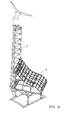
- the alternator (aerogenerator) supporting post is introduced inside the trestle, and the photovoltaic structure is totally independent, it may be provided that the aerogenerator has an independent structure, as shown in Fig. 6.
- An aerogenerator does not always produce the same amount of electric current; on the contrary, it reaches a maximum performance at a certain wind speed. Generally, the higher the wind speed, the greater will be the electric current production. Hence, the available power is proportional to the third power of the wind speed; however, if the velocity of the propeller is not controlled, the generator may be seriously damaged. All manufactures adjust the maximum rotor speed to correspond to a safety value.
- the wind rotor is used to convert the wind kinetic energy into mechanical energy, which is converted in turn into electric energy, by the motor connected thereto.
- the power provided by an aerogenerator is always proportional to the area which is swept by the vanes (blades).
- the vane number directly influences the motor efficiency: this is an essential element in the design of an aerogenerator. For a given type of blades, the higher the number of blades, the greater will be the moment transmitted to the wind rotor shaft.
- the airfoil section is the contour of a blade or vane, in a cross sectional plane orthogonal to its axis.
- Airfoil profiles airfoil profiles
- the traditional airfoil section resembles that of an aeroplane wing, which is curved on one side and more or less flat on the other.
- the toy windmill profile which is bulged, is characterised by the fact that its two faces follow more or less parallel lines which go into a spin along the axis: it may be easily formed by extrusion.
- control mechanisms may be classified in three categories:
- the aerodynamic control is an inherent feature of any kind of airfoil profile. For a given angular velocity, when the wind speed increases, the angle of attack "seen" by the rotating blade increases also, so that the blade will eventually have its profile aligned with the dominant wind stream and thereby reduce its angular velocity: that is, the propeller converts less energy but does not reach critical velocities.
- Electric energy is generated when an electric conductor is moved in a magnetic field:
- alternators with permanent magnets the magnetic field is constant and stationary. These alternators are much lighter than other kinds of generators where the excitation circuit is formed by a ferromagnetic core and a cooper wire winding traversed by a direct current used to generate the magnetic field.
- Permanent magnet alternators produce an electric current and voltage that have a frequency proportional to the angular velocity. This implies that it is impossible to directly connect to such generators, electrical apparatus that operates at 50 Hz.
- variable excitation alternators are their easy “pickup” (acceleration) in case of feeble winds, since the magnetic flux of the inductor - which is essentially zero when the rotor performs only a few turns -, increases more and more when the winds become stronger, until a nominal velocity is reached.
- the dynamo generates energy with a power that follows a cubic law (third power of the wind velocity): if the wind velocity doubles, the output power increases by a factor of eight.
- the alternator has the maximum efficiency only in one point of the power curve; all other points of this curve are only a compromise, which is particularly penalising in case of feeble winds or winds of medium strength; this is in fact the major limitation in the application of aerogenerators with permanent magnets.
- the generating set for producing energy consumes non renewable fuel such as oil and its derivatives, and therefore has a continuous cost which is proportional thereto; any apparatus that exploits renewable energy (e.g. solar or wind energy) does not consume anything for all its service life, and therefore no costs are incurred.
- non renewable fuel such as oil and its derivatives
- any apparatus that exploits renewable energy e.g. solar or wind energy
- Energy output this is the energy produced by a wind of medium strength, in the velocity interval from 16 to 20 km/h.
- the renewable (wind) energy generation system comprises the following: an aerogenerator with a rated power of 15 kW, formed by:
- the energy that is converted by the aerogenerator is used to charge the batteries, in the following way:
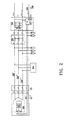
- FIG. 2 With reference to Fig. 2, there is shown a generic electrical circuit arrangement for the aerogenerator which co-operates with the batteries through the respective battery charger.
- the rotor 20 which is directly actuated by the blade motion is interconnected to an excitation circuit 21', 21" and to a power circuit 22', 22", 22"' by means of a sectioning device 23.
- the power circuit is directly connected to dissipation resistances 24.
- the power circuit applies the phase voltages present at the generator output to an autotransformer 25, which are than fed to the input of a battery charger/rectifier 26 at whose output a direct voltage Vcc is obtained, useful for charging the battery.
- the rectifier 26 is controlled by a regulator PWM 27 which operates according to acquired data relative to physical parameters obtained from the batteries, as determined by the battery temperature sensor 28, and the shunt 29 - which measures the sum of the electric currents inside the batteries, the latters being provided in the present realisation according to a double series arrangement.
- a regulator PWM 27 which operates according to acquired data relative to physical parameters obtained from the batteries, as determined by the battery temperature sensor 28, and the shunt 29 - which measures the sum of the electric currents inside the batteries, the latters being provided in the present realisation according to a double series arrangement.
- the expected energy at this speed equals 1.116 kWh/year.
- the expected energy at this speed is about 5627 kWh/year.
- this generator - having a diameter of 7.3 m - is able to produce for the standard specific location, an energy of 17243 kWh.
- the aerogenerator at issue is of a kind comprising a rotor with three blades (vanes), with an automatic regulation of the load generated by the wind, and producing a mechanical conversion of energy into electrical energy by the use of a synchronous motor with independent and adjustable excitation; power: 15 kW.
- the charge regulator 27 operatively decouples the aerogenerator from the batteries, and provides for the following:
- the regulator 27 operates according to the values of the charging current 29 and temperature 28 of the battery, and acts on the excitation of the synchronous generator and on the static converter AC/DC, by adequately controlling the value of the voltage. In practice, on the one hand it draws the power from the wind by means of the aerogenerator, and on the other, it stores this energy in the batteries based on the capacity, the charging status, and the temperature of each cell, by using the PWM technology, so as to bring the battery charge level as much as possible near to a its 100% level, without damaging the batteries.
- the bulk charge is performed for a battery charge level which is less than 70%, by forcing into the batteries the maximum current they can accept.
- the electronically effected limitation of the electric current value prevents an excessive charging, which could lead to a reduction of the battery's average life.
- the regulator imposes a constant voltage to the batteries, which is a function of the number of series-connected batteries and of their temperature (57.2 [V] at 25 DEG C).
- the regulator switches to the float charge modality.
- the regulator imposes a float voltage of 53.2 [V] at 25 DEG C, with a current of 4-8 A (batteries' rated capacity 4680 Ah); when the current that is accepted by the batteries increases, the system returns to the bulk charge or acceptance charge modalities respectively.
- the regulator operation must be of a selectable kind, that is, it must be possible to determine which charging modes it must use, the transition set points from one charging mode to the next must be settable, it must be possible to exclude the equalisation charging (the batteries' equalisation is performed by an additional system), the different charging modes must be determined depending on the charge that can be accepted by the batteries (and not on the voltage), and the regulator should measure the effective charging current to the batteries, by means of an external shunt.
- the voltage during the acceptance charge and float charge modes are dependent on the cell temperature, and the regulator must automatically vary these values with respect to the pre-set values, so as to not reduce the batteries' average life.
- Fig. 1 also shows an advantageous position chosen for the photovoltaic (solar) panels 6, which are arranged on the roof of a shelter 7, that is normally present in a radio station used for mobile cellular telephony.
- solar photovoltaic
- This system is connected to the electric control panel for the renewable energy, abbreviated QE/ER, which in turn provides for the charging of the battery set and for the feeding - through the inverters - of the AC loads (apparatus), by means of a distribution panel (QE/D) located in the SRB (abbreviation for base radio station) normally inside a shelter.
- Electric lines start from the panel QE/D and reach the general modified panel of the radio base station, said lines being used for feeding the various apparatus at a voltage of 48 Vcc.
- the system in question comprises three photovoltaic generators, and each generator comprises in turn:
- FIG. 3 shows a schematic representation of a single photoelectric generator, according to the present invention, which is interfaced with a dedicated regulator (e.g. of the kind named Solar Boost 3048 PL800).
- a dedicated regulator e.g. of the kind named Solar Boost 3048 PL800.
- each row is provided with its own by-pass diode 32', 32", 32"', 32"”and each series comprising four panel rows.
- the generated power is furnished by usual protection elements 33 to the batteries, by means of the control circuit 34 that performs a PWM-type regulation on the battery side, and a MPPT regulation on the side of the photovoltaic generator.
- the regulation is based on the data that are acquired, which relate to physical parameters obtained form the battery set, like those detected by the batteries' temperature sensor 28, and by the shunt 29, which measures the sum of electric currents in the batteries provided for in the described embodiment, that includes a double series.
- the regulators 34, the grounding system and the sectioning and protection devices for the photovoltaic generators, are installed on external electric panels to be arranged in proximity of the QE/ER.
- the energy that is converted by the photovoltaic generator will be used for charging the batteries, as follows:
- each photovoltaic generator is connected to the batteries and the load through a dedicated regulator 34.
- This regulator decouples - under the operative point of view - the photovoltaic generator from the batteries, and provides for the following:
- MPPT Maximum power point tracking circuit
- the regulator must be provided with a maximum power point tracking circuit:
- a row with four panels (type UFLEX US-64), in presence of usual insolation conditions, has the following features:
- the regulator provided with the MPPT circuit draws the maximum possible power from the photovoltaic panels, and at the same time it stores this energy in the batteries based on the capacity, the charge status, and the temperature conditions of individual cells, by using the PWM technology in order to bring the charge level as much as possible near to the 100% value without damaging the batteries.
- the regulator After completion of the bulk charge mode, and when the batteries' residual capacity is between 70% and 95%, the regulator imposes a constant voltage to the batteries, which is a function of the number of cells that are connected in series, and of their temperature (57.2 [V] at 25 DEG C). When the batteries' acceptance charge falls below 46 A (batteries' rated capacity: 4680 Ah), the regulator switches to the float charge mode.
- the regulator In the float charge mode, the regulator imposes to the batteries a float charge of 53.2 [V] at 25 DEG C, with a current of 4-8 A (batteries rated capacity: 4680 Ah); when the current that is accepted by the batteries increases, the system returns to the bulk charge mode or the acceptance charge mode.
- the regulator is "settable”, that is, it must be possible to determine the charging modes it uses, it must be possible to set the transition set-points from one charging mode to the next, it must be possible to exclude the equalisation charge (the equalisation of the batteries is entrusted to another system), the different charging modes must be determined depending on the battery's acceptable charge (not from its voltage), and lastly, the regulator must be able to measure the effective charge current in the battery by using an external shunt.
- the voltage in the acceptance charge mode and in the float charge mode are functions of the cell temperature, and the regulator must vary automatically these values with respect to pre-set values, in such a way as to safeguard the average life of the batteries.
- the regulator In compliance with the rules, the regulator must be designed to operate with 125% of the rated capacities of the photovoltaic panels, under standard conditions, so that the regulator must be able to accept a group of panels with a maximum short-circuit current of 24 A under standard conditions; in the same way, all circuits located downstream of the regulator must be designed for a value of electric current equal or greater than 40 A - even if not explicitly indicated -, in compliance with the criterion adopted by the same rules that do not - however - refer to the devices using the recent MPPT technology.
- the new kind of electric energy supply using 100% of renewable energy, one part of which is generated in a photovoltaic manner (17 % of the maximum supplied power) and the other part by exploiting the wind energy (83 % of the maximum supplied power), is able to cope with electric loads of the base radio station (SRB), including the possibility of storing the energy in an appropriate battery set.
- SRB base radio station
- the energy generated in this way will be distributed in the form of a direct current, at a voltage regulated by the DC/DC converters, suited to charge a battery set of 4680 Ah and 48 V and suited to supply alternating current by using the inverters.
- the whole system is locally monitored through a remote transmission of the principal signals and of the alarms.
- the storage battery in question is connected to the electric panel of renewable energy supply, which provides for its charging by means of renewable energy generation systems, and at the same time, for the supply of the AC electric apparatus, by using inverters and a distribution panel located inside the SRB.
- a set of batteries has been installed that includes ninety-six elements, each formed by a single cell of 2 V and 1170 Ah; these elements are connected in series and in parallel to obtain a rated voltage of 48 V and a capacity of 4680 Ah.
- the batteries are of the kind including a gel-fixed electrolyte, with valve-regulated elements, not requiring any maintenance and specifically used in telecommunication applications.
- the energy that is stored in the 4680 Ah battery is distributed to the DC apparatus (loads), or else it is converted to a 50 Hz current - using the inverters -, for AC apparatus (loads).
- the remote interface and control system that is provided for the continuously operating generating-station used for generating electric energy from renewable sources (like photovoltaic and wind energy sources), according to the present invention, has essentially the task of controlling the interaction between a wind energy generation system, a photovoltaic field, and a storage battery. These systems are interfaced to the SRB in order to supply the electric energy to the apparatus (loads) of the SRB itself.
- the renewable energy system (abbreviated SER) must totally replace electric energy sources that presently supply energy to radio base stations, by converting solar energy and wind energy and by providing a dedicated battery set able to cope with a possible temporary renewable energy lack.
- Fig. 5 shows the INTCR system architecture. It represents a monitoring system whose central unit 89 directly manages the following:
- the central unit allows the 'in situ' management of all monitored data, and permits to forward this information to a possible supervision centre 95, by using a communication network 96.
- the central unit comprises:
- the power supplies of the system INTCR provide for the use of a battery chargers and a buffer battery, for insuring the operation of the central unit, also in case of a temporary lack of external power.
- Families of dedicated - that is specific - power supplies are used, in case standard detectors are installed in the plant (e.g. smoke, water, and gas detectors), including buffer batteries for insuring the operation in the eventuality of a black-out.
- standard detectors e.g. smoke, water, and gas detectors
- buffer batteries for insuring the operation in the eventuality of a black-out.
- the system of dedicated interfaces for data transfer comprises:
- the monitoring and equalisation centre is suited to control the charge and discharge conditions of the battery set that has been defined above.
- the battery set is connected to the electric panel (electric board) for renewable energy, QE/ER, that provides for the charging of the battery set, by using the generation systems of renewable energy, and moreover, for the supply of the apparatus (loads), - that must be supplied with alternating current (AC) by means of inverters-, through the intermediary of a distribution board (QE/D) located inside the shelter.
- QE/ER renewable energy
- the battery monitoring system is installed in proximity of the battery.
- a battery set formed by 96 elements will be installed, wherein each element is formed by a single cell of 2 V and 1170 Ah; these elements will be connected in series and in parallel, so as to provide a rated voltage of 48 V and a capacity of 4680 Ah.
- a monitoring and control system that continuously interacts with the batteries; this system includes a current source that may be connected to every cell, so as to aid the battery charger to maintain an equal and balanced charge in each cell (equalisation), with a tolerance within 1% of the general average.
- the same current source is used for the active cell test, whose response serves to determine not only the electrochemical condition and temperature of the cell, but also to check the respective charging state.
- VRLA sealed lead battery
- the corrosion of the material forming the positive plate produces a gradual capacity loss, until the need for a replacement of the battery arises. This process of capacity reduction is accelerated each time the battery is discharged, or when the temperature increases.
- the batteries that are specifically constructed for storing energy obtained from photovoltaic systems have a sufficient amount of lead to allow frequent discharges, but they have a short average life unless the values of the charging/discharging current are controlled (three to four years).
- the plates and the supporting grids have been constructed for a well defined number of discharge cycles, and for a well defined energy storage capacity.
- the end of the life of a battery is defined as the incapacity of at least one cell to maintain the rating voltage for at least 80% of the rating time. Premature cell failure may occur because of a short circuit or an open circuit between the positive and negative plates, or for mechanical and electrochemical reasons.
- the capacity of a battery is determined by the active lead area that is present on the plate, and by the concentration of sulphuric acid which is in intimate contact with the active material. If the active material is subject to sulphation, this effect being increased with ageing, or if the acid concentration in the electrolyte (measurable with the use of densimeters) has decreased, the capacity is decreased. If temperature increases, the capacity will decrease in a manner proportional to the corrosion of the active material.
- each lead cell In order to increase the capacity it is possible to connect more cells in parallel; moreover, since each lead cell generates a voltage of 2V, several lead cells are connected in series to reach the desired voltage (24 elements of 2 V each, connected in series, will be necessary to obtain a battery of 48 V).
- the conventional method used to charge a row of cells that are connected in series consists in applying a constant voltage at its ends. The charging voltage is raised until a charging current flows through the battery.
- the traditional method of equalisation of the charge state between the cells is to increase the common charging voltage for various hours and at fixed predetermined intervals. In so doing, however, an overcharging of the already fully charged cells is produced, and this causes a loss of electrolyte solution and the generation of hydrogen gas.
- the preferred method in order to be sure that each cell is charged in the same way, is to individually charge each cell having a too low voltage, until it reaches the full charge.
- the system will apply an overvoltage to each individual cell whose voltage has fallen below this threshold. In so doing, the voltage of the relevant cells will be automatically increased, with a consequent redistribution of the common battery charging voltage, until all cell voltages will fall within the preset deviation threshold.
- the most widely diffused method consists in discharging the battery and checking the discharge time on the load, at constant current.
- test interval between the discharges must be long, otherwise the life cycles of the battery will be reduced.
- An alternative and preferred method consists in charging the cell and in monitoring the time as a function of the voltage applied to the terminals: this is the inverse process, in which electric energy is converted in chemical energy.
- the voltage at its ends will increase more than that on the other cells in response to the charging current.
- This active test method uses the same isolated charging current that has been described above and that provides for a charge balancing between the cells. The result obtained by this method may be easily applied to each cell, using appropriate software and appropriate algorithms.
- the values obtained from the monitoring will be processed by the computer and compared with sensitivity threshold trends that generate alarms each time an instability problem arises, which is due to changes in the charging state, in the integrity of the connections, or in the internal impedance and temperature.
- the automatic control system may be programmed in accordance with the curves that relate to specific performances of each individual cell during an event, and the control system may also be updated with the real load data, when the load varies. This information is extremely important for the technical staff that must face emergency situations, since it is derived from actual data.
- the permanent recording of events, performed by the automatic control system provides real (actual) data of the battery in Ah (ampere-hour), that may be used for determining the guarantee of the battery with its manufacturer.
- the economic value of an automatic battery control system may be evaluated with regard to the risk of battery failure.
- Fig. 4 there is shown, in principle, an electric circuit arrangement of a row composed of 24 elements, and of the monitoring and equalisation apparatus for the batteries.
- the same monitoring apparatus may be used to control an additional row, of 24 elements of 2 V each, that has not been included in the drawing, in order to simplify it.
- Temperature probes 28 are directly interfaced with the elements 41', 41", and said probes, besides indicating - to the monitoring and equalisation apparatus 42 - the instant value of the temperature on the battery elements, are also used locally by the regulators 27 and 34, respectively located at the aerogenerator and the photovoltaic generator.
- shunts 44' and 44 for the additional row of 24 elements that is not included in the figure, and said shunts 44', 44"are connected in series in order to measure the sum of the electric currents in the batteries. Therefore, also this measurement is used locally by the regulators 27 and 34, which are located respectively at the aerogenerator and at the photovoltaic generator.
- the detection of the discharge current of the batteries is performed by a Hall sensor 45, which sends the signal corresponding to a particular load (apparatus), to the monitoring and equalisation apparatus 42.. Therefore, the parameters and the physical values that are sent to the input of the monitoring system, are the following:
- the system measures the analogue values on each channel every time that the scanning of the battery elements is switched.
- the scanning frequency is predefined at a value comprised between 'a channel per second' and about '10 channels per second'.
- Each measured voltage value is compared with the alarm value (low and high) and each alarm situation is recorded in the computer alarm file.
- the alarm contacts are controlled, and a message appears on the liquid crystal display of the instrument.
- the battery discharge test is automatically activated when the presence of a battery discharge current is detected, or in case of absence of voltage supply to the control device - for example an AutoCap.
- the system performs the scanning of the battery voltages at the maximum possible frequency (about 10 channels per second). This scanning frequency of the discharge is automatically set and is independent from the value set for the scanning frequency in the automatic test.
- the scanning frequency returns to the value that is set by the user.
- a further function of the discharge test is the activation of the measurement of the discharge time. This function allows the system to compare the battery discharge rate (speed) with the programmed response curve and to communicate to the user an estimate of the remaining time during which the battery can still support the load. This residual time is given with an accuracy of one minute.
- the data related to a discharge event are written on a disk. These files contain very useful information, like the voltages of the single units, the battery discharge current, and the residual amount of Ah (ampere-hours); all data are accompanied by the hour and date at which they have been detected or calculated.
- the voltage measurements are generally a good indication of the 'health status' of a battery, but in some cases they could be misleading.
- the batteries may have a good working range voltage even if their conditions are critical. For this reason, the system uses the response test. This test provides for the application of a voltage to each single block, and for the measurement of the electric current amount this single block can absorb. This value gives an indication of the electrochemical status of the single block and of the quality of the connections.
- Electric current absorption from batteries that are in poor efficiency conditions is different from absorption of batteries that are in a good state, and it depends from the reasons why the battery is no more good.
- the system measures the electric current absorbed by each single block, and since a change of the conditions of a battery implies a change in the absorbed current, the response value of the test will differ in each individual case.
- the system generates an alarm for significantly different responses. In this case it is advisable to proceed to a more accurate analysis of the conditions of this cell or of the single block where the alarm signal was generated. Since batteries differ from each other under different aspects, the system must be started with a new battery or with a battery that has been tested recently. Then, it is possible to utilise as reference data the data obtained from a battery that is in a good state.
- the system allows to obtain a plotting of the response trend.
- This graph is a comparison between the response value of each channel with respect to a normal pre-set value.
- the response deviation (or shift) is defined as the difference between the most recent response value, and the value of response trend.
- the trend alarm is activated when this deviation is above the pre-set value.
- the response test is automatically disabled in the 24 hours following the initial installation, after a discharge event, or in case cell balancing is being performed. This allows the battery to maintain itself or to reach an equilibrium, and moreover it avoids acquisition of incorrect data.
- the response tests are performed automatically at the expiration of the predefined intervals, during the installation phase.
- each voltage increase in a single-block implies a voltage decrease on a different single-block. This voltage decrease must necessarily occur in a single-block having a voltage greater than the average of the battery.
- the machine of the present invention has the principal feature of being suited for each kind of wind, and of not requiring a device for the interruption of its operation (unlimited cut-out), moreover, it is constructed with materials (e.g. stainless steel, polymers, etc.) that insure a perfect duration (life) also in presence of saline atmosphere.
- materials e.g. stainless steel, polymers, etc.
- the location of installation may not be sufficiently vast to receive a separate tower with its aerogenerator; thus, also in order to avoid an interference with the radio waves transmitted by the radio base station, it is preferred to mount the generator on the same trestle that is used for the transmission, and to introduce inside this trestle - after an appropriate adaptation-, a steel-made independent post, by widening the foundation as specified above.
- the panels of the three photovoltaic generators are conveniently and advantageously mounted above the SRB (radio base station), normally in a shelter, using a supporting structure made of metallic section bars.
Landscapes
- Engineering & Computer Science (AREA)
- Power Engineering (AREA)
- Life Sciences & Earth Sciences (AREA)
- Sustainable Development (AREA)
- Sustainable Energy (AREA)
- Chemical & Material Sciences (AREA)
- Combustion & Propulsion (AREA)
- Mechanical Engineering (AREA)
- General Engineering & Computer Science (AREA)
- Charge And Discharge Circuits For Batteries Or The Like (AREA)
- Control Of Eletrric Generators (AREA)
- Photovoltaic Devices (AREA)
- Wind Motors (AREA)
- Supply And Distribution Of Alternating Current (AREA)
- Mobile Radio Communication Systems (AREA)
- Selective Calling Equipment (AREA)
- Arrangements For Transmission Of Measured Signals (AREA)
Abstract
- a radio transceiver system;
- plants for generating electric energy from solar energy and wind energy;
- a battery set comprising a plurality of cells, that cooperates with said plants for storing the generated electric energy and feeding said radio transceiver system;
- a monitoring device for monitoring said battery set and preventing malfunctions adapted to actively interact in a selective way with each cell of the battery set so as to maintain the charge in each cell within a preset deviation from a predetermined average voltage.
Description
- polygonal - 16 or 18 edges - and tapered, of the coupling type (plug-in type);
- tubular, flanged, and having a constant cross-section.
-
Heavy posts H 18, 24, 30, and 36 m; - Light posts
H 12, 18, 24, 30 and 36 m.
- aerodynamic control;
- reduction of the surface which is effectively swept by the wind rotor;
- modification of the vane adjustment angle.
their power curve is similar to that of a dynamo.
- the energy produced by the generator is transferred to the batteries through a regulator and a static AC/CC converter;
- an automatic and continuous control of the voltage and battery charging current is performed, according to the charge condition (charge state) of each battery cell, while effecting at the same time a correction of the control parameters with respect to the battery temperature;
- in case of overproduction of the aerogenerator (strong wind or charged batteries), in order to prevent an excessive velocity of the rotor the excess energy will be dissipated by a resistance.
- it stabilises the operation of the photovoltaic panels at the point of the voltage-current characteristic curve, where the value of the generated power attains its maximum;
- it regulates the voltage and current at the output of the generator, depending on charging condition and load requirements.
- maximum power point tracking circuit (MPPT maximum power point tracking),
- protection against polarity inversion and transient overvoltages (panel side and battery side),
- control of the batteries' charging voltage, PWM (pulse width modulation),
- limitation of output current by electronic means,
- batteries charging process, performed with three settable modes; Bulk Charge, Acceptance Charge, and Float Charge,
- batteries equalisation function, that can be disabled,
- temperature compensation,
- external shunt, for measuring the actual battery charging current,
- voltage for float charge, less than voltage for acceptance charge.
- peak power (Wp), 256 W
- short circuit current (Icc), 4.8 A
- open-circuit voltage (Vo), 95.2 V
- voltage under load at maximum power (Vmp), 66 V
- maximum power current (Imp) 3.88 A.
- all electric panels must allow access and inspection from the front side;
- the connections towards the system to be supplied, and the parallel connection between several batteries, must be performed by means of adequate panels (boards) or distribution boxes, both from below and from above, in separate raceways;
- the cooling of the boards and of the apparatus may not be effected by forced ventilation;
- the energy produced by the aerogenerator is transferred to the batteries by a AC/DC regulation and conversion system in order to be able to transfer a maximum amount of energy depending on the production and the electric current absorption;
- the continuous automatic control of the charge condition and operative condition is performed on each cell of the storage battery;
- the storage battery is monitored as explained above, and the charge status and operation conditions of the cells is also monitored, with a remote control of the principal parameters and of the alarms, regarding the storage battery itself, the battery chargers, the aerogenerator, and the photovoltaic field.
- when the battery charge status corresponds to less than 40% of its capacity (4680 Ah), in order to allow a timely recharge intervention to be made with a battery charging set of 10-17 Kw; - in case of degradation of some of the battery cells, the latter being unable to perform the usual operations of charging and discharging of energy.
- up to 16 digital inputs (DI) and up to 4 counter inputs (CI) 90;
- up to 27 analogue inputs (AI) 92;
- 2 analogue outputs (AO) 93;
- 16 digital outputs (DO) 94.
- the installation status of the plant;
- the history file of all changes of the status of all inputs - including the respective hour and date (alarm, pre-alarm, signalling);
- the history file of all values of sensors-transducers sampled during the activation period;
- measurement and analysis devices operating with direct or alternating current;
- devices for the automatic reset of the distribution panels (distribution boards).
- an interface for
peripheral devices 95, wherein this interface is utilised in order to insert additional devices in the data collection network: for instance, AC current analysers, DC current analysers etc. (an important feature is to insure electrical insulation between the various peripheral devices, thereby rendering the network to a high degree exempt form noises or disturbances); an interface for the modem, which is used to transfer data of the central unit, - through the modem -, to a possible supervision centre; - an interface for Ethernet networks, which is used to transfer data of the central unit, through an Ethernet network with communication protocol TCP/IP, to a supervision centre, if any.
- individual cell charging;
- active tests on individual cells, for the evaluation of the electrochemical condition, the thermal state, the residual charge (automatic test, battery discharge test, response test, charge balancing of the single unit);
- storage of the effected test results;
- monitoring and storage of discharge events;
- control of two rows of 24 single blocks units, each row being formed of single unit having two cells of 2 V;
- possibility of expansion, up to two rows of 24 single units each, wherein said single blocks individually include six cells of 2 V;
- possibility of setting the allowed unbalance for individual cells, that is adjustable up to a value of 1% with respect to the average voltage value of a row;
- Hall sensor, for measuring the charging and discharge current of a battery;
- ambient temperature sensor;
- 12 temperature sensors for the single unit;
- 5 auxiliary analogue inputs;
- measurement of the voltage of a row;
- calculation of the resistance of the individual cells;
- calculation of the residual discharge time;
- calculation of the energy supplied by the battery (Ah);
- automatic storage of the trends of the monitored data;
- calculation of the internal temperature of the individual cells;
- calculation of the charge state of the individual cells;
- storage of the alarm history (that is alarm log);
- storage of the discharge events;
- scanning of 10 single blocks per second;
- voltage measurements with a resolution of 0.001 [V] and self-calibration;
- electric current measurements with a resolution of 0.001 [A] and self-calibration;
- temperature measurements with a resolution of +/- 1 DEG C, and self-calibration;
- hardware and software (not dedicated that is commonly available on the market);
- protocols for external access RS-232 and RS-485 (not dedicated that is commonly available on the market);
- arrangement for remote access by means of a modem with Audio Dialer.
- the ambient temperature detected by the probe 46;
- the voltage of a row, and the resistance of the cells;
- the residual discharge time;
- the energy (Ah) that is drawn form the batteries;
- the cell internal temperature; moreover, the historic information (that is the log) related to the acquired alarm signals and to the batteries' discharges are also memorised.
- automatic test;
- battery discharge test;
- response test;
- balancing of the charge of the single units (equalisation).
Claims (15)
- A radio base station for mobile cellular telephony comprising:a radio transceiver system;plants for generating electric energy from solar energy and wind energy;a battery set comprising a plurality of cells that co-operates with said plants for storing the generated electric energy and feeding said radio transceiver system;a monitoring device for monitoring said battery set and preventing malfunctions adapted to actively interact in a selective way with each cell of the battery set so as to maintain the charge in each cell within a preset deviation from a predetermined average voltage.
- A radio base station for mobile cellular telephony according to claim 1, wherein the monitoring device comprises a current source which is adapted to be connected to each cell of the battery set for individually charging the cells having a voltage below the predetermined average voltage by at least the preset deviation.
- A radio base station for mobile cellular telephony according to claim 1 or 2, wherein the monitoring device is adapted to measure the voltage of each cell of the battery set for determining and updating the average voltage of the cells.
- A radio base station for mobile cellular telephony according to claim 3, wherein the monitoring device is adapted to apply an overvoltage to each cell of the battery set that has a voltage below the updated average voltage by at least the preset deviation, until all cell voltages fall within the preset deviation from the updated predetermined average voltage.
- A radio base station for mobile cellular telephony according to any of claims 1 to 4, wherein the monitoring device comprises a battery charger which is connected to terminals of the battery set for maintaining a constant voltage throughout the battery set.
- A radio base station for mobile cellular telephony according to any of claims 1 to 5, wherein the monitoring device is adapted to actively interact in a selective way with each cell of the battery set for the evaluation of the electrochemical condition of each cell.
- A radio base station for mobile cellular telephony according to any of claims 1 to 6, wherein the monitoring device is adapted to actively interact in a selective way with each cell of the battery set for the evaluation of the thermal state of each cell.
- A radio base station for mobile cellular telephony according to any of claims 1 to 7, wherein the monitoring device is adapted to actively interact in a selective way with each cell of the battery set for the evaluation of the charge state of each cell.
- A, radio base station for mobile cellular telephony according to any of claims 1 to 8, wherein the monitoring device is adapted to individually check a health state of the cells of the battery set by charging each cell and by monitoring the charging time as a function of the voltage applied to the cell.
- A radio base station for mobile cellular telephony according to any of claims 1 to 9, further comprising a single supporting structure adapted to support both the radio transceiver system and the plant for generating electric energy from wind energy.
- A radio base station for mobile cellular telephony according to claim 10, wherein the single supporting structure compriseswherein the tower shares the basement with the support (2) and the basement is structured in such a way as to support both the support (2) and the tower.a support (2) for supporting the radio transceiver system, the support (2) having a basement, anda tower for supporting the plant for generating electric energy from wind energy within the support (2),
- A radio base station for cellular mobile telephony according to claim 11, wherein the single supporting structure further comprises a plurality of retaining and connection structures (5', 5", 5"') interposed between the support (2) and the tower for connecting the support (2) and the tower to one other.
- A radio base station for cellular mobile telephony according to claim 10, wherein the single supporting structure comprises a support (2) for supporting the radio transceiver system, the plant for generating electric energy from wind energy is mounted on the support (2) and said support (2) is structured in such a way as to support also the plant for generating electric energy from wind energy.
- A radio base station for mobile cellular telephony according to any of claims 11 to 13, wherein the support (2) for supporting the radio transceiver system is a trestle.
- A radio base station for mobile cellular telephony according to claim 10, wherein the single supporting structure comprises a tower for supporting the plant for generating electric energy from wind energy, the radio transceiver system is mounted on the tower and said tower is structured in such a way as to support also the radio transceiver system.
Applications Claiming Priority (3)
| Application Number | Priority Date | Filing Date | Title |
|---|---|---|---|
| ITRM20020027 | 2002-01-22 | ||
| IT2002RM000027A ITRM20020027A1 (en) | 2002-01-22 | 2002-01-22 | RADIO BASE STATION FOR MOBILE MOBILE TELEPHONE WITH ELECTRICITY POWER STATION FROM PHOTOVOLTAIC-WIND ENERGY WITH CONTINUOUS OPERATION |
| EP02425757A EP1330009A3 (en) | 2002-01-22 | 2002-12-10 | Continuously operating generating-station exploiting photovoltaic and wind energy sources |
Related Parent Applications (1)
| Application Number | Title | Priority Date | Filing Date |
|---|---|---|---|
| EP02425757A Division EP1330009A3 (en) | 2002-01-22 | 2002-12-10 | Continuously operating generating-station exploiting photovoltaic and wind energy sources |
Publications (2)
| Publication Number | Publication Date |
|---|---|
| EP1610441A2 true EP1610441A2 (en) | 2005-12-28 |
| EP1610441A3 EP1610441A3 (en) | 2009-03-18 |
Family
ID=11455974
Family Applications (3)
| Application Number | Title | Priority Date | Filing Date |
|---|---|---|---|
| EP05016162A Withdrawn EP1610571A3 (en) | 2002-01-22 | 2002-12-10 | Radio base station for mobile cellular telephony fed by wind energy source |
| EP05016163A Withdrawn EP1610441A3 (en) | 2002-01-22 | 2002-12-10 | Radio base station for mobile cellular telephony fed by solar and wind energy sources |
| EP02425757A Withdrawn EP1330009A3 (en) | 2002-01-22 | 2002-12-10 | Continuously operating generating-station exploiting photovoltaic and wind energy sources |
Family Applications Before (1)
| Application Number | Title | Priority Date | Filing Date |
|---|---|---|---|
| EP05016162A Withdrawn EP1610571A3 (en) | 2002-01-22 | 2002-12-10 | Radio base station for mobile cellular telephony fed by wind energy source |
Family Applications After (1)
| Application Number | Title | Priority Date | Filing Date |
|---|---|---|---|
| EP02425757A Withdrawn EP1330009A3 (en) | 2002-01-22 | 2002-12-10 | Continuously operating generating-station exploiting photovoltaic and wind energy sources |
Country Status (4)
| Country | Link |
|---|---|
| EP (3) | EP1610571A3 (en) |
| BR (1) | BR0300064A (en) |
| IT (1) | ITRM20020027A1 (en) |
| PE (1) | PE20030843A1 (en) |
Cited By (5)
| Publication number | Priority date | Publication date | Assignee | Title |
|---|---|---|---|---|
| WO2010134855A1 (en) * | 2009-05-19 | 2010-11-25 | Flexenclosure Ab | Dual climate zones |
| CN102545368A (en) * | 2012-02-08 | 2012-07-04 | 湖南省汇粹电力科技有限公司 | Multi-energy intelligent control power-supply system |
| US8494595B2 (en) | 2009-09-07 | 2013-07-23 | Hitachi, Ltd. | Communication control apparatus |
| EP4047775A1 (en) | 2021-02-23 | 2022-08-24 | Deutsche Telekom AG | On-site energy management system for an energy-autonomous cell site |
| EP4187753A1 (en) * | 2021-11-25 | 2023-05-31 | Soltec Innovations, S.L. | Solar panel system |
Families Citing this family (81)
| Publication number | Priority date | Publication date | Assignee | Title |
|---|---|---|---|---|
| JP4556677B2 (en) * | 2005-01-18 | 2010-10-06 | オムロン株式会社 | Power conditioner with built-in curve tracer |
| US10693415B2 (en) | 2007-12-05 | 2020-06-23 | Solaredge Technologies Ltd. | Testing of a photovoltaic panel |
| US11881814B2 (en) | 2005-12-05 | 2024-01-23 | Solaredge Technologies Ltd. | Testing of a photovoltaic panel |
| US11309832B2 (en) | 2006-12-06 | 2022-04-19 | Solaredge Technologies Ltd. | Distributed power harvesting systems using DC power sources |
| US12316274B2 (en) | 2006-12-06 | 2025-05-27 | Solaredge Technologies Ltd. | Pairing of components in a direct current distributed power generation system |
| US8384243B2 (en) | 2007-12-04 | 2013-02-26 | Solaredge Technologies Ltd. | Distributed power harvesting systems using DC power sources |
| US8319483B2 (en) | 2007-08-06 | 2012-11-27 | Solaredge Technologies Ltd. | Digital average input current control in power converter |
| US8947194B2 (en) | 2009-05-26 | 2015-02-03 | Solaredge Technologies Ltd. | Theft detection and prevention in a power generation system |
| US9088178B2 (en) | 2006-12-06 | 2015-07-21 | Solaredge Technologies Ltd | Distributed power harvesting systems using DC power sources |
| US12676488B2 (en) | 2006-12-06 | 2026-07-07 | Solaredge Technologies Ltd. | System and method for protection during inverter shutdown in distributed power installations |
| US8319471B2 (en) | 2006-12-06 | 2012-11-27 | Solaredge, Ltd. | Battery power delivery module |
| US9112379B2 (en) | 2006-12-06 | 2015-08-18 | Solaredge Technologies Ltd. | Pairing of components in a direct current distributed power generation system |
| US8963369B2 (en) | 2007-12-04 | 2015-02-24 | Solaredge Technologies Ltd. | Distributed power harvesting systems using DC power sources |
| US8618692B2 (en) | 2007-12-04 | 2013-12-31 | Solaredge Technologies Ltd. | Distributed power system using direct current power sources |
| US11888387B2 (en) | 2006-12-06 | 2024-01-30 | Solaredge Technologies Ltd. | Safety mechanisms, wake up and shutdown methods in distributed power installations |
| US8473250B2 (en) | 2006-12-06 | 2013-06-25 | Solaredge, Ltd. | Monitoring of distributed power harvesting systems using DC power sources |
| US11569659B2 (en) | 2006-12-06 | 2023-01-31 | Solaredge Technologies Ltd. | Distributed power harvesting systems using DC power sources |
| US9130401B2 (en) | 2006-12-06 | 2015-09-08 | Solaredge Technologies Ltd. | Distributed power harvesting systems using DC power sources |
| US11855231B2 (en) | 2006-12-06 | 2023-12-26 | Solaredge Technologies Ltd. | Distributed power harvesting systems using DC power sources |
| US11296650B2 (en) | 2006-12-06 | 2022-04-05 | Solaredge Technologies Ltd. | System and method for protection during inverter shutdown in distributed power installations |
| US8013472B2 (en) | 2006-12-06 | 2011-09-06 | Solaredge, Ltd. | Method for distributed power harvesting using DC power sources |
| US8816535B2 (en) | 2007-10-10 | 2014-08-26 | Solaredge Technologies, Ltd. | System and method for protection during inverter shutdown in distributed power installations |
| US11735910B2 (en) | 2006-12-06 | 2023-08-22 | Solaredge Technologies Ltd. | Distributed power system using direct current power sources |
| US11687112B2 (en) | 2006-12-06 | 2023-06-27 | Solaredge Technologies Ltd. | Distributed power harvesting systems using DC power sources |
| EP2201661A2 (en) * | 2007-06-25 | 2010-06-30 | David J. Muchow | Suitcase power system |
| WO2009072076A2 (en) | 2007-12-05 | 2009-06-11 | Solaredge Technologies Ltd. | Current sensing on a mosfet |
| US9291696B2 (en) | 2007-12-05 | 2016-03-22 | Solaredge Technologies Ltd. | Photovoltaic system power tracking method |
| US11264947B2 (en) | 2007-12-05 | 2022-03-01 | Solaredge Technologies Ltd. | Testing of a photovoltaic panel |
| WO2009072077A1 (en) | 2007-12-05 | 2009-06-11 | Meir Adest | Testing of a photovoltaic panel |
| US8289742B2 (en) | 2007-12-05 | 2012-10-16 | Solaredge Ltd. | Parallel connected inverters |
| JP2011507465A (en) | 2007-12-05 | 2011-03-03 | ソラレッジ テクノロジーズ リミテッド | Safety mechanism, wake-up method and shutdown method in distributed power installation |
| EP2083170A1 (en) * | 2008-01-23 | 2009-07-29 | Flexenclosure AB | Method and device for controlling operation of a power supply system |
| EP2269290B1 (en) | 2008-03-24 | 2018-12-19 | Solaredge Technologies Ltd. | Switch mode converter including active clamp for achieving zero voltage switching |
| WO2009136358A1 (en) | 2008-05-05 | 2009-11-12 | Solaredge Technologies Ltd. | Direct current power combiner |
| ES2355885B1 (en) * | 2008-05-30 | 2012-02-09 | Windeco Renovable, S.L.U. | ELECTRONIC REGULATOR FOR AEROGENERATORS. |
| CN104158483B (en) | 2009-05-22 | 2017-09-12 | 太阳能安吉科技有限公司 | The heat dissipating junction box of electric isolution |
| ES2360713B1 (en) * | 2009-07-01 | 2012-04-23 | Vodafone España, S.A.U. | POWER DIRECTED SERVICE OFFERED FOR A BASE STATION. |
| US12418177B2 (en) | 2009-10-24 | 2025-09-16 | Solaredge Technologies Ltd. | Distributed power system using direct current power sources |
| GB0921052D0 (en) | 2009-12-01 | 2010-01-13 | Poweroasis Ltd | Managing projected power outrage at mobile radio base sites |
| US8710699B2 (en) | 2009-12-01 | 2014-04-29 | Solaredge Technologies Ltd. | Dual use photovoltaic system |
| US8766696B2 (en) | 2010-01-27 | 2014-07-01 | Solaredge Technologies Ltd. | Fast voltage level shifter circuit |
| IT1402184B1 (en) | 2010-09-16 | 2013-08-28 | Bitron Spa | PHOTOVOLTAIC PANEL CHARGER. |
| US10230310B2 (en) | 2016-04-05 | 2019-03-12 | Solaredge Technologies Ltd | Safety switch for photovoltaic systems |
| US10673222B2 (en) | 2010-11-09 | 2020-06-02 | Solaredge Technologies Ltd. | Arc detection and prevention in a power generation system |
| US10673229B2 (en) | 2010-11-09 | 2020-06-02 | Solaredge Technologies Ltd. | Arc detection and prevention in a power generation system |
| GB2485527B (en) | 2010-11-09 | 2012-12-19 | Solaredge Technologies Ltd | Arc detection and prevention in a power generation system |
| GB2486408A (en) | 2010-12-09 | 2012-06-20 | Solaredge Technologies Ltd | Disconnection of a string carrying direct current |
| GB2483317B (en) | 2011-01-12 | 2012-08-22 | Solaredge Technologies Ltd | Serially connected inverters |
| US12665546B2 (en) | 2011-01-28 | 2026-06-23 | Solaredge Technologies Ltd. | Pairing of components in a direct current distributed power generation system |
| US8570005B2 (en) | 2011-09-12 | 2013-10-29 | Solaredge Technologies Ltd. | Direct current link circuit |
| GB2498365A (en) | 2012-01-11 | 2013-07-17 | Solaredge Technologies Ltd | Photovoltaic module |
| GB2498791A (en) | 2012-01-30 | 2013-07-31 | Solaredge Technologies Ltd | Photovoltaic panel circuitry |
| GB2498790A (en) | 2012-01-30 | 2013-07-31 | Solaredge Technologies Ltd | Maximising power in a photovoltaic distributed power system |
| US9853565B2 (en) | 2012-01-30 | 2017-12-26 | Solaredge Technologies Ltd. | Maximized power in a photovoltaic distributed power system |
| GB2499991A (en) | 2012-03-05 | 2013-09-11 | Solaredge Technologies Ltd | DC link circuit for photovoltaic array |
| EP2859650B1 (en) | 2012-05-25 | 2017-02-15 | Solaredge Technologies Ltd. | Circuit for interconnected direct current power sources |
| US10115841B2 (en) | 2012-06-04 | 2018-10-30 | Solaredge Technologies Ltd. | Integrated photovoltaic panel circuitry |
| US9941813B2 (en) | 2013-03-14 | 2018-04-10 | Solaredge Technologies Ltd. | High frequency multi-level inverter |
| US9548619B2 (en) | 2013-03-14 | 2017-01-17 | Solaredge Technologies Ltd. | Method and apparatus for storing and depleting energy |
| EP2779251B1 (en) | 2013-03-15 | 2019-02-27 | Solaredge Technologies Ltd. | Bypass mechanism |
| US9318974B2 (en) | 2014-03-26 | 2016-04-19 | Solaredge Technologies Ltd. | Multi-level inverter with flying capacitor topology |
| FR3034582B1 (en) * | 2015-04-01 | 2018-10-19 | Orange | METHOD AND SYSTEM FOR ELECTRICALLY POWERING A DIRECT CURRENT LOAD FROM AN ALTERNATIVE CURRENT SOURCE AND A SOLAR GENERATOR |
| US10483790B2 (en) | 2015-06-26 | 2019-11-19 | Clear Blue Technologies Inc. | System and method for charging autonomously powered devices using variable power source |
| US10599113B2 (en) | 2016-03-03 | 2020-03-24 | Solaredge Technologies Ltd. | Apparatus and method for determining an order of power devices in power generation systems |
| US11081608B2 (en) | 2016-03-03 | 2021-08-03 | Solaredge Technologies Ltd. | Apparatus and method for determining an order of power devices in power generation systems |
| CN107153212B (en) | 2016-03-03 | 2023-07-28 | 太阳能安吉科技有限公司 | Method for mapping power generation facilities |
| US11018623B2 (en) | 2016-04-05 | 2021-05-25 | Solaredge Technologies Ltd. | Safety switch for photovoltaic systems |
| US12057807B2 (en) | 2016-04-05 | 2024-08-06 | Solaredge Technologies Ltd. | Chain of power devices |
| US11177663B2 (en) | 2016-04-05 | 2021-11-16 | Solaredge Technologies Ltd. | Chain of power devices |
| CN106438200B (en) * | 2016-12-06 | 2023-06-27 | 内蒙古工业大学 | A solar and wind energy integrated power generation system |
| KR102068280B1 (en) * | 2019-08-01 | 2020-01-21 | 이윤원 | Hybrid Power Generation System |
| CN110492467B (en) * | 2019-09-06 | 2024-02-09 | 集美大学 | Floating type wind-measuring mobile platform wind-solar-energy storage direct-current micro-grid system for offshore radar |
| CN112769183B (en) * | 2020-12-31 | 2023-11-10 | 上海移为通信技术股份有限公司 | Charging methods, devices, electronic equipment and storage media |
| CN112952878B (en) * | 2021-03-08 | 2024-05-14 | 阳光电源股份有限公司 | Multi-direct-current coupling system and control method thereof |
| CN113159402B (en) * | 2021-04-06 | 2022-09-13 | 国家电网公司华中分部 | Area environment-power system collaborative optimization method considering atmospheric pollution |
| IT202200018399A1 (en) * | 2022-09-09 | 2024-03-09 | Gabriele Storani | Control system of a photovoltaic and wind power plant and control procedure of a photovoltaic and wind power plant |
| IT202300019452A1 (en) * | 2023-09-21 | 2025-03-21 | Marco MASTINO | ENERGY GENERATION AND STORAGE SYSTEM |
| CN117885606A (en) * | 2024-03-13 | 2024-04-16 | 中国第一汽车股份有限公司 | Battery management method, system, vehicle and storage medium |
| CN118906885B (en) * | 2024-08-02 | 2025-05-06 | 中铁武汉勘察设计院有限公司 | Charging pile energy source complementation method and system based on renewable energy sources and charging pile |
| CN119070488B (en) * | 2024-11-05 | 2025-05-23 | 国网浙江省电力有限公司杭州市余杭区供电公司 | A method for identifying weak links in distribution networks with renewable energy access |
| CN121727085B (en) * | 2026-02-26 | 2026-04-28 | 天津大学 | Electric energy storage system and method for rural power grid |
Family Cites Families (4)
| Publication number | Priority date | Publication date | Assignee | Title |
|---|---|---|---|---|
| JP3231801B2 (en) * | 1991-02-08 | 2001-11-26 | 本田技研工業株式会社 | Battery charger |
| US5218286A (en) * | 1991-09-16 | 1993-06-08 | Monarch Marking Systems, Inc. | Multichannel battery charger |
| JP3503414B2 (en) * | 1997-05-12 | 2004-03-08 | 日産自動車株式会社 | Battery charging rate adjustment device for assembled batteries |
| JPH10339056A (en) * | 1997-06-05 | 1998-12-22 | Takeo Nakajima | Multifunctional tower for disaster prevention |
-
2002
- 2002-01-22 IT IT2002RM000027A patent/ITRM20020027A1/en unknown
- 2002-12-10 EP EP05016162A patent/EP1610571A3/en not_active Withdrawn
- 2002-12-10 EP EP05016163A patent/EP1610441A3/en not_active Withdrawn
- 2002-12-10 EP EP02425757A patent/EP1330009A3/en not_active Withdrawn
-
2003
- 2003-01-15 PE PE2003000045A patent/PE20030843A1/en not_active Application Discontinuation
- 2003-01-17 BR BR0300064-8A patent/BR0300064A/en not_active IP Right Cessation
Cited By (5)
| Publication number | Priority date | Publication date | Assignee | Title |
|---|---|---|---|---|
| WO2010134855A1 (en) * | 2009-05-19 | 2010-11-25 | Flexenclosure Ab | Dual climate zones |
| US8494595B2 (en) | 2009-09-07 | 2013-07-23 | Hitachi, Ltd. | Communication control apparatus |
| CN102545368A (en) * | 2012-02-08 | 2012-07-04 | 湖南省汇粹电力科技有限公司 | Multi-energy intelligent control power-supply system |
| EP4047775A1 (en) | 2021-02-23 | 2022-08-24 | Deutsche Telekom AG | On-site energy management system for an energy-autonomous cell site |
| EP4187753A1 (en) * | 2021-11-25 | 2023-05-31 | Soltec Innovations, S.L. | Solar panel system |
Also Published As
| Publication number | Publication date |
|---|---|
| BR0300064A (en) | 2003-09-02 |
| EP1610441A3 (en) | 2009-03-18 |
| PE20030843A1 (en) | 2003-10-08 |
| EP1330009A2 (en) | 2003-07-23 |
| EP1610571A3 (en) | 2009-03-18 |
| ITRM20020027A0 (en) | 2002-01-22 |
| EP1610571A2 (en) | 2005-12-28 |
| EP1330009A3 (en) | 2005-04-13 |
| ITRM20020027A1 (en) | 2003-07-22 |
Similar Documents
| Publication | Publication Date | Title |
|---|---|---|
| EP1610571A2 (en) | Radio base station for mobile cellular telephony fed by wind energy source | |
| KR100694485B1 (en) | Hybrid power generation system using solar and wind power | |
| Hara et al. | Testing the technologies | |
| CN104734190B (en) | A kind of monitoring method of the micro-grid system being automatically obtained FREQUENCY CONTROL | |
| Shibata et al. | Redox flow batteries for the stable supply of renewable energy | |
| KR20150004376A (en) | Management of battery capacity | |
| CN104682448A (en) | Operation and monitoring method for battery energy storage power station based on power prediction | |
| CN104659800A (en) | Power prediction based monitoring device for battery energy storage power station | |
| CN104753084A (en) | Micro-grid system capable of controlling frequency automatically | |
| KR100961834B1 (en) | Apparatus and method of controlling power supply driving by multiple power source | |
| CN104505907A (en) | Monitoring device of battery energy storage system with reactive adjusting function | |
| Elsaadawi et al. | Design and simulation of a standalone solar energy system by PV SYST | |
| CN114844114A (en) | Distribution network system based on distributed optical storage and remote safe operation and maintenance method | |
| Simonazzi et al. | Modeling of a university campus Micro-Grid for optimal planning of renewable generation and storage deployment | |
| Gevorgian et al. | Modeling, testing and economic analysis of a wind-electric battery charging station | |
| Shigematsu et al. | Vanadium FBES s installed by Sumitomo Electric Industries, Ltd | |
| US11563341B2 (en) | Uninterruptible power supply in wind power installations | |
| KR200344088Y1 (en) | 1kW ~ 5kW class linked small wind power generator | |
| JP6936071B2 (en) | Power generation equipment control method and power generation equipment control device | |
| JP2025525150A (en) | Renewable energy power generation, storage and management system | |
| Carriço et al. | Technical and economic assessment of a 500 W autonomous photovoltaic system with LiFePO4 battery storage | |
| CN104638682A (en) | Battery energy-storage power station based on power predication | |
| JPH104631A (en) | Solar power system | |
| RU2792171C2 (en) | Combined power plant of modular type of mobile and stationary design, including renewable energy sources | |
| EP4277074A1 (en) | Methods and systems for estimating the operational status of an electrical generator in a distributed energy resource system |
Legal Events
| Date | Code | Title | Description |
|---|---|---|---|
| PUAI | Public reference made under article 153(3) epc to a published international application that has entered the european phase |
Free format text: ORIGINAL CODE: 0009012 |
|
| AC | Divisional application: reference to earlier application |
Ref document number: 1330009 Country of ref document: EP Kind code of ref document: P |
|
| AK | Designated contracting states |
Kind code of ref document: A2 Designated state(s): AT BE BG CH CY CZ DE DK EE ES FI FR GB GR IE IT LI LU MC NL PT SE SI SK TR |
|
| AX | Request for extension of the european patent |
Extension state: AL LT LV MK RO |
|
| RAP1 | Party data changed (applicant data changed or rights of an application transferred) |
Owner name: TELECOM ITALIA S.P.A. |
|
| RIC1 | Information provided on ipc code assigned before grant |
Ipc: H02J 7/00 20060101ALI20081124BHEP Ipc: H02J 7/35 20060101AFI20051109BHEP |
|
| PUAL | Search report despatched |
Free format text: ORIGINAL CODE: 0009013 |
|
| AK | Designated contracting states |
Kind code of ref document: A3 Designated state(s): AT BE BG CH CY CZ DE DK EE ES FI FR GB GR IE IT LI LU MC NL PT SE SI SK TR |
|
| AX | Request for extension of the european patent |
Extension state: AL LT LV MK RO |
|
| 17P | Request for examination filed |
Effective date: 20090804 |
|
| 17Q | First examination report despatched |
Effective date: 20090903 |
|
| AKX | Designation fees paid |
Designated state(s): AT BE BG CH CY CZ DE DK EE ES FI FR GB GR IE IT LI LU MC NL PT SE SI SK TR |
|
| STAA | Information on the status of an ep patent application or granted ep patent |
Free format text: STATUS: THE APPLICATION IS DEEMED TO BE WITHDRAWN |
|
| 18D | Application deemed to be withdrawn |
Effective date: 20100316 |