EP1610348A1 - Magnetic core for high frequency and inductive component using same - Google Patents
Magnetic core for high frequency and inductive component using same Download PDFInfo
- Publication number
- EP1610348A1 EP1610348A1 EP04772273A EP04772273A EP1610348A1 EP 1610348 A1 EP1610348 A1 EP 1610348A1 EP 04772273 A EP04772273 A EP 04772273A EP 04772273 A EP04772273 A EP 04772273A EP 1610348 A1 EP1610348 A1 EP 1610348A1
- Authority
- EP
- European Patent Office
- Prior art keywords
- powder
- soft magnetic
- metallic glass
- frequency core
- glass powder
- Prior art date
- Legal status (The legal status is an assumption and is not a legal conclusion. Google has not performed a legal analysis and makes no representation as to the accuracy of the status listed.)
- Granted
Links
Images


Classifications
-
- H—ELECTRICITY
- H01—ELECTRIC ELEMENTS
- H01F—MAGNETS; INDUCTANCES; TRANSFORMERS; SELECTION OF MATERIALS FOR THEIR MAGNETIC PROPERTIES
- H01F1/00—Magnets or magnetic bodies characterised by the magnetic materials therefor; Selection of materials for their magnetic properties
- H01F1/01—Magnets or magnetic bodies characterised by the magnetic materials therefor; Selection of materials for their magnetic properties of inorganic materials
- H01F1/03—Magnets or magnetic bodies characterised by the magnetic materials therefor; Selection of materials for their magnetic properties of inorganic materials characterised by their coercivity
- H01F1/12—Magnets or magnetic bodies characterised by the magnetic materials therefor; Selection of materials for their magnetic properties of inorganic materials characterised by their coercivity of soft-magnetic materials
- H01F1/14—Magnets or magnetic bodies characterised by the magnetic materials therefor; Selection of materials for their magnetic properties of inorganic materials characterised by their coercivity of soft-magnetic materials metals or alloys
- H01F1/147—Alloys characterised by their composition
- H01F1/153—Amorphous metallic alloys, e.g. glassy metals
- H01F1/15358—Making agglomerates therefrom, e.g. by pressing
- H01F1/15366—Making agglomerates therefrom, e.g. by pressing using a binder
-
- H—ELECTRICITY
- H01—ELECTRIC ELEMENTS
- H01F—MAGNETS; INDUCTANCES; TRANSFORMERS; SELECTION OF MATERIALS FOR THEIR MAGNETIC PROPERTIES
- H01F17/00—Fixed inductances of the signal type
- H01F17/04—Fixed inductances of the signal type with magnetic core
- H01F17/06—Fixed inductances of the signal type with magnetic core with core substantially closed in itself, e.g. toroid
- H01F17/062—Toroidal core with turns of coil around it
-
- H—ELECTRICITY
- H01—ELECTRIC ELEMENTS
- H01F—MAGNETS; INDUCTANCES; TRANSFORMERS; SELECTION OF MATERIALS FOR THEIR MAGNETIC PROPERTIES
- H01F1/00—Magnets or magnetic bodies characterised by the magnetic materials therefor; Selection of materials for their magnetic properties
- H01F1/01—Magnets or magnetic bodies characterised by the magnetic materials therefor; Selection of materials for their magnetic properties of inorganic materials
- H01F1/03—Magnets or magnetic bodies characterised by the magnetic materials therefor; Selection of materials for their magnetic properties of inorganic materials characterised by their coercivity
- H01F1/12—Magnets or magnetic bodies characterised by the magnetic materials therefor; Selection of materials for their magnetic properties of inorganic materials characterised by their coercivity of soft-magnetic materials
- H01F1/14—Magnets or magnetic bodies characterised by the magnetic materials therefor; Selection of materials for their magnetic properties of inorganic materials characterised by their coercivity of soft-magnetic materials metals or alloys
- H01F1/147—Alloys characterised by their composition
- H01F1/153—Amorphous metallic alloys, e.g. glassy metals
- H01F1/15308—Amorphous metallic alloys, e.g. glassy metals based on Fe/Ni
-
- H—ELECTRICITY
- H01—ELECTRIC ELEMENTS
- H01F—MAGNETS; INDUCTANCES; TRANSFORMERS; SELECTION OF MATERIALS FOR THEIR MAGNETIC PROPERTIES
- H01F27/00—Details of transformers or inductances, in general
- H01F27/02—Casings
- H01F27/027—Casings specially adapted for combination of signal type inductors or transformers with electronic circuits, e.g. mounting on printed circuit boards
-
- H—ELECTRICITY
- H01—ELECTRIC ELEMENTS
- H01F—MAGNETS; INDUCTANCES; TRANSFORMERS; SELECTION OF MATERIALS FOR THEIR MAGNETIC PROPERTIES
- H01F27/00—Details of transformers or inductances, in general
- H01F27/28—Coils; Windings; Conductive connections
- H01F27/29—Terminals; Tapping arrangements for signal inductances
- H01F27/292—Surface mounted devices
-
- H—ELECTRICITY
- H01—ELECTRIC ELEMENTS
- H01F—MAGNETS; INDUCTANCES; TRANSFORMERS; SELECTION OF MATERIALS FOR THEIR MAGNETIC PROPERTIES
- H01F3/00—Cores, Yokes, or armatures
- H01F3/10—Composite arrangements of magnetic circuits
- H01F3/14—Constrictions; Gaps, e.g. air-gaps
Definitions
- This invention relates to a high-frequency core mainly using a soft magnetic material and an inductance component using the core.
- the material of a high-frequency core generally as a material of a high-frequency core, soft ferrite, high-silicon steel, an amorphous metal, a powder core, and the like have mainly been used.
- the reason why the above-mentioned materials are used is as follows.
- the soft ferrite the material itself has a high specific resistance.
- the material may be formed into a thin plate or a powder so as to reduce an eddy current although the material itself has a low specific resistance.
- the above-mentioned materials are selectively used depending upon a working frequency or an intended use.
- the material high in specific resistance such as the soft ferrite
- the material high in saturation magnetic flux density such as the high-silicon steel
- a magnetic material having both of a high saturation magnetic flux density and a high specific resistance is not yet provided.
- the soft ferrite improvement of the saturation magnetic flux density is considered but, actually, no substantial improvement is made.
- the material itself has a high saturation magnetic flux density.
- the material in order to adapt to a high-frequency band, the material must be formed into a thinner plate as the frequency band is higher. A multilayer core using such material is lowered in space factor, which may result in decrease in saturation magnetic flux density.
- the powder core it may be possible to achieve a high specific resistance by inserting an insulating material between fine powder particles and to achieve a high saturation magnetic flux density by high-density molding.
- a method of improving saturation magnetization of a soft magnetic powder used therefor and a method of forming a high-density molded body while maintaining insulation between powder particles are not established at present.
- alloy compositions used as the soft magnetic material are restricted to Fe-based alloys which are generally classified into a PePCBSiGa alloy composition and a FeSiBM (M being a transition metal) alloy composition.
- the patent document 1 uses the former, i.e., an alloy having the FePcBSiGa alloy composition and discloses that, by the use of this soft magnetic material, excellent magnetic characteristics capable of achieving a high specific resistance and a high saturation magnetic flux density are obtained. It is noted here that the latter, i.e., the FeSiBM alloy composition is also disclosed (see Japanese Unexamined Patent Application Publications (JP-A) Nos.
- patent documents 2 and 3 respectively. Further, it is also disclosed to use the soft magnetic material for a core (see Japanese Unexamined Patent Application Publication (JP-A) No. H11-74111, hereinafter referred to as a patent document 4).
- JP-A Japanese Unexamined Patent Application Publications
- This invention has been made in order to solve the above-mentioned problems. It is an object of this invention to provide an inexpensive high-frequency core made of a soft magnetic material having a high saturation magnetic flux density and a high specific resistance and to provide an inductance component using the same.
- a high-frequency core comprising a molded body obtained by molding a mixture of a soft magnetic metallic glass powder and a binder in an amount of 10% or less in mass ratio with respect to the soft magnetic metallic glass powder, the soft magnetic metallic glass powder having an alloy composition represented by a general formula (Fe 1-a-b Ni a Co b ) 100-x-y-z (M 1-p M' p ) x T y B z (where 0 ⁇ a ⁇ 0.30, 0 ⁇ b ⁇ 0.50, 0 ⁇ a+b ⁇ 0.50, 0 ⁇ p ⁇ 0.5, 1 atomic % ⁇ x ⁇ 5 atomic %, 1 atomic % ⁇ y ⁇ 12 atomic %, 12 atomic % ⁇ z ⁇ 25 atomic %, 22 ⁇ (x+y+z) ⁇ 32, M being at least one selected from Zr, Nb, Ta, Hf, Mo, Ti, V, Cr,
- the total amount of Al, C, and P is preferably 0.5 % or less in mass ratio.
- the molded body preferably has a powder filling rate of 50 % or more, a magnetic flux density of 0.5 T or more when a magnetic field of 1.6 x 10 4 A/m is applied, and a specific resistance of 1 x 10 4 ⁇ cm or more.
- the molded body is preferably obtained by preparing the mixture of the soft magnetic metallic glass powder and the binder in an amount of 5 % or less in mass ratio with respect to the soft magnetic metallic glass powder and compression-molding the mixture using a die.
- the molded body preferably has a powder filling rate of 70 % or more, a magnetic flux density of 0.75 T or more when a magnetic field of 1.6 x 10 4 A/m is applied, and a specific resistance of 1 ⁇ cm or more.
- the molded body is preferably obtained by preparing the mixture of the soft magnetic metallic glass powder and the binder in an amount of 3 % or less in mass ratio with respect to the soft magnetic metallic glass powder and compression-molding the mixture using a die under a temperature condition not lower than a softening point of the binder.
- the molded body preferably has a powder filling rate of 80 % or more, a magnetic flux density of 0.9 T or more when a magnetic field of 1.6 x 10 4 A/m is applied, and a specific resistance of 0.1 ⁇ cm or more.
- the molded body is preferably obtained by preparing the mixture of the soft magnetic metallic glass powder and the binder in an amount of 1 % or less in mass ratio with respect to the soft magnetic metallic glass powder and compression-molding the mixture at a temperature within a supercooled liquid temperature range of the soft magnetic metallic glass powder.
- the molded body preferably has a powder filling rate of 90 % or more, a magnetic flux density of 1.0 T or more when a magnetic field of 1.6 x 10 4 A/m is applied, and a specific resistance of 0.01 ⁇ cm or more.
- the soft magnetic metallic glass powder is preferably produced by water atomization or gas atomization and at least 50 % of powder particles preferably have a size not smaller than 10 ⁇ m.
- a soft magnetic alloy powder having an average diameter smaller than that of the soft magnetic metallic glass powder and a low hardness is preferably added in an amount of 5-50% in volume ratio.
- the soft magnetic metallic glass powder preferably has an aspect ratio (long axis/short axis) within a range between 1 and 3.
- the molded body is heat treated at a temperature not lower than a Curie point of the alloy powder after molding and that SiO 2 is contained at least in a part of an intermediate material between powder particles of the alloy powder.
- an inductance component comprising the high-frequency core described in one of the above-mentioned paragraphs and at least one turn of winding wound around the core.
- the inductance component has a gap formed at a part of a magnetic path of the high-frequency core.
- the above-mentioned high-frequency core in which the soft magnetic metallic glass powder has a maximum particle size of 45 ⁇ m or less and an average diameter of 30 ⁇ m or less in mesh size.
- the total amount of Al, C, and P is preferably 0.5 % or less in weight ratio.
- a soft magnetic alloy powder having an average diameter smaller than that of the soft magnetic metallic glass powder and a low hardness is preferably added in an amount of 5-50% in volume ratio.
- an inductance component comprising the high-frequency core mentioned above and including a winding coil embedded in a magnetic body and formed by press-molding into an integral structure.
- the high-frequency core has a powder filling rate of 50 % or more and that a peak value of Q (1/tan ⁇ ) is 40 or more at 500 kHz or more.
- the high-frequency core has a maximum powder particle size of 45 ⁇ m or less and an average diameter of 20 ⁇ m or less and that a peak value of Q (1/tan ⁇ ) is 50 or more at 1 MHz or more.
- heat treatment at a temperature not higher than 600 °C is preferably performed.
- the powder core is a high-permeability powder core exhibiting an excellent permeability over a wide band and an excellent performance which has never been achieved, and that, as a result, a high-frequency core made of a soft magnetic material having a high saturation magnetic flux density and a high specific resistance can be produced at a low cost. Further, it has been found out that an inductance component obtained by providing the high-frequency core with at least one turn of winding is inexpensive and has a high performance as never before.
- the present inventors also found out that, by limiting a particle size of the soft magnetic metallic glass powder represented by the above-mentioned composition formula, the powder core is excellent in core loss at a high frequency. Further, it has been found out that an inductance component obtained by providing the high-frequency core with at least one turn of winding is inexpensive and has a high performance as never before. It is also found out that, by press forming in the state where a winding coil is embedded in a magnetic body to form an integral structure, an inductance component adapted to a high-frequency large-current application is obtained.
- the alloy powder before molding may be subjected to oxidizing heat treatment in atmospheric air.
- molding may be carried out at a temperature not lower than a softening point of the resin as the binder.
- molding may be carried out in a supercooled liquid temperature range of the alloy powder.
- the soft magnetic metallic glass powder has an alloy composition represented by a formula (Fe 1-a-b Ni a Co b ) 100-x-y-z (M 1-p M' p ) x T y B z (where 0 ⁇ a ⁇ 0.30, 0 ⁇ b ⁇ 0.50, 0 ⁇ a+b ⁇ 0.50, 0 ⁇ p ⁇ 0.5, 1 atomic % ⁇ x ⁇ 5 atomic %, 1 atomic % ⁇ y ⁇ 12 atomic %, 12 atomic % ⁇ z ⁇ 25 atomic %, 22 ⁇ (x+y+z) ⁇ 32, M being at least one selected from Zr, Nb, Ta, Hf, Mo, Ti, V, Cr, and W, M' being at least one selected from Zn, Sn, R (R being at least one element selected from rare earth metals including Y), T being at least one selected from Al, Si, C, and P).
- the molded body is obtained by molding a mixture of the
- Fe as a main component is an element contributing to magnetism and is essential in order to achieve a high saturation magnetic flux density.
- a part of Fe may be replaced by Ni and/or Co in a ratio of 0 to 0.5 each or in total.
- Such substitute component has an effect of improving a glass forming performance.
- the substitute ratio of Ni is 0 to 0.3.
- Co is expected to have an effect of simultaneously improving the saturation magnetic flux density.
- the total amount of Fe and the substitute element or elements is within a range not smaller than 68 atomic % and not greater than 78 atomic % with respect to a whole of the alloy powder.
- the element M is a transition metal element necessary to improve the glass forming performance and is at least one selected from Zr, Nb, Ta, Hf, Mo, Ti, V, Cr, and W.
- the content of the element M is not smaller than 1 atomic % and not greater than 5 atomic %. This is because if the content is smaller than 1 atomic %, the glass forming performance is decreased and the permeability and the core loss are remarkably deteriorated and, if the content exceeds 5 atomic %, the saturation magnetic flux density is decreased and the usefulness is lost.
- the ratio of Fe, Co, Ni can be increased without deteriorating the glass forming performance, so that the saturation magnetic flux density can be improved.
- Si and B are elements which are essential in order to produce the soft magnetic metallic glass powder.
- the amount of Si is within a range not smaller than 1 atomic % and not greater than 12 atomic %.
- the amount of B is within a range not smaller than 12 atomic % and not greater than 25 atomic %. This is because, if the amount of Si is smaller than 1 atomic % or greater than 12 atomic % or if the amount of B is smaller than 12 atomic % or greater than 25 atomic %, the glass forming performance is degraded and a stable soft magnetic glass powder can not be produced.
- Si may be replaced by Al, P, and C.
- the total amount of Al, P, and C is not greater than 0.5 mass % because, beyond the above-mentioned range, amorphous forming performance is seriously deteriorated and, therefore, predetermined characteristics can not be obtained.
- the soft magnetic metallic glass powder is produced by water atomization or gas atomization.
- at least 50% of particle sizes are not smaller than 10 ⁇ m.
- the water atomization is established as a method of producing the alloy powder at a low cost and in a large amount.
- To be able to produce the powder by this method is a very large advantage in industrial application.
- the alloy powder of 10 ⁇ m or more is crystallized so that the magnetic characteristics are significantly deteriorated. As a result, the product yield is seriously deteriorated so that the industrial application is prevented.
- the soft magnetic metallic glass powder according to this invention is easily vitrified (amorphized) if the particle size is 150 ⁇ m or less.
- the soft magnetic metallic glass powder of this invention is highly advantageous in view of the cost.
- an appropriate oxide coating film is already formed on a powder surface. Therefore, by mixing a resin with the alloy powder and molding the mixture to form a molded body, a core having a high specific resistance is easily obtained.
- an eddy current loss can be reduced by the use of a metal powder having a very small particle size.
- an alloy composition known in the art oxidation of the powder during production is remarkable if the average diameter is 30 ⁇ m or less. Therefore, predetermined characteristics are difficult to obtain in the powder produced by a typical water atomization apparatus.
- the metallic glass powder is excellent in corrosion resistance of the alloy and is therefore advantageous in that the powder reduced in amount of oxygen and having excellent characteristics can relatively easily be produced even if the powder is very small.
- a binder such as a silicone resin in an amount of 10 % in mass ratio is mixed with the soft magnetic metallic glass powder.
- the molded body is obtained.
- the molded body serves as a high-frequency core having a powder filling rate of 50 % or more, a magnetic flux density of 0.5 T or more upon application of a magnetic field of 1.6 x 10 4 A/m, and a specific resistance of 1 x 10 4 cm.
- the amount of the binder is 10 % or less in mass ratio. This is because, if the amount exceeds 10 %, the saturation magnetic flux density becomes equivalent to or lower than that of ferrite and the usefulness of the core is lost.
- the molded body may be obtained by preparing a mixture of the soft magnetic metallic glass powder and the binder in an amount of 5 % or less in mass ratio with respect to the soft magnetic metallic glass powder and compression-molding the mixture using a die.
- the molded body has a powder filling rate of 70 % or more, a magnetic flux density of 0.75 T or more when a magnetic field of 1.6 x 10 4 A/m is applied, and a specific resistance of 1 ⁇ cm or more.
- the magnetic flux density is 0.75 T or more and the specific resistance is 1 ⁇ m or more, the characteristics are more excellent as compared with a Sendust core and the usefulness is further improved.
- the molded body may be obtained by preparing a mixture of the soft magnetic metallic glass powder and the binder in an amount of 3 % or less in mass ratio with respect to the soft magnetic metallic glass powder and compression-molding the mixture using a die under a temperature condition not higher than a softening point of the binder.
- the molded body has a powder filling rate of 80 % or more, a magnetic flux density of 0.9 T or more when a magnetic field of 1.6 x 10 4 A/m is applied, and a specific resistance of 0.1 ⁇ cm or more.
- the molded body may be obtained by preparing a mixture of the soft magnetic metallic glass powder and the binder in an amount of 1 % or less in mass ratio with respect to the soft magnetic metallic glass powder and compression-molding the mixture in a supercooled liquid temperature range of the soft magnetic metallic glass powder.
- the molded body has a powder filling rate of 90 % or more, a magnetic flux density of 1.0 T or more when a magnetic field of 1.6 x 10 4 A/m is applied, and a specific resistance of 0.01 ⁇ cm or more.
- the magnetic flux density is 1.0 T or more and the specific resistance is 0.01 ⁇ m or more
- the magnetic flux density is substantially equivalent to that of a multilayer core including an amorphous metal and a high-silicon steel plate in a practical region.
- the molded body herein obtained is small in hysteresis loss and high in specific resistance so that the core loss characteristic is much superior.
- the usefulness as a core is further improved.
- the molded body as the high-frequency core may be subjected to heat treatment under a temperature condition not higher than the Curie point as a strain-relieving heat treatment.
- the core loss is further reduced and the usefulness as a core is further improved.
- SiO 2 is contained at least in a part of an intermediate material between particles of the alloy powder in order to maintain insulation between the particles (alternatively, all of the intermediate material may be SiO 2 ).
- an inductance component is produced by providing the above-mentioned high-frequency core with at least one turn of winding after a gap is formed at a part of a magnetic path if necessary, a product exhibiting high permeability in a high magnetic field and having excellent characteristics is produced.
- Fig. 1 is an external perspective view showing a basic structure of a high-frequency core 1 according to one embodiment of this invention.
- Fig. 1 shows a state where the high-frequency core 1 using the above-mentioned soft magnetic metallic glass powder is formed into a ring-shaped plate.
- Fig. 2 is an external perspective view showing an inductance component obtained by providing the high-frequency core 1 with a winding.
- Fig. 2 shows a state where a predetermined number of turns of winding 3 is wound around the high-frequency core 1 as the ring-shaped plate to produce the inductance component 101 with lead wire extracting parts 3a and 3b.
- Fig. 3 shows an external perspective view of a basic structure of a high-frequency core 1 according to another embodiment of this invention.
- Fig. 3 shows a state where the high-frequency core 1 using the above-mentioned soft magnetic metallic glass powder is formed into a ring-shaped plate and a gap 2 is formed at a part of a magnetic path.
- the gap 2 is a blank space or a space filled with an insulating material.
- the insulating material a heat-resistant insulating sheet is suitable.
- Fig. 4 is an external perspective view of an inductance component 101 obtained by providing the high-frequency core 1 having the gap 2 with the winding 3.
- Fig. 4 shows a state where a predetermined number of turns of winding 3 is wound around the high-frequency core 1 as the ring-shaped plate having the gap 2 to produce the inductance component with the lead wire extracting parts 3a and 3b.
- a powder core is produced by molding a mixture of a soft magnetic metallic glass powder having the above-mentioned metallic glass composition and having the maximum particle size of 45 ⁇ m or less in mesh size and the average diameter of 30 ⁇ m or less and a binder in an amount of 10 % or less in mass ratio with respect to the soft magnetic metallic glass powder, the powder core exhibits an extremely low loss characteristic at a high frequency and has an excellent performance never before achieved.
- the powder core with a winding, the inductance component excellent in Q characteristic is obtained.
- press-molding a magnetic body with a winding coil embedded therein to form an integral structure an inductance component adapted to a large high-frequency current is obtained.
- the reason why the powder particle size is defined will be described in detail. If the maximum particle size exceeds 45 ⁇ m in mesh size, the Q characteristic in a high-frequency region is deteriorated. Further, unless the average diameter is 30 ⁇ m or less, the Q characteristic at 500 kHz or more does not exceed 40. Further, unless the average diameter is 20 ⁇ m or less, the Q value at 1 MHz or more is not 50 or more.
- the metallic glass powder is advantageous in that, since the specific resistance of the alloy itself is twice to ten times higher than conventional materials, the Q characteristic is high even at the same particle size . If the same Q characteristic is sufficient, a usable particle size range is widened so as to reduce a powder production cost.
- Fig. 5 is an external perspective view of a basic structure of a high-frequency inductance component according to yet another embodiment of this invention.
- a long plate material (strip material) 5 formed by the above-mentioned soft magnetic metallic glass powder is wound in a plate plane direction (horizontal direction in the figure) to obtain a winding coil 7.
- the winding coil is embedded in a magnetic body 8 comprising a mixture of a magnetic powder and a binder.
- press-molding is performed to obtain an integral structure as an inductance component 103.
- the winding coil 7 of the plate material 7 has parts protruding on opposite end faces of the magnetic body 8 to serve as lead terminals.
- An entire surface of a winding portion of the plate material 5 is provided with an insulating coating 6.
- pure metal element materials including Fe, Si, B, Nb, and substitute elements therefor were weighed so as to obtain predetermined compositions.
- various kinds of soft magnetic alloy powders were produced by water atomization generally used.
- a misch metal is a mixture of rare earth metals.
- the permeability was obtained from the inductance value at 100 kHz by the use of an LCR meter. Further, by the use of a d.c. magnetic characteristics measuring instrument, measurement was made of the saturation magnetic flux density when a magnetic field of 1.6 x10 4 A/m was applied. In addition, upper and lower surfaces of each core were polished and measurement by X-ray diffraction (XRD) was carried out to observe a phase. The results shown in Table 1 were obtained.
- Table 1 shows composition ratios of the samples. Further, an XRD pattern obtained by XRD measurement is judged as a glass phase if only a broad peak specific to the glass phase was detected, as a (glass + crystal) phase if a sharp peak attributable to a crystal was observed together with a broad peak, and as a crystal phase if only a sharp peak was observed without a broad peak.
- a glass transition temperature and a crystallization temperature were measured as thermal analysis by DSC to confirm that a supercooled liquid temperature range ⁇ Tx was 30 K or more for all those samples.
- the specific resistance was measured for the molded bodies (cores) by two-terminal d.c. measurement. As a result, it was confirmed that all samples exhibited excellent specific resistances not lower than 1 ⁇ cm.
- the temperature elevation rate of DSC was 40 K/min. From the examples 1 to 3 and the comparative examples 1 and 2, it is understood that the core having a glass phase is obtained if the amount of Nb is 3 to 6 %. However, it is seen that the magnetic flux density is as low as 0.75 T or less in the comparative example 2 where the amount of Nb is 6 %. From the examples 4 to 10 and the comparative examples 3 to 6, it is understood that the core having a glass phase is obtained if the amount of Si is 1 or more, the amount of B is 25 or less, and the amount of Fe is 68 to 78.
- the glass phase having a high permeability can not be formed if the amount of Nb is 1 % while the glass phase can be formed if the amount is 2 % or more. Further, it is understood that the saturation magnetic flux density is improved by replacing Nb by Zn but the glass phase can not be formed if the replacement ratio exceeds 0.5.
- the total amount of Zn and Nb it is understood that 5% or less is appropriate from the examples 25 and 26 and the comparative examples 11 and 12. From the examples 27 and 28, it is understood that the similar effect is obtained if Sn or a misch metal is added instead of Zn. From the examples 29 to 31, it is understood that the similar effect is obtained if a part of Fe is replaced by Ni or Co and that these element may be added in combination. As shown in the examples 32 and 33, it is understood that the similar effect is obtained if Ta or Mo is used instead of Nb. As shown in the examples 34 to 36 and the comparative example 13, Al, C, and P may be added. However, if the total amount exceeds 0.5 mass%, an ability of forming an amorphous structure is remarkably deteriorated.
- An alloy powder having a composition of (Fe 0.8 Ni 0 Co 0.2 ) 75 Si 4 B 20 Nb 1 was prepared by water atomization. The powder thus obtained was classified into those having a size of 75 ⁇ m or less. XRD measurement was carried out to confirm a broad peak specific to a glass phase. Next, thermal analysis by DSC was carried out to measure a glass transition temperature and a crystallization temperature to find out that ⁇ Tx was 35K. Then, the powder was heat treated at 450 °C lower than the glass transition temperature for 0.5 hour in atmospheric air to form oxide on the surface of the powder. Next, the powder was mixed with 10%, 5%, 2.5%, 1 %, and 0.5% silicone resin.
- the specific resistance has a value as high as ⁇ 10 4 comparable to that of a ferrite core when the amount of the binder exceeds 5%. Because no special effect is obtained even If the molding temperature is elevated, molding at the room temperature is sufficient. Next, when the amount of the binder is equal to 5%, the specific resistance as high as 1 ⁇ cm or more is obtained and molding at the room temperature is sufficient. Next, it is understood that, when the content of the binder is equal to 2.5%, the powder filling rate is dramatically improved, the magnetic flux density is high, and the specific resistance of 0.1 ⁇ cm or more is obtained if molding is carried out at 150 °C.
- an alloy powder having a composition of Fe 73 Si 7 B 17 Nb 2 Zn 1 was prepared by water atomization. Thereafter, the powder thus obtained was classified into those having a particle size of 75 ⁇ m or less. Then, XRD measurement was carried out to confirm a broad peak specific to a glass phase. Further, thermal analysis by DSC was carried out to measure a glass transition temperature and a crystallization temperature to confirm that a vitrification start temperature range ⁇ Tx was 35K. Then, the powder was kept at a temperature condition of 450 °C lower than the glass transition temperature and heat treated for 0.5 hour in atmospheric air to form oxide on the surface of the powder.
- the powder with oxide formed thereon was mixed with, in mass ratio, 10%, 5%, 2.5%, 1 %, and 0.5% silicone resin as a binder.
- these powders were molded by applying a pressure of 11.8 x 10 8 Pa under three different temperature conditions, i.e., at a room temperature, at 150 °C higher than a softening temperature of the resin, and at 550 °C in a supercooled liquid temperature range of the soft magnetic metallic glass powder, so that the height was equal to 5 mm.
- various kinds of molded bodies were produced.
- the specific resistance has a value as high as ⁇ 10 4 comparable to that of a ferrite core when the amount of the binder (the amount of the resin) exceeds 5%. It is understood that no special effect is obtained even if the molding temperature is elevated and that the molding condition around the room temperature is sufficient. Further, it is understood that, when the amount of the resin is equal to 5%, the specific resistance as high as 1 ⁇ cm or more is obtained and that molding at the room temperature is similarly sufficient. Further, it is understood that, when the amount of the resin is equal to 2.5%, the powder filling rate is dramatically improved, the magnetic flux density is high, and the specific resistance of 0.1 ⁇ cm or more is obtained if molding is carried out at 150 °C.
- the inductance characteristic was measured in comparison with various core materials. Further, a core prepared by the use of the same alloy powder and the same production process was heat treated at 500 °C for 0.5 hour in a nitrogen atmosphere to obtain another sample. The inductance characteristic of this sample is also shown. For standardization of the inductance value, the permeability was obtained for comparison.
- the core materials compared were Sendust, 6.5% silicon steel, and an iron-based amorphous metal.
- the inductance component of this invention has a magnetic flux density equivalent to that of the inductance component using the amorphous metal and exhibits a core loss characteristic lower than that of the inductance component using Sendust. Therefore, the inductance component of this invention can be used as a very excellent inductance component. It has been confirmed that, in the inductance component using the heat-treated core, the permeability and the core loss are further improved.
- an inductance component was produced by the use of a material corresponding to the sample No. 12 in the example 38. Further, another inductance component was prepared using a high-frequency core produced by the same alloy powder and the same production process and heat treated at 500 °C for 0.5 hour in a nitrogen atmosphere. Further, for comparison, inductance components (including the structure having a gap at a part of a magnetic path as shown in Fig. 4) were produced by the use of Sendust, 6.5 % silicon steel, and a Fe-based amorphous metal as core materials, respectively. For those inductance components, the magnetic flux density (at 1.6 x 10 4 A/m) by d.c. magnetic characteristics measurement, the d.c.
- the inductance component of this invention has a magnetic flux density substantially equivalent to that of the inductance component using the Fe-based amorphous metal as a core and yet exhibits a core loss lower than that of the inductance component using Sendust as a core. Therefore, the inductance component of this invention has a very excellent characteristic. It has been confirmed that, in the inductance component using the heat-treated core, the permeability and the core loss are further improved and more excellent characteristics are achieved.
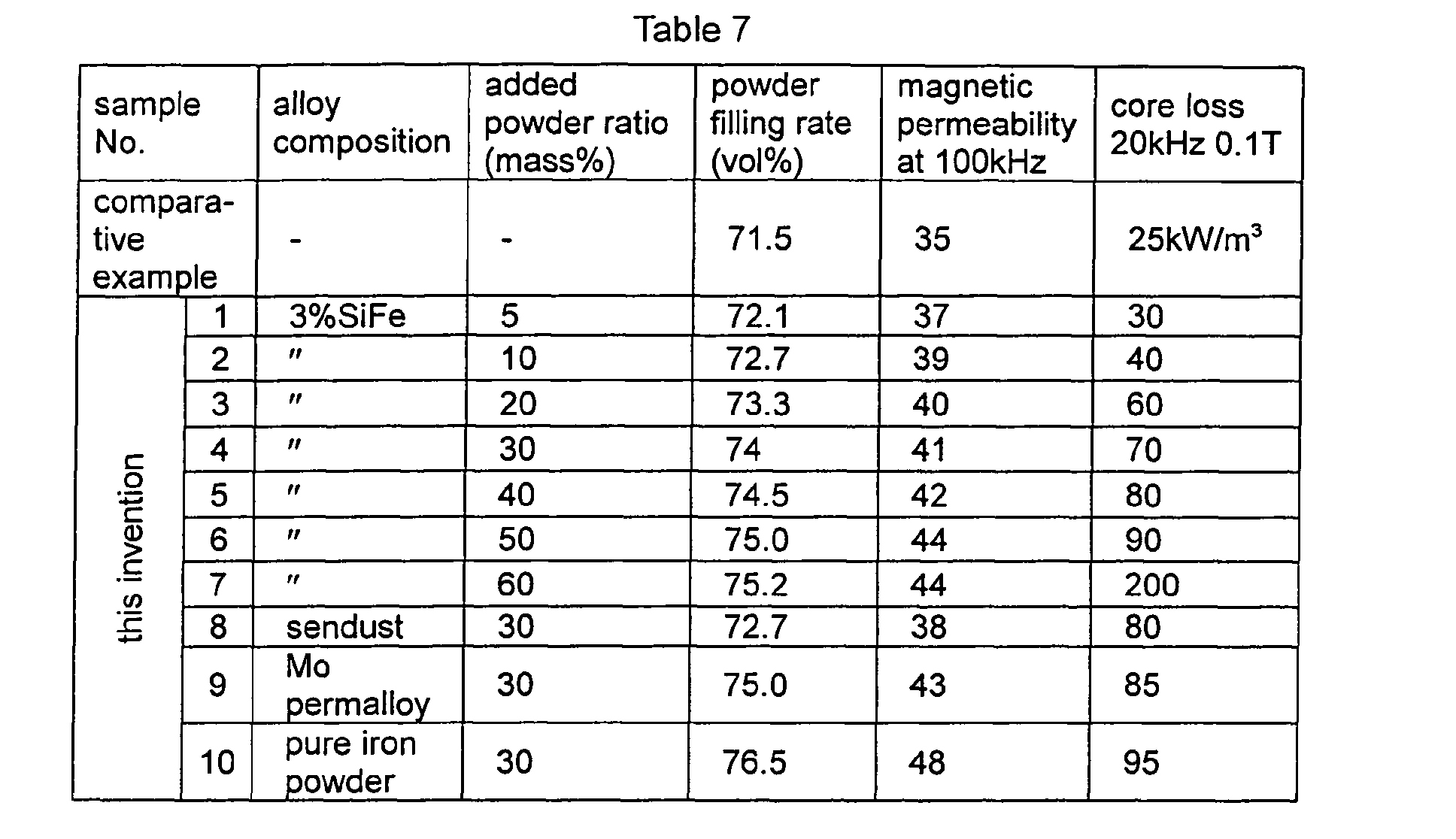
- an alloy powder having a composition of Fe 73 Si 7 B 17 Nb 3 was prepared by water atomization. Thereafter, the powder thus obtained was classified into those having a particle size of 45 ⁇ m or less. Then, XRD measurement was carried out to confirm a broad peak specific to a glass phase. Further, thermal analysis by DSC was carried out to measure a glass transition temperature and a crystallization temperature to confirm that a supercooled liquid temperature range ⁇ Tx was 35K. Then, powders obtained by water atomization and having following alloy compositions were filtered by a standard sieve into the powders of 20 ⁇ m or less. These powders were mixed at ratios shown in Table 7.
- a silicone resin as a binder was mixed in an amount of 1.5% in mass ratio.
- a pressure of 11.8 x 10 8 Pa so that the height was equal to 5 mm.
- heat treatment was carried out in Ar at 500 °C.
- the inductance component of this invention is improved in powder filling rate by adding to the metallic glass powder the soft magnetic powder smaller in particle size, and is consequently improved in permeability.
- the added amount exceeds 50%, the improving effect is weakened and the core loss characteristic is significantly degraded. Therefore, it is understood that the added amount is preferably 50% or less.
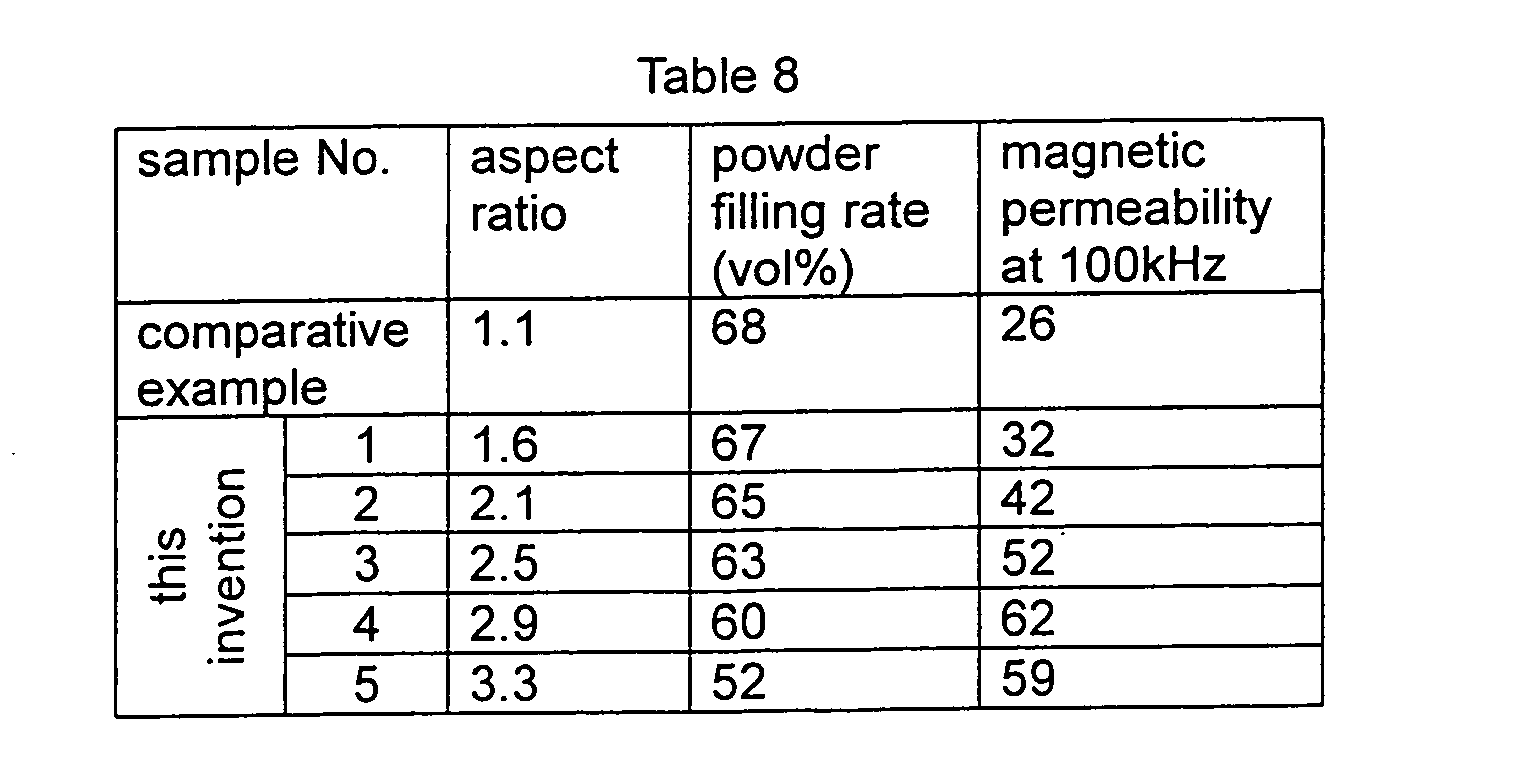
- alloy powders having a composition of Fe 73 Si 7 B 17 Nb 3 were prepared by water atomization. By changing various production conditions, powders having aspect ratios shown in Table 8 were prepared. Thereafter, the powders thus obtained were classified into those having a particle size of 45 ⁇ m or less. Then, XRD measurement was carried out to confirm a broad peak specific to a glass phase.
- thermal analysis by DSC was carried out to measure a glass transition temperature and a crystallization temperature to confirm that a supercooled liquid temperature range ⁇ Tx was 35K.
- a silicone resin as a binder was mixed in an amount of 3.0% in mass ratio.
- heat treatment was carried out in Ar at 500 °C.
- the inductance component of this invention is improved in permeability by increasing the aspect ratio of the metallic glass powder.
- the aspect ratio of the powder is preferably 3 or less.
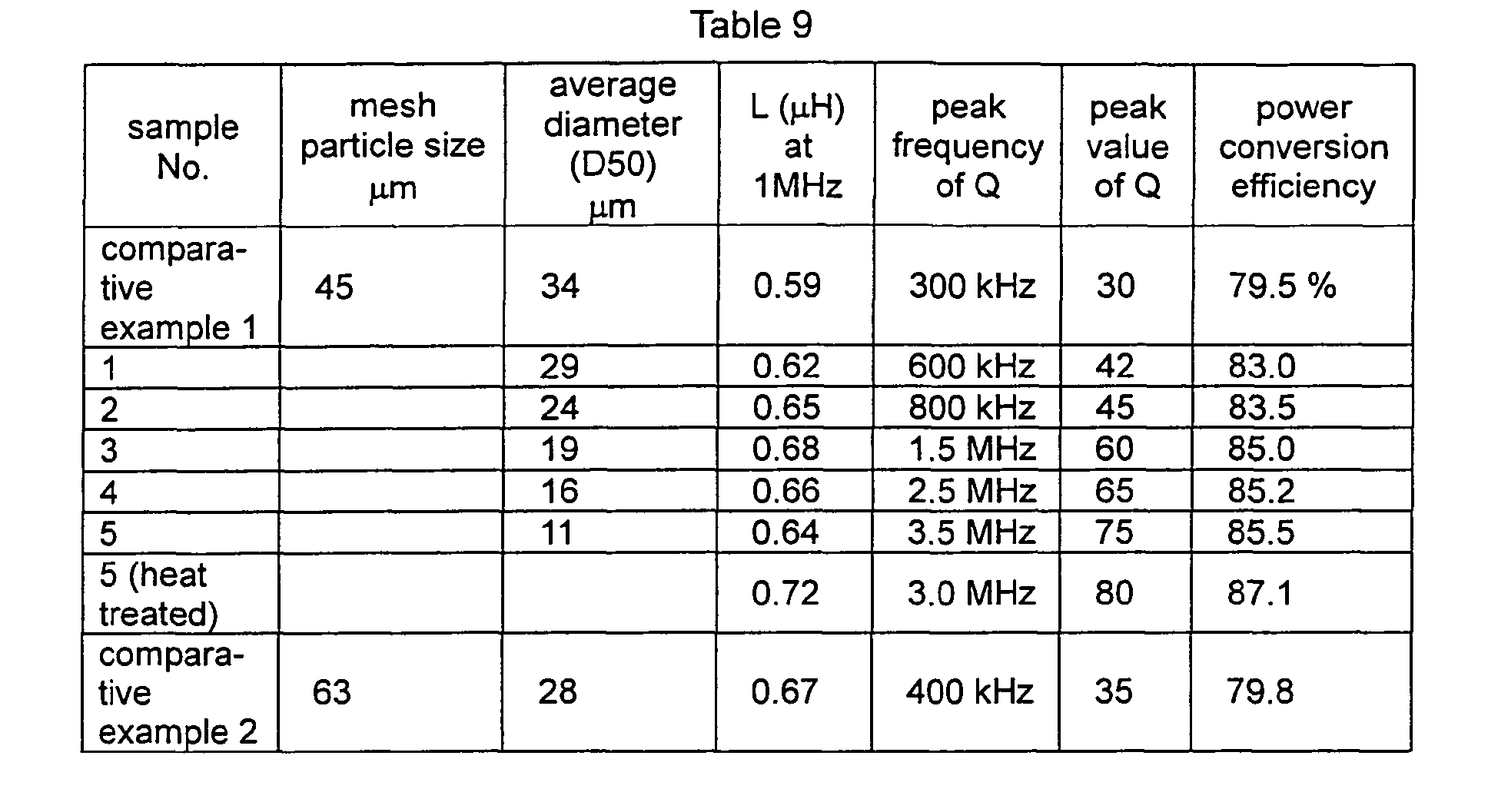
- the inductance and the resistance were measured at various frequencies by the use of an LCR meter. From the measurements, the inductance value at 1 MHz, the peak frequency of Q, and the peak value of Q were obtained. The results shown in Table 9 were obtained.
- the measurement condition was an input of 12 V, an output of 5 V, a drive frequency of 300 kHz, and an output current of 1 A.
- the peak frequency of Q was 500 kHz or more and its value was 40 or more. At that time, the power conversion efficiency was as excellent as 80% or more.
- the peak frequency of Q was 1 MHz or more and its value was 50 or more. At that time, the power conversion efficiency was as more excellent as 85% or more. Further, it is understood that, by heat treating the inductance component, the conversion efficiency is further improved.
- the powder is subjected to oxidization or insulating coating and molded by the use of a die or the like using an appropriate molding method to obtain a molded body.
- the powder core is prepared. Therefore, a high-permeability powder core which exhibits excellent permeability characteristics over a wide band and which is never known is obtained. As a result, it is possible to economically produce a high-frequency core of a soft magnetic material having a high saturation magnetic flux density and a high specific resistance. Further, an inductance component comprising the high-frequency core and at least one turn of winding wound therearound is obtained as an economical and high-performance product which has never been obtained. Accordingly, this invention is extremely useful in industrial application.
- the metallic glass powder having a maximum particle size of 45 ⁇ m or less in mesh size and an average diameter of 30 ⁇ m or less, more desirably 20 ⁇ m or less is used, a powder core having an extremely low loss characteristic at a high frequency is obtained.
- An inductance component comprising the high-frequency core with at least one turn of winding wound therearound is extremely excellent in Q characteristic so that the power supply efficiency can be improved.
- this invention is very useful in industrial application.
- the metallic glass powder having a maximum particle size of 45 ⁇ m or less in mesh size and an average diameter of 30 ⁇ m or less, more desirably 20 ⁇ m or less is press-molded with a winding coil embedded in a magnetic body to form an integral structure.
- a winding coil embedded in a magnetic body in addition to the excellent core characteristics specific to the metallic glass, heat generation resulting from an electric current flowing through the winding coil is radiated through the metal magnetic body.
- the synergetic effect thereof it is possible to obtain an inductance component increased in rated current for the same shape.
- the high-frequency core according to this invention is economically obtained by the use of the soft magnetic metallic glass material having a high saturation magnetic flux density and a high specific resistance. Further, the inductance component obtained by providing the core with the winding is excellent in magnetic characteristics in a high-frequency band as never before. Thus, it is possible to produce a high-permeability powder core low in cost and high in performance as never before and to provide an inductance component, such as a choke coil and a transformer, as a power supply component of various electronic apparatuses.
- press-molding may be carried out with the winding coil embedded in the magnetic body to form an integral structure.
- the inductance component small in size and adapted to a large current can be produced.
- the high-frequency core according to this invention is economically obtained by the use of the soft magnetic metallic glass material having a high saturation magnetic flux density and a high specific resistance. Further, the inductance component obtained by providing the core with the winding is excellent in magnetic characteristics in a high-frequency band as never before. Thus, a high-permeability powder core low in cost and high in performance as never before can be produced and is suitably used in a power supply component, such as a choke coil and a transformer, of various electronic apparatuses.
Landscapes
- Engineering & Computer Science (AREA)
- Power Engineering (AREA)
- Physics & Mathematics (AREA)
- Electromagnetism (AREA)
- Chemical & Material Sciences (AREA)
- Dispersion Chemistry (AREA)
- Microelectronics & Electronic Packaging (AREA)
- Soft Magnetic Materials (AREA)
- Coils Or Transformers For Communication (AREA)
Abstract
Description
| alloy composition | magnetic flux density/T at 1.6x10⁴ A/m | permeability at 100 kHz | XRD measurement result | |
| comparative example 1 | Fe74Si4B20Nb2 | 0.92/T | 22 | crystal phase |
| example 1 | Fe73Si4B20Nb3 | 0.87 | 31 | glass phase |
| example 2 | Fe72Si4B20Nb4 | 0.82 | 33 | glass phase |
| example 3 | Fe71Si4B20Nb5 | 0.77 | 35 | glass phase |
| comparative example 2 | Fe70Si4B20Nb6 | 0.72 | 37 | glass phase |
| comparative example 3 | Fe77Si0B20Nb3 | 0.98 | 19 | crystal phase |
| example 4 | Fe76Si1B20Nb3 | 0.95 | 30 | glass phase |
| example 5 | Fe75Si2B20Nb3 | 0.93 | 32 | glass phase |
| example 6 | Fe73Si4B20Nb3 | 0.87 | 34 | glass phase |
| example 7 | Fe68Si9B20Nb3 | 0.76 | 36 | glass phase |
| comparative example 4 | Fe67Si10B20Nb3 | 0.70 | 21 | crystal phase |
| comparative example 5 | Fe79Si14B14Nb3 | 0.95 | 20 | crystal phase |
| example 8 | Fe78Si4B15Nb3 | 0.94 | 33 | glass phase |
| example 9 | Fe73Si4B20Nb3 | 0.87 | 35 | glass phase |
| example 10 | Fe68Si4B25Nb3 | 0.80 | 37 | glass phase |
| comparative example 6 | Fe67Si4B26Nb3 | 0.79 | 23 | crystal phase |
| example 11 | (Fe0.9Ni0.1Co0)75Si4B20Nb1 | 0.92 | 32 | glass phase |
| example 12 | (Fe0.8Ni0.2Co0)75Si4B20Nb1 | 0.87 | 34 | glass phase |
| example 13 | (Fe0.7Ni0.3Co0)75Si4B20Nb1 | 0.82 | 36 | glass phase |
| comparative example 7 | (Fe0.6Ni0.4Co0)75Si4B20Nb1 | 0.77 | 38 | glass phase |
| example 14 | (Fe0.9Ni0Co0.1)75Si4B20Nb1 | 0.92 | 31 | glass phase |
| example 15 | (Fe0.8Ni0Co0.2)75Si4B20Nb1 | 0.95 | 33 | glass phase |
| example 16 | (Fe0.7Ni0Co0.5)75Si4B20Nb1 | 0.88 | 35 | glass phase |
| comparative example 8 | (Fe0.6Ni0Co0.6)75Si4B20Nb1 (Fe0.6Ni0CO0.6)75Si4B20Nb1 | 0.85 | 37 | glass phase |
| example 17 | (Fe0.7Ni0.1Co0.2)75Si4B20Nb1 | 0.88 | 34 | glass phase |
| example 18 | (Fe0.7Ni0.1Co0.2)74Si4B20Nb2 | 0.84 | 36 | glass phase |
| example 19 | (Fe0.7Ni0.1Co0.2)74Si4B20Ta2 | 0.84 | 34 | glass phase |
| example 20 | (Fe0.7Ni0.1Co0.2)74Si4B20Mo2 | 0.84 | 35 | glass phase |
| alloy composition | magnetic flux density/T at 1.6x10⁻⁴ A/m | permeability at 100 kHz | XRD measurement result | |
| comparative example 9 | Fe75Si7B17Nb1, | 0.91 | 18 | crystal phase |
| example 21 | Fe74Si7B17Nb2 | 0.87 | 35 | glass phase |
| example 22 | Fe73Si7B17Nb3 | 0.82 | 37 | glass phase |
| example 23 | Fe73Si7B17Nb2Zn1, | 0.84 | 37 | glass phase |
| example 24 | Fe73Si7B17Nb1.5Zn1.5 | 0.85 | 35 | glass phase |
| comparative example 10 | Fe73Si7B17Nb1Zn2 | 0.86 | 19 | crystal phase |
| comparative example 11 | Fe75Si7B17Nb0Zn1 | 0.93 | 17 | crystal phase |
| example 25 | Fe74Si7B17Nb1Zn1, | 0.89 | 33 | glass phase |
| example 26 | Fe71Si7B17Nb4Zn1 | 0.75 | 37 | glass phase |
| comparative example 12 | Fe70Si7B17Nb5Zn1 | 0.68 | 35 | glass phase |
| example 27 | Fe73Si7B17Nb2Sn1 | 0.81 | 35 | glass phase |
| example 28 | Fe73.5Si7B17Nb2 (misch metal)0.5 | 0.85 | 35 | glass phase |
| example 29 | (Fe0.9Ni0.1Co0)74Si7B17Nb1Zn1 | 0.87 | 34 | glass phase |
| example 30 | (Fe0.8Ni0Co0.2)74Si7B17Nb1Zn1, | 0.89 | 32 | glass phase |
| example 31 | (Fe0.7Ni0.1Co0.2)74Si7B17Nb1Zn1, | 0.88 | 33 | glass phase |
| example 32 | (Fe0.7Ni0.1Co0.2)73Si7B17Ta2Zn1 | 0.78 | 32 | glass phase |
| example 33 | (Fe0.7Ni0.1Co0.2)73Si7B17Mo2Zn1 | 0.76 | 34 | glass phase |
| example 34 | (Fe73Si12B12Nb2)+ (Al0.05C0.05P0.05)wt % | 0.86 | 33 | glass phase |
| example 35 | (Fe73Si9B14Nb3) + (Al0.1C0.1P0.1)wt% | 0.81 | 35 | glass phase |
| example 36 | (Fe73Si9B14Nb3) + (Al 0.3 C0.1 P0.1)wt% | 0.80 | 33 | glass phase |
| comparative example 13 | (Fe73Si9B14Nb3)+ (Al0.2Co0.2P0.2)wt% | 0.80 | 15 | crystal phase |
| Sample No. | resin content (%) | molding temperature | powder filling rate (%) | magnetic flux density/T at 1.6 x 10⁴ A/m | |
| 1 | 0.5 | room temperature | 69.0 | 0.92 | ≧100 |
| 2 | 1 | " | 69.9 | 0.93 | ≧100 |
| 3 | 2.5 | " | 70.8 | 0.94 | ≧100 |
| 4 | 5 | " | 70.3 | 0.94 | ≧ 100 |
| 5 | 10 | " | 52.0 | 0.66 | ≧104 |
| 6 | 0.5 | 150°C | 80.8 | 1.10 | 5 |
| 7 | 1 | " | 81.5 | 1.11 | 10 |
| 8 | 2.5 | " | 82.2 | 1.12 | 15 |
| 9 | 5 | " | 70.8 | 0.94 | ≧100 |
| 10 | 10 | " | 52.5 | 0.67 | ≧104 |
| 11 | 0.5 | 550°C | 95.5 | 1.33 | 0.1 |
| 12 | 1 | " | 92.5 | 1.28 | 0.5 |
| 13 | 2.5 | " | 82.7 | 1.13 | 10 |
| 14 | 5 | " | 71.2 | 0.95 | ≧100 |
| 15 | 10 | " | 52.2 | 0.67 | ≧104 |
| sample No. | resin content (%) | molding temperature | powder filling rate (%) | magnetic flux density/T at 1.6 x 10⁴ A/M | |
| 1 | 0.5 | room temperature | 68.9 | 0.83 | ≧100 |
| 2 | 1 | room temperature | 69.7 | 0.84 | ≧100 |
| 3 | 2.5 | room temperature | 70.5 | 0.85 | ≧100 |
| 4 | 5 | room temperature | 70.1 | 0.84 | 100 |
| 5 | 10 | room temperature | 51.5 | 0.56 | ≧104 |
| 6 | 0.5 | 150°C | 80.7 | 1.02 | 5 |
| 7 | 1 | 150°C | 81.3 | 1.03 | 10 |
| 8 | 2.5 | 150°C | 81.9 | 1.04 | 15 |
| 9 | 5 | 150°C | 70.6 | 0.85 | ≧100 |
| 10 | 10 | 150°C | 52.0 | 0.58 | ≧10E4 |
| 11 | 0.5 | 550°C | 95.4 | 1.21 | 0.1 |
| 12 | 1 | 550°C | 92.2 | 1.17 | 0.5 |
| 13 | 2.5 | 550°C | 82.4 | 1.05 | 10 |
| 14 | 5 | 550°C | 71.0 | 0.85 | ≧100 |
| 15 | 10 | 550°C | 51.7 | 0.57 | ≧104 |
| sample name | magnetic flux density/T at 1.6 x 10⁴ A/M | specific resistance Ωcm | Permeability - | core loss 20kHz 0.1T |
| this invention | 1.28 | 0.5 | 150 | 50/mW/cc |
| this invention (heat treated) | 1.29 | 0.4 | 200 | 30 |
| MnZn ferrite | 0.55 | ≧104 | 100* | 10 |
| Sendust | 0.65 | 100 | 80 | 100 |
| 6.5% silicon steel | 1.0 | 100µ | 100* | 250 |
| Fe-based amorphous metal | 1.3 | 150µ | 100* | 400 |
| Note) *with a gap inserted at a part of a magnetic path. |
| sample name | magnetic flux density/T at 1.6 x 10⁴ A/M | specific resistance Ωcm | permeability - | core loss 20kHz 0.1T |
| this invention | 1.21 | 0.5 | 160 | 50/mW/cc |
| this invention (heat treated) | 1.23 | 0.4 | 220 | 25 |
| MnZn ferrite | 0.55 | ≥104 | 100* | 9 |
| Sendust | 0.65 | 100 | 80 | 100 |
| 6.5% silicon steel | 1.0 | 100µ | 100* | 250 |
| Fe-based amorphous metal | 1.3 | 150µ | 100* | 400 |
Claims (17)
- A high-frequency core comprising a molded body obtained by molding a mixture of a soft magnetic metallic glass powder and a binder in an amount of 10% or less in mass ratio with respect to the soft magnetic metallic glass powder, said soft magnetic metallic glass powder having an alloy composition represented by a general formula (Fe1-a-bNiaCob)100-x-y-z (M1-pM'p)xTyBz (where 0 ≦ a ≦ 0.30, 0 ≦ b ≦ 0.50, 0 ≦ a+b ≦ 0.50, 0 ≦ p ≦ 0.5, 1 atomic % ≦ x ≦ 5 atomic %, 1 atomic % ≦ y ≦ 12 atomic %, 12 atomic % ≦ z ≦25 atomic %, 22 ≦ (x+y+z) ≦ 32, M being at least one selected from Zr, Nb, Ta, Hf, Mo, Ti, V, Cr, and W, M' being at least one selected from Zn, Sn, R ,where R is at least one element selected from rare earth metals including Y, and T is at least one selected from Al, Si, C, and P).
- The high-frequency core according to claim 1, wherein the total amount of Al, C, and P is 0.5 % or less in mass ratio.
- The high-frequency core according to claim 1 or 2, wherein the molded body has a powder filling rate of 50 % or more, a magnetic flux density of 0.5 T or more when a magnetic field of 1.6 x 10⁴ A/m is applied, and a specific resistance of 1 x 10⁴ Ωcm or more.
- The high-frequency core according to any one of claims 1 to 3, wherein the molded body is obtained by preparing the mixture of the soft magnetic metallic glass powder and the binder in an amount of 5 % or less in mass ratio with respect to the soft magnetic metallic glass powder and compression-molding the mixture using a die, the molded body having a powder filling rate of 70 % or more, a magnetic flux density of 0.75 T or more when a magnetic field of 1.6 x 10⁴ A/m is applied, and a specific resistance of 1 Ωcm or more.
- The high-frequency core according to any one of claims 1 to 4, wherein the molded body is obtained by preparing the mixture of the soft magnetic metallic glass powder and the binder in an amount of 3 % or less in mass ratio with respect to the soft magnetic metallic glass powder and compression-molding the mixture using a die under a temperature condition not lower than a softening point of the binder, the molded body having a powder filling rate of 80 % or more, a magnetic flux density of 0.9 T or more when a magnetic field of 1.6 x 10⁴ A/m is applied, and a specific resistance of 0.1 Ωcm or more.
- The high-frequency core according to any one of claims 1 to 5, wherein the molded body is obtained by preparing the mixture of the soft magnetic metallic glass powder and the binder in an amount of 1 % or less in mass ratio with respect to the soft magnetic metallic glass powder and compression-molding the mixture at a temperature within a supercooled liquid temperature range of the soft magnetic metallic glass powder, the molded body having a powder filling rate of 90 % or more, a magnetic flux density of 1.0 T or more when a magnetic field of 1.6 x 10⁴ A/m is applied, and a specific resistance of 0.01 Ωcm or more.
- The high-frequency core according to any one of claims 1 to 6, wherein the soft magnetic metallic glass powder is produced by water atomization or gas atomization and at least 50 % of powder particles have a size not smaller than 10 µm.
- The high-frequency core according to any one of claims 1 to 7, wherein a soft magnetic alloy powder having an average diameter smaller than that of the soft magnetic metallic glass powder and a low hardness is added in an amount of 5-50% in volume ratio.
- The high-frequency core according to any one of claims 1 to 8, wherein the soft magnetic metallic glass powder has an aspect ratio (long axis/short axis) within a range between 1 and 3.
- The high-frequency core according to any one of claims 1 to 9, wherein the molded body is heat treated at a temperature not lower than a Curie point of the alloy powder after molding, SiO2 being contained at least in a part of an intermediate material between powder particles of the alloy powder.
- The high-frequency core according to any one of claims 1 to 10, wherein the soft magnetic metallic glass powder has a maximum particle size of 45 µm or less in mesh size and an average diameter of 30 µm or less.
- An inductance component comprising the high-frequency core claimed in any one of claims 1 to 11 and at least one turn of winding wound around the core.
- The inductance component according to claim 12, wherein a gap is formed at a part of a magnetic path of the high-frequency core.
- The inductance component comprising the high-frequency core claimed in claim 11 and a winding coil embedded in a magnetic body and formed by press-molding into an integral structure.
- The inductance component according to claim 14, wherein the high-frequency core has a powder filling rate of 50 % or more and a peak value of Q (1/tanδ) is 40 or more at 500 kHz or more.
- The inductance component according to claim 14 or 15, wherein the high-frequency core has a maximum powder particle size of 45 µm or less in mesh size and an average diameter of 20 µm or less and that a peak value of Q(=1/tanδ) is 50 or more at 1 MHz or more.
- The inductance component according to any one of claims 14 to 16, wherein heat treatment at a temperature not higher than 600 °C is performed.
Applications Claiming Priority (5)
| Application Number | Priority Date | Filing Date | Title |
|---|---|---|---|
| JP2003298548 | 2003-08-22 | ||
| JP2003298548 | 2003-08-22 | ||
| JP2004080802 | 2004-03-19 | ||
| JP2004080802 | 2004-03-19 | ||
| PCT/JP2004/012317 WO2005020252A1 (en) | 2003-08-22 | 2004-08-20 | Magnetic core for high frequency and inductive component using same |
Publications (3)
| Publication Number | Publication Date |
|---|---|
| EP1610348A1 true EP1610348A1 (en) | 2005-12-28 |
| EP1610348A4 EP1610348A4 (en) | 2006-06-14 |
| EP1610348B1 EP1610348B1 (en) | 2011-08-10 |
Family
ID=34220710
Family Applications (1)
| Application Number | Title | Priority Date | Filing Date |
|---|---|---|---|
| EP04772273A Expired - Lifetime EP1610348B1 (en) | 2003-08-22 | 2004-08-20 | High-frequency magnetic core and inductive component using the same |
Country Status (4)
| Country | Link |
|---|---|
| US (1) | US7170378B2 (en) |
| EP (1) | EP1610348B1 (en) |
| JP (1) | JP4828229B2 (en) |
| WO (1) | WO2005020252A1 (en) |
Cited By (1)
| Publication number | Priority date | Publication date | Assignee | Title |
|---|---|---|---|---|
| CN108735431A (en) * | 2017-04-19 | 2018-11-02 | 株式会社村田制作所 | Coil component |
Families Citing this family (35)
| Publication number | Priority date | Publication date | Assignee | Title |
|---|---|---|---|---|
| JP2006032907A (en) * | 2004-05-17 | 2006-02-02 | Nec Tokin Corp | High frequency magnetic core and inductance component using the same |
| EP1598836B1 (en) * | 2004-05-17 | 2008-12-31 | Nec Tokin Corporation | High-frequency core and inductance component using the same |
| TWI268289B (en) * | 2004-05-28 | 2006-12-11 | Tsung-Shune Chin | Ternary and multi-nary iron-based bulk glassy alloys and nanocrystalline alloys |
| JP2006287004A (en) * | 2005-04-01 | 2006-10-19 | Nec Tokin Corp | Magnetic core for high frequency and inductance component using it |
| KR100993413B1 (en) * | 2005-11-01 | 2010-11-09 | 도시바 마테리알 가부시키가이샤 | Planar Magnetic Elements and Power IC Packages Using the Same |
| CN100442402C (en) * | 2005-11-16 | 2008-12-10 | 安泰科技股份有限公司 | Iron-based amorphous alloy powder with excellent high-frequency performance, magnetic powder core and preparation method thereof |
| US8048191B2 (en) * | 2005-12-28 | 2011-11-01 | Advanced Technology & Material Co., Ltd. | Compound magnetic powder and magnetic powder cores, and methods for making them thereof |
| JP4849545B2 (en) * | 2006-02-02 | 2012-01-11 | Necトーキン株式会社 | Amorphous soft magnetic alloy, amorphous soft magnetic alloy member, amorphous soft magnetic alloy ribbon, amorphous soft magnetic alloy powder, and magnetic core and inductance component using the same |
| US20080036566A1 (en) | 2006-08-09 | 2008-02-14 | Andrzej Klesyk | Electronic Component And Methods Relating To Same |
| JP2008109080A (en) * | 2006-09-29 | 2008-05-08 | Alps Electric Co Ltd | Dust core and manufacturing method thereof |
| JP4446487B2 (en) * | 2006-10-17 | 2010-04-07 | 新東ホールディングス株式会社 | Inductor and method of manufacturing inductor |
| JP4308864B2 (en) * | 2006-10-31 | 2009-08-05 | Tdk株式会社 | Soft magnetic alloy powder, green compact and inductance element |
| EP1933337B8 (en) * | 2006-12-15 | 2010-09-01 | Alps Green Devices Co., Ltd | Fe-based amorphous magnetic alloy and magnetic sheet |
| TWI315529B (en) * | 2006-12-28 | 2009-10-01 | Ind Tech Res Inst | Monolithic inductor |
| JP4826523B2 (en) * | 2007-03-26 | 2011-11-30 | セイコーエプソン株式会社 | Soft magnetic powder, method for producing soft magnetic powder, dust core and magnetic element |
| CN100457955C (en) * | 2007-04-16 | 2009-02-04 | 安泰科技股份有限公司 | Iron-based bulk amorphous alloy material |
| TW200845057A (en) * | 2007-05-11 | 2008-11-16 | Delta Electronics Inc | Inductor |
| JP4944971B2 (en) * | 2008-05-16 | 2012-06-06 | 日立金属株式会社 | Dust core and choke |
| TWI407462B (en) * | 2009-05-15 | 2013-09-01 | Cyntec Co Ltd | Inductor and manufacturing method thereof |
| JP5158163B2 (en) * | 2010-09-17 | 2013-03-06 | セイコーエプソン株式会社 | Powder magnetic core and magnetic element |
| US9349520B2 (en) * | 2010-11-09 | 2016-05-24 | California Institute Of Technology | Ferromagnetic cores of amorphous ferromagnetic metal alloys and electronic devices having the same |
| TWI441929B (en) * | 2011-01-17 | 2014-06-21 | Alps Green Devices Co Ltd | Fe-based amorphous alloy powder, and a powder core portion using the Fe-based amorphous alloy, and a powder core |
| US20120274328A1 (en) * | 2011-04-28 | 2012-11-01 | Hanington Gary J | Axial high voltage transformer with signal pass-through ability |
| JP2012054569A (en) * | 2011-09-30 | 2012-03-15 | Seiko Epson Corp | Soft magnetic powder, method for producing soft magnetic powder, dust core, and magnetic element |
| JP6060508B2 (en) * | 2012-03-26 | 2017-01-18 | Tdk株式会社 | Planar coil element and manufacturing method thereof |
| KR20140018459A (en) * | 2012-07-23 | 2014-02-13 | 삼성전자주식회사 | Magnetic composite and method of manufacturing the same and article and device |
| JP5919144B2 (en) * | 2012-08-31 | 2016-05-18 | 株式会社神戸製鋼所 | Iron powder for dust core and method for producing dust core |
| WO2014061670A1 (en) * | 2012-10-19 | 2014-04-24 | 株式会社村田製作所 | Laminated coil device and manufacturing method therefor |
| USD729730S1 (en) * | 2013-06-06 | 2015-05-19 | Jon Simon Gillespie-Brown | Power charging ring |
| KR20160126751A (en) * | 2015-04-24 | 2016-11-02 | 삼성전기주식회사 | Coil electronic component and manufacturing method thereof |
| JP6477429B2 (en) * | 2015-11-09 | 2019-03-06 | 株式会社村田製作所 | Coil parts |
| KR102684408B1 (en) * | 2017-01-10 | 2024-07-12 | 엘지이노텍 주식회사 | Magnetic core and coil component |
| JP6245391B1 (en) * | 2017-01-30 | 2017-12-13 | Tdk株式会社 | Soft magnetic alloys and magnetic parts |
| JP7114985B2 (en) * | 2018-03-29 | 2022-08-09 | スミダコーポレーション株式会社 | Coil components, electronic devices, metal magnetic powders and support equipment |
| CN109036753B (en) * | 2018-07-02 | 2020-06-12 | 四川大学 | Amorphous nanocrystalline composite magnetic powder core and preparation method thereof |
Family Cites Families (30)
| Publication number | Priority date | Publication date | Assignee | Title |
|---|---|---|---|---|
| JPS5933183B2 (en) * | 1980-06-24 | 1984-08-14 | 株式会社東芝 | Low loss amorphous alloy |
| JPS6074412A (en) * | 1983-09-28 | 1985-04-26 | Toshiba Corp | Multi-output common choke coil |
| US4627668A (en) | 1983-09-28 | 1986-12-09 | Repco Limited | Relay valve |
| JPS62232103A (en) * | 1986-04-01 | 1987-10-12 | Hitachi Metals Ltd | Fe base amorphous dust core and manufacture thereof |
| JPS63158810A (en) * | 1986-12-23 | 1988-07-01 | Toshiba Corp | Dust core |
| JPH0294406A (en) * | 1988-09-29 | 1990-04-05 | Tdk Corp | Dust core |
| JPH0478114A (en) * | 1990-07-20 | 1992-03-12 | Toshiba Corp | Composite magnetic core |
| JP3108931B2 (en) | 1991-03-15 | 2000-11-13 | 株式会社トーキン | Inductor and manufacturing method thereof |
| JPH05299232A (en) * | 1992-04-20 | 1993-11-12 | Matsushita Electric Ind Co Ltd | Resin molded magnetic material |
| JPH0734183A (en) * | 1993-07-22 | 1995-02-03 | Kawatetsu Techno Res Corp | Composite dust core material and manufacturing method thereof |
| DE19802349B4 (en) * | 1997-01-23 | 2010-04-15 | Alps Electric Co., Ltd. | Soft magnetic amorphous alloy, high hardness amorphous alloy and their use |
| JPH11131199A (en) | 1997-01-23 | 1999-05-18 | Akihisa Inoue | Soft magnetic glass alloy |
| EP0867897B1 (en) * | 1997-03-25 | 2003-11-26 | Alps Electric Co., Ltd. | Fe based hard magnetic alloy having super-cooled liquid region |
| EP0898287B1 (en) * | 1997-08-22 | 2003-05-21 | Alps Electric Co., Ltd. | Hard magnetic alloy having supercooled liquid region, sintered product thereof and applications |
| TW455631B (en) * | 1997-08-28 | 2001-09-21 | Alps Electric Co Ltd | Bulky magnetic core and laminated magnetic core |
| JP3532392B2 (en) | 1997-08-28 | 2004-05-31 | アルプス電気株式会社 | Bulk core |
| JP3877893B2 (en) * | 1999-01-08 | 2007-02-07 | アルプス電気株式会社 | High permeability metal glass alloy for high frequency |
| JP4061783B2 (en) | 1999-08-25 | 2008-03-19 | セイコーエプソン株式会社 | Method for producing soft magnetic metal powder and soft magnetic metal powder |
| JP2001068324A (en) * | 1999-08-30 | 2001-03-16 | Hitachi Ferrite Electronics Ltd | Powder molding core |
| JP3595481B2 (en) | 1999-12-28 | 2004-12-02 | アルプス電気株式会社 | Dust core and method of manufacturing dust core |
| JP2002151317A (en) * | 2000-03-21 | 2002-05-24 | Alps Electric Co Ltd | Dust core and its manufacturing method |
| US6594157B2 (en) * | 2000-03-21 | 2003-07-15 | Alps Electric Co., Ltd. | Low-loss magnetic powder core, and switching power supply, active filter, filter, and amplifying device using the same |
| JP4684461B2 (en) | 2000-04-28 | 2011-05-18 | パナソニック株式会社 | Method for manufacturing magnetic element |
| JP2002105502A (en) | 2000-09-26 | 2002-04-10 | Kubota Corp | Soft magnetic metal powder, powder aggregate and compression molded body |
| JP3980828B2 (en) * | 2000-12-18 | 2007-09-26 | アルプス電気株式会社 | Dust core |
| JP3756405B2 (en) * | 2000-12-22 | 2006-03-15 | 独立行政法人科学技術振興機構 | Soft magnetic, high strength Fe-Co-Ni based metallic glass alloy |
| JP2003142319A (en) * | 2001-11-05 | 2003-05-16 | Nec Tokin Corp | Dust core, coil component, and power converter using them |
| JP4346354B2 (en) | 2003-06-03 | 2009-10-21 | アルプス電気株式会社 | Powder core |
| JP2004363466A (en) | 2003-06-06 | 2004-12-24 | Toko Inc | Composite magnetic material and method of manufacturing inductor using the same |
| EP1598836B1 (en) | 2004-05-17 | 2008-12-31 | Nec Tokin Corporation | High-frequency core and inductance component using the same |
-
2004
- 2004-08-20 EP EP04772273A patent/EP1610348B1/en not_active Expired - Lifetime
- 2004-08-20 US US10/548,286 patent/US7170378B2/en not_active Expired - Lifetime
- 2004-08-20 WO PCT/JP2004/012317 patent/WO2005020252A1/en not_active Ceased
- 2004-08-20 JP JP2005513369A patent/JP4828229B2/en not_active Expired - Fee Related
Cited By (1)
| Publication number | Priority date | Publication date | Assignee | Title |
|---|---|---|---|---|
| CN108735431A (en) * | 2017-04-19 | 2018-11-02 | 株式会社村田制作所 | Coil component |
Also Published As
| Publication number | Publication date |
|---|---|
| EP1610348A4 (en) | 2006-06-14 |
| EP1610348B1 (en) | 2011-08-10 |
| US7170378B2 (en) | 2007-01-30 |
| JP4828229B2 (en) | 2011-11-30 |
| JPWO2005020252A1 (en) | 2006-11-16 |
| US20060170524A1 (en) | 2006-08-03 |
| WO2005020252A1 (en) | 2005-03-03 |
Similar Documents
| Publication | Publication Date | Title |
|---|---|---|
| US7170378B2 (en) | Magnetic core for high frequency and inductive component using same | |
| US10984932B2 (en) | Amorphous soft magnetic alloy and inductance component using the same | |
| EP3549696B1 (en) | Soft magnetic powder, dust magnetic core, magnetic part, and method for producing dust magnetic core | |
| CA3051184C (en) | Soft magnetic powder, fe-based nanocrystalline alloy powder, magnetic component and dust core | |
| KR101503199B1 (en) | Fe-BASED AMORPHOUS ALLOY POWDER, DUST CORE USING THE Fe-BASED AMORPHOUS ALLOY POWDER, AND COIL-EMBEDDED DUST CORE | |
| KR101513844B1 (en) | Fe-based amorphous alloy, dust core formed using the fe-based amorphous alloy, and dust core with embedded coil | |
| EP1598836B1 (en) | High-frequency core and inductance component using the same | |
| KR20090130054A (en) | Soft Magnetic Alloys, Magnetic Components Using the Same, and Methods for Manufacturing the Same | |
| CN108376598B (en) | Soft magnetic alloy and magnetic component | |
| KR102214392B1 (en) | Soft magnetic alloy and magnetic device | |
| EP3364425A1 (en) | Soft magnetic alloy and magnetic device | |
| JP5063861B2 (en) | Composite dust core and manufacturing method thereof | |
| JP2006032907A (en) | High frequency magnetic core and inductance component using the same | |
| JP6191855B2 (en) | Soft magnetic metal powder and high frequency powder magnetic core | |
| CN100520994C (en) | High-frequency core and inductance component using the same | |
| JP4106966B2 (en) | Composite magnetic material and manufacturing method thereof |
Legal Events
| Date | Code | Title | Description |
|---|---|---|---|
| PUAI | Public reference made under article 153(3) epc to a published international application that has entered the european phase |
Free format text: ORIGINAL CODE: 0009012 |
|
| 17P | Request for examination filed |
Effective date: 20050803 |
|
| AK | Designated contracting states |
Kind code of ref document: A1 Designated state(s): AT BE BG CH CY CZ DE DK EE ES FI FR GB GR HU IE IT LI LU MC NL PL PT RO SE SI SK TR |
|
| AX | Request for extension of the european patent |
Extension state: AL HR LT LV MK |
|
| A4 | Supplementary search report drawn up and despatched |
Effective date: 20060508 |
|
| DAX | Request for extension of the european patent (deleted) | ||
| RBV | Designated contracting states (corrected) |
Designated state(s): DE FR GB |
|
| 17Q | First examination report despatched |
Effective date: 20070502 |
|
| GRAP | Despatch of communication of intention to grant a patent |
Free format text: ORIGINAL CODE: EPIDOSNIGR1 |
|
| REG | Reference to a national code |
Ref country code: DE Ref legal event code: R079 Ref document number: 602004033896 Country of ref document: DE Free format text: PREVIOUS MAIN CLASS: H01F0001260000 Ipc: H01F0001153000 |
|
| RIC1 | Information provided on ipc code assigned before grant |
Ipc: H01F 17/06 20060101ALI20110214BHEP Ipc: H01F 1/153 20060101AFI20110214BHEP |
|
| RTI1 | Title (correction) |
Free format text: HIGH-FREQUENCY MAGNETIC CORE AND INDUCTIVE COMPONENT USING THE SAME |
|
| GRAS | Grant fee paid |
Free format text: ORIGINAL CODE: EPIDOSNIGR3 |
|
| GRAA | (expected) grant |
Free format text: ORIGINAL CODE: 0009210 |
|
| AK | Designated contracting states |
Kind code of ref document: B1 Designated state(s): DE FR GB |
|
| REG | Reference to a national code |
Ref country code: GB Ref legal event code: FG4D |
|
| REG | Reference to a national code |
Ref country code: DE Ref legal event code: R081 Ref document number: 602004033896 Country of ref document: DE Owner name: TOKIN CORPORATION, SENDAI-SHI, JP Free format text: FORMER OWNERS: NEC TOKIN CORP., SENDAI, MIYAGI, JP; INOUE, AKIHISA, SENDAI, MIYAGI, JP Ref country code: DE Ref legal event code: R081 Ref document number: 602004033896 Country of ref document: DE Owner name: INOUE, AKIHISA, SENDAI, JP Free format text: FORMER OWNERS: NEC TOKIN CORP., SENDAI, MIYAGI, JP; INOUE, AKIHISA, SENDAI, MIYAGI, JP |
|
| REG | Reference to a national code |
Ref country code: DE Ref legal event code: R096 Ref document number: 602004033896 Country of ref document: DE Effective date: 20111006 |
|
| PLBE | No opposition filed within time limit |
Free format text: ORIGINAL CODE: 0009261 |
|
| STAA | Information on the status of an ep patent application or granted ep patent |
Free format text: STATUS: NO OPPOSITION FILED WITHIN TIME LIMIT |
|
| 26N | No opposition filed |
Effective date: 20120511 |
|
| REG | Reference to a national code |
Ref country code: DE Ref legal event code: R097 Ref document number: 602004033896 Country of ref document: DE Effective date: 20120511 |
|
| REG | Reference to a national code |
Ref country code: FR Ref legal event code: PLFP Year of fee payment: 13 |
|
| REG | Reference to a national code |
Ref country code: DE Ref legal event code: R082 Ref document number: 602004033896 Country of ref document: DE Representative=s name: PRUEFER & PARTNER MBB PATENTANWAELTE RECHTSANW, DE Ref country code: DE Ref legal event code: R081 Ref document number: 602004033896 Country of ref document: DE Owner name: INOUE, AKIHISA, SENDAI, JP Free format text: FORMER OWNERS: NEC TOKIN CORP., SENDAI, MIYAGI, JP; INOUE, AKIHISA, SENDAI, MIYAGI, JP Ref country code: DE Ref legal event code: R081 Ref document number: 602004033896 Country of ref document: DE Owner name: TOKIN CORPORATION, SENDAI-SHI, JP Free format text: FORMER OWNERS: NEC TOKIN CORP., SENDAI, MIYAGI, JP; INOUE, AKIHISA, SENDAI, MIYAGI, JP |
|
| REG | Reference to a national code |
Ref country code: FR Ref legal event code: PLFP Year of fee payment: 14 |
|
| REG | Reference to a national code |
Ref country code: FR Ref legal event code: CD Owner name: INOUE, AKIHISA, JP Effective date: 20171120 Ref country code: FR Ref legal event code: CD Owner name: NEC TOKIN CORPORATION, JP Effective date: 20171120 |
|
| REG | Reference to a national code |
Ref country code: FR Ref legal event code: PLFP Year of fee payment: 15 |
|
| PGFP | Annual fee paid to national office [announced via postgrant information from national office to epo] |
Ref country code: GB Payment date: 20200813 Year of fee payment: 17 Ref country code: FR Payment date: 20200715 Year of fee payment: 17 Ref country code: DE Payment date: 20200804 Year of fee payment: 17 |
|
| REG | Reference to a national code |
Ref country code: DE Ref legal event code: R119 Ref document number: 602004033896 Country of ref document: DE |
|
| GBPC | Gb: european patent ceased through non-payment of renewal fee |
Effective date: 20210820 |
|
| PG25 | Lapsed in a contracting state [announced via postgrant information from national office to epo] |
Ref country code: GB Free format text: LAPSE BECAUSE OF NON-PAYMENT OF DUE FEES Effective date: 20210820 Ref country code: FR Free format text: LAPSE BECAUSE OF NON-PAYMENT OF DUE FEES Effective date: 20210831 Ref country code: DE Free format text: LAPSE BECAUSE OF NON-PAYMENT OF DUE FEES Effective date: 20220301 |