EP1609807A1 - Polyvinyl alcohol block copolymer and aqueous pigment dispersions and recording fluids made by using the same - Google Patents
Polyvinyl alcohol block copolymer and aqueous pigment dispersions and recording fluids made by using the same Download PDFInfo
- Publication number
- EP1609807A1 EP1609807A1 EP04724816A EP04724816A EP1609807A1 EP 1609807 A1 EP1609807 A1 EP 1609807A1 EP 04724816 A EP04724816 A EP 04724816A EP 04724816 A EP04724816 A EP 04724816A EP 1609807 A1 EP1609807 A1 EP 1609807A1
- Authority
- EP
- European Patent Office
- Prior art keywords
- group
- polyvinyl alcohol
- pigment
- pigment dispersion
- polymer
- Prior art date
- Legal status (The legal status is an assumption and is not a legal conclusion. Google has not performed a legal analysis and makes no representation as to the accuracy of the status listed.)
- Withdrawn
Links
Images


Classifications
-
- C—CHEMISTRY; METALLURGY
- C08—ORGANIC MACROMOLECULAR COMPOUNDS; THEIR PREPARATION OR CHEMICAL WORKING-UP; COMPOSITIONS BASED THEREON
- C08F—MACROMOLECULAR COMPOUNDS OBTAINED BY REACTIONS ONLY INVOLVING CARBON-TO-CARBON UNSATURATED BONDS
- C08F293/00—Macromolecular compounds obtained by polymerisation on to a macromolecule having groups capable of inducing the formation of new polymer chains bound exclusively at one or both ends of the starting macromolecule
- C08F293/005—Macromolecular compounds obtained by polymerisation on to a macromolecule having groups capable of inducing the formation of new polymer chains bound exclusively at one or both ends of the starting macromolecule using free radical "living" or "controlled" polymerisation, e.g. using a complexing agent
-
- C—CHEMISTRY; METALLURGY
- C08—ORGANIC MACROMOLECULAR COMPOUNDS; THEIR PREPARATION OR CHEMICAL WORKING-UP; COMPOSITIONS BASED THEREON
- C08F—MACROMOLECULAR COMPOUNDS OBTAINED BY REACTIONS ONLY INVOLVING CARBON-TO-CARBON UNSATURATED BONDS
- C08F293/00—Macromolecular compounds obtained by polymerisation on to a macromolecule having groups capable of inducing the formation of new polymer chains bound exclusively at one or both ends of the starting macromolecule
-
- C—CHEMISTRY; METALLURGY
- C08—ORGANIC MACROMOLECULAR COMPOUNDS; THEIR PREPARATION OR CHEMICAL WORKING-UP; COMPOSITIONS BASED THEREON
- C08L—COMPOSITIONS OF MACROMOLECULAR COMPOUNDS
- C08L53/00—Compositions of block copolymers containing at least one sequence of a polymer obtained by reactions only involving carbon-to-carbon unsaturated bonds; Compositions of derivatives of such polymers
-
- C—CHEMISTRY; METALLURGY
- C09—DYES; PAINTS; POLISHES; NATURAL RESINS; ADHESIVES; COMPOSITIONS NOT OTHERWISE PROVIDED FOR; APPLICATIONS OF MATERIALS NOT OTHERWISE PROVIDED FOR
- C09D—COATING COMPOSITIONS, e.g. PAINTS, VARNISHES OR LACQUERS; FILLING PASTES; CHEMICAL PAINT OR INK REMOVERS; INKS; CORRECTING FLUIDS; WOODSTAINS; PASTES OR SOLIDS FOR COLOURING OR PRINTING; USE OF MATERIALS THEREFOR
- C09D11/00—Inks
- C09D11/30—Inkjet printing inks
-
- C—CHEMISTRY; METALLURGY
- C09—DYES; PAINTS; POLISHES; NATURAL RESINS; ADHESIVES; COMPOSITIONS NOT OTHERWISE PROVIDED FOR; APPLICATIONS OF MATERIALS NOT OTHERWISE PROVIDED FOR
- C09D—COATING COMPOSITIONS, e.g. PAINTS, VARNISHES OR LACQUERS; FILLING PASTES; CHEMICAL PAINT OR INK REMOVERS; INKS; CORRECTING FLUIDS; WOODSTAINS; PASTES OR SOLIDS FOR COLOURING OR PRINTING; USE OF MATERIALS THEREFOR
- C09D11/00—Inks
- C09D11/30—Inkjet printing inks
- C09D11/32—Inkjet printing inks characterised by colouring agents
- C09D11/322—Pigment inks
-
- C—CHEMISTRY; METALLURGY
- C09—DYES; PAINTS; POLISHES; NATURAL RESINS; ADHESIVES; COMPOSITIONS NOT OTHERWISE PROVIDED FOR; APPLICATIONS OF MATERIALS NOT OTHERWISE PROVIDED FOR
- C09D—COATING COMPOSITIONS, e.g. PAINTS, VARNISHES OR LACQUERS; FILLING PASTES; CHEMICAL PAINT OR INK REMOVERS; INKS; CORRECTING FLUIDS; WOODSTAINS; PASTES OR SOLIDS FOR COLOURING OR PRINTING; USE OF MATERIALS THEREFOR
- C09D153/00—Coating compositions based on block copolymers containing at least one sequence of a polymer obtained by reactions only involving carbon-to-carbon unsaturated bonds; Coating compositions based on derivatives of such polymers
-
- C—CHEMISTRY; METALLURGY
- C09—DYES; PAINTS; POLISHES; NATURAL RESINS; ADHESIVES; COMPOSITIONS NOT OTHERWISE PROVIDED FOR; APPLICATIONS OF MATERIALS NOT OTHERWISE PROVIDED FOR
- C09D—COATING COMPOSITIONS, e.g. PAINTS, VARNISHES OR LACQUERS; FILLING PASTES; CHEMICAL PAINT OR INK REMOVERS; INKS; CORRECTING FLUIDS; WOODSTAINS; PASTES OR SOLIDS FOR COLOURING OR PRINTING; USE OF MATERIALS THEREFOR
- C09D17/00—Pigment pastes, e.g. for mixing in paints
- C09D17/001—Pigment pastes, e.g. for mixing in paints in aqueous medium
-
- Y—GENERAL TAGGING OF NEW TECHNOLOGICAL DEVELOPMENTS; GENERAL TAGGING OF CROSS-SECTIONAL TECHNOLOGIES SPANNING OVER SEVERAL SECTIONS OF THE IPC; TECHNICAL SUBJECTS COVERED BY FORMER USPC CROSS-REFERENCE ART COLLECTIONS [XRACs] AND DIGESTS
- Y10—TECHNICAL SUBJECTS COVERED BY FORMER USPC
- Y10S—TECHNICAL SUBJECTS COVERED BY FORMER USPC CROSS-REFERENCE ART COLLECTIONS [XRACs] AND DIGESTS
- Y10S526/00—Synthetic resins or natural rubbers -- part of the class 520 series
- Y10S526/923—Ethylenic monomers containing at least one salt group
Definitions
- the present invention relates to a polyvinyl alcohol based block copolymer and to an aqueous pigment dispersion using the same.
- the invention relates to a recording liquid of a pigment dispersion type to be used as a recording liquid for an inkjet printer, etc. and to a polyvinyl alcohol based block copolymer which can be used therefor.
- An inkjet printer is rapidly propagating from both personal use and business use for such reasons that full colorization can be easily achieved; that noises are low; that an image with high resolution is obtained at low costs; and that high-speed printing is possible.
- a recording liquid to be used for an inkjet printer an aqueous recording liquid is the mainstream, and printed matters with high resolution become available.
- this aqueous recording liquid one containing a water-soluble dye and a liquid medium as the major components was the mainstream.
- printed matters obtained by such an aqueous recording liquid were insufficient with respect to water fastness, light fastness, ozone fastness, etc. because the aqueous recording liquid contains a water-soluble dye.
- an aqueous recording liquid of a pigment dispersion type in which a pigment is dispersed in an aqueous medium hereinafter sometimes referred to simply as "ink" is developed in place of such a dye.
- polyvinyl alcohol polyvinyl alcohol based block polymers containing polyvinyl alcohol as the major component, and the like are generally known. Since the polyvinyl alcohol (hereinafter sometimes referred to as "PVA") is a crystalline polymer, if its degree of saponification is too high, its solubility in water is lowered. Furthermore, such PVA has low solubility in a general organic solvent.
- PVA whose degree of saponification is lowered
- PVA whose solubility in an organic solvent is enhanced by allowing a hydroxyl group of PVA to react with a compound having an aldehyde group
- PVA based block copolymers in which a different kind of polymer is bound to PVA in a blocked state for the purpose of imparting effective characteristics as a polymer dispersant.
- PVA based block copolymers there are proposed ones in which a PVA based block and other block are bound to each other via a sulfur atom-containing coupler (see, for example, Patent Documents 1 and 2); ones in which the subject blocks are bound to each other via an ether bond (see, for example, Patent Documents 3 and 4); ones in which the subject blocks are bound to each other via a nitrogen atom (see, for example, Non-Patent Documents 1 and 2); and besides, PVA based block copolymers composed of three blocks, etc. (see, for example, Patent Document 5).
- Non-Patent Documents 1 and 2 since the production processes thereof are concerned with a polymerization method by irradiation with ultraviolet rays, there was encountered a problem that such is not suitable for industrial application.
- Patent Document 5 describes that as one of merely general exemplifications, a PVA based block can be used as a block of a copolymer.
- a PVA based block can be used as a block of a copolymer.
- an acrylic block copolymer is given.
- the gist of the invention is concerned with a polyvinyl alcohol based block copolymer represented by the following general formula (1). Also, another gist of the invention is concerned with a pigment dispersion aqueous liquid containing at least a pigment and this specific polyvinyl alcohol based block copolymer in an aqueous medium and a recording liquid containing this pigment dispersion aqueous liquid.
- A represents a polyvinyl alcohol based block
- B represents a block containing a hydrophobic segment B' and a hydrophilic or hydrophobic segment B" other than A and B'
- X 1 , X 2 , X 3 , and X 4 each independently represents a hydrogen atom, a halogen atom, an alkyl group, an alkenyl group, an aralkyl group, or an aryl group
- m1 represents an integer of from 1 to 5
- m2 represents an integer of from 0 to 4
- (m1 + m2) represents an integer of from 1 to 5.
- the polyvinyl alcohol based block copolymer of the invention is a block copolymer in which a polyvinyl alcohol based block A and other block B are connected to each other via a specific connecting group, as represented by the following general formula (1).
- A represents a polyvinyl alcohol based block
- B represents a block containing a hydrophobic segment B' and a hydrophilic or hydrophobic segment B" other than A and B'
- X 1 , X 2 , X 3 , and X 4 each independently represents a hydrogen atom, a halogen atom, an alkyl group, an alkenyl group, an aralkyl group, or an aryl group
- m1 represents an integer of from 1 to 5
- m2 represents an integer of from 0 to 4
- (m1 + m2) represents an integer of from 1 to 5.
- the polyvinyl alcohol based block copolymer which is used in the invention usually has a number average molecular weight in the range of 1,000 or more, preferably 3,000 or more, and more preferably 5,000 or more and not more than 150,000, preferably not more than 100,000, more preferably not more than 60,000, and further preferably not more than 40,000. Furthermore, it is preferable that its molecular weight distribution (Mw/Mn) is narrow. Above all, the molecular weight distribution is preferably not more than 4, and especially preferably not more than 2.
- the polyvinyl alcohol based block A is a polyvinyl alcohol based polymer residue, and a part of the hydroxyl groups thereof may be protected by an acyl group.
- the subject acyl group is not particularly limited so far as it is general as a protective group of a hydroxyl group, preferred examples thereof include alkylcarbonyl groups which may be substituted with a substituent selected from the group consisting of a halogen atom and an aryl group, such as an acetyl group, a propionyl group, a butyryl group, an isobutyryl group, a valeryl group, a pivaloyl group, a pentylcarbonyl group, a neopentylcarbonyl group, a hexylcarbonyl group, a heptylcarbonyl group, a decyl group, a laurolyl group, a myristolyl group, a palmitoyl group, a stearoyl group, a chloroacetyl group, a dichloroacetyl group, a trichloroacetyl group, a trifluoroacet
- an acetyl group a chloroacetyl group, an allylcarbonyl group, a benzoyl group, or a benzylcarbonyl group is preferable. Above all, an acetyl group is preferable.
- a rate of acylation of the hydroxyl group in the vinyl alcohol based polymer residue may be properly chosen and determined depending upon the intended application of an ultimately obtained polymer.
- the rate of acylation is in general not more than 20 %, preferably not more than 10 %, and more preferably not more than 5 % of the total unit number in the polyvinyl alcohol based block A.
- a and b each represents -OH or -OCOR 3 (wherein R 3 represents a hydrogen atom, an alkyl group, an alkenyl group, an aryl group, or an aralkyl group, provided that the case where a and b represent -OCOR 3 at the same time is excluded); R 1 and R 2 each independently represents a hydrogen atom or a hydrocarbon group having from 1 to 6 carbon atoms; n represents an integer of from 1 to 1,000; and D is represented by the following general formula (6) or (7).
- R 4 represents a hydrogen atom or a hydrocarbon group having from 1 to 6 carbon atoms
- R 5 represents -OH or -OCOR A (wherein R A represents a hydrogen atom, an alkyl group, an alkenyl group, an aryl group, or an aralkyl group).)
- R 1 and R 2 each independently represents a hydrogen atom or a hydrocarbon group having from 1 to 6 carbon atoms.
- this hydrocarbon group having from 1 to 6 carbon atoms include alkyl groups such as a methyl group, an ethyl group, a propyl group, an isopropyl group, a butyl group, an isobutyl group, a t-butyl group, a sec-butyl group, a pentyl group, an isopentyl group, a neopentyl group, a t-pentyl group, and a hexyl group.
- a hydrogen atom or an alkyl group having a small number of carbon atoms is preferable, and specifically, an alkyl group having from 1 to 3 carbon atoms is preferable; and a hydrogen atom or a methyl group is especially preferable.
- a and b each represents -OH or -OCOR 3 , provided that the case where a and b represent -OCOR 3 at the same time is excluded.
- R 3 represents a hydrogen atom, an alkyl group, an alkenyl group, an aryl group, or an aralkyl group.
- the alkyl group, alkenyl group, aryl group or aralkyl group preferably has from 1 to 20 carbon atoms and may be linear, branched or cyclic, and the carbon atom may have a substituent.
- alkyl groups and substituted alkyl groups such as a methyl group, an ethyl group, a propyl group, an isopropyl group, a butyl group, an isobutyl group, a t-butyl group, a sec-butyl group, a pentyl group, an isopentyl group, a neopentyl group, a t-pentyl group, a hexyl group, a heptyl group, a decyl group, a dodecyl group, a hexadecyl group, an octadecyl group, a chloromethyl group, a dichloromethyl group, a trichloromethyl group, and a trifluoromethyl group; alkenyl groups and substituted alkenyl groups such as a vinyl group, an allyl group, an isopropenyl group, a 3-butenyl group
- a methyl group, a chloromethyl group, an allyl group, a phenyl group, or a benzyl group is preferable as R 3 ; alkyl groups or substituted alkyl groups having a small number of carbon atoms are more preferable, specifically, alkyl groups or substituted alkyl groups having from 1 to 3 carbon atoms are preferable, and a methyl group or a chloromethyl group is especially preferable.
- R 4 represents a hydrogen atom or a hydrocarbon group having from 1 to 6 carbon atoms
- R 5 represents -OH or -OCOR A
- R A represents a hydrogen atom, an alkyl group, an alkenyl group, an aryl group, or an aralkyl group.
- the hydrocarbon group having from 1 to 6 carbon atoms in R 4 specifically ones which are the same as described above for R 1 and R 2 are enumerated.
- a hydrogen atom or an alkyl group having a small number of carbon atoms is preferable, and specifically, an alkyl group having from 1 to 3 carbon atoms is preferable, and a hydrogen atom or a methyl group is especially preferable.
- R A represents an alkyl group, an alkenyl group, an aryl group, or an aralkyl group each having from 1 to 20 carbon atoms. These groups may be linear, branched or cyclic, and the carbon atom may have a substituent.
- R A as the alkyl group, the alkenyl group, the aryl group, or the aralkyl group each having from 1 to 20 carbon atoms, specifically ones which are the same as described above for R 3 are enumerated.
- a methyl group, a chloromethyl group, an allyl group, a phenyl group, or a benzyl group is preferable, and alkyl groups or substituted alkyl group having a small number of carbon atoms are more preferable. Specifically, alkyl groups or substituted alkyl groups having from 1 to 3 carbon atoms are preferable, and a methyl group or a chloromethyl group is especially preferable.
- the polyvinyl alcohol based block A is one in which the respective vinyl alcohol units are bound to each other by an arbitrary combination from four binding models of "head-to-head”, “head-to-tail”, “tail-to-head”, and “tail-to-head” as represented by the general formulae (2) to (5).
- the number of vinyl alcohol units in the polyvinyl alcohol based block A may be 2 or more, it is usually 10 or more, preferably 20 or more, more preferably 30 or more, and further preferably 40 or more; and its upper limit is not more than 2,000, preferably not more than 1,000, more preferably not more than 500, and further preferably not more than 250.
- n in the general formulae (2) to (5) is an integer of 1 or more, preferably 5 or more, more preferably 10 or more, preferably 15 or more, and further preferably 20 or more; and its upper limit is an integer of not more than 1, 000, preferably not more than 500, more preferably not more than 250, and further preferably not more than 125.
- n When the number of vinyl alcohol units is too small (namely, n is too low), there may be the case where because of a lowering in solubility in water of the polyvinyl alcohol based block copolymer of the invention, the pigment dispersibility is lowered, or the rub fastness of a printed matter is lowered. Conversely, when the number of vinyl alcohol units is too large (namely, n is too high), there may be the case where because of an excessive increase of the viscosity of a pigment dispersion aqueous liquid, the pigment dispersibility is lowered, and when such a pigment dispersion aqueous liquid is used as a recording liquid, discharge properties of the recording liquid are lowered.
- the tacticity of the polyvinyl alcohol based block A is not particularly limited, an atactic structure or a syndiotactic structure closed to the atactic structure is preferable, and an atactic structure is more preferable.
- this polyvinyl alcohol based block A may have a unit derived from a monomer other than vinyl alcohol as a copolymerization component. Its content is usually not more than 15 % by mole, and especially preferably not more than 10 % by mole based on the whole of the polyvinyl alcohol based block A.
- this monomer examples include olefins such as ethylene, propylene, 1-butene, and isobutene; acrylic acid and salts thereof; acrylic esters such as methyl acrylate, ethyl acrylate, n-propyl acrylate, i-propyl acrylate, n-butyl acrylate, i-butyl acrylate, t-butyl acrylate, 2-ethylhexyl acrylate, dodecyl acrylate, and octadecyl acrylate; methacrylic acid and salts thereof; methacrylic esters such as methyl methacrylate, ethyl methacrylate, n-propyl methacrylate, i-propyl methacrylate, n-butyl methacrylate, i-butyl methacrylate, t-butyl methacrylate, 2-ethylhexyl methacrylate, dodecyl
- a molecular weight of the polyvinyl alcohol based block A is generally 500 or more, preferably 800 or more, and especially preferably 1,000 or more; and its upper limit is not more than 100,000, preferably not more than 50,000, more preferably not more than 30, 000, and especially preferably not more than 10,000.
- the molecular weight is too low, there may be the case where because of a lowering in solubility in water of the polyvinyl alcohol based block copolymer of the invention, the pigment dispersibility is lowered, or the rub fastness of a printed matter is lowered.
- the polyvinyl alcohol based block copolymer of the invention is characterized in that the connecting group between the polyvinyl alcohol based block A and other block B in the general formula (1) is a specific connecting group, specifically an optionally substituted alkylene group.
- X 1 , X 2 , X 3 , and X 4 each independently represents a hydrogen atom, a halogen atom, an alkyl group, an alkenyl group, an aralkyl group, or an aryl group.
- the alkyl group, alkenyl group, aralkyl group or aryl group preferably has from 1 to 20 carbon atoms and may be linear, branched or cyclic, and the carbon atom may have a substituent.
- any substituted functional group can be used so far as it does not hinder the stability of the polyvinyl alcohol based block copolymer of the invention.
- linear or branched alkyl groups having from 1 to 4 carbon atoms such as a methyl group, an ethyl group, and a butyl group; and linear or branched alkoxy groups having from 1 to 4 carbon atoms such as a methoxy group and an ethoxy group are preferable.
- a hydrogen atom, a halogen atom, an alkyl group having not more than 4 carbon atoms, an alkenyl group, a benzyl group, or a phenyl group is preferable.
- a hydrogen atom, a halogen atom, a methyl group, an allyl group, a benzyl group, or a phenyl group is preferable, and a hydrogen atom or a halogen atom is especially preferable.
- m1 represents an integer of from 1 to 5; m2 represents an integer of from 0 to 4; and (m1 + m2) represents an integer of from 1 to 5.
- (m1 + m2) is preferably an integer of from 1 to 3; and (m1 + m2) is especially preferably 1 or 2.
- alkylene groups or haloalkylene having a relatively small number of carbon atoms are preferable, and haloalkylene groups are especially preferable.
- alkylene groups or haloalkylene groups having from 1 to 3 carbon atoms include a methylene group, an ethylene group, a propylene group, a chloromethylene group, a dichloromethylene group, a dibromomethylene group, and a tetrachloroethylene group. Above all, a chloromethylene group, a dichloromethylene group, a dibromomethylene group, or a tetrachloroethylene group is preferable.
- the block B represents a block containing a hydrophobic segment B' and a hydrophilic or hydrophobic segment B" other than the foregoing A and B'.
- the alignment order of the segments B' and B" in the block B is arbitrary, it is preferable that B' and B" are aligned in this order from the side near the polyvinyl alcohol based block A.
- the segment B" is preferably a hydrophilic segment.
- the polyvinyl alcohol based block A is a block which is soluble in water and crystalline. Accordingly, when the block B which is bound to this block A via the connecting group aligns the hydrophobic segment B' and the hydrophilic segment B" in this order from the connecting group, the both terminal sides of the polyvinyl alcohol based block copolymer become hydrophilic. And, the hydrophobic segment B' interposed by these hydrophilic portions adsorbs on the surface of the pigment which is hydrophobic.
- the pigment dispersion stability is further enhanced, and hence, such is preferable. While the reason why the pigment dispersion stability is enhanced is not elucidated, the following reasons may be considered. It is considered that in bringing the polymer dispersant and the pigment into contact with each other in an aqueous medium such as water and alcohols to produce a pigment dispersion aqueous liquid, the hydrophobic polymer chain itself causes coagulation in the aqueous medium because of its hydrophobicity. And, there may be considered the case where this coagulate becomes firm to such extent that the coagulation is not loosened even at the time of pigment dispersing. It is considered that it is difficult to widely cover the surface of the pigment which is hydrophobic by such a hydrophobic polymer chain.
- hydrophobic segment B' when it is made of a gradient copolymer containing a small amount of a hydrophilic monomer in addition to the hydrophobic monomer (for example, when the hydrophobic segment B' composed mainly of a styrene monomer contains a hydrophilic monomer such as a (meth)acrylic acid based monomer), it is possible to provide the structure of the hydrophobic segment B' with flexibility. Therefore, it is considered that it is possible to suppress the formation of a firm coagulate even at the time of pigment dispersing in the aqueous medium. And, it is considered that the polymer dispersant having such a hydrophobic segment can more widely cover the surface of the pigment. It is considered that by widely covering the surface of the pigment which is hydrophobic, it becomes possible to reduce the hydrophobicity of the surface of the pigment, whereby the pigment dispersion stability in the aqueous medium is enhanced.
- R 6 represents a hydrogen atom, a halogen atom, a cyano group, or an alkyl group having from 1 to 10 carbon atoms.
- the halogen atom include F, Cl, Br, and I; and examples of the alkyl group having from 1 to 10 carbon atoms include a methyl group, an ethyl group, an n-propyl group, an isopropyl group, an n-butyl group, a t-butyl group, a pentyl group, a neopentyl group, a hexyl group, a heptyl group, and a decyl group.
- R 6 a hydrogen atom or an alkyl group having from 1 to 10 carbon atoms is preferable; and above all, an alkyl group having a relatively small number of carbon atoms is preferable, and specifically, an alkyl group having from 1 to 3 carbon atoms is preferable. Especially, a hydrogen atom or a methyl group is preferable.
- halogen atom such as F, Cl, Br, and I
- an acyloxy group such as an acetoxy group, a propionyloxy group, a butyryloxy group, an isobutyloxy group, a valelyloxy group, an isovalelyloxy group, a pivaloyloxy group, a benzoyloxy group, and a toluoyloxy group
- a carboxyl group; a carboxylato salt such as -COONa and -COOK
- an aminocarbonyl group a linear or branched alkoxycarbonyl group such as a methoxycarbonyl group, an ethoxycarbonyl group, an n-propoxycarbonyl group, an isopropoxycarbonyl group, an n-butoxycarbonyl group, an isobutoxy
- R 7 a methyl group, an acetoxy group, an allyl group, a phenyl group, a t-butoxycarbonyl group, an arylcarbonyl group, a methoxycarbonyl group, or a carboxylato salt is preferable; and a phenyl group, a t-butoxycarbonyl group, a benzylcarbonyl group, a methoxycarbonyl group, or a carboxylato salt is especially preferable.
- 1 in the general formulae (8) to (11) represents an integer of from 1 to 1,000. Above all, it is preferable that 1 is 1 or more, and its upper limit is not more than 500, and especially not more than 200.
- a polymer residue having a charge group is preferable as the hydrophilic segment.
- acrylic acid salt polymer residues such as a sodium acrylate polymer residue (AA(Na)); and methacrylic acid salt polymer residues such as a sodium methacrylate polymer residue (MAA(Na)) are preferable.
- hydrophobic segment ones not having a charge group are preferable.
- aryl (meth) acrylate based polymer residues such as a benzyl acrylate polymer residue and a benzyl methacrylate polymer residue (BzMA); alkyl (meth)acrylate based polymer residues such as a 2-ethylhexyl acrylate polymer residue (2EtHxA), an n-butyl acrylate polymer residue (n-BtA), a t-butyl acrylate polymer residue (t-BA), a methyl acrylate polymer residue (MeA), and an ethyl acrylate polymer residue (EtA); and a styrene based polymer residue (St).
- 2EtHxA 2-ethylhexyl acrylate polymer residue
- n-BtA n-butyl acrylate polymer residue
- t-BA t-butyl acryl
- aryl methacrylate based polymer residues such as (BzMA), alkyl acrylate based polymer residues such as (2EtHxA), (n-BtA), (t-BA), and (MeA), a styrene based polymer residue (St), etc. are preferable.
- a molecular weight of the block B is in general 500 or more; and its upper limit is preferably not more than 50, 000, and especially not more than 20,000.
- polyvinyl alcohol based block copolymer of the invention in the foregoing general formula (1), it is preferable that the polyvinyl alcohol based block A is represented by any one of the foregoing general formulae (2) to (5), while the block B is represented by any one of the foregoing general formulae (8) to (11). Above all, polyvinyl alcohol based block copolymers comprising a combination of preferred ones in the respective blocks A and B are preferable because the effects of the invention become remarkable.
- a polyvinyl ester having a halogen atom Z in one terminal thereof as represented by the following general formula (12) is first obtained by a chain transfer polymerization method, etc.
- This polyvinyl ester has a similar structure to the foregoing polyvinyl alcohol based block A, except that a halogen atom is bound to one terminal thereof.
- a radical polymerizable monomer is polymerized by an atom transfer radical polymerization method, etc. by using this polyvinyl ester as a macro initiator, to obtain a block copolymer containing a polyvinyl ester.
- A' represents an acyloxy group in which a in the units represented by the foregoing general formulae (2) to (5) is all represented by -OCOR 3 (wherein R 3 is the same as defined above); X 1 , X 2 , X 3 , X 4 , m1, and m2 are the same as defined above; and Z represents a halogen atom such as F, Cl, Br, and I.)
- Z is preferably a chlorine atom.
- the foregoing polyvinyl ester having a halogen atom in one terminal thereof can be synthesized by a chain transfer polymerization method called as telomerization (Eur. Polym. J., 18, 779 (1982)). That is, a polyvinyl ester having a halogen atom in one terminal thereof is obtained quantitatively by radical polymerization of a vinyl ester in the presence of a polyhalogenated hydrocarbon having a large radical chain transfer constant called as a chain transfer agent (telogen) .
- the connecting group between A' and Z is corresponding to the connecting group of A-B in the general formula (1) and is derived by the chain transfer agent. That is, X 1 , X 2 , X 3 , and X 4 in the general formula (1) are derived from the chain transfer agent.
- chain transfer agent examples include methylene chloride, ethylene chloride, dichloroethane, ethylidene chloride, ethylidene bromide, chloroform, carbon tetrachloride, carbon tetrabromide, methylchloroform, trichloroethane, tetrachloroethane, allyl chloride, butyl chloride, butyl bromide, butyl iodide, chlorobenzene, bromobenzene, dichlorobenzene, benzyl chloride, and methallyl chloride.
- vinyl ester examples include vinyl acetate, vinyl propionate, vinyl laurate, vinyl stearate, vinyl pivalate, vinyl formate, vinyl caproate, vinyl caprate, vinyl myristate, vinyl palmitate, vinyl 2-ethylhexanoate, vinyl cyclohexanecarboxylate, vinyl monochloroacetate, vinyl adipate, vinyl methacrylate, vinyl crotonate, vinyl sorbate, vinyl benzoate, vinyl cinnamate, and ⁇ -substitution products thereof.
- vinyl esters having a bulky side chain or vinyl esters having high polarity such as vinyl acetate, vinyl pivalate, and vinyl formate, are suitable.
- the molecular weight can be arbitrarily adjusted by choosing a ratio of the chain transfer agent to the vinyl ester monomer or by changing the monomer concentration in the case of using a polymerization solvent.
- a radical polymerization initiator in the chain transfer polymerization method known initiators such as azo based initiators, redox based initiators, and UV based initiators can be used. Radiations or electron beams can also be used. Of these, azo based initiators are preferable because of easiness in handling.
- the polymerization reaction can be carried out in the absence of a solvent or in the presence of a solvent.
- polymerization reaction solvents include ethers such as diethyl ether, tetrahydrofuran, diphenyl ether, anisole, and dimethoxybenzene; amides such as N,N-dimethylformamide and N,N-dimethylacetamide; nitriles such as acetonitrile, propionitrile, and benzonitrile; carbonyl compounds such as acetone, methyl ethyl ketone, methyl isobutyl ketone, ethyl acetate, butyl acetate, ethylene carbonate, and propylene carbonate; alcohols such as methanol, ethanol, propanol, isopropanol, n-butyl alcohol, t-butyl alcohol, and isoamyl alcohol; aromatic hydrocarbons such as benzene, toluene, and xy
- a method in which the vinyl ester monomer, the chain transfer agent, and the polymerization solvent are charged in a reactor, the temperature is raised, and the polymerization solvent containing the radical polymerization initiator is then dividedly added is preferable because the generation of heat at the time of polymerization reaction can be controlled.
- an amount of the chain transfer agent to be used is not particularly limited, it is usually 0.01 parts by weight or more, preferably 1 part by weight or more and not more than 2, 000 parts by weight, and preferably not more than 1, 000 parts by weight based on 100 parts by weight of the vinyl ester monomer.
- an amount of the solvent to be used is not particularly limited, it is usually 1 part by weight or more and not more than 2,000 parts by weight, and preferably not more than 1,000 parts by weight based on 100 parts by weight of the monomer.
- a polymerization temperature is not particularly limited, it is usually 0°C or higher, and preferably 20°C or higher; and its upper limit is not higher than 200°C, and preferably not higher than 150°C.
- the thus obtained polyvinyl ester is purified in the usual way and provided for a next step.
- this purification method for example, there is enumerated a method in which the polymerization solution is thrown into a solvent in which the monomer and the polymerization solvent are soluble but the polyvinyl ester is insoluble, thereby precipitating the polyvinyl ester, which is then filtered out and dried.
- a purification method in which after removing the unreacted monomer by distillation, etc., the reaction solvent is displaced.
- a purification method in which after removing the unreacted monomer by distillation, etc., the reaction solvent is displaced is preferable.
- this purification method by adding an alkaline component to a solution containing the polyvinyl ester at the time of removal operation of the unreacted monomer, an acid as generated within the system by distillation, etc. is neutralized, whereby decomposition of the polyvinyl ester due to this acid can be suppressed, and hence, this method is preferable.
- the distillation is carried out in vacuo.
- the distillation in vacuo is carried out at not higher than 50°C, and especially not higher than 40°C.
- the atom transfer radical polymerization method is one method of living radical polymerization methods and is expressed by the following scheme.
- (P) represents a polymer or an initiator
- (M) represents a transition metal
- X represents a halogen atom
- Y and L each represents a ligand capable of being coordinated on (M)
- n and (n +1) each represents a valence of the transition metal.
- a low-valence complex (1) and a high-valence complex (2) constitute a redox conjugated system.
- a low-valence complex (1) radically withdraws a halogen atom X from a halogen-containing polymerization initiator P-X to form a high-valence complex (2) and a carbon-center radical P ⁇ .
- a rate of this reaction is expressed by K act .
- This radical P ⁇ reacts with a monomer to form an intermediate radical species P ⁇ of the same kind as illustrated in the scheme.
- a rate of this reaction is expressed by K propagation ).
- a reaction between the high-valence complex (2) and the radical P ⁇ generates a product P-X and simultaneously regenerates the low-valence complex (1).
- a rate of this reaction is expressed by K deact .
- transition metal to be used for the atom transfer radical polymerization method is not particularly limited, at least one transition metal selected from those belonging to the groups 7 to 11 of the periodic table is suitable.
- a redox catalyst redox conjugated complex
- the low-valence complex (1) and the high-valence complex (2) reversible change as illustrated in the foregoing scheme.
- the low-valence metal (M) n to be used is a metal selected from the group of Cu + , Ni 0 , Ni + , Ni 2+ , Pd 0 , Pd + , Pt 0 , Pt + Pt 2+ , Rh + Rh 2+ Rh 3+ , Co + , Co 2+ , Ir 0 , Ir + , Ir 2+ , Ir 3+ , Fe 2+ , Ru 2+ , Ru 3+ , Ru 4+ , Ru 5+ , Os 2+ , Os 3+ , Re 2+ , Re 3+ , Re 4+ , Re 6+ , Mn 2+ , and Mn 3+ .
- Cu + is preferable; and Cu + is especially preferable.
- Specific examples of a monovalent copper compound include cuprous chloride, cuprous bromide, cuprous iodide, and cuprous cyanide.
- an organic ligand is generally used as the ligand.
- organic ligand examples thereof include 2,2'-bipyridyl and derivatives thereof, 1,10-phenanthroline and derivatives thereof, tetramethyethylenediamine, pentamethyldiethylenetriamine, tris(dimethylaminoethyl)amine, triphenyl phosphine, and tributyl phosphine.
- Aliphatic polyamines such as tris(dimethylaminoethyl)amine are especially preferable.
- the solvents as enumerated as the polymerization solvent to be used in the chain transfer polymerization can be similarly used. Above all, alcohols are preferable; and methanol, isopropyl alcohol, or a mixed solvent thereof is especially preferable.
- radical polymerizable monomer examples include an acrylate based monomer, a methacrylate based monomer, and a styrene based monomer.
- acrylate based monomer examples include methyl acrylate, ethyl acrylate, propyl acrylate, n-butyl acrylate, t-butyl acrylate, hexyl acrylate, 2-ethylhexyl acrylate, nonyl acrylate, benzyl acrylate, cyclohexyl acrylate, lauryl acrylate, n-octyl acrylate, 2-methoxyethyl acrylate, butoxyethyl acrylate, methoxytetraethylene glycol acrylate, 2-hydroxyethyl acrylate, 2-hydroxypropyl acrylate, 3-chloro-2-hydroxypropyl acrylate, tetrahydrofurfuryl acrylate, 2-hydroxy-3-phenoxypropyl acrylate, diethylene glycol acrylate, polyethylene glycol acrylate, 2-(dimethylamino)ethyl acrylalte, N,N
- methacrylate based monomer examples include methyl methacrylate, ethyl methacrylate, propyl methacrylate, n-butyl methacrylate, t-butyl methacrylate, hexyl methacrylate, 2-ethylhexyl methacrylate, nonyl methacrylate, benzyl methacrylate, cyclohexyl methacrylate, lauryl methacrylate, n-octyl methacrylate, 2-methoxyethyl methacrylate, butoxyethyl methacrylate, methoxytetraethylene glycol methacrylate, 2-hydroxyethyl methacrylate, 2-hydroxypropyl methacrylate, 3-chloro-2-hydroxypropyl methacrylate, tetrahydrofurfuryl methacrylate, 2-hydroxy-3-phenoxypropyl methacrylate, diethylene glycol methacrylate, polyethylene glycol methacrylate, polyethylene
- styrene based monomer examples include styrene, o-methoxystyrene, m-methoxystyrene, p-methoxystyrene, o-t-butoxystyrene, m-t-butoxystyrene, p-t-butoxystyrene, o-chloromethylstyrene, m-chloromethylstyrene, and p-chloromethylstyrene.
- an amount of the solvent to be used is not particularly limited, it is usually 1 part by weight or more, and preferably 100 parts by weight or more based on 100 parts by weight of the monomer; and its upper limit is not more than 2, 000 parts by weight, and preferably not more than 1, 000 parts by weight.
- an amount of the low-valence metal (M) n to be used is not particularly limited, it is usually 10 -6 moles/liter or more, and preferably 10 -5 moles/liter or more in terms of a concentration in the polymerization reaction system; and its upper limit is not more than 10 -1 moles/liter. And, it is usually 0.001 moles or more, and preferably 0. 005 moles or more per mole of the initiator; and its upper limit is not more than 100 moles, and preferably not more than 50 moles. Furthermore, though a polymerization temperature is not particularly limited, it is usually 0°C or higher, and preferably 20°C or higher; and its upper limit is not higher than 200°C, and preferably not higher than 150°C. In the invention, the polymerization livingly proceeds.
- the block B is preferably a polymer containing the foregoing radical polymerizable monomer as a constituent component and may be a modification product thereof depending upon the intended application. Specifically, it is possible to introduce a carboxylic acid ester group as a side chain in the principal chain of the block B; to hydrolyze a carboxylic acid ester group under an acidic or alkaline condition to form a carboxylic acid structure; and to further neutralize the carboxylic acid with sodium hydroxide, etc. to form a carboxylic acid salt structure.
- the hydrolysis may be carried out in the same step as in the saponification reaction of the polyvinyl ester as the block A or in a separate step.
- a tertiary amine may be allowed to react with benzyl chloride, etc. to form a quaternary salt structure structure.
- the block B is preferably a gradient copolymer as obtained by polymerizing a plural number of radical polymerizable monomers having different reactivity as the radical polynierizable monomer.
- a process for producing the gradient copolymer for example, there is enumerated a method in which in the foregoing atom transfer radical polymerization method, two or more monomers having different reactivity are copolymerized by using the foregoing polyvinyl ester having a halogen atom in one terminal thereof as the macro initiator (P-X).
- a method for introducing two or more monomers having different reactivity into the polymerization reaction system is arbitrary. Specifically, for example, there is enumerated a method for simultaneously introducing all kinds of monomers to be used for the reaction in a reactor at the time of initiating the polymerization. As another method, there is enumerated a method for continuously or dividedly introducing the monomers to be used for the reaction singly and/or in admixture in the reactor at the time of initiating the polymerization. In addition, there is enumerated a method for continuously or dividedly introducing the monomers to be used for the reaction as two or more mixtures having a different composition ratio in the reactor at the time of initiating the polymerization. Above all, a method for simultaneously introducing all kinds of the monomers to be used for the reaction in the reactor at the time of initiating the polymerization is preferable.
- the hydrophilic monomer includes a monomer which exhibits hydrophilicity by a modification reaction after the polymerization
- the hydrophilic monomer includes a monomer which exhibits hydrophilicity by a modification reaction after the polymerization
- the hydrophobic monomer having high reactivity and a hydrophilic monomer having low reactivity as compared with this hydrophobic monomer.
- the hydrophobic segment B' in a portion closed to the connecting group contains a hydrophilic group in its structure, it is plasticized by water in the aqueous medium, whereby it becomes possible to provide the hydrophobic segment B' with flexibility.
- the hydrophobic segment B' in the block B has flexibility, and preferably the terminal of the block B has the hydrophilic segment B"
- a pigment dispersion aqueous liquid by bringing the PVA based block copolymer of the invention having this block B (polymer dispersant) and a pigment into contact with each other in an aqueous medium such as water and alcohols and dispersing, it is possible to prevent the polymer chain itself of the hydrophobic segment B' from the formation of a firm coagulate to such extent that it is not loosened at the time of dispersing in the aqueous medium, whereby the polymer dispersant more widely covers the surface of the pigment. In this way, it is considered that it becomes possible to reduce hydrophobicity on the surface of the pigment which is originally hydrophobic, whereby the dispersion stability of the pigment in the aqueous medium is enhanced.
- a combination of such hydrophobic segment B' and hydrophilic segment B" may be produced by using an arbitrary hydrophobic monomer having high reactivity and an arbitrary hydrophilic monomer having low reactivity as compared with this hydrophobic monomer (the hydrophilic monomer includes a monomer which exhibits hydrophilicity by a modification reaction after the polymerization).
- examples of the hydrophobic segment in the segments B' and B" include polymer residues not having a charge group, for example, aryl (meth)acrylate based polymer residues such as a benzyl acrylate polymer residue and a benzyl methacrylate polymer residue (BzMA); alkyl (meth)acrylate based polymer residues such as a 2-ethylhexyl acrylate polymer residue (2EtHxA), an n-butyl acrylate polymer residue (n-BtA), a t-butyl acrylate polymer residue (t-BA), a methyl acrylate polymer residue (MeA), and an ethyl acrylate polymer residue (EtA); and a styrene based polymer residue (St).
- aryl (meth)acrylate based polymer residues such as a benzyl acrylate polymer residue and a benzyl methacrylate polymer residue
- aryl methacrylate based polymer residues such as (BzMA), alkyl methacrylate based polymer residues such as (2EtHxA), (n-BtA), (t-BA), and (MeA), and a styrene based polymer residue (St), etc. are preferable.
- polymer residues having a charge group are preferable.
- acrylic acid salt polymer residues such as a sodium acrylate polymer residue (AA(Na)
- methacrylic acid salt polymer residues such as a sodium methacrylate polymer residue (MAA(Na)) are preferable.
- a plural number of radical polymerizable monomers, and preferably a mixture of these monomers may be polymerized by the atom transfer radical polymerization method by using the foregoing polyvinyl ester having a halogen atom in one terminal thereof as the macro initiator (P-X) of the atom transfer radical polymerization method.
- the addition order of the macro initiator, the plural kinds of radical polymerizable monomers, and the catalyst is arbitrary.
- the temperature is raised to the vicinity of the reaction initiation temperature within the range not exceeding the reaction initiation temperature, specifically, the temperature is raised within 20°C, and preferably 15°C of the reaction initiation temperature, and a mixture containing a macro initiator and plural kinds of radical polymerizable monomers is then mixed with the catalyst, followed by raising the temperature to initiate the polymerization reaction.
- This method is preferable because impurities derived from the catalyst are reduced.
- the catalyst which is used in such a polymerization reaction method is arbitrary. Above all, the use of a copper catalyst such as cuprous chloride and cuprous bromide is preferable because the effects become remarkable. The use of cuprous bromide is more preferable.
- the thus obtained block copolymer is provided for a next step after purification in the usual way or without being purified.
- the purification method there are enumerated a method in which precipitation and filtration of the block copolymer in a solvent in which the polymer is insoluble but the monomers and the catalyst are soluble are repeated and a purification method in which the unreacted monomers are removed by distillation, etc. and the reaction solvent is then displaced.
- the saponification reaction of the polyvinyl ester block is carried out in the presence of a saponification catalyst.
- a saponification catalyst for example, methanol, ethanol, isopropanol, and butanol
- an alcohol for example, methanol, ethanol, isopropanol, and butanol
- benzene methyl acetate
- an ether such as tetrahydrofuran, diphenyl ether, anisole, and dimethoxybenzene
- an amide such as N,N-dimethylformamide and N,N-dimethylacetamide
- a nitrile such as acetonitrile, propionitrile, and benzonitrile
- a carbonyl compound such as acetone, methyl ethyl ketone, methyl isobutyl ketone, ethyl acetate, butyl acetate, ethylene carbonate, and propylene carbonate; and the like may be mixed and used as a solvent for saponification reaction.
- alkaline catalysts such as alkali metal hydroxides or alcoholates, for example, sodium hydroxide, potassium hydroxide, sodium methylate, sodium ethylate, and potassium methylate can be used.
- Acid catalysts such as sulfuric acid, hydrochloric acid, and p-toluenesulfonic acid can also be used.
- an amount of the alkaline catalyst to be used is not particularly limited, it is usually not more than 100 millimolar equivalents, preferably not more than 50 millimolar equivalents, and more preferably not more than 30 millimolar equivalents per mole of the vinyl ester unit.
- an amount of the acid catalyst to be used is not particularly limited, it is usually not more than 1,000 millimolar equivalents, preferably not more than 500 millimolar equivalents, and more preferably not more than 300 millimolar equivalents per mole of the vinyl ester unit.
- a temperature of the saponification reaction is usually 20°C or higher, and preferably 40°C or higher; and its upper limit is not higher than 100°C, and preferably not higher than 80°C.
- the saponification reaction of the block A and the hydrolysis reaction may be carried out in the same step (one pot).
- examples of a solvent to be used include alcohols (for example, methanol, ethanol, isopropanol, and butanol), benzene, methyl acetate, ethers such as tetrahydrofuran, diphenyl ether, anisole, and dimethoxybenzene; amides such as N,N-dimethylformamide and N,N-dimethylacetamide; nitriles such as acetonitrile, propionitrile, and benzonitrile; carbonyl compounds such as acetone, methyl ethyl ketone, methyl isobutyl ketone, ethyl acetate, butyl acetate, ethylene carbonate, and propylene carbonate; and water. These may be used singly or in admixture. Above all, it is preferred to use a mixture of water and a water-soluble organic solvent such as methanol and tetrahydro
- alkaline catalysts such as alkali metal hydroxides or alcoholates, for example, sodium hydroxide, potassium hydroxide, sodium methylate, sodium ethylate, and potassium methylate are used.
- Acid catalysts such as sulfuric acid, hydrochloric acid, and p-toluenesulfonic acid can also be used.
- the polyvinyl alcohol based block copolymer of the invention is a water-soluble or water-dispersible polymer, when used as a polymer dispersant of a pigment dispersion aqueous liquid, it exhibits excellent pigment dispersibility in this aqueous liquid. Furthermore, when this pigment dispersion aqueous liquid is used as a recording liquid, especially it is used as an inkjet recording liquid, there gives rise to effects at the same time such that not only dispersion stability of a pigment becomes good, but also discharge properties of a recording liquid from a discharge nozzle become good, and further, a printed matter having excellent rub fastness is obtained.
- a pigment dispersion aqueous liquid using the polyvinyl alcohol based block copolymer of the invention as a polymer dispersant and a recording liquid of a pigment dispersion type containing the same will be hereunder described.
- pigments which are used in the invention ones which are general in respective applications may be properly chosen without particular limitations.
- Representative examples thereof include extender pigments such as calcium carbonate, kaolin clay, talc, bentonite, and mica; metal oxide based pigments represented by titanium oxide, zinc oxide, goethite, magnetite, and chromium oxide; composite oxide based pigments such as Titan Yellow, Titan Buff, antimony yellow, vanadium-tin yellow, cobalt green, cobalt chromium green, manganese green, cobalt blue, cerulean blue, manganese blue, tungsten blue, Egyptian Blue, and cobalt black; sulfide based pigments represented by lithobone, cadmium red/yellow, and cadmium red; phosphate based pigments represented by mineral violet, cobalt violet, lithium cobalt phosphate, sodium cobalt phosphate, potassium cobalt phosphate, ammonium cobalt phosphate, nickel phosphate, and copper
- pigments having the pigment number as described below and known carbon blacks which are generally used in the field of color material.
- red pigment examples include quinacridone based pigments, xanthene based pigments, perylene based pigments, anthanthrone based pigments, and monozo based pigments; and specific examples thereof include C.I. Pigment Red-5, -7, -12, -112, -81, -122, -123, -146, -147, -168, -173, -202, -206, -207, and -209. Of these, quinacridone based pigments are more preferable.
- monoazoe based pigments and disazo based pigments are preferable as the yellow pigment because their color development as printed materials is good as compared with other pigments.
- C.I. Pigment-1, -3, -16, -17, -74, -120, -128, -151, and -175 are especially preferable in view of hue thereof; and
- C.I. Pigment Yellow-74 is especially preferable because it is a non-halogen compound and it scarcely influences the environment and can be made fine, etc.
- copper phthalocyanine pigments are preferable as the blue pigment because their color development as printed materials is good as compared with other pigments.
- C.I. Pigment Blue-15:3 is preferable in view of hue thereof.
- carbon blacks such as acetylene black, channel black, and furnace black can be used as the carbon black which is used in the invention. Above all, channel black or furnace black is preferable; and furnace black is especially preferable.
- a DBP oil absorption of the foregoing carbon black is preferably 40 mL/100 g or more, more preferably 50 mL/100 g or more, and especially preferably 60 mL/100 g or more from the viewpoint of printing density.
- a volatile matter content is preferably not more than 8 % by weight, and especially preferably not more than 4 % by weight.
- a pH is preferably 3 or more, and especially preferably 6 or more; and its upper limit is not more than 11, and especially preferably not more than 9.
- a BET specific surface area is usually 100 m 2 /g or more, and preferably 150 m 2 /g or more; and its upper limit is preferably not more than 700 m 2 /g, and especially preferably not more than 600 m 2 /g.
- the DBP oil absorption is a value as measured according to the A method of JIS K6221; the volatile matter content is a value as measured according to the method of JIS K6221; and the primary particle size is an arithmetic average (number average) size by an electron microscope.
- the size of the primary particle of such a pigment may be arbitrarily set up depending upon the intended purpose, it is usually 10 nm or more and not more than 800 nm, preferably not more than 500 nm, more preferably not more than 300 nm, further preferably not more than 200 nm, and especially preferably not more than 100 nm.
- a mean particle size of the foregoing pigment is usually not more than 500 nm, and preferably not more than 200 nm. Furthermore, its lower limit is usually 20 nm or more.
- a measurement using an electron microscope such as SEM and TEM may be employed.
- the foregoing pigment is one which is not chemical modified and which does not contain impurities other than the pigment, such as a crystallization preventing agent for promoting the pigment to become fine.
- impurities other than the pigment such as a crystallization preventing agent for promoting the pigment to become fine.
- the latter is especially preferable because a color region of the recording liquid can be widened.
- the dye which is physically adsorbed on the pigment preferably contains one having a dye adsorption, as represented by the following expression (I), of 0.02 g/g or more, preferably 0.03 g/g or more, and more preferably 0.04 g/g or more.
- [Dye adsorption (g/g)] ⁇ [Dye adsorption rate of dispersion] ⁇ [Total amount of dyes in dispersion (0.4 g)] ⁇ /[Amount of pigment in dispersion (4.1 g)]
- the dye adsorption rate is a value as determined from a ratio of peak areas as obtained by measuring dye concentrations by high performance liquid chromatography with respect to a supernatant resulting from removal of solids from a dispersion as prepared in the absence of a surfactant by using the foregoing pigment (4.1 g) and the foregoing dye (0.4 g) and an aqueous solution of the foregoing dye (0.4 g).
- What the dye is reversibly adsorbed on the pigment without being accompanied by a chemical reaction can be, for example, confirmed in the following way. That is, a large excess (for example, approximately 9 times by weight) of dimethylformamide (DMF) is added to the prepared recording liquid and thoroughly mixed by an ultrasonic dispersing treatment, etc., and an amount of the dye in a filtrate resulting from removal of the pigment from the mixture by filtering, etc. is measured. An amount of the dye which is not adsorbed on the pigment in the recording liquid at the time of preparation is confirmed in advance, and an increase of the dye to be contained in the recording liquid after the treatment therefor is confirmed, whereby it can be confirmed that the dye is reversibly adsorbed on the pigment.
- DMF dimethylformamide
- the "dye adsorption rate" in the expression (I) is a value as determined in the following method.
- Water is added to the pigment in an amount of 4.1 g in terms of solids and the dye in an amount of 0.4 g in terms of solids at 23°C, to make the total amount to 50 g; the mixture is subjected to a dispersing treatment together with 75 g of 0.5-mm ⁇ zirconia beads in a paint shaker for 6 hours to obtain a dispersion; and this dispersion is subjected to a centrifugal treatment at 23°C and a centrifugal force of 17968 x g (g: gravitational acceleration) for 3 hours to obtain a supernatant.
- the foregoing supernatant and the foregoing 0.87 wt% dye aqueous solution are each measured by high performance liquid chromatography, and the dye adsorption rate is determined according to the following expression (II) on a basis of the resulting peak area of HPLC derived from the subject dye.
- (Dye adsorption rate) [1 - (Peak area of HPLC of supernatant)/(Peak area of HPLC of 0.87 wt% dye aqueous solution)]
- a column is not particularly limited, but a column whose separation mode is a reversed phase, which is generally used, is suitable. Furthermore, a chromatopack is not particularly limited so far as data processing from an HPLC detector can be achieved.
- the recording liquid of the invention a combination of two or more kinds of pigments and/or two or more kinds of dyes may be used.
- a dye of the dispersion is a dye mixture adaptive with a mixing ratio of the dyes in the recording liquid.
- a red pigment of the dispersion is a pigment mixture.
- a dye and a pigment in the dispersion are a dye mixture and a pigment mixture adaptive with a mixing ratio in the recording liquid, respectively.
- a dye of the 0.87 wt% dye aqueous solution in the expression (II) is a dye mixture adaptive with a mixing ratio of the dyes in the recording liquid.
- the dye adsorption on the pigment is high as far as possible.
- an upper limit with respect to the dye adsorption and when the amount of the dye is increased while making the pigment concentration constant, the dye adsorption becomes constant from a certain addition amount (this adsorption will be hereinafter referred to as "saturation adsorption"). Accordingly, an upper limit of the dye adsorption is defined by such a saturation adsorption.
- the saturation adsorption is determined by the kinds of the pigment and the dye to be used and cannot be unequivocally defined. However, it is from approximately 0.01 to 0.1 g/g.
- Such a dye examples include ones having a skeleton structure analogous to the pigment, namely ones derived from a ring structure for bearing plane properties in the chemical structures of the dye molecule and the pigment molecule, and ones derived from stack between ⁇ -electrons in the dye molecule and the pigment molecule or an electrical attraction of functional groups.
- a xanthene based dye, an anthraquinone based dye, and the like are preferable in view of a combination of analogous skeleton structures of an aromatic fused polycyclic system suitable for physical adsorption; in the case of using a monoazo based pigment and a disazo based pigment as the pigment, a monoazo based dye and a disazo based dye are preferable in view of a combination of analogous skeleton structures suitable for physical adsorption; in the case of using a copper phthalocyanine based pigment as the pigment, a copper phthalocyanine based dye is preferable in view of a combination analogous skeleton structures of an aromatic fused polycyclic system suitable for physical adsorption; and in the case of using carbon black as the pigment, a monoazo based dye, a disazo based dye, a copper phthalocyanine based dye, and the like are preferable in view of a
- the number of dissociative groups such as a hydroxyl group, an amino group, a carboxyl group, and a sulfonic group is preferably one or more and not more than four.
- Ones having a dissociative group represented by at least one of -COOH and -SO 3 H as the form of a free acid are more preferable, and the number thereof is especially preferably one or more and not more than two per molecule of the dye.
- the dye molecule does not have a dissociative group, a dispersing effect in the aqueous medium due to adsorption of the dye on the pigment is hardly obtained.
- the number of dissociative groups represented by -COOH or -SO 3 H is three or more, since the dye is likely dissolved in the medium of the recording liquid rather than adsorption on the pigment, a dispersing effect due to adsorption of the dye on the pigment is hardly obtained.
- the liquid properties of an inkjet recording liquid are usually neutral to alkaline, it is suitable that the inkjet recording liquid has an anionic group to such extent that it is dissociated in an alkaline aqueous medium to secure affinity with water.
- a proportion of the latter is not more than 30 % by weight, preferably not more than 20 % by weight, more preferably not more than 10 % by weight, further preferably not more than 5 % by weight, and especially preferably not more than 1 % by weight based the whole amount of the pigments.
- the pigment dispersion aqueous liquid contains at least the foregoing pigment and the foregoing polyvinyl alcohol based block copolymer as a polymer dispersant in an aqueous medium.
- aqueous medium examples include water and/or a water-soluble organic solvent.
- the water-soluble organic solvent is not particularly limited so far as it is generally used for this application. Specifically, ones having a vapor pressure lower than water are useful.
- examples thereof include polyhydric alcohols such as ethylene glycol, propylene glycol, butanediol, pentanediol, 2-butene-1,4-diol, 2-methyl-2,4-pentanediol, 1,2,6-hexanetriol, diethylene glycol, triethylene glycol, polyethylene glycol, glycerin, and dipropylene glycol; ketones such as acetonylacetone; esters such as ⁇ -butyrolactone, diacetin, and triethyl phosphate; lower alkoxy alcohols such as 2-methoxyethanol and 2-ethoxyethanol; furfuryl alcohol, tetrahydrofurfuryl alcohol, N-methylpyrrolidone, N-
- pigments which is used in the pigment aqueous liquid of the invention arbitrary pigments such as untreated pigments, pigments in which the surface thereof is chemically modified, and pigments in which a dye is adsorbed on the surface thereof to impart self dispersibility thereto can be used.
- a concentration of the pigment in the pigment dispersion aqueous liquid of the invention is usually not more than 30 % by weight, and preferably not more than 20 % by weight.
- the concentration of the pigment is usually 0.1 % by weight or more, preferably 0.5 % by weight or more, and more preferably 1 % by weight or more.
- a concentration of the foregoing polyvinyl alcohol based block copolymer in the pigment dispersion aqueous liquid of the invention is usually 0.05 % by weight or more, preferably 0.25 % by weight or more, and more preferably 0.5 % by weight or more.
- concentration of the polyvinyl alcohol based block copolymer falls within this range, an effect for enhancing rub fastness is sufficient.
- the upper limit of the content of the subject polymer is usually not more than 20 % by weight, preferably not more than 10 % by weight, and more preferably not more than 5 % by weight.
- the amount of the polyvinyl alcohol based block copolymer is generally 0.01 parts by weight or more, preferably 0. 05 parts by weight, and especially preferably 0.1 parts by weight or more based on part by weight of the pigment; and its upper limit is not more than 2 parts by weight, and especially preferably not more than 1.5 parts by weight.
- a concentration of a coloring agent of the foregoing pigment dispersion aqueous liquid is adjusted as the need arises, and in addition, a variety of additives may be added depending upon the intended application.
- a pigment or a dye may be additionally contained for the purposes of toning, etc.
- a concentration of the whole of coloring agents in the recording liquid of the invention is 0.1 % by weight or more, and especially preferably 0.5 % by weight or more based on the whole amount of the recording liquid; and its upper limit is not more than 15 % by weight, preferably not more than 10 % by weight, and especially preferably not more than 8 % by weight.
- the amount of the coloring agent to be additionally contained in the pigment dispersion aqueous liquid is usually not more than 100 parts by weight, preferably not more than 75 parts by weight, more preferably not more than 50 parts by weight, and especially preferably not more than 25 parts by weight based on 100 parts by weight of the coloring agent in the pigment dispersion aqueous liquid.
- a concentration of the water-soluble organic solvent in the recording liquid of the invention may be properly chosen and determined, it is usually 1 % by weight or more and not more than 45 % by weight, and especially preferably not more than 40 % by weight based on the recording liquid. Furthermore, with respect to the content of water in the recording liquid, concentrations of the foregoing coloring agent and water-soluble organic solvent and arbitrary addition components as described below may be properly set up.
- additives may be added as the need arises within the range where the effects of the invention are not hindered.
- additives for recording liquid such as a penetration accelerator, a surface tension modifier, a hydrotropic agent, a pH adjuster, a chelating agent, an antiseptic, a viscosity adjuster, a humectant, a fungicide, and a rust preventive.
- the content of these additives in the recording liquid of the invention is usually not more than 10 % by weight, and especially preferably not more than 5 % by weight based on the whole amount of the recording liquid.
- the penetration accelerator examples include lower alcohols such as ethanol, isopropanol, butanol, and pentanol; carbitols such as ethylene glycol monobutyl ether and triethylene glycol monobutyl ether glycol ether; and surfactants.
- surfactant arbitrary surfactants such as nonionic surfactants, anionic surfactants, cationic surfactants, amphoteric surfactants, and polymer based surfactants can be used. Above all, nonionic surfactants, anionic surfactants, and polymer based surfactants are preferable.
- nonionic surfactant examples include polyoxyethylene alkyl ethers, polyoxyethylene alkylaryl ethers, polyoxyethylene derivatives, oxyethylene/oxypropylene block copolymers, sorbitan fatty acid esters, polyoxyethylene sorbitan fatty acid esters, polyoxyethylene sorbitol fatty acid esters, glycerin fatty acid esters, polyoxyethylene fatty acid esters, and polyoxyethylene alkylamines.
- anionic surfactant examples include fatty acid salts, alkylsulfuric acid ester salts, alkylbenzenesulfonic acid salts, alkylnaphthalenesulfonic acid salts, alkylsulfosuccinic acid salts, alkyldiphenyl ether sulfonic acid salts, alkylphosphoric acid salts, polyoxyethylene alkylsulfuric acid ester salts, polyoxyethylene alkylarylsulfuric acid ester salts, alkanesulfonic acid salts, naphthalenesulfonic acid-formalin condensates, polyoxyethylene alkylphospric acid esters, and ⁇ -olefin sulfonic acid salts.
- examples of the polymer based surfactant include polyacrylic acid, styrene/acrylic acid copolymers, styrene/acrylic acid/acrylic ester copolymers, styrene/maleic acid copolymers, styrene/maleic acid/acrylic ester copolymers, styrene/methacrylic acid copolymers, styrene/methacrylic acid/acrylic ester copolymers, styrene/maleic acid half ester copolymers, streyne/styrenesulfonic acid copolymers, vinylnaphthalene/maleic acid copolymers, vinylnaphthalene/acrylic acid copolymers, and salts thereof.
- the cationic surfactant is not particularly limited, examples thereof include tetraalkylammonium salts, alkylamine salts, benzalconium salts, alkylpyridinium salts, and imidazolium salts.
- surfactants such as silicone based surfactants, for example, polysiloxane oxyethylene adducts; fluorine based surfactants, for example, perfluoroalkylcarboxylic acid salts, perfluoroalkylsulfonic acid salts, and oxyethylene perfluoroalkyl ethers; and biosurfactants, for example, rhamonolipid and lysolecithin can also be used.
- silicone based surfactants for example, polysiloxane oxyethylene adducts
- fluorine based surfactants for example, perfluoroalkylcarboxylic acid salts, perfluoroalkylsulfonic acid salts, and oxyethylene perfluoroalkyl ethers
- biosurfactants for example, rhamonolipid and lysolecithin
- the content of such a surfactant may be properly chosen and determined. Usually, by adding the surfactant in an amount in the range of 0.001 % by weight or more and not more than 5 % by weight based on the recording liquid, it is possible to further improve rapid dryness and printing quality of a printed matter.
- the surface tension modifier examples include alcohols such as diethanolamine, triethanolamine, glycerin, and diethylene glycol; and nonionic, cationic, anionic or amphoteric surfactants.
- urea alkylureas, ethylene urea, propylene urea, thiourea, guanidine urea, and tetraalkylammonium halides are preferable.
- glycerin As the humectant, glycerin, diethylene glycol, etc. can also be added as one which also functions as a water-soluble organic solvent.
- sugars such as maltitol, sorbitol, gluconolactone, and maltose can be added.
- a pH modifier such as sodium hydroxide, nitric acid, and ammonia, or a buffer such as phosphoric acid can also be used, although these materials are not particularly limited.
- a pH of the recording liquid is usually in the neutral to alkaline range.
- the recording liquid is preferably adjusted at a pH of from about 6 to 11.
- the chelating agent is not particularly limited, a sodium salt of ethylenediaminetetraacetic acid, a diammonium salt of ethylenediaminetetraacetic acid, and the like are useful. Such a material is preferably used in an amount in the range of 0.005 % by weight or more and not more than 0.5 % by weight based on the recording liquid.
- the fungicide is not particularly limited, sodium dehydroacetate, sodium benzoate, and the like are useful. Such a material is preferably contained in an amount in the range of 0.05 % by weight or more and not more than 1 % by weight based on the recording liquid.
- the recording liquid of the invention brings an excellent effect as an inkjet recording liquid.
- the recording liquid of the invention is most characterized by using the foregoing polyvinyl alcohol based block copolymer as a polymer dispersant.
- polymer dispersants which are a water-soluble resin and which have hitherto been added for the purposes of fixing properties to paper and water fastness of an ink coating film
- in using the polyvinyl alcohol based block copolymer of the invention even when its concentration is low, it is possible to provide a printed matter which is excellent in dispersion stability of the pigment and excellent in rub fastness.
- a water-soluble or water-dispersible resin other than the foregoing polyvinyl alcohol based block copolymer may be contained within the range where the effects of the invention are not hindered.
- water-soluble vinyl based resins such as acrylic resins, styrene-acrylic resins, polyvinyl alcohol based resins other than those of the invention, and vinyl acetate based resins
- known water-soluble or water-dispersible resins such as polyester resins, polyamide resins, polyurethane resins, epoxy resins, butadiene based resins, petroleum based resins, and fluorine based resins.
- acrylic resins or styrene-acrylic resins are preferable.
- a copolymer containing such a hydrophobic segment and a hydrophilic segment other than the polyvinyl alcohol based block is preferable; and this copolymer is especially preferably a random copolymer.
- the content of all of the water-soluble or water-dispersible resins including the foregoing polyvinyl alcohol based block copolymer and other water-soluble or water-dispersible resin is usually 0.05 % by weight or more, preferably 0.25 % by weight or more, and more preferably 0.5 % by weight or more; and its upper limit is not more than 20 % by weight, preferably not more than 10 % by weight, and especially preferably not more than 5 % by weight.
- an amount of the known aqueous resin to be used may be properly chosen and determined within the range where its weight ratio to the foregoing polyvinyl alcohol based block copolymer is in the range of from 99:1 to 1:99.
- the amount of other water-soluble or water-dispersible resin is not more than 30 parts by weight, preferably not more than 20 parts by weight, and especially preferably not more than 10 parts by weight based on part by weight of the polyvinyl alcohol based block copolymer.
- the pigment dispersion aqueous liquid of the invention contains the foregoing polyvinyl alcohol based block copolymer as a polymer dispersant. Furthermore, in the production process of the pigment dispersion aqueous liquid, a mixing method and an addition order of the pigment, the aqueous medium, and the polymer dispersant, etc. are arbitrary.
- an untreated pigment or a treated pigment such as pigments in which the surface thereof is chemically modified as described previously, pigments which are treated with a known dispersant such as surfactant, and pigments on which a dye is adsorbed, into contact with a polymer dispersant, the resulting pigment is brought into contact with an aqueous medium, mixed and dispersed.
- the dispersion may be brought into contact with a polymer dispersant to form a pigment dispersion aqueous liquid.
- the polyvinyl acetate had a number average molecular weight of 2,914 and a molecular weight distribution of 1.83.
- a terminal structure of this polyvinyl acetate was -CCl 3 . From the matter that a peak of a methylene group (a peak having a chemical shift ⁇ of from 2.8 to 3.2) adjacent to the terminal of this polyvinyl acetate was seen in 1H-NMR (solvent: CDCl 3 ) and the matter that a number average molecular weight (3,000) as calculated while taking the terminal structure as -CCl 3 was substantially coincident with a number average molecular weight as determined from GPC, it was confirmed that polyvinyl acetate having a quantitatively halogen-substituted group (-CCl 3 ) in one terminal thereof could be synthesized.
- a connecting group to connect the polyvinyl acetate block to the other block is a dichloromethylene group.
- a connecting group to connect the PVA based block to the other block is the foregoing connecting group (dichloromethylene group) in which a part or all of the chlorine atoms are substituted with a hydrogen atom.
- a structure of this PVA based block copolymer was confirmed by 13 C-NMR using heavy water as a solvent.
- a degree of saponification of PVA as determined by 13 C-NMR was 99 %, and a composition ratio of a vinyl alcohol unit to a sodium acrylate unit to a t-butyl acrylate unit to a methyl acrylate unit in the block copolymer was 40.7:32.1:13.6:13.7 (molar ratio).
- the resulting block copolymer was allowed to stand in a hot air dryer at 180°C for 30 minutes. As a result, coloration and odor were not observed so that it was noted that the block copolymer was excellent in heat resistance.
- the resulting polyvinyl acetate had a number average molecular weight of 6,490 and a molecular weight distribution of 2.1.
- a methanol solution of NaOH was added to the foregoing methanol solution of polyvinyl acetate at a molar ratio of NaOH/vinyl acetate of 0.05 %, and the mixture was subjected to a saponification reaction at 40°C to obtain polyvinyl alcohol (1).
- a degree of saponification as measured by 1 H-NMR was 99 %.
- the polyvinyl acetate had a number average molecular weight of 5,100 and a molecular weight distribution of 1.96.
- a terminal structure of the foregoing polyvinyl acetate was -CCl 3 . From the matter that a peak of a methylene group (a peak having a chemical shift ⁇ of from 2.8 to 3.2) adjacent to the terminal of this polyvinyl acetate was seen in 1H-NMR (solvent : CDCl 3 ) and the matter that a number average molecular weight (5, 000) as calculated while taking the terminal structure as -CCl 3 was substantially coincident with a number average molecular weight as determined from GPC, it was confirmed that polyvinyl acetate having a quantitatively halogen-substituted group (-CCl 3 ) in one terminal thereof could be synthesized.
- a mixed solution of 75 g of isopropyl alcohol as a solvent, 721 g of t-butyl acrylate and 58 g of styrene as monomers, 9.6051 g of tris (2-dimethylamino) ethylamine as a ligand, and 110.4 g of the foregoing polyvinyl acetate as obtained by the foregoing method as a macro initiator was bubbled with nitrogen for 15 minutes and then charged in the foregoing flask. The mixture was heated and subjected to a polymerization reaction under a reflux condition for 365 minutes.
- a connecting group to connect the polyvinyl acetate block to the other block is a dichloromethylene group.
- a connecting group to connect the PVA based block to the other block is the foregoing connecting group (dichloromethylene group) in which a part or all of the chlorine atoms are substituted with a hydrogen atom.
- a structure of the foregoing block copolymer was confirmed by 13C-NMR using heavy water as a solvent.
- a composition ratio, as determined by 13C-NMR, of a vinyl acetate unit to a vinyl alcohol unit to a sodium acrylate unit to a t-butyl acrylate unit to a methyl acrylate unit to a styrene unit in the block copolymer was 1.3:21.4:13.8:46.3:5.3:11.9 (molar ratio).
- the polyvinyl acetate had a number average molecular weight of 3,800 and a molecular weight distribution of 1.96.
- a terminal structure of the foregoing polyvinyl acetate was -CCl 3 . From the matter that a peak of a methylene group (a peak having a chemical shift ⁇ of from 2.8 to 3.2) adj acent to the terminal of this polyvinyl acetate was seen in 1H-NMR (solvent: CDCl 3 ) and the matter that a number average molecular weight (4,000) as calculated while taking the terminal structure as -CCl 3 was substantially coincident with a number average molecular weight as determined from GPC, it was confirmed that polyvinyl acetate having a quantitatively halogen-substituted group (-CCl 3 ) in one terminal thereof could be synthesized.
- a mixed solution of 90 g of isopropyl alcohol and 30 g of methanol as solvents, 306 g of benzyl methacrylate and 374.5 g of methyl acrylate as monomers, 9.14 g of tris(2-dimethylamino)-ethylamine as a ligand, and 96 g of the foregoing polyvinyl acetate as a macro initiator was bubbled with nitrogen for 15 minutes and then charged in the foregoing flask. The mixture was heated and allowed to react under a reflux condition for 660 minutes.
- a connecting group to connect the polyvinyl acetate block to the other block is a dichloromethylene group.
- a connecting group to connect the PVA based block to the other block is the foregoing connecting group (dichloromethylene group) in which a part or all of the chlorine atoms are substituted with a hydrogen atom.
- a structure of the foregoing block copolymer was confirmed by H-NMR using heavy water as a solvent.
- a composition ratio, as determined by H-NMR, of a vinyl alcohol unit to a sodium acrylate unit to a methyl acrylate unit to a sodium methacrylate unit to a benzyl methacrylate unit in the block copolymer was 14:44:10:11:21 (molar ratio).
- the polyvinyl acetate had a number average molecular weight of 4,200 and a molecular weight distribution of 2.22.
- a terminal structure of the foregoing polyvinyl acetate was -CCl 3 . From the matter that a peak of a methylene group (a peak having a chemical shift ⁇ of from 2.8 to 3.2) adjacent to the terminal of this polyvinyl acetate was seen in 1H-NMR (solvent: CDCl 3 ) and the matter that a number average molecular weight (4,500) as calculated while taking the terminal structure as -CCl 3 was substantially coincident with a number average molecular weight as determined from GPC, it was confirmed that polyvinyl acetate having a quantitatively halogen-substituted group (-CCl 3 ) in one terminal thereof could be synthesized.
- a connecting group to connect the polyvinyl acetate block to the other block is a dichloromethylene group.
- a connecting group to connect the PVA based block to the other block is the foregoing connecting group (dichloromethylene group) in which a part or all of the chlorine atoms are substituted with a hydrogen atom.
- a structure of the foregoing block copolymer was confirmed by H-NMR using heavy water as a solvent.
- a composition ratio, as determined by H-NMR, of a vinyl alcohol unit to a sodium acrylate unit to an n-butyl acrylate acryl unit to a styrene unit in the block copolymer was 20:65:4:11 (molar ratio).
- Example 5 Synthesis of polyvinyl alcohol-b-poly (sodium acrylate-co-methyl acrylate-co-sodium methacrylate-co-benzyl methacrylate-co-styrene)
- a terminal structure of the foregoing polyvinyl acetate was -CCl 3 . From the matter that a peak of a methylene group (a peak having a chemical shift ⁇ of from 2.8 to 3.2) adjacent to the terminal of this polyvinyl acetate was seen in 1H-NMR (solvent : CDCl 3 ) and the matter that a number average molecular weight (4,000) as calculated while taking the terminal structure as -CCl 3 was substantially coincident with a number average molecular weight as determined from GPC, it was confirmed that polyvinyl acetate having a quantitatively halogen-substituted group (-CCl 3 ) in one terminal thereof could be synthesized.
- a catalyst solution having 1.2 g of cuprous bromide as a catalyst and 24.07 g of tris-(2-dimethylamino)ethylamine as a ligand dissolved in 30 g of methanol was added. After adding the catalyst solution, the mixture was heated and subjected to a polymerization reaction under a reflux condition for 25 hours.
- a number average molecular weight (Mn) increased with the lapse of polymerization reaction time. Furthermore, molar ratios of the respective monomers of methyl acrylate (MA), benzyl methacrylate (BzMA) and styrene (St) in the polymer as calculated from the consumed amounts of the monomers in the polymerization solution as determined by gas chromatography are shown in Table 1.
- the block copolymer as connected to the polyvinyl acetate is polyvinyl acetate-b-poly(methyl acrylate-co-benzyl methacrylate-co-styrene) in which its composition changes with an increase of the number average molecular weight thereof and the monomer composition in this block polymer changes towards the terminal (it is of a gradient structure). Moreover, its number average molecular was 19,400, and its molecular weight distribution was 1.41.
- a connecting group to connect the polyvinyl acetate block to the other block is a dichloromethylene group.
- a connecting group to connect the PVA based block to the other block is the foregoing connecting group (dichloromethylene group) in which a part or all of the chlorine atoms are substituted with a hydrogen atom.
- a structure of the foregoing block copolymer was confirmed by H-NMR using heavy water as a solvent.
- a composition ratio, as determined by H-NMR, of a vinyl alcohol unit to a sodium acrylate unit to a methyl acrylate unit to a sodium methacrylate unit to a benzyl methacrylate unit to a styrene unit in the block copolymer was 21:36:17:3:18:5 (molar ratio).
- Example 6 Synthesis of polyvinyl alcohol-b-poly(sodium acrylate-co-methyl acrylate-co-sodium methacrylate-co-benzyl methacrylate-co-styrene)
- the polyvinyl acetate had a number average molecular weight of 9,300 and a molecular weight distribution of 2.1.
- a terminal structure of the foregoing polyvinyl acetate was -CCl 3 . From the matter that a peak of a methylene group (a peak having a chemical shift ⁇ of from 2.8 to 3.2) adjacent to the terminal of this polyvinyl acetate was seen in 1H-NMR (solvent : CDCl 3 ) and the matter that a number average molecular weight (9,000) as calculated while taking the terminal structure as -CCl 3 was substantially coincident with a number average molecular weight as determined from GPC, it was confirmed that polyvinyl acetate having a quantitatively halogen-substituted group (-CCl 3 ) in one terminal thereof could be synthesized.
- a number average molecular weight (Mn) increased with the lapse of polymerization reaction time. Furthermore, molar ratios of the respective monomers of methyl acrylate (MA), benzyl methacrylate (BzMA) and styrene (St) in the polymer as calculated from the consumed amounts of the monomers in the polymerization solution as determined by gas chromatography are shown in Table 2.
- the block copolymer as connected to the polyvinyl acetate is polyvinyl acetate-b-poly(methyl acrylate-co-benzyl methacrylate-co-styrene) in which its composition changes with an increase of the number average molecular weight thereof and the monomer composition in this block polymer changes towards the terminal (it is of a gradient structure). Moreover, its number average molecular was 16, 900, and its molecular weight distribution was 1.67.
- a connecting group to connect the polyvinyl acetate block to the other block is a dichloromethylene group.
- a connecting group to connect the PVA based block to the other block is the foregoing connecting group (dichloromethylene group) in which a part or all of the chlorine atoms are substituted with a hydrogen atom.
- a structure of the foregoing block copolymer was confirmed by H-NMR using heavy water as a solvent.
- a composition ratio, as determined by H-NMR, of a vinyl alcohol unit to a sodium acrylate unit to a methyl acrylate unit to a sodium methacrylate unit to a benzyl methacrylate unit to a styrene unit in the block copolymer was 36:31:11:7:11:4 (molar ratio).
- Example 7 Synthesis of polyvinyl alcohol-b-poly (sodium acrylate-co-methyl acrylate-co-sodium methacrylate-co-benzyl methacrylate-co-styrene)
- a catalyst solution having 0.3 g of azobis-(2-methylbutyronitrile) as a catalyst dissolved in 534 g of chloroform was added dropwise over 6 hours.
- a terminal structure of the foregoing polyvinyl acetate was -CCl 3 . From the matter that a peak of a methylene group (a peak having a chemical shift ⁇ of from 2.8 to 3.2) adjacent to the terminal of this polyvinyl acetate was seen in 1H-NMR (solvent: CDCl 3 ) and the matter that a number average molecular weight (4,500) as calculated while taking the terminal structure as -CCl 3 was substantially coincident with a number average molecular weight as determined from GPC, it was confirmed that polyvinyl acetate having a quantitatively halogen-substituted group (-CCl 3 ) in one terminal thereof could be synthesized.
- a catalyst solution having 0.6 g of cuprous bromide as a catalyst and 12.0 g of tris(2-dimethylamino) ethylamine as a ligand dissolved in 30 g of methanol was added. After adding the catalyst solution, the mixture was heated and subjected to a polymerization reaction under a reflux condition for 25.5 hours.
- a number average molecular weight (Mn) increased with the lapse of polymerization reaction time. Furthermore, molar ratios of the respective monomers of methyl acrylate (MA) , benzyl methacrylate (BzMA) and styrene (St) in the polymer as calculated from the consumed amounts of the monomers in the polymerization solution as determined by gas chromatography are shown in Table 3.
- the block copolymer as connected to the polyvinyl acetate is polyvinyl acetate-b-poly(methyl acrylate-co-benzyl methacrylate-co-styrene) in which its composition changes with an increase of the number average molecular weight thereof and the monomer composition in this block polymer changes towards the terminal (it is of a gradient structure). Moreover, its number average molecular was 17, 300, and its molecular weight distribution was 1.48.
- a connecting group to connect the polyvinyl acetate block to the other block is a dichloromethylene group. Average molar composition ratio Mn MA BzMA St 4,400 to 7,800 45.7 50.0 4.4 7,800 to 12,600 54.0 43.7 2.3 12,600 to 15,100 71.8 27.6 0.6 15,100 to 17,300 90.0 10.0 0.0
- a supernatant was again removed, and 300 g of water was added to the residue, followed by neutralizing with acetic acid.
- the solution was heated to 90°C, and the residual THF and methanol were distilled off to obtain a polymer aqueous solution. Thereafter, impurities were removed from the polymer aqueous solution by using an ultrafiltration membrane (ACP-1050, manufactured by Asahi Kasei Corporation).
- a connecting group to connect the PVA based block to the other block is the foregoing connecting group (dichloromethylene group) in which a part or all of the chlorine atoms are substituted with a hydrogen atom.
- a structure of the foregoing block copolymer was confirmed by H-NMR using heavy water as a solvent.
- a composition ratio, as determined by H-NMR, of a vinyl alcohol unit to a sodium acrylate unit to a methyl acrylate unit to a sodium methacrylate unit to a benzyl methacrylate unit to a styrene unit in the block copolymer was 25:26:21:2:21:5 (molar ratio).
- a catalyst solution having 0.0597 g of cuprous bromide as a catalyst and 1.2121 g of tris (2-dimethylamino) ethylamine as a ligand dissolved in 5 g of methanol was added. After adding the catalyst solution, the mixture was heated and subjected to a polymerization reaction under a reflux condition for 22 hours.
- a number average molecular weight (Mn) increased with the lapse of polymerization reaction time. Furthermore, molar ratios of the respective monomers of methyl acrylate (MA), benzyl methacrylate (BzMA) and styrene (St) in the polymer as calculated from the consumed amounts of the monomers in the polymerization solution as determined by gas chromatography are shown in Table 4. As is clear from Table 4, it was confirmed that the resulting block copolymer is b-poly(methyl acrylate-co-benzyl methacrylate-co-styrene) which is a gradient copolymer in which its composition changes with an increase of the number average molecular weight thereof.
- the solution was heated to 90°C, and the residual THF and methanol were distilled off to obtain a polymer aqueous solution. Thereafter, the polymer aqueous solution was thrown into acetonitrile to precipitate the polymer. The resulting polymer was dried in vacuo to obtain poly(sodium acrylate-co-methyl acrylate-co-sodium methacrylate-co-benzyl methacrylate-co-styrene) which is a gradient copolymer.
- a structure of the foregoing gradient copolymer was confirmed by H-NMR using heavy water as a solvent.
- a composition ratio, as determined by H-NMR, of a sodium acrylate unit to a methyl acrylate unit to a sodium methacrylate unit to a benzyl methacrylate unit to a styrene unit in the polymer was 41:26:4:24:5 (molar ratio).
- a mixed solution of 500 g of anisole as a solvent, 250 g of t-butyl acrylate and 250 g of n-butyl acrylate as monomers, 9.88 g of pentamethyldiethylenetriamine as a ligand, and 7.243 g of methyl bromopropionate as an initiator was bubbled with nitrogen for 15 minutes and then charged in the foregoing flask. The mixture was heated and subjected to a polymerization reaction under a reflux condition for 130 minutes.
- a structure of this random copolymer was confirmed by H-NMR using heavy water as a solvent.
- a composition ratio, as determined by H-NMR, of a sodium acrylate unit to an n-butyl acrylate unit in the random copolymer was 50:50 (molar ratio).
- a mixed solution of 68.9 g of methanol as a solvent, 400 g of t-butyl acrylate, 113 g of n-butyl acrylate and 37.5 g of styrene as monomers, 6.06 g of tris(2-dimethylamino)ethylamine as a ligand, and 4.18 g of methyl bromopropionate as an initiator was bubbled with nitrogen for 15 minutes and then charged in the foregoing flask. The mixture was heated and subjected to a polymerization reaction under a reflux condition for 150 minutes.
- a structure of the foregoing random copolymer was confirmed by H-NMR using heavy water as a solvent.
- a composition ratio, as determined by H-NMR, of a sodium acrylate unit to an n-butyl acrylate unit to a styrene unit in the random copolymer was 63:22:15 (molar ratio).
- a structure of the foregoing random copolymer was confirmed by H-NMR using heavy water as a solvent.
- a composition ratio, as determined by H-NMR, of a sodium acrylate unit to an n-butyl acrylate unit to a styrene unit in the random copolymer was 38:25:28 (molar ratio).
- 1,050 g of tetrahydrofuran as a solvent and 192 g of acrylic acid, 240 g of n-butyl acrylate and 48 g of styrene as monomers were charged in the foregoing flask.
- the bath temperature was raised from room temperature to 70°C over one hour, and the mixture was subjected to a polymerization reaction at 70°C for 8 hours.
- the polymerization liquid was concentrated by an evaporator, and a polymer was precipitated in acetonitrile. Thereafter, the resulting polymer was dried in vacuo to obtain poly(acrylic acid-co-n-butyl acrylate-co-styrene).
- This polymer had a number average molecular weight of 11,000 and a molecular weight distribution of 1.65.
- a structure of the foregoing random copolymer was confirmed by H-NMR using heavy water as a solvent.
- a composition ratio, as determined by H-NMR, of a sodium acrylate unit to an n-butyl acrylate unit to a styrene unit in the random copolymer was 60:31:9 (molar ratio).
- 1,050 g of tetrahydrofuran as a solvent and 144 g of acrylic acid, 288 g of n-butyl acrylate and 48 g of styrene as monomers were charged in the foregoing flask.
- the bath temperature was raised from room temperature to 70°C over one hour, and the mixture was subjected to a polymerization reaction at 70°C for 8 hours.
- the polymerization liquid was concentrated by an evaporator, and a polymer was precipitated in acetonitrile. Thereafter, the resulting polymer was dried in vacuo to obtain poly(acrylic acid-co-n-butyl acrylate-co-styrene).
- This polymer had a number average molecular weight of 8,200 and a molecular weight distribution of 1.80.
- a structure of the foregoing random copolymer was confirmed by H-NMR using heavy water as a solvent.
- a composition ratio, as determined by H-NMR, of a sodium acrylate unit to an n-butyl acrylate unit to a styrene unit in the random copolymer was 50:40:10 (molar ratio).
- 2,2'-azobis (2,4-dimethylvaleronitrile) as a catalyst.
- 3,500 g of tetrahydrofuran as a solvent and 600 g of acrylic acid, 600 g of n-butyl acrylate and 400 g of styrene as monomers were charged in the foregoing flask.
- the bath temperature was raised from room temperature to 70°C over one hour, and the mixture was subjected to a polymerization reaction at 70°C for 8 hours.
- the polymerization liquid was concentrated by an evaporator, and a polymer was precipitated in acetonitrile. Thereafter, the resulting polymer was dried in vacuo to obtain poly(acrylic acid-co-n-butyl acrylate-co-styrene).
- This polymer had a number average molecular weight of 11,000 and a molecular weight distribution of 1.60.
- a structure of the foregoing random copolymer was confirmed by H-NMR using heavy water as a solvent.
- a composition ratio, as determined by H-NMR, of a sodium acrylate unit to an n-butyl acrylate unit to a styrene unit in the random copolymer was 47:22:31 (molar ratio).
- 2,2'-azobis(2,4-dimethylvaleronitrile) as a catalyst.
- 3,500 g of tetrahydrofuran as a solvent and 600 g of acrylic acid, 600 g of n-butyl acrylate and 400 g of styrene as monomers were charged in the foregoing flask.
- the bath temperature was raised from room temperature to 70°C over one hour, and the mixture was subjected to a polymerization reaction at 70°C for 8 hours.
- reaction liquid was cooled to room temperature, neutralized with a sodium hydroxide/methanol solution, and then precipitated in isopropyl alcohol. A precipitate was filtered and dried in vacuo to obtain a mixture of poly(sodium acrylate-co-n-butyl acrylate-co-styrene). This polymer had a number average molecular weight of 11, 000 and a molecular weight distribution of 1.6.
- a structure of the foregoing random copolymer was confirmed by H-NMR using heavy water as a solvent.
- a composition ratio, as determined by H-NMR, of a sodium acrylate unit to an n-butyl acrylate unit to a styrene unit in the random copolymer was 47:21:32 (molar ratio).
- 2,2'-azobis(2,4-dimethylvaleronitrile) as a catalyst.
- 3,500 g of tetrahydrofuran as a solvent and 600 g of acrylic acid, 600 g of 2-ethylhexyl acrylate and 400 g of styrene as monomers were charged in the foregoing flask.
- the bath temperature was raised from room temperature to 70°C over one hour, and the mixture was subjected to a polymerization reaction at 70°C for 8 hours.
- the polymerization liquid was concentrated by an evaporator, and a polymer was precipitated in acetonitrile. Thereafter, the resulting polymer was dried in vacuo to obtain poly(acrylic acid-co-ethylhexyl acrylate-co-styrene).
- This polymer had a number average molecular weight of 13,000 and a molecular weight distribution of 1.5.
- a structure of the foregoing random copolymer was confirmed by H-NMR using heavy water as a solvent.
- a composition ratio, as determined by H-NMR, of a sodium acrylate unit to an ethylhexyl acrylate unit to a styrene unit in the random copolymer was 47.5:17:35.5 (molar ratio).
- 4 g of 2,2'-azobis(2,4-dimethylvaleronitrile) as a catalyst.
- 700 g of tetrahydrofuran as a solvent and 120 g of acrylic acid, 120 g of n-butyl acrylate and 80 g of benzyl methacrylate as monomers were charged in the foregoing flask.
- the bath temperature was raised from room temperature to 70°C over one hour, and the mixture was subjected to a polymerization reaction at 70°C for 8 hours.
- the polymerization liquid was concentrated by an evaporator, and a polymer was precipitated in acetonitrile. Thereafter, the resulting polymer was dried in vacuo to obtain poly(acrylic acid-co-n-butyl acrylate-co-benzyl methacrylate).
- This polymer had a number average molecular weight of 15,000 and a molecular weight distribution of 1.6.
- a structure of the foregoing random copolymer was confirmed by H-NMR using heavy water as a solvent.
- a composition ratio, as determined by H-NMR, of a sodium acrylate unit to an n-butyl acrylate unit to a benzyl methacrylate unit in the random copolymer was 56:20:24 (molar ratio).
- 4 g of 2,2'-azobis (2,4-dimethylvaleronitrile) as a catalyst.
- 700 g of tetrahydrofuran as a solvent and 85 g of acrylic acid, 79 g of n-butyl acrylate and 156 g of benzyl methacrylate as monomers were charged in the foregoing flask.
- the bath temperature was raised from room temperature to 70°C over one hour, and the mixture was subjected to a polymerization reaction at 70°C for 8 hours.
- the polymerization liquid was concentrated by an evaporator, and a polymer was precipitated in acetonitrile. Thereafter, the resulting polymer was dried in vacuo to obtain poly(acrylic acid-co-n-butyl acrylate-co-benzyl methacrylate).
- This polymer had a number average molecular weight of 16,000 and a molecular weight distribution of 1.7.
- a structure of the foregoing random copolymer was confirmed by H-NMR using heavy water as a solvent.
- a composition ratio, as determined by H-NMR, of a sodium acrylate unit to an n-butyl acrylate unit to a benzyl methacrylate unit in the random copolymer was 40:30:30 (molar ratio).
- 4 g of 2,2'-azobis(2,4-dimethylvaleronitrile) as a catalyst.
- 700 g of tetrahydrofuran as a solvent and 98 g of acrylic acid, 91 g of n-butyl acrylate, 11 g of benzyl methacrylate and 22 g of styrene as monomers were charged in the foregoing flask.
- the bath temperature was raised from room temperature to 70°C over one hour, and the mixture was subjected to a polymerization reaction at 70°C for 8 hours.
- the polymerization liquid was concentrated by an evaporator, and a polymer was precipitated in acetonitrile. Thereafter, the resulting polymer was dried in vacuo to obtain poly(acrylic acid-co-n-butyl acrylate-co-benzyl methacrylate-co-styrene).
- This polymer had a number average molecular weight of 13,000 and a molecular weight distribution of 1.4.
- a structure of the foregoing random copolymer was confirmed by H-NMR using heavy water as a solvent.
- a composition ratio, as determined by H-NMR, of a sodium acrylate unit to an n-butyl acrylate unit to a benzyl methacrylate unit to a styrene unit in the random copolymer was 30:10:25:35 (molar ratio).
- Pigment Red-122 (paste, solids content: 29.7 %, manufactured by Dainichiseika Color & Chemicals Mfg. Co., Ltd.), 25 g of a 10 % aqueous solution of Acid Red-51 (manufactured by Aldrich Chemical Company), and 149.2 g of deionized water were mixed and dispersed at 25°C for 8 hours by using a bead mill using 0.5-mm ⁇ zirconia beads as media, to obtain a dispersion.
- the foregoing dispersion was weighed in a 300-mL beaker; the beaker was dipped in ice water; dispersing was carried out for 5 minutes by using an ultrasonic homogenizer (US-300T, manufactured by Nihonseiki Seisakusho Ltd., using a 26-mm ⁇ chip); after the liquid temperature had reached 20°C, dispersing was repeated for 5 minutes; and dispersing was continued until a dispersing time became 60 minutes in total, to obtain a pigment dispersion.
- This dispersion was adjusted so as to have a pigment concentration of 8 % by weight, thereby preparing a pigment dispersion A.
- an ink was produced according to the following formulation.
- Pigment dispersion A 3.75 g B-A (10% aqueous solution) 0.5 g Deionized water 4.135 g Diethylene glycol 0.5 g Glycerin 0.5 g Trimethylolpropane 0.6 g Olefin E1010 (surfactant manufactured by Air Products and Chemicals, Inc.) 0.015 g
- This recording liquid A was evaluated in the following methods. Incidentally, a printer of an inkjet recording system (BJ-S700, manufactured by Canon Inc.) was used as a printer, and commercially available glossy paper (PR101) was used as printing paper. Furthermore, the recording liquid was used for the evaluation after filtering by a 0.45- ⁇ m filter.
- an accelerated test was carried out by adding 1.0 wt% of ammonium benzoate having an effect for hindering dispersion stability to the recording liquid. After adding ammonium benzoate, the mixture was kept at 70°C for one hour, and a particle size was measured. The smaller the increase of the particle size, the more stable the recording liquid is.
- the inkjet recording liquid was diluted with deionized water to 10,000 times; the measurement was carried out in DLS7000 of Otsuka Electronics Co., Ltd. by using He-Ne laser for magenta and yellow and Ar laser for black and cyan, respectively; and a value of the mean particle size was calculated by the Cumulant method.
- Pigment Blue-15:3 (paste, solids content: 30.8 %, manufactured by Dainichiseika Color & Chemicals Mfg. Co., Ltd.), 25 g of a 10 % aqueous solution of Direct Blue-86 (manufactured by Mitsubishi Chemical Corporation), and 151.9 g of deionized water were mixed and dispersed at 25°C for 6 hours by using a bead mill using 0.5-mm ⁇ zirconia beads as media, to obtain a dispersion.
- the foregoing dispersion was dispersed by using an ultrasonic homogenizer in the same manner as in Example 8, to obtain a pigment dispersion.
- This dispersion was adjusted so as to have a pigment concentration of 8 % by weight, thereby preparing a pigment dispersion B.
- an ink was prepared and evaluated in the same manner as in Example 8. The results are shown in Table 5.
- Pigment Yellow-74 (paste, solids content: 23.5 %, manufactured by Dainichiseika Color & Chemicals Mfg. Co., Ltd.)
- 25 g of a 10 % aqueous solution of Direct Yelow-27 (manufactured by Aldrich Chemical Company)
- 129.3 g of deionized water were mixed and dispersed at 25°C for 8 hours by using a bead mill using 0.5-mm ⁇ zirconia beads as media, to obtain a dispersion.
- the foregoing dispersion was dispersed by using an ultrasonic homogenizer in the same manner as in Example 8, to obtain a pigment dispersion.
- This dispersion was adjusted so as to have a pigment concentration of 8 % by weight, thereby preparing a pigment dispersion C.
- an ink was prepared and evaluated in the same manner as in Example 8. The results are shown in Table 5.
- the foregoing dispersion was dispersed by using an ultrasonic homogenizer in the same manner as in Example 8, to obtain a pigment dispersion.
- This dispersion was adjusted so as to have a pigment concentration of 8 % by weight, thereby preparing a pigment dispersion D.
- an ink was prepared and evaluated in the same manner as in Example 8. The results are shown in Table 5.
- Example 9 An ink was prepared and evaluated in the same manner as in Example 9, except that in Example 9, B-A to be used as a polymer was changed to B-C. The results are shown in Table 5.
- Pigment Red-122 (paste, solids content: 29.7 %, manufactured by Dainichiseika Color & Chemicals Mfg. Co., Ltd.), 50 g of a 10 % aqueous solution of B-A, and 115.7 g of deionized water were mixed and dispersed at 25°C for 8 hours by using a bead mill using 0.5-mm ⁇ zirconia beads as media, to obtain a dispersion.
- Pigment dispersion E 5 g Deionized water 3.385 g Diethylene glycol 0.5 g Glycerin 0.5 g Trimethylolpropane 0.6 g Olefin E1010 (surfactant manufactured by Air Products and Chemicals, Inc.) 0.015 g
- the foregoing dispersion was dispersed by using an ultrasonic homogenizer in the same manner as in Example 8, to obtain a pigment dispersion.
- This dispersion was adjusted so as to have a pigment concentration of 8 % by weight, thereby preparing a pigment dispersion F.
- Example 13 The same procedures as in Example 13 were followed, except for changing the pigment dispersion to this pigment dispersion. The results are shown in Table 5.
- the foregoing dispersion was weighed in a 300-mL beaker; the beaker was dipped in ice water; and dispersing was carried out by using an ultrasonic homogenizer in the same manner as in Example 8 until a dispersing time became 60 minutes in total, to obtain a pigment dispersion.
- This dispersion was adjusted so as to have a pigment concentration of 8 % by weight, thereby preparing a pigment dispersion F.
- Example 13 The same procedures as in Example 13 were followed, except for changing the pigment dispersion to this pigment dispersion. The results are shown in Table 5.
- Pigment Red-122 (paste, solids content: 29.7 %, manufactured by Dainichiseika Color & Chemicals Mfg. Co., Ltd.), 56 g of a 10 % aqueous solution of R-B, and 87.7 g of deionized water were mixed and preliminarily dispersed for 10 minutes by using a homogenizer. Thereafter, the dispersion was dispersed at 60°C for 4 hours by using a bead mill using 0.
- the foregoing dispersion was weighed in a 500-mL beaker; the beaker was dipped in ice water; dispersing was carried out for 5 minutes by using an ultrasonic homogenizer (US-600T, manufactured by Nihonseiki Seisakusho Ltd., using a 36-mm ⁇ chip); after the liquid temperature had reached 40°C, dispersing was repeated for 5 minutes; and dispersing was continued until a dispersing time became 60 minutes in total, to obtain a pigment dispersion.
- This dispersion was adjusted so as to have a pigment concentration of 8 % by weight, thereby preparing a pigment dispersion H.
- Example 13 The same procedures as in Example 13 were followed, except for changing the pigment dispersion to this pigment dispersion. The results are shown in Table 5.
- Pigment Red-122 (paste, solids content: 29.7 %, manufactured by Dainichiseika Color & Chemicals Mfg. Co., Ltd.), 56 g of a 10 % aqueous solution of R-C, and 91.1 g of deionized water were mixed and preliminarily dispersed for 10 minutes by using a homogenizer.
- the dispersion was dispersed at 40°C for 4 hours by using a bead mill using 0.5-mm ⁇ zirconia beads as media, 14 g of a 10 % aqueous solution of B-D was added dropwise to the dispersion over 5 minutes by using a Peri-Star pump, dispersing for one hour was repeated thrice, and after dropping the temperature to 25°C, dispersing was continued for one hour to obtain a dispersion.
- the foregoing dispersion was dispersed by using an ultrasonic homogenizer in the same manner as in Example 16, to obtain a pigment dispersion.
- This dispersion was adjusted so as to have a pigment concentration of 8 % by weight, thereby preparing a pigment dispersion I.
- Example 13 The same procedures as in Example 13 were followed, except for changing the pigment dispersion to this pigment dispersion. The results are shown in Table 5.
- Pigment Red-122 (paste, solids content: 29.7 %, manufactured by Dainichiseika Color & Chemicals Mfg. Co., Ltd.), 56 g of a 10 % aqueous solution of R-D, and 87.7 g of deionized water were mixed and preliminarily dispersed for 10 minutes by using a homogenizer.
- the dispersion was dispersed at 60°C for 4 hours by using a bead mill using 0.5-mm ⁇ zirconia beads as media, 14 g of a 10 % aqueous solution of B-D was added dropwise to the dispersion over 5 minutes by using a Peri-Star pump, and dispersing for one hour was repeated thrice, and after dropping the temperature to 40°C, dispersing was continued for one hour to obtain a dispersion.
- the foregoing dispersion was dispersed by using an ultrasonic homogenizer in the same manner as in Example 16, to obtain a pigment dispersion.
- This dispersion was adjusted so as to have a pigment concentration of 8 % by weight, thereby preparing a pigment dispersion J.
- Example 13 The same procedures as in Example 13 were followed, except for changing the pigment dispersion to this pigment dispersion. The results are shown in Table 5.
- Pigment Red-122 (paste, solids content: 29.7 %, manufactured by Dainichiseika Color & Chemicals Mfg. Co., Ltd.), 56 g of a 10 % aqueous solution of R-D, and 87.7 g of deionized water were mixed and preliminarily dispersed for 10 minutes by using a homogenizer.
- the dispersion was dispersed at 60°C for 4 hours by using a bead mill using 0.5-mm ⁇ zirconia beads as media, 14 g of a 10 % aqueous solution of B-E was added dropwise to the dispersion over 5 minutes by using a Peri-Star pump, and dispersing for one hour was repeated thrice, and after dropping the temperature to 40°C, dispersing was continued for one hour to obtain a dispersion.
- the foregoing dispersion was dispersed by using an ultrasonic homogenizer in the same manner as in Example 16, to obtain a pigment dispersion.
- This dispersion was adjusted so as to have a pigment concentration of 8 % by weight, thereby preparing a pigment dispersion K.
- Example 13 The same procedures as in Example 13 were followed, except for changing the pigment dispersion to this pigment dispersion. The results are shown in Table 5.
- Pigment Blue-15:3 (paste, solids content: 30.8 %, manufactured by Dainichiseika Color & Chemicals Mfg. Co., Ltd.), 56 g of a 10 % aqueous solution of R-E, and 91.1 g of deionized water were mixed and preliminarily dispersed for 10 minutes by using a homogenizer.
- the dispersion was dispersed at 40°C for 4 hours by using a bead mill using 0.5-mm ⁇ zirconia beads as media, 14 g of a 10 % aqueous solution of B-F was added dropwise to the dispersion over 5 minutes by using a Peri-Star pump, and dispersing for one hour was repeated thrice, and after dropping the temperature to 25°C, dispersing was continued for one hour to obtain a dispersion.
- the foregoing dispersion was dispersed by using an ultrasonic homogenizer in the same manner as in Example 16, except that dispersing was carried out for 3 minutes and that after the liquid temperature had reached 20°C, dispersing was repeated for 3 minutes, to obtain a pigment dispersion.
- This dispersion was adjusted so as to have a pigment concentration of 8 % by weight, thereby preparing a pigment dispersion L.
- Example 13 The same procedures as in Example 13 were followed, except for changing the pigment dispersion to this pigment dispersion. The results are shown in Table 5.
- Pigment Yellow-74 (paste, solids content: 23.5 %, manufactured by Dainichiseika Color & Chemicals Mfg. Co., Ltd.), 56 g of a 10 % aqueous solution of R-F, and 62.9 g of deionized water were mixed and preliminarily dispersed for 10 minutes by using a homogenizer.
- the dispersion was dispersed at 25°C for one hour by using a bead mill using 0.5-mm ⁇ zirconia beads as media, 42 g of a 10 % aqueous solution of B-F was added dropwise to the dispersion over 15 minutes by using a Peri-Star pump, and after raising the temperature to 40°C, dispersing was carried out for 7 hours to obtain a dispersion.
- the foregoing dispersion was dispersed by using an ultrasonic homogenizer in the same manner as in Example 20, to obtain a pigment dispersion.
- This dispersion was adjusted so as to have a pigment concentration of 8 % by weight, thereby preparing a pigment dispersion M.
- Example 13 The same procedures as in Example 13 were followed, except for changing the pigment dispersion to this pigment dispersion. The results are shown in Table 5.
- Pigment Red-122 (paste, solids content: 29.7 %, manufactured by Dainichiseika Color & Chemicals Mfg. Co., Ltd.), 56 g of a 10 % aqueous solution of R-G, and 87.7 g of deionized water were mixed and preliminarily dispersed for 10 minutes by using a homogenizer.
- the dispersion was dispersed at 60°C for 4 hours by using a bead mill using 0.5-mm ⁇ zirconia beads as media, 14 g of a 10 % aqueous solution of B-F was added dropwise to the dispersion over 5 minutes by using a Peri-Star pump, and dispersing for one hour was repeated thrice, and after dropping the temperature to 40°C, dispersing was continued for one hour to obtain a dispersion.
- the foregoing dispersion was dispersed by using an ultrasonic homogenizer in the same manner as in Example 16, to obtain a pigment dispersion.
- This dispersion was adjusted so as to have a pigment concentration of 8 % by weight, thereby preparing a pigment dispersion N.
- Example 13 The same procedures as in Example 13 were followed, except for changing the pigment dispersion to this pigment dispersion. The results are shown in Table 5.
- the foregoing dispersion was dispersed by using an ultrasonic homogenizer in the same manner as in Example 16, to obtain a pigment dispersion.
- This dispersion was adjusted so as to have a pigment concentration of 8 % by weight, thereby preparing a pigment dispersion O.
- Example 13 The same procedures as in Example 13 were followed, except for changing the pigment dispersion to this pigment dispersion. The results are shown in Table 5.
- Pigment Blue-15:3 (paste, solids content: 30.8 %, manufactured by Dainichiseika Color & Chemicals Mfg. Co., Ltd.), 112 g of a 10 % aqueous solution of R-G, and 32.1 g of deionized water were mixed and preliminarily dispersed for 10 minutes by using a homogenizer.
- the dispersion was dispersed at 25°C for one hour by using a bead mill using 0.5-mm ⁇ zirconia beads as media, 42 g of a 10 % aqueous solution of B-F was added dropwise to the dispersion over 15 minutes by using a Peri-Star pump, and dispersing was carried out for one hour to obtain a dispersion.
- the foregoing dispersion was dispersed by using an ultrasonic homogenizer in the same manner as in Example 20, to obtain a pigment dispersion.
- This dispersion was adjusted so as to have a pigment concentration of 8 % by weight, thereby preparing a pigment dispersion P.
- Example 13 The same procedures as in Example 13 were followed, except for changing the pigment dispersion to this pigment dispersion. The results are shown in Table 5.
- Pigment Yellow-74 (paste, solids content: 23.5 %, manufactured by Dainichiseika Color & Chemicals Mfg. Co., Ltd.), 56 g of a 10 % aqueous solution of R-G, and 62.9 g of deionized water were mixed and preliminarily dispersed for 10 minutes by using a homogenizer.
- the dispersion was dispersed at 25°C for one hour by using a bead mill using 0.5-mm ⁇ zirconia beads as media, 42 g of a 10 % aqueous solution of B-F was added dropwise to the dispersion over 15 minutes by using a Peri-Star pump, and after raising the temperature to 40°C, dispersing was carried out for 7 hours to obtain a dispersion.
- the foregoing dispersion was dispersed by using an ultrasonic homogenizer in the same manner as in Example 20, to obtain a pigment dispersion.
- This dispersion was adjusted so as to have a pigment concentration of 8 % by weight, thereby preparing a pigment dispersion Q.
- Example 13 The same procedures as in Example 13 were followed, except for changing the pigment dispersion to this pigment dispersion. The results are shown in Table 5.
- a pigment dispersion R was obtained in the same manner as in Example 23, except for changing the R-G to R-I.
- Example 13 The same procedures as in Example 13 were followed, except for changing the pigment dispersion to this pigment dispersion. The results are shown in Table 5.
- the foregoing dispersion was dispersed by using an ultrasonic homogenizer in the same manner as in Example 16, to obtain a pigment dispersion.
- This dispersion was adjusted so as to have a pigment concentration of 8 % by weight, thereby preparing a pigment dispersion S.
- Example 13 The same procedures as in Example 13 were followed, except for changing the pigment dispersion to this pigment dispersion. The results are shown in Table 5.
- a pigment dispersion T was obtained in the same manner as in Example 27, except for changing the R-J to R-K.
- Example 13 The same procedures as in Example 13 were followed, except for changing the pigment dispersion to this pigment dispersion. The results are shown in Table 5.
- a pigment dispersion U was obtained in the same manner as in Example 27, except for changing the R-J to R-L.
- Example 13 The same procedures as in Example 13 were followed, except for changing the pigment dispersion to this pigment dispersion. The results are shown in Table 5.
- a pigment dispersion V was obtained in the same manner as in Example 24, except for changing the B-F to B-G.
- Example 13 The same procedures as in Example 13 were followed, except for changing the pigment dispersion to this pigment dispersion. The results are shown in Table 5.
- the foregoing dispersion was dispersed by using an ultrasonic homogenizer in the same manner as in Example 16, to obtain a pigment dispersion.
- This dispersion was adjusted so as to have a pigment concentration of 8 % by weight, thereby preparing a pigment dispersion W.
- Example 13 The same procedures as in Example 13 were followed, except for changing the pigment dispersion to this pigment dispersion. The results are shown in Table 5.
- a pigment dispersion X was obtained in the same manner as in Example 30, except for changing the R-G and B-G to R-H and B-H, respectively.
- Example 13 The same procedures as in Example 13 were followed, except for changing the pigment dispersion to this pigment dispersion. The results are shown in Table 5.
- a pigment dispersion Y was obtained in the same manner as in Example 27, except for changing the R-J and B-F to R-H and B-H, respectively.
- Example 13 The same procedures as in Example 13 were followed, except for changing the pigment dispersion to this pigment dispersion. The results are shown in Table 5.
- Example 8 The same procedures as in Example 8 were followed, except for changing the polymer of Example 8 to a polyvinyl alcohol homopolymer (PVA-102 of Kuraray Co., Ltd.). The results are shown in Table 5.
- Example 8 The same procedures as in Example 8 were followed, except for changing the polymer of Example 8 to a styrene-acrylic acid block copolymer (P2476 of Polymer Source Inc.). The results are shown in Table 5.
- Example 8 The same procedures as in Example 8 were followed, except that the polymer was not used. The results are shown in Table 5.
- Example 13 The same procedures as in Example 13 were followed, except for changing the polymer of Example 13 to a styrene-acrylic acid block copolymer (P2476 of Polymer Source Inc.). The results are shown in Table 5.
- Example 13 The same procedures as in Example 13 were followed, except for changing the polymer of Example 13 to a polyvinyl alcohol homopolymer (PVA-102 of Kuraray Co., Ltd.). The results are shown in Table 5.
- Example 14 The same procedures as in Example 14 were followed, except for changing the polymer of Example 14 to a polymer dispersant JONCRYL 678 (Johnson Polymer, Inc.). The results are shown in Table 5.
- Example 14 The same procedures as in Example 14 were followed, except for changing the polymer of Example 14 to R-D. The results are shown in Table 5.
- the foregoing dispersion was dispersed by using an ultrasonic homogenizer in the same manner as in Example 16, to obtain a pigment dispersion.
- This dispersion was adjusted so as to have a pigment concentration of 8 % by weight, thereby preparing a pigment dispersion.
- This dispersion was formed into an ink in the same manner as Example 13 to obtain a recording liquid.
- the prepared recording liquid had a very high viscosity so that printing could not be carried out. The results are shown in Table 5.
- the recording liquid having a polyvinyl alcohol based block copolymer added thereto according to the invention is excellent in stability, and high in gloss (high in printing density) and excellent in rub fastness of the resulting printed matter.
- the recording liquid not using this polymer or using a known polymer is low in stability and insufficient in rub fastness and low in printing density of the resulting printed matter.
- the recording liquid of the invention it is possible to provide a recording liquid of a pigment dispersion type capable of giving a printed matter which is high in printing density, is suppressed in blur, has high printing quality, and has good fastness including rub fastness, light fastness and water fastness and having a low viscosity, good discharge properties and good storage stability.
- the recording liquid of the invention can be suitably used for recording liquids for an inkjet printer, etc.
Landscapes
- Chemical & Material Sciences (AREA)
- Organic Chemistry (AREA)
- Engineering & Computer Science (AREA)
- Chemical Kinetics & Catalysis (AREA)
- Wood Science & Technology (AREA)
- Materials Engineering (AREA)
- Life Sciences & Earth Sciences (AREA)
- Polymers & Plastics (AREA)
- Health & Medical Sciences (AREA)
- Medicinal Chemistry (AREA)
- Inks, Pencil-Leads, Or Crayons (AREA)
- Graft Or Block Polymers (AREA)
- Compositions Of Macromolecular Compounds (AREA)
- Pigments, Carbon Blacks, Or Wood Stains (AREA)
- Ink Jet (AREA)
- Ink Jet Recording Methods And Recording Media Thereof (AREA)
Abstract

Description


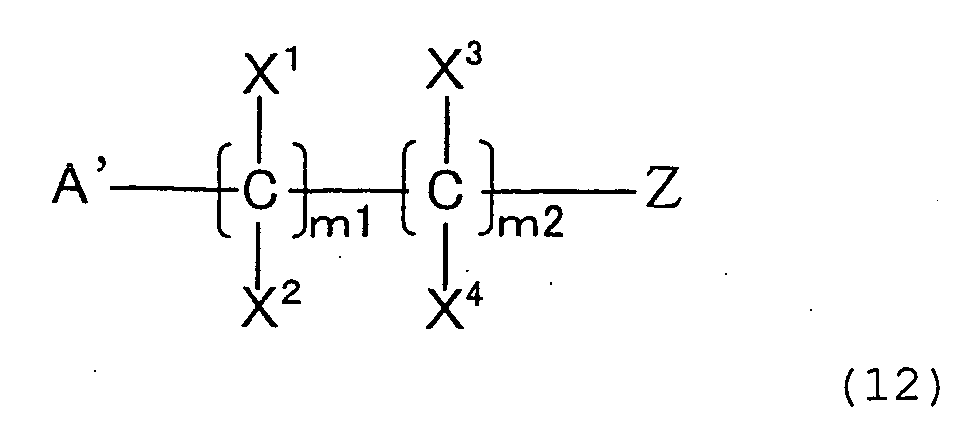
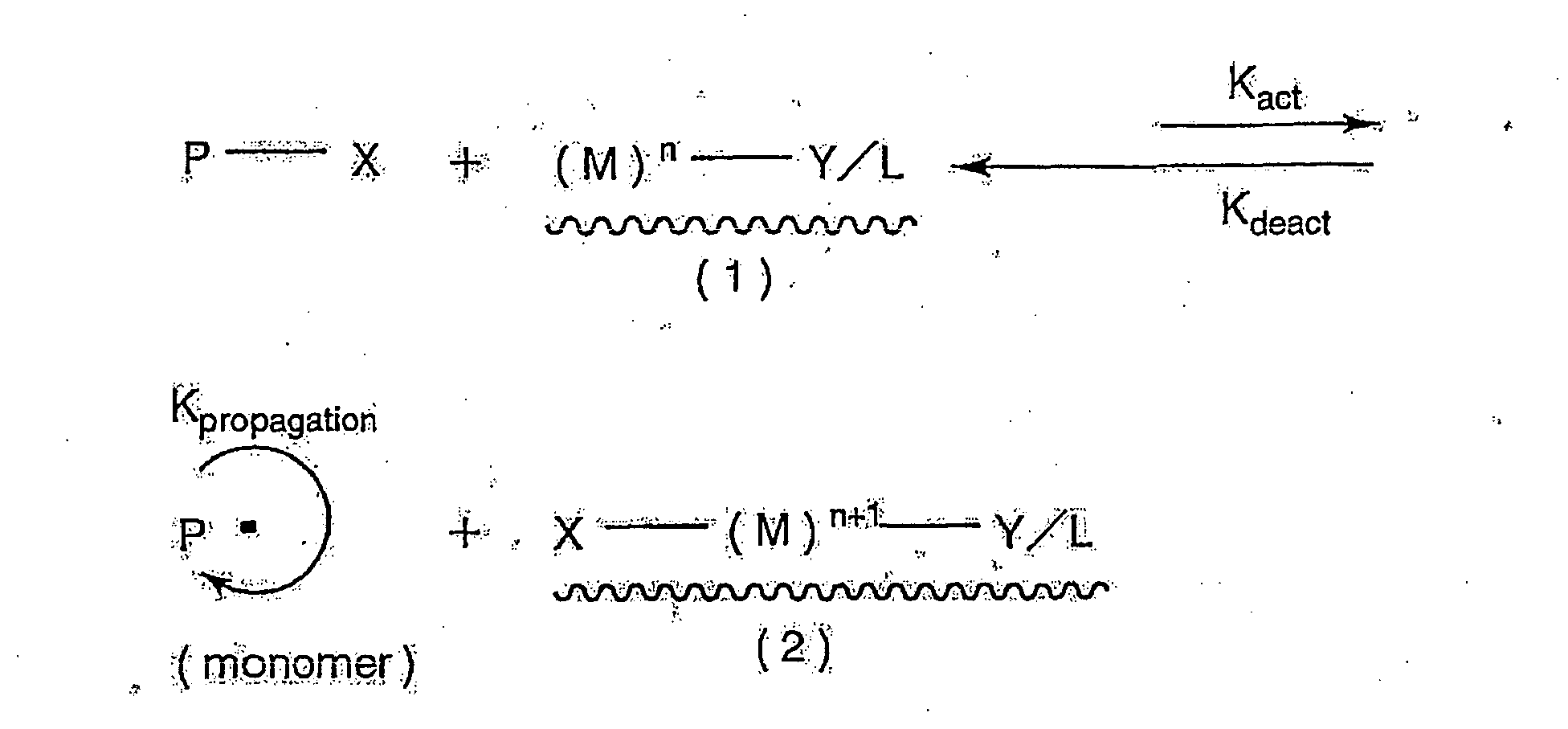
| Average molar composition ratio | |||
| Mn | MA | BzMA | St |
| 4,100 to 9,500 | 38.2 | 57.3 | 4.4 |
| 9,500 to 12,500 | 69.9 | 28.9 | 1.2 |
| 12,500 to 16,500 | 75.6 | 23.9 | 0.5 |
| 16,500 to 18,700 | 91.7 | 8.3 | 0.0 |
| 18,700 to 19,400 | 100 | 0 | 0 |
| Average molar composition ratio | |||
| Mn | MA | BzMA | St |
| 9,300 to 12,200 | 24.6 | 68.9 | 6.5 |
| 12,200 to 14,600 | 69.9 | 29.0 | 1.1 |
| 14,600 to 15,700 | 79.1 | 20.9 | 0.0 |
| 15,700 to 16,900 | 91.2 | 8.8 | 0.0 |
| Average molar composition ratio | |||
| Mn | MA | BzMA | St |
| 4,400 to 7,800 | 45.7 | 50.0 | 4.4 |
| 7,800 to 12,600 | 54.0 | 43.7 | 2.3 |
| 12,600 to 15,100 | 71.8 | 27.6 | 0.6 |
| 15,100 to 17,300 | 90.0 | 10.0 | 0.0 |
| Average molar composition ratio | ||||
| Mn | | BzMA | St | |
| 0 to 3,100 | 31.7 | 62.0 | 6.3 | |
| 3,100 to 5,800 | 52.8 | 44.0 | 3.2 | |
| 5,800 to 8,900 | 69.0 | 30.5 | 0.5 | |
| 8,900 to 11,900 | 77.5 | 22.5 | 0.0 | |
| 11,900 to 13,600 | 93.2 | 6.8 | 0 |
| (Preparation of recording liquid) | |
| Pigment dispersion A | 3.75 g |
| B-A (10% aqueous solution) | 0.5 g |
| Deionized water | 4.135 g |
| Diethylene glycol | 0.5 g |
| Glycerin | 0.5 g |
| Trimethylolpropane | 0.6 g |
| Olefin E1010 (surfactant manufactured by Air Products and Chemicals, Inc.) | 0.015 g |
| (Preparation of recording liquid) | |
| Pigment dispersion E | 5 g |
| Deionized water | 3.385 g |
| Diethylene glycol | 0.5 g |
| Glycerin | 0.5 g |
| Trimethylolpropane | 0.6 g |
| Olefin E1010 (surfactant manufactured by Air Products and Chemicals, Inc.) | 0.015 g |

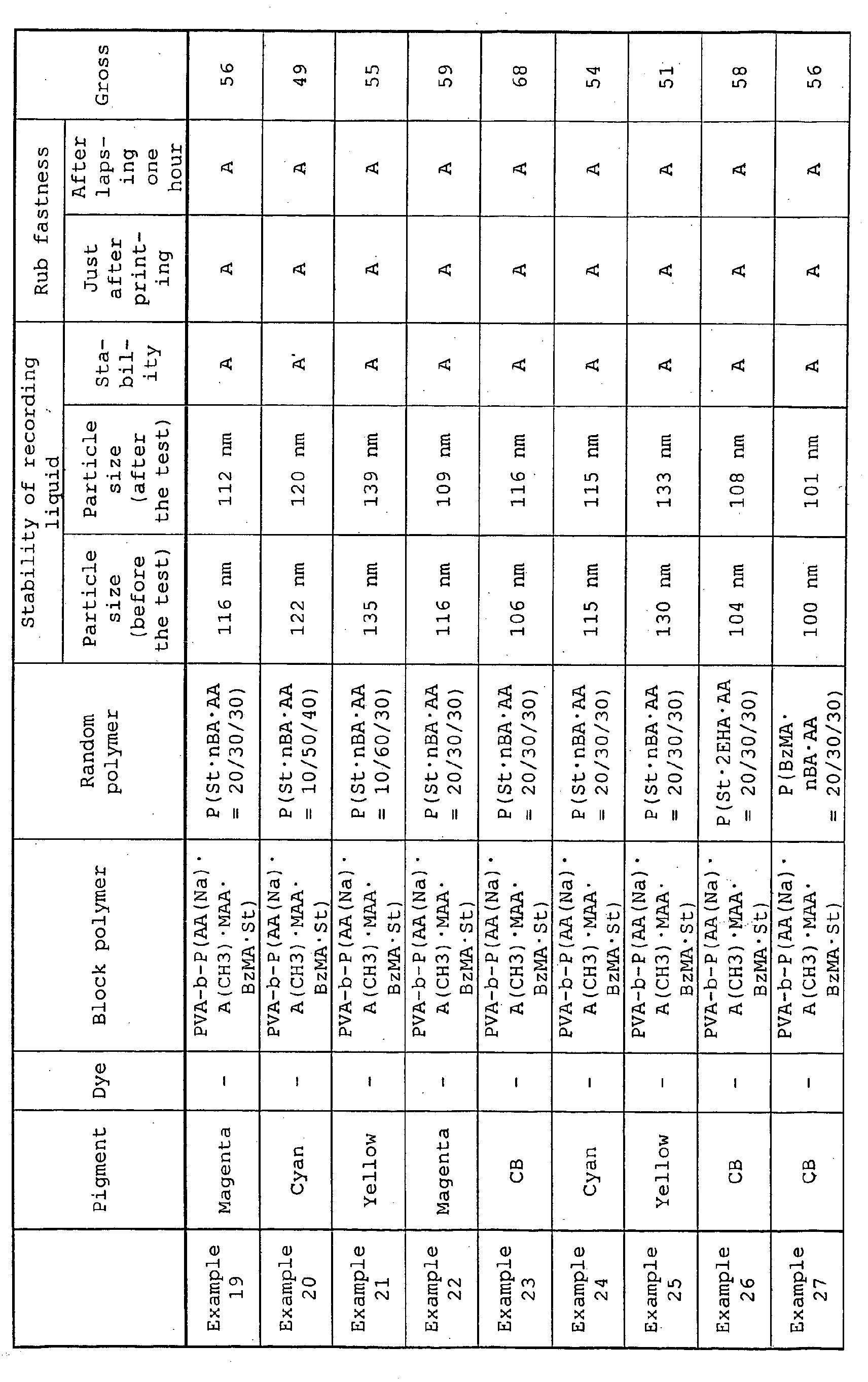


Claims (13)
- A polyvinyl alcohol based block copolymer represented by the following general formula (1):(wherein A represents a polyvinyl alcohol based block; B represents a block containing a hydrophobic segment B' and a hydrophilic or hydrophobic segment B" other than A and B' ; X1, X2, X3, and X4 each independently represents a hydrogen atom, a halogen atom, an alkyl group, an alkenyl group, an aralkyl group, or an aryl group; ml represents an integer of from 1 to 5; m2 represents an integer of from 0 to 4; and (ml +.m2) represents an integer of from 1 to 5).
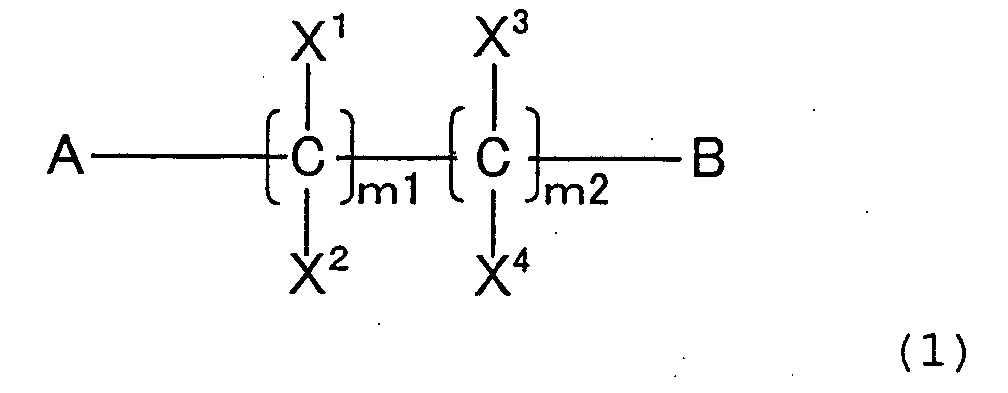
- The polyvinyl alcohol based block copolymer according to claim 1, characterized in that the polyvinyl alcohol based block A in the general formula (1) has a molecular weight of 500 or more and not more than 100,000.
- The polyvinyl alcohol based block copolymer according to claim 1 or 2, characterized in that the segments B' and B" in the block B are aligned in the order of B' and B" from the side near A.
- The polyvinyl alcohol based block copolymer according to any one of claims 1 to 3, characterized in that the block B is a gradient copolymer.
- The polyvinyl alcohol based block copolymer according to any one of claims 1 to 4, characterized in that the polyvinyl alcohol based block A has a molecular weight of from 500 to 50,000; and that the block B has a molecular weight of from 500 to 50,000.
- The polyvinyl alcohol based block copolymer according to any one of claims 1 to 5, characterized in that A in the general formula (1) is represented by any one of the following general formulae (2) to (5):
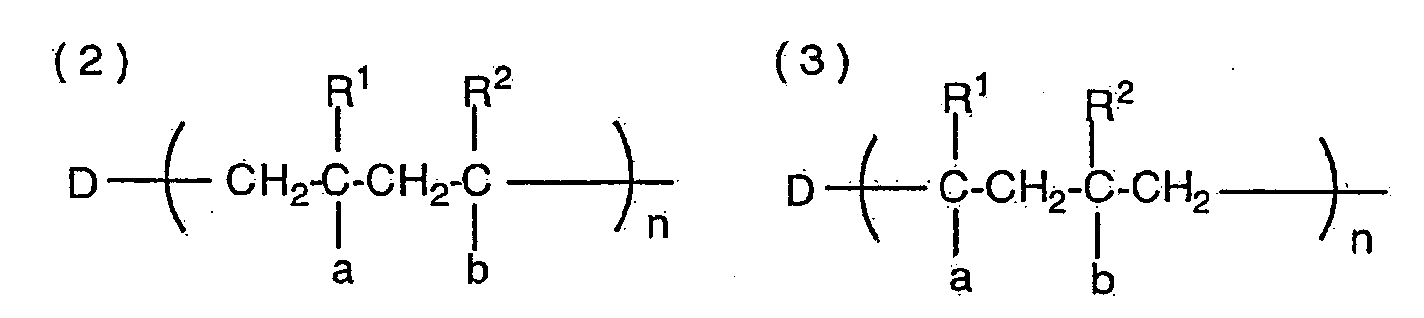 (wherein a and b each represents -OH or -OCOR3, (wherein R3 represents a hydrogen atom, an alkyl group, an alkenyl group, an aryl group, or an aralkyl group, provided that the case where a and b represent -OCOR3 at the same time is excluded); R1 and R2 each independently represents a hydrogen atom or a hydrocarbon group having from 1 to 6 carbon atoms; n represents an integer of from 1 to 1,000; and D is represented by the following general formula (6) or (7):
 (wherein R4 represents a hydrogen atom or a hydrocarbon group having from 1 to 6 carbon atoms; and R5 represents -OH or -OCORA, (wherein RA represents a hydrogen atom, an alkyl group, an alkenyl group, an aryl group, or an aralkyl group))); and that B in the general formula (1) is represented by any one of the following general formulae (8) to (11):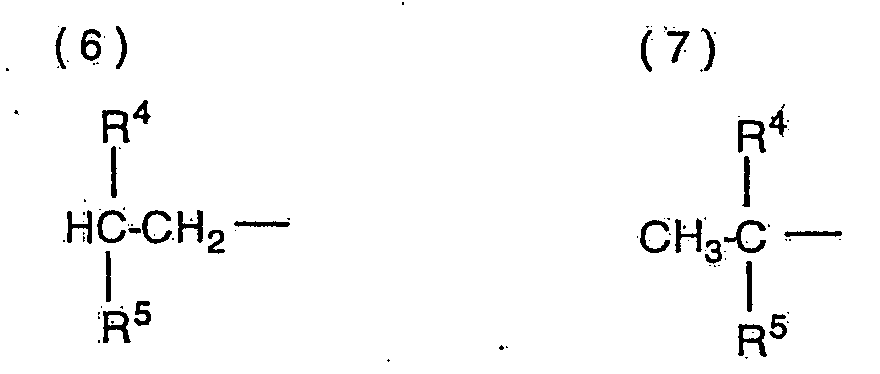
 (wherein R6 represents a hydrogen atom, a halogen atom, a cyano group, or an alkyl group having from 1 to 10 carbon atoms; R7 represents a hydrogen atom, a hydroxyl group, a halogen atom, a cyano group, a carboxyl group, a carboxylato salt, an aminocarbonyl group, an alkyl group, an acyloxy group, an alkenyl group, an aryl group, or an alkoxycarbonyl group; R8 represents a hydrogen atom, a halogen atom, an alkyl group, an alkyl ether group, an alkenyl group, an aryl group, an aralkyl group, or an acyloxy group; and 1 represents an integer of from 1 to 1,000).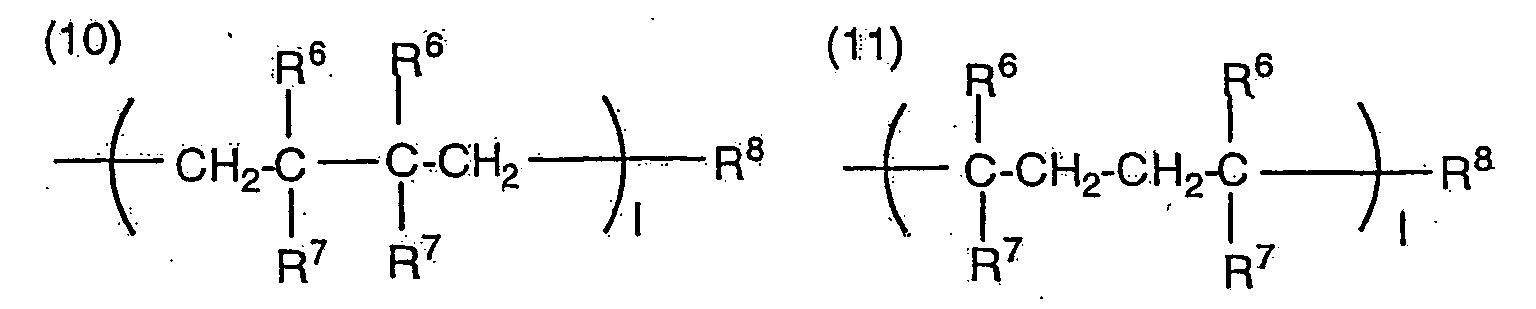
- A pigment dispersion aqueous liquid containing at least a pigment and a polyvinyl alcohol based block copolymer represented by the following general formula (1) in an aqueous medium:(wherein A represents a polyvinyl alcohol based block; B represents a block containing a hydrophobic segment B' and a hydrophilic or hydrophobic segment B" other than A and B' ; X1, X2, X3, and X4 each independently represents a hydrogen atom, a halogen atom, an alkyl group, an alkenyl group, an aralkyl group, or an aryl group; m1 represents an integer of from 1 to 5; m2 represents an integer of from 0 to 4; and (m1 + m2) represents an integer of from 1 to 5).

- The pigment dispersion aqueous liquid according to claim 7, characterized in that the polyvinyl alcohol based block copolymer is the polyvinyl alcohol based block copolymer as according to any one of claims 2 to 6.
- The pigment dispersion aqueous liquid according to claim 7 or 8, characterized in that the pigment is one or two or more pigments selected from the group consisting of phthalocyanine based pigments, anthrapyrimidine pigments, anthanthrone based pigments, indanthrone based pigments, flavanthrone based pigments, perylene based pigments, diketopyrrolopyrrole based pigments, perinone based pigments, quinophthalone based pigments, anthraquinone based pigments, thioindigo based pigments, quinacridone based pigments, quinacridone quinone based pigments, xanthene based pigments, anthanthrone based pigments, dioxazine based pigments, monoazo based pigments, disazo based pigments, azomethine based pigments, carbon black, metal complex based pigments, and inorganic pigments.
- The pigment dispersion aqueous liquid according to any one of claims 7 to 9, characterized in that a weight ratio of the pigment to the polyvinyl alcohol based block copolymer is from 1:0.01 to 1:2.
- The pigment dispersion aqueous liquid according to any one of claims 7 to 10, characterized by further containing a copolymer containing a hydrophobic segment and a hydrophilic segment other than a polyvinyl alcohol based block, with a weight ratio of said copolymer to the polyvinyl alcohol based block copolymer being from 99:1 to 1:99.
- The pigment dispersion aqueous liquid according to claim 11, characterized in that the copolymer containing a hydrophobic segment and a hydrophilic segment other than a polyvinyl alcohol based block is a random copolymer.
- A recording liquid containing the pigment dispersion aqueous liquid according to any one of claims 7 to 12.
Applications Claiming Priority (5)
| Application Number | Priority Date | Filing Date | Title |
|---|---|---|---|
| JP2003099276 | 2003-04-02 | ||
| JP200399276 | 2003-04-02 | ||
| JP2003164779 | 2003-06-10 | ||
| JP2003164779 | 2003-06-10 | ||
| PCT/JP2004/004659 WO2004090006A1 (en) | 2003-04-02 | 2004-03-31 | Polyvinyl alcohol block copolymer and aqueous pigment dispersions and recording fluids made by using the same |
Publications (2)
| Publication Number | Publication Date |
|---|---|
| EP1609807A1 true EP1609807A1 (en) | 2005-12-28 |
| EP1609807A4 EP1609807A4 (en) | 2006-06-14 |
Family
ID=33161492
Family Applications (1)
| Application Number | Title | Priority Date | Filing Date |
|---|---|---|---|
| EP04724816A Withdrawn EP1609807A4 (en) | 2003-04-02 | 2004-03-31 | COPOLYMER POLYVINYL ALCOHOL SEQUENCE AND AQUEOUS PIGMENT DISPERSIONS, RECORDING FLUIDS PREPARED THEREFROM |
Country Status (4)
| Country | Link |
|---|---|
| US (1) | US7348382B2 (en) |
| EP (1) | EP1609807A4 (en) |
| JP (1) | JP5333309B2 (en) |
| WO (1) | WO2004090006A1 (en) |
Cited By (4)
| Publication number | Priority date | Publication date | Assignee | Title |
|---|---|---|---|---|
| EP1780247A2 (en) | 2005-10-28 | 2007-05-02 | Canon Kabushiki Kaisha | Aqueous ink, ink jet recording method, ink cartridge, recording unit and ink jet recording apparatus |
| EP1780246A1 (en) * | 2005-10-28 | 2007-05-02 | Canon Kabushiki Kaisha | Aqueous ink, ink jet recording method, ink cartridge, recording unit and ink jet recording apparatus |
| WO2013023262A1 (en) * | 2011-08-12 | 2013-02-21 | Jeporu S.A. | Non-toxic paint suitable for artistic or didactic expression |
| CN113227018A (en) * | 2018-10-30 | 2021-08-06 | 毕克化学有限公司 | Ceramic slurry composition and method for producing laminated ceramic part |
Families Citing this family (13)
| Publication number | Priority date | Publication date | Assignee | Title |
|---|---|---|---|---|
| JP3127258B2 (en) | 1996-04-17 | 2001-01-22 | 株式会社キッツ | Method of forming ball for ball valve |
| KR101166014B1 (en) * | 2005-02-28 | 2012-07-19 | 삼성에스디아이 주식회사 | A composition for preparing an electron emitter, the electron emitter prepared using the composition, and an electron emission device comprising the electron emitter |
| DE602006013566D1 (en) * | 2005-10-28 | 2010-05-27 | Canon Kk | Aqueous ink, ink jet recording method, ink cartridge, recording unit and ink jet recording apparatus |
| US8188179B2 (en) * | 2006-12-14 | 2012-05-29 | Canon Kabushiki Kaisha | Ink-jet recording pigment ink |
| KR101750907B1 (en) | 2008-03-20 | 2017-06-27 | 애버리 데니슨 코포레이션 | Acrylic polymers having controlled placement of functional groups |
| JP5429759B2 (en) | 2009-02-18 | 2014-02-26 | エルジー・ケム・リミテッド | Resin composition, optical film, and liquid crystal display device |
| KR101849686B1 (en) | 2010-05-19 | 2018-04-17 | 애버리 데니슨 코포레이션 | Ordered architectures in acrylic polymers |
| US8536275B2 (en) * | 2010-06-30 | 2013-09-17 | Lg Chem, Ltd. | Acryl-based copolymers and optical film including the same |
| KR101939108B1 (en) | 2011-10-14 | 2019-01-16 | 애버리 데니슨 코포레이션 | Controlled architecture polymers |
| EP2847285B1 (en) | 2012-05-07 | 2016-07-13 | Rhodia Operations | Aqueous coatings and paints incorporating one or more antimicrobial biosurfactants and methods for using same |
| US11111319B2 (en) * | 2016-03-31 | 2021-09-07 | Kuraray Co., Ltd. | Polyvinyl alcohol |
| EP3877470A4 (en) | 2018-11-05 | 2022-08-03 | Rhodia Operations | Aqueous coatings containing biosurfactants as bio-adjuvants and methods for using same |
| TWI836106B (en) * | 2019-06-28 | 2024-03-21 | 日商可樂麗股份有限公司 | Vinyl alcohol-based block copolymer and method for producing same |
Family Cites Families (18)
| Publication number | Priority date | Publication date | Assignee | Title |
|---|---|---|---|---|
| US4002589A (en) * | 1975-01-13 | 1977-01-11 | Calgon Corporation | Preparation of water soluble segmented polymers |
| JPH0674304B2 (en) * | 1983-04-08 | 1994-09-21 | 株式会社クラレ | Method for producing block copolymer containing polyvinyl alcohol polymer as one component |
| JPH0674305B2 (en) * | 1983-04-08 | 1994-09-21 | 株式会社クラレ | Method for producing block copolymer containing polyvinyl ester polymer as one component |
| JPS60226535A (en) * | 1984-04-24 | 1985-11-11 | Mitsubishi Kasei Vinyl Co | Method for manufacturing resin molded products with hydrophilic surfaces |
| US4638024A (en) * | 1984-05-14 | 1987-01-20 | Kuraray Co., Ltd. | Polymer composition comprising a protein and a block copolymer which contains a polyvinyl alcohol polymer unit and an ionic polymer unit |
| JPS61130349A (en) * | 1984-11-29 | 1986-06-18 | Kuraray Co Ltd | High-molecular porous body |
| JP2565511B2 (en) | 1987-09-17 | 1996-12-18 | 株式会社クラレ | Dispersion stabilizer for suspension polymerization of vinyl chloride |
| JPH03290402A (en) * | 1990-04-06 | 1991-12-20 | Kuraray Co Ltd | Dispersion stabilizer for suspension polymerization of vinyl chloride-based monomer |
| JPH08134401A (en) | 1990-12-28 | 1996-05-28 | Toyobo Co Ltd | Water-base coating composition and production thereof |
| JP3285622B2 (en) * | 1992-10-27 | 2002-05-27 | 株式会社クラレ | Block copolymer |
| JPH06134401A (en) * | 1992-10-30 | 1994-05-17 | Sumitomo Cement Co Ltd | Powder raw material classifier |
| JPH06228214A (en) * | 1993-02-04 | 1994-08-16 | Kuraray Co Ltd | Production of vinyl resin |
| US5672424A (en) * | 1996-06-03 | 1997-09-30 | Xerox Corporation | Ink jet transparencies |
| JP3630858B2 (en) * | 1996-07-10 | 2005-03-23 | 株式会社クラレ | Block copolymer |
| JPH10130347A (en) * | 1996-10-25 | 1998-05-19 | Asahi Glass Co Ltd | Polymer production method |
| JP2001019770A (en) * | 1999-07-07 | 2001-01-23 | Kuraray Co Ltd | Polyvinyl alcohol-based graft polymer, polyvinyl alcohol-based block polymer and methods for producing them |
| JP4361659B2 (en) * | 2000-02-22 | 2009-11-11 | 株式会社クラレ | Ceramic molding binder |
| JP2002241451A (en) * | 2000-12-15 | 2002-08-28 | Nippon Synthetic Chem Ind Co Ltd:The | Resin composition and its use |
-
2004
- 2004-03-31 EP EP04724816A patent/EP1609807A4/en not_active Withdrawn
- 2004-03-31 WO PCT/JP2004/004659 patent/WO2004090006A1/en not_active Ceased
-
2005
- 2005-10-03 US US11/240,619 patent/US7348382B2/en not_active Expired - Lifetime
-
2010
- 2010-03-23 JP JP2010066533A patent/JP5333309B2/en not_active Expired - Fee Related
Cited By (8)
| Publication number | Priority date | Publication date | Assignee | Title |
|---|---|---|---|---|
| EP1780247A2 (en) | 2005-10-28 | 2007-05-02 | Canon Kabushiki Kaisha | Aqueous ink, ink jet recording method, ink cartridge, recording unit and ink jet recording apparatus |
| EP1780246A1 (en) * | 2005-10-28 | 2007-05-02 | Canon Kabushiki Kaisha | Aqueous ink, ink jet recording method, ink cartridge, recording unit and ink jet recording apparatus |
| EP1780247A3 (en) * | 2005-10-28 | 2007-09-19 | Canon Kabushiki Kaisha | Aqueous ink, ink jet recording method, ink cartridge, recording unit and ink jet recording apparatus |
| US8324293B2 (en) | 2005-10-28 | 2012-12-04 | Canon Kabushiki Kaisha | Aqueous ink, ink jet recording method, ink cartridge, recording unit and ink jet recording apparatus |
| US8367750B2 (en) | 2005-10-28 | 2013-02-05 | Canon Kabushiki Kaisha | Aqueous ink, ink jet recording method, ink cartridge, recording unit and ink jet recording apparatus |
| US8741984B2 (en) | 2005-10-28 | 2014-06-03 | Canon Kabushiki Kaisha | Aqueous ink, ink jet recording method, ink cartridge, recording unit and ink jet recording apparatus |
| WO2013023262A1 (en) * | 2011-08-12 | 2013-02-21 | Jeporu S.A. | Non-toxic paint suitable for artistic or didactic expression |
| CN113227018A (en) * | 2018-10-30 | 2021-08-06 | 毕克化学有限公司 | Ceramic slurry composition and method for producing laminated ceramic part |
Also Published As
| Publication number | Publication date |
|---|---|
| JP2010209336A (en) | 2010-09-24 |
| EP1609807A4 (en) | 2006-06-14 |
| US20060089423A1 (en) | 2006-04-27 |
| WO2004090006A1 (en) | 2004-10-21 |
| JP5333309B2 (en) | 2013-11-06 |
| US7348382B2 (en) | 2008-03-25 |
Similar Documents
| Publication | Publication Date | Title |
|---|---|---|
| JP5333309B2 (en) | Polyvinyl alcohol block copolymer and aqueous pigment dispersion using the same | |
| KR101441141B1 (en) | An inkjet ink composition comprising a modified colorant, and a modified colorant | |
| JP3172696B2 (en) | Ink for inkjet printing | |
| JP5359102B2 (en) | Ink set and ink jet recording method using the same | |
| US20060211791A1 (en) | Inkjet inks comprising modified pigments having attached polymeric groups | |
| US20100010148A1 (en) | Aqueous pigment dispersion, method for producing the same, and recording liquid containing the same | |
| JP5251186B2 (en) | Aqueous pigment dispersion, ink composition, and inkjet recording method | |
| JP2009079209A (en) | Aqueous pigment dispersion, ink composition, and inkjet recording method | |
| JP6836731B2 (en) | Ink set and printed matter manufacturing method | |
| CN101351509B (en) | Modified colorant and inkjet ink composition comprising modified colorant | |
| US20050132931A1 (en) | Block copolymeric dispersant for pigment particle in aqueous system, and ink composition comprising the same | |
| JP4525142B2 (en) | Polyvinyl alcohol block copolymer and aqueous pigment dispersion using the same | |
| JP2008195769A (en) | Block polymer compound, liquid composition, and inkjet ink | |
| JP2010037419A (en) | Ink set and inkjet image recording method using the same | |
| JP2010070749A (en) | Pigment dispersion liquid, ink composition, and inkjet recording method | |
| CN115386031A (en) | Seeded emulsion polymerization process for latex and aqueous inkjet ink compositions prepared therefrom | |
| JP2010006981A (en) | Aqueous pigment dispersion for printing, ink composition and inkjet recording method | |
| CN100402570C (en) | Polyvinyl alcohol block copolymer, and aqueous pigment dispersion and recording fluid using same | |
| JP2008174731A (en) | Aqueous pigment dispersion and recording liquid for ink jet printer | |
| JP2019026741A (en) | 1,2-alkanediol composition and aqueous mixture | |
| US10647864B2 (en) | Aqueous pigment dispersion, aqueous green ink for inkjet recording, and aqueous red ink for inkjet recording | |
| JP2011219556A (en) | Carbon black dispersion, ink composition, and inkjet recording method | |
| JP5669476B2 (en) | Water-based colorant dispersion, method for producing water-based colorant dispersion, and water-based ink for inkjet recording | |
| EP1846522A1 (en) | Stable pigment dispersions comprising a block copolymer consisting of ionic aromatic monomers | |
| JP2011157450A (en) | Aqueous pigment dispersion liquid and recording liquid |
Legal Events
| Date | Code | Title | Description |
|---|---|---|---|
| PUAI | Public reference made under article 153(3) epc to a published international application that has entered the european phase |
Free format text: ORIGINAL CODE: 0009012 |
|
| 17P | Request for examination filed |
Effective date: 20051004 |
|
| AK | Designated contracting states |
Kind code of ref document: A1 Designated state(s): AT BE BG CH CY CZ DE DK EE ES FI FR GB GR HU IE IT LI LU MC NL PL PT RO SE SI SK TR |
|
| AX | Request for extension of the european patent |
Extension state: AL LT LV MK |
|
| A4 | Supplementary search report drawn up and despatched |
Effective date: 20060427 |
|
| RIC1 | Information provided on ipc code assigned before grant |
Ipc: C09D 11/00 20060101ALI20060421BHEP Ipc: C08L 53/00 20060101ALI20060421BHEP Ipc: C09D 17/00 20060101ALI20060421BHEP Ipc: C08F 293/00 20060101AFI20041026BHEP Ipc: C09D 153/00 20060101ALI20060421BHEP |
|
| DAX | Request for extension of the european patent (deleted) | ||
| RBV | Designated contracting states (corrected) |
Designated state(s): DE FR GB |
|
| RAP1 | Party data changed (applicant data changed or rights of an application transferred) |
Owner name: MITSUBISHI CHEMICAL CORPORATION |
|
| RBV | Designated contracting states (corrected) |
Designated state(s): DE FR GB |
|
| 17Q | First examination report despatched |
Effective date: 20081113 |
|
| RAP1 | Party data changed (applicant data changed or rights of an application transferred) |
Owner name: MITSUBISHI CHEMICAL CORPORATION |
|
| RAP1 | Party data changed (applicant data changed or rights of an application transferred) |
Owner name: MITSUBISHI CHEMICAL CORPORATION |
|
| RAP1 | Party data changed (applicant data changed or rights of an application transferred) |
Owner name: MITSUBISHI CHEMICAL CORPORATION |
|
| RIC1 | Information provided on ipc code assigned before grant |
Ipc: C08F 293/00 20060101AFI20041026BHEP Ipc: C08L 53/00 20060101ALI20060421BHEP Ipc: C09D 153/00 20060101ALI20060421BHEP Ipc: C09D 17/00 20060101ALI20060421BHEP Ipc: C09D 11/00 20140101ALI20060421BHEP |
|
| GRAP | Despatch of communication of intention to grant a patent |
Free format text: ORIGINAL CODE: EPIDOSNIGR1 |
|
| INTG | Intention to grant announced |
Effective date: 20190318 |
|
| STAA | Information on the status of an ep patent application or granted ep patent |
Free format text: STATUS: THE APPLICATION IS DEEMED TO BE WITHDRAWN |
|
| 18D | Application deemed to be withdrawn |
Effective date: 20190730 |