EP1609671A2 - Module d'habitation pliant destiné à être monté sur le toit d'un véhicule automobile - Google Patents
Module d'habitation pliant destiné à être monté sur le toit d'un véhicule automobile Download PDFInfo
- Publication number
- EP1609671A2 EP1609671A2 EP20050358007 EP05358007A EP1609671A2 EP 1609671 A2 EP1609671 A2 EP 1609671A2 EP 20050358007 EP20050358007 EP 20050358007 EP 05358007 A EP05358007 A EP 05358007A EP 1609671 A2 EP1609671 A2 EP 1609671A2
- Authority
- EP
- European Patent Office
- Prior art keywords
- tray
- module according
- folding house
- house module
- movable
- Prior art date
- Legal status (The legal status is an assumption and is not a legal conclusion. Google has not performed a legal analysis and makes no representation as to the accuracy of the status listed.)
- Pending
Links
- 230000004308 accommodation Effects 0.000 title 1
- 230000006835 compression Effects 0.000 description 3
- 238000007906 compression Methods 0.000 description 3
- 239000004744 fabric Substances 0.000 description 1
- 239000000463 material Substances 0.000 description 1
- 230000000284 resting effect Effects 0.000 description 1
Images

Classifications
-
- B—PERFORMING OPERATIONS; TRANSPORTING
- B60—VEHICLES IN GENERAL
- B60P—VEHICLES ADAPTED FOR LOAD TRANSPORTATION OR TO TRANSPORT, TO CARRY, OR TO COMPRISE SPECIAL LOADS OR OBJECTS
- B60P3/00—Vehicles adapted to transport, to carry or to comprise special loads or objects
- B60P3/32—Vehicles adapted to transport, to carry or to comprise special loads or objects comprising living accommodation for people, e.g. caravans, camping, or like vehicles
- B60P3/34—Vehicles adapted to transport, to carry or to comprise special loads or objects comprising living accommodation for people, e.g. caravans, camping, or like vehicles the living accommodation being expansible, collapsible or capable of rearrangement
- B60P3/341—Vehicles adapted to transport, to carry or to comprise special loads or objects comprising living accommodation for people, e.g. caravans, camping, or like vehicles the living accommodation being expansible, collapsible or capable of rearrangement comprising flexible elements
Definitions
- the invention relates to the field of recreation and more specifically that of camping caravanning.
- It relates to a folding housing module intended to be mounted on the roof of a vehicle automobile.
- roof tents consisting essentially of a ferry fixed lower bed support and a movable upper tray that can be lifted from top to form, in collaboration with a side canvas, a shelter for the night.
- Their main disadvantage is to have only a single bed, thereby limiting the interest of their usage.
- their access being at the top of a scale, is perilous.
- awnings that can be joined to the housing module but these awnings are not not deployed at the same time as the housing module and must be mounted in the same way a camping tent.
- the inventor has, in the past, devised a first original solution and described in the patent FR 8310945.
- the main feature of this invention is that the movable upper tray consists of two articulated parts and that during the deployment one of the parts comes along the windshield of the vehicle and the other is supported horizontally at the hood.
- This feature allows the module to have a small footprint when folded, but the height of access remains quite important and there is no provision for a device that makes the easy deployment maneuver.
- the longitudinal profiles of vehicles evolve and this solution is no longer well suited to the plunging windshields of modern vehicles.
- the inventor imagined a second original solution and described in the patent FR
- the main objective of this invention is to aim to reduce the access height of the floor of the module and to facilitate its deployment.
- the main feature is that the movable top tray is in one piece and unfolds on the side of the vehicle by swiveling an angle greater than 200 degrees. This characteristic makes it possible to obtain a trained floor by the inner side wall of the movable upper bin which is of access height reasonable and a module that allows the standing while staying a height above all reasonable.
- This patent also describes the deployment device which consists in pulling the hinged step and the device for compensating the weight of the mobile upper tray constituted by springs sliding gas compressors inside the mobile upper bin and connected to the lower bin fixed by a traction rod device.
- this device has not been completely revealed satisfactory in its operation.
- the geometry of the device is such that at the beginning deployment the weight of the tray can not be sufficiently compensated, which makes its difficult opening and at the end of deployment the weight of the tray is too compensated and when the canvas is put in tension the tray tends to go up.
- the present invention consists of a housing module comprising a movable upper tray articulated around lateral hinges which in a first phase opens automatically by means of a spring up to an angle of more than 20 degrees and in a second phase opens manually up to an angle of more than 200 degrees.
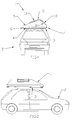
- FIG. 1 represents a front view of the housing module (1) closed, installed on the roof of the vehicle (2) via roof bars (3).
- the housing module consists essentially of a fixed lower tray (4) supporting a mattress and a movable upper tray (5) articulated around hinges (6).
- a closure device (7) secures the two bins when closed.
- the floor is constituted by the inner wall (8) of the movable tray (5).
- the step (9) which allows access to the floor (8) when the movable tray is deployed, is articulated 180 degrees about the axis (10) and held folded by means of clips (11).
- FIG. 2 represents a side view of the closed housing module (1) installed on the roof of the vehicle (2) via roof bar (3).
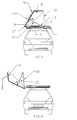
- Figure 3 shows a sectional view of the half-open housing module.
- the mobile container (5) automatically opens under the action of the compression spring (12) to an angle of more than 20 degrees when the spring arrives at the end of the race. Once the tray is opened, it is then possible to take arm end the adjustable lower end (13) of the articulated step and continue manually open the bin to an angle of more than 200 degrees, until the footstep comes to rest on the ground.
- said angles are preferably 40 degrees at the end automatic opening and 220 degrees at the end of manual opening.
- the compression spring (12) is advantageously a gas spring.
- One of the ends (14) is articulated on the movable tray and the other end (15) is articulated on a reaction arm (16) pivoting about an axis (17) close to that of the hinges.
- the spring is at the end of the stroke and the arm leaves its support and pivots with the movable tray (5).
- the lower end (13) of the step (9) is telescopic and can be adjusted in function the height of the vehicle.
- a remarkable consequence of the geometry of the whole deployment device is that when the movable tray (5) is ajar, the height of gripping of the adjustable lower end (13) of the step (9) remains constant and accessible regardless of the height of the vehicle. On the model presented the height of gripping the end of the footboard is 1.95 meters, regardless of the height of the vehicle.
- a strap (18) attached to the movable tray opposite the hinges, allows to draw the tray in compressing the spring to close it.
- FIG. 4 represents a sectional view of the housing module in the second phase manual opening.
- the spring (12) is locked at the end of stroke and the reaction arm (16) has left its support and pivots with the movable tray (5).
- the reaction arm (16) is advantageously constituted by an articulated tray serving as a table.
- This tray is supported on the mattress during the first opening phase, and is parallel to the floor (8) of the tray (5) when the spring (12) is at the end of the race.
- the stiffness of the compression spring is sufficient to maintain the horizontal table when the movable tray (5) is deployed. This results in a table deployment simplified since it is deployed at the same time as the mobile tray.
- Figure 5 shows a sectional view of the fully deployed housing module.
- the telescopic end (13) of the step (9) in contact with the ground is adjusted to such an extent way that the floor formed by the inner side wall (8) of the movable tray (5) is found in the horizontal.
- a bench (19) makes it possible to sit at the table and also serves as a step to access the bed supported by the fixed tray (4).
- the hood (20) is integral with the fixed tray (4) and three arches (21, 22 and 23). It is deployed by rotating the said hoops and maintained on the tray mobile by means of quick fasteners of the pressure type.
- Figure 6 shows a side view of the fully deployed housing module.
- a door (24) closed by a zipper is cut in the fabric to the right of the footstool.
- a handle (25) integral with the table top makes it possible to stand on the input and output of the module.
- the bins are advantageously constructed of sandwich materials to be lightweight and ensure good rigidity. This allows in particular the movable tray resting on the central step not to be veiled under the load.
- the housing module is advantageously equipped comfort accessories for the step (hoop equipped with lighting and table equipped with a sink and a stove).
- the hinges are located to the right of the vehicle but they could be located on the left without departing from the scope of the invention.
- the characteristics of The invention allows the housing module to be mounted on any type of vehicle, be it a sedan, a station wagon, a minivan or an all-terrain vehicle.
Landscapes
- Engineering & Computer Science (AREA)
- Health & Medical Sciences (AREA)
- Public Health (AREA)
- Transportation (AREA)
- Mechanical Engineering (AREA)
- Body Structure For Vehicles (AREA)
Abstract
Le module d'habitation comprend un bac inférieur fixe (4) supportant un matelas et un bac supérieur (5) mobile articulé autour de charnières latérales. Dans une première phase de déploiement le bac mobile (5) s'entrouvre automatiquement au moyen d'un ressort (12) jusqu'à un angle supérieur à 20 degrés et dans une deuxième phase il s'ouvre manuellement jusqu'à un angle supérieur à 200 degrés. Un résultat remarquable de la géométrie de l'ensemble du dispositif de déploiement est que, lorsque le bac mobile (5) est entrouvert, la hauteur de préhension de l'extrémité inférieure réglable (13) du marchepied (9) reste constante et accessible quelque soit la hauteur du véhicule. L'invention concerne le domaine des loisirs et plus spécialement celui du camping caravaning. <IMAGE>
Description
L'invention concerne le domaine des loisirs et plus spécialement celui du camping
caravaning.
Elle a pour objet un module d'habitation pliant destiné à être monté sur le toit d'un véhicule
automobile.
Il existe actuellement sur le marché, des tentes de toit constituées essentiellement d'un bac
inférieur fixe supportant un lit et d'un bac supérieur mobile pouvant être soulevé de bas en
haut de façon à former, en collaboration avec une toile latérale, un abri pour la nuit. Leur
principal inconvénient est de ne disposer que d'un simple lit, limitant par la même l'intérêt de
leur utilisation. De plus leur accès se situant au sommet d'une échelle, est périlleux.
Afin de pouvoir disposer d'un espace plus important qui permette la station debout, il est
prévu des auvents que l'on peut venir accoler au module d'habitation mais ces auvents ne sont
pas déployés en même temps que le module d'habitation et doivent être montés à la façon
d'une tente de camping.
Plusieurs solutions en vue d'offrir un espace plus accueillant, c'est à dire un espace qui
permette la station debout, ont été imaginées mais, à présent, aucune n'a vu le jour sur le
marché.
De telles solutions sont décrites dans les brevets US 3712315 , US 4111479 et FR 2085386.
Le premier brevet décrit un module d'habitation qui ne comporte pas de plancher mais une
simple extension en toile vers l'arrière du véhicule qui permet la station debout. Les deux
autres brevets décrivent un module d'habitation dont le bac supérieur mobile pivote avec un
angle de 180 degrés vers l'avant pour former un plancher au dessus du capot du véhicule.
Mais la hauteur d'accès reste assez importante et il n'est pas décrit de dispositif qui rende la
manoeuvre de déploiement aisée.
En dehors du fait que ces modules doivent être très légers et peu encombrants une fois pliés,
une des principales difficultés de conception est leur dispositif de déploiement. En effet la
hauteur du toit d'un véhicule est telle que la manoeuvre de déploiement se fait toujours à bout
de bras et qu'il est alors difficile d'exercer un couple suffisant pour faire pivoter le ou les bacs
supérieurs mobiles.
L'inventeur a, dans le passé, imaginé une première solution originale et décrite dans le brevet
FR 8310945. La principale caractéristique de cette invention est que le bac supérieur mobile
est formé de deux parties articulées et que lors du déploiement une des parties vient longer le
pare-brise du véhicule et l'autre vient s'appuyer horizontalement au niveau du capot. Cette
caractéristique permet au module d'avoir un faible encombrement une fois plié, mais la
hauteur d'accès reste assez importante et il n'est pas prévu de dispositif qui rende la
manoeuvre de déploiement aisée. De plus, les profils longitudinaux des véhicules évoluent et
cette solution n'est plus bien adaptée aux pare-brises plongeants des véhicules modernes.
L'inventeur a alors imaginé une deuxième solution originale et décrite dans le brevet FR
9907132. Le principal objectif de cette invention est de viser à réduire la hauteur d'accès du
plancher du module et à en faciliter son déploiement. La principale caractéristique est que le
bac supérieur mobile est en une seule partie et se déploie sur le côté du véhicule en pivotant
d'un angle supérieur à 200 degrés. Cette caractéristique permet d'obtenir un plancher formé
par la paroi latérale intérieure du bac supérieur mobile qui est d'une hauteur d'accès
raisonnable et un module qui permet la station debout tout en restant d'une hauteur hors tout
raisonnable.
Ce brevet décrit aussi le dispositif de déploiement qui consiste à tirer le marchepied articulé
et le dispositif de compensation du poids du bac supérieur mobile constitué par des ressorts
de compression à gaz coulissants à l'intérieur du bac supérieur mobile et liés au bac inférieur
fixe par un dispositif de bielle de traction. Toutefois ce dispositif ne s'est pas révélé tout à fait
satisfaisant au niveau de son fonctionnement. La géométrie du dispositif est telle qu'au début
du déploiement le poids du bac ne peut être suffisamment compensé, ce qui rend son
ouverture malaisée et qu'en fin de déploiement le poids du bac est trop compensé et lorsque la
toile est mise en tension le bac a tendance à remonter.
La présente invention consiste en un module d'habitation comportant un bac supérieur mobile
articulé autour de charnières latérales qui dans une première phase s'entrouvre
automatiquement au moyen d'un ressort jusqu'à un angle de plus de 20 degrés et dans une
deuxième phase s'ouvre manuellement jusqu'à un angle de plus de 200 degrés.
On comprendra mieux l'invention en se référant aux figures suivantes :
- Les figures 1 et 2 représentent le module d'habitation fermé et installé sur le véhicule.
- Les figures 3 et 4 représentent le module d'habitation lors des différentes phases de son déploiement.
- Les figures 5 et 6 représentent le module d'habitation entièrement déployé.
La figure 1 représente une vue de face du module d'habitation (1) fermé, installé sur le toit du
véhicule (2) par l'intermédiaire de barres de toit (3).
Le module d'habitation est constitué essentiellement d'un bac inférieur fixe (4) supportant un
matelas et d'un bac supérieur mobile (5) articulé autour de charnières (6).
L'axe de ces charnières est avantageusement surbaissé par rapport au plan de joint des deux
bacs afin que l'effort d'ouverture exercé à bout de bras puisse exercer au niveau du bac
mobile un couple d'ouverture plus important. Un dispositif de fermeture (7) solidarise les
deux bacs lorsqu'ils sont fermés.
Le plancher est constitué par la paroi intérieure (8) du bac mobile (5).
Le marchepied (9) qui permet l'accès au plancher (8) lorsque le bac mobile est déployé, est
articulé sur 180 degrés autour de l'axe (10) et maintenu replié au moyen de clips (11).
La figure 2 représente une vue latérale du module d'habitation fermé (1) installé sur le toit du
véhicule (2) par l'intermédiaire de barre de toit (3).
La figure 3 représente une vue en coupe du module d'habitation entrouvert. A la suite de
l'ouverture du dispositif de fermeture (7), le bac mobile (5) s'entrouvre automatiquement sous
l'action du ressort de compression (12), jusqu'à un angle de plus de 20 degrés lorsque le
ressort arrive en fin de course. Une fois le bac entrouvert, il est alors possible de prendre à
bout de bras l'extrémité inférieure réglable (13) du marchepied articulé et de continuer
manuellement l'ouverture du bac jusqu'à un angle de plus de 200 degrés, jusqu'à ce que le
marchepied vienne s'appuyer sur le sol.
Sur le module d'habitation présenté, lesdits angles sont préférentiellement de 40 degrés en fin
d'ouverture automatique et de 220 degrés en fin d'ouverture manuelle.
Le ressort de compression (12) est avantageusement un ressort à gaz. Une des extrémités (14)
est articulée sur le bac mobile et l'autre extrémité (15) est articulée sur un bras de réaction
(16) pivotant autour d'un axe (17) proche de celui des charnières. Lors de la première phase
d'ouverture automatique le bras de réaction (16) reste en appui sur le bac fixe (4) et lors de la
deuxième phase d'ouverture manuelle, le ressort est en fin de course et le bras quitte alors son
appui et pivote avec le bac mobile (5).
L'extrémité inférieure (13) du marchepied (9) est télescopique et peut être réglée en fonction
de la hauteur du véhicule. Une conséquence remarquable de la géométrie de l'ensemble du
dispositif de déploiement est que, lorsque le bac mobile (5) est entrouvert, la hauteur de
préhension de l'extrémité inférieure réglable (13) du marchepied (9) reste constante et
accessible quelque soit la hauteur du véhicule. Sur le modèle présenté la hauteur de
préhension de l'extrémité du marchepied est de 1.95 mètres, quelque soit la hauteur du
véhicule.
Une sangle (18) fixée sur le bac mobile côté opposé aux charnières, permet de tirer le bac en
comprimant le ressort afin de le refermer.
La figure 4 représente une vue en coupe du module d'habitation dans la deuxième phase
d'ouverture manuelle. Le ressort (12) est bloqué en fin de course et le bras de réaction (16) a
quitté son appui et pivote avec le bac mobile (5).
Sur le module d'habitation présenté le bras de réaction (16) est constitué avantageusement par
un plateau articulé faisant office de table. Ce plateau prend appui sur le matelas lors de la
première phase d'ouverture, et est parallèle au plancher (8) du bac (5) lorsque le ressort (12)
est en fin de course. La raideur du ressort de compression est suffisante pour maintenir la
table horizontale lorsque le bac mobile (5) est déployé. Il en résulte un déploiement de la table
simplifié puisqu'elle est déployée en même temps que le bac mobile.
La figure 5 représente une vue en coupe du module d'habitation entièrement déployé.
L'extrémité télescopique (13) du marchepied (9) en contact avec le sol est réglée de telle
façon que le plancher formé par la paroi latérale intérieure (8) du bac mobile (5) se retrouve à
l'horizontale. Un banc (19) permet de s'asseoir à table et sert aussi de marche pour accéder au
lit supporté par le bac fixe (4). La capote (20) est solidaire du bac fixe (4) et des trois arceaux
(21, 22 et 23). Elle est déployée en faisant pivoter les dits arceaux et maintenue sur le bac
mobile au moyen de fixations rapides du type pressions.
La figure 6 représente une vue latérale du module d'habitation entièrement déployé. Une
porte (24) fermée par une fermeture à glissière est découpée dans la toile au droit du
marchepied. Une poignée (25) solidaire du plateau de la table permet de se tenir lors de
l'entrée et de la sortie du module.
Les bacs sont avantageusement construits en matériaux sandwich pour être léger et assurer
une bonne rigidité. Cela permet notamment au bac mobile en appui sur le marchepied central
de ne pas se voiler sous la charge. Le module d'habitation est avantageusement équipé
d'accessoires de confort pour l'étape (arceau équipé d'un éclairage et table équipée d'un évier
et d'un réchaud).
Dans l'exemple représenté les charnières sont situées à droite du véhicule mais elles
pourraient être situées à gauche sans sortir du cadre de l'invention. Les caractéristiques de
l'invention permettent au module d'habitation de se monter sur n'importe quel type de
véhicule, que ce soit une berline, un break, un monospace ou un véhicule tout terrain.
Claims (11)
- Module d'habitation pliant (1) destiné à être monté sur le toit d'un véhicule (2) comportant un bac inférieur fixe (4) supportant un matelas et un bac supérieur (5) mobile articulé autour de charnières latérales (6) caractérisé en ce que dans une première phase de déploiement le bac mobile (5) s'entrouvre automatiquement au moyen d'un ressort (12) jusqu'à un angle supérieur à 20 degrés et que dans une deuxième phase il s'ouvre manuellement jusqu'à un angle supérieur à 200 degrés.
- Module d'habitation pliant suivant la revendication 1 caractérisé à ce que les dits angles sont respectivement de 40 degrés et de 220 degrés.
- Module d'habitation pliant suivant la revendication 1 et 2 caractérisé en ce qu'une des extrémités (14) du ressort (12) est articulée sur le bac mobile (5) et que l'autre extrémité (15) est articulée sur un bras de réaction (16) articulé près de l'axe des charnières latérales (6).
- Module d'habitation pliant suivant la revendication 3 caractérisé en ce que, lors de la première phase d'ouverture, le bras de réaction (16) reste en appui sur le bac fixe (4).
- Module d'habitation pliant suivant les revendications 3 et 4 caractérisé en ce que, lors de la deuxième phase d'ouverture, le bras de réaction (16) quitte son appui et pivote avec le bac mobile (5).
- Module d'habitation pliant suivant l'une des revendications 3,4 et 5 caractérisé en ce que le bras de réaction (16) est constitué par un plateau articulé faisant office de table.
- Module d'habitation pliant suivant la revendication 1 caractérisé en ce que la deuxième phase de déploiement est effectuée manuellement en prenant l'extrémité réglable (13) d'un marchepied (9) articulé sur le bac mobile (5).
- Module d'habitation pliant suivant la revendication 7 caractérisé en ce que le marchepied (9) est articulé sur un angle de 180 degrés entre la position repliée et la position déployée.
- Module d'habitation pliant suivant l'une des revendications 1, 7 et 8 caractérisé en ce que le bac mobile (5) repose sur le marchepied (9) lorsqu'il est déployé.
- Module d'habitation pliant suivant l'une des revendications 1 et 2 caractérisé en ce qu'une sangle (23) est fixée sur le bac mobile (5) côté opposé aux charnières latérales (6) afin de le refermer.
- Module d'habitation pliant suivant l'une des revendications 1 et 2 caractérisé en ce que l'axe des charnières (6) est surbaissé par rapport au plan de joint des deux bacs.
Applications Claiming Priority (2)
| Application Number | Priority Date | Filing Date | Title |
|---|---|---|---|
| FR0406703 | 2004-06-21 | ||
| FR0406703A FR2871749A1 (fr) | 2004-06-21 | 2004-06-21 | Module d'habitation pliant destine a etre monte sur le toit d'un vehicule automobile |
Publications (1)
| Publication Number | Publication Date |
|---|---|
| EP1609671A2 true EP1609671A2 (fr) | 2005-12-28 |
Family
ID=35124475
Family Applications (1)
| Application Number | Title | Priority Date | Filing Date |
|---|---|---|---|
| EP20050358007 Pending EP1609671A2 (fr) | 2004-06-21 | 2005-06-17 | Module d'habitation pliant destiné à être monté sur le toit d'un véhicule automobile |
Country Status (2)
| Country | Link |
|---|---|
| EP (1) | EP1609671A2 (fr) |
| FR (1) | FR2871749A1 (fr) |
Cited By (1)
| Publication number | Priority date | Publication date | Assignee | Title |
|---|---|---|---|---|
| GR1006749B (el) * | 2009-02-03 | 2010-04-08 | Εμμανουηλ Ξαγοραρακης | Νεου τυπου πτυσσομενη κατασκευη σπιτιου προσαρτωμενου στην οροφη του αυτοκινητου |
Citations (5)
| Publication number | Priority date | Publication date | Assignee | Title |
|---|---|---|---|---|
| FR2085386A1 (fr) | 1970-04-16 | 1971-12-24 | Guerin Robert | |
| US3712315A (en) | 1971-03-31 | 1973-01-23 | E Franzen | Collapsible shelter for mounting on a transportation vehicle |
| US4111479A (en) | 1977-06-15 | 1978-09-05 | The Raymond Lee Organization, Inc. | Vehicle top camper |
| FR2548109A1 (fr) | 1983-06-29 | 1985-01-04 | Valdy Pierre | Module d'habitation pliant destine a etre monte sur le toit d'un vehicule automobile |
| FR2794410A1 (fr) | 1999-06-02 | 2000-12-08 | Pierre Gabriel Valdy | Module d'habitation pliant destine a etre monte sur le toit d'un vehicule automobile |
-
2004
- 2004-06-21 FR FR0406703A patent/FR2871749A1/fr active Pending
-
2005
- 2005-06-17 EP EP20050358007 patent/EP1609671A2/fr active Pending
Patent Citations (5)
| Publication number | Priority date | Publication date | Assignee | Title |
|---|---|---|---|---|
| FR2085386A1 (fr) | 1970-04-16 | 1971-12-24 | Guerin Robert | |
| US3712315A (en) | 1971-03-31 | 1973-01-23 | E Franzen | Collapsible shelter for mounting on a transportation vehicle |
| US4111479A (en) | 1977-06-15 | 1978-09-05 | The Raymond Lee Organization, Inc. | Vehicle top camper |
| FR2548109A1 (fr) | 1983-06-29 | 1985-01-04 | Valdy Pierre | Module d'habitation pliant destine a etre monte sur le toit d'un vehicule automobile |
| FR2794410A1 (fr) | 1999-06-02 | 2000-12-08 | Pierre Gabriel Valdy | Module d'habitation pliant destine a etre monte sur le toit d'un vehicule automobile |
Cited By (1)
| Publication number | Priority date | Publication date | Assignee | Title |
|---|---|---|---|---|
| GR1006749B (el) * | 2009-02-03 | 2010-04-08 | Εμμανουηλ Ξαγοραρακης | Νεου τυπου πτυσσομενη κατασκευη σπιτιου προσαρτωμενου στην οροφη του αυτοκινητου |
Also Published As
| Publication number | Publication date |
|---|---|
| FR2871749A1 (fr) | 2005-12-23 |
Similar Documents
| Publication | Publication Date | Title |
|---|---|---|
| FR2842159A1 (fr) | Poussette pliable | |
| FR2724138A1 (fr) | Dispositif definissant un espace de rangement, pour vehicules comportant un toit rabattable | |
| EP0005382B1 (fr) | Caravane pliante en toile | |
| FR3087466A1 (fr) | Tente pliable comprenant deux structures parapluies | |
| FR2617449A1 (fr) | Perfectionnements aux unites mobiles habitables extensibles | |
| EP2593331A1 (fr) | Vehicule comprenant un siege escamotable en deux temps | |
| WO2010004111A4 (fr) | Paroi escamotable de séparation et d'assise pour un véhicule notamment routier de transport de personnes | |
| EP1609671A2 (fr) | Module d'habitation pliant destiné à être monté sur le toit d'un véhicule automobile | |
| CA2802394A1 (fr) | Dispositif d'amenagement d'un vehicule | |
| FR2983140A1 (fr) | Dispositif a placer sur une remorque pour transformer l'ensemble en une caravane pliante rigide | |
| FR3068377A1 (fr) | Tente de toit pliable | |
| FR2794410A1 (fr) | Module d'habitation pliant destine a etre monte sur le toit d'un vehicule automobile | |
| FR2971279A1 (fr) | Dispositif deployable d'habitation itinerante | |
| EP0362082B1 (fr) | Plateforme support s'adaptant sur des véhicules du type caravane | |
| FR2803565A1 (fr) | Vehicule transformable en pick up | |
| FR2905644A1 (fr) | Coffre de toit repliable | |
| FR2548109A1 (fr) | Module d'habitation pliant destine a etre monte sur le toit d'un vehicule automobile | |
| FR2763903A1 (fr) | Coffre de toit rapidement demontable et transformable en tente de camping confortable | |
| EP1541418A1 (fr) | Véhicule automobile comprenant un système de rangement d'un tendelet | |
| CH721610A1 (fr) | Tente-remorque pour véhicule à deux roues | |
| FR2853869A1 (fr) | Ensemble coffre a bagages et tente de toit pour vehicules | |
| EP4667252A1 (fr) | Système de toit couchette pour véhicule automobile | |
| FR2969540A1 (fr) | Dispositif anti-remous pour vehicule automobile decapotable | |
| FR2601305A1 (fr) | Abri leger pliable solidaire du vehicule de transport. | |
| FR3148184A1 (fr) | Systeme de surelevation reversible d’une partie mobile d’un pavillon d’un vehicule, ensemble d’amenagement et vehicule afferents |
Legal Events
| Date | Code | Title | Description |
|---|---|---|---|
| PUAI | Public reference made under article 153(3) epc to a published international application that has entered the european phase |
Free format text: ORIGINAL CODE: 0009012 |
|
| STAA | Information on the status of an ep patent application or granted ep patent |
Free format text: STATUS: THE APPLICATION HAS BEEN PUBLISHED |
|
| AK | Designated contracting states |
Kind code of ref document: A2 Designated state(s): AT BE BG CH CY CZ DE DK EE ES FI FR GB GR HU IE IS IT LI LT LU MC NL PL PT RO SE SI SK TR |
|
| AX | Request for extension of the european patent |
Extension state: AL BA HR LV MK YU |