EP1609644A2 - Dust reducing apparatus - Google Patents
Dust reducing apparatus Download PDFInfo
- Publication number
- EP1609644A2 EP1609644A2 EP05013139A EP05013139A EP1609644A2 EP 1609644 A2 EP1609644 A2 EP 1609644A2 EP 05013139 A EP05013139 A EP 05013139A EP 05013139 A EP05013139 A EP 05013139A EP 1609644 A2 EP1609644 A2 EP 1609644A2
- Authority
- EP
- European Patent Office
- Prior art keywords
- air
- door opening
- vehicle
- reducing apparatus
- dust reducing
- Prior art date
- Legal status (The legal status is an assumption and is not a legal conclusion. Google has not performed a legal analysis and makes no representation as to the accuracy of the status listed.)
- Granted
Links
Images




Classifications
-
- B—PERFORMING OPERATIONS; TRANSPORTING
- B60—VEHICLES IN GENERAL
- B60J—WINDOWS, WINDSCREENS, NON-FIXED ROOFS, DOORS, OR SIMILAR DEVICES FOR VEHICLES; REMOVABLE EXTERNAL PROTECTIVE COVERINGS SPECIALLY ADAPTED FOR VEHICLES
- B60J9/00—Devices not provided for in one of main groups B60J1/00 - B60J7/00
- B60J9/04—Air curtains
-
- B—PERFORMING OPERATIONS; TRANSPORTING
- B60—VEHICLES IN GENERAL
- B60H—ARRANGEMENTS OF HEATING, COOLING, VENTILATING OR OTHER AIR-TREATING DEVICES SPECIALLY ADAPTED FOR PASSENGER OR GOODS SPACES OF VEHICLES
- B60H1/00—Heating, cooling or ventilating devices
- B60H1/24—Ventilating devices where the heating or cooling is irrelevant
- B60H1/241—Ventilating devices where the heating or cooling is irrelevant characterised by the location of ventilation devices in the vehicle
- B60H1/243—Ventilating devices where the heating or cooling is irrelevant characterised by the location of ventilation devices in the vehicle located in the lateral area (e.g. doors, pillars)
-
- B—PERFORMING OPERATIONS; TRANSPORTING
- B60—VEHICLES IN GENERAL
- B60H—ARRANGEMENTS OF HEATING, COOLING, VENTILATING OR OTHER AIR-TREATING DEVICES SPECIALLY ADAPTED FOR PASSENGER OR GOODS SPACES OF VEHICLES
- B60H1/00—Heating, cooling or ventilating devices
- B60H1/34—Nozzles; Air-diffusers
-
- B—PERFORMING OPERATIONS; TRANSPORTING
- B60—VEHICLES IN GENERAL
- B60H—ARRANGEMENTS OF HEATING, COOLING, VENTILATING OR OTHER AIR-TREATING DEVICES SPECIALLY ADAPTED FOR PASSENGER OR GOODS SPACES OF VEHICLES
- B60H3/00—Other air-treating devices
Definitions
- the present invention relates to a dust reducing apparatus for reducing the amount of dust types such as pollen inside the cabin of a vehicle such as an automobile.
- an in-vehicle air conditioner for preventing the ingress of pollen into the vehicle cabin of an automobile has been considered as a measure to counter hay fever (pollen allergy), for which the number of sufferers is growing (e.g., see Japanese Patent Application Laid-Open Publication (JP-A) No. 8-310230).
- JP-A Japanese Patent Application Laid-Open Publication
- this in-vehicle air conditioner the downstream portion of an outside air inlet port in an air conditioner duct is divided into first and second air intake paths, and a filter for removing pollen is disposed in the second air intake path.
- An outside air switching door for selectively guiding the outside air taken in from the outside air inlet port to the first air intake path or the second air intake path is disposed inside the air conditioner duct.
- the outside air switching door is controlled, on the basis of signals from a rain drop detection sensor and a magnetic detection sensor, to be positioned at a position to guide the outside air to the filter for removing pollen in periods when the skies are clear or cloudy and when pollen, which is the causative agent of hay fever, is dispersed in the outside air.
- pollen which is the causative agent of hay fever
- JP-A No. 8-310230 also discloses an in-vehicle air conditioner in which a filter for removing pollen is also disposed downstream of an inside air inlet port in the air conditioner duct. In this configuration, not only is the pollen included in the outside air removed, but the pollen included in the inside air is also effectively trapped (removed).
- the conventional in-vehicle air conditioner is unable to prevent the ingress of pollen through the door opening when the door opening is opened as a person enters or exits the vehicle.
- the present invention provides a dust reducing apparatus that can restrict the ingress of dust types such as pollen into the vehicle cabin through the door opening.
- a first aspect of the invention provides a dust reducing apparatus that forms, along a door opening disposed in a vehicle body of a vehicle, an air curtain dividing the inside of a vehicle cabin from the outside when the door opening is open.
- the dust reducing apparatus when the door opens the door opening in the vehicle body, for example, as a passenger enters or exits the vehicle, the dust reducing apparatus divides the inside of the vehicle cabin from the outside by forming the air curtain along the door opening. Thus, dust types such as pollen included in the air outside the vehicle cabin are prevented from ingressing into the vehicle cabin through the door opening.
- the dust reducing apparatus of the first aspect can restrict the ingress of dust types such as pollen into the vehicle cabin through the door opening.
- a second aspect of the invention provides a dust reducing apparatus including: an air blowout portion that is disposed along an edge portion of a door opening in a vehicle body of a vehicle, which door opening is opened and closed by a door, with the air blowout portion blowing out air to form an air curtain that divides the inside of a vehicle cabin from the outside; an air supplier that supplies air to the air blowout portion; and a controller that causes air to be supplied to the air blowout portion from the air supplier when the door opening is opened.
- the controller when the door opens the door opening in the vehicle body, for example, as a person enters or exits the vehicle, the controller causes air to be supplied from the air supplier to the air blowout portion.
- the air blown out from the air blowout portion forms the air curtain, and the inside of the vehicle cabin is separated from the outside by the air curtain.
- dust types such as pollen included in the air outside the vehicle cabin are prevented from ingressing into the vehicle cabin through the door opening.
- the dust reducing apparatus of the second aspect can restrict the ingress of dust types such as pollen into the vehicle cabin through the door opening.
- a third aspect of the invention provides a dust reducing apparatus including an air nozzle that is disposed in a vehicle and blows out air to the outside of the vehicle body to remove dust types adhering to the clothes of a person about to enter the vehicle.
- a person about to enter the vehicle showers himself/herself with the air blown out (emitted) from the air nozzle to remove dust types adhering to the person's clothes.
- dust types adhering to the clothes of the person are prevented from ingressing into the vehicle cabin through the door opening as the person enters the vehicle.
- the dust reducing apparatus of the third aspect can restrict the ingress of dust types such as pollen into the vehicle cabin through the door opening. It will be noted that it is preferable for the air blown out from the air nozzle to be compressed air of a compressor and the like or an air tank.
- the dust reducing apparatus pertaining to the present invention has the excellent effect that it restricts the ingress of dust types such as pollen into the vehicle cabin through the door opening.
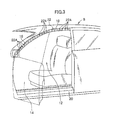
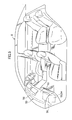
- FIGS. 1 to 3 An example where an air curtain forming apparatus 10 serving as a dust reducing apparatus pertaining to a first embodiment of the invention is applied to an automobile serving as a vehicle will be described on the basis of FIGS. 1 to 3.
- FIG. 1 is a perspective view showing the operating state of an air curtain forming apparatus 10
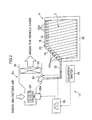
- FIG. 2 is a block diagram showing the schematic overall configuration of the air curtain forming apparatus 10.
- the air curtain forming apparatus 10 forms an air curtain C along the open surface of a door opening 12 that communicates the inside and outside of a vehicle cabin in a vehicle body B of an automobile.
- the inside of the vehicle cabin is divided (demarcated) from the outside by the air curtain C when the door opening 12 is open.
- the door opening 12 in the vehicle body B of the automobile is configured to be opened and closed by a door 14.
- the upper edge of the door opening 12 is defined by an A-pillar 16 and a roof side rail 18, and the lower edge of the door opening 12 is defined by a floorboard (side sill) 20.
- the air curtain forming apparatus 10 includes an air blowout portion 22 disposed in the A-pillar 16 and the roof side rail 18.
- the air blowout portion 22 is configured by numerous blowout holes 22A that are disposed along the longitudinal direction of the A-pillar 16 and the roof side rail 18, which have a hollow configuration (not shown). In the first embodiment, the insides of the A-pillar 16 and the roof side rail 18 are mutually communicated.
- the air blowout portion 22 is configured to form the air curtain C that divides the inside of the vehicle cabin from the outside by blowing out air simultaneously and continuously from the numerous blowout holes 22A towards the floorboard 20.
- the air blowout portion 22 may also be configured by a single or plural slits disposed along the longitudinal direction of the A-pillar 16 and the roof side rail 18.
- the air curtain forming apparatus 10 is configured to supply air to the air blowout portion 22 from an in-vehicle air conditioner 24.
- the in-vehicle air conditioner 24 includes an air conditioning blower 28 that is disposed inside an air conditioning duct 26 into which inside air or outside air is introduced. Air that has been conditioned through an internal heat exchanger 30 such as an evaporator and a heater core is blown to the inside of the vehicle cabin by the operation of the air conditioning blower 28.
- the air curtain forming apparatus 10 also includes an air supply path 32 that communicates the air conditioning duct 26 and the air blowout portion 22 (the insides of the A-pillar 16 and the roof side rail 18).
- the air supply path 32 may be configured by a flexible pipe member such as a hose or tube in which one end is connected to the air conditioning duct 26 and the other end is connected to the lower portion or the upper portion of the A-pillar 16, for example.
- Part of the air supply path 32 may also be configured by using a hollow configural member of the vehicle body B.
- the air curtain forming apparatus 10 also includes a switch 34 that selectively switches between a state where the air conditioning duct 26 and the air blowout portion 22 are mutually communicated and a state where the communication between the air conditioning duct 26 and the air blowout portion 22 is blocked.
- the switch 34 is disposed at an end portion or intermediate portion of the air supply path 32 and functions as an open/close valve that opens and closes the air supply path 32.
- the air curtain forming apparatus 10 is configured to prevent the air blown by the air conditioning blower 28 from being supplied to the air blowout portion 22 when it is not necessary to form the air curtain C.
- the air curtain forming apparatus 10 described above is controlled by an air conditioning ECU 36 that includes the function of a controller in the present invention so that the air curtain forming apparatus 10 forms the air curtain C when the door opening 12 is opened as a person enters or exits the vehicle.
- the air conditioning ECU 36 is electrically connected to a drive motor 28A of the air conditioning blower 28 and configured to conduct ordinary control of the in-vehicle air conditioner 24. Description of this control will be omitted.
- the air conditioning ECU 36 is electrically connected to the switch 34 and a courtesy switch 38.
- the courtesy switch 38 outputs a signal (may be an ON/OFF signal) corresponding to the opening and closing of the door opening 12 by the door 14 in order to turn ON a light inside the vehicle when the door 14 is operated.
- the courtesy switch 38 corresponds to a door open/close detector in the present invention.
- the air conditioning ECU 36 drives the drive motor 28A to activate the switch 34 and open the air supply path 32.
- the air blown by the air conditioning blower 28 is continuously supplied from the in-vehicle air conditioner 24 to the air blowout portion 22, and the air curtain C is formed.
- the air conditioning ECU 36 stops the drive motor 28A to switch the switch 34 and block (close) the air supply path 32.
- a signal (called a "close signal” below) corresponding to the fact that the door opening 12 has been closed is inputted to the air conditioning ECU 36 from the courtesy switch 38, the air conditioning ECU 36 stops the drive motor 28A to switch the switch 34 and block (close) the air supply path 32.
- the door opening 12 is closed during the operation of the in-vehicle air conditioner 24, the driven state of the drive motor 28A is maintained and the strength of the blowing is controlled.
- the strength of the blowing is controlled so that more than the ordinary amount of air is supplied for the air curtain C.
- the air blowout portion 22, the air supply path 32, the switch 34 and the courtesy switch 38 described above are disposed in each door opening 12 (i.e., in correspondence to the number of door openings 12) in the vehicle body B of the automobile, and form air curtains C in the door openings 12, respectively, that are opened as a person enters or exits the vehicle.
- the air curtain forming apparatus 10 of the above configuration In an automobile to which the air curtain forming apparatus 10 of the above configuration has been applied, when the door 14 is moved to the open position and the door opening 12 is opened as a person enters the automobile, the open signal is inputted to the air conditioning ECU 36 from the courtesy switch 38. When this happens, the air conditioning ECU 36 drives the drive motor 28A to activate the air conditioning blower 28, the switch 34 corresponding to the opened door opening 12 is activated, and the air supply path 32 is opened. Thus, the air supplied from the air conditioning duct 26 to the air blowout portion 22 via the air supply path 32 is continuously blown out from the blowout holes 22A as shown in FIG. 1, and the air curtain C is formed in the opened door opening 12.
- the air outside the vehicle cabin namely pollen (dust types) flying in the air outside the vehicle cabin
- the air curtain C divides the inside of the vehicle cabin from the outside.
- the air curtain C is formed in the same manner as when a person enters the automobile, and pollen (dust types) flying in the air outside the vehicle cabin is prevented from ingressing into the vehicle cabin via the door opening 12.
- the air curtain C also does not inhibit the action of a person exiting the automobile.
- the close signal is inputted to the air conditioning ECU 36 from the courtesy switch 38, and the air conditioning ECU 36 stops the drive motor 28A to activate the switch 34 and block the air supply path 32.
- the air curtain C is no longer formed, and the air conditioning blower 28 is switched to the state where it is used (only) for the in-vehicle air conditioner 24.
- the ingress of pollen into the vehicle cabin through the door opening 12 can be restricted, and the amount of pollen inside the vehicle cabin of the automobile to which the air curtain forming apparatus 10 has been applied can be reduced.
- the air curtain C is formed using the air blown by the air conditioning blower 28 of the in-vehicle air conditioner 24.
- the function of restricting the ingress of pollen into the vehicle cabin through the door opening 12 is realized without having to dispose a dedicated blower.
- the air blowout portion 22 is disposed along the A-pillar 16 and the roof side rail 18 configuring the upper edge of the door opening 12, and the air curtain C is formed by blowing out the air mainly downward.
- the air current of the air curtain C does not directly strike the face of the person entering or exiting the automobile. For this reason, the person entering or exiting the automobile is prevented from experiencing a sense of displeasure.
- the air curtain forming apparatus 10 operates and forms the air curtain C only when the door opening 12 is opened, when there is the potential for pollen to ingress into the vehicle cabin, whereby the ingress of pollen into the vehicle cabin can be reliably prevented.
- the air curtain forming apparatus 10 is controlled by the air conditioning ECU 36, but the invention is not limited to this.
- the air curtain forming apparatus 10 may also be controlled by a dedicated controller that is partially or completely independent from the air conditioning ECU 36.
- An air curtain forming apparatus 50 serving as a dust reducing apparatus pertaining to a second embodiment of the invention will be described on the basis of FIGS. 4 and 5.
- the same reference numerals will be given to parts/members that are basically the same as those of the first embodiment, and description of those parts/members will be omitted.
- FIG. 4 is a block diagram showing the schematic overall configuration of the air curtain forming apparatus 50.
- the air curtain forming apparatus 50 is similar to the air curtain forming apparatus 10 in that the air curtain C is formed by the air blown out from the air blowout portion 22 disposed along the upper edge of the door opening 12, but is different from the air curtain forming apparatus 10 in that the air curtain C is formed using compressed air. This will be described in greater detail below.
- the air curtain forming apparatus 50 includes a compressor 52, which is a compressed air source, and an air tank 54, which is communicated with the compressor 52 and accumulates the compressed air supplied from the compressor 52.
- the air tank 54 is communicated with the air blowout portion 22 (the inside spaces of the A-pillar 16 and the roof side rail 18) via an air hose 56.
- An electromagnetic open/close valve 58 is disposed in the air hose 56. By opening and closing the air hose 56, the air hose 56 is selectively switched between a state where the air tank 54 and the air blowout portion 22 are mutually communicated and a state where the communication between the air tank 54 and the air blowout portion 22 is blocked.
- the compressor 52 and the air tank 54 are disposed inside an installment panel 60 of the automobile. Similar to the first embodiment, the air blowout portion 22, the air hose 56 and the electromagnetic open/close valve 58 are disposed in correspondence to the number of doors.
- the electromagnetic open/close valve 58 may be disposed inside the installment panel 60 or in the vicinity of the corresponding door opening 12.
- the air curtain forming apparatus 50 also includes a pollen reducing ECU 62.
- the pollen reducing ECU 62 is electrically connected to the compressor 52, the electromagnetic open/close valve 58, the courtesy switch 38 and a pressure sensor 64.
- the pressure sensor 64 is disposed in the air tank 54 itself or between the air tank 54 and the electromagnetic open/close valve 58 in the air hose 56, and is configured to output a signal corresponding to the pressure in the air tank 54 to the pollen reducing ECU 62.
- the air curtain forming apparatus 50 is configured to activate the compressor 52 and maintain the air pressure inside the air tank 54 at a pressure equal to or greater than a predetermined pressure when the pressure signal inputted from the pressure sensor 64 is a signal corresponding to the fact that the pressure inside the air tank 54 is less than the predetermined pressure.
- the compressor 52 is electrically operated and drivable independent from the engine.
- the pollen reducing ECU 62 switches the electromagnetic open/close valve 58 to the open state
- the close signal is inputted to the pollen reducing ECU 62 from the courtesy switch 38
- the pollen reducing ECU 62 switches the electromagnetic open/close valve 58 to the closed state. It will be noted that there are also instances where the compressor 52 operates even during the opening of the electromagnetic open/close valve 58.
- the air outside the vehicle cabin namely pollen (dust types) flying in the air outside the vehicle cabin
- the air curtain C divides the inside of the vehicle cabin from the outside.
- the air curtain C is formed in the same manner as when a person enters the automobile described above, and pollen (dust types) flying in the air outside the vehicle cabin is prevented from ingressing into the vehicle cabin via the door opening 12.
- the air curtain C also does not inhibit the action of a person exiting the automobile.
- the close signal is inputted to the pollen reducing ECU 62 from the courtesy switch 38, and the pollen reducing ECU 62 switches the electromagnetic open/close valve 58 to the closed state.
- the air curtain C is no longer formed, and the electromagnetic open/close valve 58 is switched to the state where the compressed air inside the air tank 54 is maintained.
- the ingress of pollen into the vehicle cabin through the door opening 12 can be restricted, and the amount of pollen inside the vehicle cabin of the automobile to which the air curtain forming apparatus 50 has been applied can be reduced.
- the air curtain C is formed using the compressed air.
- an air curtain C that is strong in comparison to a configuration using a blower as the air source can be formed. For this reason, the ingress of pollen into the vehicle cabin can be effectively restricted even when the door opening 12 is opened in an environment where there are strong winds.
- the air curtain forming apparatus 50 includes the dedicated compressor 52 as the air source, the setting of the specifications (blowout pressure, blowout speed, blowout volume, etc.) of the air curtain C is easy.
- the air curtain forming apparatus 50 includes the air tank 54, the capacity of the compressed air is ensured, and a sufficiently strong air curtain can be formed over a predetermined period of time (i.e., the formed state can be maintained). Also, because it is not necessary to start the compressor 52 when the door opening 12 is opened, the air curtain C is rapidly formed at substantially the same time as when the door opening 12 is opened. Moreover, air curtains C having a sufficient strength can be reliably formed in each of the door openings 12 even when plural door openings 12 are opened at the same time. Thus, the ingress of pollen into the vehicle cabin can be reliably prevented.
- the air blowout portion 22 is disposed along the A-pillar 16 and the roof side rail 18 configuring the upper edge of the door opening 12, and the air curtain C is formed by blowing out the air mainly downward.
- the air current of the air curtain C does not directly strike the face of the person entering or exiting the automobile. For this reason, the person entering or exiting the automobile is prevented from experiencing a sense of displeasure.
- the air curtain forming apparatus 50 operates and forms the air curtain C only when the door opening 12 is opened, when there is the potential for pollen to ingress into the vehicle cabin, whereby the ingress of pollen into the vehicle cabin can be reliably prevented.
- the air curtain forming apparatus 50 includes the air tank 54, but the invention is not limited to this.
- the compressed air of the compressor 52 may also be directly supplied to the air blowout portion 22.
- the pollen reducing ECU 62 is not limited to a dedicated controller and may also be configured so that it is incorporated in a control circuit of an in-vehicle air conditioner having a pollen reducing function and is cooperatively controlled with these.
- the present invention is not limited by the disposition of the compressor 52 and the air tank 54.
- An air shower apparatus 70 serving as a dust reducing apparatus pertaining to a third embodiment of the invention will be described on the basis of FIG. 6.
- the same reference numerals will be given to parts/members that are the same as those of the first and second embodiments, and description of those parts/members will be omitted.
- FIG. 6 is a perspective view showing an operating state of the air shower apparatus 70.
- the air shower apparatus 70 blows, onto a person about to enter the vehicle, an air shower that is an air current directed to the outside of the vehicle cabin, and is configured to blow off pollen adhering to the clothes and the like of the person about to enter the vehicle.
- the air shower apparatus 70 includes air nozzles 72 that open to the rear end of the door 14. Air blown out from the air nozzles 72 forms an air shower S.
- the air nozzles 72 are plurally disposed along the vertical direction at the rear end of a door body 14A with a hollow configuration (not shown) and the rear end of a door sash 14B. The air nozzles 72 form the air shower S across a wide range from the upper portion (head) to the lower portion (feet) of a person.
- the air shower apparatus 70 is applied to the automobile together with the air curtain forming apparatus 50, and is configured so that the compressed air is supplied from the air tank 54 to the air nozzles 72 through an unillustrated air supply path.
- the air supply path is divided from the air hose 56 downstream of the electromagnetic open/close valve 58.
- the compressed air is automatically blown out from the air nozzles 72 in the door 14 positioned in the open position opening the door opening 12, whereby the air shower S is formed.
- the air supply path which communicates the air tank 54 disposed in the vehicle body and the air nozzles 72 in the door 14, can be configured in the same manner as a known configuration that guides the conditioned air of the air conditioner disposed in the vehicle body to the side portion of the vehicle cabin through the inside of the door 14.
- the air shower apparatus 70 of the above configuration has been applied together with the air curtain forming apparatus 50
- the open signal is inputted to the pollen reducing ECU 62 from the courtesy switch 38.
- the pollen reducing ECU 62 switches the electromagnetic open/close valve 58 corresponding to the opened door opening 12, i.e., the air hose 56, to the open state.
- the air supplied from the air tank 54 to the air blowout portion 22 via the air hose 56 is continuously blown out from the blowout holes 22A, and the air curtain C is formed in the opened door opening 12.
- the air flowing through the divided air supply path from the air hose 56 is blown out from the air nozzles 72 to form the air shower S.
- a person about to enter the vehicle stands at the position where the person is showered with this air shower S, and pollen adhering to the clothes and body surfaces of the person is blown away by the air shower S while the person appropriately changes his/her posture.
- the person enters the vehicle through the door opening 12 in which the air curtain C is formed moves the door 14 to the closed position, and closes the door opening 12.
- the close signal is inputted to the pollen reducing ECU 62 from the courtesy switch 38, and the pollen reducing ECU 62 switches the electromagnetic open/close valve 58 to the closed state.
- the air curtain C and the air shower S are no longer formed, and the electromagnetic open/close valve 58 is switched to the state where the compressed air inside the air tank 54 is maintained.
- the ingress of pollen adhering to the person into the vehicle cabin through the door opening 12 i.e., the pollen that the person brings into the vehicle cabin
- the air shower apparatus 70 includes the plural air nozzles 72 along the vertical direction at the rear edge portion of the door 14
- pollen adhering to portions of the person in the vertical direction from the portions that are close to the person's face and relatively high to the portions that are close to the person's feet and relatively low can be effectively removed without the person having to move too much.
- the air shower apparatus 70 is applied to the automobile together with the air curtain forming apparatus 50, pollen flying (dispersed) through the air outside the vehicle cabin can be reliably prevented from ingressing into the vehicle cabin. It will be noted that description of the effects of the air curtain forming apparatus 50 will be omitted here because they are the same as those which are described in the second embodiment.
- the air nozzles 72 are disposed across substantially the entire height of the rear end of the door 14, but the present invention is not limited to this.
- the air nozzles 72 may also be disposed simply along part of the rear end of the door 14 in the vertical direction.
- the site at which the air shower S is blown out is not limited to the rear end of the door 14.
- the air shower S may also be blown out from the upper portion of the door trim.
- means for switching the direction in which the air is blown out such as a louver, may also be disposed in the air shower.
- An air shower apparatus 80 serving as a dust reducing apparatus pertaining to a fourth embodiment of the invention will be described on the basis of FIG. 7.
- the same reference numerals will be given to parts/members that are the same as those of the first to third embodiments, and description of those parts/members will be omitted.
- FIG. 7 is a perspective view showing an operating state of the air shower apparatus 80.
- the air shower apparatus 80 is similar to the air shower apparatus 70 in that it blows, onto a person about to enter the vehicle, an air shower S that is an air current directed to the outside of the vehicle cabin, but is different from the air shower apparatus 70 in that the air shower apparatus 80 is disposed with a detachable air nozzle 82.
- the air nozzle 82 is fixed to the end of a flexible air hose 84, and is configured to be attachable to and detachable from a retaining portion (not shown) disposed on the inner surface of the door 14. It is preferable for the air hose 84 to be storable inside the door body 14A in a state where the air nozzle 82 is retained in the door 14.
- the air shower apparatus 80 is configured so that a person about to enter the vehicle grasps the air nozzle 82 and uses the air shower S to blow away pollen adhering to the clothes and body surfaces of the person.
- the air shower apparatus 80 is applied to an automobile together with the air curtain forming apparatus 50, and blows out the compressed air supplied from the air tank 54 through the air nozzle 82 to form the air shower S.
- the air hose 84 (air nozzle 82) is connected to the air tank 54 by an air supply path similar to that of the air nozzles 72 pertaining to the third embodiment.
- an electromagnetic open/close valve is disposed separately from the electromagnetic open/close valve 58 in the air supply path, and a switch that switches between opening and closing the electromagnetic open/close valve is disposed at a position on the air nozzle 82 where the electromagnetic open/close valve can be easily operated by the person grasping the air nozzle 82.
- the electromagnetic open/close valve is configured to ordinarily close the air supply path and open the air supply path when the switch is operated.
- the electromagnetic switch 58 opens so that the compressed air can be supplied to the air nozzle 82.
- the air shower S is blown out through the air nozzle 82 by manually operating the switch thereafter.
- the air shower apparatus 80 of the above configuration has been applied together with the air curtain forming apparatus 50
- the open signal is inputted to the pollen reducing ECU 62 from the courtesy switch 38.
- the pollen reducing ECU 62 switches the electromagnetic open/close valve 58 corresponding to the opened door opening 12, i.e., the air hose 56, to the open state.
- the air supplied from the air tank 54 to the air blowout portion 22 via the air hose 56 is continuously blown out from the blowout holes 22A, and the air curtain C is formed in the opened door opening 12.
- the air flowing through the divided air supply path from the air nozzle 56 is blown out from the air nozzles 72 to form the air shower S.
- a person about to enter the vehicle pulls out the air hose 84 from the door body 14A, removes the air nozzle 82 from the retaining portion of the door 14, and operates the switch disposed in the air nozzle 82, whereby the compressed air is blown out from the air nozzle 82 and the air shower S is formed.
- the person about to enter the vehicle showers himself/herself with the shower S while appropriately changing the position and orientation of the air nozzle 82 with respect to the person's body, so that pollen adhering to the clothes and body surfaces of the person is blown away by the air shower S.
- the person enters the vehicle through the door opening 12 in which the air curtain C is formed moves the door 14 to the closed position, and closes the door opening 12.
- the close signal is inputted to the pollen reducing ECU 62 from the courtesy switch 38, and the pollen reducing ECU 62 switches the electromagnetic open/close valve 58 to the closed state.
- the air curtain C and the air shower S are no longer formed, and the electromagnetic open/close valve 58 is switched to the state where the compressed air inside the air tank 54 is maintained.
- the ingress of pollen adhering to the person into the vehicle cabin through the door opening 12 i.e., the pollen that the person brings into the vehicle cabin
- the amount of pollen inside the vehicle cabin of the automobile to which the air shower apparatus 80 has been applied can be reduced.
- the air shower apparatus 80 includes the air nozzle 82 that can be attached to and detached from the door 14 and the air shower S can be formed from the air nozzle 82 detached from the door 14, the person about to enter the vehicle can shower himself/herself with the air shower S from the air nozzle 82 by moving the air nozzle 82 to a desired orientation and position, and pollen adhering to portions of the person such as the clothes and body portions can be effectively removed.
- the air shower apparatus 80 is applied to the automobile together with the air curtain forming apparatus 50, pollen flying (dispersed) through the air outside the vehicle cabin can be reliably prevented from ingressing into the vehicle cabin. It will be noted that description of the effects of the air curtain forming apparatus 50 will be omitted here because they are the same as those which are described in the second embodiment.
- the air shower apparatus 70 and 80 shares the air source with the air curtain forming apparatus 50, but the present invention is not limited to this.
- the air shower apparatus 70 and 80 may also be configured to have an independent air source.
- simply the air shower apparatus 70 or the air shower apparatus 80 may be applied to the automobile without disposing the air curtain forming apparatus 50.
- the air shower apparatus 70 or the air shower apparatus 80 may be applied together with the air curtain forming apparatus 10.
- a switch for manually switching the air shower S ON and OFF may be disposed in the air shower apparatus 70, and the air shower S may be ordinarily blown out from the air nozzle 82 of the air shower apparatus 80 when the door opening 2 is open.
- the door 14 opening and closing the door opening 12 of the vehicle body B is a hinged door, but the present invention is not limited to this.
- the door opening 12 may also be opened and closed by a sliding door.
- the door opening 12 is not limited to being a door opening for a person to enter or exit the vehicle.
- the air curtain forming apparatus 10 or 50 may also be applied to a back door opening that is opened and closed by a back door.
- the dust reducing apparatus pertaining to the invention can form the air curtain by blowing out, from an edge portion of the door opening, air blown by a blower of an in-vehicle air conditioner.
- the dust reducing apparatus pertaining to the invention can form the air curtain by blowing out, from an edge portion of the door opening, compressed air of a compressor disposed inside the vehicle.
- the compressor is disposed inside the vehicle, and a discharge portion of the compressor and the blowout portion of the air curtain are mutually communicated.
- the compressed air generated by the compressor is directly or indirectly supplied to the blowout portion of the air curtain, and the air curtain is formed by the compressed air.
- the dust reducing apparatus includes the compressor that generates compressed air, the dust reducing apparatus can reliably prevent the ingress of dust types into the vehicle cabin with a strong air curtain. Also, the setting of the specifications (blowout pressure, blowout speed, blowout volume, etc.) of the air curtain is easy.
- the dust reducing apparatus pertaining to the invention can include an air tank that accumulates the compressed air of the compressor, and the dust reducing apparatus can form the air curtain by blowing out the compressed air in the air tank from the edge portion of the door opening.
- the air tank is disposed between the compressor and the blowout portion of the air curtain, the compressed air accumulated in the air tank is supplied to the blowout portion, and the air curtain is formed. For this reason, the capacity of the compressed air is ensured, an air curtain of a sufficient strength can be formed over a predetermined period of time (i.e., the formed state can be maintained), and the ingress of dust types into the vehicle cabin can be reliably prevented. Also, because it is not necessary to start the compressor when the door opening is opened, the air curtain is rapidly formed.
- the dust reducing apparatus with this configuration is particularly suited for vehicles such as minivans and SUVs in which the area of the door opening is large.
- the dust reducing apparatus pertaining to the invention can include an air blowout portion disposed in a pillar and a roof side portion that define an upper edge of the door opening in the vehicle body, and the dust reducing apparatus can form the air curtain by blowing out air from the air blowout portion.
- This dust reducing apparatus forms the air curtain by blowing out air mainly downward from the air blowout portion disposed in the pillar (particularly a slanted pillar such as a front pillar or a rear pillar) and the roof side portion that define the upper edge of the door opening in the vehicle body. For this reason, the air current of the air curtain does not directly strike the face of a person about to enter the vehicle.
- the dust reducing apparatus pertaining to the invention can control the formation timing of the air curtain on the basis of a signal from a courtesy switch that outputs a signal corresponding to the open/closed state of the door opening.
- the air supplier may be a blower of an in-vehicle air conditioner.
- an air conditioning duct disposed with the blower of the in-vehicle air conditioner and the blowout portion of the air curtain are communicated by an air duct that can open and close.
- an air path through which the blower sends air is switched to the opened air duct side, and the air curtain is formed by the air blown by the blower via the air duct.
- the air supplier may be configured to include a compressor disposed inside the vehicle.
- the compressor is disposed inside the vehicle, and a discharge portion of the compressor and the blowout portion of the air curtain are mutually communicated.
- the compressed air generated by the compressor is directly or indirectly supplied to the blowout portion of the air curtain, and the air curtain is formed by the compressed air.
- the dust reducing apparatus includes the compressor that generates compressed air, the dust reducing apparatus can reliably prevent the ingress of dust types into the vehicle cabin with a strong air curtain. Also, the setting of the specifications (blowout pressure, blowout speed, blowout volume, etc.) of the air curtain is easy.
- the air supplier may further include an air tank disposed downstream of the compressor and an open/close valve disposed downstream of the air tank, and the open/close valve may be controlled by the controller.
- the air blowout portion may be disposed in a pillar and a roof side portion defining an upper edge of the door opening in the vehicle body, and the air blowout portion may blow out air downward to form the air curtain.
- This dust reducing apparatus forms the air curtain by blowing out air mainly downward from the air blowout portion disposed in the pillar (particularly a slanted pillar such as a front pillar or a rear pillar) and the roof side portion that define the upper edge of the door opening in the vehicle body. For this reason, the air current of the air curtain does not directly strike the face of a person about to enter the vehicle.
- the controller may cause air to be supplied from the air supplier to the air blowout portion when a signal corresponding to the open state of the door opening is inputted from a door open/close detector that outputs a signal corresponding to the opened/closed state of the door opening by the door, and the controller may cause the supply of air from the air supplier to the air blowout portion to be stopped when a signal corresponding to the closed state of the door is inputted from the door open/close detector.
- the controller causes air to be supplied from the air supplier to the air blowout portion when the signal inputted from the door open/close detector that outputs a signal corresponding to the opened/closed state of the door opening is a signal corresponding to the open state of the door opening.
- the controller causes the supply of air from the air supplier to the air blowout portion to be stopped when the signal inputted from the door open/close detector is a signal corresponding to the closed state of the door opening by the door.
- the air curtain is reliably formed only when the door opening is open, and the ingress of dust types into the vehicle cabin is prevented.
- a courtesy switch for controlling the lighting and extinguishing of a light inside the cabin can be used as the door open/close detector.
- the dust reducing apparatus pertaining to the invention can include an air nozzle that is disposed in the vehicle and blows out air to the outside of the vehicle body to remove dust adhering to the clothes of a person about to enter the vehicle.
- a person about to enter the vehicle showers himself/herself with the air blown out (emitted) from the air nozzle to remove dust types adhering to the person's clothes.
- the person also passes through the air curtain to enter the vehicle.
- the dust reducing apparatus prefferably configured so that the air forming the air curtain and the air blown out from the air nozzle are obtained from a shared air source (preferably, compressed air), whereby the number of parts can be reduced.
- the air nozzle may be disposed in an edge portion along a vertical direction of the door that opens and closes a door opening in the vehicle body.
- the air nozzle is disposed in the edge portion of the door that opens and closes the door opening, and air is blown out from the air nozzle disposed in the door in a state where the door opening is open.
- the dust reducing apparatus blows out air along a wide range with respect to a standing person about to enter the vehicle, and can effectively remove dust types adhering to the person without the person having to move too much.
- the air nozzle may be attachable to and detachable from the vehicle body, with the air nozzle being configured to blow out air in a state where it has been detached from the vehicle body.
Landscapes
- Engineering & Computer Science (AREA)
- Mechanical Engineering (AREA)
- Physics & Mathematics (AREA)
- Thermal Sciences (AREA)
- Air-Conditioning For Vehicles (AREA)
- Prevention Of Fouling (AREA)
Abstract
Description
Claims (16)
- A dust reducing apparatus that forms, along a door opening disposed in a vehicle body of a vehicle, an air curtain dividing the inside of a vehicle cabin from the outside when the door opening is open.
- The dust reducing apparatus of claim 1, wherein the dust reducing apparatus forms the air curtain by blowing out, from an edge portion of the door opening, air blown by a blower of an in-vehicle air conditioner.
- The dust reducing apparatus of claim 1, wherein the dust reducing apparatus forms the air curtain by blowing out, from an edge portion of the door opening, compressed air of a compressor disposed inside the vehicle.
- The dust reducing apparatus of claim 3, wherein the dust reducing apparatus includes an air tank that accumulates the compressed air of the compressor, and the dust reducing apparatus forms the air curtain by blowing out the compressed air in the air tank from the edge portion of the door opening.
- The dust reducing apparatus of any one of claims 1 to 4, wherein the dust reducing apparatus includes an air blowout portion disposed in a pillar and a roof side portion that define an upper edge of the door opening in the vehicle body, and the dust reducing apparatus forms the air curtain by blowing out air from the air blowout portion.
- The dust reducing apparatus of any one of claims 1 to 5, wherein the formation timing of the air curtain is controlled on the basis of a signal from a courtesy switch that outputs a signal corresponding to the open/closed state of the door opening.
- A dust reducing apparatus comprising:an air blowout portion that is disposed along an edge portion of a door opening in a vehicle body of a vehicle, which door opening is opened and closed by a door, with the air blowout portion blowing out air to form an air curtain that divides the inside of a vehicle cabin from the outside;an air supplier that supplies air to the air blowout portion; anda controller that causes air to be supplied to the air blowout portion from the air supplier when the door opening is opened.
- The dust reducing apparatus of claim 7, wherein the air supplier is a blower of an in-vehicle air conditioner.
- The dust reducing apparatus of claim 7, wherein the air supplier is configured to include a compressor disposed inside the vehicle.
- The dust reducing apparatus of claim 9, wherein the air supplier further includes an air tank disposed downstream of the compressor and an open/close valve disposed downstream of the air tank, with the open/close valve being controlled by the controller.
- The dust reducing apparatus of any one of claims 7 to 10, wherein the air blowout portion is disposed in a pillar and a roof side portion defining an upper edge of the door opening in the vehicle body, and the air blowout portion blows out air downward to form the air curtain.
- The dust reducing apparatus of any one of claims 7 to 11, wherein
the controller causes air to be supplied from the air supplier to the air blowout portion when a signal corresponding to the open state of the door opening is inputted from a door open/close detector that outputs a signal corresponding to the opened/closed state of the door opening by the door, and
the controller causes the supply of air from the air supplier to the air blowout portion to be stopped when a signal corresponding to the closed state of the door is inputted from the door open/close detector. - The dust reducing apparatus of any one of claims 1 to 12, wherein the dust reducing apparatus includes an air nozzle that is disposed in the vehicle and blows out air to the outside of the vehicle body to remove dust adhering to the clothes of a person about to enter the vehicle.
- A dust reducing apparatus comprising an air nozzle that is disposed in a vehicle and blows out air to the outside of a vehicle body to remove dust adhering to the clothes of a person about to enter the vehicle.
- The dust reducing apparatus of any one of claims 13 and 14, wherein the air nozzle is disposed in an edge portion along a vertical direction of a door that opens and closes a door opening in the vehicle body.
- The dust reducing apparatus of any one of claims 13 and 14, wherein the air nozzle is attachable to and detachable from the vehicle body, with the air nozzle being configured to blow out air in a state where the air nozzle has been detached from the vehicle body.
Applications Claiming Priority (2)
| Application Number | Priority Date | Filing Date | Title |
|---|---|---|---|
| JP2004182225 | 2004-06-21 | ||
| JP2004182225A JP4033176B2 (en) | 2004-06-21 | 2004-06-21 | Dust reduction device |
Publications (3)
| Publication Number | Publication Date |
|---|---|
| EP1609644A2 true EP1609644A2 (en) | 2005-12-28 |
| EP1609644A3 EP1609644A3 (en) | 2006-07-19 |
| EP1609644B1 EP1609644B1 (en) | 2009-08-26 |
Family
ID=34982152
Family Applications (1)
| Application Number | Title | Priority Date | Filing Date |
|---|---|---|---|
| EP05013139A Expired - Lifetime EP1609644B1 (en) | 2004-06-21 | 2005-06-17 | Dust reducing apparatus |
Country Status (5)
| Country | Link |
|---|---|
| US (1) | US20050282485A1 (en) |
| EP (1) | EP1609644B1 (en) |
| JP (1) | JP4033176B2 (en) |
| CN (1) | CN100411898C (en) |
| DE (1) | DE602005016187D1 (en) |
Cited By (2)
| Publication number | Priority date | Publication date | Assignee | Title |
|---|---|---|---|---|
| EP2527175A1 (en) * | 2011-05-21 | 2012-11-28 | REHAU AG + Co | Motor vehicle with a passenger compartment and a door opening |
| GB2579548A (en) * | 2018-11-30 | 2020-07-01 | Jaguar Land Rover Ltd | A vehicle cabin |
Families Citing this family (36)
| Publication number | Priority date | Publication date | Assignee | Title |
|---|---|---|---|---|
| JP4403942B2 (en) * | 2004-10-04 | 2010-01-27 | 株式会社デンソー | Air conditioner for vehicles |
| US20060076427A1 (en) * | 2004-10-12 | 2006-04-13 | Schneider Joseph L Jr | Lift truck with heating system |
| US20070123157A1 (en) * | 2005-11-30 | 2007-05-31 | Shah Sanjay M | Structurally-integrated HVAC duct |
| US8702481B1 (en) * | 2007-04-23 | 2014-04-22 | Danhard, Inc. | Vehicle air wall |
| US20090001787A1 (en) * | 2007-06-26 | 2009-01-01 | Gm Global Technology Operations, Inc. | Ionized Air System and Method for Dissipating an Electrostatic Charge in a Vehicle |
| US20090013712A1 (en) * | 2007-07-11 | 2009-01-15 | Robert William Norris | Refrigerated trailer and method for same |
| US8141621B2 (en) * | 2008-12-11 | 2012-03-27 | International Business Machines Corporation | Apparatus and method for providing in situ cooling of computer data centers during service calls |
| US20100236770A1 (en) * | 2009-03-19 | 2010-09-23 | Ford Global Technologies, Llc | Method and system for controlling an automotive hvac system |
| US9057528B2 (en) * | 2009-10-28 | 2015-06-16 | GM Global Technologies Operations LLC | Utilizing gaseous flow to redirect particulate matter |
| US9102217B2 (en) * | 2009-10-28 | 2015-08-11 | GM Global Technology Operations LLC | Air curtain |
| DE102010033515A1 (en) * | 2010-08-05 | 2012-02-09 | Gm Global Technology Operations Llc (N.D.Ges.D. Staates Delaware) | Apparatus and method for preventing the entry of foreign particles into a vehicle interior |
| US9840129B2 (en) * | 2011-09-29 | 2017-12-12 | Subaru Corporation | Vehicle, cooling apparatus, and cooling method |
| JP5492861B2 (en) * | 2011-11-01 | 2014-05-14 | 富士重工業株式会社 | Vehicle, air conditioner, and air conditioning method |
| DE102012107863A1 (en) | 2012-08-27 | 2014-02-27 | Dr. Ing. H.C. F. Porsche Aktiengesellschaft | Motor vehicle e.g. hybrid vehicle, has air nozzles vertically provided above each other, and arranged around vehicle seat such that air emitted from nozzles produces air swirl around seat with approximately perpendicular rotational axis |
| US20140060795A1 (en) * | 2012-09-06 | 2014-03-06 | Jeffrey N. Yu | Concealed dynamic ventilation system |
| US9499221B2 (en) * | 2013-07-03 | 2016-11-22 | Honda Motor Co., Ltd. | Integrated duct step garnish assembly |
| CN103318002A (en) * | 2013-07-17 | 2013-09-25 | 何伟彬 | Automobile door air umbrella |
| CN104234113A (en) * | 2014-07-11 | 2014-12-24 | 南京理学工程数据技术有限公司 | Air valve curtain of mini excavator |
| DE102015214594A1 (en) | 2014-08-20 | 2016-02-25 | Ford Global Technologies, Llc | Control of an air conditioning system for motor vehicles |
| FR3032391B1 (en) * | 2015-02-06 | 2018-09-21 | Alstom Transport Technologies | DEVICE FOR GENERATING AN AIR CURTAIN, ESPECIALLY FOR EQUIPPING A RAILWAY VEHICLE |
| US9963014B2 (en) | 2016-01-15 | 2018-05-08 | Joy Mm Delaware, Inc. | Debris barrier for vehicle operator cab |
| JP6904128B2 (en) * | 2017-07-20 | 2021-07-14 | 株式会社デンソー | Air blower |
| CN108501668B (en) * | 2018-03-27 | 2020-12-08 | 湖南机电职业技术学院 | Automobile-used gas curtain separation system and car |
| KR102083224B1 (en) * | 2018-10-10 | 2020-03-02 | 타타대우상용차(주) | Air knife awning system for commercial vehicle |
| JP7092014B2 (en) | 2018-12-04 | 2022-06-28 | トヨタ自動車株式会社 | Airflow forming device for passenger compartment |
| US20210387737A1 (en) * | 2020-06-10 | 2021-12-16 | Walter Dorwin Teague Associates, Inc. | Passenger air shield |
| CN111645495A (en) * | 2020-06-11 | 2020-09-11 | 南通大学附属医院 | Area separating, disinfecting and purifying device for passenger cabin of public transport means |
| WO2022081496A1 (en) * | 2020-10-12 | 2022-04-21 | Howard Fredrick Todd | Anti-pathogenic system |
| CN112535390B (en) * | 2020-12-19 | 2022-12-16 | 宜昌市金石软件有限公司 | Detachable clothing display stand |
| DE102022201757A1 (en) | 2022-02-21 | 2023-08-24 | Volkswagen Aktiengesellschaft | Ventilation system and ventilation method for ventilating a vehicle |
| US20230347712A1 (en) * | 2022-03-31 | 2023-11-02 | Oshkosh Corporation | Vehicle hvac system |
| JP7826099B2 (en) * | 2022-04-06 | 2026-03-09 | 株式会社Subaru | Vehicle fluid control device |
| EP4306716B1 (en) * | 2022-07-14 | 2026-02-18 | Joseph Vögele AG | Road construction machine with blower device |
| CN115626027A (en) * | 2022-10-19 | 2023-01-20 | 浙江极氪智能科技有限公司 | Cleaning and drying system, method and vehicle |
| US20240351411A1 (en) * | 2023-04-19 | 2024-10-24 | David Walter Wright | Motor vehicle closure panel medium expelling device and method |
| US12605988B2 (en) * | 2023-10-25 | 2026-04-21 | Fca Us Llc | Hood closure assist system |
Citations (1)
| Publication number | Priority date | Publication date | Assignee | Title |
|---|---|---|---|---|
| JPH08310230A (en) | 1995-05-23 | 1996-11-26 | Kansei Corp | On-vehicle air conditioner |
Family Cites Families (18)
| Publication number | Priority date | Publication date | Assignee | Title |
|---|---|---|---|---|
| JPS5943126Y2 (en) * | 1979-11-30 | 1984-12-20 | 株式会社ボッシュオートモーティブ システム | Vehicle blower |
| JPS61177957U (en) * | 1985-04-25 | 1986-11-06 | ||
| DE3744500A1 (en) * | 1987-12-30 | 1989-07-13 | Klaus Hennig | Ventilation device for motor-vehicle interiors with air feed from above |
| JPH0233722U (en) * | 1988-08-30 | 1990-03-02 | ||
| JPH0429316Y2 (en) * | 1988-09-30 | 1992-07-16 | ||
| JPH035507U (en) * | 1989-06-02 | 1991-01-21 | ||
| ES2041940T3 (en) * | 1989-10-31 | 1993-12-01 | Siemens Aktiengesellschaft | DEVICE FOR VENTILATION OF THE PASSENGER COMPARTMENT OF AN AUTOMOBILE. |
| JPH0622030U (en) * | 1992-08-31 | 1994-03-22 | 日産ディーゼル工業株式会社 | Rain shelter at cab entrance |
| JPH0848151A (en) * | 1994-08-09 | 1996-02-20 | Mitsubishi Heavy Ind Ltd | Air-conditioner for vehicle |
| JPH08128692A (en) * | 1994-10-31 | 1996-05-21 | Matsushita Seiko Co Ltd | Air shower |
| US5584436A (en) * | 1994-11-18 | 1996-12-17 | White Consolidated Industires, Inc. | Portable blower with detachable nozzle |
| JP2651372B2 (en) * | 1995-09-29 | 1997-09-10 | ナショナル住宅産業株式会社 | Air blow device |
| DE19711060A1 (en) * | 1997-03-17 | 1998-09-24 | Duewag Ag | Arrangement for generating air curtains at door openings, in particular for local vehicles |
| CN1349901A (en) * | 2000-10-20 | 2002-05-22 | 王辉 | Automobile air purifying system |
| CN2552751Y (en) * | 2000-11-13 | 2003-05-28 | 高永彬 | Car with air purifier |
| JP3678143B2 (en) * | 2000-12-21 | 2005-08-03 | いすゞ自動車株式会社 | Refrigerated / refrigerated vehicles |
| JP2003314875A (en) * | 2002-04-18 | 2003-11-06 | Kaname Omaki | Dust intrusion prevention device and sheet shutter |
| DE10241571B4 (en) * | 2002-09-07 | 2005-08-04 | Faurecia Autositze Gmbh & Co. Kg | Air-conditioned motor vehicle seat |
-
2004
- 2004-06-21 JP JP2004182225A patent/JP4033176B2/en not_active Expired - Fee Related
-
2005
- 2005-06-17 DE DE602005016187T patent/DE602005016187D1/en not_active Expired - Lifetime
- 2005-06-17 EP EP05013139A patent/EP1609644B1/en not_active Expired - Lifetime
- 2005-06-21 CN CNB2005100774770A patent/CN100411898C/en not_active Expired - Fee Related
- 2005-06-21 US US11/156,555 patent/US20050282485A1/en not_active Abandoned
Patent Citations (1)
| Publication number | Priority date | Publication date | Assignee | Title |
|---|---|---|---|---|
| JPH08310230A (en) | 1995-05-23 | 1996-11-26 | Kansei Corp | On-vehicle air conditioner |
Cited By (2)
| Publication number | Priority date | Publication date | Assignee | Title |
|---|---|---|---|---|
| EP2527175A1 (en) * | 2011-05-21 | 2012-11-28 | REHAU AG + Co | Motor vehicle with a passenger compartment and a door opening |
| GB2579548A (en) * | 2018-11-30 | 2020-07-01 | Jaguar Land Rover Ltd | A vehicle cabin |
Also Published As
| Publication number | Publication date |
|---|---|
| CN100411898C (en) | 2008-08-20 |
| DE602005016187D1 (en) | 2009-10-08 |
| US20050282485A1 (en) | 2005-12-22 |
| JP2006001493A (en) | 2006-01-05 |
| EP1609644B1 (en) | 2009-08-26 |
| CN1712256A (en) | 2005-12-28 |
| EP1609644A3 (en) | 2006-07-19 |
| JP4033176B2 (en) | 2008-01-16 |
Similar Documents
| Publication | Publication Date | Title |
|---|---|---|
| EP1609644B1 (en) | Dust reducing apparatus | |
| JP2014181008A (en) | Vehicle water drop removal device | |
| KR20080085324A (en) | Indoor pressure controller and control method for bus | |
| JP4387719B2 (en) | Air conditioner for vehicles | |
| KR101300555B1 (en) | Air conditioning apparatus for automotive vehicles | |
| JP6123996B2 (en) | Side mirror water drop remover | |
| KR0134512B1 (en) | The device for providing fresh air into the room of a car | |
| JP6079964B2 (en) | Water drop remover for door window | |
| JPH1086636A (en) | Air conditioner for automobile | |
| KR20220008555A (en) | Air conditioning device for a vehicle | |
| KR200141332Y1 (en) | Indoor ventilation system of automobile | |
| JPH08142651A (en) | Outside air introduction device of automobile | |
| KR0134518B1 (en) | Vent device & the control method of trunk for a vehicle | |
| KR102448655B1 (en) | car air conditioner | |
| KR200393437Y1 (en) | Ventilation apparatus for vehicle | |
| JP3957160B2 (en) | Car interior ventilation system | |
| JPH04166413A (en) | Ventilation and cooling device for vehicle | |
| CN113844230A (en) | Air conditioner for vehicle | |
| KR100229013B1 (en) | Rear view mirror mounted with ventilator of a car | |
| KR100391785B1 (en) | Rear duct apparatus of car | |
| KR200367919Y1 (en) | An apparatus for discharging indoor air of automobile | |
| JPH03248917A (en) | Air curtain device for automobile sunshine roof | |
| KR100482504B1 (en) | Rainwater intercept system for automobile outside rear view mirror | |
| KR100356211B1 (en) | Air outlet device for automobile | |
| KR200141333Y1 (en) | Defroster for rear door glass of car |
Legal Events
| Date | Code | Title | Description |
|---|---|---|---|
| PUAI | Public reference made under article 153(3) epc to a published international application that has entered the european phase |
Free format text: ORIGINAL CODE: 0009012 |
|
| 17P | Request for examination filed |
Effective date: 20050704 |
|
| AK | Designated contracting states |
Kind code of ref document: A2 Designated state(s): AT BE BG CH CY CZ DE DK EE ES FI FR GB GR HU IE IS IT LI LT LU MC NL PL PT RO SE SI SK TR |
|
| AX | Request for extension of the european patent |
Extension state: AL BA HR LV MK YU |
|
| PUAL | Search report despatched |
Free format text: ORIGINAL CODE: 0009013 |
|
| AK | Designated contracting states |
Kind code of ref document: A3 Designated state(s): AT BE BG CH CY CZ DE DK EE ES FI FR GB GR HU IE IS IT LI LT LU MC NL PL PT RO SE SI SK TR |
|
| AX | Request for extension of the european patent |
Extension state: AL BA HR LV MK YU |
|
| RIC1 | Information provided on ipc code assigned before grant |
Ipc: B60H 1/24 20060101ALI20060609BHEP Ipc: B60H 3/00 20060101AFI20051013BHEP |
|
| AKX | Designation fees paid |
Designated state(s): DE FR GB |
|
| 17Q | First examination report despatched |
Effective date: 20071122 |
|
| GRAP | Despatch of communication of intention to grant a patent |
Free format text: ORIGINAL CODE: EPIDOSNIGR1 |
|
| GRAS | Grant fee paid |
Free format text: ORIGINAL CODE: EPIDOSNIGR3 |
|
| GRAA | (expected) grant |
Free format text: ORIGINAL CODE: 0009210 |
|
| RIN1 | Information on inventor provided before grant (corrected) |
Inventor name: TAKEDA, HIRONOBU Inventor name: KATO, YASUSHI |
|
| AK | Designated contracting states |
Kind code of ref document: B1 Designated state(s): DE FR GB |
|
| REG | Reference to a national code |
Ref country code: GB Ref legal event code: FG4D |
|
| REF | Corresponds to: |
Ref document number: 602005016187 Country of ref document: DE Date of ref document: 20091008 Kind code of ref document: P |
|
| PLBE | No opposition filed within time limit |
Free format text: ORIGINAL CODE: 0009261 |
|
| STAA | Information on the status of an ep patent application or granted ep patent |
Free format text: STATUS: NO OPPOSITION FILED WITHIN TIME LIMIT |
|
| 26N | No opposition filed |
Effective date: 20100527 |
|
| REG | Reference to a national code |
Ref country code: GB Ref legal event code: 746 Effective date: 20130326 |
|
| REG | Reference to a national code |
Ref country code: DE Ref legal event code: R084 Ref document number: 602005016187 Country of ref document: DE Effective date: 20130319 |
|
| PGFP | Annual fee paid to national office [announced via postgrant information from national office to epo] |
Ref country code: GB Payment date: 20130612 Year of fee payment: 9 Ref country code: DE Payment date: 20130612 Year of fee payment: 9 |
|
| PGFP | Annual fee paid to national office [announced via postgrant information from national office to epo] |
Ref country code: FR Payment date: 20130624 Year of fee payment: 9 |
|
| REG | Reference to a national code |
Ref country code: DE Ref legal event code: R119 Ref document number: 602005016187 Country of ref document: DE |
|
| GBPC | Gb: european patent ceased through non-payment of renewal fee |
Effective date: 20140617 |
|
| REG | Reference to a national code |
Ref country code: DE Ref legal event code: R119 Ref document number: 602005016187 Country of ref document: DE Effective date: 20150101 |
|
| REG | Reference to a national code |
Ref country code: FR Ref legal event code: ST Effective date: 20150227 |
|
| PG25 | Lapsed in a contracting state [announced via postgrant information from national office to epo] |
Ref country code: DE Free format text: LAPSE BECAUSE OF NON-PAYMENT OF DUE FEES Effective date: 20150101 |
|
| PG25 | Lapsed in a contracting state [announced via postgrant information from national office to epo] |
Ref country code: FR Free format text: LAPSE BECAUSE OF NON-PAYMENT OF DUE FEES Effective date: 20140630 Ref country code: GB Free format text: LAPSE BECAUSE OF NON-PAYMENT OF DUE FEES Effective date: 20140617 |