The present invention relates to gas turbine engine mounts, and particularly to gas
turbine engine mounts for attachment of said engines to airframes.
In its most basic form, the gas turbine engine comprises a compressor coupled to a
turbine, and a combustor located therebetween. In operation, the compressor
compresses the working fluid which is then heated by the combustor. The turbine then
extracts sufficient energy from the fluid to power the compressor. In the case of a direct
thrust engine, the remaining useful energy of the fluid is then used to accelerate the
fluid as it exits the turbine and produce thrust. In the case of an indirect thrust engine,
the remaining useful energy is extracted via a further turbine, called the power turbine,
and used to drive a propeller or a rotor.
Aircraft gas turbine engines are attached to their associated airframe by a number of
mounts. These transmit engine loads, such as torque and thrust, to the airframe.
Where the loads imposed by the engine on the airframe are not steady state and have
an oscillating component they give rise to fatigue. Because the fatigue strength of
materials is less than their ultimate strength, oscillating loads require stronger, heavier
structures. Preferably then, the engine mounts isolate the airframe from oscillating
loads, and transmit only steady state loads to the airframe.
Design of engine mounts is complicated by the need to consider the engine loads
imposed by engine failure. One particular example of such a case is that of 'blade off';
where axial flow compressors or turbines are used in the gas turbine, the rotative
machinery comprises bladed discs that rotate at extremely high speeds. Although
extremely unusual, such compressors and turbines can shed blades when the
attachment between a blade and the disc fails. The resultant loss of mass from the
rotating component causes a large out of balance load, which applies large oscillating
loads to the platform in which the engine is mounted. These loads increase
proportional to the square of the rotating speed. They increase further where departure
of the blade instigates the loss of further blades.
In the case of an engine mount according to the prior art, a flexible structure is provided
between engine and airframe, which can accommodate oscillating loads during normal
operation of the gas turbine engine. Such a structure is well known in the art as a load
bearing spring link mount.
The load bearing spring link mount comprises an engine attachment point located, at
the mid-span of a flexible first beam, and an aircraft attachment point located at the
mid-span of a flexible second beam. The first and second beam are joined together at
their first and second ends by respective first and second elements such that a vertical
clearance exists between the first and second beams. Located at the mid-span of the
second beam is a bolt, which projects through a hole in the first beam, sized to allow
relative movement therebetween. The head of the bolt has a vertical clearance gap
between the upper surface of the first beam such that the bolt head engages the
second beam when the two are moved apart a predetermined distance.
The clearance gap between first and second beams allows the spring link to
accommodate a predetermined amount of vertical compression before the beams touch
and the link becomes rigid. Similarly, the vertical clearance between the upper surface
of the first beam and the bolt head allows the spring link to accommodate a
predetermined amount of vertical extension before the bolt engages the first beam and
renders the link rigid. In this way, the range of movement of the link is controlled and
the range of movement of engine relative to the airframe. This is an important
consideration during normal operation of the gas turbine engine, where it is important
that the engine stays close to its installed position.
In the blade off case however, the amplitude of oscillation of the engine is much larger
than during normal operation. With a link optimised for normal operation, the range of
movement of the link is insufficient, and as the link is alternately compressed and
stretched, the extremes of each motion exceed the available displacement and the
mount is rendered effectively rigid. This causes the engine loads to be imparted
directly into the airframe.
A number of approaches have been taken to avoid this problem. One approach is to
reject flexible mounts in favour of solid mounts sized for the worst-case blade-off
condition, and suitably reinforce the airframe. Another approach has been to design
the engine mounts to fail during blade-off, with a secondary mounts, known as
'catchers', to allow the engine a greater degree of movement.
Both approaches increase the weight of the aircraft, because of the reinforcement
necessary to carry the full load or because of the secondary mounts. Furthermore, the
first approach increases the amount of vibration passed to the airframe, while the
second approach increases the volume of the engine installation.
What is needed then is an engine mount which can absorb engine vibration during
normal engine operation, but which does not top out and impart the full loads into the
airframe when the engine fail through blade-off, or other failure modes.
According to the present invention there is provided an engine mount for a gas turbine
comprising a first compliant structure having a range of compliant movement governed
by a first stiffness value, further comprising stiffening means which act upon the
compliant structure through part of the range of compliant movement such that the
mount has at least two modes of operation, a first mode governed only by the first
stiffness value of the compliant structure, and a second mode governed by both the first
stiffness value and the stiffening means.
Preferably, the compliant structure is compliant under compression and under tension,
and the stiffening means comprise compression stiffening means which act upon the
compliant structure through part of the range of compliant movement under
compression of the mount.
Preferably, the compliant structure is compliant under compression and under tension,
and the stiffening means comprise tension stiffening means which act upon the
compliant structure through part of the range of compliant movement under tension of
the mount.
Preferably, the mount is provided with both compression stiffening means which act
upon the compliant structure through part of the range of compliant movement of the
mount under compression of the mount, and tension stiffening means which act upon
the compliant structure through part of the range of compliant movement of the mount
under tension.
Preferably, the range of compliant movement governed only by the stiffness value of
the mount corresponds is sized to accommodate the normal operation loads of a gas
turbine engine used with the mount.
Preferably, the range of compliant movement governed by both the first stiffness value
and the stiffening means is sized to accommodate an engine blade off event of a gas
turbine engine used with the mount.
Preferably, the stiffening means comprises resilient means in the form of a Belleville
washer.
Preferably, the mount comprises displacement limiting means, wherein the resilient
means are located adjacent the displacement limiting means. In particular, the
displacement limiting means comprises a bolt, and the stiffening means are located
coaxial about the bolt.
The invention will now be described in further detail with reference to the accompanying
drawings in which;
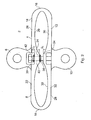
Turning to the second drawing, there is shown an engine mount 2 according to the
present invention. It is one of a pair of mounts, located at the five o'clock and seven
o'clock positions relative to the engine casing (not shown), towards the rear of the
engine.
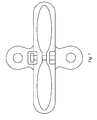
The mount comprises a first structure 4 in the form of a load bearing spring link. The
link comprises an engine attachment point 6 located at the mid-span of a flexible first
beam 8, and an aircraft attachment point 10 located at the mid-span of a flexible
second beam 12. The first and second beam 8,12 lie parallel one another, joined at
their first and second ends 14,16. The beams are shaped such that an elongate hoop
is formed, the major axis of which lies parallel with the first and second beam 8,12. The
minor axis of the hoop passes through the engine attachment point 6 and airframe
attachment point 10, which lay opposite one another.
The thickness of the first and second beam 8,12 varies along their lengths. The first
beam 8 has a substantially flat upper surface 18, while the lower surface 20 is relieved
such that the beam 8 tapers from the first end 14, to a thin 'neck' section 22 midway
between the first end and the mid-span. The section then increases, to a boss 24 at
the mid-span point of the beam 8, adjacent the engine attachment point 6. The first
beam 8 is symmetric about this boss 24 such that it then tapers towards a thin neck 26
section midway between the boss 24 and the second end 16 before again increasing
towards the second end 16 thickness, which is the same as that of the first end.
The second beam 12 is a mirror image of the first beam 8, reflected in the major axis of
the mount 2 and has a substantially flat lower surface 28, while the upper surface 30 is
relieved such that the beam tapers from the first end 14, to a thin 'neck' section 32 midway
between the first end 14and the mid span. The section then increases, to a boss
34 at the mid-span point, adjacent the aircraft attachment point 10. The beam 12 is
symmetric about this boss 34 such that it tapers towards a thin neck section 26 midway
between the boss 34 and the beam end 16 and then increases in thickness towards the
second end 16.
Flex at the neck regions 22,26,32,36, and bending of the first and second beams 8,12
allows compliant movement of the engine attachment point 6 relative to the airframe
attachment point 10, governed by stiffness characteristic K1.
An upstanding bolt 38 projects from the mid-span boss 34 of the second beam, coaxial
with the minor axis of the engine mount 2. The shaft 39 of this bolt projects through a
hole 40 in the first beam 8, sized to allow sliding movement therebetween. This
arrangement constrains relative movement between first and second beam 8,12 to
motion parallel to the minor axis of the mount. Relative movement in the major axis is
prevented by interference between the bolt shaft 39 and hole 40, as well as the lateral
stiffness of the engine mount 2.
With the mount at rest, the head 44 of the bolt is spaced apart from the outer surface 18
of the first beam 8, which is locally relieved, to define a tension clearance gap GT
between the bolt head 44 and the beam upper surface 18. This sets the maximum
displacement of the mid-point of the first beam 8 away from the mid point of the second
beam 12. When the beams are at maximum displacement, the head of the bolt 44
abuts the outer surface of the first beam 8 to prevent further displacement.
Similarly, the mid-span bosses 24,34 of each beam are spaced apart, at rest, to define
a compression clearance gap GC between mid-span bosses 24,34 that limits the
amount by which the beams can move towards one another under compression of the
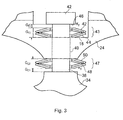
mount. The bolt 38 and bosses 24,34 which form the displacement limiting means of
the mount 2, will be seen in more detail if reference is now made to Figure 3.
Hence the spring mount provides a range of compliant movement between the engine
and airframe, from full extension to full compression of GC + GT. Throughout this range
of movement, a conventional spring mount has a substantially constant stiffness. The
mount 2 according to the present invention is provided with stiffening means 44,45,
48,50 which act upon the spring mount through only part of the range of compliant
movement so that the mount has at least two stiffness values throughout its compliant
range of operation. In the present embodiment, compression stiffening means are
provided to stiffen the mount 2 in compression and tension stiffening means to stiffen
the mount 2 in extension, for displacements beyond the normal operating range of the
link.
The tension stiffening means 43 comprises a stack of opposed Belleville washers
44,45, with stiffness characteristic K2, located coaxial about the bolt 38, and fixed to the
upper surface of the first beam 8, between the beam 8 and the lower surface 46 of the
bolt head. The stack is shorter than clearance gap GT between bolt head and beam to
divide the gap into a first 'unsprung gap' GT1 and a second 'sprung gap' GT2. Unsprung
gap GT1 allows a limited amount of compliant movement under tension wherein the
stiffening means 43 does not engage the bolt head. For this range of movement, the
displacement is governed only by the stiffness value K1 of the spring link. Beyond this
tensile displacement however, the stiffening means 43 engages the bolt head so that
further movement is governed by stiffness value K1 + K2.
Similarly, the compression stiffening means 47 comprises a stack of opposed Belleville
washers 48,50, with stiffness characteristic K3, located coaxial about the bolt 38, and
fixed to the lower surface 20 of the first beam on the mid-span boss 24. The stack
48,50 is shorter than the gap GC between first and second bosses 24,34 so that the gap
is divided into an 'unsprung gap' GC1 and a 'sprung gap' GC2. Unsprung gap GC1 allows
a limited amount of compliant movement when the mount is compressed over which the
stiffening means 47 does not engage the second boss 34. Hence this range of
displacement is governed only by the stiffness value K1 of the spring link. Beyond this
compressive displacement however, the stiffening means 47 engages the second boss
34 so that any further movement is governed by stiffness value K1 + K3.
During normal operation of the gas turbine engine, vibration of the engine is
accommodated by vertical flex of the engine mount 2 i.e. by relative movement
between the engine attachment point 6 and the aircraft attachment point 10 through
flexing of the first and second beams 8,12 of the engine mount 2. The stiffness K1 of
the mount 2, and the clearance unpsrung gaps GC1, GT1 are selected such that the
range of displacement of the first beam 8 relative to the second beam 12 does not
exceed unpsrung gap GC1 in compression, or unpsrung gap GT1 in tension under
normal operating loads, ie those imposed by the engine during normal engine operation
in straight and level flight. This isolates engine noise from the aircraft.
In the event of an engine blade off event loads imposed by the engine exceed these
normal operation loads. Where the mount is placed under such a load in tension, it is
extended beyond tension unsprung gap GT1. Tension stiffening means 43 then comes
into play to stiffen the mount sufficiently that the loads are accommodated within the
compliant range of extension of the mount 2, ie within sprung gap GT2. Where the
mount 2 is placed under such a load in compression, it is compressed beyond
compression unpsrung gap GC1. Compression stiffening means 47 then comes into
play to stiffen the mount sufficiently that the loads are accommodated within the
compliant range of compression of the mount 2 ie within compression sprung gap GC2.
When the tension stiffening means 43 are engaged, or when the compression stiffening
means 47 are engaged, the effective stiffness characteristic of the engine mount is
increased to K1+K2, or K1+K3 respectively. This restricts the displacement of the first
and second beams relative one another at the extremes of compression and tension of
the mount. In this way, the mount is provided with two modes of operation, a first
optimised for the cruise condition, with stiffness value K1 set to govern the relative
displacement of the mount over the range of movement GT1 + GC1, and a second mode
optimised for the engine blade-off condition where relative displacement of the mount
outside of the cruise range, GT2 and GC2 is governed by, respectively K1+K2 and
K1+K3. This avoids the need to oversize an engine mount to accommodate the
excessive range of relative displacement necessitated by a single stiffness value set for
cruise, at the blade-off condition, or the need to use a over-stiff spring mount for the
cruise, so that the stiffness is suited to the blade-off condition.
It will be understood that this description is not intended to limit the scope of the present
invention to only the mount arrangement described. It will be understood by the person
skilled in the art that a number of configurations are possible wherein a flexible mount is
provided with resilient means that increase the effective stiffness of the structure
beyond a predetermined displacement.
Similarly, the stiffening means used to increase the effective stiffness of the mount are
not limited to Belleville washers. A number of stiffening means may be used to provide
the stiffening effect, such as coil springs, air springs, or elastomers.
Similarly, it will be understood that it may be advantageous to configure the stiffening
means, Belleville washers in the present embodiment, such that a rising rate is
provided wherein the value of K increases proportionally with the displacement of the
mount, for example by the use of a stack of washers, each of which has a different
stiffness to create a spring whose stiffness increases with displacement. Similarly, a
gas spring can be used, which has a natural rising rate.
Although the figures show only a monolithic load bearing spring link, it will be
understood that the link may be assembled from a number of separate components.