EP1605710A1 - Method for detecting the random access of user equipment - Google Patents
Method for detecting the random access of user equipment Download PDFInfo
- Publication number
- EP1605710A1 EP1605710A1 EP04721451A EP04721451A EP1605710A1 EP 1605710 A1 EP1605710 A1 EP 1605710A1 EP 04721451 A EP04721451 A EP 04721451A EP 04721451 A EP04721451 A EP 04721451A EP 1605710 A1 EP1605710 A1 EP 1605710A1
- Authority
- EP
- European Patent Office
- Prior art keywords
- correlation
- window
- threshold
- emulation
- random access
- Prior art date
- Legal status (The legal status is an assumption and is not a legal conclusion. Google has not performed a legal analysis and makes no representation as to the accuracy of the status listed.)
- Granted
Links
- 238000000034 method Methods 0.000 title claims abstract description 48
- 238000010295 mobile communication Methods 0.000 claims abstract description 14
- 230000009466 transformation Effects 0.000 claims description 17
- 238000001514 detection method Methods 0.000 claims description 15
- 238000001914 filtration Methods 0.000 claims description 5
- 239000013598 vector Substances 0.000 description 6
- 238000005516 engineering process Methods 0.000 description 3
- 238000010586 diagram Methods 0.000 description 2
- 230000001360 synchronised effect Effects 0.000 description 2
Images


Classifications
-
- H—ELECTRICITY
- H04—ELECTRIC COMMUNICATION TECHNIQUE
- H04B—TRANSMISSION
- H04B1/00—Details of transmission systems, not covered by a single one of groups H04B3/00 - H04B13/00; Details of transmission systems not characterised by the medium used for transmission
- H04B1/69—Spread spectrum techniques
- H04B1/707—Spread spectrum techniques using direct sequence modulation
- H04B1/7073—Synchronisation aspects
- H04B1/7075—Synchronisation aspects with code phase acquisition
- H04B1/70755—Setting of lock conditions, e.g. threshold
-
- H—ELECTRICITY
- H04—ELECTRIC COMMUNICATION TECHNIQUE
- H04B—TRANSMISSION
- H04B1/00—Details of transmission systems, not covered by a single one of groups H04B3/00 - H04B13/00; Details of transmission systems not characterised by the medium used for transmission
- H04B1/69—Spread spectrum techniques
- H04B1/707—Spread spectrum techniques using direct sequence modulation
- H04B1/7073—Synchronisation aspects
- H04B1/7075—Synchronisation aspects with code phase acquisition
- H04B1/70754—Setting of search window, i.e. range of code offsets to be searched
-
- H—ELECTRICITY
- H04—ELECTRIC COMMUNICATION TECHNIQUE
- H04W—WIRELESS COMMUNICATION NETWORKS
- H04W74/00—Wireless channel access
- H04W74/08—Non-scheduled access, e.g. ALOHA
Definitions
- the present invention relates to wireless mobile communication technology, and more particularly to a method for detecting random access of user equipment (UE) to a mobile communication system.
- UE user equipment
- a base station can detect the random access of single user equipment or detect at the same time the random access of a plurality of UEs.
- Figure 1 shows a mobile communication system consisting of a base station (BS) and n (n is a positive integer) user equipments (UE01, UE02 ..., UEn).
- BS base station
- n is a positive integer
- each UE Since a plurality of UEs are allowed to access the system at the same time, each UE usually adopts an orthogonal or quasi-orthogonal pseudo-random code (PN) as its uplink synchronizing random access signal.
- PN pseudo-random code
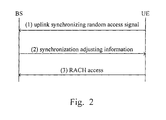
- the BS can get the information of simultaneously accessed UEs through detecting the uplink synchronizing signals sent by each UE in the mobile circumstance.
- a set of (N) orthogonal or quasi-orthogonal pseudo-random sequence codes m 1 , m 2 ⁇ m N (vectors) can be assigned to the BS, and one of the said codes will be selected by one UE in the group.
- the set of orthogonal or quasi-orthogonal pseudo-random sequence codes satisfies the following correlation properties: wherein, the "•" represents dot product.
- the uplink synchronizing random access signal sent by UE contains a pseudo-random sequence code.
- the BS can detect the uplink synchronizing signal of each UE by using various kinds of mature correlation operations, such as direct sequence convolution (linear correlation) or matched filtering, etc., combined at the same time with a series of relevant decision conditions.
- the uplink synchronizing random access signal that UE adopts is orthogonal or quasi-orthogonal pseudo-random sequence code
- the technical scheme for achieving the said object of the present invention can be as follows: a method for detecting random access of UE applied in a mobile communication system which consists of at least one BS and a group of UEs; wherein the said BS and the said group of UEs use a set of N (N is a positive integer) orthogonal or quasi-orthogonal pseudo-random sequence codes for the random access of UEs; and by detecting the pseudo-random sequence code selected by each UE, BS can simultaneously detect the random access of UEs; the method comprising:
- the technical scheme for implementing the object of the present invention can also be as follows: a method for detecting random access of UE applied in a mobile communication system which consists of at least one BS and a group of UEs; wherein the BS and the group of UE use a set of N (N is a positive integer) orthogonal or quasi-orthogonal pseudo-random sequence codes for UE random access; and by detecting the pseudo-random sequence code selected by each randomly accessed UE, BS can detect simultaneously the random access of UEs; the method comprising the steps of:
- Step A1 the said correlation operation starts from any one pseudo-random sequence code of the pseudo-random sequence code set; in Step D1, whether the one or more conditions are satisfied or not, go back to Step A1, and select another pseudo-random sequence code different from the currently used pseudo-random sequence code to make correlation operation with the random access signal of the said UE, until all the N pseudo-random sequence codes in said set have been operated.
- the number of the pseudo-random sequence code in the pseudo-random sequence code set, N is a variable or a fixed integer number, whose value is at least 1.
- the said correlation operation in Step A or A 1 further comprises:
- the said obtaining a corresponding correlation result window in Step A or A 1 comprises: taking the norm of every element in said inverse Fourier transformation result to educe the said correlation result window.
- the said norm comprises: the correlation result educed by the said norm in the form of power or absolute amplitude.
- Step 3 the said dot product is carried out in a correlation detector through a direct sequence correlation or a matched filtering correlation operation.
- Step B or B1 if the correlation result window is in the form of power, take the maximum power point in the correlation power window as the correlation peak point; if the correlation result window is in the form of absolute amplitude, take the maximum absolute amplitude in the correlation absolute amplitude window as the correlation peak point.
- the said Step C or C 1 comprises:
- Step 2) the length of the window on one side of the maximum correlation peak point is 1/3 of the length of the correlation peak window, and the length of the window on the other side of the maximum peak point is 2/3 of the length of the correlation peak window; in Step 3), the lengths of front-side window and rear-side window can be equal or unequal.
- the said Step D or D1 comprises:
- Step d13, d23, d33 or d43 if the conditions are satisfied, further executing the following steps:
- the present invention provides a new method for detecting random access of one UE or a plurality of UE in a mobile communication system.
- the said mobile communication system has at least one BS and a group of UEs.
- a set of (N) orthogonal or quasi-orthogonal pseudo-random sequence codes is assigned to the BS and the group of UEs.
- Each UE selects randomly a pseudo-random sequence code from the set of pseudo-random sequence codes for random access.
- the BS can simultaneously detect random access of one or a plurality of UEs by detecting the pseudo-random sequence code that is selected by each random access UE.
- the present invention utilizes the orthogonality among the orthogonal or quasi-orthogonal pseudo-random sequence codes.
- BS makes a correlation operation of the access signal sent by UE at one moment (represented by Vector sig , and containing one or a plurality of pseudo-random sequence codes selected randomly by UE or assigned to UE from the set of pseudo-random sequence codes) with every pseudo-random sequence code from the said set of pseudo-random sequence codes (there are totally N times of correlation operation), and then compares the maximum correlation peak of each result of N times correlation operations, and/or the maximum correlation peak of each result of N times correlation operations and the correlation peak points in front-side and rear-side windows, and/or the mean power value, total power value, effective mean power value and effective total power value of all the correlation points within a certain window of the above correlation peak points, and/or the corresponding differences with the thresholds obtained through emulation; and/or counts the number of the correlation point whose value is greater than the threshold and then compares the said number with one or several
- the BS can detect pseudo-random sequence codes selected by one or a plurality of UEs that randomly and simultaneously accesses the system at that moment, thereby detecting the said one or a plurality of UE that randomly and simultaneously accesses the system at the moment.
- the present invention is able to detect the random access of one UE or a plurality of simultaneously accessed UEs using randomly selected or assigned pseudo-random sequence code, implementing detection of one UE or a plurality of UEs getting accessed simultaneously and randomly.
- BS has a set of (N) orthogonal or quasi-orthogonal pseudo-random sequence codes m 1 , m 2 ... m N , any UE of the UE group will select a pseudo-random sequence code from the code set for accessing the system.
- the BS will receive a random access signal sig sent by the UE that contains the m x code information in it.
- This invention is accordingly a process in which based on the orthogonality among the pseudo-random sequence codes, by making correlation operation between each pseudo-random sequence code of the pseudo-random sequence code set m 1 , m 2 ⁇ m N and the received signal sig , the BS determines that the m x information is contained in the signal sig according to the detection of the correlation peak values.
- the correlation operation can be carried out by any kind of correlators, such as matched filter, direct sequence convolution etc.
- more than one threshold can be set to make multiple-condition judgments, such as comparing to maximum correlation peak, maximum correlation peak and other correlation peaks other than the maximum peak, or the mean of the correlation peaks within a window of these correlation peaks, and judging by counting the number of the correlation results that is larger than a certain threshold, etc.
- N is the number of pseudo-random sequence codes in the orthogonal or quasi-orthogonal pseudo-random sequence code set.
- Figure 3 shows a flowchart of BS detecting the random access of UE according to a preferred embodiment of the present invention.
- the pseudo-random sequence codes selected by each simultaneously accessed UEs can be determined, i.e. all the UEs getting accessed at one time can be detected.
- This embodiment is applied in a TD-SCDMA system and takes the matched filtering as the correlation operation to detect random access of UE based on the results of the correlation operation. Only N times of correlation operations are needed to detect the random access of all UEs, at most N UEs at one time.
- Step 301 BS making a Fast Fourier Transformation (FFT) to the received access signal sig from UE containing pseudo-random sequence codes randomly selected by each UE:
- FFT Fast Fourier Transformation
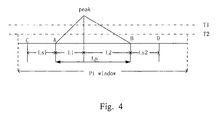
- Step 307 Determining the value and position of the peak point in the correlation power (or the absolute amplitude) window (Pi window) P i , the size and position of the peak value window Lp (L1+L2), the size and position of front-side window and rear-side window Ls1, Ls2, etc.
- the specific determining procedure is hereinafter described with reference to Figure 4:
- Step 309 making a judgment according to condition 1: set a first threshold T1 and the condition 1 comprises: Peak - Pave1 > T1, and Peak - Pave2 > T1;
- Steps 310 and 311 making a judgment according to condition 2:
- T2 T2 ⁇ T1
- condition 1 has various alternatives; one or some of the alternatives can be used to substitute the above Steps 308 and 309.
- the calculated Pave1 or Pave2 can be the total power of the correlation power in the front-side or rear-side windows, or the effective mean power thereof with the interferences eliminated, or the effective total power thereof with the interferences eliminated; then the threshold T1 should be adjusted accordingly through emulation.
- One or some of the values mentioned above can be selected for use in making decision, i.e. making decision based on one or some of the relevant conditions.
- Another example is: first calculate, respectively, the total power, mean power, effective total power and effective mean power of the correlation power in the peak window (window length Lp); and then calculate, respectively, the differences between the calculated total power, mean power, effective total power and effective mean power and the total power, mean power, effective total power and effective mean power of the correlation power in the front-side and rear-side windows; adjust the corresponding threshold T1 through emulation; compare the calculated differences with the corresponding threshold, if the calculated differences are larger, the conditions are satisfied.
- One or some of the values mentioned above can be selected for use in execution, i.e. making decision based on one or some of the relevant conditions.
- Another example is: only calculate the mean power, the total power, the effective mean power with the interferences eliminated and the effective total power with the interferences eliminated of the correlation power in the peak window (window length Lp); and then adjust the corresponding threshold T1 through emulation. if the said mean power, total power, effective mean power and effective total power are respectively greater than relevant thresholds, the conditions are satisfied.
- One or some of the values mentioned above can be selected for use in execution, i.e. making decision based on one or some of the relevant conditions.
- Another example is: only calculate the mean power, the total power, the effective mean power with the interferences eliminated and the effective total power with the interferences eliminated of the correlation powers in the front-side and rear-side windows; and then adjust the corresponding threshold T1 through emulation. Compare the calculated mean power, total power, effective mean power and effective total power respectively with the relevant threshold T1; if they are greater than the threshold, the conditions are satisfied.
- One or some of the values mentioned above can be selected for use in execution, i.e. making decision based on one or some of the relevant conditions.
- the effective value mentioned is the value with the interferences eliminated from it, and the mean value and total value of the interferences can be calculated by utilizing the remaining correlation part of the entire correlation power window after removing the peak window and the front-side and rear-side windows from it, so the effective total value and the effective mean value of the correlation power window can be accordingly obtained.
- Another example is: first count, in the remaining part of the correlation power window after removing the peak window from it, the number of the correlation power point whose value is greater than a given threshold (obtained by emulation) and then compare the said number with a given number threshold (obtained by emulation); if the said number is less than the number threshold, the condition is satisfied.
- the pseudo-random sequence code selected by each UE can be determined, accordingly simultaneously accessed UEs can be detected; and based on this, and connections between the BS and each UE can be established so as to implement the UE random access.
- the BS can detect simultaneously the randomly accessed UEs up to a maximum number of N that the system allows, thus realizing the detection of the random access of a plurality of UEs.
- the method of the present invention can overcome these problems and provides a rapid, reliable and accurate method for the detection of received signal.
- BS uses different pseudo-random sequence codes to differentiate different accessing UEs in the same frame, when the above situation appears, BS cannot differentiate the two or more than two UEs that have selected the same pseudo-random sequence code, and there would be conflicts among the random accesses of these UEs.
- Step 306 it is better to make a detection for conflict among random accesses of a plurality of UEs after Step 306, doing the random access detection of UE only after deciding that there is no random access conflict.
Landscapes
- Engineering & Computer Science (AREA)
- Computer Networks & Wireless Communication (AREA)
- Signal Processing (AREA)
- Mobile Radio Communication Systems (AREA)
Abstract
Description

Claims (25)
- A method for detecting random access of user equipment (UE), applicable to a mobile communication system consisting of at least one base station (BS) and a group of UEs, wherein the said BS and the said group of UEs use a set of N (N is a positive integer) orthogonal or quasi-orthogonal pseudo-random sequence codes for the random access of UE, and by detecting the pseudo-random sequence code selected by each randomly accessed UE, BS implements a simultaneous detection of the random access of UEs, the method comprising:A. BS making a correlation operation of the random access signal received at one moment from UE containing information of the pseudo-random sequence codes selected by the accessing UE with a pseudo-random sequence code from the local pseudo-random sequence code set of the BS, and obtaining a corresponding correlation result window, wherein the said correlation operation starts from any pseudo-random sequence code of the pseudo-random sequence code set and ends when operations with all the N pseudo-random sequence codes are completed;B. finding the maximum correlation peak value point in every correlation result window;C. based on the position of each correlation peak value point, dividing a correlation peak window from the corresponding correlation result window, or dividing a correlation peak window and the front-side and rear-side windows at both sides of the correlation peak window from the correlation result window;D. selecting one or more thresholds, considering the correlation results in every correlation peak window or every correlation peak window and its front-side and rear-side windows larger than the said one or more thresholds as conditions, and performing one or more comparisons related to the corresponding conditions, if all the conditions are satisfied, determining that the pseudo-random sequence code taking part in the correlation operation in Step A is the pseudo-random sequence code selected by a UE accessing at that moment.
- A method for detecting random access of UE according to Claim 1, further comprising after the said Step C: setting a threshold, comparing the said threshold with the correlation results in every correlation peak window, or with the correlation results in the side windows of every correlation result window excluding the said correlation peak window; if the comparison condition is satisfied, determining that the said pseudo-random sequence code involved in the correlation operation in Step A is selected by two or more than two UEs for random access, and there is an access conflict, then stopping the execution of Step D, otherwise continuing with Step D.
- A method for detecting random access of UE according to Claim 1, wherein the said number N of pseudo-random sequence codes in the said pseudo-random sequence code set is a variable or fixed integer number, whose value is at least 1.
- A method for detecting random access of UE according to Claim 1, wherein the said correlation operation in Step A further comprising:1) BS making a Fourier Transformation to the received access signal from UE, and obtaining a Fourier Transformation result;2) BS making a Fourier Transformation to a pseudo-random sequence code of the local pseudo-random sequence code set, and obtaining a Fourier Transformation result;3) BS making a dot product of the Fourier Transformation result of Step 1) and the Fourier Transformation result of Step 2), obtaining the result of the correlation operation, and then making an Inverse Fourier Transformation to the obtained result of the correlation operation;
the said obtaining a corresponding correlation result window in Step A further comprising: taking the norm of every element in said inverse Fourier transformation result of step 3) to educe the said correlation result window. - A method for detecting random access of UE according to Claim 4, wherein the said taking the norm comprises: the correlation result in the form of power or absolute amplitude educed by the norm.
- A method for detecting random access of UE according to Claim 4, wherein the said obtaining the result of correlation operation through dot product in Step 3) comprises conducting in a correlation detector the correlation operation including a direct sequence correlation or a matched filtering correlation.
- A method for detecting random access of UE according to Claim 1, further comprising, in Step B, if the correlation result window is in the form of power, taking the point with maximum power in the correlation power window as the correlation peak point; if the correlation result window is in the form of absolute amplitude, taking the point with maximum absolute amplitude in the correlation absolute amplitude window as the correlation peak point.
- A method for detecting random access of UE according to Claim 1, wherein said Step C further comprising:1) setting the length of the correlation peak window through emulation;2) setting the relationship between the window lengths on both sides of the maximum correlation peak point and the length of the correlation peak window through emulation;3) setting the lengths of the front-side window and rear-side window through emulation;4) based on the results of Steps 1) and 2), marking off the position of the correlation peak window that contains the maximum correlation peak point;5) based on the results of Steps 3) and 4), marking off the positions of the front-side window and rear-side window.
- A method for detecting random access of UE according to Claim 8, wherein, in Step 2), the window length on one side of maximum peak point is 1/3 of the length of the correlation peak window, and the window length on the other side of maximum peak point is 2/3 of the length of the correlation peak window; and in Step 3), the lengths of front-side window and rear-side window can be equal or unequal.
- A method for detecting random access of UE according to Claim 1, wherein the said Step D further comprising:d11) calculating, respectively, the mean values and/or the total values and/or the effective mean values with the interference eliminated and/or the effective total values with the interference eliminated of the correlation results in the front-side and rear-side windows beside the correlation peak window, and calculating the differences, respectively, between the peak value of the correlation peak point and the said two mean values, total values, effective mean values and/or effective total values of the front-side and the rear-side windows;d12) through emulation, setting thresholds corresponding to the said differences calculated in Step d 11;d13) if the said differences between the peak value of the correlation peak point and the said two mean values, total values, effective mean values and/or effective total values of the front-side and rear-side windows are, simultaneously, greater than the said one or more thresholds, determining that the conditions are satisfied.
- A method for detecting random access of UE according to Claim 10, further comprising after Step d13 if the said conditions are satisfied:d51) setting a threshold through emulation;d52) counting in the correlation peak window the number of the correlation point whose correlation result value is greater than the said threshold;d53) setting a threshold for the said counted number through emulation;d54) if the counted number in Step 52 is less than the set threshold in Step 53, further determining that the condition is satisfied, otherwise the condition is unsatisfied.
- A method for detecting random access of UE according to Claim 10, further comprising after Step d13 if the said conditions are satisfied:d61) setting a threshold through emulation;d62) counting, in the correlation result window excluding the correlation peak window, the number of the correlation point whose correlation result value is greater than the said threshold;d63) setting a threshold for the said counted number through emulation;d64) if the counted number in Step 62 is less than the said threshold in Step 63, the condition is satisfied, otherwise the condition is unsatisfied.
- A method for detecting random access of UE according to Claim 10, further comprising after Step d13 if the said conditions are satisfied:d71) setting a threshold through emulation;d72) calculating the differences between the maximum correlation peak and each correlation result point outside the correlation peak window but in the correlation result window;d73) counting the number of the correlation result point with the said difference less than said threshold of Step 71;d74) setting a threshold for said counted number through emulation;d75) if the said counted number is less than said threshold in Step d74, the condition is satisfied, otherwise the condition is unsatisfied.
- A method for detecting random access of UE according to Claim 1, wherein the said Step D further comprising:d21) calculating, respectively, the mean value, total value, effective mean value with the interferences eliminated, and/or effective total value with the interferences eliminated of the correlation results in the correlation peak window; calculating, respectively, the mean values, total values, effective mean values with the interferences eliminated, and/or effective total values with the interferences eliminated of the correlation results in the front-side and rear-side windows; and calculating, respectively, the corresponding differences between the mean value, total value, effective mean value and effective total value of the correlation results in the correlation peak window and the mean values, total values, effective mean values and effective total values of the correlation results in the front-side and rear-side windows;d22) through emulation, setting, respectively, one threshold corresponding to each of the said differences in Step d21;d23) if the differences between the mean value, total value, effective mean value and effective total value of the correlation results in the correlation peak window and the mean values, total values, effective mean values and effective total values of the correlation results in the front-side and rear-side windows are greater than the corresponding thresholds, respectively, determining that the conditions are satisfied.
- A method for detecting random access of UE according to Claim 14, further comprising after Step d23 if the said conditions are satisfied:d51) setting a threshold through emulation;d52) counting in the correlation peak window the number of the correlation point whose correlation result value is greater than the said threshold;d53) setting a threshold for the said counted number through emulation;d54) if the counted number in Step 52 is less than the set threshold in Step 53, further determining that the condition is satisfied, otherwise the condition is unsatisfied.
- A method for detecting random access of UE according to Claim 14, further comprising after Step d23 if the said conditions are satisfied:d61) setting a threshold through emulation;d62) counting in the correlation result window excluding the correlation peak window the number of the correlation point whose correlation result value is greater than the said threshold;d63) setting a threshold for the said counted number through emulation;d64) if the counted number in Step 62 is less than the said threshold in Step 63, determining that the condition is satisfied, otherwise the condition is unsatisfied.
- A method for detecting random access of UE according to Claim 14, further comprising after Step d23 if the said conditions are satisfied:d71) setting a threshold through emulation;d72) calculating the differences between the maximum correlation peak and each correlation result point outside the correlation peak window but in the correlation result window;d73) counting the number of the correlation result point with the said difference less than said threshold of Step 71;d74) setting a threshold for said counted number through emulation;d75) if the said counted number is less than said threshold in Step d74, determining that the condition is satisfied, and otherwise the condition is unsatisfied.
- A method detecting random access of UE according to Claim 1, wherein the said Step D further comprising:d31) calculating, respectively, the mean value, total value, effective mean value with the interferences eliminated, and/or effective total value with the interferences eliminated of the correlation results in the correlation peak window;d32) through emulation, setting, respectively, thresholds corresponding to the said mean value, total value, effective mean value and/or effective total value;d33) if the said mean value, total value, effective mean value and/or effective total value of the correlation results are greater than the corresponding thresholds, respectively, determining that the conditions are satisfied.
- A method for detecting random access of UE according to Claim 18, further comprising after Step d33 if the said conditions are satisfied:d51) setting a threshold through emulation;d52) counting in the correlation peak window the number of the correlation point whose correlation result value is greater than the said threshold;d53) setting a threshold for the said counted number through emulation;d54) if the counted number in Step 52 is less than the set threshold in Step 53, further determining that the condition is satisfied, otherwise the condition is unsatisfied.
- A method for detecting random access of UE according to Claim 18, further comprising after Step d33 if the said conditions are satisfied:d61) setting a threshold through emulation;d62) counting, in the correlation result window excluding the correlation peak window, the number of the correlation point whose correlation result value is greater than the said threshold;d63) setting a threshold for the said counted number through emulation;d64) if the counted number in Step 62 is less than the said threshold in Step 63, further determining that the condition is satisfied, otherwise the condition is unsatisfied.
- A method for detecting random access of UE according to Claim 18, further comprising after Step d33 if the said conditions are satisfied:d71) setting a threshold through emulation;d72) calculating the differences between the maximum correlation peak and each correlation result point outside the correlation peak window but in the correlation result window;d73) counting the number of the correlation result point with the said difference less than said threshold of Step 71;d74) setting a threshold for said counted number through emulation;d75) if the said counted number is less than said threshold in Step d74, further determining that the condition is satisfied, and otherwise the condition is unsatisfied.
- A method for detecting random access of UE according to Claim 1, wherein the said Step D further comprising:d41) calculating, respectively, the mean values and/or the total values and/or the effective mean values with the interferences eliminated and/or the effective total values with the interferences eliminated of the correlation results in the front-side and rear-side windows on both side of the correlation peak window;d42) through emulation, setting, respectively, thresholds corresponding to the said mean values, total values, effective mean values and effective total values;d43) if the said mean values, total values, effective mean values and/or effective total values of the correlation results are greater than the corresponding thresholds respectively, determining that the conditions are satisfied.
- A method for detecting random access of UE according to Claim 22, further comprising after Step d43 if the said conditions are satisfied:d51) setting a threshold through emulation;d52) counting t in the correlation peak window he number of the correlation point whose correlation result value is greater than the said threshold;d53) setting a threshold for the said counted number through emulation;d54) if the counted number in Step 52 is less than the set threshold in Step 53, further determining that the condition is satisfied, otherwise the condition is unsatisfied.
- A method for detecting random access of UE according to Claim 22, further comprising after Step d43 if the said conditions are satisfied:d61) setting a threshold through emulation;d62) counting, in the correlation result window excluding the correlation peak window the number of the correlation point whose correlation result value is greater than the said threshold;d63) setting a threshold for the said counted number through emulation;d64) if the counted number in Step 62 is less than the said threshold in Step 63, further determining that the condition is satisfied, otherwise the condition is unsatisfied.
- A method for detecting random access of UE according to Claim 22, further comprising after Step d43 if the said conditions are satisfied:d71) setting a threshold through emulation;d72) calculating the differences between the maximum correlation peak and each correlation result point outside the correlation peak window but in the correlation result window;d73) counting the number of the correlation result point with the said difference less than said threshold of Step 71;d74) setting a threshold for said counted number through emulation;d75) if the said counted number is less than said threshold in Step d74, further determining that the condition is satisfied, and otherwise the condition is unsatisfied.
Applications Claiming Priority (3)
| Application Number | Priority Date | Filing Date | Title |
|---|---|---|---|
| CNB031191746A CN1275485C (en) | 2003-03-18 | 2003-03-18 | Method for detecting user's terminal random cut-in |
| CN03119174 | 2003-03-18 | ||
| PCT/CN2004/000218 WO2004084564A1 (en) | 2003-03-18 | 2004-03-18 | Method for detecting the random access of user equipment |
Publications (3)
| Publication Number | Publication Date |
|---|---|
| EP1605710A1 true EP1605710A1 (en) | 2005-12-14 |
| EP1605710A4 EP1605710A4 (en) | 2010-01-13 |
| EP1605710B1 EP1605710B1 (en) | 2017-02-22 |
Family
ID=32997028
Family Applications (1)
| Application Number | Title | Priority Date | Filing Date |
|---|---|---|---|
| EP04721451.5A Expired - Lifetime EP1605710B1 (en) | 2003-03-18 | 2004-03-18 | Method for detecting the random access of user equipment |
Country Status (4)
| Country | Link |
|---|---|
| US (1) | US7554955B2 (en) |
| EP (1) | EP1605710B1 (en) |
| CN (1) | CN1275485C (en) |
| WO (1) | WO2004084564A1 (en) |
Cited By (4)
| Publication number | Priority date | Publication date | Assignee | Title |
|---|---|---|---|---|
| CN101137189B (en) * | 2006-08-28 | 2010-04-21 | 北京信威通信技术股份有限公司 | Method and system for detecting uplink accessing test sequence of TDD communication system |
| EP2406890A1 (en) * | 2009-03-13 | 2012-01-18 | ST-Ericsson SA | Process for assigning a fingr of a rake receiver in idle mode, and apparatus for carrying out the process |
| US8717996B2 (en) | 2007-08-08 | 2014-05-06 | Telefonaktiebolaget Lm Ericsson (Publ) | Uplink scrambling during random access |
| EP2439973A4 (en) * | 2009-07-06 | 2017-08-16 | ZTE Corporation | Detection method and apparatus based on random access process |
Families Citing this family (22)
| Publication number | Priority date | Publication date | Assignee | Title |
|---|---|---|---|---|
| CN100441045C (en) * | 2005-08-17 | 2008-12-03 | 鼎桥通信技术有限公司 | Method for selecting random access channel by user terminal in radio mobile communication system |
| CN100401660C (en) * | 2005-11-29 | 2008-07-09 | 中兴通讯股份有限公司 | A detection method for user terminal random access |
| CN101248593B (en) * | 2005-12-05 | 2011-11-23 | 中兴通讯股份有限公司 | Method for accidental access detecting collision reprocessing for improving user access rate |
| KR101151817B1 (en) * | 2006-05-03 | 2012-06-01 | 한국전자통신연구원 | Method for transmitting up link contorl signal in mobile communication system |
| EP2057855B1 (en) * | 2006-08-29 | 2009-12-09 | Telefonaktiebolaget L M Ericsson (Publ) | Detection of access bursts in a random access channel |
| CN101155163B (en) * | 2006-09-29 | 2010-05-12 | 鼎桥通信技术有限公司 | A random access method, system, transmitter device, and receiver device |
| CN101282575B (en) * | 2007-04-02 | 2012-01-11 | 中兴通讯股份有限公司 | Random access method and system |
| US7953060B2 (en) * | 2007-06-11 | 2011-05-31 | Viasat, Inc. | Quasisynchronous reservation requests |
| CN101335986B (en) * | 2007-06-28 | 2011-11-02 | 华为技术有限公司 | Method, network equipment and user equipment for random access |
| CN101141142B (en) * | 2007-08-09 | 2010-12-29 | 中兴通讯股份有限公司 | Method for reducing missed detection of uplink synchronous detection |
| KR100911307B1 (en) * | 2008-03-17 | 2009-08-11 | 엘지전자 주식회사 | Reference signal transmission method |
| CN101582716B (en) * | 2008-05-13 | 2014-03-12 | 中兴通讯股份有限公司 | Random access detection device and method in TD-SCDMA system |
| JP5250335B2 (en) * | 2008-08-08 | 2013-07-31 | 株式会社日立国際電気 | RADIO COMMUNICATION DEVICE HAVING RANDOM ACCESS SIGNAL DETECTION FUNCTION, RADIO COMMUNICATION SYSTEM, AND RANDOM ACCESS SIGNAL DETECTION METHOD |
| CN101938440B (en) * | 2009-06-30 | 2013-06-05 | 中兴通讯股份有限公司 | Detection method and device of random access signals of OFDM (Orthogonal Frequency Division Multiplexing) system |
| US8781050B2 (en) * | 2009-12-17 | 2014-07-15 | Electronics And Telecommunications Research Institute | Method and apparatus for estimating symbol timing |
| US9001678B2 (en) * | 2012-02-29 | 2015-04-07 | Hong Kong Applied Science And Technology Research Institute Co., Ltd. | False alarm reduction with search windowing and peak suppression |
| CN103687046B (en) * | 2012-09-26 | 2017-03-22 | 京信通信系统(中国)有限公司 | Detection method and apparatus of random access preamble sequence |
| US9743288B2 (en) * | 2012-12-21 | 2017-08-22 | Motorola Solutions, Inc. | Method and apparatus for mitigating transmission interference between narrowband and broadband mobile devices |
| CN104349492B (en) * | 2013-07-24 | 2018-03-09 | 华为技术有限公司 | Random access method and device |
| CN107079502A (en) | 2014-11-04 | 2017-08-18 | 瑞典爱立信有限公司 | For the Wireless Telecom Equipment of improved Stochastic accessing transmissions, network node and method therein |
| CN108882388B (en) * | 2017-05-10 | 2021-06-11 | 大唐移动通信设备有限公司 | Random access method and base station |
| CN109639315B (en) * | 2018-12-20 | 2021-06-15 | 惠州Tcl移动通信有限公司 | Mobile terminal pseudo-random sequence processing method, device and storage medium |
Family Cites Families (10)
| Publication number | Priority date | Publication date | Assignee | Title |
|---|---|---|---|---|
| CN1080047C (en) * | 1996-03-05 | 2002-02-27 | Ntt移动通信网株式会社 | Signal transmission method, transmitter, receiver and spreading code synchronization method in mobile communication system |
| DE19723090C2 (en) * | 1997-06-02 | 2003-09-25 | Siemens Ag | Method, mobile station and base station for establishing a connection in a radio communication system |
| US6442189B1 (en) * | 1998-01-14 | 2002-08-27 | Lg Electronics, Inc. | Binary code phase offset calculation method and a binary code phase synchronization method by using the phase offset |
| JP2001021637A (en) * | 1999-07-07 | 2001-01-26 | Mitsubishi Electric Corp | Position measuring device and position measuring method |
| KR100674806B1 (en) * | 1999-12-31 | 2007-01-26 | 주식회사 케이티 | Physical Layer Collision Detection Device in Mobile Communication System |
| EP1212853B1 (en) | 2000-06-02 | 2005-08-31 | Samsung Electronics Co., Ltd. | Method for selecting rach in a cdma mobile communication system |
| US6466958B1 (en) * | 2000-09-12 | 2002-10-15 | Interstate Electronics Corporation, A Division Of L3 Communications Corporation | Parallel frequency searching in an acquisition correlator |
| DE10065238A1 (en) | 2000-12-27 | 2002-07-04 | Alcatel Sa | Radio operated telecommunication system |
| US7206298B2 (en) * | 2001-09-06 | 2007-04-17 | Qualcomm, Incorporated | Conducting searches amidst asynchronous cells of a communication system |
| US8243634B2 (en) * | 2007-03-07 | 2012-08-14 | Telefonaktiebolaget L M Ericsson (Publ) | Random access in time division duplex communication systems |
-
2003
- 2003-03-18 CN CNB031191746A patent/CN1275485C/en not_active Expired - Lifetime
-
2004
- 2004-03-18 EP EP04721451.5A patent/EP1605710B1/en not_active Expired - Lifetime
- 2004-03-18 WO PCT/CN2004/000218 patent/WO2004084564A1/en not_active Ceased
-
2005
- 2005-09-19 US US11/230,297 patent/US7554955B2/en not_active Expired - Lifetime
Cited By (7)
| Publication number | Priority date | Publication date | Assignee | Title |
|---|---|---|---|---|
| CN101137189B (en) * | 2006-08-28 | 2010-04-21 | 北京信威通信技术股份有限公司 | Method and system for detecting uplink accessing test sequence of TDD communication system |
| US8717996B2 (en) | 2007-08-08 | 2014-05-06 | Telefonaktiebolaget Lm Ericsson (Publ) | Uplink scrambling during random access |
| US9949239B2 (en) | 2007-08-08 | 2018-04-17 | Telefonaktiebolaget Lm Ericsson (Publ) | Uplink scrambling during random access |
| US11330567B2 (en) | 2007-08-08 | 2022-05-10 | Telefonaktiebolaget Lm Ericsson (Publ) | Uplink scrambling during random access |
| US12089218B2 (en) | 2007-08-08 | 2024-09-10 | Telefonaktiebolaget Lm Ericsson (Publ) | Uplink scrambling during random access |
| EP2406890A1 (en) * | 2009-03-13 | 2012-01-18 | ST-Ericsson SA | Process for assigning a fingr of a rake receiver in idle mode, and apparatus for carrying out the process |
| EP2439973A4 (en) * | 2009-07-06 | 2017-08-16 | ZTE Corporation | Detection method and apparatus based on random access process |
Also Published As
| Publication number | Publication date |
|---|---|
| CN1275485C (en) | 2006-09-13 |
| CN1533199A (en) | 2004-09-29 |
| US7554955B2 (en) | 2009-06-30 |
| EP1605710A4 (en) | 2010-01-13 |
| WO2004084564A1 (en) | 2004-09-30 |
| EP1605710B1 (en) | 2017-02-22 |
| US20060050775A1 (en) | 2006-03-09 |
Similar Documents
| Publication | Publication Date | Title |
|---|---|---|
| EP1605710B1 (en) | Method for detecting the random access of user equipment | |
| CN102510566B (en) | Method and device for searching neighbor-cell of LTE (long term evolution) system | |
| US7336635B2 (en) | Method and apparatus for fast W-CDMA acquisition | |
| CN1703854B (en) | Method and system for interference assessment and reduction in wireless communication system | |
| CN100362763C (en) | cell search using peak quality factor | |
| CN1275489C (en) | Method for detecting multiple user's terminal random cutrin conflict | |
| CN101075845B (en) | A method and device for realizing downlink synchronization during initial cell search | |
| EP2027661B1 (en) | Method and arrangement for preamble detection | |
| US11057945B2 (en) | Apparatus and method for random access in wireless communication system | |
| CN120200713B (en) | Index detection method, device, equipment, medium and product | |
| US20120163512A1 (en) | Processing nodes and methods of estimating interference in a radio telecommunication network | |
| KR20010031524A (en) | Synchronizing device and synchronizing method | |
| CN101248593B (en) | Method for accidental access detecting collision reprocessing for improving user access rate | |
| KR20140111461A (en) | Method and apparatus for timing acquisition in code division multiple access system | |
| CN1595834A (en) | Method and apparatus for initial synchronization in CDMA mobile communication system | |
| RU2563888C2 (en) | Assessment of noise power in wireless communication systems | |
| EP1436906B1 (en) | Ray classification | |
| JP3965397B2 (en) | Mobile communication system and base station used in the system | |
| KR100788892B1 (en) | Apparatus and method for generating downlink signal, and apparatus and method for searching cell | |
| KR100311527B1 (en) | fast multipath acquiring method, and receiver for the method | |
| CN107734515A (en) | A kind of detection method and device of accidental access signal | |
| Shin | Maximum-Likelihood Acquisition of Spread-Spectrum Signals in Frequency-Selective Fading Channels |
Legal Events
| Date | Code | Title | Description |
|---|---|---|---|
| PUAI | Public reference made under article 153(3) epc to a published international application that has entered the european phase |
Free format text: ORIGINAL CODE: 0009012 |
|
| 17P | Request for examination filed |
Effective date: 20050921 |
|
| AK | Designated contracting states |
Kind code of ref document: A1 Designated state(s): AT BE BG CH CY CZ DE DK EE ES FI FR GB GR HU IE IT LI LU MC NL PL PT RO SE SI SK TR |
|
| AX | Request for extension of the european patent |
Extension state: AL LT LV MK |
|
| DAX | Request for extension of the european patent (deleted) | ||
| A4 | Supplementary search report drawn up and despatched |
Effective date: 20091216 |
|
| 17Q | First examination report despatched |
Effective date: 20100325 |
|
| RAP1 | Party data changed (applicant data changed or rights of an application transferred) |
Owner name: CHINA ACADEMY OF TELECOMMUNICATIONS TECHNOLOGY |
|
| GRAP | Despatch of communication of intention to grant a patent |
Free format text: ORIGINAL CODE: EPIDOSNIGR1 |
|
| GRAJ | Information related to disapproval of communication of intention to grant by the applicant or resumption of examination proceedings by the epo deleted |
Free format text: ORIGINAL CODE: EPIDOSDIGR1 |
|
| GRAP | Despatch of communication of intention to grant a patent |
Free format text: ORIGINAL CODE: EPIDOSNIGR1 |
|
| RIC1 | Information provided on ipc code assigned before grant |
Ipc: H04B 1/7075 20110101AFI20160603BHEP Ipc: H04W 74/08 20090101ALN20160603BHEP |
|
| INTG | Intention to grant announced |
Effective date: 20160623 |
|
| INTG | Intention to grant announced |
Effective date: 20160704 |
|
| GRAS | Grant fee paid |
Free format text: ORIGINAL CODE: EPIDOSNIGR3 |
|
| STAA | Information on the status of an ep patent application or granted ep patent |
Free format text: STATUS: GRANT OF PATENT IS INTENDED |
|
| GRAJ | Information related to disapproval of communication of intention to grant by the applicant or resumption of examination proceedings by the epo deleted |
Free format text: ORIGINAL CODE: EPIDOSDIGR1 |
|
| GRAL | Information related to payment of fee for publishing/printing deleted |
Free format text: ORIGINAL CODE: EPIDOSDIGR3 |
|
| STAA | Information on the status of an ep patent application or granted ep patent |
Free format text: STATUS: EXAMINATION IS IN PROGRESS |
|
| REG | Reference to a national code |
Ref country code: DE Ref legal event code: R079 Ref document number: 602004050795 Country of ref document: DE Free format text: PREVIOUS MAIN CLASS: H04Q0007000000 Ipc: H04B0001707500 |
|
| GRAP | Despatch of communication of intention to grant a patent |
Free format text: ORIGINAL CODE: EPIDOSNIGR1 |
|
| STAA | Information on the status of an ep patent application or granted ep patent |
Free format text: STATUS: GRANT OF PATENT IS INTENDED |
|
| INTC | Intention to grant announced (deleted) | ||
| RIC1 | Information provided on ipc code assigned before grant |
Ipc: H04W 74/08 20090101ALN20161117BHEP Ipc: H04B 1/7075 20110101AFI20161117BHEP |
|
| INTG | Intention to grant announced |
Effective date: 20161201 |
|
| GRAA | (expected) grant |
Free format text: ORIGINAL CODE: 0009210 |
|
| STAA | Information on the status of an ep patent application or granted ep patent |
Free format text: STATUS: THE PATENT HAS BEEN GRANTED |
|
| AK | Designated contracting states |
Kind code of ref document: B1 Designated state(s): AT BE BG CH CY CZ DE DK EE ES FI FR GB GR HU IE IT LI LU MC NL PL PT RO SE SI SK TR |
|
| REG | Reference to a national code |
Ref country code: GB Ref legal event code: FG4D |
|
| REG | Reference to a national code |
Ref country code: DE Ref legal event code: R081 Ref document number: 602004050795 Country of ref document: DE Owner name: DATANG MOBILE COMMUNICATIONS EQUIPMENT CO., LT, CN Free format text: FORMER OWNER: DA TANG MOBILE COMMUNICATIONS EQUIPMENT CO., LTD., PEKING/BEI-JING, CN |
|
| REG | Reference to a national code |
Ref country code: CH Ref legal event code: EP |
|
| REG | Reference to a national code |
Ref country code: AT Ref legal event code: REF Ref document number: 869998 Country of ref document: AT Kind code of ref document: T Effective date: 20170315 |
|
| REG | Reference to a national code |
Ref country code: IE Ref legal event code: FG4D |
|
| REG | Reference to a national code |
Ref country code: FR Ref legal event code: PLFP Year of fee payment: 14 |
|
| REG | Reference to a national code |
Ref country code: DE Ref legal event code: R096 Ref document number: 602004050795 Country of ref document: DE |
|
| REG | Reference to a national code |
Ref country code: NL Ref legal event code: MP Effective date: 20170222 |
|
| REG | Reference to a national code |
Ref country code: AT Ref legal event code: MK05 Ref document number: 869998 Country of ref document: AT Kind code of ref document: T Effective date: 20170222 |
|
| PG25 | Lapsed in a contracting state [announced via postgrant information from national office to epo] |
Ref country code: FI Free format text: LAPSE BECAUSE OF FAILURE TO SUBMIT A TRANSLATION OF THE DESCRIPTION OR TO PAY THE FEE WITHIN THE PRESCRIBED TIME-LIMIT Effective date: 20170222 Ref country code: GR Free format text: LAPSE BECAUSE OF FAILURE TO SUBMIT A TRANSLATION OF THE DESCRIPTION OR TO PAY THE FEE WITHIN THE PRESCRIBED TIME-LIMIT Effective date: 20170523 |
|
| PG25 | Lapsed in a contracting state [announced via postgrant information from national office to epo] |
Ref country code: ES Free format text: LAPSE BECAUSE OF FAILURE TO SUBMIT A TRANSLATION OF THE DESCRIPTION OR TO PAY THE FEE WITHIN THE PRESCRIBED TIME-LIMIT Effective date: 20170222 Ref country code: AT Free format text: LAPSE BECAUSE OF FAILURE TO SUBMIT A TRANSLATION OF THE DESCRIPTION OR TO PAY THE FEE WITHIN THE PRESCRIBED TIME-LIMIT Effective date: 20170222 Ref country code: SE Free format text: LAPSE BECAUSE OF FAILURE TO SUBMIT A TRANSLATION OF THE DESCRIPTION OR TO PAY THE FEE WITHIN THE PRESCRIBED TIME-LIMIT Effective date: 20170222 Ref country code: PT Free format text: LAPSE BECAUSE OF FAILURE TO SUBMIT A TRANSLATION OF THE DESCRIPTION OR TO PAY THE FEE WITHIN THE PRESCRIBED TIME-LIMIT Effective date: 20170622 Ref country code: BG Free format text: LAPSE BECAUSE OF FAILURE TO SUBMIT A TRANSLATION OF THE DESCRIPTION OR TO PAY THE FEE WITHIN THE PRESCRIBED TIME-LIMIT Effective date: 20170522 Ref country code: NL Free format text: LAPSE BECAUSE OF FAILURE TO SUBMIT A TRANSLATION OF THE DESCRIPTION OR TO PAY THE FEE WITHIN THE PRESCRIBED TIME-LIMIT Effective date: 20170222 |
|
| PG25 | Lapsed in a contracting state [announced via postgrant information from national office to epo] |
Ref country code: CZ Free format text: LAPSE BECAUSE OF FAILURE TO SUBMIT A TRANSLATION OF THE DESCRIPTION OR TO PAY THE FEE WITHIN THE PRESCRIBED TIME-LIMIT Effective date: 20170222 Ref country code: EE Free format text: LAPSE BECAUSE OF FAILURE TO SUBMIT A TRANSLATION OF THE DESCRIPTION OR TO PAY THE FEE WITHIN THE PRESCRIBED TIME-LIMIT Effective date: 20170222 Ref country code: IT Free format text: LAPSE BECAUSE OF FAILURE TO SUBMIT A TRANSLATION OF THE DESCRIPTION OR TO PAY THE FEE WITHIN THE PRESCRIBED TIME-LIMIT Effective date: 20170222 Ref country code: RO Free format text: LAPSE BECAUSE OF FAILURE TO SUBMIT A TRANSLATION OF THE DESCRIPTION OR TO PAY THE FEE WITHIN THE PRESCRIBED TIME-LIMIT Effective date: 20170222 Ref country code: SK Free format text: LAPSE BECAUSE OF FAILURE TO SUBMIT A TRANSLATION OF THE DESCRIPTION OR TO PAY THE FEE WITHIN THE PRESCRIBED TIME-LIMIT Effective date: 20170222 |
|
| REG | Reference to a national code |
Ref country code: CH Ref legal event code: PL |
|
| REG | Reference to a national code |
Ref country code: DE Ref legal event code: R097 Ref document number: 602004050795 Country of ref document: DE |
|
| PG25 | Lapsed in a contracting state [announced via postgrant information from national office to epo] |
Ref country code: PL Free format text: LAPSE BECAUSE OF FAILURE TO SUBMIT A TRANSLATION OF THE DESCRIPTION OR TO PAY THE FEE WITHIN THE PRESCRIBED TIME-LIMIT Effective date: 20170222 Ref country code: MC Free format text: LAPSE BECAUSE OF FAILURE TO SUBMIT A TRANSLATION OF THE DESCRIPTION OR TO PAY THE FEE WITHIN THE PRESCRIBED TIME-LIMIT Effective date: 20170222 Ref country code: DK Free format text: LAPSE BECAUSE OF FAILURE TO SUBMIT A TRANSLATION OF THE DESCRIPTION OR TO PAY THE FEE WITHIN THE PRESCRIBED TIME-LIMIT Effective date: 20170222 |
|
| REG | Reference to a national code |
Ref country code: IE Ref legal event code: MM4A |
|
| PLBE | No opposition filed within time limit |
Free format text: ORIGINAL CODE: 0009261 |
|
| STAA | Information on the status of an ep patent application or granted ep patent |
Free format text: STATUS: NO OPPOSITION FILED WITHIN TIME LIMIT |
|
| 26N | No opposition filed |
Effective date: 20171123 |
|
| PG25 | Lapsed in a contracting state [announced via postgrant information from national office to epo] |
Ref country code: LU Free format text: LAPSE BECAUSE OF NON-PAYMENT OF DUE FEES Effective date: 20170318 |
|
| PG25 | Lapsed in a contracting state [announced via postgrant information from national office to epo] |
Ref country code: CH Free format text: LAPSE BECAUSE OF NON-PAYMENT OF DUE FEES Effective date: 20170331 Ref country code: IE Free format text: LAPSE BECAUSE OF NON-PAYMENT OF DUE FEES Effective date: 20170318 Ref country code: LI Free format text: LAPSE BECAUSE OF NON-PAYMENT OF DUE FEES Effective date: 20170331 Ref country code: SI Free format text: LAPSE BECAUSE OF FAILURE TO SUBMIT A TRANSLATION OF THE DESCRIPTION OR TO PAY THE FEE WITHIN THE PRESCRIBED TIME-LIMIT Effective date: 20170222 |
|
| REG | Reference to a national code |
Ref country code: BE Ref legal event code: MM Effective date: 20170331 |
|
| REG | Reference to a national code |
Ref country code: FR Ref legal event code: PLFP Year of fee payment: 15 |
|
| PG25 | Lapsed in a contracting state [announced via postgrant information from national office to epo] |
Ref country code: BE Free format text: LAPSE BECAUSE OF NON-PAYMENT OF DUE FEES Effective date: 20170331 |
|
| PG25 | Lapsed in a contracting state [announced via postgrant information from national office to epo] |
Ref country code: HU Free format text: LAPSE BECAUSE OF FAILURE TO SUBMIT A TRANSLATION OF THE DESCRIPTION OR TO PAY THE FEE WITHIN THE PRESCRIBED TIME-LIMIT; INVALID AB INITIO Effective date: 20040318 |
|
| PG25 | Lapsed in a contracting state [announced via postgrant information from national office to epo] |
Ref country code: CY Free format text: LAPSE BECAUSE OF NON-PAYMENT OF DUE FEES Effective date: 20170222 |
|
| PG25 | Lapsed in a contracting state [announced via postgrant information from national office to epo] |
Ref country code: TR Free format text: LAPSE BECAUSE OF FAILURE TO SUBMIT A TRANSLATION OF THE DESCRIPTION OR TO PAY THE FEE WITHIN THE PRESCRIBED TIME-LIMIT Effective date: 20170222 |
|
| REG | Reference to a national code |
Ref country code: DE Ref legal event code: R081 Ref document number: 602004050795 Country of ref document: DE Owner name: DATANG MOBILE COMMUNICATIONS EQUIPMENT CO., LT, CN Free format text: FORMER OWNER: CHINA ACADEMY OF TELECOMMUNICATIONS TECHNOLOGY, BEIJING, CN |
|
| REG | Reference to a national code |
Ref country code: GB Ref legal event code: 732E Free format text: REGISTERED BETWEEN 20210729 AND 20210804 |
|
| PGFP | Annual fee paid to national office [announced via postgrant information from national office to epo] |
Ref country code: FR Payment date: 20230322 Year of fee payment: 20 |
|
| PGFP | Annual fee paid to national office [announced via postgrant information from national office to epo] |
Ref country code: GB Payment date: 20230321 Year of fee payment: 20 Ref country code: DE Payment date: 20230321 Year of fee payment: 20 |
|
| REG | Reference to a national code |
Ref country code: DE Ref legal event code: R071 Ref document number: 602004050795 Country of ref document: DE |
|
| REG | Reference to a national code |
Ref country code: GB Ref legal event code: PE20 Expiry date: 20240317 |
|
| PG25 | Lapsed in a contracting state [announced via postgrant information from national office to epo] |
Ref country code: GB Free format text: LAPSE BECAUSE OF EXPIRATION OF PROTECTION Effective date: 20240317 |