EP1605442A1 - Magnetic recording medium and its production method - Google Patents
Magnetic recording medium and its production method Download PDFInfo
- Publication number
- EP1605442A1 EP1605442A1 EP03816360A EP03816360A EP1605442A1 EP 1605442 A1 EP1605442 A1 EP 1605442A1 EP 03816360 A EP03816360 A EP 03816360A EP 03816360 A EP03816360 A EP 03816360A EP 1605442 A1 EP1605442 A1 EP 1605442A1
- Authority
- EP
- European Patent Office
- Prior art keywords
- layer
- magnetic recording
- nonmagnetic
- recording medium
- based alloy
- Prior art date
- Legal status (The legal status is an assumption and is not a legal conclusion. Google has not performed a legal analysis and makes no representation as to the accuracy of the status listed.)
- Withdrawn
Links
Images



Classifications
-
- G—PHYSICS
- G11—INFORMATION STORAGE
- G11B—INFORMATION STORAGE BASED ON RELATIVE MOVEMENT BETWEEN RECORD CARRIER AND TRANSDUCER
- G11B5/00—Recording by magnetisation or demagnetisation of a record carrier; Reproducing by magnetic means; Record carriers therefor
- G11B5/62—Record carriers characterised by the selection of the material
- G11B5/64—Record carriers characterised by the selection of the material comprising only the magnetic material without bonding agent
- G11B5/66—Record carriers characterised by the selection of the material comprising only the magnetic material without bonding agent the record carriers consisting of several layers
- G11B5/676—Record carriers characterised by the selection of the material comprising only the magnetic material without bonding agent the record carriers consisting of several layers having magnetic layers separated by a nonmagnetic layer, e.g. antiferromagnetic layer, Cu layer or coupling layer
-
- G—PHYSICS
- G11—INFORMATION STORAGE
- G11B—INFORMATION STORAGE BASED ON RELATIVE MOVEMENT BETWEEN RECORD CARRIER AND TRANSDUCER
- G11B5/00—Recording by magnetisation or demagnetisation of a record carrier; Reproducing by magnetic means; Record carriers therefor
- G11B5/62—Record carriers characterised by the selection of the material
- G11B5/64—Record carriers characterised by the selection of the material comprising only the magnetic material without bonding agent
- G11B5/66—Record carriers characterised by the selection of the material comprising only the magnetic material without bonding agent the record carriers consisting of several layers
- G11B5/672—Record carriers characterised by the selection of the material comprising only the magnetic material without bonding agent the record carriers consisting of several layers having different compositions in a plurality of magnetic layers, e.g. layer compositions having differing elemental components or differing proportions of elements
-
- G—PHYSICS
- G11—INFORMATION STORAGE
- G11B—INFORMATION STORAGE BASED ON RELATIVE MOVEMENT BETWEEN RECORD CARRIER AND TRANSDUCER
- G11B5/00—Recording by magnetisation or demagnetisation of a record carrier; Reproducing by magnetic means; Record carriers therefor
- G11B5/62—Record carriers characterised by the selection of the material
- G11B5/73—Base layers, i.e. all non-magnetic layers lying under a lowermost magnetic recording layer, e.g. including any non-magnetic layer in between a first magnetic recording layer and either an underlying substrate or a soft magnetic underlayer
- G11B5/7368—Non-polymeric layer under the lowermost magnetic recording layer
- G11B5/7369—Two or more non-magnetic underlayers, e.g. seed layers or barrier layers
-
- G—PHYSICS
- G11—INFORMATION STORAGE
- G11B—INFORMATION STORAGE BASED ON RELATIVE MOVEMENT BETWEEN RECORD CARRIER AND TRANSDUCER
- G11B5/00—Recording by magnetisation or demagnetisation of a record carrier; Reproducing by magnetic means; Record carriers therefor
- G11B5/84—Processes or apparatus specially adapted for manufacturing record carriers
- G11B5/851—Coating a support with a magnetic layer by sputtering
-
- G—PHYSICS
- G11—INFORMATION STORAGE
- G11B—INFORMATION STORAGE BASED ON RELATIVE MOVEMENT BETWEEN RECORD CARRIER AND TRANSDUCER
- G11B5/00—Recording by magnetisation or demagnetisation of a record carrier; Reproducing by magnetic means; Record carriers therefor
- G11B5/62—Record carriers characterised by the selection of the material
- G11B5/73—Base layers, i.e. all non-magnetic layers lying under a lowermost magnetic recording layer, e.g. including any non-magnetic layer in between a first magnetic recording layer and either an underlying substrate or a soft magnetic underlayer
- G11B5/7368—Non-polymeric layer under the lowermost magnetic recording layer
- G11B5/7379—Seed layer, e.g. at least one non-magnetic layer is specifically adapted as a seed or seeding layer
-
- G—PHYSICS
- G11—INFORMATION STORAGE
- G11B—INFORMATION STORAGE BASED ON RELATIVE MOVEMENT BETWEEN RECORD CARRIER AND TRANSDUCER
- G11B5/00—Recording by magnetisation or demagnetisation of a record carrier; Reproducing by magnetic means; Record carriers therefor
- G11B5/84—Processes or apparatus specially adapted for manufacturing record carriers
- G11B5/8404—Processes or apparatus specially adapted for manufacturing record carriers manufacturing base layers
-
- Y—GENERAL TAGGING OF NEW TECHNOLOGICAL DEVELOPMENTS; GENERAL TAGGING OF CROSS-SECTIONAL TECHNOLOGIES SPANNING OVER SEVERAL SECTIONS OF THE IPC; TECHNICAL SUBJECTS COVERED BY FORMER USPC CROSS-REFERENCE ART COLLECTIONS [XRACs] AND DIGESTS
- Y10—TECHNICAL SUBJECTS COVERED BY FORMER USPC
- Y10S—TECHNICAL SUBJECTS COVERED BY FORMER USPC CROSS-REFERENCE ART COLLECTIONS [XRACs] AND DIGESTS
- Y10S428/00—Stock material or miscellaneous articles
- Y10S428/90—Magnetic feature
Definitions
- the present invention relates to a magnetic recording medium suitable for high-density recording and also to a manufacturing method for such a magnetic recording medium.
- the demand for higher-density recording is increasing to a magnetic disk drive for use as an external storage for a computer.
- the characteristics required for a magnetic recording medium to meet the above demand include higher S/Nm (signal-to-medium noise ratio) of the magnetic recording medium and an improvement in thermal stability.
- S/Nm signal-to-medium noise ratio
- thermal stability For a reduction in medium noise, it is necessary to reduce the size of magnetic grains forming a magnetic layer and to weaken the magnetic interaction between the magnetic grains.
- An improvement in the in-plane orientation of the C-axis as the axis of easy magnetization in the magnetic recording layer also contributes to a reduction in the medium noise.
- a technique of using an underlayer made of a suitable Cr alloy having a crystal lattice size near that of the CoCr alloy forming the magnetic recording layer and a technique of forming an intermediate layer between the magnetic recording layer and the underlayer wherein the intermediate layer is made of a Co-based alloy having better in-plane orientation characteristics than those of the magnetic recording layer (S. Ohkijima et al., Digest of IEEE - Inter - Mag., AB - 03, 1997).
- This medium includes a keeper layer, which is a soft magnetic layer whose magnetization direction is parallel to that of a magnetic layer (magnetic recording layer).
- This soft magnetic layer is formed above or below the magnetic layer.
- a Cr magnetic insulating layer is provided between the soft magnetic layer and the magnetic layer.
- the soft magnetic layer decreases the demagnetizing field of bits written in the magnetic layer.
- the purpose of decoupling of grains in the magnetic layer is not attained because of the soft magnetic layer continuously exchange-coupled to the magnetic recording layer. As a result, the medium noise is increased.
- a magnetic recording medium including at least one exchange layer structure and a magnetic recording layer provided on the exchange layer structure, wherein the exchange layer structure includes a ferromagnetic layer and a nonmagnetic coupling layer formed on the ferromagnetic layer, and the magnetization direction in the ferromagnetic layer is antiparallel to that in the magnetic recording layer.
- the magnetization direction in the magnetic recording layer and the magnetization direction in the ferromagnetic layer become parallel to each other.
- the magnetization direction in the ferromagnetic layer is inverted to become antiparallel to the magnetization direction in the magnetic recording layer.
- the apparent film thickness can be increased as a whole. Accordingly, the thermal stability of recorded bits can be improved and the medium noise can be reduced without any adverse effects on the performance of the magnetic recording medium, thus realizing a magnetic recording medium which can perform reliable high-density recording.
- the use of the above-mentioned exchange layer structure is effective.
- an exchange coupling field for making the magnetization direction in the magnetic recording layer and the magnetization direction in the ferromagnetic layer antiparallel to each other is produced with a sufficient intensity.
- a magnetic recording medium including a ferromagnetic layer made of a Co-based alloy material; a nonmagnetic coupling layer formed on the ferromagnetic layer and made of Ru or a Ru-based alloy material; and a magnetic recording layer formed on the nonmagnetic coupling layer and made of a Co-based alloy material; the nonmagnetic coupling layer containing nitrogen.
- the nonmagnetic coupling layer is formed by sputtering in an atmosphere of Ar-N 2 mixed gas, and the partial pressure of nitrogen gas during the sputtering is set in the range of 6.7 ⁇ 10 -3 to 3.7 ⁇ 10 -2 Pa.
- the magnetic recording layer includes at least one Co-based alloy layer containing Co as a principal component and at least one element selected from the group consisting of Cr, Pt, B, and Cu.
- the ferromagnetic layer contains Co as a principal component and at least one element selected from the group consisting of Cr, Pt, and B.
- a magnetic recording medium including a nonmagnetic substrate; an underlayer formed on the nonmagnetic substrate; a nonmagnetic intermediate layer formed on the underlayer; a ferromagnetic layer formed on the nonmagnetic intermediate layer and made of a Co-based alloy material; a nonmagnetic coupling layer formed on the ferromagnetic layer and made of Ru or a Ru-based alloy material; and a magnetic recording layer formed on the nonmagnetic coupling layer and made of a Co-based alloy material; the nonmagnetic coupling layer containing nitrogen.
- the nonmagnetic coupling layer is formed by sputtering in an atmosphere of Ar-N 2 mixed gas, and the partial pressure of nitrogen gas during the sputtering is set in the range of 6.7 ⁇ 10 -3 to 3.7 ⁇ 10 -2 Pa.
- the underlayer includes a first underlayer formed of Cr and a second underlayer provided on the first base layer and formed of a Cr-based alloy material containing Cr as a principal component and at least one element selected from the group consisting of Mo, Ta, Ti, W, and V.
- a manufacturing method for a magnetic recording medium including the steps of forming an underlayer on a substrate by sputtering; forming a nonmagnetic intermediate layer on the underlayer by sputtering; forming a ferromagnetic layer of a Co-based alloy material on the nonmagnetic intermediate layer by sputtering; forming a nonmagnetic coupling layer of Ru or a Ru-based alloy material on the ferromagnetic layer by sputtering in an atmosphere of Ar-N 2 mixed gas; and forming a magnetic recording layer of a Co-based alloy material on the nonmagnetic coupling layer by sputtering.
- the partial pressure of nitrogen gas during the sputtering in forming the nonmagnetic coupling layer is set in the range of 6.7 ⁇ 10 -3 to 3.7 ⁇ 10 -2 Pa.
- FIG. 1 there is shown a schematic sectional diagram showing the configuration of a magnetic recording medium according to a preferred embodiment of the present invention.
- the magnetic recording medium has a sectional structure obtained by laminating a nonmagnetic substrate 2, Cr adhesive layer 4, NiP seed layer 6, first underlayer 8, second underlayer 10, nonmagnetic intermediate layer 12, ferromagnetic layer 14, Ru nonmagnetic coupling layer 16 containing N, magnetic recording layer 18, protective layer 20, and lubrication layer 22 in this order.
- the nonmagnetic substrate 2 is formed of Al, Al alloy, or glass, for example.
- the nonmagnetic substrate 2 may be textured or untextured.
- the Cr adhesive layer 4 having a thickness of 25 nm is formed on the nonmagnetic substrate 2.
- the NiP seed layer 6 having a thickness of 25 nm is formed on the Cr adhesive layer 4.
- the first underlayer 8 having a thickness of 4 nm is formed on the NiP seed layer 6.
- the first underlayer 8 is made of Cr.
- the second underlayer 10 having a thickness of 3 nm is formed on the first underlayer 8.
- the second underlayer 10 is formed of CrMo.
- the material of the second underlayer 10 is not limited to CrMo, but may be a Cr-based alloy containing Cr as a principal component and at least one element selected from the group consisting of Mo, Ta, Ti, W, and V.
- the nonmagnetic intermediate layer 12 having a thickness of 1 nm is formed on the second base layer 10.
- the nonmagnetic intermediate layer 12 is formed of CoCrTa.
- the nonmagnetic intermediate layer 12 is provided to promote the epitaxial growth of the magnetic recording layer 18, the decrease in range of grain size distribution in the magnetic recording layer 18, and the orientation of the axis of easy magnetization in the magnetic recording layer 18 parallel to the surface of the magnetic recording medium.
- the ferromagnetic layer 14 having a thickness of 3 nm is formed on the nonmagnetic intermediate layer 12.
- the ferromagnetic layer 14 is made of CoCrPtB.
- the material of the ferromagnetic layer 14 is not limited to CoCrPtB, but may be a Co-based alloy containing Co as a principal component and at least one element selected from the group consisting of Cr, Pt, and B.
- the nonmagnetic exchange coupling layer 16 having a thickness of 0.8 nm is formed on the ferromagnetic layer 14.
- the nonmagnetic exchange coupling layer 16 is formed of Ru.
- the Ru nonmagnetic exchange coupling layer 16 is formed by sputtering in an atmosphere of Ar-N 2 mixed gas. Accordingly, the Ru film deposited by this sputtering contains a minute amount of nitrogen (N).
- the magnetic recording layer 18 having a thickness of 17 nm is formed on the Ru(N) nonmagnetic exchange coupling layer 16.
- the magnetic recording layer 18 is made of CoCrPtBCu.
- the material of the magnetic recording layer 18 is not limited to CoCrPtBCu, but may be a Co-based alloy containing Co as a principal component and at least one element selected from the group consisting of Cr, Pt, B, and Cu. It is needless to say that the magnetic recording layer 18 is not limited to a single layer, but may be composed of multiple layers.
- the protective layer 20 having a thickness of 5 nm is formed on the magnetic recording layer 18.
- the lubrication layer 22 is formed on the protective layer 20, so as to lubricate the recording surface of the magnetic recording medium. This lubrication layer 22 is formed of an organic lubricant.
- FIG. 2 shows a manufacturing method for the above-mentioned magnetic recording medium.
- a sputtering chamber is vacuumed to 4 ⁇ 10 -5 Pa or less.
- the substrate 2 is heated to 220°C. Thereafter, Ar gas is introduced into the sputtering chamber to hold the pressure in the sputtering chamber at 0.67 Pa.
- the Cr adhesive layer 4 is formed on the substrate 2 (step S12), and the NiP seed layer 6 is next formed on the Cr adhesive layer 4 (step S13).
- step S14 the substrate 2 is heated to 260°C. Thereafter, the first and second base layers 8 and 10 are formed (step S15).
- the CoCrTa nonmagnetic intermediate layer 12 is formed on the second base layer 10 (step S16), and the CoCrPtB ferromagnetic layer 14 is next formed on the nonmagnetic intermediate layer 12 (step S17).
- the Ar-N 2 mixed gas is introduced into the sputtering chamber to form the Ru(N) nonmagnetic exchange coupling layer 16 having a thickness of 0.8 nm (step S18).
- Samples were prepared with changing the partial pressure of the nitrogen gas at step S18 to clarify the dependence of exchange coupling field (Hex), coercivity (Hc), and S/Nm upon this partial pressure.
- step S19 Ar gas is introduced into the sputtering chamber to form the CoCrPtBCu magnetic recording layer 16 having a thickness of 17 nm (step S19) and next form the protective layer 20 having a thickness of 5 nm (step S20).
- step S21 an organic lubricant is applied to the protective layer 20 to form the lubrication layer 22 (step S21).
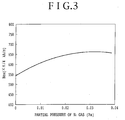
- FIG. 3 shows the dependence of exchange coupling field (Hex) upon the partial pressure of nitrogen gas in forming the exchange coupling layer 16.
- the exchange coupling field (Hex) in the case of adding nitrogen to the exchange coupling layer is larger than that in the case of not adding nitrogen to the exchange coupling layer, and the exchange coupling field (Hex) increases with an increase in the partial pressure of nitrogen gas.
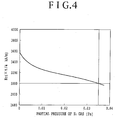
- FIG. 4 shows the dependence of coercivity (Hc) of the magnetic recording layer 18 upon the partial pressure of nitrogen gas in forming the exchange coupling layer 16.
- Hc coercivity
- the coercivity tends to decrease with an increase in the partial pressure of nitrogen gas, and a desired coercivity of not less than 3000 oersteds (Oe) or not less than 3000 ⁇ n/4 (kA/m) is obtained in the range of not more than 3.7 ⁇ 10 -2 Pa for the partial pressure of nitrogen gas.
- the loss of coercivity due to the addition of nitrogen can be compensated by optimizing the material of the magnetic recording layer 18.
- FIG. 5 shows the dependence of signal-to-medium noise ratio (S/Nm) at a recording density of 307 kFCI upon the partial pressure of nitrogen gas in forming the exchange coupling layer 16.
- S/Nm signal-to-medium noise ratio
- the S/Nm is more improved with an increase in the partial pressure of nitrogen gas as compared with the case of not adding nitrogen to the exchange coupling layer, and a desired S/Nm of not less than 14.5 dB can be obtained in the range of not less than 6.7 ⁇ 10 -3 Pa for the partial pressure of nitrogen gas.
- the partial pressure of nitrogen gas in forming the nonmagnetic exchange coupling layer 16 is preferably set in the range of 6.7 ⁇ 10 -3 to 3.7 ⁇ 10 -2 Pa.
- a magnetic recording medium which can increase an exchange coupling force between a magnetic recording layer and a ferromagnetic layer to improve the thermal stability of recorded bits, thereby obtaining a high S/Nm.
Landscapes
- Engineering & Computer Science (AREA)
- Manufacturing & Machinery (AREA)
- Magnetic Record Carriers (AREA)
- Manufacturing Of Magnetic Record Carriers (AREA)
Abstract
Description
Claims (9)
- A magnetic recording medium comprising:a ferromagnetic layer made of a Co-based alloy material;a nonmagnetic coupling layer formed on said ferromagnetic layer and made of Ru or a Ru-based alloy material, said nonmagnetic coupling layer containing nitrogen; anda magnetic recording layer formed on said nonmagnetic coupling layer and made of a Co-based alloy material.
- The magnetic recording medium according to claim 1, wherein said nonmagnetic coupling layer is formed by sputtering in an atmosphere of Ar-N2 mixed gas, and the partial pressure of nitrogen gas during the sputtering is set in the range of 6.7 × 10⁻³ to 3.7 × 10⁻² Pa.
- The magnetic recording medium according to claim 1, wherein said magnetic recording layer comprises at least one Co-based alloy layer containing Co as a principal component and at least one element selected from the group consisting of Cr, Pt, B, and Cu.
- The magnetic recording medium according to claim 1, wherein said ferromagnetic layer contains Co as a principal component and at least one element selected from the group consisting of Cr, Pt, and B.
- A magnetic recording medium comprising:a nonmagnetic substrate;an underlayer formed on said nonmagnetic substrate;a nonmagnetic intermediate layer formed on said underlayer ;a ferromagnetic layer formed on said nonmagnetic intermediate layer and made of a Co-based alloy material;a nonmagnetic coupling layer formed on said ferromagnetic layer and made of Ru or a Ru-based alloy material, said nonmagnetic coupling layer containing nitrogen; anda magnetic recording layer formed on said nonmagnetic coupling layer and made of a Co-based alloy material.
- The magnetic recording medium according to claim 5, wherein said nonmagnetic coupling layer is formed by sputtering in an atmosphere of Ar-N2 mixed gas, and the partial pressure of nitrogen gas during the sputtering is set in the range of 6.7 × 10⁻³ to 3.7 × 10⁻² Pa.
- The magnetic recording medium according to claim 5, wherein said underlayer comprises a first underlayer made of Cr and a second underlayer formed on said first underlayer and made of a Cr-based alloy material containing Cr as a principal component and at least one element selected from the group consisting of Mo, Ta, Ti, W, and V.
- A manufacturing method for a magnetic recording medium, comprising the steps of:forming an underlayer on a substrate by sputtering;forming a nonmagnetic intermediate layer on said underlayer by sputtering;forming a ferromagnetic layer of a Co-based alloy material on said nonmagnetic intermediate layer by sputtering;forming a nonmagnetic coupling layer of Ru or a Ru-based alloy material on said ferromagnetic layer by sputtering in an atmosphere of Ar-N2 mixed gas; andforming a magnetic recording layer of a Co-based alloy material on said nonmagnetic coupling layer by sputtering.
- The manufacturing method for a magnetic recording medium according to claim 8, wherein the partial pressure of nitrogen gas during the sputtering in forming said nonmagnetic coupling layer is set in the range of 6.7 × 10⁻³ to 3.7 × 10⁻² Pa.
Applications Claiming Priority (1)
| Application Number | Priority Date | Filing Date | Title |
|---|---|---|---|
| PCT/JP2003/003177 WO2004084194A1 (en) | 2003-03-17 | 2003-03-17 | Magnetic recording medium and its production method |
Publications (2)
| Publication Number | Publication Date |
|---|---|
| EP1605442A1 true EP1605442A1 (en) | 2005-12-14 |
| EP1605442A4 EP1605442A4 (en) | 2006-03-22 |
Family
ID=33018130
Family Applications (1)
| Application Number | Title | Priority Date | Filing Date |
|---|---|---|---|
| EP03816360A Withdrawn EP1605442A4 (en) | 2003-03-17 | 2003-03-17 | MAGNETIC RECORDING MEDIUM AND METHOD OF MANUFACTURING THE SAME |
Country Status (6)
| Country | Link |
|---|---|
| US (1) | US20050042480A1 (en) |
| EP (1) | EP1605442A4 (en) |
| JP (1) | JPWO2004084194A1 (en) |
| KR (1) | KR20040105210A (en) |
| CN (1) | CN1639774A (en) |
| WO (1) | WO2004084194A1 (en) |
Families Citing this family (1)
| Publication number | Priority date | Publication date | Assignee | Title |
|---|---|---|---|---|
| KR100634540B1 (en) * | 2005-03-24 | 2006-10-13 | 삼성전자주식회사 | Magnetic recording head and its manufacturing method |
Family Cites Families (15)
| Publication number | Priority date | Publication date | Assignee | Title |
|---|---|---|---|---|
| JPS59142738A (en) * | 1983-02-02 | 1984-08-16 | Nec Corp | Magnetic recording medium |
| JP3018360B2 (en) * | 1989-12-22 | 2000-03-13 | 大同特殊鋼株式会社 | Manufacturing method of magnetic recording medium |
| EP1302932B1 (en) * | 1999-06-08 | 2004-10-13 | Fujitsu Limited | Magnetic recording medium |
| JP2001283428A (en) * | 2000-03-30 | 2001-10-12 | Toshiba Corp | Perpendicular magnetic recording medium and perpendicular magnetic recording / reproducing device |
| JP2001291230A (en) * | 2000-03-31 | 2001-10-19 | Sony Corp | Magnetic recording medium and method of manufacturing the same |
| JP2002100030A (en) * | 2000-09-21 | 2002-04-05 | Toshiba Corp | Perpendicular magnetic recording media |
| JP2002133647A (en) * | 2000-10-27 | 2002-05-10 | Showa Denko Kk | Magnetic recording medium, its manufacturing method, magnetic recording and reproducing device, and substrate for the medium |
| JP2002260208A (en) * | 2000-12-28 | 2002-09-13 | Showa Denko Kk | Magnetic recording medium, its manufacturing method and device, and magnetic recording/reproducing apparatus |
| JP3866102B2 (en) * | 2000-12-28 | 2007-01-10 | 昭和電工株式会社 | Magnetic recording medium, manufacturing method thereof, manufacturing apparatus, and magnetic recording / reproducing apparatus |
| JP2002260207A (en) * | 2000-12-28 | 2002-09-13 | Showa Denko Kk | Magnetic recording medium, its manufacturing method and device, and magnetic recording/reproducing apparatus |
| JP2002298323A (en) * | 2001-03-30 | 2002-10-11 | Toshiba Corp | Magnetic recording medium and magnetic recording device |
| JP2003016620A (en) * | 2001-06-29 | 2003-01-17 | Toshiba Corp | Magnetic recording medium, magnetic recording device, and magnetic recording method |
| US6828036B1 (en) * | 2001-08-21 | 2004-12-07 | Seagate Technology Llc | Anti-ferromagnetically coupled magnetic media with combined interlayer + first magnetic layer |
| US6567236B1 (en) * | 2001-11-09 | 2003-05-20 | International Business Machnes Corporation | Antiferromagnetically coupled thin films for magnetic recording |
| US6723450B2 (en) * | 2002-03-19 | 2004-04-20 | Hitachi Global Storage Technologies Netherlands B.V. | Magnetic recording medium with antiparallel coupled ferromagnetic films as the recording layer |
-
2003
- 2003-03-17 EP EP03816360A patent/EP1605442A4/en not_active Withdrawn
- 2003-03-17 JP JP2004569552A patent/JPWO2004084194A1/en not_active Withdrawn
- 2003-03-17 WO PCT/JP2003/003177 patent/WO2004084194A1/en not_active Ceased
- 2003-03-17 CN CNA03805664XA patent/CN1639774A/en active Pending
- 2003-03-17 KR KR10-2004-7013795A patent/KR20040105210A/en not_active Ceased
-
2004
- 2004-09-29 US US10/953,093 patent/US20050042480A1/en not_active Abandoned
Also Published As
| Publication number | Publication date |
|---|---|
| CN1639774A (en) | 2005-07-13 |
| US20050042480A1 (en) | 2005-02-24 |
| WO2004084194A1 (en) | 2004-09-30 |
| EP1605442A4 (en) | 2006-03-22 |
| JPWO2004084194A1 (en) | 2006-06-29 |
| KR20040105210A (en) | 2004-12-14 |
Similar Documents
| Publication | Publication Date | Title |
|---|---|---|
| US9142238B2 (en) | Vertical magnetic recording disk manufacturing method and vertical magnetic recording disk | |
| KR100611088B1 (en) | Antiferromagnetic Combined Magnetic Recording Media | |
| US20030064249A1 (en) | Perpendicular magnetic recording medium and a method of manufacturing the same | |
| EP1298648B1 (en) | Magnetic recording medium and magnetic storage apparatus | |
| EP1302933A1 (en) | Magnetic recording medium | |
| JP2008117506A (en) | Perpendicular magnetic recording medium | |
| US6623875B2 (en) | Magnetic recording medium and magnetic storage apparatus | |
| JP4534711B2 (en) | Perpendicular magnetic recording medium | |
| KR20010090701A (en) | Magnetic recording medium and magnetic storage apparatus | |
| US6428906B1 (en) | Magnetic recording media having a layered structure for perpendicular magnetization of a recording layer | |
| KR20070067600A (en) | Vertical Magnetic Recording Discs with Ultra-thin Nucleation Membranes for Improving Corrosion Resistance and Methods for Making the Discs | |
| US7833640B2 (en) | Intermediate tri-layer structure for perpendicular recording media | |
| KR100638230B1 (en) | Magnetic recording medium, magnetic storage apparatus and method of producing magnetic recording medium | |
| JP2003317221A (en) | Perpendicular magnetic recording media | |
| US7294419B2 (en) | High density magnetic recording medium having uniform local coercivity distribution and grain size distribution and fine grains and manufacturing method thereof | |
| US7427446B2 (en) | Magnetic recording medium with antiparallel magnetic layers and CrN based underlayer, magnetic storage apparatus and method of producing magnetic recording medium | |
| JP2002092865A (en) | Perpendicular magnetic recording medium | |
| EP1605442A1 (en) | Magnetic recording medium and its production method | |
| US7141272B2 (en) | Method of producing magnetic recording medium | |
| JP2003067909A (en) | Perpendicular magnetic recording media | |
| US6835476B2 (en) | Antiferromagnetically coupled magnetic recording media with CoCrFe alloy first ferromagnetic film | |
| JP2005093016A (en) | Magnetic recording medium | |
| JP4534402B2 (en) | Perpendicular magnetic recording medium and manufacturing method thereof | |
| US6967061B1 (en) | Bilayer magnetic structure for high density recording media | |
| JP2002216339A (en) | Perpendicular magnetic recording media |
Legal Events
| Date | Code | Title | Description |
|---|---|---|---|
| PUAI | Public reference made under article 153(3) epc to a published international application that has entered the european phase |
Free format text: ORIGINAL CODE: 0009012 |
|
| 17P | Request for examination filed |
Effective date: 20041208 |
|
| AK | Designated contracting states |
Kind code of ref document: A1 Designated state(s): AT BE BG CH CY CZ DE DK EE ES FI FR GB GR HU IE IT LI LU MC NL PT RO SE SI SK TR |
|
| A4 | Supplementary search report drawn up and despatched |
Effective date: 20060208 |
|
| RIC1 | Information provided on ipc code assigned before grant |
Ipc: G11B 5/66 20060101AFI20060202BHEP Ipc: G11B 5/851 20060101ALI20060202BHEP |
|
| RBV | Designated contracting states (corrected) |
Designated state(s): DE FR GB |
|
| STAA | Information on the status of an ep patent application or granted ep patent |
Free format text: STATUS: THE APPLICATION IS DEEMED TO BE WITHDRAWN |
|
| 18D | Application deemed to be withdrawn |
Effective date: 20060428 |