EP1605065A1 - Laser carding process - Google Patents
Laser carding process Download PDFInfo
- Publication number
- EP1605065A1 EP1605065A1 EP05398002A EP05398002A EP1605065A1 EP 1605065 A1 EP1605065 A1 EP 1605065A1 EP 05398002 A EP05398002 A EP 05398002A EP 05398002 A EP05398002 A EP 05398002A EP 1605065 A1 EP1605065 A1 EP 1605065A1
- Authority
- EP
- European Patent Office
- Prior art keywords
- leather
- channels
- carding process
- laser
- length
- Prior art date
- Legal status (The legal status is an assumption and is not a legal conclusion. Google has not performed a legal analysis and makes no representation as to the accuracy of the status listed.)
- Withdrawn
Links
- 238000000034 method Methods 0.000 title claims abstract description 25
- 238000009960 carding Methods 0.000 title claims abstract description 15
- 239000010985 leather Substances 0.000 claims abstract description 30
- 230000001133 acceleration Effects 0.000 claims description 2
- 239000003292 glue Substances 0.000 abstract description 4
- 239000002904 solvent Substances 0.000 abstract description 3
- 230000035515 penetration Effects 0.000 abstract description 2
- 239000000126 substance Substances 0.000 description 5
- 238000004026 adhesive bonding Methods 0.000 description 3
- PAYRUJLWNCNPSJ-UHFFFAOYSA-N Aniline Chemical compound NC1=CC=CC=C1 PAYRUJLWNCNPSJ-UHFFFAOYSA-N 0.000 description 2
- 238000001311 chemical methods and process Methods 0.000 description 2
- 238000000605 extraction Methods 0.000 description 2
- 238000011282 treatment Methods 0.000 description 2
- 238000004073 vulcanization Methods 0.000 description 2
- 238000005299 abrasion Methods 0.000 description 1
- 239000013043 chemical agent Substances 0.000 description 1
- 238000005260 corrosion Methods 0.000 description 1
- 230000007797 corrosion Effects 0.000 description 1
- 230000002045 lasting effect Effects 0.000 description 1
- 239000000463 material Substances 0.000 description 1
- 230000005012 migration Effects 0.000 description 1
- 238000013508 migration Methods 0.000 description 1
- 238000002360 preparation method Methods 0.000 description 1
- 239000002994 raw material Substances 0.000 description 1
- 230000009466 transformation Effects 0.000 description 1
Images
Classifications
-
- A—HUMAN NECESSITIES
- A43—FOOTWEAR
- A43D—MACHINES, TOOLS, EQUIPMENT OR METHODS FOR MANUFACTURING OR REPAIRING FOOTWEAR
- A43D37/00—Machines for roughening soles or other shoe parts preparatory to gluing
-
- C—CHEMISTRY; METALLURGY
- C14—SKINS; HIDES; PELTS; LEATHER
- C14B—MECHANICAL TREATMENT OR PROCESSING OF SKINS, HIDES OR LEATHER IN GENERAL; PELT-SHEARING MACHINES; INTESTINE-SPLITTING MACHINES
- C14B1/00—Manufacture of leather; Machines or devices therefor
- C14B1/44—Mechanical treatment of leather surfaces
- C14B1/48—Roughening
Definitions
- the present invention has, as goal, a carding process done by laser, specially, in leather and to be used, mainly, in the necessary tasks to perform the gluing, or vulcanisation, between two surfaces.
- carding In the shoe industry in particular and in leather segments in general, carding consists in the surfaces physical or chemical abrasion, as a way of preparation, so that the vulcanisation or gluing process will be effective in terms of adhesion, to secure the values established by the international norms, or by the clients in particular.
- the industrial leather is a natural raw material that in its transformation process from raw leather to leather usable in the industry, suffers various chemical and physical treatments, so that it becomes lasting, resistant and aesthetically pleasant.
- the leather surface is treated so that it has the aspect, the touch and the impermeability characteristics required.
- Carding consists in the necessary operations for the removal of the referenced superficial layer removal or at least the changing of its characteristics.
- the present patent refers to a new carding process using a laser that performs channels in the leather surface that will allow the glue solvents penetration in the fibres located under the finishing surface.
- the laser beam (4) with a diameter of only a few tenths of millimetres is guided at a velocity that can reach 10 meters per second and an acceleration to a 100 m/s 2 limit.
- the spot small dimension causes the energy density to reach values in the order of 6.000 Watt/mm 2 , this value is high enough for a channel to be done (6) figure 2, in the beam incidence point at high velocity.
- Figure 2 represents a channel in perspective (6) open by the laser beam in an aniline leather surface of traditional cut enlarged about sixty times.
- the carding consists in the opening of several channels with lengths between 0,1 and 1,0 mm parallel, or oriented according a second and determined angle, separate by distances of order of the channels length greatness, as represented in the plant view of figure 3 and the in the enlarged perspective of figure 4.
- figure 5 is represented, in enlarged cut, a leather skin carded by the process presented in the present patent where we can identify the channels opened by the laser (6) and through the arrows (7) the migration way of the solvents used in the connection of the leather to the sole.
- the depth of the channels can vary between 0.1 mm e 1.0 mm but preferable between 0.3 and 0.35 mm.
- the length of the channels can vary between 0.1 mm and 1.0 mm but preferable between 0.6 e 0.7 mm.
- the space between channels (length of the intact leather between channels) can vary between 0.01 and 0.3 mm.
- the contact surface of the glue (between the two surfaces to adhere) is increased comparatively to the one obtained by the carding made by the traditional processes that limit to redraw the leather superficial finishing layer.
- the increasing of the surface can reach, for the depths, lengths and spacing of the channels referenced as preferential, about 30 %.
Landscapes
- Engineering & Computer Science (AREA)
- Manufacturing & Machinery (AREA)
- Mechanical Engineering (AREA)
- Chemical & Material Sciences (AREA)
- Organic Chemistry (AREA)
- Treatment And Processing Of Natural Fur Or Leather (AREA)
- Treatment Of Fiber Materials (AREA)
Abstract
Description
- The present invention has, as goal, a carding process done by laser, specially, in leather and to be used, mainly, in the necessary tasks to perform the gluing, or vulcanisation, between two surfaces.
- In the shoe industry in particular and in leather segments in general, carding consists in the surfaces physical or chemical abrasion, as a way of preparation, so that the vulcanisation or gluing process will be effective in terms of adhesion, to secure the values established by the international norms, or by the clients in particular.
- The industrial leather is a natural raw material that in its transformation process from raw leather to leather usable in the industry, suffers various chemical and physical treatments, so that it becomes lasting, resistant and aesthetically pleasant.
- The leather surface is treated so that it has the aspect, the touch and the impermeability characteristics required.
- The existence of a finishing compact and soft surface, soaked in more or less impermeable substances, makes the gluing (adhesion) to other substances almost impossible if the referenced superficial layer is not eliminated.
- Carding consists in the necessary operations for the removal of the referenced superficial layer removal or at least the changing of its characteristics.
- The state of the art recognizes physical and chemical processes.
- In physical processes the extraction of the leather superficial layer is done, for example, by a sand-paper, a metallic or plastic brush. The relative movement between the sand-paper or brush and the leather can be performed manually or mechanically with the help of robot harms.
- In the chemical process the extraction or changing of the leather surface characteristics is performed by a chemical agent, that by a surface corrosion process, or by a changing process of the chemical connection characteristics, is going to allow as a final result, an adhesion of the leather surface to another surface.
- The present patent refers to a new carding process using a laser that performs channels in the leather surface that will allow the glue solvents penetration in the fibres located under the finishing surface.
- The process described in the presented patent allows, contrary to the other known processes, a precise control of the "wearing out" performed in the leather superficial layer. In reality, the present process allows "to dig" channels with defined length, depth, shape and development as well as enlarge or cross several channels.
- The process object of the present patent is described in detail further ahead with the help of figures :
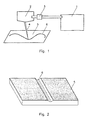
- Figure 1 - Laser carding device scheme.
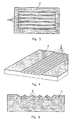
- Figure 2 - Perspective view of a channel shape, performed by the process object of the patent.
- Figure 3 - Plant view of the shape of several parallel channels performed by the project object of the patent.
- Figure - Perspective view of the shape of several parallel channels, performed by the process object of the present patent.
- Figure 5 - Cut view of several parallel channels performed by the process object of the present patent.
-
- From a laser font (1) and through a beam transportation and treatment system (3) it reaches a galvanometric mirror system (2) that direct the beam (4) to the surface of the leather to card (5).
- The laser beam (4) with a diameter of only a few tenths of millimetres is guided at a velocity that can reach 10 meters per second and an acceleration to a 100 m/s2 limit.
- The spot small dimension (diameter of laser incidence) causes the energy density to reach values in the order of 6.000 Watt/mm2, this value is high enough for a channel to be done (6) figure 2, in the beam incidence point at high velocity.
- Figure 2 represents a channel in perspective (6) open by the laser beam in an aniline leather surface of traditional cut enlarged about sixty times.
- The carding consists in the opening of several channels with lengths between 0,1 and 1,0 mm parallel, or oriented according a second and determined angle, separate by distances of order of the channels length greatness, as represented in the plant view of figure 3 and the in the enlarged perspective of figure 4.
- The path followed by the laser in each one of the lines that make the channels at the leather surface, in the areas where the adhesion with the sole is going to take place, is previously defined in computer in a graphic program attacking the leather surface in accordance with the organic fibres orientations.
- This practical possibility offered by the process presented in the present patent, of the channel opening according to the leather fibres is absolutely revolutionary, because it avoids the transversal cut of the fibres, increasing the adhesion index of the materials that are a part of the sole.
- In figure 5 is represented, in enlarged cut, a leather skin carded by the process presented in the present patent where we can identify the channels opened by the laser (6) and through the arrows (7) the migration way of the solvents used in the connection of the leather to the sole.
- As referenced before, through the programming of the laser beam guidance it is possible to control the depth, length and space between channels and in this way increase the glue contact surface. The depth of the channels can vary between 0.1 mm e 1.0 mm but preferable between 0.3 and 0.35 mm. The length of the channels can vary between 0.1 mm and 1.0 mm but preferable between 0.6 e 0.7 mm. The space between channels (length of the intact leather between channels) can vary between 0.01 and 0.3 mm.
- Due to the outline shape performed in the leather by the carding process object of the present patent and represented in figure 5 the contact surface of the glue (between the two surfaces to adhere) is increased comparatively to the one obtained by the carding made by the traditional processes that limit to redraw the leather superficial finishing layer. The increasing of the surface can reach, for the depths, lengths and spacing of the channels referenced as preferential, about 30 %.
Claims (5)
- a - Leather carding process characterized by the incidence of a laser beam guided, that perform channels on the leather surface with length, depth and pre established development.
- a - Leather carding process according to claim 1, characterized by the beam diameter being inferior to 1,0 mm and guided at a velocity until 10 m/s with a limit acceleration of 100 m/s2.
- a - Leather carding process according to claims 1 and 2, characterized by the beam energy density that can reach 6000 Watt/mm2.
- a - Leather carding process according with claim 1, 2 and 3, characterized by the performance of several parallel channels, each one with the depth and length between 0.1 and 1 mm and leaving intact a length between 0.01 and 3,0 mm.
- a - Leather carding process according with claims 1, 2, 3 and 4, characterized by the several parallel channels each one with a depth of 0.05 to 1.0 mm, a length of 0.6 to 0.7 mm, leaving between them only 0.01 mm of intact leather.
Applications Claiming Priority (2)
| Application Number | Priority Date | Filing Date | Title |
|---|---|---|---|
| PT10306704A PT103067A (en) | 2004-02-06 | 2004-02-06 | LASER CARD PROCESS |
| PT10306704 | 2004-02-06 |
Publications (1)
| Publication Number | Publication Date |
|---|---|
| EP1605065A1 true EP1605065A1 (en) | 2005-12-14 |
Family
ID=34942863
Family Applications (1)
| Application Number | Title | Priority Date | Filing Date |
|---|---|---|---|
| EP05398002A Withdrawn EP1605065A1 (en) | 2004-02-06 | 2005-02-04 | Laser carding process |
Country Status (2)
| Country | Link |
|---|---|
| EP (1) | EP1605065A1 (en) |
| PT (1) | PT103067A (en) |
Cited By (1)
| Publication number | Priority date | Publication date | Assignee | Title |
|---|---|---|---|---|
| DE102009049776A1 (en) | 2008-12-18 | 2010-06-24 | Ecco Sko A/S | Leather-made shoe shaft roughening method, involves alternately directing laser beam and accomplishing change in adjustment of laser beam based on occurrence of preset conditions in operating cycle of robots |
Citations (1)
| Publication number | Priority date | Publication date | Assignee | Title |
|---|---|---|---|---|
| EP1072322A2 (en) * | 1999-07-26 | 2001-01-31 | Lucio Vaccani | Head for applying adhesive |
-
2004
- 2004-02-06 PT PT10306704A patent/PT103067A/en not_active IP Right Cessation
-
2005
- 2005-02-04 EP EP05398002A patent/EP1605065A1/en not_active Withdrawn
Patent Citations (1)
| Publication number | Priority date | Publication date | Assignee | Title |
|---|---|---|---|---|
| EP1072322A2 (en) * | 1999-07-26 | 2001-01-31 | Lucio Vaccani | Head for applying adhesive |
Cited By (1)
| Publication number | Priority date | Publication date | Assignee | Title |
|---|---|---|---|---|
| DE102009049776A1 (en) | 2008-12-18 | 2010-06-24 | Ecco Sko A/S | Leather-made shoe shaft roughening method, involves alternately directing laser beam and accomplishing change in adjustment of laser beam based on occurrence of preset conditions in operating cycle of robots |
Also Published As
| Publication number | Publication date |
|---|---|
| PT103067A (en) | 2005-08-31 |
Similar Documents
| Publication | Publication Date | Title |
|---|---|---|
| EP2000043B1 (en) | File, particularly nail file | |
| ATE465279T1 (en) | METHOD FOR PROCESSING SURFACES WITH A HARD CARBON COATING | |
| CA2243694A1 (en) | Metal single layer abrasive cutting tool having a contoured cutting surface | |
| ATE491052T1 (en) | METHOD FOR TREATING THE BLADE TIP OF A TURBINE BLADE AND TURBINE BLADE TREATED BY SUCH A METHOD | |
| DE50000357D1 (en) | METHOD FOR PRODUCING A CUTTING TOOL AND CUTTING TOOL | |
| DE50004199D1 (en) | DRILL TIP AND METHOD FOR GRINDING A DRILL TIP | |
| EP0787820A3 (en) | Methods of preparing cutting tool substrates for coating with diamond and products resulting therefrom | |
| ATE482051T1 (en) | METHOD FOR PRODUCING A TOOL | |
| ATE142924T1 (en) | METHOD FOR GRINDING THE SURFACES OF CUTTING BLADES AND GRINDING DISC FOR CARRYING OUT THIS METHOD | |
| ATE227443T1 (en) | METHOD FOR THE REMOVAL PROCESSING OF WORKPIECES | |
| ATE343474T1 (en) | METHOD AND DEVICE FOR PRODUCING VENEERS AND VENEERED PARTS AS WELL AS VENEERS AND VENEERED PARTS | |
| ES8402744A1 (en) | Abrasive element obtained by electrolytic deposit of diamond. | |
| US446962A (en) | Finishing wood surfaces | |
| EP1297926A3 (en) | Method and apparatus for grinding workpiece surfaces to super-finish surfaces with micro oil pockets | |
| CN106272762A (en) | Surface treatment method for antique wood floor | |
| US3194153A (en) | Pre-cut stencils capable of defining three distinct stencil areas | |
| Riedel et al. | An examination of Stone Age/Bronze Age adzes and axes of red deer (Cervus elaphus L.) antler from the Leine Valley, near Hannover | |
| JP7285128B2 (en) | Method for manufacturing nail tip, method for directly forming nail tip on natural nail, and nail tip | |
| Bersenev et al. | Use-Wear Analysis of Bone Artifacts from the Bronze Age Settlement of Tyubyak (Based on the Materials from the 1987 Excavation) | |
| SU1007957A1 (en) | Method of producing abrasive tool | |
| US4641669A (en) | Method for reinforcing and hardening human nails | |
| JPH1148696A (en) | Surface treatment method for stone materials | |
| ATE172771T1 (en) | METHOD FOR PRODUCING CLADDING, CLADDING AND METHOD FOR ATTACHING THE SAME | |
| WO2004029413A3 (en) | Shield tunneling method and apparatus for excavating a tunnel of non-circular cross-section | |
| Haupt | Discussion of “In Situ Shear Wave Velocity by Cross-Hole Method” |
Legal Events
| Date | Code | Title | Description |
|---|---|---|---|
| PUAI | Public reference made under article 153(3) epc to a published international application that has entered the european phase |
Free format text: ORIGINAL CODE: 0009012 |
|
| 17P | Request for examination filed |
Effective date: 20050204 |
|
| AK | Designated contracting states |
Kind code of ref document: A1 Designated state(s): AT BE BG CH CY CZ DE DK EE ES FI FR GB GR HU IE IS IT LI LT LU MC NL PL PT RO SE SI SK TR |
|
| AX | Request for extension of the european patent |
Extension state: AL BA HR LV MK YU |
|
| AKX | Designation fees paid |
Designated state(s): AT BE BG CH CY CZ DE DK EE ES FI FR GB GR HU IE IS IT LI LT LU MC NL PL PT RO SE SI SK TR |
|
| 17Q | First examination report despatched |
Effective date: 20070723 |
|
| STAA | Information on the status of an ep patent application or granted ep patent |
Free format text: STATUS: THE APPLICATION IS DEEMED TO BE WITHDRAWN |
|
| 18D | Application deemed to be withdrawn |
Effective date: 20071204 |