EP1602675A1 - Flexible polyurethane foam - Google Patents
Flexible polyurethane foam Download PDFInfo
- Publication number
- EP1602675A1 EP1602675A1 EP04711496A EP04711496A EP1602675A1 EP 1602675 A1 EP1602675 A1 EP 1602675A1 EP 04711496 A EP04711496 A EP 04711496A EP 04711496 A EP04711496 A EP 04711496A EP 1602675 A1 EP1602675 A1 EP 1602675A1
- Authority
- EP
- European Patent Office
- Prior art keywords
- polyurethane foam
- flexible polyurethane
- firmness
- surfactant
- humidity
- Prior art date
- Legal status (The legal status is an assumption and is not a legal conclusion. Google has not performed a legal analysis and makes no representation as to the accuracy of the status listed.)
- Granted
Links
Images

Classifications
-
- C—CHEMISTRY; METALLURGY
- C08—ORGANIC MACROMOLECULAR COMPOUNDS; THEIR PREPARATION OR CHEMICAL WORKING-UP; COMPOSITIONS BASED THEREON
- C08J—WORKING-UP; GENERAL PROCESSES OF COMPOUNDING; AFTER-TREATMENT NOT COVERED BY SUBCLASSES C08B, C08C, C08F, C08G or C08H
- C08J9/00—Working-up of macromolecular substances to porous or cellular articles or materials; After-treatment thereof
- C08J9/0014—Use of organic additives
- C08J9/0019—Use of organic additives halogenated
-
- C—CHEMISTRY; METALLURGY
- C08—ORGANIC MACROMOLECULAR COMPOUNDS; THEIR PREPARATION OR CHEMICAL WORKING-UP; COMPOSITIONS BASED THEREON
- C08G—MACROMOLECULAR COMPOUNDS OBTAINED OTHERWISE THAN BY REACTIONS ONLY INVOLVING UNSATURATED CARBON-TO-CARBON BONDS
- C08G18/00—Polymeric products of isocyanates or isothiocyanates
- C08G18/06—Polymeric products of isocyanates or isothiocyanates with compounds having active hydrogen
- C08G18/28—Polymeric products of isocyanates or isothiocyanates with compounds having active hydrogen characterised by the compounds used containing active hydrogen
- C08G18/40—High-molecular-weight compounds
-
- C—CHEMISTRY; METALLURGY
- C08—ORGANIC MACROMOLECULAR COMPOUNDS; THEIR PREPARATION OR CHEMICAL WORKING-UP; COMPOSITIONS BASED THEREON
- C08G—MACROMOLECULAR COMPOUNDS OBTAINED OTHERWISE THAN BY REACTIONS ONLY INVOLVING UNSATURATED CARBON-TO-CARBON BONDS
- C08G2110/00—Foam properties
- C08G2110/0008—Foam properties flexible
-
- C—CHEMISTRY; METALLURGY
- C08—ORGANIC MACROMOLECULAR COMPOUNDS; THEIR PREPARATION OR CHEMICAL WORKING-UP; COMPOSITIONS BASED THEREON
- C08G—MACROMOLECULAR COMPOUNDS OBTAINED OTHERWISE THAN BY REACTIONS ONLY INVOLVING UNSATURATED CARBON-TO-CARBON BONDS
- C08G2110/00—Foam properties
- C08G2110/0083—Foam properties prepared using water as the sole blowing agent
-
- C—CHEMISTRY; METALLURGY
- C08—ORGANIC MACROMOLECULAR COMPOUNDS; THEIR PREPARATION OR CHEMICAL WORKING-UP; COMPOSITIONS BASED THEREON
- C08G—MACROMOLECULAR COMPOUNDS OBTAINED OTHERWISE THAN BY REACTIONS ONLY INVOLVING UNSATURATED CARBON-TO-CARBON BONDS
- C08G2350/00—Acoustic or vibration damping material
-
- C—CHEMISTRY; METALLURGY
- C08—ORGANIC MACROMOLECULAR COMPOUNDS; THEIR PREPARATION OR CHEMICAL WORKING-UP; COMPOSITIONS BASED THEREON
- C08J—WORKING-UP; GENERAL PROCESSES OF COMPOUNDING; AFTER-TREATMENT NOT COVERED BY SUBCLASSES C08B, C08C, C08F, C08G or C08H
- C08J2375/00—Characterised by the use of polyureas or polyurethanes; Derivatives of such polymers
- C08J2375/04—Polyurethanes
Definitions
- the present invention relates to flexible polyurethane foam, and more particularly, to flexible polyurethane foam which rarely bottoms out, has excellent vibration-absorption ability and durability, and is suitably used as padding materials for automobile and aircraft seating and beds.
- polyurethane foam (hereinafter sometime simply referred to as "polyurethane foam”, “urethane foam”, or “foam”) has been widely used as padding materials for vehicle seat cushions and backrests.
- polyurethane foam urethane foam
- urethane foam urethane foam
- a metal spring a metal spring that is not used.
- the full-foam type seat uses a thick urethane foam as a padding material. Therefore, riding comfort can be improved by improving the performance of urethane itself.
- the static riding comfort is often represented by numerical data value given by compression deflection curve, which is obtained by compressing a foam sample test-piece by a pressurizing iron board.
- compression deflection curve which is obtained by compressing a foam sample test-piece by a pressurizing iron board.
- a vibration transmissibility increases by lowering the density of polyurethane. It has been reported that a human organ resonates when vibrations of the region of 4 to 8 Hz are transmitted thereto, with the result that a person will be fatigued and develop carsickness. In general, a transmissibility at 6 Hz is often used as an index when vibration transmissibility is evaluated. In the case of a vehicle seat, it is generally said that a resonance frequency is present between 3 to 5 Hz. From a vibration engineering point of view, to reduce the vibration transmissibility at 6 Hz, the resonance frequency must be shift toward a lower frequency range. However, as the density of polyurethane foam is reduced, the resonance vibration increases. As a result, the transmissibility of 6 Hz vibration increases, the vibration characteristics of such polyurethane foam deteriorates. The data of Table 2 (shown later) also support this.
- the present invention has been made to solve the aforementioned problems and provides flexible polyurethane foam satisfying requirements of high performance, low density, and thickness reduction. Therefore, it is an object of the present invention to provide a polyurethane foam which rarely bottoms out and has excellent durability and vibrational dampening. It is another object of the present invention to provide a polyurethane foam causing little change in firmness even if humidity changes.
- the present inventors have conducted intensive studies to attain the aforementioned objects by paying attention to static load, the cell structure, and composition of polyurethane foam. As a result, they found that the aforementioned objects can be attained by adding a specific surfactant as a cell regulator. Based on the finding, the present invention has been accomplished.
- a flexible polyurethane foam for a cushioning material comprising a polyol and an isocyanate as main components, and a fluoride surfactant as a cell regulator, wherein the fluoride surfactant has a structure of a perfluoroalkyl group, and exhibits a foaming height of 3 mm or more in a toluene solution containing the surfactant at a concentration of 0.1% by mass or in an aqueous ethanol solution containing the surfactant at a concentration of 60% by mass, five minutes after the toluene solution or the aqueous ethanol solution is stirred.
- the flexible polyurethane foam may have a humidity/heat compression residual deflection at a temperature 49 to 51°C and a humidity 90 to 100% and a reduction rate of repeated compression 25% firmness both lower by 5% or more, as compared to a flexible polyurethane foam that has the same density and 25% firmness but contains no the fluoride surfactant.
- the flexible polyurethane foam may also have a deflection difference between pressure 490N and 882N in a static load test larger by 1 mm or more, as compared to a flexible polyurethane foam that has the same density and 25% firmness but contains no the fluoride surfactant.
- the flexible polyurethane foam may also have a resonance magnification and transmissibility at 6 Hz both lower by 5% or more, as compared to a flexible polyurethane foam that has the same density and 25% firmness but contains no the fluoride surfactant.
- the flexible polyurethane foam may also have a change rate of 25% firmness with a humidity change smaller by 5% or more, as compared to a flexible polyurethane foam that has the same density and 25% firmness but contains no the fluoride surfactant.
- the flexible polyurethane foam according to the present invention can satisfy the requirements of high performance, low density or thickness reduction, compared to flexible polyurethane foam currently in use and having the aforementioned problem.
- a flexible polyurethane foam according to the present invention contains a polyol and an isocyanate as main components, and a fluoride surfactant as a cell structure regulator.
- the fluoride surfactant (to be also referred to as "the fluoride surfactant of the present invention” hereinafter) has the structure of a perfluoroalkyl group, exhibits a foaming height of 3 mm or more in a toluene solution containing the surfactant at a concentration of 0.1% by mass or in an aqueous ethanol solution containing the surfactant at a concentration of 60% by mass, five minutes after the toluene solution or the aqueous ethanol solution is stirred.
- the test method of measuring the foaming height of the fluoride surfactant will be described later.
- the flexible polyurethane foam of the present invention has the following excellent characteristics, as compared to a flexible polyurethane foam that has the same density and 25% firmness but contains no the fluoride surfactant of the invention.
- the term "the same density and firmness” means that the difference between the density of the flexible polyurethane foam of the present invention and that of a flexible polyurethane foam that does not contain the fluoride surfactant of the present invention is within ⁇ 2.5% of the reference value, and the difference between them in 25% firmness is within ⁇ 4%.
- the flexible polyurethane foam may have a humidity/heat compression residual deflection at a temperature 49 to 51°C and a humidity 90 to 100% and a reduction rate of repeated compression 25% firmness both lower by 5% or more, as compared to a flexible polyurethane foam that has the same density and 25% firmness but contains no said fluoride surfactant.
- the flexible polyurethane foam may also have a deflection difference between pressure 490N and 882N in a static load test larger by 1 mm or more, as compared to a flexible polyurethane foam that has the same density and 25% firmness but contains no said fluoride surfactant.
- the flexible polyurethane foam may also have a resonance magnification and transmissibility of 6 Hz both lower by 5% or more, as compared to a flexible polyurethane foam that has the same density and 25% firmness but contains no said fluoride surfactant.
- a flexible polyurethane foam according to the present invention contains a polyol (A) and an isocyanate compound (B) as main components and produced by reacting the main components with a catalyst (C), a foaming agent (D) and the fluoride surfactant (E) of the present invention serving as a cell regulator, and optional components, such as an organic silicone-based surfactant (F) serving as a foam-shaping agent, a cross-linking agent (G), and foaming agent (H).
- a catalyst C
- D foaming agent
- E fluoride surfactant
- optional components such as an organic silicone-based surfactant (F) serving as a foam-shaping agent, a cross-linking agent (G), and foaming agent (H).
- a polyol (A) is not particularly restricted and any polyol usually used in the art may be used.
- polyether polyol and a polymer polyol may be used alone or in combination of two or more. It is desirable to use a polyol having a hydroxyl value within the range of 15 to 60 mg KOH/g and the overall degree of unsaturation of 0.1 meq/g or less.
- a isocyanate compound (B) is not particularly restricted.
- use may be made of aromatic groups, alicyclic groups or aliphatic isocyanate compounds having not less than two isocyanate groups, modified compounds or mixture of these compounds.
- Specific examples of such an isocyanate compound (B) include tolylene diisocyanate (TDI), diphenylmethane diisocyanate (MDI), and hexamethylene diisocyanate (HMDI). They may be used alone or as a compound.
- a catalyst (C) is not particularly restricted and any catalyst known in the art may be used.
- a catalyst include amines such as triethylenediamine, bis-(2-dimethylaminoethyl)ether, triethylamine, N-methylmorpholine, N-ethylmorpholine, tripropylamine, tributylamine, dimethylbenzylamine, N,N,N',N'-tetramethylhexamethylenediamine, N,N,N',N',N" -pentamethyldiethyleneamine, 1,8-diaza-bicyclo(5,4,0) undecene-7,1,2-dimethylimidazole, 1-butyl-2-methylimidazole, N, N-dimethyl-N-hexanolamine, dimethylethanolamine, and N-trioxyethylene-N,N-dimethylamine or organic acids of these amines; and organic metal compounds such as stannous octoate, dibuthyltindi
- a foaming agent water (H 2 O) may be used. When water is used, it reacts with an isocyanate group to produce carbonic acid gas, which is virtually used as the foaming agent.
- a low-boiling point organic compound may be used.
- a CO 2 loading apparatus may be used for supplying carbon acid gas into a mixture solution of raw materials to produce foams.
- fluoride surfactant (E) serving as a cell regulator for example, use may be made of DS-101, DS-102, DS-202, DS-301, DS-401, DS-403, DS-451 (manufactured by Daikin Industries Ltd.); S-111, S-112, S-113, S-121, S-131, S-132, S-141, S-145, S-393, KH-40 (manufactured by Asahi Glass Co., Ltd); and F-110, F-116, F-120, F-142D, F-144D, F-150, F-160, F-171, F-172, F-173, F-177, F-178A, F-178K, F-179, F-183, F-184, F-191, F-471, F-477, F-478, F-812 (manufactured by Dai-Nippon Ink Chemical Industries Co., Ltd.).
- the fluoride surfactant of the present invention which has the structure of a perfluoroalkyl group, exhibits a foaming height of 3 mm or more in a toluene solution containing the surfactant at a concentration of 0.1% by mass or in an aqueous ethanol solution containing the surfactant at a concentration of 60% by mass, five minutes after the toluene solution or the aqueous ethanol solution is stirred.
- F-177 and F-478 and S-393 are preferably used.
- any known organic silicone-based surfactant in the art may be optionally used.
- any known organic silicone-based surfactant in the art may be optionally used.
- a cross-linking agent (G) may be used to improve physical characteristics of polyurethane foam.
- a compound having a hydroxyl value of 200 to 1,800 mg KOH/g may be used.
- alcohol amines such as diethanol amine, triethanol amine, monoethanole amine, monopropanol amine, dipropanol amine, tripropanol amine, N-methyl-diethanol amine, N-phenyl-dipropanol amine
- polyamines such as tolylene diamine, diethyltolylene diamine, diaminodiphenylmethane, isophorone diamine, hexamethylenediamine, ethylenediamine, and diethylenetridiamine
- compounds composed of an alkylene oxide added to a polyamine or an amino alcohol and aliphatic polyols such as glycerin.
- cross-linking agents known in the art may be used. These cross-linking agents may be used. These cross-linking agents may
- a foam breaker (H) is used to control air permeability and crushing of flexible polyurethane foam.
- Such a foam breaker is not particularly restricted and a cell opener known in the art may be used.
- P-505s manufactured Mistui Takeda Chemicals Inc.
- EL-985 Alignment-Coupled Glass Co., Ltd.
- a preferable composition rate of the present invention will be described by a mass ratio to the amount of polyol (A) being 100.
- the mass ratio of an isocyanate compound (B) is obtained by calculating an equivalent ratio (called NCO index) of the hydroxyl groups of raw materials to the isocyanate groups of a polyisocyanate.
- NCO index an equivalent ratio
- Raw materials except an isocyanate compound (B) were blended in a 3-liter beaker with a handle in predetermined contents so as to obtain a predetermined total amount.
- the mixture was stirred for 30 seconds by a mixer and then an isocyanate compound was added thereto. After stirring for 5 seconds, the mixture was immediately poured in a mold of 400 ⁇ 400 ⁇ 100 mm adjusted at a temperature of 65 ⁇ 2°C in advance, and the mold was closed. After curing the mixture for 5 minutes, urethane foam was taken out from the mold and compressed and crushed by hands.
- Sample test pieces were prepared from the urethane foam produced by the aforementioned method and subjected to physical property, static load, and vibration tests. Physical properties were checked in accordance with JIS K6400. The detailed conditions are as follows:
- Sample pieces of 400 ⁇ 400 ⁇ 100 mm are compressed by applying load at a pressurizing rate of 50 mm/min.
- Test sample pieces 400 ⁇ 400 ⁇ 100 mm were compressed by a pressuring iron board at a pressurizing rate of 150 mm/minute to a force of 882N. Upon removing the load of the pressuring iron board, the test sample pieces were left alone for one minute. The test was then repeated in the same conditions above. In this way, the deflection difference between pressure 490N and 882N was obtained.
- test sample pieces 400 ⁇ 400 ⁇ 100 mm
- a vibration test was performed in accordance with JASO B-407.
- the test sample pieces were vibrated under pressure of 50 kg of an iron board while applying a frequency having an amplitude of ⁇ 2.5 mm to obtain the transmissibility (vibration transfer rate). Form the transmissibility obtained, a resonance frequency, resonance magnification, and the transmissibility of a 6 Hz were obtained.
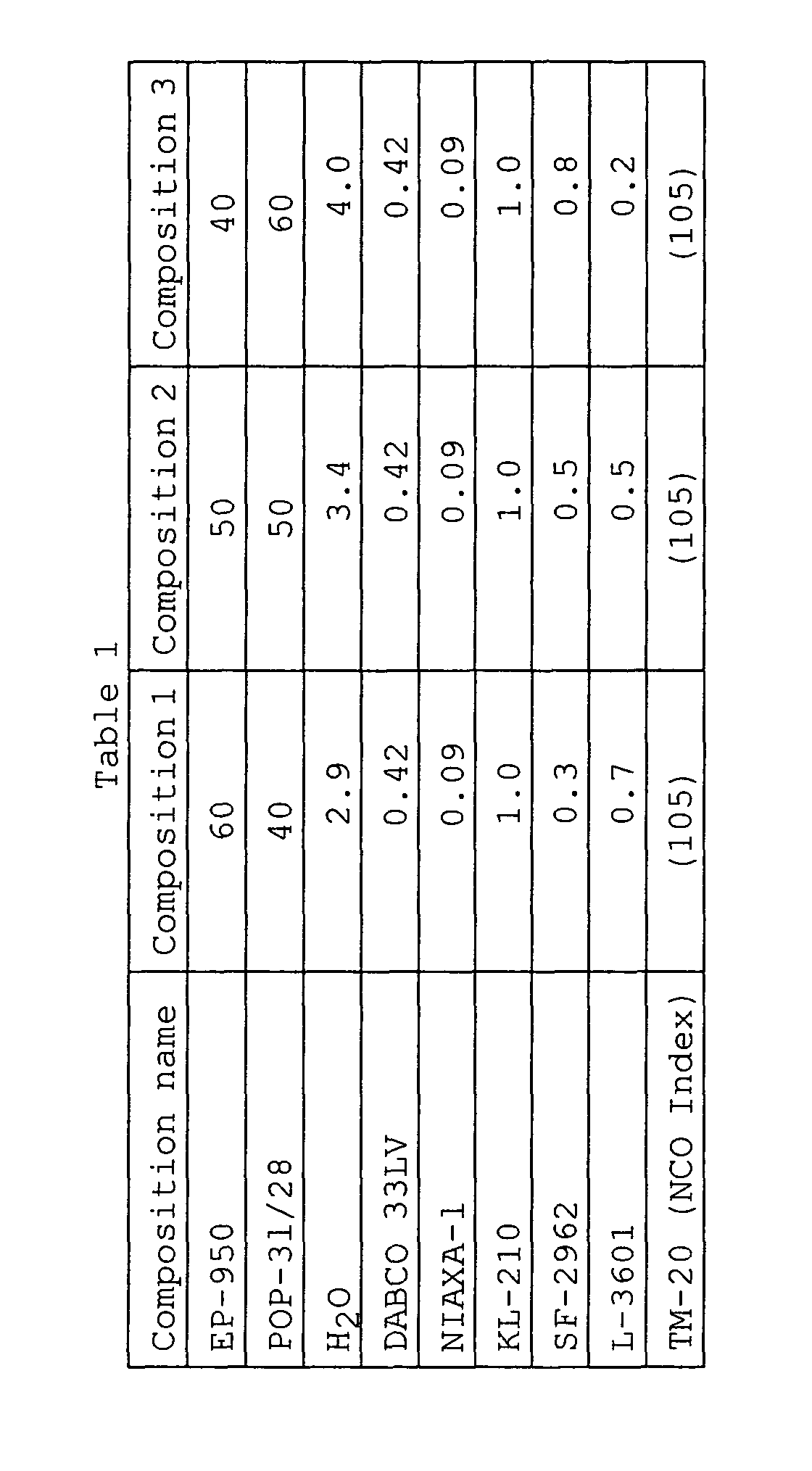
- Table 1 shows flexible polyurethane foam compositions same in firmness and different in density.
- Table 2 shows the results of physical properties measured on the flexible polyurethane foams listed in Table 1.
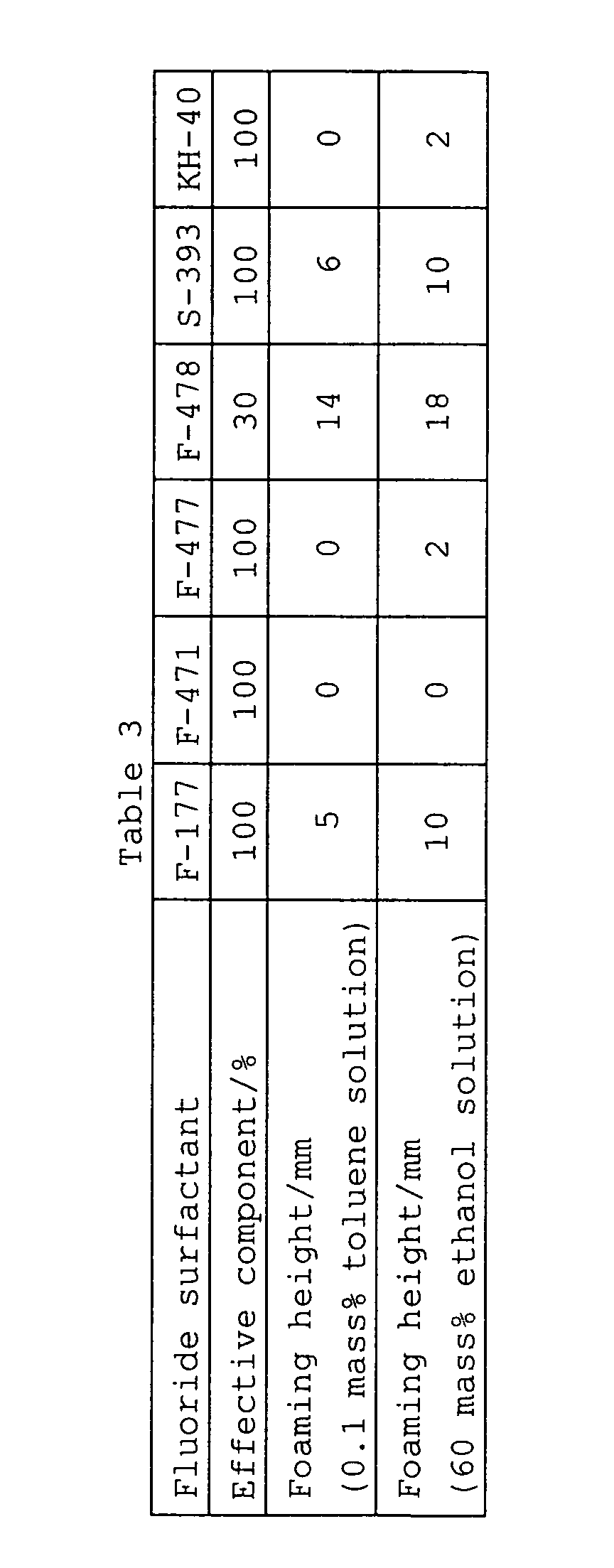
- Table 3 shows the foamability of solutions containing a fluoride surfactant in a concentration of 1% by mass in terms of pure ingredient.
- fluoride surfactants according to the present invention are F-177, F-478, and S-393.
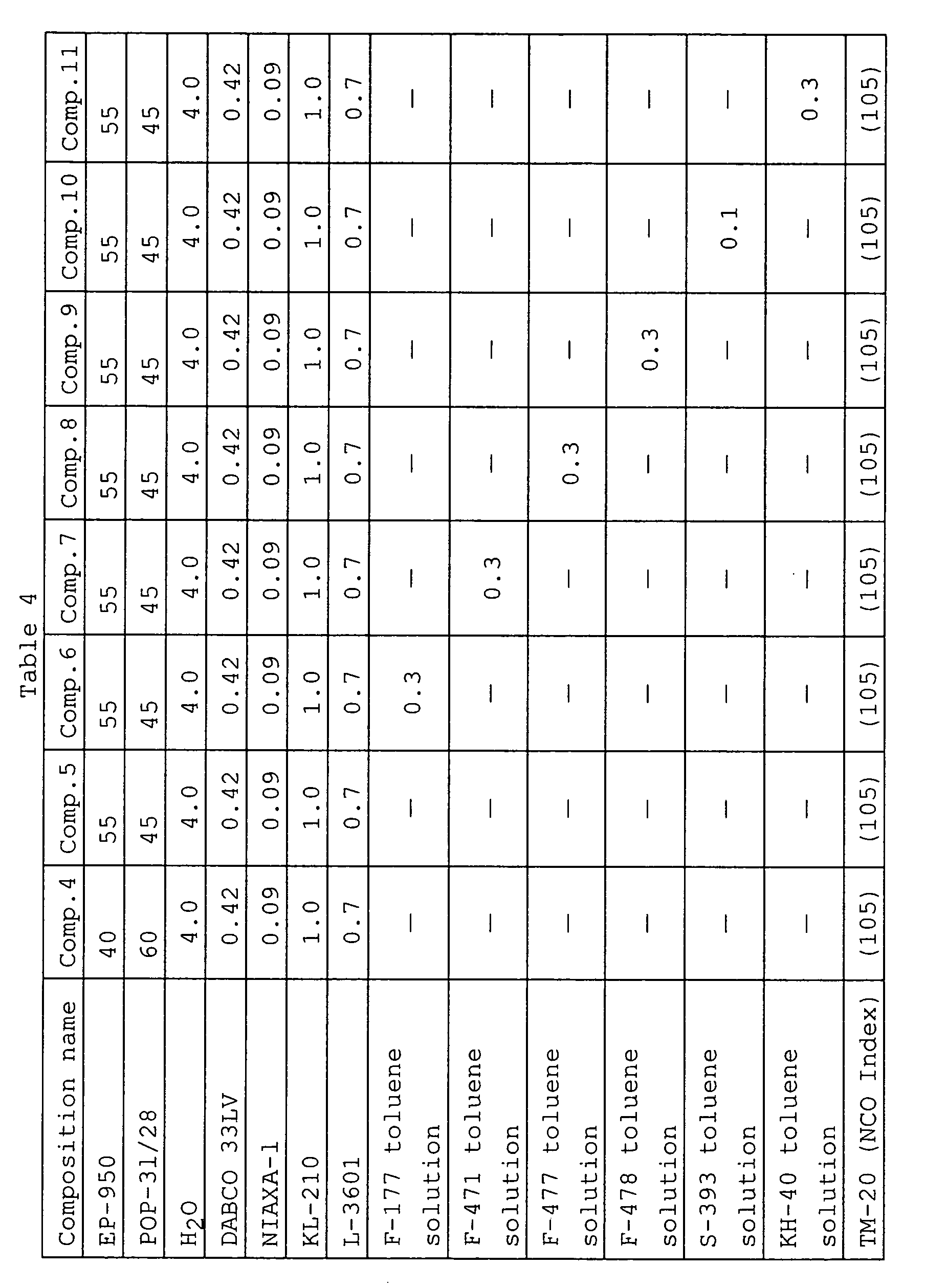
- Table 4 shows the compositions of fluorocarbon-containing polyurethane foams.
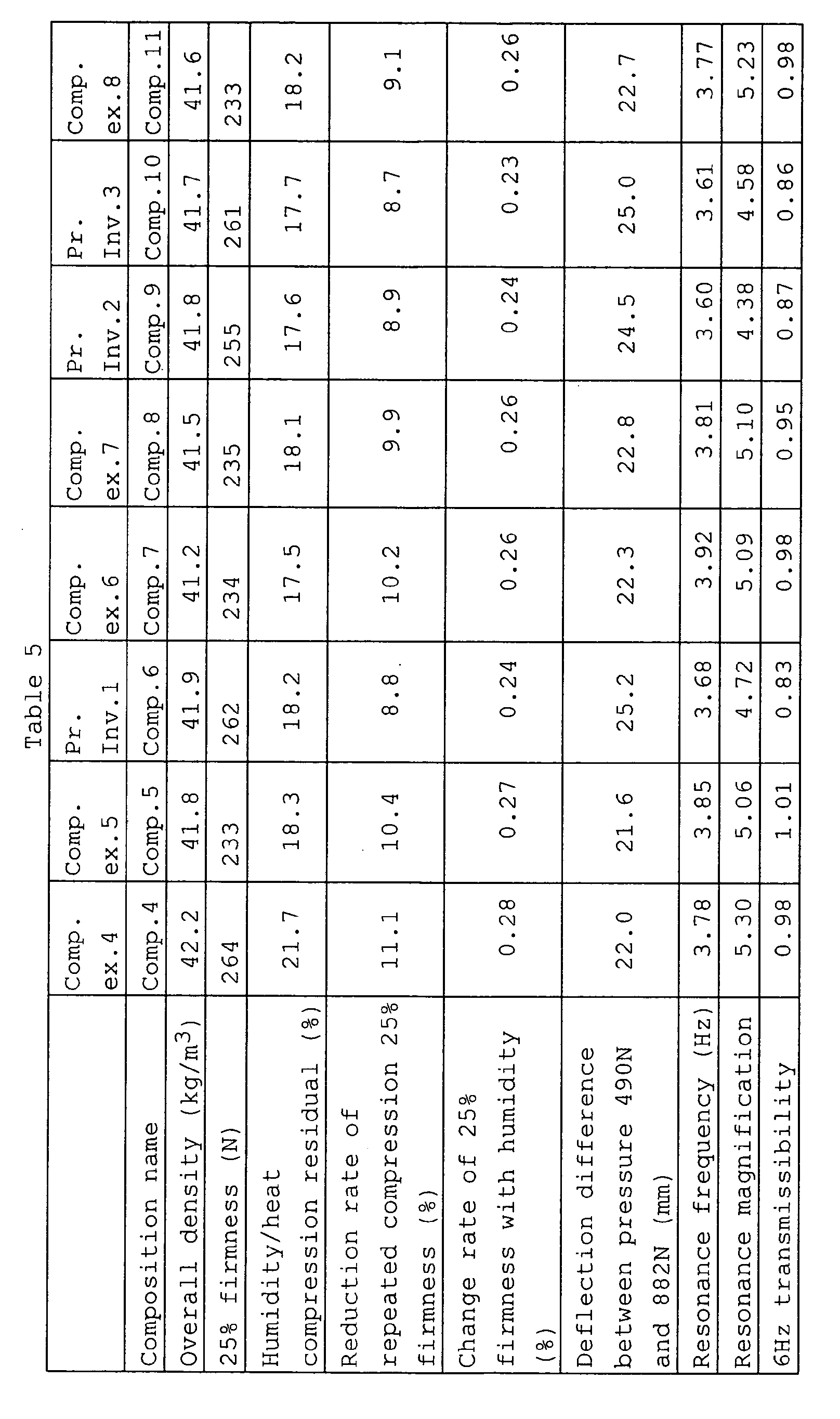
- Table 5 shows the physical properties of the polyurethane foams listed in Table 4.
- the polyurethane foams of the present inventions 1 to 3 contains a polyol and a polymer polyol in a ratio of 55:45 so as to have the same "25% firmness".
- the polyurethane foam of Comparative Example 5 has the same composition as in Examples 1 to 3 except that no fluoride surfactant is contained.
- the "25% firmness" of polyurethane foam is increased by addition of a fluoride surfactant.
- the present invention successfully provides a novel flexible polyurethane foam satisfying requirements for high performance, low density or reduction in thickness.
Landscapes
- Chemical & Material Sciences (AREA)
- Health & Medical Sciences (AREA)
- Chemical Kinetics & Catalysis (AREA)
- Medicinal Chemistry (AREA)
- Polymers & Plastics (AREA)
- Organic Chemistry (AREA)
- Engineering & Computer Science (AREA)
- Materials Engineering (AREA)
- Polyurethanes Or Polyureas (AREA)
Abstract
Description
It has been reported that a human organ resonates when vibrations of the region of 4 to 8 Hz are transmitted thereto, with the result that a person will be fatigued and develop carsickness. In general, a transmissibility at 6 Hz is often used as an index when vibration transmissibility is evaluated. In the case of a vehicle seat, it is generally said that a resonance frequency is present between 3 to 5 Hz.
From a vibration engineering point of view, to reduce the vibration transmissibility at 6 Hz, the resonance frequency must be shift toward a lower frequency range. However, as the density of polyurethane foam is reduced, the resonance vibration increases.
As a result, the transmissibility of 6 Hz vibration increases, the vibration characteristics of such polyurethane foam deteriorates. The data of Table 2 (shown later) also support this.
(cell adjustor): 0.0001 to 5.0
(foam-shaping agent): 0.1 to 3.0

Claims (5)
- A flexible polyurethane foam for a cushioning material, the flexible polyurethane foam comprising a polyol and an isocyanate as main components, and a fluoride surfactant as a cell regulator, wherein the fluoride surfactant has a structure of a perfluoroalkyl group, and exhibits a foaming height of 3 mm or more in a toluene solution containing the surfactant at a concentration of 0.1% by mass or in an aqueous ethanol solution containing the surfactant at a concentration of 60% by mass, five minutes after the toluene solution or the aqueous ethanol solution is stirred.
- The flexible polyurethane foam according to claim 1, having a humidity/heat compression residual deflection at a temperature 49 to 51°C and a humidity 90 to 100% and a reduction rate of repeated compression 25% firmness both lower by 5% or more, as compared to a flexible polyurethane foam that has the same density and 25% firmness but contains no said fluoride surfactant.
- The flexible polyurethane foam according to claim 1 or 2, having a deflection difference between pressure 490N and 882N in a static load test larger by 1 mm or more, as compared to a flexible polyurethane foam that has the same density and 25% firmness but contains no said fluoride surfactant.
- The flexible polyurethane foam according to any one of claims 1 to 3, having a resonance magnification and transmissibility of 6 Hz both lower by 5% or more, as compared to a flexible polyurethane foam that has the same density and 25% firmness but contains no said fluoride surfactant.
- The flexible polyurethane foam according to any one of claims 1 to 4, having a change rate of 25% firmness with a humidity smaller by 5% or more, as compared to a flexible polyurethane foam that has the same density and 25% firmness but contains no said fluoride surfactant.
Applications Claiming Priority (3)
| Application Number | Priority Date | Filing Date | Title |
|---|---|---|---|
| JP2003038125 | 2003-02-17 | ||
| JP2003038125 | 2003-02-17 | ||
| PCT/JP2004/001640 WO2004072142A1 (en) | 2003-02-17 | 2004-02-16 | Flexible polyurethane foam |
Publications (3)
| Publication Number | Publication Date |
|---|---|
| EP1602675A1 true EP1602675A1 (en) | 2005-12-07 |
| EP1602675A4 EP1602675A4 (en) | 2007-08-22 |
| EP1602675B1 EP1602675B1 (en) | 2014-09-10 |
Family
ID=32866383
Family Applications (1)
| Application Number | Title | Priority Date | Filing Date |
|---|---|---|---|
| EP04711496.2A Expired - Lifetime EP1602675B1 (en) | 2003-02-17 | 2004-02-16 | Flexible polyurethane foam |
Country Status (4)
| Country | Link |
|---|---|
| US (2) | US20050049324A1 (en) |
| EP (1) | EP1602675B1 (en) |
| JP (1) | JP4199770B2 (en) |
| WO (1) | WO2004072142A1 (en) |
Families Citing this family (7)
| Publication number | Priority date | Publication date | Assignee | Title |
|---|---|---|---|---|
| JP2006001647A (en) * | 2004-05-18 | 2006-01-05 | Sumitomo Electric Ind Ltd | Container, package, method for producing container, method for producing package, and compound semiconductor substrate |
| JP4595675B2 (en) * | 2005-05-25 | 2010-12-08 | 旭硝子株式会社 | Flexible polyurethane foam, method for producing the same, and automotive seat using the flexible polyurethane foam |
| JP4548220B2 (en) * | 2005-05-25 | 2010-09-22 | 旭硝子株式会社 | Flexible polyurethane foam, method for producing the same, and automotive seat using the flexible polyurethane foam |
| JP4736539B2 (en) * | 2005-05-25 | 2011-07-27 | 旭硝子株式会社 | Flexible polyurethane foam for automobile seat and method for producing the same |
| CN101631810B (en) * | 2006-12-29 | 2013-07-24 | 江森自控科技公司 | Polyurethane foam compositions, products and methods |
| AU2013329491A1 (en) | 2012-10-10 | 2015-04-30 | Basf Se | Viscoelastic polyurethane foam |
| WO2022061336A1 (en) | 2020-09-21 | 2022-03-24 | Saint-Gobain Performance Plastics Corporation | Polyurethane foam and methods of forming the same |
Family Cites Families (12)
| Publication number | Priority date | Publication date | Assignee | Title |
|---|---|---|---|---|
| US3567500A (en) * | 1968-04-18 | 1971-03-02 | Us Agriculture | Fluoroamide-amino polymers and process for imparting oleophobic yet hydrophilic properties to fibrous materials |
| US4171282A (en) * | 1977-12-07 | 1979-10-16 | Ciba-Geigy Corporation | Fluorinated nonionic surfactants |
| US4356273A (en) * | 1979-04-30 | 1982-10-26 | Minnesota Mining And Manufacturing Company | Fluorochemical foam stabilizer and foamed polyurethanes made therewith |
| JP4128631B2 (en) * | 1997-03-17 | 2008-07-30 | ダウ グローバル テクノロジーズ インコーポレイティド | Polyurethane latex, process for producing the same, and polymer produced therefrom |
| JPH11322875A (en) * | 1998-05-15 | 1999-11-26 | Nhk Spring Co Ltd | Urethane foam and its manufacturing method |
| JP2000220467A (en) * | 1999-01-28 | 2000-08-08 | Tokai Rubber Ind Ltd | Low water absorption and low oil absorption soundproofing material |
| US6391807B1 (en) * | 1999-09-24 | 2002-05-21 | 3M Innovative Properties Company | Polymer composition containing a fluorochemical oligomer |
| JP2001329042A (en) * | 2000-05-25 | 2001-11-27 | Nippon Polyurethane Ind Co Ltd | Method for producing flexible polyurethane foam having high resilience and high vibration absorption |
| CN1245442C (en) * | 2001-07-18 | 2006-03-15 | 旭硝子株式会社 | Production process of hard foamed synthetic resin |
| JP2004536141A (en) * | 2001-07-25 | 2004-12-02 | チバ スペシャルティ ケミカルズ ホールディング インコーポレーテッド | Perfluoroalkyl substituted amines, acids, amino acids and thioether acids |
| JP2003040966A (en) * | 2001-07-31 | 2003-02-13 | Asahi Glass Co Ltd | Flexible polyurethane foam |
| US6747169B2 (en) * | 2001-08-02 | 2004-06-08 | Fuji Photo Film Co., Ltd. | Fluorine compound, surfactant, aqueous coating composition and silver halide photographic light-sensitive material using them |
-
2004
- 2004-02-16 JP JP2005505020A patent/JP4199770B2/en not_active Expired - Lifetime
- 2004-02-16 EP EP04711496.2A patent/EP1602675B1/en not_active Expired - Lifetime
- 2004-02-16 WO PCT/JP2004/001640 patent/WO2004072142A1/en not_active Ceased
- 2004-10-13 US US10/965,101 patent/US20050049324A1/en not_active Abandoned
-
2006
- 2006-03-02 US US11/366,074 patent/US20060148922A1/en not_active Abandoned
Also Published As
| Publication number | Publication date |
|---|---|
| EP1602675B1 (en) | 2014-09-10 |
| JPWO2004072142A1 (en) | 2006-06-01 |
| US20060148922A1 (en) | 2006-07-06 |
| US20050049324A1 (en) | 2005-03-03 |
| WO2004072142A1 (en) | 2004-08-26 |
| EP1602675A4 (en) | 2007-08-22 |
| JP4199770B2 (en) | 2008-12-17 |
Similar Documents
| Publication | Publication Date | Title |
|---|---|---|
| TWI254053B (en) | Flexible polyurethane foam and method for its production | |
| CA2790042C (en) | Cushion pad and method for manufacturing the same | |
| JP4624560B2 (en) | Low resilience and low frequency molded polyurethane foam | |
| US5106884A (en) | Flexible polyurea foams having controlled load bearing qualities | |
| EP1602675B1 (en) | Flexible polyurethane foam | |
| US20090011221A1 (en) | Cushioning Material for a Polishing Pad | |
| US9243120B2 (en) | Polyurethane foam formulation, products and methods | |
| EP3643731A1 (en) | Composition for soft polyurethane foam, soft polyurethane foam, and vehicle seat pad | |
| JP2025160350A (en) | seat pad | |
| JPH11322875A (en) | Urethane foam and its manufacturing method | |
| JP2016033213A (en) | Polyisocyanate composition for flexible polyurethane foam | |
| JP2003026749A (en) | Method for producing flexible polyurethane foam | |
| JP4131491B2 (en) | Soft polyurethane slab foam for thermoforming | |
| JP4595675B2 (en) | Flexible polyurethane foam, method for producing the same, and automotive seat using the flexible polyurethane foam | |
| JP7847932B2 (en) | seat pad | |
| JP2956034B2 (en) | Flexible polyurethane elastic foam | |
| EP4555902A1 (en) | Seat pad | |
| WO2003072626A1 (en) | Process for production of flexible polyurethane foam | |
| JP2024058539A (en) | Seat pad | |
| JP2003147044A (en) | Method for producing flexible polyurethane foam | |
| JP2002253380A (en) | Seat structure | |
| JP2007302790A (en) | Polyol composition for open cell flexible polyurethane foam and method for producing open cell flexible polyurethane foam |
Legal Events
| Date | Code | Title | Description |
|---|---|---|---|
| PUAI | Public reference made under article 153(3) epc to a published international application that has entered the european phase |
Free format text: ORIGINAL CODE: 0009012 |
|
| 17P | Request for examination filed |
Effective date: 20041015 |
|
| AK | Designated contracting states |
Kind code of ref document: A1 Designated state(s): AT BE BG CH CY CZ DE DK EE ES FI FR GB GR HU IE IT LI LU MC NL PT RO SE SI SK TR |
|
| AX | Request for extension of the european patent |
Extension state: AL LT LV MK |
|
| DAX | Request for extension of the european patent (deleted) | ||
| RBV | Designated contracting states (corrected) |
Designated state(s): DE FR |
|
| A4 | Supplementary search report drawn up and despatched |
Effective date: 20070725 |
|
| RIC1 | Information provided on ipc code assigned before grant |
Ipc: C08J 9/00 20060101ALI20070719BHEP Ipc: C08G 18/00 20060101AFI20040831BHEP |
|
| 17Q | First examination report despatched |
Effective date: 20130527 |
|
| GRAP | Despatch of communication of intention to grant a patent |
Free format text: ORIGINAL CODE: EPIDOSNIGR1 |
|
| INTG | Intention to grant announced |
Effective date: 20140417 |
|
| RAP1 | Party data changed (applicant data changed or rights of an application transferred) |
Owner name: NHK SPRING CO., LTD. |
|
| GRAS | Grant fee paid |
Free format text: ORIGINAL CODE: EPIDOSNIGR3 |
|
| GRAA | (expected) grant |
Free format text: ORIGINAL CODE: 0009210 |
|
| AK | Designated contracting states |
Kind code of ref document: B1 Designated state(s): DE FR |
|
| REG | Reference to a national code |
Ref country code: DE Ref legal event code: R096 Ref document number: 602004045807 Country of ref document: DE Effective date: 20141016 |
|
| REG | Reference to a national code |
Ref country code: DE Ref legal event code: R097 Ref document number: 602004045807 Country of ref document: DE |
|
| PLBE | No opposition filed within time limit |
Free format text: ORIGINAL CODE: 0009261 |
|
| STAA | Information on the status of an ep patent application or granted ep patent |
Free format text: STATUS: NO OPPOSITION FILED WITHIN TIME LIMIT |
|
| 26N | No opposition filed |
Effective date: 20150611 |
|
| REG | Reference to a national code |
Ref country code: DE Ref legal event code: R119 Ref document number: 602004045807 Country of ref document: DE |
|
| REG | Reference to a national code |
Ref country code: FR Ref legal event code: ST Effective date: 20151030 |
|
| PG25 | Lapsed in a contracting state [announced via postgrant information from national office to epo] |
Ref country code: DE Free format text: LAPSE BECAUSE OF NON-PAYMENT OF DUE FEES Effective date: 20150901 |
|
| PG25 | Lapsed in a contracting state [announced via postgrant information from national office to epo] |
Ref country code: FR Free format text: LAPSE BECAUSE OF NON-PAYMENT OF DUE FEES Effective date: 20150302 |