EP1602655A1 - Benzofuran derivative - Google Patents
Benzofuran derivative Download PDFInfo
- Publication number
- EP1602655A1 EP1602655A1 EP04716775A EP04716775A EP1602655A1 EP 1602655 A1 EP1602655 A1 EP 1602655A1 EP 04716775 A EP04716775 A EP 04716775A EP 04716775 A EP04716775 A EP 04716775A EP 1602655 A1 EP1602655 A1 EP 1602655A1
- Authority
- EP
- European Patent Office
- Prior art keywords
- group
- benzofuran
- pyridazin
- dihydro
- methyl
- Prior art date
- Legal status (The legal status is an assumption and is not a legal conclusion. Google has not performed a legal analysis and makes no representation as to the accuracy of the status listed.)
- Withdrawn
Links
Images
Classifications
-
- C—CHEMISTRY; METALLURGY
- C07—ORGANIC CHEMISTRY
- C07D—HETEROCYCLIC COMPOUNDS
- C07D405/00—Heterocyclic compounds containing both one or more hetero rings having oxygen atoms as the only ring hetero atoms, and one or more rings having nitrogen as the only ring hetero atom
- C07D405/02—Heterocyclic compounds containing both one or more hetero rings having oxygen atoms as the only ring hetero atoms, and one or more rings having nitrogen as the only ring hetero atom containing two hetero rings
- C07D405/04—Heterocyclic compounds containing both one or more hetero rings having oxygen atoms as the only ring hetero atoms, and one or more rings having nitrogen as the only ring hetero atom containing two hetero rings directly linked by a ring-member-to-ring-member bond
-
- A—HUMAN NECESSITIES
- A61—MEDICAL OR VETERINARY SCIENCE; HYGIENE
- A61K—PREPARATIONS FOR MEDICAL, DENTAL OR TOILETRY PURPOSES
- A61K31/00—Medicinal preparations containing organic active ingredients
- A61K31/33—Heterocyclic compounds
- A61K31/395—Heterocyclic compounds having nitrogen as a ring hetero atom, e.g. guanethidine or rifamycins
- A61K31/495—Heterocyclic compounds having nitrogen as a ring hetero atom, e.g. guanethidine or rifamycins having six-membered rings with two or more nitrogen atoms as the only ring heteroatoms, e.g. piperazine or tetrazines
- A61K31/50—Pyridazines; Hydrogenated pyridazines
- A61K31/501—Pyridazines; Hydrogenated pyridazines not condensed and containing further heterocyclic rings
-
- A—HUMAN NECESSITIES
- A61—MEDICAL OR VETERINARY SCIENCE; HYGIENE
- A61P—SPECIFIC THERAPEUTIC ACTIVITY OF CHEMICAL COMPOUNDS OR MEDICINAL PREPARATIONS
- A61P1/00—Drugs for disorders of the alimentary tract or the digestive system
- A61P1/04—Drugs for disorders of the alimentary tract or the digestive system for ulcers, gastritis or reflux esophagitis, e.g. antacids, inhibitors of acid secretion, mucosal protectants
-
- A—HUMAN NECESSITIES
- A61—MEDICAL OR VETERINARY SCIENCE; HYGIENE
- A61P—SPECIFIC THERAPEUTIC ACTIVITY OF CHEMICAL COMPOUNDS OR MEDICINAL PREPARATIONS
- A61P19/00—Drugs for skeletal disorders
-
- A—HUMAN NECESSITIES
- A61—MEDICAL OR VETERINARY SCIENCE; HYGIENE
- A61P—SPECIFIC THERAPEUTIC ACTIVITY OF CHEMICAL COMPOUNDS OR MEDICINAL PREPARATIONS
- A61P19/00—Drugs for skeletal disorders
- A61P19/02—Drugs for skeletal disorders for joint disorders, e.g. arthritis, arthrosis
-
- A—HUMAN NECESSITIES
- A61—MEDICAL OR VETERINARY SCIENCE; HYGIENE
- A61P—SPECIFIC THERAPEUTIC ACTIVITY OF CHEMICAL COMPOUNDS OR MEDICINAL PREPARATIONS
- A61P29/00—Non-central analgesic, antipyretic or antiinflammatory agents, e.g. antirheumatic agents; Non-steroidal antiinflammatory drugs [NSAID]
-
- A—HUMAN NECESSITIES
- A61—MEDICAL OR VETERINARY SCIENCE; HYGIENE
- A61P—SPECIFIC THERAPEUTIC ACTIVITY OF CHEMICAL COMPOUNDS OR MEDICINAL PREPARATIONS
- A61P37/00—Drugs for immunological or allergic disorders
-
- A—HUMAN NECESSITIES
- A61—MEDICAL OR VETERINARY SCIENCE; HYGIENE
- A61P—SPECIFIC THERAPEUTIC ACTIVITY OF CHEMICAL COMPOUNDS OR MEDICINAL PREPARATIONS
- A61P37/00—Drugs for immunological or allergic disorders
- A61P37/02—Immunomodulators
-
- A—HUMAN NECESSITIES
- A61—MEDICAL OR VETERINARY SCIENCE; HYGIENE
- A61P—SPECIFIC THERAPEUTIC ACTIVITY OF CHEMICAL COMPOUNDS OR MEDICINAL PREPARATIONS
- A61P37/00—Drugs for immunological or allergic disorders
- A61P37/08—Antiallergic agents
-
- A—HUMAN NECESSITIES
- A61—MEDICAL OR VETERINARY SCIENCE; HYGIENE
- A61P—SPECIFIC THERAPEUTIC ACTIVITY OF CHEMICAL COMPOUNDS OR MEDICINAL PREPARATIONS
- A61P43/00—Drugs for specific purposes, not provided for in groups A61P1/00-A61P41/00
Definitions
- the present invention relates to a benzofuran derivative which exhibits excellent inhibitory effect against production of tumor necrosis factor (TNF- ⁇ ) and high absorption after oral administration, and thus is useful for preventing or treating allergic diseases, immune diseases, inflammatory diseases, or similar diseases.
- TNF- ⁇ tumor necrosis factor
- the present invention also relates to a drug containing the derivative as an active ingredient.
- Tumor necrosis factor is an inflammatory cytokine produced by cells such as macrophages. It exhibits a variety of physiological activities, and thus is indispensable to protect the living body and maintain homeostasis. Meanwhile, overproduction of tumor necrosis factor (TNF- ⁇ ) is considered to be responsible for allergic, inflammatory, or autoimmune diseases, such as chronic articular rheumatism, arthritis deformans, asthma, bronchitis, atopic dermatitis, inflammatory visceral disease, ulcerative colitis, Crohn's disease, and acquired immunological deficiency syndrome (AIDS), and thus compounds exhibiting TNF- ⁇ production inhibitory effect are expected to function as preventive or therapeutic remedies for these diseases.
- autoimmune diseases such as chronic articular rheumatism, arthritis deformans, asthma, bronchitis, atopic dermatitis, inflammatory visceral disease, ulcerative colitis, Crohn's disease, and acquired immunological deficiency syndrome (AIDS)
- AIDS acquired immunological deficiency syndrome
- Low-molecular-weight compounds heretofore disclosed to have TNF- ⁇ production inhibitory effect include oxyindole derivatives (WO 0122966, JP-A-2001-511449), thiazolyl derivatives (WO 0164674), pyrrole derivatives (JP-A-2001-181187, JP-A-2000-514808), piperidylpyrimidine derivatives (JP-A-2001-511764), picolinic acid derivatives (EP 926137), imidazopyridine derivatives (WO 0158900), tetrahydrothieno[2,3-c]pyridine derivatives (JP 13151779, JP 13158789, JP 13151780), and sulfonamide derivatives (WO 01/62751, WO 01/62715).
- oxyindole derivatives WO 0122966, JP-A-2001-511449
- thiazolyl derivatives WO 0164674
- pyrrole derivatives JP-A-2001-181187
- Another compound i.e., dihydropyridazinone derivative, has also been disclosed as having TNF- ⁇ production inhibitory effect (JP-A-2000-290261), but it greatly differs from the compounds of the present invention in terms of chemical structure.
- the present inventors have found that there can be obtained, by introducing a pyridazinyl group into a benzofuran skeleton at the 5-position thereof, a compound which exhibits good absorption after oral administration and excellent TNF- ⁇ production inhibitory effect and thus is useful as a drug for preventing or treating, for example, allergic diseases, immune diseases, or inflammatory diseases.
- the present invention has been accomplished based on such a finding.
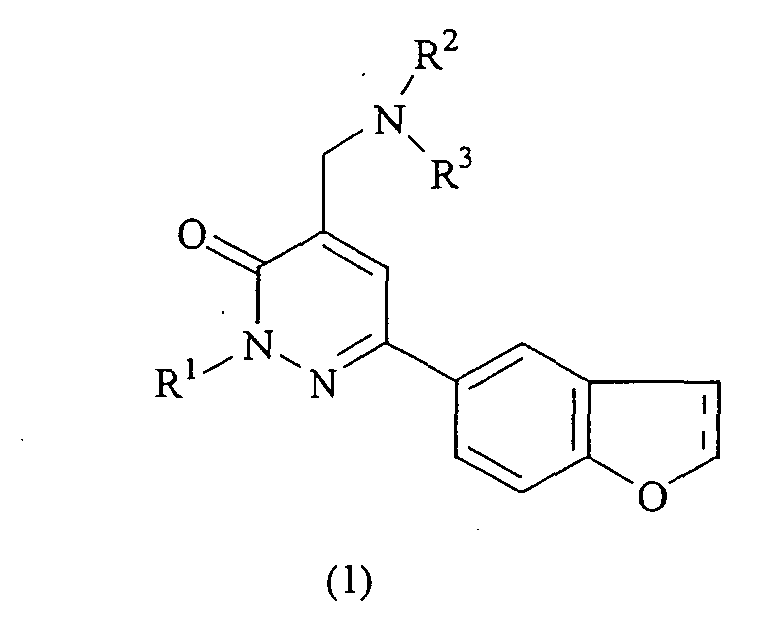
- the present invention provides a benzofuran derivative represented by formula (1): (wherein R 1 represents an alkyl group which may have a substituent or an alkenyl group which may have a substituent; each of R 2 and R 3 represents a hydrogen atom, an alkyl group, a hydroxyalkyl group, a dihydroxyalkyl group, or an alkynyl group, or R 2 and R 3 form, together with the nitrogen atom adjacent thereto, a nitrogen-containing saturated heterocyclic group which may have a substituent; and the broken line denotes the possible presence of a double bond) or a salt thereof.
- R 1 represents an alkyl group which may have a substituent or an alkenyl group which may have a substituent
- each of R 2 and R 3 represents a hydrogen atom, an alkyl group, a hydroxyalkyl group, a dihydroxyalkyl group, or an alkynyl group, or R 2 and R 3 form, together with the nitrogen atom adjacent thereto, a
- the present invention also provides a drug containing, as an active ingredient, a benzofuran derivative (1) or a salt thereof.
- the present invention also provides a drug composition containing a benzofuran derivative (1) or a salt thereof and a pharmacologically acceptable carrier therefor.
- the present invention also provides a method for treating pathological conditions caused by excessive production of tumor necrosis factor (TNF- ⁇ ), characterized by administering a benzofuran derivative (1) or a salt thereof.
- TNF- ⁇ tumor necrosis factor
- the present invention also provides use of a benzofuran derivative (1) or a salt thereof in manufacture of a drug.
- the compound (1) of the present invention exhibits excellent tumor necrosis factor (TNF- ⁇ ) production inhibitory effect and enhanced absorption after oral administration, and therefore is useful for preventing or treating allergic diseases, immune diseases, inflammatory diseases, or similar pathological conditions.
- TNF- ⁇ tumor necrosis factor
- alkyl, hydroxyalkyl, or dihydroxyalkyl groups when alkyl, hydroxyalkyl, or dihydroxyalkyl groups are referred to, either the alkyl group or the alkyl moiety of the hydroxyalkyl or dihydroxyalkyl group is C1-C12 alkyl, more preferably C1-C7 alkyl.
- the alkyl group/moiety may be linear, branched, or cyclic, or may have a ring structure.
- alkyl group/moiety examples include methyl, ethyl, n-propyl, isopropyl, n-butyl, isobutyl, cyclopropyl, cyclobutyl, cyclopentyl, cyclohexyl, cyclopropylmethyl, cyclopropylethyl, cyclobutylmethyl, cyclopentylmethyl, and cyclohexylmethyl.
- the alkyl group represented by R 1 is C1-C12 alkyl, preferably C1-C7 alkyl, more preferably C1-C5 alkyl.
- the alkyl group may be linear, branched, or cyclic, or may have a ring structure.
- Examples of the alkyl group represented by R 1 include methyl, ethyl, propyl, isobutyl, cyclobutyl, cyclopentyl, cyclohexyl, cyclopropylmethyl, cyclopropylethyl, cyclobutylmethyl, cyclopentylmethyl, and cyclohexylmethyl, with methyl, ethyl, isobutyl, cyclopropylmethyl, or cyclopentylmethyl being preferred.
- the alkenyl group represented by R 1 is preferably C2-C12 alkenyl, more preferably C2-C7 alkenyl, particularly preferably C2-C5 alkenyl.
- the alkenyl group may be linear or branched, and examples of the alkenyl group include vinyl, propenyl, butenyl, and pentenyl.
- Examples of the substituent which may be possessed by the alkyl or alkenyl group represented by R 1 include an aryl group which may have a substituent and a heteroaryl group which may have a substituent.
- the aryl group may be a C6-C14 aryl group, and examples of the aryl group include phenyl and naphthyl, wherein phenyl is preferred.
- the heteroaryl group may be a heteroaryl group which has a 5-membered or 6-membered ring containig one to three nitrogen atoms, and examples of the heteroaryl group include pyrrolyl, imidazolyl, pyrazolyl, pyridyl, pyrimidinyl, pyrazinyl, and pyridazinyl, with pyridyl being preferred.
- the aryl or heteroaryl group may have one to three substituents.
- substituents include a halogen atom, an alkyl group, and an alkoxy group.
- halogen atom include fluorine, chlorine, bromine, and iodine, wherein fluorine and chlorine are preferred.
- the alkyl group is preferably C1-C12 alkyl, more preferably C1-C7 alkyl.
- the alkoxy group is preferably C1-C12 alkoxy, more preferably C1-C7 alkoxy.
- Either the alkyl group represented by R 2 or R 3 or the alkyl moiety of the hydroxyalkyl or dihydroxyalkyl group represented by R 2 or R 3 is preferably C1-C12 alkyl, more preferably C1-C7 alkyl.
- the alkyl group/moiety is preferably linear or branched, and examples of the alkyl group/moiety include methyl, ethyl, n-propyl, isopropyl, n-butyl, isobutyl, hydroxyethyl, hydroxypropyl, hydroxybutyl, dihydroxypropyl, and dihydroxybutyl.
- alkynyl group represented by R 2 or R 3 examples include C3-C12 alkynyl, particularly C3-C7 alkynyl, such as propargyl (2-propynyl).
- Examples of the nitrogen-containing saturated heterocyclic group which is formed from R 2 , R 3 , and the nitrogen atom adjacent thereto include 5-membered, 6-membered, and 7-membered saturated heterocyclic groups. Specific examples include pyrrolidinyl, piperidino, piperazinyl, homopiperazinyl, and morpholino, wherein piperazinyl, piperidino, and morpholino are preferred.
- Examples of the substituent which may be possessed by the heterocyclic group include a halogen atom, an alkyl group, alkoxycarbonyl group, and an aralkyl group.
- Examples of the halogen atom include fluorine, chlorine, bromine, and iodine.
- Examples of the alkyl group include C1-C12 alkyl groups, with C1-C7 alkyl groups being preferred.
- Examples of the alkoxycarbonyl group include C1-C12 alkyloxycarbonyl groups, with C1-C7 alkoxycarbonyl groups being preferred.
- the aralkyl group is preferably phenyl-C1-C7 alkyl groups, with a benzyl group being particularly preferred.
- the broken line denotes the possible presence of a double bond. However, the absence of double bond is preferred.
- R 1 is particularly preferably isobutyl, cyclopropylmethyl, cyclopentylmethyl, cinnamyl, halogenocinnamyl, benzyl, halogenobenzyl, dihalogenobenzyl, or (halogenophenyl)propyl.
- R 2 and R 3 is preferably a hydrogen atom, a C1-C7 alkyl group, a C1-C7 hydroxyalkyl group, or a propargyl group.
- the heterocyclic group formed by R 2 and R 3 is preferably a piperazinyl group, a piperidino group, a pyrrolidino group, or a morpholino group, wherein each of the four groups may optionally be substituted by a C1-C7 alkyl group or a benzyl group.
- the salt form of the compound (1) of the present invention is preferably an acid-addition salt.
- the acid-addition salt include inorganic acid salts such as hydrochloride, sulfate, nitrate, and phosphate, and organic acid salts such as methanesulfonate, maleate, fumarate, citrate, and oxalate.
- the compounds of the present invention may be in the form of solvates or keto-enol tautomers.
- the present invention also encompasses such solvates and tautomers.
- No particular limitation is imposed on the type of the solvate, so long as the solvate does not adversely affect tumor necrosis factor (TNF- ⁇ ) production inhibitory effect, among other effects, and the solvate may be formed from a solvent employed in the production or other steps, such as water or alcohol.
- the solvate is preferably a hydrate.
- the compound (1) of the present invention can be produced through, for example, the following production process: (wherein R 4 represents an alkyl group; Hal represents a halogen atom; Ms represents a methanesulfonyl group; and each of R 1 , R 2 , and R 3 has the same meaning as described above) .
- the thus-produced compound (5) is reacted with R 1 -Hal or R 1 -OMs in the presence of an alkali (e.g., potassium carbonate), to thereby produce compound (6).
- the compound (6) is hydrolyzed to thereby give compound (7), which is subsequently reacted with chloroethyl carbonate, to thereby give an acid anhydride.
- the acid anhydride is reduced by use of a reducing agent (e.g., sodium borohydride), to thereby give compound (8).
- the compound (8) is reacted with methanesulfonyl chloride in the presence of a base (e.g., triethylamine), to thereby produce compound (9), serving as a key intermediate compound of the production process.
- a base e.g., triethylamine
- the target compound (1) can be produced by reacting the compound (9) with an amine (R 2 (R 3 )NH) of interest.
- the reaction is preferably performed in a polar solvent (e.g., acetonitrile) and in the presence or absence of an alkali (e.g., potassium carbonate).
- a polar solvent e.g., acetonitrile
- an alkali e.g., potassium carbonate
- R 2 or R 3 of the amine has an amino group
- the amino group of the starting amine may be protected in advance with an appropriate protecting group (e.g., an alkoxycarbonyl group), and the protecting group is removed after completion of reaction.
- the salt of the compound (1) of the present invention is produced through reaction of the compound with an organic acid or an inorganic acid through a routine method.
- the separation/purification of the compound (1) of the present invention can be performed through a purification method generally employed in the field of organic synthesis chemistry, such as filtration, extraction, washing, drying, concentration, recrystallization, or chromatography.
- the intermediates of the production process can be used in the subsequent reaction step without performing further purification.
- the compound (1) of the present invention may be produced in the form of solvate of a solvent such as reaction solvent or recrystallization solvent, particularly in the form of hydrate.
- the compound (1) of the present invention exhibits excellent TNF- ⁇ production inhibitory effect and exhibits improved absorption after oral administration. Therefore, the compound (1) is useful as a drug for preventing or treating pathological conditions of mammals, including humans, caused by excessive production of TNF- ⁇ , such as allergic diseases, inflammatory diseases, and autoimmune diseases.
- pathological conditions caused by excessive production of TNF- ⁇ include chronic articular rheumatism, arthritis deformans, asthma, bronchitis, atopic dermatitis, inflammatory visceral diseases, ulcerative colitis, Crohn's disease, and acquired immunological deficiency syndrome (AIDS) .
- the drug composition of the present invention contains the compound (1) as an active ingredient.
- the active ingredient, compound (1) can be processed, into a drug preparation, singly or in combination with one or more pharmacologically acceptable carriers (e.g., solubilizer, excipient, binder, and diluent).
- pharmacologically acceptable carriers e.g., solubilizer, excipient, binder, and diluent.
- examples of the physical form of the drug preparation include tablets, capsules, granules, powders, injections, and suppositories.
- the drug preparation can be produced through a known method.
- a drug preparation for oral administration can be produced through processing the compound (1) with one or more suitably selected carriers such as a solubilizer (e.g., tragacanth gum, acacia, a sucrose ester, lecithin, olive oil, soybean oil, or PEG400), an excipient (e.g., starch, mannitol, or lactose), a binder (e.g., sodium carboxymethylcellulose or hydroxypropylcellulose), a disintegrant (e.g., crystalline cellulose or calcium carboxymethylcellulose), a lubricant (e.g., talc or magnesium stearate), and a flowability-improving agent (e.g., light anhydrous silicic acid).
- a solubilizer e.g., tragacanth gum, acacia, a sucrose ester, lecithin, olive oil, soybean oil, or PEG400
- an excipient e.g., starch, manni
- the dose of the drug composition of the present invention varies depending on, among others, the body weight, age, sex, or pathological condition of the patient.
- the daily dose of compound (1) for an adult is typically 0.01 to 1,000 mg, preferably 0.1 to 100 mg.
- the compound (1) is preferably administered once a day or two or three times a day in a divided manner.
- 6-(2,3-Dihydro-1-benzofuran-5-yl)-4-methoxycarbonyl-2H-pyridazin-3-one (2.0 g, 7.35 mmol) was dissolved in N,N-dimethylformamide (17 mL), and potassium carbonate (2.0 g, 14.7 mmol) and bromomethylcyclopropane (1.2 g, 8.8 mmol) were added to the resultant solution, followed by stirring for two hours at 80°C. The temperature of the reaction mixture was reduced to room temperature, and saturated aqueous sodium hydrogencarbonate solution was added thereto, followed by extraction with ethyl acetate.
- the organic layer was washed with saturated brine and dried over sodium sulfate anhydrate, and the solvent was removed through distillation, to thereby yield 2.66 g of a crude product.
- the crude product was suspended in methanol (20 mL), and a 2-mol/L aqueous sodium hydroxide solution (20 mL) was added thereto, followed by stirring for one hour at 60°C. After the temperature of the reaction mixture had been reduced to room temperature, water was added thereto, and the mixture was acidified with concentrated hydrochloric acid, followed by extraction with ethyl acetate. The organic layer was washed with saturated brine and dried over sodium sulfate anhydrate.
- the formed triethylamine hydrochloride was removed through filtration, and a solution of sodium borohydride (327 mg, 8.64 mmol) in water (2 mL) was added to the filtrate under cooling with ice, followed by stirring for 15 minutes at room temperature. Aqueous hydrochloric acid (2 mol/L) was added to the reaction mixture, and the resultant mixture was extracted with ethyl acetate. The organic layer was washed with saturated brine and dried over sodium sulfate anhydrate.
- Example 1 (6) The general procedure of Example 1 (6) was carried out by use of 2-cyclopropylmethyl-6-(2,3-dihydro-1-benzofuran-5-yl)-4-methanesulfonyloxymethyl-2H-pyridazin-3-one and diethanolamine, to thereby yield the title compound as a yellow oil (yield: 74.5%).
- Example 1 The general procedure of Example 1 (6) was repeated by use of 2-cyclopropylmethyl-6-(2,3-dihydro-1-benzofuran-5-yl)-4-methanesulfonyloxymethyl-2H-pyridazin-3-one and tert-butyl-1-piperazine carboxylate, to thereby yield the title compound as a yellow oil (yield: 97.6%).
- Example 1 (3) The general procedure of Example 1 (3) was carried out by use of 6-(2,3-dihydro-1-benzofuran-5-yl)-4-methoxycarbonyl-2H-pyridazin-3-one and 4-fluorobenzyl chloride, to thereby yield the title compound as a yellow powder (yield: 54.7%). m.p.: 215-218°C.
- Example 1 The general procedure of Example 1 (4) was carried out by use of 4-carboxy-2-(4-fluorobenzyl)-6-(2,3-dihydro-1-benzofuran-5-yl)-2H-pyridazin-3-one, to thereby yield the title compound as a yellow oil (yield: 43.4%).
- Example 1 The general procedure of Example 1 (5) was carried out by use of 2-(4-fluorobenzyl)-6-(2,3-dihydro-1-benzofuran-5-yl)-4-hydroxymethyl-2H-pyridazin-3-one, to thereby yield the title compound as a yellow oil (yield: 78.6%).
- Example 1 The general procedure of Example 1 (6) was repeated by use of 2-(4-fluorobenzyl)-6-(2,3-dihydro-1-benzofuran-5-yl)-4-methanesulfonyloxymethyl-2H-pyridazin-3-one, to thereby yield the title compound as a pale yellow powder (yield: 54.8%). m.p.: 179-180°C.
- Example 1 (3) The general procedure of Example 1 (3) was carried out by use of 6-(2,3-dihydro-1-benzofuran-5-yl)-4-methoxycarbonyl-2H-pyridazin-3-one and 4-chlorobenzyl chloride, to thereby yield the title compound as a yellow powder (yield: 89.3%). m.p.: 200-210°C.
- Example 1 The general procedure of Example 1 (4) was repeated by use of 4-carboxy-2-(4-chlorobenzyl)-6-(2,3-dihydro-1-benzofuran-5-yl)-2H-pyridazin-3-one, to thereby yield the title compound as a pale yellow powder (yield: 32.7%). m.p.: 129-134°C.
- Example 1 The general procedure of Example 1 (5) was carried out by use of 2-(4-chlorobenzyl)-6-(2,3-dihydro-1-benzofuran-5-yl)-4-hydroxymethyl-2H-pyridazin-3-one, to thereby yield the title compound as a yellow powder (yield: 96.60). m.p.: 69-70°C.
- Example 1 (6) The general procedure of Example 1 (6) was carried out by use of 2-(4-chlorobenzyl)-6-(2,3-dihydro-1-benzofuran-5-yl)-4-methanesulfonyloxymethyl-2H-pyridazin-3-one, to thereby yield the title compound as faint yellow needle-like crystal (yield: 46.3%). m.p.: 149-150°C.
- 1 H NMR (400MHz, CDCl 3 ) ⁇ : 2.55(3H, s), 2.75-2.95(8H, m), 3.29(2H, t, J 8.5 Hz), 3.61(2H, s), 4.
- Example 1 (3) The general procedure of Example 1 (3) was carried out by use of 6-(2,3-dihydro-1-benzofuran-5-yl)-4-methoxycarbonyl-2H-pyridazin-3-one and 4-chlorocinnamyl chloride, to thereby yield the title compound as an orange powder (yield: 44.4%). m.p. : 177-181°C.
- Example 1 The general procedure of Example 1 (5) was repeated by use of 2-(4-chlorocinnamyl)-6-(2,3-dihydro-1-benzofuran-5-yl)-4-hydroxymethyl-2H-pyridazin-3-one, to thereby yield the title compound as a pale yellow powder (yield: 83.3%). m.p.: 135-140°C.
- Example 1 (6) The general procedure of Example 1 (6) was carried out by use of 2-(4-chlorocinnamyl)-6-(2,3-dihydro-1-benzofuran-5-yl)-4-methanesulfonyloxymethyl-2H-pyridazin-3-one, to thereby yield the title compound as a faint brown powder (yield: 45.8%). m.p. : 112-113°C.
- Example 7 The general procedure of Example 7 was repeated by use of 2-(4-chlorocinnamyl)-6-(2,3-dihydro-1-benzofuran-5-yl)-4-(4-methyl-1-piperazinyl)methyl-2H-pyridazin-3-one, to thereby yield the title compound as a pale brown crystalline powder (yield: 40.5%). m.p.
- the product was heated with quinoline (3.3 g) and copper powder (133 mg) at 200°C for six hours in a nitrogen atmosphere. After cooling, the mixture was dissolved in ethyl acetate, followed by washing sequentially with diluted hydrochloric acid, saturated aqueous sodium bicarbonate, and saturated brine. The mixture was dried over sodium sulfate anhydrate, and the solvent was removed through distillation, to thereby yield 517 mg of the title compound as a blackish brown powder (88.7%).
- Example 1 (3) The general procedure of Example 1 (3) was carried out by use of 6-(1-benzofuran-5-yl)-4-carboxy-2H-pyridazin-3-one; to thereby yield the title compound as a pale yellow powder (yield: 95.6%). m.p.: 222-225°C.
- Example 1 (3) The general procedure of Example 1 (3) was carried out by use of 6-(1-benzofuran-5-yl)-4-methoxycarbonyl-2H-pyridazin-3-one and 4-fluorobenzyl chloride, to thereby yield the title compound as a yellow powder (yield: 73.4%). m.p.: 207-210°C.
- Example 1 The general procedure of Example 1 (4) was carried out by use of 6-(1-benzofuran-5-yl)-4-carboxy-2-(4-fluorobenzyl)-2H-pyridazin-3-one, to thereby yield the title compound as faint yellow powder (yield: 30.4%). m.p.: 158-160°C.
- Example 1 The general procedure of Example 1 (5) was carried out by use of 6-(1-benzofuran-5-yl)-2-(4-fluorobenzyl)-4-hydroxymethyl-2H-pyridazin-3-one, to thereby yield the title compound as a yellow powder (yield: 85.2%). m.p.: 162-165°C.
- Example 1 (6) The general procedure of Example 1 (6) was carried out by use of 6-(1-benzofuran-5-yl)-2-(4-fluorobenzyl)-4-methanesulfonyloxymethyl-2H-pyridazin-3-one, to thereby yield the title compound as pale yellow needle-like crystal (yield: 61.7%). m.p.: 128-130°C.
- Example 1 (3) The general procedure of Example 1 (3) was carried out by use of 6-(2,3-dihydro-1-benzofuran-5-yl)-4-methoxycarbonyl-2H-pyridazin-3-one and 3-(2-chlorophenyl)-1-propanol methanesulfonate, to thereby yield the title compound as a yellow powder (yield: 76.8%). m.p.: 137-140°C.
- Example 1 The general procedure of Example 1 (4) was carried out by use of 4-carboxy-2-[3-(2-chlorophenyl)propyl]-6-(2,3-dihydro-1-benzofuran-5-yl)-2H-pyridazin-3-one, to thereby yield the' title compound as a yellow oil (yield: 49.6%).
- Example 1 The general procedure of Example 1 (5) was carried out by use of 2-[3-(2-chlorophenyl)propyl]-6-(2,3-dihydro-1-benzofuran-5-yl)-4-hydroxymethyl-2H-pyridazin-3-one, to thereby yield the title compound as a yellow oil (yield: 95.9%).
- Example 1 (6) The general procedure of Example 1 (6) was carried out by use of 2-[3-(2-chlorophenyl)propyl]-6-(2,3-dihydro-1-benzofuran-5-yl)-4-methanesulfonyloxymethyl-2H-pyridazin-3-one, to thereby yield the title compound as a yellow oil (yield: 79.3%).
- Example 7 The general procedure of Example 7 was carried out by use of 2-[3-(2-chlorophenyl)propyl]-6-(2,3-dihydro-1-benzofuran-5-yl)-4-(4-methyl-1-piperazinyl)methyl-2H-pyridazin-3-one, to thereby yield the title compound as a pale brown crystalline powder (yield: 77.2%).
- Example 5 The general procedure of Example 5 was carried out by use of 2-[3-(2-chlorophenyl)propyl]-6-(2,3-dihydro-1-benzofuran-5-yl)-4-methanesulfonyloxymethyl-2H-pyridazin-3-one, to thereby yield the title compound as a yellow oil (yield: 58.30).
- Example 1 The general procedure of Example 1 (4) was carried out by use of 4-carboxy-2-[3-(4-chlorophenyl)propyl]-6-(2,3-dihydro-1-benzofuran-5-yl)-2H-pyridazin-3-one, to thereby yield the title compound as a yellow oil (yield: 53.3%).
- Example 1 The general procedure of Example 1 (5) was repeated by use of 2-[3-(4-chlorophenyl)propyl]-6-(2,3-dihydro-1-benzofuran-5-yl)-4-hydroxymethyl-2H-pyridazin-3-one, to thereby yield the title compound as a yellow oil (yield: 96.9%).
- Example 1 The general procedure of Example 1 (6) was repeated by use of 2-[3-(4-chlorophenyl)propyl]-6-(2,3-dihydro-1-benzofuran-5-yl)-4-methanesulfonyloxymethyl-2H-pyridazin-3-one, to thereby yield the title compound as a yellow oil (yield: 62.7%).
- Example 5 The general procedure of Example 5 was repeated by use of 2-[3-(4-chlorophenyl)propyl]-6-(2,3-dihydro-1-benzofuran-5-yl)-4-methanesulfonyloxymethyl-2H-pyridazin-3-one, to thereby yield the title compound as a yellow oil (yield: 54.5%).
- Example 1 (3) The general procedure of Example 1 (3) was carried out by use of 6-(2,3-dihydro-1-benzofuran-5-yl)-4-methoxycarbonyl-2H-pyridazin-3-one and 2-chlorobenzyl chloride, to thereby yield the title compound as yellow needle-like crystal (yield: 75.0%). m.p.: 177.9-178.6°C.
- Example 1 The general procedure of Example 1 (4) was repeated by use of 4-carboxy-2-(2-chlorobenzyl)-6-(2,3-dihydro-1-benzofuran-5-yl)-2H-pyridazin-3-one, to thereby yield the title compound as pale yellow needle-like crystal (yield: 42.8%). m.p.: 158.3-159.0°C.
- Example 1 The general procedure of Example 1 (5) was repeated by use of 2-(2-chlorobenzyl)-6-(2,3-dihydro-1-benzofuran-5-yl)-4-hydroxymethyl-2H-pyridazin-3-one, to thereby yield the title compound as pale yellow needles (yield: 74.7%). m.p.: 118.2-118.9°C.
- Example 1 The general procedure of Example 1 (6) was repeated by use of 2-(2-chlorobenzyl)-6-(2,3-dihydro-1-benzofuran-5-yl)-4-methanesulfonyloxymethyl-2H-pyridazin-3-one, to thereby yield the title compound as pale yellow needle-like crystal (yield: 42.5%). m.p.: 141.4-142.1°C.
- Example 5 The general procedure of Example 5 was repeated by use of 2-(2-chlorobenzyl)-6-(2,3-dihydro-1-benzofuran-5-yl)-4-methanesulfonyloxymethyl-2H-pyridazin-3-one, to thereby yield the title compound as pale yellow needle-like crystal (yield: 45.8%). m.p.: 120.1-122.8°C.
- RAW264.7 cells were suspended in a DMEM medium supplemented with 10% fetal bovine serum (FBS), and the suspension was seeded in wells of a 24-well plate (5 ⁇ 10 5 /mL/well) . Each test compound (0 to 10 ⁇ M) was added to the wells, and the mixture was incubated in a CO 2 incubator for 30 minutes. Subsequently, lipopolysaccharide was added to the mixture in an amount of 1 ⁇ g/mL, and incubation was further performed in a CO 2 incubator for eight hours. Eight hours after the start of incubation, the culture supernatant was collected, and the amount of TNF- ⁇ contained in the culture broth was determined through ELISA. IC 50 value was determined through comparison with the amount of produced TNF- ⁇ in the drug-free (blank) case. The results regarding some representative compounds are shown in Table 1.
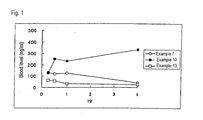
- test compounds Examples 7, 10, and 13 were suspended in 0.5% HPMC in a mortar.
- the suspension was orally administered to each male ICR mouse (6 weeks old) in an amount of 10 mg/kg.
- a blood sample was collected and centrifuged, whereby a plasma sample was prepared.
- the level of the test compound in the plasma sample was determined through HPLC. The results are shown in Fig. 1.
- the compounds according to the present invention exhibit good absorbability, indicating that the compounds are useful as drugs which can be orally administered.
Landscapes
- Health & Medical Sciences (AREA)
- Chemical & Material Sciences (AREA)
- Organic Chemistry (AREA)
- Pharmacology & Pharmacy (AREA)
- Veterinary Medicine (AREA)
- Public Health (AREA)
- General Health & Medical Sciences (AREA)
- Animal Behavior & Ethology (AREA)
- Medicinal Chemistry (AREA)
- Life Sciences & Earth Sciences (AREA)
- General Chemical & Material Sciences (AREA)
- Nuclear Medicine, Radiotherapy & Molecular Imaging (AREA)
- Chemical Kinetics & Catalysis (AREA)
- Bioinformatics & Cheminformatics (AREA)
- Engineering & Computer Science (AREA)
- Immunology (AREA)
- Physical Education & Sports Medicine (AREA)
- Rheumatology (AREA)
- Pain & Pain Management (AREA)
- Orthopedic Medicine & Surgery (AREA)
- Pulmonology (AREA)
- Epidemiology (AREA)
- Pharmaceuticals Containing Other Organic And Inorganic Compounds (AREA)
- Plural Heterocyclic Compounds (AREA)
Abstract
Description

each of R2 and R3 represents a hydrogen atom, an alkyl group, a hydroxyalkyl group, a dihydroxyalkyl group, or an alkynyl group, or R2 and R3 form, together with the nitrogen atom adjacent thereto, a nitrogen-containing saturated heterocyclic group which may have a substituent; and
the broken line denotes the possible presence of a double bond)
or a salt thereof.

1H NMR (400MHz, CDCl3)δ:
3.28 (2H, t, J= 8.3 Hz), 3.99 (3H, s), 4.66(2H, t, J= 8.3 Hz), 6.87(1H, d, J= 8.3 Hz), 7.56(1H, d, J= 8.3 Hz), 7.68 (1H, s). 8.31 (1H, s).
m.p.: 160-165°C.
1H NMR (400MHz, CDCl3) δ:
0.50-0.55(2H, m), 0.60-0.66(2H, m), 1.46 (1H, m), 3.30(2H, t, J= 8.8 Hz), 4.22(2H, t, J= 7.3 Hz), 4.67(2H, t, J= 8.8 Hz), 6.89 (1H, d, J= 8.5 Hz), 7.65 (1H, dd, J= 8.5, 2.0 Hz), 7.72 (1H, s). 8.62 (1H, s).
m.p. : 115-117°C.
1H NMR (400MHz, CDCl3)δ:
0.46-0.51 (2H, m), 0.54-0.60(2H, m), 1.43 (1H, m), 3.28(2H, t, J= 8.8 Hz), 4.10 (2H, d, J= 7.1 Hz), 4.64 (2H, d, J= 8.8 Hz), 4.71 ((2H, d, J= 0.73 Hz), 6.85 (1H, d, J= 8.5 Hz), 7.55 (1H, dd, J= 8.5, 2.0 Hz), 7.63(1H, s), 7.68 (1H, s).
m.p.: 108-111°C.
1H NMR (400MHz, CDCl3)δ:
0.45-0.50(2H, m), 0.53-0.60(2H, m), 1.42 (1H, m), 3.17 (3H, s), 3.29 (2H, t, J= 8.8 Hz), 4.10 (2H, d, J= 7.3 Hz), 4.65(2H, t, J= 8.8 Hz), 5.28 (2H, d, J= 0.97 Hz), 6.86 (1H, d, J= 8.3 Hz), 7.56 (1H, dd, J= 8.3, 2.0 Hz), 7.67 (1H, s), 7.75 (1H, s).
m.p.: 128-130°C.
1H NMR (400MHz, CDCl3)δ:
0.45-0.57 (4H, m), 1.42 (1H, m), 2.43 (3 H, s), 2.60-3.00(8H, m), 3.29(2H, t, J= 8.8 Hz), 3.61(2H, s), 4.09(2H, d, J= 7.2 Hz), 4.64(2H, t, J= 8.8 Hz), 6.82 (1H, d, J= 8.3 Hz), 7.55 (1H, d, J= 8.3 Hz), 7.69 (1H, s), 7.71 (1H, s).
IR (KBr) cm-1 : 1651, 1608, 1501, 1242, 1168, 808.
Mass m/z: 380 (M+).
1H NMR (400MHz, CDCl3) δ:
0.40-0.65 (4H, m), 1.42 (1H, m), 2.70-3.05 (4H, m), 3.28(2H, t, J= 8.8 Hz), 3.50-4.00(6H, m), 4.11(2H, d, J= 8.5 Hz), 4.64(2H, t, J= 8.8 Hz), 6.85 (1H, d, J= 8.5 Hz), 7.58 (1H, d, J= 8.5 Hz), 7.71 (1H, s), 7.80 (1H, s).
IR(Neat) cm-1: 3392, 1645, 1602, 1516, 1238, 1047.
Mass m/z: 354 (M+-CH2OH).
1H NMR (400MHz, CDCl3)δ:
0.45-0.56(4H, m), 1.43 (1H, m), 2.44 (3H, s), 3.28(2H, t, J= 8.8 Hz), 3.62(2H, s), 4.10 (2H, d, J= 7.3 Hz), 4.63(2H, t, J= 8.8 Hz), 6.85 (1H, d, J= 8.3 Hz), 7.62 (1H, d, J= 8.3 Hz), 7.72 (1H, s), 7.92 (1H,m).
IR (KBr) cm-1 : 1651, 1606, 1499, 1243, 1102, 820.
Mass m/z :325(M+).
1H NMR (400MHz, CDCl3)δ:
0.45-0.50(2H, m), 0.51-0.58(2H, m), 1.42 (1H, m),1.47 (9H, s), 2.45-2.60 (4H, m), 3.29 (2H ,t , J= 8.8 Hz), 3.45-3.55 (4H, m), 3.58(2H, brs), 4.10 (2H, d, J= 7.1 Hz),4.64(2H, t, J= 8.8 Hz), 6.86 (1H, d, J= 8.3 Hz), 7.55 (1H, m), 7.69 (1H, s), 7.75 (1H,m).
1H NMR (400MHz, CDCl3)δ:
0.44-0.58(4H, m),1.43 (1H, m),2.58-2.70 (5H, m), 2.99-3.10(4H, m), 3.29(2H, t, J= 8.5 Hz), 3.57(2H, s), 4.09(2H, d, J= 7.3 Hz), 4.64(2H, t, J= 8.5 Hz), 6.86 (1H, d, J= 8.3 Hz), 7.56 (1H, d, J= 8.3 Hz), 7.68 (1H, s), 7.74 (1H, m).
IR(Neat) cm-1: 1652, 1607, 1497, 1238, 1102, 821.
Mass m/z : 366(M+).
1H NMR (400MHz, CDCl3) δ:
0.44-0.60 (4H,m), 1.42 (1H,m), 3.27 (2H, t, J= 8.8 Hz),3.92(2H,s),4.09(2H,d, J= 7.1 Hz),4.63(2H,t,J= 8.8 Hz), 6.84 (1H, d, J= 8.3 Hz), 7.56 (1H, dd, J= 8.3, 1.2 Hz), 7.69 (1H, d, J= 1.2 Hz), 8.02 (1H, s).
IR(Neat) cm-1 : 1648, 1605, 1498, 1238, 1105, 754.
Mass m/z :297 (M+).
m.p.: 215-218°C.
1H NMR (400MHz, CDCl3)δ:
3.30(2H, t, J= 8.8 Hz), 4.68(2H, t, J= 8.8 Hz), 5.46(2H, s), 6.87 (1H, d, J= 8.5 Hz), 7.04-7.08(2H, m), 7.50-7.54(2H, m), 7.63 (1H, dd, J= 8.5, 2.0 Hz), 7.70 (1H, s), 8.60 (1H, s), 14.06 (1H, s).
1H NMR (400MHz, CDCl3)δ:
3.28(2H, t, J= 8.8 Hz), 4.64(2H, t, J= 8.8 Hz), 4.69(2H, d, J= 1.2 Hz), 5.35(2H, s), 6.85 (1H, d, J= 8.5 Hz), 6.98-7.04(2H, m), 7.46-7.50 (2H, m), 7.55 (1H, dd, J= 8.5, 2.0 Hz), 7.64 (1H, s), 7.67 (1H, brs) .
1H NMR (400MHz, CDCl3) δ:
3.14 (3H, s), 3.29(2H, t, J= 8.8 Hz), 4.65(2H, t, J= 8.8 Hz), 5.27 (2H, d, J= 1.5 Hz), 5.35(2H, s), 6.86 (1H, d, J= 8.5 Hz), 6.98-7.05(2H, m), 7.45-7.50(2H, m), 7.55 (1H, dd, J= 8.5, 2.0 Hz), 7.65 (1H, brs), 7.75 (1H, brs).
m.p.: 179-180°C.
1H NMR (400MHz, CDCl3)δ:
2.43(3H, s), 2.64-2.74 (8H, m), 3.29 (2H, t, J= 8.5 Hz), 3.58 (2H, s), 4.65 (2H, t, J= 8.5 Hz), 5.34 (2H, s), 6.86 (1H, d, J= 8.5 Hz), 6.98-7.04 (2H, m), 7.46-7.51 (2H, m), 7.54 (1H, dd, J= 8.5, 2.0 Hz), 7.67(1H, d, J= 2.0 Hz), 7.70(1H, s).
IR (KBr) cm-1: 1653, 1609, 1501, 1240, 1119, 819.
Mass m/z :434 (M+) .
m.p.: 201-204°C(dec.).
1H NMR(400MHz, CDCl3)δ: 2.79(3H, s), 2.99(4H, brs), 3.13(2H, brs), 3.30(2H, t, J= 8.8 Hz), 3.45(2H, brs), 3.67(2H, s), 4.65(2H, t, J= 8.8 Hz), 5.34 (2H, s), 6.86 (1H, d, J= 8.3 Hz), 7.01(2H, dd, J= 8.8, 8.8 Hz), 7.49(2H, dd, J= 8.8, 5.4 Hz), 7.60 (1H, brs), 7.51 (1H, m), 7.66 (1H, s).
IR(KBr) cm-1: 3437, 1655, 1608, 1510, 1497, 1438, 1240.
Mass m/z :434 (M+).
m.p.: 200-210°C.
1H NMR (400MHz, CDCl3)δ:
3.30(2H, t, J= 8.8 Hz), 4.68(2H, t, J= 8.8 Hz), 5.45(2H, s), 6.89 (1H, d, J= 8.5 Hz), 7.35 (2H, d, J= 8.5 Hz), 7.46(2H, d, J= 8.5 Hz), 7. 62 (1H, dd, J= 8.5, 2.0 Hz), 7.70 (1H, d, J= 2.0 Hz), 8.61 (1H, s), 14.02 (1H, brs).
m.p.: 129-134°C.
1H NMR(400MHz, CDCl3)δ:
3.28(2H, t, J= 8.8 Hz), 4.64(2H, t, J= 8.8 Hz), 4.69(2H, s), 5.35(2H, s), 6.85(1H, d, J= 8.3 Hz), 7.28-7.32(2H, m), 7.41-7.43(2H, m), 7.55 (1H, m), 7.65 (1H, m), 7.66 (1H, brs).
m.p.: 69-70°C.
1H NMR(400MHz, CDCl3) δ :
3.15(3H, s), 3.29(2H, t, J= 8.8 Hz), 4.65(2H, t, J= 8.8 Hz), 5.24(2H, s), 5.34(2H, s), 6.86 (1H, d, J= 8.3 Hz), 7.30-7.32(2H, m), 7.41-7.43(2H, m), 7.55 (1H, m), 7.65 (1H, m), 7.75 (1H, m).
m.p.: 149-150°C.
1H NMR (400MHz, CDCl3) δ:
2.55(3H, s), 2.75-2.95(8H, m), 3.29(2H, t, J= 8.5 Hz), 3.61(2H, s), 4. 65 (2H, t, J= 8.5 Hz), 5.33 (2H, s), 6.86 (1H, d, J= 8.3 Hz), 7.29 (2H, d, J= 8.3 Hz), 7.43(2H, d, J= 8. 3 Hz), 7.53 (1H, brs, J= 8.3 Hz), 7.64-7.70 (2H, m).
IR (KBr) cm-1: 1654, 1609, 1499, 1241, 1118, 808.
Mass m/z : 450 (M+), 452 (M+) .
m.p. : 177-181°C.
1H NMR (400MHz, CDCl3)δ:
3.29(2H, t, J= 8.5 Hz), 4.67(2H, t, J= 8.5 Hz), 5.09 (2H, dd, J= 6.7, 1.2 Hz), 6.39 (1H, dt, J= 15.9, 6.7 Hz), 6.73 (1H, d, J= 15.9 Hz), 6.89 (1H, d, J= 8.5 Hz), 7.29 (2H, d, J= 8.5 Hz), 7.33 (2H, d, J= 8.5 Hz), 7.64 (1H, dd, J= 8. 5, 2.0 Hz), 7.70 (1H, d, J= 2.0 Hz), 8.63 (1H, s).
m.p.: 131-141°C.
1H NMR (400MHz, CDCl3)δ:
3.27(2H, t, J= 8.5 Hz), 4.64(2H, t, J= 8.5 Hz), 4.71 (2H, d, J= 1.2 Hz),4.98(2H, dd, J= 6. 6, 1 .2 Hz), 6.41 (1H, dt, J= 15.9, 6.6 Hz), 6.65(1H, d, J= 15.9 Hz), 6.85(1H, d, J= 8.3 Hz), 7.26(2H, d, J= 8.8 Hz), 7.31(2H, d, J= 8.8 Hz), 7.56(1H, brs, J= 8.8 Hz), 7.66(1H, brs), 7.68 (1H, brs).
m.p.: 135-140°C.
1H NMR (400MHz, CDCl3) δ:
3.16(3H, s), 3.28(2H, t, J= 8.5 Hz), 4.65(2H, t, J= 8.5 Hz), 4.98(2H, dd, J= 6.6, 1.2 Hz), 5.28 (2H, d, J= 1.2 Hz), 6.39 (1H, dt, J= 15.9, 6.6 Hz), 6.66 (1H, d, J= 15.9 Hz), 6.86 (1H, d, J= 8.5 Hz), 7.27 (2H, d, J= 8.5 Hz), 7.31(2H, d, J= 8.5 Hz), 7.57 (1H, brs, J= 8.5 Hz), 7.67 (1H,brs), 7.77 (1H, t, J= 1.2 Hz).
m.p. : 112-113°C.
1H NMR (400MHz, CDCl3) δ:
2.49(3H, s), 2.60-2.84(8H, m), 3.29 (2H, t, J= 8.5 Hz), 3.61(2H, brs), 4.64(2H, t, J= 8.5 Hz), 4.97(2H, d, J= 6.3 Hz), 6.42 (1H, dt, J= 15.9, 6.3 Hz), 6.66 (1H, d, J= 15.9 Hz), 6.86 (1H, d, J= 8.3 Hz), 7.25 (2H, d, J= 8.5 Hz), 7.31(2H, d, J= 8.5 Hz), 7.54 (1H, d, J= 8.3 Hz), 7.69 (1H, s), 7.72 (1H, s).
IR (KBr) cm-1: 1648, 1607, 1496, 1238, 1091, 807.
Mass m/z : 476(M+), 478 (M+).
m.p. : 248-251°C
1H NMR (400MHz, DMSO-d6)δ:
2.81(3H, s), 3.25 (2H, t, J= 8.8 Hz), 3.50-4.00 (10H, m), 4.60 (2H, t, J= 8.8 Hz), 4.97 (2H, d, J= 5.6 Hz), 6.42 (1H, dt, J= 16.3, 5.6 Hz), 6.64 (1H, d, J= 16.3 Hz), 6.89 (1H, d, J= 8.3 Hz), 7.37(2H, d, J= 8.5 Hz), 7.47 (1H, m), 7.49 (2H, d, J= 8.5 Hz), 766 (1H, dd, J= 8.3, 2.0 Hz), 7.79 (1H, s).
IR (KBr) cm-1: 1652, 1607, 1492, 1239, 1091, 933.
1H NMR(400MHz, CDCl3)δ:
2.67(3H, s), 6.87 (1H, dd, J= 2.0, 1.0 Hz), 7.55 (1H, d, J= 8.8 Hz), 7.70 (1H, d, J= 2,4 Hz), 7.98 (1H, dd, J= 8.8, 2.0 Hz), 8.26 (1H, d, J= 2.4 Hz).
Mass m/z : 160 (M+) .
m.p.: 222-225°C.
1H NMR (400MHz, CDCl3)δ:
4.01(3H, s), 6.85(1H, dd, J= 2.0, 0.98 Hz), 7.60(1H, d, J= 8.5 Hz), 7.70 (1H, d, J= 2.2 Hz), 7.77 (1H, dd, J= 8.5, 2.0 Hz), 8.04 (1H, d, J= 2.2 Hz), 8. 42 (1H, s).
m.p.: 207-210°C.
1H NMR (400MHz, CDCl3)δ:
5.50(2H, s), 6.88(1H, dd, J= 2.0, 0.98 Hz), 7.05-7.09(2H, m), 7.53-7.56 (2H, m), 7.63 (1H, d, J= 8.8 Hz), 7.72 (1H, d, J= 2.2 Hz), 7.82 (1H, dd, J= 8.8, 2.0 Hz), 8.08 (1H, d, J= 2.2 Hz), 8.72 (1H, s).
m.p.: 158-160°C.
1H NMR(400MHz, CDCl3)δ:
4.72(2H, d, J= 1.2 Hz), 5.39(2H, s), 6.85(1H, dd, J= 2.2, 0.98 Hz), 6.99-7.06(2H, m), 7.49-7.53(2H, m), 7.59 (1H, d, J= 8.5 Hz), 7.69 (1H, d, J= 2.2 Hz),7.76-7.79(2H, m), 8.02 (1H, d, J= 2.2 Hz).
m.p.: 162-165°C.
1H NMR (400MHz, CDCl3) δ:
3.16(3H, s), 5.28 (2H, d, J= 1.5 Hz), 5.39 (2H, s), 6. 86 (1H, dd, J= 2.2, 0.98 Hz), 7. 00-7. 06 (2H, m), 7.48-7 .52 (2H, m), 7.59 (1H, d, J= 8.8 Hz), 7.70 (1H, d, J= 2.0 Hz),7.77 (1H, dd, J= 8.8, 2.2 Hz), 7.86 (1H, t, J= 1.2 Hz), 8.01 (1H, d, J= 2.0 Hz).
m.p.: 128-130°C.
1H NMR(400MHz, CDCl3)δ:
2.36(3H, s), 2.55-2.70(8H, m), 3.59(2H, d, J= 1.2 Hz), 5.38 (2H, s), 6.86 (1H, dd, J= 2.2, 0.98 Hz), 6.99-7.05 (2H, m), 7.49-7.55 (2H, m), 7.59 (1H, d, J= 8.5 Hz), 7.69 (1H, d, J= 2.2 Hz), 7.77 (1H, dd, J= 8.5, 2.2 Hz), 7.83 (1H, s), 8.02 (1H, d, J= 2.2 Hz).
IR(KBr) cm-1: 1651, 1605, 1511, 1241, 1118, 770.
Mass m/z :432 (M+) .
m.p.: 137-140°C.
1H NMR(400MHz, CDCl3)δ:
2.26-2.34 (2H, m),2.88(2H, t, J= 7.8 Hz), 3.30 (2H, t, J= 8.8 Hz), 4.43(2H, t, J= 7.1 Hz), 4.67(2H, t, J= 8.8 Hz), 6.88 (1H, d, J= 8.3 Hz), 7.12-7.24(3H, m), 7.33 (1H, m), 7.63 (1H, dd, J= 9.3, 2.0 Hz), 7.71 (1H, brs), 8.59 (1H, s), 14.22 (1H, brs).
1H NMR(400MHz, CDCl3)δ:
2.19-2.27(2H, m), 2.85 (2H, t, J= 7.6 Hz), 3.28(2H, t, J= 8.5 Hz), 4.32(2H, t, J= 7.3 Hz), 4. 64 (2H, t, J= 8.5 Hz), 4.70(2H, d, J= 1.2 Hz), 6.85 (1H, d, J= 8.3 Hz), 7.11-7.20 (3H, m), 7.32 (1H, m), 7.55 (1H, dd, J= 8.3, 1.2 Hz), 7.63 (1H, s), 7.68 (1H, s).
1H NMR(400MHz, CDCl3)δ:
2.19-2.27(2H, m),2.85(2H, t, J= 7.6 Hz), 3.17 (3H, s), 3.29(2H, t, J= 8.8 Hz), 4.32(2H, t, J= 7.1 Hz), 4.65 (2H, t, J= 8.8 Hz), 5.27 (2H, d, J= 1.5 Hz), 6.86 (1H, d, J= 8.5 Hz), 7.12-7.20 (3H, m), 7.32 (1H, m), 7.56 (1H, dd, J= 8.5, 1.2 Hz), 7.67 (1H, s), 7.74 (1H, s).
1H NMR (400MHz, CDCl3) δ:
2.17-2.26(2H, m), 2.57(3H, s), 2.80-2.88(10H, m), 3.29(2H, t, J= 8.8 Hz), 3.63(2H, s), 4.31(2H, t, J= 7.3 Hz), 4.65(2H, t, J= 8.8 Hz), 6.86 (1H, d, J= 8.5 Hz), 7.11-7.18(3H, m), 7.28-7.33(2H, m), 7.52 (1H, s), 7. 68 (1H, s).
IR(Neat) cm-1: 1652, 1608, 1498, 1237, 1015, 753.
Mass m/z : 478(M+), 480 (M+) .
m.p.: 228-231°C
1H NMR (400MHz, DMSO-d6)δ:
2.05-2.15(2H, m), 2.75-2.85(2H, m), 2.81(3H, s), 3.26(2H, t, J= 8.8 Hz), 3.60-4.20(10H, m), 4.21(2H, t, J= 7.1 Hz), 4.61(2H, t, J= 8.8 Hz), 6.89 (1H, d, J= 8.5 Hz), 7.20-7.30(3H, m), 7.38-7.41(2H, m), 7.65 (1H, dd, J= 8.5, 2.0 Hz), 7.78(1H, s) .
IR (KBr) cm-1: 1660, 1610, 1499, 1238, 1018, 941.
1H NMR (400MHz, CDCl3)δ:
2.11-2.26 (2H, m), 2.85 (2H, t, J= 7.3 Hz), 3.27(2H, t, J= 8.8 Hz), 3.90(2H, s), 4.31(2H, t, J= 7.3 Hz), 4.63(2H, t, J= 8.8 Hz), 6.84 (1H, d, J= 8.5 Hz), 7.10-7.19 (3H, m), 7.32 (1H, m), 7.56 (1H,dd, J= 8.5, 2.0 Hz), 7.68(1H, s), 7.69 (1H,s). IR(Neat) cm-1: 1652, 1606, 1498, 1238, 1108, 754.
Mass m/z : 395(M+), 397 (M+) .
m.p.: 157-160°C.
1H NMR (400MHz, CDCl3)δ:
2.21-2.30(2H, m),2.73(2H, t, J= 7.6 Hz), 3. 03 (2H, t, J= 8.8 Hz), 4.38(2H, t, J= 7.3 Hz), 4.68 (2H, t, J= 8.8 Hz), 6.89 (1H, d, J= 8.3 Hz), 7.13(2H, d, J= 8.3 Hz),7.24(2H, d, J= 8.3 Hz), 7.62 (1H, dd, J= 8.3, 2.0 Hz), 7.69 (1H, s), 8.58 (1H, s), 14.19 (1H, brs).
1H NMR (400MHz, CDCl3)δ:
2.16-2.24 (2H, m),2.70(2H, t, J= 7.3 Hz), 3.28 (2H, t, J= 8.8 Hz), 4.27(2H, t, J= 7.3 Hz), 4.65 (2H, t, J= 8.8 Hz), 4.76(2H, d, J= 1.2 Hz), 6.85 (1H, d, J= 8.5 Hz), 7.14(2H, d, J= 8.3 Hz), 7.23(2H, d, J= 8.3 Hz), 7.55 (1H, dd, J= 8.3, 2.2 Hz), 7.61 (1H, s), 7.66 (1H, brs) .
1H NMR (400MHz, CDCl3) δ:
2.16-2.23 (2H, m), 2.70 (2H, t, J= 7.6 Hz), 3.17 (3H, s), 3.29(2H, t, J= 8.8 Hz), 4.27(2H, t, J= 7.3 Hz), 4.65(2H, t, J= 8.8 Hz), 5.25(2H, d, J= 1.5 Hz), 6.86(1H, d, J= 8.3 Hz), 7.14(2H, d, J= 8.3 Hz), 7.23(2H, d, J= 8.3 Hz), 7.55 (1H, dd, J= 8.3, 2.2 Hz), 7.64(1H, s), 7.73(1H, s).
1H NMR (400MHz, CDCl3) δ:
2.15-2.33 (2H, m), 2.37(3H, s), 2.52-2.72(10H, m), 3.29(2H, t, J= 8.8 Hz), 3.56(2H, d, J= 1.2 Hz), 4.26(2H, t, J= 7.6 Hz), 4.65 (2H, t, J= 8.8 Hz), 6.87 (1H, d, J= 8.5 Hz), 7.14(2H, d, J= 8.5 Hz), 7.22(2H,d, J= 8.5 Hz), 7.53 (1H, dd, J= 8.5, 2.0 Hz), 7.67 (1H, d, J= 2.0 Hz), 7.69 (1H, s).
IR(Neat) cm-1: 1649, 1607, 1496, 1237, 1015, 755.
Mass m/z :478 (M+), 480 (M+).
1H NMR (400MHz, CDCl3)δ:
2.15-2.23(2H, m), 2.70(2H, t, J= 7.3 Hz), 3.27(2H, t, J= 8.8 Hz), 3.90(2H, s), 4.26(2H, t, J= 7.3 Hz), 4.64(2H, t, J= 8.8 Hz), 6.84 (1H, d, J= 8.5 Hz), 7.14(2H,d, J= 8.5 Hz), 7.22(2H, d, J= 8.5 Hz), 7.55 (1H, dd, J= 8.5, 2.0 Hz), 7.65-7.67(2H, m) .
IR(Neat) cm-1: 1652, 1606, 1496, 1238, 1103, 756.
Mass m/z : 395 (M+), 397(M+).
m.p.: 177.9-178.6°C.
1H NMR (400MHz, CDCl3)δ:
3.27(2H, t, J= 8.5 Hz), 4.65(2H, t, J= 8.5 Hz), 5.66(2H, s), 6.85 (1H, d, J= 8.5 Hz), 7.23-7.33(3H, m), 7.45 (1H, m), 7.59 (1H, dd, J= 8.5, 2.0 Hz), 7.67 (1H, d, J= 1.5 Hz), 8.65 (1H, s), 14.03 (1H, s).
IRKBr) cm-1: 1756, 1638, 1577, 1499, 1476, 1456, 1435, 1303, 1244.
m.p.: 158.3-159.0°C.
1H NMR(400MHz, CDCl3)δ:
3.23(2H, t, J= 8.8 Hz), 4.41(2H, t, J= 8.8 Hz), 4.71(2H, d, J= 1.2 Hz), 5.53(2H, s), 6.81(1H, d, J= 8.5 Hz), 7.13-7.24(3H, m), 7.40(1H, m), 7.53(1H, dd, J= 8.5, 2.0 Hz), 7.65 (1H, d, J= 1.5 Hz), 7.72 (1H, t, J= 1.2 Hz) .
IR (KBr) cm-1: 3402, 1656, 1614, 1596, 1498, 1442, 1235.
Mass m/z : 368 (M+) , 370 (M+).
m.p.: 118.2-118.9°C.
1H NMR (400MHz, CDCl3)δ:
3.16(3H, s), 3.25(2H, t, J= 8.8 Hz), 4.63(2H, t, J= 8.8 Hz), 5.28(2H,d, J= 1.5 Hz), 5.54(2H, s), 6.83 (1H, d, J= 8.3 Hz), 7.16-7.27(3H, m), 7.41(1H, m), 7.53(1H, dd, J= 8.3, 2.0 Hz), 7.64(1H, d, J= 1.5 Hz), 7.80(1H, t, J= 1.2 Hz).
IR (KBr) cm-1 : 1655, 1608, 1398, 1444, 1356, 1242, 1166, 1040. Mass m/z :446(M+), 448(M+).
m.p.: 141.4-142.1°C.
1H NMR (400MHz, CDCl3)δ:
2.35(3H, s), 2.64(4H, brs), 2.78(4H, brs), 3.26(2H, t, J= 8.8 Hz), 3.60(2H, d, J= 1.5 Hz), 4.63(2H, t, J= 8.8 Hz), 5.54(2H, s), 6.88 (1H, d, J= 8.3 Hz), 7.14-7.24 (3H, m), 7.40 (1H, m), 7.53 (1H, dd, J= 8.3, 2.0 Hz), 7.66 (1H, s), 7.78 (1H, s).
IR (KBr) cm-1 : 1656, 1611, 1498, 1440, 1323, 1297, 1238.
Mass m/z : 450(M+), 452 (M+) .
m.p.: 120.1-122.8°C.
1H NMR (400MHz, CDCl3)δ:
3.24(2H, t, J= 8.8 Hz), 3.93(2H, s), 4.62(2H, t, J= 8.8 Hz), 5.28(2H, d, J= 1.5 Hz), 5.54(2H, s), 6.82 (1H, d, J= 8.5 Hz), 7.14-7.26 (3H, m), 7.39 (1H, m), 7.54 (1H, dd, J= 8.3, 2.0 Hz), 7.66 (1H, s), 7.75 (1H, s).
IR (KBr) cm-1 : 3354, 1654, 1613, 1499, 1438, 1239.
Mass m/z: 367 (M+), 369 (M+) .

As is clear from Fig. 1, the compounds according to the present invention exhibit good absorbability, indicating that the compounds are useful as drugs which can be orally administered.
Claims (22)
- A benzofuran derivative represented by formula (1):(wherein R1 represents an alkyl group which may have a substituent or an alkenyl group which may have a substituent;
each of R2 and R3 represents a hydrogen atom, an alkyl group, a hydroxyalkyl group, a dihydroxyalkyl group, or an alkynyl group, or R2 and R3 form, together with the nitrogen atom adjacent thereto, a nitrogen-containing saturated heterocyclic group which may have a substituent; and
the broken line denotes the possible presence of a double bond)
or a salt thereof. - A compound according to claim 1, wherein R1 is a C1-C12 alkyl group which may have a substituent or a C2-C12 alkenyl group which may have a substituent.
- A compound according to claim 2, wherein the substituent which may be possessed by the alkyl or alkenyl group represented by R1 is a C6-C14 aryl group or a heteroaryl group having a 5-membered or 6-membered ring containing one to three nitrogen atoms, and the aryl or heteroaryl group may be substituted by one to three members selected from among halogen atoms, alkyl groups, and alkoxy groups.
- A compound according to claim 1, wherein each of R2 and R3 represents a hydrogen atom, alkyl group, hydroxyalkyl group, dihydroxyalkyl group, or alkynyl group, or R2 and R3 form, together with the nitrogen atom adjacent thereto, a 5-membered, 6-membered, or 7-membered nitrogen-containing saturated heterocyclic group, and the heterocyclic group may be substituted by a halogen atom, alkyl group, alkoxycarbonyl group, or aralkyl group.
- A compound according to claim 1, wherein R1 represents a cyclopropylmethyl group, a cinnamyl group, a halogenocinnamyl group, a benzyl group, a halogenobenzyl group, a dihalogenobenzyl group, or a (halogenophenyl)propyl group; each of R2 and R3 is a hydrogen atom, a C1-C7 alkyl group, or a C1-C7 hydroxyalkyl group; the heterocyclic group formed by R2 and R3 is a piperazinyl group which may be substituted by a C1-C7 alkyl group.
- A compound according to claim 1, which is 2-cyclopropylmethyl-6-(2,3-dihydro-1-benzofuran-5-yl)-4-(4-methyl-1-piperazinyl)methyl-2H-pyridazin-3-one, 4-N,N,-bis(2-hydroxyethyl) aminomethyl-2-cyclopropylmethyl- 6- (2, 3-dihydro-1-benzofuran-5-yl)-2H-pyridazin-3-one, 2-cyclopropylmethyl-6-(2,3-dihydro-1-benzofuran-5-yl)-4-dimethylaminomethyl-2H-pyridazin-3-one, 2-cyclopropylmethyl-6-(2,3-dihydro-1-benzofuran-5-yl)-4-(1-piperazinyl)methyl-2H-pyridazin-3-one, 4-aminomethyl-2-cyclopropylmethyl-6-(2,3-dihydro-1-benzofuran-5-yl)-2H-pyridazin-3-one, 2-(4-fluorobenzyl)-6-(2,3-dihydro-1-benzofuran-5-yl)-4-(4-methyl-1-piperazinyl)methyl-2H-pyridazin-3-one, 2-(4-chlorobenzyl)-6-(2,3-dihydro-1-benzofuran-5-yl)-4-(4-methyl-1-piperazinyl)methyl-2H-pyridazin-3-one, 2-(4-chlorocinnamyl)-6-(2,3-dihydro-1-benzofuran-5-yl)-4-(4-methyl-1-piperazinyl)methyl-2H-pyridazin-3-one, 6-(1-benzofuran-5-yl)-2-(4-fluorobenzyl)-4-(4-methyl-1-piperazinyl)methyl-2H-pyridazin-3-one, 2-[3-(2-chlorophenyl)propyl]-6-(2,3-dihydro-1-benzofuran-5-yl)-4-(4-methyl-1-piperazinyl)methyl-2H-pyridazin-3-one, 4-aminomethyl-2-[3-(2-chlorophenyl)propyl]-6-(2,3-dihydro-1-benzofuran-5-yl)-2H-pyridazin-3-one, 2-[3-(4-chlorophenyl)propyl]-6-(2,3-dihydro-1-benzofuran-5-yl)-4-(4-methyl-1-piperazinyl)methyl-2H-pyridazin-3-one, 4-aminomethyl-2-[3-(4-chlorophenyl)propyl]-6-(2,3-dihydro-1-benzofuran-5-yl)-2H-pyridazin-3-one, 2-(2-chlorobenzyl)-6-(2,3-dihydro-1-benzofuran-5-yl)-4-(4-methyl-1-piperazinyl)methyl-2H-pyridazin-3-one, or 4-aminomethyl-2-(2-chlorobenzyl)-6-(2,3-dihydro-1-benzofuran-5-yl)-2H-pyridazin-3-one.
- A drug containing, as an active ingredient, a compound or a salt thereof as recited in any one of claims 1 to 6.
- A drug according to claim 7, which is a drug for preventing or treating a pathological condition caused by excessive production of tumor necrosis factor (TNF-α).
- A drug according to claim 7, which is a drug for preventing or treating an immune disease, an inflammatory disease, or an allergic disease.
- A drug according to claim 7, which is a drug for preventing or treating rheumatism, arthritis, or ulcerative colitis.
- A tumor necrosis factor (TNF-α) production inhibitor containing, as an active ingredient, a compound or a salt thereof as recited in any one of claims 1 to 7.
- A drug composition containing a compound or a salt thereof as recited in any one of claims 1 to 6 and a pharmacologically acceptable carrier therefor.
- A drug composition according to claim 12, which is a drug composition for preventing or treating a pathological condition caused by excessive production of tumor necrosis factor (TNF-α).
- A drug composition according to claim 12, which is a drug composition for preventing or treating an immune disease, an inflammatory disease, or an allergic disease.
- A drug composition according to claim 12, which is a drug composition for preventing or treating rheumatism, arthritis, or ulcerative colitis.
- Use of a compound or a salt thereof as recited in any one of claims 1 to 6 in manufacture of a drug.
- Use according to claim 16, wherein the drug is a drug for preventing or treating a pathological condition caused by excessive production of tumor necrosis factor (TNF-α) .
- Use according to claim 16, wherein the drug is a drug for preventing or treating an immune disease, an inflammatory disease, or an allergic disease.
- Use according to claim 16, wherein the drug is a drug for preventing or treating rheumatism, arthritis, or ulcerative colitis.
- A method for treating a pathological condition caused by excessive production of tumor necrosis factor (TNF-α), characterized by administering a compound or a salt thereof as recited in any one of claims 1 to 6.
- A method for treating an immune disease, an inflammatory disease, or an allergic disease, characterized by administering a compound or a salt thereof as recited in any one of claims 1 to 6.
- A method according to claim 21, which is a method for the treatment of rheumatism, arthritis, or ulcerative colitis.
Applications Claiming Priority (3)
| Application Number | Priority Date | Filing Date | Title |
|---|---|---|---|
| US45256403P | 2003-03-07 | 2003-03-07 | |
| US452564P | 2003-03-07 | ||
| PCT/JP2004/002633 WO2004078751A1 (en) | 2003-03-07 | 2004-03-03 | Benzofuran derivative |
Publications (2)
| Publication Number | Publication Date |
|---|---|
| EP1602655A1 true EP1602655A1 (en) | 2005-12-07 |
| EP1602655A4 EP1602655A4 (en) | 2010-06-09 |
Family
ID=32962732
Family Applications (1)
| Application Number | Title | Priority Date | Filing Date |
|---|---|---|---|
| EP04716775A Withdrawn EP1602655A4 (en) | 2003-03-07 | 2004-03-03 | BENZOFURAN DERIVATIVE |
Country Status (15)
| Country | Link |
|---|---|
| US (1) | US7314877B2 (en) |
| EP (1) | EP1602655A4 (en) |
| JP (1) | JP4528722B2 (en) |
| KR (1) | KR20050105982A (en) |
| CN (1) | CN1326852C (en) |
| AU (1) | AU2004218161B9 (en) |
| BR (1) | BRPI0407519A (en) |
| CA (1) | CA2512280A1 (en) |
| MX (1) | MXPA05009500A (en) |
| MY (1) | MY137964A (en) |
| NO (1) | NO20053312L (en) |
| NZ (1) | NZ541064A (en) |
| RU (1) | RU2328495C2 (en) |
| TW (1) | TWI281397B (en) |
| WO (1) | WO2004078751A1 (en) |
Families Citing this family (15)
| Publication number | Priority date | Publication date | Assignee | Title |
|---|---|---|---|---|
| RU2005132167A (en) | 2003-03-18 | 2006-05-10 | Кова Ко., Лтд. (Jp) | WATER-SOLUBLE DERIVATIVES OF PHENYL-PYRIDAZINE AND MEDICINES CONTAINING THEM |
| EP1604988A1 (en) * | 2004-05-18 | 2005-12-14 | Sanofi-Aventis Deutschland GmbH | Pyridazinone derivatives, methods for producing them and their use as pharmaceuticals |
| DE102005057924A1 (en) * | 2005-12-05 | 2007-06-06 | Merck Patent Gmbh | pyridazinone derivatives |
| WO2007102081A2 (en) * | 2006-03-09 | 2007-09-13 | Om Pharma | Immunomodulatory compounds and treatment of diseases related to an overproduction of inflammatory cytokines |
| FR2941947B1 (en) * | 2009-02-12 | 2011-03-25 | Sanofi Aventis | 3-BENZOFURANYL-INDOL-2-ONE 3-DERIVED DERIVATIVES, THEIR PREPARATION AND THEIR THERAPEUTIC APPLICATION |
| CN101845032B (en) * | 2010-06-03 | 2011-11-30 | 广东德鑫制药有限公司 | Phenolic compound and uses |
| WO2012011314A1 (en) | 2010-07-22 | 2012-01-26 | 扶桑薬品工業株式会社 | Benzofuranone compound and pharmaceutical composition containing same |
| KR101882172B1 (en) * | 2011-01-14 | 2018-07-26 | 스페로 트리넴, 인코포레이티드 | Process of making gyrase and topoisomerase iv inhibitors |
| AU2011380572B2 (en) | 2011-10-31 | 2016-05-26 | Korea Electric Power Corporation | Solid carbon dioxide absorbent including amine or a compound thereof for use in the capturing process of dry carbon dioxide, and method for manufacturing same |
| KR101652199B1 (en) * | 2015-06-03 | 2016-08-30 | 영남대학교 산학협력단 | Novel benzofuranone compound, preparation method thereof and composition for preventing or treating inflammatory bowel disease comprising the same as an active ingredient |
| KR20180006522A (en) | 2016-07-07 | 2018-01-18 | 삼성디스플레이 주식회사 | Liquid crystal composition and liquid crystal display including the same |
| CN108440468B (en) * | 2018-04-17 | 2022-09-23 | 南华大学 | 2-(benzofuran-5-yl)phenol and its application as an anticancer drug |
| WO2020097258A1 (en) | 2018-11-06 | 2020-05-14 | Edgewise Therapeutics, Inc. | Pyridazinone compounds and uses thereof |
| EP3877052B1 (en) | 2018-11-06 | 2023-08-16 | Edgewise Therapeutics, Inc. | Pyridazinone compounds and uses thereof |
| ES2958954T3 (en) | 2018-11-06 | 2024-02-16 | Edgewise Therapeutics Inc | Pyridazinone compounds and uses thereof |
Family Cites Families (21)
| Publication number | Priority date | Publication date | Assignee | Title |
|---|---|---|---|---|
| GB9127430D0 (en) * | 1991-12-27 | 1992-02-19 | Scras | Benzofuranylimidazole derivatives |
| JP3093507B2 (en) * | 1993-02-15 | 2000-10-03 | キヤノン株式会社 | Liquid crystal compound, liquid crystal composition containing the same, liquid crystal element having the same, display method and display device using them |
| JP3989554B2 (en) * | 1996-03-29 | 2007-10-10 | デユフアー・インターナシヨナル・リサーチ・ベー・ブイ | Piperazine and piperidine compounds |
| JP2001511764A (en) | 1996-04-12 | 2001-08-14 | 住友製薬株式会社 | Piperidinyl pyrimidine derivative |
| JP3337992B2 (en) | 1997-11-04 | 2002-10-28 | ファイザー製薬株式会社 | 5-Substituted picolinic acid compound and method for producing the same |
| US6348468B1 (en) * | 1997-11-19 | 2002-02-19 | Kowa Co., Ltd. | Pyridazine compounds and compositions containing the same |
| TWI241295B (en) * | 1998-03-02 | 2005-10-11 | Kowa Co | Pyridazine derivative and medicine containing the same as effect component |
| JP2000247959A (en) * | 1999-02-26 | 2000-09-12 | Kowa Co | Pyridazin-3-one derivatives and pharmaceuticals containing the same |
| JP2000290261A (en) | 1999-04-01 | 2000-10-17 | Mitsui Chemicals Inc | Dihydropyridazinone derivative and tumor necrosis factor production inhibitor comprising the same as active ingredient |
| JP2003510278A (en) | 1999-09-30 | 2003-03-18 | スミスクライン・ビーチャム・コーポレイション | Caspases and apoptosis |
| JP4502435B2 (en) | 1999-11-30 | 2010-07-14 | 興和創薬株式会社 | 4,5,6,7-tetrahydrothieno [2,3-c] pyridine-based compound |
| JP4548882B2 (en) | 1999-11-30 | 2010-09-22 | 興和創薬株式会社 | 4,5,6,7-tetrahydrothieno [2,3-c] pyridine compound |
| JP4548884B2 (en) | 1999-12-03 | 2010-09-22 | 興和創薬株式会社 | 4,5,6,7-tetrahydrothieno [2,3-c] pyridine derivative |
| CA2399136A1 (en) | 2000-02-09 | 2001-08-16 | Hideo Kato | 1h-imidazopyridine derivatives |
| KR20020079882A (en) | 2000-02-21 | 2002-10-19 | 아스트라제네카 아베 | Arylpiperazines and Arylpiperidines and Their Use as Metalloproteinase Inhibiting Agents |
| WO2001062715A1 (en) | 2000-02-24 | 2001-08-30 | Smithkline Beecham P.L.C. | Novel cd23 inhibitors |
| JP2003525291A (en) | 2000-03-01 | 2003-08-26 | ジヤンセン・フアーマシユーチカ・ナームローゼ・フエンノートシヤツプ | 2,4-disubstituted thiazolyl derivatives |
| US6664256B1 (en) * | 2000-07-10 | 2003-12-16 | Kowa Co., Ltd. | Phenylpyridazine compounds and medicines containing the same |
| US6869954B2 (en) * | 2001-09-26 | 2005-03-22 | Kowa Co., Ltd. | Water-soluble phenylpyridazine compounds and compositions containing the same |
| US6861428B2 (en) * | 2001-09-26 | 2005-03-01 | Kowa Co., Ltd. | Water-soluble phenylpyridazine compounds and compositions containing the same |
| JP3774710B2 (en) | 2003-06-27 | 2006-05-17 | 横浜ゴム株式会社 | Pneumatic tire |
-
2004
- 2004-03-03 BR BRPI0407519-6A patent/BRPI0407519A/en not_active IP Right Cessation
- 2004-03-03 EP EP04716775A patent/EP1602655A4/en not_active Withdrawn
- 2004-03-03 CN CNB2004800059391A patent/CN1326852C/en not_active Expired - Fee Related
- 2004-03-03 KR KR1020057012914A patent/KR20050105982A/en not_active Ceased
- 2004-03-03 MX MXPA05009500A patent/MXPA05009500A/en active IP Right Grant
- 2004-03-03 US US10/547,779 patent/US7314877B2/en not_active Expired - Fee Related
- 2004-03-03 AU AU2004218161A patent/AU2004218161B9/en not_active Ceased
- 2004-03-03 NZ NZ541064A patent/NZ541064A/en unknown
- 2004-03-03 RU RU2005131018/04A patent/RU2328495C2/en not_active IP Right Cessation
- 2004-03-03 WO PCT/JP2004/002633 patent/WO2004078751A1/en not_active Ceased
- 2004-03-03 JP JP2005503069A patent/JP4528722B2/en not_active Expired - Fee Related
- 2004-03-03 CA CA002512280A patent/CA2512280A1/en not_active Abandoned
- 2004-03-05 MY MYPI20040776A patent/MY137964A/en unknown
- 2004-03-05 TW TW093105878A patent/TWI281397B/en not_active IP Right Cessation
-
2005
- 2005-07-06 NO NO20053312A patent/NO20053312L/en not_active Application Discontinuation
Non-Patent Citations (2)
| Title |
|---|
| No further relevant documents disclosed * |
| See also references of WO2004078751A1 * |
Also Published As
| Publication number | Publication date |
|---|---|
| JP4528722B2 (en) | 2010-08-18 |
| NO20053312L (en) | 2005-10-04 |
| MY137964A (en) | 2009-04-30 |
| NZ541064A (en) | 2007-09-28 |
| EP1602655A4 (en) | 2010-06-09 |
| HK1087105A1 (en) | 2006-10-06 |
| KR20050105982A (en) | 2005-11-08 |
| TW200420292A (en) | 2004-10-16 |
| TWI281397B (en) | 2007-05-21 |
| US20060189621A1 (en) | 2006-08-24 |
| WO2004078751A1 (en) | 2004-09-16 |
| AU2004218161B2 (en) | 2009-10-29 |
| US7314877B2 (en) | 2008-01-01 |
| JPWO2004078751A1 (en) | 2006-06-08 |
| AU2004218161B9 (en) | 2009-11-26 |
| BRPI0407519A (en) | 2006-02-14 |
| NO20053312D0 (en) | 2005-07-06 |
| MXPA05009500A (en) | 2005-10-18 |
| RU2005131018A (en) | 2006-02-10 |
| CN1326852C (en) | 2007-07-18 |
| AU2004218161A1 (en) | 2004-09-16 |
| RU2328495C2 (en) | 2008-07-10 |
| CA2512280A1 (en) | 2004-09-16 |
| CN1756753A (en) | 2006-04-05 |
Similar Documents
| Publication | Publication Date | Title |
|---|---|---|
| US7314877B2 (en) | Benzofuran derivative | |
| EP0385237B1 (en) | 2-(1-piperazinyl)-4-phenylcycloalkanopyridine derivatives, processes for the production thereof, and pharmaceutical composition containing the same | |
| JP6035423B2 (en) | Novel condensed pyrimidine compound or salt thereof | |
| CN107849037A (en) | For treating and preventing the hepatitis b virus infected new formic acid derivates of three rings, 4 pyridone 3 | |
| WO2001070728A1 (en) | 2-[nitrogen-heterocyclic]pyrimidone derivatives | |
| US9181238B2 (en) | N-(pyridin-2-yl)sulfonamides and compositions thereof as protein kinase inhibitors | |
| KR20180095655A (en) | A pyrazolyl derivative useful for the treatment of autoimmune diseases | |
| JPWO2006040966A1 (en) | Aromatic ring fused pyrimidine derivatives | |
| JP2005515216A (en) | Quinazolinone derivatives | |
| JP2022523477A (en) | A pharmaceutical composition for preventing or treating a pyrrolopyrimidine derivative and a protein kinase-related disease containing the derivative as an active ingredient. | |
| JP2022540671A (en) | Inhibitors of cyclin-dependent kinases | |
| WO2018133875A1 (en) | Jak kinase inhibitor and preparation method and use thereof | |
| EP1136483A1 (en) | 2-[Piperazinyl]pyrimidone derivatives | |
| KR20230163335A (en) | Heteroaryl derivative compounds, and uses thereof | |
| CN115785074A (en) | PARP7 inhibitors and uses thereof | |
| CN113248474A (en) | Five-membered azole heterocyclic derivative and preparation method and application thereof | |
| CN101337934A (en) | Method for preparing fluoroquinolone compound | |
| US7211577B2 (en) | Water-soluble phenylpyridazine derivative and medicine containing the same | |
| US7087606B2 (en) | Water-soluble phenylpyridazine compounds and compositions containing the same | |
| KR20050092761A (en) | Thienopyridazinones and their use in modulation of autoimmune disease | |
| US9505724B2 (en) | 4-amino substituted condensed pyrimidine compounds as PDE4 inhibitors | |
| HK1087105B (en) | Benzofuran derivative | |
| JP3304086B2 (en) | [3H, 7H] thiazolo [3,4-a] viridines having anti-inflammatory and anti-asthmatic effects on respiratory organs | |
| WO2010059555A1 (en) | Prolyl hydroxylase inhibitors | |
| HK40083035B (en) | Parp7 inhibitor and use thereof |
Legal Events
| Date | Code | Title | Description |
|---|---|---|---|
| PUAI | Public reference made under article 153(3) epc to a published international application that has entered the european phase |
Free format text: ORIGINAL CODE: 0009012 |
|
| 17P | Request for examination filed |
Effective date: 20050629 |
|
| AK | Designated contracting states |
Kind code of ref document: A1 Designated state(s): AT BE BG CH CY CZ DE DK EE ES FI FR GB GR HU IE IT LI LU MC NL PL PT RO SE SI SK TR |
|
| AX | Request for extension of the european patent |
Extension state: AL LT LV MK |
|
| DAX | Request for extension of the european patent (deleted) | ||
| A4 | Supplementary search report drawn up and despatched |
Effective date: 20100510 |
|
| GRAP | Despatch of communication of intention to grant a patent |
Free format text: ORIGINAL CODE: EPIDOSNIGR1 |
|
| STAA | Information on the status of an ep patent application or granted ep patent |
Free format text: STATUS: THE APPLICATION IS DEEMED TO BE WITHDRAWN |
|
| 18D | Application deemed to be withdrawn |
Effective date: 20120403 |