EP1602374A1 - Remedy for drug/substance dependence - Google Patents

Remedy for drug/substance dependence Download PDF

Info

Publication number
EP1602374A1
EP1602374A1 EP04717763A EP04717763A EP1602374A1 EP 1602374 A1 EP1602374 A1 EP 1602374A1 EP 04717763 A EP04717763 A EP 04717763A EP 04717763 A EP04717763 A EP 04717763A EP 1602374 A1 EP1602374 A1 EP 1602374A1
Authority
EP
European Patent Office
Prior art keywords
carbon atoms
drug
dependence
denotes
substance
Prior art date
Legal status (The legal status is an assumption and is not a legal conclusion. Google has not performed a legal analysis and makes no representation as to the accuracy of the status listed.)
Withdrawn
Application number
EP04717763A
Other languages
German (de)
French (fr)
Other versions
EP1602374A4 (en
Inventor
Ko Hasebe
Tomohiko Suzuki
Hideaki Fujii
Tsutomu Suzuki
Current Assignee (The listed assignees may be inaccurate. Google has not performed a legal analysis and makes no representation or warranty as to the accuracy of the list.)
Toray Industries Inc
Original Assignee
Toray Industries Inc
Priority date (The priority date is an assumption and is not a legal conclusion. Google has not performed a legal analysis and makes no representation as to the accuracy of the date listed.)
Filing date
Publication date
Application filed by Toray Industries Inc filed Critical Toray Industries Inc
Publication of EP1602374A1 publication Critical patent/EP1602374A1/en
Publication of EP1602374A4 publication Critical patent/EP1602374A4/en
Withdrawn legal-status Critical Current

Links

Images

Classifications

    • AHUMAN NECESSITIES
    • A61MEDICAL OR VETERINARY SCIENCE; HYGIENE
    • A61KPREPARATIONS FOR MEDICAL, DENTAL OR TOILETRY PURPOSES
    • A61K31/00Medicinal preparations containing organic active ingredients
    • A61K31/33Heterocyclic compounds
    • A61K31/395Heterocyclic compounds having nitrogen as a ring hetero atom, e.g. guanethidine or rifamycins
    • A61K31/435Heterocyclic compounds having nitrogen as a ring hetero atom, e.g. guanethidine or rifamycins having six-membered rings with one nitrogen as the only ring hetero atom
    • A61K31/47Quinolines; Isoquinolines
    • A61K31/485Morphinan derivatives, e.g. morphine, codeine
    • AHUMAN NECESSITIES
    • A61MEDICAL OR VETERINARY SCIENCE; HYGIENE
    • A61PSPECIFIC THERAPEUTIC ACTIVITY OF CHEMICAL COMPOUNDS OR MEDICINAL PREPARATIONS
    • A61P25/00Drugs for disorders of the nervous system
    • A61P25/30Drugs for disorders of the nervous system for treating abuse or dependence
    • AHUMAN NECESSITIES
    • A61MEDICAL OR VETERINARY SCIENCE; HYGIENE
    • A61PSPECIFIC THERAPEUTIC ACTIVITY OF CHEMICAL COMPOUNDS OR MEDICINAL PREPARATIONS
    • A61P25/00Drugs for disorders of the nervous system
    • A61P25/30Drugs for disorders of the nervous system for treating abuse or dependence
    • A61P25/36Opioid-abuse
    • CCHEMISTRY; METALLURGY
    • C07ORGANIC CHEMISTRY
    • C07DHETEROCYCLIC COMPOUNDS
    • C07D489/00Heterocyclic compounds containing 4aH-8, 9 c- Iminoethano-phenanthro [4, 5-b, c, d] furan ring systems, e.g. derivatives of [4, 5-epoxy]-morphinan of the formula:

Definitions

  • the preparation of the present invention can further contain various adjuvants, or can also be used together with other preparations containing various adjuvants.
  • the drugs that can be used together are not especially limited. Particular examples of them include an antipsychotic agent, antidepressant, antianxiety agent, anticonvulsant, sympathomimetic agent, NMDA receptor antagonist, calcium channel blocking agent, serotonin receptor antagonist, antihistaminic agent, opioid agent, GABA receptor function reinforcer, anti-inflammatory drug, etc.

Landscapes

  • Health & Medical Sciences (AREA)
  • Chemical & Material Sciences (AREA)
  • Organic Chemistry (AREA)
  • Public Health (AREA)
  • Veterinary Medicine (AREA)
  • General Health & Medical Sciences (AREA)
  • Animal Behavior & Ethology (AREA)
  • Life Sciences & Earth Sciences (AREA)
  • Pharmacology & Pharmacy (AREA)
  • Medicinal Chemistry (AREA)
  • Addiction (AREA)
  • Bioinformatics & Cheminformatics (AREA)
  • General Chemical & Material Sciences (AREA)
  • Nuclear Medicine, Radiotherapy & Molecular Imaging (AREA)
  • Neurology (AREA)
  • Biomedical Technology (AREA)
  • Chemical Kinetics & Catalysis (AREA)
  • Engineering & Computer Science (AREA)
  • Neurosurgery (AREA)
  • Psychiatry (AREA)
  • Emergency Medicine (AREA)
  • Epidemiology (AREA)
  • Pharmaceuticals Containing Other Organic And Inorganic Compounds (AREA)
  • Nitrogen And Oxygen Or Sulfur-Condensed Heterocyclic Ring Systems (AREA)
  • Nitrogen Condensed Heterocyclic Rings (AREA)

Abstract

The present invention relates to therapeutic agents for drug/substance dependence containing a compound represented by the following compound: <CHEM> as an active ingredient. The therapeutic agents are excellent in the capability to penetrate into the brain, can promote the recovery from the state of psychologycal and physical dependence on dependence drugs/substances, can inhibit the craving and exacerbation, and are useful for the drug therapy of drug/substance dependence and drug/substance dependence patients. <IMAGE>

Description

TECHNICAL FIELD
The object of the present invention is to provide therapeutic agents for drug/substance dependence. Examples of the drug/substance include dependence drugs/substances having excitatory actions on the central nervous system, particularly amphetamine type drugs (stimulant drugs), cocaine type drugs, hallucinogen (LSD) type drugs, nicotine, etc., and dependence drugs/substances having inhibitory actions on the central nervous system, particularly barbiturate and alcohol type drugs, morphine type drugs, cannabis type drugs, organic solvent type drugs, and psychotropic drugs such as benzodiazepines, and those using two or more of these drugs/substances together. The object of the present invention is to provide therapeutic agents for drug/substance dependence, which is excellent in the ability to penetrate into the brain and can inhibit the expression per se of the dependence caused by these drugs/substances, not for the conventional symptomatic therapy, in the therapy of the drug/substance dependence caused by the above-mentioned drugs/substances.
BACKGROUND ART
If one habitually uses a natural substance such as opium, cocaine or cannabis, or a specific drug such as heroine, barbiturate or stimulant drug, or an organic solvent such as a thinner or toluene, one cannot quit using it and spends much of one's life for a mere purpose of obtaining it. Also people's habitual use of favorite tastes in daily life such as drinking (alcohols) and smoking (nicotine) also involves the same problem that the drugs/substances contained in them induce psychological or physical dependence.
The World Health Organization (WHO) defines as follows: "Drug dependence is a state, psychological and sometimes also physical, resulting from the interaction between the organism and a drug, characterized by behavioral and other responses that always include a compulsion to take a drug on a continuous or periodic basis in order to experience its psycological effects, and sometimes to avoid the discomfort of its absence." At the same time, WHO classifies the dependence-inducing drugs into eight types: (1) barbiturate and alcohol type, (2) amphetamine type, (3) cannabis type, (4) cocaine type, (5) hallucinogen (LSD) type, (6) CART type, (7) morphine type, and (8) organic solvent type. Furthermore, US National Institute on Drug Abuse (NIDA) enumerates generally abused drugs in addition to the above, such as benzodiazepines including flunitrazepam, γ-hydroxybutyrate, ketamine, phencyclidine and its derivatives, anabolic steroids, etc. Methamphetamine often abused in Japan is one of amphetamine type drugs (stimulant drugs) such as amphetamine, methylphenidate, and methylenedioxymethamphetamine, and is classified as a dependent drug/substance having an excitatory action on the central nervous system, like cocaine type drugs and nicotine. So far, neither method nor drug with a remarkable effect has been available for curing the dependence on these drugs/substances, and it is desired to develop any novel therapeutic agent.
Meanwhile, opioid receptors on which opioid acts are classified into three receptor types µ, δ and κ, and endogenous ligands and numerous synthetic ligands bound to the respective receptors are reported. It is known that agonists and antagonists for the respective types of receptors show respectively different pharmacological properties. With regard to the therapy of drug/substance dependence using opioid antagonists, known are clinical effects in the therapy of alcohol dependence by naltrexone (µ antagonist) and in the therapy of dependence on morphine type drugs such as morphine and heroine by naltrexone and buprenorphine (µ partial agonist - κ agonist). Moreover, for inhibiting the abuse or use of cocaine, a method of using naltrindole (NTI) as an opioid δ antagonist is disclosed (US Patent 5,411,965). However, on the other hand, there is also a report stating that NTI did not exert any influence on the effect of reinforcing cocaine self-administration or on the reward effect of cocaine in conditioned place preference (de Vries, T. J., et al., Psychopharmacol., 120, 442, 199), and it cannot be said that there is an established opinion concerning the effect of opioid δ antagonists on cocaine dependence. In addition, US Patent 5, 411, 965 that discloses the inhibition of cocaine use merely shows the effect of inhibiting the cocaine's reinforcing effect in the case when NTI is administered simultaneously with or before cocaine treatment, and does not show the effect of post-administration to the patients in which the state of drug/substance dependence to be usually treated has already been formed, that is, the therapeutic effect on drug/substance dependence. Furthermore, the action of NTI for inhibiting the physical dependence formed by a morphine type dependence drug is disclosed in US Patent 5, 352, 680. However, the patent merely states that NTI and its irreversible binding derivative 5'-NTII showed the effect of preventing the formation of physical dependence by morphine, and does not describe its therapeutic effect at all.
Further, as the effect of an opioid antagonist on dependence drugs/substances, a case where naloxone reduced cigarette consumption of chronic smokers is known (Karras, A., et al., Life Sci. , 27, 1541, 1980), but on the other hand, reported is a result negating the usefulness of an antagonist like naloxone as a therapeutic agent, that naloxone promoted the withdrawal symptoms of nicotine-dependent rats on the contrary while morphine as an agonist inhibited the withdrawal symptoms occurring after administration of nicotine (Malin, D. H., et al., Psychopharmacology, 112, 339, 1933). So, the opinion concerning the therapeutic effect of opioid antagonists on nicotine dependence is not yet established.
Meanwhile, the compounds of the present invention are publicly known as opioid δ ligands (PCT WO97/11948), but the gazette does not disclose the effect as therapeutic agents for drug/substance dependence at all. The present invention provides a novel medicinal application.
In general, it often occurs that a drug having its site of action in the central nervous system (in the brain) shows high activity in an in-vitro evaluation at the cellular level but shows little activity in an in-vivo evaluation made by actually administering to an animal. Several causes can be considered for the occurrence of such a phenomenon, and one of them can be the low ability of the drug to penetrate into the brain. The ability of a compound to penetrate into the brain can be an important factor for a drug expected to act in the central nervous system.
DISCLOSURE OF THE INVENTION
The object of the present invention is to provide therapeutic agents for drug/substance dependence. Particularly the object of the present invention is to provide therapeutic agents for drug/substance dependence, which are excellent in the ability to penetrate into the brain and can inhibit the expression per se of the dependence caused by the following drugs/substances, not for the conventional symptomatic therapy, in the therapy of the drug/substance dependence caused by the drugs/substances having excitatory actions on the central nervous system, particularly amphetamine type drugs (stimulant drugs), cocaine type drugs, hallucinogen (LSD) type drugs, nicotine, etc., and dependence drugs/substances having inhibitory actions on the central nervous system, particularly barbiturate and alcohol type drugs, morphine type drugs, cannabis type drugs, organic solvent type drugs, and psychotropic drugs such as benzodiazepines, and those using two or more of these drugs/substances together.
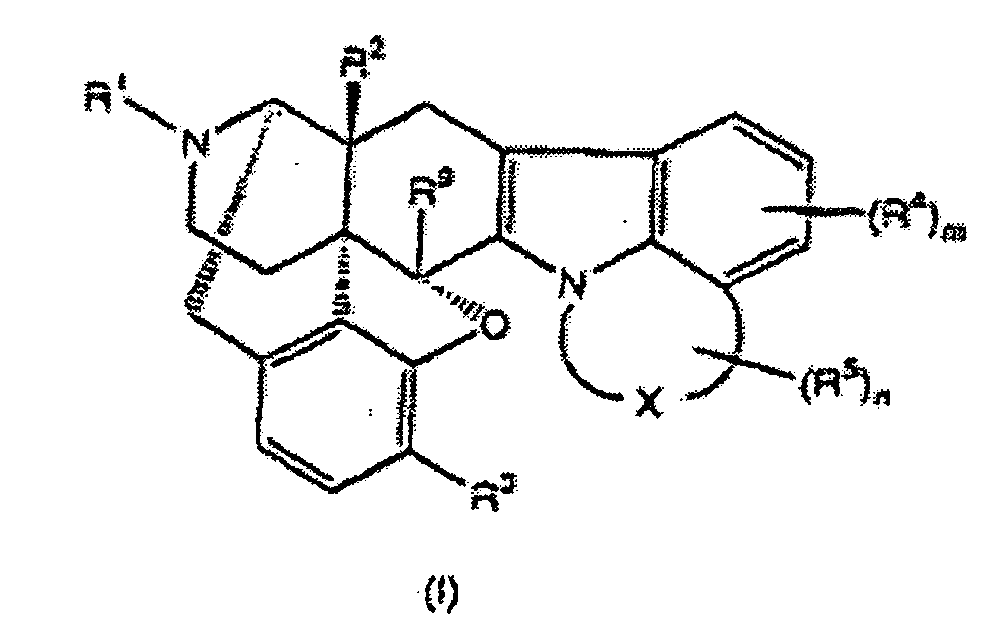
The inventors studied intensively to solve the above-mentioned-problem, and as a result, found that the compounds represented by general formula (I) are lipophilic compounds likely to pass through the blood-brain barrier, and are especially useful for the therapy of drug/substance dependence. Thus, the present invention has been completed. The present invention relates to therapeutic agents for drug/substance dependence comprising an indole derivative represented by general formula (I)
Figure 00050001
[where R1 denotes hydrogen, alkyl with 1 to 5 carbon atoms, cycloalkylalkyl with 4 to 7 carbon atoms, cycloalkenylalkyl with 5 to 7 carbon atoms, aryl with 6 to 12 carbon atoms, aralkyl with 7 to 13 carbon atoms (where the aralkyl means an arylalkyl or arylalkenyl), alkenyl with 3 to 7 carbon atoms, furanylalkyl (the alkyl portion of which has 1 to 5 carbon atoms), or thiophenyl-alkyl (the alkyl portion of which has 1 to 5 carbon atoms);
R2 denotes hydrogen, hydroxy, alkoxy with 1 to 5 carbon atoms, or alkanoyloxy with 1 to 5 carbon atoms,
R3 denotes hydrogen, hydroxy, alkoxy with 1 to 5 carbon atoms, alkanoyloxy with 1 to 5 carbon atoms, or aralkyloxy with 7 to 13 carbon atoms;
-X- denotes crosslinking consisting of 2 to 5 carbon atoms (where one or more of the carbon atoms may be substituted by a nitrogen atom, oxygen atom or sulfur atom);
m denotes an integer of 0 to 3;
n denotes an integer of 0 to 10;
m R4s and n R5s denote independently fluorine, chlorine, bromine, iodine, nitro, alkyl with 1 to 5 carbon atoms, hydroxy, alkoxy with 1 to 5 carbon atoms, trifluoromethyl, trifluoromethoxy, cyano, phenyl, isothiocyanato, SR6, SOR6, SO2R6, (CH2)pOR6, (CH2)pCO2R6, SO2NR7R8, CONR7R8, (CH2)pNR7R8, or (CH2)pN(R7)COR8 (where p denotes an integer of 0 to 5; R6 denotes hydrogen or alkyl with 1 to 5 carbon atoms; and R7 and R8 denote, respectively independently, hydrogen, alkyl with 1 to 5 carbon atoms, or cycloalkylalkyl with 4 to 7 carbon atoms) (where among said m R4s and n R5s, two adjacent R4s, two adjacent R5s, or one R4 and one R5 adjacent to each other can be combined to form a benzene fused ring, pyridine fused ring, cyclopentane fused ring, cyclohexane fused ring, or cycloheptane fused ring);
R9 denotes hydrogen, alkyl with 1 to 5 carbon atoms, alkenyl with 2 to 5 carbon atoms, aralkyl with 7 to 13 carbon atoms, (CH2)pOR6, or (CH2)pCO2R6 (p and R6 are respectively as defined before);
R10 and R11 are combined to denote -O-, -S- or -CH2-, or R10 denotes hydrogen, while R11 denotes hydrogen, hydroxy, alkoxy with 1 to 5 carbon atoms, or alkanoyloxy with 1 to 5 carbon atoms], or any of its pharmacologically allowable acid addition salts as an active ingredient. The present invention also relates to a therapeutic method for drug/substance dependence using the indole derivative represented by said general formula (I) or any of its pharmacologically allowable acid addition salts, and also to the use of the indole derivative represented by said general formula (I) or any of its pharmacologically allowable acid addition salts for therapy of drug/substance dependence.
BRIEF DESCRIPTION OF THE DRAWING
Fig. 1 shows the recovery effect of compound 1 on dependence state (therapeutic effect on stimulant drug dependence) using the reward effect in a conditioned place preference test of methamphetamine as an indicator.
Figure 00070001
In Fig. 1, * indicates being statistically significant at a significance level of 5% or less.
THE BEST MODES FOR CARRYING OUT THE INVENTION
As described above, the present invention relates to therapeutic agents for drug/substance dependence containing any of the compounds represented by the general formula (I) as an active ingredient.
In the compounds represented by the general formula (I), it is preferred that R1 denotes hydrogen, alkyl with 1 to 5 carbon atoms, cycloalkylmethyl with 4 to 7 carbon atoms, cycloalkenylmethyl with 5 to 7 carbon atoms, phenyl, naphthyl, phenylalkyl with 7 to 13 carbon atoms, phenylalkenyl with 7 to 13 carbon atoms, alkenyl with 3 to 7 carbon atoms, furan-2-yl-alkyl (with 1 to 5 carbon atoms), or thiophene-2-yl-alkyl (with 1 to 5 carbon atoms). Particularly preferred is hydrogen, methyl, ethyl, propyl, butyl, cyclopropylmethyl, cyclobutylmethyl, cyclopentylmethyl, cyclohexylmethyl, cyclopentenylmethyl, cyclohexenylmethyl, benzyl, phenethyl, cinnamyl, 3-butenyl, trans-2-butenyl, prenyl, allyl, furan-2-yl-methyl, furan-2-yl-ethyl, thiophene-2-yl-methyl, or thiophene-2-yl-ethyl. Among them, especially preferred is cyclopropylmethyl, cyclobutylmethyl, cyclopentylmethyl, cyclohexylmethyl, 3-butenyl, trans-2-butenyl, prenyl, or allyl.
It is preferred that R2 denotes hydrogen, hydroxy, acetoxy, propionoxy, methoxy, or ethoxy. Particularly preferred is hydrogen, hydroxy, acetoxy, or methoxy.
It is preferred that R3 denotes hydrogen, hydroxy, acetoxy, propionoxy, methoxy, ethoxy, orbenzyloxy. Particularly preferred is hydrogen, hydroxy, acetoxy, methoxy, or benzyloxy.
It is preferred that -X- denotes an alkylene with 2 to 5 carbon atoms (one carbon atom of which may also be substituted by a nitrogen atom, oxygen atom, or sulfur atom). Further preferred is an alkylene with 2 to 5 carbon atoms, -(CH2)2-O-, or -(CH2)2-S-.
It is preferred that R4 and R5 denote, respectively independently, fluorine, chlorine, bromine, iodine, nitro, alkyl with 1 to 5 carbon atoms, hydroxy, alkoxy with 1 to 5 carbon atoms, trifluoromethyl, trifluoromethoxy, cyano, phenyl, isothiocyanato, SR6, SOR6, SO2R6, (CH2)pOR6, (CH2)pCO2R6, SO2NR7R8, CONR7R8, (CH2)pNR7R8, or (CH2)pN(R7)COR8 (where p denotes an integer of 0 to 5; R6 denotes hydrogen or alkyl with 1 to 5 carbon atoms; and R7 and R8 denote, respectively independently, hydrogen, alkyl with 1 to 5 carbon atoms, or cycloalkylalkyl with 4 to 7 carbon atoms). Particularly preferred is fluorine, chlorine, bromine, iodine, nitro, methyl, hydroxy, methoxy, trifluoromethyl, trifluoromethoxy, cyano, phenyl, isothiocyanato, methylthio, methylsulfinyl, methylsulfonyl, hydroxymethyl, hydroxyethyl, methoxymethyl, ethoxymethyl methoxyethyl, methoxycarbonyl, ethoxycarbonyl, methoxycarbonylmethyl, ethoxycarbonylmethyl, sulfamoyl, dimethylsulfamoyl, dimethylcarbamoyl, dimethylamino, dimethylaminomethyl, dimethylaminoethyl, or amino. Of course, a compound in which both m and n denote 0, namely, a non-substituted compound is also one of preferred compounds. Furthermore, it is preferred that two adjacent R4s, two adjacent R5s, or one R4 and one R5 adjacent to each other are combined to form at least one of benzene fused ring, pyridine fused ring, cyclopentane fused ring, cyclohexane fused ring, and cycloheptane fused ring. Especially preferred is that a benzene fused ring is formed.
It is preferred that R9 denotes hydrogen, alkyl with 1 to 5 carbon atoms, allyl, or benzyl. Particularly preferred is hydrogen or methyl.
It is preferred that R10 and R11 are combined to denote -O-, or that R10 denotes hydrogen, while R11 denotes hydrogen, hydroxy, or methoxy. It is especially preferred that both are combined to denote -O-, though R10 and R11 are not limited to those enumerated here.
The compounds represented by the general formula (I) can be produced, for example, according to the method disclosed in PCT WO97/11948.
Pharmacologically preferred acid addition salts include inorganic acid salts such as hydrochlorides, sulfates, nitrates, hydrobromides, hydriodides, and phosphates, organic carboxylates such as acetates, lactates, citrates, oxalates, glutarates, malates, tartrates, fumarates, mandelates, maleates, benzoates, and phthalates, organic sulfonates such as methanesulfonates, ethanesulfonates, benzenesulfonates, p-toluenesulfonates, and camphorsulfonates, etc. Among them, preferred are hydrochlorides, hydrobromides, phosphates, tartrates, maleates, methanesulfonates, etc. The acid addition salts are not limited to those enumerated here either.
If these compounds represented by the general formula (I) pass the necessary stability test, they can be administered orally or parenterally as they are, or as medicinal compositions obtained by mixing them with any publicly known pharmacologically allowable acid, carrier, excipient, etc. Formulations employed for administering them include injections, tablets, capsules, granules, powders, syrups, suppositories, etc. The dosage can be adequately selected in response to symptom, age, body weight, administration method, etc. In the case of an injection for an adult, the dosage as an active ingredient is from 0.0001 mg to 1 g per day. In the case of an oral medicine, it is from 0.005 mg to 10 g. In either case, the dosage can be administered at a time or in several times.
Furthermore, for the purpose of enhancing the therapeutic effect for drug/substance dependence, the preparation of the present invention can further contain various adjuvants, or can also be used together with other preparations containing various adjuvants. The drugs that can be used together are not especially limited. Particular examples of them include an antipsychotic agent, antidepressant, antianxiety agent, anticonvulsant, sympathomimetic agent, NMDA receptor antagonist, calcium channel blocking agent, serotonin receptor antagonist, antihistaminic agent, opioid agent, GABA receptor function reinforcer, anti-inflammatory drug, etc. More particularly, they include clozapine, quetiapine, risperidone, haloperidol, paroxetine, fluoxetine, fluvoxamine, milnacipran, amitriptyline, imipramine, desipramine, fluoxetine, carbamazepine, diazepam, gabapentin, valproic acid, carbamazepine , clonidine, phentolamine, prazosin, ketamine, ifenprodil, mexitilene, ketanserin, sarpogrelate hydrochloride, benzodiazepine, barbiturate, fluoxetine, ondansetron, diphenhydramine, naltrexone, diclofenac, etc. Furthermore, for the therapy of alcohol dependence, disulfiram or acamprosate can be used together, and for the therapy of nicotine dependence, nicotine substitute therapy (nicotine gum, nicotine patch, or nicotine vaccine) or bupropion can also be used together. Moreover, the therapy of the present invention can also be used in combination, for example, with the electroconvulsive therapy used in the therapy for drug/substance dependence.
Examples of the drug/substance dependence to be covered by the therapy of the present invention include the drug/substance dependence caused by dependence drugs/substances having excitatory actions on the central nervous system, particularly amphetamine type drugs (stimulant drugs) such as methamphetamine, amphetamine, and methylphenidate, methylenedioxymethamphetamine, cocaine type drugs such as cocaine, hallucinogen type drugs such as LSD, nicotine, etc. and dependence drugs/substances having inhibitory actions on the central nervous system, particularly barbiturate and alcohol type drugs, morphine type drugs such as morphine, heroine, codeine, and dihydrocodeine, cannabis type drugs such as THC, organic solvent type drugs such as thinners (toluene and ethyl acetate), psychotropic agents such as benzodiazepines (triazolam, flunitrazepam, etc.), and Halcion. Furthermore, the compounds used in the present invention exhibit an effect also for the drug/substance dependence caused by two or more drugs/substances among the dependence drugs/substances.
EXAMPLES
The present invention is particularly explained below based on examples. The following examples are described merely for exemplification, and the present invention is not limited thereto or thereby in any case.
[Example 1] Evaluation of lipophilicity of compounds using a partition coefficient as an indicator
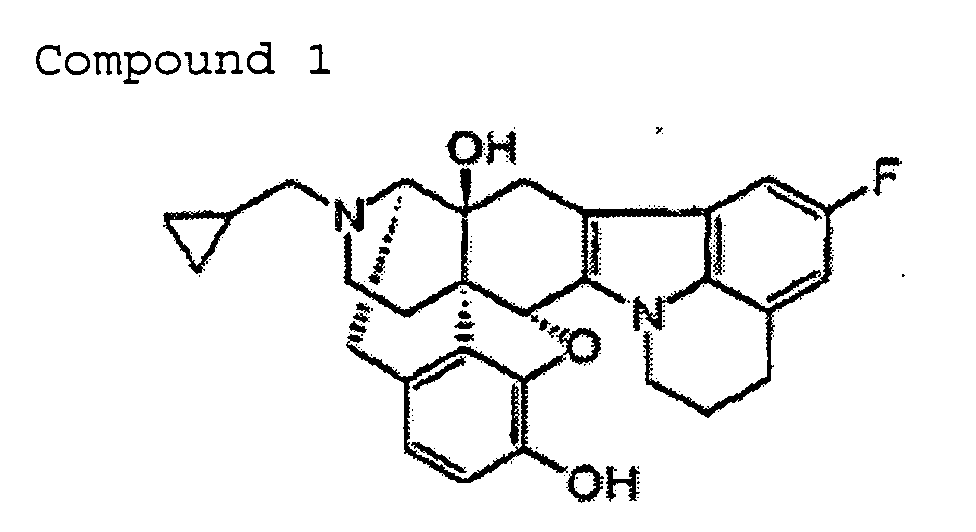
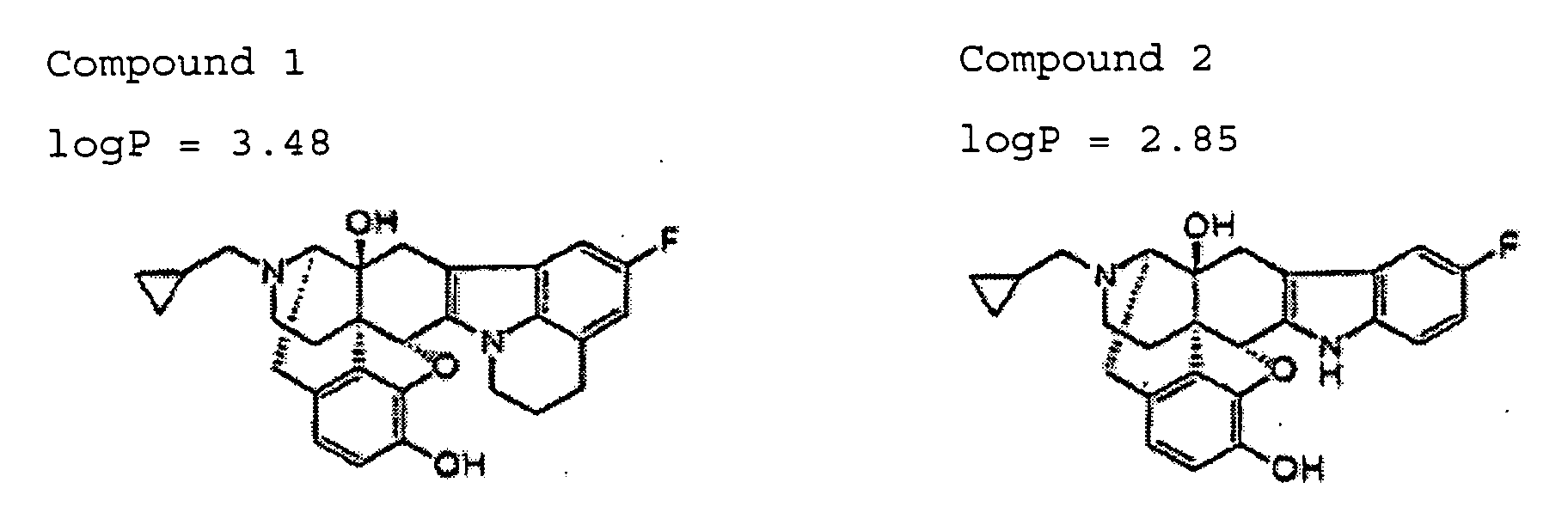
For penetration from blood to the brain, there is a barrier called the blood-brain barrier, and the lipophilicity is an important factor for the penetration into the brain. One of the parameters used for estimating the lipophilicity of a compound is partition coefficient P. The partition coefficient P is defined as the ratio of the concentration of a compound in n-octanol to the concentration of the compound in water. When the partition coefficient is larger, it expresses that the lipophilicity of the compound is higher. The partition coefficient P can be experimentally obtained and can also be obtained by calculation. For compounds 1 to 4, the logarithm of partition coefficient P, logP, values reported by Crippen, et al. (Crippen, G. M., et al., J. Chem. Inf. Comput. Sci., 27, 21, 1987) were calculated using CS Chem DrawR (CambridgSoft), and the calculation results are shown in Table 1. Compounds 1 and 3 are the compounds of the present invention, and compounds 2 and 4 are comparative control compounds.
Figure 00130001
Figure 00130002
[Example 2] Effect of compound 1 in promoting the recovery process after acquisition of psychological dependence by a stimulant drug (therapeutic effect for stimulant drug dependence)
The effect of compound 1 in promoting the recovery during the convalescence after the acquisition of psychological dependence by a stimulant drug was discussed using the conditioned place preference method (Suzuki, T., et al., Psychopharmacology, 102, 438, 1990: Spyraki, C., The Psychopharmacology of Addiction, p. 96, Oxford Medical Publication, New York, 1988; hereinafter called CPP method) . As a stimulant drug forming psychological dependence, methamphetamine hydrochloride was used. Furthermore, as a therapeutic agent for drug dependence, compound 1 was used.
For the experiment, SD male rats were used. The experimental apparatus used was a CPP apparatus having two compartments (one black, the other white). In the experiment, at first, the rats were trained for being conditioned with the sensory effect of the drug and the environments (white and black) in the apparatus for 6 days. The conditioned rats were placed and tested in the apparatus without drug administration. The drug dependence was evaluated with the residence time of the rats in the white and black boxes in the test session, as an indicator, in reference to whether the rats preferred the drug-induced sensory effect. As a result, the residence time in the box conditioned by the stimulant drug (2.0 mg/kg, subcutaneous) administration became long to show the formation of stimulant drug dependence (Fig. 2, 0th day after start of therapy) . The rats acquiring the stimulant drug dependence obtained like this were divided into groups, and subcutaneously administered with a solvent or compound 1 (0.3 mg/kg) twice per day. On the 2nd, 4th, 6th and 7th day after start of administration of the solvent or compound 1, the rats were tested again to observe the change in the state of stimulant drug dependence.
As a result, as shown in Fig. 1, the solvent administered group maintained the state of stimulant drug dependence till 7th day after start of administration. On the contrary, the group administered with compound 1 (0.3 mg/kg, subcutaneous) every day showed apparent recovery from the state of stimulant drug dependence from 4th day after start of administration, and showed significant recovery on 7th day after start of administration. This result shows that compound 1 exhibits an action even if it is administered after acquisition of dependence, namely, exhibits a therapeutic effect for stimulant drug dependence.
In Fig. 1, symbol * indicates being statistically significant at a significance level of 5% or less.
INDUSTRIAL APPLICABILITY
The therapeutic agents for drug/substance dependence of the present invention contain an indole derivative represented by the general formula (I) or any of its pharmacologically allowable acid addition salts as an active ingredient and are useful for drug therapy of drug/substance dependence.
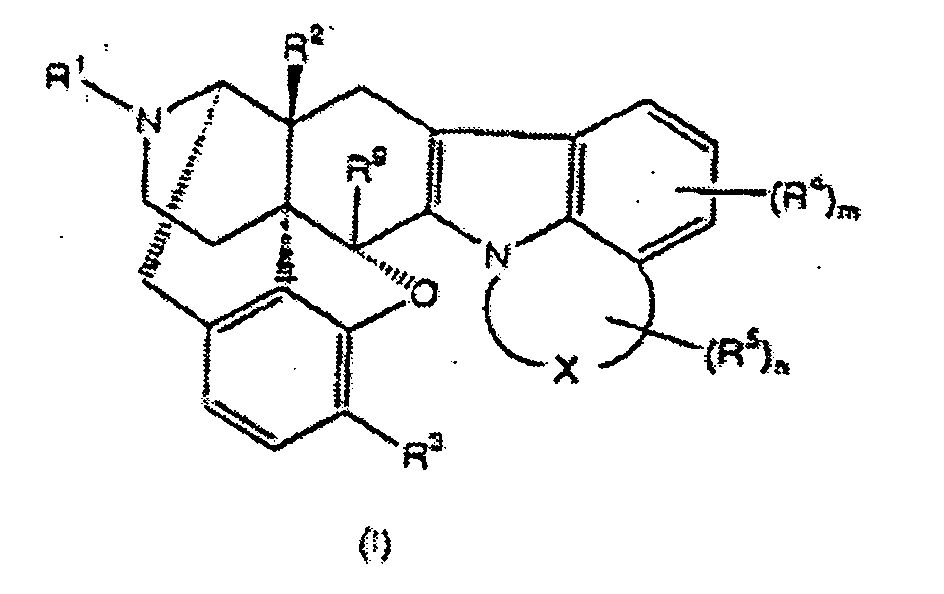
  • 1. Therapeutic agents for drug/substance dependence comprising an indole derivative represented by general formula (I)
    Figure 00160001
    [where R1 denotes hydrogen, alkyl with 1 to 5 carbon atoms, cycloalkylalkyl with 4 to 7 carbon atoms, cycloalkenylalkyl with 5 to 7 carbon atoms, aryl with 6 to 12 carbon atoms, aralkyl with 7 to 13 carbon atoms (where the aralkyl means an arylalkyl or arylalkenyl), alkenyl with 3 to 7 carbon atoms, furanylalkyl (the alkyl portion of which has 1 to 5 carbon atoms), or thiophenyl-alkyl (the alkyl portion of which has 1 to 5 carbon atoms);
    R2 denotes hydrogen, hydroxy, alkoxy with 1 to 5 carbon atoms, alkanoyloxy with 1 to 5 carbon atoms,
    R3 denotes hydrogen, hydroxy, alkoxy with 1 to 5 carbon atoms, alkanoyloxy with 1 to 5 carbon atoms, or aralkyloxy with 7 to 13 carbon atoms;
    -X- denotes crosslinking consisting of 2 to 5 carbon atoms (where one or more of the carbon atoms may be substituted by a nitrogen atom, oxygen atom or sulfur atom);
    m denotes an integer of 0 to 3;
    n denotes an integer of 0 to 10;
    m R4s and n R5s denote, respectively independently, fluorine, chlorine, bromine, iodine, nitro, alkyl with 1 to 5 carbon atoms, hydroxy, alkoxy with 1 to 5 carbon atoms, trifluoromethyl, trifluoromethoxy, cyano, phenyl, isothiocyanato, SR6, SOR6, SO2R6, (CH2)pOR6, (CH2)pCO2R6, SO2NR7R8, CONR7R8, (CH2) pNR7R8, or (CH2)pN(R7)COR8 (where p denotes an integer of 0 to 5; R6 denotes hydrogen or alkyl with 1 to 5 carbon atoms; and R7 and R8 denote, respectively independently, hydrogen, alkyl with 1 to 5 carbon atoms, or cycloalkylalkyl with 4 to 7 carbon atoms) (where among said m R4s and n R5s, two adjacent R4s, two adjacent R5s, or one R4 and one R5 adjacent to each other can be combined to form a benzene fused ring, pyridine fused ring, cyclopentane fused ring, cyclohexane fused ring, or cycloheptane fused ring);
    R9 denotes hydrogen, alkyl with 1 to 5 carbon atoms, alkenyl with 2 to 5 carbon atoms, aralkyl with 7 to 13 carbon atoms, (CH2)pOR6, or (CH2) pCO2R6 (p and R6 are respectively as defined before) ;
    R10 and R11 are combined to denote -O-, -S- or -CH2-, or R10 denotes hydrogen, while R11 denotes hydrogen, hydroxy, alkoxy with 1 to 5 carbon atoms, or alkanoyloxy with 1 to 5 carbon atoms], or any of its pharmacologically allowable acid addition salts as an active ingredient.
  • 2. Therapeutic agents for drug/substance dependence, according to claim 1, which contains an indole derivative represented by the general formula (I) (where R10 and R11 are combined to denote -O-) or any of its pharmacologically allowable acid addition salts, as an active ingredient.
  • 3. Therapeutic agents for drug/substance dependence, according to claim 2, which contains an indole derivative represented by the general formula (I) (where R1 denotes a cycloalkylalkyl with 4 to 7 carbon atoms or alkenyl with 3 to 7 carbon atoms) or any of its pharmacologically allowable acid addition salts, as an active ingredient.
  • 4. Therapeutic agents for drug/substance dependence, according to claim 3, which contains an indole derivative represented by the general formula (I) (where R1 denotes cyclopropylmethyl, cyclobutylmethyl, cyclopentylmethyl, cyclohexylmethyl, 3-butenyl, trans-2-butenyl, prenyl, or allyl; R2 denotes hydrogen, hydroxy, acetoxy, or methoxy; R3 denotes hydrogen, hydroxy, acetoxy, methoxy, or benzyloxy; -X- denotes an alkylene with 2 to 5 carbon atoms, -(CH2)2-O-, or -(CH2)2-S-; m and n denote independently 0 or 1; R4 and R5 denote, respectively independently, fluorine, chlorine, bromine, iodine, nitro, methyl, hydroxy, methoxy, trifluoromethyl, trifluoromethoxy, cyano, phenyl, isothiocyanato, methylthio, methylsulfinyl, methylsulfonyl, hydroxymethyl, hydroxyethyl, methoxymethyl, ethoxymethyl, methoxyethyl, methoxycarbonyl, ethoxycarbonyl, methoxycarbonylmethyl, ethoxycarbonylmethyl, sulfamoyl, dimethylsulfamoyl, dimethylcarbamoyl, dimethylamino, dimethylaminomethyl, dimethylaminoethyl, or amino; and R9 denotes hydrogen or methyl) or any of its pharmacologically allowable acid addition salts, as an active ingredient.
  • 5. Therapeutic agents for drug/substance dependence, according to any one of claims 1 through 4, wherein the drug/substance dependence is dependence caused by a drug/substance having an excitatory action on the central nervous system.
  • 6. Therapeutic agents for drug/substance dependence, according to any one of claims 1 through 4, wherein the drug/substance dependence is dependence caused by a nicotine or amphetamine type drug (stimulant drug).
  • 7. Therapeutic agents for drug/substance dependence, according to any one of claims 1 through 4, wherein the drug/substance dependence is dependence caused by a cocaine type drug.
  • 8. Therapeutic agents for drug/substance dependence, according to any one of claims 1 through 4, wherein the drug/substance dependence is dependence caused by a dependence drug/substance having an inhibitory action on the central nervous system.
  • 9. A therapeutic method for drug/substance dependence using the indole derivative or any of its pharmacologically allowable acid addition salts as set forth in any one of claims 1 through 4.
  • 10. Use of the indole derivative or any of its pharmacologically allowable acid addition salts as set forth in any one of claims 1 through 4, for the therapy of drug/substance dependence.
  • Claims (8)

    1. Therapeutic agents for drug/substance dependence comprising an indole derivative represented by general formula (I)
      Figure 00200001
      [where R1 denotes hydrogen, alkyl with 1 to 5 carbon atoms, cycloalkylalkyl with 4 to 7 carbon atoms, cycloalkenylalkyl with 5 to 7 carbon atoms, aryl with 6 to 12 carbon atoms, aralkyl with 7 to 13 carbon atoms (where the aralkyl means an arylalkyl or arylalkenyl), alkenyl with 3 to 7 carbon atoms, furanylalkyl (the alkyl portion of which has 1 to 5 carbon atoms), or thiophenyl-alkyl (the alkyl portion of which has 1 to 5 carbon atoms);
      R2 denotes hydrogen, hydroxy, alkoxy with 1 to 5 carbon atoms, alkanoyloxy with 1 to 5 carbon atoms,
      R3 denotes hydrogen, hydroxy, alkoxy with 1 to 5 carbon atoms, alkanoyloxy with 1 to 5 carbon atoms, or aralkyloxy with 7 to 13 carbon atoms;
      -X- denotes crosslinking consisting of 2 to 5 carbon atoms (where one or more of the carbon atoms may be substituted by a nitrogen atom, oxygen atom or sulfur atom);
      m denotes an integer of 0 to 3;
      n denotes an integer of 0 to 10;
      m R4s and n R5s denote, respectively independently, fluorine, chlorine, bromine, iodine, nitro, alkyl with 1 to 5 carbon atoms, hydroxy, alkoxy with 1 to 5 carbon atoms, trifluoromethyl, trifluoromethoxy, cyano, phenyl, isothiocyanato, SR6, SOR6, SO2R6, (CH2)pOR6, (CH2)pCO2R6, SO2NR7R8, CONR7R8, (CH2)pNR7R8, or (CH2)pN(R7)COR8 (where p denotes an integer of 0 to 5; R6 denotes hydrogen or alkyl with 1 to 5 carbon atoms; and R7 and R8 denote, respectively independently, hydrogen, alkyl with 1 to 5 carbon atoms, or cycloalkylalkyl with 4 to 7 carbon atoms) (where among said m R4s and n R5s, two adjacent R4s , two adjacent R5s , or one R4 and one R5 adjacent to each other can be combined to form a benzene fused ring, pyridine fused ring, cyclopentane fused ring, cyclohexane fused ring, or cycloheptane fused ring);
      R9 denotes hydrogen, alkyl with 1 to 5 carbon atoms, alkenyl with 2 to 5 carbon atoms, aralkyl with 7 to 13 carbon atoms, (CH2)pOR6, or (CH2)pCO2R6 (p and R6 are respectively as defined before)];
      or any of its pharmacologically allowable acid addition salts as an active ingredient.
    2. Therapeutic agents for drug/substance dependence, according to claim 1, which contains an indole derivative represented by the general formula (I) (where R1 denotes a cycloalkylalkyl with 4 to 7 carbon atoms or alkenyl with 3 to 7 carbon atoms) or any of its pharmacologically allowable acid addition salts, as an active ingredient.
    3. Therapeutic agents for drug/substance dependence, according to claim 1 or 2, which contains an indole derivative represented by the general formula (I) (where R1 denotes cyclopropylmethyl, cyclobutylmethyl, cyclopentylmethyl, cyclohexylmethyl, 3-butenyl, trans-2-butenyl, prenyl, or allyl; R2 denotes hydrogen, hydroxy, acetoxy, or methoxy; R3 denotes hydrogen, hydroxy, acetoxy, methoxy, or benzyloxy; -X- denotes an alkylene with 2 to 5 carbon atoms, -(CH2)2-O-, or -(CH2)2-S-; m and n denote independently 0 or 1; R4 and R5 denote, respectively independently, fluorine, chlorine, bromine, iodine, nitro, methyl, hydroxy, methoxy, trifluoromethyl, trifluoromethoxy, cyano, phenyl, isothiocyanato, methylthio, methylsulfinyl, methylsulfonyl, hydroxymethyl, hydroxyethyl, methoxymethyl, ethoxymethyl, methoxyethyl, methoxycarbonyl, ethoxycarbonyl, methoxycarbonylmethyl, ethoxycarbonylmethyl, sulfamoyl, dimethylsulfamoyl, dimethylcarbamoyl, dimethylamino, dimethylaminomethyl, dimethylaminoethyl, or amino; and R9 denotes hydrogen or methyl) or any of its pharmacologically allowable acid addition salts, as an active ingredient.
    4. Therapeutic agents for drug/substance dependence, according to any one of claims 1 through 3, wherein the drug/substance dependence is dependence caused by a drug/substance having an excitatory action on the central nervous system.
    5. Therapeutic agents for drug/substance dependence, according to any one of claims 1 through 3, wherein the drug/substance dependence is dependence caused by a nicotine or amphetamine type drug (stimulant drug).
    6. Therapeutic agents for drug/substance dependence, according to any one of claims 1 through 3, wherein the drug/substance dependence is dependence caused by a cocaine type drug.
    7. Therapeutic agents for drug/substance dependence, according to any one of claims 1 through 3, wherein the drug/substance dependence is dependence caused by a dependence drug/substance having an inhibitory action on the central nervous system.
    8. Use of the indole derivative or any of its pharmacologically allowable acid addition salts as set forth in any one of claims 1 through 3, for the preparation of a therapeutic agent for the therapy of drug/substance dependence.
    EP04717763A 2003-03-07 2004-03-05 Remedy for drug/substance dependence Withdrawn EP1602374A4 (en)

    Applications Claiming Priority (3)

    Application Number Priority Date Filing Date Title
    JP2003061113 2003-03-07
    JP2003061113 2003-03-07
    PCT/JP2004/002821 WO2004078177A1 (en) 2003-03-07 2004-03-05 Remedy for drug/substance dependence

    Publications (2)

    Publication Number Publication Date
    EP1602374A1 true EP1602374A1 (en) 2005-12-07
    EP1602374A4 EP1602374A4 (en) 2007-03-07

    Family

    ID=32958952

    Family Applications (1)

    Application Number Title Priority Date Filing Date
    EP04717763A Withdrawn EP1602374A4 (en) 2003-03-07 2004-03-05 Remedy for drug/substance dependence

    Country Status (6)

    Country Link
    US (1) US20060025434A1 (en)
    EP (1) EP1602374A4 (en)
    JP (1) JPWO2004078177A1 (en)
    CN (1) CN1758912A (en)
    CA (1) CA2518133A1 (en)
    WO (1) WO2004078177A1 (en)

    Families Citing this family (2)

    * Cited by examiner, † Cited by third party
    Publication number Priority date Publication date Assignee Title
    AU2006308889A1 (en) * 2005-10-31 2007-05-10 Braincells, Inc. GABA receptor mediated modulation of neurogenesis
    US20080004260A1 (en) * 2006-06-29 2008-01-03 Transcept Pharmaceuticals, Inc. Compositions of 5-HT3 antagonists and dopamine D2 antagonists for treatment of dopamine-associated chronic conditions

    Family Cites Families (12)

    * Cited by examiner, † Cited by third party
    Publication number Priority date Publication date Assignee Title
    US4816586A (en) * 1987-07-29 1989-03-28 Regents Of The University Of Minnesota Delta opioid receptor antagonists
    US5352680A (en) * 1992-07-15 1994-10-04 Regents Of The University Of Minnesota Delta opioid receptor antagonists to block opioid agonist tolerance and dependence
    US5852030A (en) * 1992-09-29 1998-12-22 Toray Industries, Inc. Indole derivatives, process for producing the same and medicinal uses of the same
    US5411965A (en) * 1993-08-23 1995-05-02 Arizona Board Of Regents Use of delta opioid receptor antagonists to treat cocaine abuse
    US5464841A (en) * 1993-11-08 1995-11-07 Univ Minnesota Use of delta opioid receptor antagonists to treat immunoregulatory disorders
    ES2197953T3 (en) * 1995-09-26 2004-01-16 Toray Industries, Inc. DERIVATIVES OF INDOL AND MEDICAL APPLICATIONS OF THE SAME.
    WO1997033581A1 (en) * 1996-03-13 1997-09-18 Yale University Smoking cessation treatments using naltrexone and related compounds
    JP2002508753A (en) * 1997-05-20 2002-03-19 エール ユニバーシティ Drug dependent treatment using opiate antagonists and serotonin compounds
    JP4359711B2 (en) * 1997-09-02 2009-11-04 東レ株式会社 Drug addiction treatment
    JP4340437B2 (en) * 2000-10-31 2009-10-07 レンセラール ポリテクニック インスティチュート 8-Carboxamide-2,6-methano-3-benzazocine
    AU2408602A (en) * 2000-11-22 2002-06-03 Toray Industries Indole derivatives and use thereof in medicines
    US7164021B2 (en) * 2002-09-18 2007-01-16 The Curators Of The University Of Missouri Opiate analogs selective for the δ-opioid receptor

    Also Published As

    Publication number Publication date
    WO2004078177A1 (en) 2004-09-16
    JPWO2004078177A1 (en) 2006-06-08
    CA2518133A1 (en) 2004-09-16
    US20060025434A1 (en) 2006-02-02
    EP1602374A4 (en) 2007-03-07
    CN1758912A (en) 2006-04-12

    Similar Documents

    Publication Publication Date Title
    Dykstra et al. Kappa opioids in rhesus monkeys. II. Analysis of the antagonistic actions of quadazocine and beta-funaltrexamine.
    US5352680A (en) Delta opioid receptor antagonists to block opioid agonist tolerance and dependence
    AU2006277753B2 (en) 3, hb cis dihydrotetrabanezine for the treatment of schizophrenia and other psychoses
    KR101630467B1 (en) Inhibitor of analgesic tolerance
    US6583151B2 (en) Remedies for drug addiction
    Wardle et al. Selective and functional 5-hydroxytryptamine4 receptor antagonism by SB 207266
    WO2017218518A1 (en) Pharmaceutical compositions and methods for treatment of pain
    KR20200103045A (en) Sleep disorder treatment and prevention
    JP2006131545A (en) Neuropathic pain treatment
    EP0805157B1 (en) Indole derivatives and medicinal use thereof
    EP1602374A1 (en) Remedy for drug/substance dependence
    EP0844241B1 (en) Inhibitor for narcotic analgetic dependence/resistance acquisition
    RU2419433C2 (en) Mediciation for prevention and treatment of alcohol dependence and dependence from medications
    KR101492029B1 (en) Treatment or Prevention of Integrated Ataxia
    Yancey-Wrona et al. 6β-Naltrexol preferentially antagonizes opioid effects on gastrointestinal transit compared to antinociception in mice
    CA2378710A1 (en) Use of 2-amino-4-(4-fluoronaphth-1-yl)-6-isopropylpyrimidine in the treatment of gi disorders
    US20010053786A1 (en) Methods for treating addictive disorders
    JPWO2008102859A1 (en) Drugs for the prevention and / or treatment of anxiety disorders
    Woods et al. Evaluation of new compounds for opioid activity (1996)
    Woods et al. 1989 annual report, evaluation of new compounds for opioid activity
    Davis et al. Opioid Pharmacology
    Coop et al. Department of Pharmaceutical Sciences, University of Maryland School of Pharmacy, Baltimore, MD, and Laboratory of Medicinal Chemistry, National Institute of Diabetes and Digestive and Kidney Diseases, National
    Woods et al. The Drug Abuse Basic Research Program, Departments of Pharmacology, Psychology and Biological Chemistry, University of Michigan, Ann Arbor, MI
    JPWO1997006139A1 (en) Inhibitor of dependence and tolerance to narcotic analgesics

    Legal Events

    Date Code Title Description
    PUAI Public reference made under article 153(3) epc to a published international application that has entered the european phase

    Free format text: ORIGINAL CODE: 0009012

    17P Request for examination filed

    Effective date: 20050923

    AK Designated contracting states

    Kind code of ref document: A1

    Designated state(s): AT BE BG CH CY CZ DE DK EE ES FI FR GB GR HU IE IT LI LU MC NL PL PT RO SE SI SK TR

    AX Request for extension of the european patent

    Extension state: AL LT LV MK

    DAX Request for extension of the european patent (deleted)
    RBV Designated contracting states (corrected)

    Designated state(s): DE ES FR GB IT

    A4 Supplementary search report drawn up and despatched

    Effective date: 20070205

    RIC1 Information provided on ipc code assigned before grant

    Ipc: A61K 31/485 20060101AFI20040930BHEP

    STAA Information on the status of an ep patent application or granted ep patent

    Free format text: STATUS: THE APPLICATION IS DEEMED TO BE WITHDRAWN

    18D Application deemed to be withdrawn

    Effective date: 20070505