EP1601156A2 - Verfahren zur RTP Paketauthentifizierung - Google Patents
Verfahren zur RTP Paketauthentifizierung Download PDFInfo
- Publication number
- EP1601156A2 EP1601156A2 EP05009945A EP05009945A EP1601156A2 EP 1601156 A2 EP1601156 A2 EP 1601156A2 EP 05009945 A EP05009945 A EP 05009945A EP 05009945 A EP05009945 A EP 05009945A EP 1601156 A2 EP1601156 A2 EP 1601156A2
- Authority
- EP
- European Patent Office
- Prior art keywords
- packet
- rtp
- authentication
- endpoint
- real
- Prior art date
- Legal status (The legal status is an assumption and is not a legal conclusion. Google has not performed a legal analysis and makes no representation as to the accuracy of the status listed.)
- Withdrawn
Links
- 238000000034 method Methods 0.000 title claims abstract description 33
- 230000003111 delayed effect Effects 0.000 claims description 2
- 230000004048 modification Effects 0.000 abstract description 4
- 238000012986 modification Methods 0.000 abstract description 4
- 230000015556 catabolic process Effects 0.000 abstract description 3
- 238000006731 degradation reaction Methods 0.000 abstract description 3
- 238000002347 injection Methods 0.000 abstract description 2
- 239000007924 injection Substances 0.000 abstract description 2
- 238000012795 verification Methods 0.000 abstract 1
- 101100217298 Mus musculus Aspm gene Proteins 0.000 description 12
- 238000004891 communication Methods 0.000 description 8
- 230000008901 benefit Effects 0.000 description 4
- 238000005516 engineering process Methods 0.000 description 4
- 238000010586 diagram Methods 0.000 description 3
- 230000008569 process Effects 0.000 description 3
- 238000012360 testing method Methods 0.000 description 3
- 230000000694 effects Effects 0.000 description 2
- 230000006872 improvement Effects 0.000 description 2
- 238000005457 optimization Methods 0.000 description 2
- 230000003466 anti-cipated effect Effects 0.000 description 1
- 230000008859 change Effects 0.000 description 1
- 230000001419 dependent effect Effects 0.000 description 1
- 238000001514 detection method Methods 0.000 description 1
- 238000002474 experimental method Methods 0.000 description 1
- 230000006870 function Effects 0.000 description 1
- 230000010365 information processing Effects 0.000 description 1
- 230000000977 initiatory effect Effects 0.000 description 1
- 230000000116 mitigating effect Effects 0.000 description 1
- 238000012545 processing Methods 0.000 description 1
- 230000009467 reduction Effects 0.000 description 1
- 230000004044 response Effects 0.000 description 1
- 230000011664 signaling Effects 0.000 description 1
- 230000007723 transport mechanism Effects 0.000 description 1
- 230000000007 visual effect Effects 0.000 description 1
Images



Classifications
-
- H—ELECTRICITY
- H04—ELECTRIC COMMUNICATION TECHNIQUE
- H04L—TRANSMISSION OF DIGITAL INFORMATION, e.g. TELEGRAPHIC COMMUNICATION
- H04L63/00—Network architectures or network communication protocols for network security
- H04L63/12—Applying verification of the received information
-
- H—ELECTRICITY
- H04—ELECTRIC COMMUNICATION TECHNIQUE
- H04L—TRANSMISSION OF DIGITAL INFORMATION, e.g. TELEGRAPHIC COMMUNICATION
- H04L65/00—Network arrangements, protocols or services for supporting real-time applications in data packet communication
- H04L65/1066—Session management
- H04L65/1101—Session protocols
-
- H—ELECTRICITY
- H04—ELECTRIC COMMUNICATION TECHNIQUE
- H04L—TRANSMISSION OF DIGITAL INFORMATION, e.g. TELEGRAPHIC COMMUNICATION
- H04L65/00—Network arrangements, protocols or services for supporting real-time applications in data packet communication
- H04L65/60—Network streaming of media packets
- H04L65/65—Network streaming protocols, e.g. real-time transport protocol [RTP] or real-time control protocol [RTCP]
-
- H—ELECTRICITY
- H04—ELECTRIC COMMUNICATION TECHNIQUE
- H04L—TRANSMISSION OF DIGITAL INFORMATION, e.g. TELEGRAPHIC COMMUNICATION
- H04L65/00—Network arrangements, protocols or services for supporting real-time applications in data packet communication
- H04L65/60—Network streaming of media packets
- H04L65/70—Media network packetisation
-
- H—ELECTRICITY
- H04—ELECTRIC COMMUNICATION TECHNIQUE
- H04L—TRANSMISSION OF DIGITAL INFORMATION, e.g. TELEGRAPHIC COMMUNICATION
- H04L9/00—Cryptographic mechanisms or cryptographic arrangements for secret or secure communications; Network security protocols
- H04L9/06—Cryptographic mechanisms or cryptographic arrangements for secret or secure communications; Network security protocols the encryption apparatus using shift registers or memories for block-wise or stream coding, e.g. DES systems or RC4; Hash functions; Pseudorandom sequence generators
- H04L9/065—Encryption by serially and continuously modifying data stream elements, e.g. stream cipher systems, RC4, SEAL or A5/3
- H04L9/0656—Pseudorandom key sequence combined element-for-element with data sequence, e.g. one-time-pad [OTP] or Vernam's cipher
- H04L9/0662—Pseudorandom key sequence combined element-for-element with data sequence, e.g. one-time-pad [OTP] or Vernam's cipher with particular pseudorandom sequence generator
-
- H—ELECTRICITY
- H04—ELECTRIC COMMUNICATION TECHNIQUE
- H04L—TRANSMISSION OF DIGITAL INFORMATION, e.g. TELEGRAPHIC COMMUNICATION
- H04L9/00—Cryptographic mechanisms or cryptographic arrangements for secret or secure communications; Network security protocols
- H04L9/32—Cryptographic mechanisms or cryptographic arrangements for secret or secure communications; Network security protocols including means for verifying the identity or authority of a user of the system or for message authentication, e.g. authorization, entity authentication, data integrity or data verification, non-repudiation, key authentication or verification of credentials
- H04L9/3236—Cryptographic mechanisms or cryptographic arrangements for secret or secure communications; Network security protocols including means for verifying the identity or authority of a user of the system or for message authentication, e.g. authorization, entity authentication, data integrity or data verification, non-repudiation, key authentication or verification of credentials using cryptographic hash functions
-
- H—ELECTRICITY
- H04—ELECTRIC COMMUNICATION TECHNIQUE
- H04L—TRANSMISSION OF DIGITAL INFORMATION, e.g. TELEGRAPHIC COMMUNICATION
- H04L9/00—Cryptographic mechanisms or cryptographic arrangements for secret or secure communications; Network security protocols
- H04L9/32—Cryptographic mechanisms or cryptographic arrangements for secret or secure communications; Network security protocols including means for verifying the identity or authority of a user of the system or for message authentication, e.g. authorization, entity authentication, data integrity or data verification, non-repudiation, key authentication or verification of credentials
- H04L9/3297—Cryptographic mechanisms or cryptographic arrangements for secret or secure communications; Network security protocols including means for verifying the identity or authority of a user of the system or for message authentication, e.g. authorization, entity authentication, data integrity or data verification, non-repudiation, key authentication or verification of credentials involving time stamps, e.g. generation of time stamps
-
- H—ELECTRICITY
- H04—ELECTRIC COMMUNICATION TECHNIQUE
- H04L—TRANSMISSION OF DIGITAL INFORMATION, e.g. TELEGRAPHIC COMMUNICATION
- H04L9/00—Cryptographic mechanisms or cryptographic arrangements for secret or secure communications; Network security protocols
- H04L9/50—Cryptographic mechanisms or cryptographic arrangements for secret or secure communications; Network security protocols using hash chains, e.g. blockchains or hash trees
Definitions
- the present invention relates to methods for Real-time Transport Protocol (RTP) packet authentication on a packet data network.
- RTP Real-time Transport Protocol
- the invention relates to methods for preventing toll fraud, privacy compromise, voice quality degradation, or denial of service (DoS) on Voice over IP networks.
- DoS denial of service
- VoIP Voice over IP
- VoIP protocols for signaling and media transport themselves present additional vulnerabilities that might lead to toll fraud, privacy compromise, voice quality degradation, or denial of service (DoS).
- DoS denial of service
- RTP Real-time Transport Protocol
- the Real-time Transport Protocol (RTP) used as the basis for media transport is susceptible to several attacks, including third-party snooping of private conversations, injection of forged content, and introduction or modification of packets to degrade voice quality.
- SRTP Secure Real-time Transport Protocol
- SRTCP RTP Control Protocol
- the SRTP specifies Advance Encryption Standard (AES) encryption of the RTP payload and a message authentication hash of the header and the encrypted payload using Keyed-Hashing for Message Authentication (HMAC-SHA1) to achieve enhanced security.
- AES Advance Encryption Standard
- HMAC-SHA1 Keyed-Hashing for Message Authentication
- AEA Avaya Encryption Algorithm
- MAC-SHA1 is the default message authentication code, and its implementation is mandatory. However, optional message authentication codes are permitted.
- HMAC-SHA1 produces a 160-bit digest and recommends that no more than 80 bits to be truncated from the least significant end.
- 128 bits can be truncated (resulting in a 32-bit authentication tag) for bandwidth efficiency if the following conditions are met: (1) the RTP payload is stateless, (2) an attacker is unlikely to be able to intelligently modify the SRTP ciphertext, (3) and no data forwarding or access control decisions are made based on the RTP data.
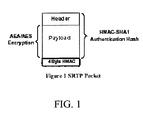
- SRTP One potential concern for SRTP is the overhead imposed by the authentication hash. As seen in FIG. 1, the entire header and encrypted payload are hashed via the HMAC-SHA1 algorithm to produce an 80-bit or 32-bit message authentication tag. The tag must be computed so that each packet can be authenticated.
- one possible denial of service attack is to bombard a target with a series of forged packets, each of which contains an improper authentication tag.
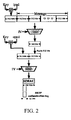
- FIG. 2 shows the steps for computing an authentication tag using HMAC-SHA1.
- the full computation also includes a few XOR, padding, copying operations, but the total execution time is heavily dependent on the hashing operations.
- the main processing for one SHA-1 hash consists of four rounds of 20 steps each. These four rounds contain a total of 740 32-bit logical and arithmetic operations (AND, OR, NOT, XOR, modulo addition). In addition to the hash operations, the two 512-bit XOR operations require 32 32-bit logical XOR operations.
- each RTP packet payload contains 160 8-bit samples or 160 bytes.
- the RTP header is 12 bytes long, assuming no CSRC fields.
- An attacker can take advantage of this computational overhead by bombarding a victim with forged packets that invoke the authentication process with the sole intent to consume processor cycles.
- SRTP+ three embodiments of the present invention, collectively called SRTP+, that significantly reduce the maximum processor cycles consumed by forged packets.
- Each embodiment utilizes a message authentication embodiment that does not require authentication of the entire header and payload. This is a departure from SRTP, which performs both message authentication and integrity checking with a single message authentication tag.
- SRTP+ focuses only on authentication, with the intent of identifying forged packets quickly. Thus, in the presence of many forged packets, SRTP+ performs well. However, if all packets are legitimate, a minimal, but constant overhead is imposed. Also described are the expected performances of SRTP+ of the present invention.
- a first embodiment of the present invention provides a method for Real-time Transport Protocol (RTP) packet authentication on a packet data network, comprising the steps of: providing a pseudorandom number generator (PRNG) for generating pseudorandom numbers; exchanging a PRNG seed in a secure manner between two end points of the network; assigning one of the pseudorandom numbers to each RTP packet based on an RTP sequence number as an authentication tag on endpoint 1; attaching the assigned pseudorandom number to each of the packets on the endpoint 1, and transmitting the packets to the endpoint 2; generating the pseudorandom number corresponding to the sequence number of the received packet on the endpoint 2; comparing the generated pseudorandom number to the authentication tag included in the arriving RTP packet on the endpoint 2; and authenticating only the RTP packets having the authentication tags which match the generated pseudorandom number; and when a sequence number of an arriving RTP packet is out of order because one or more of the proceeding RTP packets was dropped or delayed, iterating the PRNG multiple times such that the pseudorandom
- a second aspect of the present invention provides a method for Real-time Transport Protocol (RTP) packet authentication on a packet data network, comprising the steps of: selecting a key on endpoint 1 of the network; securely sending the key to endpoint 2 of the network; generating a hash of a sequence number and a timestamp in a packet and sending the hash to the endpoint 2 along with the packet; computing the hash of a sequence number and a timestamp of the received packet using the previously received key on the endpoint 2; comparing the received hash and the computed hash; and if the received hash and the computed hash are equal, accepting the packet.
- RTP Real-time Transport Protocol
- a third embodiment of the present invention provides a method for Real-time Transport Protocol (RTP) packet authentication on a packet data network, comprising the steps of: generating N ordered, random numbers on Endpoint 1; sending the N random numbers to Endpoint 2 as part of an encrypted payload of a SRTP packet; decrypting and storing the N random numbers on the Endpoint 2; generating one additional random number that is appended to a current sequence of the N random numbers, resulting in N + 1 random numbers on the Endpoint 1; sending a first one of the N + 1 ordered, random numbers in cleartext form along with remaining ones of the N ordered random numbers in encrypted form in a current packet, from the Endpoint 1 to the Endpoint 2; comparing the random number received in cleartext form on the Endpoint 2 with the N random numbers stored on the Endpoint 2; and if the random number received in cleartext form matches one of the previously stored N random numbers, accepting the packet, which entails decrypting the N random numbers in the packet, and storing the previously stored random numbers as a current set of the
- FIG. 1 illustrates a conventional SRTP Packet
- FIG. 2 illustrates an SRTP Authentication Tag Generation using HMAC-SHA1
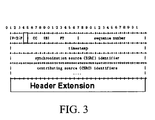
- FIG. 3 illustrates the SRTP+ Authentication Tag Location of the present invention
- FIG. 4 illustrates the FIPS 140 Approved Cryptographically Secure Pseudo- random Number
- FIG. 5(A) is a schematic diagram of an SRTP+ Communications for Pseudorandom Number Sequence of Embodiment 1 of the present invention
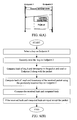
- FIG. 5(B) is a flow chart of the steps of the method of Embodiment 1 of the present invention.
- FIG. 6(A) is a schematic diagram of an SRTP+ Communications for Sequence Number/Timestamp Hash of Embodiment 2 of the present invention
- FIG. 6(B) is a flow chart of the steps of the method of Embodiment 2 of the present invention.
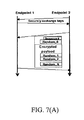
- FIG. 7(A) is a schematic diagram of an SRTP+ Communications for Secret Random Number Chaining of Embodiment 3 of the present invention.
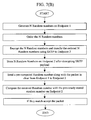
- FIG. 7(B) is a flow chart of the steps of the method of Embodiment 3 of the present invention.
- FIG. 8 illustrates the time to generate one pseudorandom number with the method of Embodiment 1 as a function of key size.
- FIG. 3 displays the fields of an RTP header.
- the RTP specification allows header extensions if the Extension (labeled as "X") field is set to 1.
- the actual header extension is appended to the original header and consists of an extension length as well as the extension data itself. Use of this second location is convenient and simply takes advantage of the existing RTP specification. However, some transport mechanisms might compress the header to minimize bandwidth utilization, in which case header extensions might not be allowed. For that situation, the tag may be attached to the RTP payload immediately after the SRTP HMAC tag, which is shown in FIG. 1.
- the authentication tag is a number in a cryptographically secure pseudorandom number sequence.
- Each RTP packet is assigned a pseudorandom number based on its sequence number, as shown in Table 1.
- Each RTP packet has a sequence number which is included in the packet in a 32 bit field.
- the pseudorandom number generator PRNG
- PRNG pseudorandom number generator
- the Federal Information Processing Standard has approved some PRNGs which are "crypto-secure".
- One such approved PRNG is based on a cryptographic hash, such as SHA1, as shown in FIG. 4. Assignment of Pseudorandom Number Based on Sequence Number Sequence # 1 2 ... 1002 1003 Pseudorandom number R1 R2 ... R1002 R1003
- PRNGs pseudorandom number generators
- FIG. 5(A) shows the communications between two endpoints.
- FIG. 5(A) illustrates a flow chart of this embodiment.
- Step S1 the seed for the PRNG is selected ( Step S1 ) and exchanged ( Step S2 ) in a secure manner.
- SRTP SRTP+ PRNG keys
- the exchange of SRTP+ PRNG keys can be piggybacked on top of the secure exchange of keys for SRTP.
- a 32-bit SRTP+ authentication tag is generated and attached ( Step S3 ) to each RTP packet. This authentication tag can be transmitted in cleartext, since knowledge of the authentication tag for one packet cannot yield the tag for succeeding packets.
- SRTP For SRTP, a 32-bit rollover counter effectively extends the width of the sequence number to 48 bits.
- the sequence numbers in Table 1 can be based on the full 48-bit sequence number.
- Step S5 the authentication tag for an incoming packet in compared with the computed tags on Endpoint 2. If the tags are equal ( Step S6 ), the incoming packet is accepted. If the authentication tag for the incoming packet matches the pseudorandom number for the lowest sequence number in the sliding window, then the sliding window can be shifted forward to discard the accepted packet.
- the size of the sliding window should be based on the largest forward skip in sequence numbers that can be tolerated by the underlying media codec.
- One advantage of using a sliding window is that pseudorandom numbers for future packets can be calculated in advance, which allows the computationally intensive portion of the authentication process to be shifted away temporally from the time when a packet arrives.
- Embodiment 1 avoids the need to maintain a sliding window to remember previously calculated pseudorandom numbers. Instead of using a PRNG, the sequence number and timestamp in the RTP header are hashed using a cryptographically secure hash, such as HMAC-SHA1 to obtain the authentication tag. Thus, each packet is independently verified. Out-of-order and dropped packets do not affect the authentication process.
- a cryptographically secure hash such as HMAC-SHA1
- FIG. 6(A) shows the communication between the two endpoints.
- this embodiment is similar to SRTP, except that the message authentication code only authenticates part of the header instead of the entire header and payload.
- the message authentication code only authenticates part of the header instead of the entire header and payload.
- FIG. 6(B) highlights the steps of this embodiment
- Step S1 Selecting a key on Endpoint 1
- Step S3 Generating hash of seq # and timestamp in the packet and send to Endpoint 2 along with the packet
- Step S4 Computing hash of seq# and timestamp of the received packet using the previously received key on Endpoint 2
- the SRTP+ keys can be exchanged along with the SRTP keys. In fact, the same SRTP keys can even be used as the SRTP+ keys.
- the SRTP+ authentication tag can be transmitted in cleartext.
- Embodiments 1 and 2 depends on SHA1 to either generate a pseudorandom number or to calculate a message digest. Thus, the performance savings realized with either of these two embodiments is limited by the need to perform a SHA1 hash operation on at least one block.
- a third embodiment avoids the need for SHA1 altogether, but must be used in conjunction with SRTP encryption.
- the sender calculates in advance a series of random numbers and uses a number as the authentication tag for each packet.
- the authentication tag is sent in cleartext, but the random numbers for the next N packets are encrypted (e.g., included in the SRTP encrypted payload).
- the receiver stores the N random numbers after decrypting the payload.
- FIG. 7(A) shows the communications between the two endpoints.
- FIG. 7(B) highlights the steps of this third embodiment, including:
- Step S1 Generating N ordered, random numbers on Endpoint 1 ( Step S1 );
- Step S2 Sending the N random numbers to Endpoint 2 as part of the encrypted payload of a SRTP packet ( Step S2 );
- Step S3 Decrypting and storing the N random numbers on Endpoint 2 ( Step S3 );
- Step S4 Generating one additional random number that is appended to the current sequence of N random numbers, resulting in N + 1 random numbers on Endpoint 1 ( Step S4 );
- Step S5 Sending the first of the N + 1 ordered random numbers in cleartext form along with the remaining N random numbers in encrypted form in a current packet, from Endpoint 1 to Endpoint 2 ( Step S5 );
- Step S7 If the cleartext random number received matches one of the previously stored N random numbers, accepting the current packet, which entails decrypting the N random numbers in the current packet, and storing the previously stored random numbers as the current set of N random numbers.
- Steps 1, 2, and 3 above represent the initial activity done once per session during the session creation, and Steps 4-7 represent the per-packet activity done for each packet.
- the main advantage of this embodiment is the extremely low overhead of verifying authentication, which requires a simple arithmetic comparison. However, additional bytes need to be encrypted at the sender and decrypted at the receiver. If the last block of the block cipher encryption involves a number of cleartext bits that is less than the block size, the unused bits can be used to hide the N random numbers. Unfortunately, the default 160-byte payload for G.711 encoding leaves no unused bits when used with 128-bit AES blocks.
- a further disadvantage is the need to transmit the full set of N random numbers with each packet, which carries a great deal of redundancy.
- One possible mitigation is to minimize the width of the random numbers. Since the numbers can be truly random, as opposed to pseudorandom, the width of the numbers can be very small, since truly random numbers cannot be predicted based upon knowledge of previous numbers. Perhaps, the width can be as small as 4 bits for each number. Also, the value of N can be limited by the maximum forward skip in sequence numbers allowed by the media codec.
- Table 2 shows the measured performance for each of the three SRTP+ embodiments as well as the performance for SRTP. These numbers only show the performance for the portion of the run-time overhead imposed by the random number generation for Embodiment 1, the HMAC-SHA1 code generation for Embodiment 2, the AES encryption of one 128-bit block for Embodiment 3, the HMAC-SHA1 code generation for SRTP with a 172-byte RTP packet, which is common for VoIP applications. Although the actual platforms on which real VoIP systems are deployed may differ from these test systems, the relative performance of SRTP+ on most systems should be similar to the results presented in Table 2.
- Embodiment 3 is much faster than the other embodiments largely because the 128-bit AES block cipher encryption operates on a smaller input block compared to the 512-bit SHA1 hash operation.
- the steady-state overhead is incurred when all incoming packets are successfully authenticated.
- the total overhead consists of the SRTP overhead in addition to the SRTP+ overhead.
- the steady-state overheads for Embodiments 1, 2, and 3 are 26%, 68%, and 6%, respectively.
- the second type of overhead occurs when a faked packet is detected.
- a denial of service attack might involve a barrage of faked packets.
- the total overhead on the receiver side is just the SRTP+ overhead, since SRTP+ will detect the fake packet and avoid the need to incur the SRTP overhead.
- Embodiment 1 in Table 2 were based on 160-bit keys to generate the random numbers.
- FIPS 186-2 [8] specifies that the key size must be 160 to 512 bits inclusive.
- FIG. 8 shows the time required to generate one pseudorandom number for various key sizes. The key size does not affect the time, except at a key size of 448 bits, when the time suddenly doubles. This increase occurs at 448 bits because SHA1 requires a 64-bit message length to be appended to the message. Hence at 448 bits, an extra 512-bit block needs to be processed.
- the three SRTP+ embodiments present techniques for tolerating a denial of service attack based on a barrage of faked RTP packets. Such a barrage of packets might demand sufficient computing resources to prevent the system from delivering the expected service.
- the SRTP+ embodiments allow quick authentication of packets and thus decrease the potential load on the processor.
Landscapes
- Engineering & Computer Science (AREA)
- Computer Security & Cryptography (AREA)
- Computer Networks & Wireless Communication (AREA)
- Signal Processing (AREA)
- Multimedia (AREA)
- Computer Hardware Design (AREA)
- Computing Systems (AREA)
- General Engineering & Computer Science (AREA)
- Business, Economics & Management (AREA)
- General Business, Economics & Management (AREA)
- Data Exchanges In Wide-Area Networks (AREA)
Applications Claiming Priority (2)
| Application Number | Priority Date | Filing Date | Title |
|---|---|---|---|
| US10/854,702 US7372856B2 (en) | 2004-05-27 | 2004-05-27 | Method for real-time transport protocol (RTP) packet authentication |
| US854702 | 2004-05-27 |
Publications (2)
| Publication Number | Publication Date |
|---|---|
| EP1601156A2 true EP1601156A2 (de) | 2005-11-30 |
| EP1601156A3 EP1601156A3 (de) | 2010-09-08 |
Family
ID=34936234
Family Applications (1)
| Application Number | Title | Priority Date | Filing Date |
|---|---|---|---|
| EP05009945A Withdrawn EP1601156A3 (de) | 2004-05-27 | 2005-05-06 | Verfahren zur RTP Paketauthentifizierung |
Country Status (4)
| Country | Link |
|---|---|
| US (1) | US7372856B2 (de) |
| EP (1) | EP1601156A3 (de) |
| JP (1) | JP4836493B2 (de) |
| CA (1) | CA2506967A1 (de) |
Cited By (1)
| Publication number | Priority date | Publication date | Assignee | Title |
|---|---|---|---|---|
| GB2432993A (en) * | 2005-12-01 | 2007-06-06 | Marconi Comm Ltd | Combating fraud in telecommunication systems |
Families Citing this family (36)
| Publication number | Priority date | Publication date | Assignee | Title |
|---|---|---|---|---|
| US7574594B2 (en) * | 2005-02-23 | 2009-08-11 | Dell Products Lp | Network authentication based on inter-packet gap characteristics |
| US8339974B1 (en) * | 2005-06-22 | 2012-12-25 | Sprint Communications Company L.P. | Method and system for detecting and mitigating RTP-based denial of service attacks |
| US8369311B1 (en) | 2005-07-01 | 2013-02-05 | Callwave Communications, Llc | Methods and systems for providing telephony services to fixed and mobile telephonic devices |
| US7983254B2 (en) * | 2005-07-20 | 2011-07-19 | Verizon Business Global Llc | Method and system for securing real-time media streams in support of interdomain traversal |
| US7725709B2 (en) * | 2005-09-09 | 2010-05-25 | Telefonaktiebolaget L M Ericsson (Publ) | Methods for secure and bandwidth efficient cryptographic synchronization |
| WO2007035655A2 (en) * | 2005-09-16 | 2007-03-29 | The Trustees Of Columbia University In The City Of New York | Using overlay networks to counter denial-of-service attacks |
| DE102006025369B4 (de) * | 2005-12-02 | 2007-10-25 | Fraunhofer-Gesellschaft zur Förderung der angewandten Forschung e.V. | Verfahren und Vorrichtung zur Sicherung der Integrität und/oder Nichtabstreitbarkeit von paketbasierter, zeitkritischer Kommunkation |
| US20070237144A1 (en) * | 2006-03-30 | 2007-10-11 | Avaya Technology Llc | Transporting authentication information in RTP |
| US20080005558A1 (en) * | 2006-06-29 | 2008-01-03 | Battelle Memorial Institute | Methods and apparatuses for authentication and validation of computer-processable communications |
| US8139566B2 (en) * | 2006-07-21 | 2012-03-20 | Cisco Technology, Inc. | System and method for establishing a communication session between two endpoints that do not both support secure media |
| US7986773B2 (en) * | 2006-08-29 | 2011-07-26 | Cisco Technology, Inc. | Interactive voice response system security |
| US7852783B2 (en) * | 2006-12-07 | 2010-12-14 | Cisco Technology, Inc. | Identify a secure end-to-end voice call |
| US8341417B1 (en) * | 2006-12-12 | 2012-12-25 | Cisco Technology, Inc. | Data storage using encoded hash message authentication code |
| US8055903B2 (en) * | 2007-02-15 | 2011-11-08 | Avaya Inc. | Signal watermarking in the presence of encryption |
| JP2008259077A (ja) * | 2007-04-06 | 2008-10-23 | N-Crypt Lab Inc | 送受信システム、送信装置、受信装置、それらで実行される方法、並びにプログラム |
| GB0713787D0 (en) * | 2007-07-16 | 2007-08-22 | Cellfire Security Technologies | Security protocol, secure communication system and method |
| CN101163010B (zh) * | 2007-11-14 | 2010-12-08 | 华为软件技术有限公司 | 对请求消息的鉴权方法和相关设备 |
| US8375453B2 (en) * | 2008-05-21 | 2013-02-12 | At&T Intellectual Property I, Lp | Methods and apparatus to mitigate a denial-of-service attack in a voice over internet protocol network |
| CN101329719B (zh) * | 2008-08-01 | 2010-11-10 | 西安西电捷通无线网络通信股份有限公司 | 一种适合于同类电子标签的匿名认证方法 |
| US8813197B2 (en) * | 2008-12-15 | 2014-08-19 | Novell, Inc. | Techniques for network process identity enablement |
| US9454973B2 (en) * | 2009-04-07 | 2016-09-27 | Telefonaktiebolaget Lm Ericsson (Publ) | Method and arrangement for providing a backwards compatible payload format |
| KR101530095B1 (ko) * | 2009-04-16 | 2015-06-19 | 네이버 주식회사 | 슬라이딩 윈도우를 이용한 클라이언트 인증 방법 및 시스템 |
| CN102025685B (zh) * | 2009-09-21 | 2013-09-11 | 华为技术有限公司 | 认证处理方法及装置 |
| US20110107394A1 (en) * | 2009-10-30 | 2011-05-05 | Nathan Stanley Jenne | Authentication methods and devices |
| US11301592B2 (en) | 2010-01-28 | 2022-04-12 | Pure Storage, Inc. | Distributed storage with data obfuscation and method for use therewith |
| US8959366B2 (en) | 2010-01-28 | 2015-02-17 | Cleversafe, Inc. | De-sequencing encoded data slices |
| US20190108366A1 (en) * | 2010-01-28 | 2019-04-11 | International Business Machines Corporation | Secure data transmission utilizing distributed storage |
| US9237169B2 (en) * | 2012-06-01 | 2016-01-12 | Apple Inc. | Network stream identification for open FaceTime |
| US9450757B2 (en) * | 2014-05-07 | 2016-09-20 | Oxcept Limited | Method and device for communication security |
| KR102349450B1 (ko) | 2014-12-08 | 2022-01-10 | 삼성전자주식회사 | 무결성 검사 데이터 제공 방법 및 장치 |
| CN105491060B (zh) * | 2015-12-30 | 2019-07-02 | 北京神州绿盟信息安全科技股份有限公司 | 防御分布式拒绝服务攻击的方法、装置、客户端及设备 |
| KR102397287B1 (ko) | 2017-07-11 | 2022-05-13 | 삼성전자 주식회사 | 무선 충전을 위한 데이터 통신 방법 및 이를 사용하는 전자 장치 |
| CN109359470B (zh) | 2018-08-14 | 2020-09-01 | 阿里巴巴集团控股有限公司 | 多方安全计算方法及装置、电子设备 |
| CN110012260B (zh) * | 2019-03-18 | 2021-01-19 | 苏州科达科技股份有限公司 | 一种视频会议内容保护方法、装置、设备及系统 |
| US11880457B2 (en) * | 2019-09-27 | 2024-01-23 | Micron Technology, Inc. | Device intrusion detection via variable code comparison |
| WO2022099683A1 (zh) * | 2020-11-16 | 2022-05-19 | 华为云计算技术有限公司 | 一种数据传输方法、装置、设备、系统及存储介质 |
Family Cites Families (6)
| Publication number | Priority date | Publication date | Assignee | Title |
|---|---|---|---|---|
| JP2798141B2 (ja) * | 1990-05-18 | 1998-09-17 | 富士通株式会社 | Atmネットワークにおけるセルエラー訂正方式 |
| TW545023B (en) * | 1999-12-10 | 2003-08-01 | Koninkl Philips Electronics Nv | Synchronization of session keys |
| JP3948595B2 (ja) * | 2000-03-06 | 2007-07-25 | Kddi株式会社 | メッセージ認証装置 |
| JP3819729B2 (ja) * | 2001-04-20 | 2006-09-13 | 株式会社エヌ・ティ・ティ・ドコモ | データ安全化通信装置及びその方法 |
| US7742504B2 (en) * | 2002-01-24 | 2010-06-22 | University Of Southern California | Continuous media system |
| JP2003338817A (ja) * | 2002-03-12 | 2003-11-28 | Matsushita Electric Ind Co Ltd | メディア送信方法、メディア受信方法、メディア送信装置及びメディア受信装置 |
-
2004
- 2004-05-27 US US10/854,702 patent/US7372856B2/en active Active
-
2005
- 2005-05-06 EP EP05009945A patent/EP1601156A3/de not_active Withdrawn
- 2005-05-10 CA CA002506967A patent/CA2506967A1/en not_active Abandoned
- 2005-05-27 JP JP2005155748A patent/JP4836493B2/ja not_active Expired - Fee Related
Non-Patent Citations (1)
| Title |
|---|
| Sachin Garg, Navjot Singh, Timothy Tsai: "SRTP+: An efficient Scheme for RTP Packet Authentication" Avaya Labs Research 9 January 2004 (2004-01-09), pages 1-8, XP007914123 Retrieved from the Internet: URL:http://www.tsai-family.com/tim_work/pubs/ALR-2004-001-paper.pdf [retrieved on 2010-07-26] * |
Cited By (1)
| Publication number | Priority date | Publication date | Assignee | Title |
|---|---|---|---|---|
| GB2432993A (en) * | 2005-12-01 | 2007-06-06 | Marconi Comm Ltd | Combating fraud in telecommunication systems |
Also Published As
| Publication number | Publication date |
|---|---|
| JP2005341593A (ja) | 2005-12-08 |
| CA2506967A1 (en) | 2005-11-27 |
| JP4836493B2 (ja) | 2011-12-14 |
| US7372856B2 (en) | 2008-05-13 |
| EP1601156A3 (de) | 2010-09-08 |
| US20050265349A1 (en) | 2005-12-01 |
Similar Documents
| Publication | Publication Date | Title |
|---|---|---|
| US7372856B2 (en) | Method for real-time transport protocol (RTP) packet authentication | |
| US7693278B2 (en) | Data distribution apparatus and data communications system | |
| Baugher et al. | The secure real-time transport protocol (SRTP) | |
| Preneel et al. | On the security of iterated message authentication codes | |
| Nie et al. | Performance evaluation of DES and Blowfish algorithms | |
| US8503681B1 (en) | Method and system to securely transport data encryption keys | |
| US7110539B1 (en) | Method and apparatus for encrypting and decrypting data | |
| JP2020513117A (ja) | カウンタベースの暗号システムにおける改良型認証付き暗号化のための方法及びシステム | |
| US20070237144A1 (en) | Transporting authentication information in RTP | |
| US20140198912A1 (en) | Block Cipher Modes of Non-Malleable Operation | |
| Baugher et al. | RFC3711: The secure real-time transport protocol (SRTP) | |
| EP1615370B1 (de) | Authentifizierung von Kurznachrichten. | |
| EP1922836B1 (de) | Verfahren zur sicheren und bandbreiteneffizienten kryptographischen synchronisation | |
| CN107534552A (zh) | 交易完整性密钥的分发和验证 | |
| Garg et al. | SRTP+, An efficient scheme for RTP packet authentication | |
| Garg et al. | Short Paper: Schemes for Enhancing the Denial-of-Service Tolerance of SRTP | |
| Joaquim et al. | Vulnerability-tolerant transport layer security | |
| Kölbl | Design and analysis of cryptographic algorithms | |
| Wang et al. | A distributed key-changing mechanism for secure voice over IP (VOIP) service | |
| Chawdhury et al. | Security enhancement of MD5 hashed passwords by using the unused bits of TCP header | |
| US20040008840A1 (en) | Secure telecommunications system for wireless local area networks | |
| Joaquim et al. | vtTLS: A vulnerability-tolerant communication protocol | |
| Man et al. | Security enhancement on VoIP using chaotic cryptography | |
| Khaksari et al. | Secure VoIP using a bare PC | |
| Jenkins et al. | AES Encryption with HMAC-SHA2 for Kerberos 5 |
Legal Events
| Date | Code | Title | Description |
|---|---|---|---|
| PUAI | Public reference made under article 153(3) epc to a published international application that has entered the european phase |
Free format text: ORIGINAL CODE: 0009012 |
|
| AK | Designated contracting states |
Kind code of ref document: A2 Designated state(s): AT BE BG CH CY CZ DE DK EE ES FI FR GB GR HU IE IS IT LI LT LU MC NL PL PT RO SE SI SK TR |
|
| AX | Request for extension of the european patent |
Extension state: AL BA HR LV MK YU |
|
| RIN1 | Information on inventor provided before grant (corrected) |
Inventor name: TSAI, TIMOTHY KOHCHIH Inventor name: SINGH, NAVJOT Inventor name: GARG, SACHIN |
|
| PUAL | Search report despatched |
Free format text: ORIGINAL CODE: 0009013 |
|
| AK | Designated contracting states |
Kind code of ref document: A3 Designated state(s): AT BE BG CH CY CZ DE DK EE ES FI FR GB GR HU IE IS IT LI LT LU MC NL PL PT RO SE SI SK TR |
|
| AX | Request for extension of the european patent |
Extension state: AL BA HR LV MK YU |
|
| 17P | Request for examination filed |
Effective date: 20110228 |
|
| AKX | Designation fees paid |
Designated state(s): AT BE BG CH CY CZ DE DK EE ES FI FR GB GR HU IE IS IT LI LT LU MC NL PL PT RO SE SI SK TR |
|
| 17Q | First examination report despatched |
Effective date: 20110719 |
|
| STAA | Information on the status of an ep patent application or granted ep patent |
Free format text: STATUS: THE APPLICATION IS DEEMED TO BE WITHDRAWN |
|
| 18D | Application deemed to be withdrawn |
Effective date: 20141202 |