EP1600852A2 - Verfahren und Vorrichtung zur Berechnung einer modularen Inversen - Google Patents
Verfahren und Vorrichtung zur Berechnung einer modularen Inversen Download PDFInfo
- Publication number
- EP1600852A2 EP1600852A2 EP05253278A EP05253278A EP1600852A2 EP 1600852 A2 EP1600852 A2 EP 1600852A2 EP 05253278 A EP05253278 A EP 05253278A EP 05253278 A EP05253278 A EP 05253278A EP 1600852 A2 EP1600852 A2 EP 1600852A2
- Authority
- EP
- European Patent Office
- Prior art keywords
- calculating
- montgomery
- input variable
- inverse
- modular
- Prior art date
- Legal status (The legal status is an assumption and is not a legal conclusion. Google has not performed a legal analysis and makes no representation as to the accuracy of the status listed.)
- Granted
Links
Images





Classifications
-
- G—PHYSICS
- G06—COMPUTING OR CALCULATING; COUNTING
- G06F—ELECTRIC DIGITAL DATA PROCESSING
- G06F7/00—Methods or arrangements for processing data by operating upon the order or content of the data handled
- G06F7/60—Methods or arrangements for performing computations using a digital non-denominational number representation, i.e. number representation without radix; Computing devices using combinations of denominational and non-denominational quantity representations, e.g. using difunction pulse trains, STEELE computers, phase computers
- G06F7/72—Methods or arrangements for performing computations using a digital non-denominational number representation, i.e. number representation without radix; Computing devices using combinations of denominational and non-denominational quantity representations, e.g. using difunction pulse trains, STEELE computers, phase computers using residue arithmetic
- G06F7/721—Modular inversion, reciprocal or quotient calculation
-
- G—PHYSICS
- G06—COMPUTING OR CALCULATING; COUNTING
- G06F—ELECTRIC DIGITAL DATA PROCESSING
- G06F7/00—Methods or arrangements for processing data by operating upon the order or content of the data handled
- G06F7/60—Methods or arrangements for performing computations using a digital non-denominational number representation, i.e. number representation without radix; Computing devices using combinations of denominational and non-denominational quantity representations, e.g. using difunction pulse trains, STEELE computers, phase computers
- G06F7/72—Methods or arrangements for performing computations using a digital non-denominational number representation, i.e. number representation without radix; Computing devices using combinations of denominational and non-denominational quantity representations, e.g. using difunction pulse trains, STEELE computers, phase computers using residue arithmetic
- G06F7/728—Methods or arrangements for performing computations using a digital non-denominational number representation, i.e. number representation without radix; Computing devices using combinations of denominational and non-denominational quantity representations, e.g. using difunction pulse trains, STEELE computers, phase computers using residue arithmetic using Montgomery reduction
Definitions
- the present invention relates to a method and apparatus for calculating a modular inverse.
- the problem facing the security industry is that of producing high-speed, low-cost and robust cryptographic products in order to satisfy customer demands for real-time encryption and repel cryptanalytic attacks.
- Modular arithmetic is a key ingredient of many public key crypto-systems. It provides finite structures (called “rings”) which have all the usual arithmetic operations of integers and which can be easily implemented with existing computer hardware.
- Modular multiplicative inversion has a number of uses in cryptography.
- one its main uses is in the generation of private keys from public keys in accordance with the well-known RSA algorithm. These private keys are used to decrypt a message encrypted (by the RSA algorithm) with the public key.
- Such private keys may also be used as digital signatures to enable the identification of the originator of a digital communication and to guarantee the integrity of the communication.
- Modular multiplicative inversion is also used in a wide variety of elliptic curve cryptosystems.
- the El Gamal algorithm is based on the multiplication of a secret integer with a point on an elliptic curve to generate a public key.
- a digital communication is then encrypted by further scalar multiplication with the public key.
- the above scalar point multiplications can be represented as a number of point addition and doubling operations which are based on the calculation of modular multiplicative inverses.
- Modular inverses have been traditionally calculated using the extended Euclidean algorithm.
- this algorithm is iterative in nature and thus, may be slow to calculate the modular inverse of a large number. This feature is becoming increasingly problematic as ever larger keys are used to make it more difficult for unauthorised persons to crack encryption schemes.
- one of the main objectives of the present invention is to provide a mechanism for rapidly calculating modular inverses for use in RSA key generation and elliptic curve cryptography.
- Modular inverses are also used for calculating modular exponents that are used in the RSA algorithm, Diffie Hellman key exchange scheme and ElGamal encryption scheme.
- One method of performing modular exponentiation is to break it up into a series of modular multiplication operations in an addition-subtraction chaining approach. Using this approach, given integers integer a, c and p where a ⁇ p, the modular exponent a c (mod p) can be calculated by multiplying intermediate values starting with a and a -1 (mod p).
- the Montgomery multiplication algorithm ( P. L. Montgomery, Math. Computation (44) 519-521 ) is a technique that provides an efficient mechanism for implementing modular multiplication.
- the Montgomery multiplication algorithm is particularly suited to the inherently binary nature of general-purpose computers and provides a simpler and faster method of performing modular multiplication than more traditional methods.
- the above-described Montgomery multiplication algorithm can also be used to calculate modular exponents in an addition-subtraction chaining approach.
- the modular exponent a c (mod p) may be calculated from intermediate values starting with a*2 k (mod p) and a -1 *2 k (mod p).
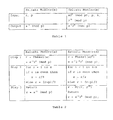
- Phase1 (a) a -1 2 z (mod p) where z is an integer and k ⁇ z ⁇ 2k.
- the second stage of Kaliski's algorithm completes the operation by using the "Almost Montgomery Inverse” (Phase1 (a)) and z to calculate MonInv(a).
- Kaliski algorithm can be used for calculating a classical modular inverse. Accordingly, there are two separate Kaliski algorithms, the first of which (Kaliski ModInv()) provides a mechanism of calculating a classical modular inverse and the second of which (Kaliski MonInv()) provides a mechanism of calculating a Montgomery modular inverse of an integer already in the Montgomery domain.
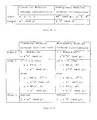
- Savas and Koç algorithm can be used for calculating a classical modular inverse. Accordingly, there are two separate Savas and Koç algorithms, the first of which (Savas/Koç ModInv()) provides a mechanism of calculating a classical modular inverse and the second of which (Savas/Koç MonInv()) provides a mechanism of calculating a Montgomery Modular Inverse.
- the Savas and Koç ModInv() algorithm involves one or two Montgomery multiplication operations.
- the Savas and Koç Monlnv() algorithm involves two or three Montgomery multiplication operations.
- a method of calculating a classical modular inverse or a Montgomery modular inverse of an integer a (mod p), where p is a k-bit integer comprising the steps of:
- the first input variable is a and the second input variable is one when calculating a classical modular inverse; and the first input variable is a2 k mod(p) and the second input variable is R 2 when calculating the Montgomery modular inverse.
- an apparatus for calculating a classical modular inverse or a Montgomery modular inverse of an integer a (mod p), where p is a k-bit integer, comprising:
- the first input variable is a and the second input variable is one when calculating a classical modular inverse and the first input variable is a2 k (mod p) and the second input variable is R 2 when calculating a Montgomery modular inverse.
- the apparatus further comprises a means of transmitting the output of the fourth calculating means.
- the second calculating means is implemented in a control unit that further comprises a logic unit which compares z and k.
- the second, third and fourth calculating means comprise a multiplier unit, an addition unit and a subtraction unit.
- the addition unit and the subtraction unit employ fast carry chains and two's complement addition.
- the multiplier unit comprises a plurality of cascaded unsigned multiplier units.
- the multiplier unit comprises a means of adding the outputs from the unsigned multiplier units employing look-ahead carry chains.
- the apparatus is a field programmable gate array.
- the apparatus is an application specific integrated circuit.
- the apparatus operates on 256 bit data.
- a third aspect of the invention there is provided a method of generating a private encryption key from a public encryption key by calculating the modular inverse of the public encryption key with the method of the first aspect.
- the private encryption key is employed in an RSA algorithm.
- an apparatus for generating a private encryption key from a public encryption key comprising a means for performing the method of the third aspect.
- a digital signature generated from the private key produced by the method of the third aspect is provided.
- a sixth aspect of the invention there is provided a method of encrypting data comprising the steps of:
- an apparatus for encrypting data comprising:
- the present invention improves on the algorithms developed by Kaliski and Savas and Koç by providing a single unified algorithm that can compute both the classical modular inverse and the Montgomery modular inverse of an integer. Accordingly, the present invention provides a mechanism for substantially reducing the silicon usage of hardware implementations of traditional modular inversion algorithms.
- the method of calculating a classical modular inverse and a Montgomery modular inverse of an integer in accordance with the invention will be known henceforth as the unified inversion algorithm. Accordingly, the following description will first describe the unified inversion algorithm and will provide evidence of its advantages by way of a hardware implementation.
- the unified inversion algorithm provides a single, efficient algorithm for computing both the classical modular inverse and the Montgomery modular inverse of an integer already in the Montgomery domain.
- the algorithm is a two-stage process in which the output from the first stage (in common with the output from the first stage of the Kaliski algorithms) is the integer satisfying k ⁇ z ⁇ 2k.
- the Savas and Koç algorithm for calculating a Montgomery modular inverse required a maximum of three Montgomery multiplication operations.
- Table 6 it will be noted that the unified inversion algorithm is more efficient than the Savas and Koç algorithm for computing a Montgomery modular inverse, since the unified inversion algorithm requires at most only two Montgomery multiplication operations. Consequently, the unified inversion algorithm provides at least a 33% saving in the required number of Montgomery multiplication operations.
- the unified inversion algorithm is particularly suited for hardware (and indeed software) implementations, since a single circuit architecture can be used to compute both types of modular inverse.
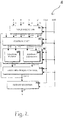
- the unified inversion circuit 5 when computing a classical modular inverse, the unified inversion circuit 5 employs input values 10 of a and 1 .
- input values 10 of a 2k (mod p) and R 2 are employed.
- the input values 10 are registered 12 into the unified inversion circuit 5 at 32-bits per clock cycle over 8 cycles.
- the values a and p are then fed into a Phase1 component 14, which comprises a 256-bit adder and subtractor (not shown), implemented using fast carry chains located on, for example, a Virtex2 Pro device.
- the addition and subtraction operations are performed sequentially in accordance with the pseudo-code shown in Table 7, using a state machine approach.
- phase1(a) and z are then stored in a control unit 16.
- the value 2 2k-z is also calculated in the control unit 16.
- the main calculations performed in the Montgomery multiplication algorithm include three full-word multiplications, one full-word addition, and a conditional full-word subtraction. In practice, the full-word addition and subtraction operations are performed using fast carry chains and two's-complement addition.
- the inputs to the 256-bit Montgomery multiplier architecture 18 are registered 22 into the Montgomery multiplier 18 at a rate of 32-bits per clock cycle over a period of 8 cycles.
- the main calculation operations of the Montgomery multiplication algorithm are performed in a calculation unit 24 that operates under the control of a control unit 26.
- the calculation unit 24 comprises a 256x256 bit multiplier unit 28 and an addition/subtraction unit 30.
- the 256x256-bit multiplier unit 28 is developed by cascading numerous 16 ⁇ 16-bit unsigned multipliers.
- the partial products from the cascaded 16x16-bit unsigned multipliers are added together using fast look-ahead carry chains until the desired multiplier size is attained.
- the calculation and addition of the partial products from the cascaded 16x16-bit unsigned multipliers is a fully pipelined process, designed to take full advantage of the small critical path delay of the 16x16-bit multiplier blocks and the fast carry chains. Therefore it takes 3, 5, 7, and 9 clock cycles to respectively complete 32, 64, 128, and 256 bit multiplication operations.
- control unit 26 determines the order in which the multiplications, addition and conditional subtraction operations of the calculation unit 26 are performed.
- the t-REG / UPDATE REG / CONTROL component 32 also performs the trivial mod and div operations. Once the conditional subtraction has been performed, the variable u is output from the output register 34 at a rate of 32-bits per cycle over a period of 8 clock cycles.
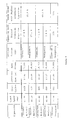
- Table 7 shows the results of experiments (obtained using Xilinx Foundation software v6.1.03i) comparing the performance of the above algorithms. Referring to Table 7, it can be seen that using the unified inversion algorithm instead of Kaliski's algorithms to calculate the classical inverse and the Montgomery modular inverse of an integer already in the Montgomery domain, results in a speed up of 17.8% and 27.1% respectively.
- a modular inverter circuit can be implemented using a single unified inversion circuit in place of the two separate circuits required to implement both of Kaliski's algorithms, an overall reduction of 18.8% in the number of slices used is achievable. This percentage is a relative measure calculated by computing the difference between the number of slices required to implement Kaliski's algorithms and the number of slices required by the unified inversion circuit; and then dividing the difference by the number of slices required to implement Kaliski's algorithms.
- the unified inversion algorithm does not provide a significant speed-up if used instead of the Savas/Koc algorithms, nonetheless, the unified inversion circuit provides a 49.9% reduction in the silicon area usage compared with the Savas and Koç algorithms (using the same relative measurement as used when comparing against the Kaliski algorithms).
- Kaliski and Savas and Koç algorithms are implemented in software or alternative hardware media, e.g. modern application specific integrated circuit (ASIC) devices, since the unified inversion algorithm has an inherently less complicated structure than the other algorithms.
- ASIC application specific integrated circuit
Landscapes
- Physics & Mathematics (AREA)
- General Physics & Mathematics (AREA)
- Engineering & Computer Science (AREA)
- Computational Mathematics (AREA)
- Mathematical Analysis (AREA)
- Mathematical Optimization (AREA)
- Pure & Applied Mathematics (AREA)
- Theoretical Computer Science (AREA)
- Mathematical Physics (AREA)
- General Engineering & Computer Science (AREA)
- Computing Systems (AREA)
- Complex Calculations (AREA)
- Length Measuring Devices With Unspecified Measuring Means (AREA)
- Measurement Of Mechanical Vibrations Or Ultrasonic Waves (AREA)
- Measuring Volume Flow (AREA)
- Analysing Materials By The Use Of Radiation (AREA)
Applications Claiming Priority (2)
| Application Number | Priority Date | Filing Date | Title |
|---|---|---|---|
| GBGB0412084.6A GB0412084D0 (en) | 2004-05-29 | 2004-05-29 | "Method of calculating a modular inverse" |
| GB0412084 | 2004-05-29 |
Publications (3)
| Publication Number | Publication Date |
|---|---|
| EP1600852A2 true EP1600852A2 (de) | 2005-11-30 |
| EP1600852A3 EP1600852A3 (de) | 2008-03-26 |
| EP1600852B1 EP1600852B1 (de) | 2009-12-02 |
Family
ID=32671317
Family Applications (1)
| Application Number | Title | Priority Date | Filing Date |
|---|---|---|---|
| EP05253278A Expired - Lifetime EP1600852B1 (de) | 2004-05-29 | 2005-05-27 | Verfahren und Vorrichtung zur Berechnung einer modularen Inversen |
Country Status (5)
| Country | Link |
|---|---|
| US (1) | US20050283514A1 (de) |
| EP (1) | EP1600852B1 (de) |
| AT (1) | ATE450824T1 (de) |
| DE (1) | DE602005017976D1 (de) |
| GB (1) | GB0412084D0 (de) |
Families Citing this family (8)
| Publication number | Priority date | Publication date | Assignee | Title |
|---|---|---|---|---|
| FR2887351A1 (fr) * | 2005-06-16 | 2006-12-22 | St Microelectronics Sa | Protection d'un calcul d'exponentiation modulaire effectue par un circuit integre |
| US8243919B2 (en) * | 2007-03-07 | 2012-08-14 | Research In Motion Limited | Method and apparatus for performing elliptic curve scalar multiplication in a manner that counters power analysis attacks |
| CA2593723C (en) * | 2007-06-27 | 2016-04-19 | Blackberry Limited | Multi-dimensional montgomery ladders for elliptic curves |
| KR101794807B1 (ko) * | 2011-01-31 | 2017-11-08 | 삼성전자주식회사 | 몽고메리 역원 계산 장치 및 이를 이용한 몽고메리 역원 계산 방법 |
| CN104123431B (zh) * | 2013-04-24 | 2018-09-14 | 国民技术股份有限公司 | 一种元素的模逆计算方法及装置 |
| KR101321259B1 (ko) * | 2013-05-23 | 2013-10-29 | 목포대학교산학협력단 | 몽고메리 역원 알고리즘을 위한 뺄셈 연산 장치 및 그 방법 |
| CN103336680B (zh) * | 2013-06-27 | 2016-01-13 | 清华大学 | 实现二进制左移模逆算法的电路 |
| JP7414675B2 (ja) | 2020-09-11 | 2024-01-16 | キオクシア株式会社 | 逆元演算装置及びメモリシステム |
Family Cites Families (7)
| Publication number | Priority date | Publication date | Assignee | Title |
|---|---|---|---|---|
| US4623981A (en) * | 1983-09-20 | 1986-11-18 | Digital Equipment Corporation | ALU with carry length detection |
| US6088453A (en) * | 1997-01-27 | 2000-07-11 | Kabushiki Kaisha Toshiba | Scheme for computing Montgomery division and Montgomery inverse realizing fast implementation |
| CA2253009C (en) * | 1997-11-04 | 2002-06-25 | Nippon Telegraph And Telephone Corporation | Method and apparatus for modular inversion for information security and recording medium with a program for implementing the method |
| US6240436B1 (en) * | 1998-03-30 | 2001-05-29 | Rainbow Technologies, Inc. | High speed montgomery value calculation |
| US20020055962A1 (en) * | 1999-11-12 | 2002-05-09 | Richard Schroeppel | Automatically solving equations in finite fields |
| US7050579B1 (en) * | 2000-03-31 | 2006-05-23 | State Of Oregon Acting By And Through The State Board Of Education On Behalf Of Oregon State University | Cryptographic methods and apparatus using word-wise montgomery multiplication |
| US7234044B1 (en) * | 2003-12-03 | 2007-06-19 | Altera Corporation | Processor registers having state information |
-
2004
- 2004-05-29 GB GBGB0412084.6A patent/GB0412084D0/en not_active Ceased
-
2005
- 2005-05-27 EP EP05253278A patent/EP1600852B1/de not_active Expired - Lifetime
- 2005-05-27 AT AT05253278T patent/ATE450824T1/de not_active IP Right Cessation
- 2005-05-27 DE DE602005017976T patent/DE602005017976D1/de not_active Expired - Lifetime
- 2005-05-27 US US11/139,957 patent/US20050283514A1/en not_active Abandoned
Non-Patent Citations (5)
| Title |
|---|
| DALYY A ET AL: "Fast Modular Inversion in the Montgomery Domain on Recon gurable Logic" INTERNET CITATION, [Online] 1 July 2003 (2003-07-01), XP007901451 Retrieved from the Internet: URL:http://eee.ucc.ie/staff/marnanel/Files /papers/Daly_Marnane_Popovici_I SSC2003.pdf> [retrieved on 2006-12-13] * |
| KALISKI B S: "THE MONTGOMERY INVERSE AND ITS APPLICATIONS" IEEE TRANSACTIONS ON COMPUTERS, IEEE SERVICE CENTER, LOS ALAMITOS, CA, US, vol. 44, no. 8, 1 August 1995 (1995-08-01), pages 1064-1065, XP000525965 ISSN: 0018-9340 * |
| LORENCZ R ET AL: "Subtraction-free Almost Montgomery Inverse algorithm" INFORMATION PROCESSING LETTERS, AMSTERDAM, NL, vol. 94, no. 1, 15 April 2005 (2005-04-15), pages 11-14, XP004764737 ISSN: 0020-0190 * |
| LORENCZ R: "NEW ALGORITHM FOR CLASSICAL MODULAR INVERSE" CRYPTOGRAPHIC HARDWARE AND EMBEDDED SYSTEMS. INTERNATIONAL WORKSHOP, 13 August 2002 (2002-08-13), pages 57-70, XP001160521 * |
| SAVAS E KOC C K: "The montgomery modular inverse-revisited" IEEE TRANSACTIONS ON COMPUTERS, IEEE SERVICE CENTER, LOS ALAMITOS, CA, US, vol. 49, no. 7, July 2000 (2000-07), pages 763-766, XP002955515 ISSN: 0018-9340 * |
Also Published As
| Publication number | Publication date |
|---|---|
| EP1600852A3 (de) | 2008-03-26 |
| DE602005017976D1 (de) | 2010-01-14 |
| GB0412084D0 (en) | 2004-06-30 |
| US20050283514A1 (en) | 2005-12-22 |
| EP1600852B1 (de) | 2009-12-02 |
| ATE450824T1 (de) | 2009-12-15 |
Similar Documents
| Publication | Publication Date | Title |
|---|---|---|
| McIvor et al. | Hardware Elliptic Curve Cryptographic Processor Over $ rm GF (p) $ | |
| US20120057695A1 (en) | Circuits for modular arithmetic based on the complementation of continued fractions | |
| Daly et al. | An FPGA implementation of a GF (p) ALU for encryption processors | |
| Tan et al. | High-speed modular multiplier for lattice-based cryptosystems | |
| Großschädl | A bit-serial unified multiplier architecture for finite fields GF (p) and GF (2m) | |
| Koppermann et al. | X25519 hardware implementation for low-latency applications | |
| Choi et al. | ECC coprocessor over a NIST prime field using fast partial Montgomery reduction | |
| Fournaris et al. | A new RSA encryption architecture and hardware implementation based on optimized Montgomery multiplication | |
| Moon et al. | Fast VLSI arithmetic algorithms for high-security elliptic curve cryptographic applications | |
| EP1600852B1 (de) | Verfahren und Vorrichtung zur Berechnung einer modularen Inversen | |
| KR100508092B1 (ko) | 저전력 모듈로 곱셈을 수행하는 연산장치 | |
| Bhaskar et al. | An efficient hardware model for RSA Encryption system using Vedic mathematics | |
| EP1708081B1 (de) | Verfahren und Vorrichtung zur Berechnung eines Montgomery-Konvertierungsparameters | |
| Manochehri et al. | Fast Montgomery modular multiplication by pipelined CSA architecture | |
| Ghoreishi et al. | High speed RSA implementation based on modified Booth's technique and Montgomery's multiplication for FPGA platform | |
| Mahapatra et al. | RSA cryptosystem with modified Montgomery modular multiplier | |
| Nibouche et al. | Architectures for Montgomery's multiplication | |
| Rahman et al. | Efficient hardware implementation of RSA cryptography | |
| McLoone et al. | Coarsely integrated operand scanning (CIOS) architecture for high-speed Montgomery modular multiplication | |
| Elias et al. | On efficient implementation of FPGA-based hyperelliptic curve cryptosystems | |
| US7403965B2 (en) | Encryption/decryption system for calculating effective lower bits of a parameter for Montgomery modular multiplication | |
| KR100946256B1 (ko) | 다정도 캐리 세이브 가산기를 이용한 듀얼필드상의확장성있는 몽고매리 곱셈기 | |
| Wang et al. | FPGA based unified architecture for public key and private key cryptosystems | |
| Venkatalakshmi et al. | Design of montgomery multiplier–RSA algorithm | |
| Huzaifa et al. | Low latency Montgomery multiplier for cryptographic applications |
Legal Events
| Date | Code | Title | Description |
|---|---|---|---|
| PUAI | Public reference made under article 153(3) epc to a published international application that has entered the european phase |
Free format text: ORIGINAL CODE: 0009012 |
|
| AK | Designated contracting states |
Kind code of ref document: A2 Designated state(s): AT BE BG CH CY CZ DE DK EE ES FI FR GB GR HU IE IS IT LI LT LU MC NL PL PT RO SE SI SK TR |
|
| AX | Request for extension of the european patent |
Extension state: AL BA HR LV MK YU |
|
| PUAL | Search report despatched |
Free format text: ORIGINAL CODE: 0009013 |
|
| AK | Designated contracting states |
Kind code of ref document: A3 Designated state(s): AT BE BG CH CY CZ DE DK EE ES FI FR GB GR HU IE IS IT LI LT LU MC NL PL PT RO SE SI SK TR |
|
| AX | Request for extension of the european patent |
Extension state: AL BA HR LV MK YU |
|
| 17P | Request for examination filed |
Effective date: 20080926 |
|
| AKX | Designation fees paid |
Designated state(s): AT BE BG CH CY CZ DE DK EE ES FI FR GB GR HU IE IS IT LI LT LU MC NL PL PT RO SE SI SK TR |
|
| 17Q | First examination report despatched |
Effective date: 20090113 |
|
| GRAP | Despatch of communication of intention to grant a patent |
Free format text: ORIGINAL CODE: EPIDOSNIGR1 |
|
| GRAC | Information related to communication of intention to grant a patent modified |
Free format text: ORIGINAL CODE: EPIDOSCIGR1 |
|
| GRAS | Grant fee paid |
Free format text: ORIGINAL CODE: EPIDOSNIGR3 |
|
| GRAA | (expected) grant |
Free format text: ORIGINAL CODE: 0009210 |
|
| AK | Designated contracting states |
Kind code of ref document: B1 Designated state(s): AT BE BG CH CY CZ DE DK EE ES FI FR GB GR HU IE IS IT LI LT LU MC NL PL PT RO SE SI SK TR |
|
| REG | Reference to a national code |
Ref country code: GB Ref legal event code: FG4D |
|
| REG | Reference to a national code |
Ref country code: CH Ref legal event code: EP |
|
| REG | Reference to a national code |
Ref country code: IE Ref legal event code: FG4D |
|
| REF | Corresponds to: |
Ref document number: 602005017976 Country of ref document: DE Date of ref document: 20100114 Kind code of ref document: P |
|
| REG | Reference to a national code |
Ref country code: SE Ref legal event code: TRGR |
|
| REG | Reference to a national code |
Ref country code: NL Ref legal event code: VDEP Effective date: 20091202 |
|
| PG25 | Lapsed in a contracting state [announced via postgrant information from national office to epo] |
Ref country code: LT Free format text: LAPSE BECAUSE OF FAILURE TO SUBMIT A TRANSLATION OF THE DESCRIPTION OR TO PAY THE FEE WITHIN THE PRESCRIBED TIME-LIMIT Effective date: 20091202 |
|
| LTIE | Lt: invalidation of european patent or patent extension |
Effective date: 20091202 |
|
| PG25 | Lapsed in a contracting state [announced via postgrant information from national office to epo] |
Ref country code: CY Free format text: LAPSE BECAUSE OF FAILURE TO SUBMIT A TRANSLATION OF THE DESCRIPTION OR TO PAY THE FEE WITHIN THE PRESCRIBED TIME-LIMIT Effective date: 20091202 Ref country code: PL Free format text: LAPSE BECAUSE OF FAILURE TO SUBMIT A TRANSLATION OF THE DESCRIPTION OR TO PAY THE FEE WITHIN THE PRESCRIBED TIME-LIMIT Effective date: 20091202 Ref country code: SI Free format text: LAPSE BECAUSE OF FAILURE TO SUBMIT A TRANSLATION OF THE DESCRIPTION OR TO PAY THE FEE WITHIN THE PRESCRIBED TIME-LIMIT Effective date: 20091202 |
|
| PG25 | Lapsed in a contracting state [announced via postgrant information from national office to epo] |
Ref country code: AT Free format text: LAPSE BECAUSE OF FAILURE TO SUBMIT A TRANSLATION OF THE DESCRIPTION OR TO PAY THE FEE WITHIN THE PRESCRIBED TIME-LIMIT Effective date: 20091202 |
|
| PG25 | Lapsed in a contracting state [announced via postgrant information from national office to epo] |
Ref country code: NL Free format text: LAPSE BECAUSE OF FAILURE TO SUBMIT A TRANSLATION OF THE DESCRIPTION OR TO PAY THE FEE WITHIN THE PRESCRIBED TIME-LIMIT Effective date: 20091202 Ref country code: RO Free format text: LAPSE BECAUSE OF FAILURE TO SUBMIT A TRANSLATION OF THE DESCRIPTION OR TO PAY THE FEE WITHIN THE PRESCRIBED TIME-LIMIT Effective date: 20091202 Ref country code: IS Free format text: LAPSE BECAUSE OF FAILURE TO SUBMIT A TRANSLATION OF THE DESCRIPTION OR TO PAY THE FEE WITHIN THE PRESCRIBED TIME-LIMIT Effective date: 20100402 Ref country code: PT Free format text: LAPSE BECAUSE OF FAILURE TO SUBMIT A TRANSLATION OF THE DESCRIPTION OR TO PAY THE FEE WITHIN THE PRESCRIBED TIME-LIMIT Effective date: 20100402 Ref country code: EE Free format text: LAPSE BECAUSE OF FAILURE TO SUBMIT A TRANSLATION OF THE DESCRIPTION OR TO PAY THE FEE WITHIN THE PRESCRIBED TIME-LIMIT Effective date: 20091202 Ref country code: BG Free format text: LAPSE BECAUSE OF FAILURE TO SUBMIT A TRANSLATION OF THE DESCRIPTION OR TO PAY THE FEE WITHIN THE PRESCRIBED TIME-LIMIT Effective date: 20100302 Ref country code: ES Free format text: LAPSE BECAUSE OF FAILURE TO SUBMIT A TRANSLATION OF THE DESCRIPTION OR TO PAY THE FEE WITHIN THE PRESCRIBED TIME-LIMIT Effective date: 20100313 |
|
| PG25 | Lapsed in a contracting state [announced via postgrant information from national office to epo] |
Ref country code: CZ Free format text: LAPSE BECAUSE OF FAILURE TO SUBMIT A TRANSLATION OF THE DESCRIPTION OR TO PAY THE FEE WITHIN THE PRESCRIBED TIME-LIMIT Effective date: 20091202 Ref country code: BE Free format text: LAPSE BECAUSE OF FAILURE TO SUBMIT A TRANSLATION OF THE DESCRIPTION OR TO PAY THE FEE WITHIN THE PRESCRIBED TIME-LIMIT Effective date: 20091202 Ref country code: SK Free format text: LAPSE BECAUSE OF FAILURE TO SUBMIT A TRANSLATION OF THE DESCRIPTION OR TO PAY THE FEE WITHIN THE PRESCRIBED TIME-LIMIT Effective date: 20091202 |
|
| PLBE | No opposition filed within time limit |
Free format text: ORIGINAL CODE: 0009261 |
|
| STAA | Information on the status of an ep patent application or granted ep patent |
Free format text: STATUS: NO OPPOSITION FILED WITHIN TIME LIMIT |
|
| PG25 | Lapsed in a contracting state [announced via postgrant information from national office to epo] |
Ref country code: GR Free format text: LAPSE BECAUSE OF FAILURE TO SUBMIT A TRANSLATION OF THE DESCRIPTION OR TO PAY THE FEE WITHIN THE PRESCRIBED TIME-LIMIT Effective date: 20100303 |
|
| 26N | No opposition filed |
Effective date: 20100903 |
|
| PG25 | Lapsed in a contracting state [announced via postgrant information from national office to epo] |
Ref country code: MC Free format text: LAPSE BECAUSE OF NON-PAYMENT OF DUE FEES Effective date: 20100531 |
|
| REG | Reference to a national code |
Ref country code: CH Ref legal event code: PL |
|
| PG25 | Lapsed in a contracting state [announced via postgrant information from national office to epo] |
Ref country code: DK Free format text: LAPSE BECAUSE OF FAILURE TO SUBMIT A TRANSLATION OF THE DESCRIPTION OR TO PAY THE FEE WITHIN THE PRESCRIBED TIME-LIMIT Effective date: 20091202 |
|
| PG25 | Lapsed in a contracting state [announced via postgrant information from national office to epo] |
Ref country code: CH Free format text: LAPSE BECAUSE OF NON-PAYMENT OF DUE FEES Effective date: 20100531 Ref country code: LI Free format text: LAPSE BECAUSE OF NON-PAYMENT OF DUE FEES Effective date: 20100531 |
|
| PG25 | Lapsed in a contracting state [announced via postgrant information from national office to epo] |
Ref country code: IT Free format text: LAPSE BECAUSE OF FAILURE TO SUBMIT A TRANSLATION OF THE DESCRIPTION OR TO PAY THE FEE WITHIN THE PRESCRIBED TIME-LIMIT Effective date: 20091202 |
|
| PG25 | Lapsed in a contracting state [announced via postgrant information from national office to epo] |
Ref country code: IE Free format text: LAPSE BECAUSE OF NON-PAYMENT OF DUE FEES Effective date: 20100527 |
|
| PGFP | Annual fee paid to national office [announced via postgrant information from national office to epo] |
Ref country code: FR Payment date: 20110511 Year of fee payment: 7 Ref country code: SE Payment date: 20110524 Year of fee payment: 7 |
|
| PGFP | Annual fee paid to national office [announced via postgrant information from national office to epo] |
Ref country code: GB Payment date: 20110519 Year of fee payment: 7 Ref country code: FI Payment date: 20110519 Year of fee payment: 7 |
|
| PGFP | Annual fee paid to national office [announced via postgrant information from national office to epo] |
Ref country code: DE Payment date: 20110523 Year of fee payment: 7 |
|
| PG25 | Lapsed in a contracting state [announced via postgrant information from national office to epo] |
Ref country code: HU Free format text: LAPSE BECAUSE OF FAILURE TO SUBMIT A TRANSLATION OF THE DESCRIPTION OR TO PAY THE FEE WITHIN THE PRESCRIBED TIME-LIMIT Effective date: 20100603 Ref country code: LU Free format text: LAPSE BECAUSE OF NON-PAYMENT OF DUE FEES Effective date: 20100527 |
|
| PG25 | Lapsed in a contracting state [announced via postgrant information from national office to epo] |
Ref country code: TR Free format text: LAPSE BECAUSE OF FAILURE TO SUBMIT A TRANSLATION OF THE DESCRIPTION OR TO PAY THE FEE WITHIN THE PRESCRIBED TIME-LIMIT Effective date: 20091202 |
|
| REG | Reference to a national code |
Ref country code: SE Ref legal event code: EUG |
|
| GBPC | Gb: european patent ceased through non-payment of renewal fee |
Effective date: 20120527 |
|
| PG25 | Lapsed in a contracting state [announced via postgrant information from national office to epo] |
Ref country code: FI Free format text: LAPSE BECAUSE OF NON-PAYMENT OF DUE FEES Effective date: 20120527 |
|
| PG25 | Lapsed in a contracting state [announced via postgrant information from national office to epo] |
Ref country code: SE Free format text: LAPSE BECAUSE OF NON-PAYMENT OF DUE FEES Effective date: 20120528 |
|
| REG | Reference to a national code |
Ref country code: FR Ref legal event code: ST Effective date: 20130131 |
|
| REG | Reference to a national code |
Ref country code: DE Ref legal event code: R119 Ref document number: 602005017976 Country of ref document: DE Effective date: 20121201 |
|
| PG25 | Lapsed in a contracting state [announced via postgrant information from national office to epo] |
Ref country code: GB Free format text: LAPSE BECAUSE OF NON-PAYMENT OF DUE FEES Effective date: 20120527 Ref country code: FR Free format text: LAPSE BECAUSE OF NON-PAYMENT OF DUE FEES Effective date: 20120531 |
|
| PG25 | Lapsed in a contracting state [announced via postgrant information from national office to epo] |
Ref country code: DE Free format text: LAPSE BECAUSE OF NON-PAYMENT OF DUE FEES Effective date: 20121201 |