EP1599554B1 - Verfahren zur einfärbung von substraten für optische anwendungen - Google Patents
Verfahren zur einfärbung von substraten für optische anwendungen Download PDFInfo
- Publication number
- EP1599554B1 EP1599554B1 EP04716518.8A EP04716518A EP1599554B1 EP 1599554 B1 EP1599554 B1 EP 1599554B1 EP 04716518 A EP04716518 A EP 04716518A EP 1599554 B1 EP1599554 B1 EP 1599554B1
- Authority
- EP
- European Patent Office
- Prior art keywords
- tinting
- optical substrate
- monomer
- meth
- coating composition
- Prior art date
- Legal status (The legal status is an assumption and is not a legal conclusion. Google has not performed a legal analysis and makes no representation as to the accuracy of the status listed.)
- Expired - Lifetime
Links
- 239000000758 substrate Substances 0.000 title claims description 64
- 230000003287 optical effect Effects 0.000 title claims description 60
- 239000000178 monomer Substances 0.000 claims description 83
- 238000000034 method Methods 0.000 claims description 50
- 238000005299 abrasion Methods 0.000 claims description 48
- NIXOWILDQLNWCW-UHFFFAOYSA-M Acrylate Chemical compound [O-]C(=O)C=C NIXOWILDQLNWCW-UHFFFAOYSA-M 0.000 claims description 40
- VYPSYNLAJGMNEJ-UHFFFAOYSA-N Silicium dioxide Chemical compound O=[Si]=O VYPSYNLAJGMNEJ-UHFFFAOYSA-N 0.000 claims description 39
- 239000008199 coating composition Substances 0.000 claims description 39
- 239000007787 solid Substances 0.000 claims description 38
- XEKOWRVHYACXOJ-UHFFFAOYSA-N Ethyl acetate Chemical group CCOC(C)=O XEKOWRVHYACXOJ-UHFFFAOYSA-N 0.000 claims description 33
- 238000004132 cross linking Methods 0.000 claims description 29
- 239000002202 Polyethylene glycol Substances 0.000 claims description 26
- 229920001223 polyethylene glycol Polymers 0.000 claims description 26
- 239000008119 colloidal silica Substances 0.000 claims description 25
- 239000003795 chemical substances by application Substances 0.000 claims description 23
- 239000002904 solvent Substances 0.000 claims description 23
- 229920000515 polycarbonate Polymers 0.000 claims description 20
- 239000004417 polycarbonate Substances 0.000 claims description 20
- 125000004386 diacrylate group Chemical group 0.000 claims description 16
- 239000007983 Tris buffer Substances 0.000 claims description 14
- -1 polyoxyethylene backbone Polymers 0.000 claims description 13
- KFZMGEQAYNKOFK-UHFFFAOYSA-N Isopropanol Chemical compound CC(C)O KFZMGEQAYNKOFK-UHFFFAOYSA-N 0.000 claims description 12
- 125000001495 ethyl group Chemical group [H]C([H])([H])C([H])([H])* 0.000 claims description 9
- ZFSLODLOARCGLH-UHFFFAOYSA-N isocyanuric acid Chemical compound OC1=NC(O)=NC(O)=N1 ZFSLODLOARCGLH-UHFFFAOYSA-N 0.000 claims description 9
- 125000005702 oxyalkylene group Chemical group 0.000 claims description 9
- BPXVHIRIPLPOPT-UHFFFAOYSA-N 1,3,5-tris(2-hydroxyethyl)-1,3,5-triazinane-2,4,6-trione Chemical compound OCCN1C(=O)N(CCO)C(=O)N(CCO)C1=O BPXVHIRIPLPOPT-UHFFFAOYSA-N 0.000 claims description 8
- GWEVSGVZZGPLCZ-UHFFFAOYSA-N Titan oxide Chemical compound O=[Ti]=O GWEVSGVZZGPLCZ-UHFFFAOYSA-N 0.000 claims description 8
- 150000001875 compounds Chemical class 0.000 claims description 8
- 229910052757 nitrogen Inorganic materials 0.000 claims description 8
- TXBCBTDQIULDIA-UHFFFAOYSA-N 2-[[3-hydroxy-2,2-bis(hydroxymethyl)propoxy]methyl]-2-(hydroxymethyl)propane-1,3-diol Chemical compound OCC(CO)(CO)COCC(CO)(CO)CO TXBCBTDQIULDIA-UHFFFAOYSA-N 0.000 claims description 6
- NTIZESTWPVYFNL-UHFFFAOYSA-N Methyl isobutyl ketone Chemical group CC(C)CC(C)=O NTIZESTWPVYFNL-UHFFFAOYSA-N 0.000 claims description 6
- UIHCLUNTQKBZGK-UHFFFAOYSA-N Methyl isobutyl ketone Natural products CCC(C)C(C)=O UIHCLUNTQKBZGK-UHFFFAOYSA-N 0.000 claims description 6
- LRHPLDYGYMQRHN-UHFFFAOYSA-N N-Butanol Chemical compound CCCCO LRHPLDYGYMQRHN-UHFFFAOYSA-N 0.000 claims description 6
- 239000011247 coating layer Substances 0.000 claims description 6
- WXZMFSXDPGVJKK-UHFFFAOYSA-N pentaerythritol Chemical compound OCC(CO)(CO)CO WXZMFSXDPGVJKK-UHFFFAOYSA-N 0.000 claims description 6
- MCMNRKCIXSYSNV-UHFFFAOYSA-N ZrO2 Inorganic materials O=[Zr]=O MCMNRKCIXSYSNV-UHFFFAOYSA-N 0.000 claims description 4
- 150000001252 acrylic acid derivatives Chemical class 0.000 claims description 4
- 125000003118 aryl group Chemical group 0.000 claims description 4
- 150000002148 esters Chemical class 0.000 claims description 4
- 150000002576 ketones Chemical class 0.000 claims description 4
- RVTZCBVAJQQJTK-UHFFFAOYSA-N oxygen(2-);zirconium(4+) Chemical compound [O-2].[O-2].[Zr+4] RVTZCBVAJQQJTK-UHFFFAOYSA-N 0.000 claims description 4
- 239000004408 titanium dioxide Substances 0.000 claims description 4
- JOYRKODLDBILNP-UHFFFAOYSA-N Ethyl urethane Chemical compound CCOC(N)=O JOYRKODLDBILNP-UHFFFAOYSA-N 0.000 claims description 3
- OTLDLKLSNZMTTA-UHFFFAOYSA-N octahydro-1h-4,7-methanoindene-1,5-diyldimethanol Chemical compound C1C2C3C(CO)CCC3C1C(CO)C2 OTLDLKLSNZMTTA-UHFFFAOYSA-N 0.000 claims description 3
- 125000001436 propyl group Chemical group [H]C([*])([H])C([H])([H])C([H])([H])[H] 0.000 claims 2
- 238000000576 coating method Methods 0.000 description 74
- 239000011248 coating agent Substances 0.000 description 52
- 239000000203 mixture Substances 0.000 description 35
- 239000000975 dye Substances 0.000 description 29
- YIJYFLXQHDOQGW-UHFFFAOYSA-N 2-[2,4,6-trioxo-3,5-bis(2-prop-2-enoyloxyethyl)-1,3,5-triazinan-1-yl]ethyl prop-2-enoate Chemical compound C=CC(=O)OCCN1C(=O)N(CCOC(=O)C=C)C(=O)N(CCOC(=O)C=C)C1=O YIJYFLXQHDOQGW-UHFFFAOYSA-N 0.000 description 12
- 239000003999 initiator Substances 0.000 description 10
- 230000008569 process Effects 0.000 description 10
- 229920005989 resin Polymers 0.000 description 9
- 239000011347 resin Substances 0.000 description 9
- JHQVCQDWGSXTFE-UHFFFAOYSA-N 2-(2-prop-2-enoxycarbonyloxyethoxy)ethyl prop-2-enyl carbonate Chemical compound C=CCOC(=O)OCCOCCOC(=O)OCC=C JHQVCQDWGSXTFE-UHFFFAOYSA-N 0.000 description 8
- KWVGIHKZDCUPEU-UHFFFAOYSA-N 2,2-dimethoxy-2-phenylacetophenone Chemical compound C=1C=CC=CC=1C(OC)(OC)C(=O)C1=CC=CC=C1 KWVGIHKZDCUPEU-UHFFFAOYSA-N 0.000 description 7
- 230000004927 fusion Effects 0.000 description 7
- 239000000377 silicon dioxide Substances 0.000 description 7
- IJGRMHOSHXDMSA-UHFFFAOYSA-N Atomic nitrogen Chemical compound N#N IJGRMHOSHXDMSA-UHFFFAOYSA-N 0.000 description 6
- QVGXLLKOCUKJST-UHFFFAOYSA-N atomic oxygen Chemical compound [O] QVGXLLKOCUKJST-UHFFFAOYSA-N 0.000 description 6
- 239000001301 oxygen Substances 0.000 description 6
- 229910052760 oxygen Inorganic materials 0.000 description 6
- 239000013557 residual solvent Substances 0.000 description 6
- 238000004528 spin coating Methods 0.000 description 6
- 125000005375 organosiloxane group Chemical group 0.000 description 5
- XLYOFNOQVPJJNP-UHFFFAOYSA-N water Substances O XLYOFNOQVPJJNP-UHFFFAOYSA-N 0.000 description 5
- 239000000463 material Substances 0.000 description 4
- 239000000243 solution Substances 0.000 description 4
- 229920001187 thermosetting polymer Polymers 0.000 description 4
- IISBACLAFKSPIT-UHFFFAOYSA-N bisphenol A Chemical compound C=1C=C(O)C=CC=1C(C)(C)C1=CC=C(O)C=C1 IISBACLAFKSPIT-UHFFFAOYSA-N 0.000 description 3
- 238000010586 diagram Methods 0.000 description 3
- 238000009472 formulation Methods 0.000 description 3
- 238000004519 manufacturing process Methods 0.000 description 3
- 229920000642 polymer Polymers 0.000 description 3
- 229920001169 thermoplastic Polymers 0.000 description 3
- 239000004634 thermosetting polymer Substances 0.000 description 3
- 239000004416 thermosoftening plastic Substances 0.000 description 3
- YYROPELSRYBVMQ-UHFFFAOYSA-N 4-toluenesulfonyl chloride Chemical compound CC1=CC=C(S(Cl)(=O)=O)C=C1 YYROPELSRYBVMQ-UHFFFAOYSA-N 0.000 description 2
- KWOLFJPFCHCOCG-UHFFFAOYSA-N Acetophenone Chemical compound CC(=O)C1=CC=CC=C1 KWOLFJPFCHCOCG-UHFFFAOYSA-N 0.000 description 2
- GUUVPOWQJOLRAS-UHFFFAOYSA-N Diphenyl disulfide Chemical compound C=1C=CC=CC=1SSC1=CC=CC=C1 GUUVPOWQJOLRAS-UHFFFAOYSA-N 0.000 description 2
- CERQOIWHTDAKMF-UHFFFAOYSA-M Methacrylate Chemical compound CC(=C)C([O-])=O CERQOIWHTDAKMF-UHFFFAOYSA-M 0.000 description 2
- 229910000831 Steel Inorganic materials 0.000 description 2
- ISAOCJYIOMOJEB-UHFFFAOYSA-N benzoin Chemical compound C=1C=CC=CC=1C(O)C(=O)C1=CC=CC=C1 ISAOCJYIOMOJEB-UHFFFAOYSA-N 0.000 description 2
- RWCCWEUUXYIKHB-UHFFFAOYSA-N benzophenone Chemical compound C=1C=CC=CC=1C(=O)C1=CC=CC=C1 RWCCWEUUXYIKHB-UHFFFAOYSA-N 0.000 description 2
- 239000012965 benzophenone Substances 0.000 description 2
- 230000005540 biological transmission Effects 0.000 description 2
- 230000036624 brainpower Effects 0.000 description 2
- 238000005266 casting Methods 0.000 description 2
- 239000003054 catalyst Substances 0.000 description 2
- 239000012141 concentrate Substances 0.000 description 2
- 230000001419 dependent effect Effects 0.000 description 2
- 238000005213 imbibition Methods 0.000 description 2
- 229910052809 inorganic oxide Inorganic materials 0.000 description 2
- 229920003023 plastic Polymers 0.000 description 2
- 239000004033 plastic Substances 0.000 description 2
- 238000002360 preparation method Methods 0.000 description 2
- 150000003254 radicals Chemical class 0.000 description 2
- KJCLYACXIWMFCC-UHFFFAOYSA-M sodium;5-benzoyl-4-hydroxy-2-methoxybenzenesulfonate Chemical compound [Na+].C1=C(S([O-])(=O)=O)C(OC)=CC(O)=C1C(=O)C1=CC=CC=C1 KJCLYACXIWMFCC-UHFFFAOYSA-M 0.000 description 2
- 241000894007 species Species 0.000 description 2
- 239000010959 steel Substances 0.000 description 2
- 239000000126 substance Substances 0.000 description 2
- 210000002268 wool Anatomy 0.000 description 2
- ANLWBVKLHKOSCW-AMESBYJASA-N (4z)-3-[1-(2,5-dimethylfuran-3-yl)ethylidene]-4-ethylideneoxolane-2,5-dione Chemical compound C\C=C1/C(=O)OC(=O)C1=C(C)C1=C(C)OC(C)=C1 ANLWBVKLHKOSCW-AMESBYJASA-N 0.000 description 1
- MSAHTMIQULFMRG-UHFFFAOYSA-N 1,2-diphenyl-2-propan-2-yloxyethanone Chemical compound C=1C=CC=CC=1C(OC(C)C)C(=O)C1=CC=CC=C1 MSAHTMIQULFMRG-UHFFFAOYSA-N 0.000 description 1
- CUJPFPXNDSIBPG-UHFFFAOYSA-N 1,3-propanediyl Chemical group [CH2]C[CH2] CUJPFPXNDSIBPG-UHFFFAOYSA-N 0.000 description 1
- DKEGCUDAFWNSSO-UHFFFAOYSA-N 1,8-dibromooctane Chemical compound BrCCCCCCCCBr DKEGCUDAFWNSSO-UHFFFAOYSA-N 0.000 description 1
- RBXGKYQSHGSWHS-UHFFFAOYSA-N 1-[(2,4-dinitrophenyl)methyl]benzimidazole Chemical compound [O-][N+](=O)C1=CC([N+](=O)[O-])=CC=C1CN1C2=CC=CC=C2N=C1 RBXGKYQSHGSWHS-UHFFFAOYSA-N 0.000 description 1
- VOBUAPTXJKMNCT-UHFFFAOYSA-N 1-prop-2-enoyloxyhexyl prop-2-enoate Chemical compound CCCCCC(OC(=O)C=C)OC(=O)C=C VOBUAPTXJKMNCT-UHFFFAOYSA-N 0.000 description 1
- PIZHFBODNLEQBL-UHFFFAOYSA-N 2,2-diethoxy-1-phenylethanone Chemical compound CCOC(OCC)C(=O)C1=CC=CC=C1 PIZHFBODNLEQBL-UHFFFAOYSA-N 0.000 description 1
- CGJVJVBQENEISI-UHFFFAOYSA-N 2,4-dinitrobenzenesulfonyl bromide Chemical compound [O-][N+](=O)C1=CC=C(S(Br)(=O)=O)C([N+]([O-])=O)=C1 CGJVJVBQENEISI-UHFFFAOYSA-N 0.000 description 1
- OZAIFHULBGXAKX-UHFFFAOYSA-N 2-(2-cyanopropan-2-yldiazenyl)-2-methylpropanenitrile Chemical compound N#CC(C)(C)N=NC(C)(C)C#N OZAIFHULBGXAKX-UHFFFAOYSA-N 0.000 description 1
- KMNCBSZOIQAUFX-UHFFFAOYSA-N 2-ethoxy-1,2-diphenylethanone Chemical compound C=1C=CC=CC=1C(OCC)C(=O)C1=CC=CC=C1 KMNCBSZOIQAUFX-UHFFFAOYSA-N 0.000 description 1
- DIVXVZXROTWKIH-UHFFFAOYSA-N 2-hydroxy-1,2-diphenylpropan-1-one Chemical compound C=1C=CC=CC=1C(O)(C)C(=O)C1=CC=CC=C1 DIVXVZXROTWKIH-UHFFFAOYSA-N 0.000 description 1
- BQZJOQXSCSZQPS-UHFFFAOYSA-N 2-methoxy-1,2-diphenylethanone Chemical compound C=1C=CC=CC=1C(OC)C(=O)C1=CC=CC=C1 BQZJOQXSCSZQPS-UHFFFAOYSA-N 0.000 description 1
- JPRAEFWJEBKFCB-UHFFFAOYSA-N 2-nitro-9h-fluoren-3-amine Chemical compound C1=CC=C2C(C=C(C(=C3)[N+]([O-])=O)N)=C3CC2=C1 JPRAEFWJEBKFCB-UHFFFAOYSA-N 0.000 description 1
- FRIBMENBGGCKPD-UHFFFAOYSA-N 3-(2,3-dimethoxyphenyl)prop-2-enal Chemical compound COC1=CC=CC(C=CC=O)=C1OC FRIBMENBGGCKPD-UHFFFAOYSA-N 0.000 description 1
- BUZICZZQJDLXJN-UHFFFAOYSA-N 3-azaniumyl-4-hydroxybutanoate Chemical compound OCC(N)CC(O)=O BUZICZZQJDLXJN-UHFFFAOYSA-N 0.000 description 1
- VVBLNCFGVYUYGU-UHFFFAOYSA-N 4,4'-Bis(dimethylamino)benzophenone Chemical compound C1=CC(N(C)C)=CC=C1C(=O)C1=CC=C(N(C)C)C=C1 VVBLNCFGVYUYGU-UHFFFAOYSA-N 0.000 description 1
- GRDXCFKBQWDAJH-UHFFFAOYSA-N 4-acetamidobenzenesulfonyl chloride Chemical compound CC(=O)NC1=CC=C(S(Cl)(=O)=O)C=C1 GRDXCFKBQWDAJH-UHFFFAOYSA-N 0.000 description 1
- TUZVQTLSJYAYJK-UHFFFAOYSA-N 5-(2-chlorophenyl)-2,4-diphenyl-1h-imidazole Chemical compound ClC1=CC=CC=C1C1=C(C=2C=CC=CC=2)N=C(C=2C=CC=CC=2)N1 TUZVQTLSJYAYJK-UHFFFAOYSA-N 0.000 description 1
- FIHBHSQYSYVZQE-UHFFFAOYSA-N 6-prop-2-enoyloxyhexyl prop-2-enoate Chemical compound C=CC(=O)OCCCCCCOC(=O)C=C FIHBHSQYSYVZQE-UHFFFAOYSA-N 0.000 description 1
- KYNSBQPICQTCGU-UHFFFAOYSA-N Benzopyrane Chemical compound C1=CC=C2C=CCOC2=C1 KYNSBQPICQTCGU-UHFFFAOYSA-N 0.000 description 1
- 239000004342 Benzoyl peroxide Substances 0.000 description 1
- OMPJBNCRMGITSC-UHFFFAOYSA-N Benzoylperoxide Chemical compound C=1C=CC=CC=1C(=O)OOC(=O)C1=CC=CC=C1 OMPJBNCRMGITSC-UHFFFAOYSA-N 0.000 description 1
- HMTKSAUNOFGNNX-UHFFFAOYSA-N CN(C)C([SH2]C(C1=CC=CC=C1)=O)=S Chemical compound CN(C)C([SH2]C(C1=CC=CC=C1)=O)=S HMTKSAUNOFGNNX-UHFFFAOYSA-N 0.000 description 1
- 229910052684 Cerium Inorganic materials 0.000 description 1
- QSJXEFYPDANLFS-UHFFFAOYSA-N Diacetyl Chemical group CC(=O)C(C)=O QSJXEFYPDANLFS-UHFFFAOYSA-N 0.000 description 1
- LFQSCWFLJHTTHZ-UHFFFAOYSA-N Ethanol Chemical compound CCO LFQSCWFLJHTTHZ-UHFFFAOYSA-N 0.000 description 1
- 229920003171 Poly (ethylene oxide) Polymers 0.000 description 1
- XBDQKXXYIPTUBI-UHFFFAOYSA-M Propionate Chemical compound CCC([O-])=O XBDQKXXYIPTUBI-UHFFFAOYSA-M 0.000 description 1
- 244000028419 Styrax benzoin Species 0.000 description 1
- 235000000126 Styrax benzoin Nutrition 0.000 description 1
- 235000008411 Sumatra benzointree Nutrition 0.000 description 1
- KXKVLQRXCPHEJC-UHFFFAOYSA-N acetic acid trimethyl ester Natural products COC(C)=O KXKVLQRXCPHEJC-UHFFFAOYSA-N 0.000 description 1
- 239000000654 additive Substances 0.000 description 1
- 230000000996 additive effect Effects 0.000 description 1
- 230000004075 alteration Effects 0.000 description 1
- 239000005030 aluminium foil Substances 0.000 description 1
- 150000004056 anthraquinones Chemical class 0.000 description 1
- 230000008901 benefit Effects 0.000 description 1
- ALIQZUMMPOYCIS-UHFFFAOYSA-N benzene-1,3-disulfonyl chloride Chemical compound ClS(=O)(=O)C1=CC=CC(S(Cl)(=O)=O)=C1 ALIQZUMMPOYCIS-UHFFFAOYSA-N 0.000 description 1
- WURBFLDFSFBTLW-UHFFFAOYSA-N benzil Chemical compound C=1C=CC=CC=1C(=O)C(=O)C1=CC=CC=C1 WURBFLDFSFBTLW-UHFFFAOYSA-N 0.000 description 1
- 229960002130 benzoin Drugs 0.000 description 1
- 235000019400 benzoyl peroxide Nutrition 0.000 description 1
- 230000015572 biosynthetic process Effects 0.000 description 1
- 230000001680 brushing effect Effects 0.000 description 1
- 238000010888 cage effect Methods 0.000 description 1
- 230000003047 cage effect Effects 0.000 description 1
- 230000015556 catabolic process Effects 0.000 description 1
- GWXLDORMOJMVQZ-UHFFFAOYSA-N cerium Chemical compound [Ce] GWXLDORMOJMVQZ-UHFFFAOYSA-N 0.000 description 1
- 150000008371 chromenes Chemical class 0.000 description 1
- VDBXLXRWMYNMHL-UHFFFAOYSA-N decanediamide Chemical compound NC(=O)CCCCCCCCC(N)=O VDBXLXRWMYNMHL-UHFFFAOYSA-N 0.000 description 1
- PKAZBZIEOSJIDC-UHFFFAOYSA-N decylsulfanylbenzene Chemical compound CCCCCCCCCCSC1=CC=CC=C1 PKAZBZIEOSJIDC-UHFFFAOYSA-N 0.000 description 1
- 238000009792 diffusion process Methods 0.000 description 1
- 125000005594 diketone group Chemical group 0.000 description 1
- LTYMSROWYAPPGB-UHFFFAOYSA-N diphenyl sulfide Chemical compound C=1C=CC=CC=1SC1=CC=CC=C1 LTYMSROWYAPPGB-UHFFFAOYSA-N 0.000 description 1
- PODOEQVNFJSWIK-UHFFFAOYSA-N diphenylphosphoryl-(2,4,6-trimethoxyphenyl)methanone Chemical compound COC1=CC(OC)=CC(OC)=C1C(=O)P(=O)(C=1C=CC=CC=1)C1=CC=CC=C1 PODOEQVNFJSWIK-UHFFFAOYSA-N 0.000 description 1
- 238000007598 dipping method Methods 0.000 description 1
- 239000002270 dispersing agent Substances 0.000 description 1
- 239000012990 dithiocarbamate Substances 0.000 description 1
- 230000000694 effects Effects 0.000 description 1
- 125000000816 ethylene group Chemical group [H]C([H])([*:1])C([H])([H])[*:2] 0.000 description 1
- 239000013020 final formulation Substances 0.000 description 1
- 235000019382 gum benzoic Nutrition 0.000 description 1
- 150000002432 hydroperoxides Chemical class 0.000 description 1
- 238000007654 immersion Methods 0.000 description 1
- 238000010348 incorporation Methods 0.000 description 1
- 230000005764 inhibitory process Effects 0.000 description 1
- 230000000977 initiatory effect Effects 0.000 description 1
- MGFYSGNNHQQTJW-UHFFFAOYSA-N iodonium Chemical compound [IH2+] MGFYSGNNHQQTJW-UHFFFAOYSA-N 0.000 description 1
- 230000001678 irradiating effect Effects 0.000 description 1
- 239000011159 matrix material Substances 0.000 description 1
- 230000007246 mechanism Effects 0.000 description 1
- YLHXLHGIAMFFBU-UHFFFAOYSA-N methyl phenylglyoxalate Chemical compound COC(=O)C(=O)C1=CC=CC=C1 YLHXLHGIAMFFBU-UHFFFAOYSA-N 0.000 description 1
- 238000012986 modification Methods 0.000 description 1
- 230000004048 modification Effects 0.000 description 1
- JBZFKXMYWMNTQK-UHFFFAOYSA-N n,n-diethyl-2-phenylphenanthro[9,10-d]imidazol-2-amine Chemical compound N1=C2C3=CC=CC=C3C3=CC=CC=C3C2=NC1(N(CC)CC)C1=CC=CC=C1 JBZFKXMYWMNTQK-UHFFFAOYSA-N 0.000 description 1
- DASJFYAPNPUBGG-UHFFFAOYSA-N naphthalene-1-sulfonyl chloride Chemical compound C1=CC=C2C(S(=O)(=O)Cl)=CC=CC2=C1 DASJFYAPNPUBGG-UHFFFAOYSA-N 0.000 description 1
- OPECTNGATDYLSS-UHFFFAOYSA-N naphthalene-2-sulfonyl chloride Chemical compound C1=CC=CC2=CC(S(=O)(=O)Cl)=CC=C21 OPECTNGATDYLSS-UHFFFAOYSA-N 0.000 description 1
- 150000001451 organic peroxides Chemical class 0.000 description 1
- 150000004880 oxines Chemical class 0.000 description 1
- 125000006353 oxyethylene group Chemical group 0.000 description 1
- 125000000864 peroxy group Chemical group O(O*)* 0.000 description 1
- 229920005668 polycarbonate resin Polymers 0.000 description 1
- 239000004431 polycarbonate resin Substances 0.000 description 1
- PNNRZXFUPQQZSO-UHFFFAOYSA-N pyran Chemical compound [CH]1OC=CC=C1 PNNRZXFUPQQZSO-UHFFFAOYSA-N 0.000 description 1
- 238000001228 spectrum Methods 0.000 description 1
- 125000003003 spiro group Chemical group 0.000 description 1
- KWLUWUSPJXHGDL-UHFFFAOYSA-N spiro[1,3-dihydronaphtho[3,2-f]benzimidazole-2,1'-cyclohexane]-5,10-dione Chemical compound N1C=2C=C3C(=O)C4=CC=CC=C4C(=O)C3=CC=2NC21CCCCC2 KWLUWUSPJXHGDL-UHFFFAOYSA-N 0.000 description 1
- ZXULNZMZFCWWIX-UHFFFAOYSA-N spiro[1,3-dihydronaphtho[3,2-f]benzimidazole-2,1'-cyclohexane]-5,11-dione Chemical compound C1=C2C(=O)C3=CC=CC=C3C=C2C(=O)C(N2)=C1NC12CCCCC1 ZXULNZMZFCWWIX-UHFFFAOYSA-N 0.000 description 1
- JFLHVURVKPJADI-UHFFFAOYSA-N spiro[chromene-2,9'-xanthene] Chemical compound C12=CC=CC=C2OC2=CC=CC=C2C11C=CC2=CC=CC=C2O1 JFLHVURVKPJADI-UHFFFAOYSA-N 0.000 description 1
- 238000005507 spraying Methods 0.000 description 1
- 150000003461 sulfonyl halides Chemical class 0.000 description 1
- GJBRNHKUVLOCEB-UHFFFAOYSA-N tert-butyl benzenecarboperoxoate Chemical compound CC(C)(C)OOC(=O)C1=CC=CC=C1 GJBRNHKUVLOCEB-UHFFFAOYSA-N 0.000 description 1
- 229920005992 thermoplastic resin Polymers 0.000 description 1
- 150000003568 thioethers Chemical class 0.000 description 1
- 229910052724 xenon Inorganic materials 0.000 description 1
- FHNFHKCVQCLJFQ-UHFFFAOYSA-N xenon atom Chemical compound [Xe] FHNFHKCVQCLJFQ-UHFFFAOYSA-N 0.000 description 1
Images
Classifications
-
- C—CHEMISTRY; METALLURGY
- C09—DYES; PAINTS; POLISHES; NATURAL RESINS; ADHESIVES; COMPOSITIONS NOT OTHERWISE PROVIDED FOR; APPLICATIONS OF MATERIALS NOT OTHERWISE PROVIDED FOR
- C09D—COATING COMPOSITIONS, e.g. PAINTS, VARNISHES OR LACQUERS; FILLING PASTES; CHEMICAL PAINT OR INK REMOVERS; INKS; CORRECTING FLUIDS; WOODSTAINS; PASTES OR SOLIDS FOR COLOURING OR PRINTING; USE OF MATERIALS THEREFOR
- C09D4/00—Coating compositions, e.g. paints, varnishes or lacquers, based on organic non-macromolecular compounds having at least one polymerisable carbon-to-carbon unsaturated bond ; Coating compositions, based on monomers of macromolecular compounds of groups C09D183/00 - C09D183/16
-
- C—CHEMISTRY; METALLURGY
- C08—ORGANIC MACROMOLECULAR COMPOUNDS; THEIR PREPARATION OR CHEMICAL WORKING-UP; COMPOSITIONS BASED THEREON
- C08F—MACROMOLECULAR COMPOUNDS OBTAINED BY REACTIONS ONLY INVOLVING CARBON-TO-CARBON UNSATURATED BONDS
- C08F290/00—Macromolecular compounds obtained by polymerising monomers on to polymers modified by introduction of aliphatic unsaturated end or side groups
- C08F290/02—Macromolecular compounds obtained by polymerising monomers on to polymers modified by introduction of aliphatic unsaturated end or side groups on to polymers modified by introduction of unsaturated end groups
- C08F290/06—Polymers provided for in subclass C08G
- C08F290/062—Polyethers
-
- C—CHEMISTRY; METALLURGY
- C09—DYES; PAINTS; POLISHES; NATURAL RESINS; ADHESIVES; COMPOSITIONS NOT OTHERWISE PROVIDED FOR; APPLICATIONS OF MATERIALS NOT OTHERWISE PROVIDED FOR
- C09D—COATING COMPOSITIONS, e.g. PAINTS, VARNISHES OR LACQUERS; FILLING PASTES; CHEMICAL PAINT OR INK REMOVERS; INKS; CORRECTING FLUIDS; WOODSTAINS; PASTES OR SOLIDS FOR COLOURING OR PRINTING; USE OF MATERIALS THEREFOR
- C09D171/00—Coating compositions based on polyethers obtained by reactions forming an ether link in the main chain; Coating compositions based on derivatives of such polymers
- C09D171/02—Polyalkylene oxides
-
- C—CHEMISTRY; METALLURGY
- C08—ORGANIC MACROMOLECULAR COMPOUNDS; THEIR PREPARATION OR CHEMICAL WORKING-UP; COMPOSITIONS BASED THEREON
- C08L—COMPOSITIONS OF MACROMOLECULAR COMPOUNDS
- C08L2205/00—Polymer mixtures characterised by other features
- C08L2205/05—Polymer mixtures characterised by other features containing polymer components which can react with one another
Definitions
- the present invention relates to methods for coating optical substrates with a tinted or coloured coating.
- the invention also relates to compositions that can be used to coat optical substrates such as ophthalmic lenses with a tinted or coloured coating, and to optical substrates that have been coated using the methods and/or compositions of the invention.
- Optically transparent resins are in widespread use nowadays for the manufacture of optical substrates such as eyeglass lenses. These resins are advantageous in that they are light, robust and easily processed.
- thermoset resins are used for the manufacture of optical substrates.
- Particular thermoset resins that have been used include polymers of diethylene glycol bis(allyl carbonate) such as CR-39TM (a trade mark of PPG Industries) which provide optical substrates that have good transparency and heat resistance and have minimal colour aberration.
- Another advantage of these particular resins is that they are relatively easy to tint by introducing a tinting agent into the resin. In the field of eyeglass lenses it is fashionable to tint or dye lenses to give the lens a coloured tint.
- thermoplastic resin that is used in the manufacture of optical substrates is a polycarbonate of bisphenol A.
- This polycarbonate resin has good transparency, impact resistance and heat resistance and has a relatively high refractive index.
- polycarbonates are more difficult to dye than some of the aforementioned thermoset resins such as CR-39.
- thermoset and thermoplastic optical substrates are their poor abrasion resistance.
- abrasion resistant coatings 'hard coatings'
- hard coatings are often non tintable.
- organosiloxane hard coatings are the organosiloxane hard coatings. Organosiloxane coatings are often applied to thermoset lens materials. However, it is found that the more abrasion resistant the organosiloxane coating is, the less tintable it is. In general, organosiloxane resins cannot in themselves be tinted. Instead, they act as a medium through which dye molecules can pass. Therefore, irrespective of whether the organosiloxane coating is tintable it still requires the underlying substrate to be tintable.
- acrylate based coatings Another class of hard coatings are the acrylate based coatings. These coatings are often used to coat thermoplastics such as polycarbonate. Abrasion resistant acrylate coatings are also generally not tintable. Hitherto, tintable acrylate coatings have very poor abrasion resistance.
- thermoset substrates One method that can be used to apply a coating to thermoset substrates is by in-mould coating. This involves applying a coating to a mould surface, partially curing the coating, assembling a mould pair, filling the mould with a substrate monomer and then curing the substrate as normal. A coated substrate is then removed from the assembly.
- In-mould coating is a very cost effective way of coating an optical substrate. For optical substrates such as finished lenses, it is necessary to apply a coating to both the back and front of the lens. In order to tint a finished lens it is necessary to have a tintable coating applied to one or both surfaces. Unfortunately, up to now there are no known systems suitable as a tintable in-mould coating.
- the present invention aims to provide a method and/or composition for tinting plastic optical substrates, including polycarbonate and thermoset optical substrates, that alleviates some of the problems with prior art methods and compositions.
- US-A-5827923 discloses a composition that can be used to form a tintable hard coating on a substrate.
- the composition contains: (A) colloidal silica; (B) an acrylate or methacrylate monomer that is capable of reacting with the colloidal silica; (C) a monomer containing two or more acryloxy or methacryloxy groups; (D) a radical initiator; and (E) a tintability additive.
- the present invention provides a method for tinting an optical substrate according to claim 1.
- the present invention also provides a coating composition, that is suitable for forming an abrasion resistant tintable coating layer on an optical substrate according to claim 23.
- the present invention also provides a tinted optical substrate that is tinted according to the method of the invention.
- the optical substrate may be any substrate that functions to transmit or reflect light.
- the term therefore includes optical articles such as ophthalmic lenses, and any other optical article that may require a tintable coating.
- the method and composition of the present invention may be particularly suitable for tinting optical substrates that are formed from an aromatic polycarbonate such as the polycarbonate of bisphenol A, although it will be appreciated that the invention is not necessarily limited to that particular application.
- the step of coating the optical substrate may involve applying the coating composition to a preformed optical substrate or it may involve applying the coating during the formation of the optical substrate, such as in an in-mould coating process.
- the tinting compound may be one or more of the fixed dyes that are known in the art.
- the tinting compound may be one or more photochromic dyes.
- the oxyalkylene units of the monomer having at least four contiguous oxyalkylene units may be oxyethylene units.
- the monomer may be a di(meth)acrylate monomer with a long chain polyoxyethylene backbone.
- '(meth)acrylate' refers to either an acrylate group or a methacrylate group.
- 'oxyalkylene' refers to groups of formula -(CH 2 ) n -O- where n is greater than or equal to two.
- Non-limiting examples of oxyalkylene groups include oxyethylene, oxypropylene and oxybutylene.
- the abrasion resistant agent is an acrylated colloidal species such as colloidal silica, titanium dioxide, zirconium dioxide or other inorganic oxide. Most preferably, the abrasion resistant agent is acrylated colloidal silica which promotes coating adhesion durability and abrasion resistance.
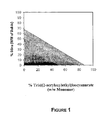
- Figure 1 shows a plot of concentration of colloidal silica vs concentration of high cross linking monomer (tris[2-acryloyloxy)ethyl]isocyanurate) and shows the effect of the concentration of each on the tintability of the composition of the invention.
- the data for Figure 1 were obtained using a system in which the coating was cured under a nitrogen blanket.
- the optical substrate is an ophthalmic lens.
- the composition and methods may be used to coat any transparent optical substrate.
- the coating composition of the invention includes a monomer having a polyoxyalkylene backbone containing at least four oxyalkylene units, an abrasion resistant agent and a high crosslinking monomer.
- the composition can be coated onto a preformed lens or onto a mould surface prior to casting of a lens in an in-mould coating process.
- the basic in-mould coating process is similar to the one described in International patent application WO01/21375 , which is incorporated herein solely for the purpose of exemplifying in-mould coating processes.
- the in-mould coating process typically involves coating the casting face of a mould section with the composition of the invention, optionally in a suitable solvent.
- the composition may be applied by a variety of techniques including spraying, dipping, brushing, flow coating, spin coating and the like.
- the composition may then be partially or fully cured, for example by UV initiated partial polymerisation.
- the degree of polymerisation may be controlled as described in WO01/21375 .
- the mould pieces After coating the mould section with the composition and partial curing and/or solvent removal, the mould pieces are fitted together to form a coated mould cavity. Lens monomer is then poured into the mould and the plastic is cured in the usual way.
- the monomer having a polyoxyalkylene backbone containing at least four oxyalkylene units may be present in the coating composition in an amount of from about 10 to about 100% as a w/w of the total monomer (i.e. polyoxyalkylene monomer and high cross linking monomer).
- the monomer having a polyoxyalkylene backbone containing at least four oxyalkylene units may be a monomer containing a long chain polyoxyethylene backbone and is preferably a di(meth)acrylate monomer with a long chain polyoxyethylene backbone.
- Suitable polyoxyethylene di(meth)acrylates include polyethylene glycol (200) di(meth)acrylate, polyethylene glycol (400) di(meth)acrylate and polyethylene glycol (600) di(meth)acrylate.
- the abrasion resistant agent is acrylated colloidal silica although other acrylated colloidal species such as titanium dioxide, zirconium dioxide or other inorganic oxide could also be used.
- the abrasion resistant agent promotes coating adhesion durability and abrasion resistance.
- the acrylated colloidal silica does not contain any significant amounts of hexane diol diacrylate.
- Hexane diol diacrylate (HDDA) is commonly used as a dispersant in commercial acrylated colloidal silica preparations.
- the amount of acrylated colloidal silica that is present in the composition may vary up to about 70% (w/w solids) however, as discussed in more detail later, the amount used will depend on the amount of high cross linking monomer that is present in the composition.
- high cross linking monomer refers to a monomer that has a rigid backbone or a flexible backbone attached to a rigid core (such as an aromatic ring) wherein polymerisation of the high cross linking monomer provides a polymer having a high level of abrasion resistance.
- the level of abrasion resistance of the polymerised coating can be determined using standard tests, the details of which are provided in the examples provided herein.
- the high crosslinking monomer may be tris[2-(meth)acryloyloxy]ethyl]isocyanurate, tris(2-hydroxyethyl)isocyanurate di(meth)acrylate, N,N',N"-tris(meth)acrylhexahydro-s-triazine, pentaerythritol tetra(meth)acrylate, dipentaerythritol hexa(meth)acrylate, pentaerythritol tetra(meth)acrylate, tris(2-hydroxyethyl)isocyanurate tri(meth)acrylate, trimethylol propyl tri(meth)acrylate, dipentaerythritol hexa(meth)acrylate, 2,2,4,4,6,6-hexahydro-2,2,4,4,6,6-hexakis(2-((2-methyl-1-oxo-2-propenyl)oxy) ethoxy)-1,
- High crosslinking monomers with polar backbones such as tris[2-(meth)acryloyloxy]ethyl]isocyanurate, and tris(2-hydroxyethyl)isocyanurate di(meth)acrylate and N,N',N"-tris(meth)acrylhexahydro-s-triazine are most preferable as their polarity enhances the inherent tintability of the coating composition.
- tris[2-(meth)acryloyloxy]ethyl]isocyanurate, and tris(2-hydroxyethyl)isocyanurate di(meth)acrylate and N,N',N"-tris(meth)acrylhexahydro-s-triazine in the coating composition also enables the coated optical substrate to be overcoated with hard coatings.
- the high crosslinking monomer may be present in the coating composition in an amount of up to about 80% as a w/w of the total monomer (i.e. high cross linking monomer and long chain polyoxyalkylene monomer). Again, the amount used will depend on the amount of abrasion resistant agent that is present in the composition.
- the formulation regime for the coating composition is best represented by the diagram shown in Figure 1 and by Equation (I).
- the filled regions of the plot represent the tintable region.
- the darkest cross hatched region ( ⁇ ) represents the most preferable region in terms of tint rate and property performance.
- the lighter cross hatched regions ( ⁇ and ⁇ ) denote similar property performance but lower tint rates.
- the black region represents unacceptable abrasion resistance.
- the white region is the non-tintable region. From the diagram, it can be seen that the monomer ratio preference is dependent upon the level of silica. If the silica is low, higher levels of tris[2-acryloyloxy)ethyl]isocyanurate are required. If the silica is high, higher levels of polyethylene glycol (400) di(meth)acrylate are required.
- the weight percentage of tris[2-(acryloyloxy)ethyl]isocyanurate is preferably between about 50 and about 90%. Most preferably, when acrylated silica is not present (although an abrasion resistant agent is required in the coating composition of the present invention), the weight percentage of tris[2-(acryloyloxy)ethyl]isocyanurate is between about 50 and about 75%.
- the weight percentage of acrylated colloidal silica is preferably between about 30 and about 68%. Most preferably, when tris[2-(acryloyloxy)ethyl]isocyanurate is not present (although a high crosslinking monomer is required in the coating composition of the present invention), the weight percentage of acrylated colloidal silica is between about 30 and about 50%.
- the coating layer that is formed provides good abrasion resistance.
- abrasion resistance For example, using tris(2-(acryloyloxy)ethyl]isocyanurate and polyethylene glycol (400) di(meth)acrylate it is possible to achieve abrasion resistances that are up to 3 times more abrasion resistant in the standard Bayer test than uncoated CR-39, and up to 20 times more abrasion resistant in the standard steel wool test than uncoated CR-39.
- the coating composition preferably includes a solvent to promote adhesion of the coating to the polycarbonate. If the solvent is not sufficiently aggressive to polycarbonate then the level of adhesion of the coating to the polycarbonate lens substrate will not be sufficient. Alternatively, if the solvent selected is too aggressive than the coating will become hazy.
- Suitable solvents include ketones such as methyl isobutyl ketone, and esters such as ethyl acetate.
- ketones such as methyl isobutyl ketone
- esters such as ethyl acetate
- alcohol such as isopropanol or n-butanol.
- the solvent combination selected may have an influence on the tint rate of the cured coating. Without being bound by theory it can be speculated that solvent cage effects may affect the cure mechanism and hence affect the structure of the polymer matrix formed. In this regard, it was found that the use of esters was advantageous over ketones in terms of increasing the rate of tint uptake.
- the composition is preferably fully or partially cured.
- high intensity UV and/or high efficiency photoinitiators are used to overcome oxygen inhibition during polymerisation of the coating composition.
- the optimal photoinitiator depends upon the spectrum and intensity of the irradiating light source. High intensity UV lamps that are available from Fusion Corporation and Xenon Corporation are suitable.
- Suitable photopolymerisation initiators are acryloin and derivatives thereof, such as benzoin, benzoin methyl ether, benzoin ethyl ether, benzoin isopropyl ether, benzoin isobutyl ether, and ⁇ -methylbenzoin; diketones such as benzil and diacetyl, etc; organic sulfides such as diphenyl monosulfide, diphenyl disulfide, decylphenylsulfide, and tetramethylthiuram monosulfide; S-acyl dithiocarbamates, such as S-benzoyl-N,N-dimethyldithiocarbamate; phenones such as acetophenone, ⁇ , ⁇ , ⁇ -tribromacetophenone, ⁇ , ⁇ -diethoxyacetophenone, ⁇ , ⁇ -dimethoxy- ⁇ -phenylacetophenone, o-nitro- ⁇ , ⁇ , ⁇ -t
- photoinitiator Although the choice of photoinitiator is not restricted to any specific class, consideration needs to be given so that a residual colour is not imparted to the cured coating.
- photoinitiators available commercially include: Lucirin TPO, Irgacure 651, Irgacure 819, Irgacure 1800, Irgacure 500, lrgacure 907, Darocure 4043, Darocure 1664, Darocure 1116 and Vicure 55
- curing may or may not need to be undertaken in an oxygen depleted environment.
- optimal irradiation sources and photoinitiators are selected the difference in performance between coating resins cured in air versus those cured in an oxygen depleted environment is marginal. Curing in an environment depleted of oxygen also widens the choice of irradiation sources and photoinitiators.
- the composition may also be polymerised by curing using thermal initiators.
- the use of such an initiator may also need to be undertaken in an oxygen depleted environment.
- the initiator may be any of the suitable thermal initiators known in the art.
- the nature of the initiator utilised in the composition is dependent upon the ethylenically unsaturated material used. For example, for those ethylenically unsaturated materials that undergo free radical polymerisation, suitable initiators are compounds that liberate or generate a free-radical on addition of energy.
- Such initiators include peroxy, azo, and redox systems each of which are well known and are described in polymerisation art.
- the free-radical initiators include the conventional heat activated catalysts such as organic peroxides and organic hydroperoxides.
- these catalysts are benzoyl peroxide, tertiary-butyl perbenzoate, cumene hydroperoxide, azobis(isobutyronitrile) and the like.
- Suitable tinting compounds include dyes that are typically used by optical laboratories, such as BPI dyes from Brain Power Incorporated, Perma Dyes from Inland, Shades Lens Dyes from Cerium Optical
- the process of tinting typically involves the immersion of a lens in a heated solution (generally water based) of dissolved dyes.
- a heated solution generally water based
- an alternate tint process does exist whereby lenses can be immersed in a dye solution that is subsequently heated in a microwave.
- the dyes can be incorporated into a coating by applying a second coating that contains photochromic dyes over the coating of this invention.
- the lens, together with the two coatings is then heated to a high temperature to allow for the diffusion of the photochromic dyes from the coating containing the photochromic dye into the coating of this invention.
- the original coating containing the photochromic dye is then removed leaving the coating of this invention now containing photochromic dye. This process is commonly known as an imbibition process and is described in United States Patent 5,130,353 .
- Suitable photochromic dyes can be selected from one or more of the group consisting of anthraquinones, phthalocyanines, spiro-oxazines, chromenes, pyrans and fulgides.
- Examples of preferred photochromic dyes may be selected from the group consisting of:
- a method of imbibition of photochromic dyes into a lens that is particularly suited to the coating of this invention is as described in United States Patent 5,130,353 .
- a sufficient amount of photochromic dye needs to be present. If a hard coated optical element is to be imbibed with photochromic dye either a thin readily imbibable coating is applied over a readily imbibable element or the readily imbibable coating needs to be of sufficient thickness to accommodate a sufficient level of photochromic dye. Generally a coating depth of about 30 microns is required to be imbibed. Such readily imbibable coating can be applied either via an in-mould coating process or via a conventional coating process.
- composition was used in a spin coating process for a polycarbonate lens as described herein.
- composition was spin coated onto a polycarbonate lens using standard coating procedures.
- composition was cured by 15 seconds exposure to a Fusion Corporation D lamp with nitrogen blanketing.
- BPI Black from Brain Power Incorporated
- 100ml of BPI Black from Brain Power Incorporated is added to 1 litre of water, mixed and heated to 96°C.
- Lenses are dipped into the solution for a set period of time and transmission measured. This procedure is repeated periodically until the desired transmission is reached. The total time the lens is in the tinting solution is recorded.
- the Bayer and steel wool abrasion resistance rankings are based upon the abrasion resistance of a selected material relative to CR-39.
- Abrasion resistance is quantified in terms of the amount of haze developed when a lens is abraded. The higher the level of haze the less abrasion resistant a lens is.
- the star rating is based on the ratio of the level haze for a sample lens to the level of haze for an uncoated CR-39 lens. The star rating is based on the following haze ratios.
- composition was used in a spin coating process for a polycarbonate lens as described herein.
- the composition was cured by 15 seconds exposure to a Fusion Corporation D-lamp in air.
- composition was used in a spin coating process for a polycarbonate lens as described herein.
- tris[2-(acryloyloxy)ethyl]isocyanurate 40% (w/w monomer) polyethylene glycol (400) diacrylate 60% (w/w monomer) Acrylated Colloidal Silica 20% (w/w solids) Benzophenone 5% (w/w solids) BYK 300 0.8% (w/w solids) Solids 50% (w/w) Ethyl Acetate (plus residual solvent) 50% (w/w)
- composition was used in an in-mould coating process for a CR-39 lens as described herein.
- composition was applied to the back surface of a front mould and partially cured with -5 seconds exposure to a Fusion Corporation D-lamp in air.
- the back and front mould was assembled and filled with CR-39 monomer and thermally cured using standard processes.
- composition was used in a spin coating process for a polycarbonate lens as described herein polyethylene glycol (400) diacrylate 100% (w/w monomer) Acrylated Colloidal Silica 40% (w/w solids) Irgacure 651 5% (w/w solids) BYK 300 0.8% (w/w solids) Solids 50% (w/w) Ethyl Acetate(plus residual solvent) 50% (w/w)
- composition was used in a spin coating process for a polycarbonate lens as described herein tris[2-(acryloyloxy)ethyl]isocyanurate 70% (w/w monomer) polyethylene glycol (400) diacrylate 30% (w/w monomer) Acrylated Colloidal Silica 0% (w/w solids) Irgacure 651 5% (w/w solids) BYK 300 0.8% (w/w solids) Solids 50% (w/w) Ethyl Acetate (plus residual solvent) 50% (w/w)
Landscapes
- Chemical & Material Sciences (AREA)
- Organic Chemistry (AREA)
- Engineering & Computer Science (AREA)
- Life Sciences & Earth Sciences (AREA)
- Materials Engineering (AREA)
- Wood Science & Technology (AREA)
- Chemical Kinetics & Catalysis (AREA)
- Health & Medical Sciences (AREA)
- Medicinal Chemistry (AREA)
- Polymers & Plastics (AREA)
- Paints Or Removers (AREA)
- Surface Treatment Of Optical Elements (AREA)
- Coloring (AREA)
Claims (40)
- Ein Verfahren zur Einfärbung eines Substrats für optische Anwendungen, das die folgenden Verfahrensschritte umfasst:- Anwendung einer Beschichtungszusammensetzung, die sich wie folgt zusammensetzt:• aus einem polymerisierbaren Monomer mit einem Polyoxyalkylen-Rückgrat, das mindestens vier aneinander angrenzende Oxyalkyleneinheiten enthält, und• aus einem abriebfesten Mittel und einem hoch quervernetzenden polymerisierbaren Monomer,auf das optische Substrat,- wodurch die Beschichtungszusammensetzung zur Bildung einer abriebbeständigen Deckschicht polymerisiert wird,
und- wobei ein Einfärbungsmittel in die Deckschicht zur Einfärbung des optischen Substrats eingebracht wird, wobei die relativen Mengen des abriebfesten Mittels (y) als ein Gewichtsprozent der Feststoffe und das hoch quervernetzende Monomer (x) als ein Gewichtsprozent der Monomere zwischen y = -0,76x + 68 und y = -0,60x + 30 betragen. - Ein Verfahren zur Einfärbung eines Substrats für optische Anwendungen nach Anspruch 1, wobei die relativen Mengen des abriebfesten Mittels (y) als ein Gewichtsprozent der Feststoffe und das hoch quervernetzende Monomer (x) als ein Gewichtsprozent der Monomere zwischen y = -0,75x + 60 und y = -0,60x + 30 betragen.
- Ein Verfahren zur Einfärbung eines Substrats für optische Anwendungen nach Anspruch 2, wobei die relativen Mengen des abriebfesten Mittels (y) als ein Gewichtsprozent der Feststoffe und das hoch quervernetzende Monomer (x) als ein Gewichtsprozent der Monomere zwischen y = -0,67x + 50 und y = -0,60x + 30 betragen.
- Ein Verfahren zur Einfärbung eines Substrats für optische Anwendungen nach Anspruch 1, wobei das polymerisierbare Monomer mit einem Polyoxyalkylen-Rückgrat ein Polyoxyethylen-Rückgrat hat.
- Ein Verfahren zur Einfärbung eines Substrats für optische Anwendungen nach Anspruch 4, wobei das polymerisierbare Monomer mit einem Polyoxyalkylen-Rückgrat ein Diacrylat-Monomer ist.
- Ein Verfahren zur Einfärbung eines Substrats für optische Anwendungen nach Anspruch 4, wobei das polymerisierbare Monomer mit einem Polyoxyalkylen-Rückgrat ein Dimethacrylat-Monomer ist.
- Ein Verfahren zur Einfärbung eines Substrats für optische Anwendungen nach Anspruch 4, wobei das Monomer mit einem Polyoxyalkylen-Rückgrat aus der Gruppe ausgewählt ist, die Polyethylenglykol (200) Diacrylat, Polyethylenglykol (400) Diacrylat, Polyethylenglykol (600) Diacrylat, Polyethylenglykol (200) Dimethacrylat, Polyethylenglykol (400) Dimethacrylat und Polyethylenglykol (600) Dimethacrylat umfasst.
- Ein Verfahren zur Einfärbung eines Substrats für optische Anwendungen nach Anspruch 7, wobei es sich bei dem abriebfesten Mittel um eine akrylisierte kolloidale Art handelt.
- Ein Verfahren zur Einfärbung eines Substrats für optische Anwendungen nach Anspruch 8, wobei die akrylisierte kolloidale Art aus der Gruppe ausgewählt ist, die Kolloid-Kieselerde, Titandioxid und Zirkoniumdioxid umfasst.
- Ein Verfahren zur Einfärbung eines Substrats für optische Anwendungen nach Anspruch 9, wobei das abriebfeste Mittel eine akrylisierte Kolloid-Kieselerde ist.
- Ein Verfahren zur Einfärbung eines Substrats für optische Anwendungen nach Anspruch 10, wobei das hoch quervernetzende Monomer aus der Liste ausgewählt ist, die Tris[2-(meth)acryloyloxy]ethyl]isocyanurat, Tris(2-hydroxyethyl)isocyanurat-Di(meth)acrylat, N,N',N''-Tris(meth)acrylhexahydro-s-triazin, Pentaerythritol-Tetra(meth)acrylat, Dipentaerythritol-Hexa(meth)acrylat, Pentaerythritol-Tetra(meth)acrylat, Tris(2-hydroxyethyl)isocyanurat-Tri(meth)acrylat, Triethylolpropyltri(meth)acrylat, Dipentaerythritol-Hexa(meth)acrylat, 2,2,4,4,6,6-hexahydro-2,2,4,4,6,6-hexakis(2-((2-methyl-l-oxo-2-propenyl)oxy) ethoxy)-1,3,5,2,4,6-triazatriphosphorin, tetra-, penta- und hexafunktionale Urethan-(Meth)acrylate und Tricyclodecan-Dimethanol-Di(meth)acrylat umfasst.
- Ein Verfahren zur Einfärbung eines Substrats für optische Anwendungen nach Anspruch 11, wobei das hoch quervernetzende Monomer Tris[(2-acryloyloxy)ethyl]isocyanurat ist.
- Ein Verfahren zur Einfärbung eines Substrats für optische Anwendungen nach Anspruch 11, wobei das hoch quervernetzende Monomer Tris(2-hydroxyethyl)isocyanurat-Diacrylat ist.
- Ein Verfahren zur Einfärbung eines Substrats für optische Anwendungen nach Anspruch 1, wobei das optische Substrat ein Brillenglas ist.
- Ein Verfahren zur Einfärbung eines Substrats für optische Anwendungen nach Anspruch 1, wobei das optische Substrat aus einem aromatischen Polycarbonat gebildet wird.
- Ein Verfahren zur Einfärbung eines Substrats für optische Anwendungen nach Anspruch 15, wobei die Beschichtungszusammensetzung ein Lösungsmittel umfasst.
- Ein Verfahren zur Einfärbung eines Substrats für optische Anwendungen nach Anspruch 16, wobei das Lösungsmittel aus der Gruppe ausgewählt ist, die Ketone und Ester umfasst.
- Ein Verfahren zur Einfärbung eines Substrats für optische Anwendungen nach Anspruch 17, wobei das Lösungsmittel Methylisobutylketon ist.
- Ein Verfahren zur Einfärbung eines Substrats für optische Anwendungen nach Anspruch 17, wobei das Lösungsmittel Ethylacetat ist.
- Ein Verfahren zur Einfärbung eines Substrats für optische Anwendungen nach Anspruch 17, wobei das Lösungsmittel auch Isopropanol oder n-Butanol umfasst.
- Ein Verfahren zur Einfärbung eines Substrats für optische Anwendungen nach Anspruch 1, wobei das Einfärbungsmittel ein Festfarbstoff ist.
- Ein Verfahren zur Einfärbung eines Substrats für optische Anwendungen nach Anspruch 1, wobei das Einfärbungsmittel ein photochromer Farbstoff ist.
- Eine Beschichtungszusammensetzung, die für die Bildung einer abriebfesten, einfärbbaren Deckschicht auf einem Substrat für optische Anwendungen geeignet ist; diese Beschichtungszusammensetzung umfasst:• ein polymerisierbares Monomer mit einem Polyoxyalkylen-Rückgrat, das mindestens vier aneinander angrenzende Oxyalkyleneinheiten enthält, und• ein abriebfestes Mittel und ein hoch quervernetzendes polymerisierbares Monomer,wobei die Beschichtungszusammensetzung polymerisierbar ist, um eine abriebfeste Deckschicht auf dem optischen Substrat zu bilden, in die ein Einfärbungsmittel eingebracht werden kann, wobei die relativen Mengen des abriebfesten Mittels (y) als ein Gewichtsprozent der Feststoffe und das hoch quervernetzende Monomer (x) als ein Gewichtsprozent der Monomere zwischen y = -0,76x + 68 und y = -0,60x + 30 betragen.
- Eine Beschichtungszusammensetzung zur Einfärbung eines Substrats für optische Anwendungen nach Anspruch 23, wobei die relativen Mengen des abriebfesten Mittels (y) als ein Gewichtsprozent der Feststoffe und das hoch quervernetzende Monomer (x) als ein Gewichtsprozent der Monomere zwischen y = -0,75x + 60 und y = -0,60x + 30 betragen.
- Eine Beschichtungszusammensetzung zur Einfärbung eines Substrats für optische Anwendungen nach Anspruch 24, wobei die relativen Mengen des abriebfesten Mittels (y) als ein Gewichtsprozent der Feststoffe und das hoch quervernetzende Monomer (x) als ein Gewichtsprozent der Monomere zwischen y = -0,67x + 50 und y = -0,60x + 30 betragen.
- Eine Beschichtungszusammensetzung nach Anspruch 23, wobei das polymerisierbare Monomer mit einem Polyoxyalkylen-Rückgrat ein Polyoxyethylen-Rückgrat hat.
- Eine Beschichtungszusammensetzung nach Anspruch 26, wobei das Monomer mit einem Polyoxyalkylen-Rückgrat ein Diacrylat-Monomer ist.
- Eine Beschichtungszusammensetzung nach Anspruch 26, wobei das Monomer mit einem Polyoxyalkylen-Rückgrat ein Dimethacrylat-Monomer ist.
- Eine Beschichtungszusammensetzung nach Anspruch 26, wobei das Monomer mit einem Polyoxyalkylen-Rückgrat aus der Gruppe ausgewählt ist, die Polyethylenglykol (200) Diacrylat, Polyethylenglykol (400) Diacrylat, Polyethylenglykol (600) Diacrylat, Polyethylenglykol (200) Dimethacrylat, Polyethylenglykol (400) Dimethacrylat und Polyethylenglykol (600) Dimethacrylat umfasst.
- Eine Beschichtungszusammensetzung nach Anspruch 29, wobei es sich bei dem abriebfesten Mittel um eine akrylisierte kolloidale Art handelt.
- Eine Beschichtungszusammensetzung nach Anspruch 30, wobei die akrylisierte kolloidale Art aus der Gruppe ausgewählt ist, die Kolloid-Kieselerde, Titandioxid und Zirkoniumdioxid umfasst.
- Eine Beschichtungszusammensetzung nach Anspruch 31, wobei die akrylisierte kolloidale Art akrylisierte Kolloid-Kieselerde ist.
- Eine Beschichtungszusammensetzung nach Anspruch 32, wobei das hoch quervernetzende Monomer aus der Liste ausgewählt ist, die Tris[2-(meth)acryloyloxy]ethyl]isocyanurat, Tris(2-hydroxyethyl)isocyanurat-Di(meth)acrylat, N,N',N"-Tris(meth)acrylhexahydro-s-triazin, Pentaerythritol-Tetra(meth)acrylat, Dipentaerythritol-Hexa(meth)acrylat, Pentaerythritol-Tetra(meth)acrylat, Tris(2-hydroxyethyl)isocyanurat-Tri(meth)acrylat, Triethylol-Propyltri(meth)acrylat, Dipentaerythritol-Hexa(meth)acrylat, 2,2,4,4,6,6-hexahydro-2,2,4,4,6,6-hexakis(2-((2-methyl-1-oxo-2-propenyl)oxy) ethoxy)-1,3,5,2,4,6-triazatriphosphorin, tetra-, penta- und hexafunktionale Urethan-(Meth)acrylate und Tricyclodecan-Dimethanol-Di(meth)acrylat umfasst.
- Eine Beschichtungszusammensetzung nach Anspruch 33, wobei das hoch quervernetzende Monomer Tris[(2-acryloyloxy)ethyl]isocyanurat ist.
- Eine Beschichtungszusammensetzung nach Anspruch 33, wobei das hoch quervernetzende Monomer Tris(2-hydroxyethyl)isocyanurat-Diacrylat ist.
- Eine Beschichtungszusammensetzung nach Anspruch 33, wobei die Beschichtungszusammensetzung ein Lösungsmittel umfasst.
- Eine Beschichtungszusammensetzung nach Anspruch 36, wobei das Lösungsmittel aus der Gruppe ausgewählt ist, die Ketone und Ester umfasst.
- Eine Beschichtungszusammensetzung nach Anspruch 37, wobei das Lösungsmittel Methylisobutylketon ist.
- Eine Beschichtungszusammensetzung nach Anspruch 37, wobei das Lösungsmittel Ethylacetat ist.
- Eine Beschichtungszusammensetzung nach Anspruch 39, wobei das Lösungsmittel auch Isopropanol oder n-Butanol umfasst.
Applications Claiming Priority (3)
| Application Number | Priority Date | Filing Date | Title |
|---|---|---|---|
| AU2003900960 | 2003-03-03 | ||
| AU2003900960A AU2003900960A0 (en) | 2003-03-03 | 2003-03-03 | Tinting optical substrates |
| PCT/AU2004/000271 WO2004078862A1 (en) | 2003-03-03 | 2004-03-03 | Tinting optical substrates |
Publications (3)
| Publication Number | Publication Date |
|---|---|
| EP1599554A1 EP1599554A1 (de) | 2005-11-30 |
| EP1599554A4 EP1599554A4 (de) | 2006-08-02 |
| EP1599554B1 true EP1599554B1 (de) | 2014-06-25 |
Family
ID=31500006
Family Applications (1)
| Application Number | Title | Priority Date | Filing Date |
|---|---|---|---|
| EP04716518.8A Expired - Lifetime EP1599554B1 (de) | 2003-03-03 | 2004-03-03 | Verfahren zur einfärbung von substraten für optische anwendungen |
Country Status (9)
| Country | Link |
|---|---|
| US (2) | US7763313B2 (de) |
| EP (1) | EP1599554B1 (de) |
| CN (1) | CN100383207C (de) |
| AU (1) | AU2003900960A0 (de) |
| BR (1) | BRPI0407915B1 (de) |
| DE (1) | DE04716518T1 (de) |
| ES (1) | ES2505698T3 (de) |
| PT (1) | PT1599554E (de) |
| WO (1) | WO2004078862A1 (de) |
Families Citing this family (6)
| Publication number | Priority date | Publication date | Assignee | Title |
|---|---|---|---|---|
| ES2901736T3 (es) | 2014-07-10 | 2022-03-23 | Carl Zeiss Vision Italia S P A | Método para teñir con color una lente para gafas protectoras y gafas |
| EP3273290A1 (de) * | 2016-07-21 | 2018-01-24 | Carl Zeiss Vision International GmbH | Drucktinte, vorzugsweise 3d-drucktinte, brillenglas und verfahren zur herstellung eines brillenglases |
| EP3316021A1 (de) | 2016-12-23 | 2018-05-02 | Carl Zeiss Vision International GmbH | Komponente für eine brille mit detektor für das erfassen einer uv-licht-strahlendosis |
| EP3715117B1 (de) * | 2017-09-29 | 2024-03-06 | NIKE Innovate C.V. | Strukturell gefärbte textilartikel und verfahren zur herstellung strukturell gefärbter textilartikel |
| CA3104446C (en) * | 2018-06-29 | 2023-08-22 | Gerald TREADWAY | Tintable abrasion resistant compositions |
| CN113248667B (zh) * | 2021-04-30 | 2022-04-12 | 江苏可奥熙光学材料科技有限公司 | 一种超韧型丙烯酸酯树脂及其制备工艺 |
Family Cites Families (27)
| Publication number | Priority date | Publication date | Assignee | Title |
|---|---|---|---|---|
| US743920A (en) * | 1902-09-02 | 1903-11-10 | Thomas H Phillips | Impact-tool. |
| JPS5925840A (ja) * | 1982-08-05 | 1984-02-09 | Mitsui Petrochem Ind Ltd | 被覆用硬化型樹脂組成物 |
| GB2163172B (en) * | 1984-06-30 | 1987-11-25 | Yokohama Rubber Co Ltd | Ultraviolet-curing resin composition |
| US4774035A (en) * | 1986-01-14 | 1988-09-27 | Camelot Industries Corporation | Process of coating an ophthalmic lens |
| EP0269366B1 (de) * | 1986-11-21 | 1995-06-07 | Sola International Holdings, Ltd. | Vernetzbare Giessmassen |
| US4954591A (en) | 1987-11-06 | 1990-09-04 | Pilkington Visioncare Holdings, Inc. | Abrasion resistant radiation curable coating for polycarbonate article |
| US5250723A (en) * | 1989-03-01 | 1993-10-05 | Mitsui Toatsu Chemicals, Inc. | High surface hardness transparent resin and polymerizable monomer |
| CA2018237C (en) | 1989-07-14 | 2000-05-09 | Antony P. Wright | Radiation curable acryloxyfunctional silicone coating composition |
| US5258225A (en) * | 1990-02-16 | 1993-11-02 | General Electric Company | Acrylic coated thermoplastic substrate |
| US5130353A (en) | 1990-03-07 | 1992-07-14 | Ppg Industries, Inc. | Method for preparing photochromic plastic article |
| WO1992017535A1 (en) * | 1991-04-03 | 1992-10-15 | Red Spot Paint & Varnish Co., Inc. | Uv curable clearcoat compositions and process |
| US5232964A (en) | 1991-11-12 | 1993-08-03 | Dow Corning Corporation | Tintable abrasion resistant coating compositions |
| US5368941A (en) * | 1992-08-31 | 1994-11-29 | Dow Corning Corporation | Deformable, abrasion-resistant silicone coating and method of producing the same |
| US5916669A (en) * | 1994-11-10 | 1999-06-29 | 2C Optics, Inc. | Enhanced abrasion resistance radiation curable coating for substrates |
| US5619288A (en) * | 1995-01-23 | 1997-04-08 | Essilor Of America, Inc. | Impact resistant plastic ophthalmic lens |
| US5614321A (en) * | 1995-04-14 | 1997-03-25 | General Electric Company | Abrasion resistant, curable hardcoating compositions and tinted articles made therefrom |
| AUPN268495A0 (en) * | 1995-04-27 | 1995-05-25 | Sola International Holdings Ltd | Tintable cross-linkable compositions |
| US5804301A (en) * | 1996-01-11 | 1998-09-08 | Avery Dennison Corporation | Radiation-curable coating compositions |
| US6087010A (en) * | 1996-06-10 | 2000-07-11 | Nof Corporation | Fluorine-containing polyfunctional (meth) acrylate composition low refractivity material and reflection reducing film |
| US5743920A (en) * | 1996-08-23 | 1998-04-28 | Kohan; George | No-mess ophthalmic lens tinting process |
| AUPP155998A0 (en) * | 1998-01-29 | 1998-02-19 | Sola International Holdings Ltd | Coating composition |
| AUPQ326399A0 (en) | 1999-09-21 | 1999-10-28 | Sola International Holdings Ltd | Method of coating an optical element |
| AU7996600A (en) * | 1999-10-07 | 2001-05-10 | Sola International Inc. | Uv curable coatings for plastic ophthalmic lens |
| AUPR056300A0 (en) * | 2000-09-29 | 2000-10-26 | Sola International Holdings Ltd | Edge coated ophthalmic lens |
| US6799233B1 (en) | 2001-06-29 | 2004-09-28 | Koninklijke Philips Electronics N.V. | Generalized I2C slave transmitter/receiver state machine |
| AUPR949001A0 (en) * | 2001-12-14 | 2002-01-24 | Sola International Holdings Ltd | Abrasion resistant coating composition |
| US7452924B2 (en) * | 2003-08-12 | 2008-11-18 | 3M Espe Ag | Self-etching emulsion dental compositions and methods |
-
2003
- 2003-03-03 AU AU2003900960A patent/AU2003900960A0/en not_active Abandoned
-
2004
- 2004-03-03 ES ES04716518.8T patent/ES2505698T3/es not_active Expired - Lifetime
- 2004-03-03 DE DE04716518T patent/DE04716518T1/de active Pending
- 2004-03-03 EP EP04716518.8A patent/EP1599554B1/de not_active Expired - Lifetime
- 2004-03-03 US US10/548,124 patent/US7763313B2/en active Active
- 2004-03-03 BR BRPI0407915-9A patent/BRPI0407915B1/pt not_active IP Right Cessation
- 2004-03-03 PT PT47165188T patent/PT1599554E/pt unknown
- 2004-03-03 CN CNB2004800057610A patent/CN100383207C/zh not_active Expired - Lifetime
- 2004-03-03 WO PCT/AU2004/000271 patent/WO2004078862A1/en not_active Ceased
-
2010
- 2010-06-17 US US12/817,647 patent/US8044141B2/en not_active Expired - Lifetime
Also Published As
| Publication number | Publication date |
|---|---|
| BRPI0407915A (pt) | 2006-03-01 |
| WO2004078862A1 (en) | 2004-09-16 |
| US20060148952A1 (en) | 2006-07-06 |
| ES2505698T3 (es) | 2014-10-10 |
| CN1756814A (zh) | 2006-04-05 |
| US8044141B2 (en) | 2011-10-25 |
| US7763313B2 (en) | 2010-07-27 |
| EP1599554A1 (de) | 2005-11-30 |
| DE04716518T1 (de) | 2006-07-13 |
| BRPI0407915B1 (pt) | 2014-09-02 |
| AU2003900960A0 (en) | 2003-03-13 |
| EP1599554A4 (de) | 2006-08-02 |
| CN100383207C (zh) | 2008-04-23 |
| PT1599554E (pt) | 2014-08-05 |
| US20100256297A1 (en) | 2010-10-07 |
Similar Documents
| Publication | Publication Date | Title |
|---|---|---|
| US9453950B2 (en) | Photochromic coating process | |
| EP2015923B1 (de) | Verfahren zur herstellung von optischen elementen mit hohem brechungsindex | |
| US6863848B2 (en) | Methods for preparing composite photochromic ophthalmic lenses | |
| US8044141B2 (en) | Tinting optical substrates | |
| EP1453920B1 (de) | Zusammensetzung für kratzfesten überzug | |
| WO1993021010A1 (en) | Lenses with high impact resistance and high scratch resistance | |
| JP7596076B2 (ja) | フォトクロミック物品および眼鏡 | |
| JPH10510927A (ja) | 光透過可能な物品へのホトクロミック分子の配合 | |
| EP4502673A1 (de) | Polymerisierbare zusammensetzung für einen optischen artikel und optischer artikel | |
| JP7429119B2 (ja) | 光学物品用重合性組成物および光学物品 | |
| RU2373061C1 (ru) | Фотохромные органические триплексы и способ их получения | |
| WO2021132049A1 (ja) | フォトクロミック物品の保護層形成用重合性組成物、フォトクロミック物品および眼鏡 | |
| EP1549483B1 (de) | Verfahren zur herstellung von photochromen ophthalmischen verbundlinsen und eine photochrome linse | |
| JP2011215245A (ja) | フォトクロミックレンズ | |
| AU2002366250B2 (en) | Photochromic coating process | |
| JP2001011109A (ja) | 高屈折率光硬化性樹脂組成物およびその硬化物 | |
| WO2025249536A1 (ja) | フォトクロミック物品の保護層形成用硬化性組成物、フォトクロミック物品及び眼鏡 | |
| WO1996034025A1 (en) | Tintable cross-linkable compositions | |
| EP4502672A1 (de) | Polymerisierbare zusammensetzung für einen optischen artikel und optischer artikel |
Legal Events
| Date | Code | Title | Description |
|---|---|---|---|
| PUAI | Public reference made under article 153(3) epc to a published international application that has entered the european phase |
Free format text: ORIGINAL CODE: 0009012 |
|
| 17P | Request for examination filed |
Effective date: 20050816 |
|
| AK | Designated contracting states |
Kind code of ref document: A1 Designated state(s): AT BE BG CH CY CZ DE DK EE ES FI FR GB GR HU IE IT LI LU MC NL PL PT RO SE SI SK TR |
|
| AX | Request for extension of the european patent |
Extension state: AL LT LV MK |
|
| DAX | Request for extension of the european patent (deleted) | ||
| DET | De: translation of patent claims | ||
| A4 | Supplementary search report drawn up and despatched |
Effective date: 20060705 |
|
| 17Q | First examination report despatched |
Effective date: 20061020 |
|
| EL | Fr: translation of claims filed | ||
| RAP1 | Party data changed (applicant data changed or rights of an application transferred) |
Owner name: CARL ZEISS VISION AUSTRALIA HOLDINGS LTD. |
|
| GRAP | Despatch of communication of intention to grant a patent |
Free format text: ORIGINAL CODE: EPIDOSNIGR1 |
|
| INTG | Intention to grant announced |
Effective date: 20140108 |
|
| GRAS | Grant fee paid |
Free format text: ORIGINAL CODE: EPIDOSNIGR3 |
|
| GRAA | (expected) grant |
Free format text: ORIGINAL CODE: 0009210 |
|
| AK | Designated contracting states |
Kind code of ref document: B1 Designated state(s): AT BE BG CH CY CZ DE DK EE ES FI FR GB GR HU IE IT LI LU MC NL PL PT RO SE SI SK TR |
|
| REG | Reference to a national code |
Ref country code: GB Ref legal event code: FG4D |
|
| REG | Reference to a national code |
Ref country code: CH Ref legal event code: EP |
|
| REG | Reference to a national code |
Ref country code: AT Ref legal event code: REF Ref document number: 674723 Country of ref document: AT Kind code of ref document: T Effective date: 20140715 |
|
| REG | Reference to a national code |
Ref country code: IE Ref legal event code: FG4D |
|
| REG | Reference to a national code |
Ref country code: PT Ref legal event code: SC4A Free format text: AVAILABILITY OF NATIONAL TRANSLATION Effective date: 20140730 |
|
| REG | Reference to a national code |
Ref country code: DE Ref legal event code: R096 Ref document number: 602004045346 Country of ref document: DE Effective date: 20140807 |
|
| REG | Reference to a national code |
Ref country code: ES Ref legal event code: FG2A Ref document number: 2505698 Country of ref document: ES Kind code of ref document: T3 Effective date: 20141010 |
|
| PG25 | Lapsed in a contracting state [announced via postgrant information from national office to epo] |
Ref country code: CY Free format text: LAPSE BECAUSE OF FAILURE TO SUBMIT A TRANSLATION OF THE DESCRIPTION OR TO PAY THE FEE WITHIN THE PRESCRIBED TIME-LIMIT Effective date: 20140625 Ref country code: GR Free format text: LAPSE BECAUSE OF FAILURE TO SUBMIT A TRANSLATION OF THE DESCRIPTION OR TO PAY THE FEE WITHIN THE PRESCRIBED TIME-LIMIT Effective date: 20140926 Ref country code: FI Free format text: LAPSE BECAUSE OF FAILURE TO SUBMIT A TRANSLATION OF THE DESCRIPTION OR TO PAY THE FEE WITHIN THE PRESCRIBED TIME-LIMIT Effective date: 20140625 |
|
| REG | Reference to a national code |
Ref country code: AT Ref legal event code: MK05 Ref document number: 674723 Country of ref document: AT Kind code of ref document: T Effective date: 20140625 |
|
| REG | Reference to a national code |
Ref country code: NL Ref legal event code: VDEP Effective date: 20140625 |
|
| PG25 | Lapsed in a contracting state [announced via postgrant information from national office to epo] |
Ref country code: SE Free format text: LAPSE BECAUSE OF FAILURE TO SUBMIT A TRANSLATION OF THE DESCRIPTION OR TO PAY THE FEE WITHIN THE PRESCRIBED TIME-LIMIT Effective date: 20140625 |
|
| PG25 | Lapsed in a contracting state [announced via postgrant information from national office to epo] |
Ref country code: SK Free format text: LAPSE BECAUSE OF FAILURE TO SUBMIT A TRANSLATION OF THE DESCRIPTION OR TO PAY THE FEE WITHIN THE PRESCRIBED TIME-LIMIT Effective date: 20140625 Ref country code: CZ Free format text: LAPSE BECAUSE OF FAILURE TO SUBMIT A TRANSLATION OF THE DESCRIPTION OR TO PAY THE FEE WITHIN THE PRESCRIBED TIME-LIMIT Effective date: 20140625 Ref country code: EE Free format text: LAPSE BECAUSE OF FAILURE TO SUBMIT A TRANSLATION OF THE DESCRIPTION OR TO PAY THE FEE WITHIN THE PRESCRIBED TIME-LIMIT Effective date: 20140625 Ref country code: RO Free format text: LAPSE BECAUSE OF FAILURE TO SUBMIT A TRANSLATION OF THE DESCRIPTION OR TO PAY THE FEE WITHIN THE PRESCRIBED TIME-LIMIT Effective date: 20140625 |
|
| PG25 | Lapsed in a contracting state [announced via postgrant information from national office to epo] |
Ref country code: AT Free format text: LAPSE BECAUSE OF FAILURE TO SUBMIT A TRANSLATION OF THE DESCRIPTION OR TO PAY THE FEE WITHIN THE PRESCRIBED TIME-LIMIT Effective date: 20140625 Ref country code: NL Free format text: LAPSE BECAUSE OF FAILURE TO SUBMIT A TRANSLATION OF THE DESCRIPTION OR TO PAY THE FEE WITHIN THE PRESCRIBED TIME-LIMIT Effective date: 20140625 Ref country code: PL Free format text: LAPSE BECAUSE OF FAILURE TO SUBMIT A TRANSLATION OF THE DESCRIPTION OR TO PAY THE FEE WITHIN THE PRESCRIBED TIME-LIMIT Effective date: 20140625 |
|
| REG | Reference to a national code |
Ref country code: DE Ref legal event code: R097 Ref document number: 602004045346 Country of ref document: DE |
|
| PG25 | Lapsed in a contracting state [announced via postgrant information from national office to epo] |
Ref country code: DK Free format text: LAPSE BECAUSE OF FAILURE TO SUBMIT A TRANSLATION OF THE DESCRIPTION OR TO PAY THE FEE WITHIN THE PRESCRIBED TIME-LIMIT Effective date: 20140625 Ref country code: IT Free format text: LAPSE BECAUSE OF FAILURE TO SUBMIT A TRANSLATION OF THE DESCRIPTION OR TO PAY THE FEE WITHIN THE PRESCRIBED TIME-LIMIT Effective date: 20140625 |
|
| PLBE | No opposition filed within time limit |
Free format text: ORIGINAL CODE: 0009261 |
|
| STAA | Information on the status of an ep patent application or granted ep patent |
Free format text: STATUS: NO OPPOSITION FILED WITHIN TIME LIMIT |
|
| 26N | No opposition filed |
Effective date: 20150326 |
|
| PG25 | Lapsed in a contracting state [announced via postgrant information from national office to epo] |
Ref country code: BE Free format text: LAPSE BECAUSE OF FAILURE TO SUBMIT A TRANSLATION OF THE DESCRIPTION OR TO PAY THE FEE WITHIN THE PRESCRIBED TIME-LIMIT Effective date: 20140625 |
|
| PG25 | Lapsed in a contracting state [announced via postgrant information from national office to epo] |
Ref country code: MC Free format text: LAPSE BECAUSE OF FAILURE TO SUBMIT A TRANSLATION OF THE DESCRIPTION OR TO PAY THE FEE WITHIN THE PRESCRIBED TIME-LIMIT Effective date: 20140625 Ref country code: LU Free format text: LAPSE BECAUSE OF FAILURE TO SUBMIT A TRANSLATION OF THE DESCRIPTION OR TO PAY THE FEE WITHIN THE PRESCRIBED TIME-LIMIT Effective date: 20150303 |
|
| REG | Reference to a national code |
Ref country code: CH Ref legal event code: PL |
|
| PG25 | Lapsed in a contracting state [announced via postgrant information from national office to epo] |
Ref country code: SI Free format text: LAPSE BECAUSE OF FAILURE TO SUBMIT A TRANSLATION OF THE DESCRIPTION OR TO PAY THE FEE WITHIN THE PRESCRIBED TIME-LIMIT Effective date: 20140625 |
|
| REG | Reference to a national code |
Ref country code: IE Ref legal event code: MM4A |
|
| PG25 | Lapsed in a contracting state [announced via postgrant information from national office to epo] |
Ref country code: LI Free format text: LAPSE BECAUSE OF NON-PAYMENT OF DUE FEES Effective date: 20150331 Ref country code: CH Free format text: LAPSE BECAUSE OF NON-PAYMENT OF DUE FEES Effective date: 20150331 Ref country code: IE Free format text: LAPSE BECAUSE OF NON-PAYMENT OF DUE FEES Effective date: 20150303 |
|
| REG | Reference to a national code |
Ref country code: FR Ref legal event code: PLFP Year of fee payment: 13 |
|
| REG | Reference to a national code |
Ref country code: FR Ref legal event code: PLFP Year of fee payment: 14 |
|
| PG25 | Lapsed in a contracting state [announced via postgrant information from national office to epo] |
Ref country code: BG Free format text: LAPSE BECAUSE OF FAILURE TO SUBMIT A TRANSLATION OF THE DESCRIPTION OR TO PAY THE FEE WITHIN THE PRESCRIBED TIME-LIMIT Effective date: 20140625 Ref country code: HU Free format text: LAPSE BECAUSE OF FAILURE TO SUBMIT A TRANSLATION OF THE DESCRIPTION OR TO PAY THE FEE WITHIN THE PRESCRIBED TIME-LIMIT; INVALID AB INITIO Effective date: 20040303 |
|
| PG25 | Lapsed in a contracting state [announced via postgrant information from national office to epo] |
Ref country code: TR Free format text: LAPSE BECAUSE OF FAILURE TO SUBMIT A TRANSLATION OF THE DESCRIPTION OR TO PAY THE FEE WITHIN THE PRESCRIBED TIME-LIMIT Effective date: 20140625 |
|
| REG | Reference to a national code |
Ref country code: FR Ref legal event code: PLFP Year of fee payment: 15 |
|
| PGFP | Annual fee paid to national office [announced via postgrant information from national office to epo] |
Ref country code: FR Payment date: 20230322 Year of fee payment: 20 |
|
| PGFP | Annual fee paid to national office [announced via postgrant information from national office to epo] |
Ref country code: PT Payment date: 20230223 Year of fee payment: 20 Ref country code: GB Payment date: 20230321 Year of fee payment: 20 Ref country code: DE Payment date: 20220620 Year of fee payment: 20 |
|
| PGFP | Annual fee paid to national office [announced via postgrant information from national office to epo] |
Ref country code: ES Payment date: 20230527 Year of fee payment: 20 |
|
| REG | Reference to a national code |
Ref country code: DE Ref legal event code: R071 Ref document number: 602004045346 Country of ref document: DE |
|
| REG | Reference to a national code |
Ref country code: GB Ref legal event code: PE20 Expiry date: 20240302 |
|
| REG | Reference to a national code |
Ref country code: ES Ref legal event code: FD2A Effective date: 20240401 |
|
| PG25 | Lapsed in a contracting state [announced via postgrant information from national office to epo] |
Ref country code: ES Free format text: LAPSE BECAUSE OF EXPIRATION OF PROTECTION Effective date: 20240304 |
|
| PG25 | Lapsed in a contracting state [announced via postgrant information from national office to epo] |
Ref country code: ES Free format text: LAPSE BECAUSE OF EXPIRATION OF PROTECTION Effective date: 20240304 Ref country code: GB Free format text: LAPSE BECAUSE OF EXPIRATION OF PROTECTION Effective date: 20240302 Ref country code: PT Free format text: LAPSE BECAUSE OF EXPIRATION OF PROTECTION Effective date: 20240312 |