EP1599007B1 - Verfahren und Server zur Bereitstellung eines multi-modalen Dialogs - Google Patents
Verfahren und Server zur Bereitstellung eines multi-modalen Dialogs Download PDFInfo
- Publication number
- EP1599007B1 EP1599007B1 EP04291272A EP04291272A EP1599007B1 EP 1599007 B1 EP1599007 B1 EP 1599007B1 EP 04291272 A EP04291272 A EP 04291272A EP 04291272 A EP04291272 A EP 04291272A EP 1599007 B1 EP1599007 B1 EP 1599007B1
- Authority
- EP
- European Patent Office
- Prior art keywords
- modal
- client
- script
- resource
- proxy server
- Prior art date
- Legal status (The legal status is an assumption and is not a legal conclusion. Google has not performed a legal analysis and makes no representation as to the accuracy of the status listed.)
- Expired - Lifetime
Links
- 238000000034 method Methods 0.000 title claims abstract description 22
- 230000003993 interaction Effects 0.000 claims abstract description 33
- 238000013515 script Methods 0.000 claims description 57
- 230000004044 response Effects 0.000 description 22
- 238000004891 communication Methods 0.000 description 16
- 238000012546 transfer Methods 0.000 description 9
- 230000006870 function Effects 0.000 description 6
- 235000010627 Phaseolus vulgaris Nutrition 0.000 description 5
- 244000046052 Phaseolus vulgaris Species 0.000 description 5
- 238000012545 processing Methods 0.000 description 4
- 230000001360 synchronised effect Effects 0.000 description 4
- 230000005540 biological transmission Effects 0.000 description 3
- 238000007726 management method Methods 0.000 description 3
- 238000010295 mobile communication Methods 0.000 description 3
- 230000008569 process Effects 0.000 description 3
- 150000003839 salts Chemical class 0.000 description 3
- 239000011800 void material Substances 0.000 description 3
- 230000000903 blocking effect Effects 0.000 description 2
- 230000008859 change Effects 0.000 description 2
- 238000013499 data model Methods 0.000 description 2
- 230000001419 dependent effect Effects 0.000 description 2
- 230000007246 mechanism Effects 0.000 description 2
- 230000009466 transformation Effects 0.000 description 2
- 230000001960 triggered effect Effects 0.000 description 2
- 101001094649 Homo sapiens Popeye domain-containing protein 3 Proteins 0.000 description 1
- 101000608234 Homo sapiens Pyrin domain-containing protein 5 Proteins 0.000 description 1
- 101000578693 Homo sapiens Target of rapamycin complex subunit LST8 Proteins 0.000 description 1
- 102100027802 Target of rapamycin complex subunit LST8 Human genes 0.000 description 1
- 238000004458 analytical method Methods 0.000 description 1
- 230000009118 appropriate response Effects 0.000 description 1
- 230000015556 catabolic process Effects 0.000 description 1
- 230000001413 cellular effect Effects 0.000 description 1
- 238000006243 chemical reaction Methods 0.000 description 1
- 238000010168 coupling process Methods 0.000 description 1
- 238000005859 coupling reaction Methods 0.000 description 1
- 238000006731 degradation reaction Methods 0.000 description 1
- 238000010586 diagram Methods 0.000 description 1
- 238000005516 engineering process Methods 0.000 description 1
- 239000000284 extract Substances 0.000 description 1
- 238000011160 research Methods 0.000 description 1
- 238000005316 response function Methods 0.000 description 1
Images

Classifications
-
- H—ELECTRICITY
- H04—ELECTRIC COMMUNICATION TECHNIQUE
- H04L—TRANSMISSION OF DIGITAL INFORMATION, e.g. TELEGRAPHIC COMMUNICATION
- H04L67/00—Network arrangements or protocols for supporting network services or applications
- H04L67/01—Protocols
- H04L67/02—Protocols based on web technology, e.g. hypertext transfer protocol [HTTP]
-
- H—ELECTRICITY
- H04—ELECTRIC COMMUNICATION TECHNIQUE
- H04L—TRANSMISSION OF DIGITAL INFORMATION, e.g. TELEGRAPHIC COMMUNICATION
- H04L67/00—Network arrangements or protocols for supporting network services or applications
- H04L67/50—Network services
- H04L67/56—Provisioning of proxy services
-
- H—ELECTRICITY
- H04—ELECTRIC COMMUNICATION TECHNIQUE
- H04L—TRANSMISSION OF DIGITAL INFORMATION, e.g. TELEGRAPHIC COMMUNICATION
- H04L67/00—Network arrangements or protocols for supporting network services or applications
- H04L67/50—Network services
- H04L67/56—Provisioning of proxy services
- H04L67/565—Conversion or adaptation of application format or content
Definitions
- the present invention relates to a method of providing a multi-modal dialog between a multi-modal application and a user communicating with the multi-modal application via a client suited to exchange and present documents encoded in standard or extended hyper text mark-up language.
- the invention further relates to a proxy server for supporting multi-modal dialogs between multi-modal applications and users.
- computers have been provided with a plurality of different types of input devices, such as a keyboard, a mouse, a touch panel, an image scanner, a video camera, a pen and a microphone to enable various information items to be inputted in various forms.
- input devices such as a keyboard, a mouse, a touch panel, an image scanner, a video camera, a pen and a microphone
- output devices such as different forms of display units and a loudspeaker
- enhanced communication terminals are equipped with different types of input and output devices which enables input and output of information items in various forms.
- JP 101 07877 A describes a multi-modal telephone set which uses both, a display and a synthesized voice to communicate with the user.
- SALT Speech Application Language Tags
- PDA Personal Digital Assistant
- the application framework is comprised of three main components: a modality-independent application model, transformation rules, and a controller.
- the application model consists of a data model to be populated via user interaction and a high-level description of the user interaction to be carried out in populating the data model.
- User interaction is defined in the application model as a sequence of modality-independent building blocks called conversational gestures, e.g., input fields for user input and messages to the user.
- the controller mediates between the application model and a user's device.
- the controller represents the sequence of the conversational gestures as a tree structure which is traversed.
- the controller applies modality-specific transformation rules to render the modality-independent conversational gestures into the specific view of the user's device.
- user input is captured by the user's modality specific device and communicated to the controller.
- Multi-modal Data Access Research Disclosure, Kenneth Mason Publications, Hampshire, Great Britain, no. 426, Win 1999, ISSN 0374-4353, pages 1393-1396 , describes a standards-open multi-modal system for accessing personal data stored in a back-end data source such as an email server or an address data base.
- a user using a modality-specific client send a request comprising a request type, such as "get message N", and a client-device indicator to the ReqMux which determines which facade the request has to be forwarded to.
- POP Post Office Protocol
- XML Extensible Markup Language
- XSL Extensible Style Sheet Language
- JSP Java Server Pages
- style sheets are stored in the system server and selected based on the output type requested by the client.
- the object of the present invention is achieved by a method according to claim 1.
- the object of the present invention is further achieved by a proxy server according to claim 6.
- the multi-modal proxy establishes multi-modal interactions based on standard browser technology e.g. on a browser based multi-tier web applications. Proxy components perform the client-side multi-modal dialog control and synchronization, which has no longer be done by components of the client.
- This architecture combines high speed performance with reduced computation power and memory requirements at the client's side. This supports the use of thin clients. Further, it increases flexibility and applicability of multi-modal applications and features since it is sufficient to equip a client with standard browser components to use this client in the context of a multi-modal dialog.
- the thin client architecture advances the desktop/location-centric applications to a centralized processing, management and support environment.
- the invention increases the scalability and maintability of the multi-modal system. It provides the ability to scale as business needs change as well as accommodate increased users, transactions volumes and history - and this without performance degradation. Further, it guarantees the co-existence with legacy applications.
- a multi-modal system comprises a client with a standard internet browser without add-ons e.g. without a specific plug-in, a multi-modal proxy server responsible for multi-modal session- and dialog-management and a multi-modal server which comprises several resource modules such as a speech recognition, text to speech and handwriting recognition modules.
- HTTP Hyper Text Transfer Protocol
- RTP Real Time Protocol
- a multi-modal dialog is composed by using the JAVA scripts. Multi-modal interaction can be applied to HTML elements such as text-add fields, lists, buttons, links etc.
- GSM Global System for Mobile Communication
- UMTS Universal Mobile Telecommunication System
- the invention empowers such mobile device being equipped with a standard internet browser to support multi-modal interaction. This has significant advantages: A user can select at any times a preferred modality of interaction and is not tight to a particular channel's presentation flow. Thereby, interaction becomes a personal and optimized experience for the user.
- the proxy server composes said one or more requested resources into a document presented in standard or extended hyper text mark-up language and transfers the document to the client.
- the resource transferred by such mechanism towards the client supports parts of the multi-modal interaction which are not supported by standard web-browser functionalities. Additional resources of modality are made available in a simple and efficient way.
- the proxy server creates a script providing a resource of modality and composes the script into the document.
- the script initiates the output of a specific voice announcement.
- the proxy server creates a script for embedding multi-modal event handling into the document and composes such a script into the document.
- the proxy server creates in addition a corresponding resource handler providing a proxy side interface for the script. Messages are exchanged according to standard or extended hyper text mark-up language between the script located on the client and the resource handler located on the proxy server. Such messages are used to control resources embedded in the script and to a proxy-side interface provided for such resources to request and receive additional information.
- the proxy server retrieves a resource module according to a modality requested within the multi-modal dialog.
- a multi-modal server provides a set of resource modules, in particular a speech recognition module, a text-to-speech module and a handwriting module.
- the proxy server initializes sessions between the client and the retrieved resource modules. Further, it composes multi-modal interactions based on initialized sessions.
- RTP Real Time Protocol
- the proxy server creates a resource handler for the retrieved resource module.
- This resource handler provides a proxy-side interface for a script located on the client and enables the script to exchange information with the retrieved resource module. It becomes possible for a script located on the client to control a resource module or receive information inputted by the user and processed by the resource module.
- the resource handlers provide a kind of multi-modality application interface to scripts located on the client which makes it possible to embed multi-modal event handling into documents encoded in HTML/XHTML.
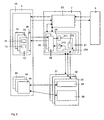
- Fig. 1 shows communication networks 11 and 12, a client 4, an application server 5, a proxy server 2 and a multi-modality server 3.
- the client 4 is a "thin” client, i.e. a client with reduced processing and memory resources.
- UMTS Universal Mobile Telecommunications
- GSM Global System for Mobile Communication
- GPRS General Packet Radio Service
- the client 4 provides a set of two or more different modalities for the interaction with the user 6.
- a modality describes the way how information is presented from the client 4 to the user 6 or from the user 6 to the client 4.
- an information may be submitted as voice message, written information on a screen, by an icon or a graphic display on screen, by pressing a specific key of a keypad, by entering a handwritten command, by a pen, by a mouse pad, by a voice command, by a typed command word or by touching an icon on a touch pad.
- FIG. 1 shows four different kind of interactions 81 to 84 between the client 4 and the user 6, each of which assigned to a different modality.
- the communication network 11 connects the client 4 with the proxy server 4 and the multi-modal server 3. Further, the communication network 12 connects the proxy server 2 with the application server 5.
- TCP Transmission Control Protocol
- IP Internet Protocol
- IP Internet Protocol
- the communication network 11 is formed by a mobile network, for example a GSM or UMTS network and a fixed data network, i.e. the aforementioned IP network.
- the client 4 and the proxy server 2/the multi-modal server 3 may exchange data via an asynchroune connection (e.g. via a GPRS service or via synchronous connection through the mobile network).
- the client 4 is a fixed terminal or a terminal connected with the proxy server 2 and the multi-modal server 3 via a WLAN interface.
- the communication network 11 and the communication network 12 are constituted by the aforementioned IP network.
- the application server 5 operates one or more multi-modal applications, e.g. applications having multi-modal capability.
- applications are encoded in a multi-modal mark-up language, e.g. via HTML+, SALT or X+V. If these applications are contacted by a client, they provide a multi-modal user interface to the user of the respective client.
- the client 4 has one or several processors executing software programs and various input/output devices, for example the input/output devices 42, 43, 44 and 45.
- HTML Hyper Text Mark-Up Language
- XHTML Extended Hyper Text Mark-Up Language
- the input/output device 42 is a display, a keypad and a mouse pad
- the input/output device 43 is a loudspeaker
- the input/output device 44 is a microphone
- the input/output device 45 is a pen for enabling handwritten inputs.
- the proxy server 2 is an IP-server located in an IP-network. But, it is also possible to implement the functionalities of the proxy server 2 into a network access server controlling the access of the client 4 to the aforementioned IP network.
- the proxy server 2 is constituted by one or several interconnected computers, a software platform and a plurality of application programs executed based on this platform.
- the functionalities of the proxy server 2 are provided by the execution of these software programs based on the system platform. From functional point of view, the proxy server 2 provides one or more multi-modal proxies each having a data base 21, a dialog manager 22, a composer 23 and one or more resource handlers 24.
- the multi-modal server 3 is an internet server which provides one or more resource modules supporting a multi-modal interaction between the user 6 and the client 4.
- the multi-modal server 3 comprises the resource modules 31, 32 and 33.
- the resource module 31 is a speech recognition module
- the resource module 32 is a text-to-speed conversion module
- the resource module 33 is a handwriting recognition module.
- the resource modules 31 to 33 of the multi-modal server 3 may be shared by a plurality of multi-modal proxies located at different proxy servers. But, it is also possible that the resource modules 31 to 33 are embedded in the proxy server 2 and solely used by the one or more multi-modal proxies provided by the proxy server 2.
- the dialog manager 22 performs multi-model dialog management.
- HTTP Hyper Text Transfer Protocol
- HTTP Hyper Text Transfer Protocol
- the dialog manager 22 creates a set of one or more scripts providing a resource of modality or embedding multi-modal event handling by means of the database 21. It composes the scripts into a HTML or XHTML document sent to the client 4 to be executed by the browser 41. Further, the dialog manager may create a set of one or more resource handlers providing a proxy-side interface for these scripts.
- the dialog manager 22 retrieves - based on the response or responses from the application server 5 - one or more of the resource module of the multi-modal server 3 and initializes a session between components of the client 4 and these retrieved resource modules.
- the dialog manager 22 creates a HTML document 7 with a set of scripts 71, 72 and 73 and transfers this document as HTTP response 92 to the client 4.
- the script 71 implements the output of a specific voice announcement and adds the resource "specific voice announcement" as additional resource of modality to the capability set of the browser 41.
- the script 73 embeds multi-modal event handling into the HTML document 7.
- the script links the multi-modal event handling with HTML elements of the document 7, such as text-added fields, lists, buttons, links, etc.
- the script 73 exchanges via a communication connection 93 HTML messages or XHTML messages with a corresponding resource handler located at the proxy server 2 which provides a proxy-side application interface for the script 73.
- dialog manager 22 retrieves resource modules of the multi-modal server 3 according to the specific modalities requested within the multi-modal dialog, i.e. reserves resource modules and bind them to dialog manager 22.
- the composer 23 composes a multi-modal interaction with the user 6 based on standard or extended hyper text mark-up language interactions with the client 6 and based on the retrieved additional resources. For example the composer 23 composes a multi-modal interaction in the context of the multi-modal dialog out of the interactions 81 to 84, wherein the interaction 81 is a standard or extended hyper text mark-up interaction, the interaction 82 is a voice announcement created by the script 71, the interaction 83 is a voice input processed by the resource module 31 under control of the composer 23 and the script 73, and the interaction 84 is a handwriting input processed by the resource module 33 under control of the composer 23 and the script 73.
- the interaction 81 is a standard or extended hyper text mark-up interaction
- the interaction 82 is a voice announcement created by the script 71
- the interaction 83 is a voice input processed by the resource module 31 under control of the composer 23 and the script 73
- the interaction 84 is a handwriting input processed by the resource module 33 under control of the composer 23 and the
- the composer 23 composes the multi-modal dialog with the user 6 according to the information received from the application server 5 and on the events received from the user 6, wherein these events may be pre-processed by the script 73.
- the multi-modal application requests the output of an information via voice announcement or the user 6 selects that the output of the information should be done by a voice announcement.
- the system implements this voice announcement by creating the script 71 and executing the script 71 by the browser 41 or by retrieving the resource module 23, establishing a RTP connection and initializing a session between the resource module 32 and the component 43 of the client 4, and triggering the resource module 32 through the resource handler 24 to create the voice announcement and transfer it to the component 43.
- the script 73 detects an event indicating a request from the user to perform a voice input.
- the script 73 contacts the proxy server 2 which retrieves the resource module 31, initiates the establishment of a RTP connection 94 with the component 44, initiates a session between these components and receives and processes the results of the processing of the resource module 31.
- Fig. 2 shows some detailed implementations of the multi-modal system of Fig. 1.
- Fig. 2 shows the client 4, the proxy server 2, the application server 5 and the resource modules 31 to 33.
- the client 4 comprises the WEB-browser 41 and the components 43 to 45.
- the scripts 71 to 73 are encoded as JAVA-scripts.
- the browser 41 comprises an active X-object 46 used by the JAVA-script 73 to invoke a servlet of the proxy server 2 provided by a corresponding JAVA-class.
- the servlet processes the information and creates correspondent response information which are handled by the active X-object 46 and may be used by the script but without reload of the HTTML document 41.
- the web-side formed by the document 41 plays the role of a client and the proxy server 2 with the servlet plays the role of the server.
- the format of the messages exchanged between the client and the server complies with the XML standard.
- the JAVA-script 73 has a function (request) inquiring via an XML message "XML request” a method of a servlet "control servlet".
- the JAVA-script function (request) transfers its input parameter "request XML-string” of the type string to the servlet "control servlet”.
- it installs an event-handler for the event "on ready state change" of the active X object 46. If the JAVA-script function 74 successfully receives a response from the servlet, the event-handler inquires the function "handle XML response" and hands over the DOM document of the response.
- the JAVA-script function 75 named "Handle XML response” expects a DOM document as input, searches through the input to find a node named “mathResponse” and inserts this value in a text field of the document 7.
- the browser 41 provides a XMLHTTP object that can be used by the JAVA-script 71 to 73.
- the JAVA-script is running on the client-browser 41 and sends XML-messages to a servlet by using this object.
- the XMLHTTP object is supported in Microsoft internet Explorer 5.0 or later.
- Other browsers e.g. Mozilla and Netscape 6) provide a similar interface.
- Information can be send asynchronously by HTTP from a server to a client without reloading the page.
- the client makes a non-blocking request to the server that decides the time it replies. This imitates a server-push.
- void open (String method, String url, Boolean async) Initializes a request and specifies the method, URL, and whether the call is asynchronous or not. Methods are "POST" and "GET”.
- void send (String message) sends the request void setRequestHeader(String parameter, String value) sets parameters in the HTTP-Header
- String response Text() returns the response as String XMLDOM responseXml() returns the response as XMLDOM EventHandler onreadystatechange() eventhandler which is called when the readyState changes int readyState() returns the state of the connection
- the Java-Script function named "request ()" is called periodically . If no request is active it opens a new HTTP-Request by calling the POST - command of the XMLHTTP object and sending a message string to a servlet.
- the servlet running on the server receives the transmitted string which it can read from the input-stream and interacts with the application. After processing the input-stream and based on the status of the application the servlet formulates its response.
- the parameter "async" can be set to TRUE in the POST - command of the XMLHTTP object to run the request asynchronously, which means that there could be some seconds or minutes between sending and receiving without blocking the HTML-Browser. So the servlet can wait for its response until a the push event is triggered by the application. This new information is sent to the client.
- the "onreadystatechange" event of the XMLHTTP object is triggered with an "readyState of value 4, when the client has received the response.
- An event-handler installed on this event can then process the response.
- Fig. 2 shows a MMAPI bean 27 having a socket 274, a request buffer 271, a response buffer 272 and an observer thread 273.
- the socket 274 supports the communication between the MMAPI bean 27 and the corresponding resource module, e.g. the resource module 33, via a TCP/IP communication connection. It analyses the request buffer 271 and transfers appropriate requests via this communication connection. The server thread scans the information received via the TCP/IP connection and fills the response buffer if it detects appropriate responses.
- the servelets 25 and 26 transfer requests to the request buffer and receives responses from the response buffer via respective fill request and get response functions. Thereby, the system performs a synchronous data transmission between the servlets and the MMAPI beans.
- the resources 31 to 33 provide functionalities to communicate with the client 4 via a TCP/IP connection and via a RTP connection.
- the resource module 33 comprising a communication unit 34 supporting the TCP/IP interface and a communication unit 35 supporting a RTP interface.
- Each of the resource modules 31 to 33 may simultaneously support multiple clients.
- the MMAPI bean 27 sends a session initialization request to the resource module 33, which instantiates a corresponding session with the dedicated component of the client 4 and responses the results of this session.
Landscapes
- Engineering & Computer Science (AREA)
- Computer Networks & Wireless Communication (AREA)
- Signal Processing (AREA)
- Information Transfer Between Computers (AREA)
- Machine Translation (AREA)
- Document Processing Apparatus (AREA)
Claims (6)
- Ein Verfahren der Bereitstellung eines multi-modalen Dialogs zwischen einer multi-modalen Anwendung (5) und einem Anwender (6), der mit der multi-modalen Anwendung (5) über einen client (4) kommuniziert, der einen Satz von zwei oder mehr verschiedenen Modalitäten für die Wechselwirkung mit dem Anwender (6) bereitstellt und geeignet ist, Dokumente, die in Standard oder Erweiterter Hypertext Markup Language codiert sind, auszutauschen und darzustellen, wobei das Verfahren die Schritte umfaßt:Aufbauen des multi-modalen Dialogs zwischen der multi-modalen Anwendung (5) und dem Anwender (6) durch einen Proxy-Server (2), der mit dem Client (4) über den Austausch von Informationen wechselwirkt, die in Standard oder Erweiterter Hypertext Markup Language codiert sind;Abrufen mindestens einer zusätzlichen Ressource (71, 72, 73, 31, 32, 33) der Modalität durch den Proxy-Server (2), die innerhalb des multi-modalen Dialogs angefordert wurde und;Zusammenstellen einer multi-modalen Wechselwirkung mit dem Anwender (6) durch den Proxy-Server (2) auf der Basis der Standard oder Erweiterter Hypertext Markup Language-Wechselwirkungen (81) mit dem Client und der abgerufenen zusätzlichen Ressourcen (71, 72, 73, 31, 32, 33),dadurch gekennzeichnet,daß das Verfahren den weiteren Schritt umfaßt :Erzeugen eines Scripts (73) durch den Proxy-Server (2) zur Einbettung der multi-modalen Ereignisbehandlung undZusammenstellen des Scripts (73) in ein Dokument (7), das in Standard oder Erweiterter Hypertext Markup Language dargestellt ist und an den Client (4) gesendet wurde;Abrufen eines Ressourcenmoduls (31, 32, 33) durch den Proxy-Server (2) gemäß einer Modalität, die innerhalb des multi-modalen Dialogs angefordert wurde,Erzeugen eines Ressourcenhandlers (24) durch den Proxy-Server (2) für das abgerufene Ressourcenmodul (31, 32, 33), das eine proxyseitige Schnittstelle für das Script (73) bereitstellt, das sich auf dem Client (4) befindet, wobei der Ressourcenhandler (24) das Script (73) aktiviert, um Informationen mit dem abgerufenen Ressourcenmodul (31, 32, 33) auszutauschen; und Initialisieren einer Session (94) zwischen dem Client (4) und dem abgerufenen Ressourcenmodul (31, 32, 33) und zusammenstellen einer multi-modalen Wechselwirkung auf der Basis der initialisierten Session (94).
- Das Verfahren nach Anspruch 1,
dadurch gekennzeichnet,
daß das Verfahren den weiteren Schritt umfaßt: zusammenstellen eines Satzes von einer oder mehr angeforderten Ressourcen (71, 72, 73) in ein Dokument (7), das in Standard oder Erweiterter Hypertext Markup Language dargestellt ist; und Übertragen des Dokuments (7) an den Client (4). - Das Verfahren nach Anspruch 2,
dadurch gekennzeichnet,
daß der Proxy-Server (2) ein Script (71) erzeugt, das eine Ressource der Modalität bereitstellt, und das Script (71) in das Dokument (7) zusammenstellt. - Das Verfahren nach Anspruch 1,
dadurch gekennzeichnet,
daß das Verfahren den weiteren Schritt des Erzeugens eines Ressourcenhandlers (24) für das abgerufene Ressourcenmodul (31, 32, 33) umfaßt, wobei der Ressourcenhandler über eine TCP/IP-Verbindung mit dem Ressourcenmodul (31, 32, 33) kommuniziert. - Das Verfahren nach Anspruch 1,
dadurch gekennzeichnet,
daß das Verfahren den weiteren Schritt des Aufbauens einer RTP-Verbindung zwischen Komponenten (43, 44, 45) des Clients (4) und dem abgerufenen Ressourcenmodul (31, 32, 33) umfaßt. - Ein Proxy-Server (2) zur Unterstützung multi-modaler Dialoge zwischen multi-modalen Anwendungen (5) und Anwendern (6), die mit der multi-modalen Anwendung durch jeweilige Clients (4) kommunizieren, die einen Satz von zwei oder mehr verschiedenen Modalitäten für die Wechselwirkung mit einem Anwender (6) bereitstellen und geeignet sind, Dokumente, die in Standard oder Erweiterter Hypertext Markup Language codiert sind, auszutauschen und darzustellen, wobei der Proxy-Server umfaßt: einen Dialogmanager (22), der angepaßt ist, einen multi-modalen Dialog zwischen einer multi-modalen Anwendung (5) und einem Anwender (6) über einen Proxy-Server (2) aufzubauen, um mit dem Client (4) über den Austausch von Informationen, die in Standard oder Erweiterter Hypertext Markup Language codiert sind, zu wechselwirken und mindestens eine zusätzliche Ressource (71, 72, 73, 31, 32, 33) der Modalität abzurufen, die innerhalb des multi-modalen Dialogs angefordert wurde, und einen Composer (23) zum Zusammenstellen einer multi-modalen Wechselwirkung mit dem Anwender auf der Basis der Standard oder Erweiterter Hypertext Markup Language-Wechselwirkungen mit dem Client (4) und der abgerufenen zusätzlichen Ressourcen (71, 72, 73, 31, 32, 33),
dadurch gekennzeichnet
daß der Proxy-Server (2) angepaßt ist für:das Erzeugen eines Scripts (73) zur Einbettung der multi-modalen Ereignisbehandlung und das Zusammenstellen des Scripts (73) in ein Dokument (7), das in Standard oder Erweiterter Hypertext Markup Language dargestellt und an den Client (4) gesendet wurde;das Abrufen eines Ressourcenmoduls (31, 32, 33) gemäß einer Modalität, die innerhalb des multi-modalen Dialogs angefordert wurde,das Erzeugen eines Ressourcenhandlers (24) für das abgerufene Ressourcenmodul (31, 32, 33), das eine proxyseitige Schnittstelle für das Script (73) bereitstellt, das sich auf dem Client (4) befindet, wobei der Ressourcenhandler (24) das Script (73) aktiviert, um Informationen mit dem abgerufenen Ressourcenmodul (31, 32, 33) auszutauschen, unddas Initialisieren einer session (94) zwischen dem Client (4) und dem abgerufenen Ressourcenmodul (31, 32, 33) und das Zusammenstellen einer multi-modalen Wechselwirkung auf der Basis der initialisierten Session (94).
Priority Applications (8)
| Application Number | Priority Date | Filing Date | Title |
|---|---|---|---|
| DE602004008887T DE602004008887T2 (de) | 2004-05-18 | 2004-05-18 | Verfahren und Server zur Bereitstellung eines multi-modalen Dialogs |
| EP04291272A EP1599007B1 (de) | 2004-05-18 | 2004-05-18 | Verfahren und Server zur Bereitstellung eines multi-modalen Dialogs |
| AT04291272T ATE373380T1 (de) | 2004-05-18 | 2004-05-18 | Verfahren und server zur bereitstellung eines multi-modalen dialogs |
| RU2006102661/09A RU2390958C2 (ru) | 2004-05-18 | 2005-05-10 | Способ и сервер для обеспечения мультимодального диалога |
| PCT/EP2005/052110 WO2005112386A1 (en) | 2004-05-18 | 2005-05-10 | Method and server for providing a multi-modal dialog |
| MXPA05013745A MXPA05013745A (es) | 2004-05-18 | 2005-05-10 | Metodo y servidor para proporcionar un dialogo multimodal. |
| CN200510068081.XA CN100527729C (zh) | 2004-05-18 | 2005-05-16 | 提供多模态对话的方法和服务器 |
| US11/130,203 US20050261909A1 (en) | 2004-05-18 | 2005-05-17 | Method and server for providing a multi-modal dialog |
Applications Claiming Priority (1)
| Application Number | Priority Date | Filing Date | Title |
|---|---|---|---|
| EP04291272A EP1599007B1 (de) | 2004-05-18 | 2004-05-18 | Verfahren und Server zur Bereitstellung eines multi-modalen Dialogs |
Publications (2)
| Publication Number | Publication Date |
|---|---|
| EP1599007A1 EP1599007A1 (de) | 2005-11-23 |
| EP1599007B1 true EP1599007B1 (de) | 2007-09-12 |
Family
ID=34931109
Family Applications (1)
| Application Number | Title | Priority Date | Filing Date |
|---|---|---|---|
| EP04291272A Expired - Lifetime EP1599007B1 (de) | 2004-05-18 | 2004-05-18 | Verfahren und Server zur Bereitstellung eines multi-modalen Dialogs |
Country Status (8)
| Country | Link |
|---|---|
| US (1) | US20050261909A1 (de) |
| EP (1) | EP1599007B1 (de) |
| CN (1) | CN100527729C (de) |
| AT (1) | ATE373380T1 (de) |
| DE (1) | DE602004008887T2 (de) |
| MX (1) | MXPA05013745A (de) |
| RU (1) | RU2390958C2 (de) |
| WO (1) | WO2005112386A1 (de) |
Families Citing this family (24)
| Publication number | Priority date | Publication date | Assignee | Title |
|---|---|---|---|---|
| US8799464B2 (en) * | 2001-12-28 | 2014-08-05 | Motorola Mobility Llc | Multi-modal communication using a session specific proxy server |
| US8181112B2 (en) * | 2004-05-21 | 2012-05-15 | Oracle International Corporation | Independent portlet rendering |
| CN100535900C (zh) * | 2005-12-06 | 2009-09-02 | 国际商业机器公司 | 用于提供异步门户页的方法和系统 |
| US11093898B2 (en) | 2005-12-08 | 2021-08-17 | International Business Machines Corporation | Solution for adding context to a text exchange modality during interactions with a composite services application |
| US8259923B2 (en) * | 2007-02-28 | 2012-09-04 | International Business Machines Corporation | Implementing a contact center using open standards and non-proprietary components |
| US10332071B2 (en) * | 2005-12-08 | 2019-06-25 | International Business Machines Corporation | Solution for adding context to a text exchange modality during interactions with a composite services application |
| US20070133773A1 (en) | 2005-12-08 | 2007-06-14 | International Business Machines Corporation | Composite services delivery |
| JP2008129713A (ja) * | 2006-11-17 | 2008-06-05 | Fujitsu Ltd | 複数のモダリティを関連付けるための方法、そのプログラムおよび複数モダリティを関連付けるマルチモーダルシステム |
| US8594305B2 (en) | 2006-12-22 | 2013-11-26 | International Business Machines Corporation | Enhancing contact centers with dialog contracts |
| US9055150B2 (en) | 2007-02-28 | 2015-06-09 | International Business Machines Corporation | Skills based routing in a standards based contact center using a presence server and expertise specific watchers |
| US20080205625A1 (en) * | 2007-02-28 | 2008-08-28 | International Business Machines Corporation | Extending a standardized presence document to include contact center specific elements |
| US9247056B2 (en) | 2007-02-28 | 2016-01-26 | International Business Machines Corporation | Identifying contact center agents based upon biometric characteristics of an agent's speech |
| US7865544B2 (en) | 2007-06-26 | 2011-01-04 | International Business Machines Corporation | Method and system for providing XML-based asynchronous and interactive feeds for web applications |
| US8386260B2 (en) * | 2007-12-31 | 2013-02-26 | Motorola Mobility Llc | Methods and apparatus for implementing distributed multi-modal applications |
| US8370160B2 (en) * | 2007-12-31 | 2013-02-05 | Motorola Mobility Llc | Methods and apparatus for implementing distributed multi-modal applications |
| US8881020B2 (en) * | 2008-06-24 | 2014-11-04 | Microsoft Corporation | Multi-modal communication through modal-specific interfaces |
| US8843849B2 (en) * | 2009-11-09 | 2014-09-23 | Blackberry Limited | Directional navigation of page content |
| US20110119389A1 (en) * | 2009-11-19 | 2011-05-19 | Microsoft Corporation | Transferring multiple communication modalities during a conversation |
| US8559606B2 (en) * | 2010-12-07 | 2013-10-15 | Microsoft Corporation | Multimodal telephone calls |
| US9052796B2 (en) | 2012-01-08 | 2015-06-09 | Microsoft Technology Licensing Llc | Asynchronous handling of an input stream dedicated to multiple targets |
| US9537899B2 (en) | 2012-02-29 | 2017-01-03 | Microsoft Technology Licensing, Llc | Dynamic selection of security protocol |
| US10262555B2 (en) * | 2015-10-09 | 2019-04-16 | Microsoft Technology Licensing, Llc | Facilitating awareness and conversation throughput in an augmentative and alternative communication system |
| CN110399040B (zh) * | 2019-07-23 | 2023-05-12 | 芋头科技(杭州)有限公司 | 多模态交互方法、用户端设备、服务器及系统 |
| US11308259B2 (en) * | 2020-03-09 | 2022-04-19 | Servicenow, Inc. | Web element retargeting |
Family Cites Families (30)
| Publication number | Priority date | Publication date | Assignee | Title |
|---|---|---|---|---|
| US6088515A (en) * | 1995-11-13 | 2000-07-11 | Citrix Systems Inc | Method and apparatus for making a hypermedium interactive |
| JP3733218B2 (ja) * | 1997-09-30 | 2006-01-11 | キヤノン株式会社 | 中継装置及びその制御方法及び記憶媒体 |
| US6356533B1 (en) * | 1998-08-07 | 2002-03-12 | At&T Corp | Apparatus and method for selecting communication modes |
| DE19910236A1 (de) * | 1999-03-09 | 2000-09-21 | Philips Corp Intellectual Pty | Verfahren zur Spracherkennung |
| DE60008483T2 (de) * | 1999-11-09 | 2004-06-24 | Nortel Networks Ltd., St. Laurent | Telefondiensten in einem Kommunikationsnetzwerk |
| US7415537B1 (en) * | 2000-04-07 | 2008-08-19 | International Business Machines Corporation | Conversational portal for providing conversational browsing and multimedia broadcast on demand |
| US7072984B1 (en) * | 2000-04-26 | 2006-07-04 | Novarra, Inc. | System and method for accessing customized information over the internet using a browser for a plurality of electronic devices |
| US7464381B1 (en) * | 2000-05-12 | 2008-12-09 | Oracle International Corporation | Content update proxy method |
| FI20001918L (fi) * | 2000-08-30 | 2002-03-01 | Nokia Corp | Monimodaalinen sisältö ja automaattinen puheen tunnistus langattomassa tietoliikennejärjestelmässä |
| US6934756B2 (en) * | 2000-11-01 | 2005-08-23 | International Business Machines Corporation | Conversational networking via transport, coding and control conversational protocols |
| US7028306B2 (en) * | 2000-12-04 | 2006-04-11 | International Business Machines Corporation | Systems and methods for implementing modular DOM (Document Object Model)-based multi-modal browsers |
| GB0108044D0 (en) * | 2001-03-30 | 2001-05-23 | British Telecomm | Application synchronisation |
| EP1451679A2 (de) * | 2001-03-30 | 2004-09-01 | BRITISH TELECOMMUNICATIONS public limited company | Anwendungssynchronisierung |
| US7409349B2 (en) * | 2001-05-04 | 2008-08-05 | Microsoft Corporation | Servers for web enabled speech recognition |
| US7711570B2 (en) * | 2001-10-21 | 2010-05-04 | Microsoft Corporation | Application abstraction with dialog purpose |
| US7136909B2 (en) * | 2001-12-28 | 2006-11-14 | Motorola, Inc. | Multimodal communication method and apparatus with multimodal profile |
| US8799464B2 (en) * | 2001-12-28 | 2014-08-05 | Motorola Mobility Llc | Multi-modal communication using a session specific proxy server |
| US6804330B1 (en) * | 2002-01-04 | 2004-10-12 | Siebel Systems, Inc. | Method and system for accessing CRM data via voice |
| US7210098B2 (en) * | 2002-02-18 | 2007-04-24 | Kirusa, Inc. | Technique for synchronizing visual and voice browsers to enable multi-modal browsing |
| US6704396B2 (en) * | 2002-02-27 | 2004-03-09 | Sbc Technology Resources, Inc. | Multi-modal communications method |
| US6807529B2 (en) * | 2002-02-27 | 2004-10-19 | Motorola, Inc. | System and method for concurrent multimodal communication |
| US20030187944A1 (en) * | 2002-02-27 | 2003-10-02 | Greg Johnson | System and method for concurrent multimodal communication using concurrent multimodal tags |
| US7315613B2 (en) * | 2002-03-11 | 2008-01-01 | International Business Machines Corporation | Multi-modal messaging |
| US20030187658A1 (en) * | 2002-03-29 | 2003-10-02 | Jari Selin | Method for text-to-speech service utilizing a uniform resource identifier |
| SE0202058D0 (sv) * | 2002-07-02 | 2002-07-02 | Ericsson Telefon Ab L M | Voice browsing architecture based on adaptive keyword spotting |
| US20040128342A1 (en) * | 2002-12-31 | 2004-07-01 | International Business Machines Corporation | System and method for providing multi-modal interactive streaming media applications |
| US7260535B2 (en) * | 2003-04-28 | 2007-08-21 | Microsoft Corporation | Web server controls for web enabled recognition and/or audible prompting for call controls |
| US8311835B2 (en) * | 2003-08-29 | 2012-11-13 | Microsoft Corporation | Assisted multi-modal dialogue |
| KR100561228B1 (ko) * | 2003-12-23 | 2006-03-15 | 한국전자통신연구원 | 보이스엑스엠엘 문서를 엑스에이치티엠엘플러스보이스문서로 변환하기 위한 방법 및 이를 이용한 멀티모달서비스 시스템 |
| US20060235694A1 (en) * | 2005-04-14 | 2006-10-19 | International Business Machines Corporation | Integrating conversational speech into Web browsers |
-
2004
- 2004-05-18 EP EP04291272A patent/EP1599007B1/de not_active Expired - Lifetime
- 2004-05-18 AT AT04291272T patent/ATE373380T1/de not_active IP Right Cessation
- 2004-05-18 DE DE602004008887T patent/DE602004008887T2/de not_active Expired - Lifetime
-
2005
- 2005-05-10 RU RU2006102661/09A patent/RU2390958C2/ru not_active IP Right Cessation
- 2005-05-10 WO PCT/EP2005/052110 patent/WO2005112386A1/en not_active Ceased
- 2005-05-10 MX MXPA05013745A patent/MXPA05013745A/es unknown
- 2005-05-16 CN CN200510068081.XA patent/CN100527729C/zh not_active Expired - Fee Related
- 2005-05-17 US US11/130,203 patent/US20050261909A1/en not_active Abandoned
Non-Patent Citations (1)
| Title |
|---|
| None * |
Also Published As
| Publication number | Publication date |
|---|---|
| RU2006102661A (ru) | 2007-08-10 |
| EP1599007A1 (de) | 2005-11-23 |
| CN1700692A (zh) | 2005-11-23 |
| US20050261909A1 (en) | 2005-11-24 |
| CN100527729C (zh) | 2009-08-12 |
| DE602004008887D1 (de) | 2007-10-25 |
| ATE373380T1 (de) | 2007-09-15 |
| RU2390958C2 (ru) | 2010-05-27 |
| DE602004008887T2 (de) | 2008-01-17 |
| MXPA05013745A (es) | 2006-03-13 |
| WO2005112386A1 (en) | 2005-11-24 |
Similar Documents
| Publication | Publication Date | Title |
|---|---|---|
| EP1599007A1 (de) | Verfahren und Server zur Bereitstellung eines multi-modalen Dialogs | |
| US7216351B1 (en) | Systems and methods for synchronizing multi-modal interactions | |
| EP2561656B1 (de) | Servlet-api und verfahren für xmpp-protokoll | |
| US8566103B2 (en) | Multi-modal web interaction over wireless network | |
| US20060036770A1 (en) | System for factoring synchronization strategies from multimodal programming model runtimes | |
| US20040117409A1 (en) | Application synchronisation | |
| US7295984B2 (en) | Systems and methods for providing voice and data interfaces to web services-based applications | |
| CA2632706A1 (en) | High level network layer system and method | |
| KR20030060884A (ko) | 웹 운영체제 및 웹 데스크탑 | |
| US8291032B2 (en) | Email system | |
| US7076523B2 (en) | Interaction interface for a composite device computing environment | |
| US7437481B2 (en) | Methods and apparatus for utilizing user software to communicate with network-resident services | |
| CN1255726C (zh) | 设备控制系统和方法 | |
| JP2004046810A (ja) | クライアント/サーバ環境におけるアプリケーションステップのディスパッチ方法及びサービスポータルシステム | |
| US20110106908A1 (en) | Transfer of information between at least two software | |
| CN101561803A (zh) | 以手持通讯装置浏览网络信息的方法 | |
| Singh et al. | An efficient asynchronous mobile web service framework | |
| WO2012136020A1 (zh) | 一种座席系统、座席系统客户端及其处理方法 | |
| KR20100097740A (ko) | 단일 요청 기반 메시지에 의한 일련의 웹 서비스들의 인보케이션을 위한 디바이스들 및 방법 | |
| Li et al. | An adaptable architecture for secure delivery of converged services | |
| Tang et al. | Study on distributed speech synthesis system. | |
| Liwanag et al. | Prototype Web Services and Instant Messaging Integration | |
| Griffin et al. | Representational State Transfer as a Real Time Communications Integration Mechanism | |
| EP2036280B1 (de) | Verfahren und einrichtung zum bereitstellen von internet-diensten für einen telefonbenutzer |
Legal Events
| Date | Code | Title | Description |
|---|---|---|---|
| PUAI | Public reference made under article 153(3) epc to a published international application that has entered the european phase |
Free format text: ORIGINAL CODE: 0009012 |
|
| 17P | Request for examination filed |
Effective date: 20050510 |
|
| AK | Designated contracting states |
Kind code of ref document: A1 Designated state(s): AT BE BG CH CY CZ DE DK EE ES FI FR GB GR HU IE IT LI LU MC NL PL PT RO SE SI SK TR |
|
| AX | Request for extension of the european patent |
Extension state: AL HR LT LV MK |
|
| AKX | Designation fees paid |
Designated state(s): AT BE BG CH CY CZ DE DK EE ES FI FR GB GR HU IE IT LI LU MC NL PL PT RO SE SI SK TR |
|
| GRAP | Despatch of communication of intention to grant a patent |
Free format text: ORIGINAL CODE: EPIDOSNIGR1 |
|
| RAP1 | Party data changed (applicant data changed or rights of an application transferred) |
Owner name: ALCATEL LUCENT |
|
| GRAS | Grant fee paid |
Free format text: ORIGINAL CODE: EPIDOSNIGR3 |
|
| GRAA | (expected) grant |
Free format text: ORIGINAL CODE: 0009210 |
|
| AK | Designated contracting states |
Kind code of ref document: B1 Designated state(s): AT BE BG CH CY CZ DE DK EE ES FI FR GB GR HU IE IT LI LU MC NL PL PT RO SE SI SK TR |
|
| REG | Reference to a national code |
Ref country code: GB Ref legal event code: FG4D |
|
| REG | Reference to a national code |
Ref country code: CH Ref legal event code: EP |
|
| REF | Corresponds to: |
Ref document number: 602004008887 Country of ref document: DE Date of ref document: 20071025 Kind code of ref document: P |
|
| REG | Reference to a national code |
Ref country code: IE Ref legal event code: FG4D |
|
| ET | Fr: translation filed | ||
| PG25 | Lapsed in a contracting state [announced via postgrant information from national office to epo] |
Ref country code: FI Free format text: LAPSE BECAUSE OF FAILURE TO SUBMIT A TRANSLATION OF THE DESCRIPTION OR TO PAY THE FEE WITHIN THE PRESCRIBED TIME-LIMIT Effective date: 20070912 |
|
| PG25 | Lapsed in a contracting state [announced via postgrant information from national office to epo] |
Ref country code: PL Free format text: LAPSE BECAUSE OF FAILURE TO SUBMIT A TRANSLATION OF THE DESCRIPTION OR TO PAY THE FEE WITHIN THE PRESCRIBED TIME-LIMIT Effective date: 20070912 Ref country code: AT Free format text: LAPSE BECAUSE OF FAILURE TO SUBMIT A TRANSLATION OF THE DESCRIPTION OR TO PAY THE FEE WITHIN THE PRESCRIBED TIME-LIMIT Effective date: 20070912 Ref country code: CH Free format text: LAPSE BECAUSE OF FAILURE TO SUBMIT A TRANSLATION OF THE DESCRIPTION OR TO PAY THE FEE WITHIN THE PRESCRIBED TIME-LIMIT Effective date: 20070912 Ref country code: LI Free format text: LAPSE BECAUSE OF FAILURE TO SUBMIT A TRANSLATION OF THE DESCRIPTION OR TO PAY THE FEE WITHIN THE PRESCRIBED TIME-LIMIT Effective date: 20070912 |
|
| NLV1 | Nl: lapsed or annulled due to failure to fulfill the requirements of art. 29p and 29m of the patents act | ||
| PG25 | Lapsed in a contracting state [announced via postgrant information from national office to epo] |
Ref country code: BE Free format text: LAPSE BECAUSE OF FAILURE TO SUBMIT A TRANSLATION OF THE DESCRIPTION OR TO PAY THE FEE WITHIN THE PRESCRIBED TIME-LIMIT Effective date: 20070912 |
|
| REG | Reference to a national code |
Ref country code: CH Ref legal event code: PL |
|
| PG25 | Lapsed in a contracting state [announced via postgrant information from national office to epo] |
Ref country code: NL Free format text: LAPSE BECAUSE OF FAILURE TO SUBMIT A TRANSLATION OF THE DESCRIPTION OR TO PAY THE FEE WITHIN THE PRESCRIBED TIME-LIMIT Effective date: 20070912 Ref country code: GR Free format text: LAPSE BECAUSE OF FAILURE TO SUBMIT A TRANSLATION OF THE DESCRIPTION OR TO PAY THE FEE WITHIN THE PRESCRIBED TIME-LIMIT Effective date: 20071213 Ref country code: ES Free format text: LAPSE BECAUSE OF FAILURE TO SUBMIT A TRANSLATION OF THE DESCRIPTION OR TO PAY THE FEE WITHIN THE PRESCRIBED TIME-LIMIT Effective date: 20071223 |
|
| PG25 | Lapsed in a contracting state [announced via postgrant information from national office to epo] |
Ref country code: PT Free format text: LAPSE BECAUSE OF FAILURE TO SUBMIT A TRANSLATION OF THE DESCRIPTION OR TO PAY THE FEE WITHIN THE PRESCRIBED TIME-LIMIT Effective date: 20080212 Ref country code: CZ Free format text: LAPSE BECAUSE OF FAILURE TO SUBMIT A TRANSLATION OF THE DESCRIPTION OR TO PAY THE FEE WITHIN THE PRESCRIBED TIME-LIMIT Effective date: 20070912 Ref country code: SK Free format text: LAPSE BECAUSE OF FAILURE TO SUBMIT A TRANSLATION OF THE DESCRIPTION OR TO PAY THE FEE WITHIN THE PRESCRIBED TIME-LIMIT Effective date: 20070912 |
|
| PG25 | Lapsed in a contracting state [announced via postgrant information from national office to epo] |
Ref country code: SE Free format text: LAPSE BECAUSE OF FAILURE TO SUBMIT A TRANSLATION OF THE DESCRIPTION OR TO PAY THE FEE WITHIN THE PRESCRIBED TIME-LIMIT Effective date: 20071212 Ref country code: RO Free format text: LAPSE BECAUSE OF FAILURE TO SUBMIT A TRANSLATION OF THE DESCRIPTION OR TO PAY THE FEE WITHIN THE PRESCRIBED TIME-LIMIT Effective date: 20070912 |
|
| PLBE | No opposition filed within time limit |
Free format text: ORIGINAL CODE: 0009261 |
|
| STAA | Information on the status of an ep patent application or granted ep patent |
Free format text: STATUS: NO OPPOSITION FILED WITHIN TIME LIMIT |
|
| PG25 | Lapsed in a contracting state [announced via postgrant information from national office to epo] |
Ref country code: DK Free format text: LAPSE BECAUSE OF FAILURE TO SUBMIT A TRANSLATION OF THE DESCRIPTION OR TO PAY THE FEE WITHIN THE PRESCRIBED TIME-LIMIT Effective date: 20070912 |
|
| 26N | No opposition filed |
Effective date: 20080613 |
|
| PG25 | Lapsed in a contracting state [announced via postgrant information from national office to epo] |
Ref country code: MC Free format text: LAPSE BECAUSE OF NON-PAYMENT OF DUE FEES Effective date: 20080531 |
|
| PG25 | Lapsed in a contracting state [announced via postgrant information from national office to epo] |
Ref country code: IE Free format text: LAPSE BECAUSE OF NON-PAYMENT OF DUE FEES Effective date: 20080519 Ref country code: EE Free format text: LAPSE BECAUSE OF FAILURE TO SUBMIT A TRANSLATION OF THE DESCRIPTION OR TO PAY THE FEE WITHIN THE PRESCRIBED TIME-LIMIT Effective date: 20070912 |
|
| PG25 | Lapsed in a contracting state [announced via postgrant information from national office to epo] |
Ref country code: SI Free format text: LAPSE BECAUSE OF FAILURE TO SUBMIT A TRANSLATION OF THE DESCRIPTION OR TO PAY THE FEE WITHIN THE PRESCRIBED TIME-LIMIT Effective date: 20070912 |
|
| PG25 | Lapsed in a contracting state [announced via postgrant information from national office to epo] |
Ref country code: CY Free format text: LAPSE BECAUSE OF FAILURE TO SUBMIT A TRANSLATION OF THE DESCRIPTION OR TO PAY THE FEE WITHIN THE PRESCRIBED TIME-LIMIT Effective date: 20070912 |
|
| PG25 | Lapsed in a contracting state [announced via postgrant information from national office to epo] |
Ref country code: BG Free format text: LAPSE BECAUSE OF FAILURE TO SUBMIT A TRANSLATION OF THE DESCRIPTION OR TO PAY THE FEE WITHIN THE PRESCRIBED TIME-LIMIT Effective date: 20071212 |
|
| PG25 | Lapsed in a contracting state [announced via postgrant information from national office to epo] |
Ref country code: LU Free format text: LAPSE BECAUSE OF NON-PAYMENT OF DUE FEES Effective date: 20080518 Ref country code: HU Free format text: LAPSE BECAUSE OF FAILURE TO SUBMIT A TRANSLATION OF THE DESCRIPTION OR TO PAY THE FEE WITHIN THE PRESCRIBED TIME-LIMIT Effective date: 20080313 |
|
| PG25 | Lapsed in a contracting state [announced via postgrant information from national office to epo] |
Ref country code: TR Free format text: LAPSE BECAUSE OF FAILURE TO SUBMIT A TRANSLATION OF THE DESCRIPTION OR TO PAY THE FEE WITHIN THE PRESCRIBED TIME-LIMIT Effective date: 20070912 |
|
| PG25 | Lapsed in a contracting state [announced via postgrant information from national office to epo] |
Ref country code: IT Free format text: LAPSE BECAUSE OF NON-PAYMENT OF DUE FEES Effective date: 20080531 |
|
| REG | Reference to a national code |
Ref country code: GB Ref legal event code: 732E Free format text: REGISTERED BETWEEN 20130926 AND 20131002 |
|
| REG | Reference to a national code |
Ref country code: FR Ref legal event code: GC Effective date: 20131018 |
|
| REG | Reference to a national code |
Ref country code: FR Ref legal event code: RG Effective date: 20141016 |
|
| REG | Reference to a national code |
Ref country code: FR Ref legal event code: PLFP Year of fee payment: 12 |
|
| REG | Reference to a national code |
Ref country code: FR Ref legal event code: CA Effective date: 20150521 |
|
| REG | Reference to a national code |
Ref country code: FR Ref legal event code: CA Effective date: 20150521 |
|
| REG | Reference to a national code |
Ref country code: FR Ref legal event code: PLFP Year of fee payment: 13 |
|
| REG | Reference to a national code |
Ref country code: FR Ref legal event code: PLFP Year of fee payment: 14 |
|
| PGFP | Annual fee paid to national office [announced via postgrant information from national office to epo] |
Ref country code: FR Payment date: 20170523 Year of fee payment: 14 Ref country code: DE Payment date: 20170523 Year of fee payment: 14 Ref country code: GB Payment date: 20170519 Year of fee payment: 14 |
|
| REG | Reference to a national code |
Ref country code: DE Ref legal event code: R119 Ref document number: 602004008887 Country of ref document: DE |
|
| GBPC | Gb: european patent ceased through non-payment of renewal fee |
Effective date: 20180518 |
|
| PG25 | Lapsed in a contracting state [announced via postgrant information from national office to epo] |
Ref country code: GB Free format text: LAPSE BECAUSE OF NON-PAYMENT OF DUE FEES Effective date: 20180518 Ref country code: DE Free format text: LAPSE BECAUSE OF NON-PAYMENT OF DUE FEES Effective date: 20181201 Ref country code: FR Free format text: LAPSE BECAUSE OF NON-PAYMENT OF DUE FEES Effective date: 20180531 |