EP1598975B1 - Dynamische Zuweisung von Bits und Unterkanälen in einem Mehrnutzer-MIMO-OFDMA-System - Google Patents
Dynamische Zuweisung von Bits und Unterkanälen in einem Mehrnutzer-MIMO-OFDMA-System Download PDFInfo
- Publication number
- EP1598975B1 EP1598975B1 EP05010520.4A EP05010520A EP1598975B1 EP 1598975 B1 EP1598975 B1 EP 1598975B1 EP 05010520 A EP05010520 A EP 05010520A EP 1598975 B1 EP1598975 B1 EP 1598975B1
- Authority
- EP
- European Patent Office
- Prior art keywords
- mimo
- user terminal
- subchannels
- user
- subchannel
- Prior art date
- Legal status (The legal status is an assumption and is not a legal conclusion. Google has not performed a legal analysis and makes no representation as to the accuracy of the status listed.)
- Expired - Lifetime
Links
Images


Classifications
-
- H—ELECTRICITY
- H04—ELECTRIC COMMUNICATION TECHNIQUE
- H04L—TRANSMISSION OF DIGITAL INFORMATION, e.g. TELEGRAPHIC COMMUNICATION
- H04L1/00—Arrangements for detecting or preventing errors in the information received
- H04L1/02—Arrangements for detecting or preventing errors in the information received by diversity reception
- H04L1/06—Arrangements for detecting or preventing errors in the information received by diversity reception using space diversity
-
- G—PHYSICS
- G08—SIGNALLING
- G08G—TRAFFIC CONTROL SYSTEMS
- G08G1/00—Traffic control systems for road vehicles
- G08G1/14—Traffic control systems for road vehicles indicating individual free spaces in parking areas
- G08G1/141—Traffic control systems for road vehicles indicating individual free spaces in parking areas with means giving the indication of available parking spaces
-
- G—PHYSICS
- G08—SIGNALLING
- G08G—TRAFFIC CONTROL SYSTEMS
- G08G1/00—Traffic control systems for road vehicles
- G08G1/14—Traffic control systems for road vehicles indicating individual free spaces in parking areas
- G08G1/149—Traffic control systems for road vehicles indicating individual free spaces in parking areas coupled to means for restricting the access to the parking space, e.g. authorization, access barriers, indicative lights
-
- H—ELECTRICITY
- H04—ELECTRIC COMMUNICATION TECHNIQUE
- H04L—TRANSMISSION OF DIGITAL INFORMATION, e.g. TELEGRAPHIC COMMUNICATION
- H04L1/00—Arrangements for detecting or preventing errors in the information received
- H04L1/0001—Systems modifying transmission characteristics according to link quality, e.g. power backoff
- H04L1/0002—Systems modifying transmission characteristics according to link quality, e.g. power backoff by adapting the transmission rate
- H04L1/0003—Systems modifying transmission characteristics according to link quality, e.g. power backoff by adapting the transmission rate by switching between different modulation schemes
-
- H—ELECTRICITY
- H04—ELECTRIC COMMUNICATION TECHNIQUE
- H04L—TRANSMISSION OF DIGITAL INFORMATION, e.g. TELEGRAPHIC COMMUNICATION
- H04L5/00—Arrangements affording multiple use of the transmission path
- H04L5/0001—Arrangements for dividing the transmission path
- H04L5/0026—Division using four or more dimensions, e.g. beam steering or quasi-co-location [QCL]
-
- H—ELECTRICITY
- H04—ELECTRIC COMMUNICATION TECHNIQUE
- H04L—TRANSMISSION OF DIGITAL INFORMATION, e.g. TELEGRAPHIC COMMUNICATION
- H04L5/00—Arrangements affording multiple use of the transmission path
- H04L5/003—Arrangements for allocating sub-channels of the transmission path
- H04L5/0037—Inter-user or inter-terminal allocation
-
- H—ELECTRICITY
- H04—ELECTRIC COMMUNICATION TECHNIQUE
- H04L—TRANSMISSION OF DIGITAL INFORMATION, e.g. TELEGRAPHIC COMMUNICATION
- H04L5/00—Arrangements affording multiple use of the transmission path
- H04L5/003—Arrangements for allocating sub-channels of the transmission path
- H04L5/0044—Allocation of payload; Allocation of data channels, e.g. PDSCH or PUSCH
- H04L5/0046—Determination of the number of bits transmitted on different sub-channels
-
- H—ELECTRICITY
- H04—ELECTRIC COMMUNICATION TECHNIQUE
- H04L—TRANSMISSION OF DIGITAL INFORMATION, e.g. TELEGRAPHIC COMMUNICATION
- H04L5/00—Arrangements affording multiple use of the transmission path
- H04L5/0001—Arrangements for dividing the transmission path
- H04L5/0003—Two-dimensional division
- H04L5/0005—Time-frequency
- H04L5/0007—Time-frequency the frequencies being orthogonal, e.g. OFDM(A) or DMT
-
- H—ELECTRICITY
- H04—ELECTRIC COMMUNICATION TECHNIQUE
- H04L—TRANSMISSION OF DIGITAL INFORMATION, e.g. TELEGRAPHIC COMMUNICATION
- H04L5/00—Arrangements affording multiple use of the transmission path
- H04L5/0001—Arrangements for dividing the transmission path
- H04L5/0014—Three-dimensional division
- H04L5/0023—Time-frequency-space
-
- H—ELECTRICITY
- H04—ELECTRIC COMMUNICATION TECHNIQUE
- H04L—TRANSMISSION OF DIGITAL INFORMATION, e.g. TELEGRAPHIC COMMUNICATION
- H04L5/00—Arrangements affording multiple use of the transmission path
- H04L5/003—Arrangements for allocating sub-channels of the transmission path
- H04L5/0058—Allocation criteria
- H04L5/006—Quality of the received signal, e.g. BER, SNR, water filling
-
- H—ELECTRICITY
- H04—ELECTRIC COMMUNICATION TECHNIQUE
- H04L—TRANSMISSION OF DIGITAL INFORMATION, e.g. TELEGRAPHIC COMMUNICATION
- H04L5/00—Arrangements affording multiple use of the transmission path
- H04L5/003—Arrangements for allocating sub-channels of the transmission path
- H04L5/0058—Allocation criteria
- H04L5/0064—Rate requirement of the data, e.g. scalable bandwidth, data priority
-
- H—ELECTRICITY
- H04—ELECTRIC COMMUNICATION TECHNIQUE
- H04L—TRANSMISSION OF DIGITAL INFORMATION, e.g. TELEGRAPHIC COMMUNICATION
- H04L5/00—Arrangements affording multiple use of the transmission path
- H04L5/0091—Signalling for the administration of the divided path, e.g. signalling of configuration information
- H04L5/0096—Indication of changes in allocation
Definitions
- the present invention relates generally to a mobile communication system, and more particularly to a scheme for optimizing subchannel and bit allocation in a multicarrier-based mobile communication system.
- a multiple-input multiple-output (MIMO) system in the downlink can be broken down to multiple parallel independent single-user MIMO systems. Further, when the orthogonal frequency division multiple access (OFDMA) technology is applied to the downlink MIMO system, a multiuser-MIMO/OFDMA system is provided. In this system, data streams for users are multiplexed over space and frequency, and thus the users receive the spatially multiplexed data streams.
- OFDMA orthogonal frequency division multiple access
- FIG. 1 is a conceptual diagram illustrating subchannels of a multiuser-multiple-input multiple-output/orthogonal frequency division multiple access (MIMO/OFDMA) system.
- MIMO/OFDMA multiuser-multiple-input multiple-output/orthogonal frequency division multiple access
- FIG. 1 there are space division multiple access (SDMA) subchannels in which each user occupies several MIMO subchannels, for each orthogonal frequency division multiplexing (OFDM) subcarrier.
- the users generate MIMO subchannels using the MIMO technologies, and transmit data through the generated MIMO subchannels.
- SDMA space division multiple access
- a more important feature of a multiuser-MIMO/OFDMA system design is that SDMA channels are allocated to users, and bits are loaded to the MIMO subchannels allocated to a single user for adaptive modulation.
- the present invention has been designed to solve the above and other problems occurring in the prior art. Therefore, it is an aspect of the present invention to provide a subchannel and bit allocation method for efficiently allocating subchannels in an orthogonal frequency division multiple access (OFDMA) system using multiple antennas.
- OFDMA orthogonal frequency division multiple access
- a resource allocation method in a multiuser-multiple-input multiple-output/orthogonal frequency division multiple access (MIMO/OFDMA) system including a base station for transmitting signals through a plurality of transmitter antennas, and a plurality of terminals for receiving the signals through receiver antennas.
- the resource allocation method includes determining a number of subchannels for each user according to a channel environment; and allocating a modulating scheme for each subchannel according to the determined number of subchannels.
- the present invention provides an optimal scheme for subchannel and bit allocation, and a suboptimal scheme for separately performing the subchannel and bit allocation.
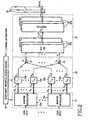
- FIG. 2 is a block diagram illustrating a multiuser-multiple-input multiple-output/orthogonal frequency division multiple access (MIMO/OFDMA) base station to which a subchannel and bit allocation method in accordance with the present invention is applied.
- the multiuser-MIMO/OFDMA base station includes a modulation unit 21, a precoding unit 23, and an OFDMA transmission unit 27.
- the modulation unit 21 includes a plurality of adaptive modulators 21a for processing input data of multiple users.
- the precoding unit 23 includes a plurality of precoders 23a for precoding signals output from the adaptive modulators 21a, and a plurality of adders 25 for adding outputs of the precoders 23a.
- the OFDMA transmission unit 27 includes a plurality of Inverse Fast Fourier Transform (IFFT) and parallel-to-serial (P/S) modules 27a, and a plurality of cyclic prefix (CP) insertion modules 27b for inserting CPs into output signals of the IFFT and P/S modules 27a.
- IFFT Inverse Fast Fourier Transform
- P/S parallel-to-serial
- CP cyclic prefix
- the multiuser-MIMO/OFDMA base station further includes a subchannel and bit allocation module 29 for generating information necessary for subchannel and bit allocation using feedback information received from terminals, and providing the generated information to the modulation unit 21 and the precoding unit 23.
- the above-described base station transmits signals of N subcarriers through N t transmitter antennas 28. It is assumed that the channel is flat fading in the present invention.
- the base station receives downlink channel information from all K user terminals, allocates a set of subchannels to each user terminal, and determines the number of bits to be transmitted through each channel.
- the subchannel and bit allocation information is transmitted to user terminals through a separate control channel.
- N R receiver antennas and N T M ⁇ N R , where M is an integer greater than or equal to 2
- M different user terminals occupy M SDMA subchannels per subcarrier
- each user terminal receives N R spatially multiplexed bit streams through MIMO processing.
- the bit streams are referred to as MIMO subchannels.
- ⁇ n denotes an indicator set for M user terminals occupying M SDMA subchannels of the n -th subcarrier.
- ⁇ n consists of M integers chosen from ⁇ 1,2, ⁇ , K ⁇ .
- the matrix F n,k When the matrix F n,k is properly chosen, the multiuser interference in ⁇ k ⁇ n , S n,k can be eliminated, and S n , k and k ⁇ ⁇ n can be recovered at a receiver.
- the matrix F n,k provides M SDMA subchannels associated with single-user MIMO subchannels, such that each user terminal can spatially multiplex N R data streams.
- a transmitter transmits data to K user terminals through all M ⁇ N ⁇ N R subchannels under the following conditions:
- Condition 1 M SDMA subchannels per subcarrier should be allocated to M different user terminals.
- M N T
- F n,k N n,k
- Condition 2 is unnecessary.
- a data rate R k of the k -th user terminal can be expressed as shown in Equation (1).
- Equation (1) c k ( n , l ) denotes the number of bits allocated to the l -th MIMO subchannel of the k -th user terminal when the k -th user terminal occupies one of the SDMA subchannels of the n -th subcarrier.
- the transmission power allocated to the k -th user terminal can be expressed as shown in Equation (2).
- Equation (2) f k ( c ) is the received power required to stably receive c bits per symbol.
- ⁇ k ( n , l , p ) is an equivalent channel gain of the l -th MIMO subchannel of the k -th user terminal when the k -th and p -th user terminals occupy two SDMA subchannels of the n -th subcarrier.
- MIMO subchannels are ordered according to their equivalent channel gains without loss of generality, i.e.,
- Equation (3) The optimal subchannel and bit allocation problem for minimizing the total transmission power required to transmit data at a rate of ⁇ R 1 ,..., R K ⁇ can be formulated as shown in Equation (3).
- N R 1 (multiuser-MISO/OFDMA)
- the index l for MIMO subchannels and the corresponding summations can be removed from Equation (3).
- Equation (3) The optimization problem in Equation (3) can be simplified as shown in Equation (4).
- Equation (4) ⁇ k ( n , p ) is an equivalent channel gain of the k -th user terminal when the k -th and p -th user terminals occupy two SDMA subchannels of the n -th subcarrier.
- Condition 2 In the single-user MIMO/OFDMA system, only Condition 2 should be satisfied because there is one SDMA subchannel per subcarrier. A user index p can be removed.
- IP requires an exponential time algorithm whose complexity rapidly increases with the number of constraints and variables.
- the optimal IP algorithm was simulated using multiuser-MIMO/OFDMA, multiuser-MISO/OFDMA, and single-user-MIMO/OFDMA systems.
- Table 1 describes system parameters used in the simulation.
- Table 1 Multiuser-MIMO/OFDMA Multiuser-MISO/OFDMA Single-user-MIMO/OFDMA N T 4 2 2 N R 2 1 2 M 2 2 1 # of FFT( N ) 64 64 64 Total # of subchannels 256 128 128 # of users ( K ) 4 # of max. bits ( C ) 12 Required BER 10 -4
- Channel 8-tap frequency selective Rayleigh fading channels with exponentially decaying power profiles were assumed.
- the channel parameters were fixed during one frame period.
- the average channel magnitudes of the different users were generally unequal and the difference, denoted by ⁇ , between the strongest and weakest channels of the four users was either zero or 30 dB.
- Table 2 ⁇ (dB) MIMO subchannel group
- User k # of assigned MIMO subchannels # of MIMO subchannels with c k ( n , l ) i bits
- Total 128 0 37 91 0 0 l 2 1 30 21 9 0 0 0 0.58 2 27 10 17 0 0 0 0.50 3 31 21 10 0 0 0 0.57 4 32 23 9 0 0 0 0.49 Total 120 75 45 0 0 0 30
- the results are sorted into two groups.
- the first group includes resulting values associated with an MIMO subchannel with a larger equivalent channel gain ⁇ k ( n ,l, p ), and the second group includes the rest.
- subchannels are almost equivalently distributed to user terminals. That is, 28 to 34 subchannels of Group 1 are allocated to each user, and 27 to 32 subchannels of Group 2 are allocated to each user.
- Table 2 describes a ratio of average subchannel gains ⁇ k 2 l and ⁇ ⁇ k 2 l . This ratio had only a small variation. Accordingly, this ratio will also be useful for the suboptimal algorithm.
- Tables 4 and 5 show the resulting number of subchannels allocated to each user terminal and the number of bits allocated to each subchannel.
- c k denotes the dominant constellation in the multiuser-MISO/OFDMA system.
- a preferred embodiment of the present invention separates the subchannel and bit allocation problem into two steps to reduce complexity.
- subchannels are allocated under the assumption of dominant constellation.
- bits are distributed to subchannels allocated in the first step. Accordingly, the assumption in the first step is not assumed in this step.
- the subchannel allocation in the first step can be performed via suboptimal algorithms, while the bit allocation in the second step can adopt a greedy algorithm. By separately performing subchannel and bit allocation, this yields a suboptimal algorithm that is considerably simpler to implement than the optimal IP approach.
- Equation 6 Using the dominant constellation of the multiuser-MIMO/OFDMA, the optimal subchannel allocation problem in the first step can be expressed as shown in Equation 6.
- the auxiliary constraint is included for the purpose of finding a useful observation. Equation (6) is considerably simpler than the original IP of Equation (3).
- Equation (6) takes the form of a transportation problem that can be relaxed to linear programming (LP).
- Equation (6) the combination of two user terminals k and p, ⁇ ( k , p ) ⁇ , is supplied to each subcarrier depending on the costs ⁇ g k ( n , p ) .
- ⁇ k ( n , p ) is the number of units shipped from the combination ( k , p ) to the n -th subcarrier if the k -th and p -th users occupy two SDMA subchannels of the n -the subcarrier.
- the constraints in Equation (6) are the demand and supply constraints, respectively, of the transportation problem.
- IP is relaxed to LP.
- the problem is solved using the modified Vogel's method.
- ⁇ c k ( l ) ⁇ in the dominant constellation can be obtained during an initial phase.
- Equation (6) can be simplified as shown in Equation (7).
- Equation (7) The solution ⁇ c k * l of Equation (7) can be obtained by introducing a Lagrange multiplier ⁇ and using a numerical technique, such as vector-form Newton's method.
- Equation (6) The optimization in Equation (6) is an IP problem with much computational load.
- a heuristic subchannel allocation algorithm is developed by modifying Vogel's method.
- S and U denotes sets of subcarrier and user indices, respectively. These sets are defined in Equation (8) and Equation (9). S ⁇ 1 2 ... N U ⁇ ⁇ k p
- P n is the penalty defined as the difference between the two smallest cost values in ⁇ g m ( n , p )
- subchannel allocation for the suboptimal approach in accordance with the present invention is as follows:
- Step 1 Evaluate real-valued ⁇ c k * l from Equation (7) using the vector-form Newton's method.
- Step 2 Substitute ⁇ c k * l for ⁇ c k ( l ) ⁇ in Equation (6) and solve Equation (6) using the above-described modified Vogel's method to obtain ⁇ k ( n , p ) ⁇ .
- the overall heuristic algorithm for subchannel allocation requires O ( K 2 ) operations for one iteration of the vector-form Newton's method, and requires O ( NK 4 ) operations for the heuristic algorithm.
- This is a polynomial-time algorithm that can be applied to real-time multiuser-MIMO/OFDMA systems.
- the channel allocation method in the multiuser-MISO/OFDMA system is the same as the optimization method in Equation (6). Accordingly, the proposed heuristic algorithm can be applied to the multiuser-MISO/OFDMA system.
- N subcarriers are supplied to K users depending on the costs ⁇ g k ( n ) ⁇ .
- ⁇ k ( n ) is the number of units shipped from the n -th subcarrier to the k -th user.
- a transportation problem can be solved by LP relaxation and Vogel's method.
- ⁇ c k ( l ) ⁇ can be obtained during an initial phase.
- the solution ⁇ c k * l of Equation (11) can be obtained by introducing a Lagrange multiplier ⁇ and using a numerical technique, such as vector-form Newton's method.
- Step 1 Evaluate real-valued ⁇ c k * l from Equation (11) using the vector-form Newton's method.
- Step 2 Substitute ⁇ c k * l for ⁇ c k ( l ) ⁇ in Equation (10) and solve Equation (10) using LP after dropping the integer constraints from ⁇ ⁇ k ( n,p ) ⁇ in order to obtain ⁇ k ( n , p ) ⁇ .
- Step 1 Evaluate real-valued ⁇ c k * l from Equation (11) using the vector-form Newton's method.
- Step 2 Substitute ⁇ c k * l for ⁇ c k ( l ) ⁇ in Equation (10) and solve Equation (10) using Vogel's method to obtain ⁇ k ( n , p ) ⁇ .
- Vogel's method The computational load required by Vogel's method is O ( NK 2 ), while the computation load for LP is O ( N 4 ). Because usually N >> K , Vogel's method is considerably simpler to implement than LP.
- the overall heuristic algorithm for subchannel allocation requires O ( K 2 ) operations for one iteration of the vector-form Newton's method, and requires O ( NK 2 ) operations for the heuristic algorithm.
- O ( K 2 ) operations for one iteration of the vector-form Newton's method and requires O ( NK 2 ) operations for the heuristic algorithm.
- This is a polynomial-time algorithm that can be applied to real-time single-user-MIMO/OFDMA systems.
- Equation (12) The bit allocation problem in the multiuser-MIMO/OFDMA system can be expressed as shown in Equation (12).
- p ⁇ k K ⁇ l 1 N R c k n l ⁇ ⁇ k n p , ⁇ k , where only ⁇ c k ( n,l ) ⁇ ⁇ 0,..., C ⁇ are treated as variables since ⁇ ⁇ k ( n,p ) ⁇ are already determined through the subchannel allocation.
- Equation (12) reveals that the bit allocation for each user can be independently performed.
- This fact indicates that the bit allocation for each user can be performed as in the case of single-user OFDM. Accordingly, it is possible to apply the greedy algorithm proposed for single-user OFDM.
- Equations (13) and (14) are the bit allocation problems of multiuser-MISO/OFDMA and single-user-MIMO/OFDMA systems, respectively.
- Equations (13) and (14) are also solved using the greedy algorithm.
- bit allocation for multiuser-MIMO/OFDMA and multiuser-MISO/OFDMA systems requires O ( NK 2 ) operations, while the bit allocation for single-user-MIMO/OFDMA needs O ( NK ) operation.
- Table 6 shows the resulting transmission power for various ⁇ R 1 , R 2 , R 3 , R 4 ⁇ and ⁇ ⁇ ⁇ 0,30 ⁇ [ dB ] .
- Table 6 ⁇ ( dB ) Bits/OFDM symbol Optimal IP (dB) Heuristic (dB) Random (dB) R 1 R 2 R 3 R 4 0 256 256 256 256 39.93 40.24 42.93 128 128 384 384 40.38 40.93 43.10 64 64 448 448 41.03 41.56 43.31 30 256 256 256 256 55.92 57.86 62.41 128 128 384 384 50.74 52.20 57.08 64 64 448 448 46.71 48.01 53.31
- the optimal IP yielded the minimum P T for all cases.
- the P T values from the suboptimal algorithm were reasonably close to the minimum values.
- Table 7 describes the data rates obtained by the additionally required power of the heuristic and random algorithms with respect to the optimal IP.
- Table 7 ⁇ ( dB ) Bits/OFDM symbol
- Optimal IP (dB) R 1 R 2 R 3 R 4 0 256 256 256 256 39.93 262 262 262 262 40.24 316 316 316 316 42.93 128 128 384 384 40.38 140 140 396 396 40.93 186 186 442 442 43.10 64 64 448 448 41.03 76 76 460 460 41.56 116 116 500 43.31 30 256 256 256 256 55.92 306 306 306 306 306 306 306 306 306 306 306 306 306 306 57.86 424 424 424 424 62.41 128 128 384 384 50.74 150 150 406 406 52.20 246 246 502 502 57.08 64 64 448 448 46
- Table 8 shows the resulting transmission power P T for various ⁇ R 1 , R 2 , R 3 , R 4 ⁇ and ⁇ ⁇ ⁇ 0,30 ⁇ [ dB ] .
- Table 8 ⁇ ( dB ) Bits/OFDM symbol Optimal IP (dB) Heuristic (dB) Random (dB) R 1 R 2 R 3 R 4 0 128 128 128 128 38.28 38.84 42.71 64 64 192 192 38.93 39.92 42.86 32 32 224 224 39.87 40.83 43.18 30 128 128 128 128 55.15 56.70 62.02 64 64 192 192 50.12 51.67 57.02 32 32 224 224 46.40 47.74 53.48
- the optimal IP showed the minimum P T for all cases.
- the P T values from the suboptimal algorithm were reasonably close to the minimum values.
- the resulting transmission power P T is shown in Table 9.
- the optimal IP yielded the minimum P T for all cases.
- the P T values from the suboptimal algorithms were reasonably close to the minimum values.
- Table 11 shows the resulting transmission power P T for various ⁇ R 1 , R 2 , R 3 , R 4 ⁇ and ⁇ ⁇ ⁇ 0,30 ⁇ [ dB ] .
- Table 11 ⁇ ( dB ) Bits/OFDM symbol Multiuser-MIMO/OFDMA (dB) Multiuser-MISO/OFDMA (dB) Single-user-MIMO/OFDMA (dB) R 1 R 2 R 3 R 4 0 256 256 256 256 40.28 44.93 38.52 128 128 384 384 41.06 48.41 38.79 64 64 448 448 41.70 51.29 38.90 30 256 256 256 256 57.88 64.46 54.26 128 128 384 384 52.35 57.22 49.29 64 64 448 448 48.09 53.53 45.68
- the single-user-MIMO/OFDMA which has the maximum number of receiver antennas, yielded the minimum P T and the multiuser-MISO/OFDMA, which has the minimum number of receiver antennas, yielded the maximum P T .
- FIG. 3 is a flow chart illustrating a subchannel and bit allocation method in accordance with the present invention.
- the subchannel and bit allocation method computes channel gain and transmission rate information using feedback information from terminals in Step S301, and computes an average channel gain according to a computed channel gain for each user in Step S302.
- the average channel gain for each user has been determined, the average number of bits to be allocated to a corresponding user is determined in Step S303.
- the number of subchannels to be allocated to each user is determined in Step S304.
- Subchannels are allocated to each user according to the determined number of subchannels in Step S305.
- a modulation scheme is determined on a channel-by-channel basis in Step S306.
- the subchannel and bit allocation method for multiuser-MIMO/OFDMA systems in accordance with the present invention can optimize subchannel and bit allocation using IP. Further, the subchannel and bit allocation method in accordance with the present invention can obtain the performance close to that of the optimal IP algorithm using an efficient suboptimal algorithm for separately performing a subchannel and bit allocation process.
- the subchannel and bit allocation method in accordance with the present invention can considerably improve frequency use efficiency as well as a power gain by adaptively allocating subchannels and bits according to channel environments, as compared with a system using a fixed modulation scheme.
Landscapes
- Engineering & Computer Science (AREA)
- Signal Processing (AREA)
- Computer Networks & Wireless Communication (AREA)
- Quality & Reliability (AREA)
- Physics & Mathematics (AREA)
- General Physics & Mathematics (AREA)
- Computer Security & Cryptography (AREA)
- Radio Transmission System (AREA)
- Mobile Radio Communication Systems (AREA)
Claims (15)
- Ein Ressourcenzuweisungsverfahren in einem Multiple-Input Multiple-Output / Orthogonal Frequency Division Multiple Access, MIMO / OFDMA, System, das eine Basisstation zum Senden von Signalen mittels einer Vielzahl von Sendeantennen und eine Vielzahl von Nutzerendgeräten zum Empfangen der Signale mittels Empfangsantennen umfasst, wobei jedes Nutzerendgerät NR Empfangsantennen besitzt, wobei NR eine ganze Zahl größer als oder gleich 1 ist, wobei das Verfahren gekennzeichnet ist durch:Empfangen von Feedback-Informationen von den Nutzerendgeräten;Bestimmen (S301) einer Kanalverstärkung für jedes Nutzerendgerät und jeden MIMO Unterkanal und einer Übertragungsrate für jedes Nutzerendgerät unter Verwendung der Feedback-Informationen;Berechnen (S302) einer mittleren Kanalverstärkung für jedes Nutzerendgerät und jede Gruppe von MIMO Unterkanälen durch Mittelung über alle Kanalverstärkungen, die mit jedem Nutzerendgerät und der Gruppe von MIMO Unterkanälen verknüpft sind;Bestimmen (S303) einer mittleren Anzahl von Bits für jedes Nutzerendgerät und jeden der MIMO Unterkanäle der Gruppe von MIMO Unterkanälen gemäß der mittleren Kanalverstärkung für jedes Nutzerendgerät und die Gruppe von MIMO Unterkanälen;Berechnen (S304) einer Anzahl von MIMO Unterkanälen für jedes Nutzerendgerät gemäß der mittleren Anzahl von Bits für jedes Nutzerendgerät und jeden der MIMO Unterkanäle der Gruppe von MIMO Unterkanälen; undZuweisen eines Modulationsschemas für jeden MIMO Unterkanal gemäß der berechneten Anzahl von MIMO Unterkanälen,wobei die Gruppe von MIMO Unterkanälen durch einen MIMO Unterkanalindex definiert ist.
- Ressourcenzuweisungsverfahren nach Anspruch 1, wobei der Schritt des Zuweisens des Modulationsschemas umfasst:Zuweisen (S305) mindestens eines MIMO Unterkanals zu jedem Nutzerendgerät gemäß der Anzahl von MIMO Unterkanälen für jedes Nutzerendgerät; undBestimmen (S306) des Modulationsschemas für jeden des mindestens einen MIMO Unterkanals unter Berücksichtigung der mittleren Anzahl von Bits für jedes Nutzerendgerät und jeden der MIMO Unterkanäle der Gruppe von MIMO Unterkanälen und der Anzahl von MIMO Unterkanälen für jedes Nutzerendgerät.
- Ressourcenzuweisungsverfahren nach Anspruch 2, wobei die Kanalumgebung eine Mehrbenutzer-MIMO / OFDMA Umgebung und / oder eine Mehrbenutzer-Multiple-Input Single-Output MISO / OFDMA Umgebung, wo NR=1 für jedes Nutzerendgerät ist, und / oder eine Einzelbenutzer-MIMO / OFDMA Umgebung umfasst.
- Ressourcenzuweisungsverfahren nach Anspruch 3, wobei die mittlere Kanalverstärkung für jedes Nutzerendgerät und die Gruppe von MIMO Unterkanälen in der Mehrbenutzer-MIMO / OFDMA Umgebung berechnet wird durch:

wobei K eine Gesamtzahl von Nutzerendgeräten ist, N eine Gesamtzahl von Unterträgern ist, k und p Indizes von Nutzerendgeräten sind und I der Index des MIMO Unterkanals ist. - Ressourcenzuweisungsverfahren nach Anspruch 3, wobei die mittlere Kanalverstärkung für jedes Nutzerendgerät und die Gruppe von MIMO Unterkanälen in der Mehrbenutzer-MISO / OFDMA Umgebung berechnet wird durch:

wobei K eine Gesamtzahl von Nutzerendgeräten ist, N eine Gesamtzahl von Unterträgern ist und k und p Indizes von Nutzerendgeräten sind. - Ressourcenzuweisungsverfahren nach Anspruch 3, wobei die mittlere Kanalverstärkung für jedes Nutzerendgerät und die Gruppe von MIMO Unterkanälen in der Einzelbenutzer-MIMO / OFDMA Umgebung berechnet wird durch:

wobei N eine Gesamtzahl von Unterträgern ist und I der Index des MIMO Unterkanals ist. - Ressourcenzuweisungsverfahren nach Anspruch 2, wobei die mittlere Kanalverstärkung für jedes Nutzerendgerät und jede Gruppe von MIMO Unterkanälen durch:

in einer Mehrbenutzer-MIMO / OFDMA Umgebung berechnet wird; durch:
in einer Mehrbenutzer-Multiple Input Single Output MISO / OFDMA Umgebung berechnet wird, wobei NR=1 für jedes Nutzerendgerät ist; und durch:
in einer Einzelbenutzer-MIMO / OFDMA Umgebung berechnet wird,
wobei K eine Gesamtzahl von Nutzerendgeräten ist, N eine Gesamtzahl von Unterträgern ist, k und p Indizes von Nutzerendgeräten sind und I der Index des MIMO Unterkanal ist. - Ressourcenzuweisungsverfahren nach Anspruch 2, wobei die Anzahl von MIMO Unterkanälen für jedes Nutzerendgerät unter Verwendung des Verfahrens nach Vogel berechnet wird, das derart modifiziert ist, dass zusätzliche Bedingungen in einer Mehrbenutzer-MIMO /
OFDMA Umgebung und einer Mehrbenutzer-Multiple-Input Single-Output MISO / OFDMA Umgebung, wo NR=1 für jedes Nutzerendgerät ist, berücksichtigt werden;
wobei die Anzahl von MIMO Unterkanälen für jedes Nutzerendgerät berechnet wird, indem die Anzahl von Einheiten bestimmt wird, die von einer Kombination von Nutzerendgeräten, die räumliche Unterkanäle eines Unterträgers des MIMO / OFDMA Systems belegen, zu dem Unterträger transportiert werden. - Ressourcenzuweisungsverfahren nach Anspruch 2, wobei die Anzahl von MIMO Unterkanälen für jedes Nutzerendgerät unter Verwendung des Verfahrens nach Vogel in einer Einzelbenutzer-MIMO / OFDMA Umgebung berechnet wird;
wobei die Anzahl von MIMO Unterkanälen für jedes Nutzerendgerät berechnet wird, indem die Anzahl von Einheiten bestimmt wird, die von einer Kombination von Nutzerendgeräten, die räumliche Unterkanäle eines Unterträgers des MIMO / OFDMA Systems belegen, zu dem Unterträger transportiert werden. - Ressourcenzuweisungsverfahren nach Anspruch 1, wobei der Schritt des Zuweisens des Modulationsschemas umfasst:Zuweisen mindestens eines MIMO Unterkanals zu jedem Nutzerendgerät gemäß der Anzahl von MIMO Unterkanälen für jedes Nutzerendgerät; undBestimmen des Modulationsschemas für jeden des mindestens einen MIMO Unterkanals.
- Ressourcenzuweisungsverfahren nach Anspruch 1, wobei die Kanalumgebung eine Mehrbenutzer-MIMO / OFDMA Umgebung und / oder eine Mehrbenutzer-Multiple-Input Single-Output MISO / OFDMA Umgebung, wo NR=1 für jedes Nutzerendgerät ist, und / oder eine Einzelbenutzer-MIMO / OFDMA Umgebung umfasst.
- Ressourcenzuweisungsverfahren nach Anspruch 1, wobei die Anzahl von MIMO Unterkanälen für jedes Nutzerendgerät unter Verwendung des Verfahrens nach Vogel berechnet wird, das derart modifiziert ist, dass zusätzliche Bedingungen in einer Mehrbenutzer-MIMO / OFDMA Umgebung berücksichtigt werden;
wobei die Anzahl von MIMO Unterkanälen für jedes Nutzerendgerät berechnet wird, indem die Anzahl von Einheiten bestimmt wird, die von einer Kombination von Nutzerendgeräten, die räumliche Unterkanäle eines Unterträgers des MIMO / OFDMA Systems belegen, zu dem Unterträger transportiert werden. - Ressourcenzuweisungsverfahren nach Anspruch 1, wobei die Anzahl von MIMO Unterkanälen für jedes Nutzerendgerät unter Verwendung des Verfahrens nach Vogel berechnet wird, das derart modifiziert ist, dass zusätzliche Bedingungen in einer Mehrbenutzer-Multiple-Input Single-Output MISO / OFDMA Umgebung, wo NR=1 für jedes Nutzerendgerät ist, berücksichtigt werden;
wobei die Anzahl von MIMO Unterkanälen für jedes Nutzerendgerät berechnet wird, indem die Anzahl von Einheiten bestimmt wird, die von einer Kombination von Nutzerendgeräten, die räumliche Unterkanäle eines Unterträgers des MIMO / OFDMA Systems belegen, zu dem Unterträger transportiert werden. - Ressourcenzuweisungsverfahren nach Anspruch 1, wobei die Anzahl von MIMO Unterkanälen für jedes Nutzerendgerät unter Verwendung des Verfahrens nach Vogel berechnet wird, das derart modifiziert ist, dass zusätzliche Bedingungen in einer Einzelbenutzer-MIMO / OFDMA Umgebung berücksichtigt werden;
wobei die Anzahl von MIMO Unterkanälen für jedes Nutzerendgerät berechnet wird, indem die Anzahl von Einheiten bestimmt wird, die von einer Kombination von Nutzerendgeräten, die räumliche Unterkanäle eines Unterträgers des MIMO / OFDMA Systems belegen, zu dem Unterträger transportiert werden. - Eine Ressourcenzuweisungsvorrichtung, die dazu ausgebildet ist, das Verfahren nach einem der Ansprüche 1 bis 14 durchzuführen.
Applications Claiming Priority (2)
| Application Number | Priority Date | Filing Date | Title |
|---|---|---|---|
| KR1020040034960A KR20050109863A (ko) | 2004-05-17 | 2004-05-17 | 다중 사용자 mimo/ofdma 시스템을 위한 부채널및 비트 할당 기법 |
| KR2004034960 | 2004-05-17 |
Publications (3)
| Publication Number | Publication Date |
|---|---|
| EP1598975A2 EP1598975A2 (de) | 2005-11-23 |
| EP1598975A3 EP1598975A3 (de) | 2012-04-04 |
| EP1598975B1 true EP1598975B1 (de) | 2014-03-12 |
Family
ID=34936523
Family Applications (1)
| Application Number | Title | Priority Date | Filing Date |
|---|---|---|---|
| EP05010520.4A Expired - Lifetime EP1598975B1 (de) | 2004-05-17 | 2005-05-13 | Dynamische Zuweisung von Bits und Unterkanälen in einem Mehrnutzer-MIMO-OFDMA-System |
Country Status (3)
| Country | Link |
|---|---|
| US (1) | US7372830B2 (de) |
| EP (1) | EP1598975B1 (de) |
| KR (1) | KR20050109863A (de) |
Cited By (2)
| Publication number | Priority date | Publication date | Assignee | Title |
|---|---|---|---|---|
| US9124402B2 (en) | 2007-07-18 | 2015-09-01 | Marvell World Trade Ltd. | Method and apparatus for transmitting first data streams via respective transmitters to multiple clients stations during a same period and successively transmitting second data streams |
| US9270431B2 (en) | 2009-03-31 | 2016-02-23 | Marvell World Trade Ltd. | Sounding and steering protocols for wireless communications |
Families Citing this family (28)
| Publication number | Priority date | Publication date | Assignee | Title |
|---|---|---|---|---|
| US7952511B1 (en) | 1999-04-07 | 2011-05-31 | Geer James L | Method and apparatus for the detection of objects using electromagnetic wave attenuation patterns |
| KR20070000321A (ko) * | 2005-06-27 | 2007-01-02 | 삼성전자주식회사 | 직교주파수분할 다중접속 이동통신시스템에서 동적 채널할당방법 |
| JP4624901B2 (ja) * | 2005-10-12 | 2011-02-02 | 株式会社日立製作所 | 無線データ通信システム、無線データ通信方法および通信装置 |
| CN101346926B (zh) * | 2005-10-27 | 2012-11-14 | 高通股份有限公司 | 用于无线通信系统中的段敏感调度的预编码 |
| KR100749415B1 (ko) * | 2005-11-28 | 2007-08-14 | 한국전자통신연구원 | Ofdma/tdd 통신 시스템에서 부채널 및 전력 할당방법과 장치 및 그 장치를 포함하는 송신 장치 |
| KR100819285B1 (ko) * | 2006-03-16 | 2008-04-02 | 삼성전자주식회사 | 다중 사용자를 지원하는 다중 안테나 시스템에서의 피드 백 정보 송/수신방법 및 그 시스템 |
| KR100878768B1 (ko) | 2006-09-15 | 2009-01-14 | 삼성전자주식회사 | Mimo ofdm 송수신 방법 및 장치 |
| US8144793B2 (en) | 2006-12-12 | 2012-03-27 | Microsoft Corporation | Cognitive multi-user OFDMA |
| US10014931B2 (en) * | 2007-01-13 | 2018-07-03 | Samsung Electronics Co., Ltd. | Method and system for transmitting and receiving signal using multiple frequency bands in a wireless communication system |
| US11362774B2 (en) | 2007-03-20 | 2022-06-14 | Nokia Technologies Oy | Transmission adaptation in a wireless network |
| US7970085B2 (en) * | 2007-05-08 | 2011-06-28 | Microsoft Corporation | OFDM transmission and reception for non-OFDMA signals |
| WO2009012448A2 (en) | 2007-07-18 | 2009-01-22 | Marvell World Trade Ltd. | Wireless network with simultaneous uplink transmission of independent data from multiple client stations |
| KR101369340B1 (ko) * | 2008-01-25 | 2014-03-26 | 삼성전자주식회사 | 다중안테나 통신시스템에서 피드백 채널을 할당하는 방법및 장치 |
| US20090213741A1 (en) * | 2008-02-27 | 2009-08-27 | The Hong Kong University Of Science And Technology | Multi-user MIMO systems with Imperfect CSIT and ARQ |
| US8542642B2 (en) * | 2008-06-26 | 2013-09-24 | Freescale Semiconductor, Inc. | Channel condition dependent scheduling |
| US8982889B2 (en) | 2008-07-18 | 2015-03-17 | Marvell World Trade Ltd. | Preamble designs for sub-1GHz frequency bands |
| US9094167B2 (en) * | 2009-02-02 | 2015-07-28 | Samsung Electronics Co., Ltd. | System and method for multi-user and multi-cell MIMO transmissions |
| US8274951B2 (en) * | 2009-03-17 | 2012-09-25 | Samsung Electronics Co., Ltd. | System and method for dynamic cell selection and resource mapping for CoMP joint transmission |
| US9088466B2 (en) | 2009-07-23 | 2015-07-21 | Marvell World Trade Ltd. | Coexistence of a normal-rate physical layer and a low-rate physical layer in a wireless network |
| US8213376B2 (en) | 2010-02-17 | 2012-07-03 | King Fahd University Of Petroleum And Minerals | OFDMA power allocation method |
| CN101958836B (zh) * | 2010-10-12 | 2014-11-05 | 中兴通讯股份有限公司 | 层次化服务质量中队列资源管理方法及装置 |
| CN102238736B (zh) * | 2011-06-09 | 2014-09-17 | 中国人民解放军国防科学技术大学 | Ofdm系统解码转发中继的资源分配方法 |
| WO2013032584A1 (en) | 2011-08-29 | 2013-03-07 | Marvell World Trade Ltd. | Coexistence of a normal-rate physical layer and a low-rate physical layer in a wireless network |
| US8942659B2 (en) | 2011-09-08 | 2015-01-27 | Drexel University | Method for selecting state of a reconfigurable antenna in a communication system via machine learning |
| EP2749107A4 (de) * | 2011-09-16 | 2015-04-08 | Nokia Solutions & Networks Oy | Verfahren und vorrichtung zur funkressourcenzuweisung |
| US9571256B2 (en) * | 2014-10-08 | 2017-02-14 | Intel Corporation | Systems, methods, and devices for allocating OFDMA subchannels without straddling direct current |
| US20160286537A1 (en) * | 2015-03-26 | 2016-09-29 | Intel IP Corporation | Apparatuses, computer readable media, and methods for signaling non-contiguous sub-channels in a high-efficiency wireless local-area network |
| CN109118807A (zh) * | 2017-06-23 | 2019-01-01 | 南京理工大学 | 潮汐式智能停车方法及系统 |
Family Cites Families (5)
| Publication number | Priority date | Publication date | Assignee | Title |
|---|---|---|---|---|
| US7688899B2 (en) * | 2001-05-17 | 2010-03-30 | Qualcomm Incorporated | Method and apparatus for processing data for transmission in a multi-channel communication system using selective channel inversion |
| US6760388B2 (en) * | 2001-12-07 | 2004-07-06 | Qualcomm Incorporated | Time-domain transmit and receive processing with channel eigen-mode decomposition for MIMO systems |
| US7020110B2 (en) * | 2002-01-08 | 2006-03-28 | Qualcomm Incorporated | Resource allocation for MIMO-OFDM communication systems |
| KR100494844B1 (ko) * | 2002-12-21 | 2005-06-14 | 한국전자통신연구원 | 통신 시스템의 적응형 자원 할당 방법 |
| US7099678B2 (en) * | 2003-04-10 | 2006-08-29 | Ipr Licensing, Inc. | System and method for transmit weight computation for vector beamforming radio communication |
-
2004
- 2004-05-17 KR KR1020040034960A patent/KR20050109863A/ko not_active Ceased
-
2005
- 2005-05-13 EP EP05010520.4A patent/EP1598975B1/de not_active Expired - Lifetime
- 2005-05-17 US US11/130,484 patent/US7372830B2/en not_active Expired - Lifetime
Cited By (3)
| Publication number | Priority date | Publication date | Assignee | Title |
|---|---|---|---|---|
| US9124402B2 (en) | 2007-07-18 | 2015-09-01 | Marvell World Trade Ltd. | Method and apparatus for transmitting first data streams via respective transmitters to multiple clients stations during a same period and successively transmitting second data streams |
| US9270431B2 (en) | 2009-03-31 | 2016-02-23 | Marvell World Trade Ltd. | Sounding and steering protocols for wireless communications |
| US10181881B2 (en) | 2009-03-31 | 2019-01-15 | Marvell World Trade Ltd. | Sounding and steering protocols for wireless communications |
Also Published As
| Publication number | Publication date |
|---|---|
| EP1598975A3 (de) | 2012-04-04 |
| KR20050109863A (ko) | 2005-11-22 |
| US7372830B2 (en) | 2008-05-13 |
| US20050254457A1 (en) | 2005-11-17 |
| EP1598975A2 (de) | 2005-11-23 |
Similar Documents
| Publication | Publication Date | Title |
|---|---|---|
| US7372830B2 (en) | Dynamic subchannel and bit allocation in a multiuser-MIMO/OFDMA system | |
| US8184682B2 (en) | Precoding signaling in a MIMO wireless communication system | |
| EP1542419B1 (de) | Verfahren zur Kanalzuweisung mit Raummultiplexierung in einem orthogonalen Frequenzmultiplexsystem mit mehreren Antennen | |
| US8068471B2 (en) | Method and apparatus for scheduling multiple users in a communication system | |
| JP4864720B2 (ja) | 閉ループ多重入出力移動通信システムで送信固有ベクトルを選択してデータを送信する装置及び方法 | |
| US9635642B2 (en) | Method and apparatus for transmitting/receiving CSI-RS operating in massive MIMO system FDD mode | |
| EP1994652B1 (de) | Verfahren für übertragung/empfang von rückkoppelungsinformationen in einem mehrantennensystem mit mehreren benutzer und rückkoppelungssystem dafür | |
| EP1973284B1 (de) | Effiziente gemeinsame Übertragung verschiedener Steuerinformationen in einem drahtlosen Kommunikationssystem | |
| US8576937B2 (en) | Precoding apparatus and method in a wireless communication system using multiple input multiple output | |
| EP1929691B1 (de) | Betriebsmittelzuteilungsverfahren für MIMO-OFDM von Mehrbenutzer-Zugangssystemen | |
| EP1919115A2 (de) | Verfahren, System, Basisstation und Benutzergerät zur Bestimmung des Verzögerungswertes von zyklischer Verzögerungsdiversität | |
| US20100246712A1 (en) | Method and apparatus for data transmission | |
| KR20080114452A (ko) | 다중 안테나 시스템에서 데이터 전송방법 및 코드북구성방법 | |
| CN102195698A (zh) | 多用户多输入多输出mu-mimo无线通信系统中的下行链路传输 | |
| EP2034774A1 (de) | Vorrichtung zur Zuweisung von Unterkanälen | |
| US7693140B2 (en) | CDMA transmitting apparatus and CDMA receiving apparatus | |
| US20060209975A1 (en) | Multiple antenna communication system | |
| EP1804413B1 (de) | Kommunikationssystem und Verfahren für dynamischen räumlichen Frequenzteilungs-Mehrfachzugriff für den Uplink von Endgeräten zur Basisstation | |
| US20060281422A1 (en) | Method and system for transmit power control in a multiple-input multiple-output wireless communication system | |
| Tehrani et al. | Enhanced achievable DoF bounds for cache-aided MIMO communication systems | |
| US20090034456A1 (en) | Communications Systems | |
| KR20060119144A (ko) | 다중 사용자 다중 송수신 안테나 통신장치 및 그 방법 | |
| EP2911315B1 (de) | Signalübertragungsverfahren und basisstation für mehrnutzer-mimo-system | |
| Matsumura et al. | Orthogonal beamforming using Gram-Schmidt orthogonalization for multi-user MIMO downlink system | |
| EP3573252A1 (de) | Vorcodierungsstrategie für daten-multicasting |
Legal Events
| Date | Code | Title | Description |
|---|---|---|---|
| PUAI | Public reference made under article 153(3) epc to a published international application that has entered the european phase |
Free format text: ORIGINAL CODE: 0009012 |
|
| 17P | Request for examination filed |
Effective date: 20050513 |
|
| AK | Designated contracting states |
Kind code of ref document: A2 Designated state(s): AT BE BG CH CY CZ DE DK EE ES FI FR GB GR HU IE IS IT LI LT LU MC NL PL PT RO SE SI SK TR |
|
| AX | Request for extension of the european patent |
Extension state: AL BA HR LV MK YU |
|
| PUAL | Search report despatched |
Free format text: ORIGINAL CODE: 0009013 |
|
| AK | Designated contracting states |
Kind code of ref document: A3 Designated state(s): AT BE BG CH CY CZ DE DK EE ES FI FR GB GR HU IE IS IT LI LT LU MC NL PL PT RO SE SI SK TR |
|
| AX | Request for extension of the european patent |
Extension state: AL BA HR LV MK YU |
|
| RIC1 | Information provided on ipc code assigned before grant |
Ipc: H04L 5/02 20060101ALI20120224BHEP Ipc: H04L 5/00 20060101ALI20120224BHEP Ipc: H04L 1/06 20060101AFI20120224BHEP Ipc: H04L 1/00 20060101ALI20120224BHEP |
|
| RAP1 | Party data changed (applicant data changed or rights of an application transferred) |
Owner name: SAMSUNG ELECTRONICS CO., LTD. Owner name: KOREA ADVANCED INSTITUTE OF SCIENCE AND TECHNOLOGY |
|
| 17Q | First examination report despatched |
Effective date: 20121026 |
|
| AKX | Designation fees paid |
Designated state(s): DE FI FR GB IT SE |
|
| GRAP | Despatch of communication of intention to grant a patent |
Free format text: ORIGINAL CODE: EPIDOSNIGR1 |
|
| INTG | Intention to grant announced |
Effective date: 20130925 |
|
| GRAS | Grant fee paid |
Free format text: ORIGINAL CODE: EPIDOSNIGR3 |
|
| GRAA | (expected) grant |
Free format text: ORIGINAL CODE: 0009210 |
|
| AK | Designated contracting states |
Kind code of ref document: B1 Designated state(s): DE FI FR GB IT SE |
|
| REG | Reference to a national code |
Ref country code: GB Ref legal event code: FG4D |
|
| REG | Reference to a national code |
Ref country code: DE Ref legal event code: R096 Ref document number: 602005042898 Country of ref document: DE Effective date: 20140424 |
|
| PG25 | Lapsed in a contracting state [announced via postgrant information from national office to epo] |
Ref country code: FI Free format text: LAPSE BECAUSE OF FAILURE TO SUBMIT A TRANSLATION OF THE DESCRIPTION OR TO PAY THE FEE WITHIN THE PRESCRIBED TIME-LIMIT Effective date: 20140312 Ref country code: SE Free format text: LAPSE BECAUSE OF FAILURE TO SUBMIT A TRANSLATION OF THE DESCRIPTION OR TO PAY THE FEE WITHIN THE PRESCRIBED TIME-LIMIT Effective date: 20140312 |
|
| REG | Reference to a national code |
Ref country code: DE Ref legal event code: R097 Ref document number: 602005042898 Country of ref document: DE |
|
| PLBE | No opposition filed within time limit |
Free format text: ORIGINAL CODE: 0009261 |
|
| STAA | Information on the status of an ep patent application or granted ep patent |
Free format text: STATUS: NO OPPOSITION FILED WITHIN TIME LIMIT |
|
| 26N | No opposition filed |
Effective date: 20141215 |
|
| GBPC | Gb: european patent ceased through non-payment of renewal fee |
Effective date: 20140612 |
|
| REG | Reference to a national code |
Ref country code: FR Ref legal event code: ST Effective date: 20150130 |
|
| REG | Reference to a national code |
Ref country code: DE Ref legal event code: R097 Ref document number: 602005042898 Country of ref document: DE Effective date: 20141215 |
|
| PG25 | Lapsed in a contracting state [announced via postgrant information from national office to epo] |
Ref country code: IT Free format text: LAPSE BECAUSE OF FAILURE TO SUBMIT A TRANSLATION OF THE DESCRIPTION OR TO PAY THE FEE WITHIN THE PRESCRIBED TIME-LIMIT Effective date: 20140312 |
|
| PG25 | Lapsed in a contracting state [announced via postgrant information from national office to epo] |
Ref country code: GB Free format text: LAPSE BECAUSE OF NON-PAYMENT OF DUE FEES Effective date: 20140612 Ref country code: FR Free format text: LAPSE BECAUSE OF NON-PAYMENT OF DUE FEES Effective date: 20140602 |
|
| PGFP | Annual fee paid to national office [announced via postgrant information from national office to epo] |
Ref country code: DE Payment date: 20190423 Year of fee payment: 15 |
|
| REG | Reference to a national code |
Ref country code: DE Ref legal event code: R119 Ref document number: 602005042898 Country of ref document: DE |
|
| PG25 | Lapsed in a contracting state [announced via postgrant information from national office to epo] |
Ref country code: DE Free format text: LAPSE BECAUSE OF NON-PAYMENT OF DUE FEES Effective date: 20201201 |