EP1598975B1 - Dynamic subchannel and bit allocation in a multiuser-mimo/OFDMA system - Google Patents
Dynamic subchannel and bit allocation in a multiuser-mimo/OFDMA system Download PDFInfo
- Publication number
- EP1598975B1 EP1598975B1 EP05010520.4A EP05010520A EP1598975B1 EP 1598975 B1 EP1598975 B1 EP 1598975B1 EP 05010520 A EP05010520 A EP 05010520A EP 1598975 B1 EP1598975 B1 EP 1598975B1
- Authority
- EP
- European Patent Office
- Prior art keywords
- mimo
- user terminal
- subchannels
- user
- subchannel
- Prior art date
- Legal status (The legal status is an assumption and is not a legal conclusion. Google has not performed a legal analysis and makes no representation as to the accuracy of the status listed.)
- Expired - Lifetime
Links
Images


Classifications
-
- H—ELECTRICITY
- H04—ELECTRIC COMMUNICATION TECHNIQUE
- H04L—TRANSMISSION OF DIGITAL INFORMATION, e.g. TELEGRAPHIC COMMUNICATION
- H04L1/00—Arrangements for detecting or preventing errors in the information received
- H04L1/02—Arrangements for detecting or preventing errors in the information received by diversity reception
- H04L1/06—Arrangements for detecting or preventing errors in the information received by diversity reception using space diversity
-
- G—PHYSICS
- G08—SIGNALLING
- G08G—TRAFFIC CONTROL SYSTEMS
- G08G1/00—Traffic control systems for road vehicles
- G08G1/14—Traffic control systems for road vehicles indicating individual free spaces in parking areas
- G08G1/141—Traffic control systems for road vehicles indicating individual free spaces in parking areas with means giving the indication of available parking spaces
-
- G—PHYSICS
- G08—SIGNALLING
- G08G—TRAFFIC CONTROL SYSTEMS
- G08G1/00—Traffic control systems for road vehicles
- G08G1/14—Traffic control systems for road vehicles indicating individual free spaces in parking areas
- G08G1/149—Traffic control systems for road vehicles indicating individual free spaces in parking areas coupled to means for restricting the access to the parking space, e.g. authorization, access barriers, indicative lights
-
- H—ELECTRICITY
- H04—ELECTRIC COMMUNICATION TECHNIQUE
- H04L—TRANSMISSION OF DIGITAL INFORMATION, e.g. TELEGRAPHIC COMMUNICATION
- H04L1/00—Arrangements for detecting or preventing errors in the information received
- H04L1/0001—Systems modifying transmission characteristics according to link quality, e.g. power backoff
- H04L1/0002—Systems modifying transmission characteristics according to link quality, e.g. power backoff by adapting the transmission rate
- H04L1/0003—Systems modifying transmission characteristics according to link quality, e.g. power backoff by adapting the transmission rate by switching between different modulation schemes
-
- H—ELECTRICITY
- H04—ELECTRIC COMMUNICATION TECHNIQUE
- H04L—TRANSMISSION OF DIGITAL INFORMATION, e.g. TELEGRAPHIC COMMUNICATION
- H04L5/00—Arrangements affording multiple use of the transmission path
- H04L5/0001—Arrangements for dividing the transmission path
- H04L5/0026—Division using four or more dimensions, e.g. beam steering or quasi-co-location [QCL]
-
- H—ELECTRICITY
- H04—ELECTRIC COMMUNICATION TECHNIQUE
- H04L—TRANSMISSION OF DIGITAL INFORMATION, e.g. TELEGRAPHIC COMMUNICATION
- H04L5/00—Arrangements affording multiple use of the transmission path
- H04L5/003—Arrangements for allocating sub-channels of the transmission path
- H04L5/0037—Inter-user or inter-terminal allocation
-
- H—ELECTRICITY
- H04—ELECTRIC COMMUNICATION TECHNIQUE
- H04L—TRANSMISSION OF DIGITAL INFORMATION, e.g. TELEGRAPHIC COMMUNICATION
- H04L5/00—Arrangements affording multiple use of the transmission path
- H04L5/003—Arrangements for allocating sub-channels of the transmission path
- H04L5/0044—Allocation of payload; Allocation of data channels, e.g. PDSCH or PUSCH
- H04L5/0046—Determination of the number of bits transmitted on different sub-channels
-
- H—ELECTRICITY
- H04—ELECTRIC COMMUNICATION TECHNIQUE
- H04L—TRANSMISSION OF DIGITAL INFORMATION, e.g. TELEGRAPHIC COMMUNICATION
- H04L5/00—Arrangements affording multiple use of the transmission path
- H04L5/0001—Arrangements for dividing the transmission path
- H04L5/0003—Two-dimensional division
- H04L5/0005—Time-frequency
- H04L5/0007—Time-frequency the frequencies being orthogonal, e.g. OFDM(A) or DMT
-
- H—ELECTRICITY
- H04—ELECTRIC COMMUNICATION TECHNIQUE
- H04L—TRANSMISSION OF DIGITAL INFORMATION, e.g. TELEGRAPHIC COMMUNICATION
- H04L5/00—Arrangements affording multiple use of the transmission path
- H04L5/0001—Arrangements for dividing the transmission path
- H04L5/0014—Three-dimensional division
- H04L5/0023—Time-frequency-space
-
- H—ELECTRICITY
- H04—ELECTRIC COMMUNICATION TECHNIQUE
- H04L—TRANSMISSION OF DIGITAL INFORMATION, e.g. TELEGRAPHIC COMMUNICATION
- H04L5/00—Arrangements affording multiple use of the transmission path
- H04L5/003—Arrangements for allocating sub-channels of the transmission path
- H04L5/0058—Allocation criteria
- H04L5/006—Quality of the received signal, e.g. BER, SNR, water filling
-
- H—ELECTRICITY
- H04—ELECTRIC COMMUNICATION TECHNIQUE
- H04L—TRANSMISSION OF DIGITAL INFORMATION, e.g. TELEGRAPHIC COMMUNICATION
- H04L5/00—Arrangements affording multiple use of the transmission path
- H04L5/003—Arrangements for allocating sub-channels of the transmission path
- H04L5/0058—Allocation criteria
- H04L5/0064—Rate requirement of the data, e.g. scalable bandwidth, data priority
-
- H—ELECTRICITY
- H04—ELECTRIC COMMUNICATION TECHNIQUE
- H04L—TRANSMISSION OF DIGITAL INFORMATION, e.g. TELEGRAPHIC COMMUNICATION
- H04L5/00—Arrangements affording multiple use of the transmission path
- H04L5/0091—Signalling for the administration of the divided path, e.g. signalling of configuration information
- H04L5/0096—Indication of changes in allocation
Definitions
- the present invention relates generally to a mobile communication system, and more particularly to a scheme for optimizing subchannel and bit allocation in a multicarrier-based mobile communication system.
- a multiple-input multiple-output (MIMO) system in the downlink can be broken down to multiple parallel independent single-user MIMO systems. Further, when the orthogonal frequency division multiple access (OFDMA) technology is applied to the downlink MIMO system, a multiuser-MIMO/OFDMA system is provided. In this system, data streams for users are multiplexed over space and frequency, and thus the users receive the spatially multiplexed data streams.
- OFDMA orthogonal frequency division multiple access
- FIG. 1 is a conceptual diagram illustrating subchannels of a multiuser-multiple-input multiple-output/orthogonal frequency division multiple access (MIMO/OFDMA) system.
- MIMO/OFDMA multiuser-multiple-input multiple-output/orthogonal frequency division multiple access
- FIG. 1 there are space division multiple access (SDMA) subchannels in which each user occupies several MIMO subchannels, for each orthogonal frequency division multiplexing (OFDM) subcarrier.
- the users generate MIMO subchannels using the MIMO technologies, and transmit data through the generated MIMO subchannels.
- SDMA space division multiple access
- a more important feature of a multiuser-MIMO/OFDMA system design is that SDMA channels are allocated to users, and bits are loaded to the MIMO subchannels allocated to a single user for adaptive modulation.
- the present invention has been designed to solve the above and other problems occurring in the prior art. Therefore, it is an aspect of the present invention to provide a subchannel and bit allocation method for efficiently allocating subchannels in an orthogonal frequency division multiple access (OFDMA) system using multiple antennas.
- OFDMA orthogonal frequency division multiple access
- a resource allocation method in a multiuser-multiple-input multiple-output/orthogonal frequency division multiple access (MIMO/OFDMA) system including a base station for transmitting signals through a plurality of transmitter antennas, and a plurality of terminals for receiving the signals through receiver antennas.
- the resource allocation method includes determining a number of subchannels for each user according to a channel environment; and allocating a modulating scheme for each subchannel according to the determined number of subchannels.
- the present invention provides an optimal scheme for subchannel and bit allocation, and a suboptimal scheme for separately performing the subchannel and bit allocation.
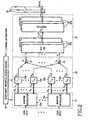
- FIG. 2 is a block diagram illustrating a multiuser-multiple-input multiple-output/orthogonal frequency division multiple access (MIMO/OFDMA) base station to which a subchannel and bit allocation method in accordance with the present invention is applied.
- the multiuser-MIMO/OFDMA base station includes a modulation unit 21, a precoding unit 23, and an OFDMA transmission unit 27.
- the modulation unit 21 includes a plurality of adaptive modulators 21a for processing input data of multiple users.
- the precoding unit 23 includes a plurality of precoders 23a for precoding signals output from the adaptive modulators 21a, and a plurality of adders 25 for adding outputs of the precoders 23a.
- the OFDMA transmission unit 27 includes a plurality of Inverse Fast Fourier Transform (IFFT) and parallel-to-serial (P/S) modules 27a, and a plurality of cyclic prefix (CP) insertion modules 27b for inserting CPs into output signals of the IFFT and P/S modules 27a.
- IFFT Inverse Fast Fourier Transform
- P/S parallel-to-serial
- CP cyclic prefix
- the multiuser-MIMO/OFDMA base station further includes a subchannel and bit allocation module 29 for generating information necessary for subchannel and bit allocation using feedback information received from terminals, and providing the generated information to the modulation unit 21 and the precoding unit 23.
- the above-described base station transmits signals of N subcarriers through N t transmitter antennas 28. It is assumed that the channel is flat fading in the present invention.
- the base station receives downlink channel information from all K user terminals, allocates a set of subchannels to each user terminal, and determines the number of bits to be transmitted through each channel.
- the subchannel and bit allocation information is transmitted to user terminals through a separate control channel.
- N R receiver antennas and N T M ⁇ N R , where M is an integer greater than or equal to 2
- M different user terminals occupy M SDMA subchannels per subcarrier
- each user terminal receives N R spatially multiplexed bit streams through MIMO processing.
- the bit streams are referred to as MIMO subchannels.
- ⁇ n denotes an indicator set for M user terminals occupying M SDMA subchannels of the n -th subcarrier.
- ⁇ n consists of M integers chosen from ⁇ 1,2, ⁇ , K ⁇ .
- the matrix F n,k When the matrix F n,k is properly chosen, the multiuser interference in ⁇ k ⁇ n , S n,k can be eliminated, and S n , k and k ⁇ ⁇ n can be recovered at a receiver.
- the matrix F n,k provides M SDMA subchannels associated with single-user MIMO subchannels, such that each user terminal can spatially multiplex N R data streams.
- a transmitter transmits data to K user terminals through all M ⁇ N ⁇ N R subchannels under the following conditions:
- Condition 1 M SDMA subchannels per subcarrier should be allocated to M different user terminals.
- M N T
- F n,k N n,k
- Condition 2 is unnecessary.
- a data rate R k of the k -th user terminal can be expressed as shown in Equation (1).
- Equation (1) c k ( n , l ) denotes the number of bits allocated to the l -th MIMO subchannel of the k -th user terminal when the k -th user terminal occupies one of the SDMA subchannels of the n -th subcarrier.
- the transmission power allocated to the k -th user terminal can be expressed as shown in Equation (2).
- Equation (2) f k ( c ) is the received power required to stably receive c bits per symbol.
- ⁇ k ( n , l , p ) is an equivalent channel gain of the l -th MIMO subchannel of the k -th user terminal when the k -th and p -th user terminals occupy two SDMA subchannels of the n -th subcarrier.
- MIMO subchannels are ordered according to their equivalent channel gains without loss of generality, i.e.,
- Equation (3) The optimal subchannel and bit allocation problem for minimizing the total transmission power required to transmit data at a rate of ⁇ R 1 ,..., R K ⁇ can be formulated as shown in Equation (3).
- N R 1 (multiuser-MISO/OFDMA)
- the index l for MIMO subchannels and the corresponding summations can be removed from Equation (3).
- Equation (3) The optimization problem in Equation (3) can be simplified as shown in Equation (4).
- Equation (4) ⁇ k ( n , p ) is an equivalent channel gain of the k -th user terminal when the k -th and p -th user terminals occupy two SDMA subchannels of the n -th subcarrier.
- Condition 2 In the single-user MIMO/OFDMA system, only Condition 2 should be satisfied because there is one SDMA subchannel per subcarrier. A user index p can be removed.
- IP requires an exponential time algorithm whose complexity rapidly increases with the number of constraints and variables.
- the optimal IP algorithm was simulated using multiuser-MIMO/OFDMA, multiuser-MISO/OFDMA, and single-user-MIMO/OFDMA systems.
- Table 1 describes system parameters used in the simulation.
- Table 1 Multiuser-MIMO/OFDMA Multiuser-MISO/OFDMA Single-user-MIMO/OFDMA N T 4 2 2 N R 2 1 2 M 2 2 1 # of FFT( N ) 64 64 64 Total # of subchannels 256 128 128 # of users ( K ) 4 # of max. bits ( C ) 12 Required BER 10 -4
- Channel 8-tap frequency selective Rayleigh fading channels with exponentially decaying power profiles were assumed.
- the channel parameters were fixed during one frame period.
- the average channel magnitudes of the different users were generally unequal and the difference, denoted by ⁇ , between the strongest and weakest channels of the four users was either zero or 30 dB.
- Table 2 ⁇ (dB) MIMO subchannel group
- User k # of assigned MIMO subchannels # of MIMO subchannels with c k ( n , l ) i bits
- Total 128 0 37 91 0 0 l 2 1 30 21 9 0 0 0 0.58 2 27 10 17 0 0 0 0.50 3 31 21 10 0 0 0 0.57 4 32 23 9 0 0 0 0.49 Total 120 75 45 0 0 0 30
- the results are sorted into two groups.
- the first group includes resulting values associated with an MIMO subchannel with a larger equivalent channel gain ⁇ k ( n ,l, p ), and the second group includes the rest.
- subchannels are almost equivalently distributed to user terminals. That is, 28 to 34 subchannels of Group 1 are allocated to each user, and 27 to 32 subchannels of Group 2 are allocated to each user.
- Table 2 describes a ratio of average subchannel gains ⁇ k 2 l and ⁇ ⁇ k 2 l . This ratio had only a small variation. Accordingly, this ratio will also be useful for the suboptimal algorithm.
- Tables 4 and 5 show the resulting number of subchannels allocated to each user terminal and the number of bits allocated to each subchannel.
- c k denotes the dominant constellation in the multiuser-MISO/OFDMA system.
- a preferred embodiment of the present invention separates the subchannel and bit allocation problem into two steps to reduce complexity.
- subchannels are allocated under the assumption of dominant constellation.
- bits are distributed to subchannels allocated in the first step. Accordingly, the assumption in the first step is not assumed in this step.
- the subchannel allocation in the first step can be performed via suboptimal algorithms, while the bit allocation in the second step can adopt a greedy algorithm. By separately performing subchannel and bit allocation, this yields a suboptimal algorithm that is considerably simpler to implement than the optimal IP approach.
- Equation 6 Using the dominant constellation of the multiuser-MIMO/OFDMA, the optimal subchannel allocation problem in the first step can be expressed as shown in Equation 6.
- the auxiliary constraint is included for the purpose of finding a useful observation. Equation (6) is considerably simpler than the original IP of Equation (3).
- Equation (6) takes the form of a transportation problem that can be relaxed to linear programming (LP).
- Equation (6) the combination of two user terminals k and p, ⁇ ( k , p ) ⁇ , is supplied to each subcarrier depending on the costs ⁇ g k ( n , p ) .
- ⁇ k ( n , p ) is the number of units shipped from the combination ( k , p ) to the n -th subcarrier if the k -th and p -th users occupy two SDMA subchannels of the n -the subcarrier.
- the constraints in Equation (6) are the demand and supply constraints, respectively, of the transportation problem.
- IP is relaxed to LP.
- the problem is solved using the modified Vogel's method.
- ⁇ c k ( l ) ⁇ in the dominant constellation can be obtained during an initial phase.
- Equation (6) can be simplified as shown in Equation (7).
- Equation (7) The solution ⁇ c k * l of Equation (7) can be obtained by introducing a Lagrange multiplier ⁇ and using a numerical technique, such as vector-form Newton's method.
- Equation (6) The optimization in Equation (6) is an IP problem with much computational load.
- a heuristic subchannel allocation algorithm is developed by modifying Vogel's method.
- S and U denotes sets of subcarrier and user indices, respectively. These sets are defined in Equation (8) and Equation (9). S ⁇ 1 2 ... N U ⁇ ⁇ k p
- P n is the penalty defined as the difference between the two smallest cost values in ⁇ g m ( n , p )
- subchannel allocation for the suboptimal approach in accordance with the present invention is as follows:
- Step 1 Evaluate real-valued ⁇ c k * l from Equation (7) using the vector-form Newton's method.
- Step 2 Substitute ⁇ c k * l for ⁇ c k ( l ) ⁇ in Equation (6) and solve Equation (6) using the above-described modified Vogel's method to obtain ⁇ k ( n , p ) ⁇ .
- the overall heuristic algorithm for subchannel allocation requires O ( K 2 ) operations for one iteration of the vector-form Newton's method, and requires O ( NK 4 ) operations for the heuristic algorithm.
- This is a polynomial-time algorithm that can be applied to real-time multiuser-MIMO/OFDMA systems.
- the channel allocation method in the multiuser-MISO/OFDMA system is the same as the optimization method in Equation (6). Accordingly, the proposed heuristic algorithm can be applied to the multiuser-MISO/OFDMA system.
- N subcarriers are supplied to K users depending on the costs ⁇ g k ( n ) ⁇ .
- ⁇ k ( n ) is the number of units shipped from the n -th subcarrier to the k -th user.
- a transportation problem can be solved by LP relaxation and Vogel's method.
- ⁇ c k ( l ) ⁇ can be obtained during an initial phase.
- the solution ⁇ c k * l of Equation (11) can be obtained by introducing a Lagrange multiplier ⁇ and using a numerical technique, such as vector-form Newton's method.
- Step 1 Evaluate real-valued ⁇ c k * l from Equation (11) using the vector-form Newton's method.
- Step 2 Substitute ⁇ c k * l for ⁇ c k ( l ) ⁇ in Equation (10) and solve Equation (10) using LP after dropping the integer constraints from ⁇ ⁇ k ( n,p ) ⁇ in order to obtain ⁇ k ( n , p ) ⁇ .
- Step 1 Evaluate real-valued ⁇ c k * l from Equation (11) using the vector-form Newton's method.
- Step 2 Substitute ⁇ c k * l for ⁇ c k ( l ) ⁇ in Equation (10) and solve Equation (10) using Vogel's method to obtain ⁇ k ( n , p ) ⁇ .
- Vogel's method The computational load required by Vogel's method is O ( NK 2 ), while the computation load for LP is O ( N 4 ). Because usually N >> K , Vogel's method is considerably simpler to implement than LP.
- the overall heuristic algorithm for subchannel allocation requires O ( K 2 ) operations for one iteration of the vector-form Newton's method, and requires O ( NK 2 ) operations for the heuristic algorithm.
- O ( K 2 ) operations for one iteration of the vector-form Newton's method and requires O ( NK 2 ) operations for the heuristic algorithm.
- This is a polynomial-time algorithm that can be applied to real-time single-user-MIMO/OFDMA systems.
- Equation (12) The bit allocation problem in the multiuser-MIMO/OFDMA system can be expressed as shown in Equation (12).
- p ⁇ k K ⁇ l 1 N R c k n l ⁇ ⁇ k n p , ⁇ k , where only ⁇ c k ( n,l ) ⁇ ⁇ 0,..., C ⁇ are treated as variables since ⁇ ⁇ k ( n,p ) ⁇ are already determined through the subchannel allocation.
- Equation (12) reveals that the bit allocation for each user can be independently performed.
- This fact indicates that the bit allocation for each user can be performed as in the case of single-user OFDM. Accordingly, it is possible to apply the greedy algorithm proposed for single-user OFDM.
- Equations (13) and (14) are the bit allocation problems of multiuser-MISO/OFDMA and single-user-MIMO/OFDMA systems, respectively.
- Equations (13) and (14) are also solved using the greedy algorithm.
- bit allocation for multiuser-MIMO/OFDMA and multiuser-MISO/OFDMA systems requires O ( NK 2 ) operations, while the bit allocation for single-user-MIMO/OFDMA needs O ( NK ) operation.
- Table 6 shows the resulting transmission power for various ⁇ R 1 , R 2 , R 3 , R 4 ⁇ and ⁇ ⁇ ⁇ 0,30 ⁇ [ dB ] .
- Table 6 ⁇ ( dB ) Bits/OFDM symbol Optimal IP (dB) Heuristic (dB) Random (dB) R 1 R 2 R 3 R 4 0 256 256 256 256 39.93 40.24 42.93 128 128 384 384 40.38 40.93 43.10 64 64 448 448 41.03 41.56 43.31 30 256 256 256 256 55.92 57.86 62.41 128 128 384 384 50.74 52.20 57.08 64 64 448 448 46.71 48.01 53.31
- the optimal IP yielded the minimum P T for all cases.
- the P T values from the suboptimal algorithm were reasonably close to the minimum values.
- Table 7 describes the data rates obtained by the additionally required power of the heuristic and random algorithms with respect to the optimal IP.
- Table 7 ⁇ ( dB ) Bits/OFDM symbol
- Optimal IP (dB) R 1 R 2 R 3 R 4 0 256 256 256 256 39.93 262 262 262 262 40.24 316 316 316 316 42.93 128 128 384 384 40.38 140 140 396 396 40.93 186 186 442 442 43.10 64 64 448 448 41.03 76 76 460 460 41.56 116 116 500 43.31 30 256 256 256 256 55.92 306 306 306 306 306 306 306 306 306 306 306 306 306 306 57.86 424 424 424 424 62.41 128 128 384 384 50.74 150 150 406 406 52.20 246 246 502 502 57.08 64 64 448 448 46
- Table 8 shows the resulting transmission power P T for various ⁇ R 1 , R 2 , R 3 , R 4 ⁇ and ⁇ ⁇ ⁇ 0,30 ⁇ [ dB ] .
- Table 8 ⁇ ( dB ) Bits/OFDM symbol Optimal IP (dB) Heuristic (dB) Random (dB) R 1 R 2 R 3 R 4 0 128 128 128 128 38.28 38.84 42.71 64 64 192 192 38.93 39.92 42.86 32 32 224 224 39.87 40.83 43.18 30 128 128 128 128 55.15 56.70 62.02 64 64 192 192 50.12 51.67 57.02 32 32 224 224 46.40 47.74 53.48
- the optimal IP showed the minimum P T for all cases.
- the P T values from the suboptimal algorithm were reasonably close to the minimum values.
- the resulting transmission power P T is shown in Table 9.
- the optimal IP yielded the minimum P T for all cases.
- the P T values from the suboptimal algorithms were reasonably close to the minimum values.
- Table 11 shows the resulting transmission power P T for various ⁇ R 1 , R 2 , R 3 , R 4 ⁇ and ⁇ ⁇ ⁇ 0,30 ⁇ [ dB ] .
- Table 11 ⁇ ( dB ) Bits/OFDM symbol Multiuser-MIMO/OFDMA (dB) Multiuser-MISO/OFDMA (dB) Single-user-MIMO/OFDMA (dB) R 1 R 2 R 3 R 4 0 256 256 256 256 40.28 44.93 38.52 128 128 384 384 41.06 48.41 38.79 64 64 448 448 41.70 51.29 38.90 30 256 256 256 256 57.88 64.46 54.26 128 128 384 384 52.35 57.22 49.29 64 64 448 448 48.09 53.53 45.68
- the single-user-MIMO/OFDMA which has the maximum number of receiver antennas, yielded the minimum P T and the multiuser-MISO/OFDMA, which has the minimum number of receiver antennas, yielded the maximum P T .
- FIG. 3 is a flow chart illustrating a subchannel and bit allocation method in accordance with the present invention.
- the subchannel and bit allocation method computes channel gain and transmission rate information using feedback information from terminals in Step S301, and computes an average channel gain according to a computed channel gain for each user in Step S302.
- the average channel gain for each user has been determined, the average number of bits to be allocated to a corresponding user is determined in Step S303.
- the number of subchannels to be allocated to each user is determined in Step S304.
- Subchannels are allocated to each user according to the determined number of subchannels in Step S305.
- a modulation scheme is determined on a channel-by-channel basis in Step S306.
- the subchannel and bit allocation method for multiuser-MIMO/OFDMA systems in accordance with the present invention can optimize subchannel and bit allocation using IP. Further, the subchannel and bit allocation method in accordance with the present invention can obtain the performance close to that of the optimal IP algorithm using an efficient suboptimal algorithm for separately performing a subchannel and bit allocation process.
- the subchannel and bit allocation method in accordance with the present invention can considerably improve frequency use efficiency as well as a power gain by adaptively allocating subchannels and bits according to channel environments, as compared with a system using a fixed modulation scheme.
Landscapes
- Engineering & Computer Science (AREA)
- Signal Processing (AREA)
- Computer Networks & Wireless Communication (AREA)
- Physics & Mathematics (AREA)
- General Physics & Mathematics (AREA)
- Quality & Reliability (AREA)
- Computer Security & Cryptography (AREA)
- Radio Transmission System (AREA)
- Mobile Radio Communication Systems (AREA)
Description
- The present invention relates generally to a mobile communication system, and more particularly to a scheme for optimizing subchannel and bit allocation in a multicarrier-based mobile communication system.
- A multiple-input multiple-output (MIMO) system in the downlink can be broken down to multiple parallel independent single-user MIMO systems. Further, when the orthogonal frequency division multiple access (OFDMA) technology is applied to the downlink MIMO system, a multiuser-MIMO/OFDMA system is provided. In this system, data streams for users are multiplexed over space and frequency, and thus the users receive the spatially multiplexed data streams.
-
FIG. 1 is a conceptual diagram illustrating subchannels of a multiuser-multiple-input multiple-output/orthogonal frequency division multiple access (MIMO/OFDMA) system. In the multiuser-MIMO/OFDMA system as illustrated inFIG. 1 , there are space division multiple access (SDMA) subchannels in which each user occupies several MIMO subchannels, for each orthogonal frequency division multiplexing (OFDM) subcarrier. The users generate MIMO subchannels using the MIMO technologies, and transmit data through the generated MIMO subchannels. A more important feature of a multiuser-MIMO/OFDMA system design is that SDMA channels are allocated to users, and bits are loaded to the MIMO subchannels allocated to a single user for adaptive modulation. - Document
US 2003/128658 A1 (WALTON JAY ROD [US] ET AL) 10 July 2003 (2003-07-10 - For subchannel and bit allocation, optimal and suboptimal schemes have been proposed to minimize the overall transmission power under the data rate constraint or to maximize a data rate under the transmission power constraint. For a multiuser-multiple-input single-output (MISO)/OFDM system, a bit allocation scheme for maximizing a signal-to-noise ratio (SNR) has been proposed. More specifically, a suboptimal scheme that takes into account interference and a data rate in a multiuser-MISO/OFDMA system has been proposed. However, when the data rate constraint is present, there is a drawback that the suboptimal scheme can be applied only to an OFDMA system.
- Accordingly, the present invention has been designed to solve the above and other problems occurring in the prior art. Therefore, it is an aspect of the present invention to provide a subchannel and bit allocation method for efficiently allocating subchannels in an orthogonal frequency division multiple access (OFDMA) system using multiple antennas.
- It is another aspect of the present invention to provide a subchannel and bit allocation method for improving a power gain, and frequency use efficiency by performing adaptive modulation according to channel state.
- The above and other aspects of the present invention can be achieved by a resource allocation method in a multiuser-multiple-input multiple-output/orthogonal frequency division multiple access (MIMO/OFDMA) system including a base station for transmitting signals through a plurality of transmitter antennas, and a plurality of terminals for receiving the signals through receiver antennas. The resource allocation method includes determining a number of subchannels for each user according to a channel environment; and allocating a modulating scheme for each subchannel according to the determined number of subchannels.
- The above and other aspects and advantages of the present invention will be more clearly understood from the following detailed description taken in conjunction with the accompanying drawings, in which:
-
FIG. 1 is a conceptual diagram illustrating subchannels of a multiuser-multiple-input multiple-output/orthogonal frequency division multiple access (MIMO/OFDMA) system; -
FIG. 2 is a block diagram illustrating a multiuser-MIMO/OFDMA base station to which a subchannel and bit allocation method in accordance with the present invention is applied; and -
FIG. 3 is a flow chart illustrating the subchannel and bit allocation method in accordance with the present invention. - A subchannel and bit allocation method in accordance with preferred embodiments of the present invention will be described in detail herein below with reference to the accompanying drawings. More specifically, the present invention provides an optimal scheme for subchannel and bit allocation, and a suboptimal scheme for separately performing the subchannel and bit allocation.
-
FIG. 2 is a block diagram illustrating a multiuser-multiple-input multiple-output/orthogonal frequency division multiple access (MIMO/OFDMA) base station to which a subchannel and bit allocation method in accordance with the present invention is applied. Referring toFIG. 2 , the multiuser-MIMO/OFDMA base station includes amodulation unit 21, aprecoding unit 23, and anOFDMA transmission unit 27. Themodulation unit 21 includes a plurality ofadaptive modulators 21a for processing input data of multiple users. Theprecoding unit 23 includes a plurality ofprecoders 23a for precoding signals output from theadaptive modulators 21a, and a plurality ofadders 25 for adding outputs of theprecoders 23a. TheOFDMA transmission unit 27 includes a plurality of Inverse Fast Fourier Transform (IFFT) and parallel-to-serial (P/S)modules 27a, and a plurality of cyclic prefix (CP)insertion modules 27b for inserting CPs into output signals of the IFFT and P/S modules 27a. - The multiuser-MIMO/OFDMA base station further includes a subchannel and
bit allocation module 29 for generating information necessary for subchannel and bit allocation using feedback information received from terminals, and providing the generated information to themodulation unit 21 and theprecoding unit 23. - The above-described base station transmits signals of N subcarriers through Nt transmitter antennas 28. It is assumed that the channel is flat fading in the present invention. The base station receives downlink channel information from all K user terminals, allocates a set of subchannels to each user terminal, and determines the number of bits to be transmitted through each channel.
- The subchannel and bit allocation information is transmitted to user terminals through a separate control channel. When each user terminal has NR receiver antennas and NT = M·NR , where M is an integer greater than or equal to 2, M different user terminals occupy M SDMA subchannels per subcarrier, and each user terminal receives NR spatially multiplexed bit streams through MIMO processing. The bit streams are referred to as MIMO subchannels. Ω n denotes an indicator set for M user terminals occupying M SDMA subchannels of the n -th subcarrier. Ω n consists of M integers chosen from {1,2,···,K}. When an NR ×1 vector is defined by Xn,k ,

- When X n,k is multiplied by an NT ×NR processing matrix, Sn,k = Fn,k Xn,k is yielded and ∑ k∈Ωn Sn,k is transmitted through the n -th subcarrier. However, when Xn,k = 0, such multiplication is unnecessary.
- When the matrix Fn,k is properly chosen, the multiuser interference in ∑ k∈Ωn , Sn,k can be eliminated, and S n,k and k ∈ Ω n can be recovered at a receiver. The matrix Fn,k provides M SDMA subchannels associated with single-user MIMO subchannels, such that each user terminal can spatially multiplex NR data streams.
- A transmitter transmits data to K user terminals through all M · N · NR subchannels under the following conditions:
- Condition 1: M SDMA subchannels per subcarrier should be allocated to M different user terminals.
- Condition 2: All NR MIMO subchannels associated with one SDMA subchannel should be allocated to a single user terminal occupying the SDMA subchannel.
- When M = 1, the multiuser-MIMO/OFDMA system is switched to a single-user-MIMO/OFDMA system in which each subcarrier with NR MIMO subchannels is occupied by a single user terminal. In this case, NT = NR , Fn,k = E n,k , and
Condition 1 is unnecessary. - Another form of the multiuser-MIMO/OFDMA system is a multiuser-multiple-input single-output (MISO)/OFDMA system having a single receiver antenna, where NR = 1. In this case, M = NT , Fn,k =
N n,k , and Condition 2 is unnecessary. - An optimal subchannel and bit allocation scheme based on integer programming (IP) in accordance with the present invention will be described herein below. For convenience, it is assumed that the number of SDMA subchannels for each OFDM subcarrier is 2, i.e., M = 2.
- A data rate Rk of the k -th user terminal can be expressed as shown in Equation (1).


- If the k -th and p -th user terminals occupy two SDMA subchannels of the n -th subcarrier, and c bits are allocated to the l-th MIMO subchannel associated with an SDMA subchannel of the k -th user terminal, ρ k (n,l,p,c) = 1. Otherwise, ρ k (n,l,p,c) = 0.
- In Equation (1), ck (n,l) denotes the number of bits allocated to the l-th MIMO subchannel of the k -th user terminal when the k -th user terminal occupies one of the SDMA subchannels of the n -th subcarrier. The transmission power allocated to the k -th user terminal can be expressed as shown in Equation (2).

- In Equation (2), fk (c) is the received power required to stably receive c bits per symbol. α k (n,l,p) is an equivalent channel gain of the l -th MIMO subchannel of the k -th user terminal when the k -th and p -th user terminals occupy two SDMA subchannels of the n -th subcarrier.
- It is assumed that the MIMO subchannels are ordered according to their equivalent channel gains without loss of generality, i.e., |α k (n,1,p)|≥|α k (n,2,p)|,∀k,n,p.
- The optimal subchannel and bit allocation problem for minimizing the total transmission power required to transmit data at a rate of {R 1,...,RK } can be formulated as shown in Equation (3).

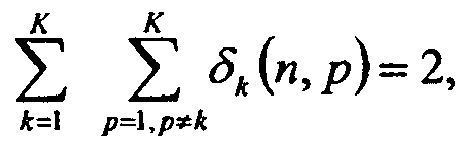
- In Equation (3), PT denotes an intensity of the total transmission power. If the k -th and p -th user terminals occupy two SDMA subchannels associated with the n -th subcarrier, δ k (n,p) = 1. Otherwise, δ k (n,p) = 0.
- In Equation (3), an inequality


Conditions 1 and 2. An optimal solution of the problem is obtained by IP using binary variables. - When M = 1 (single-user-MISO/OFDMA), one of the user indices p and the corresponding summations can be removed from Equation (3). As a result, a condition of δ k (n,p)=δ p (n,k),∀k,n,p is discarded. Furthermore, in this case, an inequality
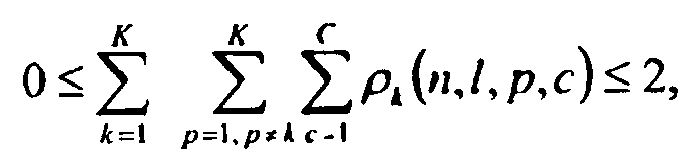
only Condition 1 is discarded. - When NR = 1 (multiuser-MISO/OFDMA), the index l for MIMO subchannels and the corresponding summations can be removed from Equation (3). In this case,


- In the case of the multiuser-MISO/OFDMA system (for convenience, M = 2), a single MIMO subchannel associated with a single SDMA subchannel exists. Accordingly, a MIMO subchannel index l can be removed, and only
Condition 1 needs to be satisfied. The optimization problem in Equation (3) can be simplified as shown in Equation (4).
- In Equation (4), if the k -th and p -th user terminals occupy two SDMA subchannels of the n -th subcarrier, and c bits are allocated to an MIMO subchannel associated with an SDMA subchannel of the k -th user terminal, ρk (n,l,c) = 1. Otherwise, ρk (n,l,c) = 0.
- In Equation (4), α k (n, p) is an equivalent channel gain of the k -th user terminal when the k -th and p -th user terminals occupy two SDMA subchannels of the n -th subcarrier. In the data rate constraint of


- In the single-user MIMO/OFDMA system, only Condition 2 should be satisfied because there is one SDMA subchannel per subcarrier. A user index p can be removed.
- Accordingly, the optimization problem can be expressed as shown in Equation (5).

- In Equation (5), if the k -th user terminal occupies one SDMA subchannel of the n -th subcarrier, c bits are allocated to the l -th MIMO subchannel associated with the SDMA subchannel of the k -th user terminal, ρ k (n,l,c) = 1. Otherwise, ρ k (n,l,c) = 0.
- In Equation (5) and its constraint


- Conventionally, IP requires an exponential time algorithm whose complexity rapidly increases with the number of constraints and variables.
- Now, the behavior of the optimal IP algorithm is examined through computer simulation, and several observations are performed in relation to bit allocation.
- The optimal IP algorithm was simulated using multiuser-MIMO/OFDMA, multiuser-MISO/OFDMA, and single-user-MIMO/OFDMA systems. Table 1 describes system parameters used in the simulation.
Table 1 Multiuser-MIMO/OFDMA Multiuser-MISO/OFDMA Single-user-MIMO/OFDMA NT 4 2 2 NR 2 1 2 M 2 2 1 # of FFT(N) 64 64 64 Total # of subchannels 256 128 128 # of users (K) 4 # of max. bits (C) 12 Required BER 10-4 Channel 8-tap frequency selective Rayleigh fading channels with exponentially decaying power profiles were assumed. The channel parameters were fixed during one frame period. The average channel magnitudes of the different users were generally unequal and the difference, denoted by γ, between the strongest and weakest channels of the four users was either zero or 30 dB. - For the multiuser-MIMO/OFDMA system, Table 2 describes the number of subchannels allocated to each user terminal and the number of bits allocated to each subchannel where R 1 = R 2 = R 3 = R 4 = 256.
Table 2 γ (dB) MIMO subchannel group User k # of assigned MIMO subchannels # of MIMO subchannels with ck (n,l) = i bits Ratio i = 2 i = 4 i = 6 i = 8 i = 10 0 l = 1 1 34 0 13 21 0 0 0.77 2 28 0 0 28 0 0 0.87 3 32 0 9 23 0 0 0.73 4 34 0 15 19 0 0 0.83 Total 128 0 37 91 0 0 l = 2 1 30 21 9 0 0 0 0.58 2 27 10 17 0 0 0 0.50 3 31 21 10 0 0 0 0.57 4 32 23 9 0 0 0 0.49 Total 120 75 45 0 0 0 30 l = 1 1 63 31 32 0 0 0 0.88 2 28 0 1 27 0 0 0.79 3 20 0 0 4 16 0 0.74 4 17 0 0 0 10 7 0.72 Total 128 31 33 31 26 7 l = 2 1 33 33 0 0 0 0 0.42 2 25 6 18 1 0 0 0.46 3 20 0 8 12 0 0 0.57 4 17 0 0 15 2 0 0.56 Total 95 39 26 28 2 0 - Because equivalent channel gains of two MIMO subchannels (NR = 2), {α k (n,l,p),l = 1, 2}, are different in most cases, the results are sorted into two groups. The first group includes resulting values associated with an MIMO subchannel with a larger equivalent channel gain α k (n,l,p), and the second group includes the rest. In relation to channels with the same channel gain (γ = 0), subchannels are almost equivalently distributed to user terminals. That is, 28 to 34 subchannels of
Group 1 are allocated to each user, and 27 to 32 subchannels of Group 2 are allocated to each user. Where γ = 30 dB, a large number of subchannels were allocated toUser Terminal 1 with the lowest average channel magnitude, and a small number of subchannels were allocated to User Terminal 4 with the highest average channel magnitude. This occurred because R 1 = R 2 = R 3 = R 4. - It is important to observe that the optimal IP often loaded the same number of bits (or constellation size) for subchannels allocated to one user. This indicates that ck (n,l) in Equation (1) tends to be the same regardless of n. More specifically, ck (l) indicates the dominant constellation.
- When γ = 0 dB , c 1(1) = 6 because 21 out of 34 MIMO subchannels were loaded 6 bits. The remaining 13 subchannels were loaded 4 bits. Accordingly, the dominant constellation for each pair of (k,l) can be found.
- When the same experiment are repeated 1,000 times as shown in Table 3, it was observed that about 70 % of ck (n,l) were equal to their corresponding dominant constellation ck (l), and almost all ck (n,l) were in the neighborhood of ck (l).
Table 3 γ = 0dB γ = 30dB 
0.69 0.74 
0.99 0.99 - The observation regarding the dominant constellation is essential to obtain a suboptimal algorithm.
- Table 2 describes a ratio of average subchannel gains


- When R 1 = R 2 = R 3 = R 4 = 128 in the multiuser-MISO/OFDMA system and the single-user-MIMO/OFDMA system, Tables 4 and 5 show the resulting number of subchannels allocated to each user terminal and the number of bits allocated to each subchannel.
Table 4 γ (dB) User k # of assigned MIMO subchannels # of MIMO subchannels with ck (n) = i bits Ratio i = 2 i = 4 i = 6 i = 8 i = 10 0 1 33 2 31 0 0 0 0.83 2 30 0 26 4 0 0 0.76 3 32 6 20 6 0 0 0.75 4 33 2 31 0 0 0 0.81 Total 128 10 108 10 0 0 30 1 54 44 10 0 0 0 0.88 2 32 7 18 7 0 0 0.80 3 21 0 5 10 6 0 0.89 4 20 0 1 14 5 0 0.87 Total 127 51 34 31 11 0 Table 5 γ(dB) MIMO subchannel group User k # of assigned MIMO subchannels # of MIMO subchannels with ck (n,l) = i bits Ratio i = 2 i = 4 i = 6 i = 8 i = 10 
0 l = 1 1 19 0 14 5 0 0 0.87 2 16 0 3 13 0 0 0.82 3 14 0 3 11 0 0 0.74 4 15 0 4 11 0 0 0.71 Total 64 0 24 40 0 0 l = 2 1 19 17 2 0 0 0 0.66 2 16 13 3 0 0 0 0.60 3 14 3 11 0 0 0 0.47 4 14 5 9 0 0 0 0.62 Total 63 38 25 0 0 0 30 l = 1 1 38 17 21 0 0 0 0.83 2 11 0 0 8 3 0 0.90 3 8 0 0 0 5 3 0.84 4 7 0 0 0 0 7 0.96 Total 64 17 21 8 8 10 l = 2 1 5 5 0 0 0 0 0.40 2 11 0 5 6 0 0 0.43 3 8 0 0 3 5 0 0.54 4 7 0 0 1 4 2 0.64 Total 31 5 5 10 9 2 - We can also find the same observation regarding the dominant constellation and the ratio between average subchannel gains as in the multiuser-MIMO/OFDMA system. ck denotes the dominant constellation in the multiuser-MISO/OFDMA system.
- When γ = 0 dB, c 1 = 4 because 31 out of 33 subchannels were loaded 4 bits. The remaining two subchannels were loaded 2 bits (refer to Table 4). Accordingly, the dominant constellation for each user terminal k can be found. From Table 5, the dominant constellation ck (l) in the single-user-MIMO/OFDMA system can also be determined. Further, in Table 5, ratios between average subchannel gains only have a small variation.
- A preferred embodiment of the present invention separates the subchannel and bit allocation problem into two steps to reduce complexity.
- In the first step, subchannels are allocated under the assumption of dominant constellation.
-

-

-

- In the second step, bits are distributed to subchannels allocated in the first step. Accordingly, the assumption in the first step is not assumed in this step. The subchannel allocation in the first step can be performed via suboptimal algorithms, while the bit allocation in the second step can adopt a greedy algorithm. By separately performing subchannel and bit allocation, this yields a suboptimal algorithm that is considerably simpler to implement than the optimal IP approach.
- Using the dominant constellation of the multiuser-MIMO/OFDMA, the optimal subchannel allocation problem in the first step can be expressed as shown in Equation 6.

- In Equation (6),


- Furthermore, an efficient heuristic algorithm can be found for the following observation.
- Observation 1: Suppose that {ck (l)} are known. Then, {fk (ck (l))} becomes known and Equation (6) takes the form of a transportation problem that can be relaxed to linear programming (LP).
- In Equation (6), the combination of two user terminals k and p, {(k,p)}, is supplied to each subcarrier depending on the costs {gk (n,p) . δ k (n,p) is the number of units shipped from the combination (k,p) to the n -th subcarrier if the k -th and p -th users occupy two SDMA subchannels of the n -the subcarrier. The constraints in Equation (6) are the demand and supply constraints, respectively, of the transportation problem.
- In the case of transportation, it is straightforward to show that IP is relaxed to LP.
- In addition, there are efficient heuristic algorithms. One such algorithm is known as Vogel's method capable of being modified to take account of the additional constraints of

- Before solving the optimization problem in the first step, {ck (l)} in the dominant constellation can be obtained during an initial phase. Evaluation of {ck (l)} requires the following assumption on the channel gain:


- Under the above assumption, Equation (6) can be simplified as shown in Equation (7).


- The solution

- Although the obtained

- The optimization in Equation (6) is an IP problem with much computational load.
- As described above, to reduce the load, a heuristic subchannel allocation algorithm is developed by modifying Vogel's method. The modification is to put the additional constraints of

- To describe the heuristic algorithm, the following notations are necessary: S and U denotes sets of subcarrier and user indices, respectively. These sets are defined in Equation (8) and Equation (9).


- Pn is the penalty defined as the difference between the two smallest cost values in {gm (n,p)|k = 1,..., K, p = 1,...,K, k ≠ p}. More specifically,



- For each iteration of this algorithm, the size of the subcarrier index set S is reduced by one, due to the constraints of


- In summary, the subchannel allocation for the suboptimal approach in accordance with the present invention is as follows:
- Step 1: Evaluate real-valued

- Step 2: Substitute

- The overall heuristic algorithm for subchannel allocation requires O(K 2) operations for one iteration of the vector-form Newton's method, and requires O(NK 4) operations for the heuristic algorithm. This is a polynomial-time algorithm that can be applied to real-time multiuser-MIMO/OFDMA systems.
- Except for the values of


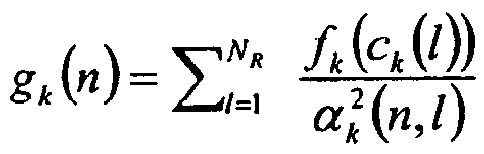

- Furthermore, we can find some suboptimal algorithms for this problem due to the following observation:
- Observation 2: Suppose that {ck (l)} are known. Then, {fk (ck (l))} become known and Equation (10) takes the form of a transportation problem that can be relaxed to linear programming (LP).
- In Equation (10), N subcarriers are supplied to K users depending on the costs {gk (n)}. δ k (n) is the number of units shipped from the n -th subcarrier to the k -th user. The constraints of


- Before solving the optimization problem in the first step, {ck (l)} can be obtained during an initial phase.
- Evaluation of {ck (l)} requires the following assumption on the channel gain:


- Under the above assumption, the optimization problem in Equation (10) can be simplified as shown in Equation (11).


- Finally, the suboptimal approaches to the subchannel allocation in the single-user-MIMO/OFDMA system in accordance with the present invention are as follows:
- Step 1: Evaluate real-valued

- Step 2: Substitute

- Step 1: Evaluate real-valued

- Step 2: Substitute

- The computational load required by Vogel's method is O(NK 2), while the computation load for LP is O(N 4). Because usually N >> K, Vogel's method is considerably simpler to implement than LP.
- The overall heuristic algorithm for subchannel allocation requires O(K 2) operations for one iteration of the vector-form Newton's method, and requires O(NK 2) operations for the heuristic algorithm. This is a polynomial-time algorithm that can be applied to real-time single-user-MIMO/OFDMA systems.
- The bit allocation problem in the multiuser-MIMO/OFDMA system can be expressed as shown in Equation (12).

- Equation (12) reveals that the bit allocation for each user can be independently performed. Under the constraint


- Equations (13) and (14) are the bit allocation problems of multiuser-MISO/OFDMA and single-user-MIMO/OFDMA systems, respectively.


- Like the case of the multiuser-MIMO/OFDMA system, Equations (13) and (14) are also solved using the greedy algorithm.
- The bit allocation for multiuser-MIMO/OFDMA and multiuser-MISO/OFDMA systems requires O(NK 2) operations, while the bit allocation for single-user-MIMO/OFDMA needs O(NK) operation.
- The optimal IP and suboptimal algorithm were examined. For comparison, also considered were the random algorithm where subchannels were randomly allocated and bits were allocated by the greedy algorithm. Accordingly, the parameters were the same as those in Table 1.
- For the multiuser-MIMO/OFDMA system, the simulation results were the average of 100 trials.
- Table 6 shows the resulting transmission power for various {R 1,R 2,R 3,R 4} and γ ∈ {0,30} [dB].
Table 6 γ (dB) Bits/OFDM symbol Optimal IP (dB) Heuristic (dB) Random (dB) R 1 R 2 R 3 R 4 0 256 256 256 256 39.93 40.24 42.93 128 128 384 384 40.38 40.93 43.10 64 64 448 448 41.03 41.56 43.31 30 256 256 256 256 55.92 57.86 62.41 128 128 384 384 50.74 52.20 57.08 64 64 448 448 46.71 48.01 53.31 - As expected, the optimal IP yielded the minimum PT for all cases. The PT values from the suboptimal algorithm were reasonably close to the minimum values. The performance gap between the optimal IP and the suboptimal algorithm did not exceed 0.55 dB, when γ = 0 dB , and 1.94 dB, when γ = 30 dB . The random algorithm was worse than the others. That is, the maximum additionally required power was 3.00 dB, when γ = 0 dB, and 6.60 dB, when γ = 30 dB.
- To further examine the performance degradation of the algorithms against the optimal IP, additional experiments with the optimal IP were performed for various {R 1,R 2,R 3,R 4}.
- Table 7 describes the data rates obtained by the additionally required power of the heuristic and random algorithms with respect to the optimal IP.
Table 7 γ (dB) Bits/OFDM symbol Optimal IP (dB) R 1 R 2 R 3 R 4 0 256 256 256 256 39.93 262 262 262 262 40.24 316 316 316 316 42.93 128 128 384 384 40.38 140 140 396 396 40.93 186 186 442 442 43.10 64 64 448 448 41.03 76 76 460 460 41.56 116 116 500 500 43.31 30 256 256 256 256 55.92 306 306 306 306 57.86 424 424 424 424 62.41 128 128 384 384 50.74 150 150 406 406 52.20 246 246 502 502 57.08 64 64 448 448 46.71 78 78 464 464 48.01 148 148 532 532 53.31 - For example, when γ = 0 dB, 40.24 dB, which was needed for {256,256,256,256} using the heuristic algorithm in Table 6, achieved {262,262,262,262} with the optimal IP. The performance degradation of the heuristic algorithm was less than 12 bits/OFDM symbol per user, when γ = 0 dB, and was less than 50 bits/OFDM symbol per user, when γ = 30 dB. In the case of random algorithm, the maximum loss was 60 bits/OFDM symbol per user, when γ = 0 dB, and 128 bits/OFDM symbol per user, when γ = 30 dB.
- As indicated above, the simulation results for the multiuser-MISO/OFDMA systems were the average of 100 trials.
- Table 8 shows the resulting transmission power PT for various {R 1, R 2, R 3, R 4} and γ ∈ {0,30} [dB].
Table 8 γ (dB) Bits/OFDM symbol Optimal IP (dB) Heuristic (dB) Random (dB) R 1 R 2 R 3 R 4 0 128 128 128 128 38.28 38.84 42.71 64 64 192 192 38.93 39.92 42.86 32 32 224 224 39.87 40.83 43.18 30 128 128 128 128 55.15 56.70 62.02 64 64 192 192 50.12 51.67 57.02 32 32 224 224 46.40 47.74 53.48 - As expected, the optimal IP showed the minimum PT for all cases. The PT values from the suboptimal algorithm were reasonably close to the minimum values. The performance gap between the optimal IP and the suboptimal algorithm was less than 0.99 dB, when γ = 0 dB, and 1.55 dB, when γ = 30 dB. The random algorithm was worse than the others. That is, the maximum additionally required power was 3.93 dB, when γ = 0 dB, and 7.08 dB, when γ = 30 dB.
- For the single-user-MIMO/OFDMA system, the simulation results were the average of 20 trials.
- The resulting transmission power PT is shown in Table 9.
Table 9 γ (dB) Bits/OFDM symbol Optimal IP (dB) Suboptimal LP (dB) Heuristic (dB) Random (dB) R 1 R2 R3 R4 0 128 128 128 128 37.05 37.24 37.30 40.57 64 64 192 192 37.24 37.46 37.56 41.06 32 32 224 224 37.56 37.80 37.84 40.82 30 128 128 128 128 52.52 53.11 53.41 55.95 64 64 192 192 47.42 47.49 48.43 52.59 32 32 224 224 43.36 43.70 44.29 49.79 - In Table 9, the optimal IP yielded the minimum PT for all cases. The PT values from the suboptimal algorithms were reasonably close to the minimum values. The performance gap between the optimal IP and the suboptimal LP algorithm did not exceed 0.24 dB, when γ = 0 dB, and did not exceed 0.59 dB, when γ = 30 dB. In the case of the heuristic algorithm, the gap was less than 0.32 dB, when γ = 0 dB, and was less than 0.01 dB, when γ = 30 dB. The random algorithm was worse than the others. That is, the maximum additionally required power was 3.82 dB, when γ = 0 dB, and 6.43 dB, when γ = 30 dB.
- To compare the performance of the above three systems, additional simulations were performed when all systems has the same number of subchannels. The parameters were shown in Table 10 and the heuristic algorithm was applied.
Table 10 Multiuser-MIMO/OFDMA Multiuser-MISO/OFDMA Single-user-MIMO/OFDMA NT 4 4 4 NR 2 1 4 M 2 4 1 # of FFT(N) 64 64 64 Total # of subchannels 256 256 256 # of users (K) 4 # of max. bits (C) 12 Required BER 104 Channel 8-tap frequency selective Rayleigh fading channels with exponentially decaying power profiles were assumed. The channel parameters were fixed during one frame period. The average channel magnitudes of the different users were generally unequal and the difference, denoted by γ , between the strongest and weakest channels of the four users was either zero or 30 dB. - In Table 10, the simulation results were the average of 100 trials.
- Table 11 shows the resulting transmission power PT for various {R 1, R 2 ,R 3, R 4} and γ ∈ {0,30} [dB].
Table 11 γ (dB) Bits/OFDM symbol Multiuser-MIMO/OFDMA (dB) Multiuser-MISO/OFDMA (dB) Single-user-MIMO/OFDMA (dB) R 1 R 2 R 3 R 4 0 256 256 256 256 40.28 44.93 38.52 128 128 384 384 41.06 48.41 38.79 64 64 448 448 41.70 51.29 38.90 30 256 256 256 256 57.88 64.46 54.26 128 128 384 384 52.35 57.22 49.29 64 64 448 448 48.09 53.53 45.68 - As shown in Table 11, the single-user-MIMO/OFDMA, which has the maximum number of receiver antennas, yielded the minimum PT and the multiuser-MISO/OFDMA, which has the minimum number of receiver antennas, yielded the maximum PT . The performance gap between the single-user-MIMO/OFDMA and the multiuser-MIMO/OFDMA did not exceed 2.8 dB, when γ = 0 dB, and did not exceed 3.62 dB, when γ = 30 dB. The multiuser-MISO/OFDMA was worse than the others. That is, the maximum additionally required power was 12.39 dB, when γ = 0 dB, and 10.20 dB, when γ = 30 dB.
-
FIG. 3 is a flow chart illustrating a subchannel and bit allocation method in accordance with the present invention. As illustrated inFIG. 3 , the subchannel and bit allocation method computes channel gain and transmission rate information using feedback information from terminals in Step S301, and computes an average channel gain according to a computed channel gain for each user in Step S302. When the average channel gain for each user has been determined, the average number of bits to be allocated to a corresponding user is determined in Step S303. The number of subchannels to be allocated to each user is determined in Step S304. Subchannels are allocated to each user according to the determined number of subchannels in Step S305. - After the subchannels are allocated to each user, a modulation scheme is determined on a channel-by-channel basis in Step S306.
- As is apparent from the description above, the subchannel and bit allocation method for multiuser-MIMO/OFDMA systems (including its special systems) in accordance with the present invention can optimize subchannel and bit allocation using IP. Further, the subchannel and bit allocation method in accordance with the present invention can obtain the performance close to that of the optimal IP algorithm using an efficient suboptimal algorithm for separately performing a subchannel and bit allocation process.
- Additionally, the subchannel and bit allocation method in accordance with the present invention can considerably improve frequency use efficiency as well as a power gain by adaptively allocating subchannels and bits according to channel environments, as compared with a system using a fixed modulation scheme.
- While the present invention has been shown and described with reference to certain preferred embodiments thereof, it will be understood by those skilled in the art that various changes in form and details may be made therein without departing from the scope of the present invention as defmed by the appended claims.
Claims (15)
- A resource allocation method in a multiple-input multiple-output/orthogonal frequency division multiple access, MIMO/OFDMA, system including a base station for transmitting signals through a plurality of transmitter antennas, and a plurality of user terminals for receiving the signals through receiver antennas, wherein each user terminal has NR receiver antennas with NR being an integer greater than or equal to 1, the method characterised by:receiving feedback information from the user terminals;determining (S301) a channel gain for each user terminal and each MIMO subchannel and a transmission rate for each user terminal, using the feedback information;computing (S302) an average channel gain for each user terminal and MIMO subchannel group by averaging over all channel gains associated with each user terminal and the MIMO subchannel group;determining (S303) an average number of bits for each user terminal and each of MIMO subchannels of the MIMO subchannel group according to the average channel gain for each user terminal and the MIMO subchannel group;computing (S304) a number of MIMO subchannels for each user terminal according to the average number of bits for each user terminal and each of MIMO subchannels of the MIMO subchannel group; andallocating a modulating scheme for each MIMO subchannel according to the computed number of MIMO subchannels,wherein the MIMO subchannel group is defined by a MIMO subchannel index.
- The resource allocation method according to claim 1, wherein the step of allocating the modulation scheme comprises:allocating(S305) at least one MIMO subchannel to each user terminal according to the number of MIMO subchannels for each user terminal; anddetermining (S306) the modulation scheme for each of the at least one MIMO subchannel while taking into account the average number of bits for each user terminal and each of MIMO subchannels of the MIMO subchannel group and the number of MIMO subchannels for each user terminal.
- The resource allocation method according to claim 2, wherein the channel environment includes at least one of a multiuser-MIMO/OFDMA environment, a multiuser-multiple-input single-output MISO/OFDMA environment, where NR=1 for each user terminal, and a single-user MIMO/OFDMA environment.
- The resource allocation method according to claim 3, wherein the average channel gain for each user terminal and the MIMO subchannel group in the multiuser-MIMO/OFDMA environment is computed by:

where K is a total number of user terminals, N is a total number of subcarriers, k and p are user terminal indices, and I is the MIMO subchannel index. - The resource allocation method according to claim 3, wherein the average channel gain for each user terminal and the MIMO subchannel group in the multiuser-MISO/OFDMA environment is computed by:
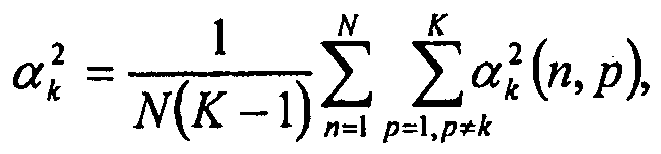
where K is a total number of user terminals, N is a total number of subcarriers, and k and p are user terminal indices. - The resource allocation method according to claim 3, wherein the average channel gain for each user terminal and the MIMO subchannel group in the single-user-MIMO/OFDMA environment is computed by:

where N is a total number of subcarriers, and I is the MIMO subchannel index. - The resource allocation method according to claim 2, wherein the average channel gain for each user terminal and MIMO subchannel group is computed by:

in a multiuser-MIMO/OFDMA environment, is computed by:
in a multiuser-multiple-input single-output MISO/OFDMA environment, where NR=1 for each user terminal, and is computed by:
in a single-user-MIMO/OFDMA environment,
where K is a total number of user terminals, N is a total number of subcarriers, k and p are user terminal indices, and I is the MIMO subchannel index. - The resource allocation method according to claim 2, wherein the number of MIMO subchannels for each user terminal is computed using Vogel's method, which is modified such that additional constraints are taken into account in a multiuser-MIMO/OFDMA environment and a multiuser-multiple-input single-output MISO/OFDMA environment, where NR=1 for each user terminal;
wherein the number of MIMO subchannels for each user terminal is computed by determining the number of units shipped from a combination of user terminals occupying spatial subchannels of a subcarrier of the MIMO/OFDMAsystem to the subcarrier. - The resource allocation method according to claim 2, wherein the number of MIMO subchannels for each user terminal is computed using Vogel's method in a single-user-MIMO/OFDMA environment;
wherein the number of MIMO subchannels for each user terminal is computed by determining the number of units shipped from a combination of user terminals occupying spatial subchannels of a subcarrier of the MIMO/OFDMA system to the subcarrier. - The resource allocation method according to claim 1, wherein the step of allocating the modulation scheme comprises:allocating at least one MIMO subchannel to each user terminal according to the number of MIMO subchannels for each user terminal; anddetermining the modulation scheme for each of the at least one MIMO subchannel.
- The resource allocation method according to claim 1, wherein the channel environment includes at least one of a multiuser-MIMO/OFDMA environment, a multiuser-multiple-input single-output MISO/OFDMA environment, where NR=1 for each user terminal, and a single-user-MIMO/OFDMA environment.
- The resource allocation method according to claim 1, wherein the number of MIMO subchannels for each user terminal is computed using Vogel's method, which is modified such that additional constraints are taken into account in a multiuser-MIMO/OFDMA environment;
wherein the number of MIMO subchannels for each user terminal is computed by determining the number of units shipped from a combination of user terminals occupying spatial subchannels of a subcarrier of the MIMO/OFDMA system to the subcarrier. - The resource allocation method according to claim 1, wherein the number of MIMO subchannels for each user terminal is computed using Vogel's method, which is modified such that additional constraints are taken into account in a multiuser-multiple-input single-output MISO/OFDMA environment, where NR=1 for each user terminal;
wherein the number of MIMO subchannels for each user terminal is computed by determining the number of units shipped from a combination of user terminals occupying spatial subchannels of a subcarrier of the MIMO/OFDMA system to the subcarrier. - The resource allocation method according to claim 1, wherein the number of MIMO subchannels for each user terminal is computed using Vogel's method, which is modified such that additional constraints are taken into account in a single-user-MIMO/OFDMA environment;
wherein the number of MIMO subchannels for each user terminal is computed by determining the number of units shipped from a combination of user terminals occupying spatial subchannels of a subcarrier of the MIMO/OFDMA system to the subcarrier. - A resource allocation apparatus adapted to perform the method of one of claims 1 to 14.
Applications Claiming Priority (2)
| Application Number | Priority Date | Filing Date | Title |
|---|---|---|---|
| KR2004034960 | 2004-05-17 | ||
| KR1020040034960A KR20050109863A (en) | 2004-05-17 | 2004-05-17 | Dynamic subchannel and bit allocation in multiuser mimo/ofdma system |
Publications (3)
| Publication Number | Publication Date |
|---|---|
| EP1598975A2 EP1598975A2 (en) | 2005-11-23 |
| EP1598975A3 EP1598975A3 (en) | 2012-04-04 |
| EP1598975B1 true EP1598975B1 (en) | 2014-03-12 |
Family
ID=34936523
Family Applications (1)
| Application Number | Title | Priority Date | Filing Date |
|---|---|---|---|
| EP05010520.4A Expired - Lifetime EP1598975B1 (en) | 2004-05-17 | 2005-05-13 | Dynamic subchannel and bit allocation in a multiuser-mimo/OFDMA system |
Country Status (3)
| Country | Link |
|---|---|
| US (1) | US7372830B2 (en) |
| EP (1) | EP1598975B1 (en) |
| KR (1) | KR20050109863A (en) |
Cited By (2)
| Publication number | Priority date | Publication date | Assignee | Title |
|---|---|---|---|---|
| US9124402B2 (en) | 2007-07-18 | 2015-09-01 | Marvell World Trade Ltd. | Method and apparatus for transmitting first data streams via respective transmitters to multiple clients stations during a same period and successively transmitting second data streams |
| US9270431B2 (en) | 2009-03-31 | 2016-02-23 | Marvell World Trade Ltd. | Sounding and steering protocols for wireless communications |
Families Citing this family (28)
| Publication number | Priority date | Publication date | Assignee | Title |
|---|---|---|---|---|
| US7952511B1 (en) | 1999-04-07 | 2011-05-31 | Geer James L | Method and apparatus for the detection of objects using electromagnetic wave attenuation patterns |
| KR20070000321A (en) * | 2005-06-27 | 2007-01-02 | 삼성전자주식회사 | Dynamic channel allocation method in a orthogonal frequency division multiple access mobile communication system |
| JP4624901B2 (en) * | 2005-10-12 | 2011-02-02 | 株式会社日立製作所 | Wireless data communication system, wireless data communication method, and communication apparatus |
| RU2527748C2 (en) | 2005-10-27 | 2014-09-10 | Квэлкомм Инкорпорейтед | Precoding for segment-dependent scheduling in wireless communication systems |
| KR100749415B1 (en) * | 2005-11-28 | 2007-08-14 | 한국전자통신연구원 | Subchannel and power allocation method and apparatus in an OPDMA / TCD communication system and transmission apparatus including the apparatus |
| KR100819285B1 (en) * | 2006-03-16 | 2008-04-02 | 삼성전자주식회사 | Method for transmiting/receiving feedback information in a multi-antenna system of selporting multi-user and system thereof |
| KR100878768B1 (en) | 2006-09-15 | 2009-01-14 | 삼성전자주식회사 | MIM OPF M transmission and reception method and apparatus |
| US8144793B2 (en) | 2006-12-12 | 2012-03-27 | Microsoft Corporation | Cognitive multi-user OFDMA |
| KR100973433B1 (en) * | 2007-01-13 | 2010-08-03 | 삼성전자주식회사 | Signal transmission and reception method using multiple frequency band in wireless communication system and system therefor |
| US11362774B2 (en) | 2007-03-20 | 2022-06-14 | Nokia Technologies Oy | Transmission adaptation in a wireless network |
| US7970085B2 (en) * | 2007-05-08 | 2011-06-28 | Microsoft Corporation | OFDM transmission and reception for non-OFDMA signals |
| CN101755498B (en) | 2007-07-18 | 2016-09-28 | 马维尔国际贸易有限公司 | A kind of wireless network and client stations |
| KR101369340B1 (en) * | 2008-01-25 | 2014-03-26 | 삼성전자주식회사 | Method and apparatus for allocating feedback channel in multipe antenna communication system |
| US20090213741A1 (en) * | 2008-02-27 | 2009-08-27 | The Hong Kong University Of Science And Technology | Multi-user MIMO systems with Imperfect CSIT and ARQ |
| WO2009156794A1 (en) * | 2008-06-26 | 2009-12-30 | Freescale Semiconductor, Inc. | Channel condition dependent scheduling |
| US8982889B2 (en) | 2008-07-18 | 2015-03-17 | Marvell World Trade Ltd. | Preamble designs for sub-1GHz frequency bands |
| US9094167B2 (en) * | 2009-02-02 | 2015-07-28 | Samsung Electronics Co., Ltd. | System and method for multi-user and multi-cell MIMO transmissions |
| US8274951B2 (en) * | 2009-03-17 | 2012-09-25 | Samsung Electronics Co., Ltd. | System and method for dynamic cell selection and resource mapping for CoMP joint transmission |
| US9077594B2 (en) | 2009-07-23 | 2015-07-07 | Marvell International Ltd. | Coexistence of a normal-rate physical layer and a low-rate physical layer in a wireless network |
| US8213376B2 (en) | 2010-02-17 | 2012-07-03 | King Fahd University Of Petroleum And Minerals | OFDMA power allocation method |
| CN101958836B (en) * | 2010-10-12 | 2014-11-05 | 中兴通讯股份有限公司 | Queuing resource management method and device in hierarchical service quality |
| CN102238736B (en) * | 2011-06-09 | 2014-09-17 | 中国人民解放军国防科学技术大学 | Decode-and-forward relaying resource allocation method for orthogonal frequency division multiplexing (OFDM) system |
| EP2752066B1 (en) | 2011-08-29 | 2016-09-14 | Marvell World Trade Ltd. | Coexistence of a normal-rate physical layer and a low-rate physical layer in a wireless network |
| US8942659B2 (en) | 2011-09-08 | 2015-01-27 | Drexel University | Method for selecting state of a reconfigurable antenna in a communication system via machine learning |
| EP2749107A4 (en) * | 2011-09-16 | 2015-04-08 | Nokia Solutions & Networks Oy | METHODS AND APPARATUS FOR ALLOCATION OF RADIO RESOURCES |
| US9571256B2 (en) | 2014-10-08 | 2017-02-14 | Intel Corporation | Systems, methods, and devices for allocating OFDMA subchannels without straddling direct current |
| US20160286537A1 (en) * | 2015-03-26 | 2016-09-29 | Intel IP Corporation | Apparatuses, computer readable media, and methods for signaling non-contiguous sub-channels in a high-efficiency wireless local-area network |
| CN109118807A (en) * | 2017-06-23 | 2019-01-01 | 南京理工大学 | Tidal type intelligent parking method and system |
Family Cites Families (5)
| Publication number | Priority date | Publication date | Assignee | Title |
|---|---|---|---|---|
| US7688899B2 (en) * | 2001-05-17 | 2010-03-30 | Qualcomm Incorporated | Method and apparatus for processing data for transmission in a multi-channel communication system using selective channel inversion |
| US6760388B2 (en) * | 2001-12-07 | 2004-07-06 | Qualcomm Incorporated | Time-domain transmit and receive processing with channel eigen-mode decomposition for MIMO systems |
| US7020110B2 (en) * | 2002-01-08 | 2006-03-28 | Qualcomm Incorporated | Resource allocation for MIMO-OFDM communication systems |
| KR100494844B1 (en) * | 2002-12-21 | 2005-06-14 | 한국전자통신연구원 | Method for Adaptive Resource Allocation for Communication System |
| US7099678B2 (en) * | 2003-04-10 | 2006-08-29 | Ipr Licensing, Inc. | System and method for transmit weight computation for vector beamforming radio communication |
-
2004
- 2004-05-17 KR KR1020040034960A patent/KR20050109863A/en not_active Ceased
-
2005
- 2005-05-13 EP EP05010520.4A patent/EP1598975B1/en not_active Expired - Lifetime
- 2005-05-17 US US11/130,484 patent/US7372830B2/en active Active
Cited By (3)
| Publication number | Priority date | Publication date | Assignee | Title |
|---|---|---|---|---|
| US9124402B2 (en) | 2007-07-18 | 2015-09-01 | Marvell World Trade Ltd. | Method and apparatus for transmitting first data streams via respective transmitters to multiple clients stations during a same period and successively transmitting second data streams |
| US9270431B2 (en) | 2009-03-31 | 2016-02-23 | Marvell World Trade Ltd. | Sounding and steering protocols for wireless communications |
| US10181881B2 (en) | 2009-03-31 | 2019-01-15 | Marvell World Trade Ltd. | Sounding and steering protocols for wireless communications |
Also Published As
| Publication number | Publication date |
|---|---|
| EP1598975A3 (en) | 2012-04-04 |
| KR20050109863A (en) | 2005-11-22 |
| EP1598975A2 (en) | 2005-11-23 |
| US7372830B2 (en) | 2008-05-13 |
| US20050254457A1 (en) | 2005-11-17 |
Similar Documents
| Publication | Publication Date | Title |
|---|---|---|
| US7372830B2 (en) | Dynamic subchannel and bit allocation in a multiuser-MIMO/OFDMA system | |
| US8184682B2 (en) | Precoding signaling in a MIMO wireless communication system | |
| EP1542419B1 (en) | Method for assigning channels based on spatial division multiplexing in an orthogonal frequency division multiplexing system with multiple antennas | |
| US8068471B2 (en) | Method and apparatus for scheduling multiple users in a communication system | |
| JP4864720B2 (en) | Apparatus and method for transmitting data by selecting a transmission eigenvector in a closed-loop multiple input / output mobile communication system | |
| US9635642B2 (en) | Method and apparatus for transmitting/receiving CSI-RS operating in massive MIMO system FDD mode | |
| EP1994652B1 (en) | Method for transmitting/receiving feedback information in a multi-antenna system supporting multiple users, and feedback system supporting the same | |
| EP1973284B1 (en) | Efficient joint transmission of different control information in a wireless communications system | |
| US8576937B2 (en) | Precoding apparatus and method in a wireless communication system using multiple input multiple output | |
| EP1929691B1 (en) | Resource allocation method for MIMO-OFDM of multi-user access systems | |
| EP1919115A2 (en) | Method, system, base station and user equipment for determining delay value of cyclic delay diversity | |
| US20100246712A1 (en) | Method and apparatus for data transmission | |
| KR20080114452A (en) | Data transmission method and codebook construction method in multi-antenna system | |
| CN102195698A (en) | Downlink transmission in a multiple-user multiple-input multiple-output MU-MIMO wireless communication system | |
| EP2034774A1 (en) | Subchannel allocation apparatus | |
| US7693140B2 (en) | CDMA transmitting apparatus and CDMA receiving apparatus | |
| US20060209975A1 (en) | Multiple antenna communication system | |
| EP1804413B1 (en) | Communication system and method of dynamic space-frequency-division multiple-access for uplink from terminals to base-station | |
| US20060281422A1 (en) | Method and system for transmit power control in a multiple-input multiple-output wireless communication system | |
| Tehrani et al. | Enhanced achievable DoF bounds for cache-aided MIMO communication systems | |
| US20090034456A1 (en) | Communications Systems | |
| KR20060119144A (en) | Multi user multi transmit / receive antenna communication apparatus and method | |
| EP2911315B1 (en) | Signal transmission method and base station for multi-user multiple-input multiple-output system | |
| Matsumura et al. | Orthogonal beamforming using Gram-Schmidt orthogonalization for multi-user MIMO downlink system | |
| EP3573252A1 (en) | A precoding strategy for data multicasting |
Legal Events
| Date | Code | Title | Description |
|---|---|---|---|
| PUAI | Public reference made under article 153(3) epc to a published international application that has entered the european phase |
Free format text: ORIGINAL CODE: 0009012 |
|
| 17P | Request for examination filed |
Effective date: 20050513 |
|
| AK | Designated contracting states |
Kind code of ref document: A2 Designated state(s): AT BE BG CH CY CZ DE DK EE ES FI FR GB GR HU IE IS IT LI LT LU MC NL PL PT RO SE SI SK TR |
|
| AX | Request for extension of the european patent |
Extension state: AL BA HR LV MK YU |
|
| PUAL | Search report despatched |
Free format text: ORIGINAL CODE: 0009013 |
|
| AK | Designated contracting states |
Kind code of ref document: A3 Designated state(s): AT BE BG CH CY CZ DE DK EE ES FI FR GB GR HU IE IS IT LI LT LU MC NL PL PT RO SE SI SK TR |
|
| AX | Request for extension of the european patent |
Extension state: AL BA HR LV MK YU |
|
| RIC1 | Information provided on ipc code assigned before grant |
Ipc: H04L 5/02 20060101ALI20120224BHEP Ipc: H04L 5/00 20060101ALI20120224BHEP Ipc: H04L 1/06 20060101AFI20120224BHEP Ipc: H04L 1/00 20060101ALI20120224BHEP |
|
| RAP1 | Party data changed (applicant data changed or rights of an application transferred) |
Owner name: SAMSUNG ELECTRONICS CO., LTD. Owner name: KOREA ADVANCED INSTITUTE OF SCIENCE AND TECHNOLOGY |
|
| 17Q | First examination report despatched |
Effective date: 20121026 |
|
| AKX | Designation fees paid |
Designated state(s): DE FI FR GB IT SE |
|
| GRAP | Despatch of communication of intention to grant a patent |
Free format text: ORIGINAL CODE: EPIDOSNIGR1 |
|
| INTG | Intention to grant announced |
Effective date: 20130925 |
|
| GRAS | Grant fee paid |
Free format text: ORIGINAL CODE: EPIDOSNIGR3 |
|
| GRAA | (expected) grant |
Free format text: ORIGINAL CODE: 0009210 |
|
| AK | Designated contracting states |
Kind code of ref document: B1 Designated state(s): DE FI FR GB IT SE |
|
| REG | Reference to a national code |
Ref country code: GB Ref legal event code: FG4D |
|
| REG | Reference to a national code |
Ref country code: DE Ref legal event code: R096 Ref document number: 602005042898 Country of ref document: DE Effective date: 20140424 |
|
| PG25 | Lapsed in a contracting state [announced via postgrant information from national office to epo] |
Ref country code: FI Free format text: LAPSE BECAUSE OF FAILURE TO SUBMIT A TRANSLATION OF THE DESCRIPTION OR TO PAY THE FEE WITHIN THE PRESCRIBED TIME-LIMIT Effective date: 20140312 Ref country code: SE Free format text: LAPSE BECAUSE OF FAILURE TO SUBMIT A TRANSLATION OF THE DESCRIPTION OR TO PAY THE FEE WITHIN THE PRESCRIBED TIME-LIMIT Effective date: 20140312 |
|
| REG | Reference to a national code |
Ref country code: DE Ref legal event code: R097 Ref document number: 602005042898 Country of ref document: DE |
|
| PLBE | No opposition filed within time limit |
Free format text: ORIGINAL CODE: 0009261 |
|
| STAA | Information on the status of an ep patent application or granted ep patent |
Free format text: STATUS: NO OPPOSITION FILED WITHIN TIME LIMIT |
|
| 26N | No opposition filed |
Effective date: 20141215 |
|
| GBPC | Gb: european patent ceased through non-payment of renewal fee |
Effective date: 20140612 |
|
| REG | Reference to a national code |
Ref country code: FR Ref legal event code: ST Effective date: 20150130 |
|
| REG | Reference to a national code |
Ref country code: DE Ref legal event code: R097 Ref document number: 602005042898 Country of ref document: DE Effective date: 20141215 |
|
| PG25 | Lapsed in a contracting state [announced via postgrant information from national office to epo] |
Ref country code: IT Free format text: LAPSE BECAUSE OF FAILURE TO SUBMIT A TRANSLATION OF THE DESCRIPTION OR TO PAY THE FEE WITHIN THE PRESCRIBED TIME-LIMIT Effective date: 20140312 |
|
| PG25 | Lapsed in a contracting state [announced via postgrant information from national office to epo] |
Ref country code: GB Free format text: LAPSE BECAUSE OF NON-PAYMENT OF DUE FEES Effective date: 20140612 Ref country code: FR Free format text: LAPSE BECAUSE OF NON-PAYMENT OF DUE FEES Effective date: 20140602 |
|
| PGFP | Annual fee paid to national office [announced via postgrant information from national office to epo] |
Ref country code: DE Payment date: 20190423 Year of fee payment: 15 |
|
| REG | Reference to a national code |
Ref country code: DE Ref legal event code: R119 Ref document number: 602005042898 Country of ref document: DE |
|
| PG25 | Lapsed in a contracting state [announced via postgrant information from national office to epo] |
Ref country code: DE Free format text: LAPSE BECAUSE OF NON-PAYMENT OF DUE FEES Effective date: 20201201 |