EP1598642B1 - Anzeigesystem für Flugzeuge - Google Patents
Anzeigesystem für Flugzeuge Download PDFInfo
- Publication number
- EP1598642B1 EP1598642B1 EP05290752.4A EP05290752A EP1598642B1 EP 1598642 B1 EP1598642 B1 EP 1598642B1 EP 05290752 A EP05290752 A EP 05290752A EP 1598642 B1 EP1598642 B1 EP 1598642B1
- Authority
- EP
- European Patent Office
- Prior art keywords
- indication
- flight control
- control indicator
- trajectory
- change
- Prior art date
- Legal status (The legal status is an assumption and is not a legal conclusion. Google has not performed a legal analysis and makes no representation as to the accuracy of the status listed.)
- Expired - Lifetime
Links
Images




Classifications
-
- G—PHYSICS
- G01—MEASURING; TESTING
- G01C—MEASURING DISTANCES, LEVELS OR BEARINGS; SURVEYING; NAVIGATION; GYROSCOPIC INSTRUMENTS; PHOTOGRAMMETRY OR VIDEOGRAMMETRY
- G01C23/00—Combined instruments indicating more than one navigational value, e.g. for aircraft; Combined measuring devices for measuring two or more variables of movement, e.g. distance, speed or acceleration
Definitions
- the present invention relates to a steering indicator for an aircraft that is guided along a flight path.
- the present invention relates to a piloting indicator for aircraft, to overcome these disadvantages.
- the pilot of the aircraft is informed at least of the next change of trajectory, which allows him to anticipate this change of trajectory.
- the present invention thus makes it possible to reduce the stress and the workload of the pilot of the aircraft, in such a flight phase exhibiting a change of trajectory, which is very demanding.
- a steering indicator according to the invention can be applied to any type of trajectory comprising lateral branches and vertical segments as mentioned above.
- said display means simultaneously present said first and second indication means.
- said display screen may be a head-up screen or a head-down screen.
- Display screens that already exist on the aircraft are preferably used, which has the effect of reducing the cost and the size of the piloting indicator in accordance with the invention, and allows a varied use.
- said first and second indication means are autonomous on the display screen, with respect to other displays of said display screen.
- each of said first and second indication means comprises an arrow.
- the length of said arrow is a function of a particular intensity (slope, turning radius) concerning the next change of trajectory and each of said first and second indication means further comprises at least one bar that is associated with said arrow and which makes it possible to present a limit intensity for the next indicated change.
- This particular embodiment therefore makes it possible to present more information relating to the difficulty of the next change of trajectory and the remaining margin of maneuver, compared to the maximum capacities of the aircraft.
- each of said indication means further includes a clock indicating the time remaining until the next path change, lateral or vertical.
- said first and second indication means are autonomous on the display screen, with respect to one another, whereas in a second variant, said display means have an indicator global device comprising at least two indication means and a single clock.
- said display means differentially present said two means for indicating said global indicator.
- said display means have (in particular vertically or horizontally) a plurality of indication means, in an order corresponding to the order of appearance of the corresponding indicated path changes.
- At least one of said first and second indication means is associated with a guide pattern which is also presented on said display screen.
- said indication means each comprise a bar.
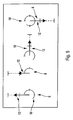
- the piloting indicator 1 according to the invention and diagrammatically represented on the figure 1 is intended to assist the pilot of an aircraft, particularly a military transport aircraft, in piloting this aircraft.
- the present invention applies to any type of flight path, whose lateral trajectory comprises lateral branches and the vertical trajectory of the vertical segments.
- said flight trajectory which is determined by said set 2 of information sources, is a so-called "twine" trajectory, whose lateral and vertical transitions respectively between lateral branches and segments. vertical, are constant radius arcs, which are derived from setpoint speed considerations and maximum allowable load factors.
- This flight path is a predicted anticipated trajectory, determined using predicted climb and descent performance.
- said display screen 7 may in particular be a standard head-up display, of the HUD ("Head Up Display” in English) type, or a usual head-down control screen.
- the piloting indicator 1 according to the invention is therefore a piloting aid device, which makes it possible to reduce the pilot's workload (which exists for the pilot in the usual situation, in particular to monitor and wait for the next changes trajectory). Thanks to the invention, the pilot can thus concentrate more on piloting the expected change of trajectory. It will be noted that a display screen head-up also has the advantage, compared to a head-down display screen, of avoiding the pilot having to constantly change direction of gaze, between the vision at the front of the aircraft for piloting and the vision down to watch the viewing screen.
- the displays made by said display means 5, in particular when they are applied to a head-up display screen 7, have a simplified symbology with in particular elementary shapes such as for example arches. circle, rectilinear segments and alphanumeric characters (and / or possibly easily distinguishable colors).
- said first and second indication means 8 and 10 are autonomous on the display screen 7 with respect to other displays (not shown) of said display screen 7
- each of said first and second indicating means 8 and 10 includes an arrow 12, 13, as shown in FIG. figure 2 for said first indication means 8.
- each of said indicating means 8 and 10 is a function of an intensity specified below, concerning the next indicated change.
- each of said indicating means 8 and 10 further comprises at least one bar 14, 15 and 16 which is associated with said arrow 12, 13 and which makes it possible to present a limit intensity for the next indicated change (slope maximum climbing or descending for the vertical plane; maximum turning radius for the lateral plane).
- the length of the arrow 12 (indicating means 8) is a function of the slope that the aircraft must fly to follow the next vertical segment, and the bar 14 indicates the maximum slope that the aircraft is able to steal.
- the length of said boom 13 depends on the radius of the arc that the aircraft must fly (in rotation) to join the next lateral branch, and said bars 15 and 16 respectively indicate the minimum and maximum radius of an arc that the aircraft is able to fly to join a next side branch.
- the different margins are illustrated by the gaps between respectively the end 13A of the boom 13 and said bars 15 and 16.
- Each of said indicating means 8 and 10 further comprises a clock 18 which is presented in the form of a circle (or arc) 18A and which indicates the time remaining until the next change of trajectory, as illustrated by example on the figure 4 .
- This clock 18 therefore represents a countdown that starts at a time remaining given, before the next change of trajectory.
- This remaining time can be a time constant defined during the preparation of the mission, for example in accordance with the minimum length of a vertical segment and the associated speed reference if necessary.
- the circle 18A is full, as shown on the left side of the figure 4 , the time remaining before the next path change is greater than said predefined time constant.
- a complete circle of this clock 18 may represent 60 seconds of flight.
- the arc 18A begins to decrease as soon as the aircraft is 60 seconds of flight of the next change of trajectory.
- the lines 20 on the circle (or the arc) 18A indicate time intervals (for example every 15 seconds in the previous example) and therefore help the pilot to better estimate the time remaining.
- Another solution is to consider that the countdown is initialized, at the time of a change of trajectory, with the time remaining before the next change (and therefore variable from one change to another).
- the circular arc 18A then decreases during a time which corresponds to the predicted flight time between two successive trajectory changes.
- the speed of decrease of the circular arc 18A is, in this case, a characteristic of the distance between two successive changes of trajectory.
- the clock 18 is associated with an indication means 8, 10 as represented on the figures 2 and 3 .
- the indication of the remaining time takes a minimum of space on the display screen 7 and avoids the presentation of an additional numerical value on the latter.
- the different indication means 8 and 10 which are presented on the display screen 7, are autonomous with respect to each other.
- said display means 5 has a plurality of indicating means 8, 10 which are presented in a particular order (defined for example horizontally from left to right, as shown in FIG. figure 5 , or vertically from top to bottom) which corresponds to the order of appearance of the changes of trajectory indicated by these different means of indication 8, 10 thus presented.
- a single clock 18 is preferably provided, which is, after each path change, associated with the indicating means indicating the next path change.
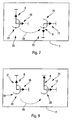
- the display means 5 have, on the display screen 7, a global indicator 21 comprising at least two indication means 8, 10 and a single clock 18, as represented on the figure 6 .
- the clock 18 only concerns the next change (vertical or lateral) expected.
- said display means 5 differentially present said two indication means 8, 10 of said global indicator 21.
- Such a differentiation can be realized by different colors or different patterns, as is the case on the Figures 6 to 12 , on which the indicating means corresponding to the next change is in solid line and the indicating means corresponding to another subsequent change is in broken lines.
- said global indicator 21 is updated at each change of trajectory: for example, the second change becomes the first or the next change, the third change becomes the second change, and so on.
- the global indicator 21 is shown on the left-hand side, in the current situation 22, and on the right-hand side, in a following situation 23, as illustrated by an arrow 24 highlighting the passage from one situation to another.
- a first solution is represented on the figures 8 and 9
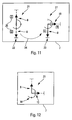
- the second solution is represented on the figures 10 and 11 .
- the first solution consists in presenting on the display screen 7 only the first vertical change with the first lateral change, even if this first vertical change and this first lateral change are not consecutive.
- the global indicator 21 shows the second vertical change (situation 23 with the indication means 8 always in solid line), while the lateral change (average of indication 10) remains in broken lines.
- the vertical change represented in continuous line corresponds to the closest change.
- the clock is reset appropriately for each change.
- a second solution consists in defining an auxiliary indication means 25, for example an arrow or a numerical value, to indicate the number of consecutive changes of the same type.
- the number of the auxiliary indication means 25 is lowered by one unit and thus changes from "three" to "two” for the very first change of trajectory from the situation 22.
- the two indication means 8 and 10 are represented identically (in continuous line for example), as shown in FIG. figure 12 .
- the figure 12 shows as an example that the next two changes of trajectory that will be made simultaneously concern a rise and a rotation to the right.
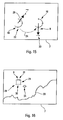
- a second solution is such that said display means 7 have an overall arrow 26 corresponding to the vector sum of the two arrows 12 and 13 relating to two indicating means 8 and 10 which indicate two changes of trajectory which are made simultaneously in two different plans, as depicted on the figure 14 .
- the left part of the figure 14 simply illustrates the mode of determination of the display means shown and shown on the right side, as shown by an arrow 27. This left part also explains the position of the bars 14, 15 and 16 on the indication means of the right part.
- At least one of said first and second indication means 9 and 11 is associated with a guide pattern 28 which is also presented by said display screen 7, which which makes it possible to reduce the size of the display implemented by the piloting indicator 1 according to the present invention.
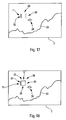
- Said lateral and vertical guidance indicators 29 and 30 can be represented together ( figures 16 and 18 ) or separately, as illustrated by the figure 17 on which only said vertical guidance indicator 29 is shown.
- the guiding pattern 28 comprises two indicating means 9, 11, as shown in FIG. figure 18 , we can differentiate the bars 31 and 32, to show which of the indicated course changes is the next change of trajectory.
- the next change of trajectory can be indicated in continuous line (bar 32 on the figure 18 ) and the other trajectory change (s) in broken lines (bar 31).
- the two bars 31 and 32 may be of the same shape, especially in solid lines.
Landscapes
- Engineering & Computer Science (AREA)
- Radar, Positioning & Navigation (AREA)
- Remote Sensing (AREA)
- Aviation & Aerospace Engineering (AREA)
- Physics & Mathematics (AREA)
- General Physics & Mathematics (AREA)
- Traffic Control Systems (AREA)
Claims (29)
- Steuerungsanzeige für ein Luftfahrzeug, welches entlang einer Flugtrajektorie geführt wird, welche umfasst:- eine vertikale Trajektorie, die mehrere aufeinander folgende vertikale Segmente umfasst, welche geradlinig sind und jeweils eine bestimmte Neigung aufweisen;und- eine seitliche Trajektorie, die mehrere aufeinander folgende seitliche Zweige aufweist, welche geradlinig sind und jeweils eine bestimmte Route aufweisen,wobei die Vorrichtung umfasst:- eine Zentraleinheit (3), die dazu eingerichtet ist, jede Trajektorienänderung zu bestimmen, die einer vertikalen Änderung, welche einen Übergang von einem eine erste Neigung aufweisenden ersten vertikalen Segment zu einem eine andere Neigung aufweisenden zweiten vertikalen Segment darstellt, oder einer seitlichen Änderung, welche einen Übergang von einem eine erste Route aufweisenden ersten seitlichen Zweig zu einem eine andere Route aufweisenden zweiten seitlichen Zweig darstellt, entspricht; und- Darstellungsmittel (5):• welche dazu eingerichtet sind, auf mindestens einem Bildschirmgerät (7) zu präsentieren:* mindestens ein erstes Anzeigemittel (8, 9), das mindestens eine nächstfolgende vertikale Änderung anzeigt; und* mindestens ein zweites, von dem ersten Anzeigemittel (8, 9) verschiedenes Anzeigemittel (10, 11), das mindestens eine nächstfolgende seitliche Änderung anzeigt; und• welche derart ausgebildet sind, dass sie mindestens eines von dem ersten und dem zweiten Anzeigemittel (8, 9, 10, 11) präsentieren, nämlich dasjenige, das die, ausgehend von der gegenwärtigen Position des Luftfahrzeugs, nächste Trajektorienänderung anzeigt.
- Steuerungsanzeige nach Anspruch 1,
dadurch gekennzeichnet, dass die Darstellungsmittel (5) das erste und das zweite Anzeigemittel (8, 9, 10, 11) gleichzeitig präsentieren. - Steuerungsanzeige nach einem der Ansprüche 1 und 2,
dadurch gekennzeichnet, dass Bildschirmgerät (7) ein Head-up-Display ist. - Steuerungsanzeige nach einem der Ansprüche 1 und 2,
dadurch gekennzeichnet, dass Bildschirmgerät (7) ein Head-down-Display ist. - Steuerungsanzeige nach einem der Ansprüche 1 bis 4, dadurch gekennzeichnet, dass das erste und das zweite Anzeigemittel (8, 10) auf dem Bildschirmgerät (7) autonom in Bezug auf andere Anzeigen des Bildschirmgerätes (7) sind.
- Steuerungsanzeige nach Anspruch 5,
dadurch gekennzeichnet, dass das erste und das zweite Anzeigemittel (8, 10) jeweils einen Pfeil (12, 13) aufweisen. - Steuerungsanzeige nach Anspruch 6,
dadurch gekennzeichnet, dass das erste Anzeigemittel (8) einen Pfeil (12) aufweist, welcher gerichtet ist:- nach oben, falls das nächste vertikale Segment eine positive Neigung aufweist; und- nach unten, falls das nächste vertikale Segment eine negative Neigung aufweist. - Steuerungsanzeige nach einem der Ansprüche 6 und 7,
dadurch gekennzeichnet, dass das zweite Anzeigemittel (10) einen Pfeil (13) aufweist, welcher gerichtet ist:- nach rechts, falls der nächste seitliche Zweig durch eine Drehung nach rechts erreicht wird; und- nach links, falls der nächste seitliche Zweig durch eine Drehung nach links erreicht wird. - Steuerungsanzeige nach einem der Ansprüche 6 bis 8,
dadurch gekennzeichnet, dass die Länge des Pfeils (12, 13) von einer Intensität abhängt, welche die nächste Trajektorienänderung betrifft, und das erste und das zweite Anzeigemittel (8, 10) außerdem jeweils mindestens einen Steg (14, 15, 16) aufweisen, welcher dem Pfeil (12, 13) zugeordnet ist und welcher es ermöglicht, eine Grenzintensität für die nächste angezeigte Änderung darzustellen. - Steuerungsanzeige nach Anspruch 9,
dadurch gekennzeichnet, dass das erste Anzeigemittel (8) einen einzigen Steg (14) aufweist, welcher die maximale Neigung anzeigt, mit der das Luftfahrzeug fliegen kann. - Steuerungsanzeige nach einem der Ansprüche 9 und 10,
dadurch gekennzeichnet, dass das zweite Anzeigemittel (10) zwei Stege (15, 16) aufweist, welche den minimalen bzw. maximalen Kurvenradius anzeigen, mit dem das Luftfahrzeug fliegen kann. - Steuerungsanzeige nach einem der Ansprüche 5 bis 11,
dadurch gekennzeichnet, dass jedes der Anzeigemittel (8, 10) außerdem eine Uhr (18) aufweist, welche die bis zur nächsten Trajektorienänderung verbleibende Zeit anzeigt. - Steuerungsanzeige nach Anspruch 12,
dadurch gekennzeichnet, dass die Uhr (18) in Form eines Kreises (18A) dargestellt ist, dessen Darstellung sich allmählich verkleinert, derart, dass der verbleibende Teil zu der verbleibenden Zeit proportional ist. - Steuerungsanzeige nach Anspruch 13,
dadurch gekennzeichnet, dass die verbleibende Zeit, die durch einen vollständigen Kreis (18A) angezeigt wird, einer vorbestimmten Dauer entspricht. - Steuerungsanzeige nach Anspruch 13,
dadurch gekennzeichnet, dass die verbleibende Zeit, die durch einen vollständigen Kreis (18A) angezeigt wird, einer vorhergesagten Flugdauer des Luftfahrzeugs zwischen der letzten Trajektorienänderung und der nächsten Trajektorienänderung entspricht. - Steuerungsanzeige nach einem der Ansprüche 5 bis 15,
dadurch gekennzeichnet, dass das erste und das zweite Anzeigemittel (8, 10) auf dem Bildschirmgerät (7) autonom voneinander sind. - Steuerungsanzeige nach einem der Ansprüche 5 bis 15,
dadurch gekennzeichnet, dass die Darstellungsmittel (5) einen Gesamtanzeiger (21) präsentieren, der mindestens zwei Anzeigemittel (8, 10) und eine einzige Uhr (18) umfasst. - Steuerungsanzeige nach Anspruch 17,
dadurch gekennzeichnet, dass die Darstellungsmittel (5) die zwei Anzeigemittel (8, 10) des Gesamtanzeigers (21) auf unterschiedliche Weise präsentieren. - Steuerungsanzeige nach einem der Ansprüche 17 und 18,
dadurch gekennzeichnet, dass die Darstellungsmittel (5) den Gesamtanzeiger (21) bei jeder Trajektorienänderung aktualisieren. - Steuerungsanzeige nach einem der Ansprüche 17 bis 19,
dadurch gekennzeichnet, dass die Darstellungsmittel (5) auf einem Anzeigemittel (8, 10) des Gesamtanzeigers (21) gegebenenfalls die Anzahl der nächsten und nachfolgenden Änderungen sichtbar machen, die den durch dieses Anzeigemittel (8, 10) angezeigten Typ von Trajektorienänderung betreffen. - Steuerungsanzeige nach einem der Ansprüche 17 bis 20,
dadurch gekennzeichnet, dass die Darstellungsmittel (5) zwei Anzeigemittel (8, 10) welche zwei Trajektorienänderungen anzeigen, die gleichzeitig realisiert werden, auf identische Weise präsentieren. - Steuerungsanzeige nach einem der Ansprüche 17 bis 20,
dadurch gekennzeichnet, dass die Darstellungsmittel (5) einen Gesamtpfeil (26) präsentieren, welcher der Vektorsumme von zwei Pfeilen (12, 13) entspricht, die sich auf zwei Anzeigemittel (8, 10) beziehen, welche zwei Trajektorienänderungen anzeigen, die gleichzeitig realisiert werden. - Steuerungsanzeige nach einem der Ansprüche 5 bis 22,
dadurch gekennzeichnet, dass die Darstellungsmittel (5) mehrere Anzeigemittel (8, 10) in einer bestimmten Reihenfolge präsentieren, die der Reihenfolge des Eintretens der entsprechenden angezeigten Trajektorienänderungen entspricht. - Steuerungsanzeige nach einem der Ansprüche 1 bis 4,
dadurch gekennzeichnet, dass das erste und/oder das zweite Anzeigemittel (9, 11) mit einem Führungsbild (28) verknüpft ist, welches ebenfalls auf dem Bildschirmgerät (7) präsentiert wird. - Steuerungsanzeige nach Anspruch 24,
dadurch gekennzeichnet, dass das Anzeigemittel (9, 11) einen Steg (31, 32) aufweist. - Steuerungsanzeige nach Anspruch 25,
dadurch gekennzeichnet, dass das erste Anzeigemittel (9) einen Steg (31) aufweist, welcher präsentiert wird:- im oberen Bereich des Führungsbildes (28), falls das nächste vertikale Segment eine positive Neigung aufweist; und- im unteren Bereich des Führungsbildes (28), falls das nächste vertikale Segment eine negative Neigung aufweist. - Steuerungsanzeige nach einem der Ansprüche 25 und 26,
dadurch gekennzeichnet, dass das zweite Anzeigemittel (11) einen Steg (32) aufweist, welcher präsentiert wird:- im rechten Bereich des Führungsbildes (28), falls der nächste seitliche Zweig durch eine Drehung nach rechts erreicht wird; und- im linken Bereich des Führungsbildes (28), falls der nächste seitliche Zweig durch eine Drehung nach links erreicht wird. - Steuerungsanzeige nach einem der Ansprüche 25 bis 27, dadurch gekennzeichnet, dass die Darstellungsmittel (5) mehrere Stege (31, 32) gegebenenfalls auf unterschiedliche Weise präsentieren.
- Luftfahrzeug,
dadurch gekennzeichnet, dass es eine Steuerungsanzeige (1) aufweist, wie unter einem der Ansprüche 1 bis 28 definiert.
Applications Claiming Priority (2)
| Application Number | Priority Date | Filing Date | Title |
|---|---|---|---|
| FR0405382 | 2004-05-18 | ||
| FR0405382A FR2870518B1 (fr) | 2004-05-18 | 2004-05-18 | Indicateur de pilotage pour un aeronef |
Publications (2)
| Publication Number | Publication Date |
|---|---|
| EP1598642A1 EP1598642A1 (de) | 2005-11-23 |
| EP1598642B1 true EP1598642B1 (de) | 2014-08-13 |
Family
ID=34942073
Family Applications (1)
| Application Number | Title | Priority Date | Filing Date |
|---|---|---|---|
| EP05290752.4A Expired - Lifetime EP1598642B1 (de) | 2004-05-18 | 2005-04-06 | Anzeigesystem für Flugzeuge |
Country Status (4)
| Country | Link |
|---|---|
| US (1) | US7467030B2 (de) |
| EP (1) | EP1598642B1 (de) |
| CA (1) | CA2502503C (de) |
| FR (1) | FR2870518B1 (de) |
Families Citing this family (8)
| Publication number | Priority date | Publication date | Assignee | Title |
|---|---|---|---|---|
| FR2946780B1 (fr) * | 2009-06-12 | 2011-07-15 | Thales Sa | Procede et dispositif d'affichage des limites de marges de vol pour un aeronef |
| RU2477521C1 (ru) * | 2012-03-30 | 2013-03-10 | Российская Федерация, от имени которой выступает Министерство промышленности и торговли Российской Федерации (Минпромторг России) | Система управления летным экспериментом |
| US9555896B2 (en) * | 2014-03-11 | 2017-01-31 | Textron Innovations Inc. | Aircraft flight control |
| DE102014104572B4 (de) | 2014-04-01 | 2017-11-02 | Deutsches Zentrum für Luft- und Raumfahrt e.V. | Geschwindigkeitsanzeige |
| RU2642526C1 (ru) * | 2017-01-31 | 2018-01-25 | Владимир Иванович Винокуров | Способ распознавания разрушения (подрыва) самолета и устройство для его осуществления |
| DE102017130714B4 (de) * | 2017-12-20 | 2020-10-08 | Deutsches Zentrum für Luft- und Raumfahrt e.V. | Pilotenunterstützung mittels Augmented Reality |
| FR3089955B1 (fr) * | 2018-12-18 | 2021-05-21 | Thales Sa | Procede et systeme de guidage d’aide au suivi d’une trajectoire pour un pilotage au vecteur-vitesse d’un aeronef |
| CN113269114B (zh) * | 2021-06-04 | 2024-02-02 | 北京易航远智科技有限公司 | 一种基于多隐变量预测器及关键点的行人轨迹预测方法 |
Family Cites Families (7)
| Publication number | Priority date | Publication date | Assignee | Title |
|---|---|---|---|---|
| US222887A (en) * | 1879-12-23 | Improvement in globe-valves | ||
| US132860A (en) * | 1872-11-05 | Improvement in bridges | ||
| FR2741320B1 (fr) * | 1995-11-21 | 1998-01-02 | Sextant Avionique | Procede de pilotage a basse altitude |
| US6112141A (en) * | 1997-10-15 | 2000-08-29 | Dassault Aviation | Apparatus and method for graphically oriented aircraft display and control |
| US6690299B1 (en) * | 1998-01-12 | 2004-02-10 | Rockwell Collins, Inc. | Primary flight display with tactical 3-D display including three view slices |
| US20030132860A1 (en) * | 2001-09-21 | 2003-07-17 | Honeywell International, Inc. | Interface for visual cueing and control for tactical flightpath management |
| US7010398B2 (en) * | 2001-10-11 | 2006-03-07 | The Boeing Company | Control system providing perspective flight guidance |
-
2004
- 2004-05-18 FR FR0405382A patent/FR2870518B1/fr not_active Expired - Fee Related
-
2005
- 2005-04-06 EP EP05290752.4A patent/EP1598642B1/de not_active Expired - Lifetime
- 2005-04-06 CA CA2502503A patent/CA2502503C/fr not_active Expired - Fee Related
- 2005-05-04 US US11/121,053 patent/US7467030B2/en not_active Expired - Fee Related
Also Published As
| Publication number | Publication date |
|---|---|
| US7467030B2 (en) | 2008-12-16 |
| CA2502503C (fr) | 2014-06-10 |
| EP1598642A1 (de) | 2005-11-23 |
| FR2870518A1 (fr) | 2005-11-25 |
| US20050273222A1 (en) | 2005-12-08 |
| CA2502503A1 (fr) | 2005-11-18 |
| FR2870518B1 (fr) | 2007-08-03 |
Similar Documents
| Publication | Publication Date | Title |
|---|---|---|
| CA2472290C (fr) | Systeme d'aide a la commande de la deceleration d'un aeronef roulant sur le sol | |
| EP1891618B1 (de) | Verfahren und system zur hilfe bei der flugkontrolle eines tieffliegenden flugzeugs | |
| EP2600107B1 (de) | Vorrichtung für den interaktiven Dialog zwischen einem Luftfahrzeugführer und einem Lenksystem dieses Luftfahrzeugs | |
| CA2135410C (fr) | Procede et dispositif d'aide au pilotage d'un aeronef | |
| EP1598641A1 (de) | Verfahren und Vorrichtung zum Abändern eines Flugplanes eines Flugzeuges | |
| EP1859428B1 (de) | Geländeausweichverfahren und -system für ein flugzeug | |
| FR2848661A1 (fr) | Equipement anticollision terrain embarque a bord d'aeronef avec aide au retour en vol normal | |
| EP2738099A1 (de) | Pilotenassistenzsystem für Luftfahrzeug bei Strömungsabriss | |
| EP2717019A1 (de) | Anzeigeverfahren und -Vorrichtung von Flugparametern in einem Luftfahrzeug | |
| FR2847553A1 (fr) | Dispositif d'aide a l'interception par un aeronef d'un segment d'une trajectoire situee dans un plan horizontal et systeme d'aide a l'interception et au suivi d'un tel segment | |
| FR2872316A1 (fr) | Procede de changement de procedure d'approche d'un aeronef | |
| EP1893946A2 (de) | Anzeigeverfahren und vorrichtung für ein einem flugplan folgenden flugzeug | |
| FR3033886A1 (fr) | Dispositif d' affichage d'une variation d'energie et d'une borne de variation d'energie d'un aeronef | |
| EP0775953B1 (de) | Steuermethode im Tiefflug | |
| CA2502503C (fr) | Indicateur de pilotage pour un aeronef. | |
| EP1600838B1 (de) | Verfahren und Vorrichtung zur Sicherung eines Tiefflugs eines Flugzeuges | |
| WO2005093374A1 (fr) | Dispositif optoelectronique securise d’aide au roulage pour aeronef | |
| FR2906048A1 (fr) | Procede et dispositif de modification d'un plan de vol et notamment d'une procedure de decollage pour un aeronef | |
| EP1310769B1 (de) | Verfahren und Vorrichtung zur Steuerungshilfe in einem Flugzeug | |
| CA2503045C (fr) | Procede et dispositif de guidage d'un aeronef a l'atterrissage | |
| EP0730212A2 (de) | Steueranordnung eines handgesteuerten Flugzeugsystemes mit insbesondere einem Head-Up-Display | |
| EP1907795B1 (de) | Flughafenerkennungssystem für ein flugzeug | |
| EP1598718B1 (de) | Verfahren und Einrichtung zur Bestimmung der Sicherheitshöhe für ein Luftfahrzeug | |
| EP0737846A1 (de) | Optoelektrische Vorrichtung zur Unterstützung der Führung eines Flugzeuges bei schlechter Sicht | |
| EP1598271A1 (de) | Steuerungsanzeige zum Anzeigen von Schubinformationen eines Luftfahrzeuges |
Legal Events
| Date | Code | Title | Description |
|---|---|---|---|
| PUAI | Public reference made under article 153(3) epc to a published international application that has entered the european phase |
Free format text: ORIGINAL CODE: 0009012 |
|
| AK | Designated contracting states |
Kind code of ref document: A1 Designated state(s): AT BE BG CH CY CZ DE DK EE ES FI FR GB GR HU IE IS IT LI LT LU MC NL PL PT RO SE SI SK TR |
|
| AX | Request for extension of the european patent |
Extension state: AL BA HR LV MK YU |
|
| 17P | Request for examination filed |
Effective date: 20060109 |
|
| AKX | Designation fees paid |
Designated state(s): AT BE BG CH CY CZ DE DK EE ES FI FR GB GR HU IE IS IT LI LT LU MC NL PL PT RO SE SI SK TR |
|
| RAP1 | Party data changed (applicant data changed or rights of an application transferred) |
Owner name: AIRBUS OPERATIONS |
|
| RAP1 | Party data changed (applicant data changed or rights of an application transferred) |
Owner name: AIRBUS OPERATIONS (SAS) |
|
| 17Q | First examination report despatched |
Effective date: 20120720 |
|
| GRAP | Despatch of communication of intention to grant a patent |
Free format text: ORIGINAL CODE: EPIDOSNIGR1 |
|
| INTG | Intention to grant announced |
Effective date: 20140325 |
|
| GRAS | Grant fee paid |
Free format text: ORIGINAL CODE: EPIDOSNIGR3 |
|
| GRAA | (expected) grant |
Free format text: ORIGINAL CODE: 0009210 |
|
| AK | Designated contracting states |
Kind code of ref document: B1 Designated state(s): AT BE BG CH CY CZ DE DK EE ES FI FR GB GR HU IE IS IT LI LT LU MC NL PL PT RO SE SI SK TR |
|
| REG | Reference to a national code |
Ref country code: GB Ref legal event code: FG4D Free format text: NOT ENGLISH |
|
| REG | Reference to a national code |
Ref country code: AT Ref legal event code: REF Ref document number: 682505 Country of ref document: AT Kind code of ref document: T Effective date: 20140815 Ref country code: CH Ref legal event code: EP |
|
| REG | Reference to a national code |
Ref country code: IE Ref legal event code: FG4D Free format text: LANGUAGE OF EP DOCUMENT: FRENCH |
|
| REG | Reference to a national code |
Ref country code: DE Ref legal event code: R096 Ref document number: 602005044450 Country of ref document: DE Effective date: 20140918 |
|
| REG | Reference to a national code |
Ref country code: NL Ref legal event code: VDEP Effective date: 20140813 |
|
| REG | Reference to a national code |
Ref country code: AT Ref legal event code: MK05 Ref document number: 682505 Country of ref document: AT Kind code of ref document: T Effective date: 20140813 |
|
| REG | Reference to a national code |
Ref country code: LT Ref legal event code: MG4D |
|
| PG25 | Lapsed in a contracting state [announced via postgrant information from national office to epo] |
Ref country code: LT Free format text: LAPSE BECAUSE OF FAILURE TO SUBMIT A TRANSLATION OF THE DESCRIPTION OR TO PAY THE FEE WITHIN THE PRESCRIBED TIME-LIMIT Effective date: 20140813 Ref country code: BG Free format text: LAPSE BECAUSE OF FAILURE TO SUBMIT A TRANSLATION OF THE DESCRIPTION OR TO PAY THE FEE WITHIN THE PRESCRIBED TIME-LIMIT Effective date: 20141113 Ref country code: FI Free format text: LAPSE BECAUSE OF FAILURE TO SUBMIT A TRANSLATION OF THE DESCRIPTION OR TO PAY THE FEE WITHIN THE PRESCRIBED TIME-LIMIT Effective date: 20140813 Ref country code: PT Free format text: LAPSE BECAUSE OF FAILURE TO SUBMIT A TRANSLATION OF THE DESCRIPTION OR TO PAY THE FEE WITHIN THE PRESCRIBED TIME-LIMIT Effective date: 20141215 Ref country code: GR Free format text: LAPSE BECAUSE OF FAILURE TO SUBMIT A TRANSLATION OF THE DESCRIPTION OR TO PAY THE FEE WITHIN THE PRESCRIBED TIME-LIMIT Effective date: 20141114 Ref country code: ES Free format text: LAPSE BECAUSE OF FAILURE TO SUBMIT A TRANSLATION OF THE DESCRIPTION OR TO PAY THE FEE WITHIN THE PRESCRIBED TIME-LIMIT Effective date: 20140813 Ref country code: SE Free format text: LAPSE BECAUSE OF FAILURE TO SUBMIT A TRANSLATION OF THE DESCRIPTION OR TO PAY THE FEE WITHIN THE PRESCRIBED TIME-LIMIT Effective date: 20140813 |
|
| PG25 | Lapsed in a contracting state [announced via postgrant information from national office to epo] |
Ref country code: IS Free format text: LAPSE BECAUSE OF FAILURE TO SUBMIT A TRANSLATION OF THE DESCRIPTION OR TO PAY THE FEE WITHIN THE PRESCRIBED TIME-LIMIT Effective date: 20141213 Ref country code: CY Free format text: LAPSE BECAUSE OF FAILURE TO SUBMIT A TRANSLATION OF THE DESCRIPTION OR TO PAY THE FEE WITHIN THE PRESCRIBED TIME-LIMIT Effective date: 20140813 Ref country code: AT Free format text: LAPSE BECAUSE OF FAILURE TO SUBMIT A TRANSLATION OF THE DESCRIPTION OR TO PAY THE FEE WITHIN THE PRESCRIBED TIME-LIMIT Effective date: 20140813 |
|
| PG25 | Lapsed in a contracting state [announced via postgrant information from national office to epo] |
Ref country code: NL Free format text: LAPSE BECAUSE OF FAILURE TO SUBMIT A TRANSLATION OF THE DESCRIPTION OR TO PAY THE FEE WITHIN THE PRESCRIBED TIME-LIMIT Effective date: 20140813 |
|
| REG | Reference to a national code |
Ref country code: FR Ref legal event code: PLFP Year of fee payment: 11 |
|
| PG25 | Lapsed in a contracting state [announced via postgrant information from national office to epo] |
Ref country code: DK Free format text: LAPSE BECAUSE OF FAILURE TO SUBMIT A TRANSLATION OF THE DESCRIPTION OR TO PAY THE FEE WITHIN THE PRESCRIBED TIME-LIMIT Effective date: 20140813 Ref country code: IT Free format text: LAPSE BECAUSE OF FAILURE TO SUBMIT A TRANSLATION OF THE DESCRIPTION OR TO PAY THE FEE WITHIN THE PRESCRIBED TIME-LIMIT Effective date: 20140813 Ref country code: SK Free format text: LAPSE BECAUSE OF FAILURE TO SUBMIT A TRANSLATION OF THE DESCRIPTION OR TO PAY THE FEE WITHIN THE PRESCRIBED TIME-LIMIT Effective date: 20140813 Ref country code: CZ Free format text: LAPSE BECAUSE OF FAILURE TO SUBMIT A TRANSLATION OF THE DESCRIPTION OR TO PAY THE FEE WITHIN THE PRESCRIBED TIME-LIMIT Effective date: 20140813 Ref country code: RO Free format text: LAPSE BECAUSE OF FAILURE TO SUBMIT A TRANSLATION OF THE DESCRIPTION OR TO PAY THE FEE WITHIN THE PRESCRIBED TIME-LIMIT Effective date: 20140813 Ref country code: EE Free format text: LAPSE BECAUSE OF FAILURE TO SUBMIT A TRANSLATION OF THE DESCRIPTION OR TO PAY THE FEE WITHIN THE PRESCRIBED TIME-LIMIT Effective date: 20140813 |
|
| REG | Reference to a national code |
Ref country code: DE Ref legal event code: R097 Ref document number: 602005044450 Country of ref document: DE |
|
| PG25 | Lapsed in a contracting state [announced via postgrant information from national office to epo] |
Ref country code: PL Free format text: LAPSE BECAUSE OF FAILURE TO SUBMIT A TRANSLATION OF THE DESCRIPTION OR TO PAY THE FEE WITHIN THE PRESCRIBED TIME-LIMIT Effective date: 20140813 |
|
| PLBE | No opposition filed within time limit |
Free format text: ORIGINAL CODE: 0009261 |
|
| STAA | Information on the status of an ep patent application or granted ep patent |
Free format text: STATUS: NO OPPOSITION FILED WITHIN TIME LIMIT |
|
| 26N | No opposition filed |
Effective date: 20150515 |
|
| PG25 | Lapsed in a contracting state [announced via postgrant information from national office to epo] |
Ref country code: LU Free format text: LAPSE BECAUSE OF FAILURE TO SUBMIT A TRANSLATION OF THE DESCRIPTION OR TO PAY THE FEE WITHIN THE PRESCRIBED TIME-LIMIT Effective date: 20150406 Ref country code: MC Free format text: LAPSE BECAUSE OF FAILURE TO SUBMIT A TRANSLATION OF THE DESCRIPTION OR TO PAY THE FEE WITHIN THE PRESCRIBED TIME-LIMIT Effective date: 20140813 Ref country code: SI Free format text: LAPSE BECAUSE OF FAILURE TO SUBMIT A TRANSLATION OF THE DESCRIPTION OR TO PAY THE FEE WITHIN THE PRESCRIBED TIME-LIMIT Effective date: 20140813 |
|
| REG | Reference to a national code |
Ref country code: CH Ref legal event code: PL |
|
| REG | Reference to a national code |
Ref country code: IE Ref legal event code: MM4A |
|
| PG25 | Lapsed in a contracting state [announced via postgrant information from national office to epo] |
Ref country code: LI Free format text: LAPSE BECAUSE OF NON-PAYMENT OF DUE FEES Effective date: 20150430 Ref country code: CH Free format text: LAPSE BECAUSE OF NON-PAYMENT OF DUE FEES Effective date: 20150430 |
|
| REG | Reference to a national code |
Ref country code: FR Ref legal event code: PLFP Year of fee payment: 12 |
|
| PG25 | Lapsed in a contracting state [announced via postgrant information from national office to epo] |
Ref country code: IE Free format text: LAPSE BECAUSE OF NON-PAYMENT OF DUE FEES Effective date: 20150406 |
|
| REG | Reference to a national code |
Ref country code: FR Ref legal event code: PLFP Year of fee payment: 13 |
|
| PG25 | Lapsed in a contracting state [announced via postgrant information from national office to epo] |
Ref country code: HU Free format text: LAPSE BECAUSE OF FAILURE TO SUBMIT A TRANSLATION OF THE DESCRIPTION OR TO PAY THE FEE WITHIN THE PRESCRIBED TIME-LIMIT; INVALID AB INITIO Effective date: 20050406 |
|
| PG25 | Lapsed in a contracting state [announced via postgrant information from national office to epo] |
Ref country code: BE Free format text: LAPSE BECAUSE OF NON-PAYMENT OF DUE FEES Effective date: 20150430 |
|
| PG25 | Lapsed in a contracting state [announced via postgrant information from national office to epo] |
Ref country code: TR Free format text: LAPSE BECAUSE OF FAILURE TO SUBMIT A TRANSLATION OF THE DESCRIPTION OR TO PAY THE FEE WITHIN THE PRESCRIBED TIME-LIMIT Effective date: 20140813 |
|
| REG | Reference to a national code |
Ref country code: FR Ref legal event code: PLFP Year of fee payment: 14 |
|
| PGFP | Annual fee paid to national office [announced via postgrant information from national office to epo] |
Ref country code: DE Payment date: 20180420 Year of fee payment: 14 |
|
| PGFP | Annual fee paid to national office [announced via postgrant information from national office to epo] |
Ref country code: FR Payment date: 20180420 Year of fee payment: 14 |
|
| PGFP | Annual fee paid to national office [announced via postgrant information from national office to epo] |
Ref country code: GB Payment date: 20180418 Year of fee payment: 14 |
|
| REG | Reference to a national code |
Ref country code: DE Ref legal event code: R119 Ref document number: 602005044450 Country of ref document: DE |
|
| GBPC | Gb: european patent ceased through non-payment of renewal fee |
Effective date: 20190406 |
|
| PG25 | Lapsed in a contracting state [announced via postgrant information from national office to epo] |
Ref country code: DE Free format text: LAPSE BECAUSE OF NON-PAYMENT OF DUE FEES Effective date: 20191101 Ref country code: GB Free format text: LAPSE BECAUSE OF NON-PAYMENT OF DUE FEES Effective date: 20190406 |
|
| PG25 | Lapsed in a contracting state [announced via postgrant information from national office to epo] |
Ref country code: FR Free format text: LAPSE BECAUSE OF NON-PAYMENT OF DUE FEES Effective date: 20190430 |