Technical Field
This invention relates to a process for producing aqueous resin
dispersions which can form coating film of excellent drying property
with both thick appearance and high gloss; aqueous resin
compositions which contain the aqueous resin dispersions; and
water-based paint compositions which contain the aqueous resin
compositions.
Background Art
Recently shift from organic solvent-based compositions to
water-based compositions in the art of paint, ink, adhesive and the
like is under progress, for conservation of natural resources,
environmental sanitation, prevention of pollution and provision of
non-dangerous products. For example, as vehicles used in
water-based paint compositions, for example, resins such as alkyd
resin, acrylic resin, polyester resin, polyurethane resin, epoxy resin
and the like can be named. When unsaturated fatty acid is used as a
starting material of alkyd resin, oxidation-hardenable groups can be
introduced into the resin's skeletal structure, and when such alkyd
resin is used as a vehicle of water-based paint compositions, the
compositions can be one-liquid cold set. Also due to oiliness of the
resin, the water-based paint compositions are expected to exhibit
anti-corrosive effect when they are applied onto metallic surfaces.
The resin's softness, however, retards drying of the coated film, which
generally results in low weatherability. On the other hand, acrylic
resin is quick-drying and highly weather-resistant but is inferior in
corrosion resistance. As a resinous material for the aqueous system
which concurrently exhibits the characteristic properties of these two
kinds of resins, graft resins formed by binding alkyd resins and
acrylic resins by chemical reaction have been developed and many
proposals were made. For example, JP Sho 50 (1975)-126723A, JP
Sho 56 (1981)-5863A and Sho 60 (1985)-221469A disclosed a method
for producing aqueous solutions or dispersions of such resins, which
comprised making a fatty acid-modified monomer through reaction of
unsaturated fatty acid having non-conjugated double bond with
glycidyl ester of α,β-ethylenically unsaturated acid, copolymerizing
the fatty acid-modified monomer with unsaturated monomer such as
α,β-ethylenically unsaturated carboxylic acid in organic solvent,
neutralizing the carboxyl groups in the resulting resin with basic
substance, and thereafter diluting the resin with water. However,
those hydrophilic resins according to the method are prepared
through solution polymerization, and the formed polymers must be
dissolved in organic solvent. Hence it is generally difficult to give
them high molecular weight. Furthermore, for dissolving or
dispersing the formed polymers in water, monomers having
hydrophilic groups such as carboxyl or hydroxyl groups, or an
emulsifier must be used in large quantities. In consequence, coating
films formed of the polymers are subject to a problem of insufficient
water resistance.
JP Sho 59 (1984)-8773A disclosed preparation of an oxidative
polymerization type aqueous emulsion by emulsion polymerization of
a radical-polymerizable monomeric mixture using a surfactant and/or
high molecular protective colloid. The monomeric mixture contained
a fatty acid-modified monomer which was obtained through a reaction
of a drying oil fatty acid or semi-drying oil fatty acid with glycidyl
ester of α,β-etylenically unsaturated acid.
The formation mechanism of an emulsion polymer is such that
the participating monomer(s) diffuse in water from large monomer
drops present in the aqueous phase, and the polymerization
progresses in the micelles formed by surfactant, to produce polymer
particles (small particles under polymerization). In that occasion,
the monomer(s) used for the polymerization must be supplied under
the polymerization conditions, from the monomer drops to the
polymer particles, as they diffuse and migrate in the water.
There are generally large differences in particle diameter
between the monomer drops and the polymer particles growing from
the micelles. This means there is large difference between the total
surface area of the monomer drops and that of the polymer particles,
and therefore initiator radicals or the monomer(s) diffusing in the
water penetrate into those of the greater surface area, i.e., into the
polymer particles and the polymerization progresses in situ. During
the emulsion polymerization, the polymer particles grow as their
diameters gradually increase.
In the occasion of emulsion polymerizing the
radical-polymerizable mixture containing the fatty acid-modified
monomer, the fatty acid-modified monomer having a very low
water-solubility is left in the monomer drops at the polymerization
stage, and the polymerization progresses in the monomer drops,
producing polymer particles containing many of the fatty
acid-modified monomer units. On the other hand, the monomer(s)
other than the fatty acid-modified monomer diffuse in the water from
the monomer drops into the micelles to form polymer particles
containing many units of the monomer(s) other than the fatty acid-modified
monomer. Thus, in high probability drastically irregular
distribution of hydrophilic polymer particles and hydrophobic polymer
particles occurs in the finally obtained emulsion. In consequence,
coating films formed from above-described oxidative polymerization
type aqueous emulsions have such problems that the hydrophobic
polymer particles provide nuclei to cause cissing, or they come up to
the surface to retain tackiness at the surface, or due to their
incompatibility transparent film cannot be obtained to markedly
impair appearance of the finished coating film.
As a measure to overcome those problems as above,
EP-A-1044993 proposed aqueous copolymers containing a copolymer
which was a polymerization product of vinyl monomers and a
hydrophobic ester or partial ester, and their production process. The
publication proposed addition of a hydrophobic ester from drying oil
acid and polyol to the monomer drops at the polymerization time, to
inhibit formation of second generation particles other than the
monomer drops. The aqueous copolymers that are described in the
publication do not contain volatile fusion assistant and form
transparent film, but they are slow drying particularly at the initial
stage after application. In actual use the coating film from the
copolymers retains tackiness. The coating film is also subject to such
defects that its weatherability and water resistance are insufficient.
Disclosure of the Invention
The main object of the present invention is to provide a process
for stably producing an aqueous resin dispersion by emulsion
polymerization of a monomeric mixture containing a fatty
acid-modified polymerizable unsaturated monomer or monomers, and
other polymerizable unsaturated monomer or monomers which are
copolymerizable therewith.
We have engaged in concentrative studies for accomplishing
the above object, and now discovered that an aqueous resin
composition which exhibits both polymerization stability and storage
stability and which forms coating film having excellent water
resistance, weatherability and so an can be obtained by a process
comprising finely dispersing a monomeric mixture containing a fatty
acid-modified polymerizable monomer(s), such that a specific average
particle diameter is attained, and polymerizing the resulting
monomeric emulsified product. Still more preferably, as the
monomeric emulsified product, one of specific monomeric composition
is selected. The present invention is whereupon completed.
Thus, the present invention provides a process for producing
an aqueous resin dispersion in which the average particle diameter of
the dispersed resin is not more than 500 nm, comprising finely
dispersing a monomeric mixture (I) containing (A) fatty acid-modified
polymerizable unsaturated monomer and (B) other polymerizable
unsaturated monomer which is copolymerizable with the monomer
(A) in an aqueous medium in such a manner that the dispersed
particles have an average particle diameter not more than 500 nm,
and polymerizing the resulting emulsified product, or mini-emulsion
polymerizing the same.
The present invention also provides aqueous resin
compositions which contain said aqueous resin dispersion, and
water-based paint compositions which contain said aqueous resin
compositions.
According to the above process of this invention, an aqueous
resin dispersion containing fatty acid-modified monomer units can be
stably prepared, without using a large quantity of organic solvent or
auxiliary surfactant and the like. Furthermore, aqueous resin
compositions and water-based paint compositions which contain the
aqueous resin dispersion show excellent storage stability and
film-forming ability. They can be readily hardened at ambient
temperature although they are single-component type and still in
addition, hardened coating films formed therefrom have very
favorable transparency, gloss and appearance (thick appearance), and
show excellent performances in water resistance, durability, corrosion
resistance, weatherability and the like. Thus, the present invention
achieves conspicuous effects. In particular, the water-based paint
compositions which contain the aqueous resin dispersion are suitable
for protective coating on metallic surfaces, because they are well
compatible with metallic surfaces such as of iron and can prevent
occurrence of rust spots or the like.
Hereafter the present invention is explained in further details.
The process of the present invention is characterized in that it
comprises finely dispersing a monomeric mixture (I) which contains
(A) fatty acid-modified polymerizable unsaturated monomer(s) and
(B) other polymerizable unsaturated monomer(s) which are
copolymerizable with the monomer (A) in an aqueous medium such
that the average particle diameter becomes no more than 500 nm, and
polymerizing the resulting monomeric emulsified product, or
mini-emulsion polymerizing the same.
Where the average particle diameter of the monomeric mixture
in the emulsified product exceeds 500 nm, sedimentation of the
monomeric emulsified product during storage or heterogeneity in
hydrophilic-hydrophobic components' distribution become notable.
Those phenomena are apt to cause opacity in coating film formed of
the compositions prepared from the product and hence are
undesirable.
In the present specification, the average particle diameter is
measured of a sample diluted with deionized water, with
SALD-3100™ (Shimazu Seisakujo, a laser diffraction particle size
distribution measuring apparatus) at ambient temperature (around
20°C). The average particle diameter is measured within 24 hours of
the preparation of sample emulsified product of finely divided
monomers or aqueous resin dispersion.
As the aqueous medium used at the polymerization time,
water or water-organic solvent mixed solution prepared by mixing an
organic solvent such as a water-soluble organic solvent with water
which is the chief component, can be named.
Fatty acid-modified polymerizable unsaturated monomer (A)
In the present invention, fatty acid-modified polymerizable
unsaturated monomer (A) is used for facilitating fine granulation (or
mini-emulsification) of the monomeric mixture at the time of its
emulsification; for stabilizing the monomeric emulsified product after
the fine granulation at its polymerization stage and inhibiting
diffusion of other polymerizable unsaturated monomer(B) into the
aqueous medium; for imparting thick appearance to the coating film
formed by using the particles dispersed in the aqueous resin
dispersion as prepared in the above-described manner; and for
introducing oxidation-hardenable groups into the particles dispersed
in the aqueous resin dispersion. The monomer includes
polymerizable unsaturated monomers having polymerizable
unsaturated groups at terminals of hydrocarbon chains derived from
fatty acid. As the polymerizable unsaturated groups herein referred
to, for example, vinyl group, (meth)acryloyl groups and the like can be
named, meth(acryloyl) groups being particularly preferred.
As the fatty acid-modified polymerizable unsaturated
monomer (A), for example, those which can be obtained by reacting
fatty acid (a1) with epoxy-containing polymerizable unsaturated
monomer (a2) or hydroxyl-containing polymerizable unsaturated
monomer (a3) can be used.
As the fatty acid (a1), those having a structure that a carboxyl
group is bound to one end of hydrocarbon chain, for example, drying
oil fatty acid, semi-drying oil fatty acid and non-drying oil fatty acid
can be named. While drying oil fatty acid and semi-drying oil fatty
acid are not strictly distinguishable, normally drying oil fatty acid is
an unsaturated fatty acid having iodine value no less than 130, and
semi-drying oil fatty acid is an unsaturated fatty acid having iodine
value of at least 100 but less than 130. On the other hand,
non-drying oil fatty acid normally has iodine value less than 100.
As the drying oil fatty acid and semi-drying oil fatty acid, for
example, fish oil fatty acid, dehydrated caster oil fatty acid, safflower
oil fatty acid, linseed oil fatty acid, soybean oil fatty acid, sesame oil
fatty acid, poppy oil fatty acid, perilla oil fatty acid, hempseed oil fatty
acid, grape kernel oil fatty acid, corn oil fatty acid, tall oil fatty acid,
sunflower oil fatty acid, cottonseed oil fatty acid, walnut oil fatty acid,
rubber seed oil fatty acid, highly conjugated dehydrated caster oil
fatty acid and the like can be named. As the non-drying oil fatty acid,
for example, coconut oil fatty acid, hydrogenated coconut oil fatty acid,
palm oil fatty acid and the like can be named. These can be used
either singly or in combination of two or more. Furthermore, these
fatty acids can be concurrently used with caproic acid, capric acid,
lauric acid, myristic acid, palmitic acid, stearic acid and the like.
The epoxy-containing polymerizable unsaturated monomer
(a2) which is reactable with above fatty acid (a1) for preparing the
fatty acid-modified polymerizable unsaturated monomer (A) includes
compounds having one epoxy group and one polymerizable
unsaturated group per molecule. More specifically, for example,
glycidyl meth(acrylate), β-methylglycidyl meth(acrylate),
3,4-epoxycyclohexylmethyl meth(acrylate), 3,4-epoxycyclohexylethyl
meth(acrylate), 3,4-epoxycyclohexylpropyl meth(acrylate),
allylglycidyl ether and the like can be named. These can be used
either singly or in combination of two or more.
The fatty acid (a1) and epoxy-containing polymerizable
unsaturated monomer (a2) can be reacted at such ratios that the
equivalent ratio between carboxyl groups in the fatty acid (a1) and
epoxy groups in the epoxy-containing monomer (a2) lies within a
range of 0.75:1 - 1.25:1, preferably 0.8:1 - 1.2:1.
The reaction of above fatty acid (a1) with the epoxy-containing
polymerizable unsaturated monomer (a2) is normally conducted in
the presence of a polymerization inhibitor under such conditions as
will not induce problems in the reaction such as gelation but allow
smooth reaction of carboxyl groups in the fatty acid component with
epoxy groups in the epoxy-containing polymerizable unsaturated
monomer. It is normally suitable to conduct the reaction by heating
at temperatures of about 100 - about 180°C for about 0.5 - about 10
hours.
For the reaction an esterification catalyst such as tertiary
amine, e.g., N, N-dimethylaminoethanol and the like, or quaternary
ammonium salt, e.g., brominated tetraethylammonium, brominated
tetrabutylammonium and the like can be used. Furthermore, an
organic solvent which is inert to the reaction can be used.
As the polymerization inhibitor, those per se known radical
polymerization inhibitors, for example, hydroxy compound such as
hydroquinone, hydroquinone monomethyl ether, pyrocatechol,
p-tert-butylcatechol and the like; nitro compound such as
nitrobenzene, nitrobenzoic acid, o-, m- or p-dinitrobenzene, 2,4-dinitrotoluene,
2,4-dinitrophenol, trinitrobenzene , picric acid and the
like; quinone compound such as p-benzoquinone,
dichlorobenzoquinone, chloranil, anthraquinone, phenanthroquinone
and the like; and nitroso compound such as nitrosobenzene,
nitroso-β-naphthol and the like can be named. These can be used
either singly or in combination of two or more.
The fatty acid-modified polymerizable monomer (A) can also be
obtained through esterification reaction of said fatty acid (a1) with
hydroxyl-containing polymerizable unsaturated monomer (a3). The
hydroxyl-containing polymerizable unsaturated monomer (a3)
includes those compounds having one hydroxyl group and one
polymerizable unsaturated group per molecule, more specifically, for
example, C2 - C8 hydroxyalkyl (meth)acrylates such as
2-hydroxyethyl meth(acrylate), 2-hydroxypropyl (meth)acrylate,
3-hydroxypropyl (meth)acrylate, hydroxybutyl (meth)acrylate and the
like; allyl alcohol; (meth)acrylates having hydroxyl group such as
ε-caprolactone-modified products of above C2 - C8 hydroxyalkyl
(meth)acrylates; and (meth)acrylates having polyoxyethylene chain
having a hydroxyl group at its molecular end. These may be used
either singly or in combination of two or more.
The fatty acid (a1) and hydroxyl-containig polymerizable
unsaturated monomer (a3) can be normally reacted at such ratios that
the equivalent ratio of carboxyl groups in the fatty acid (a1) to
hydroxyl groups in the hydroxyl-containing monomer (a3) lies within
a range of 0.4:1 - 1.25:1, preferably 0.5:1 - 1.2:1.
The reaction of the fatty acid (a1) with the hydroxyl-containing
polymerizable unsaturated monomer (a3) is normally conducted in
the presence of a polymerization inhibitor under such conditions as
will not induce problems such as gelation but allow smooth reaction of
carboxyl groups in the fatly acid component with hydroxyl groups in
the hydroxyl-containing polymerizable unsaturated monomer. It is
normally suitable to conduct the reaction in the presence of an
esterification catalyst, by heating at temperatures of about 100 -
about 180°C, for about 0.5 - about 10 hours. As the esterification
catalyst, for example, sulfuric acid, aluminium sulfate, potassium
hydrogensulfate, alkyl-substituted benzene, hydrochloric acid, methyl
sulfate, phosphoric acid and the like can be named. These catalysts
can be used normally within a range of about 0.001 - about 2.0 wt% to
the combined amount of the fatty acid (a1) and hydroxyl-containing
polymerizable unsaturated monomer (a3) that are reacted.
Furthermore, an organic solvent which is inert to the reaction may be
used.
As the polymerization inhibitor, those per se known radical
polymerization inhibitors, for example, hydroxy compound such as
hydroquinone, hydroquinone monomethyl ether, pyrocatechol,
p-tert-butylcatechol and the like; nitro compound such as
nitrobenzene, nitrobenzoic acid, o-, m- or p-dinitrobenzene, 2,4-dinitrotoluene,
2,4-dinitrophenol, trinitrobenzene , picric acid and the
like; quinone compound such as p-benzoquinone,
dichlorobenzoquinone, chloranil, anthraquinone, phenanthroquinone
and the like; and nitroso compound such as nitrosobenzene,
nitroso-β-naphthol and the like can be named. These can be used
either singly or in combination of two or more.
Other polymerizable unsaturated monomer (B)
The other polymerizable unsaturated monomer (B) which is
used in the process of the present invention signifies those
polymerizable unsaturated monomers which are copolymerizable with
above fatty acid-modified polymerizable unsaturated monomer (A),
and includes such compounds which contain at least one, preferably
one only, polymerizable unsaturated group per molecule, e.g., vinyl
group, (meth)acryloyl group and the like.
As specific examples of such other polymerizable unsaturated
monomer (B), alkyl or cycloalkyl (meth)acrylates such as methyl
(meth)acrylate, ethyl (meth)acrylate, n-propyl (meth)acrylate,
i-propyl (meth)acrylate, n-butyl (meth)acrylate, i-butyl (meth)acrylate,
tert-butyl (meth)acrylate, n-hexyl (meth)acrylate, octyl
(meth)acrylate, 2-ethylhexyl (meth)acrylate, nonyl (meth)acrylate,
tridecyl (meth)acrylate, lauryl (meth)acrylate, stearyl (meth)acrylate,
isostearyl (meth)acrylate, cyclohexyl (meth)acrylate,
methylcyclohexyl (meth)acrylate, t-butylcyclohexyl (meth)acrylate,
cyclododecyl (meth)acrylate, and the like; polymerizable unsaturated
compounds having isobornyl group such as isobornyl (meth)acrylate;
polymerizable unsaturated compounds having adamantyl group such
as adamantyl (meth)acrylate; vinyl aromatic compounds such as
styrene, α-methylstyrene, vinyltoluene and the like; polymerizable
unsaturated compounds having alkoxysilyl group such as vinyl
trimethoxysilane, vinyl triethoxysilane, vinyl tris (2-methoxyethoxy)
silane, γ-(meth)acryloyloxypropyl-trimethoxysilane,
γ-(meth)acryloyloxypropyl-triethoxysilane and the like; perfluoroalkyl
(meth)acrylates such as perfluorobutylehtyl (meth)acrylate,
perfluorooctylethyl(meth)acrylate and the like; polymerizable
unsaturated compounds having photopolymerizable functional group
like maleimide group; 1,2,2,6,6,-pentamethylpiperidyl (meth)acrylate,
2,2,6,6,-tetramethylpiperidinyl (meth)acrylate and the like; vinyl
compounds such as N-vinylpyrrolidone, ethylene, butadiene,
chloroprene, vinyl propionate, vinyl acetate and the like; compounds
having carboxyl group such as (meth)acrylic acid, maleic acid, crotonic
acid, β-carboxyethyl acrylate and the like; nitrogen-containing
polymerizable unsaturated compounds such as (meth)acrylonitrile,
(meth)acrylamide, dimethylaminopropyl (meth)acrylamide,
dimethylaminoethyl (meth)acrylate, adducts of glycidyl
(meth)acrylate and amines, and the like; C2 - C8 hydroxyalkyl
(meth)acrylates such as 2-hydroxyethyl meth(acrylate),
2-hydroxypropyl (meth)acrylate, 3-hydroxypropyl (meth)acrylate,
hydroxybutyl (meth)acrylate and the like; allyl alcohol;
(meth)acrylates having hydroxyl group such as ε-caprolactone-modified
products of above C2 - C8 hydroxyalkyl (meth)acrylates;
polymerizable unsaturated compounds having hydroxyl group such as
(meth)acrylates having polyoxyethylene chain having a hydroxyl
group at its molecular end; (meth)acrylates having polyoxyethylene
chain having an alkoxy group at its molecular end; polymerizable
unsaturated compounds having sulfonic acid group such as
2-acrylamide-2-methylpropanesulfonic acid, allylsulfonic acid, sodium
styrenesulfonate, sulfoethyl methacrylate and sodium salt or
ammonium salt thereof; addition reaction products of
hydroxybenzophenones with glycidyl (meth)acrylate, examples of the
hydroxybenzophenone including
2-hydroxy-4-(3-methacryloyloxy-2-hydroxypropoxy) benzophenone,
2-hydroxy-4-(3-acryloyloxy-2-hydroxypropoxy) benzophenone,
2,2'-dihydroxy-4-(3-methacryloyloxy-2-hydroxypropoxy)-benzophenone,
2,2'-dihydroxy-4-(3-acryloyloxy-2-hydroxypropoxy)-benzophenone
and the like, or polymerizable unsaturated compounds
having ultraviolet-absorbing functional group such as 2-(2'-hydroxy-5'-methacryloyloxyethylphenyl)-2H-benzotriazole
or the like;
ultraviolet-stable polymerizable unsaturated compounds such as
4-(meth)acryloyloxy-1,2,2,6,6,-pentamethylpiperidine, 4-(meth)-acryloyloxy-2,2,6,6,-tetramethylpiperidine,
4-cyano-4-(meth)-acryloylamino-2,2,6,6,-tetramethylpiperidine,
1-(meth)acryloyl-4-(meth)acryloylamino-2,2,6,6,-tetramethylpiperidine,
1-(meth)acryloyl-4-cyano-4-(meth)acryloylamino-2,2,6,6-tetramethylpiperidine,
4-crotonoyloxy-2,2,6,6,-tetramethylpiperidine,
4-crotonoylamino-2,2,6,6,-tetrametylpiperidine,
1-crotonoyl-4-crotonoyloxy-2,2,6,6,-tetramethylpiperidine and the
like; polymerizable unsaturated compounds having carbonyl group
such as acrolein, diacetonacrylamide, diacetonemethacrylamide,
acetoacetoxyethyl methacrylate, formylstyrol, C4 - C7 vinyl alkyl
ketones (e.g., vinyl methyl ketone, vinyl ethyl ketone, vinyl butyl
ketone); polyvinyl compounds having at least two polymerizable
unsaturated groups per molecule such as allyl (meth)acrylate,
ethylene glycol di(meth)acrylate, triethylene glycol di(meth)acrylate,
tetraethylene glycol di(meth)acrylate, 1,3-butylene glycol
di(meth)acrylate, trimethylolpropane tri(meth)acrylate,
1,4-butanediol di(meth)acrylate, neopentyl glycol di(meth)acrylate,
1,6-hexanediol di(meth)acrylate, pentaerythritol di(meth)acrylate,
pentaerythritol tetra(meth)acrylate, glycerol di(meth)acrylate,
1,1,1,-trishydroxymethylethane di(meth)acrylate,
1,1,1-trishydroxymethylethane tri(meth)acrylate,
1,1,1-trishydroxymethylpropane tri(meth)acrylate,
triallylisocyanurate, diallylterephthalate, divinylbenzene and the
like; can be named. These can be used either singly or in
combination of two or more, depending on the performance desired for
individual aqueous resin dispersions.
Use ratio of above monomer (A) and monomer (B) is subject to
no particular limitation but may be suitably selected according to the
performance desired of, or the utility intended for, individual aqueous
resin dispersions. In general terms, based on the combined amount
of the monomer (A) and monomer (B), monomer (A) may be within a
range of 1 - 90 wt%, preferably 5 - 60 wt%, inter alia, 10 -40 wt%;
and monomer (B), within a range of 10 - 99 wt%, preferably 40 -95
wt%, inter alia, 60 -90wt%. Where the use ratio of the monomer (A)
is less than 1 wt%, oxidative hardening of the coating film formed
with use of the resulting aqueous resin dispersion fails to progress
satisfactorily, and also thick appearance of the coating film is apt to be
impaired. On the other hand, where it exceeds 90 wt%, the hardened
coating film formed with use of the resulting aqueous resin dispersion
becomes brittle and the film may have insufficient weatherability.
It is preferred to select as the other polymerizable unsaturated
monomer (B), so that the theoretical glass transition temperature of
the (co)polymer of all of the used monomer(s) (B) should lie within a
range of 0 - 100°C, preferably 10 - 80°C, inter alia, 40 - 70°C.
The glass transition temperature (absolute temperature) as
referred to in this invention is calculated according to the following
equation.
1/Tg = W1/T1 + W2/T2 + .... Wn/Tn
in which W1, W2 ... Wn are wt% of each monomer
[=(used amount of each monomer/total weight of the
monomers) × 100]; and T1, T2 ... Tn are glass transition
temperature (absolute temperature) of each homopolymer of
respective monomer. Glass transition temperatures of the
homopolymers of respective monomers are those values given
in "Polymer Handbook" (Second Edition, ed. by J. Brandrup. E.
H. Immergut). Where glass transition temperature relating
to a certain monomer is not found in the Handbook, a
homopolymer having a weight average molecular weight of
around 50,000 of the particular monomer is synthesized, and
the polymer's glass transition temperature is measured by
means of differential scanning thermal analysis.
Where the theoretical glass transition temperature of
(co)polymer of the total monomer (B) falls within the above-specified
range, both satisfactory film-forming ability of the resulting aqueous
resin dispersion and such physical properties of the coating film
formed with use of the aqueous resin dispersion as weatherability,
water resistance and the like can be obtained.
Furthermore, the other polymerizable unsaturated monomer
(B) preferably contains carboxyl-containing polymerizable
unsaturated monomer (b1) within a range of 0.1 - 5 wt%, preferably
at least 0.5 wt% but less than 3 wt%, based on the total weight of the
monomers (A) and (B).
As the carboxyl-containing polymerizable unsaturated
monomer (b1), for example, (meth)acrylic acid, maleic acid, crotonic
acid, β-carboxyethyl acrylate and the like can be named. Of these,
particularly acrylic acid, methacrylic acid and crotonic acid are
preferred. By the use of such carboxyl-containing polymerizable
unsaturated monomer (b1) as at least a part of the other
polymerizable unsaturated monomer (B), stability of resin particles
dispersed in the aqueous medium of the resulting aqueous resin
dispersion or mechanical stability can be secured. Furthermore,
when the aqueous resin dispersion containing such a monomer (b1) is
applied to enamel paint, color matching ability of the paint can be
improved.
The other polymerizable unsaturated monomer (B) preferably
comprises, furthermore, as at least a part thereof, 30 - 90 wt%,
preferably 35 - 85 wt%, inter alia, 45 - 80 wt%, based on the
combined weight of the monomer (A) and monomer (B), of
polymerizable unsaturated monomer (b2). The monomer (b2)
contains at least C4 straight chain, branched chain or cyclic, saturated
or unsaturated hydrocarbon group.
As such polymerizable unsaturated monomer (b2) containng at
least C4 hydrocarbon group, for example, alkyl or cycloalkyl
(meth)acrylates such as n-butyl (meth)acrylate, i-butyl (meth)acrylate,
tert-butyl (meth)acrylate, n-hexyl (meth)acrylate, octyl
(meth)acrylate, 2-ethylhexyl (meth)acrylate, nonyl (meth)acrylate,
tridecyl (meth)acrylate, lauryl (meth)acrylate, stearyl (meth)acrylate,
"isostearyl acrylate" (Osaka Organochemical Co.), cyclohexyl
(meth)acrylate, methylcyclohexyl (meth)acrylate, t-butylcyclohexyl
(meth)acrylate, cyclododecyl (meth)acrylate and the like;
polymerizable unsaturated compounds having isobornyl group such
as isobornyl (meth)acrylate; polymerizable unsaturated compounds
having adamantyl group such as adamantyl (meth)acrylate; and vinyl
aromatic compounds such as styrene, α-methylstyrene, vinyltoluene
and the like can be named. Use of such polymerizable unsaturated
monomer (b2) having at least C4 hydrocarbon group contributes to
improve water resistance of coating film formed of the particles
dispersed in the resulting aqueous resin dispersion.
It is also desirable that the other polymerizable unsaturated
monomer (B) comprises, as at least a part thereof, polymerizable
unsaturated monomer (b3) having at least C6 straight chain or
branched chain hydrocarbon group, in an amount of 1 - 30 wt%,
preferably 5 - 20 wt%, inter alia, 6 - 18 wt%, based on the combined
weight of the monomers (A) and (B).
As the polymerizable unsaturated monomer (b3) having at
least C6 straight or branched chain hydrocarbon group, for example,
n-hexyl (meth)acrylate, octyl (meth)acrylate, 2-ethylhexyl
(meth)acrylate, nonyl (meth)acrylate, tridecyl (meth)acrylate, lauryl
(meth)acrylate, stearyl (meth)acrylate, "isostearyl acrylate" (Osaka
Organochemical Co.) and the like can be named. These can be used
either singly or in combination of two or more.
Use of such polymerizable unsaturated monomer (b3)
containing at least C6 straight or branched chain hydrocarbon group
as at least a part of the other polymerizable unsaturated monomer (B)
allows the monomeric emulsified product after the concurrent fine
granulation of the other polymerizable unsaturated monomer (B) with
the fatty acid-modified polymerizable unsaturated monomer (A) to
maintain polymerization stability and furthermore enables
production of aqueous resin dispersions which can form coating film of
excellent water resistance.
In the occasion of preparing an aqueous resin dispersion
according to the process of the invention, it is desirable that the other
polymerizable unsaturated monomer (B) comprises those
carboxyl-containing polymerizable unsaturated monomer (b1),
polymerizable unsaturated monomer (b2) which contains hydrocarbon
group having at least 4 carbon atoms and other polymerizable
unsaturated monomer (b7) other than above fatty acid-modified
polymerizable unsaturated monomer (A), monomer (b1) and monomer
(b2): that the monomeric mixture (I) to be emulsion polymerized
contains, based on the combined weight of the monomers (A) and (B),
5 - 50 wt%, preferably 10 - 40 wt%, inter alia, 10 - 35 wt%, of
monomer (A); 0.1 -5 wt%, preferably 0.5 - 4.5 wt%, inter alia, 0.5 - 3
wt%, of monomer (b1); 45 - 80 wt%, preferably 50 - 75 wt%, inter alia,
55 - 70 wt%, of monomer (b2), and 0 - 49.9 wt%, preferably 0 - 39.5
wt%, inter alia, 0 - 34.5 wt% of the other polymerizable unsaturated
monomer (b7); and the polymerizable unsaturated monomer (b2)
containing hydrocarbon group having at least 4 carbon atoms
comprises, based on the combined weight of the monomers (A) and (B),
1 - 30 wt%, preferably 5 - 20 wt%, inter alia, 6 - 18 wt% of the
polymerizable unsaturated monomer (b3) containing straight or
branched chain hydrocarbon group having at least 6 carbon atoms.
In the above composition, where the use ratio of monomer (A)
is less than 5 wt%, thick appearance of coating film formed with use of
resulting aqueous resin dispersion becomes insufficient. On the
contrary, where it exceeds 50 wt%, coating film formed from the
composition may exhibit insufficient weatherability. Where the use
ratio of monomer (b1) is less than 0.1 wt%, particles in the resulting
aqueous resin dispersion may show insufficient stability. On the
contrary, where it exceeds 5 wt%, coating film formed from the
resulting dispersion may have reduced water resistance.
Furthermore, where the use ratio of monomer (b2) is less than 45 wt%,
coating film formed from the resulting dispersion may have reduced
water resistance. On the other hand, where it exceeds 80 wt%,
storage stability of resulting aqueous resin dispersion may be
impaired.
Aqueous resin dispersions can be stably prepared through
copolymerization of fatty acid-modified polymerizable unsaturated
monomer (A) and the other polymerizable unsaturated monomer (B)
at the above-specified ratios, and the aqueous resin dispersions can
form coating films having transparency and thick appearance and
exhibiting excellent performance such as water resistance and the
like.
It is also desirable that the other polymerizable unsaturated
monomer (B) contains, as at least a part thereof, cycloalkyl-containing
polymerizable unsaturated monomer (b4).
As the cycloalkyl-containing polymerizable unsaturated
monomer (b4), those compounds having one cycloalkyl group
containing at least 6 carbon atoms and one polymerizable
unsaturated bond per molecule are suitable. Examples of such
compounds include cyclohexyl (meth)acrylate, methylcyclohexyl
(meth)acrylate, t-butylcyclohexyl (meth)acrylate, cyclododecyl
(meth)acrylate and the like, which can be used either singly or in
combination of two or more. Of these, cyclohexyl (meth)acrylate is
preferred.
Use of cycloalkyl-containing polymerizable unsaturated
monomer (b4) as at least a part of the other polymerizable
unsaturated monomer (B) can improve weatherability of coating film
formed from the resulting aqueous resin dispersion, and also can
improve its water resistance, soil resistance and the like. Where
improvement in weatherability is intended, adequate (b4) content is 1
- 70 wt%, preferably 10 - 60 wt%, inter alia, 25 - 45 wt%, based on
the combined weight of monomers (A) and (B).
It is also desirable that the other polymerizable unsaturated
monomer (B) contains, as at least a part thereof, aromatic vinyl
monomer (b5). As the aromatic vinyl monomer (b5), for example,
vinyl aromatic compounds such as styrene, α-methylstyrene,
vinyltoluene and the like can be named, which can be used either
singly or in combination of two or more. Use of such aromatic vinyl
monomer (b5) can increase copolymerizability of total monomers and
also can improve physical properties of formed coating film, such as
water resistance.
In general terms, it is adequate to use such aromatic vinyl
monomer (b5) within a range of 1 - 50 wt%, preferably 5 - 45 wt%,
inter alia, 12 - 35 wt%, based on the combined weight of monomers
(A) and (B).
In the occasion of preparing an aqueous resin dispersion
according to the process of the invention, it is desirable that the other
polymerizable unsaturated monomer (B) comprises those
cycloalkyl-containing polymerizable unsaturated monomer (b4),
aromatic vinyl monomer (b5), and other polymerizable unsaturated
monomer (b8) other than above monomer (A), monomer (b4) and
monomer (b5): and that the monomeric mixture (I) to be emulsion
polymerized contains, based on the combined weight of the monomers
(A) and (B), 5 - 50 wt%, preferably 10 - 40 wt%, inter alia, 10 - 35
wt%, of monomer (A); 1 -70 wt%, preferably 10 - 60 wt%, inter alia,
25 - 45 wt%, of monomer (b4); 1 - 50 wt%, preferably 5 - 45 wt%,
inter alia, 12 - 35 wt%, of monomer (b5), and 0 - 93 wt%, preferably 0
- 75 wt%, inter alia, 0 - 47 wt% of the other polymerizable
unsaturated monomer (b8).
In the above composition, where the use ratio of monomer (A)
is less than 5 wt%, thick appearance of coating film formed with use of
resulting aqueous resin dispersion becomes insufficient. On the
contrary, where it exceeds 50 wt%, coating film formed from the
composition may exhibit insufficient weatherability. Where the use
ratio of monomer (b4) is less than 1 wt%, formed coating film has
insufficient weatherability. On the contrary, when it exceeds 70 wt%,
polymerization stability is occasionally impaired. Furthermore,
when use ratio of monomer (b5) is less than 1 wt%, water resistance of
coating film formed therefrom may be reduced. On the other hand,
when it exceeds 50 wt%, weatherability of formed coating film may
become insufficient.
Through copolymerization of fatty acid-modified polymerizable
unsaturated monomer (A) and the other polymerizable unsaturated
monomer (B) at the above-specified ratios, aqueous resin dispersions
which form coating films having transparency, thick appearance and
particularly favorable water resistance and weatherability can be
prepared.
Again, in the occasion of preparing an aqueous resin dispersion
of the present invention, it is desirable that the other polymerizable
unsaturated monomer (B) comprises, as at least a part thereof,
carbonyl-containing polymerizable unsaturated monomer (b6).
The carbonyl-containing polymerizable unsaturated monomer
(b6) includes compounds having one carbonyl group and one
polymerizable unsaturated bond per molecule. More specifically, for
example, acrolein, diacetone acrylamide, diacetone methacrylamide,
acetoacetoxyethyl methacrylate, formyl styrol, C4 - C7 vinyl alkyl
ketone (e.g., vinyl methyl ketone, vinyl ethyl ketone, vinyl butyl
ketone) and the like can be named. These can be used either singly
or in combination of two or more. In particular, diacetone
(meth)acrylamide are preferred.
When such carbonyl-containing polymerizable unsaturated
monomer (b6) is used as at least a part of the other polymerizable
unsaturated monomer (B), and when a later-specified hydrazine
derivative is blended with the resulting aqueous resin dispersion,
auxiliary crosslinkage of the monomer (b6)-derived carbonyl groups
and the hydrazine derivative can be promoted in addition to the
oxidative hardening caused by the fatty acid (a1) component, and
drying property of the coating film formed from the dispersion can be
further improved. Using this dispersion, paint compositions capable
of forming coating film showing favorable physical properties such as
weatherability, water resistance and the like can be prepared.
In general terms, such carbonyl- containing monomer (b6) is
suitably used within a range of 0.5 - 35 wt%, preferably 2 - 20 wt%,
based on the combined weight of the monomers (A) and (B).
Where the other polymerizable unsaturated monomer (B)
comprises such carbonyl-containing polymerizable unsaturated
monomer (b6), kind of the fatty acid (a1) is not particularly limited,
which may be semi-drying oil fatty acid and/or non-drying oil fatty
acid. Semi-drying oil fatty acid and/or non-drying oil fatty acid are
generally those of low oxidative hardenability, and those earlier
exemplified can be used.
Use ratios of semi-drying oil fatty acid and/or non-drying oil
fatty acid and carbonyl-containing polymerizable unsaturated
monomer (b6) can be generally within the following ranges based on
the combined weight of the monomers (A) and (B): semi-drying oil
fatty acid and/or non-drying oil fatty acid, 5 - 50 wt%, preferably 10 -
40 wt%; and carbonyl-containing polymerizable unsaturated
monomer (b6), 0.5 - 35 wt%, preferably 2 - 20 wt%. Where
semi-drying oil fatty acid and/or non-drying oil fatty acid component
is less than 5 wt%, thick appearance of the coating film formed from
the resulting aqueous resin dispersion may be impaired. On the
contrary, when it exceeds 50 wt%, water resistance of the formed
coating film may become insufficient. Again, where
carbonyl-containing polymerizable unsaturated monomer (b6) is less
than 0.5 wt%, formed coating film has insufficient water resistance
and weatherability. On the other hand, when it exceeds 35 wt %,
formed coating film may become brittle.
Use of carbonyl-containing polymerizable unsaturated
monomer (b6) as at least a part of the monomer (B) allows
crosslinkage between the carbonyl groups and later-described
hydrazine derivative to progress where such a hydrazine derivative is
concurrently used. Hence, even when semi-drying oil fatty acid
and/or non-drying oil fatty acid are used as the fatty acid (a1)
component, aqueous resin dispersion capable of forming coating film
of thick appearance which exhibits favorable weatherability, water
resistance and the like and showing good compatibility with iron
substrate material can be prepared.
The other polymerizable unsaturated monomer (B)
furthermore can comprise hydroxyl-containing (meth)acrylate, for
securing stability of finely granulated monomeric emulsified product
at the polymerization stage or stability of particles in aqueous resin
dispersions during storage. As the hydroxyl-containing
(meth)acrylate, those earlier exemplified can be used, and its use ratio
is within a range of 1 - 50 wt%, preferably 1 - 30 wt%, inter alia, 1 -
10 wt%, based on the combined amount of the monomers A and B.
According to the invention, the monomeric mixture (I)
comprises, as the essential components, heretofore described fatty
acid-modified polymerizable unsaturated monomer (A) and other
polymerizable unsaturated monomer (B) which is copolymerizable
with the monomer (A). The monomeric mixture (I) may further
contain a compound or compounds which do not substantially contain
polymerizable unsaturated group.
Use of such monomeric mixture (I) comprising compound(s)
which do not substantially contain polymerizable unsaturated group
allows preparation of particles enclosing said compound(s) as
dispersed in the aqueous resin dispersions.
As the compounds which do not substantially contain
polymerizable unsaturated group, for example, paint additives such
as ultraviolet absorber, ultraviolet stabilizer, metallic dryer and the
like; resins such as acrylic resin, polyester resin, polyurethane resin,
alkyd resin and the like; and coloring agents such as pigment, dye and
the like can be named. These can be used either singly or in
combination of two or more. In particular, at least one selected from
the ultraviolet absorber, ultraviolet stabilizer and metallic dryer is
preferred.
As the ultraviolet absorber, for example, salicylic acid
derivatives such as phenyl salicylate, p-octylphenyl salicylate,
4-t-butylphenyl salicylate and the like; benzophenone compounds
such as 2,4-dihyroxybenzophenone,
2-hydroxy-4-methoxybenzophenone, 2, 2'-dihydroxy-4-methoxybenzophenone,
2-hydroxy-4-methoxy-2'-carboxybenzophenone,
2-hydroxy-4-methoxy-5-sulfobenzophenone
trihydrate, 2,2'-dihydroxy-4,4'-dimethoxybenzophenone,
2-hydroxy-4-octoxybenzophenone, 2-hydroxy-4-octadecyloxybenzophenone,
sodium 2-2'-dihydroxy-4,4'-dimethoxy-5-sulfobenzophenone,
2,2',4,4'-tetrahydroxybenzophenone,
4-dodecyloxy-2-hydroxybenzophenone, 5-chloro-2-hydroxybenzophenone,
resorcinol monobenzoate, 2,4-dibenzoylresorcinol,
4,6-dibenzoylresorcinol, hydroxydodecylbenzophenone,
2,2'-dihydroxy-4(3-methacryloxy-2-hydroxypropoxy)-benzophenone
and the like; benzotriazole compounds such as
2-(2'-hydroxy-5'-methylphenyl)-benzotriazole and the like; other
compounds such as oxalic acid anilide, cyanoacrylate and the like; and
acrylic copolymers containing above-exemplified ultraviolet absorbing
monomer as a copolymerized component can be named.
As the ultraviolet stabilizer, for example, 2-(3-t-butyl-5-methyl-2-hydroxyphenyl)-5-chlorobenzotriazole,
2-(3,5-di-t-butyl-2-hydroxyphenyl)-5-chlorobenzotriazole,
poly[{6-(1,1,3,3-tetramethylbutyl)amino-1,3,5-triazin-2,4-diyl}{(2,2,6,6
-tetramethyl-4-piperidyl)imino}hexamethylene{(2,2,6,6-tetramethyl-4
-piperidyl)imino}], dimethyl succinate -1-(2-hydroxyethyl)-4-hydroxy-2,2,6,6-tetramethylpiperidine
polycondensate,
2,4-di-t-butylphenyl-3,5- di-t-butyl-4-hydroxybenzoate,
bis-(2,2',6,6'-tetramethyl-4-piperidinyl) cebacate,
4-benzoyloxy-2,2',6,6'-tetramethylpiperidine, acrylic copolymers
containing above-exemplified ultraviolet-stable monomer as a
copolymerized component can be named.
Above ultraviolet absorber and/or ultraviolet stabilizer may be
used singly or as suitably selected combinations. Generally suitable
use ratios of the ultraviolet absorber and/or ultraviolet stabilizer are:
based on the combined weight of the monomers (A) and (B),
ultraviolet absorber, within a range of 0.1 - 5.0 wt%, in particular, 0.2
- 0.7 wt%; and the ultraviolet stabilizer, 0.1 - 5.0 wt%, in particular,
0.2 - 3.0 wt%.
In the present invention, where the monomeric mixture (I)
contains such ultraviolet absorber and/or ultraviolet stabilizer, at
least a part of the particles dispersed in the resulting aqueous resin
dispersion enclose the ultraviolet absorber and/or ultraviolet
stabilizer and in consequence the absorber and/or stabilizer are
uniformly dispersed in coating film formed from the aqueous resin
dispersion. Furthermore, they are not eluted out of the formed film
by rain water or the like and exhibit their effect stably over a
prolonged period.
As the metallic dryer, for example, salts of at least one metal
selected from the group consisting of aluminum, calcium, cerium,
cabalt, iron, lithium, magnesium, manganese, zinc and zirconium,
with acid can be named. As the acid, for example, capric acid,
caprylic acid, isodecanoic acid, linolenic acid, naphthenic acid,
neodecanoic acid, actenic acid, oleic acid, palmitic acid, resin acid,
ricinoleic acid, soybean oil fatty acid, stearic acid, tall oil fatty cid and
the like can be named.
In the present invention, where such a metallic dryer is
contained in the monomeric mixture (I) prior to the polymerization,
oxidative hardenability of coating film formed from the resulting
aqueous resin dispersion can be improved. This is presumably
because the metallic dryer is enclosed in at least a part of the particles
dispersed in the aqueous resin dispersion, and when the
dryer-enclosing particles are formed into film, the metallic dryer can
effectively act on oxidative hardening polymerizable unsaturated
groups, within the enclosing particles. Generally suitable use
amount of the metallic dryer is, based on combined weight of the
monomers (A) and (B), within a range of 0.5 - 10 wt%, in particular, 1
- 7 wt%.
In the occasion of fine granulation of the monomeric mixture
(I) in an aqueous medium, an emulsifier may be concurrently used
where necessary. As the emulsifier, anionic emulsifier and nonionic
emulsifier are suitable. As the anionic emulsifier, for example,
sodium salt or ammonium salt of alkylsulfonic acid,
alkylbenzenesulfonic acid, alkylphosphoric acid and the like can be
named. Also as the nonionic emulsifier, for example,
polyoxyethylene oleyl ether, polyoxyethylene stearyl ether,
polyoxyethylene lauryl ether, polyoxyethylene tridecyl ether,
polyoxyethylene phenyl ether, polyoxyethylene nonylphenyl ether,
polyoxyethylene octylphenyl ether, polyoxyethylene monolaurate,
polyoxyethylene monostearate, polyoxyethylene monooleate, sorbitan
monolaurate, sorbitan monostearate, sorbitan trioleate,
polyoxyethylene sorbitan monolaurate and the like can be named.
It is also permissible to use polyoxyalkylene-containing anionic
emulsifier which has an anionic group and a polyoxyalkylene group
such as polyoxyethylene group or polyoxypropylene group per
molecule or reactive anionic emulsifier having the anionic group and
polymerizable unsaturated group per molecule.
Such an emulsifier can be used within a range of 0.1 - 15 wt%,
preferably 0.5 - 12 wt%, based on the combined amount of total
monomers.
The monomeric mixture (I) may also contain a chain transfer
agent, for the purpose of adjusting molecular weight of the resulting
aqueous resin dispersion. Useful chain transfer agent includes
compounds having mercapto group. As specific examples,
laurylmercaptan, t-dodecylmercaptan, octylmercaptan, 2-ethylhexyl
thioglycolate, 2-methyl-5-tert-butylthiophenol, mercaptoethanol,
thioglycerol, mercaptoacetic acid (thioglycolic acid),
mercaptopropionate, n-octyl-3-mercaptopropionate and the like can
be named. Generally suitable use amount of the chain transfer
agent is, based on the combined amount of total monomers, within the
range of 0.05 - 10 wt%, in particular, 0.1 - 5 wt%.
Where necessary, the monomeric mixture (I) may further be
blended with organic solvent such as long chain saturated
hydrocarbon solvent like hexadecane, long chain alcoholic solvent like
hexadecanol and the like.
According to the present invention, so far described monomeric
mixture (I) can form a monomeric emulsified product when it is finely
dispersed in an aqueous medium.
Concentration of the monomeric mixture (I) in an aqueous
medium generally suitably lies within a range of 10 - 70 wt%,
preferably 20 - 60 wt%, from the standpoint of fine granulation-forming
ability of the monomeric emulsified product formed, stability
at the polymerization stage and practical utility when it is applied to
water-based paint.
Fine dispersing of the monomeric mixture (I) in an aqueous
medium can be normally conducted with a dispersing machine having
high-energy shearing ability. As useful dispersing machines in that
occasion, for example, high-pressure emulsifier, ultrasonic emulsifier,
high-pressure colloid mill, high-pressure homogenizer and the like
can be named. These dispersing machines are normally operable
under high pressure levels of 10 - 1000 MPa, preferably around 50 -
300 MPa. The monomeric mixture may be preliminarily emulsified
with a dispersing device or the like, in advance of the machine
dispersing.
Suitable average particle diameter of the particles dispersed in
the monomeric emulsified product, which is obtained upon finely
dispersing the monomeric mixture (I) with above-described means, is
not more than 500 nm, preferably within the range of 80 - 400 nm,
inter alia, 100 - 300 nm, in consideration of transparency and water
resistance of formed coating film.
Polymerization of thus obtained monomeric emulsified product
can be conducted, for example, through the steps of feeding the entire
amount of the monomeric emulsified product after the fine dispersion
into a reactor equipped with a stirrer, adding a polymerization
initiator and heating the system under stirring, following known
mini-emulsion polymerization method.
As the polymerization initiator, either oil-soluble or
water-soluble type can be used. As examples of oil-soluble
polymerization initiator, organic peroxides such as benzoyl peroxide,
octanoyl peroxide, lauroyl peroxide, stearoyl peroxide and the like;
and azo compounds such as azobisisobutyronitrile, azobis-(2,4-dimethylvaleronitrile)
and the like can be named. As examples
of water-soluble initiator, organic peroxides such as cumene
hydroperoxide, tert-butyl peroxide, tert-butyl peroxylaurate,
tert-butyl peroxyisopropylcarbonate, tert-butyl peroxyacetate,
diisopropylbenzene hydroperoxide and the like; azo compounds such
as azobis(2-methylpropionitrile), azobis(2-methylbutyronitrile), 4,4'-azobis(4-cyanobutanoic
acid), dimethylazobis- (2-methylpropionate),
azobis[2-methyl-N- (2-hydroxyethyl)-propionamide],
azobis{2-methyl-N-[2-(1-hydroxybutyl)]-propionamide} and the like;
and persulfates such as potassium persulfate, ammonium persulfate,
sodium persulfate and the like can be named. These may be used
either singly or in combination of two or more. Where necessary, a
reducing agent such as sugar, sodiumformaldehyde sulfoxylate, iron
complex or the like may be used concurrently with such
polymerization initiator to form a redox polymerization system.
Preferred use amount of the polymerization initiator ranges
0.1 - 5 wt%, in particular, 0.2 - 3 wt%, based on the combined weight
of the monomers (A) and (B). Means to add the polymerization
initiatior is subject to no particular limitation and can be suitably
selected depending on its kind or amount. For example, it may be
contained in the monomeric mixture (I) or in the aqueous medium in
advance, or added at one time or dropwise during polymerization.
According to the invention, where the aqueous resin dispersion
contains acidic groups, it is desirable to neutralize them with a
neutralizing agent, for improving mechanical stability of particles
dispersed in the aqueous resin dispersion. The neutralizing agent is
subject to no limitation so long as it can neutralize acidic groups. For
example, sodilum hydroxide, potassium hydroxide, trimethylamine,
dimethylaminoethanol, 2-methyl-2-amino-1-propanol, triethylamine,
aqueous ammonia and the like can be named. These neutralizing
agents are desirably used in such respective amount as will render pH
of the aqueous resin dispersion after the neutralization about 6.5 -
9.0.
According to the so far described process of the present
invention, an aqueous resin dispersion in which the dispersed resin
has an average particle diameter not greater than 500 nm, in
particular, within the range of 100 - 300 nm can be prepared. The
average particle diameter of the dispersed resin in each aqueous resin
dispersion depends on the average particle diameter of dispersed
particles in the monomeric emulsified product prior to polymerization.
Where the average diameter of the particles dispersed in the
monomeric emulsified product prior to the polymerization is caused to
lie within the above-specified range, variation ratio of average particle
diameter of dispersed resin in the aqueous resin dispersion to that of
the dispersed particles in the monomeric emulsified product can be
generally kept within a range of 50 - 150%, in particular, at least 60%
but less than 100%,
inter alia, 70 - 99%. Said variation ratio can be
caluculated according to the following equation:
Where the variation ratio of average particle diameter lies
within the above-specified range, the emulsion polymerization can be
stably conducted, and the average particle diameter of the resin
dispersed in the eventually obtained aqueous resin dispersion can be
made to fall within the above-specified range (not greater than 500
nm, in particular, 80 - 400 nm, inter alia, 100 - 300nm) to enable
formation of transparent hardened coating film.
It is generally desirable for aqueous resin dispersions which
are prepared according to the process of the invention to have
weight-average molecular weight ranging 10,000 - 300,000, in
particular, 30,000 - 200,000. Weight-average molecular weight as
referred to in the present specification is the value obtained by
converting weight-average molecular weight of a sample dispersion
using tetrahydrofuran as the solvent, as measured by means of gel
permeation chromatography, based on weight-average molecular
weight of polystyrene. As the column used in the gel permeation
chromatography, "TSKgel G-4000 H × L", "TSKgel G-3000 H × L",
"TSKgel G-2500 H × L"and "TSKgel G-2000 H × L" (tradenames,
products by Tosoh Corporation) can be named.
It is generally convenient for the aqueous resin dispersions to
have an oil length within a range of 0.5 - 45%, preferably 3 -30%,
inter alia, 10 -25%. Where the oil length is less than 0.5%, coating
film formed therefrom exhibits insufficient oxidative hardenability.
On the other hand, where it exceeds 45%, the coating film tends to
become hard and brittle as its drying time passes and may come to
have inferior performance in weatherability, alkali resistance and the
like. In the present specification, oil length refers to weight
percentile value of fatty acid contained in solid component of an
aqueous resin dispersion.
Aqueous resin compositions
Aqueous resin compositions provided by the invention
comprise those aqueous resin dispersions obtained as
above-described.
The aqueous resin compositions may additionally contain
hydrazine derivatives.
As specific examples of the hydrazine derivatives, C2 - C18
saturated dicarboxylic acid dihydrazides such as oxalic acid
dihydrazide, malonic acid dihydrazide, glutaric acid dihydrazide,
succinic acid dihyrazide, adipic acid dihydrazide, sebacic acid
dihydrazide and the like; monoolefinic unsaturated dicarboxylic acid
dihydrazides such as maleic acid dihydrazide, fumaric acid
dihydrazide, itaconic acid dihydrazide and the like; terephtalic acid
dihydrazide or isophthalic acid dihydrazide; pyromellitic acid
dihydrazide, trihydrazide or tetrahydrazide; nitrilotrihydrazide, citric
acid trihydrazide, 1,2,4-benzene trihydrazide,
ethylenediaminetetraacetic acid tetrahydrazide, 1,4,5,8-naphthoic
acid tetrahydrazide; polyhydrazides obtained through reaction of low
molecular weight polymers having carboxylic acid lower alkyl ester
groups with hydrazine or hydrazine hydrate; hydrazide-containing
compounds such as carbonic acid dihydrazide and the like; bis-semicarbazide;
polyfunctional semicarbazides which are obtained by
reacting diisocyanate such as hexamethylene diisocyanate,
isophorone diisocyanate, or polyisocyanate compounds derived
therefrom with excessive N,N-substituted hydrazines such as
N,N-dimethylhydrazine or above-exemplified hydrazides, aqueous
polyfunctional semicarbazides which are obtained by reacting
isocyanate groups in reaction products of above polyisocyanate
compounds with polyether and active hydrogen compounds containing
hydrophilic groups, such as polyols or polyethylene glycol monoalkyl
ethers, with excessive amount of above-exemplified dihydrazide;
compounds having semicarbazide groups such as mixtures of the
polyfunctional semicarbazide and aqueous polyfunctional
semicarbazide; and compounds having hydrazone groups such as
bis-acetyl dihydrazone and the like can be named.
Where the aqueous resin compositions contain such hydrazine
derivatives, coating film formed therefrom absorbs harmful
substances in the air, for example, formaldehyde, and are useful for
removal of these harmful substances. Furthermore, where the
aqueous resin dispersion has carbonyl groups, such a hydrazine
derivative can act as a crosslinking agent for auxiliary crosslinkage.
Desirable amount of the hydrazine derivative to be blended lies,
based on the solid resin content of the aqueous resin dispersion,
generally within a range of 0.01 - 10 wt%, in particular, 0.1 - 8 wt%.
The aqueous resin compositions may further contain, where
necessary, such additives as wetting agent, defoaming agent,
plasticizer, film-forming assistant, organic solvent, thickener,
antiseptic, antifungus agent, pH regulating agent, hardening catalyst,
surface treating agent and the like, in suitable selective combination.
Those already explained metallic dryer, ultraviolet absorber and
ultraviolet stabilizer may also be contained in the aqueous resin
compositions.
The aqueous resin compositions provided by the present
invention are hardenable even at ambient temperatures, and
resulting hardened films are transparent. More specifically,
transmission haze value of the hardened films, for example, can be
made 5 or less. This transmission haze value is determined as
follows. On a transparent sheet whose transmission haze value has
been measured with "COH-300A" (a color-difference turbidity
measuring machine, Nihon Denshoku Kogyo Co.), a test sample is
applied to a dry film thickness of 20 µm and aged for a week at 20°C to
provide a test specimen. Transmission haze value of this test
specimen is measured with COH-300A, and the transmission haze
value of the transparent sheet is subtracted from the measured value.
Thus the aqueous resin compositions can be put to various uses
such as paints for architecture, outer panels of automobiles, car parts
and the like, coating materials like printing ink, paint additives,
joining agent for non-woven fabric, adhesives, fillers, molding
materials, resist and the like.
Water-based paint compositions
This invention also provides water-based paint compositions
which contain above aqueous resin compositions.
The water based paint compositions can be used as clear paint
or enamel paint.
Where they are used as enamel paint, coloring pigment, effect
pigment, extender, rust preventive pigment or the like which are
known in the art of paint can be blended as pigment component.
For example, it is generally desirable for the water-based paint
compositions containing titanium white, to contain titanium white at
a pigment volumetric concentration (PVC) within a range of 5 - 25%,
preferably 7 -22%, for retaining thick appearance of formed coating
film and having glossy finish. As the titanium white, rutile type is
preferred from the standpoint of weatherability. Here the "pigment
volumetric concentration" refers to the volumetric ratio of blended
pigment component to the combined solid content of total resin
component and total pigment in the concerned paint. In the present
specification, specific gravity value of each pigment which provides
the basis for calculating the pigment's volume conforms to "Toryo
Genryo Binran" (manual of paint materials), 6th ed. (Nihon Paint
Industries Corporation Association) and specific gravity of solid resin
content is assumed to be approximate to 1.
The water-based paint compositions may contain, other than
the above-described components, modifying resins such as
water-soluble or emulsifiable acrylic resin, alkyd resin, silicone resin,
fluorine-containing resin, epoxy resin, urethane resin, polyester resin
and the like; pigment-dispersing agent, surfactant, dispersant,
defoaming agent, thickener, film-forming assistant, antiseptic,
antifungus agent, anti-freezing agent, pH regulator, flash rust
inhibitor , aldehyde capturing agent, laminar clay mineral, powdery
or fine particulate active carbon, titanium oxide as an optical catalyst,
antifouling agent such as polyalkylene glycol-modified alkyl silicate
and the like. These additives can be contained either singly or in
combination of two or more.
The water-based paint compositions can be applied onto new
substrate surfaces or old coating film-applied surfaces. Materials
constituting the substrate are subject to no particular limitation,
which may be, for example, inorganic substrate such as concrete,
mortal, slate plate, PC plate, ALC plate, cement calcium silicate plate,
concrete blocks, wood, stone and the like; organic substrate such as
plastics; and metals such as iron, aluminum and the like. As old
coating films, those of acrylic resin, acrylic-urethane resin,
polyurethane resin, fluorine-containing resin, silicone-acrylic resin,
vinyl acetate resin, epoxy resin, alkyd resin and the like, which have
been applied onto those substrates, can be named. These old coated
surfaces may be applied with water-based or solvent-based undercoat,
and where necessary, a water-based paint composition of the present
invention can be applied onto the undercoat-applied surface. It is
also possible to apply a water-based paint composition of the
invention as an undercoat and thereafter apply a known water-based
top coat thereonto.
Because the fatty acid component of the aqueous resin
dispersion in the water-based paint compositions of the present
invention is highly compatible with iron, the compositions are
suitable to provide protective film on iron substrate or coated iron
substrate surface. Single or plural applications of the composition
are sufficient to maintain appearance for a long term.
In applying a water-based paint composition of the present
invention onto metallic surface of iron substrate or the like, the
composition desirably contains 1 - 10%, in particular, 2 - 8% of
phosphoric acid-derived pigment, in terms of PVC.
It is desirable that the phosphoric acid-derived pigments are
those which are readily dispersible in the presence of high molecular
surfactant, from the viewpoint of corrosion resistance and gloss. As
specific examples of such phosphoric acid-derived pigment, zinc
phosphate, zinc phosphosilicate, zinc aluminum phosphate, zinc
calcium phosphate, calcium phosphate, aluminum pyrophosphate,
calcium pyrophosphate, aluminum dihydrogentripolyphosphate,
aluminium metaphosphate, calcium metaphosphate, zinc
phosphomolybdate, aluminum phosphomolybdate and the like can be
named.
The water-based paint compositions of the invention may also
contain at least one basic compound selected from the group
consisting of nitrous acid salt, phytic acid salt, tannic acid salt and
polyamine compounds. As nitrous acid salt, for example, sodium
nitrite, calcium nitrite, strontium nitrite, barium nitrite, ammonium
nitrite and the like can be named. As phytic acid salt, for example,
sodium phytate, potassium phytate and the like can be named. As
tannic acid salt, for example, sodium tannate, potassium tannate and
the like can be named, and as polyamine compound, for example,
N-(2-hydroxyethyl)-ethylenediamine triacetate (HEDTA),
ethylenediamine tetraacetate (EDTA), diethylenetriamine
pentaacetate (DTPA), propylenediamine tetraacetate (PDTA),
iminodiacetic acid, nitrilotriacetic acid (NTA),
diethylenetriaminepentamethylenephosphoric acid (DTPMP), and
their alkali metal salts, and intercalational compound formed by
intercalating monoalkylamine or polyamine, quaternary ammonium
ion and the like into laminar phosphate such as aluminum
dihydrogentripolyphosphate, and the like can be named. These can
be used either singly or in combination of two or more.
Addition of these basic compounds enables to prevent
occurrence of rust spots in coating film formed by directly applying a
water-based paint composition onto a metallic surface, as rust on the
metallic surface bleeds onto the coated surface. Suitable amount of
the basic compound to be added lies within a range of 0.02 - 2 wt%, in
particular, 0.05 - 1 wt%, based on the weight of the concerned
water-based paint composition.
Water-based paint compositions of the present invention can be
applied by such means as air spray, airless spray, electrostatic
application, brushing, roller coating, texture gun, universal gun and
the like. Drying can be effected by any of heat drying, forced drying
and ambient temperature drying. In the present specification,
drying condition at lower than 40°C is referred to as ambient
temperature drying, drying condition at no lower than 40°C but lower
than 80°C is referred to as forced drying, and drying condition at 80°C
or above, as heat drying. Application rate of a water-based paint
composition of the present invention can be, for example, within a
range of 50 - 300 g/m2.
Examples
Hereafter the present invention is more specifically explained
referring to working examples, in which parts and % are wt parts and
wt%.
Preparation of fatty acid-modified monomers
Production Example 1
The following components were placed in a reaction vessel and
reacted at reaction temperature of 140°C under stirring, to provide a
fatty acid-modified monomer (a-1). The reaction of epoxy groups
with carboxyl groups was monitored by measuring the amount of
residual carboxyl groups. About 5 hours were required for
completing the reaction.
| Safflower oil fatty acid | 280 parts |
| Glycidyl methacrylate | 142 parts. |
Production Example 1 was repeated except that the reacted
components were changed to the following, to provide a fatty
acid-modified monomer (a-2).
| Linseed oil fatty acid | 280 parts |
| Glycidyl methacrylate | 142 parts. |
Production Example 1 was repeated except that the reacted
components were changed to the following, to provide a fatty
acid-modified monomer (a-3).
| Coconut oil fatty acid | 210 parts |
| Glycidyl methacrylate | 142 parts. |
The following components were put in a reaction vessel and
heated to 120°C under stirring.
| Safflower oil fatty acid | 2240 parts |
| Hydroquinone | 1.8 parts |
| Methylsulfuric acid | 2.6 parts |
| Toluene | 144 parts. |
Then a mixture of the following components was dropped into
the reaction vessel over a period of 2 hours.
| Hydroxyethyl methacrylate | 1300 parts |
| Hydroquinone | 2.6 parts |
| Methylsulfuric acid | 5.6 parts |
| Toluene | 234 parts. |
After the dropping ended, the temperature was raised to 150°C,
and the reaction was continued for about 5 hours until the acid value
was lowered to not higher than 8.7. Thereafter the toluene was
removed under reduced pressure until the heating residue reached at
least 95%, to provide a fatty acid-modified monomer (a-4).
Preparation of aqueous resin dispersions
The following components were put in a glass beaker and
stirred with a dispersing device at 2,000 rpm for 15 minutes to
provide a pre-emulsion. This pre-emulsion was high-pressure
treated at 100 MPa with a high-pressure emulsifying apparatus in
which the fluid was mutually collided with exertion of high pressure
energy, to provide a monomeric emulsified product in which the
average diameter of the dispersed particles was 190 nm.
| Composition of the monomeric emulsified product |
| Fatty acid-modified monomer (a-1) | 30 parts |
| n-Butyl methacrylate | 25 parts |
| i-Butyl methacrylate | 27 parts |
| 2-Ethylhexyl methacrylate | 17 parts |
| Methacrylic acid | 1 part |
| "Newcol707 SF" (note 1) | 10 parts |
| Deionized water | 85 parts |
Then the monomeric emulsified product was transferred into a
flask and diluted with deionized water to a solid concentration of 45%.
After raising its temperature to 85°C, an aqueous initiator solution of
2 g of VA-086 (note 2) as dissolved in 64.7 g of deionized water was
thrown into the flask, followed by 3 hours' stirring during which the
same temperature was maintained. Thereafter an aqueous initiator
solution of 0.5 g of VA-086 (note 2) as dissolved in 16.2 g of deionized
water was added to the flask. While the same temperature was
maintained, the content in the flask was stirred for an hour, cooled to
40°C, and its pH was adjusted to 8.0 with dimethylaminoethanol, to
provide an aqueous resin dispersion (I-1) having a solid concentration
of 40%, in which the dispersed resin had an average particle diameter
of 185 nm.
- (note 1)
- Newcol707SF: tradename, Nihon Emulsifier Co., an
anionic emulsifier having polyoxyethylene chain;
active component, 30%
- (note 2)
- VA-086: tradename, Wako Pure Chemical Industries,
Ltd., 2,2'-azobis (2-methyl-N-(2-hydroxyethyl)-propionamide]
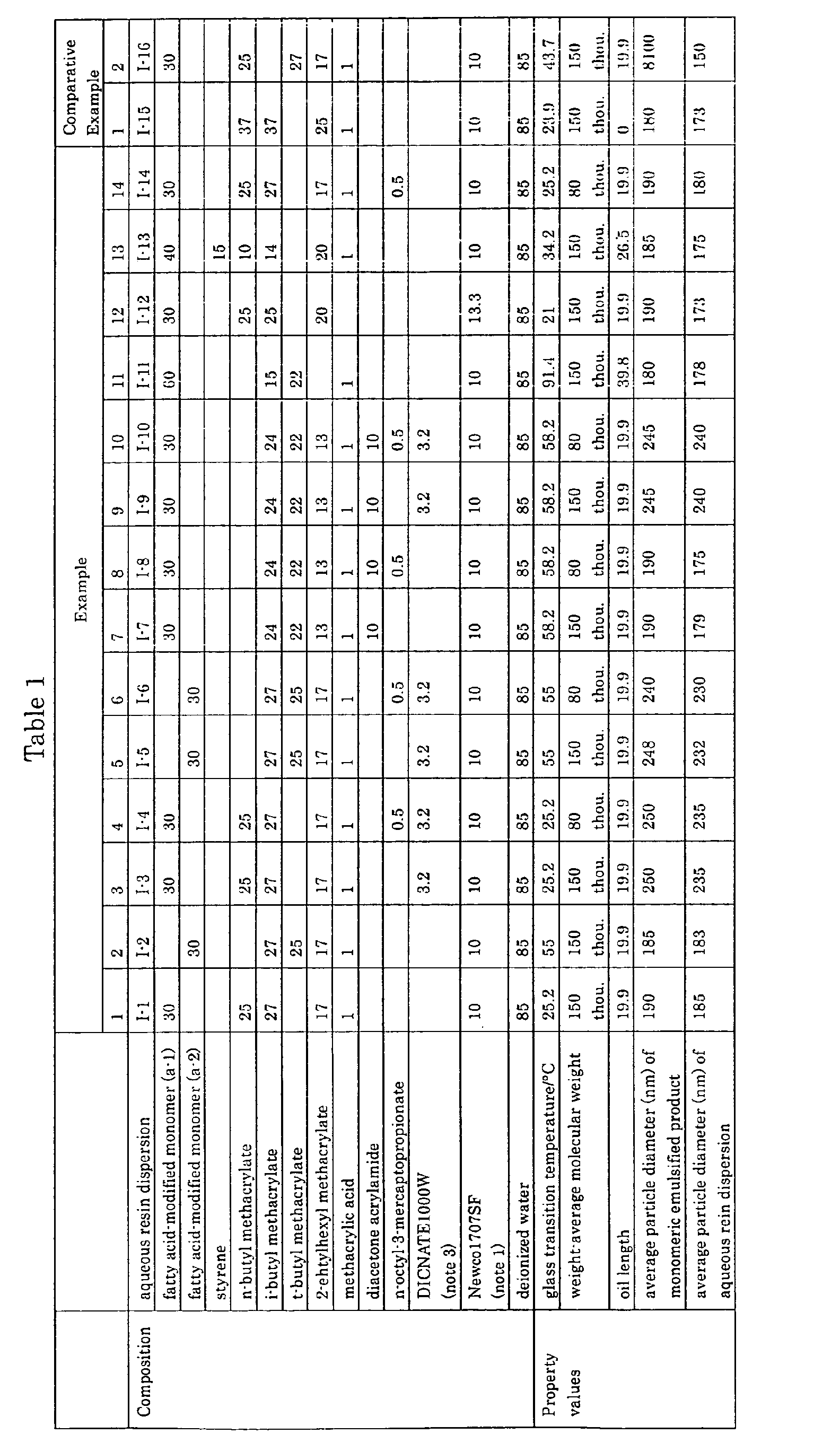
Examples 2 - 14 and Comparative Example 1
In the manner identical with Example 1 except that the
blended composition of monomeric emulsified product was changed as
shown in Table 1, aqueous resin dispersions (I-2)-(I-14) and (I-15)
were obtained.
The monomers, an emulsifier and deionized water were put in
a glass beaker at the blend ratio as indicated in Table 1, and stirred
with dispersing device at 2,000 rpm for 15 minutes to provide a
monomeric emulsified product. Average particle diameter of the
particles dispersed in the monomeric emulsified product was 8,100
nm. To this monomeric emulsified product 2 g of VA-086 (note 2) was
added, followed by stirring until the added polymerization initiator
was dissolved. Separately, 0.08 g of Newcol707 SF (note 1) and 50 g
of deionized water were put in a flask and heated to 85°C. While
maintaining said temperature inside the flask, the monomeric
emulsified product and an aqueous solution of 0.5 g of VA-086 as
dissolved in 10 g of deionized water were dropped into the flask over 4
hours under stirring. After termination of the dropping, the system
was aged for an hour and an aqueous initiator solution of 0.25 g of
VA-086 (note 2) as dissolved in 3.0 g of deionized water was added into
the flask. After further an hour's aging, an aqueous resin dispersion
(I-16) was obtained. This aqueous resin dispersion left a large
quantity of filtration residue. The residue was removed and the
filtrate was sampled. In the diluted sample, the resin dispersed
therein had an average particle diameter of 150 nm.
Comparative Example 3
Seventy 70 parts of toluene was put in a flask and heated to
100°C. A monomeric mixture of the following composition as
prepared in a separate vessel was dropped into the flask over 4 hours
under stirring, while said temperature was maintained. After
termination of the dropping the system was aged for an hour, and an
initiator solution of 5.0 g of t-butylperoxy-2-ethylhexanoate as
dissolved in 1.0 g of toluene was added dropwise over an hour,
followed by another hour's aging. Thereafter the system was cooled
to 40°C, to provide a fatty acid-modified acrylic resin. Per 100 g of
the fatty acid-modified acrylic resin, 5 g of Newcol707 SF was added,
stirred, and diluted with deionized water to the solid content of 33%.
The mixture was given forced stirring to provide an aqueous
dispersion, heated, and the toluene was removed under reduced
pressure to provide an autoemulifiable aqueous resin dispersion
(I-17).
| Composition of the monomeric mixture |
| Fatty acid-modified monomer (a-1) | 30 parts |
| n-Butyl methacrylate | 25 parts |
| i-Butyl methacrylate | 27 parts |
| 2-Ethylhexyl methacrylate | 15 parts |
| Methacrylic acid | 3 parts |
| Toluene | 15 parts |
| t-Butyl peroxy-2-ethylhexanoate | 1.2parts |
The following components were put in a glass beaker and
stirred with dispersing device at 2,000 rpm for 15 minutes to provide
a pre-emulsion. The pre-emulsion was given a high pressure
treatment with a high-pressure emulsifying apparatus in which the
fluid was mutually collided under exertion of high-pressure energy at
100 MPa. Thus a monomeric emulsified product in which the
dispersed particles had an average particle diameter of 190 nm was
obtained.
| Composition of monomeric emulsified product |
| Fatty acid-modified monomer (a-2) | 30.15 parts |
| Styrene | 15 parts |
| Hydroxyethyl methacrylate | 4.5 parts |
| i-Butyl methacrylate | 20.35 parts |
| t-Butyl methacrylate | 20 parts |
| 2-Ethylhexyl methacrylate | 8 parts |
| Methacrylic acid | 2 parts |
| Newcol707SF (note 1) | 10 parts |
| Deionized water | 85 parts |
Then the monomeric emulsified product was transferred to a
flask and diluted with deionized water to the solid content of 45%.
Then the temperature inside the flask was raised to 85°C, an aqueous
initiator solution of 1.0 part of ammonium persulfate as dissolved in
15 parts of deionized water was thrown into the flask, and the content
of the flask was stirred for 3 hours while said temperature was
maintained. Then an aqueous initiator solution of 0.3 part of
ammonium persulfate as dissolved in 2.7 parts of deionized water was
added to the flask, followed by an hour's stirring while the same
temperature was maintained. Then the system was cooled to 40°
and its pH was adjusted to 8.0 with dimethylaminoethanol, to provide
an aqueous resin dispersion (I-18) having a solid concentration of 40%.
The resin dispersed therein had an average particle diameter of 165
nm.
Examples 16 - 33
Above Example 15 was repeated except that the blended
composition was changed to those as indicated in the following Tables
2 and 3, to provide aqueous resin dispersions (I-19) - (I-36).
Comparative Example 4
The pre-emulsion as obtained in Example 1 was stirred with a
dispersing machine having high shearing ability, at 10,000 rpm for 5
minutes, to provide a monomeric emulsified product in which the
dispersed particles had an average particle diameter of 520 nm.
Except the above operation same composition of blended components
and procedures as Example 1 were used to provide an aqueous resin
dispersion (I-37) in which the dispersed resin had an average particle
diameter of 630 nm.
| | Example |
| | 15 | 16 | 17 | 18 | 19 | 20 | 21 | 22 |
| Composition | aqueous resin dispersion | I-18 | I-19 | I-20 | 1-21 | I-22 | I-23 | I-24 | I-25 |
| fatty acid-modified monomer (a-1) | | 30.15 |
| fatty acid-modified monomer (a-2) | 30.15 | | 30.15 | 30.15 | 30.15 | 30.15 | 30.15 | 30.15 |
| styrene | 15 | 15 | 15 | 15 | 15 | 15 | 15 | 15 |
| hydroxyethyl methacrylate | 4.5 | 4.5 | 4.5 | 4.5 | 4.5 | 4.5 | 4.5 | 4.5 |
| i-butyl methacrylate | 20.35 | 20.35 | 20.35 | 20.35 | 20.35 | 17.35 | 18.35 | 18.35 |
| t-butyl methacrylate | 20 | 20 | 20 | 20 | 20 | 20 | 18 | 18 |
| 2-ethylhexyl acrylate | 8 | 8 |
| 2-ethylhexyl methacrylate | | | 8 | 8 | 8 | 8 | 8 | 8 |
| methacrylic acid | 2 | 2 | | | 2 | 2 | 2 | 2 |
| acrylic acid | | | 2 |
| itaconic acid | | | | 2 |
| diacetone acrylamide | | | | | | 3 |
| cyclohexyl methacrylate |
| RUVA-93 (note4) | | | | | | | 2 |
| 4-(meth)acryloyloxy-1,2,2,6,6,pentamethylpiperidine | | | | | | | 2 |
| TINUVINE 384-2 (note5) | | | | | | | | 0.5 |
| TINUVINE 123 (note6) | | | | | | | | 0.5 |
| n-octyl-3-mercaptopropionate | 0.3 | 0.3 | 0.3 | 0.3 | 0.3 | 0.3 | 0.3 | 0.3 |
| cobalt naphthenate | | | | | 1.5 |
| zirconium octenate | | | | | 2 |
| calcium naphthenate | | | | | 1 |
| Newcol707SF (note1) | 10 | 10 | 10 | 10 | 10 | 10 | 10 | 10 |
| deionized water | 85 | 85 | 85 | 85 | 85 | 85 | 85 | 85 |
| Property values | glass transition temperature | 63 | 63 | 70.7 | 71.5 | 72.9 | 73.3 | 72.4 | 72.4 |
| weight-average molecular weight | 110 thou. | 110 thou. | 110 thou. | 110 thou. | 110 thou. | 110 thou. | 110 thou. | 110 thou. |
| oil length | 20 | 20 | 20 | 20 | 20 | 20 | 20 | 20 |
| average particle diameter (nm) of monomeric emulsified product | 190 | 185 | 195 | 180 | 193 | 212 | 190 | 190 |
| average particle diameter (nm) of aqueous resin dispersion | 165 | 160 | 173 | 160 | 165 | 180 | 160 | 165 |
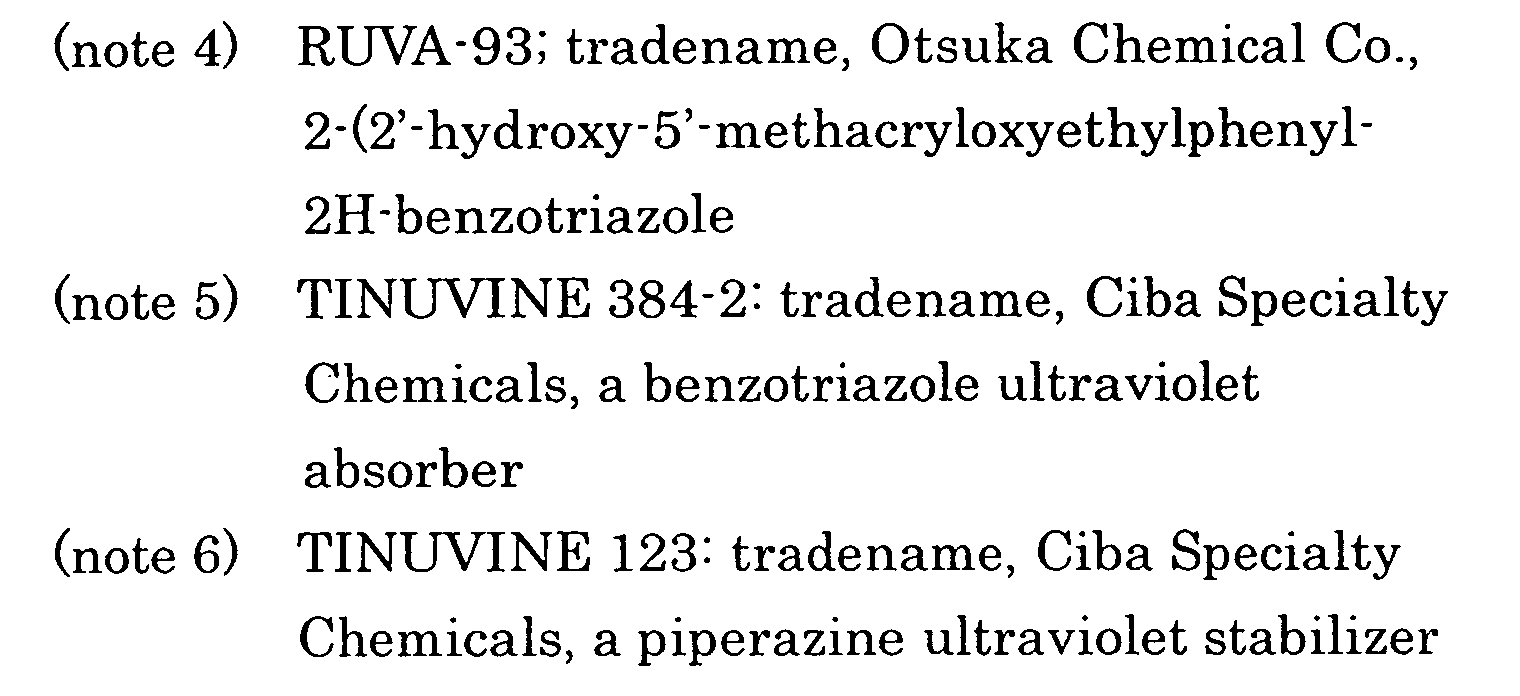
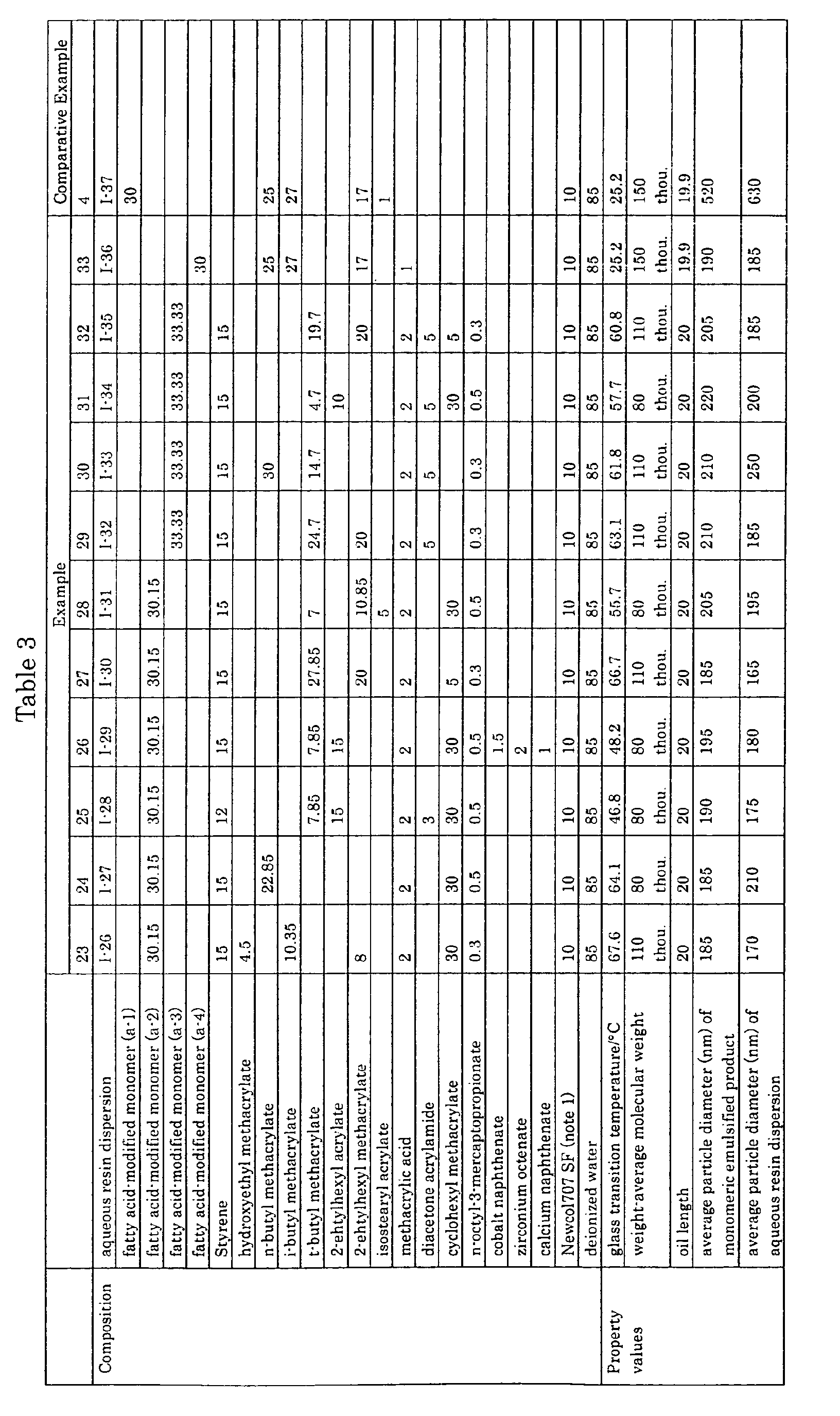
Aqueous resin compositions were obtained at the blend ratios
as indicated in the following Table 4. Storage stability and
transparency of each of the aqueous resin compositions were
evaluated according to the following standards. The results are
concurrently shown in Table 4.
Transparency was evaluated by measuring transmission haze
value. Onto an OHP sheet whose transmission haze value had been
measured in advance with COH-300A (tradename, Nippon Denshoku
Kogyo, a color difference-turbidity measuring machine), each aqueous
resin composition was applied to a dry film thickness of 20 µm, and
aged for 20°C for a week to provide test specimens. Transmission
haze values of these test specimens were measured with COH-300A
(tradename, Nippon Denshoku Kogyo, a color difference-turbidity
measuring machine). Subtracting from the measured values the
transmission haze value of the OHP sheet, the remaining values were
indicated as transparency of the respective test specimens. Lower
values signify better transparency.
(*2) Storage stability
One (1) kg of each of the aqueous resin compositions was put in
1L-capacity can with coated inner surface, sealed in nitrogen
atmosphere and stored for 30 days at 40°C. Thereafter the
temperature was dropped to ambient level. Condition of the
compositions in the containers was visually observed and evaluated
according to the following standards.
Preparation of water-based paint compositions
Examples 67 - 100 and Comparative Examples 9 - 12
Those components as shown under Composition (A) in Table 5
were successively charged in a container each and stirred with a
dispersing device for 30 minutes to homogeneity to provide pigment
pastes. Then the aqueous resin dispersions (I-1) - (I-37) were each
added to the pigment pastes, followed by successive addition of the
components as shown under Composition (B) in Table 5, to provide
water-based paint compositions. The compositions were then
evaluated according to the following standards. The results are also
shown in Table 5 concurrently with the water-based paint
compositions' property values.
Each of the water-based paint compositions was applied onto
exfoliate paper to a film thickness of 20 µ and dried for a week. Then
released coating film was put in 20°C acetone solvent and extracted
for 24 hours. The residual ratio (%) after the extraction was
examined. Higher values indicate better hardenability.
(*4) Thick appearance
Each of the water-based paint compositions was applied onto
glass sheet with a 6-mil doctor blade and dried under the conditions
of temperature, 20°C and relative humidity, 60%. The test-coated
sheet samples were visually evaluated after one day of the
application:
(*5) Gloss
Gloss at 60° of the test coated sheet samples as obtained in the
same manner as in above (*4) was measured. Higher values indicate
better gloss.
(*6) Water resistance
Steel sheet (150 × 70 × 0.8 mm) meeting JIS K 5410 rating
was degreased with xylene, and onto which each of the water-based
paint compositions as diluted with city water to about 70KU was
applied with brush at an application rate of 150 g/m
2, followed by a
week's drying at 20°C and relative humidity of 60%, to provide test
panels. The test panels were given a water resistance test (96 hour's
immersion) following JIS K 5400-8.19. Conditions of the coated
panel surfaces after the test were evaluated according to the following
standard.
(*7) Corrosion resistance
As the substrate material a steel sheet (150 × 70 × 0.8 mm)
meeting JIS K 5410 rating, which was degreased with xylene was
used. Each of the water-based paint compositions was diluted with
city water to about 70 KU, and applied onto the steel sheet with brush
at an application rate of 100 g/m2.
After a day's drying, second time application was conducted in
the manner identical with the first time application, and dried for 7
days under the conditions of 20°C and relative humidity of 60% to
provide test panels. The test panels were subjected to 36 cycles of
the composite cycle anti-corrosion test as specified by JIS K 5621, and
thereafter the coated surfaces were evaluated according to the
following criteria:
(*8) Accelerated weatherability
Test panels prepared in the same manner as those for the
corrosion test were irradiated for 1,000 hours according to the
acclerated weatherability test as specified by JIS K 5400 - 9.8.1
(Sunshine carbon arc lamp system). Thereafter the coated surfaces
were evaluated by degree of chalking according to JIS K5400-9.6.
Lower evaluation points indicate more advanced degree of chalking.