EP1598207B1 - Stabilizers for use in substantially light-insensitive thermographic recording materials. - Google Patents
Stabilizers for use in substantially light-insensitive thermographic recording materials. Download PDFInfo
- Publication number
- EP1598207B1 EP1598207B1 EP05102620A EP05102620A EP1598207B1 EP 1598207 B1 EP1598207 B1 EP 1598207B1 EP 05102620 A EP05102620 A EP 05102620A EP 05102620 A EP05102620 A EP 05102620A EP 1598207 B1 EP1598207 B1 EP 1598207B1
- Authority
- EP
- European Patent Office
- Prior art keywords
- groups
- group
- alkyl
- mbiz
- substantially light
- Prior art date
- Legal status (The legal status is an assumption and is not a legal conclusion. Google has not performed a legal analysis and makes no representation as to the accuracy of the status listed.)
- Expired - Lifetime
Links
- 239000000463 material Substances 0.000 title claims description 111
- 239000003381 stabilizer Substances 0.000 title claims description 46
- 125000003118 aryl group Chemical group 0.000 claims description 41
- 125000001931 aliphatic group Chemical group 0.000 claims description 26
- 239000011230 binding agent Substances 0.000 claims description 21
- 125000004432 carbon atom Chemical group C* 0.000 claims description 19
- 239000003638 chemical reducing agent Substances 0.000 claims description 18
- GGCZERPQGJTIQP-UHFFFAOYSA-N sodium;9,10-dioxoanthracene-2-sulfonic acid Chemical compound [Na+].C1=CC=C2C(=O)C3=CC(S(=O)(=O)O)=CC=C3C(=O)C2=C1 GGCZERPQGJTIQP-UHFFFAOYSA-N 0.000 claims description 17
- 239000012964 benzotriazole Substances 0.000 claims description 16
- 229910052760 oxygen Inorganic materials 0.000 claims description 11
- 229910052717 sulfur Inorganic materials 0.000 claims description 10
- 125000002252 acyl group Chemical group 0.000 claims description 9
- 125000003545 alkoxy group Chemical group 0.000 claims description 9
- 125000004435 hydrogen atom Chemical group [H]* 0.000 claims description 9
- 229910052757 nitrogen Inorganic materials 0.000 claims description 9
- 125000000472 sulfonyl group Chemical group *S(*)(=O)=O 0.000 claims description 9
- 125000002877 alkyl aryl group Chemical group 0.000 claims description 8
- 125000004429 atom Chemical group 0.000 claims description 8
- 125000005843 halogen group Chemical group 0.000 claims description 8
- 239000000178 monomer Substances 0.000 claims description 8
- 150000002825 nitriles Chemical class 0.000 claims description 8
- 125000000449 nitro group Chemical group [O-][N+](*)=O 0.000 claims description 8
- 125000004433 nitrogen atom Chemical group N* 0.000 claims description 8
- 125000004437 phosphorous atom Chemical group 0.000 claims description 8
- 229910052710 silicon Inorganic materials 0.000 claims description 8
- IMROMDMJAWUWLK-UHFFFAOYSA-N Ethenol Chemical compound OC=C IMROMDMJAWUWLK-UHFFFAOYSA-N 0.000 claims description 7
- XTXRWKRVRITETP-UHFFFAOYSA-N Vinyl acetate Chemical compound CC(=O)OC=C XTXRWKRVRITETP-UHFFFAOYSA-N 0.000 claims description 7
- CBECDWUDYQOTSW-UHFFFAOYSA-N 2-ethylbut-3-enal Chemical compound CCC(C=C)C=O CBECDWUDYQOTSW-UHFFFAOYSA-N 0.000 claims description 6
- JTHNLKXLWOXOQK-UHFFFAOYSA-N n-propyl vinyl ketone Natural products CCCC(=O)C=C JTHNLKXLWOXOQK-UHFFFAOYSA-N 0.000 claims description 6
- 150000001299 aldehydes Chemical class 0.000 claims description 5
- 229920000642 polymer Polymers 0.000 claims description 5
- 125000001424 substituent group Chemical group 0.000 claims description 5
- 229920002554 vinyl polymer Polymers 0.000 claims description 5
- XSQUKJJJFZCRTK-UHFFFAOYSA-N Urea Chemical compound NC(N)=O XSQUKJJJFZCRTK-UHFFFAOYSA-N 0.000 claims description 4
- 239000004202 carbamide Substances 0.000 claims description 4
- 150000001732 carboxylic acid derivatives Chemical class 0.000 claims description 4
- 125000002924 primary amino group Chemical group [H]N([H])* 0.000 claims description 4
- 125000000547 substituted alkyl group Chemical group 0.000 claims description 4
- 125000004001 thioalkyl group Chemical group 0.000 claims description 4
- 125000000391 vinyl group Chemical group [H]C([*])=C([H])[H] 0.000 claims description 4
- JAHNSTQSQJOJLO-UHFFFAOYSA-N 2-(3-fluorophenyl)-1h-imidazole Chemical compound FC1=CC=CC(C=2NC=CN=2)=C1 JAHNSTQSQJOJLO-UHFFFAOYSA-N 0.000 claims description 3
- 125000003354 benzotriazolyl group Chemical class N1N=NC2=C1C=CC=C2* 0.000 claims description 3
- LVHBHZANLOWSRM-UHFFFAOYSA-N methylenebutanedioic acid Natural products OC(=O)CC(=C)C(O)=O LVHBHZANLOWSRM-UHFFFAOYSA-N 0.000 claims description 3
- 125000004948 alkyl aryl alkyl group Chemical group 0.000 claims description 2
- QVGXLLKOCUKJST-UHFFFAOYSA-N atomic oxygen Chemical compound [O] QVGXLLKOCUKJST-UHFFFAOYSA-N 0.000 claims description 2
- 239000001301 oxygen Substances 0.000 claims description 2
- 125000005017 substituted alkenyl group Chemical group 0.000 claims description 2
- 125000004426 substituted alkynyl group Chemical group 0.000 claims description 2
- 125000003107 substituted aryl group Chemical group 0.000 claims description 2
- 125000004434 sulfur atom Chemical group 0.000 claims description 2
- 230000000052 comparative effect Effects 0.000 description 37
- 239000010410 layer Substances 0.000 description 19
- 238000010438 heat treatment Methods 0.000 description 18
- QRUDEWIWKLJBPS-UHFFFAOYSA-N benzotriazole Chemical compound C1=CC=C2N[N][N]C2=C1 QRUDEWIWKLJBPS-UHFFFAOYSA-N 0.000 description 15
- 150000001875 compounds Chemical group 0.000 description 15
- -1 silver halide Chemical class 0.000 description 15
- 239000000203 mixture Substances 0.000 description 14
- 238000000034 method Methods 0.000 description 13
- 150000003378 silver Chemical class 0.000 description 12
- 239000004615 ingredient Substances 0.000 description 10
- 239000003795 chemical substances by application Substances 0.000 description 9
- VYPSYNLAJGMNEJ-UHFFFAOYSA-N Silicium dioxide Chemical compound O=[Si]=O VYPSYNLAJGMNEJ-UHFFFAOYSA-N 0.000 description 8
- 239000002253 acid Substances 0.000 description 8
- 239000011248 coating agent Substances 0.000 description 8
- 238000000576 coating method Methods 0.000 description 8
- 239000011241 protective layer Substances 0.000 description 8
- AQRYNYUOKMNDDV-UHFFFAOYSA-M silver behenate Chemical compound [Ag+].CCCCCCCCCCCCCCCCCCCCCC([O-])=O AQRYNYUOKMNDDV-UHFFFAOYSA-M 0.000 description 8
- 239000006185 dispersion Substances 0.000 description 7
- 238000002474 experimental method Methods 0.000 description 7
- 229910052709 silver Inorganic materials 0.000 description 7
- 239000004332 silver Substances 0.000 description 7
- 125000000217 alkyl group Chemical group 0.000 description 6
- 229920001577 copolymer Polymers 0.000 description 6
- 238000011156 evaluation Methods 0.000 description 6
- 229910052739 hydrogen Inorganic materials 0.000 description 6
- 239000001257 hydrogen Substances 0.000 description 6
- 230000008569 process Effects 0.000 description 6
- 239000004094 surface-active agent Substances 0.000 description 6
- 238000001035 drying Methods 0.000 description 5
- 230000000694 effects Effects 0.000 description 5
- 239000003921 oil Substances 0.000 description 5
- 230000009467 reduction Effects 0.000 description 5
- 239000000454 talc Substances 0.000 description 5
- 229910052623 talc Inorganic materials 0.000 description 5
- 238000001931 thermography Methods 0.000 description 5
- 239000004372 Polyvinyl alcohol Substances 0.000 description 4
- 150000008064 anhydrides Chemical class 0.000 description 4
- 125000004122 cyclic group Chemical group 0.000 description 4
- 239000002270 dispersing agent Substances 0.000 description 4
- 229940042795 hydrazides for tuberculosis treatment Drugs 0.000 description 4
- 230000003287 optical effect Effects 0.000 description 4
- 229920002451 polyvinyl alcohol Polymers 0.000 description 4
- 235000019422 polyvinyl alcohol Nutrition 0.000 description 4
- 239000004800 polyvinyl chloride Substances 0.000 description 4
- 229920000915 polyvinyl chloride Polymers 0.000 description 4
- LFQCEHFDDXELDD-UHFFFAOYSA-N tetramethyl orthosilicate Chemical compound CO[Si](OC)(OC)OC LFQCEHFDDXELDD-UHFFFAOYSA-N 0.000 description 4
- 238000007651 thermal printing Methods 0.000 description 4
- BWGNESOTFCXPMA-UHFFFAOYSA-N Dihydrogen disulfide Chemical compound SS BWGNESOTFCXPMA-UHFFFAOYSA-N 0.000 description 3
- BQCADISMDOOEFD-UHFFFAOYSA-N Silver Chemical compound [Ag] BQCADISMDOOEFD-UHFFFAOYSA-N 0.000 description 3
- 230000015572 biosynthetic process Effects 0.000 description 3
- 229910052799 carbon Inorganic materials 0.000 description 3
- 125000003178 carboxy group Chemical group [H]OC(*)=O 0.000 description 3
- 229920002678 cellulose Polymers 0.000 description 3
- 239000000839 emulsion Substances 0.000 description 3
- 238000005516 engineering process Methods 0.000 description 3
- 230000006872 improvement Effects 0.000 description 3
- 230000007935 neutral effect Effects 0.000 description 3
- 229920002037 poly(vinyl butyral) polymer Polymers 0.000 description 3
- 229920000139 polyethylene terephthalate Polymers 0.000 description 3
- 239000005020 polyethylene terephthalate Substances 0.000 description 3
- 238000007639 printing Methods 0.000 description 3
- 229920005989 resin Polymers 0.000 description 3
- 239000011347 resin Substances 0.000 description 3
- 239000000377 silicon dioxide Substances 0.000 description 3
- 230000000087 stabilizing effect Effects 0.000 description 3
- UXTZUUVTGMDXNG-UHFFFAOYSA-N 1,2-benzoxazine-3,4-dione Chemical class C1=CC=C2C(=O)C(=O)NOC2=C1 UXTZUUVTGMDXNG-UHFFFAOYSA-N 0.000 description 2
- OEPOKWHJYJXUGD-UHFFFAOYSA-N 2-(3-phenylmethoxyphenyl)-1,3-thiazole-4-carbaldehyde Chemical compound O=CC1=CSC(C=2C=C(OCC=3C=CC=CC=3)C=CC=2)=N1 OEPOKWHJYJXUGD-UHFFFAOYSA-N 0.000 description 2
- ZWEHNKRNPOVVGH-UHFFFAOYSA-N 2-Butanone Chemical compound CCC(C)=O ZWEHNKRNPOVVGH-UHFFFAOYSA-N 0.000 description 2
- DZAUWHJDUNRCTF-UHFFFAOYSA-N 3-(3,4-dihydroxyphenyl)propanoic acid Chemical compound OC(=O)CCC1=CC=C(O)C(O)=C1 DZAUWHJDUNRCTF-UHFFFAOYSA-N 0.000 description 2
- HQUVXRFXGBZDNB-UHFFFAOYSA-N 7-methyl-1,3-benzoxazine-2,4-dione Chemical compound O1C(=O)NC(=O)C=2C1=CC(C)=CC=2 HQUVXRFXGBZDNB-UHFFFAOYSA-N 0.000 description 2
- PEDCQBHIVMGVHV-UHFFFAOYSA-N Glycerine Chemical compound OCC(O)CO PEDCQBHIVMGVHV-UHFFFAOYSA-N 0.000 description 2
- UFHFLCQGNIYNRP-UHFFFAOYSA-N Hydrogen Chemical compound [H][H] UFHFLCQGNIYNRP-UHFFFAOYSA-N 0.000 description 2
- AFVFQIVMOAPDHO-UHFFFAOYSA-N Methanesulfonic acid Chemical compound CS(O)(=O)=O AFVFQIVMOAPDHO-UHFFFAOYSA-N 0.000 description 2
- BAPJBEWLBFYGME-UHFFFAOYSA-N Methyl acrylate Chemical compound COC(=O)C=C BAPJBEWLBFYGME-UHFFFAOYSA-N 0.000 description 2
- ZTHYODDOHIVTJV-UHFFFAOYSA-N Propyl gallate Chemical compound CCCOC(=O)C1=CC(O)=C(O)C(O)=C1 ZTHYODDOHIVTJV-UHFFFAOYSA-N 0.000 description 2
- BZHJMEDXRYGGRV-UHFFFAOYSA-N Vinyl chloride Chemical compound ClC=C BZHJMEDXRYGGRV-UHFFFAOYSA-N 0.000 description 2
- 230000004913 activation Effects 0.000 description 2
- 239000000654 additive Substances 0.000 description 2
- 230000002411 adverse Effects 0.000 description 2
- 150000001344 alkene derivatives Chemical class 0.000 description 2
- CCGGDOVGIDSGQN-UHFFFAOYSA-N benzo[f][1,2]benzoxazine-1,2-dione Chemical class C1=CC=CC2=C(C(C(=O)NO3)=O)C3=CC=C21 CCGGDOVGIDSGQN-UHFFFAOYSA-N 0.000 description 2
- 150000001721 carbon Chemical group 0.000 description 2
- 150000001735 carboxylic acids Chemical class 0.000 description 2
- YCIMNLLNPGFGHC-UHFFFAOYSA-N catechol Chemical compound OC1=CC=CC=C1O YCIMNLLNPGFGHC-UHFFFAOYSA-N 0.000 description 2
- 239000001913 cellulose Substances 0.000 description 2
- 239000008119 colloidal silica Substances 0.000 description 2
- 238000011161 development Methods 0.000 description 2
- 150000002148 esters Chemical class 0.000 description 2
- VFPFQHQNJCMNBZ-UHFFFAOYSA-N ethyl gallate Chemical compound CCOC(=O)C1=CC(O)=C(O)C(O)=C1 VFPFQHQNJCMNBZ-UHFFFAOYSA-N 0.000 description 2
- LNTHITQWFMADLM-UHFFFAOYSA-N gallic acid Chemical compound OC(=O)C1=CC(O)=C(O)C(O)=C1 LNTHITQWFMADLM-UHFFFAOYSA-N 0.000 description 2
- 125000000623 heterocyclic group Chemical group 0.000 description 2
- 238000003384 imaging method Methods 0.000 description 2
- 230000001050 lubricating effect Effects 0.000 description 2
- YDSWCNNOKPMOTP-UHFFFAOYSA-N mellitic acid Chemical compound OC(=O)C1=C(C(O)=O)C(C(O)=O)=C(C(O)=O)C(C(O)=O)=C1C(O)=O YDSWCNNOKPMOTP-UHFFFAOYSA-N 0.000 description 2
- FBSFWRHWHYMIOG-UHFFFAOYSA-N methyl 3,4,5-trihydroxybenzoate Chemical compound COC(=O)C1=CC(O)=C(O)C(O)=C1 FBSFWRHWHYMIOG-UHFFFAOYSA-N 0.000 description 2
- 239000002245 particle Substances 0.000 description 2
- 125000005543 phthalimide group Chemical class 0.000 description 2
- 229920002689 polyvinyl acetate Polymers 0.000 description 2
- 239000011118 polyvinyl acetate Substances 0.000 description 2
- 239000000843 powder Substances 0.000 description 2
- CYIDZMCFTVVTJO-UHFFFAOYSA-N pyromellitic acid Chemical compound OC(=O)C1=CC(C(O)=O)=C(C(O)=O)C=C1C(O)=O CYIDZMCFTVVTJO-UHFFFAOYSA-N 0.000 description 2
- 150000003839 salts Chemical class 0.000 description 2
- 239000002904 solvent Substances 0.000 description 2
- 230000006641 stabilisation Effects 0.000 description 2
- 238000011105 stabilization Methods 0.000 description 2
- 239000007858 starting material Substances 0.000 description 2
- 239000000126 substance Substances 0.000 description 2
- 238000012360 testing method Methods 0.000 description 2
- 150000007944 thiolates Chemical group 0.000 description 2
- 238000012546 transfer Methods 0.000 description 2
- ARCGXLSVLAOJQL-UHFFFAOYSA-N trimellitic acid Chemical compound OC(=O)C1=CC=C(C(O)=O)C(C(O)=O)=C1 ARCGXLSVLAOJQL-UHFFFAOYSA-N 0.000 description 2
- 125000002221 trityl group Chemical group [H]C1=C([H])C([H])=C([H])C([H])=C1C([*])(C1=C(C(=C(C(=C1[H])[H])[H])[H])[H])C1=C([H])C([H])=C([H])C([H])=C1[H] 0.000 description 2
- OMDQUFIYNPYJFM-XKDAHURESA-N (2r,3r,4s,5r,6s)-2-(hydroxymethyl)-6-[[(2r,3s,4r,5s,6r)-4,5,6-trihydroxy-3-[(2s,3s,4s,5s,6r)-3,4,5-trihydroxy-6-(hydroxymethyl)oxan-2-yl]oxyoxan-2-yl]methoxy]oxane-3,4,5-triol Chemical compound O[C@@H]1[C@@H](O)[C@@H](O)[C@@H](CO)O[C@@H]1OC[C@@H]1[C@@H](O[C@H]2[C@H]([C@@H](O)[C@H](O)[C@@H](CO)O2)O)[C@H](O)[C@H](O)[C@H](O)O1 OMDQUFIYNPYJFM-XKDAHURESA-N 0.000 description 1
- ARWCZKJISXFBGI-UHFFFAOYSA-N (3,4-dihydroxyphenyl)-phenylmethanone Chemical compound C1=C(O)C(O)=CC=C1C(=O)C1=CC=CC=C1 ARWCZKJISXFBGI-UHFFFAOYSA-N 0.000 description 1
- 150000005206 1,2-dihydroxybenzenes Chemical class 0.000 description 1
- PUCYIVFXTPWJDD-UHFFFAOYSA-N 1,6-dihydroxycyclohexa-2,4-dienecarboxylic acid Chemical compound OC1C=CC=CC1(O)C(O)=O PUCYIVFXTPWJDD-UHFFFAOYSA-N 0.000 description 1
- TUSDEZXZIZRFGC-UHFFFAOYSA-N 1-O-galloyl-3,6-(R)-HHDP-beta-D-glucose Natural products OC1C(O2)COC(=O)C3=CC(O)=C(O)C(O)=C3C3=C(O)C(O)=C(O)C=C3C(=O)OC1C(O)C2OC(=O)C1=CC(O)=C(O)C(O)=C1 TUSDEZXZIZRFGC-UHFFFAOYSA-N 0.000 description 1
- RTBFRGCFXZNCOE-UHFFFAOYSA-N 1-methylsulfonylpiperidin-4-one Chemical compound CS(=O)(=O)N1CCC(=O)CC1 RTBFRGCFXZNCOE-UHFFFAOYSA-N 0.000 description 1
- 238000001644 13C nuclear magnetic resonance spectroscopy Methods 0.000 description 1
- DFZVZKUDBIJAHK-UHFFFAOYSA-N 2-hydroxyoctadecanoic acid silver Chemical compound [Ag].OC(C(=O)O)CCCCCCCCCCCCCCCC DFZVZKUDBIJAHK-UHFFFAOYSA-N 0.000 description 1
- 125000004493 2-methylbut-1-yl group Chemical group CC(C*)CC 0.000 description 1
- WZHHYIOUKQNLQM-UHFFFAOYSA-N 3,4,5,6-tetrachlorophthalic acid Chemical compound OC(=O)C1=C(Cl)C(Cl)=C(Cl)C(Cl)=C1C(O)=O WZHHYIOUKQNLQM-UHFFFAOYSA-N 0.000 description 1
- YQUVCSBJEUQKSH-UHFFFAOYSA-N 3,4-dihydroxybenzoic acid Chemical class OC(=O)C1=CC=C(O)C(O)=C1 YQUVCSBJEUQKSH-UHFFFAOYSA-N 0.000 description 1
- NUWHYWYSMAPBHK-UHFFFAOYSA-N 3,4-dihydroxybenzonitrile Chemical compound OC1=CC=C(C#N)C=C1O NUWHYWYSMAPBHK-UHFFFAOYSA-N 0.000 description 1
- KFIRODWJCYBBHY-UHFFFAOYSA-N 3-nitrophthalic acid Chemical compound OC(=O)C1=CC=CC([N+]([O-])=O)=C1C(O)=O KFIRODWJCYBBHY-UHFFFAOYSA-N 0.000 description 1
- UPMLOUAZCHDJJD-UHFFFAOYSA-N 4,4'-Diphenylmethane Diisocyanate Chemical compound C1=CC(N=C=O)=CC=C1CC1=CC=C(N=C=O)C=C1 UPMLOUAZCHDJJD-UHFFFAOYSA-N 0.000 description 1
- YFURRWKTIKKJEF-UHFFFAOYSA-N 7-methoxy-1,3-benzoxazine-2,4-dione Chemical compound O1C(=O)NC(=O)C=2C1=CC(OC)=CC=2 YFURRWKTIKKJEF-UHFFFAOYSA-N 0.000 description 1
- HRPVXLWXLXDGHG-UHFFFAOYSA-N Acrylamide Chemical compound NC(=O)C=C HRPVXLWXLXDGHG-UHFFFAOYSA-N 0.000 description 1
- NLHHRLWOUZZQLW-UHFFFAOYSA-N Acrylonitrile Chemical compound C=CC#N NLHHRLWOUZZQLW-UHFFFAOYSA-N 0.000 description 1
- NLZUEZXRPGMBCV-UHFFFAOYSA-N Butylhydroxytoluene Chemical compound CC1=CC(C(C)(C)C)=C(O)C(C(C)(C)C)=C1 NLZUEZXRPGMBCV-UHFFFAOYSA-N 0.000 description 1
- 229920002284 Cellulose triacetate Polymers 0.000 description 1
- 239000004801 Chlorinated PVC Substances 0.000 description 1
- 239000004262 Ethyl gallate Substances 0.000 description 1
- 239000001263 FEMA 3042 Substances 0.000 description 1
- 229920000926 Galactomannan Polymers 0.000 description 1
- 239000001828 Gelatine Substances 0.000 description 1
- OWYWGLHRNBIFJP-UHFFFAOYSA-N Ipazine Chemical compound CCN(CC)C1=NC(Cl)=NC(NC(C)C)=N1 OWYWGLHRNBIFJP-UHFFFAOYSA-N 0.000 description 1
- FYYHWMGAXLPEAU-UHFFFAOYSA-N Magnesium Chemical compound [Mg] FYYHWMGAXLPEAU-UHFFFAOYSA-N 0.000 description 1
- WSMYVTOQOOLQHP-UHFFFAOYSA-N Malondialdehyde Chemical class O=CCC=O WSMYVTOQOOLQHP-UHFFFAOYSA-N 0.000 description 1
- GRYLNZFGIOXLOG-UHFFFAOYSA-N Nitric acid Chemical compound O[N+]([O-])=O GRYLNZFGIOXLOG-UHFFFAOYSA-N 0.000 description 1
- 229910019142 PO4 Inorganic materials 0.000 description 1
- LRBQNJMCXXYXIU-PPKXGCFTSA-N Penta-digallate-beta-D-glucose Natural products OC1=C(O)C(O)=CC(C(=O)OC=2C(=C(O)C=C(C=2)C(=O)OC[C@@H]2[C@H]([C@H](OC(=O)C=3C=C(OC(=O)C=4C=C(O)C(O)=C(O)C=4)C(O)=C(O)C=3)[C@@H](OC(=O)C=3C=C(OC(=O)C=4C=C(O)C(O)=C(O)C=4)C(O)=C(O)C=3)[C@H](OC(=O)C=3C=C(OC(=O)C=4C=C(O)C(O)=C(O)C=4)C(O)=C(O)C=3)O2)OC(=O)C=2C=C(OC(=O)C=3C=C(O)C(O)=C(O)C=3)C(O)=C(O)C=2)O)=C1 LRBQNJMCXXYXIU-PPKXGCFTSA-N 0.000 description 1
- 229920002845 Poly(methacrylic acid) Polymers 0.000 description 1
- 239000004698 Polyethylene Substances 0.000 description 1
- 239000002202 Polyethylene glycol Substances 0.000 description 1
- 239000004743 Polypropylene Substances 0.000 description 1
- 239000004793 Polystyrene Substances 0.000 description 1
- FOIXSVOLVBLSDH-UHFFFAOYSA-N Silver ion Chemical compound [Ag+] FOIXSVOLVBLSDH-UHFFFAOYSA-N 0.000 description 1
- 229920002125 Sokalan® Polymers 0.000 description 1
- 229920002472 Starch Polymers 0.000 description 1
- NNLVGZFZQQXQNW-ADJNRHBOSA-N [(2r,3r,4s,5r,6s)-4,5-diacetyloxy-3-[(2s,3r,4s,5r,6r)-3,4,5-triacetyloxy-6-(acetyloxymethyl)oxan-2-yl]oxy-6-[(2r,3r,4s,5r,6s)-4,5,6-triacetyloxy-2-(acetyloxymethyl)oxan-3-yl]oxyoxan-2-yl]methyl acetate Chemical compound O([C@@H]1O[C@@H]([C@H]([C@H](OC(C)=O)[C@H]1OC(C)=O)O[C@H]1[C@@H]([C@@H](OC(C)=O)[C@H](OC(C)=O)[C@@H](COC(C)=O)O1)OC(C)=O)COC(=O)C)[C@@H]1[C@@H](COC(C)=O)O[C@@H](OC(C)=O)[C@H](OC(C)=O)[C@H]1OC(C)=O NNLVGZFZQQXQNW-ADJNRHBOSA-N 0.000 description 1
- 150000001241 acetals Chemical class 0.000 description 1
- 125000002777 acetyl group Chemical group [H]C([H])([H])C(*)=O 0.000 description 1
- 150000007513 acids Chemical class 0.000 description 1
- 150000008360 acrylonitriles Chemical class 0.000 description 1
- 230000000996 additive effect Effects 0.000 description 1
- 150000007933 aliphatic carboxylic acids Chemical class 0.000 description 1
- 150000003863 ammonium salts Chemical class 0.000 description 1
- JFCQEDHGNNZCLN-UHFFFAOYSA-N anhydrous glutaric acid Natural products OC(=O)CCCC(O)=O JFCQEDHGNNZCLN-UHFFFAOYSA-N 0.000 description 1
- 125000000129 anionic group Chemical group 0.000 description 1
- 239000003945 anionic surfactant Substances 0.000 description 1
- 230000002547 anomalous effect Effects 0.000 description 1
- 239000003963 antioxidant agent Substances 0.000 description 1
- 125000003435 aroyl group Chemical group 0.000 description 1
- 239000011324 bead Substances 0.000 description 1
- 235000010354 butylated hydroxytoluene Nutrition 0.000 description 1
- 125000004063 butyryl group Chemical group O=C([*])C([H])([H])C([H])([H])C([H])([H])[H] 0.000 description 1
- 125000002837 carbocyclic group Chemical group 0.000 description 1
- OAYRYNVEFFWSHK-UHFFFAOYSA-N carsalam Chemical compound C1=CC=C2OC(=O)NC(=O)C2=C1 OAYRYNVEFFWSHK-UHFFFAOYSA-N 0.000 description 1
- 239000003093 cationic surfactant Substances 0.000 description 1
- 150000001768 cations Chemical class 0.000 description 1
- 238000001311 chemical methods and process Methods 0.000 description 1
- 229920000457 chlorinated polyvinyl chloride Polymers 0.000 description 1
- 229910052681 coesite Inorganic materials 0.000 description 1
- 239000012141 concentrate Substances 0.000 description 1
- 230000003750 conditioning effect Effects 0.000 description 1
- 229910052906 cristobalite Inorganic materials 0.000 description 1
- 125000004093 cyano group Chemical group *C#N 0.000 description 1
- 230000001419 dependent effect Effects 0.000 description 1
- JTXUVYOABGUBMX-UHFFFAOYSA-N didodecyl hydrogen phosphate Chemical compound CCCCCCCCCCCCOP(O)(=O)OCCCCCCCCCCCC JTXUVYOABGUBMX-UHFFFAOYSA-N 0.000 description 1
- 235000014113 dietary fatty acids Nutrition 0.000 description 1
- 239000002612 dispersion medium Substances 0.000 description 1
- TVACALAUIQMRDF-UHFFFAOYSA-N dodecyl dihydrogen phosphate Chemical group CCCCCCCCCCCCOP(O)(O)=O TVACALAUIQMRDF-UHFFFAOYSA-N 0.000 description 1
- 150000002170 ethers Chemical class 0.000 description 1
- 235000019277 ethyl gallate Nutrition 0.000 description 1
- 239000000194 fatty acid Substances 0.000 description 1
- 229930195729 fatty acid Natural products 0.000 description 1
- 150000004665 fatty acids Chemical class 0.000 description 1
- 125000002541 furyl group Chemical group 0.000 description 1
- 235000004515 gallic acid Nutrition 0.000 description 1
- 229940074391 gallic acid Drugs 0.000 description 1
- 229920000159 gelatin Polymers 0.000 description 1
- 235000019322 gelatine Nutrition 0.000 description 1
- 150000004676 glycans Chemical class 0.000 description 1
- 235000011187 glycerol Nutrition 0.000 description 1
- 229910001385 heavy metal Inorganic materials 0.000 description 1
- 125000001072 heteroaryl group Chemical group 0.000 description 1
- 125000004356 hydroxy functional group Chemical group O* 0.000 description 1
- 239000012535 impurity Substances 0.000 description 1
- 238000010348 incorporation Methods 0.000 description 1
- 238000007689 inspection Methods 0.000 description 1
- 238000005342 ion exchange Methods 0.000 description 1
- XEEYBQQBJWHFJM-UHFFFAOYSA-N iron Substances [Fe] XEEYBQQBJWHFJM-UHFFFAOYSA-N 0.000 description 1
- 229910052742 iron Inorganic materials 0.000 description 1
- 125000000959 isobutyl group Chemical group [H]C([H])([H])C([H])(C([H])([H])[H])C([H])([H])* 0.000 description 1
- 125000001449 isopropyl group Chemical group [H]C([H])([H])C([H])(*)C([H])([H])[H] 0.000 description 1
- 239000000314 lubricant Substances 0.000 description 1
- 239000010687 lubricating oil Substances 0.000 description 1
- 239000011777 magnesium Substances 0.000 description 1
- 229910052749 magnesium Inorganic materials 0.000 description 1
- 238000004519 manufacturing process Methods 0.000 description 1
- 230000000873 masking effect Effects 0.000 description 1
- 229940098779 methanesulfonic acid Drugs 0.000 description 1
- IBKQQKPQRYUGBJ-UHFFFAOYSA-N methyl gallate Natural products CC(=O)C1=CC(O)=C(O)C(O)=C1 IBKQQKPQRYUGBJ-UHFFFAOYSA-N 0.000 description 1
- 239000003094 microcapsule Substances 0.000 description 1
- 238000012986 modification Methods 0.000 description 1
- 230000004048 modification Effects 0.000 description 1
- 125000004108 n-butyl group Chemical group [H]C([H])([H])C([H])([H])C([H])([H])C([H])([H])* 0.000 description 1
- 125000000740 n-pentyl group Chemical group [H]C([H])([H])C([H])([H])C([H])([H])C([H])([H])C([H])([H])* 0.000 description 1
- 125000004123 n-propyl group Chemical group [H]C([H])([H])C([H])([H])C([H])([H])* 0.000 description 1
- 239000000025 natural resin Substances 0.000 description 1
- 125000001971 neopentyl group Chemical group [H]C([*])([H])C(C([H])([H])[H])(C([H])([H])[H])C([H])([H])[H] 0.000 description 1
- 229910017604 nitric acid Inorganic materials 0.000 description 1
- 239000002736 nonionic surfactant Substances 0.000 description 1
- 150000002894 organic compounds Chemical group 0.000 description 1
- 150000002898 organic sulfur compounds Chemical class 0.000 description 1
- 239000007800 oxidant agent Substances 0.000 description 1
- 230000033116 oxidation-reduction process Effects 0.000 description 1
- 239000011236 particulate material Substances 0.000 description 1
- 150000002989 phenols Chemical class 0.000 description 1
- NBIIXXVUZAFLBC-UHFFFAOYSA-K phosphate Chemical compound [O-]P([O-])([O-])=O NBIIXXVUZAFLBC-UHFFFAOYSA-K 0.000 description 1
- 239000010452 phosphate Substances 0.000 description 1
- IJAPPYDYQCXOEF-UHFFFAOYSA-N phthalazin-1(2H)-one Chemical compound C1=CC=C2C(=O)NN=CC2=C1 IJAPPYDYQCXOEF-UHFFFAOYSA-N 0.000 description 1
- XNGIFLGASWRNHJ-UHFFFAOYSA-N phthalic acid Chemical compound OC(=O)C1=CC=CC=C1C(O)=O XNGIFLGASWRNHJ-UHFFFAOYSA-N 0.000 description 1
- 229920002401 polyacrylamide Polymers 0.000 description 1
- 229920000058 polyacrylate Polymers 0.000 description 1
- 239000004584 polyacrylic acid Substances 0.000 description 1
- 229920000515 polycarbonate Polymers 0.000 description 1
- 239000004417 polycarbonate Substances 0.000 description 1
- 229920000728 polyester Polymers 0.000 description 1
- 229920000573 polyethylene Polymers 0.000 description 1
- 229920001223 polyethylene glycol Polymers 0.000 description 1
- 229920000193 polymethacrylate Polymers 0.000 description 1
- 229920001155 polypropylene Polymers 0.000 description 1
- 229920001282 polysaccharide Polymers 0.000 description 1
- 239000005017 polysaccharide Substances 0.000 description 1
- 229920002223 polystyrene Polymers 0.000 description 1
- 229920000036 polyvinylpyrrolidone Polymers 0.000 description 1
- 239000001267 polyvinylpyrrolidone Substances 0.000 description 1
- 235000013855 polyvinylpyrrolidone Nutrition 0.000 description 1
- 239000002243 precursor Substances 0.000 description 1
- 238000012545 processing Methods 0.000 description 1
- 125000001501 propionyl group Chemical group O=C([*])C([H])([H])C([H])([H])[H] 0.000 description 1
- 235000010388 propyl gallate Nutrition 0.000 description 1
- 239000000473 propyl gallate Substances 0.000 description 1
- 229940075579 propyl gallate Drugs 0.000 description 1
- 229920006395 saturated elastomer Polymers 0.000 description 1
- 238000006748 scratching Methods 0.000 description 1
- 230000002393 scratching effect Effects 0.000 description 1
- 230000001235 sensitizing effect Effects 0.000 description 1
- 229920002545 silicone oil Polymers 0.000 description 1
- 229940054334 silver cation Drugs 0.000 description 1
- YRSQDSCQMOUOKO-KVVVOXFISA-M silver;(z)-octadec-9-enoate Chemical compound [Ag+].CCCCCCCC\C=C/CCCCCCCC([O-])=O YRSQDSCQMOUOKO-KVVVOXFISA-M 0.000 description 1
- CLDWGXZGFUNWKB-UHFFFAOYSA-M silver;benzoate Chemical compound [Ag+].[O-]C(=O)C1=CC=CC=C1 CLDWGXZGFUNWKB-UHFFFAOYSA-M 0.000 description 1
- MNMYRUHURLPFQW-UHFFFAOYSA-M silver;dodecanoate Chemical compound [Ag+].CCCCCCCCCCCC([O-])=O MNMYRUHURLPFQW-UHFFFAOYSA-M 0.000 description 1
- LTYHQUJGIQUHMS-UHFFFAOYSA-M silver;hexadecanoate Chemical compound [Ag+].CCCCCCCCCCCCCCCC([O-])=O LTYHQUJGIQUHMS-UHFFFAOYSA-M 0.000 description 1
- ORYURPRSXLUCSS-UHFFFAOYSA-M silver;octadecanoate Chemical compound [Ag+].CCCCCCCCCCCCCCCCCC([O-])=O ORYURPRSXLUCSS-UHFFFAOYSA-M 0.000 description 1
- 239000000344 soap Substances 0.000 description 1
- 239000011734 sodium Substances 0.000 description 1
- 229910052708 sodium Inorganic materials 0.000 description 1
- 239000007787 solid Substances 0.000 description 1
- 241000894007 species Species 0.000 description 1
- 230000003595 spectral effect Effects 0.000 description 1
- 238000002798 spectrophotometry method Methods 0.000 description 1
- 229910001220 stainless steel Inorganic materials 0.000 description 1
- 239000010935 stainless steel Substances 0.000 description 1
- 239000008107 starch Substances 0.000 description 1
- 235000019698 starch Nutrition 0.000 description 1
- 229910052682 stishovite Inorganic materials 0.000 description 1
- 238000006467 substitution reaction Methods 0.000 description 1
- 230000002195 synergetic effect Effects 0.000 description 1
- 239000000057 synthetic resin Substances 0.000 description 1
- 229920003002 synthetic resin Polymers 0.000 description 1
- LRBQNJMCXXYXIU-NRMVVENXSA-N tannic acid Chemical compound OC1=C(O)C(O)=CC(C(=O)OC=2C(=C(O)C=C(C=2)C(=O)OC[C@@H]2[C@H]([C@H](OC(=O)C=3C=C(OC(=O)C=4C=C(O)C(O)=C(O)C=4)C(O)=C(O)C=3)[C@@H](OC(=O)C=3C=C(OC(=O)C=4C=C(O)C(O)=C(O)C=4)C(O)=C(O)C=3)[C@@H](OC(=O)C=3C=C(OC(=O)C=4C=C(O)C(O)=C(O)C=4)C(O)=C(O)C=3)O2)OC(=O)C=2C=C(OC(=O)C=3C=C(O)C(O)=C(O)C=3)C(O)=C(O)C=2)O)=C1 LRBQNJMCXXYXIU-NRMVVENXSA-N 0.000 description 1
- 235000015523 tannic acid Nutrition 0.000 description 1
- 229920002258 tannic acid Polymers 0.000 description 1
- 229940033123 tannic acid Drugs 0.000 description 1
- 125000001973 tert-pentyl group Chemical group [H]C([H])([H])C([H])([H])C(*)(C([H])([H])[H])C([H])([H])[H] 0.000 description 1
- AUHHYELHRWCWEZ-UHFFFAOYSA-N tetrachlorophthalic anhydride Chemical compound ClC1=C(Cl)C(Cl)=C2C(=O)OC(=O)C2=C1Cl AUHHYELHRWCWEZ-UHFFFAOYSA-N 0.000 description 1
- 125000003396 thiol group Chemical group [H]S* 0.000 description 1
- 229910052905 tridymite Inorganic materials 0.000 description 1
- 238000002604 ultrasonography Methods 0.000 description 1
- 125000003774 valeryl group Chemical group O=C([*])C([H])([H])C([H])([H])C([H])([H])C([H])([H])[H] 0.000 description 1
- 239000003232 water-soluble binding agent Substances 0.000 description 1
Classifications
-
- G—PHYSICS
- G03—PHOTOGRAPHY; CINEMATOGRAPHY; ANALOGOUS TECHNIQUES USING WAVES OTHER THAN OPTICAL WAVES; ELECTROGRAPHY; HOLOGRAPHY
- G03C—PHOTOSENSITIVE MATERIALS FOR PHOTOGRAPHIC PURPOSES; PHOTOGRAPHIC PROCESSES, e.g. CINE, X-RAY, COLOUR, STEREO-PHOTOGRAPHIC PROCESSES; AUXILIARY PROCESSES IN PHOTOGRAPHY
- G03C1/00—Photosensitive materials
- G03C1/494—Silver salt compositions other than silver halide emulsions; Photothermographic systems ; Thermographic systems using noble metal compounds
- G03C1/498—Photothermographic systems, e.g. dry silver
- G03C1/4989—Photothermographic systems, e.g. dry silver characterised by a thermal imaging step, with or without exposure to light, e.g. with a thermal head, using a laser
-
- G—PHYSICS
- G03—PHOTOGRAPHY; CINEMATOGRAPHY; ANALOGOUS TECHNIQUES USING WAVES OTHER THAN OPTICAL WAVES; ELECTROGRAPHY; HOLOGRAPHY
- G03C—PHOTOSENSITIVE MATERIALS FOR PHOTOGRAPHIC PURPOSES; PHOTOGRAPHIC PROCESSES, e.g. CINE, X-RAY, COLOUR, STEREO-PHOTOGRAPHIC PROCESSES; AUXILIARY PROCESSES IN PHOTOGRAPHY
- G03C1/00—Photosensitive materials
- G03C1/494—Silver salt compositions other than silver halide emulsions; Photothermographic systems ; Thermographic systems using noble metal compounds
- G03C1/498—Photothermographic systems, e.g. dry silver
- G03C1/49836—Additives
- G03C1/49845—Active additives, e.g. toners, stabilisers, sensitisers
-
- G—PHYSICS
- G03—PHOTOGRAPHY; CINEMATOGRAPHY; ANALOGOUS TECHNIQUES USING WAVES OTHER THAN OPTICAL WAVES; ELECTROGRAPHY; HOLOGRAPHY
- G03C—PHOTOSENSITIVE MATERIALS FOR PHOTOGRAPHIC PURPOSES; PHOTOGRAPHIC PROCESSES, e.g. CINE, X-RAY, COLOUR, STEREO-PHOTOGRAPHIC PROCESSES; AUXILIARY PROCESSES IN PHOTOGRAPHY
- G03C1/00—Photosensitive materials
- G03C1/005—Silver halide emulsions; Preparation thereof; Physical treatment thereof; Incorporation of additives therein
- G03C1/04—Silver halide emulsions; Preparation thereof; Physical treatment thereof; Incorporation of additives therein with macromolecular additives; with layer-forming substances
-
- G—PHYSICS
- G03—PHOTOGRAPHY; CINEMATOGRAPHY; ANALOGOUS TECHNIQUES USING WAVES OTHER THAN OPTICAL WAVES; ELECTROGRAPHY; HOLOGRAPHY
- G03C—PHOTOSENSITIVE MATERIALS FOR PHOTOGRAPHIC PURPOSES; PHOTOGRAPHIC PROCESSES, e.g. CINE, X-RAY, COLOUR, STEREO-PHOTOGRAPHIC PROCESSES; AUXILIARY PROCESSES IN PHOTOGRAPHY
- G03C1/00—Photosensitive materials
- G03C1/494—Silver salt compositions other than silver halide emulsions; Photothermographic systems ; Thermographic systems using noble metal compounds
- G03C1/498—Photothermographic systems, e.g. dry silver
- G03C1/49836—Additives
- G03C1/49863—Inert additives, e.g. surfactants, binders
-
- G—PHYSICS
- G03—PHOTOGRAPHY; CINEMATOGRAPHY; ANALOGOUS TECHNIQUES USING WAVES OTHER THAN OPTICAL WAVES; ELECTROGRAPHY; HOLOGRAPHY
- G03C—PHOTOSENSITIVE MATERIALS FOR PHOTOGRAPHIC PURPOSES; PHOTOGRAPHIC PROCESSES, e.g. CINE, X-RAY, COLOUR, STEREO-PHOTOGRAPHIC PROCESSES; AUXILIARY PROCESSES IN PHOTOGRAPHY
- G03C2200/00—Details
- G03C2200/40—Mercapto compound
Definitions
- the present invention concerns stabilizers for use in substantially light-insensitive thermographic recording materials.
- Thermography is an image-forming process including a heating step and hence includes photothermography in which the image-forming process includes image-wise exposure and direct thermal processes in which the image-forming process includes an image-wise heating step.
- direct thermal printing a visible image pattern is produced by image-wise heating of a recording material.
- EP-A 0 901 040 discloses a substantially light-insensitive monosheet recording material comprising a support and a thermosensitive element containing a substantially light-insensitive organic silver salt, an organic reducing agent therefor in thermal working relationship therewith and a binder, characterized in that said thermosensitive element further contains an unsaturated carbocyclic or heterocyclic stabilizer compound substituted with a -SA group where A is hydrogen, a counterion to compensate the negative charge of the thiolate group or a group forming a symmetrical or an asymmetrical disulfide and said recording material is capable of producing prints with a numerical gradation value defined as the quotient of the fraction (2.5 - 0.1)/(E 2.5 - E 0.1 ) greater than 2.3, where E 2.5 is the energy in Joule applied in a dot area of 87 ⁇ m x 87 ⁇ m of the imaging layer that produces an optical density value of 2.5, and E 0.1 is the energy in Joule applied in a dot area of the
- EP-A 0 897 130 discloses a thermographic recording element having at least one image forming layer, said element comprising an organic silver salt, a reducing agent, and at least one of the substituted alkene derivatives of the general formulae (1) through (14): wherein W is an electron attractive group, D is an electron donative group, H is hydrogen, the groups represented by W or D attached to the same carbon atom, taken together, may form a cyclic structure, the compound may assume either a trans or cis structure when both trans and cis structures are possible with respect to W or D, and two W groups in formula (14) form a cyclic structure.
- US 3,839,041 discloses a photothermographic element comprising a support having thereon photosensitive silver halide in association with an oxidation-reduction image-forming combination comprising (i) a heavy metal salt oxidizing agent with (ii) a reducing agent, a binder, and a stabilizer precursor which is a compound of the formula: Wherein R 3 is acetyl, propionyl, butyryl, pentanoyl, carboxy, cyano, aroyl containing up to 13 carbon atoms, or furyl; R 5 is alkyl containing one to five carbon atoms, carboxy, aryl containing six to 12 carbon atoms, or hydrogen; R 4 is alkyl containing one to five carbon atoms, carboxy, or hydrogen; n is 0 or 2.
- thermographic recording materials Differences between substantially light-insensitive thermographic recording materials and photothermographic recording materials
- thermographic materials in which image formation is based on the reduction of organic silver salts is significantly different from that of photothermographic recording materials, despite the fact that in both cases the image results from the reduction of organic silver salts.
- this a superficial similarity masking the fact that the realization of the species which catalyze this reduction is completely different, being image-wise exposure of photosensitive silver halide-containing photo-addressable thermally developable elements in the case of photothermographic recording materials and image-wise heating of thermosensitive elements which do not contain photosensitive silver halide in the case of thermographic recording materials.
- Substantially light-insensitive thermographic recording materials contain the imaging-forming components both before and after image formation and unwanted image-forming must be hindered both during storage prior to printing and in prints exposed to light on light-boxes e.g. during examination by radiologists. Furthermore, such stabilization must take place without adverse effects upon the image quality particularly the image tone. There is therefore a need for stabilizers which fulfil these requirements.
- thermographic recording materials which endow substantially light-insensitive thermographic recording materials with improved image tone stability of the image background upon exposure to light, particularly in respect of b* CIELAB values.
- thermographic recording materials suitable with improved image tone stability of the image background after storage, particularly in respect of b* CIELAB values.
- alkyl means all variants possible for each number of carbon atoms in the alkyl group i.e. for three carbon atoms: n-propyl and isopropyl; for four carbon atoms: n-butyl, isobutyl and tertiary-butyl; for five carbon atoms: n-pentyl, 1,1-dimethylpropyl, 2,2-dimethylpropyl and 2-methyl-butyl etc.
- the L*, a* and b* CIELAB-values are defined in ASTM Norm E179-90 in a R(45/0) geometry with evaluation according to ASTM Norm E308-90.
- Substantially light-insensitive means not intentionally light sensitive.
- thermosensitive element as used herein is that element which contains all the ingredients which contribute to image formation.
- the thermosensitive element contains one or more substantially light-insensitive organic silver salts, one or more reducing agents therefor in thermal working relationship therewith and at least one binder.
- the element may comprise a layer system in which the above-mentioned ingredients may be dispersed in different layers, with the proviso that the substantially light-insensitive organic silver salts are in reactive association with the reducing agents i.e. during the thermal development process the reducing agent must be present in such a way that it is able to diffuse to the particles of substantially light-insensitive organic silver salt so that reduction to silver can occur.
- thermosensitive element of the substantially light-insensitive black and white monosheet thermographic recording material preferably excludes at least one of the substituted alkene derivatives of the general formulae (1) through (14): wherein W is an electron attractive group, D is an electron donative group, H is hydrogen, the groups represented by W or D attached to the same carbon atom, taken together, may form a cyclic structure, the compound may assume either a trans or cis structure when both trans and cis structures are possible with respect to W or D, and two W groups in formula (14) form a cyclic structure.
- the substantially light-insensitive black and white monosheet thermographic recording material includes the possibility of one or more substantially light-insensitive organic silver salts and/or one of more organic reducing agents therefor being encapsulated in heat-responsive microcapsules, such as disclosed in EP-A 0 736 799 .
- n is at least 1.
- A is selected from the group consisting of an optionally substituted alkyl groups, optionally substituted alkenyl groups, optionally substituted alkynyl groups, optionally substituted alkyaryl groups, optionally substituted alkyl-heterocyclic groups, optionally substituted alkyl-heteroaromatic groups, optionally substituted alkyl groups in which at least one of the non-terminal main chain carbon atoms is substituted with an oxygen or a sulfur atom, optionally substituted aryl groups, optionally substituted alkyl-aryl-alkyl groups, optionally substituted alkyl-heteroaryl-alkyl groups, optionally substituted alkyl-COO-alkyl-OOC-alkyl groups, optionally substituted alkyl-O-COO-alkyl groups, optionally substituted alkyl-CON
- X is -A-M and -M is a -(2-S-imidazole) group or a -(2-S-imidazole) group annelated with an aromatic ring system.
- X is -A-(CH 2 ) m -M, wherein m is 2 to 20 and -M is a -(2-S-imidazole) group or a -(2-S-imidazole) group annelated with an aromatic ring system.
- X is -A-(CH 2 ) m -M, wherein m is 4 to 9 and -M is a -(2-S-imidazole) group or a -(2-S-imidazole) group annelated with an aromatic ring system.
- the at least one stabilizer represented by formula (I) is selected from the group consisting of:
- the at least one stabilizer represented by formula (I) is selected from the group consisting of:
- Suitable compounds represented by formula (I), according to the present invention include: Structure MBIZ-1 MBIZ-2 MBIZ-3 MBIZ-4 MBIZ-5 MBIZ-6 MBIZ-7 MBIZ-8 MBIZ-9 MBIZ-10 MBIZ-11 MBIZ-12 MBIZ-13 MMIZ-1 MMIZ-2 MMIZ-3 MMIZ-4 MMIZ-5 MMIZ-6
- the organic silver salts are not double organic salts containing a silver cation associated with a second cation e.g. magnesium or iron ions.
- At least one of the organic silver salts is a substantially light-insensitive silver salt of an organic carboxylic acid.
- At least one of the organic silver salts is a substantially light-insensitive silver salt of an aliphatic carboxylic acids known as a fatty acid, wherein the aliphatic carbon chain has preferably at least 12 C-atoms, e.g. silver laurate, silver palmitate, silver stearate, silver hydroxystearate, silver oleate and silver behenate, which silver salts are also called "silver soaps".
- Other silver salts of an organic carboxylic acid as described in GB-P 1,439,478 e.g. silver benzoate, may likewise be used to produce a thermally developable silver image.
- Combinations of different silver salt of an organic carboxylic acids may also be used in the present invention, as disclosed in EP-A 964 300 .
- Organic silver salts may be dispersed by standard dispersion techniques. Ball mills, bead mills, microfluidizers, ultrasonic apparatuses, rotor stator mixers etc. have been found to be useful in this regard. Mixtures of organic silver salt dispersions produced by different techniques may also be used to obtain the desired thermographic properties e.g. of coarser and more finely ground dispersions of organic silver salts.
- the reducing agent is an organic compound containing at least one active hydrogen atom linked to O, N or C, such as is the case with, aromatic di- and tri-hydroxy compounds.
- 1,2-dihydroxybenzene derivatives such as catechol, 3-(3,4-dihydroxyphenyl) propionic acid, 1,2-dihydroxybenzoic acid, gallic acid and esters e.g. methyl gallate, ethyl gallate, propyl gallate, tannic acid, and 3,4-dihydroxy-benzoic acid esters are preferred, with those described in EP-A 0 692 733 and EP-A 0 903 625 being particularly preferred.
- Combinations of reducing agents may also be used that on heating become reactive partners in the reduction of the one or more substantially light-insensitive organic silver salt.
- combinations of sterically hindered phenols with sulfonyl hydrazide reducing agents such as disclosed in US 5,464,738 ; trityl hydrazides and formyl-phenyl-hydrazides such as disclosed in US 5,496,695 ; trityl hydrazides and formyl-phenyl-hydrazides with diverse auxiliary reducing agents as disclosed in US 5,545,505 , US 5,545,507 and US 5,558,983 ; acrylonitrile compounds as disclosed in US 5,545,515 and US 5,635,339 ; and 2-substituted malonodialdehyde compounds as disclosed in US 5,654,130 .
- thermosensitive element Binder of the thermosensitive element
- the film-forming binder of the thermosensitive element may be all kinds of natural, modified natural or synthetic resins or mixtures of such resins, in which the at least one organic silver salt can be dispersed homogeneously either in aqueous or solvent media: e.g.
- cellulose derivatives starch ethers, galactomannan, polymers derived from ⁇ , ⁇ -ethylenically unsaturated compounds such as polyvinyl chloride, after-chlorinated polyvinyl chloride, copolymers of vinyl chloride and vinylidene chloride, copolymers of vinyl chloride and vinyl acetate, polyvinyl acetate and partially hydrolyzed polyvinyl acetate, polyvinyl alcohol, polyvinyl acetals that are made from polyvinyl alcohol as starting material in which only a part of the repeating vinyl alcohol units may have reacted with an aldehyde, preferably polyvinyl butyral, copolymers of acrylonitrile and acrylamide, polyacrylates, polymethacrylates, polystyrene and polyethylene or mixtures thereof.
- aldehyde preferably polyvinyl butyral
- copolymers of acrylonitrile and acrylamide copolymers of acrylonitrile and
- the at least one binder comprises at least one first polymer consisting of vinyl aceto-acetal monomer units and monomer units selected from the group consisting of vinyl butyral, vinyl alcohol, vinyl acetate and itaconic acid monomer units, wherein the weight ratio of the at least one binder to said light-insensitive silver salt(s) of a carboxylic acid in said thermosensitive element is greater than 1.5; and the at least one binder optionally contains less than 40% by weight of a second polymer consisting of vinyl butyral monomer units and optionally vinyl alcohol and/or vinyl acetate monomer units.
- thermographic recording materials are: polyvinyl alcohol, polyacrylamide, polymethacrylamide, polyacrylic acid, polymethacrylic acid, polyvinylpyrrolidone, polyethyleneglycol, proteinaceous binders, polysaccharides and water-soluble cellulose derivatives.
- a preferred water-soluble binder for use in the thermographic recording materials of the present invention is gelatine.
- the binder to organic silver salt weight ratio is preferably in the range of 0.2 to 7, and the thickness of the thermosensitive element is preferably in the range of 5 to 50 ⁇ m. Binders are preferred which do not contain additives, such as certain antioxidants (e.g. 2,6-di-tert-butyl-4-methylphenol), or impurities which adversely affect the thermographic properties of the thermographic recording materials in which they are used.
- additives such as certain antioxidants (e.g. 2,6-di-tert-butyl-4-methylphenol), or impurities which adversely affect the thermographic properties of the thermographic recording materials in which they are used.
- thermosensitive element contains a toning agent, which enables a neutral black image tone to be obtained in the higher densities and neutral grey in the lower densities.
- thermosensitive element further contains a toning agent selected from the group consisting of phthalimides, phthalazinones, benzoxazine diones and naphthoxazine diones e.g.
- phthalimides and phthalazinones within the scope of the general formulae described in US 4,082,901 ; the toning agents described in US 3,074,809 , 3,446,648 and 3,844,797 ; and the heterocyclic toner compounds of the benzoxazine dione or naphthoxazine dione type as disclosed in GB 1,439,478 , US 3,951,660 and US 5,599,647 .
- the substantially light-insensitive thermographic recording material contains a thermosensitive element, the thermosensitive element containing one or more toning agents selected from the group consisting of phthalazinone, benzo [e] [1,3] oxazine-2,4-dione, 7-methyl-benzo[e][1,3]oxazine-2,4-dione, 7-methoxy-benzo[e][1,3]oxazine-2,4-dione and 7-(ethylcarbonato)-benzo[e][1,3]oxazine-2,4-dione.
- phthalazinone benzo [e] [1,3] oxazine-2,4-dione
- 7-methyl-benzo[e][1,3]oxazine-2,4-dione 7-methoxy-benzo[e][1,3]oxazine-2,4-dione
- thermographic recording material further contains an auxiliary antifoggant to obtain improved shelf-life and reduced fogging.
- thermographic recording material further contains an antifoggant selected from the group consisting of benzotriazole, substituted benzotriazoles and aromatic polycarboxylic acid such as ortho-phthalic acid, 3-nitro-phthalic acid, tetrachlorophthalic acid, mellitic acid, pyromellitic acid and trimellitic acid and anhydrides thereof.
- an antifoggant selected from the group consisting of benzotriazole, substituted benzotriazoles and aromatic polycarboxylic acid such as ortho-phthalic acid, 3-nitro-phthalic acid, tetrachlorophthalic acid, mellitic acid, pyromellitic acid and trimellitic acid and anhydrides thereof.
- thermosensitive element further contains an optionally substituted benzotriazole.
- the thermosensitive element further contains at least one polycarboxylic acid and/or anhydride thereof in a molar percentage of at least 15 with respect to all the organic silver salt(s) present and in thermal working relationship therewith.
- the polycarboxylic acid may be aliphatic (saturated as well as unsaturated aliphatic and also cycloaliphatic) or an aromatic polycarboxylic acid, may be substituted and may be used in anhydride form or partially esterified on the condition that at least two free carboxylic acids remain or are available in the heat recording step.
- the substantially light-insensitive thermographic material used in the present invention may contain one or more surfactants, which may be anionic, non-ionic or cationic surfactants and/or one or more dispersants.
- Suitable dispersants are natural polymeric substances, synthetic polymeric substances and finely divided powders, e.g. finely divided non-metallic inorganic powders such as silica.
- the support is transparent or translucent. It is preferably a thin flexible carrier made transparent resin film, e.g. made of a cellulose ester, e.g. cellulose triacetate, polypropylene, polycarbonate or polyester, e.g. polyethylene terephthalate.
- the support may be in sheet, ribbon or web form and subbed if needs be to improve the adherence to the thereon coated thermosensitive element.
- the support may be dyed or pigmented to provide a transparent coloured background for the image.
- the thermosensitive element is provided with a protective layer.
- a protective layer In general this protects the thermosensitive element from atmospheric humidity and from surface damage by scratching etc. and prevents direct contact of printheads or heat sources with the recording layers.
- Protective layers for thermosensitive elements which come into contact with and have to be transported past a heat source under pressure, have to exhibit resistance to local deformation and good slipping characteristics during transport past the heat source during heating.
- a slipping layer being the outermost layer, may comprise a dissolved lubricating material and/or particulate material, e.g. talc particles, optionally protruding from the outermost layer. Examples of suitable lubricating materials are a surface active agent, a liquid lubricant, a solid lubricant or mixtures thereof, with or without a polymeric binder.
- any layer of the substantially light-insensitive thermographic material used in the present invention may proceed by any coating technique e.g. such as described in Modern Coating and Drying Technology, edited by Edward D. Cohen and Edgar B. Gutoff, (1992) VCH Publishers Inc., 220 East 23rd Street, Suite 909 New York, NY 10010, USA. Coating may proceed from aqueous or solvent media with overcoating of dried, partially dried or undried layers.
- Thermographic imaging is carried out by the image-wise application of heat either in analogue fashion by direct exposure through an image or by reflection from an image, or in digital fashion pixel by pixel either by using an infra-red heat source, for example with a Nd-YAG laser or other infra-red laser, with a substantially light-insensitive thermographic recording material preferably containing an infra-red absorbing compound, or by direct thermal imaging with a thermal head.
- an infra-red heat source for example with a Nd-YAG laser or other infra-red laser
- a substantially light-insensitive thermographic recording material preferably containing an infra-red absorbing compound
- thermal printing image signals are converted into electric pulses and then through a driver circuit selectively transferred to a thermal printhead.
- the thermal printhead consists of microscopic heat resistor elements, which convert the electrical energy into heat via Joule effect.
- the operating temperature of common thermal printheads is in the range of 300 to 400°C and the heating time per picture element (pixel) may be less than 1.0ms, the pressure contact of the thermal printhead with the recording material being e.g. 200-1000g/linear cm, i.e. with a contact zone (nip) of 200 to 300 ⁇ m a pressure of 5000 to 50,000 g/cm 2 , to ensure a good transfer of heat.
- the image-wise heating of the recording material with the thermal printing heads may proceed through a contacting but removable resin sheet or web wherefrom during the heating no transfer of recording material can take place.
- Activation of the heating elements can be power-modulated or pulse-length modulated at constant power.
- EP-A 654 355 discloses a method for making an image by image-wise heating by means of a thermal head having energizable heating elements, wherein the activation of the heating elements is executed duty cycled pulsewise.
- EP-A 622 217 discloses a method for making an image using a direct thermal imaging element producing improvements in continuous tone reproduction.
- Image-wise heating of the recording material can also be carried out using an electrically resistive ribbon incorporated into the material.
- Image- or pattern-wise heating of the recording material may also proceed by means of pixel-wise modulated ultrasound.
- Thermographic imaging can be used for the production of reflection type prints and transparencies, in particular for use in the medical diagnostic field in which black-imaged transparencies are widely used in inspection techniques operating with a light box.
- Subbing layer Nr. 01 on the emulsion side of the support copolymer of 88% vinylidene chloride, 10% methyl acrylate and 2% itaconic acid 79.1 mg/m 2 Kieselsol ® 100F, a colloidal silica from BAYER 18.6 mg/m 2 Mersolat ® H, a surfactant from BAYER 0.4 mg/m 2 Ultravon ® W, a surfactant from CIBA-GEIGY 1.9 mg/m 2
- R01 3,4-dihydroxybenzonitrile
- R02 3,4-dihydroxybenzophenone
- S02 tetrachlorophthalic acid anhydride
- S03 benzotriazole
- ULTRAVON TM W 75-85% concentrate of a sodium arylsulfonate from Ciba Geigy converted into acid form by passing through an ion exchange column;
- SYLOID TM 72 a silica from Grace;
- SERVOXYL TM VPDZ 3/100 a mono[isotridecyl polyglycolether (3 EO)] phosphate, from SERVO DELDEN B.V.;
- SERVOXYL TM VPAZ 100 a mixture of monolauryl and dilauryl phosphate, from SERVO DELDEN B.V.; MICROACE TAL
- thermographic recording materials of INVENTION EXAMPLES 1 to 16 and COMPARATIVE EXAMPLES 1 to 4 were prepared by coating a dispersion with the following ingredients in 2-butanone onto a 175 ⁇ m thick blue-pigmented polyethylene terephthalate support with CIELAB a*- and b*- values of -9.5 and -17.9 respectively subbed on the emulsion-coated side with subbing layer 01 giving layers after drying at 50°C for 1h in a drying cupboard with the compositions given in Table 1.
- Table 1 Comparative example nr.
- thermosensitive elements were then coated with an aqueous composition with the following ingredients, which was adjusted to a pH of 3.8 with 1N nitric acid, to a wet layer thickness of 85 ⁇ m and then dried at 50°C for 15 minutes to produce a protective layer with the composition:
- the protective layer was hardened by heating the substantially light-insensitive thermographic recording material at 45°C for 7 days at a relative humidity of 70%.
- thermographic recording materials of INVENTION EXAMPLES 1 to 16 and COMPARATIVE EXAMPLES 1 to 4 were printed using a DRYSTAR TM 4500 printer from AGFA-GEVAERT with a resolution of 508 dpi which had been modified to operate at a printing speed of 14 mm/s and a line-time of 3.5 ms instead of 7.1 ms and in which the 75 ⁇ m long (in the transport direction) and 50 ⁇ m wide thermal head resistors were power-modulated to produce different image densities.
- the maximum densities of the images were measured through a visible filter with a MACBETH TM TR924 densitometer.
- the stainless steel light-box used was 650mm long, 600mm wide and 120mm high with an opening 610mm long and 560mm wide with a rim 10mm wide and 5mm deep round the opening, thereby forming a platform for a 5mm thick plate of white PVC 630mm long and 580mm wide, making the white PVC-plate flush with the top of the light-box and preventing light loss from the light-box other than through the white PVC-plate.
- This light-box was fitted with 9 Planilux TM TLD 36W/54 fluorescent lamps 27mm in diameter mounted length-wise equidistantly from the two sides, with the lamps positioned equidistantly to one another and the sides over the whole width of the light-box and with the tops of the fluorescent tubes 30mm below the bottom of the white PVC plate and 35mm below the materials being tested.
- the shifts in CIELAB a*- and b*-values at an optical density, D, of 1.0 and the shift in the CIELAB b*-value were determined for INVENTION EXAMPLES 1 to 16 and COMPARATIVE EXAMPLES 1 to 4 and the results are given in Table 2.
- Table 2 Comparative Example nr.
- thermosensitive thermographic recording materials of INVENTION EXAMPLES 1 to 16 in which the thermosensitive elements contain a compound according to formula (I) exhibit substantially improved stability of the b* CIELAB values of the image background to light exposure compared with the substantially light-insensitive thermographic recording material of COMPARATIVE EXAMPLE 1 which is identical to the substantially light-insensitive thermographic recording materials of INVENTION EXAMPLES 1 to 16 except for the absence of a compound according to formula (I) in the thermosensitive element and also compared with the substantially light-insensitive thermographic recording materials of COMPARATIVE EXAMPLES 2 to 4, in which the compounds A01, A02 and A03 are present instead of a stabilizer according to formula (I).
- the substantially light-insensitive thermographic recording materials of INVENTION EXAMPLE 19 was prepared as described for INVENTION EXAMPLE 3 and INVENTION EXAMPLES 17 and 18 as for INVENTION EXAMPLE 3 except that concentrations of MBIZ-3 of 5 and 8 mol% were used instead of 10 mol% with respect to silver behenate.
- the substantially light-insensitive thermographic recording materials of INVENTION EXAMPLE 22 was prepared as described for INVENTION EXAMPLE 4 and INVENTION EXAMPLES 20 and 21 as for INVENTION EXAMPLE 4 except that concentrations of MBIZ-4 of 5 and 8 mol% were used instead of 10 mol% with respect to silver behenate.
- thermosensitive elements of the substantially light-insensitive thermographic recording materials of INVENTION EXAMPLES 17 to 22 together with those for INVENTION EXAMPLES 3 and 4 and COMPARATIVE EXAMPLE 1 in which no additional stabilizer is present in the thermosensitive element are summarized in Table 3 below.
- Table 3 Comparative example nr. stabilizer AgBeh coverage [g/m 2 ] BL5HP [g/ m 2 ] R01 mol% vs AgB R02 mol% vs AgB T02 mol% vs AgB S01 mol% vs AgB S02 mol% vs AgB VL [g /m 2 ] Oil [g/ m 2 ] type conc.
- thermographic recording materials of COMPARATIVE EXAMPLES 5 to 8 and INVENTION EXAMPLES 23 to 34 were prepared by coating a dispersion with the following ingredients in 2-butanone onto a 175 ⁇ m thick blue-pigmented polyethylene terephthalate support with CIELAB a*- and b*- values of -9.5 and -17.9 respectively subbed on the emulsion-coated side with subbing layer 01 giving layers after drying at 50°C for 1h in a drying cupboard with the compositions given in Table 5 below.
- thermosensitive elements were then coated with a protective layer as described for substantially light-insensitive thermographic recording materials of COMPARATIVE EXAMPLES 1 to 4 and INVENTION EXAMPLES 1 to 16.
- Table 5 Comparative example nr. stabilizer AgBeh coverage [g/m POLY 01 [g/ ] m 2 ] R01 mol% vs AgB R02 mol vs AgB T01 % mol vs AgB T02 % mol vs AgB S01 mol% vs AgB S02 mol vs AgB S03 % mol vs AgB VL % [g /m 2 ] Oil [g/ m 2 ] type conc.
- thermosensitive elements of the substantially light-insensitive thermographic materials of COMPARATIVE EXAMPLES 5 to 8 and INVENTION EXAMPLES 23 to 34 are significantly different from those of the substantially light-insensitive thermographic materials of COMPARATIVE EXAMPLES 1 to 4 and INVENTION EXAMPLES 1 to 22 in two important respects: they contain benzotriazole (S03) as a further stabilizer and they contain as binder POLY 01, a copolymer of vinyl aceto-acetal, vinyl butyral, vinyl alcohol and vinyl acetate instead of BL5HP, a polyvinyl butyral.
- Benzotriazole is widely used as a stabilizer in substantially light-insensitive thermographic materials and has excellent stabilizing properties except in respect of shelf-life stability with a strong increase in the b* CIELAB value at density of 1.0.
- the substantially light-insensitive thermographic materials of INVENTION EXAMPLES 23 to 34 all exhibit substantially higher shelf-life stability i.e. a lower increase in b* CIELAB value at a density of 1.0, than the substantially light-insensitive thermographic material of COMPARATIVE EXAMPLE 5 in which no further stabilizer is present. Therefore, stabilizers according to formula (I) are surprisingly capable of at least ameliorating the poor shelf-life stability of thermographic materials with benzotriazole.
- thermosensitive elements contained a compound according to formula (I) and the binder used was POLY 01 exhibited a better image tone and image tone stability profile than the substantially light-insensitive thermographic materials of COMPARATIVE EXAMPLES 6 to 8 in which the thermosensitive elements contain one of compounds A01, A02 or A03 in the same molar concentration in respect to silver behenate: higher b* values in prints with fresh film and very poor shelf-life stability in the presence of A01; higher b* values in prints with fresh film and a strong increase in the b* value for Dmin in light box experiments in the presence of A02; and higher a* values in prints with fresh film and a very strong increase in the b* value for Dmin in light box experiments in the presence of A03.
- thermosensitive thermographic materials of COMPARATIVE EXAMPLES 9 and 10 and INVENTION EXAMPLES 35 to 42 was prepared as described for COMPARATIVE EXAMPLES 5 to 8 and INVENTION EXAMPLES 23 to 34 except as indicated in the thermosensitive element compositions given in Table 7 below.
- Table 7 Comparative example nr.
- benzotriazole and the stabilizer according to formula (I) appears to depend upon the choice of stabilizer according to formula (I), being 5 mol% benzotriazole/2 mol% MBIZ-3 in the case of MBIZ-3, being 5 mol% benzotriazole/5 mol% stabilizer according to formula (I) in the case of MBIZ-7, MBIZ-10 and MBIZ-11 and being 5 mol% benzotriazole/2-4 mol% MBIZ-13 in the case of MBIZ-13.
Landscapes
- Physics & Mathematics (AREA)
- Chemical & Material Sciences (AREA)
- Engineering & Computer Science (AREA)
- Materials Engineering (AREA)
- General Physics & Mathematics (AREA)
- Optics & Photonics (AREA)
- Heat Sensitive Colour Forming Recording (AREA)
Description
- The present invention concerns stabilizers for use in substantially light-insensitive thermographic recording materials.
- Thermography is an image-forming process including a heating step and hence includes photothermography in which the image-forming process includes image-wise exposure and direct thermal processes in which the image-forming process includes an image-wise heating step. In direct thermal printing a visible image pattern is produced by image-wise heating of a recording material.
-
EP-A 0 901 040 discloses a substantially light-insensitive monosheet recording material comprising a support and a thermosensitive element containing a substantially light-insensitive organic silver salt, an organic reducing agent therefor in thermal working relationship therewith and a binder, characterized in that said thermosensitive element further contains an unsaturated carbocyclic or heterocyclic stabilizer compound substituted with a -SA group where A is hydrogen, a counterion to compensate the negative charge of the thiolate group or a group forming a symmetrical or an asymmetrical disulfide and said recording material is capable of producing prints with a numerical gradation value defined as the quotient of the fraction (2.5 - 0.1)/(E2.5 - E0.1) greater than 2.3, where E2.5 is the energy in Joule applied in a dot area of 87 µm x 87 µm of the imaging layer that produces an optical density value of 2.5, and E0.1 is the energy in Joule applied in a dot area of the imaging layer material that produces an optical density value of 0.1. -
EP-A 0 897 130 discloses a thermographic recording element having at least one image forming layer, said element comprising an organic silver salt, a reducing agent, and at least one of the substituted alkene derivatives of the general formulae (1) through (14):


-
US 3,839,041 discloses a photothermographic element comprising a support having thereon photosensitive silver halide in association with an oxidation-reduction image-forming combination comprising (i) a heavy metal salt oxidizing agent with (ii) a reducing agent, a binder, and a stabilizer precursor which is a compound of the formula:
- Differences between substantially light-insensitive thermographic recording materials and photothermographic recording materials
- The technology of substantially light-insensitive thermographic materials in which image formation is based on the reduction of organic silver salts is significantly different from that of photothermographic recording materials, despite the fact that in both cases the image results from the reduction of organic silver salts. However, this a superficial similarity masking the fact that the realization of the species which catalyze this reduction is completely different, being image-wise exposure of photosensitive silver halide-containing photo-addressable thermally developable elements in the case of photothermographic recording materials and image-wise heating of thermosensitive elements which do not contain photosensitive silver halide in the case of thermographic recording materials. This difference in technology is further underlined by the nature of the ingredients used in the two types of materials, the most significant difference being the absence of photosensitive silver halide and spectral sensitizing agents in substantially light-insensitive thermographic recording materials, but also reflected in the different reducing agents used, stronger reducing agents being used in substantially light-insensitive thermographic recording materials, the different stabilizers, the different toning agents etc. Furthermore, the thermal development processes themselves are significantly different in that the whole material is heated at temperatures of less than 150°C for periods of seconds (e.g. 10s) in the case of photothermographic recording materials, whereas in the case of substantially light-insensitive thermographic recording materials the materials are image-wise heated at much higher temperatures for periods of ms (e.g. 10-20 ms). Realization of a neutral image tone is a major problem in the case of substantially light-insensitive thermographic recording materials due to the very short heating times, whereas it is much less of a problem in photothermographic recording materials due to the much longer heating times.
- Substantially light-insensitive thermographic recording materials contain the imaging-forming components both before and after image formation and unwanted image-forming must be hindered both during storage prior to printing and in prints exposed to light on light-boxes e.g. during examination by radiologists. Furthermore, such stabilization must take place without adverse effects upon the image quality particularly the image tone. There is therefore a need for stabilizers which fulfil these requirements.
- It is therefore an aspect of the present invention to provide stabilizers which endow substantially light-insensitive thermographic recording materials with improved image tone stability of the image background upon exposure to light, particularly in respect of b* CIELAB values.
- It is therefore a further aspect of the present invention to provide stabilizers which endow substantially light-insensitive thermographic recording materials suitable with improved image tone stability of the image background after storage, particularly in respect of b* CIELAB values.
- Further aspects and advantages of the invention will become apparent from the description hereinafter.
- It has been surprisingly found that the incorporation of at least one stabilizer represented by formula (I):

- Aspects of the present invention are realized with a substantially light-insensitive black and white monosheet thermographic recording material comprising a support and a thermosensitive element, said thermosensitive element containing a substantially light-insensitive organic silver salt, an organic reducing agent therefor in thermal working relationship therewith, at least one binder and at least one stabilizer represented by formula (I):

- Preferred embodiments of the present invention are disclosed in the detailed description of the invention.
- The term alkyl means all variants possible for each number of carbon atoms in the alkyl group i.e. for three carbon atoms: n-propyl and isopropyl; for four carbon atoms: n-butyl, isobutyl and tertiary-butyl; for five carbon atoms: n-pentyl, 1,1-dimethylpropyl, 2,2-dimethylpropyl and 2-methyl-butyl etc.
- The term acyl group as used in disclosing the present invention means -(C=O)-aryl and -(C=O)-alkyl groups.
- The term disulfide as used in disclosing the present invention means one of a group or organosulfur compounds RSSR' that may be symmetrical (R = R') or unsymmetrical (R and R', different).
- The L*, a* and b* CIELAB-values are defined in ASTM Norm E179-90 in a R(45/0) geometry with evaluation according to ASTM Norm E308-90.
- Substantially light-insensitive means not intentionally light sensitive.
- The term thermosensitive element as used herein is that element which contains all the ingredients which contribute to image formation. According to the present invention, the thermosensitive element contains one or more substantially light-insensitive organic silver salts, one or more reducing agents therefor in thermal working relationship therewith and at least one binder. The element may comprise a layer system in which the above-mentioned ingredients may be dispersed in different layers, with the proviso that the substantially light-insensitive organic silver salts are in reactive association with the reducing agents i.e. during the thermal development process the reducing agent must be present in such a way that it is able to diffuse to the particles of substantially light-insensitive organic silver salt so that reduction to silver can occur.
- The thermosensitive element of the substantially light-insensitive black and white monosheet thermographic recording material, according to the present invention, preferably excludes at least one of the substituted alkene derivatives of the general formulae (1) through (14):


- The substantially light-insensitive black and white monosheet thermographic recording material, according to the present invention, includes the possibility of one or more substantially light-insensitive organic silver salts and/or one of more organic reducing agents therefor being encapsulated in heat-responsive microcapsules, such as disclosed in
EP-A 0 736 799 . - Aspects of the present invention are realized with a substantially light-insensitive black and white monosheet thermographic recording material comprising a support and a thermosensitive element, said thermosensitive element containing a substantially light-insensitive organic silver salt, an organic reducing agent therefor in thermal working relationship therewith, at least one binder and at least one stabilizer represented by formula (I):

- According to a first embodiment of the substantially light-insensitive black and white monosheet thermographic recording material, according to the present invention, in the at least one stabilizer represented by formula (I) n is at least 1.
- According to a second embodiment of the substantially light-insensitive black and white monosheet thermographic recording material, according to the present invention, in the at least one stabilizer represented by formula (I) A is selected from the group consisting of an optionally substituted alkyl groups, optionally substituted alkenyl groups, optionally substituted alkynyl groups, optionally substituted alkyaryl groups, optionally substituted alkyl-heterocyclic groups, optionally substituted alkyl-heteroaromatic groups, optionally substituted alkyl groups in which at least one of the non-terminal main chain carbon atoms is substituted with an oxygen or a sulfur atom, optionally substituted aryl groups, optionally substituted alkyl-aryl-alkyl groups, optionally substituted alkyl-heteroaryl-alkyl groups, optionally substituted alkyl-COO-alkyl-OOC-alkyl groups, optionally substituted alkyl-O-COO-alkyl groups, optionally substituted alkyl-CONH-alkyl groups, and optionally substituted alkyl-COO-aryl-OOC-alkyl groups. Preferred substituents for the alkyl, aryl and heteroaryl groups include alkyl, alkoxy, -S-alkyl, hydroxy and mercapto groups.
- According to a third embodiment of the substantially light-insensitive black and white monosheet thermographic recording material, according to the present invention, in the at least one stabilizer represented by formula (I) X is -A-M and -M is a -(2-S-imidazole) group or a -(2-S-imidazole) group annelated with an aromatic ring system.
- According to a fourth embodiment of the substantially light-insensitive black and white monosheet thermographic recording material, according to the present invention, in the at least one stabilizer represented by formula (I) X is -A-(CH2)m-M, wherein m is 2 to 20 and -M is a -(2-S-imidazole) group or a -(2-S-imidazole) group annelated with an aromatic ring system.
- According to a fifth embodiment of the substantially light-insensitive black and white monosheet thermographic recording material, according to the present invention, in the at least one stabilizer represented by formula (I) X is -A-(CH2)m-M, wherein m is 4 to 9 and -M is a -(2-S-imidazole) group or a -(2-S-imidazole) group annelated with an aromatic ring system.
- According to a sixth embodiment of the substantially light-insensitive black and white monosheet thermographic recording material, according to the present invention, the at least one stabilizer represented by formula (I) is selected from the group consisting of:

- According to a seventh embodiment of the substantially light-insensitive black and white monosheet thermographic recording material, according to the present invention, the at least one stabilizer represented by formula (I) is selected from the group consisting of:

- Compounds represented by formula (I), according to the present invention, can be prepared from readily available starting materials using standard organic chemistry techniques known to one skilled in the art and available in such reference books as Houben-Weyl.
- Suitable compounds represented by formula (I), according to the present invention, include:
Structure MBIZ-1 
MBIZ-2 
MBIZ-3 
MBIZ-4 
MBIZ-5 
MBIZ-6 
MBIZ-7 
MBIZ-8 
MBIZ-9 
MBIZ-10 
MBIZ-11 
MBIZ-12 
MBIZ-13 
MMIZ-1 
MMIZ-2 
MMIZ-3 
MMIZ-4 
MMIZ-5 
MMIZ-6 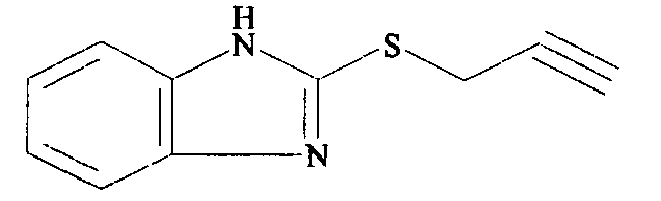
- According to an eighth embodiment of the substantially light-insensitive black and white monosheet thermographic recording material, according to the present invention, the organic silver salts are not double organic salts containing a silver cation associated with a second cation e.g. magnesium or iron ions.
- According to a ninth embodiment of the substantially light-insensitive black and white monosheet thermographic recording material of the present invention, at least one of the organic silver salts is a substantially light-insensitive silver salt of an organic carboxylic acid.
- According to a tenth embodiment of the substantially light-insensitive black and white monosheet thermographic recording material of the present invention, at least one of the organic silver salts is a substantially light-insensitive silver salt of an aliphatic carboxylic acids known as a fatty acid, wherein the aliphatic carbon chain has preferably at least 12 C-atoms, e.g. silver laurate, silver palmitate, silver stearate, silver hydroxystearate, silver oleate and silver behenate, which silver salts are also called "silver soaps". Other silver salts of an organic carboxylic acid as described in
GB-P 1,439,478 EP-A 964 300 - Organic silver salts may be dispersed by standard dispersion techniques. Ball mills, bead mills, microfluidizers, ultrasonic apparatuses, rotor stator mixers etc. have been found to be useful in this regard. Mixtures of organic silver salt dispersions produced by different techniques may also be used to obtain the desired thermographic properties e.g. of coarser and more finely ground dispersions of organic silver salts.
- According to an eleventh embodiment of the black and white thermographic recording material, according to the present invention, the reducing agent is an organic compound containing at least one active hydrogen atom linked to O, N or C, such as is the case with, aromatic di- and tri-hydroxy compounds. 1,2-dihydroxybenzene derivatives, such as catechol, 3-(3,4-dihydroxyphenyl) propionic acid, 1,2-dihydroxybenzoic acid, gallic acid and esters e.g. methyl gallate, ethyl gallate, propyl gallate, tannic acid, and 3,4-dihydroxy-benzoic acid esters are preferred, with those described in
EP-A 0 692 733 andEP-A 0 903 625 being particularly preferred. - Combinations of reducing agents may also be used that on heating become reactive partners in the reduction of the one or more substantially light-insensitive organic silver salt. For example, combinations of sterically hindered phenols with sulfonyl hydrazide reducing agents such as disclosed in
US 5,464,738 ; trityl hydrazides and formyl-phenyl-hydrazides such as disclosed inUS 5,496,695 ; trityl hydrazides and formyl-phenyl-hydrazides with diverse auxiliary reducing agents as disclosed inUS 5,545,505 ,US 5,545,507 andUS 5,558,983 ; acrylonitrile compounds as disclosed inUS 5,545,515 andUS 5,635,339 ; and 2-substituted malonodialdehyde compounds as disclosed inUS 5,654,130 . - The film-forming binder of the thermosensitive element may be all kinds of natural, modified natural or synthetic resins or mixtures of such resins, in which the at least one organic silver salt can be dispersed homogeneously either in aqueous or solvent media: e.g. cellulose derivatives, starch ethers, galactomannan, polymers derived from α,β-ethylenically unsaturated compounds such as polyvinyl chloride, after-chlorinated polyvinyl chloride, copolymers of vinyl chloride and vinylidene chloride, copolymers of vinyl chloride and vinyl acetate, polyvinyl acetate and partially hydrolyzed polyvinyl acetate, polyvinyl alcohol, polyvinyl acetals that are made from polyvinyl alcohol as starting material in which only a part of the repeating vinyl alcohol units may have reacted with an aldehyde, preferably polyvinyl butyral, copolymers of acrylonitrile and acrylamide, polyacrylates, polymethacrylates, polystyrene and polyethylene or mixtures thereof.
- According to an eleventh embodiment of the black and white thermographic recording material, according to the present invention, the at least one binder comprises at least one first polymer consisting of vinyl aceto-acetal monomer units and monomer units selected from the group consisting of vinyl butyral, vinyl alcohol, vinyl acetate and itaconic acid monomer units, wherein the weight ratio of the at least one binder to said light-insensitive silver salt(s) of a carboxylic acid in said thermosensitive element is greater than 1.5; and the at least one binder optionally contains less than 40% by weight of a second polymer consisting of vinyl butyral monomer units and optionally vinyl alcohol and/or vinyl acetate monomer units.
- Suitable water-soluble film-forming binders for use in thermographic recording materials according to the present invention are: polyvinyl alcohol, polyacrylamide, polymethacrylamide, polyacrylic acid, polymethacrylic acid, polyvinylpyrrolidone, polyethyleneglycol, proteinaceous binders, polysaccharides and water-soluble cellulose derivatives. A preferred water-soluble binder for use in the thermographic recording materials of the present invention is gelatine.
- The binder to organic silver salt weight ratio is preferably in the range of 0.2 to 7, and the thickness of the thermosensitive element is preferably in the range of 5 to 50 µm. Binders are preferred which do not contain additives, such as certain antioxidants (e.g. 2,6-di-tert-butyl-4-methylphenol), or impurities which adversely affect the thermographic properties of the thermographic recording materials in which they are used.
- According to a twelfth embodiment of the black and white monosheet thermographic recording material, according to the present invention, the thermosensitive element contains a toning agent, which enables a neutral black image tone to be obtained in the higher densities and neutral grey in the lower densities.
- According to a thirteenth embodiment of the black and white monosheet thermographic recording material, according to the present invention, the thermosensitive element further contains a toning agent selected from the group consisting of phthalimides, phthalazinones, benzoxazine diones and naphthoxazine diones e.g. phthalimides and phthalazinones within the scope of the general formulae described in
US 4,082,901 ; the toning agents described inUS 3,074,809 ,3,446,648 and3,844,797 ; and the heterocyclic toner compounds of the benzoxazine dione or naphthoxazine dione type as disclosed inGB 1,439,478 US 3,951,660 andUS 5,599,647 . - According to a fourteenth embodiment of the substantially light-insensitive black and white monosheet thermographic recording material, according to the present invention, the substantially light-insensitive thermographic recording material contains a thermosensitive element, the thermosensitive element containing one or more toning agents selected from the group consisting of phthalazinone, benzo [e] [1,3] oxazine-2,4-dione, 7-methyl-benzo[e][1,3]oxazine-2,4-dione, 7-methoxy-benzo[e][1,3]oxazine-2,4-dione and 7-(ethylcarbonato)-benzo[e][1,3]oxazine-2,4-dione.
- According to a fifteenth embodiment of the black and white monosheet thermographic recording material, according to the present invention, the thermographic recording material further contains an auxiliary antifoggant to obtain improved shelf-life and reduced fogging.
- According to a sixteenth embodiment of the black and white monosheet thermographic recording material, according to the present invention, the thermographic recording material further contains an antifoggant selected from the group consisting of benzotriazole, substituted benzotriazoles and aromatic polycarboxylic acid such as ortho-phthalic acid, 3-nitro-phthalic acid, tetrachlorophthalic acid, mellitic acid, pyromellitic acid and trimellitic acid and anhydrides thereof.
- According to a seventeenth embodiment of the black and white monosheet thermographic recording material, according to the present invention, the thermosensitive element further contains an optionally substituted benzotriazole.
- According to an eighteenth embodiment of the black and white monosheet thermographic recording material, according to the present invention, the thermosensitive element further contains at least one polycarboxylic acid and/or anhydride thereof in a molar percentage of at least 15 with respect to all the organic silver salt(s) present and in thermal working relationship therewith. The polycarboxylic acid may be aliphatic (saturated as well as unsaturated aliphatic and also cycloaliphatic) or an aromatic polycarboxylic acid, may be substituted and may be used in anhydride form or partially esterified on the condition that at least two free carboxylic acids remain or are available in the heat recording step.
- Surfactants and dispersants aid the dispersion of ingredients which are insoluble in the particular dispersion medium. The substantially light-insensitive thermographic material used in the present invention may contain one or more surfactants, which may be anionic, non-ionic or cationic surfactants and/or one or more dispersants. Suitable dispersants are natural polymeric substances, synthetic polymeric substances and finely divided powders, e.g. finely divided non-metallic inorganic powders such as silica.
- According to a nineteenth embodiment of the substantially light-insensitive black and white monosheet thermographic recording material, according to the present invention, the support is transparent or translucent. It is preferably a thin flexible carrier made transparent resin film, e.g. made of a cellulose ester, e.g. cellulose triacetate, polypropylene, polycarbonate or polyester, e.g. polyethylene terephthalate. The support may be in sheet, ribbon or web form and subbed if needs be to improve the adherence to the thereon coated thermosensitive element. The support may be dyed or pigmented to provide a transparent coloured background for the image.
- According to a twentieth embodiment of the substantially light-insensitive black and white monosheet thermographic recording material, according to the present invention, the thermosensitive element is provided with a protective layer. In general this protects the thermosensitive element from atmospheric humidity and from surface damage by scratching etc. and prevents direct contact of printheads or heat sources with the recording layers. Protective layers for thermosensitive elements which come into contact with and have to be transported past a heat source under pressure, have to exhibit resistance to local deformation and good slipping characteristics during transport past the heat source during heating. A slipping layer, being the outermost layer, may comprise a dissolved lubricating material and/or particulate material, e.g. talc particles, optionally protruding from the outermost layer. Examples of suitable lubricating materials are a surface active agent, a liquid lubricant, a solid lubricant or mixtures thereof, with or without a polymeric binder.
- The coating of any layer of the substantially light-insensitive thermographic material used in the present invention may proceed by any coating technique e.g. such as described in Modern Coating and Drying Technology, edited by Edward D. Cohen and Edgar B. Gutoff, (1992) VCH Publishers Inc., 220 East 23rd Street, Suite 909 New York, NY 10010, USA. Coating may proceed from aqueous or solvent media with overcoating of dried, partially dried or undried layers.
- Thermographic imaging is carried out by the image-wise application of heat either in analogue fashion by direct exposure through an image or by reflection from an image, or in digital fashion pixel by pixel either by using an infra-red heat source, for example with a Nd-YAG laser or other infra-red laser, with a substantially light-insensitive thermographic recording material preferably containing an infra-red absorbing compound, or by direct thermal imaging with a thermal head.
- In thermal printing image signals are converted into electric pulses and then through a driver circuit selectively transferred to a thermal printhead. The thermal printhead consists of microscopic heat resistor elements, which convert the electrical energy into heat via Joule effect. The operating temperature of common thermal printheads is in the range of 300 to 400°C and the heating time per picture element (pixel) may be less than 1.0ms, the pressure contact of the thermal printhead with the recording material being e.g. 200-1000g/linear cm, i.e. with a contact zone (nip) of 200 to 300 µm a pressure of 5000 to 50,000 g/cm2, to ensure a good transfer of heat.
- In order to avoid direct contact of the thermal printing heads with the outermost layer on the same side of the support as the thermosensitive element when this outermost layer is not a protective layer, the image-wise heating of the recording material with the thermal printing heads may proceed through a contacting but removable resin sheet or web wherefrom during the heating no transfer of recording material can take place.
- Activation of the heating elements can be power-modulated or pulse-length modulated at constant power.
EP-A 654 355 EP-A 622 217 - Image-wise heating of the recording material can also be carried out using an electrically resistive ribbon incorporated into the material. Image- or pattern-wise heating of the recording material may also proceed by means of pixel-wise modulated ultrasound.
- Thermographic imaging can be used for the production of reflection type prints and transparencies, in particular for use in the medical diagnostic field in which black-imaged transparencies are widely used in inspection techniques operating with a light box.
- The invention is illustrated hereinafter by way of comparative examples and invention examples. The percentages and ratios given in these examples are by weight unless otherwise indicated.
- Subbing layer Nr. 01 on the emulsion side of the support:
copolymer of 88% vinylidene chloride, 10% methyl acrylate and 2% itaconic acid 79.1 mg/m2 Kieselsol® 100F, a colloidal silica from BAYER 18.6 mg/m2 Mersolat® H, a surfactant from BAYER 0.4 mg/m2 Ultravon® W, a surfactant from CIBA-GEIGY 1.9 mg/m2 - Ingredients in the thermosensitive element in addition to the above-mentioned ingredients:
BL5HP = S-LEC BL5HP, a polyvinyl butyral from SEKISUI; POLY 01 = copolymer of 44% vinyl aceto-acetal, 38% vinyl butyral, 17% vinyl alcohol and 2% vinyl acetate (determined by 13C NMR) with Mw = 130,000, Mn = 44,000 and Tg = 89°C Oil = BAYSILON, a silicone oil from BAYER; VL = DESMODUR VL, a 4,4'-diisocyanatodiphenylmethane from BAYER; - Reducing agents:
R01 = 3,4-dihydroxybenzonitrile; R02 = 3,4-dihydroxybenzophenone; - Toning agent:
T01 = 7-(ethylcarbonato)-benzo[e][1,3]oxazine-2,4-dione; T02 = 7-methyl-benzo[e][1,3]oxazine-2,4-dione; - Stabilizers:
S01 = glutaric acid S02 = tetrachlorophthalic acid anhydride S03 = benzotriazole - Additive:



- Ingredients in the protective layer:
ERCOL™ 48 20 = a polyvinylalcohol from ACETEX EUROPE; LEVASIL™ VP AC 4055 = 15% aqueous dispersion of colloidal silica with acid groups predominantly neutralized with Na+ and a specific surface area of 500 m2/g, from BAYER AG has been converted into ammonium salt; ULTRAVON™ W = 75-85% concentrate of a sodium arylsulfonate from Ciba Geigy converted into acid form by passing through an ion exchange column; SYLOID™ 72 = a silica from Grace; SERVOXYL™ VPDZ 3/100 = a mono[isotridecyl polyglycolether (3 EO)] phosphate, from SERVO DELDEN B.V.; SERVOXYL™ VPAZ 100 = a mixture of monolauryl and dilauryl phosphate, from SERVO DELDEN B.V.; MICROACE TALC P3 = an Indian talc from NIPPON TALC; RILANIT™ GMS = a glycerine monotallow acid ester, from HENKEL TMOS = tetramethylorthosilicate hydrolyzed in the presence of methanesulfonic acid. - The substantially light-insensitive thermographic recording materials of INVENTION EXAMPLES 1 to 16 and COMPARATIVE EXAMPLES 1 to 4 were prepared by coating a dispersion with the following ingredients in 2-butanone onto a 175µm thick blue-pigmented polyethylene terephthalate support with CIELAB a*- and b*- values of -9.5 and -17.9 respectively subbed on the emulsion-coated side with subbing layer 01 giving layers after drying at 50°C for 1h in a drying cupboard with the compositions given in Table 1.
Table 1: Comparative example nr. stabilizer AgBeh coverage [g/m2] BL5HP [g/ m2] R01 mol% vs AgB R02 mol% vs AgB T02 mol% vs AgB S01 mol% vs AgB S02 mol% vs AgB VL [g /m ] Oil [g/ m2] type conc. mol% vs AgB 1 - - 4.15 16.6 35 45 15 26 4.91 0.17 0.035 2 A01 10 4.15 16.6 35 45 15 26 4.91 0.17 0.035 3 A02 10 4.15 16.6 35 45 15 26 4.91 0.17 0.035 4 A03 10 4.15 16.6 35 45 15 26 4.91 0.17 0.035 Invention example nr. 1 MBIZ-1 10 4.15 16.6 35 45 15 26 4.91 0.17 0.035 2 MBIZ-2 10 4.15 16.6 35 45 15 26 4.91 0.17 0.035 3 MBIZ-3 10 4.15 16.6 35 45 15 26 4.91 0.17 0.035 4 MBIZ-4 10 4.15 16.6 35 45 15 26 4.91 0.17 0.035 5 MBIZ-5 10 4.15 16.6 35 45 15 26 4.91 0.17 0.035 6 MBIZ-6 10 4.15 16.6 35 45 15 26 4.91 0.17 0.035 7 MBIZ-7 10 4.15 16.6 35 45 15 26 4.91 0.17 0.035 8 MBIZ-8 10 4.15 16.6 35 45 15 26 4.91 0.17 0.035 9 MBIZ-9 10 4.15 16.6 35 45 15 26 4.91 0.17 0.035 10 MBIZ-10 10 4.15 16.6 35 45 15 26 4.91 0.17 0.035 11 MBIZ-11 10 4.15 16.6 35 45 15 26 4.91 0.17 0.035 12 MMIZ-1 10 4.15 16.6 35 45 15 26 4.91 0.17 0.035 13 MMIZ-2 10 4.15 16.6 35 45 15 26 4.91 0.17 0.035 14 MMIZ-4 10 4.15 16.6 35 45 15 26 4.91 0.17 0.035 15 MMIZ-5 10 4.15 16.6 35 45 15 26 4.91 0.17 0.035 16 MMIZ-6 10 4.15 16.6 35 45 15 26 4.91 0.17 0.035 - The thermosensitive elements were then coated with an aqueous composition with the following ingredients, which was adjusted to a pH of 3.8 with 1N nitric acid, to a wet layer thickness of 85 µm and then dried at 50°C for 15 minutes to produce a protective layer with the composition:
ERCOL™ 48 20 = 2.1g/m2 LEVASIL™ VP AC 4055 = 1.05g/m2 ULTRAVON™ W = 0.075g/m2 SYLOID™ 72 = 0.09 g/m2 SERVOXYL™ VPDZ 3/100 = 0.075g/m2 SERVOXYL™ VPAZ 100 = 0.075g/m2 MICROACE TALC P3 = 0.045g/m2 RILANIT™ GMS = 0.15g/m2 TMOS = 0.87g/m2 (assuming that the TMOS was completely converted to SiO2) - After coating the protective layer was hardened by heating the substantially light-insensitive thermographic recording material at 45°C for 7 days at a relative humidity of 70%.
- The substantially light-insensitive thermographic recording materials of INVENTION EXAMPLES 1 to 16 and COMPARATIVE EXAMPLES 1 to 4 were printed using a DRYSTAR™ 4500 printer from AGFA-GEVAERT with a resolution of 508 dpi which had been modified to operate at a printing speed of 14 mm/s and a line-time of 3.5 ms instead of 7.1 ms and in which the 75 µm long (in the transport direction) and 50 µm wide thermal head resistors were power-modulated to produce different image densities.
- The maximum densities of the images (Dmax) were measured through a visible filter with a MACBETH™ TR924 densitometer.
- The image tone of fresh prints made with the substantially light-insensitive thermographic recording materials of INVENTION EXAMPLES 1 to 16 and COMPARATIVE EXAMPLES 1 to 4 was assessed on the basis of the L*, a* and b* CIELAB-values at optical densities, D, of 1.0 and 2.0 and the results given in Table 2.
- Light-box tests were performed by exposing the substantially light-insensitive thermographic materials of INVENTION EXAMPLES 1 to 16 and COMPARATIVE EXAMPLES 1 to 4 for 3 days on top of the white PVC window of a specially constructed light-box placed in a Votsch conditioning cupboard set at 30°C and a relative humidity of 85%. Only a central area of the window 550mm long by 500mm wide was used for mounting the test materials to ensure uniform exposure.
- The stainless steel light-box used was 650mm long, 600mm wide and 120mm high with an opening 610mm long and 560mm wide with a rim 10mm wide and 5mm deep round the opening, thereby forming a platform for a 5mm thick plate of white PVC 630mm long and 580mm wide, making the white PVC-plate flush with the top of the light-box and preventing light loss from the light-box other than through the white PVC-plate. This light-box was fitted with 9 Planilux™ TLD 36W/54 fluorescent lamps 27mm in diameter mounted length-wise equidistantly from the two sides, with the lamps positioned equidistantly to one another and the sides over the whole width of the light-box and with the tops of the fluorescent tubes 30mm below the bottom of the white PVC plate and 35mm below the materials being tested. The shifts in CIELAB a*- and b*-values at an optical density, D, of 1.0 and the shift in the CIELAB b*-value were determined for INVENTION EXAMPLES 1 to 16 and COMPARATIVE EXAMPLES 1 to 4 and the results are given in Table 2.
Table 2: Comparative Example nr. stabilizer type Dmax CIELAB-values of prints with fresh film Shift in b* CIELAB-values of prints after 3d/30°C/85%RH light-box exposure Dmin D = 1.0 D = 2.0 b* a* b* a* b* D = 1.0 D =2.0 Dmin 1 - 4.21 -16.72 -2.92 -6.38 -0.56 -3.64 +13.20 +5.82 +13.67 2 A01 4.44 -16.47 -1.37 -1.82 -0.10 +0.50 +2.38 +0.93 +9.45 3 A02 4.24 +17.07 -3.55 -7.30 -1.26 -4.81 +7.59 +3.11 +14.98 4 A03 3.56 -16.77 -2.68 -9.21 +0.24 -7.00 +2.22 +0.62 +11.03 Invention Example nr 1 MBIZ-1 3.65 -16.92 -2.91 -9.38 -0.76 -7.59 +3.58 +1.06 +5.60 2 MBIZ-2 3.32 -17.3 -3.56 -7.42 -0.79 -6.42 +1.40 +0.93 +4.47 3 MBIZ-3 3.79 -16.12 -2.66 -8.06 -0.08 -6.80 +0.95 +0.08 +3.67 4 MBIZ-4 3.49 -16.02 -1.90 -8.99 +1.21 -7.16 +2.90 +1.99 +4.02 5 MBIZ-5 3.86 -16.16 -2.36 -8.75 -0.11 -7.27 +2.42 +0.80 +6.04 6 MBIZ-6 3.63 -16.02 -2.47 -8.91 +0.16 -7.18 +2.10 +1.24 +4.24 7 MBIZ-7 2.92 -18.05 -1.43 -9.43 -0.49 -6.42 +2.57 +1.54 +1.60 8 MBIZ-8 3.17 -13.7 -2.25 -6.74 0.84 -5.54 +3.06 +1.82 +2.11 9 MBIZ-9 3.66 -17.36 -2.51 -8.61 0.84 -5.89 +3.47 +2.41 +4.31 10 MBIZ-10 3.62 -16.99 -1.47 -8.66 +1.17 -6.52 +1.23 +0.63 +2.95 11 MBIZ-11 3.63 -17.50 -2.20 -8.67 +0.94 -6.34 +1.87 +1.40 +3.05 12 MMIZ-1 3.58 -17.23 -1.55 -9.39 +1.76 -6.31 +3.87 +1.78 +6.47 13 MMIZ-2 3.77 -17.12 -1.51 -9.24 +1.13 -6.74 +5.44 +2.59 +7.98 14 MMIZ-4 3.67 -17.43 x -18.05 -10.68 +0.08 -7.39 +5.79 +2.53 +6.85 15 MMIZ-5 3.58 -16.96 -1.93 -10.37 +0.65 -7.59 +5.46 +2.72 +6.66 16 MMIZ-6 3.22 -16.94 +1.80 -9.39 +5.02 -5.22 +4.48 +2.75 +3.61 - The substantially light-insensitive thermographic recording materials of INVENTION EXAMPLES 1 to 16 in which the thermosensitive elements contain a compound according to formula (I) exhibit substantially improved stability of the b* CIELAB values of the image background to light exposure compared with the substantially light-insensitive thermographic recording material of COMPARATIVE EXAMPLE 1 which is identical to the substantially light-insensitive thermographic recording materials of INVENTION EXAMPLES 1 to 16 except for the absence of a compound according to formula (I) in the thermosensitive element and also compared with the substantially light-insensitive thermographic recording materials of COMPARATIVE EXAMPLES 2 to 4, in which the compounds A01, A02 and A03 are present instead of a stabilizer according to formula (I). These comparative examples show that the stabilizing effect of the stabilizer according to formula (I) is dependent upon the >NH group of the 2-imazolyl group or 2-imazolyl group annelated with an aromatic ring system not being substituted, at least one (M-) group being a 2-imazolyl group annelated with an aromatic ring system and does not tolerate substitution of the >NH group in the 2-imidazolyl group by a -S- group.
- The substantially light-insensitive thermographic recording materials of INVENTION EXAMPLE 19 was prepared as described for INVENTION EXAMPLE 3 and INVENTION EXAMPLES 17 and 18 as for INVENTION EXAMPLE 3 except that concentrations of MBIZ-3 of 5 and 8 mol% were used instead of 10 mol% with respect to silver behenate. The substantially light-insensitive thermographic recording materials of INVENTION EXAMPLE 22 was prepared as described for INVENTION EXAMPLE 4 and INVENTION EXAMPLES 20 and 21 as for INVENTION EXAMPLE 4 except that concentrations of MBIZ-4 of 5 and 8 mol% were used instead of 10 mol% with respect to silver behenate.
- The compositions of the thermosensitive elements of the substantially light-insensitive thermographic recording materials of INVENTION EXAMPLES 17 to 22 together with those for INVENTION EXAMPLES 3 and 4 and COMPARATIVE EXAMPLE 1 in which no additional stabilizer is present in the thermosensitive element are summarized in Table 3 below.
Table 3: Comparative example nr. stabilizer AgBeh coverage [g/m2] BL5HP [g/ m2] R01 mol% vs AgB R02 mol% vs AgB T02 mol% vs AgB S01 mol% vs AgB S02 mol% vs AgB VL [g /m2 ] Oil [g/ m2 ] type conc. mol% vs AgB 1 - - 4.15 16.6 35 45 15 26 4.91 0.17 0.035 Invention example nr. 17 MBIZ-3 5 4.15 16.6 35 45 15 26 4.91 0.17 0.035 18 MBIZ-3 8 4.15 16.6 35 45 15 26 4.91 0.17 0.035 19 MBIZ-3 10 4.15 16.6 35 45 15 26 4.91 0.17 0.035 3 MBIZ-3 10 4.15 16.6 35 45 15 26 4.91 0.17 0.035 20 MBIZ-4 5 4.15 16.6 35 45 15 26 4.91 0.17 0.035 21 MBIZ-4 8 4.15 16.6 35 45 15 26 4.91 0.17 0.035 22 MBIZ-4 10 4.15 16.6 35 45 15 26 4.91 0.17 0.035 4 MBIZ-4 10 4.15 16.6 35 45 15 26 4.91 0.17 0.035 - Thermographic evaluation of the substantially light-insensitive thermographic recording materials of INVENTION EXAMPLES 17 to 22 was carried out as described for the substantially light-insensitive thermographic recording materials of INVENTION EXAMPLES 1 to 16 and COMPARATIVE EXAMPLE 1.
- The Dmax values, a* and b* CIELAB-values at densities of 1.0 and 2.0 together with the results of light box experiments are given in Table 4 below together with the results for the substantially light-insensitive thermographic recording materials of INVENTION EXAMPLES 3 and 4 and COMPARATIVE EXAMPLE 1.
Table 4: Comparative Example nr. stabilizer Dmax CIELAB-values of prints with fresh film Δb* CIELAB-value of prints after 3d/30°C/ 85%RH light-box expos. type conc. vs AgBeh [mol%] D = 1.0 D = 2.0 a* b* a* b* D = 1.0 Dmin 1 - 0 4.21 -2.92 -6.38 -0.56 -3.64 +13.20 +13.67 Invention Example nr 17 MBIZ-3 5 3.82 -2.95 -8.56 -0.03 -6.71 +2.35 +3.90 18 MBIZ-3 8 3.77 -2.83 -8.37 -0.15 -6.75 +1.64 +3.99 19 MBIZ-3 10 3.56x -2.83 -8.43 +0.12 -6.59 +1.78 +2.81 3 MBIZ-3 10 3.79 -2.66 -8.06 -0.08 -6.80 +0.95 +3.67 20 MBIZ-4 5 3.76 -2.99 -8.83 -0.06 -6.74 +2.32 +4.19 21 MBIZ-4 8 3.57 -2.82 -8.66 +0.05 -6.49 +2.33 +4.69 22 MBIZ-4 10 3.44 -2.80 -7.90 -0.29 -6.38 +2.17 +4.58 4 MBIZ-4 10 3.49 -1.90 -8.99 +1.21 -7.16 +2.90 +4.02 - No significant difference was established for MBIZ-3 and MBIZ-4 in the concentration range of 5 to 10 mol% with respect to silver behenate in respect of the effect on the image tone of fresh images and their light-box stabilizing effect.
- The substantially light-insensitive thermographic recording materials of COMPARATIVE EXAMPLES 5 to 8 and INVENTION EXAMPLES 23 to 34 were prepared by coating a dispersion with the following ingredients in 2-butanone onto a 175µm thick blue-pigmented polyethylene terephthalate support with CIELAB a*- and b*- values of -9.5 and -17.9 respectively subbed on the emulsion-coated side with subbing layer 01 giving layers after drying at 50°C for 1h in a drying cupboard with the compositions given in Table 5 below.
- The thermosensitive elements were then coated with a protective layer as described for substantially light-insensitive thermographic recording materials of COMPARATIVE EXAMPLES 1 to 4 and INVENTION EXAMPLES 1 to 16.
Table 5: Comparative example nr. stabilizer AgBeh coverage [g/m POLY 01 [g/ ] m2] R01 mol% vs AgB R02 mol vs AgB T01 % mol vs AgB T02 % mol vs AgB S01 mol% vs AgB S02 mol vs AgB S03 % mol vs AgB VL % [g /m2] Oil [g/ m2] type conc. mol% vs AgB 5 - - 3.48 12.52 50 45 3 15 26 6.0 5.0 0.184 0.037 6 A01 5 3.40 12.23 50 45 3 15 26 6.0 5.0 0.180 0.036 7 A02 5 3.42 12.33 50 45 3 15 26 6.0 5.0 0.182 0.036 8 A03 5 3.37 12.14 50 45 3 15 26 6.0 5.0 0.179 0.036 Invention example nr 23 MBIZ-1 5 3.35 12.04 50 45 3 15 26 6.0 5.0 0.177 0.035 24 MBIZ-2 5 3.37 12.14 50 45 3 15 26 6.0 5.0 0.179 0.036 25 MBIZ-3 5 3.37 12.14 50 45 3 15 26 6.0 5.0 0.179 0.036 26 MBIZ-4 5 3.40 12.23 50 45 3 15 26 6.0 5.0 0.180 0.036 27 MBIZ-5 5 3.45 12.42 50 45 3 15 26 6.0 5.0 0.183 0.037 28 MBIZ-6 5 3.50 12.61 50 45 3 15 26 6.0 5.0 0.186 0.035 29 MBIZ-7 5 3.42 12.33 50 45 3 15 26 6.0 5.0 0.182 0.036 30 MBIZ-8 5 3.40 12.23 50 45 3 15 26 6.0 5.0 0.180 0.036 31 MBIZ-9 5 3.40 12.23 50 45 3 15 26 6.0 5.0 0.180 0.036 32 MBIZ-10 5 3.45 12.42 50 45 3 15 26 6.0 5.0 0.183 0.037 33 MBIZ-11 5 3.37 12.14 50 45 3 15 26 6.0 5.0 0.179 0.036 34 MMIZ-4 5 3.35 12.04 50 45 3 15 26 6.0 5.0 0.177 0.035 - Thermographic evaluation of the substantially light-insensitive thermographic recording materials of COMPARATIVE EXAMPLES 5 to 8 and INVENTION EXAMPLES 23 to 34 was carried out as described for the substantially light-insensitive thermographic recording materials of INVENTION EXAMPLES 1 to 16 and COMPARATIVE EXAMPLES 1 to 4.
- The Dmax values, a* and b* CIELAB-values at densities of 1.0 and 2.0 together with the results of light box experiments are given in Table 6 below. Also included in Table 6 are the results of shelf-life experiments in which the difference in the CIELAB b*-values at D = 1.0 for prints produced with fresh materials and prints produced with materials which were subjected for 4 days to a temperature of 45°C and a relative humidity of 70%.
Table 6: Comparative Example nr. stabilizer type Dmax CIELAB-values of prints with fresh film Δb* CIELAB-value of D = 1.0 D = 2.0 prints after 3d/30°C/85%RH light-box fresh print due to storage at 4d/45°C/70%RH a* b* a* b* D=1.0 Dmin D = 1.0 5 - 3.63 -1.27 -7.60 +2.12 -5.97 +2.42 +3.66 +1.43 6 A01 3.87 -1.02 -2.88 +1.56 -0.74 +1.89 +4.06 +2.96 7 A02 3.83 -1.09 -4.95 +0.79 -4.65 +1.36 +4.75 -0.14 8 A03 3.37 -0.77 -6.24 +3.29 -5.17 +3.17 +6.69 -0.64 Invention Example nr 23 MBIZ-1 3.44 -1.83 -6.46 +1.53 -5.86 +3.08 +4.08 +0.62 24 MBIZ-2 3.45 -1.98 -6.00 +1.97 -4.91 +1.89 +4.23 -0.30 25 MBIZ-3 3.32 -2.00 -6.42 +1.56 -5.69 +1.86 +3.51 +0.36 26 MBIZ-4 3.32 -1.17 -6.73 +2.99 -5.56 +2.13 +3.57 +0.21 27 MBIZ-5 3.32 -1.93 -5.94 +1.07 -5.33 +2.44 +4.81 +0.09 28 MBIZ-6 3.33 -1.65 -6.35 +1.89 -5.51 +1.85 +4.10 +0.36 29 MBIZ-7 3.40 -1.22 -7.25 +2.13 -6.01 +0.75 +2.53 +0.25 30 MBIZ-8 3.31 -1.24 -5.18 +2.79 -3.67 +4.54 +2.99 +0.15 31 MBIZ-9 3.29 -1.29 -6.76 +2.57 -5.26 +3.82 +3.64 +0.30 32 MBIZ-10 3.40 -0.95 -6.95 +2.56 -5.51 +2.15 +3.72 +0.36 33 MBIZ-11 3.37 -0.67 -7.25 +2.17 -3.49 +3.39 +3.57 +0.40 34 MMIZ-4 3.62 -1.26 -6.21 +3.07 -4.91 +3.82 +5.34 -0.42 - The thermosensitive elements of the substantially light-insensitive thermographic materials of COMPARATIVE EXAMPLES 5 to 8 and INVENTION EXAMPLES 23 to 34 are significantly different from those of the substantially light-insensitive thermographic materials of COMPARATIVE EXAMPLES 1 to 4 and INVENTION EXAMPLES 1 to 22 in two important respects: they contain benzotriazole (S03) as a further stabilizer and they contain as binder POLY 01, a copolymer of vinyl aceto-acetal, vinyl butyral, vinyl alcohol and vinyl acetate instead of BL5HP, a polyvinyl butyral. Benzotriazole is widely used as a stabilizer in substantially light-insensitive thermographic materials and has excellent stabilizing properties except in respect of shelf-life stability with a strong increase in the b* CIELAB value at density of 1.0.
- The substantially light-insensitive thermographic materials of INVENTION EXAMPLES 23 to 34 all exhibit substantially higher shelf-life stability i.e. a lower increase in b* CIELAB value at a density of 1.0, than the substantially light-insensitive thermographic material of COMPARATIVE EXAMPLE 5 in which no further stabilizer is present. Therefore, stabilizers according to formula (I) are surprisingly capable of at least ameliorating the poor shelf-life stability of thermographic materials with benzotriazole.
- Furthermore, the substantially light-insensitive thermographic recording materials of INVENTION EXAMPLES 23 to 34 in which the thermosensitive elements contained a compound according to formula (I) and the binder used was POLY 01 exhibited a better image tone and image tone stability profile than the substantially light-insensitive thermographic materials of COMPARATIVE EXAMPLES 6 to 8 in which the thermosensitive elements contain one of compounds A01, A02 or A03 in the same molar concentration in respect to silver behenate: higher b* values in prints with fresh film and very poor shelf-life stability in the presence of A01; higher b* values in prints with fresh film and a strong increase in the b* value for Dmin in light box experiments in the presence of A02; and higher a* values in prints with fresh film and a very strong increase in the b* value for Dmin in light box experiments in the presence of A03.
- The substantially light-insensitive thermographic materials of COMPARATIVE EXAMPLES 9 and 10 and INVENTION EXAMPLES 35 to 42 was prepared as described for COMPARATIVE EXAMPLES 5 to 8 and INVENTION EXAMPLES 23 to 34 except as indicated in the thermosensitive element compositions given in Table 7 below.
Table 7: Comparative example nr. stabilizer AgBeh cover- 01 age [g/m2] POLY [g/ m2 ] R01 mo1% vs AgB R02 mol vs AgB T01 mol% vs AgB T02 mol% vs AgB S01 mol% vs AgB S02 mol% vs AgB S03 mol% vs AgB VL [g /m2 ] Oil [g/ m2] type conc. mol% vs AgB 9 - - 3.30 11.88 50 45 3 15 26 6.0 5.0 0.175 0.035 10 - - 3.37 12.14 50 45 3 15 26 6.0 - 0.179 0.036 Invention example nr 35 MBIZ-3 5 3.35 12.04 50 45 3 15 26 6.0 - 0.177 0.035 36 MBIZ-3 4 3.35 12.04 50 45 3 15 26 6.0 5.0 0.177 0.035 37 MBIZ-3 2 3.37 12.14 50 45 3 15 26 6.0 5.0 0.179 0.036 38 MBIZ-7 2 3.35 12.04 50 45 3 15 26 6.0 5.0 0.177 0.035 39 MBIZ-10 5 3.30 11.88 50 45 3 15 26 6.0 - 0.175 0.035 40 MBIZ-10 2 3.27 11.76 50 45 3 15 26 6.0 5.0 0.173 0.035 41 MBIZ-11 5 3.24 11.66 50 45 3 15 26 6.0 - 0.172 0.034 42 MBIZ-11 2 3.32 11.95 50 45 3 15 26 6.0 5.0 0.176 0.035 43 MBIZ-13 5 3.50 12.61 50 45 3 15 26 6.0 - 0.186 0.037 44 MBIZ-13 4 3.37 12.14 50 45 3 15 26 6.0 5.0 0.179 0.036 45 MBIZ-13 2 3.42 12.33 50 45 3 15 26 6.0 5.0 0.182 0.037 - Thermographic evaluation of the substantially light-insensitive thermographic recording materials of COMPARATIVE EXAMPLES 9 and 10 and INVENTION EXAMPLES 35 to 42 was carried out as described for the substantially light-insensitive thermographic recording materials of COMPARATIVE EXAMPLES 5 to 8 and INVENTION EXAMPLES 23 to 34.
- The Dmax values, a* and b* CIELAB-values at densities of 1.0 and 2.0 together with the results of light box experiments and shelf-life experiments are given together with the results for COMPARATIVE EXAMPLE 5 and INVENTION EXAMPLES 25, 29, 32 and 33 in Table 8 below.
Table 8: Comparative Example nr. stabilizer type Dmax CIELAB-values of prints with fresh film Δb* CIELAB-value of D = 1.0 D = 2.0 prints after 3d/30°C/85% RH light-box fresh print after 4d/45°C/ 70%RH storage a* b* a* b* D =1.0 Dmin D = 1.0 9 - S03 3.61 -1.46 -7.73 +2.61 -5.13 +2.96 +3.49 +1.13 10 - - 3.71 -1.79 -5.59 +2.46 -3.22 +8.66 +6.29 +0.61 Invention Example nr 35 MBIZ-3 - 3.44 -1.83 -6.66 +2.25 -4.97 +3.60 +4.52 +0.48 25 MBIZ-3 S03 3.32 -2.00 -6.42 +1.56 -5.69 +1.86 +3.51 +0.36 36 MBIZ-3 S03 3.33 -1.84 -7.94 +1.68 -6.13 +1.16 +2.13 +0.86 37 MBIZ-3 S03 3.38 -1.21 -7.24 +2.57 -5.42 +1.65 +3.25 +0.35 COMP 9 - S03 3.61 -1.46 -7.73 +2.61 -5.13 +2.96 +3.49 +1.13 COMP 5 - S03 3.63 -1.27 -7.60 +2.12 -5.97 +2.42 +3.66 +1.43 29 MBIZ-7 S03 3.40 -1.22 -7.25 +2.13 -6.01 +0.75 +2.53 +0.25 38 MBIZ-7 S03 3.46 -1.49 -8.50 +1.91 -6.12 +1.48 +2.52 +0.98 COMP 9 - S03 3.61 -1.46 -7.73 +2.61 -5.13 +2.96 +3.49 +1.13 COMP 5 - S03 3.63 -1.27 -7.60 +2.12 -5.97 +2.42 +3.66 +1.43 39 MBIZ-10 - 3.40 -1.32 -7.76 +2.69 -5.54 +2.70 +3.95 +1.32 32 MBIZ-10 S03 3.40 -0.95 -6.95 +2.56 -5.51 +2.15 +3.72 +0.36 40 MBIZ-10 S03 3.34 -1.55 -8.34 +2.09 -6.11 +2.25 +2.82 +0.80 COMP 9 - S03 3.61 -1.46 -7.73 +2.61 -5.13 +2.96 +3.49 +1.13 COMP 5 - S03 3.63 -1.27 -7.60 +2.12 -5.97 +2.42 +3.66 +1.43 41 MBIZ-11 - 3.32 -1.47 -8.03 +2.83 -5.54 +5.52 +3.78 +1.10 33 MBIZ-11 S03 3.37 -0.67 -7.25 +2.17 -3.49 +3.39 +3.57 +0.40 42 MBIZ-11 S03 3.40 -1.63 -7.90 +2.32 -5.23 +2.07 +2.81 +0.89 COMP 9 - S03 3.61 -1.46 -7.73 +2.61 -5.13 +2.96 +3.49 +1.13 COMP 5 - S03 3.63 -1.27 -7.60 +2.12 -5.97 +2.42 +3.66 +1.43 43 MBIZ-13 - 3.30 -1.60 -8.90 +2.10 -6.55 +1.87 +2.55 +0.39 44 MBIZ-13 S03 3.13 -1.29 -9.19 +1.80 -6.68 +1.20 +2.39 +0.26 45 MBIZ-13 S03 3.19 -1.16 -8.99 +1.97 -6.84 +1.23 +2.59 +0.21 COMP 9 - S03 3.61 -1.46 -7.73 +2.61 -5.13 +2.96 +3.49 +1.13 COMP 5 - S03 3.63 -1.27 -7.60 +2.12 -5.97 +2.42 +3.66 +1.43 - The results in Table 8 cast further light upon the surprising ameliorating effect of the stabilizers according to formula (I) upon the effect of benzotriazole stabilization on the shelf-life stability of substantially light-insensitive thermographic recording materials. The results for COMPARATIVE EXAMPLE 10 show that the base composition without benzotriazole and stabilizers according to formula (I) exhibits a fairly good shelf-life stability as can be seen from the Δb* CIELAB value at a density of 1.0 of +0.61. The presence of 5 mol% benzotriazole in respect of silver behenate clearly worsens the shelf-life stability as can be seen from the increase in Δb* CIELAB value at a density of 1.0 from +0.61 to +1.13 or +1.43.
- The presence of 5 mol% MBIZ-3 or MBIZ-13 with respect to silver behenate slightly improves the shelf-life stability as can be seen from the slight decrease in Δb* CIELAB value at a density of 1.0 from +0.61 to +0.48 and +0.39 respectively, but the presence of 5 mol% MBIZ-10 or MBIZ-11 with respect to silver behenate worsens the shelf-life stability as can be seen from the increase in Δb* CIELAB at a density of 1.0 from +0.61 to +1.32 and +1.10 respectively.
- However, the results in Table 8 show that when benzotriazole and the stabilizers according to formula (I) are simultaneously incorporated into the base composition a synergetic improvement in shelf-life stability occurred in the case of MBIZ-3, MBIZ-7, MBIZ-10, MBIZ-11 and MBIZ-13 i.e. the shelf-life stability obtained is better than that obtained with either benzotriazole or any one of MBIZ-3, MBIZ-7, MBIZ-10, MBIZ-11 and MBIZ-13 separately. This is so consistent that the results with INVENTION EXAMPLE 36 can be disregarded as being anomalous. The optimum mix of benzotriazole and the stabilizer according to formula (I) appears to depend upon the choice of stabilizer according to formula (I), being 5 mol% benzotriazole/2 mol% MBIZ-3 in the case of MBIZ-3, being 5 mol% benzotriazole/5 mol% stabilizer according to formula (I) in the case of MBIZ-7, MBIZ-10 and MBIZ-11 and being 5 mol% benzotriazole/2-4 mol% MBIZ-13 in the case of MBIZ-13.
- The present invention may include any feature or combination of features disclosed herein either implicitly or explicitly or any generalisation thereof. In view of the foregoing description it will be evident to a person skilled in the art that various modifications may be made within the scope of the invention.
Claims (9)
- A substantially light-insensitive black and white monosheet thermographic recording material comprising a support and a thermosensitive element, said thermosensitive element containing a substantially light-insensitive organic silver salt, an organic reducing agent therefor in thermal working relationship therewith, at least one binder and at least one stabilizer represented by formula (I):

- Substantially light-insensitive black and white monosheet thermographic recording material according to claim 1, A is selected from the group consisting of an optionally substituted alkyl groups, optionally substituted alkenyl groups, optionally substituted alkynyl groups, optionally substituted alkyaryl groups, optionally substituted alkyl-heterocyclic groups, optionally substituted alkyl-heteroaromatic groups, optionally substituted alkyl groups in which at least one of the non-terminal main chain carbon atoms is substituted with an oxygen or a sulfur atom, optionally substituted aryl groups, optionally substituted alkyl-aryl-alkyl groups, optionally substituted alkyl-heteroaryl-alkyl groups, optionally substituted alkyl-COO-alkyl-OOC-alkyl groups, optionally substituted alkyl-O-COO-alkyl groups, optionally substituted alkyl-CONH-alkyl groups, and optionally substituted alkyl-COO-aryl-OOC-alkyl groups.
- Substantially light-insensitive black and white monosheet thermographic recording material according to claim 1 or 2, wherein in said at least one stabilizer according to formula (I) X is -A-M and -M is a -(2-S-imidazole) group or a -(2-S-imidazole) group annelated with an aromatic ring system.
- Substantially light-insensitive black and white monosheet thermographic recording material according to any of the preceding claims, wherein in said at least one stabilizer according to formula (I) X is -A-(CH2)m-M, wherein m is 2 to 20 and -M is a -(2-S-imidazole) group or a -(2-S-imidazole) group annelated with an aromatic ring system.
- Substantially light-insensitive black and white monosheet thermographic recording material according to any of the preceding claims, wherein in said at least one stabilizer according to formula (I) X is -A-(CH2)m-M, wherein m is 4 to 9 and -M is a -(2-S-imidazole) group or a -(2-S-imidazole) group annelated with an aromatic ring system.
- Substantially light-insensitive black and white monosheet thermographic recording material according to any of the preceding claims, wherein said at least one stabilizer is selected from the group consisting of:

- Substantially light-insensitive black and white monosheet thermographic recording material according to claim 1, wherein said at least one stabilizer is selected from the group consisting of:

- Substantially light-insensitive black and white monosheet thermographic recording material according to any of the preceding claims, wherein said at least one binder comprises at least one first polymer consisting of vinyl aceto-acetal monomer units and monomer units selected from the group consisting of vinyl butyral, vinyl alcohol, vinyl acetate and itaconic acid monomer units, wherein the weight ratio of said at least one binder to said light-insensitive silver salt(s) of a carboxylic acid in said thermosensitive element is greater than 1.5; and said at least one binder optionally contains less than 40% by weight of a second polymer consisting of vinyl butyral monomer units and optionally vinyl alcohol and/or vinyl acetate monomer units.
- Substantially light-insensitive black and white monosheet thermographic recording material according to any of the preceding claims, wherein said thermosensitive element further contains an optionally substituted benzotriazole.
Priority Applications (1)
| Application Number | Priority Date | Filing Date | Title |
|---|---|---|---|
| EP05102620A EP1598207B1 (en) | 2004-05-17 | 2005-04-04 | Stabilizers for use in substantially light-insensitive thermographic recording materials. |
Applications Claiming Priority (3)
| Application Number | Priority Date | Filing Date | Title |
|---|---|---|---|
| EP04102147 | 2004-05-17 | ||
| EP04102147 | 2004-05-17 | ||
| EP05102620A EP1598207B1 (en) | 2004-05-17 | 2005-04-04 | Stabilizers for use in substantially light-insensitive thermographic recording materials. |
Publications (2)
| Publication Number | Publication Date |
|---|---|
| EP1598207A1 EP1598207A1 (en) | 2005-11-23 |
| EP1598207B1 true EP1598207B1 (en) | 2008-01-16 |
Family
ID=35446012
Family Applications (1)
| Application Number | Title | Priority Date | Filing Date |
|---|---|---|---|
| EP05102620A Expired - Lifetime EP1598207B1 (en) | 2004-05-17 | 2005-04-04 | Stabilizers for use in substantially light-insensitive thermographic recording materials. |
Country Status (1)
| Country | Link |
|---|---|
| EP (1) | EP1598207B1 (en) |
Family Cites Families (13)
| Publication number | Priority date | Publication date | Assignee | Title |
|---|---|---|---|---|
| DE2558951A1 (en) * | 1974-12-28 | 1976-07-08 | Canon Kk | Photothermographic material based on organic silver salt - contg. organic sulphur cpd. for high speed and image quality |
| JPS61267754A (en) * | 1985-04-17 | 1986-11-27 | Fuji Photo Film Co Ltd | Heat developable photosensitive material |
| JPH0619568B2 (en) * | 1986-01-10 | 1994-03-16 | 富士写真フイルム株式会社 | Photosensitive material manufacturing method |
| JPH07119951B2 (en) * | 1988-08-05 | 1995-12-20 | 富士写真フイルム株式会社 | Photothermographic material |
| JPH0367256A (en) * | 1989-04-30 | 1991-03-22 | Konica Corp | Heat-developable color photosensitive material |
| US6586170B1 (en) * | 1997-08-11 | 2003-07-01 | Fuji Photo Film Co., Ltd. | Thermographic recording element |
| EP0901040B1 (en) * | 1997-09-03 | 2002-04-03 | Agfa-Gevaert | Substantially light-insensitive thermographic recording material with improved stability and image-tone |
| JP2001013618A (en) * | 1999-06-28 | 2001-01-19 | Konica Corp | Heat-developable photosensitive material |
| JP3965861B2 (en) * | 2000-04-06 | 2007-08-29 | コニカミノルタホールディングス株式会社 | Photothermographic material |
| US6534251B1 (en) * | 2001-03-13 | 2003-03-18 | Konica Corporation | Silver salt photothermographic dry imaging material and image recording method thereof |
| EP1278101B1 (en) * | 2001-07-17 | 2008-07-02 | Konica Minolta Medical & Graphic, Inc. | Silver salt photothermographic imaging material, and image recording method and image forming method by the use thereof |
| EP1484641A1 (en) * | 2003-06-06 | 2004-12-08 | Agfa-Gevaert | Binders for use in the thermosensitive elements of substantially light-insensitive thermographic recording materials. |
| EP1484642A1 (en) * | 2003-06-06 | 2004-12-08 | Agfa-Gevaert | Binders for use in light-insensitive thermographic recording materials |
-
2005
- 2005-04-04 EP EP05102620A patent/EP1598207B1/en not_active Expired - Lifetime
Non-Patent Citations (1)
| Title |
|---|
| None * |
Also Published As
| Publication number | Publication date |
|---|---|
| EP1598207A1 (en) | 2005-11-23 |
Similar Documents
| Publication | Publication Date | Title |
|---|---|---|
| US7097961B2 (en) | Stabilizers for use in substantially light-insensitive thermographic recording materials | |
| EP1598207B1 (en) | Stabilizers for use in substantially light-insensitive thermographic recording materials. | |
| EP0809142B1 (en) | Production process for a thermographic recording material with improved stability and image-tone | |
| EP0809144B1 (en) | Substantially non-photosensitive thermographic recording material with improved stability and image-tone | |
| US7033743B2 (en) | Barrier layers for use in substantially light-insensitive thermographic recording materials | |
| EP1484640B1 (en) | Surfactants for use in light-insensitive thermographic recording materials | |
| EP1420292B1 (en) | Stabilizers for use in substantially light-insensitive thermographic recording materials. | |
| US6902880B2 (en) | Stabilizers for use in substantially light-insensitive thermographic recording materials | |
| EP1420293B1 (en) | Stabilizers for use in substantially light-insensitive thermographic recording materials. | |
| US6306573B1 (en) | Production process for a benzotriazole-containing thermographic recording material with improved stability and image-tone | |
| EP1637338B1 (en) | Substantially light-insensitive thermographic recording material | |
| US6207614B1 (en) | Substantially light-insensitive black and white monosheet thermographic recording material with improved image tone | |
| US5854174A (en) | Substantially non-photosensitive thermographic recording material with improved stability and image-tone | |
| EP1422551B1 (en) | Stabilizers for use in substantially light-insensitive thermographic recording materials. | |
| EP1431814B1 (en) | Toning agents for use in substantially light-insensitive recording materials. | |
| EP0782043A1 (en) | Thermographic recording material which improved tone reproduction | |
| US7060655B2 (en) | Stabilizers for use in substantially light-insensitive thermographic recording materials | |
| US6908731B2 (en) | Stabilizers for use in substantially light-insensitive thermographic recording materials | |
| EP1431059B1 (en) | Barrier layers for use in substantially light-insensitive thermographic recording materials | |
| US7045487B2 (en) | Toning agents for use in substantially light-insensitive recording materials | |
| EP1006406B1 (en) | Black and white thermographic recording material with improved stability to direct sunlight | |
| EP1245403B1 (en) | Thermographic recording material with improved image tone. | |
| US7294605B2 (en) | Thermographic recording materials containing a mesionic, 1,2,4-triazolium-3-thiolate compound | |
| JP2005329714A (en) | Stabilizer used in substantially non-photosensitive thermography recording material | |
| EP0809143A1 (en) | Substantially non-photosensitive thermographic recording material with improved stability and image-tone |
Legal Events
| Date | Code | Title | Description |
|---|---|---|---|
| PUAI | Public reference made under article 153(3) epc to a published international application that has entered the european phase |
Free format text: ORIGINAL CODE: 0009012 |
|
| AK | Designated contracting states |
Kind code of ref document: A1 Designated state(s): AT BE BG CH CY CZ DE DK EE ES FI FR GB GR HU IE IS IT LI LT LU MC NL PL PT RO SE SI SK TR |
|
| AX | Request for extension of the european patent |
Extension state: AL BA HR LV MK YU |
|
| 17P | Request for examination filed |
Effective date: 20060523 |
|
| AKX | Designation fees paid |
Designated state(s): DE FR GB |
|
| 17Q | First examination report despatched |
Effective date: 20060710 |
|
| RAP1 | Party data changed (applicant data changed or rights of an application transferred) |
Owner name: AGFA HEALTHCARE NV |
|
| GRAP | Despatch of communication of intention to grant a patent |
Free format text: ORIGINAL CODE: EPIDOSNIGR1 |
|
| GRAS | Grant fee paid |
Free format text: ORIGINAL CODE: EPIDOSNIGR3 |
|
| GRAA | (expected) grant |
Free format text: ORIGINAL CODE: 0009210 |
|
| AK | Designated contracting states |
Kind code of ref document: B1 Designated state(s): DE FR GB |
|
| REG | Reference to a national code |
Ref country code: GB Ref legal event code: FG4D |
|
| RIN1 | Information on inventor provided before grant (corrected) |
Inventor name: LOUWET, FRANKAGFA-GEVAERT Inventor name: LOCCUFIER, JOHAN AGFA-GEVAERT |
|
| REF | Corresponds to: |
Ref document number: 602005004327 Country of ref document: DE Date of ref document: 20080306 Kind code of ref document: P |
|
| ET | Fr: translation filed | ||
| PLBE | No opposition filed within time limit |
Free format text: ORIGINAL CODE: 0009261 |
|
| STAA | Information on the status of an ep patent application or granted ep patent |
Free format text: STATUS: NO OPPOSITION FILED WITHIN TIME LIMIT |
|
| 26N | No opposition filed |
Effective date: 20081017 |
|
| REG | Reference to a national code |
Ref country code: FR Ref legal event code: ST Effective date: 20081231 |
|
| PG25 | Lapsed in a contracting state [announced via postgrant information from national office to epo] |
Ref country code: FR Free format text: LAPSE BECAUSE OF NON-PAYMENT OF DUE FEES Effective date: 20080430 |
|
| PGFP | Annual fee paid to national office [announced via postgrant information from national office to epo] |
Ref country code: GB Payment date: 20140304 Year of fee payment: 10 |
|
| PGFP | Annual fee paid to national office [announced via postgrant information from national office to epo] |
Ref country code: DE Payment date: 20140304 Year of fee payment: 10 |
|
| REG | Reference to a national code |
Ref country code: DE Ref legal event code: R119 Ref document number: 602005004327 Country of ref document: DE |
|
| GBPC | Gb: european patent ceased through non-payment of renewal fee |
Effective date: 20150404 |
|
| PG25 | Lapsed in a contracting state [announced via postgrant information from national office to epo] |
Ref country code: DE Free format text: LAPSE BECAUSE OF NON-PAYMENT OF DUE FEES Effective date: 20151103 Ref country code: GB Free format text: LAPSE BECAUSE OF NON-PAYMENT OF DUE FEES Effective date: 20150404 |