EP1598076A1 - Interleukin 6 production inhibitor - Google Patents
Interleukin 6 production inhibitor Download PDFInfo
- Publication number
- EP1598076A1 EP1598076A1 EP03774207A EP03774207A EP1598076A1 EP 1598076 A1 EP1598076 A1 EP 1598076A1 EP 03774207 A EP03774207 A EP 03774207A EP 03774207 A EP03774207 A EP 03774207A EP 1598076 A1 EP1598076 A1 EP 1598076A1
- Authority
- EP
- European Patent Office
- Prior art keywords
- interleukin
- lactoperoxidase
- production
- suppressive
- disease caused
- Prior art date
- Legal status (The legal status is an assumption and is not a legal conclusion. Google has not performed a legal analysis and makes no representation as to the accuracy of the status listed.)
- Withdrawn
Links
Classifications
-
- C—CHEMISTRY; METALLURGY
- C12—BIOCHEMISTRY; BEER; SPIRITS; WINE; VINEGAR; MICROBIOLOGY; ENZYMOLOGY; MUTATION OR GENETIC ENGINEERING
- C12Y—ENZYMES
- C12Y111/00—Oxidoreductases acting on a peroxide as acceptor (1.11)
- C12Y111/01—Peroxidases (1.11.1)
- C12Y111/01007—Peroxidase (1.11.1.7), i.e. horseradish-peroxidase
-
- A—HUMAN NECESSITIES
- A23—FOODS OR FOODSTUFFS; TREATMENT THEREOF, NOT COVERED BY OTHER CLASSES
- A23L—FOODS, FOODSTUFFS OR NON-ALCOHOLIC BEVERAGES, NOT OTHERWISE PROVIDED FOR; PREPARATION OR TREATMENT THEREOF
- A23L33/00—Modifying nutritive qualities of foods; Dietetic products; Preparation or treatment thereof
- A23L33/10—Modifying nutritive qualities of foods; Dietetic products; Preparation or treatment thereof using additives
-
- A—HUMAN NECESSITIES
- A61—MEDICAL OR VETERINARY SCIENCE; HYGIENE
- A61K—PREPARATIONS FOR MEDICAL, DENTAL OR TOILETRY PURPOSES
- A61K38/00—Medicinal preparations containing peptides
- A61K38/16—Peptides having more than 20 amino acids; Gastrins; Somatostatins; Melanotropins; Derivatives thereof
- A61K38/43—Enzymes; Proenzymes; Derivatives thereof
-
- A—HUMAN NECESSITIES
- A61—MEDICAL OR VETERINARY SCIENCE; HYGIENE
- A61K—PREPARATIONS FOR MEDICAL, DENTAL OR TOILETRY PURPOSES
- A61K38/00—Medicinal preparations containing peptides
- A61K38/16—Peptides having more than 20 amino acids; Gastrins; Somatostatins; Melanotropins; Derivatives thereof
- A61K38/43—Enzymes; Proenzymes; Derivatives thereof
- A61K38/44—Oxidoreductases (1)
-
- A—HUMAN NECESSITIES
- A61—MEDICAL OR VETERINARY SCIENCE; HYGIENE
- A61P—SPECIFIC THERAPEUTIC ACTIVITY OF CHEMICAL COMPOUNDS OR MEDICINAL PREPARATIONS
- A61P13/00—Drugs for disorders of the urinary system
- A61P13/12—Drugs for disorders of the urinary system of the kidneys
-
- A—HUMAN NECESSITIES
- A61—MEDICAL OR VETERINARY SCIENCE; HYGIENE
- A61P—SPECIFIC THERAPEUTIC ACTIVITY OF CHEMICAL COMPOUNDS OR MEDICINAL PREPARATIONS
- A61P19/00—Drugs for skeletal disorders
- A61P19/02—Drugs for skeletal disorders for joint disorders, e.g. arthritis, arthrosis
-
- A—HUMAN NECESSITIES
- A61—MEDICAL OR VETERINARY SCIENCE; HYGIENE
- A61P—SPECIFIC THERAPEUTIC ACTIVITY OF CHEMICAL COMPOUNDS OR MEDICINAL PREPARATIONS
- A61P29/00—Non-central analgesic, antipyretic or antiinflammatory agents, e.g. antirheumatic agents; Non-steroidal antiinflammatory drugs [NSAID]
-
- A—HUMAN NECESSITIES
- A61—MEDICAL OR VETERINARY SCIENCE; HYGIENE
- A61P—SPECIFIC THERAPEUTIC ACTIVITY OF CHEMICAL COMPOUNDS OR MEDICINAL PREPARATIONS
- A61P31/00—Antiinfectives, i.e. antibiotics, antiseptics, chemotherapeutics
- A61P31/04—Antibacterial agents
-
- A—HUMAN NECESSITIES
- A61—MEDICAL OR VETERINARY SCIENCE; HYGIENE
- A61P—SPECIFIC THERAPEUTIC ACTIVITY OF CHEMICAL COMPOUNDS OR MEDICINAL PREPARATIONS
- A61P31/00—Antiinfectives, i.e. antibiotics, antiseptics, chemotherapeutics
- A61P31/12—Antivirals
-
- A—HUMAN NECESSITIES
- A61—MEDICAL OR VETERINARY SCIENCE; HYGIENE
- A61P—SPECIFIC THERAPEUTIC ACTIVITY OF CHEMICAL COMPOUNDS OR MEDICINAL PREPARATIONS
- A61P31/00—Antiinfectives, i.e. antibiotics, antiseptics, chemotherapeutics
- A61P31/12—Antivirals
- A61P31/14—Antivirals for RNA viruses
- A61P31/16—Antivirals for RNA viruses for influenza or rhinoviruses
-
- A—HUMAN NECESSITIES
- A61—MEDICAL OR VETERINARY SCIENCE; HYGIENE
- A61P—SPECIFIC THERAPEUTIC ACTIVITY OF CHEMICAL COMPOUNDS OR MEDICINAL PREPARATIONS
- A61P35/00—Antineoplastic agents
-
- A—HUMAN NECESSITIES
- A61—MEDICAL OR VETERINARY SCIENCE; HYGIENE
- A61P—SPECIFIC THERAPEUTIC ACTIVITY OF CHEMICAL COMPOUNDS OR MEDICINAL PREPARATIONS
- A61P43/00—Drugs for specific purposes, not provided for in groups A61P1/00-A61P41/00
-
- A—HUMAN NECESSITIES
- A61—MEDICAL OR VETERINARY SCIENCE; HYGIENE
- A61P—SPECIFIC THERAPEUTIC ACTIVITY OF CHEMICAL COMPOUNDS OR MEDICINAL PREPARATIONS
- A61P7/00—Drugs for disorders of the blood or the extracellular fluid
-
- A—HUMAN NECESSITIES
- A61—MEDICAL OR VETERINARY SCIENCE; HYGIENE
- A61P—SPECIFIC THERAPEUTIC ACTIVITY OF CHEMICAL COMPOUNDS OR MEDICINAL PREPARATIONS
- A61P7/00—Drugs for disorders of the blood or the extracellular fluid
- A61P7/02—Antithrombotic agents; Anticoagulants; Platelet aggregation inhibitors
-
- A—HUMAN NECESSITIES
- A61—MEDICAL OR VETERINARY SCIENCE; HYGIENE
- A61P—SPECIFIC THERAPEUTIC ACTIVITY OF CHEMICAL COMPOUNDS OR MEDICINAL PREPARATIONS
- A61P9/00—Drugs for disorders of the cardiovascular system
- A61P9/10—Drugs for disorders of the cardiovascular system for treating ischaemic or atherosclerotic diseases, e.g. antianginal drugs, coronary vasodilators, drugs for myocardial infarction, retinopathy, cerebrovascula insufficiency, renal arteriosclerosis
Definitions
- the present invention relates to an interleukin-6 suppressive agent comprising lactoperoxidase as an active ingredient. More specifically, the present invention relates to an interleukin-6 suppressive agent that has effects in the prevention and/or therapy of disease caused by an abnormal production of interleukin-6 and to an interleukin-6 suppressive agent that can be applied in food and drink, feed, or the like.
- An inflammatory reaction is a kind of biological defense reaction to tissue damage to be caused by various kinds of invasion and is featured by associated symptoms such as flare, swelling, pyrexia, and pain.
- Bioactive substances involved in the inflammatory reaction include so-called inflammatory mediators such as histamine, serotonin, and prostaglandin and so-called inflammatory cytokines such as interleukin-1, interleukin-6, interleukin-8, and tumor necrosis factors (TNFs), which are produced by various kinds of cells such as leukocytes (e.g., Shogo Karino, Nobuyuki Miyasaka, and Nagahiro Minato Ed., "Clinical Immunology", Asakura-Shoten, 1997, p. 73-77).
- Interleukin-6 is a polypeptide cytokine consisting of 184 amino acids with a molecular weight of 21 to 28 kDa. Interleukin-6 can be produced from a wide variety of cells such as vascular endothelial cells, T-lymphocytes, B-lymphocytes, monocytes, and macrophages by various kinds of stimulative substances such as lipopolysaccharide, interleukin-1, and TNFs, which can be found in the site of inflammation. As the biological actions of interleukin-6, important actions have been reported, including the acceleration of the synthesis of acute-phase inflammatory protein, induction of the antibody production by B-cells, and the activation of T-lymphocytes.
- interleukin-6 may deeply relate to various kinds of immunopathy, inflammatory diseases, and lymphoid tumors (e.g., Masahiro Matsumura, Ed., "Dictionary of Molecular Cell Biology", Tokyo Kagaku Dojin Co., Ltd., 1997, p. 90).
- interleukin-6 antibody and interleukin-6 receptor antibody which inhibit the action of inerleukin-6, have been expected to show effectiveness on various kinds of inflammatory diseases such as autoimmune diseases including rheumatoid arthritis and the like, psoriasis, atrial myxoma, mesangial proliferative nephritis, Castleman syndrome, AIDS, and multiple myeloma (e.g., "Clinical Immunology", Asakukra-Shoten, 1997, P. 73-77).
- a therapeutic agent for a disease caused by the production of an interleukin-6 using an antibody against interleukin-6 receptor as an active ingredient e.g., JP 8-169846 A
- a composition for suppressing interleukin-6 produced by cultured mammalian cells JP 8-99996 A
- each of the suppressive action of lactoferrin on the urinary level of interleukin-6 in an Escherichia coli urinary tract infection mouse e.g., "Infection and Immunity", U.S.A., vol. 68, 2000, p. 5816-5823
- a composition for regulating the ability to produce interleukin containing fermented milk or a processed product thereof as an active ingredient e.g., JP 5-9124 A.
- Lactoperoxidase one of the milk proteins, is an oxidoreductase not only contained in mammalian milk but also contained in secretions such as saliva, tears, and respiratory mucus (e.g., "American Journal of Respiratory and Critical Care Medicine", U.S.A., vol. 166, 2002, p. S57-S61), which are industrially purified in large volumes from milk (e.g., JP 5-41981 A).
- lactoperoxidase Various biological functions of lactoperoxidase have been reported, such as antibacterial activity, antiviral activity, antioxidative activity, anticancer activity, and immunoregulating activity (e.g., "Journal of Nutritional Biochemistry", U.S.A., vol. 11, 2000, p. 94-102; “Life Sciences", U.S.A., vol. 43, 1988, p. 739-745; “Life Sciences”, U.S.A., vol. 47, 1990, p. 703-709; “Journal of Dairy Research", U.K., vol. 63, 1996, p. 257-267; “Journal of Dairy Research", U.K., vol. 64, 1997, p.
- lactoperoxidase which is a milk protein
- lactoperoxidase has a suppressive action on the production of interleukin-6 as a result of extensive studies mainly on food materials such as proteins with respect to an interleukin-6 suppressive agent with safety and few side effects, which can be administered on a daily basis for a long time.
- lactoperoxidase which is a milk protein
- the present invention provides an interleukin-6 suppressive agent comprising lactoperoxidase as an active ingredient.
- the interleukin-6 suppressive agent is a pharmaceutical preparation for preventing and/or treating a disease caused by the production of interleukin-6.
- the present invention further provides a food and drink composition or a feed composition, which is prepared by adding the interleukin-6 suppressive agent.
- the present invention further provides a use of lactoperoxidase for manufacture of a pharmaceutical preparation for preventing and/or treating a disease caused by production of interleukin-6.
- the present invention further provides a method of preventing or treating a disease by administering an interleukin-6 suppressive agent comprising lactoperoxidase as an effective ingredient to an object person who requires prevention or therapy of a disease caused by production of interleukin-6.
- the disease caused by the production of interleukin-6 includes thrombocytosis, myeloma, Castleman syndrome, cardiac myxoma, glomerulonephritis, rheumatoid arthritis, sepsis, and influenza-virus infectious disease.
- the present invention provides a pharmaceutical preparation effective to prevention and/or therapy of a disease caused by the production of interleukin-6, which excels in safety, enables mass-production at low costs, and has an effective suppressive action against the production of interleukin-6.
- Lactoperoxidase to be used in the present invention can be obtained from milk or the like of a human, a cow, a horse, a sheep, or a goat.
- a method as disclosed in JP 5-41981 A (title of the invention: viable cell-containing liquid composition)
- preferable is an industrial production from whey or skimmed milk of unheated milk or the like according to the conventional method (e.g., ion-exchange chromatography).
- lactoperoxidase originated from natural products (e.g., produced by Biopole), or recombinant lactoperoxidase (e.g., recombinant lactoperoxidase expressed and purified by the method of Shin et al., "Biochemical and Biophysical Research Communications", vol. 271, 2000, p. 831-836, or commercially available recombinant lactoperoxidase) (e.g., produced by Biopole).
- lactoperoxidase examples include engineered products of lactoperoxidase as described above.
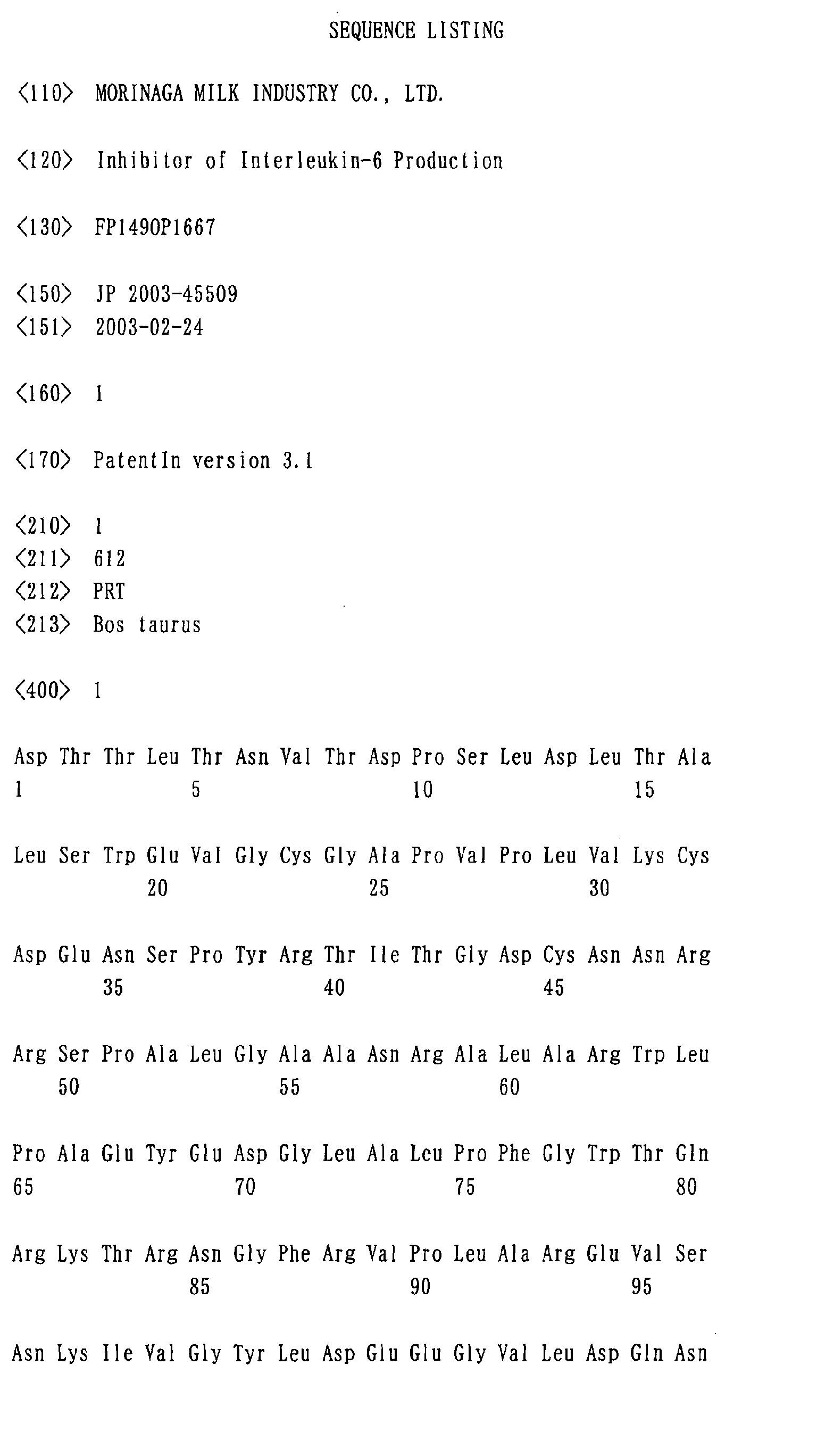
- the engineered product can be exemplified by a protein including a protein having of a sequence with substitutions, deletions, or additions of one or several amino acids in the amino acid sequence of EMBL-Accession No.: M58150 or SEQ ID NO: 1, EMBL-Accession No.: AY324876, EMBL-Accession No.: AF027970, or the like.
- the term "several" means 2 to 50, preferably 2 to 20, particularly preferably 2 to 10.
- the engineered product can be exemplified by a protein having a sequence which has homology of 70% or more, preferably 80% or more, more preferably 90% or more, particularly preferably 95% or more to the amino acid sequence of EMBL-Accession No.: M58150 or SEQ ID NO: 1, EMBL-Accession No.: AY324876, EMBL-Accession No.: AF027970, or the like.
- those engineered products of lactoperoxidase may be modified so as to retain a suppressive action on the production of interleukin-6 and to lower the antigenicity against a human as far as possible.
- the lactoperoxidase-engineered product can be obtained by allowing a gene encoding wild-type lactoperoxidase to be mutated by a PCR method or the like to express the mutant gene in a well-known expression system, and determining the suppressive action of the resulting protein on the production of interleukin-6. Furthermore, it can also be obtained such that a microorganism or the like in which a wild-type lactoperoxidase-encoding gene is introduced is subjected to mutagenic treatment with UV irradiation or the like and then a lactoperoxidase engineered product is purified from the resulting microorganism to determine the suppressive action on the production of interleukin-6.
- the "engineered products” used herein are not necessarily prepared by engineering the wild type, so that they may be mutants as naturally occurring ones.
- lactoperoxidase when lactoperoxidase is added to food and drink and feed when in use, it is preferable to use the wild-type lactoperoxidase in which any amino acid is as less subjected as possible to substitution, deletion, addition, or the like.
- Lactoperoxidase has a suppressive action on the production of interleukin-6, so that it can be used as an active ingredient for an interleukin-6 suppressive agent (hereinafter, also referred to as "suppressive agent of the present invention").
- the "active ingredient” means an ingredient that shows a suppressive effect on the production of interleukin-6.
- the suppressive agent of the present invention does not have to contain lactoperoxidase as a main ingredient.
- the suppressive agent of the present invention may contain an ingredient having a suppressive action on the production of interleukin-6.
- the inhibitor of the present invention may contain an ingredient having a suppressive action on the production of interleukin-6, other useful proteins in milk such as casein, ⁇ -lactalbumin, and ⁇ -lactoglobulin.
- the interleukin-6 suppressive agent of the present invention may contain, in addition to lactoperoxidase, a partial peptide of lactoperoxidase or a hydrolysate mixture (peptides mixture) of lactoperoxidase. In addition, it may contain partial peptide(s) of lactoperoxidase having a suppressive action on the production of interleukin-6 or a hydrolysate mixture (a peptide mixture) of lactoperoxidase as an active ingredient.
- the interleukin-6 suppressive agent of the present invention has a suppressive action on the production of interleukin-6 that is a kind of inflammatory cytokines produced in the living body, and thus can be used as pharmaceutical preparations such as those having soothing effects on the symptoms of various kinds of infectious and inflammatory diseases, such as thrombocytosis, myeloma, Castleman syndrome, cardiac myxoma, glomerulonephritis, rheumatoid arthritis, sepsis, and influenza-virus infectious disease, through the suppression of the interleukin-6 production.
- infectious and inflammatory diseases such as thrombocytosis, myeloma, Castleman syndrome, cardiac myxoma, glomerulonephritis, rheumatoid arthritis, sepsis, and influenza-virus infectious disease
- the application of the suppressive agent of the present invention is not limited to prevention and/or therapy of the disease caused by an abnormal production of interleukin-6.
- the active ingredient of the interleukin-6 suppressive agent of the present invention is included in food materials such as milk protein, so that the interleukin-6 suppressive agent of the present invention is high in safety to human beings and has such characteristic that its effect is exerted on prevention and/or therapy to the disease caused by the production of interleukin-6 by daily oral intake thereof as a composition contained in food and drink.
- the forms of the interleukin-6 suppressive agent of the present invention include, but are not particularly limited to, pharmaceutical compositions, food and drink compositions, and feed compositions.
- an embodiment of the suppressive agent of the present invention is a pharmaceutical preparation for the prevention and/or therapy of the disease caused by the production of interleukin-6, which contains lactoperoxidase as an active ingredient.
- another embodiment of the present invention is the use of lactoperoxidase for manufacture of a pharmaceutical preparation for the prevention and/or therapy of the disease caused by the production of interleukin-6.
- the suppressive agent of the present invention is administered to an object person who requires the prevention or therapy of the disease caused by the production of interleukin-6 to prevent or medicate the disease.
- the suppressive agent of the present invention is added to a raw material of a food and drink composition or a raw material of a feed composition to make up the food and drink composition or the feed composition.
- the examples of disease caused by the production of interleukin-6 include various kinds of infectious diseases, inflammatory diseases, and the like, for example, thrombocytosis, myeloma, Castleman syndrome, cardiac myxoma, glomerulonephritis, rheumatoid arthritis, sepsis, and influenza-virus infectious disease.
- the suppressive agent of the present invention may be lactoperoxidase itself or may contain an ingredient other than lactoperoxidase.
- the ingredient other than lactoperoxidase can be suitably selected depending on the dosage form.
- various kinds of food and drink may be prepared by mixing with lactoperoxidase powder, an aqueous lactoperoxidase solution (e.g., syrup), or the like as the interleukin-6-suppressive agent of the present invention.
- the pharmaceutical composition can be produced by pharmaceutically formulating lactoperoxidase using pharmaceutically acceptable excipient and any other additives, and the pharmaceutically-formulated lactoperoxidase can be used as preventative and/or therapeutic agents against a disease caused by the production of interleukin-6.
- the content of lactoperoxidase in a pharmaceutical preparation is generally 0.001 to 20% by mass, preferably 0.1 to 15% by mass.
- additives such as excipients, binders, disintegrating agents, lubricants, stabilizers, flavoring agents, diluents, and injection solvent can be used.
- the excipients include: saccharide derivatives such as lactose, saccharose, glucose, mannitol, and sorbit; starch derivatives such as corn starch, potato starch, ⁇ -starch, dextrin, and carboxymethyl starch; cellulose derivatives such as crystal cellulose, hydroxypropyl cellulose, hydroxypropyl methylcellulose, carboxymethyl cellulose, and calcium carboxymethyl cellulose; gum Arabic; dextran; pullulan; silicate derivatives such as light silicic anhydride, synthetic silica aluminum, and bisilicate magnesium aluminate; phosphate derivatives such as calcium phosphate; carbonate derivatives such as calcium carbonate; and sulfate derivatives such as calcium sulfate.
- saccharide derivatives such as lactose, saccharose, glucose, mannitol, and sorbit
- starch derivatives such as corn starch, potato starch, ⁇ -starch, dextrin, and carboxymethyl starch
- Binders include, in addition to the excipients described above: gelatin; polyvinyl pyrrolidone; and magrogol, for example.
- Disintegrating agents include, in addition to the excipients described above, chemically-modified starch or cellulose derivatives such as croscarmellose sodium, carboxymethyl starch sodium, and cross-linked polyvinyl pyrrolidone, for example.
- Lubricants include: talc; stearic acid; metal stearates such as calcium stearate and magnesium stearate; colloidal silica; waxes such as Veegum and spermaceti; boric acid; glycol; carboxylic acids such as fumaric acid and adipic acid; sodium carboxylate such as sodium benzoate; sulfate salts such as sodium sulfate; leucine; lauryl sulfates such as sodium lauryl sulfate and magnesium lauryl sulfate; silic acids such as silicic anhydride and silicic hydrate; and starch derivatives, for example.
- Stabilizers include: p-hydroxybenzoate esters such as methylparaben and propylparaben; alcohols such as chlorobutanol, benzyl alcohol, and phenylethyl alcohol; benzalkonium chloride; acetic anhydride; and sorbic acid, for example.
- Flavoring agents include sweeteners, acidifiers, and perfume, for example.
- Injection solvents include, for example, water, ethanol, and glycerin.
- the routes of administration for the pharmaceutical composition include oral administration and non-oral administration such as enteral administration.
- Dosage forms for the administration of the pharmaceutical composition include spray, capsules, tablets, granules, syrup, emulsion, suppository, injection, ointment, and tapes, for example.
- the interleukin-6 suppressive agent of the present invention can be also administered by blending it in food and drink, feed, and the like.
- the dosage and the number of doses vary depending on intended effects, administration method, duration of treatment, age, body weight, and the like.
- the dosage can be suitably selected from 10 mg to 10 g per day for an adult in general, and the number of doses can be suitably selected from once to several times per day.
- a dosing period is preferably 7 days or more.
- the forms of the food and drink compositions mixed with the lactoperoxidase of the present invention include: soft drinks in which lactoperoxidase powder, an aqueous lactoperoxidase solution (e.g., syrup), or the like is mixed as an interleukin-6 suppressive agent of the present invention, milk beverage or concentrated stock solutions of these beverages, and conditioning powder thereof; dairy products such as processed milk and fermented milk; enteral nourishing foods; and functional foods.
- a tablet-shaped supplement can be encompassed. It eliminates the need to control the food intake and calorie per day in consideration of the intake of other foods, while the intake of the active ingredient can be precisely grasped.
- the food and drink composition or feed composition of the present invention can be provided as a food and drink composition or feed composition having an indication of its efficiency for the prevention or therapy of a disease described below.
- the composition is provided for the prevention or therapy of a disease caused by the production of interleukin-6 such as thrombocytosis, myeloma, Castleman syndrome, cardiac myxoma, glomerulonephritis, rheumatoid arthritis, sepsis, and influenza-virus infectious disease.
- the term "indication” means an action to inform a demander of the efficiency, for example, an action to provide a product of the food and drink composition or feed composition of the present invention, or a package and advertisement of the product, or the like with the efficiency, and an action to transfer, deliver, or display the product provided with the efficiency.
- a preferable embodiment thereof is indication as food for specified health uses (see the enforcement regulations of Health Promotion Law (April 30, 2003, Item 86 of the Health, the Japanese Ministry of Health, Labor and Welfare) Section 12 (1), Item 5).
- the inventors of the present invention have studied the effect of lactoperoxidase against the induction of interleukin-6 production in a model mouse infected with influenza virus (the suppressive action on interleukin-6 production, suppressive action on an increase in the number of inflammatory cells, and suppressive action on lung consolidation (severity of pneumonia symptom)).
- the suppressive action on interleukin-6 production suppressive action on an increase in the number of inflammatory cells
- suppressive action on lung consolidation severeness of pneumonia symptom
- test sample was prepared by dissolving lactoperoxidase (produced by Biopole) in purified water so as to have a concentration of 12.5% by mass.
- purified water was used as a control sample.
- mice Seven-week-old female BALB/C mice (purchased from Nippon SLC) in total were placed in a cage equipped with a coprophagy preventing net and then fed for an acclimatization period of one week with standard pellets (produced by Clea Japan) and drinking water. Subsequently, the mice were divided into two groups of 6 animals each. Then, a control group was obtained by orally administering 0.5 ml of the control sample to one group through a feeding tube. A test group was obtained by orally administering 0.5 ml of the test sample to the other group. These oral administrations were started a day before virus infection and were then successively conducted once a day for 7 days from the start of the administration.
- mice At the date of virus infection (second day from the start of sample administration), all of the mice were intranasally inoculated with 10 ⁇ l of a phosphate buffer containing 660 PFU (PFU: Plaque-Forming Unit) of an influenza virus A/PR/8/34 (H1N1) strain under anesthesia. The mice were dissected after 6 days from the infection (the final day of sample administration) and various measuring samples shown below were collected.
- PFU Plaque-Forming Unit
- Serum samples were collected from the mice after the sample administration by collecting blood from the orbital vein thereof under anesthesia, respectively.
- a needle was inserted into the trachea after dissection and then 1 ml of a serum-free eagle MEM culture medium (produced by Nissui Pharmaceutical) was injected using an injector, followed by collecting the liquid into the same syringe. The similar injection and collection were repeated two more times, so that bronchoalveolar lavage fluids of the three times in total were collected.
- the collected bronchoalveolar lavage fluid was centrifuged at 1000 rpm and separated into a cellular fraction and a supernatant.
- the cellular fraction was provided as an inflammatory cell sample and the supernatant was provided as a bronchoalveolar lavage fluid supernatant sample.
- lungs were collected from the dissected mice and provided as lung consolidation samples.
- the concentrations of interleukin-6 in the serum sample and the bronchoalveolar lavage fluid sample were measured using an ELISA method and the measured values of 6 animals in one group were averaged.
- the number of inflammatory cells was measured using a cell-number measuring device (manufactured by Nihon Koden Corporation) and the measured values of 6 animals in one group were averaged.
- the severity of consolidation as an inflammatory index of virus infection was scored from 0 (no consolidation) to 10 (sever consolidation) according to the method of Ginsberg et al., "Journal of Experimental Medicine", U.S.A., vol. 95, 1952, p. 135-145) and the measured values of 6 animals in one group were averaged.
- Tables 1, 2, and 3 The results of this test are shown in Tables 1, 2, and 3, respectively.
- Table 1 shows the measurement results of the respective concentrations of interleukin-6 in the serum sample and the bronchoalveolar lavage fluid supernatant sample.
- Table 2 shows the results of measuring the number of inflammatory cells in the bronchoalveolar lavage fluid.
- Table 3 shows the lung consolidation scores.
- lactoperoxidase had a suppressive effect on the production of interleukin-6 in vivo in an effective manner.
- a parenteral injection having the following composition with a suppressive effect on the production of interlukin-6 was manufactured by the conventional method. Lactoperoxidase (produced by Biopole) 2.0 (%) Actinomycin D (produced by Sigma) 0.005 Sodium chloride 0.9 (produced by Wako Pure Chemical Industry) Mannitol (produced by Kanto Chemical) 1.0 Distilled water for injection 96.095 (Otsuka Pharmaceutical)
- a water phase was prepared in a tank by dissolving 10.8 kg of an enzymatically-hydrolyzed whey protein (produced by Morinaga Milk Industry), 36 kg of dextrin (manufactured by Showa Sangyo), and small amounts of water-soluble vitamins and minerals in 200 kg of water.
- an oil phase was prepared by mixing and dissolving 3 kg of soy bean salad oil (produced by Taiyo Yushi), 8.5 kg of palm oil (produced by Taiyo Yushi), 2.5 kg of safflower oil (produced by Taiyo Yushi), 0.2 kg of lecithin (produced by Ajinomoto), 0.2 kg of fatty acid monoglyceride (produced by Kao Corporation), and a small amount of fat-soluble vitamins.
- the oil phase was added to the water phase in the tank and mixed by stirring, followed by heating up to 70°C and homogenizing at a pressure of 14.7 MPa with a homogenizer. Subsequently, after 10-minute sterilization at 90°C, approximately 59 kg of intermediate product powder was prepared by condensation and spray drying. In 50 kg of the intermediate product powder, 6.8 kg of saccharose (produced by Hokuren), 167 g of amino-acids mixture powder (produced by Ajinomoto), and 60 g of lactoperoxidase (produced by Biopole) were added, followed by uniformly mixing them to produce 56 kg of enteral nourishing food powder containing lactoperoxidase as the interleukin-6 suppressive agent.
- saccharose produced by Hokuren
- amino-acids mixture powder produced by Ajinomoto
- lactoperoxidase produced by Biopole
- 1,800 (approximately 900 g) tablets containing lactoperoxidase as an interleukin-6 suppressive agent was manufactured such that 150 g of lactoperoxidase (produced by Biopole), 100 g of Lactulose powder (produced by Morinaga Milk Industry), 635 g of malto-dextrin (produced by Matsutani Chemical Industry), 85 g of skim milk (produced by Morinaga Milk Industry), 1 g of stevia sweetener (produced by San-Ei Gen F.F.I.), 5 g of yogurt flavor (produced by San-Ei Gen F.F.I.), and 24 g of a glycerin fatty acid ester pharmaceutical preparation (produced by Riken Vitamin) were added and uniformly mixed, and then the mixed powder was subjected to continuous tablet making using a tableting machine (manufactured by Hata Tekkojo) under conditions of 0.5 g per tablet, a tableting speed of 12 tablets/minute, and a pressure of 9.8 KPa.
- the present invention relates to the interleukin-6 suppressive agent containing lactoperoxidase as an active ingredient and to the use thereof.
- the present invention exerts the following effects:
Landscapes
- Health & Medical Sciences (AREA)
- Life Sciences & Earth Sciences (AREA)
- Chemical & Material Sciences (AREA)
- General Health & Medical Sciences (AREA)
- Engineering & Computer Science (AREA)
- Public Health (AREA)
- Medicinal Chemistry (AREA)
- Veterinary Medicine (AREA)
- Organic Chemistry (AREA)
- Pharmacology & Pharmacy (AREA)
- Animal Behavior & Ethology (AREA)
- Bioinformatics & Cheminformatics (AREA)
- Chemical Kinetics & Catalysis (AREA)
- General Chemical & Material Sciences (AREA)
- Nuclear Medicine, Radiotherapy & Molecular Imaging (AREA)
- Immunology (AREA)
- Epidemiology (AREA)
- Proteomics, Peptides & Aminoacids (AREA)
- Gastroenterology & Hepatology (AREA)
- Virology (AREA)
- Oncology (AREA)
- Communicable Diseases (AREA)
- Urology & Nephrology (AREA)
- Hematology (AREA)
- Diabetes (AREA)
- Zoology (AREA)
- Wood Science & Technology (AREA)
- Rheumatology (AREA)
- Genetics & Genomics (AREA)
- General Engineering & Computer Science (AREA)
- Biochemistry (AREA)
- Mycology (AREA)
- Nutrition Science (AREA)
- Food Science & Technology (AREA)
- Polymers & Plastics (AREA)
- Physical Education & Sports Medicine (AREA)
- Orthopedic Medicine & Surgery (AREA)
- Molecular Biology (AREA)
- Pain & Pain Management (AREA)
- Heart & Thoracic Surgery (AREA)
Abstract
An interleukin-6 suppressive agent comprising
lactoperoxidase as an active ingredient is used as a
pharmaceutical preparation or the like for prevention
and/or therapy of a disease caused by production of
interleukin-6, such as thrombocytosis, myeloma, Castleman
syndrome, rheumatoid arthritis, or influenza-virus
infectious disease.
Description
The present invention relates to an interleukin-6
suppressive agent comprising lactoperoxidase as an active
ingredient. More specifically, the present invention
relates to an interleukin-6 suppressive agent that has
effects in the prevention and/or therapy of disease caused
by an abnormal production of interleukin-6 and to an
interleukin-6 suppressive agent that can be applied in
food and drink, feed, or the like.
An inflammatory reaction is a kind of biological
defense reaction to tissue damage to be caused by various
kinds of invasion and is featured by associated symptoms
such as flare, swelling, pyrexia, and pain. Bioactive
substances involved in the inflammatory reaction include
so-called inflammatory mediators such as histamine,
serotonin, and prostaglandin and so-called inflammatory
cytokines such as interleukin-1, interleukin-6,
interleukin-8, and tumor necrosis factors (TNFs), which
are produced by various kinds of cells such as leukocytes
(e.g., Shogo Karino, Nobuyuki Miyasaka, and Nagahiro
Minato Ed., "Clinical Immunology", Asakura-Shoten, 1997, p.
73-77).
Interleukin-6 is a polypeptide cytokine consisting
of 184 amino acids with a molecular weight of 21 to 28 kDa.
Interleukin-6 can be produced from a wide variety of cells
such as vascular endothelial cells, T-lymphocytes, B-lymphocytes,
monocytes, and macrophages by various kinds
of stimulative substances such as lipopolysaccharide,
interleukin-1, and TNFs, which can be found in the site of
inflammation. As the biological actions of interleukin-6,
important actions have been reported, including the
acceleration of the synthesis of acute-phase inflammatory
protein, induction of the antibody production by B-cells,
and the activation of T-lymphocytes. On the other hand, it
has been suggested that the abnormality in production of
interleukin-6 may deeply relate to various kinds of
immunopathy, inflammatory diseases, and lymphoid tumors
(e.g., Masahiro Matsumura, Ed., "Dictionary of Molecular
Cell Biology", Tokyo Kagaku Dojin Co., Ltd., 1997, p. 90).
On the other hand, interleukin-6 antibody and
interleukin-6 receptor antibody, which inhibit the action
of inerleukin-6, have been expected to show effectiveness
on various kinds of inflammatory diseases such as
autoimmune diseases including rheumatoid arthritis and the
like, psoriasis, atrial myxoma, mesangial proliferative
nephritis, Castleman syndrome, AIDS, and multiple myeloma
(e.g., "Clinical Immunology", Asakukra-Shoten, 1997, P.
73-77). A therapeutic agent for a disease caused by the
production of an interleukin-6 using an antibody against
interleukin-6 receptor as an active ingredient (e.g., JP
8-169846 A) and a composition for suppressing interleukin-6
produced by cultured mammalian cells (JP 8-99996 A) have
been already disclosed. In addition, it is revealed that,
when the anti-inflammatory agent, indomethacin is
administered to rats with carrageenan-induced pleurisy,
pleuritic inflammation is restrained significantly and
interleukin-6 in a peritoneal exudation is inhibited (e.g.,
"Yakugaku Zasshi", vol. 120, 2000, p. 455-462).
Regarding the involvement of proteins in milk to
interleukin-6, there has been to date disclosed each of
the suppressive action of lactoferrin on the urinary level
of interleukin-6 in an Escherichia coli urinary tract
infection mouse (e.g., "Infection and Immunity", U.S.A.,
vol. 68, 2000, p. 5816-5823) and a composition for
regulating the ability to produce interleukin containing
fermented milk or a processed product thereof as an active
ingredient (e.g., JP 5-9124 A).
Lactoperoxidase, one of the milk proteins, is an
oxidoreductase not only contained in mammalian milk but
also contained in secretions such as saliva, tears, and
respiratory mucus (e.g., "American Journal of Respiratory
and Critical Care Medicine", U.S.A., vol. 166, 2002, p.
S57-S61), which are industrially purified in large volumes
from milk (e.g., JP 5-41981 A).
Various biological functions of lactoperoxidase have
been reported, such as antibacterial activity, antiviral
activity, antioxidative activity, anticancer activity, and
immunoregulating activity (e.g., "Journal of Nutritional
Biochemistry", U.S.A., vol. 11, 2000, p. 94-102; "Life
Sciences", U.S.A., vol. 43, 1988, p. 739-745; "Life
Sciences", U.S.A., vol. 47, 1990, p. 703-709; "Journal of
Dairy Research", U.K., vol. 63, 1996, p. 257-267; "Journal
of Dairy Research", U.K., vol. 64, 1997, p. 281-288;
"Veterinary Immunology and Immunopathology", Holland, vol.
56, 1997, p. 85-96). There are disclosed technologies with
respect to the use of lactoperoxidase, peroxide donor, and
thiocyanate for the production of therapeutic
pharmaceuticals for Helicobacter pylori infection (e.g.,
JP 2000-509367 A), a preventive and therapeutic agent for
the infection of pathogenic bacteria to be added in the
mixed feed of farmed aquatic animals (e.g., JP 3103615 B),
an age resistor (JP 3103167 B), and a liver-function
improving agent (e.g., JP 2001-226289 A), the preventive
and therapeutic application of peroxidase (e.g., JP 6-501453
A), and a therapeutic agent for corneal disorder
(e.g., JP 2840795 B). Furthermore, the applicant of the
present invention has already disclosed a urease-inactivating
composition in which peroxidase, thiocyanic
acid, and hydrogen peroxide are provided as active
ingredients (disclosed in JP 2002-238554 A). However,
there has been to date no reports on existing technology
at all about the effect of lactoperoxidase on the
production of one of inflammatory cytokines, ineterleukin-6.
In consideration of the background art, the
inventors of the present invention have found for the
first time that lactoperoxidase, which is a milk protein,
has a suppressive action on the production of interleukin-6
as a result of extensive studies mainly on food
materials such as proteins with respect to an interleukin-6
suppressive agent with safety and few side effects,
which can be administered on a daily basis for a long time.
As a result, it is revealed that the symptoms of various
kinds of infectious diseases and inflammatory diseases
caused by the production of interleukin-6 can be relieved
by the use of lactoperoxidase.
In order to solve the above-mentioned problems, the
present invention provides an interleukin-6 suppressive
agent comprising lactoperoxidase as an active ingredient.
According to a preferred aspect of the interleukin-6
suppressive agent, the interleukin-6 suppressive agent is
a pharmaceutical preparation for preventing and/or
treating a disease caused by the production of
interleukin-6.
The present invention further provides a food and
drink composition or a feed composition, which is prepared
by adding the interleukin-6 suppressive agent.
The present invention further provides a use of
lactoperoxidase for manufacture of a pharmaceutical
preparation for preventing and/or treating a disease
caused by production of interleukin-6.
The present invention further provides a method of
preventing or treating a disease by administering an
interleukin-6 suppressive agent comprising lactoperoxidase
as an effective ingredient to an object person who
requires prevention or therapy of a disease caused by
production of interleukin-6.
In the present invention, the disease caused by the
production of interleukin-6 includes thrombocytosis,
myeloma, Castleman syndrome, cardiac myxoma,
glomerulonephritis, rheumatoid arthritis, sepsis, and
influenza-virus infectious disease.
The present invention provides a pharmaceutical
preparation effective to prevention and/or therapy of a
disease caused by the production of interleukin-6, which
excels in safety, enables mass-production at low costs,
and has an effective suppressive action against the
production of interleukin-6.
Among the matters described in the background art,
the technology highly related to the present invention is
different from the present invention in following points:
Hereinafter, preferred embodiments of the present
invention will be described in detail. However, the
present invention is not limited to the preferred
embodiments described below, so that it can be modified
within the scope of the present invention. In addition,
unless otherwise specified, percentage is represented by
mass in this specification.
Lactoperoxidase to be used in the present invention
can be obtained from milk or the like of a human, a cow, a
horse, a sheep, or a goat. For example, like a method as
disclosed in JP 5-41981 A (title of the invention: viable
cell-containing liquid composition), preferable is an
industrial production from whey or skimmed milk of
unheated milk or the like according to the conventional
method (e.g., ion-exchange chromatography). Furthermore,
it is also possible to use commercially available
lactoperoxidase originated from natural products (e.g.,
produced by Biopole), or recombinant lactoperoxidase (e.g.,
recombinant lactoperoxidase expressed and purified by the
method of Shin et al., "Biochemical and Biophysical
Research Communications", vol. 271, 2000, p. 831-836, or
commercially available recombinant lactoperoxidase) (e.g.,
produced by Biopole).
Examples of lactoperoxidase, which can be used in
the present invention, include engineered products of
lactoperoxidase as described above. Specifically, the
engineered product can be exemplified by a protein
including a protein having of a sequence with
substitutions, deletions, or additions of one or several
amino acids in the amino acid sequence of EMBL-Accession
No.: M58150 or SEQ ID NO: 1, EMBL-Accession No.: AY324876,
EMBL-Accession No.: AF027970, or the like. The term
"several" means 2 to 50, preferably 2 to 20, particularly
preferably 2 to 10. In addition, the engineered product
can be exemplified by a protein having a sequence which
has homology of 70% or more, preferably 80% or more, more
preferably 90% or more, particularly preferably 95% or
more to the amino acid sequence of EMBL-Accession No.:
M58150 or SEQ ID NO: 1, EMBL-Accession No.: AY324876,
EMBL-Accession No.: AF027970, or the like. Preferably,
those engineered products of lactoperoxidase may be
modified so as to retain a suppressive action on the
production of interleukin-6 and to lower the antigenicity
against a human as far as possible. The lactoperoxidase-engineered
product can be obtained by allowing a gene
encoding wild-type lactoperoxidase to be mutated by a PCR
method or the like to express the mutant gene in a well-known
expression system, and determining the suppressive
action of the resulting protein on the production of
interleukin-6. Furthermore, it can also be obtained such
that a microorganism or the like in which a wild-type
lactoperoxidase-encoding gene is introduced is subjected
to mutagenic treatment with UV irradiation or the like and
then a lactoperoxidase engineered product is purified from
the resulting microorganism to determine the suppressive
action on the production of interleukin-6. In this regard,
the "engineered products" used herein are not necessarily
prepared by engineering the wild type, so that they may be
mutants as naturally occurring ones. In addition, when
lactoperoxidase is added to food and drink and feed when
in use, it is preferable to use the wild-type
lactoperoxidase in which any amino acid is as less
subjected as possible to substitution, deletion, addition,
or the like.
Lactoperoxidase has a suppressive action on the
production of interleukin-6, so that it can be used as an
active ingredient for an interleukin-6 suppressive agent
(hereinafter, also referred to as "suppressive agent of
the present invention"). Here, the "active ingredient"
means an ingredient that shows a suppressive effect on the
production of interleukin-6. Thus, the suppressive agent
of the present invention does not have to contain
lactoperoxidase as a main ingredient. Besides, other than
lactoperoxidase, the suppressive agent of the present
invention may contain an ingredient having a suppressive
action on the production of interleukin-6. For example,
other than lactoperoxidase, the inhibitor of the present
invention may contain an ingredient having a suppressive
action on the production of interleukin-6, other useful
proteins in milk such as casein, α-lactalbumin, and β-lactoglobulin.
The interleukin-6 suppressive agent of the present
invention may contain, in addition to lactoperoxidase, a
partial peptide of lactoperoxidase or a hydrolysate
mixture (peptides mixture) of lactoperoxidase. In addition,
it may contain partial peptide(s) of lactoperoxidase
having a suppressive action on the production of
interleukin-6 or a hydrolysate mixture (a peptide mixture)
of lactoperoxidase as an active ingredient.
The interleukin-6 suppressive agent of the present
invention has a suppressive action on the production of
interleukin-6 that is a kind of inflammatory cytokines
produced in the living body, and thus can be used as
pharmaceutical preparations such as those having soothing
effects on the symptoms of various kinds of infectious and
inflammatory diseases, such as thrombocytosis, myeloma,
Castleman syndrome, cardiac myxoma, glomerulonephritis,
rheumatoid arthritis, sepsis, and influenza-virus
infectious disease, through the suppression of the
interleukin-6 production. However, the application of the
suppressive agent of the present invention is not limited
to prevention and/or therapy of the disease caused by an
abnormal production of interleukin-6.
The active ingredient of the interleukin-6
suppressive agent of the present invention is included in
food materials such as milk protein, so that the
interleukin-6 suppressive agent of the present invention
is high in safety to human beings and has such
characteristic that its effect is exerted on prevention
and/or therapy to the disease caused by the production of
interleukin-6 by daily oral intake thereof as a
composition contained in food and drink.
The forms of the interleukin-6 suppressive agent of
the present invention include, but are not particularly
limited to, pharmaceutical compositions, food and drink
compositions, and feed compositions. In other words, an
embodiment of the suppressive agent of the present
invention is a pharmaceutical preparation for the
prevention and/or therapy of the disease caused by the
production of interleukin-6, which contains
lactoperoxidase as an active ingredient. In addition,
another embodiment of the present invention is the use of
lactoperoxidase for manufacture of a pharmaceutical
preparation for the prevention and/or therapy of the
disease caused by the production of interleukin-6. In a
preferred embodiment, the suppressive agent of the present
invention is administered to an object person who requires
the prevention or therapy of the disease caused by the
production of interleukin-6 to prevent or medicate the
disease. Furthermore, in another embodiment, the
suppressive agent of the present invention is added to a
raw material of a food and drink composition or a raw
material of a feed composition to make up the food and
drink composition or the feed composition.
The examples of disease caused by the production of
interleukin-6 include various kinds of infectious diseases,
inflammatory diseases, and the like, for example,
thrombocytosis, myeloma, Castleman syndrome, cardiac
myxoma, glomerulonephritis, rheumatoid arthritis, sepsis,
and influenza-virus infectious disease.
The suppressive agent of the present invention may
be lactoperoxidase itself or may contain an ingredient
other than lactoperoxidase. The ingredient other than
lactoperoxidase can be suitably selected depending on the
dosage form. For example, various kinds of food and drink
may be prepared by mixing with lactoperoxidase powder, an
aqueous lactoperoxidase solution (e.g., syrup), or the
like as the interleukin-6-suppressive agent of the present
invention.
The pharmaceutical composition can be produced by
pharmaceutically formulating lactoperoxidase using
pharmaceutically acceptable excipient and any other
additives, and the pharmaceutically-formulated
lactoperoxidase can be used as preventative and/or
therapeutic agents against a disease caused by the
production of interleukin-6. In the case of pharmaceutical
formulation, the content of lactoperoxidase in a
pharmaceutical preparation is generally 0.001 to 20% by
mass, preferably 0.1 to 15% by mass. For pharmaceutical
formulation, additives such as excipients, binders,
disintegrating agents, lubricants, stabilizers, flavoring
agents, diluents, and injection solvent can be used.
The excipients include: saccharide derivatives such
as lactose, saccharose, glucose, mannitol, and sorbit;
starch derivatives such as corn starch, potato starch, α-starch,
dextrin, and carboxymethyl starch; cellulose
derivatives such as crystal cellulose, hydroxypropyl
cellulose, hydroxypropyl methylcellulose, carboxymethyl
cellulose, and calcium carboxymethyl cellulose; gum
Arabic; dextran; pullulan; silicate derivatives such as
light silicic anhydride, synthetic silica aluminum, and
bisilicate magnesium aluminate; phosphate derivatives such
as calcium phosphate; carbonate derivatives such as
calcium carbonate; and sulfate derivatives such as calcium
sulfate. Binders include, in addition to the excipients
described above: gelatin; polyvinyl pyrrolidone; and
magrogol, for example. Disintegrating agents include, in
addition to the excipients described above, chemically-modified
starch or cellulose derivatives such as
croscarmellose sodium, carboxymethyl starch sodium, and
cross-linked polyvinyl pyrrolidone, for example.
Lubricants include: talc; stearic acid; metal stearates such as calcium stearate and magnesium stearate; colloidal silica; waxes such as Veegum and spermaceti; boric acid; glycol; carboxylic acids such as fumaric acid and adipic acid; sodium carboxylate such as sodium benzoate; sulfate salts such as sodium sulfate; leucine; lauryl sulfates such as sodium lauryl sulfate and magnesium lauryl sulfate; silic acids such as silicic anhydride and silicic hydrate; and starch derivatives, for example. Stabilizers include: p-hydroxybenzoate esters such as methylparaben and propylparaben; alcohols such as chlorobutanol, benzyl alcohol, and phenylethyl alcohol; benzalkonium chloride; acetic anhydride; and sorbic acid, for example. Flavoring agents include sweeteners, acidifiers, and perfume, for example. Injection solvents include, for example, water, ethanol, and glycerin.
Lubricants include: talc; stearic acid; metal stearates such as calcium stearate and magnesium stearate; colloidal silica; waxes such as Veegum and spermaceti; boric acid; glycol; carboxylic acids such as fumaric acid and adipic acid; sodium carboxylate such as sodium benzoate; sulfate salts such as sodium sulfate; leucine; lauryl sulfates such as sodium lauryl sulfate and magnesium lauryl sulfate; silic acids such as silicic anhydride and silicic hydrate; and starch derivatives, for example. Stabilizers include: p-hydroxybenzoate esters such as methylparaben and propylparaben; alcohols such as chlorobutanol, benzyl alcohol, and phenylethyl alcohol; benzalkonium chloride; acetic anhydride; and sorbic acid, for example. Flavoring agents include sweeteners, acidifiers, and perfume, for example. Injection solvents include, for example, water, ethanol, and glycerin.
The routes of administration for the pharmaceutical
composition include oral administration and non-oral
administration such as enteral administration. Dosage
forms for the administration of the pharmaceutical
composition include spray, capsules, tablets, granules,
syrup, emulsion, suppository, injection, ointment, and
tapes, for example.
In addition, the interleukin-6 suppressive agent of
the present invention can be also administered by blending
it in food and drink, feed, and the like. The dosage and
the number of doses vary depending on intended effects,
administration method, duration of treatment, age, body
weight, and the like. The dosage can be suitably selected
from 10 mg to 10 g per day for an adult in general, and
the number of doses can be suitably selected from once to
several times per day. In addition, a dosing period is
preferably 7 days or more.
The forms of the food and drink compositions mixed
with the lactoperoxidase of the present invention,
include: soft drinks in which lactoperoxidase powder, an
aqueous lactoperoxidase solution (e.g., syrup), or the
like is mixed as an interleukin-6 suppressive agent of the
present invention, milk beverage or concentrated stock
solutions of these beverages, and conditioning powder
thereof; dairy products such as processed milk and
fermented milk; enteral nourishing foods; and functional
foods.
As a form of the food and drink composition, a
tablet-shaped supplement can be encompassed. It eliminates
the need to control the food intake and calorie per day in
consideration of the intake of other foods, while the
intake of the active ingredient can be precisely grasped.
Furthermore, the food and drink composition or feed
composition of the present invention can be provided as a
food and drink composition or feed composition having an
indication of its efficiency for the prevention or therapy
of a disease described below. In other words, it is
possible to indicate that the composition is provided for
the prevention or therapy of a disease caused by the
production of interleukin-6 such as thrombocytosis,
myeloma, Castleman syndrome, cardiac myxoma,
glomerulonephritis, rheumatoid arthritis, sepsis, and
influenza-virus infectious disease.
The term "indication" means an action to inform a
demander of the efficiency, for example, an action to
provide a product of the food and drink composition or
feed composition of the present invention, or a package
and advertisement of the product, or the like with the
efficiency, and an action to transfer, deliver, or display
the product provided with the efficiency. In particular, a
preferable embodiment thereof is indication as food for
specified health uses (see the enforcement regulations of
Health Promotion Law (April 30, 2003, Item 86 of the
Health, the Japanese Ministry of Health, Labor and
Welfare) Section 12 (1), Item 5).
In the present invention, for evaluating a
suppressive action on the production of interleukin-6 by
lactoperoxidase, on the basis of a report that describes
the induction of interleukin-6 production with the
infection of influenza virus in human beings and mammals
("Journal of Medical Virology", U.S.A., vol. 64, 2001, p.
262-269; and "Circulation", U.S.A., vol. 103, 2001, p.
2283-2288), the inventors of the present invention have
studied the effect of lactoperoxidase against the
induction of interleukin-6 production in a model mouse
infected with influenza virus (the suppressive action on
interleukin-6 production, suppressive action on an
increase in the number of inflammatory cells, and
suppressive action on lung consolidation (severity of
pneumonia symptom)). As regards the details thereof, a
method of test examples described herein is used.
Hereinafter, the action of the interleukin-6
suppressive agent will be described in detail with
reference to the test examples.
This examination was conducted to investigate the
effects of lactoperoxidase on interleukin-6 produced by
inflammation with virus infection, the number of
inflammatory cells, and the severity of lung consolidation.
A test sample was prepared by dissolving
lactoperoxidase (produced by Biopole) in purified water so
as to have a concentration of 12.5% by mass. As a control
sample, purified water was used.
12 Seven-week-old female BALB/C mice (purchased from
Nippon SLC) in total were placed in a cage equipped with a
coprophagy preventing net and then fed for an
acclimatization period of one week with standard pellets
(produced by Clea Japan) and drinking water. Subsequently,
the mice were divided into two groups of 6 animals each.
Then, a control group was obtained by orally administering
0.5 ml of the control sample to one group through a
feeding tube. A test group was obtained by orally
administering 0.5 ml of the test sample to the other group.
These oral administrations were started a day before virus
infection and were then successively conducted once a day
for 7 days from the start of the administration. At the
date of virus infection (second day from the start of
sample administration), all of the mice were intranasally
inoculated with 10 µl of a phosphate buffer containing 660
PFU (PFU: Plaque-Forming Unit) of an influenza virus
A/PR/8/34 (H1N1) strain under anesthesia. The mice were
dissected after 6 days from the infection (the final day
of sample administration) and various measuring samples
shown below were collected.
Serum samples were collected from the mice after the
sample administration by collecting blood from the orbital
vein thereof under anesthesia, respectively. In addition,
a needle was inserted into the trachea after dissection
and then 1 ml of a serum-free eagle MEM culture medium
(produced by Nissui Pharmaceutical) was injected using an
injector, followed by collecting the liquid into the same
syringe. The similar injection and collection were
repeated two more times, so that bronchoalveolar lavage
fluids of the three times in total were collected. The
collected bronchoalveolar lavage fluid was centrifuged at
1000 rpm and separated into a cellular fraction and a
supernatant. The cellular fraction was provided as an
inflammatory cell sample and the supernatant was provided
as a bronchoalveolar lavage fluid supernatant sample.
Furthermore, lungs were collected from the dissected mice
and provided as lung consolidation samples.
The concentrations of interleukin-6 in the serum
sample and the bronchoalveolar lavage fluid sample were
measured using an ELISA method and the measured values of
6 animals in one group were averaged.
For the inflammatory cell samples, the number of
inflammatory cells was measured using a cell-number
measuring device (manufactured by Nihon Koden Corporation)
and the measured values of 6 animals in one group were
averaged.
The severity of consolidation as an inflammatory
index of virus infection was scored from 0 (no
consolidation) to 10 (sever consolidation) according to
the method of Ginsberg et al., "Journal of Experimental
Medicine", U.S.A., vol. 95, 1952, p. 135-145) and the
measured values of 6 animals in one group were averaged.
The results of this test are shown in Tables 1, 2,
and 3, respectively. Table 1 shows the measurement results
of the respective concentrations of interleukin-6 in the
serum sample and the bronchoalveolar lavage fluid
supernatant sample. Table 2 shows the results of measuring
the number of inflammatory cells in the bronchoalveolar
lavage fluid. Table 3 shows the lung consolidation scores.
As a result, as is evident from Table 1, it was
found that the concentrations of interleukin-6 in the
serum sample and the bronchoalveolar lavage fluid
supernatant sample were significantly decreased by the
administration of lactoperoxidase to virus-infected mice,
respectively.
In addition, as is evident from Table 2, an effect
of lactoperoxidase that suppressed the exudation of the
inflammatory cells was also confirmed as the number of
inflammatory cells in the bronchoalveolar lavage fluid was
decreased by the administration of lactoperoxidase.
Furthermore, as is evident from Table 3, the
suppressive effect of lactoperoxidase on the lung
inflammation was also confirmed such that the lung
consolidation score was 5.0 in the control group, but in
the test group administered with lactoperoxidase it was
decreased to 1.8.
Therefore, lactoperoxidase had a suppressive effect
on the production of interleukin-6 in vivo in an effective
manner. Thus, depending on such an effect, it was revealed
that the suppressive action on the exudation of
inflammatory cells and the effect of improving
inflammatory symptoms of the lungs were brought out.
Furthermore, when the content of virus in the
supernatant of the bronchoalveolar lavage fluid was
measured by a plaque method using MDCK cells ("Journal of
General Virology), U.K., vol. 71, 1990, p. 2149-2155),
there was no difference in content of virus between the
control group and the test group with respect. From this,
it was confirmed that lactoperoxidase had no anti-virus
effect directly on influenza virus in the living body.
| Interleukin-6 concentration (pg/ml) | ||
| Serum sample | Bronchoalveolar lavage fluid supernatant sample | |
| Test group | 59 | 998 |
| Control group | 198 | 4358 |
| Number of inflammatory cells (× 105 cells/ml) | |
| Test group | 4.6 |
| Control group | 9.6 |
| Lung consolidation score | |
| Test group | 1.8 |
| Control group | 5.0 |
Hereinafter, the present invention will be described
in more detail with reference to examples. However, the
present invention is not limited to the following examples.
A parenteral injection having the following
composition with a suppressive effect on the production of
interlukin-6 was manufactured by the conventional method.
| Lactoperoxidase (produced by Biopole) | 2.0 (%) |
| Actinomycin D (produced by Sigma) | 0.005 |
| Sodium chloride | 0.9 |
| (produced by Wako Pure Chemical Industry) | |
| Mannitol (produced by Kanto Chemical) | 1.0 |
| Distilled water for injection | 96.095 |
| (Otsuka Pharmaceutical) |
7,000 capsules having a suppressive effect on the
production of interleukin-6 were obtained by sieving 600 g
of lactose (produced by Meggle GmbH), 400 g of corn starch
(produced by Nisshin Seifun Group Inc.), 400 g of
crystalline cellulose (produced by Wako Pure Chemical
Industry), and 600 g of lactoperoxidase through a 50-mesh
sieve (manufactured by Yamato Scientific), putting into a
polyethylene bag with a thickness of 0.5 mm, mixing by
inversion, and filling the powder into capsules
(manufactured by Nippon Elanco, No. 1 gelatin capsules, Op.
Yellow No. 6 Body, and an empty weight of 75 mg) in an
amount of 275 mg by using an automatic capsule filling
machine (manufactured by Cecere Pedini; press type).
A water phase was prepared in a tank by dissolving
10.8 kg of an enzymatically-hydrolyzed whey protein
(produced by Morinaga Milk Industry), 36 kg of dextrin
(manufactured by Showa Sangyo), and small amounts of
water-soluble vitamins and minerals in 200 kg of water.
Concurrently, an oil phase was prepared by mixing and
dissolving 3 kg of soy bean salad oil (produced by Taiyo
Yushi), 8.5 kg of palm oil (produced by Taiyo Yushi), 2.5
kg of safflower oil (produced by Taiyo Yushi), 0.2 kg of
lecithin (produced by Ajinomoto), 0.2 kg of fatty acid
monoglyceride (produced by Kao Corporation), and a small
amount of fat-soluble vitamins. The oil phase was added to
the water phase in the tank and mixed by stirring,
followed by heating up to 70°C and homogenizing at a
pressure of 14.7 MPa with a homogenizer. Subsequently,
after 10-minute sterilization at 90°C, approximately 59 kg
of intermediate product powder was prepared by
condensation and spray drying. In 50 kg of the
intermediate product powder, 6.8 kg of saccharose
(produced by Hokuren), 167 g of amino-acids mixture powder
(produced by Ajinomoto), and 60 g of lactoperoxidase
(produced by Biopole) were added, followed by uniformly
mixing them to produce 56 kg of enteral nourishing food
powder containing lactoperoxidase as the interleukin-6
suppressive agent.
1,800 (approximately 900 g) tablets containing
lactoperoxidase as an interleukin-6 suppressive agent was
manufactured such that 150 g of lactoperoxidase (produced
by Biopole), 100 g of Lactulose powder (produced by
Morinaga Milk Industry), 635 g of malto-dextrin (produced
by Matsutani Chemical Industry), 85 g of skim milk
(produced by Morinaga Milk Industry), 1 g of stevia
sweetener (produced by San-Ei Gen F.F.I.), 5 g of yogurt
flavor (produced by San-Ei Gen F.F.I.), and 24 g of a
glycerin fatty acid ester pharmaceutical preparation
(produced by Riken Vitamin) were added and uniformly mixed,
and then the mixed powder was subjected to continuous
tablet making using a tableting machine (manufactured by
Hata Tekkojo) under conditions of 0.5 g per tablet, a
tableting speed of 12 tablets/minute, and a pressure of
9.8 KPa.
As described above in detail, the present invention
relates to the interleukin-6 suppressive agent containing
lactoperoxidase as an active ingredient and to the use
thereof. The present invention exerts the following
effects:


Claims (8)
- An interleukin-6 suppressive agent comprising lactoperoxidase as an active ingredient.
- The interleukin-6 suppressive agent according to claim 1, wherein the interleukin-6 suppressive agent is a pharmaceutical preparation for preventing and/or treating a disease caused by production of interleukin-6.
- The interleukin-6 suppressive agent according to claim 2, wherein the disease caused by the production of interleukin-6 is thrombocytosis, myeloma, Castleman syndrome, cardiac myxoma, glomerulonephritis, rheumatoid arthritis, sepsis, or influenza-virus infectious disease.
- A food and drink composition or a feed composition, which is prepared by adding the interleukin-6 suppressive agent according to any one of claims 1 to 3.
- A use of lactoperoxidase for manufacture of a pharmaceutical preparation for preventing and/or treating a disease caused by production of interleukin-6.
- The use of lactoperoxidase according to claim 5, wherein the disease caused by the production of interleukin-6 is thrombocytosis, myeloma, Castleman syndrome, cardiac myxoma, glomerulonephritis, rheumatoid arthritis, sepsis, or influenza-virus infectious disease.
- A method of preventing or treating a disease, comprising administering an interleukin-6 suppressive agent comprising lactoperoxidase as an effective ingredient to an object person who requires prevention or therapy of a disease caused by production of interleukin-6.
- The method according to claim 7, wherein the disease caused by the production of interleukin-6 is thrombocytosis, myeloma, Castleman syndrome, cardiac myxoma, glomerulonephritis, rheumatoid arthritis, sepsis, or influenza-virus infectious disease.
Applications Claiming Priority (3)
| Application Number | Priority Date | Filing Date | Title |
|---|---|---|---|
| JP2003045509 | 2003-02-24 | ||
| JP2003045509 | 2003-02-24 | ||
| PCT/JP2003/015009 WO2004073733A1 (en) | 2003-02-24 | 2003-11-25 | Interleukin 6 production inhibitor |
Publications (2)
| Publication Number | Publication Date |
|---|---|
| EP1598076A1 true EP1598076A1 (en) | 2005-11-23 |
| EP1598076A4 EP1598076A4 (en) | 2008-07-09 |
Family
ID=32905527
Family Applications (1)
| Application Number | Title | Priority Date | Filing Date |
|---|---|---|---|
| EP03774207A Withdrawn EP1598076A4 (en) | 2003-02-24 | 2003-11-25 | INHIBITOR OF PRODUCTION OF INTERLEUKINE 6 |
Country Status (9)
| Country | Link |
|---|---|
| US (2) | US7282202B2 (en) |
| EP (1) | EP1598076A4 (en) |
| JP (1) | JP3738268B2 (en) |
| KR (1) | KR100688928B1 (en) |
| CN (1) | CN1311870C (en) |
| AU (1) | AU2003284678B2 (en) |
| CA (1) | CA2489208C (en) |
| NZ (1) | NZ537089A (en) |
| WO (1) | WO2004073733A1 (en) |
Families Citing this family (6)
| Publication number | Priority date | Publication date | Assignee | Title |
|---|---|---|---|---|
| CA2489208C (en) * | 2003-02-24 | 2012-11-06 | Morinaga Milk Industry Co., Ltd. | Interleukin-6 suppressive agent |
| CA2637833A1 (en) | 2006-01-20 | 2007-07-26 | Morinaga Milk Industry Co., Ltd | Pharmaceutical composition, food or drink, or feed for intestinal disease |
| JP2007223910A (en) * | 2006-02-21 | 2007-09-06 | Snow Brand Milk Prod Co Ltd | Anti-inflammatory agent |
| KR100721703B1 (en) * | 2006-06-29 | 2007-05-25 | 주식회사 알앤엘바이오 | Antiviral Composition Containing Alder Extract |
| KR100736159B1 (en) * | 2006-06-29 | 2007-07-06 | 주식회사 알앤엘바이오 | Antiviral composition containing similar extract |
| JP2008189637A (en) * | 2007-02-08 | 2008-08-21 | Snow Brand Milk Prod Co Ltd | Prophylactic of autoimmune disease |
Family Cites Families (18)
| Publication number | Priority date | Publication date | Assignee | Title |
|---|---|---|---|---|
| LU85479A1 (en) | 1984-07-25 | 1986-02-12 | Oleofina Sa | ANTIBACTERIAL FOOD COMPOSITIONS FOR ANIMALS AND PROCESS FOR PREPARING THE SAME |
| US6020015A (en) | 1988-09-22 | 2000-02-01 | Gaull; Gerald E. | Infant formula compositions and nutrition containing genetically engineered human milk proteins |
| DE3834636A1 (en) | 1988-10-11 | 1990-04-19 | Max Planck Gesellschaft | METHOD FOR ANALYZING LENGTH POLYMORPHISMS IN DNA AREAS |
| JPH03218318A (en) * | 1989-11-02 | 1991-09-25 | Chugai Pharmaceut Co Ltd | Production of treating agent for rotavirus infectious disease |
| ATE193324T1 (en) * | 1989-11-03 | 2000-06-15 | Incyte Pharma Inc | RECOMBINANT PRODUCTION OF LACTOPEROXIDASE |
| GB9015910D0 (en) * | 1990-07-19 | 1990-09-05 | Univ Bruxelles | Novel use |
| JP2840795B2 (en) * | 1990-11-13 | 1998-12-24 | 参天製薬株式会社 | Corneal disorder treatment |
| JP3103615B2 (en) | 1991-05-13 | 2000-10-30 | 株式会社イムノ・ジャパン | Preventive and therapeutic agent for pathogen infection added to formulated feed for cultured aquatic animals |
| JP3510639B2 (en) | 1991-06-28 | 2004-03-29 | カルピス株式会社 | Functional food or health food with a function to regulate interleukin production |
| JP3103167B2 (en) | 1991-10-30 | 2000-10-23 | 雪印乳業株式会社 | Anti-aging agent |
| DK0695189T3 (en) * | 1992-12-29 | 1999-08-09 | Genentech Inc | Treatment of inflammatory bowel disease with IFN-gamma inhibitors |
| CN1306963C (en) | 1994-10-21 | 2007-03-28 | 岸本忠三 | Pharmaceutical composition for treating diseases caused by IL-6 production |
| SE506529C2 (en) | 1996-01-23 | 1997-12-22 | Semper Ab | Use of a lactoperoxidase system for the preparation of a drug against Helicobacter pylori |
| ES2138561B1 (en) * | 1998-04-17 | 2000-07-01 | Univ Madrid Complutense | USE OF VIP PEPTIDES AND PACAP IN THE TREATMENT OF ENDOTOXIC SHOCK IN MAMMALS. |
| JP4679687B2 (en) * | 2000-02-16 | 2011-04-27 | 雪印乳業株式会社 | Liver function improving agent |
| JP4382295B2 (en) | 2001-02-15 | 2009-12-09 | 森永乳業株式会社 | Urease inactivating composition and food and drink |
| EP1390497A2 (en) * | 2001-05-25 | 2004-02-25 | Genset | Human cdnas and proteins and uses thereof |
| CA2489208C (en) * | 2003-02-24 | 2012-11-06 | Morinaga Milk Industry Co., Ltd. | Interleukin-6 suppressive agent |
-
2003
- 2003-11-25 CA CA2489208A patent/CA2489208C/en not_active Expired - Fee Related
- 2003-11-25 EP EP03774207A patent/EP1598076A4/en not_active Withdrawn
- 2003-11-25 US US10/518,018 patent/US7282202B2/en not_active Expired - Lifetime
- 2003-11-25 WO PCT/JP2003/015009 patent/WO2004073733A1/en not_active Ceased
- 2003-11-25 JP JP2004568509A patent/JP3738268B2/en not_active Expired - Fee Related
- 2003-11-25 KR KR1020047020405A patent/KR100688928B1/en not_active Expired - Fee Related
- 2003-11-25 CN CNB2003801006185A patent/CN1311870C/en not_active Expired - Fee Related
- 2003-11-25 AU AU2003284678A patent/AU2003284678B2/en not_active Ceased
- 2003-11-25 NZ NZ537089A patent/NZ537089A/en not_active IP Right Cessation
-
2007
- 2007-09-13 US US11/855,032 patent/US7731955B2/en not_active Expired - Fee Related
Also Published As
| Publication number | Publication date |
|---|---|
| CN1311870C (en) | 2007-04-25 |
| JP3738268B2 (en) | 2006-01-25 |
| KR20050044774A (en) | 2005-05-12 |
| WO2004073733A1 (en) | 2004-09-02 |
| US7282202B2 (en) | 2007-10-16 |
| AU2003284678A1 (en) | 2004-09-09 |
| NZ537089A (en) | 2007-07-27 |
| CN1691959A (en) | 2005-11-02 |
| AU2003284678B2 (en) | 2006-02-23 |
| CA2489208C (en) | 2012-11-06 |
| US20050249715A1 (en) | 2005-11-10 |
| US20080160005A1 (en) | 2008-07-03 |
| CA2489208A1 (en) | 2004-09-02 |
| JPWO2004073733A1 (en) | 2006-06-01 |
| KR100688928B1 (en) | 2007-03-02 |
| EP1598076A4 (en) | 2008-07-09 |
| US7731955B2 (en) | 2010-06-08 |
Similar Documents
| Publication | Publication Date | Title |
|---|---|---|
| EP2420244B1 (en) | Lipid metabolism-improving agent | |
| CN1525863A (en) | Lipoteichoic acid from lactic acid bacteria and its use for modulating the immune response mediated by gram-negative bacteria, possibly pathogenic gram-positive bacteria | |
| US7731955B2 (en) | Interleukin-6 suppressive agent | |
| US20110262421A1 (en) | Pharmaceutical composition, food or drink, or feed for intestinal disease | |
| JP5715117B2 (en) | Eating disorder treatment | |
| CN112351693A (en) | Anti-influenza virus agent for inhibiting severe influenza | |
| JP2009215301A (en) | Protease inhibitor | |
| JP2004083487A (en) | Antiviral composition and composition for prevention and treatment of viral infection | |
| JP4868700B2 (en) | Protease inhibitor | |
| JP5504441B2 (en) | Mitochondrial fusion promoter | |
| JP2004256395A (en) | Leukocyte migration regulator | |
| WO2024004931A1 (en) | Immunomodulation composition | |
| KR20180041400A (en) | Composition for preventing or treating of virus infection comprising Lactobacillus sakei K040706 | |
| CN119857112A (en) | Application of EC in preparation of medicine for preventing or treating metabolic diseases | |
| KR20240017258A (en) | Composition for preventing or treating metabolic disease comprising FSTL1 | |
| CN114901296A (en) | Capillary disease inhibitor, capillary disease improver, and capillary neogenesis promoter | |
| JP2009137982A (en) | Interleukin-18 inducer |
Legal Events
| Date | Code | Title | Description |
|---|---|---|---|
| PUAI | Public reference made under article 153(3) epc to a published international application that has entered the european phase |
Free format text: ORIGINAL CODE: 0009012 |
|
| 17P | Request for examination filed |
Effective date: 20050107 |
|
| AK | Designated contracting states |
Kind code of ref document: A1 Designated state(s): AT BE BG CH CY CZ DE DK EE ES FI FR GB GR HU IE IT LI LU MC NL PT RO SE SI SK TR |
|
| A4 | Supplementary search report drawn up and despatched |
Effective date: 20080605 |
|
| 17Q | First examination report despatched |
Effective date: 20091105 |
|
| STAA | Information on the status of an ep patent application or granted ep patent |
Free format text: STATUS: THE APPLICATION IS DEEMED TO BE WITHDRAWN |
|
| 18D | Application deemed to be withdrawn |
Effective date: 20110202 |