EP1597789B1 - High temperature composite proton exchange membranes - Google Patents
High temperature composite proton exchange membranes Download PDFInfo
- Publication number
- EP1597789B1 EP1597789B1 EP04707735A EP04707735A EP1597789B1 EP 1597789 B1 EP1597789 B1 EP 1597789B1 EP 04707735 A EP04707735 A EP 04707735A EP 04707735 A EP04707735 A EP 04707735A EP 1597789 B1 EP1597789 B1 EP 1597789B1
- Authority
- EP
- European Patent Office
- Prior art keywords
- proton exchange
- acid
- membrane
- exchange membrane
- phosphonic acid
- Prior art date
- Legal status (The legal status is an assumption and is not a legal conclusion. Google has not performed a legal analysis and makes no representation as to the accuracy of the status listed.)
- Expired - Lifetime
Links
Images



Classifications
-
- H—ELECTRICITY
- H01—ELECTRIC ELEMENTS
- H01M—PROCESSES OR MEANS, e.g. BATTERIES, FOR THE DIRECT CONVERSION OF CHEMICAL ENERGY INTO ELECTRICAL ENERGY
- H01M8/00—Fuel cells; Manufacture thereof
- H01M8/10—Fuel cells with solid electrolytes
- H01M8/1016—Fuel cells with solid electrolytes characterised by the electrolyte material
- H01M8/1018—Polymeric electrolyte materials
- H01M8/1069—Polymeric electrolyte materials characterised by the manufacturing processes
- H01M8/1081—Polymeric electrolyte materials characterised by the manufacturing processes starting from solutions, dispersions or slurries exclusively of polymers
-
- H—ELECTRICITY
- H01—ELECTRIC ELEMENTS
- H01M—PROCESSES OR MEANS, e.g. BATTERIES, FOR THE DIRECT CONVERSION OF CHEMICAL ENERGY INTO ELECTRICAL ENERGY
- H01M8/00—Fuel cells; Manufacture thereof
- H01M8/10—Fuel cells with solid electrolytes
- H01M8/1016—Fuel cells with solid electrolytes characterised by the electrolyte material
- H01M8/1018—Polymeric electrolyte materials
- H01M8/102—Polymeric electrolyte materials characterised by the chemical structure of the main chain of the ion-conducting polymer
- H01M8/1023—Polymeric electrolyte materials characterised by the chemical structure of the main chain of the ion-conducting polymer having only carbon, e.g. polyarylenes, polystyrenes or polybutadiene-styrenes
-
- H—ELECTRICITY
- H01—ELECTRIC ELEMENTS
- H01M—PROCESSES OR MEANS, e.g. BATTERIES, FOR THE DIRECT CONVERSION OF CHEMICAL ENERGY INTO ELECTRICAL ENERGY
- H01M8/00—Fuel cells; Manufacture thereof
- H01M8/10—Fuel cells with solid electrolytes
- H01M8/1016—Fuel cells with solid electrolytes characterised by the electrolyte material
- H01M8/1018—Polymeric electrolyte materials
- H01M8/1069—Polymeric electrolyte materials characterised by the manufacturing processes
- H01M8/1072—Polymeric electrolyte materials characterised by the manufacturing processes by chemical reactions, e.g. in situ polymerisation or in situ crosslinking
-
- Y—GENERAL TAGGING OF NEW TECHNOLOGICAL DEVELOPMENTS; GENERAL TAGGING OF CROSS-SECTIONAL TECHNOLOGIES SPANNING OVER SEVERAL SECTIONS OF THE IPC; TECHNICAL SUBJECTS COVERED BY FORMER USPC CROSS-REFERENCE ART COLLECTIONS [XRACs] AND DIGESTS
- Y02—TECHNOLOGIES OR APPLICATIONS FOR MITIGATION OR ADAPTATION AGAINST CLIMATE CHANGE
- Y02E—REDUCTION OF GREENHOUSE GAS [GHG] EMISSIONS, RELATED TO ENERGY GENERATION, TRANSMISSION OR DISTRIBUTION
- Y02E60/00—Enabling technologies; Technologies with a potential or indirect contribution to GHG emissions mitigation
- Y02E60/30—Hydrogen technology
- Y02E60/50—Fuel cells
-
- Y—GENERAL TAGGING OF NEW TECHNOLOGICAL DEVELOPMENTS; GENERAL TAGGING OF CROSS-SECTIONAL TECHNOLOGIES SPANNING OVER SEVERAL SECTIONS OF THE IPC; TECHNICAL SUBJECTS COVERED BY FORMER USPC CROSS-REFERENCE ART COLLECTIONS [XRACs] AND DIGESTS
- Y02—TECHNOLOGIES OR APPLICATIONS FOR MITIGATION OR ADAPTATION AGAINST CLIMATE CHANGE
- Y02P—CLIMATE CHANGE MITIGATION TECHNOLOGIES IN THE PRODUCTION OR PROCESSING OF GOODS
- Y02P70/00—Climate change mitigation technologies in the production process for final industrial or consumer products
- Y02P70/50—Manufacturing or production processes characterised by the final manufactured product
Definitions
- This invention relates to an apparatus for generating electricity comprising: an anode electrode; a cathode electrode and a proton exchange membrane. More particularly, this invention relates to proton exchange membranes suitable for use in proton exchange membrane fuel cells operating at temperatures ranging from about room temperature to about 170°C.
- a fuel cell is an electrochemical device in which the chemical energy of a reaction between a fuel and an oxidant is converted directly into electricity.
- the basic fuel cell unit comprises an electrolyte layer in contact with a porous anode and cathode on either side.
- a gaseous or liquid fuel is continuously fed to the anode electrode, sometimes referred to as the fuel electrode, and an oxidant, such as oxygen from air, is continuously fed to the cathode electrode, sometimes referred to as the air electrode, and electrochemical reactions occur at the electrodes to produce an electric current.
- a plurality of fuel cell units are typically stacked one on top of another with a bipolar separator plate separating the fuel cell units between the anode electrode of one fuel cell unit and the cathode electrode of an adjacent fuel cell unit.
- This invention relates to proton exchange membrane fuel cells, also sometimes referred to as polymer electrolyte membrane fuel cells.
- the electrolyte is a proton conducting membrane sandwiched between two porous electrodes. The backs of the electrodes are made hydrophobic by coating with an appropriate compound, such as TEFLON®.
- Proton conducting membranes conventionally used in proton exchange membrane fuel cells are made of a perfluorinated sulfonic acid polymer, an example of which is sold under the brand name NAFION® by DuPont.
- NAFION membranes which are fully fluorinated polymers, have exceptionally high chemical and thermal stability and are stable against chemical attack in strong bases, strong oxidizing and reducing acids, H 2 O 2 , Cl 2 , H 2 and O 2 at temperatures up to about 100°C.
- NAFION consists of a fluoropolymer backbone upon which sulfonic acid groups are chemically bonded.
- an exceptional performer NAFION is an expensive material and makes proton exchange membrane fuel cells economically unattractive in most applications. Much of the cost of NAFION is due to two factors: the use of fluorine and the very severe reaction conditions needed to prepare the polymer.
- the proton exchange membrane fuel cell is suitable for a wide range of power generating applications including vehicular applications.
- the proton exchange membrane fuel cell system for automobile applications requires operation at temperatures in excess of about 100°C to reduce the size of radiators, increase fuel efficiency and provide better water and heat management.
- the most common high temperature proton exchange membranes for fuel cells are inorganic metal oxide-doped NAFION and phosphoric acid doped polybenzimidazole (PBI) and its derivatives.
- the metal oxide-doped NAFION membrane the metal oxide is used to retain water within the membrane at elevated temperatures, thereby maintaining the membrane proton conductive.
- the phosphoric acid is proton conductive at 120°C to 160°C.
- the challenge is to find lower cost membranes having the desired properties for use as a proton conductor in proton exchange membrane fuel cells.
- Some of these properties include mechanically stable and durable film behavior in the cell-operating environment with long lifetimes, hydrophilicity for high conductivity and water insolubility.
- Low cost membranes in the form of sulfonated polystyrene membranes have been applied to proton exchange membrane fuel cells. However, these membranes can only be used at temperatures of less than about 100°C.
- Membranes capable of operating at higher temperatures, about 120°C to about 170°C have the advantages of enhanced CO tolerance, which enables simplification of the entire fuel cell system; improved cathode reaction kinetics, which enables the use of higher stack power densities; and reduced heat exchanger requirements.
- the stability of high temperature membranes is still problematic.
- a fuel cell comprising a proton exchange membrane comprising polyvinyl alcohol crosslinked by glyoxal is known.
- US-4357402 discloses a membrane material for battery separators, made of polyvinyl alcohol resin crosslinked with an agent of dialdehyde.
- a composite polymer membrane with proton conductivity properties made of a mixed solution of polyvinyl alcohol and a sulfonati and a crosslinking agent is disclosed in EP 1085051
- one object of this invention to provide a low cost proton conducting membrane suitable for use in proton exchange membrane fuel cells.
- an apparatus for generating electricity comprising an anode electrode and a cathode electrode by a composite proton exchange membrane in accordance with claim 1.
- the membranes are both hydrophilic and stable in water as well as under fuel cell operating conditions.
- the phosphonic acid and sulfonic acid groups are proton conductive when water is present.
- the phosphonic acid is polymerized using phosphoric acid and forms a hydrogen bond with phosphoric acid, which can be used in a fuel cell operating at temperatures in the range of about 120°C to about 170°C.
- the polymerized phosphoric acid cross-linked in the poly(vinyl alcohol) and/or poly(vinyl ethylene alcohol) is stable under humidified fuel cell operating conditions and unhumidified high temperature fuel cell operating conditions.
- the invention disclosed herein is directed to a proton exchange membrane fuel cell comprising an anode electrode, a cathode electrode and an electrolyte disposed between the anode electrode and the cathode electrode.
- the electrolyte is a composite proton exchange membrane comprising a backbone structure comprising poly(vinyl alcohol) and is suitable for use over the range of fuel cell operating temperatures from about room temperature to about 170°C.
- the membrane further comprises at least one cross-linking agent, preferably glyoxal.
- Fig. 1 is a diagram showing the basic reaction between poly(vinyl alcohol) and the cross-linking agent glyoxal, which produces the cross-linked poly(vinyl alcohol) membrane. This is an inter-molecular cross-link.
- nitrilo tris (methylene) tri phosphonic acid is used as a cross-linking agent in accordance with this invention.
- the product from cross-linking the poly(vinyl alcohol) backbone structure with nitrilo tris (methylene) tri phosphonic acid is shown in Fig. 2 .
- This product consumes OH bonds from the phosphonic acid and, thus, does not provide the membrane with the full extent of desired proton conductivity.
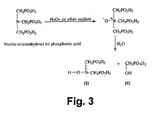
- the product shown in Fig. 2 may be reduced by the addition of an oxidant, such as hydrogen peroxide, to the nitrilo tris (methylene) tri phosphonic acid to produce the intermediates (3) and (4) shown in Fig. 3 , both of which have OH bonds to contact the poly(vinyl alcohol).
- the proton exchange membrane comprises a poly(vinyl alcohol) backbone cross-linked with glyoxal and nitrilo tris (methylene) tri phosphonic acid and may be reduced by an oxidant.
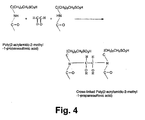
- the poly(vinyl alcohol) backbone is cross-linked with poly(2-acrylamido-2-methyl-1-propanesulfonic acid) and glyoxal in accordance with the reaction shown in Fig. 4 .
- This reaction is desirable for providing proton conductivity to the membrane.
- the first of hese three embodiments not forming part of the invention but represent background art that is useful for understanding the invention is the combination of the products of Figs. 1 and 3 , namely poly(vinyl alcohol) cross-linked with glyoxal and the intermediates resulting from the reduction of nitrilo tris (methylene) tri phosphonic acid with an oxidant
- the second shown embodiment is poly(vinyl alcohol) cross-linked with glyoxal, the intermediates resulting from the reduction of nitrilo tris (methylene) tri phosphonic acid with an oxidant, and poly(2-acrylamido-2-methyl-1-propanesulfonic acid).
- Each of these two embodiments is proton conductive at elevated temperatures due to the phosphonic group, which provides more freedom for the protons in the membranes.
- the third embodiment of the above-mentioned three embodiments is a proton exchange membrane comprising poly(vinyl alcohol) cross-linked with glyoxal and poly(2-acrylamido-2-methyl-1-propanesulfonic acid).
- This membrane is proton conductive so long as the membrane is wet, that is so long as the fuel cell is operating at a temperature below 100°C.
- Fig. 5 shows the use of phosphoric acid for the polymerization of phosphonic acid and the formation of a hydrogen bond between the phosphonic acid and phosphoric acid in the PVA chain.
- This polymer enables the fuel cell to operate from room temperature to about 170°C.
- the use of PVEA renders the membrane mechanically stronger than membranes using PVA.
- the mixture of PVA and PVEA improves both physical and mechanical membrane properties.
- the following reactants are employed to produce a proton exchange membrane : Poly(vinyl alcohol) (5% aqueous solution) 50.0 g Nitrilo tris (methylene) tri phosphonic acid (50% aqueous solution) 5.0 g Hydrogen peroxide (3% aqueous solution) 20.0 g Glyoxal (40% aqueous solution) 3.0 g 50.0 g of 5% solution of poly(vinyl alcohol) and 5.0 g of nitrilo tris (methylene) tri phosphonic acid are weighed in a reaction flask and stirred for 10 minutes.
- the reaction flask is a 500 ml 3-neck round bottom flask fitted with a mechanical stirrer, condenser and nitrogen inlet. Hydrogen peroxide solution is then added to the flask and stirred for one hour. The temperature is raised to 140°C after which glyoxal is added. The reactants are allowed to react for an additional hour. Thereafter, the resulting solution is cooled and filtered after which the membranes are cast on a glass plate. The membranes are allowed to dry overnight and then they are placed in an oven at 90°C to cure. During the curing process, water solubility of the membranes is monitored. When the membranes are no longer water soluble, they are removed from the oven.
- the membrane is prepared as set forth in Example 1 with the exception that 0.3 g of phosphorus pentoxide are used in place of the hydrogen peroxide and with the further exception that the reactions are carried out at a temperature of about 100°C instead of 140°C.
- phosphorus pentoxide By replacing hydrogen peroxide with phosphorus pentoxide, it is believed that when the phosphorus pentoxide reacts with water, phosphoric acid will be produced, which, in turn, will embed in the membrane, resulting in an increase in proton conductivity.
- the membrane in this example is produced by mixing a measured amount of poly(vinyl alcohol), nitrilo tris (methylene) tri phosphonic acid and poly(2-acrylamido-2-methyl-1-propanesulfonic acid) in a 3-necked flask fitted with a condenser, mechanical stirrer and nitrogen inlet for 10 minutes, adding the oxidant phosphorus pentoxide and mixing for an additional hour.
- the reactants are heated to 90°C after which glyoxal is added.
- the reactants are then heated for an additional 11 ⁇ 2 hours.
- the resulting solution is cooled and filtered.
- the membrane is then cast on a TEFLON substrate and dried at room temperature overnight. The dried membrane is then cured in an oven at a temperature in the range of about 90-100°C until the membrane is insoluble in water, at which point it is then removed from the oven.
- the membrane is produced in accordance with the procedure of Example 3 except that 10.0 g of 3% hydrogen peroxide solution are used as an oxidant in place of the phosphorus pentoxide.
- nitrilo tris (methylene) tri phosphonic acid, sulfoacetic acid and phosphoric acid are added to a PEVOH solution, followed by stirring to prepare a casting solution.
- the casting solution is then cast onto a PTFE substrate using a glass rod.
- the solution is evaporated at room temperature and then in an oven at 80°C for 11 ⁇ 2 hours.
- the resulting membrane is heat treated at about 120°C for about 1 hour.
- the resulting membrane comprises both sulfonic acid and phosphonic acid groups that make the membrane proton conducting.
- phosphono acetic acid, sulfosuccinic acid and phosphoric acid are added to a PEVOH solution, followed by stirring to prepare a casting solution.
- the casting solution is then cast onto a PTFE substrate using a glass rod.
- the solution is evaporated at room temperature and then in an oven at 80°C for 11 ⁇ 2 hours.
- the resulting membrane is heat treated at about 120°C for about 1 hour.
- the resulting membrane comprises both sulfonic acid and phosphonic acid groups that make the membrane proton conducting.
Landscapes
- Chemical & Material Sciences (AREA)
- Engineering & Computer Science (AREA)
- Manufacturing & Machinery (AREA)
- General Chemical & Material Sciences (AREA)
- Sustainable Energy (AREA)
- Sustainable Development (AREA)
- Life Sciences & Earth Sciences (AREA)
- Chemical Kinetics & Catalysis (AREA)
- Electrochemistry (AREA)
- Dispersion Chemistry (AREA)
- Crystallography & Structural Chemistry (AREA)
- Fuel Cell (AREA)
- Manufacture Of Macromolecular Shaped Articles (AREA)
Description
- This invention relates to an apparatus for generating electricity comprising: an anode electrode; a cathode electrode and a proton exchange membrane. More particularly, this invention relates to proton exchange membranes suitable for use in proton exchange membrane fuel cells operating at temperatures ranging from about room temperature to about 170°C.
- A fuel cell is an electrochemical device in which the chemical energy of a reaction between a fuel and an oxidant is converted directly into electricity. The basic fuel cell unit comprises an electrolyte layer in contact with a porous anode and cathode on either side. In a typical fuel cell, a gaseous or liquid fuel is continuously fed to the anode electrode, sometimes referred to as the fuel electrode, and an oxidant, such as oxygen from air, is continuously fed to the cathode electrode, sometimes referred to as the air electrode, and electrochemical reactions occur at the electrodes to produce an electric current. Due to the limited electricity generating capacity of individual fuel cell units, a plurality of fuel cell units are typically stacked one on top of another with a bipolar separator plate separating the fuel cell units between the anode electrode of one fuel cell unit and the cathode electrode of an adjacent fuel cell unit.
- There are a number of different fuel cell types which are classified based upon a variety of categories including the combination of type of fuel and oxidant, whether the fuel is processed external to or inside the fuel cell, the type of electrolyte, e.g. solid oxides, phosphoric acid, molten carbonate and proton exchange membranes, the temperature of operation and whether the reactants are provided to the fuel cell by internal or external manifolds.
- This invention relates to proton exchange membrane fuel cells, also sometimes referred to as polymer electrolyte membrane fuel cells. In a proton exchange membrane fuel cell, the electrolyte is a proton conducting membrane sandwiched between two porous electrodes. The backs of the electrodes are made hydrophobic by coating with an appropriate compound, such as TEFLON®. Proton conducting membranes conventionally used in proton exchange membrane fuel cells are made of a perfluorinated sulfonic acid polymer, an example of which is sold under the brand name NAFION® by DuPont. NAFION membranes, which are fully fluorinated polymers, have exceptionally high chemical and thermal stability and are stable against chemical attack in strong bases, strong oxidizing and reducing acids, H2O2, Cl2, H2 and O2 at temperatures up to about 100°C. NAFION consists of a fluoropolymer backbone upon which sulfonic acid groups are chemically bonded. However, although an exceptional performer, NAFION is an expensive material and makes proton exchange membrane fuel cells economically unattractive in most applications. Much of the cost of NAFION is due to two factors: the use of fluorine and the very severe reaction conditions needed to prepare the polymer.
- The proton exchange membrane fuel cell is suitable for a wide range of power generating applications including vehicular applications. The proton exchange membrane fuel cell system for automobile applications requires operation at temperatures in excess of about 100°C to reduce the size of radiators, increase fuel efficiency and provide better water and heat management. At the present time, the most common high temperature proton exchange membranes for fuel cells are inorganic metal oxide-doped NAFION and phosphoric acid doped polybenzimidazole (PBI) and its derivatives. In the metal oxide-doped NAFION membrane, the metal oxide is used to retain water within the membrane at elevated temperatures, thereby maintaining the membrane proton conductive. In the PBI membrane, the phosphoric acid is proton conductive at 120°C to 160°C. However, these two types of membranes do not exhibit promising performance and lifetimes under fuel cell operating conditions. In the metal oxide-doped NAFION membrane, the inorganic metal oxide leaches out over time due to the absence of a stable bond between the inorganic species and the binding membrane. Similarly, in the PBI membrane, the phosphoric acid departs from the membrane with product water in the fuel cell because the phosphoric acid and the imine group in the PBI membrane are only weakly bonded. In the proton exchange membrane fuel cell, the membrane is required to operate under a wide range of temperatures from about room temperature to about 170°C so that the fuel cell can both cool-start and operate at high temperature conditions.
- Accordingly, the challenge is to find lower cost membranes having the desired properties for use as a proton conductor in proton exchange membrane fuel cells. Some of these properties include mechanically stable and durable film behavior in the cell-operating environment with long lifetimes, hydrophilicity for high conductivity and water insolubility. Low cost membranes in the form of sulfonated polystyrene membranes have been applied to proton exchange membrane fuel cells. However, these membranes can only be used at temperatures of less than about 100°C. Membranes capable of operating at higher temperatures, about 120°C to about 170°C, have the advantages of enhanced CO tolerance, which enables simplification of the entire fuel cell system; improved cathode reaction kinetics, which enables the use of higher stack power densities; and reduced heat exchanger requirements. However, the stability of high temperature membranes is still problematic.
- From
US-3265536 a fuel cell comprising a proton exchange membrane comprising polyvinyl alcohol crosslinked by glyoxal is known. FurtherUS-4357402 discloses a membrane material for battery separators, made of polyvinyl alcohol resin crosslinked with an agent of dialdehyde. A composite polymer membrane with proton conductivity properties made of a mixed solution of polyvinyl alcohol and a sulfonati and a crosslinking agent is disclosed inEP 1085051 - It is, thus, one object of this invention to provide a low cost proton conducting membrane suitable for use in proton exchange membrane fuel cells.
- It is one object of this invention to provide a proton conducting membrane for a proton exchange membrane fuel cell which is capable of operating over the entire temperature range from about room temperature to about 170°C.
- It is another object of this invention to provide a proton conducting membrane for a proton exchange membrane fuel cell which is mechanically and chemical stable and durable under fuel cell operating conditions.
- It is another object of this invention to provide a proton conducting membrane for use in proton exchange membrane fuel cells having high conductivity.
- These and other objects of this invention are addressed in an apparatus for generating electricity comprising an anode electrode and a cathode electrode by a composite proton exchange membrane in accordance with
claim 1. The membranes are both hydrophilic and stable in water as well as under fuel cell operating conditions. In addition, in those membranes employing phosphonic acid and propanesulfonic acid, the phosphonic acid and sulfonic acid groups are proton conductive when water is present. The phosphonic acid is polymerized using phosphoric acid and forms a hydrogen bond with phosphoric acid, which can be used in a fuel cell operating at temperatures in the range of about 120°C to about 170°C. The polymerized phosphoric acid cross-linked in the poly(vinyl alcohol) and/or poly(vinyl ethylene alcohol) is stable under humidified fuel cell operating conditions and unhumidified high temperature fuel cell operating conditions. - These and other objects and features of this invention will be better understood from the following detailed description taken in conjunction with the drawings, wherein:
-
Fig. 1 is a drawing showing the reactions for producing a proton exchange membrane comprising glyoxal as a cross-linking agent in accordance with one embodiment of this invention; -
Fig. 2 is a drawing showing the reactions for producing a proton exchange membrane comprising nitrilo tris (methylene) tri phosphonic acid as a cross-linking agent in accordance with one embodiment of this invention; -
Fig. 3 is a drawing showing reactions for producing additional elements of the proton exchange membrane comprising nitrilo tris (methylene) tri phosphonic acid in accordance with one embodiment of this invention; -
Fig. 4 is a drawing showing the reactions for producing a proton exchange membrane comprising poly(2-acrylamido-2-methyl-1-propanesulfonic acid) in accordance with one embodiment of this invention; and -
Fig. 5 is a drawing showing (a) the polymerization of phosphonic acid using phosphoric acid and (b) the formation of hydrogen bonds between phosphonic acid and phosphoric acid. - The invention disclosed herein is directed to a proton exchange membrane fuel cell comprising an anode electrode, a cathode electrode and an electrolyte disposed between the anode electrode and the cathode electrode. The electrolyte is a composite proton exchange membrane comprising a backbone structure comprising poly(vinyl alcohol) and is suitable for use over the range of fuel cell operating temperatures from about room temperature to about 170°C. The membrane further comprises at least one cross-linking agent, preferably glyoxal.
Fig. 1 is a diagram showing the basic reaction between poly(vinyl alcohol) and the cross-linking agent glyoxal, which produces the cross-linked poly(vinyl alcohol) membrane. This is an inter-molecular cross-link. - In addition to glyoxal, nitrilo tris (methylene) tri phosphonic acid is used as a cross-linking agent in accordance with this invention. The product from cross-linking the poly(vinyl alcohol) backbone structure with nitrilo tris (methylene) tri phosphonic acid is shown in
Fig. 2 . This product consumes OH bonds from the phosphonic acid and, thus, does not provide the membrane with the full extent of desired proton conductivity. However the product shown inFig. 2 may be reduced by the addition of an oxidant, such as hydrogen peroxide, to the nitrilo tris (methylene) tri phosphonic acid to produce the intermediates (3) and (4) shown inFig. 3 , both of which have OH bonds to contact the poly(vinyl alcohol). - The proton exchange membrane comprises a poly(vinyl alcohol) backbone cross-linked with glyoxal and nitrilo tris (methylene) tri phosphonic acid and may be reduced by an oxidant.
- In accordance with this invention, the poly(vinyl alcohol) backbone is cross-linked with poly(2-acrylamido-2-methyl-1-propanesulfonic acid) and glyoxal in accordance with the reaction shown in
Fig. 4 . This reaction is desirable for providing proton conductivity to the membrane. - From the reactions shown in
Figs. 1-4 , there are three embodiments of the proton exchange membrane achieved. In all three of these embodiments, the acids in these composite membranes are stable because there is a strong bond between the acids and the poly(vinyl alcohol) membrane backbone. - The first of hese three embodiments not forming part of the invention but represent background art that is useful for understanding the invention is the combination of the products of
Figs. 1 and3 , namely poly(vinyl alcohol) cross-linked with glyoxal and the intermediates resulting from the reduction of nitrilo tris (methylene) tri phosphonic acid with an oxidant The second shown embodiment is poly(vinyl alcohol) cross-linked with glyoxal, the intermediates resulting from the reduction of nitrilo tris (methylene) tri phosphonic acid with an oxidant, and poly(2-acrylamido-2-methyl-1-propanesulfonic acid). Each of these two embodiments is proton conductive at elevated temperatures due to the phosphonic group, which provides more freedom for the protons in the membranes. - The third embodiment of the above-mentioned three embodiments is a proton exchange membrane comprising poly(vinyl alcohol) cross-linked with glyoxal and poly(2-acrylamido-2-methyl-1-propanesulfonic acid). This membrane is proton conductive so long as the membrane is wet, that is so long as the fuel cell is operating at a temperature below 100°C.
-
Fig. 5 shows the use of phosphoric acid for the polymerization of phosphonic acid and the formation of a hydrogen bond between the phosphonic acid and phosphoric acid in the PVA chain. This polymer enables the fuel cell to operate from room temperature to about 170°C. The use of PVEA renders the membrane mechanically stronger than membranes using PVA. However, the mixture of PVA and PVEA improves both physical and mechanical membrane properties. - In this example, the following reactants are employed to produce a proton exchange membrane :
Poly(vinyl alcohol) (5% aqueous solution) 50.0 g Nitrilo tris (methylene) tri phosphonic acid (50% aqueous solution) 5.0 g Hydrogen peroxide (3% aqueous solution) 20.0 g Glyoxal (40% aqueous solution) 3.0 g - In this example, the membrane is prepared as set forth in Example 1 with the exception that 0.3 g of phosphorus pentoxide are used in place of the hydrogen peroxide and with the further exception that the reactions are carried out at a temperature of about 100°C instead of 140°C. By replacing hydrogen peroxide with phosphorus pentoxide, it is believed that when the phosphorus pentoxide reacts with water, phosphoric acid will be produced, which, in turn, will embed in the membrane, resulting in an increase in proton conductivity.
- In this example, in addition to the reactants of Example 2, 2.0 g of a 5% aqueous solution of poly(2-acrylamido-2-methyl-1-propanesulfonic acid) is employed as an additional cross-linking agent. The rationale for adding this polymer as a cross-linking agent is that it contains a sulfonic acid group, which, when combined with the phosphonic acid, we have found provides a substantial improvement in proton conductivity as well as better membrane performance. The membrane in this example is produced by mixing a measured amount of poly(vinyl alcohol), nitrilo tris (methylene) tri phosphonic acid and poly(2-acrylamido-2-methyl-1-propanesulfonic acid) in a 3-necked flask fitted with a condenser, mechanical stirrer and nitrogen inlet for 10 minutes, adding the oxidant phosphorus pentoxide and mixing for an additional hour. The reactants are heated to 90°C after which glyoxal is added. The reactants are then heated for an additional 1½ hours. The resulting solution is cooled and filtered. The membrane is then cast on a TEFLON substrate and dried at room temperature overnight. The dried membrane is then cured in an oven at a temperature in the range of about 90-100°C until the membrane is insoluble in water, at which point it is then removed from the oven.
- In this example, the membrane is produced in accordance with the procedure of Example 3 except that 10.0 g of 3% hydrogen peroxide solution are used as an oxidant in place of the phosphorus pentoxide.
- In this example, the following reactants are employed to produce a proton exchange membrane
Poly(vinyl alcohol co polyethylene) (10% solution in formic acid) Nitrilo tris (methylene) tri phosphonic acid 40.0 g (10% solution in formic acid) 18.0 g Sulfoacetic acid 0.34 g Phosphoric acid (85% aqueous solution) 1.0 g - In this example, nitrilo tris (methylene) tri phosphonic acid, sulfoacetic acid and phosphoric acid are added to a PEVOH solution, followed by stirring to prepare a casting solution. The casting solution is then cast onto a PTFE substrate using a glass rod. The solution is evaporated at room temperature and then in an oven at 80°C for 1½ hours. For conducting the sulfonation and cross-linking process, the resulting membrane is heat treated at about 120°C for about 1 hour. The resulting membrane comprises both sulfonic acid and phosphonic acid groups that make the membrane proton conducting.
- In this example, the following reactants are employed to produce a proton exchange membrane
Poly(vinyl alcohol) (5% solution in deionized water) 80.0 g Phosphono acetic acid 1.27 g Sulfosuccinic acid (70% aqueous solution) 4.60 g Phosphoric acid (85% aqueous solution) 1.13 g - In this example, phosphono acetic acid, sulfosuccinic acid and phosphoric acid are added to a PEVOH solution, followed by stirring to prepare a casting solution. The casting solution is then cast onto a PTFE substrate using a glass rod. The solution is evaporated at room temperature and then in an oven at 80°C for 1½ hours. For conducting the sulfonation and cross-linking process, the resulting membrane is heat treated at about 120°C for about 1 hour. The resulting membrane comprises both sulfonic acid and phosphonic acid groups that make the membrane proton conducting.
Claims (4)
- An apparatus for generating electricity comprising:an anode electrode;a cathode electrode; anda proton exchange membrane disposed between said anode electrode and said cathode electrode, said proton exchange membrane comprising at least one of poly(vinyl alcohol) and poly(vinyl ethylene alcohol) and a plurality of cross-linking agents, one of said cross-linking agents comprising glyoxal and another of said cross-linking agents comprising at least one phosphonic acid group and/or at least one sulfonic acid group,
wherein said at least one phosphonic acid group is selected from the group consisting of nitrilo tris (methylene)triphosphonic acid, phosphono acetic acid and combinations thereof and said at least one sulfonic acid group is selected from the group consisting of poly(2-acrylamido-2-methyl-1-propanesulfonic acid, sulfosuccinic acid, sulfoacetic acid, and combinations thereof. - An apparatus in accordance with claim 1, wherein said proton exchange membrane comprises nitrilo tris (methylene)tri phosphonic acid modified by a suitable oxidant.
- An apparatus in accordance with claim 2, wherein said oxidant is hydrogen peroxide.
- An apparatus in accordance with claim 1, wherein said proton exchange membrane comprises polymerized phosphonic acid and at least one hydrogen bond between said phosphonic acid and phosphonic acid.
Applications Claiming Priority (5)
| Application Number | Priority Date | Filing Date | Title |
|---|---|---|---|
| US44592703P | 2003-02-07 | 2003-02-07 | |
| US445927P | 2003-02-07 | ||
| US10/430,476 US7115333B2 (en) | 2003-02-07 | 2003-05-06 | High temperature composite proton exchange membranes |
| US430476 | 2003-05-06 | ||
| PCT/US2004/002948 WO2004073085A2 (en) | 2003-02-07 | 2004-02-03 | High temperature composite proton exchange membranes |
Publications (2)
| Publication Number | Publication Date |
|---|---|
| EP1597789A2 EP1597789A2 (en) | 2005-11-23 |
| EP1597789B1 true EP1597789B1 (en) | 2013-01-16 |
Family
ID=32829641
Family Applications (1)
| Application Number | Title | Priority Date | Filing Date |
|---|---|---|---|
| EP04707735A Expired - Lifetime EP1597789B1 (en) | 2003-02-07 | 2004-02-03 | High temperature composite proton exchange membranes |
Country Status (3)
| Country | Link |
|---|---|
| US (1) | US7115333B2 (en) |
| EP (1) | EP1597789B1 (en) |
| WO (1) | WO2004073085A2 (en) |
Families Citing this family (11)
| Publication number | Priority date | Publication date | Assignee | Title |
|---|---|---|---|---|
| KR100536257B1 (en) * | 2004-06-29 | 2005-12-12 | 삼성에스디아이 주식회사 | Membrane/electrode assembly for fuel cell and fuel cell comprising same |
| US20060078783A1 (en) * | 2004-10-07 | 2006-04-13 | Alexander Bluvstein | Gas blocking anode for a direct liquid fuel cell |
| US20060147789A1 (en) * | 2004-10-07 | 2006-07-06 | More Energy Ltd., | Gas blocking anode for a direct liquid fuel cell |
| RU2321104C2 (en) * | 2004-12-02 | 2008-03-27 | Оксис Энерджи Лимитед | Electrolyte for lithium-sulfur batteries and lithium-sulfur batteries using this electrolyte |
| US20070154774A1 (en) * | 2006-01-05 | 2007-07-05 | More Energy Ltd. | Hydrophilized anode for a direct liquid fuel cell |
| CA2697891C (en) * | 2007-08-29 | 2015-06-09 | Council Of Scientific & Industrial Research | Proton conducting polymer electrolyte membrane useful in polymer electrolyte fuel cells |
| JP5557430B2 (en) * | 2008-04-11 | 2014-07-23 | 日東電工株式会社 | PROTON CONDUCTIVE POLYMER ELECTROLYTE MEMBRANE, PROCESS FOR PRODUCING THE SAME, MEMBRANE-ELECTRODE ASSEMBLY USING THE SAME, AND POLYMER ELECTROLYTE FUEL CELL |
| EP2131433A1 (en) * | 2008-06-05 | 2009-12-09 | Reinz-Dichtungs-Gmbh | Electrochemical cell and method for its manufacturing |
| US9074290B2 (en) | 2012-07-31 | 2015-07-07 | Gas Technology Institute | Bipolar ion exchange membranes for batteries and other electrochemical devices |
| WO2017126081A1 (en) * | 2016-01-21 | 2017-07-27 | 日新電機 株式会社 | Redox flow battery |
| CN119133543B (en) * | 2024-11-12 | 2025-03-07 | 浙江德创环保科技股份有限公司 | High-temperature proton exchange membrane based on basic group grafted polyvinyl alcohol and preparation method thereof |
Family Cites Families (14)
| Publication number | Priority date | Publication date | Assignee | Title |
|---|---|---|---|---|
| US3265536A (en) | 1962-12-11 | 1966-08-09 | American Cyanamid Co | Alkali saturated cross-linked polyvinyl alcohol membranes and fuel cell with same |
| FR1583089A (en) | 1968-07-18 | 1969-10-17 | ||
| FR2384357A1 (en) * | 1977-03-16 | 1978-10-13 | Comp Generale Electricite | ZINC ELECTROCHEMICAL GENERATOR |
| US4664761A (en) | 1985-12-27 | 1987-05-12 | Uop Inc. | Electrochemical method and apparatus using proton-conducting polymers |
| CA2085549A1 (en) | 1991-12-25 | 1993-06-26 | Noboru Nakano | Fuel cell and electrolyte membrane therefor |
| JPH0676838A (en) | 1992-06-25 | 1994-03-18 | Aqueous Res:Kk | Ion exchange membrane fuel cell and its manufacture |
| US5460896A (en) | 1993-01-22 | 1995-10-24 | Kabushiki Kaisha Equos Research | Fuel cell |
| US5643689A (en) | 1996-08-28 | 1997-07-01 | E.C.R.-Electro-Chemical Research Ltd. | Non-liquid proton conductors for use in electrochemical systems under ambient conditions |
| CA2333277A1 (en) | 1999-03-23 | 2000-09-28 | Nisshinbo Industries, Inc. | Ion-conductive solid polymer-forming composition and ion-conductive solid polymer electrolyte, binder resin and secondary cell |
| US6523699B1 (en) | 1999-09-20 | 2003-02-25 | Honda Giken Kogyo Kabushiki Kaisha | Sulfonic acid group-containing polyvinyl alcohol, solid polymer electrolyte, composite polymer membrane, method for producing the same and electrode |
| US20020155341A1 (en) * | 2001-04-19 | 2002-10-24 | More Energy Ltd. | Self-managing electrochemical fuel cell and fuel cell anode |
| WO2003062493A1 (en) * | 2002-01-23 | 2003-07-31 | Polyfuel, Inc. | Acid-base proton conducting polymer blend membrane |
| DE10209419A1 (en) | 2002-03-05 | 2003-09-25 | Celanese Ventures Gmbh | Process for producing a polymer electrolyte membrane and its use in fuel cells |
| CN1202583C (en) * | 2002-05-09 | 2005-05-18 | 华南理工大学 | Composite type proteon exchange film for high-temp. direct methanol fue cell and preparation process thereof |
-
2003
- 2003-05-06 US US10/430,476 patent/US7115333B2/en not_active Expired - Lifetime
-
2004
- 2004-02-03 EP EP04707735A patent/EP1597789B1/en not_active Expired - Lifetime
- 2004-02-03 WO PCT/US2004/002948 patent/WO2004073085A2/en not_active Ceased
Also Published As
| Publication number | Publication date |
|---|---|
| US20040157131A1 (en) | 2004-08-12 |
| WO2004073085A2 (en) | 2004-08-26 |
| US7115333B2 (en) | 2006-10-03 |
| EP1597789A2 (en) | 2005-11-23 |
| WO2004073085A3 (en) | 2005-08-11 |
Similar Documents
| Publication | Publication Date | Title |
|---|---|---|
| Mader et al. | Polybenzimidazole/acid complexes as high-temperature membranes | |
| CN1974639B (en) | Polymer electrolyte membrane for fuel cell and fuel cell system | |
| US20100183941A1 (en) | Assembly of membrane, electrode, gas diffusion layer and gasket, method for producing the same, and solid polymer fuel cell | |
| KR100370399B1 (en) | Partially fluorinated copolymer based on trifluorostyrene and substituted vinyl compound and ion conductive polymer layer formed therefrom | |
| JP2007224304A (en) | Crosslinkable sulfonated copolymer and production method thereof, cured product of crosslinkable sulfonated copolymer and production method thereof, polymer electrolyte membrane, membrane electrode assembly, and fuel cell | |
| CN1729590A (en) | Membrane electrode elements, polymer membranes for membrane electrode elements and polymer membrane electrolyte fuel cells and methods of manufacturing them | |
| KR100723389B1 (en) | Polymer electrolyte membrane and fuel cell employing same | |
| US7115333B2 (en) | High temperature composite proton exchange membranes | |
| KR101569719B1 (en) | Crosslinked hydrocarbon polymer electrolyte membranes with diols by radiation and manufacturing method thereof | |
| WO2023183720A2 (en) | Well defined quaternary ammonium functionalized quaterphenylene polymer derivatives for low and high temperature polymer electrolyte membrane fuel cells | |
| WO2009125636A1 (en) | Proton conductive polymer electrolyte membrane, process for producing the proton conductive polymer electrolyte membrane, and membrane-electrode assembly and polymer electrolyte fuel cell using the proton conductive polymer electrolyte membrane | |
| KR101926169B1 (en) | Sulfonated cellulose, proton conducting polymer membranes using the same, and polymer electrolyte membrane fuel cell having proton conducting polymer membranes | |
| US20060159975A1 (en) | Polymer electrolyte and fuel cell using the same | |
| KR101085358B1 (en) | Hydrocarbon-based polymer membrane comprising a silane compound, a manufacturing method thereof, a membrane-electrode assembly and a fuel cell comprising the same | |
| KR100506096B1 (en) | Polymer comprising terminal sulfonic acid group, and polymer electrolyte and fuel cell using the same | |
| KR100776911B1 (en) | Novel metal?-chromium-phosphate complex and use thereof | |
| KR20080017422A (en) | Polymer electrolyte membrane having improved dimensional stability | |
| KR20070083044A (en) | A multi-block copolymer, a method for manufacturing the same, a polymer electrolyte membrane prepared from the multi-block copolymer, a method for manufacturing the same, and a fuel cell including the polymer electrolyte membrane | |
| KR100889768B1 (en) | Proton conductive polymer composition, polymer membrane using the polymer composition and fuel cell using the same | |
| KR20070080668A (en) | Composite Polymer Electrolyte Membrane, Manufacturing Method Thereof and Fuel Cell Employing the Electrolyte Membrane | |
| US20070087246A1 (en) | Materials and methods for making proton exchange polymers, polymer membranes, membrane-electrode assemblies and fuel cells | |
| KR100900515B1 (en) | Graft Polymer Membrane, Manufacturing Method of Polymer Electrolyte Membrane Using the Same and Polymer Fuel Cell for High Temperature Operation | |
| KR100637211B1 (en) | Polymer electrolyte and fuel cell using the same | |
| KR102546869B1 (en) | Method for manufacturing the membrane, the membrane, membrane-electorode assembly and the fuel cell comprising the same | |
| KR102728980B1 (en) | Ion transport polymer, method for preparing the same and electrolyte membrane comprising the same |
Legal Events
| Date | Code | Title | Description |
|---|---|---|---|
| PUAI | Public reference made under article 153(3) epc to a published international application that has entered the european phase |
Free format text: ORIGINAL CODE: 0009012 |
|
| 17P | Request for examination filed |
Effective date: 20050826 |
|
| AK | Designated contracting states |
Kind code of ref document: A2 Designated state(s): AT BE BG CH CY CZ DE DK EE ES FI FR GB GR HU IE IT LI LU MC NL PT RO SE SI SK TR |
|
| AX | Request for extension of the european patent |
Extension state: AL LT LV MK |
|
| DAX | Request for extension of the european patent (deleted) | ||
| 17Q | First examination report despatched |
Effective date: 20060714 |
|
| GRAP | Despatch of communication of intention to grant a patent |
Free format text: ORIGINAL CODE: EPIDOSNIGR1 |
|
| GRAS | Grant fee paid |
Free format text: ORIGINAL CODE: EPIDOSNIGR3 |
|
| GRAA | (expected) grant |
Free format text: ORIGINAL CODE: 0009210 |
|
| AK | Designated contracting states |
Kind code of ref document: B1 Designated state(s): AT BE BG CH CY CZ DE DK EE ES FI FR GB GR HU IE IT LI LU MC NL PT RO SE SI SK TR |
|
| REG | Reference to a national code |
Ref country code: GB Ref legal event code: FG4D |
|
| REG | Reference to a national code |
Ref country code: CH Ref legal event code: EP |
|
| REG | Reference to a national code |
Ref country code: IE Ref legal event code: FG4D |
|
| REG | Reference to a national code |
Ref country code: CH Ref legal event code: EP Ref country code: AT Ref legal event code: REF Ref document number: 594320 Country of ref document: AT Kind code of ref document: T Effective date: 20130215 |
|
| REG | Reference to a national code |
Ref country code: DE Ref legal event code: R096 Ref document number: 602004040782 Country of ref document: DE Effective date: 20130314 |
|
| REG | Reference to a national code |
Ref country code: AT Ref legal event code: MK05 Ref document number: 594320 Country of ref document: AT Kind code of ref document: T Effective date: 20130116 |
|
| REG | Reference to a national code |
Ref country code: NL Ref legal event code: VDEP Effective date: 20130116 |
|
| PG25 | Lapsed in a contracting state [announced via postgrant information from national office to epo] |
Ref country code: BE Free format text: LAPSE BECAUSE OF FAILURE TO SUBMIT A TRANSLATION OF THE DESCRIPTION OR TO PAY THE FEE WITHIN THE PRESCRIBED TIME-LIMIT Effective date: 20130116 Ref country code: CY Free format text: LAPSE BECAUSE OF FAILURE TO SUBMIT A TRANSLATION OF THE DESCRIPTION OR TO PAY THE FEE WITHIN THE PRESCRIBED TIME-LIMIT Effective date: 20130116 Ref country code: AT Free format text: LAPSE BECAUSE OF FAILURE TO SUBMIT A TRANSLATION OF THE DESCRIPTION OR TO PAY THE FEE WITHIN THE PRESCRIBED TIME-LIMIT Effective date: 20130116 Ref country code: BG Free format text: LAPSE BECAUSE OF FAILURE TO SUBMIT A TRANSLATION OF THE DESCRIPTION OR TO PAY THE FEE WITHIN THE PRESCRIBED TIME-LIMIT Effective date: 20130416 Ref country code: ES Free format text: LAPSE BECAUSE OF FAILURE TO SUBMIT A TRANSLATION OF THE DESCRIPTION OR TO PAY THE FEE WITHIN THE PRESCRIBED TIME-LIMIT Effective date: 20130427 Ref country code: SE Free format text: LAPSE BECAUSE OF FAILURE TO SUBMIT A TRANSLATION OF THE DESCRIPTION OR TO PAY THE FEE WITHIN THE PRESCRIBED TIME-LIMIT Effective date: 20130116 |
|
| PG25 | Lapsed in a contracting state [announced via postgrant information from national office to epo] |
Ref country code: SI Free format text: LAPSE BECAUSE OF FAILURE TO SUBMIT A TRANSLATION OF THE DESCRIPTION OR TO PAY THE FEE WITHIN THE PRESCRIBED TIME-LIMIT Effective date: 20130116 Ref country code: GR Free format text: LAPSE BECAUSE OF FAILURE TO SUBMIT A TRANSLATION OF THE DESCRIPTION OR TO PAY THE FEE WITHIN THE PRESCRIBED TIME-LIMIT Effective date: 20130417 Ref country code: PT Free format text: LAPSE BECAUSE OF FAILURE TO SUBMIT A TRANSLATION OF THE DESCRIPTION OR TO PAY THE FEE WITHIN THE PRESCRIBED TIME-LIMIT Effective date: 20130516 Ref country code: FI Free format text: LAPSE BECAUSE OF FAILURE TO SUBMIT A TRANSLATION OF THE DESCRIPTION OR TO PAY THE FEE WITHIN THE PRESCRIBED TIME-LIMIT Effective date: 20130116 Ref country code: NL Free format text: LAPSE BECAUSE OF FAILURE TO SUBMIT A TRANSLATION OF THE DESCRIPTION OR TO PAY THE FEE WITHIN THE PRESCRIBED TIME-LIMIT Effective date: 20130116 |
|
| PG25 | Lapsed in a contracting state [announced via postgrant information from national office to epo] |
Ref country code: MC Free format text: LAPSE BECAUSE OF NON-PAYMENT OF DUE FEES Effective date: 20130228 |
|
| REG | Reference to a national code |
Ref country code: CH Ref legal event code: PL |
|
| PG25 | Lapsed in a contracting state [announced via postgrant information from national office to epo] |
Ref country code: SK Free format text: LAPSE BECAUSE OF FAILURE TO SUBMIT A TRANSLATION OF THE DESCRIPTION OR TO PAY THE FEE WITHIN THE PRESCRIBED TIME-LIMIT Effective date: 20130116 Ref country code: RO Free format text: LAPSE BECAUSE OF FAILURE TO SUBMIT A TRANSLATION OF THE DESCRIPTION OR TO PAY THE FEE WITHIN THE PRESCRIBED TIME-LIMIT Effective date: 20130116 Ref country code: LI Free format text: LAPSE BECAUSE OF NON-PAYMENT OF DUE FEES Effective date: 20130228 Ref country code: CZ Free format text: LAPSE BECAUSE OF FAILURE TO SUBMIT A TRANSLATION OF THE DESCRIPTION OR TO PAY THE FEE WITHIN THE PRESCRIBED TIME-LIMIT Effective date: 20130116 Ref country code: EE Free format text: LAPSE BECAUSE OF FAILURE TO SUBMIT A TRANSLATION OF THE DESCRIPTION OR TO PAY THE FEE WITHIN THE PRESCRIBED TIME-LIMIT Effective date: 20130116 Ref country code: DK Free format text: LAPSE BECAUSE OF FAILURE TO SUBMIT A TRANSLATION OF THE DESCRIPTION OR TO PAY THE FEE WITHIN THE PRESCRIBED TIME-LIMIT Effective date: 20130116 Ref country code: CH Free format text: LAPSE BECAUSE OF NON-PAYMENT OF DUE FEES Effective date: 20130228 |
|
| PLBE | No opposition filed within time limit |
Free format text: ORIGINAL CODE: 0009261 |
|
| REG | Reference to a national code |
Ref country code: FR Ref legal event code: ST Effective date: 20131031 |
|
| STAA | Information on the status of an ep patent application or granted ep patent |
Free format text: STATUS: NO OPPOSITION FILED WITHIN TIME LIMIT |
|
| REG | Reference to a national code |
Ref country code: IE Ref legal event code: MM4A |
|
| REG | Reference to a national code |
Ref country code: DE Ref legal event code: R119 Ref document number: 602004040782 Country of ref document: DE Effective date: 20130903 |
|
| 26N | No opposition filed |
Effective date: 20131017 |
|
| GBPC | Gb: european patent ceased through non-payment of renewal fee |
Effective date: 20130416 |
|
| PG25 | Lapsed in a contracting state [announced via postgrant information from national office to epo] |
Ref country code: IT Free format text: LAPSE BECAUSE OF FAILURE TO SUBMIT A TRANSLATION OF THE DESCRIPTION OR TO PAY THE FEE WITHIN THE PRESCRIBED TIME-LIMIT Effective date: 20130116 |
|
| PG25 | Lapsed in a contracting state [announced via postgrant information from national office to epo] |
Ref country code: GB Free format text: LAPSE BECAUSE OF NON-PAYMENT OF DUE FEES Effective date: 20130416 Ref country code: DE Free format text: LAPSE BECAUSE OF NON-PAYMENT OF DUE FEES Effective date: 20130903 Ref country code: FR Free format text: LAPSE BECAUSE OF NON-PAYMENT OF DUE FEES Effective date: 20130318 Ref country code: IE Free format text: LAPSE BECAUSE OF NON-PAYMENT OF DUE FEES Effective date: 20130203 |
|
| PG25 | Lapsed in a contracting state [announced via postgrant information from national office to epo] |
Ref country code: TR Free format text: LAPSE BECAUSE OF FAILURE TO SUBMIT A TRANSLATION OF THE DESCRIPTION OR TO PAY THE FEE WITHIN THE PRESCRIBED TIME-LIMIT Effective date: 20130116 |
|
| PG25 | Lapsed in a contracting state [announced via postgrant information from national office to epo] |
Ref country code: LU Free format text: LAPSE BECAUSE OF NON-PAYMENT OF DUE FEES Effective date: 20130203 Ref country code: HU Free format text: LAPSE BECAUSE OF FAILURE TO SUBMIT A TRANSLATION OF THE DESCRIPTION OR TO PAY THE FEE WITHIN THE PRESCRIBED TIME-LIMIT; INVALID AB INITIO Effective date: 20040203 |