EP1595903A1 - Heat resistant aqueous polyurethane resin composition for artificial or synthetic leather, method or producing the same and leather-like sheet - Google Patents
Heat resistant aqueous polyurethane resin composition for artificial or synthetic leather, method or producing the same and leather-like sheet Download PDFInfo
- Publication number
- EP1595903A1 EP1595903A1 EP05252746A EP05252746A EP1595903A1 EP 1595903 A1 EP1595903 A1 EP 1595903A1 EP 05252746 A EP05252746 A EP 05252746A EP 05252746 A EP05252746 A EP 05252746A EP 1595903 A1 EP1595903 A1 EP 1595903A1
- Authority
- EP
- European Patent Office
- Prior art keywords
- polyurethane resin
- hindered amine
- compound
- isocyanate groups
- imino
- Prior art date
- Legal status (The legal status is an assumption and is not a legal conclusion. Google has not performed a legal analysis and makes no representation as to the accuracy of the status listed.)
- Granted
Links
Classifications
-
- C—CHEMISTRY; METALLURGY
- C08—ORGANIC MACROMOLECULAR COMPOUNDS; THEIR PREPARATION OR CHEMICAL WORKING-UP; COMPOSITIONS BASED THEREON
- C08G—MACROMOLECULAR COMPOUNDS OBTAINED OTHERWISE THAN BY REACTIONS ONLY INVOLVING UNSATURATED CARBON-TO-CARBON BONDS
- C08G18/00—Polymeric products of isocyanates or isothiocyanates
- C08G18/06—Polymeric products of isocyanates or isothiocyanates with compounds having active hydrogen
- C08G18/83—Chemically modified polymers
-
- C—CHEMISTRY; METALLURGY
- C08—ORGANIC MACROMOLECULAR COMPOUNDS; THEIR PREPARATION OR CHEMICAL WORKING-UP; COMPOSITIONS BASED THEREON
- C08G—MACROMOLECULAR COMPOUNDS OBTAINED OTHERWISE THAN BY REACTIONS ONLY INVOLVING UNSATURATED CARBON-TO-CARBON BONDS
- C08G18/00—Polymeric products of isocyanates or isothiocyanates
- C08G18/06—Polymeric products of isocyanates or isothiocyanates with compounds having active hydrogen
- C08G18/28—Polymeric products of isocyanates or isothiocyanates with compounds having active hydrogen characterised by the compounds used containing active hydrogen
- C08G18/65—Low-molecular-weight compounds having active hydrogen with high-molecular-weight compounds having active hydrogen
- C08G18/66—Compounds of groups C08G18/42, C08G18/48, or C08G18/52
- C08G18/6666—Compounds of group C08G18/48 or C08G18/52
- C08G18/667—Compounds of group C08G18/48 or C08G18/52 with compounds of group C08G18/32 or polyamines of C08G18/38
- C08G18/6674—Compounds of group C08G18/48 or C08G18/52 with compounds of group C08G18/32 or polyamines of C08G18/38 with compounds of group C08G18/3203
-
- C—CHEMISTRY; METALLURGY
- C08—ORGANIC MACROMOLECULAR COMPOUNDS; THEIR PREPARATION OR CHEMICAL WORKING-UP; COMPOSITIONS BASED THEREON
- C08G—MACROMOLECULAR COMPOUNDS OBTAINED OTHERWISE THAN BY REACTIONS ONLY INVOLVING UNSATURATED CARBON-TO-CARBON BONDS
- C08G18/00—Polymeric products of isocyanates or isothiocyanates
- C08G18/06—Polymeric products of isocyanates or isothiocyanates with compounds having active hydrogen
- C08G18/08—Processes
- C08G18/10—Prepolymer processes involving reaction of isocyanates or isothiocyanates with compounds having active hydrogen in a first reaction step
- C08G18/12—Prepolymer processes involving reaction of isocyanates or isothiocyanates with compounds having active hydrogen in a first reaction step using two or more compounds having active hydrogen in the first polymerisation step
-
- C—CHEMISTRY; METALLURGY
- C08—ORGANIC MACROMOLECULAR COMPOUNDS; THEIR PREPARATION OR CHEMICAL WORKING-UP; COMPOSITIONS BASED THEREON
- C08G—MACROMOLECULAR COMPOUNDS OBTAINED OTHERWISE THAN BY REACTIONS ONLY INVOLVING UNSATURATED CARBON-TO-CARBON BONDS
- C08G18/00—Polymeric products of isocyanates or isothiocyanates
- C08G18/06—Polymeric products of isocyanates or isothiocyanates with compounds having active hydrogen
- C08G18/28—Polymeric products of isocyanates or isothiocyanates with compounds having active hydrogen characterised by the compounds used containing active hydrogen
- C08G18/40—High-molecular-weight compounds
- C08G18/48—Polyethers
- C08G18/4804—Two or more polyethers of different physical or chemical nature
- C08G18/4808—Mixtures of two or more polyetherdiols
-
- C—CHEMISTRY; METALLURGY
- C08—ORGANIC MACROMOLECULAR COMPOUNDS; THEIR PREPARATION OR CHEMICAL WORKING-UP; COMPOSITIONS BASED THEREON
- C08G—MACROMOLECULAR COMPOUNDS OBTAINED OTHERWISE THAN BY REACTIONS ONLY INVOLVING UNSATURATED CARBON-TO-CARBON BONDS
- C08G18/00—Polymeric products of isocyanates or isothiocyanates
- C08G18/06—Polymeric products of isocyanates or isothiocyanates with compounds having active hydrogen
- C08G18/28—Polymeric products of isocyanates or isothiocyanates with compounds having active hydrogen characterised by the compounds used containing active hydrogen
- C08G18/40—High-molecular-weight compounds
- C08G18/48—Polyethers
- C08G18/4854—Polyethers containing oxyalkylene groups having four carbon atoms in the alkylene group
-
- C—CHEMISTRY; METALLURGY
- C08—ORGANIC MACROMOLECULAR COMPOUNDS; THEIR PREPARATION OR CHEMICAL WORKING-UP; COMPOSITIONS BASED THEREON
- C08L—COMPOSITIONS OF MACROMOLECULAR COMPOUNDS
- C08L75/00—Compositions of polyureas or polyurethanes; Compositions of derivatives of such polymers
- C08L75/04—Polyurethanes
-
- D—TEXTILES; PAPER
- D06—TREATMENT OF TEXTILES OR THE LIKE; LAUNDERING; FLEXIBLE MATERIALS NOT OTHERWISE PROVIDED FOR
- D06N—WALL, FLOOR, OR LIKE COVERING MATERIALS, e.g. LINOLEUM, OILCLOTH, ARTIFICIAL LEATHER, ROOFING FELT, CONSISTING OF A FIBROUS WEB COATED WITH A LAYER OF MACROMOLECULAR MATERIAL; FLEXIBLE SHEET MATERIAL NOT OTHERWISE PROVIDED FOR
- D06N3/00—Artificial leather, oilcloth or other material obtained by covering fibrous webs with macromolecular material, e.g. resins, rubber or derivatives thereof
- D06N3/12—Artificial leather, oilcloth or other material obtained by covering fibrous webs with macromolecular material, e.g. resins, rubber or derivatives thereof with macromolecular compounds obtained otherwise than by reactions only involving carbon-to-carbon unsaturated bonds, e.g. gelatine proteins
- D06N3/14—Artificial leather, oilcloth or other material obtained by covering fibrous webs with macromolecular material, e.g. resins, rubber or derivatives thereof with macromolecular compounds obtained otherwise than by reactions only involving carbon-to-carbon unsaturated bonds, e.g. gelatine proteins with polyurethanes
Definitions
- the present invention relates to a heat resistant aqueous polyurethane resin composition for artificial or synthetic leather, a method of producing the same and a leather-like sheet. More particularly, the present invention relates to a heat resistant aqueous polyurethane resin composition for artificial or synthetic leather, a method of producing the same and a leather-like sheet that does not cause desorption of a polyurethane resin in a dyeing treatment when used in a process of artificial or synthetic leather.
- untreated white cloth is of ten processed with resins, and then provided into a dyeing process.
- a dyeing process owing to the processing with high temperature and high pressure water, a phenomenon that resin deposited by the processing with resin desorbs from the processed cloth in a dyeing vessel is observed. It is known to cause problems that the desorbed resin (1) deposits onto and contaminates the interior of the dyeing vessel, and (2) re-adheres to the cloth to be processed to cause defective piece goods.
- the heat resistance may be improved and desorption of the resin may be suppressed in some degree by adding and mixing a low molecular weight hindered amine light stabilizer (HALS) to the resin used in the processing to enhance the heat resistance (see e.g. Japanese Patent No. 3166072).
- HALS low molecular weight hindered amine light stabilizer
- high molecular weight hindered amine light stabilizers are used.
- the present invention attained to solve the problems of prior art and the objective of the present invention is to provide a heat resistant aqueous polyurethane resin composition for artificial or synthetic leather, a method of producing the same and a leather-like sheet, which improve heat resistance of urethane resin to prevent from desorbing the stabilizer in the dyeing process and enable to substantially suppress vessel contamination and the frequency of occurrence of defective piece goods by introducing hindered amine stabilizers into polyurethane resin.
- the present invent ion prevents from solving out of the stabil i zer in the dyeing process and allows to have original heat resistance of the hindered amine stabilizers by introducing the hindered amine stabilizers into a molecular skeleton of polyurethane resin, so that the desorption of the urethane resin is prevented.
- the heat resistant aqueous polyurethane resin composition for artificial or synthetic leather of the present invention comprises a polyurethane resin obtained by introducing a hindered amine stabilizer into the molecular skeleton of the polyurethane resin by reacting the hindered amine stabilizer having imino groups and a compound having isocyanate groups.
- the compound having isocyanate groups may be a polyisocyanate compound or a urethane prepolymer.
- the heat resistant aqueous polyurethane resin composition for artificial or synthetic leather of another aspect of the present invention comprises a polyurethane resin obtained by introducing a hindered amine stabilizer into the molecular skeleton of the polyurethane resin by adding a compound having free isocyanate groups to a urethane prepolymer having isocyanate groups, emulsifying and elongating the molecular chain of the urethane prepolymer.
- the compound having free isocyanate groups is obtained by a reaction of a hindered amine stabilizer having imino groups and a polyisocyanate compound.
- the method of producing a heat resistant aqueous polyurethane resin composition for artificial or synthetic leather of the present invention comprises reacting a hindered amine stabilizer having imino groups and a compound having isocyanate groups, and emulsifying and elongating the molecular chain of the resultant compound to obtain a polyurethane resin which is introduced the hindered amine stabilizer into the molecular skeleton of the polyurethane resin.
- the compound having isocyanate groups includes a polyisocyanate compound and a urethane prepolymer.
- the method of producing a heat resistant aqueous polyurethane resin composition for artificial or synthetic leather of another aspect of the present invention comprises reacting a hindered amine stabilizer having imino groups and a polyisocyanate compound to obtain a compound having free isocyanate groups, adding the compound having free isocyanate groups to a polyurethane prepolymer having isocyanate groups, and emulsifying the polyurethane prepolymer having isocyanate groups and elongating the molecular chain of the polyurethane prepolymer having isocyanate groups to obtain a polyurethane resin which is introduced the hindered amine stabilizer into the molecular skeleton of the polyurethane resin.
- the heat resistant aqueous polyurethane resin composition for artificial or synthetic leather according to the present invention, the heat resistance of the polyurethane resin is improved and prevented the desorption of the stabilizer by hot water processing in the dyeing process because the solving out of the hindered amine stabilizer is prevented. Therefore, the vessel contamination by the desorbed resin and the re-adheres to the cloth to be processed is substantially suppressed.
- the hindered amine stabilizer can be introduced into the molecular skeleton of the polyurethane, the heat resistance of the polyurethane resin is highly improved.
- compositions of the present invention can be utilized in various industrial fields such as textile industry including artificial leather, synthetic leather and moisture permeable waterproofing articles.
- Available hindered amine stabilizers having imino groups available for the present invention are, for example, (1) poly[ ⁇ 6-(1, 1, 3, 3-tetramethyl butyl) amino-1, 3, 5- triazine 2, 4-dily ⁇ ⁇ (2, 2, 6, 6- tetramethyl-4-piperidyl)imino ⁇ hexamethylene ⁇ (2, 2, 6, 6- tetramethyl-4-piperidyl)imino ⁇ ], and (2) N, N, N, N-tetrakis- (4, 6-bis-(butyl-(N-methyl-2, 2, 6, 6- tetramethylpiperidine-4-yl) amino-triazine-2-yl)-4, 7-diazadecane-1, 10-diamine.
- the amount of the hindered amine stabilizer having imino groups is determined such that the amount falls within the range of 0.1 - 5.0 % by weight based on the solid resin content of the heat resistant aqueous polyurethane resin composition for artificial or synthetic leather finally obtained. If the amount is less than 0.1 % by weight, heat resistance of the polyurethane may not be greatly improved, while if the amount is more than 5.0 % by weight, strength of the film is lowered which may cause desorption of the resin, which is undesirable.
- the hindered amine stabilizers having imino groups in the present invention can be incorporated into a molecular skeleton of a urethane resin by reacting with a polyisocyanate.
- the hindered amine stabilizers having imino groups can be incorporated into a urethane resin molecular skeleton by adding the hindered amine stabilizer before urethane prepolymerizing reaction of a polyisocyanate and an organic compound having active hydrogen, and emulsifying the resultant urethane prepolymer and elongating the chain of the urethane prepolymer.
- the hindered amine stabilizers having imino groups can be also incorporated into a molecular skeleton of a urethane resin by reacting with a urethane prepolymer obtained by reacting a polyisocyanate and an organic compound having active hydrogen, then emulsifying and elongating the chain of the urethane prepolymer.
- hindered amine stabilizers having imino groups can be also incorporated into a molecular skeleton of a urethane resin by reacting with a polyisocyanate to obtain a compound having free isocyanate groups in advance, then conducting urethane prepolymerizing reaction using the compound having free isocyanate groups, emulsifying and elongating the chain of the urethane prepolymer.
- Examples of the compounds having isocyanate groups include polyisocyanate compounds and urethane prepolymers. Various polyisocyanates used in the field of the urethane industry can be used as the compound having isocyanate groups.
- Examples of the compound having isocyanate groups include various type of aromatic, aliphatic and alicyclic isocyanates and mixtures thereof, such as naphthalene diisocyanate, isophorone diisocyanate, xylylene diisocyanate, hexamethylene diisocyanate, hydrogenated diphenylmethane diisocyanate, diphenylmethane diisocyanate, tolylene diisocyanate, norbornane diisocyanate, polymethylene polyphenyl polyisocyanate, biuret type hexamethylene diisocyanate, isocyanurate type hexamethylene diisocyanate, and mixtures thereof.
- urethane prepolymers examples include various prepolymers obtained by using the above-described polyisocyanates and compounds having active hydrogen.
- Examples of the compounds having active hydrogen for reacting with polyisocyanates include polyols such as ethylene glycol, diethylene glycol, butane diol, propylene glycoltrimethylolpropane, glycerin, pentaerythritol, and oxyalkylene derivatives thereof.
- components of aromatic ring or alicyclic ring can be used such as bisphenol A, bisphenol B, hydrogenated bisphenol A, dibromobisphenol A, cyclohexanediol, cyclohexanedimethanol, hydroquinone, hydroquinone dihydroxyethyl ether, bis(2-hydroxyethyl)terephthalate, bis(4-hydroxyphenyl) sulfone, etc.
- Antioxidants or heat stabilizers other than the hindered amine stabilizers having imino groups may be concurrently used such as hindered phenols, phosphorus compounds, lactones, sulfur compounds. Moreover, benzoate stabilizers or hindered amine stabilizers that have not imino groups can be concurrently used. Further, in the present invention, antiseptics or antifungal agents may be also added.
- 42.4 parts of 5% aqueous solution of ethylenediamine was added and stirred for 60 minutes.
- methyl ethyl ketone was evaporated by an evaporator at 40 - 50°C under reduced pressure to obtain an opal aqueous polyurethane resin composition 1 for artificial or synthetic leather containing urethane resin emulsion which has a mean particle size of 1.2 micron and solid content of 40%.
- methyl ethyl ketone was evaporated by an evaporator at 40 - 50°C under reduced pressure to obtain an opal aqueous polyurethane resin composition 2 for artificial or synthetic leather containing urethane resin emulsion which has a mean particle size of 1.1 micron and solid content of 40%.
- 42.4 parts of 5% aqueous solution of ethylenediamine was added and stirred for 60 minutes.
- methyl ethyl ketone was evaporated by an evaporator at 40 - 50°C under reduced pressure to obtain an opal aqueous polyurethane resin composition 3 for artificial or synthetic leather containing urethane resin emulsion which has a mean particle size of 1.2 micron and solid content of 40%.
- 42.4 parts of 5% aqueous solution of ethylenediamine was added and stirred for 60 minutes.
- methyl ethyl ketone was evaporated by an evaporator at 40 - 50°C under reduced pressure to obtain an opal aqueous polyurethane resin composition 4 for artificial or synthetic leather containing urethane resin emulsion which has a mean particle size of 1.2 micron and solid content of 40%.
- methyl ethyl ketone was evaporated by an evaporator at 40 - 50°C under reduced pressure to obtain an opal aqueous polyurethane resin composition 6 for artificial or synthetic leather containing urethane resin emulsion having mean particle size of 1.2 micron and solid content of 40%.
- Aqueous solutions were prepared by adding 70% of water to 30% of the respective Urethane emulsions of Examples and Comparative Examples.
- Superfine raising cloths of polyester (base cloths) were impregnated with the respective aqueous solutions and wrung with a mangle (at wet pick up of 90%owf (on weight fiber)), then thermally treated at 130°C to obtain resin-impregnated cloths.
- These cloths were dyed with dispersed dye using high-temperature and high-pressure jet dyeing machine (Mini Jet MJ-P300S, manufactured by Kabushikigaisya Tekusamu Giken).
- Dyeing was carried out under the condition of acetic acid 1g/liter, dispersed dye 0.5% owf and mixture of fatty acid ester of polyethylene glycol and sodium sulfonate of polyalkyleneoxide adduct of dialkyl phenol (COLOURSOL CE-91, manufactured by Dai-Ichi KogyouSeiyaku Co., LTD) 1g/liter, treating at 130°C for 30 minutes.
- Each of the polyurethane resin compositions was applied on a PET film such that the thickness of dry film became 200 micron, then dried at 25°C for 24 hours. Further, these PET films were dried 130°C for 30 minutes.
- the film samples prepared in the above were immersed in an aqueous acetic acid solution (1g/liter) of 60°C. Then the temperature is increased using high-pressure dyeing machine (Mini Color, manufactured by Kabushikigaisya Tekusamu Giken) to 130°C and maintained at this temperature for 15 minutes. Next, the films were cooled and washed with hot water for 5 minutes. The films then immersed in an aqueous NaOH and thiourea dioxide solution (each 2g/liter) of 60°C, followed by increasing the temperature to 80°C and continuously heated at this temperature for 15 minutes. Next, The films were cooled and washed with hot water and dried at room temperature. After the films were heated at 170°C for 10 hours, evaluation was carried out by determining whether tackiness was observed on the surface of the films. The results are listed in Table 1.
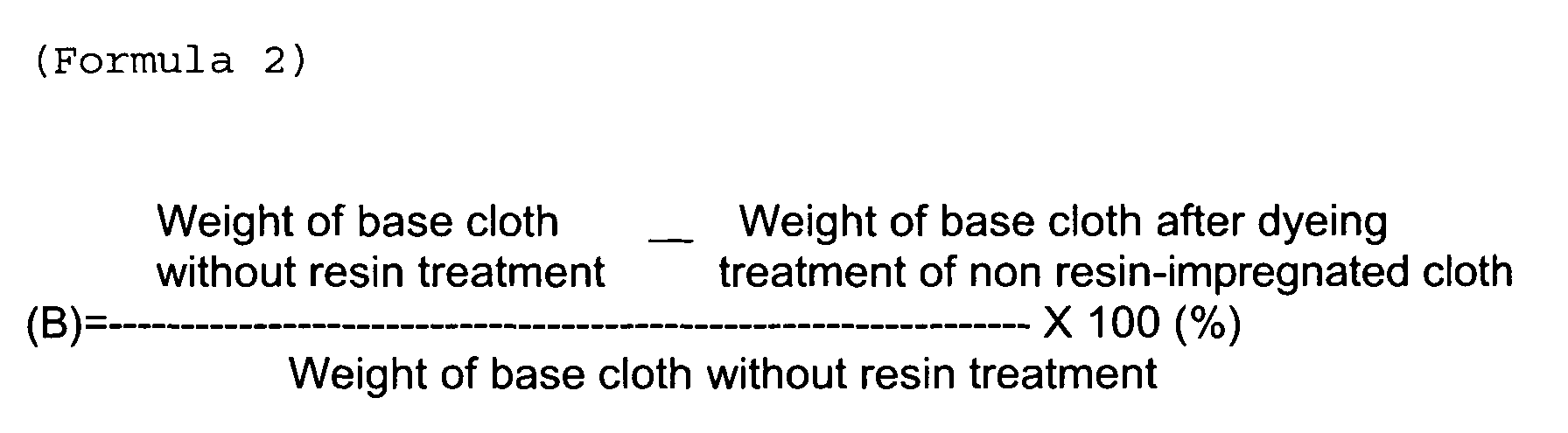
- the ratio of desorbed resin was determined based on the change of weight of base cloth, resin-impregnated cloth and dye-treated cloth.
- the ratio of desorbed resin (%) was, as shown in formula 3, determined based on difference between (A) and (B) which were calculated from formulae 1 and 2, respectively.
- the results are shown in Table 1. (Formula 3)
- the ratio of desorbed resin (%) (A) - (B)
- the films prepared using the compositions of respective Examples have excellent heat resistance, whereas the films prepared using the compositions of respective Comparative Examples have low heat resistance because of high tackiness or melting of the films. It is also understood that the films using the compositions of respective Examples have low ratio of eliminated resin, whereas the films using the compositions of respective Comparative Examples have low heat resistance because of high ratio of eliminated resin.
Landscapes
- Chemical & Material Sciences (AREA)
- Chemical Kinetics & Catalysis (AREA)
- Health & Medical Sciences (AREA)
- Medicinal Chemistry (AREA)
- Polymers & Plastics (AREA)
- Organic Chemistry (AREA)
- Dispersion Chemistry (AREA)
- Engineering & Computer Science (AREA)
- Textile Engineering (AREA)
- General Chemical & Material Sciences (AREA)
- Synthetic Leather, Interior Materials Or Flexible Sheet Materials (AREA)
- Polyurethanes Or Polyureas (AREA)
Abstract
Description
- The present invention relates to a heat resistant aqueous polyurethane resin composition for artificial or synthetic leather, a method of producing the same and a leather-like sheet. More particularly, the present invention relates to a heat resistant aqueous polyurethane resin composition for artificial or synthetic leather, a method of producing the same and a leather-like sheet that does not cause desorption of a polyurethane resin in a dyeing treatment when used in a process of artificial or synthetic leather.
- In a manufacturing process of suede-like artificial leather, untreated white cloth is of ten processed with resins, and then provided into a dyeing process. In a dyeing process, owing to the processing with high temperature and high pressure water, a phenomenon that resin deposited by the processing with resin desorbs from the processed cloth in a dyeing vessel is observed. It is known to cause problems that the desorbed resin (1) deposits onto and contaminates the interior of the dyeing vessel, and (2) re-adheres to the cloth to be processed to cause defective piece goods.
- To solve such problems, various investigations are made in the past. As an example, it is known that the heat resistance may be improved and desorption of the resin may be suppressed in some degree by adding and mixing a low molecular weight hindered amine light stabilizer (HALS) to the resin used in the processing to enhance the heat resistance (see e.g. Japanese Patent No. 3166072). In case where desired effect is not obtained by adding the low molecular weight hindered amine light stabilizer, high molecular weight hindered amine light stabilizers are used.
- However, although certain degree of effect is obtained by adding high molecular weight hindered amine light stabilizers, effect expected based on the added amount of the stabilizers is not obtained because the hindered amine light stabilizers are partially solved out from the resin.
- Further, although it is investigated to introduce the hindered amine light stabilizer into a molecular skeleton of the resin in order to improve light fastness (see e.g. Japanese laid open patent publication No. 2000-265052), distinction of effect is observed depending upon a type of the light stabilizer used for introducing and available type of the light stabilizer is limited because it is essential to form an ester bond for introducing the stabilizer. In addition, the light stabilizer is easily eliminated because the ester bond is easily hydrolyzed, which resulting in a problem that it cannot stand up to processing with hot water in a dyeing process. Moreover, even if it stands up to processing with hot water, the durability of the resin still remains low because the problem that the hydrolysis occurs with ease is not dissolved.
- The present invention attained to solve the problems of prior art and the objective of the present invention is to provide a heat resistant aqueous polyurethane resin composition for artificial or synthetic leather, a method of producing the same and a leather-like sheet, which improve heat resistance of urethane resin to prevent from desorbing the stabilizer in the dyeing process and enable to substantially suppress vessel contamination and the frequency of occurrence of defective piece goods by introducing hindered amine stabilizers into polyurethane resin.
- The present invent ion prevents from solving out of the stabil i zer in the dyeing process and allows to have original heat resistance of the hindered amine stabilizers by introducing the hindered amine stabilizers into a molecular skeleton of polyurethane resin, so that the desorption of the urethane resin is prevented.
- The heat resistant aqueous polyurethane resin composition for artificial or synthetic leather of the present invention comprises a polyurethane resin obtained by introducing a hindered amine stabilizer into the molecular skeleton of the polyurethane resin by reacting the hindered amine stabilizer having imino groups and a compound having isocyanate groups.
- In the above invention, the compound having isocyanate groups may be a polyisocyanate compound or a urethane prepolymer.
- The heat resistant aqueous polyurethane resin composition for artificial or synthetic leather of another aspect of the present invention comprises a polyurethane resin obtained by introducing a hindered amine stabilizer into the molecular skeleton of the polyurethane resin by adding a compound having free isocyanate groups to a urethane prepolymer having isocyanate groups, emulsifying and elongating the molecular chain of the urethane prepolymer. The compound having free isocyanate groups is obtained by a reaction of a hindered amine stabilizer having imino groups and a polyisocyanate compound.
- The method of producing a heat resistant aqueous polyurethane resin composition for artificial or synthetic leather of the present invention comprises reacting a hindered amine stabilizer having imino groups and a compound having isocyanate groups, and emulsifying and elongating the molecular chain of the resultant compound to obtain a polyurethane resin which is introduced the hindered amine stabilizer into the molecular skeleton of the polyurethane resin.
- In the above invention, the compound having isocyanate groups includes a polyisocyanate compound and a urethane prepolymer.
- The method of producing a heat resistant aqueous polyurethane resin composition for artificial or synthetic leather of another aspect of the present invention comprises reacting a hindered amine stabilizer having imino groups and a polyisocyanate compound to obtain a compound having free isocyanate groups, adding the compound having free isocyanate groups to a polyurethane prepolymer having isocyanate groups, and emulsifying the polyurethane prepolymer having isocyanate groups and elongating the molecular chain of the polyurethane prepolymer having isocyanate groups to obtain a polyurethane resin which is introduced the hindered amine stabilizer into the molecular skeleton of the polyurethane resin.
- Using the heat resistant aqueous polyurethane resin composition for artificial or synthetic leather according to the present invention, the heat resistance of the polyurethane resin is improved and prevented the desorption of the stabilizer by hot water processing in the dyeing process because the solving out of the hindered amine stabilizer is prevented. Therefore, the vessel contamination by the desorbed resin and the re-adheres to the cloth to be processed is substantially suppressed.
- According to the method of producing a heat resistant aqueous polyurethane resin composition for artificial or synthetic leather of the present invention, because the hindered amine stabilizer can be introduced into the molecular skeleton of the polyurethane, the heat resistance of the polyurethane resin is highly improved.
- Because heat resistance is improved by using an aqueous polyurethane resin compositions of the present invention, the compositions can be utilized in various industrial fields such as textile industry including artificial leather, synthetic leather and moisture permeable waterproofing articles.
- Available hindered amine stabilizers having imino groups available for the present invention are, for example, (1) poly[{6-(1, 1, 3, 3-tetramethyl butyl) amino-1, 3, 5- triazine 2, 4-dily} {(2, 2, 6, 6- tetramethyl-4-piperidyl)imino} hexamethylene {(2, 2, 6, 6- tetramethyl-4-piperidyl)imino}], and (2) N, N, N, N-tetrakis- (4, 6-bis-(butyl-(N-methyl-2, 2, 6, 6- tetramethylpiperidine-4-yl) amino-triazine-2-yl)-4, 7-diazadecane-1, 10-diamine.
- The amount of the hindered amine stabilizer having imino groups is determined such that the amount falls within the range of 0.1 - 5.0 % by weight based on the solid resin content of the heat resistant aqueous polyurethane resin composition for artificial or synthetic leather finally obtained. If the amount is less than 0.1 % by weight, heat resistance of the polyurethane may not be greatly improved, while if the amount is more than 5.0 % by weight, strength of the film is lowered which may cause desorption of the resin, which is undesirable.
- The hindered amine stabilizers having imino groups in the present invention can be incorporated into a molecular skeleton of a urethane resin by reacting with a polyisocyanate. For example, the hindered amine stabilizers having imino groups can be incorporated into a urethane resin molecular skeleton by adding the hindered amine stabilizer before urethane prepolymerizing reaction of a polyisocyanate and an organic compound having active hydrogen, and emulsifying the resultant urethane prepolymer and elongating the chain of the urethane prepolymer. The hindered amine stabilizers having imino groups can be also incorporated into a molecular skeleton of a urethane resin by reacting with a urethane prepolymer obtained by reacting a polyisocyanate and an organic compound having active hydrogen, then emulsifying and elongating the chain of the urethane prepolymer. Further, the hindered amine stabilizers having imino groups can be also incorporated into a molecular skeleton of a urethane resin by reacting with a polyisocyanate to obtain a compound having free isocyanate groups in advance, then conducting urethane prepolymerizing reaction using the compound having free isocyanate groups, emulsifying and elongating the chain of the urethane prepolymer.
- Examples of the compounds having isocyanate groups include polyisocyanate compounds and urethane prepolymers. Various polyisocyanates used in the field of the urethane industry can be used as the compound having isocyanate groups. Examples of the compound having isocyanate groups include various type of aromatic, aliphatic and alicyclic isocyanates and mixtures thereof, such as naphthalene diisocyanate, isophorone diisocyanate, xylylene diisocyanate, hexamethylene diisocyanate, hydrogenated diphenylmethane diisocyanate, diphenylmethane diisocyanate, tolylene diisocyanate, norbornane diisocyanate, polymethylene polyphenyl polyisocyanate, biuret type hexamethylene diisocyanate, isocyanurate type hexamethylene diisocyanate, and mixtures thereof.
- Examples of the urethane prepolymers include various prepolymers obtained by using the above-described polyisocyanates and compounds having active hydrogen.
- Examples of the compounds having active hydrogen for reacting with polyisocyanates include polyols such as ethylene glycol, diethylene glycol, butane diol, propylene glycoltrimethylolpropane, glycerin, pentaerythritol, and oxyalkylene derivatives thereof. In addition, components of aromatic ring or alicyclic ring can be used such as bisphenol A, bisphenol B, hydrogenated bisphenol A, dibromobisphenol A, cyclohexanediol, cyclohexanedimethanol, hydroquinone, hydroquinone dihydroxyethyl ether, bis(2-hydroxyethyl)terephthalate, bis(4-hydroxyphenyl) sulfone, etc.
- Antioxidants or heat stabilizers other than the hindered amine stabilizers having imino groups may be concurrently used such as hindered phenols, phosphorus compounds, lactones, sulfur compounds. Moreover, benzoate stabilizers or hindered amine stabilizers that have not imino groups can be concurrently used. Further, in the present invention, antiseptics or antifungal agents may be also added.
- Next, the present invention is explained by way of Examples and Comparative Examples, however, these should not be construed as limiting the scope of the present invention. It should be noted that "%" and "parts" used in the following Examples and Comparative Examples mean % by weight and parts by weight, respectively.
- To a mixture of 180 parts of poly-tetrametylene glycol (average molecular weight 1000, hydroxyl value 112, PTMG 1000 (manufactured by Asahi Kasei Corporation)), 20 parts of polyoxyethylenepropylene random copolymerized glycol (average molecular weight 3400, content of oxyethylene chain 80 % by weight), 3.8 parts of 1, 4-butanediol, 3.8 parts of trimethylolpropane and 143.8 parts of methyl ethyl ketone, 79.9 parts of dicyclohexylmethane diisocyanate was added. Then, reaction was carried out at 75°C for 90 minutes. As a result, a methyl ethyl ketone solution of urethane prepolymer was obtained whose content of free isocyanate group was 1.03% (Urethane Prepolymer A).
- To a mixture of 198 parts of polypropylene glycol (average molecular weight 1100, hydroxyl value 102, POLYHARDENER D-100 (manufactured by Dai-Ichi KogyouSeiyaku Co., LTD)), 20 parts of polyoxyethylenepropylene random copolymerized glycol (average molecular weight 3400, content of oxyethylene chain 80 % by weight), 3.8 parts of 1, 4-butanediol, 3.8 parts of trimethylolpropane and 143.8 parts of methyl ethyl ketone, 76.2 parts of diphenylmethane diisocyanate was added. Then, reaction was carried out at 75°C for 90 minutes. As a result, a methyl ethyl ketone solution of urethane prepolymer was obtained whose content of free isocyanate group was 1.03% (Urethane Prepolymer B).
- To the above described Urethane Prepolymer A, 58 parts of 5 % methyl ethyl ketone solution of N, N, N, N-tetrakis-(4, 6-bis-(butyl-(N-methly-2, 2, 6, 6-tetramethylpiperidine-4-yl)amino-triazine-2-yl)-4, 7-diazadecane-1, 10-diamine and 29 parts of 5 % methyl ethyl ketone solution of 1, 3, 5-tris(4-tert-butyl-3-hydroxy-2, 6-dimethylbenzyl) isocyanuric acid as hindered phenol antioxidant were added and stirred for 10 minutes. Then, 14.4 parts of a polyoxyethylenearylphenol ether type of nonionic surface-active agent (HLB=15), which is an ethylene oxide adduct of a distyrenated phenol, was added to the solution and stirred, followed by 454.7 parts of water and emulsified and dispersed. Next, 42.4 parts of 5% aqueous solution of ethylenediamine was added and stirred for 60 minutes. Then, methyl ethyl ketone was evaporated by an evaporator at 40 - 50°C under reduced pressure to obtain an opal aqueous polyurethane resin composition 1 for artificial or synthetic leather containing urethane resin emulsion which has a mean particle size of 1.2 micron and solid content of 40%.
- To the above described Urethane Prepolymer A, 58 parts of 5 % methyl ethyl ketone solution of poly [{6-(1, 1, 3, 3-tetramethyl butyl) amino-1, 3, 5- triazine 2, 4-dily} {(2, 2, 6, 6-tetramethyl-4-piperidyl)imino} hexamethylene {(2, 2, 6, 6-tetramethyl-4-piperidyl)imino}] and 1.07 parts of isophorone diisocyanate were added and stirred for 5 minutes to prepare a solution. This solution was then added to the above synthesized Urethane Prepolymer A and stirred. 29 parts of 5% methyl ethyl ketone solution of 1, 6-hexamethylenebis(N, N-dimetylsemicarbazide) as semicarbazide antioxidant was added and stirred for 5 minutes. Then, 14.4 parts of a polyoxyethylenearylphenol ether type of nonionic surface-active agent (HLB=15), which is an ethylene oxide adduct of distyrenated phenol, was added to the solution and stirred, followed by 454.7 parts of water and emulsified and dispersed. Next, 42.4 parts of 5% aqueous solution of ethylenediamine was added and stirred for 60 minutes. Then, methyl ethyl ketone was evaporated by an evaporator at 40 - 50°C under reduced pressure to obtain an opal aqueous polyurethane resin composition 2 for artificial or synthetic leather containing urethane resin emulsion which has a mean particle size of 1.1 micron and solid content of 40%.
- To the above described Urethane Prepolymer A, 5.8 parts of 5 % methyl ethyl ketone solution of N, N, N, N-tetrakis-(4, 6-bis-(butyl-(N-methly-2, 2, 6, 6-tetramethylpiperidine-4-yl)amino-triazine-2-yl)-4, 7-diazadecane-1, 10-diamine was added and stirred for 5 minutes. Then, 14.4 parts of a polyoxyethylenearylphenol ether type of nonionic surface active agent (HLB=15), which is an ethylene oxide adduct of distyrenated phenol, was added to the solution and stirred, followed by 454.7 parts of water and emulsified and dispersed. Next, 42.4 parts of 5% aqueous solution of ethylenediamine was added and stirred for 60 minutes. Then, methyl ethyl ketone was evaporated by an evaporator at 40 - 50°C under reduced pressure to obtain an opal aqueous polyurethane resin composition 3 for artificial or synthetic leather containing urethane resin emulsion which has a mean particle size of 1.2 micron and solid content of 40%.
- To the above described Urethane Prepolymer B, 290 parts of 5 % methyl ethyl ketone solution of N, N, N, N-tetrakis-(4, 6-bis-(butyl-(N-methly-2, 2, 6, 6-tetramethylpiperidine-4-yl)amino-triazine-2-yl)-4, 7-diazadecane-1, 10-diamine was added and stirred for 5 minutes. Then, 14.4 parts of a polyoxyethylenearylphenol ether type of nonionic surface active agent (HLB=15), which is an ethylene oxide adduct of distyrenated phenol, was added to the solution and stirred, followed by 454.7 parts of water and emulsified and dispersed. Next, 42.4 parts of 5% aqueous solution of ethylenediamine was added and stirred for 60 minutes. Then, methyl ethyl ketone was evaporated by an evaporator at 40 - 50°C under reduced pressure to obtain an opal aqueous polyurethane resin composition 4 for artificial or synthetic leather containing urethane resin emulsion which has a mean particle size of 1.2 micron and solid content of 40%.
- To the above described Urethane Prepolymer A, 14.4 parts of a polyoxyethylenearylphenol ether type of nonionic surface-active agent (HLB=15), which is an ethylene oxide adduct of distyrenated phenol, was added and stirred, followed by 454.7 parts of water and emulsified and dispersed. Next, 42.4 parts of 5% aqueous solution of ethylenediamine was added and stirred for 60 minutes. Next, 58 parts of 5 % methyl ethyl ketone solution of N, N, N, N-tetrakis- (4, 6-bis-(butyl-(N-methly-2, 2, 6, 6-tetramethylpiperidine-4-yl)amino-triazine-2-yl)-4, 7-diazadecane-1, 10-diamine was added to the solution and stirred for 5 minutes. Then, methyl ethyl ketone was evaporated by an evaporator at 40 - 50°C under reduced pressure to obtain an opal aqueous polyurethane resin composition 5 for artificial or synthetic leather containing urethane resin emulsion which has a mean particle size of 1.2 micron and solid content of 40%.
- To the above described Urethane Prepolymer A, 14.4 parts of a polyoxyethylenearylphenol ether type of nonionic surface-active agent (HLB=15), which is an ethylene oxide adduct of distyrenated phenol, was added and stirred, followed by 454.7 parts of water and emulsified and dispersed. Next, 42.4 parts of 5% aqueous solution of ethylenediamine was added and stirred for 60 minutes. Then, methyl ethyl ketone was evaporated by an evaporator at 40 - 50°C under reduced pressure to obtain an opal aqueous polyurethane resin composition 6 for artificial or synthetic leather containing urethane resin emulsion having mean particle size of 1.2 micron and solid content of 40%.
- Aqueous solutions were prepared by adding 70% of water to 30% of the respective Urethane emulsions of Examples and Comparative Examples. Superfine raising cloths of polyester (base cloths) were impregnated with the respective aqueous solutions and wrung with a mangle (at wet pick up of 90%owf (on weight fiber)), then thermally treated at 130°C to obtain resin-impregnated cloths. These cloths were dyed with dispersed dye using high-temperature and high-pressure jet dyeing machine (Mini Jet MJ-P300S, manufactured by Kabushikigaisya Tekusamu Giken). Dyeing was carried out under the condition of acetic acid 1g/liter, dispersed dye 0.5% owf and mixture of fatty acid ester of polyethylene glycol and sodium sulfonate of polyalkyleneoxide adduct of dialkyl phenol (COLOURSOL CE-91, manufactured by Dai-Ichi KogyouSeiyaku Co., LTD) 1g/liter, treating at 130°C for 30 minutes. After completion of dyeing process, reduction cleaning was carried out under the condition of hydrosulfite 2g/liter, soda ash 2g/liter, polyalkyleneoxide adduct of dialkyl phenol (TRIPOL TK, manufactured by Dai-Ichi KogyouSeiyaku Co., LTD) 1g/liter, treating at 80°C for 20 minutes, followed by drying to obtain dyeing treated cloths. Estimation of filmheat resistance and tendency of desorbing of resin using the dyed cloths as follows, the results of which are shown in Table 1.
- Each of the polyurethane resin compositions was applied on a PET film such that the thickness of dry film became 200 micron, then dried at 25°C for 24 hours. Further, these PET films were dried 130°C for 30 minutes.
- The film samples prepared in the above were immersed in an aqueous acetic acid solution (1g/liter) of 60°C. Then the temperature is increased using high-pressure dyeing machine (Mini Color, manufactured by Kabushikigaisya Tekusamu Giken) to 130°C and maintained at this temperature for 15 minutes. Next, the films were cooled and washed with hot water for 5 minutes. The films then immersed in an aqueous NaOH and thiourea dioxide solution (each 2g/liter) of 60°C, followed by increasing the temperature to 80°C and continuously heated at this temperature for 15 minutes. Next, The films were cooled and washed with hot water and dried at room temperature. After the films were heated at 170°C for 10 hours, evaluation was carried out by determining whether tackiness was observed on the surface of the films. The results are listed in Table 1.
- The ratio of desorbed resin was determined based on the change of weight of base cloth, resin-impregnated cloth and dye-treated cloth. The ratio of desorbed resin (%) was, as shown in formula 3, determined based on difference between (A) and (B) which were calculated from formulae 1 and 2, respectively. The results are shown in Table 1.

- As seen from Table 1, it is understood that the films prepared using the compositions of respective Examples have excellent heat resistance, whereas the films prepared using the compositions of respective Comparative Examples have low heat resistance because of high tackiness or melting of the films. It is also understood that the films using the compositions of respective Examples have low ratio of eliminated resin, whereas the films using the compositions of respective Comparative Examples have low heat resistance because of high ratio of eliminated resin.

Claims (11)
- A heat resistant aqueous polyurethane resin composition for artificial or synthetic leather comprising a polyurethane resin obtained by introducing a hindered amine stabilizer into the molecular skeleton of the polyurethane resin by reacting the hindered amine stabilizer having imino groups and a compound having isocyanate groups.
- The composition according to claim 1, wherein the compound having isocyanate groups is a polyisocyanate compound, or a urethane prepolymer.
- A heat resistant aqueous polyurethane resin composition for artificial or synthetic leather comprising a polyurethane resin obtained by introducing a hindered amine stabilizer into the molecular skeleton of the polyurethane resin by adding a compound having free isocyanate groups to a urethane prepolymer having isocyanate groups, emulsifying and elongating the molecular chain of the urethane prepolymer, wherein the compound having free isocyanate groups is obtained by a reaction of a hindered amine stabilizer having imino groups and a polyisocyanate compound.
- The composition according to any one of claims 1 to 3, wherein the hindered amine stabilizer having imino groups is reacted such that the content of the stabilizer falls within the range of 0.1 to 5.0 % by weight based on the solid content of the aqueous polyurethane resin composition.
- The composition according to any one of claims 1 to 4, wherein the hindered amine stabilizer having imino groups is poly[{6-(1, 1, 3, 3-tetramethyl butyl) amino-1, 3, 5- triazine 2, 4-dily} {(2, 2, 6, 6- tetramethyl-4-piperidyl)imino} hexamethylene {(2, 2, 6, 6- tetramethyl-4-piperidyl)imino}] or N, N, N, N-tetrakis-(4, 6-bis-(butyl-(N-methly-2, 2, 6, 6- tetramethylpiperidine-4-yl) amino-triazine-2-yl)-4, 7-diazadecane-1, 10-diamine.
- A method of producing a heat resistant aqueous polyurethane resin composition for artificial or synthetic leather, comprising:reacting a hindered amine stabilizer having imino groups and a compound having isocyanate groups, andemulsifying the resultant compound and elongating the molecular chain of the compound to obtain a polyurethane resin which is introduced the hindered amine stabilizer into the molecular skeleton of the polyurethane resin.
- The method according to claim 6, wherein the compound having isocyanate groups is a polyisocyanate compound or a urethane prepolymer.
- A method of producing a heat resistant aqueous polyurethane resin composition for artificial or synthetic leather into which the hindered amine stabilizer is introduced, comprising:reacting a hindered amine stabilizer having imino groups and a polyisocyanate compound to obtain a compound having free isocyanate groups,adding the compound having free isocyanate groups to a polyurethane prepolymer having isocyanate groups, andemulsifying the polyurethane prepolymer having isocyanate groups and elongating the molecular chain of the polyurethane prepolymer having isocyanate groups to obtain a polyurethane resin which is introduced the hindered amine stabilizer into the molecular skeleton of the polyurethane resin.
- The method according to any one of claims 6 to 8, wherein the hindered amine stabilizer having imino groups is reacted such that the content of the stabilizer falls within the range of 0.1 to 5.0 % by weight based on the solid content of the aqueous polyurethane resin composition.
- The method according to any one of claims 6 to 9, wherein the hindered amine stabilizer having imino groups is poly[{6-(1, 1, 3, 3-tetramethyl butyl) amino-1, 3, 5- triazine 2, 4-dily} {(2, 2, 6, 6- tetramethyl-4-piperidyl) imino} hexamethylene {(2, 2, 6, 6- tetramethyl-4-piperidyl)imino}] or N, N, N, N-tetrakis-(4, 6-bis-(butyl-(N-methly-2, 2, 6, 6- tetramethylpiperidine-4-yl) amino-triazine-2-yl)-4, 7-diazadecane-1, 10-diamine.
- A leather-like sheet obtained by impregnating a fabric base material with the heat resistant aqueous polyurethane resin composition according to any one of claims 1 to 5.
Applications Claiming Priority (2)
| Application Number | Priority Date | Filing Date | Title |
|---|---|---|---|
| JP2004144621A JP4293441B2 (en) | 2004-05-14 | 2004-05-14 | A water-based polyurethane resin composition for heat-resistant artificial and synthetic leather, a method for producing the same, and a leather-like sheet. |
| JP2004144621 | 2004-05-14 |
Publications (2)
| Publication Number | Publication Date |
|---|---|
| EP1595903A1 true EP1595903A1 (en) | 2005-11-16 |
| EP1595903B1 EP1595903B1 (en) | 2010-04-21 |
Family
ID=34941141
Family Applications (1)
| Application Number | Title | Priority Date | Filing Date |
|---|---|---|---|
| EP05252746A Ceased EP1595903B1 (en) | 2004-05-14 | 2005-05-04 | Heat resistant aqueous polyurethane resin composition for artificial or synthetic leather, method or producing the same and leather-like sheet |
Country Status (4)
| Country | Link |
|---|---|
| EP (1) | EP1595903B1 (en) |
| JP (1) | JP4293441B2 (en) |
| KR (1) | KR100738178B1 (en) |
| CN (1) | CN1696198A (en) |
Cited By (1)
| Publication number | Priority date | Publication date | Assignee | Title |
|---|---|---|---|---|
| US11772990B2 (en) | 2018-04-19 | 2023-10-03 | King Fahd University Of Petroleum And Minerals | Removal of cadmium ions using a terpolymer/carbon nanotube composite |
Families Citing this family (6)
| Publication number | Priority date | Publication date | Assignee | Title |
|---|---|---|---|---|
| KR101005507B1 (en) * | 2006-12-01 | 2011-01-04 | 디아이씨 가부시끼가이샤 | Leather seat |
| WO2012026338A1 (en) * | 2010-08-26 | 2012-03-01 | 大日精化工業株式会社 | Self-crosslinking polysiloxane-modified polyhydroxy polyurethane resin, resin material containing same, method for producing same, artificial leather comprising same, and thermoplastic polyolefin skin material comprising same |
| KR20170002057A (en) | 2015-06-29 | 2017-01-06 | 코오롱인더스트리 주식회사 | Artificial leather and method for manufacturing the same |
| CN106589296A (en) * | 2015-10-16 | 2017-04-26 | 奕益实业有限公司 | Hindered amine light stabilizer and composite material |
| CN106589574A (en) * | 2015-10-16 | 2017-04-26 | 奕益实业有限公司 | Method for preparing composite material and composite material |
| CN114621577B (en) * | 2022-03-22 | 2023-09-01 | 浙江伟星实业发展股份有限公司 | Anti-color-absorption resin material and preparation method and application thereof |
Citations (3)
| Publication number | Priority date | Publication date | Assignee | Title |
|---|---|---|---|---|
| JPH04258642A (en) * | 1991-02-12 | 1992-09-14 | Kuraray Co Ltd | Leather-like sheet material with excellent durability and method for producing the same |
| JP2000265052A (en) * | 1999-03-17 | 2000-09-26 | Kuraray Co Ltd | Polyurethane emulsion and leather-like sheet produced using the same |
| US20030194556A1 (en) | 2002-01-17 | 2003-10-16 | Thorsten Rische | Stabilized aqueous polyurethane-polyurea dispersions |
-
2004
- 2004-05-14 JP JP2004144621A patent/JP4293441B2/en not_active Expired - Fee Related
-
2005
- 2005-05-04 EP EP05252746A patent/EP1595903B1/en not_active Ceased
- 2005-05-13 KR KR1020050040253A patent/KR100738178B1/en not_active Expired - Fee Related
- 2005-05-16 CN CNA2005100726673A patent/CN1696198A/en active Pending
Patent Citations (3)
| Publication number | Priority date | Publication date | Assignee | Title |
|---|---|---|---|---|
| JPH04258642A (en) * | 1991-02-12 | 1992-09-14 | Kuraray Co Ltd | Leather-like sheet material with excellent durability and method for producing the same |
| JP2000265052A (en) * | 1999-03-17 | 2000-09-26 | Kuraray Co Ltd | Polyurethane emulsion and leather-like sheet produced using the same |
| US20030194556A1 (en) | 2002-01-17 | 2003-10-16 | Thorsten Rische | Stabilized aqueous polyurethane-polyurea dispersions |
Non-Patent Citations (2)
| Title |
|---|
| DATABASE WPI Section Ch Week 199243, Derwent World Patents Index; Class A25, AN 1992-354798, XP002341401 * |
| DATABASE WPI Section Ch Week 200113, Derwent World Patents Index; Class A25, AN 2001-114866, XP002341402 * |
Cited By (1)
| Publication number | Priority date | Publication date | Assignee | Title |
|---|---|---|---|---|
| US11772990B2 (en) | 2018-04-19 | 2023-10-03 | King Fahd University Of Petroleum And Minerals | Removal of cadmium ions using a terpolymer/carbon nanotube composite |
Also Published As
| Publication number | Publication date |
|---|---|
| JP4293441B2 (en) | 2009-07-08 |
| KR100738178B1 (en) | 2007-07-10 |
| KR20060047908A (en) | 2006-05-18 |
| EP1595903B1 (en) | 2010-04-21 |
| CN1696198A (en) | 2005-11-16 |
| JP2005325474A (en) | 2005-11-24 |
Similar Documents
| Publication | Publication Date | Title |
|---|---|---|
| EP3398980B1 (en) | Aqueous-dispersion type polycarbonate-based polyurethane resin composition, textile product treated with same, and process for producing aqueous-dispersion type polycarbonate-based polyurethane resin composition | |
| US5859122A (en) | Polycarbonate polyurethane resin composition | |
| EP2978788B1 (en) | Non-fluorinated urethane based coatings | |
| EP3198072B1 (en) | Non-fluorinated urethane based coatings | |
| EP0525567B1 (en) | Use of coatings in the preparation of water vapour permeable coatings | |
| EP3266930B1 (en) | Method for producing leather-like sheet | |
| US4743470A (en) | Spreading pastes containing polyurethane plastics and a process for the production of polyurethane coatings permeable to water vapor | |
| EP2016145A1 (en) | Microporous coating based on polyurethane-polyurea | |
| CN103649153B (en) | Polyurethane resin for moisture-permeable water-proof materials, and polyurethane resin composition | |
| EP2181133A2 (en) | Microporous coating based on polyurethane polyurea | |
| DE4236569A1 (en) | Aqueous coating compositions and their use for producing water vapor permeable coatings | |
| EP2202352A1 (en) | Cloth waterproofed with vegetable component | |
| EP1595903B1 (en) | Heat resistant aqueous polyurethane resin composition for artificial or synthetic leather, method or producing the same and leather-like sheet | |
| EP0078436A1 (en) | Non-crystalline polyamine/carbonic-acid salt compostions, process for their preparation and their use in making polyurethane-polyureas, particularly foamed coatings | |
| EP0517029B1 (en) | Process for the preparation of coating compositions for water-permeable coatings | |
| DE102017103145A1 (en) | Vehicle interior material and method for its production | |
| JP2020059928A (en) | Resin film and fiber cloth and fiber product formed by laminating it | |
| JP2009242675A (en) | Adhesive for moisture permeable water proofing cloth | |
| JP2012241299A (en) | Method for producing flame retardant polyester-based fiber product | |
| CN1244732C (en) | Aqueous composition used for preventing felt contraction of wool | |
| WO2003016612A1 (en) | Textile treatment | |
| EP4501113A1 (en) | Antibacterial agent | |
| JPH05186631A (en) | Porous structure and method for producing the same | |
| JP2015193810A (en) | Polyurethane resin for moisture-permeable water-proof material | |
| DE19533218A1 (en) | Hydrophilic modified poly:isocyanate use as curing agent during sizing and opt. dyeing with indigo |
Legal Events
| Date | Code | Title | Description |
|---|---|---|---|
| PUAI | Public reference made under article 153(3) epc to a published international application that has entered the european phase |
Free format text: ORIGINAL CODE: 0009012 |
|
| AK | Designated contracting states |
Kind code of ref document: A1 Designated state(s): AT BE BG CH CY CZ DE DK EE ES FI FR GB GR HU IE IS IT LI LT LU MC NL PL PT RO SE SI SK TR |
|
| AX | Request for extension of the european patent |
Extension state: AL BA HR LV MK YU |
|
| 17P | Request for examination filed |
Effective date: 20060510 |
|
| AKX | Designation fees paid |
Designated state(s): IT |
|
| REG | Reference to a national code |
Ref country code: DE Ref legal event code: 8566 |
|
| 17Q | First examination report despatched |
Effective date: 20070514 |
|
| GRAP | Despatch of communication of intention to grant a patent |
Free format text: ORIGINAL CODE: EPIDOSNIGR1 |
|
| GRAS | Grant fee paid |
Free format text: ORIGINAL CODE: EPIDOSNIGR3 |
|
| GRAA | (expected) grant |
Free format text: ORIGINAL CODE: 0009210 |
|
| AK | Designated contracting states |
Kind code of ref document: B1 Designated state(s): IT |
|
| PLBE | No opposition filed within time limit |
Free format text: ORIGINAL CODE: 0009261 |
|
| STAA | Information on the status of an ep patent application or granted ep patent |
Free format text: STATUS: NO OPPOSITION FILED WITHIN TIME LIMIT |
|
| 26N | No opposition filed |
Effective date: 20110124 |
|
| PGFP | Annual fee paid to national office [announced via postgrant information from national office to epo] |
Ref country code: IT Payment date: 20200414 Year of fee payment: 16 |
|
| PG25 | Lapsed in a contracting state [announced via postgrant information from national office to epo] |
Ref country code: IT Free format text: LAPSE BECAUSE OF NON-PAYMENT OF DUE FEES Effective date: 20210504 |