EP1595864A1 - Polycyclic aromatic carbon based solid strong acid - Google Patents
Polycyclic aromatic carbon based solid strong acid Download PDFInfo
- Publication number
- EP1595864A1 EP1595864A1 EP03815739A EP03815739A EP1595864A1 EP 1595864 A1 EP1595864 A1 EP 1595864A1 EP 03815739 A EP03815739 A EP 03815739A EP 03815739 A EP03815739 A EP 03815739A EP 1595864 A1 EP1595864 A1 EP 1595864A1
- Authority
- EP
- European Patent Office
- Prior art keywords
- acid
- polycyclic aromatic
- solid
- catalyst
- strong acid
- Prior art date
- Legal status (The legal status is an assumption and is not a legal conclusion. Google has not performed a legal analysis and makes no representation as to the accuracy of the status listed.)
- Granted
Links
Images



Classifications
-
- B—PERFORMING OPERATIONS; TRANSPORTING
- B01—PHYSICAL OR CHEMICAL PROCESSES OR APPARATUS IN GENERAL
- B01J—CHEMICAL OR PHYSICAL PROCESSES, e.g. CATALYSIS OR COLLOID CHEMISTRY; THEIR RELEVANT APPARATUS
- B01J31/00—Catalysts comprising hydrides, coordination complexes or organic compounds
- B01J31/02—Catalysts comprising hydrides, coordination complexes or organic compounds containing organic compounds or metal hydrides
- B01J31/06—Catalysts comprising hydrides, coordination complexes or organic compounds containing organic compounds or metal hydrides containing polymers
-
- B—PERFORMING OPERATIONS; TRANSPORTING
- B01—PHYSICAL OR CHEMICAL PROCESSES OR APPARATUS IN GENERAL
- B01J—CHEMICAL OR PHYSICAL PROCESSES, e.g. CATALYSIS OR COLLOID CHEMISTRY; THEIR RELEVANT APPARATUS
- B01J31/00—Catalysts comprising hydrides, coordination complexes or organic compounds
- B01J31/02—Catalysts comprising hydrides, coordination complexes or organic compounds containing organic compounds or metal hydrides
- B01J31/0215—Sulfur-containing compounds
- B01J31/0225—Sulfur-containing compounds comprising sulfonic acid groups or the corresponding salts
-
- C—CHEMISTRY; METALLURGY
- C07—ORGANIC CHEMISTRY
- C07C—ACYCLIC OR CARBOCYCLIC COMPOUNDS
- C07C309/00—Sulfonic acids; Halides, esters, or anhydrides thereof
- C07C309/01—Sulfonic acids
- C07C309/28—Sulfonic acids having sulfo groups bound to carbon atoms of six-membered aromatic rings of a carbon skeleton
- C07C309/33—Sulfonic acids having sulfo groups bound to carbon atoms of six-membered aromatic rings of a carbon skeleton of six-membered aromatic rings being part of condensed ring systems
- C07C309/38—Sulfonic acids having sulfo groups bound to carbon atoms of six-membered aromatic rings of a carbon skeleton of six-membered aromatic rings being part of condensed ring systems formed by at least three rings
-
- C—CHEMISTRY; METALLURGY
- C07—ORGANIC CHEMISTRY
- C07C—ACYCLIC OR CARBOCYCLIC COMPOUNDS
- C07C309/00—Sulfonic acids; Halides, esters, or anhydrides thereof
- C07C309/01—Sulfonic acids
- C07C309/62—Sulfonated fats, oils or waxes of undetermined constitution
-
- B—PERFORMING OPERATIONS; TRANSPORTING
- B01—PHYSICAL OR CHEMICAL PROCESSES OR APPARATUS IN GENERAL
- B01J—CHEMICAL OR PHYSICAL PROCESSES, e.g. CATALYSIS OR COLLOID CHEMISTRY; THEIR RELEVANT APPARATUS
- B01J2231/00—Catalytic reactions performed with catalysts classified in B01J31/00
- B01J2231/40—Substitution reactions at carbon centres, e.g. C-C or C-X, i.e. carbon-hetero atom, cross-coupling, C-H activation or ring-opening reactions
-
- B—PERFORMING OPERATIONS; TRANSPORTING
- B01—PHYSICAL OR CHEMICAL PROCESSES OR APPARATUS IN GENERAL
- B01J—CHEMICAL OR PHYSICAL PROCESSES, e.g. CATALYSIS OR COLLOID CHEMISTRY; THEIR RELEVANT APPARATUS
- B01J37/00—Processes, in general, for preparing catalysts; Processes, in general, for activation of catalysts
- B01J37/20—Sulfiding
Definitions
- the present invention relates to a solid acid insoluble in a polar solvent obtained by a process characterizing that polycyclic aromatic hydrocarbon or polycyclic aromatic hydrocarbon to which carbon material is blended is heat-treated in conc. sulfuric acid or in fuming sulfuric acid, then the polycyclic aromatic hydrocarbon is condensed and sulfonated, or composed with carbon materials which is blended at the condensation or sulfonation reaction, or a composite solid strong acid composed by said solid acid and carbon material and an use of said solid acid as a solid strong acid catalyst.
- Acid catalyst is necessary for chemical industries of the present age, and used in production of various products such as chemicals, products of petrochemical industry or polymer products, and considerable parts of the acid catalysts are a liquid acid such as hydrochloric acid or sulfuric acid.
- the liquid acid catalyst used in a production process is separated from the product and recovered by means of processes of neutralization with a base and removal of salt which is formed by the neutralization.
- energy consumed for the neutralization process and the removal process of salt occupies considerable parts in total energy used in all production processes.
- the recovered salts are over supply in a market, further, since mostly of these salts are by-products whose utilizability is small, in many cases, treatment of these salts are difficult.
- a solid acid does not need said neutralization process or removing process of salt for separation and recovery, does not form unnecessary by-products and can produce an objected product by lower energy. Therefore, investigation was carried out in early stage (Ishihara, K; Hasegawa, A; Yamamoto, H. Angew. Chem. Int. Ed.2001, 40, 4077; Document 1). As the results of the investigation, a solid acid catalyst such as zeolite, silica alumina or hydrous niobate obtains good results in chemical industries and provides good benefit to human society.
- a strong acid polymer material prepared by sulfonation of polystyrene can be considered as a solid acid and has been used as a cationic ion-exchange resin which indicates acidity for a long time.
- Nafion (T.M. of Du-pont) which loads sulfone group on polytetrafuluoroethylene skeleton is known as a very strong solid acid (solid super strong acid) having hydrophilicity, and it is well known that these acid polymers act as a super strong acid having acid strength stronger than liquid acid.
- polymer has problems that it is weak to heat and is too expensive for an industrial use.
- sulfuric acid trace zirconia prepared by sulfuric acid treatment of zirconium oxide (ZrO 2 ) is a solid acid catalyst having the strongest acidity, the amount of sulfuric acid trace is not so large, and numbers of acid point per unit weight is smaller than that of liquid acid, therefore, it is hard to satisfy said requirement.
- the subject of the present invention is to provide a solid acid catalyst which dissolves said problems and can be advantageously usable for an industrial use.
- the inventors of the present invention think about a structure characterizing that sulfuric groups are loaded to a chemical material possessing a basic backbone which is stable against physical action such as heat, and pay attention to use a polycyclic hydrocarbon compounds characterizing that many aromatic compound rings, which are contained in tar, pitch, fuel oil or asphalt, are condensed as a composing material of said basic backbone.
- the inventors of the present invention use tar, pitch, fuel oil or asphalt itself or a polycyclic hydrocarbon compounds characterizing that many aromatic compound rings are condensed as a composing material of said basic backbone, heat treated them in concentrated sulfuric acid or fuming sulfuric acid, and the chemical structural feature and acid characteristic of the obtained product are investigated, and found out that condensation reaction of the composing material of said basic backbone is progressed simultaneously with sulfonation and an useful material as a solid acid which can be used stable in high temperature condition can be obtained.
- the inventors of the present invention carried out esterfication reaction of ethylalcohol and acetic acid by trial, and find out that said reaction is remarkably accelerated by presence of said solid acid and is useful as a solid acid catalyst, thus the subject can be accomplished. Further, in an investigation to obtain a solid acid material which improves the characteristics of said obtained solid acid, carbon materials such as activated carbon or acetylene black are blended to the material of said solid acid and heat treated in concentrated sulfuric acid or fuming sulfuric acid, and find out that a composite solid acid of polycyclic aromatic carbon solid acid-carbon material can be obtained.
- the first one of the present invention is (1) a solid acid, which is insoluble in a polar solvent, obtained by heat treating of polycyclic aromatic hydrocarbons in concentrated sulfuric acid or fuming sulfuric acid to thereby condense and sulfonate said polycyclic aromatic hydrocarbons.
- the first one of the present invention is (2) the solid acid of (1) wherein, the polycyclic aromatic hydrocarbons is at least one selected from the group consisting of a polycyclic aromatic hydrocarbon obtained by condensing two or more aromatic rings, mixture of a polycyclic aromatic hydrocarbon obtained by condensing two or more aromatic rings or tar, pitch, fuel oil or asphalt containing a polycyclic aromatic hydrocarbon obtained by condensing two or more aromatic rings, more desirably, the first one of the present invention is (3) the solid acid of (1) or (2) wherein, temperature T for heat treatment is 100°C ⁇ T ⁇ 450°C, further desirably the first one of the present invention is (4) the solid acid of (3) wherein, the temperature T for heat treatment is 200°C ⁇ T ⁇ 350°C.
- the second one of the present invention is (5) a solid strong acid catalyst comprising the solid acid of (1) which is insoluble in a polar solvent.
- the second one of the present invention is (6) the solid strong acid catalyst comprising the solid acid of (2) which is insoluble in a polar solvent, more desirably, the second one of the present invention is (7) the solid strong acid catalyst comprising the solid acid of (2) which is insoluble in a polar solvent, further desirably the second one of the present invention is (8) the solid strong acid catalyst comprising the solid acid of (4) which is insoluble in a polar solvent.
- the third one of the present invention is (9) a composite solid strong acid comprising a solid acid and a carbon material, wherein said solid acid is obtained by heat treating of polycyclic aromatic hydrocarbons to which the carbon material is blended in concentrated sulfuric acid or fuming sulfuric acid, transforming said polycyclic aromatic hydrocarbons to a solid acid which is insoluble in a polar solvent by condensation and sulfonation further compositing with said carbon material.
- the third one of the present invention is (10) the composite solid strong acid of (9), wherein the aromatic hydrocarbons is at least one selected from the group consisting of a polycyclic aromatic hydrocarbon obtained by condensing two or more aromatic rings, mixture of a polycyclic aromatic hydrocarbon obtained by condensing two or more aromatic rings or tar, pitch, fuel oil or asphalt containing a polycyclic aromatic hydrocarbon obtained by condensing two or more aromatic rings, more desirably, the third one of the present invention is (11) the composite solid strong acid of (9) or (10), wherein temperature T for heat treatment is 100 °C ⁇ T ⁇ 450 °C, further desirably the third one of the present invention is (12) the solid acid of (11) wherein, the temperature T for heat treatment is 200 °C ⁇ T ⁇ 350 °C , furthermore desirably, the third one of the present invention is (13) the composite solid strong acid of (9), (10), (11) or (12), wherein, the carbon material is at least one selected from the group consisting
- Results are shown in Fig.3.
- formation of ethyl acetate by reaction without catalyst is also shown by time lapse.
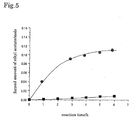
- forming speed of ethyl acetate in the presence of synthesized catalyst is remarkably high, and it is understood that the synthesized material acts as a strong solid acid catalyst.
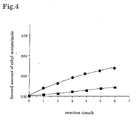
- black powder is evacuated at 150°C for 1 hour, then 0.2 g of it is added as a catalyst into mixed solution of 0.1mol acetic acid and 1.0mol ethyl alcohol under argon gas flow, stirred at 70°C for 6 hours and the amount of ethyl acetate formed by acid catalyst reaction is detected by a gas chromatography. Results are shown in Fig.4. In Fig.4, for the comparison, formation of ethyl acetate by reaction without catalyst is also shown by time lapse. As shown in Fig.4, forming speed of ethyl acetate in the presence of synthesized catalyst is remarkably high, and it is understood that the synthesized material acts as a strong solid acid catalyst.
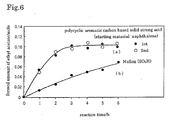
- Results are shown in Fig.6 (a).
- Fig.6 for the comparison, formation of ethyl acetate by reaction using same amount of SO 3 H Nafion as a catalyst is also shown by time lapse (b).
- time lapse b
- the synthesized catalyst formation speed of ethyl acetate is very fast and it is understood that the synthesized material is a solid acid catalyst having stronger acid strength than that of Nafion ( ⁇ ).
- ⁇ acid catalytic activity of polycyclic aromatic carbon solid strong acid does not deteriorate by repeating use.
- said synthesized polycyclic aromatic carbon solid strong acid is heated with distilled water in an autoclave of 150°C for 72hours and filtrated. This filtrated powder is evacuated for 1 hour at 150°C, then 0.2g of it is used as a catalyst and same reaction as mentioned above is carried out. Catalytic activity of it is same as to the case of Fig.6.
- Results are shown in Fig.7 (a).
- Fig.7 for the comparison, formation of ethyl acetate by reaction using same amount of SO 3 H Nafion as a catalyst is also shown by time lapse (b).
- time lapse b
- the synthesized catalyst formation speed of ethyl acetate is very fast and it is understood that the synthesized material is a solid acid catalyst having stronger acid strength than that of Nafion ( ⁇ ).
- Fig.7 (O) acid catalytic activity of polycyclic aromatic carbon solid strong acid does not deteriorate by repeating use.
- said synthesized polycyclic aromatic carbon solid strong acid is heated with distilled water in an autoclave of 150°C for 72hours and filtrated. This filtrated powder is evacuated for 1 hour at 150°C, then 0.2g of it is used as a catalyst and same reaction as mentioned above is carried out. Catalytic activity of it is same as to the case of Fig.7.
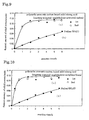
- polycyclic aromatic carbon solid strong acid is evacuated at 150°C for 1 hour, then 0.2 g of it is added as a catalyst into mixed solution of 0.1mol acetic acid and 1.0mol ethyl alcohol under argon gas flow, stirred at 70°C for 6 hours and the amount of ethyl acetate formed by acid catalyst reaction is detected by a gas chromatography Results are shown in Fig.8 (a). In Fig.8, for the comparison, formation of ethyl acetate by reaction using same amount of SO 3 H Nafion as a catalyst is also shown by time lapse (b).
- Polycyclic aromatic carbon solid strong acid - carbon material composite 5g of naphthalene and 5g of activated carbon are added to 300mL of conc. sulfuric acid (96%) and heated at 250°C for 15 hours. Excess conc. sulfuric acid is removed by vacuum distillation at 250°C, and then black solid powder of polycyclic aromatic carbon solid strong acid - carbon material composite is obtained. This aromatic carbon solid strong acid - carbon material composite is washed by 300mL of distilled water at 90°C, and the washing process is repeated until sulfuric acid contained in water after washed becomes under detection limit of elementary analysis. From elementary analysis, sulfur content of this polycyclic aromatic carbon solid strong acid is 3.5 atm%, and presence of many sulfonic acid groups are detected. From the results of temperature-programmed desorption and thermogravimetric analysis, it is confirmed that the decomposition temperature of the polycyclic aromatic carbon solid strong acid - carbon material composite in atmosphere is 230°C, and is understood that thermo stability of it is high.
- polycyclic aromatic carbon solid strong acid - carbon material composite is evacuated at 150°C for 1 hour, then 0.2 g of it is added as a catalyst into mixed solution of 0.1mol acetic acid and 1.0mol ethyl alcohol under argon gas flow, stirred at 70°C for 6 hours and the amount of ethyl acetate formed by acid catalyst reaction is detected by a gas chromatography. Results are shown in Fig.9 (a). In Fig.9, for the comparison, formation of ethyl acetate by reaction using same amount of SO 3 H Nafion as a catalyst is also shown by time lapse (b).
- the synthesized material is a solid acid catalyst having stronger acid strength than that of Nafion ( ⁇ ). Further, it is confirmed that the obtained polycyclic aromatic carbon solid strong acid - carbon material composite indicates stronger activity than that of polycyclic aromatic carbon solid strong acid whose starting material is naphthalene alone, and it is also confirmed that acid catalytic activity can be improved by adhering polycyclic aromatic carbon solid strong acid to the surface of activated carbon having broad surface area. After reaction, recovered material is washed, then used as a catalyst of same reaction. Results are shown in Fig.9 (O).
- polycyclic aromatic carbon solid strong acid - carbon material composite is evacuated at 150°C for 1 hour, then 0.2 g of it is added as a catalyst into mixed solution of 0.1mol acetic acid and 0.1mol ethyl alcohol under argon gas flow, stirred at 70°C for 6 hours and the amount of ethyl acetate formed by acid catalyst reaction is detected by a gas chromatography. Results are shown in Fig.10 (a).
- polycyclic aromatic carbon solid strong acid - carbon material composite indicates stronger activity than that of polycyclic aromatic carbon solid strong acid whose starting material is naphthalene alone, and it is also confirmed that acid catalytic activity can be improved by adhering polycyclic aromatic carbon solid strong acid to the surface of acetylene black having broad surface area.
- black powder is evacuated at 150°C for 1 hour, then 0.2 g of it is added as a catalyst into mixed solution of 0.1mol acetic acid and 1.0mol ethyl alcohol under argon gas flow, stirred at 70°C for 6 hours and the amount of ethyl acetate formed by acid catalyst reaction is detected by a gas chromatography.
- the forming speed of ethyl acetate is not so much different from the state of without catalyst and is clearly understood that the synthesized material does not act as a solid acid catalyst.
- X-ray photoelectron spectroscopic spectrum of said black powder is measured, and from the result it become clear that sulfur is not exist on the surface. The reason why is considered as follows, that is, when temperature for treatment is too high, sulfone groups on surface are decomposed.
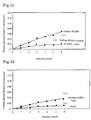
- Proton exchanged SO 3 H Nafion powder (product of Du'pont) is evacuated at 150°C for 1 hour, then 0.2 g of it is added as a catalyst into mixed solution of 0.1mol acetic acid and 1.0mol ethyl alcohol under argon gas flow, stirred at 70°C for 6 hours and the amount of ethyl acetate formed by acid catalyst reaction is detected by a gas chromatography. Results are shown in Fig. 11 (a). Formation of ethyl acetate is progressed under the presence of Nafion. After reaction, recovered material is washed, and then used as a catalyst of same reaction. Results are shown in Fig. 11. As clearly understood from Fig.
- Zirconia sulfate (product of Wako Junyaku Co., Ltd.) is evacuated at 150°C for 1 hour, then 0.2 g of it is added as a catalyst into mixed solution of 0.1mol acetic acid and 1.0mol ethyl alcohol under argon gas flow, stirred at 70°C for 6 hours and the amount of ethyl acetate formed by acid catalyst reaction is detected by a gas chromatography Results are shown in Fig. 12. Formation of ethyl acetate is progressed under the presence of zirconia sulfate ( ⁇ ). After reaction, recovered material is washed, and then used as a catalyst of same reaction. Results are shown in Fig.12 (O). As clearly understood by the Figure, acid catalytic activity of zirconia sulfate remarkably deteriorated by repeating use, and sulfuric acid trace on the surface of zirconia sulfate is unstable in water.
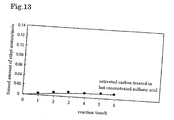
- black powder is evacuated at 150°C for 1 hour, then 0.2 g of it is added as a catalyst into mixed solution of 0.1mol acetic acid and 1.0mol ethyl alcohol under argon gas flow, stirred at 70°C for 6 hours and the amount of ethyl acetate formed by acid catalyst reaction is detected by a gas chromatography. Results are shown in Fig. 13. Cleary understood from the Figure, forming speed of ethyl acetate is slow under the presence of synthesized catalyst, and is confirmed that acid catalytic function of the synthesized material is very small.
- Solid strong acid or solid strong acid - carbon material composite of the present invention which are insoluble in a polar solvent is a material having strong acid characteristic produced by relatively easy method using cheap material, therefore, brings an excellent effect that are advantageous from view points of cost, function and industry
Landscapes
- Chemical & Material Sciences (AREA)
- Organic Chemistry (AREA)
- Engineering & Computer Science (AREA)
- Chemical Kinetics & Catalysis (AREA)
- Materials Engineering (AREA)
- General Chemical & Material Sciences (AREA)
- Oil, Petroleum & Natural Gas (AREA)
- Catalysts (AREA)
- Production Of Liquid Hydrocarbon Mixture For Refining Petroleum (AREA)
- Carbon And Carbon Compounds (AREA)
- Organic Low-Molecular-Weight Compounds And Preparation Thereof (AREA)
Abstract
Description
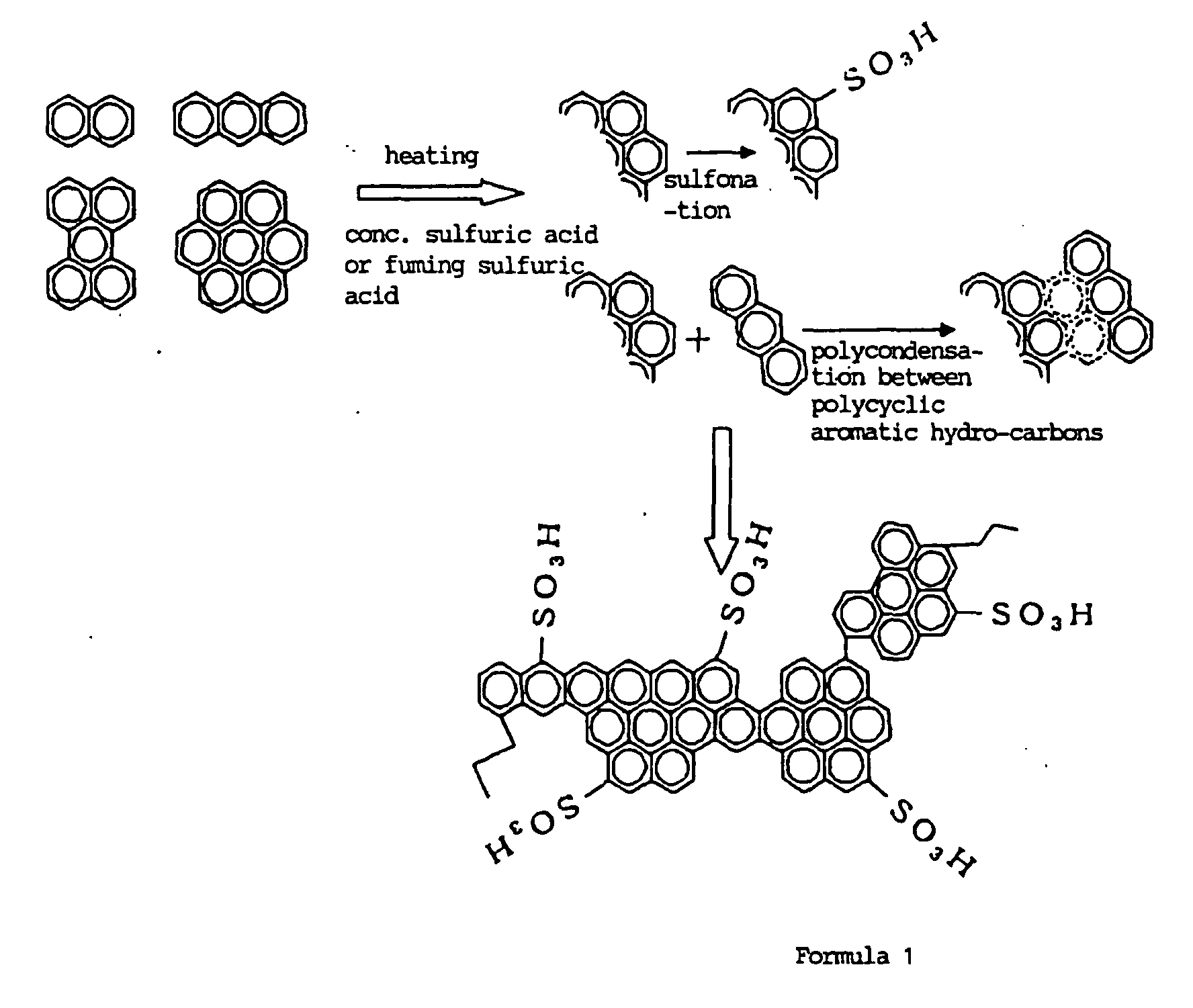
The inventors of the present invention, predicts that polycyclic aromatic hydrocarbon characterized that many aromatic rings are condensed forms the structure which progressed to two dimensional shape similar to graphite, and even if the outermost aromatic rings are sulfonated, it becomes a solid acid which is insoluble in water based on the largely advanced structure of hydrophobic polycyclic aromatic hydrocarbon, and tried heat treatment indicated by following
Above mentioned polycyclic aromatic carbon solid strong acid is evacuated at 150°C for 1 hour, then 0.2g of it is added as a catalyst into mixed solution of 0.1mol acetic acid and 10mol ethyl alcohol under argon gas flow, stirred at 70°C for 6 hours and the amount of ethyl acetate formed by acid catalyst reaction is detected by a gas chromatography. Results are shown in Fig.6 (a). In Fig.6, for the comparison, formation of ethyl acetate by reaction using same amount of SO3H Nafion as a catalyst is also shown by time lapse (b). As shown in the Figure, in the presence of the synthesized catalyst, formation speed of ethyl acetate is very fast and it is understood that the synthesized material is a solid acid catalyst having stronger acid strength than that of Nafion (). After reaction, recovered material is washed, then used as a catalyst of same reaction. Results are shown in Fig.6 (○). As clearly understood from Fig.6, acid catalytic activity of polycyclic aromatic carbon solid strong acid does not deteriorate by repeating use. Further, said synthesized polycyclic aromatic carbon solid strong acid is heated with distilled water in an autoclave of 150°C for 72hours and filtrated. This filtrated powder is evacuated for 1 hour at 150°C, then 0.2g of it is used as a catalyst and same reaction as mentioned above is carried out. Catalytic activity of it is same as to the case of Fig.6. These results indicate that said polycyclic aromatic carbon solid strong acid is chemically stable and acid strength of it is not deteriorated even in hot water of 150°C.
Above mentioned polycyclic aromatic carbon solid strong acid is evacuated at 150°C for 1 hour, then 0.2 g of it is added as a catalyst into mixed solution of 0.1mol acetic acid and 1.0mol ethyl alcohol under argon gas flow, stirred at 70°C for 6 hours and the amount of ethyl acetate formed by acid catalyst reaction is detected by a gas chromatography. Results are shown in Fig.7 (a). In Fig.7, for the comparison, formation of ethyl acetate by reaction using same amount of SO3H Nafion as a catalyst is also shown by time lapse (b). As shown in the Figure, in the presence of the synthesized catalyst, formation speed of ethyl acetate is very fast and it is understood that the synthesized material is a solid acid catalyst having stronger acid strength than that of Nafion (). After reaction, recovered material is washed, then used as a catalyst of same reaction. Results are shown in Fig.7 (O). As clearly understood from Fig.7, acid catalytic activity of polycyclic aromatic carbon solid strong acid does not deteriorate by repeating use. Further, said synthesized polycyclic aromatic carbon solid strong acid is heated with distilled water in an autoclave of 150°C for 72hours and filtrated. This filtrated powder is evacuated for 1 hour at 150°C, then 0.2g of it is used as a catalyst and same reaction as mentioned above is carried out. Catalytic activity of it is same as to the case of Fig.7. These results indicate that said polycyclic aromatic carbon solid strong acid is chemically stable and acid strength of it is not deteriorated even in hot water of 150°C.
Above mentioned polycyclic aromatic carbon solid strong acid is evacuated at 150°C for 1 hour, then 0.2 g of it is added as a catalyst into mixed solution of 0.1mol acetic acid and 1.0mol ethyl alcohol under argon gas flow, stirred at 70°C for 6 hours and the amount of ethyl acetate formed by acid catalyst reaction is detected by a gas chromatography Results are shown in Fig.8 (a). In Fig.8, for the comparison, formation of ethyl acetate by reaction using same amount of SO3H Nafion as a catalyst is also shown by time lapse (b). As shown in the Figure, in the presence of the synthesized catalyst, formation speed of ethyl acetate is very fast and it is understood that the synthesized material is a solid acid catalyst having stronger acid strength than that of Nafion (). After reaction, recovered material is washed, then used as a catalyst of same reaction. Results are shown in Fig.8 (○). As clearly understood from Fig.8, acid catalytic activity of polycyclic aromatic carbon solid strong acid does not deteriorate by repeating use. Further, said synthesized polycyclic aromatic carbon solid strong acid is heated with distilled water in an autoclave of 150°C for 72hours and filtrated. This filtrated powder is evacuated for 1 hour at 150°C, then 0.2g of it is used as a catalyst and same reaction as mentioned above is carried out. Catalytic activity of it is same as to the case of Fig.8. These results indicate that said polycyclic aromatic carbon solid strong acid is chemically stable and acid strength of it is not deteriorated even in hot water of 150°C.
Above mentioned polycyclic aromatic carbon solid strong acid - carbon material composite is evacuated at 150°C for 1 hour, then 0.2 g of it is added as a catalyst into mixed solution of 0.1mol acetic acid and 0.1mol ethyl alcohol under argon gas flow, stirred at 70°C for 6 hours and the amount of ethyl acetate formed by acid catalyst reaction is detected by a gas chromatography. Results are shown in Fig.10 (a). In Fig.10, for the comparison, formation of ethyl acetate by reaction using same amount of SO3H Nafion as a catalyst is also shown by time lapse (b). As shown in the Figure, in the presence of the synthesized catalyst, formation speed of ethyl acetate is very fast and it is understood that the synthesized material is a solid acid catalyst having stronger acid strength than that of Nafion (). Further, it is confirmed that the obtained polycyclic aromatic carbon solid strong acid - carbon material composite indicates stronger activity than that of polycyclic aromatic carbon solid strong acid whose starting material is naphthalene alone, and it is also confirmed that acid catalytic activity can be improved by adhering polycyclic aromatic carbon solid strong acid to the surface of acetylene black having broad surface area.
This solid powder is washed by 300mL of ethyl alcohol, and the washing process is repeated until sulfuric acid contained in ethyl alcohol after washed becomes under detection limit of elementary analysis. Since from X-ray diffraction pattern of the obtained black powder, any structure is not observed, this material is understood to be amorphous. From elementary analysis, sulfur content of this polycyclic aromatic carbon solid strong acid is 0.05 atm%. Above mentioned black powder is evacuated at 150°C for 1 hour, then 0.2 g of it is added as a catalyst into mixed solution of 0.1mol acetic acid and 1.0mol ethyl alcohol under argon gas flow, stirred at 70°C for 6 hours and the amount of ethyl acetate formed by acid catalyst reaction is detected by a gas chromatography. The forming speed of ethyl acetate is not so much different from the state of without catalyst and is clearly understood that the synthesized material does not act as a solid acid catalyst. For the quantitative analysis of sulfur amount loaded to the surface, X-ray photoelectron spectroscopic spectrum of said black powder is measured, and from the result it become clear that sulfur is not exist on the surface. The reason why is considered as follows, that is, when temperature for treatment is too high, sulfone groups on surface are decomposed.
Above mentioned black powder is evacuated at 150°C for 1 hour, then 0.2 g of it is added as a catalyst into mixed solution of 0.1mol acetic acid and 1.0mol ethyl alcohol under argon gas flow, stirred at 70°C for 6 hours and the amount of ethyl acetate formed by acid catalyst reaction is detected by a gas chromatography. Results are shown in Fig. 13. Cleary understood from the Figure, forming speed of ethyl acetate is slow under the presence of synthesized catalyst, and is confirmed that acid catalytic function of the synthesized material is very small.
Claims (13)
- A solid acid, which is insoluble in a polar solvent, obtained by heat treating of polycyclic aromatic hydrocarbons in concentrated sulfuric acid or fuming sulfuric acid to thereby condense and sulfonate said polycyclic aromatic hydrocarbons.
- The solid acid of claim 1, wherein polycyclic aromatic hydrocarbons is at least one selected from the group consisting of a polycyclic aromatic hydrocarbon obtained by condensing two or more aromatic rings, mixture of a polycyclic aromatic hydrocarbon obtained by condensing two or more aromatic rings or tar, pitch, fuel oil or asphalt containing a polycyclic aromatic hydrocarbon obtained by condensing two or more aromatic rings.
- The solid acid of claim 1 or claim 2, wherein temperature T for heat treatment is 100°C≦T≦450°C.
- The solid acid of claim 3, wherein temperature T for heat treatment is 200°C≦T≦350°C.
- A solid strong acid catalyst comprising, a solid acid, which is insoluble in a polar solvent, obtained by heat treating of polycyclic aromatic hydrocarbons in concentrated sulfuric acid or fuming sulfuric acid to thereby to concentrate and sulfonate said polycyclic aromatic hydrocarbons.
- The solid strong acid catalyst of claim 5, wherein polycyclic aromatic hydrocarbons is at least one selected from the group consisting of a polycyclic aromatic hydrocarbon obtained by condensing two or more aromatic rings, mixture of a polycyclic aromatic hydrocarbon obtained by condensing two or more aromatic rings or tar, pitch, fuel oil or asphalt containing a polycyclic aromatic hydrocarbon obtained by condensing two or more aromatic rings.
- The solid strong acid catalyst of claim 5 or claim 6, wherein temperature T for heat treatment is 100°C≦T≦450°C.
- The solid strong acid catalyst of claim 7, wherein temperature T for heat treatment is 200°C≦T≦350°C.
- A composite solid strong acid comprising, a solid acid and a carbon material, wherein said solid acid is obtained by heat treating of polycyclic aromatic hydrocarbons to which the carbon material is blended in concentrated sulfuric acid or fuming sulfuric acid, transforming said polycyclic aromatic hydrocarbons to a solid acid which is insoluble in a polar solvent by condensation and sulfonation further compositing with said carbon material.
- The composite solid strong acid of claim 9, wherein polycyclic aromatic hydrocarbons is at least one selected from the group consisting of a polycyclic aromatic hydrocarbon obtained by condensing two or more aromatic rings, mixture of a polycyclic aromatic hydrocarbon obtained by condensing two or more aromatic rings or tar, pitch, fuel oil or asphalt containing a polycyclic aromatic hydrocarbon obtained by condensing two or more aromatic rings.
- The composite solid strong acid of claim 9 or claim 10, wherein temperature T for heat treatment is 100°C≦T≦450°C.
- The composite solid strong acid of claim 11, wherein temperature T for heat treatment is 200°C≦T≦350°C.
- The composite solid strong acid according to anyone of claims 9, 10, 11 or 12, wherein the carbon material is at least one selected from the group consisting of carbon black, acetylene black, activated carbon, carbon nano tube or fullerene.
Applications Claiming Priority (3)
| Application Number | Priority Date | Filing Date | Title |
|---|---|---|---|
| JP2003027810 | 2003-02-05 | ||
| JP2003027810A JP4041409B2 (en) | 2003-02-05 | 2003-02-05 | Polycyclic aromatic carbon-based solid strong acid |
| PCT/JP2003/011442 WO2004069789A1 (en) | 2003-02-05 | 2003-09-08 | Polycyclic aromatic carbon based solid strong acid |
Publications (3)
| Publication Number | Publication Date |
|---|---|
| EP1595864A1 true EP1595864A1 (en) | 2005-11-16 |
| EP1595864A4 EP1595864A4 (en) | 2007-04-25 |
| EP1595864B1 EP1595864B1 (en) | 2015-05-27 |
Family
ID=32844184
Family Applications (1)
| Application Number | Title | Priority Date | Filing Date |
|---|---|---|---|
| EP03815739.2A Expired - Lifetime EP1595864B1 (en) | 2003-02-05 | 2003-09-08 | Polycyclic aromatic hydrocarbon based solid strong acid |
Country Status (5)
| Country | Link |
|---|---|
| US (1) | US7335790B2 (en) |
| EP (1) | EP1595864B1 (en) |
| JP (1) | JP4041409B2 (en) |
| CN (1) | CN1308299C (en) |
| WO (1) | WO2004069789A1 (en) |
Cited By (2)
| Publication number | Priority date | Publication date | Assignee | Title |
|---|---|---|---|---|
| WO2007064809A3 (en) * | 2005-12-02 | 2007-12-27 | Sachem Inc | Anion-exchange displacement chromatography process and anionic organic compounds for use as displacer compounds in anion-exchange displacement chromatography process |
| EP1994984A4 (en) * | 2006-03-10 | 2009-10-28 | Nippon Oil Corp | CARBON-BASED SOLID ACID, CATALYST COMPRISING THE SOLID ACID AND REACTION UTILIZING THE SOLID ACID AS CATALYST |
Families Citing this family (35)
| Publication number | Priority date | Publication date | Assignee | Title |
|---|---|---|---|---|
| US7594989B2 (en) * | 2004-05-14 | 2009-09-29 | Exxonmobile Research And Engineering Company | Enhanced thermal upgrading of heavy oil using aromatic polysulfonic acid salts |
| JP4688139B2 (en) * | 2005-03-16 | 2011-05-25 | 国立大学法人東京工業大学 | Solid acid-containing composition |
| JP4925399B2 (en) * | 2005-06-08 | 2012-04-25 | 東洋インキScホールディングス株式会社 | Method for producing solid acid |
| WO2007000913A1 (en) | 2005-06-27 | 2007-01-04 | Tokyo Institute Of Technology | Processes for producing higher fatty acid esters |
| JPWO2007029496A1 (en) * | 2005-09-07 | 2009-03-19 | 国立大学法人東京工業大学 | Fluorinated sulfonic acid group-introduced amorphous carbon, its production method and its use |
| WO2007032188A1 (en) * | 2005-09-16 | 2007-03-22 | Tokyo Institute Of Technology | Solid acid catalyst |
| JP5127020B2 (en) * | 2005-12-01 | 2013-01-23 | Jx日鉱日石エネルギー株式会社 | Olefin hydration process |
| JP2008133250A (en) * | 2006-02-24 | 2008-06-12 | Tokyo Electric Power Co Inc:The | Method for producing alkyl ether by microwave |
| EP2039783A4 (en) | 2006-06-26 | 2009-12-09 | Tokyo Inst Tech | PROCESS FOR PRODUCING POLYSACCHARIDE AND / OR MONOSACCHARIDE BY HYDROLYSIS OF ANOTHER POLYSACCHARIDE |
| JP5039955B2 (en) * | 2006-09-07 | 2012-10-03 | トヨタ自動車株式会社 | Fuel cell electrolyte and fuel cell |
| JP4984766B2 (en) * | 2006-09-11 | 2012-07-25 | 凸版印刷株式会社 | Sulfonic acid group-introduced amorphous carbon-containing composition |
| CN100421793C (en) * | 2006-11-10 | 2008-10-01 | 湖南师范大学 | Method for preparation of solid sulfonic acid by carbohydrate catalysis |
| WO2008102913A1 (en) | 2007-02-21 | 2008-08-28 | Nippon Oil Corporation | Sulfonic acid group-containing carbonaceous material |
| JP5339453B2 (en) | 2007-05-11 | 2013-11-13 | Jx日鉱日石エネルギー株式会社 | Method for producing sulfonic acid group-containing carbonaceous material, solid acid catalyst, method for producing alkylation reaction product, and method for producing olefin polymer |
| JP5574216B2 (en) * | 2007-06-29 | 2014-08-20 | Jx日鉱日石エネルギー株式会社 | Method for producing sulfonic acid group-containing carbonaceous material |
| WO2009004950A1 (en) * | 2007-06-29 | 2009-01-08 | Nippon Oil Corporation | Method for production of monosaccharide and/or water-soluble polysaccharide by hydrolysis of cellulose-containing material |
| JP5292742B2 (en) * | 2007-08-21 | 2013-09-18 | 凸版印刷株式会社 | Fuel cell using solid acid and method for producing solid acid |
| JP5182987B2 (en) * | 2008-05-06 | 2013-04-17 | 株式会社豊田自動織機 | Catalyst precursor, catalyst material, and catalyst production method |
| JP4557097B2 (en) | 2008-11-27 | 2010-10-06 | 横浜ゴム株式会社 | Electrolyte for photoelectric conversion element and photoelectric conversion element and dye-sensitized solar cell using the electrolyte |
| JP4725689B2 (en) | 2008-12-26 | 2011-07-13 | 横浜ゴム株式会社 | Electrolyte for photoelectric conversion element and photoelectric conversion element and dye-sensitized solar cell using the electrolyte |
| US9357774B2 (en) | 2009-08-31 | 2016-06-07 | Tokyo Institute Of Technology | Sterilization method |
| JP5482110B2 (en) * | 2009-11-04 | 2014-04-23 | 富士電機株式会社 | Solid acid and process for producing the same |
| WO2012177975A1 (en) * | 2011-06-24 | 2012-12-27 | Brewer Science Inc. | Highly soluble carbon nanotubes with enhanced conductivity |
| CN102716767B (en) * | 2012-07-04 | 2014-06-04 | 太原理工大学 | Preparation method of high-acid-content carbon-based solid acid |
| CN102784663A (en) * | 2012-08-10 | 2012-11-21 | 绍兴文理学院 | Preparation method of high temperature-resisting carbon-based solid acid |
| JP6315831B2 (en) * | 2013-02-13 | 2018-04-25 | 独立行政法人国立高等専門学校機構 | Method for hydrolysis of cellulose |
| CN103263935A (en) * | 2013-06-08 | 2013-08-28 | 宁夏大学 | Preparation method and application of magnetic core-shell carbon-based solid acid |
| WO2015005144A1 (en) | 2013-07-12 | 2015-01-15 | 独立行政法人産業技術総合研究所 | Carbon-containing solid acid having sulfonate group |
| JP6313764B2 (en) | 2013-08-08 | 2018-04-18 | 田中貴金属工業株式会社 | Catalyst for polymer electrolyte fuel cell and method for producing the same |
| JP6430184B2 (en) | 2013-09-18 | 2018-11-28 | フタムラ化学株式会社 | Synthetic resin binder molded solid acid and method for producing the same |
| CN103831130B (en) * | 2014-02-17 | 2015-11-04 | 太原理工大学 | A process for simultaneously preparing coal-based solid acid and fuel oil |
| CN105131321A (en) | 2014-06-04 | 2015-12-09 | 苏州高通新材料科技有限公司 | Method for treatment of organic polymer material with acid, and functionalized-graphene-containing powder product with carbon material attached to the surface |
| CN105879911B (en) * | 2016-04-07 | 2019-02-12 | 大连理工大学 | A kind of high temperature resistant solid acid catalyst based on coal direct liquefaction heavy organic fraction and its preparation method and application |
| DE102018211916A1 (en) * | 2018-07-18 | 2020-01-23 | Robert Bosch Gmbh | fuel cell |
| WO2020196383A1 (en) | 2019-03-22 | 2020-10-01 | 日産化学株式会社 | Carbon-based solid acid |
Family Cites Families (10)
| Publication number | Priority date | Publication date | Assignee | Title |
|---|---|---|---|---|
| US1711449A (en) * | 1925-04-27 | 1929-04-30 | Peter C Reilly | Treatment of pitch |
| US2585983A (en) * | 1948-12-04 | 1952-02-19 | Standard Oil Co | Alkylation process |
| US4868343A (en) * | 1986-04-16 | 1989-09-19 | Catalytica Inc. | Acid catalyzed process |
| JPS6397624A (en) | 1986-10-15 | 1988-04-28 | Sumitomo Metal Ind Ltd | Production of condensed polycyclic aromatic resin |
| DE68928384T2 (en) | 1989-02-23 | 1998-05-07 | Sumikin Chemical | Aromatic curable resins and their production |
| CN1039902C (en) * | 1992-05-21 | 1998-09-23 | 蔡宪元 | Coproduction process of methylnaphthol and ethylnaphthol |
| CN1099089A (en) * | 1994-06-03 | 1995-02-22 | 北京市石景山区华泰化学品公司 | Early strength water reducing agent for non-alkali concrete |
| EP0964844B1 (en) | 1997-01-08 | 2003-09-10 | Eastman Chemical Resins, Inc. | Fluorinated solid acids as catalysts for the preparation of hydrocarbon resins |
| CN1294096A (en) * | 1999-10-28 | 2001-05-09 | 重庆钢铁(集团)有限责任公司 | Process for preparing water-reducing agent |
| ATE503253T1 (en) | 2003-09-16 | 2011-04-15 | Tokyo Inst Tech | SULFONATED AMORPHIC CARBON, PROCESS FOR PRODUCING IT AND USE THEREOF |
-
2003
- 2003-02-05 JP JP2003027810A patent/JP4041409B2/en not_active Expired - Fee Related
- 2003-09-08 WO PCT/JP2003/011442 patent/WO2004069789A1/en not_active Ceased
- 2003-09-08 US US10/544,402 patent/US7335790B2/en not_active Expired - Lifetime
- 2003-09-08 EP EP03815739.2A patent/EP1595864B1/en not_active Expired - Lifetime
- 2003-09-08 CN CNB038259346A patent/CN1308299C/en not_active Expired - Fee Related
Cited By (2)
| Publication number | Priority date | Publication date | Assignee | Title |
|---|---|---|---|---|
| WO2007064809A3 (en) * | 2005-12-02 | 2007-12-27 | Sachem Inc | Anion-exchange displacement chromatography process and anionic organic compounds for use as displacer compounds in anion-exchange displacement chromatography process |
| EP1994984A4 (en) * | 2006-03-10 | 2009-10-28 | Nippon Oil Corp | CARBON-BASED SOLID ACID, CATALYST COMPRISING THE SOLID ACID AND REACTION UTILIZING THE SOLID ACID AS CATALYST |
Also Published As
| Publication number | Publication date |
|---|---|
| CN1741991A (en) | 2006-03-01 |
| JP2004238311A (en) | 2004-08-26 |
| CN1308299C (en) | 2007-04-04 |
| EP1595864A4 (en) | 2007-04-25 |
| EP1595864B1 (en) | 2015-05-27 |
| US20060276668A1 (en) | 2006-12-07 |
| JP4041409B2 (en) | 2008-01-30 |
| US20080045745A2 (en) | 2008-02-21 |
| WO2004069789A1 (en) | 2004-08-19 |
| US7335790B2 (en) | 2008-02-26 |
Similar Documents
| Publication | Publication Date | Title |
|---|---|---|
| EP1595864B1 (en) | Polycyclic aromatic hydrocarbon based solid strong acid | |
| EP1667167B1 (en) | Sulfonated amorphous carbon, process for producing the same and use thereof | |
| JP5614737B2 (en) | Solid acid catalyst containing sulfonic acid group-containing carbonaceous material and method for producing various compounds by reaction using the same | |
| JPWO2007105802A1 (en) | Carbon solid acid, catalyst comprising the same, and reaction using the same as a catalyst | |
| JP5360719B2 (en) | Method for producing solid acid catalyst comprising sulfonic acid group-containing carbonaceous material and use thereof | |
| Sarmah et al. | Selective oxidation of biomass-derived alcohols and aromatic and aliphatic alcohols to aldehydes with O2/air using a RuO2-supported Mn3O4 catalyst | |
| JP6351181B2 (en) | Carbon-based solid acid having sulfonic acid group | |
| JPWO2008143008A1 (en) | Method for producing sulfonic acid group-containing carbonaceous material, solid acid catalyst, method for producing alkylation reaction product, and method for producing olefin polymer | |
| Turek et al. | Propylene oxidation over poly (azomethines) doped with heteropolyacids | |
| JP5182987B2 (en) | Catalyst precursor, catalyst material, and catalyst production method | |
| Wang et al. | Production of aryl oxygen-containing compounds via catalytic pyrolysis of bagasse lignin over La0. 8M0. 2FeO3 (M= La, Ca, Sr, Ba) | |
| Perez et al. | Polyvinyl sulfonated catalyst and the effect of sulfonic sites on the dehydration of carbohydrates | |
| Ptaszyńska et al. | The role of mechanochemical treatment of carbon nanotubes in promoting glycerol etherification | |
| JP5114712B2 (en) | Solid acid catalyst | |
| CN105618133A (en) | Magnetic glucose-based solid acid catalyst as well as preparation method and application thereof | |
| Liu et al. | Catalytic lignin valorization over HSZ-supported CuNiAl-based catalysts with microwave heating | |
| Afandiyeva et al. | Synthesis of synthetic petroleum acids based on naphthene-paraffinic consentrate in the catalytic presence of reduced graphene oxide | |
| JP2009214051A (en) | Diamond solid acid, and solid acid catalyst and solid electrolyte consisting of the diamond solid acid | |
| JP2008214508A (en) | Compound consisting of solid acid and hyperbranched polymer and use thereof | |
| JPWO2007029496A1 (en) | Fluorinated sulfonic acid group-introduced amorphous carbon, its production method and its use | |
| CN1271146C (en) | Sulfonated carbon nanotube and its making method | |
| WO2007064041A1 (en) | Method for hydration of olefin | |
| CN1131104C (en) | Cobalt-lanthanum-molybdenum oxide catalyst for synthesizing formaldehyde from methane and preparation method thereof | |
| CN114713211A (en) | Preparation method and application of titanium-aluminum binary oxide | |
| Khatri | Design and synthesis of calixarene-templated catalysts |
Legal Events
| Date | Code | Title | Description |
|---|---|---|---|
| PUAI | Public reference made under article 153(3) epc to a published international application that has entered the european phase |
Free format text: ORIGINAL CODE: 0009012 |
|
| 17P | Request for examination filed |
Effective date: 20050824 |
|
| AK | Designated contracting states |
Kind code of ref document: A1 Designated state(s): AT BE BG CH CY CZ DE DK EE ES FI FR GB GR HU IE IT LI LU MC NL PT RO SE SI SK TR |
|
| RBV | Designated contracting states (corrected) |
Designated state(s): DE FR GB |
|
| A4 | Supplementary search report drawn up and despatched |
Effective date: 20070328 |
|
| RIC1 | Information provided on ipc code assigned before grant |
Ipc: C07C 309/38 20060101ALI20070322BHEP Ipc: B01J 31/06 20060101ALI20070322BHEP Ipc: B01J 31/02 20060101AFI20070322BHEP |
|
| 17Q | First examination report despatched |
Effective date: 20080714 |
|
| REG | Reference to a national code |
Ref country code: DE Ref legal event code: R079 Ref document number: 60347663 Country of ref document: DE Free format text: PREVIOUS MAIN CLASS: C07C0309380000 Ipc: B01J0037200000 |
|
| RIC1 | Information provided on ipc code assigned before grant |
Ipc: C07C 309/62 20060101ALI20140930BHEP Ipc: B01J 31/02 20060101ALI20140930BHEP Ipc: B01J 37/20 20060101AFI20140930BHEP Ipc: B01J 31/06 20060101ALI20140930BHEP Ipc: C07C 309/38 20060101ALI20140930BHEP |
|
| GRAP | Despatch of communication of intention to grant a patent |
Free format text: ORIGINAL CODE: EPIDOSNIGR1 |
|
| INTG | Intention to grant announced |
Effective date: 20141117 |
|
| GRAS | Grant fee paid |
Free format text: ORIGINAL CODE: EPIDOSNIGR3 |
|
| GRAA | (expected) grant |
Free format text: ORIGINAL CODE: 0009210 |
|
| RAP1 | Party data changed (applicant data changed or rights of an application transferred) |
Owner name: JAPAN SCIENCE AND TECHNOLOGY AGENCY |
|
| AK | Designated contracting states |
Kind code of ref document: B1 Designated state(s): DE FR GB |
|
| REG | Reference to a national code |
Ref country code: GB Ref legal event code: FG4D |
|
| REG | Reference to a national code |
Ref country code: DE Ref legal event code: R096 Ref document number: 60347663 Country of ref document: DE Effective date: 20150709 Ref country code: DE Ref legal event code: R096 Ref document number: 60347663 Country of ref document: DE |
|
| REG | Reference to a national code |
Ref country code: DE Ref legal event code: R097 Ref document number: 60347663 Country of ref document: DE |
|
| PLBE | No opposition filed within time limit |
Free format text: ORIGINAL CODE: 0009261 |
|
| STAA | Information on the status of an ep patent application or granted ep patent |
Free format text: STATUS: NO OPPOSITION FILED WITHIN TIME LIMIT |
|
| 26N | No opposition filed |
Effective date: 20160301 |
|
| REG | Reference to a national code |
Ref country code: FR Ref legal event code: PLFP Year of fee payment: 14 |
|
| REG | Reference to a national code |
Ref country code: FR Ref legal event code: PLFP Year of fee payment: 15 |
|
| REG | Reference to a national code |
Ref country code: FR Ref legal event code: PLFP Year of fee payment: 16 |
|
| PGFP | Annual fee paid to national office [announced via postgrant information from national office to epo] |
Ref country code: FR Payment date: 20210809 Year of fee payment: 19 |
|
| PGFP | Annual fee paid to national office [announced via postgrant information from national office to epo] |
Ref country code: GB Payment date: 20210809 Year of fee payment: 19 Ref country code: DE Payment date: 20210805 Year of fee payment: 19 |
|
| REG | Reference to a national code |
Ref country code: DE Ref legal event code: R119 Ref document number: 60347663 Country of ref document: DE |
|
| GBPC | Gb: european patent ceased through non-payment of renewal fee |
Effective date: 20220908 |
|
| PG25 | Lapsed in a contracting state [announced via postgrant information from national office to epo] |
Ref country code: FR Free format text: LAPSE BECAUSE OF NON-PAYMENT OF DUE FEES Effective date: 20220930 Ref country code: DE Free format text: LAPSE BECAUSE OF NON-PAYMENT OF DUE FEES Effective date: 20230401 |
|
| PG25 | Lapsed in a contracting state [announced via postgrant information from national office to epo] |
Ref country code: GB Free format text: LAPSE BECAUSE OF NON-PAYMENT OF DUE FEES Effective date: 20220908 |