EP1594236A2 - Distributed resource management for enhanced dedicated channel - Google Patents
Distributed resource management for enhanced dedicated channel Download PDFInfo
- Publication number
- EP1594236A2 EP1594236A2 EP05252541A EP05252541A EP1594236A2 EP 1594236 A2 EP1594236 A2 EP 1594236A2 EP 05252541 A EP05252541 A EP 05252541A EP 05252541 A EP05252541 A EP 05252541A EP 1594236 A2 EP1594236 A2 EP 1594236A2
- Authority
- EP
- European Patent Office
- Prior art keywords
- short
- term
- allocating
- base station
- long
- Prior art date
- Legal status (The legal status is an assumption and is not a legal conclusion. Google has not performed a legal analysis and makes no representation as to the accuracy of the status listed.)
- Granted
Links
Images
Classifications
-
- H—ELECTRICITY
- H04—ELECTRIC COMMUNICATION TECHNIQUE
- H04W—WIRELESS COMMUNICATION NETWORKS
- H04W24/00—Supervisory, monitoring or testing arrangements
- H04W24/08—Testing, supervising or monitoring using real traffic
-
- H—ELECTRICITY
- H04—ELECTRIC COMMUNICATION TECHNIQUE
- H04W—WIRELESS COMMUNICATION NETWORKS
- H04W28/00—Network traffic management; Network resource management
- H04W28/16—Central resource management; Negotiation of resources or communication parameters, e.g. negotiating bandwidth or QoS [Quality of Service]
- H04W28/18—Negotiating wireless communication parameters
-
- H—ELECTRICITY
- H04—ELECTRIC COMMUNICATION TECHNIQUE
- H04B—TRANSMISSION
- H04B17/00—Monitoring; Testing
- H04B17/30—Monitoring; Testing of propagation channels
- H04B17/382—Monitoring; Testing of propagation channels for resource allocation, admission control or handover
-
- H—ELECTRICITY
- H04—ELECTRIC COMMUNICATION TECHNIQUE
- H04W—WIRELESS COMMUNICATION NETWORKS
- H04W72/00—Local resource management
- H04W72/04—Wireless resource allocation
- H04W72/044—Wireless resource allocation based on the type of the allocated resource
- H04W72/0446—Resources in time domain, e.g. slots or frames
-
- H—ELECTRICITY
- H04—ELECTRIC COMMUNICATION TECHNIQUE
- H04W—WIRELESS COMMUNICATION NETWORKS
- H04W72/00—Local resource management
- H04W72/04—Wireless resource allocation
- H04W72/044—Wireless resource allocation based on the type of the allocated resource
- H04W72/0453—Resources in frequency domain, e.g. a carrier in FDMA
-
- H—ELECTRICITY
- H04—ELECTRIC COMMUNICATION TECHNIQUE
- H04W—WIRELESS COMMUNICATION NETWORKS
- H04W72/00—Local resource management
- H04W72/50—Allocation or scheduling criteria for wireless resources
- H04W72/54—Allocation or scheduling criteria for wireless resources based on quality criteria
- H04W72/541—Allocation or scheduling criteria for wireless resources based on quality criteria using the level of interference
-
- H—ELECTRICITY
- H04—ELECTRIC COMMUNICATION TECHNIQUE
- H04W—WIRELESS COMMUNICATION NETWORKS
- H04W88/00—Devices specially adapted for wireless communication networks, e.g. terminals, base stations or access point devices
- H04W88/12—Access point controller devices
Definitions
- This invention relates generally to telecommunications, and, more particularly, to wireless telecommunications.
- a conventional wireless telecommunications system such as a cellular telephone system, includes one or more base stations (sometimes referred to as node-Bs) that may establish and/or maintain one or more concurrent wireless communication links with one or more mobile units.
- a base station may establish and/or maintain concurrent wireless communication links with a plurality of mobile units within a cell associated with the base station.
- the mobile units may be cellular telephones, pagers, personal data assistants, portable computers, desktop computers, and the like.
- a radio network controller may be coupled to the one or more base stations.
- the radio network controller manages resources for an uplink dedicated channel used by each mobile unit associated with each of the base stations.
- the radio network controller may include a resource management function that controls the interference from other mobile units in the cell, as well as handover mobile units in neighboring cells, so that a required quality of service (sometimes referred to as a QoS) is satisfied for each mobile unit.
- UMTS Universal Mobile Telephone Service
- the radio network controller performs the various resource management functions based upon a long-term entity such as a long-term average of the Received Total Wideband Power or Received Signal Strength Indicator, which are absolute measures of the aggregate received power.
- the long-term entity is typically used to determine a measure of the relative contribution of thermal noise and interference from other mobile units called the "rise-over-thermal," or RoT.
- the radio network controller may use the rise-over-thermal to allocate the resources of the base stations such that a desired quality of service may be maintained for each mobile unit.
- the radio network controller may use the rise-over-thermal to administrate the total number of the users in the system and the system load of the base stations so that a frame error rate for each mobile unit may be kept below a desired level or in a desired range.
- the radio network controller may use the rise-over-thermal to administrate the total number of the users and the system load of the base stations so that a signal-to-noise ratio for each mobile unit may be kept above a desired level or in a desired range.
- the radio network controller requires additional headroom with an assumption of a worst case scenario to perform the resource management functions, which reduces the efficiency of the wireless telecommunications system.
- the radio network controller may account for silences in voice communication, such as pauses in a conversation, by assuming a worst-case scenario in which all mobile units are assumed to be transmitting and/or receiving voice communications during silences.
- the additional headroom is, at least in part, a result of the radio network controller performing the various resource management functions based upon long-term variables, such as the long-term average of the Received Total Wideband Power or Received Signal Strength Indicator.
- the present invention is directed to addressing the effects of one or more of the problems set forth above.
- a method for distributed resource management for enhanced dedicated channel includes determining at least one short-term entity associated with the at least one base station and providing the at least one short-term entity to a radio network controller.
- a method for distributed resource management for enhanced dedicated channel that includes receiving at least one short-term entity associated with the at least one base station and allocating at least one long-term resource based upon the at least one short-term entity.
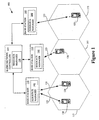
- FIG. 1 conceptually illustrates one embodiment of a wireless telecommunications system 100.
- the wireless telecommunications system 100 is a cellular wireless telecommunications system 100 that operates in accordance with the Universal Mobile Telecommunication System (UMTS) protocol.
- UMTS Universal Mobile Telecommunication System
- the present invention is not limited to cellular systems that operate in accordance with the UMTS protocol.
- the wireless telecommunications system 100 may be any desirable system that operates in accordance with any desirable protocol including, but not limited to, a code division multiple access (CDMA) 2000 protocol, a Personal Communication System (PCS) protocol, a GSM protocol, and wireless LAN protocol.
- CDMA code division multiple access
- PCS Personal Communication System
- GSM Global System
- wireless LAN protocol wireless LAN protocol
- the wireless telecommunications system 100 includes a radio network controller 105 that is communicatively coupled to one or more base stations 110.
- the radio network controller 105 may be communicatively coupled to the one or more base stations 110 by any of a variety of wired and/or wireless links.
- signals passed between the radio network controller 105 and the one or more base stations 110 may pass through other devices (not shown). For example, the signals may pass through one or more routers, switches, networks, and the like.
- Each base station 110 is associated with at least one cell 115.
- each base station 110 may be associated with a cell 115 corresponding to a geographic area having a radius of approximately 2 miles.
- the size of the cells 115 depends upon a variety of factors including, but not limited to, the transmission and/or reception power of the base station 110, the presence of obstructions such as buildings and/or mountains, and the like.
- the cells 115 may not have a simple geometric shape, such as a hexagon, and boundaries of the cells 115 are not generally precisely defined, although in the interest of clarity the cells 115 shown in Figure 1 are depicted as hexagons having precise boundaries.
- the mobile units 120 establish concurrent wireless communication links 125 with at least the base station 110 associated with the cell 115 containing the mobile unit 120.
- the concurrent wireless communication links 125 include an uplink dedicated channel (sometimes referred to as an uplink DCH).
- the base stations 110 provide signals indicative of a long-term allocation of resources associated with the base stations 110 to the radio network controller 105.
- the signals indicative of the long-term allocation of resources include a long-term average of the Received Total Wideband Power or Received Signal Strength Indicator (RSSI).
- RSSI Received Total Wideband Power or Received Signal Strength Indicator
- a long-term resource management function 130 in the radio network controller 105 uses the signals indicative of a long-term allocation of resources to allocate resources associated with the radio network controller 105 and/or the base stations 110.
- the long-term resource management function 130 may use the long-term average of the Received Total Wideband Power or RSSI to control call admission, handoff of the mobile units 120 between base stations 110, and the like.
- the term "long-term” refers to resources that may be allocated on a relatively long timescale, such as call admission, handoff of the mobile units 120, system overload control, and the like.
- the long-term allocation of resources may take place on a timescale of approximately 100 milliseconds to a few seconds.
- a short-term resource management function 140 in the base station 110 allocates short-term resources.
- short-term refers to resources that may be allocated on a relatively short time scale, such as the bandwidth allocated to voice and/or data communications.
- voice and/or data communication bandwidth may be allocated to the mobile units 120 on a timescale of between about one-tenth of a millisecond and about ten milliseconds.
- the relative bandwidth allocated to data communications may be increased when the required voice bandwidth decreases, i.e. during silences in the voice communication.
- the efficiency of the wireless telecommunications system 100 may be improved by allowing the short-term resource management function 140 to allocate bandwidth to voice and/or data communications and other short-term resources.
- the short-term resource management function 140 may reduce headroom by accounting for silences in voice communication, such as pauses in a conversation, using a statistical model of the mobile units 120 associated with the corresponding base station 110.
- an enhanced dedicated channel feature of the short-term resource management function 140 attempts to maximize capacity of the wireless telecommunications system 100 by dynamically controlling interference from mobile units 120 to approach a maximum tolerable level of a rise-over-thermal. However, efficiency of the operation of the resource management functions 130, 140 may be reduced if operation of the resource management functions 130, 140 is not coordinated.
- the long-term resource management function 130 may attempt to throttle traffic from the mobile units 120 to reduce the rise-over-thermal because the long-term resource management function 130 may interpret the large value of the rise-over-thermal as indicating that the wireless telecommunications system 100 may be near capacity and/or possibly overloaded.
- Distributed resource allocation by the long-term and short-term resource management functions 130, 140 is coordinated by providing at least one feedback signal indicative of the short-term allocation performed by the short-term resource management function 140 to the long-term resource management function 130.
- the feedback signal is indicative of one or more measurements of one or more short-term entities carried out at the one or more base stations 110.
- the one or more measurements include a legacy uplink dedicated channel fraction of the Received Total Wideband Power, an average normalized received chip energy for the mobile units 120, an individual normalized received chip energy for each mobile unit 120, and the like.
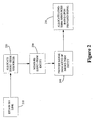
- FIG. 2 conceptually illustrates one embodiment of a method 200 of distributed resource management that may be used in the wireless telecommunications system 100 shown in Figure 1.
- a wireless communication link is established (at 210). As discussed above, the wireless communication link may be established (at 210) between one base station 110 and one mobile unit 120, between one base station 110 and a plurality of mobile units 120, between a plurality of base stations 110 and a plurality of mobile units 120, or any other desirable combination.
- One or more short-term resource management functions 140 allocate (at 220) short-term resources associated with the base stations 110 and/or the mobile units 120. In one embodiment, the short-term resources are allocated (at 220) on a timescale of between one to fifteen time slots (about 0.667 and ten milliseconds in UMTS). In one alternative embodiment, the short-term resources are allocated (at 220) on a timescale of between one to sixteen power control groups (about 1.25 ms to twenty milliseconds in CDMA2000).
- measuring (at 230) the short-term entity includes measuring a legacy dedicated channel fraction of the Received Total Wideband Power.
- the legacy uplink dedicated channel allows the mobile units 120 to transmit at any data rate within a contracted Transport Format Combination Set (TFCS) with a guaranteed quality of service associated with a service class of the mobile unit 120.
- the data rate of the uplink dedicated channel may be determined by a traffic arrival rate and without any short-term control at a physical layer, i . e . by the short-term resource management function 140.
- the legacy uplink dedicated channel may use a large margin in the rise-over-thermal to allow the long-term resource management function 130 to account for a relatively large variation of interference from other mobile units 120.
- the legacy dedicated channel fraction of the uplink dedicated channel may therefore be used as a reference for the long-term measurement as the reference for the resource management 130 in the radio network controller 120 to allocate resources including call admission, system overload control, and the like.
- Measuring (at 230) the short-term entity may also include measuring (at 230) an average normalized received chip energy associated with the mobile units 120.
- data rate and/or time scheduling functions in the short-term resource management function 140 may allocate the data rate and/or scheduling of each mobile unit 120 to satisfy a short-term rise-over-thermal tolerance requirement.
- the data rate adjustment and/or time scheduling may reach a saturation stage such that no additional mobile units 120 are allowed to join the wireless communications system 100.
- An indication that the saturation stage has been reached may be that the mobile units 120 have reached the lowest Transport Format Combination (TFC) in the rate scheduling mode and/or buffer overflow in the time scheduling mode.
- TFC Transport Format Combination
- the measured (at 230) average normalized received chip energy for the mobile users 120 provides a reference to the long-term resource management function 130 that allows the long-term resource management function 130 to determine whether or not a new mobile unit 120 should be admitted to the wireless communication system 100.
- Measuring (at 230) the short-term entity may also include measuring (at 230) an entity indicative of radio channel conditions associated with the mobile units 120.
- individual normalized received chip energy associated with each of the mobile units 120 may be measured (at 230) as an indication of the radio channel conditions associated with each of the mobile units 120.
- the data rate and/or time scheduling modes of the short-term resource management function 140 allow each mobile unit 120 to be controlled in order to optimize throughput of the wireless telecommunications system 100. For example, data rates for mobile units 120 having poor radio channel conditions may be decreased and data rates for mobile units 120 having good radio channel conditions may be increased.
- the individual normalized received chip energy is measured (at 230) as an indication of the radio channel condition.
- the SIR (Signal to Interference Ratio) target may be used as the normalization factor.
- the indication of the radio channel conditions may be used by the long-term resource management function 130 to allocate long-term resources such as call admission.
- the signal indicative of the measured short-term entities is provided (at 240) to the long-term resource management function 130 in the radio network controller 105.
- the provided (at 240) signal may be indicative of one or more of a legacy dedicated channel fraction of the Received Total Wideband Power or RSSI, an average normalized received chip energy, a radio channel condition, an individual normalized received chip energy, and the like.
- the long-term resource management function 130 allocates (at 250) long-term resources based upon the provided signal.
- the long-term resource management function 130 may control call admission, system overload, handover, and the like using the provided signal.
- the long-term resource management function 130 may also terminate one or more calls using the provided signal measurement output as the reference index.
- the long-term resource management function 130 may terminate a wireless communication link associated with the mobile unit 120 based upon a poor radio channel condition, a system overload, insufficient radio resource for a user request to handoff, and the like.
Landscapes
- Engineering & Computer Science (AREA)
- Computer Networks & Wireless Communication (AREA)
- Signal Processing (AREA)
- Quality & Reliability (AREA)
- Physics & Mathematics (AREA)
- Electromagnetism (AREA)
- Mobile Radio Communication Systems (AREA)
Abstract
Description
Claims (10)
- A method of communication with at least one base station, comprising:determining at least one short-term entity associated with the at least one base station; andproviding the at least one short-term entity to a radio network controller.
- The method of claim 1, wherein determining the at least one short-term entity comprises determining at least one of a legacy dedicated channel fraction of a received total wideband power, a legacy dedicated channel fraction of a received signal strength indication, an average normalized received chip energy, a radio channel condition, and an individual normalized received chip energy.
- The method of claim 1, comprising establishing at least one wireless communication link between at least one base station and at least one mobile unit.
- The method of claim 3, wherein establishing the at least one wireless communication link comprises establishing at least one uplink dedicated channel between the at least one base station and the at least one mobile unit.
- The method of claim 1, comprising allocating at least one short-term resource.
- The method of claim 5, wherein allocating the at least one short-term resource comprises allocating at least one of a voice communication bandwidth and a data communication bandwidth, and wherein allocating the at least one short-term resource comprises allocating the at least one short-term resource on a timescale of between one to fifteen time slots (about 0.667 and ten milliseconds in UMTS) or one to sixteen power control groups (about 1.25 ms to twenty milliseconds in CDMA2000), and wherein wherein allocating the at least one short-term resource comprises allocating the at least one short-term resource to attempt to maximize capacity of a wireless telecommunications system, and wherein allocating the at least one short-term resource comprises dynamically controlling interference from at least one mobile unit.
- A method of communication with at least one bas station, comprising:receiving at least one short-term entity associated with the at least one base station; andallocating at least one long-term resource based upon the at least one short-term entity.
- The method of claim 7, wherein receiving the at least one short-term entity comprises receiving at least one of a legacy dedicated channel fraction of a received total wideband power or received signal strength indication, an average normalized received chip energy, a radio channel condition, and an individual normalized received chip energy.
- The method of claim 7, wherein allocating the at least one long-term resource comprises allocating at least one of a call admission, a system overload control, and a handover control, and wherein allocating the at least one long-term resource comprises allocating the at least one long-term resource on a timescale of approximately 100 milliseconds to a few seconds.
- The method of claim 10, comprising terminating at least one wireless communication link between at least one base station and at least one mobile unit based upon at least one of a poor radio channel condition, a system overload, and a handoff.
Applications Claiming Priority (2)
| Application Number | Priority Date | Filing Date | Title |
|---|---|---|---|
| US840756 | 2001-04-23 | ||
| US10/840,756 US7853292B2 (en) | 2004-05-06 | 2004-05-06 | Distributed resource management for enhanced dedicated channel |
Publications (3)
| Publication Number | Publication Date |
|---|---|
| EP1594236A2 true EP1594236A2 (en) | 2005-11-09 |
| EP1594236A3 EP1594236A3 (en) | 2006-03-22 |
| EP1594236B1 EP1594236B1 (en) | 2008-09-03 |
Family
ID=34940993
Family Applications (1)
| Application Number | Title | Priority Date | Filing Date |
|---|---|---|---|
| EP05252541A Expired - Lifetime EP1594236B1 (en) | 2004-05-06 | 2005-04-22 | Distributed resource management for enhanced dedicated channel |
Country Status (6)
| Country | Link |
|---|---|
| US (1) | US7853292B2 (en) |
| EP (1) | EP1594236B1 (en) |
| JP (1) | JP4777684B2 (en) |
| KR (1) | KR101123587B1 (en) |
| CN (1) | CN1694380B (en) |
| DE (1) | DE602005009428D1 (en) |
Cited By (1)
| Publication number | Priority date | Publication date | Assignee | Title |
|---|---|---|---|---|
| CN101043716B (en) * | 2006-03-24 | 2011-07-27 | 华为技术有限公司 | Method for wireless resource management in wireless evolvement network and apparatus thereof |
Families Citing this family (7)
| Publication number | Priority date | Publication date | Assignee | Title |
|---|---|---|---|---|
| US7573856B2 (en) * | 2003-11-25 | 2009-08-11 | Telefonaktiebolaget Lm Ericsson (Publ) | Power-based rate adaptation of wireless communication channels |
| US20060135189A1 (en) * | 2004-12-22 | 2006-06-22 | Shirish Nagaraj | Method of controlling a received signal strength target in a wireless communication system |
| US20060229089A1 (en) * | 2005-04-07 | 2006-10-12 | Yeliz Tokgoz | Method and apparatus for interference control in wireless communication systems |
| US9401843B2 (en) * | 2006-01-27 | 2016-07-26 | Telefonaktiebolaget Lm Ericsson (Publ) | Method and apparatus for reverse link control in a wireless communication network as a function of reverse link load characteristic |
| GB0725051D0 (en) * | 2007-12-21 | 2008-01-30 | Fujitsu Lab Of Europ Ltd | Communications system |
| US20100268981A1 (en) * | 2009-04-20 | 2010-10-21 | Futurewei Technologies, Inc. | System and Method for Tunneling System Error Handling Between Communications Systems |
| KR101567368B1 (en) * | 2009-07-02 | 2015-11-09 | 삼성전자주식회사 | Apparatus and method for managing resource to decrasse inter cell interference in a broadband wireless commmunication system |
Family Cites Families (16)
| Publication number | Priority date | Publication date | Assignee | Title |
|---|---|---|---|---|
| JPH04323921A (en) * | 1991-04-24 | 1992-11-13 | Nec Corp | Line connecting system in radiotelephony system |
| US5396645A (en) * | 1992-04-09 | 1995-03-07 | Comcast Pcs Communications, Inc. | System and method for determining whether to assign a macrocell or microcell communication frequency to a mobile communication terminal |
| CA2215725C (en) * | 1996-01-30 | 2001-06-12 | Motorola, Inc. | Method and apparatus for maintaining call quality in a communication system |
| US5956642A (en) | 1996-11-25 | 1999-09-21 | Telefonaktiebolaget L M Ericsson | Adaptive channel allocation method and apparatus for multi-slot, multi-carrier communication system |
| FI973837A7 (en) * | 1997-09-29 | 1999-03-30 | Nokia Telecommunications Oy | Allocation of data transfer resources |
| US6907243B1 (en) * | 1999-06-09 | 2005-06-14 | Cisco Technology, Inc. | Method and system for dynamic soft handoff resource allocation in a wireless network |
| US6298233B1 (en) * | 1999-08-13 | 2001-10-02 | Motorola, Inc. | Method and apparatus in a two-way wireless communication system for detection and deferred reporting of a communication difficulty |
| US6631124B1 (en) * | 1999-11-03 | 2003-10-07 | Ericsson Inc. | Methods and apparatus for allocating resources in hybrid TDMA communication systems |
| EP1117269A1 (en) * | 2000-01-13 | 2001-07-18 | TELEFONAKTIEBOLAGET LM ERICSSON (publ) | Method and devices for improved handover procedures in mobile communication systems |
| US6987738B2 (en) * | 2001-01-12 | 2006-01-17 | Motorola, Inc. | Method for packet scheduling and radio resource allocation in a wireless communication system |
| US6930470B2 (en) | 2001-03-01 | 2005-08-16 | Nortel Networks Limited | System and method for code division multiple access communication in a wireless communication environment |
| FR2827098B1 (en) | 2001-07-05 | 2003-12-05 | Nortel Networks Ltd | METHOD FOR CONTROLLING RADIO RESOURCES ASSIGNED TO COMMUNICATION BETWEEN A MOBILE TERMINAL AND A SPREAD-SPECTRUM CELLULAR INFRASTRUCTURE, AND EQUIPMENT FOR IMPLEMENTING THE METHOD |
| JP2003299131A (en) * | 2002-04-03 | 2003-10-17 | Nec Corp | Communication control device, communication control method, and program therefor |
| US8009607B2 (en) * | 2002-04-24 | 2011-08-30 | Telefonaktiebolaget Lm Ericsson (Publ) | Method and apparatus for uplink transmission timing in a mobile communications system |
| AU2003263164A1 (en) * | 2002-07-03 | 2004-01-23 | Siemens Aktiengesellschaft | Method for controlling a data transmission in a radiocommunication system with a hierarchical network architecture |
| KR20050038977A (en) * | 2003-10-23 | 2005-04-29 | 삼성전자주식회사 | System and method for transmitting/receiving resource allocation information in a radio communication system |
-
2004
- 2004-05-06 US US10/840,756 patent/US7853292B2/en not_active Expired - Fee Related
-
2005
- 2005-04-22 EP EP05252541A patent/EP1594236B1/en not_active Expired - Lifetime
- 2005-04-22 DE DE602005009428T patent/DE602005009428D1/en not_active Expired - Lifetime
- 2005-04-29 CN CN200510068405XA patent/CN1694380B/en not_active Expired - Fee Related
- 2005-04-29 KR KR1020050036086A patent/KR101123587B1/en not_active Expired - Fee Related
- 2005-05-06 JP JP2005134720A patent/JP4777684B2/en not_active Expired - Fee Related
Cited By (1)
| Publication number | Priority date | Publication date | Assignee | Title |
|---|---|---|---|---|
| CN101043716B (en) * | 2006-03-24 | 2011-07-27 | 华为技术有限公司 | Method for wireless resource management in wireless evolvement network and apparatus thereof |
Also Published As
| Publication number | Publication date |
|---|---|
| EP1594236B1 (en) | 2008-09-03 |
| CN1694378A (en) | 2005-11-09 |
| US20060211375A1 (en) | 2006-09-21 |
| CN1694380B (en) | 2012-07-18 |
| KR101123587B1 (en) | 2012-06-13 |
| KR20060049156A (en) | 2006-05-18 |
| JP2005323374A (en) | 2005-11-17 |
| JP4777684B2 (en) | 2011-09-21 |
| US7853292B2 (en) | 2010-12-14 |
| EP1594236A3 (en) | 2006-03-22 |
| DE602005009428D1 (en) | 2008-10-16 |
Similar Documents
| Publication | Publication Date | Title |
|---|---|---|
| EP1112624B1 (en) | Method and apparatus for distributed optimal reverse link scheduling of resources, such as rate and power, in a wireless communication system | |
| KR101028973B1 (en) | Estimation of Uplink Loads with Altered Data Rates | |
| US7953040B2 (en) | Channel assignment in wireless communication | |
| EP1192831B1 (en) | Method for selection of coding method | |
| US20070155395A1 (en) | Scheduling mobile users based on cell load | |
| EP1561358B1 (en) | Wireless communication rate shaping | |
| US7411923B2 (en) | Wireless communication rate shaping | |
| US20100135170A1 (en) | Load estimation for a cell in a wireless network | |
| KR20050052494A (en) | System and method for rate assignment | |
| EP1641143B1 (en) | Method and apparatus for controlling transmission power in a wireless network | |
| EP1452065B1 (en) | A method and arrangement for allocation the quantity of a channel to a mobile station as a function of the measured quality | |
| US7395069B2 (en) | Radio resource management in a communication system | |
| US7853292B2 (en) | Distributed resource management for enhanced dedicated channel | |
| JP2009510872A (en) | Throughput optimized carrier allocation | |
| EP1463356B1 (en) | Equipment and method of call admission in cdma based system | |
| US20060135189A1 (en) | Method of controlling a received signal strength target in a wireless communication system | |
| Pérez-Romero et al. | A generalized framework for multi-RAT scenarios characterisation | |
| Hoglund et al. | Quality-based tuning of cell downlink load target and link power maxima in WCDMA | |
| EP1212909B1 (en) | Cell breathing reduction in a cellular network | |
| Hiltunen et al. | Interference control mechanism for 5G indoor micro operators utilizing dynamic TDD | |
| US20080132266A1 (en) | Maximum Allowable Transmission Rate Deciding Method, Mobile Station And Wireless Base Station | |
| Honkasalo et al. | Kari Sipilä and Seppo Hämäläinen | |
| HK1084256B (en) | System and method for rate assignment | |
| HK1108978B (en) | Method and apparatus for distributed reverse link scheduling of rate and power in a wireless communication system |
Legal Events
| Date | Code | Title | Description |
|---|---|---|---|
| PUAI | Public reference made under article 153(3) epc to a published international application that has entered the european phase |
Free format text: ORIGINAL CODE: 0009012 |
|
| 17P | Request for examination filed |
Effective date: 20050517 |
|
| AK | Designated contracting states |
Kind code of ref document: A2 Designated state(s): AT BE BG CH CY CZ DE DK EE ES FI FR GB GR HU IE IS IT LI LT LU MC NL PL PT RO SE SI SK TR |
|
| AX | Request for extension of the european patent |
Extension state: AL BA HR LV MK YU |
|
| PUAL | Search report despatched |
Free format text: ORIGINAL CODE: 0009013 |
|
| AK | Designated contracting states |
Kind code of ref document: A3 Designated state(s): AT BE BG CH CY CZ DE DK EE ES FI FR GB GR HU IE IS IT LI LT LU MC NL PL PT RO SE SI SK TR |
|
| AX | Request for extension of the european patent |
Extension state: AL BA HR LV MK YU |
|
| AKX | Designation fees paid |
Designated state(s): DE FR GB |
|
| 17Q | First examination report despatched |
Effective date: 20070118 |
|
| 17Q | First examination report despatched |
Effective date: 20070118 |
|
| GRAP | Despatch of communication of intention to grant a patent |
Free format text: ORIGINAL CODE: EPIDOSNIGR1 |
|
| GRAS | Grant fee paid |
Free format text: ORIGINAL CODE: EPIDOSNIGR3 |
|
| GRAA | (expected) grant |
Free format text: ORIGINAL CODE: 0009210 |
|
| AK | Designated contracting states |
Kind code of ref document: B1 Designated state(s): DE FR GB |
|
| REG | Reference to a national code |
Ref country code: GB Ref legal event code: FG4D |
|
| REF | Corresponds to: |
Ref document number: 602005009428 Country of ref document: DE Date of ref document: 20081016 Kind code of ref document: P |
|
| PLBE | No opposition filed within time limit |
Free format text: ORIGINAL CODE: 0009261 |
|
| STAA | Information on the status of an ep patent application or granted ep patent |
Free format text: STATUS: NO OPPOSITION FILED WITHIN TIME LIMIT |
|
| 26N | No opposition filed |
Effective date: 20090604 |
|
| REG | Reference to a national code |
Ref country code: GB Ref legal event code: 732E Free format text: REGISTERED BETWEEN 20131031 AND 20131106 |
|
| REG | Reference to a national code |
Ref country code: FR Ref legal event code: CD Owner name: ALCATEL-LUCENT USA INC. Effective date: 20131122 |
|
| REG | Reference to a national code |
Ref country code: FR Ref legal event code: GC Effective date: 20140410 |
|
| REG | Reference to a national code |
Ref country code: FR Ref legal event code: RG Effective date: 20141015 |
|
| REG | Reference to a national code |
Ref country code: FR Ref legal event code: PLFP Year of fee payment: 12 |
|
| REG | Reference to a national code |
Ref country code: FR Ref legal event code: PLFP Year of fee payment: 13 |
|
| PGFP | Annual fee paid to national office [announced via postgrant information from national office to epo] |
Ref country code: GB Payment date: 20170419 Year of fee payment: 13 Ref country code: DE Payment date: 20170419 Year of fee payment: 13 Ref country code: FR Payment date: 20170419 Year of fee payment: 13 |
|
| REG | Reference to a national code |
Ref country code: DE Ref legal event code: R119 Ref document number: 602005009428 Country of ref document: DE |
|
| GBPC | Gb: european patent ceased through non-payment of renewal fee |
Effective date: 20180422 |
|
| PG25 | Lapsed in a contracting state [announced via postgrant information from national office to epo] |
Ref country code: DE Free format text: LAPSE BECAUSE OF NON-PAYMENT OF DUE FEES Effective date: 20181101 |
|
| PG25 | Lapsed in a contracting state [announced via postgrant information from national office to epo] |
Ref country code: GB Free format text: LAPSE BECAUSE OF NON-PAYMENT OF DUE FEES Effective date: 20180422 |
|
| PG25 | Lapsed in a contracting state [announced via postgrant information from national office to epo] |
Ref country code: FR Free format text: LAPSE BECAUSE OF NON-PAYMENT OF DUE FEES Effective date: 20180430 |