EP1594180A1 - Silver oxide powder for alkali battery and process for producing the same - Google Patents
Silver oxide powder for alkali battery and process for producing the same Download PDFInfo
- Publication number
- EP1594180A1 EP1594180A1 EP04710510A EP04710510A EP1594180A1 EP 1594180 A1 EP1594180 A1 EP 1594180A1 EP 04710510 A EP04710510 A EP 04710510A EP 04710510 A EP04710510 A EP 04710510A EP 1594180 A1 EP1594180 A1 EP 1594180A1
- Authority
- EP
- European Patent Office
- Prior art keywords
- silver oxide
- oxide powder
- less
- silver
- alkaline battery
- Prior art date
- Legal status (The legal status is an assumption and is not a legal conclusion. Google has not performed a legal analysis and makes no representation as to the accuracy of the status listed.)
- Granted
Links
- NDVLTYZPCACLMA-UHFFFAOYSA-N silver oxide Chemical compound [O-2].[Ag+].[Ag+] NDVLTYZPCACLMA-UHFFFAOYSA-N 0.000 title claims abstract description 200
- 229910001923 silver oxide Inorganic materials 0.000 title claims abstract description 102
- 239000000843 powder Substances 0.000 title claims abstract description 74
- 239000003513 alkali Substances 0.000 title claims description 29
- 238000000034 method Methods 0.000 title claims description 18
- 239000007864 aqueous solution Substances 0.000 claims abstract description 29
- 239000011163 secondary particle Substances 0.000 claims abstract description 25
- 239000000243 solution Substances 0.000 claims abstract description 25
- 239000002245 particle Substances 0.000 claims abstract description 19
- 239000011164 primary particle Substances 0.000 claims abstract description 18
- 238000004090 dissolution Methods 0.000 claims abstract description 15
- 238000002441 X-ray diffraction Methods 0.000 claims abstract description 6
- 238000004438 BET method Methods 0.000 claims abstract description 5
- 238000002791 soaking Methods 0.000 claims abstract description 5
- 238000000634 powder X-ray diffraction Methods 0.000 claims abstract description 4
- HEMHJVSKTPXQMS-UHFFFAOYSA-M Sodium hydroxide Chemical compound [OH-].[Na+] HEMHJVSKTPXQMS-UHFFFAOYSA-M 0.000 claims description 75
- 238000006243 chemical reaction Methods 0.000 claims description 36
- XLYOFNOQVPJJNP-UHFFFAOYSA-N water Substances O XLYOFNOQVPJJNP-UHFFFAOYSA-N 0.000 claims description 30
- 239000003792 electrolyte Substances 0.000 claims description 23
- 238000005406 washing Methods 0.000 claims description 21
- 229910052709 silver Inorganic materials 0.000 claims description 20
- 239000012452 mother liquor Substances 0.000 claims description 18
- -1 nitrate ions Chemical class 0.000 claims description 18
- KWYUFKZDYYNOTN-UHFFFAOYSA-M potassium hydroxide Substances [OH-].[K+] KWYUFKZDYYNOTN-UHFFFAOYSA-M 0.000 claims description 16
- 239000002002 slurry Substances 0.000 claims description 16
- 239000004332 silver Substances 0.000 claims description 13
- NUJOXMJBOLGQSY-UHFFFAOYSA-N manganese dioxide Chemical compound O=[Mn]=O NUJOXMJBOLGQSY-UHFFFAOYSA-N 0.000 claims description 12
- 229910002651 NO3 Inorganic materials 0.000 claims description 10
- 230000003472 neutralizing effect Effects 0.000 claims description 10
- 239000007774 positive electrode material Substances 0.000 claims description 9
- 229910000108 silver(I,III) oxide Inorganic materials 0.000 claims description 9
- OKTJSMMVPCPJKN-UHFFFAOYSA-N Carbon Chemical compound [C] OKTJSMMVPCPJKN-UHFFFAOYSA-N 0.000 claims description 7
- QAOWNCQODCNURD-UHFFFAOYSA-L Sulfate Chemical compound [O-]S([O-])(=O)=O QAOWNCQODCNURD-UHFFFAOYSA-L 0.000 claims description 7
- 229910052799 carbon Inorganic materials 0.000 claims description 7
- 239000000203 mixture Substances 0.000 claims description 7
- 239000007773 negative electrode material Substances 0.000 claims description 7
- FOIXSVOLVBLSDH-UHFFFAOYSA-N Silver ion Chemical compound [Ag+] FOIXSVOLVBLSDH-UHFFFAOYSA-N 0.000 claims description 6
- 239000004810 polytetrafluoroethylene Substances 0.000 claims description 6
- 229920001343 polytetrafluoroethylene Polymers 0.000 claims description 6
- 239000007787 solid Substances 0.000 claims description 5
- 229910018916 CoOOH Inorganic materials 0.000 claims description 4
- 229910002640 NiOOH Inorganic materials 0.000 claims description 4
- GGCZERPQGJTIQP-UHFFFAOYSA-N sodium;9,10-dioxoanthracene-2-sulfonic acid Chemical compound [Na+].C1=CC=C2C(=O)C3=CC(S(=O)(=O)O)=CC=C3C(=O)C2=C1 GGCZERPQGJTIQP-UHFFFAOYSA-N 0.000 claims description 4
- 239000000654 additive Substances 0.000 claims description 3
- 230000000996 additive effect Effects 0.000 claims description 3
- 229910045601 alloy Inorganic materials 0.000 claims description 3
- 239000000956 alloy Substances 0.000 claims description 3
- 238000002156 mixing Methods 0.000 claims description 3
- 238000003860 storage Methods 0.000 description 35
- SQGYOTSLMSWVJD-UHFFFAOYSA-N silver(1+) nitrate Chemical compound [Ag+].[O-]N(=O)=O SQGYOTSLMSWVJD-UHFFFAOYSA-N 0.000 description 34
- 229910001961 silver nitrate Inorganic materials 0.000 description 17
- 150000002500 ions Chemical class 0.000 description 14
- 150000001875 compounds Chemical class 0.000 description 12
- 239000013078 crystal Substances 0.000 description 11
- 150000003839 salts Chemical class 0.000 description 11
- UIIMBOGNXHQVGW-UHFFFAOYSA-M Sodium bicarbonate Chemical compound [Na+].OC([O-])=O UIIMBOGNXHQVGW-UHFFFAOYSA-M 0.000 description 10
- 238000012423 maintenance Methods 0.000 description 10
- BQCADISMDOOEFD-UHFFFAOYSA-N Silver Chemical compound [Ag] BQCADISMDOOEFD-UHFFFAOYSA-N 0.000 description 8
- 238000006386 neutralization reaction Methods 0.000 description 8
- 230000001105 regulatory effect Effects 0.000 description 8
- 230000005070 ripening Effects 0.000 description 8
- 230000000694 effects Effects 0.000 description 7
- 239000011701 zinc Substances 0.000 description 7
- NHNBFGGVMKEFGY-UHFFFAOYSA-N Nitrate Chemical compound [O-][N+]([O-])=O NHNBFGGVMKEFGY-UHFFFAOYSA-N 0.000 description 6
- XLOMVQKBTHCTTD-UHFFFAOYSA-N Zinc monoxide Chemical compound [Zn]=O XLOMVQKBTHCTTD-UHFFFAOYSA-N 0.000 description 6
- 239000007788 liquid Substances 0.000 description 6
- 238000005259 measurement Methods 0.000 description 6
- 230000000052 comparative effect Effects 0.000 description 5
- 229910000030 sodium bicarbonate Inorganic materials 0.000 description 5
- 238000003756 stirring Methods 0.000 description 5
- 229920000298 Cellophane Polymers 0.000 description 4
- 239000011149 active material Substances 0.000 description 4
- 230000003247 decreasing effect Effects 0.000 description 4
- 239000000706 filtrate Substances 0.000 description 4
- 238000010438 heat treatment Methods 0.000 description 4
- 239000012535 impurity Substances 0.000 description 4
- 230000001965 increasing effect Effects 0.000 description 4
- 239000002244 precipitate Substances 0.000 description 4
- 239000008139 complexing agent Substances 0.000 description 3
- 238000000354 decomposition reaction Methods 0.000 description 3
- 230000007935 neutral effect Effects 0.000 description 3
- 239000007858 starting material Substances 0.000 description 3
- 239000011787 zinc oxide Substances 0.000 description 3
- CDBYLPFSWZWCQE-UHFFFAOYSA-L Sodium Carbonate Chemical compound [Na+].[Na+].[O-]C([O-])=O CDBYLPFSWZWCQE-UHFFFAOYSA-L 0.000 description 2
- 238000005119 centrifugation Methods 0.000 description 2
- 239000010949 copper Substances 0.000 description 2
- 238000009826 distribution Methods 0.000 description 2
- 238000001035 drying Methods 0.000 description 2
- 238000004519 manufacturing process Methods 0.000 description 2
- OTCVAHKKMMUFAY-UHFFFAOYSA-N oxosilver Chemical class [Ag]=O OTCVAHKKMMUFAY-UHFFFAOYSA-N 0.000 description 2
- 230000005855 radiation Effects 0.000 description 2
- 239000000376 reactant Substances 0.000 description 2
- 238000001878 scanning electron micrograph Methods 0.000 description 2
- 238000000926 separation method Methods 0.000 description 2
- VFWRGKJLLYDFBY-UHFFFAOYSA-N silver;hydrate Chemical compound O.[Ag].[Ag] VFWRGKJLLYDFBY-UHFFFAOYSA-N 0.000 description 2
- VWDWKYIASSYTQR-UHFFFAOYSA-N sodium nitrate Chemical compound [Na+].[O-][N+]([O-])=O VWDWKYIASSYTQR-UHFFFAOYSA-N 0.000 description 2
- 239000010935 stainless steel Substances 0.000 description 2
- 229910001220 stainless steel Inorganic materials 0.000 description 2
- RNWHGQJWIACOKP-UHFFFAOYSA-N zinc;oxygen(2-) Chemical compound [O-2].[Zn+2] RNWHGQJWIACOKP-UHFFFAOYSA-N 0.000 description 2
- 229910019920 (NH3)2SO4 Inorganic materials 0.000 description 1
- PAWQVTBBRAZDMG-UHFFFAOYSA-N 2-(3-bromo-2-fluorophenyl)acetic acid Chemical compound OC(=O)CC1=CC=CC(Br)=C1F PAWQVTBBRAZDMG-UHFFFAOYSA-N 0.000 description 1
- RYGMFSIKBFXOCR-UHFFFAOYSA-N Copper Chemical compound [Cu] RYGMFSIKBFXOCR-UHFFFAOYSA-N 0.000 description 1
- 239000007832 Na2SO4 Substances 0.000 description 1
- 239000004677 Nylon Substances 0.000 description 1
- 239000004743 Polypropylene Substances 0.000 description 1
- PMZURENOXWZQFD-UHFFFAOYSA-L Sodium Sulfate Chemical compound [Na+].[Na+].[O-]S([O-])(=O)=O PMZURENOXWZQFD-UHFFFAOYSA-L 0.000 description 1
- 238000003917 TEM image Methods 0.000 description 1
- HCHKCACWOHOZIP-UHFFFAOYSA-N Zinc Chemical compound [Zn] HCHKCACWOHOZIP-UHFFFAOYSA-N 0.000 description 1
- 239000002253 acid Substances 0.000 description 1
- 239000012670 alkaline solution Substances 0.000 description 1
- 239000006183 anode active material Substances 0.000 description 1
- 239000006182 cathode active material Substances 0.000 description 1
- 239000000701 coagulant Substances 0.000 description 1
- 230000001276 controlling effect Effects 0.000 description 1
- 229910052802 copper Inorganic materials 0.000 description 1
- 230000007423 decrease Effects 0.000 description 1
- 238000007865 diluting Methods 0.000 description 1
- 239000002270 dispersing agent Substances 0.000 description 1
- 230000002708 enhancing effect Effects 0.000 description 1
- 230000007613 environmental effect Effects 0.000 description 1
- 230000001747 exhibiting effect Effects 0.000 description 1
- 238000001914 filtration Methods 0.000 description 1
- 239000011261 inert gas Substances 0.000 description 1
- 229920001778 nylon Polymers 0.000 description 1
- 230000003647 oxidation Effects 0.000 description 1
- 238000007254 oxidation reaction Methods 0.000 description 1
- 229920001155 polypropylene Polymers 0.000 description 1
- 238000001556 precipitation Methods 0.000 description 1
- 239000000047 product Substances 0.000 description 1
- 230000002035 prolonged effect Effects 0.000 description 1
- 229920006395 saturated elastomer Polymers 0.000 description 1
- 239000003566 sealing material Substances 0.000 description 1
- 229910000029 sodium carbonate Inorganic materials 0.000 description 1
- 235000010344 sodium nitrate Nutrition 0.000 description 1
- 239000004317 sodium nitrate Substances 0.000 description 1
- 229910052938 sodium sulfate Inorganic materials 0.000 description 1
- 230000002194 synthesizing effect Effects 0.000 description 1
- 229910052725 zinc Inorganic materials 0.000 description 1
Classifications
-
- H—ELECTRICITY
- H01—ELECTRIC ELEMENTS
- H01M—PROCESSES OR MEANS, e.g. BATTERIES, FOR THE DIRECT CONVERSION OF CHEMICAL ENERGY INTO ELECTRICAL ENERGY
- H01M4/00—Electrodes
- H01M4/02—Electrodes composed of, or comprising, active material
- H01M4/24—Electrodes for alkaline accumulators
- H01M4/34—Silver oxide or hydroxide electrodes
-
- H—ELECTRICITY
- H01—ELECTRIC ELEMENTS
- H01M—PROCESSES OR MEANS, e.g. BATTERIES, FOR THE DIRECT CONVERSION OF CHEMICAL ENERGY INTO ELECTRICAL ENERGY
- H01M10/00—Secondary cells; Manufacture thereof
- H01M10/24—Alkaline accumulators
- H01M10/32—Silver accumulators
-
- H—ELECTRICITY
- H01—ELECTRIC ELEMENTS
- H01M—PROCESSES OR MEANS, e.g. BATTERIES, FOR THE DIRECT CONVERSION OF CHEMICAL ENERGY INTO ELECTRICAL ENERGY
- H01M4/00—Electrodes
- H01M4/02—Electrodes composed of, or comprising, active material
- H01M4/36—Selection of substances as active materials, active masses, active liquids
- H01M4/48—Selection of substances as active materials, active masses, active liquids of inorganic oxides or hydroxides
- H01M4/54—Selection of substances as active materials, active masses, active liquids of inorganic oxides or hydroxides of silver
-
- Y—GENERAL TAGGING OF NEW TECHNOLOGICAL DEVELOPMENTS; GENERAL TAGGING OF CROSS-SECTIONAL TECHNOLOGIES SPANNING OVER SEVERAL SECTIONS OF THE IPC; TECHNICAL SUBJECTS COVERED BY FORMER USPC CROSS-REFERENCE ART COLLECTIONS [XRACs] AND DIGESTS
- Y02—TECHNOLOGIES OR APPLICATIONS FOR MITIGATION OR ADAPTATION AGAINST CLIMATE CHANGE
- Y02E—REDUCTION OF GREENHOUSE GAS [GHG] EMISSIONS, RELATED TO ENERGY GENERATION, TRANSMISSION OR DISTRIBUTION
- Y02E60/00—Enabling technologies; Technologies with a potential or indirect contribution to GHG emissions mitigation
- Y02E60/10—Energy storage using batteries
Definitions
- This invention relates to a positive electrode material for a silver oxide battery, namely, a silver oxide powder for an alkaline battery, and a method of producing the same.
- the silver oxide battery is a voltaic cell that uses silver oxide (Ag 2 O) as the positive electrode material (cathode active material) and zinc as the negative electrode active material (anode active material). Owing to its ability to maintain a constant voltage over a prolonged period, this battery is used mainly as a power source for driving quartz-oscillator watches and clocks, the integrated circuitry of game machines, and the like.
- silver oxide Ag 2 O
- this battery is used mainly as a power source for driving quartz-oscillator watches and clocks, the integrated circuitry of game machines, and the like.
- the silver oxide battery is generally structured as follows.
- the silver oxide powder serving as the active material of the battery positive electrode is blended with at least one member selected from among MnO 2 , NiOOH, CoOOH, AgNiO 2 , AgCoO 2 , CaO, MnO, HgO, CdO, CdS, polytetrafluoroethylene, metallic silver, AgO and carbon.
- the blend, called the “positive electrode compound,” is generally formed into a circular shape (the "compacted compound body") using a die press.
- the compacted compound body is installed in a can (positive electrode can) made of stainless steel or a stainless steel laminate, a separator is mounted on the compacted compound on the open side of the can, another can is charged with negative electrode zinc paste (negative electrode can), and the positive and negative electrode cans are joined.
- a nylon ring is generally used as the insulating sealing material interposed between the positive and negative electrode cans.
- NaOH, KOH or a mixture thereof is used as the electrolyte.
- the electrolyte is usually injected after the compacted compound body is installed in the positive electrode can. Electrolyte is also sometimes added to the negative electrode zinc paste.
- the assembled battery is pressure-cured to facilitate permeation of the electrolyte into the compacted compound body.
- silver oxide (Ag 2 O) is unstable in an electrolyte. As a result, cases may arise in which self-discharge occurs because the Ag 2 O dissolves in an alkaline solution and the dissolved Ag ions reach the Zn negative electrode or because Ag is precipitated owing to a decomposition reaction of the Ag 2 O itself.
- Another practice adopted is to further install a polypropylene or PEGF film between the positive electrode and the cellophane, to establish a multilayer arrangement. Decline in the function of the cellophane owing to oxidation by the Ag ions is, however, unavoidable.
- the extent to which the separator can be formed in multiple layers is limited by the limitation on the volume of the battery.
- positive electrode side solutions proposed include that taught by JP Sho59-167963A of adding Cd to the positive electrode compound so as to curb dissolution of silver, that taught by JP Sho55-133765A of adding zinc oxide to the Ag 2 O, and that taught by JP Hei2-12762A of sandwiching the silver oxide positive electrode with a shaped body of mixed manganese dioxide and carbon.
- the method of adding Cd will be undesirable from now on owing to environmental concerns.
- the method of adding zinc oxide reduces battery capacity because the zinc oxide does not function as an active material, and the method of disposing a shaped body of mixed manganese dioxide and carbon between the positive electrode and separator may well complicate the battery manufacturing process and increases cost.
- An object of the present invention is therefore to provide a battery silver oxide powder that is low in self-discharge.
- the inventors carried out an extended study regarding the aforesaid problems. As a result, the inventors learned that since the dissolution rate of silver ion into the electrolyte is affected by the powder property of the silver oxide and the crystallinity of the silver oxide, it is possible by appropriately controlling these properties to obtain a silver oxide that is low in self-discharge and to improve the post-storage service capacity maintenance factor. In order to reduce the silver ion dissolution rate, it is particularly necessary to bring the specific surface area, primary particle diameter and crystal grain diameter of the silver oxide powder into prescribed ranges. These factors are complexly interrelated and if any one of them is not satisfied, the improving effect becomes insufficient.
- the present invention provides an alkaline battery silver oxide powder that when soaked in a 50 °C KOH 40% aqueous solution for 24 hours experiences dissolution of Ag into the solution of 40 mg/L (milligram/liter) or less and further provides an alkaline battery silver oxide powder that exhibits substantially no Ag peak by X-ray diffraction even after soaking in a 50 °C KOH 40% aqueous solution for 72 hours.
- This alkaline battery silver oxide powder has a crystallite size calculated from the half value breadth of the (111) plane peak by powder X-ray diffraction of greater than 250 Angstrom and equal to or less than 1000 Angstrom, particle diameter such that the average diameter of secondary particles is equal to or greater than 1 ⁇ m and equal to or less than 500 ⁇ m and that of primary particles forming the secondary particles is equal to or greater than 0.1 ⁇ m and equal to or less than 10.0 ⁇ m, and specific surface area by the BET method of 5 m 2 /g or less.
- This invention provides an alkaline battery positive electrode shaped body formed by blending with said silver oxide powder at least one additive selected from the group consisting of MnO 2 , NiOOH, CoOOH, AgNiO 2 , AgCoO 2 , CaO, MnO, HgO, CdO, CdS, polytetrafluoroethylene, metallic silver, AgO and carbon, plus provides an alkaline battery comprising a negative electrode active material, a positive electrode active material, an alkaline electrolyte, a separator and a can body, wherein the alkaline battery uses an alloy composed mainly of Zn as the negative electrode active material, NaOH, KOH or a mixture thereof as the electrolyte, and said silver oxide as the positive electrode active material.
- One feature of the silver oxide according to the present invention is low dissolution of Ag ions into the electrolyte and that when soaked in a 50 °C KOH 40% aqueous solution for 24 hours it experiences dissolution of Ag into the solution of 40 mg/L or less.
- the amount of Ag ion dissolution exceeds this level, the rate at which the dissolved out Ag ions reach the Zn negative electrode increases and the rate of so-called self-discharge is also accelerated.
- substantially no Ag peak by X-ray diffraction appears even after soaking in a 50 °C KOH 40% aqueous solution for 72 hours. In other words, no Ag precipitates from the silver oxide even after such soaking. This indicates stability in the electrolyte, whereby the post-storage service capacity maintenance factor of the battery becomes excellent.
- This silver oxide powder exhibiting resistance to self-discharge and decomposition preferably has a crystallite size calculated from the half value breadth of the (111) plane peak by powder X-ray diffraction of greater than 250 Angstrom and equal to or less than 1000 Angstrom, particle diameter such that the average diameter of secondary particles is equal to or greater than 1 ⁇ m and equal to or less than 500 ⁇ m and that of primary particles forming the secondary particles is equal to or greater than 0.1 ⁇ m and equal to or less than 10.0 ⁇ m, and specific surface area by the BET method of 5 m 2 /g or less.
- the crystallite size is not more than 250 Angstrom, reduction of silver oxide in the electrolyte proceeds readily, which is thought to be due to instability in the electrolyte. As a result, a crystallite size of greater than 250 Angstrom is required. However, a product with a crystallite size exceeding 1000 Angstrom is difficult to produce in actual practice, and even if one is obtained, its effect is saturated, so that the crystallite size is preferably greater than 250 Angstrom to 1000 Angstrom, more preferably greater than 270 Angstrom to 1000 Angstrom.
- the particle diameter (average particle diameter) of the silver oxide when the diameter of the secondary particles formed by assembled primary particles is less than 1 ⁇ m, the powder becomes hard to handle owing to high bulk and poor fluidity and, in addition, it becomes difficult to maintain a good post-storage service capacity maintenance factor. When the secondary particle diameter exceeds 500 ⁇ m, however, no further major effect on the post-storage service capacity maintenance factor can be expected.
- the secondary particle diameter is therefore preferable 1- 500 ⁇ m, more preferably 1.5 - 500 ⁇ m, still more preferably 5 - 300 ⁇ m.
- the diameter of the primary particles that form the secondary particles is less than 0.1 ⁇ m, stability in the electrolyte is degraded to undesirably make the silver oxide readily reducible. However, growth to larger than 10 ⁇ m requires a special reaction that increases cost.
- the primary particle diameter is therefore preferably about 0.1- 10 ⁇ m, more preferably about 0.5 - 5 ⁇ m.
- the value of the silver oxide specific surface area as measured by the BET method needs to be equal to or less than 5 m 2 /g. and is preferably 4 m 2 /g or less, more preferably 0.5 m 2 /g or less.
- the specific surface area exceeds 5 m 2 /g, the dissolution rate of silver ions into the electrolyte become high and reduction to Ag proceeds readily, making in impossible to achieve the object of the present invention.
- the silver oxide according to the present invention can be produced through the following steps. Steps 3 and 4 are sometimes repeated two or more times in order to reduce impurities.
- an inorganic acid salt of Ag and an alkali compound are reacted in water under appropriate stirring.
- Reaction methods available for this include the method of adding the alkali to the silver salt, the method of adding the Ag salt to an aqueous solution of the alkali and the method of simultaneously adding the Ag salt and alkali to water.
- the method of adding the alkali to the Ag salt or the method of simultaneously adding the Ag salt and alkali to water is preferable.
- the Ag salt is preferably sulfate or nitrate of silver, while as the alkali compound there can be used NaOH, KOH, NH 3 , (NH 3 ) 2 CO 3 , Na 2 CO 3 , Na 2 SO 4 , (NH 3 ) 2 SO 4 or the like.
- the amount of silver ions dissolved in the reaction mother liquor is preferably equal to or greater than 10 mg/L, more preferably equal to or greater than 15 mg/L.
- solubility is generally controlled by means reaction temperature and pH, silver solubility can be further enhanced by using a complexing agent. Still more preferably, it is desirable for the silver oxide generation rate, i.e., the period from the start of neutralization and the filtering step, to be 30 min or longer.
- a complexing agent can be made co-present at the time of reacting the inorganic acid salt of Ag and the alkali.
- Silver oxide is precipitated from the liquor by this neutralizing reaction, but the primary particle diameter, secondary particle diameter, specific surface area and crystallinity of the precipitant are affected by such factors as the solubility of the Ag in the reaction liquor, pulp concentration and convection rate owing to stirring or the like. These factors therefore have to be suitably controlled to produce silver oxide whose particle diameter and specific surface area are in accordance with the present invention.
- Factors affecting particle growth are reaction temperature, reaction liquor concentration, rate of salt and/or alkali addition, and ripening period after addition, and these need to be controlled so as to achieve a particle diameter according to the present invention.
- the pH of the reaction liquor should be equal to or higher than 5 and equal to or lower than 11.
- the secondary particle diameter becomes small owing to low Ag solubility, and when the pH is lower than 5, yield is poor owing to excessively high Ag solubility.
- primary particle diameter, secondary particle diameter and crystallinity can also be controlled by making a dispersant, complexing agent, coagulant or the like co-present in the reaction liquor.
- a reaction temperature of 100 °C or lower is preferable because special equipment is necessary at a high temperature.
- the crystal grains become small and the Ag concentration in the mother liquor becomes low, making it difficult to obtain a silver oxide that is good in storage properties and self-discharge properties.
- the Ag concentration of the reaction liquor is less than 10 mg/L, it is difficult to consistently produce silver oxide powder having a crystal grain diameter of greater than 250 Angstrom and therefore difficult to obtain a silver oxide that is excellent in storage properties and self-discharge properties.
- the ripening is conducted in the temperature range of 20 - 100 °C, preferably on the high side of this range, for 10 min or more.
- the pulp concentration has a large effect mainly on the aggregated diameter of the primary particles and by extension on the secondary particle diameter.
- the growth of the secondary particles is accompanied by repeated collisions among the primary particles and among the secondary particles, so that increasing the frequency of collision increases the secondary particle diameter.
- the pulp concentration is preferably made 100 g/L or greater to less than 450 g/L.
- Solid-liquid separation can be implemented by, for example, the filter press method or spin drying. Pure water is preferably used for washing. Washing needs to be conducted for so long as the electrical conductivity of the washing filtrate takes a prescribed value. The reduction and dissolution behavior of the silver during battery storage not only is affected by the aforesaid powder properties but also tends to be affected by impurities. If salts originating in the starting materials remain at the washing step, they become a cause of self-discharge in the battery. Since the effect of nitrate ions and sulfate ions is particularly large, washing is preferably conducted until the total impurity content becomes 0.02 % or less, more preferably 0.01% or less. When sulfate ion and/or nitrate ion content has been reduced to 0.02% or less, preferably 0.01 % or less, the silver oxide is outstanding in discharge performance after storage.
- the silver oxide obtained from the neutralizing step needs to be thoroughly washed in the washing step.
- the washing step is aimed at enhancing the silver oxide content and at removing nitrate ions or sulfate ions originating in the starting materials.
- nitrate ions are measured as impurity originating in the starting material because silver nitrate is used as the silver salt, but sulfate ions can be considered to have a similar effect. It is presumed that ions capable of assuming two or more valences also have a similar effect.
- the purpose in heat-treating the cake after washing is to remove moisture from the cake and decompose remaining Ag salt.
- the heat treatment is preferably conducted at a temperature of 50 °C or higher and 400 °C or lower. At a temperature higher than 400 °C, the silver oxide is decomposed to precipitate metallic silver, which reduces the battery capacity. At lower than 50 °C, efficiency is poor owing to slow drying rate.
- the heat treatment is preferably conducted in an inert gas atmosphere, in a vacuum or in air removed of CO 2 , so that atmospheric CO 2 does not react with the silver oxide. For obtaining high-purity silver oxide, it is possible to follow the heat treatment at a temperature higher than 50 °C and not higher than 400 °C with another washing step and heat treatment at a temperature of 300 °C or lower.
- the silver oxide powder in accordance with the present invention obtained in this manner can be used as a positive electrode active material in the same manner as in the conventional silver oxide battery.
- an alkaline battery comprising a negative electrode active material, a positive electrode active material, an alkaline electrolyte, a separator and a can body, to use an alloy composed mainly of Zn as the negative electrode active material, NaOH, KOH or a mixture thereof as the electrolyte, and the silver oxide in accordance with the present invention as the positive electrode active material.
- the silver oxide powder according to the present invention with at least one additive selected from the group consisting of MnO 2 , NiOOH, CoOOH, AgNiO 2 , AgCoO 2 , CaO, MnO, HgO, CdO, CdS, polytetrafluoroethylene, metallic silver, AgO and carbon, form the result into a compacted compound body, and use the compacted compound body as the positive electrode.
- at least one additive selected from the group consisting of MnO 2 , NiOOH, CoOOH, AgNiO 2 , AgCoO 2 , CaO, MnO, HgO, CdO, CdS, polytetrafluoroethylene, metallic silver, AgO and carbon
- Silver oxide dispersed in a 0.2 % aqueous solution of hexametaphosphoric acid under exposure to an ultrasonic wave was measured for volume-based average particle diameter using a laser particle size analyzer (Microtrac HRA). The average diameter of particles larger than 100 ⁇ m was calculated from mesh diameter. Other methods available for the measurement include ones using a scanning electron micrograph or HELLOS particle size distribution.
- the average value was calculated from the vertical and lateral diameters of 100 particles measured in a scanning electron or transmission electron micrograph.
- a 5 g specimen was added to 50 cc of KOH 40% aqueous solution, stirred for 5 minutes and, after the container was sealed, allowed to soak in the sealed state at 50 °C for 72 hours in a thermostatic oven.
- the result was filtered, the residue thoroughly washed with pure water, the dried powder subjected to X-ray diffraction, and the result examined for presence/absence of an Ag peak .
- the filter paper was severely eaten away by the alkali, the solid-liquid was conducted by centrifugation. The following was taken into consideration regarding the Ag diffraction peak.
- a beaker type battery was used for experimental purposes.
- the positive electrode was fabricated of a mixture obtained by mixing active material, PTFE (polytetrafluoroethylene) and carbon at a ratio of 0.8 : 0.1 : 0.1.
- the mixture was passed through a press to form a 0.2 mm thick sheet and a 15 mm diameter disk cut from the sheet was used as the positive electrode after being attached under 2t pressure to an Ni mesh to serve as a collector.
- the weight of the active material in the positive electrode was 0.15 mg.
- the service capacity maintenance factor (%) of the fabricated battery was calculated as the service capacity after standing for 96 hours in a thermo-hygrostat at 50 °C and 80% humidity relative to that before the storage expressed in percentage and this value was defined as an index. A higher service capacity maintenance factor indicates proportionally better powder storage properties.
- Service capacity maintenance factor (%) 100 x post-storage service capacity (mAh/g) / pre-storage service capacity (mAh/g).
- the amount of 48% NaOH aqueous solution added at this time was regulated to maintain the NaOH in the vessel constantly at 0.6 mole/L taking into account the portion of the total amount of NaOH initially present in the vessel consumed to neutralize the increase in NO 3 - ions caused by addition of the aforesaid salt.
- the obtained slurry was filtered off and thoroughly washed with pure water to obtain a cake.
- the obtained cake was dried and crushed to afford a silver oxide powder.
- the powder properties, storage properties and discharge performance of the obtained silver oxide powder were examined. The results are shown in Table 1.
- the Ag ion content of the reaction mother liquor was 14 mg/L.
- the silver nitrate aqueous solution and 48% NaOH aqueous solution were added to obtain a neutral precipitate.
- the amount of 48% NaOH aqueous solution added at this time was regulated to maintain the NaOH in the vessel constantly at 0.02 mole/L taking into account the portion of the total amount of NaOH initially present in the vessel consumed to neutralize the increase in NO 3 - ions caused by addition of the aforesaid salt.
- the obtained slurry was filtered off and thoroughly washed with pure water to obtain a cake.
- the obtained cake was dried and crushed to afford a silver oxide powder.
- the powder properties, storage properties and discharge performance of the obtained silver oxide powder were examined. The results are shown in Table 1.
- the Ag ion content of the reaction mother liquor was 10 mg/L.
- Silver nitrate aqueous solution at an Ag concentration of 120 g/L and an aqueous solution containing 100 g/L of NaHCO 3 were simultaneously added to 3 L of an aqueous solution containing 100 g/L of sodium nitrate.
- the rate of silver nitrate addition was set at 40 mL/min and the rate of NaHCO 3 addition was regulated to make the pH of the liquor in the vessel 5.9.
- the obtained slurry was filtered off and thoroughly washed with pure water to obtain a cake.
- the obtained cake was dried to afford a silver oxide powder.
- the powder properties, storage properties and discharge performance of the obtained silver oxide powder were examined. The results are shown in Table 1.
- the silver oxide powder obtained in Example 4 was shaped, crushed and classified to obtain a silver oxide powder whose secondary particle diameter distribution was 70 - 300 ⁇ m and average secondary particle diameter was 150 ⁇ m.
- the powder properties, storage properties and discharge performance of the obtained silver oxide powder were examined. The results are shown in Table 1.
- the nitrate solution was added with NH 4 HCO 3 over a period of 40 min to makes its final pH 6.0.
- the obtained slurry was filtered off and thoroughly washed with pure water to obtain a cake.
- the obtained cake was dried to afford a silver oxide powder.
- the powder properties, storage properties and discharge performance of the obtained silver oxide powder were examined. The results are shown in Table 1.
- Silver nitrate aqueous solution at an Ag concentration of 120 g/L and an aqueous solution containing 100 g/L of NaHCO 3 were simultaneously added to 3 L of an aqueous solution containing ammonium nitrate at a concentration of 100 g/L.
- the rate of silver nitrate addition was set at 40 mL/min and the rate of NaHCO 3 addition was regulated to make the pH of the liquor in the vessel 5.9.
- the obtained slurry was filtered off and thoroughly washed with pure water to obtain a cake.
- the obtained cake was dried to afford a silver oxide powder.
- the powder properties, storage properties and discharge performance of the obtained silver oxide powder were examined. The results are shown in Table 1.
- the Ag ion content of the reaction mother liquor was 3200 mg/L.
- the silver nitrate aqueous solution and 48% NaOH aqueous solution were simultaneously added to obtain a neutral precipitate.
- the amount of 48% NaOH aqueous solution added at this time was regulated to maintain the NaOH in the vessel constantly at 0.02 mole/L taking into account the portion of the total amount of NaOH initially present in the vessel consumed to neutralize the increase in NO 3 - ions caused by addition of the aforesaid salt.
- the obtained slurry was filtered off and thoroughly washed with pure water to obtain a cake.
- the obtained cake was dried and crushed to afford a silver oxide powder.
- the powder properties, storage properties and discharge performance of the obtained silver oxide powder were examined. The results are shown in Table 1.
- the Ag ion content of the reaction mother liquor was 5 mg/L.
- Example 2 was repeated except that, as shown in Table 2, the temperature of the aqueous alkali solution during neutralization was changed among 90 °C, 75 °C, 50 °C (same as Example 2) and 25 °C.
- the powder properties, storage properties and discharge performances of the silver oxide powders obtained are shown in Table 2.
- the Ag concentrations of the mother liquor are also shown in Table 2.
- Example 2 was repeated except that the amount of alkali added during neutralization was varied. As shown in Table 3, the amount of added alkali was changed to change the difference obtained by subtracting the amount of NO 3 - ions from the total amount of added NaOH (NaOH - NO 3 ) among 2 mole/L, 0.6 mole/L (Example 2) and 0.08 mole/L.
- the powder properties, storage properties and discharge performances of the silver oxide powders obtained are shown in Table 3.
- the Ag concentrations of the mother liquor are also shown in Table 3.
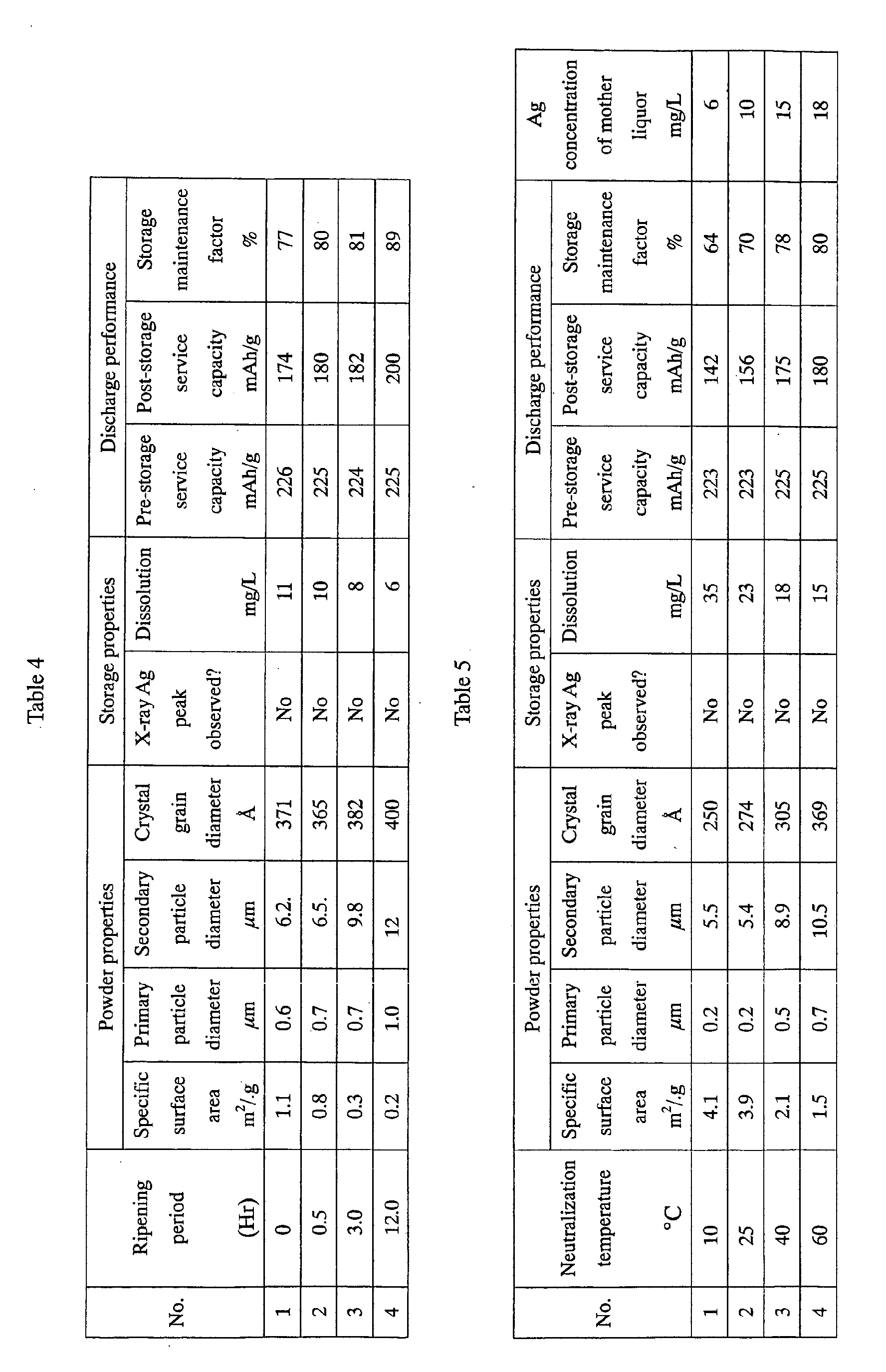
- Example 2 was repeated except that the temperature was increased to 90 °C after completion of the neutralizing reaction and ripening was conducted for a prescribed period at that temperature. As shown in Table 4, the ripening period at 90 °C was set at 0 hour (Example 2), 0.5 hour, 3 hours and 12 hours. The powder properties, storage properties and discharge performances of the silver oxide powders obtained are shown in Table 4.
- Example 3 was repeated except that; as shown in Table 5, the temperature of the aqueous alkali solution during neutralization was changed among 10 °C, 20 °C, (same as Example 3), 40 °C and 60 °C.
- the powder properties, storage properties and discharge performances of the silver oxide powders obtained are shown in Table 5.
- the Ag concentrations of the mother liquor are also shown in Table 5.
- Example 4 was repeated except that different amounts of washing water were used at the time of washing the filtered-off slurry obtained with pure water.
- the amounts of washing water used were as shown in Table 6.
- the conductivity of the filtrate was measured.
- the washing was done using 20 °C ion-exchanged water whose conductivity at 20 °C before washing was 0.08 mS/m.
- the nitrate ion concentration of the silver oxide after washing was also measured.
- the measured values and the discharge performances (maintenance factors) of the silver oxide powders are shown in Table 6.
- the silver oxide powder according to the present invention has a property of being resistant to self-discharge and, as such, enables constitution of a silver oxide battery excellent in storage properties.
Landscapes
- Chemical & Material Sciences (AREA)
- Chemical Kinetics & Catalysis (AREA)
- Electrochemistry (AREA)
- General Chemical & Material Sciences (AREA)
- Battery Electrode And Active Subsutance (AREA)
- Primary Cells (AREA)
Abstract
Description
- t :
- Crystal grain diameter
- λ :
- Wavelength of Ka 1 radiation of Cu
- B :
- Half value breadth
- :
- Angle of diffraction


| No | Amount of washing water (L) | Conductivity mS/m | Nitrate ion concentration mg/L | Storage maintenance factor (%) |
| 1 | 0.5 | 675 | 0.1 | 44 |
| 2 | 1.0 | 145 | 0.03 | 59 |
| 3 | 1.5 | 26.5 | 0.009 | 70 |
| 4 | 2.0 | 8.26 | 0.004 | 81 |
| 3 | 3.0 | 3.72 | 0.001 | 89 |
| 4 | 5.0 | 2.68 | < 0.001 | 89 |
Claims (8)
- An alkaline battery silver oxide powder that when soaked in a 50 °C KOH 40% aqueous solution for 24 hours experiences dissolution of Ag into the solution of 40 mg/L or less.
- An alkaline battery silver oxide powder that exhibits substantially no Ag peak by X-ray diffraction even after soaking in a 50 °C KOH 40% aqueous solution for 72 hours.
- An alkaline battery silver oxide powder according to claim 1 or 2 whose crystallite size calculated from the half value breadth of the (111) plane peak by powder X-ray diffraction is greater than 250 Angstrom and equal to or less than 1000 Angstrom.
- An alkaline battery silver oxide powder according to any of claims 1 to 3, wherein the average diameter of secondary particles is equal to or greater than 1 µm and equal to or less than 500 µm, that of primary particles forming the secondary particles is equal to or greater than 0.1 µm and equal to or less than 10.0 µm, and specific surface area by the BET method is 5 m2/g or less.
- An alkaline battery silver oxide powder according to any of claims 1 to 4 whose total content of nitrate ions and sulfate ions is 0.01% or less.
- A method of producing an alkaline battery silver oxide powder comprising forming a silver oxide-containing slurry by carrying out a neutralizing reaction between silver salt and alkali in water, separating a solid particle component from the slurry and washing the solid particle component, which method is characterized in that the neutralizing reaction is conducted under a condition of the silver ion concentration of the reaction mother liquor being constantly 10 mg/L or greater.
- An alkaline battery positive electrode shaped body formed by blending with the silver oxide powder of any of claims 3 to 5 at least one additive selected from the group consisting of MnO2, NiOOH, CoOOH, AgNiO2, AgCoO2, CaO, MnO, HgO, CdO, CdS, polytetrafluoroethylene, metallic silver, AgO and carbon.
- An alkaline battery comprising a negative electrode active material, a positive electrode active material, an alkaline electrolyte, a separator and a can body, which alkaline battery uses an alloy composed mainly of Zn as the negative electrode active material, an aqueous solution of NaOH, KOH or a mixture thereof as the electrolyte, and a silver oxide of any of claims 1 to 5 as the positive electrode active material.
Applications Claiming Priority (3)
| Application Number | Priority Date | Filing Date | Title |
|---|---|---|---|
| JP2003034909 | 2003-02-13 | ||
| JP2003034909 | 2003-02-13 | ||
| PCT/JP2004/001463 WO2004073095A1 (en) | 2003-02-13 | 2004-02-12 | Silver oxide powder for alkali battery and process for producing the same |
Publications (3)
| Publication Number | Publication Date |
|---|---|
| EP1594180A1 true EP1594180A1 (en) | 2005-11-09 |
| EP1594180A4 EP1594180A4 (en) | 2009-12-30 |
| EP1594180B1 EP1594180B1 (en) | 2013-01-02 |
Family
ID=32866283
Family Applications (1)
| Application Number | Title | Priority Date | Filing Date |
|---|---|---|---|
| EP04710510A Expired - Lifetime EP1594180B1 (en) | 2003-02-13 | 2004-02-12 | Silver oxide powder for alkali battery and process for producing the same |
Country Status (5)
| Country | Link |
|---|---|
| US (2) | US7771872B2 (en) |
| EP (1) | EP1594180B1 (en) |
| CN (2) | CN101667641B (en) |
| AU (1) | AU2004211104C1 (en) |
| WO (1) | WO2004073095A1 (en) |
Cited By (1)
| Publication number | Priority date | Publication date | Assignee | Title |
|---|---|---|---|---|
| WO2008121184A1 (en) * | 2007-03-30 | 2008-10-09 | Eveready Battery Company, Inc. | Multi-layer positive electrode structures having a silver-containing layer for miniature cells |
Families Citing this family (7)
| Publication number | Priority date | Publication date | Assignee | Title |
|---|---|---|---|---|
| KR101783686B1 (en) | 2010-11-17 | 2017-10-10 | 루바타 아플레톤 엘엘씨 | Alkaline collector anode |
| EP2573213B1 (en) * | 2011-09-23 | 2017-10-25 | Covestro Deutschland AG | Oxygen-consuming electrode and method for its production |
| EP2573210B1 (en) * | 2011-09-23 | 2016-10-26 | Covestro Deutschland AG | Oxygen-consuming electrode and method for its production |
| CN102945957B (en) * | 2012-12-07 | 2017-03-22 | 中国电子科技集团公司第十八研究所 | Preparation method of spiny silver peroxide anode material |
| KR102424543B1 (en) * | 2017-01-31 | 2022-07-25 | 엠. 테크닉 가부시키가이샤 | Method for producing highly crystalline silver fine particles |
| CN110289401A (en) * | 2019-05-28 | 2019-09-27 | 超威电源有限公司 | A kind of lead storage battery cathode carbon composite and cathode lead plaster, lead storage battery |
| CN115849431B (en) * | 2022-10-11 | 2023-07-18 | 贵州梅岭电源有限公司 | Zinc-silver battery and its high specific capacity AgO cathode material |
Family Cites Families (22)
| Publication number | Priority date | Publication date | Assignee | Title |
|---|---|---|---|---|
| JPS5344834A (en) * | 1976-10-06 | 1978-04-22 | Tokyo Shibaura Electric Co | Silver oxide battery |
| JPS55133765A (en) | 1979-04-04 | 1980-10-17 | Hitachi Maxell Ltd | Silver battery |
| JPS5652873A (en) | 1979-10-01 | 1981-05-12 | Hitachi Maxell Ltd | Silver-oxide battery |
| JPS56149771A (en) * | 1980-04-19 | 1981-11-19 | Hitachi Maxell Ltd | Silver-oxide secondary battery |
| JPS57111956A (en) | 1980-12-26 | 1982-07-12 | Hitachi Maxell Ltd | Silver-oxide secondary battery |
| JPS57111955A (en) | 1980-12-26 | 1982-07-12 | Hitachi Maxell Ltd | Manufacture of argentous oxide for silver-oxide secondary battery |
| DE3125892C1 (en) | 1981-07-01 | 1982-10-28 | W.C. Heraeus Gmbh, 6450 Hanau | Process for preparing silver(I) oxide for button cells |
| JPS5851470A (en) * | 1981-09-20 | 1983-03-26 | Hitachi Maxell Ltd | Manufacture of silver-oxide battery |
| JPS58117650A (en) | 1982-01-05 | 1983-07-13 | Hitachi Maxell Ltd | Manufacture of silver oxide battery |
| JPS58149771A (en) | 1982-03-03 | 1983-09-06 | 株式会社ネプスリ− | Self-respirating device capable of holding definite oxygen concentration |
| JPS58163166A (en) | 1982-03-20 | 1983-09-27 | Hitachi Maxell Ltd | Argentic oxide cell |
| JPS59167963A (en) | 1983-03-11 | 1984-09-21 | Matsushita Electric Ind Co Ltd | Silver oxide cell |
| JPS6055A (en) * | 1983-06-15 | 1985-01-05 | Matsushita Electric Ind Co Ltd | Manufacture of silver oxide battery |
| JPS61110964A (en) * | 1984-11-06 | 1986-05-29 | Mitsui Mining & Smelting Co Ltd | Silver oxide battery |
| JPS61136915A (en) * | 1984-12-04 | 1986-06-24 | Sumitomo Metal Mining Co Ltd | Production of granular silver oxide |
| JPS61271747A (en) * | 1985-05-27 | 1986-12-02 | Matsushita Electric Ind Co Ltd | silver oxide battery |
| US4792505A (en) * | 1987-12-14 | 1988-12-20 | Westinghouse Electric Corp. | Electrodes made from mixed silver-silver oxides |
| JPH0212762A (en) | 1988-06-30 | 1990-01-17 | Matsushita Electric Ind Co Ltd | Silver oxide battery |
| JPH04184867A (en) * | 1990-11-19 | 1992-07-01 | Toshiba Battery Co Ltd | Silver oxide battery |
| JP3232990B2 (en) * | 1994-12-19 | 2001-11-26 | 松下電器産業株式会社 | Alkaline storage battery and method for manufacturing the same |
| JP3574915B2 (en) * | 1996-11-08 | 2004-10-06 | 同和鉱業株式会社 | Silver oxide for batteries, method for producing the same, and batteries using the same |
| CN1288776C (en) * | 2000-09-11 | 2006-12-06 | 同和矿业株式会社 | Positive electrode active material for alkaline batteries |
-
2004
- 2004-02-12 EP EP04710510A patent/EP1594180B1/en not_active Expired - Lifetime
- 2004-02-12 CN CN2009101348834A patent/CN101667641B/en not_active Expired - Lifetime
- 2004-02-12 CN CNB2004800016911A patent/CN100490224C/en not_active Expired - Lifetime
- 2004-02-12 AU AU2004211104A patent/AU2004211104C1/en not_active Ceased
- 2004-02-12 WO PCT/JP2004/001463 patent/WO2004073095A1/en not_active Ceased
-
2005
- 2005-06-24 US US11/165,227 patent/US7771872B2/en active Active
-
2010
- 2010-07-01 US US12/828,580 patent/US20100272631A1/en not_active Abandoned
Cited By (2)
| Publication number | Priority date | Publication date | Assignee | Title |
|---|---|---|---|---|
| WO2008121184A1 (en) * | 2007-03-30 | 2008-10-09 | Eveready Battery Company, Inc. | Multi-layer positive electrode structures having a silver-containing layer for miniature cells |
| US7648799B2 (en) | 2007-03-30 | 2010-01-19 | Eveready Battery Co., Inc. | Multi-layer positive electrode structures having a silver-containing layer for miniature cells |
Also Published As
| Publication number | Publication date |
|---|---|
| CN101667641A (en) | 2010-03-10 |
| CN1723577A (en) | 2006-01-18 |
| EP1594180A4 (en) | 2009-12-30 |
| AU2004211104A1 (en) | 2004-08-26 |
| CN101667641B (en) | 2012-12-12 |
| US20100272631A1 (en) | 2010-10-28 |
| WO2004073095A1 (en) | 2004-08-26 |
| AU2004211104C1 (en) | 2009-08-13 |
| EP1594180B1 (en) | 2013-01-02 |
| AU2004211104B2 (en) | 2009-01-29 |
| US7771872B2 (en) | 2010-08-10 |
| CN100490224C (en) | 2009-05-20 |
| US20050266311A1 (en) | 2005-12-01 |
Similar Documents
| Publication | Publication Date | Title |
|---|---|---|
| EP2545605B1 (en) | Alkaline battery including lambda-manganese dioxide | |
| US20100272631A1 (en) | Silver oxide powder for alkaline battery and method of producing the same | |
| EP2545606B1 (en) | Methods of making acid-treated manganese dioxide | |
| EP2828202B1 (en) | Methods of making metal-doped nickel oxide active materials | |
| JP6262320B2 (en) | Metal doped nickel oxide active material | |
| EP2713425B1 (en) | Alkaline storage battery, positive electrode material for alkaline storage battery, and method for manufacturing positive electrode material for alkaline storage battery | |
| EP3605665A1 (en) | Primary alkaline battery | |
| EP1032067A2 (en) | Nickel-metal hydride secondary battery | |
| EP2828910B1 (en) | Metal-doped nickel oxide active materials | |
| EP2545003A1 (en) | Method of making lambda-manganese dioxide | |
| JP4756189B2 (en) | Silver oxide powder for alkaline batteries | |
| KR100240817B1 (en) | Electrolytic Manganese Dioxide and Manufacturing Method Thereof, and Manganese Battery | |
| US20020039683A1 (en) | Manufacturing method of positive active material for alkaline storage battery, nickel electrode using the same material and alkaline storage battery using the same nickel electrode |
Legal Events
| Date | Code | Title | Description |
|---|---|---|---|
| PUAI | Public reference made under article 153(3) epc to a published international application that has entered the european phase |
Free format text: ORIGINAL CODE: 0009012 |
|
| 17P | Request for examination filed |
Effective date: 20050629 |
|
| AK | Designated contracting states |
Kind code of ref document: A1 Designated state(s): AT BE BG CH CY CZ DE DK EE ES FI FR GB GR HU IE IT LI LU MC NL PT RO SE SI SK TR |
|
| AX | Request for extension of the european patent |
Extension state: AL LT LV MK |
|
| DAX | Request for extension of the european patent (deleted) | ||
| RBV | Designated contracting states (corrected) |
Designated state(s): CH DE FR GB LI |
|
| RAP1 | Party data changed (applicant data changed or rights of an application transferred) |
Owner name: DOWA HOLDINGS CO., LTD. |
|
| RAP1 | Party data changed (applicant data changed or rights of an application transferred) |
Owner name: DOWA ELECTRONICS MATERIALS CO., LTD. |
|
| A4 | Supplementary search report drawn up and despatched |
Effective date: 20091126 |
|
| 17Q | First examination report despatched |
Effective date: 20100309 |
|
| GRAP | Despatch of communication of intention to grant a patent |
Free format text: ORIGINAL CODE: EPIDOSNIGR1 |
|
| GRAS | Grant fee paid |
Free format text: ORIGINAL CODE: EPIDOSNIGR3 |
|
| GRAA | (expected) grant |
Free format text: ORIGINAL CODE: 0009210 |
|
| AK | Designated contracting states |
Kind code of ref document: B1 Designated state(s): CH DE FR GB LI |
|
| REG | Reference to a national code |
Ref country code: GB Ref legal event code: FG4D |
|
| REG | Reference to a national code |
Ref country code: CH Ref legal event code: NV Representative=s name: RIEDERER HASLER AND PARTNER PATENTANWAELTE AG, LI Ref country code: CH Ref legal event code: EP |
|
| REG | Reference to a national code |
Ref country code: DE Ref legal event code: R096 Ref document number: 602004040619 Country of ref document: DE Effective date: 20130228 |
|
| PGFP | Annual fee paid to national office [announced via postgrant information from national office to epo] |
Ref country code: FR Payment date: 20130301 Year of fee payment: 10 |
|
| PLBE | No opposition filed within time limit |
Free format text: ORIGINAL CODE: 0009261 |
|
| STAA | Information on the status of an ep patent application or granted ep patent |
Free format text: STATUS: NO OPPOSITION FILED WITHIN TIME LIMIT |
|
| 26N | No opposition filed |
Effective date: 20131003 |
|
| REG | Reference to a national code |
Ref country code: DE Ref legal event code: R097 Ref document number: 602004040619 Country of ref document: DE Effective date: 20131003 |
|
| REG | Reference to a national code |
Ref country code: FR Ref legal event code: ST Effective date: 20141031 |
|
| PG25 | Lapsed in a contracting state [announced via postgrant information from national office to epo] |
Ref country code: FR Free format text: LAPSE BECAUSE OF NON-PAYMENT OF DUE FEES Effective date: 20140228 |
|
| PGFP | Annual fee paid to national office [announced via postgrant information from national office to epo] |
Ref country code: GB Payment date: 20221230 Year of fee payment: 20 |
|
| PGFP | Annual fee paid to national office [announced via postgrant information from national office to epo] |
Ref country code: CH Payment date: 20230307 Year of fee payment: 20 |
|
| PGFP | Annual fee paid to national office [announced via postgrant information from national office to epo] |
Ref country code: DE Payment date: 20221229 Year of fee payment: 20 |
|
| REG | Reference to a national code |
Ref country code: DE Ref legal event code: R071 Ref document number: 602004040619 Country of ref document: DE |
|
| REG | Reference to a national code |
Ref country code: CH Ref legal event code: PL |
|
| REG | Reference to a national code |
Ref country code: GB Ref legal event code: PE20 Expiry date: 20240211 |
|
| PG25 | Lapsed in a contracting state [announced via postgrant information from national office to epo] |
Ref country code: GB Free format text: LAPSE BECAUSE OF EXPIRATION OF PROTECTION Effective date: 20240211 |