EP1593393B1 - Anti-TNF antibodies and methotrexate in the concomitant treatment of autoimmune diseases - Google Patents
Anti-TNF antibodies and methotrexate in the concomitant treatment of autoimmune diseases Download PDFInfo
- Publication number
- EP1593393B1 EP1593393B1 EP05076131A EP05076131A EP1593393B1 EP 1593393 B1 EP1593393 B1 EP 1593393B1 EP 05076131 A EP05076131 A EP 05076131A EP 05076131 A EP05076131 A EP 05076131A EP 1593393 B1 EP1593393 B1 EP 1593393B1
- Authority
- EP
- European Patent Office
- Prior art keywords
- methotrexate
- antibody
- administered
- tnf
- necrosis factor
- Prior art date
- Legal status (The legal status is an assumption and is not a legal conclusion. Google has not performed a legal analysis and makes no representation as to the accuracy of the status listed.)
- Revoked
Links
Images



Classifications
-
- A—HUMAN NECESSITIES
- A61—MEDICAL OR VETERINARY SCIENCE; HYGIENE
- A61K—PREPARATIONS FOR MEDICAL, DENTAL OR TOILETRY PURPOSES
- A61K31/00—Medicinal preparations containing organic active ingredients
- A61K31/33—Heterocyclic compounds
- A61K31/395—Heterocyclic compounds having nitrogen as a ring hetero atom, e.g. guanethidine or rifamycins
- A61K31/495—Heterocyclic compounds having nitrogen as a ring hetero atom, e.g. guanethidine or rifamycins having six-membered rings with two or more nitrogen atoms as the only ring heteroatoms, e.g. piperazine or tetrazines
- A61K31/505—Pyrimidines; Hydrogenated pyrimidines, e.g. trimethoprim
-
- A—HUMAN NECESSITIES
- A61—MEDICAL OR VETERINARY SCIENCE; HYGIENE
- A61K—PREPARATIONS FOR MEDICAL, DENTAL OR TOILETRY PURPOSES
- A61K31/00—Medicinal preparations containing organic active ingredients
- A61K31/33—Heterocyclic compounds
- A61K31/395—Heterocyclic compounds having nitrogen as a ring hetero atom, e.g. guanethidine or rifamycins
- A61K31/495—Heterocyclic compounds having nitrogen as a ring hetero atom, e.g. guanethidine or rifamycins having six-membered rings with two or more nitrogen atoms as the only ring heteroatoms, e.g. piperazine or tetrazines
- A61K31/505—Pyrimidines; Hydrogenated pyrimidines, e.g. trimethoprim
- A61K31/519—Pyrimidines; Hydrogenated pyrimidines, e.g. trimethoprim ortho- or peri-condensed with heterocyclic rings
-
- A—HUMAN NECESSITIES
- A61—MEDICAL OR VETERINARY SCIENCE; HYGIENE
- A61K—PREPARATIONS FOR MEDICAL, DENTAL OR TOILETRY PURPOSES
- A61K38/00—Medicinal preparations containing peptides
- A61K38/16—Peptides having more than 20 amino acids; Gastrins; Somatostatins; Melanotropins; Derivatives thereof
- A61K38/17—Peptides having more than 20 amino acids; Gastrins; Somatostatins; Melanotropins; Derivatives thereof from animals; from humans
- A61K38/177—Receptors; Cell surface antigens; Cell surface determinants
- A61K38/1793—Receptors; Cell surface antigens; Cell surface determinants for cytokines; for lymphokines; for interferons
-
- A—HUMAN NECESSITIES
- A61—MEDICAL OR VETERINARY SCIENCE; HYGIENE
- A61K—PREPARATIONS FOR MEDICAL, DENTAL OR TOILETRY PURPOSES
- A61K39/00—Medicinal preparations containing antigens or antibodies
- A61K39/395—Antibodies; Immunoglobulins; Immune serum, e.g. antilymphocytic serum
-
- A—HUMAN NECESSITIES
- A61—MEDICAL OR VETERINARY SCIENCE; HYGIENE
- A61K—PREPARATIONS FOR MEDICAL, DENTAL OR TOILETRY PURPOSES
- A61K39/00—Medicinal preparations containing antigens or antibodies
- A61K39/395—Antibodies; Immunoglobulins; Immune serum, e.g. antilymphocytic serum
- A61K39/39533—Antibodies; Immunoglobulins; Immune serum, e.g. antilymphocytic serum against materials from animals
- A61K39/39541—Antibodies; Immunoglobulins; Immune serum, e.g. antilymphocytic serum against materials from animals against normal tissues, cells
-
- A—HUMAN NECESSITIES
- A61—MEDICAL OR VETERINARY SCIENCE; HYGIENE
- A61K—PREPARATIONS FOR MEDICAL, DENTAL OR TOILETRY PURPOSES
- A61K39/00—Medicinal preparations containing antigens or antibodies
- A61K39/395—Antibodies; Immunoglobulins; Immune serum, e.g. antilymphocytic serum
- A61K39/39533—Antibodies; Immunoglobulins; Immune serum, e.g. antilymphocytic serum against materials from animals
- A61K39/3955—Antibodies; Immunoglobulins; Immune serum, e.g. antilymphocytic serum against materials from animals against proteinaceous materials, e.g. enzymes, hormones, lymphokines
-
- A—HUMAN NECESSITIES
- A61—MEDICAL OR VETERINARY SCIENCE; HYGIENE
- A61K—PREPARATIONS FOR MEDICAL, DENTAL OR TOILETRY PURPOSES
- A61K45/00—Medicinal preparations containing active ingredients not provided for in groups A61K31/00 - A61K41/00
- A61K45/06—Mixtures of active ingredients without chemical characterisation, e.g. antiphlogistics and cardiaca
-
- A—HUMAN NECESSITIES
- A61—MEDICAL OR VETERINARY SCIENCE; HYGIENE
- A61P—SPECIFIC THERAPEUTIC ACTIVITY OF CHEMICAL COMPOUNDS OR MEDICINAL PREPARATIONS
- A61P1/00—Drugs for disorders of the alimentary tract or the digestive system
-
- A—HUMAN NECESSITIES
- A61—MEDICAL OR VETERINARY SCIENCE; HYGIENE
- A61P—SPECIFIC THERAPEUTIC ACTIVITY OF CHEMICAL COMPOUNDS OR MEDICINAL PREPARATIONS
- A61P19/00—Drugs for skeletal disorders
- A61P19/02—Drugs for skeletal disorders for joint disorders, e.g. arthritis, arthrosis
-
- A—HUMAN NECESSITIES
- A61—MEDICAL OR VETERINARY SCIENCE; HYGIENE
- A61P—SPECIFIC THERAPEUTIC ACTIVITY OF CHEMICAL COMPOUNDS OR MEDICINAL PREPARATIONS
- A61P29/00—Non-central analgesic, antipyretic or antiinflammatory agents, e.g. antirheumatic agents; Non-steroidal antiinflammatory drugs [NSAID]
-
- A—HUMAN NECESSITIES
- A61—MEDICAL OR VETERINARY SCIENCE; HYGIENE
- A61P—SPECIFIC THERAPEUTIC ACTIVITY OF CHEMICAL COMPOUNDS OR MEDICINAL PREPARATIONS
- A61P37/00—Drugs for immunological or allergic disorders
-
- A—HUMAN NECESSITIES
- A61—MEDICAL OR VETERINARY SCIENCE; HYGIENE
- A61P—SPECIFIC THERAPEUTIC ACTIVITY OF CHEMICAL COMPOUNDS OR MEDICINAL PREPARATIONS
- A61P37/00—Drugs for immunological or allergic disorders
- A61P37/02—Immunomodulators
- A61P37/06—Immunosuppressants, e.g. drugs for graft rejection
-
- C—CHEMISTRY; METALLURGY
- C07—ORGANIC CHEMISTRY
- C07K—PEPTIDES
- C07K16/00—Immunoglobulins [IG], e.g. monoclonal or polyclonal antibodies
- C07K16/18—Immunoglobulins [IG], e.g. monoclonal or polyclonal antibodies against material from animals or humans
- C07K16/24—Immunoglobulins [IG], e.g. monoclonal or polyclonal antibodies against material from animals or humans against cytokines, lymphokines or interferons
- C07K16/241—Tumor Necrosis Factors
-
- A—HUMAN NECESSITIES
- A61—MEDICAL OR VETERINARY SCIENCE; HYGIENE
- A61K—PREPARATIONS FOR MEDICAL, DENTAL OR TOILETRY PURPOSES
- A61K39/00—Medicinal preparations containing antigens or antibodies
- A61K2039/505—Medicinal preparations containing antigens or antibodies comprising antibodies
-
- A—HUMAN NECESSITIES
- A61—MEDICAL OR VETERINARY SCIENCE; HYGIENE
- A61K—PREPARATIONS FOR MEDICAL, DENTAL OR TOILETRY PURPOSES
- A61K39/00—Medicinal preparations containing antigens or antibodies
- A61K2039/545—Medicinal preparations containing antigens or antibodies characterised by the dose, timing or administration schedule
-
- C—CHEMISTRY; METALLURGY
- C07—ORGANIC CHEMISTRY
- C07K—PEPTIDES
- C07K2317/00—Immunoglobulins specific features
- C07K2317/20—Immunoglobulins specific features characterized by taxonomic origin
- C07K2317/24—Immunoglobulins specific features characterized by taxonomic origin containing regions, domains or residues from different species, e.g. chimeric, humanized or veneered
-
- C—CHEMISTRY; METALLURGY
- C07—ORGANIC CHEMISTRY
- C07K—PEPTIDES
- C07K2319/00—Fusion polypeptide
Definitions
- TNF ⁇ tumor necrosis factor alpha
- TKTF ⁇ tumor necrosis factor beta
- TNF ⁇ tumor necrosis factor
- CD4+ and CD8+ peripheral blood T lymphocytes and some cultured T and B cell lines Cuturi et al., J. Exp. Med. 165:1581 (1987 ); Sung et al., J. Exp. Med. 168:1539 (1988 ); Turner et al., Eur. J. Immunol. 17:1807-1814 (1987 ) also produce TNF ⁇ .
- TNF causes pro-inflammatory actions which result in tissue injury, such as degradation of cartilage and bone, induction of adhesion molecules, inducing procoagulant activity on vascular endothelial cells ( Pober et al., J. Immunol. 136:1680 (1986 )), increasing the adherence of neutrophils and lymphocytes ( Pober et al., J. Immunol. 138:3319 (1987 )), and stimulating the release of platelet activating factor from macrophages, neutrophils and vascular endothelial cells ( Camussi et al., J. Exp. Med. 166:1390 (1987 )).
- Cachexia The extensive wasting which is associated with cancer, and other diseases, is known as "cachexia" ( Kern et al., J. Patent. Enter. Nutr. 12:286-298 (1988 )). Cachexia includes progressive weight loss, anorexia, and persistent erosion of body mass in response to a malignant growth. The fundamental physiological derangement can relate to a recline in food intake relative to energy expenditure. The cachectic state causes most cancer morbidity and mortality. TNF can mediate cachexia in cancer, infectious pathology, and other catabolic states.
- TNF also plays a central role in gram-negative sepsis and endotoxic shock ( Michie et al., Br. J. Surg. 76:670-671 (1989 ); Debets et al., Second Vienna shock Forum, p.463-466 (1989 ); Simpson et al., Crit. Care Clin. 5:27-47 (1989 )), including fever, malaise, anorexia, and cachexia. Endotoxin strongly activates monocyte/macrophage production and secretion of TNF and other cytokines ( Kornbluth et al., J. Immunol. 137:2585-2591 (1986 )).
- TNF and other monocyte-derived cytokines mediate the metabolic and neurohormonal responses to endotoxin ( Michie et al., New Engl. J. Med. 318:1481-1486 (1988 )).
- Endotoxin administration to human volunteers produces acute illness with flu-like symptoms including fever, tachycardia, increased metabolic rate and stress hormone release ( Revhaug et al., Arch. Surg. 123:162-170 (1988 )).
- Circulating TNF increases in patients suffering from Gram-negative sepsis ( Waage et al., Lancet 1:355-357 (1987 ) ; Hammerle et al., Second Vienna Shock Forum p. 715-718 (1989 ); Debets et al., Crit. Care Med. 17:489-497 (1989 ); Calandra et al., J. Infect. Dis. 161:982-987 (1990 )).
- TNF ⁇ has been implicated in inflammatory diseases, autoimmune diseases, viral, bacterial and parasitic infections, malignancies, and/or neurogenerative diseases and is a useful target for specific biological therapy in diseases, such as rheumatoid arthritis and Crohn's disease.
- beneficialal effects in open-label trials with a chimeric monoclonal antibody to TNF ⁇ (cA2) have been reported with suppression of inflammation ( Elliott et al., Arthritis Rheum. 36:1681-1690 (1993 ); Elliott et al., Lancet 344:1125-1127 (1994 )). See also, Van Dullemen et al., Gastroenterology 109:129-135 (1995 ).
- WO95/09652 discloses a method of treating autoimmune or anti-inflammatory diseases in a mammal using a combination of a CD4 + T cell inhibiting agent and a tumour necrosis factor antagonist.
- the anti-rheumatic agent methotrexate can be administered in conjunction with the CD4+ T cell inhibiting agent and / or the TNF antagonist.
- the TNF antagonist may be inter alia an anti-TNF antibody.
- WO 94/08619 relates to a combination of anti-CD4 antibody and anti-tumour necrosis factor antibody for treating autoimmune or anti-inflammatory diseases in a mammal. It is suggested that other inflammatory drugs, such as methotrexate or cyclosporine-A, might be administered in conjunction with the anti-CD4 antibody or the anti-TNF antibody. WO94/08619 does not disclose or suggest the use of an anti-tumour necrosis factor antibody in the treatment of rheumatoid arthritis, juvenile chronic arthritis, ankylosing spondylitis, psoriatic arthritis or Crohn's disease in concomitant therapy with methotrexate therapy.
- WO96/33204 published on 24th October 1996 , relates to a method of treating an individual having a TNF-mediated disease comprising administering to the individual multiple doses of an anti-TNF antibody.
- Anti-TNF antibodies may be conjugated to a cytotoxic agent, including daunorubicin, doxorubicin, methotrexate and Mitomycin C, for in vivo therapy.
- TNF-related pathologies include inter alia rheumatoid arthritis and Crohn's disease.
- WO96/33204 does not disclose the use of an anti-tumour necrosis factor antibody in the treatment of rheumatoid arthritis, juvenile chronic arthritis, ankylosing spondylitis, psoriatic arthritis or Crohn's disease in concomitant therapy with methotrexate therapy.
- the present invention is based on the discovery that treatment of patients suffering from a TNF-mediated disease with a tumor necrosis factor antagonist which is an anti-tumor necrosis factor antibody, as concomitant therapy to methotrexate therapy produces a rapid and sustained reduction in the clinical signs and symptoms of the disease.
- the present invention is also based on the unexpected and dramatic discovery that a multiple dose regimen of a tumor necrosis factor antagonist which is an anti-tumor necrosis factor antibody, when administered adjunctively with methotrexate to an individual suffering from a TNF-mediated disease produces a highly beneficial or synergistic clinical response for a significantly longer duration compared to that obtained with a single or multiple dose regimen of the antagonist administered alone or that obtained with methotrexate administered alone.
- an anti-human tumour necrosis factor antibody or a fragment thereof, which binds specifically to tumour necrosis factor, for use in treatment of rheumatoid arthritis, juvenile chronic arthritis, ankylosing spondylitis, psoriatic arthritis or Crohn's disease, wherein the anti-tumour necrosis factor antibody is to be administered in single or multiple doses, as concomitant therapy with methotrexate therapy, and the methotrexate is to be administered in multiple doses.
- methotrexate is administered in the form of a series of low doses separated by intervals of days or weeks.
- an anti-tumour necrosis factor antibody for use in treating rheumatoid arthritis by administration as concomitant therapy to patients receiving methotrexate therapy.
- an anti-tumour necrosis factor antibody for use in treating rheumatoid arthritis, which antibody is cA2, to be administered as a repeated treatment as concomitant therapy with methotrexate therapy in rheumatoid arthritis patients whose disease is incompletely controlled by methotrexate.
- the present- invention relates to the discovery that anti-TNF antibodies can be administered to patients suffering from a TNF-mediated disease as concomitant therapy to methotrexate therapy, with good to excellent alleviation of the signs and symptoms of the disease.
- the present invention also relates to the discovery that anti-TNF antibodies can be administered to patients suffering from a TNF-mediated disease in multiple doses and as concomitant therapy to methotrexate therapy, with a significant improvement in duration of clinical response.
- an anti-human tumour necrosis factor antibody or a fragment thereof, which binds specifically to tumour necrosis factor, for use in treatment of rheumatoid arthritis, juvenile chronic arthritis, ankylosing spondylitis, psoriatic arthritis or Crohn's disease, wherein the anti-tumour necrosis factor antibody is to be administered in single or multiple doses, as concomitant therapy with methotrexate therapy, and the methotrexate is to be administered in multiple doses.
- the anti-TNF antibody and methotrexate can be administered simultaneously or sequentially.
- the anti-TNF antibody and methotrexate can each be administered in single or multiple doses. Multiple anti-TNF antibodies can be co-administered with methotrexate.
- Other therapeutic regimens and agents can be used in combination with the therapeutic co-administration of anti-TNF antibodies and metrotrexate or other drugs that suppress the immune system.
- an anti-tumour necrosis factor antibody for use in treating rheumatoid arthritis by administration as concomitant therapy to patients receiving methotrexate therapy.
- an anti-tumour necrosis factor antibody for use in treating rheumatoid arthritis, which antibody is cA2, to be administered as a repeated treatment as concomitant therapy with methotrexate therapy in rheumatoid arthritis patients whose disease is incompletely controlled by methotrexate.
- a "TNF-mediated disease” refers to a TNF related pathology or disease which is rheumatoid arthritis, juvenile chronic arthritis, ankylosing spondylitis, psoriatic arthritis or Crohn's disease.
- recurrence', "flare-up” or “relapse” are defined to encompass the reappearance of one or more symptoms of the disease state.
- a reoccurrence can include the experience of one or more of swollen joints, morning stiffness or joint tenderness.
- methotrexate significantly reduces immunogenicity of anti-TNF antibodies, thus permitting administration of multiple dosages of anti-TNF antibodies with enhanced safety.
- methotrexate can be used to reduce immunogenicity of other antibodies or proteins.
- compositions comprising methotrexate and a TNF antagonist.
- the compositions are useful for treating a subject having a pathology or condition associated with abnormal levels of a substance reactive with a TNF antagonist, in particular TNF in excess of, or less than, levels present in a normal healthy subject, where such excess or diminished levels occur in a systemic, localized or particular tissue type or location in the body.
- tissue types can include, but are not limited to, blood, lymph, central nervous system (CNS), liver, kidney, spleen, heart muscle or blood vessels, brain or spinal cord white matter or grey matter, cartilage, ligaments, tendons, lung, pancreas, ovary, testes, prostate.
- Increased or decreased TNF concentrations relative to normal levels can also be localized to specific regions or cells in the body, such as joints, nerve blood vessel junctions, bones, specific tendons or ligaments, or sites of infection, such as bacterial or viral infections.
- a "tumor necrosis factor antagonist” decreases, blocks, inhibits, abrogates or interferes with TNF activity in vivo and is an anti-TNF antibody which binds specfically to TNF.
- a suitable TNF antagonist can also prevent or inhibit TNF synthesis and/or TNF release.
- a suitable TNF antagonist can also prevent or inhibit TNF receptor signalling.
- an "anti-tumor necrosis factor antibody” decreases, blocks, inhibits, abrogates or interferes with TNF activity in vivo.
- Anti-TNF antibodies useful in the methods and compositions of the present invention include monoclonal, chimeric, humanized, resurfaced and recombinant antibodies and fragments thereof which are characterized by high affinity binding to TNF and low toxicity (including human anti-murine antibody (HAMA) and/or human anti-chimeric antibody (HACA) response).
- HAMA human anti-murine antibody
- HACA human anti-chimeric antibody
- an antibody where the individual components, such as the variable region, constant region and framework, individually and/or collectively possess low immunogenicity is useful in the present invention.
- the antibodies which can be used in the invention are characterized by their ability to treat patients for extended periods with good to excellent alleviation of symptoms and low toxicity. Low immunogenicity and/or high affinity, as well as other undefined properties, may contribute to the therapeutic results achieved.
- a high affinity monoclonal antibody useful in the methods and compositions of the present invention is murine monoclonal antibody (mAb) A2 and antibodies which will competitively inhibit in vivo the binding to human TNF ⁇ of anti-TNF ⁇ murine mAb A2 or an antibody having substantially the same specific binding characteristics, as well as fragments and regions thereof.
- Murine monoclonal antibody A2 and chimeric derivatives thereof, such as cA2 are described in U.S. patent No 6,284,471 (filed February 4, 1994 ), U.S patent No 5,656,272, (filed February 4, 1994 ), U.S. patent No 5,919,452 (filed February 4, 1994 ), U.S.
- a second example of a high affinity monoclonal antibody useful in the methods and compositions of the present invention is murine mAb 195 and antibodies which will competitively inhibit in vivo the binding to human TNF ⁇ of anti-TNF ⁇ murine 195 or an antibody having substantially the same specific binding characteristics, as well as fragments and regions thereof.
- Murine monoclonal antibodies useful in the methods and compositions of the present invention include murine mAb 114 and murine mAb 199 and antibodies which will competitively inhibit in vivo the binding to human TNF ⁇ of anti-TNF ⁇ murine mAb 114 or mAb 199 or an antibody having substantially the same specific binding characteristics of mAb 114 or mAb 199, as well as fragments and regions thereof.
- Murine monoclonal antibodies 114, 195 and 199 and the method for producing them are described by Möller, A. et al. (Cytokine 2(3):162-169 (1990 )).
- Chimeric antibodies are immunoglobulin molecules characterized by two or more segments or portions derived from different animal species.
- the variable region of the chimeric antibody is derived from a non-human mammalian antibody, such as a murine mAb, and the immunoglobulin constant region is derived from a human immunoglobulin molecule.
- a variable region with low immunogenicity is selected and combined with a human constant region which also has low immunogenicity, the combination also preferably having low immunogenicity.
- Low immunogenicity is defined herein as raising significant HACA or HAMA responses in less than about 75%, or preferably less than about 50% of the patients treated and/or raising low titres in the patient created (less than about 300, preferably less than about 100 measured with a double antigen enzyme immunoassay) ( Elliott et al., Lancet 344:1125-1127 (1994 )).
- chimeric antibody includes monovalent, divalent or polyvalent immunoglobulins.
- a monovalent chimeric antibody is a dimer (HL)) formed by a chimeric H chain associated through disulfide bridges with a chimeric L chain.
- a divalent chimeric antibody is a tetramer (H2L2) formed by two HL dimers associated through at least one disulfide bridge.
- a polyvalent chimeric antibody can also be produced, for example, by employing a CH region that aggregates (e.g., from an IgM H chain, or ⁇ chain).
- Antibodies comprise individual heavy (H) and/or light (L) immunoglobulin chains.
- a chimeric H chain comprises an antigen binding region derived from the H chain of a non-human antibody specific for TNF, which is linked to at least a portion of a human H chain C region (CH), such as CH1 or CH2.
- a chimeric L chain comprises an antigen binding region derived from the L chain of a non-human antibody specific for TNF, linked to at least a portion of a human L chain C region (CL).
- the anti-TNF chimeric antibody can comprise, for example, two light chains and two heavy chains, each of the chains comprising at least part of a human constant region and at least part of a variable (V) region of non-human origin having specificity to human TNF, said antibody binding with high affinity to an inhibiting and/or neutralizing epitope of human TNF, such as the antibody cA2.
- the antibody also includes a fragment or a derivative of such an antibody, such as one or more portions of the antibody chain, such as the heavy chain constant or variable regions, or the light chain constant or variable regions.
- Humanizing and resurfacing the antibody can further reduce the immunogenicity of the antibody. See, for example, Winter (U.S. Patent No. 5,225,539 and EP 239,400 B1 ), Padlan et al. (EP 519,596 A1 ) and Pedersen et al. (EP 592,106 A1 ).
- Preferred antibodies useful in the methods and compositions of the present invention are high affinity human-murine chimeric anti-TNF antibodies, and fragments or regions thereof, that have potent inhibiting and/or neutralizing activity in vivo against human TNF ⁇ .
- Such antibodies and chimeric antibodies can include those generated by immunization using purified recombinant TNF ⁇ or peptide fragments thereof comprising one or more epitopes.
- Chimeric mAb cA2 has been described, for example, in U.S. patent No. 6,284,471 (filed February 4, 1994 ), U.S. patent No.5,656,272 (filed February 4, 1994 ), U.S. patent No.5,919,452 (filed February 4, 1994 ), and U.S. patent No.5,698,195 (filed October 18, 1994 ), and by Le, J. et al. (International Publication No.
- Chimeric A2 anti-TNF consists of the antigen binding variable region of the high-affinity neutralizing mouse anti-human TNF IgGl antibody, designated A2, and the constant regions of a human IgGl, kappa immunoglobulin.
- the human IgGl Fc region improves allogeneic antibody effector function, increases the circulating serum half-life and decreases the immunogenicity of the antibody.
- the avidity and epitope specificity of the chimeric A2 is derived from the variable region of the murine A2. Chimeric A2 neutralizes the cytotoxic effect of both natural and recombinant human TNF in a dose dependent manner.
- the affinity constant of cA2 was calculated to be 1.8x10 9 M -1 .
- Preferred methods for determining mAb specificity and affinity by competitive inhibition can be found in Harlow, et al., Antibodies: A Laboratory Manual, Cold Spring Harbor Laboratory Press, Cold Spring Harbor, New York, 1988 ; Colligan et al., eds., Current Protocols in Immunology, Greene Publishing Assoc. and Wiley Interscience, New York, (1992, 1993 ); Kozbor et al., Immunol. Today 4:72-79 (1983 ); Ausubel et al., eds. Current Protocols in Molecular Biology, Wiley Interscience, New York (1987, 1992, 1993 ); and Muller, Meth. Enzymol. 92:589-601 (1983 ).
- the term "antigen binding region” refers to that portion of an antibody molecule which contains the amino acid residues that interact with an antigen and confer on the antibody its specificity and affinity for the antigen.
- the antibody region includes the "framework" amino acid residues necessary to maintain the proper conformation of the antigen-binding residues.
- the antigen binding region will be of murine origin. In other embodiments, the antigen binding region can be derived from other animal species, such as sheep, rabbit, rat or hamster.
- Preferred sources for the DNA encoding such a non-human antibody include cell lines which produce antibody, preferably hybrid cell lines commonly known as hybridomas. In one embodiment, a preferred hybridoma is the A2 hybridoma cell line.
- an "antigen” is a molecule or a portion of a molecule capable of being bound by an antibody which is additionally capable of inducing an animal to produce antibody capable of selectively binding to an epitope of that antigen.
- An antigen can have one or more than one epitope.
- epitope is meant to refer to that portion of the antigen capable of being recognized by and bound by an antibody at one or more of the antibody's antigen binding region.
- Epitopes usually consist of chemically active surface groupings of molecules such as amino acids or sugar side chains and have specific three dimensional structural characteristics as well as specific charge characteristics.
- inhibiting and/or neutralizing episcope is intended an epitope, which, when bound by an antibody, results in loss of biological activity of the molecule containing the epitope, in vivo or in vitro, more preferably in vivo , including binding of TNF to a TNF receptor.
- Epitopes of TNF have been identified within amino acids 1 to about 20, about 56 to about 77, about 108 to about 127 and about 138 to about 149.
- the antibody binds to an epitope comprising at least about 5 amino acids of TNF within TNF residues from about 87 to about 107, about 59 to about 80 or a combination thereof.
- epitopes include at least about 5 amino acids and less than about 22 amino acids embracing or overlapping one or more of these regions.
- epitopes of TNF which are recognized by, and/or binds with anti-TNF activity, an antibody, and fragments, and variable regions thereof, include: 59-80: 87-108:
- anti-TNF antibodies, and fragments, and variable regions thereof, that are recognized by, and/or binds with anti-TNF activity block the action of TNF ⁇ without binding to the putative receptor binding locus as presented by Eck and Sprang (J. Biol. Chem. 264(29): 17595-17605 (1989 ) (amino acids 11-13, 37-42, 49-57 and 155-157 of hTNF ⁇ ).
- Rathjen et al. International Publication No. WO 91/02078 (published February 21, 1991 ), incorporated herein by reference, discloses TNF ligands which can bind additional epitopes of TNF.
- Murine antibodies which can be used in the preparation of the antibodies useful in the methods and compositions of the present invention have also been described in Rubin et al ., EP 0218868 (published April 22, 1987 ); Yone et al., EP 0288088 (published October 26, 1988 ); Liang, et al., Biochem. Biophys. Res. Comm. 137:647-854 (1986 ); Meager, et al., Hybridoma 3:15-311 (1987 ); Fendly et al., Hybridoma 6:359-369 (1987 ); Bringman, et al., Hybridoma 6:489-507 (1987 ); Hirai, et al., J. Immunol. Meth. 96:57-62 (1987 ); Möller, et al., Cytokine 2:162-169 (1990 ).
- the cell fusions are accomplished by standard procedures well known to those skilled in the field of immunology. Fusion partner cell lines and methods for fusing and selecting hybridomas and screening for mAbs are well known in the art. See, e.g, Ausubel infra , Harlow infra , and Colligan infra.
- the TNF ⁇ -specific murine mAb useful in the methods and compositions of the present invention can be produced in large quantities by injecting hybridoma or transfectoma cells secreting the antibody into the peritoneal cavity of mice and, after appropriate time, harvesting the ascites fluid which contains a high titer of the mAb, and isolating the mAb therefrom.
- hybridoma e.g., rat or human
- hybridoma cells are preferably grown in irradiated or athymic nude mice.
- the antibodies can be produced by culturing hybridoma or transfectoma cells in vitro and isolating secreted mAb from the cell culture medium or recombinantly, in eukaryotic or prokaryotic cells.
- the antibody used in the methods and compositions of the present invention is a mAb which binds amino acids of an epitope of TNF recognized by A2, rA2 or cA2, produced by a hybridoma or by a recombinant host.
- the antibody is a chimeric antibody which recognizes an epitope recognized by A2.
- the antibody is a chimeric antibody designated as chimeric A2 (cA2).
- murine mAb A2 is produced by a cell line designated c134A.
- Chimeric antibody cA2 is produced by a cell line designated c168A.
- c168A was deposited at the American Type Culture Collection, Rockville, Maryland, as a "Culture Safe Deposit.”
- “Derivatives” of the antibodies including fragments, regions or proteins encoded by truncated or modified genes to yield molecular species functionally resembling the immunoglobulin fragments are also useful in the methods and compositions of the present invention.
- the modifications include, but are not limited to, addition of genetic sequences coding for cytotoxic proteins such as plant and bacterial toxins.
- the fragments and derivatives can be produced from appropriate cells, as is known in the art.
- anti-TNF antibodies, fragments and regions can be bound to cytotoxic proteins or compounds in vitro, to provide cytotoxic anti-TNF antibodies which would selectively kill cells having TNF on their surface.
- “Fragments” of the antibodies include, for example, Fab, Fab', F(ab') 2 and Fv. These fragments lack the Fc fragment of intact antibody, clear more rapidly from the circulation, and can have less non-specific tissue binding than an intact antibody ( Wahl et al., J. Nucl. Med. 24:316-325 (1983 )). These fragments are produced from intact antibodies using methods well known in the art, for example by proteolytic cleavage with enzymes such as papain (to produce Fab fragments) or pepsin (to produce F(ab') 2 fragments).
- Recombinant and/or chimeric murine-human or human-human antibodies that inhibit TNF can be produced using known techniques based on the teachings provided in U.S. patent No. 6,284,471 (filled February 4, 1994 ), U.S. patent No. 5,656,272 (filed February 4, 1994 ), U.S. patent No. 5,919,452 (filed February 4, 1994 ), U.S patent No. 5,698,195 (filed on October 18, 1994 ) and Le, J. et al., International Publication No. WO 92/16553 (published October 1, 1992 ). See, e.g., Ausubel et al., eds.
- the DNA encoding an anti-TNF antibody can be genomic DNA or cDNA which encodes at least one of the heavy chain constant region (Hc), the heavy chain variable region (Hc), the light chain variable region (Lv) and the light chain constant regions (Lc).
- Hc heavy chain constant region
- Hc heavy chain variable region
- Lv light chain variable region
- Lc light chain constant regions
- cDNA requires that gene expression elements appropriate for the host cell be combined with the gene in order to achieve synthesis of the desired protein.
- the use of cDNA sequences is advantageous over genomic sequences (which contain introns), in that cDNA sequences can be expressed in bacteria or other hosts which lack appropriate RNA splicing systems. An example of such a preparation is set forth below.
- the genetic code is degenerate, more than one codon can be used to encode a particular amino acid.
- one or more different oligonucleotides can be identified, each of which would be capable of encoding the amino acid.
- the probability that a particular oligonucleotide will, in fact, constitute the actual XXX-encoding sequence can be estimated by considering abnormal base pairing relationships and the frequency with which a particular codon is actually used (to encode a particular amino acid) in eukaryotic or prokaryotic cells expressing an anti-TNF antibody or fragment.
- Such "codon usage rules" are disclosed by Lathe, et al., J. Mol. Biol. 183:1-12 (1985 ).
- amino acid sequence can be encoded by only a single oligonucleotide
- amino acid sequence can be encoded by any of a set of similar oligonucleotides.
- all of the members of this set contain oligonucleotides which are capable of encoding the peptide fragment and, thus, potentially contain the same oligonucleotide sequence as the gene which encodes the peptide fragment
- only one member of the set contains the nucleotide sequence that is identical to the nucleotide sequence of the gene.
- this members is present within the set, and is capable of hybridizing to DNA even in the presence of the other members of the set, it is possible to employ the unfractionated set of oligonucleotides in the same manner in which one would employ a single oligonucleotide to clone the gene that encodes the protein.
- the oligonucleotide, or set of oligonucleotides, containing the theoretical "most probable" sequence capable of encoding an anti-TNF antibody or fragment including a variable or constant region is used to identify the sequence of a complementary oligonucleotide or set of oligonucleotides which is capable of hybridizing to the "most probable" sequence, or set of sequences.
- An oligonucleotide containing such a complementary sequence can be employed as a probe to identify and isolate the variable or constant region anti-TNF gene (Sambrook et al ., infra ).
- a suitable oligonucleotide, or set of oligonucleotides, which is capable of encoding a fragment of the variable or constant anti-TNF region (or which is complementary to such an oligonucleotide, or set of oligonucleotides) is identified (using the above-described procedure), synthesized, and hybridized by means well known in the art, against a DNA or, more preferably, a cDNA preparation derived from cells which are capable of expressing anti-TNF antibodies or variable or constant regions thereof.
- Single stranded oligonucleotide molecules complementary to the "most probable" variable or constant anti-TNF region peptide coding sequences can be synthesized using procedures which are well known to those of ordinary skill in the art ( Belagaje, et al., J. Biol. Chem. 254:5765-5780 (1979 ); Maniatis, et al., In: Molecular Mechanisms in the Control of Gene Expression, Nierlich, et al., eds., Acad. Press, New York (1976 ); Wu, et al., Prog. Nucl. Acid Res. Molec. Biol. 21:101-141 (1978 ); Khorana, Science 203:614-625 (1979 )).
- DNA synthesis can be achieved through the use of automated synthesizers.
- Techniques of nucleic acid hybridization are disclosed by Sambrook et al., Molecular Cloning: A Laboratory Manual, Cold Spring Harbor Laboratory Press, New York (1989 ); and by Haynes, et al., in: Nucleic Acid Hybridization, A Practical Approach, IRL Press, Washington, DC (1985 ).
- Techniques such as, or similar to, those described above have successfully enabled the cloning of genes for human aldehyde dehydrogenases ( Hsu, et al., Proc. Natl. Acad. Sci. USA 82:3771-3775 (1985 )), fibronectin ( Suzuki, et al., Bur. Mol. Biol. Origan.
- a library of expression vectors is prepared by cloning DNA or, more preferably, cDNA (from a cell capable of expressing an anti-TNF antibody or variable or constant region) into an expression vector.
- the library is then screened for members capable of expressing a protein which competitively inhibits the binding of an anti-TNF antibody, such as A2 or cA2, and which has a nucleotide sequence that is capable of encoding polypeptides that have the same amino acid sequence as anti-TNF antibodies or fragments thereof.
- DNA, or more preferably cDNA is extracted and purified from a cell which is capable of expressing an anti-TNF antibody or fragment.
- the purified cDNA is fragmentized (by shearing, endonuclease digestion, etc.) to produce a pool of DNA or cDNA fragments.
- DNA or cDNA fragments from this pool are then cloned into an expression vector in order to produce a genomic library of expression vectors whose members each contain a unique cloned DNA or cDNA fragment such as in a lambda phage library, expression in prokaryotic cell (e.g., bacteria) or eukaryotic cells, (e.g., mammalian, yeast, insect or, fungus).
- prokaryotic cell e.g., bacteria
- eukaryotic cells e.g., mammalian, yeast, insect or, fungus
- nucleic acid encoding such variable or constant anti-TNF regions is isolated, the nucleic acid can be appropriately expressed in a host cell, along with other constant or variable heavy or light chain encoding nucleic acid, in order to provide recombinant monoclonal antibodies that bind TNF with inhibitory activity.
- Such antibodies preferably include a murine or human anti-TNF variable region which contains a framework residue having complementarity determining residues which are responsible for antigen binding.
- Human genes which encode the constant (C) regions of the chimeric antibodies, fragments and regions of the present invention can be derived from a human fetal liver library, by known methods.
- Human C region genes can be derived from any human cell including those which express and produce human immunoglobulins.
- the human CH region can be derived from any of the known classes or isotypes of human H chains, including gamma, ⁇ , ⁇ , ⁇ or ⁇ , and subtypes thereof, such as G1, G2, G3 and G4. Since the H chain isotype is responsible for the various effector functions of an antibody, the choice of CH region will be guided by the desired effector functions, such as complement fixation, or activity in antibody-dependent cellular cytotoxicity (ADCC).
- ADCC antibody-dependent cellular cytotoxicity
- the CH region is derived from gamma 1 (IgG1), gamma 3 (IgG3), gamma 4 (IgG4), or ⁇ (IgM).
- the human CL region can be derived from either human L chain isotype, kappa or lambda.
- Human immunoglobulin C regions are obtained from human cells by standard cloning techniques ( Sambrook, et al. (Molecular Cloning: A Laboratory Manual, 2nd Edition, Cold Spring Harbor Press, Cold Spring Harbor, New York (1989 ) and Ausubel et al., eds., Current Protocols in Molecular Biology, Wiley Interscience, New York (1987-1993 )).
- Human C region genes are readily available from known clones containing genes representing the two classes of L chains, the five classes of H chains and subclasses thereof.
- Chimeric antibody fragments, such as F(ab') 2 and Fab can be prepared by designing a chimeric H chain gene which is appropriately truncated.
- a chimeric gene encoding an H chain portion of an F(ab') 2 fragment would include DNA sequences encoding the CH1 domain and hinge region of the H chain, followed by a translational stop codon to yield the truncated molecule.
- the murine, human and chimeric antibodies, fragments and regions are produced by cloning DNA segments encoding the H and L chain antigen-binding regions of a TNF-specific antibody, and joining these DNA segments to DNA segments encoding CH and CL regions, respectively, to produce murine, human or chimeric immunoglobulin-encoding genes.
- a fused chimeric gene is created which comprises a first DNA segment that encodes at least the antigen-binding region of non-human origin, such as a functionally rearranged V region with joining (J) segment, linked to a second DNA segment encoding at least a part of a human C region.
- cDNA encoding the antibody V and C regions and the method of producing a chimeric antibody can involve several steps, outlined below:
- H and L chain J regions have different sequences, but a high degree of sequence homology exists (greater than 80%) among each group, especially near the C region. This homology is exploited in this method and consensus sequences of H and L chain J regions can be used to design oligonucleotides for use as primers for introducing useful restriction sites into the J region for subsequent linkage of V region segments to human C region segments.
- C region cDNA vectors prepared from human cells can be modified by site-directed mutagenesis to place a restriction site at the analogous position in the human sequence. For example, one can clone the complete human kappa chain C (Ck) region and the complete human gamma-1 C region (C gamma-1). In this case, the alternative method based upon genomic C region clones as the source for C region vectors would not allow these genes to be expressed in bacterial systems where enzymes needed to remove intervening sequences are absent. Cloned V region segments are excised and ligated to L or H chain C region vectors.
- the human C gamma-1 region can be modified by introducing a termination codon thereby generating a gene sequence which encodes the H chain portion of an Fab molecule.
- the coding sequences with linked V and C regions are then transferred into appropriate expression vehicles for expression in appropriate hosts, prokaryotic or eukaryotic.
- Two coding DNA sequences are said to be "operably linked” if the linkage results in a continuously translatable sequence without alteration or interruption of the triplet reading frame.
- a DNA coding sequence is operably linked to a gene expression element if the linkage results in the proper function of that gene expression element to result in expression of the coding sequence.
- Expression vehicles include plasmids or other vectors. Preferred among these are vehicles carrying a functionally complete human CH or CL chain sequence having appropriate restriction sites engineered so that any VH or VL chain sequence with appropriate cohesive ends can be easily inserted therein. Human CH or CL chain sequence-containing vehicles thus serve as intermediates for the expression of any desired complete H or L chain in any appropriate host.
- a chimeric antibody such as a mouse-human or human-human, will typically be synthesized from genes driven by the chromosomal gene promoters native to the mouse H and L chain V regions used in the constructs; splicing usually occurs between the splice donor site in the mouse J region and the splice acceptor site preceding the human C region and also at the splice regions that occur within the human C, region; polyadenylation and transcription termination occur at native chromosomal sites downstream of the human coding regions.
- a nucleic acid sequence encoding at least one anti-TNF antibody fragment may be recombined with vector DNA in accordance with conventional techniques, including blunt-ended or staggered-ended termini for ligation, restriction enzyme digestion to provide appropriate termini, filling in of cohesive ends as appropriate, alkaline phosphatase treatment to avoid undesirable joining, and ligation with appropriate lipases. Techniques for such manipulations are disclosed, e.g., by Ausubel, supra, Sambrook, supra, entirely incorporated herein by reference, and are well known in the art.
- a nucleic acid molecule such as DNA, is "capable of expressing" a polypeptide if it contains nucleotide sequences which contain transcriptional and translational regulatory information and such sequences are "operable linked” to nucleotide sequences which encode the polypeptide.
- An operable linkage is a linkage in which the regulatory DNA sequences and the DNA sequence sought to be expressed are connected in such a way as to permit gene expression as anti-TNF peptides or antibody fragments in recoverable amounts.
- the precise nature of the regulatory regions needed for gene expression may vary from organism to organism and is well known in the analogous art.
- H and L chain genes are available for the expression of cloned anti-TNF peptide H and L chain genes in mammalian cells (see Glover, ed., DNA Cloning, Vol. II, pp. 143-238, IRL Press, Washington, DC, 1985 ). Different approaches can be followed to obtain complete H2L2 antibodies. It is possible to co-express H and L chains in the same cells to achieve intracellular association and linkage of H and L chains into complete tetrameric H2L2 antibodies. The co-expression can occur by using either the same or different plasmids in the same host. Genes for both H and L chains can be placed into the same plasmid, which is then transfected into cells, thereby selecting directly for cells that express both chains.
- cells can be transfected first with a plasmid encoding one chain, for example the L chain, followed by transfection of the resulting cell line with an H chain plasmid containing a second selectable marker.
- Cell lines producing H2L2 molecules via either route could be transfected with plasmids encoding additional copies of peptides, H, L, or H plus L chains in conjunction with additional selectable markers to generate cell lines with enhanced properties, such as higher production of assembled H2L2 antibody molecules or enhanced stability of the transfected cell lines.
- methotrexate presently available oral and intravenous formulations of methotrexate include Rheumatrex ® methotrexate dose pack (Lederle Laboratories, Wayne, NJ); methotrexate tablets (Mylan Pharmaceuticals Inc., Morgantown, WV; Roxane Laboratories, Inc., Columbus, OH); and methotrexate sodium tablets, for injection and injection (Immunex Corporation, Seattle, WA) and methotrexate LPF ® sodium (methotrexate sodium injection) (Immunex Corporation, Seattle, WA). Methotrexate is also available from Pharmacochemie (Netherlands).
- Methotrexate prodrugs, homologs and/or analogs can also be used in the methods and compositions of the present invention.
- other immunosuppressive agents or drugs that suppress the immune system can be used in the methods and compositions of the present invention.
- Anti-TNF antibodies, and methotrexate of the present invention can be administered to an individual in a variety of ways.
- the routes of administration include intradermal, transdermal (e.g., in slow release polymers), intramuscular, intraperitoneal, intravenous, subcutaneous, oral, topical, epidural, buccal, rectal, vaginal and intranasal routes.
- any other therapeutically efficacious route of administration can be used, for example, infusion or bolus injection, absorption through epithelial or mucocutaneous linings, or by gene therapy wherein a DNA molecule encoding the therapeutic protein or peptide is administered to the patient, e.g., via a vector, which causes the protein or peptide to be expressed and secreted at therapeutic levels in vivo .
- the anti-TNF antibodies and methotrexate of the present invention can be administered together with other components of biologically active agents, such as pharmaceutically acceptable surfactants (e.g., glycerides), excipients (e.g., lactose), carriers, diluents and vehicles. If desired, certain sweetening, flavoring and/or coloring agents, can also be added.
- the anti-TNF antibodies and methotrexate can be administered prophylactically or therapeutically to an individual.
- Anti-TNF antibodies can be administered prior to, simultaneously with (in the same or different compositions) or sequentially with the administration of methotrexate, such that anti-TNF antibodies are administered as concomitant therapy to methotrexate therapy.
- anti-TNF antibodies and methotrexate of the present invention can be formulated as a solution, suspension, emulsion or lyophilized powder in association with a pharmaceutically acceptable parenteral vehicle.
- a pharmaceutically acceptable parenteral vehicle examples include water, saline, Ringer's solution, dextrose solution, and 5% human serum albumin. Liposomes and nonaqueous vehicles such as fixed oils can also be used.
- the vehicle or lyophilized powder can contain additives that maintain isotonicity (e.g., sodium chloride, mannitol) and chemical stability (e.g., buffers and preservatives). The formulation is sterilized by commonly used techniques.
- Suitable pharmaceutical carriers are described in Remington's Pharmaceutical Sciences, A. Osol, a standard reference text in this field of art.
- a parenteral composition suitable for administration by injection is prepared by dissolving 1.5% by weight of active ingredient in 0.9% sodium chloride solution.
- Anti-TNF antibodies and methotrexate are administered in therapeutically effective amounts.
- a "therapeutically effective amount” is such that administration of anti-TNF antibody and methotrexate of the present invention, results in inhibition of the biological activity of TNF relative to the biological activity of TNF when therapeutically effective amounts of anti-TNF antibody and methotrexate are not administered, or relative to the biological activity of TNF when a therapeutically effective amount of the composition is not administered.
- a therapeutically effective amount is preferably an amount of anti-TNF antibody and methotrexate necessary to significantly reduce or eliminate signs and symptoms associated with a particular TNF-mediated disease.
- a therapeutically effective amount is not necessarily an amount such that administration of the anti-TNF antibody alone, or administration of methotrexate alone, must necessarily result in inhibition of the biological activity of TNF.
- a maintenance amount of anti-TNF antibody alone, of methotrexate alone, or of a combination of anti-TNF antibody and methotrexate can be administered to the individual.
- a maintenance amount is the amount of anti-TNF antibody, methotrexate, or combination of anti-TNF antibody and methotrexate necessary to maintain the reduction or elimination of the signs and symptoms associated with a particular TNF-mediated disease achieved by the therapeutically effective dose.
- the maintenance amount can be administered in the form of a single dose, or a series or doses separated by intervals of days or weeks.
- the dosage administered to an individual will vary depending upon a variety of factors, including the pharmacodynamic characteristics of the particular antagonists, and its mode and route of administration; size, age, sex, health, body weight and diet of the recipient; nature and extent of symptoms of the disease being treated, kind of concurrent treatment, frequency of treatment, and the effect desired.
- in vitro and in vivo methods of determining the inhibition of TNF in an individual are well known to those of skill in the art.
- Such in vitro assays can include a TNF cytotoxicity assay (e.g., the WEHI assay or a radioimmunoassay, ELISA).
- In vivo methods can include rodent lethality assays and/or primate pathology model systems ( Mathison et al., J.
- Anti-TNF antibody and methotrexate can each be administered in single or multiple doses depending upon factors such as nature and extent of symptoms, kind of concurrent treatment and the effect desired.
- other therapeutic regimens or agents e.g., multiple drug regimens
- an anti-TNF antibody is administered in multiple doses.
- methotrexate is administered in the form of a series of low doses separated by intervals of days or weeks. Adjustment and manipulation of established dosage ranges are well within the ability of those skilled in the art.
- a daily dosage of active ingredient can be about 0.01 to 100 milligrams per kilogram of body weight. Ordinarily 1 to 40 milligrams per kilogram per day given in divided doses 1 to 6 times a day or in sustained release form is effective to obtain desired results. Second or subsequent administrations can be administered at a dosage which is the same, less than or greater than the initial or previous dose administered to the individual.
- a second or subsequent administration is preferably during or immediately prior to relapse or a flare-up of the disease or symptoms of the disease.
- second and subsequent administrations can be given between about one day to 30 weeks from the previous administration.
- Two, three, four or more total administrations can be delivered to the individual, as needed.
- Dosage forms (composition) suitable for internal administration generally contain from about 0.1 milligram to about 500 milligrams of active ingredient per unit.
- the active ingredient will ordinarily be present in an amount of about 0.5-95% by weight based on the total weight of the composition.
- a chimeric monoclonal anti-TNF antibody (cA2) following multiple infusions of 1, 3 or 10 mg/kg cA2, alone or in combination with methotrexate, compared to multiple infusions of placebo in combination with methotrexate, in the treatment of rheumatoid arthritis (RA) in patients.
- cA2 chimeric monoclonal anti-TNF antibody
- ESR erythrocyte sedimentation rate
- CRP C-reactive protein
- corticosteroids s 7.5 mg/day
- NSAIDs non-steroidal anti-inflammatory drugs
- the chimeric monoclonal anti-TNF antibody (cA2) was supplied as a sterile solution containing 5 mg cA2 per ml of 0.01 M phosphate-buffered saline in 0.15 M sodium chloride with 0.01% polysorbate 80, pH 7.2.
- the placebo vials contained 0.1% human serum albumin in the same buffer.
- the appropriate amount of cA2 or placebo was diluted to 300 ml in sterile saline by the pharmacist, and administered intravenously via a 0.2 ⁇ m in-line filter over 2 hours.
- the characteristics of the placebo and cA2 infusion bags were identical, and the investigators and patients did not know which infusion was being administered.
- Patients were randomized to one of seven treatment groups. The number of patients in each dose (or treatment) group is indicated in Table 1. Each of the 101 patients received multiple infusions of either 0, 1, 3 or 10 mg/kg cA2. Infusions were to be administered at weeks O, 2, 6, 10 and 14. Starting at week 0, the patients were receiving 7.5 mg/wk of methotrexate (Pharmacochemie, Netherlands) or 3 placebo tablets/week (Pharmacochemie, Netherlands). Patients were monitored for adverse events during infusions and regularly thereafter, by interviews, physical examination, and laboratory testing.
- the six primary disease-activity assessments were chosen to allow analysis of the response in individual patients according to the Paulus index ( Paulus, et al., Arthritis Rheumatism 33:477-484 (1990 ), the teachings of which are incorporated herein by reference).
- the assessments contributing to this index were the tender joint and swollen joint scores (60 and 58 joints, respectively, hips not assessed for swelling; graded 0-3), the duration of morning stiffness (minutes), the patient's and physician's assessment of disease severity (on a 5-point scale, ranging from 1 (symptom-free) to 5 (very severe), and erythrocyte sedimentation rate (ESR).
- VAS visual analogue scale
- grip strength 0.300 mm Hg, mean of three measurements per hand by sphygmomanometer cuff.
- C-reactive protein was measured by rate nephelometry (Abbott fluorescent polarizing immunoassay). See also, Elliott et al., Lancet 344:1105-1110 (1994 ); Elliott et al., Lancet 344:1125-1127 (1994 ); and Elliott et al., Arthritis Rheum. 36(12):1681-1690 (1993 ), which references are entirely incorporated herein by reference.
- Evaluations were performed at weeks 1, 2, 4, 6, 8, 10, 12, 14, 16, 18, 20, 22 and 26.
- the 101 patients were randomized to one of seven treatment (or dose) groups.
- the patients enrolled in each dose group were well matched for baseline demographics. Disease duration and swollen and tender joint counts at baseline were also well-balanced across the groups (Table 1).
- the pre-specified primary analysis in this trial was the comparison of the total time of clinical response during the 26-week follow-up period.
- the results for the primary analysis are shown in Table 2.
- the response rates at Paulus 20% are shown in Table 3. Drop-outs were considered as non-responders subsequent to their dropping out from the study. With the exception of the 1 mg/kg group not receiving methotrexate, all of the cA2-sreated groups demonstrated clinical benefit through 14 weeks when the last dose of cA2 was received. Sustained clinical benefit was observed through 26 weeks (the last follow-up visit) in patients who received 3 or 10 mg/kg cA2 with methotrexate. Approximately one-half of the patients who received 3 mg/kg cA2 with methotrexate demonstrated continued clinical benefit at 26 weeks.
- the response rates at Paulus 50% are shown in Table 4.
- the magnitude of the clinical benefit of cA2 treatment was substantial.
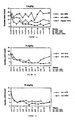
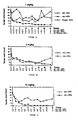
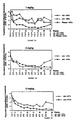
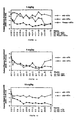
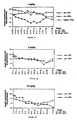
- Figures 1-4 Results for measures of swollen and tender joint counts and the physician and patient global assessments are shown in Figures 1-4 .
- the median results in Figures 1-4 were reported for each evaluation visit based only on the patients with data collected. That is, a last observation carried forward approach was not used for patients who dropped out. Instead, the number of patients with data that comprise each point on the graph was reported at the bottom of the figures.
- CRP C-reactive protein
- HAQ Health Assessment Questionnaire
- Serum concentrations of cA2 were obtained in all patients in this study.
- the serum concentration in each patient plotted over time according to the cA2 dose group is shown in Figure 7 .
- Data plotted are the serum cA2 concentrations obtained just before the administration of cA2 at weeks 2, 6, 10 and 14 and then at weeks 18 and 26. These sampling times were selected to best demonstrate the stability of the cA2 concentration during the multiple dose regimen and the decline in serum cA2 concentration after the last dose was administered.
- the scales for cA2 concentration for each graph are condensed as the cA2 dose was increased.
- HACA human anti-chimeric antibodies
- results for the immune response rate are shown not including patients with serum cA2 at 26 weeks and including patients with serum cA2 at 26 weeks, assuming that if cA2 was present at 26 weeks, the patient did not have a positive HACA response.
- HACA Responses 1 mg/kg 3 mg/kg 10 mg/kg MTX+ MTX- MTX+ MTX- MTX+ MTX- HACA responses not including pts with 26-week serum cA2 2/13 (15.4%) 8/15 (53.3%) 0/10 (0%) 3/12 (25.0%) 0/2 (0%) 1/10 (10%) HACA responses including pts with 26-week serum cA2 1 2/13 (15.4%) 8/15 (53.3%) 0/15 (0%) 3/14 (21.4%) 0/14 (0%) 1/15 (6.7%) 1 Patients with a measurable 26-week serum cA2 concentration were considered negative for a HACA response for this analysis.
- Multisystem, infusion-related reactions include headache, fever, facial flushing, pruritus, myalgia, nausea, chest tightness, dyspnea, vomiting, erythema, abdominal discomfort, diaphoresis, shivers, hypertension, lightheadedness, hypotension, palpitations and somnolence.
- Hypersensitivity reactions may occur whenever protein-containing materials, such as cA2, are administered. Thus, it is unclear whether these symptoms represent an immunologic event or physical factors such as infusion rate and immunoglobulin aggregation. Investigators have reported that symptoms resolve in some patients by decreasing the rate of the infusion. Previous literature reports indicate that vasomotor symptoms have been observed in patients receiving intravenous immunoglobulin therapy ( Berkman et al., Ann. Intern Med. 112:278-292 (1990 ); Ochs et al., Lancet 2:1158-1159 (1980 )).
- treatment with cA2 is well tolerated.
- the reductions in disease activity produced by cA2 are significant as supported by the findings of a low placebo response rate.
- High clinical response rates are obtained with a multiple dose regimen of 3 mg/kg cA2 in combination with 7.5 mg/wk methotrexate and can be sustained through 26 weeks.
- This dose regimen is considered preferable to the 1 mg/kg plus methotrexate regimen because better pharmacokinetics are obtained, virtually no immune response was detected and the clinical response is better sustained following the last treatment with cA2.
- the clinical benefit obtained by increasing the dose regimen to 10 mg/kg cA2 plus methotrexate is similar to that observed with the 3 mg/kg cA2 plus methotrexate regimen.
- the results of this study indicate that treatment with a multiple dose regimen of cA2 as adjunctive and/or concomitant therapy to methotrexate therapy, in RA patients whose disease is incompletely controlled by methotrexate, produces a highly beneficial or synergistic clinical response that can be sustained through 26 weeks.
- the benefit produced by cA2 generally exceeds 50% reductions in the traditional measurements of rheumatoid arthritis (swollen and tender joints, patient and physician global disease assessments) and achieves near clinical remission in many patients.
- the results of this study indicate that treatment with multiple infusions of cA2 as adjunctive and/or concomitant therapy to methotrexate therapy is an important and efficacious therapeutic approach for treating RA in patients.
- RA rheumatoid arthritis
- RA patients at three centers in the United States who, despite receiving three months therapy with methotrexate administered at a stable dose of 10 mg/wk for at least 4 weeks prior to screening, still had active disease according to the criteria of the American College of Rheumatology, were enrolled in the study.
- Active disease was defined by the presence of six or more swollen joints plus at least three of four secondary criteria (duration of morning stiffness ⁇ 45 minutes; ⁇ 6 tender or painful joints; erythrocyte sedimentation rate (ESR) ⁇ 28 mm/hour; C-reactive protein (CRP) ⁇ 20 mg/l.
- the chimeric monoclonal anti-TNF antibody (cA2) was supplied as a sterile solution containing 5 mg cA2 per ml of 0.01 M phosphate-buffered saline in 0.15 M sodium chloride with 0.01% polysorbate 80, pH 7.2.
- the placebo vials contained 0.1% human serum albumin in the same buffer.
- the appropriate amount of cA2 or placebo was diluted to 300 ml in sterile saline by the pharmacist, and administered intravenously via a 0.2 ⁇ m in-line filter over 2 hours.
- the characteristics of the placebo and cA2 infusion bags were identical, and the investigators and patients did not know which infusion was being administered.
- methotrexate Pharmacochemie, Netherlands
- VAS patient's assessment of pain
- VAS patient's global assessment of disease activity
- VAS physician's global assessment of disease activity
- HAQ patient's assessment of physical function
- ESR acute phase reactant
- the 28 patients were randomized to one of four treatment (or dose) groups.
- Clinical benefit of cA2 treatment was evident at the first evaluation visit at one week. Although each of the 3 doses of cA2 produced clinical responses in the majority of patients treated, the duration of clinical response appeared to be better sustained through 12 weeks in the groups receiving 10 or 20 mg/kg cA2. Clinical response was achieved much more frequently among patients receiving cA2 as compared to placebo. That is, 17/21 (81%) patients in the 3 cA2 groups achieved a response, compared with only 1/7 (14%) placebo treated patients. The magnitude of clinical response was notable. The mean tender joint count among cA2 treated patients decreased from 30.1 at baseline to 13.3 at week 12, and mean CRP decreased from 3.0 at baseline to 1.1 at week 12.
- the results of this study indicate that treatment with cA2 as adjunctive and/or concomitant therapy to methotrexate therapy is effective in the reduction of the signs and symptoms of rheumatoid arthritis in patients whose disease is incompletely controlled by methotrexate. Moreover, the clinical response achieved by this approach can be sustained for more than 12 weeks after a single treatment. Accordingly, the results of this study indicate that treatment with cA2 as adjunctive and/or concomitant therapy to methotrexate therapy is an important and efficacious therapeutic approach for treating RA in patients.
- Example 2 a randomized, double-blind, placebo controlled, 12 week study of cA2 was conducted in RA patients who had active disease despite receiving three months therapy with methotrexate administered at a stable dose of 10 mg/wk for at least 4 weeks prior to screening.
- VAS patient's assessment of pain
- VAS patient's global assessment of disease activity
- VAS physician's global assessment of disease activity
- HAQ patient's assessment of physical function
- ESR acute phase reactant
- Example 2 Of three patients who did not respond during the double-blinded study described in Example 2 (2 received placebos, 1 received 5 mg/kg cA2), two of these patients experienced a transient clinical response, and one patient is still responding through week 20.
- Embodiments of the disclosure may include the features of the following enumerated paragraphs ("paras").
Landscapes
- Health & Medical Sciences (AREA)
- Life Sciences & Earth Sciences (AREA)
- Chemical & Material Sciences (AREA)
- Medicinal Chemistry (AREA)
- General Health & Medical Sciences (AREA)
- Public Health (AREA)
- Veterinary Medicine (AREA)
- Pharmacology & Pharmacy (AREA)
- Animal Behavior & Ethology (AREA)
- Immunology (AREA)
- Engineering & Computer Science (AREA)
- Epidemiology (AREA)
- Bioinformatics & Cheminformatics (AREA)
- Organic Chemistry (AREA)
- Mycology (AREA)
- Microbiology (AREA)
- Chemical Kinetics & Catalysis (AREA)
- General Chemical & Material Sciences (AREA)
- Nuclear Medicine, Radiotherapy & Molecular Imaging (AREA)
- Proteomics, Peptides & Aminoacids (AREA)
- Gastroenterology & Hepatology (AREA)
- Cell Biology (AREA)
- Endocrinology (AREA)
- Biochemistry (AREA)
- Biophysics (AREA)
- Genetics & Genomics (AREA)
- Molecular Biology (AREA)
- Rheumatology (AREA)
- Biomedical Technology (AREA)
- Zoology (AREA)
- Physical Education & Sports Medicine (AREA)
- Transplantation (AREA)
- Orthopedic Medicine & Surgery (AREA)
- Pain & Pain Management (AREA)
- Medicines Containing Antibodies Or Antigens For Use As Internal Diagnostic Agents (AREA)
- Medicines That Contain Protein Lipid Enzymes And Other Medicines (AREA)
- Pharmaceuticals Containing Other Organic And Inorganic Compounds (AREA)
- Peptides Or Proteins (AREA)
- Acyclic And Carbocyclic Compounds In Medicinal Compositions (AREA)
- Pyrane Compounds (AREA)
Abstract
Description
- Monocytes and macrophages secrete cytokines known as tumor necrosis factor alpha (TNFα) and tumor necrosis factor beta (TKTFβ) in response to endotoxin or other stimuli. TNFα is a soluble homotrimer of 17 kD protein subunits (Smith et al., J. Biol. Chem. 262:6951- 6954 (1987)). A membrane-bound 26 kD precursor form of TNF also exists (Kriegler et al., Cell 53:45-53 (1988)). For reviews of TNF, see Beutler et al., Nature 320:584 (1986); Old, Science 230:630 (1986); and Le et al., Lab. Invest. 56:234 (1987).
- Cells other than monocytes or macrophages also produce TNFα. For example, human non-monocytic tumor cell lines produce tumor necrosis factor (TNF) (Rubin et al., J. Exp. Med. 164:1350 (1986); Spriggs et al., Proc. Natl. Acad. Sci. USA 84:6563 (1987)). CD4+ and CD8+ peripheral blood T lymphocytes and some cultured T and B cell lines (Cuturi et al., J. Exp. Med. 165:1581 (1987); Sung et al., J. Exp. Med. 168:1539 (1988); Turner et al., Eur. J. Immunol. 17:1807-1814 (1987)) also produce TNFα.
- TNF causes pro-inflammatory actions which result in tissue injury, such as degradation of cartilage and bone, induction of adhesion molecules, inducing procoagulant activity on vascular endothelial cells (Pober et al., J. Immunol. 136:1680 (1986)), increasing the adherence of neutrophils and lymphocytes (Pober et al., J. Immunol. 138:3319 (1987)), and stimulating the release of platelet activating factor from macrophages, neutrophils and vascular endothelial cells (Camussi et al., J. Exp. Med. 166:1390 (1987)).
- Recent evidence associates TNF with infections (Cerami et al., Immunol. Today 9:28 (1988)), immune disorders, neoplastic pathologies (Oliff et al., Cell 50:555 (1987)), autoimmune pathologies and graft-versus-host pathologies (Piguet et al., J. Exp. Med. 166:1280 (1987)). The association of TNF with cancer and infectious pathologies is often related to the host's catabolic state. Cancer patients suffer from weight loss, usually associated with anorexia.
- The extensive wasting which is associated with cancer, and other diseases, is known as "cachexia" (Kern et al., J. Patent. Enter. Nutr. 12:286-298 (1988)). Cachexia includes progressive weight loss, anorexia, and persistent erosion of body mass in response to a malignant growth. The fundamental physiological derangement can relate to a recline in food intake relative to energy expenditure. The cachectic state causes most cancer morbidity and mortality. TNF can mediate cachexia in cancer, infectious pathology, and other catabolic states.
- TNF also plays a central role in gram-negative sepsis and endotoxic shock (Michie et al., Br. J. Surg. 76:670-671 (1989); Debets et al., Second Vienna shock Forum, p.463-466 (1989); Simpson et al., Crit. Care Clin. 5:27-47 (1989)), including fever, malaise, anorexia, and cachexia. Endotoxin strongly activates monocyte/macrophage production and secretion of TNF and other cytokines (Kornbluth et al., J. Immunol. 137:2585-2591 (1986)). TNF and other monocyte-derived cytokines mediate the metabolic and neurohormonal responses to endotoxin (Michie et al., New Engl. J. Med. 318:1481-1486 (1988)). Endotoxin administration to human volunteers produces acute illness with flu-like symptoms including fever, tachycardia, increased metabolic rate and stress hormone release (Revhaug et al., Arch. Surg. 123:162-170 (1988)). Circulating TNF increases in patients suffering from Gram-negative sepsis (Waage et al., Lancet 1:355-357 (1987) ; Hammerle et al., Second Vienna Shock Forum p. 715-718 (1989); Debets et al., Crit. Care Med. 17:489-497 (1989); Calandra et al., J. Infect. Dis. 161:982-987 (1990)).
- Thus, TNFα has been implicated in inflammatory diseases, autoimmune diseases, viral, bacterial and parasitic infections, malignancies, and/or neurogenerative diseases and is a useful target for specific biological therapy in diseases, such as rheumatoid arthritis and Crohn's disease. Beneficial effects in open-label trials with a chimeric monoclonal antibody to TNFα (cA2) have been reported with suppression of inflammation (Elliott et al., Arthritis Rheum. 36:1681-1690 (1993); Elliott et al., Lancet 344:1125-1127 (1994)). See also, Van Dullemen et al., Gastroenterology 109:129-135 (1995). Beneficial results in a randomized, double-blind, placebo-controlled trial with cA2 have also been reported with suppression of inflammation (Elliott et al., Lancet 344:1105-1110 (1994)).
WO95/09652 - Maini et al (Kennedy Institute of Rheumatology 29th Scientific Report 1995) report on a study which examines the safety and efficacy, in rheumatoid arthritis, of repeated dosing with anti-TNF monoclonal antibody cA2 in combination with, or compared to, the established antirheumatoid drug, methotrexate. This report does not disclose the results of the study, or any therapeutic effects. Nor does it suggest that the anti-tumour necrosis factor antibody be used in concomitant therapy with methotrexate therapy.
-
WO 94/08619 WO94/08619 - Bologna et al., La Presse medicale, report on uses of combination regimens for rheumatoid arthritis. Reference is made to studies carried out using different combinations of DMARDs such as azathioprine, hydroxychloroquine, methotrexate, salazopyrine. The authors conclude that such combinations have not been shown to provide any appreciable benefit at the clinical level, and add that numerous possible combinations remain to be studied, for example the combination of methotrexate with targeted drugs such as anti-CD4 and anti-TNFα monoclonal antibodies or the soluble TNFα receptor. There is no suggestion to use anti-TNFα antibodies in concomitant therapy with methotrexate therapy in the treatment of rheumatoid arthritis.
- Fenner et al., Arthritis & Rheumatism, Vol 38, n°9 (suppl.) 1995, page S266, Abstract 679, disclose sequential monotherapy of rheumatoid arthritis in clinical trials. Patients first receive methotrexate which is withdrawn prior to administration of a TNF receptor-IgG fusion molecule. Thereafter, methotrexate is reintroduced. There is no disclosure of the use of anti-TNF antibodies and no disclosure of concomitant therapy.
- Sander et al., Arthritis & Rheumatism, Vol 38, n°9 (suppl.) 1995, page S266, Abstract 678, disclose combined therapy of rheumatoid arthritis involving intermittent methotrexate treatment and TNF-blockade. Long-term methotrexate therapy is interrupted by a wash-out of 28 days, and then a TNF-blocking agent is administered during 6 to 12 months. During this period the patient receives no methotrexate. Finally, the TNF-blocking agent is stopped, and methotrexate therapy is reintroduced. There is no disclosure of the use of anti-TNF antibodies, and no disclosure of concomitant therapy.
-
WO96/33204, published on 24th October 1996 WO96/33204 - Moreland et al., Journal of Rheumatology 1996, Volume 23, supplement 44, pp78-83), review the results of clinical trials combining methotrexate (MTX) with an anti-CD4 monoclonal antibody, in the treatment of rheumatoid arthritis (RA). In particular, reference is made to phase I and phase II trials in which patients already receiving MTX as baseline treatment were given an anti-CD4 monoclonal antibody. Clinical responses in patients receiving anti-CD4 treatment and MTX treatment were found to be the same as those observed with patients taking placebo and MTX. The authors conclude that such a combined treatment is not associated with efficacy. Moreland et al suggest that studies could be designed using combinations of traditional DMARDs such as MTX, or other DMARDs, with biologic agents such as anti-TNFα, or with soluble TNF receptor fusion proteins, but warns that such combinations raise the concern of increasing the risk of serious adverse events. There is no disclosure or suggestion of the use of anti-TNFα monoclonal antibodies in concomitant therapy with MTX in treatment of RA.
- Elliott (International Journal of Immunopharmacology, 1995, vol 17 (2), pp141-145, is a review article summarising the results of three clinical trials using the anti-TNF antibody cA2 as mono-therapy in treatment of rheumatoid arthritis. The patients participating in these trials did not receive concomitant MTX therapy, any DMARD therapy having been withdrawn at least 4 weeks prior to trial entry. Short-term suppression of rheumatoid disease is demonstrated. The authors suggest that cA2 may be useful in the control of disease whilst awaiting onset of action of DMARDs. There is no disclosure or suggestion of the use of anti-TNFa monoclonal antibodies in concomitant therapy with MTX in treatment of RA.
- The present invention is based on the discovery that treatment of patients suffering from a TNF-mediated disease with a tumor necrosis factor antagonist which is an anti-tumor necrosis factor antibody, as concomitant therapy to methotrexate therapy produces a rapid and sustained reduction in the clinical signs and symptoms of the disease. The present invention is also based on the unexpected and dramatic discovery that a multiple dose regimen of a tumor necrosis factor antagonist which is an anti-tumor necrosis factor antibody, when administered adjunctively with methotrexate to an individual suffering from a TNF-mediated disease produces a highly beneficial or synergistic clinical response for a significantly longer duration compared to that obtained with a single or multiple dose regimen of the antagonist administered alone or that obtained with methotrexate administered alone. As a result of Applicants' invention, there is provided herein an anti-human tumour necrosis factor antibody, or a fragment thereof, which binds specifically to tumour necrosis factor, for use in treatment of rheumatoid arthritis, juvenile chronic arthritis, ankylosing spondylitis, psoriatic arthritis or Crohn's disease, wherein the anti-tumour necrosis factor antibody is to be administered in single or multiple doses, as concomitant therapy with methotrexate therapy, and the methotrexate is to be administered in multiple doses. In a particular embodiment, methotrexate is administered in the form of a series of low doses separated by intervals of days or weeks.
- There is also provided herein an anti-tumour necrosis factor antibody for use in treating rheumatoid arthritis by administration as concomitant therapy to patients receiving methotrexate therapy. There is also provided herein an anti-tumour necrosis factor antibody for use in treating rheumatoid arthritis, which antibody is cA2, to be administered as a repeated treatment as concomitant therapy with methotrexate therapy in rheumatoid arthritis patients whose disease is incompletely controlled by methotrexate.
-
-
Figures 1A-1C are a set of three graphs showing the results over time for swollen joint count in rheumatoid arthritis (RA) patients receiving cA2 treatment (1 mg/kg, 3 mg/kg or 10 mg/kg) with or without methotrexate. Results for the placebo group (methotrexate alone) are shown with the 1 mg/kg group. The number of patients with data at each evaluation visit is shown at the bottom of each graph. White circle = - methotrexate (MTX-); black circle = + methotrexate (MTX+); square = placebo. -
Figures 2A-2C are a set of three graphs showing the results over time for tender joint count in RA patients receiving cA2 treatment (1 mg/kg, 3 mg/kg or 10 mg/kg) with or without methotrexate. Results for the placebo group (methotrexate alone) are shown with the 1 mg/kg group. The number of patients with data at each evaluation visit is shown at the bottom of each graph. White circle = - methotrexate; black circle = + methotrexate; square = placebo. -
Figures 3A-3C are a set of three graphs showing the results over time for the Physician's Global Disease Assessment in RA patients receiving cA2 treatment (1 mg/kg, 3 mg/kg or 10 mg/kg) with or without methotrexate. Results for the placebo group (methotrexate alone) are shown with the 1 mg/kg group. The number of patients with data at each evaluation visit is shown at the bottom of each graph. White circle = - methotrexate; black circle =
+ methotrexate; square = placebo. -
Figures 4A-4C are a set of three graphs showing the results over time for the Patient Disease Assessment in RA patients receiving cA2 treatment (1 mg/kg, 3 mg/kg or 10 mg/kg) with or without methotrexate. Results for the placebo group (methotrexate alone) are shown with the 1 mg/kg group. The number of patients with data at each evaluation visit is shown at the bottom of each graph. White circle = - methotrexate; black circle = + methotrexate; square = placebo. -
Figures 5A-5C are a set of three graphs showing the results over time for C-reactive protein (CRP) concentration in RA patients receiving cA2 treatment (1 mg/kg. 3 mg/kg or 10 mg/kg) with or without methotrexate. Results for the placebo group (methotrexate alone) are shown with the 1 mg/kg group. The number of patients with data at each evaluation visit is shown at the bottom of each graph. White circle = - methotrexate; black circle = + methotrexate; square = placebo. -
Figures 6A-6C are a set of three graphs showing the results over time for the Health Assessment Questionnaire (HAQ) in RA patients receiving cA2 treatment (1 mg/kg, 3 mg/kg or 10 mg/kg) with or without methotrexate. Results for the placebo group (methotrexate alone) are shown with the 1 mg/kg group. The number of patients with data at each evaluation visit is shown at the bottom of each graph. White circle = - methotrexate; black circle = + methotrexate; square = placebo. -
Figures 7A-7F are a set of six graphs showing the serum cA2 concentration in each RA patient receiving cA2 treatment (1 mg/kg, 3 mg/kg or 10 mg/kg) with or without methotrexate, plotted over time. Data plotted are the serum cA2 concentrations obtained just before the administration of cA2 atweeks weeks -
Figures 8A and 8B are a set of two graphs showing the median serum cA2 concentration over time in RA patients receiving 3 mg/kg cA2 (top panel) or 10 mg/kg cA2 (bottom panel) with or without methotrexate. Square = + methotrexate; circle or triangle = - methotrexate. - The present- invention relates to the discovery that anti-TNF antibodies can be administered to patients suffering from a TNF-mediated disease as concomitant therapy to methotrexate therapy, with good to excellent alleviation of the signs and symptoms of the disease. The present invention also relates to the discovery that anti-TNF antibodies can be administered to patients suffering from a TNF-mediated disease in multiple doses and as concomitant therapy to methotrexate therapy, with a significant improvement in duration of clinical response.
- As a result of Applicants' invention, there is provided herein an anti-human tumour necrosis factor antibody, or a fragment thereof, which binds specifically to tumour necrosis factor, for use in treatment of rheumatoid arthritis, juvenile chronic arthritis, ankylosing spondylitis, psoriatic arthritis or Crohn's disease, wherein the anti-tumour necrosis factor antibody is to be administered in single or multiple doses, as concomitant therapy with methotrexate therapy, and the methotrexate is to be administered in multiple doses. The anti-TNF antibody and methotrexate can be administered simultaneously or sequentially. The anti-TNF antibody and methotrexate can each be administered in single or multiple doses. Multiple anti-TNF antibodies can be co-administered with methotrexate. Other therapeutic regimens and agents can be used in combination with the therapeutic co-administration of anti-TNF antibodies and metrotrexate or other drugs that suppress the immune system.
- There is also provided herein an anti-tumour necrosis factor antibody for use in treating rheumatoid arthritis by administration as concomitant therapy to patients receiving methotrexate therapy.
- There is also provided herein an anti-tumour necrosis factor antibody for use in treating rheumatoid arthritis, which antibody is cA2, to be administered as a repeated treatment as concomitant therapy with methotrexate therapy in rheumatoid arthritis patients whose disease is incompletely controlled by methotrexate.
- As used herein, a "TNF-mediated disease" refers to a TNF related pathology or disease which is rheumatoid arthritis, juvenile chronic arthritis, ankylosing spondylitis, psoriatic arthritis or Crohn's disease.
- See, e.g., Berkow et al., Eds., The Merck Manual, 16th edition, .
- The terms "recurrence', "flare-up" or "relapse" are defined to encompass the reappearance of one or more symptoms of the disease state. For example, in the case of rheumatoid arthritis, a reoccurrence can include the experience of one or more of swollen joints, morning stiffness or joint tenderness.
- There is disclosed herein a method of treating rheumatoid arthritis in an individual comprising co-administering methotrexate and a TNF antagonist to the individual in therapeutically effective amounts.
- There is also disclosed herein a method for treating Crohn's disease in an individual comprising co-administering a methotrexate and a TNF antagonist to the individual in therapeutically effective amounts.
- The benefits of combination therapy with methotrexate and TNF antagonists according to the claimed invention include high clinical response rates for significantly longer durations in comparison with that obtained with treatment with each therapeutic modality separately. In addition, methotrexate significantly reduces immunogenicity of anti-TNF antibodies, thus permitting administration of multiple dosages of anti-TNF antibodies with enhanced safety. The results described herein suggest that methotrexate can be used to reduce immunogenicity of other antibodies or proteins.
- There are also disclosed herein compositions comprising methotrexate and a TNF antagonist. The compositions are useful for treating a subject having a pathology or condition associated with abnormal levels of a substance reactive with a TNF antagonist, in particular TNF in excess of, or less than, levels present in a normal healthy subject, where such excess or diminished levels occur in a systemic, localized or particular tissue type or location in the body. Such tissue types can include, but are not limited to, blood, lymph, central nervous system (CNS), liver, kidney, spleen, heart muscle or blood vessels, brain or spinal cord white matter or grey matter, cartilage, ligaments, tendons, lung, pancreas, ovary, testes, prostate. Increased or decreased TNF concentrations relative to normal levels can also be localized to specific regions or cells in the body, such as joints, nerve blood vessel junctions, bones, specific tendons or ligaments, or sites of infection, such as bacterial or viral infections.
- As used herein, a "tumor necrosis factor antagonist" decreases, blocks, inhibits, abrogates or interferes with TNF activity in vivo and is an anti-TNF antibody which binds specfically to TNF. A suitable TNF antagonist can also prevent or inhibit TNF synthesis and/or TNF release. A suitable TNF antagonist can also prevent or inhibit TNF receptor signalling.
- As used herein, an "anti-tumor necrosis factor antibody" decreases, blocks, inhibits, abrogates or interferes with TNF activity in vivo. Anti-TNF antibodies useful in the methods and compositions of the present invention include monoclonal, chimeric, humanized, resurfaced and recombinant antibodies and fragments thereof which are characterized by high affinity binding to TNF and low toxicity (including human anti-murine antibody (HAMA) and/or human anti-chimeric antibody (HACA) response). In particular, an antibody where the individual components, such as the variable region, constant region and framework, individually and/or collectively possess low immunogenicity is useful in the present invention. The antibodies which can be used in the invention are characterized by their ability to treat patients for extended periods with good to excellent alleviation of symptoms and low toxicity. Low immunogenicity and/or high affinity, as well as other undefined properties, may contribute to the therapeutic results achieved.
- An example of a high affinity monoclonal antibody useful in the methods and compositions of the present invention is murine monoclonal antibody (mAb) A2 and antibodies which will competitively inhibit in vivo the binding to human TNFα of anti-TNFα murine mAb A2 or an antibody having substantially the same specific binding characteristics, as well as fragments and regions thereof. Murine monoclonal antibody A2 and chimeric derivatives thereof, such as cA2, are described in
U.S. patent No 6,284,471 (filed February 4, 1994 ), U.S patent No5,656,272, (filed February 4, 1994 ),U.S. patent No 5,919,452 (filed February 4, 1994 ),U.S. patent No 5,698,195, (filed October 18, 1994 ), andLe, J. et al., International Publication No. WO 92/16553 (published October 1, 1992 - Additional examples of monoclonal anti-TNF antibodies that can be used in the present invention are described in the art (see, e.g.,
U.S. patent No. 5,656,272 (filed September 11, 1992 );Rathjen et al., International Publication No. WO 91/02078 (published February 21, 1991 Rubin et al., EPO Patent Publication 0218868 (published April 22, 1987 );Yone et al., EPO Patent Publication No. 3288088 (October 26, 1988 ); Liang, et al., Biochem. Biophys. Res. Comm. 137:847-854 (1986); Meager, et al., Hybridoma 6:305-311 (1987); Fendly et al., Hybridoma 6:359-369 (1987); Bringman, et al., Hybridoma 6:489-507 (1987); Hirai, et al., J. Immunol. Meth. 96:57-62 (1987); Moller, et al., Cytokine 2:162-169 (1990). - Chimeric antibodies are immunoglobulin molecules characterized by two or more segments or portions derived from different animal species. Generally, the variable region of the chimeric antibody is derived from a non-human mammalian antibody, such as a murine mAb, and the immunoglobulin constant region is derived from a human immunoglobulin molecule. Preferably, a variable region with low immunogenicity is selected and combined with a human constant region which also has low immunogenicity, the combination also preferably having low immunogenicity. "Low" immunogenicity is defined herein as raising significant HACA or HAMA responses in less than about 75%, or preferably less than about 50% of the patients treated and/or raising low titres in the patient created (less than about 300, preferably less than about 100 measured with a double antigen enzyme immunoassay) (Elliott et al., Lancet 344:1125-1127 (1994)).
- As used herein, the term "chimeric antibody" includes monovalent, divalent or polyvalent immunoglobulins. A monovalent chimeric antibody is a dimer (HL)) formed by a chimeric H chain associated through disulfide bridges with a chimeric L chain. A divalent chimeric antibody is a tetramer (H2L2) formed by two HL dimers associated through at least one disulfide bridge. A polyvalent chimeric antibody can also be produced, for example, by employing a CH region that aggregates (e.g., from an IgM H chain, or µ chain).
- Antibodies comprise individual heavy (H) and/or light (L) immunoglobulin chains. A chimeric H chain comprises an antigen binding region derived from the H chain of a non-human antibody specific for TNF, which is linked to at least a portion of a human H chain C region (CH), such as CH1 or CH2. A chimeric L chain comprises an antigen binding region derived from the L chain of a non-human antibody specific for TNF, linked to at least a portion of a human L chain C region (CL).
- Chimeric antibodies and methods for their production have been described in the art (Morrison et al., Proc. Natl. Acad. Sci. USA 81:6851-6855 (1984); Boulianne et al., Nature 312:643-646 (1984); Neuberger et al., Nature 314:268-270 (1985); Taniguchi et al., European Patent Application No.
171496 (published February 19, 1985 173494 (published March 5, 1986 Neuberger et al., PCT Application No. WO 86/01533, (published March 13, 1986 184187 (published June 11, 1986 173494 (published March 5, 1986 Robinson et al., International Publication No. PCT/US86/02269 (published May 7, 1987 ); Liu et al., Proc. Natl. Acad. Sci. USA 84:3439-3443 (1987); Sun et al., Proc. Natl. Acad. Sci. USA 84:214-218 (1987); Better et al., Science 240:1041-1043 (1988); and Harlow and Lane, Antibodies: A Laboratory Manual, Cold Spring Harbor Laboratory, New York, 1988). - The anti-TNF chimeric antibody can comprise, for example, two light chains and two heavy chains, each of the chains comprising at least part of a human constant region and at least part of a variable (V) region of non-human origin having specificity to human TNF, said antibody binding with high affinity to an inhibiting and/or neutralizing epitope of human TNF, such as the antibody cA2. The antibody also includes a fragment or a derivative of such an antibody, such as one or more portions of the antibody chain, such as the heavy chain constant or variable regions, or the light chain constant or variable regions.
- Humanizing and resurfacing the antibody can further reduce the immunogenicity of the antibody. See, for example,
Winter (U.S. Patent No. 5,225,539 andEP 239,400 B1 Padlan et al. (EP 519,596 A1 Pedersen et al. (EP 592,106 A1 - Preferred antibodies useful in the methods and compositions of the present invention are high affinity human-murine chimeric anti-TNF antibodies, and fragments or regions thereof, that have potent inhibiting and/or neutralizing activity in vivo against human TNFα. Such antibodies and chimeric antibodies can include those generated by immunization using purified recombinant TNFα or peptide fragments thereof comprising one or more epitopes.
- An example of such a chimeric antibody is cA2 and antibodies which will competitively inhibit in vivo the binding to human TNFα of anti-TNFα murine mAb A2, chimeric mAb cA2, or an antibody having substantially the same specific binding characteristics, as well as fragments and regions thereof. Chimeric mAb cA2 has been described, for example, in
U.S. patent No. 6,284,471 (filed February 4, 1994 ),U.S. patent No.5,656,272 (filed February 4, 1994 ),U.S. patent No.5,919,452 (filed February 4, 1994 ), andU.S. patent No.5,698,195 (filed October 18, 1994 ), and byLe, J. et al. (International Publication No. WO 92/16553 (published October 1, 1992 - Chimeric A2 anti-TNF consists of the antigen binding variable region of the high-affinity neutralizing mouse anti-human TNF IgGl antibody, designated A2, and the constant regions of a human IgGl, kappa immunoglobulin. The human IgGl Fc region improves allogeneic antibody effector function, increases the circulating serum half-life and decreases the immunogenicity of the antibody. The avidity and epitope specificity of the chimeric A2 is derived from the variable region of the murine A2. Chimeric A2 neutralizes the cytotoxic effect of both natural and recombinant human TNF in a dose dependent manner. From binding assays of cA2 and recombinant human TNF, the affinity constant of cA2 was calculated to be 1.8x10⁹M-1. Preferred methods for determining mAb specificity and affinity by competitive inhibition can be found in Harlow, et al., Antibodies: A Laboratory Manual, Cold Spring Harbor Laboratory Press, Cold Spring Harbor, New York, 1988; Colligan et al., eds., Current Protocols in Immunology, Greene Publishing Assoc. and Wiley Interscience, New York, (1992, 1993); Kozbor et al., Immunol. Today 4:72-79 (1983); Ausubel et al., eds. Current Protocols in Molecular Biology, Wiley Interscience, New York (1987, 1992, 1993); and Muller, Meth. Enzymol. 92:589-601 (1983).
- As used herein, the term "antigen binding region" refers to that portion of an antibody molecule which contains the amino acid residues that interact with an antigen and confer on the antibody its specificity and affinity for the antigen. The antibody region includes the "framework" amino acid residues necessary to maintain the proper conformation of the antigen-binding residues. Generally, the antigen binding region will be of murine origin. In other embodiments, the antigen binding region can be derived from other animal species, such as sheep, rabbit, rat or hamster. Preferred sources for the DNA encoding such a non-human antibody include cell lines which produce antibody, preferably hybrid cell lines commonly known as hybridomas. In one embodiment, a preferred hybridoma is the A2 hybridoma cell line.
- An "antigen" is a molecule or a portion of a molecule capable of being bound by an antibody which is additionally capable of inducing an animal to produce antibody capable of selectively binding to an epitope of that antigen. An antigen can have one or more than one epitope.
- The term "epitope" is meant to refer to that portion of the antigen capable of being recognized by and bound by an antibody at one or more of the antibody's antigen binding region. Epitopes usually consist of chemically active surface groupings of molecules such as amino acids or sugar side chains and have specific three dimensional structural characteristics as well as specific charge characteristics. By "inhibiting and/or neutralizing episcope" is intended an epitope, which, when bound by an antibody, results in loss of biological activity of the molecule containing the epitope, in vivo or in vitro, more preferably in vivo, including binding of TNF to a TNF receptor. Epitopes of TNF have been identified within
amino acids 1 to about 20, about 56 to about 77, about 108 to about 127 and about 138 to about 149. Preferably, the antibody binds to an epitope comprising at least about 5 amino acids of TNF within TNF residues from about 87 to about 107, about 59 to about 80 or a combination thereof. Generally, epitopes include at least about 5 amino acids and less than about 22 amino acids embracing or overlapping one or more of these regions. - For example, epitopes of TNF which are recognized by, and/or binds with anti-TNF activity, an antibody, and fragments, and variable regions thereof, include:
59-80: 
87-108: 
- The anti-TNF antibodies, and fragments, and variable regions thereof, that are recognized by, and/or binds with anti-TNF activity, these epitopes block the action of TNFα without binding to the putative receptor binding locus as presented by Eck and Sprang (J. Biol. Chem. 264(29): 17595-17605 (1989) (amino acids 11-13, 37-42, 49-57 and 155-157 of hTNFα).
Rathjen et al., International Publication No. WO 91/02078 (published February 21, 1991 - The techniques to raise antibodies to small peptide sequences that recognize and bind to those sequences in the free or conjugated form or when presented as a native sequence in the context of a large protein are well known in the art. Such antibodies can be produced by hybridoma or recombinant techniques known in the art.
- Murine antibodies which can be used in the preparation of the antibodies useful in the methods and compositions of the present invention have also been described in Rubin et al.,
EP 0218868 (published April 22, 1987 );Yone et al., EP 0288088 (published October 26, 1988 ); Liang, et al., Biochem. Biophys. Res. Comm. 137:647-854 (1986); Meager, et al., Hybridoma 6:305-311 (1987); Fendly et al., Hybridoma 6:359-369 (1987); Bringman, et al., Hybridoma 6:489-507 (1987); Hirai, et al., J. Immunol. Meth. 96:57-62 (1987); Möller, et al., Cytokine 2:162-169 (1990). - The cell fusions are accomplished by standard procedures well known to those skilled in the field of immunology. Fusion partner cell lines and methods for fusing and selecting hybridomas and screening for mAbs are well known in the art. See, e.g, Ausubel infra, Harlow infra, and Colligan infra.
- The TNFα-specific murine mAb useful in the methods and compositions of the present invention can be produced in large quantities by injecting hybridoma or transfectoma cells secreting the antibody into the peritoneal cavity of mice and, after appropriate time, harvesting the ascites fluid which contains a high titer of the mAb, and isolating the mAb therefrom. For such in vivo production of the mAb with a hybridoma (e.g., rat or human), hybridoma cells are preferably grown in irradiated or athymic nude mice. Alternatively, the antibodies can be produced by culturing hybridoma or transfectoma cells in vitro and isolating secreted mAb from the cell culture medium or recombinantly, in eukaryotic or prokaryotic cells.
- In one embodiment, the antibody used in the methods and compositions of the present invention is a mAb which binds amino acids of an epitope of TNF recognized by A2, rA2 or cA2, produced by a hybridoma or by a recombinant host. In another embodiment, the antibody is a chimeric antibody which recognizes an epitope recognized by A2. In still another embodiment, the antibody is a chimeric antibody designated as chimeric A2 (cA2).
- As examples of antibodies useful in the methods and compositions of the present invention, murine mAb A2 is produced by a cell line designated c134A. Chimeric antibody cA2 is produced by a cell line designated c168A. c168A was deposited at the American Type Culture Collection, Rockville, Maryland, as a "Culture Safe Deposit."
- "Derivatives" of the antibodies including fragments, regions or proteins encoded by truncated or modified genes to yield molecular species functionally resembling the immunoglobulin fragments are also useful in the methods and compositions of the present invention. The modifications include, but are not limited to, addition of genetic sequences coding for cytotoxic proteins such as plant and bacterial toxins. The fragments and derivatives can be produced from appropriate cells, as is known in the art. Alternatively, anti-TNF antibodies, fragments and regions can be bound to cytotoxic proteins or compounds in vitro, to provide cytotoxic anti-TNF antibodies which would selectively kill cells having TNF on their surface.
- "Fragments" of the antibodies include, for example, Fab, Fab', F(ab')2 and Fv. These fragments lack the Fc fragment of intact antibody, clear more rapidly from the circulation, and can have less non-specific tissue binding than an intact antibody (Wahl et al., J. Nucl. Med. 24:316-325 (1983)). These fragments are produced from intact antibodies using methods well known in the art, for example by proteolytic cleavage with enzymes such as papain (to produce Fab fragments) or pepsin (to produce F(ab')2 fragments).
- Recombinant and/or chimeric murine-human or human-human antibodies that inhibit TNF can be produced using known techniques based on the teachings provided in
U.S. patent No. 6,284,471 (filled February 4, 1994 ),U.S. patent No. 5,656,272 (filed February 4, 1994 ),U.S. patent No. 5,919,452 (filed February 4, 1994 ),U.S patent No. 5,698,195 (filed on October 18, 1994 ) andLe, J. et al., International Publication No. WO 92/16553 (published October 1, 1992 - The DNA encoding an anti-TNF antibody can be genomic DNA or cDNA which encodes at least one of the heavy chain constant region (Hc), the heavy chain variable region (Hc), the light chain variable region (Lv) and the light chain constant regions (Lc). A convenient alternative to the use of chromosomal gene fragments as the source of DNA encoding the murine V region antigen-binding segment is the use of cDNA for the construction of chimeric immunoglobulin genes, e.g., as reported by Liu et al. (Proc. Natl. Acad. Sci., USA 84:3439 (1987) and J. Immunology 139:3521 (1987)). The use of cDNA requires that gene expression elements appropriate for the host cell be combined with the gene in order to achieve synthesis of the desired protein. The use of cDNA sequences is advantageous over genomic sequences (which contain introns), in that cDNA sequences can be expressed in bacteria or other hosts which lack appropriate RNA splicing systems. An example of such a preparation is set forth below.
- Because the genetic code is degenerate, more than one codon can be used to encode a particular amino acid. Using the genetic code, one or more different oligonucleotides can be identified, each of which would be capable of encoding the amino acid. The probability that a particular oligonucleotide will, in fact, constitute the actual XXX-encoding sequence can be estimated by considering abnormal base pairing relationships and the frequency with which a particular codon is actually used (to encode a particular amino acid) in eukaryotic or prokaryotic cells expressing an anti-TNF antibody or fragment. Such "codon usage rules" are disclosed by Lathe, et al., J. Mol. Biol. 183:1-12 (1985). Using the "codon usage rules" of Lathe, a single oligonucleotide, or a set of oligonucleotides, that contains a theoretical "most probable" nucleotide sequence capable of encoding anti-TNF variable or constant region sequences is identified.
- Although occasionally an amino acid sequence can be encoded by only a single oligonucleotide, frequently the amino acid sequence can be encoded by any of a set of similar oligonucleotides. Importantly, whereas all of the members of this set contain oligonucleotides which are capable of encoding the peptide fragment and, thus, potentially contain the same oligonucleotide sequence as the gene which encodes the peptide fragment, only one member of the set contains the nucleotide sequence that is identical to the nucleotide sequence of the gene. Because this members is present within the set, and is capable of hybridizing to DNA even in the presence of the other members of the set, it is possible to employ the unfractionated set of oligonucleotides in the same manner in which one would employ a single oligonucleotide to clone the gene that encodes the protein.
- The oligonucleotide, or set of oligonucleotides, containing the theoretical "most probable" sequence capable of encoding an anti-TNF antibody or fragment including a variable or constant region is used to identify the sequence of a complementary oligonucleotide or set of oligonucleotides which is capable of hybridizing to the "most probable" sequence, or set of sequences. An oligonucleotide containing such a complementary sequence can be employed as a probe to identify and isolate the variable or constant region anti-TNF gene (Sambrook et al., infra).
- A suitable oligonucleotide, or set of oligonucleotides, which is capable of encoding a fragment of the variable or constant anti-TNF region (or which is complementary to such an oligonucleotide, or set of oligonucleotides) is identified (using the above-described procedure), synthesized, and hybridized by means well known in the art, against a DNA or, more preferably, a cDNA preparation derived from cells which are capable of expressing anti-TNF antibodies or variable or constant regions thereof. Single stranded oligonucleotide molecules complementary to the "most probable" variable or constant anti-TNF region peptide coding sequences can be synthesized using procedures which are well known to those of ordinary skill in the art (Belagaje, et al., J. Biol. Chem. 254:5765-5780 (1979); Maniatis, et al., In: Molecular Mechanisms in the Control of Gene Expression, Nierlich, et al., eds., Acad. Press, New York (1976); Wu, et al., Prog. Nucl. Acid Res. Molec. Biol. 21:101-141 (1978); Khorana, Science 203:614-625 (1979)). Additionally, DNA synthesis can be achieved through the use of automated synthesizers. Techniques of nucleic acid hybridization are disclosed by Sambrook et al., Molecular Cloning: A Laboratory Manual, Cold Spring Harbor Laboratory Press, New York (1989); and by Haynes, et al., in: Nucleic Acid Hybridization, A Practical Approach, IRL Press, Washington, DC (1985). Techniques such as, or similar to, those described above have successfully enabled the cloning of genes for human aldehyde dehydrogenases (Hsu, et al., Proc. Natl. Acad. Sci. USA 82:3771-3775 (1985)), fibronectin (Suzuki, et al., Bur. Mol. Biol. Origan. J. 4:2519-2524 (1985)), the human estrogen receptor gene (Walter, et al., Proc. Natl. Acad. Sci. USA 82:7889-7893 (1985)), tissue-type plasminogen activator (Pennica, et al., Nature 301:214-221 (1983)) and human placental alkaline phosphatase complementary DNA (Keun, et al., Proc. Natl. Acad. Sci. USA 82:8715-8719 (1985)).
- In an alternative way of cloning a polynucleotide encoding an anti-TNF variable or constant region, a library of expression vectors is prepared by cloning DNA or, more preferably, cDNA (from a cell capable of expressing an anti-TNF antibody or variable or constant region) into an expression vector. The library is then screened for members capable of expressing a protein which competitively inhibits the binding of an anti-TNF antibody, such as A2 or cA2, and which has a nucleotide sequence that is capable of encoding polypeptides that have the same amino acid sequence as anti-TNF antibodies or fragments thereof. In this embodiment, DNA, or more preferably cDNA, is extracted and purified from a cell which is capable of expressing an anti-TNF antibody or fragment. The purified cDNA is fragmentized (by shearing, endonuclease digestion, etc.) to produce a pool of DNA or cDNA fragments. DNA or cDNA fragments from this pool are then cloned into an expression vector in order to produce a genomic library of expression vectors whose members each contain a unique cloned DNA or cDNA fragment such as in a lambda phage library, expression in prokaryotic cell (e.g., bacteria) or eukaryotic cells, (e.g., mammalian, yeast, insect or, fungus). See, e.g., Ausubel, infra, Harlow, infra, Colligan, infra; Nyyssonen et al. Bio/Technology 11:591-595 (1993); Marks et al., Bio/Technology 11:1145-1149 (October 1993). Once nucleic acid encoding such variable or constant anti-TNF regions is isolated, the nucleic acid can be appropriately expressed in a host cell, along with other constant or variable heavy or light chain encoding nucleic acid, in order to provide recombinant monoclonal antibodies that bind TNF with inhibitory activity. Such antibodies preferably include a murine or human anti-TNF variable region which contains a framework residue having complementarity determining residues which are responsible for antigen binding.
- Human genes which encode the constant (C) regions of the chimeric antibodies, fragments and regions of the present invention can be derived from a human fetal liver library, by known methods. Human C region genes can be derived from any human cell including those which express and produce human immunoglobulins. The human CH region can be derived from any of the known classes or isotypes of human H chains, including gamma, µ, α, δ or ε, and subtypes thereof, such as G1, G2, G3 and G4. Since the H chain isotype is responsible for the various effector functions of an antibody, the choice of CH region will be guided by the desired effector functions, such as complement fixation, or activity in antibody-dependent cellular cytotoxicity (ADCC). Preferably, the CH region is derived from gamma 1 (IgG1), gamma 3 (IgG3), gamma 4 (IgG4), or µ (IgM). The human CL region can be derived from either human L chain isotype, kappa or lambda.
- Genes encoding human immunoglobulin C regions are obtained from human cells by standard cloning techniques (Sambrook, et al. (Molecular Cloning: A Laboratory Manual, 2nd Edition, Cold Spring Harbor Press, Cold Spring Harbor, New York (1989) and Ausubel et al., eds., Current Protocols in Molecular Biology, Wiley Interscience, New York (1987-1993)). Human C region genes are readily available from known clones containing genes representing the two classes of L chains, the five classes of H chains and subclasses thereof. Chimeric antibody fragments, such as F(ab')2 and Fab, can be prepared by designing a chimeric H chain gene which is appropriately truncated. For example, a chimeric gene encoding an H chain portion of an F(ab')2 fragment would include DNA sequences encoding the CH1 domain and hinge region of the H chain, followed by a translational stop codon to yield the truncated molecule.
- Generally, the murine, human and chimeric antibodies, fragments and regions are produced by cloning DNA segments encoding the H and L chain antigen-binding regions of a TNF-specific antibody, and joining these DNA segments to DNA segments encoding CH and CL regions, respectively, to produce murine, human or chimeric immunoglobulin-encoding genes. Thus, in a preferred embodiment, a fused chimeric gene is created which comprises a first DNA segment that encodes at least the antigen-binding region of non-human origin, such as a functionally rearranged V region with joining (J) segment, linked to a second DNA segment encoding at least a part of a human C region.
- Therefore, cDNA encoding the antibody V and C regions and the method of producing a chimeric antibody can involve several steps, outlined below:
- 1. isolation of messenger RNA (mRNA) from the cell line producing an anti-TNF antibody and from optional additional antibodies supplying heavy and light constant regions; cloning and cDNA production therefrom;
- 2. preparation of a full length cDNA library from purified mRNA from which the appropriate V and/or C region gene segments of the L and H chain genes can be: (i) identified with appropriate probes, (ii) sequenced, and (iii) made compatible with a C or V gene segment from another antibody for a chimeric antibody;
- 3. Construction of complete H or L chain coding sequences by linkage of the cloned specific V region gene segments to cloned C region gene, as described above;
- 4. Expression and production of L and H chains in selected hosts, including prokaryotic and eukaryotic cells to provide murine-murine, human-murine, human-human or human-murine antibodies.
- One common feature of all immunoglobulin H and L chain genes and their encoded mRNAs is the J region. H and L chain J regions have different sequences, but a high degree of sequence homology exists (greater than 80%) among each group, especially near the C region. This homology is exploited in this method and consensus sequences of H and L chain J regions can be used to design oligonucleotides for use as primers for introducing useful restriction sites into the J region for subsequent linkage of V region segments to human C region segments.
- C region cDNA vectors prepared from human cells can be modified by site-directed mutagenesis to place a restriction site at the analogous position in the human sequence. For example, one can clone the complete human kappa chain C (Ck) region and the complete human gamma-1 C region (C gamma-1). In this case, the alternative method based upon genomic C region clones as the source for C region vectors would not allow these genes to be expressed in bacterial systems where enzymes needed to remove intervening sequences are absent. Cloned V region segments are excised and ligated to L or H chain C region vectors. Alternatively, the human C gamma-1 region can be modified by introducing a termination codon thereby generating a gene sequence which encodes the H chain portion of an Fab molecule. The coding sequences with linked V and C regions are then transferred into appropriate expression vehicles for expression in appropriate hosts, prokaryotic or eukaryotic.
- Two coding DNA sequences are said to be "operably linked" if the linkage results in a continuously translatable sequence without alteration or interruption of the triplet reading frame. A DNA coding sequence is operably linked to a gene expression element if the linkage results in the proper function of that gene expression element to result in expression of the coding sequence.
- Expression vehicles include plasmids or other vectors. Preferred among these are vehicles carrying a functionally complete human CH or CL chain sequence having appropriate restriction sites engineered so that any VH or VL chain sequence with appropriate cohesive ends can be easily inserted therein. Human CH or CL chain sequence-containing vehicles thus serve as intermediates for the expression of any desired complete H or L chain in any appropriate host.
- A chimeric antibody, such as a mouse-human or human-human, will typically be synthesized from genes driven by the chromosomal gene promoters native to the mouse H and L chain V regions used in the constructs; splicing usually occurs between the splice donor site in the mouse J region and the splice acceptor site preceding the human C region and also at the splice regions that occur within the human C, region; polyadenylation and transcription termination occur at native chromosomal sites downstream of the human coding regions.
- A nucleic acid sequence encoding at least one anti-TNF antibody fragment may be recombined with vector DNA in accordance with conventional techniques, including blunt-ended or staggered-ended termini for ligation, restriction enzyme digestion to provide appropriate termini, filling in of cohesive ends as appropriate, alkaline phosphatase treatment to avoid undesirable joining, and ligation with appropriate lipases. Techniques for such manipulations are disclosed, e.g., by Ausubel, supra, Sambrook, supra, entirely incorporated herein by reference, and are well known in the art.
- A nucleic acid molecule, such as DNA, is "capable of expressing" a polypeptide if it contains nucleotide sequences which contain transcriptional and translational regulatory information and such sequences are "operable linked" to nucleotide sequences which encode the polypeptide. An operable linkage is a linkage in which the regulatory DNA sequences and the DNA sequence sought to be expressed are connected in such a way as to permit gene expression as anti-TNF peptides or antibody fragments in recoverable amounts. The precise nature of the regulatory regions needed for gene expression may vary from organism to organism and is well known in the analogous art. See, e.g., Sambrook et al., Molecular Cloning: A Laboratory Manual, Cold Spring Harbor Laboratory Press, New York (1989); and Ausubel, eds., Current Protocols in Molecular Biology, Wiley Interscience, New York (1987, 1993).
- Many vector systems are available for the expression of cloned anti-TNF peptide H and L chain genes in mammalian cells (see Glover, ed., DNA Cloning, Vol. II, pp. 143-238, IRL Press, Washington, DC, 1985). Different approaches can be followed to obtain complete H2L2 antibodies. It is possible to co-express H and L chains in the same cells to achieve intracellular association and linkage of H and L chains into complete tetrameric H2L2 antibodies. The co-expression can occur by using either the same or different plasmids in the same host. Genes for both H and L chains can be placed into the same plasmid, which is then transfected into cells, thereby selecting directly for cells that express both chains. Alternatively, cells can be transfected first with a plasmid encoding one chain, for example the L chain, followed by transfection of the resulting cell line with an H chain plasmid containing a second selectable marker. Cell lines producing H2L2 molecules via either route could be transfected with plasmids encoding additional copies of peptides, H, L, or H plus L chains in conjunction with additional selectable markers to generate cell lines with enhanced properties, such as higher production of assembled H2L2 antibody molecules or enhanced stability of the transfected cell lines.
- Presently available oral and intravenous formulations of methotrexate include Rheumatrex® methotrexate dose pack (Lederle Laboratories, Wayne, NJ); methotrexate tablets (Mylan Pharmaceuticals Inc., Morgantown, WV; Roxane Laboratories, Inc., Columbus, OH); and methotrexate sodium tablets, for injection and injection (Immunex Corporation, Seattle, WA) and methotrexate LPF® sodium (methotrexate sodium injection) (Immunex Corporation, Seattle, WA). Methotrexate is also available from Pharmacochemie (Netherlands). Methotrexate prodrugs, homologs and/or analogs (e.g., folate antagonists) can also be used in the methods and compositions of the present invention. Alternatively, other immunosuppressive agents (or drugs that suppress the immune system) can be used in the methods and compositions of the present invention.
- Anti-TNF antibodies, and methotrexate of the present invention can be administered to an individual in a variety of ways. The routes of administration include intradermal, transdermal (e.g., in slow release polymers), intramuscular, intraperitoneal, intravenous, subcutaneous, oral, topical, epidural, buccal, rectal, vaginal and intranasal routes. Any other therapeutically efficacious route of administration can be used, for example, infusion or bolus injection, absorption through epithelial or mucocutaneous linings, or by gene therapy wherein a DNA molecule encoding the therapeutic protein or peptide is administered to the patient, e.g., via a vector, which causes the protein or peptide to be expressed and secreted at therapeutic levels in vivo. In addition, the anti-TNF antibodies and methotrexate of the present invention can be administered together with other components of biologically active agents, such as pharmaceutically acceptable surfactants (e.g., glycerides), excipients (e.g., lactose), carriers, diluents and vehicles. If desired, certain sweetening, flavoring and/or coloring agents, can also be added.
- The anti-TNF antibodies and methotrexate can be administered prophylactically or therapeutically to an individual. Anti-TNF antibodies can be administered prior to, simultaneously with (in the same or different compositions) or sequentially with the administration of methotrexate, such that anti-TNF antibodies are administered as concomitant therapy to methotrexate therapy.
- For parenteral (e.g., intravenous, subcutaneous intramuscular) administration, anti-TNF antibodies and methotrexate of the present invention can be formulated as a solution, suspension, emulsion or lyophilized powder in association with a pharmaceutically acceptable parenteral vehicle. Examples of such vehicles are water, saline, Ringer's solution, dextrose solution, and 5% human serum albumin. Liposomes and nonaqueous vehicles such as fixed oils can also be used. The vehicle or lyophilized powder can contain additives that maintain isotonicity (e.g., sodium chloride, mannitol) and chemical stability (e.g., buffers and preservatives). The formulation is sterilized by commonly used techniques.
- Suitable pharmaceutical carriers are described in Remington's Pharmaceutical Sciences, A. Osol, a standard reference text in this field of art.
- For example, a parenteral composition suitable for administration by injection is prepared by dissolving 1.5% by weight of active ingredient in 0.9% sodium chloride solution.
- Anti-TNF antibodies and methotrexate are administered in therapeutically effective amounts. As used herein, a "therapeutically effective amount" is such that administration of anti-TNF antibody and methotrexate of the present invention, results in inhibition of the biological activity of TNF relative to the biological activity of TNF when therapeutically effective amounts of anti-TNF antibody and methotrexate are not administered, or relative to the biological activity of TNF when a therapeutically effective amount of the composition is not administered. A therapeutically effective amount is preferably an amount of anti-TNF antibody and methotrexate necessary to significantly reduce or eliminate signs and symptoms associated with a particular TNF-mediated disease. As used herein, a therapeutically effective amount is not necessarily an amount such that administration of the anti-TNF antibody alone, or administration of methotrexate alone, must necessarily result in inhibition of the biological activity of TNF.
- Once a therapeutically effective amount has been administered, a maintenance amount of anti-TNF antibody alone, of methotrexate alone, or of a combination of anti-TNF antibody and methotrexate can be administered to the individual. A maintenance amount is the amount of anti-TNF antibody, methotrexate, or combination of anti-TNF antibody and methotrexate necessary to maintain the reduction or elimination of the signs and symptoms associated with a particular TNF-mediated disease achieved by the therapeutically effective dose. The maintenance amount can be administered in the form of a single dose, or a series or doses separated by intervals of days or weeks.
- The dosage administered to an individual will vary depending upon a variety of factors, including the pharmacodynamic characteristics of the particular antagonists, and its mode and route of administration; size, age, sex, health, body weight and diet of the recipient; nature and extent of symptoms of the disease being treated, kind of concurrent treatment, frequency of treatment, and the effect desired. In vitro and in vivo methods of determining the inhibition of TNF in an individual are well known to those of skill in the art. Such in vitro assays can include a TNF cytotoxicity assay (e.g., the WEHI assay or a radioimmunoassay, ELISA). In vivo methods can include rodent lethality assays and/or primate pathology model systems (Mathison et al., J. Clin. Invest., 81:1925-1937 (1988); Beutler et al., Science 229:869-871 (1985); Tracey et al., Nature 330:662-664 (1987); Shimamoto et al., Immunol. Lett. 17:311-318 (1988); Silva et al., J. Infect. Dis. 162:421-427 (1990); Opal et al., J. Infect. Dis. 161:1148-1152 (1990); Hinshaw et al., Circ. shock 30:278-292 (1990)).
- Anti-TNF antibody and methotrexate can each be administered in single or multiple doses depending upon factors such as nature and extent of symptoms, kind of concurrent treatment and the effect desired. Thus, other therapeutic regimens or agents (e.g., multiple drug regimens) can be used in combination with the therapeutic co-administration of anti-TNF antibody and methotrexate. In a particular embodiment, an anti-TNF antibody is administered in multiple doses. In another embodiment, methotrexate is administered in the form of a series of low doses separated by intervals of days or weeks. Adjustment and manipulation of established dosage ranges are well within the ability of those skilled in the art.
- Usually a daily dosage of active ingredient can be about 0.01 to 100 milligrams per kilogram of body weight. Ordinarily 1 to 40 milligrams per kilogram per day given in divided
doses 1 to 6 times a day or in sustained release form is effective to obtain desired results. Second or subsequent administrations can be administered at a dosage which is the same, less than or greater than the initial or previous dose administered to the individual. - A second or subsequent administration is preferably during or immediately prior to relapse or a flare-up of the disease or symptoms of the disease. For example, second and subsequent administrations can be given between about one day to 30 weeks from the previous administration. Two, three, four or more total administrations can be delivered to the individual, as needed.
- Dosage forms (composition) suitable for internal administration generally contain from about 0.1 milligram to about 500 milligrams of active ingredient per unit. In these pharmaceutical compositions the active ingredient will ordinarily be present in an amount of about 0.5-95% by weight based on the total weight of the composition.
- The present invention will now be illustrated by the following example, which is not intended to be limiting in any way.
- A randomized, double-blind, placebo controlled study was conducted to evaluate the safety and efficacy of a chimeric monoclonal anti-TNF antibody (cA2) following multiple infusions of 1, 3 or 10 mg/kg cA2, alone or in combination with methotrexate, compared to multiple infusions of placebo in combination with methotrexate, in the treatment of rheumatoid arthritis (RA) in patients.
- One hundred one (101) patients at six European centers who had been using methotrexate for at least 6 months, had been on a stable dose of 7.5 mg/wk for at least 4 weeks, and had active disease (according to the criteria of the American College of Rheumatology) with erosive changes on X-rays of hands and feet, were enrolled in the trial. Active disease was defined by the presence of six or more swollen joints plus at least three of four secondary criteria (duration of morning stiffness ≥45 minutes; ≥6 tender or painful joints; erythrocyte sedimentation rate (ESR) ≥28 mm/hour; C-reactive protein (CRP) ≥20 mg/l.
- In patients using corticosteroids (s 7.5 mg/day) or non-steroidal anti-inflammatory drugs (NSAIDs), the doses had been stable for 4 weeks prior to screening. The dose of corticosteroids remained stable throughout trial participation. The dose of NSAID typically also remained stable throughout trial participation.
- The chimeric monoclonal anti-TNF antibody (cA2) was supplied as a sterile solution containing 5 mg cA2 per ml of 0.01 M phosphate-buffered saline in 0.15 M sodium chloride with 0.01
% polysorbate 80, pH 7.2. The placebo vials contained 0.1% human serum albumin in the same buffer. Before use, the appropriate amount of cA2 or placebo was diluted to 300 ml in sterile saline by the pharmacist, and administered intravenously via a 0.2 µm in-line filter over 2 hours. The characteristics of the placebo and cA2 infusion bags were identical, and the investigators and patients did not know which infusion was being administered. - Patients were randomized to one of seven treatment groups. The number of patients in each dose (or treatment) group is indicated in Table 1. Each of the 101 patients received multiple infusions of either 0, 1, 3 or 10 mg/kg cA2. Infusions were to be administered at weeks O, 2, 6, 10 and 14. Starting at
week 0, the patients were receiving 7.5 mg/wk of methotrexate (Pharmacochemie, Netherlands) or 3 placebo tablets/week (Pharmacochemie, Netherlands). Patients were monitored for adverse events during infusions and regularly thereafter, by interviews, physical examination, and laboratory testing. - The six primary disease-activity assessments were chosen to allow analysis of the response in individual patients according to the Paulus index (Paulus, et al., Arthritis Rheumatism 33:477-484 (1990), the teachings of which are incorporated herein by reference). The assessments contributing to this index were the tender joint and swollen joint scores (60 and 58 joints, respectively, hips not assessed for swelling; graded 0-3), the duration of morning stiffness (minutes), the patient's and physician's assessment of disease severity (on a 5-point scale, ranging from 1 (symptom-free) to 5 (very severe), and erythrocyte sedimentation rate (ESR). Patients were considered to have responded if at least four of the six variables improved, defined as at least 20% improvement in the continuous variables, and at least two grades of improvement or improvement from
grade 2 to 1 in the two disease-severity assessments (Paulus 20% response). Improvements of at least 50% in the continuous variables were also used (Paulus 50% response). - Other disease-activity assessments included the pain score (0-10 cm on a visual analogue scale (VAS)), an assessment of fatigue (0-10 cm VAS), and grip strength (0-300 mm Hg, mean of three measurements per hand by sphygmomanometer cuff).
- The ESR was measured at each study site with a standard method (Westergen). C-reactive protein (CRP) was measured by rate nephelometry (Abbott fluorescent polarizing immunoassay). See also, Elliott et al., Lancet 344:1105-1110 (1994); Elliott et al., Lancet 344:1125-1127 (1994); and Elliott et al., Arthritis Rheum. 36(12):1681-1690 (1993), which references are entirely incorporated herein by reference.
- Evaluations were performed at
weeks - The 101 patients were randomized to one of seven treatment (or dose) groups. The patients enrolled in each dose group were well matched for baseline demographics. Disease duration and swollen and tender joint counts at baseline were also well-balanced across the groups (Table 1). Table 1 also shows the maximum methotrexate dose administered within 6 months prior to randomization. Median maximum doses for each group ranged between 10 and 15 mg/week; there were no significant differences amongst the treatment groups (p=0.404).


- The pre-specified primary analysis in this trial was the comparison of the total time of clinical response during the 26-week follow-up period. The results for the primary analysis are shown in Table 2. The duration of response of all cA2-treated groups, with the exception of the 1 mg/kg group not receiving methotrexate, was significantly improved (p<0.001) compared to the placebo group receiving methotrexate alone.
TABLE 2 Total Time of Responsea Based On Paulus 20% CriteriaTreatment Groups Placebo 1 mg/ kg cA2 3 mg/ kg cA2 10 mg/kg cA2 Treatment effect p-value MTX+ (n=14) MTX+ (n=14) MTX-(n=15) MTX+ (n=15) MTX-(n=14) MTX+ (n=13) MTX-(n=15) Total time of response in weeks Median 0 16.6 2.6 16.5 17.2 >23.1 10.4 <0.001 Minimum 0 0 0 0 0 0 0 25th percentile 0.0 6.2 2.0 7.0 4.0 2.6 6.9 75th percentile 0.0 22.5 8.0 >20.1 20.7 >24.6 >23.1 Maximum >15.1 >26.9 15.1 >24.9 >25.9 >25.6 >26.4 p-val:vs. MTX alone <0.001 0.119 <0.001 <0.001 <0.001 <0.001 aPatients were followed through 26 weeks following the initial infusion of cA2 - The response rates at
Paulus 20% are shown in Table 3. Drop-outs were considered as non-responders subsequent to their dropping out from the study. With the exception of the 1 mg/kg group not receiving methotrexate, all of the cA2-sreated groups demonstrated clinical benefit through 14 weeks when the last dose of cA2 was received. Sustained clinical benefit was observed through 26 weeks (the last follow-up visit) in patients who received 3 or 10 mg/kg cA2 with methotrexate. Approximately one-half of the patients who received 3 mg/kg cA2 with methotrexate demonstrated continued clinical benefit at 26 weeks.

- The response rates at
Paulus 50% are shown in Table 4. The magnitude of the clinical benefit of cA2 treatment was substantial. The majority of patients were responding to cA2 treatment according to the 50% Paulus criteria.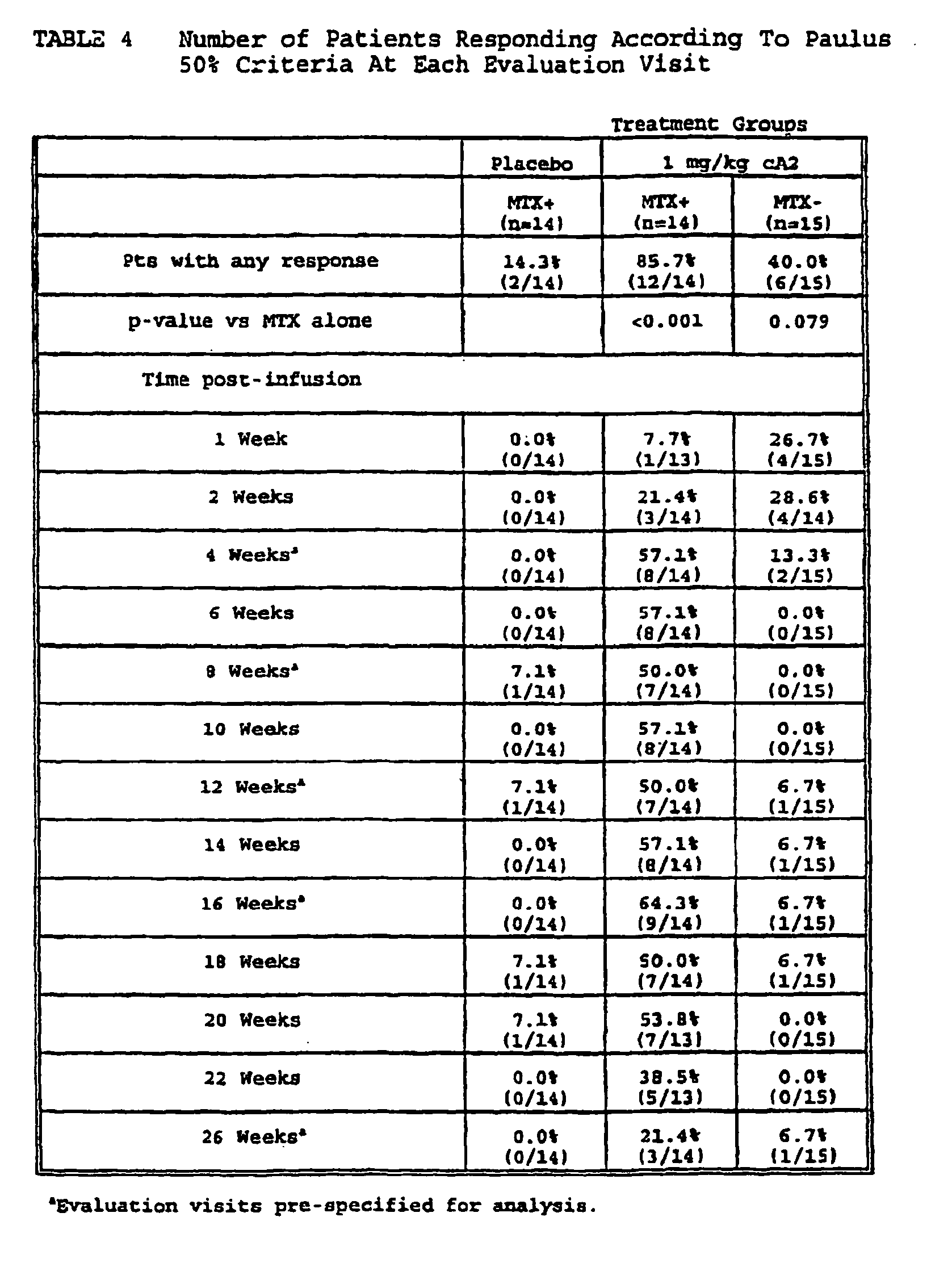

- Commensurate with the clinical response rates shown in Tables 2-4, most of the patients in the treatment groups demonstrating effectiveness of cA2 treatment received all 5 infusions of cA2 (Table 5). The principle reason for patients not receiving the complete dose regimen was because of lack of efficacy in the placebo group methotrexate alone) and in the 1 mg/kg group not receiving methotrexate. All 15 patients in the 3 mg/kg group that received methotrexate completed the 5-infusion dose regimen.
TABLE 5 Number of Infusions Completed Treatment Groups Placebo 1 mg/ kg cA2 3 mg/ kg cA2 10 mg/kg cA2 Treatment effect p-value MTX+ (n=14) MTX+ (n=14) MTX-(n=15) MTX+ (N=15) MTX-(n=14) MTX+ (n=14) MTX-(n=15) Pts with completea infusions 5
infusions 6
(42.86%)12
(85.71%)9
(53.33%)15
(100.00%)12
(85.71%)12
(65.71%)12
(80.00%)0.003 4
infusions 0
(0.00%)1
(7.14%)0
(0.00%)0
(0.00%)1
(7.14%)1
(7.14%)0
(0.00%)3
infusions 2
(14.29%)1
(7.14%)6
(40.00%)0
(0.00%)0
(0.00%)1
(7.14%)1
(6.67%)2
infusions 5
(35.71%)0
(0.00%)1
(6.67%)0
(0.00%)1
(7.14%)0
(0.00%)2
(13.33%)1
infusion 1
(7-14%)0
(0.00%)0
(0.00%)0
(0.00%)0
(0.00%)0
(0.00%)0
(0.00%)aPatients are counted only once for the first group for which they qualify (5 infusions> 4 infusions etc....). Patients were only counted if they had completed the entire infusion. - Results for measures of swollen and tender joint counts and the physician and patient global assessments are shown in
Figures 1-4 . The median results inFigures 1-4 were reported for each evaluation visit based only on the patients with data collected. That is, a last observation carried forward approach was not used for patients who dropped out. Instead, the number of patients with data that comprise each point on the graph was reported at the bottom of the figures. - Despite the number of drop-outs in the placebo group and the 1 mg/kg group not receiving methotrexate, the results in
Figures 1-4 demonstrate that cA2 treatment in combination with methotrexate profoundly reduces disease activity for all of the traditional measurements of disease activity, approaching near remission in many patients. - Results for a commonly used serum marker of inflammatory activity, C-reactive protein (CRP) are shown in
Figure 5 . Treatment with cA2 produced a rapid decrease in CRP concentration which was sustained through 26 weeks in the patients who received 3 or 10 mg/kg cA2. - Results for the Health Assessment Questionnaire (HAQ) are shown in
Figure 6 . This measurement of quality of life/disability demonstrated improvement over time corresponding with the clinical improvement observed in patients treated with cA2. In the patients treated with 3 mg/kg cA2 and methotrexate, the HAQ decreased from 2.0 at baseline to 1.1 at 22 weeks. - Serum concentrations of cA2 were obtained in all patients in this study. The serum concentration in each patient plotted over time according to the cA2 dose group is shown in
Figure 7 . Data plotted are the serum cA2 concentrations obtained just before the administration of cA2 atweeks weeks - Substantial differences were observed for the cA2 serum concentration over time in the 1 mg/kg dose groups according to whether patients received methotrexate. Most of the patients receiving 1 mg/kg cA2 with methotrexate demonstrated measurable cA2 concentrations through 18 weeks, although it appeared that there was a tendency for the concentration to decline over time. In sharp contrast, the majority of patients who received 1 mg/kg cA2 without methotrexate were not able to maintain measurable serum concentrations of cA2 over time. As discussed herein, the inability to maintain serum cA2 in these patients was associated with a high rate of neutralizing antibody formation.
- In contrast to the 1 mg/kg groups, patients who received either 3 mg/kg cA2 or 10 mg/kg cA2 were able to maintain serum cA2 concentrations through the multiple dose regimen. However, even in those dose groups, there was evidence that concomitant treatment with methotrexate was associated with high cA2 serum concentrations. As shown in
Figure 8 , the median serum cA2 concentration in both the 3 and 10 mg/kg dose groups receiving methotrexate was higher than in the corresponding groups not receiving methotrexate. - Serum samples were collected through 26 weeks from all patients and analyzed for human anti-chimeric antibodies (HACA) to cA2. The results for HACA responses for each cA2 treatment group are shown in Table 6. It should be noted that in several patients in the 3 mg/kg group and in most patients in the 10 mg/kg group, cA2 was still present in the 26-week sample and could potentially interfere with the detection of HACA in the assay. However, it could also be reasoned that if neutralizing antibodies were present at 26 weeks, then cA2 should not be present. Therefore, in presenting the data in Table 6, results for the immune response rate are shown not including patients with serum cA2 at 26 weeks and including patients with serum cA2 at 26 weeks, assuming that if cA2 was present at 26 weeks, the patient did not have a positive HACA response.
TABLE 6 HACA Responses 1 mg/ kg 3 mg/ kg 10 mg/kg MTX+ MTX- MTX+ MTX- MTX+ MTX- HACA responses not including pts with 26- week serum cA2 2/13
(15.4%)8/15
(53.3%)0/10
(0%)3/12
(25.0%)0/2
(0%)1/10
(10%)HACA responses including pts with 26- week serum cA2 12/13
(15.4%)8/15
(53.3%)0/15
(0%)3/14
(21.4%)0/14
(0%)1/15
(6.7%)1 Patients with a measurable 26-week serum cA2 concentration were considered negative for a HACA response for this analysis. - The results in Table 6 demonstrate that concomitant methotrexate treatment suppresses the immune response to cA2, enabling stable pharmacokinetics to be achieved in a multiple dose regimen of cA2. This effect was also found after combined anti-CD4/anti-TNF antibody treatment in mice with collagen-induced arthritis and described in
U.S. patent No. 6,270,766, filed February 28, 1996 , the teachings of which are entirely incorporated herein by reference. - Two out of 86 patients (with most patients receiving 5 treatments) experienced multisystem infusion-related reactions with retreatment. Multisystem, infusion-related reactions include headache, fever, facial flushing, pruritus, myalgia, nausea, chest tightness, dyspnea, vomiting, erythema, abdominal discomfort, diaphoresis, shivers, hypertension, lightheadedness, hypotension, palpitations and somnolence.
- Hypersensitivity reactions, as described herein, may occur whenever protein-containing materials, such as cA2, are administered. Thus, it is unclear whether these symptoms represent an immunologic event or physical factors such as infusion rate and immunoglobulin aggregation. Investigators have reported that symptoms resolve in some patients by decreasing the rate of the infusion. Previous literature reports indicate that vasomotor symptoms have been observed in patients receiving intravenous immunoglobulin therapy (Berkman et al., Ann. Intern Med. 112:278-292 (1990); Ochs et al., Lancet 2:1158-1159 (1980)).
- One patient developed hypotension during all three infusions of 10 mg/kg cA2. The patient did not display clinical signs of hypotension and did not require medical treatment, but, in keeping with predefined safety criteria, the treatment schedule of this patient was discontinued.
- One patient treated with 3 infusions of 10 mg/kg of cA2 and with 7.5 mg/week methotrexate developed symptoms of sepsis as a result of
staphylococcal pneumonia 2 weeks after her last study visit and 14 weeks after her last infusion with cA2. Six days after developing symptoms she was admitted to the hospital and treated. She died one day later. (This patient had not proceeded with the fourth infusion for reasons unrelated to the sepsis.) Patients with RA who develop infections have a worse than expected outcome. Wolfe and coworkers have reported an observed: expected ratio for death due to pneumonia of 5.307 and an observed: expected ratio for death due to infections (excluding pneumonia) of 6.213 in RA patients from the ARAMIS database (Wolfe et al., Arthritis Rheumatism 4:481-494 (1994)). - One patient experienced a serious postoperative infection following
cataract surgery 9 weeks after the fifth and last infusion of 3 mg/kg of cA2 (with 7.5 mg/week methotrexate), leading to removal of the eye. This patient was receiving prednisolone (7 mg/day). The incidence of endophthalmitis after cataract extraction has been reported to be between 0.072 and 0.093% (Rattan et al., Ophthalmology 98(9):1147-1148 (1991)) and may be heightened in patients receiving corticosteroid therapy. - Eight (9%) of 87 patients developed double stranded (ds)-DNA antibodies following multiple infusions of cA2. Measurements were performed at baseline,
week - One patient developed dyspnea, pleuritic chest pain and a rebound of arthritis activity at study week 14 (four weeks after the fourth infusion of 3 mg/kg of cA2). Symptoms resolved and she received her fifth dose of cA2. Symptoms recurred 3 weeks later. Examination of the serial blood samples revealed that the test for antinuclear antibodies and anti ds-DNA antibodies were negative prior to treatment, but became positive at
week 6 of the study. The patient's symptoms responded to oral prednisolone 20-30 mg daily. The working diagnosis was systemic lupus erythematosus (SLE). The patient currently does not have systems of SLE but has active RA. - To date, although antibodies to ds-DNA have been detected in patients treated with cA2, they generally represent transient increases and only one patient has been symptomatic. In patients who have had sufficient follow-up, anti-ds-DNA antibodies have resolved with discontinuation of treatment.
- In summary, treatment with cA2 is well tolerated. The reductions in disease activity produced by cA2 are significant as supported by the findings of a low placebo response rate. High clinical response rates are obtained with a multiple dose regimen of 3 mg/kg cA2 in combination with 7.5 mg/wk methotrexate and can be sustained through 26 weeks. This dose regimen is considered preferable to the 1 mg/kg plus methotrexate regimen because better pharmacokinetics are obtained, virtually no immune response was detected and the clinical response is better sustained following the last treatment with cA2. The clinical benefit obtained by increasing the dose regimen to 10 mg/kg cA2 plus methotrexate is similar to that observed with the 3 mg/kg cA2 plus methotrexate regimen.
- Thus, the results of this study indicate that treatment with a multiple dose regimen of cA2 as adjunctive and/or concomitant therapy to methotrexate therapy, in RA patients whose disease is incompletely controlled by methotrexate, produces a highly beneficial or synergistic clinical response that can be sustained through 26 weeks. The benefit produced by cA2 generally exceeds 50% reductions in the traditional measurements of rheumatoid arthritis (swollen and tender joints, patient and physician global disease assessments) and achieves near clinical remission in many patients. Accordingly, the results of this study indicate that treatment with multiple infusions of cA2 as adjunctive and/or concomitant therapy to methotrexate therapy is an important and efficacious therapeutic approach for treating RA in patients.
- A randomized, double-blind, placebo controlled study was conducted to evaluate the effects of a single infusion of placebo, 5, 10 or 20 mg/kg cA2 in combination with methotrexate, administered at a dose of 10 mg/week, in the treatment of rheumatoid arthritis (RA) in patients.
- Twenty-eight (28) RA patients at three centers in the United States who, despite receiving three months therapy with methotrexate administered at a stable dose of 10 mg/wk for at least 4 weeks prior to screening, still had active disease according to the criteria of the American College of Rheumatology, were enrolled in the study. Active disease was defined by the presence of six or more swollen joints plus at least three of four secondary criteria (duration of morning stiffness ≥45 minutes; ≥6 tender or painful joints; erythrocyte sedimentation rate (ESR) ≥28 mm/hour; C-reactive protein (CRP) ≥20 mg/l.
- Patients taking NSAIDs and corticosteroids (prednisone) at screening were allowed to continue at stable doses (7.5 mg/day).
- The chimeric monoclonal anti-TNF antibody (cA2) was supplied as a sterile solution containing 5 mg cA2 per ml of 0.01 M phosphate-buffered saline in 0.15 M sodium chloride with 0.01
% polysorbate 80, pH 7.2. The placebo vials contained 0.1% human serum albumin in the same buffer. Before use, the appropriate amount of cA2 or placebo was diluted to 300 ml in sterile saline by the pharmacist, and administered intravenously via a 0.2 µm in-line filter over 2 hours. The characteristics of the placebo and cA2 infusion bags were identical, and the investigators and patients did not know which infusion was being administered. - Patients were randomized to one of four treatment groups (7 patients per group). Each of the 28 patients received a single dose of either 0, 5, 10 or 20 mg/kg cA2 and were followed for 12 weeks. Patients continued treatment with methotrexate (Pharmacochemie, Netherlands) administered at 10 mg/week throughout the study. Patients were monitored for adverse events during infusions and regularly thereafter, by interviews, physical examination, and Laboratory testing.
- The primary measurement of clinical response was defined by the ACR preliminary definition of response (Felson et al., Arthritis Rheumatism 38(6):727-735 (1995)). Patients were considered to have a response if they had a 20% reduction in swollen and tender joint count, and had experienced a 20% reduction in 3 of the 5 following assessments: patient's assessment of pain (VAS), patient's global assessment of disease activity (VAS), physician's global assessment of disease activity (VAS), patient's assessment of physical function (HAQ), and an acute phase reactant (ESR). The ESR was measured at each study site with a standard method (Westergen).
- Evaluations were performed at
day 3, and atweeks - The 28 patients were randomized to one of four treatment (or dose) groups.
- The clinical response rates over time by
ACR 20% criteria in each of the treatment groups is shown in Table 7.TABLE 7 Clinical Response Rates (By ACR 20% Criteria) In Patients Receiving 10 mg/kg MethotrexatePlacebo Dose of cA2 cA2
Treated
Patients 5 mg/ kg 10 mg/ kg 20 mg/kg Pts evaluated 7 7 7 7 21 Pts with any
response1(14.3%) 6(85.7%) 5(71.4%) 6(85.7%) 17(81.0%) 1 Week 0(0.0%) 4(57.1%) 2(28.6%) 5(71.4%) 11(52.4%) 2 Weeks 0(0.0%) 4(57.1%) 5(71.4%) 5(71.4%) 14(66.7%) 4 Weeks 1(14.3%) 3(42.9%) 5(71.4%) 5(71.4%) 13(61.9%) 6 Weeks 0(0.0%) 3(42.9%) S(71.4%) 4(57.1%) 12(57.1%) 8 Weeks 1(14.3%) 3(42.9%) 4(57.1%) 4(57.1%) 11(52.4%) 10 Weeks 1(14.3%) 1(14.3%) 4(57.1%) 3(42.9%) 8(38.1%) 12 Weeks 1(14.3%) 2(28.6%) 4(57.1%) 3(42.9%) 9(42.9%) - Clinical benefit of cA2 treatment was evident at the first evaluation visit at one week. Although each of the 3 doses of cA2 produced clinical responses in the majority of patients treated, the duration of clinical response appeared to be better sustained through 12 weeks in the groups receiving 10 or 20 mg/kg cA2. Clinical response was achieved much more frequently among patients receiving cA2 as compared to placebo. That is, 17/21 (81%) patients in the 3 cA2 groups achieved a response, compared with only 1/7 (14%) placebo treated patients. The magnitude of clinical response was notable. The mean tender joint count among cA2 treated patients decreased from 30.1 at baseline to 13.3 at
week 12, and mean CRP decreased from 3.0 at baseline to 1.1 atweek 12. - The duration of clinical response appeared to be dose dependent. 2/6 (33%) of the responding patients treated with 5 mg/kg cA2 sustained a response through 12 weeks of followup, compared to 7/11 (64%) of the responding patients who received 10 or 20 mg/kg. Treatment in all groups was generally well tolerated.
- In summary, the results of this study indicate that treatment with cA2 as adjunctive and/or concomitant therapy to methotrexate therapy is effective in the reduction of the signs and symptoms of rheumatoid arthritis in patients whose disease is incompletely controlled by methotrexate. Moreover, the clinical response achieved by this approach can be sustained for more than 12 weeks after a single treatment. Accordingly, the results of this study indicate that treatment with cA2 as adjunctive and/or concomitant therapy to methotrexate therapy is an important and efficacious therapeutic approach for treating RA in patients.
- An open label study was conducted to evaluate the effects of repeated infusions of 10 mg/kg cA2 in combination with methotrexate, administered at a dose of 10 mg/week, in the treatment of rheumatoid arthritis in patients.
- As described in Example 2, a randomized, double-blind, placebo controlled, 12 week study of cA2 was conducted in RA patients who had active disease despite receiving three months therapy with methotrexate administered at a stable dose of 10 mg/wk for at least 4 weeks prior to screening.
- At
week 12, patients who had completed the 12 week evaluation period and had not experienced adverse events prohibiting further infusions of cA2, were offered 3 subsequent open label infusions of cA2, administered at a dose of 10 mg/kg, at eight week intervals (weeks - 11/23 patients entering this open label study were evaluated at 1 of 3 centers in the United States and followed up to 40 weeks after initial entry. Patients continued treatment with methotrexate administered at 10 mg/week throughout the study. Repeated treatments with cA2 were generally well tolerated. Three patients had transient infusion related symptoms (urticaria, somnolence).
- The primary measurement of clinical response was defined by the ACR preliminary definition of response (Felson et al., Arthritis Rheumatism 38(6) :727-735 (1995)). Patients were considered to have a response if they had a 20% reduction in swollen and tender joint count, and had experienced a 20% reduction in 3 of the 5 following assessments: patient's assessment of pain (VAS), patient's global assessment of disease activity (VAS), physician's global assessment of disease activity (VAS), patient's assessment of physical function (HAQ), and an acute phase reactant (ESR). The ESR was measured at each study site with a standard method (Westergen).
- Of six patients who had all received cA2 during the double-blinded study described in Example 2 and responded through the 12 weeks of that study, four patients sustained a response throughout the 40 week followup. Of the remaining two patients, one patient is still responding through
week 28, and one patient recently entered this open label trial. For all 4 patients completing 40 weeks of followup and the patient atweek 28, final tender joint counts were 2 and swollenjoint counts 1, compared to a mean of 23 and 29, respectively, at entry into the double-blinded study described in Example 2. For 4 of these 5 patients, ESR were 18 mm/hr and CRP 0.7, compared to a mean of 27 and 3.9, respectively, at entry into the double-blind study described in Example 2. - Of two patients who had both received cA2 during the double-blinded study described in Example 2 and responded only through
week 10 of that study, one patient responded through 36 weeks and one patient is still responding throughweek 20. - Of three patients who did not respond during the double-blinded study described in Example 2 (2 received placebos, 1 received 5 mg/kg cA2), two of these patients experienced a transient clinical response, and one patient is still responding through
week 20. - In summary, the preliminary results of this study suggest that repeated adjunctive and/or concomitant therapy with cA2, in RA patients whose disease is incompletely controlled by methotrexate, can result in substantial clinical improvement for a majority of the patients. Moreover, the clinical response achieved by this approach can be sustained for up to 40 weeks of followup. Accordingly, the results of this study indicate that repeated treatment with cA2 as adjunctive and/or concomitant therapy to methotrexate therapy is an important and efficacious therapeutic approach for treating RA in patients.
- Embodiments of the disclosure may include the features of the following enumerated paragraphs ("paras").
- 1. A method for treating or preventing a tumor necrosis factor-mediated disease in an individual in need thereof comprising co-administering methotrexate and an anti-tumor necrosis factor antibody or fragment thereof to the individual, in therapeutically effective amounts.
- 2. A method of
para 1 wherein the anti-tumor necrosis factor antibody and methotrexate are administered simultaneously. - 3. A method of
para 1 wherein the anti-tumor necrosis factor antibody and methotrexate are administered sequentially. - 4. A method of
para 1 wherein the tumor necrosis factor-mediated disease is selected from the group consisting of: autoimmune disease, acute or chronic immune disease, inflammatory disease and neurodegenerative disease. - 5. A method of
para 4 wherein the anti-tumor necrosis factor antibody is administered in multiple doses. - 6. A method of
para 5 wherein the anti-tumor necrosis factor antibody is a chimeric antibody. - 7. A method of
para 6 wherein the chimeric antibody binds to one or more amino acids of hTNFα selected from the group consisting of about 87-108 and about 59-80. - 8. A method of
para 6 wherein the chimeric antibody binds to the epitope of cA2. - 9. A method of
para 8 wherein the chimeric antibody is cA2. - 10. A method for treating or preventing rheumatoid arthritis in an individual in need thereof comprising co-administering methotrexate and an anti-tumor necrosis factor antibody to the individual, in therapeutically effective amounts.
- 11. A method of
para 10 wherein the anti-tumor necrosis factor antibody and methotrexate are administered simultaneously. - 12. A method of
para 10 wherein the anti-tumor necrosis factor antibody and methotrexate are administered sequentially. - 13. A method of
para 10 wherein the anti-tumor necrosis factor antibody is administered in multiple doses. - 14. A method of
para 13 wherein the anti-tumor necrosis factor antibody is a chimeric antibody. - 15. A method of
para 14 wherein the chimeric antibody binds to one or more amino acids of hTNFα selected from the group consisting of about 87-108 and about 59-80. - 16. A method of
para 14 wherein the chimeric antibody binds to the epitope of cA2. - 17. A method of
para 16 wherein the chimeric antibody is cA2. - 18. A method for treating or preventing Crohn's disease in an individual in need thereof comprising co-administering methotrexate and an anti-tumor necrosis factor antibody to the individual, in therapeutically effective amounts.
- 19. A method of
para 18 wherein the anti-tumor necrosis factor antibody and methotrexate are administered simultaneously. - 20. A method of
para 18 wherein the anti-tumor necrosis factor antibody and methotrexate are administered sequentially. - 21. A method of
para 18 wherein the anti-tumor necrosis factor antibody is administered in multiple doses. - 22. A method of para 21 wherein the anti-tumor necrosis factor antibody is a chimeric antibody.
- 23. A method of
para 22 wherein the chimeric antibody binds to one or more amino acids of hTNFα selected from the group consisting of about 87-108 and about 59-80. - 24. A method of
para 22 wherein the chimeric antibody binds to the epitope of cA2. - 25. A method of
para 22 wherein the chimeric antibody is cA2. - 26. A composition comprising methotrexate and an anti-tumor necrosis factor antibody or fragment thereof.
- 27. A composition of
para 26 wherein the anti-tumor necrosis factor antibody is a chimeric antibody. - 28. A composition of para 27 wherein the chimeric antibody binds to one or more amino acids of hTNFÁ selected from the group consisting of about 87-108 and about 59-80.
- 29. A composition of para 27 wherein the chimeric antibody binds to the epitope of cA2.
- 30. A composition of para 29 wherein the chimeric antibody is cA2.
- 31. A method for treating or preventing a tumor necrosis factor-mediated disease in an individual in need thereof comprising co-administering methotrexate and a tumor necrosis factor antagonist to the individual, in therapeutically effective amounts.
- 32. Use of methotrexate and an anti-tumor necrosis factor antibody or fragment thereof for the manufacture of coadministrable or sequentially administrable medicaments, for treating or preventing a tumor necrosis factor-mediated disease in an individual.
- 33. The use of para 32, for the treatment of tumor necrosis factor-mediated diseases selected from autoimmune disease, acute or chromic immune disease, inflammatory disease and neurodegenerative disease.
- 34. Use of methotrexate and an anti-tumor necrosis factor antibody for the manufacture of coadministrable or sequentially administrable medicaments for treating or preventing rheumatoid arthritis in an individual.
- 35. Use of methotrexate and an anti-tumor necrosis factor antibody for the manufacture of coadministrable or sequentially administrable medicaments, for treating or prevent Crohn's disease in an individual.
- 36. The use of
para 32, 34 or 35, wherein the anti-tumor necrosis factor antibody is a Chimeric antibody. - 37. The use of
para 32, 34 or 35, wherein the chimeric antibody binds to one or more amino acids of hTNfα selected from the group consisting of about 87-108 and about 59-80. - 38. The use of
para 32, 34 or 35, wherein the chimeric antibody binds to the epitope of cA2. - 39. The use of
para 32, 34 or 35, wherein the chimeric antibody is cA2. - 40. Use of methotrexate and a tumor necrosis factor antagonist for the manufacture of medicaments for treating or preventing a tumor necrosis factor-mediated disease in an individual in need thereof.
Claims (24)
- Use of an anti-human tumour necrosis factor antibody, or a fragment thereof, which binds specifically to tumour necrosis factor,
for the preparation of a medicament for treatment of rheumatoid arthritis, juvenile chronic arthritis, ankylosing spondylitis, psoriatic arthritis or Crohn's disease, wherein the anti-tumour necrosis factor antibody is to be administered in single or multiple doses, as concomitant therapy with methotrexate therapy, and
the methotrexate is to be administered in multiple doses. - Use according to claim 1, wherein the anti-tumour necrosis factor antibody is monoclonal.
- Use according to claim 1, wherein the anti-tumour necrosis factor antibody is chimeric.
- Use according to claim 1, wherein the anti-tumour necrosis factor antibody is humanized.
- The use according to claim 1 for the preparation of a medicament for treatment of rheumatoid arthritis.
- The use according to any one of claims 1 to 5, wherein the methotrexate is to be administered in the form of a series of low doses separated by intervals of days or weeks.
- The use according to claim 1, wherein the TNF-mediated disease is rheumatoid arthritis and the anti-TNF antibody is to be administered as multiple infusions.
- The use according to claim 7, wherein the anti-TNF antibody is a chimeric monoclonal antibody, to be administered as multiple infusions of 1, 3 or 10 mg/kg.
- Use of an anti-tumour necrosis factor antibody for the preparation of a medicament for treating rheumatoid arthritis,
wherein the anti- tumour necrosis factor antibody is to be administered as concomitant therapy to patients receiving methotrexate therapy. - The use according to claim 9, wherein the anti-TNF antibody is cA2, to be administered in combination with methotrexate as a single infusion of 5, 10 or 20 mg/kg cA2, and the methotrexate is to be administered at a dose of 10 mg/week.
- Use of an anti-tumour necrosis factor antibody for the preparation of a medicament for treating rheumatoid arthritis,
wherein the anti-tumour necrosis factor antibody is cA2, to be administered as a repeated treatment as concomitant therapy with methotrexate therapy in rheumatoid arthritis patients whose disease is incompletely controlled by methotrexate. - The use according to claim 11, wherein the anti-TNF antibody is cA2, to be administered as a repeated infusion of 10 mg/kg cA2 , and the methotrexate is to be administered at a dose of 10 mg/week.
- An anti-human tumour necrosis factor antibody, or a fragment thereof, which binds specifically to tumour necrosis factor,
for use in treatment of rheumatoid arthritis, juvenile chronic arthritis, ankylosing spondylitis, psoriatic arthritis or Crohn's disease, wherein the anti-tumour necrosis factor antibody is to be administered in single or multiple doses, as concomitant therapy with methotrexate therapy, and
the methotrexate is to be administered in multiple doses. - The antibody according to claim 13 which is monoclonal.
- The antibody according to claim 13 which is chimeric.
- The antibody according to claim 13 which is humanized.
- The antibody according to claim 13 for use in treating rheumatoid arthritis.
- The antibody according to any one of claims 13 to 17, wherein the methotrexate is to be administered in the form of a series of low doses separated by intervals of days or weeks.
- The antibody according to claim 13 for use in the treatment of rheumatoid arthritis by administration as multiple infusions.
- The antibody according to claim 19, which is a chimeric monoclonal antibody, to be administered as multiple infusions of 1, 3 or 10 mg/kg.
- An anti-tumour necrosis factor antibody for use in treating rheumatoid arthritis by administration as concomitant therapy to patients receiving methotrexate therapy.
- The antibody according to claim 21 which is cA2, to be administered, in combination with methotrexate, as a single infusion of 5, 10 or 20 mg/kg cA2, and the methotrexate is to be administered at a dose of 10 mg/week.
- An anti-tumour necrosis factor antibody for use in treating rheumatoid arthritis, which antibody is cA2, to be administered as a repeated treatment as concomitant therapy with methotrexate therapy in rheumatoid arthritis patients whose disease is incompletely controlled by methotrexate.
- The antibody according to claim 23, wherein the anti-TNF antibody is cA2, to be administered as a repeated infusion of 10 mg/kg cA2 , and the methotrexate is to be administered at a dose of 10 mg/week.
Priority Applications (2)
| Application Number | Priority Date | Filing Date | Title |
|---|---|---|---|
| EP08005013A EP1941904B1 (en) | 1996-08-01 | 1997-08-01 | TNF antagonists for use in adjunctive therapy to methotrexate in the treatment of autoimmune diseases |
| DK08005013.1T DK1941904T3 (en) | 1996-08-01 | 1997-08-01 | TNF antagonists for use in supplemental therapy for methotrexate in the treatment of autoimmune disorders |
Applications Claiming Priority (3)
| Application Number | Priority Date | Filing Date | Title |
|---|---|---|---|
| US08/690,775 US6270766B1 (en) | 1992-10-08 | 1996-08-01 | Anti-TNF antibodies and methotrexate in the treatment of arthritis and crohn's disease |
| US690775 | 1996-08-01 | ||
| EP97933799A EP0914157B1 (en) | 1996-08-01 | 1997-08-01 | Anti-tnf antibodies / tnf receptor and methotrexate in the treatment of autoimmune disease |
Related Parent Applications (2)
| Application Number | Title | Priority Date | Filing Date |
|---|---|---|---|
| EP97933799A Division EP0914157B1 (en) | 1996-08-01 | 1997-08-01 | Anti-tnf antibodies / tnf receptor and methotrexate in the treatment of autoimmune disease |
| EP97933799.5 Division | 1998-02-12 |
Related Child Applications (2)
| Application Number | Title | Priority Date | Filing Date |
|---|---|---|---|
| EP08005013A Division EP1941904B1 (en) | 1996-08-01 | 1997-08-01 | TNF antagonists for use in adjunctive therapy to methotrexate in the treatment of autoimmune diseases |
| EP08005013.1 Division-Into | 2008-03-18 |
Publications (3)
| Publication Number | Publication Date |
|---|---|
| EP1593393A2 EP1593393A2 (en) | 2005-11-09 |
| EP1593393A3 EP1593393A3 (en) | 2007-12-12 |
| EP1593393B1 true EP1593393B1 (en) | 2011-11-30 |
Family
ID=24773909
Family Applications (3)
| Application Number | Title | Priority Date | Filing Date |
|---|---|---|---|
| EP08005013A Revoked EP1941904B1 (en) | 1996-08-01 | 1997-08-01 | TNF antagonists for use in adjunctive therapy to methotrexate in the treatment of autoimmune diseases |
| EP97933799A Revoked EP0914157B1 (en) | 1996-08-01 | 1997-08-01 | Anti-tnf antibodies / tnf receptor and methotrexate in the treatment of autoimmune disease |
| EP05076131A Revoked EP1593393B1 (en) | 1996-08-01 | 1997-08-01 | Anti-TNF antibodies and methotrexate in the concomitant treatment of autoimmune diseases |
Family Applications Before (2)
| Application Number | Title | Priority Date | Filing Date |
|---|---|---|---|
| EP08005013A Revoked EP1941904B1 (en) | 1996-08-01 | 1997-08-01 | TNF antagonists for use in adjunctive therapy to methotrexate in the treatment of autoimmune diseases |
| EP97933799A Revoked EP0914157B1 (en) | 1996-08-01 | 1997-08-01 | Anti-tnf antibodies / tnf receptor and methotrexate in the treatment of autoimmune disease |
Country Status (11)
| Country | Link |
|---|---|
| US (10) | US6270766B1 (en) |
| EP (3) | EP1941904B1 (en) |
| AT (2) | ATE305798T1 (en) |
| AU (1) | AU719015B2 (en) |
| CA (2) | CA2261630C (en) |
| DE (1) | DE69734317T2 (en) |
| DK (3) | DK1593393T3 (en) |
| ES (3) | ES2378446T3 (en) |
| LU (4) | LU92004I2 (en) |
| PT (2) | PT1941904E (en) |
| WO (1) | WO1998005357A1 (en) |
Cited By (4)
| Publication number | Priority date | Publication date | Assignee | Title |
|---|---|---|---|---|
| US8216807B2 (en) | 2006-10-12 | 2012-07-10 | Genentech, Inc. | Antibodies to lymphotoxin-α |
| US8298537B2 (en) | 1996-08-01 | 2012-10-30 | The Mathilda And Terence Kennedy Institute Of Rheumatology Trust | Concomitant treatment of rheumatoid arthritis with anti-TNF-α antibodies and methotrexate |
| US9546212B2 (en) | 2001-06-08 | 2017-01-17 | Abbvie Biotechnology Ltd. | Methods of administering anti-TNFα antibodies |
| US12247071B2 (en) | 2016-12-21 | 2025-03-11 | Amgen Inc. | Anti-TNF alpha antibody formulations |
Families Citing this family (113)
| Publication number | Priority date | Publication date | Assignee | Title |
|---|---|---|---|---|
| JP3443119B2 (en) | 1989-08-07 | 2003-09-02 | ペプテック リミテッド | Tumor necrosis factor binding ligand |
| US5959087A (en) * | 1989-08-07 | 1999-09-28 | Peptide Technology, Ltd. | Tumour necrosis factor binding ligands |
| US20030225254A1 (en) * | 1989-08-07 | 2003-12-04 | Rathjen Deborah Ann | Tumour necrosis factor binding ligands |
| US6277969B1 (en) * | 1991-03-18 | 2001-08-21 | New York University | Anti-TNF antibodies and peptides of human tumor necrosis factor |
| US6764681B2 (en) * | 1991-10-07 | 2004-07-20 | Biogen, Inc. | Method of prophylaxis or treatment of antigen presenting cell driven skin conditions using inhibitors of the CD2/LFA-3 interaction |
| US6770279B1 (en) * | 1992-10-08 | 2004-08-03 | The Kennedy Institute Of Rheumatology | TNFα antagonists and cyclosporin in therapy of rheumatoid arthritis |
| US7070783B1 (en) | 1995-05-09 | 2006-07-04 | The Mathilda And Terence Kennedy Institute Of Rheumatology | Small molecular weight TNF receptor multimeric molecule |
| US6090382A (en) | 1996-02-09 | 2000-07-18 | Basf Aktiengesellschaft | Human antibodies that bind human TNFα |
| HU230048B1 (en) * | 1996-02-09 | 2015-06-29 | Abbvie Biotechnology Ltd | Use of human tnf-alpha binding antibodies |
| TW555765B (en) | 1996-07-09 | 2003-10-01 | Amgen Inc | Low molecular weight soluble tumor necrosis factor type-I and type-II proteins |
| US7129061B1 (en) * | 1996-08-07 | 2006-10-31 | Biogen Idec Ma Inc. | Tumor necrosis factor related ligand |
| DK0942740T3 (en) * | 1996-12-06 | 2003-12-15 | Amgen Inc | Combination therapy using a TFN-binding protein to treat TFN-mediated diseases |
| EP1352656A3 (en) * | 1996-12-06 | 2004-02-04 | Amgen Inc. | Combination therapy using a TNF binding protein for treating TNF-mediated diseases |
| EP1170017A1 (en) * | 1997-05-12 | 2002-01-09 | The Kennedy Institute Of Rheumatology | Use of tumor necrosis factor alpha (TNF-alpha) and vascular endothelial growth factor (VEGF) for the manufacture of a therapeutic composition |
| DE69927831T2 (en) * | 1998-08-31 | 2006-07-20 | Biogen, Inc., Cambridge | MODULATION OF MEMORY EFFECTOR CELLS USING A CD2 BINDING AGGREGATE |
| US6015557A (en) * | 1999-02-24 | 2000-01-18 | Tobinick; Edward L. | Tumor necrosis factor antagonists for the treatment of neurological disorders |
| ATE311199T1 (en) | 1999-05-07 | 2005-12-15 | Genentech Inc | TREATMENT OF AUTOIMMUNE DISEASES WITH ANTAGONISTS THAT BIND SURFACE MARKERS OF B CELLS |
| US6544504B1 (en) | 1999-07-28 | 2003-04-08 | Schering Corporation | Combined use of interleukin 10 and methotrexate for immuno-modulatory therapy |
| WO2001008696A2 (en) * | 1999-07-28 | 2001-02-08 | Schering Corporation | Combined use of interleukin 10 and methotrexate for immuno-modulatory therapy |
| US8147824B2 (en) | 1999-08-05 | 2012-04-03 | Athersys, Inc. | Immunomodulatory properties of multipotent adult progenitor cells and uses thereof |
| MXPA02010993A (en) * | 2000-05-12 | 2003-03-10 | Genzyme Corp | MODULATORS OF TNF agr; SIGNALING. |
| US20110195063A1 (en) * | 2000-08-07 | 2011-08-11 | Centocor, Inc. | Methods of Treating Ankylosing Spondylitis Using Anti-TNF Antibodies and Peptides of Human Tumor Necrosis Factor |
| US6709655B2 (en) * | 2001-02-28 | 2004-03-23 | Instituto Bioclon, S.A. De C.V. | Pharmaceutical composition of F(ab1)2 antibody fragments and a process for the preparation thereof |
| AU2002306651B2 (en) * | 2001-03-02 | 2007-12-13 | Medimmune, Llc | Methods of preventing or treating inflammatory or autoimmune disorders by administering integrin alphav Beta3 antagonists |
| WO2002072788A2 (en) * | 2001-03-14 | 2002-09-19 | Centocor, Inc. | Chronic obstructive pulmonary disease-related immunglobulin derived proteins, compositions, methods and uses |
| PL367102A1 (en) | 2001-05-02 | 2005-02-21 | Purdue Research Foundation | Treatment and diagnosis of macrophage mediated disease |
| WO2003009740A2 (en) * | 2001-07-24 | 2003-02-06 | Biogen Idec Ma Inc. | Methods for treating or preventing sclerotic disorders using cd2-binding agents |
| US8043602B2 (en) | 2002-02-07 | 2011-10-25 | Endocyte, Inc. | Folate targeted enhanced tumor and folate receptor positive tissue optical imaging technology |
| US8043603B2 (en) * | 2002-02-07 | 2011-10-25 | Endocyte, Inc. | Folate targeted enhanced tumor and folate receptor positive tissue optical imaging technology |
| US20040009172A1 (en) * | 2002-04-26 | 2004-01-15 | Steven Fischkoff | Use of anti-TNFalpha antibodies and another drug |
| US20030206898A1 (en) * | 2002-04-26 | 2003-11-06 | Steven Fischkoff | Use of anti-TNFalpha antibodies and another drug |
| PL218992B1 (en) * | 2002-07-19 | 2015-02-27 | Abbott Biotech Ltd | Neutralising, a high-affinity anti-TNF-alpha isolated human antibody, use of this antibody, crystal containing the anti-TNF-alpha human antibody and a preparation containing the crystal |
| MY150740A (en) | 2002-10-24 | 2014-02-28 | Abbvie Biotechnology Ltd | Low dose methods for treating disorders in which tnf? activity is detrimental |
| AU2003291134A1 (en) * | 2002-11-21 | 2004-06-18 | Genzyme Corporation | Use of diamide derivatives for inhibiting chronic tissue transplant rejection |
| PT1562571E (en) * | 2002-11-21 | 2011-11-25 | Genzyme Corp | Combination of a diamide derivative and immunosuppressive agents for inhibiting transplant rejection |
| ATE472556T1 (en) | 2002-12-02 | 2010-07-15 | Amgen Fremont Inc | ANTIBODIES DIRECTED AGAINST THE TUMOR NECROSIS FACTOR AND THEIR USES |
| US20050042219A1 (en) * | 2002-12-05 | 2005-02-24 | Woulfe Susan L. | Engineered Fab' fragment anti-tumor necrosis factor alpha in combination with disease modifying anti-rheumatic drugs |
| US7101978B2 (en) * | 2003-01-08 | 2006-09-05 | Applied Molecular Evolution | TNF-α binding molecules |
| EP1460088A1 (en) * | 2003-03-21 | 2004-09-22 | Biotest AG | Humanized anti-CD4 antibody with immunosuppressive properties |
| GB2401040A (en) * | 2003-04-28 | 2004-11-03 | Chugai Pharmaceutical Co Ltd | Method for treating interleukin-6 related diseases |
| EP1629281B1 (en) | 2003-05-30 | 2008-10-29 | Purdue Research Foundation | Diagnostic method for atherosclerosis |
| AU2004251750A1 (en) * | 2003-06-25 | 2005-01-06 | Elan Pharmaceuticals, Inc. | Methods and compositions for treating rheumatoid arthritis |
| MXPA06000965A (en) * | 2003-07-25 | 2007-05-04 | Silanes Sa De Cv Lab | Administration of anti-cytokine f(ab')2 antibody fragments. |
| US7435799B2 (en) * | 2004-01-08 | 2008-10-14 | Applied Molecular Evolution | TNF-α binding molecules |
| WO2005077018A2 (en) * | 2004-02-06 | 2005-08-25 | Astellas Us Llc | Methods of treating skin disorders |
| TWI439284B (en) | 2004-04-09 | 2014-06-01 | 艾伯維生物技術有限責任公司 | Multiple variable dose therapy for the treatment of TNFα-related disorders |
| KR20070011558A (en) * | 2004-05-04 | 2007-01-24 | 제네상스 파머슈티컬스, 아이엔씨. | Haplotype Markers and Methods of Using Them to Measure Response to Treatment |
| CA2565259A1 (en) * | 2004-05-07 | 2005-12-08 | Astellas Us Llc | Soluble lfa-3 polypeptide for treating viral disorders |
| WO2006041970A2 (en) * | 2004-10-08 | 2006-04-20 | Abbott Biotechnology Ltd. | Treatment of respiratory syncytial virus (rsv) infection |
| US20060111295A1 (en) * | 2004-11-22 | 2006-05-25 | Smith Henry J | Cellular receptors utilized as carrier agents for pharmaceutical compounds used in the treatment of arthritis, inflammation and immune disorders |
| WO2006071754A2 (en) * | 2004-12-23 | 2006-07-06 | Purdue Research Foundation | Positron emission tomography imaging method |
| US20090124993A1 (en) | 2005-02-17 | 2009-05-14 | Burkly Linda C | Treating neurological disorders |
| WO2006122187A2 (en) | 2005-05-10 | 2006-11-16 | Biogen Idec Ma Inc. | Treating and evaluating inflammatory disorders |
| KR101465456B1 (en) | 2005-05-16 | 2014-11-27 | 애브비 바이오테크놀로지 리미티드 | Use of TNF inhibitor for treatment of erosive polyarthritis |
| JP5175723B2 (en) | 2005-07-05 | 2013-04-03 | パーデュー・リサーチ・ファウンデーション | Preparation of compositions for treating monocyte-mediated diseases |
| US20070041905A1 (en) * | 2005-08-19 | 2007-02-22 | Hoffman Rebecca S | Method of treating depression using a TNF-alpha antibody |
| EP1940473A2 (en) | 2005-09-23 | 2008-07-09 | Purdue Research Foundation | Multiphoton in vivo flow cytometry method and device |
| AU2016203976B2 (en) * | 2005-11-09 | 2018-02-01 | Abt Holding Company | Immunomodulatory properties of multipotent adult progenitor cells and uses thereof |
| US11000546B2 (en) | 2005-11-09 | 2021-05-11 | Athersys, Inc. | Immunomodulatory properties of MAPCs and uses thereof |
| US10117900B2 (en) | 2005-11-09 | 2018-11-06 | Athersys, Inc. | MAPC treatment of brain injuries and diseases |
| CA3028321C (en) | 2006-01-23 | 2022-06-21 | Athersys, Inc. | Mapc treatment of brain injuries and diseases |
| US20080118496A1 (en) * | 2006-04-10 | 2008-05-22 | Medich John R | Uses and compositions for treatment of juvenile rheumatoid arthritis |
| EP2666472A3 (en) | 2006-04-10 | 2014-04-02 | Abbott Biotechnology Ltd | Uses and compositions for treatment of psoriatic arthritis |
| WO2007120656A2 (en) | 2006-04-10 | 2007-10-25 | Abbott Biotechnology Ltd. | Uses and compositions for treatment of rheumatoid arthritis |
| US9605064B2 (en) | 2006-04-10 | 2017-03-28 | Abbvie Biotechnology Ltd | Methods and compositions for treatment of skin disorders |
| US20090317399A1 (en) * | 2006-04-10 | 2009-12-24 | Pollack Paul F | Uses and compositions for treatment of CROHN'S disease |
| US20080131374A1 (en) * | 2006-04-19 | 2008-06-05 | Medich John R | Uses and compositions for treatment of rheumatoid arthritis |
| TWI498137B (en) | 2006-06-30 | 2015-09-01 | Abbvie Biotechnology Ltd | Automatic injection device |
| US20080064626A1 (en) * | 2006-09-08 | 2008-03-13 | Zanella John M | Methods of treating tendonitis in a subject by using an anti-cytokine agent |
| US8685752B2 (en) | 2006-11-03 | 2014-04-01 | Purdue Research Foundation | Ex vivo flow cytometry method and device |
| US8586595B2 (en) * | 2007-02-07 | 2013-11-19 | Purdue Research Foundation | Positron emission tomography imaging method |
| RU2009141592A (en) * | 2007-04-11 | 2011-05-20 | Алькон Рисерч, Лтд. (Us) | USE OF TNFα INHIBITOR IN COMBINATION WITH ANTIHISTAMINE TREATMENT FOR TREATMENT OF ALLERGIC RHINITIS AND ALLERGIC CONJUNCTIVITIS |
| US20090182035A1 (en) * | 2007-04-11 | 2009-07-16 | Alcon Research, Ltd. | Use of a combination of olopatadine and cilomilast to treat non-infectious rhinitis and allergic conjunctivitis |
| US8961926B2 (en) * | 2007-05-25 | 2015-02-24 | Purdue Research Foundation | Method of imaging localized infections |
| MX2009013410A (en) | 2007-06-08 | 2010-03-22 | Biogen Idec Inc | Biomarkers for predicting anti-tnf responsiveness or non-responsiveness. |
| US8999337B2 (en) | 2007-06-11 | 2015-04-07 | Abbvie Biotechnology Ltd. | Methods for treating juvenile idiopathic arthritis by inhibition of TNFα |
| EP2249809A1 (en) | 2008-01-15 | 2010-11-17 | Abbott GmbH & Co. KG | Powdered protein compositions and methods of making same |
| AU2009224690B2 (en) * | 2008-03-13 | 2014-10-09 | Biotest Ag | Agent for treating disease |
| CN102027017A (en) * | 2008-03-13 | 2011-04-20 | 生物测试股份公司 | Agent for treating disease |
| PL2262838T3 (en) * | 2008-03-13 | 2016-10-31 | Agent for treating disease | |
| BRPI0919489A2 (en) * | 2008-09-29 | 2015-12-01 | Biotest Ag | composition, kit, methods of treating a rheumatic disease, and rheumatoid arthritis in a patient, agent capable of activating cd4 + cd25 + regulatory t cells and methotrexate, and use of an agent capable of activating cd4 + cd25 + regulatory t cells and methotrexate |
| US20100203146A1 (en) * | 2009-02-09 | 2010-08-12 | Callisto Pharmaceuticals, Inc. | Intermittent dosing strategy for treating rheumatoid arthritis |
| RU2012117141A (en) * | 2009-10-01 | 2013-11-10 | Алькон Рисерч, Лтд. | COMPOSITIONS OF OLOPATADINE AND WAYS OF THEIR APPLICATION |
| GB0920944D0 (en) | 2009-11-30 | 2010-01-13 | Biotest Ag | Agents for treating disease |
| CN102770458A (en) * | 2009-12-02 | 2012-11-07 | 阿塞勒隆制药公司 | Compositions and methods for increasing serum half-life of Fc fusion proteins |
| US9062106B2 (en) | 2011-04-27 | 2015-06-23 | Abbvie Inc. | Methods for controlling the galactosylation profile of recombinantly-expressed proteins |
| EP2718328A4 (en) | 2011-06-08 | 2014-12-24 | Acceleron Pharma Inc | COMPOSITIONS AND METHODS FOR INCREASING SERIAL HALF LIFE |
| PH12014500888A1 (en) | 2011-11-08 | 2014-06-09 | Arena Pharm Inc | Modulators of the g protein-coupled mas receptor and the treatment of disorders related thereto |
| WO2013158279A1 (en) | 2012-04-20 | 2013-10-24 | Abbvie Inc. | Protein purification methods to reduce acidic species |
| WO2013158273A1 (en) | 2012-04-20 | 2013-10-24 | Abbvie Inc. | Methods to modulate c-terminal lysine variant distribution |
| US9067990B2 (en) | 2013-03-14 | 2015-06-30 | Abbvie, Inc. | Protein purification using displacement chromatography |
| US9249182B2 (en) | 2012-05-24 | 2016-02-02 | Abbvie, Inc. | Purification of antibodies using hydrophobic interaction chromatography |
| HRP20230655T1 (en) * | 2012-07-05 | 2023-10-13 | Taiwan Liposome Company, Ltd. | Methods of treating arthritis |
| US8958362B2 (en) * | 2012-08-24 | 2015-02-17 | William Marsh Rice University | Method and system for wirelessly transmitting data |
| KR20150043523A (en) | 2012-09-02 | 2015-04-22 | 애브비 인코포레이티드 | Methods to control protein heterogeneity |
| US9512214B2 (en) | 2012-09-02 | 2016-12-06 | Abbvie, Inc. | Methods to control protein heterogeneity |
| DE102012020496A1 (en) | 2012-10-18 | 2014-04-24 | Charité - Universitätsmedizin Berlin | Invitro diagnosis and/or early detection of neurofibromatosis type 1 and/or neurofibromatosis type 1-associated tumor from sample of a patient for treating the patient with the tumor, comprises detecting protein or its fragment in sample |
| WO2014123696A1 (en) | 2013-01-25 | 2014-08-14 | Thymon, Llc | Compositions for selective reduction of circulating bioactive soluble tnf and methods for treating tnf-mediated disease |
| SG11201507230PA (en) | 2013-03-12 | 2015-10-29 | Abbvie Inc | Human antibodies that bind human tnf-alpha and methods of preparing the same |
| US8921526B2 (en) | 2013-03-14 | 2014-12-30 | Abbvie, Inc. | Mutated anti-TNFα antibodies and methods of their use |
| US9017687B1 (en) | 2013-10-18 | 2015-04-28 | Abbvie, Inc. | Low acidic species compositions and methods for producing and using the same using displacement chromatography |
| WO2014151878A2 (en) | 2013-03-14 | 2014-09-25 | Abbvie Inc. | Methods for modulating protein glycosylation profiles of recombinant protein therapeutics using monosaccharides and oligosacharides |
| WO2014182673A1 (en) | 2013-05-07 | 2014-11-13 | Arena Pharmaceuticals, Inc. | Modulators of the g protein-coupled mas receptor and the treatment of disorders related thereto |
| US9827181B2 (en) | 2013-06-05 | 2017-11-28 | Industrial Technology Research Institute | Method and pharmaceutical composition for hair growth |
| EP3052640A2 (en) | 2013-10-04 | 2016-08-10 | AbbVie Inc. | Use of metal ions for modulation of protein glycosylation profiles of recombinant proteins |
| US9181337B2 (en) | 2013-10-18 | 2015-11-10 | Abbvie, Inc. | Modulated lysine variant species compositions and methods for producing and using the same |
| US8946395B1 (en) | 2013-10-18 | 2015-02-03 | Abbvie Inc. | Purification of proteins using hydrophobic interaction chromatography |
| US9085618B2 (en) | 2013-10-18 | 2015-07-21 | Abbvie, Inc. | Low acidic species compositions and methods for producing and using the same |
| WO2015073884A2 (en) | 2013-11-15 | 2015-05-21 | Abbvie, Inc. | Glycoengineered binding protein compositions |
| WO2015075408A1 (en) * | 2013-11-21 | 2015-05-28 | Vodafone Ip Licensing Limited | Telecommunication networks for content delivery and lawful interception, content filtering and further content services using a savi platform |
| US9402876B2 (en) | 2013-11-27 | 2016-08-02 | Industrial Technology Research Institute | Method and pharmaceutical composition for hair growth |
| KR102372512B1 (en) * | 2017-11-20 | 2022-03-10 | 가톨릭대학교 산학협력단 | Composition for preventing or treating ostarthritis comprising Poly-γ-glutamic acid and methotrexate |
| CN116688094A (en) * | 2021-12-15 | 2023-09-05 | 苏州澳宗生物科技有限公司 | Use of p75 extracellular domain in the treatment and/or prevention of rheumatoid arthritis |
Citations (1)
| Publication number | Priority date | Publication date | Assignee | Title |
|---|---|---|---|---|
| WO1996033204A1 (en) * | 1995-04-20 | 1996-10-24 | The Kennedy Institute Of Rheumatology | Multiple administrations of anti-tnf antibody |
Family Cites Families (70)
| Publication number | Priority date | Publication date | Assignee | Title |
|---|---|---|---|---|
| US5672347A (en) * | 1984-07-05 | 1997-09-30 | Genentech, Inc. | Tumor necrosis factor antagonists and their use |
| JPS6147500A (en) | 1984-08-15 | 1986-03-07 | Res Dev Corp Of Japan | Chimera monoclonal antibody and its preparation |
| EP0173494A3 (en) | 1984-08-27 | 1987-11-25 | The Board Of Trustees Of The Leland Stanford Junior University | Chimeric receptors by dna splicing and expression |
| GB8422238D0 (en) | 1984-09-03 | 1984-10-10 | Neuberger M S | Chimeric proteins |
| JPS61134325A (en) | 1984-12-04 | 1986-06-21 | Teijin Ltd | Expression of hybrid antibody gene |
| US4695459A (en) | 1984-12-26 | 1987-09-22 | The Board Of Trustees Of Leland Stanford Junior University | Method of treating autoimmune diseases that are mediated by Leu3/CD4 phenotype T cells |
| US4870163A (en) | 1985-08-29 | 1989-09-26 | New York Blood Center, Inc. | Preparation of pure human tumor necrosis factor and hybridomas producing monoclonal antibodies to human tumor necrosis factor |
| EP0247091B1 (en) | 1985-11-01 | 1993-09-29 | Xoma Corporation | Modular assembly of antibody genes, antibodies prepared thereby and use |
| GB8607679D0 (en) | 1986-03-27 | 1986-04-30 | Winter G P | Recombinant dna product |
| US5225539A (en) | 1986-03-27 | 1993-07-06 | Medical Research Council | Recombinant altered antibodies and methods of making altered antibodies |
| GB8608068D0 (en) | 1986-04-02 | 1986-05-08 | Cobbold S P | Monoclonal antibodies |
| US5096906A (en) | 1986-12-31 | 1992-03-17 | University Of Virginia Alumni Patents Foundation | Method of inhibiting the activity of leukocyte derived cytokines |
| JP2647427B2 (en) | 1987-04-24 | 1997-08-27 | 帝人株式会社 | Detection method, monoclonal antibody, and detection kit for determining disease state of subject |
| GB8805792D0 (en) | 1988-03-11 | 1988-04-13 | Celltech Ltd | Medicaments |
| US5260422A (en) | 1988-06-23 | 1993-11-09 | Anergen, Inc. | MHC conjugates useful in ameliorating autoimmunity |
| US5468481A (en) | 1988-06-23 | 1995-11-21 | Amergen, Inc. | MHC class II-peptide conjugates useful in ameliorating autoimmunity |
| US5225538A (en) | 1989-02-23 | 1993-07-06 | Genentech, Inc. | Lymphocyte homing receptor/immunoglobulin fusion proteins |
| US5116964A (en) | 1989-02-23 | 1992-05-26 | Genentech, Inc. | Hybrid immunoglobulins |
| GB8912497D0 (en) | 1989-05-31 | 1989-07-19 | Cobbold Stephen P | Monoclonal antibodies |
| WO1991000092A1 (en) | 1989-06-13 | 1991-01-10 | Smithkline Beecham Corporation | Inhibition of interleukin-1 and tumor necrosis factor production by monocytes and/or macrophages |
| IL95031A (en) | 1989-07-18 | 2007-03-08 | Amgen Inc | Method for the production of a human recombinant tumor necrosis factor inhibitor |
| JP3443119B2 (en) | 1989-08-07 | 2003-09-02 | ペプテック リミテッド | Tumor necrosis factor binding ligand |
| US5298396A (en) | 1989-11-15 | 1994-03-29 | National Jewish Center For Immunology And Respiratory Medicine | Method for identifying T cells disease involved in autoimmune disease |
| DE69028713T3 (en) | 1989-12-27 | 2004-05-13 | Centocor, Inc. | CHIMERAL IMMUNOGLOBULINE FOR CD4 RECEPTORS |
| DE4006269A1 (en) | 1990-02-28 | 1991-08-29 | Max Planck Gesellschaft | Antibody which binds to tumour necrosis factor receptors |
| US5204329A (en) | 1990-06-11 | 1993-04-20 | Du Pont Merck Pharmaceutical Company | Treatment of organ transplantation rejection |
| GB2246569A (en) | 1990-06-15 | 1992-02-05 | Charing Cross Sunley Research | Tumour necrosis factor - alpha binding protein |
| GB9022648D0 (en) | 1990-10-18 | 1990-11-28 | Charing Cross Sunley Research | Polypeptide and its use |
| GB9023783D0 (en) | 1990-11-01 | 1990-12-12 | Celltech Ltd | Pharmaceutical product |
| US5958413A (en) | 1990-11-01 | 1999-09-28 | Celltech Limited | Use of antibodies to TNF or fragments derived thereof and xanthine derivatives for combination therapy and compositions therefor |
| AU8910891A (en) | 1990-11-20 | 1992-06-11 | National Heart & Lung Institute, The | Treatment of lung diseases |
| US5994510A (en) | 1990-12-21 | 1999-11-30 | Celltech Therapeutics Limited | Recombinant antibodies specific for TNFα |
| GB9109645D0 (en) | 1991-05-03 | 1991-06-26 | Celltech Ltd | Recombinant antibodies |
| DE4108204A1 (en) | 1991-03-14 | 1992-09-17 | Schering Ag | PROCESS FOR THE PREPARATION OF ALKOXYMAGNESIUM HALOGENIDES |
| US5698195A (en) * | 1991-03-18 | 1997-12-16 | New York University Medical Center | Methods of treating rheumatoid arthritis using chimeric anti-TNF antibodies |
| US6284471B1 (en) | 1991-03-18 | 2001-09-04 | New York University Medical Center | Anti-TNFa antibodies and assays employing anti-TNFa antibodies |
| US7192584B2 (en) * | 1991-03-18 | 2007-03-20 | Centocor, Inc. | Methods of treating psoriasis with anti-TNF antibodies |
| US6277969B1 (en) | 1991-03-18 | 2001-08-21 | New York University | Anti-TNF antibodies and peptides of human tumor necrosis factor |
| US5656272A (en) * | 1991-03-18 | 1997-08-12 | New York University Medical Center | Methods of treating TNF-α-mediated Crohn's disease using chimeric anti-TNF antibodies |
| CA2736076A1 (en) | 1991-03-18 | 1992-09-19 | New York University | Monoclonal and chimeric antibodies specific for human tumor necrosis factor |
| US5919452A (en) * | 1991-03-18 | 1999-07-06 | New York University | Methods of treating TNFα-mediated disease using chimeric anti-TNF antibodies |
| DE69233482T2 (en) | 1991-05-17 | 2006-01-12 | Merck & Co., Inc. | Method for reducing the immunogenicity of antibody variable domains |
| MX9204374A (en) | 1991-07-25 | 1993-03-01 | Idec Pharma Corp | RECOMBINANT ANTIBODY AND METHOD FOR ITS PRODUCTION. |
| EP0611302B1 (en) | 1991-10-15 | 2000-03-29 | MULLARKEY, Michael F. | Receptors for treating late phase inflammatory responses |
| US5201329A (en) * | 1992-01-21 | 1993-04-13 | Claire Quackenbush | Permanent wave rod having hinged end-cap |
| US5580873A (en) | 1992-03-04 | 1996-12-03 | Cell Therapeutics, Inc. | Enatiomerically pure hydroxylated xanthine compounds to treat proliferative vascular diseases |
| US5447851B1 (en) | 1992-04-02 | 1999-07-06 | Univ Texas System Board Of | Dna encoding a chimeric polypeptide comprising the extracellular domain of tnf receptor fused to igg vectors and host cells |
| US5639641A (en) | 1992-09-09 | 1997-06-17 | Immunogen Inc. | Resurfacing of rodent antibodies |
| EP0620739A4 (en) | 1992-09-15 | 1997-01-15 | Immunex Corp | Method of treating tnf-dependent inflammation using tumor necrosis factor antagonists. |
| WO1995009652A1 (en) | 1993-10-06 | 1995-04-13 | The Kennedy Institute For Rheumatology | Treatment of autoimmune and inflammatory disorders |
| US6270766B1 (en) | 1992-10-08 | 2001-08-07 | The Kennedy Institute Of Rheumatology | Anti-TNF antibodies and methotrexate in the treatment of arthritis and crohn's disease |
| WO1994008619A1 (en) * | 1992-10-08 | 1994-04-28 | The Kennedy Institute Of Rheumatology | Treatment of autoimmune and inflammatory disorders |
| US6770279B1 (en) | 1992-10-08 | 2004-08-03 | The Kennedy Institute Of Rheumatology | TNFα antagonists and cyclosporin in therapy of rheumatoid arthritis |
| DE4320157A1 (en) | 1993-06-18 | 1994-12-22 | Bayer Ag | Use of 1,2,4-dithiazolium salts as chemotherapeutic agents |
| EP1004312A1 (en) | 1993-07-30 | 2000-05-31 | Kennedy Institute Of Rheumatology | Method for treating multiple sclerosis |
| AU7965694A (en) | 1993-10-15 | 1995-05-04 | Curators Of The University Of Missouri, The | Dna encoding the human p2u receptor and null cells expressing p2u receptors |
| US20020068057A1 (en) | 1994-03-10 | 2002-06-06 | Marc Feldmann | Treatment of autoimmune and inflammatory disorders |
| US6190691B1 (en) * | 1994-04-12 | 2001-02-20 | Adolor Corporation | Methods for treating inflammatory conditions |
| GB2289218A (en) | 1994-05-06 | 1995-11-15 | Merck & Co Inc | Inhibition of TNFalpha production with agonists of the A2b subtype of the adenosine receptor |
| US5525613A (en) * | 1994-06-16 | 1996-06-11 | Entropin, Inc. | Covalently coupled benzoylecgonine ecgonine and ecgonidine |
| US5530157A (en) * | 1995-02-16 | 1996-06-25 | Scios Nova Inc. | Anti-inflammatory benzoic acid derivatives |
| US6090382A (en) * | 1996-02-09 | 2000-07-18 | Basf Aktiengesellschaft | Human antibodies that bind human TNFα |
| HU230048B1 (en) | 1996-02-09 | 2015-06-29 | Abbvie Biotechnology Ltd | Use of human tnf-alpha binding antibodies |
| AU2012202134B2 (en) | 1996-08-01 | 2013-02-14 | The Kennedy Trust For Rheumatology Research | Anti-TNF antibodies and methotrexate in the treatment of autoimmune disease |
| AU5182500A (en) | 1996-08-01 | 2000-10-26 | Kennedy Institute Of Rheumatology, The | Anti-TNF antibodies and methotrexate in the treatment of autoimmune disease |
| DE19650115C1 (en) | 1996-12-03 | 1998-07-02 | Fraunhofer Ges Forschung | Medication dosing device |
| DK0942740T3 (en) | 1996-12-06 | 2003-12-15 | Amgen Inc | Combination therapy using a TFN-binding protein to treat TFN-mediated diseases |
| US6177077B1 (en) | 1999-02-24 | 2001-01-23 | Edward L. Tobinick | TNT inhibitors for the treatment of neurological disorders |
| US6015557A (en) | 1999-02-24 | 2000-01-18 | Tobinick; Edward L. | Tumor necrosis factor antagonists for the treatment of neurological disorders |
| EP4006269B1 (en) | 2021-11-15 | 2023-12-27 | E-Parktower GmbH | Storage/parking device for vehicles |
-
1996
- 1996-08-01 US US08/690,775 patent/US6270766B1/en not_active Expired - Fee Related
-
1997
- 1997-08-01 AT AT97933799T patent/ATE305798T1/en active
- 1997-08-01 AT AT05076131T patent/ATE535255T1/en active
- 1997-08-01 WO PCT/GB1997/002058 patent/WO1998005357A1/en not_active Ceased
- 1997-08-01 EP EP08005013A patent/EP1941904B1/en not_active Revoked
- 1997-08-01 DE DE69734317T patent/DE69734317T2/en not_active Expired - Lifetime
- 1997-08-01 ES ES05076131T patent/ES2378446T3/en not_active Expired - Lifetime
- 1997-08-01 ES ES08005013T patent/ES2388244T3/en not_active Expired - Lifetime
- 1997-08-01 PT PT08005013T patent/PT1941904E/en unknown
- 1997-08-01 CA CA2261630A patent/CA2261630C/en not_active Expired - Lifetime
- 1997-08-01 DK DK05076131.1T patent/DK1593393T3/en active
- 1997-08-01 CA CA2791778A patent/CA2791778A1/en not_active Abandoned
- 1997-08-01 EP EP97933799A patent/EP0914157B1/en not_active Revoked
- 1997-08-01 AU AU37035/97A patent/AU719015B2/en not_active Withdrawn - After Issue
- 1997-08-01 PT PT05076131T patent/PT1593393E/en unknown
- 1997-08-01 DK DK08005013.1T patent/DK1941904T3/en active
- 1997-08-01 DK DK97933799T patent/DK0914157T3/en active
- 1997-08-01 ES ES97933799T patent/ES2247635T3/en not_active Expired - Lifetime
- 1997-08-01 EP EP05076131A patent/EP1593393B1/en not_active Revoked
-
2001
- 2001-01-03 US US09/754,004 patent/US20020010180A1/en not_active Abandoned
- 2001-08-03 US US09/921,937 patent/US20020136723A1/en not_active Abandoned
-
2005
- 2005-09-12 US US11/225,631 patent/US7846442B2/en not_active Expired - Fee Related
-
2008
- 2008-10-07 US US12/287,340 patent/US7838489B2/en not_active Expired - Fee Related
-
2009
- 2009-08-26 US US12/583,851 patent/US20110123543A1/en not_active Abandoned
- 2009-08-26 US US12/583,855 patent/US20110014188A1/en not_active Abandoned
-
2012
- 2012-01-13 US US13/350,065 patent/US8383120B2/en not_active Expired - Fee Related
- 2012-01-13 US US13/350,262 patent/US8298537B2/en not_active Expired - Fee Related
- 2012-05-23 LU LU92004C patent/LU92004I2/en unknown
- 2012-05-23 LU LU92005C patent/LU92005I2/en unknown
- 2012-10-04 US US13/645,332 patent/US20130064816A1/en not_active Abandoned
- 2012-11-16 LU LU92098C patent/LU92098I2/en unknown
- 2012-11-16 LU LU92099C patent/LU92099I2/en unknown
Patent Citations (1)
| Publication number | Priority date | Publication date | Assignee | Title |
|---|---|---|---|---|
| WO1996033204A1 (en) * | 1995-04-20 | 1996-10-24 | The Kennedy Institute Of Rheumatology | Multiple administrations of anti-tnf antibody |
Non-Patent Citations (12)
Cited By (7)
| Publication number | Priority date | Publication date | Assignee | Title |
|---|---|---|---|---|
| US8298537B2 (en) | 1996-08-01 | 2012-10-30 | The Mathilda And Terence Kennedy Institute Of Rheumatology Trust | Concomitant treatment of rheumatoid arthritis with anti-TNF-α antibodies and methotrexate |
| US8383120B2 (en) | 1996-08-01 | 2013-02-26 | The Mathilda And Terence Kennedy Institute Of Rheumatology Trust | Concomitant treatment of rheumatoid arthritis with anti-TNF-alpha antibodies and methotrexate |
| US9546212B2 (en) | 2001-06-08 | 2017-01-17 | Abbvie Biotechnology Ltd. | Methods of administering anti-TNFα antibodies |
| US8216807B2 (en) | 2006-10-12 | 2012-07-10 | Genentech, Inc. | Antibodies to lymphotoxin-α |
| US8541552B2 (en) | 2006-10-12 | 2013-09-24 | Genetech, Inc. | Antibodies to lymphotoxin-α |
| US8642740B2 (en) | 2006-10-12 | 2014-02-04 | Genentech, Inc. | Antibodies to lymphotoxin-alpha |
| US12247071B2 (en) | 2016-12-21 | 2025-03-11 | Amgen Inc. | Anti-TNF alpha antibody formulations |
Also Published As
Similar Documents
| Publication | Publication Date | Title |
|---|---|---|
| EP1941904B1 (en) | TNF antagonists for use in adjunctive therapy to methotrexate in the treatment of autoimmune diseases | |
| US20070178099A1 (en) | Suppression of TNFalpha and IL-12 in therapy | |
| EP1460087B1 (en) | Use of TNF antagonists for decreasing plasma level of fibrinogen | |
| AU2011200206B2 (en) | Anti-TNF antibodies and methotrexate in the treatment of autoimmune disease | |
| US6770279B1 (en) | TNFα antagonists and cyclosporin in therapy of rheumatoid arthritis | |
| AU2012202134B2 (en) | Anti-TNF antibodies and methotrexate in the treatment of autoimmune disease | |
| AU2013202407B2 (en) | Anti-TNF antibodies and methotrexate in the treatment of autoimmune disease | |
| HK1020011B (en) | Anti-tnf antibodies and methotrexate in the treatment of autoimmune disease | |
| AU2007203067A1 (en) | Anti-TNF antibodies and methotrexate in the treatment of autoimmune disease | |
| AU2015202049A1 (en) | Anti-TNF antibodies and methotrexate in the treatment of autoimmune disease | |
| WO1998011917A1 (en) | Hiv-1 therapy with il-2 and anti-tnf antibody | |
| CA3215919A1 (en) | Treatment for systemic lupus erythematosus using anti-baffr antibodies |
Legal Events
| Date | Code | Title | Description |
|---|---|---|---|
| PUAI | Public reference made under article 153(3) epc to a published international application that has entered the european phase |
Free format text: ORIGINAL CODE: 0009012 |
|
| AC | Divisional application: reference to earlier application |
Ref document number: 0914157 Country of ref document: EP Kind code of ref document: P |
|
| AK | Designated contracting states |
Kind code of ref document: A2 Designated state(s): AT BE CH DE DK ES FI FR GB GR IE IT LI LU MC NL PT SE |
|
| PUAL | Search report despatched |
Free format text: ORIGINAL CODE: 0009013 |
|
| AK | Designated contracting states |
Kind code of ref document: A3 Designated state(s): AT BE CH DE DK ES FI FR GB GR IE IT LI LU MC NL PT SE |
|
| 17P | Request for examination filed |
Effective date: 20080603 |
|
| AKX | Designation fees paid |
Designated state(s): AT BE CH DE DK ES FI FR GB GR IE IT LI LU MC NL PT SE |
|
| 17Q | First examination report despatched |
Effective date: 20081030 |
|
| TPAC | Observations filed by third parties |
Free format text: ORIGINAL CODE: EPIDOSNTIPA |
|
| GRAP | Despatch of communication of intention to grant a patent |
Free format text: ORIGINAL CODE: EPIDOSNIGR1 |
|
| GRAS | Grant fee paid |
Free format text: ORIGINAL CODE: EPIDOSNIGR3 |
|
| RTI1 | Title (correction) |
Free format text: ANTI-TNF ANTIBODIES AND METHOTREXATE IN THE CONCOMITANT TREATMENT OF AUTOIMMUNE DISEASES |
|
| GRAA | (expected) grant |
Free format text: ORIGINAL CODE: 0009210 |
|
| AC | Divisional application: reference to earlier application |
Ref document number: 0914157 Country of ref document: EP Kind code of ref document: P |
|
| AK | Designated contracting states |
Kind code of ref document: B1 Designated state(s): AT BE CH DE DK ES FI FR GB GR IE IT LI LU MC NL PT SE |
|
| REG | Reference to a national code |
Ref country code: GB Ref legal event code: FG4D Ref country code: CH Ref legal event code: EP |
|
| REG | Reference to a national code |
Ref country code: IE Ref legal event code: FG4D |
|
| REG | Reference to a national code |
Ref country code: NL Ref legal event code: T3 |
|
| REG | Reference to a national code |
Ref country code: PT Ref legal event code: SC4A Free format text: AVAILABILITY OF NATIONAL TRANSLATION Effective date: 20120203 |
|
| REG | Reference to a national code |
Ref country code: DK Ref legal event code: T3 |
|
| REG | Reference to a national code |
Ref country code: DE Ref legal event code: R082 Ref document number: 69740345 Country of ref document: DE Representative=s name: VOSSIUS & PARTNER, DE |
|
| REG | Reference to a national code |
Ref country code: DE Ref legal event code: R096 Ref document number: 69740345 Country of ref document: DE Effective date: 20120301 |
|
| REG | Reference to a national code |
Ref country code: CH Ref legal event code: NV Representative=s name: E. BLUM & CO. AG PATENT- UND MARKENANWAELTE VSP |
|
| REG | Reference to a national code |
Ref country code: SE Ref legal event code: TRGR |
|
| REG | Reference to a national code |
Ref country code: DE Ref legal event code: R082 Ref document number: 69740345 Country of ref document: DE Representative=s name: VOSSIUS & PARTNER, DE Effective date: 20120214 Ref country code: DE Ref legal event code: R081 Ref document number: 69740345 Country of ref document: DE Owner name: THE MATHILDA AND TERENCE KENNEDY INSTITUTE OF , GB Free format text: FORMER OWNER: THE KENNEDY INSTITUTE OF RHEUMATOLOGY, HAMMERSMITH, GB Effective date: 20120110 Ref country code: DE Ref legal event code: R081 Ref document number: 69740345 Country of ref document: DE Owner name: THE MATHILDA AND TERENCE KENNEDY INSTITUTE OF , GB Free format text: FORMER OWNER: THE KENNEDY INSTITUTE OF RHEUMATOLOGY, HAMMERSMITH, GB Effective date: 20120214 Ref country code: DE Ref legal event code: R082 Ref document number: 69740345 Country of ref document: DE Representative=s name: VOSSIUS & PARTNER PATENTANWAELTE RECHTSANWAELT, DE Effective date: 20120214 Ref country code: DE Ref legal event code: R081 Ref document number: 69740345 Country of ref document: DE Owner name: THE MATHILDA AND TERENCE KENNEDY INSTITUTE OF , GB Free format text: FORMER OWNER: THE KENNEDY INSTITUTE OF RHEUMATOLOGY, HAMMERSMITH, LONDON, GB Effective date: 20120214 Ref country code: DE Ref legal event code: R081 Ref document number: 69740345 Country of ref document: DE Owner name: THE MATHILDA AND TERENCE KENNEDY INSTITUTE OF , GB Free format text: FORMER OWNER: THE KENNEDY INSTITUTE OF RHEUMATOLOGY, HAMMERSMITH, LONDON, GB Effective date: 20120110 Ref country code: DE Ref legal event code: R081 Ref document number: 69740345 Country of ref document: DE Owner name: THE KENNEDY TRUST FOR RHEUMATOLOGY RESEARCH, GB Free format text: FORMER OWNER: THE KENNEDY INSTITUTE OF RHEUMATOLOGY, HAMMERSMITH, LONDON, GB Effective date: 20120110 Ref country code: DE Ref legal event code: R081 Ref document number: 69740345 Country of ref document: DE Owner name: THE KENNEDY TRUST FOR RHEUMATOLOGY RESEARCH, GB Free format text: FORMER OWNER: THE KENNEDY INSTITUTE OF RHEUMATOLOGY, HAMMERSMITH, LONDON, GB Effective date: 20120214 |
|
| REG | Reference to a national code |
Ref country code: ES Ref legal event code: FG2A Ref document number: 2378446 Country of ref document: ES Kind code of ref document: T3 Effective date: 20120412 |
|
| REG | Reference to a national code |
Ref country code: GR Ref legal event code: EP Ref document number: 20120400449 Country of ref document: GR Effective date: 20120322 |
|
| RAP2 | Party data changed (patent owner data changed or rights of a patent transferred) |
Owner name: THE MATHILDA AND TERRENCE KENNEDY INSTITUTE OF RHE |
|
| REG | Reference to a national code |
Ref country code: FR Ref legal event code: CP Free format text: PRODUCT NAME: ADALIMUMAB; NAT. REGISTRATION NO/DATE: EU/1/03/256/001-010 20030908; FIRST REGISTRATION: CH - 56221 20030416 Spc suppl protection certif: 12C0038 Filing date: 20120525 Ref country code: FR Ref legal event code: CP Free format text: PRODUCT NAME: GOLIMUMAB; REGISTRATION NO/DATE: EU/1/09/546/001-004 20091001 Spc suppl protection certif: 12C0037 Filing date: 20120525 |
|
| REG | Reference to a national code |
Ref country code: IT Ref legal event code: SPCF Ref document number: 502012902027441 Country of ref document: IT Free format text: PRODUCT NAME: GOLIMUMAB(SIMPONI); AUTHORISATION NUMBER(S) AND DATE(S): EU/1/09/546/001-004, 20091001 Spc suppl protection certif: 132012902054807 Ref country code: IT Ref legal event code: SPCF Ref document number: 502012902027441 Country of ref document: IT Free format text: AUTHORISATION NUMBER(S) AND DATE(S): 56221, 20030416;EU/1/03/256/001-006, 20030908 Spc suppl protection certif: 132012902054808 |
|
| REG | Reference to a national code |
Ref country code: FI Ref legal event code: SPCF Spc suppl protection certif: C20120021 Ref country code: FI Ref legal event code: SPCF Spc suppl protection certif: C20120022 Ref country code: NL Ref legal event code: KC1 Free format text: PRODUCT NAME: GOLIMUMAB; REGISTRATION NO/DATE: EU/1/09/546/001-004 20091005 Spc suppl protection certif: C300531 Filing date: 20120523 Extension date: 20220731 Ref country code: NL Ref legal event code: KC1 Free format text: PRODUCT NAME: ADALIMUMAB; REGISTRATION NO/DATE: EU/1/03/256/001-01056221 2003160908 Spc suppl protection certif: C300530 Filing date: 20120523 Extension date: 20180907 |
|
| REG | Reference to a national code |
Ref country code: CH Ref legal event code: PK |
|
| REG | Reference to a national code |
Ref country code: NL Ref legal event code: TD Effective date: 20120604 |
|
| REG | Reference to a national code |
Ref country code: CH Ref legal event code: SPCF Free format text: PRODUCT NAME: ADALIMUMAB; REGISTRATION NUMBER/DATE: SWISSMEDIC 56221 16.04.2003 Filing date: 20120529 Ref country code: CH Ref legal event code: PFA Owner name: THE MATHILDA AND TERENCE KENNEDY INSTITUTE OF RHE Free format text: THE MATHILDA AND TERENCE KENNEDY INSTITUTE OF RHEUMATOLOGY#1 ASPENLEA ROAD HAMMERSMITH#LONDON W6 8LH (GB) -TRANSFER TO- THE MATHILDA AND TERENCE KENNEDY INSTITUTE OF RHEUMATOLOGY TRUST#65 ASPENLEA ROAD HAMMERSMITH#LONDON W6 8LH (GB) Ref country code: CH Ref legal event code: SPCF Free format text: PRODUCT NAME: GOLIMUMAB; REGISTRATION NUMBER/DATE: SWISSMEDIC 61263 29.09.2010 Filing date: 20120529 |
|
| REG | Reference to a national code |
Ref country code: IE Ref legal event code: SPCF Free format text: PRODUCT NAME: ADALIMUMAB; NAT REGISTRATION NO/DATE: EU/1/03/256/001-006 20030908; FIRST REGISTRATION NO/DATE: 56221 20030416 Spc suppl protection certif: 2012/022 Filing date: 20120524 Ref country code: IE Ref legal event code: SPCF Free format text: PRODUCT NAME: GOLIMUMAB; REGISTRATION NO/DATE: EU/1/09/546/001-004 20091001 Spc suppl protection certif: 2012/023 Filing date: 20120524 |
|
| REG | Reference to a national code |
Ref country code: SE Ref legal event code: SPCF Free format text: PRODUCT NAME: GOLIMUMAB; REG. NO/DATE: EU/1/09/546/001 20091001 Spc suppl protection certif: 1290021-3 Ref country code: SE Ref legal event code: SPCF Free format text: PRODUCT NAME: ADALIMUMAB; NAT. REG. NO/DATE: EU/1/03/256/001 20030908; FIRST REG.: CH 56221 20030416 Spc suppl protection certif: 1290020-5 |
|
| REG | Reference to a national code |
Ref country code: FR Ref legal event code: CR Free format text: PRODUCT NAME: ADALIMUMAB; REGISTRATION NO/DATE IN FRANCE: EU/1/03/256/001 DU 20030908; REGISTRATION NO/DATE AT EEC: 56221 DU 20030416 Spc suppl protection certif: 12C0038 Filing date: 20120525 Ref country code: FR Ref legal event code: CR Free format text: PRODUCT NAME: GOLIMUMAB; REGISTRATION NO/DATE IN FRANCE: EU/1/09/546/001 DU 20091001; REGISTRATION NO/DATE AT EEC: EU/1/09/546/001-004 DU 20120530 Spc suppl protection certif: 12C0037 Filing date: 20120525 Ref country code: FR Ref legal event code: CP Effective date: 20120530 Ref country code: FR Ref legal event code: CP Free format text: PRODUCT NAME: ADALIMUMAB; NAT. REGISTRATION NO/DATE: EU/1/03/256/001-010 20030908; FIRST REGISTRATION: 56221 20030416 Spc suppl protection certif: 12C0038 Filing date: 20120525 Ref country code: FR Ref legal event code: CP Free format text: PRODUCT NAME: GOLIMUMAB; REGISTRATION NO/DATE: EU/1/09/546/001-004 20091001 Spc suppl protection certif: 12C0037 Filing date: 20120525 Ref country code: FR Ref legal event code: EM Ref document number: FR12C0037 Country of ref document: FR Date of ref document: 20150911 Ref country code: FR Ref legal event code: EM Ref document number: FR12C0038 Country of ref document: FR Date of ref document: 20150911 |
|
| REG | Reference to a national code |
Ref country code: GB Ref legal event code: CTFF Free format text: PRODUCT NAME: GOLIMUMAB; REGISTERED: UK EU/1/09/546/001-004 20091001 Spc suppl protection certif: SPC/GB12/026 Filing date: 20120529 Ref country code: GB Ref legal event code: CTFF Free format text: PRODUCT NAME: ADALIMUMAB; REGISTERED: CH CH56221 20030416; UK EU/1/03/256/001-006 20030908 Spc suppl protection certif: SPC/GB12/027 Filing date: 20120529 |
|
| REG | Reference to a national code |
Ref country code: DK Ref legal event code: CTFF Spc suppl protection certif: CA 2012 00023 Filing date: 20120529 Expiry date: 20220801 Ref country code: DK Ref legal event code: CTFF Spc suppl protection certif: CA 2012 00022 Filing date: 20120529 Expiry date: 20180416 |
|
| REG | Reference to a national code |
Ref country code: LU Ref legal event code: CCP Free format text: 92005, EXPIRES: 20220801 Spc suppl protection certif: 92005 Expiry date: 20220801 Ref country code: LU Ref legal event code: CCP Free format text: 92004, EXPIRES: 20180416 Spc suppl protection certif: 92004 Expiry date: 20180416 |
|
| REG | Reference to a national code |
Ref country code: DE Ref legal event code: R065 Free format text: PRODUCT NAME: GOLIMUMAB IN ALLEN DEM SCHUTZ DES GRUNDPATENTS UNTERLIEGENDEN FORMEN; REGISTRATION NO/DATE: EU/1/09/546/001-004 20091001 Spc suppl protection certif: 122012000036 Filing date: 20120524 Expiry date: 20170802 Effective date: 20120706 |
|
| PLBI | Opposition filed |
Free format text: ORIGINAL CODE: 0009260 |
|
| PLBI | Opposition filed |
Free format text: ORIGINAL CODE: 0009260 |
|
| REG | Reference to a national code |
Ref country code: IT Ref legal event code: SPCG Ref document number: 502012902027441 Country of ref document: IT Free format text: PRODUCT NAME: GOLIMUMAB(SIMPONI); AUTHORISATION NUMBER(S) AND DATE(S): EU/1/09/546/001-004, 20091001 Spc suppl protection certif: 132012902054807 Extension date: 20220801 Ref country code: IT Ref legal event code: SPCG Ref document number: 502012902027441 Country of ref document: IT Free format text: AUTHORISATION NUMBER(S) AND DATE(S): 56221, 20030416;EU/1/03/256/001-006, 20030908 Spc suppl protection certif: 132012902054808 Extension date: 20180415 |
|
| 26 | Opposition filed |
Opponent name: HOSPIRA UK LIMITED Effective date: 20120829 Opponent name: ALTHAUSEN, SONJA Effective date: 20120828 Opponent name: CELLTRION, INC. Effective date: 20120824 |
|
| PLAX | Notice of opposition and request to file observation + time limit sent |
Free format text: ORIGINAL CODE: EPIDOSNOBS2 |
|
| 26 | Opposition filed |
Opponent name: ABBOTT LABORATORIES Effective date: 20120823 Opponent name: EISELER, ALICE Effective date: 20120829 Opponent name: HOSPIRA UK LIMITED Effective date: 20120829 Opponent name: ALTHAUSEN, SONJA Effective date: 20120828 Opponent name: CELLTRION, INC. Effective date: 20120824 |
|
| REG | Reference to a national code |
Ref country code: DE Ref legal event code: R065 Free format text: PRODUCT NAME: ADALIMUMAB IN ALLEN DEM SCHUTZ DES GRUNDPATENTS UNTERLIEGENDEN FORMEN; NAT. REGISTRATION NO/DATE: EU/1/03/256/001-006 20030908; FIRST REGISTRATION: SCHWEIZ/LIECHTENSTEIN 56221 20030416 Spc suppl protection certif: 122012000037 Filing date: 20120524 Expiry date: 20170802 Effective date: 20120911 |
|
| REG | Reference to a national code |
Ref country code: DE Ref legal event code: R026 Ref document number: 69740345 Country of ref document: DE Effective date: 20120824 |
|
| PLAB | Opposition data, opponent's data or that of the opponent's representative modified |
Free format text: ORIGINAL CODE: 0009299OPPO |
|
| PLAF | Information modified related to communication of a notice of opposition and request to file observations + time limit |
Free format text: ORIGINAL CODE: EPIDOSCOBS2 |
|
| REG | Reference to a national code |
Ref country code: SE Ref legal event code: SPCG Free format text: PRODUCT NAME: GOLIMUMAB; REG. NO/DATE: EU/1/09/546/001 20091001 Spc suppl protection certif: 1290021-3 Expiry date: 20170802 Extension date: 20220801 |
|
| R26 | Opposition filed (corrected) |
Opponent name: ABBOTT LABORATORIES Effective date: 20120823 Opponent name: ALTHAUSEN, SONJA Effective date: 20120828 Opponent name: EISELER, ALICE Effective date: 20120829 Opponent name: HOSPIRA UK LIMITED Effective date: 20120829 Opponent name: CELLTRION, INC. Effective date: 20120824 |
|
| PLAF | Information modified related to communication of a notice of opposition and request to file observations + time limit |
Free format text: ORIGINAL CODE: EPIDOSCOBS2 |
|
| REG | Reference to a national code |
Ref country code: GB Ref legal event code: S72Z Free format text: CLAIM LODGED; CLAIM FOR REVOCATION LODGED AT THE PATENTS COURT ON 17 MAY 2012 (HC12B01969) Ref country code: GB Ref legal event code: S75Z Free format text: APPLICATION FILED; PATENT COURT ACTION NUMBER: HC12B01969 TITLE OF PATENT: ANTI-TNF ANTIBODIES AND METHOTREXATE IN THE CONCOMITANT TREATMENT OF AUTOIMMUNE DISEASES INTERNATIONAL CLASSIFICATION: A61K NAME OF PATENT PROPRIETOR: THE KENNEDY TRUST FOR RHEUMATOLOGY RESEARCH PROPRIETORS ADDRESS FOR SERVICE: C/O WRAGGE & CO LLP 3 WATERHOUSE SQUARE 142 HOLBORN LONDON EC1N 2SW THESE AMENDMENTS MAY BE VIEWED ON OUR WEBSITE. |
|
| PLBB | Reply of patent proprietor to notice(s) of opposition received |
Free format text: ORIGINAL CODE: EPIDOSNOBS3 |
|
| PLBP | Opposition withdrawn |
Free format text: ORIGINAL CODE: 0009264 |
|
| PLBP | Opposition withdrawn |
Free format text: ORIGINAL CODE: 0009264 |
|
| REG | Reference to a national code |
Ref country code: GB Ref legal event code: S75Z Free format text: APPLICATION NOT PROCEEDED WITH; APPLICATION FOR AMENDMENT UNDER SECTION 75 BEFORE THE COURT FILED ON 26 FEBRUARY 2013 NOT PROCEEDED WITH ON 18 JULY 2013 (HC 12 B01969) Ref country code: GB Ref legal event code: S72Z Free format text: CLAIM FOR REVOCATION DISCONTINUED; CLAIM FOR REVOCATION LODGED AT THE PATENTS COURT ON 17 MAY 2012, DISCONTINUED BY COURT ORDER DATED 18 JULY 2013 (HC12 B01969) |
|
| REG | Reference to a national code |
Ref country code: CH Ref legal event code: SPCW Free format text: PRODUCT NAME: GOLIMUMAB; REGISTRATION NO/DATE: SWISSMEDIC 61263 29.09.2010 Spc suppl protection certif: C01593393/02 |
|
| REG | Reference to a national code |
Ref country code: CH Ref legal event code: SPCG Free format text: PRODUCT NAME: ADALIMUMAB; NAT. REGISTRATION NO/DATE: SWISSMEDIC 56221 20030416 Spc suppl protection certif: C01593393/01 Filing date: 20120529 Extension date: 20180415 |
|
| REG | Reference to a national code |
Ref country code: AT Ref legal event code: HC Ref document number: 535255 Country of ref document: AT Kind code of ref document: T Owner name: THE KENNEDY TRUST FOR RHEUMATOLOGY RESEARCH, GB Effective date: 20140717 |
|
| RAP2 | Party data changed (patent owner data changed or rights of a patent transferred) |
Owner name: THE KENNEDY TRUST FOR RHEUMATOLOGY RESEARCH |
|
| PLAB | Opposition data, opponent's data or that of the opponent's representative modified |
Free format text: ORIGINAL CODE: 0009299OPPO |
|
| R26 | Opposition filed (corrected) |
Opponent name: ABBVIE INC. Effective date: 20120823 |
|
| APBM | Appeal reference recorded |
Free format text: ORIGINAL CODE: EPIDOSNREFNO |
|
| APBP | Date of receipt of notice of appeal recorded |
Free format text: ORIGINAL CODE: EPIDOSNNOA2O |
|
| APAH | Appeal reference modified |
Free format text: ORIGINAL CODE: EPIDOSCREFNO |
|
| APBM | Appeal reference recorded |
Free format text: ORIGINAL CODE: EPIDOSNREFNO |
|
| APBP | Date of receipt of notice of appeal recorded |
Free format text: ORIGINAL CODE: EPIDOSNNOA2O |
|
| REG | Reference to a national code |
Ref country code: CH Ref legal event code: SPCP Owner name: THE KENNEDY TRUST FOR RHEUMATOLOGY RESEARCH, GB Free format text: FORMER OWNER: THE MATHILDA AND TERENCE KENNEDY INSTITUTE OF RHEUMATOLOGY TRUST, GB Spc suppl protection certif: C01593393/01 Ref country code: CH Ref legal event code: PFA Owner name: THE KENNEDY TRUST FOR RHEUMATOLOGY RESEARCH, GB Free format text: FORMER OWNER: THE MATHILDA AND TERENCE KENNEDY INSTITUTE OF RHEUMATOLOGY TRUST, GB |
|
| PLAB | Opposition data, opponent's data or that of the opponent's representative modified |
Free format text: ORIGINAL CODE: 0009299OPPO |
|
| APBQ | Date of receipt of statement of grounds of appeal recorded |
Free format text: ORIGINAL CODE: EPIDOSNNOA3O |
|
| R26 | Opposition filed (corrected) |
Opponent name: ABBVIE INC. Effective date: 20120823 |
|
| REG | Reference to a national code |
Ref country code: DE Ref legal event code: R082 Ref document number: 69740345 Country of ref document: DE Representative=s name: VOSSIUS & PARTNER PATENTANWAELTE RECHTSANWAELT, DE Ref country code: DE Ref legal event code: R081 Ref document number: 69740345 Country of ref document: DE Owner name: THE KENNEDY TRUST FOR RHEUMATOLOGY RESEARCH, GB Free format text: FORMER OWNER: THE MATHILDA AND TERENCE KENNEDY INSTITUTE OF RHEUMATOLOGY TRUST, LONDON, GB |
|
| REG | Reference to a national code |
Ref country code: FR Ref legal event code: PLFP Year of fee payment: 19 |
|
| REG | Reference to a national code |
Ref country code: FR Ref legal event code: SPCC Owner name: THE KENNEDY TRUST FOR RHEUMATOLOGY RESEARCH, GB Free format text: PRODUCT NAME: GOLIMUMAB; REGISTRATION NO/DATE: EU/1/09/546/001-004 20091001 Spc suppl protection certif: 12C0037 Filing date: 20120525 Ref country code: FR Ref legal event code: SPCC Owner name: THE KENNEDY TRUST FOR RHEUMATOLOGY RESEARCH, GB Free format text: PRODUCT NAME: ADALIMUMAB; NAT. REGISTRATION NO/DATE: EU/1/03/256/001-010 20030908; FIRST REGISTRATION: CH - 56221 20030416 Spc suppl protection certif: 12C0038 Filing date: 20120525 |
|
| REG | Reference to a national code |
Ref country code: NL Ref legal event code: SPCF Free format text: PRODUCT NAME: GOLIMUMAB; REGISTRATION NO/DATE: EU/1/09/546/001-004 20091005 Spc suppl protection certif: 300531 Filing date: 20120523 Expiry date: 20170731 Extension date: 20220731 Ref country code: NL Ref legal event code: SPCF Free format text: PRODUCT NAME: ADALIMUMAB; REGISTRATION NO/DATE: EU/1/03/256/001-010 20030908 Spc suppl protection certif: 300530 Filing date: 20120523 Expiry date: 20170731 Extension date: 20180907 |
|
| PLAB | Opposition data, opponent's data or that of the opponent's representative modified |
Free format text: ORIGINAL CODE: 0009299OPPO |
|
| R26 | Opposition filed (corrected) |
Opponent name: ABBVIE INC. Effective date: 20120823 |
|
| APBU | Appeal procedure closed |
Free format text: ORIGINAL CODE: EPIDOSNNOA9O |
|
| REG | Reference to a national code |
Ref country code: NL Ref legal event code: SPCT Owner name: THE KENNEDY TRUST FOR RHEUMATOLOGY RESEARCH; GB Free format text: DETAILS ASSIGNMENT: VERANDERING VAN EIGENAAR(S), VERANDERING VAN NAAM VAN DE EIGENAAR(S) Spc suppl protection certif: 300531 Effective date: 20160218 Ref country code: NL Ref legal event code: HC Owner name: THE KENNEDY TRUST FOR RHEUMATOLOGY RESEARCH; GB Free format text: DETAILS ASSIGNMENT: VERANDERING VAN EIGENAAR(S), VERANDERING VAN NAAM VAN DE EIGENAAR(S); FORMER OWNER NAME: THE MATHILDA AND TERRENCE KENNEDY INSTITUTE OF RHEUMATOLOGY TRUST Effective date: 20160218 Ref country code: NL Ref legal event code: SPCT Owner name: THE KENNEDY TRUST FOR RHEUMATOLOGY RESEARCH; GB Free format text: DETAILS ASSIGNMENT: VERANDERING VAN EIGENAAR(S), VERANDERING VAN NAAM VAN DE EIGENAAR(S) Spc suppl protection certif: 300530 Effective date: 20160218 |
|
| REG | Reference to a national code |
Ref country code: FR Ref legal event code: PLFP Year of fee payment: 20 |
|
| PLAB | Opposition data, opponent's data or that of the opponent's representative modified |
Free format text: ORIGINAL CODE: 0009299OPPO |
|
| PGFP | Annual fee paid to national office [announced via postgrant information from national office to epo] |
Ref country code: LU Payment date: 20160823 Year of fee payment: 20 Ref country code: NL Payment date: 20160819 Year of fee payment: 20 |
|
| PLBP | Opposition withdrawn |
Free format text: ORIGINAL CODE: 0009264 |
|
| PLAY | Examination report in opposition despatched + time limit |
Free format text: ORIGINAL CODE: EPIDOSNORE2 |
|
| R26 | Opposition filed (corrected) |
Opponent name: ABBOTT LABORATORIES Effective date: 20120823 |
|
| PGFP | Annual fee paid to national office [announced via postgrant information from national office to epo] |
Ref country code: DE Payment date: 20160822 Year of fee payment: 20 Ref country code: IE Payment date: 20160823 Year of fee payment: 20 Ref country code: GB Payment date: 20160819 Year of fee payment: 20 Ref country code: MC Payment date: 20160812 Year of fee payment: 20 Ref country code: IT Payment date: 20160823 Year of fee payment: 20 Ref country code: DK Payment date: 20160819 Year of fee payment: 20 Ref country code: FI Payment date: 20160811 Year of fee payment: 20 Ref country code: CH Payment date: 20160819 Year of fee payment: 20 |
|
| PGFP | Annual fee paid to national office [announced via postgrant information from national office to epo] |
Ref country code: PT Payment date: 20160801 Year of fee payment: 20 Ref country code: SE Payment date: 20160819 Year of fee payment: 20 Ref country code: FR Payment date: 20160822 Year of fee payment: 20 Ref country code: AT Payment date: 20160822 Year of fee payment: 20 Ref country code: GR Payment date: 20160822 Year of fee payment: 20 |
|
| PGFP | Annual fee paid to national office [announced via postgrant information from national office to epo] |
Ref country code: ES Payment date: 20160810 Year of fee payment: 20 Ref country code: BE Payment date: 20160819 Year of fee payment: 20 |
|
| PLBC | Reply to examination report in opposition received |
Free format text: ORIGINAL CODE: EPIDOSNORE3 |
|
| REG | Reference to a national code |
Ref country code: IE Ref legal event code: SPCW Free format text: PRODUCT NAME: ADALIMUMAB; NAT REGISTRATION NO/DATE: EU/1/03/256/001-006 20030908; FIRST REGISTRATION NO/DATE: 56221 20030416 Spc suppl protection certif: 2012/022 Filing date: 20120524 |
|
| REG | Reference to a national code |
Ref country code: FI Ref legal event code: SPCG Spc suppl protection certif: 487 Extension date: 20220801 |
|
| REG | Reference to a national code |
Ref country code: DE Ref legal event code: R071 Ref document number: 69740345 Country of ref document: DE |
|
| REG | Reference to a national code |
Ref country code: NL Ref legal event code: MK Effective date: 20170731 |
|
| REG | Reference to a national code |
Ref country code: DK Ref legal event code: EUP Effective date: 20170801 |
|
| REG | Reference to a national code |
Ref country code: CH Ref legal event code: PL |
|
| REG | Reference to a national code |
Ref country code: GB Ref legal event code: PE20 Expiry date: 20170731 Ref country code: IE Ref legal event code: MK9A |
|
| REG | Reference to a national code |
Ref country code: FI Ref legal event code: SPCL Spc suppl protection certif: C20120022 |
|
| REG | Reference to a national code |
Ref country code: AT Ref legal event code: MK07 Ref document number: 535255 Country of ref document: AT Kind code of ref document: T Effective date: 20170801 |
|
| REG | Reference to a national code |
Ref country code: SE Ref legal event code: EUG |
|
| REG | Reference to a national code |
Ref country code: BE Ref legal event code: HC Owner name: THE KENNEDY TRUST FOR RHEUMATOLOGY RESEARCH; GB Free format text: DETAILS ASSIGNMENT: CHANGE OF OWNER(S), CHANGEMENT NOM PROPRIETAIRE; FORMER OWNER NAME: THE KENNEDY TRUST FOR RHEUMATOLOGY TRUST Effective date: 20150521 Ref country code: BE Ref legal event code: MK Effective date: 20170801 |
|
| PG25 | Lapsed in a contracting state [announced via postgrant information from national office to epo] |
Ref country code: GB Free format text: LAPSE BECAUSE OF EXPIRATION OF PROTECTION Effective date: 20170731 Ref country code: PT Free format text: LAPSE BECAUSE OF EXPIRATION OF PROTECTION Effective date: 20170809 Ref country code: IE Free format text: LAPSE BECAUSE OF EXPIRATION OF PROTECTION Effective date: 20170801 |
|
| REG | Reference to a national code |
Ref country code: BE Ref legal event code: SPCF Free format text: PRODUCT NAME: GOLIMUMAB; AUTHORISATION NUMBER AND DATE: EU/1/09/546/001 20091006 Spc suppl protection certif: 2012C/023 Filing date: 20120524 Expiry date: 20170801 Extension date: 20220801 |
|
| REG | Reference to a national code |
Ref country code: BE Ref legal event code: SPCF Free format text: PRODUCT NAME: ADALIMUMAB; AUTHORISATION NUMBER AND DATE: EU/1/03/256/001 20030910 Spc suppl protection certif: 2012C/024 Filing date: 20120524 Expiry date: 20170801 Extension date: 20180910 |
|
| REG | Reference to a national code |
Ref country code: GB Ref legal event code: CTFR Free format text: PRODUCT NAME: ADALIMUMAB; REGISTERED: CH CH56221 20030416; UK EU/1/03/256/001-006 20030908 Spc suppl protection certif: SPC/GB12/027 Filing date: 20120529 Ref country code: GB Ref legal event code: CTFR Free format text: PRODUCT NAME: GOLIMUMAB; REGISTERED: UK EU/1/09/546/001-004 20091001 Spc suppl protection certif: SPC/GB12/026 Filing date: 20120529 |
|
| REG | Reference to a national code |
Ref country code: CH Ref legal event code: SPCL Spc suppl protection certif: C01593393/01 |
|
| REG | Reference to a national code |
Ref country code: DK Ref legal event code: CTFG Free format text: PRODUCT NAME: GOLIMUMAB; REG. NO/DATE: EU/1/09/546/001-004 20091001 Spc suppl protection certif: CR 2012 00023 Filing date: 20120529 Expiry date: 20170801 Extension date: 20220801 Ref country code: DK Ref legal event code: CTFG Free format text: PRODUCT NAME: ADALIMUMAB; NAT. REG. NO/DATE: EU/1/03/256/001-006 20030908; FIRST REG. NO/DATE: CH 56211 20030416 Spc suppl protection certif: CR 2012 00022 Filing date: 20120529 Expiry date: 20170801 Extension date: 20180416 Ref country code: BE Ref legal event code: SPCD Free format text: PRODUCT NAME: GOLIMUMAB; AUTHORISATION NUMBER AND DATE: EU/1/09/546/001 20091006 Spc suppl protection certif: 2012C/023 Extension date: 20220801 Effective date: 20180322 Ref country code: BE Ref legal event code: SPCD Free format text: PRODUCT NAME: ADALIMUMAB; AUTHORISATION NUMBER AND DATE: EU/1/03/256/001 20030910 Spc suppl protection certif: 2012C/024 Extension date: 20180910 Effective date: 20180322 |
|
| REG | Reference to a national code |
Ref country code: AT Ref legal event code: SPCL Ref document number: 535255 Country of ref document: AT Kind code of ref document: T Free format text: PRODUCT NAME: ADALIMUMAB; NAT. REGISTRATION NO/DATE: EU/1/03/256/001-006 20030908; FIRST REGISTRATION: CH 56221 20030416 Spc suppl protection certif: 23/2012 Filing date: 20120530 Expiry date: 20170801 Extension date: 20180416 Effective date: 20170801 |
|
| REG | Reference to a national code |
Ref country code: FR Ref legal event code: SPCL Free format text: PRODUCT NAME: GOLIMUMAB; REGISTRATION NO/DATE: EU/1/09/546/001-004 20091001 Spc suppl protection certif: 12C0037 Filing date: 20120525 Ref country code: FR Ref legal event code: SPCL Free format text: PRODUCT NAME: ADALIMUMAB; NAT. REGISTRATION NO/DATE: EU/1/03/256/001-010 20030908; FIRST REGISTRATION: CH - 56221 20030416 Spc suppl protection certif: 12C0038 Filing date: 20120525 |
|
| REG | Reference to a national code |
Ref country code: ES Ref legal event code: FD2A Effective date: 20180508 |
|
| PG25 | Lapsed in a contracting state [announced via postgrant information from national office to epo] |
Ref country code: ES Free format text: LAPSE BECAUSE OF EXPIRATION OF PROTECTION Effective date: 20170802 |
|
| REG | Reference to a national code |
Ref country code: NL Ref legal event code: SPCX Free format text: PRODUCT NAME: ADALIMUMAB; REGISTRATION NO/DATE: EU/1/03/256/001-010 20030908 Spc suppl protection certif: 300530 Filing date: 20120523 Expiry date: 20170731 Extension date: 20180907 |
|
| REG | Reference to a national code |
Ref country code: NL Ref legal event code: SPCX Free format text: PRODUCT NAME: ADALIMUMAB; REGISTRATION NO/DATE: EU/1/03/256/001-010 20030908 Spc suppl protection certif: 300530 Filing date: 20120523 Expiry date: 20170731 Extension date: 20180907 |
|
| REG | Reference to a national code |
Ref country code: NL Ref legal event code: SPCD Free format text: PRODUCT NAME: GOLIMUMAB; REGISTRATION NO/DATE: EU/1/09/546/001-004 20091005 Spc suppl protection certif: 300531 Filing date: 20120523 Expiry date: 20170731 Extension date: 20220731 Effective date: 20181218 Ref country code: NL Ref legal event code: SPCD Free format text: PRODUCT NAME: ADALIMUMAB; REGISTRATION NO/DATE: EU/1/03/256/001-010 20030908 Spc suppl protection certif: 300530 Filing date: 20120523 Expiry date: 20170731 Extension date: 20200907 Effective date: 20181218 |
|
| REG | Reference to a national code |
Ref country code: IE Ref legal event code: SPCR Free format text: PRODUCT NAME: GOLIMUMAB; REGISTRATION NO/DATE: EU/1/09/546/001-004 20091001 Spc suppl protection certif: 2012/023 Filing date: 20120524 |
|
| PLAB | Opposition data, opponent's data or that of the opponent's representative modified |
Free format text: ORIGINAL CODE: 0009299OPPO |
|
| REG | Reference to a national code |
Ref country code: DE Ref legal event code: SPC2 Ref document number: 69740345 Country of ref document: DE Free format text: PRODUCT NAME: GOLIMUMAB IN ALLEN DEM SCHUTZ DES GRUNDPATENTS UNTERLIEGENDEN FORMEN; REGISTRATION NO/DATE: EU/1/09/546/001-004 20091001 Spc suppl protection certif: 122012000036 Filing date: 20120524 Expiry date: 20170802 |
|
| REG | Reference to a national code |
Ref country code: DE Ref legal event code: SPC2 Ref document number: 69740345 Country of ref document: DE Free format text: PRODUCT NAME: ADALIMUMAB IN ALLEN DEM SCHUTZ DES GRUNDPATENTS UNTERLIEGENDEN FORMEN; NAT. REGISTRATION NO/DATE: EU/1/03/256/001-006 20030908; FIRST REGISTRATION: SCHWEIZ/LIECHTENSTEIN 56221 20030416 Spc suppl protection certif: 122012000037 Filing date: 20120524 Expiry date: 20170802 |
|
| REG | Reference to a national code |
Ref country code: DE Ref legal event code: R003 Ref document number: 69740345 Country of ref document: DE Free format text: PRODUCT NAME: GOLIMUMAB IN ALLEN DEM SCHUTZ DES GRUNDPATENTS UNTERLIEGENDEN FORMEN; REGISTRATION NO/DATE: EU/1/09/546/001-004 20091001 Spc suppl protection certif: 122012000036 Filing date: 20120524 Expiry date: 20170802 Ref country code: DE Ref legal event code: R003 Ref document number: 69740345 Country of ref document: DE Free format text: PRODUCT NAME: ADALIMUMAB IN ALLEN DEM SCHUTZ DES GRUNDPATENTS UNTERLIEGENDEN FORMEN; NAT. REGISTRATION NO/DATE: EU/1/03/256/001-006 20030908; FIRST REGISTRATION: SCHWEIZ/LIECHTENSTEIN 56221 20030416 Spc suppl protection certif: 122012000037 Filing date: 20120524 Expiry date: 20170802 |
|
| REG | Reference to a national code |
Ref country code: AT Ref legal event code: SPCX Ref document number: 535255 Country of ref document: AT Kind code of ref document: T Free format text: PRODUCT NAME: GOLIMUMAB; REGISTRATION NO/DATE: EU/1/09/546/001-004 20091001 Spc suppl protection certif: 24/2012 Filing date: 20120530 Expiry date: 20170801 Extension date: 20220801 Effective date: 20220801 |
|
| RDAF | Communication despatched that patent is revoked |
Free format text: ORIGINAL CODE: EPIDOSNREV1 |
|
| STAA | Information on the status of an ep patent application or granted ep patent |
Free format text: STATUS: THE PATENT HAS BEEN GRANTED |
|
| REG | Reference to a national code |
Ref country code: DE Ref legal event code: R103 Ref document number: 69740345 Country of ref document: DE Ref country code: DE Ref legal event code: R064 Ref document number: 69740345 Country of ref document: DE |
|
| RDAG | Patent revoked |
Free format text: ORIGINAL CODE: 0009271 |
|
| STAA | Information on the status of an ep patent application or granted ep patent |
Free format text: STATUS: PATENT REVOKED |
|
| 27W | Patent revoked |
Effective date: 20221024 |
|
| REG | Reference to a national code |
Ref country code: AT Ref legal event code: MA03 Ref document number: 535255 Country of ref document: AT Kind code of ref document: T Effective date: 20221024 |