EP1592271A1 - Procédé et appareil de contrôle de puissance d'émission sur des canaux de communication - Google Patents
Procédé et appareil de contrôle de puissance d'émission sur des canaux de communication Download PDFInfo
- Publication number
- EP1592271A1 EP1592271A1 EP05008579A EP05008579A EP1592271A1 EP 1592271 A1 EP1592271 A1 EP 1592271A1 EP 05008579 A EP05008579 A EP 05008579A EP 05008579 A EP05008579 A EP 05008579A EP 1592271 A1 EP1592271 A1 EP 1592271A1
- Authority
- EP
- European Patent Office
- Prior art keywords
- channel
- power
- transmission
- traffic
- base station
- Prior art date
- Legal status (The legal status is an assumption and is not a legal conclusion. Google has not performed a legal analysis and makes no representation as to the accuracy of the status listed.)
- Withdrawn
Links
- 238000000034 method Methods 0.000 title claims abstract description 30
- 230000005540 biological transmission Effects 0.000 claims abstract description 141
- 238000004590 computer program Methods 0.000 claims abstract description 4
- 238000004891 communication Methods 0.000 claims description 22
- 238000004364 calculation method Methods 0.000 claims description 8
- 230000008569 process Effects 0.000 claims description 8
- 238000012550 audit Methods 0.000 claims description 4
- 101100465000 Mus musculus Prag1 gene Proteins 0.000 description 21
- 230000007246 mechanism Effects 0.000 description 14
- 230000009467 reduction Effects 0.000 description 6
- 230000007480 spreading Effects 0.000 description 4
- 108010003272 Hyaluronate lyase Proteins 0.000 description 3
- 230000006978 adaptation Effects 0.000 description 3
- 238000011144 upstream manufacturing Methods 0.000 description 3
- 241000135309 Processus Species 0.000 description 2
- 230000008901 benefit Effects 0.000 description 2
- 230000011664 signaling Effects 0.000 description 2
- 230000008859 change Effects 0.000 description 1
- 230000001186 cumulative effect Effects 0.000 description 1
- 230000003247 decreasing effect Effects 0.000 description 1
- 238000001514 detection method Methods 0.000 description 1
- 230000001627 detrimental effect Effects 0.000 description 1
- 238000010586 diagram Methods 0.000 description 1
- 238000013507 mapping Methods 0.000 description 1
- 238000005259 measurement Methods 0.000 description 1
- 238000010295 mobile communication Methods 0.000 description 1
- 230000000630 rising effect Effects 0.000 description 1
- 238000005728 strengthening Methods 0.000 description 1
- 230000002123 temporal effect Effects 0.000 description 1
- 238000012795 verification Methods 0.000 description 1
Images



Classifications
-
- H—ELECTRICITY
- H04—ELECTRIC COMMUNICATION TECHNIQUE
- H04W—WIRELESS COMMUNICATION NETWORKS
- H04W52/00—Power management, e.g. Transmission Power Control [TPC] or power classes
- H04W52/04—Transmission power control [TPC]
- H04W52/18—TPC being performed according to specific parameters
- H04W52/26—TPC being performed according to specific parameters using transmission rate or quality of service QoS [Quality of Service]
-
- H—ELECTRICITY
- H04—ELECTRIC COMMUNICATION TECHNIQUE
- H04W—WIRELESS COMMUNICATION NETWORKS
- H04W52/00—Power management, e.g. Transmission Power Control [TPC] or power classes
- H04W52/04—Transmission power control [TPC]
- H04W52/06—TPC algorithms
- H04W52/16—Deriving transmission power values from another channel
-
- H—ELECTRICITY
- H04—ELECTRIC COMMUNICATION TECHNIQUE
- H04W—WIRELESS COMMUNICATION NETWORKS
- H04W52/00—Power management, e.g. Transmission Power Control [TPC] or power classes
- H04W52/04—Transmission power control [TPC]
- H04W52/18—TPC being performed according to specific parameters
- H04W52/22—TPC being performed according to specific parameters taking into account previous information or commands
-
- H—ELECTRICITY
- H04—ELECTRIC COMMUNICATION TECHNIQUE
- H04W—WIRELESS COMMUNICATION NETWORKS
- H04W52/00—Power management, e.g. Transmission Power Control [TPC] or power classes
- H04W52/04—Transmission power control [TPC]
- H04W52/18—TPC being performed according to specific parameters
- H04W52/22—TPC being performed according to specific parameters taking into account previous information or commands
- H04W52/223—TPC being performed according to specific parameters taking into account previous information or commands predicting future states of the transmission
-
- H—ELECTRICITY
- H04—ELECTRIC COMMUNICATION TECHNIQUE
- H04W—WIRELESS COMMUNICATION NETWORKS
- H04W52/00—Power management, e.g. Transmission Power Control [TPC] or power classes
- H04W52/04—Transmission power control [TPC]
- H04W52/18—TPC being performed according to specific parameters
- H04W52/22—TPC being performed according to specific parameters taking into account previous information or commands
- H04W52/228—TPC being performed according to specific parameters taking into account previous information or commands using past power values or information
-
- H—ELECTRICITY
- H04—ELECTRIC COMMUNICATION TECHNIQUE
- H04W—WIRELESS COMMUNICATION NETWORKS
- H04W52/00—Power management, e.g. Transmission Power Control [TPC] or power classes
- H04W52/04—Transmission power control [TPC]
- H04W52/18—TPC being performed according to specific parameters
- H04W52/28—TPC being performed according to specific parameters using user profile, e.g. mobile speed, priority or network state, e.g. standby, idle or non-transmission
- H04W52/286—TPC being performed according to specific parameters using user profile, e.g. mobile speed, priority or network state, e.g. standby, idle or non-transmission during data packet transmission, e.g. high speed packet access [HSPA]
-
- H—ELECTRICITY
- H04—ELECTRIC COMMUNICATION TECHNIQUE
- H04W—WIRELESS COMMUNICATION NETWORKS
- H04W52/00—Power management, e.g. Transmission Power Control [TPC] or power classes
- H04W52/04—Transmission power control [TPC]
- H04W52/30—Transmission power control [TPC] using constraints in the total amount of available transmission power
- H04W52/32—TPC of broadcast or control channels
- H04W52/325—Power control of control or pilot channels
-
- H—ELECTRICITY
- H04—ELECTRIC COMMUNICATION TECHNIQUE
- H04W—WIRELESS COMMUNICATION NETWORKS
- H04W52/00—Power management, e.g. Transmission Power Control [TPC] or power classes
- H04W52/04—Transmission power control [TPC]
- H04W52/30—Transmission power control [TPC] using constraints in the total amount of available transmission power
- H04W52/34—TPC management, i.e. sharing limited amount of power among users or channels or data types, e.g. cell loading
- H04W52/346—TPC management, i.e. sharing limited amount of power among users or channels or data types, e.g. cell loading distributing total power among users or channels
-
- H—ELECTRICITY
- H04—ELECTRIC COMMUNICATION TECHNIQUE
- H04W—WIRELESS COMMUNICATION NETWORKS
- H04W52/00—Power management, e.g. Transmission Power Control [TPC] or power classes
- H04W52/04—Transmission power control [TPC]
- H04W52/18—TPC being performed according to specific parameters
- H04W52/24—TPC being performed according to specific parameters using SIR [Signal to Interference Ratio] or other wireless path parameters
-
- H—ELECTRICITY
- H04—ELECTRIC COMMUNICATION TECHNIQUE
- H04W—WIRELESS COMMUNICATION NETWORKS
- H04W52/00—Power management, e.g. Transmission Power Control [TPC] or power classes
- H04W52/04—Transmission power control [TPC]
- H04W52/18—TPC being performed according to specific parameters
- H04W52/24—TPC being performed according to specific parameters using SIR [Signal to Interference Ratio] or other wireless path parameters
- H04W52/247—TPC being performed according to specific parameters using SIR [Signal to Interference Ratio] or other wireless path parameters where the output power of a terminal is based on a path parameter sent by another terminal
Definitions
- the present invention relates to transmission power control on communication channels in a radiocommunication system. It relates more particularly to power control for certain channels of communication useful for the implementation of transmissions of broadband data.
- Radiocommunication systems such as the GSM system ("Global System for Mobile Communications ”) or the UMTS system (" Universal Mobile Telecommunication System "), the purpose of which is to improve performance reception of the transmitted information while limiting the risks interference.
- GSM Global System for Mobile Communications
- UMTS Universal Mobile Telecommunication System
- the power control is particularly sensitive when it is applied to data transmission channels that allow high throughput, because a power too weak on such channels can generate a high rate of error in the transmission, detrimental to the flow offered. It is also the case for the control channels associated with a transmission channel of high throughput data because too little power on such channels can cause poor listening of the associated data channel and therefore the loss of useful information.
- HSDPA High Speed Downlink Packet Access
- HSDPA provides for the use of downstream transport channels shared, called HS-DSCH ("High Speed -Downlink Shared CHannel"), multiplexed on HS-PDSCH physical channels ("High Speed - Physical Downlink Shared CHannel "), allowing a base station to transmit to high-speed data terminals.
- the terminals return to the station basic feedback information, including acknowledgments and indications related to the quality of downlink transmissions, on Dedicated dedicated channels, called HS-DPCCH ("High Speed - Dedicated Physical Control CHannel ").
- HS-SCCH High Speed - Shared Control CHannel
- a base station implementing a data transmission to broadband according to the HSDPA feature distributes power between HS-PDSCH and HS-SCCH channels.
- the power to be divided between the channels HSDPA descendants is typically the remaining power when all dedicated and common descendant channels were assigned a power resignation.
- An object of the present invention is to avoid the loss of information and a limitation of performance with respect to certain channels of such as the HS-PDSCH and HS-SCCH channels.
- Another object of the invention is to control the transmission power on some shared communication channels, such as HS-PDSCH channels and HS-SCCH in an efficient and suitable manner.
- Such a power control can be applied for example to HS-DSCH type traffic channels and / or HS-SCCH control channels associated with one or more HS-DSCH channels.
- the finally calculated transmission power is relatively reliable since it also takes into account information relating to an acquittal mechanism. So even though the information backhaul at the base station differ in value between radio terminals the calculated power ensures a certain level of quality of service for each of these terminals, based on the returned acknowledgments.
- the determination of the indication of quality relative to the audit traffic channel and that of the relative quantity to acknowledgments previously transmitted to the base station may be carried out in any order.
- the determination of the relative quality indication traffic channel can even take into account the quantity determined, relative to acknowledgments previously transmitted to the base station.
- the calculated power for each channel considered over an interval corresponding transmission time is chosen so that the sum transmission powers for shared channels over this interval of transmission time is less than a predetermined power, by example a remaining power at the base station after assignment of power to the already allocated communication channels.
- the transmission power calculated for the control channel for example advantageously takes into account the power already affected for the traffic channel (s) over the transmission time interval previous correspondent.
- the transmission power for a control channel is for example calculated by applying a margin to a power of a channel predetermined power driver.
- the transmission power for a channel of For example, traffic is calculated by applying a margin to a reference power.
- the number of physical channels on which the traffic channel is multiplex on a next transmission time interval can also be deduced from said quality indication relative to said traffic channel.
- the calculated transmission power for the traffic channel is then advantageously distributed uniformly between the different physical channels on said next transmission time interval.
- the invention also proposes a base station arranged for transmit, in successive transmission time intervals, blocks destined for radio terminals, on communication channels shared between radio terminals, shared communication channels including traffic channels and control channels associated with traffic channels, at least some of the blocks transmitted by the base station giving rise to positive or negative acquittals from the terminals radio.
- the base station is arranged to implement a control of transmission power on at least some of said communication channels shared according to the aforementioned method.
- the invention also proposes a computer program product to install in a base station, including instructions to implement the aforementioned process, when the program is carried out by means of the base station.
- UMTS is a radiocommunication system using an access code-division multiple access (CDMA), that is, transmitted symbols are multiplied by codes spreading of samples called "chips" whose rate (3.84 Mchip / s in the case of UMTS) is higher than that of symbols transmitted.
- CDMA access code-division multiple access
- the spreading codes distinguish different PhCH physical channels ("Physical CHannel") which are superimposed on the same resource of transmission constituted by a carrier frequency.
- the properties of auto- and intercorrelation of the spreading codes allow the receiver to separate the PhCH and extract the symbols that are intended for it.
- a scrambling code is allocated to each cell, and different physical channels used by that cell are distinguished by mutually orthogonal channelization codes.
- the overall spreading code is the product of the code of "Channelization” and scrambling code of the cell.
- the spreading factor (equal to the ratio of the rate of the chips and the rate of the symbols) is a power of 2 between 4 and 512. This factor is chosen according to the symbol rate to be transmitted on the PhCH.
- the HS-PDSCH uses a factor relatively low spread, equal to 16. In a given cell and for a given given scrambling code, it can be set up to 15 HS-PDSCH channels using orthogonal channelization codes, only one HS-DSCH can be allocated to a user.
- the HS-DSCH transport channel is carried by one or more channels physical HS-PDSCH. These do not support the soft mode handover because the fast transmission mechanisms assume a communication with a single base station.
- An HS-SCCH channel uses a spreading factor of 128, with a sub-frame identical to that of the HS-DSCH (3 slices of 666 ⁇ s). All HS-PDSCH issued by a base station are aligned in time and the synchronization of HS-SCCH is advanced by two slices (1333 ⁇ s) per compared to that of the associated HS-PDSCHs, as shown in Figure 1. This allows the destination terminal of a data block transmitted on a HS-PDSCH in an HSDPA subframe of 2 ms to know the information necessary for its receipt. Some information contained in the TFRI, ie the codes allocated and the modulation used, are essential for the terminals because they allow them to start demodulate the HS-PDSCH (s) that concern them.
- a dedicated upstream channel is also defined in the feature HSDPA: HS-DPCCH (High Speed-Dedicated Physical Control CHannel "). It allows the terminal involved in HSDPA transmission, to return feedback information to the base station carrying the HS-PDSCH channel.
- This feedback information includes in particular the positive or negative acknowledgments of the HARQ protocol and useful measures for link adaptation.
- the terminal periodically returns to the base station a formatting query, based on an estimate of the signal-to-signal ratio downlink interference, called CQI ("Channel Quality Indicator ”)
- CQI Channel Quality Indicator
- the CQI parameter is coded on 31 levels, the difference between two levels corresponding to a difference of approximately 1 dB in the signal-to- interference.
- Each CQI value corresponds to a formatting format data, including a modulation scheme, a number of codes can be received simultaneously by the terminal in a TTI, the size of the block of information. This match is typically stored in a table pre-established memorized at the base station.
- the mechanism linkage is based on the CQI values reported, to choose a transmission format on the HS-DSCH channel, so as to ensure, with a certain level of probability, a decoding of the data by the terminal (typical targets an error rate of 10% in the decoding of the first transmission).
- the HS-DPCCH uses a subframe structure whose duration is equivalent to that of a sub-frame, that is to say 2 ms, with a spreading factor equal to 256.
- Each HS-DPCCH subframe is consisting of a first field of 2560 chips (10 symbols) containing the acknowledgments of the HARQ protocol (field marked "ACK" in FIG. 1). The last 5120 chips (20 symbols) are not systematically issued to each subframe. When they are, they contain the CQI field giving indications on the quality of the downlink HSDPA link.
- HS-DPCCH is not not transmitted continuously. This is particularly the case in periods when no information is transmitted to the terminal on the HS-PDSCH shared channel.
- Figure 1 gives a temporal representation of the main channels used between a base station and a terminal involved in a HSDPA communication. After despreading and decoding the received signal on four HS-SCCH channels indicated at the terminal (only two of which are shown in Figure 1), the latter identifies the HS-PDSCH channel on which the base station eventually sends him high speed data with a offset of two time slots. This transmission is indicated on the figure in time slots # 0, # 1 and # 2.
- dedicated channels are also used: the downlink channel DL_DPCH shifted with respect to the HS-SCCHs by a time ⁇ 1 and the upstream channel UL_DPCH having a time offset T 0 , corresponding to approximately 1024 chips, relative to the DL_DPCH, to which is added twice the propagation time between the base station and the terminal (not shown in Figure 1).
- the upstream channel HS-DPCCH the first subframe or time slice # 0 of 2ms is shifted with respect to the end of time slot # 2 of the HS-PDSCH.
- This offset corresponds to 7.5 time slots (that is to say 5 ms), plus an adjustment in time ⁇ 2 so as to maintain the orthogonality between the HS-DPCCH and UL_DPCCH codes. adjustment consisting in making the offset between these two channels multiple of the duration of 256 chips.
- a second transmission HSDPA is indicated to the terminal by another HS-SCCH channel. She is noted with time slice indexes # 3, # 4 and # 5.
- the transmission then place on an HS-PDSCH channel, which may be the same as for the first transmission, as is the case in Figure 1, or on one or more other HS-PDSCHs of the considered base station.
- HSDPA transmission is acknowledged on a sub-frame of the HS-DPCCH, but the CQI is not transmitted for this second transmission.
- the silence period on HSDPA channels descendants between the two transmissions represented implies an absence transmission of a new acknowledgment by the terminal concerned on its HS-DPCCH dedicated channel, even if the terminal can take advantage of this silence to repeat acknowledgment indications.
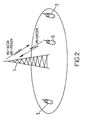
- FIG. 2 shows a base station 1 capable of transmitting high speed data to radio terminals or UEs ("User Equipment") 2 and 3, according to the HSDPA functionality.
- An allocation of HSDPA resources is performed by the base station 1.
- the station base 1 indicates to UE 2, on an HS-SCCH channel, that it will receive data on one or more HS-PDSCH channels.
- the EU 2 meanwhile, possesses a rising HS-DPCCH channel as described above.
- one or more UEs 3 will be able to receive data on one or more HS-PDSCH channels the base station 1, during a subsequent transmission time interval, or EU 2 will eventually continue to receive HSDPA data when the next transmission time interval, as well as one or more other EU 3 possibly.
- base station 1 In addition to the allocation of shared resources, base station 1 must control the transmit power on the channels implemented in the frame HSDPA functionality, especially the HS-SCCH and HS-PDSCH channels. For this purpose, it has a predetermined maximum power to use to emit these channels. This maximum power can be fixed. She can also represent the remaining power at the base station a transmission power has been allocated to the communication channels already allocated. These channels include, for example, dedicated channels or common, used by the base station. When power has already been allocated to HSDPA channels for certain terminals, this is also advantageously taken into account to assign power to the channels HSDPA relative to another terminal for the same time interval of transmission.
- a transmission to the EU 2 will be made from base station 1 on an HS-SCCH channel and a channel HS-PDSCH, if the remaining power at the base station is sufficient to implement it. Otherwise, the transmission to EU 2 can not take place. In addition, adequate transmission power be chosen for each of these channels.
- P HSDPA the cumulative transmission power on the HS-SCCH and HS-PDSCH channels for the considered user must be less than the remaining power at the base station in the range of time covered by the slices # 0, # 1 and # 2 of the HS-SCCH channel 1 for example (we note P HSDPA_contrused this power), but also in the time interval covered by the slices # 0, # 1 and # 2 of the HS-PDSCH channel (this power is noted as P HSDPA ), that is to say on five consecutive time slots in
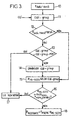
- FIG. 3 illustrates a mode of calculating the power for the HS-SCCH channel relative to a UE according to the invention. This calculation is carried out, for example, by the base station 1 relative to the UE 2 of FIG. 2.
- the transmission power P HS-SCCH to be calculated for the HS-SCCH for a next transmission time interval destined for EU 2 takes into account a CQI calculation. Indeed, the lower the CQI reassembled at the base station 1 by the UE 2, the worse the corresponding propagation channel, and therefore the power to be supplied will be important so as to compensate for the poor quality of the channel.
- the values of CQI are also advantageously classified by groups of CQI ("CQI_group"). The correspondence between a set of CQI values and a CQI_group is stored at the base station 1.
- CPICH Common Pilot Channel
- This channel carries a pilot signal, or beacon signal, formed from a sequence predetermined symbols (see technical specification 3G TS 25.211, "Physical channels and mapping of transport channels onto physical channels (FDD) ", version 3.3.0 released in June 2000 by 3GPP.)
- This signal is issued by the base station 1 on the primary scrambling code of the cell, with a channel code determined.
- a statistical quantity relating to the acknowledgment mechanism described above is calculated.
- This quantity may for example be an average rate ⁇ Ack / Nack of acknowledgments, positive or negative, previously received at the base station 1 on a HS-DPCCH channel from the UE 2. This rate makes it possible to estimate the proportion of acknowledgments received at the base station 1 relative to the acknowledgments expected by the base station 1, following a prior transmission, but that it has not received.
- the absence of acknowledgment can be considered as an indication that the UE 2 failed to detect information that was intended for it on the HS-SCCH channel, the power of the latter being too low, and therefore that the UE 2 failed to listen to the associated HS-DSCH channel in due time.
- step 11 it is deduced, as indicated above, a CQI_group as a function of the CQI values reported by UE 2, possibly over the same observation period as for ⁇ Ack / Nack . Note that this step 11 could also be implemented before step 10.
- step 12 the value of ⁇ Ack / Nack is compared with a predetermined threshold. If ⁇ Ack / Nack is greater than said threshold, this means that the average rate of acknowledgments received at the base station 1 is satisfactory and therefore that the HS-SCCH channel is well received by the UE 2.
- the power of the HS- SCCH is thus calculated from the information of the CQI_group obtained (see the description of step 15 below).
- ⁇ Ack / Nack is below said threshold, it means that the average rate of acknowledgments received at the base station 1 is too low and therefore that many information carried by the HS-SCCH to the UE 2 are not detected by the latter. In this case, it is therefore necessary to increase the transmission power of the HS-SCCH to improve the detection of this channel by the UE 2.
- step 14 we reduce the previously obtained CQI_group, that is to say that the CQI values reported by the EU are artificially 2 are worse than in reality (step 14).
- the decrease in CQI_group that is to say the choice of a CQI_group relating to values more CQIs, is only possible if the CQI_group obtained in step 11 is not already the group CQI_group_min corresponding to the values of CQI the most low. This verification is advantageously done in step 13.
- step 11 If the group obtained in step 11 is the CQI_group_min, then it is not possible to increase the transmission power of the HS-SCCH to obtain acceptable values of the ⁇ Ack / Nack , so that the UE 2 is not served at the next transmission time slot of the HS-SCCH channel (step 17).
- the base station 1 then prefers a UE 3, other than the UE 2, for the next transmission time slot of the HS-SCCH considered.
- step 15 P HS-SCCH is calculated as a function of the CQI_group obtained in step 14 (or in step 11, if ⁇ Ack / Nack is greater than the threshold). Indeed, a power margin with respect to the transmission power on the pilot channel CPICH corresponds to each CQI_group, that is to say to each predefined group of CQI values, as indicated above. P HS-SCCH is thus obtained by adding to this transmission power on the CPICH a margin corresponding to the CQI_group obtained for UE 2.
- step 16 the calculated power P HS-SCCH is not greater than the maximum power P HSDPA to be allocated by the base station 1 and which corresponds to a power remaining at the level of the base station 1 before power allocation to the HSDPA channels of the user considered. If P HS-SCCH for the considered user is greater than P HSDPA and / or P HSDPA_control , this means that the remaining power at base station 1 is insufficient for the HS-SCCH channel to be able to be transmitted at the same time. calculated power P HS-SCCH . Therefore, the UE 2 can not then be served (step 17) and the corresponding HS-SCCH resources can then be allocated to a UE 3, other than the UE 2.
- FIG. 4 shows an example of determination of a transmission power P HS-DSCH for the HS-DSCH channel when the transmission power P HS-SCCH of the HS-SCCH channel associated with this HS-DSCH has been previously determined.
- Transmitting power for the HS-DSCH channel is understood to mean the transmission power to be shared equitably between the HS-PDSCH physical channels on which the HS-DSCH transport channel will be multiplexed, this transmission power corresponding to a transmission over a next transmission time interval of these HS-PDSCH channels.
- These parameters as well as the above formula are defined in section 6A.2 of the aforementioned Technical Specification 25.214.
- the value of P HS-DSCH calculated according to the preceding formula is used by UE 2 as a reference value for its CQI calculation.
- step 21 this first estimate of the P HS-DSCH calculated in step 20 is compared with the remaining value P, for example obtained during step 18 previously described. If P HS-DSCH is greater than P remaining , this implies that the transmit power on the HS-DSCH needs to be revised downward from the initial estimate made, otherwise the HS-DSCH does not may be sent to the attention of the EU 2.
- a reduction in power to be applied to the first estimate of the HS-DSCH P calculated in step 20 is determined, so as to reduce the latter to a level less than or equal to P remaining .
- the reduction in transmission power on the HS-DSCH channel is accompanied by a decrease in the CQI in order to maintain the quality of service. Indeed, maintaining the CQI despite a decrease in power on the HS-DSCH would require strengthening the reliability of the transmission.
- the aforementioned technical specification 25.214 indicates that a decrease in a CQI level corresponds to a difference of about 1 dB in the power of the HS-DSCH.
- a new CQI is determined in step 23 from the value of ⁇ RP obtained, this new CQI being of ⁇ RP levels lower than the CQI reassembled by the UE 2. It is noted that if ⁇ RP does not an integer value when it is expressed in dB, advantageously takes the whole part of ⁇ RP , possibly to within 1 dB, to calculate the new value of the CQI of step 23.
- Each value of CQI also corresponds to a number of channels where the HS-DSCH can be multiplexed.
- the specification 25.214 provides, in particular, that such correspondence be stored in a correspondence table stored at the station basic.
- the base station 1 derives from this CQI a number of HS-PDSCH physical channels, for example from such a correspondence table (step 24).
- the transmission power calculated for the HS-DSCH channel should be less than or equal to the remaining power P.
- P HS-DSCH P CPICH + ⁇ + ⁇ - ⁇ RP .
- the number of codes available at the level of base station 1 is not zero, otherwise the absence of available resources will prevent UE 2 from being served at the next interval transmission time of the HS-DSCH.
- the required number of HS-PDSCH channels is greater than number of channelization codes remaining for HS-PDSCH channels, it is it is not possible to serve UE 2 according to the maximum number of resources wish.
- this decrease in CQI implies a reduction in power for the HS-DSCH channel noted ⁇ RC (step 27), to maintain the quality of service.
- ⁇ RC in dB, corresponds to the number of levels whose CQI is decreased.
- P HS-DSCH P CPICH + ⁇ + ⁇ - Sum ( ⁇ RP , ⁇ RC ). This power will then be distributed equitably between the different physical channels required.
- the number of HS-PDSCH physical channels on which the HS-DSCH will be multiplexed during the next transmission time interval under consideration, and between which the power PS HS-DSCH obtained in step 28 will be shared may further be subject additional adjustment.
- the power emitted per HS-PDSCH channel is determined by taking into account again information relating to the acknowledgments returned to the base station 1 by the UE 2 according to the mechanism described above.
- Fig. 5 illustrates an embodiment for determining the number of HS-PDSCH physical channels to use at the next interval transmission time, as well as the transmission power per channel physical HS-PDSCH.
- a statistical quantity relating to the acknowledgment mechanism described above is determined in step 30.
- this quantity is an average rate ⁇ Nack of negative acknowledgments (Nack) received at the base station 1 from the UE 2 over a sufficiently representative observation period, for example according to a sliding window observation mechanism.
- the aforementioned technical specification 25.214 specifies that such a rate must be of the order of 10%.
- step 31 it is checked whether ⁇ Nack is greater than a first threshold ⁇ dec . If so, this means that the proportion of information previously transmitted on the HS-DSCH, negatively acknowledged by the UE 2 is high, and therefore that the power per useful bit is probably too low. Since the total power allocated P HS-DSCH has been fixed, for example according to the mechanism illustrated in FIG. 4 described above, it is therefore necessary to reduce the number of bits that are useful to transmit, which corresponds to a change in the transport format. Each transport format defining a number of useful bits per transport block corresponds to a CQI value, this correspondence being advantageously stored in a correspondence table stored at the base station, as provided in the aforementioned technical specification 25.214.
- step 32 the value of the CQI obtained previously is reduced to reduce the size of the transport blocks on the HS-DSCH (step 32).
- This reduction may consist of a stepwise reduction of the CQI, or else an integer number of steps greater than 2. In the latter case, the integer may depend on the difference between the values of ⁇ Nack and ⁇ dec .
- step 32 may be executed several times in succession until a satisfactory CQI value is obtained.
- step 33 From the new value of CQI obtained in step 32, a corresponding number of HS-PDSCH physical channels, for example using a correspondence table as referred to above and provided for by the technical specification 25.214 mentioned above (step 33).
- step 34 it is then verified, in step 34, that this number N of channels obtained is non-zero, because otherwise it means that no resource will be allocated to UE 2 for the next transmission time interval, and therefore that the EU 2 can not be served during this time interval of transmission.
- step 31 reveals that ⁇ Nack is less than ⁇ dec
- ⁇ Nack is less than ⁇ dec
- ⁇ inc advantageously less than ⁇ dec
- step 36 we compare ⁇ Nack with a second threshold ⁇ inc , advantageously less than ⁇ dec
- ⁇ Nack is greater than ⁇ inc , but less than ⁇ dec , its value is considered satisfactory and we can proceed with the allocation of resources to UE 2, the number of resources allocated being determined by the value of CQI previously obtained, for example when determining the total power P HS-DSCH .
- step 36 reveals that ⁇ Nack is less than ⁇ inc , it means that the proportion of information transmitted on the HS-DSCH destined for the UE 2 that is the subject of negative acknowledgments is too low, and therefore that the power per useful bit on the HS-DSCH is too high. It is therefore necessary to increase the size of the transport block, that is to say the number of useful bits in the HS-DSCH, without limiting the transmission power on the HS-DSCH.
- the value of the CQI previously obtained is increased, in a step 39.
- N of HS-PDSCH channels required The latter must be less than the number of resources available at base station 1 for the EU 2 can be properly served.
- a transmission is then performed on the or the HS-SCCH channels and on the HS-PDSCH channel (s) with the powers respective emission levels calculated according to the mechanisms described above, corresponding transmission time intervals for each of these canals.
- the various steps described above are implemented within the base station 1.
- the various stages of the method are further implemented during execution of instructions correspondents of a computer program.
- the latter can for example be executed by software means of the base station 1 considered in the example described above.
Landscapes
- Engineering & Computer Science (AREA)
- Computer Networks & Wireless Communication (AREA)
- Signal Processing (AREA)
- Quality & Reliability (AREA)
- Mobile Radio Communication Systems (AREA)
Abstract
Description
- déterminer au moins une indication de qualité relative audit canal de trafic ;
- déterminer au moins une quantité relative à des acquittements préalablement transmis à la station de base ; et
- calculer une puissance d'émission sur l'un au moins parmi le canal de trafic et le canal de contrôle associé audit canal de trafic, pour ledit prochain intervalle de temps de transmission correspondant, à partir de ladite indication de qualité relative au canal de trafic et de ladite quantité relative à des acquittements préalablement transmis à la station de base.
- la figure 1 est une représentation temporelle illustrant les principaux canaux radio utilisés dans le cadre de la fonctionnalité HSDPA ;
- la figure 2 est un schéma montrant une station de base apte à communiquer avec des terminaux radio selon la fonctionnalité HSDPA ;
- la figure 3 est un organigramme montrant un mode de contrôle de la puissance sur un canal HS-SCCH selon l'invention ;
- la figure 4 est un organigramme montrant un mode de contrôle de la puissance sur un canal HS-DSCH selon l'invention ;
- la figure 5 est un organigramme montrant un mode de contrôle de la puissance sur chaque canal physique HS-PDSCH selon l'invention.
- un indicateur de format de transport et de ressources (TFRI, « Transport Format and Resource Indicator »), donnant les informations concernant le format de la partie dynamique du canal HS-DSCH, notamment pour le schéma de modulation employé, la taille du bloc de transport et les ressources physiques allouées (codes de « channelisation ») ;
- les informations liées au protocole HARQ, notamment la version de redondance, un identifiant de processus HARQ, et un indicateur de nouveaux blocs de données.
Claims (16)
- Procédé de contrôle de puissance d'émission sur des canaux de communication dans un système de radiocommunication comprenant au moins une station de base (1) agencée pour transmettre, dans des intervalles de temps de transmission successifs, des blocs à destination de terminaux radio (2, 3), sur des canaux de communication partagés entre les terminaux radio, les canaux de communication partagés comprenant des canaux de trafic et des canaux de contrôle associés à des canaux de trafic, certains au moins des blocs transmis par la station de base donnant lieu à des acquittements positifs ou négatifs de la part des terminaux radio,
le procédé comprenant les étapes suivantes relativement à un terminal radio (2) susceptible de recevoir des blocs sur au moins un canal de trafic et un canal de contrôle associé audit canal de trafic, lors d'un prochain intervalle de temps de transmission correspondant pour chaque canal :déterminer au moins une indication de qualité relative audit canal de trafic ;déterminer au moins une quantité relative à des acquittements préalablement transmis à la station de base ; etcalculer une puissance d'émission sur l'un au moins parmi le canal de trafic et le canal de contrôle associé audit canal de trafic, pour ledit prochain intervalle de temps de transmission correspondant, à partir de ladite indication de qualité relative au canal de trafic et de ladite quantité relative à des acquittements préalablement transmis à la station de base. - Procédé selon la revendication 1, dans lequel le canal de trafic est adapté à une transmission de données à haut débit.
- Procédé selon la revendication 1 ou 2, dans lequel on calcule une puissance d'émission sur le canal de trafic et une puissance d'émission sur le canal de contrôle associé audit canal de trafic, et dans lequel on émet en outre à destination dudit terminal radio sur le canal de trafic et sur le canal de contrôle associé audit canal de trafic, à la puissance d'émission calculée correspondante, lors dudit prochain intervalle de temps de transmission correspondant pour chaque canal, ladite émission étant mise en oeuvre de façon sélective lorsque la somme de la puissance d'émission sur le canal de trafic et de la puissance d'émission sur le canal de contrôle associé audit canal de trafic est inférieure à une puissance d'émission prédéterminée sur le prochain intervalle de temps de transmission correspondant pour chaque canal.
- Procédé selon la revendication 3, dans lequel l'émission à destination dudit terminal radio sur le canal de contrôle associé audit canal de trafic, à la puissance d'émission calculée correspondante, lors dudit prochain intervalle de temps de transmission correspondant, est mise en oeuvre de façon sélective en outre lorsque la somme de la puissance d'émission sur le canal de trafic et de la puissance d'émission sur le canal de contrôle associé audit canal de trafic est inférieure à une puissance d'émission prédéterminée sur l'intervalle de temps de transmission précédant immédiatement ledit prochain intervalle de temps de transmission correspondant.
- Procédé selon la revendication 4, dans lequel ladite puissance d'émission prédéterminée est une puissance restante au niveau de la station de base, après affectation de puissance à des canaux déjà alloués.
- Procédé selon l'une quelconque des revendications précédentes, dans lequel la détermination d'au moins une quantité relative à des acquittements préalablement transmis à la station de base comprend la détermination d'un taux de blocs ayant fait l'objet d'un acquittement de la part dudit terminal mobile sur une période d'observation.
- Procédé selon la revendication 6, dans lequel la détermination de l'indication de qualité relative audit canal de trafic prend en compte ledit taux de blocs ayant fait l'objet d'un acquittement de la part dudit terminal mobile sur une période d'observation.
- Procédé selon la revendication 7, dans lequel la puissance d'émission sur le canal de contrôle associé audit canal de trafic pour le prochain intervalle de temps de transmission correspondant est calculée par ajout, à la puissance d'émission prédéterminée sur un canal de communication pilote, d'une marge déduite de ladite indication de qualité déterminée.
- Procédé selon l'une quelconque des revendications 3 à 8, dans lequel on calcule la puissance d'émission sur le canal de contrôle associé audit canal de trafic, pour ledit prochain intervalle de temps de transmission correspondant, puis on calcule la puissance d'émission sur ledit canal de trafic, pour ledit prochain intervalle de temps de transmission correspondant, la puissance d'émission sur ledit canal de trafic étant calculée pour être inférieure ou égale à la différence entre la puissance d'émission prédéterminée et la puissance d'émission calculée sur le canal de contrôle associé audit canal de trafic.
- Procédé selon la revendication 9, dans lequel la détermination de l'indication de qualité relative audit canal de trafic et le calcul de la puissance d'émission sur ledit canal de trafic tiennent en outre compte d'une différence entre une puissance de référence et ladite différence entre la puissance d'émission prédéterminée et la puissance d'émission calculée sur le canal de contrôle associé audit canal de trafic.
- Procédé selon la revendication 9 ou 10, dans lequel on déduit de l'indication de qualité déterminée relative au canal de trafic un nombre de canaux physiques sur lesquels le canal de trafic peut être multiplexé, selon une table de correspondance préétablie, et dans lequel la détermination de l'indication de qualité relative audit canal de trafic et le calcul de la puissance d'émission sur ledit canal de trafic pour ledit prochain intervalle de temps de transmission correspondant tiennent en outre compte d'une comparaison entre ledit nombre de canaux physiques sur lesquels le canal de trafic peut être multiplexé et un nombre de ressources physiques disponibles à la station de base pour ledit prochain intervalle de temps de transmission.
- Procédé selon l'une quelconque des revendications 9 à 11, dans lequel la détermination d'au moins une quantité relative à des acquittements comprend la détermination d'un taux d'acquittements négatifs préalablement transmis à la station de base par ledit terminal radio sur une période d'observation, et dans lequel la détermination de l'indication de qualité relative audit canal de trafic prend en compte ledit taux d'acquittements négatifs préalablement transmis à la station de base par ledit terminal radio.
- Procédé selon la revendication 12, dans lequel on déduit de l'indication de qualité déterminée relative au canal de trafic un nombre de canaux physiques sur lesquels le canal de trafic est à multiplexer, selon une table de correspondance préétablie, et dans lequel on partage sensiblement équitablement la puissance d'émission calculée entre lesdits canaux physiques pour ledit prochain intervalle de temps de transmission correspondant au canal de trafic.
- Procédé selon l'une quelconque des revendications précédentes, dans lequel la détermination de l'indication de qualité relative audit canal de trafic prend en compte des informations de qualité relative audit canal de trafic transmises à la station de base par ledit terminal radio.
- Station de base (1) agencée pour transmettre, dans des intervalles de temps de transmission successifs, des blocs à destination de terminaux radio (2, 3), sur des canaux de communication partagés entre les terminaux radio, les canaux de communication partagés comprenant des canaux de trafic et des canaux de contrôle associés à des canaux de trafic, certains au moins des blocs transmis par la station de base donnant lieu à des acquittements positifs ou négatifs de la part des terminaux radio, ladite station de base étant agencée pour mettre en oeuvre un contrôle de puissance d'émission sur certains au moins desdits canaux de communication partagés selon l'une quelconque des revendications précédentes.
- Produit programme d'ordinateur à installer dans une station de base (1), comprenant des instructions pour mettre en oeuvre le procédé selon l'une quelconque des revendications 1 à 14, lors d'une exécution du programme par des moyens de la station de base.
Applications Claiming Priority (2)
| Application Number | Priority Date | Filing Date | Title |
|---|---|---|---|
| FR0404393 | 2004-04-26 | ||
| FR0404393A FR2869496B1 (fr) | 2004-04-26 | 2004-04-26 | Procede de controle de puissance d'emission sur des canaux de communication et station de base pour la mise en oeuvre du procede |
Publications (1)
| Publication Number | Publication Date |
|---|---|
| EP1592271A1 true EP1592271A1 (fr) | 2005-11-02 |
Family
ID=34935418
Family Applications (1)
| Application Number | Title | Priority Date | Filing Date |
|---|---|---|---|
| EP05008579A Withdrawn EP1592271A1 (fr) | 2004-04-26 | 2005-04-20 | Procédé et appareil de contrôle de puissance d'émission sur des canaux de communication |
Country Status (3)
| Country | Link |
|---|---|
| US (1) | US7634289B2 (fr) |
| EP (1) | EP1592271A1 (fr) |
| FR (1) | FR2869496B1 (fr) |
Cited By (2)
| Publication number | Priority date | Publication date | Assignee | Title |
|---|---|---|---|---|
| CN101030798B (zh) * | 2007-04-16 | 2010-07-14 | 中兴通讯股份有限公司 | 高速下行共享信道的hs-sich闭环功率控制的方法 |
| EP2020765A4 (fr) * | 2006-05-24 | 2013-08-07 | Nec Corp | Système de communication mobile, station de base, et procédé de commande de puissance de transmission utilisé pour eux |
Families Citing this family (24)
| Publication number | Priority date | Publication date | Assignee | Title |
|---|---|---|---|---|
| WO2006065182A1 (fr) * | 2004-12-17 | 2006-06-22 | Telefonaktiebolaget Lm Ericsson (Publ) | Commande de niveau de puissance pour acces par paquets de canal partage en liaison descendante haut debit |
| EP1717965A1 (fr) * | 2005-04-27 | 2006-11-02 | Alcatel Alsthom Compagnie Generale D'electricite | Commande de puissance de transmission pour des liaisons HSDPA |
| US8965440B2 (en) * | 2005-05-31 | 2015-02-24 | Alcatel Lucent | Method of estimating a current channel condition in a wireless communications network |
| US8493942B2 (en) * | 2005-08-01 | 2013-07-23 | Qualcomm Incorporated | Interference cancellation in wireless communication |
| KR20070047636A (ko) * | 2005-11-02 | 2007-05-07 | 삼성전자주식회사 | 무선 통신 시스템에서 역방향 로드 제어 장치 및 방법 |
| KR101298265B1 (ko) * | 2006-07-07 | 2013-08-22 | 삼성전자주식회사 | 패킷 수신 방법 및 패킷 전송 방법 |
| CN101114851B (zh) * | 2006-07-24 | 2010-10-20 | 大唐移动通信设备有限公司 | 一种hsdpa的功率控制方法及装置 |
| WO2008052780A1 (fr) * | 2006-10-31 | 2008-05-08 | Telefonaktiebolaget Lm Ericsson (Publ) | Procédé et agencement pour transmission d'un indicateur de qualité de canal (cqi) en liaison montante |
| EP2890183B1 (fr) * | 2006-10-31 | 2019-05-08 | InterDigital Technology Corporation | Détermination des indicateurs de qualité de canal (cqi) et intervalles de temps de transmission (tti) pour envoyer les cqi |
| US8208423B2 (en) * | 2006-11-20 | 2012-06-26 | Telefonaktiebolaget L M Ericsson (Publ) | Method and arrangement for efficiently utilizing radio resources in a communication system |
| WO2008145153A1 (fr) * | 2007-05-29 | 2008-12-04 | Telefonaktiebolaget Lm Ericsson (Publ) | Technique pour transmissions de données en liaison ascendante dans des réseaux de communication |
| JP5069060B2 (ja) * | 2007-08-14 | 2012-11-07 | 株式会社エヌ・ティ・ティ・ドコモ | 通信制御方法及び基地局 |
| US8462743B2 (en) * | 2008-01-25 | 2013-06-11 | Nokia Siemens Networks Oy | Method, apparatus and computer program for signaling channel quality information in a network that employs relay nodes |
| BRPI0910851B1 (pt) | 2008-04-21 | 2021-05-25 | Apple Inc | Método para um processo de harq |
| US20100113006A1 (en) * | 2008-11-04 | 2010-05-06 | 2Wire, Inc. | Cell calibration |
| FR2942932B1 (fr) * | 2009-03-05 | 2011-04-08 | St Wireless Sa | Procede de controle du fonctionnement d'une unite de traitement d'un appareil de communication sans fil, et appareil de communication correspondant |
| JP5565082B2 (ja) | 2009-07-31 | 2014-08-06 | ソニー株式会社 | 送信電力決定方法、通信装置及びプログラム |
| JP5531767B2 (ja) | 2009-07-31 | 2014-06-25 | ソニー株式会社 | 送信電力制御方法、通信装置及びプログラム |
| JP5429036B2 (ja) | 2009-08-06 | 2014-02-26 | ソニー株式会社 | 通信装置、送信電力制御方法、及びプログラム |
| JP5259639B2 (ja) * | 2010-03-12 | 2013-08-07 | 株式会社日立製作所 | 無線通信システム及び方法、基地局装置 |
| US8806287B1 (en) * | 2010-09-24 | 2014-08-12 | Google Inc. | Retransmission systems and methods in reliable streaming protocols using connection characteristics |
| US9648657B2 (en) * | 2011-04-01 | 2017-05-09 | Interdigital Patent Holdings, Inc. | Method and apparatus for controlling connectivity to a network |
| CN103124428B (zh) * | 2011-11-17 | 2015-04-15 | 电信科学技术研究院 | 一种上行功率控制方法及装置 |
| CN103428836B (zh) * | 2012-05-16 | 2016-03-30 | 华为技术有限公司 | 基于harq的数据传输方法、设备和系统 |
Citations (1)
| Publication number | Priority date | Publication date | Assignee | Title |
|---|---|---|---|---|
| US20030039217A1 (en) * | 2001-08-25 | 2003-02-27 | Samsung Electronics Co., Ltd. | Apparatus and method for transmitting/receiving uplink transmission power offset and HS-DSCH power level in a communication system employing HSDPA |
Family Cites Families (5)
| Publication number | Priority date | Publication date | Assignee | Title |
|---|---|---|---|---|
| US7027420B2 (en) * | 2001-07-24 | 2006-04-11 | Nokia Mobile Phones Ltd. | Method for determining whether to perform link adaptation in WCDMA communications |
| US20040100911A1 (en) * | 2002-11-25 | 2004-05-27 | Raymond Kwan | Method for link adaptation |
| JP4222957B2 (ja) * | 2004-03-01 | 2009-02-12 | ソニー・エリクソン・モバイルコミュニケーションズ株式会社 | 送信電力制御方法および装置 |
| EP1633160A1 (fr) * | 2004-09-07 | 2006-03-08 | Nokia Corporation | Procédé de la commande de l'admission, systèmè de radiocommunication par paquets et contrôleur |
| CN100571073C (zh) * | 2005-03-03 | 2009-12-16 | 株式会社Ntt都科摩 | 分组发送控制装置、分组发送控制方法 |
-
2004
- 2004-04-26 FR FR0404393A patent/FR2869496B1/fr not_active Expired - Lifetime
-
2005
- 2005-04-20 EP EP05008579A patent/EP1592271A1/fr not_active Withdrawn
- 2005-04-26 US US11/114,809 patent/US7634289B2/en not_active Expired - Fee Related
Patent Citations (1)
| Publication number | Priority date | Publication date | Assignee | Title |
|---|---|---|---|---|
| US20030039217A1 (en) * | 2001-08-25 | 2003-02-27 | Samsung Electronics Co., Ltd. | Apparatus and method for transmitting/receiving uplink transmission power offset and HS-DSCH power level in a communication system employing HSDPA |
Non-Patent Citations (3)
| Title |
|---|
| "3rd generation partnership project, technical specification group radio access network, physical layer procedures , fdd", 3GPP TS 25214 V5.7.0, December 2003 (2003-12-01), pages 1 - 64, XP002316692 * |
| "3RD GENERATION PARTNERSHIP PROJECT,TECHNICAL SPECIFICATION GROUP RADIO ACCESS NETWORK, PHYSICAL CHANNELS AND MAPPING OF TRANSPORT CHANNELS ONTO PHYSICAL CHANNELS , FDD . RELEASE 6", 3GPP TS 25211 V6.0.0, December 2003 (2003-12-01), pages 1 - 51, XP002316690 * |
| GHOSH, A ET ALL.: "CONTROL CHANNEL DESIGN FOR HIGH SPEED DOWNLINK SHARED CHANNEL FOR 3GPP W-CDMA", VEHICULAR TECHNOLOGY CONFERENCE. THE 57TH IEEE SEMIANUAL, vol. 3, March 2003 (2003-03-01), pages 2085 - 2089, XP002316691 * |
Cited By (2)
| Publication number | Priority date | Publication date | Assignee | Title |
|---|---|---|---|---|
| EP2020765A4 (fr) * | 2006-05-24 | 2013-08-07 | Nec Corp | Système de communication mobile, station de base, et procédé de commande de puissance de transmission utilisé pour eux |
| CN101030798B (zh) * | 2007-04-16 | 2010-07-14 | 中兴通讯股份有限公司 | 高速下行共享信道的hs-sich闭环功率控制的方法 |
Also Published As
| Publication number | Publication date |
|---|---|
| US20060240859A1 (en) | 2006-10-26 |
| FR2869496B1 (fr) | 2006-08-11 |
| FR2869496A1 (fr) | 2005-10-28 |
| US7634289B2 (en) | 2009-12-15 |
Similar Documents
| Publication | Publication Date | Title |
|---|---|---|
| CA2400933C (fr) | Procede d'emission de signaux radio, reseau d'acces et terminal de radiocommunication appliquant le procede | |
| US7634289B2 (en) | Method for controlling transmission power on communication channels and base station to implement the method | |
| FR2828968A1 (fr) | Appareil et procede de communications par canaux de liaisons montante et descendante pour la transmission de donnees par paquets | |
| EP0775394B1 (fr) | Procede d'adaptation de l'interface air, dans un systeme de radiocommunication vers des mobiles | |
| FR2828969A1 (fr) | Procede de signalisation entre des entites d'une couche de commande d'acces au support dans un systeme de communications par parquets | |
| FR2821219A1 (fr) | Procede et appareil pour transmettre un signal de canal de donnees physique specialise | |
| FR2835669A1 (fr) | Procede et appareil pour transmettre de l'information de jeux de canaux de commande partages dans un systeme de telecommunication mobile permettant la transmission de donnees en mode de paquets | |
| EP1324500A1 (fr) | Méthode et appareil de communication numérique avec entrelacement variable | |
| WO2010097455A1 (fr) | Méthode de signalisation de la qualité d'un canal de transmission | |
| EP1235458A1 (fr) | Procede de gestion de ressources de traitement dans un systyme de radiocommunications mobiles | |
| EP1164717A1 (fr) | Procédé pour le contrôle de puissance d'emission dans un système de radiocommunications mobiles | |
| FR2807243A1 (fr) | Procede de modulation par etalement de spectre a code d'etalement discontinu, procede de demodulation, station mobile et stations de base correspondants | |
| EP1223782B1 (fr) | Procédé de gestion de ressources de traitement dans un système de radiocommunications mobiles | |
| EP1461969B1 (fr) | Procede de controle de canaux de communication et station de base et terminal mettant en oeuvre le procede | |
| FR2860381A1 (fr) | Procede d'allocation de ressources dans un systeme de radiocommunication et station de base pour mettre en oeuvre le procede | |
| FR2815795A1 (fr) | Procede d'adaptation de lien dans un systeme de radiocommunications mobiles | |
| EP1180908A1 (fr) | Procédé de contrôle de la charge de trafic dans un reseau de radiocommunications mobiles | |
| EP1179911B1 (fr) | Procédé pour évaluer la qualité d'une liaison radio dans un système de radiocommunications mobiles | |
| EP1526751A1 (fr) | Procédé de gestion de ressources de traitement dans un système de radiocommunications mobiles | |
| EP1518336A2 (fr) | Procede, terminal et unite radio pour le reglage de la puissance d'emission en macrodiversite | |
| EP2039208B1 (fr) | Ordonnancement de terminaux pour l'émission de données vers un terminal sur un canal hsdpa par plusieurs stations de base | |
| EP2926602A1 (fr) | Procede et systeme de determination d'un intervalle de frequences dans un reseau de telecommunications | |
| KR101624312B1 (ko) | 음성 서비스를 위한 하향링크 코드채널 전력할당 방법 및 시스템 | |
| WO2013186448A1 (fr) | Procédé d'établissement d'une transmission entre des terminaux mobiles d'un même groupe appartenant à un réseau de radiocommunication à ressources partagées opérant en mode direct | |
| WO2008059183A1 (fr) | Detection de saturation de controle de puissance dans un recepteur de radiocommunication |
Legal Events
| Date | Code | Title | Description |
|---|---|---|---|
| PUAI | Public reference made under article 153(3) epc to a published international application that has entered the european phase |
Free format text: ORIGINAL CODE: 0009012 |
|
| AK | Designated contracting states |
Kind code of ref document: A1 Designated state(s): AT BE BG CH CY CZ DE DK EE ES FI FR GB GR HU IE IS IT LI LT LU MC NL PL PT RO SE SI SK TR |
|
| AX | Request for extension of the european patent |
Extension state: AL BA HR LV MK YU |
|
| 17P | Request for examination filed |
Effective date: 20051110 |
|
| AKX | Designation fees paid |
Designated state(s): AT BE BG CH CY CZ DE DK EE ES FI FR GB GR HU IE IS IT LI LT LU MC NL PL PT RO SE SI SK TR |
|
| RAP1 | Party data changed (applicant data changed or rights of an application transferred) |
Owner name: ALCATEL LUCENT |
|
| RAP1 | Party data changed (applicant data changed or rights of an application transferred) |
Owner name: ALCATEL LUCENT |
|
| 111Z | Information provided on other rights and legal means of execution |
Free format text: AT BE BG CH CY CZ DE DK EE ES FI FR GB GR HU IE IS IT LI LT LU MC NL PL PT RO SE SI SK TR Effective date: 20130410 |
|
| STAA | Information on the status of an ep patent application or granted ep patent |
Free format text: STATUS: THE APPLICATION IS DEEMED TO BE WITHDRAWN |
|
| 18D | Application deemed to be withdrawn |
Effective date: 20131101 |
|
| REG | Reference to a national code |
Ref country code: DE Ref legal event code: R079 Free format text: PREVIOUS MAIN CLASS: H04Q0007320000 Ipc: H04W0088020000 |
|
| REG | Reference to a national code |
Ref country code: DE Ref legal event code: R079 Free format text: PREVIOUS MAIN CLASS: H04Q0007320000 Ipc: H04W0088020000 Effective date: 20140526 |