EP1592205A2 - Auswahl von Verarbeitungsservern in einer Menge von Servern - Google Patents
Auswahl von Verarbeitungsservern in einer Menge von Servern Download PDFInfo
- Publication number
- EP1592205A2 EP1592205A2 EP05300293A EP05300293A EP1592205A2 EP 1592205 A2 EP1592205 A2 EP 1592205A2 EP 05300293 A EP05300293 A EP 05300293A EP 05300293 A EP05300293 A EP 05300293A EP 1592205 A2 EP1592205 A2 EP 1592205A2
- Authority
- EP
- European Patent Office
- Prior art keywords
- server
- terminal
- processing
- processing server
- session
- Prior art date
- Legal status (The legal status is an assumption and is not a legal conclusion. Google has not performed a legal analysis and makes no representation as to the accuracy of the status listed.)
- Withdrawn
Links
Images


Classifications
-
- H—ELECTRICITY
- H04—ELECTRIC COMMUNICATION TECHNIQUE
- H04Q—SELECTING
- H04Q3/00—Selecting arrangements
- H04Q3/64—Distributing or queueing
- H04Q3/66—Traffic distributors
Definitions
- the present invention relates to a method of automatic selection of a processing server in a set of processing servers. More specifically, the invention relates to a selection of a server to assign to processing a request from a terminal, among servers managing several phases constituting a service session in order to dispatch traffic consisting of requests from terminals on the set of servers.
- the present invention aims to overcome the aforementioned drawbacks by distributing the traffic load on a set of processing servers by a specific selection of a processing server whose role is to process a request from a terminal.
- the invention is advantageous in that it is based on a multi-diffusion approach, that is to say sending a request from the equipment to the processing servers.
- the process can be controlled by the equipment before the processing of each request sent by the terminal, or be repeated periodically by equipment.
- Another advantage of the invention is enable a change of server processing of requests from a terminal during a session of the terminal. So at least two requests from the terminal to during a session can be dealt with by different selected processing servers.
- the equipment may select another server address from processing in the server address list of available treatment including the corresponding server becomes the selected processing server.
- the equipment can be the terminal which avoids advantageously saturations of servers referrals.
- the equipment is a session server to which is relayed the request of the terminal.
- a piece of equipment according to the invention is a user terminal T or a SS session server.
- a session is composed of a set of phases communication between a user terminal T and a set of servers.
- the main phases are a initialization phase, one or more phases of modification and a closing phase.
- a session is identified by an IDS session ID unique.
- a session is associated with a terminal T of user, for example by matching IDS session identifier and identifier of the user of the terminal T.
- a session context is a set information dependent on a service and characterizing the session being executed invoked from a T user terminal. It contains for example, a start time of service execution offered during the session, a type of service in running, a terminal access mode to service, a billing method and so general information necessary for to be able to continue the execution of the session variables, such as session variables.
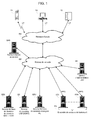
- the system of session phase management mainly includes an SAS service access server, a server of SS sessions, a database server of SBS sessions, a database server of users SBU, an SA management server, an ES set from ST1 processing servers to STN, and at least one terminal T.
- an SAS service access server a server of SS sessions
- a database server of SBS sessions a database server of users SBU
- an SA management server an ES set from ST1 processing servers to STN
- at least one terminal T at least one terminal T.
- T1, T2 and T3 indifferently designated by T in the continuation of the description.
- the terminal T requires a service from the SAS access server, by means of a request, which relays to the SS session server.
- the server of SS sessions is the intermediary between the server access to the SAS service and the processing servers ST1 to STN that process terminal requests.
- the user terminal T communicates with the server accessing the SAS service through networks RA access and a packet network RP.
- the server of SS sessions communicates with the SAS access server, the SBS session database server, the SBU user database server and the set of ES servers across the network of RP packets.
- ST1 processing servers at STN also communicate with the base server of SBS session data.
- the administration server SA communicates with the ST1 processing servers at STN and the SS session server.
- the communications between the various servers are identical, but carried out via internal links of type Ethernet and no longer via the RP packet network.
- the links between the various servers are indicated by arrows.
- the terminal T is connected to a respective access network RA by a LT link.
- the terminal T is for example a terminal of mobile cellular radio T1
- the link LT is a radiocommunication channel
- the network respective access RA includes the fixed network of a radiocommunication network, for example of the type GSM (Global System for Mobile Communications) with a GPRS service (General Packet Radio Service), or UMTS type (Universal Mobile Telecommunications System).
- GSM Global System for Mobile Communications
- GPRS General Packet Radio Service
- UMTS Universal Mobile Telecommunications System
- the terminal T is a T2 personal computer, connected directly by modem to the LT link of the xDSL or ISDN line type (Network Digital to Service Integration) connected to the network corresponding RA access.
- xDSL xDSL
- ISDN line type Network Digital to Service Integration
- the terminal T is a T3 fixed telecommunications terminal
- the LT link is a telephone line
- the access network respective RA includes the switched telephone network.
- the user terminal T includes an electronic device or object personal telecommunications to the user that can be a personal digital assistant communicating PDA.
- the terminal T can be any other home terminal portable or not, such as a video game console, or a smart TV receiver cooperating with a remote control with a display or a keyboard alphanumeric also serving as a mouse through an infrared link.
- User terminals T and access networks RA are not limited to the examples above and may be constituted by other terminals and known access networks.
- the SS session server is the central server of the system. He communicates with all the others servers to manage sessions and distribution traffic between ST1 processing servers to STN.
- the SAS Access Server is an equipment of access control to the service to which a request to process including a service address established by the terminal T is directed.
- the server SAS Access Integrates Firewall Features, routing and translation of addresses.
- the address of service is the public address of the access server SAS.
- the SAS Access Server translates the address of the service required by the terminal at another address, such as the SS session server address, to mask at the user terminal T the addresses servers, other than the service address, related to this service.
- ST1 processing servers at STN are application servers like for example Web applications. Processing servers deliver the service desired by the user.
- the set ES of the processing servers according to the first achievement forms a pool of servers that are each indifferently accessible by a user terminal via the SS session server.
- the set ES of the processing servers according to the variant of the first embodiment shown in Figure 2 is either a server pool as defined above, a cluster of servers that are installed on a single machine, each server being for example installed on a map of respective treatment in the machine and making node office of the cluster.
- the SBS session database server contains a database that stores identifiers of IDS sessions and contexts of associated CSU sessions.
- the SBU User Database Server contains a database of PU user profiles.
- a user profile PU is defined by information personal information about the user, such as an address, a phone number, any information identification, such as an identifier, a word password, information about access rights to at least one service, etc. Access rights can also be rights of access to certain operations, such as modification or closure an ongoing service session.
- the user profile can be kept in a session context.
- the SA management server checks regularly running the servers of ST1 treatment at STN in order to establish or day a list of processing server addresses operational LSO.
- the SA administration server communicates automatically the LSO list to the session server SS according to the first embodiment, which memorizes buffer the LSO list.
- the SA server ensures also maintenance and monitoring of ST1 processing servers to STN by a administrator.
- the method of selecting a processing server in a set of servers according to the first and second embodiments of the invention comprises steps A1 to A3.
- the objective of the three steps A1 to A3 is to define the available processing servers for process terminal requests. This availability is determined by a query in multi-broadcast (multicast) servers ST1 treatment at STN.
- step A1 the session server SS according to the first embodiment or the user terminal T according to the second achievement, as equipment related to terminal, sends a multicast REQ request, to all ST1 processing servers at STN.
- a multicast request is a request sent simultaneously to multiple processing servers.
- the multi-cast query can be handled between the SS session server and the servers of ST1 treatment at STN according to the management protocol of IGMP internet group (Internet Group Management Protocol).
- IGMP internet group Internet Group Management Protocol
- the session server SS automatically knows the processing servers belonging to the group of multi-broadcast, and the update of this group is a feature managed natively in the protocol multi-broadcast, allowing a server to processing to ask a SS or T equipment to belong to this group.
- each processing server that is available sends independently of the others processing servers a REP response to the query REQ to SS or T equipment.
- SS or T equipment considers a processing server unavailable who does not send a REP response to the REQ request during a predetermined time delay.
- a waiter of treatment with a greater response time that the predetermined time delay can be also considered unavailable.
- step A3 the equipment SS or T groups the query results by the multicast query to build an LSD list of ADST addresses ST1 processing servers to STN that are available.
- SS or T equipment orders list LSD in order of arrival of REP responses from the servers treatment, without intermediate calculation, that is to say according to the increasing order of response times of processing servers on request, as and when measuring REP responses from the processing servers available ST1 to STN as SS or T equipment receives.
- the selected processing server ST corresponds to the first processing server address of the ordered list LSD, and so is the one having the time short answer.
- the method of selecting a server of treatment guarantees a good distribution of the traffic between servers in the ES set.
- the ST1 processing servers at STN respond as long as their load is less than an internal load threshold.
- ST1 processing servers at STN adapt their response time respectively according to their loads.
- each server of treatment itself determines the response time to impose on a multicast request.
- the selection process A1 to A3 is repeated periodically by SS or T equipment, or is controlled by SS or T equipment before processing each request sent by the terminal T, treatment which is described below with reference in FIGS. 4 and 5 for the first embodiment and in Figures 7 and 8 for the second embodiment.
- the method initialization of sessions implementing the method of selecting a processing server in a set of servers according to the first embodiment of the invention comprises steps B1 to B15.
- the terminal T sends to the SAS access server an initialization request REQi at the service address.
- the request initialization REQi contains in particular information identifying the terminal T and the user of the terminal T.
- identifying information the user of a telecommunications terminal may include a terminal identifier and a password.
- the SAS Access Server translates the address of service to the SS session server address and sends the REQi initialization request to the server SS sessions in step B2.
- This translation of address cache terminal T the addresses of servers intervening downstream of the SAS access server.
- the only known address of the terminal T is the service address.
- the SAS Access Server and the SS Session Server are installed in or merged into a server common.
- step B3 the session server SS, as equipment sends a REQu user request to the SBU user database server, in order to retrieve the user profile PU corresponding to the user of the terminal T to verify rights access of the user of the terminal T to the required service.
- the user request REQu contains in particular the credentials of the user and a service identifier.
- the SBU User Database Server sends the SS session server a user response REPu to the REQu user request containing the profile PU of the terminal user T corresponding to Terminal user credentials T at step B4.
- step B5 the session server SS checks the user profile received contains the identifier the required service and then send a request for session REQs to the data management server SBS sessions. Otherwise the SS session server refuses access to the service, which is reported to terminal T via the SAS server.
- the REQs session request contains the PU profile of the terminal user T.
- the database server of SBS sessions creates or initializes a context of CSU user session including the profile user terminal PU for the terminal T and generates a IDS session identifier to memorize the CSU session context in association with the IDS session identifier.
- the SBS session database server sends the session server SS the identifier of session generated IDS included in a session response REPs to the REQs session request, in step B6.
- step B7 the session server SS selects the first server address of ADST processing in the server address list available treatment LSD, which was established during of the execution of the process of selecting servers of treatment at steps A1 to A3.
- the first address selected ADST denotes a processing server selected ST.
- step B8 the session server SS checks through the processing server address list operational LSO if the ADST address of the server of selected treatment ST corresponds to a server of operational processing.
- the second address of processing server is selected in the list LSD and replaces in the following process the first selected processing server address previously in step B7.
- the processing server selected ST is then the server corresponding to the second processing server address selected. This process is repeated until select a server address from processing present in the address list of operational processing server LSO.
- the session server SS When the selected ST processing server is operational, the session server SS, as that equipment linked to the terminal, sends the request of initialization REQi of the terminal T by introducing the IDS session ID to the server selected treatment ST, in step B9.
- step B10 the session server SS checks if the selected processing server ST is ready to process the initialization request of the terminal T, that is, if the processing server ST is not unavailable, or do not wait too long to answer in comparison to a predetermined time delay.
- a second or nth server address of processing is selected in the address list available LSD processing server, as described previously according to steps B7 to B9.
- the selected processing server ST When the selected ST processing server is ready, the selected processing server ST sends to the SBS session database server a REQs session request containing the IDS session identifier, in step B11, so that to retrieve the CSU session context associated with the IDS session identifier.
- step B12 the base management server of SBS session data sends to the server selected ST treatment a REPs session response containing the CSU session context that is associated to the IDS session ID and including the PU profile of the user of the terminal T.
- step B13 the processing server selected ST identifies the user of the terminal T in comparing the credentials contained in the REQi identification request received during step B9 and the credentials contained in the user profile PU of the context of CSU session.
- the selected ST processing server sends the terminal T a response inviting the user to to identify again, or simply interrupt the transaction with the terminal T, through the server Session SS and the SAS Access Server.
- the user identification can be completed by a verification of the access rights of the user service required.
- the selected processing server ST sends to terminal T through the SS session server and the SAS access server a REPi initialization response the initialization request REQi including including the IDS ID of the initialized session, to step B14.
- the IDS session ID is stored in the T terminal buffer during the duration of the session in order to introduce it in subsequent queries during the course of the session just initialized.
- the selected processing server ST commands in step B15, updating the session context CSU this time including the server address of selected ADST processing in the base server SBS session data.
- the terminal T accesses the service.
- the terminal T can modify the session, then close it when the terminal interrupts access in the service.
- the method of session modification and the closing process of session implementing the method of selecting a processing server in a set of servers according to the first embodiment of the invention respectively comprise steps C1 to C12m and steps C1 to C12c. Steps C1 to C10 are common to modification and closure processes session.
- step C1 the user terminal T sends the SAS access server a change request from session REQm, respectively a closing request session ID, analogous to the request initialization REQi and containing in particular the IDS session identifier.
- the SAS Access Server performs the translation address and relays the request REQm, REQc, to SS session server in step C2, of the same way that in step B2 in the process initializing.
- the SS session server sends the server SBS session database a query from REQs session including the IDS session ID in step C3.
- step C4 the database server of SBS sessions sends in a REPs session response the ADST processing server address previously associated with the IDS session identifier.
- step C5 the session server SS checks in the list of server identifiers from operational processing LSO if the server of processing associated with the server address of ADST processing sent is operational, as in step B8 of the initialization process. When the associated processing server is operational it is deemed to be the selected processing server ST.
- the first server address of processing is selected in the address list available LSD processing server at one step C4bis, so that in the following process the first processing server address replaces the address from the ADST processing server previously sent, to step C5.
- the process resumes at step C5.
- the processing server address selected in the LSD list must be different the processing server address sent; if not the next processing server address in the LSD list is selected.
- Steps C4bis and C5 are reiterated, selecting the second list address, then the third one, and so on continued until a processing server present in the list Operational Processing Server Addresses LSO.
- the selected processing server ST then corresponds to the identified processing server by the last address selected.
- the SS session server sends the request for modification REQm, respectively the request for closing REQc, in which is introduced in particular the IDS session identifier, to the server of selected treatment ST, in step C6.
- step C7 the session server SS checks if the selected processing server ST is ready to to treat the request REQm, REQc of the terminal T, as with step B10.
- a second or nth processing server address is selected in the server address list available LSD treatment, as described previously in steps C4bis, C5 and C6.
- the selected processing server ST is then the server corresponding to the last address of selected processing server.
- this one sends to the base server of SBS session data a REQs session request containing the IDS session ID, at step C8.
- step C9 the database server of SBS sessions sends to the processing server selected ST a REPs session response including the session context corresponding to the IDS session identifier.
- the context of session containing the PU user profile of the terminal T, the processing server ST identifies the user of the terminal T at step C10 and optionally checks its access rights, as in step B13 of the process initializing.
- the transaction is interrupted with the terminal T.
- the server of ST processing processes the REQm change request, respectively the closing request REQc.
- the selected processing server ST sends to the terminal T through the session server SS and the SAS access server a response from REPm modification to the REQm change request including the IDS session identifier, to step C11m.
- the server of selected treatment ST commands the update of the CSU session context in the base server of SBS session data.
- a session change for example a change in value a session variable.
- step C10 when it is a REQc logoff request, the server of selected ST processing command to the base server SBS session data deleting the context CSU session associated with the session identifier IDS, as well as the removal of all information related to this session in step C11c.
- the deletion leads to a release from the location associated memory in the SBS server.
- the selected processing server ST command the update of the user profile PU in the SBU user database server, in view in particular to establish by a third party an invoice from service.
- the system of session phase management mainly includes the server of database management of SBS sessions, the SBU user database server, the set Of ST1 processing servers to STN and at least one terminal T.
- the terminal T communicates directly with ST1 processing servers to STN and has by consequently, a list of the addresses of the ST1 processing servers to STN, or an address of multicast.
- the multicast address is a unique address pointing to all ST1 processing servers at STN.
- the access server to the SAS service is useless since the terminal T directly accesses ST1 processing servers at STN.
- the SA administration server is not shown in Figure 6, because this one does not fulfills no specific role in the process initialization, modification and closure the second realization, and is confined to one maintenance role.
- the algorithm of the selection process according to the invention presented at Figure 3 is modified by integrating functionalities the SS session server, as equipment, in the terminal T itself.
- the terminal T performs multi-diffusion interrogation and establishes the list of processing server addresses available LSD based on the responses of the servers of interrogation processing in multi-diffusion.
- the servers of ST1 processing at STN need to check if a query from the terminal T contains at least one multi-diffusion parameter certifying that a multicast polling has been performed previously.
- the method initialization of sessions implementing the method of selecting a processing server in the ES server set according to the second embodiment of the invention comprises steps D1 to D11.
- step D1 the terminal T selects from the first ADST processing server address in the processing server address list available LSD.
- step D2 the terminal T, as that equipment linked to the terminal, send a request of initialization REQi towards the server of treatment previously selected ST corresponding to the address ADST selected in the previous step D1.
- REQi are introduced particular identifying information of the terminal T and the terminal user T.
- the terminal T checks whether the server selected treatment ST is ready to treat the initialization request REQi of the terminal T, to step D3.
- step D1 When the ST processing server is not ready to process the initialization request REQi, the process is repeated in step D1, and a second or nth processing server address is selected in the server address list of available LSD treatment, and so on until get a processing server address corresponding to a selected processing server ST ready.
- the selected processing server ST then corresponds to the identified processing server by the last selected address obtained.
- step D4 the processing server selected ST checks that the query initialization REQi of the terminal T follows a multicast request, for example by checking the presence of a multicast parameter.
- the initialization request REQi of the terminal T does not follow a request for multicasting, the transaction with the terminal T is broken.
- the selected ST processing server sends a user request REQu including the credentials to the base server of SBU user data in step D5.
- step D6 the database server SBU delivers a REPu response to the request REQu user containing the user profile PU corresponding to the credentials. Yes none of the credentials is associated with a user profile, or if the user of the terminal T is not entitled to access the service required, the transaction is broken with the terminal T ; otherwise the user is identified in step D7.
- step D8 the processing server ST sends at the SBS session database server a REQs session request including the profile PU user, so that the database server SBS session creates or initializes a context of CSU user session in which the user profile PU is included.
- the context is stored in the SBS session database server in association with an IDS session identifier generated.
- the SBS session database server sends a REPs session response to the server ST processing containing the session identifier IDS at step D9.
- step D10 the processing server selected ST processes the REPs session response and sends the terminal T a response REPi to the request initialization REQi including in particular the IDS session identifier and its ADST address.
- step D11 the processing server selected ST to update the address of ADST processing server in the context of CSU session associated with the user's T terminal in the SBU user database server.
- the terminal T temporarily stores in memory buffer IDS session ID and address ADST processing server.
- the identifier of IDS session is memorized for the duration of the session in order to introduce it into queries following during the course of the session coming from to be initialized.
- the ADST address serves to select the processing server first previously selected ST at the beginning of the run of the session.
- the method of session modification and the closing process of session implementing the method of selecting a processing server in a set of servers according to the second embodiment of the invention respectively comprise steps E1 to E8m and steps E1 to E8c. Steps E1 to E6 are common to modification and closing procedures.
- step E1 the terminal T recovers in its buffer the IDS session ID and the ADST processing server address.
- step E2 the terminal T sends to the server processing corresponding to the server address of recovered ADST processing, a request from REQm session modification, respectively a REQc closing request, similar to the initialization request REQi and containing the IDS session identifier.
- the terminal T checks whether the server corresponding treatment is ready to treat the REQm request, REQc, of the terminal T in step E3.
- the selected ST processing server is the corresponding processing server.
- the server associated loan processing corresponds to the processing server identified by the last selected address.
- the selected processing server ST sends to the sessions database server a query REQs that contain the session identifier IDS at step E4.
- step E5 the database server of SBS sessions sends to the ST processing server a REPs response to the REQs session request containing the CSU session context associated with the identifier IDS session.
- the user is not identified, or when the user of the terminal T does not have the rights to modify or close the current service session, the transaction is interrupted with the terminal T. Otherwise, the user is identified and his rights validated at step E6.
- the selected ST processing server sends the terminal T a modification response of REPm session to the REQm change request including the IDS session identifier and the address of the ADST processing server, at the step E7M.
- the processing server ST commands the update of the CSU session context in the SBS session database server, as in step C12m of the modification process according to the first realization.
- step E6 when it is a question of REQc logoff request, the server of selected ST processing command to the base server SBS session data deleting the context session associated with the IDS session identifier, as well as deleting all the information related to this session in step E7c, as in step C11c of the session closure process according to first realization.
- step E8c as in step C12c, the processing server ST controls the setting PU user profile day in the base server of SBU user data.
- the terminal T after an initialization request REQi or a REQm session change request, the terminal T does not memorize the address of the processing server ADST. Therefore, the terminal T ignores the address of the processing server that processed the last query and must execute steps A1 to A3 again to select a processing server before each sending a request.
- This variant requires mailings of requests, respectively of answers, more numerous and thus further encumber the network, risk of seeing server response times degrade.
- the server of ST selected treatment may change during a session, that is, between phases of a session.
- the invention described herein relates to a method and a session management system that puts implement a method of selecting servers for processing in a set of servers.
- the steps of the method of the invention are determined by the instructions of a computer program embedded in a equipment, such as the terminal or the server of session.
- the program includes instructions for program which, when said program is loaded and executed in said equipment, the operation of which is then controlled by the execution of the program, perform the steps of the method according to the invention.
- the invention also applies to a computer program, including a program computer on or in an information carrier, adapted to implement the invention.
- This program can use any language of programming, and be in the form of source code, object code, or intermediate code between code source and object code as in a form partially compiled, or in any another desirable form for implementing the method according to the invention.
- the information carrier can be any which entity or device capable of storing the program.
- the medium may have a means of storage or recording medium, such that a ROM, for example a CD ROM or a ROM of microelectronic circuit, or a USB key, or magnetic recording means, for example a floppy disk or a hard disk.
- the information medium may be a transmissible medium such as an electrical or optical signal, which may be conveyed via an electrical or optical cable, by radio or by other means.
- the program according to the invention can in particular be downloaded to an Internet type network.
- the information carrier may be an integrated circuit in which the program is incorporated, the circuit being adapted to execute or to be used in the execution of the method according to the invention.
Landscapes
- Engineering & Computer Science (AREA)
- Computer Networks & Wireless Communication (AREA)
- Computer And Data Communications (AREA)
- Data Exchanges In Wide-Area Networks (AREA)
Applications Claiming Priority (2)
| Application Number | Priority Date | Filing Date | Title |
|---|---|---|---|
| FR0404535 | 2004-04-28 | ||
| FR0404535 | 2004-04-28 |
Publications (2)
| Publication Number | Publication Date |
|---|---|
| EP1592205A2 true EP1592205A2 (de) | 2005-11-02 |
| EP1592205A3 EP1592205A3 (de) | 2006-11-08 |
Family
ID=34942552
Family Applications (1)
| Application Number | Title | Priority Date | Filing Date |
|---|---|---|---|
| EP05300293A Withdrawn EP1592205A3 (de) | 2004-04-28 | 2005-04-19 | Auswahl von Verarbeitungsservern in einer Menge von Servern |
Country Status (1)
| Country | Link |
|---|---|
| EP (1) | EP1592205A3 (de) |
Family Cites Families (3)
| Publication number | Priority date | Publication date | Assignee | Title |
|---|---|---|---|---|
| US5459837A (en) * | 1993-04-21 | 1995-10-17 | Digital Equipment Corporation | System to facilitate efficient utilization of network resources in a computer network |
| US6175869B1 (en) * | 1998-04-08 | 2001-01-16 | Lucent Technologies Inc. | Client-side techniques for web server allocation |
| US7079535B2 (en) * | 2000-07-28 | 2006-07-18 | The Regents Of The Universtiy Of California | Method and apparatus for real-time fault-tolerant multicasts in computer networks |
-
2005
- 2005-04-19 EP EP05300293A patent/EP1592205A3/de not_active Withdrawn
Also Published As
| Publication number | Publication date |
|---|---|
| EP1592205A3 (de) | 2006-11-08 |
Similar Documents
| Publication | Publication Date | Title |
|---|---|---|
| EP0459337A1 (de) | Teilnehmer-Zugriffsverfahren auf Abonnementdaten für einen schnurlosen Telefondienst | |
| FR2850226A1 (fr) | Procede de presentation d'etat d'un utilisateur utilisant plusieurs equipements de communication | |
| US9363663B2 (en) | Method and apparatus for providing cellphone service from any device | |
| EP1537718B1 (de) | Automatischer authentifikationsauswahlserver | |
| US7710912B1 (en) | Managing content synchronization between a data service and a data processing device | |
| EP1457028B1 (de) | Verfahren und system für automatischen mehrfach-kanal-abruf | |
| EP1692882B1 (de) | Verfahren und server zur koordination von telekommunikationsdiensten | |
| EP1592205A2 (de) | Auswahl von Verarbeitungsservern in einer Menge von Servern | |
| EP1349400B1 (de) | Bereitstellung von Diensten entfernten Terminal mit einem entfernten Endgerät | |
| EP1795026B1 (de) | Verwaltung des herunterladens in tragbaren kommunikationsobjekten für einzeleinheitsbetrieb während einer kampagne | |
| WO2006067351A1 (fr) | Procede et systeme de mise en relation de personnes dans un reseau de telecommunication de type internet | |
| EP1637989A1 (de) | Verfahren und Vorrichtung zur Aufteilung von Konten mit persönlichen Daten | |
| EP1905217B1 (de) | Verfahren zum konfigurieren eines endgeräts über ein zugangsnetzwerk | |
| EP2608505A2 (de) | Automatisches Rückrufverfahren eines Teilnehmers durch Auswahl einer Online-Werbung, und entsprechendes Kommunikationssystem | |
| EP1676412B1 (de) | Verfahren zur Herstellung einer Direktkoordinationsverbindung zwischen einer ersten und einer zweiten Steuerzentrale zur Ausführung von Diensten | |
| WO2019186049A1 (fr) | Procédé de gestion d'un groupe d'équipements, serveur et système associés | |
| EP1610527B1 (de) | Mehod for generating a table of available servers. | |
| WO2011141664A9 (fr) | Transfert d'appel depuis un premier terminal de communication fixe situe dans un reseau local vers un second terminal de communication fixe de ce meme reseau local | |
| FR2855629A1 (fr) | Systeme d'actualisation de documents multimedias | |
| FR2877459A1 (fr) | Localisation de fichiers dans des dispositifs de traitement de donnees | |
| WO2004004294A1 (fr) | Procede d'individualisation d'un terminal relie a au moins un serveur a travers un reseau | |
| FR2860676A1 (fr) | Procede et systeme d'echange d'informations point a point par l'intermediaire d'un reseau de diffusion | |
| WO2007074319A1 (fr) | Procede d'authentification d'un utilisateur aupres d'un serveur distant, systeme mettant en œuvre ce procede, terminal client et programme d'ordinateur | |
| EP1513332A1 (de) | Verfahren und Vorrichtung zur Bereitstellung von einem Verzeichnisdienst für Benutzer eines Telekommunikationsnetzwerks | |
| FR2910759A1 (fr) | Procede de gestion et de partage de profils utilisateurs |
Legal Events
| Date | Code | Title | Description |
|---|---|---|---|
| PUAI | Public reference made under article 153(3) epc to a published international application that has entered the european phase |
Free format text: ORIGINAL CODE: 0009012 |
|
| AK | Designated contracting states |
Kind code of ref document: A2 Designated state(s): AT BE BG CH CY CZ DE DK EE ES FI FR GB GR HU IE IS IT LI LT LU MC NL PL PT RO SE SI SK TR |
|
| AX | Request for extension of the european patent |
Extension state: AL BA HR LV MK YU |
|
| 17P | Request for examination filed |
Effective date: 20060410 |
|
| PUAL | Search report despatched |
Free format text: ORIGINAL CODE: 0009013 |
|
| AK | Designated contracting states |
Kind code of ref document: A3 Designated state(s): AT BE BG CH CY CZ DE DK EE ES FI FR GB GR HU IE IS IT LI LT LU MC NL PL PT RO SE SI SK TR |
|
| AX | Request for extension of the european patent |
Extension state: AL BA HR LV MK YU |
|
| 17Q | First examination report despatched |
Effective date: 20070413 |
|
| AKX | Designation fees paid |
Designated state(s): AT BE BG CH CY CZ DE DK EE ES FI FR GB GR HU IE IS IT LI LT LU MC NL PL PT RO SE SI SK TR |
|
| GRAP | Despatch of communication of intention to grant a patent |
Free format text: ORIGINAL CODE: EPIDOSNIGR1 |
|
| STAA | Information on the status of an ep patent application or granted ep patent |
Free format text: STATUS: THE APPLICATION IS DEEMED TO BE WITHDRAWN |
|
| 18D | Application deemed to be withdrawn |
Effective date: 20080401 |