EP1592141A2 - Apparatus and method for controlling speaker volume of push-to-talk (PTT) phone - Google Patents
Apparatus and method for controlling speaker volume of push-to-talk (PTT) phone Download PDFInfo
- Publication number
- EP1592141A2 EP1592141A2 EP05009232A EP05009232A EP1592141A2 EP 1592141 A2 EP1592141 A2 EP 1592141A2 EP 05009232 A EP05009232 A EP 05009232A EP 05009232 A EP05009232 A EP 05009232A EP 1592141 A2 EP1592141 A2 EP 1592141A2
- Authority
- EP
- European Patent Office
- Prior art keywords
- contact
- ptt
- user
- phone
- speaker
- Prior art date
- Legal status (The legal status is an assumption and is not a legal conclusion. Google has not performed a legal analysis and makes no representation as to the accuracy of the status listed.)
- Withdrawn
Links
- 238000000034 method Methods 0.000 title claims abstract description 35
- 238000004891 communication Methods 0.000 claims abstract description 20
- 230000003287 optical effect Effects 0.000 claims description 5
- 230000004044 response Effects 0.000 claims description 2
- 230000006870 function Effects 0.000 description 5
- 238000010295 mobile communication Methods 0.000 description 3
- 230000005540 biological transmission Effects 0.000 description 2
- 238000010586 diagram Methods 0.000 description 2
- 230000008569 process Effects 0.000 description 2
- 238000010276 construction Methods 0.000 description 1
- 230000000694 effects Effects 0.000 description 1
- 238000012986 modification Methods 0.000 description 1
- 230000004048 modification Effects 0.000 description 1
Images



Classifications
-
- H—ELECTRICITY
- H04—ELECTRIC COMMUNICATION TECHNIQUE
- H04M—TELEPHONIC COMMUNICATION
- H04M1/00—Substation equipment, e.g. for use by subscribers
- H04M1/60—Substation equipment, e.g. for use by subscribers including speech amplifiers
- H04M1/6033—Substation equipment, e.g. for use by subscribers including speech amplifiers for providing handsfree use or a loudspeaker mode in telephone sets
- H04M1/6041—Portable telephones adapted for handsfree use
- H04M1/605—Portable telephones adapted for handsfree use involving control of the receiver volume to provide a dual operational mode at close or far distance from the user
-
- A—HUMAN NECESSITIES
- A47—FURNITURE; DOMESTIC ARTICLES OR APPLIANCES; COFFEE MILLS; SPICE MILLS; SUCTION CLEANERS IN GENERAL
- A47J—KITCHEN EQUIPMENT; COFFEE MILLS; SPICE MILLS; APPARATUS FOR MAKING BEVERAGES
- A47J43/00—Implements for preparing or holding food, not provided for in other groups of this subclass
- A47J43/04—Machines for domestic use not covered elsewhere, e.g. for grinding, mixing, stirring, kneading, emulsifying, whipping or beating foodstuffs, e.g. power-driven
- A47J43/07—Parts or details, e.g. mixing tools, whipping tools
- A47J43/0716—Parts or details, e.g. mixing tools, whipping tools for machines with tools driven from the lower side
-
- A—HUMAN NECESSITIES
- A47—FURNITURE; DOMESTIC ARTICLES OR APPLIANCES; COFFEE MILLS; SPICE MILLS; SUCTION CLEANERS IN GENERAL
- A47J—KITCHEN EQUIPMENT; COFFEE MILLS; SPICE MILLS; APPARATUS FOR MAKING BEVERAGES
- A47J27/00—Cooking-vessels
- A47J27/04—Cooking-vessels for cooking food in steam; Devices for extracting fruit juice by means of steam ; Vacuum cooking vessels
-
- A—HUMAN NECESSITIES
- A23—FOODS OR FOODSTUFFS; TREATMENT THEREOF, NOT COVERED BY OTHER CLASSES
- A23L—FOODS, FOODSTUFFS OR NON-ALCOHOLIC BEVERAGES, NOT OTHERWISE PROVIDED FOR; PREPARATION OR TREATMENT THEREOF
- A23L7/00—Cereal-derived products; Malt products; Preparation or treatment thereof
- A23L7/10—Cereal-derived products
-
- A—HUMAN NECESSITIES
- A47—FURNITURE; DOMESTIC ARTICLES OR APPLIANCES; COFFEE MILLS; SPICE MILLS; SUCTION CLEANERS IN GENERAL
- A47J—KITCHEN EQUIPMENT; COFFEE MILLS; SPICE MILLS; APPARATUS FOR MAKING BEVERAGES
- A47J27/00—Cooking-vessels
- A47J27/04—Cooking-vessels for cooking food in steam; Devices for extracting fruit juice by means of steam ; Vacuum cooking vessels
- A47J2027/043—Cooking-vessels for cooking food in steam; Devices for extracting fruit juice by means of steam ; Vacuum cooking vessels for cooking food in steam
-
- H—ELECTRICITY
- H04—ELECTRIC COMMUNICATION TECHNIQUE
- H04M—TELEPHONIC COMMUNICATION
- H04M2250/00—Details of telephonic subscriber devices
- H04M2250/12—Details of telephonic subscriber devices including a sensor for measuring a physical value, e.g. temperature or motion
Definitions
- the present invention relates to a push-to-talk (PTT) phone and, more particularly, to an apparatus and method for controlling a speaker volume of a PTT phone.
- PTT push-to-talk
- a mobile communication terminal Upon subscription for a mobile communication service, a mobile communication terminal (referred to hereinafter as a 'mobile phone') can use a one-to-one communication service with another party as a call is set up therebetween within a communication network established by a mobile communication provider.
- a mobile radio is a terminal allowing a user to transmit a voice by pressing a PTT button thereof and listen to the voice of the other party by releasing the button.
- the mobile radio does not have regional restrictions in using services and allows point-to-multipoint call communication.
- a PTT phone having the advantages of both the mobile phone and the mobile radio has been developed to meet users' demands for communication services such that it can be used as a mobile phone as usual while it also can be used as a mobile radio for a leisure activity or in an industrial site.
- the PTT phone types can be categorized as a separated type and an integrated type.
- Figure 1 is a view showing the exterior appearance of a receiver/speaker separated type PTT phone.
- the PTT phone has two communication modes: a 'ordinary mobile call mode' to be set when the user wants to use the PTT phone as a mobile phone, and a 'PTT call mode' to be set when the user wants to use the PTT phone as a mobile radio.
- the user can naturally grasp a lower portion of the PTT phone without letting a finger contact with a PTT button and communicate with the other party with the receiver portion of the PTT phone being held close to the user's ear.
- the user can press a finger on the PTT button of the PTT phone and communicate with the other party by using the speaker, with a certain interval maintained between the user's head and the PTT phone in a facing relationship. It is noted that the way the user holds the PTT phone differs depending on the communication mode the user can select.
- a related art PTT phone is designed such that the receiver used for the general mobile call mode and the speaker used for the PTT call mode are not arranged at the same position (i.e., they are located at different respective positions). Namely, the speaker is arranged at the side of a key pad or at a rear surface of the terminal in order to protect user's hearing against such a problem that the user mistakes the call mode.
- an apparatus for controlling a speaker volume of a PTT phone including a contact sensing unit for sensing contact with a user, a contact sense signal output unit for outputting a contact sense signal or a non-contact sense signal according to whether or not the contact sensing unit senses contact, and a volume controller for controlling a speaker volume according to the contact sense signal or the non-contact sense signal.
- the contact sensing unit is formed at a PTT button of the PTT phone, and/or the contact sensing unit is formed at a receiver of the PTT phone which contacts with the ear of the user or at a specific portion of the PTT phone which contacts with the face of the user.
- a method for controlling a speaker volume of a push-to-talk (PTT) phone allowing call communication in an ordinary mobile call mode or in a PTT call mode, including sensing a user's contact with a PTT button, and controlling a speaker volume of the PTT phone when the user's contact with the PTT button is sensed.
- PTT push-to-talk
- the contact is sensed by an electrical signal of a small current generated when the hand of the user is in contact with the PTT phone, and/or the contact is sensed by an optical sensor.
- the speaker is a receiver-speaker integrated type or a receiver-speaker separated type.
- the speaker volume is controlled to be one-step lower than a currently set volume level when the user's contact with the PTT button is not sensed.
- the currently set speaker volume is controlled to be maintained when the user's contact with the PTT button is sensed.
- the present invention is implemented in a push-to-talk (PTT) phone having a touch switch function provided at a PTT button or at another specific portion.
- PTT push-to-talk
- the present invention is applied to a case where a user performs call communication with another party in a PTT call mode.
- a finger of the user is in contact with the PTT button of the PTT phone having the touch switch function, it is recognized that the PTT phone is in the 'PTT call mode' and the speaker volume is adjusted to be normal, while when there is no user's finger contact with the PTT button, the speaker volume is adjusted to be a lower level by one step.
- the speaker volume can be lowered automatically when the user is listening to the other part's voice.
- the PTT phone can determine a call state (i.e., the PTT call mode and the ordinary mobile call mode) of the phone according to a contact state of the user.
- the state of contact of the user with the PTT button is divided into the following three states for controlling the speaker volume: a first state in which the user's finger is not in contact with the PTT button, a second state in which the user is in contact with the PTT button without pressing it, and a third (talk) state in which the user presses the PTT button and the voice of the user is transmitted to the other party.
- the first and second states are not discriminated by the related art PTT phone having the push button type PTT button.
- the two types of states are discriminated by sensing contact of a finger of the user and whether the user is holding the PTT phone (i.e., whether the user is facing the PTT phone or whether the user puts the PTT phone close to the ear) in the 'PTT call mode' is determined according to the discriminated state to control the volume of the speaker.
- the third state because there is no speaker output in the transmission (talk) state, description therefor is omitted.
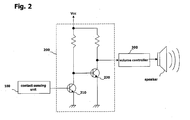
- Figure 2 is a schematic block circuit diagram showing an apparatus for controlling the speaker volume of a PTT phone in accordance with the present invention
- Figure 3 is a flow chart of a method for controlling the speaker volume of the PTT phone in accordance with the present invention.
- the PTT phone to which the present invention is applied includes a program and hardware for executing the method of the present invention.
- the hardware of the PTT phone includes a microprocessor (MPU) operating the program and controlling other units, a PTT button for use during a PTT call, a separated type receiver-loud speaker or integrated type speaker, a key pad having a transmission key for use when making an ordinary mobile call, an LCD as an output unit, and a storage unit for storing the program and other information.
- MPU microprocessor
- step S10 and S20 when the PTT phone receives a call from the other party or a bell ringing of the PTT phone is sounded, the user answers with the PTT phone (steps S10 and S20).
- finger contact of the user with a contact sensing unit 100 formed at the PTT button of the PTT phone is sensed according to how the user holds the PTT phone (step S30).
- a first transistor 210 of a contact sense signal output unit 200 is turned on by an electrical signal of a small current generated when the contact occurs and applied to its base terminal from the contact sensing unit 100 while a second transistor 220 is turned off, so that the contact sense signal output unit 200 outputs a high level signal, namely, a contact sense signal (step S80).
- a volume controller 300 determines that the user is performing normal PTT call communication, by holding the PTT phone with a finger being in contact with the PTT button (i.e., a state that the user is facing the PTT phone) (step S90), and accordingly, controls the speaker volume to be normal with a currently set volume level (step S100).
- step S20 if the user mistakes the PTT call mode for an ordinary mobile call mode with respect to a call signal from the other party (step S10), so that the user would put the phone close to the ear to perform call communication, in this case, if a finger of the user is not in contact with the contact sensing unit 100 (steps S30 and S40), then, no signal is applied from the contact sensing unit 100 to the base of the first transistor 210, so that the first transistor 210 of the contact sense signal output unit 200 is turned off and the second transistor 220 is turned on, so that the contact sense signal output unit 200 outputs no signal or only a low level signal, namely, a non-contact sense signal.
- the volume controller 300 determines that the user has mistaken the PTT call for an ordinary mobile call because the user performs call communication, naturally holding the lower portion of the PTT phone with the hand without having a finger contact with the PTT button (step S60), and accordingly controls the speaker volume to be lowered one step from the currently set speaker volume (step S70).
- step S110 when the user performs call communication in response to a call signal from the other party, a voice signal of the other party is sounded through the receiver, so the volume of the speaker does not need to be adjusted (step S120).
- the speaker volume is adjusted through the above-described process.
- Figure 4 is a flow chart of a method for controlling a speaker volume of a PTT phone having a contact sensing unit formed at a portion where the user's face is to be in contact.
- the embodiment of the method illustrated in Figure 4 is similar to that of the method illustrated in Figure 3. Thus, the same reference numerals as those in Figure 3 are given and the same process as that in the method of Figure 3 is performed.
- the operation of the first and second transistors of the speaker volume unit of the PTT phone and a speaker volume control method are different from the former embodiment of Figure 3.
- the contact sensing unit 100 formed at a specific portion, such as the receiver portion, of the PTT phone senses a user's contact (steps S30 and S40)
- the first transistor 210 of the contact sense signal output unit 200 is turned on by the electrical signal of a small current generated when the contact occurs, while the second transistor 220 is turned off, to output a high level signal, namely, the contact sense signal (step S80).
- the volume controller 300 determines that the user has mistaken the PTT call (for which the user faces the PTT phone) as an ordinary mobile call (for which the user puts the PTT phone close to the ear) and performs communication (step S220), and controls the speaker volume to be one step lower than the currently set speaker volume (step S230). Contrary to the case where the speaker volume is adjusted to be a lower level when the user's contact with the contact sensing unit 100 of the PTT button is not sensed in the former embodiment of Figure 3, in this embodiment of Figure 4, the speaker volume is adjusted to be a lower level when user's contact with the contact sensing unit 100 is sensed.
- the contact sensing unit 100 and the contact sense signal output unit 200 of the PTT phone can be implemented through an optical sensor using a reflection principle of light in order to sense a user's contact.
- the contact sensing unit 100 and the contact sense signal output unit 200 also can be implemented by using switches.
- the apparatus and method for controlling a speaker volume of the PTT phone in accordance with the present invention have the following advantages.
- a user's holding of the PTT phone by the hand is sensed according to whether the user is in contact with the contact sensing unit provided at the PTT button or at the receiver, and the speaker volume is automatically adjusted according to a type of the holding (i.e., how the user is holding the PTT phone).
- a type of the holding i.e., how the user is holding the PTT phone.
Landscapes
- Engineering & Computer Science (AREA)
- Food Science & Technology (AREA)
- Signal Processing (AREA)
- Mechanical Engineering (AREA)
- Telephone Function (AREA)
- Mobile Radio Communication Systems (AREA)
- Telephone Set Structure (AREA)
Abstract
Description
Claims (25)
- A method for controlling a speaker volume of a push-to-talk (PTT) phone allowing call communication in an ordinary mobile call mode or in a PTT call mode, comprising:sensing whether a user's contact with a PTT button of the PTT phone is or not; andcontrolling a speaker volume of the PTT phone according to whether or not the user's contact with the PTT button is sensed.
- The method of claim 1, wherein the afore-mentioned steps are performed when the PTT phone is in the PTT call mode.
- The method of claim 1, wherein the PTT button has a touch switch function.
- The method of claim 1, wherein the contact is sensed by an electrical signal of a small current generated when the hand of the user is in contact with the PTT button.
- The method of claim 1, wherein the contact is sensed as a light generated from an optical sensor is reflected by the hand of the user when the user's hand is in contact with the PTT button.
- The method of claim 1, wherein the speaker is a receiver-speaker integrated type or separated type speaker.
- The method of claim 1, further comprising:outputting a contact sense signal when the user's contact with the PTT button is sensed.
- The method of claim 7, wherein the speaker volume is controlled in response to the contact sense signal.
- The method of claim 1, wherein when the user's contact with the PTT button is not sensed, the speaker volume is controlled to be lower than a currently set volume level.
- The method of claim 1, wherein when the user's contact with the PTT button is sensed, the currently set speaker volume is controlled to be maintained.
- A method for controlling a speaker volume of a PTT phone allowing communication in an ordinary mobile call mode and in a PTT call mode, wherein when a user's contact with a specific portion of the PTT phone is sensed in the PTT call mode, a contact sense signal is outputted to control the speaker volume of the PTT phone.
- The method of claim 11, wherein the contact is sensed by an electrical signal of a small current generated when a specific portion of the user's face is in contact with a specific portion of the PTT phone.
- The method of claim 11, wherein the contact is sensed by an optical sensor when the specific portion of the user's face is in contact with the specific portion of the PTT phone.
- The method of claim 11, wherein the speaker is a receiver-speaker integrated type or separated type speaker.
- The method of claim 11, wherein when the contact sense signal is not outputted, the currently set speaker volume is controlled to be maintained.
- The method of claim 11, wherein when the contact sense signal is outputted, the speaker volume is adjusted to be lower than the currently set volume level.
- The method of claim 11, wherein the specific portion of the PTT phone is a receiver of the PTT phone which contacts with the ear of the user or a certain portion of the PTT phone which contacts with the face of the user.
- An apparatus for controlling a speaker volume of a push-to-talk (PTT) phone allowing call communication in an ordinary mobile call mode and in a PTT call mode, comprising:a contact sensing unit for sensing contact with a user;a contact sense signal output unit for outputting a contact sense signal or a non-contact sense signal according to whether or not the contact sensing unit senses the user's contact; anda volume controller for controlling a speaker volume according to the sense signal or the non-contact sense signal.
- The apparatus of claim 18, wherein the contact sensing unit is provided at a PTT button of the PTT phone.
- The apparatus of claim 18, wherein the contact sensing unit is provided at a receiver of the PTT phone which contacts with the ear of the user or at a specific portion of the PTT phone which contacts with the face of the user.
- The apparatus of claim 18, wherein the contact sensing unit senses an electrical signal of a small current generated when the user is in contact therewith.
- The apparatus of claim 18, wherein the contact sensing unit senses the user's contact by using an optical sensor.
- The apparatus of claim 18, wherein the speaker is a receiver-speaker integrated type or separated type speaker.
- The apparatus of claim 18 or 19, wherein when a user's contact with the PTT button is not sensed, the volume controller outputs a non-contact sense signal to control the speaker volume to be lower than the currently set volume.
- The apparatus of claim 18 or 20, wherein when the ear of the user is in contact with a receiver of the PTT phone or when the face of the user is in contact with a specific portion of the PTT phone, the volume controller outputs the contact sense signal to control the speaker volume to be lower than a currently set volume level.
Applications Claiming Priority (2)
| Application Number | Priority Date | Filing Date | Title |
|---|---|---|---|
| KR1020040030755A KR100677321B1 (en) | 2004-04-30 | 2004-04-30 | Apparatus and method for controlling speaker volume in mobile communication terminal |
| KR2004030755 | 2004-04-30 |
Publications (2)
| Publication Number | Publication Date |
|---|---|
| EP1592141A2 true EP1592141A2 (en) | 2005-11-02 |
| EP1592141A3 EP1592141A3 (en) | 2011-11-09 |
Family
ID=34935827
Family Applications (1)
| Application Number | Title | Priority Date | Filing Date |
|---|---|---|---|
| EP05009232A Withdrawn EP1592141A3 (en) | 2004-04-30 | 2005-04-27 | Apparatus and method for controlling speaker volume of push-to-talk (PTT) phone |
Country Status (5)
| Country | Link |
|---|---|
| US (1) | US7702368B2 (en) |
| EP (1) | EP1592141A3 (en) |
| JP (1) | JP4176733B2 (en) |
| KR (1) | KR100677321B1 (en) |
| CN (1) | CN1716978B (en) |
Cited By (1)
| Publication number | Priority date | Publication date | Assignee | Title |
|---|---|---|---|---|
| EP2911375A1 (en) * | 2014-02-20 | 2015-08-26 | Samsung Electronics Co., Ltd | Electronic device and operating method thereof |
Families Citing this family (23)
| Publication number | Priority date | Publication date | Assignee | Title |
|---|---|---|---|---|
| WO2006053185A2 (en) * | 2004-11-10 | 2006-05-18 | Bae Systems Information And Electronic Systems Integration Inc. | Wearable portable device for establishing communications interoperability at an incident site |
| KR100668341B1 (en) * | 2005-06-29 | 2007-01-12 | 삼성전자주식회사 | Method and apparatus for inputting a function of a portable terminal using a user's grip form. |
| KR100724928B1 (en) * | 2006-01-13 | 2007-06-04 | 삼성전자주식회사 | Apparatus and method for call notification of PTT (Push―To―Talk) method in mobile communication system |
| US20070243835A1 (en) * | 2006-04-13 | 2007-10-18 | Motorola, Inc. | Enhanced push-to-talk button integrating haptic response |
| TW200835282A (en) * | 2007-02-07 | 2008-08-16 | Accton Technology Corp | Volume control process of a mobile device |
| US20090181723A1 (en) * | 2008-01-11 | 2009-07-16 | Koncelik Jr Lawrence J | Apparatus and method for providing audio signal and/or visual indications of cell phone signal quality or signal strength |
| KR101544475B1 (en) * | 2008-11-28 | 2015-08-13 | 엘지전자 주식회사 | I / O control through touch |
| US20100297930A1 (en) * | 2009-05-20 | 2010-11-25 | Harris Technology, Llc | Portable Device with a Vehicle driver Detection |
| US20110044474A1 (en) * | 2009-08-19 | 2011-02-24 | Avaya Inc. | System and Method for Adjusting an Audio Signal Volume Level Based on Whom is Speaking |
| US8954177B2 (en) * | 2011-06-01 | 2015-02-10 | Apple Inc. | Controlling operation of a media device based upon whether a presentation device is currently being worn by a user |
| JPWO2013118429A1 (en) * | 2012-02-10 | 2015-05-11 | パナソニックIpマネジメント株式会社 | Electronics |
| JP6068841B2 (en) | 2012-06-25 | 2017-01-25 | 京セラ株式会社 | Portable terminal, control method, and control program |
| US9648409B2 (en) | 2012-07-12 | 2017-05-09 | Apple Inc. | Earphones with ear presence sensors |
| CN103167127A (en) * | 2012-08-07 | 2013-06-19 | 深圳市金立通信设备有限公司 | System and method for achieving incoming call mute of mobile phone based on range sensor and gesture operation |
| US20140057574A1 (en) * | 2012-08-24 | 2014-02-27 | Motorola Solutions, Inc. | Method and apparatus for controlling receive volume in a two-way radio system |
| US9344792B2 (en) | 2012-11-29 | 2016-05-17 | Apple Inc. | Ear presence detection in noise cancelling earphones |
| US9049508B2 (en) | 2012-11-29 | 2015-06-02 | Apple Inc. | Earphones with cable orientation sensors |
| US20140146982A1 (en) | 2012-11-29 | 2014-05-29 | Apple Inc. | Electronic Devices and Accessories with Media Streaming Control Features |
| CN104796166B (en) * | 2014-01-16 | 2018-12-11 | 海能达通信股份有限公司 | A kind of wireless accessory awakening method and wireless accessory |
| US9986075B2 (en) * | 2014-06-04 | 2018-05-29 | Qualcomm Incorporated | Mobile device including a substantially centrally located earpiece |
| US9923534B2 (en) * | 2014-07-31 | 2018-03-20 | E.F. Johnson Company | Automatic volume control for land mobile radio |
| US10321213B2 (en) | 2017-05-26 | 2019-06-11 | Motorola Solutions, Inc. | Remote speaker microphone with touch volume control |
| CN109889997B (en) * | 2019-04-26 | 2021-08-20 | 福建科立讯通信有限公司 | Automatic power control method for realizing individual calling of DMR (digital Mobile radio) or PDT (digital light-powered cordless telephone) interphone |
Citations (3)
| Publication number | Priority date | Publication date | Assignee | Title |
|---|---|---|---|---|
| US5448620A (en) | 1992-07-02 | 1995-09-05 | Motorola, Inc. | Volume control for a dual mode communications device |
| US5884156A (en) | 1996-02-20 | 1999-03-16 | Geotek Communications Inc. | Portable communication device |
| US20030034439A1 (en) | 2001-08-13 | 2003-02-20 | Nokia Mobile Phones Ltd. | Method and device for detecting touch pad input |
Family Cites Families (8)
| Publication number | Priority date | Publication date | Assignee | Title |
|---|---|---|---|---|
| US5684294A (en) * | 1996-10-17 | 1997-11-04 | Northern Telecom Ltd | Proximity and ambient light monitor |
| US20020044199A1 (en) * | 1997-12-31 | 2002-04-18 | Farhad Barzebar | Integrated remote control and phone |
| US6547620B1 (en) * | 1998-03-18 | 2003-04-15 | Brother Kogyo Kabushiki Kaisha | Communication apparatus, memory medium and method |
| US6349225B1 (en) * | 1999-04-01 | 2002-02-19 | Ericsson Inc. | Hearing protection for a wireless communications device |
| KR20010010545A (en) | 1999-07-21 | 2001-02-15 | 윤종용 | Apparatus for controlling receiving voice level in portabl telephone and method therefor |
| US6449363B1 (en) | 1999-11-09 | 2002-09-10 | Denso Corporation | Safety tilt mechanism for portable telephone including a speakerphone |
| JP4541674B2 (en) | 2003-09-30 | 2010-09-08 | 株式会社フジミインコーポレーテッド | Polishing composition |
| US7366535B2 (en) * | 2004-04-21 | 2008-04-29 | Nokia Corporation | Push-to-talk mobile communication terminals |
-
2004
- 2004-04-30 KR KR1020040030755A patent/KR100677321B1/en not_active Expired - Fee Related
-
2005
- 2005-04-05 JP JP2005109257A patent/JP4176733B2/en not_active Expired - Fee Related
- 2005-04-27 EP EP05009232A patent/EP1592141A3/en not_active Withdrawn
- 2005-04-29 US US11/117,605 patent/US7702368B2/en not_active Expired - Fee Related
- 2005-04-30 CN CN2005100837375A patent/CN1716978B/en not_active Expired - Fee Related
Patent Citations (3)
| Publication number | Priority date | Publication date | Assignee | Title |
|---|---|---|---|---|
| US5448620A (en) | 1992-07-02 | 1995-09-05 | Motorola, Inc. | Volume control for a dual mode communications device |
| US5884156A (en) | 1996-02-20 | 1999-03-16 | Geotek Communications Inc. | Portable communication device |
| US20030034439A1 (en) | 2001-08-13 | 2003-02-20 | Nokia Mobile Phones Ltd. | Method and device for detecting touch pad input |
Cited By (2)
| Publication number | Priority date | Publication date | Assignee | Title |
|---|---|---|---|---|
| EP2911375A1 (en) * | 2014-02-20 | 2015-08-26 | Samsung Electronics Co., Ltd | Electronic device and operating method thereof |
| US9490876B2 (en) | 2014-02-20 | 2016-11-08 | Samsung Electronics Co., Ltd. | Electronic device and operating method thereof |
Also Published As
| Publication number | Publication date |
|---|---|
| EP1592141A3 (en) | 2011-11-09 |
| CN1716978B (en) | 2011-08-31 |
| KR100677321B1 (en) | 2007-02-02 |
| US20050250553A1 (en) | 2005-11-10 |
| JP4176733B2 (en) | 2008-11-05 |
| US7702368B2 (en) | 2010-04-20 |
| CN1716978A (en) | 2006-01-04 |
| KR20050105031A (en) | 2005-11-03 |
| JP2005318575A (en) | 2005-11-10 |
Similar Documents
| Publication | Publication Date | Title |
|---|---|---|
| EP1592141A2 (en) | Apparatus and method for controlling speaker volume of push-to-talk (PTT) phone | |
| JP3666672B2 (en) | Communication terminal device | |
| US6915143B2 (en) | Portable telephone | |
| CN101198130A (en) | Portable terminal device and control method thereof | |
| US6547620B1 (en) | Communication apparatus, memory medium and method | |
| JP4183627B2 (en) | Hands-free system and incoming call receiving method thereof | |
| US20040253992A1 (en) | Method for managing incoming calls on a mobile phone | |
| US20070072642A1 (en) | Mobile communication terminal and method | |
| KR100678166B1 (en) | A method of setting an output volume of an audio signal for preventing acoustic shock and a mobile communication terminal therefor | |
| JP2003037656A (en) | Mobile telephone set and back light control method therefor | |
| CN101616499B (en) | Wireless communication device and operation method thereof | |
| US6055309A (en) | Circuit and method for automatically cutting off a speech path and converting to a standby state upon completion of speakerphone speech in a cordless telephone | |
| JP2002101193A (en) | Mobile phone | |
| JP3513271B2 (en) | Portable communication device and data terminal connected to the portable communication device | |
| KR100372862B1 (en) | Telephone having speaker and device of controlling speakers | |
| JPH1168931A (en) | Mobile phone equipment | |
| KR100321228B1 (en) | A earphone with various function | |
| JP2004064291A (en) | Mobile phone terminals | |
| KR100277069B1 (en) | How to Call a Caller on Your Phone | |
| KR20010048817A (en) | Method for voice dialing by ear-mike in wireless telecommunication set | |
| JP2974289B2 (en) | Wireless telephone | |
| KR20050043294A (en) | Method and apparutus for controlling power in mobile phone | |
| KR100678219B1 (en) | Apparatus and method for status display by sound of a mobile communication terminal to which an earphone-microphone is detachably connected | |
| JPH1127375A (en) | Voice communication device | |
| JP2001339505A (en) | Telephone set |
Legal Events
| Date | Code | Title | Description |
|---|---|---|---|
| PUAI | Public reference made under article 153(3) epc to a published international application that has entered the european phase |
Free format text: ORIGINAL CODE: 0009012 |
|
| AK | Designated contracting states |
Kind code of ref document: A2 Designated state(s): AT BE BG CH CY CZ DE DK EE ES FI FR GB GR HU IE IS IT LI LT LU MC NL PL PT RO SE SI SK TR |
|
| AX | Request for extension of the european patent |
Extension state: AL BA HR LV MK YU |
|
| PUAL | Search report despatched |
Free format text: ORIGINAL CODE: 0009013 |
|
| AK | Designated contracting states |
Kind code of ref document: A3 Designated state(s): AT BE BG CH CY CZ DE DK EE ES FI FR GB GR HU IE IS IT LI LT LU MC NL PL PT RO SE SI SK TR |
|
| AX | Request for extension of the european patent |
Extension state: AL BA HR LV MK YU |
|
| RIC1 | Information provided on ipc code assigned before grant |
Ipc: H04M 1/60 20060101ALI20110930BHEP Ipc: H04B 1/38 20060101AFI20110930BHEP |
|
| 17P | Request for examination filed |
Effective date: 20111020 |
|
| 17Q | First examination report despatched |
Effective date: 20120404 |
|
| AKX | Designation fees paid |
Designated state(s): AT BE BG CH CY CZ DE DK EE ES FI FR GB GR HU IE IS IT LI LT LU MC NL PL PT RO SE SI SK TR |
|
| STAA | Information on the status of an ep patent application or granted ep patent |
Free format text: STATUS: THE APPLICATION IS DEEMED TO BE WITHDRAWN |
|
| 18D | Application deemed to be withdrawn |
Effective date: 20141001 |