EP1591959A1 - Method of generating high-resolution image, digital image editing tool and computer readable medium - Google Patents
Method of generating high-resolution image, digital image editing tool and computer readable medium Download PDFInfo
- Publication number
- EP1591959A1 EP1591959A1 EP05009258A EP05009258A EP1591959A1 EP 1591959 A1 EP1591959 A1 EP 1591959A1 EP 05009258 A EP05009258 A EP 05009258A EP 05009258 A EP05009258 A EP 05009258A EP 1591959 A1 EP1591959 A1 EP 1591959A1
- Authority
- EP
- European Patent Office
- Prior art keywords
- resolution
- low
- image
- estimated
- resolution image
- Prior art date
- Legal status (The legal status is an assumption and is not a legal conclusion. Google has not performed a legal analysis and makes no representation as to the accuracy of the status listed.)
- Withdrawn
Links
Images






Classifications
-
- G—PHYSICS
- G06—COMPUTING OR CALCULATING; COUNTING
- G06T—IMAGE DATA PROCESSING OR GENERATION, IN GENERAL
- G06T3/00—Geometric image transformations in the plane of the image
- G06T3/40—Scaling of whole images or parts thereof, e.g. expanding or contracting
- G06T3/4053—Scaling of whole images or parts thereof, e.g. expanding or contracting based on super-resolution, i.e. the output image resolution being higher than the sensor resolution
Definitions
- the present invention relates generally to image processing and in particular to a method and system of generating a high-resolution image from a set of low-resolution images.
- U.S. Patent No. 5,696,848 to Patti et al. discloses a method of creating a high-resolution image from a sequence or low-resolution images. During the method, a low-resolution image is selected as a reference image to be reconstructed into a high-resolution image. Mapping transformations are produced to map pixels in each low-resolution image into locations of the high-resolution image using motion vectors. The accuracy of motion detection estimation for the motion vectors for each low-resolution image is detected to create an accuracy map.
- mapping transformations accuracy map, aperture time, sensor geometry, optical blur point spread function (PSF) and high-resolution sampling geometry are used to compute a blur PSF.
- the accuracy map, blur PSF, motion information from the mapping transformations and the low-resolution images are then used to create the high-resolution image.
- U.S. Patent Nos. 5,657,402 and 5,920,657 to Bender et al. disclose a method of creating a high-resolution still image from a plurality of low-resolution image frames. During the method, each image frame is scaled up and the transformation data is mapped into a larger data space representing the high-resolution image. Motion vectors are calculated to allow pixels in one low-resolution image frame to be mapped to the pixels in another low-resolution image frame. Pixels from one low-resolution image frame are then mapped into pixels of the next low-resolution image frame and interpolations are performed to fill spaces between points in the mapped image frames. When larger displacements between image frames occurs, pyramid data structures are used.
- U.S. Patent No. 6,285,804 to Crinon et al. discloses a method of creating a high-resolution image from multiple low-resolution images. During the method, motion vectors that map high-resolution sampling grid points to inter-pixel positions on the low-resolution images are derived. Pixels in the low-resolution images having the shortest distance to each inter-pixel position are identified. One of the identified low-resolution pixels at each high-resolution grid point is selected. Pixel intensity values are mapped to the high-resolution grid points according to the selected low-resolution pixels by interpolation.
- a method of producing a high-resolution image from a set of low-resolution images comprising:
- the high-resolution errors are averaged to generate the high-resolution error image.
- the medians of corresponding pixels in the high-resolution errors is determined and the medians used to generate the high-resolution error image.
- corresponding pixels in the high-resolution errors are sorted, selected sorted pixels are discarded and the remaining corresponding pixels averaged to generate the high-resolution error image.
- the source low-resolution images are registered, averaged and then scaled to high-resolution space thereby to yield the estimated high-resolution image.
- the scaling is performed using a bilinear stretching method.
- a transform matrix for each source low-resolution image in the set is generated that projects the source low-resolution image onto a designated source low-resolution image of the set.
- the transform matrices are used during transformation of the estimated high-resolution image into estimated low-resolution images and during transformation of the low-resolution errors into high-resolution errors.
- a method of creating a high-resolution image comprising:
- a digital image editing tool for generating a high-resolution image from a set of source low-resolution images comprising:
- a computer readable medium embodying a computer program for generating a high-resolution image from a set of source low-resolution images comprising:
- the present invention provides advantages in that high quality, high-resolution images can be generated quickly and efficiently from a set of source low-resolution images of varying quality.
- the present invention relates generally to a method and system of generating a high quality, high-resolution image from a set of registered or aligned low-resolution images, commonly referred to as super-resolution.
- an initial high-resolution image is estimated by interpolating the average of aligned input source low-resolution images.
- Simulated low-resolution images are then generated from the initial high-resolution estimate image.
- the simulated low-resolution images are compared with the input source low-resolution images to generate feedback error data.
- the feedback error data is then used to update the initial high-resolution estimate image.
- the above steps are performed iteratively until an estimated high-resolution image of desired quality is created.
- the present invention can be embodied in a software application executed by a processing unit such as a personal computer or the like.
- the software application may run as a stand-alone digital image editing tool or may be incorporated into other available digital image editing applications to provide enhanced functionality to those digital image editing applications.
- each low-resolution image includes a pixel matrix L of size [L 1 ⁇ L 2 ].
- the source low-resolution images in the set from which the desired high-resolution image is to be generated are registered (step 100).
- a high-resolution image is estimated based on the registered source low-resolution images (step 102).
- the estimated high-resolution image includes a pixel matrix H of size [H 1 ⁇ H 2 ].
- the estimated high-resolution image is then transformed into a set of estimated low-resolution images (step 104).
- the set of estimated low-resolution images is then compared with the source low-resolution images to generate a set of low-resolution errors, each including a pixel matrix E L (step 106).
- the set of low-resolution errors is then transformed into a set of high-resolution errors, each including a pixel matrix E H (step 108).
- An estimated high-resolution error image is then generated from the set of high-resolution errors (step 110).
- the high-resolution error image includes a pixel matrix EI H .
- the estimated high-resolution error image is combined with the high-resolution image estimated at step 102 resulting in an updated estimated high-resolution image (step 112). Steps 104 to 112 are performed iteratively until an estimated high-resolution image is generated that exhibits the desired resolution. Further specifics of the above-described method will now be described with reference to Figures 1 and 3.
- each low-resolution image I is registered with the next adjoining low-resolution image I' to its right in order using a feature-based registration approach.
- features corresponding to high curvature points in the adjoining low-resolution images I and I' are extracted and corners within the features are detected.
- a 7x7 pixel window is used to filter out closed corners within a small neighbourhood surrounding each feature.
- the first three hundred corners c(x,y) detected in each of the adjoining low-resolution images I and I' are used. If the number of detected corners in the adjoining low-resolution images I and I' is less than three hundred, all of the detected corners are used.
- a correlation for all corners c' in low-resolution image I' is made. This is equivalent to searching the entire low-resolution image I' for each corner c of low-resolution image I.
- a window centered at corner c and c' is used to determine the correlation between the corners c and c'.
- Normalized cross correlation NCC is used for calculating a correlation score between corners c(u,v) in low-resolution image I and corners c'(u',v') in low-resolution image I'.
- the normalized cross correlation NCC is expressed as:
- the correlation score ranges from minus 1, for two correlation windows that are not similar at all, to 1 for two correlation windows that are identical.
- a threshold is applied to choose the matching pairs of corners. In this example, a threshold value equal to 0.6 is used although the threshold value may change for particular applications.
- a list of corners is obtained in which each corner c in low-resolution image I has set of candidate matching corners c' in low-resolution image I'.
- the maximum permissible number of candidate matching corners is set to 20, so that each corner c in low-resolution image I possibly has 0 to 20 candidate matching corners in low-resolution image I'.
- a relaxation technique is used to disambiguate the matching corners. For the purposes of relaxation it is assumed that a candidate matching corner pair (c, c') exists where c is a corner in low-resolution image I and c' is a corner in low-resolution image I'. Let ⁇ (c) and ⁇ (c') be the neighbour corners of corners c and c' within a neighbourhood of NxM pixels.
- candidate matching corner pair (c, c') is a good match
- many other matching corner pairs (g, g') will be seen within the neighbourhood where g is a corner of ⁇ (c) and g' is a corner of ⁇ (c') such that the position of corner g relative to corner c will be similar to that of corner g' relative to corner c'.
- candidate matching corner pair (c, c') is a bad match, only a few or perhaps no matching corner pairs in the neighbourhood will be seen.
- a score of matching SM is used to measure the likelihood that candidate matching corners c and c' are in fact the same corners according to: where:
- angle of rotation in the image plane is less than 60 degrees.
- the angle between vectors and is checked to determine if it is larger than 60 degrees and if so, ⁇ (c, c'; g, g') takes the value of 0.
- the candidate matching corner c' in the set that yields the maximum score of matching SM is selected as the matching corner.
- a projective transform is used to estimate the transform detailing the transformation between each pair of adjoining low-resolution images.
- an affine transform or a translation may be used to estimate the transform if only non-projective motion in the set of source low-resolution images exists. As will be appreciated, estimating an affine transform or a translation is easier and thus faster than estimating a projective transform.
- a random sample consensus algorithm (RANSAC) based technique is used. Initially, N pairs of matching corners are chosen from the registration matrix and a projective transform detailing the transformation between the matching corners is estimated by solving a set of linear equations modeling the projective transform. The estimated projective transform is then evaluated by examining the support from other pairs of matching corners. This process is performed using other sets of randomly chosen N pairs of matching corners. The projective transform that supports the maximum number of corner matches is selected. In particular, the above-described process is carried out following the procedure below:
- M For transform matrix M having the form: Then M should satisfy the following constraint: a 11 ⁇ (0.5,1.7), a 12 ⁇ 0.8, a 13 ⁇ W , a 21 ⁇ 0.8, a 12 ⁇ (0.5,1.7), a 23 ⁇ H , a 31 ⁇ 0.1, a 23 ⁇ 0.1. in which, W and H are the width and height of the image, respectively.
- a two-step estimation is used. Initially, a maximum number of 250 iterations for projective transform estimation is performed. If the estimation fails, 2000 iterations are performed for projective transform estimation. If the estimation process still does not succeed, a translation is estimated as will now be described.
- a matched corner pair supports the translation if and only if the translated corner in low-resolution image I' falls within a 3x3 pixel neighbourhood of its corresponding corner in the low-resolution image I.
- an affine transform is to be estimated a similar procedure to that described with respect to projective transform estimation is performed, using the appropriate set of linear equations that model the affine transform. Theoretically to estimate the affine transform only three pairs of matching corners are needed. To avoid the situation where a pair of matching corners is dependent resulting in a singular matrix, at least four pairs of matching corners are required for a successful affine transform estimation to be determined.
- a maximum number of 100 iterations is initially performed. If the estimation fails, 1000 iterations are performed. If the estimation process still does not succeed, the translation is estimated.
- step 102 With the source low-resolution images registered, during step 102 the registered source low-resolution images are averaged and the resultant averaged image is scaled to high-resolution space using a bilinear stretching method (step 120) thereby to yield the initial estimated high-resolution image (step 122).
- the resultant averaged image is stretched by filling in undefined pixels through bilinear interpolation.
- bilinear interpolation a linear interpolation is made along each pixel row of the resultant averaged image followed by a linear interpolation down each column of the resultant averaged image.
- Each estimated pixel in the initial estimated high ⁇ resolution image is therefore a weighted combination of its four nearest neighbors in the resultant averaged image.
- the estimated high-resolution image is transformed into the set of estimated low-resolution images by firstly multiplying the transform matrices M generated during image registration on the estimated high-resolution image matrix H to generate transformed images and then by downsampling the transformed images to low-resolution space (step 124) thereby to yield the set of estimated low-resolution images (step 126).
- each estimated low-resolution image is subtracted from its corresponding source low-resolution image (step 128) to yield a low-resolution error for that estimated low-resolution image (step 130).
- each low-resolution error is upsampled to high-resolution space.
- the upsampled low-resolution errors are then transformed into a set of high-resolution errors by applying the inverses of the transform matrices M generated during image registration on the upsampled low-resolution errors (step 132), thereby to yield the set of high-resolution errors (step 134).
- the high-resolution errors are combined and averaged (step 136) to determine the mean of the pixels in the high-resolution errors thereby to yield the estimated high-resolution error image (step 138).
- the estimated high-resolution error image is then added to the estimated high-resolution image (step 140) thereby to update the estimated high-resolution image.
- the combining and averaging of the high-resolution errors can be modified.
- the medians of corresponding pixels in the high-resolution errors can be calculated and the medians used to yield the estimated high-resolution error image.
- corresponding pixels in the high-resolution errors can be sorted in order and the highest and lowest pixels discarded so that only the intermediate pixels in the high-resolution errors are averaged to yield the estimated high-resolution error image.
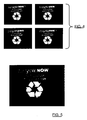
- Figures 4 to 11 show the results at the various steps of the high-resolution image generating method during processing of a set of four source low-resolution images (see Figure 4) to generate a high-resolution image.
- Figure 5 shows a high-resolution image estimated from the source low-resolution images of Figure 4 after the low-resolution images have been registered and then scaled to high-resolution space (steps 100 and 120).
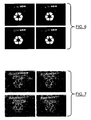
- Figure 6 shows the resultant set of estimated low-resolution images 126 generated by transforming and downsampling the estimated high-resolution image (step 124).
- Figure 7 shows the low-resolution errors 130 generated by subtracting the estimated low-resolution images of Figure 6 from the source low-resolution images of Figure 4 (step 128).
- Figure 8 shows the high-resolution errors 134 generated by upsampling and transforming the low-resolution errors of Figure 7 (step 132).
- Figure 9 shows the estimated high-resolution error image 138 generated from the high-resolution errors of Figure 8 (step 136) and
- Figure 10 shows the updated estimated high-resolution image generated by combining the estimated high-resolution error image of Figure 9 with the estimated high-resolution image of Figure 5.
- Figure 11 shows the updated estimated high-resolution image following five (5) iterations of steps 102 to 112.
- Figure 12 shows the estimated high-resolution error image generated at step 136 from the high-resolution errors of Figure 8 when the medians of the pixels in the high-resolution errors are calculated and averaged.
- Figure 13 shows the updated estimated high-resolution image generated by combining the high-resolution error image of Figure 12 with the estimated high-resolution image of Figure 5.
- Figure 14 shows the updated estimated high-resolution image following five (5) iterations of steps 102 to 112.
- Figure 15 shows the estimated high-resolution error image generated at step 136 from the high-resolution errors of Figure 8 when the pixels in the high-resolution errors are sorted in order and the highest and lowest pixels are discarded so that only the intermediate pixels in the high-resolution errors are averaged.
- Figure 16 shows the updated estimated high-resolution image generated by combining the high-resolution error image of Figure 15 with the estimated high-resolution image of Figure 5.
- Figure 17 shows the updated estimated high-resolution image following five (5) iterations of steps 102 to 112.
- the present invention allows high-quality, high-resolution images to be generated from a set of source low-resolution images quickly and efficiently. By controlling the number of iterations, high-resolution images of the desired quality can be obtained.
- the present invention can be embodied as computer readable program code stored on a computer readable medium.
- the computer readable medium is any data storage device that can store data, which can thereafter be read by a computer system. Examples of computer readable medium include read-only memory, random-access memory, CD-ROMs, magnetic tape and optical data storage devices.
- the computer readable program code can also be distributed over a network including coupled computer systems so that the computer readable program code is stored and executed in a distributed fashion.
Landscapes
- Physics & Mathematics (AREA)
- General Physics & Mathematics (AREA)
- Engineering & Computer Science (AREA)
- Theoretical Computer Science (AREA)
- Image Processing (AREA)
- Editing Of Facsimile Originals (AREA)
- Television Systems (AREA)
Abstract
Description
When larger displacements between image frames occurs, pyramid data structures are used.



- λ = 0.3 is a threshold based on the relative distance difference.



Claims (35)
- A method of generating a high-resolution image from a set of source low-resolution images comprising:(a) estimating a high-resolution image based on the set of source low-resolution images;(b) transforming the estimated high-resolution image into a set of estimated low-resolution images;(c) comparing the set of source low-resolution images with the set of estimated low-resolution images to generate a set of low-resolution errors;(d) transforming the set of low-resolution errors into a set of high-resolution errors;(e) generating a high-resolution error image based on the set of high-resolution errors;(f) combining the high-resolution error image with the estimated high resolution image to yield an updated estimated high-resolution image; and(g) repeating steps (b) to (f) until the updated estimated high-resolution image is of a desired quality.
- The method of claim 1 wherein during said generating the high-resolution errors are averaged to generate said high-resolution error image.
- The method of claim 1 wherein the medians of corresponding pixels in the high-resolution errors is determined and the medians used to generate said high-resolution error image.
- The method of claim 2 wherein corresponding pixels in the high-resolution errors are sorted, selected sorted pixels are discarded and the remaining corresponding pixels averaged to generate said high-resolution error image.
- The method of claim 4 wherein the selected sorted pixels are the highest and lowest sorted pixels.
- The method of claim 1 wherein during said estimating, the source low-resolution images are registered, averaged and then scaled to high-resolution space thereby to yield said estimated high-resolution image.
- The method of claim 6 wherein scaling is performed using a bilinear stretching method.
- The method of claim 6 wherein during said registration, a transform matrix for each source low-resolution image in said set is generated that projects said source low-resolution image onto a designated source low-resolution image of said set.
- The method of claim 8 wherein said transforming at step (b) comprises:transforming the estimated high-resolution image using said transform matrices; anddownsampling the transformed estimated high-resolution images thereby to yield said set of estimated low-resolution images.
- The method of claim 9 wherein said transforming at step (d) comprises:upsampling the low-resolution errors; andtransforming the upsampled low-resolution errors using inverses of said transform matrices thereby to yield said set of high-resolution errors.
- The method of claim 10 wherein during said generating, the high-resolution errors are averaged to generate said high-resolution error image.
- The method of claim 10 wherein the medians of corresponding pixels in the high-resolution errors is determined and the medians used to generate said high-resolution error image.
- The method of claim 10 wherein corresponding pixels in the high-resolution errors are sorted, selected sorted pixels are discarded and the remaining corresponding pixels averaged to generate said high-resolution error image.
- The method of claim 13 wherein the selected sorted pixels are the highest and lowest sorted pixels.
- The method of claim 6 wherein during registering of said low-resolution images, matching corners in adjoining low-resolution images I and I' are determined and a transform between each adjoining pair of low-resolution images based on said matching corners is estimated.
- The method of claim 15 wherein registering each pair of adjoining low-resolution images I and I' comprises:extracting features in each of said low-resolution images I and I' corresponding to high curvature points therein;determining corners adjacent said features; andmatching the corners of low-resolution image I to corresponding corners of low-resolution image I' thereby to register said low-resolution images I and I'.
- The method of claim 16 wherein during said determining, corners within a neighbourhood surrounding said features are detected.
- The method of claim 17 wherein said determining is performed until a threshold number of corners is detected.
- The method of claim 18 wherein during said matching, each detected corner in low-resolution image I' is compared with each detected corner in low-resolution image I to determine matching corners in said low-resolution images I and I'.
- The method of claim 19 wherein said comparing includes the steps of:determining the correlation between each detected corner in low-resolution image I' with each detected corner in low-resolution image I to yield a list of corners in which each corner in low-resolution image I has a set of candidate matching corners in low-resolution image I';measuring the likelihood that each of the candidate matching corners in said set corresponds to the associated corner in low-resolution image I; andselecting one of the candidate matching corners in said set.
- The method of claim 20 wherein during said correlation determining, a normalized cross correlation is used to calculate a correlation score between each detected corner in low-resolution image I' with each detected corner in low-resolution image I, correlation scores above a threshold level signifying a candidate matching corner.
- The method of claim 21 wherein said correlation determining is performed until a threshold number of candidate matching corners is determined thereby to form said set.
- The method of claim 22 wherein during said measuring, a score of matching is used to measure the likelihood that each of the candidate matching corners in said set corresponds to the associated corner in low resolution image I based on other matching corner pairs within a neighbourhood surrounding the corners being matched.
- A method of creating a high-resolution image comprising:estimating an initial high-resolution image by interpolating the average of aligned source low-resolution images;generating downsampled estimated low-resolution images from said initial high-resolution image;comparing the estimated low-resolution images with the source low-resolution images and generating feedback error data; andusing the feedback error data to update the estimated high-resolution image, wherein the estimating, generating and comparing steps are iteratively performed until the estimated high-resolution image is of a desired resolution.
- The method of claim 24 wherein the source low-resolution images are aligned using a matching features-based technique.
- The method of claim 25 wherein said feedback error data is upsampled and averaged prior to being used to update the estimated high-resolution image.
- The method of claim 26 wherein a modified averaging technique is used to modify the upsampled feedback error data prior to being used to update the estimated high-resolution image.
- A digital image editing tool for generating a high-resolution image from a set of source low-resolution images comprising:means for estimating a high-resolution image based on the set of source low-resolution images;first means for transforming the estimated high-resolution image into a set of estimated low-resolution images;means for comparing the set of source low-resolution images with the set of estimated low-resolution images to generate a set of low-resolution errors;second means for transforming the set of low-resolution errors into a set of high-resolution errors;means for generating a high-resolution error image based on said set of high-resolution errors; andmeans for combining the high-resolution error image with the estimated high resolution image to yield an updated estimated high-resolution image, wherein said first transforming means, comparing means, second transforming means, generating means and combining means being operated iteratively until the updated estimated high-resolution image is of a desired quality.
- A digital editing tool according to claim 28 wherein said generating means averages the high-resolution errors to generate said high-resolution error image.
- A digital editing tool according to claim 28 wherein said generating means determines the medians of corresponding pixels in the high-resolution errors and uses the medians to generate said high-resolution error image.
- A digital editing tool according to claim 29 wherein said generating means sorts corresponding pixels in the high-resolution errors, discards selected sorted pixels and averages the remaining corresponding pixels to generate said high-resolution error image.
- A digital editing tool according to claim 28 wherein said estimating means registers, averages and then scales the set of source low-resolution images to high resolution space thereby to yield said estimated high-resolution image.
- A digital editing tool according to claim 32 wherein scaling is performed using a bilinear stretching method.
- A computer readable medium embodying a computer program for generating a high-resolution image from a set of source low-resolution images comprising:computer program code for estimating a high-resolution image based on the set of source low-resolution images;computer program code for first transforming the estimated high-resolution image into a set of estimated low-resolution images;computer program code for comparing the set of source low-resolution images with the set of estimated low-resolution images to generate a set of low-resolution errors;computer program code for second transforming the set of low-resolution errors into a set of high-resolution errors;computer program code for generating a high-resolution error image based on said set of high-resolution errors;computer program code for combining the high-resolution error image with the estimated high resolution image to yield an updated estimated high-resolution image; andcomputer program code for iteratively conditioning the first transforming, comparing, second transforming, generating and combining computer program code until the updated estimated high-resolution image is of a desired quality.
- A method of generating a high-resolution image based on a plurality of source low-resolution images comprising:(a) estimating the high-resolution image based on the source low-resolution images;(b) transforming the estimated high-resolution image into low-resolution images;(c) generating an estimation error based on the source low-resolution images and the low-resolution images; and(d) updating the high-resolution image based on the estimation error.
Applications Claiming Priority (2)
| Application Number | Priority Date | Filing Date | Title |
|---|---|---|---|
| US10/833,612 US7352919B2 (en) | 2004-04-28 | 2004-04-28 | Method and system of generating a high-resolution image from a set of low-resolution images |
| US833612 | 2004-04-28 |
Publications (1)
| Publication Number | Publication Date |
|---|---|
| EP1591959A1 true EP1591959A1 (en) | 2005-11-02 |
Family
ID=34935845
Family Applications (1)
| Application Number | Title | Priority Date | Filing Date |
|---|---|---|---|
| EP05009258A Withdrawn EP1591959A1 (en) | 2004-04-28 | 2005-04-27 | Method of generating high-resolution image, digital image editing tool and computer readable medium |
Country Status (3)
| Country | Link |
|---|---|
| US (1) | US7352919B2 (en) |
| EP (1) | EP1591959A1 (en) |
| JP (1) | JP2005317011A (en) |
Cited By (3)
| Publication number | Priority date | Publication date | Assignee | Title |
|---|---|---|---|---|
| EP2073531A1 (en) * | 2007-12-13 | 2009-06-24 | Samsung Electronics Co., Ltd. | Method and apparatus for creating a combined image |
| EP2031558A3 (en) * | 2007-08-29 | 2010-07-28 | Kabushiki Kaisha TOPCON | Image measurement apparatus |
| WO2020093423A1 (en) * | 2018-11-09 | 2020-05-14 | Hong Kong Applied Science and Technology Research Institute Company Limited | Systems and methods for super-resolution synthesis based on weighted results from random forest classifier |
Families Citing this family (34)
| Publication number | Priority date | Publication date | Assignee | Title |
|---|---|---|---|---|
| JP4184319B2 (en) * | 2004-06-10 | 2008-11-19 | オリンパス株式会社 | Imaging device |
| WO2006003312A2 (en) * | 2004-06-16 | 2006-01-12 | Norbert Beyrard | Method for reducing exposure to infrared light beam, ultrasound or magnetic impulse rays in medical imaging devices |
| JP4151793B2 (en) * | 2004-11-15 | 2008-09-17 | オリンパス株式会社 | IMAGING DEVICE AND IMAGE RESOLUTION METHOD |
| US20070031063A1 (en) * | 2005-08-05 | 2007-02-08 | Hui Zhou | Method and apparatus for generating a composite image from a set of images |
| DE102006006449A1 (en) * | 2006-02-10 | 2007-08-16 | Siemens Ag | Method for operating an X-ray diagnostic device for generating high-resolution images |
| JP5157898B2 (en) * | 2006-03-30 | 2013-03-06 | 日本電気株式会社 | Image processing apparatus, image processing system, image processing method, and image processing program |
| WO2007115583A1 (en) * | 2006-04-12 | 2007-10-18 | Zoran (France) | Method and apparatus for robust super-resolution video scaling |
| JPWO2007122838A1 (en) * | 2006-04-25 | 2009-09-03 | 国立大学法人 奈良先端科学技術大学院大学 | Super-resolution method and super-resolution program based on hierarchical Bayesian method |
| WO2008026518A1 (en) * | 2006-08-31 | 2008-03-06 | Panasonic Corporation | Image processing device, image processing method, and image processing program |
| JP4670058B2 (en) * | 2006-10-25 | 2011-04-13 | 国立大学法人東京工業大学 | High resolution image generation method |
| US8747952B2 (en) * | 2007-01-19 | 2014-06-10 | Airbus Operations Gmbh | Materials and processes for coating substrates having heterogeneous surface properties |
| US8832290B2 (en) | 2007-02-23 | 2014-09-09 | Microsoft Corporation | Smart pre-fetching for peer assisted on-demand media |
| US7889949B2 (en) * | 2007-04-30 | 2011-02-15 | Microsoft Corporation | Joint bilateral upsampling |
| JP5076755B2 (en) * | 2007-09-07 | 2012-11-21 | ソニー株式会社 | Image processing apparatus, image processing method, and computer program |
| US8200046B2 (en) | 2008-04-11 | 2012-06-12 | Drs Rsta, Inc. | Method and system for enhancing short wave infrared images using super resolution (SR) and local area processing (LAP) techniques |
| JP4565016B2 (en) * | 2008-05-16 | 2010-10-20 | キヤノン株式会社 | Image processing apparatus, image processing method and program thereof, and computer-readable storage medium storing the program |
| US8270770B1 (en) * | 2008-08-15 | 2012-09-18 | Adobe Systems Incorporated | Region-based dense feature correspondence |
| JP4758493B2 (en) * | 2009-04-03 | 2011-08-31 | シャープ株式会社 | Portable terminal device, captured image processing system, control method for portable terminal device, program, and recording medium |
| US20100277774A1 (en) * | 2009-05-04 | 2010-11-04 | Certifi Media Inc. | Image quality indicator responsive to image processing |
| US20110102915A1 (en) * | 2009-10-30 | 2011-05-05 | Michael Pham | Device to create high definition photos |
| KR20110048252A (en) * | 2009-11-02 | 2011-05-11 | 삼성전자주식회사 | Method and apparatus for converting images based on motion vector sharing |
| US8558899B2 (en) * | 2009-11-16 | 2013-10-15 | The Aerospace Corporation | System and method for super-resolution digital time delay and integrate (TDI) image processing |
| US8339470B2 (en) * | 2009-11-30 | 2012-12-25 | Indian Institute Of Technology Madras | Method and system for generating a high resolution image |
| JP4991887B2 (en) * | 2010-01-13 | 2012-08-01 | シャープ株式会社 | Captured image processing system, control method for captured image processing system, program, and recording medium |
| US8306274B2 (en) | 2010-05-25 | 2012-11-06 | The Aerospace Corporation | Methods for estimating peak location on a sampled surface with improved accuracy and applications to image correlation and registration |
| US8368774B2 (en) * | 2010-11-22 | 2013-02-05 | The Aerospace Corporation | Imaging geometries for scanning optical detectors with overlapping fields of regard and methods for providing and utilizing same |
| US9147260B2 (en) * | 2010-12-20 | 2015-09-29 | International Business Machines Corporation | Detection and tracking of moving objects |
| US8810727B1 (en) * | 2013-05-07 | 2014-08-19 | Qualcomm Technologies, Inc. | Method for scaling channel of an image |
| TWI502548B (en) * | 2013-06-14 | 2015-10-01 | Vivotek Inc | Real-time image processing method and device therefor |
| US9076236B2 (en) | 2013-09-12 | 2015-07-07 | At&T Intellectual Property I, L.P. | Guided image upsampling using bitmap tracing |
| KR102263696B1 (en) * | 2015-03-20 | 2021-06-10 | 삼성전자주식회사 | Method and appratus for transmitting and receiving data in wireless communication system |
| US10284875B2 (en) | 2016-08-08 | 2019-05-07 | Qualcomm Incorporated | Systems and methods for determining feature point motion |
| JP7719778B2 (en) * | 2019-12-31 | 2025-08-06 | クァンティファイド・エナジー・ラボス・ピーティーイー・リミテッド | Method, system, and image processing device for capturing and/or processing electroluminescence images, and aircraft |
| CN113237554B (en) * | 2021-05-07 | 2022-04-26 | 国家卫星气象中心(国家空间天气监测预警中心) | Method, device and terminal device for generating image of surface temperature under cloud |
Family Cites Families (18)
| Publication number | Priority date | Publication date | Assignee | Title |
|---|---|---|---|---|
| US5657402A (en) * | 1991-11-01 | 1997-08-12 | Massachusetts Institute Of Technology | Method of creating a high resolution still image using a plurality of images and apparatus for practice of the method |
| US5325449A (en) * | 1992-05-15 | 1994-06-28 | David Sarnoff Research Center, Inc. | Method for fusing images and apparatus therefor |
| JP3182015B2 (en) * | 1993-01-27 | 2001-07-03 | テキサス インスツルメンツ インコーポレイテツド | Optical image synthesis method |
| US5696848A (en) * | 1995-03-09 | 1997-12-09 | Eastman Kodak Company | System for creating a high resolution image from a sequence of lower resolution motion images |
| JPH08256263A (en) * | 1995-03-17 | 1996-10-01 | Fuji Xerox Co Ltd | Image reader |
| JP3530696B2 (en) * | 1996-12-27 | 2004-05-24 | キヤノン株式会社 | Imaging device |
| US5982941A (en) * | 1997-02-07 | 1999-11-09 | Eastman Kodak Company | Method of producing digital image with improved performance characteristic |
| KR100519871B1 (en) * | 1997-12-22 | 2005-10-11 | 코닌클리케 필립스 일렉트로닉스 엔.브이. | Method and arrangement for creating a high-resolution still picture |
| JP4174122B2 (en) * | 1998-03-10 | 2008-10-29 | キヤノン株式会社 | Image processing method, apparatus, and recording medium |
| US6208765B1 (en) * | 1998-06-19 | 2001-03-27 | Sarnoff Corporation | Method and apparatus for improving image resolution |
| JP2000215317A (en) * | 1998-11-16 | 2000-08-04 | Sony Corp | Image processing method and image processor |
| US6285804B1 (en) * | 1998-12-21 | 2001-09-04 | Sharp Laboratories Of America, Inc. | Resolution improvement from multiple images of a scene containing motion at fractional pixel values |
| US7015954B1 (en) * | 1999-08-09 | 2006-03-21 | Fuji Xerox Co., Ltd. | Automatic video system using multiple cameras |
| US6466618B1 (en) * | 1999-11-19 | 2002-10-15 | Sharp Laboratories Of America, Inc. | Resolution improvement for multiple images |
| US7218751B2 (en) * | 2001-06-29 | 2007-05-15 | Digimarc Corporation | Generating super resolution digital images |
| JP2003069844A (en) * | 2001-08-24 | 2003-03-07 | Canon Inc | Image processing method and image processing apparatus |
| JP2004021436A (en) * | 2002-06-13 | 2004-01-22 | Oki Electric Ind Co Ltd | Method and apparatus for image composition correcting display, and program |
| JP4173705B2 (en) * | 2002-08-28 | 2008-10-29 | 富士フイルム株式会社 | Moving picture composition method, apparatus, and program |
-
2004
- 2004-04-28 US US10/833,612 patent/US7352919B2/en not_active Expired - Fee Related
-
2005
- 2005-04-25 JP JP2005126848A patent/JP2005317011A/en not_active Withdrawn
- 2005-04-27 EP EP05009258A patent/EP1591959A1/en not_active Withdrawn
Non-Patent Citations (3)
| Title |
|---|
| BATTIATO S ET AL: "Analysis and characterization of super-resolution reconstruction methods", PROCEEDINGS OF THE SPIE - THE INTERNATIONAL SOCIETY FOR OPTICAL ENGINEERING SPIE-INT. SOC. OPT. ENG USA, vol. 5017, 21 January 2003 (2003-01-21) - 23 January 2003 (2003-01-23), pages 323 - 331, XP002333489, ISSN: 0277-786X * |
| DOUGLAS LIM: "Achieving Accurate Image Registration as the Basis for Super-Resolution", 2003, THE UNIVERSITY OF WESTERN AUSTRALIA, XP002333488, Retrieved from the Internet <URL:http://www.csse.uwa.edu.au/~pk/studentprojects/douglaslim/DouglasLimThesis.pdf> [retrieved on 20050624] * |
| IRANI M ET AL: "IMPROVING RESOLUTION BY IMAGE REGISTRATION", CVGIP GRAPHICAL MODELS AND IMAGE PROCESSING, ACADEMIC PRESS, DULUTH, MA, US, vol. 53, no. 3, May 1991 (1991-05-01), pages 231 - 239, XP000200576, ISSN: 1077-3169 * |
Cited By (7)
| Publication number | Priority date | Publication date | Assignee | Title |
|---|---|---|---|---|
| EP2031558A3 (en) * | 2007-08-29 | 2010-07-28 | Kabushiki Kaisha TOPCON | Image measurement apparatus |
| US8300986B2 (en) | 2007-08-29 | 2012-10-30 | Kabushiki Kaisha Topcon | Image measurement apparatus for creating a panoramic image |
| EP2073531A1 (en) * | 2007-12-13 | 2009-06-24 | Samsung Electronics Co., Ltd. | Method and apparatus for creating a combined image |
| US8494306B2 (en) | 2007-12-13 | 2013-07-23 | Samsung Electronics Co., Ltd. | Method and an apparatus for creating a combined image |
| KR101464765B1 (en) * | 2007-12-13 | 2014-11-24 | 삼성전자주식회사 | Method and apparatus for generating combined image |
| WO2020093423A1 (en) * | 2018-11-09 | 2020-05-14 | Hong Kong Applied Science and Technology Research Institute Company Limited | Systems and methods for super-resolution synthesis based on weighted results from random forest classifier |
| US10685428B2 (en) | 2018-11-09 | 2020-06-16 | Hong Kong Applied Science And Technology Research Institute Co., Ltd. | Systems and methods for super-resolution synthesis based on weighted results from a random forest classifier |
Also Published As
| Publication number | Publication date |
|---|---|
| JP2005317011A (en) | 2005-11-10 |
| US7352919B2 (en) | 2008-04-01 |
| US20050244081A1 (en) | 2005-11-03 |
Similar Documents
| Publication | Publication Date | Title |
|---|---|---|
| EP1591959A1 (en) | Method of generating high-resolution image, digital image editing tool and computer readable medium | |
| JP5294343B2 (en) | Image alignment processing device, area expansion processing device, and image quality improvement processing device | |
| Protter et al. | Super resolution with probabilistic motion estimation | |
| US7565029B2 (en) | Method for determining camera position from two-dimensional images that form a panorama | |
| US7809211B2 (en) | Image normalization for computed image construction | |
| Li et al. | Video super-resolution using an adaptive superpixel-guided auto-regressive model | |
| US8098963B2 (en) | Resolution conversion apparatus, method and program | |
| CN106600538A (en) | Human face super-resolution algorithm based on regional depth convolution neural network | |
| CN107608447A (en) | For estimating the signal processor and method of the conversion between signal | |
| CN111914756A (en) | Video data processing method and device | |
| WO2013089265A1 (en) | Dictionary creation device, image processing device, image processing system, dictionary creation method, image processing method, and program | |
| US8903195B2 (en) | Specification of an area where a relationship of pixels between images becomes inappropriate | |
| WO2006046493A1 (en) | Method for speeding up super resolution processing | |
| CN106886978B (en) | Super-resolution reconstruction method of image | |
| US8213746B2 (en) | Super-resolution image processing | |
| JP2005253000A (en) | Image processing device | |
| JP4887376B2 (en) | A method for obtaining a dense parallax field in stereo vision | |
| KR102726834B1 (en) | Apparatus and method for estimating human pose based AI | |
| CN113269813A (en) | Registration method and device of digital pathological image | |
| Miravet et al. | Accurate and robust image superresolution by neural processing of local image representations | |
| JP5446516B2 (en) | Image processing device | |
| JP3781324B2 (en) | Image alignment method, fax character recognition method, and recording medium | |
| JP2006215657A (en) | Motion vector detection method, motion vector detection device, motion vector detection program, and program recording medium | |
| CN115456880B (en) | An image interpolation method based on edge restoration and adaptive edge processing | |
| CN115409704B (en) | A method and system for image super-resolution enhancement |
Legal Events
| Date | Code | Title | Description |
|---|---|---|---|
| PUAI | Public reference made under article 153(3) epc to a published international application that has entered the european phase |
Free format text: ORIGINAL CODE: 0009012 |
|
| AK | Designated contracting states |
Kind code of ref document: A1 Designated state(s): AT BE BG CH CY CZ DE DK EE ES FI FR GB GR HU IE IS IT LI LT LU MC NL PL PT RO SE SI SK TR |
|
| AX | Request for extension of the european patent |
Extension state: AL BA HR LV MK YU |
|
| RIN1 | Information on inventor provided before grant (corrected) |
Inventor name: ZHOU, HUI Inventor name: CLARKE, IAN Inventor name: SELLERS, GRAHAM |
|
| 17P | Request for examination filed |
Effective date: 20050923 |
|
| AKX | Designation fees paid |
Designated state(s): AT BE BG CH CY CZ DE DK EE ES FI FR GB GR HU IE IS IT LI LT LU MC NL PL PT RO SE SI SK TR |
|
| 17Q | First examination report despatched |
Effective date: 20060202 |
|
| STAA | Information on the status of an ep patent application or granted ep patent |
Free format text: STATUS: THE APPLICATION IS DEEMED TO BE WITHDRAWN |
|
| 18D | Application deemed to be withdrawn |
Effective date: 20070130 |