EP1591772A1 - Method for the continuous analysis of polyaromatic compounds in the gas phase and at a high temperature, and device for performing same - Google Patents
Method for the continuous analysis of polyaromatic compounds in the gas phase and at a high temperature, and device for performing same Download PDFInfo
- Publication number
- EP1591772A1 EP1591772A1 EP03785967A EP03785967A EP1591772A1 EP 1591772 A1 EP1591772 A1 EP 1591772A1 EP 03785967 A EP03785967 A EP 03785967A EP 03785967 A EP03785967 A EP 03785967A EP 1591772 A1 EP1591772 A1 EP 1591772A1
- Authority
- EP
- European Patent Office
- Prior art keywords
- polyaromatic
- compounds
- fluorescence
- high temperature
- polyaromatic compounds
- Prior art date
- Legal status (The legal status is an assumption and is not a legal conclusion. Google has not performed a legal analysis and makes no representation as to the accuracy of the status listed.)
- Withdrawn
Links
- 150000001875 compounds Chemical class 0.000 title claims abstract description 63
- 238000000034 method Methods 0.000 title claims abstract description 27
- 238000004458 analytical method Methods 0.000 title claims abstract description 25
- 238000011002 quantification Methods 0.000 claims abstract description 12
- 238000001506 fluorescence spectroscopy Methods 0.000 claims abstract description 8
- 239000000203 mixture Substances 0.000 claims description 36
- 239000007789 gas Substances 0.000 claims description 24
- MWPLVEDNUUSJAV-UHFFFAOYSA-N anthracene Chemical compound C1=CC=CC2=CC3=CC=CC=C3C=C21 MWPLVEDNUUSJAV-UHFFFAOYSA-N 0.000 claims description 17
- GVEPBJHOBDJJJI-UHFFFAOYSA-N fluoranthrene Natural products C1=CC(C2=CC=CC=C22)=C3C2=CC=CC3=C1 GVEPBJHOBDJJJI-UHFFFAOYSA-N 0.000 claims description 16
- UFWIBTONFRDIAS-UHFFFAOYSA-N Naphthalene Chemical compound C1=CC=CC2=CC=CC=C21 UFWIBTONFRDIAS-UHFFFAOYSA-N 0.000 claims description 14
- YNPNZTXNASCQKK-UHFFFAOYSA-N phenanthrene Chemical compound C1=CC=C2C3=CC=CC=C3C=CC2=C1 YNPNZTXNASCQKK-UHFFFAOYSA-N 0.000 claims description 14
- 230000005284 excitation Effects 0.000 claims description 9
- 230000009102 absorption Effects 0.000 claims description 6
- 238000010521 absorption reaction Methods 0.000 claims description 6
- 238000000695 excitation spectrum Methods 0.000 claims description 6
- 238000010791 quenching Methods 0.000 claims description 6
- 230000000171 quenching effect Effects 0.000 claims description 6
- 230000035945 sensitivity Effects 0.000 claims description 6
- 238000005259 measurement Methods 0.000 claims description 5
- WDECIBYCCFPHNR-UHFFFAOYSA-N chrysene Chemical compound C1=CC=CC2=CC=C3C4=CC=CC=C4C=CC3=C21 WDECIBYCCFPHNR-UHFFFAOYSA-N 0.000 claims description 4
- 238000000295 emission spectrum Methods 0.000 claims description 4
- NIHNNTQXNPWCJQ-UHFFFAOYSA-N fluorene Chemical compound C1=CC=C2CC3=CC=CC=C3C2=C1 NIHNNTQXNPWCJQ-UHFFFAOYSA-N 0.000 claims description 4
- BBEAQIROQSPTKN-UHFFFAOYSA-N pyrene Chemical compound C1=CC=C2C=CC3=CC=CC4=CC=C1C2=C43 BBEAQIROQSPTKN-UHFFFAOYSA-N 0.000 claims description 4
- 239000010453 quartz Substances 0.000 claims description 4
- VYPSYNLAJGMNEJ-UHFFFAOYSA-N silicon dioxide Inorganic materials O=[Si]=O VYPSYNLAJGMNEJ-UHFFFAOYSA-N 0.000 claims description 4
- 238000004364 calculation method Methods 0.000 claims description 3
- DXBHBZVCASKNBY-UHFFFAOYSA-N 1,2-Benz(a)anthracene Chemical compound C1=CC=C2C3=CC4=CC=CC=C4C=C3C=CC2=C1 DXBHBZVCASKNBY-UHFFFAOYSA-N 0.000 claims description 2
- KHNYNFUTFKJLDD-UHFFFAOYSA-N BCR-49 Natural products C1=CC(C=2C3=CC=CC=C3C=CC=22)=C3C2=CC=CC3=C1 KHNYNFUTFKJLDD-UHFFFAOYSA-N 0.000 claims description 2
- FMMWHPNWAFZXNH-UHFFFAOYSA-N Benz[a]pyrene Chemical compound C1=C2C3=CC=CC=C3C=C(C=C3)C2=C2C3=CC=CC2=C1 FMMWHPNWAFZXNH-UHFFFAOYSA-N 0.000 claims description 2
- HAXBIWFMXWRORI-UHFFFAOYSA-N Benzo[k]fluoranthene Chemical compound C1=CC(C2=CC3=CC=CC=C3C=C22)=C3C2=CC=CC3=C1 HAXBIWFMXWRORI-UHFFFAOYSA-N 0.000 claims description 2
- NINIDFKCEFEMDL-UHFFFAOYSA-N Sulfur Chemical compound [S] NINIDFKCEFEMDL-UHFFFAOYSA-N 0.000 claims description 2
- 239000005864 Sulphur Substances 0.000 claims description 2
- HXGDTGSAIMULJN-UHFFFAOYSA-N acetnaphthylene Natural products C1=CC(C=C2)=C3C2=CC=CC3=C1 HXGDTGSAIMULJN-UHFFFAOYSA-N 0.000 claims description 2
- 125000003118 aryl group Chemical group 0.000 claims description 2
- JDPBLCQVGZLACA-UHFFFAOYSA-N benzo[a]perylene Chemical group C1=CC(C=2C3=CC=CC=C3C=C3C=2C2=CC=C3)=C3C2=CC=CC3=C1 JDPBLCQVGZLACA-UHFFFAOYSA-N 0.000 claims description 2
- FTOVXSOBNPWTSH-UHFFFAOYSA-N benzo[b]fluoranthene Chemical compound C12=CC=CC=C1C1=CC3=CC=CC=C3C3=C1C2=CC=C3 FTOVXSOBNPWTSH-UHFFFAOYSA-N 0.000 claims description 2
- 229910052799 carbon Inorganic materials 0.000 claims description 2
- SIFHTIHFPPIGBL-UHFFFAOYSA-N ctk2i0750 Chemical compound C12=C3C4=CC=CC3=CC=C2C=CC=C1C1=C4CC2=CC=CC=C21 SIFHTIHFPPIGBL-UHFFFAOYSA-N 0.000 claims description 2
- 238000010438 heat treatment Methods 0.000 claims description 2
- 238000004949 mass spectrometry Methods 0.000 claims description 2
- 238000004817 gas chromatography Methods 0.000 claims 1
- 238000004611 spectroscopical analysis Methods 0.000 claims 1
- OKTJSMMVPCPJKN-UHFFFAOYSA-N Carbon Chemical compound [C] OKTJSMMVPCPJKN-UHFFFAOYSA-N 0.000 description 9
- 239000000356 contaminant Substances 0.000 description 4
- 230000000694 effects Effects 0.000 description 4
- 238000001228 spectrum Methods 0.000 description 4
- YXFVVABEGXRONW-UHFFFAOYSA-N Toluene Chemical compound CC1=CC=CC=C1 YXFVVABEGXRONW-UHFFFAOYSA-N 0.000 description 3
- 230000000711 cancerogenic effect Effects 0.000 description 3
- 238000013461 design Methods 0.000 description 3
- 238000001514 detection method Methods 0.000 description 3
- 230000007613 environmental effect Effects 0.000 description 3
- 238000002189 fluorescence spectrum Methods 0.000 description 3
- 238000001179 sorption measurement Methods 0.000 description 3
- 231100000331 toxic Toxicity 0.000 description 3
- 230000002588 toxic effect Effects 0.000 description 3
- 239000004411 aluminium Substances 0.000 description 2
- 229910052782 aluminium Inorganic materials 0.000 description 2
- XAGFODPZIPBFFR-UHFFFAOYSA-N aluminium Chemical compound [Al] XAGFODPZIPBFFR-UHFFFAOYSA-N 0.000 description 2
- 231100000315 carcinogenic Toxicity 0.000 description 2
- 238000004140 cleaning Methods 0.000 description 2
- 238000002485 combustion reaction Methods 0.000 description 2
- 238000013401 experimental design Methods 0.000 description 2
- 229910052751 metal Inorganic materials 0.000 description 2
- 239000002184 metal Substances 0.000 description 2
- 238000012544 monitoring process Methods 0.000 description 2
- 231100000219 mutagenic Toxicity 0.000 description 2
- 230000003505 mutagenic effect Effects 0.000 description 2
- 125000005575 polycyclic aromatic hydrocarbon group Chemical group 0.000 description 2
- FQWUNUXAOHTLLG-ASDGIDEWSA-N 6-[(3s,6s,9s,12r)-3,6-dibenzyl-2,5,8,11-tetraoxo-1,4,7,10-tetrazabicyclo[10.3.0]pentadecan-9-yl]-n-hydroxyhexanamide Chemical compound C([C@H]1C(=O)N2CCC[C@@H]2C(=O)N[C@H](C(N[C@@H](CC=2C=CC=CC=2)C(=O)N1)=O)CCCCCC(=O)NO)C1=CC=CC=C1 FQWUNUXAOHTLLG-ASDGIDEWSA-N 0.000 description 1
- 229920003319 Araldite® Polymers 0.000 description 1
- 229910000831 Steel Inorganic materials 0.000 description 1
- 238000000862 absorption spectrum Methods 0.000 description 1
- 239000003463 adsorbent Substances 0.000 description 1
- 125000005577 anthracene group Chemical group 0.000 description 1
- LJZJHELAFLRVSU-UHFFFAOYSA-N anthracene;phenanthrene Chemical compound C1=CC=CC2=CC3=CC=CC=C3C=C21.C1=CC=C2C3=CC=CC=C3C=CC2=C1 LJZJHELAFLRVSU-UHFFFAOYSA-N 0.000 description 1
- 239000012159 carrier gas Substances 0.000 description 1
- 238000009833 condensation Methods 0.000 description 1
- 230000005494 condensation Effects 0.000 description 1
- 238000010276 construction Methods 0.000 description 1
- 238000007796 conventional method Methods 0.000 description 1
- 230000008030 elimination Effects 0.000 description 1
- 238000003379 elimination reaction Methods 0.000 description 1
- 238000005265 energy consumption Methods 0.000 description 1
- 238000002474 experimental method Methods 0.000 description 1
- YPSKTHDIFPBEEO-UHFFFAOYSA-N fluoranthene;naphthalene Chemical compound C1=CC=CC2=CC=CC=C21.C1=CC(C2=CC=CC=C22)=C3C2=CC=CC3=C1 YPSKTHDIFPBEEO-UHFFFAOYSA-N 0.000 description 1
- 239000007850 fluorescent dye Substances 0.000 description 1
- 239000003292 glue Substances 0.000 description 1
- 239000000463 material Substances 0.000 description 1
- 239000011159 matrix material Substances 0.000 description 1
- 150000002739 metals Chemical class 0.000 description 1
- 238000010606 normalization Methods 0.000 description 1
- 230000003287 optical effect Effects 0.000 description 1
- 239000010959 steel Substances 0.000 description 1
- 231100000419 toxicity Toxicity 0.000 description 1
- 230000001988 toxicity Effects 0.000 description 1
- 238000012546 transfer Methods 0.000 description 1
- 239000012855 volatile organic compound Substances 0.000 description 1
Images




Classifications
-
- G—PHYSICS
- G01—MEASURING; TESTING
- G01N—INVESTIGATING OR ANALYSING MATERIALS BY DETERMINING THEIR CHEMICAL OR PHYSICAL PROPERTIES
- G01N21/00—Investigating or analysing materials by the use of optical means, i.e. using sub-millimetre waves, infrared, visible or ultraviolet light
- G01N21/01—Arrangements or apparatus for facilitating the optical investigation
- G01N21/03—Cuvette constructions
- G01N21/05—Flow-through cuvettes
-
- G—PHYSICS
- G01—MEASURING; TESTING
- G01N—INVESTIGATING OR ANALYSING MATERIALS BY DETERMINING THEIR CHEMICAL OR PHYSICAL PROPERTIES
- G01N21/00—Investigating or analysing materials by the use of optical means, i.e. using sub-millimetre waves, infrared, visible or ultraviolet light
- G01N21/62—Systems in which the material investigated is excited whereby it emits light or causes a change in wavelength of the incident light
- G01N21/63—Systems in which the material investigated is excited whereby it emits light or causes a change in wavelength of the incident light optically excited
- G01N21/64—Fluorescence; Phosphorescence
-
- G—PHYSICS
- G01—MEASURING; TESTING
- G01N—INVESTIGATING OR ANALYSING MATERIALS BY DETERMINING THEIR CHEMICAL OR PHYSICAL PROPERTIES
- G01N21/00—Investigating or analysing materials by the use of optical means, i.e. using sub-millimetre waves, infrared, visible or ultraviolet light
- G01N21/62—Systems in which the material investigated is excited whereby it emits light or causes a change in wavelength of the incident light
- G01N21/63—Systems in which the material investigated is excited whereby it emits light or causes a change in wavelength of the incident light optically excited
- G01N21/64—Fluorescence; Phosphorescence
- G01N2021/6417—Spectrofluorimetric devices
- G01N2021/6419—Excitation at two or more wavelengths
-
- G—PHYSICS
- G01—MEASURING; TESTING
- G01N—INVESTIGATING OR ANALYSING MATERIALS BY DETERMINING THEIR CHEMICAL OR PHYSICAL PROPERTIES
- G01N21/00—Investigating or analysing materials by the use of optical means, i.e. using sub-millimetre waves, infrared, visible or ultraviolet light
- G01N21/62—Systems in which the material investigated is excited whereby it emits light or causes a change in wavelength of the incident light
- G01N21/63—Systems in which the material investigated is excited whereby it emits light or causes a change in wavelength of the incident light optically excited
- G01N21/64—Fluorescence; Phosphorescence
- G01N2021/6417—Spectrofluorimetric devices
- G01N2021/6421—Measuring at two or more wavelengths
Definitions
- the invention relates to a new analysis method for atmospheric organic contaminants by means of fluorescence spectroscopy at high temperature in the gas phase, and also to the device used for said analysis. More specifically, the invention relates to the continuous analysis of toxic organic contaminants, specifically polyaromatic compounds.
- the present invention describes a method for the continuous analysis of polyaromatic compounds at high temperature and in the gas phase by means of fluorescence spectroscopy comprising the following steps:
- the present invention is based on the fact that the inventors have observed that it is possible to identify and quantify polyaromatic compounds continuously, by means of fluorescence spectroscopy at high temperature and in the gas phase, using a specially designed device which, when coupled to the spectrofluorimeter, permits precise resolution and quantification under the conditions required for the analysis of emissions of polyaromatic compounds in energy generation processes.
- an object of the present invention consists of an analytical method of continuous identification and quantification of polyaromatic compounds at high temperature and in the gas phase by means of fluorescence spectroscopy, characterised in that:
- polyaromatic compounds refers to polyaromatic compounds containing 2 to 5 aromatic rings in their structure, emitted in energy generation processes, transport and combustion processes in general, belonging to, among others, the following group of polyaromatic hydrocarbons prioritised by the USEPA, the United States Environmental Protection Agency, having carcinogenic activity: naphthalene, fluorene, phenanthrene, anthracene, fluoranthrene acenaphthene, acenaphthylene, chrysene, benzoperylene, benzo(k)fluoranthene, benzo(b)fluoranthene, benzoanthracene, indenopyrene, dibenzoanthracene, benzopyrene and pyrene.
- polyaromatic compounds in the present invention likewise extends to polyaromatic hydrocarbons, to complex mixtures thereof and polyaromatic compounds in general and likewise their corresponding nitrogen
- At high temperature and in gas phase refers to the analysis being conducted at the outlet temperature of the gases from the chimney or exhaust pipe.
- the calibration constants relating the signal of the corresponding polyaromatic obtained in the spectrofluorimeter to its concentration can be obtained. In all the cases studied, the correlation coefficients were greater than 0.98.
- the calibration constants are a function of the polyaromatic compound being studied, of the selected wavelength and of the gas flow inside the device.
- the fluorescence intensity at each wavelength is found to be equal to the sum of the fluorescence intensities of each of the compounds, where their calibration constants are obtained from the pure compounds, in such a way that in a general case the following applies:
- the cell has an interior cavity in the shape of an L, made up of the joining of two parallelepipeds with dimensions 30 x 5 x 10 mm arranged in such a way that they create two windows located at an angle of 90° and which permit the fluorescence to be measured in the UV-visible range.
- the dimensions of the interior parallelepiped formed from the joining of the above two are 30 x 5 x 5 mm.
- Located in these windows are two quartz sheets (40 x 10) which are perfectly joined to the aluminium by means of using a high temperature glue (Araldite 7070).
- the inlet and outlet of the hot gases was done by means of two holes of metric 3 located in the upper part of it and perpendicular to the interior cavity in the shape of an L.
- the cell also has two other cylindrical holes located in its upper part.
- the first of metric 10 permits the inclusion of a bulb resistor of the same metric in order to heat the cell, and the second, of metric 3, in which a cylindrical thermocouple is arranged which permits us to monitor the temperature of the process.
- the cell is located in a commercial spectrofluorimeter (in our case, a Perkin-Elmer LS 50B) in such a way as to permit measurement of the fluorescence signal in an angle of 90°.
- a commercial spectrofluorimeter in our case, a Perkin-Elmer LS 50B
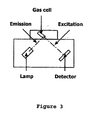
- the fluorescence signal for a continuous stream of fluorescent compound to be analysed would be a maximum (1 ppm of toluene); in other words, the length of the optical excitation and emission rays would be a maximum and perfectly aligned as can be seen in Figure 3.
- the cell was permanently screwed to a metal base, which fitted with the design of the commercial spectrofluorimeter.
- the design of the pieces will vary depending on the commercial system used for measuring the fluorescence.
- the stream of gases to be quantified was brought up to the dish with the aid of 1 ⁇ 4" steel tubes. These tubes were heat-insulated at the necessary temperature with the aid of various resistors so that they did not give any condensation problems and they were joined to the dish at its gas inlet hole by means of a 1 ⁇ 4" thread.
- the data matrix of equation (1) is solved.
- the range of concentrations obtained is between 1 ppb and 100 ppm, depending on the pairs of wavelengths selected and/or the width of the slits of the excitation and emission monochromators of the measurement apparatus.
- Example 1 Resolution of a mixture of Naphthalene and Fluoranthene
- the next step consists of selecting the wavelengths necessary for resolving the binary mixture. This choice of most suitable wavelengths for monitoring the binary rupture curves was done starting from the comparison of their excitation and emission spectra, in such way that two requisites would be complied with:
- the next step was to calculate the calibration constants which related the signal obtained in the spectrofluorimeter with the concentration of each polyaromatic compound. This determination was done using the pure compounds.
- Table 1 also shows the value of the base line of the fluorescence recording at each wavelength. This value is due to the experimental design of the gas cell and is deducted from the values of total intensity obtained. The resulting absolute value is the one that is introduced into the above equations for the quantification of the mixture of polyaromatic compounds.
- Table 1 Selected wavelengths, calibration constants and value of the base line obtained for resolution of a binary mixture of Np and Fl.
- Naphthalene Fluoranthene A (nm) L slits (nm) I 0 (u.r.) K ⁇ HAP [(u.r. ⁇ *min]/ ⁇ g Exc Em Exc Em Np FI ⁇ 1 260 370 15 20 54 1.4 0.10 ⁇ 2 275 425 15 20 22 0.10 1.6
- Figure 7 shows how, for the resolution of the binary mixture formed of Phe and An, the selected areas are represented as two shaded grey areas in the case of Phe and as two areas between grey arrows for An.
- the next step was to calculate the calibration constants which related the signal obtained in the spectrofluorimeter with the concentration of each polyaromatic compound. This determination was done using the pure compounds.
Landscapes
- Health & Medical Sciences (AREA)
- Physics & Mathematics (AREA)
- Life Sciences & Earth Sciences (AREA)
- Chemical & Material Sciences (AREA)
- Analytical Chemistry (AREA)
- Biochemistry (AREA)
- General Health & Medical Sciences (AREA)
- General Physics & Mathematics (AREA)
- Immunology (AREA)
- Pathology (AREA)
- Nuclear Medicine, Radiotherapy & Molecular Imaging (AREA)
- Investigating, Analyzing Materials By Fluorescence Or Luminescence (AREA)
Abstract
The invention relates to an analysis method employing
fluorescence spectroscopy, which is used for the
continuous identification and quantification of
polyaromatic compounds in the gas phase and at high
temperature. The invention comprises a specially-designed
cell which is arranged such that the maximum fluorescence
signal is obtained for a constant and stable flow of
polyaromatics in the gas stream. The invention can be
used in energy generation processes with a low
concentration of polyaromatics and for a lower analysis
cost than with standard gas/mass methods hitherto used,
which do not operate continuously.
Description
- The invention relates to a new analysis method for atmospheric organic contaminants by means of fluorescence spectroscopy at high temperature in the gas phase, and also to the device used for said analysis. More specifically, the invention relates to the continuous analysis of toxic organic contaminants, specifically polyaromatic compounds.
- In recent years, environmental regulations have been ever more restrictive with regard to emissions of atmospheric contaminants emitted at low concentrations, such as trace metals and volatile organic compounds, yet which have a very negative environmental impact due to their toxicity.
- So, regulations have led to a growing interest in toxic emissions, whose increase has been parallel with the rise of energy consumption, transport and electrical consumption, with the aim of achieving a quality of air which permits a lower impact on the health of citizens. In the case of toxic organic emissions, their carcinogenic, mutagenic and/or carcino/mutagenic nature has been demonstrated, yet enormous analytical difficulties hinder and delay the implementation of suitable techniques.
- Among the greatest difficulties are found their detection and quantification, since they are emitted in very low concentrations, ppm and ppb, and the durability of their analysis, which only allows this to be done discontinuously (1-7). To this must be added a high cost per analysis.
The analytical technique currently used, coupled gas-mass systems (1,4), do not solve these limitations, nevertheless it is known that fluorescence spectroscopy (3,5,6,7) presents greater sensitivity, a greater specificity and a greater linear range, yet neither the method nor the device of this patent have so far been described for carrying out analysis of polyaromatic compounds in the gas phase, at high temperature and continuously. -
- 1. Luks-Betlej, K., Chromatographia 1997, 45, 243.
- 2. Qian, K., Hsu. C.S., Anal. Chem. 1992, 64, 2327.
- 3. Manoli, E., Samara, C., Chromatographia 1996, 43, (3/4)..
- 4. Wise, S.A., Schantz, M.M., Benner, B.A., Hays, M.J., Schiller, S.B., Anal. Chem. 1995, 67, 1171.
- 5. Murayama, M., Dasgupta, P.K., Anal. Chem. 1996, 68 (7), 1226.
- 6. Garcia, C., Pérez, J.L., Moreno, B., Anal. Chem. 1994, 66 (6), 874.
- 7. Kayali, M.N., Rubio-Barroso, S., Polo-Diéz, L.M., Journal of Chromatographic Science 1995, 33,181.
-
- The present invention describes a method for the continuous analysis of polyaromatic compounds at high temperature and in the gas phase by means of fluorescence spectroscopy comprising the following steps:
- Obtaining of excitation and emission spectra for each of the potential polyaromatic compounds to analyse.
- Selection of the wavelengths necessary for resolving the mixture.
- Calculation of the calibration constants relating the signal obtained in the spectrofluorimeter with the concentration of each polyaromatic.
- The present invention is based on the fact that the inventors have observed that it is possible to identify and quantify polyaromatic compounds continuously, by means of fluorescence spectroscopy at high temperature and in the gas phase, using a specially designed device which, when coupled to the spectrofluorimeter, permits precise resolution and quantification under the conditions required for the analysis of emissions of polyaromatic compounds in energy generation processes.
- So, an object of the present invention consists of an analytical method of continuous identification and quantification of polyaromatic compounds at high temperature and in the gas phase by means of fluorescence spectroscopy, characterised in that:
- a) the fluorescence spectroscopy analysis is based
on
- a.1.- the obtaining of excitation and emission spectra for each of the potential polyaromatic compounds to analyse,
- a.2.- the selection of the wavelengths necessary for
the resolution of the mixture, complying with the
following two requisites:
- i) the quenching of the input filter has to be prevented; this involves choosing the wavelength in which the absorption of a polyaromatic compound does not coincide with the absorptions of the other compounds, and
- ii) the fluorescence signal of each polyaromatic compound has to show the maximum sensitivity.
- a.3.- the calculation of the calibration constants which relate the signal obtained by the spectrofluorimeter with the concentration of each polyaromatic compound, and
- b) the spectrofluorimeter performing the measurements is coupled to a specially designed device permitting the fluorescence signal for a constant and stable flow of polyaromatic compounds, in the gas phase and at high temperature, to be a maximum.
-
- As used in the present invention, the term "polyaromatic compounds" refers to polyaromatic compounds containing 2 to 5 aromatic rings in their structure, emitted in energy generation processes, transport and combustion processes in general, belonging to, among others, the following group of polyaromatic hydrocarbons prioritised by the USEPA, the United States Environmental Protection Agency, having carcinogenic activity: naphthalene, fluorene, phenanthrene, anthracene, fluoranthrene acenaphthene, acenaphthylene, chrysene, benzoperylene, benzo(k)fluoranthene, benzo(b)fluoranthene, benzoanthracene, indenopyrene, dibenzoanthracene, benzopyrene and pyrene. The term "polyaromatic compounds" in the present invention likewise extends to polyaromatic hydrocarbons, to complex mixtures thereof and polyaromatic compounds in general and likewise their corresponding nitrogenated, oxygenated and/or sulphur containing derivatives.
- The term "at high temperature and in gas phase", as used in the present invention, refers to the analysis being conducted at the outlet temperature of the gases from the chimney or exhaust pipe.
- The choice of wavelengths where the absorption of a polyaromatic compound does not coincide with the absorptions of others (i) requires knowing the wavelengths of each of the pure polyaromatic compounds. On the other hand, the use of the appropriate wavelength in each case will permit a fluorescence signal to be obtained for each polyaromatic signal with a maximum sensitivity (ii) in order to thereby avoid possible problems in quantification.
- Once the wavelengths have been selected, the calibration constants relating the signal of the corresponding polyaromatic obtained in the spectrofluorimeter to its concentration can be obtained. In all the cases studied, the correlation coefficients were greater than 0.98. The calibration constants are a function of the polyaromatic compound being studied, of the selected wavelength and of the gas flow inside the device.
- Under these experimental conditions used, the fluorescence intensity at each wavelength is found to be equal to the sum of the fluorescence intensities of each of the compounds, where their calibration constants are obtained from the pure compounds, in such a way that in a general case the following applies:Wherein:

- Iλi is the intensity measured by the fluorescence detector at each of the wavelengths, λ1, λ2, λ3, ........... λn.
- KλiHAPi is a proportionality constant obtained from the calibrations of the pure compounds for each wavelength and each flow of carrier gas.
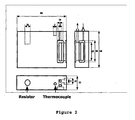
- CHAP1 is the concentration of each HAP during the course of the experiment. An additional object of the present invention consists of a device specially designed for performing the inventive method and which concerns a cell. Its construction was carried out with aluminium and has the shape of a parallelepiped with dimensions of 60 x 23 x 80 mm. It comprises two holes for the inlet and outlet of gases, two quartz windows located perpendicularly, which permit the measurement of the gas flow by fluorescence in the UV-visible range, and an electrical resistor permitting the heating of the cell to the desired temperature in the range 50-300 °C, or more preferably between 125-200 °C, with an accuracy of ± 1 °C. The temperature is measured with a thermocouple and controlled with a PID, which prevents undesired fluctuations that could affect the fluorescence signal.
-
- The cell has an interior cavity in the shape of an L, made up of the joining of two parallelepipeds with dimensions 30 x 5 x 10 mm arranged in such a way that they create two windows located at an angle of 90° and which permit the fluorescence to be measured in the UV-visible range. The dimensions of the interior parallelepiped formed from the joining of the above two are 30 x 5 x 5 mm. Located in these windows are two quartz sheets (40 x 10) which are perfectly joined to the aluminium by means of using a high temperature glue (Araldite 7070). In this cell, the inlet and outlet of the hot gases was done by means of two holes of metric 3 located in the upper part of it and perpendicular to the interior cavity in the shape of an L.
- The cell also has two other cylindrical holes located in its upper part. The first of metric 10 permits the inclusion of a bulb resistor of the same metric in order to heat the cell, and the second, of metric 3, in which a cylindrical thermocouple is arranged which permits us to monitor the temperature of the process.
- The cell is located in a commercial spectrofluorimeter (in our case, a Perkin-Elmer LS 50B) in such a way as to permit measurement of the fluorescence signal in an angle of 90°. So, the fluorescence signal for a continuous stream of fluorescent compound to be analysed would be a maximum (1 ppm of toluene); in other words, the length of the optical excitation and emission rays would be a maximum and perfectly aligned as can be seen in Figure 3.
- Having achieved this position, the cell was permanently screwed to a metal base, which fitted with the design of the commercial spectrofluorimeter. The design of the pieces will vary depending on the commercial system used for measuring the fluorescence.
- Having fixed the cell, the stream of gases to be quantified was brought up to the dish with the aid of ¼" steel tubes. These tubes were heat-insulated at the necessary temperature with the aid of various resistors so that they did not give any condensation problems and they were joined to the dish at its gas inlet hole by means of a ¼" thread.
- Finally, in order to obtain the concentration of polyaromatic compounds present in the gas mixture, the data matrix of equation (1) is solved. The range of concentrations obtained is between 1 ppb and 100 ppm, depending on the pairs of wavelengths selected and/or the width of the slits of the excitation and emission monochromators of the measurement apparatus.
- Both the method and the device solve the drawbacks of the conventional methods of the analysis in energy processes where the concentration of polyaromatics is low, permitting their detection and quantification directly at the outlet from the chimney/exhaust pipe.
- It must nevertheless be understood that the invention is not limited to the required arrangements or instruments shown in it, which are merely a schematic representation of the product of the invention.
-
- Figures 1, 2 and 3 show the design of the cell included in the patent and the way of locating it in the spectrofluorimeter such that the two quartz windows are positioned to form an angle of 90° for measuring the fluorescence in the UV-visible range. Figures 4 and 5 show the excitation and fluorescence spectra obtained for each of the compounds forming two binary mixtures. In one case the binary mixture analysed is Naphthalene (Np) and Fluoranthene (Fl) and in the other Anthracene (An) and Phenanthrene (Phe).
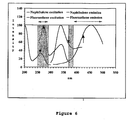
- Figures 6 and 7 correspond to a schematic representation of the wavelength selection process for the resolution of rupture curves of two binary mixtures. One of the mixtures analysed is Naphthalene (Np) and Fluoranthene (F1) and the other is Anthracene (An) and Phenanthrene (Phe).
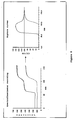
- Figures 8 and 9 show the signals obtained in the spectrofluorimeter and the rupture curve obtained by application of the above equations and later normalisation of the data for the two binary mixtures, one of them Naphthalene (Np) and Fluoranthene (Fl) and the other Anthracene (An) and Phenanthrene (Phe).
-
- The analysis procedure necessary for the resolution of a gaseous binary mixture of Naphthalene (Np) and Fluoranthene (F1) first of all commences with the obtaining of the excitation and fluorescence (emission) spectra for each of the compounds forming the binary mixture. These spectra are shown in Figure 4.
- Once the spectra of both polyaromatic compounds have been obtained, the next step consists of selecting the wavelengths necessary for resolving the binary mixture. This choice of most suitable wavelengths for monitoring the binary rupture curves was done starting from the comparison of their excitation and emission spectra, in such way that two requisites would be complied with:
- a) There is no quenching due to the inner filter effect of the compounds. To achieve this, wavelengths are taken in which the absorption spectrum of one compound does not coincide with the fluorescence of the other compound, thereby avoiding the phenomenon of energy transfer which gives rise to quenching due to the inner filter effect. In this way, it is ensured that the above equations permitting the binary rupture curves to be obtained are applicable on the basis of the calibration constants obtained for the pure compounds. Figure 6 shows the normalised fluorescence spectra of Np and Fl together with the process followed for the choice of most suitable wavelengths. In this figure, the suitable zones for monitoring the signals of each polyaromatic compound, and in which the quenching processes due to the inner filter effect are reduced, are shown in grey, either as a shaded area for the case of Np or as an area between arrows for the case of Fl.
- b) That the fluorescence signal of each polyaromatic compound has the maximum sensitivity, so that there are no problems for the quantification of the fluorescence signals. In all binary mixtures, the final fluorescence signal corresponding to a concentration of ~ 0.8 ppm ± 0.1 ppm was greater than 10 times the standard deviation of the blank under those working conditions, which permitted the correct determination of the concentration of each polyaromatic compound in the mixture. Figure 6 shows the wavelengths chosen for the resolution of the Np and Fl mixture, which appear as arrows with the same colour as their respective spectra and correspond to the maximum value of intensity within the area where no quenching is produced due to the inner filter effect.
-
- Once the experimental conditions in which the fluorescence recording is carried out have been known, the next step was to calculate the calibration constants which related the signal obtained in the spectrofluorimeter with the concentration of each polyaromatic compound. This determination was done using the pure compounds.
- In order to carry out the calibration, the following two considerations were taken into account:
- Table 1 also shows the value of the base line of the fluorescence recording at each wavelength. This value is due to the experimental design of the gas cell and is deducted from the values of total intensity obtained. The resulting absolute value is the one that is introduced into the above equations for the quantification of the mixture of polyaromatic compounds.
- The absolute values of the calibration constants found for each polyaromatic compound depended on the pair of wavelengths chosen, though in all cases these values are sufficiently sensitive for permitting an adequate resolution of the fluorescence recording.
-
Naphthalene Fluoranthene A (nm) L slits (nm) I 0 (u.r.) Kλ HAP [(u.r.}*min]/µg Exc Em Exc Em Np FI λ1 260 370 15 20 54 1.4 0.10 λ2 275 425 15 20 22 0.10 1.6 - On the basis of these calibration constants, a knowledge of the concentration of both polyaromatic compounds present in a binary mixture of gases can be achieved and they can therefore be applied to solving -different problems such as for example obtaining the rupture curves of a binary mixture of Np and Fl on activated carbon of high specific surface for the cleaning of HAP emissions. Figure 5 shows the fluorescence recording obtained for this mixture on activated carbon in which the initial concentration of both components is ~ 0.8 ppm.
- The application of this analytical procedure to this and other binary mixtures of polyaromatic compounds on different carbon-containing materials permits it to be known in this case what are the different parameters of this process which controls the elimination of emissions of mixtures of polyaromatic compounds in contaminant systems by means of adsorption.
- In this case, we start with a gaseous binary mixture of Phenanthrene (Phe) and Anthracene (An), compounds of equal molecular weight and difficult to separate and quantify by means of other detection systems such as mass spectrometry. The obtaining of the normalised excitation and fluorescence spectra is shown in Figure 5.
- Maintaining the same requisites as in the previous example, for the choice of the most suitable wavelengths, Figure 7 shows how, for the resolution of the binary mixture formed of Phe and An, the selected areas are represented as two shaded grey areas in the case of Phe and as two areas between grey arrows for An.
- Within these wavelength intervals, those presenting greater sensitivity and, therefore, which are more suitable for resolving a binary mixture of Phe and An, are marked by means of arrows.
- Once the experimental conditions in which the fluorescence recording is carried out have been known, the next step was to calculate the calibration constants which related the signal obtained in the spectrofluorimeter with the concentration of each polyaromatic compound. This determination was done using the pure compounds.
- In order to carry out the calibration, it was borne in mind that the value of the base line of the fluorescence recording at each wavelength shown in Table 2 is due to the experimental design of the gas cell and is therefore deducted from the values of total intensity obtained. The resulting absolute value is the one that is introduced into the above equations for quantification of the mixture of polyaromatic compounds.
- The absolute values of the calibration constants that are found for each polyaromatic compound depended on the pair of wavelengths chosen, though in all cases these values are sufficiently sensitive for permitting an adequate resolution of the fluorescence recording.
Selected wavelengths, calibration constants and value of the base line obtained for resolution of a binary mixture of Phe and An. Phenanthrene Anthracene λ(nm) L silts (nm) I 0 (u.r.) K λ HAP [(u.r.)*min]/ µg Exc Em Exc Em Phe An λ1 235 370 15 20 72 6 12 λ2 235 390 15 20 23 4 15 - On the basis of these calibration constants, a knowledge of the concentration of both polyaromatic compounds present in a binary mixture of gases can be achieved and they can therefore be applied to solving different problems such as for example obtaining the rupture curves of a binary mixture of Phe and An on activated carbon of high specific surface for the cleaning of polyaromatic compound emissions. Figure 9 shows the fluorescence recording obtained for this mixture on activated carbon in which the initial concentration of both components is ~ 0.8 ppm.
- This analytical procedure not only permits the behaviour shown by binary mixtures (multiple of a general case) of fluorescent compounds during their adsorption on different adsorbents to be learned, but also, continuous experimental data can be obtained of an adsorption process of multiple mixtures whose resolution is experimentally very difficult.
It is useful in energy generation processes, transport and combustion processes in general since it permits resolution of the analysis at very low concentrations and continuously.
Claims (7)
- Method of continuous identification and quantification of polyaromatic compounds in the gas phase and at high temperature, emitted in energy generation processes by means of fluorescence spectroscopy, characterised in that the analysis is based on the following steps:i) obtaining of excitation and emission spectra for each of the potential polyaromatic compounds to be identified and quantified,ii) selection of the wavelengths necessary for the resolution of the mixture, complying with the following two requisites:preventing the quenching of the input filter; this implies choosing the wavelengths which the absorption of a polyaromatic compound does not coincide with the absorptions of the other compounds. For this it is necessary to know the wavelengths of the pure compounds.The fluorescence signal of each polyaromatic compound must show the maximum sensitivity in order to thereby be able to avoid possible problems in the quantification.iii) calculation of the calibration constants which relate the signal obtained by the spectrofluorimeter with the concentration of each polyaromatic compound.
- Method according to claim 1, furthermore characterised in that the spectroscopy analysis is carried out with a specially designed cell coupled to the commercial spectrofluorimeter in such a way that permits the fluorescence signal for a constant and stable flow of polyaromatic compounds, in the gas phase and at high temperature, to be a maximum.
- Method according to claims 1 and 2, characterised in that the identified and quantified polyaromatic compounds contain two to five aromatic rings and belong to, among others, the following group: naphthalene, fluorene, phenanthrene, anthracene, fluoranthrene acenaphthene, acenaphthylene, chrysene, benzoperylene, benzo(k)fluoranthene, benzo(b)fluoranthene, benzoanthracene, indenopyrene, dibenzoanthracene, benzopyrene and pyrene, likewise their corresponding nitrogenated, oxygenated and/or sulphur containing derivatives.
- Method according to claims 1 and 2, characterised in that it permits polyaromatic compounds according to claim 3 to be identified and quantified in complex mixtures.
- Method according to claims 1 to 4, characterised in that it is done at high temperature, between temperature margins of 50-300 °C, or more preferably between 125-200 °C.
- Method according to claims 1 to 4, characterised by its high specificity for the identification and quantification of fluorescent compounds in very low concentrations, between 1 ppb and 100 ppm, compared to discontinuous coupled systems of gas chromatography /mass spectroscopy.
- Cell according to claim 2, necessary for carrying out the method according to any of claims 1 to 6, characterised in that it comprises:two holes permitting entrance and exit of the gases to analysetwo perpendicular quartz windows permitting measurement of the gas flow by fluorescence in the UV-visible range, andan electrical resistor permitting heating of the cell to the desired temperature with an accuracy of ± 1 °C, as shown schematically in Figures 1, 2 and 3.
Applications Claiming Priority (3)
| Application Number | Priority Date | Filing Date | Title |
|---|---|---|---|
| ES200202902 | 2002-12-17 | ||
| ES200202902A ES2211324B1 (en) | 2002-12-17 | 2002-12-17 | CONTINUOUS ANALYSIS PROCEDURE FOR POLYAROMATIC COMPOUNDS IN HOT AND IN GAS PHASE AND A DEVICE FOR YOUR COMMISSIONING. |
| PCT/ES2003/000645 WO2004055501A1 (en) | 2002-12-17 | 2003-12-17 | Method for the continuous analysis of polyaromatic compounds in the gas phase and at a high temperature, and device for performing same |
Publications (1)
| Publication Number | Publication Date |
|---|---|
| EP1591772A1 true EP1591772A1 (en) | 2005-11-02 |
Family
ID=32524370
Family Applications (1)
| Application Number | Title | Priority Date | Filing Date |
|---|---|---|---|
| EP03785967A Withdrawn EP1591772A1 (en) | 2002-12-17 | 2003-12-17 | Method for the continuous analysis of polyaromatic compounds in the gas phase and at a high temperature, and device for performing same |
Country Status (4)
| Country | Link |
|---|---|
| EP (1) | EP1591772A1 (en) |
| AU (1) | AU2003294980A1 (en) |
| ES (1) | ES2211324B1 (en) |
| WO (1) | WO2004055501A1 (en) |
Family Cites Families (4)
| Publication number | Priority date | Publication date | Assignee | Title |
|---|---|---|---|---|
| US5206176A (en) * | 1990-10-02 | 1993-04-27 | Massachusetts Institute Of Technology | Detection and control of aromatic compounds in combustion effluent |
| US5721613A (en) * | 1994-03-21 | 1998-02-24 | Hewlett Packard Company | Fluorescence spectrometer |
| US5880830A (en) * | 1997-01-29 | 1999-03-09 | Greenvision Systems Ltd. | Spectral imaging method for on-line analysis of polycyclic aromatic hydrocarbons in aerosols |
| JP2002168789A (en) * | 2000-11-29 | 2002-06-14 | Takashi Inaga | Polycyclic aromatic hydrocarbons detection method and apparatus |
-
2002
- 2002-12-17 ES ES200202902A patent/ES2211324B1/en not_active Expired - Fee Related
-
2003
- 2003-12-17 EP EP03785967A patent/EP1591772A1/en not_active Withdrawn
- 2003-12-17 WO PCT/ES2003/000645 patent/WO2004055501A1/en not_active Ceased
- 2003-12-17 AU AU2003294980A patent/AU2003294980A1/en not_active Abandoned
Non-Patent Citations (1)
| Title |
|---|
| See references of WO2004055501A1 * |
Also Published As
| Publication number | Publication date |
|---|---|
| WO2004055501A1 (en) | 2004-07-01 |
| ES2211324A1 (en) | 2004-07-01 |
| ES2211324B1 (en) | 2005-12-16 |
| AU2003294980A8 (en) | 2004-07-09 |
| AU2003294980A1 (en) | 2004-07-09 |
Similar Documents
| Publication | Publication Date | Title |
|---|---|---|
| US5473162A (en) | Infrared emission detection of a gas | |
| Vo-Dinh et al. | Monitoring and characterization of polyaromatic compounds in the environment | |
| Dietz et al. | Volatile organo-selenium speciation in biological matter by solid phase microextraction–moderate temperature multicapillary gas chromatography with microwave induced plasma atomic emission spectrometry detection | |
| Liaud et al. | Experimental performances study of a transportable GC-PID and two thermo-desorption based methods coupled to FID and MS detection to assess BTEX exposure at sub-ppb level in air | |
| Chen et al. | Characterization of polycyclic aromatic hydrocarbons using Raman and surface‐enhanced Raman spectroscopy | |
| CN101410710A (en) | System and method for eliminating interference to impurity measurement in noble gases | |
| Frentiu et al. | Simultaneous determination of As and Sb in soil using hydride generation capacitively coupled plasma microtorch optical emission spectrometry–comparison with inductively coupled plasma optical emission spectrometry | |
| Grosch et al. | UV absorption cross-sections of phenol and naphthalene at temperatures up to 500 C | |
| Spadavecchia et al. | Optochemical vapour detection using spin coated thin film of ZnTPP | |
| Thöny et al. | Gas-phase UV spectroscopy of anthracene, xanthone, pyrene, 1-bromopyrene and 1, 2, 4-trichlorobenzene at elevated temperatures | |
| Whitcomb et al. | Screening potential of solid-phase extraction and solid surface room temperature fluorimetry for polycyclic aromatic hydrocarbons in water samples | |
| Mouton et al. | Isomer discrimination of PAHs formed in sooting flames by jet-cooled laser-induced fluorescence: application to the measurement of pyrene and fluoranthene | |
| Aydin et al. | Direct analysis of aromatic pollutants using a HPLC-FLD/DAD method for monitoring biodegradation processes | |
| Cheskis et al. | Laser diagnostics of trace species in low-pressure flat flame | |
| US8538717B2 (en) | Method of absorbance correction in a spectroscopic heating value sensor | |
| US20090153854A1 (en) | Method and Apparatus for Spectroscopic Analysis | |
| Vatsavai et al. | Direct quantification of monohydroxy-polycyclic aromatic hydrocarbons in synthetic urine samples via solid-phase extraction–room-temperature fluorescence excitation–emission matrix spectroscopy | |
| Ramasamy et al. | Oxygen sensor via the quenching of room-temperature phosphorescence of perdeuterated phenanthrene adsorbed on Whatman 1PS filter paper | |
| Chiriac et al. | Fast and sensitive detection of acrolein in environmental water samples without derivatization using liquid chromatography tandem mass spectrometry | |
| Robbins et al. | Multielement analysis of selected elemental hydrides by chromatographically coupled plasma emission spectrometry | |
| Forbes et al. | Investigations into a novel method for atmospheric polycyclic aromatic hydrocarbon monitoring | |
| Mastral Lamarca et al. | Method for the continuous analysis of polyaromatic compounds in the gas phase and at a high temperature, and device for performing same | |
| Şahin et al. | Development of a sensitive analytical method for the determination of cadmium using hydrogen assisted T-shape slotted quartz tube-atom trap-flame atomic absorption spectrophotometry | |
| ES2211324B1 (en) | CONTINUOUS ANALYSIS PROCEDURE FOR POLYAROMATIC COMPOUNDS IN HOT AND IN GAS PHASE AND A DEVICE FOR YOUR COMMISSIONING. | |
| Wang et al. | Quantitative acquisition of differential absorption cross sections of chlorobenzenes at different temperatures |
Legal Events
| Date | Code | Title | Description |
|---|---|---|---|
| PUAI | Public reference made under article 153(3) epc to a published international application that has entered the european phase |
Free format text: ORIGINAL CODE: 0009012 |
|
| 17P | Request for examination filed |
Effective date: 20050711 |
|
| AK | Designated contracting states |
Kind code of ref document: A1 Designated state(s): AT BE BG CH CY CZ DE DK EE ES FI FR GB GR HU IE IT LI LU MC NL PT RO SE SI SK TR |
|
| AX | Request for extension of the european patent |
Extension state: AL LT LV MK |
|
| DAX | Request for extension of the european patent (deleted) | ||
| 17Q | First examination report despatched |
Effective date: 20091218 |
|
| STAA | Information on the status of an ep patent application or granted ep patent |
Free format text: STATUS: THE APPLICATION IS DEEMED TO BE WITHDRAWN |
|
| 18D | Application deemed to be withdrawn |
Effective date: 20100629 |