EP1591756B1 - Car multimedia system and method for activating a function of such a system - Google Patents
Car multimedia system and method for activating a function of such a system Download PDFInfo
- Publication number
- EP1591756B1 EP1591756B1 EP04010243A EP04010243A EP1591756B1 EP 1591756 B1 EP1591756 B1 EP 1591756B1 EP 04010243 A EP04010243 A EP 04010243A EP 04010243 A EP04010243 A EP 04010243A EP 1591756 B1 EP1591756 B1 EP 1591756B1
- Authority
- EP
- European Patent Office
- Prior art keywords
- menu item
- menu
- multimedia system
- car multimedia
- menu items
- Prior art date
- Legal status (The legal status is an assumption and is not a legal conclusion. Google has not performed a legal analysis and makes no representation as to the accuracy of the status listed.)
- Expired - Lifetime
Links
Images

Classifications
-
- G—PHYSICS
- G01—MEASURING; TESTING
- G01C—MEASURING DISTANCES, LEVELS OR BEARINGS; SURVEYING; NAVIGATION; GYROSCOPIC INSTRUMENTS; PHOTOGRAMMETRY OR VIDEOGRAMMETRY
- G01C21/00—Navigation; Navigational instruments not provided for in groups G01C1/00 - G01C19/00
- G01C21/26—Navigation; Navigational instruments not provided for in groups G01C1/00 - G01C19/00 specially adapted for navigation in a road network
- G01C21/34—Route searching; Route guidance
- G01C21/36—Input/output arrangements for on-board computers
- G01C21/3605—Destination input or retrieval
- G01C21/3611—Destination input or retrieval using character input or menus, e.g. menus of POIs
-
- G—PHYSICS
- G01—MEASURING; TESTING
- G01C—MEASURING DISTANCES, LEVELS OR BEARINGS; SURVEYING; NAVIGATION; GYROSCOPIC INSTRUMENTS; PHOTOGRAMMETRY OR VIDEOGRAMMETRY
- G01C21/00—Navigation; Navigational instruments not provided for in groups G01C1/00 - G01C19/00
- G01C21/26—Navigation; Navigational instruments not provided for in groups G01C1/00 - G01C19/00 specially adapted for navigation in a road network
- G01C21/34—Route searching; Route guidance
- G01C21/36—Input/output arrangements for on-board computers
-
- G—PHYSICS
- G01—MEASURING; TESTING
- G01C—MEASURING DISTANCES, LEVELS OR BEARINGS; SURVEYING; NAVIGATION; GYROSCOPIC INSTRUMENTS; PHOTOGRAMMETRY OR VIDEOGRAMMETRY
- G01C21/00—Navigation; Navigational instruments not provided for in groups G01C1/00 - G01C19/00
- G01C21/26—Navigation; Navigational instruments not provided for in groups G01C1/00 - G01C19/00 specially adapted for navigation in a road network
- G01C21/34—Route searching; Route guidance
- G01C21/36—Input/output arrangements for on-board computers
- G01C21/3664—Details of the user input interface, e.g. buttons, knobs or sliders, including those provided on a touch screen; remote controllers; input using gestures
-
- G—PHYSICS
- G06—COMPUTING OR CALCULATING; COUNTING
- G06F—ELECTRIC DIGITAL DATA PROCESSING
- G06F3/00—Input arrangements for transferring data to be processed into a form capable of being handled by the computer; Output arrangements for transferring data from processing unit to output unit, e.g. interface arrangements
- G06F3/01—Input arrangements or combined input and output arrangements for interaction between user and computer
- G06F3/048—Interaction techniques based on graphical user interfaces [GUI]
-
- G—PHYSICS
- G06—COMPUTING OR CALCULATING; COUNTING
- G06F—ELECTRIC DIGITAL DATA PROCESSING
- G06F3/00—Input arrangements for transferring data to be processed into a form capable of being handled by the computer; Output arrangements for transferring data from processing unit to output unit, e.g. interface arrangements
- G06F3/01—Input arrangements or combined input and output arrangements for interaction between user and computer
- G06F3/048—Interaction techniques based on graphical user interfaces [GUI]
- G06F3/0481—Interaction techniques based on graphical user interfaces [GUI] based on specific properties of the displayed interaction object or a metaphor-based environment, e.g. interaction with desktop elements like windows or icons, or assisted by a cursor's changing behaviour or appearance
- G06F3/0482—Interaction with lists of selectable items, e.g. menus
-
- G—PHYSICS
- G06—COMPUTING OR CALCULATING; COUNTING
- G06F—ELECTRIC DIGITAL DATA PROCESSING
- G06F3/00—Input arrangements for transferring data to be processed into a form capable of being handled by the computer; Output arrangements for transferring data from processing unit to output unit, e.g. interface arrangements
- G06F3/01—Input arrangements or combined input and output arrangements for interaction between user and computer
- G06F3/048—Interaction techniques based on graphical user interfaces [GUI]
- G06F3/0484—Interaction techniques based on graphical user interfaces [GUI] for the control of specific functions or operations, e.g. selecting or manipulating an object, an image or a displayed text element, setting a parameter value or selecting a range
- G06F3/04847—Interaction techniques to control parameter settings, e.g. interaction with sliders or dials
-
- G—PHYSICS
- G06—COMPUTING OR CALCULATING; COUNTING
- G06F—ELECTRIC DIGITAL DATA PROCESSING
- G06F3/00—Input arrangements for transferring data to be processed into a form capable of being handled by the computer; Output arrangements for transferring data from processing unit to output unit, e.g. interface arrangements
- G06F3/01—Input arrangements or combined input and output arrangements for interaction between user and computer
- G06F3/048—Interaction techniques based on graphical user interfaces [GUI]
- G06F3/0487—Interaction techniques based on graphical user interfaces [GUI] using specific features provided by the input device, e.g. functions controlled by the rotation of a mouse with dual sensing arrangements, or of the nature of the input device, e.g. tap gestures based on pressure sensed by a digitiser
Definitions
- the present invention relates to a car multimedia system comprising an audio unit, a navigation unit for route guidance, a controller device for controlling said units, a display for displaying selection menus with hierarchically structured menu items and end-menu items, said end-menu items allowing to start a specific function, and a selection key unit comprising at least a push button switch, preferably a hard key, a two way control, preferably a rotary knob, for selecting and a push button switch for activating menu items and end-menu items.
- the invention also relates to a method for activating a function of such a car multimedia system.
- Such car multimedia systems are known.
- the applicant of the present invention for example offers a plurality of different types of car multimedia systems under the brand name "Becker". All of these systems have in common that they are designed to fit into standardized installation slots, in the dashboard of a car. Due to such space requirement the dimensions of a front panel of the car multi media system are limited. Therefore, the front panel of the car multimedia system carries only a minimum number of selection keys, like hard keys and soft keys, one or two rotary push button switches and a display for displaying information and selection menus.
- the hard keys are assigned a predetermined function, whereas the soft keys are assigned variable functions to be selected.
- car multimedia systems offer a plurality of different functions, including audio functions like radio or CD, navigation functions like route guidance, or telecommunication functions, like telephone, e-mail, SMS or WAP, a hierarchically structured menu system allows to select these functions by using some few hard keys, soft keys and the rotary push button switch.
- a hierarchically structured menu system comprises a root menu item in a main menu level and a plurality of menu items in one or more sub-menu levels.
- each menu item in the lowest sub-menu level is called end-menu item.
- the display of the car multimedia system serves two display menu items which may be selected by rotating the rotary push button and selected by pushing it.
- US 5,887,269 discloses a navigation system according to the preamble of claim 1.
- the car multimedia system of the afore mentioned kind which comprises a discriminating device adapted to select an end-menu item in response to an actuation of said switch, preferably said hard key, said end-menu item being selected by said discriminating device on the basis of a predetermined criterion.
- the discriminating device shortens the selection process, i.e. the selection of an end-menu item, to a single touch of a switch. Hence, all sub-levels and menu items between the root menu item and the end-menu item are skipped.
- the discriminating device selects the end-menu item on the basis of a predetermined criterion which may be preset by the user or which is preset by the system.
- the user has only to confirm the selection of the discriminating device by pushing the rotary push button switch thus activating this end-menu item.
- the discriminating device allows to shorten the period necessary for selecting and activating a specific function (assigned to an end-menu item) and hence to keep the time during which the users attention is focused on the operation of the car multimedia system, is kept on a minimum.
- said discriminating device is adapted both to select and activate said and menu item.
- the discriminating device fulfils this task and also activates the selected end-menu item.
- This measure has the advantage that the period for selecting and activating a function is further reduced and therewith the users distraction from traffic.
- said criterion is the number of former selections of the end-menu items assigned to said switch, preferably said hard key.
- said discriminating device is adapted to select the end-menu item with the largest number of former selections.
- the discriminating device selects those end-menu item which has been used by the user most frequently before.
- the discriminating device determines a favourite out of the end-menu items belonging to a common root menu item which is selected and activated by a hard key.
- a data memory for storing data packets each being assigned to an end-menu item, wherein each data packet carries the number of selections of the assigned end-menu item.
- each data packet further carries the date of last use of the assigned end-menu item.
- said data memory stores at least two data packets for each assigned end-menu item.
- said discriminating device is adapted to allow the selection of menu items according to the hierarchical structure by using the rotary push button (overrule mode).
- said overrule mode is activated by a double activation of said hard key.
- said controller device is adapted to delete said data packets assigned to at least one of said end-menu items in response to a predetermined input via said selection key unit.
- said control device is adapted to allow the selection of a criterion out of a predetermined list of criteria via said selection key unit.
- the user is allowed to determine the criterion which is the basis for the discriminating device to select an end-menu item.
- the preferred criterion is the frequency of use of end-menu items.
- other criteria are also conceivable.
- This measure allows to further adapt the system to the users requests and demands.
- a telecommunications unit comprising a telephone module and an internet module allowing e-mail, SMS transmission, WAP and other telecommunication services is provided.
- that audio unit comprises a radio module and a CD module.
- the present invention is particularly useful if the car multimedia system offers a plurality of different functions.
- the selection and activation of menu items is made by said rotary push button switch.
- the rotary push button switch may be provided as two single units, namely a rotary knob and a push button switch instead of a single unit integrating both.
- the rotary switch may be replaced with a two-way switch or a four-way switch, as well.
- said hard key is provided for activating the navigation unit.
- the navigation unit offers a plurality of functions with the respective plurality of menu items, the present invention is particularly useful.
- each hard key is assigned a hierarchically structured menu with menu items and end-menu items. For each hierarchically structured menu, at least one favourite end-menu item is stored and selected by the discriminating device in response to the activation of the respective hard key.
- the object of the present invention is also solved by a method for activating a function of said car multimedia system, the method comprising the step of selecting and end-menu item in response to an actuation of said hard key, wherein said end-menu item is selected on the basis of predetermined criterion.
- said end-menu item is both selected and activated in response to said actuation of said hard key.
- said criterion is the number of former selections of said end-menu items assigned to said hard key.
- the end-menu item with the greatest number of selections is selected.
- a counter value assigned to said end-menu item is increased by one with each selection of an end-menu item.
- an actual date of use is stored for an end-menu item with each selection of said end-menu item.
- the selection and activation of menu items according to the hierarchical structure is allowed (overrule mode) in response to a predetermined operation of said selection unit, preferably a double actuation of said hard key.
- said counter values may be deleted either separately or in common via said selection key unit.
- said discriminating device selects an end-menu item in response to an actuation of said hard key.
- the discriminating device may also be adapted to select an end-menu item in response to an actuation of a soft key or any other switch of the car multimedia system.
- FIG 1 a front panel 12 of a car multimedia system 10 is schematically shown.
- the car multimedia system 10 is designed as a device which fits into the standardized installation slot in the dashboard of a vehicle.
- a further device is placed within the vehicle, for example in the glove compartment.
- This second device is the so called GSM/GPS box offering navigation and telecommunication services.
- the GSM/GPS box is electrically connected with the device in the dashboard (both devices defining the car multimedia system 10).
- Both devices have a plurality of connectors allowing to connect necessary hardware, like ear-phone, GSM antenna, GPS antenna, hence free microphone, radio antenna, loud speaker, etc. For the sake of simplicity, these parts are not shown in Figure 1 .
- the car multimedia system offers a plurality of different functions and services, for example radio, navigation, telephone, e-mail, SMS, etc. All these functions and services may be selected by a user of the car multimedia system 10 via the front panel 12.
- the front panel 12 comprises a first rotary push button switch 14 which allows to control the volume by rotating the rotary push button 14 and to switch on and off the car multimedia system 10 by pushing the rotary push button switch 14.
- the rotary push button switch 14 is placed on the left hand side of the front panel 12.
- On the right hand side a second rotary push button 16 is provided which allows to select a menu item by rotating and to activate it by pushing the rotary push button switch 16.
- selection keys in form of push button switches are provided in the upper front panel area. Three of these selection keys are referenced with reference numeral 18a, 18b and 18c.
- the selection keys 18 serve to select a predetermined function of the car multimedia system 10, in the present case the CD function with selection key 18a, the radio function with selection key 18b and the navigation function with selection key 18c. Generally such selection keys provided for selecting one specific function are called "hard keys”.
- the front panel 12 also carries so called soft keys 20. These soft keys serve to select variable functions depending on the on mode in which the car multimedia system is operated. In the present embodiment, ten soft keys are provided in the lower margin area of the front panel 12.
- a display 22 is disposed in the centre of the front panel 12.
- the display 22 is a DOT matrix display, which allows to display several lines of information in form of characters, words or pictures, icons or pictograms.
- the display 22 displays three lines of information in form of three different menu items 24a, 24b and 24c.
- the menu item shown in the middle line 24b is displayed in a larger font compared to the information shown in the first and the third line 24a, 24c.
- the larger font indicates that the menu item in line 24b is selected.
- the display 22 displays two arrows 26a, 26b, the upper arrow 26a being directed upwards and the lower arrow 26b being directed downwards. Both arrows indicate that more menu items than displayed are reachable.
- the user may select a menu item by rotating the rotary push button 16 until the desired menu item is displayed in the middle line 24b. In order to activate this selected menu item, the user than have to push the rotary push button 16. Depending on the selected and activated menu item, either further menu items are displayed or the desired function is started.
- Figure 2 illustrates a part of the hierarchically structured menu for operation of the navigation system being part of the car multimedia system 10.
- the menu comprises a plurality of menu items 32 in a first sub-menu level and a plurality of menu items 34 in a second sub-menu level. All shown menu items 32, 34 belong to one main menu item 36 (root menu item) of the main menu level.
- the first sub-menu level comprises the menu items "destination entry”, “destination memory” and "last destination”, which belong to the menu of the navigation system of the car multimedia system 10.
- the first sub-menu level, that is the menu items 32 are reached by selecting and activating the main menu item 36. This is achieved for example by pushing the hard key 18c.
- the menu items 34 of the second sub-menu level belong to a specific menu item of the first sub-menu level, in the present embodiment the menu item "destination memory".
- the menu item "destination memory" of the first sub-menu level has to be selected and activated via the rotary push button switch 16.
- the second sub-menu level defines the last or lowest menu level, which means that by selecting and activating a menu item 34 of this sub-menu level, a function is started instead of displaying further menu items. Therefore, the menu items of this second sub-menu level are called hereinafter "end-menu items”.
- the end-menu item "Becker" is selected and activated as to start route guidance to the address associated and stored with the name "Becker".
- this hierarchically structured menu is more illustrative and may be modified by providing more menu items in more than two sub-menu levels.
- the car multi media system 10 has implemented a function which automatically selects an end-menu item 34 in response to the operation of a hard key 18. Particularly, the system selects an end-menu item on the basis of a predetermined criterion, which is in the present case the frequency of use of the end-menu items belonging to the main menu item.
- the system also automatically activates the selected end-menu item 34.
- the user may start the route guidance to the address associated with "Becker" just by one switching activity.
- the criterion is variable depending on the selected root menu item.
- the selection of an end-menu item belonging to the root menu item "navigation" is carried out differently to the selection of an end-menu item belonging to for example the root menu item CD or radio.
- the system allows to "overrule" the automatic selection of an end-menu item by operating the respective hard key 18 twice within a short predetermined period.
- the system recognizes this double operation and displays the menu item 32 of the first sub-menu level in the display 22 in response thereto.
- the user may than select and activate the desired menu items in the conventional manner.
- the car multimedia system 10 comprises a main controller 50 which generally comprises at least a microprocessor or a microcontroller.
- the main controller 50 is mainly responsible for controlling all peripheral units and to perform all operations necessary for providing the functions of the car multimedia system, like radio, CD, navigation, telephone, etc.
- main controller 50 may comprise a couple of different circuits in practise, for example the microprocessor, a graphic driver circuit, a clock generator, etc.
- the main controller 50 is coupled with a read only memory circuit 52 which serves to store all program data (firmware).
- the read only memory may be provided as an erasable and rewriteable read only memory, like EPROM, EEPROM, etc.
- Erasable read only memory circuits 52 have the advantage that the firmware for operating the car multimedia system may be updated.
- a random access memory circuit 54 (RAM) is also provided and coupled with the main controller 50.
- the random access memory serves to store temporary data and user specific data, in particular.
- the random access memory 54 stores destinations programmed by the user. These stored destination data then form the menu items of the second sub-menu level.
- the main controller 50 is electrically coupled with the display 22.
- the selection key unit 56 is provided and electrically coupled with the main controller 50.
- the selection key unit 56 comprises a couple of different control elements for example hard keys 58, soft keys 60 and rotary push button switches 62.
- hard keys 58, soft keys 60 and rotary push button switches 62 are provided as push button switches. In terms of mechanical structure, however, there is no difference between the hard keys 58 and the soft keys 60.
- the main controller 50 is connected with further functional units namely an audio unit 64 comprising a CD device, a radio device (tuner), amplifiers, etc.
- the CD device is referenced with reference numeral 66 and the radio device is indicated with reference numeral 68.
- Further functional units are the navigation unit 70 and the telecommunications unit 72.
- the navigation unit for example comprises a DVD ROM device for receiving navigation data on a DVD ROM, a GPS receiver, a GPS antenna, etc.
- the telecommunications unit 72 comprises for example a GMS device and a GMS antenna.
- the present invention provides an improved operation of the car multimedia system, namely by simplifying the selection and activation of an end-menu item.
- a discriminating device 80 is provided.
- the discriminating device 80 is electrically coupled with the main controller 50 and communicates therewith. Further, the discriminating device is coupled with the random access memory circuit 54 as to allow read and write operations of data.
- the discriminating device 80 builds up and maintains a data structure and continuously updates the respective data necessary for carrying out the above mentioned automatic selection and activation of an end-menu item.
- the discriminating device 80 builds up a data structure as exemplaryly shown in Figure 4 .
- this is merely one example of a data structure and other data structures are also conceivable.
- the data is preferably structured as data lists 82, each list 82 comprising at least one data packet 84.
- Each data list 82 is assigned to a main menu item, for example navigation, telecommunications and radio.
- Each data packet 84 is divided into sub-packets in order to store different values. These values are also shown in Figure 4 which are sub-menu item, number of selections (frequency of use) and last use.
- the first value "sub-menu item” is preferably a pointer pointing to the respective data stored in the random access memory 54.
- the second value "number of selections” is a counter and defines the number of former uses of this end-menu item. In other words this value represents the frequency of use of the respective and menu item.
- the third value "last use” is the date of the last use of the respective end-menu item.
- the first data packet has the values "Becker", 10 and 29/01/2004; these values indicate that the end-menu item "Becker” has been selected and activated ten times and the last use of this end-menu item was January 29, 2004.
- the second data packet contains the values "WWP-S", 5 and 13/01/2004.
- the data packets of the third data list 82 assigned to "navigation" is ordered with respect to the value "number of selections". That is the third data packet "Becker" defines the first element in the data list since the number of selections value is greater than the respective values of the other data packets.
- the discriminating device 80 serves to maintain the data lists and data packets. Particularly, it updates the number of selections value in response to the selection and activation of the respective end-menu item. It further updates the "last use"-value.
- the discriminating device 80 is able to delete data packets out of the data lists if data packets have not been used for a predetermined period.
- the user may delete individual data packets or all data packets in the data lists by operating the selection key unit.
- the discriminating device 80 causes the controller 50 to select and activate the end-menu item forming the first data packet in the respective data list 82 in response to the operation of a hard key 18.
- the main controller 50 informs the discriminating device 80 thereof and receives the information from the discriminating device 80 which of the end-menu items is to be selected and optionally activated.
- the discriminating device 80 in turn gets this information from the data list 82. Simultaneously, the discriminating device 80 updates the respective values of the selected data packet.
- the user may overrule the discriminating device 80 by double pushing the hard key.
- the discriminating device 80 does not transmit an information to the main controller 50 about the end-menu item to be selected. Instead, the main controller 50 displays the stored menu items of the next sub-level menu. Nevertheless, the discriminating device updates the respective values of the data packet associated with the end-menu item the user has selected and activated manually.
- the functional structure of the car multimedia system as shown in Figure 3 is just one example and the present invention should not be limited thereto.
- the discriminating device 80 may be also be part of the main controller 50 and may be implemented as hard- and/or software.
- the car multimedia system 10 may comprise only the navigation unit, the audio unit, the telecommunications unit or each possible combination thereof.
Landscapes
- Engineering & Computer Science (AREA)
- Remote Sensing (AREA)
- Radar, Positioning & Navigation (AREA)
- General Physics & Mathematics (AREA)
- Physics & Mathematics (AREA)
- General Engineering & Computer Science (AREA)
- Theoretical Computer Science (AREA)
- Human Computer Interaction (AREA)
- Automation & Control Theory (AREA)
- User Interface Of Digital Computer (AREA)
- Navigation (AREA)
- Input From Keyboards Or The Like (AREA)
- Fittings On The Vehicle Exterior For Carrying Loads, And Devices For Holding Or Mounting Articles (AREA)
Abstract
Description
- The present invention relates to a car multimedia system comprising an audio unit, a navigation unit for route guidance, a controller device for controlling said units, a display for displaying selection menus with hierarchically structured menu items and end-menu items, said end-menu items allowing to start a specific function, and a selection key unit comprising at least a push button switch, preferably a hard key, a two way control, preferably a rotary knob, for selecting and a push button switch for activating menu items and end-menu items. The invention also relates to a method for activating a function of such a car multimedia system.
- Such car multimedia systems are known. The applicant of the present invention for example offers a plurality of different types of car multimedia systems under the brand name "Becker". All of these systems have in common that they are designed to fit into standardized installation slots, in the dashboard of a car. Due to such space requirement the dimensions of a front panel of the car multi media system are limited. Therefore, the front panel of the car multimedia system carries only a minimum number of selection keys, like hard keys and soft keys, one or two rotary push button switches and a display for displaying information and selection menus. The hard keys are assigned a predetermined function, whereas the soft keys are assigned variable functions to be selected.
- Since car multimedia systems offer a plurality of different functions, including audio functions like radio or CD, navigation functions like route guidance, or telecommunication functions, like telephone, e-mail, SMS or WAP, a hierarchically structured menu system allows to select these functions by using some few hard keys, soft keys and the rotary push button switch.
- As generally known, a hierarchically structured menu system comprises a root menu item in a main menu level and a plurality of menu items in one or more sub-menu levels. In the context of the present invention each menu item in the lowest sub-menu level is called end-menu item.
- The display of the car multimedia system serves two display menu items which may be selected by rotating the rotary push button and selected by pushing it.
- Due to the increasing number of functions offered by present car multimedia systems, the number of menu items as well as the number of sub-menu levels rapidly increases with the result that the user of the car multimedia system has to pass through many sub-menu levels as to reach the desired end-menu item. Hence, this selection takes more time than just to push a hard or soft key with the result that the users attention is focused on the car multimedia system for a "relatively long period" rather than on the traffic. This may lead to dangerous situations.
-
US 5,887,269 discloses a navigation system according to the preamble ofclaim 1. - In view of the above it is an object of the present invention to provide a car multimedia system of the afore mentioned kind which allows to select and activate functions in a faster way as to minimize the period within which the user focuses his attention to the car multimedia system.
- This object is solved by the car multimedia system of the afore mentioned kind which comprises a discriminating device adapted to select an end-menu item in response to an actuation of said switch, preferably said hard key, said end-menu item being selected by said discriminating device on the basis of a predetermined criterion.
- That is in other words that the discriminating device shortens the selection process, i.e. the selection of an end-menu item, to a single touch of a switch. Hence, all sub-levels and menu items between the root menu item and the end-menu item are skipped. The discriminating device selects the end-menu item on the basis of a predetermined criterion which may be preset by the user or which is preset by the system.
- The user has only to confirm the selection of the discriminating device by pushing the rotary push button switch thus activating this end-menu item.
- It is apparent that the discriminating device allows to shorten the period necessary for selecting and activating a specific function (assigned to an end-menu item) and hence to keep the time during which the users attention is focused on the operation of the car multimedia system, is kept on a minimum.
- In a preferred embodiment said discriminating device is adapted both to select and activate said and menu item.
- This is in other words that the user is reliefed from activating the selected end-menu item by pushing the rotary push button switch. Instead, the discriminating device fulfils this task and also activates the selected end-menu item.
- This measure has the advantage that the period for selecting and activating a function is further reduced and therewith the users distraction from traffic.
- In a further preferred embodiment, said criterion is the number of former selections of the end-menu items assigned to said switch, preferably said hard key. Preferably said discriminating device is adapted to select the end-menu item with the largest number of former selections.
- That is in other words that the discriminating device selects those end-menu item which has been used by the user most frequently before. Thus, the discriminating device determines a favourite out of the end-menu items belonging to a common root menu item which is selected and activated by a hard key.
- These measures result in improved ergonomics and take the usual behaviour of the user into account. The inventors of the present invention have found out that despite the plurality of selectable functions users of car multimedia systems generally use only a few number of functions in practise.
- In a preferred embodiment, a data memory for storing data packets each being assigned to an end-menu item is provided, wherein each data packet carries the number of selections of the assigned end-menu item. Preferably, each data packet further carries the date of last use of the assigned end-menu item. Most preferably, said data memory stores at least two data packets for each assigned end-menu item.
- These measures implement a data structure which allows to build up lists of favourite end-menu items. These end-menu item lists are managed by the discriminating device and serves to further increase the ergonomics of the whole system. Particularly, the implementation and maintenance of such lists allow to better react on the requests of the user.
- In a preferred embodiment, said discriminating device is adapted to allow the selection of menu items according to the hierarchical structure by using the rotary push button (overrule mode). Preferably, said overrule mode is activated by a double activation of said hard key.
- That is in other words that the user may "switch off" the discriminating device so that the normal selection and activation of an end-menu item by passing through the menu hierarchy is possible. Since this overrule mode may be selected by pushing the hard key twice, the user is not distracted by searching another hard or soft key on the front panel of the car multimedia system for selecting this mode.
- In a preferred embodiment said controller device is adapted to delete said data packets assigned to at least one of said end-menu items in response to a predetermined input via said selection key unit.
- That is in other words that the user may delete at least one member of the favourites list. This measure has the advantage that the system may further be adapted to the users requests.
- In a further preferred embodiment, said control device is adapted to allow the selection of a criterion out of a predetermined list of criteria via said selection key unit.
- This is in other words that the user is allowed to determine the criterion which is the basis for the discriminating device to select an end-menu item. As already mentioned, the preferred criterion is the frequency of use of end-menu items. However, other criteria are also conceivable.
- This measure allows to further adapt the system to the users requests and demands.
- In a preferred embodiment, a telecommunications unit comprising a telephone module and an internet module allowing e-mail, SMS transmission, WAP and other telecommunication services is provided. Further, that audio unit comprises a radio module and a CD module.
- The present invention is particularly useful if the car multimedia system offers a plurality of different functions.
- As already mentioned before, the selection and activation of menu items is made by said rotary push button switch. However, it is apparent for a skilled person that the rotary push button switch may be provided as two single units, namely a rotary knob and a push button switch instead of a single unit integrating both. Moreover, the rotary switch may be replaced with a two-way switch or a four-way switch, as well.
- In a preferred embodiment said hard key is provided for activating the navigation unit.
- Due to the fact that the navigation unit offers a plurality of functions with the respective plurality of menu items, the present invention is particularly useful.
- However, it is apparent that further hard keys may be provided for activating other units, like the audio unit, the telecommunications unit, etc. Each hard key is assigned a hierarchically structured menu with menu items and end-menu items. For each hierarchically structured menu, at least one favourite end-menu item is stored and selected by the discriminating device in response to the activation of the respective hard key.
- The object of the present invention is also solved by a method for activating a function of said car multimedia system, the method comprising the step of selecting and end-menu item in response to an actuation of said hard key, wherein said end-menu item is selected on the basis of predetermined criterion.
- This method achieves the same advantages as the inventive car multimedia system as described above so that it is referred to the respective description.
- In a preferred embodiment, said end-menu item is both selected and activated in response to said actuation of said hard key.
- Preferably, said criterion is the number of former selections of said end-menu items assigned to said hard key.
- It is also preferred that the end-menu item with the greatest number of selections is selected. Preferably, a counter value assigned to said end-menu item is increased by one with each selection of an end-menu item. Further, an actual date of use is stored for an end-menu item with each selection of said end-menu item.
- Preferably, the selection and activation of menu items according to the hierarchical structure is allowed (overrule mode) in response to a predetermined operation of said selection unit, preferably a double actuation of said hard key.
- Preferably, said counter values may be deleted either separately or in common via said selection key unit.
- In the above it has been described that said discriminating device selects an end-menu item in response to an actuation of said hard key. However, it is to be understood that the discriminating device may also be adapted to select an end-menu item in response to an actuation of a soft key or any other switch of the car multimedia system.
- Further features and advantages can be taken from the following description and the enclosed drawings.
- It is to be understood that the features mentioned above and those yet to be explained below can be used not only in the respective combinations indicated, but also in other combinations or in isolation, without leaving the scope of the present invention.
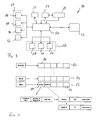
- An embodiment of the invention is shown in the drawings and will be explained in more detail in the description below with reference to same. In the drawings:
- Figure 1
- shows the front panel of a car multimedia system according to the present invention;
- Figure 2
- shows an example of a hierarchically structured menu;
- Figure 3
- is a schematic block diagram of the car multimedia system; and
- Figure 4
- is a block diagram illustrating an example of a data structure used by the car multimedia system.
- In
Figure 1 afront panel 12 of acar multimedia system 10 is schematically shown. Thecar multimedia system 10 is designed as a device which fits into the standardized installation slot in the dashboard of a vehicle. In addition to the device disposed in the dashboard a further device is placed within the vehicle, for example in the glove compartment. This second device is the so called GSM/GPS box offering navigation and telecommunication services. The GSM/GPS box is electrically connected with the device in the dashboard (both devices defining the car multimedia system 10). - Both devices have a plurality of connectors allowing to connect necessary hardware, like ear-phone, GSM antenna, GPS antenna, hence free microphone, radio antenna, loud speaker, etc. For the sake of simplicity, these parts are not shown in
Figure 1 . - The car multimedia system offers a plurality of different functions and services, for example radio, navigation, telephone, e-mail, SMS, etc. All these functions and services may be selected by a user of the
car multimedia system 10 via thefront panel 12. - The
front panel 12 comprises a first rotarypush button switch 14 which allows to control the volume by rotating therotary push button 14 and to switch on and off thecar multimedia system 10 by pushing the rotarypush button switch 14. The rotarypush button switch 14 is placed on the left hand side of thefront panel 12. On the right hand side a secondrotary push button 16 is provided which allows to select a menu item by rotating and to activate it by pushing the rotarypush button switch 16. - Further selection keys in form of push button switches are provided in the upper front panel area. Three of these selection keys are referenced with
reference numeral car multimedia system 10, in the present case the CD function with selection key 18a, the radio function with selection key 18b and the navigation function with selection key 18c. Generally such selection keys provided for selecting one specific function are called "hard keys". - In addition to these hard keys, the
front panel 12 also carries so calledsoft keys 20. These soft keys serve to select variable functions depending on the on mode in which the car multimedia system is operated. In the present embodiment, ten soft keys are provided in the lower margin area of thefront panel 12. - In the centre of the
front panel 12, adisplay 22 is disposed. In the present embodiment, thedisplay 22 is a DOT matrix display, which allows to display several lines of information in form of characters, words or pictures, icons or pictograms. - In
Figure 1 , thedisplay 22 displays three lines of information in form of three different menu items 24a, 24b and 24c. The menu item shown in the middle line 24b is displayed in a larger font compared to the information shown in the first and the third line 24a, 24c. The larger font indicates that the menu item in line 24b is selected. - Further, the
display 22 displays two arrows 26a, 26b, the upper arrow 26a being directed upwards and the lower arrow 26b being directed downwards. Both arrows indicate that more menu items than displayed are reachable. - The user may select a menu item by rotating the
rotary push button 16 until the desired menu item is displayed in the middle line 24b. In order to activate this selected menu item, the user than have to push therotary push button 16. Depending on the selected and activated menu item, either further menu items are displayed or the desired function is started. - Although the use of hierarchically structured menus is known, a exemplary menu is shown in
Figure 2 and will be explained below for better understanding of the present invention. Particularly,Figure 2 illustrates a part of the hierarchically structured menu for operation of the navigation system being part of thecar multimedia system 10. - In general, the menu comprises a plurality of
menu items 32 in a first sub-menu level and a plurality ofmenu items 34 in a second sub-menu level. All shownmenu items - In the present embodiment, the first sub-menu level comprises the menu items "destination entry", "destination memory" and "last destination", which belong to the menu of the navigation system of the
car multimedia system 10. The first sub-menu level, that is themenu items 32 are reached by selecting and activating themain menu item 36. This is achieved for example by pushing the hard key 18c. - The
menu items 34 of the second sub-menu level belong to a specific menu item of the first sub-menu level, in the present embodiment the menu item "destination memory". In order to reach themenu items 34 of the second sub-menu level, the menu item "destination memory" of the first sub-menu level has to be selected and activated via the rotarypush button switch 16. - For sake of simplicity, the other menu items of the second sub-menu level belonging to the menu items "destination entry" and "last destination" of the first sub-menu level are not shown.
- As it is apparent from
Figure 2 , the second sub-menu level defines the last or lowest menu level, which means that by selecting and activating amenu item 34 of this sub-menu level, a function is started instead of displaying further menu items. Therefore, the menu items of this second sub-menu level are called hereinafter "end-menu items". - In the embodiment shown, the end-menu item "Becker" is selected and activated as to start route guidance to the address associated and stored with the name "Becker".
- It is to be understood that this hierarchically structured menu is more illustrative and may be modified by providing more menu items in more than two sub-menu levels.
- From the above description it may be seen that for selecting and activating the end-menu item "Becker", the user must first push the hard key 18c, than select and activate the menu item "destination memory" and finally select and activate the end-menu item "Becker", each by operating the rotary
push button switch 16. At least for each selection of an menu item or end-menu item display 22 of thecar multimedia system 10 in the dashboard. Generally, this means that the users view is distracted from the street what is to be avoided. - In order to minimize the time of distraction during selection and activation of an end-menu item, the car
multi media system 10 has implemented a function which automatically selects an end-menu item 34 in response to the operation of a hard key 18. Particularly, the system selects an end-menu item on the basis of a predetermined criterion, which is in the present case the frequency of use of the end-menu items belonging to the main menu item. - With respect to
Figure 2 , this means that upon operation of the hard key 18c end-menu item "Becker" is selected under the assumption that this end-menu item 34 has been used most frequently in the past. Then the user must only activate the selected end-menu item "Becker" by pushing the rotarypush button switch 16 as to start the route guidance function. - As a result, the operation is simplified since two handling steps, namely selecting and activating a menu item in the first sub-menu level and selecting an end-menu item in the second sub-menu level, are skipped. The difference between the conventional operation and the operation according to the present invention is indicated by
arrows Fig. 2 . - In a preferred embodiment, the system also automatically activates the selected end-
menu item 34. With respect toFigure 2 , this means that the end-menu item "Becker" is automatically selected and activated in response to the operation of the hard key 18c. Hence, according to this embodiment, the user may start the route guidance to the address associated with "Becker" just by one switching activity. - It is to be understood that the criterion "frequency of use" is just one, however the preferred, way of selection. A person skilled in the art will recognize that other criteria are also conceivable. The present invention is not limited to the criterion "frequency of use".
- It may also be implemented that the criterion is variable depending on the selected root menu item. In other words, the selection of an end-menu item belonging to the root menu item "navigation" is carried out differently to the selection of an end-menu item belonging to for example the root menu item CD or radio.
- Of course, the system allows to "overrule" the automatic selection of an end-menu item by operating the respective hard key 18 twice within a short predetermined period. The system recognizes this double operation and displays the
menu item 32 of the first sub-menu level in thedisplay 22 in response thereto. The user may than select and activate the desired menu items in the conventional manner. - In
Figure 3 the functional structure of the car multimedia system is shown in form of a block diagram. Thecar multimedia system 10 comprises amain controller 50 which generally comprises at least a microprocessor or a microcontroller. Themain controller 50 is mainly responsible for controlling all peripheral units and to perform all operations necessary for providing the functions of the car multimedia system, like radio, CD, navigation, telephone, etc. - It is apparent for the man skilled in the art that the
main controller 50 may comprise a couple of different circuits in practise, for example the microprocessor, a graphic driver circuit, a clock generator, etc. - The
main controller 50 is coupled with a read onlymemory circuit 52 which serves to store all program data (firmware). Of course, the read only memory may be provided as an erasable and rewriteable read only memory, like EPROM, EEPROM, etc. Erasable read onlymemory circuits 52 have the advantage that the firmware for operating the car multimedia system may be updated. - In addition to the read only memory circuit 52 a random access memory circuit 54 (RAM) is also provided and coupled with the
main controller 50. The random access memory serves to store temporary data and user specific data, in particular. For example, with respect toFigure 2 therandom access memory 54 stores destinations programmed by the user. These stored destination data then form the menu items of the second sub-menu level. - The
main controller 50 is electrically coupled with thedisplay 22. - For allowing inputs a selection
key unit 56 is provided and electrically coupled with themain controller 50. The selectionkey unit 56 comprises a couple of different control elements for examplehard keys 58,soft keys 60 and rotary push button switches 62. Of course it is to be understood that other control elements may be provided if necessary. For example, a rotary push button switch may be replaced with a two way or four way switch and an additional confirmation switch. The hard keys andsoft keys hard keys 58 and thesoft keys 60. - The
main controller 50 is connected with further functional units namely anaudio unit 64 comprising a CD device, a radio device (tuner), amplifiers, etc. The CD device is referenced withreference numeral 66 and the radio device is indicated withreference numeral 68. Further functional units are thenavigation unit 70 and thetelecommunications unit 72. The navigation unit for example comprises a DVD ROM device for receiving navigation data on a DVD ROM, a GPS receiver, a GPS antenna, etc. Thetelecommunications unit 72 comprises for example a GMS device and a GMS antenna. - Since the structure of these units 66-72 is not part of the present invention it is refrained from describing them in detail. A man skilled in the art knows how to design these units.
- As already described before, the present invention provides an improved operation of the car multimedia system, namely by simplifying the selection and activation of an end-menu item.
- To implement this improved operation, a discriminating
device 80 is provided. The discriminatingdevice 80 is electrically coupled with themain controller 50 and communicates therewith. Further, the discriminating device is coupled with the randomaccess memory circuit 54 as to allow read and write operations of data. - The discriminating
device 80 builds up and maintains a data structure and continuously updates the respective data necessary for carrying out the above mentioned automatic selection and activation of an end-menu item. In particular, the discriminatingdevice 80 builds up a data structure as exemplaryly shown inFigure 4 . However, it is to be noted that this is merely one example of a data structure and other data structures are also conceivable. - The data is preferably structured as data lists 82, each
list 82 comprising at least onedata packet 84. Eachdata list 82 is assigned to a main menu item, for example navigation, telecommunications and radio. - With respect to the
data list 82 assigned to navigation, two data packets are indicated with the names "Becker" and "WWP-S" as already used inFigure 2 . Eachdata packet 84 is divided into sub-packets in order to store different values. These values are also shown inFigure 4 which are sub-menu item, number of selections (frequency of use) and last use. The first value "sub-menu item" is preferably a pointer pointing to the respective data stored in therandom access memory 54. The second value "number of selections" is a counter and defines the number of former uses of this end-menu item. In other words this value represents the frequency of use of the respective and menu item. The third value "last use" is the date of the last use of the respective end-menu item. - In the present embodiment the first data packet has the values "Becker", 10 and 29/01/2004; these values indicate that the end-menu item "Becker" has been selected and activated ten times and the last use of this end-menu item was January 29, 2004. The second data packet contains the values "WWP-S", 5 and 13/01/2004.
- In the present embodiment, the data packets of the
third data list 82 assigned to "navigation" is ordered with respect to the value "number of selections". That is the third data packet "Becker" defines the first element in the data list since the number of selections value is greater than the respective values of the other data packets. - As already mentioned before, the discriminating
device 80 serves to maintain the data lists and data packets. Particularly, it updates the number of selections value in response to the selection and activation of the respective end-menu item. It further updates the "last use"-value. - Optionally, the discriminating
device 80 is able to delete data packets out of the data lists if data packets have not been used for a predetermined period. Of course, it is also conceivable that the user may delete individual data packets or all data packets in the data lists by operating the selection key unit. - In addition to the build up and maintenance of the data structure, the discriminating
device 80 causes thecontroller 50 to select and activate the end-menu item forming the first data packet in therespective data list 82 in response to the operation of a hard key 18. Upon operation of a hard key, themain controller 50 informs the discriminatingdevice 80 thereof and receives the information from the discriminatingdevice 80 which of the end-menu items is to be selected and optionally activated. The discriminatingdevice 80 in turn gets this information from thedata list 82. Simultaneously, the discriminatingdevice 80 updates the respective values of the selected data packet. - As already mentioned before, the user may overrule the discriminating
device 80 by double pushing the hard key. In this case the discriminatingdevice 80 does not transmit an information to themain controller 50 about the end-menu item to be selected. Instead, themain controller 50 displays the stored menu items of the next sub-level menu. Nevertheless, the discriminating device updates the respective values of the data packet associated with the end-menu item the user has selected and activated manually. - It is to be understood that the functional structure of the car multimedia system as shown in
Figure 3 is just one example and the present invention should not be limited thereto. Particularly, the discriminatingdevice 80 may be also be part of themain controller 50 and may be implemented as hard- and/or software. Further, thecar multimedia system 10 may comprise only the navigation unit, the audio unit, the telecommunications unit or each possible combination thereof. - Further, a man skilled in the art knows that other data structures may also be used to implement the present invention.
- Those skilled in the art can now appreciate from the forgoing description that the broad teachings of the present invention can be implemented in a variety of forms. Therefore, while this invention has been described in connection with a particular example thereof, the scope of the invention should not be so limited since other modifications will become apparent to the skilled practitioner upon a study of the drawings, specification and the claims.
Claims (24)
- Car multimedia system comprising- an audio unit (64),- a navigation unit (70) for route guidance,- a controller device (50) for controlling said units,- a display (22) for displaying selection menus with hierarchically structured menu items and end-menu items, said end-menu items allowing to start a specific function, and a selection key unit (56) comprising at least a push button switch (18), preferably a hard key, a two way switch, preferably a rotary knob, for selecting and a push button switch (16) for activating menu items and end-menu items, characterized by- a discriminating device (80) adapted to select an end-menu item (34) in response to an actuation of said push button switch (18), preferably said hard key, by skipping sub-levels and menu items between a root menu item and said end-menu item, said end-menu item (34) being selected by said discriminating device (80) on the basis of a predetermined criterion.
- The car multimedia system of claim 1, characterized in that said discriminating device is adapted both to select and activate said end-menu item.
- The car multimedia system of claim 1 or 2, characterized in that said criterion is the number of former selections of the end-menu items assigned to said hard key.
- The car multimedia system of claim 3, characterized in that said discriminating device (80) is adapted to select the end menu item with the largest number of former selections.
- The car multimedia system of any of claims 3 to 4, characterized by a data memory for storing data packets each being assigned to an end-menu item, wherein each data packet carries the number of selections of the assigned end-menu item.
- The car multimedia system of claim 5, characterized in that each data packet further carries the date of last use of the assigned end-menu item.
- The car multimedia system of claim 5 or 6, characterized in that said data memory stores at least two data packets for each assigned end-menu item.
- The car multimedia system of any of the preceding claims, characterized in that said discriminating device is adapted to allow the selection of menu items according to their hierarchical structure by using the rotary push button, wherein this mode of selection is termed overrule mode.
- The car multimedia system of claim 8, characterized in that said overrule mode is activated by a double activation of said hard key.
- The car multimedia system of claim 5, characterized in that said controller device is adapted to delete said data packets assigned to at least one of said end-menu items in response to a predetermined input via said selection key unit.
- The car multimedia system of claim 1 or 2, characterized in that said control device is adapted to allow the selection of a criterion out of a predetermined list of criteria via said selection key unit.
- The car multimedia system of any of the preceding claims, characterized by a telecommunications unit comprising a telephone module and an internet module allowing e-mail and SMS transmission, WAP, and other telecommunication services.
- The car multimedia system of any of the preceding claims, characterized in that said audio unit comprises a radio module and a CD module.
- The car multimedia system of any of the preceding claims, characterized in that said rotary knob and said push button switch are provided as a rotary push button switch.
- The car multimedia system of any of the preceding claims, characterized in that said hard key is provided for activating the navigation unit.
- The car multimedia system of claim 15, characterized in that a further hard key is provided for activating the audio unit.
- A method for activating a function of a car multimedia system, the system comprising an audio unit, a navigation unit for route guidance, a controller device for controlling said units, a display for displaying selection menus with hierarchically structured menu items and end-menu items, said end-menu items allowing to start a specific function, and a selection key unit comprising at least a hard key, a rotary knob for selecting and a push button switch for activating menu items, characterized by the step of selecting an end-menu item in response to an actuation of said hard key by skipping sub-levels and menu items between a root menu item and said end-menu item, wherein said end-menu item is selected on the basis of a predetermined criterion.
- Said method of claim 17, characterized in that said end-menu item is both selected and activated in response to said actuation of said hard key.
- The method of claim 17 or 18, characterized in that said criterion is the number of former selections of said end-menu items assigned to said hard key.
- The method of claim 19, characterized in that the end-menu item with the greatest number of selections is selected.
- The method of claim 19 or 20, characterized in that with each selection of an end-menu item a counter value assigned to said end menu item is increased by one.
- The method of claim 21, characterized in that an actual date of use is stored for an end-menu item with each selection of said end-menu item.
- The method of any of claims 17 to 22, characterized in that the selection and activation of menu items according to their hierarchical structure is allowed (overrule mode) in response to a predetermined operation of said selection key unit, preferably a double actuation of said hard key.
- The method of claim 21, characterized in that said counter values may be deleted either separately or in common via said selection key unit.
Priority Applications (9)
| Application Number | Priority Date | Filing Date | Title |
|---|---|---|---|
| EP04010243A EP1591756B1 (en) | 2004-04-30 | 2004-04-30 | Car multimedia system and method for activating a function of such a system |
| AT04010243T ATE389867T1 (en) | 2004-04-30 | 2004-04-30 | VEHICLE MULTIMEDIA SYSTEM AND METHOD FOR ACTIVATING A FUNCTION OF SUCH A SYSTEM |
| DE602004012532T DE602004012532T2 (en) | 2004-04-30 | 2004-04-30 | A vehicle multimedia system and method for activating a function of such a system |
| CN200580013690.3A CN1950675B (en) | 2004-04-30 | 2005-04-29 | Car multimedia system and method for activating a function of such a system |
| KR1020067022656A KR101225910B1 (en) | 2004-04-30 | 2005-04-29 | Car multimedia system and method for activating a function of a car multimedia system |
| PCT/EP2005/004632 WO2005106394A1 (en) | 2004-04-30 | 2005-04-29 | Car multimedia system and method for activating a function of a car multimedia system |
| JP2007509980A JP4787824B2 (en) | 2004-04-30 | 2005-04-29 | In-vehicle multimedia system and method for activating functions of in-vehicle multimedia system |
| CA2560201A CA2560201C (en) | 2004-04-30 | 2005-04-29 | Car multimedia system and method for activating a function of a car multimedia system |
| US11/589,324 US9400188B2 (en) | 2004-04-30 | 2006-10-27 | Activating a function of a vehicle multimedia system |
Applications Claiming Priority (1)
| Application Number | Priority Date | Filing Date | Title |
|---|---|---|---|
| EP04010243A EP1591756B1 (en) | 2004-04-30 | 2004-04-30 | Car multimedia system and method for activating a function of such a system |
Publications (2)
| Publication Number | Publication Date |
|---|---|
| EP1591756A1 EP1591756A1 (en) | 2005-11-02 |
| EP1591756B1 true EP1591756B1 (en) | 2008-03-19 |
Family
ID=34924793
Family Applications (1)
| Application Number | Title | Priority Date | Filing Date |
|---|---|---|---|
| EP04010243A Expired - Lifetime EP1591756B1 (en) | 2004-04-30 | 2004-04-30 | Car multimedia system and method for activating a function of such a system |
Country Status (9)
| Country | Link |
|---|---|
| US (1) | US9400188B2 (en) |
| EP (1) | EP1591756B1 (en) |
| JP (1) | JP4787824B2 (en) |
| KR (1) | KR101225910B1 (en) |
| CN (1) | CN1950675B (en) |
| AT (1) | ATE389867T1 (en) |
| CA (1) | CA2560201C (en) |
| DE (1) | DE602004012532T2 (en) |
| WO (1) | WO2005106394A1 (en) |
Families Citing this family (7)
| Publication number | Priority date | Publication date | Assignee | Title |
|---|---|---|---|---|
| US8380499B2 (en) * | 2008-03-31 | 2013-02-19 | General Motors Llc | Speech recognition adjustment based on manual interaction |
| US9341493B2 (en) * | 2011-04-18 | 2016-05-17 | Volkswagen Ag | Method and apparatus for providing a user interface, particularly in a vehicle |
| CN102520867B (en) * | 2011-12-21 | 2014-07-30 | 深圳市航盛电子股份有限公司 | Automobile navigation system and navigation method thereof |
| CN104066020A (en) * | 2014-06-27 | 2014-09-24 | 深圳市星盘科技有限公司 | Method for sound box to play media and sound box applying same |
| CN104066034B (en) * | 2014-06-27 | 2017-11-17 | 深圳市星盘科技有限公司 | One kind networking audio amplifier |
| CN106128142B (en) * | 2016-06-29 | 2018-12-14 | 绍兴百嘉汽车电子仪表有限公司 | A kind of automobile navigation systems |
| CN109830235B (en) * | 2019-03-19 | 2021-04-20 | 东软睿驰汽车技术(沈阳)有限公司 | Voice control method and device, vehicle-mounted control equipment and vehicle |
Family Cites Families (35)
| Publication number | Priority date | Publication date | Assignee | Title |
|---|---|---|---|---|
| CA2095452C (en) * | 1993-05-04 | 1997-03-18 | Phillip J. Beaudet | Dynamic hierarchical selection menu |
| JPH07129350A (en) * | 1993-10-29 | 1995-05-19 | Sharp Corp | Menu selection type information processing device |
| JPH07182128A (en) * | 1993-12-24 | 1995-07-21 | Mitsubishi Electric Corp | User interface method |
| US5784059A (en) * | 1994-09-16 | 1998-07-21 | Aisin Aw Co., Ltd. | Vehicle navigation system with destination selection using hierarchical menu arrangement with selective level skipping |
| JP3596781B2 (en) * | 1994-11-21 | 2004-12-02 | 株式会社タイトー | Information providing method by information providing apparatus and information providing apparatus used for implementing the method |
| US5887269A (en) * | 1995-04-07 | 1999-03-23 | Delco Elecronics Corporation | Data product authorization control for GPS navigation system |
| US5828376A (en) * | 1996-09-23 | 1998-10-27 | J. D. Edwards World Source Company | Menu control in a graphical user interface |
| US6098085A (en) * | 1997-03-17 | 2000-08-01 | At&T Corp. | Word-serial reader for network devices having limited display capabilities |
| CN1055555C (en) * | 1998-03-26 | 2000-08-16 | 四川长虹电子集团公司 | Method for control menu display system |
| JP2000029595A (en) * | 1998-07-15 | 2000-01-28 | Fujitsu Ltd | Electronic processing device with menu interface |
| JP2000149721A (en) * | 1998-11-09 | 2000-05-30 | Alpine Electronics Inc | Operation device for on-vehicle apparatus |
| JP2001069582A (en) * | 1999-08-31 | 2001-03-16 | Clarion Co Ltd | Electronic equipment, information processing method, recording medium with information processing software recorded therein and display |
| DE19944324A1 (en) * | 1999-09-15 | 2001-03-22 | Audi Ag | Multi-function control device |
| KR100334806B1 (en) * | 1999-12-07 | 2002-05-02 | 윤종용 | Method of hot key user assignment in mobile communication terminal |
| US7137073B2 (en) * | 1999-12-18 | 2006-11-14 | Lg Electronics Inc. | Method for managing menu function in mobile station |
| JP3892197B2 (en) * | 2000-02-03 | 2007-03-14 | パイオニア株式会社 | Navigation system |
| US6899539B1 (en) * | 2000-02-17 | 2005-05-31 | Exponent, Inc. | Infantry wearable information and weapon system |
| DE10044819A1 (en) * | 2000-09-11 | 2002-04-18 | Am3 Automotive Multimedia Ag | Multimedia unit and method for operating a multimedia unit |
| JP3838014B2 (en) * | 2000-09-27 | 2006-10-25 | 日本電気株式会社 | Preference learning device, preference learning system, preference learning method, and recording medium |
| US6415224B1 (en) * | 2001-02-06 | 2002-07-02 | Alpine Electronics, Inc. | Display method and apparatus for navigation system |
| US6600994B1 (en) * | 2001-05-17 | 2003-07-29 | Horizon Navigation, Inc. | Quick selection of destinations in an automobile navigation system |
| JP4830225B2 (en) * | 2001-07-18 | 2011-12-07 | ソニー株式会社 | Recording apparatus and method, recording medium, and program |
| US20030052924A1 (en) * | 2001-09-18 | 2003-03-20 | Carlson Gary David | User interface with simultaneous display of menu tree levels |
| US7030845B2 (en) * | 2002-01-20 | 2006-04-18 | Shalong Maa | Digital enhancement of streaming video and multimedia system |
| US6484094B1 (en) * | 2002-02-19 | 2002-11-19 | Alpine Electronics, Inc. | Display method and apparatus for navigation system |
| US20030202015A1 (en) * | 2002-04-30 | 2003-10-30 | Battles Amy E. | Imaging device user interface method and apparatus |
| US20050021470A1 (en) * | 2002-06-25 | 2005-01-27 | Bose Corporation | Intelligent music track selection |
| US7315299B2 (en) * | 2002-08-01 | 2008-01-01 | Nissan Motor Co., Ltd. | Multi-way input device and operating failure avoidance method using the same |
| JP2004102609A (en) * | 2002-09-09 | 2004-04-02 | Toshiba Corp | Mobile communication terminal |
| US7827508B2 (en) * | 2002-09-13 | 2010-11-02 | Eastman Kodak Company | Hotkey function in digital camera user interface |
| DE10252688A1 (en) * | 2002-11-13 | 2004-06-03 | Caa Ag | Vehicle on board computer system with selection and activation of main and sub menus by repeated operation of a switch element |
| US7231379B2 (en) * | 2002-11-19 | 2007-06-12 | Noema, Inc. | Navigation in a hierarchical structured transaction processing system |
| JP4560760B2 (en) * | 2002-11-29 | 2010-10-13 | アイシン・エィ・ダブリュ株式会社 | Map display device and program |
| US20040150674A1 (en) * | 2003-02-02 | 2004-08-05 | Nissan Motor Co., Ltd. | Information display system for vehicle |
| JP4155854B2 (en) * | 2003-03-24 | 2008-09-24 | 富士通株式会社 | Dialog control system and method |
-
2004
- 2004-04-30 DE DE602004012532T patent/DE602004012532T2/en not_active Expired - Lifetime
- 2004-04-30 EP EP04010243A patent/EP1591756B1/en not_active Expired - Lifetime
- 2004-04-30 AT AT04010243T patent/ATE389867T1/en not_active IP Right Cessation
-
2005
- 2005-04-29 CA CA2560201A patent/CA2560201C/en not_active Expired - Fee Related
- 2005-04-29 CN CN200580013690.3A patent/CN1950675B/en not_active Expired - Fee Related
- 2005-04-29 KR KR1020067022656A patent/KR101225910B1/en not_active Expired - Fee Related
- 2005-04-29 JP JP2007509980A patent/JP4787824B2/en not_active Expired - Fee Related
- 2005-04-29 WO PCT/EP2005/004632 patent/WO2005106394A1/en not_active Ceased
-
2006
- 2006-10-27 US US11/589,324 patent/US9400188B2/en active Active
Also Published As
| Publication number | Publication date |
|---|---|
| ATE389867T1 (en) | 2008-04-15 |
| CN1950675A (en) | 2007-04-18 |
| DE602004012532T2 (en) | 2009-04-02 |
| CA2560201C (en) | 2010-07-13 |
| US20070153130A1 (en) | 2007-07-05 |
| DE602004012532D1 (en) | 2008-04-30 |
| WO2005106394A1 (en) | 2005-11-10 |
| EP1591756A1 (en) | 2005-11-02 |
| JP4787824B2 (en) | 2011-10-05 |
| KR101225910B1 (en) | 2013-01-24 |
| CA2560201A1 (en) | 2005-11-10 |
| JP2007535746A (en) | 2007-12-06 |
| KR20060132022A (en) | 2006-12-20 |
| CN1950675B (en) | 2015-05-13 |
| US9400188B2 (en) | 2016-07-26 |
Similar Documents
| Publication | Publication Date | Title |
|---|---|---|
| JP2012009031A (en) | On-vehicle multimedia system and method for selecting and starting on-vehicle multimedia system | |
| US8341549B2 (en) | Method for sorting and displaying symbols in a mobile communication terminal | |
| US9031742B2 (en) | Vehicle multimedia system | |
| US7035720B2 (en) | In-car computer system and method for selecting and activating option menus | |
| KR101232485B1 (en) | Vehicle multimedia system and method for operating a vehicle multimedia system | |
| CN103608644A (en) | Method and device for providing a user interface, in particular in a vehicle | |
| EP1591756A1 (en) | Car multimedia system and method for activating a function of such a system | |
| JP2002539010A (en) | Operation device | |
| KR20060050715A (en) | Vehicle multimedia device, and method for controlling the display of hierarchically structured menus | |
| JP4501067B2 (en) | Vehicle information display device | |
| JP5728957B2 (en) | Vehicle control device | |
| US6718260B1 (en) | Reconfigurable menu display for a vehicle navigation system | |
| CA2517292C (en) | Car multimedia apparatus and method for controlling the display of hierarchically structured menus on a display device of a car multimedia apparatus | |
| CN101341461B (en) | Control unit and method for a driver information device | |
| JP4512999B2 (en) | Vehicle information display device | |
| JP2001519128A (en) | Method and broadcast receiver for creating and storing user-specific operation menus | |
| JP2006096247A (en) | Vehicle information display device |
Legal Events
| Date | Code | Title | Description |
|---|---|---|---|
| PUAI | Public reference made under article 153(3) epc to a published international application that has entered the european phase |
Free format text: ORIGINAL CODE: 0009012 |
|
| AK | Designated contracting states |
Kind code of ref document: A1 Designated state(s): AT BE BG CH CY CZ DE DK EE ES FI FR GB GR HU IE IT LI LU MC NL PL PT RO SE SI SK TR |
|
| AX | Request for extension of the european patent |
Extension state: AL HR LT LV MK |
|
| 17P | Request for examination filed |
Effective date: 20060309 |
|
| AKX | Designation fees paid |
Designated state(s): AT BE BG CH CY CZ DE DK EE ES FI FR GB GR HU IE IT LI LU MC NL PL PT RO SE SI SK TR |
|
| 17Q | First examination report despatched |
Effective date: 20061221 |
|
| GRAP | Despatch of communication of intention to grant a patent |
Free format text: ORIGINAL CODE: EPIDOSNIGR1 |
|
| GRAS | Grant fee paid |
Free format text: ORIGINAL CODE: EPIDOSNIGR3 |
|
| GRAA | (expected) grant |
Free format text: ORIGINAL CODE: 0009210 |
|
| AK | Designated contracting states |
Kind code of ref document: B1 Designated state(s): AT BE BG CH CY CZ DE DK EE ES FI FR GB GR HU IE IT LI LU MC NL PL PT RO SE SI SK TR |
|
| REG | Reference to a national code |
Ref country code: GB Ref legal event code: FG4D |
|
| REG | Reference to a national code |
Ref country code: CH Ref legal event code: EP |
|
| REF | Corresponds to: |
Ref document number: 602004012532 Country of ref document: DE Date of ref document: 20080430 Kind code of ref document: P |
|
| REG | Reference to a national code |
Ref country code: IE Ref legal event code: FG4D |
|
| PG25 | Lapsed in a contracting state [announced via postgrant information from national office to epo] |
Ref country code: FI Free format text: LAPSE BECAUSE OF FAILURE TO SUBMIT A TRANSLATION OF THE DESCRIPTION OR TO PAY THE FEE WITHIN THE PRESCRIBED TIME-LIMIT Effective date: 20080319 |
|
| PG25 | Lapsed in a contracting state [announced via postgrant information from national office to epo] |
Ref country code: AT Free format text: LAPSE BECAUSE OF FAILURE TO SUBMIT A TRANSLATION OF THE DESCRIPTION OR TO PAY THE FEE WITHIN THE PRESCRIBED TIME-LIMIT Effective date: 20080319 |
|
| NLV1 | Nl: lapsed or annulled due to failure to fulfill the requirements of art. 29p and 29m of the patents act | ||
| PG25 | Lapsed in a contracting state [announced via postgrant information from national office to epo] |
Ref country code: BE Free format text: LAPSE BECAUSE OF FAILURE TO SUBMIT A TRANSLATION OF THE DESCRIPTION OR TO PAY THE FEE WITHIN THE PRESCRIBED TIME-LIMIT Effective date: 20080319 Ref country code: SI Free format text: LAPSE BECAUSE OF FAILURE TO SUBMIT A TRANSLATION OF THE DESCRIPTION OR TO PAY THE FEE WITHIN THE PRESCRIBED TIME-LIMIT Effective date: 20080319 Ref country code: PL Free format text: LAPSE BECAUSE OF FAILURE TO SUBMIT A TRANSLATION OF THE DESCRIPTION OR TO PAY THE FEE WITHIN THE PRESCRIBED TIME-LIMIT Effective date: 20080319 |
|
| ET | Fr: translation filed | ||
| PG25 | Lapsed in a contracting state [announced via postgrant information from national office to epo] |
Ref country code: SK Free format text: LAPSE BECAUSE OF FAILURE TO SUBMIT A TRANSLATION OF THE DESCRIPTION OR TO PAY THE FEE WITHIN THE PRESCRIBED TIME-LIMIT Effective date: 20080319 Ref country code: ES Free format text: LAPSE BECAUSE OF FAILURE TO SUBMIT A TRANSLATION OF THE DESCRIPTION OR TO PAY THE FEE WITHIN THE PRESCRIBED TIME-LIMIT Effective date: 20080630 Ref country code: CZ Free format text: LAPSE BECAUSE OF FAILURE TO SUBMIT A TRANSLATION OF THE DESCRIPTION OR TO PAY THE FEE WITHIN THE PRESCRIBED TIME-LIMIT Effective date: 20080319 Ref country code: PT Free format text: LAPSE BECAUSE OF FAILURE TO SUBMIT A TRANSLATION OF THE DESCRIPTION OR TO PAY THE FEE WITHIN THE PRESCRIBED TIME-LIMIT Effective date: 20080826 Ref country code: SE Free format text: LAPSE BECAUSE OF FAILURE TO SUBMIT A TRANSLATION OF THE DESCRIPTION OR TO PAY THE FEE WITHIN THE PRESCRIBED TIME-LIMIT Effective date: 20080619 |
|
| PG25 | Lapsed in a contracting state [announced via postgrant information from national office to epo] |
Ref country code: RO Free format text: LAPSE BECAUSE OF FAILURE TO SUBMIT A TRANSLATION OF THE DESCRIPTION OR TO PAY THE FEE WITHIN THE PRESCRIBED TIME-LIMIT Effective date: 20080319 Ref country code: MC Free format text: LAPSE BECAUSE OF NON-PAYMENT OF DUE FEES Effective date: 20080430 Ref country code: NL Free format text: LAPSE BECAUSE OF FAILURE TO SUBMIT A TRANSLATION OF THE DESCRIPTION OR TO PAY THE FEE WITHIN THE PRESCRIBED TIME-LIMIT Effective date: 20080319 |
|
| REG | Reference to a national code |
Ref country code: CH Ref legal event code: PL |
|
| PLBE | No opposition filed within time limit |
Free format text: ORIGINAL CODE: 0009261 |
|
| STAA | Information on the status of an ep patent application or granted ep patent |
Free format text: STATUS: NO OPPOSITION FILED WITHIN TIME LIMIT |
|
| PG25 | Lapsed in a contracting state [announced via postgrant information from national office to epo] |
Ref country code: CH Free format text: LAPSE BECAUSE OF NON-PAYMENT OF DUE FEES Effective date: 20080430 Ref country code: LI Free format text: LAPSE BECAUSE OF NON-PAYMENT OF DUE FEES Effective date: 20080430 Ref country code: DK Free format text: LAPSE BECAUSE OF FAILURE TO SUBMIT A TRANSLATION OF THE DESCRIPTION OR TO PAY THE FEE WITHIN THE PRESCRIBED TIME-LIMIT Effective date: 20080319 Ref country code: EE Free format text: LAPSE BECAUSE OF FAILURE TO SUBMIT A TRANSLATION OF THE DESCRIPTION OR TO PAY THE FEE WITHIN THE PRESCRIBED TIME-LIMIT Effective date: 20080319 |
|
| 26N | No opposition filed |
Effective date: 20081222 |
|
| PG25 | Lapsed in a contracting state [announced via postgrant information from national office to epo] |
Ref country code: BG Free format text: LAPSE BECAUSE OF FAILURE TO SUBMIT A TRANSLATION OF THE DESCRIPTION OR TO PAY THE FEE WITHIN THE PRESCRIBED TIME-LIMIT Effective date: 20080619 Ref country code: IE Free format text: LAPSE BECAUSE OF NON-PAYMENT OF DUE FEES Effective date: 20080430 |
|
| PG25 | Lapsed in a contracting state [announced via postgrant information from national office to epo] |
Ref country code: CY Free format text: LAPSE BECAUSE OF FAILURE TO SUBMIT A TRANSLATION OF THE DESCRIPTION OR TO PAY THE FEE WITHIN THE PRESCRIBED TIME-LIMIT Effective date: 20080319 |
|
| PG25 | Lapsed in a contracting state [announced via postgrant information from national office to epo] |
Ref country code: HU Free format text: LAPSE BECAUSE OF FAILURE TO SUBMIT A TRANSLATION OF THE DESCRIPTION OR TO PAY THE FEE WITHIN THE PRESCRIBED TIME-LIMIT Effective date: 20080920 Ref country code: LU Free format text: LAPSE BECAUSE OF NON-PAYMENT OF DUE FEES Effective date: 20080430 |
|
| PG25 | Lapsed in a contracting state [announced via postgrant information from national office to epo] |
Ref country code: TR Free format text: LAPSE BECAUSE OF FAILURE TO SUBMIT A TRANSLATION OF THE DESCRIPTION OR TO PAY THE FEE WITHIN THE PRESCRIBED TIME-LIMIT Effective date: 20080319 |
|
| PG25 | Lapsed in a contracting state [announced via postgrant information from national office to epo] |
Ref country code: GR Free format text: LAPSE BECAUSE OF FAILURE TO SUBMIT A TRANSLATION OF THE DESCRIPTION OR TO PAY THE FEE WITHIN THE PRESCRIBED TIME-LIMIT Effective date: 20080620 |
|
| REG | Reference to a national code |
Ref country code: FR Ref legal event code: PLFP Year of fee payment: 13 |
|
| REG | Reference to a national code |
Ref country code: FR Ref legal event code: PLFP Year of fee payment: 14 |
|
| REG | Reference to a national code |
Ref country code: FR Ref legal event code: PLFP Year of fee payment: 15 |
|
| PGFP | Annual fee paid to national office [announced via postgrant information from national office to epo] |
Ref country code: FR Payment date: 20210323 Year of fee payment: 18 Ref country code: IT Payment date: 20210323 Year of fee payment: 18 |
|
| PGFP | Annual fee paid to national office [announced via postgrant information from national office to epo] |
Ref country code: GB Payment date: 20210324 Year of fee payment: 18 |
|
| GBPC | Gb: european patent ceased through non-payment of renewal fee |
Effective date: 20220430 |
|
| PG25 | Lapsed in a contracting state [announced via postgrant information from national office to epo] |
Ref country code: GB Free format text: LAPSE BECAUSE OF NON-PAYMENT OF DUE FEES Effective date: 20220430 Ref country code: FR Free format text: LAPSE BECAUSE OF NON-PAYMENT OF DUE FEES Effective date: 20220430 |
|
| PG25 | Lapsed in a contracting state [announced via postgrant information from national office to epo] |
Ref country code: IT Free format text: LAPSE BECAUSE OF NON-PAYMENT OF DUE FEES Effective date: 20220430 |
|
| P01 | Opt-out of the competence of the unified patent court (upc) registered |
Effective date: 20230526 |
|
| PGFP | Annual fee paid to national office [announced via postgrant information from national office to epo] |
Ref country code: DE Payment date: 20230321 Year of fee payment: 20 |
|
| REG | Reference to a national code |
Ref country code: DE Ref legal event code: R071 Ref document number: 602004012532 Country of ref document: DE |