EP1591501A1 - Nonaromatic solvent type coating resin composition - Google Patents
Nonaromatic solvent type coating resin composition Download PDFInfo
- Publication number
- EP1591501A1 EP1591501A1 EP04707632A EP04707632A EP1591501A1 EP 1591501 A1 EP1591501 A1 EP 1591501A1 EP 04707632 A EP04707632 A EP 04707632A EP 04707632 A EP04707632 A EP 04707632A EP 1591501 A1 EP1591501 A1 EP 1591501A1
- Authority
- EP
- European Patent Office
- Prior art keywords
- solvent
- resin composition
- component
- coating
- epoxy resin
- Prior art date
- Legal status (The legal status is an assumption and is not a legal conclusion. Google has not performed a legal analysis and makes no representation as to the accuracy of the status listed.)
- Withdrawn
Links
- 239000002904 solvent Substances 0.000 title claims abstract description 129
- 238000000576 coating method Methods 0.000 title claims abstract description 119
- 239000011248 coating agent Substances 0.000 title claims abstract description 115
- 239000011342 resin composition Substances 0.000 title claims abstract description 41
- 239000003822 epoxy resin Substances 0.000 claims abstract description 71
- 229920000647 polyepoxide Polymers 0.000 claims abstract description 71
- 239000012046 mixed solvent Substances 0.000 claims abstract description 45
- 238000001704 evaporation Methods 0.000 claims abstract description 42
- 230000008020 evaporation Effects 0.000 claims abstract description 42
- 239000007787 solid Substances 0.000 claims abstract description 39
- 239000003849 aromatic solvent Substances 0.000 claims abstract description 37
- 239000000203 mixture Substances 0.000 claims abstract description 26
- 229920006334 epoxy coating Polymers 0.000 claims abstract description 3
- 150000001412 amines Chemical class 0.000 claims description 57
- 239000004593 Epoxy Substances 0.000 claims description 26
- 238000001035 drying Methods 0.000 claims description 20
- JHIVVAPYMSGYDF-UHFFFAOYSA-N cyclohexanone Chemical compound O=C1CCCCC1 JHIVVAPYMSGYDF-UHFFFAOYSA-N 0.000 claims description 16
- 239000001257 hydrogen Substances 0.000 claims description 14
- 229910052739 hydrogen Inorganic materials 0.000 claims description 14
- 239000012948 isocyanate Substances 0.000 claims description 14
- DKPFZGUDAPQIHT-UHFFFAOYSA-N Butyl acetate Natural products CCCCOC(C)=O DKPFZGUDAPQIHT-UHFFFAOYSA-N 0.000 claims description 12
- UFHFLCQGNIYNRP-UHFFFAOYSA-N Hydrogen Chemical compound [H][H] UFHFLCQGNIYNRP-UHFFFAOYSA-N 0.000 claims description 12
- 150000002513 isocyanates Chemical class 0.000 claims description 11
- 229920001187 thermosetting polymer Polymers 0.000 claims description 10
- 125000003118 aryl group Chemical group 0.000 claims description 9
- LCFVJGUPQDGYKZ-UHFFFAOYSA-N Bisphenol A diglycidyl ether Chemical compound C=1C=C(OCC2OC2)C=CC=1C(C)(C)C(C=C1)=CC=C1OCC1CO1 LCFVJGUPQDGYKZ-UHFFFAOYSA-N 0.000 claims description 7
- XUCHXOAWJMEFLF-UHFFFAOYSA-N bisphenol F diglycidyl ether Chemical compound C1OC1COC(C=C1)=CC=C1CC(C=C1)=CC=C1OCC1CO1 XUCHXOAWJMEFLF-UHFFFAOYSA-N 0.000 claims description 7
- 238000007865 diluting Methods 0.000 claims description 6
- 239000008199 coating composition Substances 0.000 claims description 2
- FUZZWVXGSFPDMH-UHFFFAOYSA-N hexanoic acid Chemical compound CCCCCC(O)=O FUZZWVXGSFPDMH-UHFFFAOYSA-N 0.000 claims 2
- 239000000463 material Substances 0.000 abstract description 19
- 230000007797 corrosion Effects 0.000 abstract description 16
- 238000005260 corrosion Methods 0.000 abstract description 16
- 229920005989 resin Polymers 0.000 description 54
- 239000011347 resin Substances 0.000 description 54
- 238000004519 manufacturing process Methods 0.000 description 44
- 239000000243 solution Substances 0.000 description 38
- 238000012360 testing method Methods 0.000 description 19
- 229910000831 Steel Inorganic materials 0.000 description 18
- 239000010959 steel Substances 0.000 description 18
- -1 corrosion resistance Substances 0.000 description 13
- XEKOWRVHYACXOJ-UHFFFAOYSA-N Ethyl acetate Chemical compound CCOC(C)=O XEKOWRVHYACXOJ-UHFFFAOYSA-N 0.000 description 12
- ISWSIDIOOBJBQZ-UHFFFAOYSA-N Phenol Natural products OC1=CC=CC=C1 ISWSIDIOOBJBQZ-UHFFFAOYSA-N 0.000 description 10
- ZWEHNKRNPOVVGH-UHFFFAOYSA-N 2-Butanone Chemical compound CCC(C)=O ZWEHNKRNPOVVGH-UHFFFAOYSA-N 0.000 description 9
- YXFVVABEGXRONW-UHFFFAOYSA-N Toluene Chemical compound CC1=CC=CC=C1 YXFVVABEGXRONW-UHFFFAOYSA-N 0.000 description 9
- 239000002981 blocking agent Substances 0.000 description 9
- 238000000034 method Methods 0.000 description 9
- 230000000704 physical effect Effects 0.000 description 9
- LRHPLDYGYMQRHN-UHFFFAOYSA-N N-Butanol Chemical compound CCCCO LRHPLDYGYMQRHN-UHFFFAOYSA-N 0.000 description 8
- HQABUPZFAYXKJW-UHFFFAOYSA-N butan-1-amine Chemical compound CCCCN HQABUPZFAYXKJW-UHFFFAOYSA-N 0.000 description 8
- FUZZWVXGSFPDMH-UHFFFAOYSA-M hexanoate Chemical compound CCCCCC([O-])=O FUZZWVXGSFPDMH-UHFFFAOYSA-M 0.000 description 8
- UAEPNZWRGJTJPN-UHFFFAOYSA-N methylcyclohexane Chemical compound CC1CCCCC1 UAEPNZWRGJTJPN-UHFFFAOYSA-N 0.000 description 7
- BTANRVKWQNVYAZ-UHFFFAOYSA-N butan-2-ol Chemical compound CCC(C)O BTANRVKWQNVYAZ-UHFFFAOYSA-N 0.000 description 6
- 238000006243 chemical reaction Methods 0.000 description 6
- 238000005336 cracking Methods 0.000 description 6
- 239000000049 pigment Substances 0.000 description 6
- WGYKZJWCGVVSQN-UHFFFAOYSA-N propylamine Chemical compound CCCN WGYKZJWCGVVSQN-UHFFFAOYSA-N 0.000 description 6
- 230000001105 regulatory effect Effects 0.000 description 6
- LFQSCWFLJHTTHZ-UHFFFAOYSA-N Ethanol Chemical compound CCO LFQSCWFLJHTTHZ-UHFFFAOYSA-N 0.000 description 5
- KFZMGEQAYNKOFK-UHFFFAOYSA-N Isopropanol Chemical compound CC(C)O KFZMGEQAYNKOFK-UHFFFAOYSA-N 0.000 description 5
- 239000002253 acid Substances 0.000 description 5
- 150000001875 compounds Chemical class 0.000 description 5
- 125000002887 hydroxy group Chemical group [H]O* 0.000 description 5
- 125000001261 isocyanato group Chemical group *N=C=O 0.000 description 5
- 229920005862 polyol Polymers 0.000 description 5
- 238000002360 preparation method Methods 0.000 description 5
- HZAXFHJVJLSVMW-UHFFFAOYSA-N 2-Aminoethan-1-ol Chemical compound NCCO HZAXFHJVJLSVMW-UHFFFAOYSA-N 0.000 description 4
- IJGRMHOSHXDMSA-UHFFFAOYSA-N Atomic nitrogen Chemical compound N#N IJGRMHOSHXDMSA-UHFFFAOYSA-N 0.000 description 4
- WYURNTSHIVDZCO-UHFFFAOYSA-N Tetrahydrofuran Chemical compound C1CCOC1 WYURNTSHIVDZCO-UHFFFAOYSA-N 0.000 description 4
- 125000003700 epoxy group Chemical group 0.000 description 4
- JBKVHLHDHHXQEQ-UHFFFAOYSA-N epsilon-caprolactam Chemical compound O=C1CCCCCN1 JBKVHLHDHHXQEQ-UHFFFAOYSA-N 0.000 description 4
- 238000002156 mixing Methods 0.000 description 4
- IOQPZZOEVPZRBK-UHFFFAOYSA-N octan-1-amine Chemical compound CCCCCCCCN IOQPZZOEVPZRBK-UHFFFAOYSA-N 0.000 description 4
- 150000003077 polyols Chemical class 0.000 description 4
- 239000004576 sand Substances 0.000 description 4
- XLYOFNOQVPJJNP-UHFFFAOYSA-N water Substances O XLYOFNOQVPJJNP-UHFFFAOYSA-N 0.000 description 4
- KODLUXHSIZOKTG-UHFFFAOYSA-N 1-aminobutan-2-ol Chemical compound CCC(O)CN KODLUXHSIZOKTG-UHFFFAOYSA-N 0.000 description 3
- CSCPPACGZOOCGX-UHFFFAOYSA-N Acetone Chemical compound CC(C)=O CSCPPACGZOOCGX-UHFFFAOYSA-N 0.000 description 3
- JOYRKODLDBILNP-UHFFFAOYSA-N Ethyl urethane Chemical compound CCOC(N)=O JOYRKODLDBILNP-UHFFFAOYSA-N 0.000 description 3
- LYCAIKOWRPUZTN-UHFFFAOYSA-N Ethylene glycol Chemical compound OCCO LYCAIKOWRPUZTN-UHFFFAOYSA-N 0.000 description 3
- OKKJLVBELUTLKV-UHFFFAOYSA-N Methanol Chemical compound OC OKKJLVBELUTLKV-UHFFFAOYSA-N 0.000 description 3
- ZMXDDKWLCZADIW-UHFFFAOYSA-N N,N-Dimethylformamide Chemical compound CN(C)C=O ZMXDDKWLCZADIW-UHFFFAOYSA-N 0.000 description 3
- IMNFDUFMRHMDMM-UHFFFAOYSA-N N-Heptane Chemical compound CCCCCCC IMNFDUFMRHMDMM-UHFFFAOYSA-N 0.000 description 3
- CTQNGGLPUBDAKN-UHFFFAOYSA-N O-Xylene Chemical compound CC1=CC=CC=C1C CTQNGGLPUBDAKN-UHFFFAOYSA-N 0.000 description 3
- DNIAPMSPPWPWGF-UHFFFAOYSA-N Propylene glycol Chemical compound CC(O)CO DNIAPMSPPWPWGF-UHFFFAOYSA-N 0.000 description 3
- GWEVSGVZZGPLCZ-UHFFFAOYSA-N Titan oxide Chemical compound O=[Ti]=O GWEVSGVZZGPLCZ-UHFFFAOYSA-N 0.000 description 3
- NIJJYAXOARWZEE-UHFFFAOYSA-N Valproic acid Chemical compound CCCC(C(O)=O)CCC NIJJYAXOARWZEE-UHFFFAOYSA-N 0.000 description 3
- 229910052782 aluminium Inorganic materials 0.000 description 3
- XAGFODPZIPBFFR-UHFFFAOYSA-N aluminium Chemical compound [Al] XAGFODPZIPBFFR-UHFFFAOYSA-N 0.000 description 3
- 239000003795 chemical substances by application Substances 0.000 description 3
- 230000000052 comparative effect Effects 0.000 description 3
- 230000007547 defect Effects 0.000 description 3
- 150000004985 diamines Chemical class 0.000 description 3
- MTHSVFCYNBDYFN-UHFFFAOYSA-N diethylene glycol Chemical compound OCCOCCO MTHSVFCYNBDYFN-UHFFFAOYSA-N 0.000 description 3
- GYZLOYUZLJXAJU-UHFFFAOYSA-N diglycidyl ether Chemical compound C1OC1COCC1CO1 GYZLOYUZLJXAJU-UHFFFAOYSA-N 0.000 description 3
- 239000003085 diluting agent Substances 0.000 description 3
- 238000001879 gelation Methods 0.000 description 3
- 239000011521 glass Substances 0.000 description 3
- 150000002466 imines Chemical class 0.000 description 3
- 229940102253 isopropanolamine Drugs 0.000 description 3
- 150000003951 lactams Chemical class 0.000 description 3
- 150000002923 oximes Chemical class 0.000 description 3
- 229920000642 polymer Polymers 0.000 description 3
- 229920001451 polypropylene glycol Polymers 0.000 description 3
- 238000005507 spraying Methods 0.000 description 3
- OGIDPMRJRNCKJF-UHFFFAOYSA-N titanium oxide Inorganic materials [Ti]=O OGIDPMRJRNCKJF-UHFFFAOYSA-N 0.000 description 3
- 239000008096 xylene Substances 0.000 description 3
- PUPZLCDOIYMWBV-UHFFFAOYSA-N (+/-)-1,3-Butanediol Chemical compound CC(O)CCO PUPZLCDOIYMWBV-UHFFFAOYSA-N 0.000 description 2
- XBTRYWRVOBZSGM-UHFFFAOYSA-N (4-methylphenyl)methanediamine Chemical compound CC1=CC=C(C(N)N)C=C1 XBTRYWRVOBZSGM-UHFFFAOYSA-N 0.000 description 2
- OUPZKGBUJRBPGC-UHFFFAOYSA-N 1,3,5-tris(oxiran-2-ylmethyl)-1,3,5-triazinane-2,4,6-trione Chemical compound O=C1N(CC2OC2)C(=O)N(CC2OC2)C(=O)N1CC1CO1 OUPZKGBUJRBPGC-UHFFFAOYSA-N 0.000 description 2
- HXKKHQJGJAFBHI-UHFFFAOYSA-N 1-aminopropan-2-ol Chemical compound CC(O)CN HXKKHQJGJAFBHI-UHFFFAOYSA-N 0.000 description 2
- BMVXCPBXGZKUPN-UHFFFAOYSA-N 1-hexanamine Chemical compound CCCCCCN BMVXCPBXGZKUPN-UHFFFAOYSA-N 0.000 description 2
- ARXJGSRGQADJSQ-UHFFFAOYSA-N 1-methoxypropan-2-ol Chemical compound COCC(C)O ARXJGSRGQADJSQ-UHFFFAOYSA-N 0.000 description 2
- VILCJCGEZXAXTO-UHFFFAOYSA-N 2,2,2-tetramine Chemical compound NCCNCCNCCN VILCJCGEZXAXTO-UHFFFAOYSA-N 0.000 description 2
- JSZMNEHRJUWKCF-UHFFFAOYSA-N 2-(3-methyl-7-oxabicyclo[4.1.0]heptan-4-yl)acetic acid Chemical compound C1C(CC(O)=O)C(C)CC2OC21 JSZMNEHRJUWKCF-UHFFFAOYSA-N 0.000 description 2
- SUTCVRHWHOUKJP-UHFFFAOYSA-N 2-(7-oxabicyclo[4.1.0]heptan-4-yl)acetic acid Chemical compound C1C(CC(=O)O)CCC2OC21 SUTCVRHWHOUKJP-UHFFFAOYSA-N 0.000 description 2
- WKJICCKTDQDONB-UHFFFAOYSA-N 2-(oxiran-2-ylmethoxycarbonyl)cyclohexane-1-carboxylic acid Chemical compound OC(=O)C1CCCCC1C(=O)OCC1OC1 WKJICCKTDQDONB-UHFFFAOYSA-N 0.000 description 2
- AOBIOSPNXBMOAT-UHFFFAOYSA-N 2-[2-(oxiran-2-ylmethoxy)ethoxymethyl]oxirane Chemical compound C1OC1COCCOCC1CO1 AOBIOSPNXBMOAT-UHFFFAOYSA-N 0.000 description 2
- YIWUKEYIRIRTPP-UHFFFAOYSA-N 2-ethylhexan-1-ol Chemical compound CCCCC(CC)CO YIWUKEYIRIRTPP-UHFFFAOYSA-N 0.000 description 2
- CRBJBYGJVIBWIY-UHFFFAOYSA-N 2-isopropylphenol Chemical compound CC(C)C1=CC=CC=C1O CRBJBYGJVIBWIY-UHFFFAOYSA-N 0.000 description 2
- XLLIQLLCWZCATF-UHFFFAOYSA-N 2-methoxyethyl acetate Chemical compound COCCOC(C)=O XLLIQLLCWZCATF-UHFFFAOYSA-N 0.000 description 2
- RNLHGQLZWXBQNY-UHFFFAOYSA-N 3-(aminomethyl)-3,5,5-trimethylcyclohexan-1-amine Chemical compound CC1(C)CC(N)CC(C)(CN)C1 RNLHGQLZWXBQNY-UHFFFAOYSA-N 0.000 description 2
- MQJKPEGWNLWLTK-UHFFFAOYSA-N Dapsone Chemical compound C1=CC(N)=CC=C1S(=O)(=O)C1=CC=C(N)C=C1 MQJKPEGWNLWLTK-UHFFFAOYSA-N 0.000 description 2
- MHZGKXUYDGKKIU-UHFFFAOYSA-N Decylamine Chemical compound CCCCCCCCCCN MHZGKXUYDGKKIU-UHFFFAOYSA-N 0.000 description 2
- RPNUMPOLZDHAAY-UHFFFAOYSA-N Diethylenetriamine Chemical compound NCCNCCN RPNUMPOLZDHAAY-UHFFFAOYSA-N 0.000 description 2
- BRLQWZUYTZBJKN-UHFFFAOYSA-N Epichlorohydrin Chemical compound ClCC1CO1 BRLQWZUYTZBJKN-UHFFFAOYSA-N 0.000 description 2
- PIICEJLVQHRZGT-UHFFFAOYSA-N Ethylenediamine Chemical compound NCCN PIICEJLVQHRZGT-UHFFFAOYSA-N 0.000 description 2
- 239000004606 Fillers/Extenders Substances 0.000 description 2
- PEDCQBHIVMGVHV-UHFFFAOYSA-N Glycerine Chemical compound OCC(O)CO PEDCQBHIVMGVHV-UHFFFAOYSA-N 0.000 description 2
- AMQJEAYHLZJPGS-UHFFFAOYSA-N N-Pentanol Chemical compound CCCCCO AMQJEAYHLZJPGS-UHFFFAOYSA-N 0.000 description 2
- 239000004952 Polyamide Substances 0.000 description 2
- 239000005062 Polybutadiene Substances 0.000 description 2
- DKGAVHZHDRPRBM-UHFFFAOYSA-N Tert-Butanol Chemical compound CC(C)(C)O DKGAVHZHDRPRBM-UHFFFAOYSA-N 0.000 description 2
- RTAQQCXQSZGOHL-UHFFFAOYSA-N Titanium Chemical compound [Ti] RTAQQCXQSZGOHL-UHFFFAOYSA-N 0.000 description 2
- 230000002159 abnormal effect Effects 0.000 description 2
- 239000000654 additive Substances 0.000 description 2
- 239000002390 adhesive tape Substances 0.000 description 2
- 150000001298 alcohols Chemical class 0.000 description 2
- IMUDHTPIFIBORV-UHFFFAOYSA-N aminoethylpiperazine Chemical compound NCCN1CCNCC1 IMUDHTPIFIBORV-UHFFFAOYSA-N 0.000 description 2
- 239000004841 bisphenol A epoxy resin Substances 0.000 description 2
- 230000001680 brushing effect Effects 0.000 description 2
- 239000010960 cold rolled steel Substances 0.000 description 2
- 238000013329 compounding Methods 0.000 description 2
- 238000001816 cooling Methods 0.000 description 2
- VEZUQRBDRNJBJY-UHFFFAOYSA-N cyclohexanone oxime Chemical compound ON=C1CCCCC1 VEZUQRBDRNJBJY-UHFFFAOYSA-N 0.000 description 2
- SWXVUIWOUIDPGS-UHFFFAOYSA-N diacetone alcohol Chemical compound CC(=O)CC(C)(C)O SWXVUIWOUIDPGS-UHFFFAOYSA-N 0.000 description 2
- 238000010790 dilution Methods 0.000 description 2
- 239000012895 dilution Substances 0.000 description 2
- 239000000539 dimer Substances 0.000 description 2
- MGHPNCMVUAKAIE-UHFFFAOYSA-N diphenylmethanamine Chemical compound C=1C=CC=CC=1C(N)C1=CC=CC=C1 MGHPNCMVUAKAIE-UHFFFAOYSA-N 0.000 description 2
- ZZTCPWRAHWXWCH-UHFFFAOYSA-N diphenylmethanediamine Chemical compound C=1C=CC=CC=1C(N)(N)C1=CC=CC=C1 ZZTCPWRAHWXWCH-UHFFFAOYSA-N 0.000 description 2
- 150000002148 esters Chemical class 0.000 description 2
- RTZKZFJDLAIYFH-UHFFFAOYSA-N ether Substances CCOCC RTZKZFJDLAIYFH-UHFFFAOYSA-N 0.000 description 2
- IIEWJVIFRVWJOD-UHFFFAOYSA-N ethylcyclohexane Chemical compound CCC1CCCCC1 IIEWJVIFRVWJOD-UHFFFAOYSA-N 0.000 description 2
- 238000011156 evaluation Methods 0.000 description 2
- 238000010438 heat treatment Methods 0.000 description 2
- 125000004435 hydrogen atom Chemical group [H]* 0.000 description 2
- 229910010272 inorganic material Inorganic materials 0.000 description 2
- 239000011147 inorganic material Substances 0.000 description 2
- GJRQTCIYDGXPES-UHFFFAOYSA-N iso-butyl acetate Natural products CC(C)COC(C)=O GJRQTCIYDGXPES-UHFFFAOYSA-N 0.000 description 2
- MLFHJEHSLIIPHL-UHFFFAOYSA-N isoamyl acetate Chemical compound CC(C)CCOC(C)=O MLFHJEHSLIIPHL-UHFFFAOYSA-N 0.000 description 2
- PHTQWCKDNZKARW-UHFFFAOYSA-N isoamylol Chemical compound CC(C)CCO PHTQWCKDNZKARW-UHFFFAOYSA-N 0.000 description 2
- ZXEKIIBDNHEJCQ-UHFFFAOYSA-N isobutanol Chemical compound CC(C)CO ZXEKIIBDNHEJCQ-UHFFFAOYSA-N 0.000 description 2
- FGKJLKRYENPLQH-UHFFFAOYSA-M isocaproate Chemical compound CC(C)CCC([O-])=O FGKJLKRYENPLQH-UHFFFAOYSA-M 0.000 description 2
- HJOVHMDZYOCNQW-UHFFFAOYSA-N isophorone Chemical compound CC1=CC(=O)CC(C)(C)C1 HJOVHMDZYOCNQW-UHFFFAOYSA-N 0.000 description 2
- OQAGVSWESNCJJT-UHFFFAOYSA-N isovaleric acid methyl ester Natural products COC(=O)CC(C)C OQAGVSWESNCJJT-UHFFFAOYSA-N 0.000 description 2
- XMGQYMWWDOXHJM-UHFFFAOYSA-N limonene Chemical compound CC(=C)C1CCC(C)=CC1 XMGQYMWWDOXHJM-UHFFFAOYSA-N 0.000 description 2
- 239000007769 metal material Substances 0.000 description 2
- GYNNXHKOJHMOHS-UHFFFAOYSA-N methyl-cycloheptane Natural products CC1CCCCCC1 GYNNXHKOJHMOHS-UHFFFAOYSA-N 0.000 description 2
- QOHMWDJIBGVPIF-UHFFFAOYSA-N n',n'-diethylpropane-1,3-diamine Chemical compound CCN(CC)CCCN QOHMWDJIBGVPIF-UHFFFAOYSA-N 0.000 description 2
- VLKZOEOYAKHREP-UHFFFAOYSA-N n-Hexane Chemical compound CCCCCC VLKZOEOYAKHREP-UHFFFAOYSA-N 0.000 description 2
- 229910052757 nitrogen Inorganic materials 0.000 description 2
- 239000012299 nitrogen atmosphere Substances 0.000 description 2
- FJDUDHYHRVPMJZ-UHFFFAOYSA-N nonan-1-amine Chemical compound CCCCCCCCCN FJDUDHYHRVPMJZ-UHFFFAOYSA-N 0.000 description 2
- IXQGCWUGDFDQMF-UHFFFAOYSA-N o-Hydroxyethylbenzene Natural products CCC1=CC=CC=C1O IXQGCWUGDFDQMF-UHFFFAOYSA-N 0.000 description 2
- 239000003973 paint Substances 0.000 description 2
- DPBLXKKOBLCELK-UHFFFAOYSA-N pentan-1-amine Chemical compound CCCCCN DPBLXKKOBLCELK-UHFFFAOYSA-N 0.000 description 2
- XUWHAWMETYGRKB-UHFFFAOYSA-N piperidin-2-one Chemical compound O=C1CCCCN1 XUWHAWMETYGRKB-UHFFFAOYSA-N 0.000 description 2
- 239000004033 plastic Substances 0.000 description 2
- 229920002647 polyamide Polymers 0.000 description 2
- 229920002857 polybutadiene Polymers 0.000 description 2
- 239000005077 polysulfide Substances 0.000 description 2
- 229920001021 polysulfide Polymers 0.000 description 2
- 150000008117 polysulfides Polymers 0.000 description 2
- BDERNNFJNOPAEC-UHFFFAOYSA-N propan-1-ol Chemical compound CCCO BDERNNFJNOPAEC-UHFFFAOYSA-N 0.000 description 2
- YKYONYBAUNKHLG-UHFFFAOYSA-N propyl acetate Chemical compound CCCOC(C)=O YKYONYBAUNKHLG-UHFFFAOYSA-N 0.000 description 2
- HNJBEVLQSNELDL-UHFFFAOYSA-N pyrrolidin-2-one Chemical compound O=C1CCCN1 HNJBEVLQSNELDL-UHFFFAOYSA-N 0.000 description 2
- 239000013557 residual solvent Substances 0.000 description 2
- 238000007665 sagging Methods 0.000 description 2
- 238000000926 separation method Methods 0.000 description 2
- 239000010935 stainless steel Substances 0.000 description 2
- 229910001220 stainless steel Inorganic materials 0.000 description 2
- NVKTUNLPFJHLCG-UHFFFAOYSA-N strontium chromate Chemical compound [Sr+2].[O-][Cr]([O-])(=O)=O NVKTUNLPFJHLCG-UHFFFAOYSA-N 0.000 description 2
- 239000000126 substance Substances 0.000 description 2
- NVBFHJWHLNUMCV-UHFFFAOYSA-N sulfamide Chemical compound NS(N)(=O)=O NVBFHJWHLNUMCV-UHFFFAOYSA-N 0.000 description 2
- FAGUFWYHJQFNRV-UHFFFAOYSA-N tetraethylenepentamine Chemical compound NCCNCCNCCNCCN FAGUFWYHJQFNRV-UHFFFAOYSA-N 0.000 description 2
- YLQBMQCUIZJEEH-UHFFFAOYSA-N tetrahydrofuran Natural products C=1C=COC=1 YLQBMQCUIZJEEH-UHFFFAOYSA-N 0.000 description 2
- 239000010936 titanium Substances 0.000 description 2
- 229910052719 titanium Inorganic materials 0.000 description 2
- DVKJHBMWWAPEIU-UHFFFAOYSA-N toluene 2,4-diisocyanate Chemical compound CC1=CC=C(N=C=O)C=C1N=C=O DVKJHBMWWAPEIU-UHFFFAOYSA-N 0.000 description 2
- 229960001124 trientine Drugs 0.000 description 2
- 239000002966 varnish Substances 0.000 description 2
- LRXTYHSAJDENHV-UHFFFAOYSA-H zinc phosphate Chemical compound [Zn+2].[Zn+2].[Zn+2].[O-]P([O-])([O-])=O.[O-]P([O-])([O-])=O LRXTYHSAJDENHV-UHFFFAOYSA-H 0.000 description 2
- 229910000165 zinc phosphate Inorganic materials 0.000 description 2
- ZWVMLYRJXORSEP-UHFFFAOYSA-N 1,2,6-Hexanetriol Chemical compound OCCCCC(O)CO ZWVMLYRJXORSEP-UHFFFAOYSA-N 0.000 description 1
- FKTHNVSLHLHISI-UHFFFAOYSA-N 1,2-bis(isocyanatomethyl)benzene Chemical compound O=C=NCC1=CC=CC=C1CN=C=O FKTHNVSLHLHISI-UHFFFAOYSA-N 0.000 description 1
- 229940058015 1,3-butylene glycol Drugs 0.000 description 1
- RYHBNJHYFVUHQT-UHFFFAOYSA-N 1,4-Dioxane Chemical compound C1COCCO1 RYHBNJHYFVUHQT-UHFFFAOYSA-N 0.000 description 1
- VZXPHDGHQXLXJC-UHFFFAOYSA-N 1,6-diisocyanato-5,6-dimethylheptane Chemical compound O=C=NC(C)(C)C(C)CCCCN=C=O VZXPHDGHQXLXJC-UHFFFAOYSA-N 0.000 description 1
- RWNUSVWFHDHRCJ-UHFFFAOYSA-N 1-butoxypropan-2-ol Chemical compound CCCCOCC(C)O RWNUSVWFHDHRCJ-UHFFFAOYSA-N 0.000 description 1
- LIPRQQHINVWJCH-UHFFFAOYSA-N 1-ethoxypropan-2-yl acetate Chemical compound CCOCC(C)OC(C)=O LIPRQQHINVWJCH-UHFFFAOYSA-N 0.000 description 1
- FENFUOGYJVOCRY-UHFFFAOYSA-N 1-propoxypropan-2-ol Chemical compound CCCOCC(C)O FENFUOGYJVOCRY-UHFFFAOYSA-N 0.000 description 1
- YVAACGXAZGGQSM-UHFFFAOYSA-N 2,2-dimethylpropaneperoxoic acid Chemical compound CC(C)(C)C(=O)OO YVAACGXAZGGQSM-UHFFFAOYSA-N 0.000 description 1
- OAYXUHPQHDHDDZ-UHFFFAOYSA-N 2-(2-butoxyethoxy)ethanol Chemical compound CCCCOCCOCCO OAYXUHPQHDHDDZ-UHFFFAOYSA-N 0.000 description 1
- VXQBJTKSVGFQOL-UHFFFAOYSA-N 2-(2-butoxyethoxy)ethyl acetate Chemical compound CCCCOCCOCCOC(C)=O VXQBJTKSVGFQOL-UHFFFAOYSA-N 0.000 description 1
- FPZWZCWUIYYYBU-UHFFFAOYSA-N 2-(2-ethoxyethoxy)ethyl acetate Chemical compound CCOCCOCCOC(C)=O FPZWZCWUIYYYBU-UHFFFAOYSA-N 0.000 description 1
- SBASXUCJHJRPEV-UHFFFAOYSA-N 2-(2-methoxyethoxy)ethanol Chemical compound COCCOCCO SBASXUCJHJRPEV-UHFFFAOYSA-N 0.000 description 1
- HHAPGMVKBLELOE-UHFFFAOYSA-N 2-(2-methylpropoxy)ethanol Chemical compound CC(C)COCCO HHAPGMVKBLELOE-UHFFFAOYSA-N 0.000 description 1
- XYVAYAJYLWYJJN-UHFFFAOYSA-N 2-(2-propoxypropoxy)propan-1-ol Chemical compound CCCOC(C)COC(C)CO XYVAYAJYLWYJJN-UHFFFAOYSA-N 0.000 description 1
- HIXDQWDOVZUNNA-UHFFFAOYSA-N 2-(3,4-dimethoxyphenyl)-5-hydroxy-7-methoxychromen-4-one Chemical compound C=1C(OC)=CC(O)=C(C(C=2)=O)C=1OC=2C1=CC=C(OC)C(OC)=C1 HIXDQWDOVZUNNA-UHFFFAOYSA-N 0.000 description 1
- XNWFRZJHXBZDAG-UHFFFAOYSA-N 2-METHOXYETHANOL Chemical compound COCCO XNWFRZJHXBZDAG-UHFFFAOYSA-N 0.000 description 1
- PTTPXKJBFFKCEK-UHFFFAOYSA-N 2-Methyl-4-heptanone Chemical compound CC(C)CC(=O)CC(C)C PTTPXKJBFFKCEK-UHFFFAOYSA-N 0.000 description 1
- OZDGMOYKSFPLSE-UHFFFAOYSA-N 2-Methylaziridine Chemical compound CC1CN1 OZDGMOYKSFPLSE-UHFFFAOYSA-N 0.000 description 1
- BDLXTDLGTWNUFM-UHFFFAOYSA-N 2-[(2-methylpropan-2-yl)oxy]ethanol Chemical compound CC(C)(C)OCCO BDLXTDLGTWNUFM-UHFFFAOYSA-N 0.000 description 1
- POAOYUHQDCAZBD-UHFFFAOYSA-N 2-butoxyethanol Chemical compound CCCCOCCO POAOYUHQDCAZBD-UHFFFAOYSA-N 0.000 description 1
- NQBXSWAWVZHKBZ-UHFFFAOYSA-N 2-butoxyethyl acetate Chemical compound CCCCOCCOC(C)=O NQBXSWAWVZHKBZ-UHFFFAOYSA-N 0.000 description 1
- ISPYQTSUDJAMAB-UHFFFAOYSA-N 2-chlorophenol Chemical compound OC1=CC=CC=C1Cl ISPYQTSUDJAMAB-UHFFFAOYSA-N 0.000 description 1
- ZNQVEEAIQZEUHB-UHFFFAOYSA-N 2-ethoxyethanol Chemical compound CCOCCO ZNQVEEAIQZEUHB-UHFFFAOYSA-N 0.000 description 1
- SVONRAPFKPVNKG-UHFFFAOYSA-N 2-ethoxyethyl acetate Chemical compound CCOCCOC(C)=O SVONRAPFKPVNKG-UHFFFAOYSA-N 0.000 description 1
- UPGSWASWQBLSKZ-UHFFFAOYSA-N 2-hexoxyethanol Chemical compound CCCCCCOCCO UPGSWASWQBLSKZ-UHFFFAOYSA-N 0.000 description 1
- QTWJRLJHJPIABL-UHFFFAOYSA-N 2-methylphenol;3-methylphenol;4-methylphenol Chemical compound CC1=CC=C(O)C=C1.CC1=CC=CC(O)=C1.CC1=CC=CC=C1O QTWJRLJHJPIABL-UHFFFAOYSA-N 0.000 description 1
- IQUPABOKLQSFBK-UHFFFAOYSA-N 2-nitrophenol Chemical compound OC1=CC=CC=C1[N+]([O-])=O IQUPABOKLQSFBK-UHFFFAOYSA-N 0.000 description 1
- ZPVFWPFBNIEHGJ-UHFFFAOYSA-N 2-octanone Chemical compound CCCCCCC(C)=O ZPVFWPFBNIEHGJ-UHFFFAOYSA-N 0.000 description 1
- HCGFUIQPSOCUHI-UHFFFAOYSA-N 2-propan-2-yloxyethanol Chemical compound CC(C)OCCO HCGFUIQPSOCUHI-UHFFFAOYSA-N 0.000 description 1
- YEYKMVJDLWJFOA-UHFFFAOYSA-N 2-propoxyethanol Chemical compound CCCOCCO YEYKMVJDLWJFOA-UHFFFAOYSA-N 0.000 description 1
- NGFPWHGISWUQOI-UHFFFAOYSA-N 2-sec-butylphenol Chemical compound CCC(C)C1=CC=CC=C1O NGFPWHGISWUQOI-UHFFFAOYSA-N 0.000 description 1
- WJQOZHYUIDYNHM-UHFFFAOYSA-N 2-tert-Butylphenol Chemical compound CC(C)(C)C1=CC=CC=C1O WJQOZHYUIDYNHM-UHFFFAOYSA-N 0.000 description 1
- QCAHUFWKIQLBNB-UHFFFAOYSA-N 3-(3-methoxypropoxy)propan-1-ol Chemical compound COCCCOCCCO QCAHUFWKIQLBNB-UHFFFAOYSA-N 0.000 description 1
- JSGVZVOGOQILFM-UHFFFAOYSA-N 3-methoxy-1-butanol Chemical compound COC(C)CCO JSGVZVOGOQILFM-UHFFFAOYSA-N 0.000 description 1
- MFKRHJVUCZRDTF-UHFFFAOYSA-N 3-methoxy-3-methylbutan-1-ol Chemical compound COC(C)(C)CCO MFKRHJVUCZRDTF-UHFFFAOYSA-N 0.000 description 1
- CCTFMNIEFHGTDU-UHFFFAOYSA-N 3-methoxypropyl acetate Chemical compound COCCCOC(C)=O CCTFMNIEFHGTDU-UHFFFAOYSA-N 0.000 description 1
- NAXUFNXWXFZVSI-UHFFFAOYSA-N 4-aminobutan-2-ol Chemical compound CC(O)CCN NAXUFNXWXFZVSI-UHFFFAOYSA-N 0.000 description 1
- FJKROLUGYXJWQN-UHFFFAOYSA-M 4-hydroxybenzoate Chemical compound OC1=CC=C(C([O-])=O)C=C1 FJKROLUGYXJWQN-UHFFFAOYSA-M 0.000 description 1
- WVYWICLMDOOCFB-UHFFFAOYSA-N 4-methyl-2-pentanol Chemical compound CC(C)CC(C)O WVYWICLMDOOCFB-UHFFFAOYSA-N 0.000 description 1
- IGFHQQFPSIBGKE-UHFFFAOYSA-N 4-nonylphenol Chemical compound CCCCCCCCCC1=CC=C(O)C=C1 IGFHQQFPSIBGKE-UHFFFAOYSA-N 0.000 description 1
- ISAVYTVYFVQUDY-UHFFFAOYSA-N 4-tert-Octylphenol Chemical compound CC(C)(C)CC(C)(C)C1=CC=C(O)C=C1 ISAVYTVYFVQUDY-UHFFFAOYSA-N 0.000 description 1
- NOWKCMXCCJGMRR-UHFFFAOYSA-N Aziridine Chemical compound C1CN1 NOWKCMXCCJGMRR-UHFFFAOYSA-N 0.000 description 1
- OWNRRUFOJXFKCU-UHFFFAOYSA-N Bromadiolone Chemical compound C=1C=C(C=2C=CC(Br)=CC=2)C=CC=1C(O)CC(C=1C(OC2=CC=CC=C2C=1O)=O)C1=CC=CC=C1 OWNRRUFOJXFKCU-UHFFFAOYSA-N 0.000 description 1
- XDTMQSROBMDMFD-UHFFFAOYSA-N Cyclohexane Chemical compound C1CCCCC1 XDTMQSROBMDMFD-UHFFFAOYSA-N 0.000 description 1
- IAYPIBMASNFSPL-UHFFFAOYSA-N Ethylene oxide Chemical compound C1CO1 IAYPIBMASNFSPL-UHFFFAOYSA-N 0.000 description 1
- 239000001293 FEMA 3089 Substances 0.000 description 1
- 239000005057 Hexamethylene diisocyanate Substances 0.000 description 1
- 239000005058 Isophorone diisocyanate Substances 0.000 description 1
- OFOBLEOULBTSOW-UHFFFAOYSA-N Malonic acid Chemical compound OC(=O)CC(O)=O OFOBLEOULBTSOW-UHFFFAOYSA-N 0.000 description 1
- NTIZESTWPVYFNL-UHFFFAOYSA-N Methyl isobutyl ketone Chemical compound CC(C)CC(C)=O NTIZESTWPVYFNL-UHFFFAOYSA-N 0.000 description 1
- UIHCLUNTQKBZGK-UHFFFAOYSA-N Methyl isobutyl ketone Natural products CCC(C)C(C)=O UIHCLUNTQKBZGK-UHFFFAOYSA-N 0.000 description 1
- 239000004721 Polyphenylene oxide Substances 0.000 description 1
- 239000004793 Polystyrene Substances 0.000 description 1
- XBDQKXXYIPTUBI-UHFFFAOYSA-M Propionate Chemical compound CCC([O-])=O XBDQKXXYIPTUBI-UHFFFAOYSA-M 0.000 description 1
- FAPWRFPIFSIZLT-UHFFFAOYSA-M Sodium chloride Chemical compound [Na+].[Cl-] FAPWRFPIFSIZLT-UHFFFAOYSA-M 0.000 description 1
- LSNNMFCWUKXFEE-UHFFFAOYSA-N Sulfurous acid Chemical compound OS(O)=O LSNNMFCWUKXFEE-UHFFFAOYSA-N 0.000 description 1
- ZJCCRDAZUWHFQH-UHFFFAOYSA-N Trimethylolpropane Chemical compound CCC(CO)(CO)CO ZJCCRDAZUWHFQH-UHFFFAOYSA-N 0.000 description 1
- XMUZQOKACOLCSS-UHFFFAOYSA-N [2-(hydroxymethyl)phenyl]methanol Chemical compound OCC1=CC=CC=C1CO XMUZQOKACOLCSS-UHFFFAOYSA-N 0.000 description 1
- 230000005856 abnormality Effects 0.000 description 1
- FZENGILVLUJGJX-UHFFFAOYSA-N acetaldehyde oxime Chemical compound CC=NO FZENGILVLUJGJX-UHFFFAOYSA-N 0.000 description 1
- KXKVLQRXCPHEJC-UHFFFAOYSA-N acetic acid trimethyl ester Natural products COC(C)=O KXKVLQRXCPHEJC-UHFFFAOYSA-N 0.000 description 1
- IPTNXMGXEGQYSY-UHFFFAOYSA-N acetic acid;1-methoxybutan-1-ol Chemical compound CC(O)=O.CCCC(O)OC IPTNXMGXEGQYSY-UHFFFAOYSA-N 0.000 description 1
- PXAJQJMDEXJWFB-UHFFFAOYSA-N acetone oxime Chemical compound CC(C)=NO PXAJQJMDEXJWFB-UHFFFAOYSA-N 0.000 description 1
- 238000007259 addition reaction Methods 0.000 description 1
- 230000001464 adherent effect Effects 0.000 description 1
- 239000005456 alcohol based solvent Substances 0.000 description 1
- 125000001931 aliphatic group Chemical group 0.000 description 1
- 150000001408 amides Chemical class 0.000 description 1
- 150000001491 aromatic compounds Chemical class 0.000 description 1
- 150000004945 aromatic hydrocarbons Chemical class 0.000 description 1
- MNFORVFSTILPAW-UHFFFAOYSA-N azetidin-2-one Chemical compound O=C1CCN1 MNFORVFSTILPAW-UHFFFAOYSA-N 0.000 description 1
- 230000015572 biosynthetic process Effects 0.000 description 1
- YXVFYQXJAXKLAK-UHFFFAOYSA-N biphenyl-4-ol Chemical group C1=CC(O)=CC=C1C1=CC=CC=C1 YXVFYQXJAXKLAK-UHFFFAOYSA-N 0.000 description 1
- 239000004842 bisphenol F epoxy resin Substances 0.000 description 1
- 239000004566 building material Substances 0.000 description 1
- BMRWNKZVCUKKSR-UHFFFAOYSA-N butane-1,2-diol Chemical compound CCC(O)CO BMRWNKZVCUKKSR-UHFFFAOYSA-N 0.000 description 1
- 235000019437 butane-1,3-diol Nutrition 0.000 description 1
- WERYXYBDKMZEQL-UHFFFAOYSA-N butane-1,4-diol Chemical compound OCCCCO WERYXYBDKMZEQL-UHFFFAOYSA-N 0.000 description 1
- 239000003054 catalyst Substances 0.000 description 1
- 229930003836 cresol Natural products 0.000 description 1
- 238000004132 cross linking Methods 0.000 description 1
- 239000003431 cross linking reagent Substances 0.000 description 1
- 230000003247 decreasing effect Effects 0.000 description 1
- 230000002950 deficient Effects 0.000 description 1
- 230000018044 dehydration Effects 0.000 description 1
- 238000006297 dehydration reaction Methods 0.000 description 1
- 238000013461 design Methods 0.000 description 1
- 230000002542 deteriorative effect Effects 0.000 description 1
- 238000011161 development Methods 0.000 description 1
- FSEUPUDHEBLWJY-HWKANZROSA-N diacetylmonoxime Chemical compound CC(=O)C(\C)=N\O FSEUPUDHEBLWJY-HWKANZROSA-N 0.000 description 1
- 125000005442 diisocyanate group Chemical group 0.000 description 1
- IUNMPGNGSSIWFP-UHFFFAOYSA-N dimethylaminopropylamine Chemical compound CN(C)CCCN IUNMPGNGSSIWFP-UHFFFAOYSA-N 0.000 description 1
- SZXQTJUDPRGNJN-UHFFFAOYSA-N dipropylene glycol Chemical compound OCCCOCCCO SZXQTJUDPRGNJN-UHFFFAOYSA-N 0.000 description 1
- 238000004090 dissolution Methods 0.000 description 1
- 239000003344 environmental pollutant Substances 0.000 description 1
- 238000003912 environmental pollution Methods 0.000 description 1
- 239000003759 ester based solvent Substances 0.000 description 1
- 239000004210 ether based solvent Substances 0.000 description 1
- 235000011187 glycerol Nutrition 0.000 description 1
- CATSNJVOTSVZJV-UHFFFAOYSA-N heptan-2-one Chemical compound CCCCCC(C)=O CATSNJVOTSVZJV-UHFFFAOYSA-N 0.000 description 1
- RRAMGCGOFNQTLD-UHFFFAOYSA-N hexamethylene diisocyanate Chemical compound O=C=NCCCCCCN=C=O RRAMGCGOFNQTLD-UHFFFAOYSA-N 0.000 description 1
- XXMIOPMDWAUFGU-UHFFFAOYSA-N hexane-1,6-diol Chemical compound OCCCCCCO XXMIOPMDWAUFGU-UHFFFAOYSA-N 0.000 description 1
- 150000003949 imides Chemical class 0.000 description 1
- 238000009863 impact test Methods 0.000 description 1
- 229910052500 inorganic mineral Inorganic materials 0.000 description 1
- SYJRVVFAAIUVDH-UHFFFAOYSA-N ipa isopropanol Chemical compound CC(C)O.CC(C)O SYJRVVFAAIUVDH-UHFFFAOYSA-N 0.000 description 1
- 229940117955 isoamyl acetate Drugs 0.000 description 1
- NIMLQBUJDJZYEJ-UHFFFAOYSA-N isophorone diisocyanate Chemical compound CC1(C)CC(N=C=O)CC(C)(CN=C=O)C1 NIMLQBUJDJZYEJ-UHFFFAOYSA-N 0.000 description 1
- JMMWKPVZQRWMSS-UHFFFAOYSA-N isopropanol acetate Natural products CC(C)OC(C)=O JMMWKPVZQRWMSS-UHFFFAOYSA-N 0.000 description 1
- 229940011051 isopropyl acetate Drugs 0.000 description 1
- NFIDBGJMFKNGGQ-UHFFFAOYSA-N isopropylmethylphenol Natural products CC(C)CC1=CC=CC=C1O NFIDBGJMFKNGGQ-UHFFFAOYSA-N 0.000 description 1
- GWYFCOCPABKNJV-UHFFFAOYSA-M isovalerate Chemical compound CC(C)CC([O-])=O GWYFCOCPABKNJV-UHFFFAOYSA-M 0.000 description 1
- 239000005453 ketone based solvent Substances 0.000 description 1
- 229910052751 metal Inorganic materials 0.000 description 1
- 239000002184 metal Substances 0.000 description 1
- 125000000325 methylidene group Chemical group [H]C([H])=* 0.000 description 1
- 239000011707 mineral Substances 0.000 description 1
- IONSZLINWCGRRI-UHFFFAOYSA-N n'-hydroxymethanimidamide Chemical compound NC=NO IONSZLINWCGRRI-UHFFFAOYSA-N 0.000 description 1
- DNYZBFWKVMKMRM-UHFFFAOYSA-N n-benzhydrylidenehydroxylamine Chemical compound C=1C=CC=CC=1C(=NO)C1=CC=CC=C1 DNYZBFWKVMKMRM-UHFFFAOYSA-N 0.000 description 1
- WHIVNJATOVLWBW-UHFFFAOYSA-N n-butan-2-ylidenehydroxylamine Chemical compound CCC(C)=NO WHIVNJATOVLWBW-UHFFFAOYSA-N 0.000 description 1
- SLCVBVWXLSEKPL-UHFFFAOYSA-N neopentyl glycol Chemical compound OCC(C)(C)CO SLCVBVWXLSEKPL-UHFFFAOYSA-N 0.000 description 1
- 229920003986 novolac Polymers 0.000 description 1
- 239000003960 organic solvent Substances 0.000 description 1
- YNOGYQAEJGADFJ-UHFFFAOYSA-N oxolan-2-ylmethanamine Chemical compound NCC1CCCO1 YNOGYQAEJGADFJ-UHFFFAOYSA-N 0.000 description 1
- WXZMFSXDPGVJKK-UHFFFAOYSA-N pentaerythritol Chemical compound OCC(CO)(CO)CO WXZMFSXDPGVJKK-UHFFFAOYSA-N 0.000 description 1
- 231100000719 pollutant Toxicity 0.000 description 1
- 229920005906 polyester polyol Polymers 0.000 description 1
- 229920000570 polyether Polymers 0.000 description 1
- 229920002223 polystyrene Polymers 0.000 description 1
- LLHKCFNBLRBOGN-UHFFFAOYSA-N propylene glycol methyl ether acetate Chemical compound COCC(C)OC(C)=O LLHKCFNBLRBOGN-UHFFFAOYSA-N 0.000 description 1
- 238000010992 reflux Methods 0.000 description 1
- YGSDEFSMJLZEOE-UHFFFAOYSA-M salicylate Chemical compound OC1=CC=CC=C1C([O-])=O YGSDEFSMJLZEOE-UHFFFAOYSA-M 0.000 description 1
- 238000006748 scratching Methods 0.000 description 1
- 230000002393 scratching effect Effects 0.000 description 1
- 238000004513 sizing Methods 0.000 description 1
- 239000011780 sodium chloride Substances 0.000 description 1
- 239000007921 spray Substances 0.000 description 1
- 239000007858 starting material Substances 0.000 description 1
- 150000003512 tertiary amines Chemical class 0.000 description 1
- RUELTTOHQODFPA-UHFFFAOYSA-N toluene 2,6-diisocyanate Chemical compound CC1=C(N=C=O)C=CC=C1N=C=O RUELTTOHQODFPA-UHFFFAOYSA-N 0.000 description 1
- 238000012546 transfer Methods 0.000 description 1
- ZIBGPFATKBEMQZ-UHFFFAOYSA-N triethylene glycol Chemical compound OCCOCCOCCO ZIBGPFATKBEMQZ-UHFFFAOYSA-N 0.000 description 1
- QXJQHYBHAIHNGG-UHFFFAOYSA-N trimethylolethane Chemical compound OCC(C)(CO)CO QXJQHYBHAIHNGG-UHFFFAOYSA-N 0.000 description 1
- 150000003673 urethanes Chemical class 0.000 description 1
- 125000002256 xylenyl group Chemical class C1(C(C=CC=C1)C)(C)* 0.000 description 1
Classifications
-
- C—CHEMISTRY; METALLURGY
- C08—ORGANIC MACROMOLECULAR COMPOUNDS; THEIR PREPARATION OR CHEMICAL WORKING-UP; COMPOSITIONS BASED THEREON
- C08J—WORKING-UP; GENERAL PROCESSES OF COMPOUNDING; AFTER-TREATMENT NOT COVERED BY SUBCLASSES C08B, C08C, C08F, C08G or C08H
- C08J3/00—Processes of treating or compounding macromolecular substances
- C08J3/02—Making solutions, dispersions, lattices or gels by other methods than by solution, emulsion or suspension polymerisation techniques
- C08J3/09—Making solutions, dispersions, lattices or gels by other methods than by solution, emulsion or suspension polymerisation techniques in organic liquids
- C08J3/091—Making solutions, dispersions, lattices or gels by other methods than by solution, emulsion or suspension polymerisation techniques in organic liquids characterised by the chemical constitution of the organic liquid
-
- C—CHEMISTRY; METALLURGY
- C08—ORGANIC MACROMOLECULAR COMPOUNDS; THEIR PREPARATION OR CHEMICAL WORKING-UP; COMPOSITIONS BASED THEREON
- C08J—WORKING-UP; GENERAL PROCESSES OF COMPOUNDING; AFTER-TREATMENT NOT COVERED BY SUBCLASSES C08B, C08C, C08F, C08G or C08H
- C08J2363/00—Characterised by the use of epoxy resins; Derivatives of epoxy resins
Definitions
- solvents have a suitable evaporation rate at ordinary temperatures, can thus be used to regulate the evaporation rate of their mixed solvent and can, upon dissolution of epoxy resin, increase the compatibility of the mixed solvent with the resin, to lower the viscosity of the resulting coating.
- a non-aromatic solvent the solubility of the resin and the evaporation rate of the solvent after application are extremely important.
- the epoxy resin (a) includes bisphenol A-diglycidyl ether, bisphenol F-diglycidyl ether, novolak glycidyl ether, hexahydrophthalic glycidyl ester, dimer acid glycidyl ester, tetraglycidyl aminodiphenyl methane, 3,4-epoxy-6-methylcyclohexylmethyl carboxylate, triglycidyl isocyanurate, 3,4-epoxycyclohexylmethyl carboxylate, polypropylene glycol diglycidyl ether, and diglycidyl ether having terminals modified with polybutadiene or polysulfide, preferably bisphenol A-diglycidyl ether, bisphenol F-diglycidyl ether. These compounds may be used singly or as a mixture of two or more thereof.
- the block isocyanate as the component B used in the present invention is described.
- the block isocyanate is obtained by reacting an isocyanate compound with an active hydrogen compound by a known method, to give a urethane prepolymer having an isocyanato group at the terminal and then reacting it with a blocking agent, to block the isocyanato group.
- a known catalyst such as tertiary amine, organometal etc. may be used.
- the above solvent is also the selected solvent.
- the epoxy resin which has reactive epoxy groups obtained by reacting a compound having phenol hydroxyl groups with epichlorohydrin and which is crosslinked and polymerized with an amine, polyamide or dibasic acid is used.
- the resin of this type hardly gives one-pack resin comparable to two-pack epoxy resin particularly with respect to coating corrosion resistance and solvent resistance.
- multifunctional alkanol amine e.g. amine
- epoxy resin having high epoxy equivalent is used, or when the average molecular weight of the modified epoxy resin is increased, corrosion resistance, moisture resistance and solvent resistance are improved, but adhesion to a material is deteriorated.
- the SP value defined by the equation (1) is in the range of 9.0 to 11.0. In this range, a stable homogenous varnish compatible well with the modified epoxy resin can be obtained.
- the SP value is preferably in the range of 9.50 to 10.50.
Landscapes
- Chemical & Material Sciences (AREA)
- General Chemical & Material Sciences (AREA)
- Dispersion Chemistry (AREA)
- Health & Medical Sciences (AREA)
- Chemical Kinetics & Catalysis (AREA)
- Medicinal Chemistry (AREA)
- Polymers & Plastics (AREA)
- Organic Chemistry (AREA)
- Paints Or Removers (AREA)
Abstract
The object of the invention is to provide a non-aromatic
solvent-based coating resin composition excellent in adhesion
to a material, corrosion resistance, processability, scratch
resistance, corrosion resistance and solvent resistance with
good balance among these properties. When a non-aromatic
solvent is selected in the invention, attention was paid to the
evaporation rate of a mixed solvent, SP value, and the viscosity
of a solution containing epoxy resin dissolved in a solids content
of 40%. The invention provides a non-aromatic solvent-based
modified epoxy coating resin composition characterized by being
dissolved in a solids content of 60% or less in a non-aromatic
solvent selected according to condition (i):
Description
The present invention relates to a non-aromatic
solvent-based coating resin composition excellent in adhesion
to a material, corrosion resistance, solvent resistance, scratch
resistance and processability, with good balance among these
properties, and is useful in pre-coat metal, sizing agent for
building material, automobile parts etc.
Aromatic solvents are registered as chemical substances
subject to a PRTR (pollutant release and transfer register) law.
Their handling is a social issue because of environmental
pollution due to their release to the air. Not only handling
but also use of the aromatic solvents may be severely limited
in future. Accordingly, there is an increasing need in recent
years for development of coating resin compositions using only
non-aromatic compounds, that is, those not using compounds
subject to the PRTR law.
Under these circumstances, when non-aromatic solvents
only are used in place of aromatic solvents in coating resin
compositions, the selection of solvent and a change in the design
of resin are required depending on intended use.
In thermosetting coating resin of one-pack type, for
example, block urethane modified epoxy resin produced by
modifying epoxy resin and mixing the resin with block isocyanate
is used. A modified epoxy resin coating produced by dissolving
such resin in a mixed solvent containing aromatic solvents is
widely used. In using non-aromatic solvents, the solubility
of resin and the evaporation rate of solvent at baking temperature
for filmmaking are extremely important. When the compatibility
of solvent with epoxy resin is low or when solvent though being
compatible with resin gives a solution of extremely high
viscosity, the resulting coating resin is problematic in
operativeness.
As one-pack ordinary-temperatures- drying coating resin ,
a modified epoxy resin coating solution using modified epoxy
resin and a mixed solvent containing aromatic solvents is widely
used. Conventionally, the solvent used in this kind of resin
is an aromatic mixed solvent which dissolves starting epoxy resin
stably to give a coating of suitable viscosity, is excellent
in film formability upon coating on an adherent, and after
formation of a coating film, does not remain in the coating due
to its rapid evaporation. For example, toluene and xylene are
used as the aromatic solvents. These solvents have a suitable
evaporation rate at ordinary temperatures, can thus be used to
regulate the evaporation rate of their mixed solvent and can,
upon dissolution of epoxy resin, increase the compatibility of
the mixed solvent with the resin, to lower the viscosity of the
resulting coating. In using a non-aromatic solvent, the
solubility of the resin and the evaporation rate of the solvent
after application are extremely important.
The present inventors made extensive study to solve these
problems, and as a result, they paid attention to the evaporation
rate of a mixed solvent, SP value, and the viscosity of a solution
with a solids content of 40% produced by dissolving epoxy resin,
and the present inventors was thereby completed. That is, the
present invention relates to:
wherein the modified epoxy resin composition in the above-mentioned item 1 comprising amine modified epoxy having a number-average molecular weight of 4,000 to 10,000 obtained by adding (a) epoxy resin having an epoxy equivalent of 200 to 1, 000 g/eq to (b) multifunctional amine, wherein active hydrogen in the component (b) is 1.10 to 1.60 equivalents relative to 1. 00 epoxy equivalent in the component (a), satisfies condition (iii):
The non-aromatic solvent handled in the present invention
includes, for example, non-aromatic hydrocarbon solvents such
as n-heptane, n-hexane, aromatics-free mineral spirit,
dipentene, turpentine oil, cyclohexane, methylcyclohexane,
ethylcyclohexane and isoparaffin solvents, alcohol solvents
such as methanol, ethanol, n-propanol, isopropanol, n-butanol,
isobutanol, sec-butanol, tert-butanol, n-amyl alcohol, isoamyl
alcohol, 2-ethyl hexanol, methyl isobutyl carbinol and benzyl
alcohol, ether alcohols and ether solvents such as methyl
Cellosolve, Cellosolve solvent, butyl Cellosolve, isobutyl
Cellosolve, tert-butyl Cellosolve, isopropyl Cellosolve, hexyl
Cellosolve, methoxybutanol, 3-methyl-3-methoxybutanol,methyl
Carbitol, Carbitol, butyl Carbitol, propylene glycol monomethyl
ether, dipropylene glycol monomethyl ether, propylene glycol
n-butyl ether, propylene glycol n-propyl ether, dipropylene
glycol n-propyl ether, dioxane and propyl Cellosolve, ester and
ether ester solvents such as methyl acetate, ethyl acetate,
n-propyl acetate, isopropyl acetate, n-butyl acetate, isobutyl
acetate, isoamyl acetate, methyl Cellosolve acetate, Cellosolve
acetate, butyl Cellosolve acetate, methoxypropyl acetate,
methoxybutyl acetate, Carbitol acetate, butyl Carbitol acetate,
3-methyl acetate-3-methoxy butanol, 3-ethoxy propionate
ethanol, 2,2,4-trimethyl-1,3-pentadiol monoisobutyrate, and
dibasic acid esters, ketone solvents such as acetone, methyl
ethyl ketone, methyl isobutyl ketone, diisobutyl ketone, methyl
n-hexylketone, methyl amyl ketone, cyclohexanone, diacetone
alcohol and isophorone, and tetrahydrofuran, dimethylformamide
etc. These solvents may be used singly or as a mixed solvent
thereof.
The present invention is characterized by using a
non-aromatic solvent wherein SP in the equation (1) below
satisfies the relationship: 9.0 ≤ SP ≤ 11.0. The SP value of
the solvent defined herein is calculated according to a chemical
composition on page 51 in Fundamental Science of Coating (1977)
(in Japanese), authored by Yuji Harasaki and published by Maki
Shoten.
Equation (1): SP = ΣCiSPi
wherein Ci (wt%) is the content of the selected solvent in the
whole solvent, and SPi is the SP value of the selected solvent.
The non-aromatic solvent is a mixed solvent having a
viscosity of 10, 000 mPa·S or less upon forming a solution wherein
the solids content of the modified epoxy resin composition
dissolved in the solvent is 40%.
Block urethane modified epoxy resin produced by
crosslinking epoxy resin having reactive epoxy groups obtained
by reacting a compound having phenol hydroxyl groups with
epichlorohydrin, with an amine, polyamide or dibasic acid to
form a polymer and then mixing the polymer with block isocyanate
is used as the one-pack thermosetting coating resin. Amodified
epoxy resin coating in solution produced by mixing the modified
epoxy resin with a mixed solvent containing aromatic solvents
is widely used. Performance such as corrosion resistance,
adhesion, processability and scratch resistance is required.
However, when the evaporation rate of each solvent
dissolving the epoxy resin serving as the starting material is
not suitable at baking temperature, the resulting coating film
still contains the solvent to lower the physical properties of
the coating film if the evaporation rate of the solvent is low,
while if the evaporation rate of the solvent is too high, cracking
occurs to cause coating defects. Further, when various solvents
are poor in compatibility with the epoxy resin, or when the
solvents though being compatible with resin give a solution of
extremely high viscosity, there arises a problem that the coating
resin cannot be applied even if its solids content is regulated
to a workable solids content.
Up to now, an aromatic solvent which has a suitable rate
of evaporation, is excellent in compatibility with epoxy resin,
does not increase the viscosity of a solution containing the
resin dissolved therein, and has a suitable rate of evaporation,
specifically a mixed solvent partially using toluene or xylene,
is generally used thereby regulating the rate of evaporation
of the solvent, increasing the compatibility of the resin with
the mixed solvent and reducing the viscosity. Now, the rate
of evaporation of the solvent used in the non-aromatic one-pack
thermosetting coating resin is the one by which the rate of
evaporation defined by equation (2) below satisfies 10≤V≤100.
The rate of evaporation of solvent defined herein was calculated
according to a formula shown in "Evaporation of Solvent" on page
45 in Coating and Paint (in Japanese), No. 339 (1981) authored
by Takeyuki Tanaka, and then converted into an evaporation rate
relative to that (= 100) of butyl acetate.
Equation (2): V = ΣCiVi
wherein Ci (wt%) is the content of the selected solvent in the
whole solvent, and Vi is a rate of evaporation of the selected
solvent, which is a relative rate assuming that the evaporation
rate of butyl acetate is 100.
V in this range is preferable because no solvent remains
in the coating film after baking and physical properties of the
coating film are not deteriorated, and the coating film is free
of defects without cracking at the time of baking. Preferably,
V is in the range of 30 to 70.
The SP value defined by the equation (1) is in the range
of 9.0 to 11.0. In this range, a stable homogenous varnish
compatible well with the modified epoxy resin can be obtained.
The SP value is preferably in the range of 9.50 to 10.50.
The resin composition used in the non-aromatic one-pack
thermosetting coating resin of the present invention is
characterized in that 95 to 70 parts (solids content) by weight
of the following component A and 5 to 30 parts (solids content)
by weight of the component B are mixed in a total of 100 parts
by weight (solids content), and dissolved in a solids content
of 60% or less in the selected non-aromatic solvent. The
component A is a polymerized modified epoxy resin containing
(a) epoxy resin having an epoxy equivalent of 300 to 3, 000 g/eq.
and (b) multifunctional amine, wherein active hydrogen in the
component (b) is 1.10 to 1.80 equivalents relative to 1.0 epoxy
equivalent in the component (a), and the component B is block
isocyanate.
Now, the epoxy resin (a) and multifunctional amine (b)
as component A used in the present invention are described.
In the present invention, the epoxy resin (a) includes
bisphenol A-diglycidyl ether, bisphenol F-diglycidyl ether,
novolak glycidyl ether, hexahydrophthalic glycidyl ester, dimer
acid glycidyl ester, tetraglycidyl aminodiphenyl methane,
3,4-epoxy-6-methylcyclohexylmethyl carboxylate, triglycidyl
isocyanurate, 3,4-epoxycyclohexylmethyl carboxylate,
polypropylene glycol diglycidyl ether, and diglycidyl ether
having terminals modified with polybutadiene or polysulfide,
preferably bisphenol A-diglycidyl ether, bisphenol
F-diglycidyl ether. These compounds may be used singly or as
a mixture of two or more thereof.
The epoxy equivalent thereof is in the range of 300 to
3000 g/eq. An epoxy equivalent in this range is preferable in
respect of corrosion resistance and processability.
In the present invention, the multifunctional amine (b)
is an amine having two ormore active hydrogen atoms in one molecule.
Specific examples include isopropanol amine, monopropanol amine,
monobutanol amine, monoethanol amine, diethylene triamine,
ethylene diamine, propylamine, butylamine, isophorone diamine,
tetrahydrofurfuryl amine, xylene diamine, diaminodiphenyl
methane, diaminosulfone, octylamine, methaphenylene diamine,
amylamine, hexylamine, octylamine, nonylamine, decylamine,
triethylenetetramine, tetramethylenepentamine, tetraethylene
pentamine, dimethylaminopropylamine, diethylaminopropylamine,
N-aminoethyl piperazine, methacene diamine, diaminodiphenyl
sulfone etc.
With respect to the compounding ratio of the component
(b) in the present invention, it is necessary that the amount
of active hydrogen in the component (b) be 1. 10 to 1.80 equivalents
relative to 1.0 equivalent of epoxy group in the component (a).
The component (b) in this range is preferable in respect
of gelation of the resin solution, water resistance etc.
Then, the method of producing the modified epoxy resin
as the component A in the present invention is described. The
modified epoxy resin can be obtained by reacting the epoxy resin
(a) with the multifunctional amine (b) such that the active
hydrogen in the component (b) is 1.10 to 1. 80 equivalents relative
to 1.0 epoxy equivalent in the component (a), in the absence
of a solvent or in the whole or a part of a mixed solvent selected
according to the condition (equations (1) and (2)).
Now, the block isocyanate as the component B used in the
present invention is described. In the present invention, the
block isocyanate is obtained by reacting an isocyanate compound
with an active hydrogen compound by a known method, to give a
urethane prepolymer having an isocyanato group at the terminal
and then reacting it with a blocking agent, to block the isocyanato
group. These reactions are conducted in an active hydrogen-free
solvent or in the absence of a solvent, wherein a known catalyst
such as tertiary amine, organometal etc. may be used. The above
solvent is also the selected solvent.
In the present invention, the isocyanate compound includes
aliphatic isocyanates such as hexamethylene diisocyanate and
trimethylhexamethylene diisocyanate; aromatic diisocyanates
such as xylylene diisocyanate, 2,4-tolylene diisocyanate and
2,6-tolylene diisocyanate; alicyclic diisocyanates such as
isophorone diisocyanate; and diisocyanate mixtures thereof and
polymers thereof.
In the present invention, the active hydrogen compound
includes divalent alcohols such as ethylene glycol, propylene
glycol, 1,2-butylene glycol, 1,3-butylene glycol, 1,6-hexane
diol, diethylene glycol, dipropylene glycol, neopentyl glycol,
hydroxy pivalate, triethylene glycol, xylylene glycol and
1,4-butylene glycol; trivalent alcohols such as glycerin,
trimethylol ethane, trimethylol propane and 1,2,6-hexanetriol;
low-molecular polyols such as pentaerythritol; polyether
polyols such as polyol propylene oxide or ethylene oxide adduct;
and high-molecular polyols such as aliphatic acid-modified
polyester polyols obtained by reacting low-molecular polyol with
dicarboxylic acid. These may be used alone or as a mixture
thereof.
The blocking agent which can be used in the present
invention includes those based on phenol, lactam, oxime, imine,
active methylene, acid amide, imide,and sulfite, among which
the blocking agents based on phenol, lactam, oxime and imine
are preferable. Specific examples include phenol-based
blocking agents such as phenol, cresol, xylenol, nitrophenol,
chlorophenol, ethyl phenol, p-hydroxydiphenyl, t-butylphenol,
o-isopropylphenol, o-sec-butylphenol, p-nonylphenol,
p-t-octylphenol, hydroxy benzoic acid and hydroxy benzoate;
lactam-based blocking agents such as ε-caprolactam,
δ-valerolactam, γ-butyrolactam and β-propiolactam; oxime-based
blocking agents such as formamide oxime, acetoaldoxime,
acetoxime, methyl ethyl ketoxime, diacetyl monoxime,
benzophenone oxime and cyclohexanone oxime; and imine-based
blocking agents such as ethylene imine and propylene imine.
With respect to the compounding ratio of the component
A to the component B in the present invention, 95 to 70 parts
(solids content) by weight of component A and 5 to 30 parts (solids
content) by weight of component B should be compounded in a total
of 100 parts by weight (solids content). When the solids content
of the component B is less than 5 parts by weight, the coating
film could not well cured at the time of thermosetting, thus
failing to exhibit coating film performance, while when the
amount is higher than 30 parts by weight, the coating film is
too hard, thus bringing about phenomena such as cracking etc.
The embodiment of the present invention wherein the resin
composition is produced from the components A and B is typically
as follows. Bisphenol A epoxy resin or bisphenol F epoxy resin
and the multifunctional amine (b) are dissolved in the selected
solvent and polymerized in a nitrogen atmosphere at 70 to 150°C
for 4 to 10 hours to give a resin solution (component A).
Separately, the block isocyanate (component B) is prepared
as described above. The component A is mixed with the component
B and diluted to a viscosity of about 3 to 50 poises with a solvent,
to give a resin composition. The solvent used in dissolving
the component A and in diluting the resin composition is a solvent
selected according to the conditions (equations (1) and (2)).
The preparation method using the selected solvent includes
a preparation method wherein both the components A and B are
synthesized in the absence of a solvent, mixed, and dissolved
in the selected solvent to give a resin solution, a preparation
methodwherein the component A is synthesized in a state dissolved
in the selected solvent and then the component B synthesized
in the absence of a solvent is mixed therewith, optionally
followed by adding the selected solvent, to prepare a resin
solution, a preparation method wherein the component B is
synthesized in a state dissolved in the selected solvent and
then the component A synthesized in the absence of a solvent
is mixed therewith, optionally followed by adding the selected
solvent, to prepare a resin solution, and a preparation method
wherein both the components A and B are synthesized in a state
dissolved in the selected solvent, optionally followed by adding
the selected solvent, to prepare a resin solution.
The solvent selected in the present invention is a mixed
solvent showing a viscosity of 10,000 mPa·S or less upon forming
a solution wherein the solids content of the modified epoxy resin
composition dissolved in the solvent is 40%. When the epoxy
resin composition is dissolved therein to give a solution with
a viscosity higher than 10,000 mPa·S, the coating solution should
be repeatedly applied in order to attain a dry coating film having
a thickness of several to several tens µm even if the solution
is diluted with the solvent to a suitable viscosity range, and
before baking, sagging and cissing occur easily, and a large
amount of residual solvent remains in the dry coating film.
In the present invention, the coating is produced according
to a known method. That is, an corrosion-preventive pigment,
an extender pigment, a leveling agent and various kinds of
additives are added to the resin composition and then kneaded
and dispersed by a disper, a sand mill, a ball mill or the like.
The resulting coating is applied onto a base material directly,
or after pretreatment, by a general coating method such as
brushing, spray coating and various kinds of coater coating.
The base material to which the coating can be applied includes
various metal materials such as a cold-rolled steel plate, a
zinc-plated steel plate, an alloyed zinc-plated steel plate,
a chrome-plated steel plate, an aluminum-plated steel plate,
a tin-plated steel plate, a lead-plated steel plate, a
nickel-plated steel plate, an aluminum plate, a titanium plate,
a stainless steel plate; plastic materials; inorganic materials
etc.
The coating is applied onto a base material and then heated,
whereby the blocking agent in the component B is dissociated
to regenerate an isocyanato group, and the generated isocyanato
group reacts with a hydroxyl group in the component A to form
a cured coating film. In this reaction, the heating temperature
is changed depending on the type of blocking agent, but is usually
about 130 to 350°C, and the heating time is 20 seconds to several
ten minutes.
In the one-pack ordinary-temperature-drying coating
resin, the epoxy resin which has reactive epoxy groups obtained
by reacting a compound having phenol hydroxyl groups with
epichlorohydrin and which is crosslinked and polymerized with
an amine, polyamide or dibasic acid is used. However, the resin
of this type hardly gives one-pack resin comparable to two-pack
epoxy resin particularly with respect to coating corrosion
resistance and solvent resistance. First, whenmultifunctional
alkanol amine (e.g. amine) having a primary hydroxyl group is
used in the modified epoxy resin, there can be brought about
improvements in adhesion to a base material and solvent
resistance, but moisture resistance is deteriorated, and
corrosion resistance is insufficient. When epoxy resin having
high epoxy equivalent is used, or when the average molecular
weight of the modified epoxy resin is increased, corrosion
resistance, moisture resistance and solvent resistance are
improved, but adhesion to a material is deteriorated.
The performance of the modified epoxy resin and the coating
film described above is considered attributable mainly to
properties (covalent bonding strength, hydrophilicity,
polarity etc.) and amount of primary hydroxyl groups in the resin.
That is, when the primary hydroxyl groups in the resin are
increased, the resin bonds covalently to water in the surface
of a base material, thus improving adhesion to the base material,
but the resin is hydrophilic so that water from the outside is
incorporated to deteriorate the moisture resistance and
corrosion resistance of the coating film. Further, this resin
has polarity thus decreasing solubility in, or compatibility
with, an organic solvent, while increasing the solvent resistance
of the coating film.
Up to now, an aromatic solvent which has a suitable rate
of evaporation, is excellent in compatibility with epoxy resin,
does not increase the viscosity of a solution containing the
resin dissolved therein, and has a suitable rate of evaporation,
specifically a mixed solvent partially using toluene or xylene,
is generally used thereby regulating the rate of evaporation
of the solvent, increasing the compatibility of the resin with
the mixed solvent and reducing the viscosity. Now, the rate
of evaporation of the solvent used in the non-aromatic one-pack
ordinary-temperature-curing coating resin is the one by which
the rate of evaporation defined by equation (3) below satisfies
100≤V≤300. The rate of evaporation of solvent defined herein
was calculated according to a formula shown in "Evaporation of
Solvent" on page 45 in Coating and Paint (in Japanese), No. 339
(1981) authored by Takeyuki Tanaka, and then converted into an
evaporation rate relative to that (= 100) of butyl acetate.
Equation (3): V = ΣCiVi
wherein Ci (wt%) is the content of the selected solvent in the
whole solvent, and Vi is a rate of evaporation of the selected
solvent, which is a relative rate assuming that the evaporation
rate of butyl acetate is 100.
V in this range is preferable because no solvent remains
in the coating film after drying and physical properties of the
coating film are hardly deteriorated, and the solvent is not
rapidly evaporated during drying so that the coating film is
free of defects without deteriorating the outward appearance.
Preferably, V is in the range of 150 to 250.
The SP value defined by the equation (1) is in the range
of 9.0 to 11.0. In this range, a stable homogenous varnish
compatible well with the modified epoxy resin can be obtained.
The SP value is preferably in the range of 9.50 to 10.50.
In the resin composition used in the non-aromatic one-pack
ordinary-temperature-curing coating resin of the present
invention, it is effective to blend the epoxy resin having a
specific epoxy equivalent with a multifunctional alkanol amine
as a crosslinking agent in a specific ratio, whereby the resulting
amine modified epoxy resin can have a molecular weight in a
specific range.
That is, the present invention relates to a coating resin
composition drying at ordinary temperatures, which comprises
amine modified epoxy having a number-average molecular weight
of 4,000 to 10,000 obtained by adding (a) epoxy resin having
an epoxy equivalent of 200 to 1, 000 g/eq to (b) multifunctional
amine, wherein active hydrogen in the component (b) is 1.10 to
1.60 equivalents relative to 1.00 epoxy equivalent in the
component (a).
Now, the epoxy resin (a) and the multifunctional amine
(b) used in the present invention are described.
In the present invention, the epoxy resin (a) includes
bisphenol A-diglycidyl ether, bisphenol F-diglycidyl ether,
novolakglycidylether, hexahydrophthalic glycidyl ester, dimer
acid glycidyl ester, tetraglycidyl aminodiphenyl methane,
3,4-epoxy-6-methylcyclohexylmethyl carboxylate, triglycidyl
isocyanurate, 3,4-epoxycyclohexylmethyl carboxylate,
polypropylene glycol diglycidyl ether, and diglycidyl ether
having terminals modified with polybutadiene or polysulfide,
preferably bisphenol A-diglycidyl ether, bisphenol
F-diglycidyl ether. These compounds may be used singly or as
a mixture of two or more thereof.
The epoxy equivalent is in the range of 200 to 1,000 g/eq,
preferably 450 to 1,000 g/eq. An epoxy equivalent in this range
is preferable in respect of the compatibility of the resulting
resin solution and the corrosion resistance, solvent resistance
and adhesion of the coating film.
In the present invention, the multifunctional amine (b)
is an amine having two or more active hydrogen atoms in one molecule,
and is divided into multifunctional alkanolamine (b1) and other
multifunctional amine (b2). The former multifunctional
alkanolamine (b1) includes isopropanol amine, monopropanol
amine, monobutanol amine, monoethanol amine and
2-aminoethylethanol amine, among which monoethanol amine is
preferable. The latter other multifunctional amine (b2)
includes diethylene triamine, ethylene diamine, butylamine,
propylamine, isophorone diamine, xylene diamine,
diaminodiphenyl methane, diaminosulfone, octylamine,
methaphenylene diamine, butylamine, amylamine, hexylamine,
octylamine, nonylamine, decylamine, triethylene tetramine,
tetraethylene pentamine, diethylaminopropylamine,
N-aminoethyl piperazine, mencene diamine, diaminodiphenyl
sulfone etc.
As the multifunctional amine (b) in the present invention,
the multifunctional alkanol amine (b1) and/or other
multifunctional amine (b2) may be used, and preferably one or
more kinds of multifunctional alkanol amine (b1) are used. When
the multifunctional alkanol amine (b1) is used in combination
with the other multifunctional amine (b2), the equivalent ratio
of these components is preferably 0.70 to 1.00/0 to 0.30 (total
of both the components: 1.00 equivalent). When the equivalent
ratio is 0 to 0.70/0.30 to 1.00, the resulting coating film is
poor in corrosion resistance, and also inferior in solvent
resistance and adhesion to a base material.
In the present invention, it is necessary that the epoxy
resin (a) and the multifunctional amine (b) are compounded in
a specific equivalent ratio, and also that the molecular weight
of the resulting amine modified epoxy resin is in a specific
range. The components (a) and (b) are compounded such that active
hydrogen in the component (b) is in the range of 1.10 to 1.60
equivalents, preferably 1.10 to 1.40 equivalents, relative to
1.00 epoxy equivalent in the component (a). This range is
preferable in respect of gelation of the resin solution, water
resistance etc. The number-average molecular weight of the
amine modified epoxy resin is in the range of 4,000 to 10,000.
When the molecular weight is less than 4,000, the resulting
coating film is made rigid, and the processability and impact
resistance thereof are deteriorated. On the other hand, when
the molecular weight is higher than 10, 000, the resisting resin
is deficient in primary hydroxyl groups, and thus the adhesion
of the coating film to a base material is deteriorated.
For production of this amine modified epoxy resin in the
present invention, the epoxy resin (a) is dissolved in a solvent,
and the multifunctional amine (b) is added to the solution, and
the mixture is polymerized by addition reaction at 70 to 150°C
in a nitrogen atmosphere for 4 to 10 hours and then diluted with
a selected solvent to attain a viscosity of about 5 to 70 poises,
to give a resin solution. The resin solution can also be prepared
using a diluting solvent selected as a solvent added to improve
the operativeness and outward appearance of a coating film.
The solvent selected in the present invention is a mixed
solvent showing a viscosity of 10,000 mPa·S or less upon forming
a solution wherein the solids content of the modified epoxy resin
composition dissolved in the solvent is 40%. When the epoxy
resin composition is dissolved therein to give a solution with
a viscosity higher than 10,000 mPa·S where the solids content
of the composition is 40%, the coating solution should be
repeatedly applied in order to attain a dry coating film having
a thickness of several to several tens µm even if the solution
is diluted with the solvent to a suitable viscosity range, and
before baking, sagging and cissing occur easily, and a large
amount of residual solvent remains in the dry coating film.
In the present invention, the usable solvent added to
improve the operativeness and outward appearance of the coating
film is an non-aromatic solvent selected from the condition
(iv-1): a non-aromatic mixed solvent containing at least 20
wt% cyclohexanone in the solvent, preferably from the condition
(iv-2) : a non-aromatic mixed solvent containing at least 40 wt%
cyclohexanone in the solvent. When the content of cyclohexanone
in the mixed solvent is less than 20 wt%, separation occurs after
mixing with the resin solution, and the resin solution is made
turbid, thus failing to give a stable resin composition. These
solvents may be used as a diluent for regulation before production
of the coating, or as a diluent during production of the coating
or as a diluent for regulation after production of the coating.
In the present invention, the coating is produced according
to a known method. That is, an corrosion-preventive pigment,
an extender pigment, a leveling agent and various kinds of
additives are added to the resin composition and kneaded and
dispersed by a disper, a sand mill, a ball mill or the like.
The resulting coating is applied onto a base material directly,
or after pretreatment, by a general coating method such as
brushing, spray coating and various kinds of coater coating.
The base material to which the coating can be applied includes
various metal materials such as a cold-rolled steel plate, a
zinc-plated steel plate, an alloyed zinc-plated steel plate,
a chrome-plated steel plate, an aluminum-plated steel plate,
a tin-plated steel plate, a lead-plated steel plate, a
nickel-plated steel plate, an aluminum plate, a titanium plate,
a stainless steel plate; plastic materials; inorganic materials
etc.
Hereinafter, the present invention is described in more
detail by reference to the Examples and Comparative Examples.
Hereinafter, the "parts" and "%" are based on weight, and the
functional amines as the component (b) and some solvents are
expressed by the following abbreviations:
- iPa
- isopropanol amine
- IPA
- isopropyl alcohol
- MEA
- monoethanol amine
- PA
- propylamine
- BA
- butylamine
- MBA
- monobutanol amine
- n-BA
- n-butyl alcohol
- PMA
- propylene glycol monomethyl ether acetate
- MA
- 3-methoxy acetate
- MEK
- methyl ethyl ketone
- MCH
- methyl cyclohexane
- PM
- propylene glycol monomethyl ether
- sec-BuOH
- sec-butyl alcohol
- n-BA
- n-butyl alcohol
- PEAC
- propylene glycol monoethyl ether acetate
Further, the type of the epoxy resin as the component (a)
are expressed by the following abbreviations:
- BP-A
- bisphenol A-diglycidyl ether epoxy resin
- BP-F
- bisphenol F-diglycidyl ether epoxy resin
The methods of evaluating physical properties of coating
film are as follows:
○, transparent; ×, there were abnormalities such as turbidity, separation of the resin from the solvent, gelation, etc.
o ○, 0 to 1 mm; ○, 1 to 2 mm; Δ, 2 to 3 mm; ×, 3 to 5 mm; and ××, 5 mm or more
o ○, not abnormal; ○, 1 to 5 blisters; Δ, 5 to 10 blisters; ×, 10 to 20 blisters; and ××, blisters on the whole surface.
o ○, not removed; ○, slightly removed; Δ, removed to an extent of about 1/3; ×, removed to an extent of half or more; and ××, removed almost.
o ○, no scratch; ○, slight scratch; Δ, scratch reaching the prime coating; ×, scratch reaching a part of the base material; and ××, the coating film was removed or the base material was scratched.
o ○, not abnormal; ○, slight cracking; Δ, cracking on the whole surface; ×, partially removed; and ××, wholly removed.
o ○, 100/100; ○, 99/100 to 80/100; Δ, 79/100 to 50/100; ×, 49/100 to 30/100; and ××, less than 29/100.
According to the ratio (weight%) shown in Table 1, solvents
were mixed to give a mixed solvent.
Polypropylene glycol (number-average molecular weight
2000) was reacted with 2,4-tolylene diisocyanate to form an
urethane derivative, then its isocyanato group was blocked with
ε-caprolactam, and the product was dissolved in a mixed solvent
shown in Table 1 to prepare a block isocyanate (solids content
70%).
A four-necked glass flask (equipped with a stirrer, a
thermometer, an external heater, a cooling tube, a condenser
and a nitrogen inlet tube) was charged with 1200 parts of a mixed
solvent shown in Table 1 and 1000 parts of bisphenol A epoxy
resin (epoxy equivalent 1000 g/eq) according to Table 2, and
the resin was dissolved in the solvent.
Then, 67 parts of iPA (active hydrogen equivalent: 37.5
g/eq) were added to the resulting solution and reacted at 100°C
for 5 hours. After the reaction, the reaction solution was cooled
to 60°C or less and then diluted with 400 parts of a mixed solvent
shown in Table 1, to give a resin solution having a solids content
of 40%. Then, 217 parts of a mixed solvent shown in Table 1
were added such that the solids content was reduced to 37%, and
337 parts of the block isocyanate (solids content 70%) obtained
in each of the Production Examples above to give a resin
composition having a solids content of 40%.
Then, 72 parts of titanium oxide (trade name: R-920,
manufactured by Dupont) and 24 parts of strontium chromate
(manufactured by Kikuchi Shikiso Kogyo) were blended as pigments
with 200 parts of each resin composition, kneaded and dispersed
with a sand mill, followed by dilution thereof with 60 parts
of a mixed solvent shown in Table 1, to give a coating. In this
case, the ratio of the pigments in total/solids content of the
resin composition was 1.2/1.0 by weight, and the ratio of titanium
oxide/strontium chromate was 75/25 by weight, and the amount
of the solvent was regulated such that the viscosity of the
resulting coating was 90 to 110 seconds (Ford cup #4).
This coating was applied by a bar coater onto a zinc
phosphate-treated steel plate (150 mm×70 mm×0.8 mm thickness),
and the thickness of the film was regulated to be 5 µm as a prime
coating. A commercial coil coating was coated thereon to a
thickens of 15 µm to form a top coating. After coating, the
steel plate was baked under the conditions of 210°C×45 seconds
for the prime coating and 210°C×60 seconds for the top coating,
to prepare a test plate. Physical properties of the coating
film on this test plate were evaluated by a method described
later. The results are shown in Table 3.
Resin compositions (Production Examples 10 to 15) were
obtained in the same manner as in Production Example 9 except
that the mixed solvent shown in Table 1 was used, and the type
and amount of each component was changed as shown in Table 2.
Then, coatings and then test plates were obtained in the same
manner as in Example 1 except that these resin compositions were
used, and the test plates were evaluated. The results are sown
in Tables 3 and 4.
Solvents were mixed according to the ratio (weight%) shown
in Table 5 to give a mixed solvent.
Solvents were mixed according to the ratio (weight%) shown
in Table 6 to give a mixed solvent.
A four-necked glass flask (equipped with a stirrer, a
thermometer, an external heater, a cooling tube, a condenser
and a nitrogen inlet tube) was charged with 1000 parts of BP-A
(epoxy equivalent 450 g/eq) and 1000 parts of the selected mixed
solvent (Table 1, Production Example 1), the resin was dissolved
in the solvent, and after dehydration under reflux, 95 parts
of i-PA were added thereto and reacted at 100°C for 5 hours.
After the reaction, the reaction solution was cooled to 60°C
or less and then diluted with 500 parts of the selected mixed
solvent (Table 1, Production Example 1), to give a resin solution
having a number-average molecular weight of 7,000, a solids
content of 40% and a viscosity of 30 poises. Then, 60 parts
of titanium oxide (trade name: R-920, manufactured by Dupont),
20 parts of aluminum phosphormolybdate (manufactured by Kikuchi
Shikiso Kogyo) and the selected mixed solvent (Table 2,
Production Example 9) were blended with 200 parts of the resin
solution, kneaded and dispersed with a sand mill, to give a coating
having a viscosity of 90 to 110 seconds (Ford cup #4).
This coating was applied by an air spray onto a zinc
phosphate-treated steel plate (150 mm×70 mm×0.8 mm thickness),
and the thickness of the film was regulated to be 20 µm. After
coating, the steel plate was left and dried at 20°C×7 days, to
prepare a test plate. Physical properties of the coating film
on this test plate were evaluated by a method described later.
The results are shown in Table 8.
Resin compositions were obtained in the same manner as
in Example 26 except that a mixed solvent shown in Table 5 was
used, a mixed solvent shown in Table 6 was used in dilution,
and the type and amount of each component were changed as shown
in Table 7. Then, coatings and then test plates were obtained
in the same manner as in the latter half of Production Example
26 that these resin compositions were used, and the test plates
were evaluated. The results are shown in Tables 8 and 9.
Method of measuring molecular weights: The modified epoxy resin
produced in each of the Production Examples was dissolved in
tetrahydrofuran and then measured for its molecular weight by
RI with Shodex GPC-101 (manufactured by Showa Denko) with
polystyrene of known molecular weight.
The evaluation results are collectively shown in Tables
8 and 9.
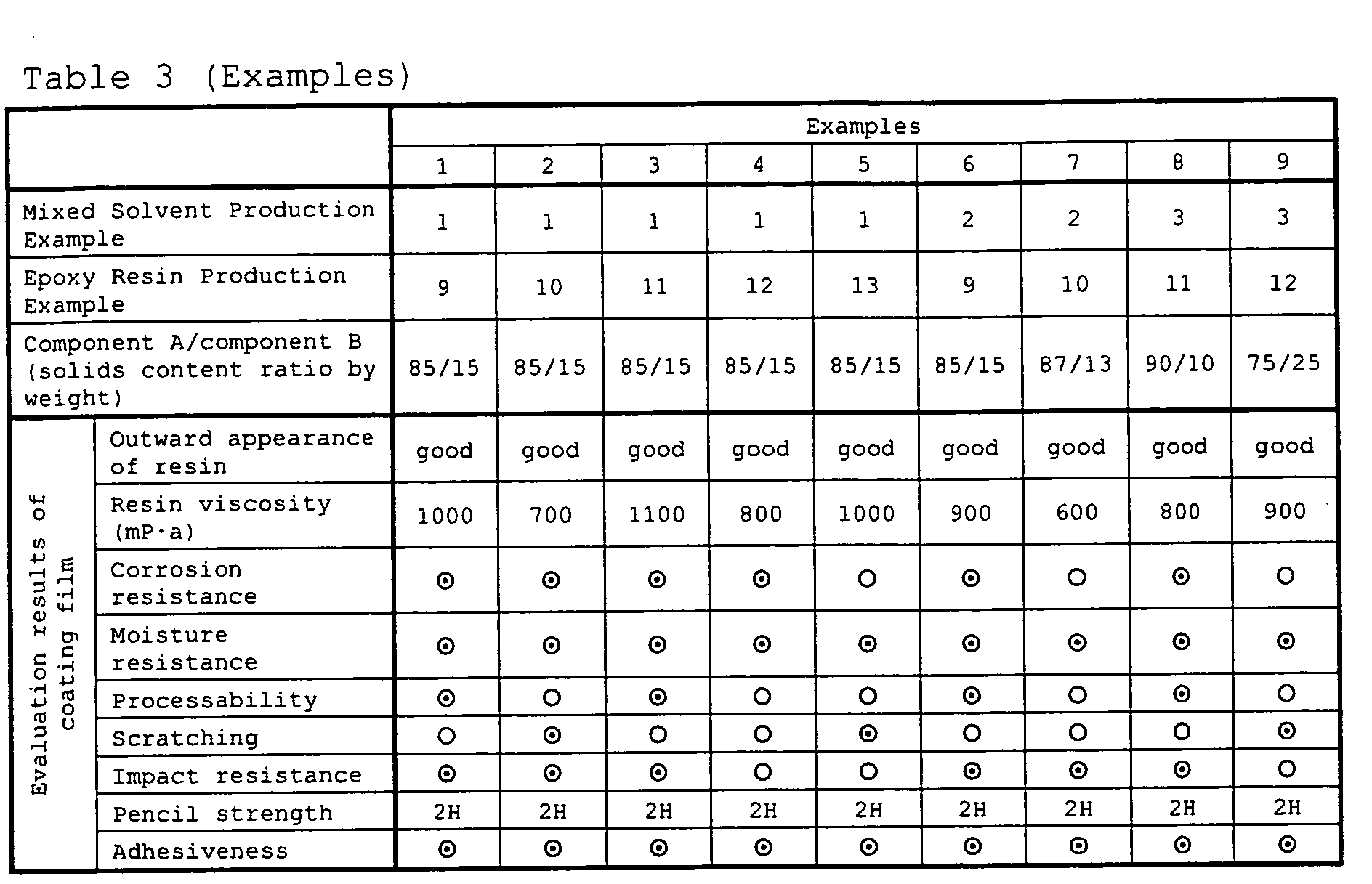

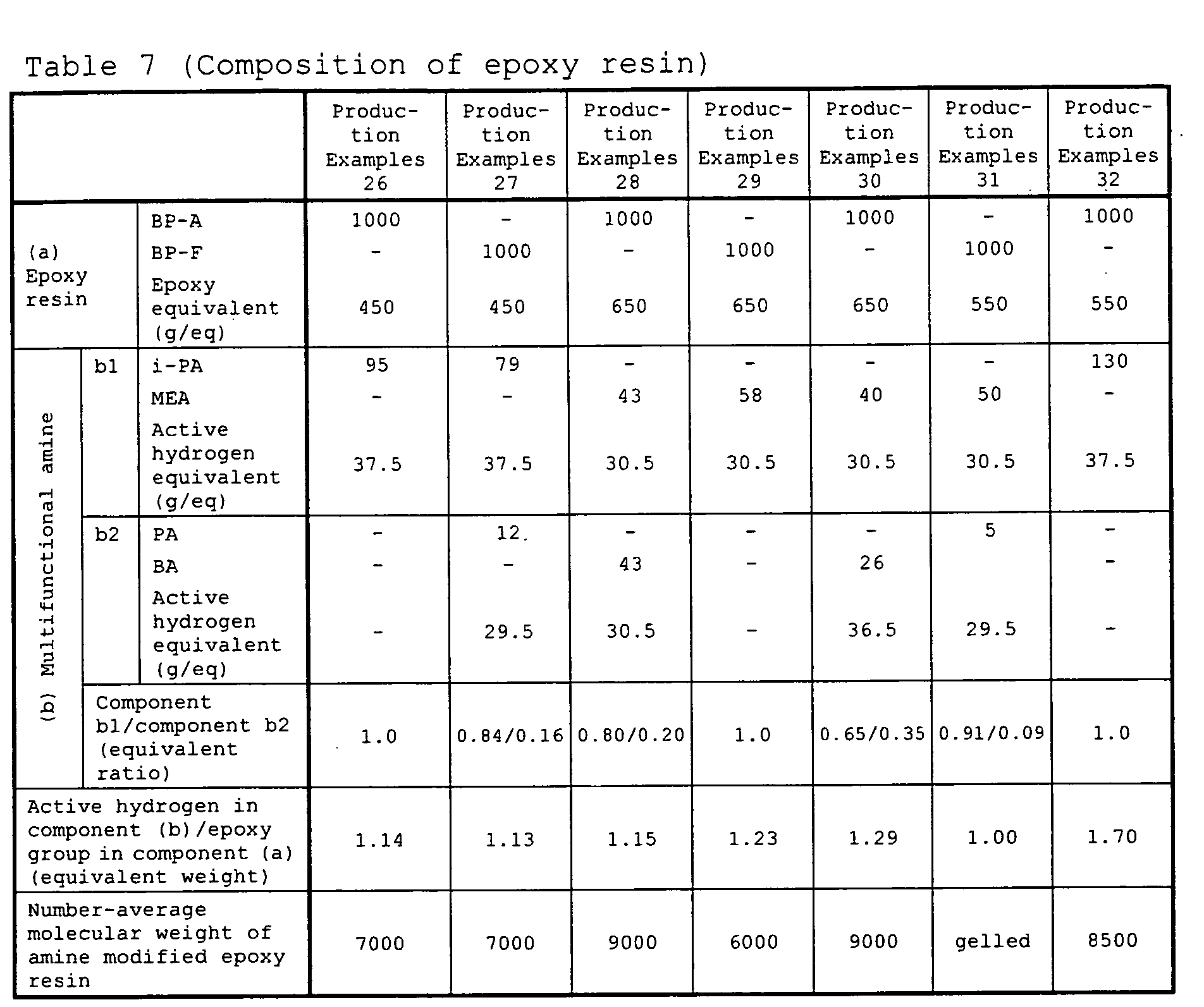
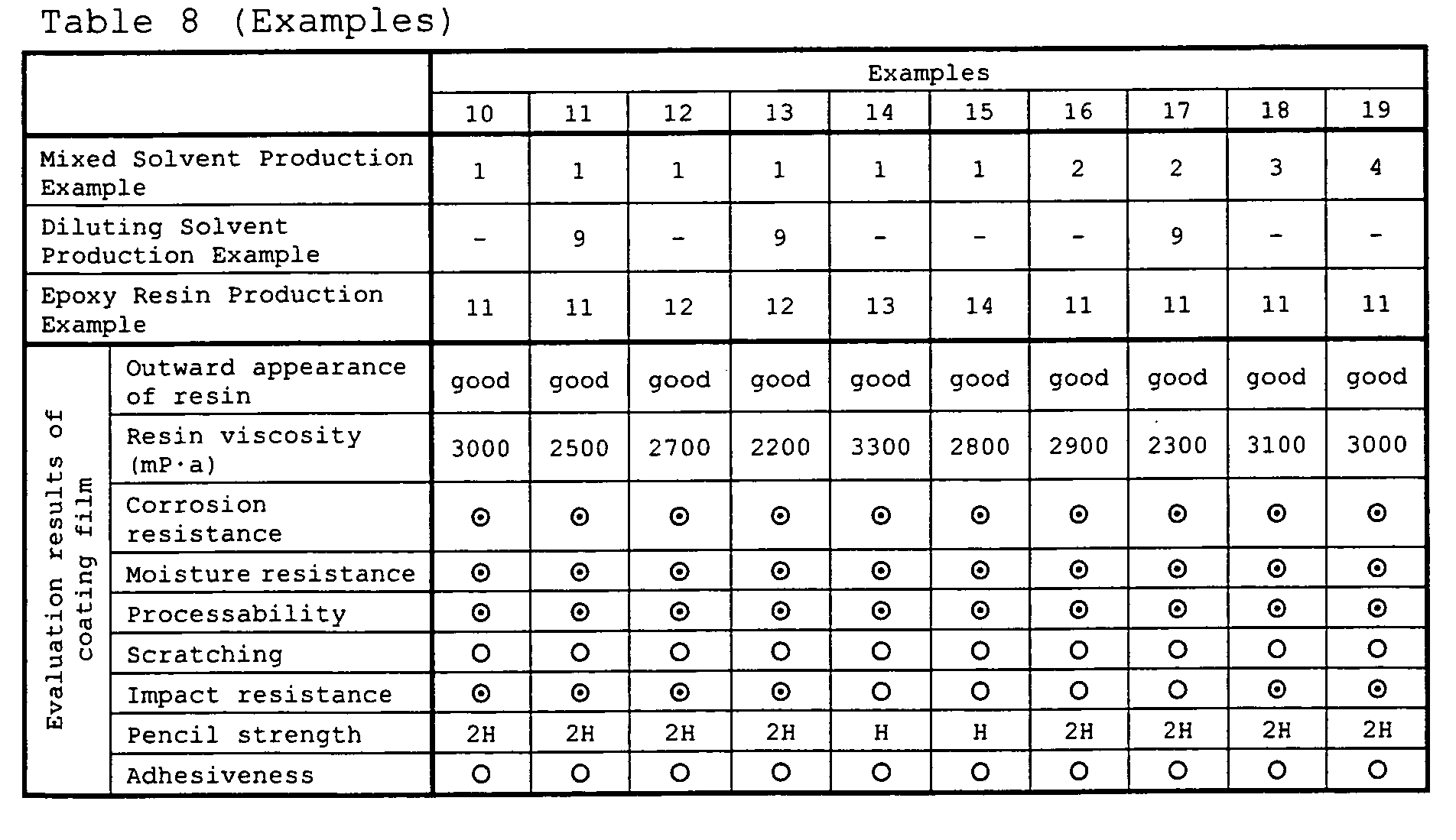

| (Composition of mixed solvent) | |||||||||
| Solvent | Rate of evaporation (Vi) | Sp value (SPi) | Production Example 1 | Production Example 2 | Production Example 3 | Production Example 4 | Production Example 5 | Production Example 6 | Production Example 7 |
| PMA | 34 | 9.2 | 5 | 30 | 15 | 5 | 5 | 5 | |
| Butyl acetate | 100 | 8.5 | 30 | ||||||
| Cyclohexanone | 25 | 9.9 | 35 | 30 | 15 | 10 | 5 | 5 | |
| n-BA | 45 | 11.4 | 20 | 25 | 25 | 30 | 85 | ||
| MA | 15 | 8.9 | 10 | 13 | 15 | 5 | 85 | 30 | 5 |
| Ethyl acetate | 525 | 9.1 | 30 | 5 | |||||
| PM | 66 | 10.2 | 30 | ||||||
| MEK | 465 | 9.3 | 30 | ||||||
| MCH | 320 | 8.2 | 30 | ||||||
| PEAC | 30 | ||||||||
| Physical properties of mixed solvent | Rate of evaporation (V) | 51.0 | 30.9 | 42.2 | 313.0 | 17.0 | 134.6 | 42.0 | |
| Sp value (SP) | 9.6 | 9.7 | 10.1 | 9.8 | 9.0 | 8.7 | 11.1 |
| (Composition of epoxy resin) | ||||||||
| Production Examples | 9 | 10 | 11 | 12 | 13 | 14 | 15 | |
| (a) | Epoxy resin | BP-A | BP-F | BP-A | BP-F | BP-A | BP-A | BP-F |
| Epoxy equivalent (g/eq) | 1000 | 1000 | 2500 | 2500 | 400 | 1000 | 1000 | |
| Amount (parts) | 1000 | 1000 | 1000 | 1000 | 1000 | 1000 | 1000 | |
| (b) | Multifunctional amine | IPA | PA | MEA | BA | iPA | iPA | iPA |
| Active hydrogen equivalent (g/eq) | 37.5 | 29.5 | 30.5 | 36.5 | 37.5 | 37.5 | 29.5 | |
| Amount (parts) | 67 | 53 | 21.4 | 18.3 | 140 | 72 | 30.7 | |
| Active hydrogen in component (b)/ epoxy group in component (a) | 1.79 | 1.80 | 1.75 | 1.25 | 1.45 | 1.92 | 1.04 |
| (Composition of mixed solvent) | ||||||||||
| Solvent | Rate of evaporation (Vi) | Sp value (SPi) | Production Example 16 | Production Example 17 | Production Example 18 | Production Example 19 | Production Example 20 | Production Example 21 | Production Example 22 | Production Example 23 |
| PMA | 34 | 9.2 | 15 | 15 | 15 | 15 | 55 | 10 | 15 | |
| Butyl acetate | 100 | 8.5 | 5 | 20 | ||||||
| n-BA | 45 | 11.4 | 40 | |||||||
| MA | 15 | 8.9 | 5 | 5 | 10 | |||||
| Ethyl acetate | 525 | 9.1 | 30 | 25 | 30 | 30 | 5 | 50 | 5 | |
| PM | 66 | 10.2 | 30 | 20 | 25 | 15 | 20 | |||
| sec-BuOH | 115 | 10.8 | 20 | 15 | 20 | 15 | 10 | 5 | ||
| Isobutyl acetate | 152 | 8.3 | 20 | 5 | 20 | 5 | 10 | 20 | ||
| PEAC | 22 | 8.6 | 5 | 5 | 5 | 20 | ||||
| IPA | 205 | 11.5 | 5 | 45 | ||||||
| MEK | 465 | 9.3 | 20 | |||||||
| MCH | 320 | 8.2 | 10 | 10 | ||||||
| Physical properties of mixed solvent | Rate of evaporation (V) | 206 | 198 | 211 | 221 | 78 | 418 | 119 | 120 | |
| Sp value (SP) | 9.78 | 9.42 | 9.67 | 9.35 | 9.48 | 9.18 | 11.1 | 8.63 |
| (Composition of diluting solvent) | ||
| Solvent | Production Example 24 | Production Example 25 |
| Cyclohexanone | 50 | 10 |
| Ethyl acetate | 50 | 90 |
According to the present invention, there can be provided
a non-aromatic solvent-based coating resin composition
excellent in adhesion to a material, corrosion resistance,
processability, scratch resistance, corrosion resistance and
solvent resistance with good balance among these properties.
Claims (7)
- A non-aromatic solvent-based modified epoxy coating resin composition characterized by being dissolved in a solids content of 60% or less in a non-aromatic solvent selected according to condition (i):wherein SP is ΣCiSPi whereupon Ci (wt%) is the content of the selected solvent in the whole solvent, and SPi is the SP value of the selected solvent.Condition (i): a mixed solvent wherein every selected solvent is a non-aromatic solvent, satisfies the following equation (1), and shows a viscosity of 10, 000 mPa·S or less upon forming a solution wherein the solids content of the modified epoxy resin composition dissolved in the solvent is 40%,
- An one-pack thermosetting coating resin composition, wherein in claim 1, 95 to 70 parts (solids content) by weight of component A and 5 to 30 parts (solids content) by weight of component B are mixed in a total amount of 100 parts by weight (solids content), and 60% or less of the solids content is dissolved in the non-aromatic solvent selected according to condition (ii):wherein V is 18 ≤ V ≤ 100whereupon Ci (wt%) is the content of the selected solvent in the whole solvent, and Vi is the evaporation rate of the selected solvent, which is a relative rate assuming that the evaporation rate of butyl acetate is 100.Component A: a modified epoxy resin composition containing (a) epoxy resin having an epoxy equivalent of 300 to 3,000 g/eq and (b) multifunctional amine, wherein active hydrogen in the component (b) is 1.10 to 1.80 equivalents relative to 1.0 epoxy equivalent in the component (a),Component B: block isocyanate,Condition (ii): every selected solvent is a non-aromatic solvent and satisfies the following equation (2):
- A coating resin composition drying at ordinary temperatures,
wherein the modified epoxy resin composition in claim 1 comprising amine modified epoxy having a number-average molecular weight of 4, 000 to 10, 000 obtained by adding (a) epoxy resin having an epoxy equivalent of 200 to 1,000 g/eq to (b) multifunctional amine, wherein active hydrogen in the component (b) is 1.10 to 1.60 equivalents relative to 1.00 epoxy equivalent in the component (a), satisfies condition (iii):wherein V is 100 ≤ V ≤ 300whereupon Ci (wt%) is the content of the selected solvent in the whole solvent, and Vi is the evaporation rate of the selected solvent, which is a relative rate assuming that the evaporation rate of butyl acetate is 100.Condition (iii): every selected solvent is a non-aromatic solvent and satisfies the following equation (3): - The coating resin composition drying at ordinary temperatures according to claim 3, wherein the multifunctional amine (b) is a multifunctional alkanol amine (b1).
- The coating resin composition drying at ordinary temperatures according to claim 3 or 4, wherein the multifunctional amine (b) is a mixture of the multifunctional alkanol amine (b1) and another multifunctional amine (b2), and the equivalent ratio of these components is 0.70 to 1.00/0 to 0.30 wherein the total of both the components is 1.00 equivalent.
- The one-pack thermosetting coating resin composition or the ordinary-temperature-drying coating resin composition according to any one of claims 2 to 5, wherein the epoxy resin (a) is bisphenol A-diglycidyl ether or bisphenol F-diglycidyl ether.
- A coating resin composition drying at ordinary temperatures, which comprises the coating resin composition drying at ordinary temperatures according to any one of claims 3 to 6 in combination with a diluting solvent which as a solvent added to the coating composition drying at ordinary temperatures is selected according to condition (iv-1):Condition (iv-1): a non-aromatic mixed solvent containing at least 20 wt% cyclohexanone in the solvent.
Applications Claiming Priority (5)
| Application Number | Priority Date | Filing Date | Title |
|---|---|---|---|
| JP2003026556 | 2003-02-04 | ||
| JP2003026556 | 2003-02-04 | ||
| JP2003035840 | 2003-02-14 | ||
| JP2003035840 | 2003-02-14 | ||
| PCT/JP2004/001057 WO2004069945A1 (en) | 2003-02-04 | 2004-02-03 | Nonaromatic solvent type coating resin composition |
Publications (2)
| Publication Number | Publication Date |
|---|---|
| EP1591501A1 true EP1591501A1 (en) | 2005-11-02 |
| EP1591501A4 EP1591501A4 (en) | 2006-03-22 |
Family
ID=32852655
Family Applications (1)
| Application Number | Title | Priority Date | Filing Date |
|---|---|---|---|
| EP04707632A Withdrawn EP1591501A4 (en) | 2003-02-04 | 2004-02-03 | Nonaromatic solvent type coating resin composition |
Country Status (3)
| Country | Link |
|---|---|
| EP (1) | EP1591501A4 (en) |
| JP (1) | JPWO2004069945A1 (en) |
| WO (1) | WO2004069945A1 (en) |
Families Citing this family (6)
| Publication number | Priority date | Publication date | Assignee | Title |
|---|---|---|---|---|
| JP4576610B2 (en) * | 2005-07-21 | 2010-11-10 | 住友ゴム工業株式会社 | Epoxy resin coating composition |
| JP2007100007A (en) * | 2005-10-07 | 2007-04-19 | Mitsui Chemicals Inc | Ordinary temperature-drying coating using nonaromatic solvent |
| JP5217309B2 (en) * | 2007-09-10 | 2013-06-19 | パナソニック株式会社 | Fin and tube heat exchanger |
| KR101449109B1 (en) * | 2012-08-03 | 2014-10-08 | 주식회사 포스코 | Composition for organic-inorganic hybrid coating solution and steel sheet having organic-inorganic hybrid coating |
| JP6341138B2 (en) * | 2015-04-10 | 2018-06-13 | 株式会社村田製作所 | Surface mount inductor and manufacturing method thereof |
| US10655019B2 (en) * | 2015-06-30 | 2020-05-19 | Taiwan Semiconductor Manufacturing Company, Ltd. | Priming material for substrate coating |
Family Cites Families (3)
| Publication number | Priority date | Publication date | Assignee | Title |
|---|---|---|---|---|
| JPH08134403A (en) * | 1994-11-07 | 1996-05-28 | Mitsui Toatsu Chem Inc | Room temperature dry resin composition for paint |
| JPH08183834A (en) * | 1994-12-28 | 1996-07-16 | Dainippon Ink & Chem Inc | Self-curing epoxy resin composition |
| JP2000034438A (en) * | 1998-07-21 | 2000-02-02 | Kansai Paint Co Ltd | Primer coating composition |
-
2004
- 2004-02-03 JP JP2005504831A patent/JPWO2004069945A1/en active Pending
- 2004-02-03 WO PCT/JP2004/001057 patent/WO2004069945A1/en not_active Ceased
- 2004-02-03 EP EP04707632A patent/EP1591501A4/en not_active Withdrawn
Non-Patent Citations (2)
| Title |
|---|
| No further relevant documents disclosed * |
| See also references of WO2004069945A1 * |
Also Published As
| Publication number | Publication date |
|---|---|
| EP1591501A4 (en) | 2006-03-22 |
| WO2004069945A1 (en) | 2004-08-19 |
| JPWO2004069945A1 (en) | 2006-05-25 |
Similar Documents
| Publication | Publication Date | Title |
|---|---|---|
| US9593258B2 (en) | Modified glycidyl carbamate resins | |
| JP6005212B2 (en) | (Block) polyisocyanate composition and coating composition using the same | |
| CN108603070B (en) | Method for preparing cationic electrodeposition coating composition | |
| JP2009287039A (en) | Coating with improved chipping resistance and method for making the same | |
| US6777504B2 (en) | Advanced bisphenol and oxyalkylene diepoxides reacted with cyclic ester, amine and blocked isocyanate | |
| WO2020194928A1 (en) | Coating composition | |
| JP2775702B2 (en) | Resin composition for chipping resistant paint | |
| JP5775660B2 (en) | High elongation, low temperature curable block polyisocyanate composition | |
| JP5109374B2 (en) | Polyamideimide resin solution and production method thereof, resin composition and coating composition | |
| JP2732239B2 (en) | Resin composition for urethane paint | |
| AU2005280622B2 (en) | Flexible, impact resistant primer | |
| JP4674988B2 (en) | Oxazolidone ring-containing epoxy resin | |
| JP6751210B2 (en) | Triisocyanate composition, water-based coating composition and coating film | |
| WO2004069945A1 (en) | Nonaromatic solvent type coating resin composition | |
| JPS62153362A (en) | Coating composition | |
| DE60314207T2 (en) | Aqueous light colored interlayer composition and multi-layer coating | |
| JP3920360B2 (en) | Polyisocyanates and block polyisocyanates derived therefrom | |
| JPH07196981A (en) | Resin composition for thermosetting paint | |
| CN100383174C (en) | Polyaddition product and cationic electrodeposition coating material containing the same | |
| CN100365084C (en) | Resin composition for non-aromatic solvent-based coating material | |
| JP3541044B2 (en) | Interlayer chipping paint for automobiles | |
| JPH0912972A (en) | Resin composition for thermosetting paint | |
| CA2298134C (en) | Resin composition for coating | |
| JP2006307196A (en) | Cation electrodeposition coating composition forming coated film in which cross section has sea-island structure | |
| JP2012012428A (en) | Dispersant composition for automotive primer, method for producing the same and dispersion using the dispersant composition |
Legal Events
| Date | Code | Title | Description |
|---|---|---|---|
| PUAI | Public reference made under article 153(3) epc to a published international application that has entered the european phase |
Free format text: ORIGINAL CODE: 0009012 |
|
| 17P | Request for examination filed |
Effective date: 20050802 |
|
| AK | Designated contracting states |
Kind code of ref document: A1 Designated state(s): AT BE BG CH CY CZ DE DK EE ES FI FR GB GR HU IE IT LI LU MC NL PT RO SE SI SK TR |
|
| AX | Request for extension of the european patent |
Extension state: AL LT LV MK |
|
| A4 | Supplementary search report drawn up and despatched |
Effective date: 20060203 |
|
| DAX | Request for extension of the european patent (deleted) | ||
| RBV | Designated contracting states (corrected) |
Designated state(s): DE IT |
|
| STAA | Information on the status of an ep patent application or granted ep patent |
Free format text: STATUS: THE APPLICATION HAS BEEN WITHDRAWN |
|
| 18W | Application withdrawn |
Effective date: 20110330 |