EP1591439A1 - Ligands and complex compounds containing the same - Google Patents
Ligands and complex compounds containing the same Download PDFInfo
- Publication number
- EP1591439A1 EP1591439A1 EP04708043A EP04708043A EP1591439A1 EP 1591439 A1 EP1591439 A1 EP 1591439A1 EP 04708043 A EP04708043 A EP 04708043A EP 04708043 A EP04708043 A EP 04708043A EP 1591439 A1 EP1591439 A1 EP 1591439A1
- Authority
- EP
- European Patent Office
- Prior art keywords
- group
- optionally substituted
- ligand
- compound
- formula
- Prior art date
- Legal status (The legal status is an assumption and is not a legal conclusion. Google has not performed a legal analysis and makes no representation as to the accuracy of the status listed.)
- Withdrawn
Links
- 239000003446 ligand Substances 0.000 title claims abstract description 47
- 150000001875 compounds Chemical class 0.000 title claims description 55
- 125000000623 heterocyclic group Chemical group 0.000 claims abstract description 19
- 229910052751 metal Inorganic materials 0.000 claims abstract description 19
- 239000002184 metal Substances 0.000 claims abstract description 19
- 125000001424 substituent group Chemical group 0.000 claims abstract description 17
- 125000005156 substituted alkylene group Chemical group 0.000 claims abstract description 12
- 125000006850 spacer group Chemical group 0.000 claims abstract description 7
- 125000005649 substituted arylene group Chemical group 0.000 claims abstract description 7
- 125000003107 substituted aryl group Chemical group 0.000 claims abstract description 5
- 125000000547 substituted alkyl group Chemical group 0.000 claims abstract description 4
- 125000005717 substituted cycloalkylene group Chemical group 0.000 claims abstract description 3
- 238000006243 chemical reaction Methods 0.000 claims description 38
- 125000004432 carbon atom Chemical group C* 0.000 claims description 22
- 125000004429 atom Chemical group 0.000 claims description 18
- 239000003054 catalyst Substances 0.000 claims description 18
- 150000002736 metal compounds Chemical class 0.000 claims description 14
- 239000010948 rhodium Substances 0.000 claims description 14
- XEEYBQQBJWHFJM-UHFFFAOYSA-N Iron Chemical compound [Fe] XEEYBQQBJWHFJM-UHFFFAOYSA-N 0.000 claims description 13
- KDLHZDBZIXYQEI-UHFFFAOYSA-N Palladium Chemical compound [Pd] KDLHZDBZIXYQEI-UHFFFAOYSA-N 0.000 claims description 13
- 125000003545 alkoxy group Chemical group 0.000 claims description 12
- BASFCYQUMIYNBI-UHFFFAOYSA-N platinum Chemical compound [Pt] BASFCYQUMIYNBI-UHFFFAOYSA-N 0.000 claims description 11
- 125000003277 amino group Chemical group 0.000 claims description 10
- 125000003118 aryl group Chemical group 0.000 claims description 9
- 229910052772 Samarium Inorganic materials 0.000 claims description 8
- 238000004519 manufacturing process Methods 0.000 claims description 8
- KZUNJOHGWZRPMI-UHFFFAOYSA-N samarium atom Chemical compound [Sm] KZUNJOHGWZRPMI-UHFFFAOYSA-N 0.000 claims description 8
- PXHVJJICTQNCMI-UHFFFAOYSA-N Nickel Chemical compound [Ni] PXHVJJICTQNCMI-UHFFFAOYSA-N 0.000 claims description 7
- NQRYJNQNLNOLGT-UHFFFAOYSA-N Piperidine Chemical compound C1CCNCC1 NQRYJNQNLNOLGT-UHFFFAOYSA-N 0.000 claims description 6
- RWRDLPDLKQPQOW-UHFFFAOYSA-N Pyrrolidine Chemical compound C1CCNC1 RWRDLPDLKQPQOW-UHFFFAOYSA-N 0.000 claims description 6
- 125000002947 alkylene group Chemical group 0.000 claims description 6
- 239000011701 zinc Substances 0.000 claims description 6
- 239000010949 copper Substances 0.000 claims description 5
- 239000010931 gold Substances 0.000 claims description 5
- 125000002887 hydroxy group Chemical group [H]O* 0.000 claims description 5
- 238000011914 asymmetric synthesis Methods 0.000 claims description 4
- 239000010936 titanium Substances 0.000 claims description 4
- 229910052725 zinc Inorganic materials 0.000 claims description 4
- RYGMFSIKBFXOCR-UHFFFAOYSA-N Copper Chemical compound [Cu] RYGMFSIKBFXOCR-UHFFFAOYSA-N 0.000 claims description 3
- KJTLSVCANCCWHF-UHFFFAOYSA-N Ruthenium Chemical compound [Ru] KJTLSVCANCCWHF-UHFFFAOYSA-N 0.000 claims description 3
- BQCADISMDOOEFD-UHFFFAOYSA-N Silver Chemical compound [Ag] BQCADISMDOOEFD-UHFFFAOYSA-N 0.000 claims description 3
- ATJFFYVFTNAWJD-UHFFFAOYSA-N Tin Chemical compound [Sn] ATJFFYVFTNAWJD-UHFFFAOYSA-N 0.000 claims description 3
- RTAQQCXQSZGOHL-UHFFFAOYSA-N Titanium Chemical compound [Ti] RTAQQCXQSZGOHL-UHFFFAOYSA-N 0.000 claims description 3
- HCHKCACWOHOZIP-UHFFFAOYSA-N Zinc Chemical compound [Zn] HCHKCACWOHOZIP-UHFFFAOYSA-N 0.000 claims description 3
- QCWXUUIWCKQGHC-UHFFFAOYSA-N Zirconium Chemical compound [Zr] QCWXUUIWCKQGHC-UHFFFAOYSA-N 0.000 claims description 3
- 229910052782 aluminium Inorganic materials 0.000 claims description 3
- XAGFODPZIPBFFR-UHFFFAOYSA-N aluminium Chemical compound [Al] XAGFODPZIPBFFR-UHFFFAOYSA-N 0.000 claims description 3
- 229910052799 carbon Inorganic materials 0.000 claims description 3
- 229910017052 cobalt Inorganic materials 0.000 claims description 3
- 239000010941 cobalt Substances 0.000 claims description 3
- GUTLYIVDDKVIGB-UHFFFAOYSA-N cobalt atom Chemical compound [Co] GUTLYIVDDKVIGB-UHFFFAOYSA-N 0.000 claims description 3
- 239000000470 constituent Substances 0.000 claims description 3
- 229910052802 copper Inorganic materials 0.000 claims description 3
- PCHJSUWPFVWCPO-UHFFFAOYSA-N gold Chemical compound [Au] PCHJSUWPFVWCPO-UHFFFAOYSA-N 0.000 claims description 3
- 229910052737 gold Inorganic materials 0.000 claims description 3
- 229910052741 iridium Inorganic materials 0.000 claims description 3
- GKOZUEZYRPOHIO-UHFFFAOYSA-N iridium atom Chemical compound [Ir] GKOZUEZYRPOHIO-UHFFFAOYSA-N 0.000 claims description 3
- 229910052742 iron Inorganic materials 0.000 claims description 3
- 229910052746 lanthanum Inorganic materials 0.000 claims description 3
- FZLIPJUXYLNCLC-UHFFFAOYSA-N lanthanum atom Chemical group [La] FZLIPJUXYLNCLC-UHFFFAOYSA-N 0.000 claims description 3
- 229910052759 nickel Inorganic materials 0.000 claims description 3
- 229910052763 palladium Inorganic materials 0.000 claims description 3
- 230000000737 periodic effect Effects 0.000 claims description 3
- 229910052697 platinum Inorganic materials 0.000 claims description 3
- 229910052702 rhenium Inorganic materials 0.000 claims description 3
- WUAPFZMCVAUBPE-UHFFFAOYSA-N rhenium atom Chemical compound [Re] WUAPFZMCVAUBPE-UHFFFAOYSA-N 0.000 claims description 3
- 229910052703 rhodium Inorganic materials 0.000 claims description 3
- MHOVAHRLVXNVSD-UHFFFAOYSA-N rhodium atom Chemical compound [Rh] MHOVAHRLVXNVSD-UHFFFAOYSA-N 0.000 claims description 3
- 229910052707 ruthenium Inorganic materials 0.000 claims description 3
- 229910052709 silver Inorganic materials 0.000 claims description 3
- 239000004332 silver Substances 0.000 claims description 3
- 239000011135 tin Substances 0.000 claims description 3
- 229910052718 tin Inorganic materials 0.000 claims description 3
- 229910052719 titanium Inorganic materials 0.000 claims description 3
- 229910052720 vanadium Inorganic materials 0.000 claims description 3
- GPPXJZIENCGNKB-UHFFFAOYSA-N vanadium Chemical compound [V]#[V] GPPXJZIENCGNKB-UHFFFAOYSA-N 0.000 claims description 3
- 229910052726 zirconium Inorganic materials 0.000 claims description 3
- 125000003504 2-oxazolinyl group Chemical group O1C(=NCC1)* 0.000 claims description 2
- -1 methylene, ethylene, propylene Chemical group 0.000 description 23
- ZMANZCXQSJIPKH-UHFFFAOYSA-N Triethylamine Chemical compound CCN(CC)CC ZMANZCXQSJIPKH-UHFFFAOYSA-N 0.000 description 21
- OKKJLVBELUTLKV-UHFFFAOYSA-N Methanol Chemical compound OC OKKJLVBELUTLKV-UHFFFAOYSA-N 0.000 description 19
- YMWUJEATGCHHMB-UHFFFAOYSA-N Dichloromethane Chemical compound ClCCl YMWUJEATGCHHMB-UHFFFAOYSA-N 0.000 description 17
- UHOVQNZJYSORNB-UHFFFAOYSA-N Benzene Chemical compound C1=CC=CC=C1 UHOVQNZJYSORNB-UHFFFAOYSA-N 0.000 description 16
- 125000000217 alkyl group Chemical group 0.000 description 15
- VLKZOEOYAKHREP-UHFFFAOYSA-N n-Hexane Chemical compound CCCCCC VLKZOEOYAKHREP-UHFFFAOYSA-N 0.000 description 15
- 238000003786 synthesis reaction Methods 0.000 description 15
- 239000000203 mixture Substances 0.000 description 14
- 239000002904 solvent Substances 0.000 description 13
- 229910009112 xH2O Inorganic materials 0.000 description 13
- XEKOWRVHYACXOJ-UHFFFAOYSA-N Ethyl acetate Chemical compound CCOC(C)=O XEKOWRVHYACXOJ-UHFFFAOYSA-N 0.000 description 12
- HEDRZPFGACZZDS-MICDWDOJSA-N Trichloro(2H)methane Chemical group [2H]C(Cl)(Cl)Cl HEDRZPFGACZZDS-MICDWDOJSA-N 0.000 description 12
- 230000015572 biosynthetic process Effects 0.000 description 12
- LFQSCWFLJHTTHZ-UHFFFAOYSA-N Ethanol Chemical compound CCO LFQSCWFLJHTTHZ-UHFFFAOYSA-N 0.000 description 10
- UKCBHEBTYNCWDW-UHFFFAOYSA-N 2-propan-2-yl-1-(trifluoromethylsulfonyl)aziridine Chemical compound CC(C)C1CN1S(=O)(=O)C(F)(F)F UKCBHEBTYNCWDW-UHFFFAOYSA-N 0.000 description 9
- 125000005843 halogen group Chemical group 0.000 description 9
- WYURNTSHIVDZCO-UHFFFAOYSA-N Tetrahydrofuran Chemical compound C1CCOC1 WYURNTSHIVDZCO-UHFFFAOYSA-N 0.000 description 8
- 238000000034 method Methods 0.000 description 8
- 125000001997 phenyl group Chemical group [H]C1=C([H])C([H])=C(*)C([H])=C1[H] 0.000 description 8
- 238000005160 1H NMR spectroscopy Methods 0.000 description 7
- XKRFYHLGVUSROY-UHFFFAOYSA-N Argon Chemical compound [Ar] XKRFYHLGVUSROY-UHFFFAOYSA-N 0.000 description 6
- RTZKZFJDLAIYFH-UHFFFAOYSA-N Diethyl ether Chemical compound CCOCC RTZKZFJDLAIYFH-UHFFFAOYSA-N 0.000 description 6
- YLQBMQCUIZJEEH-UHFFFAOYSA-N Furan Chemical compound C=1C=COC=1 YLQBMQCUIZJEEH-UHFFFAOYSA-N 0.000 description 6
- ZMXDDKWLCZADIW-UHFFFAOYSA-N N,N-Dimethylformamide Chemical compound CN(C)C=O ZMXDDKWLCZADIW-UHFFFAOYSA-N 0.000 description 6
- 229910019032 PtCl2 Inorganic materials 0.000 description 6
- 125000002496 methyl group Chemical group [H]C([H])([H])* 0.000 description 6
- CUJRVFIICFDLGR-UHFFFAOYSA-N acetylacetonate Chemical compound CC(=O)[CH-]C(C)=O CUJRVFIICFDLGR-UHFFFAOYSA-N 0.000 description 5
- 238000001704 evaporation Methods 0.000 description 5
- 230000008020 evaporation Effects 0.000 description 5
- 125000005842 heteroatom Chemical group 0.000 description 5
- 239000011541 reaction mixture Substances 0.000 description 5
- HEDRZPFGACZZDS-UHFFFAOYSA-N Chloroform Chemical compound ClC(Cl)Cl HEDRZPFGACZZDS-UHFFFAOYSA-N 0.000 description 4
- MZRVEZGGRBJDDB-UHFFFAOYSA-N N-Butyllithium Chemical compound [Li]CCCC MZRVEZGGRBJDDB-UHFFFAOYSA-N 0.000 description 4
- JUJWROOIHBZHMG-UHFFFAOYSA-N Pyridine Chemical compound C1=CC=NC=C1 JUJWROOIHBZHMG-UHFFFAOYSA-N 0.000 description 4
- 150000004945 aromatic hydrocarbons Chemical class 0.000 description 4
- 230000003197 catalytic effect Effects 0.000 description 4
- 229910001914 chlorine tetroxide Inorganic materials 0.000 description 4
- 125000000753 cycloalkyl group Chemical group 0.000 description 4
- 125000004435 hydrogen atom Chemical group [H]* 0.000 description 4
- VLTRZXGMWDSKGL-UHFFFAOYSA-M perchlorate Chemical compound [O-]Cl(=O)(=O)=O VLTRZXGMWDSKGL-UHFFFAOYSA-M 0.000 description 4
- 238000010898 silica gel chromatography Methods 0.000 description 4
- 239000000126 substance Substances 0.000 description 4
- 239000000725 suspension Substances 0.000 description 4
- ZWEHNKRNPOVVGH-UHFFFAOYSA-N 2-Butanone Chemical compound CCC(C)=O ZWEHNKRNPOVVGH-UHFFFAOYSA-N 0.000 description 3
- CSCPPACGZOOCGX-UHFFFAOYSA-N Acetone Chemical compound CC(C)=O CSCPPACGZOOCGX-UHFFFAOYSA-N 0.000 description 3
- WKBOTKDWSSQWDR-UHFFFAOYSA-N Bromine atom Chemical compound [Br] WKBOTKDWSSQWDR-UHFFFAOYSA-N 0.000 description 3
- KFZMGEQAYNKOFK-UHFFFAOYSA-N Isopropanol Chemical compound CC(C)O KFZMGEQAYNKOFK-UHFFFAOYSA-N 0.000 description 3
- YXFVVABEGXRONW-UHFFFAOYSA-N Toluene Chemical compound CC1=CC=CC=C1 YXFVVABEGXRONW-UHFFFAOYSA-N 0.000 description 3
- FDLQZKYLHJJBHD-UHFFFAOYSA-N [3-(aminomethyl)phenyl]methanamine Chemical compound NCC1=CC=CC(CN)=C1 FDLQZKYLHJJBHD-UHFFFAOYSA-N 0.000 description 3
- 229910052786 argon Inorganic materials 0.000 description 3
- 125000006615 aromatic heterocyclic group Chemical group 0.000 description 3
- 125000000732 arylene group Chemical group 0.000 description 3
- 239000012298 atmosphere Substances 0.000 description 3
- GDTBXPJZTBHREO-UHFFFAOYSA-N bromine Substances BrBr GDTBXPJZTBHREO-UHFFFAOYSA-N 0.000 description 3
- 229910052794 bromium Inorganic materials 0.000 description 3
- 239000000460 chlorine Substances 0.000 description 3
- 230000000052 comparative effect Effects 0.000 description 3
- 125000002993 cycloalkylene group Chemical group 0.000 description 3
- RAXXELZNTBOGNW-UHFFFAOYSA-N imidazole Natural products C1=CNC=N1 RAXXELZNTBOGNW-UHFFFAOYSA-N 0.000 description 3
- 229910052757 nitrogen Inorganic materials 0.000 description 3
- 229910052760 oxygen Inorganic materials 0.000 description 3
- SQGYOTSLMSWVJD-UHFFFAOYSA-N silver(1+) nitrate Chemical compound [Ag+].[O-]N(=O)=O SQGYOTSLMSWVJD-UHFFFAOYSA-N 0.000 description 3
- 229910052717 sulfur Inorganic materials 0.000 description 3
- VNDYJBBGRKZCSX-UHFFFAOYSA-L zinc bromide Chemical compound Br[Zn]Br VNDYJBBGRKZCSX-UHFFFAOYSA-L 0.000 description 3
- KKIPRRFVUAJGBU-LURJTMIESA-N (4s)-4-(2-methylpropyl)oxetan-2-one Chemical compound CC(C)C[C@H]1CC(=O)O1 KKIPRRFVUAJGBU-LURJTMIESA-N 0.000 description 2
- JNVXRQOSRUDXDY-UHFFFAOYSA-N 1,1-diiodoethane Chemical compound CC(I)I JNVXRQOSRUDXDY-UHFFFAOYSA-N 0.000 description 2
- NUSAOAJCGJSAIU-UHFFFAOYSA-N 2,6-bis(chloromethyl)-4-methylphenol Chemical compound CC1=CC(CCl)=C(O)C(CCl)=C1 NUSAOAJCGJSAIU-UHFFFAOYSA-N 0.000 description 2
- YGHRJJRRZDOVPD-UHFFFAOYSA-N 3-methylbutanal Chemical compound CC(C)CC=O YGHRJJRRZDOVPD-UHFFFAOYSA-N 0.000 description 2
- WEVYAHXRMPXWCK-UHFFFAOYSA-N Acetonitrile Chemical compound CC#N WEVYAHXRMPXWCK-UHFFFAOYSA-N 0.000 description 2
- KWOLFJPFCHCOCG-UHFFFAOYSA-N Acetophenone Chemical compound CC(=O)C1=CC=CC=C1 KWOLFJPFCHCOCG-UHFFFAOYSA-N 0.000 description 2
- 238000006596 Alder-ene reaction Methods 0.000 description 2
- IJGRMHOSHXDMSA-UHFFFAOYSA-N Atomic nitrogen Chemical compound N#N IJGRMHOSHXDMSA-UHFFFAOYSA-N 0.000 description 2
- KXDAEFPNCMNJSK-UHFFFAOYSA-N Benzamide Chemical compound NC(=O)C1=CC=CC=C1 KXDAEFPNCMNJSK-UHFFFAOYSA-N 0.000 description 2
- ZAMOUSCENKQFHK-UHFFFAOYSA-N Chlorine atom Chemical compound [Cl] ZAMOUSCENKQFHK-UHFFFAOYSA-N 0.000 description 2
- 238000005698 Diels-Alder reaction Methods 0.000 description 2
- PXGOKWXKJXAPGV-UHFFFAOYSA-N Fluorine Chemical compound FF PXGOKWXKJXAPGV-UHFFFAOYSA-N 0.000 description 2
- ZHNUHDYFZUAESO-UHFFFAOYSA-N Formamide Chemical compound NC=O ZHNUHDYFZUAESO-UHFFFAOYSA-N 0.000 description 2
- 238000007341 Heck reaction Methods 0.000 description 2
- VEXZGXHMUGYJMC-UHFFFAOYSA-N Hydrochloric acid Chemical compound Cl VEXZGXHMUGYJMC-UHFFFAOYSA-N 0.000 description 2
- JGFZNNIVVJXRND-UHFFFAOYSA-N N,N-Diisopropylethylamine (DIPEA) Chemical compound CCN(C(C)C)C(C)C JGFZNNIVVJXRND-UHFFFAOYSA-N 0.000 description 2
- IMNFDUFMRHMDMM-UHFFFAOYSA-N N-Heptane Chemical compound CCCCCCC IMNFDUFMRHMDMM-UHFFFAOYSA-N 0.000 description 2
- CTQNGGLPUBDAKN-UHFFFAOYSA-N O-Xylene Chemical compound CC1=CC=CC=C1C CTQNGGLPUBDAKN-UHFFFAOYSA-N 0.000 description 2
- 101150003085 Pdcl gene Proteins 0.000 description 2
- OFBQJSOFQDEBGM-UHFFFAOYSA-N Pentane Chemical compound CCCCC OFBQJSOFQDEBGM-UHFFFAOYSA-N 0.000 description 2
- 229910018944 PtBr2 Inorganic materials 0.000 description 2
- 229910019029 PtCl4 Inorganic materials 0.000 description 2
- KYQCOXFCLRTKLS-UHFFFAOYSA-N Pyrazine Chemical compound C1=CN=CC=N1 KYQCOXFCLRTKLS-UHFFFAOYSA-N 0.000 description 2
- KAESVJOAVNADME-UHFFFAOYSA-N Pyrrole Chemical compound C=1C=CNC=1 KAESVJOAVNADME-UHFFFAOYSA-N 0.000 description 2
- 229910021604 Rhodium(III) chloride Inorganic materials 0.000 description 2
- 229910019891 RuCl3 Inorganic materials 0.000 description 2
- 229910021603 Ruthenium iodide Inorganic materials 0.000 description 2
- WQDUMFSSJAZKTM-UHFFFAOYSA-N Sodium methoxide Chemical compound [Na+].[O-]C WQDUMFSSJAZKTM-UHFFFAOYSA-N 0.000 description 2
- 238000005575 aldol reaction Methods 0.000 description 2
- 239000012300 argon atmosphere Substances 0.000 description 2
- 238000009876 asymmetric hydrogenation reaction Methods 0.000 description 2
- 239000007795 chemical reaction product Substances 0.000 description 2
- 239000007810 chemical reaction solvent Substances 0.000 description 2
- 229910052801 chlorine Inorganic materials 0.000 description 2
- 238000004587 chromatography analysis Methods 0.000 description 2
- 238000001816 cooling Methods 0.000 description 2
- XTVVROIMIGLXTD-UHFFFAOYSA-N copper(II) nitrate Chemical compound [Cu+2].[O-][N+]([O-])=O.[O-][N+]([O-])=O XTVVROIMIGLXTD-UHFFFAOYSA-N 0.000 description 2
- QTMDXZNDVAMKGV-UHFFFAOYSA-L copper(ii) bromide Chemical compound [Cu+2].[Br-].[Br-] QTMDXZNDVAMKGV-UHFFFAOYSA-L 0.000 description 2
- 238000002425 crystallisation Methods 0.000 description 2
- 230000008025 crystallization Effects 0.000 description 2
- 125000004093 cyano group Chemical group *C#N 0.000 description 2
- 125000001995 cyclobutyl group Chemical group [H]C1([H])C([H])([H])C([H])(*)C1([H])[H] 0.000 description 2
- 125000000113 cyclohexyl group Chemical group [H]C1([H])C([H])([H])C([H])([H])C([H])(*)C([H])([H])C1([H])[H] 0.000 description 2
- 239000004913 cyclooctene Substances 0.000 description 2
- 125000001559 cyclopropyl group Chemical group [H]C1([H])C([H])([H])C1([H])* 0.000 description 2
- DHCWLIOIJZJFJE-UHFFFAOYSA-L dichlororuthenium Chemical compound Cl[Ru]Cl DHCWLIOIJZJFJE-UHFFFAOYSA-L 0.000 description 2
- 238000012672 diels-alder polymerization Methods 0.000 description 2
- 238000006735 epoxidation reaction Methods 0.000 description 2
- 125000001495 ethyl group Chemical group [H]C([H])([H])C([H])([H])* 0.000 description 2
- 238000000605 extraction Methods 0.000 description 2
- 238000004992 fast atom bombardment mass spectroscopy Methods 0.000 description 2
- 239000000706 filtrate Substances 0.000 description 2
- 239000011737 fluorine Substances 0.000 description 2
- 229910052731 fluorine Inorganic materials 0.000 description 2
- 239000011521 glass Substances 0.000 description 2
- 150000002391 heterocyclic compounds Chemical class 0.000 description 2
- 238000004128 high performance liquid chromatography Methods 0.000 description 2
- 239000001257 hydrogen Substances 0.000 description 2
- 229910052739 hydrogen Inorganic materials 0.000 description 2
- 238000006459 hydrosilylation reaction Methods 0.000 description 2
- NWYYWIJOWOLJNR-RXMQYKEDSA-N l-valinol Chemical compound CC(C)[C@H](N)CO NWYYWIJOWOLJNR-RXMQYKEDSA-N 0.000 description 2
- ZCSHNCUQKCANBX-UHFFFAOYSA-N lithium diisopropylamide Chemical compound [Li+].CC(C)[N-]C(C)C ZCSHNCUQKCANBX-UHFFFAOYSA-N 0.000 description 2
- SJYNFBVQFBRSIB-UHFFFAOYSA-N norbornadiene Chemical compound C1=CC2C=CC1C2 SJYNFBVQFBRSIB-UHFFFAOYSA-N 0.000 description 2
- 230000003647 oxidation Effects 0.000 description 2
- 238000007254 oxidation reaction Methods 0.000 description 2
- HFPZCAJZSCWRBC-UHFFFAOYSA-N p-cymene Chemical compound CC(C)C1=CC=C(C)C=C1 HFPZCAJZSCWRBC-UHFFFAOYSA-N 0.000 description 2
- 125000001476 phosphono group Chemical group [H]OP(*)(=O)O[H] 0.000 description 2
- KGRJUMGAEQQVFK-UHFFFAOYSA-L platinum(2+);dibromide Chemical compound Br[Pt]Br KGRJUMGAEQQVFK-UHFFFAOYSA-L 0.000 description 2
- BWHMMNNQKKPAPP-UHFFFAOYSA-L potassium carbonate Substances [K+].[K+].[O-]C([O-])=O BWHMMNNQKKPAPP-UHFFFAOYSA-L 0.000 description 2
- 239000000047 product Substances 0.000 description 2
- UMJSCPRVCHMLSP-UHFFFAOYSA-N pyridine Natural products COC1=CC=CN=C1 UMJSCPRVCHMLSP-UHFFFAOYSA-N 0.000 description 2
- 230000035484 reaction time Effects 0.000 description 2
- SONJTKJMTWTJCT-UHFFFAOYSA-K rhodium(iii) chloride Chemical compound [Cl-].[Cl-].[Cl-].[Rh+3] SONJTKJMTWTJCT-UHFFFAOYSA-K 0.000 description 2
- YBCAZPLXEGKKFM-UHFFFAOYSA-K ruthenium(iii) chloride Chemical compound [Cl-].[Cl-].[Cl-].[Ru+3] YBCAZPLXEGKKFM-UHFFFAOYSA-K 0.000 description 2
- 150000003839 salts Chemical class 0.000 description 2
- 238000003756 stirring Methods 0.000 description 2
- 125000004434 sulfur atom Chemical group 0.000 description 2
- FYSNRJHAOHDILO-UHFFFAOYSA-N thionyl chloride Chemical compound ClS(Cl)=O FYSNRJHAOHDILO-UHFFFAOYSA-N 0.000 description 2
- 238000009901 transfer hydrogenation reaction Methods 0.000 description 2
- WJKHJLXJJJATHN-UHFFFAOYSA-N triflic anhydride Chemical compound FC(F)(F)S(=O)(=O)OS(=O)(=O)C(F)(F)F WJKHJLXJJJATHN-UHFFFAOYSA-N 0.000 description 2
- 125000001889 triflyl group Chemical group FC(F)(F)S(*)(=O)=O 0.000 description 2
- GETQZCLCWQTVFV-UHFFFAOYSA-N trimethylamine Chemical compound CN(C)C GETQZCLCWQTVFV-UHFFFAOYSA-N 0.000 description 2
- 239000008096 xylene Substances 0.000 description 2
- UAYWVJHJZHQCIE-UHFFFAOYSA-L zinc iodide Chemical compound I[Zn]I UAYWVJHJZHQCIE-UHFFFAOYSA-L 0.000 description 2
- QOCAPOBXAIACQJ-DHIUTWEWSA-N (1r,5r)-1,5-diphenyl-3-(pyridin-3-ylmethyl)pentane-1,5-diol Chemical compound C1([C@H](O)CC(C[C@@H](O)C=2C=CC=CC=2)CC=2C=NC=CC=2)=CC=CC=C1 QOCAPOBXAIACQJ-DHIUTWEWSA-N 0.000 description 1
- RRKODOZNUZCUBN-CCAGOZQPSA-N (1z,3z)-cycloocta-1,3-diene Chemical compound C1CC\C=C/C=C\C1 RRKODOZNUZCUBN-CCAGOZQPSA-N 0.000 description 1
- LPYLNJHERBLCRN-QMDOQEJBSA-N (1z,5z)-cycloocta-1,5-diene;rhodium;hexafluorophosphate Chemical compound [Rh].F[P-](F)(F)(F)(F)F.C\1C\C=C/CC\C=C/1.C\1C\C=C/CC\C=C/1 LPYLNJHERBLCRN-QMDOQEJBSA-N 0.000 description 1
- LYXHWHHENVLYCN-QMDOQEJBSA-N (1z,5z)-cycloocta-1,5-diene;rhodium;tetrafluoroborate Chemical compound [Rh].F[B-](F)(F)F.C\1C\C=C/CC\C=C/1.C\1C\C=C/CC\C=C/1 LYXHWHHENVLYCN-QMDOQEJBSA-N 0.000 description 1
- VUTUHLLWFPRWMT-QMDOQEJBSA-M (1z,5z)-cycloocta-1,5-diene;rhodium;trifluoromethanesulfonate Chemical compound [Rh].C\1C\C=C/CC\C=C/1.C\1C\C=C/CC\C=C/1.[O-]S(=O)(=O)C(F)(F)F VUTUHLLWFPRWMT-QMDOQEJBSA-M 0.000 description 1
- OGNVQLDIPUXYDH-ZPKKHLQPSA-N (2R,3R,4S)-3-(2-methylpropanoylamino)-4-(4-phenyltriazol-1-yl)-2-[(1R,2R)-1,2,3-trihydroxypropyl]-3,4-dihydro-2H-pyran-6-carboxylic acid Chemical compound CC(C)C(=O)N[C@H]1[C@H]([C@H](O)[C@H](O)CO)OC(C(O)=O)=C[C@@H]1N1N=NC(C=2C=CC=CC=2)=C1 OGNVQLDIPUXYDH-ZPKKHLQPSA-N 0.000 description 1
- WAPNOHKVXSQRPX-SSDOTTSWSA-N (R)-1-phenylethanol Chemical compound C[C@@H](O)C1=CC=CC=C1 WAPNOHKVXSQRPX-SSDOTTSWSA-N 0.000 description 1
- AWMVMTVKBNGEAK-QMMMGPOBSA-N (R)-styrene oxide Chemical compound C1O[C@@H]1C1=CC=CC=C1 AWMVMTVKBNGEAK-QMMMGPOBSA-N 0.000 description 1
- VEJOYRPGKZZTJW-FDGPNNRMSA-N (z)-4-hydroxypent-3-en-2-one;platinum Chemical compound [Pt].C\C(O)=C\C(C)=O.C\C(O)=C\C(C)=O VEJOYRPGKZZTJW-FDGPNNRMSA-N 0.000 description 1
- MBVAQOHBPXKYMF-LNTINUHCSA-N (z)-4-hydroxypent-3-en-2-one;rhodium Chemical compound [Rh].C\C(O)=C\C(C)=O.C\C(O)=C\C(C)=O.C\C(O)=C\C(C)=O MBVAQOHBPXKYMF-LNTINUHCSA-N 0.000 description 1
- IYWJIYWFPADQAN-LNTINUHCSA-N (z)-4-hydroxypent-3-en-2-one;ruthenium Chemical compound [Ru].C\C(O)=C\C(C)=O.C\C(O)=C\C(C)=O.C\C(O)=C\C(C)=O IYWJIYWFPADQAN-LNTINUHCSA-N 0.000 description 1
- OXHOPZLBSSTTBU-UHFFFAOYSA-N 1,3-bis(bromomethyl)benzene Chemical group BrCC1=CC=CC(CBr)=C1 OXHOPZLBSSTTBU-UHFFFAOYSA-N 0.000 description 1
- GRJWOKACBGZOKT-UHFFFAOYSA-N 1,3-bis(chloromethyl)benzene Chemical group ClCC1=CC=CC(CCl)=C1 GRJWOKACBGZOKT-UHFFFAOYSA-N 0.000 description 1
- VYXHVRARDIDEHS-UHFFFAOYSA-N 1,5-cyclooctadiene Chemical compound C1CC=CCCC=C1 VYXHVRARDIDEHS-UHFFFAOYSA-N 0.000 description 1
- 239000004912 1,5-cyclooctadiene Substances 0.000 description 1
- WBCFQUOGIZJVPZ-ROUUACIJSA-N 1-[(4r)-4-phenyl-4,5-dihydro-1,3-oxazol-2-yl]-n-[[(4r)-4-phenyl-4,5-dihydro-1,3-oxazol-2-yl]methyl]methanamine Chemical compound C1([C@H]2N=C(OC2)CNCC=2OC[C@H](N=2)C=2C=CC=CC=2)=CC=CC=C1 WBCFQUOGIZJVPZ-ROUUACIJSA-N 0.000 description 1
- PAXOEUZGTBGXMO-VXGBXAGGSA-N 1-[(4s)-4-propan-2-yl-4,5-dihydro-1,3-oxazol-2-yl]-n-[[(4s)-4-propan-2-yl-4,5-dihydro-1,3-oxazol-2-yl]methyl]methanamine Chemical compound CC(C)[C@H]1COC(CNCC=2OC[C@@H](N=2)C(C)C)=N1 PAXOEUZGTBGXMO-VXGBXAGGSA-N 0.000 description 1
- WPWHSFAFEBZWBB-UHFFFAOYSA-N 1-butyl radical Chemical compound [CH2]CCC WPWHSFAFEBZWBB-UHFFFAOYSA-N 0.000 description 1
- MEKOFIRRDATTAG-UHFFFAOYSA-N 2,2,5,8-tetramethyl-3,4-dihydrochromen-6-ol Chemical compound C1CC(C)(C)OC2=C1C(C)=C(O)C=C2C MEKOFIRRDATTAG-UHFFFAOYSA-N 0.000 description 1
- KUMMBDBTERQYCG-UHFFFAOYSA-N 2,6-bis(hydroxymethyl)-4-methylphenol Chemical compound CC1=CC(CO)=C(O)C(CO)=C1 KUMMBDBTERQYCG-UHFFFAOYSA-N 0.000 description 1
- IMSODMZESSGVBE-UHFFFAOYSA-N 2-Oxazoline Chemical compound C1CN=CO1 IMSODMZESSGVBE-UHFFFAOYSA-N 0.000 description 1
- QTBSBXVTEAMEQO-UHFFFAOYSA-M Acetate Chemical compound CC([O-])=O QTBSBXVTEAMEQO-UHFFFAOYSA-M 0.000 description 1
- 229910017744 AgPF6 Inorganic materials 0.000 description 1
- NOWKCMXCCJGMRR-UHFFFAOYSA-N Aziridine Chemical compound C1CN1 NOWKCMXCCJGMRR-UHFFFAOYSA-N 0.000 description 1
- CPELXLSAUQHCOX-UHFFFAOYSA-M Bromide Chemical compound [Br-] CPELXLSAUQHCOX-UHFFFAOYSA-M 0.000 description 1
- VEXZGXHMUGYJMC-UHFFFAOYSA-M Chloride anion Chemical compound [Cl-] VEXZGXHMUGYJMC-UHFFFAOYSA-M 0.000 description 1
- 239000005749 Copper compound Substances 0.000 description 1
- 229910021590 Copper(II) bromide Inorganic materials 0.000 description 1
- 229910021592 Copper(II) chloride Inorganic materials 0.000 description 1
- MYMOFIZGZYHOMD-UHFFFAOYSA-N Dioxygen Chemical compound O=O MYMOFIZGZYHOMD-UHFFFAOYSA-N 0.000 description 1
- 229910000608 Fe(NO3)3.9H2O Inorganic materials 0.000 description 1
- 229910003771 Gold(I) chloride Inorganic materials 0.000 description 1
- 229910003767 Gold(III) bromide Inorganic materials 0.000 description 1
- 229910003803 Gold(III) chloride Inorganic materials 0.000 description 1
- 229910002621 H2PtCl6 Inorganic materials 0.000 description 1
- 229910004042 HAuCl4 Inorganic materials 0.000 description 1
- UFHFLCQGNIYNRP-UHFFFAOYSA-N Hydrogen Chemical compound [H][H] UFHFLCQGNIYNRP-UHFFFAOYSA-N 0.000 description 1
- 229910021639 Iridium tetrachloride Inorganic materials 0.000 description 1
- 229910021638 Iridium(III) chloride Inorganic materials 0.000 description 1
- 229910021575 Iron(II) bromide Inorganic materials 0.000 description 1
- 229910021577 Iron(II) chloride Inorganic materials 0.000 description 1
- 229910021579 Iron(II) iodide Inorganic materials 0.000 description 1
- 229910021576 Iron(III) bromide Inorganic materials 0.000 description 1
- 229910021578 Iron(III) chloride Inorganic materials 0.000 description 1
- 229910020427 K2PtCl4 Inorganic materials 0.000 description 1
- 229910020437 K2PtCl6 Inorganic materials 0.000 description 1
- 229910020252 KAuCl4 Inorganic materials 0.000 description 1
- 238000000023 Kugelrohr distillation Methods 0.000 description 1
- CSNNHWWHGAXBCP-UHFFFAOYSA-L Magnesium sulfate Chemical compound [Mg+2].[O-][S+2]([O-])([O-])[O-] CSNNHWWHGAXBCP-UHFFFAOYSA-L 0.000 description 1
- 238000003612 Meerwein-Ponndorf-Verley reduction reaction Methods 0.000 description 1
- AFVFQIVMOAPDHO-UHFFFAOYSA-N Methanesulfonic acid Chemical compound CS(O)(=O)=O AFVFQIVMOAPDHO-UHFFFAOYSA-N 0.000 description 1
- KWYHDKDOAIKMQN-UHFFFAOYSA-N N,N,N',N'-tetramethylethylenediamine Chemical compound CN(C)CCN(C)C KWYHDKDOAIKMQN-UHFFFAOYSA-N 0.000 description 1
- JLTDJTHDQAWBAV-UHFFFAOYSA-N N,N-dimethylaniline Chemical compound CN(C)C1=CC=CC=C1 JLTDJTHDQAWBAV-UHFFFAOYSA-N 0.000 description 1
- 229910021585 Nickel(II) bromide Inorganic materials 0.000 description 1
- 229910021586 Nickel(II) chloride Inorganic materials 0.000 description 1
- 229910021588 Nickel(II) iodide Inorganic materials 0.000 description 1
- 229910019142 PO4 Inorganic materials 0.000 description 1
- 229910021605 Palladium(II) bromide Inorganic materials 0.000 description 1
- 229910021606 Palladium(II) iodide Inorganic materials 0.000 description 1
- NFHFRUOZVGFOOS-UHFFFAOYSA-N Pd(PPh3)4 Substances [Pd].C1=CC=CC=C1P(C=1C=CC=CC=1)C1=CC=CC=C1.C1=CC=CC=C1P(C=1C=CC=CC=1)C1=CC=CC=C1.C1=CC=CC=C1P(C=1C=CC=CC=1)C1=CC=CC=C1.C1=CC=CC=C1P(C=1C=CC=CC=1)C1=CC=CC=C1 NFHFRUOZVGFOOS-UHFFFAOYSA-N 0.000 description 1
- 229910002666 PdCl2 Inorganic materials 0.000 description 1
- PCNDJXKNXGMECE-UHFFFAOYSA-N Phenazine Natural products C1=CC=CC2=NC3=CC=CC=C3N=C21 PCNDJXKNXGMECE-UHFFFAOYSA-N 0.000 description 1
- 229910006124 SOCl2 Inorganic materials 0.000 description 1
- VYPSYNLAJGMNEJ-UHFFFAOYSA-N Silicium dioxide Chemical compound O=[Si]=O VYPSYNLAJGMNEJ-UHFFFAOYSA-N 0.000 description 1
- 229910021607 Silver chloride Inorganic materials 0.000 description 1
- 229910021612 Silver iodide Inorganic materials 0.000 description 1
- 229910021117 Sm(NO3)3 Inorganic materials 0.000 description 1
- UIIMBOGNXHQVGW-UHFFFAOYSA-M Sodium bicarbonate Chemical class [Na+].OC([O-])=O UIIMBOGNXHQVGW-UHFFFAOYSA-M 0.000 description 1
- 229910003074 TiCl4 Inorganic materials 0.000 description 1
- 229910010386 TiI4 Inorganic materials 0.000 description 1
- DTQVDTLACAAQTR-UHFFFAOYSA-M Trifluoroacetate Chemical compound [O-]C(=O)C(F)(F)F DTQVDTLACAAQTR-UHFFFAOYSA-M 0.000 description 1
- 229910007340 Zn(OAc)2.2H2O Inorganic materials 0.000 description 1
- OCBFFGCSTGGPSQ-UHFFFAOYSA-N [CH2]CC Chemical compound [CH2]CC OCBFFGCSTGGPSQ-UHFFFAOYSA-N 0.000 description 1
- RBYGDVHOECIAFC-UHFFFAOYSA-L acetonitrile;palladium(2+);dichloride Chemical compound [Cl-].[Cl-].[Pd+2].CC#N.CC#N RBYGDVHOECIAFC-UHFFFAOYSA-L 0.000 description 1
- FXXACINHVKSMDR-UHFFFAOYSA-N acetyl bromide Chemical compound CC(Br)=O FXXACINHVKSMDR-UHFFFAOYSA-N 0.000 description 1
- 125000002777 acetyl group Chemical group [H]C([H])([H])C(*)=O 0.000 description 1
- 125000005595 acetylacetonate group Chemical group 0.000 description 1
- 150000001298 alcohols Chemical class 0.000 description 1
- 125000004414 alkyl thio group Chemical group 0.000 description 1
- 125000004202 aminomethyl group Chemical group [H]N([H])C([H])([H])* 0.000 description 1
- 125000005428 anthryl group Chemical group [H]C1=C([H])C([H])=C2C([H])=C3C(*)=C([H])C([H])=C([H])C3=C([H])C2=C1[H] 0.000 description 1
- 125000004104 aryloxy group Chemical group 0.000 description 1
- MAHPNPYYQAIOJN-UHFFFAOYSA-N azimsulfuron Chemical compound COC1=CC(OC)=NC(NC(=O)NS(=O)(=O)C=2N(N=CC=2C2=NN(C)N=N2)C)=N1 MAHPNPYYQAIOJN-UHFFFAOYSA-N 0.000 description 1
- RFRXIWQYSOIBDI-UHFFFAOYSA-N benzarone Chemical compound CCC=1OC2=CC=CC=C2C=1C(=O)C1=CC=C(O)C=C1 RFRXIWQYSOIBDI-UHFFFAOYSA-N 0.000 description 1
- 125000004618 benzofuryl group Chemical group O1C(=CC2=C1C=CC=C2)* 0.000 description 1
- WXNOJTUTEXAZLD-UHFFFAOYSA-L benzonitrile;dichloropalladium Chemical compound Cl[Pd]Cl.N#CC1=CC=CC=C1.N#CC1=CC=CC=C1 WXNOJTUTEXAZLD-UHFFFAOYSA-L 0.000 description 1
- 125000001797 benzyl group Chemical group [H]C1=C([H])C([H])=C(C([H])=C1[H])C([H])([H])* 0.000 description 1
- ANUZKYYBDVLEEI-UHFFFAOYSA-N butane;hexane;lithium Chemical compound [Li]CCCC.CCCCCC ANUZKYYBDVLEEI-UHFFFAOYSA-N 0.000 description 1
- OSQPUMRCKZAIOZ-UHFFFAOYSA-N carbon dioxide;ethanol Chemical compound CCO.O=C=O OSQPUMRCKZAIOZ-UHFFFAOYSA-N 0.000 description 1
- GGRQQHADVSXBQN-FGSKAQBVSA-N carbon monoxide;(z)-4-hydroxypent-3-en-2-one;rhodium Chemical compound [Rh].[O+]#[C-].[O+]#[C-].C\C(O)=C\C(C)=O GGRQQHADVSXBQN-FGSKAQBVSA-N 0.000 description 1
- LVGLLYVYRZMJIN-UHFFFAOYSA-N carbon monoxide;rhodium Chemical compound [Rh].[Rh].[Rh].[Rh].[O+]#[C-].[O+]#[C-].[O+]#[C-].[O+]#[C-].[O+]#[C-].[O+]#[C-].[O+]#[C-].[O+]#[C-].[O+]#[C-].[O+]#[C-].[O+]#[C-].[O+]#[C-] LVGLLYVYRZMJIN-UHFFFAOYSA-N 0.000 description 1
- NQZFAUXPNWSLBI-UHFFFAOYSA-N carbon monoxide;ruthenium Chemical compound [Ru].[Ru].[Ru].[O+]#[C-].[O+]#[C-].[O+]#[C-].[O+]#[C-].[O+]#[C-].[O+]#[C-].[O+]#[C-].[O+]#[C-].[O+]#[C-].[O+]#[C-].[O+]#[C-].[O+]#[C-] NQZFAUXPNWSLBI-UHFFFAOYSA-N 0.000 description 1
- 150000001734 carboxylic acid salts Chemical class 0.000 description 1
- 150000001880 copper compounds Chemical class 0.000 description 1
- ORTQZVOHEJQUHG-UHFFFAOYSA-L copper(II) chloride Chemical compound Cl[Cu]Cl ORTQZVOHEJQUHG-UHFFFAOYSA-L 0.000 description 1
- OPQARKPSCNTWTJ-UHFFFAOYSA-L copper(ii) acetate Chemical compound [Cu+2].CC([O-])=O.CC([O-])=O OPQARKPSCNTWTJ-UHFFFAOYSA-L 0.000 description 1
- SBTSVTLGWRLWOD-UHFFFAOYSA-L copper(ii) triflate Chemical compound [Cu+2].[O-]S(=O)(=O)C(F)(F)F.[O-]S(=O)(=O)C(F)(F)F SBTSVTLGWRLWOD-UHFFFAOYSA-L 0.000 description 1
- ZKXWKVVCCTZOLD-FDGPNNRMSA-N copper;(z)-4-hydroxypent-3-en-2-one Chemical compound [Cu].C\C(O)=C\C(C)=O.C\C(O)=C\C(C)=O ZKXWKVVCCTZOLD-FDGPNNRMSA-N 0.000 description 1
- 125000004976 cyclobutylene group Chemical group 0.000 description 1
- 125000004956 cyclohexylene group Chemical group 0.000 description 1
- URYYVOIYTNXXBN-UPHRSURJSA-N cyclooctene Chemical compound C1CCC\C=C/CC1 URYYVOIYTNXXBN-UPHRSURJSA-N 0.000 description 1
- 125000000522 cyclooctenyl group Chemical group C1(=CCCCCCC1)* 0.000 description 1
- 125000004979 cyclopentylene group Chemical group 0.000 description 1
- 125000004980 cyclopropylene group Chemical group 0.000 description 1
- WMKGGPCROCCUDY-PHEQNACWSA-N dibenzylideneacetone Chemical compound C=1C=CC=CC=1\C=C\C(=O)\C=C\C1=CC=CC=C1 WMKGGPCROCCUDY-PHEQNACWSA-N 0.000 description 1
- HBIHVBJJZAHVLE-UHFFFAOYSA-L dibromoruthenium Chemical compound Br[Ru]Br HBIHVBJJZAHVLE-UHFFFAOYSA-L 0.000 description 1
- AEPYKHCUOAUXAI-UHFFFAOYSA-L dibromosamarium Chemical compound [Br-].[Br-].[Sm+2] AEPYKHCUOAUXAI-UHFFFAOYSA-L 0.000 description 1
- GGSUCNLOZRCGPQ-UHFFFAOYSA-N diethylaniline Chemical compound CCN(CC)C1=CC=CC=C1 GGSUCNLOZRCGPQ-UHFFFAOYSA-N 0.000 description 1
- NZZFYRREKKOMAT-UHFFFAOYSA-N diiodomethane Chemical compound ICI NZZFYRREKKOMAT-UHFFFAOYSA-N 0.000 description 1
- HRSOSLBSWOHVPK-UHFFFAOYSA-L diiodoruthenium Chemical compound I[Ru]I HRSOSLBSWOHVPK-UHFFFAOYSA-L 0.000 description 1
- WNVQCJNZEDLILP-UHFFFAOYSA-N dimethyl(oxo)tin Chemical compound C[Sn](C)=O WNVQCJNZEDLILP-UHFFFAOYSA-N 0.000 description 1
- VSKQKCSNZJXSNZ-UHFFFAOYSA-N dinaphthalen-1-yl(oxo)tin Chemical compound C1=CC=C2C([Sn](C=3C4=CC=CC=C4C=CC=3)=O)=CC=CC2=C1 VSKQKCSNZJXSNZ-UHFFFAOYSA-N 0.000 description 1
- CQXORXDNQKUVIX-UHFFFAOYSA-N dinaphthalen-2-yl(oxo)tin Chemical compound C1=CC=CC2=CC([Sn](C=3C=C4C=CC=CC4=CC=3)=O)=CC=C21 CQXORXDNQKUVIX-UHFFFAOYSA-N 0.000 description 1
- DLFVBJFMPXGRIB-UHFFFAOYSA-M ethanimidate Chemical compound CC([O-])=N DLFVBJFMPXGRIB-UHFFFAOYSA-M 0.000 description 1
- 125000000031 ethylamino group Chemical group [H]C([H])([H])C([H])([H])N([H])[*] 0.000 description 1
- 238000001914 filtration Methods 0.000 description 1
- 125000002541 furyl group Chemical group 0.000 description 1
- 150000002344 gold compounds Chemical class 0.000 description 1
- FDWREHZXQUYJFJ-UHFFFAOYSA-M gold monochloride Chemical compound [Cl-].[Au+] FDWREHZXQUYJFJ-UHFFFAOYSA-M 0.000 description 1
- OVWPJGBVJCTEBJ-UHFFFAOYSA-K gold tribromide Chemical compound Br[Au](Br)Br OVWPJGBVJCTEBJ-UHFFFAOYSA-K 0.000 description 1
- RJHLTVSLYWWTEF-UHFFFAOYSA-K gold trichloride Chemical compound Cl[Au](Cl)Cl RJHLTVSLYWWTEF-UHFFFAOYSA-K 0.000 description 1
- 229910021505 gold(III) hydroxide Inorganic materials 0.000 description 1
- YUWFEBAXEOLKSG-UHFFFAOYSA-N hexamethylbenzene Chemical compound CC1=C(C)C(C)=C(C)C(C)=C1C YUWFEBAXEOLKSG-UHFFFAOYSA-N 0.000 description 1
- XMBWDFGMSWQBCA-UHFFFAOYSA-N hydrogen iodide Chemical compound I XMBWDFGMSWQBCA-UHFFFAOYSA-N 0.000 description 1
- 125000002883 imidazolyl group Chemical group 0.000 description 1
- 230000002401 inhibitory effect Effects 0.000 description 1
- PNDPGZBMCMUPRI-UHFFFAOYSA-N iodine Chemical compound II PNDPGZBMCMUPRI-UHFFFAOYSA-N 0.000 description 1
- 150000002504 iridium compounds Chemical class 0.000 description 1
- 150000002506 iron compounds Chemical class 0.000 description 1
- NMCUIPGRVMDVDB-UHFFFAOYSA-L iron dichloride Chemical compound Cl[Fe]Cl NMCUIPGRVMDVDB-UHFFFAOYSA-L 0.000 description 1
- RBTARNINKXHZNM-UHFFFAOYSA-K iron trichloride Chemical compound Cl[Fe](Cl)Cl RBTARNINKXHZNM-UHFFFAOYSA-K 0.000 description 1
- GYCHYNMREWYSKH-UHFFFAOYSA-L iron(ii) bromide Chemical compound [Fe+2].[Br-].[Br-] GYCHYNMREWYSKH-UHFFFAOYSA-L 0.000 description 1
- BQZGVMWPHXIKEQ-UHFFFAOYSA-L iron(ii) iodide Chemical compound [Fe+2].[I-].[I-] BQZGVMWPHXIKEQ-UHFFFAOYSA-L 0.000 description 1
- 125000000959 isobutyl group Chemical group [H]C([H])([H])C([H])(C([H])([H])[H])C([H])([H])* 0.000 description 1
- 125000001449 isopropyl group Chemical group [H]C([H])([H])C([H])(*)C([H])([H])[H] 0.000 description 1
- 150000002576 ketones Chemical class 0.000 description 1
- 239000007788 liquid Substances 0.000 description 1
- UBJFKNSINUCEAL-UHFFFAOYSA-N lithium;2-methylpropane Chemical compound [Li+].C[C-](C)C UBJFKNSINUCEAL-UHFFFAOYSA-N 0.000 description 1
- WGOPGODQLGJZGL-UHFFFAOYSA-N lithium;butane Chemical compound [Li+].CC[CH-]C WGOPGODQLGJZGL-UHFFFAOYSA-N 0.000 description 1
- 238000005259 measurement Methods 0.000 description 1
- 238000002844 melting Methods 0.000 description 1
- 230000008018 melting Effects 0.000 description 1
- 239000012528 membrane Substances 0.000 description 1
- AUHZEENZYGFFBQ-UHFFFAOYSA-N mesitylene Substances CC1=CC(C)=CC(C)=C1 AUHZEENZYGFFBQ-UHFFFAOYSA-N 0.000 description 1
- 125000001827 mesitylenyl group Chemical group [H]C1=C(C(*)=C(C([H])=C1C([H])([H])[H])C([H])([H])[H])C([H])([H])[H] 0.000 description 1
- 229910001507 metal halide Inorganic materials 0.000 description 1
- 150000005309 metal halides Chemical class 0.000 description 1
- 150000002739 metals Chemical class 0.000 description 1
- 125000005394 methallyl group Chemical group 0.000 description 1
- 125000005948 methanesulfonyloxy group Chemical group 0.000 description 1
- 125000000250 methylamino group Chemical group [H]N(*)C([H])([H])[H] 0.000 description 1
- DVSDBMFJEQPWNO-UHFFFAOYSA-N methyllithium Chemical compound C[Li] DVSDBMFJEQPWNO-UHFFFAOYSA-N 0.000 description 1
- 125000002950 monocyclic group Chemical group 0.000 description 1
- MHSKUZMKPRIIKI-BIYDSLDMSA-N n-[(2s)-1-[[3-[[bis[(2s)-3-methyl-2-(trifluoromethylsulfonylamino)butyl]amino]methyl]phenyl]methyl-[(2s)-3-methyl-2-(trifluoromethylsulfonylamino)butyl]amino]-3-methylbutan-2-yl]-1,1,1-trifluoromethanesulfonamide Chemical compound FC(F)(F)S(=O)(=O)N[C@@H](C(C)C)CN(C[C@@H](NS(=O)(=O)C(F)(F)F)C(C)C)CC1=CC=CC(CN(C[C@@H](NS(=O)(=O)C(F)(F)F)C(C)C)C[C@@H](NS(=O)(=O)C(F)(F)F)C(C)C)=C1 MHSKUZMKPRIIKI-BIYDSLDMSA-N 0.000 description 1
- 125000001624 naphthyl group Chemical group 0.000 description 1
- 150000002816 nickel compounds Chemical class 0.000 description 1
- QMMRZOWCJAIUJA-UHFFFAOYSA-L nickel dichloride Chemical compound Cl[Ni]Cl QMMRZOWCJAIUJA-UHFFFAOYSA-L 0.000 description 1
- IPLJNQFXJUCRNH-UHFFFAOYSA-L nickel(2+);dibromide Chemical compound [Ni+2].[Br-].[Br-] IPLJNQFXJUCRNH-UHFFFAOYSA-L 0.000 description 1
- BFSQJYRFLQUZKX-UHFFFAOYSA-L nickel(ii) iodide Chemical compound I[Ni]I BFSQJYRFLQUZKX-UHFFFAOYSA-L 0.000 description 1
- 150000002823 nitrates Chemical class 0.000 description 1
- 125000000449 nitro group Chemical group [O-][N+](*)=O 0.000 description 1
- 125000004433 nitrogen atom Chemical group N* 0.000 description 1
- 238000000655 nuclear magnetic resonance spectrum Methods 0.000 description 1
- 150000007524 organic acids Chemical class 0.000 description 1
- 239000007800 oxidant agent Substances 0.000 description 1
- 239000001301 oxygen Substances 0.000 description 1
- 125000004430 oxygen atom Chemical group O* 0.000 description 1
- 150000002941 palladium compounds Chemical class 0.000 description 1
- PIBWKRNGBLPSSY-UHFFFAOYSA-L palladium(II) chloride Chemical compound Cl[Pd]Cl PIBWKRNGBLPSSY-UHFFFAOYSA-L 0.000 description 1
- YJVFFLUZDVXJQI-UHFFFAOYSA-L palladium(ii) acetate Chemical compound [Pd+2].CC([O-])=O.CC([O-])=O YJVFFLUZDVXJQI-UHFFFAOYSA-L 0.000 description 1
- JKDRQYIYVJVOPF-FDGPNNRMSA-L palladium(ii) acetylacetonate Chemical compound [Pd+2].C\C([O-])=C\C(C)=O.C\C([O-])=C\C(C)=O JKDRQYIYVJVOPF-FDGPNNRMSA-L 0.000 description 1
- INIOZDBICVTGEO-UHFFFAOYSA-L palladium(ii) bromide Chemical compound Br[Pd]Br INIOZDBICVTGEO-UHFFFAOYSA-L 0.000 description 1
- HNNUTDROYPGBMR-UHFFFAOYSA-L palladium(ii) iodide Chemical compound [Pd+2].[I-].[I-] HNNUTDROYPGBMR-UHFFFAOYSA-L 0.000 description 1
- VLTRZXGMWDSKGL-UHFFFAOYSA-N perchloric acid Chemical class OCl(=O)(=O)=O VLTRZXGMWDSKGL-UHFFFAOYSA-N 0.000 description 1
- NHKJPPKXDNZFBJ-UHFFFAOYSA-N phenyllithium Chemical compound [Li]C1=CC=CC=C1 NHKJPPKXDNZFBJ-UHFFFAOYSA-N 0.000 description 1
- 235000021317 phosphate Nutrition 0.000 description 1
- 125000002467 phosphate group Chemical class [H]OP(=O)(O[H])O[*] 0.000 description 1
- 229910052698 phosphorus Inorganic materials 0.000 description 1
- 125000000587 piperidin-1-yl group Chemical group [H]C1([H])N(*)C([H])([H])C([H])([H])C([H])([H])C1([H])[H] 0.000 description 1
- 150000003058 platinum compounds Chemical class 0.000 description 1
- 125000003367 polycyclic group Chemical group 0.000 description 1
- 229910000027 potassium carbonate Inorganic materials 0.000 description 1
- LPNYRYFBWFDTMA-UHFFFAOYSA-N potassium tert-butoxide Chemical compound [K+].CC(C)(C)[O-] LPNYRYFBWFDTMA-UHFFFAOYSA-N 0.000 description 1
- 239000002244 precipitate Substances 0.000 description 1
- 238000000746 purification Methods 0.000 description 1
- 125000004309 pyranyl group Chemical group O1C(C=CC=C1)* 0.000 description 1
- 125000004076 pyridyl group Chemical group 0.000 description 1
- 125000004929 pyrrolidonyl group Chemical group N1(C(CCC1)=O)* 0.000 description 1
- 238000011160 research Methods 0.000 description 1
- 150000003284 rhodium compounds Chemical class 0.000 description 1
- 150000003304 ruthenium compounds Chemical class 0.000 description 1
- 150000003317 samarium compounds Chemical class 0.000 description 1
- VPRJMFJPKMESHB-UHFFFAOYSA-L samarium(ii) chloride Chemical compound Cl[Sm]Cl VPRJMFJPKMESHB-UHFFFAOYSA-L 0.000 description 1
- UAWABSHMGXMCRK-UHFFFAOYSA-L samarium(ii) iodide Chemical compound I[Sm]I UAWABSHMGXMCRK-UHFFFAOYSA-L 0.000 description 1
- BHXBZLPMVFUQBQ-UHFFFAOYSA-K samarium(iii) chloride Chemical compound Cl[Sm](Cl)Cl BHXBZLPMVFUQBQ-UHFFFAOYSA-K 0.000 description 1
- 239000000741 silica gel Substances 0.000 description 1
- 229910002027 silica gel Inorganic materials 0.000 description 1
- 229960001866 silicon dioxide Drugs 0.000 description 1
- ADZWSOLPGZMUMY-UHFFFAOYSA-M silver bromide Chemical compound [Ag]Br ADZWSOLPGZMUMY-UHFFFAOYSA-M 0.000 description 1
- 229940100890 silver compound Drugs 0.000 description 1
- 150000003379 silver compounds Chemical class 0.000 description 1
- LFAGQMCIGQNPJG-UHFFFAOYSA-N silver cyanide Chemical compound [Ag+].N#[C-] LFAGQMCIGQNPJG-UHFFFAOYSA-N 0.000 description 1
- 229910001544 silver hexafluoroantimonate(V) Inorganic materials 0.000 description 1
- HKZLPVFGJNLROG-UHFFFAOYSA-M silver monochloride Chemical compound [Cl-].[Ag+] HKZLPVFGJNLROG-UHFFFAOYSA-M 0.000 description 1
- 229910000161 silver phosphate Inorganic materials 0.000 description 1
- 229910001494 silver tetrafluoroborate Inorganic materials 0.000 description 1
- 239000007787 solid Substances 0.000 description 1
- 239000000758 substrate Substances 0.000 description 1
- 150000003460 sulfonic acids Chemical class 0.000 description 1
- 150000003467 sulfuric acid derivatives Chemical class 0.000 description 1
- 239000006228 supernatant Substances 0.000 description 1
- FBEIPJNQGITEBL-UHFFFAOYSA-J tetrachloroplatinum Chemical compound Cl[Pt](Cl)(Cl)Cl FBEIPJNQGITEBL-UHFFFAOYSA-J 0.000 description 1
- 125000001412 tetrahydropyranyl group Chemical group 0.000 description 1
- 125000000335 thiazolyl group Chemical group 0.000 description 1
- 125000001544 thienyl group Chemical group 0.000 description 1
- 125000003396 thiol group Chemical group [H]S* 0.000 description 1
- 150000007944 thiolates Chemical group 0.000 description 1
- 150000003606 tin compounds Chemical class 0.000 description 1
- 150000003609 titanium compounds Chemical class 0.000 description 1
- UBZYKBZMAMTNKW-UHFFFAOYSA-J titanium tetrabromide Chemical compound Br[Ti](Br)(Br)Br UBZYKBZMAMTNKW-UHFFFAOYSA-J 0.000 description 1
- XJDNKRIXUMDJCW-UHFFFAOYSA-J titanium tetrachloride Chemical compound Cl[Ti](Cl)(Cl)Cl XJDNKRIXUMDJCW-UHFFFAOYSA-J 0.000 description 1
- NLLZTRMHNHVXJJ-UHFFFAOYSA-J titanium tetraiodide Chemical compound I[Ti](I)(I)I NLLZTRMHNHVXJJ-UHFFFAOYSA-J 0.000 description 1
- FEONEKOZSGPOFN-UHFFFAOYSA-K tribromoiron Chemical compound Br[Fe](Br)Br FEONEKOZSGPOFN-UHFFFAOYSA-K 0.000 description 1
- DANYXEHCMQHDNX-UHFFFAOYSA-K trichloroiridium Chemical compound Cl[Ir](Cl)Cl DANYXEHCMQHDNX-UHFFFAOYSA-K 0.000 description 1
- ITMCEJHCFYSIIV-UHFFFAOYSA-M triflate Chemical compound [O-]S(=O)(=O)C(F)(F)F ITMCEJHCFYSIIV-UHFFFAOYSA-M 0.000 description 1
- 125000005951 trifluoromethanesulfonyloxy group Chemical group 0.000 description 1
- JLTRXTDYQLMHGR-UHFFFAOYSA-N trimethylaluminium Chemical compound C[Al](C)C JLTRXTDYQLMHGR-UHFFFAOYSA-N 0.000 description 1
- 239000011592 zinc chloride Substances 0.000 description 1
- 150000003752 zinc compounds Chemical class 0.000 description 1
- JIAARYAFYJHUJI-UHFFFAOYSA-L zinc dichloride Chemical compound [Cl-].[Cl-].[Zn+2] JIAARYAFYJHUJI-UHFFFAOYSA-L 0.000 description 1
- ONDPHDOFVYQSGI-UHFFFAOYSA-N zinc nitrate Inorganic materials [Zn+2].[O-][N+]([O-])=O.[O-][N+]([O-])=O ONDPHDOFVYQSGI-UHFFFAOYSA-N 0.000 description 1
- 229910000165 zinc phosphate Inorganic materials 0.000 description 1
- JRPGMCRJPQJYPE-UHFFFAOYSA-N zinc;carbanide Chemical compound [CH3-].[CH3-].[Zn+2] JRPGMCRJPQJYPE-UHFFFAOYSA-N 0.000 description 1
- BEAZKUGSCHFXIQ-UHFFFAOYSA-L zinc;diacetate;dihydrate Chemical compound O.O.[Zn+2].CC([O-])=O.CC([O-])=O BEAZKUGSCHFXIQ-UHFFFAOYSA-L 0.000 description 1
- IPSRAFUHLHIWAR-UHFFFAOYSA-N zinc;ethane Chemical compound [Zn+2].[CH2-]C.[CH2-]C IPSRAFUHLHIWAR-UHFFFAOYSA-N 0.000 description 1
Classifications
-
- B—PERFORMING OPERATIONS; TRANSPORTING
- B01—PHYSICAL OR CHEMICAL PROCESSES OR APPARATUS IN GENERAL
- B01J—CHEMICAL OR PHYSICAL PROCESSES, e.g. CATALYSIS OR COLLOID CHEMISTRY; THEIR RELEVANT APPARATUS
- B01J31/00—Catalysts comprising hydrides, coordination complexes or organic compounds
- B01J31/16—Catalysts comprising hydrides, coordination complexes or organic compounds containing coordination complexes
- B01J31/18—Catalysts comprising hydrides, coordination complexes or organic compounds containing coordination complexes containing nitrogen, phosphorus, arsenic or antimony as complexing atoms, e.g. in pyridine ligands, or in resonance therewith, e.g. in isocyanide ligands C=N-R or as complexed central atoms
- B01J31/1805—Catalysts comprising hydrides, coordination complexes or organic compounds containing coordination complexes containing nitrogen, phosphorus, arsenic or antimony as complexing atoms, e.g. in pyridine ligands, or in resonance therewith, e.g. in isocyanide ligands C=N-R or as complexed central atoms the ligands containing nitrogen
- B01J31/181—Cyclic ligands, including e.g. non-condensed polycyclic ligands, comprising at least one complexing nitrogen atom as ring member, e.g. pyridine
- B01J31/1815—Cyclic ligands, including e.g. non-condensed polycyclic ligands, comprising at least one complexing nitrogen atom as ring member, e.g. pyridine with more than one complexing nitrogen atom, e.g. bipyridyl, 2-aminopyridine
- B01J31/182—Cyclic ligands, including e.g. non-condensed polycyclic ligands, comprising at least one complexing nitrogen atom as ring member, e.g. pyridine with more than one complexing nitrogen atom, e.g. bipyridyl, 2-aminopyridine comprising aliphatic or saturated rings
-
- B—PERFORMING OPERATIONS; TRANSPORTING
- B01—PHYSICAL OR CHEMICAL PROCESSES OR APPARATUS IN GENERAL
- B01J—CHEMICAL OR PHYSICAL PROCESSES, e.g. CATALYSIS OR COLLOID CHEMISTRY; THEIR RELEVANT APPARATUS
- B01J31/00—Catalysts comprising hydrides, coordination complexes or organic compounds
- B01J31/16—Catalysts comprising hydrides, coordination complexes or organic compounds containing coordination complexes
- B01J31/18—Catalysts comprising hydrides, coordination complexes or organic compounds containing coordination complexes containing nitrogen, phosphorus, arsenic or antimony as complexing atoms, e.g. in pyridine ligands, or in resonance therewith, e.g. in isocyanide ligands C=N-R or as complexed central atoms
- B01J31/1805—Catalysts comprising hydrides, coordination complexes or organic compounds containing coordination complexes containing nitrogen, phosphorus, arsenic or antimony as complexing atoms, e.g. in pyridine ligands, or in resonance therewith, e.g. in isocyanide ligands C=N-R or as complexed central atoms the ligands containing nitrogen
-
- B—PERFORMING OPERATIONS; TRANSPORTING
- B01—PHYSICAL OR CHEMICAL PROCESSES OR APPARATUS IN GENERAL
- B01J—CHEMICAL OR PHYSICAL PROCESSES, e.g. CATALYSIS OR COLLOID CHEMISTRY; THEIR RELEVANT APPARATUS
- B01J31/00—Catalysts comprising hydrides, coordination complexes or organic compounds
- B01J31/16—Catalysts comprising hydrides, coordination complexes or organic compounds containing coordination complexes
- B01J31/22—Organic complexes
- B01J31/2204—Organic complexes the ligands containing oxygen or sulfur as complexing atoms
- B01J31/2208—Oxygen, e.g. acetylacetonates
- B01J31/2226—Anionic ligands, i.e. the overall ligand carries at least one formal negative charge
- B01J31/2243—At least one oxygen and one nitrogen atom present as complexing atoms in an at least bidentate or bridging ligand
-
- C—CHEMISTRY; METALLURGY
- C07—ORGANIC CHEMISTRY
- C07C—ACYCLIC OR CARBOCYCLIC COMPOUNDS
- C07C215/00—Compounds containing amino and hydroxy groups bound to the same carbon skeleton
- C07C215/46—Compounds containing amino and hydroxy groups bound to the same carbon skeleton having hydroxy groups bound to carbon atoms of at least one six-membered aromatic ring and amino groups bound to acyclic carbon atoms or to carbon atoms of rings other than six-membered aromatic rings of the same carbon skeleton
- C07C215/48—Compounds containing amino and hydroxy groups bound to the same carbon skeleton having hydroxy groups bound to carbon atoms of at least one six-membered aromatic ring and amino groups bound to acyclic carbon atoms or to carbon atoms of rings other than six-membered aromatic rings of the same carbon skeleton with amino groups linked to the six-membered aromatic ring, or to the condensed ring system containing that ring, by carbon chains not further substituted by hydroxy groups
- C07C215/50—Compounds containing amino and hydroxy groups bound to the same carbon skeleton having hydroxy groups bound to carbon atoms of at least one six-membered aromatic ring and amino groups bound to acyclic carbon atoms or to carbon atoms of rings other than six-membered aromatic rings of the same carbon skeleton with amino groups linked to the six-membered aromatic ring, or to the condensed ring system containing that ring, by carbon chains not further substituted by hydroxy groups with amino groups and the six-membered aromatic ring, or the condensed ring system containing that ring, bound to the same carbon atom of the carbon chain
-
- C—CHEMISTRY; METALLURGY
- C07—ORGANIC CHEMISTRY
- C07F—ACYCLIC, CARBOCYCLIC OR HETEROCYCLIC COMPOUNDS CONTAINING ELEMENTS OTHER THAN CARBON, HYDROGEN, HALOGEN, OXYGEN, NITROGEN, SULFUR, SELENIUM OR TELLURIUM
- C07F5/00—Compounds containing elements of Groups 3 or 13 of the Periodic Table
- C07F5/003—Compounds containing elements of Groups 3 or 13 of the Periodic Table without C-Metal linkages
-
- B—PERFORMING OPERATIONS; TRANSPORTING
- B01—PHYSICAL OR CHEMICAL PROCESSES OR APPARATUS IN GENERAL
- B01J—CHEMICAL OR PHYSICAL PROCESSES, e.g. CATALYSIS OR COLLOID CHEMISTRY; THEIR RELEVANT APPARATUS
- B01J2231/00—Catalytic reactions performed with catalysts classified in B01J31/00
- B01J2231/60—Reduction reactions, e.g. hydrogenation
- B01J2231/64—Reductions in general of organic substrates, e.g. hydride reductions or hydrogenations
- B01J2231/641—Hydrogenation of organic substrates, i.e. H2 or H-transfer hydrogenations, e.g. Fischer-Tropsch processes
-
- B—PERFORMING OPERATIONS; TRANSPORTING
- B01—PHYSICAL OR CHEMICAL PROCESSES OR APPARATUS IN GENERAL
- B01J—CHEMICAL OR PHYSICAL PROCESSES, e.g. CATALYSIS OR COLLOID CHEMISTRY; THEIR RELEVANT APPARATUS
- B01J2531/00—Additional information regarding catalytic systems classified in B01J31/00
- B01J2531/02—Compositional aspects of complexes used, e.g. polynuclearity
- B01J2531/0238—Complexes comprising multidentate ligands, i.e. more than 2 ionic or coordinative bonds from the central metal to the ligand, the latter having at least two donor atoms, e.g. N, O, S, P
- B01J2531/0241—Rigid ligands, e.g. extended sp2-carbon frameworks or geminal di- or trisubstitution
- B01J2531/0244—Pincer-type complexes, i.e. consisting of a tridentate skeleton bound to a metal, e.g. by one to three metal-carbon sigma-bonds
-
- B—PERFORMING OPERATIONS; TRANSPORTING
- B01—PHYSICAL OR CHEMICAL PROCESSES OR APPARATUS IN GENERAL
- B01J—CHEMICAL OR PHYSICAL PROCESSES, e.g. CATALYSIS OR COLLOID CHEMISTRY; THEIR RELEVANT APPARATUS
- B01J2531/00—Additional information regarding catalytic systems classified in B01J31/00
- B01J2531/02—Compositional aspects of complexes used, e.g. polynuclearity
- B01J2531/0238—Complexes comprising multidentate ligands, i.e. more than 2 ionic or coordinative bonds from the central metal to the ligand, the latter having at least two donor atoms, e.g. N, O, S, P
- B01J2531/0258—Flexible ligands, e.g. mainly sp3-carbon framework as exemplified by the "tedicyp" ligand, i.e. cis-cis-cis-1,2,3,4-tetrakis(diphenylphosphinomethyl)cyclopentane
-
- B—PERFORMING OPERATIONS; TRANSPORTING
- B01—PHYSICAL OR CHEMICAL PROCESSES OR APPARATUS IN GENERAL
- B01J—CHEMICAL OR PHYSICAL PROCESSES, e.g. CATALYSIS OR COLLOID CHEMISTRY; THEIR RELEVANT APPARATUS
- B01J2531/00—Additional information regarding catalytic systems classified in B01J31/00
- B01J2531/02—Compositional aspects of complexes used, e.g. polynuclearity
- B01J2531/0286—Complexes comprising ligands or other components characterized by their function
- B01J2531/0288—Sterically demanding or shielding ligands
-
- B—PERFORMING OPERATIONS; TRANSPORTING
- B01—PHYSICAL OR CHEMICAL PROCESSES OR APPARATUS IN GENERAL
- B01J—CHEMICAL OR PHYSICAL PROCESSES, e.g. CATALYSIS OR COLLOID CHEMISTRY; THEIR RELEVANT APPARATUS
- B01J2531/00—Additional information regarding catalytic systems classified in B01J31/00
- B01J2531/10—Complexes comprising metals of Group I (IA or IB) as the central metal
- B01J2531/16—Copper
-
- B—PERFORMING OPERATIONS; TRANSPORTING
- B01—PHYSICAL OR CHEMICAL PROCESSES OR APPARATUS IN GENERAL
- B01J—CHEMICAL OR PHYSICAL PROCESSES, e.g. CATALYSIS OR COLLOID CHEMISTRY; THEIR RELEVANT APPARATUS
- B01J2531/00—Additional information regarding catalytic systems classified in B01J31/00
- B01J2531/10—Complexes comprising metals of Group I (IA or IB) as the central metal
- B01J2531/17—Silver
-
- B—PERFORMING OPERATIONS; TRANSPORTING
- B01—PHYSICAL OR CHEMICAL PROCESSES OR APPARATUS IN GENERAL
- B01J—CHEMICAL OR PHYSICAL PROCESSES, e.g. CATALYSIS OR COLLOID CHEMISTRY; THEIR RELEVANT APPARATUS
- B01J2531/00—Additional information regarding catalytic systems classified in B01J31/00
- B01J2531/10—Complexes comprising metals of Group I (IA or IB) as the central metal
- B01J2531/18—Gold
-
- B—PERFORMING OPERATIONS; TRANSPORTING
- B01—PHYSICAL OR CHEMICAL PROCESSES OR APPARATUS IN GENERAL
- B01J—CHEMICAL OR PHYSICAL PROCESSES, e.g. CATALYSIS OR COLLOID CHEMISTRY; THEIR RELEVANT APPARATUS
- B01J2531/00—Additional information regarding catalytic systems classified in B01J31/00
- B01J2531/20—Complexes comprising metals of Group II (IIA or IIB) as the central metal
- B01J2531/26—Zinc
-
- B—PERFORMING OPERATIONS; TRANSPORTING
- B01—PHYSICAL OR CHEMICAL PROCESSES OR APPARATUS IN GENERAL
- B01J—CHEMICAL OR PHYSICAL PROCESSES, e.g. CATALYSIS OR COLLOID CHEMISTRY; THEIR RELEVANT APPARATUS
- B01J2531/00—Additional information regarding catalytic systems classified in B01J31/00
- B01J2531/30—Complexes comprising metals of Group III (IIIA or IIIB) as the central metal
- B01J2531/31—Aluminium
-
- B—PERFORMING OPERATIONS; TRANSPORTING
- B01—PHYSICAL OR CHEMICAL PROCESSES OR APPARATUS IN GENERAL
- B01J—CHEMICAL OR PHYSICAL PROCESSES, e.g. CATALYSIS OR COLLOID CHEMISTRY; THEIR RELEVANT APPARATUS
- B01J2531/00—Additional information regarding catalytic systems classified in B01J31/00
- B01J2531/30—Complexes comprising metals of Group III (IIIA or IIIB) as the central metal
- B01J2531/37—Lanthanum
-
- B—PERFORMING OPERATIONS; TRANSPORTING
- B01—PHYSICAL OR CHEMICAL PROCESSES OR APPARATUS IN GENERAL
- B01J—CHEMICAL OR PHYSICAL PROCESSES, e.g. CATALYSIS OR COLLOID CHEMISTRY; THEIR RELEVANT APPARATUS
- B01J2531/00—Additional information regarding catalytic systems classified in B01J31/00
- B01J2531/30—Complexes comprising metals of Group III (IIIA or IIIB) as the central metal
- B01J2531/38—Lanthanides other than lanthanum
-
- B—PERFORMING OPERATIONS; TRANSPORTING
- B01—PHYSICAL OR CHEMICAL PROCESSES OR APPARATUS IN GENERAL
- B01J—CHEMICAL OR PHYSICAL PROCESSES, e.g. CATALYSIS OR COLLOID CHEMISTRY; THEIR RELEVANT APPARATUS
- B01J2531/00—Additional information regarding catalytic systems classified in B01J31/00
- B01J2531/40—Complexes comprising metals of Group IV (IVA or IVB) as the central metal
- B01J2531/42—Tin
-
- B—PERFORMING OPERATIONS; TRANSPORTING
- B01—PHYSICAL OR CHEMICAL PROCESSES OR APPARATUS IN GENERAL
- B01J—CHEMICAL OR PHYSICAL PROCESSES, e.g. CATALYSIS OR COLLOID CHEMISTRY; THEIR RELEVANT APPARATUS
- B01J2531/00—Additional information regarding catalytic systems classified in B01J31/00
- B01J2531/40—Complexes comprising metals of Group IV (IVA or IVB) as the central metal
- B01J2531/46—Titanium
-
- B—PERFORMING OPERATIONS; TRANSPORTING
- B01—PHYSICAL OR CHEMICAL PROCESSES OR APPARATUS IN GENERAL
- B01J—CHEMICAL OR PHYSICAL PROCESSES, e.g. CATALYSIS OR COLLOID CHEMISTRY; THEIR RELEVANT APPARATUS
- B01J2531/00—Additional information regarding catalytic systems classified in B01J31/00
- B01J2531/40—Complexes comprising metals of Group IV (IVA or IVB) as the central metal
- B01J2531/48—Zirconium
-
- B—PERFORMING OPERATIONS; TRANSPORTING
- B01—PHYSICAL OR CHEMICAL PROCESSES OR APPARATUS IN GENERAL
- B01J—CHEMICAL OR PHYSICAL PROCESSES, e.g. CATALYSIS OR COLLOID CHEMISTRY; THEIR RELEVANT APPARATUS
- B01J2531/00—Additional information regarding catalytic systems classified in B01J31/00
- B01J2531/50—Complexes comprising metals of Group V (VA or VB) as the central metal
- B01J2531/56—Vanadium
-
- B—PERFORMING OPERATIONS; TRANSPORTING
- B01—PHYSICAL OR CHEMICAL PROCESSES OR APPARATUS IN GENERAL
- B01J—CHEMICAL OR PHYSICAL PROCESSES, e.g. CATALYSIS OR COLLOID CHEMISTRY; THEIR RELEVANT APPARATUS
- B01J2531/00—Additional information regarding catalytic systems classified in B01J31/00
- B01J2531/70—Complexes comprising metals of Group VII (VIIB) as the central metal
- B01J2531/74—Rhenium
-
- B—PERFORMING OPERATIONS; TRANSPORTING
- B01—PHYSICAL OR CHEMICAL PROCESSES OR APPARATUS IN GENERAL
- B01J—CHEMICAL OR PHYSICAL PROCESSES, e.g. CATALYSIS OR COLLOID CHEMISTRY; THEIR RELEVANT APPARATUS
- B01J2531/00—Additional information regarding catalytic systems classified in B01J31/00
- B01J2531/80—Complexes comprising metals of Group VIII as the central metal
- B01J2531/82—Metals of the platinum group
- B01J2531/821—Ruthenium
-
- B—PERFORMING OPERATIONS; TRANSPORTING
- B01—PHYSICAL OR CHEMICAL PROCESSES OR APPARATUS IN GENERAL
- B01J—CHEMICAL OR PHYSICAL PROCESSES, e.g. CATALYSIS OR COLLOID CHEMISTRY; THEIR RELEVANT APPARATUS
- B01J2531/00—Additional information regarding catalytic systems classified in B01J31/00
- B01J2531/80—Complexes comprising metals of Group VIII as the central metal
- B01J2531/82—Metals of the platinum group
- B01J2531/822—Rhodium
-
- B—PERFORMING OPERATIONS; TRANSPORTING
- B01—PHYSICAL OR CHEMICAL PROCESSES OR APPARATUS IN GENERAL
- B01J—CHEMICAL OR PHYSICAL PROCESSES, e.g. CATALYSIS OR COLLOID CHEMISTRY; THEIR RELEVANT APPARATUS
- B01J2531/00—Additional information regarding catalytic systems classified in B01J31/00
- B01J2531/80—Complexes comprising metals of Group VIII as the central metal
- B01J2531/82—Metals of the platinum group
- B01J2531/824—Palladium
-
- B—PERFORMING OPERATIONS; TRANSPORTING
- B01—PHYSICAL OR CHEMICAL PROCESSES OR APPARATUS IN GENERAL
- B01J—CHEMICAL OR PHYSICAL PROCESSES, e.g. CATALYSIS OR COLLOID CHEMISTRY; THEIR RELEVANT APPARATUS
- B01J2531/00—Additional information regarding catalytic systems classified in B01J31/00
- B01J2531/80—Complexes comprising metals of Group VIII as the central metal
- B01J2531/82—Metals of the platinum group
- B01J2531/827—Iridium
-
- B—PERFORMING OPERATIONS; TRANSPORTING
- B01—PHYSICAL OR CHEMICAL PROCESSES OR APPARATUS IN GENERAL
- B01J—CHEMICAL OR PHYSICAL PROCESSES, e.g. CATALYSIS OR COLLOID CHEMISTRY; THEIR RELEVANT APPARATUS
- B01J2531/00—Additional information regarding catalytic systems classified in B01J31/00
- B01J2531/80—Complexes comprising metals of Group VIII as the central metal
- B01J2531/82—Metals of the platinum group
- B01J2531/828—Platinum
-
- B—PERFORMING OPERATIONS; TRANSPORTING
- B01—PHYSICAL OR CHEMICAL PROCESSES OR APPARATUS IN GENERAL
- B01J—CHEMICAL OR PHYSICAL PROCESSES, e.g. CATALYSIS OR COLLOID CHEMISTRY; THEIR RELEVANT APPARATUS
- B01J2531/00—Additional information regarding catalytic systems classified in B01J31/00
- B01J2531/80—Complexes comprising metals of Group VIII as the central metal
- B01J2531/84—Metals of the iron group
- B01J2531/842—Iron
-
- B—PERFORMING OPERATIONS; TRANSPORTING
- B01—PHYSICAL OR CHEMICAL PROCESSES OR APPARATUS IN GENERAL
- B01J—CHEMICAL OR PHYSICAL PROCESSES, e.g. CATALYSIS OR COLLOID CHEMISTRY; THEIR RELEVANT APPARATUS
- B01J2531/00—Additional information regarding catalytic systems classified in B01J31/00
- B01J2531/80—Complexes comprising metals of Group VIII as the central metal
- B01J2531/84—Metals of the iron group
- B01J2531/845—Cobalt
-
- B—PERFORMING OPERATIONS; TRANSPORTING
- B01—PHYSICAL OR CHEMICAL PROCESSES OR APPARATUS IN GENERAL
- B01J—CHEMICAL OR PHYSICAL PROCESSES, e.g. CATALYSIS OR COLLOID CHEMISTRY; THEIR RELEVANT APPARATUS
- B01J2531/00—Additional information regarding catalytic systems classified in B01J31/00
- B01J2531/80—Complexes comprising metals of Group VIII as the central metal
- B01J2531/84—Metals of the iron group
- B01J2531/847—Nickel
Definitions
- the present invention relates to a ligand, its complex compound and a method for the production of the same.
- the technical problem of the present invention is to provide a novel ligand and a complex compound containing said ligand as a constituent element. More particularly, the problem of the present invention resides in providing complex compounds which, when used as a catalyst in the chemical reactions mentioned above, show an excellent catalytic characteristics, more specifically such as excellent yield and enantioselectivity, and excellent catalytic activities, and to provide a ligand for such complex compounds.
- R 1 R 2 N-Q 1 -X-Q 2 -NR 3 R 4 (wherein R 1 , R 2 , R 3 and R 4 are each the same or different and represent a group which is represented by the formula (2): wherein Q 3 is an optionally substituted alkylene group, an optionally substituted arylene group, or an optionally substituted divalent heterocyclic group; R 5 is an optionally substituted alkyl group, an optionally substituted aryl group or an optionally substituted heterocyclic group; R 6 is a substituent which may coordinate or bind to a metal atom, or R 5 and R 6 , taken together, may form a ring; Q 1 and Q 2 are each the same or different and represent an optionally substituted alkylene group or a single bond; and X is a divalent spacer), and a complex compound formed from the said ligand and metal atom can solve the problems mentioned above
- the present invention relates to:
- the alkylene group represented by Q 3 includes an alkylene group of 1 to 6 carbon atoms such as methylene, ethylene, propylene, and so on, and the said alkylene group may have substituent group(s), which may include an alkoxy group (for example, alkoxy of 1 to 6 carbon atoms such as methoxy, ethoxy, and so on), halogen atoms (for example, fluorine, chlorine, bromine, and so on).
- the number of the substituent(s) is preferably 1 to 5.
- the cycloalkylene groups represented by Q 3 include cycloalkylene groups of 3 to 7 carbon atoms, such as cyclopropylene, cyclobutylene, cyclopentylene, cyclohexylene, and so on, and the said cycloalkylene groups may have substituent(s), including an alkoxy group (for example, alkoxy groups of 1 to 6 carbon atoms, such as methoxy, ethoxy, and so on), halogen atoms (for example, fluorine, chlorine, bromine, and so on).
- the number of the substituent(s) is preferably 1 to 5.
- the arylene groups in the arylene groups represented by Q 3 which may be substituted include phenylene, naphthalenediyl, anthracenediyl, and so on, and the said substituent includes a straight-chain or branched-chain alkyl group of 1 to 6 carbon atoms (for example, methyl, ethyl, isopropyl, isobutyl and so on), the said alkoxy group, a hydroxy group, the said halogen atom and so on.
- the divalent heterocyclic groups in the divalent heterocyclic groups represented by Q 3 which may be substituted are those formed by removing two hydrogen atoms from heterocyclic compounds, and preferable examples of such heterocyclic groups are, for example, five- or six-membered monocyclic aromatic heterocyclic compounds and polycyclic aromatic heterocyclic compounds.
- Such aromatic heterocyclic compounds include those (heterocyclic compounds) containing 4 to 14 carbon atoms and 1 to 3 hetero atoms such as nitrogen, oxygen, and sulfur atom.
- Specific examples of the said aromatic heterocyclic compounds include pyridine, imidazole, furan, pyrazine, benzofuran, and pyrrole and so on.
- the substituents include the said alkyl groups, cycloalkyl groups (for example, cycloalkyl groups of 3 to 6 carbon atoms such as cyclopropyl, cyclobutyl, cyclohexyl and so on), halogenated alkyl groups (for example, halogenated alkyl groups which are formed from the said halogen atoms and the said alkyl groups), the said alkoxy groups and the said halogen atoms and so on.
- the number of the substituents present is preferably 1 to 5.
- the alkyl groups in the alkyl groups represented by R 5 which may be substituted include, for example, alkyl groups of 1 to 6 carbon atoms, and the substituent includes, for example, cycloalkyl groups (for example, cycloalkyl groups of 3 to 6 carbon atoms, such as cyclopropyl, cyclobutyl, cyclohexyl, and so on), halogenated alkyl groups (for example, those halogenated alkyl groups which are formed from the said halogen atom and the said alkyl group), the said alkoxy groups, the said halogen atoms and so on.
- cycloalkyl groups for example, cycloalkyl groups of 3 to 6 carbon atoms, such as cyclopropyl, cyclobutyl, cyclohexyl, and so on
- halogenated alkyl groups for example, those halogenated alkyl groups which are formed from the said halogen atom and the said alky
- the aryl groups in the aryl groups represented by R 5 which may be substituted include aryl groups of 6 to 14 carbon atoms.
- the specific examples of such aryl groups include a phenyl group, a naphthyl group, an anthryl group and so on.
- the substituted aryl groups include aryl groups wherein at least one hydrogen atom is replaced by the said alkyl group, the said alkoxy group, the said halogen atom, nitro group, cyano group, and so on.
- the heterocyclic groups represented by R 5 which may be substituted are preferably 5- or 6-membered monocyclic or polycyclic aromatic heterocyclic groups of 4 to 14 carbon atoms and 1 to 3 hetero atoms such as nitrogen atom, oxygen atom, sulfur atom and so on.
- Specific examples of such heterocyclic groups include pyridyl, imidazolyl, thiazolyl, pyranyl, furyl, benzofuryl, thienyl, pyrrolidonyl, piperidino, piperadinyl, morpholino, tetrahydrofuryl, tetrahydropyranyl and so on.
- the metal atoms which may coordinate or bind to the substituent represented by R 6 are preferably those selected from 3 to 14 groups of the periodic table, and specific examples of such metal atoms include lanthanum, samarium, titanium, zirconium, vanadium, rhenium, iron, ruthenium, cobalt, rhodium, iridium, nickel, palladium, copper, zinc, aluminum, tin, gold, silver and platinum, and so on.
- the substituents which may coordinate or bind to a metal atom include those containing, for example, one or more hetero atoms selected from the group consisting of O, N, P and S.
- substituents include a hydroxy group, the said alkoxy group, an amino group, a substituted amino group (for example, a monosubstituted amino group such as methylamino and ethylamino, and a di-substituted amino group such as dimethylamino, diethylamino, morpholino), a phosphono group, a phosphino group, a substituted phosphono group (for example, diethylphosphono, dimethylphosphono, and diphenylphosphono), a substituted phosphino group, a mercapto group, and an alkylthio group (wherein the alkyl moiety has the same meaning as defined above).
- the rings formed when R 5 and R 6 are taken together include a 5- or 6-membered ring having hetero atom(s) which may coordinate or bind to a metal atom.
- the said hetero atoms may either exist as a part of the atoms which constitute the substituents on the ring, or exist, when the ring is a heterocyclic one, as the atoms which constitute the heterocyclic group.
- These rings either may be substituted with the said alkyl group or aryl group, or may have asymmetric carbon atom(s).
- Specific examples of the ring structure include oxazoline, pyrroridine, piperidine and so on.
- the divalent spacers represented by X are preferably an optionally substituted alkylene group, an optionally substituted arylene group or an optionally substituted divalent heterocyclic group, wherein these alkylene, arylene and divalent heterocyclic groups may be the same ones as those mentioned above, respectively.
- the length of Q 1 -X-Q 2 is usually about 2-30 angstroms, preferably about 3 to 25 angstroms, and more preferably about 4 to 20 angstroms.
- the optionally substituted alkylene groups represented by Q 1 and Q 2 include the same ones as those described above.
- the compounds of the formula (1) can be produced either according to the known procedures or the methods known per se, namely, for example, by reacting a compound of the formula (3): Z-Q 1 -X-Q 2 -Z' (wherein Q 1 , X and Q 2 have the same meanings as defined above, and Z and Z' are each the same or different and represent a leaving group), with a compound of the formula (4): NHR 1 R 2 wherein R 1 and R 2 have the same meanings as defined above.
- the leaving groups represented by Z and Z' include, for example, a halogen atom, a trifluoromethanesulfonyloxy group, a p-toluenesulfonyloxy group, a methanesulfonyloxy group, and so on.
- the ratio of the compounds of the formulae (3) and (4) used is usually selected from a range of about 0.6 to 1.6 moles of the compound (4) to one mole of the compound (3).
- the reaction temperature is usually in the range of from about 20 °C to 200°C, and the reaction time is usually from about 5 minutes to 2 weeks.
- the reaction is preferably carried out in a solvent. Any solvent may be used if it does not inhibit the reaction.
- the reaction solvent specifically includes, for example, tetrahydrofuran, diethyl ether, benzene, xylene, chloroform, dichloromethane, and dimethylformamide, and so on.
- the reaction can be carried out preferably in the presence of a base such as trimethylamine, triethylamine, dimethylaniline, diethylaniline, pyridine, N,N,N'N'-tetramethylethylenediamine, methyl lithium, n-butyl lithium, sec-butyl lithium, tert-butyl lithium, phenyl lithium, lithium diisopropylamide, sodium methoxide, potassium tert-butoxide, potassium carbonate, and so on.
- a base such as trimethylamine, triethylamine, dimethylaniline, diethylaniline, pyridine, N,N,N'N'-tetramethylethylenediamine, methyl lithium, n-butyl lithium, sec-butyl
- the amount of the base used is usually in the range of about 2 to 100 moles, or more preferably about 2 to 50 moles, per one mole of the compound (3) used.
- the reaction product may either be purified by subjecting it to the purifying procedures such as concentration, redissolution, extraction, crystallization, and chromatography, and so on, or may be subjected directly to the reaction with a metal atom.
- the compounds of the formula (1) can also be produced by introducing the above groups R 1 , R 2 , R 3 and R 4 onto the four hydrogen atoms of the two amino groups of the compound (5): H 2 N-Q 1 -X-Q 2 -NH 2 wherein Q 1 , X and Q 2 have the same meanings as described above. Since methods for introducing the said substituents onto the amino groups have already been established well, those known methods may be adopted in the present invention, too.
- the compounds of the formula (1) thus obtained may either be used as they are, as a catalyst component in the various asymmetric synthesis reactions described below, or the complex compounds which are prepared by bringing the compound of the formula (1) into contact with the metal compound may be used as a catalyst for asymmetric synthesis reactions.
- the said complex compounds can be produced by reacting the compound of the formula (1) with a metal compound.
- metal compounds for the production of the complex compounds have so far been known in the field of the art, and those known metal compounds may be conveniently used also in the present invention.
- metal compounds include, for example, metal-halides (for example, chloride, bromide, iodide and so on), metal-carbonyl compounds, metal-carbonyl compounds combined with oxidants (for example, iodine, bromine, diiodomethane, diiodoethane and so on), metal-organic acid salts (for example, carboxylic acid salts such as acetate, trifluoroacetate and so on, and sulfonic acid salts such as methanesulfonate, trifluoromethanesulfonate and so on), metal-organic acid derivative salts (for example, salts of organic acid amides such as acetylamide, formamide
- metal-halaides metal-organic acid salts, metal-inorganic acid salts and metal-alkoxides are used more preferably.
- the amount of the metal compounds used is within the range of about 1 to 4 moles, or more preferably about 1.5 to 3 moles per 1 mole of the compound of the formula (1), though there is no particular limitation to such amount.
- the reaction temperature is usually in the range of about -10°C to 250°C, and the reaction time is usually in the range of about 5 minutes to 10 days.
- the reaction is preferably carried out in a solvent. There is no limitation to the solvent to be used, so far as the solvent makes it possible for the reaction to proceed smoothly without inhibiting the reaction.
- reaction solvent examples include, for example, acetone, methyl ethyl ketone, heptane, pentane, methanol, ethanol, tetrahydrofuran, diethyl ether, benzene, xylene, chloroform, dichloromethane and dimethylformamide.
- the reaction product may either be purified by subjecting it to various purification procedures such as concentration, redissolution, extraction, crystallization, and chromatography, and so on, or may be used as it is and served as a catalyst for asymmetric synthetic reactions.
- x is an integer
- dba dibenzylideneacetone
- Ac is acetyl
- acac is acetylacetonato
- cod is 1,5-cyclooctadiene
- coe is cyclooctene
- Tf is trifluoromethanesulfonyl (SO 2 CF 3 )
- nbd is norbornadiene
- Ph is phenyl
- arene is one of benzene, mesitylene, p-cymene and hexamethylbenzene
- Me is methyl
- Et is ethyl.
- Examples of the samarium compound include, for example, SmCl 2 , SmCl 3 , SmBr 2 , SmBr 3 , SmI 2 , SmI 3 , Sm(OCH(CH 3 ) 2 ) 3 , Sm(NO 3 ) 3 , Sm(OAc) 3 .xH 2 O, and so on.
- titanium compound examples include, for example, TiCl 4 , TiBr 4 , TiI 4 , and Ti(OCH(CH 3 ) 2 ) 4 , and so on.
- Examples of the palladium compound include, for example, Pd(dba) 2 , Pd(dba) 3 , Pd 2 (dba) 3 , Pd(PPh 3 ) 4 , PdCl 2 , PdBr 2 , PdI 2 , Pd(OAc) 2 , PdCl 2 (CH 3 CN) 2 , PdCl 2 (PhCN) 2 , [PdCl( ⁇ -allyl)] 2 , [PdCl(2-methylallyl)] 2 , Pd(acac) 2 , and so on.
- nickel compound examples include, for example, Ni(cod) 2 , NiCl 2 , NiBr 2 , NiI 2 , and so on.
- Examples of the copper compound include, for example, CuCl 2 , CuBr 2 , CuI 2 , Cu(OCH 3 ) 2 , Cu(NO 3 ) 2 .xH 2 O, Cu(OTf) 2 , Cu(OAc) 2 , Cu(acac) 2 , Cu(CF 3 CO 2 ) 2 , and so on.
- iron compound examples include, for example, FeCl 2 , FeBr 2 , FeI 2 , FeCl 3 , FeBr 3 , FeI 3 , Fe 2 (CO) 9 , Fe 3 (CO) 12 , (NH 4 ) 4 Fe(CN) 6 , (NH 4 ) 4 Fe(SO 4 ) 2 .6H 2 O, Fe(NO 3 ) 3 .9H 2 O, Fe(ClO 4 ) 3 .xH 2 O, Fe(BF 4 ) 2 .6H 2 O, K 3 Fe(CN) 6 , and so on.
- rhodium compound examples include, for example, RhCl 3 , RhCl 3 .xH 2 O, RhBr 3 .xH 2 O, RhI 3 .xH 2 O, [Rh(OAc) 2 ] 2 , [Rh(C 7 H 15 CO 2 ) 2 ] 2 , [Rh(CF 3 CO 2 ) 2 ] 2 , Rh(acac) 3 , Rh(acac)(CO) 2 , [RhCl(cod)] 2 , [RhCl(nbd)] 2 , [RhCl(C 2 H 4 )] 2 , [Rh(cod) 2 ]BF 4 , [Rh(cod) 2 ]OTf, [Rh(cod) 2 ]ClO 4 , [Rh(cod) 2 ]PF 6 , [Rh(cod) 2 ]BPh 4 , [Rh(nbd) 2 ]BF 4 , [Rh(n
- Examples of the ruthenium compound include, for example, RuCl 3 , RuCl 3 .xH 2 O, RuBr 3 .xH 2 O, RuI 3 , RuI 3 .xH 2 O, [RuCl 2 (cod)] x , [RuCl 2 (arene)] 2 , [RuBr 2 (arene)] 2 , [RuI 2 (arene)] 2 , Ru(acac) 3 , Ru 3 (CO) 12 , and so on.
- Examples of the iridium compound include, for example, IrCl 3 ⁇ xH 2 O, IrCl 4 ⁇ xH 2 O, IrBr 3 ⁇ xH 2 O, [IrCl(cod)] 2 , [IrBr(cod)] 2 , [IrI(cod)] 2 , [IrCl(coe) 2 ] 2 , [Ir(cod) 2 ]BF 4 , Ir(cod)(acac), [Ir(cod)(CH 3 CN) 2 ]BF 4 , Ir 4 (CO) 12 , [IrCl(CO) 3 ] x and so on.
- Examples of the zinc compound include, for example, ZnCl 2 , ZnBr 2 , ZnI 2 , Me 2 Zn, Et 2 Zn, Ph 2 Zn, Zn(OAc) 2 .2H 2 O, Zn(acac) 2 .xH 2 O, Zn(NO 3 ) 2 , Zn(ClO 4 ) 2 , Zn 3 (PO 4 ) 2 , and so on.
- tin compound examples include, for example, Me 2 SnO, Et 2 SnO, (n-C 3 H 7 ) 2 SnO, (n-C 4 H 9 ) 2 SnO, (n-C 8 H 17 ) 2 SnO, (n-C 12 H 25 ) 2 SnO, (PhCH 2 ) 2 SnO, Ph 2 SnO, (4-Cl-C 6 H 4 ) 2 SnO, (4-MeO-C 6 H 4 ) 2 SnO, (1-C 10 H 7 ) 2 SnO (di-(1-naphthyl)tinoxide), (2-C 10 H 7 ) 2 SnO (di-(2-naphthyl)tinoxide), and so on.
- the gold compound examples include, for example, AuCl, AuBr, AuI, AuCl 3 , AuBr 3 , AuI 3 , Au(CO)Cl, AuCN, Me 2 Au(acac), KAu(CN) 2 , NaAu(CN) 2 , Au(OH) 3 , HAuCl 4 , HAuBr 4 , KAuCl 4 , KAuBr 4 , and so on.
- Examples of the silver compound include, for example, AgCl, AgBr, AgI, AgNO 3 , AgSbF 6 , AgBF 4 , AgCN, Ag(OAc), KAg(CN) 2 , Ag(PhCO 2 ), Ag(acac), AgClO 4 , AgPF 6 , Ag 3 PO 4 , and so on.
- platinum compound examples include, for example, PtCl 2 , PtBr 2 , PtI 2 , PtCl 4 , PtBr 4 , K 2 PtCl 4 , K 2 PtBr 4 , K 2 PtI 4 , K 2 Pt(CN) 4 , H 2 PtCl 6 , H 2 PtBr 6 , K 2 PtCl 6 , K 2 PtBr 6 , K 2 PtI 6 , K 2 Pt(CN) 6 , H 2 Pt(OH) 6 , Pt(CN) 2 , PtCl 2 (cod), PtBr 2 (cod), PtI 2 (cod), Pt(acac) 2 , PtCl 2 (PhCN), PtCl 2 (CH 3 CN), Me 2 Pt(cod), PtCl 2 (C 5 H 5 N) 2 , PtCl 2 (NH 2 CH 2 CH 2 NH 2 ) 2 , (NH 3
- the complex compounds thus obtained can be used as a catalyst in various reactions.
- Typical example of such reactions is asymmetric syntheses.
- Examples of such asymmetric syntheses include, for example, asymmetric hydrogenation, asymmetric transfer hydrogenation, asymmetric hydrosilylation, asymmetric Heck reaction, asymmetric aldol reaction, asymmetric ene reaction, asymmetric oxidation, asymmetric epoxidation, asymmetric Diels-Alder reaction, polymerization, and so on.
- Specific examples of such reactions include, for example, the Meerwein-Ponndorf-Verley reduction which is used, for example, for producing optically active alcohols from ketones.
- 2,6-Bis(hydroxymethyl)-p-cresol (0.6779 g, 4.03 mmol) was suspended in CH 2 Cl 2 (10 ml), and to this suspension was added slowly SOCl 2 (3 ml, 41.1 mmol) under cooling in an ice-bath, and the resulting mixture was stirred at room temperature for 18 hours. The color of the reaction solution turned yellow. After completion of the reaction, the solvent was removed by evaporation to give 2,6-bis(chloromethyl)-p-cresol.
- Footnote 1 The structure of the samarium catalyst:
- Footnote 2 The structure of the comparative compound:
- Table 1 shown above reveals that the objective optically active alcohol can be produced in a high chemical yield and in a very high asymmetric yield, and thus the complex compound of the present invention exhibits excellent catalytic ability.
- N,N-Di[4,5-dihydro-4(R)-phenyl-1,3-oxazol-2-ylmethyl]amine (synthesized according to the description by Jiang, Y., J. Am. Chem. Soc., 1998, 120, 3817.)(196.3 mg, 58.5 ⁇ mol) was dissolved in methanol (1 ml) in a 20-ml Schlenk glassware. To this solution were added triethylamine (0.13 ml, 57.3 ⁇ mol) and ⁇ , ⁇ '-dibromo-m-xylene (0.04 ml, 27.4 ⁇ mol), and the mixture was stirred at room temperature for 40 hours.
- N,N-Di[4,5-dihydro-4(S)-isopropyl-1,3-oxazol-2-yl-methyl]amine (396.1 mg, 1.48 mmol) was dissolved in methanol (1 ml) in a 20-ml Schlenk glassware. To this solution were added triethylamine (0.2 ml, 1.43 mmol) and ⁇ , ⁇ '-dichloro-m-xylene (0.07 ml, 480 ⁇ mol), and the mixture was stirred at room temperature for 16 hours.
- reaction solution was washed successively with 1M hydrochloric acid (twice, with 50 ml each) and aqueous saturated sodium bicarbonate solution (twice, with 50 ml each), and dried over anhydrous magnesium sulfate.
- the solvent was removed by evaporation to give 3.1307 g of (R)-N-trifluoromethanesulfonyl-2-isopropylaziridine (5) as a brown oil.
- the yield was 67 %.
- the ligand (6) obtained in Example 6 (0.10 g, 0.10 mmol) was suspended in methylene chloride (5 ml) in a Schlenk glassware, and to this suspension was added trimethylaluminum in toluene (0.20 ml of 1M solution, 0.20 mmol) via a syringe. Then, the resulting mixture was stirred at room temperature for 3 hours. The reaction mixture changed from a white suspension into a colorless solution. After completion of the stirring, the solvent was removed by evaporation under reduced pressure. Hexane (5 ml) was added to the residue, and the mixture was further stirred for one hour.
- the asymmetric yield of the product was measured by means of GLC using a capillary column Chirasil-DEX CB (0.25 mm x 25 m, membrane thickness 0.25 ⁇ m, GL Science) and was found to be 93% e.e.
Landscapes
- Chemical & Material Sciences (AREA)
- Organic Chemistry (AREA)
- Inorganic Chemistry (AREA)
- Engineering & Computer Science (AREA)
- Materials Engineering (AREA)
- Chemical Kinetics & Catalysis (AREA)
- Catalysts (AREA)
- Organic Low-Molecular-Weight Compounds And Preparation Thereof (AREA)
- Epoxy Compounds (AREA)
- Heterocyclic Carbon Compounds Containing A Hetero Ring Having Nitrogen And Oxygen As The Only Ring Hetero Atoms (AREA)
- Low-Molecular Organic Synthesis Reactions Using Catalysts (AREA)
Abstract
A ligand represented by the formula (1):
R1R2N-Q1-X-Q2-NR3R4
wherein R1, R2, R3 and R4 are each the same or different and
represent a group represented by the formula (2):
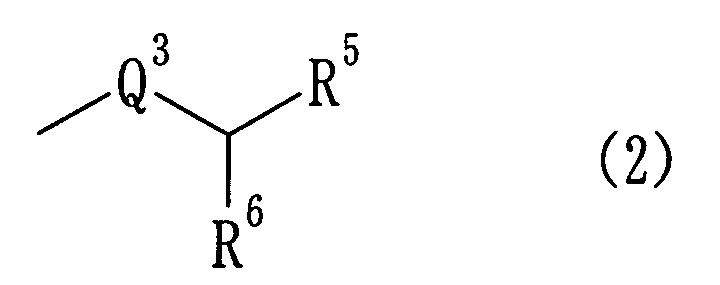 wherein Q3 is an optionally substituted alkylene group, an
optionally substituted cycloalkylene group, an optionally
substituted arylene group, or an optionally substituted
divalent heterocyclic group, R5 is an optionally
substituted alkyl group, an optionally substituted aryl
group or an optionally substituted heterocyclic group and
R6 is a substituent which may coordinate or bind to a metal
atom, or R5 and R6, taken together, may form a ring, Q1 and
Q2 are each the same or different and represent an
optionally substituted alkylene group or a single bond, and
X is a divalent spacer.
wherein Q3 is an optionally substituted alkylene group, an
optionally substituted cycloalkylene group, an optionally
substituted arylene group, or an optionally substituted
divalent heterocyclic group, R5 is an optionally
substituted alkyl group, an optionally substituted aryl
group or an optionally substituted heterocyclic group and
R6 is a substituent which may coordinate or bind to a metal
atom, or R5 and R6, taken together, may form a ring, Q1 and
Q2 are each the same or different and represent an
optionally substituted alkylene group or a single bond, and
X is a divalent spacer.
Description
- The present invention relates to a ligand, its complex compound and a method for the production of the same.
- Up to now, complex compounds prepared by coordinating or binding various ligands to metal atoms, have been used as a catalyst for various chemical reactions such as asymmetric hydrogenation, asymmetric transfer hydrogenation, asymmetric hydrosilylation, asymmetric Heck reaction, asymmetric aldol reaction, asymmetric ene reaction, asymmetric oxidation, asymmetric epoxidation, asymmetric Diels-Alder reaction, polymerization, and the like (cf. JP-A-2000-256384, JP-A-2002-255985, JP-A-2002-363143, J. Am. Chem. Soc., 2001, 123, 3367-3368, and J. Am. Chem. Soc., 1993, 115, 9800-9801).
- These days, in the field of chemical industry, appearance of a catalyst with an excellent catalytic activity has been strongly desired and a lot of researches have been carried out therefor. It is generally considered that a less amount of excellent catalysts catalyzes the chemical reactions to give objective compounds in a high yield and enantioselectivity.
- The technical problem of the present invention is to provide a novel ligand and a complex compound containing said ligand as a constituent element. More particularly, the problem of the present invention resides in providing complex compounds which, when used as a catalyst in the chemical reactions mentioned above, show an excellent catalytic characteristics, more specifically such as excellent yield and enantioselectivity, and excellent catalytic activities, and to provide a ligand for such complex compounds.
- The present inventors have studied intensively to solve the problems mentioned above, and have found that a ligand represented by the formula (1):wherein Q3 is an optionally substituted alkylene group, an optionally substituted arylene group, or an optionally substituted divalent heterocyclic group; R5 is an optionally substituted alkyl group, an optionally substituted aryl group or an optionally substituted heterocyclic group; R6 is a substituent which may coordinate or bind to a metal atom, or R5 and R6, taken together, may form a ring; Q1 and Q2 are each the same or different and represent an optionally substituted alkylene group or a single bond; and X is a divalent spacer), and a complex compound formed from the said ligand and metal atom can solve the problems mentioned above. The present inventors have further investigated extensively based on these findings and completed the present invention.
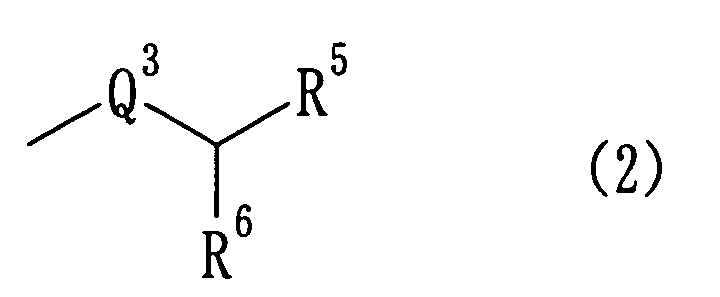
- Namely, the present invention relates to:
- (1) a ligand represented by the formula (1):
wherein Q3 is an optionally substituted alkylene group, an optionally substituted cycloalkylene group, an optionally substituted arylene group, or an optionally substituted divalent heterocyclic group; R5 is an optionally substituted alkyl group, an optionally substituted aryl group or an optionally substituted heterocyclic group; and R6 is a substituent which may coordinate or bind to a metal atom, or R5 and R6, taken together, may form a ring;

Q1 and Q2 are each the same or different and represent an optionally substituted alkylene group or a single bond; and
X is a divalent spacer. The present invention also relates to: - (2) the ligand according to the above (1), characterized in that the ligand is an optically active compound,
- (3) the ligand according to the above (1), characterized in that no asymmetric carbon atom is present in the formula (2),
- (4) the ligand according to any one of the above (1) to (3), characterized in that the spacer is an optionally substituted alkylene group, an optionally substituted arylene group or an optionally substituted divalent heterocyclic group, and
- (5) the ligand according to any one of the above (1) to (4), characterized in that the length of Q1-X-Q2 is from 2 to 30 angstroms. The present invention also relates to:
- (6) the ligand according to any one of the above (1) to (5), characterized in that Q3 is an alkylene group of 1 to 6 carbon atoms,
- (7) the ligand according to any one of the above (1) to (6), characterized in that R5 is an aryl group,
- (8) the ligand according to any one of the above (1) to (7), characterized in that R6 is a hydroxy group, an alkoxy group of 1 to 6 carbon atoms, an amino group or a substituted amino group, and
- (9) the ligand according to any one of the above (1) to (6), characterized in that the ring formed when R5 and R6 are taken together is an oxazoline, a pyrrolidine or a piperidine. The present invention also relates to:
- (10) a complex compound characterized by containing, as a constituent element, the ligand according to any one of the above (1) to (9) and a metal atom,
- (11) the complex compound according to the above (10), characterized in that the metal atom belongs to any one of groups 3 to 14 of the periodic table,
- (12) the complex compound according to the above (10) or (11), characterized in that the metal atom is lanthanum, samarium, titanium, zirconium, vanadium, rhenium, iron, ruthenium, cobalt, rhodium, iridium, nickel, palladium, copper, zinc, aluminum, tin, gold, silver or platinum,
- (13) use of the ligand described in any one of the above (1) to (9) for the production of the complex compound described in any one of the above (10) to (12), and
- (14) use of the complex compound described in any one of the above (10) to (12) as a catalyst for asymmetric synthesis reactions. The present invention also relates to:
- (15) a method for producing a compound of the formula (1):
- (16) a method for producing the complex compound described in any one of the above (10) to (12), characterized in that the ligand described in any one of the above (1) to (9) is contacted with a metal compound.
-
- In the formulae described above, the alkylene group represented by Q3 includes an alkylene group of 1 to 6 carbon atoms such as methylene, ethylene, propylene, and so on, and the said alkylene group may have substituent group(s), which may include an alkoxy group (for example, alkoxy of 1 to 6 carbon atoms such as methoxy, ethoxy, and so on), halogen atoms (for example, fluorine, chlorine, bromine, and so on). The number of the substituent(s) is preferably 1 to 5.
- The cycloalkylene groups represented by Q3 include cycloalkylene groups of 3 to 7 carbon atoms, such as cyclopropylene, cyclobutylene, cyclopentylene, cyclohexylene, and so on, and the said cycloalkylene groups may have substituent(s), including an alkoxy group (for example, alkoxy groups of 1 to 6 carbon atoms, such as methoxy, ethoxy, and so on), halogen atoms (for example, fluorine, chlorine, bromine, and so on). The number of the substituent(s) is preferably 1 to 5.
- The arylene groups in the arylene groups represented by Q3 which may be substituted include phenylene, naphthalenediyl, anthracenediyl, and so on, and the said substituent includes a straight-chain or branched-chain alkyl group of 1 to 6 carbon atoms (for example, methyl, ethyl, isopropyl, isobutyl and so on), the said alkoxy group, a hydroxy group, the said halogen atom and so on.
- The divalent heterocyclic groups in the divalent heterocyclic groups represented by Q3 which may be substituted are those formed by removing two hydrogen atoms from heterocyclic compounds, and preferable examples of such heterocyclic groups are, for example, five- or six-membered monocyclic aromatic heterocyclic compounds and polycyclic aromatic heterocyclic compounds. Such aromatic heterocyclic compounds include those (heterocyclic compounds) containing 4 to 14 carbon atoms and 1 to 3 hetero atoms such as nitrogen, oxygen, and sulfur atom. Specific examples of the said aromatic heterocyclic compounds include pyridine, imidazole, furan, pyrazine, benzofuran, and pyrrole and so on.
- The substituents include the said alkyl groups, cycloalkyl groups (for example, cycloalkyl groups of 3 to 6 carbon atoms such as cyclopropyl, cyclobutyl, cyclohexyl and so on), halogenated alkyl groups (for example, halogenated alkyl groups which are formed from the said halogen atoms and the said alkyl groups), the said alkoxy groups and the said halogen atoms and so on. The number of the substituents present is preferably 1 to 5.
- The alkyl groups in the alkyl groups represented by R5 which may be substituted include, for example, alkyl groups of 1 to 6 carbon atoms, and the substituent includes, for example, cycloalkyl groups (for example, cycloalkyl groups of 3 to 6 carbon atoms, such as cyclopropyl, cyclobutyl, cyclohexyl, and so on), halogenated alkyl groups (for example, those halogenated alkyl groups which are formed from the said halogen atom and the said alkyl group), the said alkoxy groups, the said halogen atoms and so on.
- The aryl groups in the aryl groups represented by R5 which may be substituted include aryl groups of 6 to 14 carbon atoms. The specific examples of such aryl groups include a phenyl group, a naphthyl group, an anthryl group and so on.
- The substituted aryl groups include aryl groups wherein at least one hydrogen atom is replaced by the said alkyl group, the said alkoxy group, the said halogen atom, nitro group, cyano group, and so on.
- The heterocyclic groups represented by R5 which may be substituted are preferably 5- or 6-membered monocyclic or polycyclic aromatic heterocyclic groups of 4 to 14 carbon atoms and 1 to 3 hetero atoms such as nitrogen atom, oxygen atom, sulfur atom and so on. Specific examples of such heterocyclic groups include pyridyl, imidazolyl, thiazolyl, pyranyl, furyl, benzofuryl, thienyl, pyrrolidonyl, piperidino, piperadinyl, morpholino, tetrahydrofuryl, tetrahydropyranyl and so on.
- The metal atoms which may coordinate or bind to the substituent represented by R6 are preferably those selected from 3 to 14 groups of the periodic table, and specific examples of such metal atoms include lanthanum, samarium, titanium, zirconium, vanadium, rhenium, iron, ruthenium, cobalt, rhodium, iridium, nickel, palladium, copper, zinc, aluminum, tin, gold, silver and platinum, and so on.
- The substituents which may coordinate or bind to a metal atom include those containing, for example, one or more hetero atoms selected from the group consisting of O, N, P and S. Specific examples of those substituents include a hydroxy group, the said alkoxy group, an amino group, a substituted amino group (for example, a monosubstituted amino group such as methylamino and ethylamino, and a di-substituted amino group such as dimethylamino, diethylamino, morpholino), a phosphono group, a phosphino group, a substituted phosphono group (for example, diethylphosphono, dimethylphosphono, and diphenylphosphono), a substituted phosphino group, a mercapto group, and an alkylthio group (wherein the alkyl moiety has the same meaning as defined above).
- The rings formed when R5 and R6 are taken together include a 5- or 6-membered ring having hetero atom(s) which may coordinate or bind to a metal atom. The said hetero atoms may either exist as a part of the atoms which constitute the substituents on the ring, or exist, when the ring is a heterocyclic one, as the atoms which constitute the heterocyclic group. These rings either may be substituted with the said alkyl group or aryl group, or may have asymmetric carbon atom(s). Specific examples of the ring structure include oxazoline, pyrroridine, piperidine and so on.
- The divalent spacers represented by X are preferably an optionally substituted alkylene group, an optionally substituted arylene group or an optionally substituted divalent heterocyclic group, wherein these alkylene, arylene and divalent heterocyclic groups may be the same ones as those mentioned above, respectively. The length of Q1-X-Q2 is usually about 2-30 angstroms, preferably about 3 to 25 angstroms, and more preferably about 4 to 20 angstroms.
- The optionally substituted alkylene groups represented by Q1 and Q2 include the same ones as those described above.
- In the formula (2), one or more carbon atoms selected from the group consisting of the carbon atoms to which Q3, R5 and R6 are attached, and the carbon atoms of R5 and R6 are preferably asymmetric carbon atoms.
- The compounds of the formula (1) can be produced either according to the known procedures or the methods known per se, namely, for example, by reacting a compound of the formula (3):
- The leaving groups represented by Z and Z' include, for example, a halogen atom, a trifluoromethanesulfonyloxy group, a p-toluenesulfonyloxy group, a methanesulfonyloxy group, and so on. In the reaction, the ratio of the compounds of the formulae (3) and (4) used is usually selected from a range of about 0.6 to 1.6 moles of the compound (4) to one mole of the compound (3). The reaction temperature is usually in the range of from about 20 °C to 200°C, and the reaction time is usually from about 5 minutes to 2 weeks. The reaction is preferably carried out in a solvent. Any solvent may be used if it does not inhibit the reaction. The reaction solvent specifically includes, for example, tetrahydrofuran, diethyl ether, benzene, xylene, chloroform, dichloromethane, and dimethylformamide, and so on. The reaction can be carried out preferably in the presence of a base such as trimethylamine, triethylamine, dimethylaniline, diethylaniline, pyridine, N,N,N'N'-tetramethylethylenediamine, methyl lithium, n-butyl lithium, sec-butyl lithium, tert-butyl lithium, phenyl lithium, lithium diisopropylamide, sodium methoxide, potassium tert-butoxide, potassium carbonate, and so on. The amount of the base used is usually in the range of about 2 to 100 moles, or more preferably about 2 to 50 moles, per one mole of the compound (3) used. After completion of the reaction, the reaction product may either be purified by subjecting it to the purifying procedures such as concentration, redissolution, extraction, crystallization, and chromatography, and so on, or may be subjected directly to the reaction with a metal atom.
- The compounds of the formula (1) can also be produced by introducing the above groups R1, R2, R3 and R4 onto the four hydrogen atoms of the two amino groups of the compound (5):
- The compounds of the formula (1) thus obtained may either be used as they are, as a catalyst component in the various asymmetric synthesis reactions described below, or the complex compounds which are prepared by bringing the compound of the formula (1) into contact with the metal compound may be used as a catalyst for asymmetric synthesis reactions.
- The said complex compounds can be produced by reacting the compound of the formula (1) with a metal compound. A great number of metal compounds for the production of the complex compounds have so far been known in the field of the art, and those known metal compounds may be conveniently used also in the present invention. Although there is no particular limitation to the metal compounds, such metal compounds include, for example, metal-halides (for example, chloride, bromide, iodide and so on), metal-carbonyl compounds, metal-carbonyl compounds combined with oxidants (for example, iodine, bromine, diiodomethane, diiodoethane and so on), metal-organic acid salts (for example, carboxylic acid salts such as acetate, trifluoroacetate and so on, and sulfonic acid salts such as methanesulfonate, trifluoromethanesulfonate and so on), metal-organic acid derivative salts (for example, salts of organic acid amides such as acetylamide, formamide, benzamide and so on), metal-inorganic acid salts (for example, sulfates, nitrates, perchlorates, phosphates and so on), metal-cyclic alkene compounds (for example, cyclooctadiene, cyclooctene, norbornadiene and so on), and metal compounds having a ligand (for example, hydroxy group, alkyl group, aryl group, alkoxy group, aryloxy group, amino group, cyano group, and thiolate group) which may coordinate to a metal. Among these metal compounds, metal-halaides, metal-organic acid salts, metal-inorganic acid salts and metal-alkoxides are used more preferably. The amount of the metal compounds used is within the range of about 1 to 4 moles, or more preferably about 1.5 to 3 moles per 1 mole of the compound of the formula (1), though there is no particular limitation to such amount. The reaction temperature is usually in the range of about -10°C to 250°C, and the reaction time is usually in the range of about 5 minutes to 10 days. The reaction is preferably carried out in a solvent. There is no limitation to the solvent to be used, so far as the solvent makes it possible for the reaction to proceed smoothly without inhibiting the reaction. Specific examples of the reaction solvent include, for example, acetone, methyl ethyl ketone, heptane, pentane, methanol, ethanol, tetrahydrofuran, diethyl ether, benzene, xylene, chloroform, dichloromethane and dimethylformamide. After completion of the reaction, the reaction product may either be purified by subjecting it to various purification procedures such as concentration, redissolution, extraction, crystallization, and chromatography, and so on, or may be used as it is and served as a catalyst for asymmetric synthetic reactions.
- Some specific examples of the said metal compounds are given below concerning about some of the metals described above, although it is quite obvious that the metal compounds of the present invention are not restricted to these examples. Each of the symbols used in the chemical formulae of the metal compounds shown below has the following meaning: x is an integer, dba is dibenzylideneacetone, Ac is acetyl, acac is acetylacetonato, cod is 1,5-cyclooctadiene, coe is cyclooctene, Tf is trifluoromethanesulfonyl (SO2CF3), nbd is norbornadiene, Ph is phenyl, arene is one of benzene, mesitylene, p-cymene and hexamethylbenzene, Me is methyl, and Et is ethyl.
- Examples of the samarium compound include, for example, SmCl2, SmCl3, SmBr2, SmBr3, SmI2, SmI3, Sm(OCH(CH3)2)3, Sm(NO3)3, Sm(OAc)3.xH2O, and so on.
- Examples of the titanium compound include, for example, TiCl4, TiBr4, TiI4, and Ti(OCH(CH3)2)4, and so on.
- Examples of the palladium compound include, for example, Pd(dba)2, Pd(dba)3, Pd2(dba)3, Pd(PPh3)4, PdCl2, PdBr2, PdI2, Pd(OAc)2, PdCl2(CH3CN)2, PdCl2(PhCN)2, [PdCl(π-allyl)]2, [PdCl(2-methylallyl)]2, Pd(acac)2, and so on.
- Examples of the nickel compound include, for example, Ni(cod)2, NiCl2, NiBr2, NiI2, and so on.
- Examples of the copper compound include, for example, CuCl2, CuBr2, CuI2, Cu(OCH3)2, Cu(NO3)2.xH2O, Cu(OTf)2, Cu(OAc)2, Cu(acac)2, Cu(CF3CO2)2, and so on.
- Examples of the iron compound include, for example, FeCl2, FeBr2, FeI2, FeCl3, FeBr3, FeI3, Fe2(CO)9, Fe3(CO)12, (NH4)4Fe(CN)6, (NH4)4Fe(SO4)2.6H2O, Fe(NO3)3.9H2O, Fe(ClO4)3.xH2O, Fe(BF4)2.6H2O, K3Fe(CN)6, and so on.
- Examples of the rhodium compound include, for example, RhCl3, RhCl3.xH2O, RhBr3.xH2O, RhI3.xH2O, [Rh(OAc)2]2, [Rh(C7H15CO2)2]2, [Rh(CF3CO2)2]2, Rh(acac)3, Rh(acac)(CO)2, [RhCl(cod)]2, [RhCl(nbd)]2, [RhCl(C2H4)]2, [Rh(cod)2]BF4, [Rh(cod)2]OTf, [Rh(cod)2]ClO4, [Rh(cod)2]PF6, [Rh(cod)2]BPh4, [Rh(nbd)2]BF4, [Rh(nbd)2]OTf, [Rh(nbd)2]ClO4, [Rh(nbd)2]PF6, [Rh(nbd)2]BPh4, Rh6(CO)16, Rh4(CO)12, and so on.
- Examples of the ruthenium compound include, for example, RuCl3, RuCl3.xH2O, RuBr3.xH2O, RuI3, RuI3.xH2O, [RuCl2(cod)]x, [RuCl2(arene)]2, [RuBr2(arene)]2, [RuI2(arene)]2, Ru(acac)3, Ru3(CO)12, and so on.
- Examples of the iridium compound include, for example, IrCl3·xH2O, IrCl4·xH2O, IrBr3·xH2O, [IrCl(cod)]2, [IrBr(cod)]2, [IrI(cod)]2, [IrCl(coe)2]2, [Ir(cod)2]BF4, Ir(cod)(acac), [Ir(cod)(CH3CN)2]BF4, Ir4(CO)12, [IrCl(CO)3]x and so on.
- Examples of the zinc compound include, for example, ZnCl2, ZnBr2, ZnI2, Me2Zn, Et2Zn, Ph2Zn, Zn(OAc)2.2H2O, Zn(acac)2.xH2O, Zn(NO3)2, Zn(ClO4)2, Zn3(PO4)2, and so on.
- Examples of the tin compound include, for example, Me2SnO, Et2SnO, (n-C3H7)2SnO, (n-C4H9)2SnO, (n-C8H17)2SnO, (n-C12H25)2SnO, (PhCH2)2SnO, Ph2SnO, (4-Cl-C6H4)2SnO, (4-MeO-C6H4)2SnO, (1-C10H7)2SnO (di-(1-naphthyl)tinoxide), (2-C10H7)2SnO (di-(2-naphthyl)tinoxide), and so on.
- Examples of the gold compound include, for example, AuCl, AuBr, AuI, AuCl3, AuBr3, AuI3, Au(CO)Cl, AuCN, Me2Au(acac), KAu(CN)2, NaAu(CN)2, Au(OH)3, HAuCl4, HAuBr4, KAuCl4, KAuBr4, and so on.
- Examples of the silver compound include, for example, AgCl, AgBr, AgI, AgNO3, AgSbF6, AgBF4, AgCN, Ag(OAc), KAg(CN)2, Ag(PhCO2), Ag(acac), AgClO4, AgPF6, Ag3PO4, and so on.
- Examples of the platinum compound include, for example, PtCl2, PtBr2, PtI2, PtCl4, PtBr4, K2PtCl4, K2PtBr4, K2PtI4, K2Pt(CN)4, H2PtCl6, H2PtBr6, K2PtCl6, K2PtBr6, K2PtI6, K2Pt(CN)6, H2Pt(OH)6, Pt(CN)2, PtCl2(cod), PtBr2(cod), PtI2(cod), Pt(acac)2, PtCl2(PhCN), PtCl2(CH3CN), Me2Pt(cod), PtCl2(C5H5N)2, PtCl2(NH2CH2CH2NH2)2, (NH3)2PtCl4, (NH3)2PtCl6, (NH3)2PtBr6, and so on.
- The complex compounds thus obtained can be used as a catalyst in various reactions. Typical example of such reactions is asymmetric syntheses. Examples of such asymmetric syntheses include, for example, asymmetric hydrogenation, asymmetric transfer hydrogenation, asymmetric hydrosilylation, asymmetric Heck reaction, asymmetric aldol reaction, asymmetric ene reaction, asymmetric oxidation, asymmetric epoxidation, asymmetric Diels-Alder reaction, polymerization, and so on. Specific examples of such reactions include, for example, the Meerwein-Ponndorf-Verley reduction which is used, for example, for producing optically active alcohols from ketones.
- Hereinafter, the present invention will be explained in more detail by way of Examples. However, the present invention is in no way limited to these Examples. In the Examples, the following analytical apparatuses were used: MERCURY300-C/H (Varian) 1H-NMR (300.09 MHz) for nuclear magnetic resonance spectrum measurement, and Gulliver(JASCO Corp.) for high performance liquid chromatography (HPLC).
- m-Xylylenediamine (1 ml, 7.84 mmol) was dissolved in ethanol (2 ml). To the stirred solution was added a solution of (R)-(+)-styrene oxide (3.6 ml, 31.3 mmol) dissolved in ethanol (4 ml), under cooling to 0°C. After being kept at 0°C for one hour, the reaction mixture was heated up and refluxed for 20 hours. The resulting reaction solution was purified by a silica-gel column chromatography with hexane/ethyl acetate = 3/1 to give a yellow oil (2.3536 g, 3.81 mmol, 49 % yield).
1H-NMR(CDCl3, 35°C) δ: 7.32-7.18(m, 24H, phenyl protons), 4.73(dd, J=9.75, 3.43 Hz, 4H, -CH2-CH(OH)-Ph), 3.99(d, J=13.46 Hz, 2H, Ph-CHH-N-), 3.71(d, J=13.46 Hz, 2H, Ph-CHH-N-), 2.83(dd, J=13.32, 9.75 Hz, 4H, -N-CHH-CH(OH)Ph), 2.74(dd, J=13.32, 3.43 Hz, 4H, -N-CHH-CH(OH)Ph). - The compound described above is shown by the following formula:

- In an atmosphere of argon, (1R,5R)-3-aza-3-benzyl-1,5-dihydroxy-1,5-diphenylpentane (0.6825 g, 1.96 mmol), Pd/C (10 wt% to the substrate) and methanol (10 ml) were placed in an autoclave. Then, the mixture was stirred at room temperature for 2 days under a hydrogen pressure of 7 MPa. After removal of the Pd/C by filtration, the solvent was evaporated off to give a yellow oil (0.4015 g, 1.56 mmol, 80 % yield).
1H-NMR(CDCl3, 35°C) δ: 7.35-7.18 (m, 10H, phenyl protons), 4.77 (dd, J=12.29, 3.99 Hz, 2H, -CH2-CH(OH)-Ph), 2.93 (dd, J=12.29,8.52 Hz, 2H, -N-CHH-CH(OH)Ph), 2.85(dd, J=8.52, 3.99 Hz, 2H, -N-CHH-CH(OH)Ph). - 2,6-Bis(hydroxymethyl)-p-cresol (0.6779 g, 4.03 mmol) was suspended in CH2Cl2 (10 ml), and to this suspension was added slowly SOCl2 (3 ml, 41.1 mmol) under cooling in an ice-bath, and the resulting mixture was stirred at room temperature for 18 hours. The color of the reaction solution turned yellow. After completion of the reaction, the solvent was removed by evaporation to give 2,6-bis(chloromethyl)-p-cresol.
- 2,6-Bis(chloromethyl)-p-cresol (0.0368 g, 0.178 mmol) and (1R,5R)-3-aza-1,5-dihydroxy-1,5-diphenylpentane (0.0953 g, 0.370 mmol) were dissolved in methanol (5 ml). After addition of triethylamine (1 ml) thereto, the mixture was stirred overnight at room temperature. The reaction solution was filtered through a glass filter, and the solvent in the filtrate was evaporated off to give a yellow oil (0.0852 g, 74 % yield).
1H-NMR(CDCl3, 35°C) δ: 7.20-7.32(m, 22H, phenyl protons), 4.83(dd, J=3.02, 10.37 Hz, 4H, -CH-OH), 4.14(d, J=13.04 Hz, 2H, C6H2-(CHH)2-), 3.65(d,J=13.04 Hz, 2H, C6H2-(CHH)2-), 2.83(dd, J=10.37, 13.19 Hz, 4H, -CH2-N-(CHH-)2), 2.68(dd, J=3.02, 13.19 Hz, 4H, -CH2-N-(CHH-)2), 2.28(s, 3H, -CH 3). - The compound described above is shown by the following formula:

- Synthesis of a samarium catalyst and an asymmetric hydrogen transfer type reaction
- (1) In an argon atmosphere, the compound obtained in Example 1 (0.1505 g, 244 µmol) was placed in a Schlenk glassware, and tetrahydrofuran (2 ml) was added thereto. A n-BuLi (n-butyl lithium) hexane solution (0.73 ml, 1.34 M 978 µmol) was added slowly at 0°C to the mixture by means of a syringe. The color of the reaction solution turned red.
- (2) In an argon atmosphere, metallic samarium (0.0736 g, 489 µmol) was suspended in tetrahydrofuran (2 ml) in a Schlenk glassware, and diiodoethane (0.2065 g, 732 µmol) was added to the suspension, followed by stirring at room temperature for 1 hour. The color of the reaction solution changed from green to yellow.
- (3) The reaction solution obtained in (1) was added dropwise to the reaction solution obtained in (2) at room temperature by means of a syringe. The reaction solution turned a yellow brown color, indicating that a samarium catalyst was formed in the reaction solution.
- (4) To the reaction solution obtained in (3) were
added acetophenone (0.56 ml, 4.81 mmol) and 2-propanol (9.4
ml, 121 mmol), and the mixture was stirred at 25°C for 24
hours. The reaction mixture was purified by means of
Kugelrohr distillation to give (R)-1-phenylethanol (0.541
g, 92 % yield). The asymmetric yield of the product was
measured in a HPLC using a CHIRALCEL OD column (4.6 x 250
mm, Daicel Chemical Industries Ltd) and found to be not
less than 99 % e.e. In the table below, the results
obtained by using a metal-ligand complex 4 (described on
page 9800 of J. Am. Chem. Soc. 1993, 115, 9800-9801 and
hereinafter referred to as the comparative compound) are
also given for comparison.
Catalyst Yield Asymmetric yield e.e. The samarium catalyst in Example 3-(3) (footnote 1) 92 % >99 % e.e. The comparative compound (footnote 2) 83 % 96 % e.e. -
-
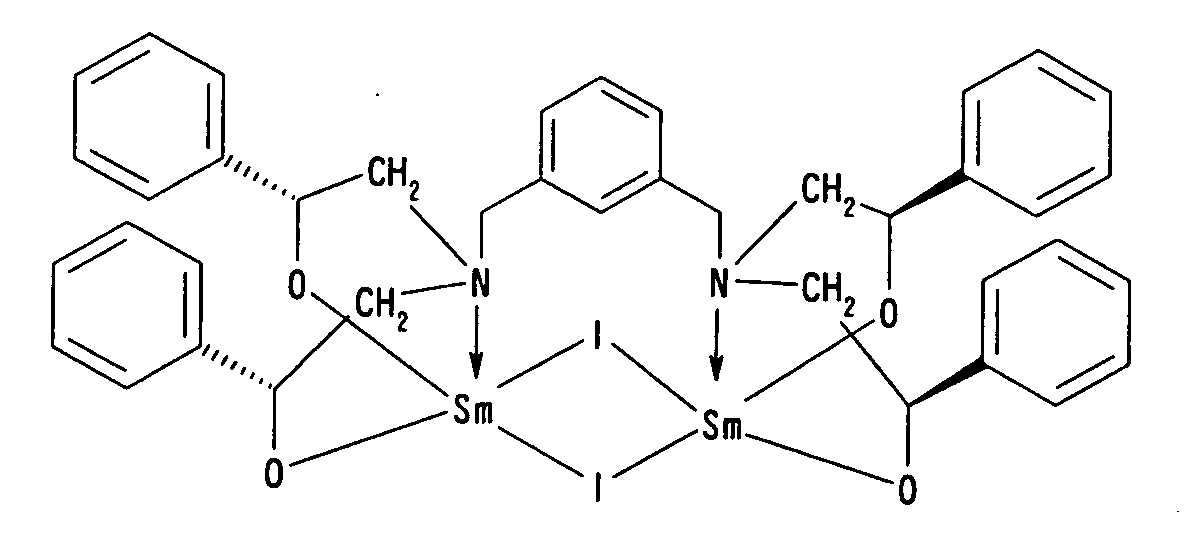
-
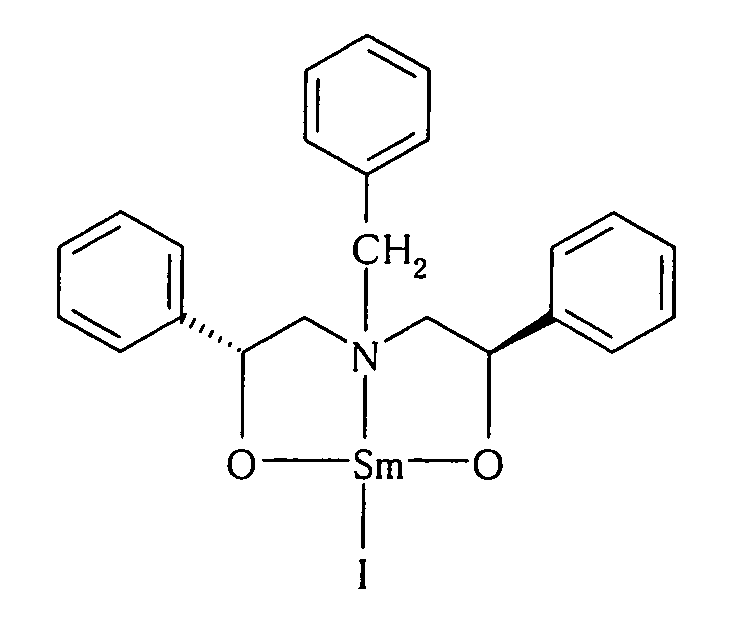
- Table 1 shown above reveals that the objective optically active alcohol can be produced in a high chemical yield and in a very high asymmetric yield, and thus the complex compound of the present invention exhibits excellent catalytic ability.
-

- N,N-Di[4,5-dihydro-4(R)-phenyl-1,3-oxazol-2-ylmethyl]amine (synthesized according to the description by Jiang, Y., J. Am. Chem. Soc., 1998, 120, 3817.)(196.3 mg, 58.5 µmol) was dissolved in methanol (1 ml) in a 20-ml Schlenk glassware. To this solution were added triethylamine (0.13 ml, 57.3 µmol) and α,α'-dibromo-m-xylene (0.04 ml, 27.4 µmol), and the mixture was stirred at room temperature for 40 hours. After removal of the solvent by evaporation, the residue was purified by a silica gel column chromatography (hexane : ethyl acetate = 1 : 3 (by volume) and 3 % by volume of triethylamine) to give the title compound (81.7 mg) as a brown oil. The yield was 30%.
1H-NMR (300MHz, CDCl3, 35°C) δ: 7.43-7.20 (m, 24H, phenyl protons), 5.21(dd, J=9.9, 14.8 Hz, 4H, -CH-CH2-O-), 4.60(dd, J=9.9, 8.5 Hz, 4H, -CHH-CH-Ph), 4.11(dd, J=14.8, 8.5 Hz, 4H, -CHH-CH-Ph), 3.99(s, 4H, Ar-CH 2-N-), 3.71(s, 8H, -N-CH 2-C).
MS (FAB): m/z 773.
HRMS (FAB): Found 773.9582, Calcd. 773.9549. - N,N-Di[4,5-dihydro-4(S)-isopropyl-1,3-oxazol-2-yl-methyl]amine (396.1 mg, 1.48 mmol) was dissolved in methanol (1 ml) in a 20-ml Schlenk glassware. To this solution were added triethylamine (0.2 ml, 1.43 mmol) and α,α'-dichloro-m-xylene (0.07 ml, 480 µmol), and the mixture was stirred at room temperature for 16 hours. The solvent was removed by evaporation and the residue was purified by a silica gel column chromatography (hexane : ethyl acetate = 2 : 5 (by volume) and 3 % by volume of triethylamine) to give the title compound as a brown oil (149.9 mg). The yield was 49%.
1H-NMR (300MHz, CDCl3, 35°C) d: 7.42-7.25 (m, 4H, phenyl protons), 4.22(dd, J=8.2, 7.2 Hz, 4H, -CH-CHH-), 3.95(dd, J=13.8, 7.2 Hz, 4H, -CH-CHH-), 3.90-3.88(m, 4H, -CH-CHH-), 3.85(s, 4H, Ar-CH 2-N-), 3.51(s, 4H, -NH-CH 2-). 1.75(d, septet, J=6.6, 6.6 Hz, 2H, CH3-CH-CH3), 0.97(d, J=6.6 Hz, 6H, CH3-CH-CH 3 ), 0.88(d, J=6.6 Hz, 6H, CH 3-CH-CH3). -
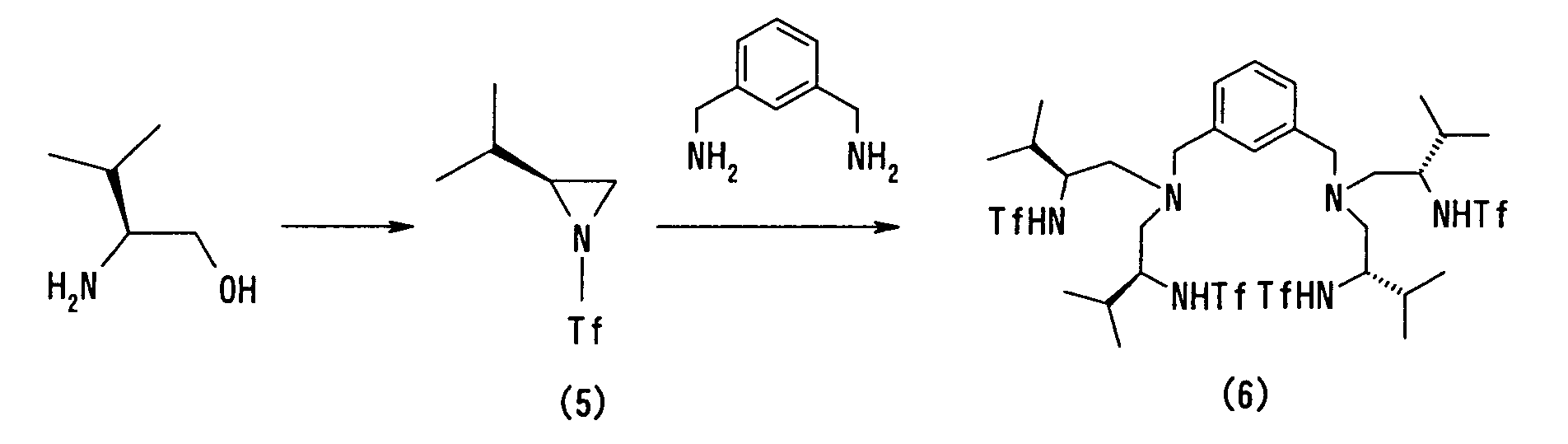
- According to the method by Cernerud, M. et al., (Tetrahedron: Asymmetry, 1997, 15, 2655), aziridine (5) was synthesized. What follows is the detailed description of this synthesis.
- In an atmosphere of argon, L-valinol (2.4 ml, 21.5 mmol) was dissolved in methylene chloride (40 ml) and triethylamine (5.6 ml, 40.1 mmol) in an 80-ml Schlenk glassware. The resulting solution was cooled to -78°C. Then, trifluoromethanesulfonic anhydride (7.2 ml, 33.7 mmol) was added slowly to the solution with the aid of a dropping funnel. The temperature was raised to -30°C, and the resulting mixture was stirred at -30°C overnight. The reaction solution was washed successively with 1M hydrochloric acid (twice, with 50 ml each) and aqueous saturated sodium bicarbonate solution (twice, with 50 ml each), and dried over anhydrous magnesium sulfate. The solvent was removed by evaporation to give 3.1307 g of (R)-N-trifluoromethanesulfonyl-2-isopropylaziridine (5) as a brown oil. The yield was 67 %.
- According to the method by Cernerud, M. et al., (Tetrahedron: Asymmetry, 1997, 20, 3437.), the compound (6) was synthesized as follows.
- (R)-N-Trifluoromethanesulfonyl-2-isopropylaziridine (5) (3.1307g) was dissolved in methanol (2 ml). To this solution was added m-xylenediamine (0.31 ml, 2.34 mmol), and the mixture was stirred at 60°C for 2 days, followed by a silica gel chromatography (ethyl acetate : hexane = 1 : 4 (by volume)) to give a ligand (6) (1.0492 g) as a colorless solid. The yield was 45 %.
1H-NMR(300MHz, CDCl3, 35°C) d: 7.49-7.20 (m, 4H, phenyl protons), 3.91(d, J=13.5 Hz, 4H, Ar-CH 2-N-), 3.53(m, 4H, N-CHH-CH-), 2.67(dd, J=13.5, 9.6 Hz, 4H, N-CHH-CH-), 2.51(dd, J=13.5, 5.1 Hz, 4H, -N-CHH-CH-), 1.97(m, 4H, CH3-CH-CH3), 0.90(d, J=7.0 Hz, 12H, CH3-CH-CH 3), 0.86(d, J=7.0 Hz, 12H, CH 3-CH-CH3).
[α]D -71.9° (c 1.0, CH3OH).
MS(FAB): m/z 1005.
HRMS(FAB): Found 1006.0491, Calcd. 1006.0531.
Melting point: 196-201°C. - In an atmosphere of argon, the ligand (6) obtained in Example 6 (0.10 g, 0.10 mmol) was suspended in methylene chloride (5 ml) in a Schlenk glassware, and to this suspension was added trimethylaluminum in toluene (0.20 ml of 1M solution, 0.20 mmol) via a syringe. Then, the resulting mixture was stirred at room temperature for 3 hours. The reaction mixture changed from a white suspension into a colorless solution. After completion of the stirring, the solvent was removed by evaporation under reduced pressure. Hexane (5 ml) was added to the residue, and the mixture was further stirred for one hour. After that, the mixture was allowed to stand for a while, and the supernatant liquid was removed by means of a syringe. The precipitate was dried under reduced pressure to give a catalyst. To the catalyst obtained was added methylene chloride (16 ml), followed by the addition of N,N-diisopropylethylamine (0.59 ml, 3.4 mmol). The mixture was cooled to -78°C in a dry ice-ethanol bath. To this were added acetyl bromide (0.28 ml, 3.8 mmol) and isovaleraldehyde (0.21 ml, 2.0 mmol) via a syringe, and the mixture was stirred at -50°C for 24 hours, during which time the reaction solution turned pale yellow. After completion of the reaction, the reaction mixture changed to orange when it was warmed up to room temperature. The reaction mixture was filtered through a glass filter packed with silica gel, and the solvent of the filtrate was evaporated off to give (S)-4-isobutyl-2-oxetanone (0.20 g, 77 % yield). The asymmetric yield of the product was measured by means of GLC using a capillary column Chirasil-DEX CB (0.25 mm x 25 m, membrane thickness 0.25 µm, GL Science) and was found to be 93% e.e.
- Complex compounds produced by using the ligand of the present invention are useful as a catalyst for asymmetric syntheses and extremely useful from industrial viewpoint.
Claims (16)
- A ligand represented by the formula (1):wherein Q3 is an optionally substituted alkylene group, an optionally substituted cycloalkylene group, an optionally substituted arylene group or an optionally substituted divalent heterocyclic group; R5 is an optionally substituted alkyl group, an optionally substituted aryl group or an optionally substituted heterocyclic group; and R6 is a substituent which may coordinate or bind to a metal atom, or R5 and R6, taken together, may form a ring,
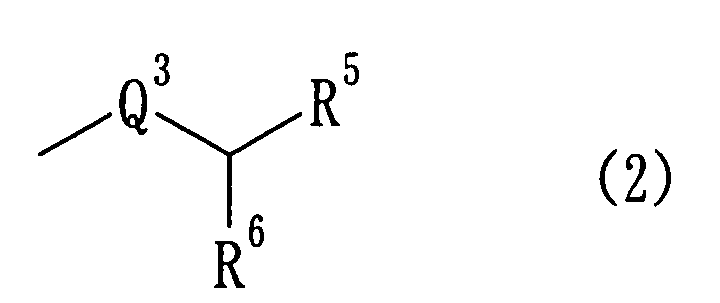
Q1 and Q2 are each the same or different and represent an optionally substituted alkylene group or a single bond, and
X is a divalent spacer. - The ligand according to claim 1, characterized in that the ligand is an optically active compound.
- The ligand according to claim 1, characterized in that no asymmetric carbon atom is present in the formula (2).
- The ligand according to any one of claims 1 to 3, characterized in that the spacer is an optionally substituted alkylene group, an optionally substituted arylene group or an optionally substituted divalent heterocyclic group.
- The ligand according to any one of claims 1 to 4, characterized in that the length of Q1-X-Q2 is from 2 to 30 angstroms.
- The ligand according to any one of claims 1 to 5, characterized in that Q3 is an alkylene group of 1 to 6 carbon atoms.
- The ligand according to any one of claims 1 to 6, characterized in that R5 is an aryl group.
- The ligand according to any one of claims 1 to 7, characterized in that R6 is a hydroxy group, an alkoxy group of 1 to 6 carbon atoms, an amino group or a substituted amino group.
- The ligand according to any one of claims 1 to 6, characterized in that the ring formed when R5 and R6 are taken together is an oxazoline, a pyrrolidine or a piperidine.
- A complex compound characterized by containing, as a constituent element, the ligand according to any one of claims 1 to 9 and a metal atom.
- The complex compound according to claim 10, characterized in that the metal atom belongs to any one of groups 3 to 14 of the periodic table.
- The complex compound according to claim 10 or 11, characterized in that the metal atom is lanthanum, samarium, titanium, zirconium, vanadium, rhenium, iron, ruthenium, cobalt, rhodium, iridium, nickel, palladium, copper, zinc, aluminum, tin, gold, silver or platinum.
- Use of the ligand described in any one of claims 1 to 9 for the production of the complex compound described in any one of claims 10 to 12.
- Use of the complex compound described in any one of claims 10 to 12 as a catalyst for asymmetric synthesis reactions.
- A method for producing a compound of the formula (1):
- A method for producing the complex compound described in any one of claims 10 to 12, characterized in that the ligand described in any one of claims 1 to 9 is contacted with a metal compound.
Applications Claiming Priority (3)
| Application Number | Priority Date | Filing Date | Title |
|---|---|---|---|
| JP2003030067 | 2003-02-06 | ||
| JP2003030067 | 2003-02-06 | ||
| PCT/JP2004/001146 WO2004069786A1 (en) | 2003-02-06 | 2004-02-04 | Ligands and complex compounds containing the same |
Publications (2)
| Publication Number | Publication Date |
|---|---|
| EP1591439A1 true EP1591439A1 (en) | 2005-11-02 |
| EP1591439A4 EP1591439A4 (en) | 2006-11-08 |
Family
ID=32844256
Family Applications (1)
| Application Number | Title | Priority Date | Filing Date |
|---|---|---|---|
| EP04708043A Withdrawn EP1591439A4 (en) | 2003-02-06 | 2004-02-04 | LIGANDS AND COMPLEX COMPOUNDS CONTAINING SAME |
Country Status (4)
| Country | Link |
|---|---|
| US (1) | US7635776B2 (en) |
| EP (1) | EP1591439A4 (en) |
| JP (1) | JP4634932B2 (en) |
| WO (1) | WO2004069786A1 (en) |
Families Citing this family (4)
| Publication number | Priority date | Publication date | Assignee | Title |
|---|---|---|---|---|
| WO2006121019A1 (en) * | 2005-05-09 | 2006-11-16 | Sumitomo Chemical Company, Limited | Vanadium complex |
| US8580994B2 (en) * | 2008-03-06 | 2013-11-12 | Dow Corning Corporation | Process for the preparation of haloalkylalkoxysilanes and haloalkylhalosilanes |
| JP5269444B2 (en) * | 2008-03-11 | 2013-08-21 | 東ソー・ファインケム株式会社 | Solid Lewis acid catalyst and method for producing Diels-Alder adduct using the same |
| US9487542B1 (en) | 2015-07-13 | 2016-11-08 | King Fahd University Of Petroleum And Minerals | Mixed ligand gold(III) complexes and methods thereof |
Family Cites Families (3)
| Publication number | Priority date | Publication date | Assignee | Title |
|---|---|---|---|---|
| US3098841A (en) * | 1960-07-11 | 1963-07-23 | Shell Oil Co | Polynuclear polyamines |
| JP4290265B2 (en) | 1999-03-02 | 2009-07-01 | 第一ファインケミカル株式会社 | Novel asymmetric ligand |
| JP4987197B2 (en) | 2001-06-04 | 2012-07-25 | 第一三共株式会社 | Process for producing optically active trihaloanilino derivative and optically active phosphine ligand |
-
2004
- 2004-02-04 EP EP04708043A patent/EP1591439A4/en not_active Withdrawn
- 2004-02-04 WO PCT/JP2004/001146 patent/WO2004069786A1/en not_active Ceased
- 2004-02-04 US US10/542,659 patent/US7635776B2/en not_active Expired - Fee Related
- 2004-02-04 JP JP2005504859A patent/JP4634932B2/en not_active Expired - Fee Related
Non-Patent Citations (3)
| Title |
|---|
| EVANS D.A. ET AL.: "A chiral samarium-based catalyst for the asymmetric Meerwein-Ponndorf-Verley reduction." JOURNAL OF THE AMERICAN CHEMICAL SOCIETY., vol. 115, no. 21, 1993, pages 9800-9801, XP002400391 US AMERICAN CHEMICAL SOCIETY, WASHINGTON, DC. * |
| OHNO K. ET AL: "Asymmetric Transfer Hydrogenation of Aryl Ketones Catalyzed by Salt-Free Two Samarium Centers Supported by a Chiral Multidentate Alkoxy Ligand" ORGANIC LETTERS , 6(25), 4695-4697 CODEN: ORLEF7; ISSN: 1523-7060, 2004, XP002400392 * |
| See also references of WO2004069786A1 * |
Also Published As
| Publication number | Publication date |
|---|---|
| JPWO2004069786A1 (en) | 2006-05-25 |
| US7635776B2 (en) | 2009-12-22 |
| WO2004069786A1 (en) | 2004-08-19 |
| JP4634932B2 (en) | 2011-02-16 |
| US20060111572A1 (en) | 2006-05-25 |
| EP1591439A4 (en) | 2006-11-08 |
Similar Documents
| Publication | Publication Date | Title |
|---|---|---|
| Müller et al. | C2‐symmetric 4, 4′, 5, 5′‐tetrahydrobi (oxazoles) and 4, 4′, 5, 5′‐tetrahydro‐2, 2′‐methylenebis [oxazoles] as chiral ligands for enantioselective catalysis preliminary communication | |
| Lötscher et al. | Enantioselective catalytic cyclopropanation of styrenes by copper complexes with chiral pinene-[5, 6]-bipyridine ligands | |
| EP0850945A1 (en) | Chiral diphosphine compound, intermediate for preparing the same, transition metal complex having the same diphosphine compound as ligand and asymmetric hydrogenation catalyst | |
| US5508438A (en) | Phosphorus compounds | |
| JP2681057B2 (en) | 2,2'-bis (diphenylphosphino) -5,5 ', 6,6', 7,7 ', 8,8'-octahydro-1,1'-binaphthyl and transition metal having this as a ligand Complex | |
| Hayashi et al. | New chiral chelating phosphine complexes containing tricarbonyl (η6-arene) chromium for highly enantioselective allylic alkylation | |
| JP3369561B2 (en) | Phosphorus compound | |
| CN112961194B (en) | PNO ligand containing chiral ferrocene and application thereof | |
| CA2462045C (en) | Novel diphosphines, their complexes with transition metals and their usein asymmetric synthesis | |
| Townsend et al. | Novel copper complexes of chiral diphosphines: preparation, structure, and use to form rhodium complex catalysts for chiral hydrogenations | |
| Chen et al. | Synthesis, structure, and catalytic activity of a new chiral NHC–iridium (III) complex | |
| Standfest-Hauser et al. | Hydrogen-transfer catalyzed by half-sandwich Ru (ii) aminophosphine complexes | |
| US5621128A (en) | Halogenated biphenyl-2,2'-diylbisdiphenylphosphines, their preparation and their use | |
| US6133464A (en) | Chiral ferrocenyls | |
| Townsend et al. | Crystal structure of (. eta. 6-hexadeuteriobenzene)[(1R, 2R)-trans-1, 2-bis ((diphenylphosphino) methyl) cyclobutane] rhodium (I) perchlorate: a model for the resting state of an asymmetric hydrogenation catalyst | |
| Cserépi-Szűcs et al. | Synthesis of chiral diphosphite ligands and comparison of their rhodium and platinum complexes in the asymmetric hydroformylation of styrene | |
| US7635776B2 (en) | Ligands and complex compounds containing the same | |
| CN120699067B (en) | Novel chiral ferrocene bridged binaphthyl skeleton phosphine ligand and application thereof | |
| Brown et al. | Flexible cis-or trans-chelating biphosphine ligands derived from αα-or ββ-trehalose | |
| US6333291B1 (en) | Optically active diphosphine compound, production intermediate thereof, transition metal complex containing the compound as ligand and asymmetric hydrogenation catalyst containing the complex | |
| Gladiali et al. | Asymmetric allylic alkylation catalyzed by Pd (II)-complexes with (S)-BINPO, a hemilabile axially chiral P, O-heterodonor inducer | |
| EP2274313B1 (en) | Ruthenium complexes having (p-p)-coordinated disphosphorus donor ligands and processes for preparing them | |
| Brunner et al. | Optically active transition metal complexes. Part 108. Synthesis, crystal structure and properties of a novel “quasi-meso” dinuclear η6-benzene-ruthenium (II) complex with chiral salicylaldiminato ligands | |
| CA2458430A1 (en) | Ligands for asymmetric reactions | |
| EP1419815B1 (en) | Phosphine compounds, transition metal complexes with the compounds contained as ligands therein, and asymmetric synthesis catalysts containing the complexes |
Legal Events
| Date | Code | Title | Description |
|---|---|---|---|
| PUAI | Public reference made under article 153(3) epc to a published international application that has entered the european phase |
Free format text: ORIGINAL CODE: 0009012 |
|
| 17P | Request for examination filed |
Effective date: 20050718 |
|
| AK | Designated contracting states |
Kind code of ref document: A1 Designated state(s): AT BE BG CH CY CZ DE DK EE ES FI FR GB GR HU IE IT LI LU MC NL PT RO SE SI SK TR |
|
| AX | Request for extension of the european patent |
Extension state: AL LT LV MK |
|
| A4 | Supplementary search report drawn up and despatched |
Effective date: 20061010 |
|
| STAA | Information on the status of an ep patent application or granted ep patent |
Free format text: STATUS: THE APPLICATION HAS BEEN WITHDRAWN |
|
| 18W | Application withdrawn |
Effective date: 20070201 |