EP1591221A1 - Polyurethane foam molding, method of producing the same, and seat pad for motor vehicle - Google Patents
Polyurethane foam molding, method of producing the same, and seat pad for motor vehicle Download PDFInfo
- Publication number
- EP1591221A1 EP1591221A1 EP03778920A EP03778920A EP1591221A1 EP 1591221 A1 EP1591221 A1 EP 1591221A1 EP 03778920 A EP03778920 A EP 03778920A EP 03778920 A EP03778920 A EP 03778920A EP 1591221 A1 EP1591221 A1 EP 1591221A1
- Authority
- EP
- European Patent Office
- Prior art keywords
- polyurethane foam
- density
- urethane stock
- molded
- stock solutions
- Prior art date
- Legal status (The legal status is an assumption and is not a legal conclusion. Google has not performed a legal analysis and makes no representation as to the accuracy of the status listed.)
- Granted
Links
Images

Classifications
-
- B—PERFORMING OPERATIONS; TRANSPORTING
- B29—WORKING OF PLASTICS; WORKING OF SUBSTANCES IN A PLASTIC STATE IN GENERAL
- B29C—SHAPING OR JOINING OF PLASTICS; SHAPING OF MATERIAL IN A PLASTIC STATE, NOT OTHERWISE PROVIDED FOR; AFTER-TREATMENT OF THE SHAPED PRODUCTS, e.g. REPAIRING
- B29C39/00—Shaping by casting, i.e. introducing the moulding material into a mould or between confining surfaces without significant moulding pressure; Apparatus therefor
- B29C39/02—Shaping by casting, i.e. introducing the moulding material into a mould or between confining surfaces without significant moulding pressure; Apparatus therefor for making articles of definite length, i.e. discrete articles
- B29C39/12—Making multilayered or multicoloured articles
-
- B—PERFORMING OPERATIONS; TRANSPORTING
- B29—WORKING OF PLASTICS; WORKING OF SUBSTANCES IN A PLASTIC STATE IN GENERAL
- B29C—SHAPING OR JOINING OF PLASTICS; SHAPING OF MATERIAL IN A PLASTIC STATE, NOT OTHERWISE PROVIDED FOR; AFTER-TREATMENT OF THE SHAPED PRODUCTS, e.g. REPAIRING
- B29C44/00—Shaping by internal pressure generated in the material, e.g. swelling or foaming ; Producing porous or cellular expanded plastics articles
- B29C44/02—Shaping by internal pressure generated in the material, e.g. swelling or foaming ; Producing porous or cellular expanded plastics articles for articles of definite length, i.e. discrete articles
- B29C44/04—Shaping by internal pressure generated in the material, e.g. swelling or foaming ; Producing porous or cellular expanded plastics articles for articles of definite length, i.e. discrete articles consisting of at least two parts of chemically or physically different materials, e.g. having different densities
- B29C44/0461—Shaping by internal pressure generated in the material, e.g. swelling or foaming ; Producing porous or cellular expanded plastics articles for articles of definite length, i.e. discrete articles consisting of at least two parts of chemically or physically different materials, e.g. having different densities by having different chemical compositions in different places, e.g. having different concentrations of foaming agent, feeding one composition after the other
-
- B—PERFORMING OPERATIONS; TRANSPORTING
- B29—WORKING OF PLASTICS; WORKING OF SUBSTANCES IN A PLASTIC STATE IN GENERAL
- B29K—INDEXING SCHEME ASSOCIATED WITH SUBCLASSES B29B, B29C OR B29D, RELATING TO MOULDING MATERIALS OR TO MATERIALS FOR MOULDS, REINFORCEMENTS, FILLERS OR PREFORMED PARTS, e.g. INSERTS
- B29K2075/00—Use of PU, i.e. polyureas or polyurethanes or derivatives thereof, as moulding material
-
- B—PERFORMING OPERATIONS; TRANSPORTING
- B29—WORKING OF PLASTICS; WORKING OF SUBSTANCES IN A PLASTIC STATE IN GENERAL
- B29K—INDEXING SCHEME ASSOCIATED WITH SUBCLASSES B29B, B29C OR B29D, RELATING TO MOULDING MATERIALS OR TO MATERIALS FOR MOULDS, REINFORCEMENTS, FILLERS OR PREFORMED PARTS, e.g. INSERTS
- B29K2105/00—Condition, form or state of moulded material or of the material to be shaped
- B29K2105/0058—Liquid or visquous
-
- B—PERFORMING OPERATIONS; TRANSPORTING
- B29—WORKING OF PLASTICS; WORKING OF SUBSTANCES IN A PLASTIC STATE IN GENERAL
- B29K—INDEXING SCHEME ASSOCIATED WITH SUBCLASSES B29B, B29C OR B29D, RELATING TO MOULDING MATERIALS OR TO MATERIALS FOR MOULDS, REINFORCEMENTS, FILLERS OR PREFORMED PARTS, e.g. INSERTS
- B29K2105/00—Condition, form or state of moulded material or of the material to be shaped
- B29K2105/04—Condition, form or state of moulded material or of the material to be shaped cellular or porous
-
- B—PERFORMING OPERATIONS; TRANSPORTING
- B29—WORKING OF PLASTICS; WORKING OF SUBSTANCES IN A PLASTIC STATE IN GENERAL
- B29K—INDEXING SCHEME ASSOCIATED WITH SUBCLASSES B29B, B29C OR B29D, RELATING TO MOULDING MATERIALS OR TO MATERIALS FOR MOULDS, REINFORCEMENTS, FILLERS OR PREFORMED PARTS, e.g. INSERTS
- B29K2995/00—Properties of moulding materials, reinforcements, fillers, preformed parts or moulds
- B29K2995/0037—Other properties
- B29K2995/0063—Density
- B29K2995/0064—Non-uniform density
-
- B—PERFORMING OPERATIONS; TRANSPORTING
- B29—WORKING OF PLASTICS; WORKING OF SUBSTANCES IN A PLASTIC STATE IN GENERAL
- B29L—INDEXING SCHEME ASSOCIATED WITH SUBCLASS B29C, RELATING TO PARTICULAR ARTICLES
- B29L2031/00—Other particular articles
- B29L2031/771—Seats
Definitions
- the present invention relates to a molded polyurethane foam product, a seat pad for a vehicle, and a method for molding a polyurethane foam product. More particularly, the invention relates to a method for molding a one-piece polyurethane foam product, the polyurethane foam product partly having different physical characteristics, and relates to a molded polyurethane foam product and a seat pad for a vehicle manufactured by the method.
- Seat pads for vehicles such as automobiles have been generally formed of flexible or semirigid polyurethane foam segments.
- cushioning properties, hardness, and vibration-absorbing properties have been improved by modifying the material or the structure.
- such a seat pad mainly includes an under-buttocks section 2, an under-thigh section 3, which are disposed at a seating portion, and side bulging sections 4 on both sides of the seating portion.
- the under-buttocks section 2 includes a base subsection 2A adjacent to the under-thigh section 3 and a rear-end subsection 2B.
- such a seat pad 1 for a vehicle is generally produced by mixing a mixture containing a polyol component, a catalyst, a foaming agent, and other additives in predetermined proportions (hereinafter referred to as "polyol-containing solution") with an isocyanate component immediately before molding to prepare a urethane stock solution, and then injecting the resulting urethane stock solution into a mold to perform foam molding.
- polyol-containing solution a mixture containing a polyol component, a catalyst, a foaming agent, and other additives in predetermined proportions
- the under-buttocks section 2 supports most of occupant's weight.
- the material constituting the under-buttocks section 2 has a close relationship to sitting comfort and riding comfort, and is thus important from the standpoint of the sitting comfort and riding comfort.
- the load due to body weight on portions other than the under-buttocks section 2 is low, and thus the level of importance of these portions is relatively low.
- the side bulging sections 4, the under-thigh section 3, and the like are partially composed of different materials.
- the entire seat pad is composed of the same material. That is, the relatively less important portions other than the under-buttocks section 2 are composed of the same material as that used for the under-buttocks section 2, which is important from the standpoint of the sitting comfort and the riding comfort. Therefore, this causes an increase in weight and cost.
- the portions other than the under-buttocks section of the seating portion are formed of a polyurethane foam segment having lower density and higher impact resilience, compared with those of a polyurethane foam segment constituting the under-buttocks section.
- the portions other than the under-buttocks section are composed of a material having low-density, thereby achieving a reduction in weight.
- the low-density material has high impact resilience, thereby improving sitting comfort and durability.
- the portions other than the under-buttocks section are not always required to be composed of a material having high impact resilience from the viewpoint of riding comfort and durability.
- the present inventor proposed a seat pad in which the portions other than the under-buttocks section of the seating portion are partly or wholly composed of a material having lower density and substantially the same hardness, compared with a material constituting the under-buttocks section (see Japanese Unexamined Patent Application Publication No. 2002-353102). As described above, load on the portions other than the under-buttocks section is low.
- the material constituting the portions other than the under-buttocks section has substantially the same hardness as that of the material constituting the under-buttocks section, even if the portions other than the under-buttocks section are composed of a low-density and inexpensive material, satisfactory performance can be obtained, from the viewpoint of the sitting comfort, the riding comfort, and the durability.
- a molded polyurethane foam product including portions having different densities and substantially the same hardness has not been molded in one piece.
- a polyurethane foam product partly having different physical characteristics in particular, a molded polyurethane foam product including a molded section having a desired density, as designed, at a desired position, has not been molded in one piece.
- the one-piece molding has been performed by injecting the urethane stock solutions into a mold without consideration of molding pressure during one-piece molding (maximum internal pressure reached in a mold during foam molding).
- molding pressure during one-piece molding maximum internal pressure reached in a mold during foam molding.
- a method for molding a polyurethane foam product according to the present invention includes the steps of injecting a urethane stock solution containing a polyol-containing solution and an isocyanate component into a mold and foaming the stock solution.
- a polyurethane foam product including at least two molded portions having different physical characteristics is molded by injecting at least two urethane stock solutions capable of forming polyurethane foam segments having different physical characteristics into the mold and then foaming the stock solutions at a predetermined molding pressure P.
- the at least two urethane stock solutions are injected into the mold and foamed so that any molded portion has the predetermined molding pressure P during foaming step.
- the urethane stock solutions are injected so as to obtain a predetermined molding pressure P at any portion during the foaming step.
- the molded portions having target physical characteristics can be surely formed.
- the one-piece polyurethane foam product including a first molded portion having a predetermined density and a second molded portion having a density different from that of the first molded portion is molded by injecting at least two urethane stock solutions capable of forming polyurethane foam segments having different densities into the mold and then foaming the urethane stock solutions at the predetermined molding pressure P.
- the amounts of urethane stock solutions injected are determined so that any molded portion has the predetermined molding pressure P during foaming step, based on the densities of the polyurethane foam segments formed with the urethane stock solutions at the predetermined molding pressure and the volumes of molded portions formed with the respective urethane stock solutions.
- the resulting polyurethane foam product partly having different densities and substantially the same hardness is particularly suitable for a seat pad for a vehicle.
- the inventive polyurethane foam product and seat pad for a vehicle are produced by the inventive method.
- portions other than an under-buttocks section of a seating portion of the seat pad partly or wholly have a density lower than that of the under-buttocks section and have the same hardness as that of the under-buttocks section.
- the term “density” refers to “overall (total) density (OA density)".
- the OA density is determined by dividing the foam weight of a seat pad for a vehicle by the foam volume.
- the term “hardness” refers to "25% hardness”.
- the 25% hardness is determined by compressing a seat pad for a vehicle until the thickness of the seat pad decreases to 25% of the original thickness using a pressure plate 200 mm in diameter.
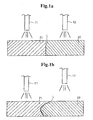
- Figs. 1A and 1B each are a schematic cross-sectional view of a method for molding a polyurethane foam product according to an embodiment of the present invention.
- a method for molding a polyurethane foam product partly having different densities and substantially the same hardness by injecting two urethane stock solutions capable of forming polyurethane foam segments having different densities and substantially the same hardness into a mold and then foaming them will be described.
- at least three such poly urethane stock solutions may be used.
- a polyurethane foam product partly having different densities, other physical properties, and characteristics may be molded by injecting two or three or more urethane stock solutions capable of forming polyurethane foam segments having different hardness, impact resilience, and vibration characteristics in addition to different densities and then foaming them.
- such two urethane stock solutions may be injected through injection nozzles 11 and 12.
- one of such two urethane stock solutions may be injected through the injection nozzle 12 at a predetermined time after injecting another urethane stock solution through the injection nozzle 11.
- a polyurethane foam product including a first molded portion 21 formed of a polyurethane foam segment having hardness H 1 and density D 1 and a second molded portion 22 formed of a polyurethane foam segment having hardness H 2 and density D 2 is molded in one piece.
- the hardness H 1 of the first molded portion 21 is substantially the same as the hardness H 2 of the second molded portion 22.
- the density D 1 of the first molded portion 21 is different from the density D 2 of the second molded portion 22.
- the term "substantially the same hardness” means that the hardness difference is 20 N or less, in particular, 0 to 4.9 N.
- the term “different densities” mean that the density difference is 3 kg/m 3 or more, in particular, about 10 to 50 kg/m 3 .
- a polyurethane foam product partly having the same hardness and different densities can be molded, the interface L between the first molded portion 21 and the second molded portion 22 being substantially in the same plane.
- the density of polyurethane foam segment molded is mainly determined by the amount of water functioning as a foaming agent contained in a polyol-containing solution in a urethane stock solution.
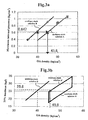
- the water content in the polyol-containing solution is adjusted, and the relationship between the molding pressure (maximum internal pressure) and the OA density of each of the two urethane stock solutions is determined (see Fig. 3A) as shown in Example 1 described below.
- the compositions of the two urethane stock solutions capable of forming polyurethane foam segments having different OA densities and a target OA-density difference at the same maximum internal pressure are determined.
- the compositions of a urethane stock solution for forming a polyurethane foam segment having a higher density hereinafter referred to as "high-density urethane stock solution”
- a urethane stock solution for forming a polyurethane foam segment having a lower density hereinafter referred to as “low-density urethane stock solution”
- the densities of first and second molded portions formed with the high-density urethane stock solution and the low-density urethane stock solution, respectively are defined as D H and D L , respectively (D H > D L ).
- the relationship between the OA density and 25% hardness is determined.
- the isocyanate index of the high-density urethane stock solution is adjusted so that the 25% hardness of the first molded portion having a density of D H formed with the high-density urethane stock solution is substantially equal to that of the second molded portion having a density of D L formed with the low-density urethane stock solution.
- This adjustment should be performed by, for example, adjusting the mixing ratio of the isocyanate component to the polyol-containing solution.
- the relationship between the density and the maximum internal pressure of the first molded portion molded with the high-density urethane stock solution is little changed by the adjustment. Therefore, the compositions of the high-density urethane stock solution and the low-density urethane stock solution capable of forming the first and second molded portions, respectively, having the same hardness and different densities can be determined at the same maximum internal pressure.
- the isocyanate index of the low-density urethane stock solution may be adjusted so that the 25% hardness of the first molded portion having a density of D H formed with the high-density urethane stock solution is substantially equal to that of the second molded portion having a density of D L formed with the low-density urethane stock solution.
- the above-description is an example of a method for preparing two urethane stock solutions having the same foam pressure and capable of forming polyurethane foam segments having different densities, and does not limit the method for preparing a urethane stock solution according to the present invention.
- the amounts of these solutions injected are determined so that the same predetermined maximum internal pressure is obtained at these molded portions.
- the amount of high-density urethane stock solution injected G H is determined from the volume V H and the density D H of the portion molded with the high-density urethane stock solution at the maximum internal pressure.
- the amount of low-density urethane stock solution injected G L is determined from the volume V L and the density D L of the portion molded with the low-density urethane stock solution.
- a value obtained by dividing the volume of each injected urethane stock solution by the volume of corresponding molded portion corresponds to the density of the molded polyurethane foam segment.
- the amount of urethane stock solution injected has been determined from the volume of the portion molded and the target density.
- the foam pressures, i.e., the maximum internal pressures, of respective polyurethane foam portions are different in molding the polyurethane foam portions having the target density. That is, the amount of each urethane stock solution injected is determined from the density and the volume of the molded portion at an arbitrary internal pressure.
- the densities of portions molded at the same molding pressure P are determined from the relationship between the molding pressure and the density.
- the amounts of urethane stock solutions injected are determined so that these densities are obtained.
- the molding pressures at any molded portion in a mold are the same pressure P.
- Examples of such a one-piece polyurethane foam product including at least two molded portions having different physical characteristics produced by the method according to the present invention include, but are not limited to, the above-described polyurethane foam product including the molded portions having the same hardness and different densities, a polyurethane foam product including the molded portions having different hardness and densities, a polyurethane foam product including the molded portions having different densities and substantially the same impact resilience, a polyurethane foam product including the molded portions having different densities and substantially the same vibration characteristics, and a polyurethane foam product including the molded portions having the same density and different hardness.
- At least two urethane stock solutions capable of forming polyurethane foam segments having different physical characteristics at a predetermined molding pressure P are injected in amounts such that the predetermined molding pressure P is obtained at any portion molded with these stock solutions, thereby molding a one-piece polyurethane foam product including at least two molded portions having different physical characteristics.
- An inventive seat pad for a vehicle includes portions preferably having the same hardness and different densities molded by such a method according to the present invention.
- portions including the under-buttocks section 2 are formed of high-density polyurethane foam segments and the other portions, which little affect sitting comfort and durability, are formed of low-density polyurethane foam segments, it is possible to reduce the weight of the entire seat pad for a vehicle.
- the hardness of the portions having low densities is the same as that of the portions having high densities, and other physical characteristics, such as impact resilience, of the portions having low densities are low level; hence, it is possible to reduce the material cost of the seat pad for a vehicle.
- the density of the portion having a high density formed with the high-density urethane stock solution is preferably about 40 to 80 kg/m 3 in order to ensure sitting comfort, riding comfort, durability, and the like.
- the 25% hardness is preferably about 150 to 300 N.
- the density of the portion having a low density formed with the low-density urethane stock solution is preferably about 40% to 95% of that of the portion having a high density formed with the high-density urethane stock solution.
- the hardness is substantially the same as that of the portion having a high density.
- the inventive seat pad for a vehicle in which the portion having a low density have substantially the same hardness as that of the portion having a high density, is reduced in weight without deterioration of riding comfort and durability.
- the hardness difference between the portion having a low density and the portion having a high density is preferably 4.9 N or less, more preferably 3 N or less, and most preferably 2 N or less.
- At least the entire under-buttocks section or at least the base subsection 2A is constituted of the polyurethane foam segment formed with the high-density urethane stock solution, and the other sections are partly or wholly constituted of the polyurethane foam segments formed with the low-density urethane stock solution.
- 20% to 70% of the total volume of the seat pad for a vehicle is preferably constituted of the polyurethane foam segment formed with the high-density urethane stock solution, the remainder is preferably constituted of the polyurethane foam segment formed with the low-density urethane stock solution.
- the impact resilience of the entire under-buttocks section or the base subsection is preferably 65% to 78% and particularly preferably 65% to 70%.
- the impact resilience of the other sections is preferably 62% or less, more preferably 50% to 62%, and most preferably 60% to 62%. In this way, by increasing the impact resilience of the entire under-buttocks section or the base subsection and reducing the impact resilience of the other sections, it is possible to satisfactorily stretch the upholstery covering the seat pad for a vehicle.
- the inventive seat pad for a vehicle is not limited to the seat pad consisting of two portions, which are the high-density portion and the low-density portion.
- a portion having substantially the same hardness and having the intermediate density between those of the high-density portion and the low-density portion may be disposed at a section other than the under-buttocks section.
- Urethane stock solution A and urethane stock solution B were prepared as described below.
- the isocyanate index of the urethane stock solution A was 36
- the isocyanate index of the urethane stock solution B was 41.
- Composition of urethane stock solution A (part by weight) Polyether polyol 58.0 Polymer polyol 40.0 Cross-linking agent 2.0 Triethylenediamine (made by Sankyo Air Products Co., Ltd.) 0.5 L-5309 (made by Dow Corning Toray Co., Ltd.) 0.5 Water 3.1 TDI 36
- Composition of urethane stock solution B (part by weight) Polyether polyol 47.0 Polymer polyol 50.0 Cross-linking agent 3.0 Triethylenediamine (made by Sankyo Air Products Co., Ltd.) 0.5 L-5309 (made by Dow Corning Toray Co., Ltd) 0.1 Water 3.6 TDI 41
- Fig. 3A shows the results.
- internal pressure P was 0.647 kg/cm 2 (63.4 kPa)
- the OA density of the polyurethane foam segment formed with the urethane stock solution A was 45.8 kg/m 3
- the OA density of the polyurethane foam segment formed with the urethane stock solution B was 40 kg/m 3 . That is, these polyurethane foam segments had different densities.
- Fig. 3B shows the results.
- the 25% hardness was 25.8 kgf.
- the 25% hardness was 18 kgf. This hardness was significantly lower than 25.8 kgf described above.
- the relationship between the OA density and the 25% hardness was investigated by gradually changing the mixing ratio of the polyol-containing solution to the isocyanate component. As shown in Fig. 3B, it was found that, in the polyurethane foam segment formed with a urethane stock solution A' having an isocyanate index of 37.5, when the OA density was 45.8 kg/m 3 , the 25% hardness was the same 25.8 kgf as that described above. Furthermore, the relationship between the OA density and the maximum internal pressure of the polyurethane foam segment formed with the urethane stock solution A' was substantially equivalent to that of the polyurethane foam segment formed with the urethane stock solution A. When the OA density was 45.8 kg/m 3 , each maximum internal pressure was 0.647 kg/cm 2 .
- the urethane stock solution A' and the urethane stock solution B were used for forming a polyurethane foam segment.
- the polyurethane foam segment included a first molded portion having a high density and a second molded portion having a low density, the first and second molded portions each having a 25% hardness of 25.8 kgf.
- the first and second molded portions each had a volume of 8,000 cm 3 .
- the volume of the cavity of a mold for molding was 16,000 cm 3 .
- the amounts of urethane stock solutions injected were determined so that the maximum internal pressure in the cavity was 0.647 kg/cm 2 at any position in the cavity during molding.
- the amounts of urethane stock solution A' and urethane stock solution B injected were determined the following so that the internal pressure was 0.647 kg/cm 2 (63.4 kPa) at any portion in one-piece molding.
- the volume of a molding cavity A' in the mold was 8,000 cm 3 .
- the volume of a molding cavity B in the mold was also 8,000 cm 3 .
- the 25% hardness of the resulting polyurethane foam product was about 25.8 kgf (252.8 N) at any portion.
- the OA density of the high-density portion was 45.8 kg/m 3
- the OA density of the low-density portion was 40 kg/m 3 .
- the impact resilience of the polyurethane foam product was 62% at the high-density portion and the low-density portion.
- the foam molding was performed as in Example 1 except that the urethane stock solution A' and the urethane stock solution B were injected into the mold with a time difference. That is, the urethane stock solution A' was charged 7, 12, or 20 seconds after the injection of the urethane stock solution B. As shown in Fig. 1B, the interface L was formed in a curved line.
- a polyurethane foam product having the following characteristics was molded: the 25% hardness was about 25.8 kgf at any portion.
- the OA density of a high-density portion was 45.8 kg/m 3
- the OA density of a low-density portion was 40 kg/m 3 .
- the impact resilience of the polyurethane foam product was 62% at the high-density portion and the low-density portion.
- Example 2 One-piece molding was performed as in Example 1 except that the urethane stock solution A was used instead of the urethane stock solution A'.
- a polyurethane foam product including a high-density portion formed with the urethane stock solution A and a low-density portion formed with the urethane stock solution B, was molded, the high-density portion having a 25% hardness of 17.8 kgf (174.4 N) and an OA density of 45.8 kg/m 3 , the low-density portion having a 25% hardness of 25.8 kgf (252.8 N ⁇ and an OA density of 40 kg/m 3 .
- a one-piece polyurethane foam product partly having different physical characteristics can be easily and surely molded.
- a seat pad for a vehicle including an under-buttocks section affecting sitting comfort, riding comfort, and durability and the other sections little affecting sitting comfort, riding comfort, and durability can be easily produced, the other sections being composed of a low-density, inexpensive material having substantially the same hardness as that of a material constituting the under-buttocks section. Therefore, according to the seat pad for a vehicle, reductions in the weight and material cost of the seat pad for a vehicle can be achieved without deterioration of sitting comfort, riding comfort, and durability.
Landscapes
- Casting Or Compression Moulding Of Plastics Or The Like (AREA)
- Mattresses And Other Support Structures For Chairs And Beds (AREA)
- Polyurethanes Or Polyureas (AREA)
Abstract
Description
| Composition of urethane stock solution A (part by weight) | |
| Polyether polyol | 58.0 |
| Polymer polyol | 40.0 |
| Cross-linking agent | 2.0 |
| Triethylenediamine (made by Sankyo Air Products Co., Ltd.) | 0.5 |
| L-5309 (made by Dow Corning Toray Co., Ltd.) | 0.5 |
| Water | 3.1 |
| TDI | 36 |
| Composition of urethane stock solution B (part by weight) | |
| Polyether polyol | 47.0 |
| Polymer polyol | 50.0 |
| Cross-linking agent | 3.0 |
| Triethylenediamine (made by Sankyo Air Products Co., Ltd.) | 0.5 |
| L-5309 (made by Dow Corning Toray Co., Ltd) | 0.1 |
| Water | 3.6 |
| TDI | 41 |
| OA density (kg/m3) | 25% Hardness (kgf) | Internal pressure (kg/cm2) | |
| High-density urethane stock solution A' | 45.8 | 25.8 | 0.647 |
| Low-density urethane | 40 | 25.8 | 0.647 |
Claims (10)
- A method for molding a one-piece polyurethane foam product, the product comprising at least two molded portions having different physical characteristics, the method comprising:injecting at least two urethane stock solutions capable of forming polyurethane foam segments having different physical characteristics into a mold, each of the urethane stock solutions comprising a polyol-containing solution and an isocyanate component; andfoaming the urethane stock solutions at a predetermined molding pressure P, wherein the at least two urethane stock solutions are injected into the mold and foamed so that any molded portion has the predetermined molding pressure P during foaming step.
- The method for molding the polyurethane foam product according to Claim 1, wherein the one-piece polyurethane foam product comprising a first molded portion having a predetermined density and a second molded portion having a density different from that of the first molded portion is molded by injecting at least two urethane stock solutions capable of forming polyurethane foam segments having different densities into the mold and then foaming the urethane stock solutions at the predetermined molding pressure P.
- The method for molding the one-piece polyurethane foam product according to Claim 2, wherein the amounts of urethane stock solutions injected are determined so that any molded portion has the predetermined molding pressure P during foaming step, based on the densities of the polyurethane foam segments formed with the urethane stock solutions at the predetermined molding pressure and the volumes of molded portions formed with the respective urethane stock solutions.
- The method for molding the one-piece polyurethane foam product according to Claim 2, wherein the one piece polyurethane foam product comprising the first molded portion having a predetermined hardness and density and the second molded portion having a density different from that of the first molded portion and having substantially the same hardness as that of the first molded portion is molded by injecting at least two urethane stock solutions capable of forming polyurethane form segments having different densities and substantially the same hardness into the mold and then foaming the urethane stock solutions at the predetermined molding pressure P.
- The method for molding the one-piece polyurethane foam product according to Claim 1, wherein the at least two urethane stock solutions are injected into the mold at the same time.
- The method for molding the one-piece polyurethane foam product according to Claim 1, wherein the at least two urethane stock solutions are injected into the mold with a time difference.
- The method for molding the one-piece polyurethane foam product according to Claim 1, wherein the molded polyurethane foam product is a seat pad for a vehicle.
- A molded polyurethane foam product produced by the method according to any one of Claims 1 to 7.
- A seat pad for a vehicle produced by the method according to any one of Claims 1 to 7.
- The seat pad for the vehicle according to Claim 9, wherein portions other than an under-buttocks section of a seating portion of the seat pad partly or wholly have a density lower than that of the under-buttocks section and have substantially the same hardness as that of the under-buttocks section.
Applications Claiming Priority (5)
| Application Number | Priority Date | Filing Date | Title |
|---|---|---|---|
| JP2002372430 | 2002-12-24 | ||
| JP2002372430 | 2002-12-24 | ||
| JP2003070312 | 2003-03-14 | ||
| JP2003070312 | 2003-03-14 | ||
| PCT/JP2003/016021 WO2004058473A1 (en) | 2002-12-24 | 2003-12-15 | Polyurethane foam molding, method of producing the same, and seat pad for motor vehicle |
Publications (3)
| Publication Number | Publication Date |
|---|---|
| EP1591221A1 true EP1591221A1 (en) | 2005-11-02 |
| EP1591221A4 EP1591221A4 (en) | 2009-12-02 |
| EP1591221B1 EP1591221B1 (en) | 2015-10-28 |
Family
ID=32684214
Family Applications (1)
| Application Number | Title | Priority Date | Filing Date |
|---|---|---|---|
| EP03778920.3A Expired - Lifetime EP1591221B1 (en) | 2002-12-24 | 2003-12-15 | Method of producing a polyurethane foam product |
Country Status (6)
| Country | Link |
|---|---|
| US (1) | US7334278B2 (en) |
| EP (1) | EP1591221B1 (en) |
| JP (1) | JP4315156B2 (en) |
| AU (1) | AU2003289086A1 (en) |
| CA (1) | CA2511527C (en) |
| WO (1) | WO2004058473A1 (en) |
Families Citing this family (15)
| Publication number | Priority date | Publication date | Assignee | Title |
|---|---|---|---|---|
| JP2006204887A (en) * | 2004-12-28 | 2006-08-10 | Bridgestone Corp | Seat cushion pad, seat back pad, and seat for vehicle |
| US7934774B2 (en) * | 2006-03-31 | 2011-05-03 | Lear Corporation | Vehicle seat assembly having a hardness gradient |
| US7661764B2 (en) * | 2006-08-30 | 2010-02-16 | Lear Corporation | Vehicle seat assembly having a hardness gradient via “A” surface intrusions and/or protrusions |
| US20080073966A1 (en) * | 2006-08-30 | 2008-03-27 | Lear Corporation | Vehicle seat assembly having a hardness gradient via hollowed sections and/or protrusions |
| ES2331746T3 (en) * | 2006-09-22 | 2010-01-14 | Dow Global Technologies Inc. | INTEGRAL SKIN TYPE POLYURETHANE FOAM. |
| US8291682B2 (en) * | 2007-05-21 | 2012-10-23 | Dodson Aimee A | Saddle pad cover |
| US8167326B2 (en) * | 2009-01-23 | 2012-05-01 | Izinger Maayan | Seat cushion |
| JP5604242B2 (en) * | 2010-09-24 | 2014-10-08 | 株式会社ブリヂストン | Seat pad and manufacturing method thereof |
| JP5561101B2 (en) * | 2010-10-27 | 2014-07-30 | 株式会社ブリヂストン | Method for producing polyurethane foam molded article |
| US9132575B2 (en) * | 2011-11-17 | 2015-09-15 | Hoffer Plastics Corporation | Carburetor float and method of manufacturing same |
| JP5940567B2 (en) * | 2014-01-27 | 2016-06-29 | トヨタ紡織株式会社 | Vehicle seat |
| KR101608203B1 (en) | 2014-06-19 | 2016-04-01 | 주식회사 현대공업 | Molding method for plastic foam using spraying |
| EP3626424A4 (en) * | 2017-05-16 | 2020-06-03 | Bridgestone Corporation | Foam molding mold and method for manufacturing foam molding body |
| JP7124032B2 (en) * | 2020-10-28 | 2022-08-23 | 本田技研工業株式会社 | Molded product manufacturing method |
| EP4607664A1 (en) * | 2024-02-20 | 2025-08-27 | Wuhan Lotus Cars Co., Ltd. | Battery tray comprising a multi-density foam component and method for producing the same |
Family Cites Families (19)
| Publication number | Priority date | Publication date | Assignee | Title |
|---|---|---|---|---|
| US4190697A (en) * | 1979-01-15 | 1980-02-26 | Milsco Manufacturing Company | Multidensity foam article and method of preparation |
| CA1194660A (en) * | 1981-06-27 | 1985-10-08 | Rudolf J. Tenhagen | Process for making polyurethane foam |
| US4405681A (en) * | 1983-01-20 | 1983-09-20 | Milsco Manufacturing Company | Foam article and method of preparation |
| GB2161375A (en) * | 1984-07-09 | 1986-01-15 | Milsco Mfg Co | Composite foam-seat cushion and method of preparation |
| JPS62105612A (en) * | 1985-11-05 | 1987-05-16 | Bridgestone Corp | Manufacture of foamed material product having laminated structure |
| JPH056824Y2 (en) * | 1986-12-02 | 1993-02-22 | ||
| US4755411A (en) * | 1987-04-22 | 1988-07-05 | Milsco Limited | Cushion having flexible outer membrane and multi-density resilient foam member therein |
| FR2634157B1 (en) * | 1988-07-15 | 1991-07-26 | Casati Francois | METHOD AND DEVICE FOR MANUFACTURING UPHOLSTERED OBJECTS BY MOLDING |
| US5000515A (en) * | 1989-02-14 | 1991-03-19 | Hoover Universal, Inc. | Variable density foam vehicle seat |
| JPH0675884B2 (en) | 1990-01-25 | 1994-09-28 | 東海化成工業株式会社 | Method for manufacturing different hardness cushion body |
| HU214931B (en) * | 1991-11-14 | 1998-07-28 | Prefoam Ag. | Method and apparatus for producing polyurethane foam products within a predetermined pressure range |
| US6156257A (en) * | 1995-12-28 | 2000-12-05 | Toyoda Gosei Co., Ltd | Reactive injection molding process for manufacturing a two-colored molded polyurethane products |
| JPH1033297A (en) * | 1996-07-26 | 1998-02-10 | Nhk Spring Co Ltd | Sheet |
| JP3731624B2 (en) | 1996-08-02 | 2006-01-05 | 株式会社ブリヂストン | Manufacturing method of seat cushion for seat |
| DE69725074T2 (en) | 1996-08-02 | 2004-06-17 | Bridgestone Corp. | Seat cushion and process for its manufacture |
| US6623675B2 (en) | 2000-08-11 | 2003-09-23 | Tokai Kogyo Kabushiki Kaisha | Manufacturing method of a cushion member |
| JP3775230B2 (en) | 2000-11-06 | 2006-05-17 | 東海興業株式会社 | Cushion material manufacturing method |
| JP2002300936A (en) * | 2001-04-06 | 2002-10-15 | Inoac Corp | Vehicle seat pad and method of manufacturing the same |
| US7676145B2 (en) * | 2007-05-30 | 2010-03-09 | Eastman Kodak Company | Camera configurable for autonomous self-learning operation |
-
2003
- 2003-12-15 CA CA2511527A patent/CA2511527C/en not_active Expired - Fee Related
- 2003-12-15 JP JP2005509740A patent/JP4315156B2/en not_active Expired - Fee Related
- 2003-12-15 EP EP03778920.3A patent/EP1591221B1/en not_active Expired - Lifetime
- 2003-12-15 WO PCT/JP2003/016021 patent/WO2004058473A1/en not_active Ceased
- 2003-12-15 AU AU2003289086A patent/AU2003289086A1/en not_active Abandoned
-
2005
- 2005-06-22 US US11/157,871 patent/US7334278B2/en not_active Expired - Lifetime
Also Published As
| Publication number | Publication date |
|---|---|
| AU2003289086A1 (en) | 2004-07-22 |
| JP4315156B2 (en) | 2009-08-19 |
| EP1591221B1 (en) | 2015-10-28 |
| US20050248203A1 (en) | 2005-11-10 |
| JPWO2004058473A1 (en) | 2006-04-27 |
| WO2004058473A1 (en) | 2004-07-15 |
| US7334278B2 (en) | 2008-02-26 |
| EP1591221A4 (en) | 2009-12-02 |
| CA2511527C (en) | 2011-07-12 |
| CA2511527A1 (en) | 2004-07-15 |
Similar Documents
| Publication | Publication Date | Title |
|---|---|---|
| US7334278B2 (en) | Molded polyurethane foam product, seat pad for vehicle, and method for molding polyurethane foam product | |
| EP2977259B1 (en) | Cushion pad | |
| EP2123195A1 (en) | Back pad and seat for vehicle | |
| US6419863B1 (en) | Method of moulding fillings and seats comprising such fillings | |
| CA1124971A (en) | Multidensity foam article and method of preparation | |
| US4670925A (en) | Process for the production of a cushion for a seat or the back for a motor vehicle or the like comprising two layers of foamed material with different properties and cushion prepared by the process | |
| CN102762133A (en) | Cushion pad and method for manufacturing same | |
| US9962002B2 (en) | Cushion pad | |
| US20180079338A1 (en) | Seat pad | |
| KR100918457B1 (en) | Cushion body of seat cushion and apparatus for manufacturing same | |
| JPH01500181A (en) | Method for producing polyurethane foam with zones of different hardness | |
| JP2002505221A (en) | Seats, especially vehicle seats | |
| JP6746448B2 (en) | Polyol composition and flexible polyurethane foam | |
| JP6584274B2 (en) | Seat pad | |
| JP2002300936A (en) | Vehicle seat pad and method of manufacturing the same | |
| EP1449463B1 (en) | Seat pad for vehicle | |
| JPH11322875A (en) | Urethane foam and its manufacturing method | |
| JP2001025418A (en) | Automotive seat cushion pads | |
| JP4719342B2 (en) | Seat cushion pad | |
| JP3501219B2 (en) | Manufacturing method of cushioning material | |
| JP2952709B2 (en) | Method of manufacturing cushion body of different hardness | |
| JP2686613B2 (en) | Skin integrated molding headrest | |
| JP2000189289A (en) | Vehicle seat pad | |
| JP2005110923A (en) | Method for forming flexible urethane foam and seat pad | |
| JP2006008773A (en) | Flexible polyurethane foam and method for producing the same |
Legal Events
| Date | Code | Title | Description |
|---|---|---|---|
| PUAI | Public reference made under article 153(3) epc to a published international application that has entered the european phase |
Free format text: ORIGINAL CODE: 0009012 |
|
| 17P | Request for examination filed |
Effective date: 20050630 |
|
| AK | Designated contracting states |
Kind code of ref document: A1 Designated state(s): AT BE BG CH CY CZ DE DK EE ES FI FR GB GR HU IE IT LI LU MC NL PT RO SE SI SK TR |
|
| AX | Request for extension of the european patent |
Extension state: AL LT LV MK |
|
| DAX | Request for extension of the european patent (deleted) | ||
| A4 | Supplementary search report drawn up and despatched |
Effective date: 20091029 |
|
| 17Q | First examination report despatched |
Effective date: 20100422 |
|
| REG | Reference to a national code |
Ref country code: DE Ref legal event code: R079 Ref document number: 60348194 Country of ref document: DE Free format text: PREVIOUS MAIN CLASS: B29C0039120000 Ipc: B29K0105000000 |
|
| RIC1 | Information provided on ipc code assigned before grant |
Ipc: B29K 105/00 20060101AFI20140327BHEP Ipc: B29K 105/04 20060101ALI20140327BHEP Ipc: B29C 39/12 20060101ALI20140327BHEP Ipc: B29C 44/04 20060101ALI20140327BHEP Ipc: B29L 31/00 20060101ALI20140327BHEP Ipc: B29K 75/00 20060101ALI20140327BHEP |
|
| GRAP | Despatch of communication of intention to grant a patent |
Free format text: ORIGINAL CODE: EPIDOSNIGR1 |
|
| INTG | Intention to grant announced |
Effective date: 20150511 |
|
| GRAS | Grant fee paid |
Free format text: ORIGINAL CODE: EPIDOSNIGR3 |
|
| GRAA | (expected) grant |
Free format text: ORIGINAL CODE: 0009210 |
|
| AK | Designated contracting states |
Kind code of ref document: B1 Designated state(s): AT BE BG CH CY CZ DE DK EE ES FI FR GB GR HU IE IT LI LU MC NL PT RO SE SI SK TR |
|
| REG | Reference to a national code |
Ref country code: GB Ref legal event code: FG4D |
|
| REG | Reference to a national code |
Ref country code: CH Ref legal event code: EP |
|
| REG | Reference to a national code |
Ref country code: AT Ref legal event code: REF Ref document number: 757697 Country of ref document: AT Kind code of ref document: T Effective date: 20151115 |
|
| REG | Reference to a national code |
Ref country code: IE Ref legal event code: FG4D |
|
| REG | Reference to a national code |
Ref country code: FR Ref legal event code: PLFP Year of fee payment: 13 |
|
| REG | Reference to a national code |
Ref country code: DE Ref legal event code: R096 Ref document number: 60348194 Country of ref document: DE |
|
| REG | Reference to a national code |
Ref country code: NL Ref legal event code: MP Effective date: 20151028 |
|
| REG | Reference to a national code |
Ref country code: AT Ref legal event code: MK05 Ref document number: 757697 Country of ref document: AT Kind code of ref document: T Effective date: 20151028 |
|
| PG25 | Lapsed in a contracting state [announced via postgrant information from national office to epo] |
Ref country code: IT Free format text: LAPSE BECAUSE OF FAILURE TO SUBMIT A TRANSLATION OF THE DESCRIPTION OR TO PAY THE FEE WITHIN THE PRESCRIBED TIME-LIMIT Effective date: 20151028 Ref country code: ES Free format text: LAPSE BECAUSE OF FAILURE TO SUBMIT A TRANSLATION OF THE DESCRIPTION OR TO PAY THE FEE WITHIN THE PRESCRIBED TIME-LIMIT Effective date: 20151028 Ref country code: NL Free format text: LAPSE BECAUSE OF FAILURE TO SUBMIT A TRANSLATION OF THE DESCRIPTION OR TO PAY THE FEE WITHIN THE PRESCRIBED TIME-LIMIT Effective date: 20151028 |
|
| PG25 | Lapsed in a contracting state [announced via postgrant information from national office to epo] |
Ref country code: PT Free format text: LAPSE BECAUSE OF FAILURE TO SUBMIT A TRANSLATION OF THE DESCRIPTION OR TO PAY THE FEE WITHIN THE PRESCRIBED TIME-LIMIT Effective date: 20160229 Ref country code: AT Free format text: LAPSE BECAUSE OF FAILURE TO SUBMIT A TRANSLATION OF THE DESCRIPTION OR TO PAY THE FEE WITHIN THE PRESCRIBED TIME-LIMIT Effective date: 20151028 Ref country code: BE Free format text: LAPSE BECAUSE OF NON-PAYMENT OF DUE FEES Effective date: 20151231 Ref country code: FI Free format text: LAPSE BECAUSE OF FAILURE TO SUBMIT A TRANSLATION OF THE DESCRIPTION OR TO PAY THE FEE WITHIN THE PRESCRIBED TIME-LIMIT Effective date: 20151028 Ref country code: SE Free format text: LAPSE BECAUSE OF FAILURE TO SUBMIT A TRANSLATION OF THE DESCRIPTION OR TO PAY THE FEE WITHIN THE PRESCRIBED TIME-LIMIT Effective date: 20151028 Ref country code: GR Free format text: LAPSE BECAUSE OF FAILURE TO SUBMIT A TRANSLATION OF THE DESCRIPTION OR TO PAY THE FEE WITHIN THE PRESCRIBED TIME-LIMIT Effective date: 20160129 |
|
| PG25 | Lapsed in a contracting state [announced via postgrant information from national office to epo] |
Ref country code: CZ Free format text: LAPSE BECAUSE OF FAILURE TO SUBMIT A TRANSLATION OF THE DESCRIPTION OR TO PAY THE FEE WITHIN THE PRESCRIBED TIME-LIMIT Effective date: 20151028 Ref country code: LU Free format text: LAPSE BECAUSE OF FAILURE TO SUBMIT A TRANSLATION OF THE DESCRIPTION OR TO PAY THE FEE WITHIN THE PRESCRIBED TIME-LIMIT Effective date: 20151215 Ref country code: MC Free format text: LAPSE BECAUSE OF FAILURE TO SUBMIT A TRANSLATION OF THE DESCRIPTION OR TO PAY THE FEE WITHIN THE PRESCRIBED TIME-LIMIT Effective date: 20151028 |
|
| REG | Reference to a national code |
Ref country code: CH Ref legal event code: PL Ref country code: DE Ref legal event code: R097 Ref document number: 60348194 Country of ref document: DE |
|
| PG25 | Lapsed in a contracting state [announced via postgrant information from national office to epo] |
Ref country code: RO Free format text: LAPSE BECAUSE OF FAILURE TO SUBMIT A TRANSLATION OF THE DESCRIPTION OR TO PAY THE FEE WITHIN THE PRESCRIBED TIME-LIMIT Effective date: 20151028 Ref country code: EE Free format text: LAPSE BECAUSE OF FAILURE TO SUBMIT A TRANSLATION OF THE DESCRIPTION OR TO PAY THE FEE WITHIN THE PRESCRIBED TIME-LIMIT Effective date: 20151028 Ref country code: SK Free format text: LAPSE BECAUSE OF FAILURE TO SUBMIT A TRANSLATION OF THE DESCRIPTION OR TO PAY THE FEE WITHIN THE PRESCRIBED TIME-LIMIT Effective date: 20151028 Ref country code: DK Free format text: LAPSE BECAUSE OF FAILURE TO SUBMIT A TRANSLATION OF THE DESCRIPTION OR TO PAY THE FEE WITHIN THE PRESCRIBED TIME-LIMIT Effective date: 20151028 |
|
| PLBE | No opposition filed within time limit |
Free format text: ORIGINAL CODE: 0009261 |
|
| STAA | Information on the status of an ep patent application or granted ep patent |
Free format text: STATUS: NO OPPOSITION FILED WITHIN TIME LIMIT |
|
| REG | Reference to a national code |
Ref country code: IE Ref legal event code: MM4A |
|
| 26N | No opposition filed |
Effective date: 20160729 |
|
| PG25 | Lapsed in a contracting state [announced via postgrant information from national office to epo] |
Ref country code: IE Free format text: LAPSE BECAUSE OF NON-PAYMENT OF DUE FEES Effective date: 20151215 Ref country code: CH Free format text: LAPSE BECAUSE OF NON-PAYMENT OF DUE FEES Effective date: 20151231 Ref country code: LI Free format text: LAPSE BECAUSE OF NON-PAYMENT OF DUE FEES Effective date: 20151231 |
|
| PG25 | Lapsed in a contracting state [announced via postgrant information from national office to epo] |
Ref country code: SI Free format text: LAPSE BECAUSE OF FAILURE TO SUBMIT A TRANSLATION OF THE DESCRIPTION OR TO PAY THE FEE WITHIN THE PRESCRIBED TIME-LIMIT Effective date: 20151028 |
|
| REG | Reference to a national code |
Ref country code: FR Ref legal event code: PLFP Year of fee payment: 14 |
|
| PG25 | Lapsed in a contracting state [announced via postgrant information from national office to epo] |
Ref country code: BE Free format text: LAPSE BECAUSE OF FAILURE TO SUBMIT A TRANSLATION OF THE DESCRIPTION OR TO PAY THE FEE WITHIN THE PRESCRIBED TIME-LIMIT Effective date: 20151028 |
|
| PG25 | Lapsed in a contracting state [announced via postgrant information from national office to epo] |
Ref country code: BG Free format text: LAPSE BECAUSE OF FAILURE TO SUBMIT A TRANSLATION OF THE DESCRIPTION OR TO PAY THE FEE WITHIN THE PRESCRIBED TIME-LIMIT Effective date: 20151028 Ref country code: HU Free format text: LAPSE BECAUSE OF FAILURE TO SUBMIT A TRANSLATION OF THE DESCRIPTION OR TO PAY THE FEE WITHIN THE PRESCRIBED TIME-LIMIT; INVALID AB INITIO Effective date: 20031215 |
|
| PG25 | Lapsed in a contracting state [announced via postgrant information from national office to epo] |
Ref country code: CY Free format text: LAPSE BECAUSE OF FAILURE TO SUBMIT A TRANSLATION OF THE DESCRIPTION OR TO PAY THE FEE WITHIN THE PRESCRIBED TIME-LIMIT Effective date: 20151028 |
|
| PG25 | Lapsed in a contracting state [announced via postgrant information from national office to epo] |
Ref country code: TR Free format text: LAPSE BECAUSE OF FAILURE TO SUBMIT A TRANSLATION OF THE DESCRIPTION OR TO PAY THE FEE WITHIN THE PRESCRIBED TIME-LIMIT Effective date: 20151028 |
|
| REG | Reference to a national code |
Ref country code: FR Ref legal event code: PLFP Year of fee payment: 15 |
|
| PGFP | Annual fee paid to national office [announced via postgrant information from national office to epo] |
Ref country code: GB Payment date: 20191220 Year of fee payment: 17 |
|
| PGFP | Annual fee paid to national office [announced via postgrant information from national office to epo] |
Ref country code: FR Payment date: 20201223 Year of fee payment: 18 Ref country code: DE Payment date: 20201211 Year of fee payment: 18 |
|
| GBPC | Gb: european patent ceased through non-payment of renewal fee |
Effective date: 20201215 |
|
| PG25 | Lapsed in a contracting state [announced via postgrant information from national office to epo] |
Ref country code: GB Free format text: LAPSE BECAUSE OF NON-PAYMENT OF DUE FEES Effective date: 20201215 |
|
| REG | Reference to a national code |
Ref country code: DE Ref legal event code: R119 Ref document number: 60348194 Country of ref document: DE |
|
| PG25 | Lapsed in a contracting state [announced via postgrant information from national office to epo] |
Ref country code: DE Free format text: LAPSE BECAUSE OF NON-PAYMENT OF DUE FEES Effective date: 20220701 |
|
| PG25 | Lapsed in a contracting state [announced via postgrant information from national office to epo] |
Ref country code: FR Free format text: LAPSE BECAUSE OF NON-PAYMENT OF DUE FEES Effective date: 20211231 |